Skip to content

Posts tagged ‘Nicholas De Lacy-Brown’

Sunday Supplement – Metamorphosis: Pond Life in the Afternoon

Spring is in the air in the UK. In fact, ever since the spring solecist on 21 March, the sun has been beating down, and it has felt more akin to early summer than early spring. OK, it’s true, we are going to be punished with a hosepipe ban come 1 April – as they say, nothing in life is free – but in the meantime, I am happy to bask in these early symptoms of summer and, starting from today, lighter summery evenings too.

In celebration of the onset of the British Summertime, in today’s Sunday Supplement, I focus on a painting which I created in May 2008, Metamorphosis: Pond Life in the Afternoon. The name of the work, and the imagery, were both created in anticipation of a solo retrospective exhibition of my work in Belgravia, London, during which the collection of work on show hoped to demonstrate my evolution as an artist over 10 years – from more naive figurative work to deeper, more thematically sophisticated representations. Thus, in this painting, a number of features make reference to my former body of work.
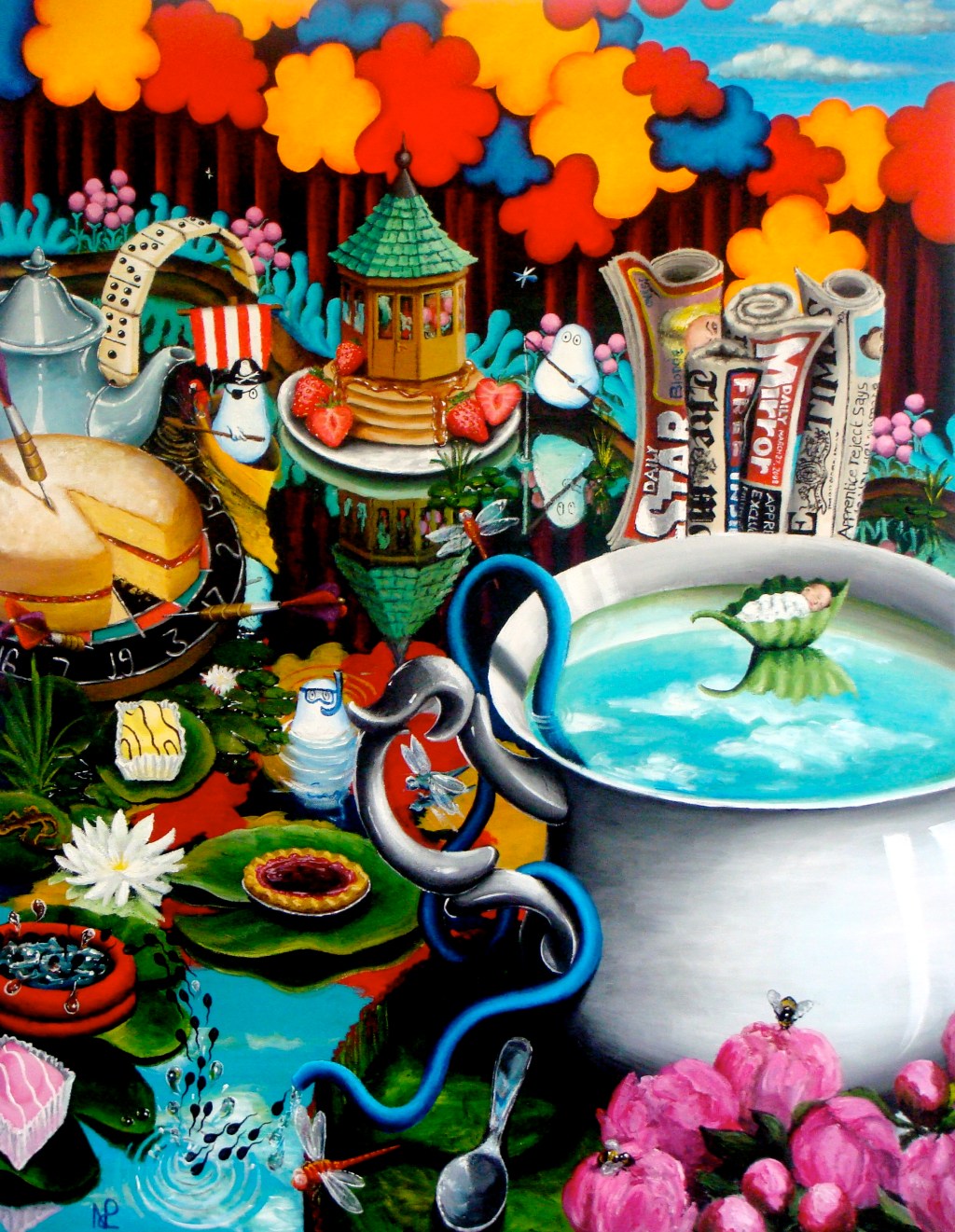
Metamorphosis: Pond Life in the Afternoon (2008, acrylic on canvas) © Nicholas de Lacy-Brown

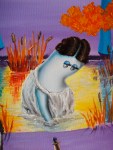
At the top of the canvas, naively painted colourful trees are planted amidst simple plants, recollecting paintings such as Orange Square painted in 2002. Next come the Norms, who dominated my work in 2005 and who here are shown enjoying a summer afternoon in a pond. Around them, game symbols of dominoes and a dart board reference my 2005/6 paintings – the Joie de Vivre collection, Tragic Conflict: Sophocles’ Antigone and La Foret des Jeux, in which game symbols dominated. As we travel downwards through the canvas, the work becomes more precise, from simple trees above to more delicately painted peonies and cakes.

In the meantime there are two representations of my life at the time of painting the work – the birth of my nephew, as shown floating around in a large cup of tea, and a group of tabloid newspapers featuring stories about me – I had at this time just appeared in the popular TV show, The Apprentice. 

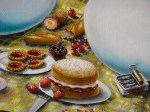
The over all setting is English garden life on a summer’s afternoon – playful games in water, and afternoon tea complete with Victoria Sponge, pancakes, strawberries, jam tarts and fondant fancies. The title “Pond Life” also refers to the tabloid press however – since pond life in English slang, also means “scum”. And that represented my feelings for the press at the time. Meanwhile “metamorphosis” refers not only to my artistic changes, but also to the changes and growth within nature, hence the tadpoles and bees, representing fertility and rebirth in this garden of delights.

It is ironic perhaps that only days after this painting was completed, I was involved in a life-altering accident which changed my artistic style forever.

Metamorphosis: Pond life in the afternoon (detail) (2008 © Nicholas de Lacy-Brown)

I leave you now to enjoy a hopefully sunny Sunday. See you next week.

© Nicholas de Lacy-Brown and The Daily Norm, 2005-2012. Unauthorized use and/or duplication of the material, whether written work or artwork, included within The Daily Norm without express and written permission from The Daily Norm’s author and/or owner is strictly prohibited. Excerpts and links may be used, provided that full and clear credit is given to Nicholas de Lacy-Brown and The Daily Norm with appropriate and specific direction to the original content.

The Daily Sketch: Norm gets attacked by a serious case of Kusama Polka dots

Is it just me, or is this Norm, and his lounge, and the view through his window, and all of his possessions covered with spots? Norm is thinking the same, hence the general look of concern on his face as he falls victim to a hideous case of the dreaded Kusama Polka dot disease. It spreads fast and wild, and is super contagious, or it was at least in the mind of Japanese artist Yayoi Kusama, whose work is currently the subject of a solo retrospective at Tate Modern (as reviewed in my post, yesterday). Relentless were the dots which covered Kusama’s world, and persistent too are the little spotty blighters as they invade the home of Norm. I’d seek to comfort him with the promise of an antidote for this contagion. The problem is, Kusama’s work doesn’t show any signs of becoming spot free, ergo Norm may need to get used to his new look. At least the new Kusama Louis Vuitton collection will fit in well…

A serious case of Kusama Polka-dots (2012, © Nicholas de Lacy-Brown, pen on paper)

© Nicholas de Lacy-Brown and The Daily Norm, 2005-2012. Unauthorized use and/or duplication of the material, whether written work or artwork, included within The Daily Norm without express and written permission from The Daily Norm’s author and/or owner is strictly prohibited. Excerpts and links may be used, provided that full and clear credit is given to Nicholas de Lacy-Brown and The Daily Norm with appropriate and specific direction to the original content.

Norms do… Amsterdam’s Red Light District

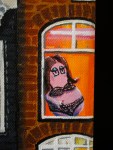
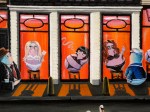
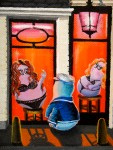
Before I had even booked my trip to Amsterdam, I couldn’t help but plan a Norm representation of what must be Amsterdam’s most renowned attraction: its red light district. Some people see Norms as being child-friendly. This painting may persuade them otherwise. Here Norms are dressed in sex head to…err…round base, with lacey bras, thongs and other revealing lingerie. On their hands, acrylic nails to tap against the glass windows help them to attract the attention of their shy customers, while heavy makeup and perfectly coiffed hair complete a carefully manicured look. As for the customers, they come from all walks of life. Here is a business man, skulking away from work, hoping for a “quickie” before he goes home to his affluent home, his wife and children. There too is a sailor, desperate after weeks away at sea for a lady’s touch. And finally we have the Norm chav, covered in tattoos and a dirty vest – he can’t afford these classy scarlet women of the night, but he can stare, and wish.

Norms in Amsterdam's Red Light District (2012 © Nicholas de Lacy-Brown, acrylic on canvas)

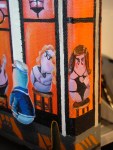
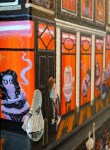
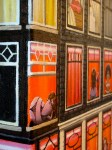
The canvas is a box canvas, so I have painted around the sides to feature more buildings, and a few more of those lovely ladies. You can see the sides, and some detailed shots of the canvas below. Enjoy!


© Nicholas de Lacy-Brown and The Daily Norm, 2005-2012. Unauthorized use and/or duplication of the material, whether written work or artwork, included within The Daily Norm without express and written permission from The Daily Norm’s author and/or owner is strictly prohibited. Excerpts and links may be used, provided that full and clear credit is given to Nicholas de Lacy-Brown and The Daily Norm with appropriate and specific direction to the original content.

Le Déjeuner sur l’herbe Part II – A Norm Re-imagining

Yesterday I explored how Manet’s enigmatic masterpiece, Le Déjeuner sur l’herbe, innovated an entirely new artistic mindset, setting a path towards impressionism, expressionism and beyond. In recognition of its important place in the history of art, countless artists have drawn inspiration from the work, and now I can add myself to the list. In today’s Daily Norm, I exclusively reveal to you my re imagining of Le Déjeuner sur l’herbe…Norm style.

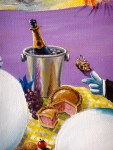
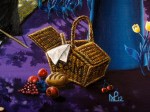
At 40″ x 30″ it’s a large canvas and one that has taken me a lot of work since I begun painting shortly after Christmas. The detail of the picnic, the hampers and the clothes certainly took some doing, not least because I chose to work in oils, with multiple layers which needed to dry before adding the next. Nonetheless, the work was a joy to paint, because Manet’s original provided a template, but not a precise blueprint which meant that I could really explore my own imagination when interpreting the original.

Le Déjeuner sur l'herbe (after Manet) 2012 © Nicholas de Lacy-Brown, Oil on canvas

As a result, my luncheon is on the grass, but the Norms have a picnic blanket to give them more comfort. Meanwhile the picnic itself is a more civilised affair. Manet’s basket of food is replaced by two hampers from the premium Piccadilly department store, Fortnum and Masons, while the spread of food on offer ranges from traditional pork pies and scotch eggs to a seafood platter, sardines and a cheese board, as well as a number of sweet treats. To drink, the Norms enjoy a bottle of Veuve Clicquot while in the hamper behind them, a flask of earl grey tea lies ready and waiting.

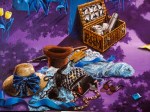
Because I made something of a feature of the picnic in the centre of the canvas, I decided to replace Manet’s spilling basket on the left of the canvas with a spilling Chanel handbag set amongst the nude female’s discarded clothing. Naturally, as well as a compact and nail varnish, the Norm’s handbag contents also include a much needed Oyster travel card, perfectly balancing the canvas with the real oysters within the seafood platter. A pair of Chanel sunglasses and a discarded bra add even more sex-chic to the scene (and yes, Norms do appear to have breasts!).

There are plenty of details in this painting, so below I include a gallery of detail shots for you to enjoy. And with this I leave you to feast your eyes upon this new Luncheon on the Grass, the latest interpretation of a painting which will continue to inspire throughout this next Millennium.

© Nicholas de Lacy-Brown and The Daily Norm, 2005-2012. Unauthorized use and/or duplication of the material, whether written work or artwork, included within The Daily Norm without express and written permission from The Daily Norm’s author and/or owner is strictly prohibited. Excerpts and links may be used, provided that full and clear credit is given to Nicholas de Lacy-Brown and The Daily Norm with appropriate and specific direction to the original content.

Sunday Supplement: La Foret des Jeux / Q4- exploring the subconscious

A sunday supplement focusing on my non-Norm paintings is well overdue I think, and for this weekend’s supplement, I have decided to go with a painting which I created in 2007/8 following something of a recurrent dream. It’s a work which is magical and jovial, surreal and fantastical, and therefore a perfect follow up to the Royal Ballet’s superb performance of The Dream which I saw last Monday.

The works featured today were painted within a short space of one another when I was exploring my subconscious. There are two “places” on which I constantly reflect in my subconscious and as an artist seeking inspiration. Both are imaginary. One is a kind of chic but dilapidated house, quite dark, with heavy damask wall coverings, low lighting, lavish furnishings and a general air of mysterious desertion about it. Out of the window is a city landscape – rooftops – almost certainly Paris, and the weather is bleak, probably autumn, dark. This place is triggered in my imagination by certain things – cool lounge music such as Hotel Costes often does the trick. Often there is no trigger at all – I just find myself transformed there in the middle of a working day. I tried to represent this place in my 2007 canvas, Q4. As with any attempt to drag the subconscious level into everyday language, the task was difficult, and while the painting comes close to creating that place to which my mind wanders, it cannot fully represent the feeling I have when I escape into the realms of my deepest imagination.

Q4 (2007 © Nicholas de Lacy-Brown, acrylic on canvas)

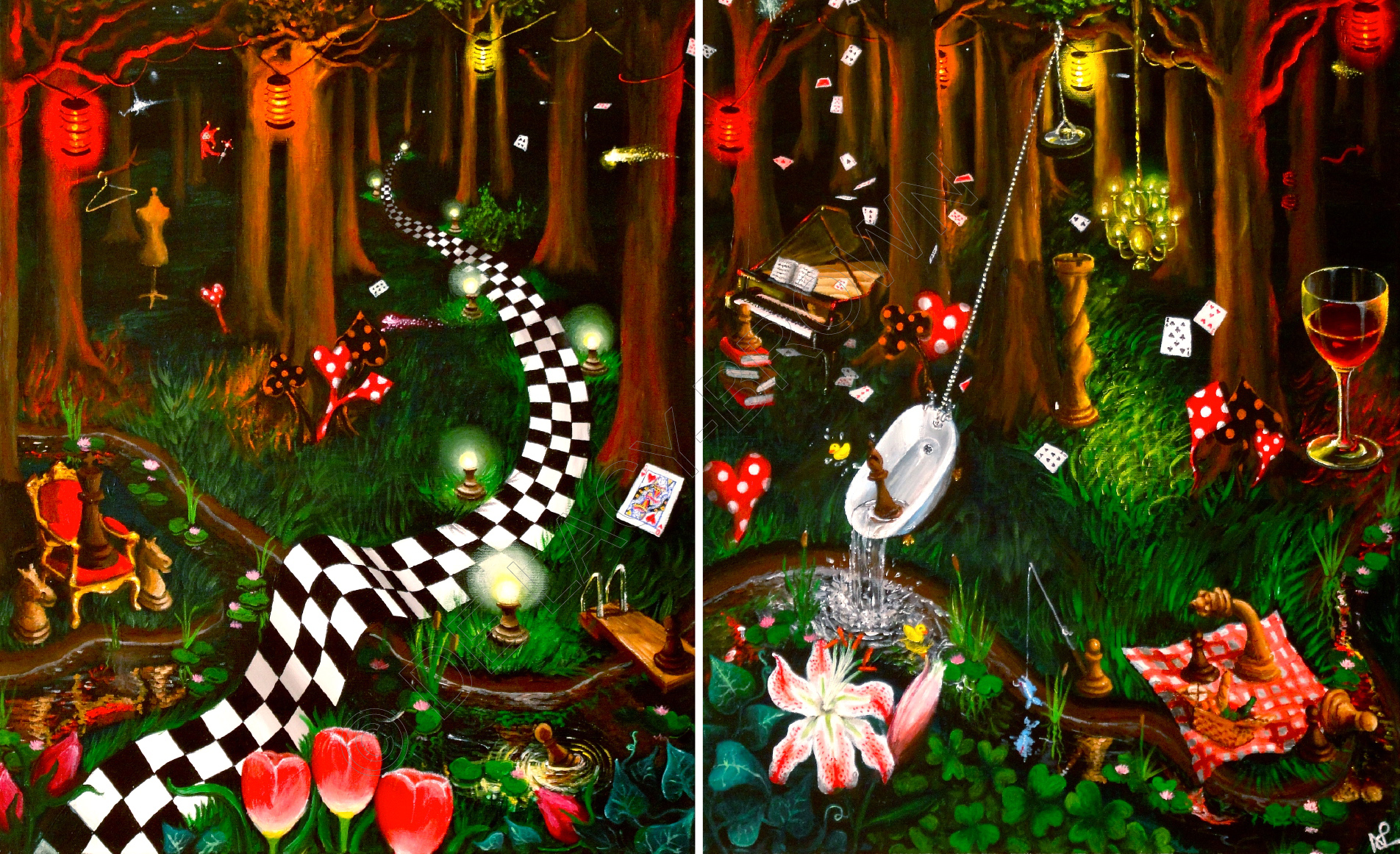
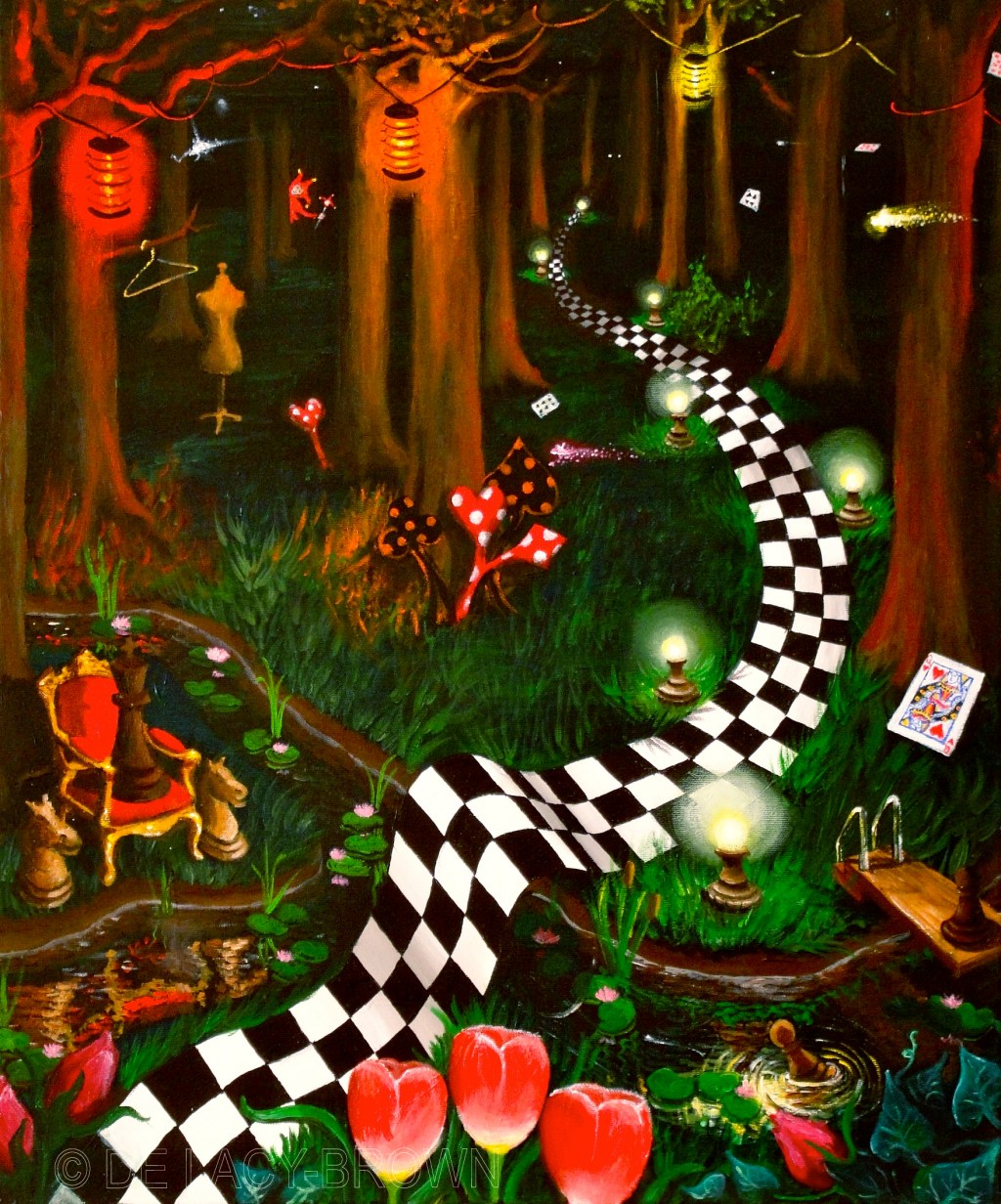
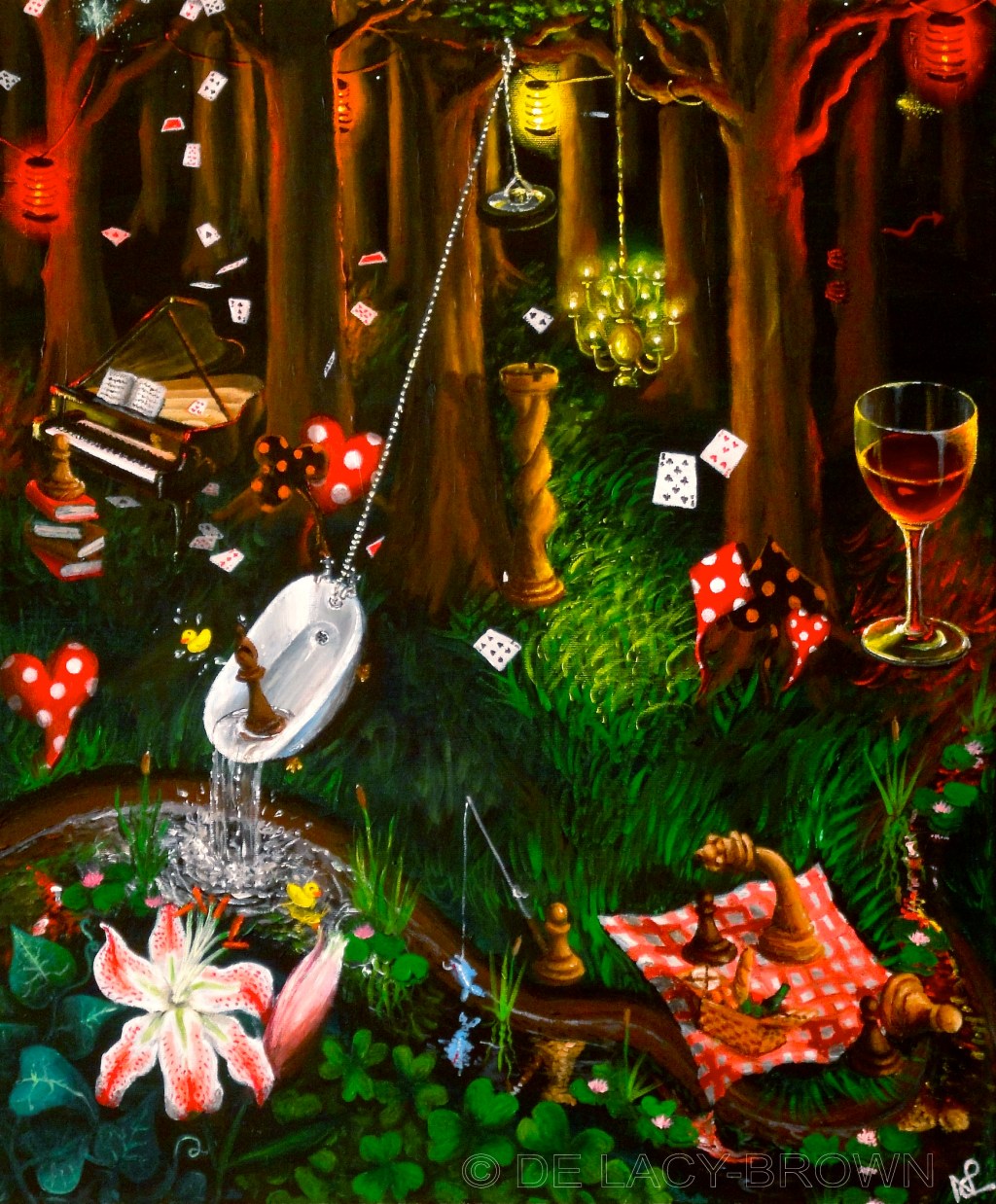
The second place I constantly return to in my subconscious is a dark forest on a summer’s night. The forest is full of surreal things, semi-hidden signs of life and a small source of water. It’s a little scary but not intimidating – the forest is hung with paper lanterns, and forest creatures provide a welcome atmosphere to me – the visitor. In seeking to paint this whimsical vision on canvas in La Foret des Jeux (the Forest of Games), I played on the surreal themes which I knew were weaved into my own imaginings. I imported the theme of games – as I had done in previous surreal paintings – and no doubt inspired by the likes of Lewis Carroll’s Alice in Wonderland. I anthropomorphised chess pieces bringing life to the scene – showing the King sitting upon a thrown, the Bishop falling from a tipped bath of water, and the Queen picnicking with her playing Pawn children. There onwards I let my imagination run wild, making for a rather surreal but playful image. It was painted at a time when my imagination was ripe for the picking – I’m not so sure I could paint something like this today.

La Foret des Jeux (2008 © Nicholas de Lacy-Brown, acrylic on canvas)

La Foret des Jeux, Canvas 1 (2008 © Nicholas de Lacy-Brown, acrylic on canvas)

La Foret des Jeux, Canvas 2 (2008 © Nicholas de Lacy-Brown, acrylic on canvas)

Wishing you a relaxed and enjoyable Sunday.

© Nicholas de Lacy-Brown and The Daily Norm, 2005-2012. Unauthorized use and/or duplication of the material, whether written work or artwork, included within The Daily Norm without express and written permission from The Daily Norm’s author and/or owner is strictly prohibited. Excerpts and links may be used, provided that full and clear credit is given to Nicholas de Lacy-Brown and The Daily Norm with appropriate and specific direction to the original content.

Sunday Supplement: The Sweet Potato Eaters

I have already referred enthusiastically, earlier in the week, to the socially insightful early masterpiece of Van Gogh – his dowdy, brown-shaded gathering of peasants, The Potato Eaters. So different from his later works, where all the melancholy and subdued tones of his earlier Dutch-based paintings seem to have been discarded, to be replaced with vivid multicoloured rainbow spectrums, flowers, landscapes and characterful people, despite the continuing melancholia escalating in his soul. Yet this painting is no less a masterpiece for its lack of colour, bandaged ears and sunflowers. True, this work would not sit so well on a chocolate box or mouse pad, but it is nevertheless a truly stunning painting to behold, and a truly genuine, authentic insight into the simple life of peasants.

Van Gogh, The Potato Eaters (1885, Van Gogh Museum, Amsterdam)

Many things strike me about the work, and I can’t wait to see the original (hopefully) when I head to Amsterdam this week. I love the strong contrast between light and shade, the concentration of light in the centre of the table, drawing the viewer into this cosy, intimate scene. I like the faces of the peasants – coarse, worn down, but somehow contented with their humble dinner. And I love the surroundings, dark, dingy, but containing small trinkets demonstrative of the familial setting of the painting. All things combined, before even seeing the original, I was inspired to undertake a parody of the work back in 2010. Taking Van Gogh’s composition, I translated the scene into one of my family. In the painting is a self-portrait (far left) along with portraits of my mother, partner, sister and nephew. Instead of potatoes, we enjoy sweet potatoes, perhaps reminiscent of the better, sweeter life that we are lucky enough to have enjoyed compared to the peasants in Van Gogh’s original.

The Sweet Potato Eaters (after Van Gogh) (oil on canvas, 2010 © Nicholas de Lacy-Brown)

In my painting, the room remains basically the same as Van Gogh’s, but I include a number of features pertaining to my family home – the retro 60s lamp which hangs in my parents dining room, the cuckoo clock which hangs in mine. On the wall is one of my paintings (Lighthouse II: Starry Night) the title of which also refers to a Van Gogh work. In the back room, my family piano features, while on the table, Van Gogh’s simple tea cups are replaced with the Arabia mugs which both my mother and I have a huge collection of – featuring illustrations of Tove Jansson’s Moomin stories. On the shelves, onions, garlic and chorizo represent our affinity, as a family, with Spain, while the shiny coffee maker represents my partner’s family living in Italy.

I took the unusual move, because of the size and scale of the project, of photographing my work as it progressed. I therefore have a series of 45 photos which show how I created the work, step by step. Hopefully this will feature (if I’ve got my technology right) as a slideshow below. I think it adds to the effect to speed up the slide show a bit by clicking on the right arrow – that way you really see the progress of the painting in fastfoward mode.

Enjoy the work, enjoy your Sunday and see you in… Amsterdam!!!

This slideshow requires JavaScript.

Sunday Supplement: Córdoba

Well it’s been quite a week. It started with snow in the UK and hurricane winds where I was in Marbella. Somewhat gleefully escaping the worst of the cold and indulging in plentiful sun drenched coffees at Cappuccino Grand Cafe, I nevertheless came home to London with something of a bump, and I don’t mean on the airplane. Rather, the bump that was troubling me was a rather large lump on my head, and with medical attention required, I had to endure not one, but two operations on said lump/ bump on the back of my head, and therefore ended the week with a sore head and a bandage obscuring half of my face. It is consequently after a couple of days “medical leave” that I return enthusiastically to the Editor’s seat of the Daily Norm to complete my early 2012 Spain Season. This is ahead of a week which promises an almost daily launch of exclusive new Norm paintings which are complete and ready to be shown to all my loyal followers. Starting with a special for Valentine’s day, a whole host of themed Norms will be making their way onto your screens for… Dutch Season! Oh the excitement!

But enough about what is forthcoming. What about today? Well, as the final instalment of my season on Spain, and following in the path of last weekend’s Sunday Supplement on Seville, I thought I would share with you what is perhaps the partner of the Seville Triptych – my work based on another  of Andalucia’s stunning cities – Córdoba . I visited Córdoba in June 2010, just two months after Seville, and as with the latter city,  was instantly inspired to paint. My inspiration, while being sourced from the generalised beauty of a historical Spanish city, was specifically engaged by two characteristic features of the city. First, I was moved by the air of decadence and decay – walls and painted plaster crumbling with such elegance that you would presume it had been perfectly choreographed in an effort to charm visitors with this offering of living history in the streets all around them. Secondly I was scandalised, utterly disgusted, by the architectural maiming of the city’s Great Mosque – otherwise known as La Mezquita – or, controversially, as La Catedral de Córdoba. But a Cathedral this is not.

Roof of La Mezquita, from which the Christian cathedral, plunged through the middle, can be seen.

The mosque, arguably the most emblematic symbol of the City with its famous row upon rows of red and white striped arches, was built at the centre of a thriving Islamic city. In 1236 it was captured by the Catholic King, Ferdinand III as part of the Catholic reconquest (“reconquista”) of the Iberian peninsula after 700 years of Islamic dominance there. Once captured, this stunning mosque was turned into a cathedral. Its minaret was rebuilt as a baroque bell tower, the open arches which encouraged people to wander in from all over the city and pray were bricked in and closed off, and most scandalously of all, the centre of the mosque was literally bulldozed to the ground as a completely jarring, architecturally conflicting baroque cathedral was plonked right in the middle of the mosque. Both the Christian and Islamic buildings are impressive in their own right, but forced together constitute, to my mind, a horribly uncomfortable, deeply shameful act of architectural vandalism. It is said that even Charles V, King of Castile at the time when the cathedral was inflicted upon the mosque, eventually regretted the move when he realised that something special and unique had been destroyed by the Christian architects.

It was these two factors – decay and the mosque which inspired my painting, and to my mind, they are closely linked. For Córdoba was a thriving Islamic city in the time of the reconquista, the capital of Al Andalus, with a huge population which included people of all faiths living in harmony together. After the reconquista, the city lost it’s status and importance, as central rule was moved to Madrid, the multi-faith population was driven out, and Córdoba was left to crumble and decay, a state which has continued to this day. Consequently in the beauty of the cracks and crumbling buildings, there are deep historical wounds, which were almost tangible, and certainly the source of melancholy in a city which is now given over mainly to tourists.

Córdoba (oil on canvas, 2010 © Nicholas de Lacy-Brown)

The reconquista is explicitly illustrated in my painting. The elephant represents the conquistadores. Like the elephant in the room, when today’s catholics name the mosque La Catedral they ignore the fact that this was, and to all intents and purposes still is, a great mosque, albeit with a Christian cathedral plunged through the middle. They ignore this senseless act of vandalism, and they assume that we will accept this as a Christian building without any appreciation of its painful historical context. As the reconquest begins, the elephant smashes the mosque to pieces, looking calm as it does so, an emblem of the conquistadores on its cloth, and a Christian altarpiece on its back. The baroque bell tower is flown in, harnessed to a Vatican helicopter, ready to be built on top of the ruins of the mosque. Meanwhile, all around, cracking walls are held tentatively together with safety pins, while the elegant street furniture of the city – lamps and ceramic street names – are interspersed with the slightly coarse application of electricity wires on the outside of the ageing walls. Finally at the foot of the painting, a swimming-pool-like gelatinous form reflects the clouds above, and is featured solely as a personal reflection of the hotel swimming pool in Córdoba which my partner and I enjoyed so much. Across it, the great roman bridge of Córdoba features, a direct pathway leading from the modern town into the old town, crossing the Guadalquivir as it still does today.

I should point out that despite its religious context, this painting does not attempt to take sides. It criticises history. It does not criticise religions in their contemporary manifestation.

Look out for my photos of Córdoba, featured tomorrow. Until then, have a great, relaxed Sunday.

© Nicholas de Lacy-Brown and The Daily Norm, 2005-2012. Unauthorized use and/or duplication of the material, whether written work or artwork, included within The Daily Norm without express and written permission from The Daily Norm’s author and/or owner is strictly prohibited. Excerpts and links may be used, provided that full and clear credit is given to Nicholas de Lacy-Brown and The Daily Norm with appropriate and specific direction to the original content.

Norms do… the Rokeby Venus

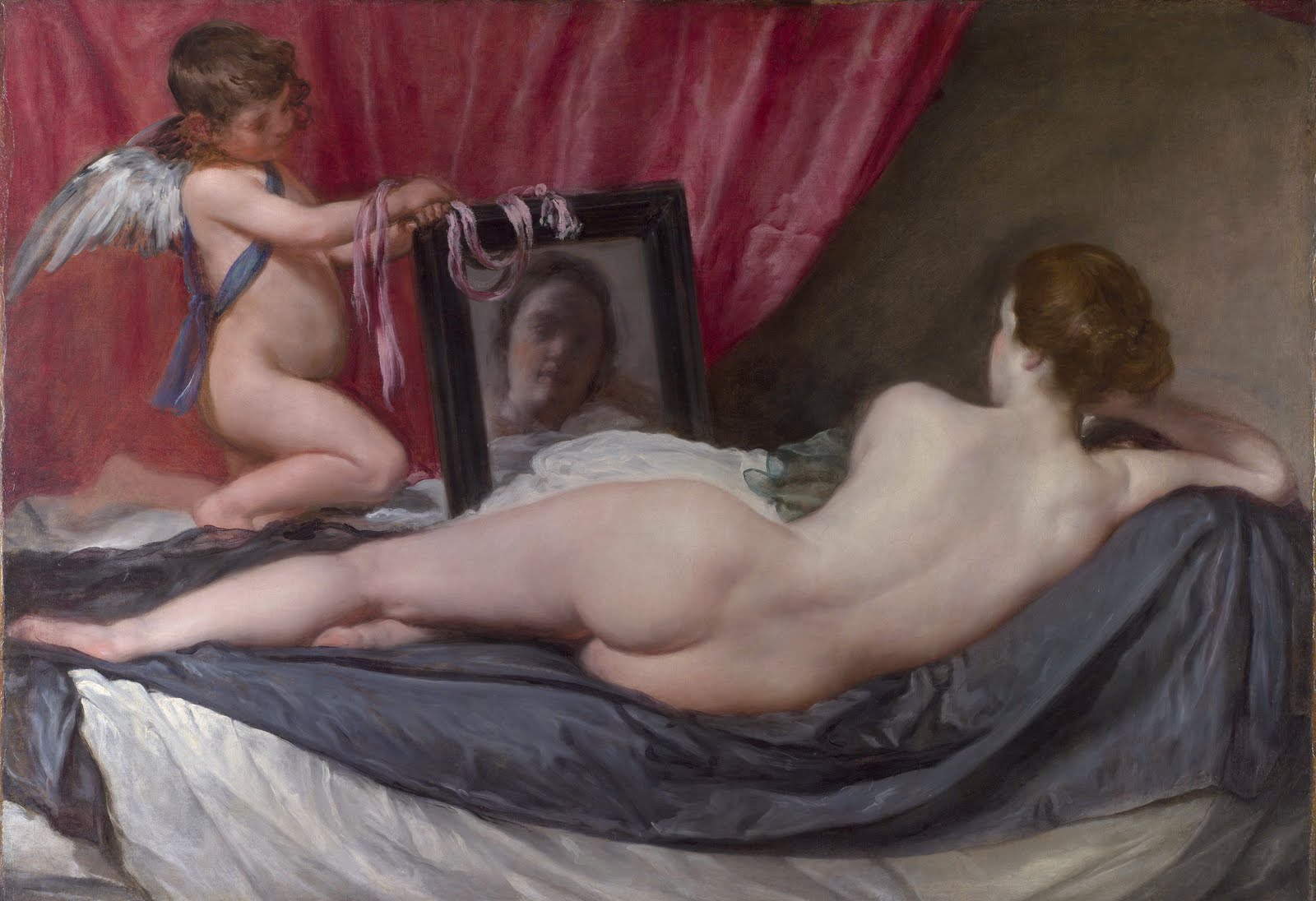
You’d excuse the Duchess of Cambridge, aka our adored Kate Middleton, for being a little miffed at the reception to her sister Pippa’s now famous backside when it meandered up the aisle of Westminster Abbey behind the blushing bride in the decade’s most watched wedding last year. Her bottom was a largely unanticipated feature of the wedding, but one which captured almost as much attention as Kate’s dress, particularly amongst the males watching the wedding (causing unanimous consternation amongst their female partners – one, it was reported, even slashed her boyfriend’s car). But should Duchess Kate wish to console herself of this great usurpation of her wedding day, she need only wander next door from the National Portrait Gallery to which she has recently become patron. There, in London’s National Gallery, she will find a backside which easily eclipses Pippa’s behind in terms of notoriety (and, frankly, beauty), a bottom which has been both ogled at and admired in equal measure for centuries, and one which has stirred such strong reactions in its audience that a King of England helped to purchase it for the nation, and prompted one crazed suffragette to slash the painting repeatedly in pursuit of her campaign for women’s rights (in prompting such violent actions then, perhaps the two bottoms are on par). It is, of course, the beautiful bottom of the Venus, painted by Spanish master Diego Velázquez, which has become known as The Rokeby Venus. 

The original Rokeby Venus by Velazquez (courtesy of The National Gallery, London)

The painting, which became known as Rokeby when it was moved to Rokeby Park in Yorkshire in the 19th century, is easily one of the prizes of The National Gallery’s collection. It not only shows a lovely naked body for audiences to admire and, possibly, to become aroused by, as well as an intimate, uninterrupted moment of self-absorbed beauty, it also offers us an innovative way of representing the archetypal duo of classical figures, Cupid and Venus, with Venus’ back to the viewer, and Cupid, without his usual bow and arrows, engaging, assisting Venus in her act of self-appreciation. Painting Venus’ back to the audience was an unusual choice, but it not only adds to the intimacy of the scene, it also allows the nude to be admired from a hitherto unseen perspective. And in order to involve the audience with his portrayal of Venus further, Velázquez uses the mirror as a device to introduce Venus’ face in the scene as well. In this way the composition is not only innovative but highly effective as a tool to seduce and captivate the viewer. As Velázquez goes, this is quite a departure from Las Meninas and his other court portraiture, and would, in fact, have been painted with a degree of secrecy in a society which was prowled by the stricture of the Spanish Inquisition. Its beauty is however equal to, if not greater than these more “official” works, and provides an intimacy and emotional intensity which would never be captured in the stiff pose of a courtier, or even the traditional classical manifestation of Venus.

Damaged sustained by the Rokeby Venus when slashed by suffragette Mary Richardson in 1914

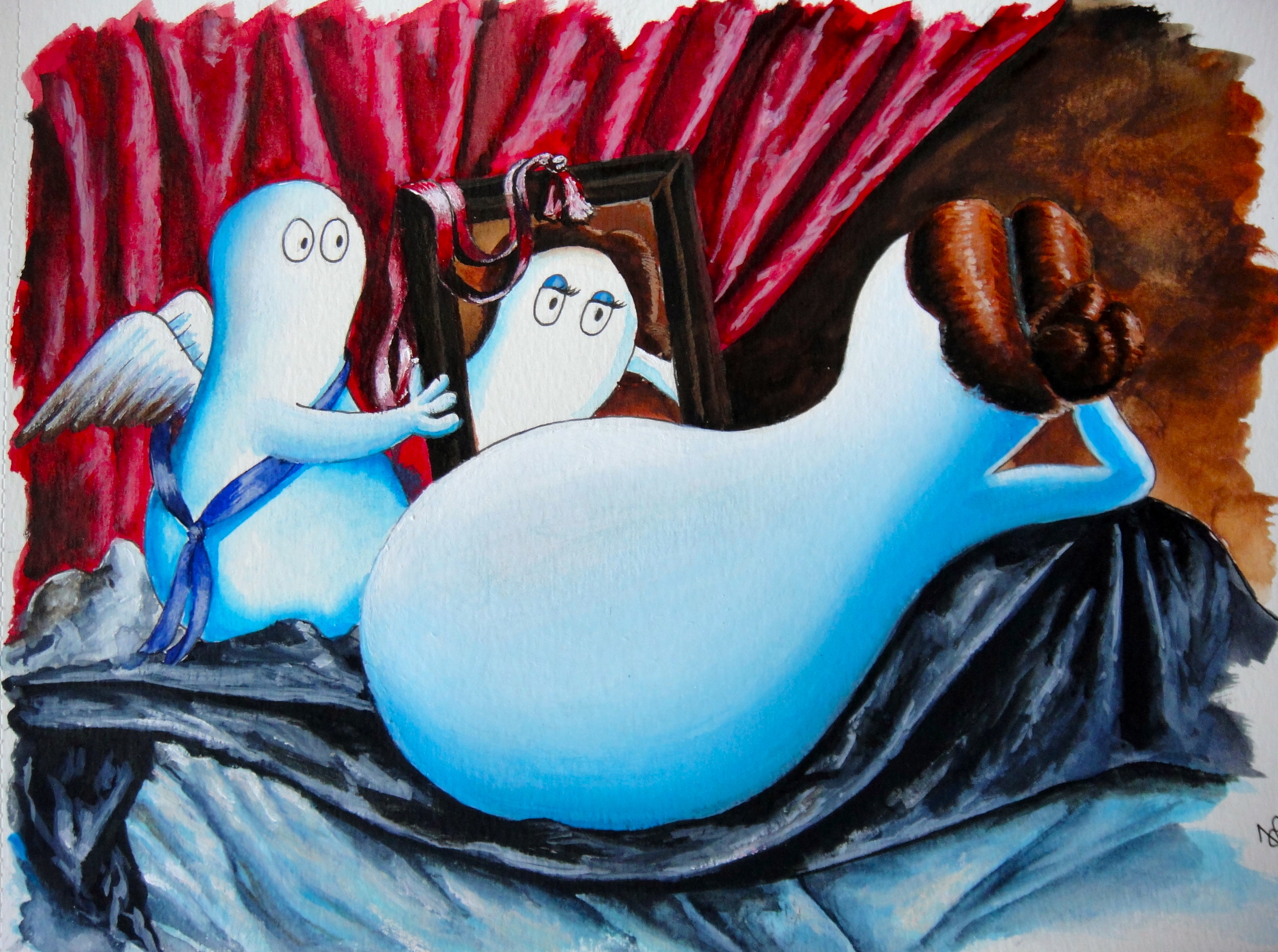
Now the Norms, being as ever, fans of high culture, particularly of a Spanish kind, have adopted the pose of the Rokeby Venus for your pleasure. In this watercolour reimagining of Velázquez’s masterpiece, the composition is pretty faithful to the original, albeit the medium of watercolour provides something of a coarser, more vivid finish than the hazy blended effect which Velázquez has achieved with oils. I also made the face of the Norm in the mirror more prominent that Velázquez’s Venus whose face is inexplicably blurred. Recent National Gallery x-rays have shown that this blurring remains unchanged from the painting’s original finish and was, therefore, always intended by Velázquez. Why he blurred the face no one can be sure, but I like to think that it conformed to the softness of the whole scene, including the gentle finish given to Cupid. In giving Venus a generalised, undefined face, Velázquez emphasises the beauty of her body and the drapery which mirrors its curves so effectively.

The Normby Venus (after Velazquez) (watercolour on paper, 2012 © Nicholas de Lacy-Brown)

Let’s hope that my Norm reimagining remains in one piece and is not slashed to pieces by a protester…

So before leaving you to (hopefully) enjoy my Norm pastiche, just a note on who else has been inspired by the Rokeby Venus. Well the list is fairly long, including Goya, Ingres, and Paul-Jacques-Aimé Baudry with his The Wave and the Pearl. But it is also possible, I think, to attribute Manet’s infamous Olympia to the dare and innovation of Velázquez’s portrayal of the nude. As Velázquez reinvents the female nude with this glance at her behind, so too did Manet reimagine the nude, painting a similarly unembellished nude who stares directly at the viewer, captivating the audience in the same way that the Rokeby Venus pulls the viewer into the intimate scene by way of her reflected stare in the mirror. Notable too is Manet’s drapery, mirroring and enhancing the curvature of his creamy-smooth nude.

Edouard Manet, Olympia (1863) courtesy of the Musée d'Orsay, Paris

Also of note is the 1970s photographic reinaction of the Rokeby Venus by Bergström as well as by contemporary photographer Sam Taylor-Wood. In the latter photograph, Soliloquy III, Taylor-Wood pushes the erotic nature of Velázquez’s work to a new level, capturing what looks like a self-portrait in the Rokeby pose above a freeze which appears to show a group of people indulging in a mass orgy in an office space.

Bergström over Paris (1976)

Soliloquy III (1998) Sam Taylor-Wood

Suddenly Pippa’s small, well-covered bottom loses much of its lustre… Until next time.

© Nicholas de Lacy-Brown and The Daily Norm, 2005-2012. Unauthorized use and/or duplication of the material, whether written work or artwork, included within The Daily Norm without express and written permission from The Daily Norm’s author and/or owner is strictly prohibited. Excerpts and links may be used, provided that full and clear credit is given to Nicholas de Lacy-Brown and The Daily Norm with appropriate and specific direction to the original content.

Norms do… Da Vinci (or Boltraffio??)

My little Norms have parodied quite a few artists and their masterpieces now. Degas’ L’Absinthe, Goya’s 3 May 1808, Velazquez’s royal portraits and Robert Doisneau’s Kiss at the Opera to name but a few. I also featured a Norm parody of Da Vinci’s great masterpiece Lady with an Ermine back in December. Well now the Norms have returned to this great classical favourite, appearing in a pastiche of that great Da Vinci work, the Madonna Litta. The only problem is, was this sumptuous Madonna and Child, usually to be found in St Petersburg’s Hermitage Museum and most recently featured in the huge sell-out spectacular Da Vinci show at London’s National Gallery, a Da Vinci painting at all?

The Madonna Litta (attributed to Leonardo Da Vinci) courtesy of the Hermitage museum, St Peteresburg

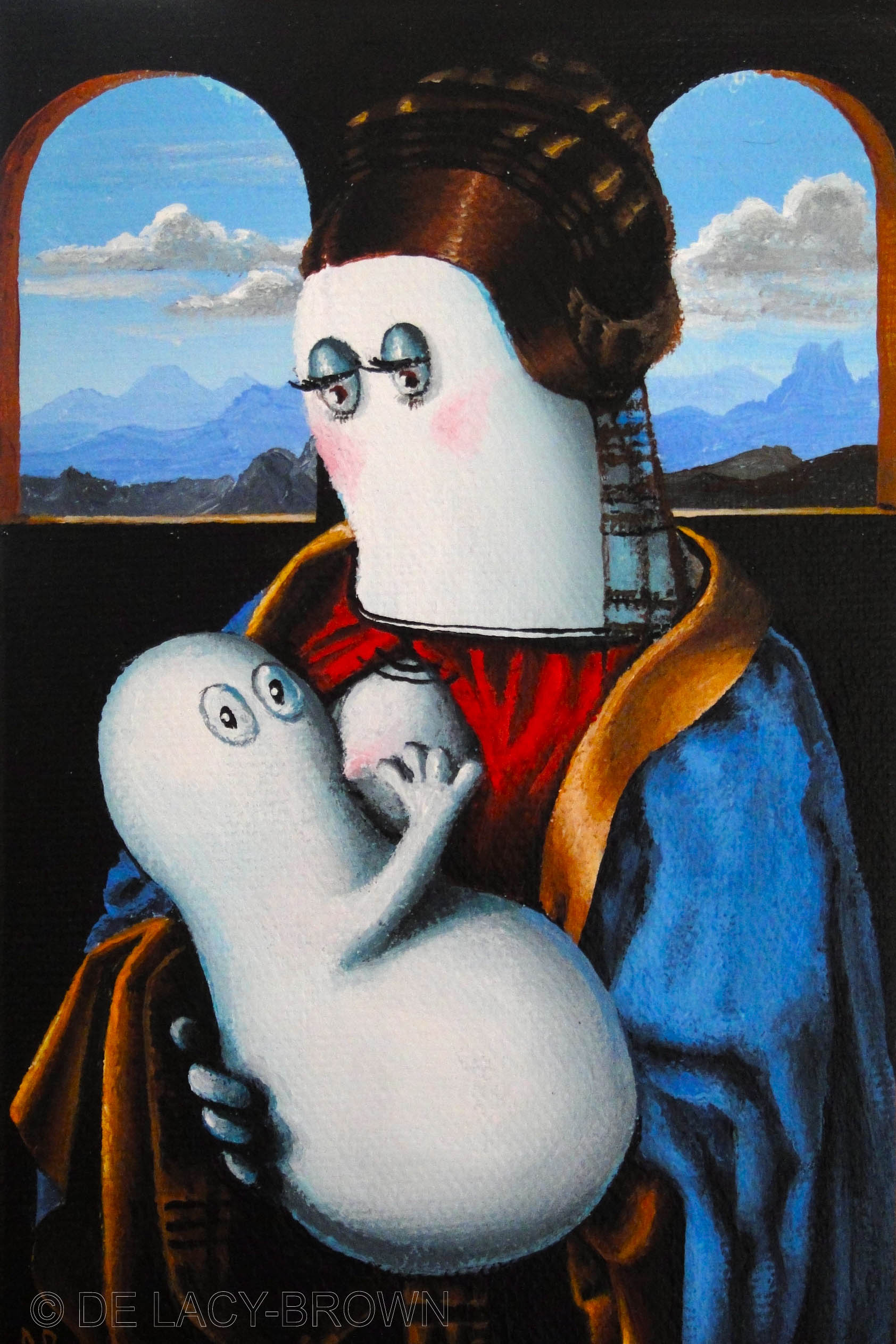
Rumour has it that the work, albeit based on ideas and primary sketches by Da Vinci, was actually completed by his pupil Giovanni Antonio Boltraffio. The Da Vinci-doubters attribute the Christ child’s apparently awkward posture to the lesser known artist, as well as a “formulaic” and “plain” landscape, and the “harsh” outlines of the characters. I’m no art history expert, and who am I to doubt these tell-tale signs. But for me the work is splendid in all its components, Da Vinci or otherwise. The landscape is fairly rudimentary, but this ensures focus is drawn to the protagonists of the tale, while providing colour balance to the piece. The sharp outlines of the characters are attributable to the dark interior background, but this is no different to the effective use of a black background in Da Vinci’s Lady with an Ermine as well as La belle Ferroniere. To my mind, the problem with the Christ child is not so much his “awkward” pose as his direct gaze towards the audience, which seems at odds with the serenity of the moment as he breastfeeds from a caring mother. All in all the painting, bursting with colour, full of familial intensity, is a superb example of the Da Vinci school whether or not painted by the great master himself.

Norm Madonna Litta (after Da Vinci) (acrylic on canvas, 2012 © Nicholas de Lacy-Brown)

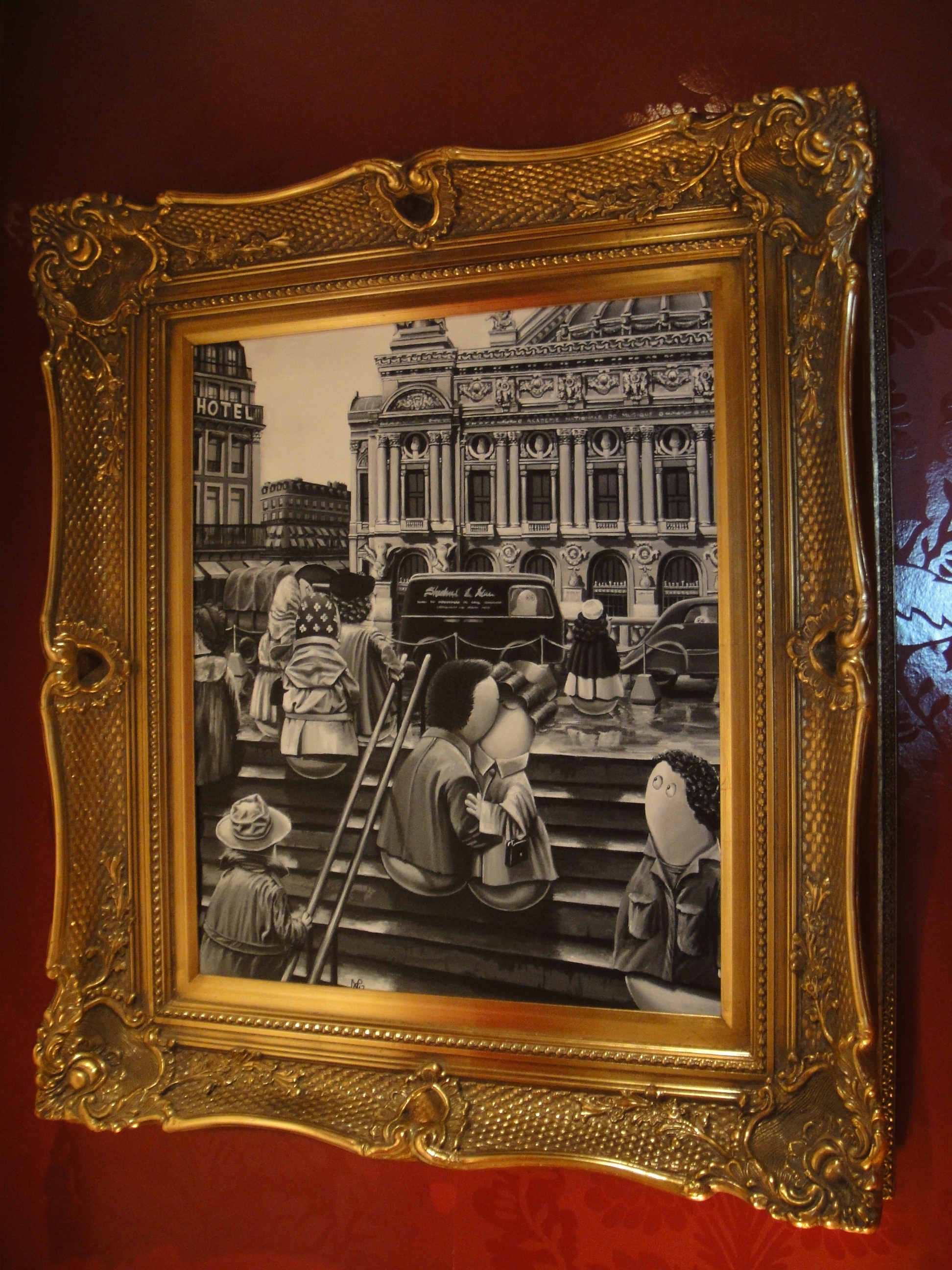
My Norm work is every bit a homage to the original Da Vinci inspiration. At 6″ x 4″, it is probably the smallest painting I have ever attempted which made the detail of the landscape and lavish fabrics difficult to paint. The reason for this size was principally to fit a very fine mock-vintage frame I found online. In fact I am completely obsessed with vintage frames at the moment, and now have a collection, filled with little Norm takes on classical paintings hanging upon dark scarlet flock wallpaper in my hallway. By far my favourite is a frame which is so grand, so utterly exuberant, that it needs to be shared on my blog. When seeking a frame for my Doisneau Norms, I wanted something as extravagant as I could find, to mark a satisfying contrast between the 1950s image and the Renaissance style framing. I love mixing up period design in this way, and in fact my flat here in London is a temple of mixed period design. The frame I eventually found fits the bill perfectly and is by far the most extravagant frame I now have in the house. Keep in mind, this is a fairly large painting – 20″ x 24″ so that gives you a sense of the overall frame size, a frame which is so utterly exquisite in its details that my partner and I have taken to staring at it for long periods of blissful admiration in the same way that the faithful may stare in awe at a beautiful baroque altarpiece. And the best bit – it was only £85 from ebay. But don’t tell anyone!

My lavishly framed Doisneau Norms

Ok, it’s officially snowing (a bit) in London so I’m off to seek warmer climes. See you there!

© Nicholas de Lacy-Brown and The Daily Norm, 2005-2012. Unauthorized use and/or duplication of the material, whether written work or artwork, included within The Daily Norm without express and written permission from The Daily Norm’s author and/or owner is strictly prohibited. Excerpts and links may be used, provided that full and clear credit is given to Nicholas de Lacy-Brown and The Daily Norm with appropriate and specific direction to the original content.
Sunday Supplement: Nordic Chills

In the first Sunday Supplement of 2012 which, for those of you who have not seen one before, features one, or a few of my non-Norm paintings, I have decided to pay homage to all things chilly. This is roundly because it has turned awfully cold here in London – ok, it’s not snowing or anything, but having had an unusually mild winter so far, we were all hoping that the spring had come early, and I think most of the budding plants all about were pretty much anticipating the same thing. So in homage to the cold, and in reminding myself that there are always colder places, I have decided to feature my paintings which were inspired by a series of visits I made to Scandinavia in 2009/2010, starting with a snowy trip to the elegant city of Stockholm, followed by an equally frosted visit to the buzzing city of Copenhagen. Upon visiting Stockholm, I was particularly struck by how watery the city is, probably more so because the water wasn’t actually frozen when I visited unlike the city’s Danish counterpart. When I took a boat trip around the archipelago, I was particularly struck by the various lighthouses which could be seen dotted all about. They looked solemn and lonely, stood steadfastly resolute in their solitude, performing their lone task of perpetual warning against sea ships and sailors whose vision is clouded with an icy fog. The result was a series of 5 paintings of lighthouses which were later exhibited along the famous Nyhavn in Copenhagen.
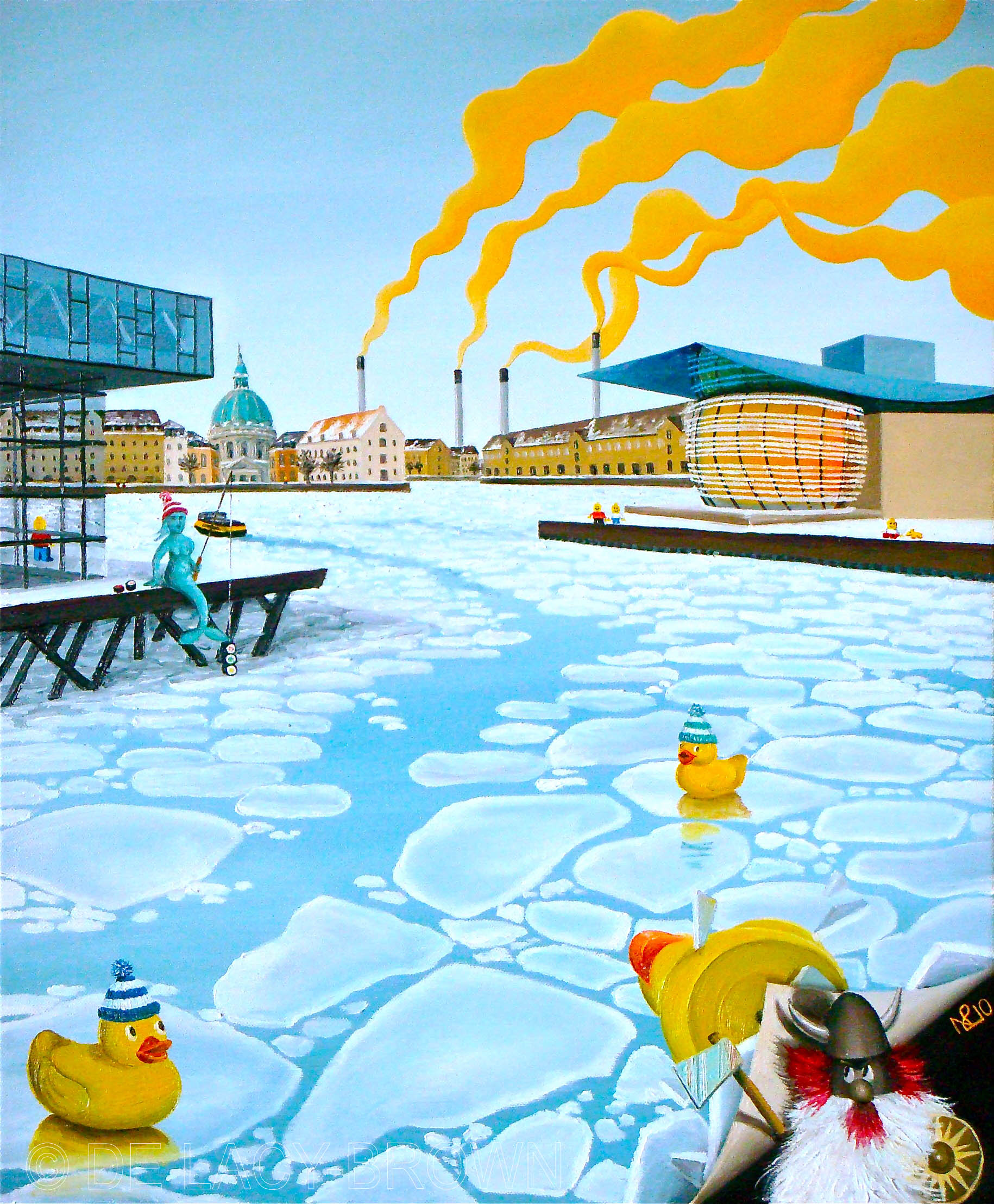
It was in fact on delivering my paintings to the Nyhavn Gallery in Copenhagen that I was inspired to paint my other Nordic work. Simply entitled Copenhagen, the work explores my fascination with the startling modern architecture, whose sharp angles and precise lines seemed to echo and suffuse with the cracking, floating ice which formed afresh each night over the city’s vast waterways. The fresh modernity of the city contrasts with Danish history represented by a furry Viking invading the scene at the foot of the painting, a wooden toy the likes of which you can buy (and I did – much to my partner’s disapproval) in souvenir shops all over Denmark. There too are signs of other Danish feats: Lego characters promenade outside the Opera House, and the city’s emblematic Little Mermaid statute, based on the story of that famous Dane, Hans Christian Andersen, who in my painting sits of the quayside, fishing fresh sushi, the likes of which I had enjoyed for the first time while in Copenhagen. The sushi, to this extent, also represents the city’s cosmopolitan feel, while the plumes of smoke flowing from the very prominent chimneys are testament to Denmark’s industrial prowess, while representing something of a conflict with their very “green” contemporary attitude.

Copenhagen (oil on canvas, 2010 © Nicholas de Lacy-Brown)

Wrap up warm, until next time…

© Nicholas de Lacy-Brown and The Daily Norm, 2005-2012. Unauthorized use and/or duplication of the material, whether written work or artwork, included within The Daily Norm without express and written permission from The Daily Norm’s author and/or owner is strictly prohibited. Excerpts and links may be used, provided that full and clear credit is given to Nicholas de Lacy-Brown and The Daily Norm with appropriate and specific direction to the original content.