Skip to content

Archive for

Paths of Glory

As millions gather across the globe today around war memorials and in reflective places holding poppies in remembrance of the horrors and losses of the First World War which began 100 years ago, I have chosen to reflect in the way I know best: through art.

Few bodies of paintings have ever captured with such visceral power and unhindered emotion the horror of war as artwork capturing the Great War. In the past, we have been used to heavily state controlled glory paintings depicting wars as valiant great history paintings full of patriotism and honour; glinting uniforms and massed weaponry; flags flapping in the wind besides stormy seas and atop galloping horses. But depictions of the First World War were always startlingly different. Instead, the emphasis was on the stories of the individuals fighting in the fields; those who had come from small villages and towns across the world without military training to face a monster of conflict never seen on the earth before. The paintings focus on the futility and the waste; the continuous struggle to a pointless end. They show landscapes ravaged and lives likewise; a world torn apart; lives treated as mere playthings.

The reason for the difference is almost certainly down to timing. WW1 came along at a time of great movement in the history of art. The impressionists had been replaced by emotionally vivid expressionism, wildly colourful fauvism, and starkly mechanical vortism. So when the greatest conflict ever known to man came along, it can be no surprise that the artists either commissioned, or inspired to reflect it on canvas or paper did so with an intensely felt emotional reaction which is as roar today as it was 100 years ago.
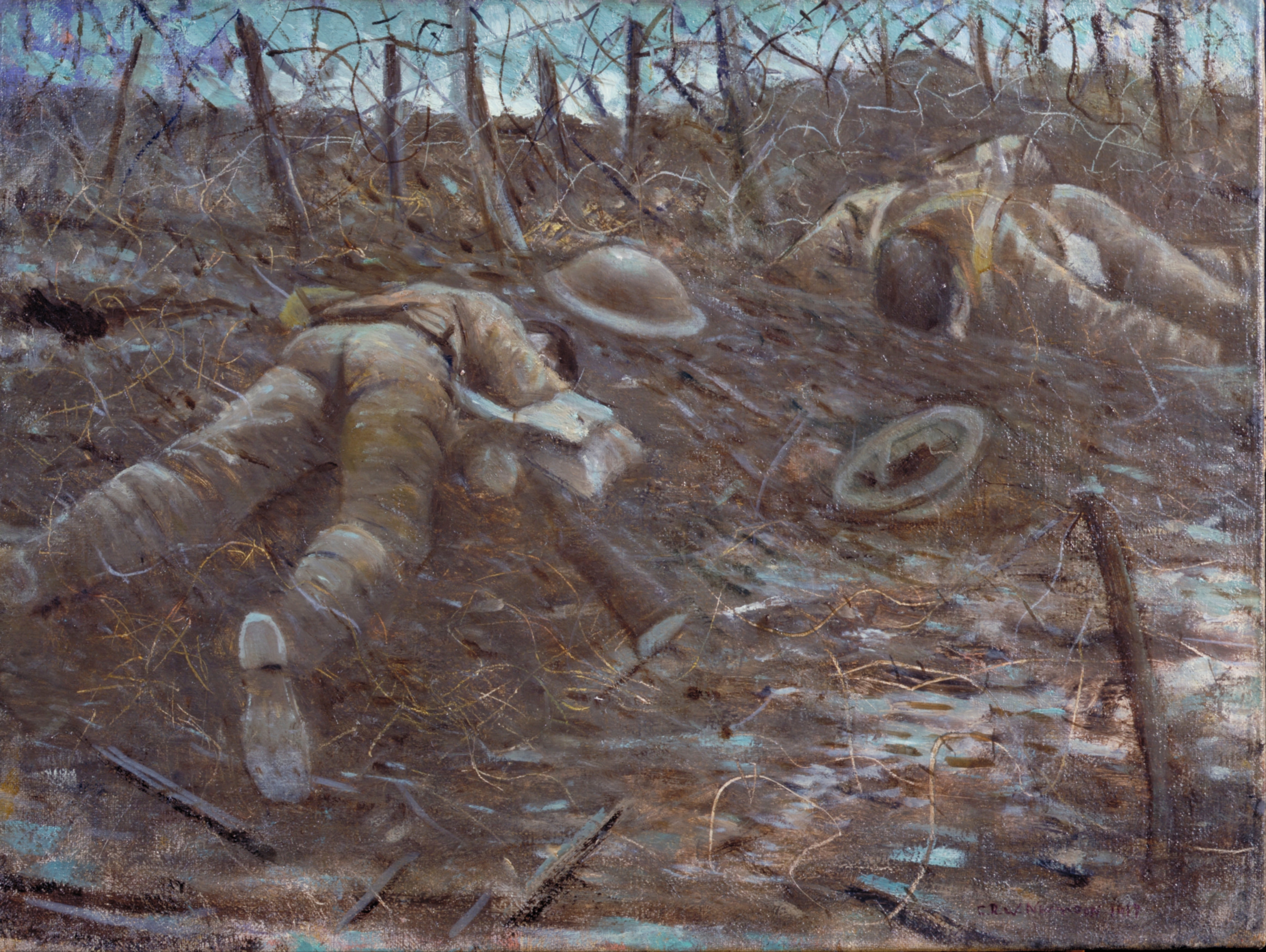
Christopher Nevinson, Paths of Glory (1917) Oil on canvas (Imperial War Museum, London)

Christopher Nevinson, Paths of Glory (1917) Oil on canvas (Imperial War Museum, London)

Chief amongst them is Paths of Glory by British artist Christopher Nevinson, which for me is the most perfect artistic manifestation of the pointlessness of war. Against a conflict-ravaged landscape devoid of anything but barbed wire and the detritus of war, the bodies of two British soldiers lay face down in the mud, deprived of a proper burial, of the mourning of their families, of any honour. This is a painting depicting life as a mere instrument of war – pawns in a wider political game, laid to waste on fields of human detriment.

There can be no denying the power of the painting. And that power was equally startling at the time of its creation, so much so that it was censored by the British Government who thought it may hinder the war effort, and exhibited in 1918 with censored labels affixed across the dead bodies. Thank goodness that at that time, the Imperial War Museum saw the great value of the painting and incorporated it into their startling collection of war art. For as years go by, and not a single survivor remains alive to remember it, the horrors of war will only ever be truly visible to our generation through art such as this.

Rembrandt’s Late Works: Better seen, and never forgotten

While the works of Rembrandt, Dutch master and one of the most applauded artists in the history of art, are instantly recognisable for their energetic brush strokes, moody lighting, undeniable intensity and rich umber colour palate, there is nothing like seeing his paintings in reality to truly appreciate the virtuosity of his work.

The National Gallery London’s new blockbuster on Rembrandt, The Late Works, provides just the opportunity to do that. In the dark bowels of the Sainsbury Wing of galleries, in rooms purpose-designed with dark walls and sharp focused lighting perfectly offsetting the brilliance of Rembrandt’s mastery over light, one enters the exhibition to come face to face with not one, but a whole room of Rembrandt self-portraits. Each demonstrates a startling honesty in self-examination, as the artist becomes visibly older and more saggy. But in as much as this room shows that a Rembrandt self-portrait is far from a rareity  (he made some 80 painted, drawn or etched self portraits in the course of his career), it immediately demonstrated that there is nothing like seeing these famous works in reality: for only then can you appreciate the brilliant layering of the paint, and the masterful use of brushwork to build an aging texture of skin which appears so realistic as it catches the light against a dark mocha background, that it almost feels as though Rembrandt has cast himself in three dimensions, ready to climb out of the frame when the many visitors to the exhibition have gone home.

Self-Portrait (1669)

Self-Portrait (1669)

Self-Portrait (1669)

Self-Portrait (1669)

Self Portrait with Two Circles (1665-9)

Self Portrait with Two Circles (1665-9)

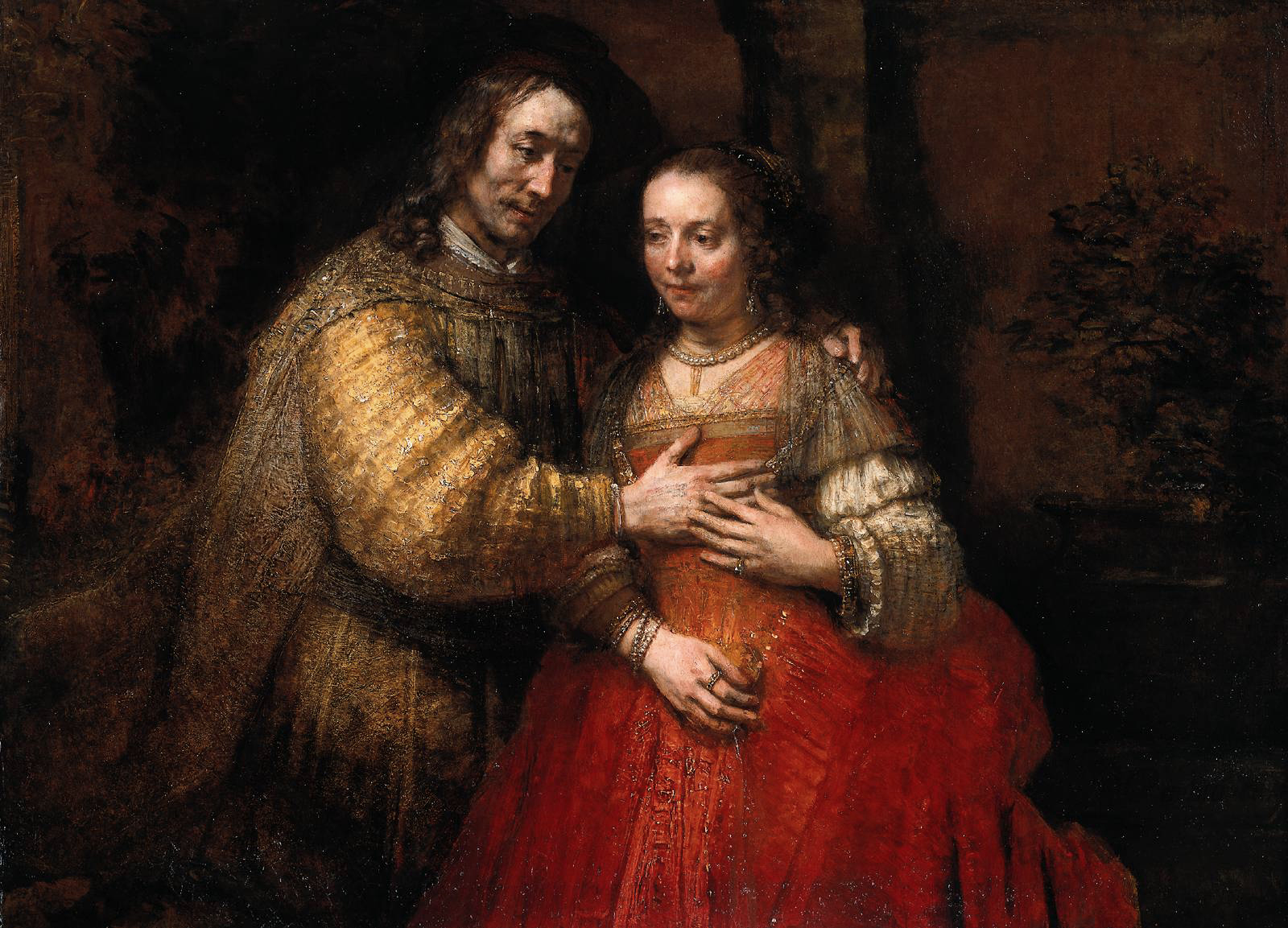
Such was the main impression that this excellent new exhibition left on me as I departed. I felt thrilled to have had the opportunity to see so many brilliant works executed at the tail end of Rembrandt’s career, when his personal fortunes were in decline, but when the product of his paintbrush was more fantastic than ever. But so too was I struck by the breadth and significance of the collection on show, testament no doubt to the National Gallery’s partnership in organising the exhibition with the Rijksmuseum in Amsterdam, who either own or have access to much of the works on show. The result is the chance to come face to face with famous works such as the Jewish Bride – a subtly romantic painting which held Van Gogh so spellbound that he declared he would give up 10 years of his life for a few moments before the painting – and the masterful group portrait, The Syndics, a superb work on a huge scale, surely surpassable only by The Night Watchmen, perhaps Rembrandt’s most famous work.

The Syndics (1662)

The Syndics (1662)

The Jewish Bride (1665)

The Jewish Bride (1665)

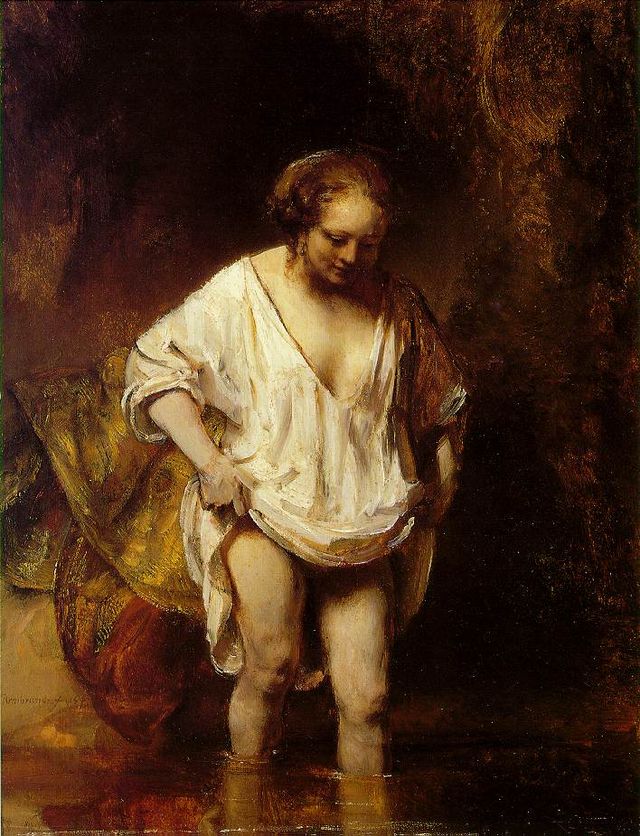
A Woman Bathing in a Stream (1654)

A Woman Bathing in a Stream (1654)

The Consipiracy of the Batavians under Claudius Civilis (1661)

The Consipiracy of the Batavians under Claudius Civilis (1661)

The other thing that struck me was how bloody popular this exhibition is. Even when you have a timed ticket, you need to queue. Admittedly I went along at the weekend, but that does not mean to say that this show will be any quieter during the week, such is the appetite no doubt for a sensational London art show after a year consisting largely of flops and unknowns (I do not include Tate Modern’s brilliant Matisse or Malevich shows in this otherwise scathing review). What this then means is something of a struggle throughout the show, something which is felt less when gazing upon huge works such as the rather questionable Conspiracy of the Batavians under Claudius Civilis, a portion of Rembrandt’s less than successful painting for Amsterdam’s new Town Hall. It is however annoying when trying to study the stunning intricacies of Rembrandt’s print works. I never knew that he was such a skilled printmaker, and his drypoint etchings were, in particular, worth elbowing the odd visitor out of the way.

The Three Crosses (1653)

The Three Crosses (1653)

Christ Presented to the People (1655)

Christ Presented to the People (1655)

Christ Presented to the People

Christ Presented to the People

Christ Preaching (1652)

Christ Preaching (1652)

But what these crowds all go to show is how superb this show is – a final hurrah for 2014, and the first great show to come out of The National Gallery, in my view, since the Da Vinci sensation in 2011/2012. Whether it be the intense forlorn gaze of Lucretia at the point of her honour suicide, the sensationally melancholic Man in Armour thought to be Alexander the Great, or the knowledgeable calm grace of Margaretha de Geer depicted wearing her ginormous lace ruff, there are masterpieces aplenty to keep you hooked to this show, and resilient to the many crowds around you.

Rembrandt_lucretia

Portrait of Margaretha de Geer (1661)

Portrait of Margaretha de Geer (1661)

A Man in Armour (Alexander the Great?) 1655

A Man in Armour (Alexander the Great?) 1655

Rembrandt, the Late Works is on at  the National Gallery until 18th January 2015.

Two Weekends: Thinking about Cappuccino

It only takes a mere moment for your life to change forever. December 2012 taught me that much – a life obliterated – or May 2008 – when another’s mistake had irreversible consequences for the rest of my days. Yet if those moments of change taught me anything, it was that life is too short to stay where you are comfortable but unhappy, where monotony sets in and where you feel as though your train is trundling steadily up the wrong path. 

Earlier this autumn the chance to change paths and find happiness in change occurred to me very suddenly. It only took an email to set the new track in motion, and only two weekends for a decision to be made. For it was in those two weekends that I both attended an interview that would take me on a new path, and in which I made the ultimate decision, standing at the crossroads, that this new path was right for me. 

Two weekends: Thinking of Cappuccino is my newest oil painting, and it tells the story of how my life is all about to change: how I have accepted the offer to become Artistic Director of a global company bearing the name of Cappuccino and stationed within the sunny shores of Mallorca in Spain, and how in taking that offer it will mean moving from London, to Palma. 

Two Weekends: Thinking about Cappuccino (2014 © Nicholas de Lacy-Brown, oil on canvas)

Two Weekends: Thinking about Cappuccino (2014 © Nicholas de Lacy-Brown, oil on canvas)

But the painting came to me in Italy, sitting by the seaside in Donoratico in Tuscany, home of my partner’s family. Sitting at a cafe by a sea so still it might have been a photo, with our own breakfast of cappuccino and crostata (jam tart) on the table, all we could think about was a move to Mallorca, despite breathing the pine tree perfumed air of Tuscany, and drinking in the beauty of that Tuscan beach before us. 

The obvious symbols came to mind: the lifeguard’s hut was the new sanctuary that a home within the medieval streets of Palma de Mallorca would offer us; through the window we looked onto the famous skyline of Palma seen behind the green shutters that are famous in both Tuscany and Mallorca. The lifeguard’s ring has given salvation to the artist within me, represented by the manakin sitting on the sand: it is not so comfortable a position as the crostata tart sitting securely on a blanket, but this tart is the law, and within the confines of its pastry lattice, the blood of my life and career development is congealed and imprisoned, like a soul left out of the fridge too long. 

And of course at the heart of it all is the Cappuccino. No longer just froth and espresso

I think it was in that moment, and in that second weekend of two, that we finally made up our minds to go, to take the leap of faith, to have an adventure and to change our lives. Now the move is in full swing, and by the end of this month we should be reinstalled in Mallorca. Which just goes to show that life can change in a moment. 

© Nicholas de Lacy-Brown and The Daily Norm, 2001-2014. Unauthorized use and/or duplication of the material, whether written work, photography or artwork, included within The Daily Norm without express and written permission from The Daily Norm’s author and/or owner is strictly prohibited. Excerpts and links may be used, provided that full and clear credit is given to Nicholas de Lacy-Brown and The Daily Norm with appropriate and specific direction to the original content. For more information on the work of Nicholas de Lacy-Brown, head to his art website at www.delacy-brown.com