Skip to content

Posts from the ‘Norms do…’ Category

Norms do… Degas’ L’Absinthe

I’ve always been a bit obsessed with the la fée verte . That is to say, I’ve always been fascinated by the debauched charm of that wonderful peppermint green drink which was and still is (in its full potent form) an illegal alcoholic substance: Absinthe. For absinthe has long been the chaperone of artistic legend, as all the most romantic illusions of the impoverished, desperate, inebriated artist are indubitably accompanied by a bottle of the green stuff, or a glass of its milky diluted counterpart. Baz Luhrmann’s Moulin Rouge, the green faced cancan dancers of Toulouse Lautrec’s underworld masterpieces, and the dissolute tale of a spiral into poverty and lascivious living on the hillsides of Montmartre in Zola’s L’Assomoir all centre around the mirky hallucinogenic potency of this green-eyed alcoholic monster. It is the very essence of bohemian artistic Paris, and it’s association has pervaded art and its cultural progeniture for decades. One of the most prominent sources of the liquor’s legendary quality is the sensational painting L’Absinthe by Edgar Degas. I first saw the painting in London, when it was exhibited at Tate Britain’s superb exhibition Degas, Sickert and Toulouse Lautrec in 2005-6. I was instantly struck by the simple solitude of the female figure, caught in a moment of absentmindedness and melancholia, appearing quite isolated despite the figure sat to her left, he looking away in his own depressive daydream. I’ve remembered the painting ever since and therefore I was so excited to make its acquaintance once again upon visiting the Musée d’Orsay the other week that I decided I had to turn it into a Norm painting. And so, when the Norms do Degas, it looks something like this…

L'Absinthe Norm (after Degas) (Acrylic on canvas, 2011 © Nicholas de Lacy-Brown)

Degas’ original painting, on the other hand, looks like this…

L'Absinthe (Edgar Degas, 1876)

Read more

Paris v London: What ever happened to British Café Culture?

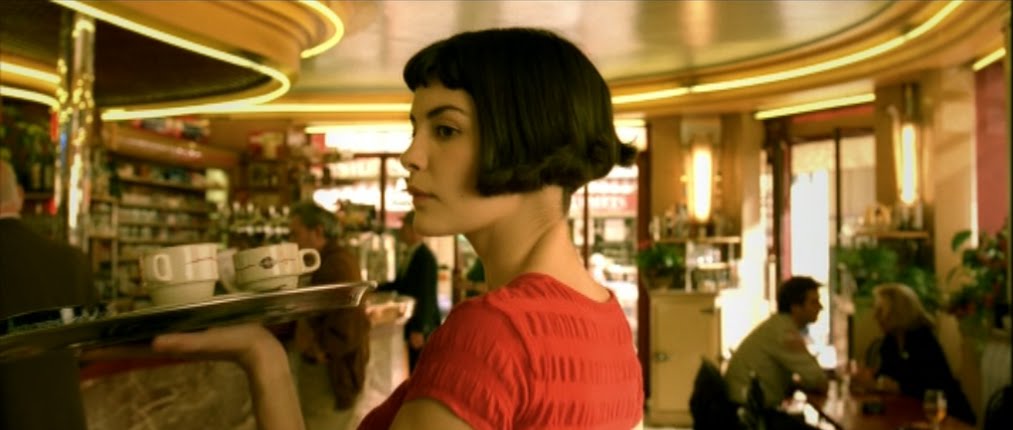
I was reading the post of one of my favourite Paris-based bloggers, Becoming Madame, the other day which described a truly resonant and idyllic scene which she witnessed when sitting inside a Parisian café. Like many of the readers who commented on the post, I was struck by how easily one can be drawn into the romanticised ideal of the Parisian café. It was the same when I was there two weeks ago: There’s something about Parisian cafes which exudes effortless elegance. Some of them are tatty, have tired looking waiters who have been doing the same job for years, browning mirrors and horrible toilets. But there’s something about them, with their hand-written blackboards, mirrored walls, wicker chairs and round tables squeezed outside, and cosy booths inside set amongst an array of old posters and photographs, that just IS romantic and offers us  the very epitome of café culture. This quintessential idyllic view of the French café was very much indulged in my favourite film of all time, Amélie, and yet, despite the cinematic interpretation, the quirky little cafe  captured in than film is wholly representative of reality.

My queuing experience in Starbucks yesterday

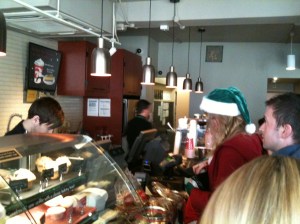
So all of this got me thinking (while stood in a massive queue in Starbucks yesterday), while the streets of Paris are literally dotted all over with cafés and brasseries on every corner, each inviting us to indulge with its cherry red awnings and cosy pavement heaters, why is it that in London, the best we can manage is a starbucks or a Cafe Nero every 100 metres? What happened to the Lyons Teahouses which were at the centre of polite society? Or the little privately run café to which everyone would flock for a gossip? In Paris you sit down and are greeted (not always immediately, warranted) by the friendly(ish) face of a smart French waiter. You order your coffee, you sit back, and you indulge in the sweet pleasure that is people watching. In London you queue for a coffee for what seems like an age. You can attempt to sit down, but most of the cafes are turned over to the takeaway trade, so seating is both limited and purposefully uncomfortable so that the turnaround is quick and no one stays too long. Because of the people rushing in and out, the doors are always open. Your experience is cold and drafty and usually, because of lack of accommodation you have to leave with coffee in a paper cup, the small hole in the lid badly designed for sipping so that generally you get half of the scalding liquid down your face before you’ve managed to sit down and enjoy it. And yet the thing is, these cafés are always full, and you get the feeling that in London there really is a growing coffee culture. So why can’t we have the relaxed café culture of Paris?

Read more

Paris Part II: The Stein Collection, Munch (and the Screaming Norm) and the unyielding stench of Camembert

My feet still cry out in protest at the mere recollection of how much we were on our feet yesterday. But what a cultural extravaganza our eyes were able to feast upon as we went from one blockbuster exhibition to another.

First stop was the Grand Palais, at which we arrived slightly giddy having indulged in a mid morning mulled wine from the festive christmas market along the Champs Élysées. The Grand Palais is always the host of superb temporary exhibitions, having held Courbet, Renoir and Monet spectaculars in the last few years. This year’s offering is Matisse, Cézanne, Picasso…The Stein Family’s Adventure in Art which explores the stalwart patronage of the well known Stein family of superstar early 20th century artists at the shaky commencement of their careers, and exhibits the vast collection of important works which they amassed as a result (see my gallery below for a preview of some of the works in the exhibition).

The exhibition was split roughly into three sections, each following the acquisitions of the three respective Stein siblings, Leo, Michael (and his wife Sarah) and Gertrude. Michael and Sarah’s almost exclusive obsession with Matisse makes for a very comprehensive show of the latter’s earlier work, when, as undisputed head of the Fauvists, his paintings command attention with their multiple bright colours and coarse brush work. Leo Stein, the more conservative collector, whose at first collected with sister Gertrude, took more to Picasso, but stopped collecting his work shortly after the blue period, finding Picasso’s progression into cubism all too much. It was Gertrude Stein who took the collection further, resolutely supporting Picasso at every twist and turn of his experimental career before his prices spiralled beyond her reach. Then her patronage embraced the likes of Juan Gris and Picaba, right up to artists working in abstract which she began to collect before her death in the 40s. Ever the pioneer, Gertrude’s collection is substantial and multifaceted and makes for a fascinating overview of the post-impressionist period when art was changing rapidly. However my favourite section was Leo Stein’s Picassos from the blue period (see the gallery below). The melancholy figures and muted colours on these canvases are loaded with a depth of emotion and sophistication of draftsmanship which is lacking in the more superficial and, dare I say it, commercial compositions in his later work. Although of Picasso’s adventures into cubism, there are some superb examples, particularly in the preparations he makes for Les Damoiselles d’Avignon. Also worth seeing are the works of Juan Gris who, taking the torch from Picasso, explores the cubism genre in his brilliantly composed geometric fragmentation of everyday life.

Read more

Norms do… Velázquez

For the final instalment of The Daily Norm’s Spanish Season, I present the second of my Norm paintings completed while in Spain… Infanta Norm! Infanta Norm is painted in the style of the Spanish Artist supremo, Diego Velázquez. Velázquez’s masterpiece, Las Meninas, is one of Spain’s most famous classical paintings, and is without a doubt the star of the show in Madrid’s Prado Gallery. The paintings is a scene depicting a day in the life of the court of King Felipe IV of Spain. As the Spanish Court’s principal artist, Velázquez painted a number of portraits of the royal family. Amongst them are various portraits of the King’s children or “Infantas”, the likes of which form the inspiration for my own “Infanta Norm”. These paintings, along with Las Meninas, have become iconic of Spain’s golden age, and the royal princesses, with their wide dresses and equally wide hair, all adorned with gleaming jewels and rich fabrics, have become staples of Spain’s tourist iconography. Hence every souvenir shop in Spain now sells reproductions of the familiar wide-dressed princesses. I in fact have a relatively less tacky red ceramic reproduction in my London lounge!

Infanta Norm (After Velázquez) (2011, acrylic on canvas) © Nicholas de Lacy-Brown

In the gallery below I enclose a few images of the collective paintings which inspired my Infanta Norm. The painting’s composition is almost entirely based upon Velázquez’s Infanta Don Margarita (1660) with its voluptuous silk curtain hangings framing the figure of the young princess. However, for her hair and some of the dress detailing, I have also taken details from two other Velázquez portraits of Princess Margarita and her sister, Maria Teresa.

Read more

Norms do… Picasso

Norm with Guitar, Pipe and Newspaper (After Picasso) (2011)

Continuing with the Spanish theme of my current blogs written from the great European peninsula itself, I have decided to focus on one Spaniard who has frequently influenced my own work as an Artist, and countless artists over the last 100 years: Pablo Picasso. The great artist, whose works boast the first, second and third place in the world records for the most expensive art works ever sold, was born very close to where I am currently staying, in Malaga. His works are sometimes divisive, but most universally admired. A few critics bemoan the childlike expression of much of his latter work, but as I have often found, it is in fact much more difficult to paint naively when, like Picasso, it is a natural instinct to paint well. What appear to be haphazard brush strokes are probably the result of many hours or even days of contemplation. The underlying balance which enables us to view a Picasso painting as a satisfied viewer may well have taken an enormous amount of preparation to achieve. In any case, Picasso is not just about eyes found where ears should be, and ears painted somewhere around the sitter’s feet. He was in fact tremendously vital to art history. He took art to new boundaries. He was a key proponent in cubism, and in abstract. He brought us a new, emotionally raw way of portraying lovers, family and other people in his life, opening the doors to the likes of Francis Bacon and his infamously savage, blurred and disfiguring portraits . Moreover, the breadth and variety of Picasso’s career provides us with a significant account of twentieth century history, not least his stunning and deeply poignant portrayal of the Spanish Civil War in Guernica, which continues to stir emotions today as perhaps the boldest declaration against war ever painted.

Read more