Skip to content

Posts from the ‘SundaySupplement’ Category

Sunday Supplement: Córdoba

Well it’s been quite a week. It started with snow in the UK and hurricane winds where I was in Marbella. Somewhat gleefully escaping the worst of the cold and indulging in plentiful sun drenched coffees at Cappuccino Grand Cafe, I nevertheless came home to London with something of a bump, and I don’t mean on the airplane. Rather, the bump that was troubling me was a rather large lump on my head, and with medical attention required, I had to endure not one, but two operations on said lump/ bump on the back of my head, and therefore ended the week with a sore head and a bandage obscuring half of my face. It is consequently after a couple of days “medical leave” that I return enthusiastically to the Editor’s seat of the Daily Norm to complete my early 2012 Spain Season. This is ahead of a week which promises an almost daily launch of exclusive new Norm paintings which are complete and ready to be shown to all my loyal followers. Starting with a special for Valentine’s day, a whole host of themed Norms will be making their way onto your screens for… Dutch Season! Oh the excitement!

But enough about what is forthcoming. What about today? Well, as the final instalment of my season on Spain, and following in the path of last weekend’s Sunday Supplement on Seville, I thought I would share with you what is perhaps the partner of the Seville Triptych – my work based on another  of Andalucia’s stunning cities – Córdoba . I visited Córdoba in June 2010, just two months after Seville, and as with the latter city,  was instantly inspired to paint. My inspiration, while being sourced from the generalised beauty of a historical Spanish city, was specifically engaged by two characteristic features of the city. First, I was moved by the air of decadence and decay – walls and painted plaster crumbling with such elegance that you would presume it had been perfectly choreographed in an effort to charm visitors with this offering of living history in the streets all around them. Secondly I was scandalised, utterly disgusted, by the architectural maiming of the city’s Great Mosque – otherwise known as La Mezquita – or, controversially, as La Catedral de Córdoba. But a Cathedral this is not.

Roof of La Mezquita, from which the Christian cathedral, plunged through the middle, can be seen.

The mosque, arguably the most emblematic symbol of the City with its famous row upon rows of red and white striped arches, was built at the centre of a thriving Islamic city. In 1236 it was captured by the Catholic King, Ferdinand III as part of the Catholic reconquest (“reconquista”) of the Iberian peninsula after 700 years of Islamic dominance there. Once captured, this stunning mosque was turned into a cathedral. Its minaret was rebuilt as a baroque bell tower, the open arches which encouraged people to wander in from all over the city and pray were bricked in and closed off, and most scandalously of all, the centre of the mosque was literally bulldozed to the ground as a completely jarring, architecturally conflicting baroque cathedral was plonked right in the middle of the mosque. Both the Christian and Islamic buildings are impressive in their own right, but forced together constitute, to my mind, a horribly uncomfortable, deeply shameful act of architectural vandalism. It is said that even Charles V, King of Castile at the time when the cathedral was inflicted upon the mosque, eventually regretted the move when he realised that something special and unique had been destroyed by the Christian architects.

It was these two factors – decay and the mosque which inspired my painting, and to my mind, they are closely linked. For Córdoba was a thriving Islamic city in the time of the reconquista, the capital of Al Andalus, with a huge population which included people of all faiths living in harmony together. After the reconquista, the city lost it’s status and importance, as central rule was moved to Madrid, the multi-faith population was driven out, and Córdoba was left to crumble and decay, a state which has continued to this day. Consequently in the beauty of the cracks and crumbling buildings, there are deep historical wounds, which were almost tangible, and certainly the source of melancholy in a city which is now given over mainly to tourists.

Córdoba (oil on canvas, 2010 © Nicholas de Lacy-Brown)

The reconquista is explicitly illustrated in my painting. The elephant represents the conquistadores. Like the elephant in the room, when today’s catholics name the mosque La Catedral they ignore the fact that this was, and to all intents and purposes still is, a great mosque, albeit with a Christian cathedral plunged through the middle. They ignore this senseless act of vandalism, and they assume that we will accept this as a Christian building without any appreciation of its painful historical context. As the reconquest begins, the elephant smashes the mosque to pieces, looking calm as it does so, an emblem of the conquistadores on its cloth, and a Christian altarpiece on its back. The baroque bell tower is flown in, harnessed to a Vatican helicopter, ready to be built on top of the ruins of the mosque. Meanwhile, all around, cracking walls are held tentatively together with safety pins, while the elegant street furniture of the city – lamps and ceramic street names – are interspersed with the slightly coarse application of electricity wires on the outside of the ageing walls. Finally at the foot of the painting, a swimming-pool-like gelatinous form reflects the clouds above, and is featured solely as a personal reflection of the hotel swimming pool in Córdoba which my partner and I enjoyed so much. Across it, the great roman bridge of Córdoba features, a direct pathway leading from the modern town into the old town, crossing the Guadalquivir as it still does today.

I should point out that despite its religious context, this painting does not attempt to take sides. It criticises history. It does not criticise religions in their contemporary manifestation.

Look out for my photos of Córdoba, featured tomorrow. Until then, have a great, relaxed Sunday.

© Nicholas de Lacy-Brown and The Daily Norm, 2005-2012. Unauthorized use and/or duplication of the material, whether written work or artwork, included within The Daily Norm without express and written permission from The Daily Norm’s author and/or owner is strictly prohibited. Excerpts and links may be used, provided that full and clear credit is given to Nicholas de Lacy-Brown and The Daily Norm with appropriate and specific direction to the original content.

Sunday Supplement: The Seville Triptych

It’s an early 2012 Spanish Season here at the Daily Norm, and what better thoughts to fill your head at this time of ferocious cold across much of the Northern Hemisphere. Here in Spain the snow hasn’t reached us, but the winds were almighty and angry. On emerging from home yesterday we found much of Marbella’s lush greenery had hit the ground. A crying shame, but such is the rapid growth of the plants out here, I’m sure many of the gaps will have filled come July.

In line with this short season of Spanish indulgence, today’s Sunday Supplement pays homage to one of Andalucía’s most famous and exquisite cities: Seville. Having travelled there in the Spring of 2010 my mind rapidly filled with numerous ideas with all the energy of a kindergarten playground. What resulted was not one, not two, but three canvases portraying the city, which, when placed together flow seamlessly into one complete panegyric to Spain’s southern gem.

Seville Triptych - Canvas I (Oil on canvas, 2010 © Nicholas de Lacy-Brown)

Prominent in the first canvas is a beautiful Spanish lady. Some asked if I had painted Amy Winehouse. Au contraire – this is the infamous Sevillian femme fatale, Carmen, immortalised in Bizet’s opera, seductive in her gaze, languidly smoking a cigarette from a packet which is decorated with the ceramic signage of the Tobacco factory where Carmen worked – a factory which today stands beautifully as ever in the centre of the city, now converted into a university. Beneath her traditional black lace mantilla which, in part, is used as a fisherman’s net, are the paraphernalia of the matador, Escamillo who, in Bizet’s operatic tale, prompted such jealousy in Carmen’s lover Don José that it led to her eventual downfall. Also in this canvas are the Moorish walls of Seville’s Real Alcazar palace, harping back to the city’s Moorish past, which is also embodied in the Torre del Oro which stands by Seville’s Guadalquivir river. Across the river, the bridge designed by Gustav Eiffel features, while from the fishing nets, floating buoys become the oranges for which Seville is renowned throughout the world. Meanwhile the flower from fragrant orange blossom adorns Carmen’s ear, while above her head, the architectural splendour of the ceramic-covered Plaza de España emerges. Finally, sat like a spider upon the ground, the elaborate gothic architecture of Seville’s great cathedral is featured in a vibrant purple.

Seville Triptych - Canvas II (Oil on canvas, 2010 © Nicholas de Lacy-Brown)

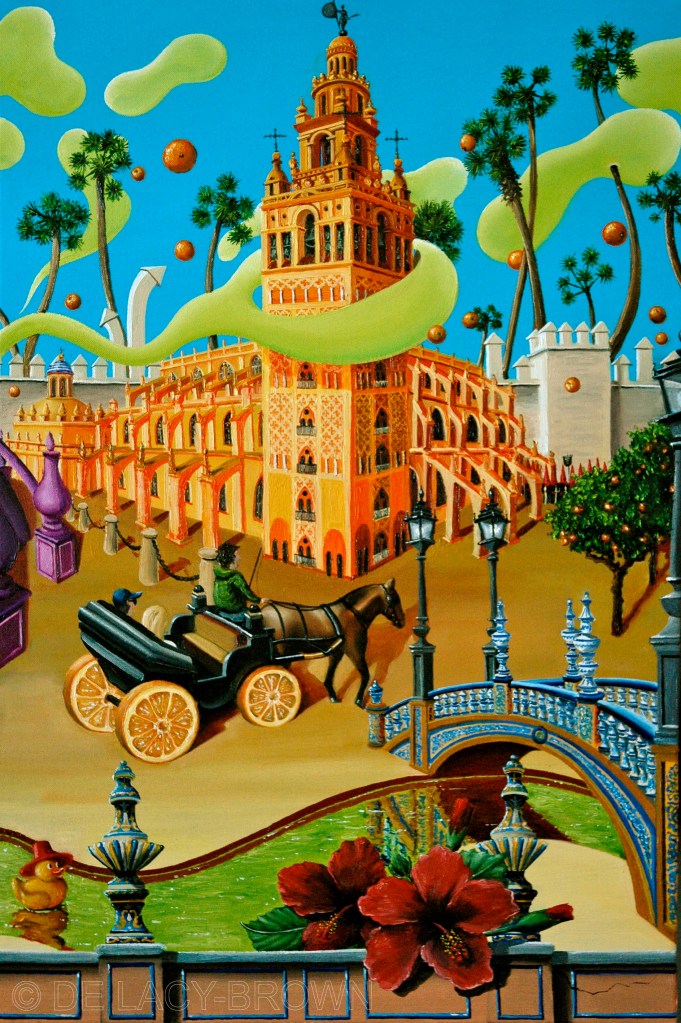
In the second canvas, the Giralda bell tower and the adjoining magnificent cathedral take centre stage, enveloped by the smoke of Carmen’s cigarette smoke. The angle of the building shows off its magnificent gothic details as well as the Moorish features on the lower section of the Giralda tower which is retained from Seville’s Moorish past. In front of the cathedral, a common site of Seville is featured – the horse and cart – whose characteristic yellow wheels are replaced with orange slices. Meanwhile, the distinctive blue and white ceramic bridge of the Plaza de España signifies that here, the river has become the pleasure lake which is central to the Plaza de España complex.

Seville Triptych - Canvas III (Oil on canvas, 2010 © Nicholas de Lacy-Brown)

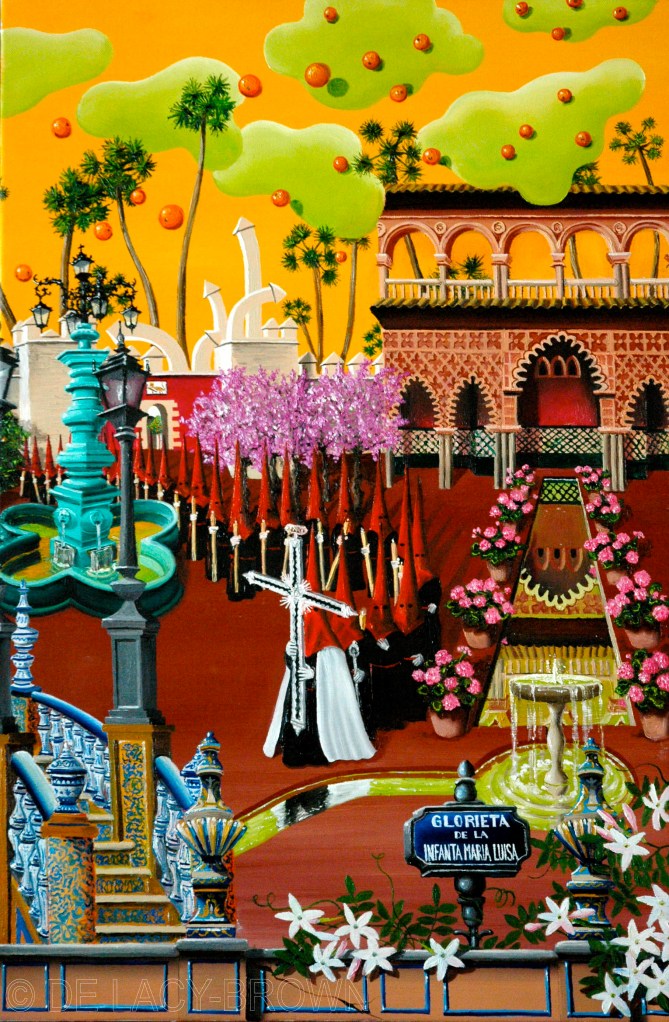
The third canvas is testament to Andalucía’s complex religious history, from the Moorish architecture which features strongly in the Real Alcazar palace, to the staunchly catholic Semana Santa (Easter Week) parades which are famous throughout Andalucía but most especially in Seville. In the foreground there is a decorative sign from the Parque Maria Luisa, which appears to emanate from the modernist age of design, while in the background, the pointed battlements of the Moorish city walls appear freed from the uniform constraints of their design, playfully reaching for the skies.

Seville Triptych - the complete triptych (Oil on canvas, 2010 © Nicholas de Lacy-Brown)

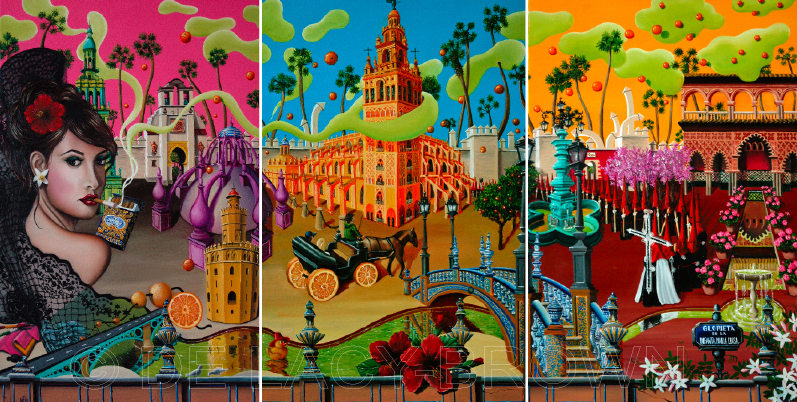
Across the three paintings, several unifying features dominate: In the immediate foreground are the walls and ceramic decorations of the Plaza de España, and behind it the River Guadalquivir which, in the second canvas becomes the pleasure pools of the Plaza de España and, by the third canvas, has turned into the Moorish pools of the Alcazar palace. In the background, the distinctive slender palm trees which pepper the cityscape and a shower of Seville oranges scatter the painting, while along the horizon, the walls of the Real Alcazar unify the canvas.

© Nicholas de Lacy-Brown and The Daily Norm, 2005-2012. Unauthorized use and/or duplication of the material, whether written work or artwork, included within The Daily Norm without express and written permission from The Daily Norm’s author and/or owner is strictly prohibited. Excerpts and links may be used, provided that full and clear credit is given to Nicholas de Lacy-Brown and The Daily Norm with appropriate and specific direction to the original content.

Sunday Supplement: Nordic Chills

In the first Sunday Supplement of 2012 which, for those of you who have not seen one before, features one, or a few of my non-Norm paintings, I have decided to pay homage to all things chilly. This is roundly because it has turned awfully cold here in London – ok, it’s not snowing or anything, but having had an unusually mild winter so far, we were all hoping that the spring had come early, and I think most of the budding plants all about were pretty much anticipating the same thing. So in homage to the cold, and in reminding myself that there are always colder places, I have decided to feature my paintings which were inspired by a series of visits I made to Scandinavia in 2009/2010, starting with a snowy trip to the elegant city of Stockholm, followed by an equally frosted visit to the buzzing city of Copenhagen. Upon visiting Stockholm, I was particularly struck by how watery the city is, probably more so because the water wasn’t actually frozen when I visited unlike the city’s Danish counterpart. When I took a boat trip around the archipelago, I was particularly struck by the various lighthouses which could be seen dotted all about. They looked solemn and lonely, stood steadfastly resolute in their solitude, performing their lone task of perpetual warning against sea ships and sailors whose vision is clouded with an icy fog. The result was a series of 5 paintings of lighthouses which were later exhibited along the famous Nyhavn in Copenhagen.

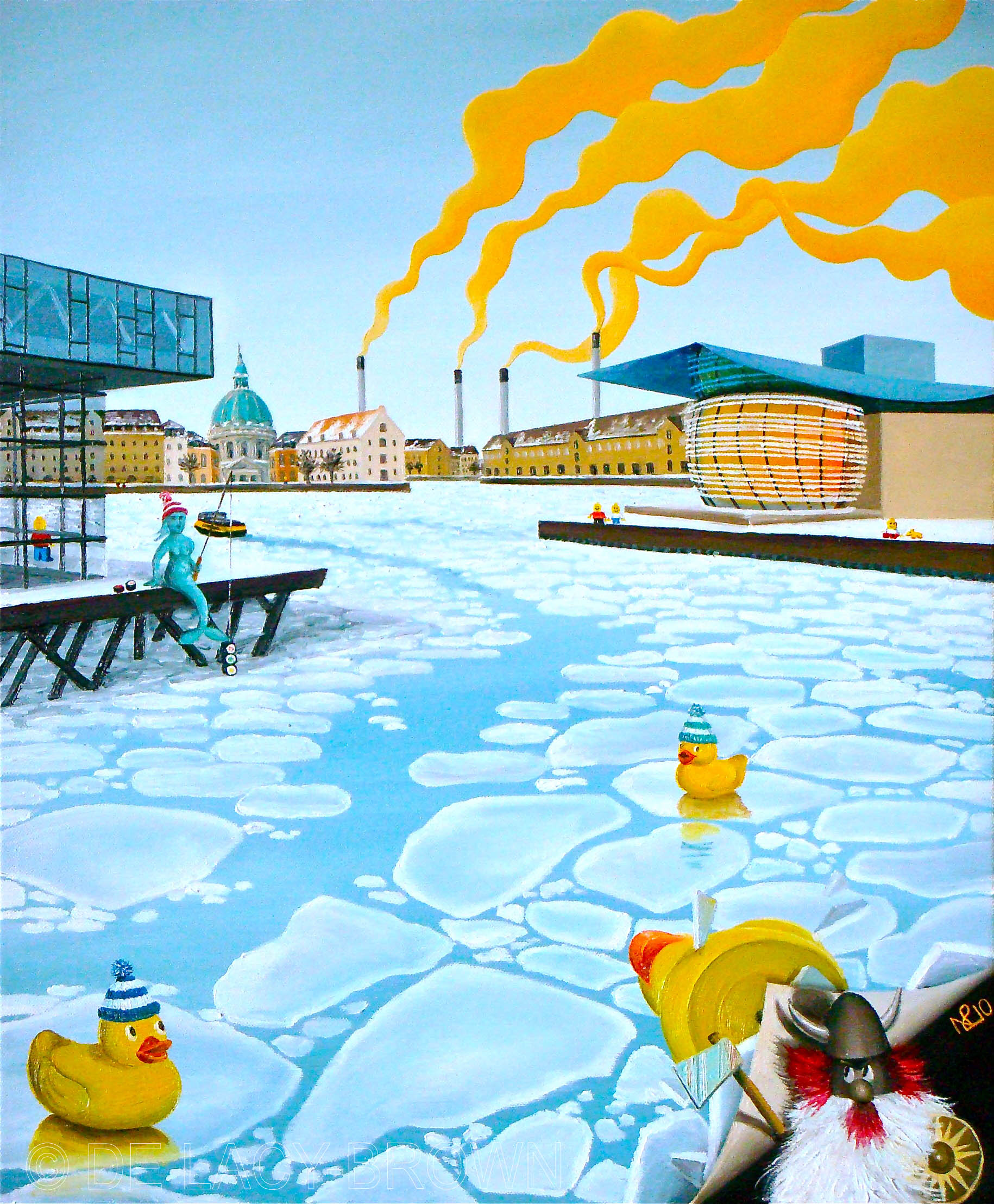
It was in fact on delivering my paintings to the Nyhavn Gallery in Copenhagen that I was inspired to paint my other Nordic work. Simply entitled Copenhagen, the work explores my fascination with the startling modern architecture, whose sharp angles and precise lines seemed to echo and suffuse with the cracking, floating ice which formed afresh each night over the city’s vast waterways. The fresh modernity of the city contrasts with Danish history represented by a furry Viking invading the scene at the foot of the painting, a wooden toy the likes of which you can buy (and I did – much to my partner’s disapproval) in souvenir shops all over Denmark. There too are signs of other Danish feats: Lego characters promenade outside the Opera House, and the city’s emblematic Little Mermaid statute, based on the story of that famous Dane, Hans Christian Andersen, who in my painting sits of the quayside, fishing fresh sushi, the likes of which I had enjoyed for the first time while in Copenhagen. The sushi, to this extent, also represents the city’s cosmopolitan feel, while the plumes of smoke flowing from the very prominent chimneys are testament to Denmark’s industrial prowess, while representing something of a conflict with their very “green” contemporary attitude.

Copenhagen (oil on canvas, 2010 © Nicholas de Lacy-Brown)

Wrap up warm, until next time…

© Nicholas de Lacy-Brown and The Daily Norm, 2005-2012. Unauthorized use and/or duplication of the material, whether written work or artwork, included within The Daily Norm without express and written permission from The Daily Norm’s author and/or owner is strictly prohibited. Excerpts and links may be used, provided that full and clear credit is given to Nicholas de Lacy-Brown and The Daily Norm with appropriate and specific direction to the original content.

Sunday Supplement: Christmas Double

For this week’s Sunday Supplement, it is in the spirit of Christmas that I bring you not one but TWO de Lacy-Brown paintings to add a little artistic fulfilment to your weekend. And, seeing as this will be the last Sunday Supplement before the big day itself (I am anticipating being ever so slightly too merry and/or stressing in the kitchen next Sunday to blog…and I suspect you will be too busy in similar scenarios to read the good old Daily Norm) I bring you two paintings from my collection which have the great festival of Christmas at their core. Some way apart, the first, painted in a more illustrative style, was created in 2002, while the second, painted in 2010, features a much more matured, realistic style of representation.

Ice Skating at Somerset House (acrylic on canvas, 2002 © Nicholas de Lacy-Brown)

The first work, above, was painted when I was in my first year at university in London. Studying at King’s College London on The Strand, I was lucky enough to be situated bang next door to what has become one of the most iconic sights of London’s Christmas celebrations: the ice skating rink at Somerset House. Flanked on all sides by the stunning Neo-classical masterpiece of Somerset House, the rink in the building’s huge cobbled courtyard is utterly atmospheric, reminding of the days of Dickensian London street scenes which, thanks to the likes of A Christmas Carol, have become synonymous with the traditional view of Christmas all around the world. At night, the rink glistens under turquoise lights, flame lanterns flickering on either side, and a tree, usually sponsored by Tiffany & Co. the jewellers, sparkling at the foot of the ice. It’s a wonderful place to skate, and it is something I really miss doing every Christmas since my accident in 2008 precluded me from engaging in such a risky activity. This painting however represents the jovial, whimsical joy of the skating I remember. However, if you ever got the rink as empty as this these days, you’d be very lucky…

Alexander, Enchanted by Christmas (oil on canvas, 2010 © Nicholas de Lacy-Brown)

The second painting of this week’s Christmas double-whammy is my later portrait of my nephew Alexander when he was just 18 months old. It captures a magical moment when he encountered the large family Christmas tree for the first time. Utterly entranced by the feast of new colours, objects and lights on view, he was literally stopped in his tracks as he took in the wonder of Christmas before him. Painted in a more photo-realistic fashion, I have tried to capture the furry white brim of the cute santa hat he was wearing, while blurring out the tree lights in the background. It was a beautiful moment. As ever, Christmas really is enhanced by the joy you can see reflected in a child’s eyes. However I may feel differently come this time next week, when I have three toddlers running rings around me, fighting for presents and playing catch with the baubles.

Postscript: If you like the painting of Somerset House above, and would like to own a high quality giclee print of the image, there are some available for sale via my Etsy online shop.

© Nicholas de Lacy-Brown and The Daily Norm, 2002-2011. Unauthorized use and/or duplication of the material, whether written work or artwork, included within The Daily Norm without express and written permission from The Daily Norm’s author and/or owner is strictly prohibited. Excerpts and links may be used, provided that full and clear credit is given to Nicholas de Lacy-Brown and The Daily Norm with appropriate and specific direction to the original content.

Sunday Supplement: Merry Christmas, Goodwill to all (Gingerbread) Men

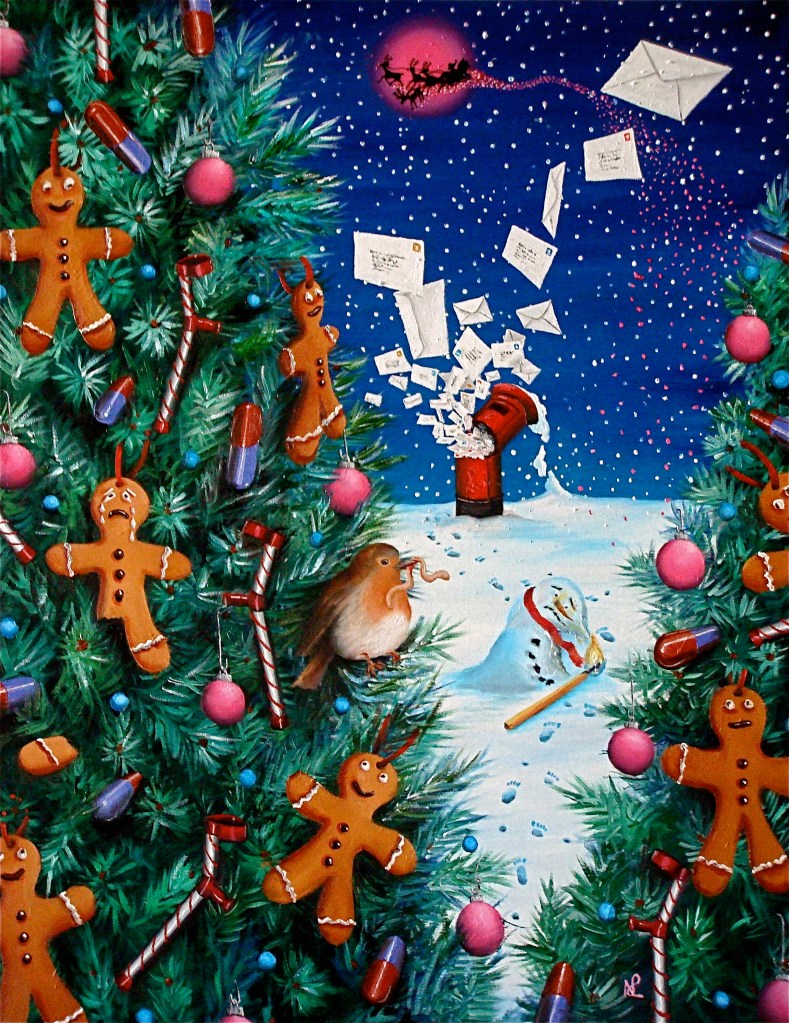
Following on from my recent Christmas tree posts, it seems suitable that for this week’s Sunday Supplement, I introduce you to the work: “Merry Christmas, Goodwill to all (Gingerbread) Men” (2008, oil on canvas). On it’s face, it’s a typical Christmas scene. Christmas trees hung with decorations and gingerbread men, snow scattered widely on a crisp winter’s night, Santa’s sleigh riding through the sky. But this is not a typical Christmas. Look closer and the images represented betray a sense of suppressed panic and bitterness. Off-centre, but at it’s heart, a gingerbread man with a broken right leg is iced with tears of apparent despair, while around him, he is surrounded by gingerbread men staring in his direction, their chocolate smiles still adhered mockingly to their faces. Also on the tree, candy canes are replaced with candy crutches, and where baubles should hang, pink ibuprofen tablets share branches with blue and red antibiotics and blue amitriptylene. On the tree perches the archetypal red-breasted robin, but he too appears menacing, caught in the act of murder of the still-living worm clasped in his beak. Between the two trees a further unsettling scene emerges, as a snowman struggles against the lit match which lays at his side, apparently placed there by whomsoever has left the footprints in the snow, footprints which betray a limp in the right foot because only the ball of the foot appears to impact the ground. Meanwhile above a British post box is cracked open, Christmas cards and other correspondence flying through the air, while above, a supposedly magical scene of santa and his sleigh is interrupted by the fall of one of his reindeers mid-flight.

Merry Christmas, Goodwill to all (Gingerbread) Men (Oil on canvas, 2008 © Nicholas de Lacy-Brown)

This is not the stereotypical scene of Christmas. It is in fact one of ten paintings which I created in the direct aftermath of a very traumatic road traffic injury of which I was the unwitting victim in May 2008. Just as I was walking past a very large structural concrete wall, a lorry crashed into it, causing the wall to collapse on top of me. I sustained severe crush fractures to my right leg as well as various other, more superficial injuries. I was lucky to be alive. What got me through the months of severe post-traumatic recovery was, and continues to be, my art. When I painted 10 paintings based on my accident, I was able to pour out my personal grief and frustration onto canvas. Each of the 10 canvases I painted represent a particular stage of my recovery. In this festive-themed painting, I recollect my first Christmas experienced after the accident and in particular my insecurity at being surrounded by a busy city at Christmas time, when I was visually and physically impeded by a very large illizarov external fixator which I was required to wear on my leg for 9 months. As I began to return to London society, I became more and more aware that people would stare at my leg in horror. They would never speak to me about my accident, but just stare – it made me feel like a leper. And all this at at time when society encouraged “goodwill to all men”. I expressed my feelings in this image of a gingerbread man, his leg broken, and all the gingerbread men around him staring, unfeeling, making his suffering all the worse.

At the same time I was ever conscious that my social life had been destroyed by my disabilities, an image I expressed in the broken letter box, its lost letters a sign of my broken friendships and lost social ties. Meanwhile the snow, the baubles and the crutches are all representative of the multitude of medication and medical aids I was required to take and use at that time. The foot steps in the snow are mine. Am I then an agent of my own self-destruction? Or am I facing up to the inevitability of life’s often bleak, stark reality?

For me, the accident was a distinct and painful reminder that we all take things for granted. I took my healthy right leg for granted until it was too late. I also took my mobility for granted. After two years on crutches and a life of mobility difficulties ahead, I now recognise how difficult life is for those with limited mobility, particularly in big cities and on public transport. I also realised that for people with disabilities, the last thing they want is to be looked at differently by other people in society. The purpose of my blog is not to lecture, rather it is to share the art and culture and beauty of life. But what I would say is: enjoy your  Christmas, your new year, and your life. Never take anything for granted, and if you see someone hobbling along a street with crutches or a bad limp, don’t stare. If you’re interested, just ask… If they’re like me, victims of accidents and disabilities would much rather talk about their experience than be marginalised because of it.

© Nicholas de Lacy-Brown and The Daily Norm, 2005-2011. Unauthorized use and/or duplication of the material, whether written work or artwork, included within The Daily Norm without express and written permission from The Daily Norm’s author and/or owner is strictly prohibited. Excerpts and links may be used, provided that full and clear credit is given to Nicholas de Lacy-Brown and The Daily Norm with appropriate and specific direction to the original content.

Sunday Supplement: Road Traffic Control

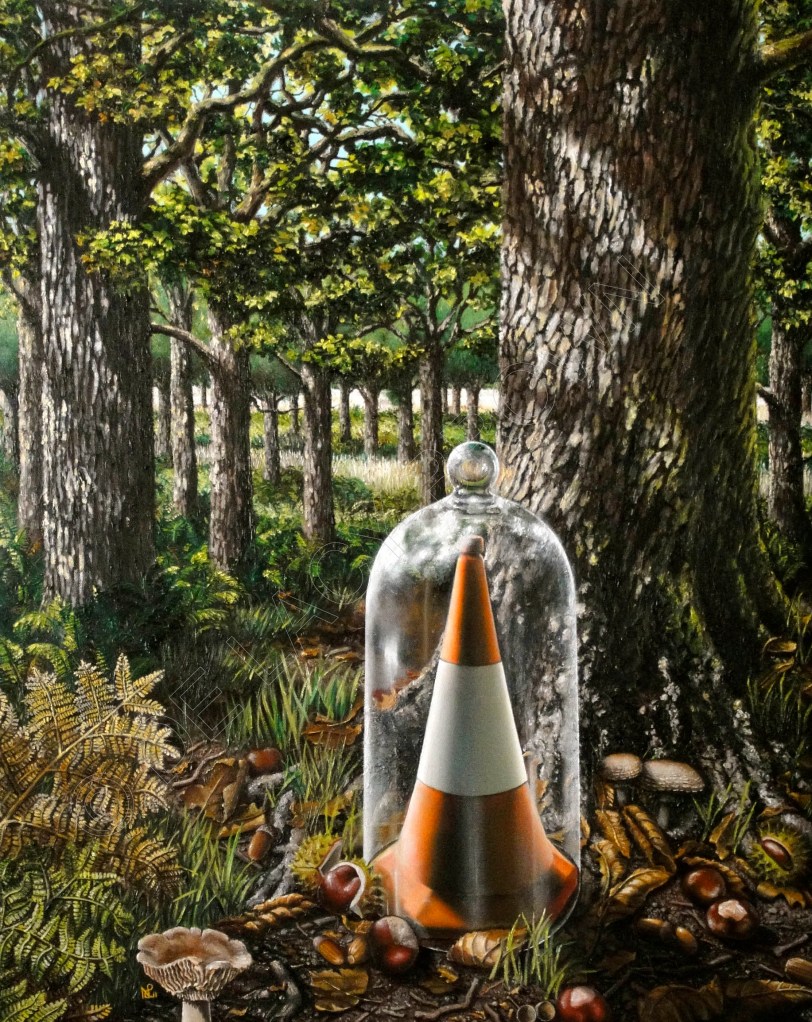
In the continued spirit of the Sunday Supplement’s exploration of some of my more detailed non-Norm work, this Sunday I am presenting a painting which I literally finished two days ago, having been working on it on and off since the first week of October: Road Traffic Control (Autumn in Richmond Park). The work was inspired by an early autumn day in Richmond Park – it was in fact the day of the mini heat wave in the UK with temperatures of 29 degrees on 1 October. This made for the rare sensation of feeling summer on the skin, but with the eyes seeing autumn hues bathed in glorious sunlight. It made for wonderful visual results in Richmond Park, which is in itself a unique and vast bucolic landscape in amongst the urban jungle that is London surrounding it. As soon as I got home, I started work on this canvas.

Road Traffic Control (Autumn in Richmond Park) (Oil on canvas, 2011 © Nicholas de Lacy-Brown)

Read more

Sunday Supplement: Le Paris Formidable

Ahhh as this blog goes to print, I am breathing the air of Paris, the most beautiful city in the world. Paris has no substitute for me. It is the ultimate jewel in the crown of global cultural offerings, every corner of the city exudes architectural magnificence, the Haussmann boulevards are so perfectly laid out that down each road your eyes feast upon one stunning postcard view after another, as the Tour Eiffel, the Arc de Triomphe, the river, the Opera Garnier all come into view. On the streets, the air is crisp and wintery but across the breeze the scent of a magnificent city in perpetual motion fills even the most unwitting visitor with a sense of anticipation. Even the antiquated metro has its own scent of the art nouveau. I adore Paris, from the inherently atmospheric tip of the Butte in Montmartre, to the boutique lined cobbled streets of the Marais. It is a constant inspiration, and I need to visit at least once a year to have my ultimate fill of this stunning city.

Le Paris Formidable (2000, acrylic on canvas) © Nicholas de Lacy-Brown

So it’s only suitable then that in this week’s Sunday Supplement, I focus upon the painting which started it all for me when I was 16 – Le Paris Formidable.

Read more

Sunday Supplement: ¡Guerra! The Spanish Civil War

While I gather it’s traditional for blogs to be published on workdays, here at the Daily Norm, we like to provide a complete weekly service. So every weekend I aim to provide the Daily Norm’s loyal readers with a Sunday supplement of a cultural kind (after all, if you’re like me, you’ll head straight to the culture section of the Sunday paper!). For the first few weeks, the Sunday Supplement with provide me with the opportunity to showcase some of my (non-Norm) artwork. While pictures of my paintings have been online in various forms for some time, the Sunday Supplement provides me with an opportunity to discuss the meaning behind the imagery.

This weekend, in conjunction with the Daily Norm’s current Spanish focus, I am showcasing the painting “¡Guerra! The Spanish Civil War 1936-1939” from my “España Volver” Collection. Meaning “return to Spain”, I painted the collection in 2009-2010, when a reinvigorated interest in Spain inspired several comprehensive works. It was a “return” because Spain has long been an influence in my work. But with the España Volver collection, my return to Spain as a subject was inspired more specifically by the nation’s social, political and historical landscape. It seems appropriate then to discuss one of my most political of Spanish paintings on this, the day that Spain goes to the polls in a general election.

¡Guerra!: The Spanish Civil War (Oil on canvas, 2009 © Nicholas de Lacy-Brown)

Read more