

Shakespeare 400: A Midsummer Night’s Dream
2016 is the year of Shakespeare. It is a festival which marks the great Bard’s birth, and his death, and above all things a celebration of his incredible works, masterpieces which have shaped generations, been interpreted and reinterpreted across the centuries, and which are a core of both British and global theatre. In exploring my own reinterpretations of his plays, some 20 years after I completed my first Shakespeare collection at the age of 13, I have moved onto my second work, painted in my new interpretative abstract style.
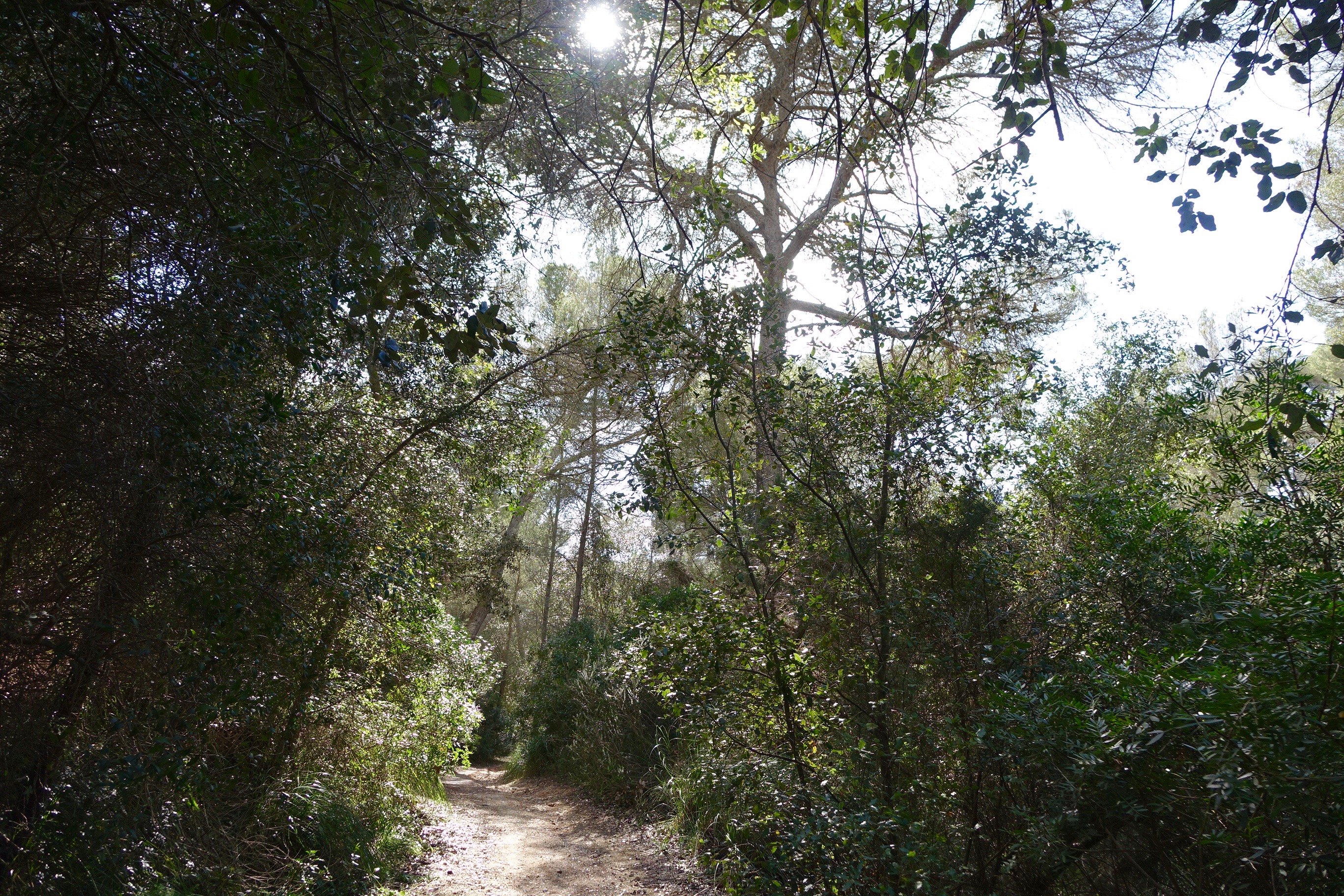
The play is A Midsummer Night’s Dream, a comic frolic of cross-purpose love affairs, mischievous spells, sparkling forest fairies and of course the famous Donkey metamorphosis of Bottom, all set between the trees of a forest near Athens. That wonderfully magical forest setting forms the background of my work, a simplified design of vertical brown stripes, creating a sense of the darkness and depth of the forest which characterises the tone of that mystical Midsummer’s Night.
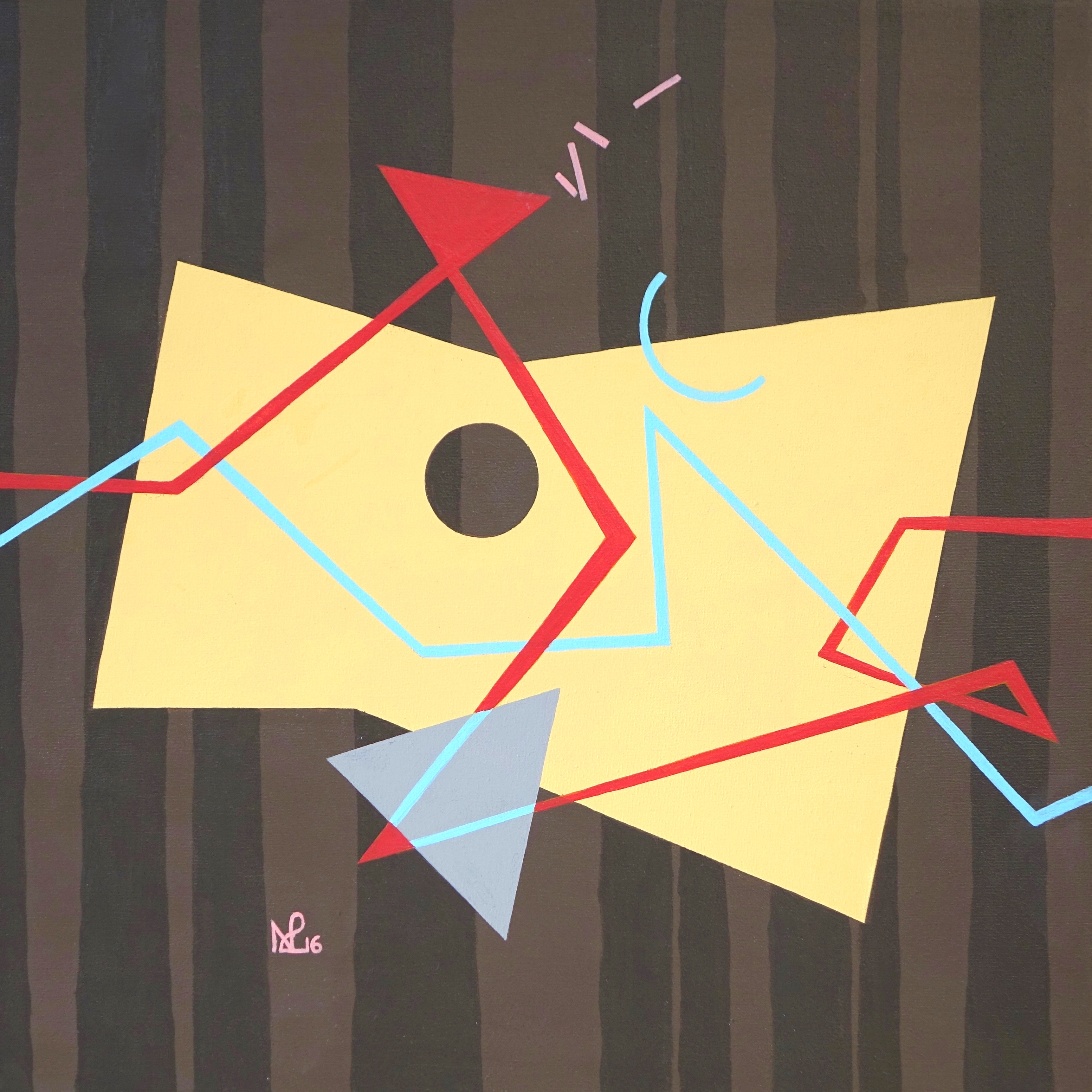
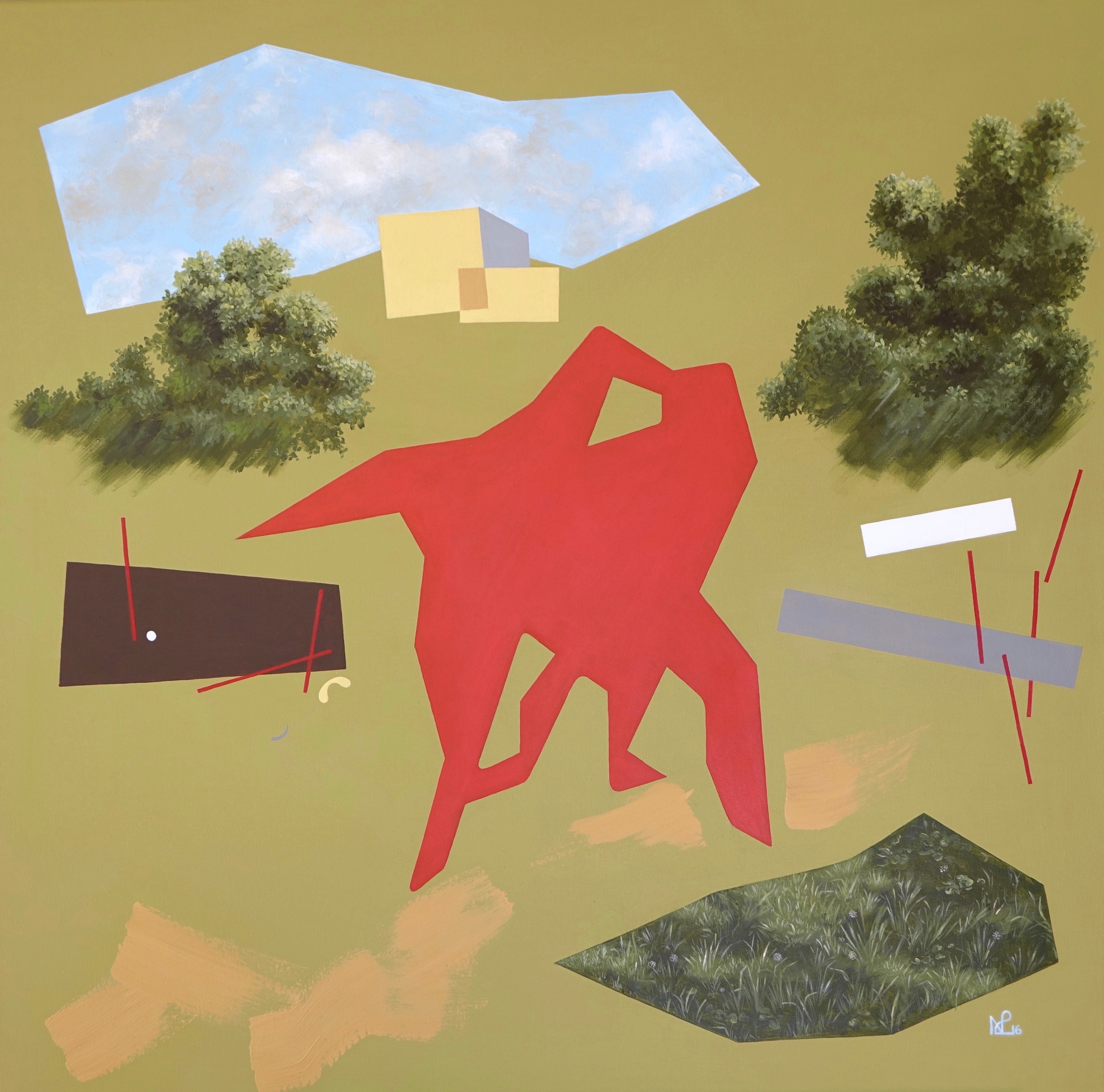
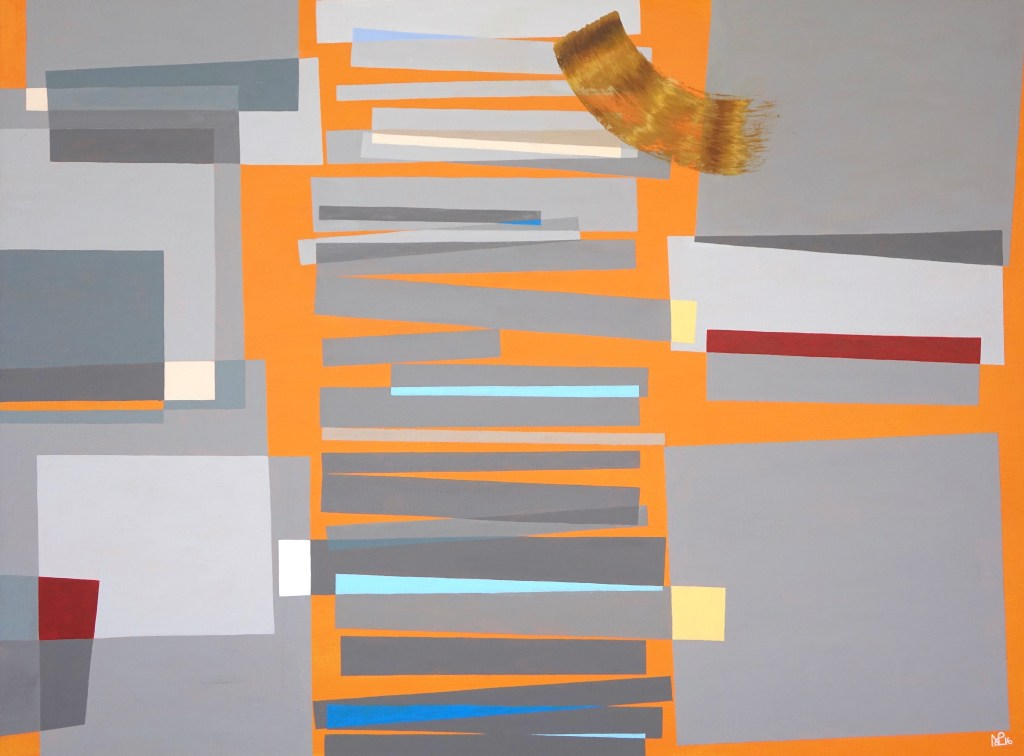
A Midsummer Night’s Dream (2016 ©Nicholas de Lacy-Brown, acrylic on canvas)
Central to the piece is a large yellow shape, representing the wall in the story of Pyramus and Thisbe, whose chink provides the only channel for communication for the two forbidden lovers after whom the story is named. Creating something of a play within a play, the tale of Pyramus and Thisbe (originally told by Ovid) is acted out at the end of the play by the theatre troupe from whom the actor-turned-donkey Bottom comes, and which likewise reflects the theme of forbidden love which is played out in the forbidden love between Hermia and Lysander.
It is in fact that disallowed love affair which sends Hermia and Lysander fleeing to the forest, where in their wake Helena, Hermia’s friend, and Demetrius, the man Hermia’s father wishes her to marry, follow. These four characters then become the pawn of Oberon and Titania, the King and Queen of the forest fairies whose own conflict results in a series of magical mischief which in turn results in the four youngsters of Athens variously falling in and out of love with one another while under the bewitchment of the “love-in-idleness” flower. That same juice is used to bewitch Titania, who in turn is caused to fall in love with the metamorphosed Bottom.
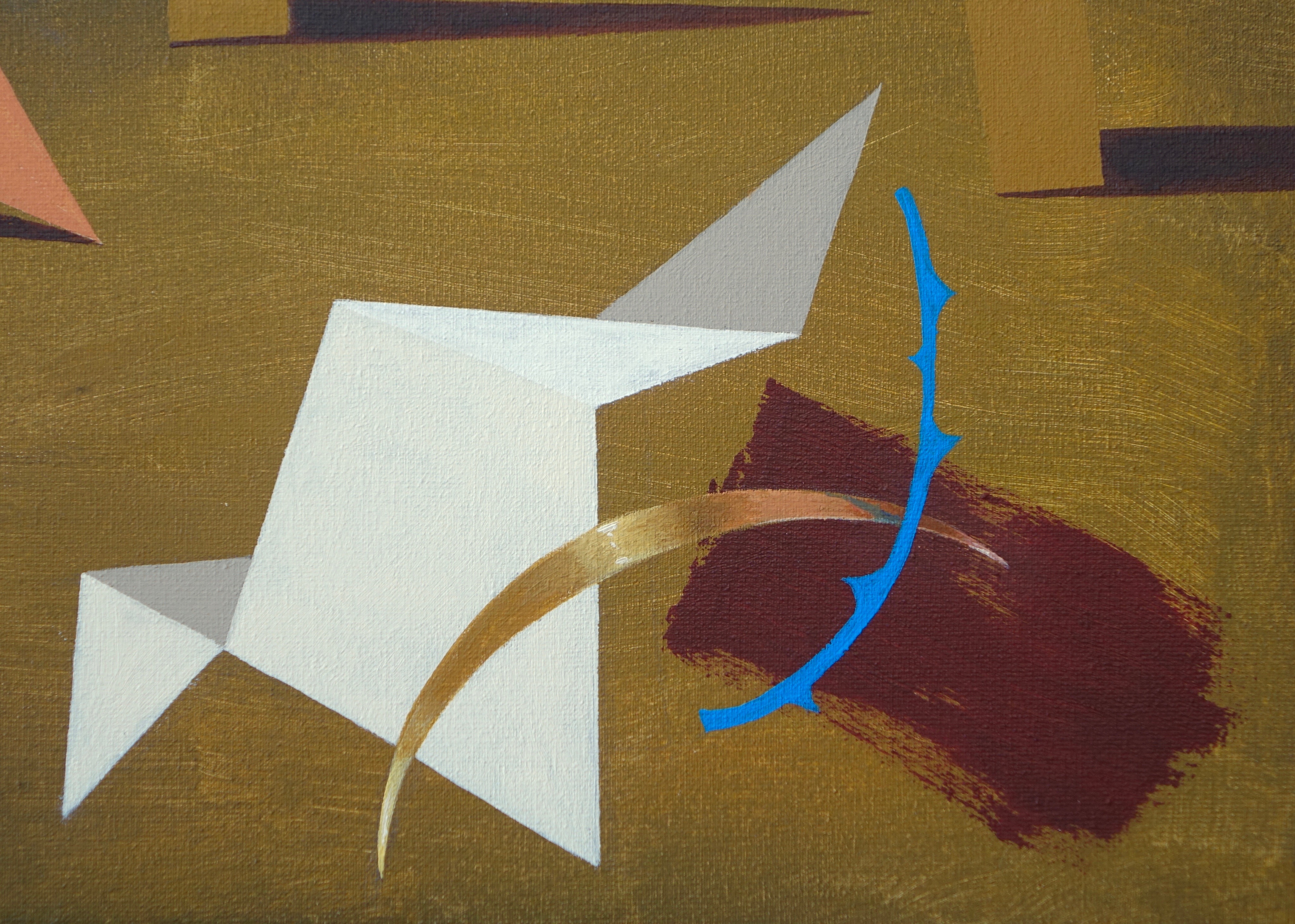
All this is represented by my painting of shapes and lines. The energetic lines which cross the canvas are those of Titania and Oberon, whose ballet of magical conflict weaves in and out of the play’s plot. Where they meet, and form shapes within their overlaps, these shapes represent the four young lovers, Helena, Hermia, Lysander and Demetrius. The grey triangle is of course the donkey head of Bottom, and when Titania’s “line” traverses the space, it is transformed blue, as though bewitched by Oberon. Meanwhile above Oberon’s line, the blue curve represents his faithful assistant Puck, the cheeky little fairy who mischievously applies the love-potion, and above the red triangle of Titania, the four little pink lines are her flying little fairy assistants, Peaseblosom, Cobweb, Moth and Mustardseed.
For those unaware of this brilliant play, the description above may bamboozle the mind. Where that is the case, please enjoy the painting instead, whose simplified lines and structure make, in themselves, what I hope is a thoroughly pleasing image for Midsummer’s Night.
© Nicholas de Lacy-Brown and The Daily Norm, 2001-2016. Unauthorized use and/or duplication of the material, whether written work, photography or artwork, included within The Daily Norm without express and written permission from The Daily Norm’s author and/or owner is strictly prohibited. For more information on the work of Nicholas de Lacy-Brown, head to his art website at www.delacybrown.com







































































 The Daily Norm
Jun 29
Melancholy Woman: Lament for a Broken Union
Sometimes in life you receive news that shocks you to the core. News which wrenches the inside of the stomach, infiltrates the heart and mind, brings tears to the eyes and fills your life, your hopes and your ambitions with darkness. I have lived through the pain of death, and the anguish of heartbreak. And all I can say is that that same physical reaction as I had experienced before once again engaged with my total metal and corporal being when last Friday I awoke to the news that the UK had voted to leave the European Union.
There is much that can be said of a Union which has grown too big, of laws unruly, of an organisation stretched beyond its limits, but there is very little which can justify the decision of 52% of the UK’s voting population opting to leave the EU for what were utterly anachronistic, completely unintelligent and sickeningly ignorant reasons. A wave of xenophobia, which has long infiltrated English society, was normalised by a leave campaign which popularised an exit from the EU as being an excuse to cleanse the country of foreigners and in so doing exercise what they lauded to be the action of “taking the country back”. Such a move does not enable Britain to become in any way stronger, nor more progressive. It is a retrograde step which will see the nation isolated, deprived economically and falling far outside the progressive benefits of a globalised society.
It is a move which has already seen the value of the pound plummet, the political system spiral into disarray, and the relationship of the UK notably deteriorate with its neighbours and allies near and far. In leaving the EU, those who wished to reinstate an England of the past have robbed its future generations of an actively mobile, economically stable future, all the while forgetting, with an unfathomable level of hypocrisy, that the England of the past was a country whose very success and global position had been marked by its own breed of imperialism and abuse of other countries and cultures overseas.
Little more can be said to best express my feelings of dismay at this time. Embarrassment of being English is coupled with my fears of being like a disconnected refuge living abroad without the rights and the freedoms to which I have become so easily accustomed all my life.
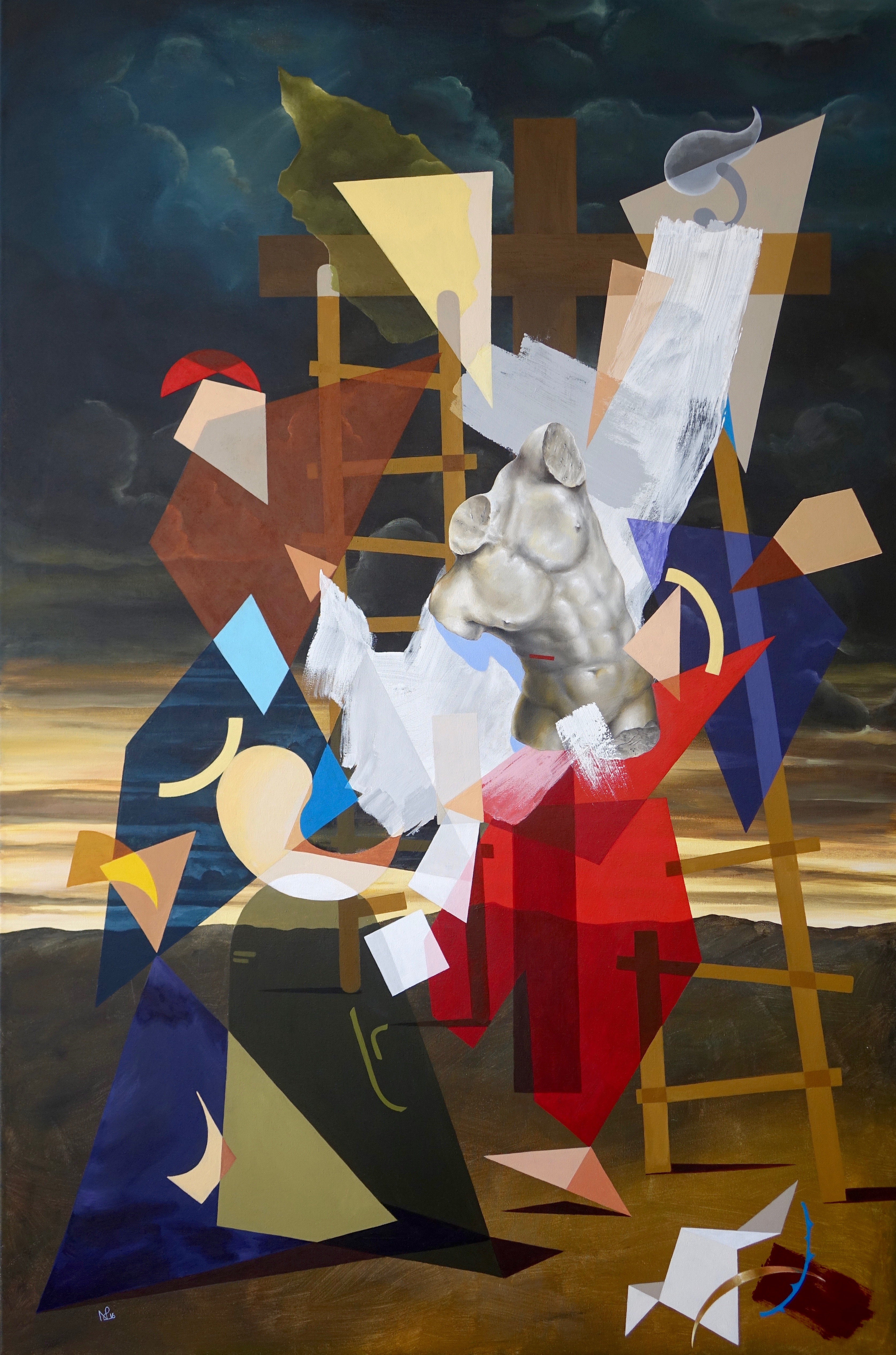
Melancholy Woman: Lament for a Broken Union (after Picasso) (2016, acrylic on canvas ©Nicholas de Lacy-Brown)
In reflecting on this time, I turned to art, as I always have in times of happiness and grief. When I saw the painting by Picasso, Melancholy Woman (1902), I felt engaged by a work of art which appeared to me to sum up the emotions of the moment. Taking a spare canvas, and moving immediately to paint an interpretation of the work, I created my own Melancholy Woman in the abstractive interpretative style which has shaped the body of my recent creations. In repainting this work, I have kept to Picasso’s expertly chosen colour palette, founded of his famously melancholic blue period, replacing his forms with a more geometric gathering.
Melancholy Woman: Lament for a Broken Union (after Picasso) (2016, acrylic on canvas ©Nicholas de Lacy-Brown)
My melancholy woman laments, like Picasso’s, for an intense heartbreak. I imagine his protagonist wept over some lover, some union lost. My woman also weeps for a broken union. The European Union. Broken by those who entirely misunderstood the modern world, proactively destroying the future of those who might still have benefitted from it. What happens next, no one knows.
© Nicholas de Lacy-Brown and The Daily Norm, 2001-2016. Unauthorized use and/or duplication of the material, whether written work, photography or artwork, included within The Daily Norm without express and written permission from The Daily Norm’s author and/or owner is strictly prohibited. For more information on the work of Nicholas de Lacy-Brown, head to his art website at www.delacybrown.com