Skip to content

Posts tagged ‘Abstract’

February in Paris – Part 3: Sonia Delaunay at MAM

Anyone having a quick peruse of my own personal artwork will know that I am a huge lover of colour. As far as I am concerned, what point is there in having colour available if it is only to be muddied and diminished with blacks and browns? No doubt sharing my opinion were some of the boldest expressionist and modernist painters of the 20th century, whose bold use of colour was at first seen as terribly scandalous but which eventually came to characterise an entire generation of art, when the boundaries of accepted aesthetic values were pushed to new extremes.

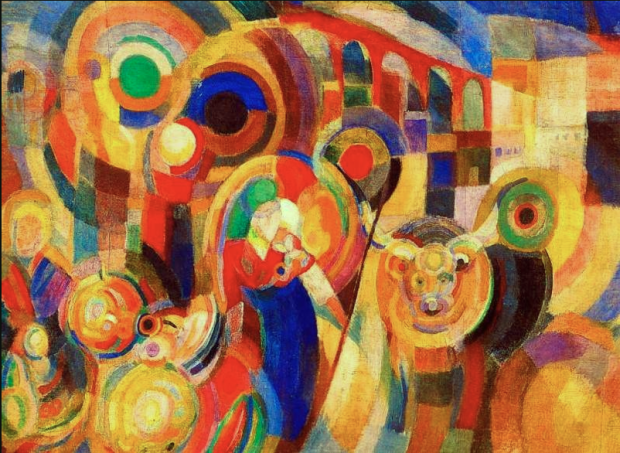
Chief amongst them were a tremendous twosome – what today may be termed a “power couple” – two of the greatest proponents of modernist expressionism and of the power and glory of pure colour: Robert and Sonia Delaunay. Together, these two artists, who married in 1910 and in 1912 proclaimed the birth of Simultanism, refocused the attention of the art world on the dynamic power of colour, using the strength and unique characteristics of colours as an end in themselves rather than a means of expressing something else. The paintings and other artworks which resulted are progressively abstract explosions of structured colour which, by virtue of their use of a full panoply of rainbow hues, are full of expressive happiness and boundless energy.
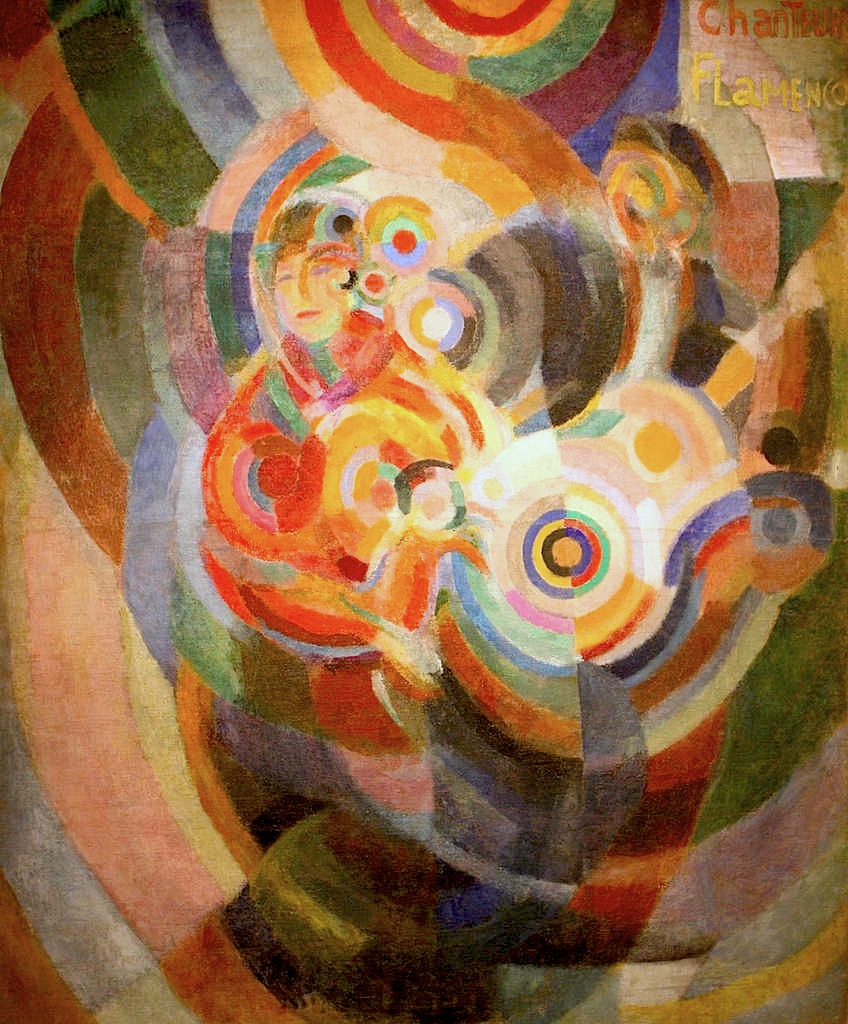
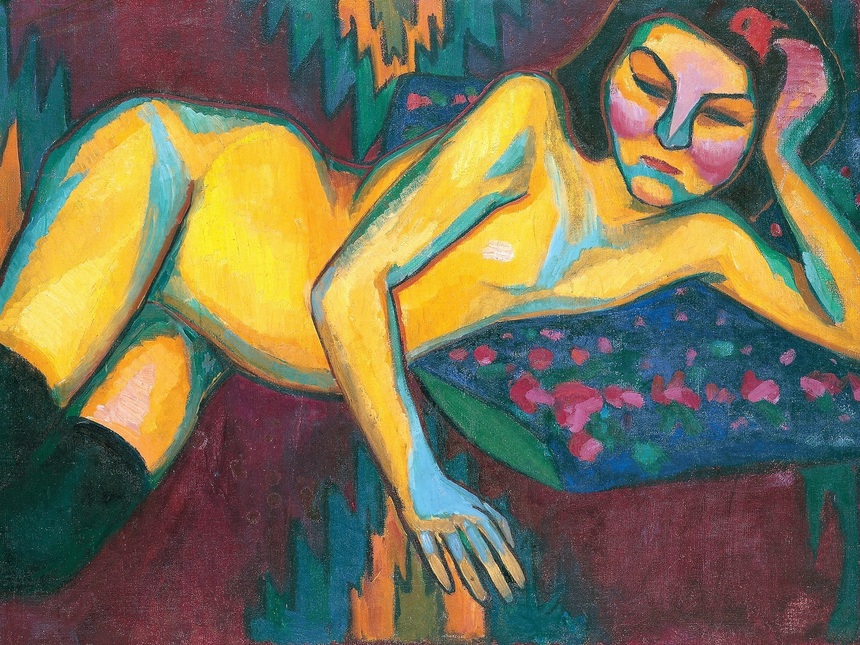
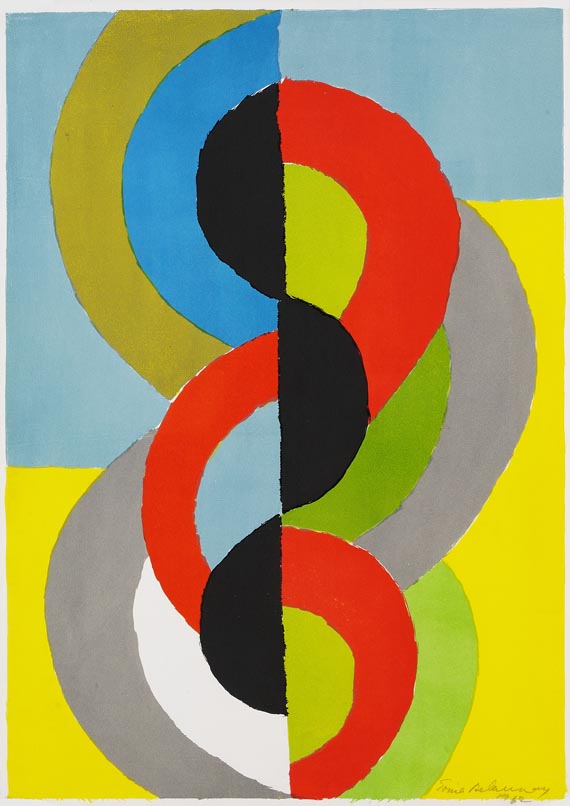
delaunay-11SAMSUNG DIGITAL CAMERAflamenco1Sonia_Delaunay_femme

Of course as is often the case with a power couple, there is often one of the two who history overlooks, and few could argue that it was Sonia who remained in the shadow of her husband for many years during and following their successful careers, a fact which is not ignored by the Museum of Modern Art in Paris (MAM) who were therefore determined to stage a bigger and even more significant Sonia Delaunay retrospective when they opened their Sonia expo a few months ago.

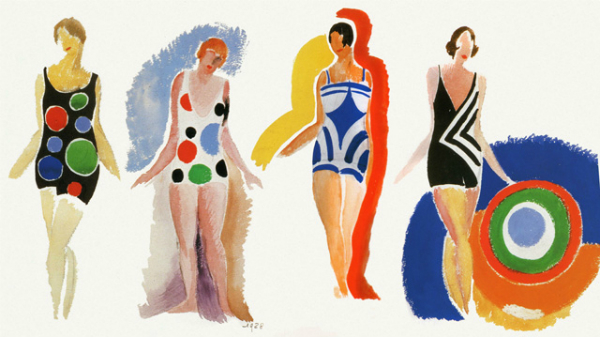
The result is an exhibition which is every bit as full of the Delaunay dynamism and energy as the paintings themselves. It is a show which demonstrates that although it was Robert Delaunay who conceptualised abstraction as a universal language, it was Sonia who experimented with it in all sorts of media, including posters, clothes and objects, and much of the MAM show comprises Sonia’s dapple in fashion, for which she designed countless zany fabrics and original outfits, as well as her determination to include abstraction and colour within the household, and as a backdrop to theatre, parties and other everyday recreational activities.
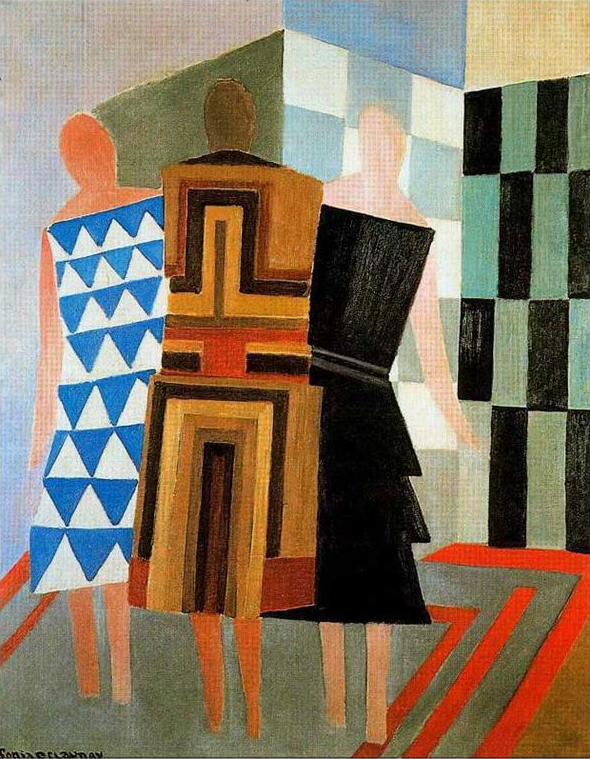
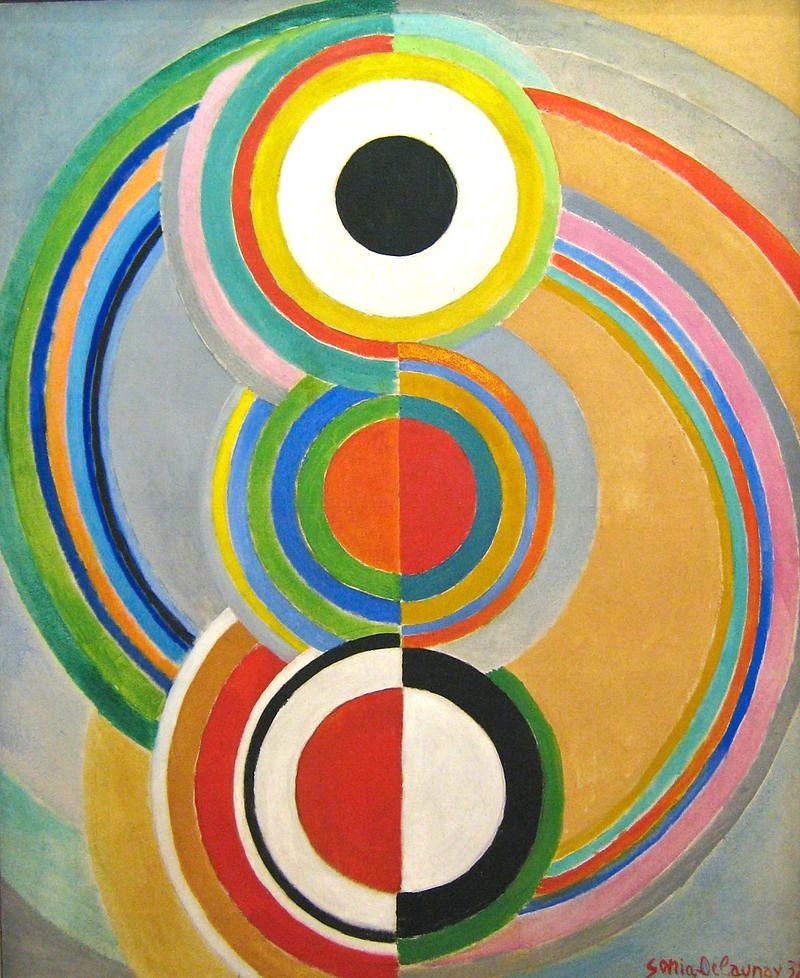
Screen shot 2015-02-18 at 23.51.50 sonia-delaunay-motifs-tissus sonia-delaunay-robes-940x669 410807408 SoniaDelaunay-maillots-1928800px-Sonia_Delaunay,_Rythme,_1938 "sonia-delaunay-p</p

For me, the main success of the MAM show is its collection of Sonia’s paintings which, when seen as a group, vibrate full of the energy and exhilaration which results from bringing together so many electric colours in one room. I particularly love how her consistent use of coloured circles is occasionally adapted to more figurative imagery, such as her abstract image of flamenco dancers, where the use of circles adds to the feel of fast sweeping dance movement. I was also interested to see how the genesis of her work was so much more figurative than it was abstract, but that even from the very beginning, her use of colour remained strong, so that even the simplest of portraits contain a face or skin tone loaded with a palette full of colour.

And it is for this unyielding uninhibited use of colour that I love the work of both Sonia and Robert Delaunay. But right now Sonia’s work is hogging more of the spotlight, an quite rightly too – every person deserves their place in the sun.

sonia

Sonia Delaunay: The Colours of Abstraction is only open for another few days at the Musée d’Art Modern de la Ville de Paris, closing on 22 February 2015. But worry not, for come April the retrospective will reopen in London’s Tate Modern, running until August.

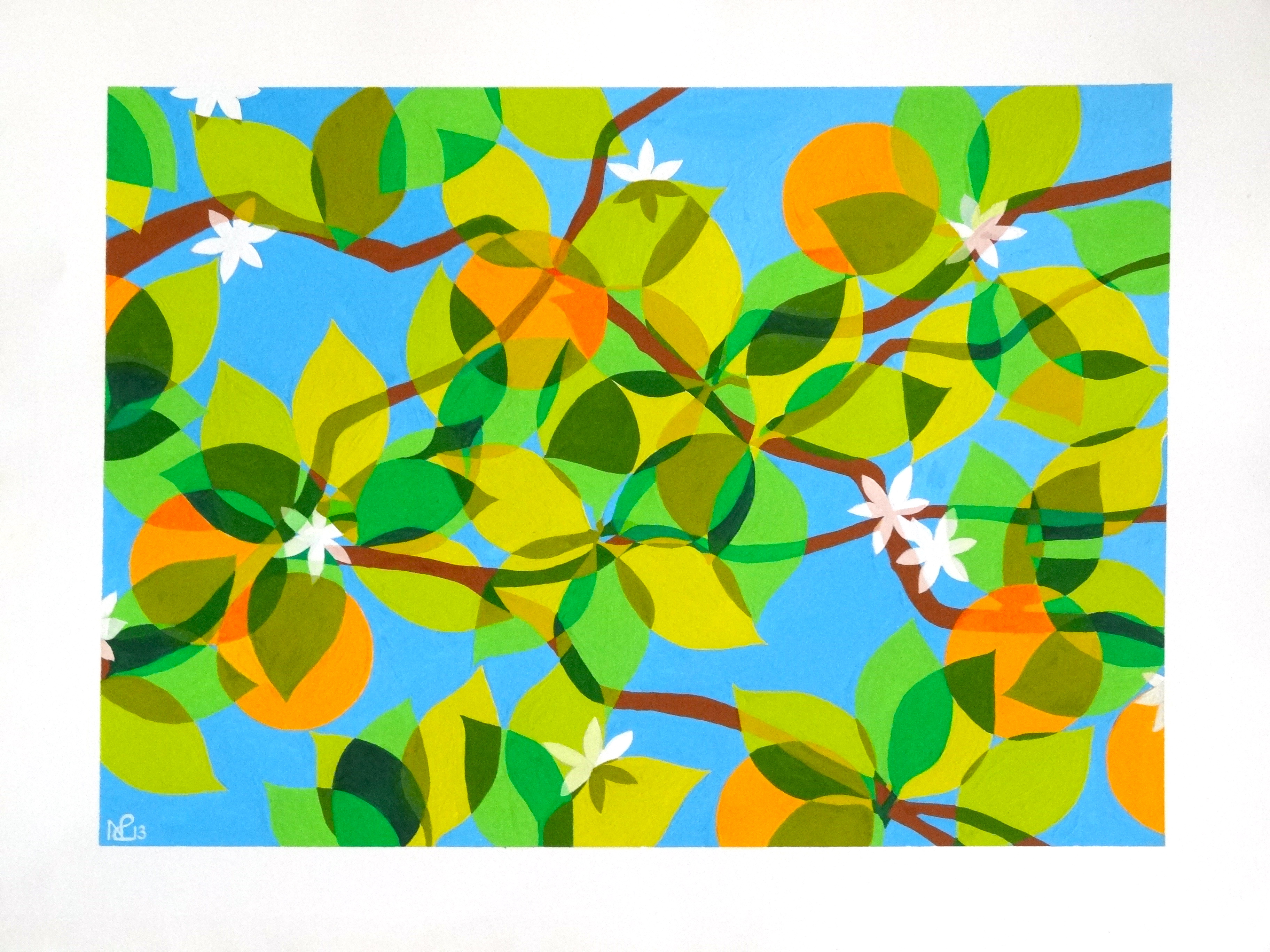
Composition No. 2 (Los Naranjos)

Last week I introduced a new painting and a very new style: Composition No.1 (squid with patatas a lo pobre), and hot on its heels I am very pleased to present my second Composition, likewise painted with gauche whose introduction into my artistic repertoire was inspired by the colourful enriching abstract works of Saloua Raouda Choucair currently on show at Tate Modern.

My second composition is inspired by those exquisite moments of summer time pleasure, when sat in the dappled Mediterranean light and shade of a ripe green orange-tree (Los Naranjos), you look up through the branches in whose semi transparent leaves the sun has scattered a panoply of greens, to see through those verdant lustres the unbroken clear blue sky beyond.

Composition No. 2 (Los Naranjos) © Nicholas de Lacy-Brown, gauche on paper

Composition No. 2 (Los Naranjos) © Nicholas de Lacy-Brown, gauche on paper

I adore mediterranean trees, basking under their natural canopy both protected from, and yet semi-dappled with the glorious midday sun. I love the unmistakable perfume of orange blossom, and the dry earthy aroma of sun warming the wrinkled bark of these well-weathered trees. And for me, the effect of light bleeding through a shelter of semi-translucent leaves lent itself so well to this abstract style, which has at its heart the idea of multi-layered shapes. The result is a painting which I hope you agree has the essence of a summer’s day, but in a decidedly abstracted mood.

Composition No.3 will surely follow suit. Until then amigos.

© Nicholas de Lacy-Brown and The Daily Norm, 2001-2013. Unauthorized use and/or duplication of the material, whether written work, photography or artwork, included within The Daily Norm without express and written permission from The Daily Norm’s author and/or owner is strictly prohibited. Excerpts and links may be used, provided that full and clear credit is given to Nicholas de Lacy-Brown and The Daily Norm with appropriate and specific direction to the original content.

Saloua Raouda Choucair – Geometric East meets Abstract Expressionist West

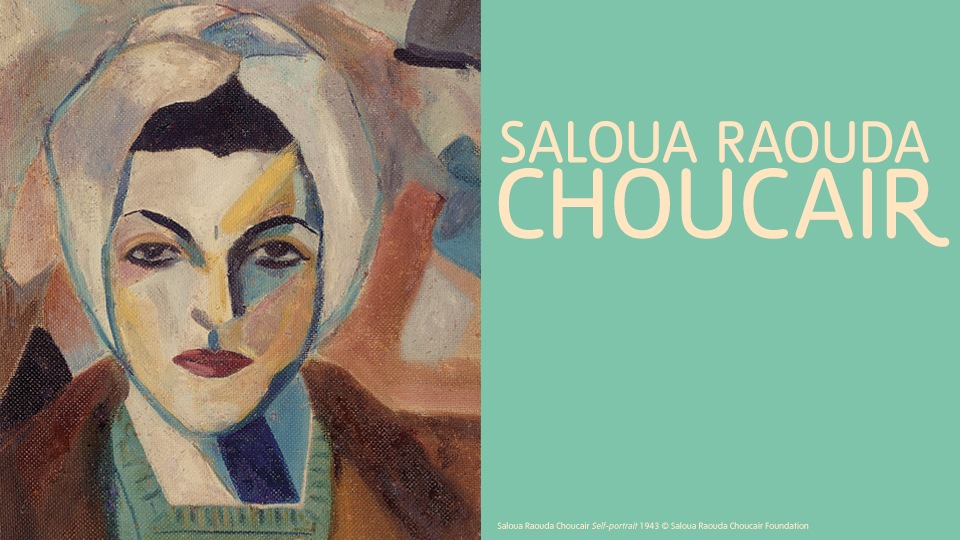
I hadn’t heard of Beirut-born artist Saloua Raouda Choucair before I dropped in, unplanned, to a small retrospective of her work at Tate Modern yesterday. In fact, as the literature accompanying the show rather depressingly tells us, “despite ceaselessly producing work for the best part of five decades, Choucair remains relatively little known internationally [and]… has not yet reached her deserved position in art history”. This is undoubtedly the reason then why our paths have not crossed each other before (and, I suppose in part has something to do with the fact that her name does not exactly spring to mind all that easily). Yet the moment I walked into the four room exhibition at Tate, encouraged to do so by the vivid bright colours of her almost fauvist abstract portrait which graces the posters of the show, I was in love.

Choucair poster

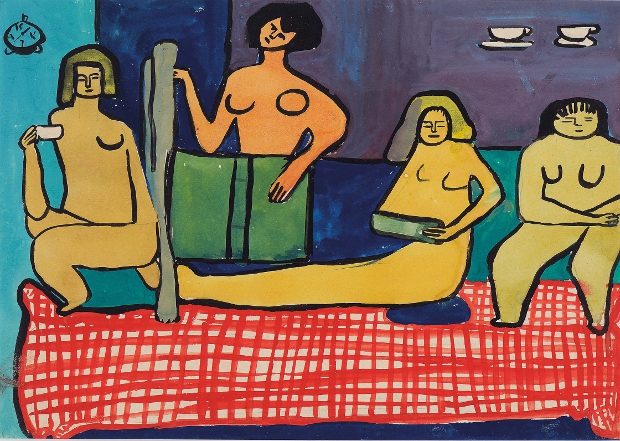
I was in love first and foremost with her paintings, largely gouache abstract compositions, with geometric forms criss crossing over each other in a multi layered colour explosion, to her Les Peintres Celebres collection, a wonderful set of group portraits, where the form of the nude has been flattened and abstracted, and the poses reduced to softened linear forms.

Les Peintes Celebres (1948-9) © Saloua Raouda Choucair Foundation

Les Peintes Celebres (1948-9) © Saloua Raouda Choucair Foundation

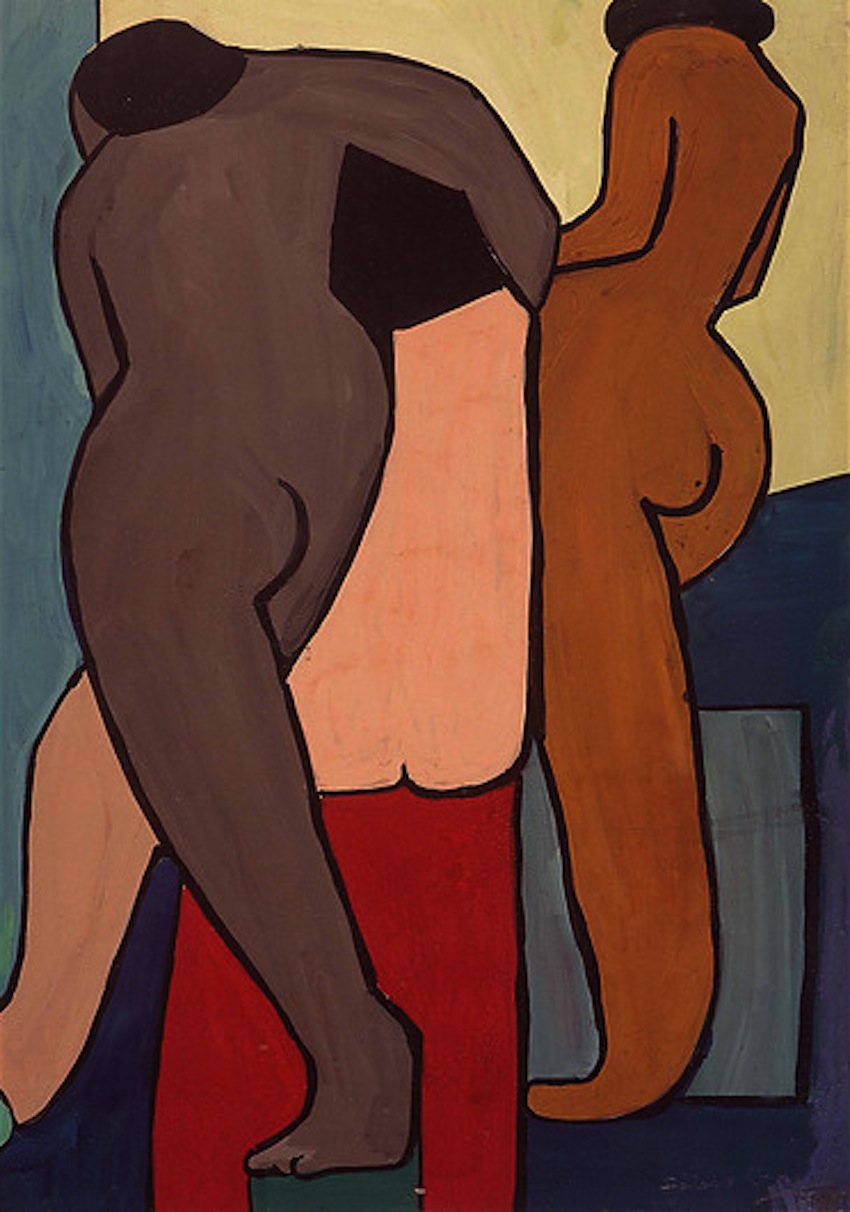
Untitled (1948-9) © Saloua Raouda Choucair Foundation

Untitled (1948-9) © Saloua Raouda Choucair Foundation

Paris-Beirut (1948) © Saloua Raouda Choucair Foundation

Paris-Beirut (1948) © Saloua Raouda Choucair Foundation

Choucair’s paintings very clearly demonstrate the influential hand of cubist figurative painter Fernand Léger, under whose influence she came in 1940s Paris, and yet as she moves from figure paintings to her abstract composition, you can see equally clear evidence of the extent to which she was inspired by the geometric forms of Islamic art, which had entranced her when she became acquainted with them in Cairo. These “Fractional Modules” as she calls them, were almost certainly my favourite paintings in the show. Simple shapes interwoven and multi-layered resulted in a wonderfully satisfying overall abstract form, an image so complex in its pictorial language (despite the repeated use of a single shape or form) that it reminds me of the same level of aesthetic satisfaction that can be gleaned from those stunning patterned tiles and plaster work in the great Islamic palaces of Southern Spain.

Composition in Blue Module (1947-51) © Saloua Raouda Choucair Foundation

Composition in Blue Module (1947-51) © Saloua Raouda Choucair Foundation

Fractional Module (1947-51) © Saloua Raouda Choucair Foundation

Fractional Module (1947-51) © Saloua Raouda Choucair Foundation

Rhythmical Composition in Yellow (1952-5) © Saloua Raouda Choucair Foundation

Rhythmical Composition in Yellow (1952-5) © Saloua Raouda Choucair Foundation

Composition with Arcs (1962-5) © Saloua Raouda Choucair Foundation

Composition with Arcs (1962-5) © Saloua Raouda Choucair Foundation

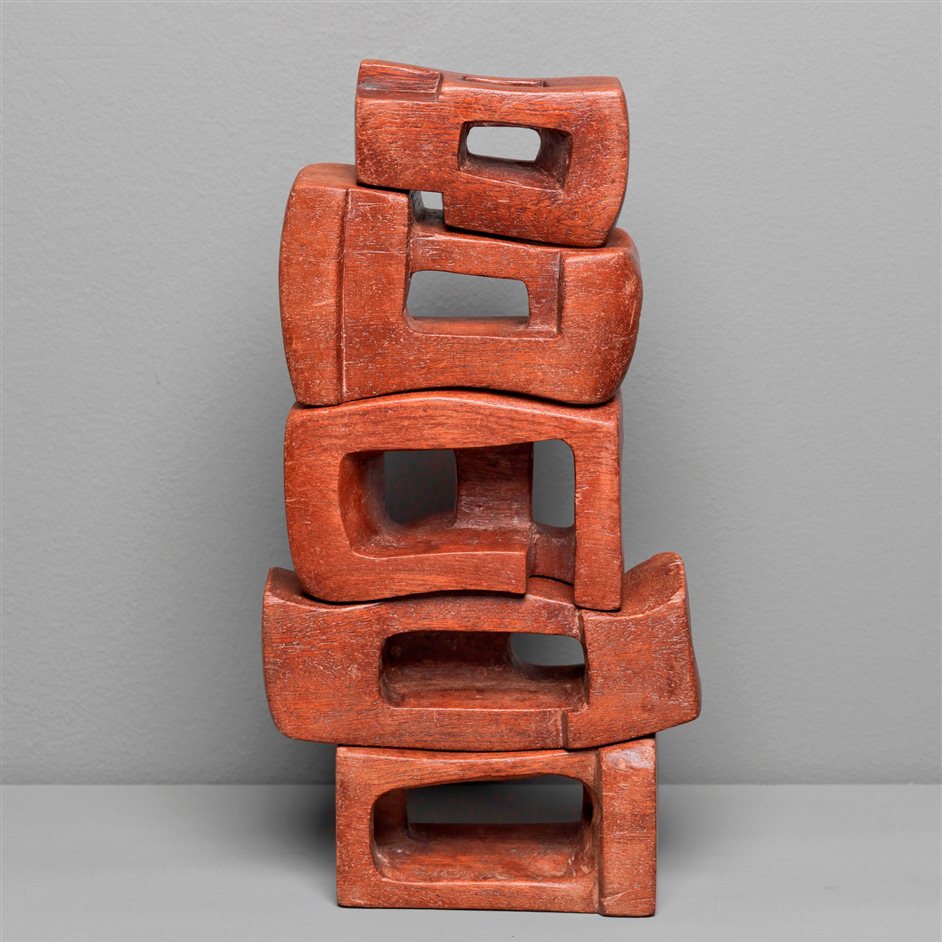
However in addition to the paintings, I also loved Choucair’s sculptures, which became her main preoccupation from the 1950s onwards, and into whose multi-dimensional forms the language of abstract expressionism has translated. Her works often reminded me of British greats Moore and Hepworth, particularly her use of strings strung across her metal sculptures to form rounded ephemeral planes. But I loved in particular her “poem” works – like a pile of bricks but each somehow melting under the tender hands of their mother-sculptor, curving into one another in an organic embrace.

Poem (1963-5) © Saloua Raouda Choucair Foundation

Poem (1963-5) © Saloua Raouda Choucair Foundation

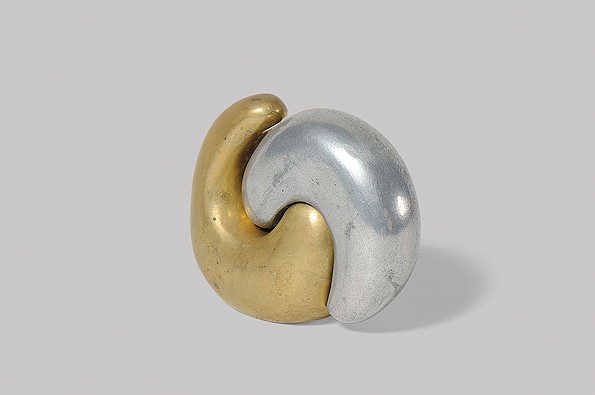
Dual (1978-80) © Saloua Raouda Choucair Foundation

Dual (1978-80) © Saloua Raouda Choucair Foundation

The screw (1975-7) © Saloua Raouda Choucair Foundation

The screw (1975-7) © Saloua Raouda Choucair Foundation

But perhaps the most powerful piece in the exhibition is  Two=One (1947-51), one of Choucair’s painted compositions which had been hanging in her Beirut flat when a bombing raid rained down on the city during the Lebanese civil war in the 1980s, resulting in glass from one of her cabinets smashing and piercing the surface of this abstract painting. Thus the painting bears witness not only to that history, but, as Tate puts it, to the “circumstances through which Choucair not only survived, but continued to work with energy and enthusiasm”. Hopefully, with this superb exhibition  hosted at the very heart of the Britain’s art capital, Choucair’s enthusiasm will finally bear fruit as she becomes recognised as an internationally important abstract artist, under whose skilful guise Eastern islamic geometry met with western Expressionism with stunning results.

Two=One (1947-51) (complete with hole at its centre)  © Saloua Raouda Choucair Foundation

Two=One (1947-51) (complete with hole at its centre) © Saloua Raouda Choucair Foundation

Soloua Raouda Choucair is on at Tate Modern until 20th October 2013.