Skip to content

Posts tagged ‘Artist’

Comparing Seascapes: Sussex and Spain

Two Seascapes, one England, one Spain. In Sussex in England, the sea is a silvery shade of grey. No surprise there, as it is an inseparable reflection of the cloudy skies above, whose repressive covering is broken only by a single glimmer of hope as a glint of light shines through. The seas are active, but not rough, but the winds are sufficiently energetic to catapult the kite surfer across the waters. At the shore the sand is dank and wet, it’s lightening colour resaturated with each swift revolution of the waves. 

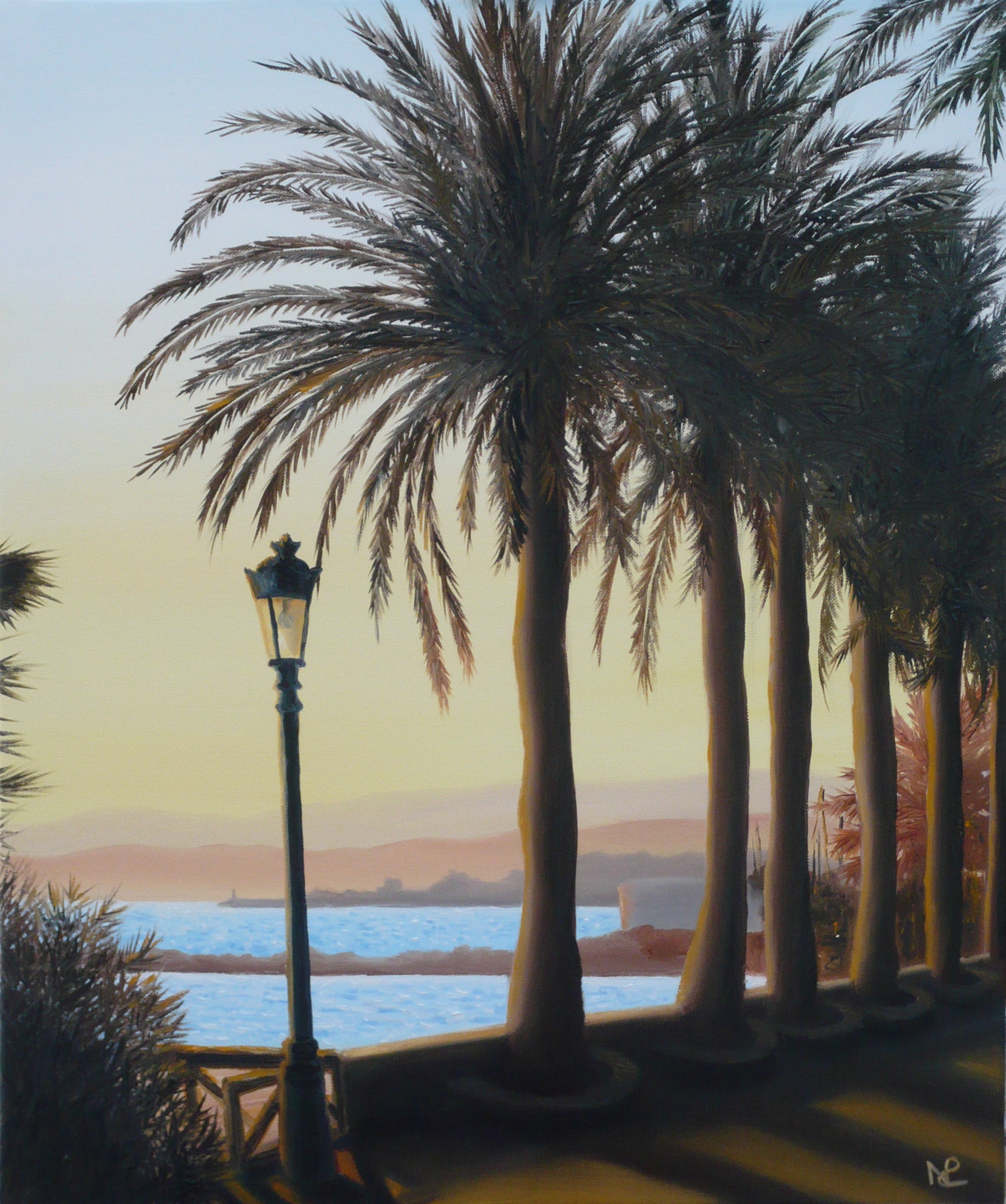
The only thing Marbella in Spain has in common is the sea. But its colour is a startling warm blue, glimmering almost independently from the yellowing evening skies above. Above the beach, a golden paseo maritimo is fringed with regal palms whose large canopy of leaves hang as silently still as the warm balmy calm air around them. Through the leaves, the multiple strata of a mountain layered landscape each deliver a different shade of soft pink, while in front the white harbour wall of Marbella’s port colours gently to cream in the face of the setting sun. 

Seascape III: Silver Surfer (2008 © Nicholas de Lacy-Brown, oil on canvas)
Seascape III: Silver Surfer (2008 © Nicholas de Lacy-Brown, oil on canvas)

Seascape IV: Marbella (2008 © Nicholas de Lacy-Brown, oil on canvas)

Seascape IV: Marbella (2008 © Nicholas de Lacy-Brown, oil on canvas)

I painted these two seascapes in 2008 when I was making a more intentional transition from acrylic into oil. These were part of a series of studies I made as I tried out the medium for the first time. Today, they hang at my parents house in Sussex, and it was when I was there this weekend that I was given the opportunity to reflect upon them, and the marked difference between seaside landscapes.

It comes at a pertinent time: in just a few days I will leave England, including the Sussex seaside town where I grew up for 18 years and which is featured in the seascape above. I will then move to Palma de Mallorca, the archetypal Mediterranean city, fringed with glorious palms and benefitting from sunshine almost the whole year around. Yet despite the very obvious benefits of moving to such a paradise, there will always be a part of me that will miss the English coast – for in its silvery wind swept beauty, the sea in England is just as special as in the Med. It’s just that more often than not, you may need a scarf and some gloves in tow to appreciate it.

© Nicholas de Lacy-Brown and The Daily Norm, 2001-2014. Unauthorized use and/or duplication of the material, whether written work, photography or artwork, included within The Daily Norm without express and written permission from The Daily Norm’s author and/or owner is strictly prohibited. Excerpts and links may be used, provided that full and clear credit is given to Nicholas de Lacy-Brown and The Daily Norm with appropriate and specific direction to the original content. For more information on the work of Nicholas de Lacy-Brown, head to his art website at www.delacy-brown.com

Two Weekends: Thinking about Cappuccino

It only takes a mere moment for your life to change forever. December 2012 taught me that much – a life obliterated – or May 2008 – when another’s mistake had irreversible consequences for the rest of my days. Yet if those moments of change taught me anything, it was that life is too short to stay where you are comfortable but unhappy, where monotony sets in and where you feel as though your train is trundling steadily up the wrong path. 

Earlier this autumn the chance to change paths and find happiness in change occurred to me very suddenly. It only took an email to set the new track in motion, and only two weekends for a decision to be made. For it was in those two weekends that I both attended an interview that would take me on a new path, and in which I made the ultimate decision, standing at the crossroads, that this new path was right for me. 

Two weekends: Thinking of Cappuccino is my newest oil painting, and it tells the story of how my life is all about to change: how I have accepted the offer to become Artistic Director of a global company bearing the name of Cappuccino and stationed within the sunny shores of Mallorca in Spain, and how in taking that offer it will mean moving from London, to Palma. 

Two Weekends: Thinking about Cappuccino (2014 © Nicholas de Lacy-Brown, oil on canvas)

Two Weekends: Thinking about Cappuccino (2014 © Nicholas de Lacy-Brown, oil on canvas)

But the painting came to me in Italy, sitting by the seaside in Donoratico in Tuscany, home of my partner’s family. Sitting at a cafe by a sea so still it might have been a photo, with our own breakfast of cappuccino and crostata (jam tart) on the table, all we could think about was a move to Mallorca, despite breathing the pine tree perfumed air of Tuscany, and drinking in the beauty of that Tuscan beach before us. 

The obvious symbols came to mind: the lifeguard’s hut was the new sanctuary that a home within the medieval streets of Palma de Mallorca would offer us; through the window we looked onto the famous skyline of Palma seen behind the green shutters that are famous in both Tuscany and Mallorca. The lifeguard’s ring has given salvation to the artist within me, represented by the manakin sitting on the sand: it is not so comfortable a position as the crostata tart sitting securely on a blanket, but this tart is the law, and within the confines of its pastry lattice, the blood of my life and career development is congealed and imprisoned, like a soul left out of the fridge too long. 

And of course at the heart of it all is the Cappuccino. No longer just froth and espresso

I think it was in that moment, and in that second weekend of two, that we finally made up our minds to go, to take the leap of faith, to have an adventure and to change our lives. Now the move is in full swing, and by the end of this month we should be reinstalled in Mallorca. Which just goes to show that life can change in a moment. 

© Nicholas de Lacy-Brown and The Daily Norm, 2001-2014. Unauthorized use and/or duplication of the material, whether written work, photography or artwork, included within The Daily Norm without express and written permission from The Daily Norm’s author and/or owner is strictly prohibited. Excerpts and links may be used, provided that full and clear credit is given to Nicholas de Lacy-Brown and The Daily Norm with appropriate and specific direction to the original content. For more information on the work of Nicholas de Lacy-Brown, head to his art website at www.delacy-brown.com

Radical and a little racy… Schiele’s nudes at the Courtauld

They’ve done it again! Short, sweet, brilliantly focused, the Courtauld Gallery in London has once again mounted a brilliant temporary exhibition with a sharp focus on a particular artist and theme. And following on from the gallery’s scintillating study of the single most important year in the development of Picasso’s career, this time the Courtauld is looking at the prolific work of an Austrian artist who sadly never lived out the full career his talent so obviously deserved: Egon Schiele. Instead, almost as though he had a premeditation of the Spanish flu that would kill him at the end of the First World War at the age of only 28, Schiele worked frantically, producing in the few short years of his career such a virtuosity of artwork that even after that short time he has been declared a pillar of Austria’s Expressionist art movement. 

Such was Schiele’s prolific output that the Courtauld had the luxury of being able to chose to focus in on one distinct element of his work: his depiction of the nude. And in doing so they have surely touched on perhaps the most memorable and striking chapter of his oeuvre. For in his depictions of the nude, Schiele was indeed very much the radical, just as the show suggests. Depicting his models with an angular and uncomfortable frame, and raw and visceral colouring, Schiele’s nudes are at once uncompromising and vulgar, while being completely fascinating and electric to the eye. 

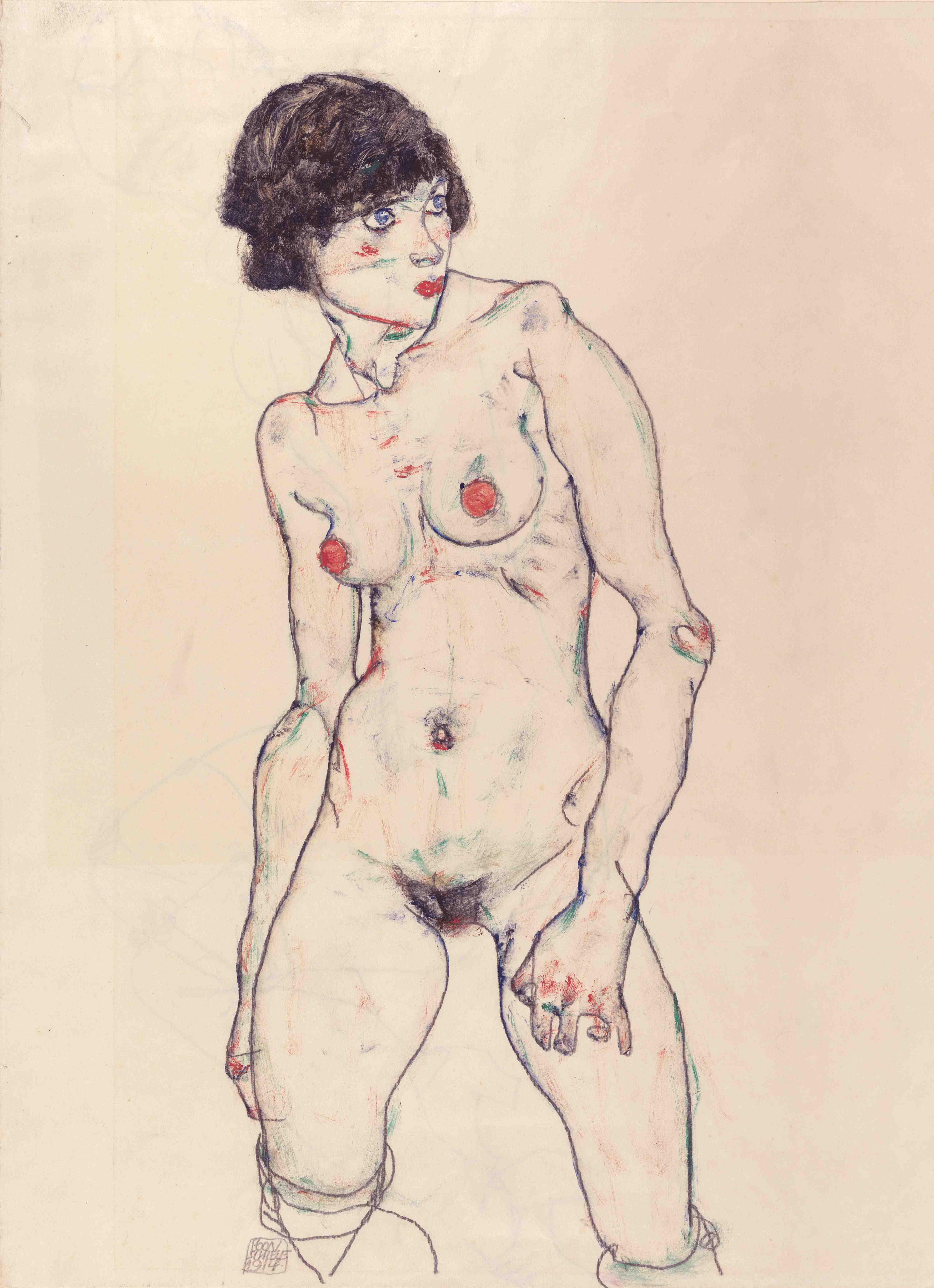
Standing Nude with Stockings, 1914

Standing Nude with Stockings, 1914

Egon Schiele, Male Lower Torso, 1910

Egon Schiele, Male Lower Torso, 1910

Nude Self-Portrait in Gray with Open Mouth, 1910

Nude Self-Portrait in Gray with Open Mouth, 1910

Squatting Female Nude, 1910

Squatting Female Nude, 1910

Schiele wasn’t exactly one to keep with the confines of classical approaches to depicting the nude. Far from it. As well as colouring in his heavily lined nudes with a raw almost skinless muscular palate of dark bloody pinks and bruised purples and ambers, he also strayed very close to the pornographic frontier, depicting women in an unflinchingly abrupt and exposed fashion. I don’t think I ever saw so many views of what lies between a woman’s thighs on a gallery wall! And yet these paintings are not porn. They do not depict a promise of pleasure, but a deeply exposed portrait of the sitter. Yes these women look seductive and often slutty, but it’s as though Schiele is inviting us to read that as part of their story rather than to have an aroused response at what they are offering. 

And of course this exhibition is far from being about the naughty bits. For what these 30 or so paintings demonstrate is the brilliance and apparent confidence of Schiele’s line work as well as the originality of his depiction. These are bodies like we have never seen them before. Distorted, and occasionally out of proportion, bulging and contorting where they shouldn’t and often with sharp edges where supple skin should be, these are nudes taken up a level to an almost abstract exploration; poses which are almost impossible to hold; limbs seemingly amputated from the torso in order to focus the audience on a particular present part of the body; and expressions which are both exposing and intensely emotional: this is uncompromising portraiture. 

Seated Female Nude with Raised Arm (Gertrude Schiele), 1910

Seated Female Nude with Raised Arm (Gertrude Schiele), 1910

Crouching Woman with Green Kerchief, 1914

Crouching Woman with Green Kerchief, 1914

Two Girls Embracing (Friends), 1915

Two Girls Embracing (Friends), 1915

Erwin Dominik Osen, Nude with Crossed Arms,1910

Erwin Dominik Osen, Nude with Crossed Arms,1910

So is this small but perfectly formed show worth braving the growing queues for? It undoubtedly is. For this is an unprecedented chance to focus in on the bold feverish creative output of a quickly lost genius and almost certainly one of the most important shows of London’s artistic year. The only complaint you may have is that this sharp focus doesn’t go on longer. 

Egon Schiele: the Radical Nude runs until 18 January. But beware – the show contains some explicit images and may not be deemed suitable for all. 

My début at the Dulwich Picture Gallery

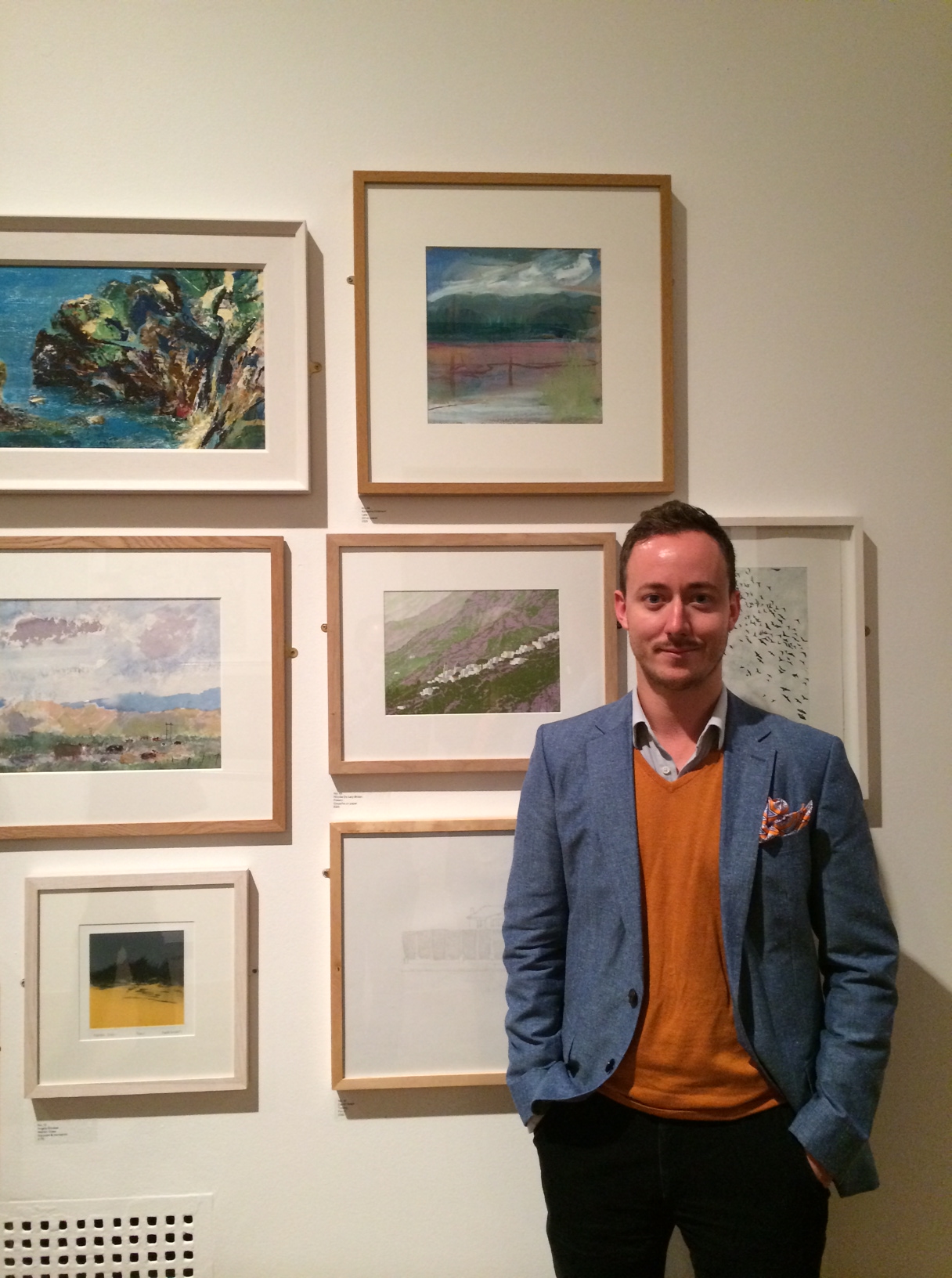
2014 has been a great year for me artistically. In May, I held my most commercially successful exhibition to date, with plenty of exciting commissions and opportunities flowing straight out of it. In July I exhibited with a new generation of freshly graduated art students at London Bridge’s Art Academy, and in September I exhibited my prints in a sensational show of printmaking talent amongst the works of the East London Printmakers at the Embassy Tea Gallery in London Bridge. But as far as 2014 goes, I have certainly left the best until last. For this October, one of my paintings will hang in an art gallery so prestigious, and so imbued with history, that it feels like a dream to see my work up on its walls.

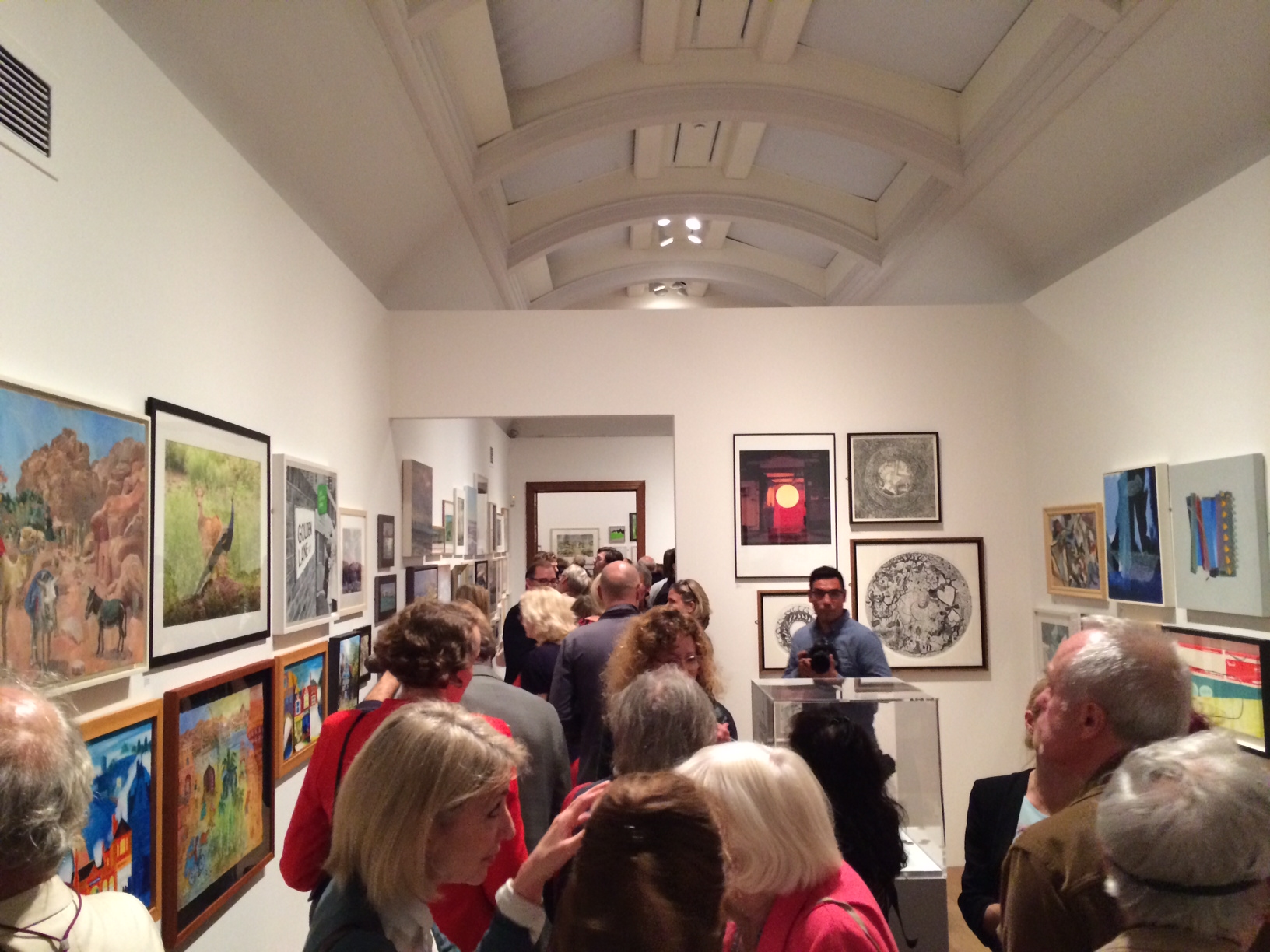
I am of course talking about the Dulwich Picture Gallery, Britain’s oldest public art gallery, and home to some of the UK’s most illustrious artists and art collections, amongst them undisputed masters such as Gainborough, Watteau, Canaletto, Veronese and Reynolds. And for the next two and a half weeks, starting with a lavish opening gala last night, my very own artwork will be hanging amongst other works in a new Open Submission show a mere few metres from these incredible masterpieces of art history – a complete honour.

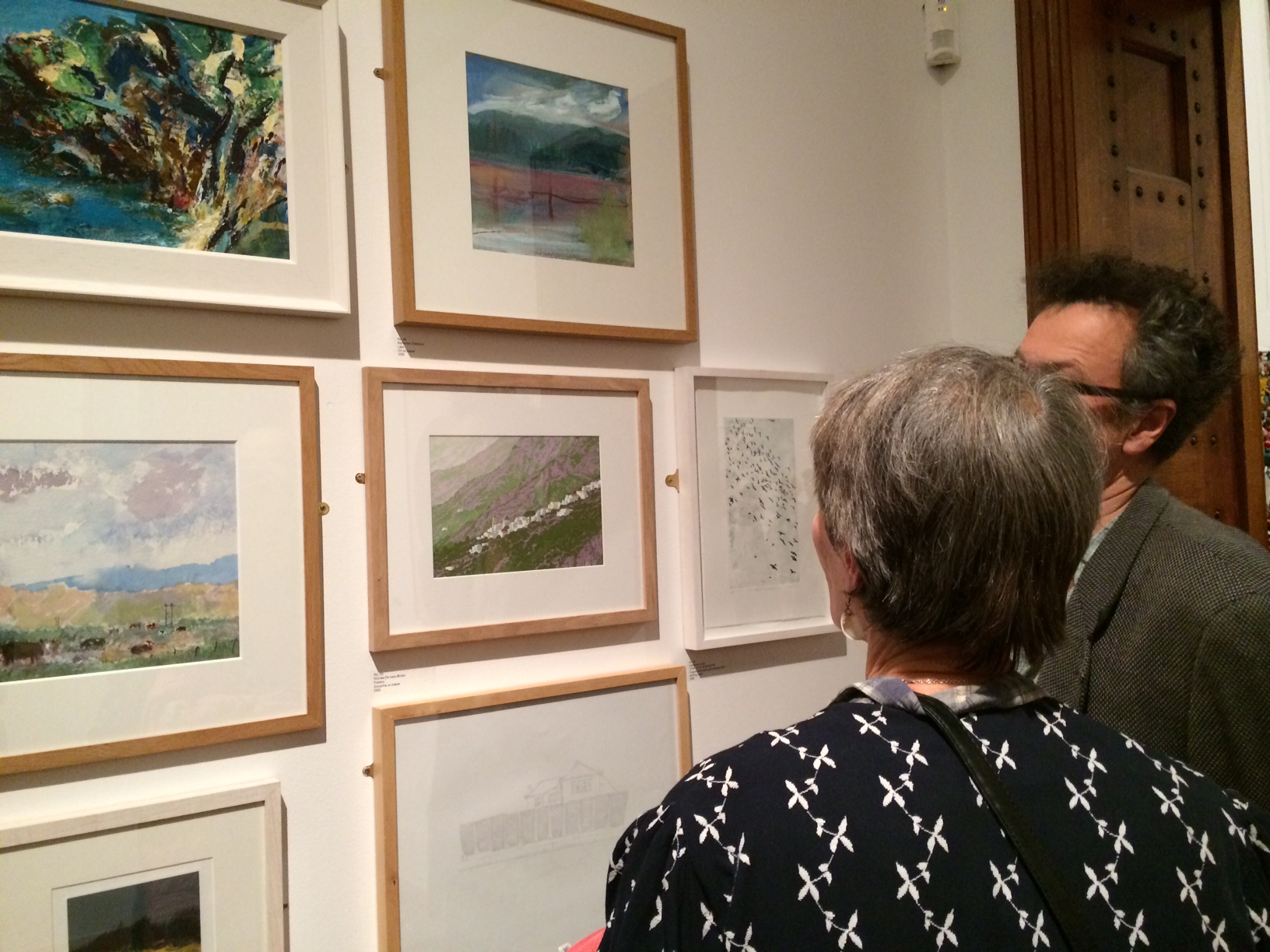
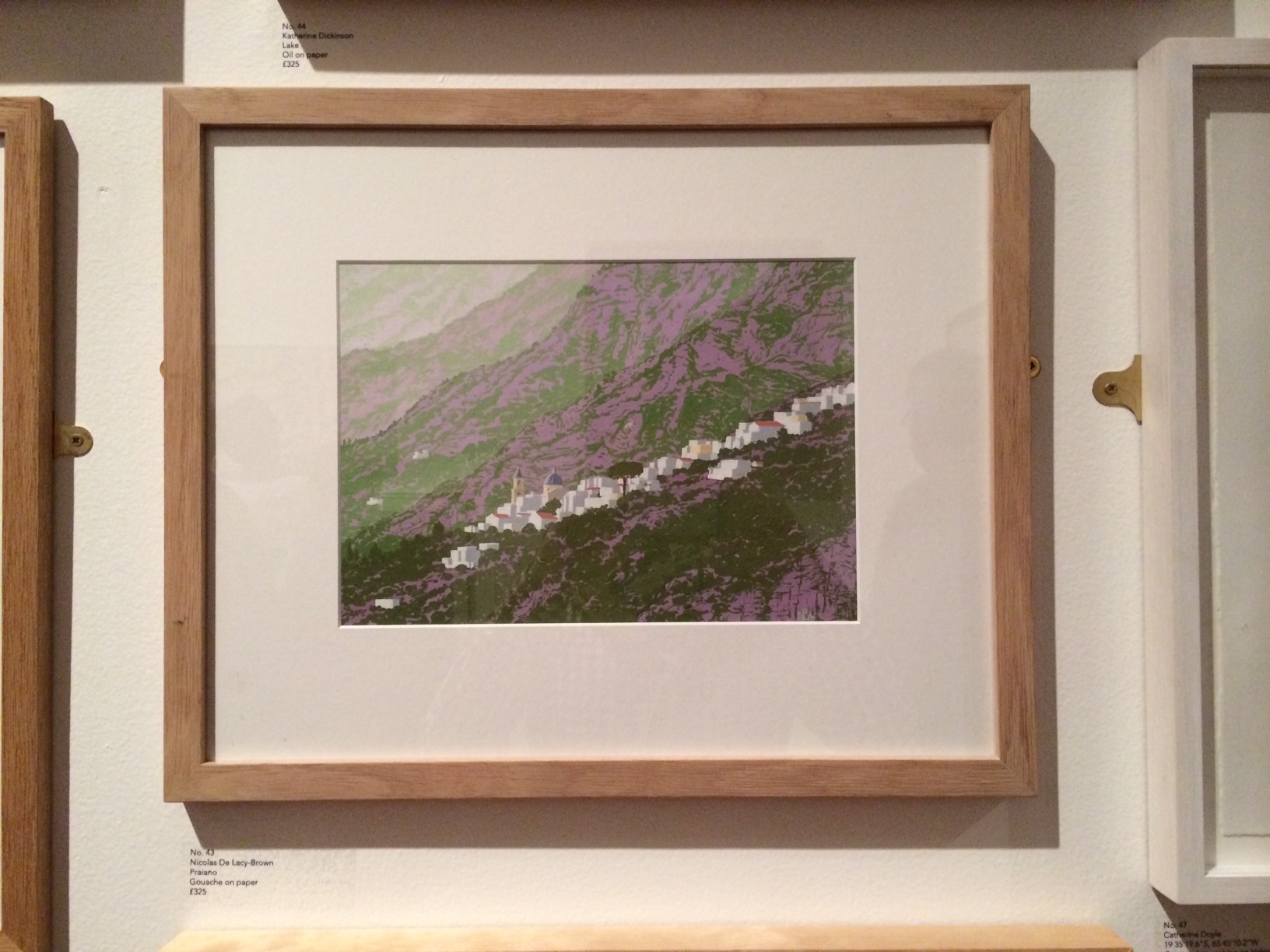
The painting selected for show was my simple landscape of Praiano, a glistening little town on the mountainous Amalfi Coast. Painted in gouache on paper in the immediate aftermath of my Amalfi Coast trip, the painting is one of currently 11 paintings comprising my “interpretations” collection, and is perhaps the most meditative and tranquil of them all. All framed up in a fancy oak frame, it looks splendid, and I have never been prouder of my artwork than last night, when I saw my little painting hung on these walls where only months before David Hockney’s world-class printworks had been admired by crowds of thousands.

2 1 image 3 imwsef

And of course my painting is not alone. Hanging amongst some 170 others, it is but one in a collection of wonderful works submitted by the Friends of the Dulwich Picture Gallery and chosen for exhibition by a panel of illustrious judges. So  don’t just go along to see my Praiano – make your way to Dulwich to see galleries full of creative gems – both those of new budding artists, and of art history’s greats.

The Dulwich Picture Gallery Friend’s Open Exhibition runs until 12 October 2014.

Interpretation No. 11 – Castagneto Carducci

Last week’s Daily Norm was a glorious panoply of Tuscan views, scenes and sensations and it’s not quite over yet. For hot on the heels of my Tuscan weekend comes my 11th interpretative landscape – part of my Interpretations collection which I began some three months ago after being inspired by the sumptuous landscapes and cubic shapes of Italy’s Amalfi Coast. 

Back in Italy this September, and one glimpse up through the vine-packed fields of Donoratico to the emerging landscape of Castagneto Carducci made me realise that this pretty hill top town was an obvious contender for an interpretative overhaul. For with its tightly packed cluster of pastel coloured houses all set up on a Tuscan hill, Castagneto offers a wonderful synthesis between petit-urban development set amidst a stunning landscape, which is exactly what the Interpretations series sets out to emulate. And I think this 11th Interpretation is probably one of my favourites of them all.   

Interpretation No. 11 - Castagneto Carducci (2014 © Nicholas de Lacy-Brown, gouache on paper)

Interpretation No. 11 – Castagneto Carducci (2014 © Nicholas de Lacy-Brown, gouache on paper)

© Nicholas de Lacy-Brown and The Daily Norm, 2001-2014. Unauthorized use and/or duplication of the material, whether written work, photography or artwork, included within The Daily Norm without express and written permission from The Daily Norm’s author and/or owner is strictly prohibited. Excerpts and links may be used, provided that full and clear credit is given to Nicholas de Lacy-Brown and The Daily Norm with appropriate and specific direction to the original content. For more information on the work of Nicholas de Lacy-Brown, head to his art website at www.delacy-brown.com

The East London Printmakers Annual Show: You’re Invited

My summer has been so incredibly hectic, full of travels, work and multiple new artistic creations that I have barely had time to promote the fact that several of my print works are about to feature in the East London Printmakers (ELP) Annual group Exhibition at the Embassy Tea Gallery in London Bridge over the next two weeks! And in fact it’s very much a case of better late than never, because the show will open this very night, with an exclusive guest appearance and official opening by none other than British abstract expressionist, Albert Irvin RA.

Amongst 70 artists exhibiting works created over the last year and aptly showcasing the versatility of printmaking as a medium will be none other than yours truly – me! Yes, this show will represent my first significant outing into the exhibiting circuit since my near sell-out show at the Strand Gallery in May, and I am particularly excited to be showing two brand new prints. The works, both of which were inspired by summer travels in Spain and Croatia respectively, mark something of an innovative departure for me. Having learned both the techniques of etching and woodcut, with these prints, I decided to combine the two things, thus taking the mediums in new directions, and printing on a totally different scale.

10644904_753873787981410_8613060105862232654_n

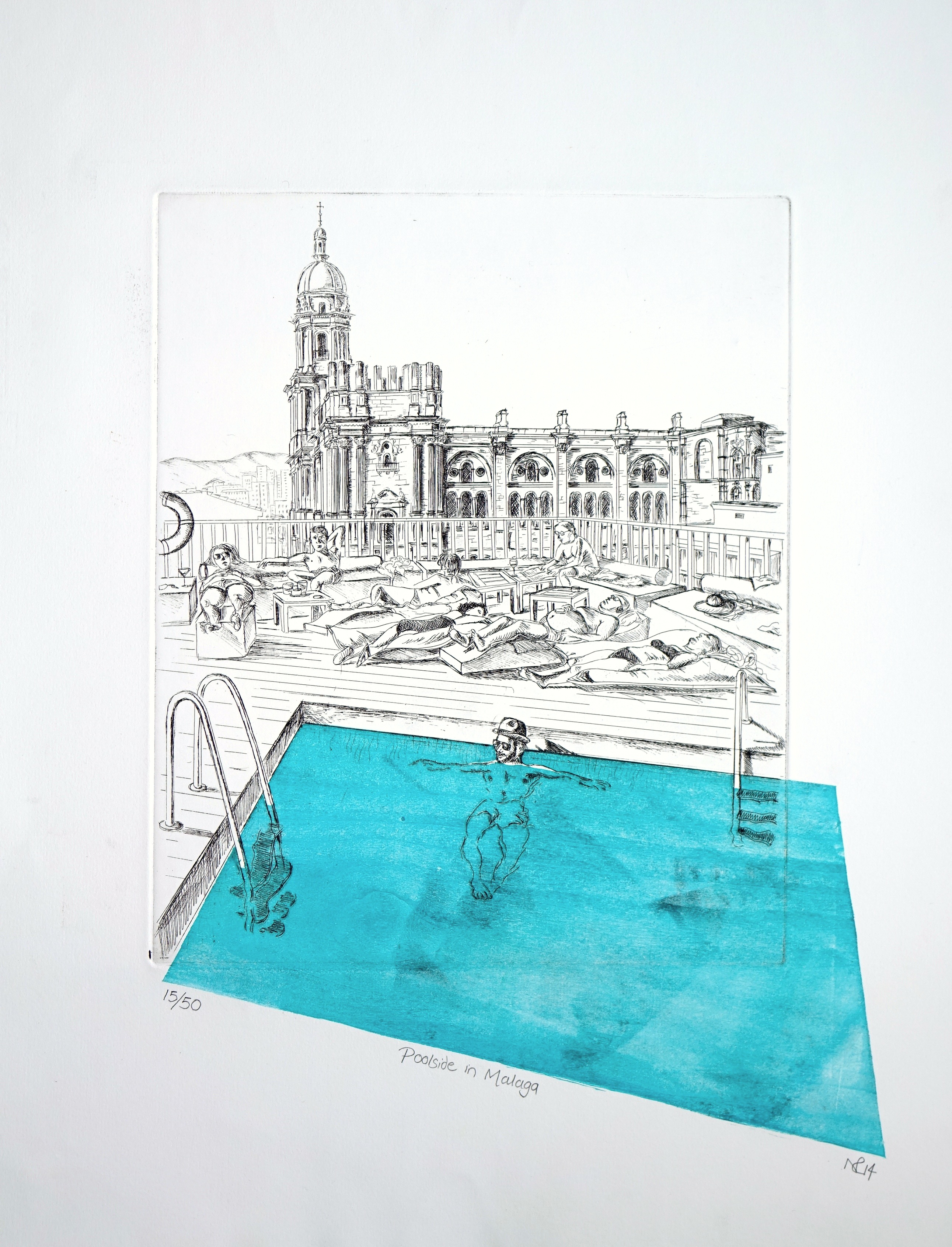
The first of the two prints, Malaga Poolside, shows a heady day when my partner and I sunbathed and swam on the incredible rooftop of the Molina Lario Hotel in Malaga. We couldn’t quite believe that up on that hotel terrace, we were able to swim with the stunning surroudings of Malaga’s one-armed cathedral just besides us, and this print attempts to capture that incredible view in a simple black and white etched line drawing, contrasting with the vivacity of the turquoise swimming pool which is almost Hockneyian in nature.

Malaga Poolside (2014 © Nicholas de Lacy-Brown, etching and woodblock on paper)

Malaga Poolside (2014 © Nicholas de Lacy-Brown, etching and woodblock on paper)

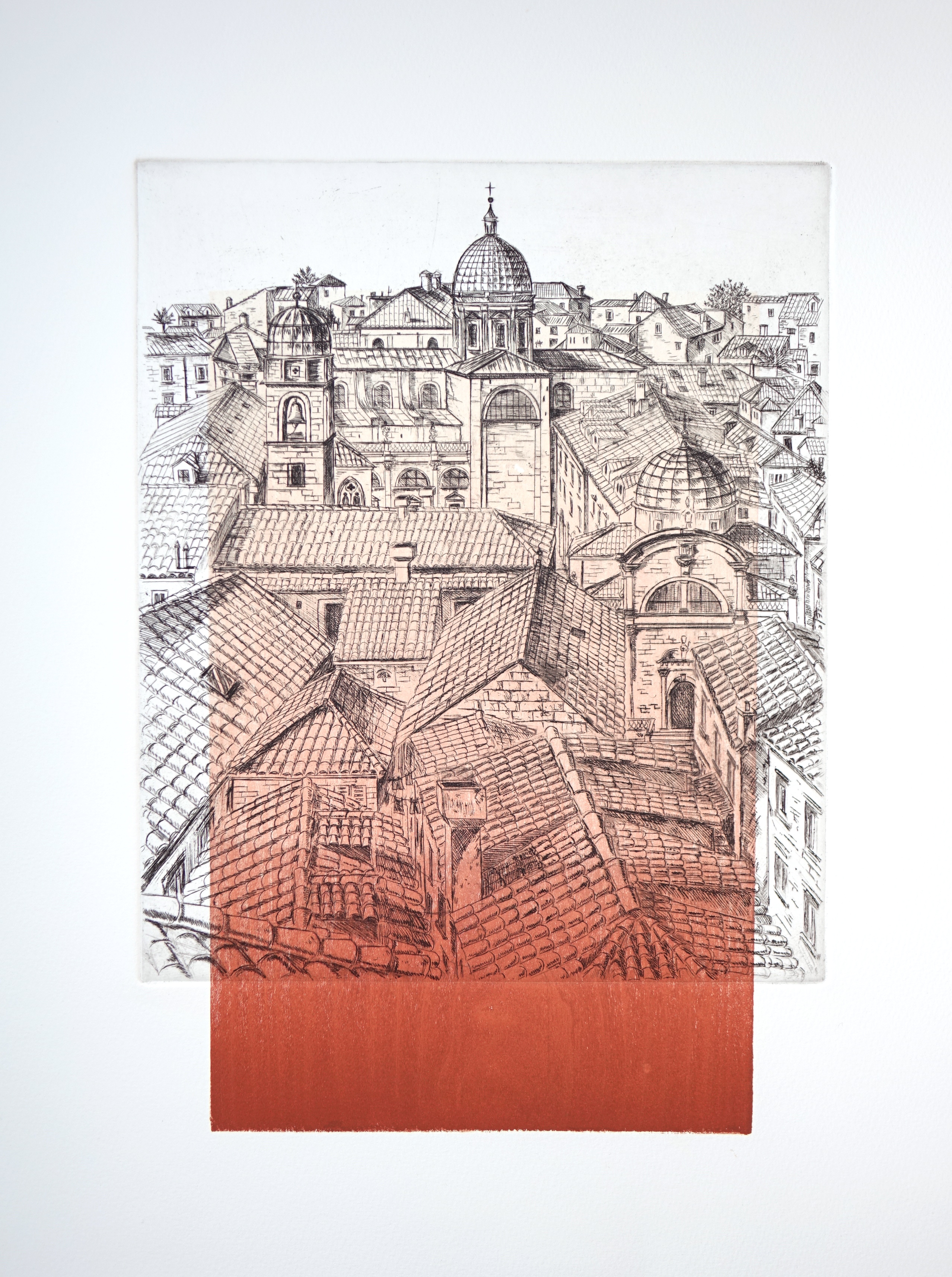
The second of my prints is entitled Terracotta Sunrise, and illustrates the swathe of terracotta rooftops which so captivated me when I visited Dubrovnik earlier this year. While I opted again for a simple line to illustrate the details of the compact houses and streets of this beautiful Croatian city, I wanted to use a graduating block of terracotta to subtly represent the overarching colour of the city when seen from afar, doing so with a graduating roll of colour which fades off almost like a sunrise.

Terracotta Sunrise (2014 © Nicholas de Lacy-Brown, etching and woodblock on paper)

Terracotta Sunrise (2014 © Nicholas de Lacy-Brown, etching and woodblock on paper)

But of course these are only photos (and not very good ones at that) and there is no substitute for seeing the real thing. So if you are able to get down to the Southawk/ London Bridge area of London tonight (for the opening) or any time over the next two weeks, do please come along – the gallery will be open until 6pm daily until 28th September. All the details can be found here. See you there.

10678733_753879087980880_4077473047340161283_n

Naturaleza Muerta

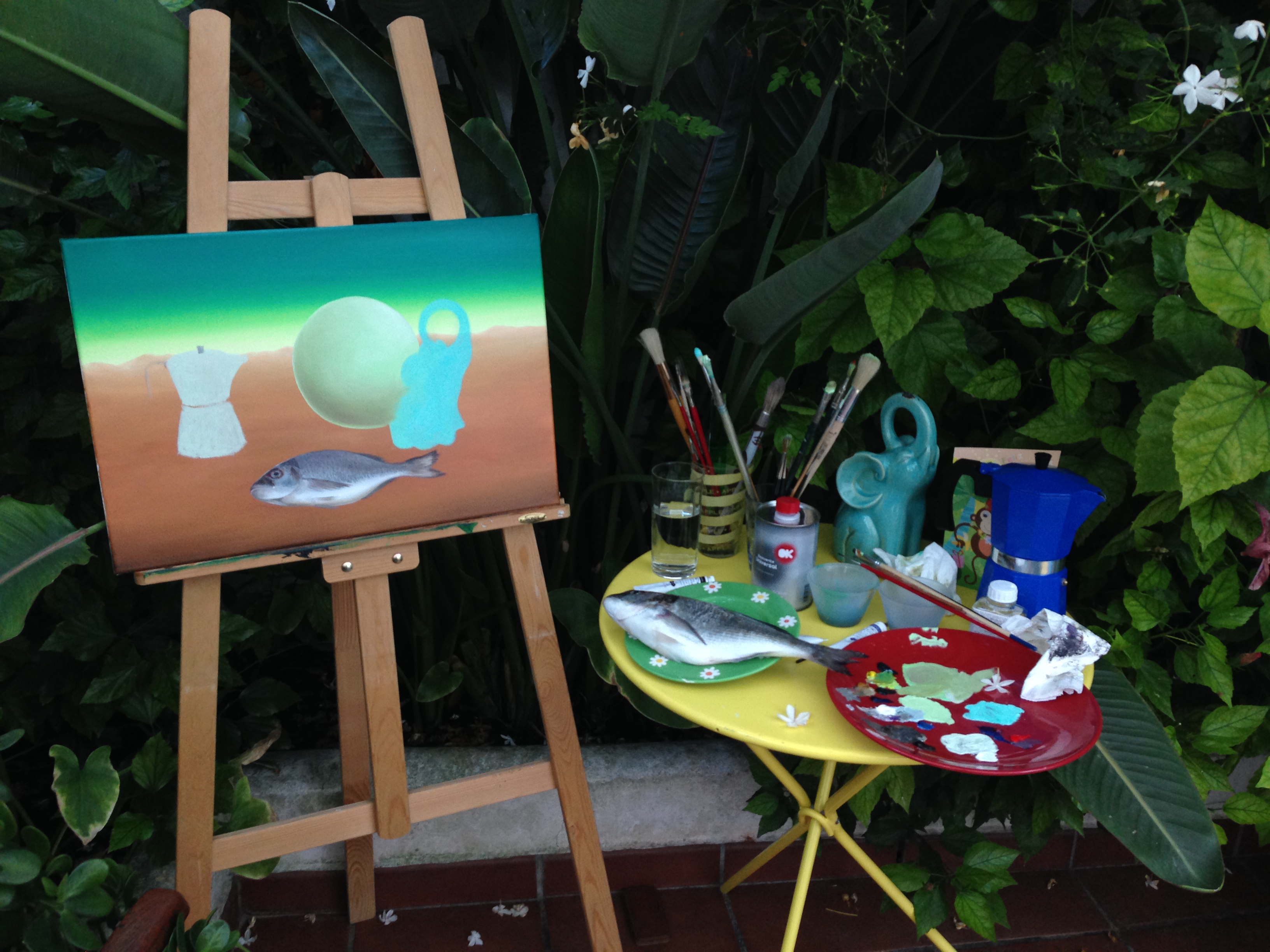
Despite many years of painting, drawing and (most recently) printmaking, and just as much time treading the boards of art galleries around Europe, I have been guilty of a great crime: I forgot all about still lifes. Subconsciously I have somehow discounted them, despite knowing them to be a great staple of art history and art collections around the world, and having enjoyed still life masterpieces such as Cezanne’s various compositions of oranges and apples, and the brilliantly photorealistic depictions of bouquets of flowers and lavish feasts from the Dutch golden age. Yet when I went to the Joaquin Peinado museum in Ronda last month, what really struck me above and beyond the majority of his wonderfully original cubist-inspired paintings, were his still lives. In particular I noticed his deceptively simple depictions of fruit and the odd household item such as a coffee pot, and an idea struck in my head: why don’t I paint a still life?!

By coincidence, before we left for Ronda from Marbella, I had already begun an oil painting – a surreal looking desert landscape which was to be the base of another germ of an idea which was developing in my head. But as soon as my still life idea struck, I realised that the combination of collected objects on a somewhat surreal deserted background would make for the perfect twist on the traditional still life composition. So as soon as we got back from Ronda, I started work.

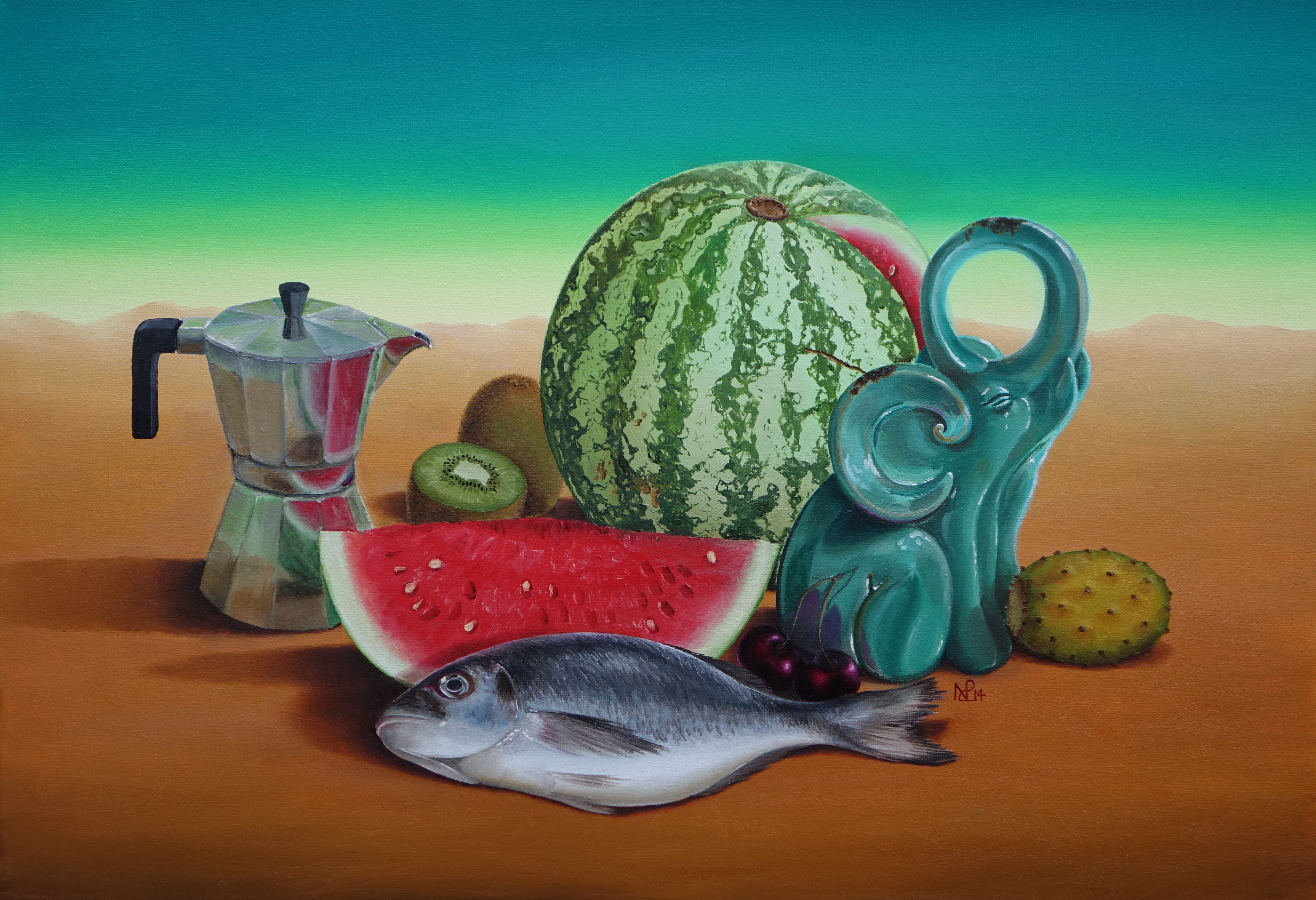
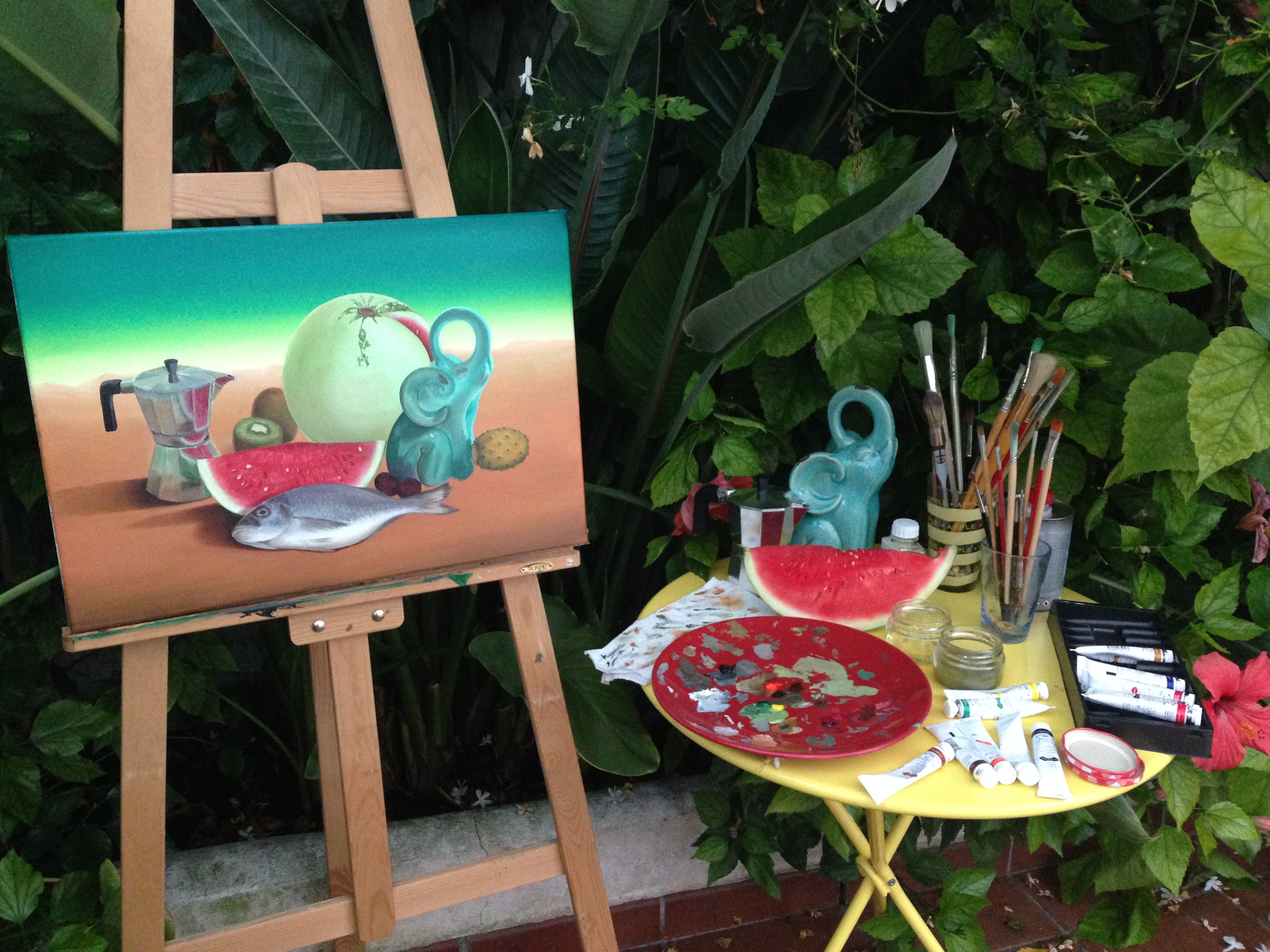
Naturaleza Muerta: Still life with coffee pot, dorada, tropical fruits and a ceramic elephant (2014 © Nicholas de Lacy-Brown, oil on canvas)

Naturaleza Muerta: Still life with coffee pot, dorada, tropical fruits and a ceramic elephant (2014 © Nicholas de Lacy-Brown, oil on canvas)

The objects I collected for my work were not really the result of coincidence. Rather, I carefully planned my selection so that I could achieve a colour balance within the two main colours of the palette chosen for this work: red and green. The ceramic elephant was already a feature of the garden in which I was doing my painting, and the various fruits were chosen specifically for their colour, shape and what they represented: the watermelon represents the global profile of Marbella; the elephant our time out on the terrace. The kiwis represent our constant furry travelling companions Fluffy and Bilbao, and the cactus fruits represent the extensive work we did on redecorating our Marbella terrace. The beautiful silvery sea bream represents all the pleasure we took in eating out; while the cherries represent my partner and I, never separated, coming as a pair. Finally the coffee pot is there in homage to Peinado who gave me the idea of a still life; and because coffee culture is surely one of the most enjoyable aspects of life in Marbella.

So after several days painting this work in instalments after visits to the beach, my first Still Life was complete. Now I’m hooked on the idea and can already imagine doing so many more. The question is, what will I paint in my next Still Life?

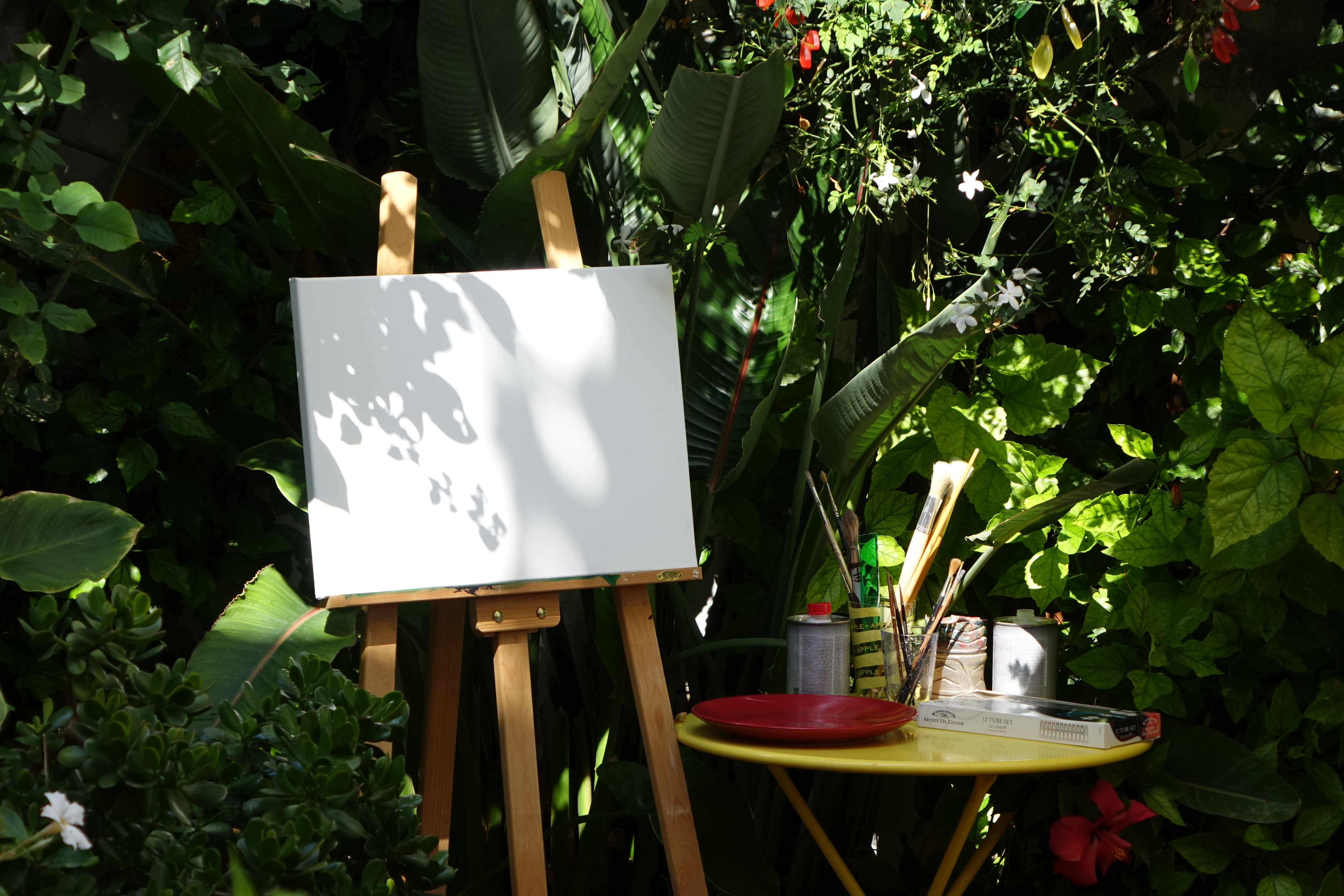
Creating my still life in our garden in Marbella

DSC04746 IMG_9667 IMG_9736

© Nicholas de Lacy-Brown 2000-2014. Unauthorised use and/or duplication of the material, whether written work, photography or artwork, included on this website without express and written permission from Nicholas de Lacy-Brown is strictly prohibited. For more information on the work of Nicholas de Lacy-Brown, head to his art website at www.delacy-brown.com
Interpretation No.10: Vintage Ronda

As England soaked in an August when early autumn usurped the rightful place of summer, I spent the last two weeks with my head still firmly in the sun-baked sands of Ronda in Southern Spain. Never has a homecoming from Spain proved so hard as the unapologetic plunge by 20 degrees from 35 to 15. And never have the grey dirty streets of London or the impossibly cramped antisocial conditions of the tube proved so unattractive when compared alongside the almost-tangible memories of Andalucia’s rolling golden hills and cerulean blue skies, memories that remain so vividly present behind my minds eye, almost taunting me as I stagnate in my unenviable choice of permanent home.

As always, I have sought to address this mental imbalance by reacquainting myself with the place where I was at my happiest, taking up my paints and paintbrushes and capturing a few spare moments in a weekday evening, to sit down and paint my memories. In so doing, I have completed my third painting of Ronda; another in the “Interpretations” series which sees me reinterpreting the landscape through simplified forms and a refocus on the shapes made by civilisation rather than the detail.

Interpretation No. 10 - Vintage Ronda (2014 © Nicholas de Lacy-Brown, gouache on paper)

Interpretation No. 10 – Vintage Ronda (2014 © Nicholas de Lacy-Brown, gouache on paper)

This 10th interpretation concentrates on two aspects of “Vintage” Ronda: first the ancient arabic walls which can still be seen on one side of the El Tajo gorge close to the old arab baths; and second a newer but still historic car, the likes of which we happened to find parked in this exact spot when taking photos of the arab ruins. When I saw it there, I could not help but recall my interpretation of the landscape in Italy’s Positano, painted with a yellow vespa in the foreground, and I knew that with this red vintage car, the perfect partner work had been born.

© Nicholas de Lacy-Brown and The Daily Norm, 2001-2014. Unauthorized use and/or duplication of the material, whether written work, photography or artwork, included within The Daily Norm without express and written permission from The Daily Norm’s author and/or owner is strictly prohibited. Excerpts and links may be used, provided that full and clear credit is given to Nicholas de Lacy-Brown and The Daily Norm with appropriate and specific direction to the original content. For more information on the work of Nicholas de Lacy-Brown, head to his art website at www.delacy-brown.com

Interpretation No. 9: The Gorge and the Puente Nuevo

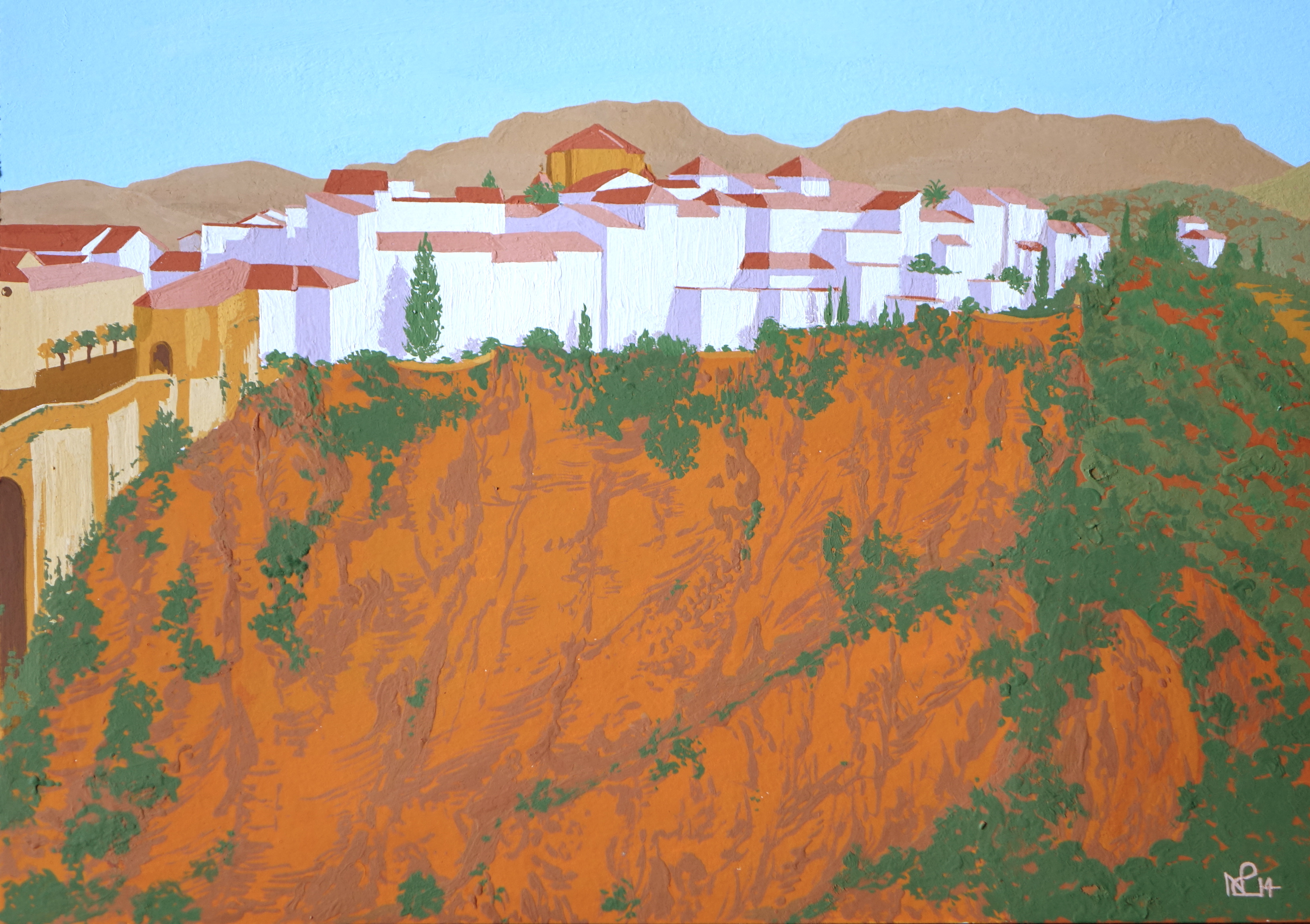
It would have been hard to stop my artistic appreciation of the city of Ronda with a single painting, and having completed Interpretation no.8, my interpretative landscape of Ronda, no.9 followed hot on its heels. This time the same fusion of the arid amber gorge and crisp white buildings predominates, but this painting focuses more on the great imposing El Tajo gorge, together with the bridge (albeit only a small slice of it) that links the two sides of ancient Ronda. In this painting I hope to have emphasised the sheer drama which the teetering positioning of Ronda’s houses on the top of a vast plunging gorge provides, as well as capturing some of the more iconic sights of the city, from the Puente Nuevo to the old cathedral sitting at its centre. 

Interpretation No. 9 (2014 © Nicholas de Lacy-Brown, gouache on paper)

Interpretation No. 9 (2014 © Nicholas de Lacy-Brown, gouache on paper)

© Nicholas de Lacy-Brown and The Daily Norm, 2001-2014. Unauthorized use and/or duplication of the material, whether written work, photography or artwork, included within The Daily Norm without express and written permission from The Daily Norm’s author and/or owner is strictly prohibited. Excerpts and links may be used, provided that full and clear credit is given to Nicholas de Lacy-Brown and The Daily Norm with appropriate and specific direction to the original content. For more information on the work of Nicholas de Lacy-Brown, head to his art website at www.delacy-brown.com

My travel sketchbook: Swimming Pool at the Paradores, Ronda

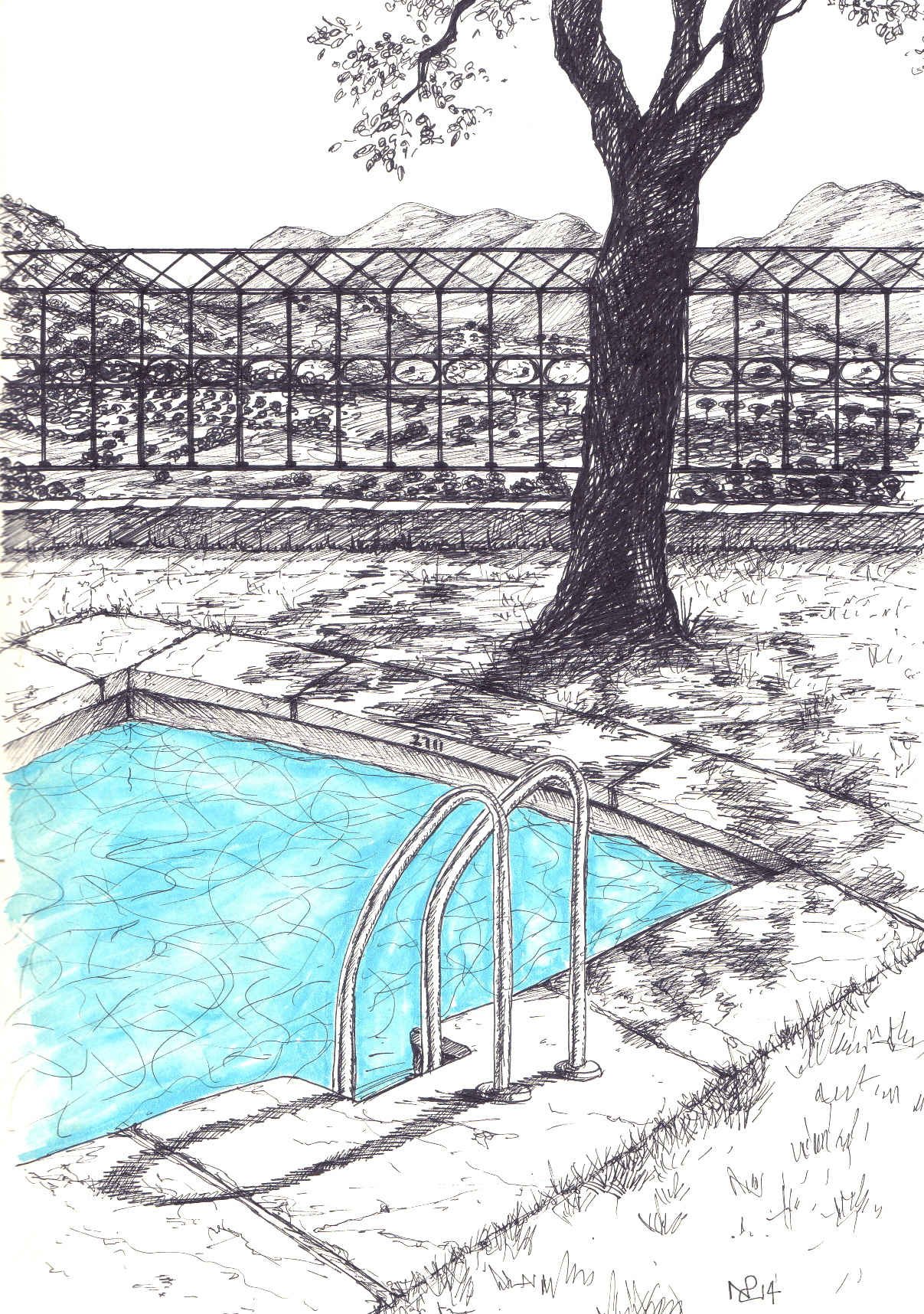
My third sketch of Ronda marked something of a departure from my two views of the gorge. I had taken my sketchbook down to the hotel pool with me on the afternoon of my birthday, half expecting to capture another glimpse of the sensational hotel views over the surrounding landscape. And while I did begin to draw in a little of that landscape, I soon realised that what was exciting me most about the scene before me wasn’t the landscape at all, but the electric blue swimming pool set within a lush garden dappled with sunlight through sheltering trees. And so in something which recalls the dolce vita represented in the early LA paintings of David Hockney, I made the swimming pool of the hotel Paradores the focus of this sketch, even returning to the completed black and white work to add the same electric blue that had so entranced me. Together there is not only a striking contrast of monochrome and blue, but the very vision of a summer’s holiday afternoon. Bliss. 

Ronda Sketch 3 - Paradores Pool (2014 © Nicholas de Lacy-Brown, pen and ink on paper)

Ronda Sketch 3 – Paradores Pool (2014 © Nicholas de Lacy-Brown, pen and ink on paper)

© Nicholas de Lacy-Brown and The Daily Norm, 2001-2014. Unauthorized use and/or duplication of the material, whether written work, photography or artwork, included within The Daily Norm without express and written permission from The Daily Norm’s author and/or owner is strictly prohibited. Excerpts and links may be used, provided that full and clear credit is given to Nicholas de Lacy-Brown and The Daily Norm with appropriate and specific direction to the original content. For more information on the work of Nicholas de Lacy-Brown, head to his art website at www.delacy-brown.com