Skip to content

Posts tagged ‘Cooking’

Madeleine Melody

OK, so admittedly, the macaron attempt a few months back didn’t exactly go to plan, as my post “Macaron Madness” will testify. So I’ve turned to another Frenchie patisserie favourite which has turned out to be slightly easier to master. In fact, I’ve mastered quite a few French favourites of like, including Crème brûlée with a picture-perfect crackable burnt caramel top (courtesy of my new favourite kitchen toy – the mini blow torch) albeit that on my third attempt, the Crème brûlée somehow managed to revert into a kind of mousse brûlée (this being the one which was rather embarrassingly cooked for two French guests – I was full of bravado about English boy being able to cook French food to perfection and then that little mishap occurred… naturally I pretended it was a purposeful reinvention of the classic). And crossing over the Pyrenees to Catalonia, I’ve also recently mastered Crema Catalana, the lighter, citrus and subtly spiced version of the Crème brûlée, a dessert which previously had me stumped – it was either too runny or like jelly. Anyway, I digress, back to France…

I’ve been intending to cook madeleines for some time, ever since I picked up one of those shell-shaped baking moulds as an impulse purchase purely because it was made of silicone and is red (thus matching my kitchen colour scheme to perfection). Nonetheless, there my madeleine mould remained, creased up in my pots and pan cupboard in a way that only silicone could, until one day, a few weeks ago, when my ears customarily pricked up to the words “Paris” on my television screen and I found myself falling instantaneously in love with a new cookery programme: Rachel Khoo’s The Little Paris Kitchen. This programme is a must for any Paris lovers – it’s worth watching alone just for the stunning views of Montmartre roof tops, the Tour Eiffel by sunset, Paris viewed from the roof of the Grand Palais where they keep beehives (who would have known?!) as well as a quirky soundtrack featuring an ecclectic mix of old French classics from the likes of Charles Trenet as well as punchy tango chill from the Gotan Project. But by far the star of the show is the little teeny weeny kitchen which gives the show its title, as well as the equally tiny, affable and engaging proprietress of her little kitchen restaurant, Rachel Khoo. She aims to cook undaunting French classics, more often than not with a contemporary twist. She makes French cooking accessible and very unpretentious, which lets face it, makes a change, and she fills the hearts of us english with a certain pride – she is after all a London girl who has made it good in the closed culinary world of Paris.

Rachel Khoo

Anyway, it was Rachel Khoo who, in her first episode, made madeleines with a twist – she places a single raspberry in each madeleine before cooking and then, once hot out of the oven, pipes the raspberry’s little opening full of an oozy lemon curd. No wonder I was inspired to take out my funny red silicone tray and try this recipe out. The results were good (see photos below) – the madeleines, unlike those which you can buy cheap in Monoprix, are unctuous and moist, and this is no doubt helped by the the lemon curd and and raspberry, both of which combine to provide a delicious mid-Madeleine treat to break up an otherwise buttery flavour. Rachel Khoo, I salute you.

Pre-cooking - the madeleine mix in my silicone mould complete with raspberries, hole facing upwards
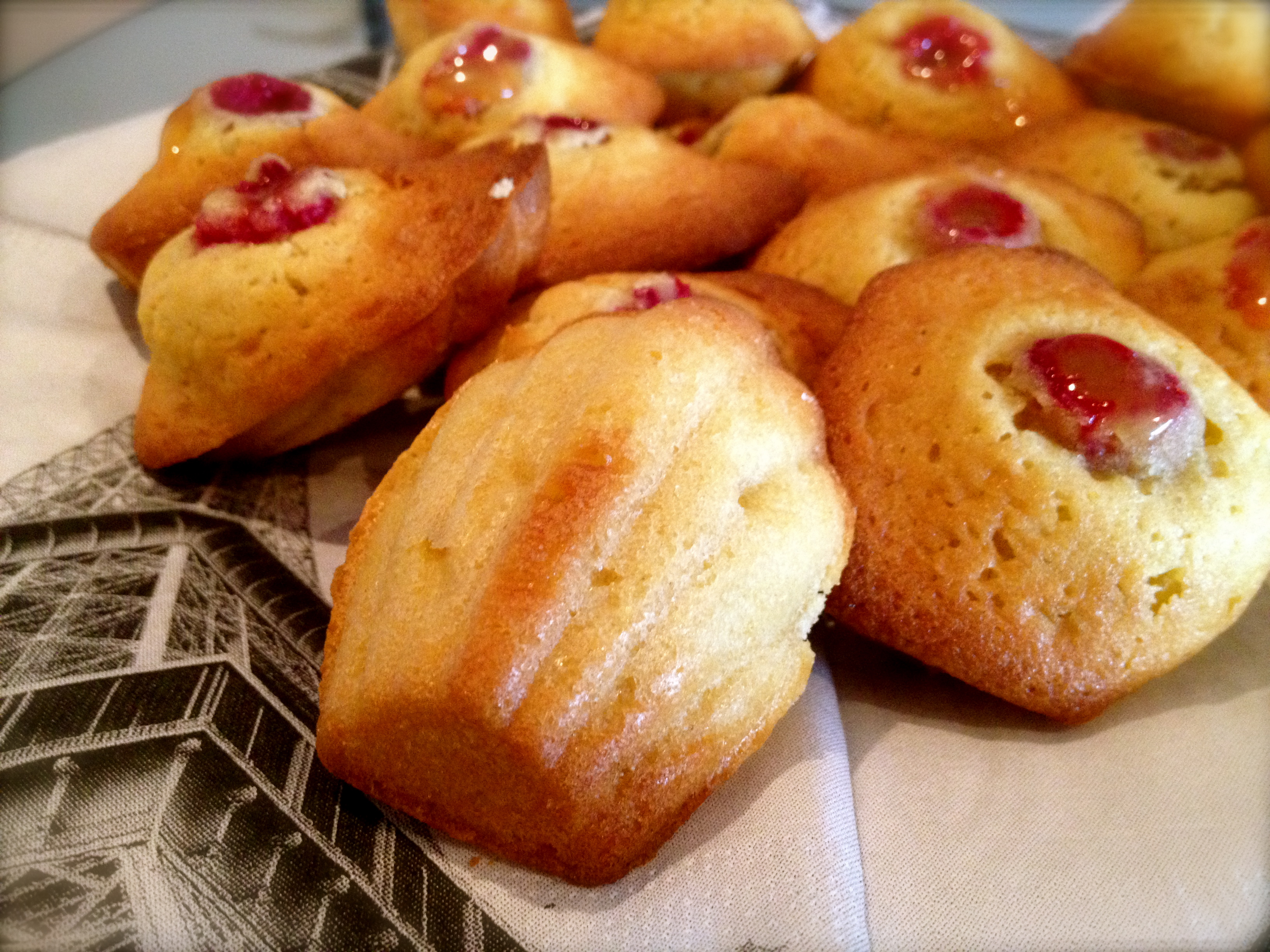
Et voilà, the finished madeleines

I told you I'm obsessed with Paris...

Rachel’s recipe for madeleines à la crème au citron can be found here.

Bon appetite!

Related articles

My Easter Day Spanish Feast Spectacular

Easter day is over, but the Spring has only just begun, and now is as good a time as any to think succulent chicken, sweet wine imbued ice cream and cute little marzipans, just in case your summer beach body needed to endure any further damage! On Easter Sunday I followed my pro-Spanish theme of the previous week by cooking a Spanish feast of which Goya himself would have been proud. And it was so tasty, I feel compelled to share all the ideas with my faithful Daily Norm readers so that you too can go all España this Spring.

First however I should express my gratitude to Claudia Roden who, in her fantastic new book, The Food of Spain, gave me much of the inspiration for the feast.

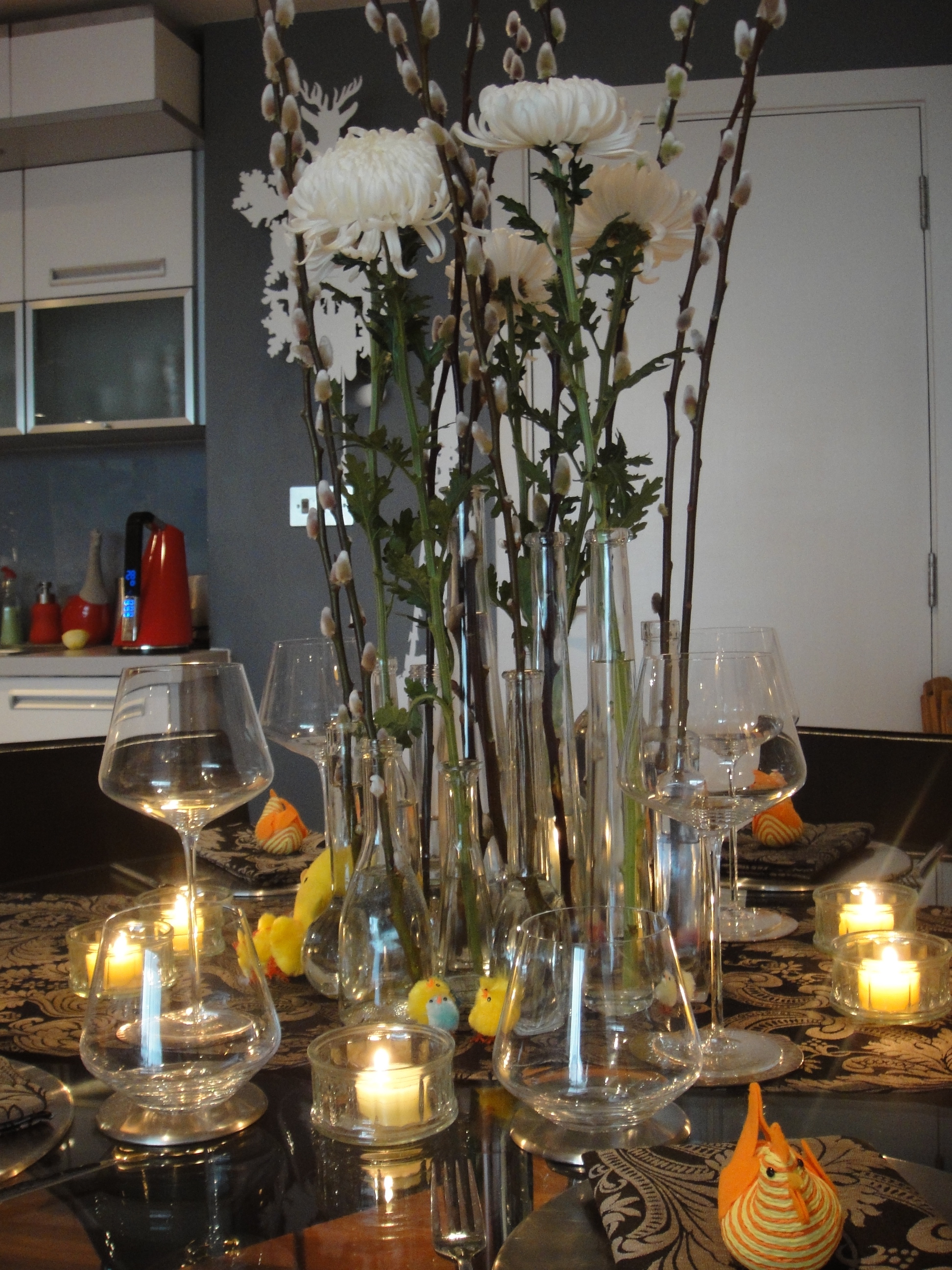
The table

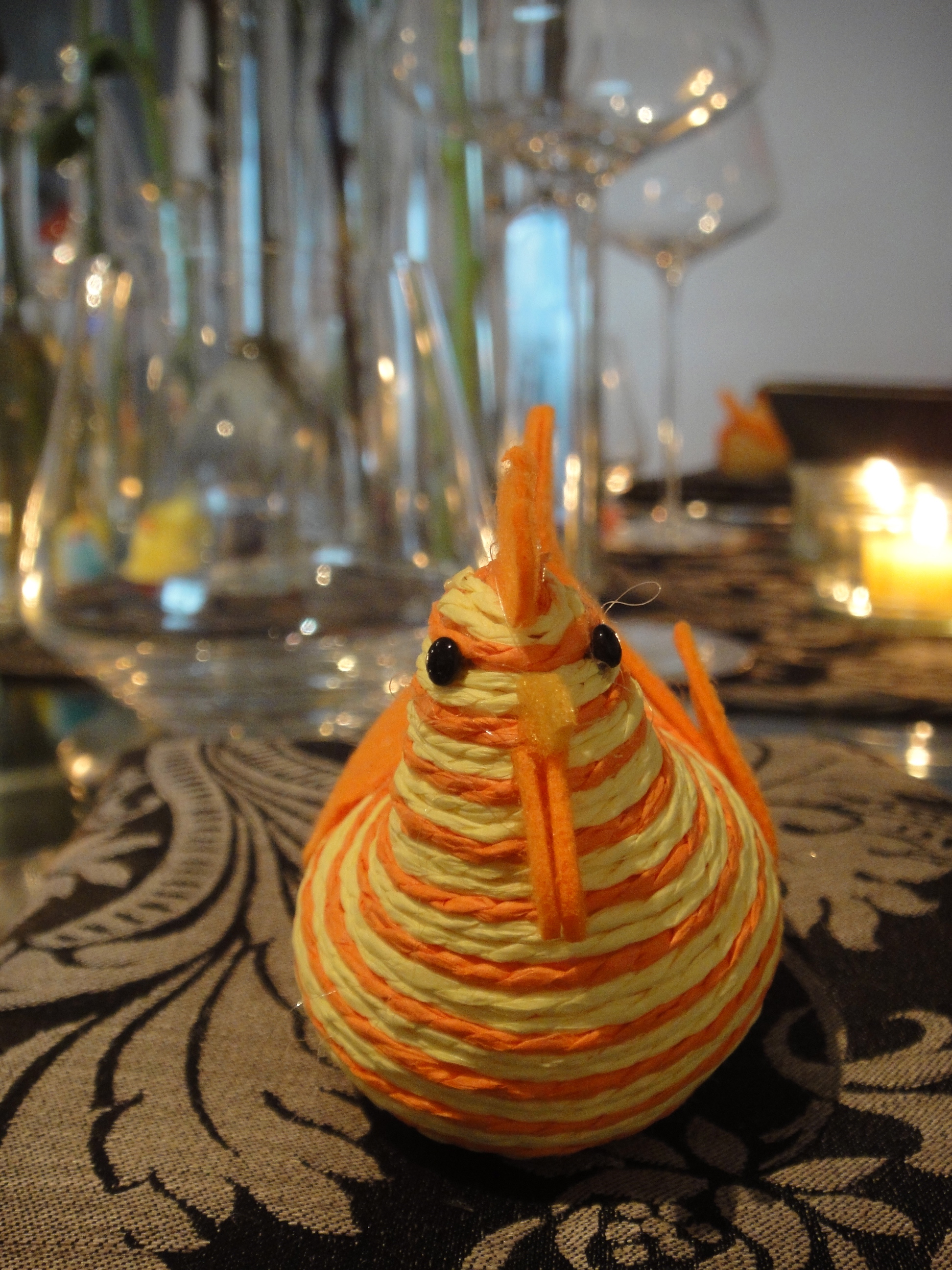
My table was all trussed up for Easter, with a spray of fresh chrysanthemums displayed alongside slender branches of pussy willow in a group of bottles, to contemporary effect. Amongst the flowers sat the must-have fluffy chicks of Easter, while at each person’s place, a damask-style napkin was topped with little paper hens.

To start…

I had to restrain myself from cooking a full-on starter because I knew that otherwise this Spring-like luncheon would become more akin to a Christmas day gorge-fest. Instead I provided some simple tapas, olives, nibbles and delicious mature manchego cheese from the land of Don Quixote, which I’ve discovered is best served sliced and drizzled with honey and sprinkled with thyme – a divine combination which would probably work well with similar hard sheep’s cheeses.

The chicken

The star of the dish was a roast chicken, but with added Spanish flavour. In a simple twist on the humble roast chicken, the chicken is at first basted in grape juice before being roasted, breasts down, for 45 minutes. Once flipped over, the breasts are again drizzled in grape juice. Meanwhile, the chicken cavity is stuffed with chunks of apple giving it a fruity aroma, while the dish is served with caramalised apples and grapes which can be either sautéd or oven cooked alongside the chicken. For the grape juice, you need to blend around 500g of grapes in a food processor and then press the pulp through a sieve to collect the juice. You should get around 250ml of juice. I was worried that the chicken, exposed as it was to the oven (I usually bake it partially wrapped in foil) would be dry, but with regular basting with the grape juices, the chicken was succulent and fruity, while the skin was ravishingly caramalised.

I served the chicken with some oven baked parsnips glazed in honey and wholegrain mustard and a generous portion of cute little Jersey Royal potatoes, straight from this year’s first harvest.

Dessert

Desserts don’t get much more Spanish than a brandy and walnut cake served with a raisin and sweet wine ice cream (helado de pasas y vino dulce). The cake on its own is fairly dry, so certainly benefits from the ice cream accompaniment. Following the Asturian recipe cited by Claudia Roden, I whisked 4 eggs and 200g caster sugar into a thick pale cream, adding 75g melted butter and 3 tablespoons of brandy into the mix. I then grinded up 500g of walnuts in the food processor which were folded into the cream mixture. It was poured into a greased spring-form cake tin and baked for around 45 minutes. The key to this recipe is the syrup which you then pour over the cake when it comes out of the oven. For this dissolve 100g sugar in 250ml water and simmer for around 5-10 minutes until syrupy. Then add a tablespoon of brandy for that alcoholic touch and pour it over the hot cake. Leave the cake for at least an hour to “drink” the syrup. The result is coarse but gooey, perfect with a raisin and wine ice cream – mine was made with a Spanish moscatel wine, but the syrupy sweet Malaga wine would be even better (let me know if you want the recipe – it’s a little to complex to set out here!)

Afternoon tea

What better way to end the day than with that Toledo favourite which I absolutely fell in love with in Spain than little marzipans. I couldn’t believe how easy they were to make! Simply take 200g ground almonds and 200g icing sugar and mix well. Then in a food processor add a few drops of almond extract (not too many or the flavour will overpower) and 2-3 tablespoons of water (you don’t need much as the almond oil makes the paste moist). And that’s it – once you have your paste, you can roll it into balls or make all sorts of imaginative shapes like I did. Once your creative side has been satiated, lay the creations on a baking tray and leave for around 12-24 hours. The marzipans will harden slightly on the outside and remain soft and moist on the inside. The best thing is that they will last for ages!

My Semana Santa nazareños

You can, by the way, glaze the marzipans for added luxor, but I tried this with Claudia Roden’s suggestion of whipped egg whites and icing sugar and it made my marzipans look as though they had been buried under a snow storm. Next time I’ll  stick to a simple egg-white glaze – and just 1-2 minutes under the grill.

¡Buen provecho!

Macaron Madness

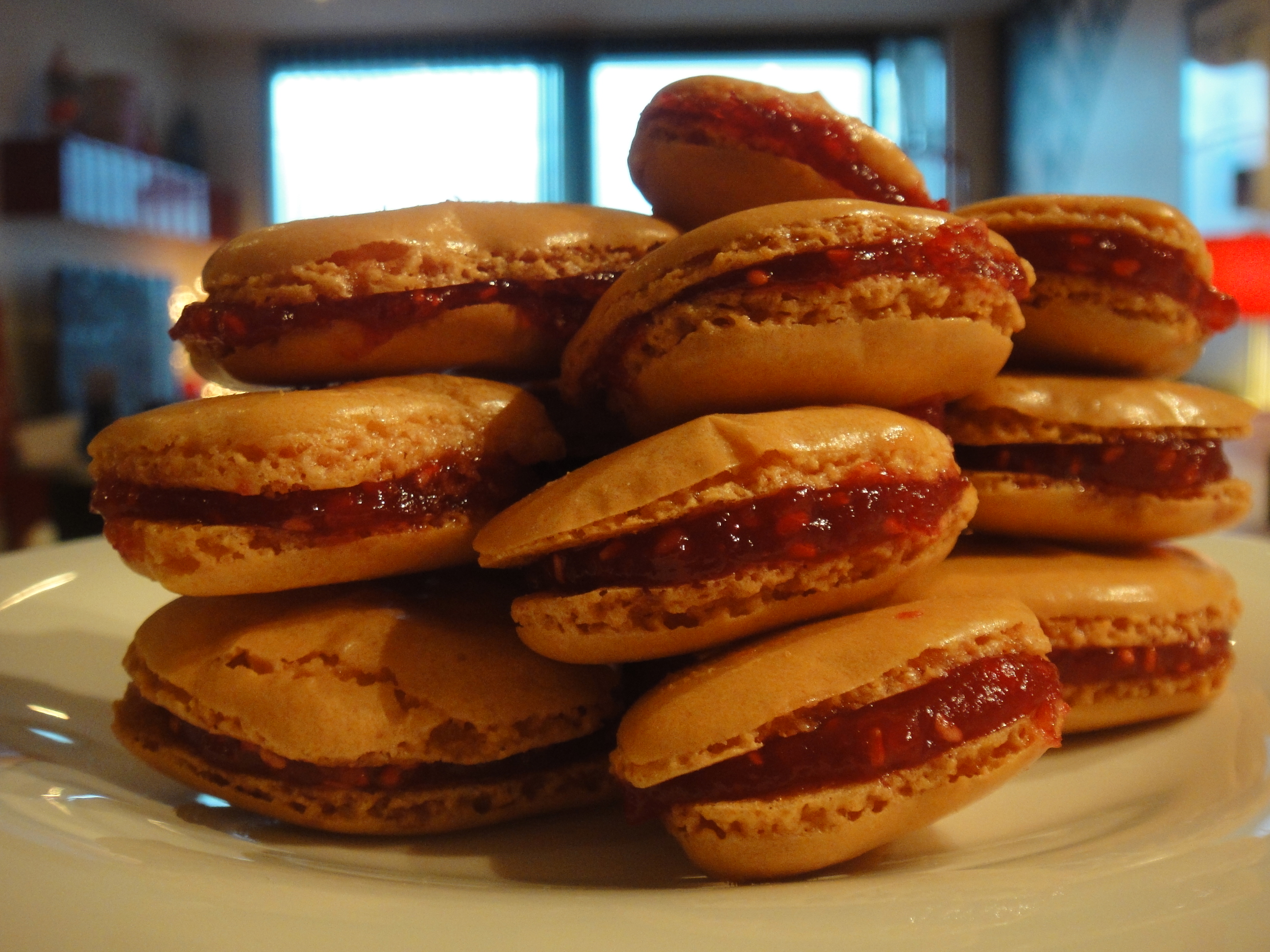
OK, so for those of you who read my post last week, you will know that I have joined the rank and file who have seen the Ladurée light, indulging in all things macaronic (I’m surprised to find this is an actual work, but sadly not generally relating to all things macaron, but hey, this is my blog, and that’s how I’m going to use it), the sweet, elegant pastry treats which add a sense of past sumptuous delight to our every day doldrum lives. Well, I decided to take things one step further and attempt to make macarons myself. How hard can it be, I thought, somewhat naively, embarking on the project with only half an hour spare, my Ladurée cook book placed a sufficient distance from the hob so as not to pollute its gold-lined pages with icing sugar or jam splatters, and my piping bags and food colouring to hand. Three hours later and I was still cleaning up my kitchen which looked like a trench warfare zone all of its own – huge splashes of pink macaron batter on every conceivable surface, three limping icing bags all leaking their contents, flung in frustration across various aspects of the kitchen, and the macarons… well, see for yourself…

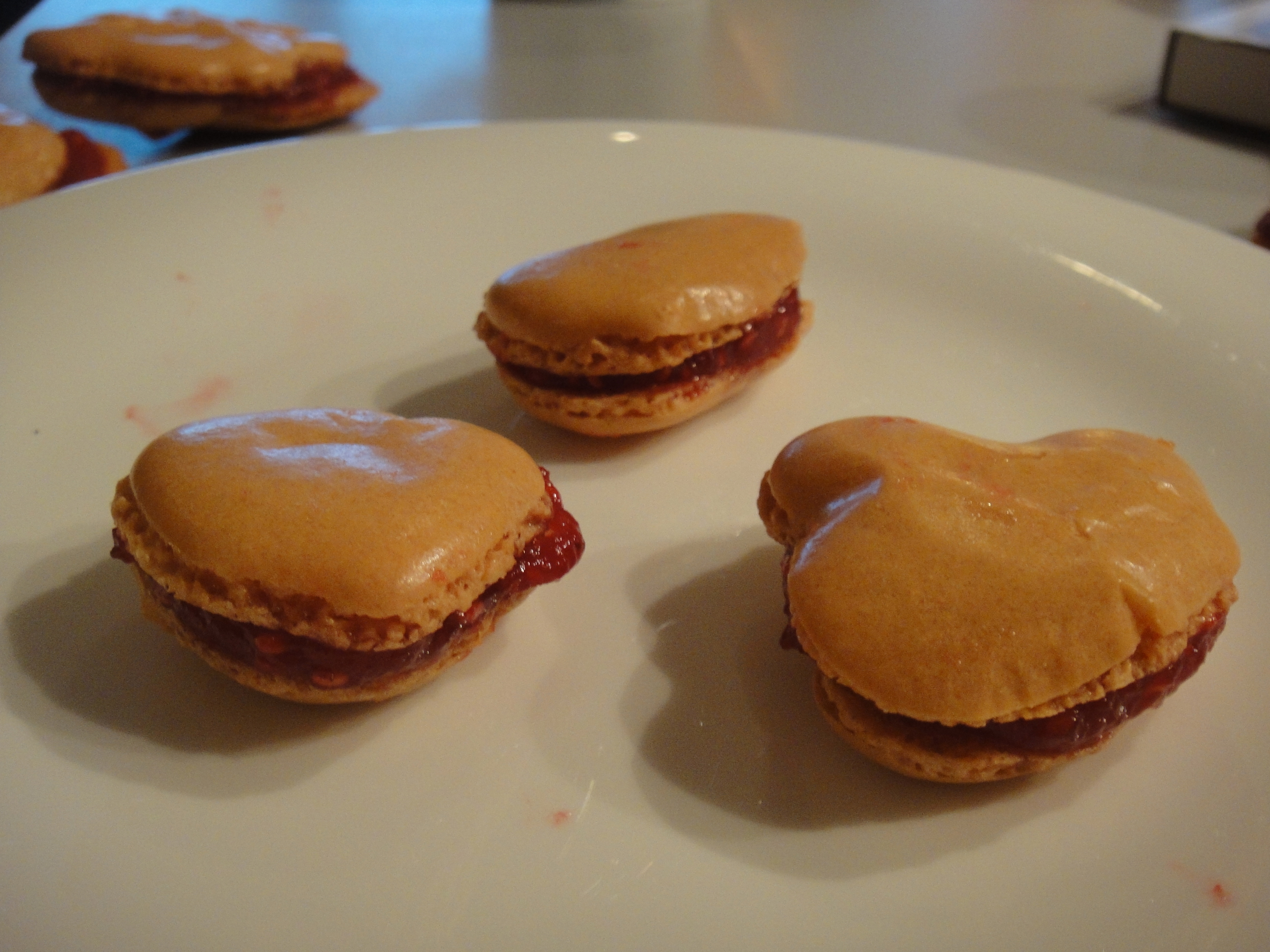
Ok, so from the side they don’t look too bad. The jam is oozy and the two sides of the macaron have their “feet” (the little crunchy bit) and the smooth bit on top which miraculously didn’t crack too much (with the one blaring exception). But then look at a random sample from above…

Indeed, not a round macaron in sight. I just could not get the bloody things to stay round! I literally piped them about five times, trying different sized nozzles, practically securing my wrist in a scaffolding-like contraption to ensure an unwavering hand, adding more icing sugar to make the mixture thicker but no no no, they just splurged all over the place into cloud-shaped disasters. On top of that, I couldn’t find any peptin for the jam, so basically had to add thickener, resulting in a jam which is more like gravy. Oh, and I should probably also admit that when these macarons went into the oven, they were pink. When they came out, they were decidedly orange.

So after all this, I have realised that £1.40 for a single macaron at Ladurée really isn’t that extravagant, when making these things requires the skill of Michelangelo painting the ceiling of the Sistine Chapel. But forever determined to succeed, these macarons won’t get the better of me. I will succeed! With this is mind, can anyone tell me how to make round macarons? I’ve realised subsequently that I used caster sugar instead of granulated, which perhaps had something to do with my mixture’s refusal to conform, or is the problem more scientific?

On top of all this, I have subsequently cottoned on to the fact, after a great number of previous misspelling disasters, that a macaron is spelt with only one ‘o’ and not two, the latter type denoting the coconut cake of which my father is rather fond. According to wikipedia, “since the English word macaroon can also refer to the coconut macaroon, many have adopted the French spelling of macaron to distinguish the two items in the English language”. I won’t be making that mistake again.

Macaron madness indeed.

PS Today I have been nominated for a HUG Award for which I am hugely grateful and honoured in my receipt. I will give the matter some thought and make my obligatory re-nomination in a post soon.