I take something of a short break from my Valencian reportage to divert my focus slightly to one of the world’s most recognised artist, who is, as ever, creating a fresh storm manifested through two new exhibitions reflecting upon specific aspects of his career; one a period in which he started to develop from young progidy into the artist we know and love today; and the other his propensity towards illustrating mythological figures in his body of work. The first exhibition, Becoming Picasso: Paris 1901, recently opened and running until the end of May, is being held here in London, at the Courtauld Gallery. The second, Picasso: Faune, Centaure, Minotare, is on show in Valencia itself, and was therefore something I was lucky enough to catch during my stay. Held at the Bancaixa foundation, it’s running for the duration of 2013.
Becoming Picasso…
So let’s go back to the beginning, a time when Picasso was yet to find himself painting mixed up bodies, before the great masterpieces of Guernica and Les Demoiselles d’Avignon, when his figures were not delineated in thick black outlines, nor his compositions fragmented by cubes. In 1901, Picasso was but 19, but already showing huge talent as a young Malaga-born prodigy, so much so in fact that his work had already been chosen, in 1900, to represent Spain in the great Exposition Universelles in Paris, followed shortly afterwards, in 1901, by his very own solo show, held in Paris by collector Ambroise Vollard (Cezanne’s principal agent).

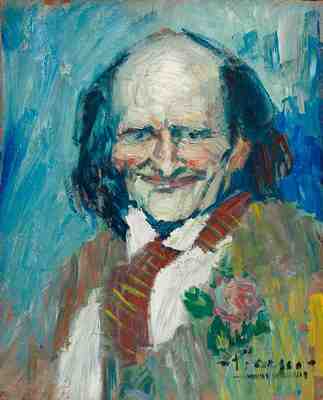
Portrait of Bibi-la-Purée (1901)
It was partly in preparation for this show that Picasso had such a prolific year in 1901, sometimes painting up to 3 canvases per day in preparation for his first big exhibition. It was a collection which borrowed from other Paris-based artists before him, such as Toulouse Lautrec’s depictions of the debauched Moulin Rouge nightclub, as well as the Spanish influences from which he was born, including the dwarf like characters of Velazquez’s work, replicated to amusing effect in this period by Picasso with paintings such as “La Nana”, a dwarfish dancer working at the Moulin Rouge. It was a period of colour and vivacity, full of latin spirit seeping into paintings such as “Spanish Dancer” and “Spanish Woman”, a rather promiscuous looking woman who again appears to reflect the work of Velazquez who famously portrayed the Spanish royal infantas with their huge skirts and embellished dresses.
It is with these fascinating paintings that the Courtauld show marks its strong opening, full of the joie de vivre of Paris but presented with a latin twist, far from the Picasso of later years, but neverthless showing prolific skill and a confident hand, even when painted so quickly.

Dwarf-Dancer (La Nana) (1901)
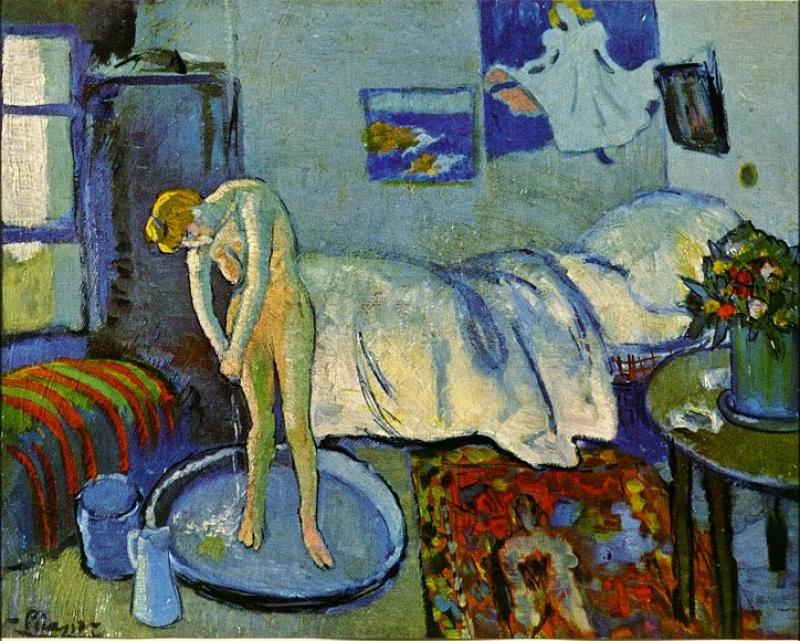
The Blue Room (1901)
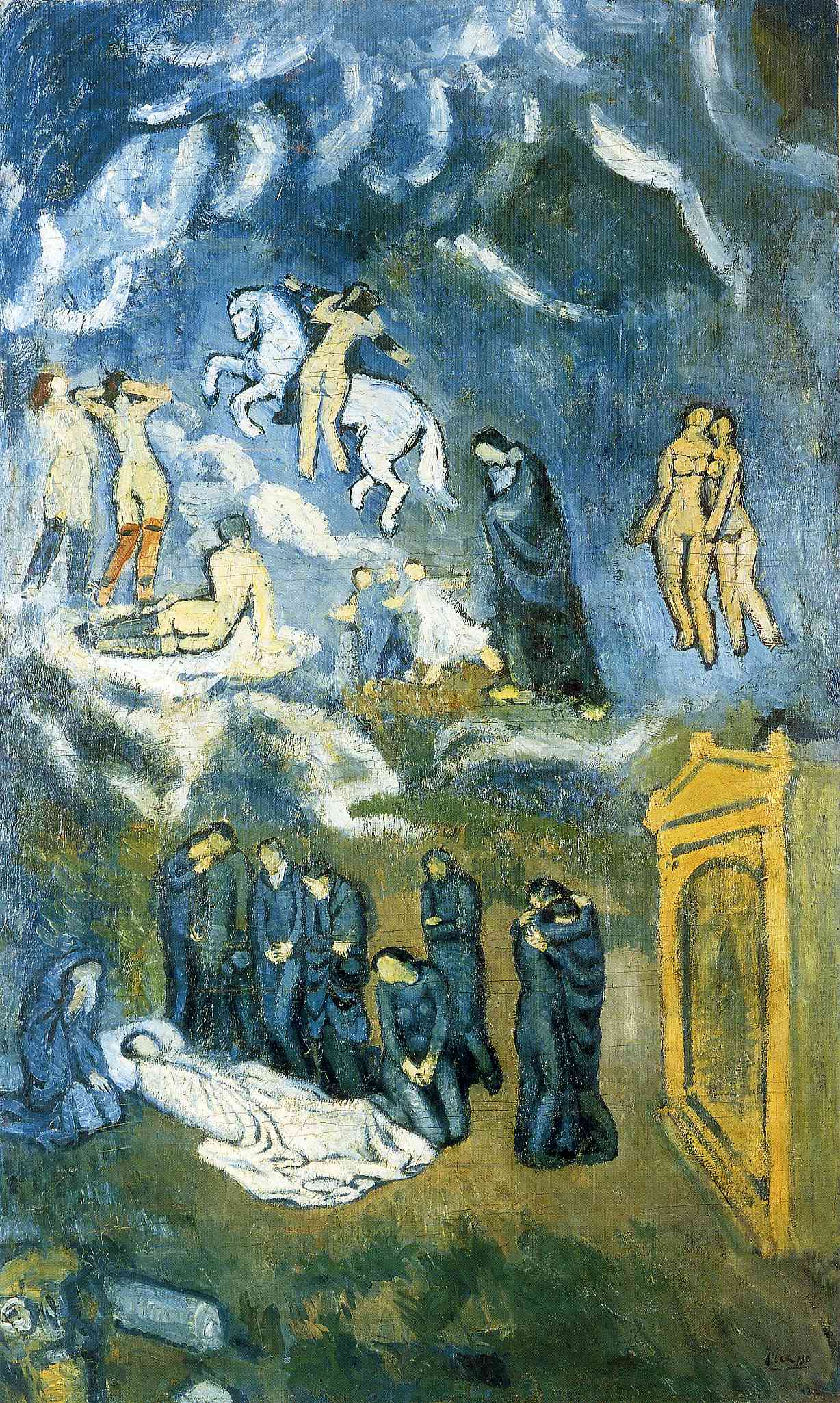
However around the same time that his solo show was being received to critical acclaim, tragedy struck in Picasso’s life. His heartbroken best friend, Carles Casagemas, shot himself in the head in a Parisian cafe in front of all of his friends. It must have been a highly traumatic event, and the emotional turmoil which results is demonstrated in a marked change to Picasso’s approach. Diverting suddenly from the multi-coloured depictions of Paris as exhibited at the Voillard show, Picasso enters a new “blue” period (as it later became known), works of obvious melancholy. The blue paintings at first reflect on Casagemas’ death itself, as Picasso’s imagination becomes riddled with an almost obsessive preoccupation on his death. Picasso paints his dead body, and an altar-piece sized scene in which Casagemas’ body appears to be riding to heaven surrounded by scantily clad prostitutes taking the place where angels would normally be represented. Again this piece exhibits strong Spanish influences, marking a clear parallel to the impressive altarpiece, “The Burial of the Count of Orgaz” by El Greco, to be found in Spain’s Toledo.
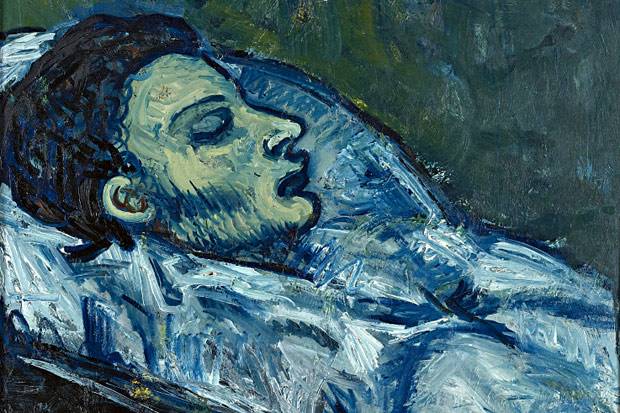
Casagemas in his Coffin (1901)

Evocation (The burial of Casagemas) (1901)
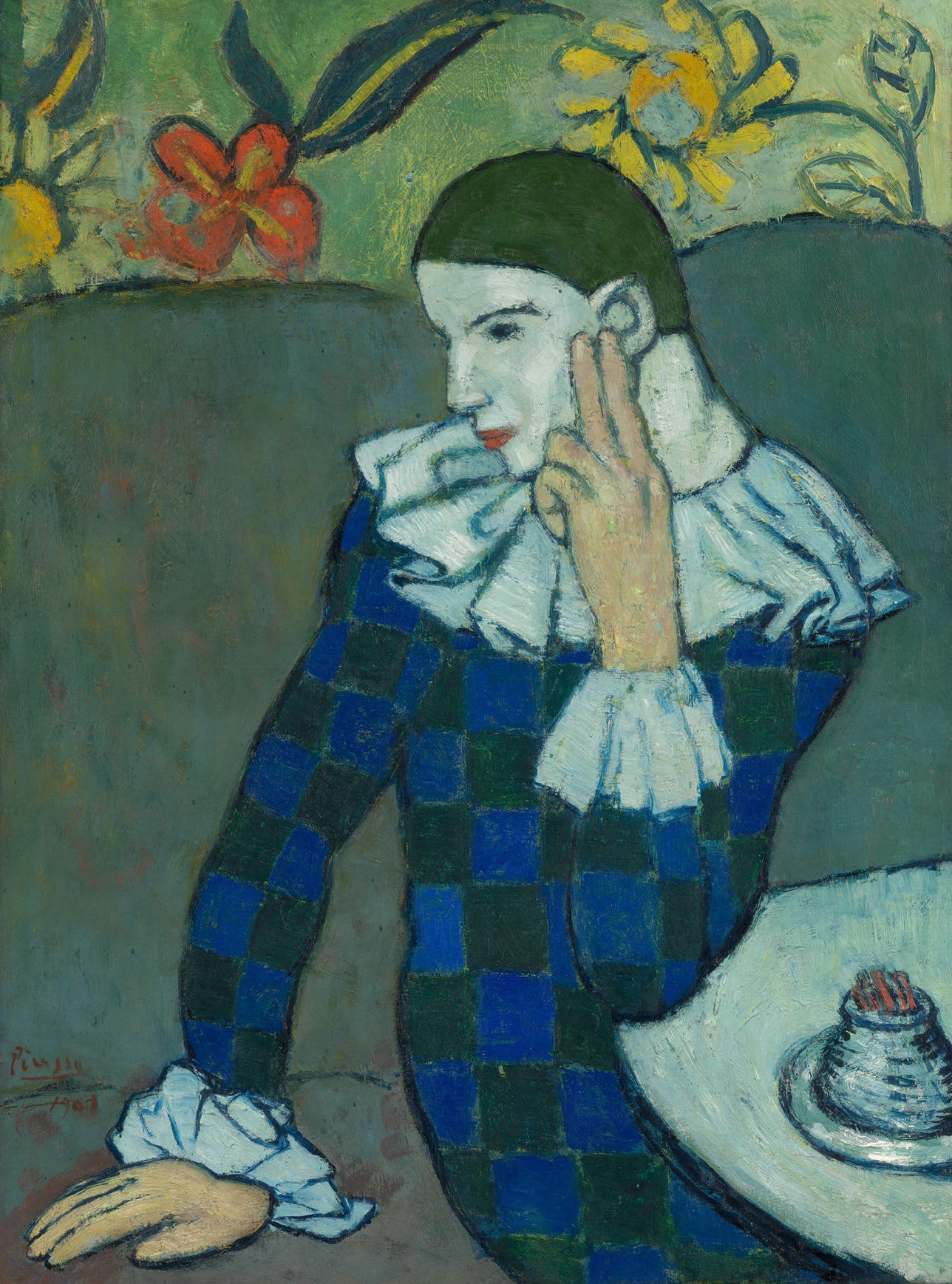
What Parisian scenes Picasso does paint during this period are now marked with the same degree of melancholy. With a clear nod to Degas’ Absinthe drinkers, Picasso’s absinthe-drinking punters are melancholy, drawn out figures, either alone or depicted sat with a mysterious harlequin figure. Meanwhile, away from the cafes, Picasso becomes equally preoccupied with the suffering of others around him, in particular gypsy-looking mothers, shown in the tight embrace of a child to withstand the suffering and hard-bitten existence all around them.
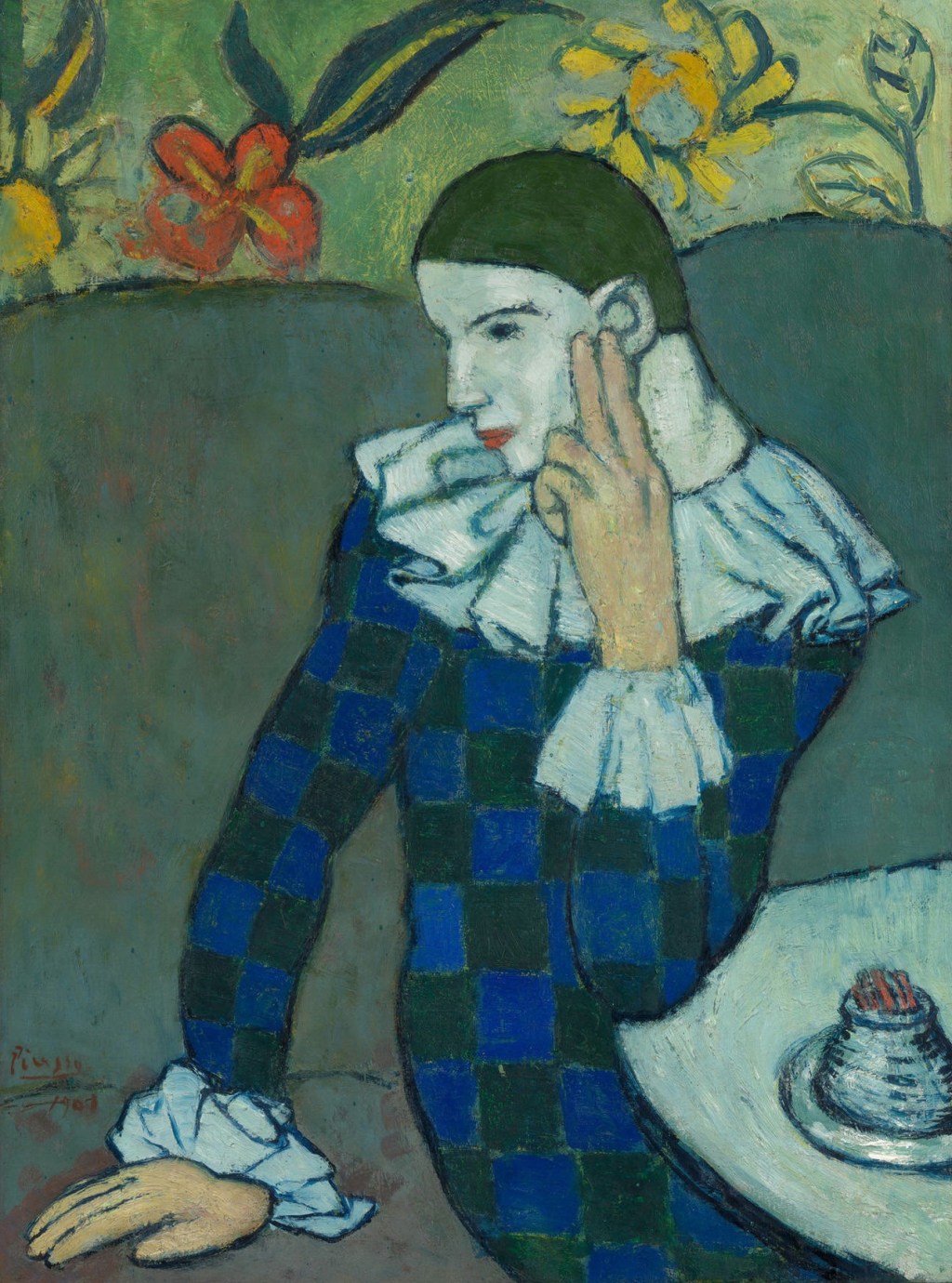
Seated Harlequin (1901)

Harlequin and his Companion (1901)

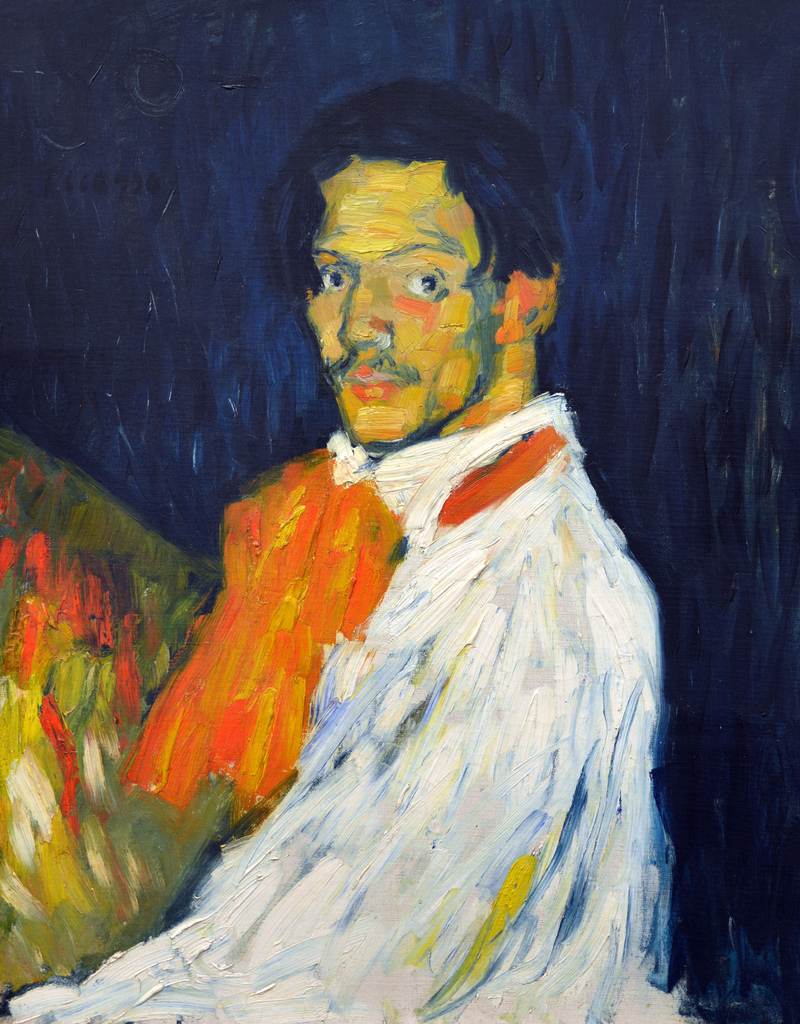
Yo – Picasso (1901)
And there the show ends. It’s a small and compact exploration of a year which was clearly significant in Picasso’s development as an artist. As his paintings during the year develop, we see him adopting a stronger and darker black outline of his figures, with colour then added in between. It is thought that he had been influenced by the likes of Gauguin and Van Gogh in adopting this approach and taking it forward for the remainder of his career. It was also during this year, and clearly buoyed by his solo exhibition success, that Picasso emerged a more confident artist, as demonstrated by the two self-portraits in the exhibition, entitled “I-Picasso” (“Yo”) and which show the artist staring out boldly, full of strength and belief in his own skills. It was also in 1901 that Picasso, for the first time, started signing his paintings with the simple epithet: “Picasso”. There was no longer a need for a first name, nor indeed for any further introduction. Bold, prodigious and startlingly original in his changing styles and daring representation, the Malaga-born artist had now made it in Paris, and there was no going back. He had become Picasso.
Picasso: Faune, Centaure, Minotaure
The second show, which I was lucky enough to catch while in Valencia, is held in the rather swish premises of the Spanish bank, Bancaja, who have established something of an art foundation in the Valencia centre. A couple of years back I went to a similar foundation established by La Caixa bank in Palma de Mallorca and remembered thinking then that good old Barclays or Lloyds in London would never have an art foundation like these – and yet it’s a shame, since banks often have huge art collections which never otherwise see the light of day.
This small show, hung across a rather spacious contemporary exhibition area, focuses on Picasso’s preoccupation with mythology, and his use of the mythological figures of the Faun, the Centaur and the Minotaur to depict not only the legendary stories themselves, but also to use those characters in portraying something of himself. Most of the works were either watercolours, lithographs or etchings, and many were illustrations drawn by Picasso in partnership with well-known authors or poets. He also used the mythological figures when designing sets for theatrical and ballet productions and these two were represented in the show.
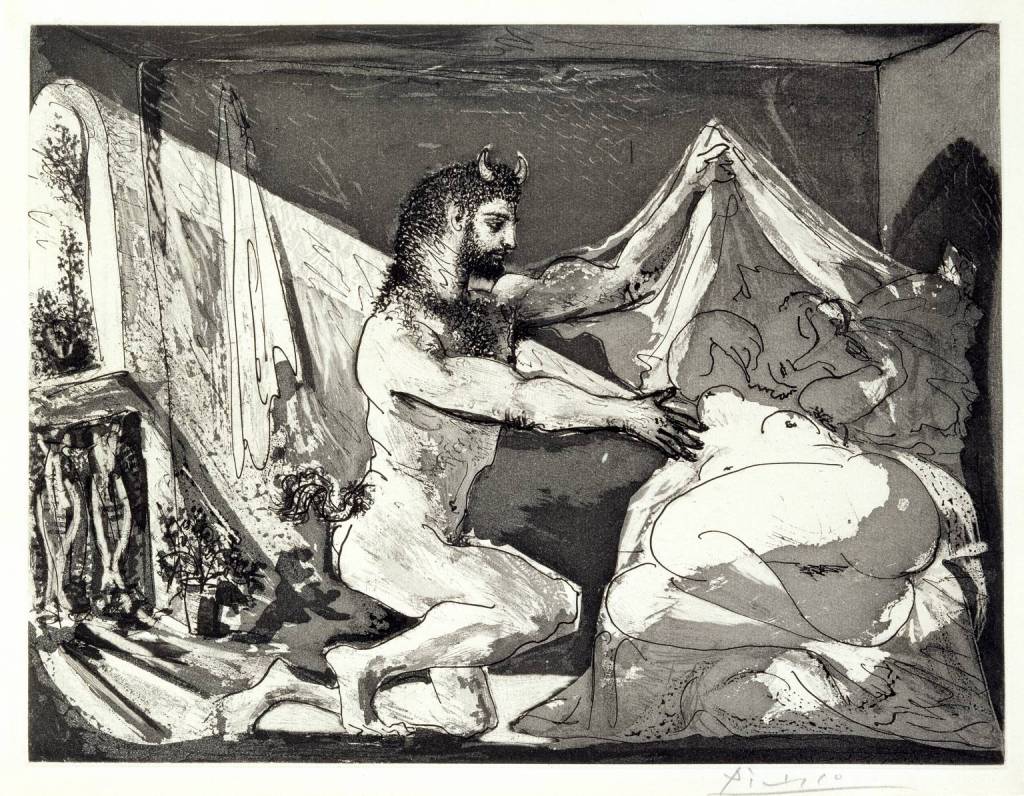
Faun Revealing a Sleeping Woman (Jupiter and Antiope, after Rembrandt) 1936

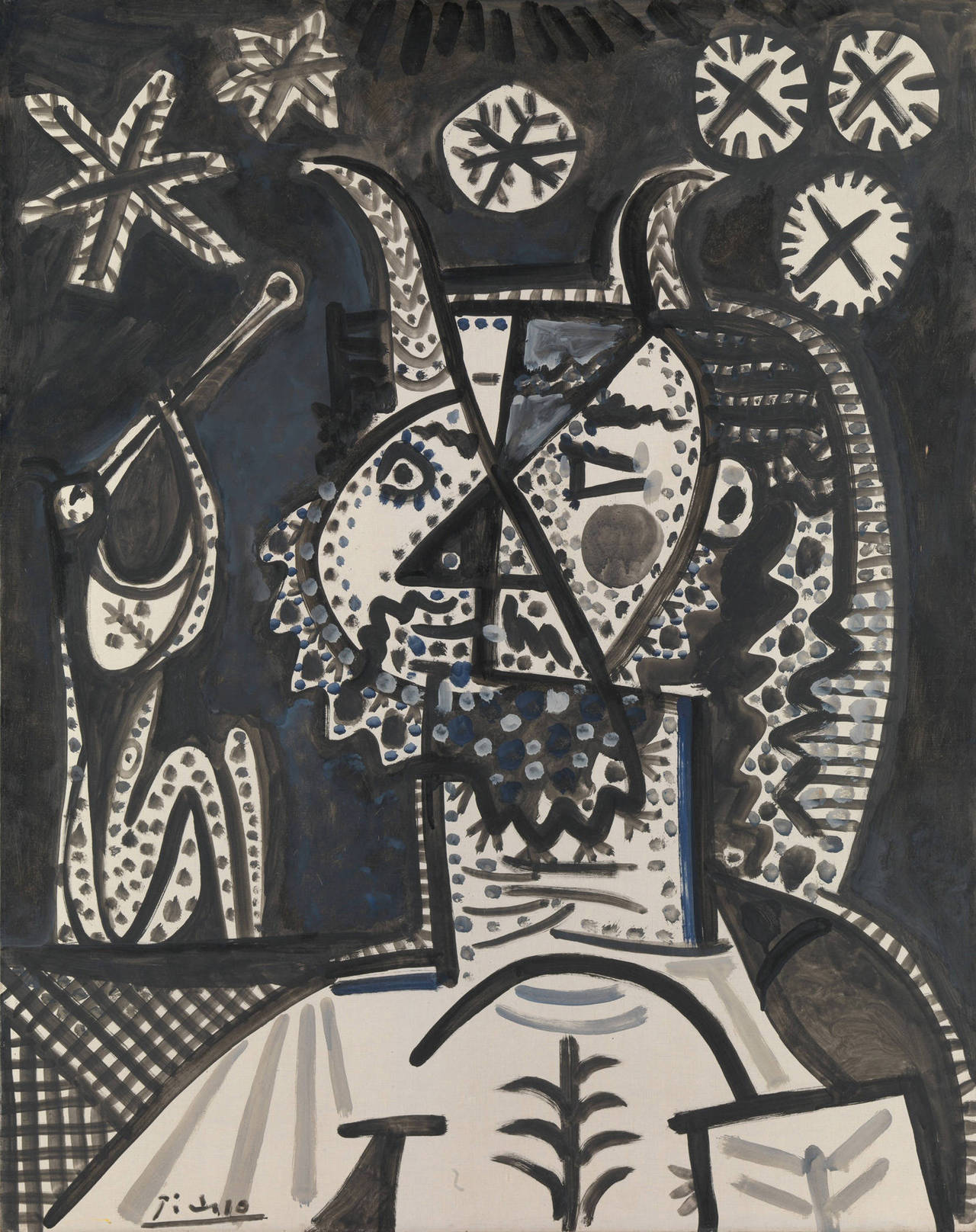
Faun with stars (1955, the Metropolitan Museum of Art, NY)
Through the faun, Picasso portrayed a happier, jocular ladies man, seducer of women, the party joker; and consequently the sketches and works of Picasso which include the faun are the work of happier times in Picasso’s career, when his subjects and his output appears carefree and creative. It is said that in representing the faun, Picasso looks back to his experiences as a lothario, as a fun and happy lover. In this work (above), “Faun revealing a sleeping woman” (1936) for example, part of the Suite Vollard which was a set of illustrations made as part of a collaboration with Ambroise Voillard, some commentators suggest that the etching was made as Picasso’s relationship with his lover and muse of ten years Marie-Thérèse Walther was coming to an end, and he looked back, nostalgically at their past affection and here, a holiday they spent together in Juan-les-Pins in the South of France.

Centaur and Bacchante, 1947
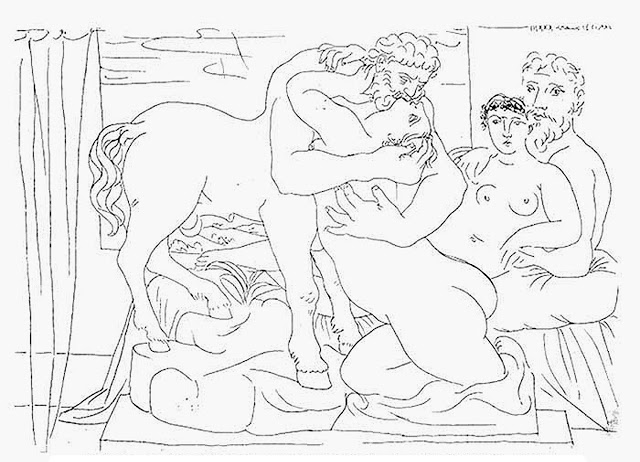
Picasso, Sculptor & Model with Statue of Centaur Kissing Girl, 1933
Through the centaur, Picasso plays on the traditional perception of the centaur as a mischievous sexual predator, a sexualised lothario, but something of a sexual outcast. On the one hand he shows the centaur painted in the loving embrace of a fellow sexualised bacchant, while on the other showing him as a troubled character who does not fit in within society. In one illustration (which I have been unable to find an image of) Picasso illustrates the rather surreal tale of a man who finds a centaur and brings him to Spain whereupon he tries to find a suitable place for him within society. The centaur is given a job as a picador in the bullring, but the centaur soon leaves the job, disliking the way that the bull would charge at him. Next he tries carting tourists around in a carriage on his back but finds the job too tiresome. Finally he settles in a teaching role. It’s a bizarre tale, but is it one which demonstrates Picasso’s own failure to properly find his niche in society?
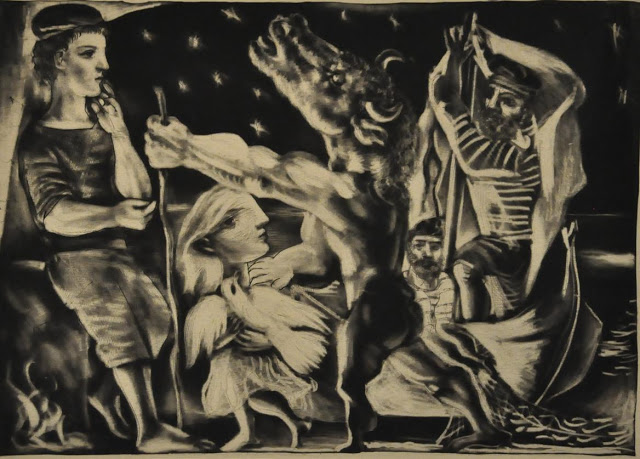
Blind Minotaur Led by a Girl through the Night (1934 Printed in 1939)
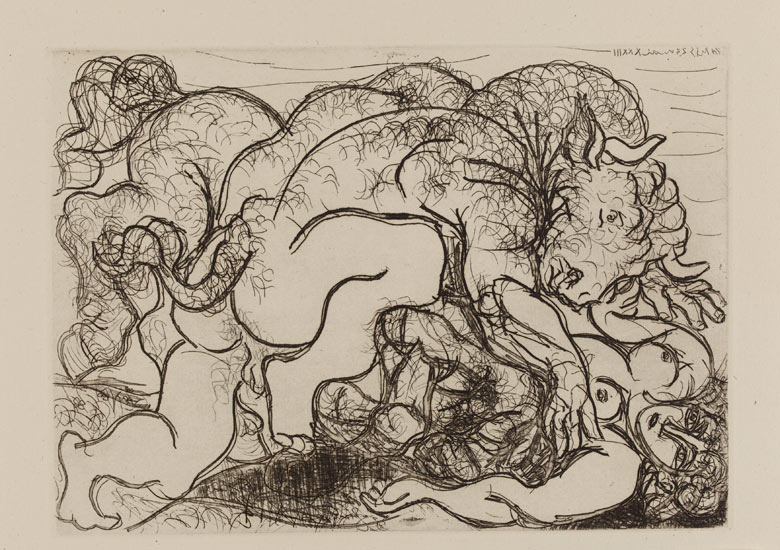
Picasso’s Minotaur lying over a female centaur, 1933; plate 87 of the Vollard Suite at the British Museum
Finally, through the minotaur, Picasso reaches his lowest ebb, depicting the troubled, self-loathing and introspective minotaur at the times when Picasso is experiencing his own depression. Sketches showing the minotaur being manipulated by women (such as the illustration of the minotaur being led blinded by a woman into the night, above), injured, murdered and abused litter the period of work which Picasso later revealed to be his lowest and most desperate – it was the time when he was trying to escape a troubled marriage with wife Olga, a time when in paintings such as “Three Dancers” (now in Tate Modern), Picasso’s figures became more severe, defaced and ugly.
So while the Bancaja’s exhibition focused on a fairly narrow chapter of Picasso’s oeuvre, it nevertheless unveiled a number of truths of Picasso’s inner psyche: Picasso the self-doubter, the traumatised, the passionate lover, and the nostalgic and sensitive gentleman. For that reason it was a fascinating biographical tale told through some scintillating visual aids in the mythological genre. If only UK banks could prove such an education.
For details of the two exhibitions above, see the relevant pages of the Courtauld and Bancaja websites.











 The Daily Norm