Skip to content

Posts tagged ‘De Lacy-Brown’

My Mallorca Gouache goes Bankside

I look at the date I last posted on this blog and blush with shame. But to be fair, my excuses are good. Very good. For I have just made an international move from Mallorca, back to London, and for almost 3 weeks I didn’t have a computer to write with, and for a further week beyond that, I had no office nor desk to place it on. However things are slowly getting there, and with only some 7 boxes out of around 107 left to unpack, and an entire home redecoration project more or less at its end, life is finally starting to settle, and my characteristic devotion to The Daily Norm will now, I hope, do likewise.

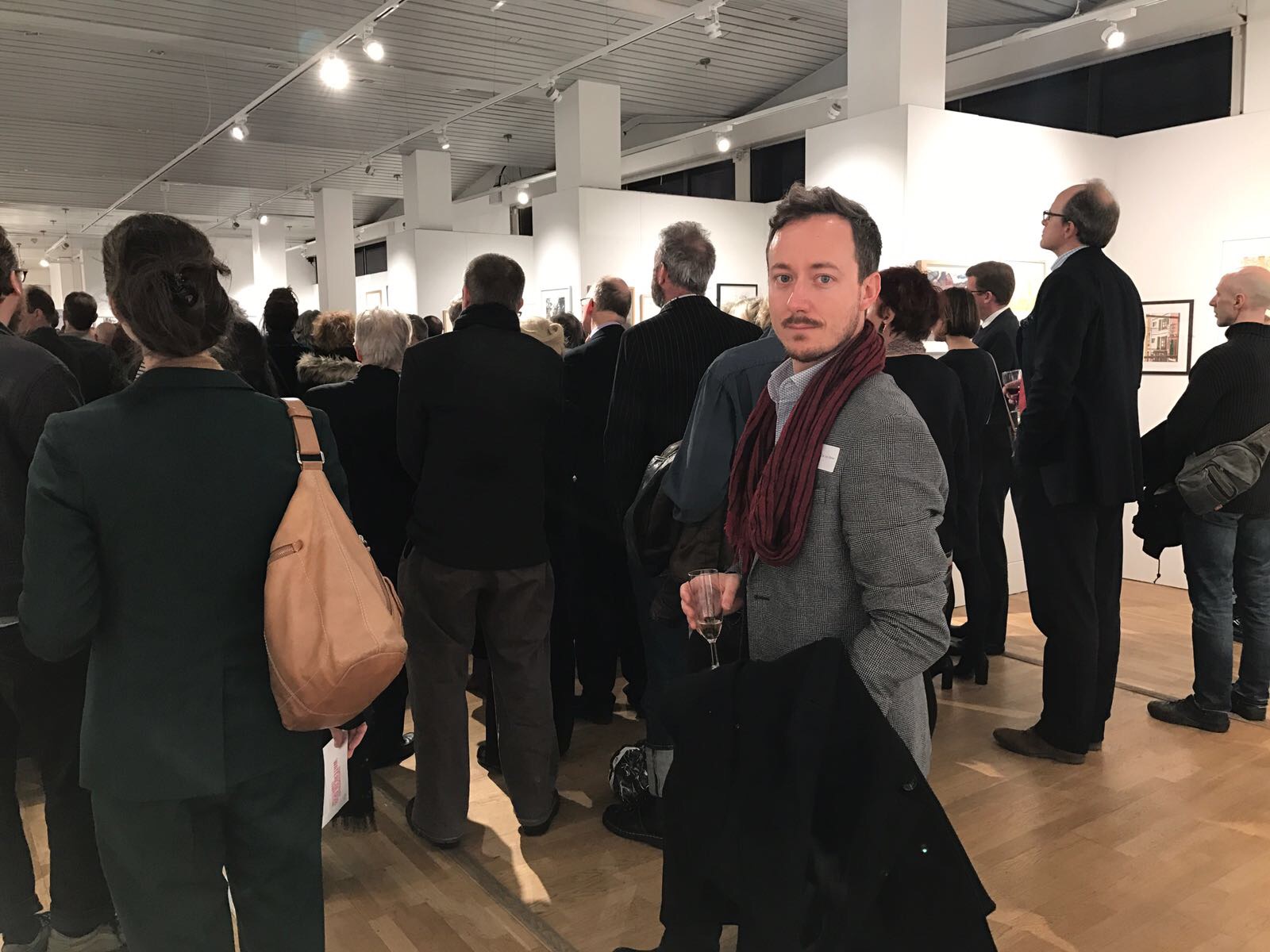
One of the escapes I was able to make during the course of this hectic  time was a series of visits to the Bankside Gallery on London’s South Bank (to be found directly next door to Tate Modern). For in a moment of perfect poetry, in my last days of Mallorca residence, I discovered that one of my paintings of Palma had been accepted by the jury of the Royal Watercolour Society Contemporary Watercolour Competition, and would be soon thereafter exhibited in London. So a painting of one home is exhibited at the very heart of another, and as I re-embrace London as my new home city, I was delighted and indeed honoured to be able to visit the Competition exhibition, both to see my own work displayed, and to admire the work of all the other successful competitors.

Galera 2

My winning submission: Ocho Balcones No. 2: Old Town Cables, Palma (2015 © Nicholas de Lacy-Brown, gouache on paper)

IMG_8456

All of the works currently on show in the exhibition can be seen here on the RWS website. What struck me from the show was just how versatile water-based mediums are in the creation of contemporary art. Often seen as a traditional method of painting, watercolour and other water-based mediums such as gouache can be used to create vivid, modern depictions of the world around us, or simply abstract or surreal images straight from the artist’s head. They are also great for really precise work on paper, as my winning work, Ocho Balcones No.2: Old Town Cables, demonstrates.
IMG_8455

Enjoying the packed private view …

My tardy publication of this article does not give you much time to enjoy these fine works in reality, for the exhibition will come to a close this Wednesday. But if you get a chance, go along…not just for my sunny glimpse of Mallorca, but for the wonderfully diverse work of the other participants whose art really proves that water-based mediums are as popular today as they ever were.

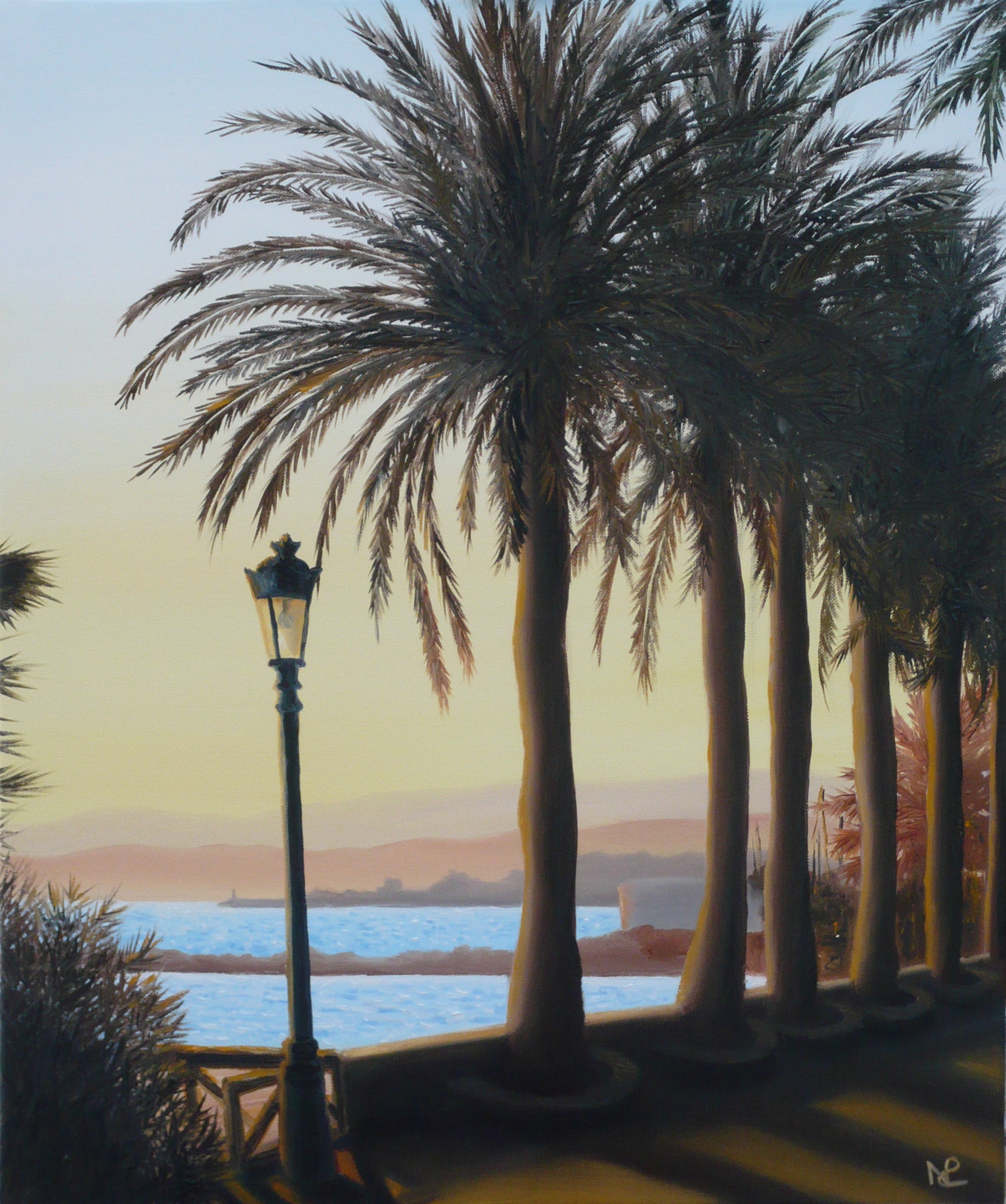
Inspired by my surroundings: Paseo Mallorca 4

Those who live on the Mediterranean island of Mallorca count themselves lucky. Winter temperatures rarely drop below 10 degrees, and on days of winter sunshine, when its rays are trapped in a corner away from occasional breezes, you might think that you are living a continuous summer. And in the Paseo Mallorca, the treelined waterway which I currently call my home, the graceful beauty of cypress trees, palms and ancient Arabic city walls continues to inspire, no matter the season. This is never more so than at the close of day, when the drama of winter sunsets add a new element of grace to this verdant avenue.

Having now painted the Paseo Mallorca three times, including views of the bridge of Jaume III and up river towards my apartment I was recently struck with renewed enthusiasm by the angle I originally painted, looking southwards towards the sea and past the Es Baluard museum of art, but this time with the changes brought about by the atmospheric light of dusk. So having previously considered my Paseo Mallorca collection to be complete, I set about embellishing it with this further, darker enhancement, whose sky and light effects add something of a more realistic feel to a collection characterised by flattened colour panes.

paseo-mallorca-4

Paseo Mallorca 4 (2017 ©Nicholas de Lacy-Brown, acrylic on canvas)

It feels appropriate that I should be presenting this painting now, at the time of dusk, as the sun sets over my time in Mallorca. For all around me, my life in Mallorca is being packed away in boxes as I prepare to leave this paradise, and my beloved Paseo Mallorca, behind. This adventure is now at an end, and London is calling me back into its fold. But long shall the memories of Mallorca prevail in my heart, especially my time spent living on this most inspirational of streets.

© Nicholas de Lacy-Brown and The Daily Norm, 2001-2016. Unauthorized use and/or duplication of the material, whether written work, photography or artwork, included within The Daily Norm without express and written permission from The Daily Norm’s author and/or owner is strictly prohibited. For more information on the work of Nicholas de Lacy-Brown, head to his art website at www.delacybrown.com

A Portrait of Mallorca

Sometimes I just want to paint what’s on my mind. The energetic fusion of ideas applied to canvas in a mixed and multifarious revolution of form and colour. But unlike the Expressionist movement, which tended to splash and splosh their emotion onto canvas in more of a literal application of paint, my variety of expressionism materialises in more of a controlled fashion. I suppose it says something about my rather controlling mind (a tendency for which my partner may testify). For my wildest form of expression is something more cubist in nature. I have always been enchanted by the age of the cubists. The ability to show an object or a subject on multidimensional planes has always filled me with an ultimate sense of pictorial satisfaction. And while my cubism is less a single subject and rather more a mixed bag of ideas, it definitely belongs to the genre.

retrato-mallorca-final

Portrait of Mallorca (2016 ©Nicholas de Lacy-Brown, acrylic on canvas)

This cubist work, which also belongs to my interpretative abstract way of thinking, is the latest canvas to hop off my easel and says everything and anything about the island on which I have spent the last two happy years of my life. It is for me a true portrait of Mallorca, because beyond the tacky tourism for which the island is so unfortunately infamous, the island is one of true bucolic peasant culture, with its own cuisine and characterised by a stunning mixed mountainous and coastal landscape. All this is represented in the imagery packed into this “portrait” which includes the spiralled ensaimada pastry for which the island is famous, the lacey headdress and straw hat worn by the traditional peasant women, as well as their flowing striped skirts flapping in the Mediterranean breeze. There too are the mountains and the beaches, the glittering coast and the yachts which encircle the island like moths around a light source. And of course the sails of the windmills, which likewise characterise the lower lying stretches of countryside.

It is a painting which fully encapsulates the multifaceted personality of an island which is much, much more than Magaluf.

© Nicholas de Lacy-Brown and The Daily Norm, 2001-2016. Unauthorized use and/or duplication of the material, whether written work, photography or artwork, included within The Daily Norm without express and written permission from The Daily Norm’s author and/or owner is strictly prohibited. For more information on the work of Nicholas de Lacy-Brown, head to his art website at www.delacybrown.com

Lady with a Yellow Sleeve (after Corot)

How things change. Having become so accustomed to walking the hallowed halls of London galleries for every changing exhibition, I now tread the sun dappled pavements of Palma de Mallorca and admire the beauty of nature rather than the beauty of paintings which capture it. However on occasion I get the opportunity to return to the London galleries I love, and the other weekend, I had the quick chance of dropping into the National Gallery where I was able to enjoy a temporary exhibition: Painters’ Paintings, which explored the impressive collections of art owned by some of the most renowned artists. Amongst an exhibition including a vast range of works from Titian to Picasso, the one painting which impressed me the most was formerly owned by Lucian Freud and painted in around 1870 by Jean-Baptiste Camille Corot, The Italian Woman or Woman with Yellow Sleeve.

corots-woman-final

Woman with a Yellow Sleeve (2016 © Nicholas de Lacy-Brown, acrylic on canvas)

corot-original

The original Corot masterpiece (© The National Gallery)

With its striking balance of colours, from the vivid red and blue of the lady’s dress to the yellow sleeve after which the painting is named, all set off against a morbidly dark background, you cannot help but be captivated by the work. No wonder the National Gallery chose to use the work as the poster-piece of their show. And as I approached the work, it was another one of those moments when a painting stirred me and I knew that an abstractive reinterpretation of the work was forming in my head. And here it is!

I would’t normally be overly attracted by a portrait of this kind, not least one where the sitter is gazing inwardly within her own world rather than outwards to the audience. But because of the colours Corot used, the painting moved me, and it is those colours which are allowed to shine in my simplified reinterpretation of the work. I hope you like it!

© Nicholas de Lacy-Brown and The Daily Norm, 2001-2016. Unauthorized use and/or duplication of the material, whether written work, photography or artwork, included within The Daily Norm without express and written permission from The Daily Norm’s author and/or owner is strictly prohibited. For more information on the work of Nicholas de Lacy-Brown, head to his art website at www.delacybrown.com

Shakespeare 400: A Midsummer Night’s Dream

2016 is the year of Shakespeare. It is a festival which marks the great Bard’s birth, and his death, and above all things a celebration of his incredible works, masterpieces which have shaped generations, been interpreted and reinterpreted across the centuries, and which are a core of both British and global theatre. In exploring my own reinterpretations of his plays, some 20 years after I completed my first Shakespeare collection at the age of 13, I have moved onto my second work, painted in my new interpretative abstract style.

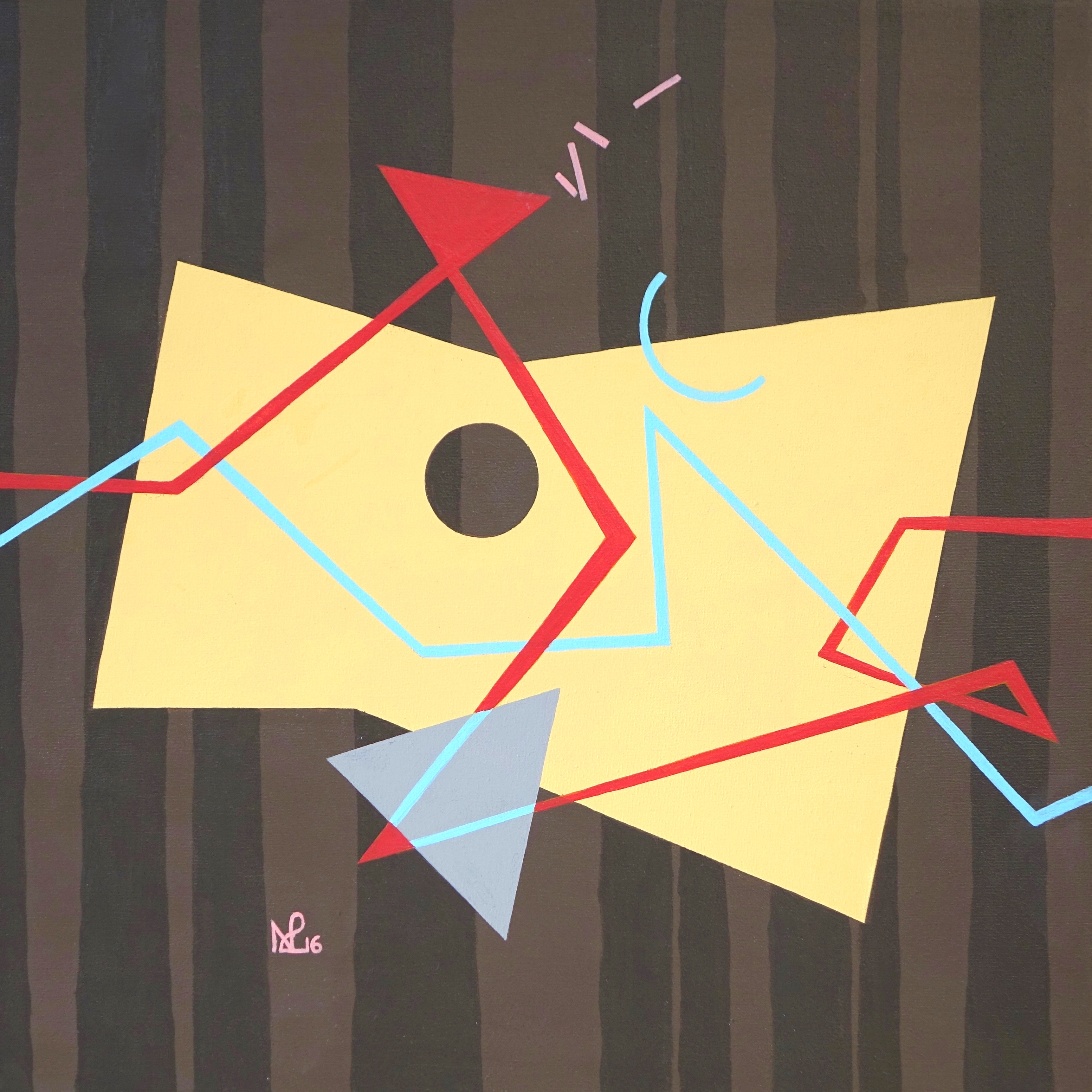
The play is A Midsummer Night’s Dream, a comic frolic of cross-purpose love affairs, mischievous spells, sparkling forest fairies and of course the famous Donkey metamorphosis of Bottom, all set between the trees of a forest near Athens. That wonderfully magical forest setting forms the background of my work, a simplified design of vertical brown stripes, creating a sense of the darkness and depth of the forest which characterises the tone of that mystical Midsummer’s Night.

Midsummer FINAL

A Midsummer Night’s Dream (2016 ©Nicholas de Lacy-Brown, acrylic on canvas)

Central to the piece is a large yellow shape, representing the wall in the story of Pyramus and Thisbe, whose chink provides the only channel for communication for the two forbidden lovers after whom the story is named. Creating something of a play within a play, the tale of Pyramus and Thisbe (originally told by Ovid) is acted out at the end of the play by the theatre troupe from whom the actor-turned-donkey Bottom comes, and which likewise reflects the theme of forbidden love which is played out in the forbidden love between Hermia and Lysander.

It is in fact that disallowed love affair which sends Hermia and Lysander fleeing to the forest, where in their wake Helena, Hermia’s friend, and Demetrius, the man Hermia’s father wishes her to marry, follow. These four characters then become the pawn of Oberon and Titania, the King and Queen of the forest fairies whose own conflict results in a series of magical mischief which in turn results in the four youngsters of Athens variously falling in and out of love with one another while under the bewitchment of the “love-in-idleness” flower. That same juice is used to bewitch Titania, who in turn is caused to fall in love with the metamorphosed Bottom.

All this is represented by my painting of shapes and lines. The energetic lines which cross the canvas are those of Titania and Oberon, whose ballet of magical conflict weaves in and out of the play’s plot. Where they meet, and form shapes within their overlaps, these shapes represent the four young lovers, Helena, Hermia, Lysander and Demetrius. The grey triangle is of course the donkey head of Bottom, and when Titania’s “line” traverses the space, it is transformed blue, as though bewitched by Oberon. Meanwhile above Oberon’s line, the blue curve represents his faithful assistant Puck, the cheeky little fairy who mischievously applies the love-potion, and above the red triangle of Titania, the four little pink lines are her flying little fairy assistants, Peaseblosom, Cobweb, Moth and Mustardseed.

For those unaware of this brilliant play, the description above may bamboozle the mind. Where that is the case, please enjoy the painting instead, whose simplified lines and structure make, in themselves, what I hope is a thoroughly pleasing image for Midsummer’s Night.

© Nicholas de Lacy-Brown and The Daily Norm, 2001-2016. Unauthorized use and/or duplication of the material, whether written work, photography or artwork, included within The Daily Norm without express and written permission from The Daily Norm’s author and/or owner is strictly prohibited. For more information on the work of Nicholas de Lacy-Brown, head to his art website at www.delacybrown.com

My Van Gogh Bedroom heads for Beijing!

A few months ago, I was on the brink of being inspired by another great artist in creating a further painting in my interpretative abstract collection when I received an important email. It was an artist who has inspired me several times before, the one and only master of colour and of passionately applied brush strokes, Vincent Van Gogh. The email I received flew into my inbox almost at the moment when I applied my signature to canvas. I had been contacted by the prestigious Van Gogh museum in Amsterdam. An opportunity had arisen, they told me, to submit contemporary artworks inspired by Van Gogh to be considered for a new globally important project. I did not hesitate to apply, and amongst those works I sent was the new work I had been working on when their email had been received: Vincent’s Bedroom, an abstractive interpretation of Van Gogh’s most famous work depicting his bedroom in the Yellow House in Arles, and presented here on The Daily Norm for the first time.

Vincent Bedroom FINAL

Vincent’s Bedroom (after Van Gogh) (2016, ©Nicholas de Lacy-Brown, acrylic on canvas)

A few weeks passed, and I was delighted to receive the news that not only had this new painting been accepted by the prestigious museum, but likewise two others painted when the same Dutch genius inspired me in the past: The Sweet Potato Eaters (based on Van Gogh’s famous The Potato Eaters) and my Norm version of his Self-Portrait with bandaged ear.

The months rolled by, during which time I waited in excited anticipation to hear from the museum what would happen to the images of my work. Thrillingly, it has now been announced that digital reproductions of my paintings will be included as part of a brand new interactive exhibition, the Meet Vincent Van Gogh experience, which will premier in Beijing in China before going off on tour. I may not have travelled anywhere near as far, but I am overwhelmed with pride that images of my paintings will be going in my place to the other side of the globe.

Vincent_van_Gogh_-_De_slaapkamer_-_Google_Art_Project

The original inspiration: Bedroom in Arles by Vincent Van Gogh (first version, 1888 – Van Gogh Museum, Amsterdam)

All that remains is to wish the Van Gogh Museum the best of luck in this exiting new venture, and to thank them in turn for their incredible support of my work. It’s not the first time I have been lucky enough to have my work included in an installation by that world-renowned museum, but it is a uniquely new experience for my works to go to Asia. You never know, I may get over to China myself to see them.

© Nicholas de Lacy-Brown and The Daily Norm, 2001-2016. Unauthorized use and/or duplication of the material, whether written work, photography or artwork, included within The Daily Norm without express and written permission from The Daily Norm’s author and/or owner is strictly prohibited. For more information on the work of Nicholas de Lacy-Brown, head to his art website at www.delacybrown.com

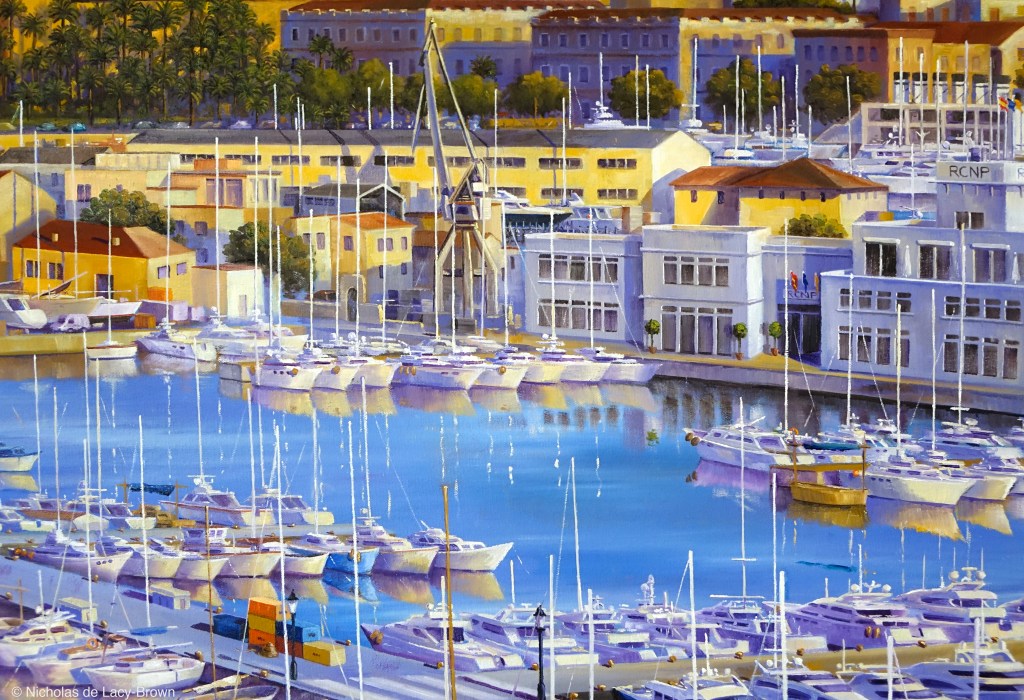
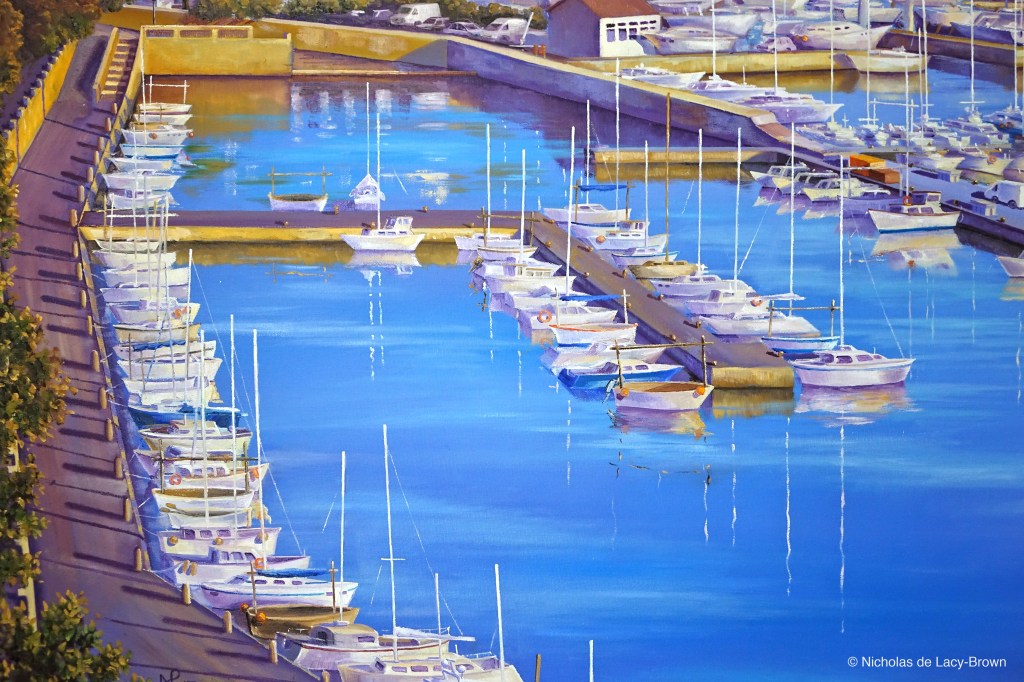
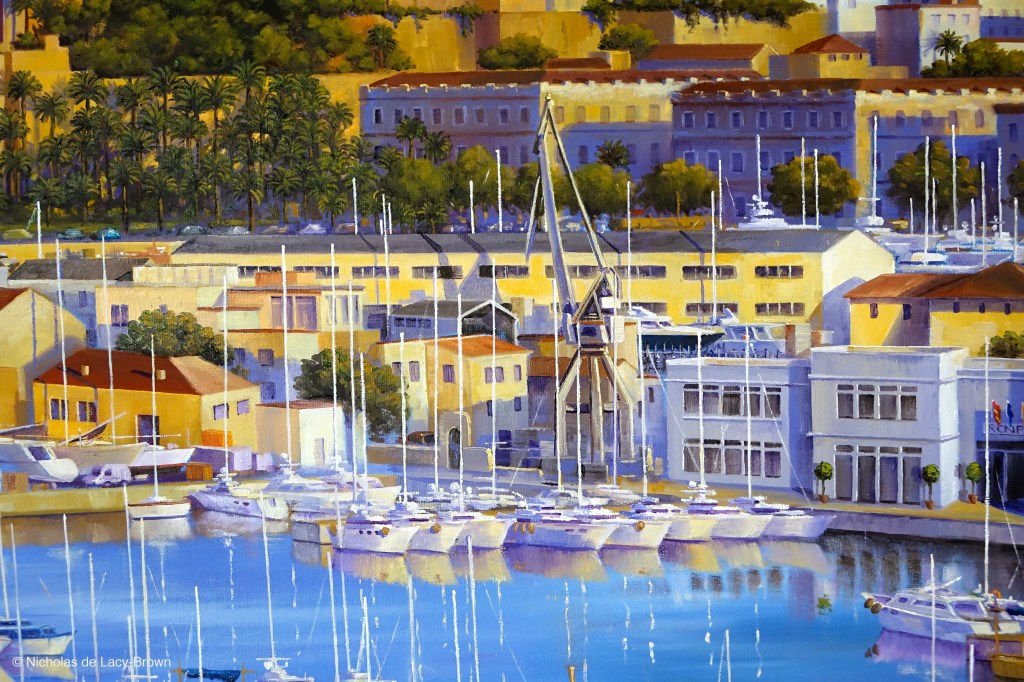
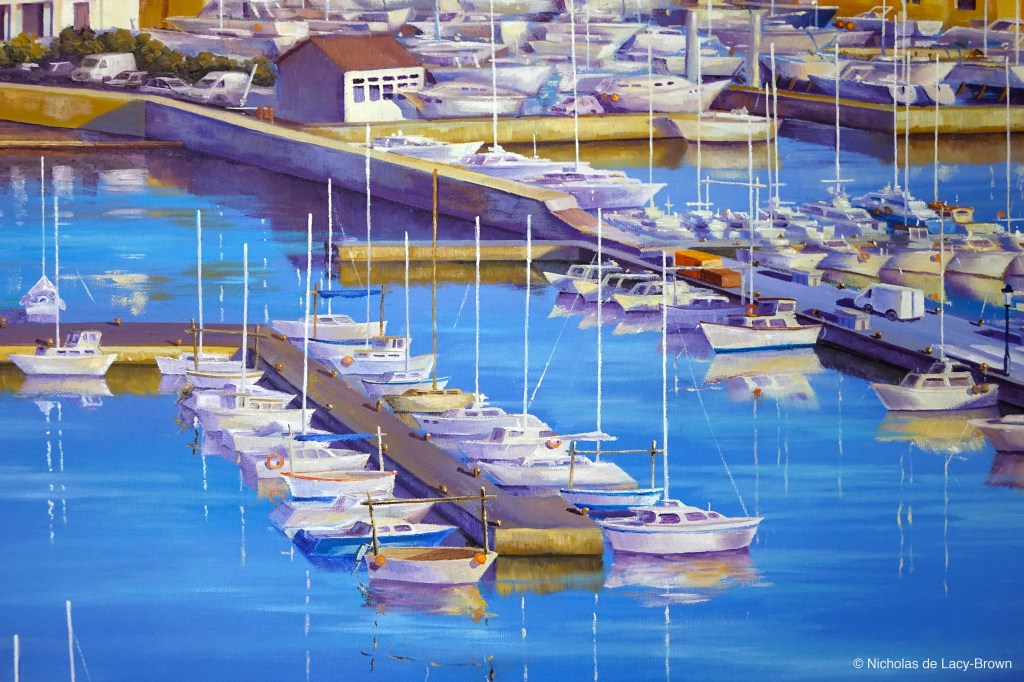
My Palma: 6 months, 157 buildings and 205 boats

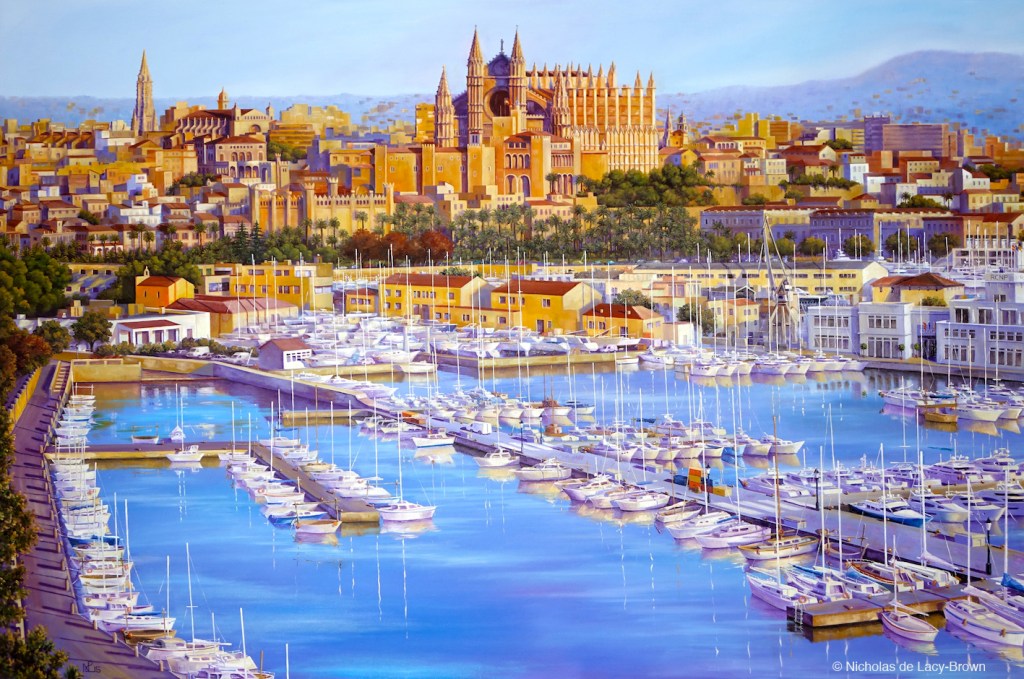
I interrupt my weekly digital exhibition of gouaches in my Ocho Balcones collection to present, with a considerable degree of excitement, my newest oil painting: The Bay of Palma. Started back in April when I found a typical little postcard of this typical view of the sprawling bay of Palma de Mallorca, I couldn’t resist the temptation to paint this city I have so come to love on the largest scale possible. So starting work on an immense 152 x 101 cm canvas, I set about painting what must be one of the most complicated painting projects of my art career.

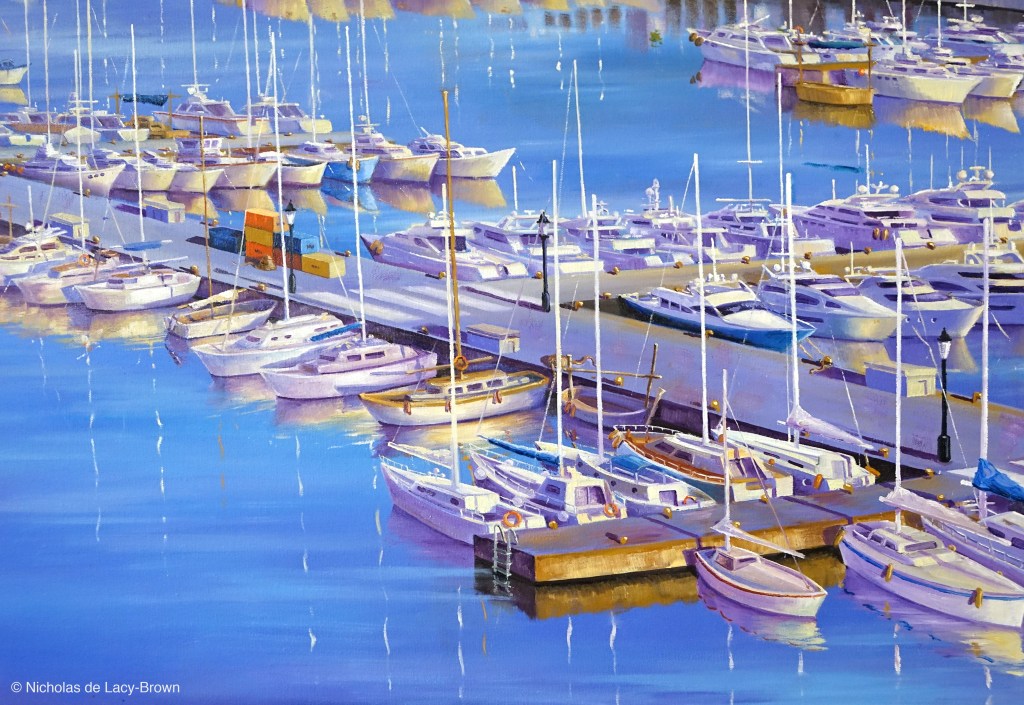
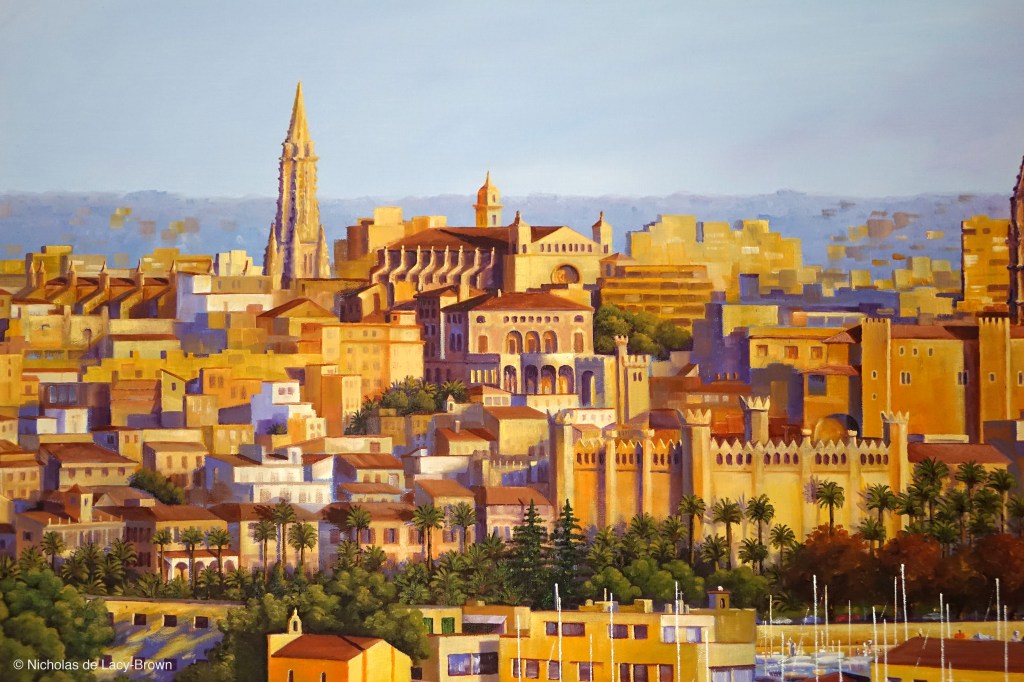
Just the cathedral alone took endless hours of laboured work and adjustments of proportion, let alone the city which surrounds it and then those dreaded boats. Ah the boats… how I agonised over painting these seemingly innocuous white forms, correcting shadows and trying to paint masts with a shaking hand. But once 205 of them were done, I stood back in pride and admiration at what I had a achieved: a landscape which is both a typical view of this most admired of cities, but which was nonetheless technically difficult to capture, both because of its size and its detail. But I am delighted with the result.

Bay of Palma Water

I am therefore proud to share this painting exclusively on The Daily Norm along with a few shots of some of the many details which fill the work. I hope you like it!

Cathedral Port2 City Port3 Port Cathedral vertical Port buildings Port1

© Nicholas de Lacy-Brown and The Daily Norm, 2001-2015. Unauthorized use and/or duplication of the material, whether written work, photography or artwork, included within The Daily Norm without express and written permission from The Daily Norm’s author and/or owner is strictly prohibited. Excerpts and links may be used, provided that full and clear credit is given to Nicholas de Lacy-Brown and The Daily Norm with appropriate and specific direction to the original content. For more information on the work of Nicholas de Lacy-Brown, head to his art website at www.delacy-brown.com

The Honeymoon Suite I: Bedroom at La Colombe d’Or

I knew that staying at La Colombe d’Or would inspire me. It wasn’t just that it happens to be stationed in one of the most exquisite locations in all of the French Riviera, but it has also inspired countless of the world’s most famous modern artists, and I wasn’t going to be the exception. So armed with my handy box of gouache paints, brushes and using the Colombe d’Or’s ashtray for water (sorry Colombe!) I set about painting what most inspired me. And from the very first morning, when I awoke to find light flooding into our bedroom, the rays dancing and undulating as they reflected across from the swimming pool right outside the room, I knew what I would have to paint.

The work which resulted is this one, the first in my Honeymoon Suite series. The painting depicts not only the effect of the light entering through a quaint wooden window into our pastel-coloured room, but also the proximity of the Alexander Calder mobile, and the Braque mosaic, just outside our room, which never failed to excite me. In  the foreground is the little desk which I used to paint this very same painting, breathing the cypress-perfumed air which wafted through the window as I did so.

Honeymoon Suite I: Bedroom at La Colombe d'Or (2015 © Nicholas de Lacy-Brown, gouache on paper)

Honeymoon Suite I: Bedroom at La Colombe d’Or (2015 © Nicholas de Lacy-Brown, gouache on paper)

Like so many artists who went before me, I could have stayed in the Colombe d’Or to paint forever.

© Nicholas de Lacy-Brown 2000-2015. Unauthorised use and/or duplication of the material, whether written work, photography or artwork, included on this website without express and written permission from Nicholas de Lacy-Brown is strictly prohibited. For more information on the work of Nicholas de Lacy-Brown, head to his art website at www.delacy-brown.com

Comparing Seascapes: Sussex and Spain

Two Seascapes, one England, one Spain. In Sussex in England, the sea is a silvery shade of grey. No surprise there, as it is an inseparable reflection of the cloudy skies above, whose repressive covering is broken only by a single glimmer of hope as a glint of light shines through. The seas are active, but not rough, but the winds are sufficiently energetic to catapult the kite surfer across the waters. At the shore the sand is dank and wet, it’s lightening colour resaturated with each swift revolution of the waves. 

The only thing Marbella in Spain has in common is the sea. But its colour is a startling warm blue, glimmering almost independently from the yellowing evening skies above. Above the beach, a golden paseo maritimo is fringed with regal palms whose large canopy of leaves hang as silently still as the warm balmy calm air around them. Through the leaves, the multiple strata of a mountain layered landscape each deliver a different shade of soft pink, while in front the white harbour wall of Marbella’s port colours gently to cream in the face of the setting sun. 

Seascape III: Silver Surfer (2008 © Nicholas de Lacy-Brown, oil on canvas)

Seascape III: Silver Surfer (2008 © Nicholas de Lacy-Brown, oil on canvas)

Seascape IV: Marbella (2008 © Nicholas de Lacy-Brown, oil on canvas)

Seascape IV: Marbella (2008 © Nicholas de Lacy-Brown, oil on canvas)

I painted these two seascapes in 2008 when I was making a more intentional transition from acrylic into oil. These were part of a series of studies I made as I tried out the medium for the first time. Today, they hang at my parents house in Sussex, and it was when I was there this weekend that I was given the opportunity to reflect upon them, and the marked difference between seaside landscapes.

It comes at a pertinent time: in just a few days I will leave England, including the Sussex seaside town where I grew up for 18 years and which is featured in the seascape above. I will then move to Palma de Mallorca, the archetypal Mediterranean city, fringed with glorious palms and benefitting from sunshine almost the whole year around. Yet despite the very obvious benefits of moving to such a paradise, there will always be a part of me that will miss the English coast – for in its silvery wind swept beauty, the sea in England is just as special as in the Med. It’s just that more often than not, you may need a scarf and some gloves in tow to appreciate it.

© Nicholas de Lacy-Brown and The Daily Norm, 2001-2014. Unauthorized use and/or duplication of the material, whether written work, photography or artwork, included within The Daily Norm without express and written permission from The Daily Norm’s author and/or owner is strictly prohibited. Excerpts and links may be used, provided that full and clear credit is given to Nicholas de Lacy-Brown and The Daily Norm with appropriate and specific direction to the original content. For more information on the work of Nicholas de Lacy-Brown, head to his art website at www.delacy-brown.com

Sunday Supplement: The Seville Triptych

It’s an early 2012 Spanish Season here at the Daily Norm, and what better thoughts to fill your head at this time of ferocious cold across much of the Northern Hemisphere. Here in Spain the snow hasn’t reached us, but the winds were almighty and angry. On emerging from home yesterday we found much of Marbella’s lush greenery had hit the ground. A crying shame, but such is the rapid growth of the plants out here, I’m sure many of the gaps will have filled come July.

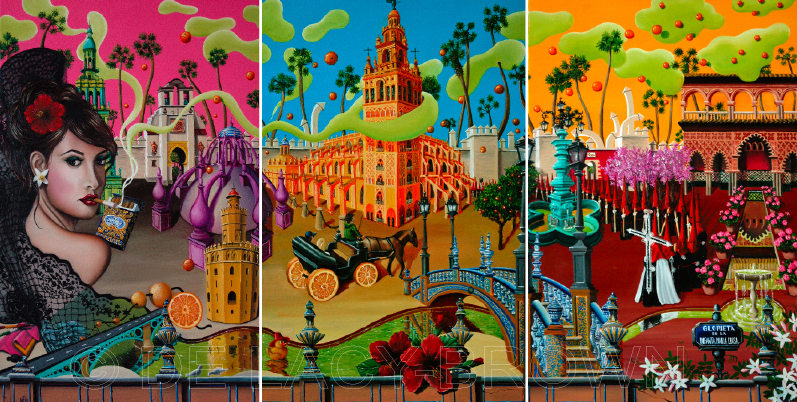
In line with this short season of Spanish indulgence, today’s Sunday Supplement pays homage to one of Andalucía’s most famous and exquisite cities: Seville. Having travelled there in the Spring of 2010 my mind rapidly filled with numerous ideas with all the energy of a kindergarten playground. What resulted was not one, not two, but three canvases portraying the city, which, when placed together flow seamlessly into one complete panegyric to Spain’s southern gem.

Seville Triptych - Canvas I (Oil on canvas, 2010 © Nicholas de Lacy-Brown)

Prominent in the first canvas is a beautiful Spanish lady. Some asked if I had painted Amy Winehouse. Au contraire – this is the infamous Sevillian femme fatale, Carmen, immortalised in Bizet’s opera, seductive in her gaze, languidly smoking a cigarette from a packet which is decorated with the ceramic signage of the Tobacco factory where Carmen worked – a factory which today stands beautifully as ever in the centre of the city, now converted into a university. Beneath her traditional black lace mantilla which, in part, is used as a fisherman’s net, are the paraphernalia of the matador, Escamillo who, in Bizet’s operatic tale, prompted such jealousy in Carmen’s lover Don José that it led to her eventual downfall. Also in this canvas are the Moorish walls of Seville’s Real Alcazar palace, harping back to the city’s Moorish past, which is also embodied in the Torre del Oro which stands by Seville’s Guadalquivir river. Across the river, the bridge designed by Gustav Eiffel features, while from the fishing nets, floating buoys become the oranges for which Seville is renowned throughout the world. Meanwhile the flower from fragrant orange blossom adorns Carmen’s ear, while above her head, the architectural splendour of the ceramic-covered Plaza de España emerges. Finally, sat like a spider upon the ground, the elaborate gothic architecture of Seville’s great cathedral is featured in a vibrant purple.

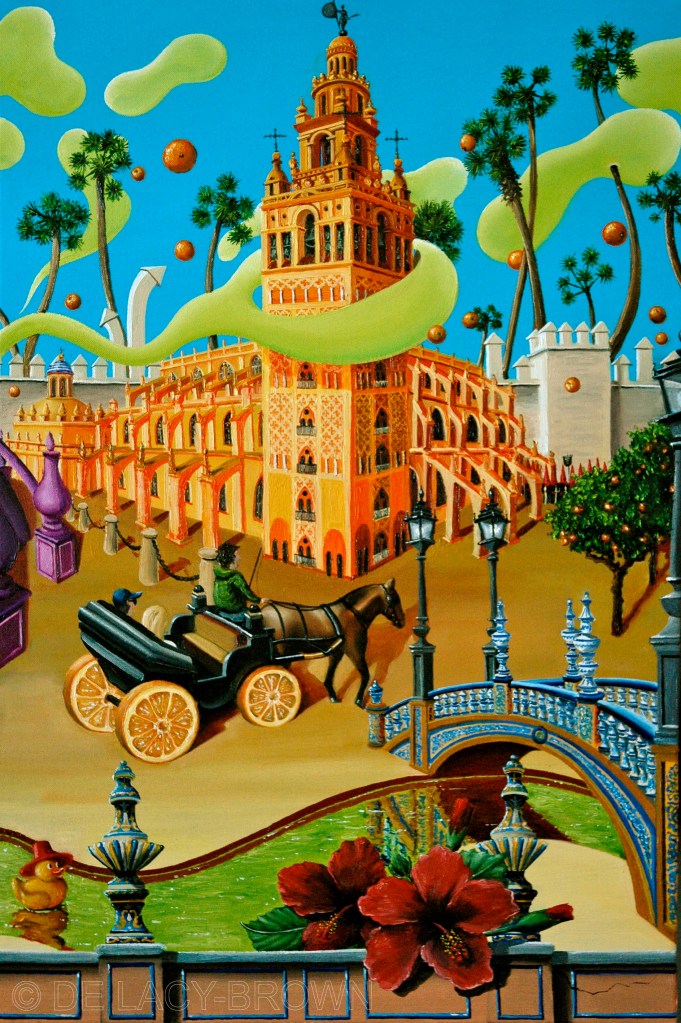
Seville Triptych - Canvas II (Oil on canvas, 2010 © Nicholas de Lacy-Brown)

In the second canvas, the Giralda bell tower and the adjoining magnificent cathedral take centre stage, enveloped by the smoke of Carmen’s cigarette smoke. The angle of the building shows off its magnificent gothic details as well as the Moorish features on the lower section of the Giralda tower which is retained from Seville’s Moorish past. In front of the cathedral, a common site of Seville is featured – the horse and cart – whose characteristic yellow wheels are replaced with orange slices. Meanwhile, the distinctive blue and white ceramic bridge of the Plaza de España signifies that here, the river has become the pleasure lake which is central to the Plaza de España complex.

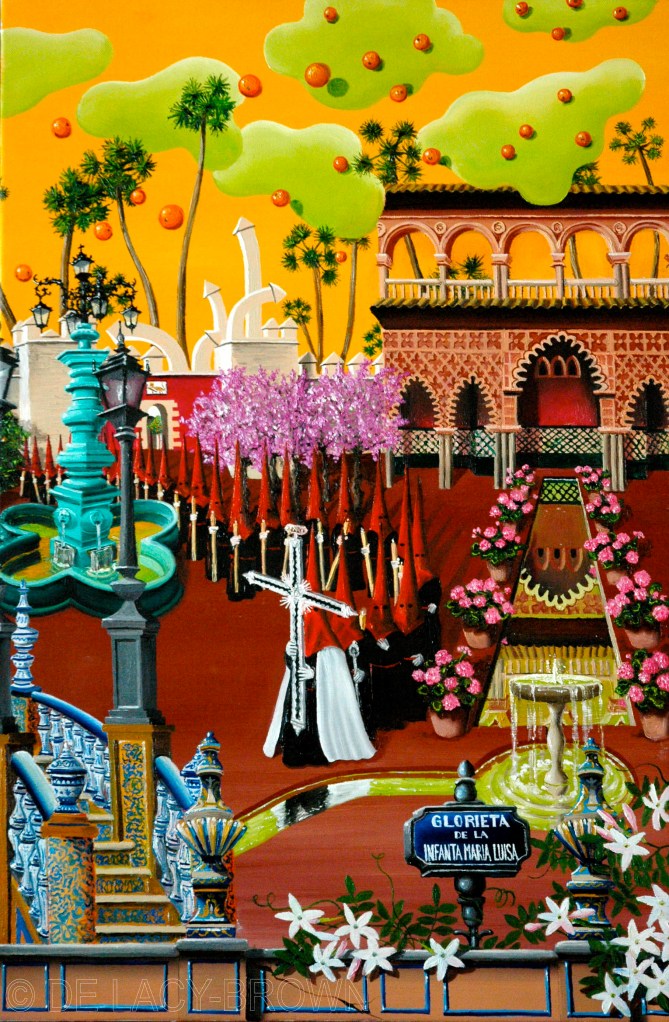
Seville Triptych - Canvas III (Oil on canvas, 2010 © Nicholas de Lacy-Brown)

The third canvas is testament to Andalucía’s complex religious history, from the Moorish architecture which features strongly in the Real Alcazar palace, to the staunchly catholic Semana Santa (Easter Week) parades which are famous throughout Andalucía but most especially in Seville. In the foreground there is a decorative sign from the Parque Maria Luisa, which appears to emanate from the modernist age of design, while in the background, the pointed battlements of the Moorish city walls appear freed from the uniform constraints of their design, playfully reaching for the skies.

Seville Triptych - the complete triptych (Oil on canvas, 2010 © Nicholas de Lacy-Brown)

Across the three paintings, several unifying features dominate: In the immediate foreground are the walls and ceramic decorations of the Plaza de España, and behind it the River Guadalquivir which, in the second canvas becomes the pleasure pools of the Plaza de España and, by the third canvas, has turned into the Moorish pools of the Alcazar palace. In the background, the distinctive slender palm trees which pepper the cityscape and a shower of Seville oranges scatter the painting, while along the horizon, the walls of the Real Alcazar unify the canvas.

© Nicholas de Lacy-Brown and The Daily Norm, 2005-2012. Unauthorized use and/or duplication of the material, whether written work or artwork, included within The Daily Norm without express and written permission from The Daily Norm’s author and/or owner is strictly prohibited. Excerpts and links may be used, provided that full and clear credit is given to Nicholas de Lacy-Brown and The Daily Norm with appropriate and specific direction to the original content.