Skip to content

Posts tagged ‘Madonna Litta’

Norms do… Da Vinci (or Boltraffio??)

My little Norms have parodied quite a few artists and their masterpieces now. Degas’ L’Absinthe, Goya’s 3 May 1808, Velazquez’s royal portraits and Robert Doisneau’s Kiss at the Opera to name but a few. I also featured a Norm parody of Da Vinci’s great masterpiece Lady with an Ermine back in December. Well now the Norms have returned to this great classical favourite, appearing in a pastiche of that great Da Vinci work, the Madonna Litta. The only problem is, was this sumptuous Madonna and Child, usually to be found in St Petersburg’s Hermitage Museum and most recently featured in the huge sell-out spectacular Da Vinci show at London’s National Gallery, a Da Vinci painting at all?

The Madonna Litta (attributed to Leonardo Da Vinci) courtesy of the Hermitage museum, St Peteresburg

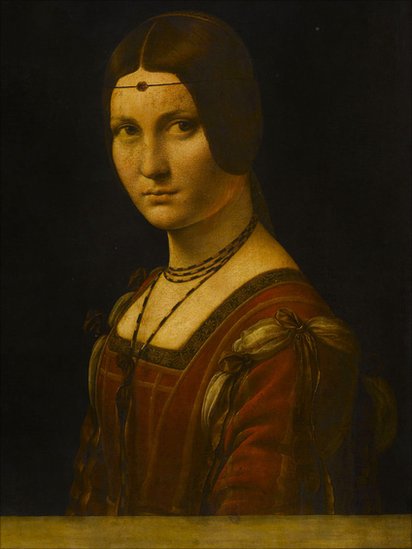
Rumour has it that the work, albeit based on ideas and primary sketches by Da Vinci, was actually completed by his pupil Giovanni Antonio Boltraffio. The Da Vinci-doubters attribute the Christ child’s apparently awkward posture to the lesser known artist, as well as a “formulaic” and “plain” landscape, and the “harsh” outlines of the characters. I’m no art history expert, and who am I to doubt these tell-tale signs. But for me the work is splendid in all its components, Da Vinci or otherwise. The landscape is fairly rudimentary, but this ensures focus is drawn to the protagonists of the tale, while providing colour balance to the piece. The sharp outlines of the characters are attributable to the dark interior background, but this is no different to the effective use of a black background in Da Vinci’s Lady with an Ermine as well as La belle Ferroniere. To my mind, the problem with the Christ child is not so much his “awkward” pose as his direct gaze towards the audience, which seems at odds with the serenity of the moment as he breastfeeds from a caring mother. All in all the painting, bursting with colour, full of familial intensity, is a superb example of the Da Vinci school whether or not painted by the great master himself.
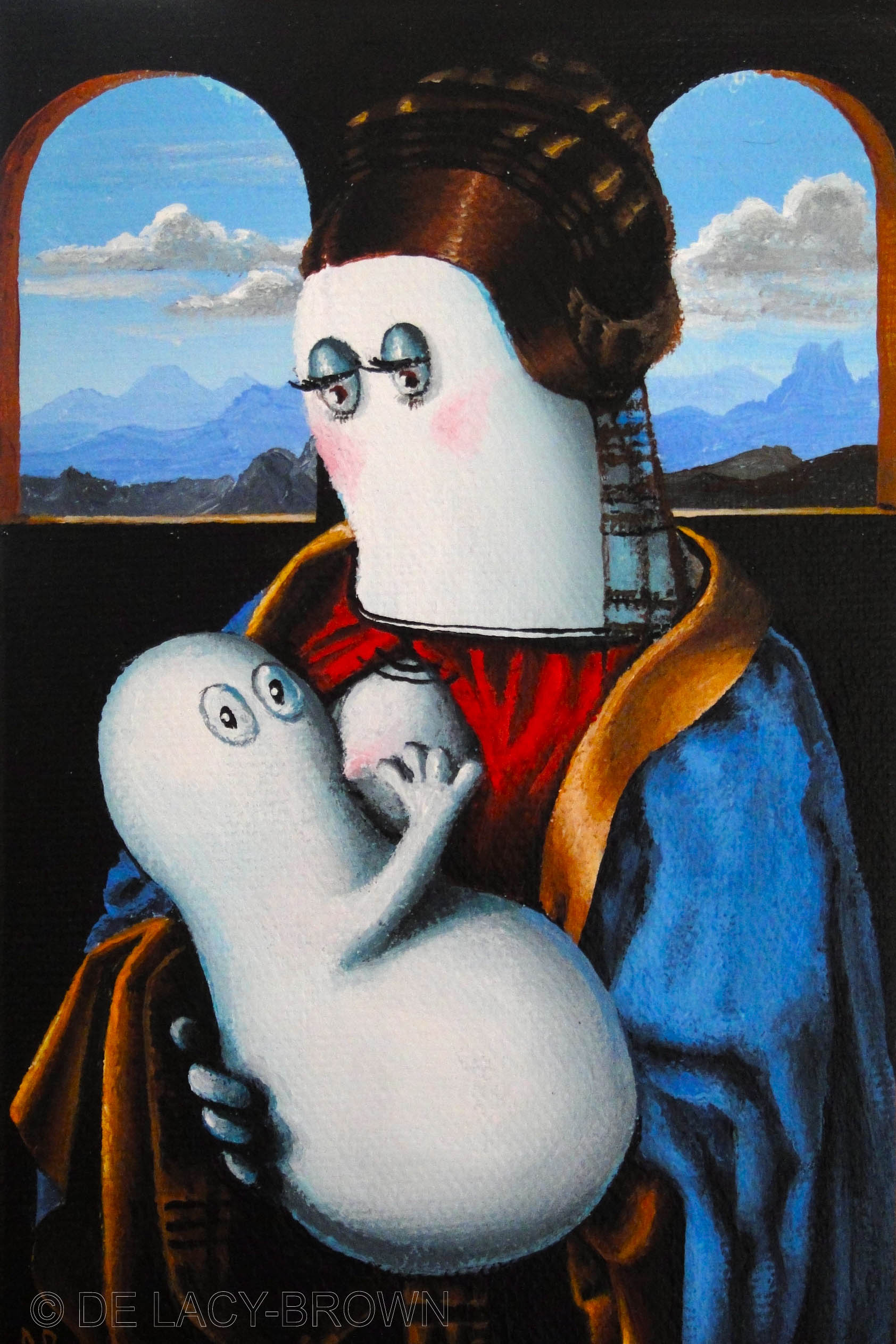
Norm Madonna Litta (after Da Vinci) (acrylic on canvas, 2012 © Nicholas de Lacy-Brown)

My Norm work is every bit a homage to the original Da Vinci inspiration. At 6″ x 4″, it is probably the smallest painting I have ever attempted which made the detail of the landscape and lavish fabrics difficult to paint. The reason for this size was principally to fit a very fine mock-vintage frame I found online. In fact I am completely obsessed with vintage frames at the moment, and now have a collection, filled with little Norm takes on classical paintings hanging upon dark scarlet flock wallpaper in my hallway. By far my favourite is a frame which is so grand, so utterly exuberant, that it needs to be shared on my blog. When seeking a frame for my Doisneau Norms, I wanted something as extravagant as I could find, to mark a satisfying contrast between the 1950s image and the Renaissance style framing. I love mixing up period design in this way, and in fact my flat here in London is a temple of mixed period design. The frame I eventually found fits the bill perfectly and is by far the most extravagant frame I now have in the house. Keep in mind, this is a fairly large painting – 20″ x 24″ so that gives you a sense of the overall frame size, a frame which is so utterly exquisite in its details that my partner and I have taken to staring at it for long periods of blissful admiration in the same way that the faithful may stare in awe at a beautiful baroque altarpiece. And the best bit – it was only £85 from ebay. But don’t tell anyone!
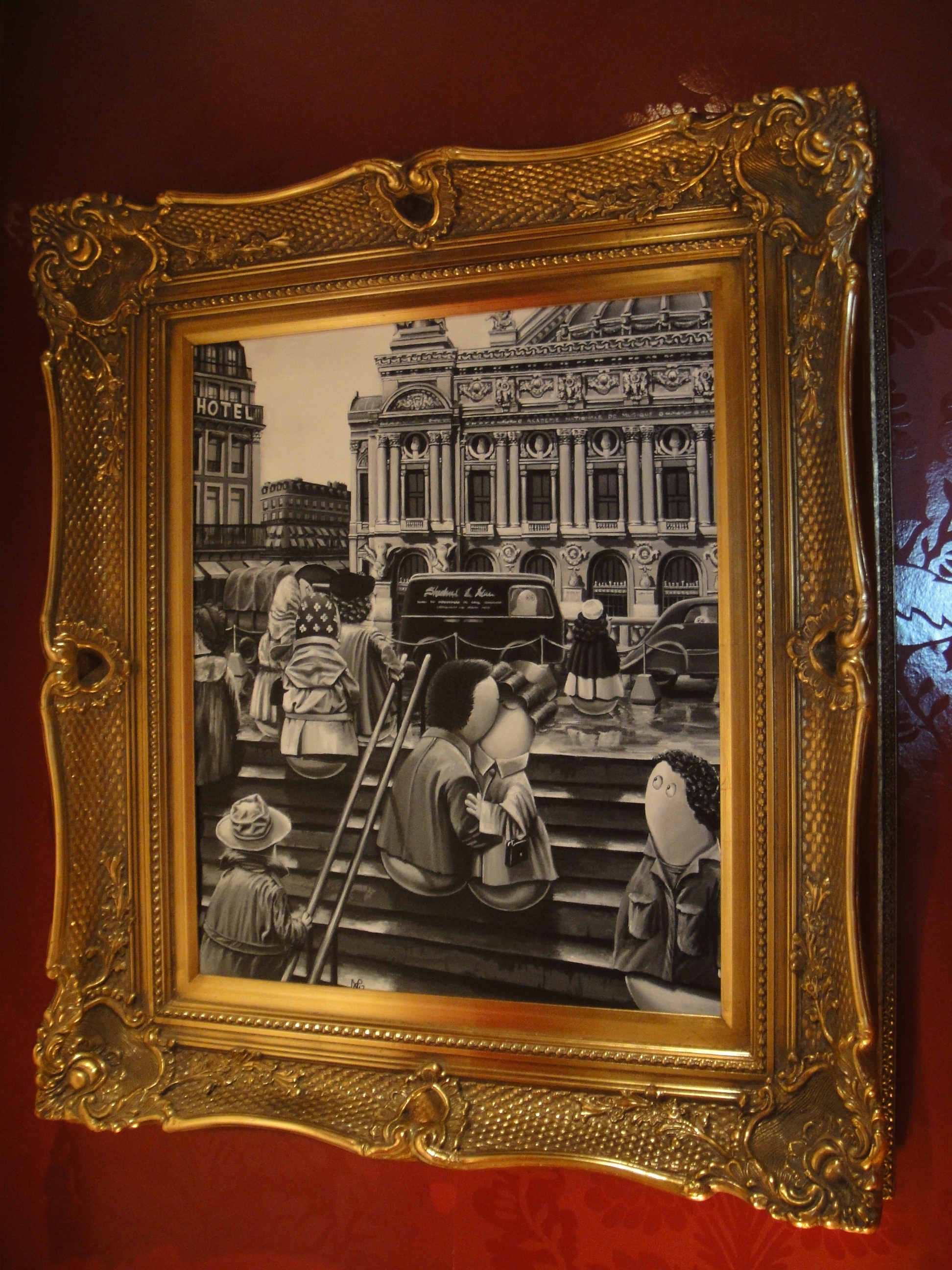
My lavishly framed Doisneau Norms

Ok, it’s officially snowing (a bit) in London so I’m off to seek warmer climes. See you there!

© Nicholas de Lacy-Brown and The Daily Norm, 2005-2012. Unauthorized use and/or duplication of the material, whether written work or artwork, included within The Daily Norm without express and written permission from The Daily Norm’s author and/or owner is strictly prohibited. Excerpts and links may be used, provided that full and clear credit is given to Nicholas de Lacy-Brown and The Daily Norm with appropriate and specific direction to the original content.

Da Vinci Season – Part 2: National Gallery exhibition review

Christmas is fast upon us, people are rushing around shopping like maniacs, there are now gigantic queues for macaroons at Ladurée on Piccadilly (I thought this madness only occurred on the Champs Élysées. We did however queue for 3 boxes…) and people are allegedly selling Waitrose Heston Blumenthal Christmas puddings for millions on ebay. However something else is in the air in London, and now, scattered across my coffee table and desk, where newly arrived Christmas cards should be taking central place, postcards of the masterpieces of Leonardo Da Vinci are fanned all over, renaissance music replacing carols on the CD player, and an open, full scale catalogue of Da Vinci’s works enables lavish Leonardo indulgence at every turn of the glossy pages. Yes, as promised, I have visited the much hyped National Gallery blockbuster, and now I can firmly pronounce myself to be a huge Da Vinci fan.

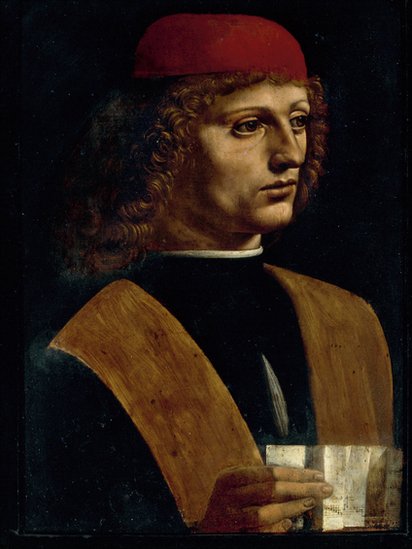
The Musician (Da Vinci, around 1486-7)

The exhibition, Leonardo Da Vinci: Painter at the Court of Milan, is not, at least to my mind, the exhibition of the decade as some commentators have lauded it. Nothing can quite surpass last year’s The Real Van Gogh at the Royal Academy which displayed a vast collection of mind-bogglingly superb works, nor indeed Tate’s incredibly comprehensive 2005 Frida Kahlo retrospective. It is, however, almost undoubtedly the exhibition of 2011. Unlike the close competitor – Tate’s Miro retrospective – Da Vinci did not go arrogantly off the rails towards the end of his career and start burning canvases or indeed painting them white with a single wiggly black line running somewhere across centre. No, for with the Da Vinci show, we are shown, from one work to another, what an undeniable master draftsman and painter this man was (asides from his various other mathematical, scientific, architectural, and engineering plaudits, to name but a few). Considering, compared to most artists, Da Vinci painted only a handful of works, each and every one is executed to an exceptional standard. Even in their various degrees of preservation, it is possible to see how superbly Da Vinci catches the light on his sitter’s skin, how accurately he has utilised his advanced knowledge of the human anatomy and perfect mathematical ratios to capture the very essence of human expression in his portraits, and how brilliantly, through detailed studies and sheer artistic brilliance, he was able to paint the most perfect drapery, clothing and overall compositional balance.

Da Vinci, Drapery Study for an angel (1495-8)

The paintings on show are far and few between, but we know this before entering. To have displayed 9 of only 15 surviving paintings is a coup for the National, and one can’t really ask for more. Take the Mona Lisa from the Louvre, and it would be like ripping Big Ben away from the Houses of Parliament. However, by reason of their sheer rarity, the sight of one, glowing majestically against a plum painted wall (the lighting is, by the way, very well executed) sends excitement through the audience in the same way that one becomes suddenly star struck when seeing a previous nobody reality TV star in a supermarket (I speak from experience – and no, I am not trying to suggest that Da Vinci’s paintings could ever be considered inconsequential). Then, filling the galleries besides are a great number of preparatory sketches and paintings executed by Da Vinci’s pupils and assistants. However the sketches are far from fillers (much like the use of endless sketches and scientific memorabilia in the recent Royal Academy Degas Ballerina show). Rather, they are crucial to understanding how Da Vinci managed to achieve such polished results, as well as gaining an insight into his thought processes (for example, this wonderful drapery study shows his intention for an altered composition for his painting, The Virgin of the Rocks in its second version, an alteration which, owing to pressure from his patrons, was never actually realised –  the original compositional planning for which can now be seen, using xray, under the paint of the final version). They are also crucial, no doubt, to proving the provenance of the various paintings, all of which seem to have undergone some level of doubt as to whether Da Vinci actually painted them.

The Belle Ferronniere (Da Vinci, around 1493-4)

Having said that, the sketches are small, as, indeed, are the majority of the paintings, and, predictably, one does find oneself becoming ever so slightly aggressive in trying to get within a metre’s distance of a work. While the National Gallery has been quite careful to limit the visitors to the show (and the huge queue for the daily released tickets which spirals outside is testament to the Gallery’s strict policy when it comes to letting in too many people all at once) there are still an awful lot of people all vying to have their fill of each and every detail of this show. Thus, I did find that one became unavoidably sucked into a sort of revolving carousel around the various exhibits, so that, like a slow conveyor belt, you could get your moment before a painting before being politely shoved forward by the belly of the man standing behind as he/it got a little too close for comfort. Break off from the conveyor and you would find it difficult to get close to a painting again for a while. And thus my eyes were not so much veiled by tears, as one commentator predicted I would, but rather by the sight of people’s heads. But then it’s alright for the reviewers isn’t it – they get to see the exhibition among only a handful of other critics. No wonder they were overcome with emotion – at how bloomin lucky they were to get the exhibition to themselves! Still, I’ve experienced worse, and for the National it does provide the added bonus that more people will buy the expensive exhibition catalogue in order to actually get a good look at what was on show.

Admirer looking at Lady with an Ermine as exhibited at the National

So what was on show at the exhibition? Well the exhibition was broadly split into 7 galleries, each room centralised around one or two Da Vinci masterpieces. In the first room, we met The Musician which is allegedly unfinished, but looks pretty good to me. In the next room, the stunning Belle Ferronniere was hung just across from my favourite, Lady with an Ermine, the two ladies almost competing with one another for who would be judged most beautiful as they had probably competed in life, the lady with an ermine being Cecilia Gallerani, mistress of Duke Ludovico Sforza, and the Belle Ferronnere thouht to have been the Duke’s wife. The Belle Ferronniere is a stunning work, her pose so confident, petulant almost, as though challenging Cecilia Gallerani, whose portrait was literally hung in the direction of La Belle’s gaze, to usurp her role as primary lover to the Duke. Both exhibit truly modern, strongly characterised poses, particularly considering the century in which they were painted.

Da Vinci's unfinished Saint Jerome (around 1488-90)

In the next room, the evidently unfinished Saint Jerome takes centre stage, but even in this state of incompletion, the painting demonstrates how accurately Da Vinci painted the human anatomy. It also proves a useful demonstration of Da Vinci’s working techniques and the stages he undertook in building up layers of paint on a canvas. Moving through into the exhibition’s central gallery, two much larger, more complex compositions are hung opposite one another is a fantastic pairing which is a unique achievement of the Gallery’s show: Da Vinci’s original Virgin of the Rocks, usually to be found in the Louvre in Paris, has been hung with the second version of the same composition, which is owned by the National Gallery. This allows for a direct comparison to be made of the two “rocks”. Personally my favourite was the National Gallery’s later version, where the colours were brighter, and the details more refined such as the little flowers in the foreground. Nonetheless, this version has been recently restored, hence the enhanced colours and more obvious details.

Read more