Skip to content

Posts tagged ‘Nicholas De Lacy-Brown’

Norms: The Saints Collection | Santa Lucia

At this festive and, for some, religious time of year, the calendar is awash with Saint’s days and festivals which make the whole Christmas period sparkle with something rather magical. Last week, I noted the passing of St Nicholas’ day, a Saint’s day of the utmost import because it is that rotund smiling fellow who will pass out the presents this December 24th, and of course because he happens to share my name. Last Saturday, another festive favourite was celebrated: St Lucy or Santa Lucia as she is perhaps more widely known, and as the bringer of light and patron saint of sight, this Saint is equally important at this sparkling, light infused time of the year.

In fact such is Santa Lucia’s renown as the bringer of light, that her Saint’s day is celebrated with gusto in the Scandinavian lands, where darkness reigns for much of the day at this time of the year, and where locals therefore gather in reverence to the Saint in the hope that St. Lucy will bring them more light to get through the winter. Apparently her connection with light stems from the fact that at the time of her death at the hands of Emperor Diocletian, her eyes were gouged out, either by order of the Emperor, or by herself in order to disuade a potential suitor from pursuing her. Either way, the story has been taken up in popular iconography, and in more recent times, Santa Lucia has been depicted holding her eyes on a platter.
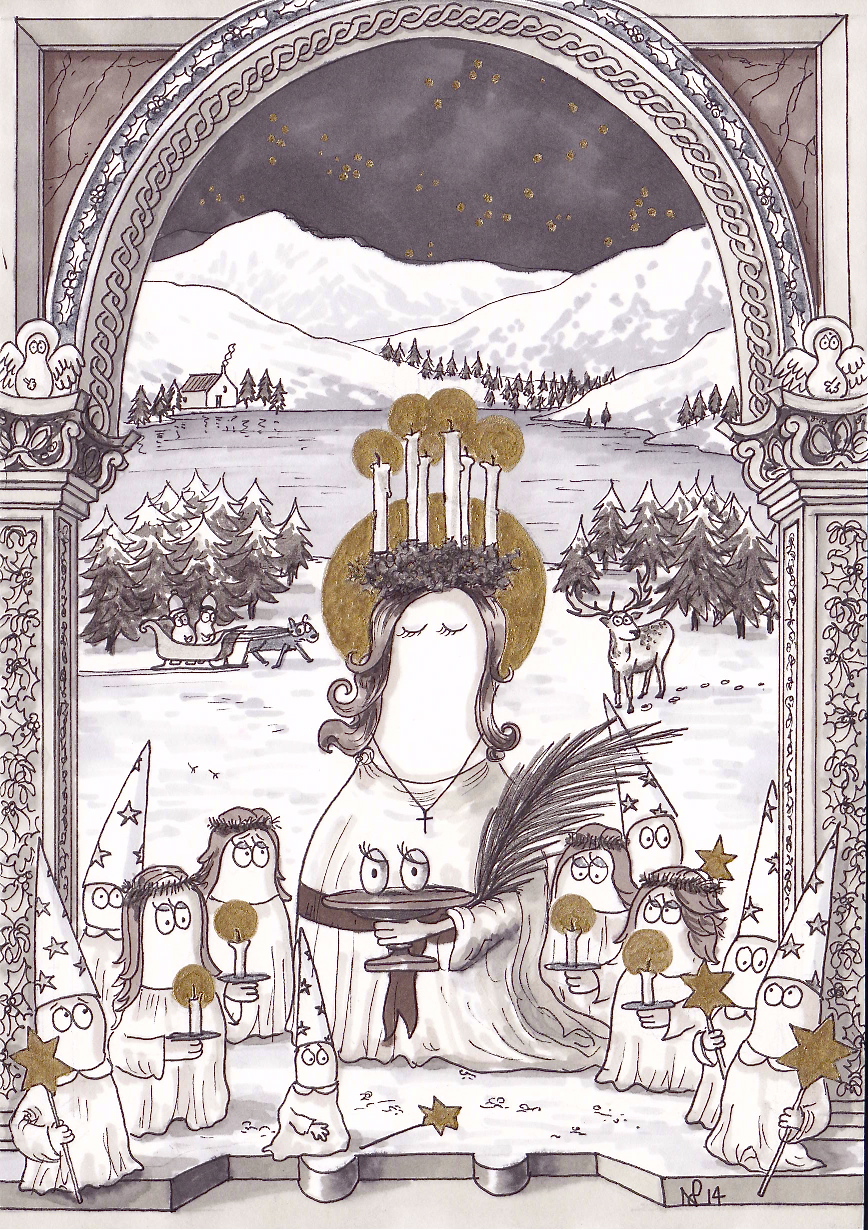
Santa Lucia Norm (2014 © Nicholas de Lacy-Brown, pen and gold paint on paper)

Santa Lucia Norm (2014 © Nicholas de Lacy-Brown, pen and gold paint on paper)

And so, here is Santa Lucia Norm, depicted in all her glory with eyes upon a platter. No gruesome gouging here (it is Christmas after all), but just the suggestion of it. My Santa Lucia is wearing the crown of candles which is worn by celebrants of her festival in the Scandinavian celebrations which are the basis of my depiction. Those celebrations also include choirs of children wearing white gowns, conical hats and carrying candles in homage to the Saint’s light-giving powers – celebrations which are depicted here against a snowy, Christmassy Scandinavian landscape. More about those celebrations tomorrow, but in the meantime – a Merry Christmas to all!

© Nicholas de Lacy-Brown and The Daily Norm, 2001-2014. Unauthorized use and/or duplication of the material, whether written work, photography or artwork, included within The Daily Norm without express and written permission from The Daily Norm’s author and/or owner is strictly prohibited. Excerpts and links may be used, provided that full and clear credit is given to Nicholas de Lacy-Brown and The Daily Norm with appropriate and specific direction to the original content. For more information on the work of Nicholas de Lacy-Brown, head to his art website at www.delacy-brown.com

Norms at the Chocolateria C’an Joan de S’Aigo

Having read my post a few days back on the oldest and most venerable of all chocolateria’s in Palma de Mallorca, the C’an Joan de S’Aigo, it was only a matter of time before the Norms sought out the establishment for themselves. Pearly white though they may be, these little one-armed creatures love nothing more than a cup of warm silky chocolate, which helps to nourish their gelatinous skin, and gives them an extra spring to their bounce. So off the Norms went to Palma’s most popular cafe, nestled in the streets of its ancient medieval quarter, and still exhibiting an eclectic mix of interior articles from a bygone era.

On the visit we see in this little Norm sketch, these hungry Norms have ventured into the cafe at a fortuitous time. For not only have they been able to find themselves plenty of greasy sweet ensaimadas to dip into their hot chocolate, but they have also coincided their visit with that of Joan Miro Norm, the great Norm artist who himself always loved to indulge in a little cup of the good stuff. Here we can see Miro Norm somewhat struggling with a piece of art work. Should he draw another bird or another star? Is the black outline around the yellow circle thick enough? It’s a real struggle being an artist – I can tell you that much.

Norms visit the C'an Joan de S'Aigo (2014 © Nicholas de Lacy-Brown, pen and ink on paper)

Norms visit the C’an Joan de S’Aigo (2014 © Nicholas de Lacy-Brown, pen and ink on paper)

© Nicholas de Lacy-Brown and The Daily Norm, 2001-2014. Unauthorized use and/or duplication of the material, whether written work, photography or artwork, included within The Daily Norm without express and written permission from The Daily Norm’s author and/or owner is strictly prohibited. Excerpts and links may be used, provided that full and clear credit is given to Nicholas de Lacy-Brown and The Daily Norm with appropriate and specific direction to the original content. For more information on the work of Nicholas de Lacy-Brown, head to his art website at www.delacy-brown.com

The Barbican Triptych

It was around 16 months ago when, following a work social function held within the Barbican Estate in the City of London, my colleague, who also lives there, commissioned me to depict the Barbican on canvas. 

It was something of a challenge. Chief amongst the challenges was the scale of the piece – a hefty triptych to feature on a large blank wall – exciting in prospect, but less so when I was already working full time with only evenings and the occasional weekend free to paint. Second was the problem of inspiration. The Barbican does not fall under what one would ordinarily term “beautiful”. Built in the style typical of the 60s and now given the rather unflattering title “brutalist architecture”, the Barbican estate is all grey concrete, sharp jagged edges and high rise. However, the site, built to fill in one of many huge expanses of the City devastated by the Blitz in WW2, is undoubtedly iconic, and as I started to muse upon a possible approach to capturing the architecture on canvas, I noticed how the architecture formed a harmony of shapes, from a variety of circles and semi circles, as well as straight horizontals and the teeth like edges of its famous three towers. And then it came upon me – what other London icon is comprised of simplistic lines and circles? Why the Underground. An idea was born. 

The Barbican Triptych (2013-14 © Nicholas de Lacy-Brown, acrylic on canvas)

The Barbican Triptych (2013-14 © Nicholas de Lacy-Brown, acrylic on canvas)

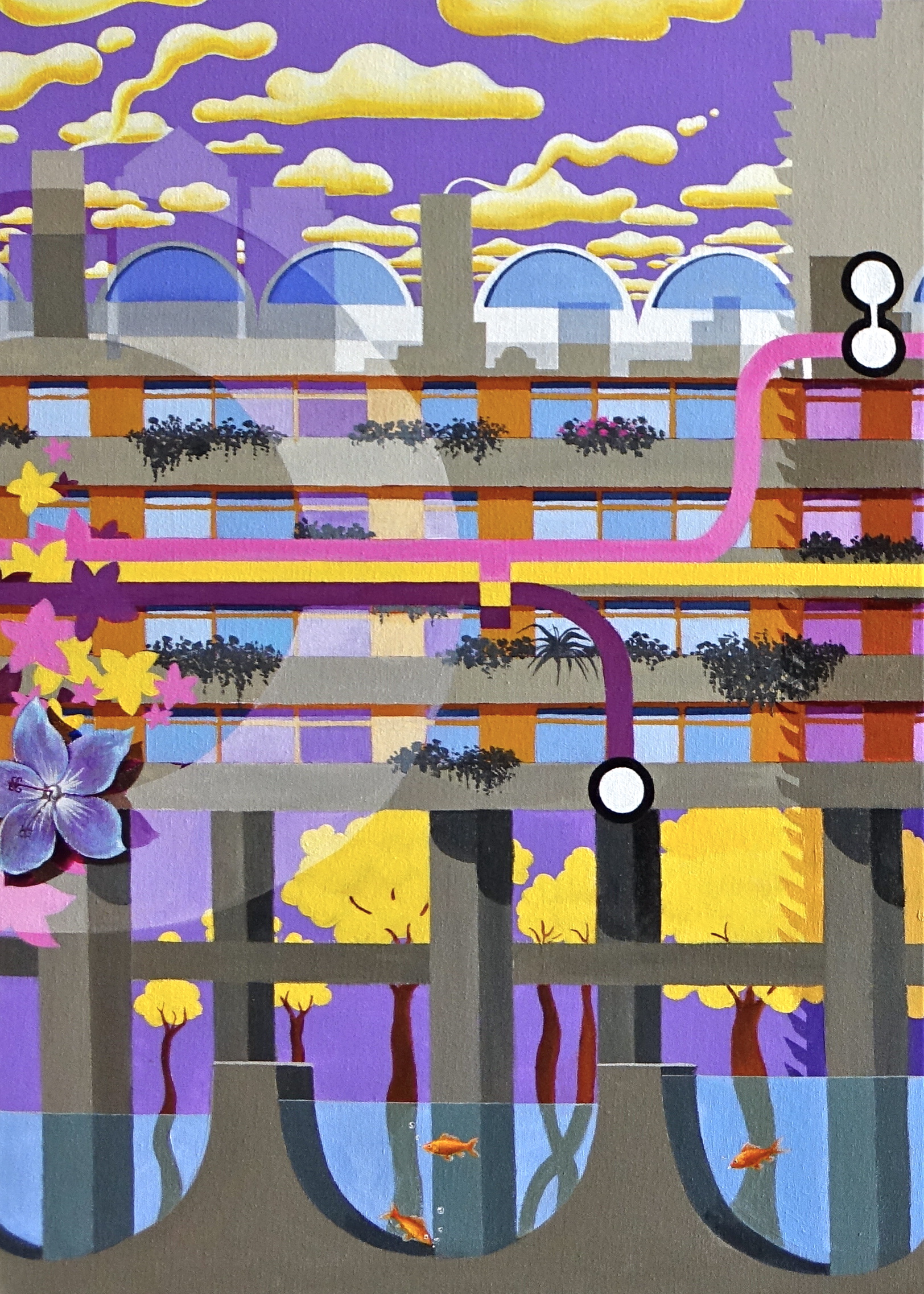
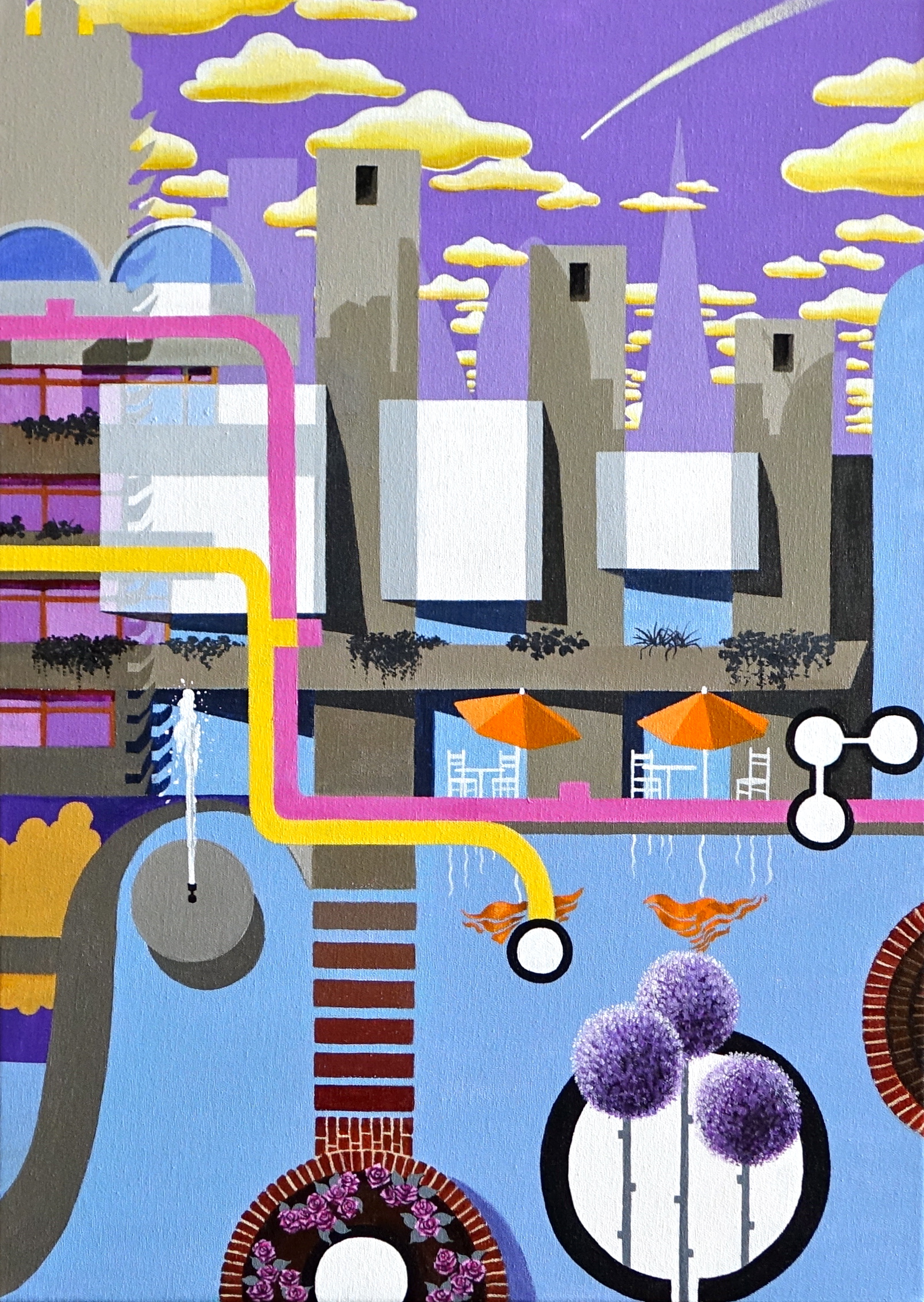
My Barbican Triptych is both a homage to the architectural shapes of the Barbican and the city in which it is located. Along the horizon of all three canvases, the famous skyline of the City can be seen, while across the piece, another London icon dominates: the famous map of the Underground. Taking the idea further, I chose to paint the work in predominant shades of purple, pink and yellow, these being the likes (Metropolitan, Hammersmith & City and Circle) that pass through the tube station at the Barbican, while occasionally where round sunken flower beds would ordinarily be found in the Barbican’s waterways, these have been replaced with the famous black ringed circle stops of the tube map. 

The painting not only reflects the architecture of the Barbican but channels the plentiful water which can be found at the Estate, starting from the waterfall on the right and flowing up through fountains and past the main cultural centre of the Estate to the fish ponds on the far right. It also includes the plentiful flowers which today make the architecture less brutal, and the plants which flow from the various residential balconies there. 

The Barbican Triptych = Canvas 1 (2013-14 © Nicholas de Lacy-Brown, acrylic on canvas)

The Barbican Triptych – Canvas 1 (2013-14 © Nicholas de Lacy-Brown, acrylic on canvas)

The Barbican Triptych - Canvas 2 (2013-14 © Nicholas de Lacy-Brown, acrylic on canvas)

The Barbican Triptych – Canvas 2 (2013-14 © Nicholas de Lacy-Brown, acrylic on canvas)

The Barbican Triptych - Canvas 3 (2013-14 © Nicholas de Lacy-Brown, acrylic on canvas)

The Barbican Triptych – Canvas 3 (2013-14 © Nicholas de Lacy-Brown, acrylic on canvas)

It may have taken well over a year to complete but I am so proud of the final result. And somewhat appropriately, this painting was the last of many I have completed while living in London. How apt then that rather than the Mediterranean setting which tends to be the staple of my work, this painting should be made in homage to the city which, up until last weekend, was my home of 12 years. My final swan song to London. 

© Nicholas de Lacy-Brown and The Daily Norm, 2001-2014. Unauthorized use and/or duplication of the material, whether written work, photography or artwork, included within The Daily Norm without express and written permission from The Daily Norm’s author and/or owner is strictly prohibited. Excerpts and links may be used, provided that full and clear credit is given to Nicholas de Lacy-Brown and The Daily Norm with appropriate and specific direction to the original content. For more information on the work of Nicholas de Lacy-Brown, head to his art website at www.delacy-brown.com


Two Weekends: Thinking about Cappuccino

It only takes a mere moment for your life to change forever. December 2012 taught me that much – a life obliterated – or May 2008 – when another’s mistake had irreversible consequences for the rest of my days. Yet if those moments of change taught me anything, it was that life is too short to stay where you are comfortable but unhappy, where monotony sets in and where you feel as though your train is trundling steadily up the wrong path. 

Earlier this autumn the chance to change paths and find happiness in change occurred to me very suddenly. It only took an email to set the new track in motion, and only two weekends for a decision to be made. For it was in those two weekends that I both attended an interview that would take me on a new path, and in which I made the ultimate decision, standing at the crossroads, that this new path was right for me. 

Two weekends: Thinking of Cappuccino is my newest oil painting, and it tells the story of how my life is all about to change: how I have accepted the offer to become Artistic Director of a global company bearing the name of Cappuccino and stationed within the sunny shores of Mallorca in Spain, and how in taking that offer it will mean moving from London, to Palma. 

Two Weekends: Thinking about Cappuccino (2014 © Nicholas de Lacy-Brown, oil on canvas)

Two Weekends: Thinking about Cappuccino (2014 © Nicholas de Lacy-Brown, oil on canvas)

But the painting came to me in Italy, sitting by the seaside in Donoratico in Tuscany, home of my partner’s family. Sitting at a cafe by a sea so still it might have been a photo, with our own breakfast of cappuccino and crostata (jam tart) on the table, all we could think about was a move to Mallorca, despite breathing the pine tree perfumed air of Tuscany, and drinking in the beauty of that Tuscan beach before us. 

The obvious symbols came to mind: the lifeguard’s hut was the new sanctuary that a home within the medieval streets of Palma de Mallorca would offer us; through the window we looked onto the famous skyline of Palma seen behind the green shutters that are famous in both Tuscany and Mallorca. The lifeguard’s ring has given salvation to the artist within me, represented by the manakin sitting on the sand: it is not so comfortable a position as the crostata tart sitting securely on a blanket, but this tart is the law, and within the confines of its pastry lattice, the blood of my life and career development is congealed and imprisoned, like a soul left out of the fridge too long. 

And of course at the heart of it all is the Cappuccino. No longer just froth and espresso

I think it was in that moment, and in that second weekend of two, that we finally made up our minds to go, to take the leap of faith, to have an adventure and to change our lives. Now the move is in full swing, and by the end of this month we should be reinstalled in Mallorca. Which just goes to show that life can change in a moment. 

© Nicholas de Lacy-Brown and The Daily Norm, 2001-2014. Unauthorized use and/or duplication of the material, whether written work, photography or artwork, included within The Daily Norm without express and written permission from The Daily Norm’s author and/or owner is strictly prohibited. Excerpts and links may be used, provided that full and clear credit is given to Nicholas de Lacy-Brown and The Daily Norm with appropriate and specific direction to the original content. For more information on the work of Nicholas de Lacy-Brown, head to his art website at www.delacy-brown.com
My début at the Dulwich Picture Gallery

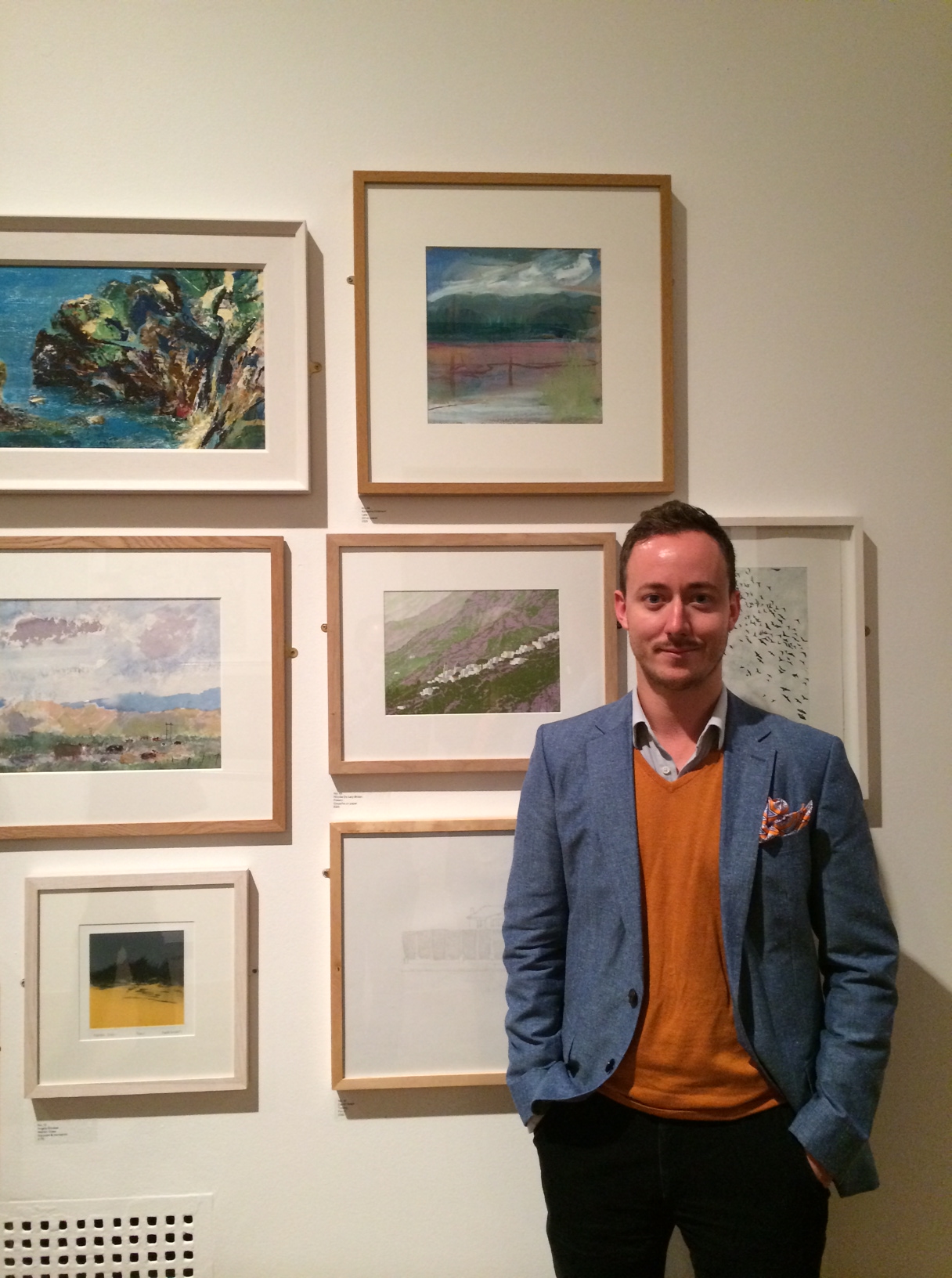
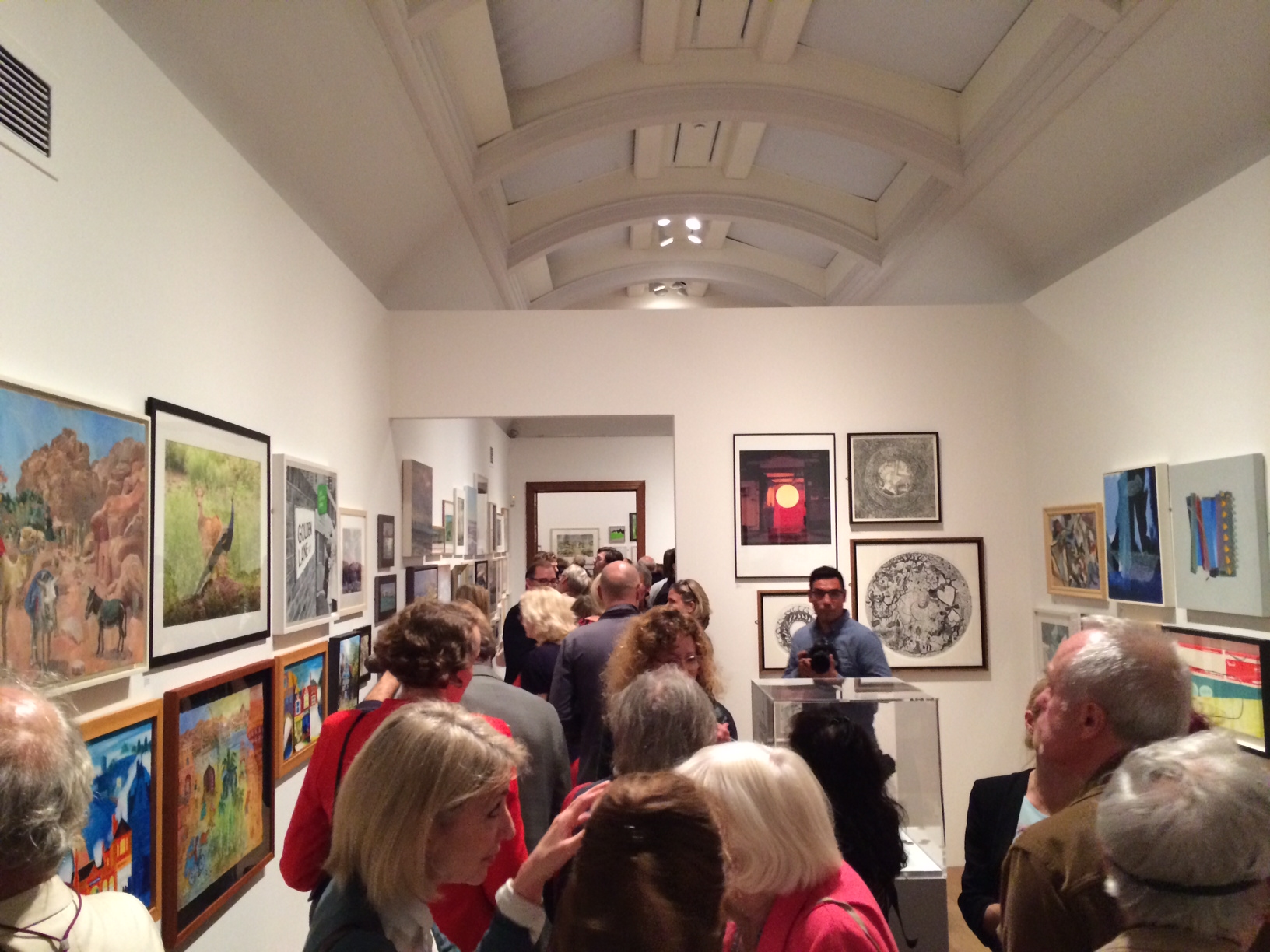
2014 has been a great year for me artistically. In May, I held my most commercially successful exhibition to date, with plenty of exciting commissions and opportunities flowing straight out of it. In July I exhibited with a new generation of freshly graduated art students at London Bridge’s Art Academy, and in September I exhibited my prints in a sensational show of printmaking talent amongst the works of the East London Printmakers at the Embassy Tea Gallery in London Bridge. But as far as 2014 goes, I have certainly left the best until last. For this October, one of my paintings will hang in an art gallery so prestigious, and so imbued with history, that it feels like a dream to see my work up on its walls.

I am of course talking about the Dulwich Picture Gallery, Britain’s oldest public art gallery, and home to some of the UK’s most illustrious artists and art collections, amongst them undisputed masters such as Gainborough, Watteau, Canaletto, Veronese and Reynolds. And for the next two and a half weeks, starting with a lavish opening gala last night, my very own artwork will be hanging amongst other works in a new Open Submission show a mere few metres from these incredible masterpieces of art history – a complete honour.

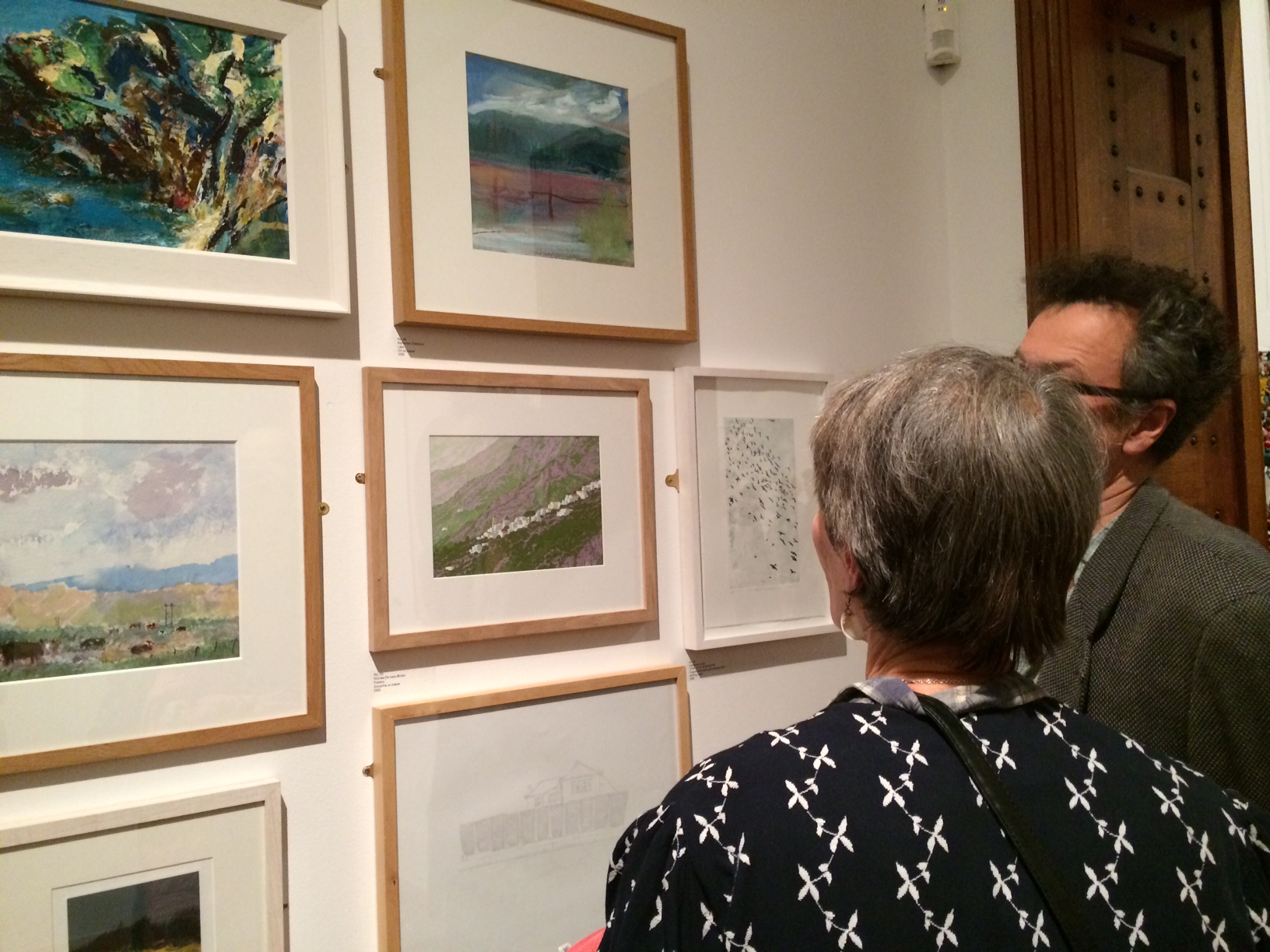
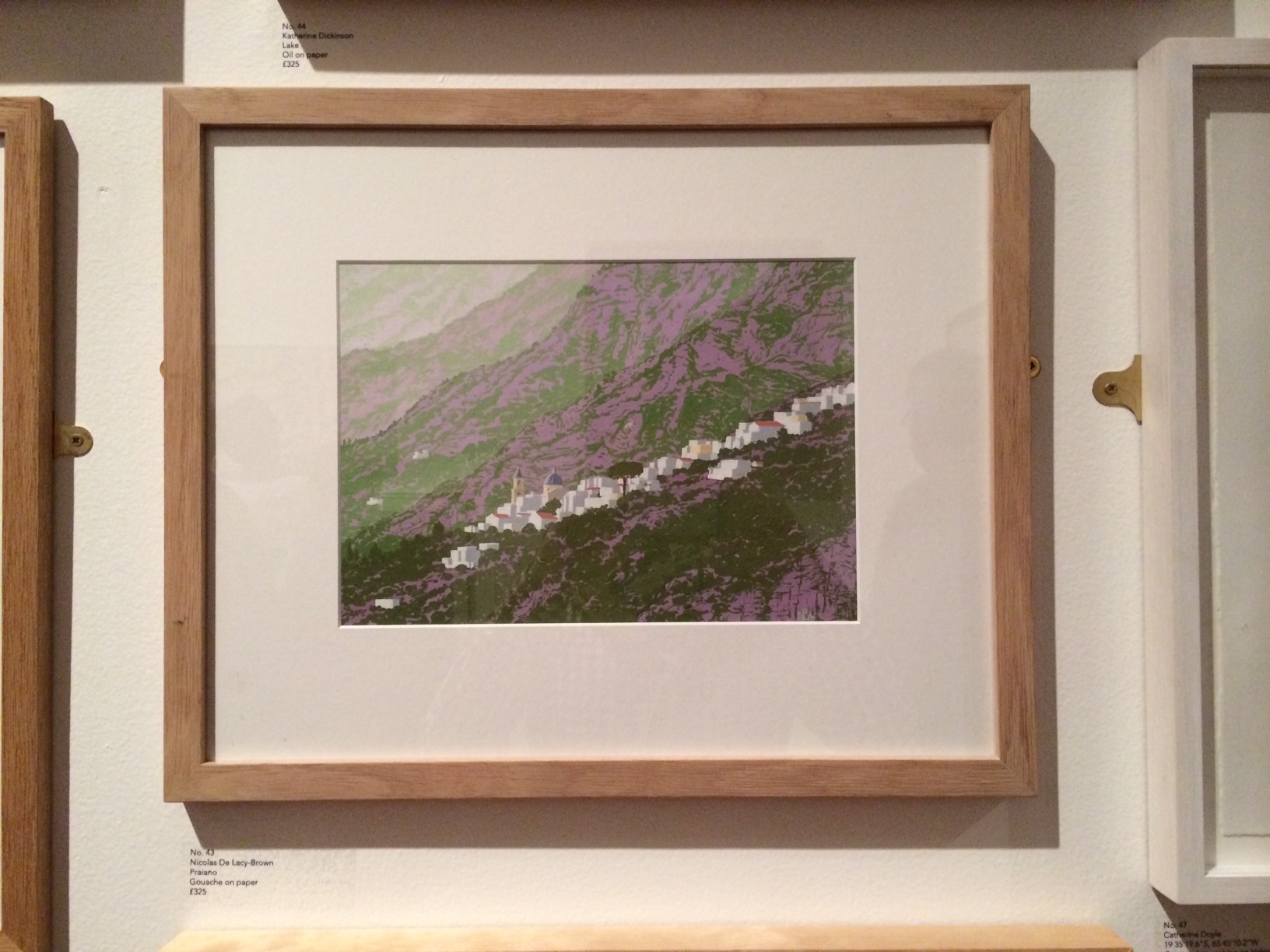
The painting selected for show was my simple landscape of Praiano, a glistening little town on the mountainous Amalfi Coast. Painted in gouache on paper in the immediate aftermath of my Amalfi Coast trip, the painting is one of currently 11 paintings comprising my “interpretations” collection, and is perhaps the most meditative and tranquil of them all. All framed up in a fancy oak frame, it looks splendid, and I have never been prouder of my artwork than last night, when I saw my little painting hung on these walls where only months before David Hockney’s world-class printworks had been admired by crowds of thousands.

2 1 image 3 imwsef

And of course my painting is not alone. Hanging amongst some 170 others, it is but one in a collection of wonderful works submitted by the Friends of the Dulwich Picture Gallery and chosen for exhibition by a panel of illustrious judges. So  don’t just go along to see my Praiano – make your way to Dulwich to see galleries full of creative gems – both those of new budding artists, and of art history’s greats.

The Dulwich Picture Gallery Friend’s Open Exhibition runs until 12 October 2014.

Naturaleza Muerta

Despite many years of painting, drawing and (most recently) printmaking, and just as much time treading the boards of art galleries around Europe, I have been guilty of a great crime: I forgot all about still lifes. Subconsciously I have somehow discounted them, despite knowing them to be a great staple of art history and art collections around the world, and having enjoyed still life masterpieces such as Cezanne’s various compositions of oranges and apples, and the brilliantly photorealistic depictions of bouquets of flowers and lavish feasts from the Dutch golden age. Yet when I went to the Joaquin Peinado museum in Ronda last month, what really struck me above and beyond the majority of his wonderfully original cubist-inspired paintings, were his still lives. In particular I noticed his deceptively simple depictions of fruit and the odd household item such as a coffee pot, and an idea struck in my head: why don’t I paint a still life?!

By coincidence, before we left for Ronda from Marbella, I had already begun an oil painting – a surreal looking desert landscape which was to be the base of another germ of an idea which was developing in my head. But as soon as my still life idea struck, I realised that the combination of collected objects on a somewhat surreal deserted background would make for the perfect twist on the traditional still life composition. So as soon as we got back from Ronda, I started work.

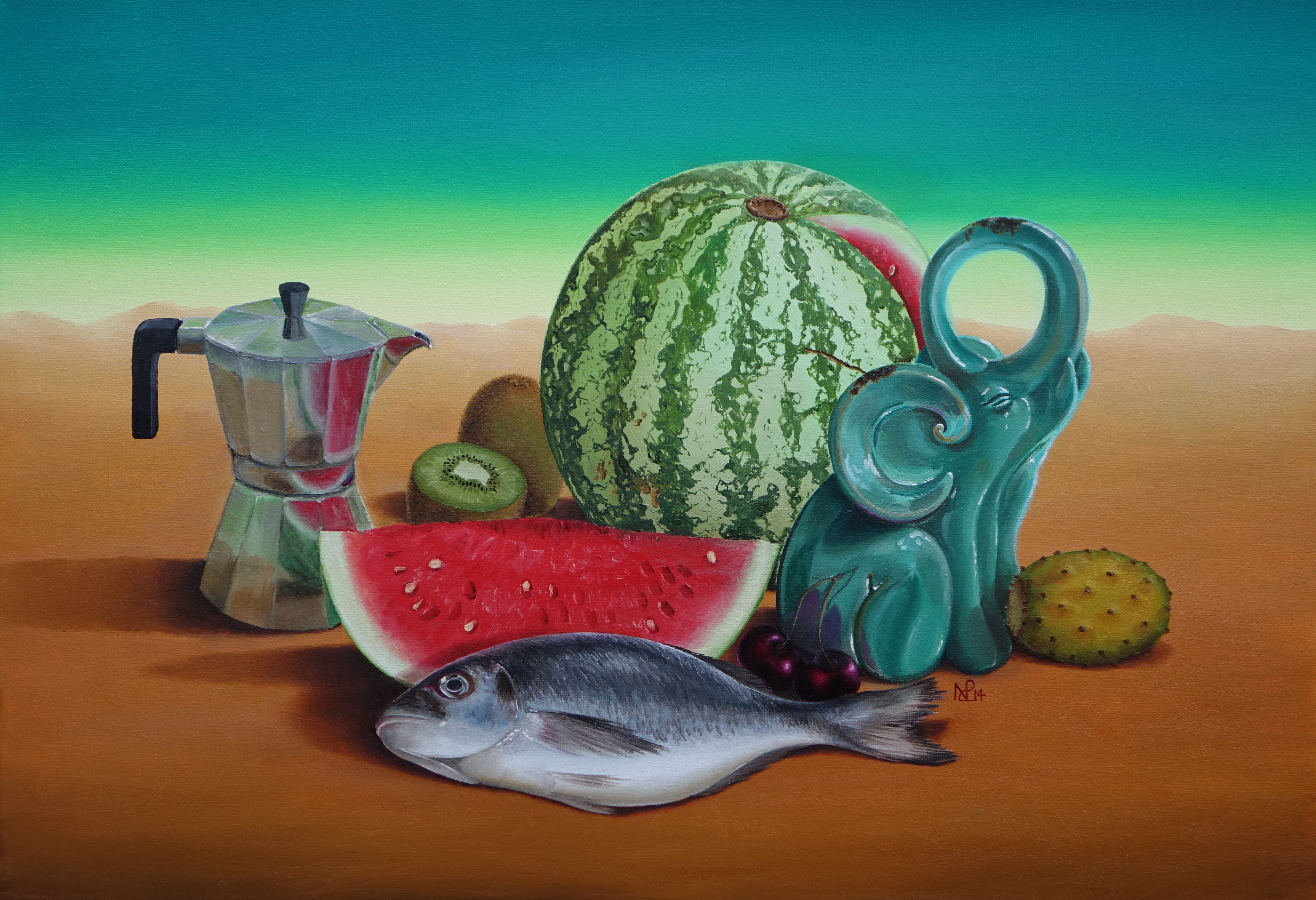
Naturaleza Muerta: Still life with coffee pot, dorada, tropical fruits and a ceramic elephant (2014 © Nicholas de Lacy-Brown, oil on canvas)

Naturaleza Muerta: Still life with coffee pot, dorada, tropical fruits and a ceramic elephant (2014 © Nicholas de Lacy-Brown, oil on canvas)

The objects I collected for my work were not really the result of coincidence. Rather, I carefully planned my selection so that I could achieve a colour balance within the two main colours of the palette chosen for this work: red and green. The ceramic elephant was already a feature of the garden in which I was doing my painting, and the various fruits were chosen specifically for their colour, shape and what they represented: the watermelon represents the global profile of Marbella; the elephant our time out on the terrace. The kiwis represent our constant furry travelling companions Fluffy and Bilbao, and the cactus fruits represent the extensive work we did on redecorating our Marbella terrace. The beautiful silvery sea bream represents all the pleasure we took in eating out; while the cherries represent my partner and I, never separated, coming as a pair. Finally the coffee pot is there in homage to Peinado who gave me the idea of a still life; and because coffee culture is surely one of the most enjoyable aspects of life in Marbella.

So after several days painting this work in instalments after visits to the beach, my first Still Life was complete. Now I’m hooked on the idea and can already imagine doing so many more. The question is, what will I paint in my next Still Life?

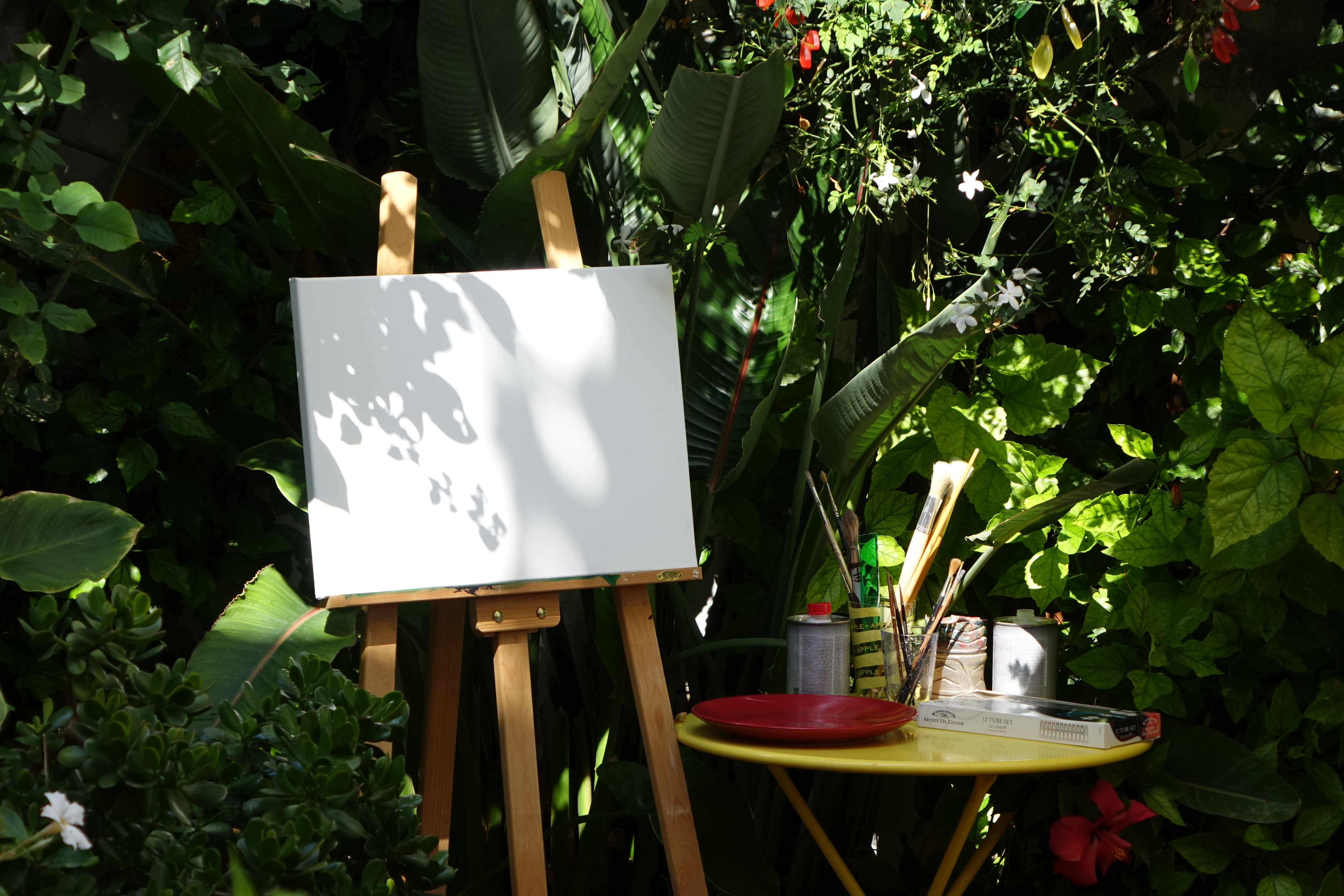
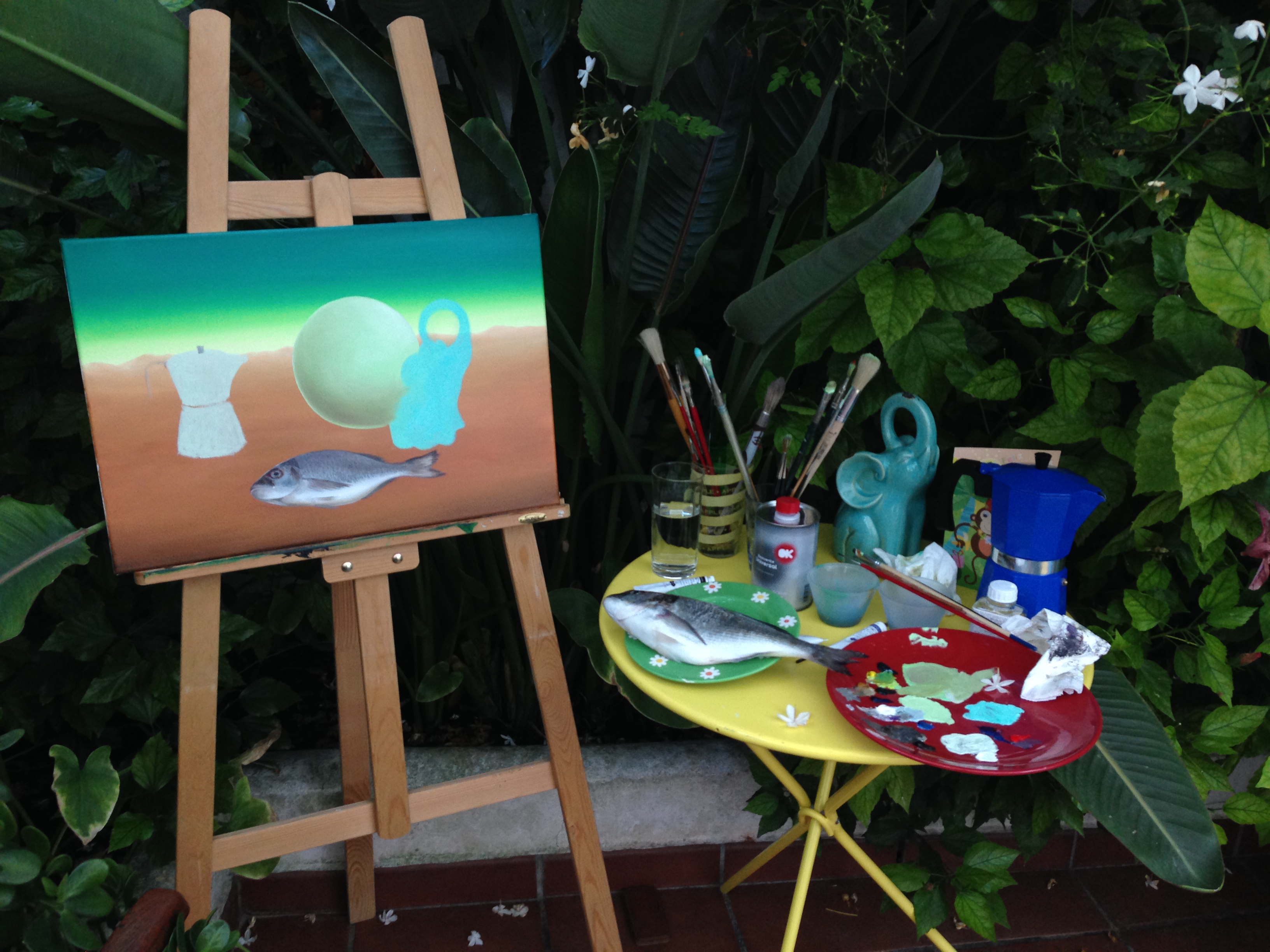
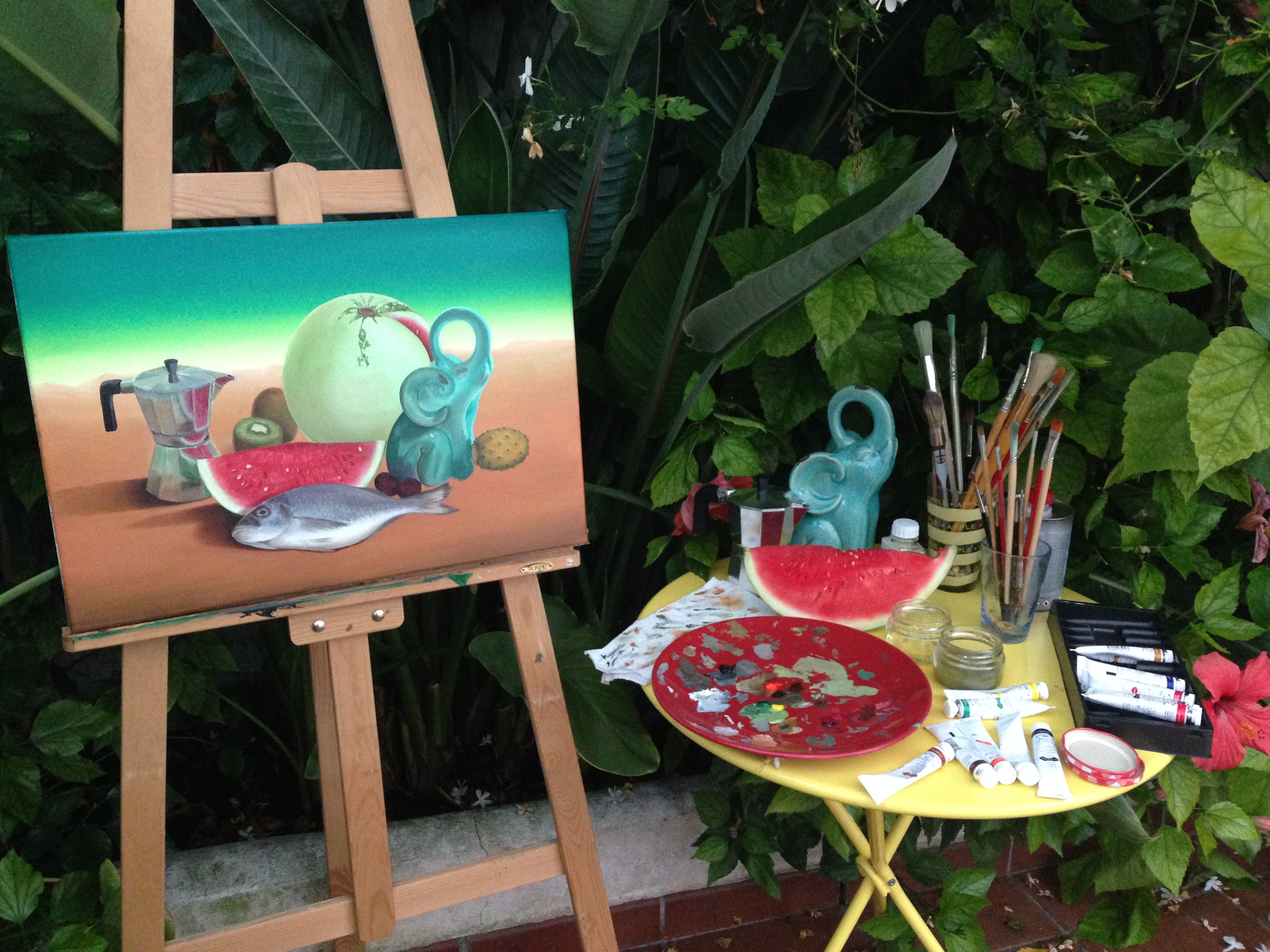
Creating my still life in our garden in Marbella

DSC04746 IMG_9667 IMG_9736

© Nicholas de Lacy-Brown 2000-2014. Unauthorised use and/or duplication of the material, whether written work, photography or artwork, included on this website without express and written permission from Nicholas de Lacy-Brown is strictly prohibited. For more information on the work of Nicholas de Lacy-Brown, head to his art website at www.delacy-brown.com
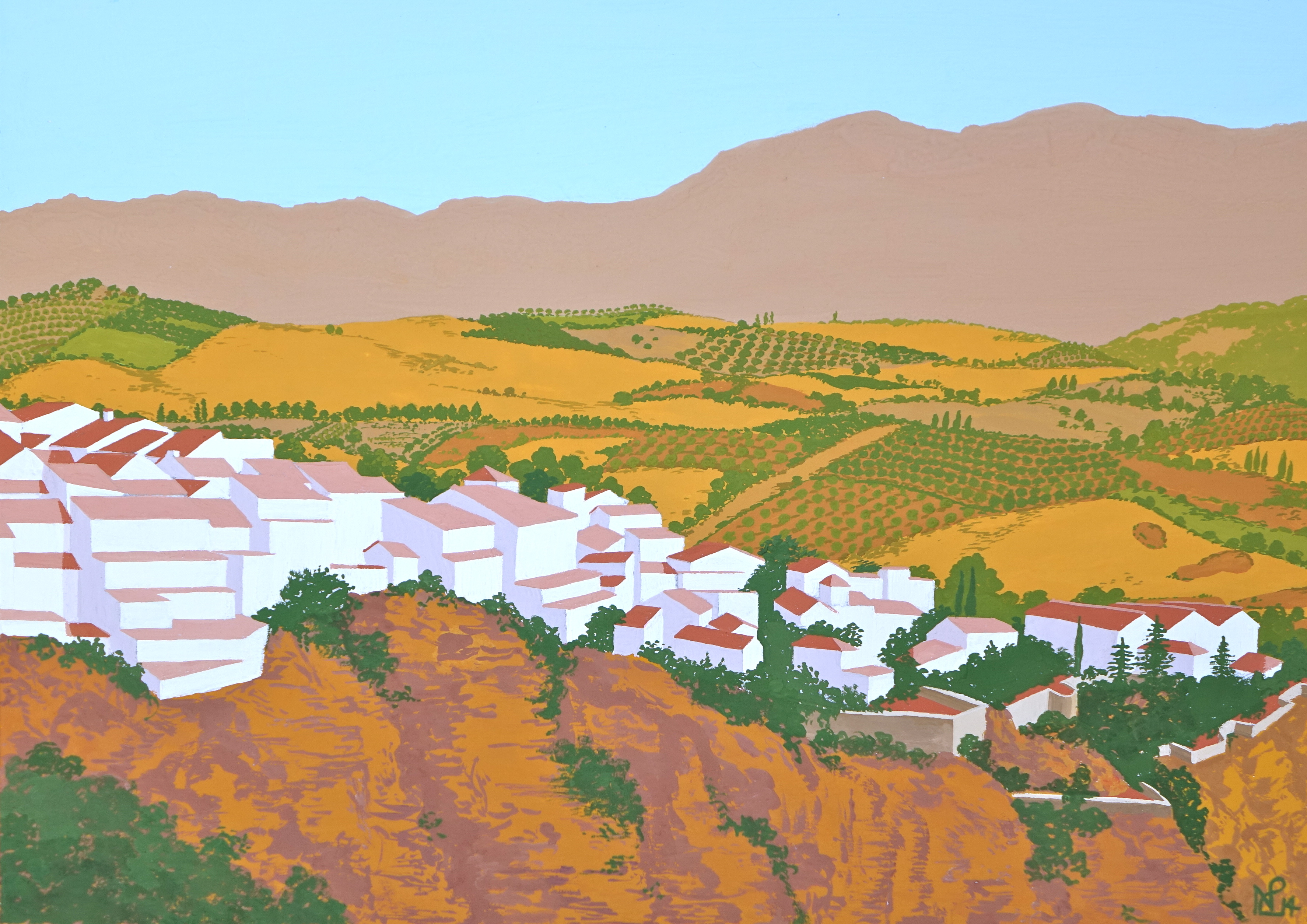
Interpretation No. 9: The Gorge and the Puente Nuevo

It would have been hard to stop my artistic appreciation of the city of Ronda with a single painting, and having completed Interpretation no.8, my interpretative landscape of Ronda, no.9 followed hot on its heels. This time the same fusion of the arid amber gorge and crisp white buildings predominates, but this painting focuses more on the great imposing El Tajo gorge, together with the bridge (albeit only a small slice of it) that links the two sides of ancient Ronda. In this painting I hope to have emphasised the sheer drama which the teetering positioning of Ronda’s houses on the top of a vast plunging gorge provides, as well as capturing some of the more iconic sights of the city, from the Puente Nuevo to the old cathedral sitting at its centre. 

Interpretation No. 9 (2014 © Nicholas de Lacy-Brown, gouache on paper)

Interpretation No. 9 (2014 © Nicholas de Lacy-Brown, gouache on paper)

© Nicholas de Lacy-Brown and The Daily Norm, 2001-2014. Unauthorized use and/or duplication of the material, whether written work, photography or artwork, included within The Daily Norm without express and written permission from The Daily Norm’s author and/or owner is strictly prohibited. Excerpts and links may be used, provided that full and clear credit is given to Nicholas de Lacy-Brown and The Daily Norm with appropriate and specific direction to the original content. For more information on the work of Nicholas de Lacy-Brown, head to his art website at www.delacy-brown.com

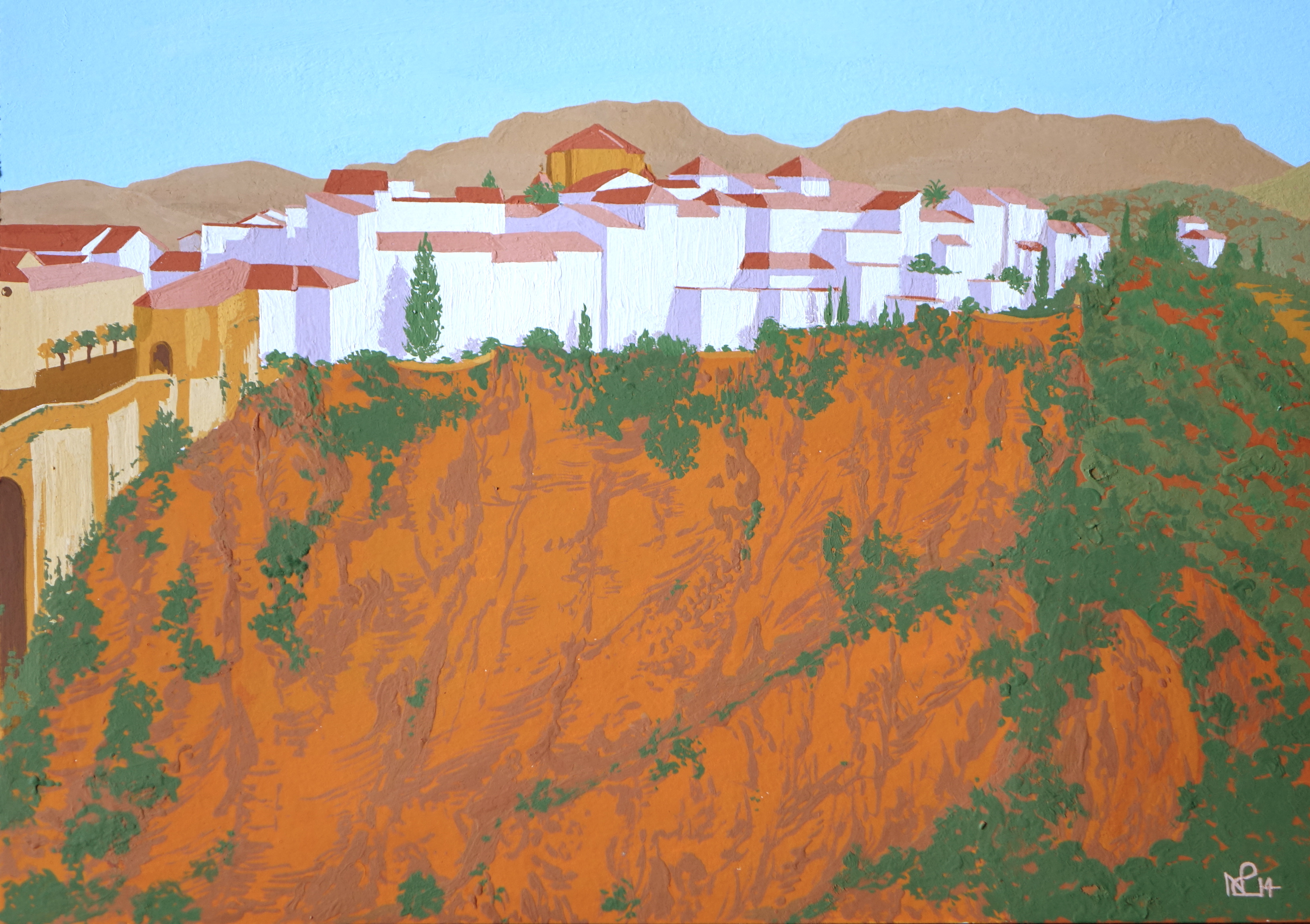
Interpretation No. 8: Ronda cluster above the El Tajo Gorge

Readers of the Daily Norm will know that following my beautiful trip to the Amalfi Coast in June, I embarked on a series on new gouache paintings. I have loosely labelled the collection “interpretations” because they are not so much landscapes as interpretations of a landscape – a simplified landscape with the details of urban structures stripped away so that the focus of the audience can be placed on the general shape made by a town or a cluster of buildings, rather than the details. This is particularly striking where generations of people have built up towns in the most hostile of landscapes, such as the cliff edges of the Amalfi Coast. The result is the development of a group of buildings which look almost out of place and surreal when set against the harsh unapologetic backdrop of nature. It is this contrast which my interpretations seek to emphasise.

Interpretation No. 8 - Ronda (2014 © Nicholas de Lacy-Brown, gouache on paper)

Interpretation No. 8 – Ronda (2014 © Nicholas de Lacy-Brown, gouache on paper)

There was no doubt that having been inspired by the vast rocky coastal crags of Amalfi, I would be likewise moved to paint by the mountainous planes and combination of town versus harsh seemingly unconquerable landscape which characterises the small urban sprawl of Ronda. I set about working on my first Ronda “interpretation” almost as soon as I caught eyes on the views. This first work is the result, a painting which, unlike the Italian works which have gone before it, loses the blues and purples of the Amalfi Coast, and is instead painted in the warm reds, ochres, bronzes and russets for which the arid Southern Spanish landscape is famous. And these colours are not works of fiction – for the El Tajo gorge on which Ronda stands is very much a fiery orange colour, which glows ever more robustly red as the sun sets upon it. It’s an awesome sight, and made for the perfect inspiration for this continuation of my Interpretations collection.

All photos and written content are strictly the copyright of Nicholas de Lacy-Brown © 2014 and The Daily Norm. All rights are reserved. Unauthorized use and/or duplication of the material, whether written work, photography or artwork, included within The Daily Norm without express and written permission from The Daily Norm’s author and/or owner is strictly prohibited. Excerpts and links may be used, provided that full and clear credit is given to Nicholas de Lacy-Brown and The Daily Norm with appropriate and specific direction to the original content. For more information on the work of Nicholas de Lacy-Brown, head to his art website at www.delacy-brown.com

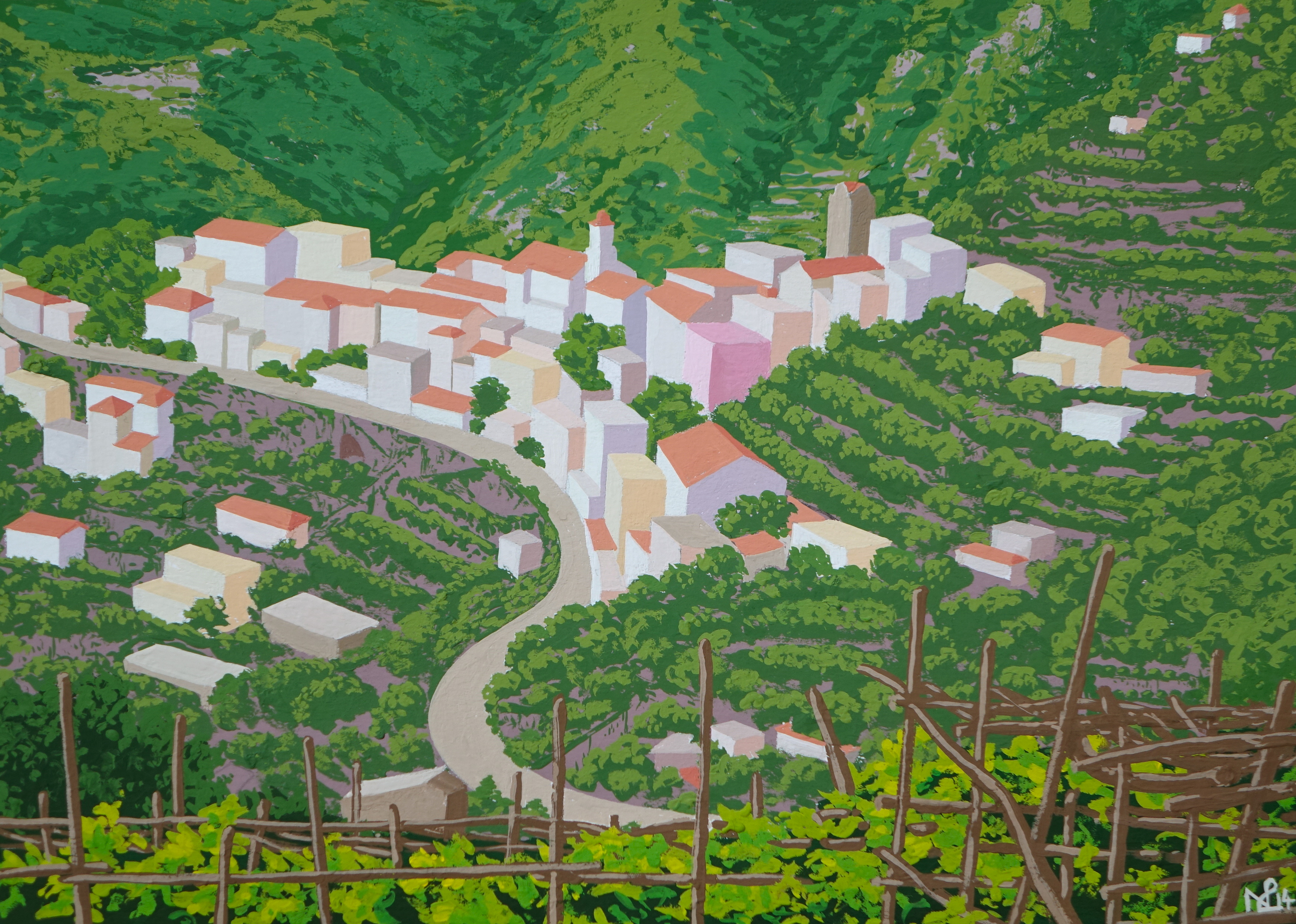
Art-in-Amalfi – Painting 7: The terraces of Ravello

As my post on yesterday’s Daily Norm makes abundantly, sensually clear, Ravello on Italy’s Amalfi Coast is a place of stunning beauty. A place so beautiful that countless people, both famed and unknown, have flocked to its heady heights to sample a taste of paradise, and to soak in the views that Gore Vidal called the most beautiful in the world. So as my collection of Amalfi paintings reaches its steady climax (although I still feel inspired to paint more), there was no way that Ravello, and the stunning views from its quaint narrow hillside passages, was not going to be a part of it.

To my eyes, the thing that was so utterly charming about those incredible views was not so much the extensive sea views, but the elegantly terraced hills, loaded with lemon trees and olives and every kind of mediterranean plant growing abundantly. Those carefully sowed terraces gave the appearance of a fashion designed striped fabric in every conceivable shade of verdant green, while the houses clustered along intermittent roads were ripe for re-expression in the delineated cubic forms which have become characteristic of my Italy gouaches.

Ravello (2014 © Nicholas de Lacy-Brown, gouache on paper)

Ravello (2014 © Nicholas de Lacy-Brown, gouache on paper)

So I am delighted to share with you this seventh Amalfi Coast painting, doing so towards the climax of the Daily Norm tales of my Amalfi adventure. But something within me tells me this is not the end. Already my paintbrush is poised to work a little gouache magic across some blank paper in a notepad by my side, and you can be sure that as and when those works are completed, I will share them on The Daily Norm. 

© Nicholas de Lacy-Brown and The Daily Norm, 2001-2014. Unauthorized use and/or duplication of the material, whether written work, photography or artwork, included within The Daily Norm without express and written permission from The Daily Norm’s author and/or owner is strictly prohibited. Excerpts and links may be used, provided that full and clear credit is given to Nicholas de Lacy-Brown and The Daily Norm with appropriate and specific direction to the original content. For more information on the work of Nicholas de Lacy-Brown, head to his art website at www.delacy-brown.com

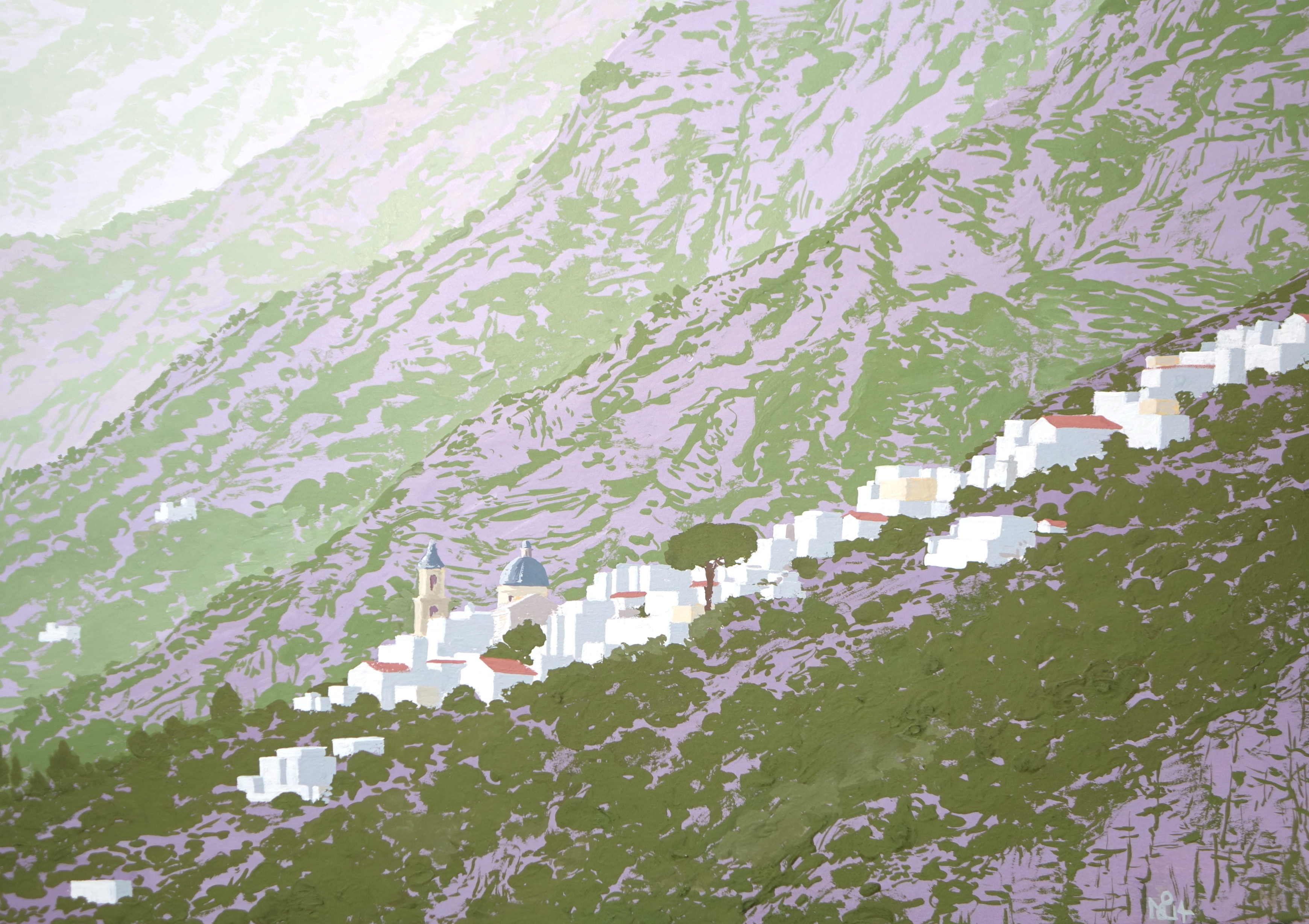
Art-in-Amalfi – Painting 5: Praiano

Having painted four views of Positano in gouache on paper, all of which concentrate on the hodgepodge of pastel-coloured cube like houses that are characteristic of the town, I decided to set my sights further afield, and start exploring the artistic potential of locations elsewhere on the Amalfi Coast. The perfect opportunity presented itself when, en route to the epicentre of the coast, Amalfi (see tomorrow’s Daily Norm for more on that front) we passed by the cliff-top town of Praiano.

Smaller than neighbouring Positano, which can be seen directly across the bay and vice versa, Praiano nevertheless has its own glittering domed churche and cluster of houses clinging precariously to the high edges of a mountain slope. However unlike Positano, whose multi-coloured composition can be spotted some distance away, Praiano is characterised by a gleaming symphony of whites and creams, dazzling in the sunshine as its buildings contrast against the green vegetation all around.

Praiano (2014 © Nicholas de Lacy-Brown, gouache on paper)

Praiano (2014 © Nicholas de Lacy-Brown, gouache on paper)

This particular view of the town, seen side on with the gradually fading folds of the mountains in the distance was definitely my favourite angle of those many enjoyed as our boat whisked past the town at speed. And of course in the process of cubic simplification which has been the focus of my recent gouache works, Praiano could not have been a better model – for its white washed houses simplify down to their basic elements brilliantly, while retaining all of the shape and character of this very pretty town.

© Nicholas de Lacy-Brown and The Daily Norm, 2001-2014. Unauthorized use and/or duplication of the material, whether written work, photography or artwork, included within The Daily Norm without express and written permission from The Daily Norm’s author and/or owner is strictly prohibited. Excerpts and links may be used, provided that full and clear credit is given to Nicholas de Lacy-Brown and The Daily Norm with appropriate and specific direction to the original content. For more information on the work of Nicholas de Lacy-Brown, head to his art website at www.delacy-brown.com