Skip to content

Posts tagged ‘Printmaking’

Printmaking Progress II: Aquatinting

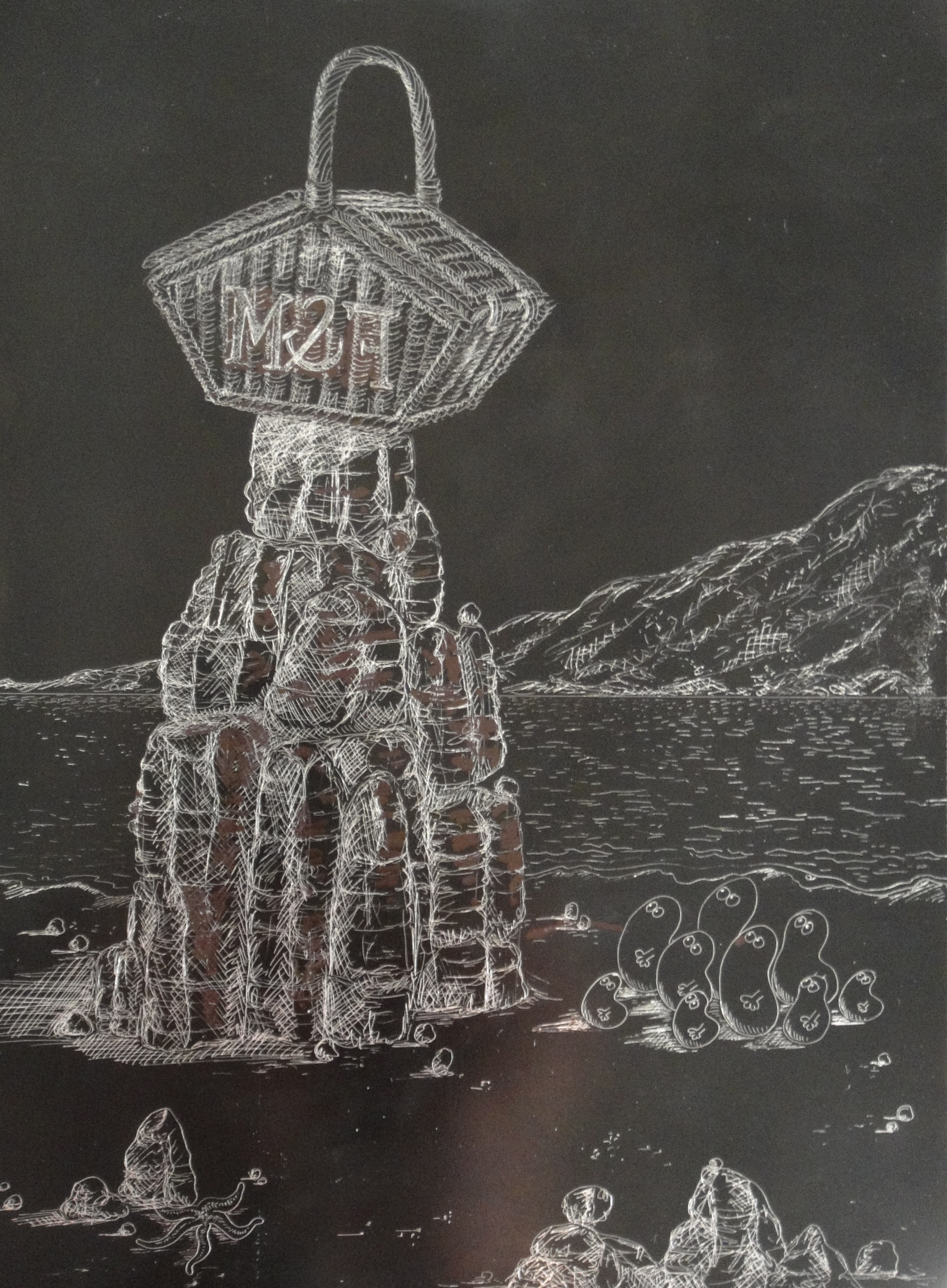
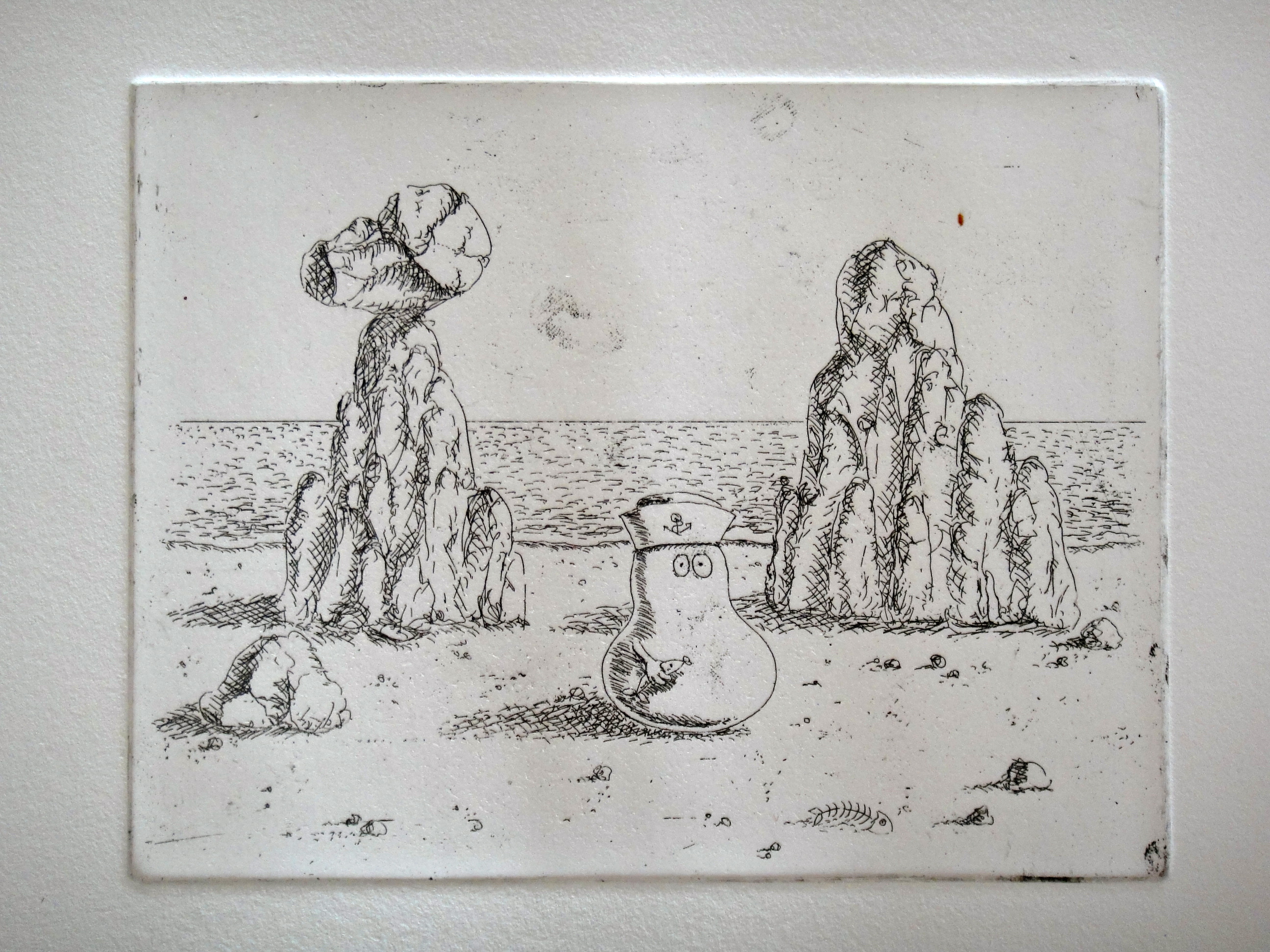
Being a self-trained artist, and so lacking the basic overview which art college provides of the many mediums which an artist has at his or her disposal, I became so entrenched in the world of painting for so many years that my recent discovery of the world of print has come as a complete revelation. Now over midway through an intermediate course in etching, I have taken to the medium like a duck to water. For not only does the medium transfer all of the skills of draughtsmanship which I have been mastering over the years in painting and more recently sketch, but through the sheer narrowness of the needle upon ground it enables me to pack the kind of detail into my etched images that I love. So, in my now advanced second etching, of a Fortnum and Mason’s hamper balanced upon a craggy rock, I have been able to go to town on the detail of the wicker, the rock texture, the little Norms looking up at the rock and the mountain and sea in the background.

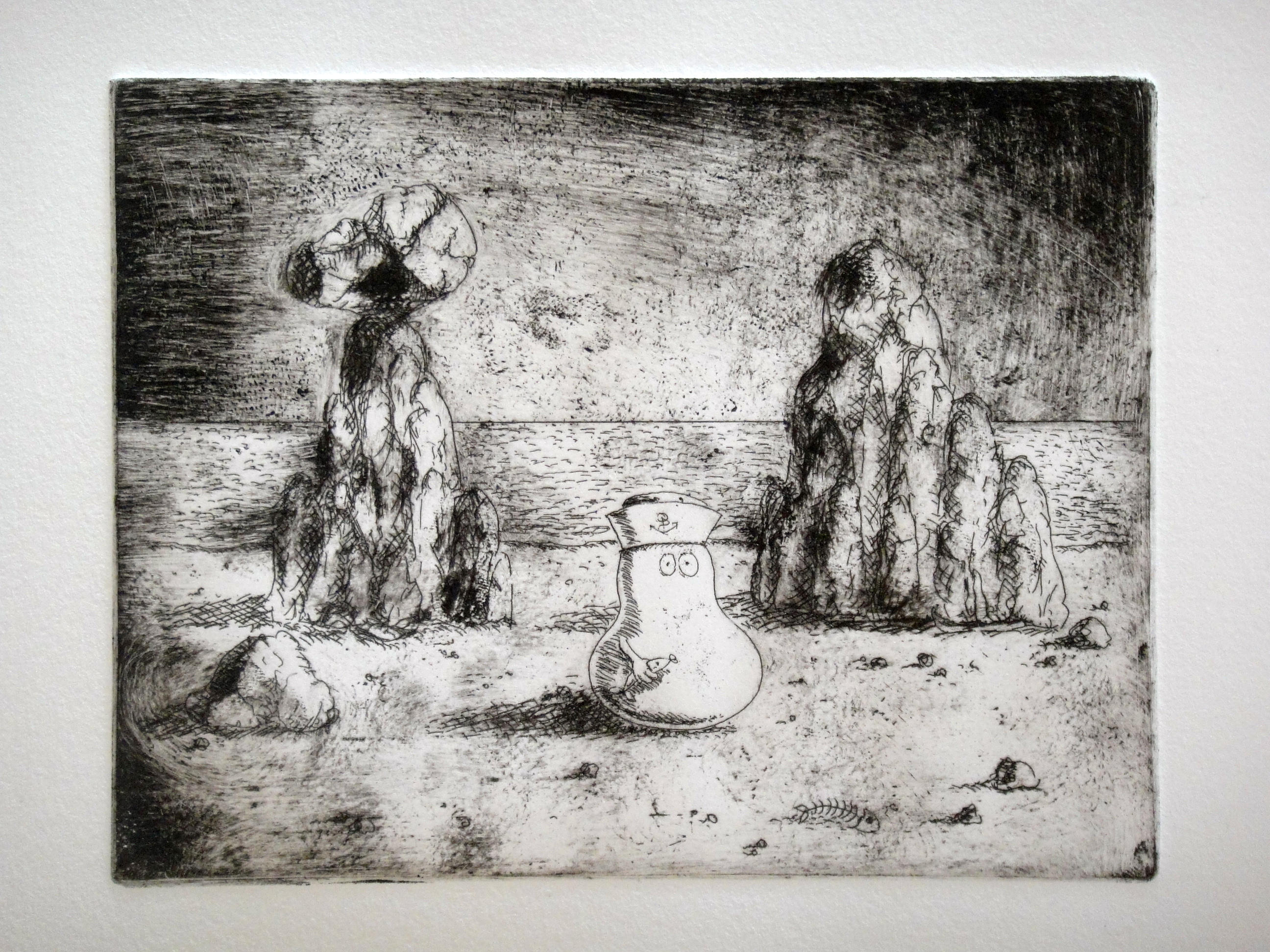
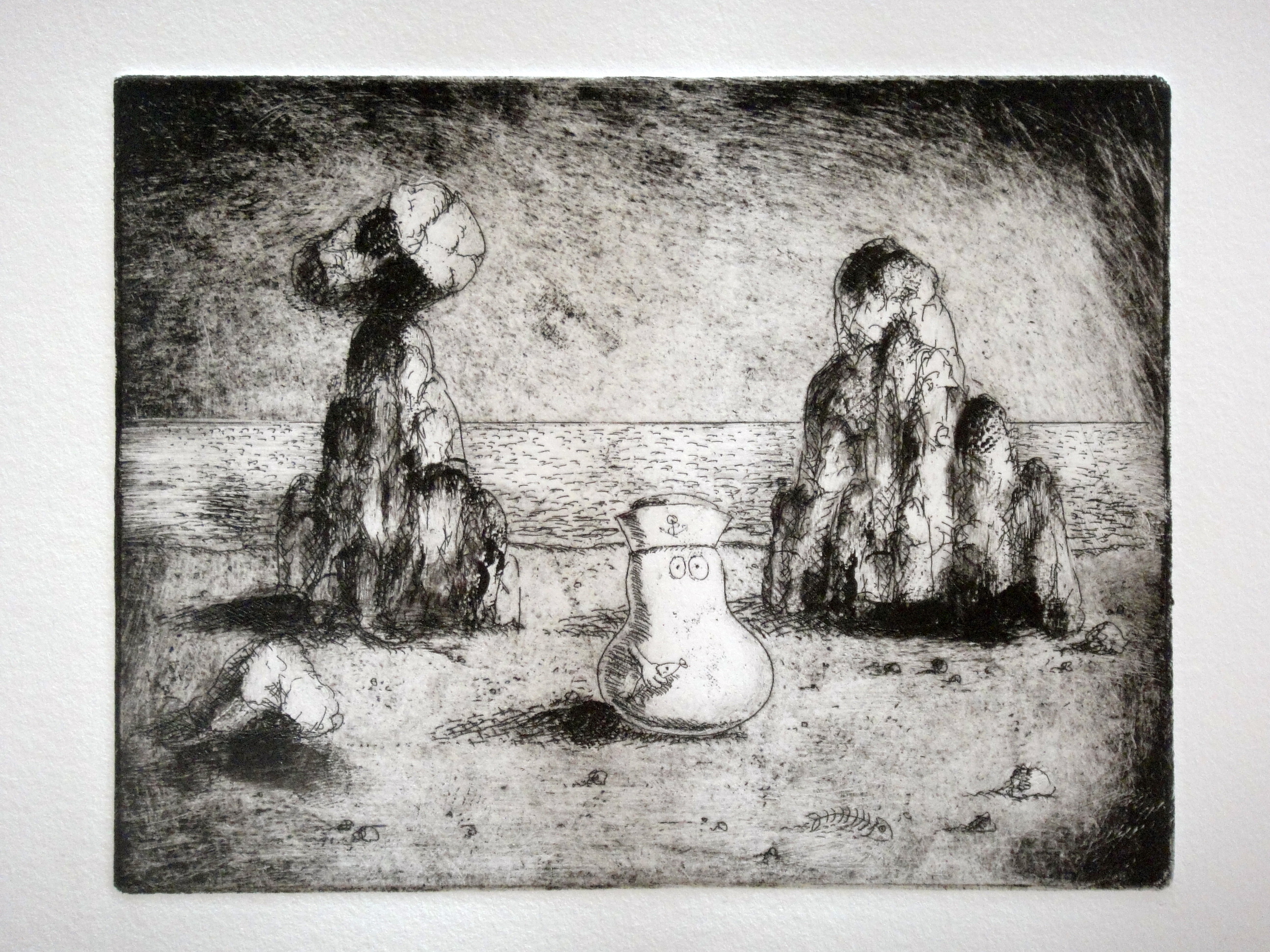
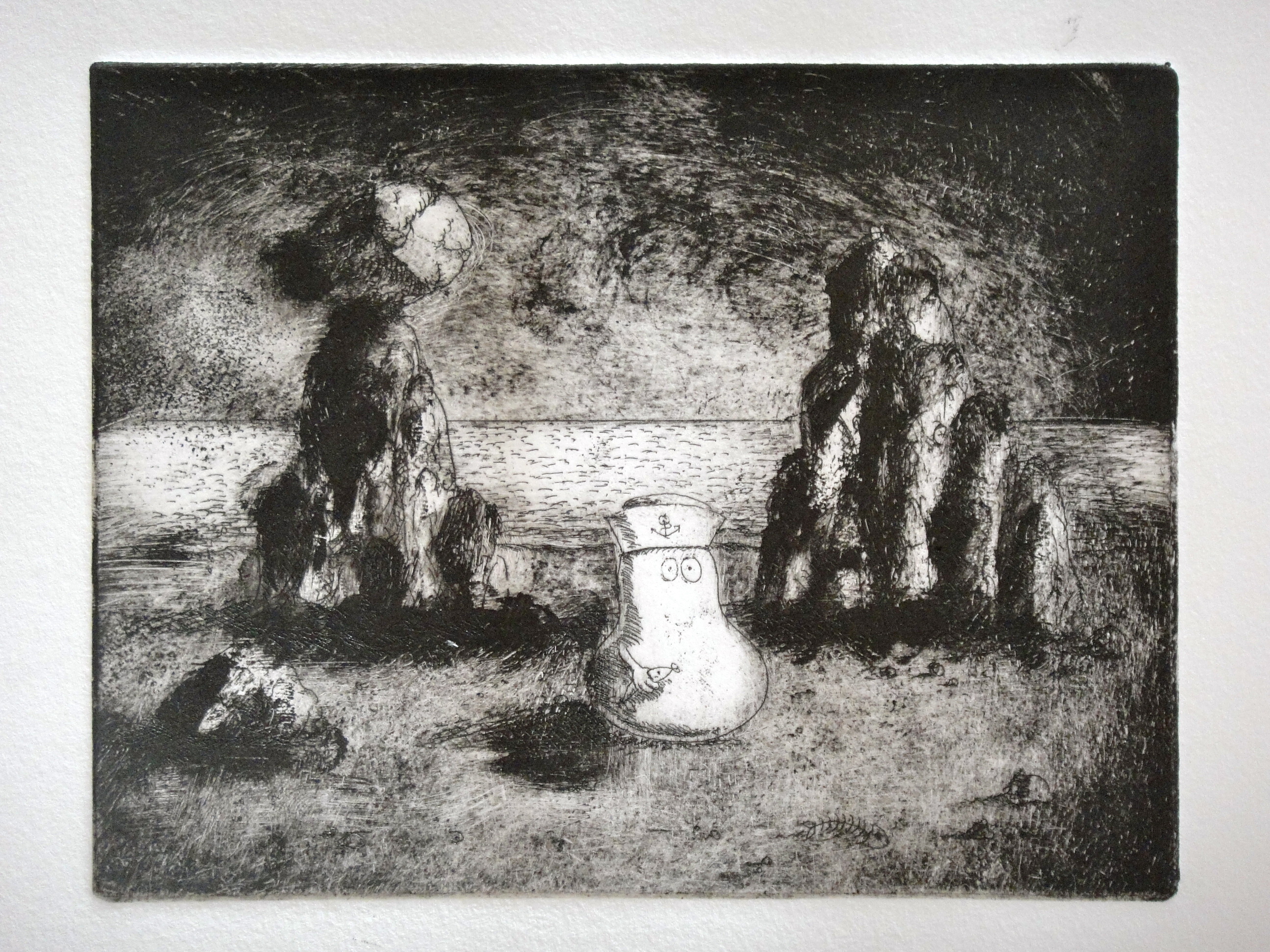
Over the last two weeks, I have developed my etched image from metallic reverse image in black ground, to simple line drawing etched into metal and printed in reverse, to an image now loaded with different tonal variety achieved through the process of aquatinting. I am not sure why the technique has the name it does – I imagined it to involve some sort of watery application, a little like applying watercolours to a finished print. But in fact it involves no water at all. Rather, aquatinting is the process by which tone is added to the etching plate through measured re-exposure to acid. It works a bit like the Benday dots which Lichtenstein made famous – apply thousands of little dots to protect the metal and when exposed to acid, only those areas of the metal not covered by dots will etch and turn darker as a result. Step back and with the light dots and the dark exposed plate combined you get a shade of grey. The longer the exposure to acid, the darker the plate becomes, as the distance between dots increases.
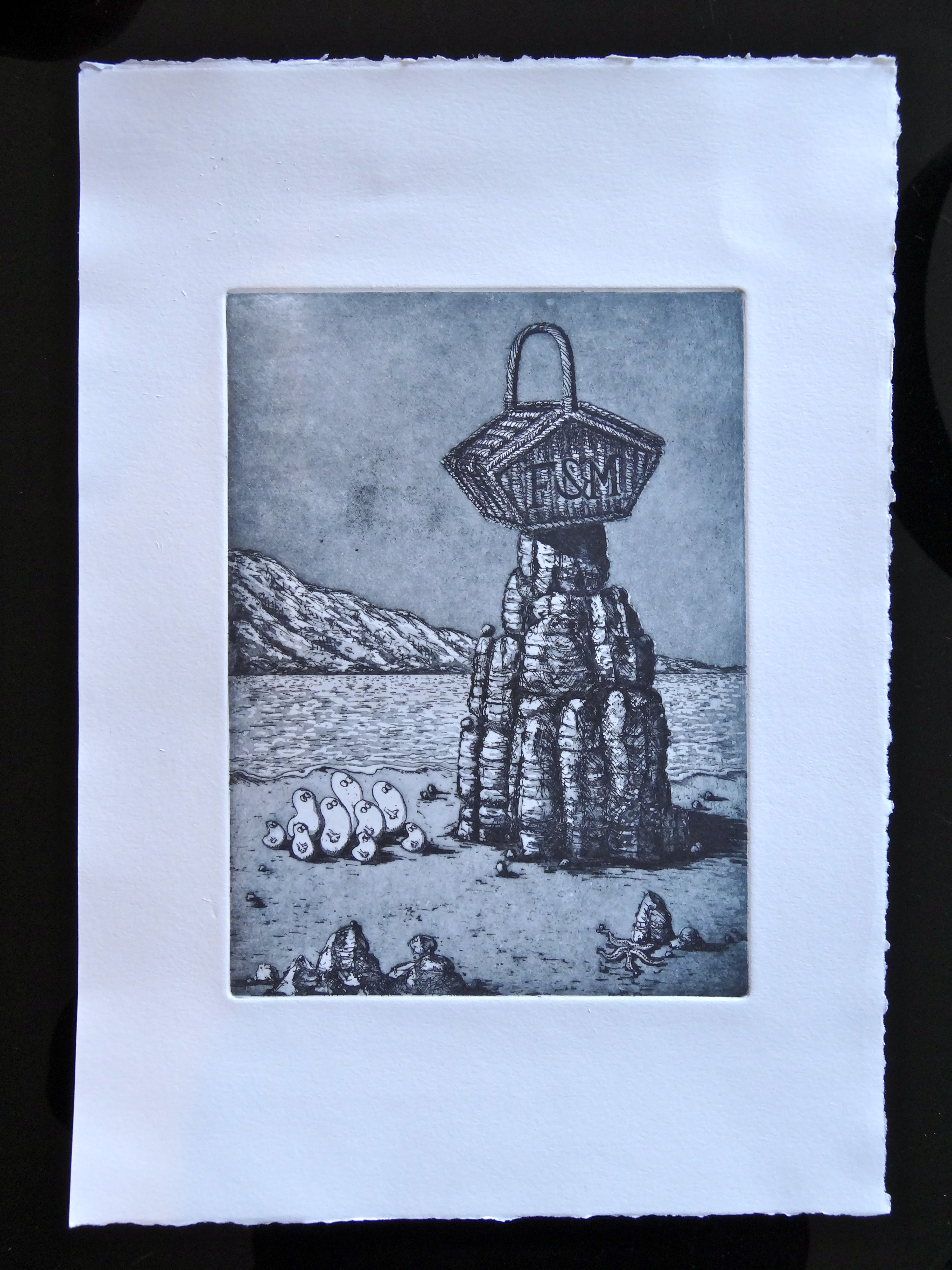
My finished tonal etching after aquatinting

My finished tonal etching after aquatinting

Following this rationale, aquatinting involved first the exposure of the whole plate to a kind of rosin dust which was allowed to settle upon the plate under controlled conditions (it’s very toxic, hence the rather attractive gas mask we were required to wear by way of protection). This was then hardened over a gas fire. Then we had to protect details of the plate which we wanted to remain white, before dipping the plate back in acid, gradually protecting more and more of the plate so that in its final dip into acid, the only part of the plate left exposed was the parts of the image I wanted to print the darkest.

The result is a plate now textured differently depending on the exposure to acid and then, once the ink is reapplied to the plate, an image which comes alive with different tonal shades. Owing to what is a fairly hopeless attempt to explain the aquatinting process above in words, perhaps the process will become clearer by looking at my finished print itself.
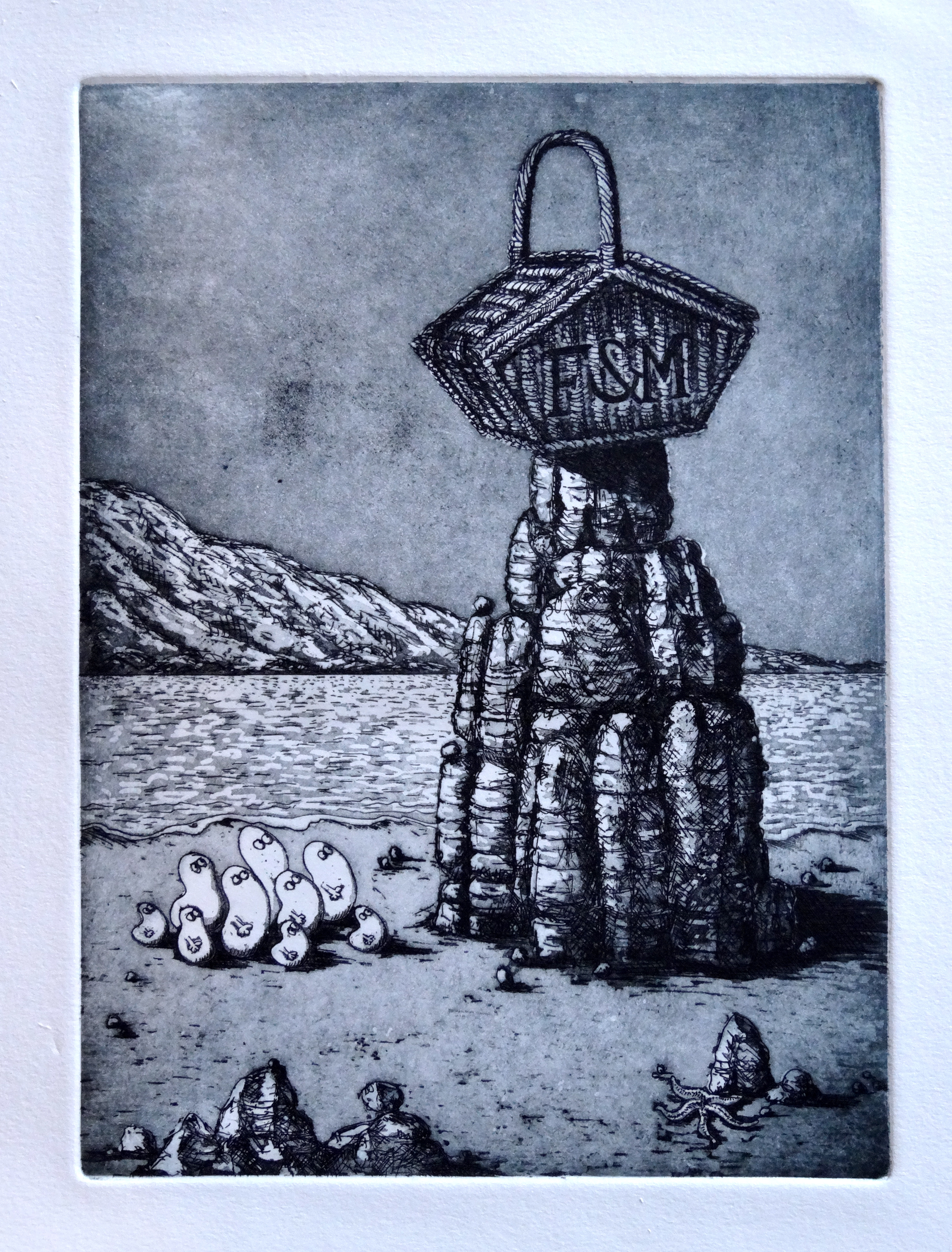
DSC00569

You will see that the Norms and the highlights of the basket and rock have remained white – that’s because I covered those with a black “stop-out” before re-exposing the entire plate to acid. The next lightest shade is the sand – this pale grey results from a quick 15 second dip into acid. This was then covered while I re-exposed the plate, allowing the sky to go darker, followed by the basket, the shadows of the rock and so on.

And there you have it, my first finished etching with aquatint applied – I am so, so delighted with the result and thrilled that I have taken so naturally to the etching medium. I have a feeling that this will not be the last.

The etching before aquatinting
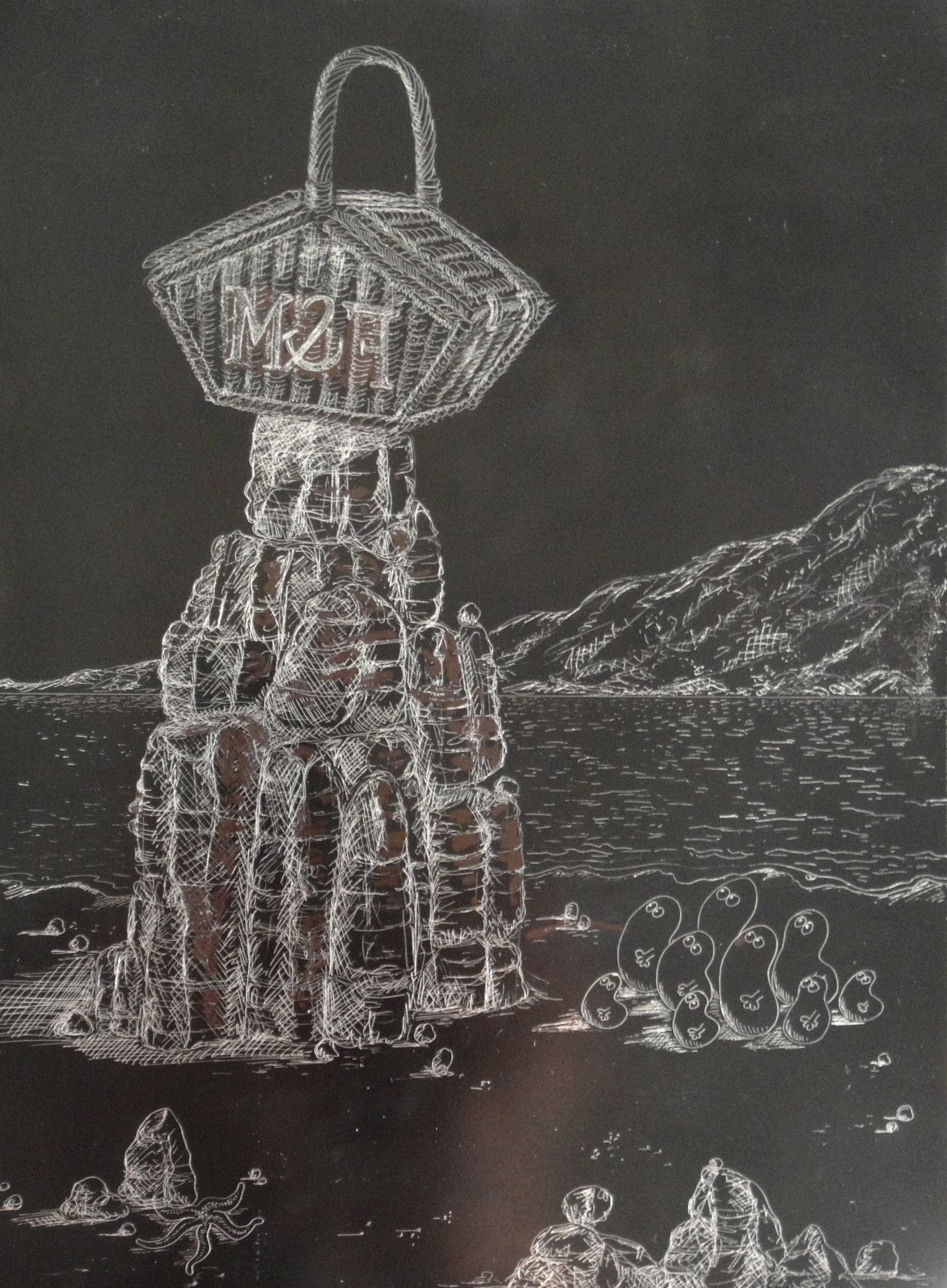
The etching before aquatinting

And before that, the initial image drawn into the "ground" layer

And before that, the initial image drawn into the “ground” layer

Related articles

Printmaking Progress I

I headed along to the Royal Academy of Arts yesterday for the London Original Print Fair. According to the website, it’s the longest-running specialist print fair in the world and yet, I am embarrassed to admit, I’d never heard of it before. Having been abundantly inspired by the prints room at last year’s Royal Academy Summer Exhibition, I never realised that only two months before, the whole Academy is veritably given over to the heterogenous medium of printmaking. And it couldn’t have come at a better time – as I unveiled on The Daily Norm last week, I am now a very eager printmaking student myself, having completed a weekend’s beginners intaglio and etching, and now enrolled upon the intermediate course, with esteemed printmaker Victoria Browne my very enthusiastic and gracefully patient teacher.

©Trevor Price - The Feast II

©Trevor Price – The Feast II

Wondering around the fair, which comprised some 50 galleries and print dealers selling an array of prints from £100 works by lesser-known artists, to 5-figure editions by the likes of Lichtenstein and Francis Bacon (and what I wouldn’t do for one of those), it dawned on me just how fantastically versatile the medium of print really is. While after only 3 days in the attempt, I now feel sufficiently versed in lino printing and etching to at least understand the basics of the medium, I haven’t even got started on dry point, on lithographs, on soft-ground etching, on screen printing. Yet with a beginner’s understanding of at least some print techniques, I was able to enjoy this comprehensive show of prints with a knowing and enthusiastic eye, taking inspiration from the array of prints on offer, and even making a small purchase of a beautiful Cornish-inspired supper scene by distinguished print-artist Trevor Price which was relief-printed and priced mercifully at the lower end of the scale!

Meanwhile back at home my head is awash with ideas for my own future print creations and an eagerness to learn new techniques. This week I’m due to learn aquatint, a method by which tone is added to the basic lines of an etching. I’ll be adding aquatint to my current etching plate which I can now very proudly unveil. As something of a follow up to my first etching, this one is also set out a Mallorcan beach, and borrows form my Autobiographical Mobile painting in its motif of a Fortnum and Mason’s hamper atop a rock. Meanwhile. down below, a group of perplexed Norms look up at the hamper, as much confused by its appearance as they are slightly scared by its precarious placing upon the rock’s peak.

My second etching pre-aquatint stage (© Nicholas de Lacy-Brown)

My second etching pre-aquatint stage (© Nicholas de Lacy-Brown)

The etching drawn into the  black "ground" pre-exposure to acid

The etching drawn into the black “ground” pre-exposure to acid

I hope to be able to show you an aquatinted version of this plate very soon! In the meantime, I cannot extol the virtues of printmaking enough – fill your homes, check out the print works of the great artists and attend print fairs everywhere – original canvases are so yesterday.

A Prelude to Printmaking – Part 2: Linocut

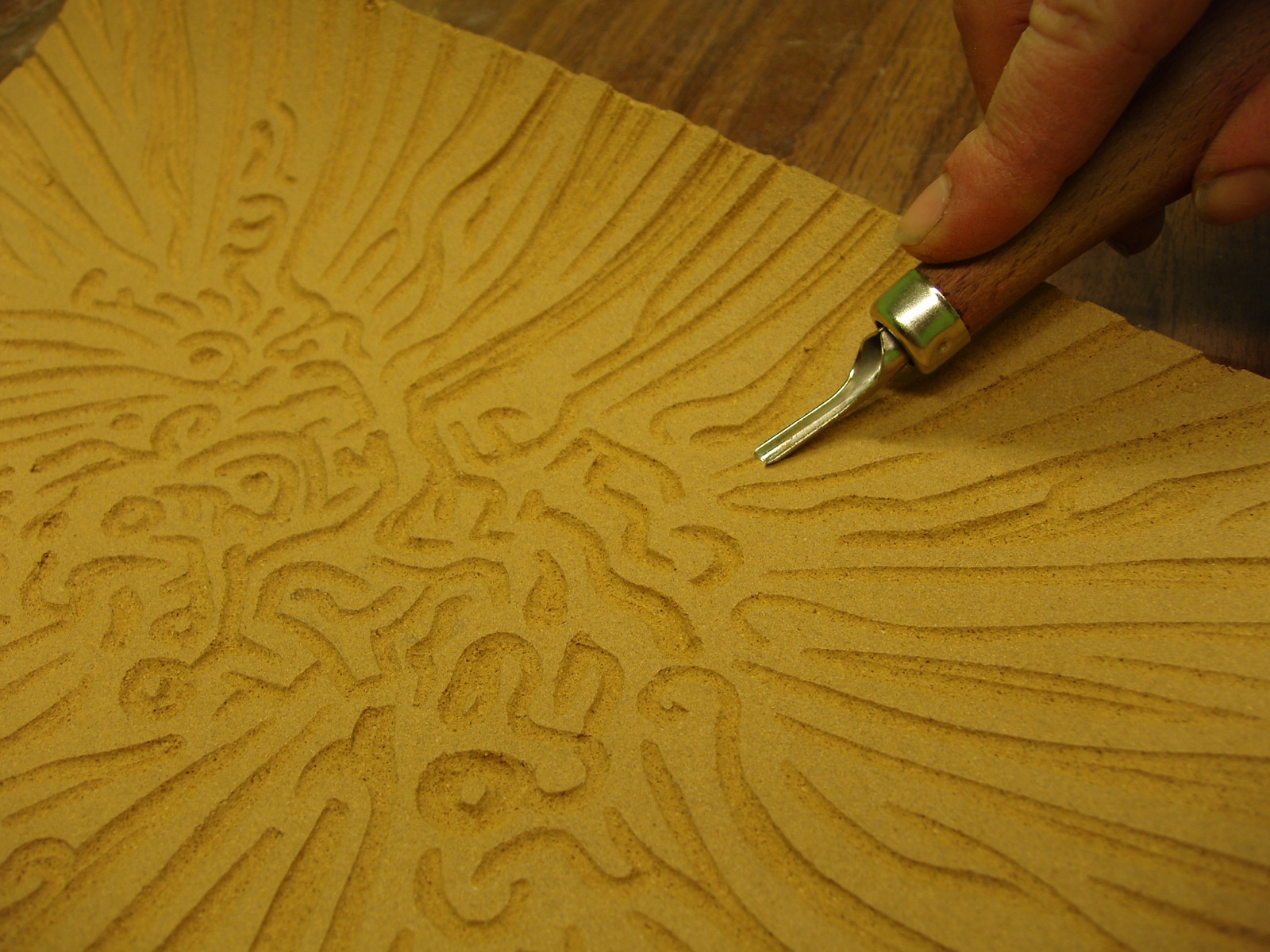
Following yesterday’s post, introducing my first ever attempt at etching to the world, here is my first ever attempt at lino cutting. Linocut, which is a form of relief printmaking, involves cutting into linoleum, which, while originally conceived for flooring, has been used by printmakers for almost as long because of its soft surface for cutting while retaining a sufficient durability for printing.

Linocutting is perhaps even trickier to get your head around than etching. This is because you use the same piece of lino to make a print of various colours. In order to “protect” each colour, you cut away at the lino further between prints, going from light to dark because light colours will never show up when printed over darker inks.

Cutting into lino

Cutting into lino

So to explain further, you first cut away from the lino anything you want to remain white. This is because the ink will never touch those cut away areas when the ink is rolled over the lino, so once applied to paper, the paper will remain white where the cuts are. Once you’ve got the hang of that and printed your first colour, the same then applies again to that colour – once you roll a darker colour over the lino, it will simply print on top of the first colour unless you cut more of the lino away to protect it. And so it continues for each layer of colour.

We worked with three colours, but with no forward planning on the details of my image, it was extremely difficult to work backwards and think of the image in terms of light going into shadow, and what colours needed to be preserved and what cut away. The lino also proved difficult to cut in a controlled manner.

The result is something a little coarse, but it’s a finish which I think works really well with the theme – Mexican Norm! Here is the finished print (I printed an edition of 5):

Mexican Norm (linocut print)

Mexican Norm (linocut print)

…and here is the lino after it’s final cut.

DSC07300

Linocutting was not a technique I loved as much as etching, largely because I find the process of making the image in etching easier to control. Nevertheless I was delighted with the results achieved through linocutting and would certainly like to give it a go again.

Norm prints a plenty, here we come…

© Nicholas de Lacy-Brown and The Daily Norm, 2001-2013. Unauthorized use and/or duplication of the material, whether written work, photography or artwork, included within The Daily Norm without express and written permission from The Daily Norm’s author and/or owner is strictly prohibited. Excerpts and links may be used, provided that full and clear credit is given to Nicholas de Lacy-Brown and The Daily Norm with appropriate and specific direction to the original content.

A Prelude to Printmaking – Part 1: Etching

I’ve never really paid much attention to prints, and still less black and white prints which, in a gallery full of paintings never seemed to capture my attention. All of this began to change around last summertime. The first trigger was the Royal Academy’s annual Summer Exhibition where, amongst the numerous galleries full of paintings of often rather questionable quality, I found myself inexorably drawn to the print gallery, a room packed to the rafters with prints of every conceivable style, technique and colour (and in fact bought two!).

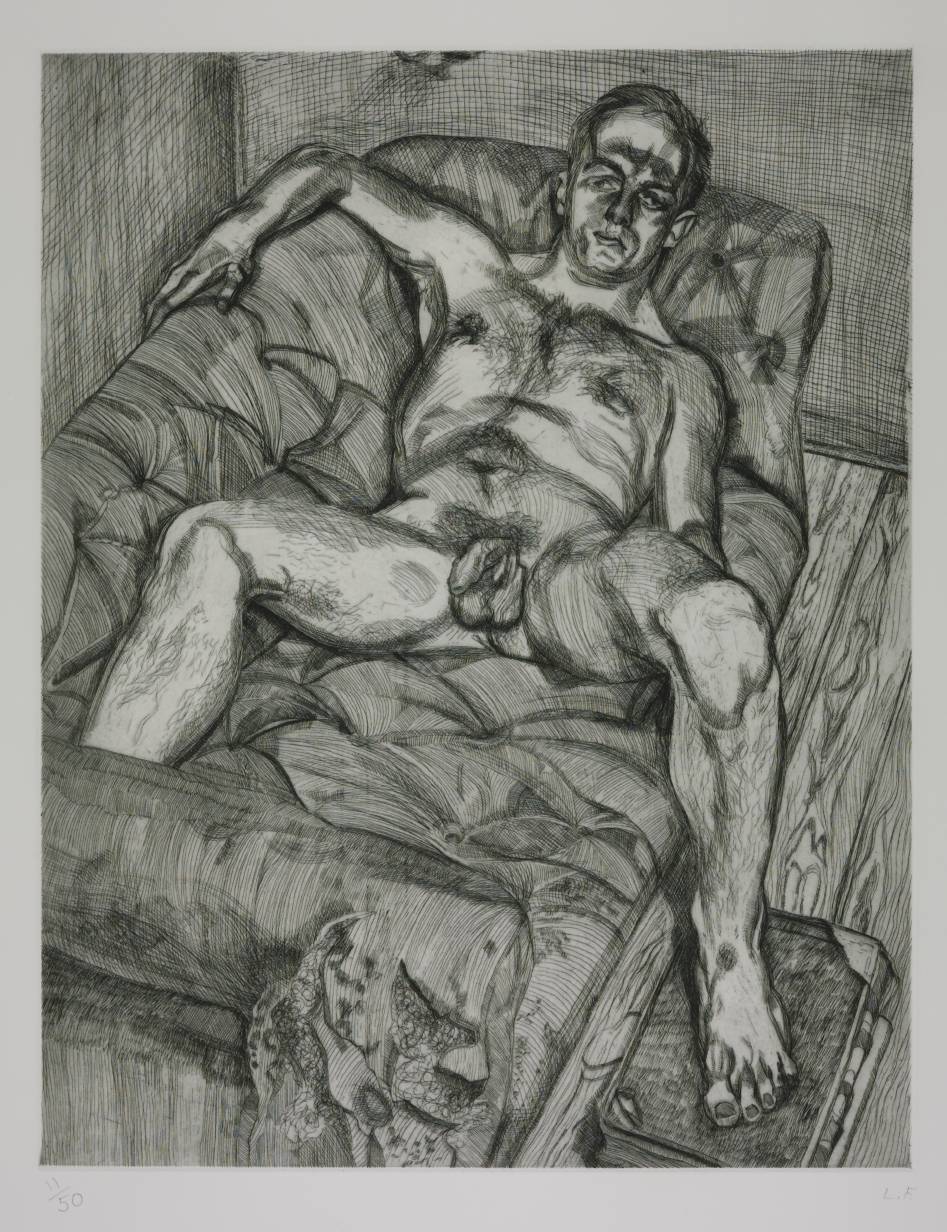
Lucian Freud, Man Posing (1985)

Lucian Freud, Man Posing (1985)

The second trigger came on a visit to the Courtauld Gallery at London’s Somerset House, where a newly acquired collection of Lucian Freud etchings had been hung. I was completely entranced by these works, which, in their monotone black and white seemed to shift focus from what is usually Freud’s fleshy textured paintwork to the almost visceral, fervid lines and cross hatchings by which Freud had reimagined many of his painted portraits in this new medium. In particular I adored Freud’s etching Man Posing (1985) in which the use of etching as a medium seemed to me so artfully applied to capture every hair, muscle and contour of the figure’s naked body.

Completely captivated, I went home and that very evening researched the internet for tips on how to etch. I very soon realised that unlike painting, etching would not be so easy to self-teach, and promptly enrolled myself for a printmaking course at the Art Academy in London Bridge (there being no introductory course dealing exclusively with etching).

Having now done this short weekend course, I can unconditionally say that I am hooked on printmaking, and on etching in particular. On the course we undertook two techniques – one was relief work (we used lino cutting – which I’ll tell you all about in Part 2 of this post); the other was the much anticipated etching technique, something which I found every bit as enjoyable to execute as I had taken delight in looking at Freud’s finished prints.

Another favourite etching - Edward Hopper, Night Shadows (1921)

Another favourite etching – Edward Hopper, Night Shadows (1921)

The process of etching is surprisingly fiddly. Of a whole day’s work in the studio, I probably spent a maximum of around 45 minutes actually drawing out my image onto plate – the remainder of the time was engaged in preparation and printing. Etching uses metal (we used zinc) and an image is etched into the plate using acid. That plate is then plied with ink and used to print an edition. So how does it all work? Well basically, once you’ve got yourself a metal plate (and carefully degreased it), you apply a dark “ground”. This is the layer which protects the metal when it is placed in acid. Once applied, you use a needle to draw your image. It is this process which reveals the metal underneath which will then be “etched” into the metal once acid is applied. So the process of drawing into the ground is a somewhat perplexing one – not only do you have to plan the image in reverse, but you’re also working in the colour negative, cross-hatching into metal to create shadows on your print, when what you end up drawing appears to be light on dark.

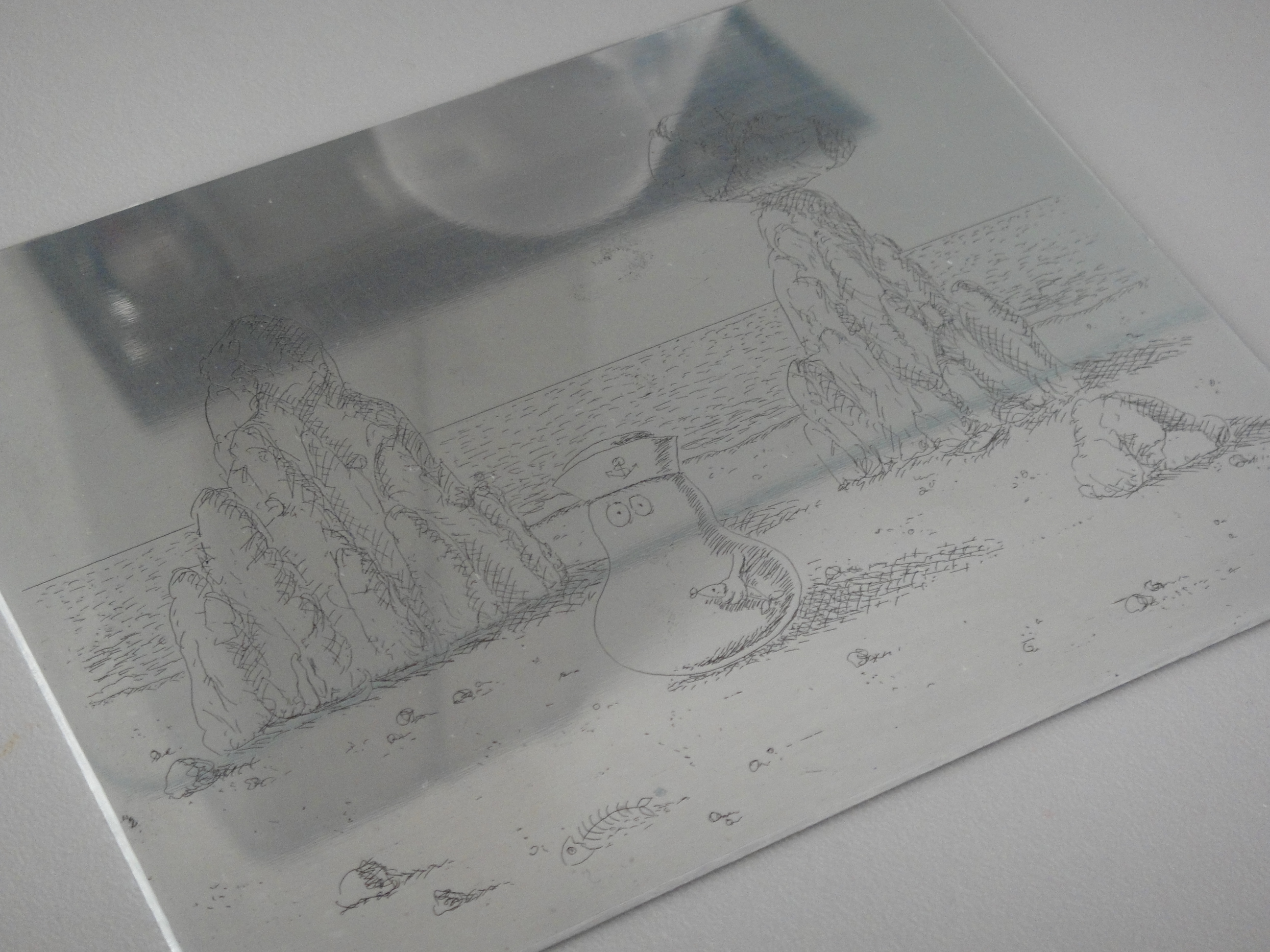
Anyway, I’m getting a little techy and I’m sure what you actually want to see is the result. And here it is: Sailor Norm on a beach in Mallorca (holding a fish). I probably ought to think of a better title, so any suggestions are welcome.

Here’s the metal plate with the image etched into it.

DSC07310

Then below, you can see what it looks like once printed: a series of prints which shows me experimenting with ink removal. In the first, I removed all the ink off the plate apart from the application of ink to the narrow etched lines. In the second, I left a little ink on the plate to create a moodier effect, and for the third and fourth left more and more, specifically targeting certain areas where I wanted more shadow. My favourite is probably the second or third. What do you think?

Sailor Norm on a beach in Mallorca (holding a fish) - print 1

Sailor Norm on a beach in Mallorca (holding a fish) – print 1

Sailor Norm on a beach in Mallorca (holding a fish) - print 2

Sailor Norm on a beach in Mallorca (holding a fish) – print 2

Sailor Norm on a beach in Mallorca (holding a fish) - print 3

Sailor Norm on a beach in Mallorca (holding a fish) – print 3

Sailor Norm on a beach in Mallorca (holding a fish) - print 4

Sailor Norm on a beach in Mallorca (holding a fish) – print 4

So that’s my first etching done, and with an intermediate course now booked, I cannot wait to create more and explore this new medium further. The etching is truly my oyster…

© Nicholas de Lacy-Brown and The Daily Norm, 2001-2013. Unauthorized use and/or duplication of the material, whether written work, photography or artwork, included within The Daily Norm without express and written permission from The Daily Norm’s author and/or owner is strictly prohibited. Excerpts and links may be used, provided that full and clear credit is given to Nicholas de Lacy-Brown and The Daily Norm with appropriate and specific direction to the original content.