Skip to content

Archive for

Dutch Masters Season Part 1: Van Gogh

Its atmospheric canals may be frozen (or perhaps now melting?), its wooden clogs uncomfortable on the feet, and its multi-coloured fields of tulips yet to burst into life, but Holland has so much to offer, especially to art lovers like myself. I’m not overly familiar with the Netherlands – I went once on a geography field trip at school, when we concentrated on the art of land reclamation and urban morphology, but it has always saddened me that I never had time to appreciate the cosmopolitan, thriving city of Amsterdam and all its multifaceted cultural offerings. This weekend, all that will change, as the Daily Norm will head to Amsterdam and hopefully posts bursting with accounts of the great city, its art and its buzzing life will swiftly follow. In anticipation of this exciting event, the Daily Norm is happy to launch the Dutch Masters Season, a three-part series looking at masters of Dutch art, as well as Norm reinterpretations of three Dutch masterpieces. This will be followed by a Sunday Supplement examining the influence of a particular Dutch supremo on a family portrait I created in 2010, and then my trip to Amsterdam will explode onto your screens in a (hopefully) spectacular fashion.

So, without further ado, let us begin this brief cultural survey of Dutch artists with this feature on a painter who is without a doubt the most famous Dutch master of them all… the indomitable sunflower-loving, paint-eating, ear-lopping saviour of colour, Vincent Van Gogh.

What can be said about Van Gogh that hasn’t been said before? A couple of years ago we got a huge anthology containing translations of his numerous letters, allowing us an invaluable insight into the artist’s sensitive, insightful mind. Last year, a new biography was published, sensationally claiming that rather than killing himself, as is the fabled (and much romanticised) tale, he was quite probably killed in a tragic accident involving local children playing with a gun. Every year some weighty international art institution holds a retrospective of his work, and chocolate boxes, t-shirts and mouse mats containing starry nights, sunflowers or a green faced portrait with decisive brush strokes and vibrant colours fly off the shelves of souvenir shops all over the world. So of course there isn’t much left to say. But where there is renown, let a Norm refresh. Where Van Gogh bandages his ear, let a Norm bandage his face. Yes, I give you, in the style of Van Gogh, Norm with a bandaged face…
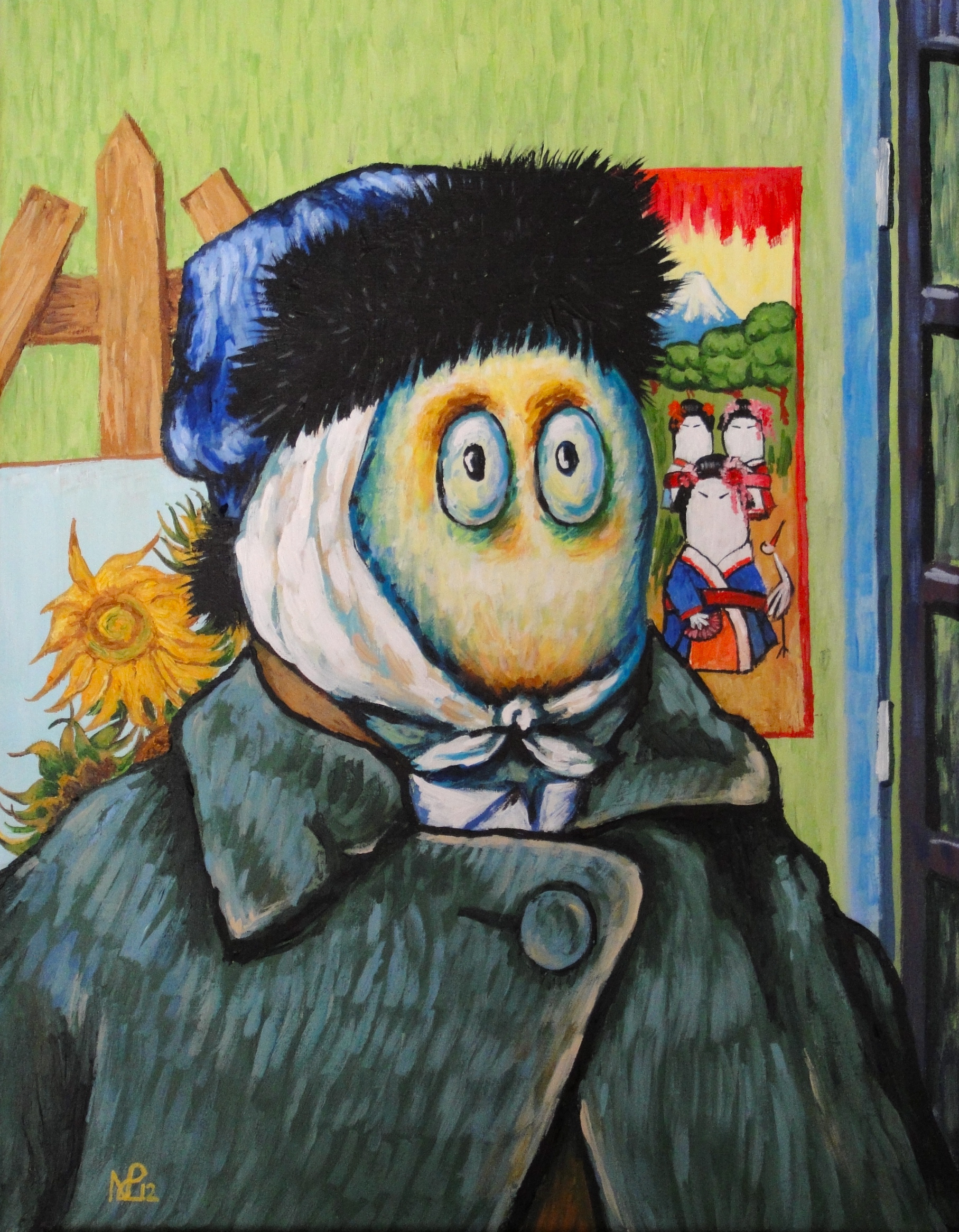
Norm with a bandaged face (after Van Gogh) (acrylic on canvas, 2012 © Nicholas de Lacy-Brown)

And the original…
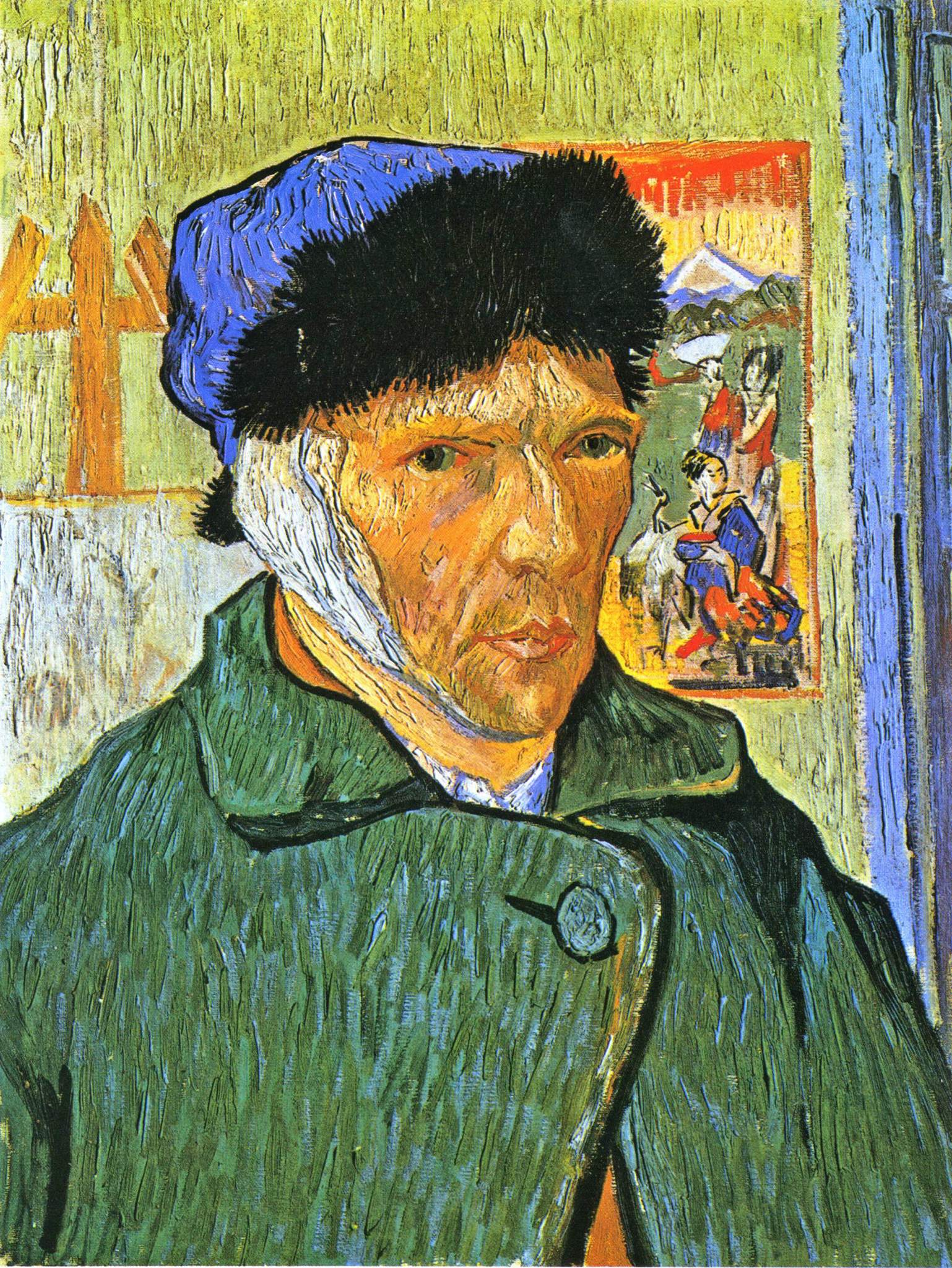
Vincent Van Gogh, Self-Portrait with Bandaged Ear (1889, Courtauld Institute of Art, London)

So why did this particular Van Gogh work inspire me? (After all, there are countless Van Gogh portraits to chose from, as well as a number of portraits of the local postman, the doctor, Gaughin’s chair and the like). Well to start with, this painting lives close to home for me, part of the wonderful collection of London’s Courtauld Institute, where more often than not, you can get this portrait, as with many of the other impressionist masterpieces in the collection, all to yourself, while Van Gogh’s Sunflowers, kept down the road at the National Gallery, is surrounded by a permanent semi-circle of tourists and school groups. But then there’s the bandaged ear, which is after all emblematic of the legend that is Van Gogh.
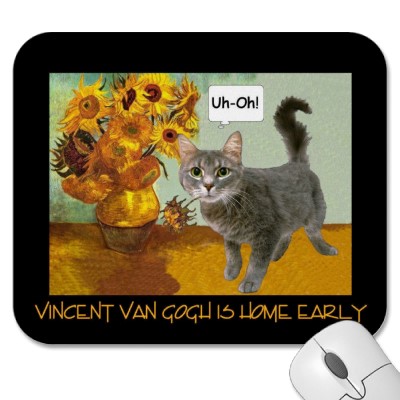
Van Gogh: souvenir hell

It happened one dark night in December 1888. Paul Gauguin, the tumultuous Tahiti-loving artist was staying with Van Gogh in the Yellow House in Arles, Provence. They argued savagely and Van Gogh came at Gauguin with a knife. At the last minute he turned on himself, cut a chunk out of his ear, and attempted to gift it to a local prostitute who sensibly alerted the authorities thus probably saving Van Gogh from bleeding to death. This painting, one of two containing the bandage (and therefore suitably amplifying the tale), was painted a month later in the comparable calm of post-cataclysmic reflection, with Gauguin gone, and Van Gogh all alone, once again, staring in the mirror in contemplation.

Vincent Van Gogh, Vase with Twelve Sunflowers (1888, Neue Pinakothek, Munich)

For me, it’s the perfect Van Gogh, because it gives us snippets of everything he represents. Broad, almost vibrating brush strokes expressing the rawness of his emotions, and the vigour and haste with which he sought to express his feelings on the canvas. A colour palette which is bold, unforgiving, almost happy despite the downbeat subject portrayed. On the wall hangs a japanese print, a recognition of the great influence of Japonisme in his work, while to his right, an easel and canvas is in progress – here I have used a bit of good old artistic licence, adding the sunflowers which are so equally emblematic of Van Gogh – just in case you weren’t immediately sure who I was referencing with this painting! In this way, the warmth of Provence contrasts with the coldness of winter portrayed in the artist’s thick coat and strange furry hat, an outfit which appears to isolate Van Gogh from the viewer, enveloping him in a melancholy introspection which is shared with the audience only through the piercing gaze of his sickly green eyes.

Well there you have it – and it looks like I had a lot to say after all. For me, Van Gogh is a master. Sometimes his works are criticised for being overly loose, coarsely painted and unsophisticated. But you only have to look at his early portraits of peasants, such as his saturnine masterpiece, The Potato Eaters, to recognise his skill as a draftsman. Rather his coarse, thick application of paint allowed him to paint fast, and this was crucial in allowing him to express his vigorous and volatile emotions on canvas, as and when they moved him. And it is this living, breathing, unforgiving emotional intensity which remains so evident in his canvases today in every decisive and quivering brush stroke, capturing audiences and inspiring biographers and curators aplenty, whether it be through sunflowers, cypress trees or in the sorrowful eyes of his many self-portraits. This is why, to my mind, Van Gogh is a true Dutch master.

Van Gogh, The Potato Eaters (1885, Van Gogh Museum, Amsterdam)

Come back tomorrow for Dutch Master number 2.

Postscript: In case you were wondering, no, Norms don’t have ears, but that doesn’t mean that this Van Gogh pretender couldn’t have inflicted a grizzly wound on himself in the same general area!

Valentine’s Kisses: Norms do… Klimt

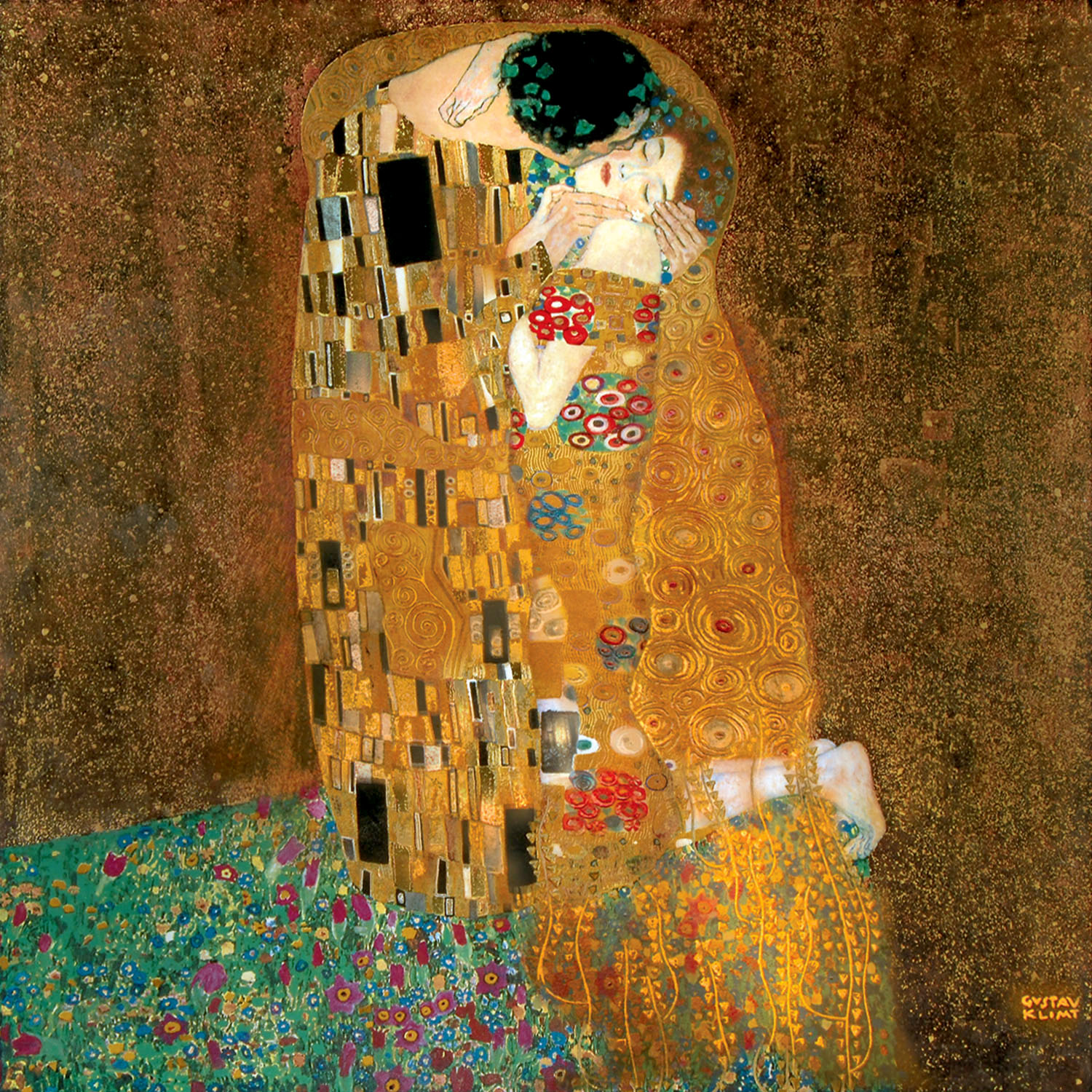
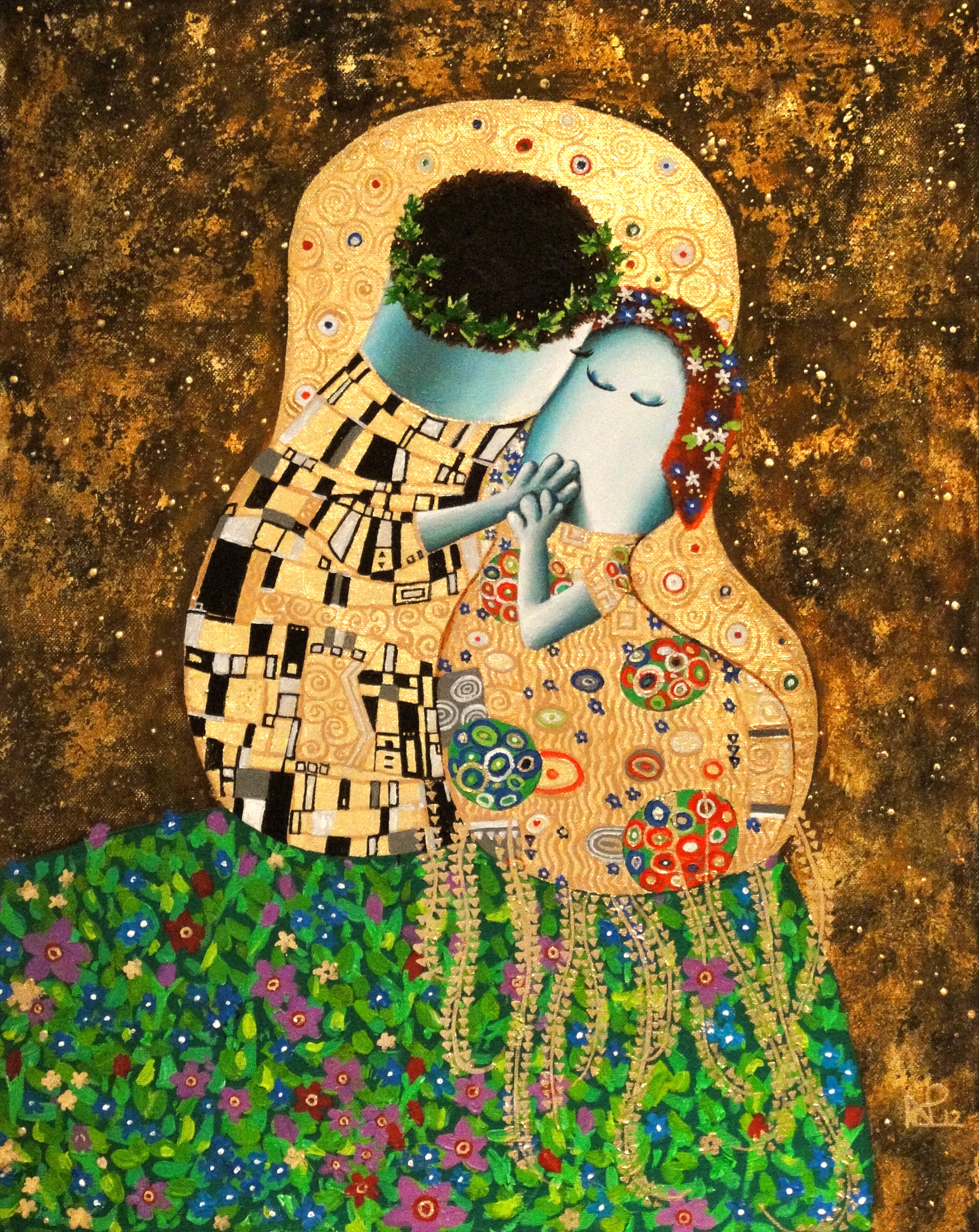
It’s valentine’s day, the day when millions of singletons across the globe shrink in disgust at the notable increase of embracing couples on the streets and inappropriate PDAs (public displays of affection), and when millions more feel the pressure of their partner’s expectation that they out do last year’s offerings with overpriced roses and a box of unwanted chocolates. But none of that here. At the Daily Norm, valentine’s is just an excuse to celebrate the more intimate, emotional side of art, while also using it as an opportunity to present a brand new Norm painting to the world! When I think of love, there is only one painting which comes to mind. It is, perhaps unsurprisingly, the same image which dominates the search results page when you type “The Kiss” into google. It is, of course the world’s must famous and celebrated embrace, The Kiss, by Gustav Klimt. And here, for your viewing pleasure, is the Norm re-inactment along with the original.

The Kiss (after Klimt) (acrylic and gold leaf on canvas, 2012 © Nicholas de Lacy-Brown)

The Kiss by Gustav Klimt (1907-8, Österreichische Galerie Belvedere, Vienna)

It’s a crying shame that like Van Gogh’s sunflowers, or Monet’s bridge/waterlillies, or Degas’ ballerinas, Klimt’s masterful golden embrace has become so commercialised, replicated and reproduced onto every form of tourist tack, from lamps and mousemats to beaded curtains and bed linen, that the automatic reaction of a viewer to the image is to see it through a kind of autopilot. As with all recognition, one fails to actually look, really look at the image. When I embarked upon a Norm version of Klimt’s work, this is exactly what I had to do. Whereas previously I had dismissed the image as cliché, when I started painting my own version, I saw so much more.

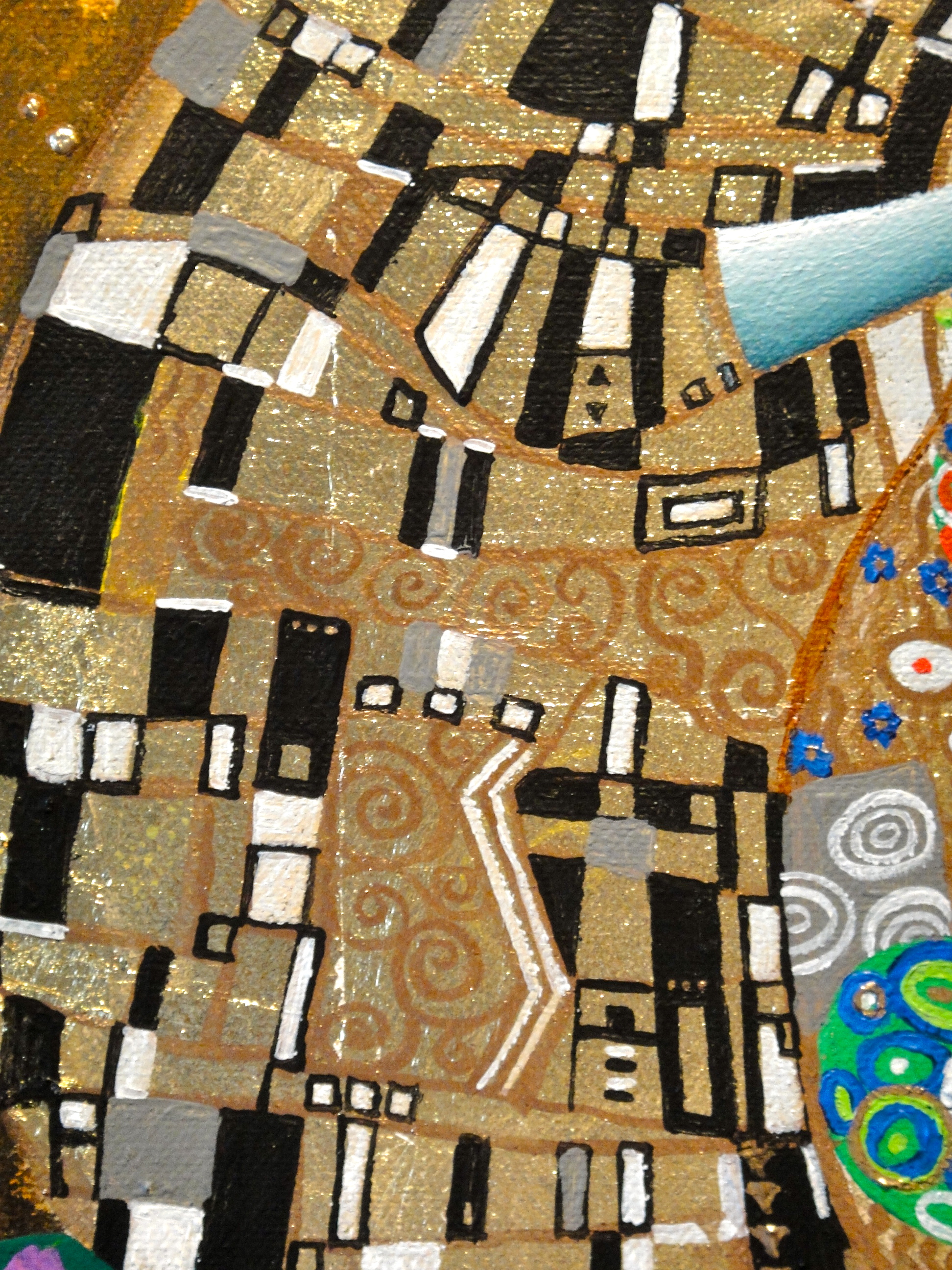
The Kiss (after Klimt) (© Nicholas de Lacy-Brown) - detail of male Norm

First of all, the painting is a superb fusion of evocative emotion mixed with art nouveau-inspired flattened design. It makes for an interesting synthesis, and seems to emphasise and centralise the intensity of the embrace all the more, since the power of the emotion charging through the embrace appears to have instigated the creation of a fantasy world around the couple, as they appear to burst out of a planet of flowers, and all around them, a cosmos of golden stars twinkle. The patterns of the clothing are also interesting. With squares and geometric patterning, the man’s clothing appears quite strong and masculine, where as the woman exudes a more feminine softness with round flowery shapes and waves. However, interestingly the fusion between the characters seems to translate into their clothing, as interspersed between the man’s squares are small patches of swirls, while on the woman, round shapes are occasionally interrupted by squares, particularly where her body touches the man’s. Moreover, the aura-like golden space around them is full of swirls which appear like stars or moving, active emotions. Also, at the bottom of the canvas, the abundant flowing golden plants trailing off the couple seem to suggest fertility, not least because of  the prominence of the upturned triangle which hints at female sexual organs.

The Kiss (after Klimt) (© Nicholas de Lacy-Brown) - detail of female Norm

More interesting still is the pose. From the painting’s title, one would draw the inference that this is a happy, loving embrace. However, having studied the work more closely, there is, to my mind, something all the more sinister about the pose. While the man stands tall and rather menacing with his black hair and firm grip of the lady, she appears to be subservient in the embrace, kneeling before the man. She appears to hold the man, not tenderly, but as though trying to loosen his grasp on her. Notably, her right arm appears to be screwed up into a tense fist rather than tenderly resting upon his shoulder. It also seems significant that the kiss is not on her lips but her cheek, as though the lady has turned her face just in time to avoid the man’s approach.

As with most great masterpieces, much is left to the public’s interpretation, but I am at least glad that in Normyfying this work, it has given me the opportunity to study it further and give it the kind of appreciation it deserves. As for my Norm reimagining, I think that the pose lends itself well to the Norms who, in their curved body shapes, fit effortlessly into the art nouveau theme of the original. Here the awkwardness of the embrace could still be interpreted either way, although as Norms only have one arm, my lady Norm is without her right screwed up fist, while the man cannot grip so firmly upon his Norm lover with his second hand. There was a lot of detail which needed painting in order to do Klimt’s original justice, and as the main photograph doesn’t necessarily show this up, I have included close up detail shots of my Norms (above), as well as a photo showing the effect of the gold leaf when a flash is used on my camera below.

The Kiss (after Klimt) (acrylic and gold leaf on canvas, 2012 © Nicholas de Lacy-Brown) - showing effect of a flash on the gold

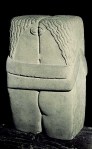
In the meantime I wish you all a very happy Valentine’s day, hoping that the day is everything you want it to be (if only if it means the effective avoidance of couples!). For those of you more inclined towards all things romantic, I leave you with a gallery of some of my favourite artistic manifestations of kisses, from Rodin’s sculpture to my own Norm version of Robert Doisneau’s Le Bazier de l’Opera.

© Nicholas de Lacy-Brown and The Daily Norm, 2005-2012. Unauthorized use and/or duplication of the material, whether written work or artwork, included within The Daily Norm without express and written permission from The Daily Norm’s author and/or owner is strictly prohibited. Excerpts and links may be used, provided that full and clear credit is given to Nicholas de Lacy-Brown and The Daily Norm with appropriate and specific direction to the original content.

Córdoba: The city which inspired the painting

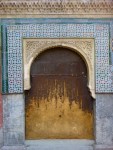
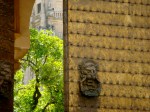
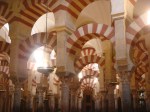
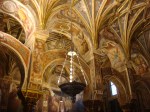
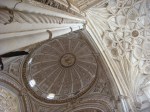
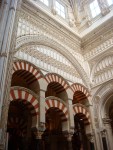
It’s my last dip into the Iberian peninsular before I go all Valentines on you… Following yesterday’s Sunday Supplement in which I introduced my painting, Córdoba, here are my photos of the city which inspired the work.

Córdoba is a unique little place. It doesn’t share the same thriving spirit as Seville or Granada for example, at least not in the very self-contained old town which looks and feels very much like a living museum given over to the tourists. Asides from La Mezquita at its centre, there are a few quaint art museums and an excellent archeological museum, but otherwise there is not a huge amount to see. Surprisingly, it did make the short list for Spain’s European Capital of Culture in 2016 which scandalously Malaga, home of the great Picasso Museum, a flashy new airport, a thriving city and a contemporary art museum, did not. Having said this, Córdoba is a crucial visit for those with an interest in Spain’s rich cultural heritage, and in particular its Moorish past. Should you go, be sure to sample Berejenas Fritas – deep fried aubergine served with a syrupy sauce – divine.

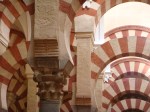
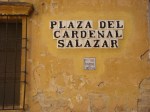
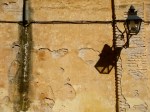
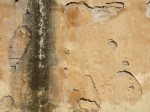
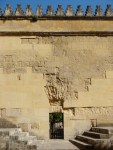
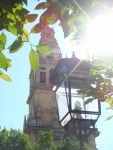
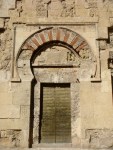
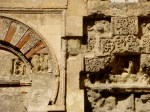
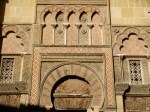
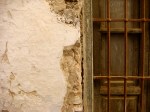
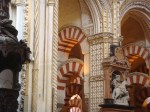
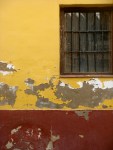
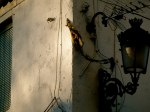
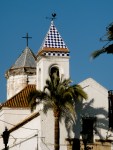
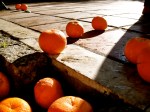
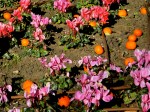
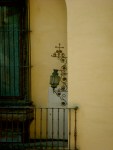
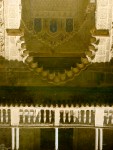
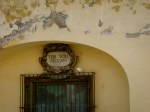
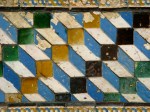
Below are a selection of the photos I took when in Córdoba. If you saw my post yesterday, you’ll recognise the crumbling facades, elegant wrought-iron lamps, the quenching relief of a hotel swimming pool, and that shameful architectural vandalism which took place in the great mosque after the Christian reconquista. This is a city where history is not only preserved, but the wounds of the past are still uncomfortably evident.

© Nicholas de Lacy-Brown and The Daily Norm, 2005-2012. Unauthorized use and/or duplication of the material, whether written work or artwork, included within The Daily Norm without express and written permission from The Daily Norm’s author and/or owner is strictly prohibited. Excerpts and links may be used, provided that full and clear credit is given to Nicholas de Lacy-Brown and The Daily Norm with appropriate and specific direction to the original content.

Sunday Supplement: Córdoba

Well it’s been quite a week. It started with snow in the UK and hurricane winds where I was in Marbella. Somewhat gleefully escaping the worst of the cold and indulging in plentiful sun drenched coffees at Cappuccino Grand Cafe, I nevertheless came home to London with something of a bump, and I don’t mean on the airplane. Rather, the bump that was troubling me was a rather large lump on my head, and with medical attention required, I had to endure not one, but two operations on said lump/ bump on the back of my head, and therefore ended the week with a sore head and a bandage obscuring half of my face. It is consequently after a couple of days “medical leave” that I return enthusiastically to the Editor’s seat of the Daily Norm to complete my early 2012 Spain Season. This is ahead of a week which promises an almost daily launch of exclusive new Norm paintings which are complete and ready to be shown to all my loyal followers. Starting with a special for Valentine’s day, a whole host of themed Norms will be making their way onto your screens for… Dutch Season! Oh the excitement!
But enough about what is forthcoming. What about today? Well, as the final instalment of my season on Spain, and following in the path of last weekend’s Sunday Supplement on Seville, I thought I would share with you what is perhaps the partner of the Seville Triptych – my work based on another  of Andalucia’s stunning cities – Córdoba . I visited Córdoba in June 2010, just two months after Seville, and as with the latter city,  was instantly inspired to paint. My inspiration, while being sourced from the generalised beauty of a historical Spanish city, was specifically engaged by two characteristic features of the city. First, I was moved by the air of decadence and decay – walls and painted plaster crumbling with such elegance that you would presume it had been perfectly choreographed in an effort to charm visitors with this offering of living history in the streets all around them. Secondly I was scandalised, utterly disgusted, by the architectural maiming of the city’s Great Mosque – otherwise known as La Mezquita – or, controversially, as La Catedral de Córdoba. But a Cathedral this is not.

Roof of La Mezquita, from which the Christian cathedral, plunged through the middle, can be seen.

The mosque, arguably the most emblematic symbol of the City with its famous row upon rows of red and white striped arches, was built at the centre of a thriving Islamic city. In 1236 it was captured by the Catholic King, Ferdinand III as part of the Catholic reconquest (“reconquista”) of the Iberian peninsula after 700 years of Islamic dominance there. Once captured, this stunning mosque was turned into a cathedral. Its minaret was rebuilt as a baroque bell tower, the open arches which encouraged people to wander in from all over the city and pray were bricked in and closed off, and most scandalously of all, the centre of the mosque was literally bulldozed to the ground as a completely jarring, architecturally conflicting baroque cathedral was plonked right in the middle of the mosque. Both the Christian and Islamic buildings are impressive in their own right, but forced together constitute, to my mind, a horribly uncomfortable, deeply shameful act of architectural vandalism. It is said that even Charles V, King of Castile at the time when the cathedral was inflicted upon the mosque, eventually regretted the move when he realised that something special and unique had been destroyed by the Christian architects.

It was these two factors – decay and the mosque which inspired my painting, and to my mind, they are closely linked. For Córdoba was a thriving Islamic city in the time of the reconquista, the capital of Al Andalus, with a huge population which included people of all faiths living in harmony together. After the reconquista, the city lost it’s status and importance, as central rule was moved to Madrid, the multi-faith population was driven out, and Córdoba was left to crumble and decay, a state which has continued to this day. Consequently in the beauty of the cracks and crumbling buildings, there are deep historical wounds, which were almost tangible, and certainly the source of melancholy in a city which is now given over mainly to tourists.

Córdoba (oil on canvas, 2010 © Nicholas de Lacy-Brown)

The reconquista is explicitly illustrated in my painting. The elephant represents the conquistadores. Like the elephant in the room, when today’s catholics name the mosque La Catedral they ignore the fact that this was, and to all intents and purposes still is, a great mosque, albeit with a Christian cathedral plunged through the middle. They ignore this senseless act of vandalism, and they assume that we will accept this as a Christian building without any appreciation of its painful historical context. As the reconquest begins, the elephant smashes the mosque to pieces, looking calm as it does so, an emblem of the conquistadores on its cloth, and a Christian altarpiece on its back. The baroque bell tower is flown in, harnessed to a Vatican helicopter, ready to be built on top of the ruins of the mosque. Meanwhile, all around, cracking walls are held tentatively together with safety pins, while the elegant street furniture of the city – lamps and ceramic street names – are interspersed with the slightly coarse application of electricity wires on the outside of the ageing walls. Finally at the foot of the painting, a swimming-pool-like gelatinous form reflects the clouds above, and is featured solely as a personal reflection of the hotel swimming pool in Córdoba which my partner and I enjoyed so much. Across it, the great roman bridge of Córdoba features, a direct pathway leading from the modern town into the old town, crossing the Guadalquivir as it still does today.

I should point out that despite its religious context, this painting does not attempt to take sides. It criticises history. It does not criticise religions in their contemporary manifestation.

Look out for my photos of Córdoba, featured tomorrow. Until then, have a great, relaxed Sunday.

© Nicholas de Lacy-Brown and The Daily Norm, 2005-2012. Unauthorized use and/or duplication of the material, whether written work or artwork, included within The Daily Norm without express and written permission from The Daily Norm’s author and/or owner is strictly prohibited. Excerpts and links may be used, provided that full and clear credit is given to Nicholas de Lacy-Brown and The Daily Norm with appropriate and specific direction to the original content.

Marbella – Hidden wrinkles beneath the botox

Far beyond the ritzy media archetype of Marbella, with its fake-tanned, label-cluttered, Ferrari-filled Puerto Banus, and its marble clad town centre, complete with grand avenues and mature parks, high street shops and tourist information centres, is a town which resembles none of the glitzy, cosmopolitan manifestations of the media-managed Marbella. It’s a town which is emblematic of historical, culture-rich Spain, where the locals, many forced from their homes by rising house prices, or others packed into small dwellings with three generations of their families, continue living the life they have always lived, while all around them their town of Marbella has enjoyed its ascendency into the darling of the jet set. This is the Marbella which must endure the relentless hardship of the fishing industry to survive, locals who must live far out in the less than salubrious suburbs in order to stay in the town. Yet within these communities is a fun-loving, strong, proud spirit. Rather than being snubbed by a WAG in designer sunglasses, here you are greeted with a pleasant “Buenos Dias”, the locals still sit around outside their homes chatting at all hours, and families flock to the cheaper restaurants whose food is authentic and unpretentious.

As a part-time resident of Marbella for the last ten years, I have become disenfranchised with the town’s superficial identity. I loathe Puerto Banus, the media face of the town, whose geographical beauty is eclipsed by the pretentious tourists, begging for attention with their pursed glossy lips and frozen foreheads. I progressively find myself straying more and more into the Spanish communities, where the essence of Spain is still alive, where Marbella could be any other town in Andalucia, where the smell of garlic pervades the air and flamenco’s anguished cry wafts across the airwaves.

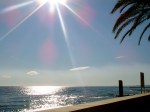
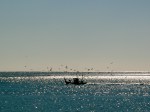
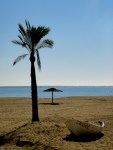
One such place is Cable Beach – it’s East out of Marbella, in the opposite direction from the Golden Mile, where the port is industrial rather than given over to pleasure, and fishermen still work, their cottages still intact having escaped demolition to make way for a hotel, and whose beach, so often deserted, is a wide, beautiful expanse of golden sand. In the photos which follow, I hoped to capture the beauty of this quieter, more authentic side of Marbella, and also include images of the outer suburbs, as well as the town in the aftermath of a recent storm – all views of the hidden, authentic town which thrives still in the shadows of the media glare.

© Nicholas de Lacy-Brown and The Daily Norm, 2005-2012. Unauthorized use and/or duplication of the material, whether written work or artwork, included within The Daily Norm without express and written permission from The Daily Norm’s author and/or owner is strictly prohibited. Excerpts and links may be used, provided that full and clear credit is given to Nicholas de Lacy-Brown and The Daily Norm with appropriate and specific direction to the original content.

Norms do… the Rokeby Venus

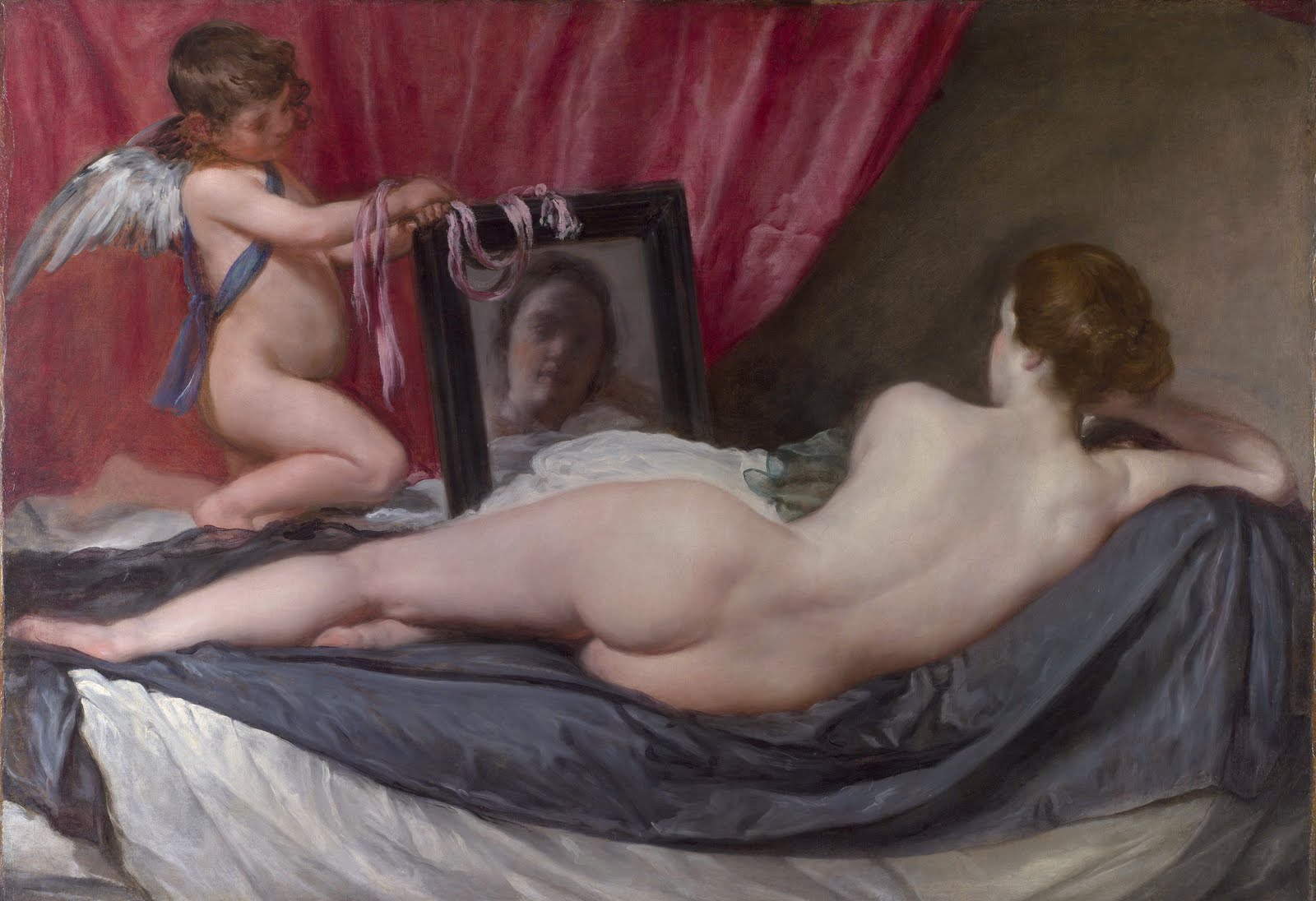
You’d excuse the Duchess of Cambridge, aka our adored Kate Middleton, for being a little miffed at the reception to her sister Pippa’s now famous backside when it meandered up the aisle of Westminster Abbey behind the blushing bride in the decade’s most watched wedding last year. Her bottom was a largely unanticipated feature of the wedding, but one which captured almost as much attention as Kate’s dress, particularly amongst the males watching the wedding (causing unanimous consternation amongst their female partners – one, it was reported, even slashed her boyfriend’s car). But should Duchess Kate wish to console herself of this great usurpation of her wedding day, she need only wander next door from the National Portrait Gallery to which she has recently become patron. There, in London’s National Gallery, she will find a backside which easily eclipses Pippa’s behind in terms of notoriety (and, frankly, beauty), a bottom which has been both ogled at and admired in equal measure for centuries, and one which has stirred such strong reactions in its audience that a King of England helped to purchase it for the nation, and prompted one crazed suffragette to slash the painting repeatedly in pursuit of her campaign for women’s rights (in prompting such violent actions then, perhaps the two bottoms are on par). It is, of course, the beautiful bottom of the Venus, painted by Spanish master Diego Velázquez, which has become known as The Rokeby Venus. 

The original Rokeby Venus by Velazquez (courtesy of The National Gallery, London)

The painting, which became known as Rokeby when it was moved to Rokeby Park in Yorkshire in the 19th century, is easily one of the prizes of The National Gallery’s collection. It not only shows a lovely naked body for audiences to admire and, possibly, to become aroused by, as well as an intimate, uninterrupted moment of self-absorbed beauty, it also offers us an innovative way of representing the archetypal duo of classical figures, Cupid and Venus, with Venus’ back to the viewer, and Cupid, without his usual bow and arrows, engaging, assisting Venus in her act of self-appreciation. Painting Venus’ back to the audience was an unusual choice, but it not only adds to the intimacy of the scene, it also allows the nude to be admired from a hitherto unseen perspective. And in order to involve the audience with his portrayal of Venus further, Velázquez uses the mirror as a device to introduce Venus’ face in the scene as well. In this way the composition is not only innovative but highly effective as a tool to seduce and captivate the viewer. As Velázquez goes, this is quite a departure from Las Meninas and his other court portraiture, and would, in fact, have been painted with a degree of secrecy in a society which was prowled by the stricture of the Spanish Inquisition. Its beauty is however equal to, if not greater than these more “official” works, and provides an intimacy and emotional intensity which would never be captured in the stiff pose of a courtier, or even the traditional classical manifestation of Venus.

Damaged sustained by the Rokeby Venus when slashed by suffragette Mary Richardson in 1914

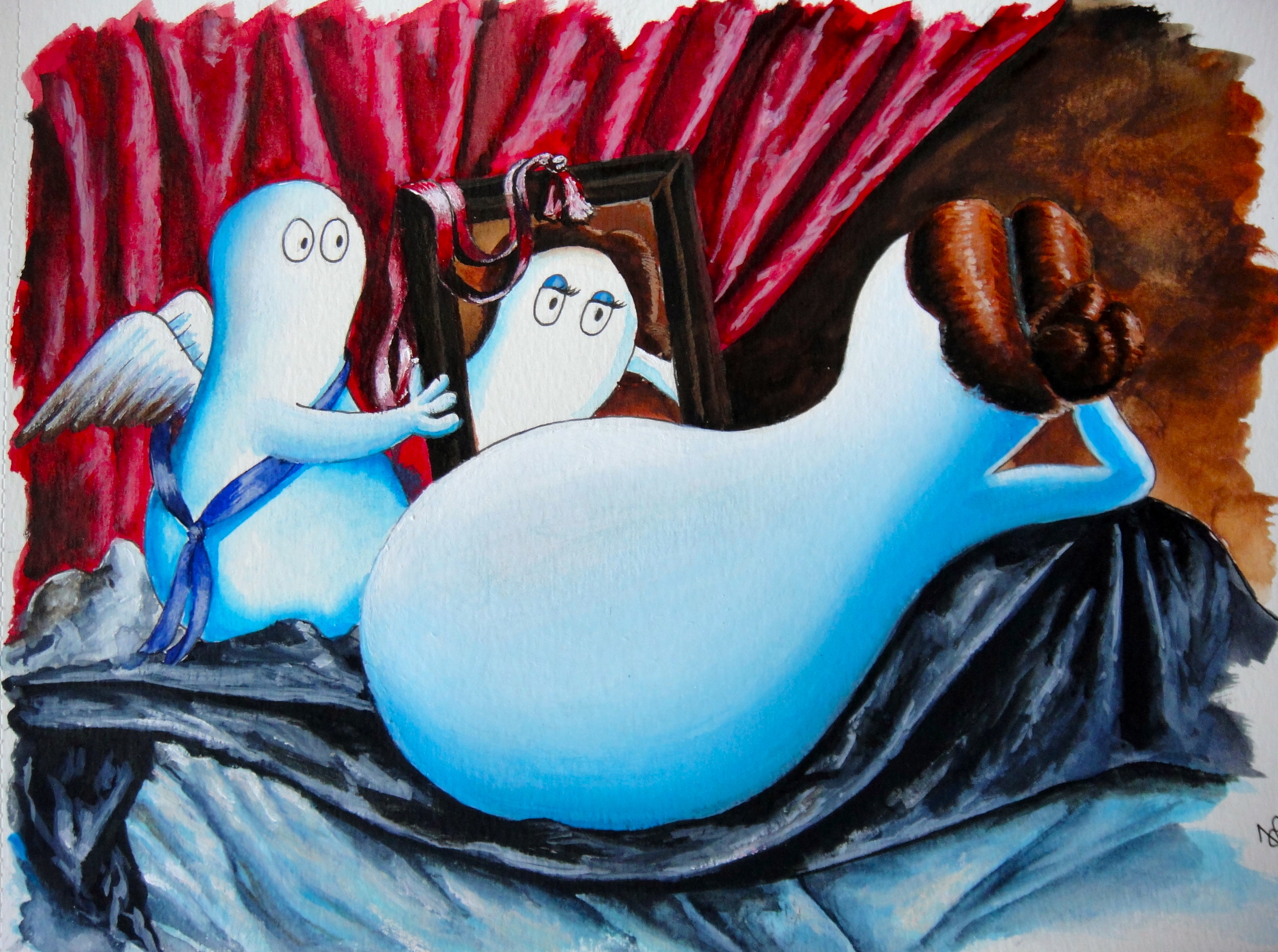
Now the Norms, being as ever, fans of high culture, particularly of a Spanish kind, have adopted the pose of the Rokeby Venus for your pleasure. In this watercolour reimagining of Velázquez’s masterpiece, the composition is pretty faithful to the original, albeit the medium of watercolour provides something of a coarser, more vivid finish than the hazy blended effect which Velázquez has achieved with oils. I also made the face of the Norm in the mirror more prominent that Velázquez’s Venus whose face is inexplicably blurred. Recent National Gallery x-rays have shown that this blurring remains unchanged from the painting’s original finish and was, therefore, always intended by Velázquez. Why he blurred the face no one can be sure, but I like to think that it conformed to the softness of the whole scene, including the gentle finish given to Cupid. In giving Venus a generalised, undefined face, Velázquez emphasises the beauty of her body and the drapery which mirrors its curves so effectively.

The Normby Venus (after Velazquez) (watercolour on paper, 2012 © Nicholas de Lacy-Brown)

Let’s hope that my Norm reimagining remains in one piece and is not slashed to pieces by a protester…

So before leaving you to (hopefully) enjoy my Norm pastiche, just a note on who else has been inspired by the Rokeby Venus. Well the list is fairly long, including Goya, Ingres, and Paul-Jacques-Aimé Baudry with his The Wave and the Pearl. But it is also possible, I think, to attribute Manet’s infamous Olympia to the dare and innovation of Velázquez’s portrayal of the nude. As Velázquez reinvents the female nude with this glance at her behind, so too did Manet reimagine the nude, painting a similarly unembellished nude who stares directly at the viewer, captivating the audience in the same way that the Rokeby Venus pulls the viewer into the intimate scene by way of her reflected stare in the mirror. Notable too is Manet’s drapery, mirroring and enhancing the curvature of his creamy-smooth nude.

Edouard Manet, Olympia (1863) courtesy of the Musée d'Orsay, Paris

Also of note is the 1970s photographic reinaction of the Rokeby Venus by Bergström as well as by contemporary photographer Sam Taylor-Wood. In the latter photograph, Soliloquy III, Taylor-Wood pushes the erotic nature of Velázquez’s work to a new level, capturing what looks like a self-portrait in the Rokeby pose above a freeze which appears to show a group of people indulging in a mass orgy in an office space.

Bergström over Paris (1976)

Soliloquy III (1998) Sam Taylor-Wood

Suddenly Pippa’s small, well-covered bottom loses much of its lustre… Until next time.

© Nicholas de Lacy-Brown and The Daily Norm, 2005-2012. Unauthorized use and/or duplication of the material, whether written work or artwork, included within The Daily Norm without express and written permission from The Daily Norm’s author and/or owner is strictly prohibited. Excerpts and links may be used, provided that full and clear credit is given to Nicholas de Lacy-Brown and The Daily Norm with appropriate and specific direction to the original content.

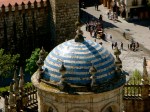
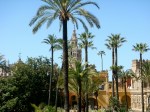
Seville: The city which inspired the painting

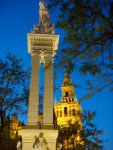
Key to understanding the Seville Triptych I painted, as featured on yesterday’s Sunday Supplement, is the city which inspired it. While I’m sat on a plane (and hopefully not stuck in an airport with snow-induced delays) I’m posting in advance the photos I took of Seville, the star of Spain’s south and one of the most sensational cities I have ever visited. Now all you need is a bottle of rioja, some chorizo tapas and flamenco on CD and winter will be dismissed for good! Enjoy.


© Nicholas de Lacy-Brown and The Daily Norm, 2005-2012. Unauthorized use and/or duplication of the material, whether written work or artwork, included within The Daily Norm without express and written permission from The Daily Norm’s author and/or owner is strictly prohibited. Excerpts and links may be used, provided that full and clear credit is given to Nicholas de Lacy-Brown and The Daily Norm with appropriate and specific direction to the original content.

Sunday Supplement: The Seville Triptych

It’s an early 2012 Spanish Season here at the Daily Norm, and what better thoughts to fill your head at this time of ferocious cold across much of the Northern Hemisphere. Here in Spain the snow hasn’t reached us, but the winds were almighty and angry. On emerging from home yesterday we found much of Marbella’s lush greenery had hit the ground. A crying shame, but such is the rapid growth of the plants out here, I’m sure many of the gaps will have filled come July.

In line with this short season of Spanish indulgence, today’s Sunday Supplement pays homage to one of Andalucía’s most famous and exquisite cities: Seville. Having travelled there in the Spring of 2010 my mind rapidly filled with numerous ideas with all the energy of a kindergarten playground. What resulted was not one, not two, but three canvases portraying the city, which, when placed together flow seamlessly into one complete panegyric to Spain’s southern gem.

Seville Triptych - Canvas I (Oil on canvas, 2010 © Nicholas de Lacy-Brown)

Prominent in the first canvas is a beautiful Spanish lady. Some asked if I had painted Amy Winehouse. Au contraire – this is the infamous Sevillian femme fatale, Carmen, immortalised in Bizet’s opera, seductive in her gaze, languidly smoking a cigarette from a packet which is decorated with the ceramic signage of the Tobacco factory where Carmen worked – a factory which today stands beautifully as ever in the centre of the city, now converted into a university. Beneath her traditional black lace mantilla which, in part, is used as a fisherman’s net, are the paraphernalia of the matador, Escamillo who, in Bizet’s operatic tale, prompted such jealousy in Carmen’s lover Don José that it led to her eventual downfall. Also in this canvas are the Moorish walls of Seville’s Real Alcazar palace, harping back to the city’s Moorish past, which is also embodied in the Torre del Oro which stands by Seville’s Guadalquivir river. Across the river, the bridge designed by Gustav Eiffel features, while from the fishing nets, floating buoys become the oranges for which Seville is renowned throughout the world. Meanwhile the flower from fragrant orange blossom adorns Carmen’s ear, while above her head, the architectural splendour of the ceramic-covered Plaza de España emerges. Finally, sat like a spider upon the ground, the elaborate gothic architecture of Seville’s great cathedral is featured in a vibrant purple.

Seville Triptych - Canvas II (Oil on canvas, 2010 © Nicholas de Lacy-Brown)

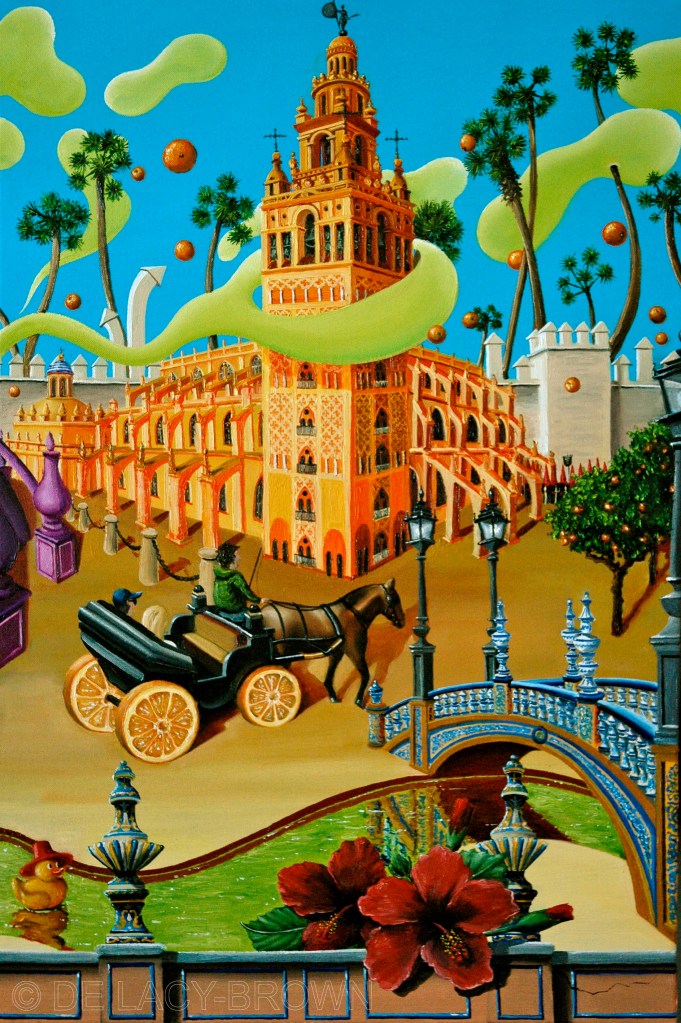
In the second canvas, the Giralda bell tower and the adjoining magnificent cathedral take centre stage, enveloped by the smoke of Carmen’s cigarette smoke. The angle of the building shows off its magnificent gothic details as well as the Moorish features on the lower section of the Giralda tower which is retained from Seville’s Moorish past. In front of the cathedral, a common site of Seville is featured – the horse and cart – whose characteristic yellow wheels are replaced with orange slices. Meanwhile, the distinctive blue and white ceramic bridge of the Plaza de España signifies that here, the river has become the pleasure lake which is central to the Plaza de España complex.

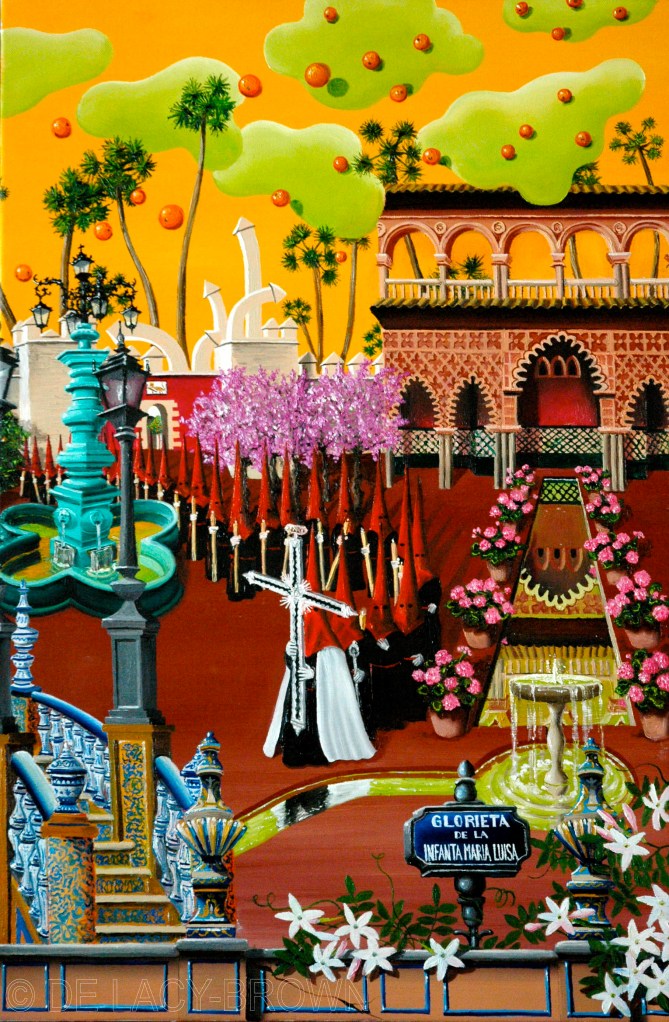
Seville Triptych - Canvas III (Oil on canvas, 2010 © Nicholas de Lacy-Brown)

The third canvas is testament to Andalucía’s complex religious history, from the Moorish architecture which features strongly in the Real Alcazar palace, to the staunchly catholic Semana Santa (Easter Week) parades which are famous throughout Andalucía but most especially in Seville. In the foreground there is a decorative sign from the Parque Maria Luisa, which appears to emanate from the modernist age of design, while in the background, the pointed battlements of the Moorish city walls appear freed from the uniform constraints of their design, playfully reaching for the skies.

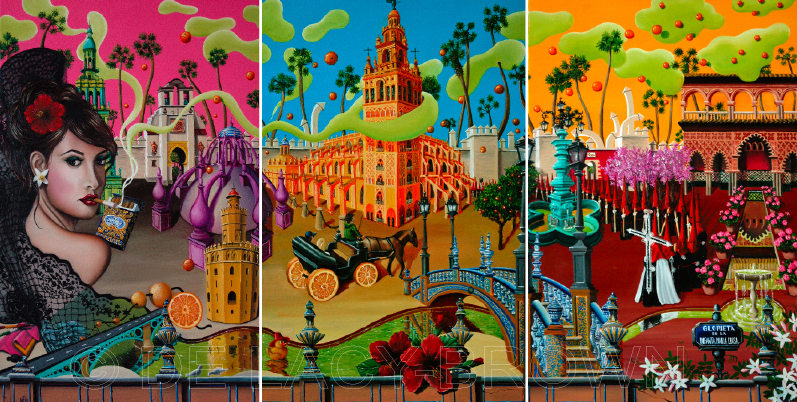
Seville Triptych - the complete triptych (Oil on canvas, 2010 © Nicholas de Lacy-Brown)

Across the three paintings, several unifying features dominate: In the immediate foreground are the walls and ceramic decorations of the Plaza de España, and behind it the River Guadalquivir which, in the second canvas becomes the pleasure pools of the Plaza de España and, by the third canvas, has turned into the Moorish pools of the Alcazar palace. In the background, the distinctive slender palm trees which pepper the cityscape and a shower of Seville oranges scatter the painting, while along the horizon, the walls of the Real Alcazar unify the canvas.

© Nicholas de Lacy-Brown and The Daily Norm, 2005-2012. Unauthorized use and/or duplication of the material, whether written work or artwork, included within The Daily Norm without express and written permission from The Daily Norm’s author and/or owner is strictly prohibited. Excerpts and links may be used, provided that full and clear credit is given to Nicholas de Lacy-Brown and The Daily Norm with appropriate and specific direction to the original content.

Why you should celebrate your Half Birthday

I like to think/ convince myself/others that, on the occasions when I exhibit too many childish traits for a fully-grown adult, my behaviour can be justified by virtue of my needs as an artist. After all, it was in the realm of childhood that the majority of us escaped into a world of make-believe, when our heads were filled with original, uncorrupted ideas, and when we would fully accept a fantastical story which, when imported into the adult world, would be derided as fanciful or shelved as being surreal and not-in-the-real-world. Having said all of this, I am not so childlike in my demands that, like the Mad Hatter in Alice’s Wonderland, I require an indulgent daily celebration of an “unbirthday”. What I do, however, celebrate every year is… my Half Birthday!

It’s a peculiarity to which those who know me have become accustomed, patiently tolerating the slightly eccentric annual demand I make of them in insisting that my half birthday is marked. I think it stems from my childhood when my parents, ever the diplomats, would give my sister and me a small present when the other was celebrating their birthday. In this way it meant that the one of us who was not celebrating did not feel left out. By coincidence, my sister’s birthday falls almost 6 months from mine, and consequently, long after my parents gave up on catering for our whims, I took it upon myself to celebrate my half birthday on an annual basis.

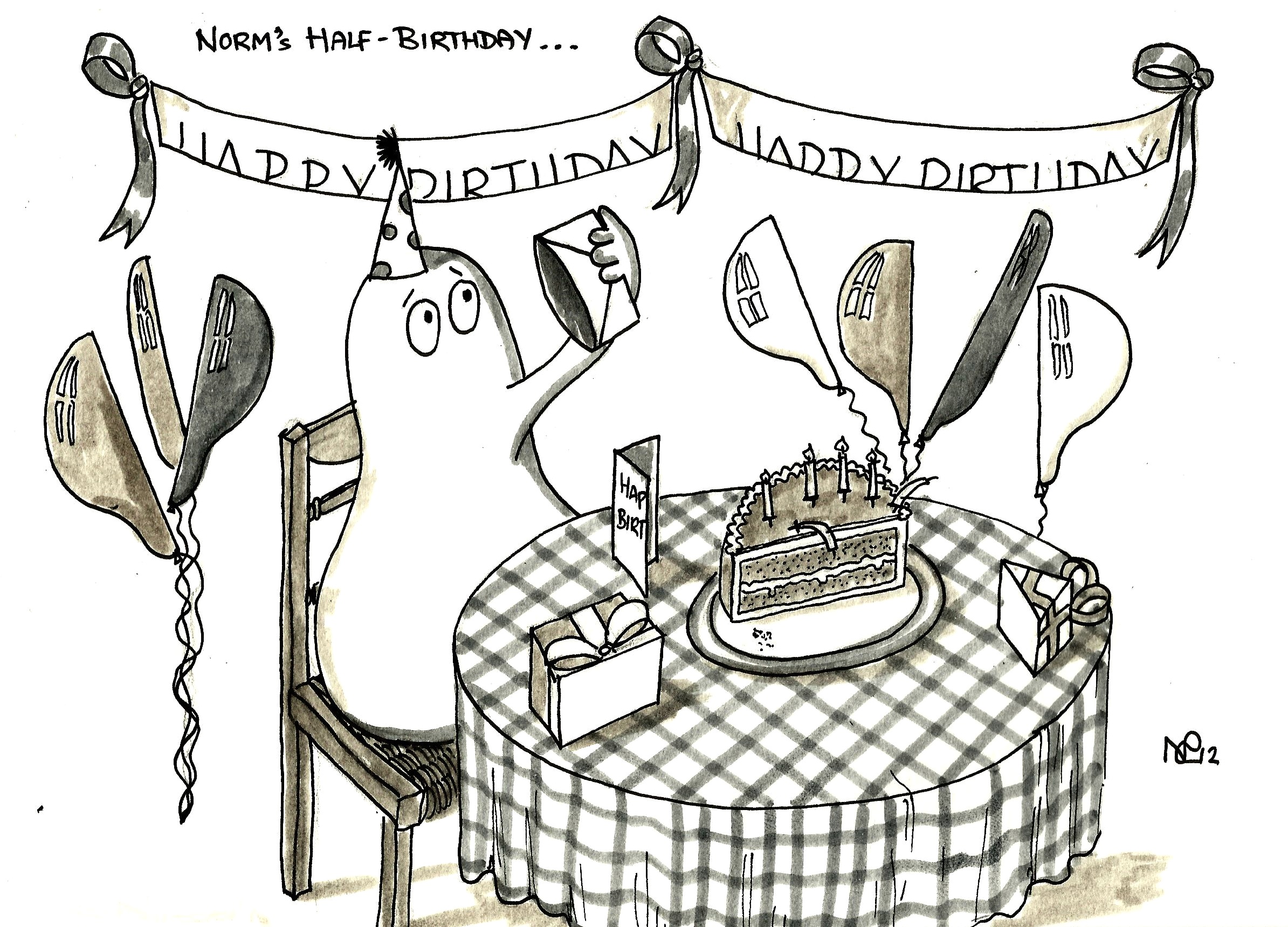
Norm's Half Birthday - Norm looks for the other half of his card (2012 © Nicholas de Lacy-Brown)

In practice no one actually gives me anything for my half birthday, and most people (including me) forget all about it. But on the occasion I do remember, I still use the date, unashamedly, as an excuse for out-of-the-blue celebrations, emotional blackmail and the like. I always remember my first year at university when my new friends, obliging my strange request, made me birthday cards which they then cut in half (I never did get the second half). This was followed by a massive half birthday party in my masters year, never, sadly to be repeated (spilt wine ruined my carpets so I quickly concluded celebrating my half birthday should be an altogether more sedate affair).

With the uni years well behind me, I really am now too old for all of this. Nevertheless, trying never hurt anyone, and since yesterday was my half birthday, I successfully persuaded my parents to join me in embarking on an impromptu celebration which included an extravagant afternoon tea out at Marbella’s very established Goyo tearooms, and dinner out at Zozoi – the darling of the Spanish expats – a fantastic French-Belgian brasserie in the heart of Marbella’s old town. And while I thought it may be a little demanding of me to insist on a cake (or half a cake) as well, judging by this amazing handbag cake I spotted in a shop window earlier, Marbella is clearly the place to pick up something special. I may try that one tomorrow…

Amazing Louis Vuitton inspired handbag cake in a shop window in Marbella

So why should you celebrate your half birthday? Well one birthday a year is pretty lousy when you consider there are 364 other days to get through. And after all, the Queen gets two birthdays doesn’t she. To me, it seems pretty reasonable to have a little celebration every six months – after all, being half a year older is just as much of a feat in my opinion. There is of course the slight issue that it will be yet a further reminder that you are getting older (I spotted a rather substantial grey hair the other day – nightmare) but all the more reasons to get yourself merry and insist your friends and family do the same. And if they complain, remind them that you could always start celebrating your quarter birthdays too. Or monthly. Now there’s a thought…

Cappuccino: No longer just froth and espresso

Cappuccino is no longer just a coffee. The café chain which brands itself after the popular italian coffee has rewritten the meaning of this favoured frothy drink. For in Cappuccino Grand Café, the cappuccinos are just the tip of the iceberg. The café group, which is now a predominant restaurant brand across the island of Mallorca, with branches also in Marbella and Valencia, as well as a handful in Jeddah and Beirut, is the ultimate in café chic. It’s exudes sophistication from every bubble of its creamy coffee froth. Its waiters are dressed to impress – with bow ties and black armbands, they are like butlers from a bygone era. Everyone is beautiful, from the staff to the customers who almost become more glamorous upon entering as they allow a wash of Cappuccino couture to penetrate and tantalise all over, as almond latte replaces a standard coffee, and cocktails and wine bubbles aplenty become the new still or sparkling. In the background, a carefully selected soundtrack resonates, wafting the space with Buddah-barish chill and soulfulness, while earlier coffee stops are accompanied by the timeless polyphony of jazz. And to top it off, Cappuccino has managed, almost across the board, to secure itself the very best of restaurant locations, so that in Marbella and Mallorca, you can savour a tranquil seaside view, while in Palma de Mallorca, locations in luxurious former palaces have been made the norm (as opposed to the Norm – let us not confuse the two).

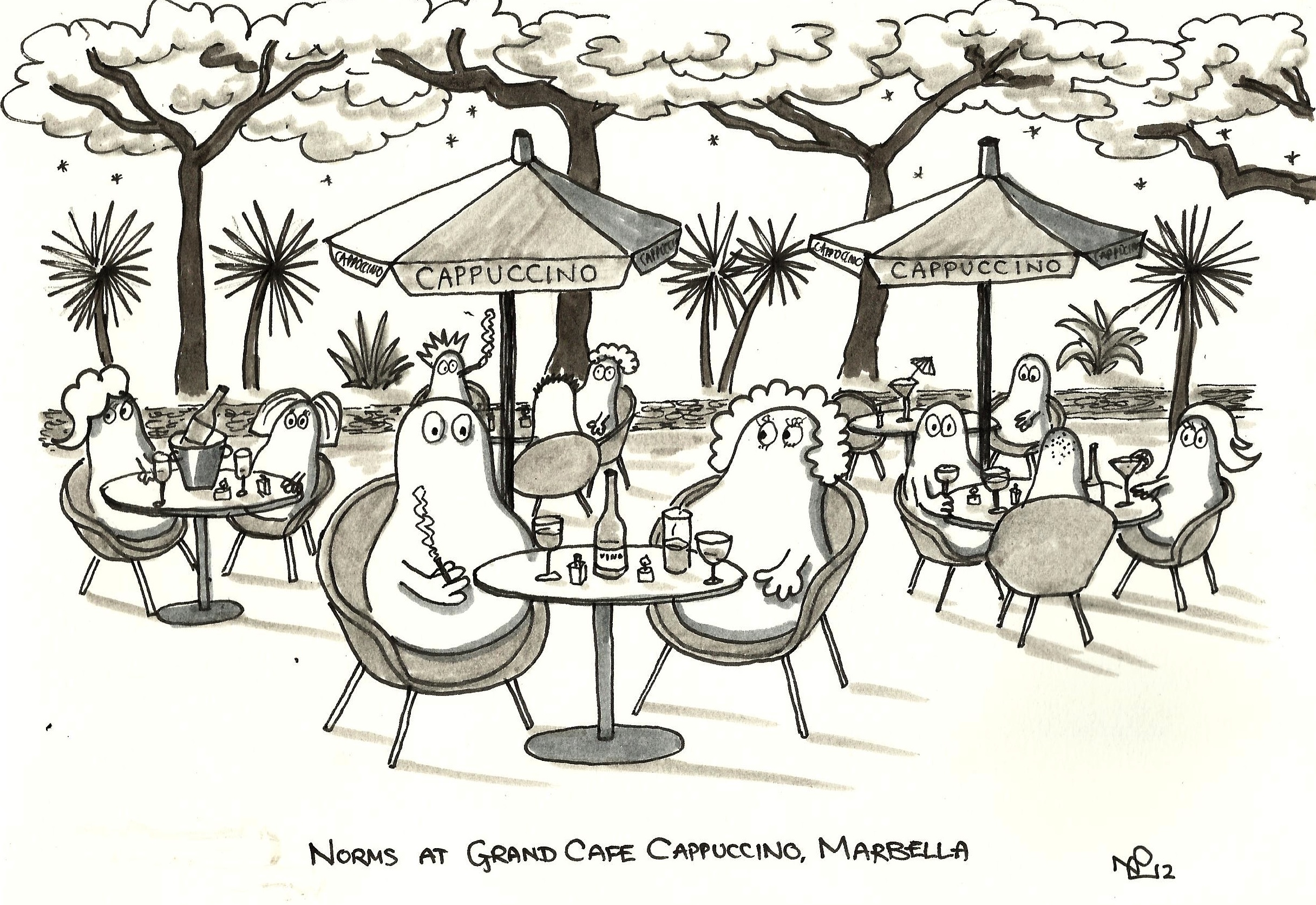
Norms at the Cappuccino Grand Cafe in Marbella (pen on paper 2012 © Nicholas de Lacy-Brown)

So why am I going on an all out campaign to promote this amazing café chain? Well it’s certainly not because they are paying me in free almond lattes (if only – although if the CEO of el Grupo Cappuccino happens to be reading this, please feel free to oblige). Rather, Cappuccino fully deserves its place in my search of all things indulgent and beautiful, because as a place to go for lunch, coffee, drinks or dinner, it is sophisticated, beautiful and ultimately satisfying.

Cappuccino first came to my attention last summer when a new branch opened in Marbella. Situated bang on the paseo maritimo next to the Mediterranean, in a quiet and very exclusive spot (Lord Sugar lives close by, as do those lucky few frequenting the opulent Marbella Club Hotel and other establishments on the Golden Mile), it benefits from superb views and is sheltered from any adverse weather conditions by a canopy of mushroomed pine trees and lush garden surrounds which lead up to the nearest luxury hotel stood behind it. When I went there for the first time, having stumbled upon it during a long walk out of Marbella’s centre, I fell in love. The music, the sunset, the staff and the food which, compared to many Marbella restaurants is very reasonably priced, were spellbinding. There I felt like a pop star, indulged, relaxed, contented.

Cappuccino, Marbella

Cappuccino's smooth almond latte

By coincidence, I had a trip booked to Mallorca a few weeks later and there, since it is the island from where the chain originally springs, Cappuccino has marked its claim to various scenic spots all over the island. Such was the beauty of their location that we spent nearly every day indulging in at least one meal in a Cappuccino – for example on the port front of the stunning natural harbour of Port d’Andratx, or in a central square in the charming medieval town of Valldemossa, just round the corner from the Monastery which laid host to one Chopin and his lover. In Palma de Mallorca, there are four Cappuccinos and a number of take away branches and, mercifully, barely a Starbucks in sight (I say barely as there blatantly is a Starbucks somewhere but I have become conversant in the habit of shunning them in cultural locations). These are perhaps some of the most opulent Cappuccinos, set in former palaces with quaint patio gardens and candlelit tables set amongst vast baroque colonnades. On Palma’s vast paseo maritimo, you can sup on the luxurious almond latte in full view of the gothic cathedral, while on Palma’s answer to Bond Street – the Passeig Borne – you can people watch to your heart’s content.

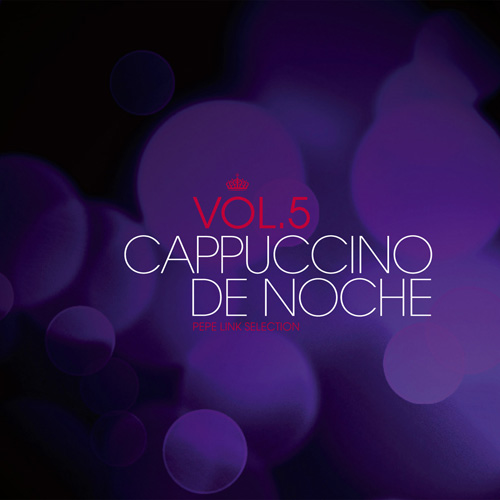
CD Volume 5 of Cappuccino's own sensational soundtrack

And what to do to savour Cappuccino’s magic once you get home? Well the atmospheric soundtrack playing in every café is happily available to purchase – I have all five volumes of the Cappuccino CDs and play them on an almost continuous repeat. The first four make for marvellous coffee music – tinkling jazz and re-imaginings of popular melodies – while the fifth volume is the ultimate in Mediterranean chill.

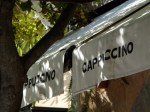
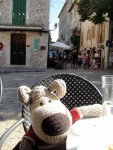
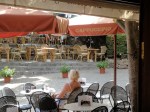
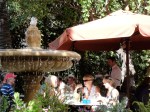
I shall rapture no further, but leave you instead with a selection of snaps I have taken at the various Cappuccinos in Marbella and Mallorca. In the meantime, Cappuccinos website can be found here, including details of all the CDs.

Vive le Cappuccino!

© Nicholas de Lacy-Brown and The Daily Norm, 2005-2012. Unauthorized use and/or duplication of the material, whether written work or artwork, included within The Daily Norm without express and written permission from The Daily Norm’s author and/or owner is strictly prohibited. Excerpts and links may be used, provided that full and clear credit is given to Nicholas de Lacy-Brown and The Daily Norm with appropriate and specific direction to the original content.