Skip to content

Posts from the ‘Art’ Category

Saloua Raouda Choucair – Geometric East meets Abstract Expressionist West

I hadn’t heard of Beirut-born artist Saloua Raouda Choucair before I dropped in, unplanned, to a small retrospective of her work at Tate Modern yesterday. In fact, as the literature accompanying the show rather depressingly tells us, “despite ceaselessly producing work for the best part of five decades, Choucair remains relatively little known internationally [and]… has not yet reached her deserved position in art history”. This is undoubtedly the reason then why our paths have not crossed each other before (and, I suppose in part has something to do with the fact that her name does not exactly spring to mind all that easily). Yet the moment I walked into the four room exhibition at Tate, encouraged to do so by the vivid bright colours of her almost fauvist abstract portrait which graces the posters of the show, I was in love.
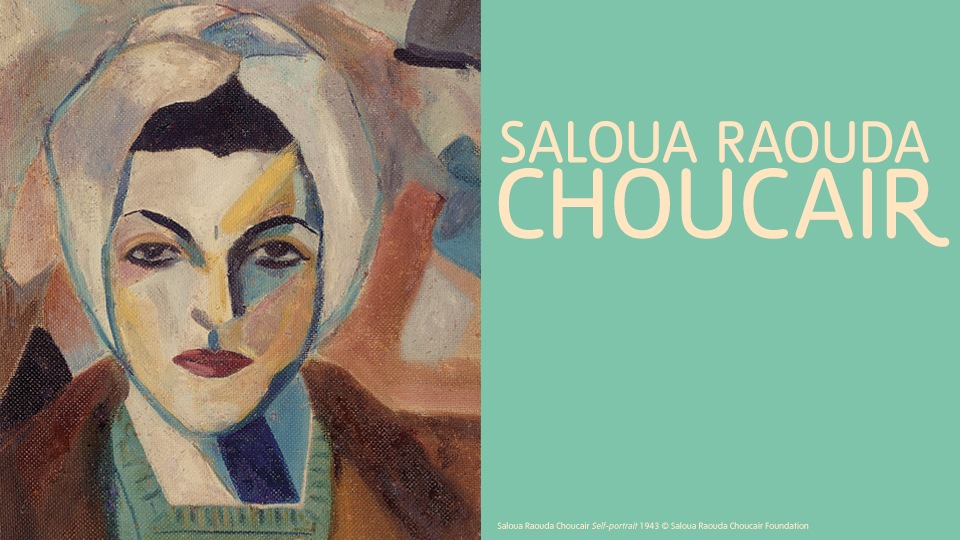
Choucair poster

I was in love first and foremost with her paintings, largely gouache abstract compositions, with geometric forms criss crossing over each other in a multi layered colour explosion, to her Les Peintres Celebres collection, a wonderful set of group portraits, where the form of the nude has been flattened and abstracted, and the poses reduced to softened linear forms.
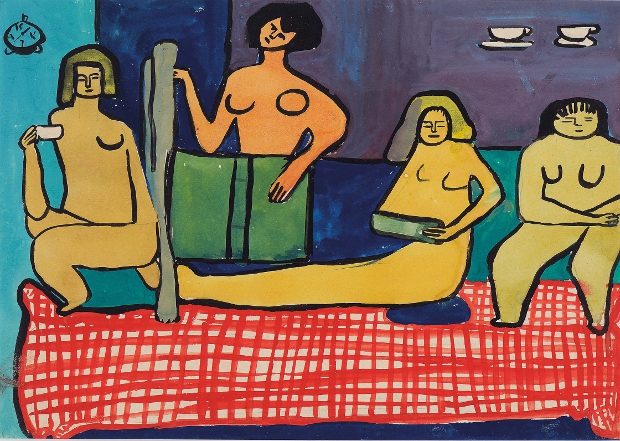
Les Peintes Celebres (1948-9) © Saloua Raouda Choucair Foundation
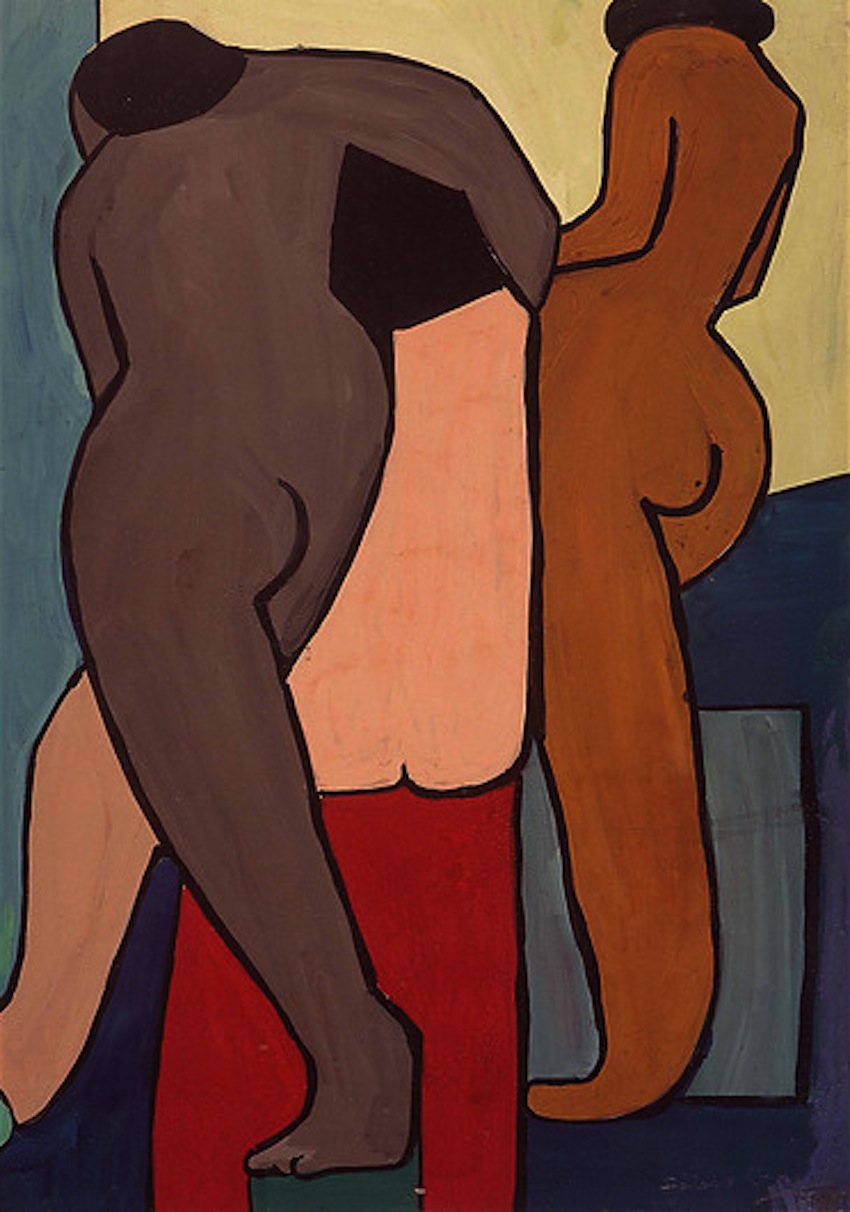
Les Peintes Celebres (1948-9) © Saloua Raouda Choucair Foundation

Untitled (1948-9) © Saloua Raouda Choucair Foundation

Untitled (1948-9) © Saloua Raouda Choucair Foundation

Paris-Beirut (1948) © Saloua Raouda Choucair Foundation

Paris-Beirut (1948) © Saloua Raouda Choucair Foundation

Choucair’s paintings very clearly demonstrate the influential hand of cubist figurative painter Fernand Léger, under whose influence she came in 1940s Paris, and yet as she moves from figure paintings to her abstract composition, you can see equally clear evidence of the extent to which she was inspired by the geometric forms of Islamic art, which had entranced her when she became acquainted with them in Cairo. These “Fractional Modules” as she calls them, were almost certainly my favourite paintings in the show. Simple shapes interwoven and multi-layered resulted in a wonderfully satisfying overall abstract form, an image so complex in its pictorial language (despite the repeated use of a single shape or form) that it reminds me of the same level of aesthetic satisfaction that can be gleaned from those stunning patterned tiles and plaster work in the great Islamic palaces of Southern Spain.

Composition in Blue Module (1947-51) © Saloua Raouda Choucair Foundation

Composition in Blue Module (1947-51) © Saloua Raouda Choucair Foundation

Fractional Module (1947-51) © Saloua Raouda Choucair Foundation

Fractional Module (1947-51) © Saloua Raouda Choucair Foundation

Rhythmical Composition in Yellow (1952-5) © Saloua Raouda Choucair Foundation

Rhythmical Composition in Yellow (1952-5) © Saloua Raouda Choucair Foundation

Composition with Arcs (1962-5) © Saloua Raouda Choucair Foundation

Composition with Arcs (1962-5) © Saloua Raouda Choucair Foundation

However in addition to the paintings, I also loved Choucair’s sculptures, which became her main preoccupation from the 1950s onwards, and into whose multi-dimensional forms the language of abstract expressionism has translated. Her works often reminded me of British greats Moore and Hepworth, particularly her use of strings strung across her metal sculptures to form rounded ephemeral planes. But I loved in particular her “poem” works – like a pile of bricks but each somehow melting under the tender hands of their mother-sculptor, curving into one another in an organic embrace.
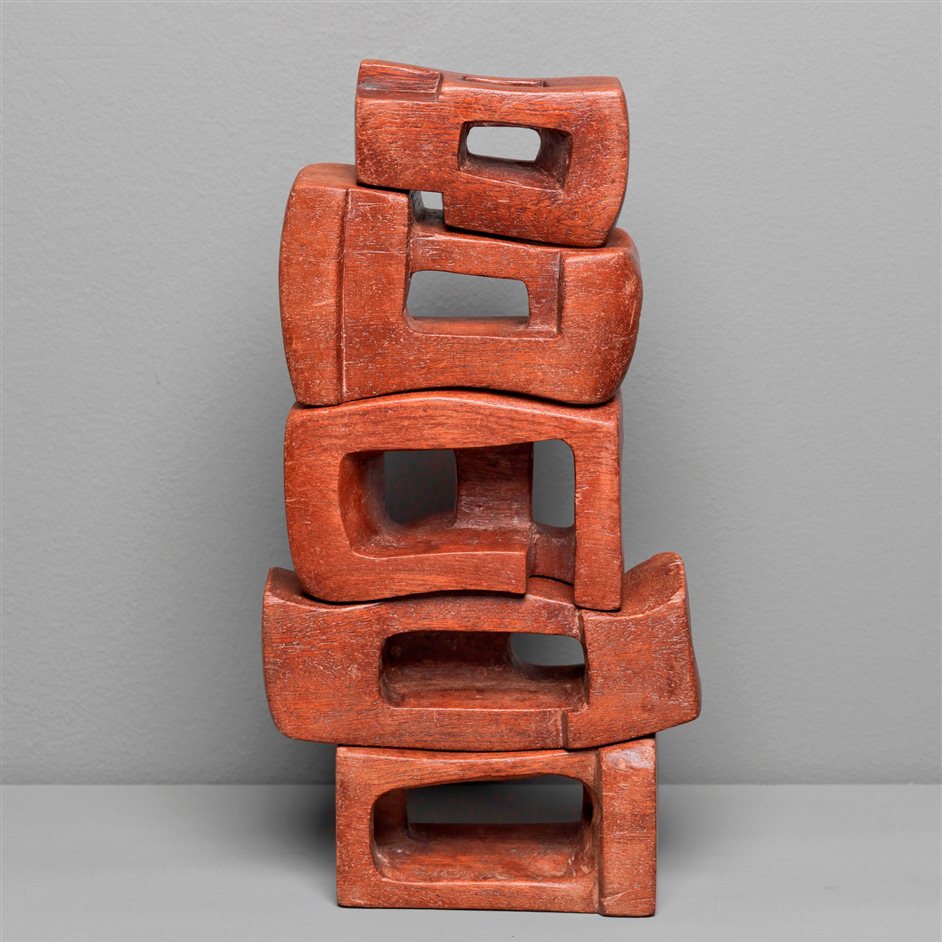
Poem (1963-5) © Saloua Raouda Choucair Foundation
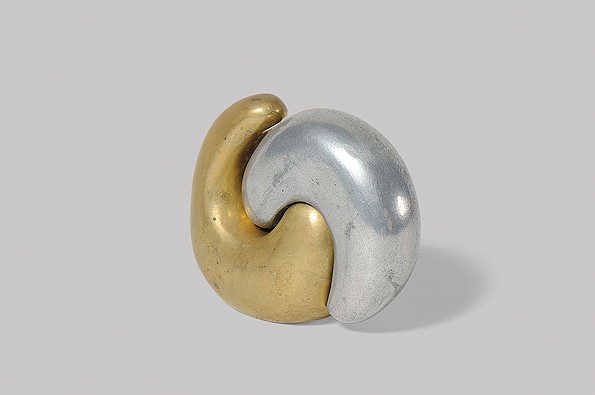
Poem (1963-5) © Saloua Raouda Choucair Foundation

Dual (1978-80) © Saloua Raouda Choucair Foundation

Dual (1978-80) © Saloua Raouda Choucair Foundation

The screw (1975-7) © Saloua Raouda Choucair Foundation

The screw (1975-7) © Saloua Raouda Choucair Foundation

But perhaps the most powerful piece in the exhibition is  Two=One (1947-51), one of Choucair’s painted compositions which had been hanging in her Beirut flat when a bombing raid rained down on the city during the Lebanese civil war in the 1980s, resulting in glass from one of her cabinets smashing and piercing the surface of this abstract painting. Thus the painting bears witness not only to that history, but, as Tate puts it, to the “circumstances through which Choucair not only survived, but continued to work with energy and enthusiasm”. Hopefully, with this superb exhibition  hosted at the very heart of the Britain’s art capital, Choucair’s enthusiasm will finally bear fruit as she becomes recognised as an internationally important abstract artist, under whose skilful guise Eastern islamic geometry met with western Expressionism with stunning results.

Two=One (1947-51) (complete with hole at its centre)  © Saloua Raouda Choucair Foundation

Two=One (1947-51) (complete with hole at its centre) © Saloua Raouda Choucair Foundation

Soloua Raouda Choucair is on at Tate Modern until 20th October 2013.


Life Drawing: my first (presentable) nude

As well as discovering the joy of printmaking, I’ve spent the last few weeks attending once-weekly life drawing evening classes at Chelsea College of Art in London. Because I’m a self-trained artist, I really notice the gaps that exist at the foundations of my artistic ability. This is more noticeable when I attempt to draw or paint scenes of people. Give me a sitter and I can paint their portrait no problem. But ask me to draw a figure out of thin air, and a rounded blobby Norm is the best you’ll get.

So this year I enrolled in a life drawing class to try and fill in the gaps of my basic training. And after 5 weeks in the attempt, I have finally drawn a nude which I don’t want to chuck straight in the bin.

nude

It’s far from accomplished, and very clearly unfinished (our time was limited – this is the stage I got to after about 45 minutes in the attempt). But I am delighted that finally I have been able to draw something which at least resembles the human form.

Which just goes to show, practice makes (closer to) perfect.

Printmaking Progress II: Aquatinting

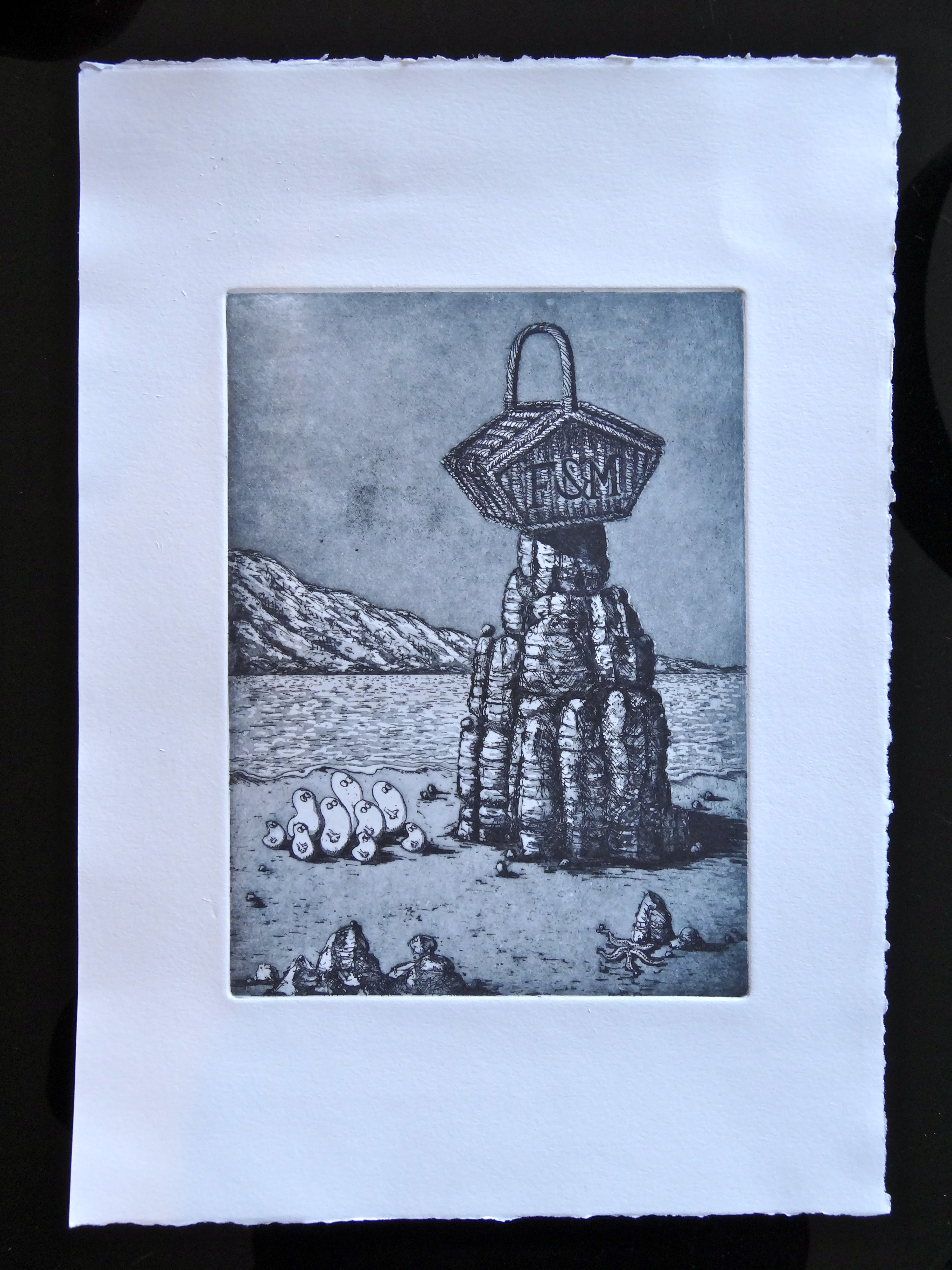
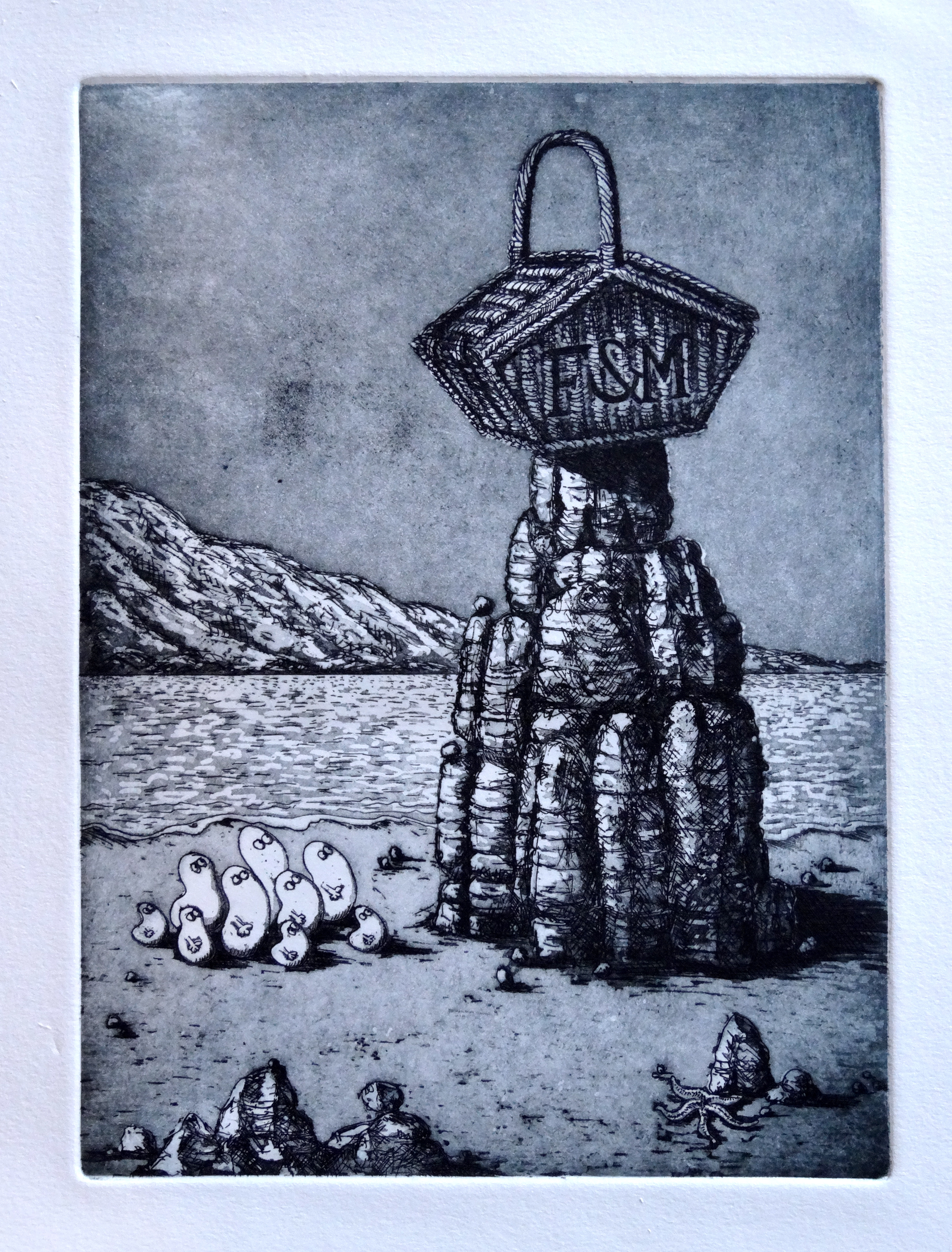
Being a self-trained artist, and so lacking the basic overview which art college provides of the many mediums which an artist has at his or her disposal, I became so entrenched in the world of painting for so many years that my recent discovery of the world of print has come as a complete revelation. Now over midway through an intermediate course in etching, I have taken to the medium like a duck to water. For not only does the medium transfer all of the skills of draughtsmanship which I have been mastering over the years in painting and more recently sketch, but through the sheer narrowness of the needle upon ground it enables me to pack the kind of detail into my etched images that I love. So, in my now advanced second etching, of a Fortnum and Mason’s hamper balanced upon a craggy rock, I have been able to go to town on the detail of the wicker, the rock texture, the little Norms looking up at the rock and the mountain and sea in the background.

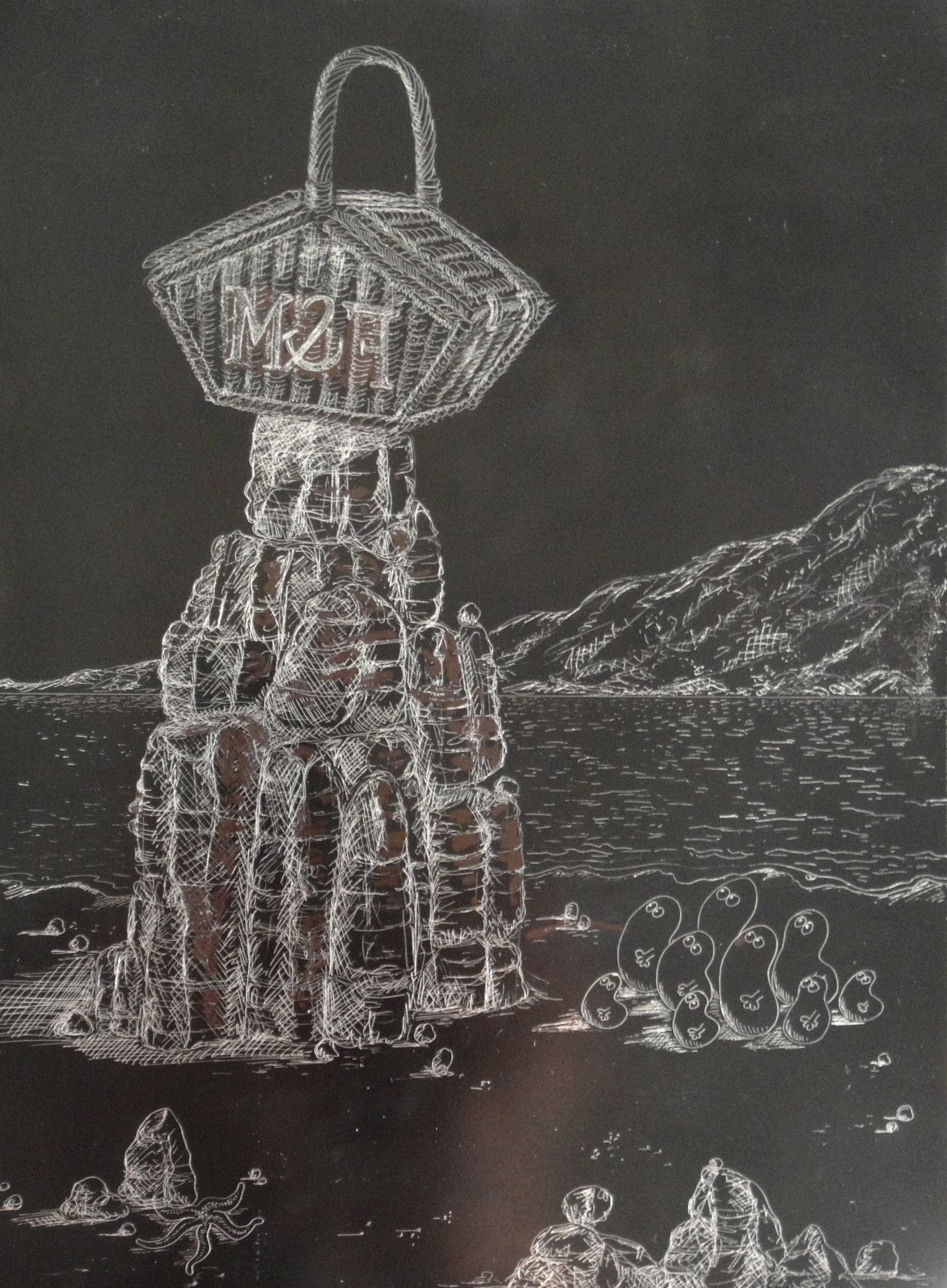
Over the last two weeks, I have developed my etched image from metallic reverse image in black ground, to simple line drawing etched into metal and printed in reverse, to an image now loaded with different tonal variety achieved through the process of aquatinting. I am not sure why the technique has the name it does – I imagined it to involve some sort of watery application, a little like applying watercolours to a finished print. But in fact it involves no water at all. Rather, aquatinting is the process by which tone is added to the etching plate through measured re-exposure to acid. It works a bit like the Benday dots which Lichtenstein made famous – apply thousands of little dots to protect the metal and when exposed to acid, only those areas of the metal not covered by dots will etch and turn darker as a result. Step back and with the light dots and the dark exposed plate combined you get a shade of grey. The longer the exposure to acid, the darker the plate becomes, as the distance between dots increases.

My finished tonal etching after aquatinting

My finished tonal etching after aquatinting

Following this rationale, aquatinting involved first the exposure of the whole plate to a kind of rosin dust which was allowed to settle upon the plate under controlled conditions (it’s very toxic, hence the rather attractive gas mask we were required to wear by way of protection). This was then hardened over a gas fire. Then we had to protect details of the plate which we wanted to remain white, before dipping the plate back in acid, gradually protecting more and more of the plate so that in its final dip into acid, the only part of the plate left exposed was the parts of the image I wanted to print the darkest.

The result is a plate now textured differently depending on the exposure to acid and then, once the ink is reapplied to the plate, an image which comes alive with different tonal shades. Owing to what is a fairly hopeless attempt to explain the aquatinting process above in words, perhaps the process will become clearer by looking at my finished print itself.

DSC00569

You will see that the Norms and the highlights of the basket and rock have remained white – that’s because I covered those with a black “stop-out” before re-exposing the entire plate to acid. The next lightest shade is the sand – this pale grey results from a quick 15 second dip into acid. This was then covered while I re-exposed the plate, allowing the sky to go darker, followed by the basket, the shadows of the rock and so on.

And there you have it, my first finished etching with aquatint applied – I am so, so delighted with the result and thrilled that I have taken so naturally to the etching medium. I have a feeling that this will not be the last.

The etching before aquatinting

The etching before aquatinting

And before that, the initial image drawn into the "ground" layer

And before that, the initial image drawn into the “ground” layer

Related articles

Autobiographical Mobile: The finished article

C’est fini! At last, my autobiographical mobile is complete! Started in June last year and completed right at the end of April of this year, the maths alone dictates that this has been a long project in the making. While my blog account of the work has been posted in respect of 25 full days of painting, a great number of evenings and hours grabbed in otherwise hectic weeks have been spent working on this piece, one of the most comprehensive projects of my art career so far. Yet the protracted length of the project (augmented by the fact I work full-time and have been undertaking a whole host of other artistic projects in the meantime) has also been one of its benefits – feeling no rush, I managed to achieve a more perfected finish on each of the areas I was working on, and likewise, owing to the passage of time, the painting has become something of a developing story in itself – a true artistic reflection of the changing circumstances of my life.

Autorretrato (Autobiographical Mobile) 2013 © Nicholas de Lacy-Brown, oil on canvas

Autorretrato (Autobiographical Mobile) 2013 © Nicholas de Lacy-Brown, oil on canvas

And how it looked on the first day of painting

And how it looked on the first day of painting

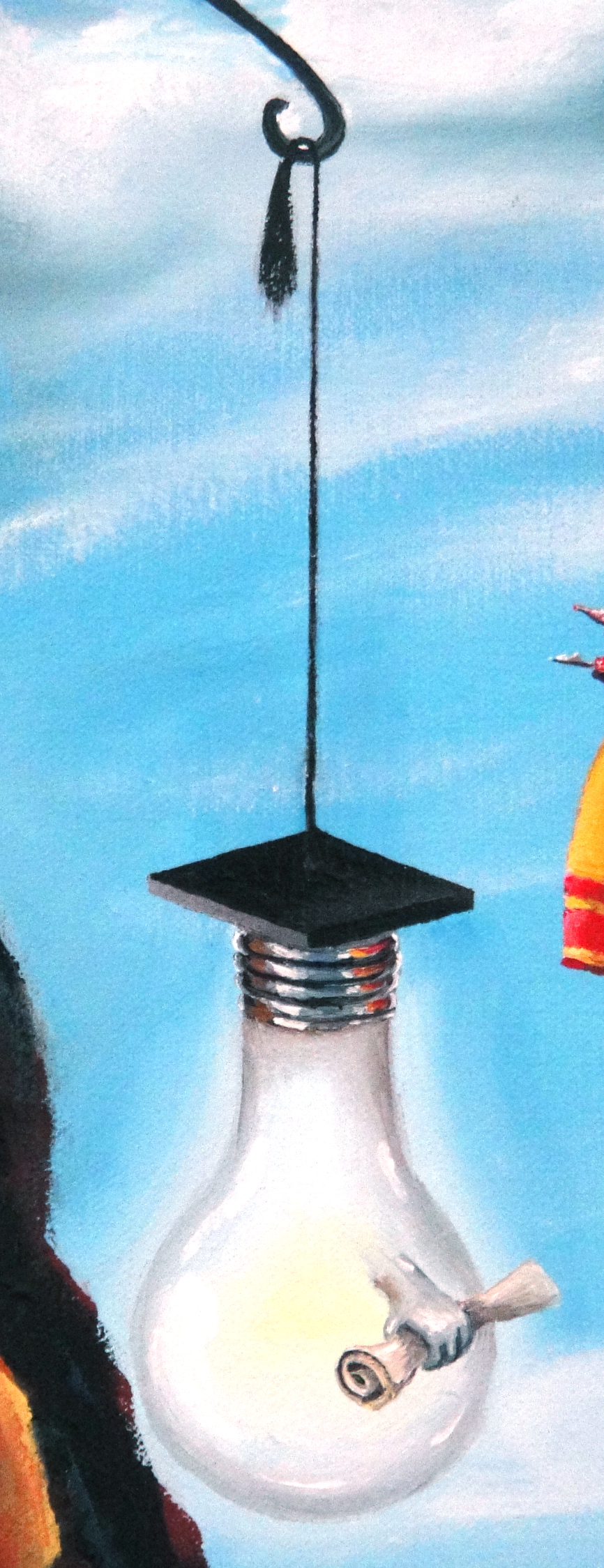
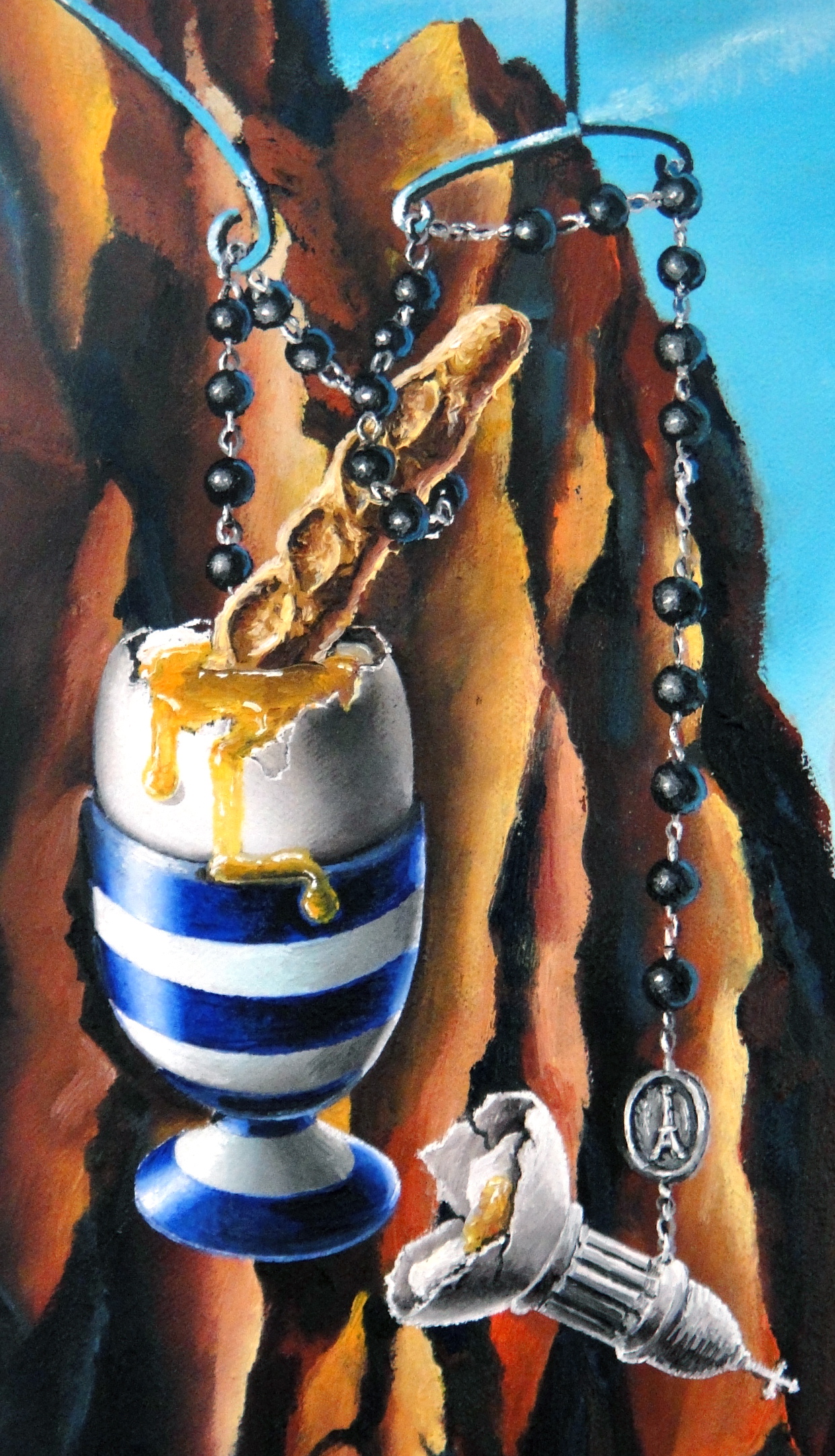
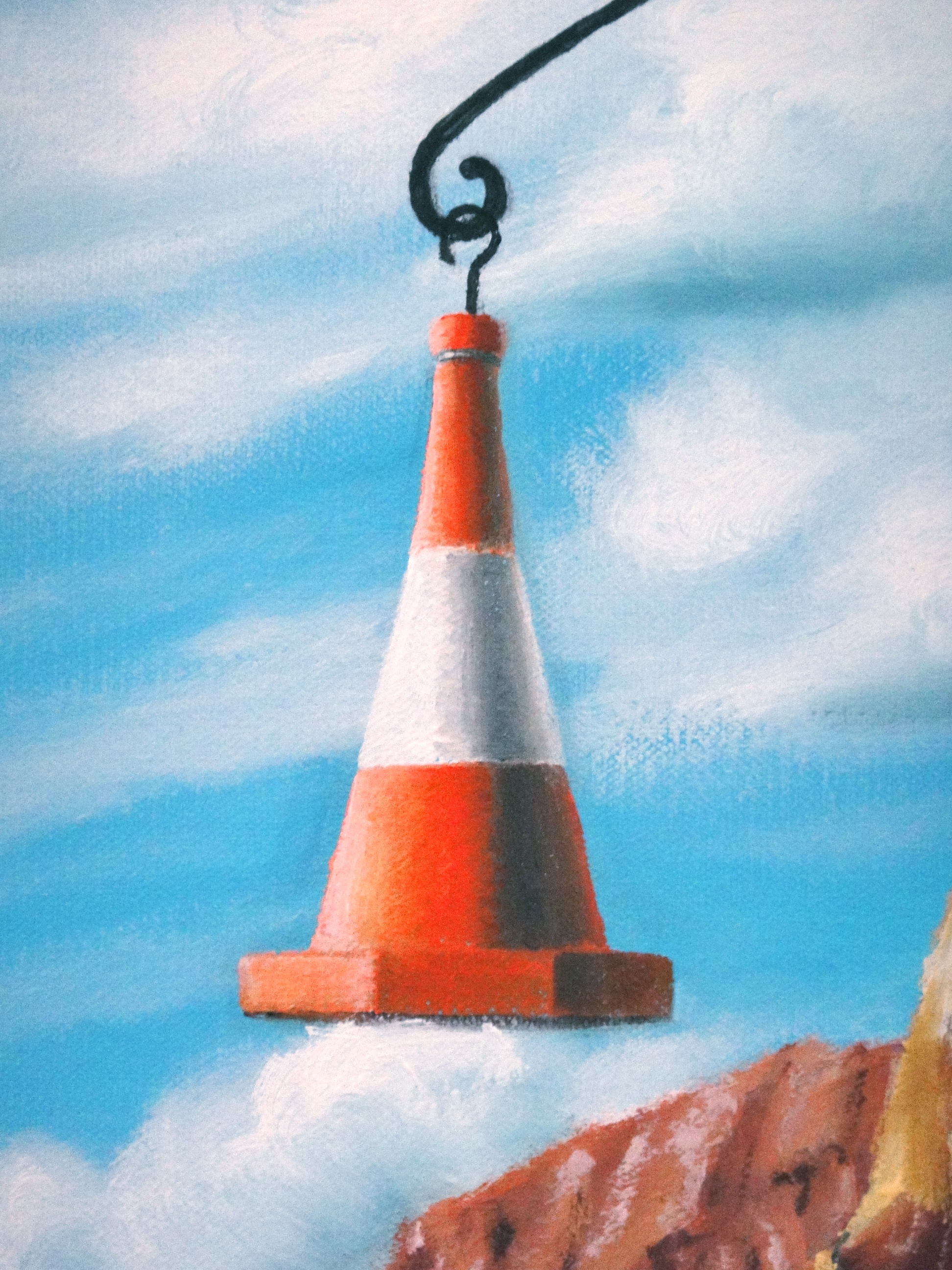
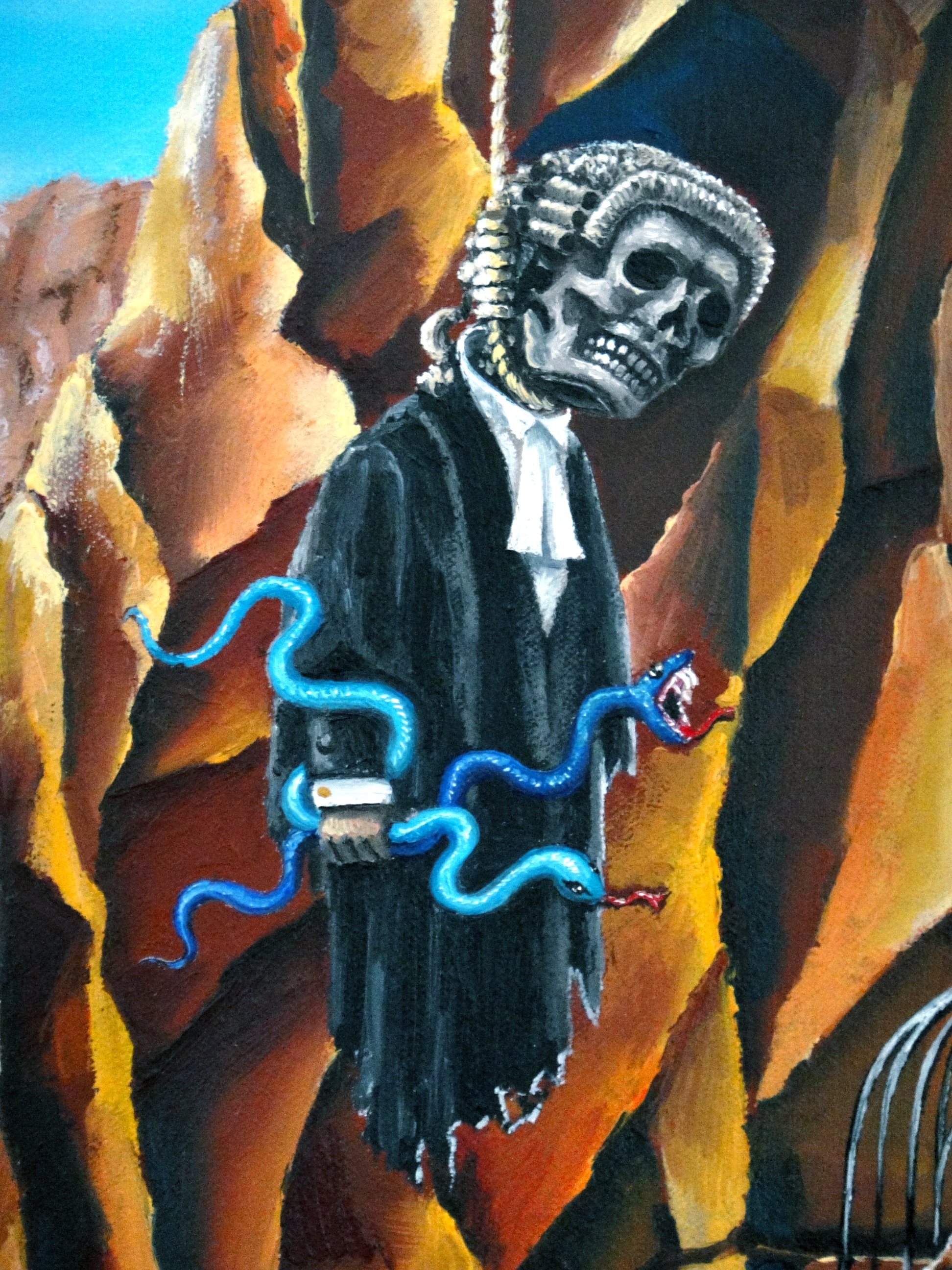
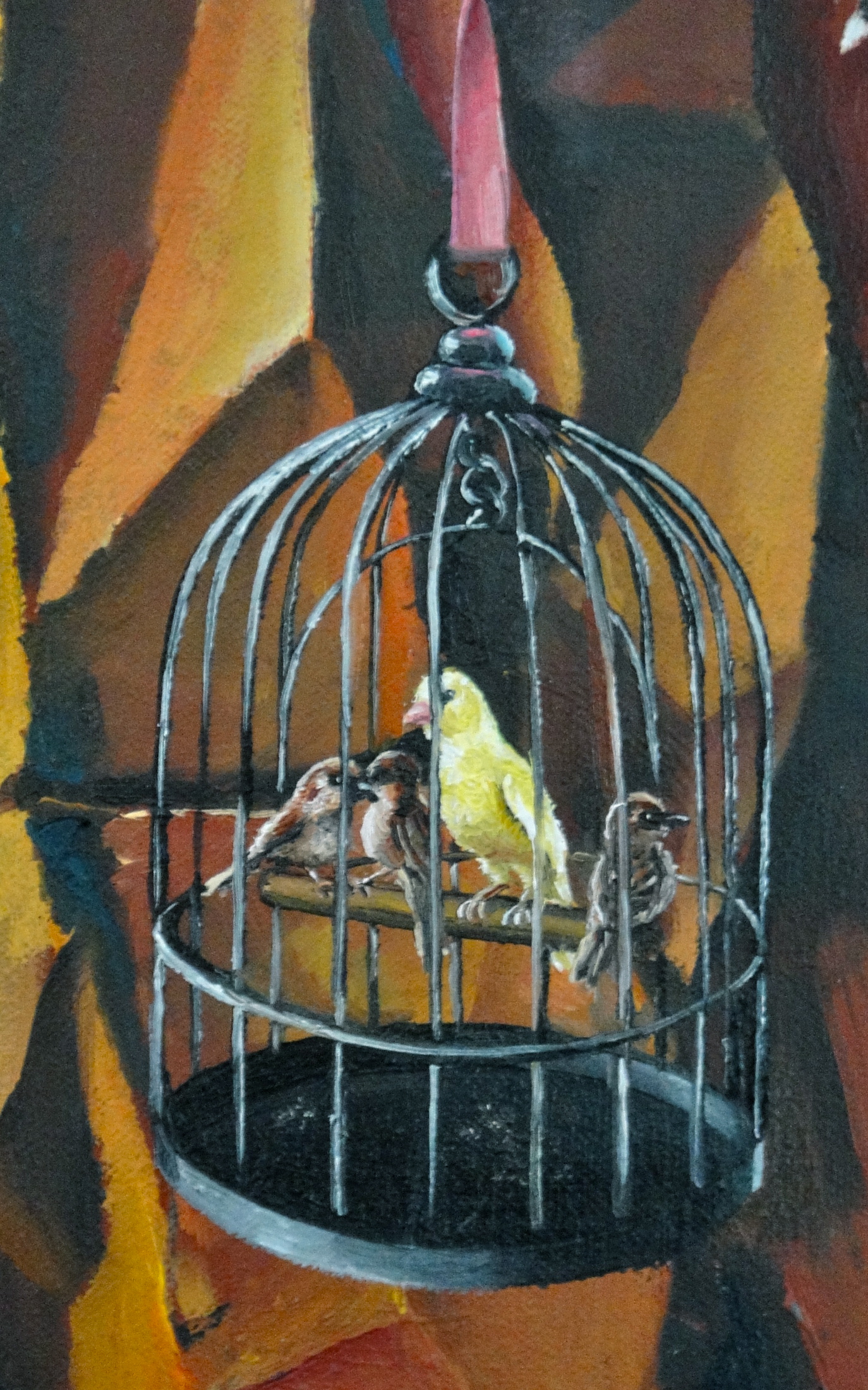
I have extrapolated upon most of the details in the painting in former posts explaining my progress, however in very brief terms, the painting is an autobiographical self-portrait told through symbols and metaphors rather than a head and shoulders portrait. At the centre of the canvas, a large free-standing mobile, in the style of the great mobile-artist Alexander Calder, represents my life. At its base, my constant companions, Fluffy and Bilbao, teddies given by my Partner and me to one another shortly after we first started dating, represent the very consistent, anchoring and significant role of our relationship in my life. Then above, the mobile acts as an autobiography balancing out the various positives and negatives in my life so far. DSC07673 On the left: the positives – all the stuff I love and which has helped to shape me into the person I am today. First up, Spain and art history, symbolised through the iconic image of one of Span’s master-artist’s Infanta portraits, whose dress is in turn decked out to resemble the sandy colours of a Spanish bull ring, while her sunglasses represent Spanish tourism, the industry which has been so important in bolstering the economy of modern day Spain. DSC07623 DSC07619Next, the symbol of enlightenment and creative/ academic success: This is a Norm-shaped lightbulb decked out in a graduation mortar-board and holding a graduation scroll. This hybrid Norm/ bulb character represents my achievements both as an illustrator-blogger and as a lawyer, and stands for the importance of learning and development in my life. Further along, the egg: This is a representation of my art career, and also my love of Paris (where I was engaged and from which I have been inseparable for at least 15 years). Paris was the inspiration for my first major painting, Le Paris Formidable, a creation which I consider to be a milestone in my artistic career and the moment I began to take painting seriously. In that image I painted the Sacre Coeur church as a series of eggs and egg cups (the white domes of the basilica reminding me of eggs), while plunging into the egg, an egg soldier is replaced by a French baguette, held up by a rosary, representing that for me, art is like my religion. DSC07613 Finally in the positives, a sun cream bottle represents my love of travel, and spurting from it, a representation of my love of gastronomy as shown through a mixed and bounteous flow of prawns, marie rose sauce, chorizo, strawberries and wine, all combined together through a meandering strand of spaghetti which in itself metamorphoses from the Fortnum and Masons hamper sat on a rock below it – the hamper representing my love of the finer things in life. DSC07617 Onto the negatives, and up first my 2008 accident – the life-changing event was informed so much of my art and altered my life, both physically and mentally forever. DSC07624 Then the death of my career at the self-employed bar, a hugely difficult time when I suffered stress close to mental breakdown, prejudice, bullying and was effectively cast out of the profession because of the small-minded prejudices which come of a profession in which survival, without fitting into the Oxbridge stereotype (the blue snakes), is all but impossible. DSC07630 Then the birdcage, a symbol of entrapment, both for my sister trapped by the grave fate which arose upon the death of her husband leaving her to bring up three toddlers alone, and for me in my career. DSC07634 Finally the Apprentice – a direct reference to another of my paintings, Nicholas in the Renaissance, a tongue-in-cheek self-portrait in which I parodied a depiction of Saint Sebastian to represent the injustices I felt I had suffered when I appeared in the acclaimed BBC television series, The Apprentice series 4. The sugar cube of course alludes to Lord Sugar, the famous business man for whom the “Apprentices” seek to work under the television format. DSC07645 Meanwhile in the foreground, an expanse of water separates my current life from my childhood, albeit only marginally, and that youth is symbolised my a self-standing rock in the bottom right of the canvas representing my family, a symbol which took on a whole new poignancy when my brother-in-law was killed last December. Meanwhile, in the rock pools to the left, also representative of my childhood, the smallest of shells represents the heady days of my youth when climbing over coastal rocks I would collect shells, affixing them onto little snails I had modelled which I would then sell at local fairs. Some could say it was the start of my art career. They were certainly formative years. DSC07582 DSC07648 DSC07610 So there we have it, my life on a large (120cm x 120cm) canvas in oil paint. I’m awfully proud of this painting, and also glad to have persevered over such a protracted period. The result is a truly reflective glimpse of my life as it stands and also acts for me as a kind of closure on all that is past. Now I look forward to a whole new chapter of my life, with all the artistic expression which will inevitably go hand in hand alongside it.DSC07661 © Nicholas de Lacy-Brown and The Daily Norm, 2001-2013. Unauthorized use and/or duplication of the material, whether written work, photography or artwork, included within The Daily Norm without express and written permission from The Daily Norm’s author and/or owner is strictly prohibited. Excerpts and links may be used, provided that full and clear credit is given to Nicholas de Lacy-Brown and The Daily Norm with appropriate and specific direction to the original content.

George Bellows: Modern American Life

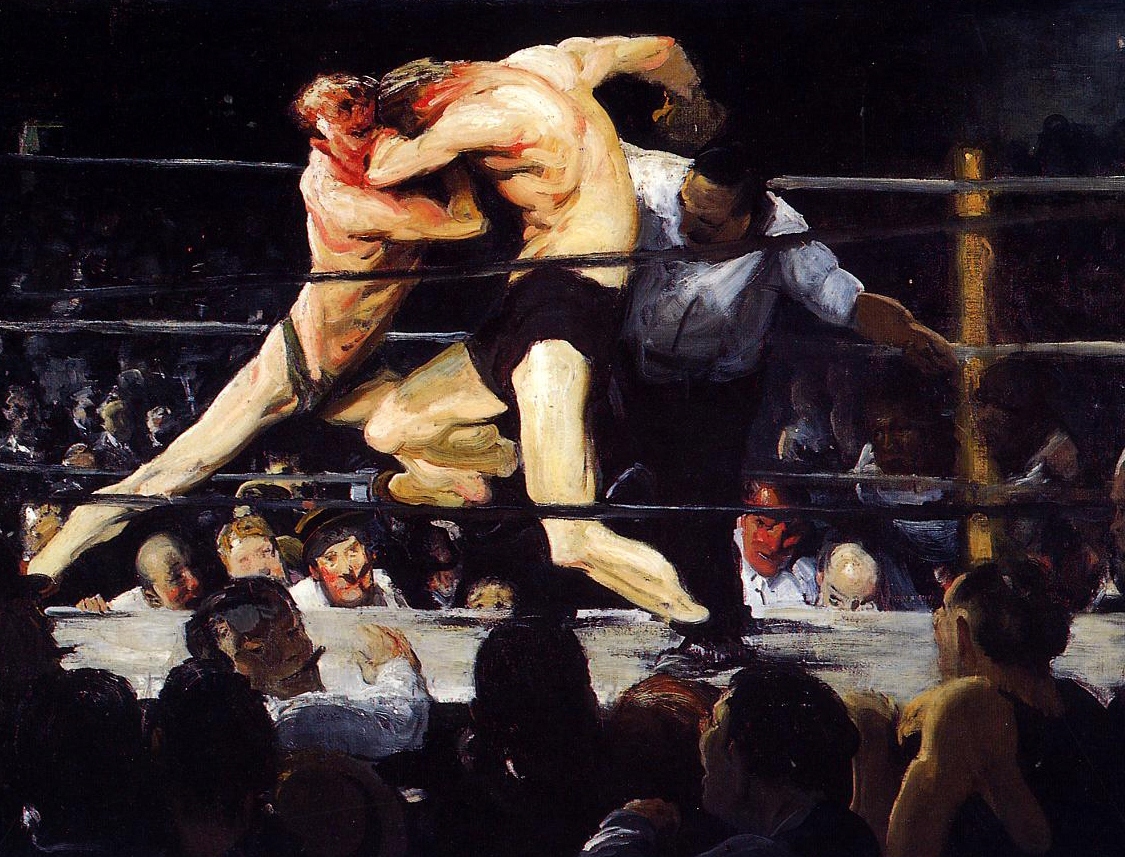
Bulging, twisting angry red bodies reminiscent of Francis Bacon’s cannibalistic, melting forms; great muscular bodies gripped in a violent embrace; long horizontal lines capturing the figures within an illuminated, elevated fighting platform; and a blood-thirsty zealous crowd, their faces hideously disfigured as they vie for blood, sweat and mighty great punches on their night out at the boxing ring – these are the captivating images of the 1900s boxing underworld for which the American artist, George Bellows, is renowned, and which form the focus of the Royal Academy’s new exhibition: George Bellows 1882-1925 Modern American LifeYet as the exhibition attempts to point out, Bellows painted much more than the poignant punches of his most famous images.

I wasn’t aware of Bellows before this show – and I excuse this gap in my art historical knowledge by virtue of the fact that this is the first Bellows retrospective to ever come to the UK, and because, to my knowledge, no or few Bellows works are held in the UK national collections. Moreover, while Bellows was a classmate of the much celebrated Edward Hopper, his career was much shorter – he died at a poultry 43, barely before he had ever got going. And yet the works which he did complete in his short life present us with an unparalleled view of turn-of-the-20th century New York, focusing on the many facets of a city in flux; from the gritty and sinister sweaty boxing underworld and the bustling expanse of Times Square, to the elegant perambulations of the richer citizens in out of town parks; from traumatic, emotionally intense depictions of war, to almost fantastical, saccharine scenes of picnics and fishermen in the outer countryside surrounding the city.

Club NIght (1907)

Club NIght (1907)

Stag at Sharkey's (1909)

Stag at Sharkey’s (1909)

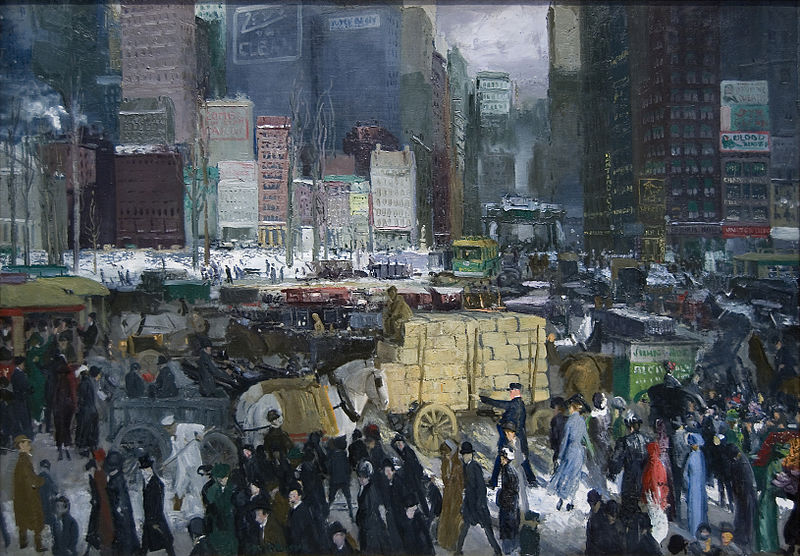
It’s perhaps no wonder that Bellows was so undyingly fascinated by New York City. Coming from a comfortable middle-class Ohio background, he would have been unprepared for the extremes of the city when he arrived there at just 22 years of age. Yet falling under the influence of artist Robert Henri, who was his teacher at the New York School of Art and who encouraged his students to eject the idealised and sentimental depictions of life favoured by the art scene at that time, and instead pursue a more unique expression of reality, Bellows soon found himself seeking out the more insalubrious, undesirable quarters of the city, and there depicting some of his most renowned works, from groups of naked immigrants bathing in the city’s dirty rivers, and builders clearing vast blocks of the city to construct a huge new homage to the modern railway, to the great bustling, smokey squares of central New York, full of workers and citizens from every spice of life, and of course those wonderfully intense boxing masterpieces.

New York (1911)

New York (1911)

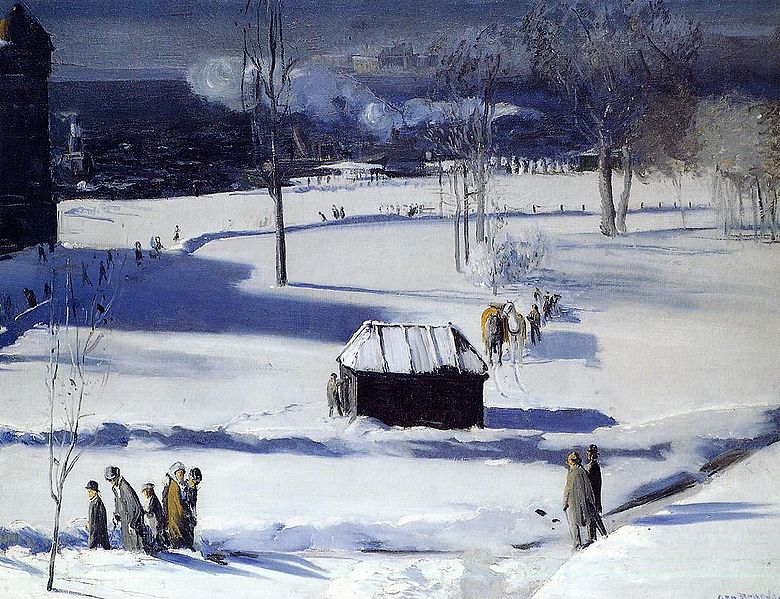
But Bellows did not limit himself to this harsher side of New York. Following his initial trawl through the unsavoury and illegal hangouts of the city, he soon moved onto depictions of a more civilised, elegant facade, with paintings of strolling couples, of elegant groups laden with white parasols and large sunhats picnicking out in the parks like something straight out of Seurat’s paintings of Paris, and of families walking out amongst snowy hills and landscapes. This is a changed side of Bellows, but no less fascinating to behold, not least because it somehow fits uneasily into the common perception of the New York of these times, and because, by comparison with Bellow’s earlier body of work, this happy, idle lifestyle appears almost reckless in its apparent disregard for the hardship of the real gritty city which lay at the heart of the nearby urban sprawl.

A Day in June (1913)

A Day in June (1913)

Summer Night, Riverside Drive (1909)

Summer Night, Riverside Drive (1909)

Blue Snow the Battery (1910)

Blue Snow the Battery (1910)

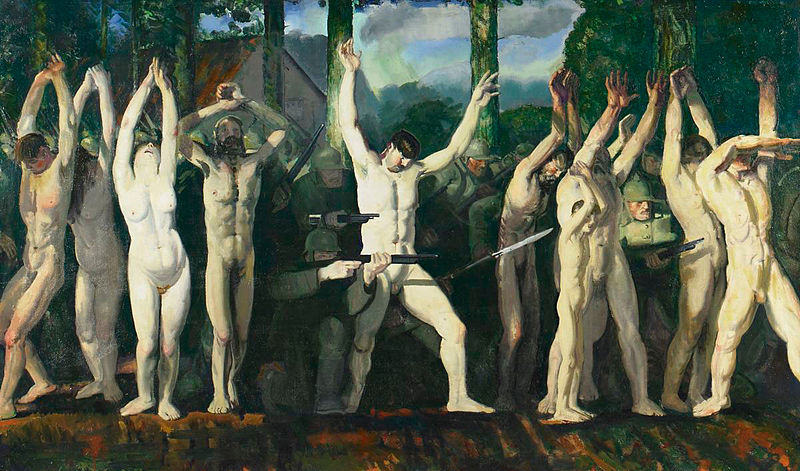
Yet for all his insightful depictions of a modern American life, perhaps the most captivating works of Bellow’s career were those which had no connection to America whatsoever: At the centre of the exhibition are Bellow’s depictions of war, works inspired by the horrors of the First World War in Europe which Bellows had read about in the American press. All five resulting paintings, four of which are on show at the Royal Academy, are conspicuously anti-German, showing the Germans in a devastating light as the perpetrators of previously unseen levels of horrific savagery, such as the Massacre at Dinant which depicts the unprovoked, summary execution of Belgian civilians following the sacking of their town which stood in neutral territory, and The Barricade, which shows the Germans using Belgian innocents as a human shield. The paintings are emotive, powerful and really quite breathtaking.

Massacre at Dinant (1918)

Massacre at Dinant (1918)

The Barricade (1918)

The Barricade (1918)

The Germans Arrive (1918)

The Germans Arrive (1918)

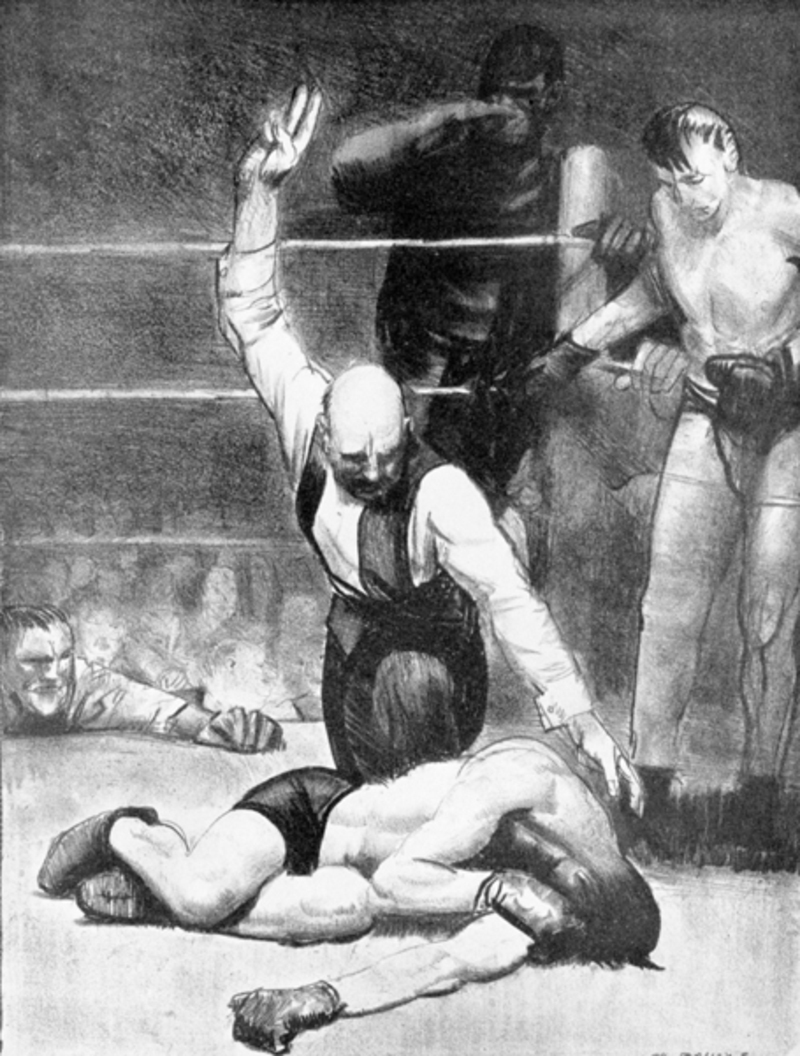
Likewise exceptional was the next room showing Bellows lithography – his brilliant printworks which were likewise used to stunning effect in depicting similarly shocking scenes such as The Law is Too Slow which shows an African American being burnt alive at the stake while surrounded by an apparently calm, even entertained crowd of white Americans. In his print works, Bellows shows himself as a master printer – he uses dark and light to maximum effect, while his faultless illustration of flesh tone in the print version of his later boxing scenes easily outstrips the paintings of the same subject.

The law is too slow (1922)

The law is too slow (1922)

Splinter Beach (1912)

Splinter Beach (1912)

Counted Out No.2 (1921)

Counted Out No.2 (1921)

After this highpoint of the show, the exhibition ends on something of a low in a gallery of overly insipid, saccharine fantastical depictions which look almost Chagall-like in style and appear to represent an uncomfortable diversion from Bellows more intense former work – even his later boxing paintings have nothing like the level of intensity as his boxing works painted 15 years before. The gallery is full of twee and sometimes stiff family portraits which resemble the work of Manet but without anything close to his emotional depth, as well as landscapes which are so excessively sentimental with their white horses and picture-perfect symmetrical mountain landscapes that Bellows’ former teacher, Robert Henri must have been turning in his grave – or at least would have done had he not outlived Bellows.

The Picnic (1924)

The Picnic (1924)

The White Horse (1922)

The White Horse (1922)

A Fisherman's Family (1923)

A Fisherman’s Family (1923)

George Dempsey and Firpo (1924)

George Dempsey and Firpo (1924)

For George Bellows died shortly after depicting these more sugary of his works, suffering from a sudden ruptured appendix and peritonitis. His career was one cut short, but perhaps just in time before his later My Little Pony style of painting threatened to overshadow the truly superb achievements of his former body of work; an oeuvre which now stands out, next to the likes of Edward Hopper, as a truly unique collective depiction of modern American life.

George Bellows: Modern American Life is on at the Royal Academy until 9 June 2013. Details and tickets can be found on the RA website.

Autobiographical Mobile: My painting diary – Day 24: A family tragedy

I set out painting my Autobiographical Mobile in June last year, and wrote my first post on the painting (once I realised it would take me some time to complete) back in August. The intention was to paint a mobile like structure, balancing from its various offshoots both the good and bad experiences of my life so far. In this way, the mobile would tell my story, acting as a autobiographical self-portrait through symbolism alone. Yet when I was planning out the painting back in the summer of last year, I could never have known that when designing how to represent the bad experiences of my life so far that a further, horrendous family tragedy would occur, rocking my world and the lives of my family forever.

Three days before Christmas last year, my brother in law was killed – hit by a car. He left behind my sister and their three children: two year old twins and a 4 year old – all boys. It’s not been something I’ve addressed directly on this blog: before now it felt too soon to address so traumatic an experience on this platform. And even now it’s too tender to describe in words. Yet as with my own road traffic accident five years before, there is no underestimating the relief which artistic representation has given me in being able to work through the pain that tragedy brings.

DSC07639

When his death occurred, Christmas died. The sparkle, the light, the glory and excitement of Christmas was automatically extinguished like a glass of water poured suddenly over a candle. The continuing presence of the decorations around us felt somehow awkward, almost insulting, like someone wearing bright pink at a funeral. And once those decorations were packed away, the world left behind was in so many ways changed from what it had been when we had taken them out, full of the spirit of Christmas only a few weeks before.

In my home what remained after Christmas had been packed away was my Autobiographical Mobile painting, sat on my easel still incomplete, but already including what I had previously considered to be a completed “bad experiences” side of the mobile. Staring at the painting it dawned on me, that no aspect of this work, like a living breathing organism in our home, was ever going to be finished until the last brushstroke had been applied – in the meantime it was a continuing record of my life, and this grave family tragedy would now have to have its place on the canvas.

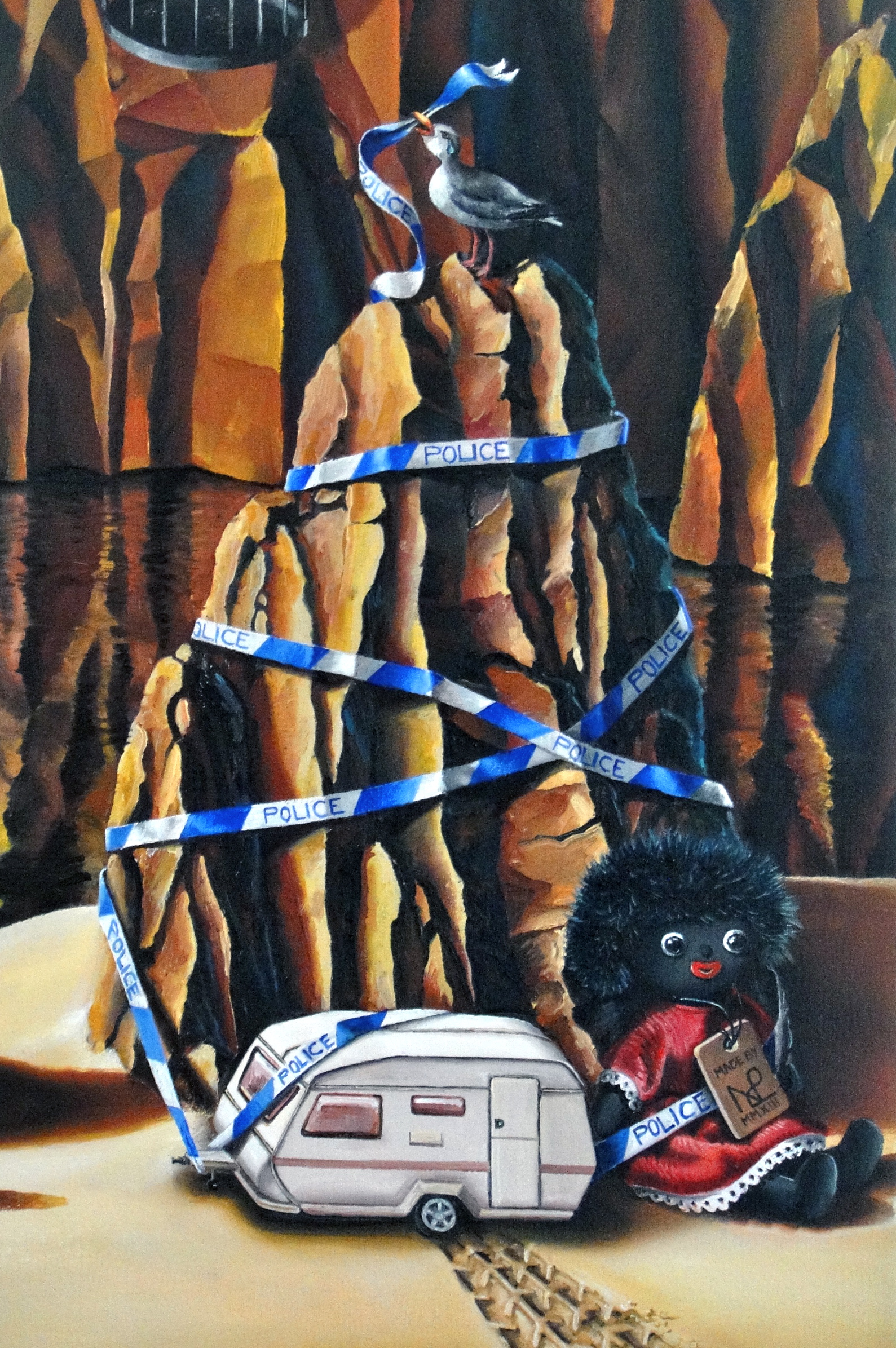
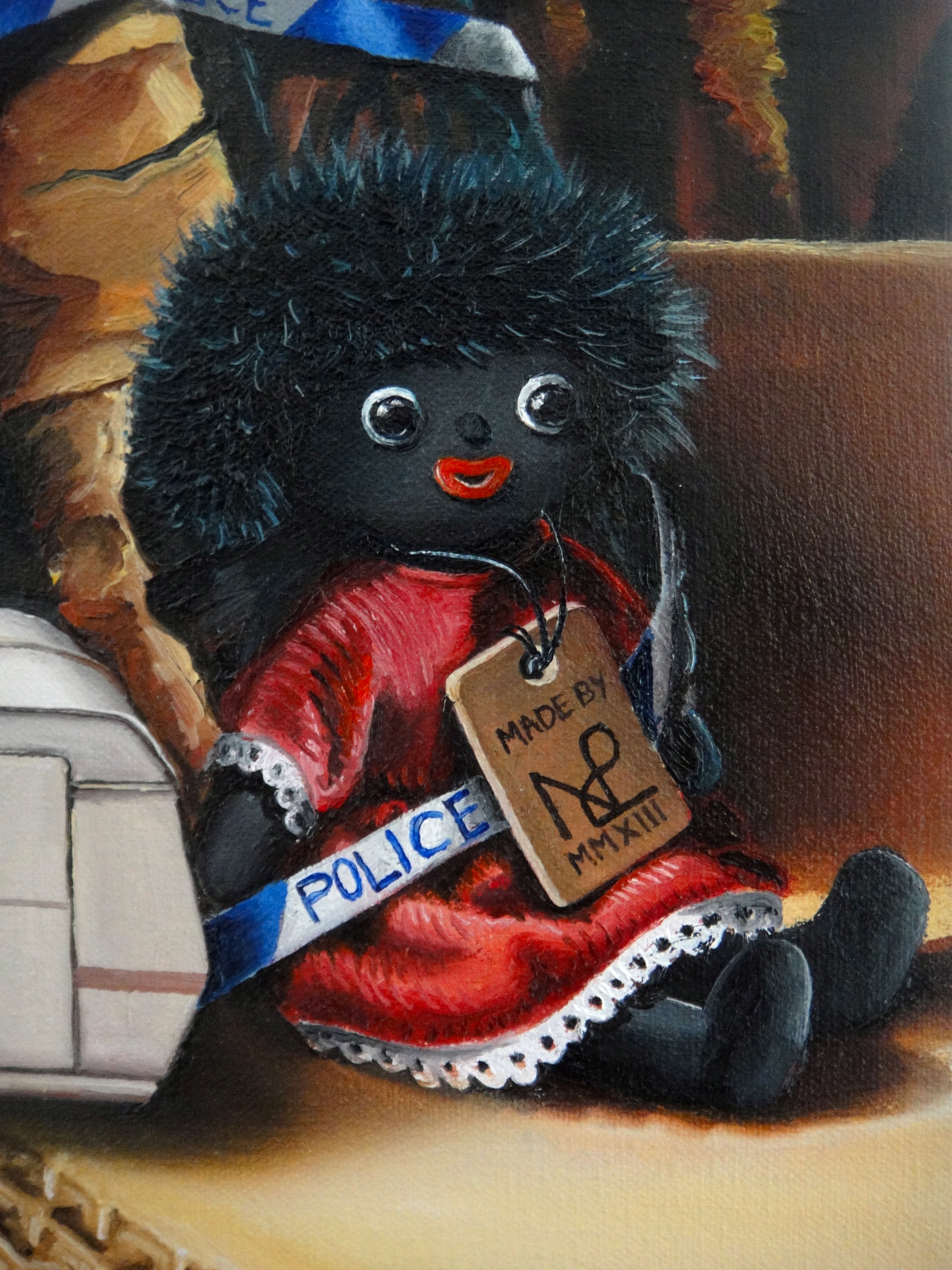
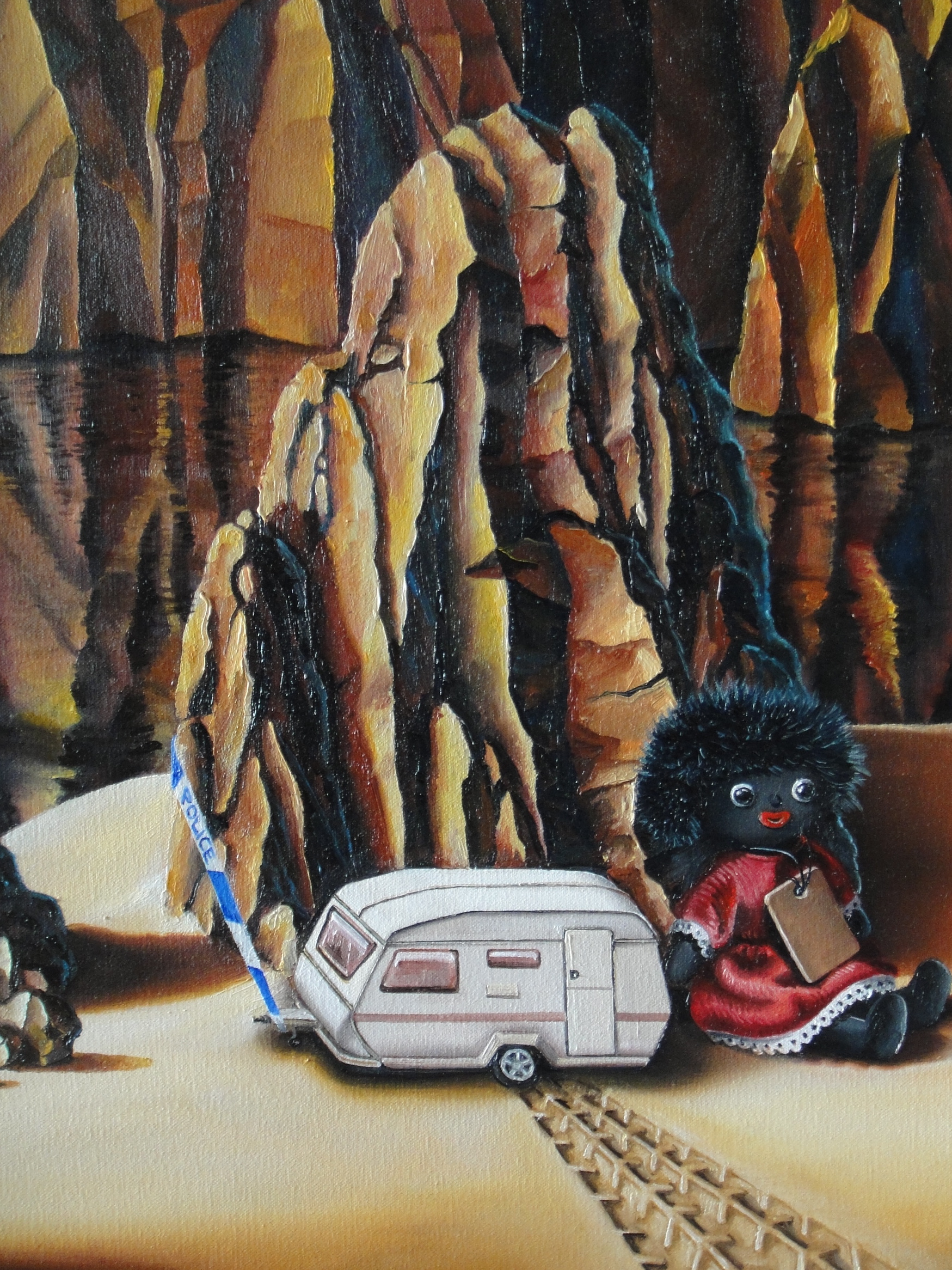
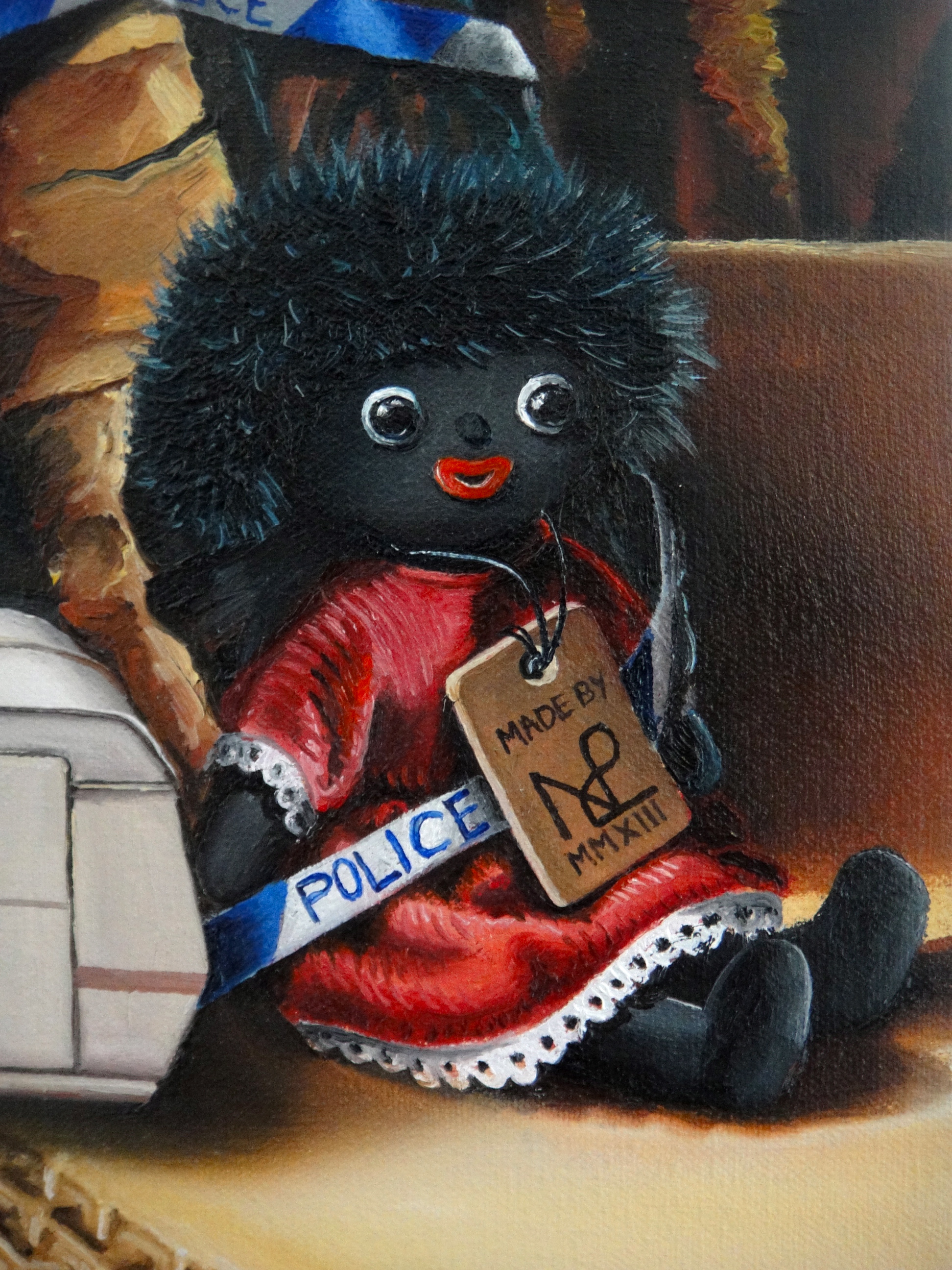
Already painted pre-Christmas was what I had thought of as the “family rock” – a large rock in the bottom right of the canvas, against which a small golly-doll, representing my mother, and a caravan representing family childhood holidays are placed. Those representations remain, but now in a different guise. For wrapped around the rock, ensnaring, entangling the family, the doll, and the caravan in its sinuous web is a police ribbon taken straight from an accident scene. Nothing in the family is free from its reach – it is all-encompassing, a symbol of the inescapable consequences of a family death, a loss of life which affects so many, irreparably, now and into the future.

DSC07444 DSC07582

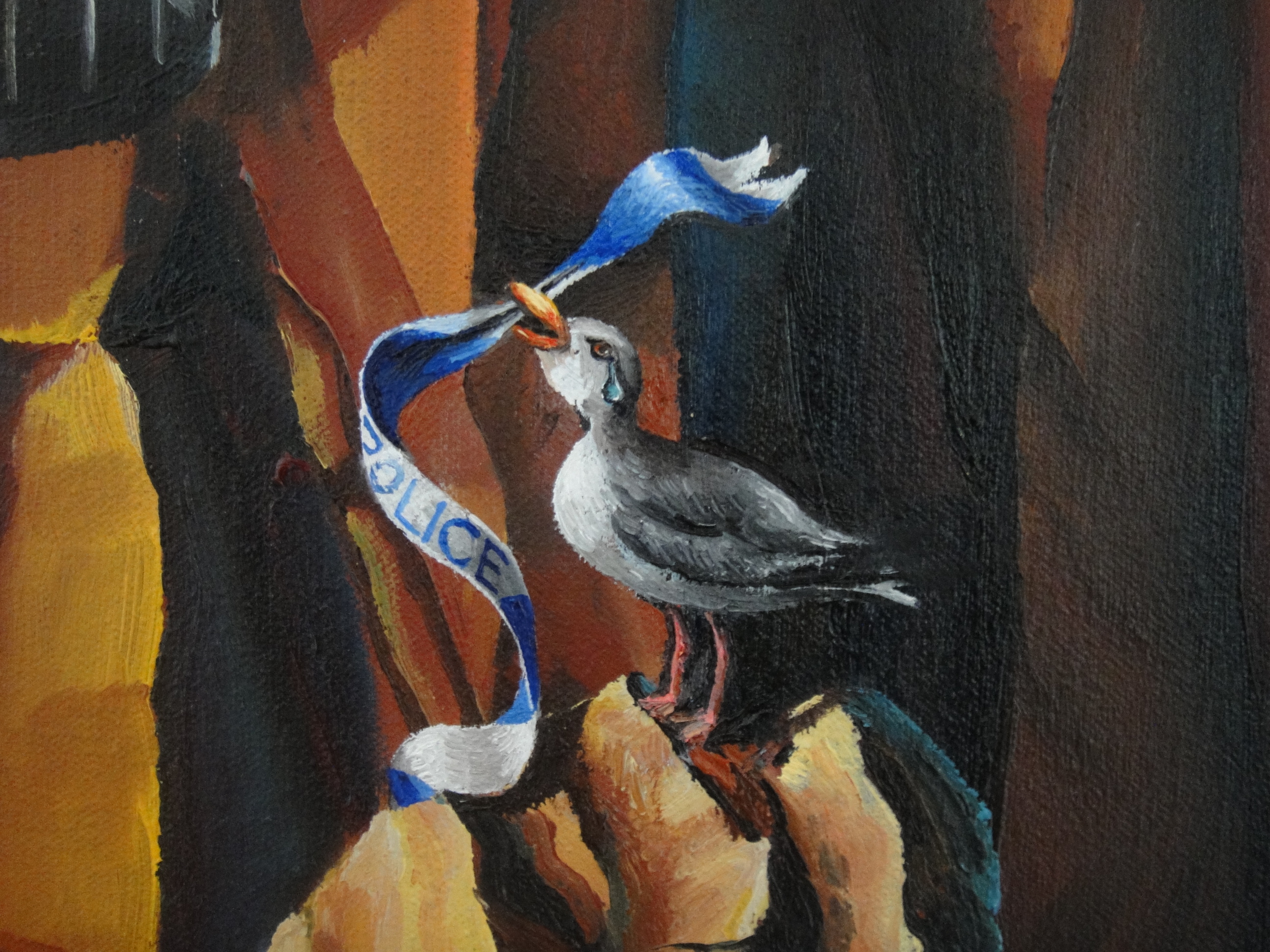
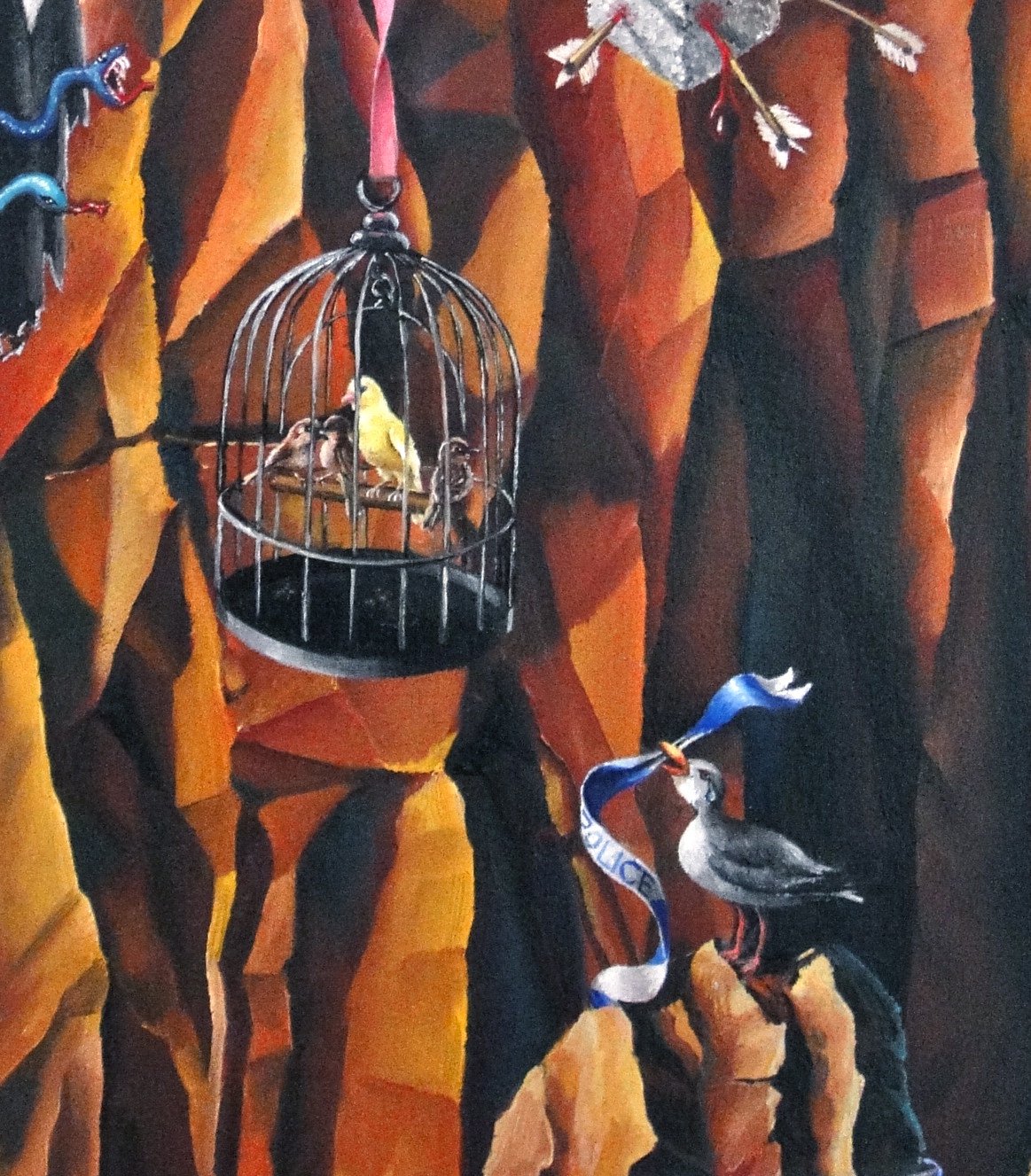
But the image goes further. Atop the rock, a seagull is standing, trying, hard as it might to break the ribbon away, a tear rolling from its eye as it comes to terms with the struggle. The seagull is my sister. We always used to call seagulls “Cathy’s friends” because they always seemed inexorably attracted to her when we were on beach holidays – maybe something to do with the snacks she was eating! The seagull – my sister – looks upwards in the direction of a cage, and in that cage is a bright yellow bird, trapped with three small babies, imprisoned within the confines of its own destiny: responsibility enclosing the bird with an iron fist.

DSC07634

Meanwhile, down at the bottom of the painting, a tire track has imprinted itself through the sand, plunging directly into the rock – the impact of the accident, hitting my family hard. None can escape, although some of us got off lighter than others – around the golly (my mother), a manufacturing certificate hangs outside the confines of the police ribbon. It bares a signature. It’s mine.

DSC07661

© Nicholas de Lacy-Brown and The Daily Norm, 2001-2013. Unauthorized use and/or duplication of the material, whether written work, photography or artwork, included within The Daily Norm without express and written permission from The Daily Norm’s author and/or owner is strictly prohibited. Excerpts and links may be used, provided that full and clear credit is given to Nicholas de Lacy-Brown and The Daily Norm with appropriate and specific direction to the original content.

Printmaking Progress I

I headed along to the Royal Academy of Arts yesterday for the London Original Print Fair. According to the website, it’s the longest-running specialist print fair in the world and yet, I am embarrassed to admit, I’d never heard of it before. Having been abundantly inspired by the prints room at last year’s Royal Academy Summer Exhibition, I never realised that only two months before, the whole Academy is veritably given over to the heterogenous medium of printmaking. And it couldn’t have come at a better time – as I unveiled on The Daily Norm last week, I am now a very eager printmaking student myself, having completed a weekend’s beginners intaglio and etching, and now enrolled upon the intermediate course, with esteemed printmaker Victoria Browne my very enthusiastic and gracefully patient teacher.

©Trevor Price - The Feast II

©Trevor Price – The Feast II

Wondering around the fair, which comprised some 50 galleries and print dealers selling an array of prints from £100 works by lesser-known artists, to 5-figure editions by the likes of Lichtenstein and Francis Bacon (and what I wouldn’t do for one of those), it dawned on me just how fantastically versatile the medium of print really is. While after only 3 days in the attempt, I now feel sufficiently versed in lino printing and etching to at least understand the basics of the medium, I haven’t even got started on dry point, on lithographs, on soft-ground etching, on screen printing. Yet with a beginner’s understanding of at least some print techniques, I was able to enjoy this comprehensive show of prints with a knowing and enthusiastic eye, taking inspiration from the array of prints on offer, and even making a small purchase of a beautiful Cornish-inspired supper scene by distinguished print-artist Trevor Price which was relief-printed and priced mercifully at the lower end of the scale!

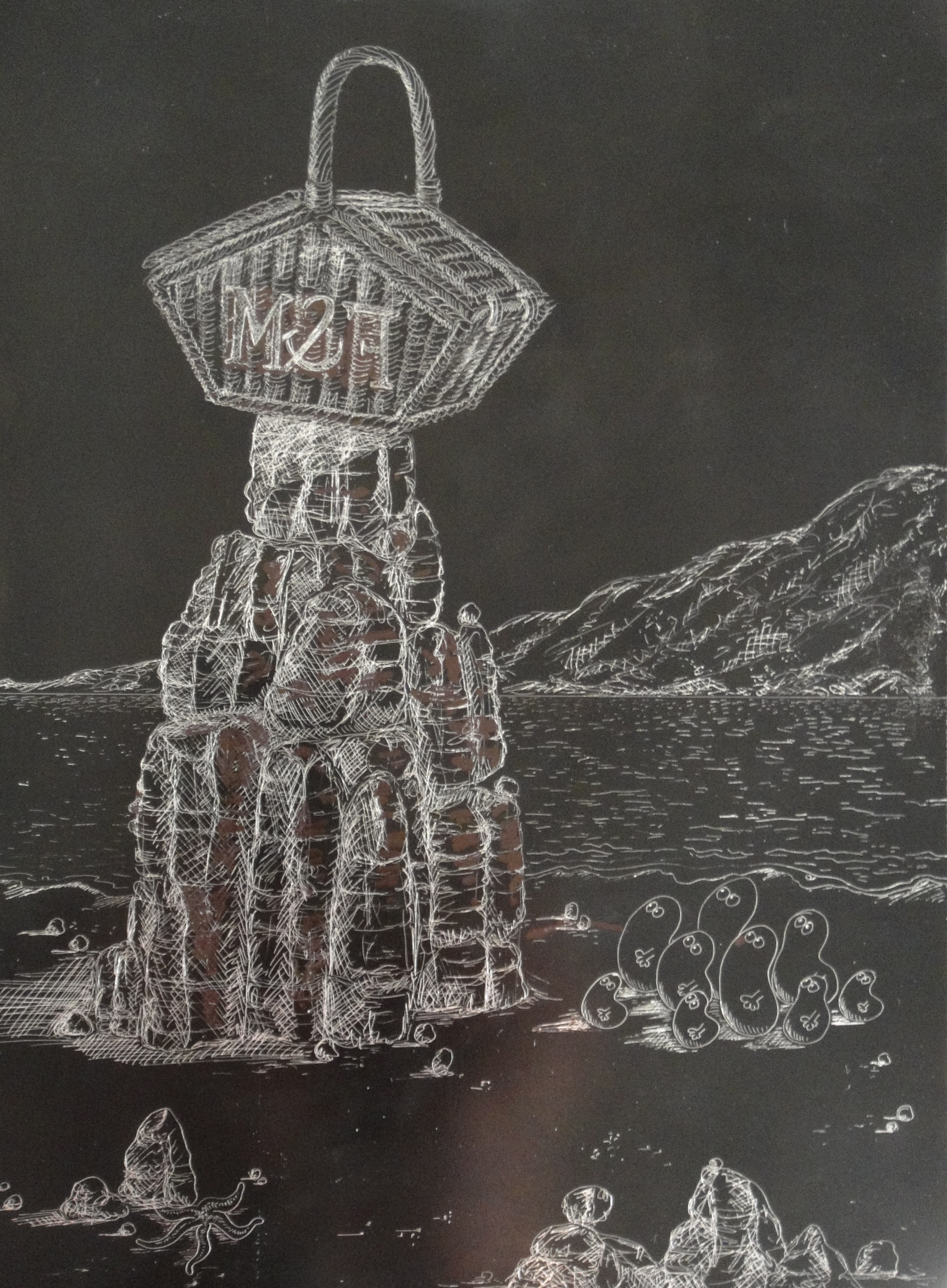
Meanwhile back at home my head is awash with ideas for my own future print creations and an eagerness to learn new techniques. This week I’m due to learn aquatint, a method by which tone is added to the basic lines of an etching. I’ll be adding aquatint to my current etching plate which I can now very proudly unveil. As something of a follow up to my first etching, this one is also set out a Mallorcan beach, and borrows form my Autobiographical Mobile painting in its motif of a Fortnum and Mason’s hamper atop a rock. Meanwhile. down below, a group of perplexed Norms look up at the hamper, as much confused by its appearance as they are slightly scared by its precarious placing upon the rock’s peak.

My second etching pre-aquatint stage (© Nicholas de Lacy-Brown)

My second etching pre-aquatint stage (© Nicholas de Lacy-Brown)

The etching drawn into the  black "ground" pre-exposure to acid

The etching drawn into the black “ground” pre-exposure to acid

I hope to be able to show you an aquatinted version of this plate very soon! In the meantime, I cannot extol the virtues of printmaking enough – fill your homes, check out the print works of the great artists and attend print fairs everywhere – original canvases are so yesterday.

Autobiographical Mobile: My painting diary – Days 20-23: Rock pools

It’s hard to believe that this post represents only days 20-23 of this painting. Something surely has to have gone wrong with this account, for in only now approaching the end of this vast project, it feels like I have been painting for months. I have, in fact, been working on this canvas for sometime – since June last year in fact (albeit intermittently) which just goes to show how little time I actually have to paint now that I am a full time lawyer, blogger and new found sketcher and printmaker.

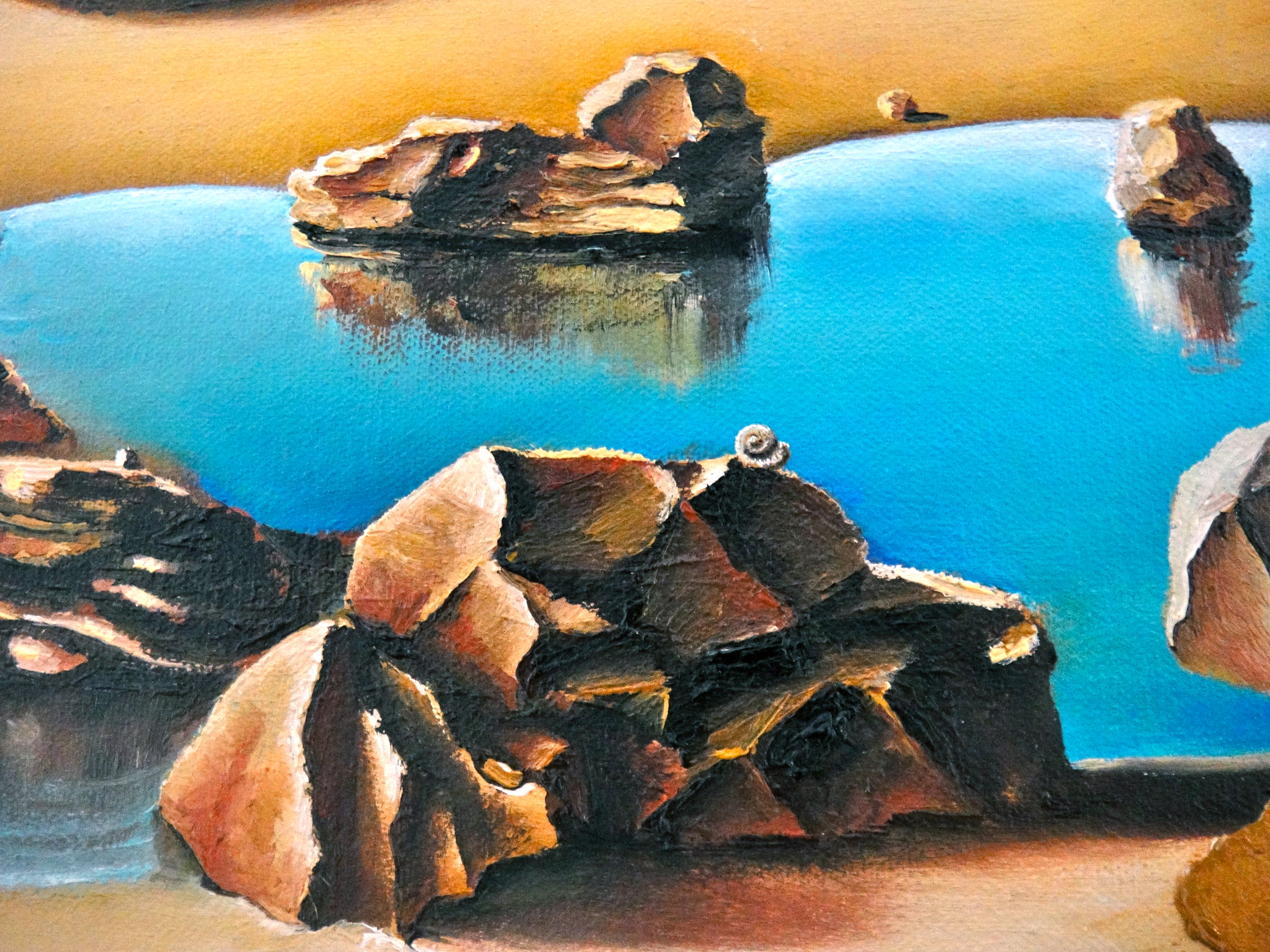
All the same, sometimes the best results are achieved with a little patience and plenty of hard work, and this aphorism is no better proved than with the latest additions to my autobiographical canvas – 4 days painting rock pools. Hard to believe that they would take so long, but each of the little rock forms, which create balance at the foot of my canvas, reflecting the large mountainous forms above in the sandy stretch below, has its own peculiar shape and character. And since each rock comes straight from my imagination, this isn’t a simple case of painting what’s in front of me. Rather, a process of trial and error commences as I try to paint rocks straight from the soul, with a lightness of approach at first as I allow the naturalistic forms to almost metamorphose innately from a wider brush stroke. Then once I feel and see a shape begin to form, I start filling in the painstaking details with a small brush.

This slideshow requires JavaScript.

The result is a satisfying swathe of rocks and water which add shape and texture to the lower foreground of my work. Reminding me of the hours spent climbing in amongst the various rock pools of the beaches of Jersey in the Channel Islands every summer throughout my childhood, collecting little shells which I later made into little models of snails, these rock forms are an important reflection on the younger years of my life as I explore my story so far on this autobiographical canvas.

© Nicholas de Lacy-Brown and The Daily Norm, 2001-2013. Unauthorized use and/or duplication of the material, whether written work, photography or artwork, included within The Daily Norm without express and written permission from The Daily Norm’s author and/or owner is strictly prohibited. Excerpts and links may be used, provided that full and clear credit is given to Nicholas de Lacy-Brown and The Daily Norm with appropriate and specific direction to the original content.
A Prelude to Printmaking – Part 2: Linocut

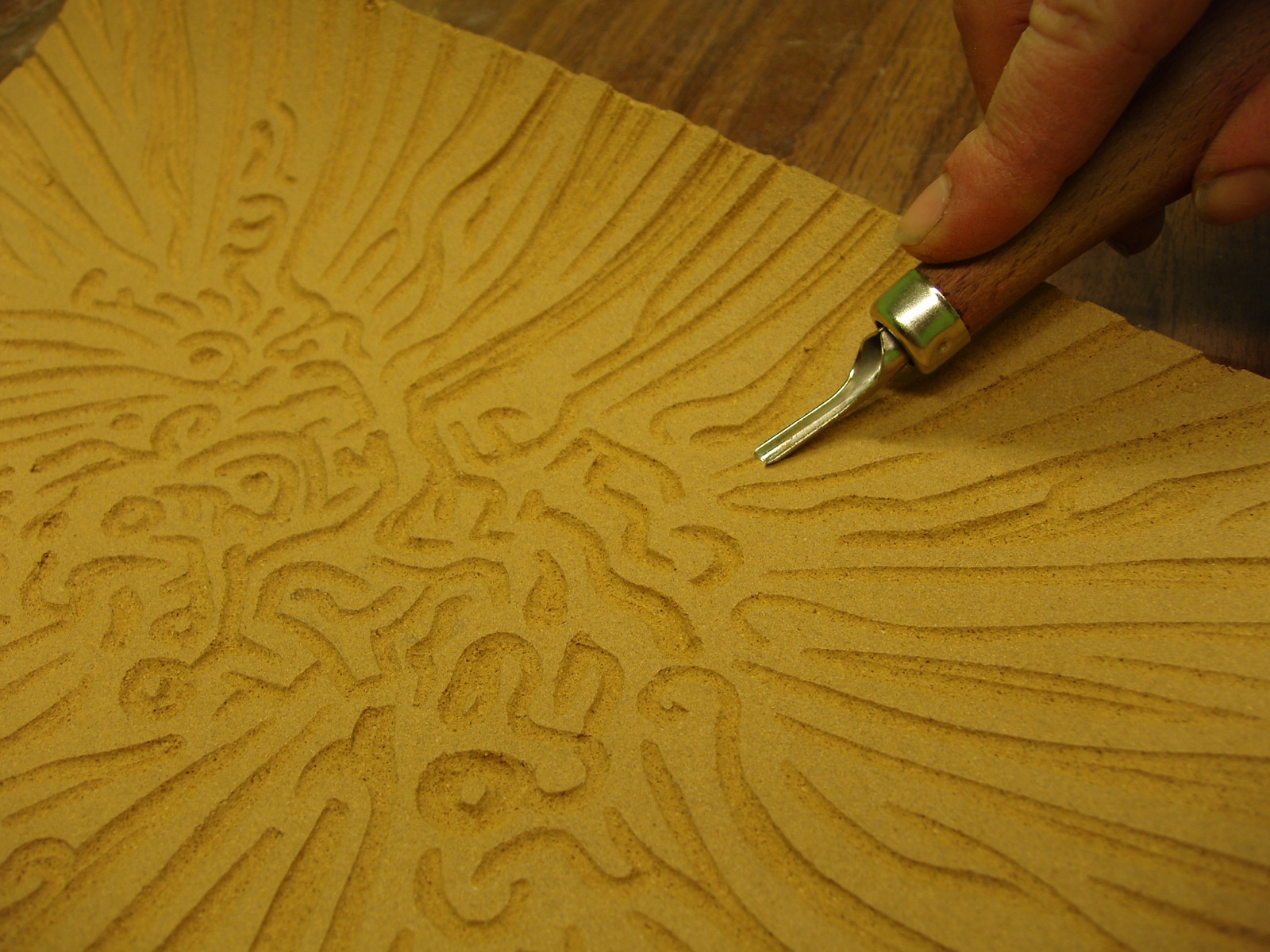
Following yesterday’s post, introducing my first ever attempt at etching to the world, here is my first ever attempt at lino cutting. Linocut, which is a form of relief printmaking, involves cutting into linoleum, which, while originally conceived for flooring, has been used by printmakers for almost as long because of its soft surface for cutting while retaining a sufficient durability for printing.

Linocutting is perhaps even trickier to get your head around than etching. This is because you use the same piece of lino to make a print of various colours. In order to “protect” each colour, you cut away at the lino further between prints, going from light to dark because light colours will never show up when printed over darker inks.

Cutting into lino

Cutting into lino

So to explain further, you first cut away from the lino anything you want to remain white. This is because the ink will never touch those cut away areas when the ink is rolled over the lino, so once applied to paper, the paper will remain white where the cuts are. Once you’ve got the hang of that and printed your first colour, the same then applies again to that colour – once you roll a darker colour over the lino, it will simply print on top of the first colour unless you cut more of the lino away to protect it. And so it continues for each layer of colour.

We worked with three colours, but with no forward planning on the details of my image, it was extremely difficult to work backwards and think of the image in terms of light going into shadow, and what colours needed to be preserved and what cut away. The lino also proved difficult to cut in a controlled manner.

The result is something a little coarse, but it’s a finish which I think works really well with the theme – Mexican Norm! Here is the finished print (I printed an edition of 5):

Mexican Norm (linocut print)

Mexican Norm (linocut print)

…and here is the lino after it’s final cut.

DSC07300

Linocutting was not a technique I loved as much as etching, largely because I find the process of making the image in etching easier to control. Nevertheless I was delighted with the results achieved through linocutting and would certainly like to give it a go again.

Norm prints a plenty, here we come…

© Nicholas de Lacy-Brown and The Daily Norm, 2001-2013. Unauthorized use and/or duplication of the material, whether written work, photography or artwork, included within The Daily Norm without express and written permission from The Daily Norm’s author and/or owner is strictly prohibited. Excerpts and links may be used, provided that full and clear credit is given to Nicholas de Lacy-Brown and The Daily Norm with appropriate and specific direction to the original content.

A Prelude to Printmaking – Part 1: Etching

I’ve never really paid much attention to prints, and still less black and white prints which, in a gallery full of paintings never seemed to capture my attention. All of this began to change around last summertime. The first trigger was the Royal Academy’s annual Summer Exhibition where, amongst the numerous galleries full of paintings of often rather questionable quality, I found myself inexorably drawn to the print gallery, a room packed to the rafters with prints of every conceivable style, technique and colour (and in fact bought two!).

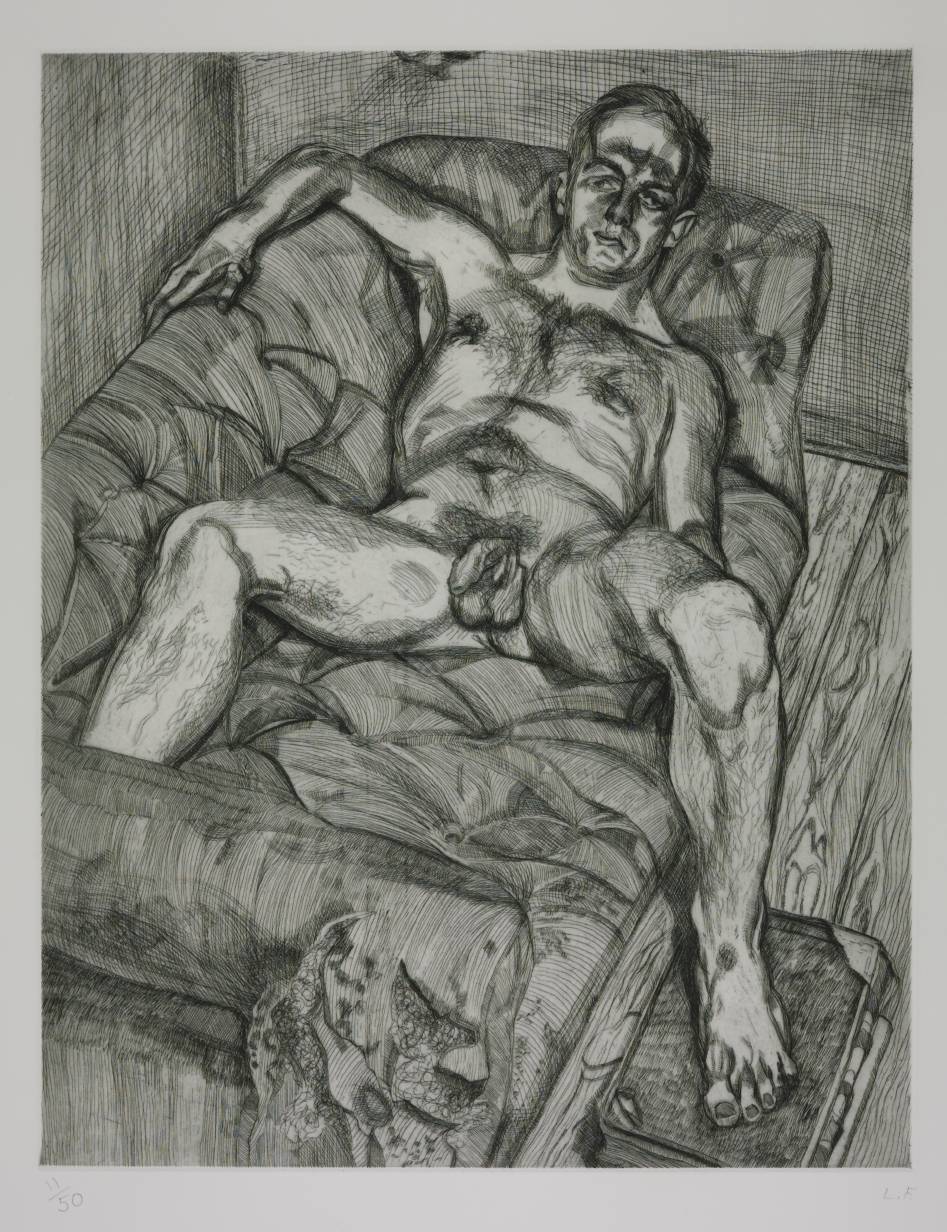
Lucian Freud, Man Posing (1985)

Lucian Freud, Man Posing (1985)

The second trigger came on a visit to the Courtauld Gallery at London’s Somerset House, where a newly acquired collection of Lucian Freud etchings had been hung. I was completely entranced by these works, which, in their monotone black and white seemed to shift focus from what is usually Freud’s fleshy textured paintwork to the almost visceral, fervid lines and cross hatchings by which Freud had reimagined many of his painted portraits in this new medium. In particular I adored Freud’s etching Man Posing (1985) in which the use of etching as a medium seemed to me so artfully applied to capture every hair, muscle and contour of the figure’s naked body.

Completely captivated, I went home and that very evening researched the internet for tips on how to etch. I very soon realised that unlike painting, etching would not be so easy to self-teach, and promptly enrolled myself for a printmaking course at the Art Academy in London Bridge (there being no introductory course dealing exclusively with etching).

Having now done this short weekend course, I can unconditionally say that I am hooked on printmaking, and on etching in particular. On the course we undertook two techniques – one was relief work (we used lino cutting – which I’ll tell you all about in Part 2 of this post); the other was the much anticipated etching technique, something which I found every bit as enjoyable to execute as I had taken delight in looking at Freud’s finished prints.

Another favourite etching - Edward Hopper, Night Shadows (1921)

Another favourite etching – Edward Hopper, Night Shadows (1921)

The process of etching is surprisingly fiddly. Of a whole day’s work in the studio, I probably spent a maximum of around 45 minutes actually drawing out my image onto plate – the remainder of the time was engaged in preparation and printing. Etching uses metal (we used zinc) and an image is etched into the plate using acid. That plate is then plied with ink and used to print an edition. So how does it all work? Well basically, once you’ve got yourself a metal plate (and carefully degreased it), you apply a dark “ground”. This is the layer which protects the metal when it is placed in acid. Once applied, you use a needle to draw your image. It is this process which reveals the metal underneath which will then be “etched” into the metal once acid is applied. So the process of drawing into the ground is a somewhat perplexing one – not only do you have to plan the image in reverse, but you’re also working in the colour negative, cross-hatching into metal to create shadows on your print, when what you end up drawing appears to be light on dark.

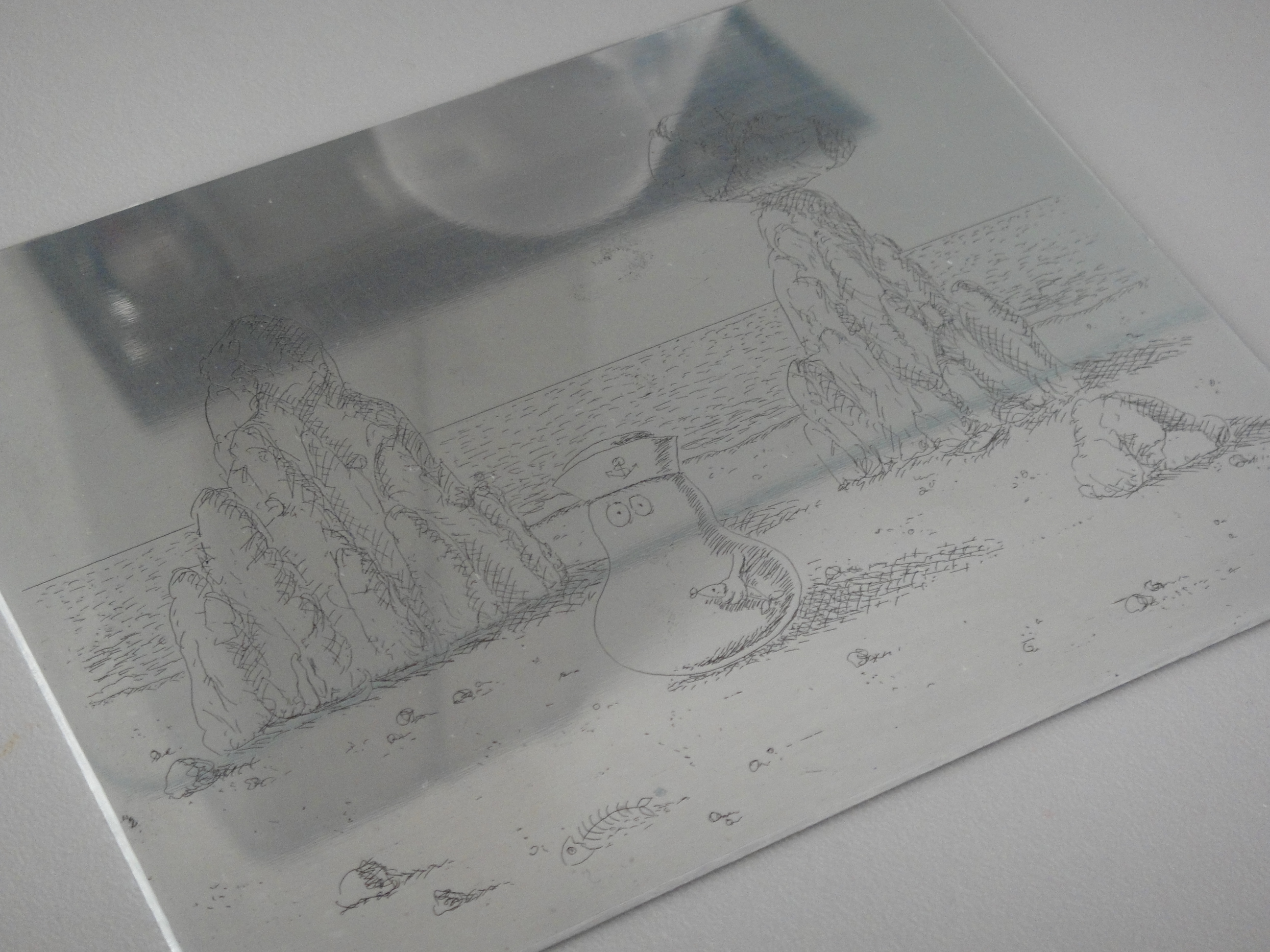
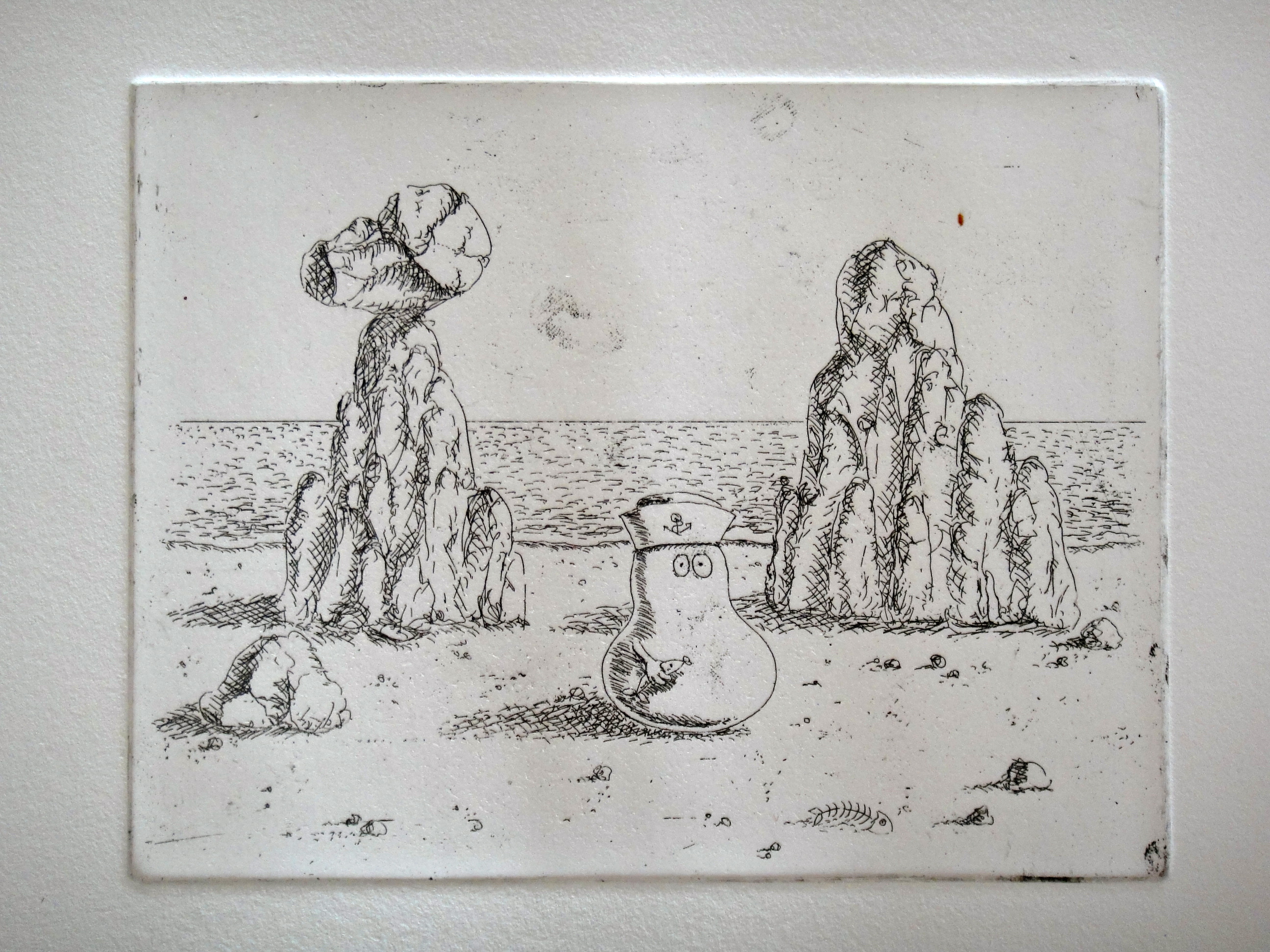
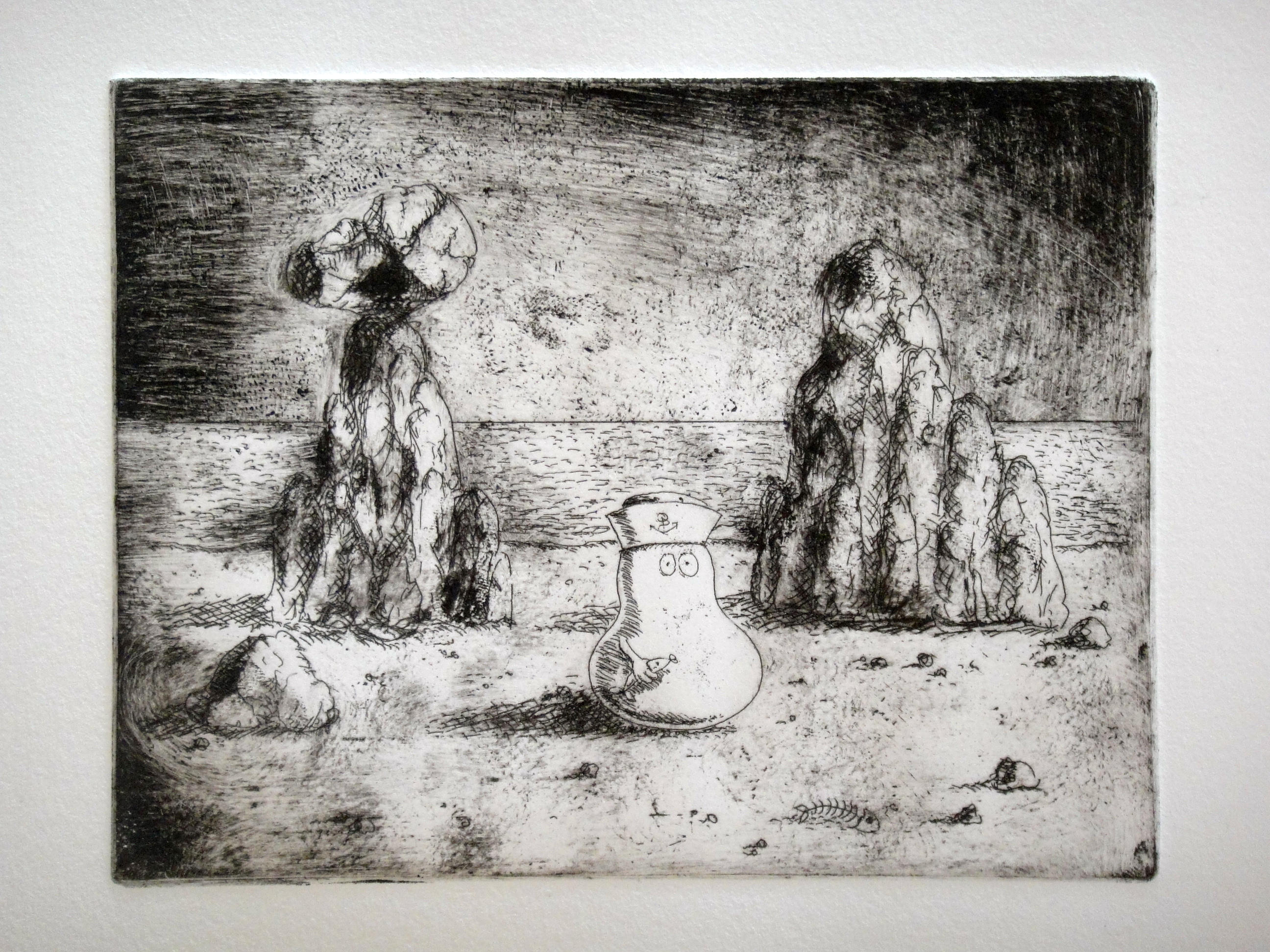
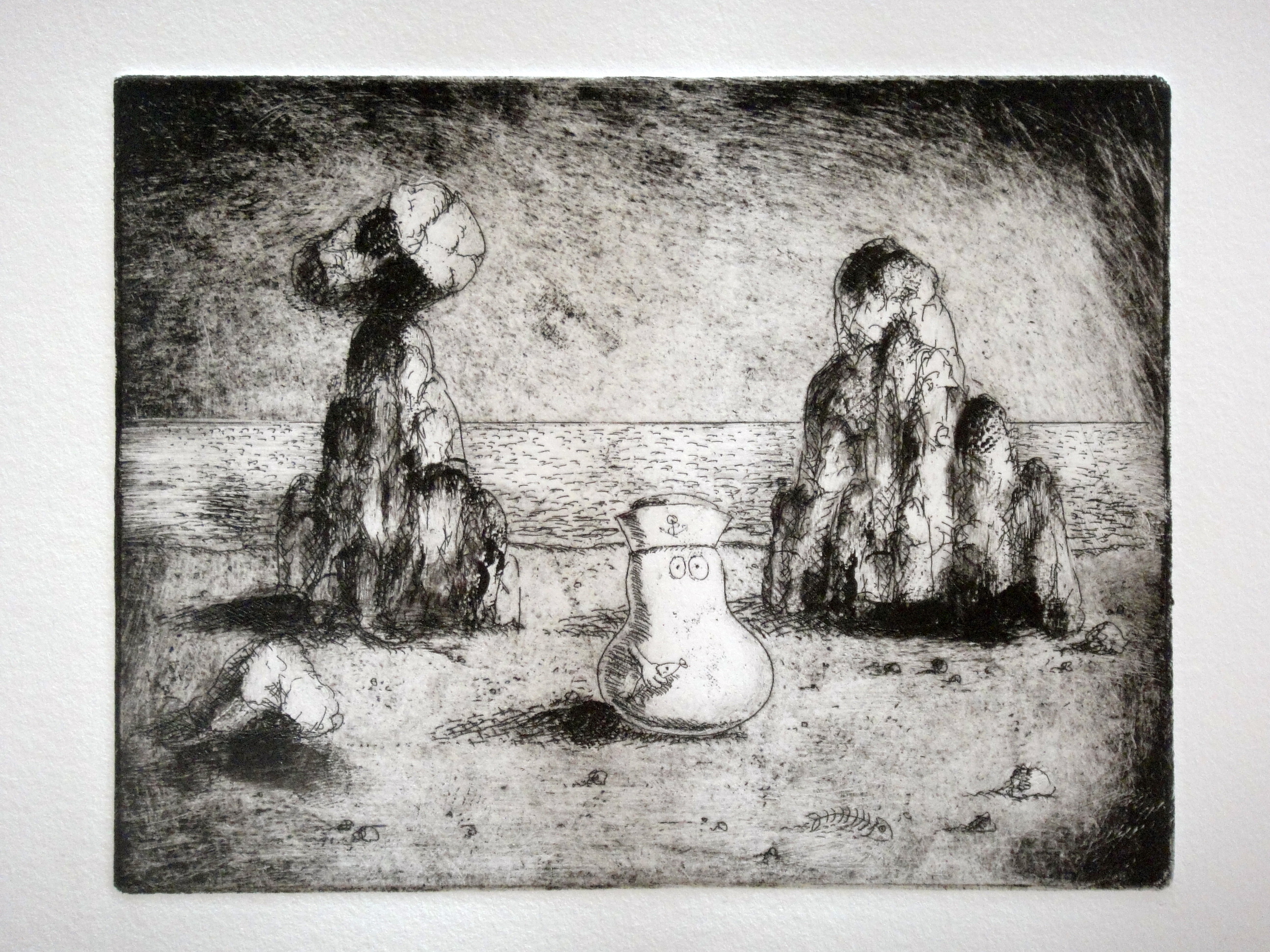
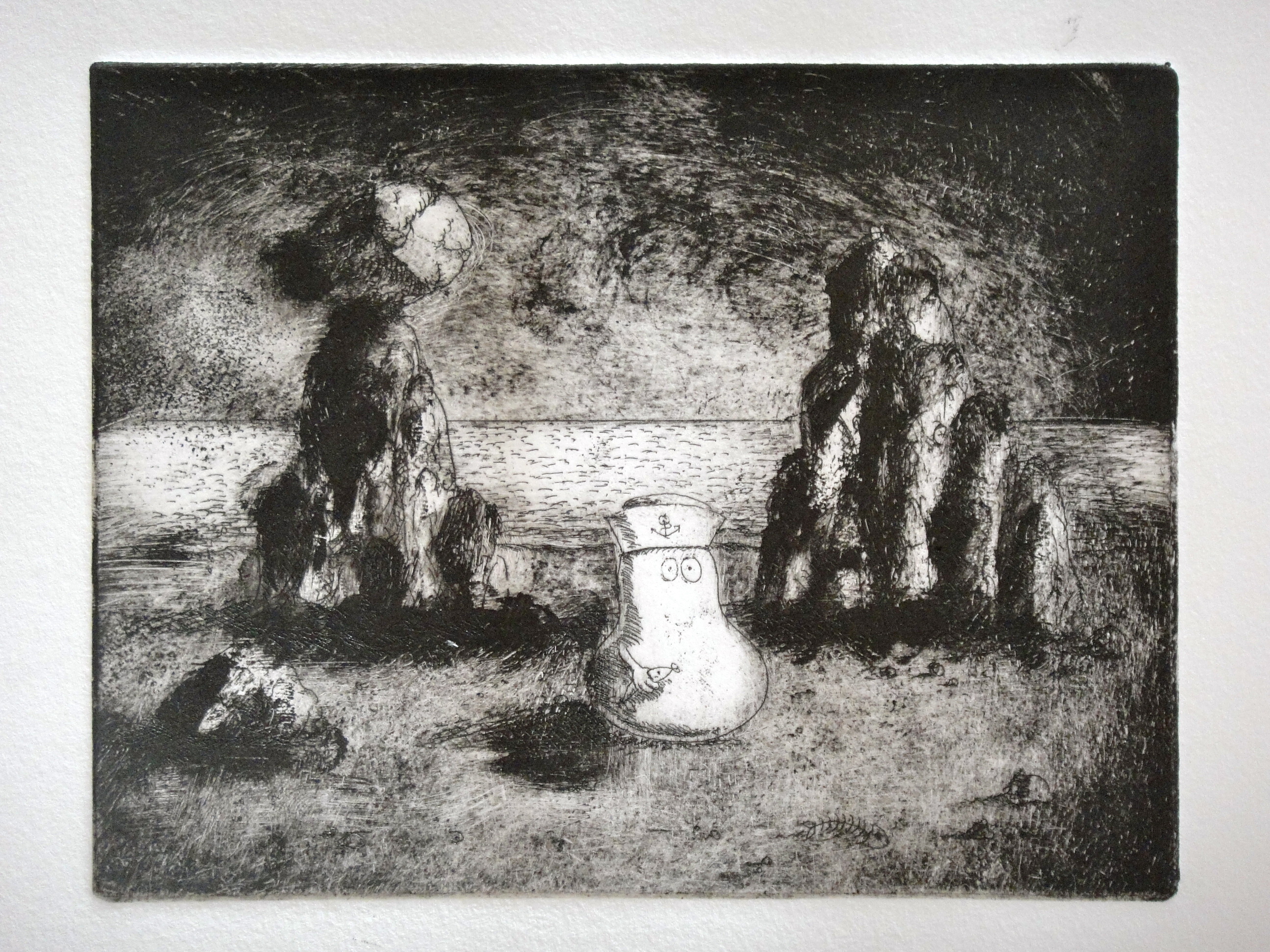
Anyway, I’m getting a little techy and I’m sure what you actually want to see is the result. And here it is: Sailor Norm on a beach in Mallorca (holding a fish). I probably ought to think of a better title, so any suggestions are welcome.

Here’s the metal plate with the image etched into it.

DSC07310

Then below, you can see what it looks like once printed: a series of prints which shows me experimenting with ink removal. In the first, I removed all the ink off the plate apart from the application of ink to the narrow etched lines. In the second, I left a little ink on the plate to create a moodier effect, and for the third and fourth left more and more, specifically targeting certain areas where I wanted more shadow. My favourite is probably the second or third. What do you think?

Sailor Norm on a beach in Mallorca (holding a fish) - print 1

Sailor Norm on a beach in Mallorca (holding a fish) – print 1

Sailor Norm on a beach in Mallorca (holding a fish) - print 2

Sailor Norm on a beach in Mallorca (holding a fish) – print 2

Sailor Norm on a beach in Mallorca (holding a fish) - print 3

Sailor Norm on a beach in Mallorca (holding a fish) – print 3

Sailor Norm on a beach in Mallorca (holding a fish) - print 4

Sailor Norm on a beach in Mallorca (holding a fish) – print 4

So that’s my first etching done, and with an intermediate course now booked, I cannot wait to create more and explore this new medium further. The etching is truly my oyster…

© Nicholas de Lacy-Brown and The Daily Norm, 2001-2013. Unauthorized use and/or duplication of the material, whether written work, photography or artwork, included within The Daily Norm without express and written permission from The Daily Norm’s author and/or owner is strictly prohibited. Excerpts and links may be used, provided that full and clear credit is given to Nicholas de Lacy-Brown and The Daily Norm with appropriate and specific direction to the original content.