Skip to content

Posts from the ‘Food’ Category

Bologna: La Rossa – Red hue of a left-leaning towered city

Of the three epithets for which it is known: La Rossa (the red), La Dotta (the learned) and La Grassa (the fat), it was the first of the three which became immediately obvious upon our early evening arrival in Bologna, capital of the Emilia Romagna (after a stuffy long train journey along the Tuscan coast with a change in Firenze): Not only did the city exhibit a searing red-hot temperature of near 40 degrees centigrade, even at 7pm, but its buildings were tinged with hues of reds, terracottas, and russets for as far as the eye could see. And what a rich, red spectacle our eyes had in store as we unloaded our luggage at the hotel (by this time full to near-combustion with olive oils, pastries and wine from Toscana) and headed straight out into the town.
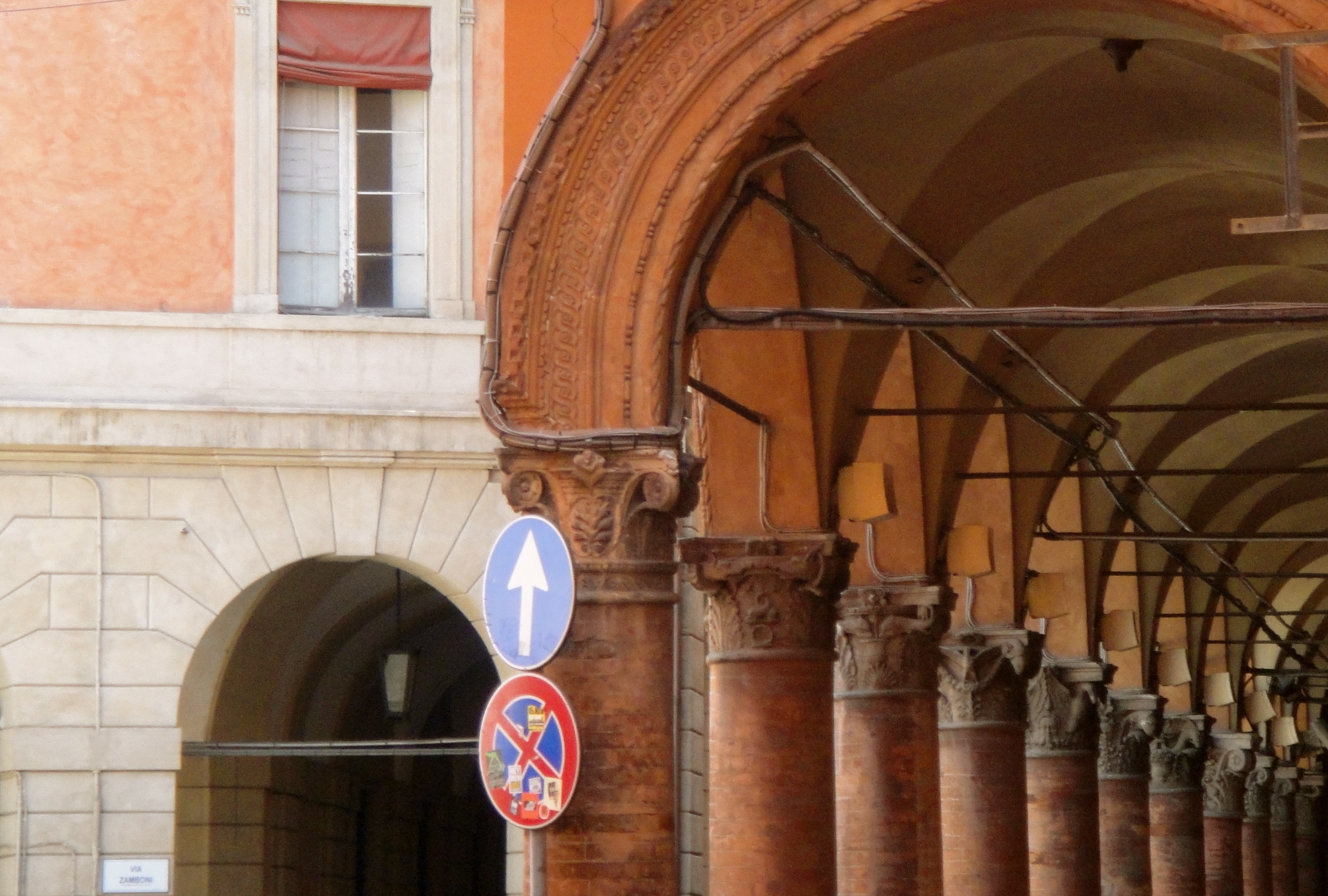
Red as far as the eye can see…

Bologna is stunning. It’s a living, breathing, pulsating city. It is not like Florence – a beautiful town whose heritage and architectural splendour cannot be doubted, but which is so full of tourists that the whole place feels a bit like a theme park. By contrast Bologna, often overlooked by Florence, just 30 minutes south by train, is a city equally rich in architectural heritage for which exhaustible superlatives are simply not sufficient, but which at the same time is alive with its university students, with a diverse population of engaging chic Italians rather than tourist throngs, with high-end restaurants and boutique shops, with cultural spectacle and a vibrant cafe culture.

For Bologna does not just celebrate its architectural wealth, but with an infamous liberal attitude, celebrates all aspects of life too. Here, none of the Catholic constraints traditionally centralised in the Vatican and strictly executed to control the moral values of nearby cities can be seen. In fact, the epithet La Rossa, traditionally used to describe Bologna’s multitude of red-shaded buildings, has, in more modern times, been used to describe the Communist-dominated local government which has been in power in the city ever since WW2. The city has never looked back, and having now morphed into a left-wing coalition, the Bologna administration has imposed an individualistic, modern vision on the city. In fact, so successful has this vision been that Sociologists from around the world have studied the so-called “Bologna model” of political and social governance, and Bologna now regularly tops the polls for where to enjoy the best quality of life in Italy. Moreover, with its liberal leanings, Bologna is the centre of civil rights and communal culture, a bastion of social democracy and the centre of Italy’s gay-rights movement. How terribly refreshing! No wonder then that as recently as the papacy of Pope John Paul II, the Vatican condemned the Bolognese as degenerates, and the city’s own archbishop lambasted his flock for loose morals and godlessness.

The film festival, for which Hitchcock films played a major part

If this is degeneration, I’m all in. The atmosphere of convivial city living could be seen by the bucket load as we entered the grand Piazza Maggiore on our first evening: There, under the stars, was set up a huge cinema projection screen, almost as big as the cathedral facade it neighboured, and before it, hundreds of seats, already filled with a bustling Bolognese crowd, a sense of excitement tangible in the air. As the square began to fill and people started sitting all over the warm pavements, the chairs already being full, we decided to join in with the crowd, and looked up at the huge screen in anticipation. Suddenly the screen came to life, and projected on this huge screen, for the whole square to see, as well as some surrounding Bologna streets, was the old crackling Hitchcock masterpiece: North by Northwest. We were entranced, and it was in fact only some hour and a half into the film, just before the characters relocate to Mount Rushmore, that we realised that our backsides and legs were becoming progressively paralysed from sitting on the hard stone of the pavement for so long.

Crowds gather for the start of the film

Opting to enjoy the rest of the film on foot, we witnessed a spectacle like I have never seen before. Practically the whole city must have been out in that square, faces tilted towards the screen, utterly engaged, the light of the projection reflected in their faces, and the rest of this city so dark around them that the stars sparkled in the sky as brightly as electric lighting. All around, the crowd had swelled. In cafes, people crammed around tables to watch the film, waiters had paused in the midst of their work and stood, entranced, yet still holding their tray full of empties, and at the back of the crowd, a load of Bolognese cyclists had rested to catch some of the film, still upon their bicycles. I’m not sure why, but there was something about this feeling of unification and togetherness, watching a film under the stars, that made me feel so emotional. It was so beautiful so see so many people from the town having come together on this warm summers evening, to watch Hitchcock under the night sky. And there was something about those old polished 1960s voices reverberating around the old facades of Renaissance and medieval architecture that sent a shiver down my spine. Incredible. And what was more, this showing was part of the Sotto le stelle del Cinema festival (‘cinema under the stars’) which runs from 2-30 July. We, therefore, were able to enjoy the spectacle every night of our stay. Bonus!

The Piazza Maggiore and the edge of the huge cinema screen

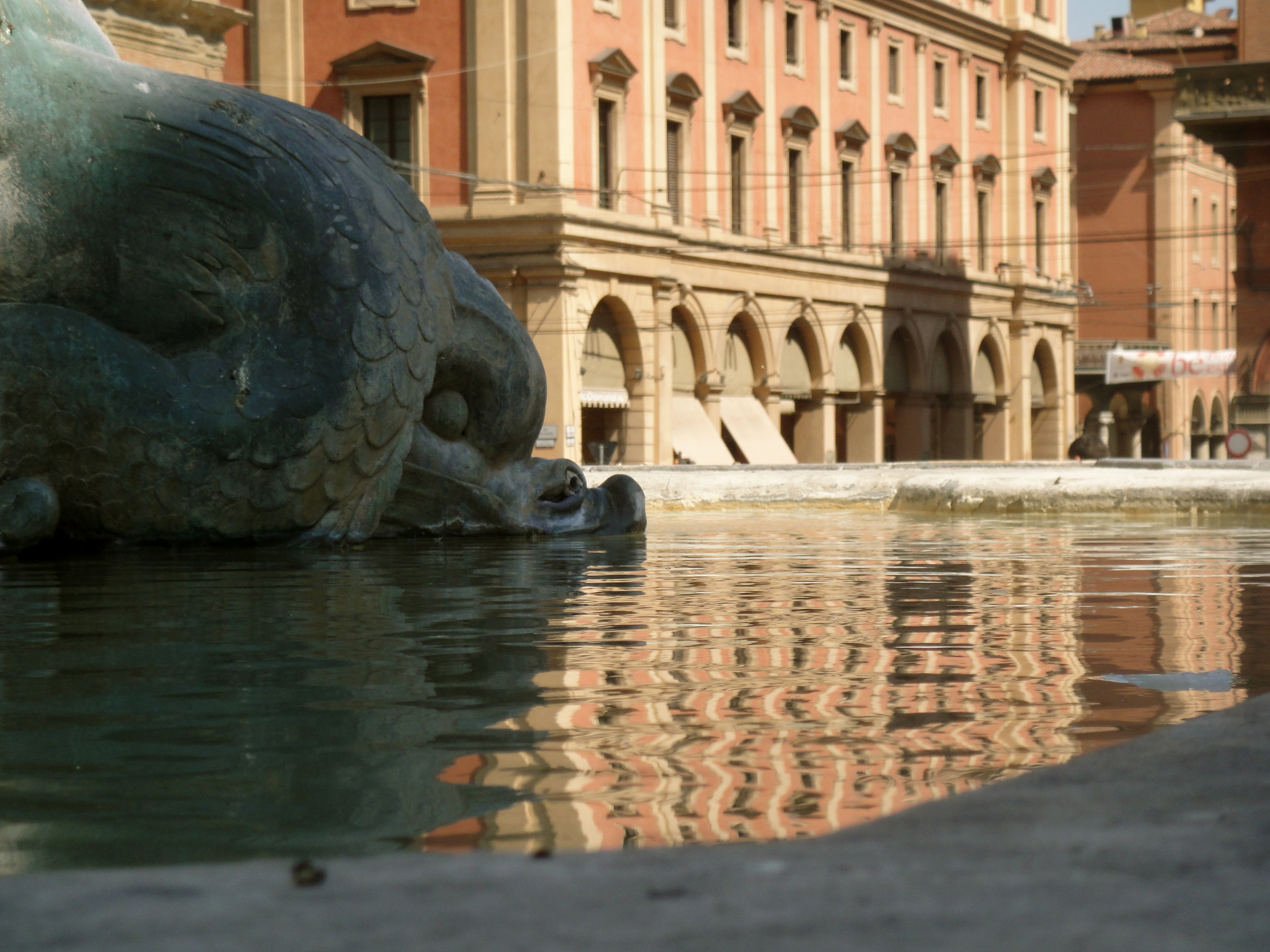
I could go on forever about this vivacious city, but it’s best not to overindulge all in one post. I shall leave you instead to gaze at the photos on this post, emblematic as they are of what makes this city truly La Rossa – endless rows of elegant colonnades and porticos, lining almost every street, providing shade and ease of walking for pedestrians across the city. Stunning old buildings, decadent in their decay, embellished with elaborate architectural details, with sculptures and with fine arcades, all demonstrating the wealth of previous occupants, who, through their architecture sought to compete with their nearest neighbour. And finally, who can forget the famous towers, which numbered some 200 in medieval Bologna – towers which got higher and higher as that same competitive spirit encouraged more splendid construction than the previous model. Only 60 are left now, with the two most famous, Asinelli and Garisenda leaning precariously at Bologna’s centre, emblematic perhaps of Bologna’s character, its non-conformist political leanings, and moreover its spirited refusal never to fall into line, but to stand out as a individualistic and creative city, running from the norm and chasing adventure. No wonder the population are so happy here – I’m ready to pack my bags and move to La Rossa myself.

The famous Bologna towers

More tomorrow. Ciao for now!

All photos are strictly the copyright of Nicholas de Lacy-Brown © 2012 and The Daily Norm. All rights are reserved. 

Tuscany Part II: Cooling pines, perfect vines and fine Tuscan wines

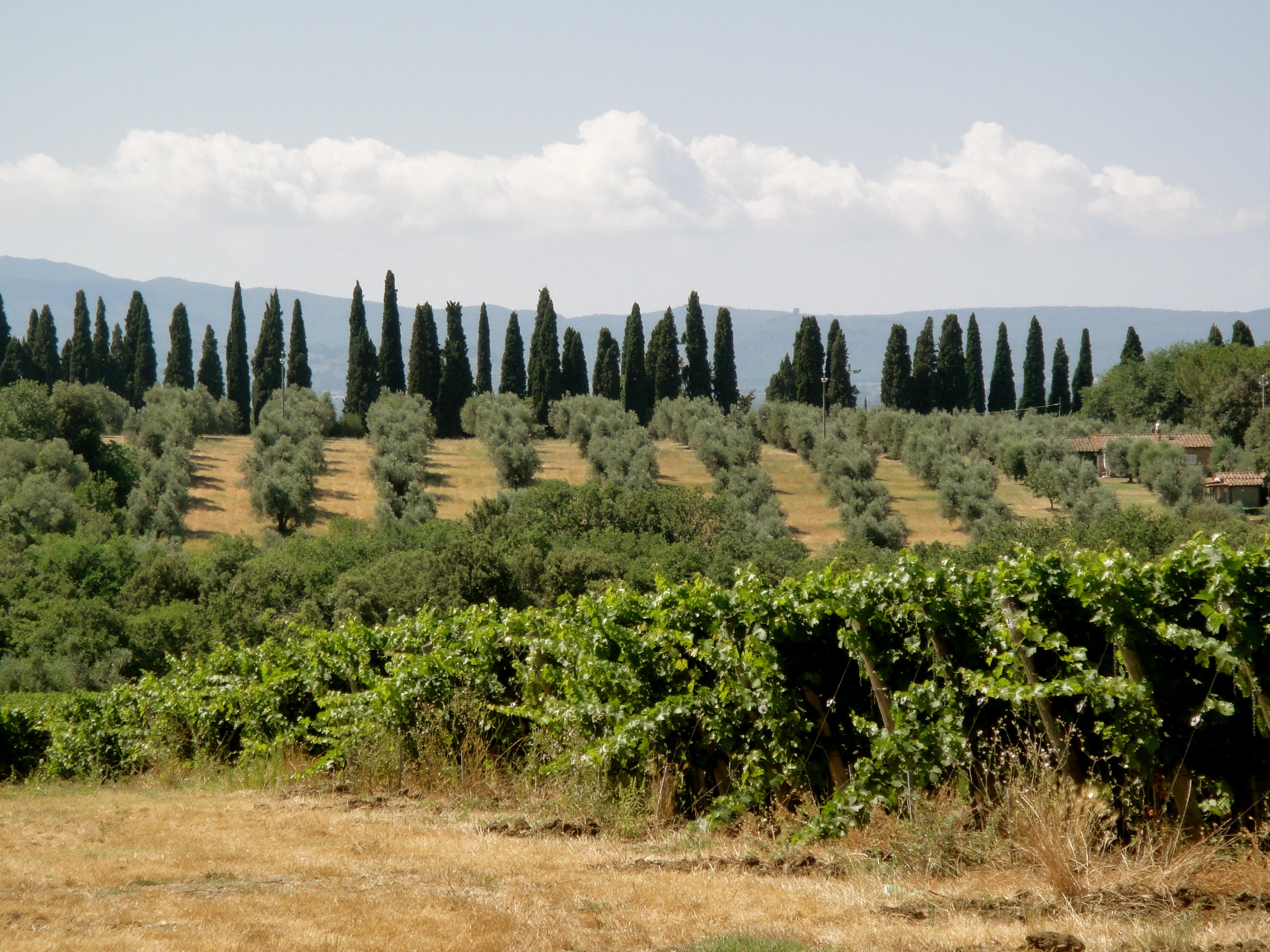
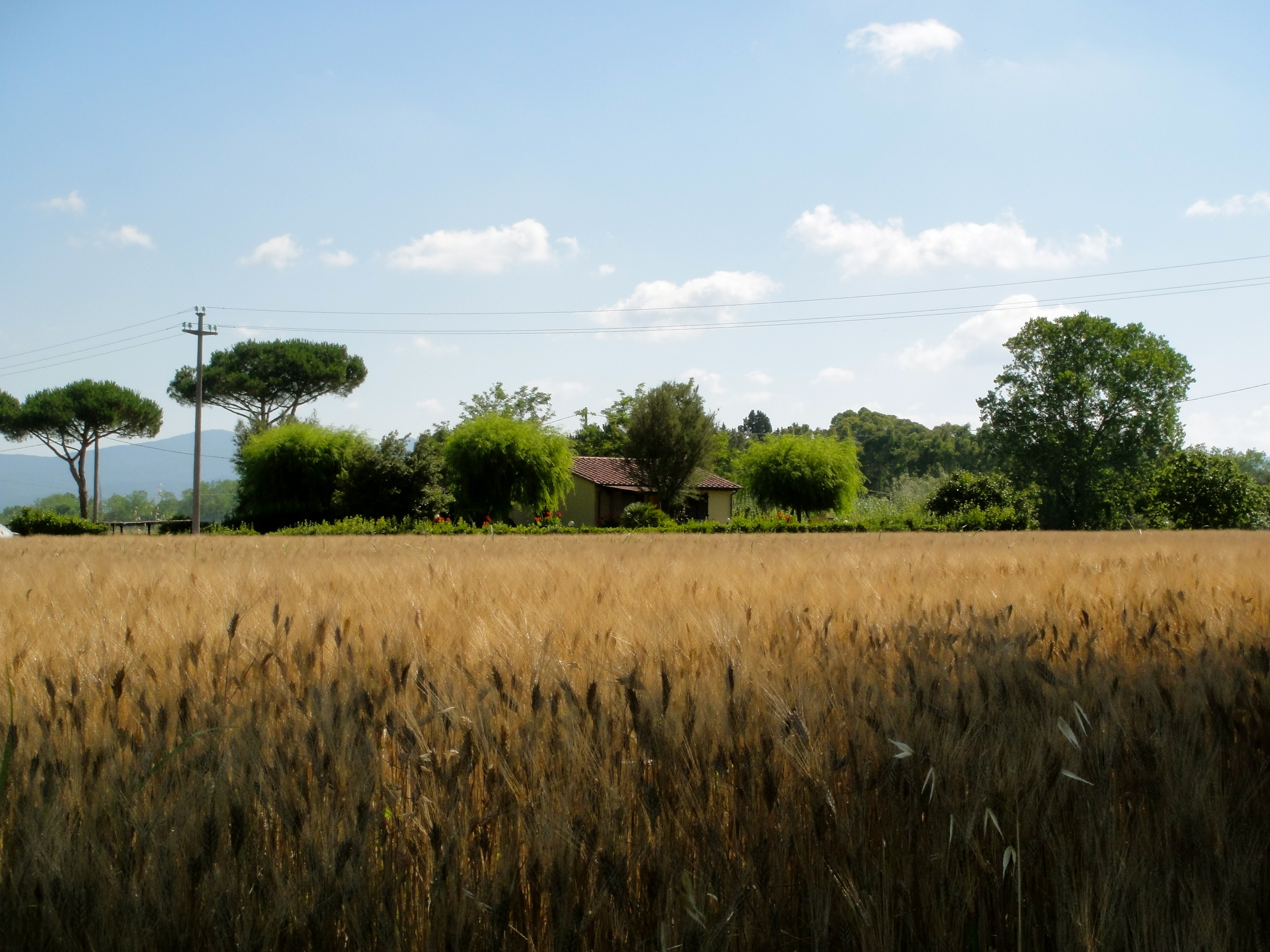
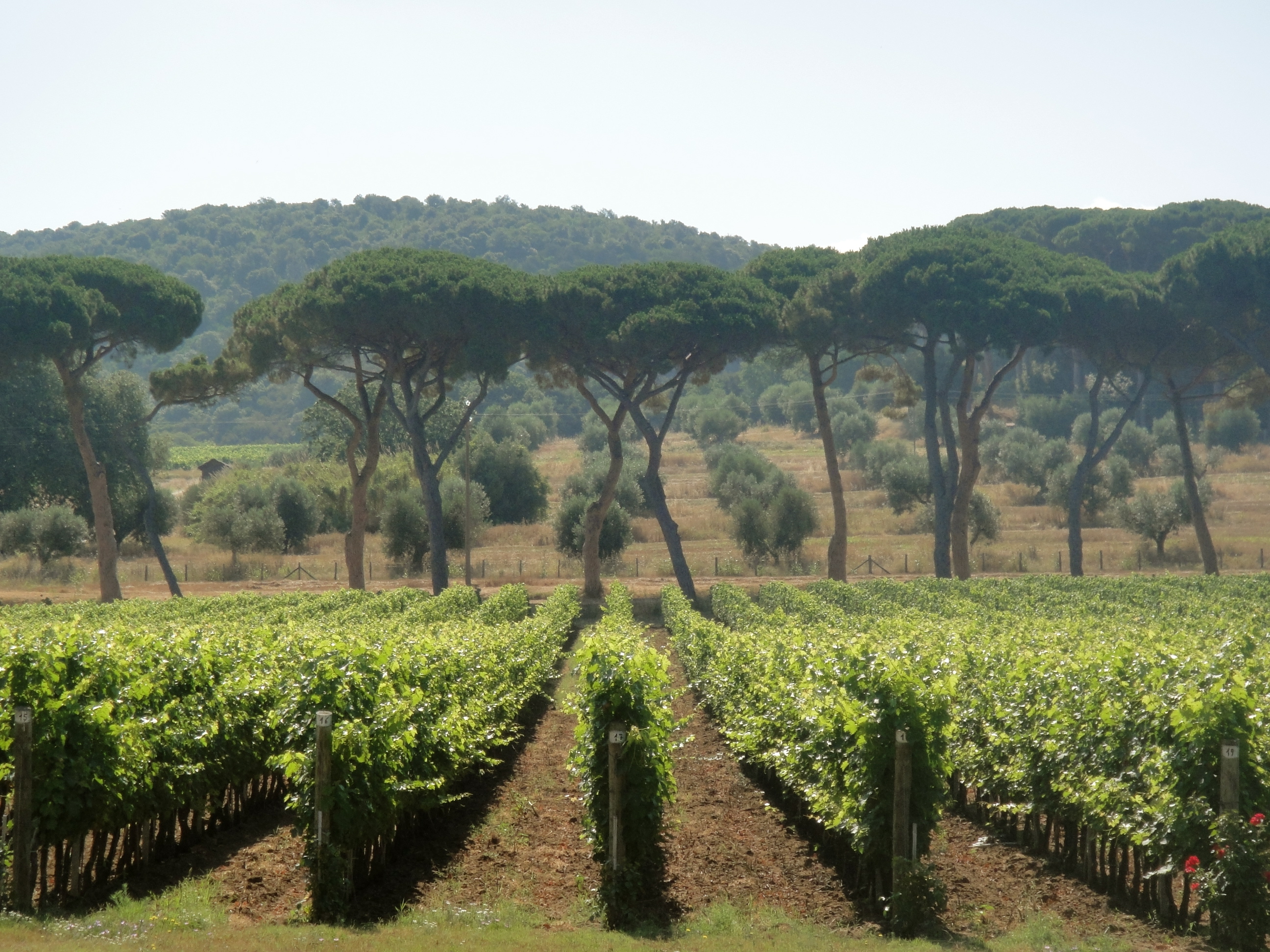
While the sea may refresh and the sand bounce sunlight upon pleasure seekers and sun worshipers, the real attraction of Tuscany for me is its stunning countryside. Rolling green hills interspersed with meandering roads and picture-perfect villas, extensive vineyards painstakingly laid out across slopes and valleys with mathematical precision, and pine trees and cypresses majestically crowning the landscapes, proudly lining driveways and cross-country roads, and providing visitors and residents alike with a naturally regal sunshade unsurpassed by the multi-coloured parasols along the coast. This greenery is emblematic of lush, bucolic Tuscany, playing host to the hundreds of cicadas whose relentless chirp readily informs that you are enjoying the hotter climes of continental Europe and presenting, at each turn of its snake-like roads, a vast array of sensational vistas and uplifting, awe-inspiring views.

The cypress trees of Bolgheri

A typical Tuscan landscape

Such is my obsession with the countryside spectacles all around the Tuscan region, that my partner’s family became all too accustomed to my relentless requests to stop the car so that I could take countless photos, both for their own sake and as pictorial research for the Tuscan paintings already building in my head. Having been fully satisfied of my desire to mingle amongst sunflowers, my next wish was to fully immerse myself in the vineyards for which the region is so famous. Often closed off behind large elegant wrought-iron gates, and cordoned off from the public, more to prevent the feasting ravage of the local wild-boars than the trespass of passers-by (I’d get in if I could!), I have gazed in wonder at so many perfectly-planted vineyards, but never been able to walk amongst them. This year however, I realised my wishes and more.

On our first vineyard outing, to a vinery close to the tiny castle-topped town of Bolgheri, I was treated to sensational views of the rolling vineyards below, from a platform build under the shade of a magnificent old oak-tree which, in Harry Potter style, bore the scar of an attack of lightening some years before.

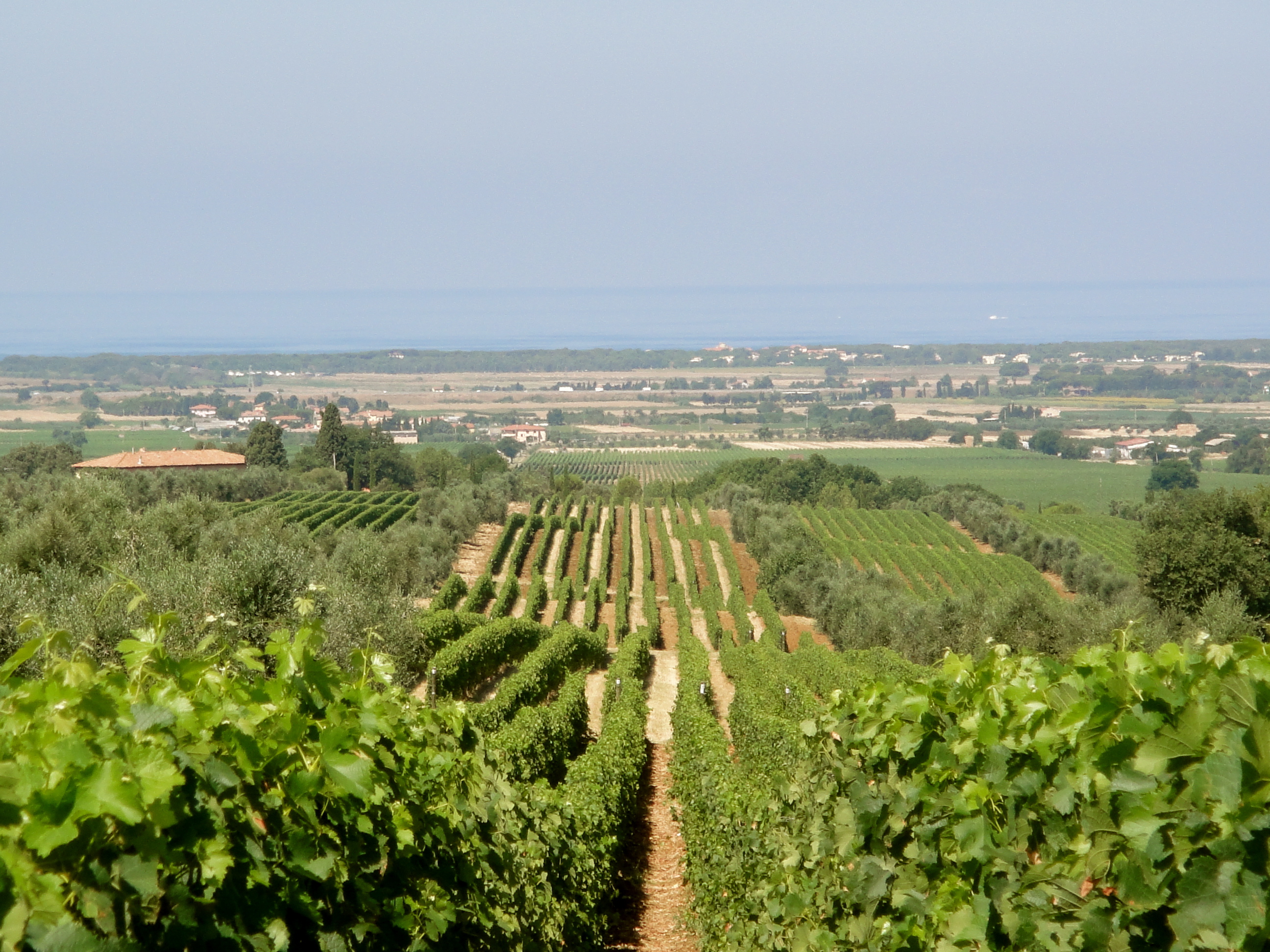
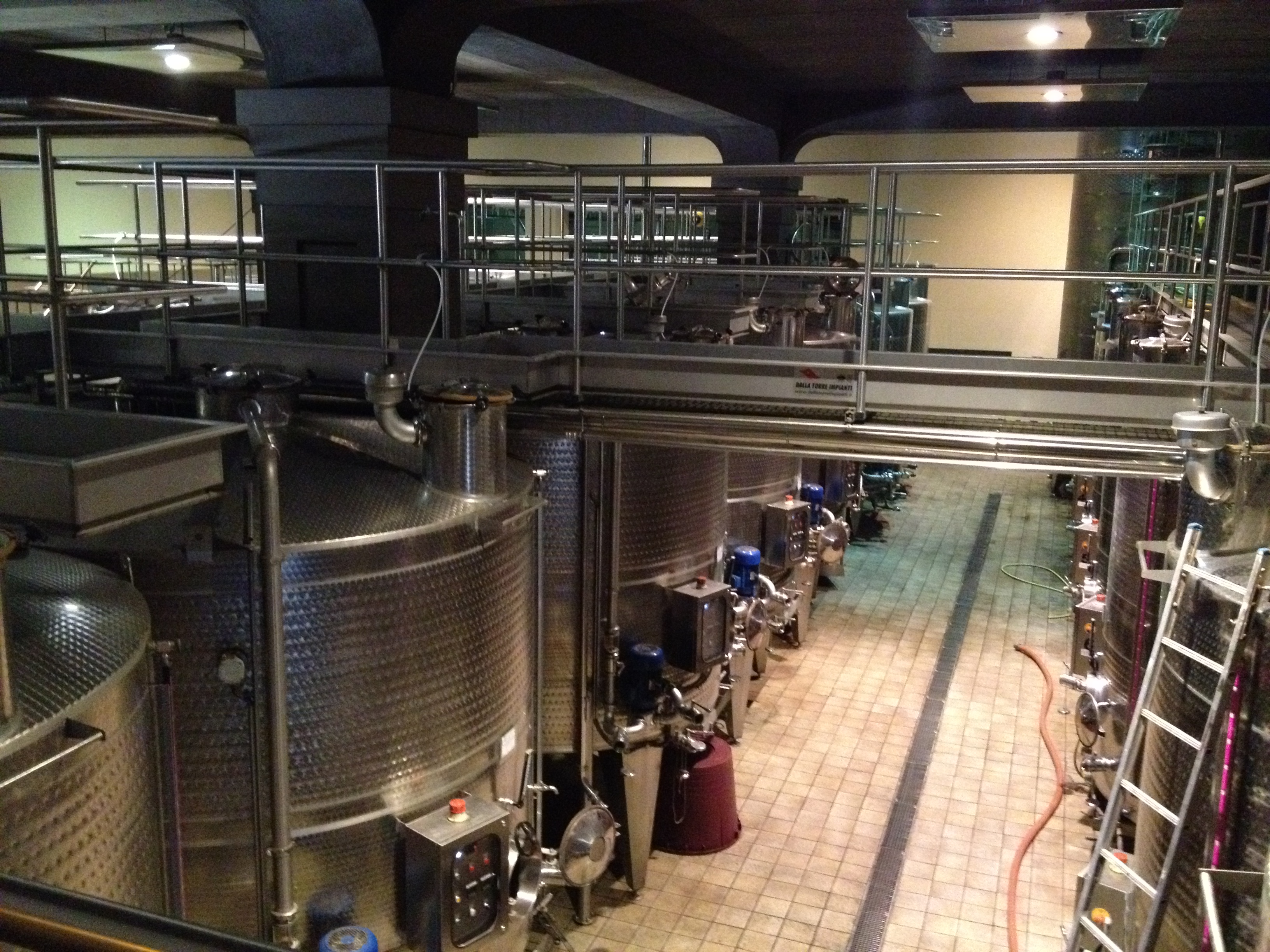
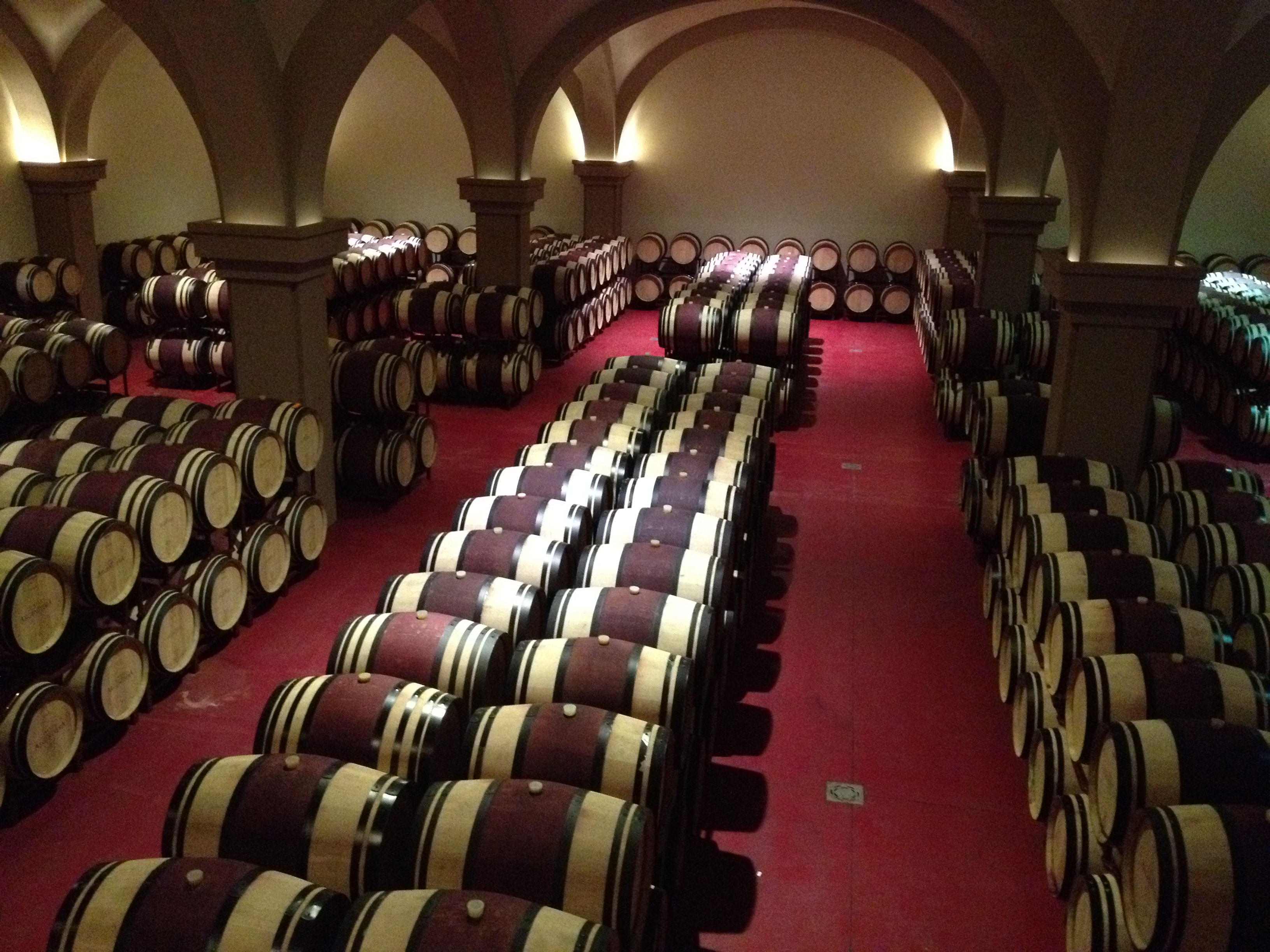
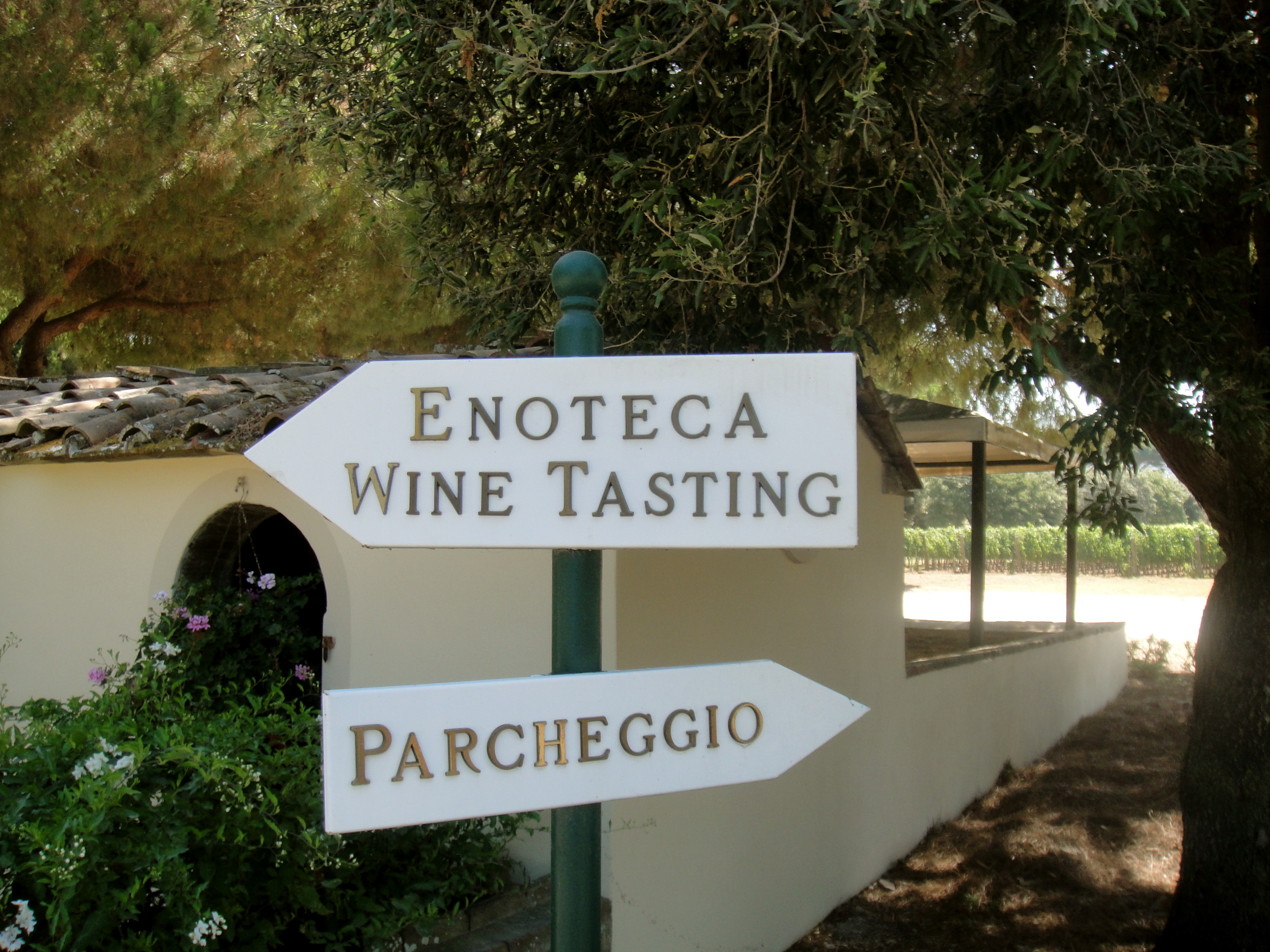
On our second vineyard outing however, we were treated to the ultimate in winery indulgence – a personal tour around the vineyard, the vast cellar where they make the wine, and an exclusive tasting of some of the vineyard’s most celebrated wines. The vineyard which played host to this unique insight into the manufacture of Tuscan wine was the Tenuta Argentiera estate, situated above the Alta Maremma coast just along from Donoratico and owned by brothers Corrado and Marcello Fratini. As wine manufacturers go, the Tenuta Argentiera estate is fairly new. As recently as fifteen years ago, the estate was all but barren. However, only a few years after acquiring the land, some 60 hectares was cultivated with row upon row of Cabernet Sauvignon, Cabernet Franc, Merlot and Syrah, grape varieties which are said to achieve outstanding quality in the Bolgheri area. But that quality is assured not just by local conditions. The estate now boasts a fit-for-purpose stunning fortress-like cellar, with huge thick walls guaranteeing the natural thermoregulation of the cellars. Inside, huge stainless steel tanks ferment and macerate the freshly-picked grapes which reach these sifi-resembling machines within 20 minutes of picking. Thereafter the wine is stored in French oak Barriques, where the vinification process is completed, bottled and sent out across the world.

Vineyards with a stunning sea view

The intricacies of this process, and the care taken in the manufacture, is obvious from the sublime flavour of the wine. Our tasting enabled us to indulge in three truly thrilling wines, from the highly drinkable entry wine Poggio ai Ginepri, to the smooth, fresh Villa Donoratico and the deep and complex Argentiera Bolgheri Superiore as well as a sample of an exquisite extra vrgin olive oil, also manufactured from produce grown on the estate.

The wine making process revealed

Those immaculate barrels

We left Tenuta Agrentiera with bags several bottles heavier and our heads certainly, indulgently, lighter, to face another afternoon in the intense but all-embracing Tuscan sunshine. La Dolce Vita? Indisputably so.

All photos are strictly the copyright of Nicholas de Lacy-Brown © 2012 and The Daily Norm. All rights are reserved. 

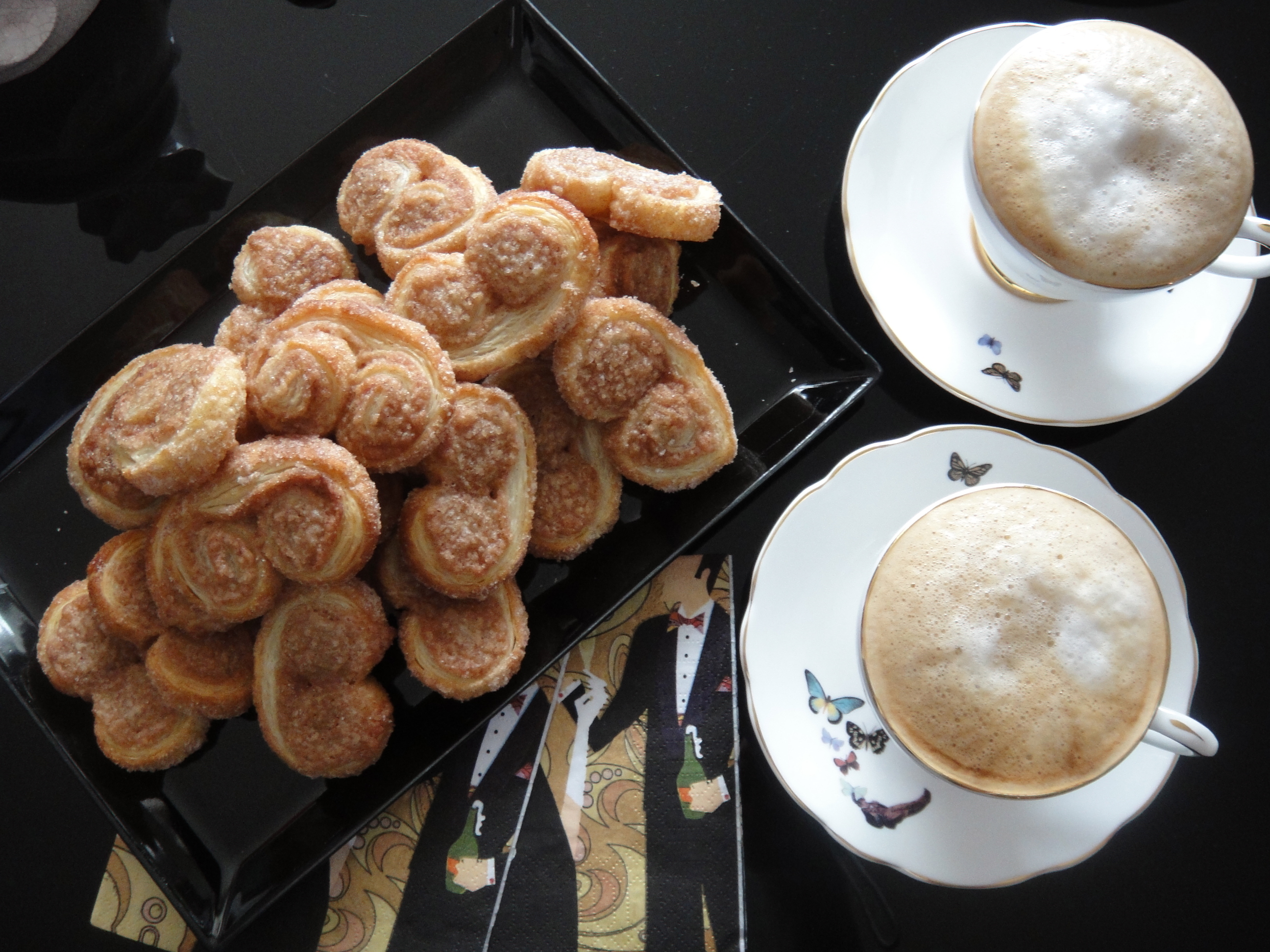
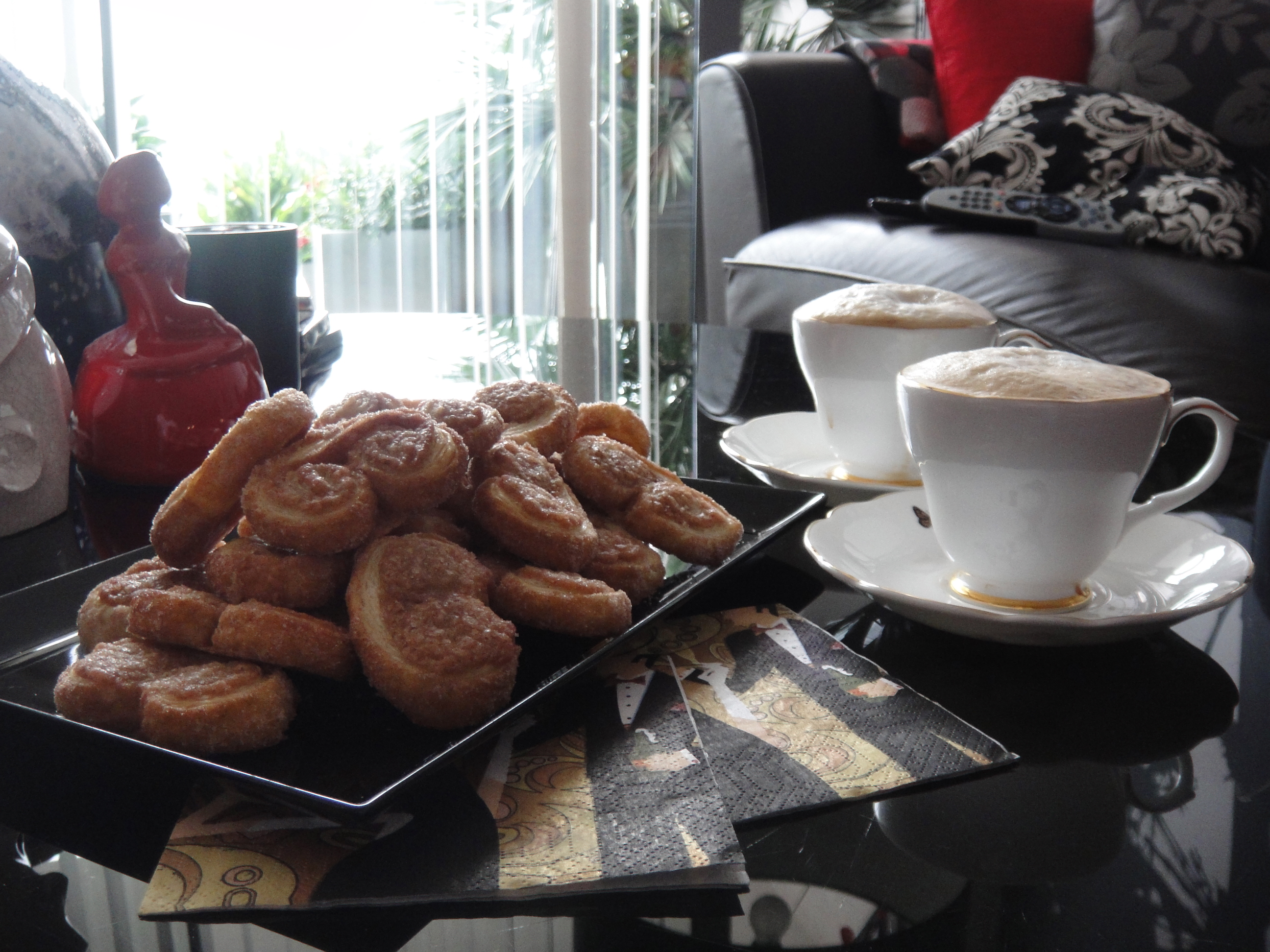
Palmiers for coffee-time – baking doesn’t come easier than this

I’m the first to admit that I am guided throughout the day by sugary treats and a healthy dose of caffeine. In the mornings I look forward to 11am, around which time I make a fresh frothy cappuccino in a vintage cup with a little treat on the side. In the afternoon meanwhile I long for my earl grey tea with a little cake, and a cleansing green tea a little later. In the evenings I go for my favourite: a fresh mint tea, or jasmine, the smell of Spanish summer, and try to resist something a little naughtier on the side.

Ok, weight-watchers this isn’t, but a giver of easy baking tips – I’m your man. The other day, I bought a roll of puff pastry from the supermarket intending to make some crayfish puff pastry treats but then couldn’t get the crayfish or anything remotely similar. So the puff pastry was sitting in the fridge and I suddenly thought to myself – hmm I should make palmiers.

Palmiers get their name from the humble palm leaf (which, somehow, they are meant to resemble) – other people call them elephant ears (probably more accurate). In Spain we call them palmeras, were they are a staple of most patisseries and cafes either glaceada (with icing) or con chocolate. Either way, they are a delicious treat and seductively simple to make.
Simply take some shop-bought buff pastry (no point in making this from scratch – hours of labour will commence for the same results) and in a cup mix up about 100g caster sugar and a heaped teaspoon of ground cinnamon. Roll out your puff pastry if it’s not rolled out already, and sprinkle generously with some of the sugar mix all over. Then fold over, roll out again, and sprinkle with some more sugar. Do this a few times until the sugar is sort of combined (it doesn’t really combine into the pastry all that well, but not to worry – you’ll sprinkle more on at the end). Then roll your pastry into a large rectangle around 12-14 inches in length and 10 inches in width.

To get the palmier shape, role the pastry along the longest side until it reaches the middle of the rectangle and stop. Then do the same with the other side, rolling into the middle until the two halves meet. Place the result in the freezer for about 10 minutes so the pastry can firm up a bit for cutting. Take the pastry out and cut into slices about half an inch thick and lay them on their side (i.e. curly pattern face up) on a baking tray, leaving a little space around each for puffing. Sprinkle them all with a little more sugar (though not too much as I went a bit mad and mine turned out uber-sugary) and bake in an oven at around 200 degrees celsius for around 10-15 minutes until they are puffed up and golden and the sugar has melted on top.

And that’s it! Leave a few minutes to cool down and you have the perfect coffee-morning treat.

PS: I should add, if you don’t like cinnamon, just leave it out. You can also make these without sugar, and dip them in chocolate at the end. You can also make savoury versions by rolling cheese into the puff pastry and then using them as bases for canapes. The world is your oyster.

A night at Glyndebourne Part 2: Damp Grounds; Delicious Dinner

When you attend the opera in most theatres, doors will open half an hour before. No sooner have you arrived that the bell will go and you’ll hurry to your seats. The interval will provide at most, the opportunity for a rushed glass of something bubbly before your brisk return into the theatre again for the second half. Once the curtain goes down, it’s home as quick as your legs can carry you, avoiding the waves of leaving attendees wherever possible.

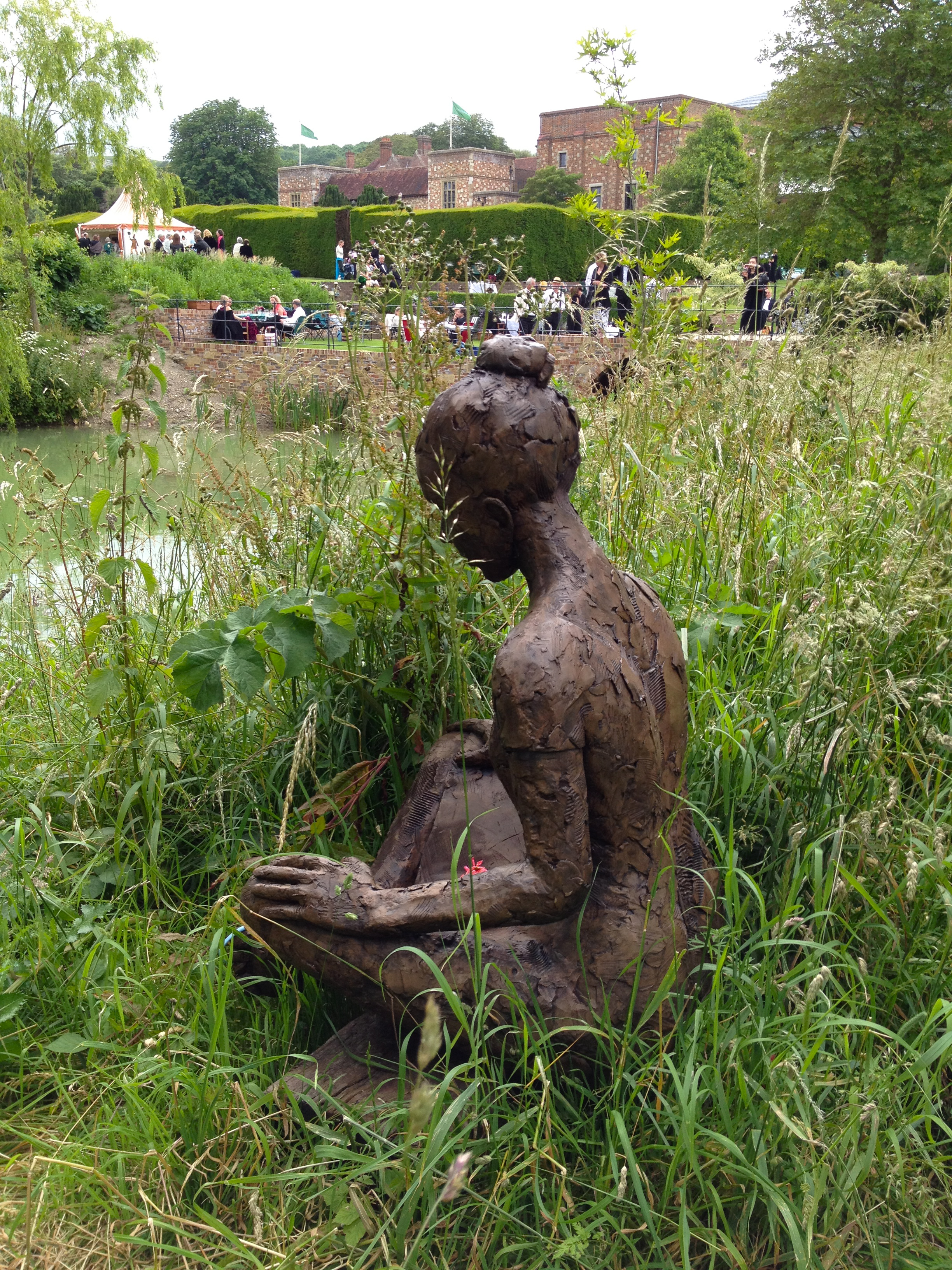
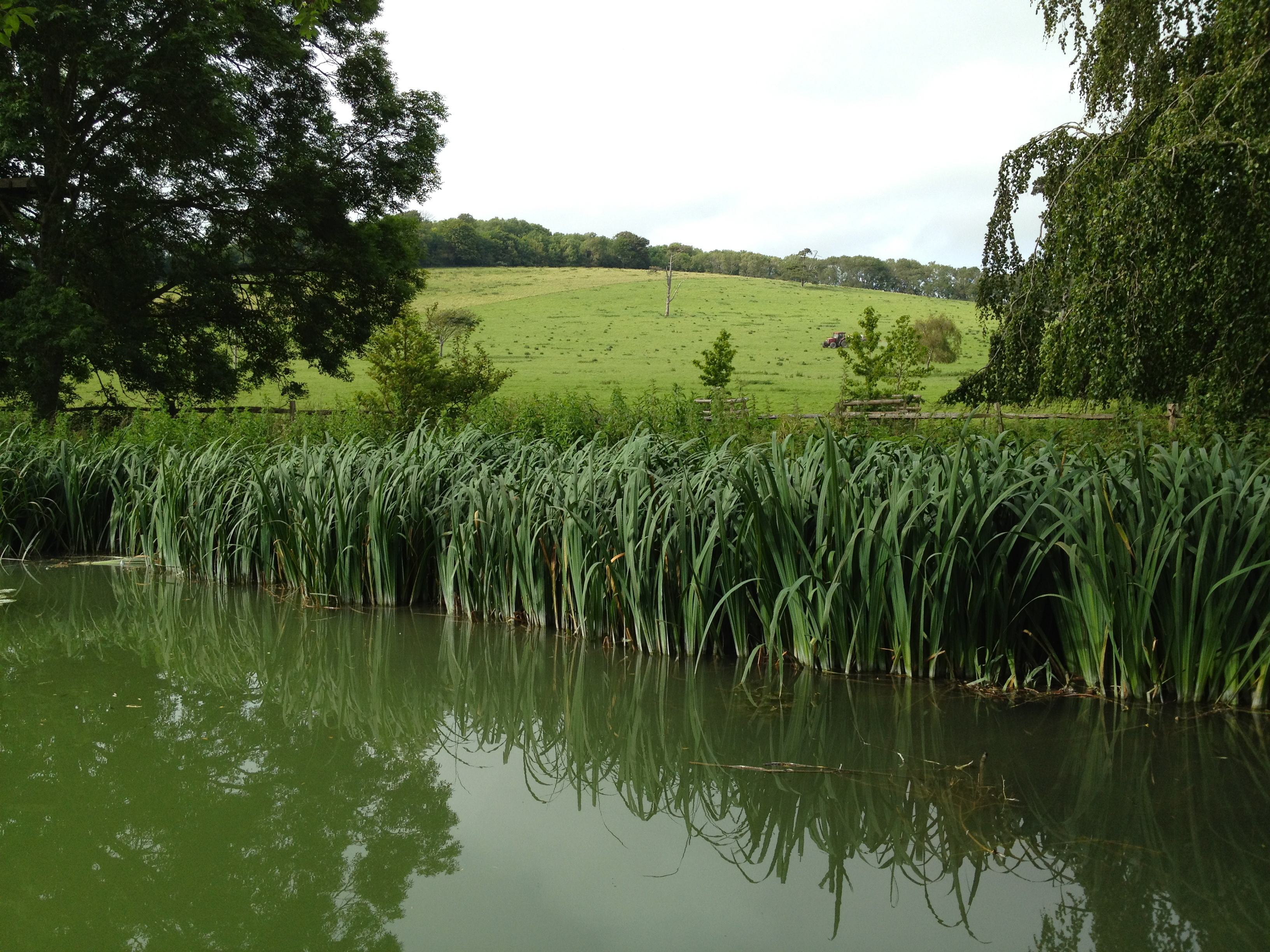
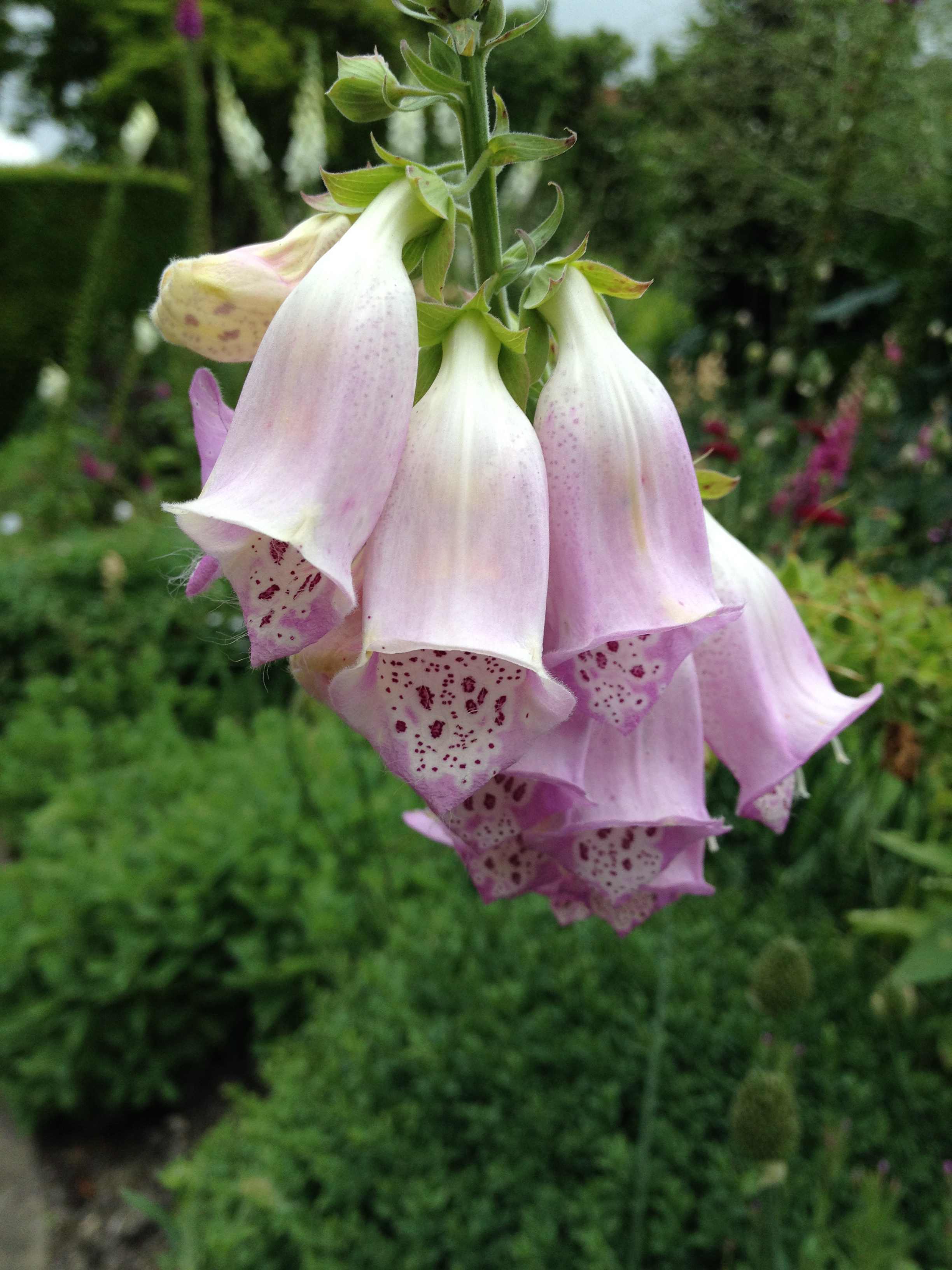
Going to see an opera at Glyndebourne is very different. It’s an event; it’s practically a day trip. Before the start of a performance, you can stroll around the grounds, walk around the dammed stream and look at the sheep, enjoy a glass of champagne on a bouncy lawn, or take high tea in one of the restaurants. There is even a small art gallery in the basement of the opera house for your entertainment, and walled gardens bursting with multi-coloured blooms. When it’s finally time for the Opera to begin you watch the first half followed by an interval of 80-90 minutes. It’s during this time that the spirit of Glyndebourne really comes alive, as picnics, already set up by opera-goers all over the perfectly maintained grounds are enjoyed, with time to sit back, sup, and discuss the first half of the performance.

A dammed stream in Glyndebourne’s extensive grounds

It’s the picnics that are, for me, emblematic of Glyndebourne, and offer a wonderful insight into a slice of English society. It’s hilarious to see how people subtly compete with one another. Far from picnicking out on a mere blanket, the Glyndebourne picnickers bring practically their whole dining room with them. They’ll be those who bring a fold up table and deck chairs which are fairly easy to carry and unpretentious. Of course they’ll have a Fortnums hamper with them, but then who doesn’t? They’ll be the ones with the plastic plates and food wrapped up in foil. But on the table next door they’ll be no such shortcuts. For those proud picnickers, the presentation of the picnic is a status symbol. So they bring chairs which are sturdy and firm. Their table is covered by a linen tablecloth with matching napkins. They’ll bring china plates and glass champagne flutes. And who could picnic without a crystal vase of flowers to set off the contents of the table? I wouldn’t be surprised if some of these picnickers bring a Butler too. I adore the charming pretention that comes with these picnics, seen equally as guests vie for the best spot on the grounds, marking their claimed territory with grand extensions of blankets and umbrellas, huge picnic baskets and other tokens of home. All done of course with a broad smile and exchanged pleasantries with the picnic table next door.

Flowers in the walled gardens

Sadly, of my four trips to Glyndebourne, I have never once been able to picnic in the grounds. I’m clearly cursed, as on each of my visits, it’s been either raining, perilously windy, or both. Such is the instability of the English summer. On good days it must be amazing in those grounds. Sadly I am yet to find out. On this visit my mother and I had long given up the hope of picnicking. We were travelling from London with minimal time to prepare, so we booked a table at the Middle & Over Wallop restaurant. As the day approached, we did not regret our decision. True, the rain just about held off, but with a keen wind and grey skies, picnicking conditions were not ideal. Yet still the majority of guests braved the conditions and stuck with their picnicking plans – another apt demonstration of Englishness – to stick it out, no matter what.

For we, perhaps more cynical diners, the Middle & Over Wallop restaurant, run during the season by Leiths with chef Albert Roux overseeing operations, provided a delicious mid-Opera feast in opulent surroundings (the restaurant must be hung with about 50 or so separate chandeliers) which was, most importantly, cosy and dry. What with time being on the short side, everything was chosen in advance, so a swift service was guaranteed.

The Middle and Over Wallop Restaurant

We both started with Hure of organic salmon, smoked salmon, crab and quail egg with watercress dressing. That dressing was light and peppery, and the smoked salmon delicate and moist. It was a fairly simple arrangement but full of flavour.

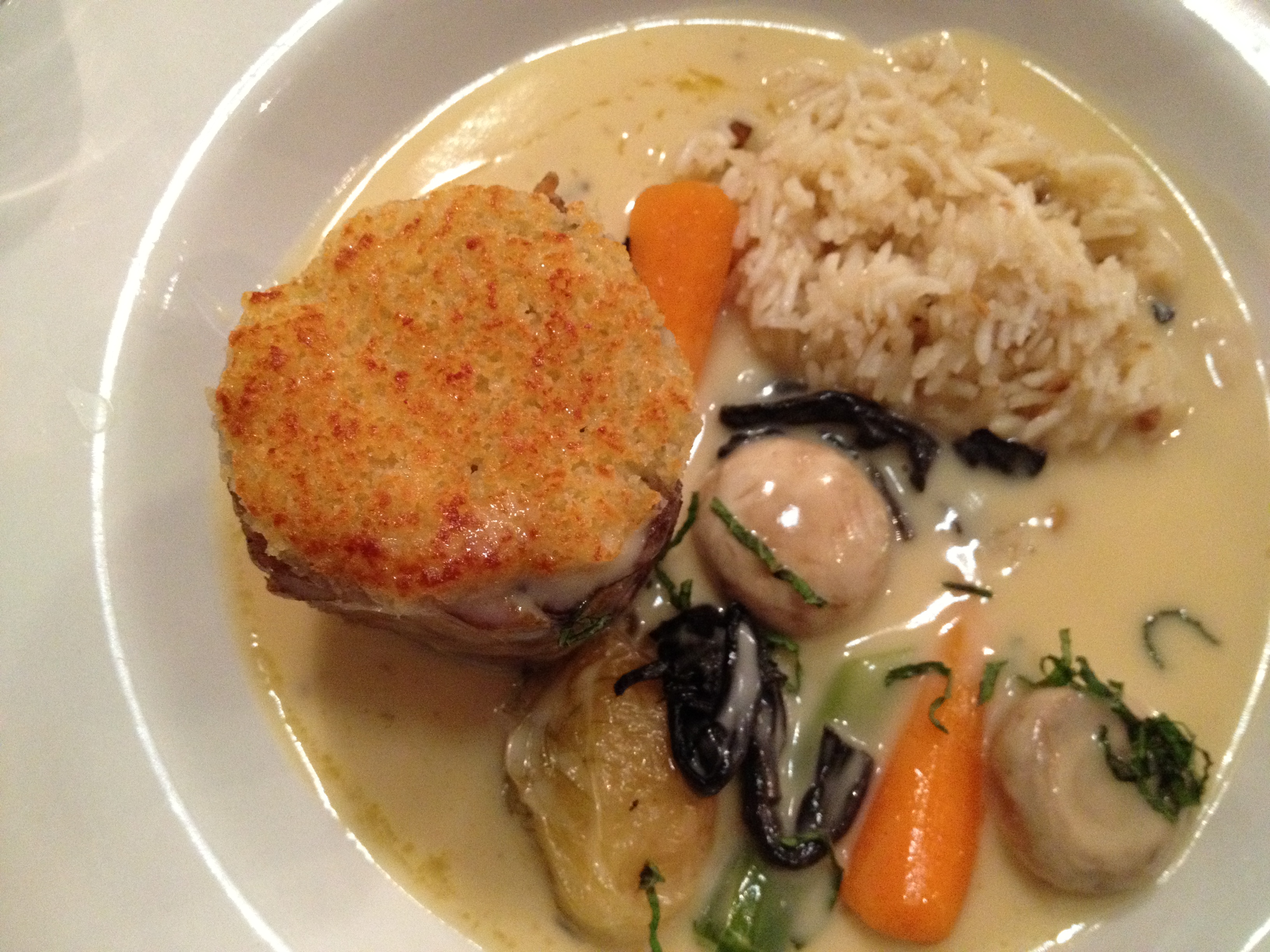
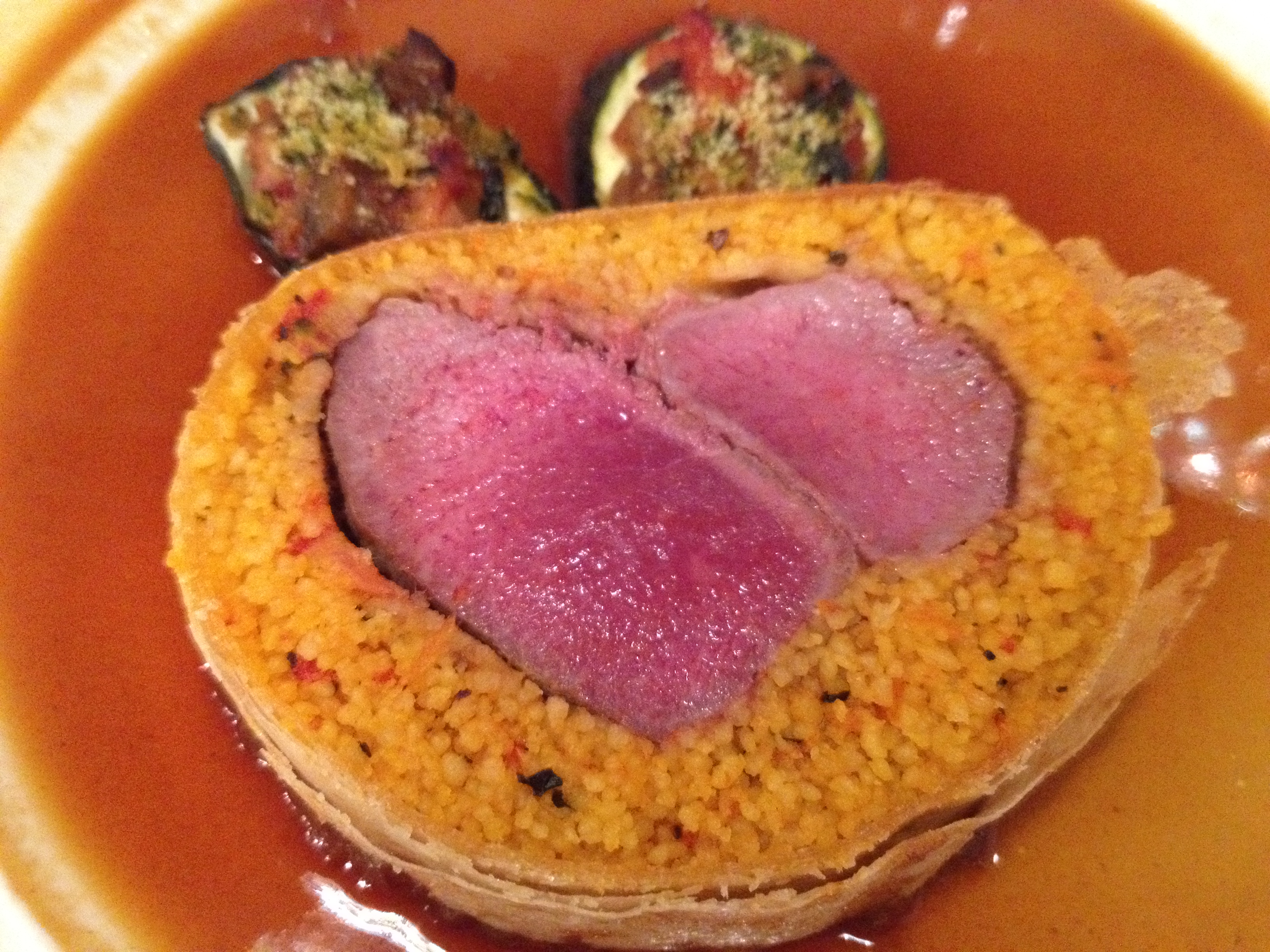
Next up for me was a blanquette of veal with mint, baby onions, Chanteney carrots and basmati rice. It was exquisite. The cheesy crumb on the top of the veal was to die for, while the meat just fell apart under my knife. Meanwhile my Mummy had a loin of Cumbria fell bred lamb wrapped with saffron couscous, and cumin rataouille. She too was aptly impressed, and this once can even be recreated at home – bonus!

Blanquette of Veal

Saffron couscous encrusted lamb

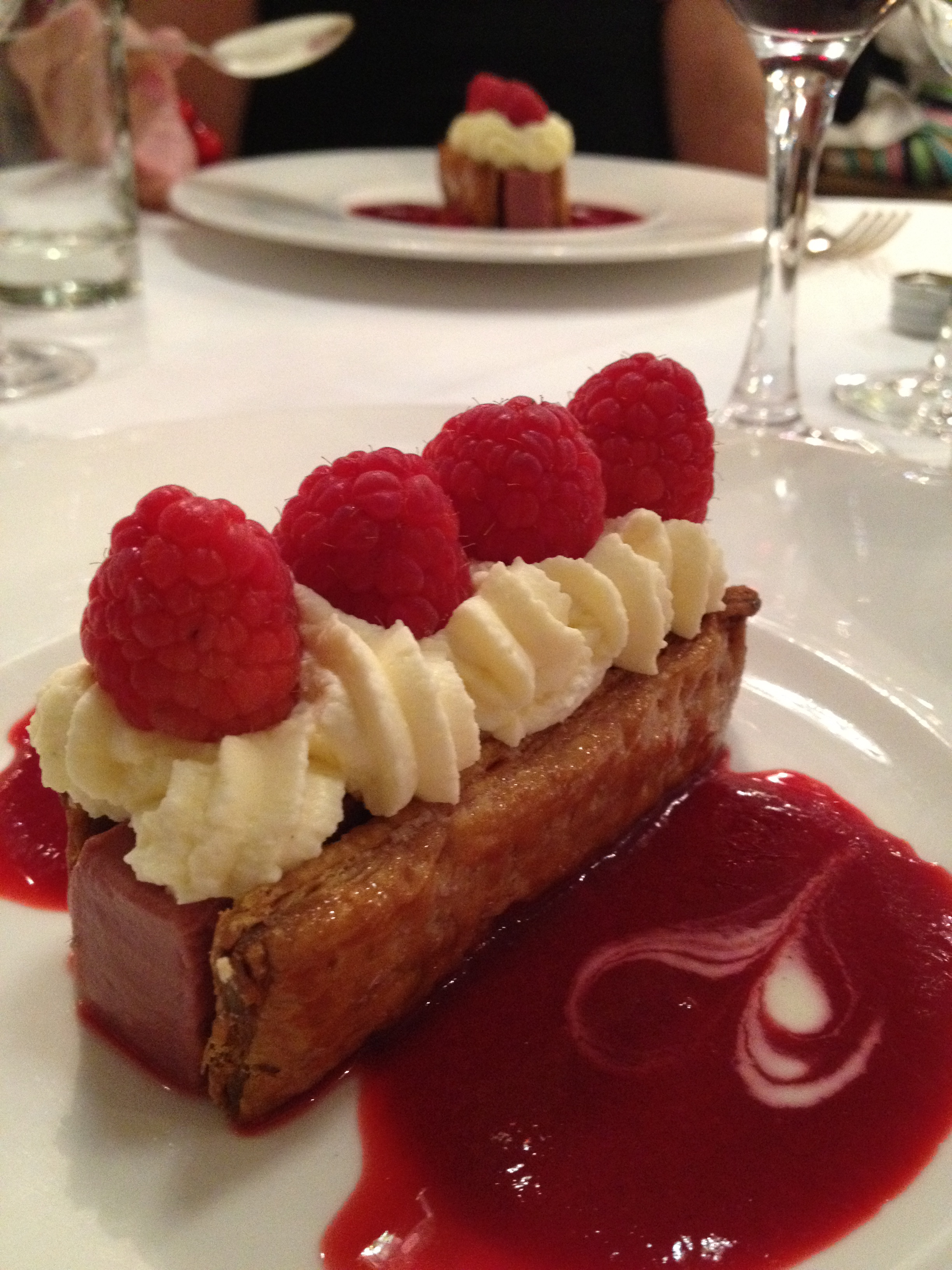
Dessert was a raspberry triple – a millefeuille of Kent raspberry, raspberry mousse and raspberry coulis. It tasted as good as it looked.

The raspberry triple

Luckily the food, while swiftly served, was light with fairly small portions – I was wearing a waist-repressing cummerbund after all!

So you see, Glyndebourne ain’t all about the Opera – it’s very much an occasion, and one which I cannot wait to repeat again. You never know, next time the sun may actually come out, and I might get to enjoy that picnic after all. But just watch me coming fellow picnickers if I get out on that lawn. Competitive is my middle name.

North Road Restaurant: Another notch in the Danish gastronomic revolution

Denmark, the country that brought us Lego, the Little Mermaid and a whole host of funky, fresh and chic interior design ideas is currently leading the world with its gastronomic innovation. René Redzepi’s two-Michelin starred extravaganza, Noma, has been awarded the ultimate accolade of Best Restaurant in the World for the last three years in a row, stealing the crown from the extended reign of El Bulli long before it closed.

While Noma will soon share its wiles with the best of British when it opens up in Claridge’s during the Olympics (i.e. those who could afford it/ were clever enough to buy a £195/head ticket before they sold out practically as soon as the event was announced), another star of culinary Denmark has drifted over to the British shores and, mercifully for we whose visits to Copenhagen are at best infrequent, is here to stay – I am of course talking about Christoffer Hruskova, whose restaurant, North Road is the bright new star of Smithfield’s market/ St John’s Road and was the location of my dinner on saturday night.

I booked up North Road upon the recommendation of my in-the-know foodie-friend Celia, whose nose for fine-dining is so refined that I would willing follow her blindfolded throughout my life, so long as she gave me plenty of slices of her fantastic Ombre cakes en route. It’s not a cheap option, but as it was the third anniversary of my first date with my partner, we at least had an excuse for a splash. And with the promise of a tree made from candy floss, who on earth could resist?

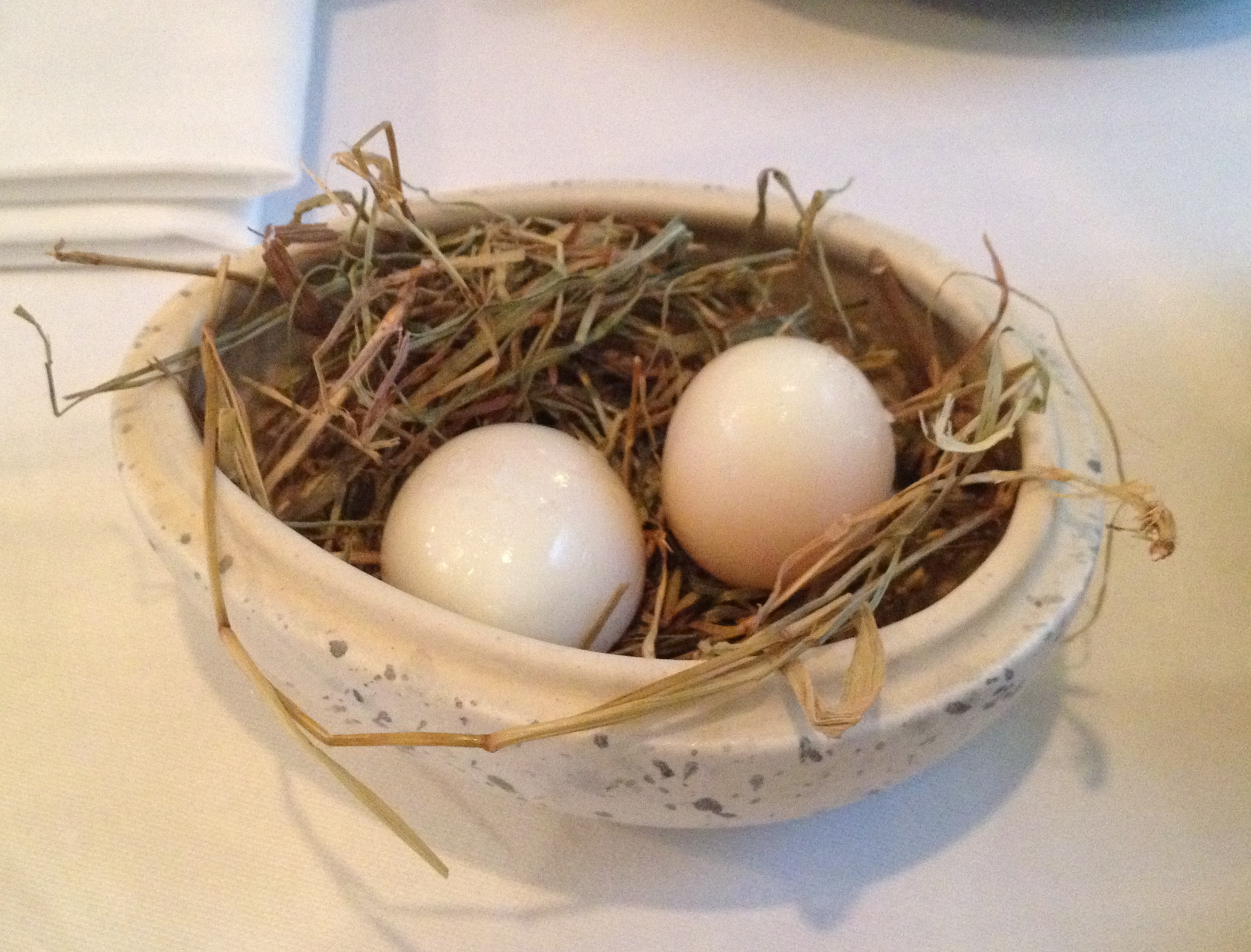
Just to start…”snacks” of quail eggs, smoking potatoes and pork crackers

Upon entering the restaurant, we were immediately struck by the sophisticated elegance of Denmark which so enthralled me upon visits to the Illum Bolighus department store in Copenhagen. So too were we instantly wooed by the attentive but very friendly welcome of the staff. Soon after being seated, the enticing smell of smoke filled our nostrils as we were treated to some starting snacks – Jersey Royal Potatoes smoked in hay and served with an exquisite mayonnaise, pickled quails’ eggs and pork crackling which was like a giant fluffy prawn cracker. My partner’s eyes met mine across the table and with that knowing look that occurs between couples who have gradually merged in one over the years of their relationship, we knew that this meal was going to be good. Very, very good.

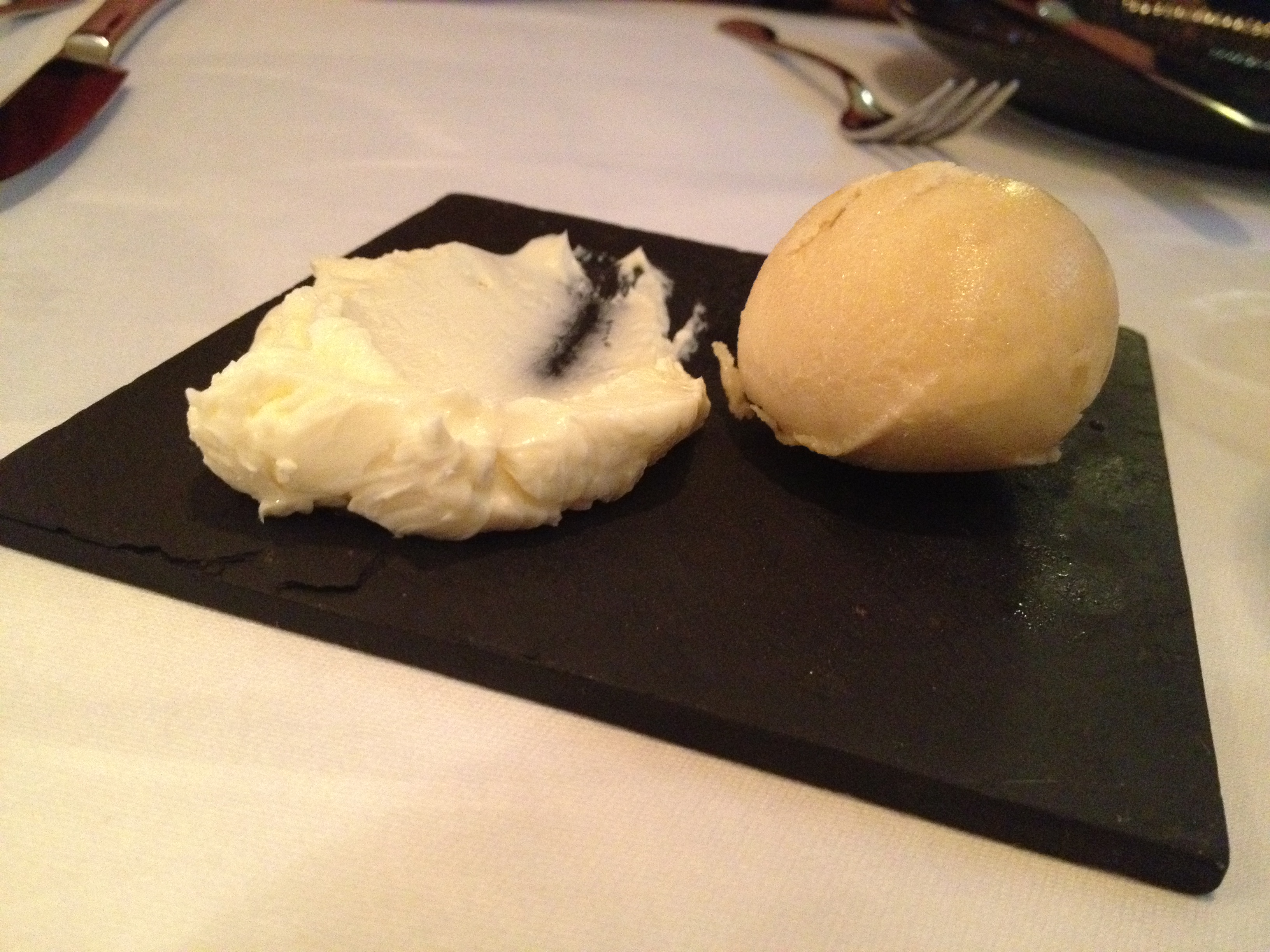
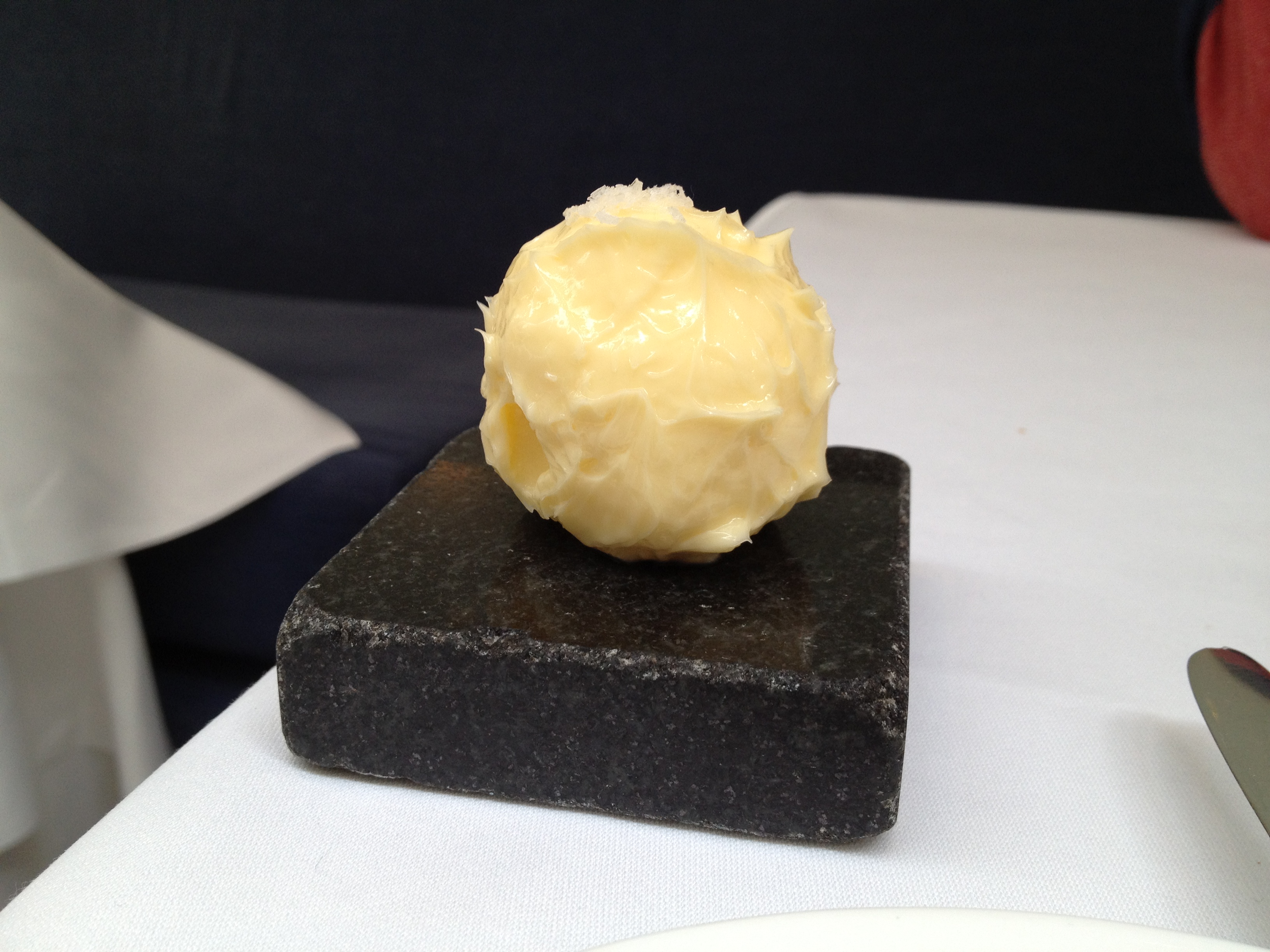
Caramalised butter…to die for

We opted for the 7 course tasting menu – it would be foolish not to, as 7 courses is only £7 more than the 5 course alternative. But before the dishes began rolling out with perfectly timed pauses between each, we were treated to a bag of little bread rolls and – wait for it – caramalised butter and a buttermilk butter. Oh dear god, let me tell you, that caramel butter was so exquisite in my mouth I almost ate the whole ball. It was crystallised and punctuated with occasional shards of salt – a rich sugary caramel which melted upon the palate before suddenly releasing a smooth butteriness. All I can say is that having enthused so fervently about this to the waiter, he told me how to make it, so future guests at my dinner parties – prepare to be wowed.

Razor claims – a masterpiece on a plate

Onto the food. First up was scottish razor clams with coastal herbs, organic cream and parsley. This was art on a plate. The exquisite marbling of the cream and the green parsley reduction was so beautiful, that even when lifted up on a spoon it made multi-marbled pictures worthy of a Turner prize. The clams were incredibly sweet and delicate – flavours of rose petals, the sea, and generalised freshness came flowing into my mouth in a way that shop-bought clams would never provide. And the flavour was perfectly matched by some wonderfully unusual coastal herbs which felt like my mouth was going off on a little adventure to some far off wind-swept seaside.

The lobster symphony

Upon that seaside I found myself engorging upon the next dish – an incredible lobster and buttermilk creation with baby cucumbers and nasturtium leaves.  As its forbearers had been, so too was this dish delicious to every degree. The nasturtium leaves were peppery, and the mini cucumbers refreshing and texturally distinctive from the succulent sweet lobster. Oh how my grandfather would have loved this dish! Once again the visual treat was tantalising, as pink undulations of soft-shelled lobster were punctuated with the star-burst leaves of the nasturtium, the hapless scatter of some sandy deliciousness, the drizzle of oil and the contrast of straight little cucumbers. Goodness, I sound like a Masterchef judge.

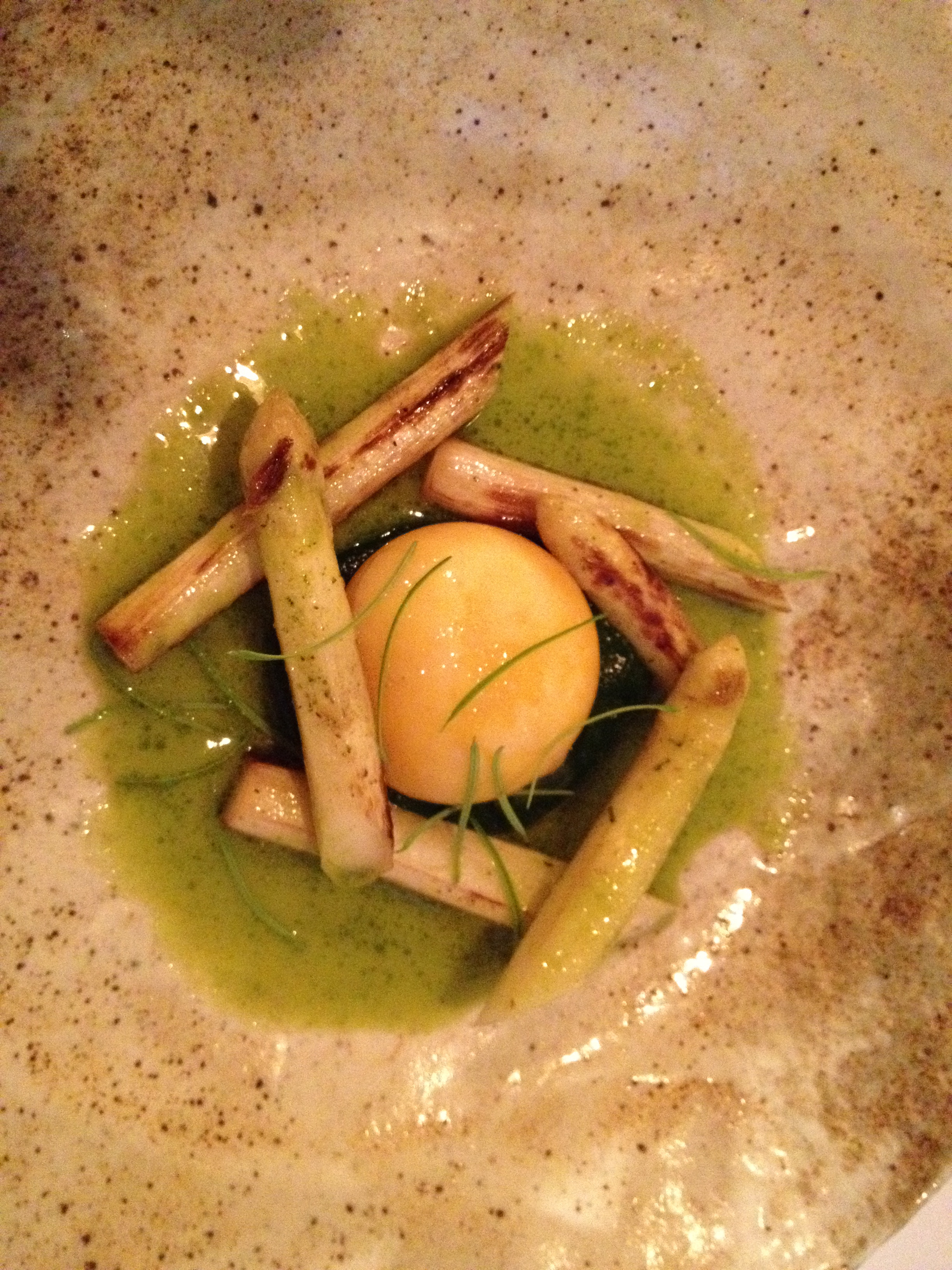
White asparagus with that perfect egg yolk pre explosion

Onwards on our trajectory towards gastronomic perfection, and up next was white kent asparagus with some revolutionary method of importing the taste of pine needles without having said needles needlessly slashing ones throat. Oh and spinach too. My goodness this was the dish of summer – a burst of summer garden freshness in every mouthful, and with a whole and masterfully served single egg-yolk at the centre, which looked so solid and yet, upon impact with the knife, burst into a flurry of sunshine yellow sweetness providing a syrupy soup in which the asparaguses floated like pale beautifies taking their first fill of sunshine.

A garden delight

Talking of summer freshness, the next course was the summer garden, placed on a plate in almost literal form. Jersey Royal potatoes, lovage and radishes were “planted” in amongst soil made from burnt butter in some brilliantly molecularly innovated form, while at the base of the dish, a creamy butter foam gave moisture and exquisite salty/creamy balance to the whole dish. The radishes provided a fresh crunch, and one potato was coated in hay ash to brilliant flavour-effect, like a barbecue and a summer potato salad all rolled into one (I note that the chef, Christoffer Hruskova, is quite keen on importing the flavour and smoke from burnt hay into his dishes which gives an incredible depth of flavour and scandinavian savour to the food).

The interior (photo: Sarah Lee)

Next up was the main course which, owing to my gradual state of inebriation by this stage I neglected to photograph. It was no less superb however – a selection of exquisitely tender Herdwick lamb cuts and little sweetbreads which were a revelation. When you think about the little lamb cheeks, tenderised by the sweet suckling of its mother’s milk, it’s a rather off-putting image, until you eat them that is, and the soft creamyness of that milk is reflected in this very soft, very rich little nugget. The dish was served with more seasonal summeryness – sea lettuce, sea blite and more coastal herbs, giving us all hope that despite a decided lack of sun outside, we may at least sample the summer through this bombardment of taste sensation in our mouthes, as well as discover the delicious, albeit slightly surreal symphony of a lamb lost somewhere on an ocean’s edge. Reminds me of that terrible movie scene when a load of lambs fell of a cliff edge – what film was that? Silence of the lambs or something?

Stone and Hay

Who knows, for up next was a plate of delicious vintage cheeses, again, neglectfully unphotographed, followed by the pure theatre of the evening. First “stone and hay” – basically a frozen stone, not to be eaten I might add, and another realistically executed stone resting on top, except this one was edible, flavoured delicately and covered convincingly with that favourite of the chef – hay soot. It wasn’t the most delicious dish of the evening, but made for a welcome palate cleanser and clever piece of gastronomic amusement.

Gorgeous gooseberries

Slightly full up by this point, we almost feared the onset of the dessert in case our dwindling appetite would not do this incredible food justice. But we oughtn’t have worried, as the dessert of english gooseberries with douglas fir and wood sorrel was fresh, bucolic and perfectly balanced between sharp and sweet with a wonderful variety of textures and again a very scandinavian, effortlessly green and glorious look.

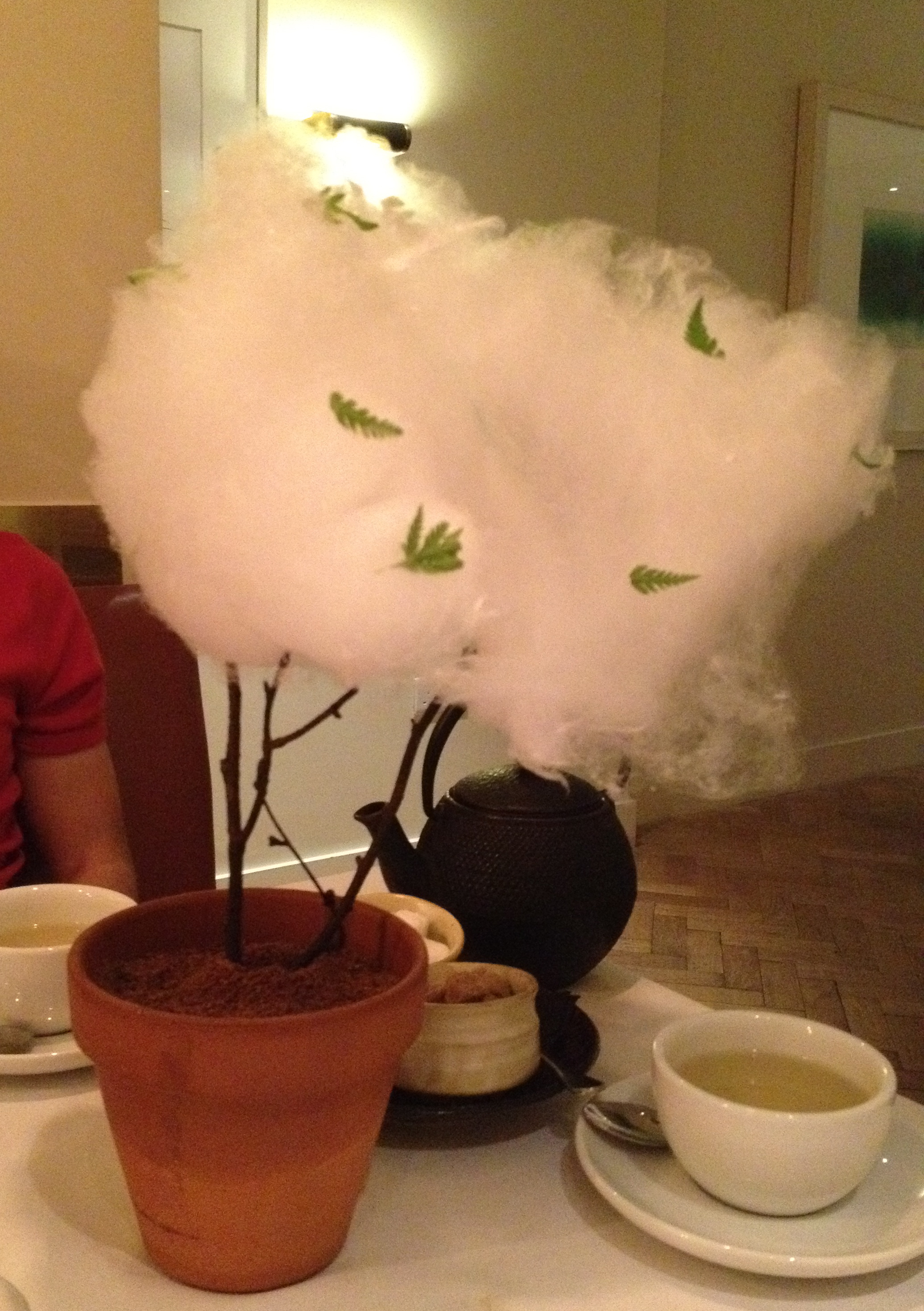
The candyfloss tree!!

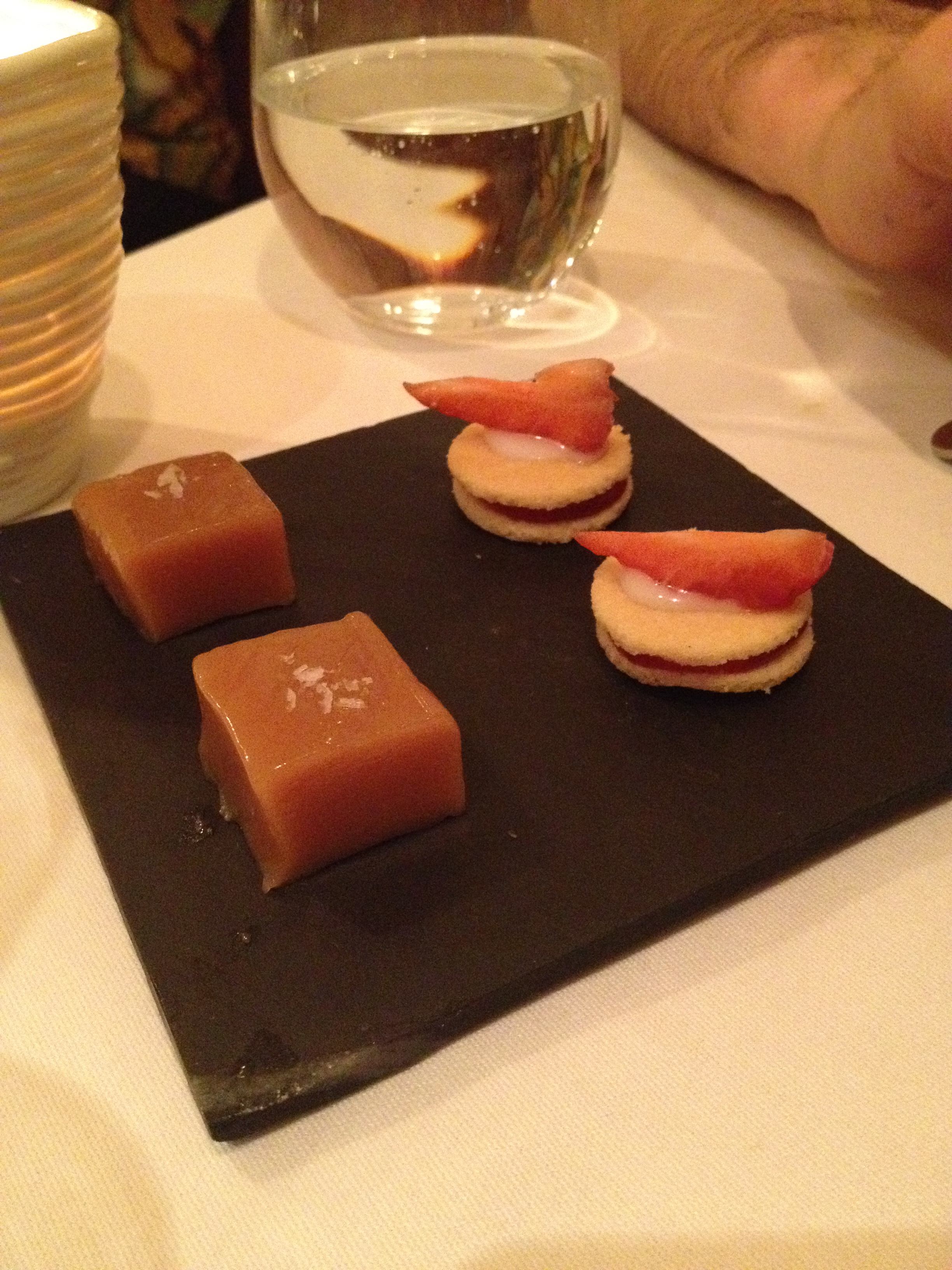
But finally, what we had all been waiting for. Emerging from the kitchen, in its unmistakable terracotta pot, the branches of a fine, blossomed candyfloss tree headed our way, complete with edible soil (made again from burnt butter which to my mind tasted of cocoa) and little petit fours of strawberry jam shortcake and fudge. Need I say more? My evening was complete. This meal was a twisting triumph with elegance, flavour exuberance and pure gastronomic sophistication throughout. Michelin star? This place deserves a galaxy!

Petit fours

So why is Danish gastronomy on such a high? In my opinion, its because Denmark offers us superb creative innovation without the stuffy anachronistic rulebook of the grand European tradition. It’s cuisine for a modern age – clean, unpretentious but effortlessly chic and fantastically clever. With the overflowing charm of the Scandinavians, you are made to feel welcome, looked after and indulged, rather than made to feel edgy and uncomfortable as is so often the atmosphere given off by the penguin waiters of the old-school. All the while, Danish food is injected with the same vitality and fun in its exploration of molecular gastronomy and thematic presentation that made the equally successful Heston Blumenthal such a star of the culinary world. In this way, Denmark is one step ahead of the rest of the world, soaring into its ascendancy where others must now follow. If they can ever catch up.

Eating España, again – Part II: The sweet stuff

So after a heavy dose of savoury Spain and seductive Salamanca you’d be forgive for thinking that this week, the week in which Spain was once again splashed over the headlines as a bank bailout was agreed, that The Daily Norm couldn’t get any more Spanish. Well you would be wrong, for today, it’s time for the ever-so-tempting waist-line enlarging pudding-perfect postres, all of which I cooked, and ate, at the weekend (I am now avoiding my bathroom scales – I feel that our current acquaintance could lead to a small falling out).

First up, something for afternoon tea, and as cakes go, this one is more almond than butter, which must make it healthy, right? It’s the very traditional Santiago Almond Cake, a firm Spanish favourite, moist in its naturally oily almond component, with a delicate and delicious simplicity.

Tarta de Santiago (Almond cake)

I first ate this delicious cake in Cappuccino Grand Café is the stunning hill-top town of Valldemossa in Mallorca. No sooner had I returned home than I was buying up the local supply of ground almonds and sampling my own.

This recipe is from the collection of Spanish desserts by the vivacious and frequently tipsy TV chef favourite, the late Keith Floyd. His recipe is so simple you have no excuse not to make this cake. In fact probably the trickiest part of the whole operation is lining a 20cm cake tin (I use a spring form to make the operation even simpler at the end). Once you’ve done that, all you need to do is get yourself a food processor and all the work will be done for you – Just whizz up 3 eggs with 225g caster sugar, 100g butter, 175g self-raising flour and 125ml water until all of the ingredients are well blended.Then add 225g ground almonds and the grated zest of 1/2 a lemon. Whizz for a few seconds only, just to mix (if you overwork the almonds the mixture will become too oily). And that’s it! Tip the mixture into your greased and preferably lined tin and bake at 180 degrees centigrade for an hour. Test with a skewer and when it comes out clean, you’re done. Once the cake is cooled, sprinkle with icing sugar and enjoy.

Flan de naranja (Orange Crème caramel) 

Next up are Rick Stein’s Orange Flans (the Spanish equivalent of the French Crème caramel, or if you want to entirely strip the words of their glamour, Caramel Creams). But these have an orange twist which provides an exquisite burst of Sevillian sunshine in your mouth. I’ve cooked these a few times now and they’ve gone down ravishingly well on each occasion. They’re not that fiddly either – just be careful not to burn the sugar.

Ok, so you need to start by preparing your space. You’re going to need around 6 ramekins which should be ready placed in a roasting tin so you can make a bain marie later (this needs to be ready because once you’ve made your caramel, you need to pour it directly into the ramekins otherwise it will turn rock hard in your pan).

Onto the caramel then. This is where you need to be careful. Place 100g caster sugar and 45ml of water in a heavy-based pan and leave over a very low heat until the sugar has completely dissolved (I stir it a bit to ease the process, but old Rick doesn’t tell you to). Once the sugar has dissolved, whack the heat up to high and leave to boil rapidly, without stiffing, until the syrup starts to turn orange, orangier, red and then a pale brown brick red colour (tends to take around 5 minutes). Be careful here. If you let it go too far into the red zone, it will very quickly burn – I’m talking seconds here. So as soon as it starts to go a brick red, whip it off the heat and pour straight into the ramekins, distributing it evenly between them. You can leave them there as you turn your attention to the orange cream.

Finely grate the zest from 2 oranges and squeeze the juice out of these and 2 others until you have around 400ml of fresh orange juice. Pour this, the zest and 300g caster sugar into a pan and bring to the boil over a low heat, stirring now and then to dissolve the sugar.

In the meantime separate out 14 (yes, fourteen!) egg yolks (discard the egg white – or save it for a nice pavlova (see below)) and place with two whole eggs (this hen has been busy) in a mixing bowl and whisk. When the orange juice comes to the boil, turn down the heat and allow it to simmer rapidly for 2 minutes. Then, through a sieve, pour the orange juice mixture into the eggs and mix.

Now it’s time to pour the mixture into your ramekins on top of the caramel. Once this is done, pour boiling water into the baking tin so it comes to two-thirds of the way up the sides of the ramekins. Place in the oven at 160 degrees centigrade for around 15 minutes for small ramekins, and 20 minutes if they’re a bit bigger. Once out of the oven lift out of the water (being careful, obv) and allow to cool before placing in the fridge. Ensure they are refidgerated for at least 4 hours before eating, but preferably overnight.

When serving, carefully invert each dish onto a small serving plate. With a bit of jigging they should plop out quite easily, but you can always eaze around the side with a knife if they’re being obstinate. Some caramel will come out on the top, but if you want more from the mass that is stuck to the bottom of your ramekin, place back in a roasting tin filled with boiling water and leave until the caramel melts a bit. Now go and eat the divine things – you’ll be booking flights straight to Andalucia in no time.

And one for luck… a very un-Spanish mini strawberry pavlova

Wasting all of those egg whites from the Flan would have been a crying shame, so I decided to make a few meringues, just to soothe my guilt at pouring so much of a hen’s hard work down the sink. I used Raymond Blanc’s simple meringue recipe which can be found here except I made mine smaller. The original intention was to crush up the meringue and make an Eton Mess but the meringues turned out so surprisingly beautifully that I made them into mini pavlovas. Here are the fruits of my labour, and well worth the extra effort.Happy cooking!


Eating España, again – Part I: One starter and two mains

Ever the diplomat, and clearly qualified for a high powered job in the Foreign Office, whenever a country get’s a bit of bad press, I try to do my bit to remind all the cynics out there that despite financial plight, banking crises, and the incessant need for multi-billion euro bailouts from reticent cash-strapped neighbours, the culture which made these economically shaky countries great survives through the monetary meltdown. This is no more so than in my beloved Spain, where the great flavours and platos ricos were born from poverty, using basic and cheap ingredients which, when combined, produce a flavour sensation which captures in its aroma, colour and savour the very essence of that culturally diverse country. Consequently, just like I did for poor old Greece a few weeks ago, I’ve returned to my London kitchen, and cooked up a feast in honour of Spain’s great gastronomic heritage.

Here are just a few dishes I tried out over the weekend. In this post I’m going to share three great savoury dishes from apple-lush Asturia, seafood-filled Catalonia and the once-moorish highly spiced lands of Andalucia. Later in the week, I’m moving on to the sweet stuff, when I’ll share a traditional Santiago almond cake, and some divinely Sevillan orange-burst creme-caramels.

Centollo a la sidra (Baked crab with cider)

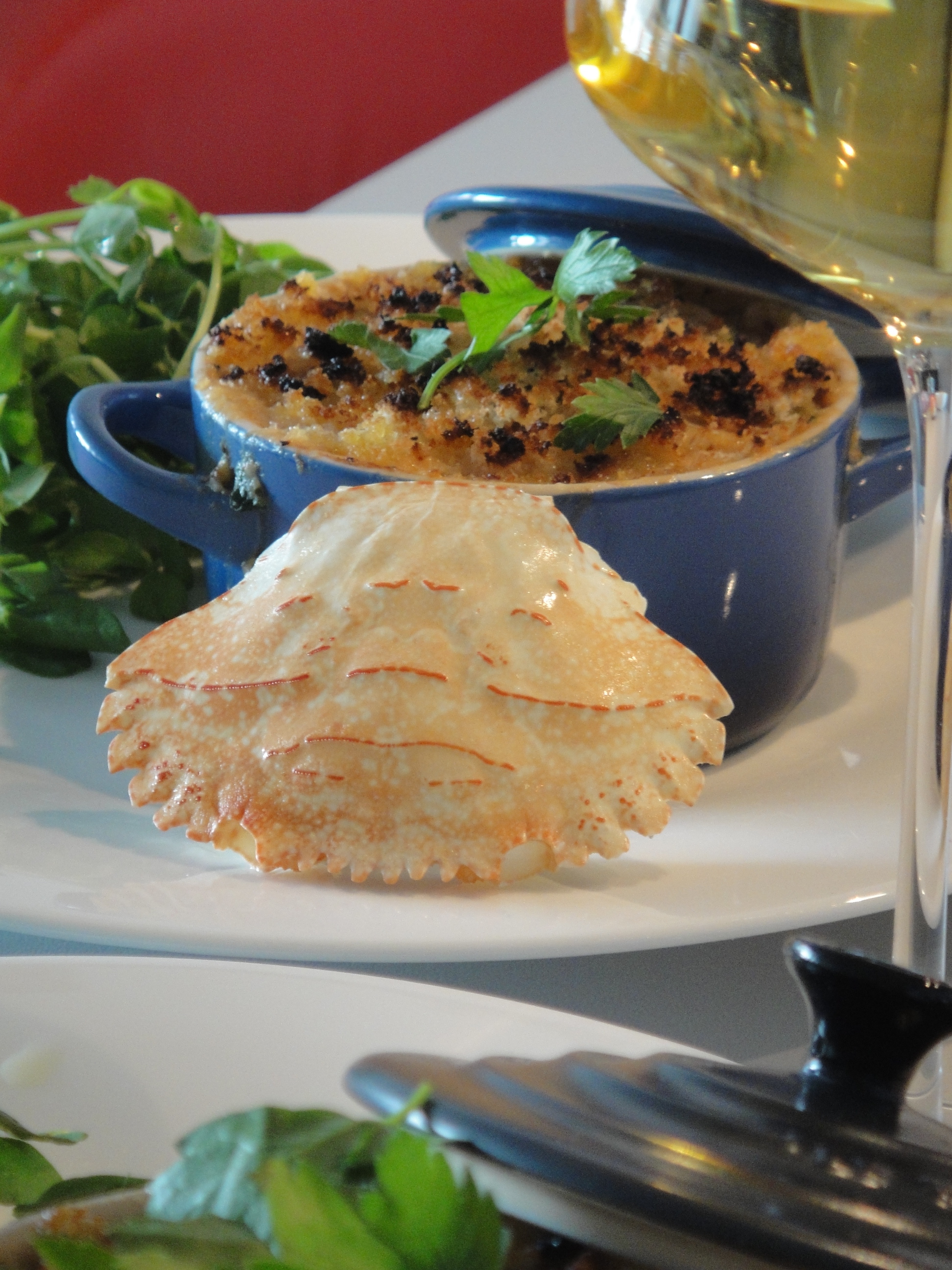
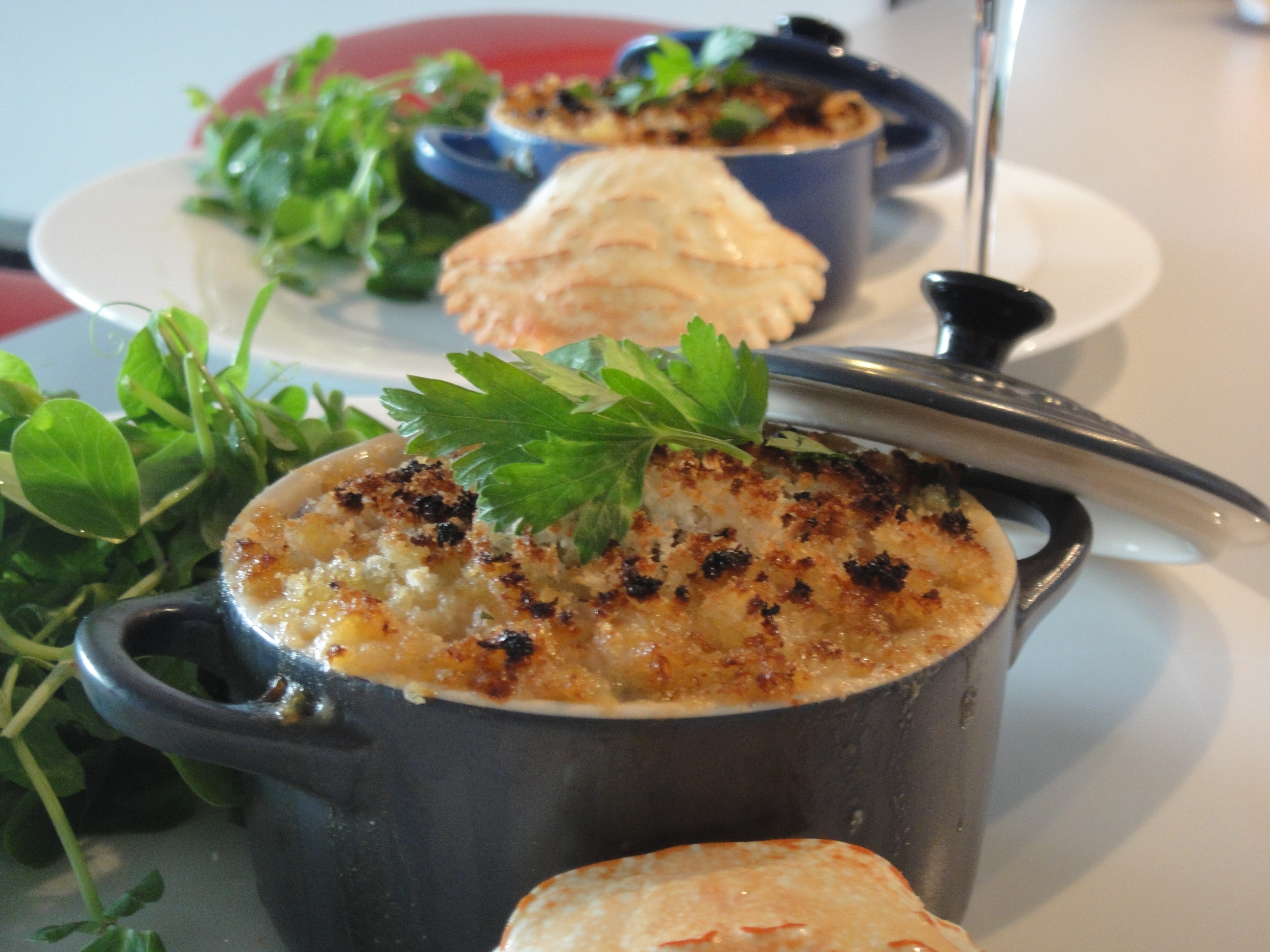
This recipe takes its inspiration from the Asturias region of Spain, where Cider is the drink of choice and sidrerias can be found in every town and village. My take is in turn based on the recipe by Claudia Roden in her fantastic book, The Food of Spain: A Celebration (Penguin, 2012) so all credit must go to her. These little ramekin filled dishes make a perfect starter or, as I did, served as a light lunch with a little side salad. In Asturias, they make this filling and stuff it back inside the shell of their txangurro spider crabs. While not attempting any such culinary craftsmanship, I paid homage to their skills by serving my dish in a mini le creuset pot with a little crab shell on the side, just for decoration (you eat with your eyes before your mouth etc etc).

To make your own crab dish (whatsoever you may chose to stuff it in) take a chopped medium onion which should be sauteed over a low heat until soft. Add to it one peeled and chopped tomato, a pinch of chilli powder (or cayenne pepper) and another pinch of salt and cook over a medium heat for around 8 minutes. Next take a fillet of cod (around 150-250 g depending on how many ramekins you want to fill) and cook for about 5 minutes or until it begins to flake, turning it once. Flake the cooked fish and add 250g of cooked white and dark crab meat, 175ml of dry cider and 2 tablespoons of chopped flat-leaf parsley. Cook for around a minute. Oil 4 small ramekins or two big mini casseroles (like mine) and spoon the mixture in. Sprinkle with fresh breadcrumbs, a few blobs of butter and place under the grill until the breadcrumbs are browned. It’s probably best you leave the ramekins to cool for a couple of minutes once they come out of the grill before you serve them!

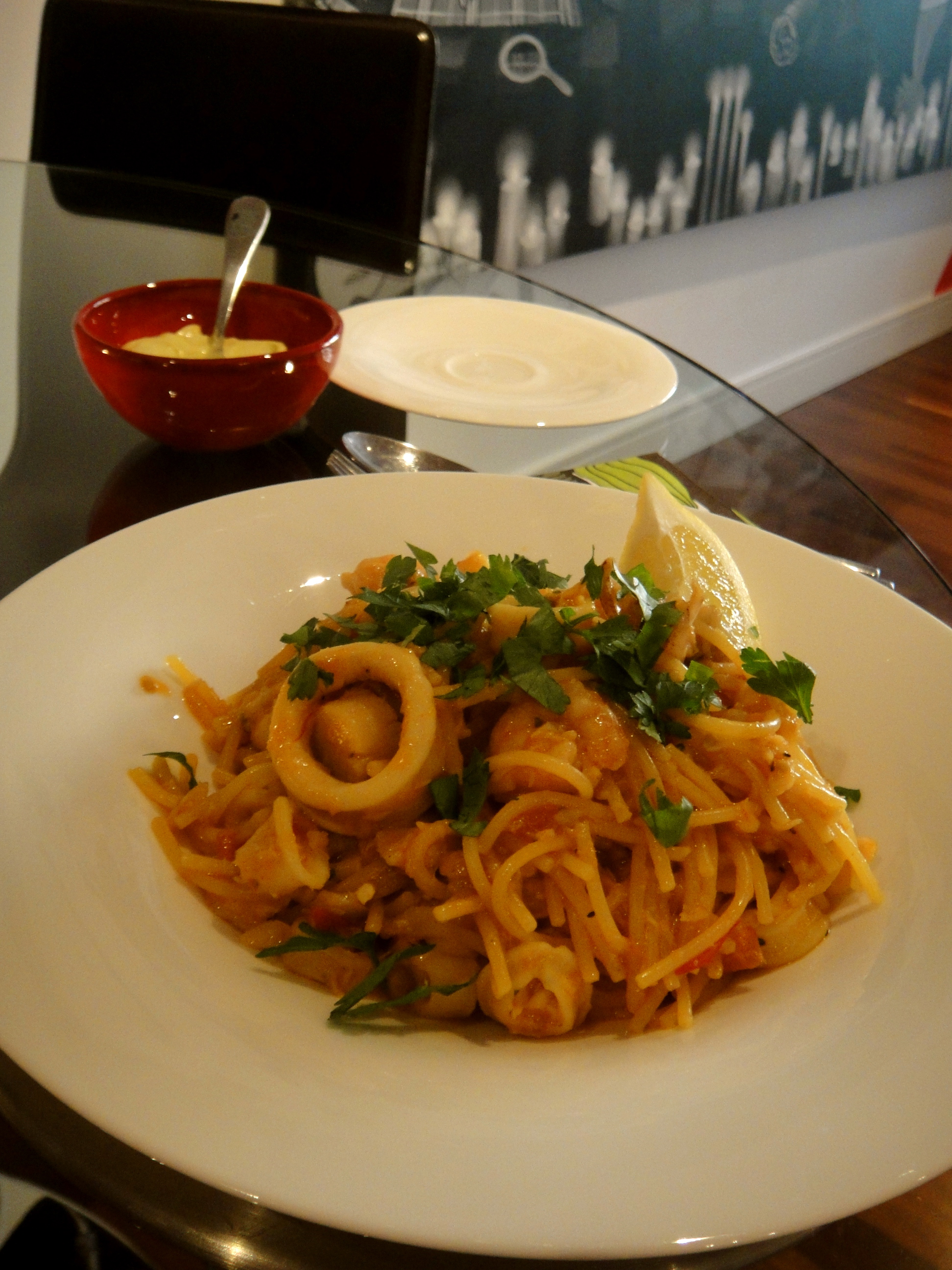
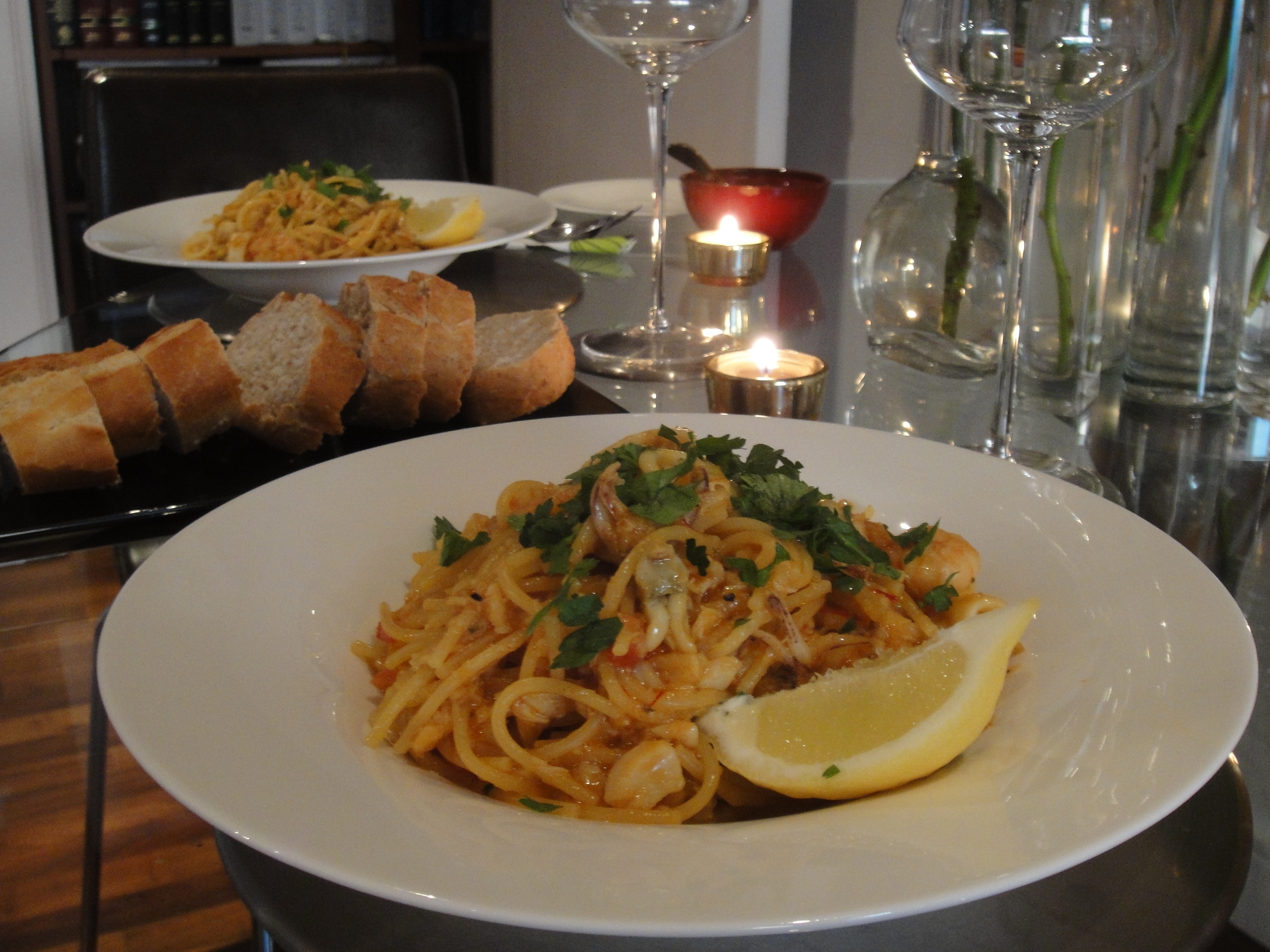
Fideuada del señorito – (smoked) seafood pasta

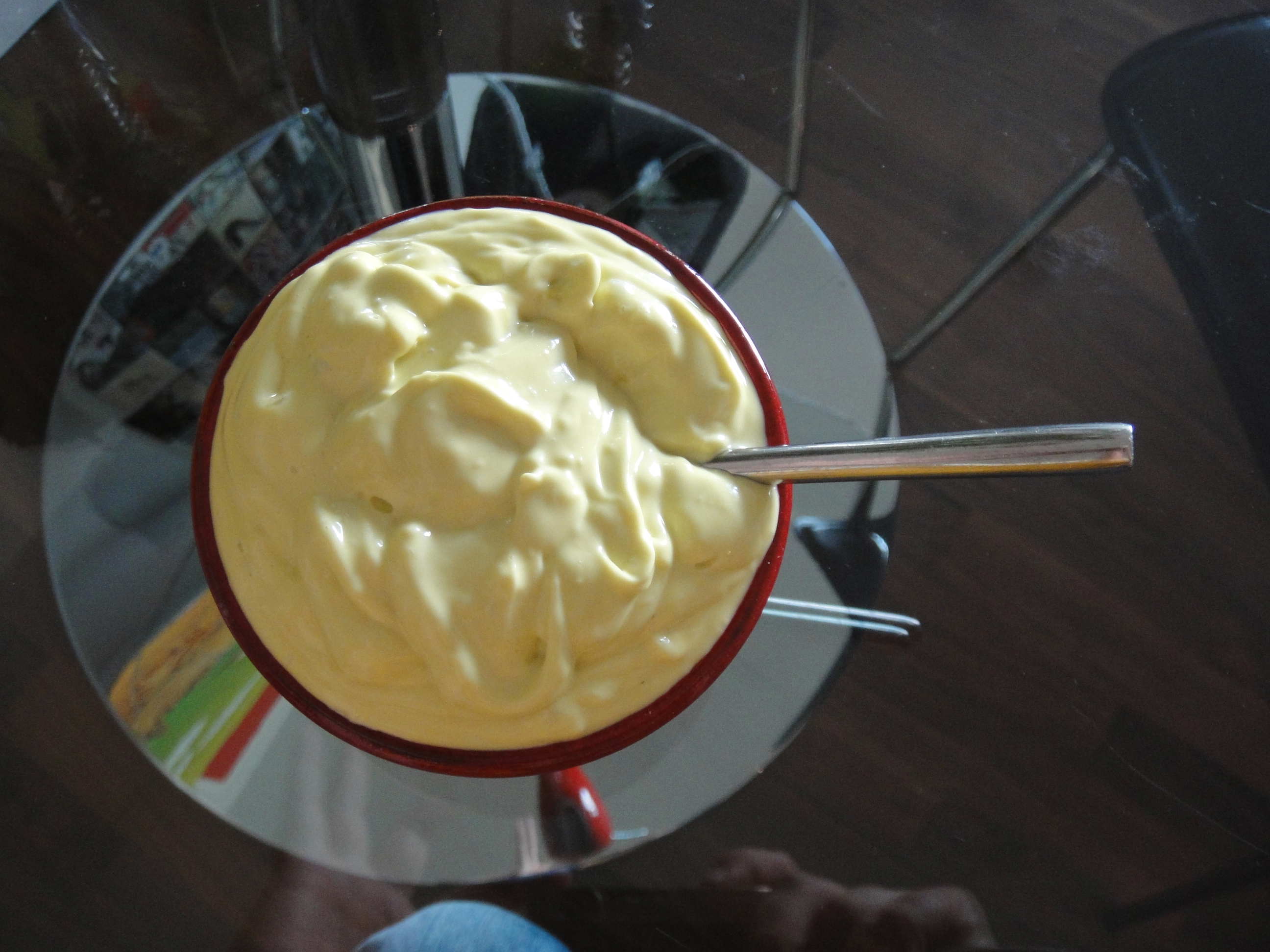
This is a pasta dish straight from the gutsy seafood-filled region of Catalonia, and brought to my attention, once again, by Claudia Roden although once again, I’ve gone my own way with it and shaken it up a bit (sorry Claudia). The dish, for no apparent reason, translates as “of the young gentleman”, perhaps because the short pieces of pasta and shelled prawns make the dish particularly easy for young senoritos and senoritas to eat. Either way its truly delicious for us adults too. You should service it with a good blob of alioli (garlic mayonnaise). If you can’t be bothered to make you own mayo, just add crushed garlic to shop bought mayonnaise. Mine is thick and yellow because I made it with extra virgin olive oil straight from a vineyard next to my Partner’s family home in Tuscany (yes yes, I know, it’s not Spain) so well worth the rather tedious effort of making it from scratch.

My alioli

To make the pasta, heat 4 tablespoons of oil in a large frying pan (or paella pan if you have one). Cook around 400g of cubed smoked haddock (Claudia Roden uses monkfish, but I didn’t have any to hand – I adore smoked haddock and loved the results in this dish – it gives a subtle smokey flavour which works amazingly well with the alioli on the side) and cook on a medium heat for around 3-5 minutes. Next add 4-6 baby squids, sliced into rings, cooking for a further couple of minutes before adding a dozen or so peeled king prawns and an equal number of scallops. Cook until the prawns are nice and pink (1-2 mins). Place all the cooked seafood to one side in a separate dish, keeping it warm. Preserve any liquid. Using the same pan, heat 2 tablespoons of oil and stir in 1-2 crushed cloves of garlic. Just before the garlic colours, add 3 chopped tomatoes, 1 heaped teaspoon of pimenton dulce (or sweet paprika), a little salt and a good pinch of saffron threads (and at this point pause and indulge in the aroma of Spain, a warm mediterranean evening wafting past your nose, a magical culinary noche brought to life in your kitchen, wherever it may be). Sorry, where was I… ah yes, The tomato will quickly thicken so at this point I added 120ml of oloroso dry sherry (although dry white wine will work too). Wait for that to reduce down, cooking for around 10 minutes.

Add around 300g (for 2-3 people) of spaghetti, broken into 3-4cm pieces to the tomato mixture, making sure it is well coated. Then add around a pint of boiling chicken stock and add back the cooked seafood, stirring it into the pasta/ tomato mix. Cook until the pasta is al dente. This should use up all the stock, but add a little more if the liquid dries up before the pasta is cooked. The dish should be moist when its finished.

And that’s it! Serve with some sprinkled parsley and a good dollop of alioli – the mixture of smoked fish and pimenton with delicate seafood and a pungent winey tomato sauce is to die for, I promise. Oh and don’t forget to give the whole thing a good squeeze of lemon juice – the acid cuts across the strong salty smokeyness perfectly.

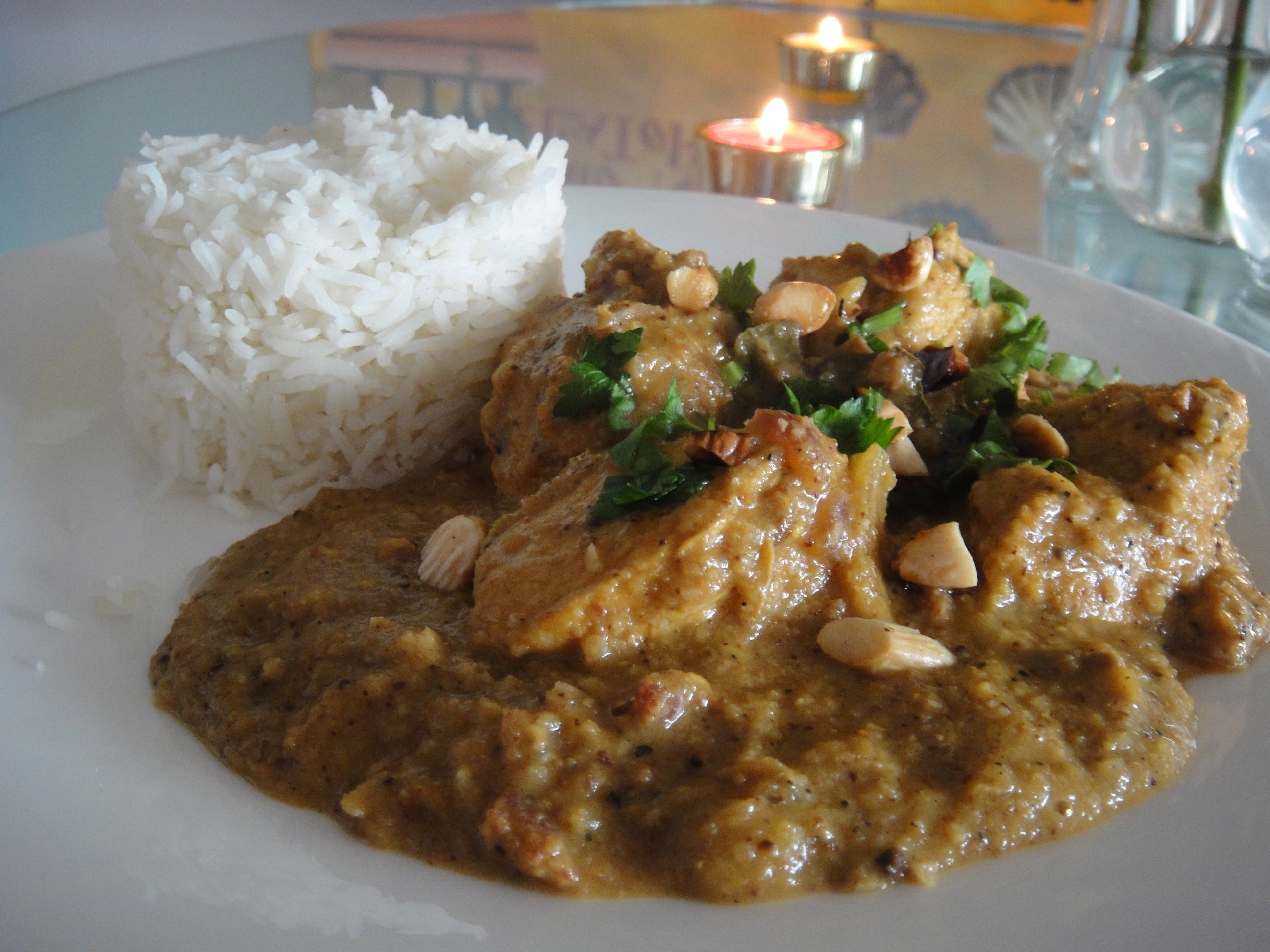
Pollo en pepitoria (Chicken in a mildly spiced saffron, pine nut and almond sauce)

Last up it’s down to the Med and the region of Andalucia where the influence of 700 years of Islamic rule can still be felt from the rafting voices and spasmodic dancing of gypsy culture emanating from Seville, to the use of mild moroccan spices in their food. This dish is no exception. It was first cooked for me by my mother, who in turn got it from chef Rick Stein, who in turn nicked it from Australian chef Luke Mangan who opened a restaurant specialising in a mixture of Spanish and Moorish cuisine. Despite this chinese-whisper-like chain of chefs, all of whom have no doubt made changes here and there, the dish is nonetheless emblematic of Southern spanish cooking, with its warm aromatic spices and plentiful use of almonds. Moreover, the use of a “picada”, that is a nutty paste stirred into the chicken, is popular across the whole of the Iberian peninsula.

Start off by hard boiling two large eggs for 10 minutes. You’ll need these later. Allow them to cool and then peel off the shell.

Next deal with your chicken. Some people will use a whole chicken, in which case they’ll chop up and use the legs, wings, breasts etc. I only really like chicken breasts and am not therefore much help on how to use these other bits of the bird – but you can. I use four chicken breasts. Cut these into fairly large pieces (probably three from each breast) so they remain moist.

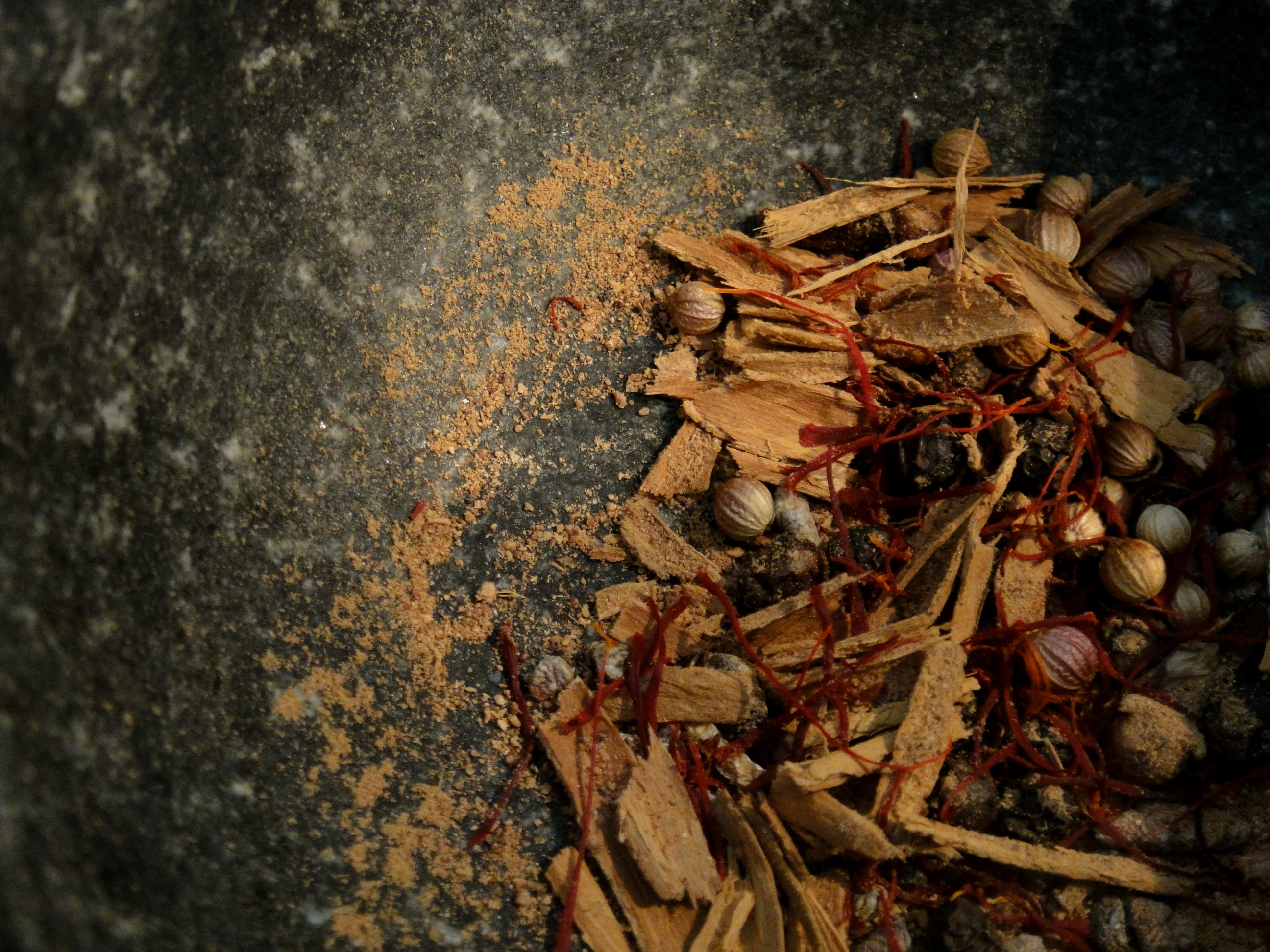
My spices: they smell as good as they look

Onto spices. Lightly crush approximately 10 cardamom pods and remove the seeds from inside (this is fairly tedious but worth it, I promise). Discard the shells and add the seeds to a pestle and mortar into which should also go 1/2 teaspoon of coriander seeds, 1/2 teaspoon saffron strands, 2 cloves, 1 cm piece of cinnamon stick, 1/4 teaspoon of nutmeg and around 10 peppercorns. Grind to a fine powder and enjoy the aromas while you’re doing so.

Now heat around 4 tablespoons of oil in a casserole. Add two peeled whole garlic cloves and a slice of white bread. Fry on both sides until golden. Transfer to a food processor. Now season the chicken lightly and fry until golden on the sides. Remove and set aside. Now in another tablespoon of oil, add 1 large onion, finely chopped and fry lightly until soft and sweetened but not brown. Stir in the spices, cooking for 1 minute and then stir in 200ml of dry oloroso (or other) sherry or white wine and 200ml of chicken stock. Return the chicken to the pan with 2 bay leaves, a handful of raisins or dates (these are my addition, but are optional) and a pinch of salt. Bring to a simmer and cook gently for around 20 minutes (40 minutes is probably necessary for chicken legs etc).

In the meantime heat a frying pan and dry roast 40g pine nuts for 1 minute and 40g blanched almonds for 2 minutes. Leave to cool. Add the nuts and the yolks from the hardboiled eggs to the bread in the food processor along with 10-12 tablespoons of cooking liquid from the chicken. Grind to a paste (this is the “picada”). Chop 20g more of blanched almonds to sprinkle over the dish at the end.

Once the chicken is cooked, stir in the picada paste and simmer for a couple of minutes longer until thickened. Stir in 1 tablespoon of lemon juice approx and make sure your seasoning is on course. Finally, in a separate pan, stir fry those remaining chopped almonds for a couple of minutes in a little oil until golden. Serve your chicken with the sauce and sprinkle the almonds on the top with some parsley.

OK, we’re done. Three dishes bringing the flavours and character of Spain directly into your house. On second thoughts maybe this post isn’t so helpful to the Spanish economy after all – once these amazing cooking aromas fill your home, you’ll have no need to go on holiday again!

A baby showered with a chequerboard of tropical cupcakes

We English don’t easily accept the idea of being influenced by America. We’ve always been the slightly supercilious older brother of our younger indefatigable sibling across the pond, wincing at the loosening of our Queen’s erudite parlance, the widening of the vowels, the advent of stuffed-crusts, of bagels and Reese’s peanut butter cups, the creator of drive-thru culinary culture and the over-eager stentorian expression which makes the refined of Kensington tut condescendingly. Yet it’s an indubitable fact of English life that the influence of the big U-S-of-A is all around us, in our music, in our food, on TV, in politics and on the high street, and no more so is this influence felt than in the way we party. The US gave us candy-abundant halloween and fairy light-filled dazzling Christmas spectaculars. And the latest craze which is doing the rounds is the Baby Shower.

According to wikipedia, a Baby Shower is generally thrown either shortly before or shortly after a baby is born. Only women are invited (!) and the new mother in question is “showered” with presents. So when my dear friend Sarah gave birth to a beautiful baby girl, Ruby, a few months ago, and announced that she would finally bring her angelic daughter down to London to be celebrated amongst our vivacious friendship circle, I decided that this baby shower business ought to be tried and tested, refined in the way that only the english know best. For starters we had men, and quite right too. In the modern world, with fathers playing an increasingly dominant role in the daily task of bringing up their children, why shouldn’t they too be showered with gifts and praise and plenty of sweet treats? Presents were showered aplenty – little cute girly outfits and some alcoholic indulgence for papa (when he’s off duty, naturally) and my gift – a norm sketch of course – devoted to little Ruby.

Welcome Ruby (© 2012 Nicholas de Lacy-Brown, pen and ink on paper)

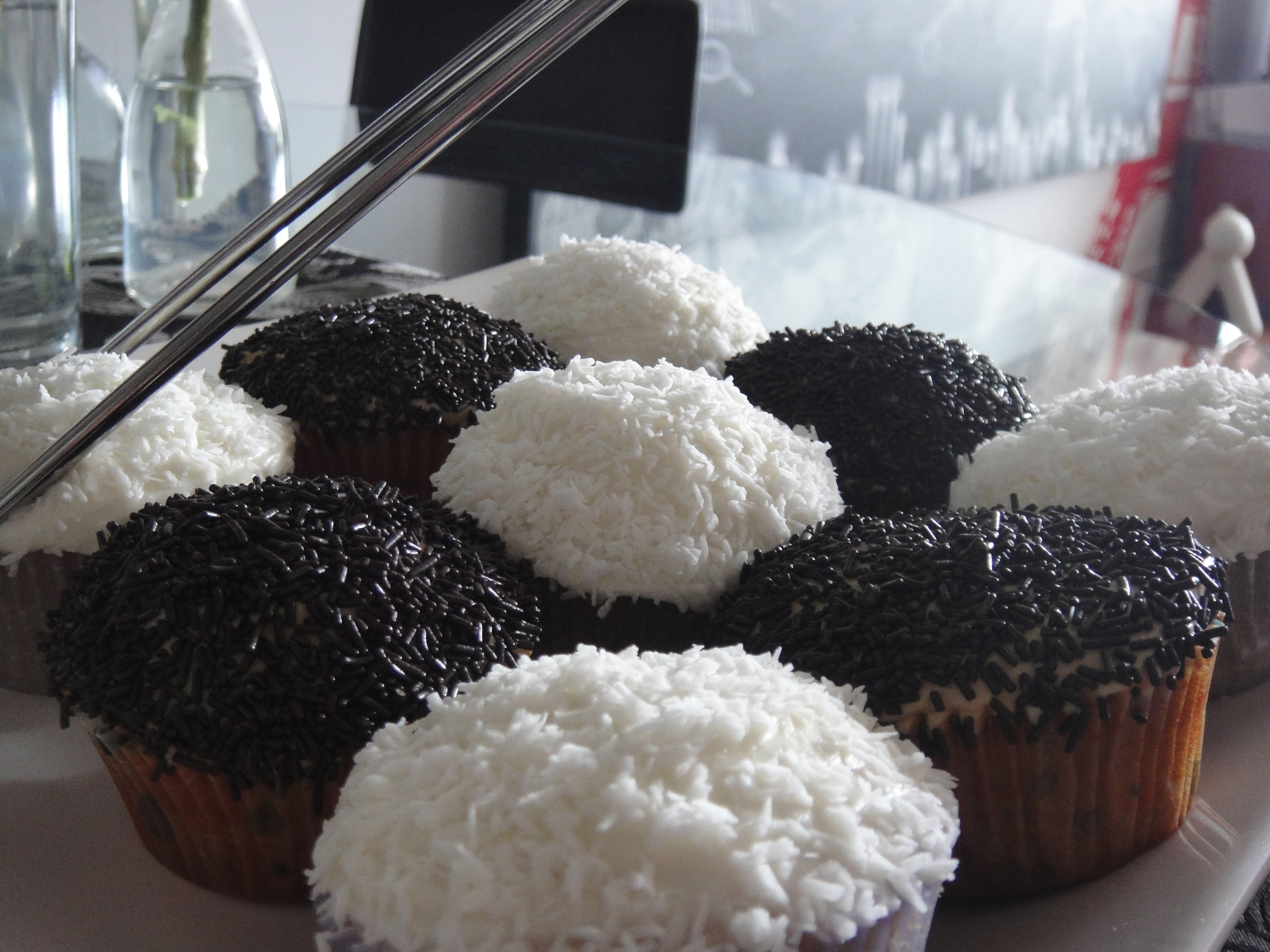
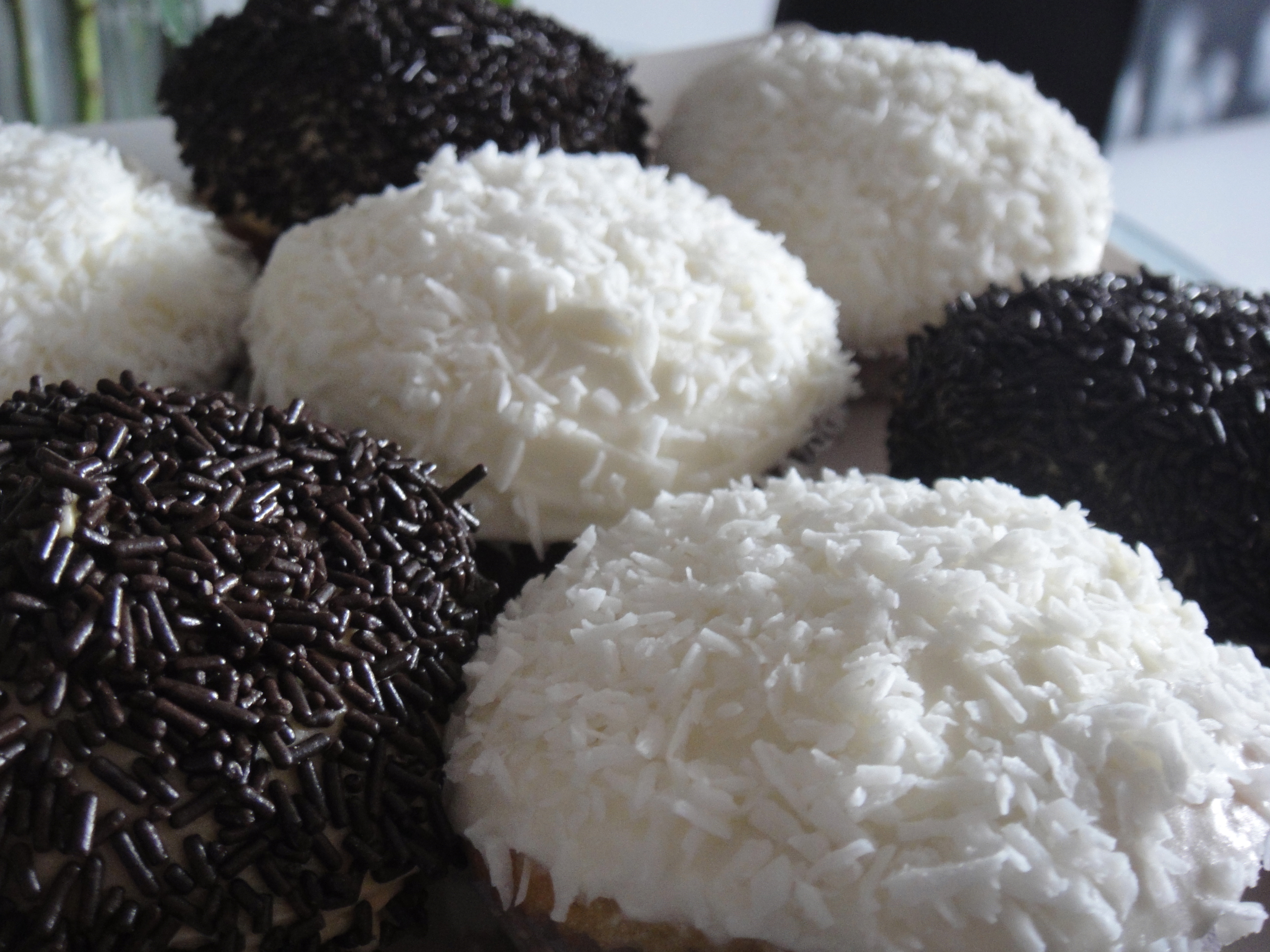
As for the sweet treats – cupcakes went all tropicana, as I chose flavours referencing the mixed and culturally rich heritage of Ruby’s parents – I made one batch of tropical cupcakes –  pineapple and coconut cupcake referencing Sarah’s Jamaican heritage and father Truong’s South Pacific patrimony – while tropical banana meets England’s now demised Hungry Monk restaurant, inventor of the infamous Banoffee Pie, inspiration for my second selection – a banoffee cupcake, loaded with indulgent dulce de leche and a gingery spiced banana sponge. Tropical flavoured, but London refined, these cupcakes were the epitome of english chic, served like a chequerboard of black and white, with one cake covered in coconut and the other in chocolate vermicelli. The fruit in both, and additions of creamy coconut milk and indulgent full fat milk respectively, made these cakes moist and delicious, while the butter cream icing was a suitably indulgent celebration of the beautiful new life in our midsts.

My recipes were adapted from London’s favourite purveyor of cupcakes, the Hummingbird Bakery. To make the pineapple and coconut cupcake, take 140g caster sugar and beat in 40g unsalted butter. Then add 120g plain flour, a pinch of salt, and 1 and a half teaspoons of baking power and mix everything together with an electric mixer. Once everything is combined, gradually mix 120ml of coconut milk and half a teaspoon of vanilla essence into the flour mixture, and finally add and mix in one egg (I actually used a bit more coconut milk – my mother always told me that the softest sponge mixtures always drip of the mixing spoon like syrup, and therefore I always add a bit more milk to achieve this effect – but it’s a matter of personal taste). Prepare 12 paper cupcake cases. Chop up 8 rings of tinned pineapple into small chunks and disperse evenly in the bottom of the paper cases. Pour the cake mixture on top and place in the oven at 170 degrees celsius for around 20-25 minutes. Test with a skewer to make sure the cakes are cooked. The skewer should come out clean. Once the cakes are cooled, make your butter icing. Beat 250g icing sugar with 80g unsalted butter with an electric mixer. Slowly add 25ml of coconut milk and whisk until very white and light and frothy (around 5-10 minutes). Paste onto the cake with a palette knife and sprinkle liberally with desiccated coconut.

The banoffee cupcakes are pretty similar. 140g of caster sugar should be added to 80g of unsalted butter. Then add 120g plain flower, a teaspoon of baking powder, a pinch of salt, a teaspoon of ground ginger and a teaspoon of ground cinnamon. Mix until well combined and then slowly add 120ml of whole milk and two eggs. Separately mash up approximately one largish banana (around 120g peeled) and stir into the cake mixture. Spoon into paper cases and cook at 170 degrees for around 20 minutes. For the icing, beat 250g icing sugar with 80g unsalted butter. Then, if you want to make your icing indulgently dulce de leche, take a small can of condensed milk and simmer on a low heat for 3 hours (yep, this takes patience) without opening the can. Make sure the water doesn’t dry out in the pan and the tin is always covered with water or the tin will explode. After three hours, open up the can and you should find yourself with a tin full of caramel deliciousness. Add a few tablespoons of this to your butter icing mixture depending on how sweet and rich you want it. Build up on your cakes with a palette knife and sprinkle chocolate vermicelli liberally over the cakes.

And there you have it. Uber sophisticated tropical cupcakes, perfect for the summer, whether a baby is forthcoming, newly arrived, or just a distant pipe-dream.

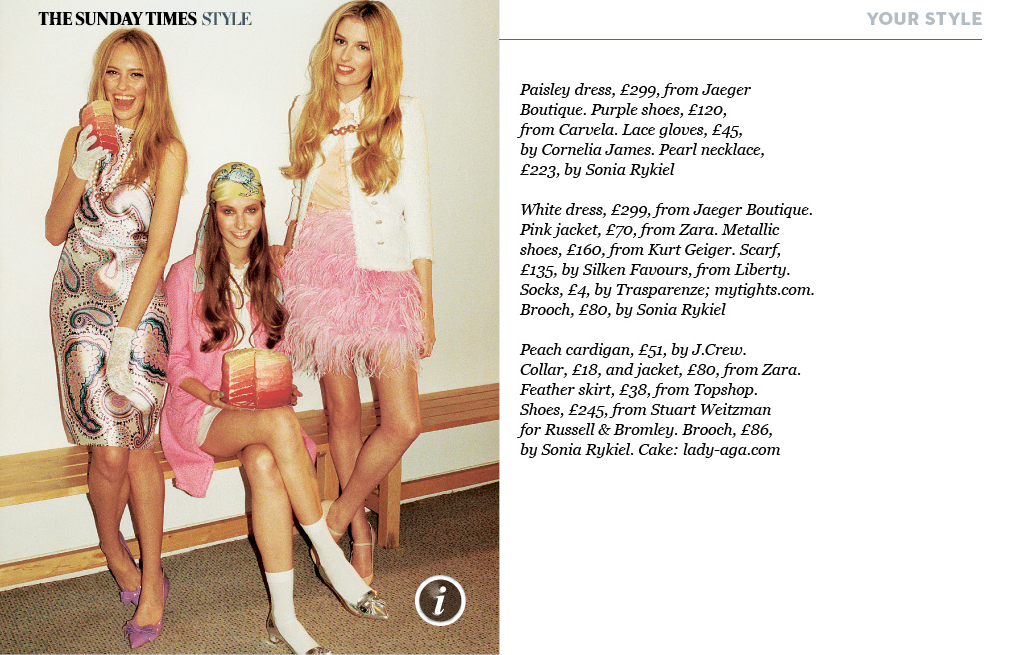
PS: Talking of uber-chic cupcakes, I am SO proud of my friend Celia whose red-velvet multi-layered ombre cake made it into this week’s Sunday Times style section as shown here… amazing!

Monotone May = Culinary indulgence: The Orrery and The Delaunay

The good weather may have reached our shores at last this week in fair-weather Angleterre, but last weekend it was an altogether different picture. One gloomy weekend followed another, as almost 7 weeks after a hose-pipe ban was enforced, we in England were subjected to day upon day of grey rainy autumnal weather. So what can one do to keep happy in such weather? Why, self-indulge, naturally!

As a result of my very rare recourse to hedonism, I visited two superb restaurants in London, both of which deserve the Daily Norm review treatment.

Le beurre

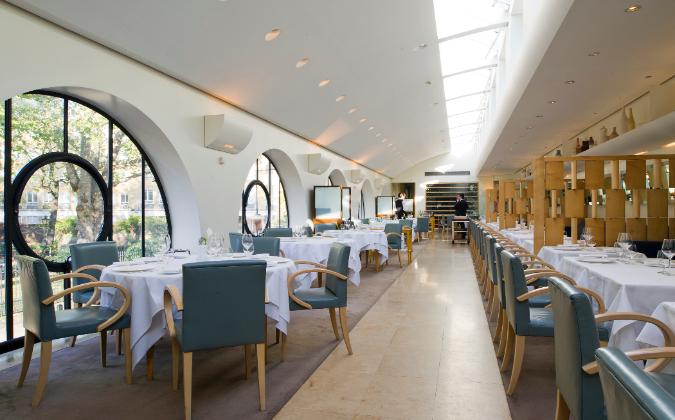
Stop one was Orrery, 55 Marylebone High Street, London, a classy first floor venue situated above the uber-chic Conran Store in Marylebone. I always think that a restaurant with an upstairs location possesses a certain superior exclusivity in the way in which it can go unnoticed so easily, and only those “in the know” get to sample it’s elevated delights. I did already know about the existence of this place, purely because on my frequent visits to Conran (I am interior design obsessed, not that I can afford many of the overblown prices in the place) I could never work out how from the front the shop appeared to have big first floor windows and yet when inside, there were no windows to look through. The secret to this great conundrum lay in a very slim line restaurant, set at the front of the building in a long gallery-like setting, but whose narrow floor-space barely registers owing to the excellent use of mirrors to reflect the large rounded windows which run along one side of the space. Having worked out where the restaurant was, I never in fact went along, that was until I saw it featured on the glitsy docu-soap Made in Chelsea last week. Anything they can do, I can do better, thought I, without anything remotely comparable to the stars of the show padding my wallet. And so it was, that having escaped quickly from Tate Modern on saturday in order to resist the temptations of dining in Tate’s expensive but view-spectacular restaurant, we ended up somewhere even pricer. Whoops.

Orrery’s interior

From the moment we walked into Orrery, we were treated like royalty. The service was exquisite – attentive and brisk, but we did not feel rushed, only well looked after. The menu we went for was the Menu du Jour, which at £25 for three courses didn’t seem bad, especially when the food then came out in a spectacular show-stopping fashion. But let me not rush this. Let us first concentrate on the unctuous fig-imbued bread with creamy home-churned butter, and a delicate amuse bouche of gazpacho – perfectly accompanied by the Catalan wine I had chosen from the wine list with all the bias of my Spain-conditioned heart.

Raviolo

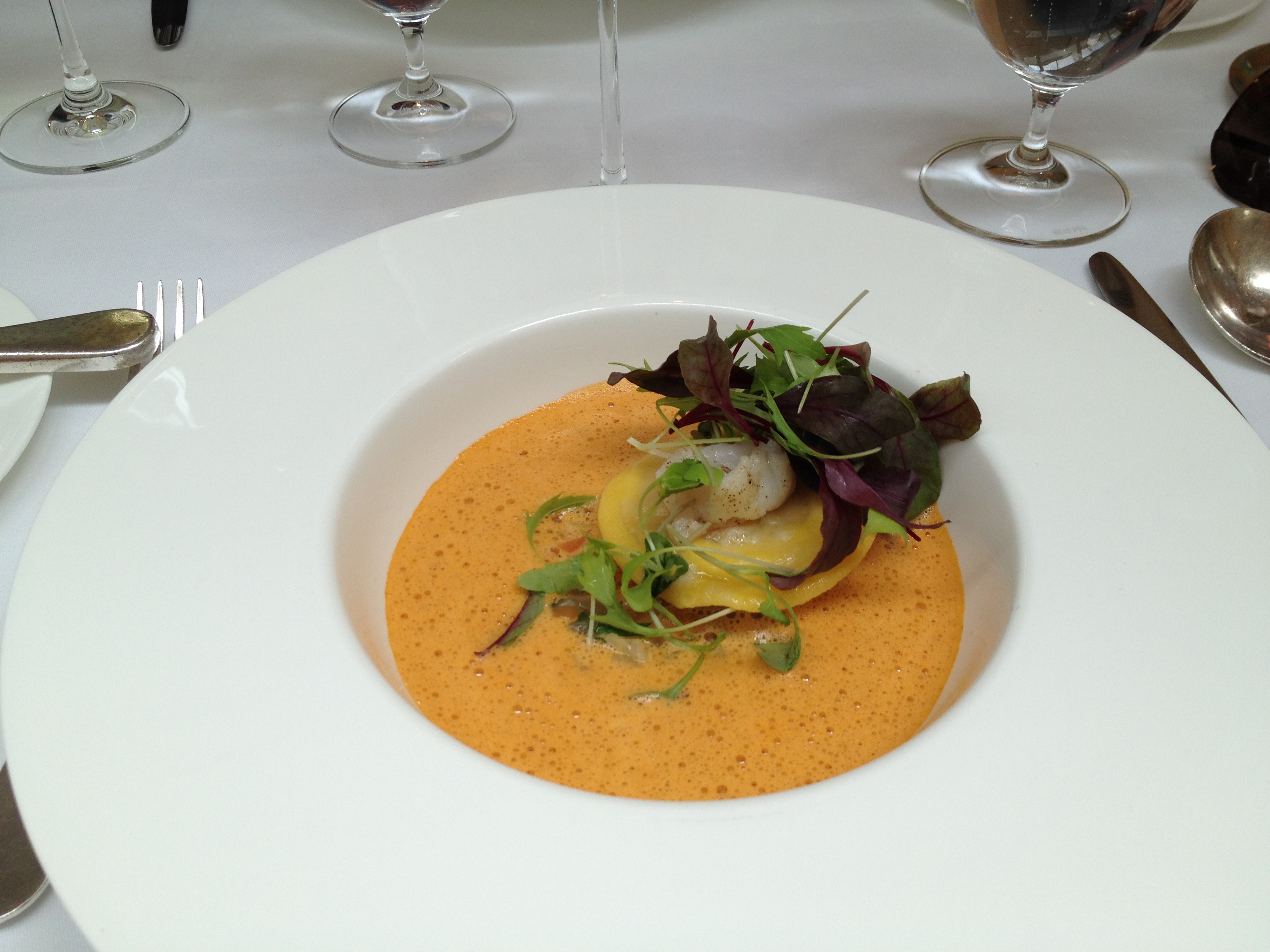
Up the next was the starter. We both went for the seafood raviolo (i.e. just one) surrounded by a frothy seafood bisque and served with a sweet, nutty pile of salad leaves and micro herbs. It was moist, well flavoured, delicate and perfectly seasoned, and the froth reminded of the incoming silky bubbles of a warm mediterranean seashore.

Feuilleté

Salmon

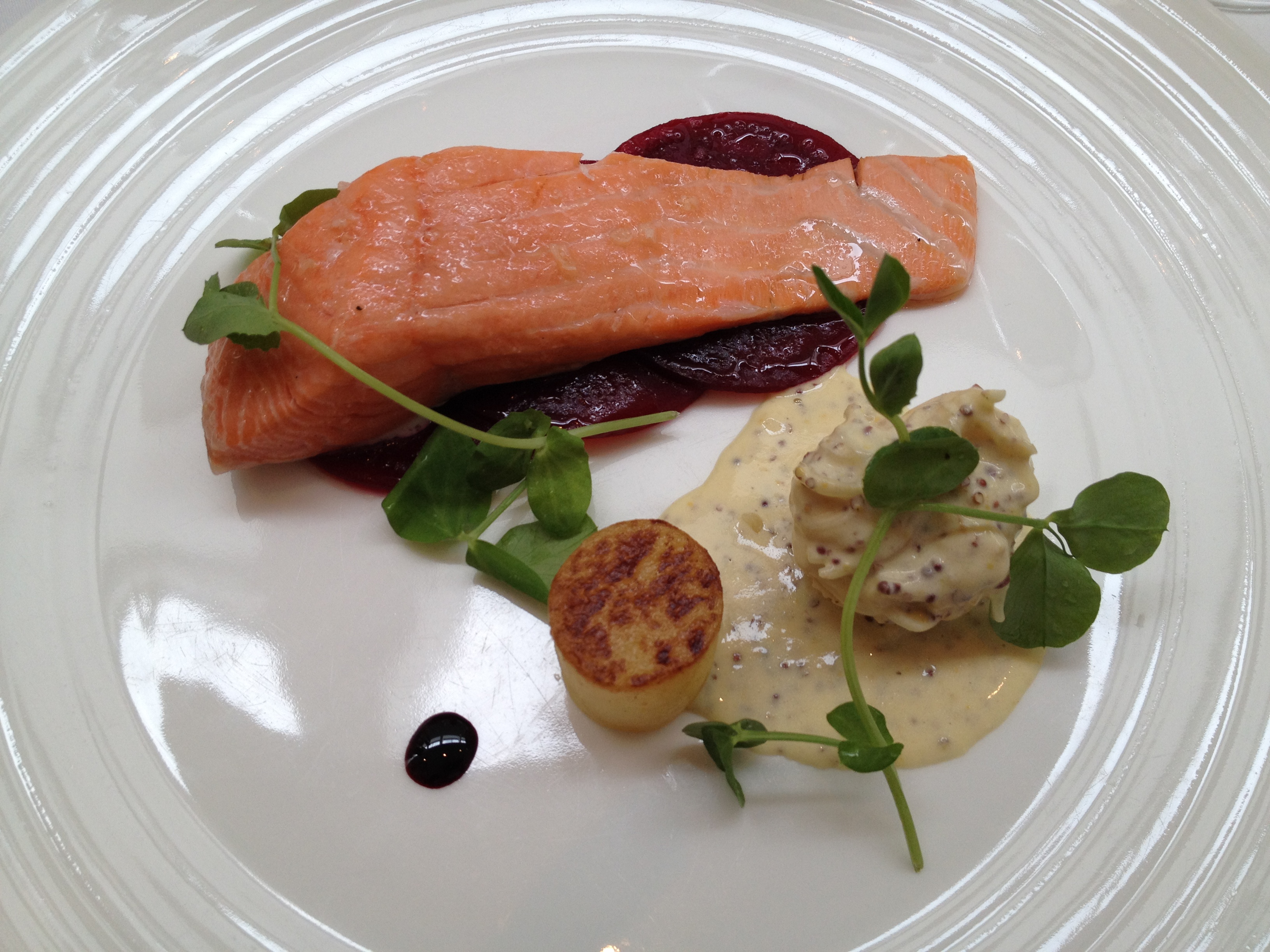
For mains I had the Feuilleté of wild mushroom, poached egg, sauce Hollandaise – it was the vegetarian option which I rarely go for but my goodness I’m glad I did. The puff pastry was golden and caramelised, the mushrooms rich and creamy, and the poached egg broke open to reveal a runny goey egg yolk which was a rich and perfect orange spilling sweetly to provide a silky sauce for the dish. My partner had salmon which, he says, was utterly moist and completely delicious. For dessert we were both unable to resist a chocolate mousse with champagne jelly and hazelnuts. Served in frosted little bowls reminiscent of 60s retro furniture, it was cool as well as classy. Finally before dragging ourselves away, we were given complimentary chocolate truffles which broke open in our mouth to reveal a super sweet but seductively sharp passion fruit syrup. Amazing.

Chocolate mousse with champagne jelly

Best of all, I discovered that the astronomers globe instrument I bought in Salamanca is actually called an “Orrery” named after the Earl of Orrery. You see, you learn a new thing every day.

Delaunay interior

The next day, a long-standing and much anticipated late-luncheon engagement with my delectable chic bride-to-be companion in all things gastronomique, Celia, was on the agenda. We were off to The Delaunay, on the Aldwych, London, a restaurant which describes itself as a Café restaurant in the Grand European Tradition. Grandeur was in fact expected – the restaurant is part of the Wolseley group, known for its old-style grandeur renowned of Paris and Vienna, more than London. And as far as grandeur goes, the Delaunay did not disappoint. As I entered, the place was heaving, veritably full with those who lunch, and those who wish that we could all live in the age when every restaurant was clad in brass and marble with giant wall clocks, wood panelling and snobby waiters just like this one (don’t we all, well, perhaps without the snobs). Luckily my exquisitely turned out lunch companion was a lady in red, guiding my eye across the crowded tables so that we could swiftly commence the important business of choosing wine. Slightly intimidated by the prices, we went for house white, which must have been fine, because we were onto prosecco in no time. The food menu at this time of the day was fairly brunchy, but had sufficient choice for us to be able to indulge in a three course feast which proved highly satisfying, in the Grand European traditional way, naturally.

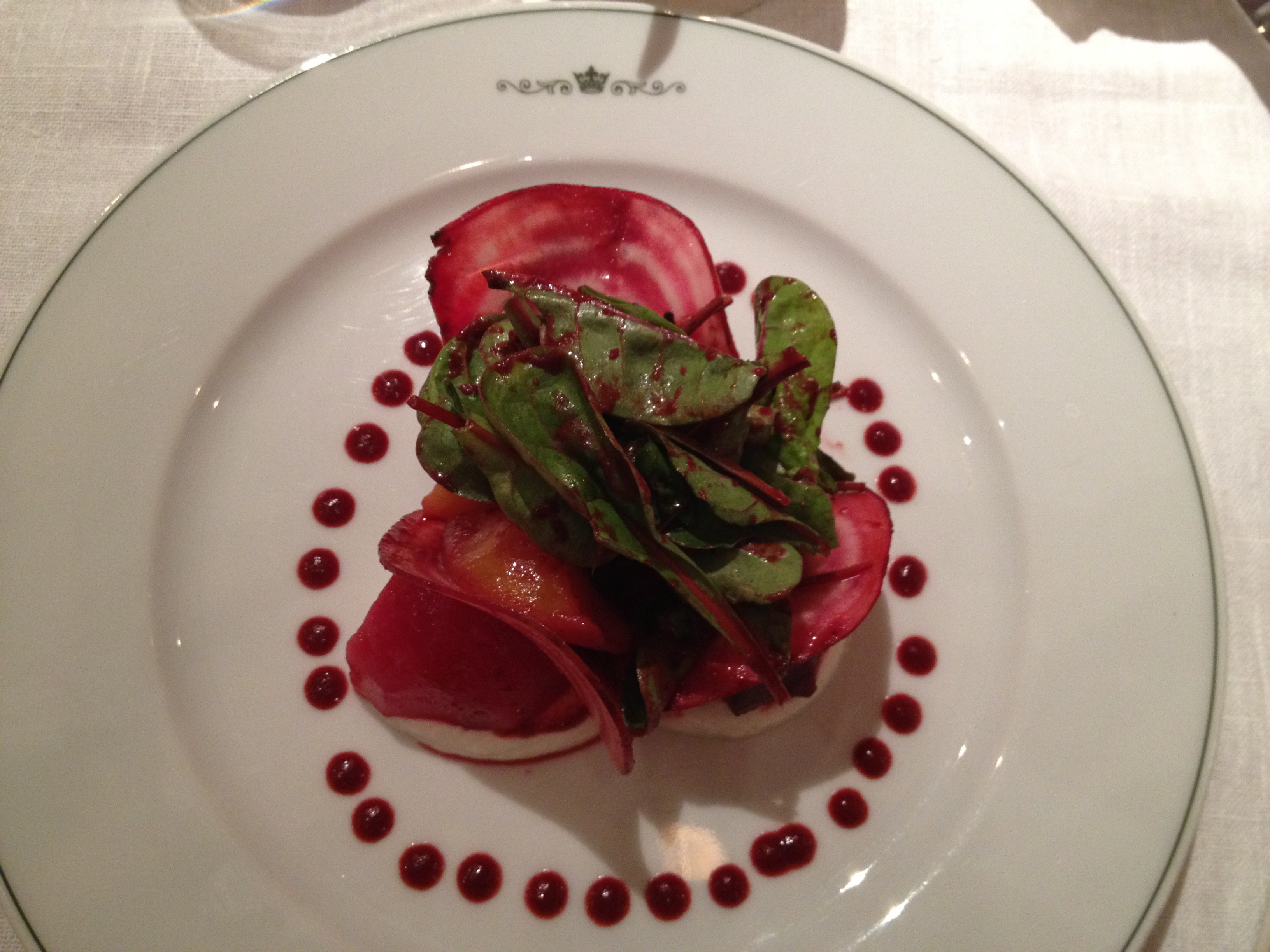
Beetroot and goat’s cheese curd salad

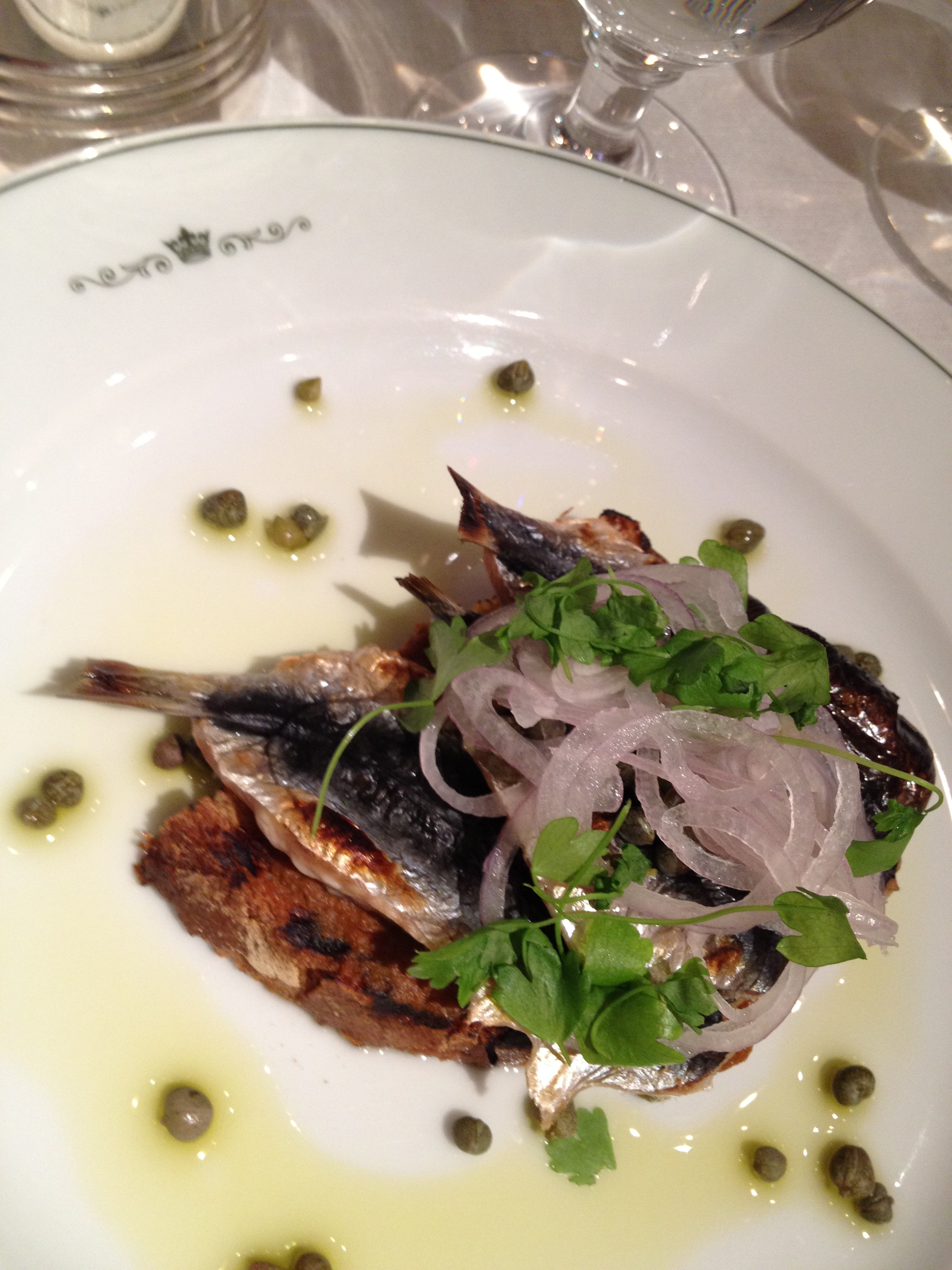
Something fishy

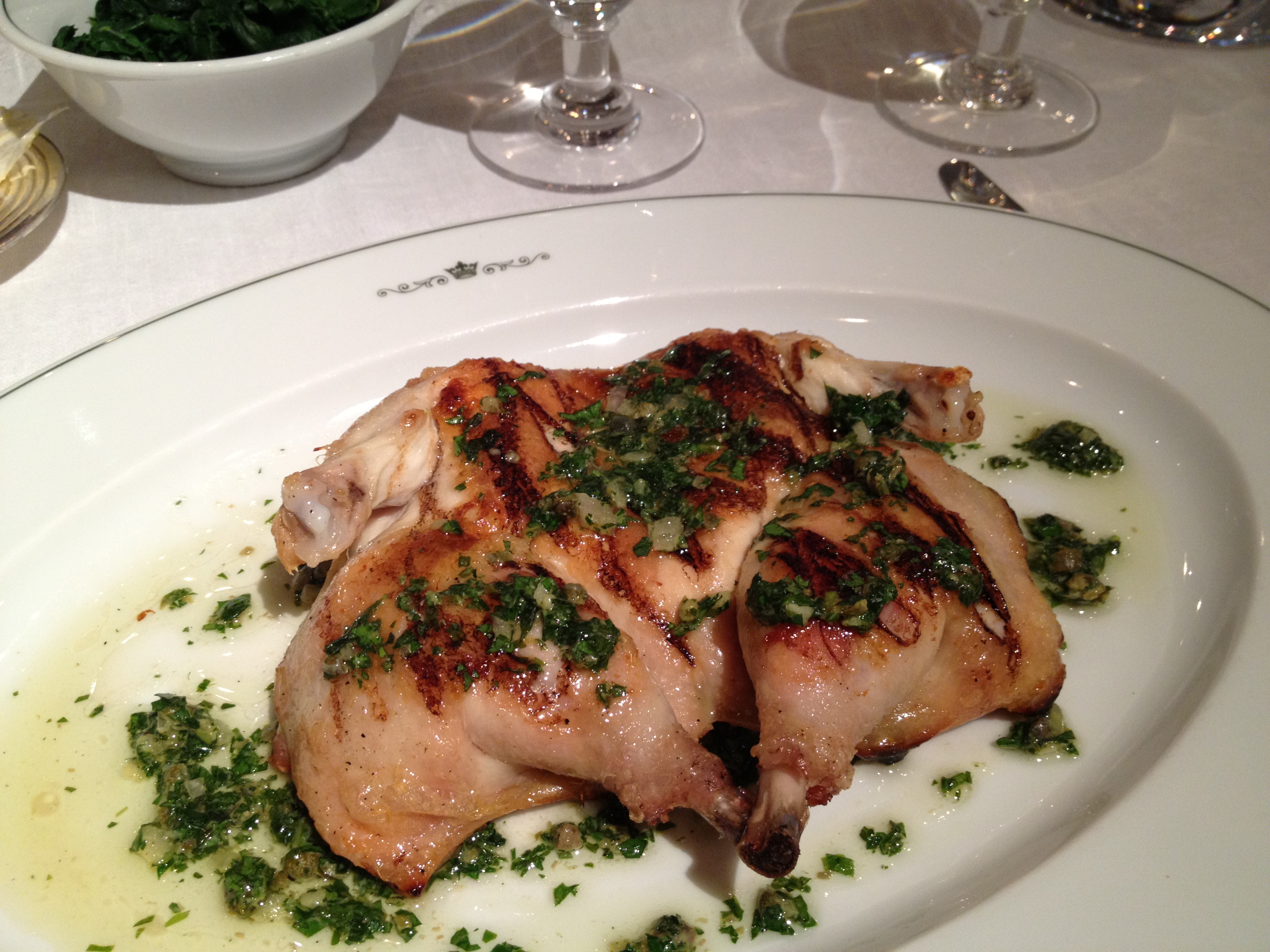
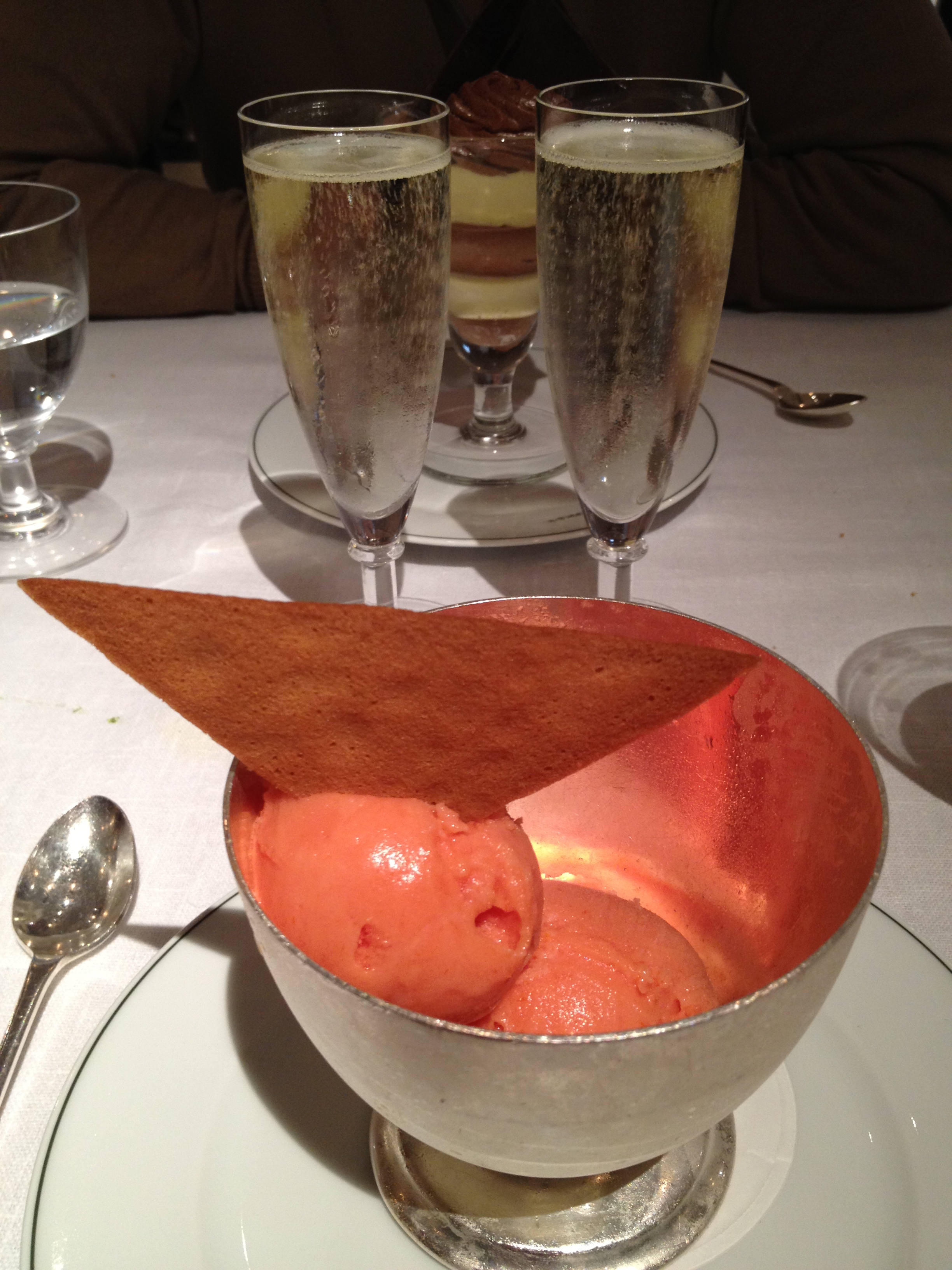
I started with a young beetroot salad with goat’s curd cheese. The flavour balance was perfect – a creamy cheese, not as heavy as it’s older, firmer counterpart, perfectly partnered by a series of different coloured and textured beetroots. Celia had something deliciously fishy. I can’t exactly remember what it was, but I’ll let her tell you on her superb food blog, Lady Aga. Next up I indulged in a golden crunched chicken schnitzel, which was incontrovertibly bad for my summer beach body attempts, but comforting on a grey May day (that rhymes so well, it must be why May turned out to be such a dire month). Celia won on this course though – her poussin with salsa verde was so moist and delicious and meaty I could have stolen the lot. For dessert I went for a white and dark chocolate mousse (I know, I know, second day running, but a boy knows what he likes) and Celia, undoubtedly feeling the pressure of my “hinted” suggestions whispered under my breath, went for a Sevillan orange sorbet which was like a walk along the sun-dappled paths of the Alcazar all over again.

Poussin

Seville orange sorbet, prosecco and a stripey chocolate mousse somewhere in the background.

The Delaunay does well in promoting the traditional grand café, particularly since it only opened recently. You could easily imagine Coco Chanel dropping in on a brief visit to London. And taking tradition seriously, I noted with bemusement that the maître d’ clicked his fingers when he wanted the attention of his waiters. Ouch. Mind you, the attention of the numerous waiters was often found wanting at our table too, which is surely one tradition Coco would not have approved of.

A Greek-inspired weekend feast without a single mention of austerity measures

It’s true. You can’t talk about Greece these days without the mention of austerity measures, riots in Athens, political instability and the potential crash of the Euro. All of this has had a knock-on effect on the Greek tourism industry, as families are put off by negative news pictures showing growing social unrest, and the current trend for “staycations” means tourists are setting their sights on local drafty beaches rather than the blue-domed, white-washed panoramas of Greece’s formerly favoured island attractions. While Greece loses its tourists, and its economy dwindles further, the tourists lose the opportunity to enjoy an affable burst of Grecian spirit in their lives, denied their chance to indulge in the mediterranean smells of garlic and basil, mint and spinach, flakey pastry and syrupy dessert, thick rich yoghurt and fresh just-caught seafood. So while Greece finds itself thrown into yet a further bout of political and social uncertainty, I have chosen, as always, to look on the brighter side of life, taking it upon myself to celebrate the sunshine-imbued gastronomic culture for which Greece should be making headlines, and importing the tastes and smells of a warm mediterranean evening into my flat. As such, I have been cooking up a storm of Greek-inspired food in my flat here in gloomy London, and the results have been so good, I feel compelled to share the results.

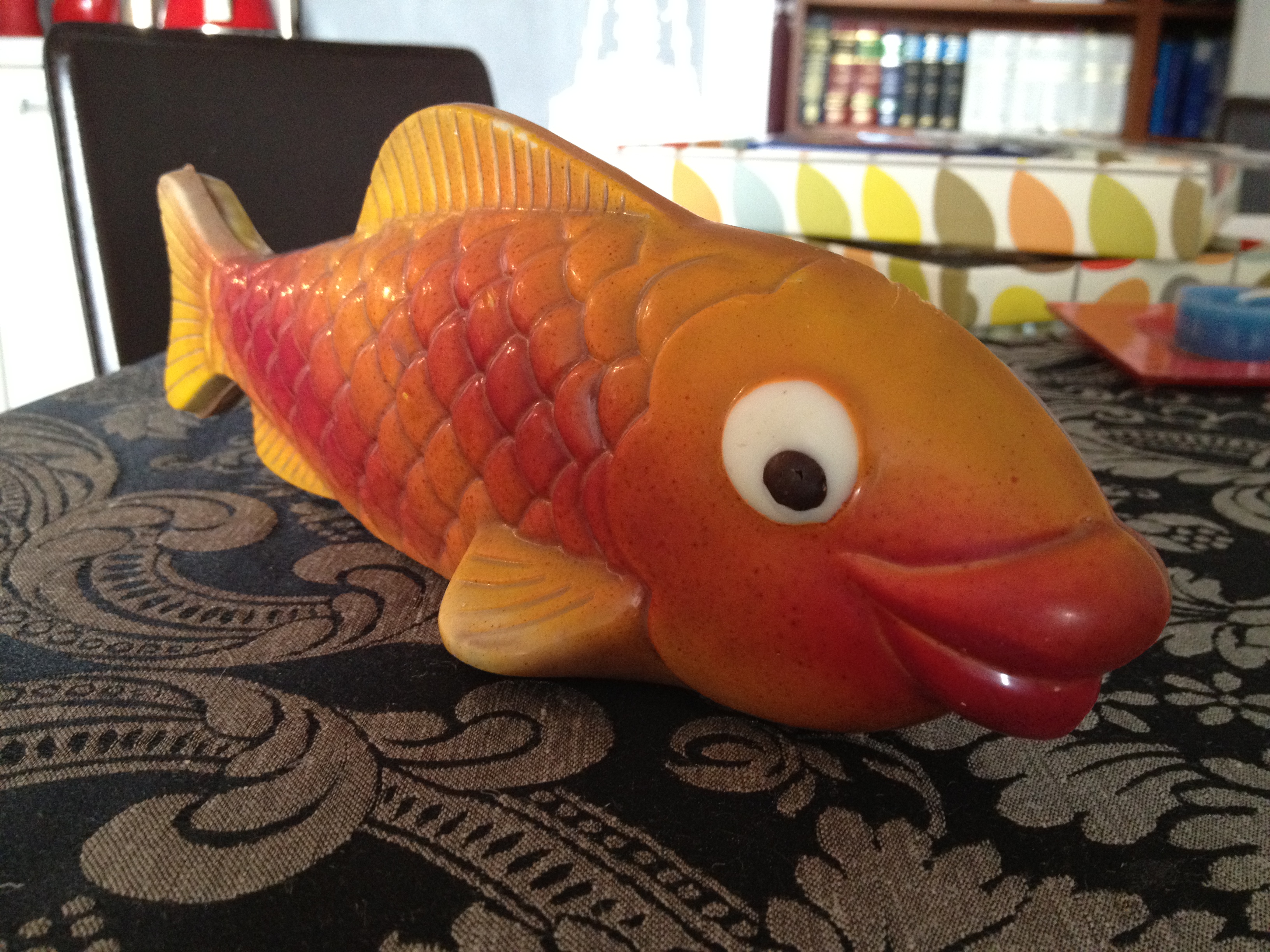
Most of the recipes are taken or adapted from Rick Stein’s Mediterranean Escapes (© Rick Stein 2007), but the cheese platter and stuffed squid dish are entirely my own creation (the chocolate fish is, sadly, so perfect as to be un-makeable – well, at least by my clumsy hands).

Feast 1 – light lunch cheese platter with a chicory salad

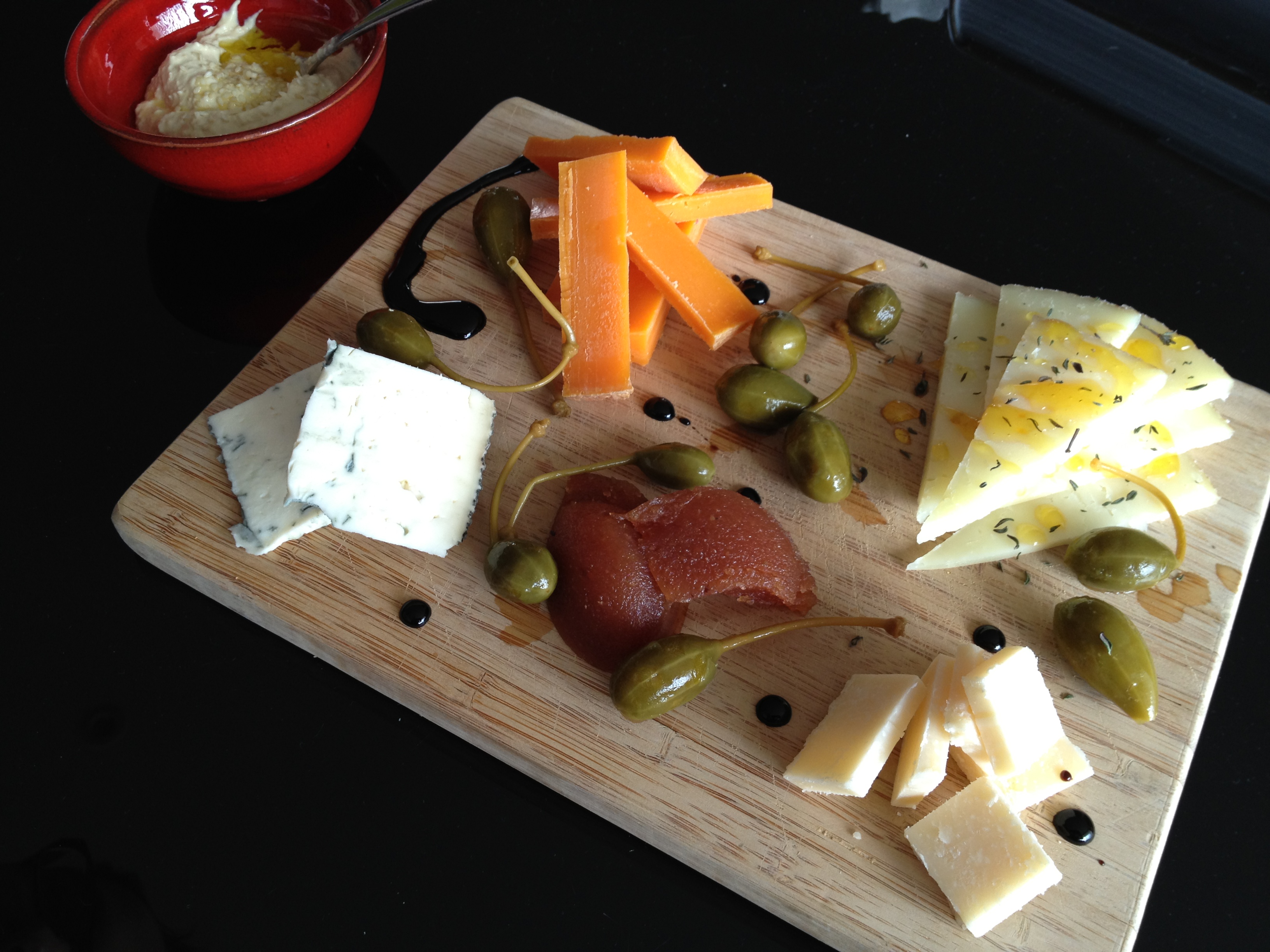
I started my greek food season (I should point out that i didn’t eat all of this at once – this was over a few days) with a light snack: a cheese platter with some greek (kefalotiri, halloumi and feta) and other mediterranean cheeses (there’s always space for my favourite Spanish cheese – manchego – drizzled with honey and sprinkled with thyme). With so many Greek cheeses out there you can go mad. I served my cheese board with a home made houmous sprinkled with sesame seeds, flat bread and rather large Greek capers, as well as a chicory, pomegranate and walnut salad.

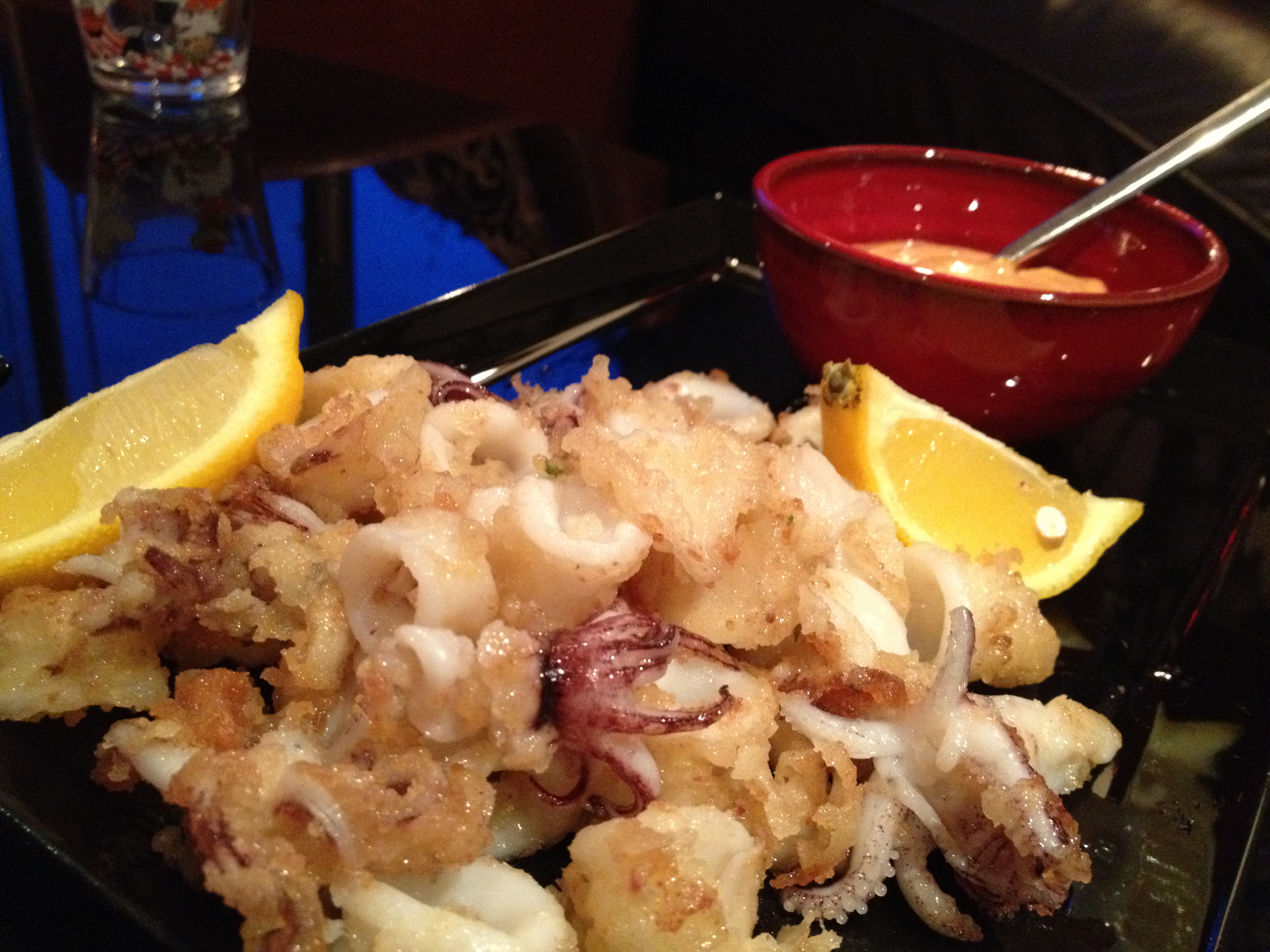
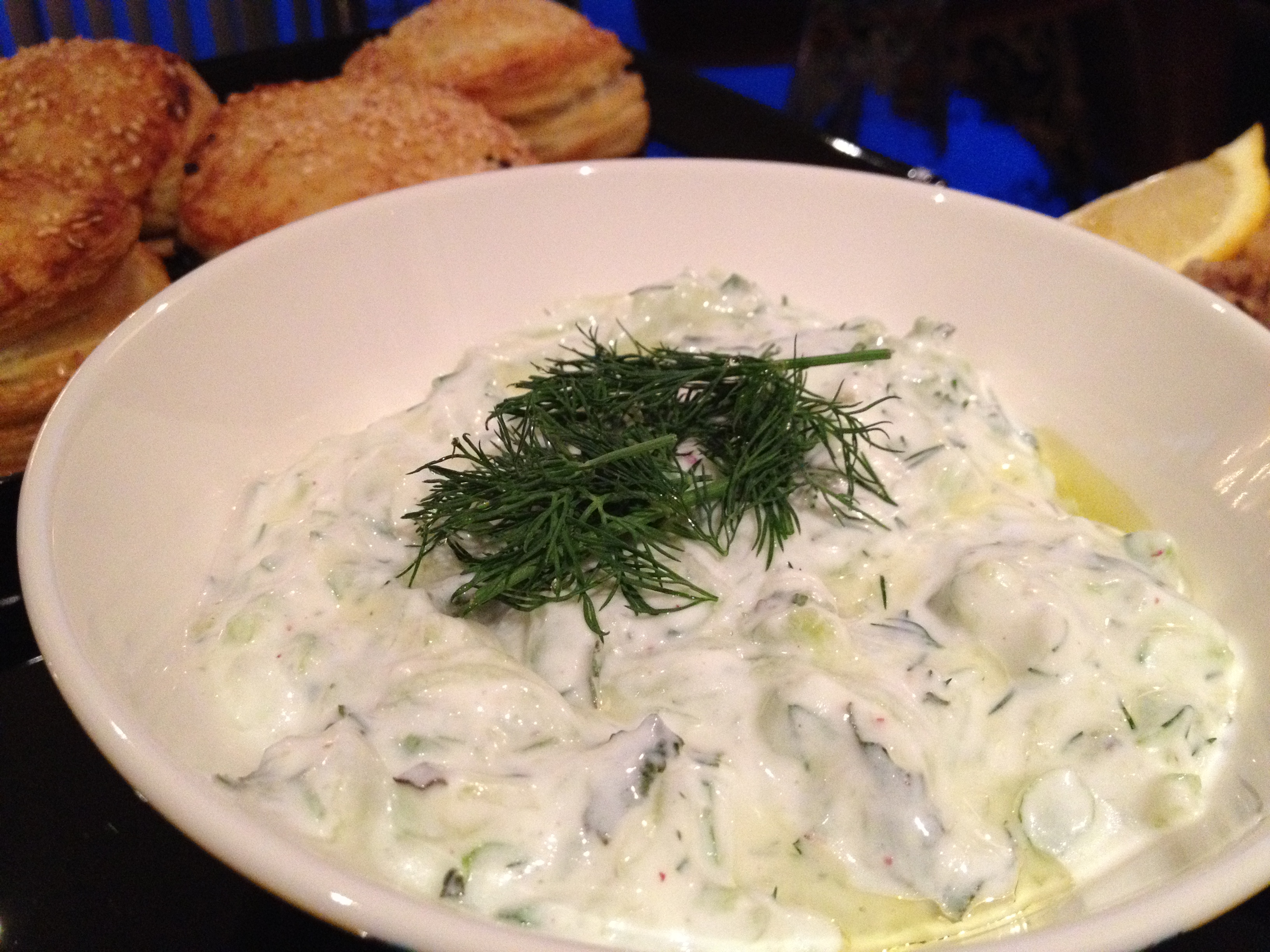
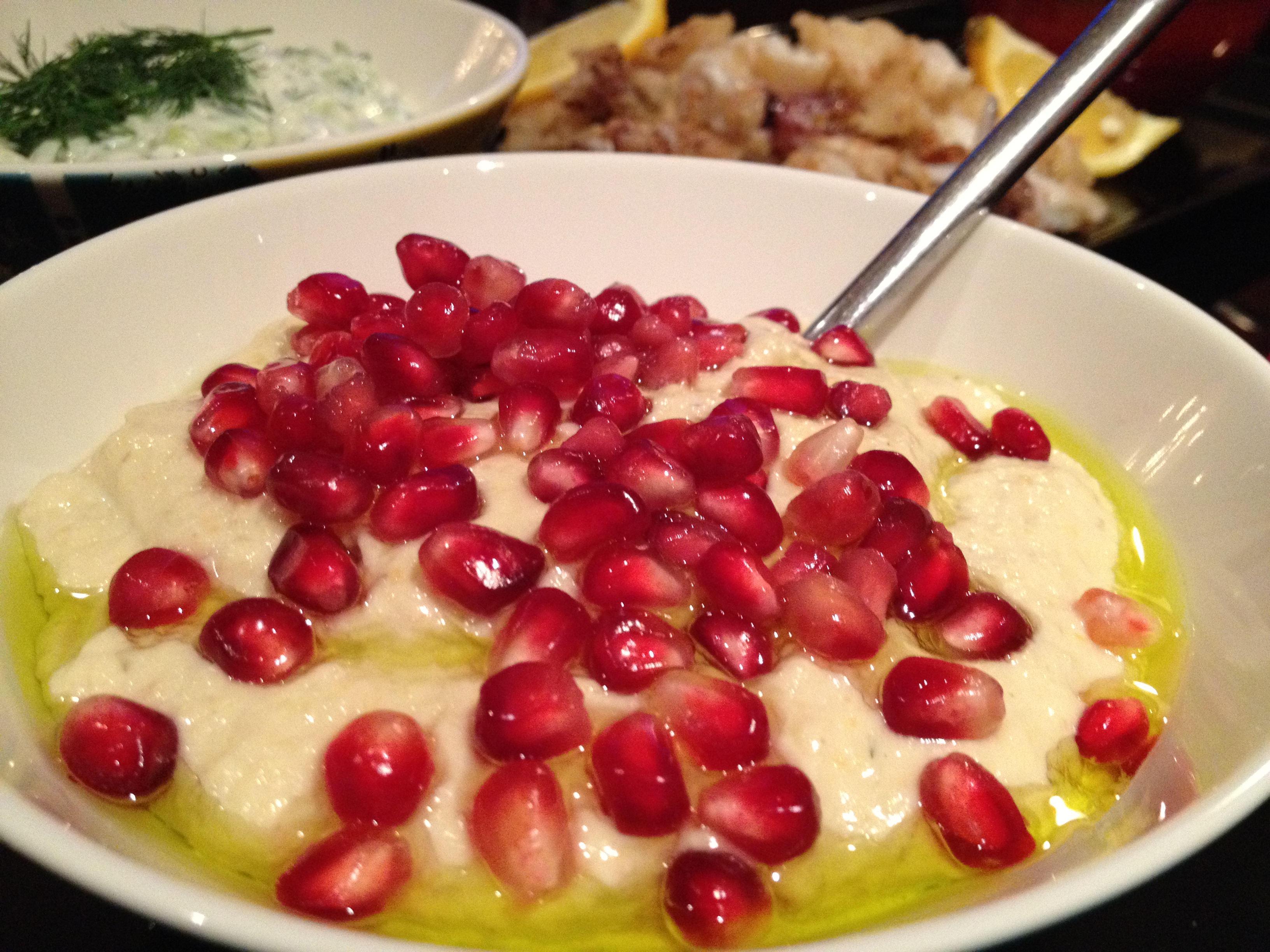
Feast 2 – Greek mezze: shallow-fried squid with a pimenton dipping sauce, Tzatziki, Baba Ghanoush, Spanakopita and pitta bread

For a real taste of the mediterranean, you can’t go wrong with some simple, lightly fried squid, dusted in well-seasoned flour and shallow fried. The key is to leave the flour-coated squid for a couple of minutes before frying as the damp flour will give a crispier finish. Then you just need to shallow-fry the squid in oil (I use olive-oil for a more rich mediterranean flavour) for around a minute. I served the squid with a wedge of lemon and a smoked pimenton mayonnaise – simply make up a standard mayonnaise with a little extra lemon. Finely chop some garlic and crush into a smooth paste with the flat blade of a knife. Add this and a teaspoon of smoked pimenton to the mayo and you have the perfect dipping sauce for the squid.

No mezze is complete without Greek favourite, Tzatziki, a cucumber and yoghurt dip perfect for eating with flat bread or pitta bread. There are various pools of thought as to how to make Tzatziki. My Cypriot friend swears by yoghurt with oregano, where as others will use mint. Rick Stein recommends dill. And frankly all of these herbs work well. Personally I’m a lover of mint, but I couldn’t resist adding a little dill as well, and I found the Tzatziki lost nothing for this herb combination. So you need to take a cucumber which should be coarsely grated (you can peel off the skin if you like, although I generally leave it for texture). Squeeze most of the juice out of the cucumber in a (clean, obviously) tea towel and add to 500g Greek yoghurt, 75g of finely chopped spring onions, 2-3 heaped tablespoons of your chopped herbs (mint, dill, and/or oregano as preferred), 2 tablespoons of good quality olive oil, a teaspoon of white wine vinegar, seasoning and 1-2 crushed garlic cloves (be careful here – the raw garlic can be surprisingly overpowering in this dish. In my experience it’s best to start with one clove and add more if you like a pungent garlic flavour).

Typical mezze will include a houmous as well as a tzatziki, but I decided to import a dish from Turkey to add variation to the typical hummus dish. Baba Ghanoush has a similar texture to houmous but with a predominant flavour of smoked aubergine which is delicious, especially when served sprinkled with pomegranate. To make the Baba Ghanoush, take three large aubergines, and pierce them near the stalk to prevent them from bursting. Place them under a grill for around 40 minutes until black on the outside and soft in the middle. Once cool enough to handle, cut the aubergines lengthways and scoop out the flesh. This should be mashed up with a masher or fork, or for those who like a smoother texture, whizz it in the food processor. Time to add 2-3 garlic cloves, crushed (again, be careful about adding too much – it’s best to start with one and keep testing), plenty of salt, 3 tablespoons of light tahini paste, a drizzle of olive oil and half a teaspoon of sesame seed oil, a squeeze of lemon juice and some parsely to garnish. Serve with pomegranate and an extra drizzle of oil.

I completed my mezze with standard greek favourites, spanakopita  (I got over excited and forgot to photograph them). These are delicious crispy spinach and feta filled pastries and are wonderful when accompanied with the tzatziki or on their own. For the filling, sweat half a small onion and two finely chopped spring onions until soft. In a separate pan wilt 500g of spinach and press out the juices. Once cool, combine the spinach and sweated onions and add 100g of crumbled feta cheese, 1 large egg, 1 tablespoon of finely grated kefalotiri or parmesan cheese, a pinch of nutmeg, 2 -3 large tablespoons of fresh mint, and seasoning and mix well. For the pastry, buy a packet of pre-made filo pastry. Cut the stack of pastry into strips 7.5 cm wide. Brush the top layer with melted butter and place a heaped teaspoon of the spinach filling into the centre of one strip at the end nearest you. Then fold one bottom corner of the pastry diagonally over the filling so that the corner touches the opposite side to make a triangle. Then fold over the filled triangular corner, continuing to fold along the whole strip until a perfect triangular pastry is formed. Do the same for all the mixture. Brush the pastries with more butter (and, if you like, sprinkle with sesame seeds). Place on a lightly buttered baking tray and bake for 25 minutes at 180 degrees centigrade/ gas mark 4 until golden and crisp. I should note that you can make this recipe with puff pastry – I did it when I bought the wrong pastry and it was still delicious!

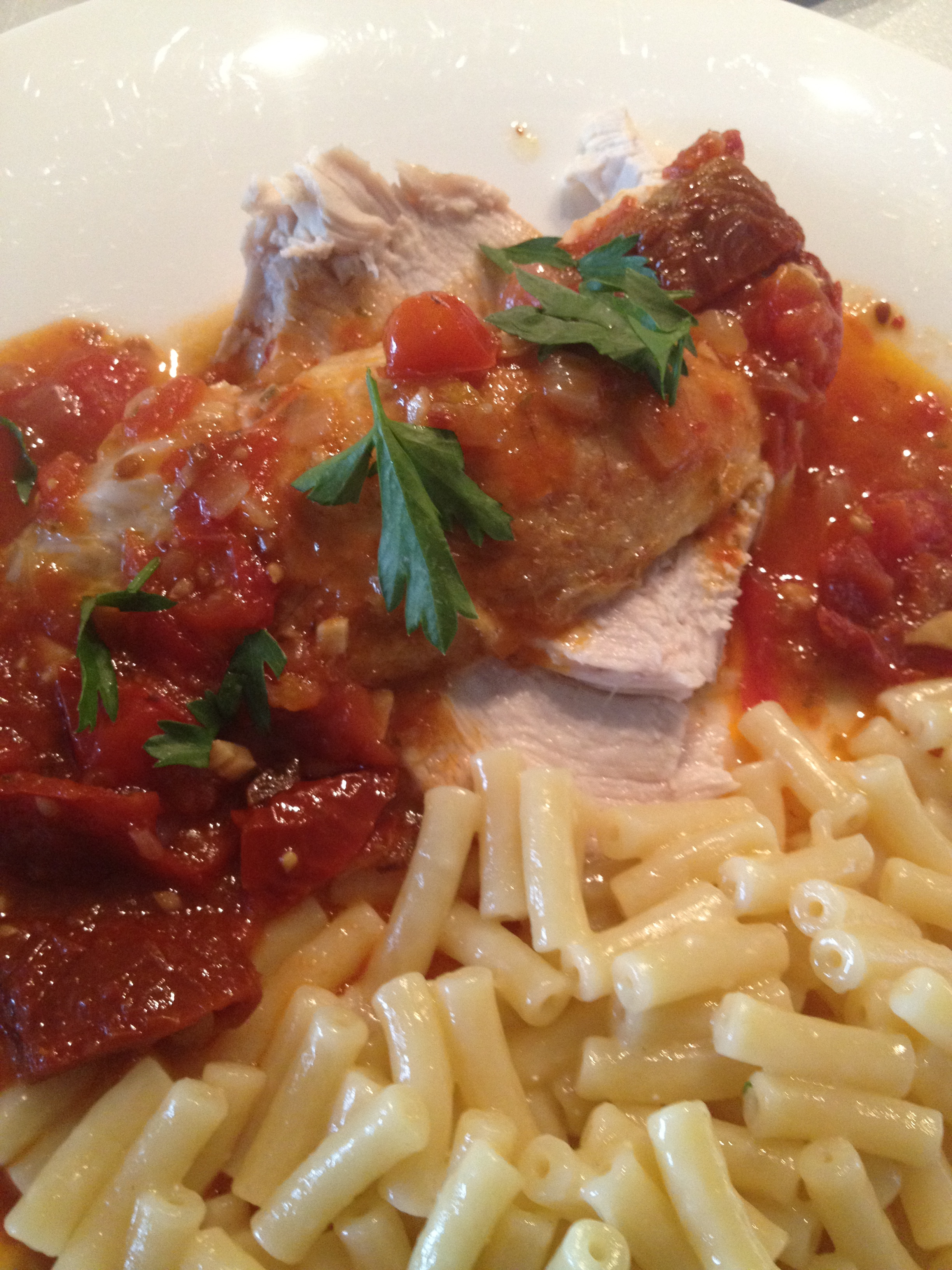
Feast 3 – Pot roasted chick with sun-dried tomatoes, cinnamon and oregano

Next up an easy-cook chicken dish which imports the spices of the Aegean sea with a rich tomatoey mediterranean sauce. Simply take a whole chicken (around 2kg) and pan fry in a casserole for a few minutes on each side to brown. Remove the chicken and in the same pan gently brown a thinly sliced onion. Add 4 garlic cloves, thinly sliced, 60 g of sun-dried tomatoes, 500g of chopped vine tomatoes (or a tin of chopped tomatoes is fine), a cinnamon stick, 150ml of chicken stock, a generous pinch of dried chillies, 1 teaspoon of dried oregano and seasoning. Bring to a simmer and replace the chicken. Cover with a tight fitting lid and bake in the oven for 1.5 hours at 180 degrees celsius/ Gas Mark 4 and baste the chicken with the sauce every so often. Once the chicken is cooked and the juices run clear, lift the chicken onto a carving board and wrap in foil to keep warm. Then bring the tomato juices to a rapid simmer for around 10 minutes until slightly reduced and thickened. Remove the cinnamon stick and serve the tomato gravy in a generous flurry over the carved chicken. You’re meant to serve this dish with orzo (rice-shaped pasta) tossed in a handful of grated kefalotiri/ parmesan cheese, but since I couldn’t source any locally, I used macaroni – which worked surprisingly well!

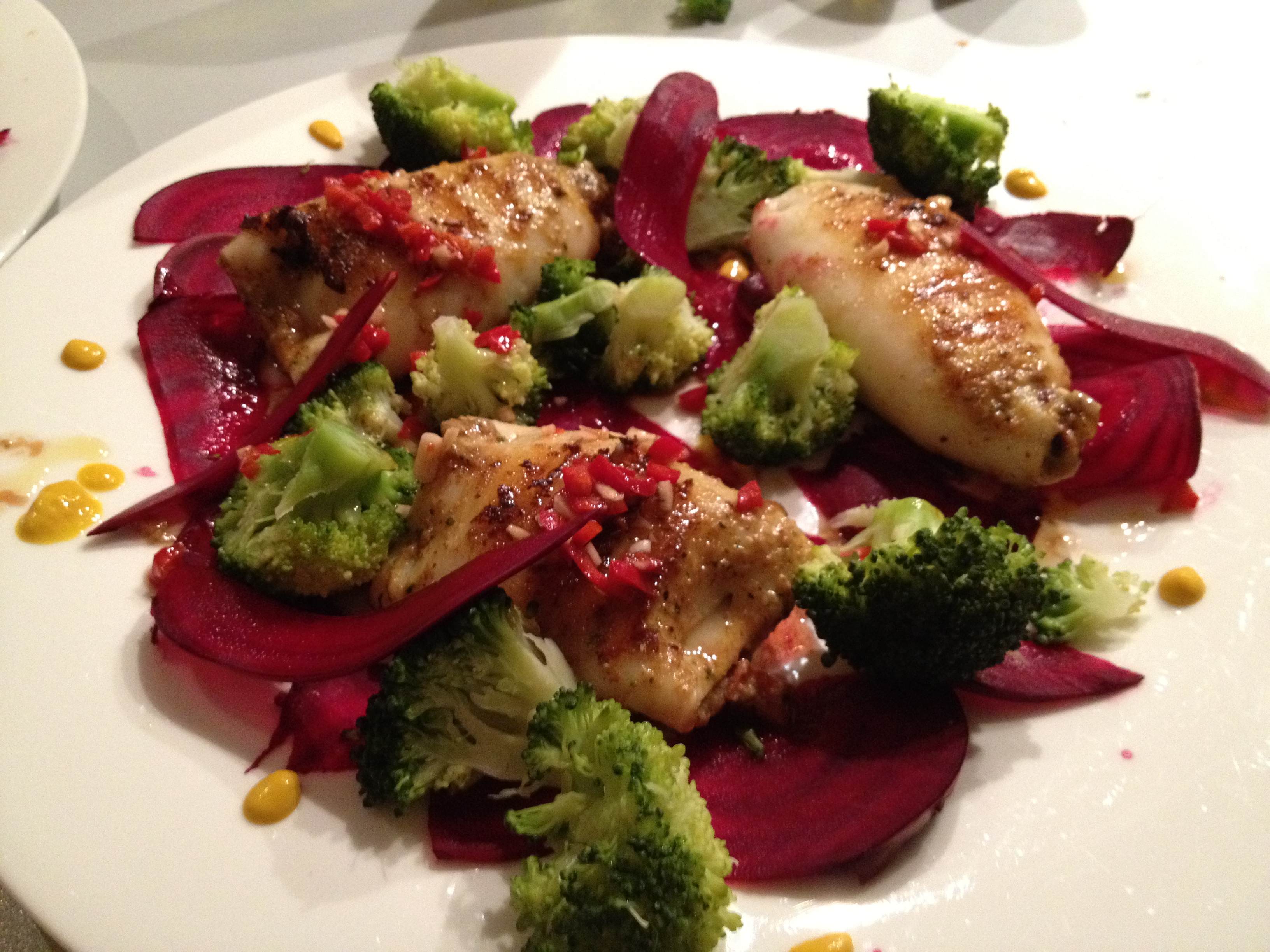
Feast 4 – Grilled stuffed squid with a broccoli and beetroot salad (with a chocolate fish for dessert)

My final installment of Greek food was a stuffed squid dish which was an exercise in using up the contents of my fridge. I defrosted 6 frozen squids (they’re not currently in season) and stuffed them with a mixture of lightly toasted pine nuts, 50g or so of feta cheese, 50 g or so of mozarella cheese, a handful of basil, a good squeeze of lemon, some very finely chopped spanish chorizo sausage, seasoning and a lightly sauteed finely chopped shallot. I made a pesto-style paste from half the pine nuts by whizzing them in a food processor with the cheese and basil and added this to the gently friend chorizo and shallots along with the other half of the toasted pine nuts (I used a 100g bag in total). This made for a variety of textures. I stuffed each squid with the mixture and fastened the end shut with a toothpick for cooking. I then grilled the squid in a griddle pan for 2-3 minutes on each side. In the meantime I lightly steamed some broccoli and finely sliced a beautiful fresh raw beetroot which I scattered over the plate at random, along with a light dressing of chopped chilli, olive oil and a squeeze of lemon juice. I also dressed the plate with a few blobs of mustard for decoration and yet more flavour intensity.

For dessert we ate something which has no remote connection to Greece whatsoever, but so beautiful was this chocolate fish which we gorged upon that he merits inclusion in this post. Bought in Salamanca, Spain a few weeks back, this fish is a chocolate beauty, so good that we resisted eating him for at least 3 weeks until finally succumbing to temptation last weekend. He tasted as good as he looked.