Skip to content

Posts from the ‘My Art’ Category

My Granada Sketchbook: Alhambra Aniconism

Andalucia, perhaps the most iconic region of Spain – the land of flamenco and polka dots, sun-scarred landscapes and toreros – owes a huge bulk of its entire identity to the cultural and aesthetic character of the Nasrid dynasty of Al Andalus, the islamic rule which gives the area its name. Despite having been flushed out by the reconquering Catholics, the arabic influence lives strong in the region, from the wailing arabesque of the flamenco cry, to the geometric imagery which characterises the multi-coloured ceramic tiles lining the walls of traditional patio gardens in practically every Spanish house.

The predominance of geometric patterns in Arabic art resulted as a cleverly constructed, beautifully executed solution to the rule of aniconism, that is the proscription in Islam against the creation of images of sentient beings. The most absolute proscription is of images of God in Islam, followed by depictions of Muhammad, and then Islamic prophets and the relatives of Muhammad, but the depiction of all humans and non-human animals is likewise discouraged. The result, especially in the times of Al Andalus when the style was still finding its feet, was to decorate palaces not only with geometric patterns, but also with calligraphy and the barely representational foliage patterns of the arabesque.

The palace of the Alhambra in Granada is renowned for boasting some of, if not the best examples of early Islamic wall decoration in the world, and it is the plethora of incredibly intricate wall calligraphy there, surrounded by delicate renderings of foliage patterns, which inspired my next Granada sketch.

Granada Motif Alhambra

Alhambra wall detail (2016 ©Nicholas de Lacy-Brown, pen on paper)

Spelling out what I believe inscribes the Nasrid motto “There is no victor but Allah” (but correct me if I’m wrong) – this is a pattern which can be found repeated endlessly around the palace as a kind of freeze above and below relentlessly repeated geometric constructs in the most splendid and mind-bogglingly calculated patterns. When I came to sketch just this tiny portion, it made me fully realise the astonishing detail with which the Alhambra decoration has been created. No wonder it is today the most visited of all attractions in Spain.

© Nicholas de Lacy-Brown and The Daily Norm, 2001-2016. Unauthorized use and/or duplication of the material, whether written work, photography or artwork, included within The Daily Norm without express and written permission from The Daily Norm’s author and/or owner is strictly prohibited. For more information on the work of Nicholas de Lacy-Brown, head to his art website at www.delacybrown.com

Our Alhambra Terrace

People take inspiration from holidays in various ways, weather through collating a set of ravishing photos, collecting foodie ideas, or even rounding up the tackiest and most whimsical souvenir. For me, it’s all about art.  There is no better way, in my mind, to look back on a holiday than through the art I great during that time. Because more than just taking a photo, the process of creating a painting or sketch involves time and contemplation, and therefore has the power to instil the final product with the great value of a comprehensive collection of memories and sensations. That is why I always do my best to get a hotel room with a view, in the knowledge that that alone will provide me with much of the inspiration I will need in the place I will feel most comfortable creating.

On our trip to Granada, we stayed in the Hotel Casa 1800, a stunningly quaint property characteristic of the rickety old houses and palazzos crammed into the ancient Albayzín district alongside the banks of the Darro River. Incredibly located just off the Plaza Santa Ana, the hotel boasted an unrivalled view of the Alhambra, but not in every room. In fact very few benefited from the crème de la crème of Granada views, but with ours, we were given the opportunity not just to enjoy the view through a window, but from our very own little terrace.

Alhambra Terrace FINAL

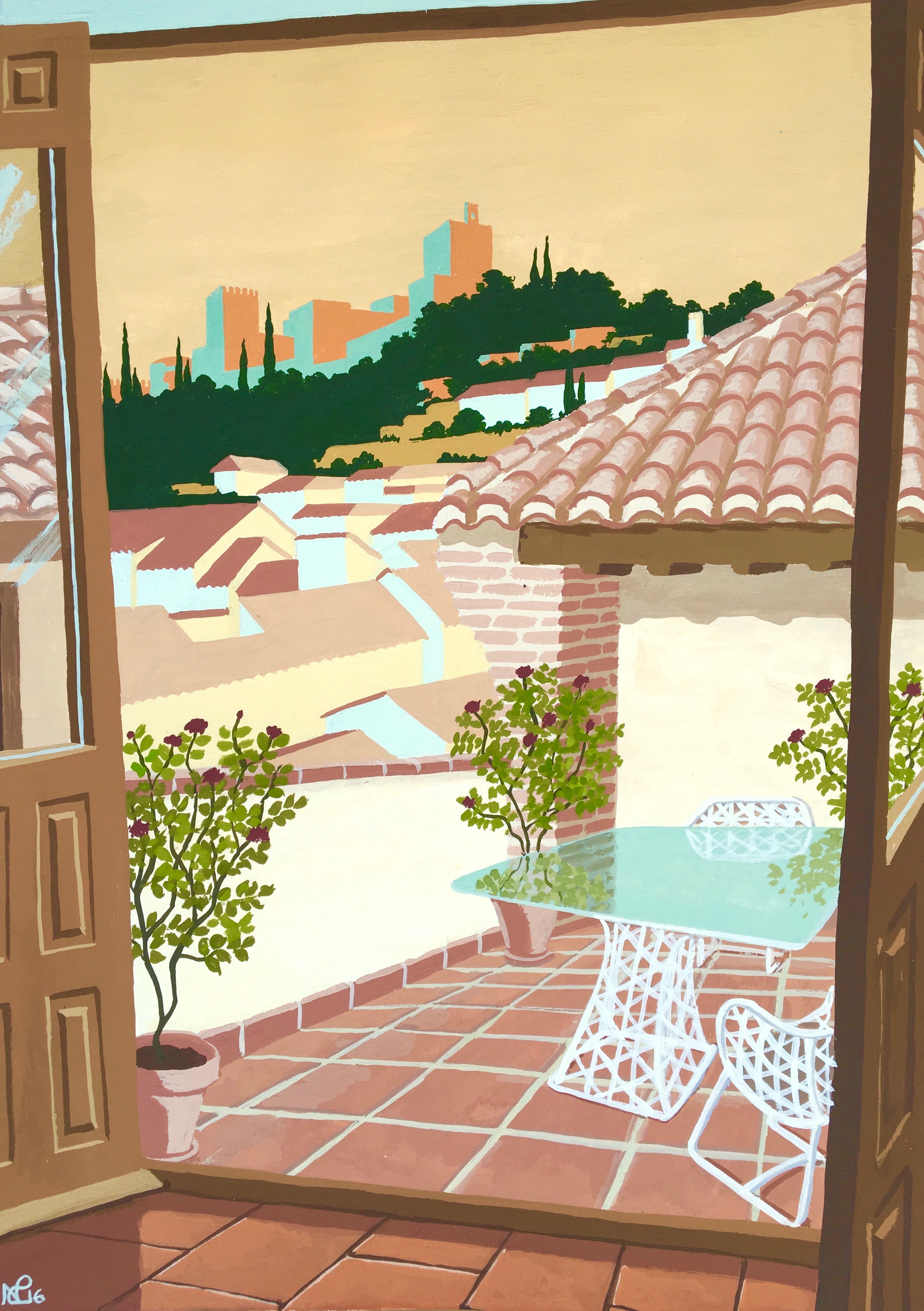
Alhambra Terrace (Hotel Casa 1800 Granada) 2016 ©Nicholas de Lacy-Brown, gouache on paper

As soon as we saw it, we knew it would be hard to tear ourselves away from the hotel. Such a cosy space and an unbeatable view could not easily be rivalled by a public space after all. With a moment’s glance, I knew the painting I would create that would best befit our experience of this space. And here it is. Making clear reference to the Honeymoon Suite collection created one year ago, this gouache painting continues the trend of painting the view from the hotel rooms enjoyed on our various travels. However with its Alhambra view, painted in a creamy orange with deep green shadows, this is one hotel room it will be hard to beat, no matter how much my future painting needs might demand it.

© Nicholas de Lacy-Brown and The Daily Norm, 2001-2016. Unauthorized use and/or duplication of the material, whether written work, photography or artwork, included within The Daily Norm without express and written permission from The Daily Norm’s author and/or owner is strictly prohibited. For more information on the work of Nicholas de Lacy-Brown, head to his art website at www.delacybrown.com
My Granada Sketchbook: Alhambra, viewed from the Albayzín

I have just returned from Andalucia in Southern Spain. It’s an annual pilgrimage to a place which inspires me deep from within its passionately romantic soul. While the old town of Marbella, in a house radiated by the fragrant perfume of jasmine, is always my base, each year I try to embellish my trip with a sampling of the region’s rich cultural offerings. This year it was the turn of Granada, a true jewel of the Iberian Peninsula, a city so rich in cultural and religious heritage that from one street to another you find yourself whisked across different centuries and richly divergent cultures.

A combination of 4 nights in Granada followed by 12 in Marbella meant for a trip front-loaded by inspirational madness, and a fortnight which then provided ample opportunity to live out the fruit of those ideas. This meant that my trusty sketchbook went with me not just in Granada, where I would sketch sat in shady plazas, and in the echoing gardens of the Alhambra, but also in Marbella, where every morning I got into the habit of finishing off my Granada sketches over a rich coffee and a slice of spongy bizchoco.

Granada Mirador Alhambra

The Alhambra viewed from the Mirador San Nicolas, Granada (2016 ©Nicholas de Lacy-Brown, pen on paper)

Today, I considered this sketch to be the best way to start my Granada tales, for it shows perhaps the most famous Granada view – the stunning Alhambra palace as viewed from the Mirador de San Nicolas, with the might of the Sierra mountains behind it. I’m not going to talk too much about the Alhambra for now… that time will surely arise as I share my Granada adventure with you. But for now I hope you enjoy this first of 9 works created on this very inspirational trip. I look forward to sharing them all with you.

© Nicholas de Lacy-Brown and The Daily Norm, 2001-2016. Unauthorized use and/or duplication of the material, whether written work, photography or artwork, included within The Daily Norm without express and written permission from The Daily Norm’s author and/or owner is strictly prohibited. For more information on the work of Nicholas de Lacy-Brown, head to his art website at www.delacybrown.com

Inspired by my surroundings: Paseo Mallorca 2

I am on a mission. To capture the beauty that is all around me. Sometimes it feels like an impossible task… the ever changing light and the relentless choice of angles makes my head spin. I feel like Monet rushing between canvases trying to capture haystacks at different times of the day. Yet I plough on, aiming to capture (in however many canvases it takes) the essence of my Palma neighbourhood: the Paseo Mallorca

My second effort in this regard is a painting of the bridge which crosses from Jaume III, Palma’s principle shopping street, stretching over to Santa Catalina, the cool kids left bank-styled area of town. The bridge itself is fairly decorative, albeit that it is somewhat simplified in this interpretation. But what struck me more than the bridge was the sweeping great curve of the white block of flats which sits at the centre of this view. Never a major fan of mass construction, especially in these kind of Mediterranean landscapes, for me there is a real space-age elegance about these 70s style blocks, glowing in the sun against the unchangeably blue skies, especially when contrasted with the soft edges of the many trees below.

Paseo Mallorca 2 FINAL

Paseo Mallorca 2 (2016 ©Nicholas de Lacy-Brown, acrylic on canvas)

© Nicholas de Lacy-Brown and The Daily Norm, 2001-2016. Unauthorized use and/or duplication of the material, whether written work, photography or artwork, included within The Daily Norm without express and written permission from The Daily Norm’s author and/or owner is strictly prohibited. For more information on the work of Nicholas de Lacy-Brown, head to his art website at www.delacybrown.com

My travel sketchbook: Hvar

I’ve already described those dying moments of a creamy honey-coloured sunset when we sat in the perfectly picturesque port of Hvar, the indulgently exclusive little island off the coast of Croatia, waiting for our ferry to take us back to Split. The ferry arrived late, a fact which might have caused vexation were it not for the opportunity it provided for the commencement of a new sketch in my trusty travel sketchbook. That same enthusiastically filled moleskin book was mercifully one item which the woefully incapable lost luggage services of Vueling did not have at their relentless disposal, and constantly, deprived of my paints, I was at least able to sketch out the most significant and happy episodes from our trip.

The beauty of Hvar Town’s little harbour, looking over to the Italianate cathedral of St Stephen’s, was one view which could not go unaccounted for as I embarked upon my last sketch of the trip. Here is the result, hoping as ever that in its creation and subsequent sharing, I can relive with you a little of those special moments of our brief Croatian summer.

Hvar

Hvar (2016 ©Nicholas de Lacy-Brown, pen on paper)

© Nicholas de Lacy-Brown and The Daily Norm, 2001-2016. Unauthorized use and/or duplication of the material, whether written work, photography or artwork, included within The Daily Norm without express and written permission from The Daily Norm’s author and/or owner is strictly prohibited. For more information on the work of Nicholas de Lacy-Brown, head to his art website at www.delacybrown.com

My travel sketchbook: The Iron Gate

Having left the seaside and retreated back within the ancient solid walls of Diocletian’s Palace, it was always a pleasure to enjoy the very active café culture which is so prevalent in Split. High quality restaurants and laid back bars alike spill out onto the ancient cobbled restaurants where once the Emperor Diocletian himself might have reclined back on a couch to drink a cup of Zinfandel wine (the famous Croatian-born grape). Despite the excellence of their food, Split’s eateries are far from pretentious. Rather, Split is alive with an atmosphere of the bohemian, a resolutely relaxed happiness which is underpinned by a plethora of live music performances from one business to the next. I will always remember one evening sitting in a cosy wine bar, funnily enough called Zinfandel, where live music was being played. Suddenly some girls started dancing to the music out in the street, and their energetic vivacity for life spread like wild fire. Within seconds the rhythm of the night had spread, and practically the whole restaurant and much of the nearby street too were dancing with strangers, inhibitions completely set aside. It was a magical moment.

Split Sketch 3

The Iron Gate (2016 ©Nicholas de Lacy-Brown, pen on paper)

Anyway, I digress. One day, heading back to the city from the beach, we stopped off in one of the spiritual hearts of the city, the Pjaca, or People’s Square, which was the first inhabited section of the city set just outside of Diocletian’s Palace. With all of the beautiful renaissance palaces which can be found in the square, the visitor is rather spoilt for choice in terms of the views on offer from one of its many cafes, but perhaps the best of the lot is the view afforded of the Iron Gate. One of four gates (Golden, Silver, Iron and Brass) which mark the four original entrances to Diocletian’s heavily fortified palace complex, the Iron Gate is one of the most distinctive, with its addition of a famous Renaissance clock characterised by its 24 digits instead of 12.

I loved this view, for all its layered complexity. Arch laid upon ancient arch, the renaissance bell tower of St Theodor, and the Venetian style palace overlapping the lot… it all made for a wonderful sight, and a clear requisite of my travel sketchbook. So sitting at a cafe I made a start on this sketch. Made with pen on paper, it’s a quick capture of a view which remain active in my mind for a long time.

© Nicholas de Lacy-Brown and The Daily Norm, 2001-2016. Unauthorized use and/or duplication of the material, whether written work, photography or artwork, included within The Daily Norm without express and written permission from The Daily Norm’s author and/or owner is strictly prohibited. For more information on the work of Nicholas de Lacy-Brown, head to his art website at www.delacybrown.com

My travel sketchbook: Diocletian’s Mausoleum

The fact that Vueling, easily the most incompetent airline in the world, lost my luggage throughout the entire course of our holiday to Croatia and Rome meant that I was travelling paintless, and brushless – something of a desperate state of affairs for an artist seeking inspiration abroad. Mercifully I had packed my trusty travel sketchbook in my hand luggage, and as though in defiance of the airline’s ineptitude, I set about sketching with even more gusto than ever.

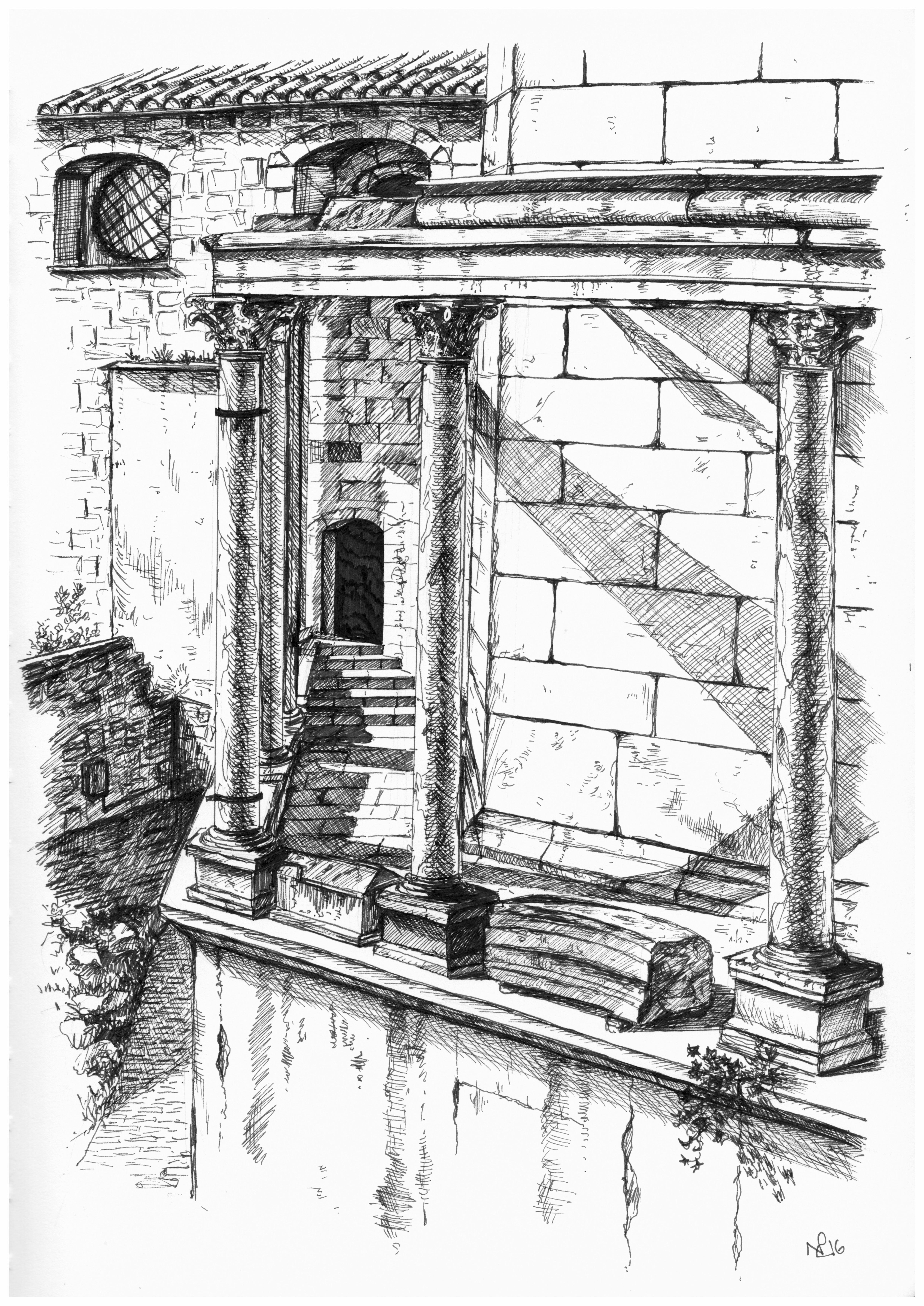
So having completed my first sketch of the view from our room in Split, I moved onto the next without so much as a breath between turning the page, and I didn’t need to go far to find another inspirational view. In fact by turning my head about an inch, I was able to enjoy, a mere two metres away from the bell tower of St Domnius, this incredibly antiquated, beautifully decadent landscape of ancient Roman columns being hit by the long shadows of a sunny Split morning.

Split Sketch 2

Diocletian’s Mausoleum (2016 ©Nicholas de Lacy-Brown, pen on paper)

The ancient walls and the freestanding colonnade alongside them are today part of St Domnius Cathedral, but at the time of their construction, almost 2,000 years ago, comprised the mausoleum building at the centre of Diocletian’s Palace where said emperor was destined to live out the afterlife. Despite now housing the Christian centre of Split, the Roman origins of this miraculously intact building are highly evident. Draped with shadow and exhibiting all the signs of their age and glorious past, I found this small corner of architecture both captivating and inspiring. Hence why I rushed to sketch it. Take that Veiling!!

© Nicholas de Lacy-Brown and The Daily Norm, 2001-2016. Unauthorized use and/or duplication of the material, whether written work, photography or artwork, included within The Daily Norm without express and written permission from The Daily Norm’s author and/or owner is strictly prohibited. For more information on the work of Nicholas de Lacy-Brown, head to his art website at www.delacybrown.com

My travel sketchbook: St Domnius detail

It’s been far too long since I last opened up the pages of my now almost full travel sketchbook. But who could possibly resist the lure of the ancient Roman bricks and the Medieval buildings piggybacking onto the remains of Emperor Diocletian’s palace which form the central foundations of old town Split. And that very same view was one we became well accustomed to, as staying in the incredible Antique Split Hotel, we benefitted from a hotel room which looked directly onto the ruins of Diocletian’s Palace, and more specifically the iconic St Domnius Cathedral which is built on the ruins of Diocletian’s mausoleum.

More than any other building, the bell tower of St Domnius marks out the landscape of Split, distinguishing the city from the other smaller towns along the Croatian coast. From a distance, the bell tower is a delicate, multilayered construct which ascends in a series of cake layers narrowing in size. From up close, it is even more exquisitely detailed, and it is one such layer of details which was the focus of my first sketch, drawn directly from our hotel bedroom.

Split Sketch 1

Detail view of St Domnius Cathedral bellower, Split (pen on paper, 2016 ©Nicholas de Lacy-Brown)

Now back at home, I miss those moments when, with the windows wide open, I was able to stare in amazement at the incredible views before us, while low flying swifts accompanied by gentle sketching with their harmonious call. It is a moment which comes back to me the instant I open my sketchbook. It’s a true treasure-trove of memories to be long cherished.

© Nicholas de Lacy-Brown and The Daily Norm, 2001-2016. Unauthorized use and/or duplication of the material, whether written work, photography or artwork, included within The Daily Norm without express and written permission from The Daily Norm’s author and/or owner is strictly prohibited. For more information on the work of Nicholas de Lacy-Brown, head to his art website at www.delacybrown.com

Melancholy Woman: Lament for a Broken Union

Sometimes in life you receive news that shocks you to the core. News which wrenches the inside of the stomach, infiltrates the heart and mind, brings tears to the eyes and fills your life, your hopes and your ambitions with darkness. I have lived through the pain of death, and the anguish of heartbreak. And all I can say is that that same physical reaction as I had experienced before once again engaged with my total metal and corporal being when last Friday I awoke to the news that the UK had voted to leave the European Union.

There is much that can be said of a Union which has grown too big, of laws unruly, of an organisation stretched beyond its limits, but there is very little which can justify the decision of 52% of the UK’s voting population opting to leave the EU for what were utterly anachronistic, completely unintelligent and sickeningly ignorant reasons. A  wave of xenophobia, which has long infiltrated English society, was normalised by a leave campaign which popularised an exit from the EU as being an excuse to cleanse the country of foreigners and in so doing exercise what they lauded to be the action of “taking the country back”. Such a move does not enable Britain to become in any way stronger, nor more progressive. It is a retrograde step which will see the nation isolated, deprived economically and falling far outside the progressive benefits of a globalised society.

It is a move which has already seen the value of the pound plummet, the political system spiral into disarray, and the relationship of the UK notably deteriorate with its neighbours and allies near and far. In leaving the EU, those who wished to reinstate an England of the past have robbed its future generations of an actively mobile, economically stable future, all the while forgetting, with an unfathomable level of hypocrisy, that the England of the past was a country whose very success and global position had been marked by its own breed of imperialism and abuse of other countries and cultures overseas.

Little more can be said to best express my feelings of dismay at this time. Embarrassment of being English is coupled with my fears of being like a disconnected refuge living abroad without the rights and the freedoms to which I have become so easily accustomed all my life.

Melancholy Woman FINAL

Melancholy Woman: Lament for a Broken Union (after Picasso) (2016, acrylic on canvas ©Nicholas de Lacy-Brown)

In reflecting on this time, I turned to art, as I always have in times of happiness and grief. When I saw the painting by Picasso, Melancholy Woman (1902), I felt engaged by a work of art which appeared to me to sum up the emotions of the moment. Taking a spare canvas, and moving immediately to paint an interpretation of the work, I created my own Melancholy Woman in the abstractive interpretative style which has shaped the body of my recent creations. In repainting this work, I have kept to Picasso’s expertly chosen colour palette, founded of his famously melancholic blue period, replacing his forms with a more geometric gathering.

http://art-picasso.com

Melancholy Woman: Lament for a Broken Union (after Picasso) (2016, acrylic on canvas ©Nicholas de Lacy-Brown)


My melancholy woman laments, like Picasso’s, for an intense heartbreak. I imagine his protagonist wept over some lover, some union lost. My woman also weeps for a broken union. The European Union. Broken by those who entirely misunderstood the modern world, proactively destroying the future of those who might still have benefitted from it. What happens next, no one knows.

© Nicholas de Lacy-Brown and The Daily Norm, 2001-2016. Unauthorized use and/or duplication of the material, whether written work, photography or artwork, included within The Daily Norm without express and written permission from The Daily Norm’s author and/or owner is strictly prohibited. For more information on the work of Nicholas de Lacy-Brown, head to his art website at www.delacybrown.com

Shakespeare 400: A Midsummer Night’s Dream

2016 is the year of Shakespeare. It is a festival which marks the great Bard’s birth, and his death, and above all things a celebration of his incredible works, masterpieces which have shaped generations, been interpreted and reinterpreted across the centuries, and which are a core of both British and global theatre. In exploring my own reinterpretations of his plays, some 20 years after I completed my first Shakespeare collection at the age of 13, I have moved onto my second work, painted in my new interpretative abstract style.

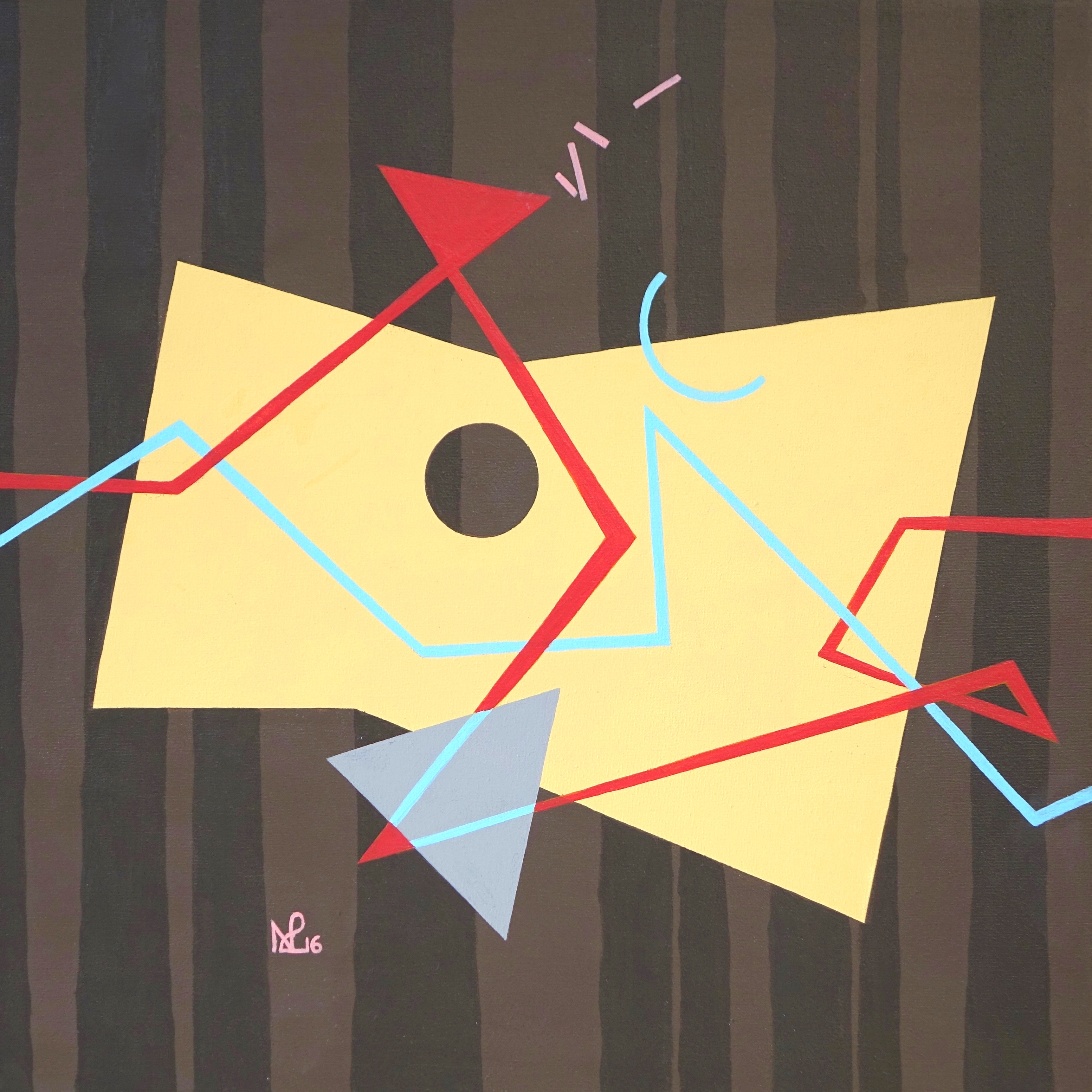
The play is A Midsummer Night’s Dream, a comic frolic of cross-purpose love affairs, mischievous spells, sparkling forest fairies and of course the famous Donkey metamorphosis of Bottom, all set between the trees of a forest near Athens. That wonderfully magical forest setting forms the background of my work, a simplified design of vertical brown stripes, creating a sense of the darkness and depth of the forest which characterises the tone of that mystical Midsummer’s Night.

Midsummer FINAL

A Midsummer Night’s Dream (2016 ©Nicholas de Lacy-Brown, acrylic on canvas)

Central to the piece is a large yellow shape, representing the wall in the story of Pyramus and Thisbe, whose chink provides the only channel for communication for the two forbidden lovers after whom the story is named. Creating something of a play within a play, the tale of Pyramus and Thisbe (originally told by Ovid) is acted out at the end of the play by the theatre troupe from whom the actor-turned-donkey Bottom comes, and which likewise reflects the theme of forbidden love which is played out in the forbidden love between Hermia and Lysander.

It is in fact that disallowed love affair which sends Hermia and Lysander fleeing to the forest, where in their wake Helena, Hermia’s friend, and Demetrius, the man Hermia’s father wishes her to marry, follow. These four characters then become the pawn of Oberon and Titania, the King and Queen of the forest fairies whose own conflict results in a series of magical mischief which in turn results in the four youngsters of Athens variously falling in and out of love with one another while under the bewitchment of the “love-in-idleness” flower. That same juice is used to bewitch Titania, who in turn is caused to fall in love with the metamorphosed Bottom.

All this is represented by my painting of shapes and lines. The energetic lines which cross the canvas are those of Titania and Oberon, whose ballet of magical conflict weaves in and out of the play’s plot. Where they meet, and form shapes within their overlaps, these shapes represent the four young lovers, Helena, Hermia, Lysander and Demetrius. The grey triangle is of course the donkey head of Bottom, and when Titania’s “line” traverses the space, it is transformed blue, as though bewitched by Oberon. Meanwhile above Oberon’s line, the blue curve represents his faithful assistant Puck, the cheeky little fairy who mischievously applies the love-potion, and above the red triangle of Titania, the four little pink lines are her flying little fairy assistants, Peaseblosom, Cobweb, Moth and Mustardseed.

For those unaware of this brilliant play, the description above may bamboozle the mind. Where that is the case, please enjoy the painting instead, whose simplified lines and structure make, in themselves, what I hope is a thoroughly pleasing image for Midsummer’s Night.

© Nicholas de Lacy-Brown and The Daily Norm, 2001-2016. Unauthorized use and/or duplication of the material, whether written work, photography or artwork, included within The Daily Norm without express and written permission from The Daily Norm’s author and/or owner is strictly prohibited. For more information on the work of Nicholas de Lacy-Brown, head to his art website at www.delacybrown.com