Skip to content

Posts from the ‘Norms do…’ Category

Dutch Masters Season Part 1: Van Gogh

Its atmospheric canals may be frozen (or perhaps now melting?), its wooden clogs uncomfortable on the feet, and its multi-coloured fields of tulips yet to burst into life, but Holland has so much to offer, especially to art lovers like myself. I’m not overly familiar with the Netherlands – I went once on a geography field trip at school, when we concentrated on the art of land reclamation and urban morphology, but it has always saddened me that I never had time to appreciate the cosmopolitan, thriving city of Amsterdam and all its multifaceted cultural offerings. This weekend, all that will change, as the Daily Norm will head to Amsterdam and hopefully posts bursting with accounts of the great city, its art and its buzzing life will swiftly follow. In anticipation of this exciting event, the Daily Norm is happy to launch the Dutch Masters Season, a three-part series looking at masters of Dutch art, as well as Norm reinterpretations of three Dutch masterpieces. This will be followed by a Sunday Supplement examining the influence of a particular Dutch supremo on a family portrait I created in 2010, and then my trip to Amsterdam will explode onto your screens in a (hopefully) spectacular fashion.

So, without further ado, let us begin this brief cultural survey of Dutch artists with this feature on a painter who is without a doubt the most famous Dutch master of them all… the indomitable sunflower-loving, paint-eating, ear-lopping saviour of colour, Vincent Van Gogh.

What can be said about Van Gogh that hasn’t been said before? A couple of years ago we got a huge anthology containing translations of his numerous letters, allowing us an invaluable insight into the artist’s sensitive, insightful mind. Last year, a new biography was published, sensationally claiming that rather than killing himself, as is the fabled (and much romanticised) tale, he was quite probably killed in a tragic accident involving local children playing with a gun. Every year some weighty international art institution holds a retrospective of his work, and chocolate boxes, t-shirts and mouse mats containing starry nights, sunflowers or a green faced portrait with decisive brush strokes and vibrant colours fly off the shelves of souvenir shops all over the world. So of course there isn’t much left to say. But where there is renown, let a Norm refresh. Where Van Gogh bandages his ear, let a Norm bandage his face. Yes, I give you, in the style of Van Gogh, Norm with a bandaged face…
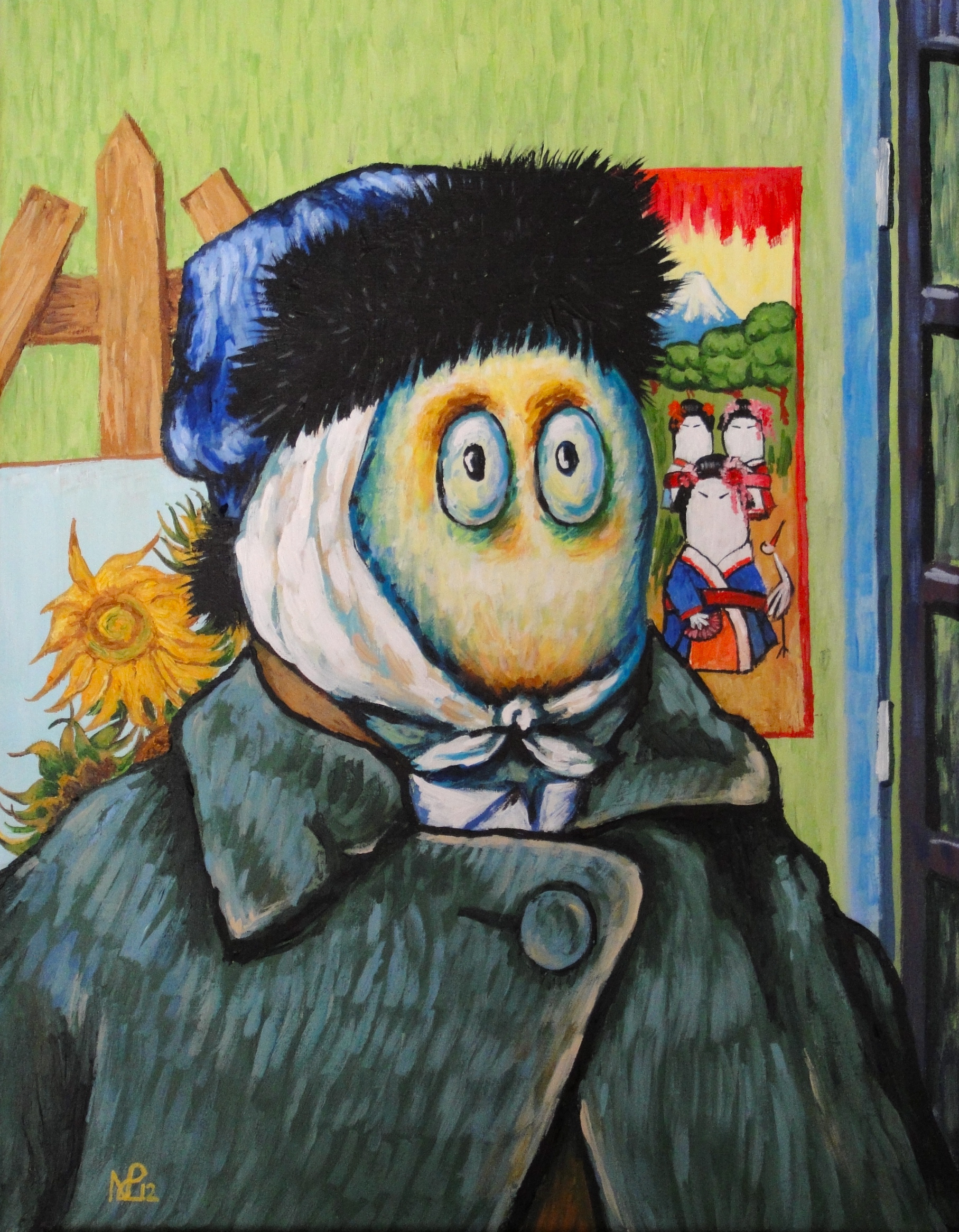
Norm with a bandaged face (after Van Gogh) (acrylic on canvas, 2012 © Nicholas de Lacy-Brown)

And the original…
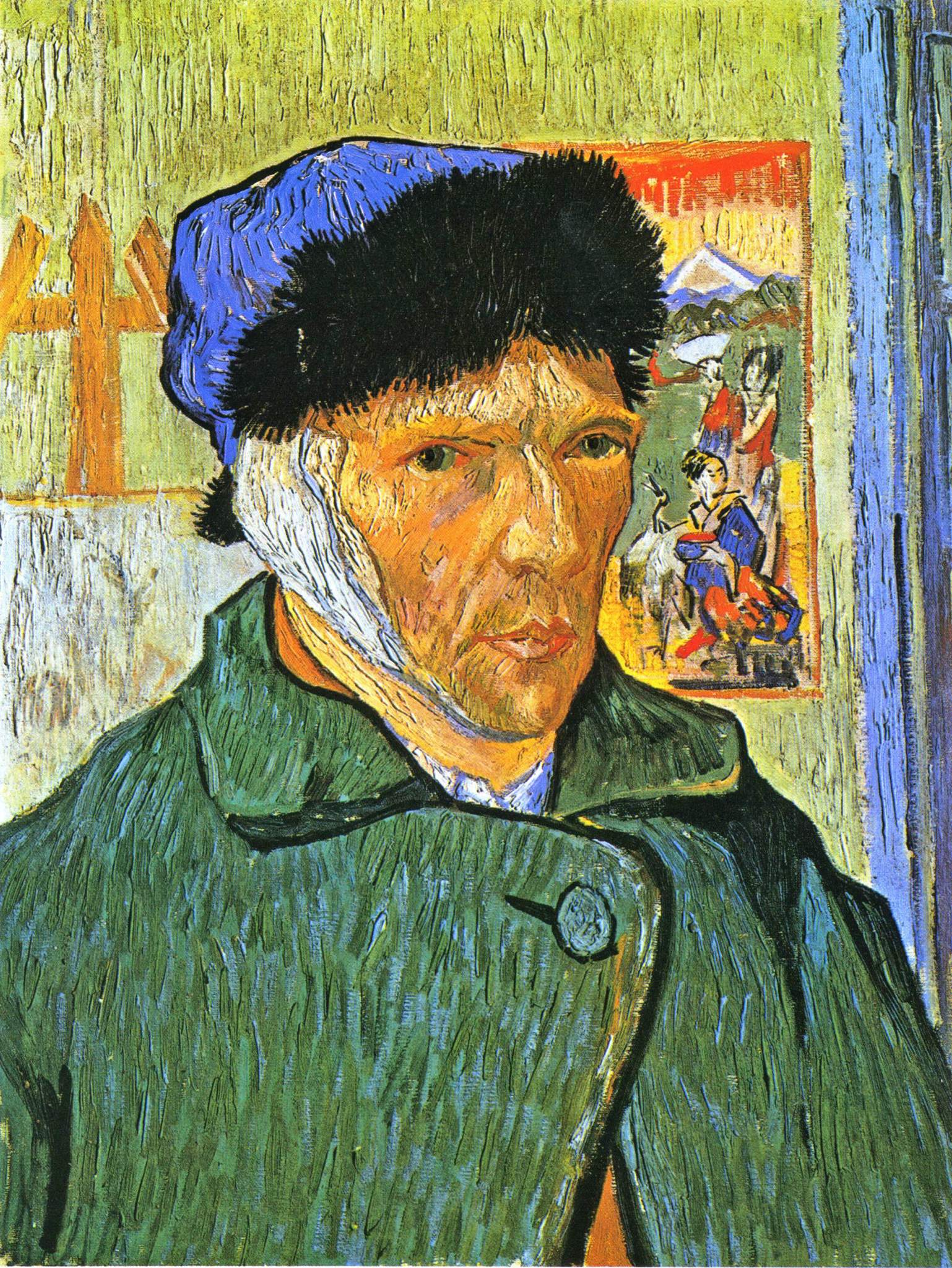
Vincent Van Gogh, Self-Portrait with Bandaged Ear (1889, Courtauld Institute of Art, London)

So why did this particular Van Gogh work inspire me? (After all, there are countless Van Gogh portraits to chose from, as well as a number of portraits of the local postman, the doctor, Gaughin’s chair and the like). Well to start with, this painting lives close to home for me, part of the wonderful collection of London’s Courtauld Institute, where more often than not, you can get this portrait, as with many of the other impressionist masterpieces in the collection, all to yourself, while Van Gogh’s Sunflowers, kept down the road at the National Gallery, is surrounded by a permanent semi-circle of tourists and school groups. But then there’s the bandaged ear, which is after all emblematic of the legend that is Van Gogh.
Van Gogh: souvenir hell

It happened one dark night in December 1888. Paul Gauguin, the tumultuous Tahiti-loving artist was staying with Van Gogh in the Yellow House in Arles, Provence. They argued savagely and Van Gogh came at Gauguin with a knife. At the last minute he turned on himself, cut a chunk out of his ear, and attempted to gift it to a local prostitute who sensibly alerted the authorities thus probably saving Van Gogh from bleeding to death. This painting, one of two containing the bandage (and therefore suitably amplifying the tale), was painted a month later in the comparable calm of post-cataclysmic reflection, with Gauguin gone, and Van Gogh all alone, once again, staring in the mirror in contemplation.

Vincent Van Gogh, Vase with Twelve Sunflowers (1888, Neue Pinakothek, Munich)

For me, it’s the perfect Van Gogh, because it gives us snippets of everything he represents. Broad, almost vibrating brush strokes expressing the rawness of his emotions, and the vigour and haste with which he sought to express his feelings on the canvas. A colour palette which is bold, unforgiving, almost happy despite the downbeat subject portrayed. On the wall hangs a japanese print, a recognition of the great influence of Japonisme in his work, while to his right, an easel and canvas is in progress – here I have used a bit of good old artistic licence, adding the sunflowers which are so equally emblematic of Van Gogh – just in case you weren’t immediately sure who I was referencing with this painting! In this way, the warmth of Provence contrasts with the coldness of winter portrayed in the artist’s thick coat and strange furry hat, an outfit which appears to isolate Van Gogh from the viewer, enveloping him in a melancholy introspection which is shared with the audience only through the piercing gaze of his sickly green eyes.

Well there you have it – and it looks like I had a lot to say after all. For me, Van Gogh is a master. Sometimes his works are criticised for being overly loose, coarsely painted and unsophisticated. But you only have to look at his early portraits of peasants, such as his saturnine masterpiece, The Potato Eaters, to recognise his skill as a draftsman. Rather his coarse, thick application of paint allowed him to paint fast, and this was crucial in allowing him to express his vigorous and volatile emotions on canvas, as and when they moved him. And it is this living, breathing, unforgiving emotional intensity which remains so evident in his canvases today in every decisive and quivering brush stroke, capturing audiences and inspiring biographers and curators aplenty, whether it be through sunflowers, cypress trees or in the sorrowful eyes of his many self-portraits. This is why, to my mind, Van Gogh is a true Dutch master.

Van Gogh, The Potato Eaters (1885, Van Gogh Museum, Amsterdam)

Come back tomorrow for Dutch Master number 2.

Postscript: In case you were wondering, no, Norms don’t have ears, but that doesn’t mean that this Van Gogh pretender couldn’t have inflicted a grizzly wound on himself in the same general area!

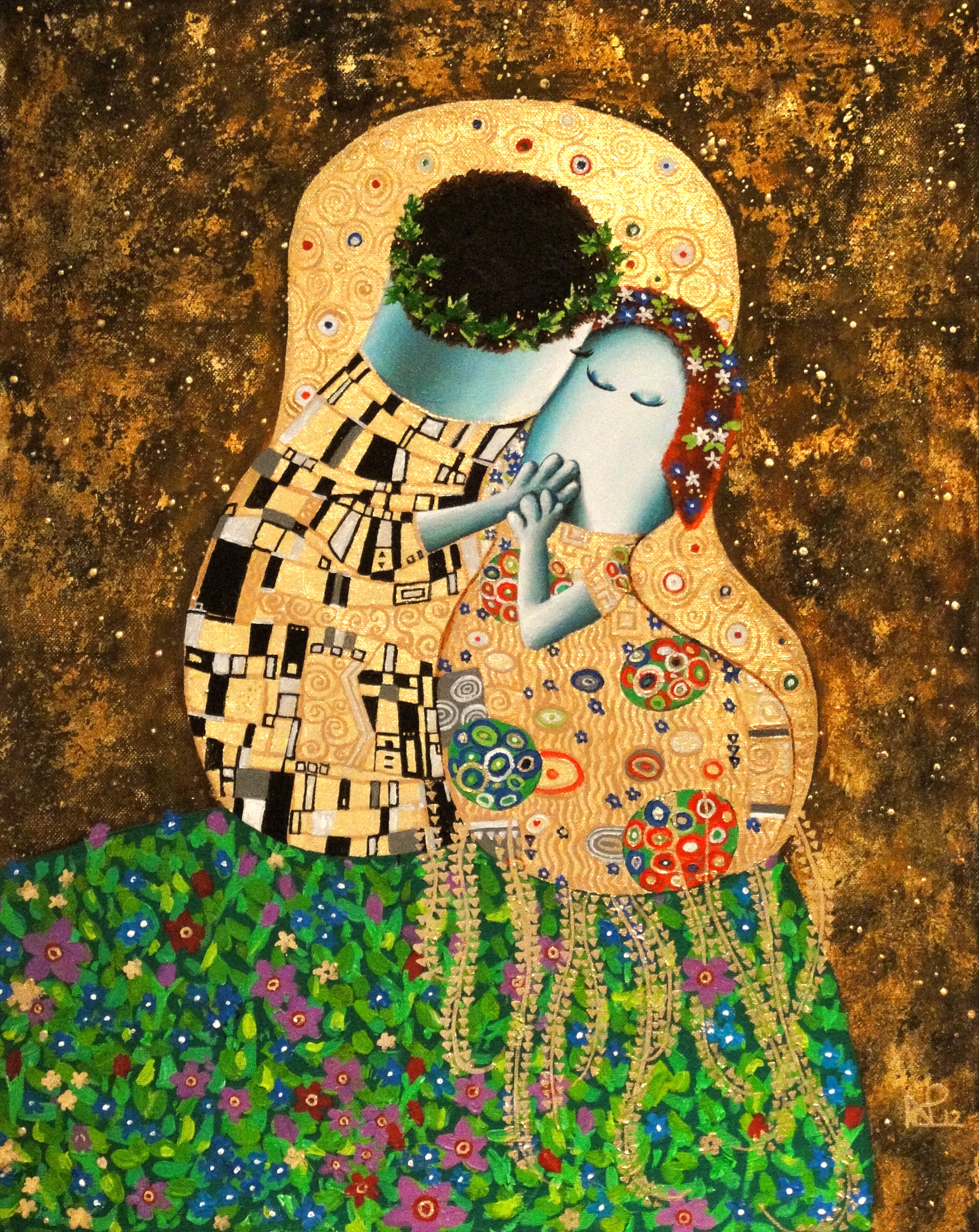
Valentine’s Kisses: Norms do… Klimt

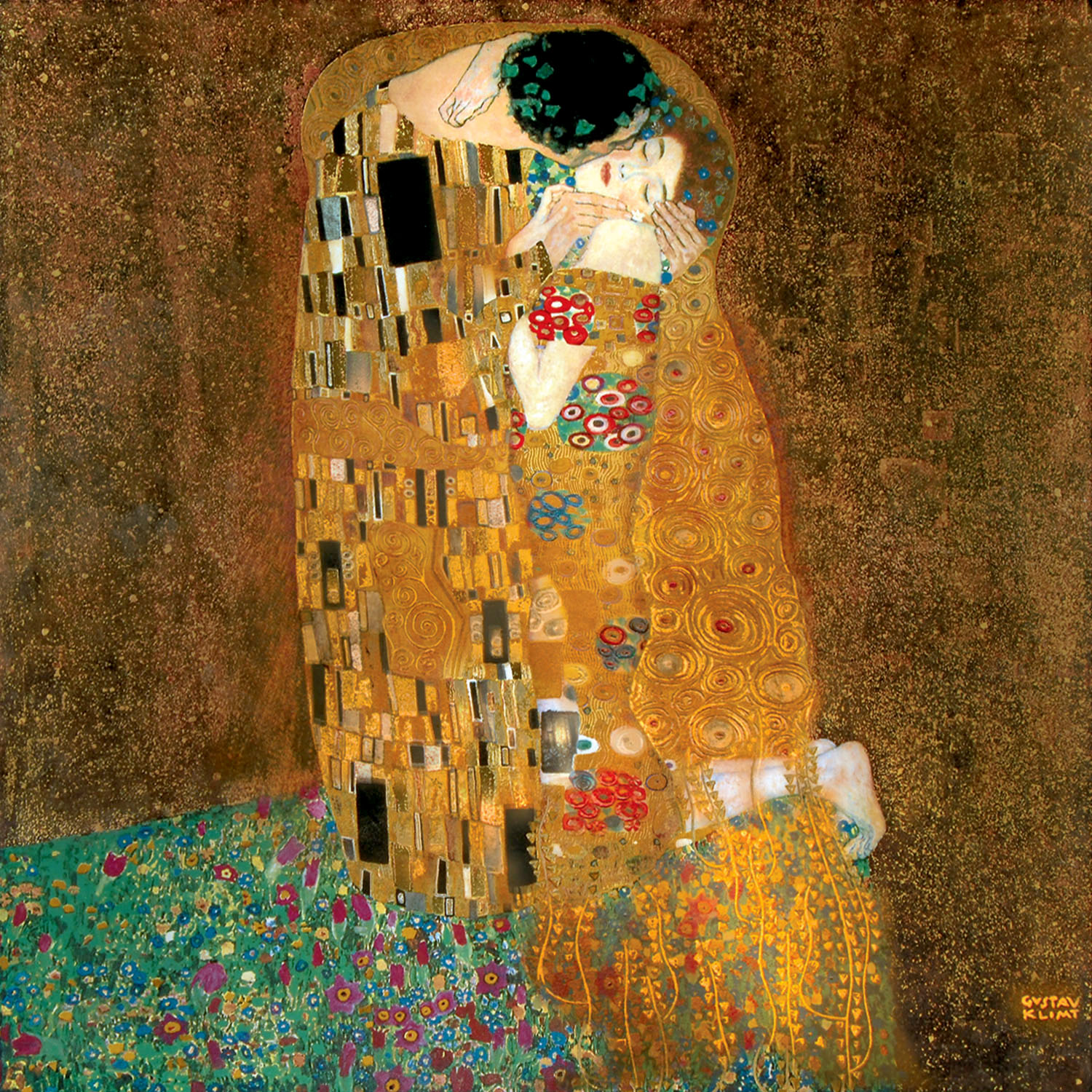
It’s valentine’s day, the day when millions of singletons across the globe shrink in disgust at the notable increase of embracing couples on the streets and inappropriate PDAs (public displays of affection), and when millions more feel the pressure of their partner’s expectation that they out do last year’s offerings with overpriced roses and a box of unwanted chocolates. But none of that here. At the Daily Norm, valentine’s is just an excuse to celebrate the more intimate, emotional side of art, while also using it as an opportunity to present a brand new Norm painting to the world! When I think of love, there is only one painting which comes to mind. It is, perhaps unsurprisingly, the same image which dominates the search results page when you type “The Kiss” into google. It is, of course the world’s must famous and celebrated embrace, The Kiss, by Gustav Klimt. And here, for your viewing pleasure, is the Norm re-inactment along with the original.
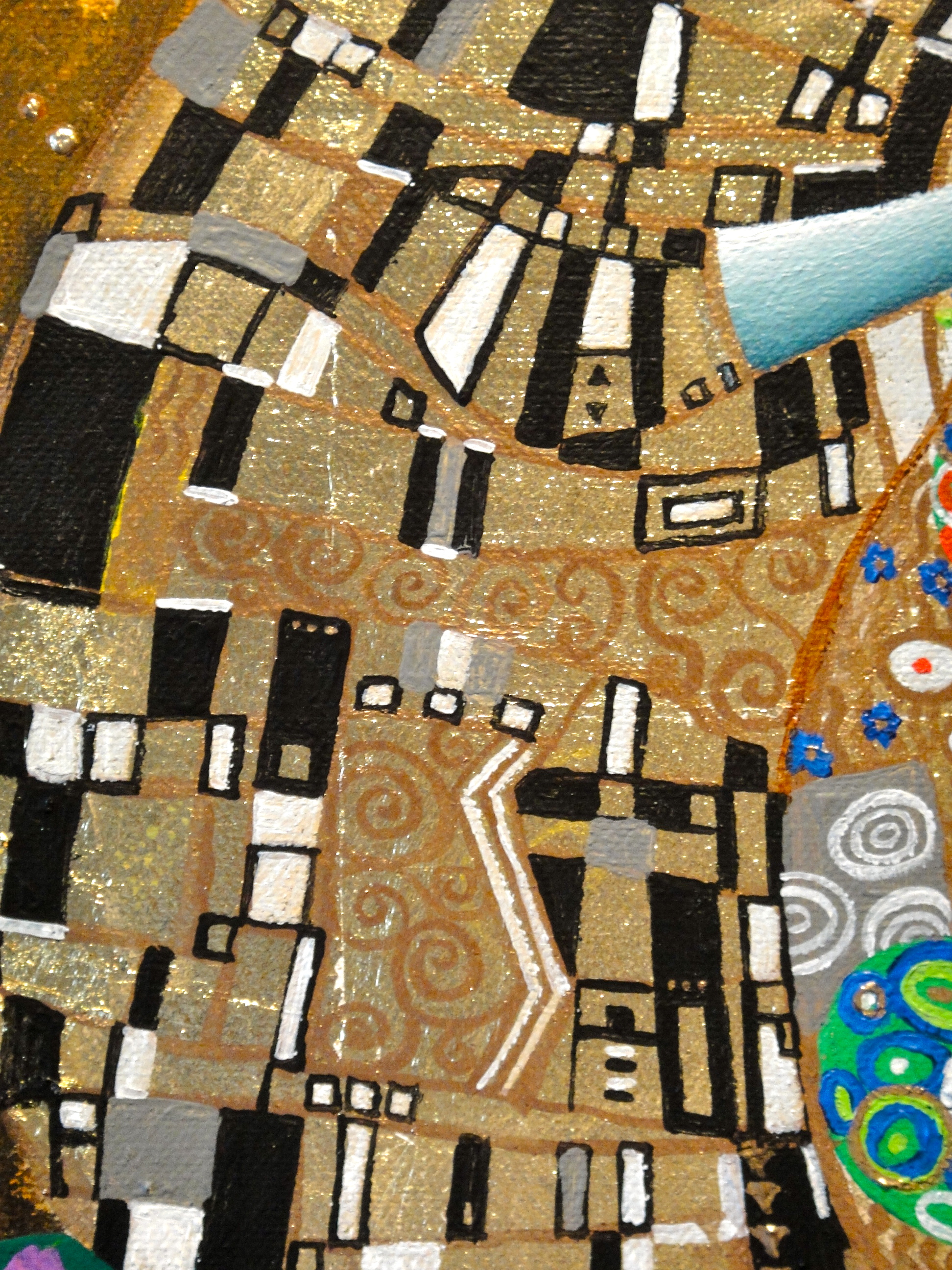
The Kiss (after Klimt) (acrylic and gold leaf on canvas, 2012 © Nicholas de Lacy-Brown)

The Kiss by Gustav Klimt (1907-8, Österreichische Galerie Belvedere, Vienna)

It’s a crying shame that like Van Gogh’s sunflowers, or Monet’s bridge/waterlillies, or Degas’ ballerinas, Klimt’s masterful golden embrace has become so commercialised, replicated and reproduced onto every form of tourist tack, from lamps and mousemats to beaded curtains and bed linen, that the automatic reaction of a viewer to the image is to see it through a kind of autopilot. As with all recognition, one fails to actually look, really look at the image. When I embarked upon a Norm version of Klimt’s work, this is exactly what I had to do. Whereas previously I had dismissed the image as cliché, when I started painting my own version, I saw so much more.

The Kiss (after Klimt) (© Nicholas de Lacy-Brown) - detail of male Norm

First of all, the painting is a superb fusion of evocative emotion mixed with art nouveau-inspired flattened design. It makes for an interesting synthesis, and seems to emphasise and centralise the intensity of the embrace all the more, since the power of the emotion charging through the embrace appears to have instigated the creation of a fantasy world around the couple, as they appear to burst out of a planet of flowers, and all around them, a cosmos of golden stars twinkle. The patterns of the clothing are also interesting. With squares and geometric patterning, the man’s clothing appears quite strong and masculine, where as the woman exudes a more feminine softness with round flowery shapes and waves. However, interestingly the fusion between the characters seems to translate into their clothing, as interspersed between the man’s squares are small patches of swirls, while on the woman, round shapes are occasionally interrupted by squares, particularly where her body touches the man’s. Moreover, the aura-like golden space around them is full of swirls which appear like stars or moving, active emotions. Also, at the bottom of the canvas, the abundant flowing golden plants trailing off the couple seem to suggest fertility, not least because of  the prominence of the upturned triangle which hints at female sexual organs.

The Kiss (after Klimt) (© Nicholas de Lacy-Brown) - detail of female Norm

More interesting still is the pose. From the painting’s title, one would draw the inference that this is a happy, loving embrace. However, having studied the work more closely, there is, to my mind, something all the more sinister about the pose. While the man stands tall and rather menacing with his black hair and firm grip of the lady, she appears to be subservient in the embrace, kneeling before the man. She appears to hold the man, not tenderly, but as though trying to loosen his grasp on her. Notably, her right arm appears to be screwed up into a tense fist rather than tenderly resting upon his shoulder. It also seems significant that the kiss is not on her lips but her cheek, as though the lady has turned her face just in time to avoid the man’s approach.

As with most great masterpieces, much is left to the public’s interpretation, but I am at least glad that in Normyfying this work, it has given me the opportunity to study it further and give it the kind of appreciation it deserves. As for my Norm reimagining, I think that the pose lends itself well to the Norms who, in their curved body shapes, fit effortlessly into the art nouveau theme of the original. Here the awkwardness of the embrace could still be interpreted either way, although as Norms only have one arm, my lady Norm is without her right screwed up fist, while the man cannot grip so firmly upon his Norm lover with his second hand. There was a lot of detail which needed painting in order to do Klimt’s original justice, and as the main photograph doesn’t necessarily show this up, I have included close up detail shots of my Norms (above), as well as a photo showing the effect of the gold leaf when a flash is used on my camera below.

The Kiss (after Klimt) (acrylic and gold leaf on canvas, 2012 © Nicholas de Lacy-Brown) - showing effect of a flash on the gold

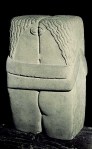
In the meantime I wish you all a very happy Valentine’s day, hoping that the day is everything you want it to be (if only if it means the effective avoidance of couples!). For those of you more inclined towards all things romantic, I leave you with a gallery of some of my favourite artistic manifestations of kisses, from Rodin’s sculpture to my own Norm version of Robert Doisneau’s Le Bazier de l’Opera.

© Nicholas de Lacy-Brown and The Daily Norm, 2005-2012. Unauthorized use and/or duplication of the material, whether written work or artwork, included within The Daily Norm without express and written permission from The Daily Norm’s author and/or owner is strictly prohibited. Excerpts and links may be used, provided that full and clear credit is given to Nicholas de Lacy-Brown and The Daily Norm with appropriate and specific direction to the original content.

Norms do… the Rokeby Venus

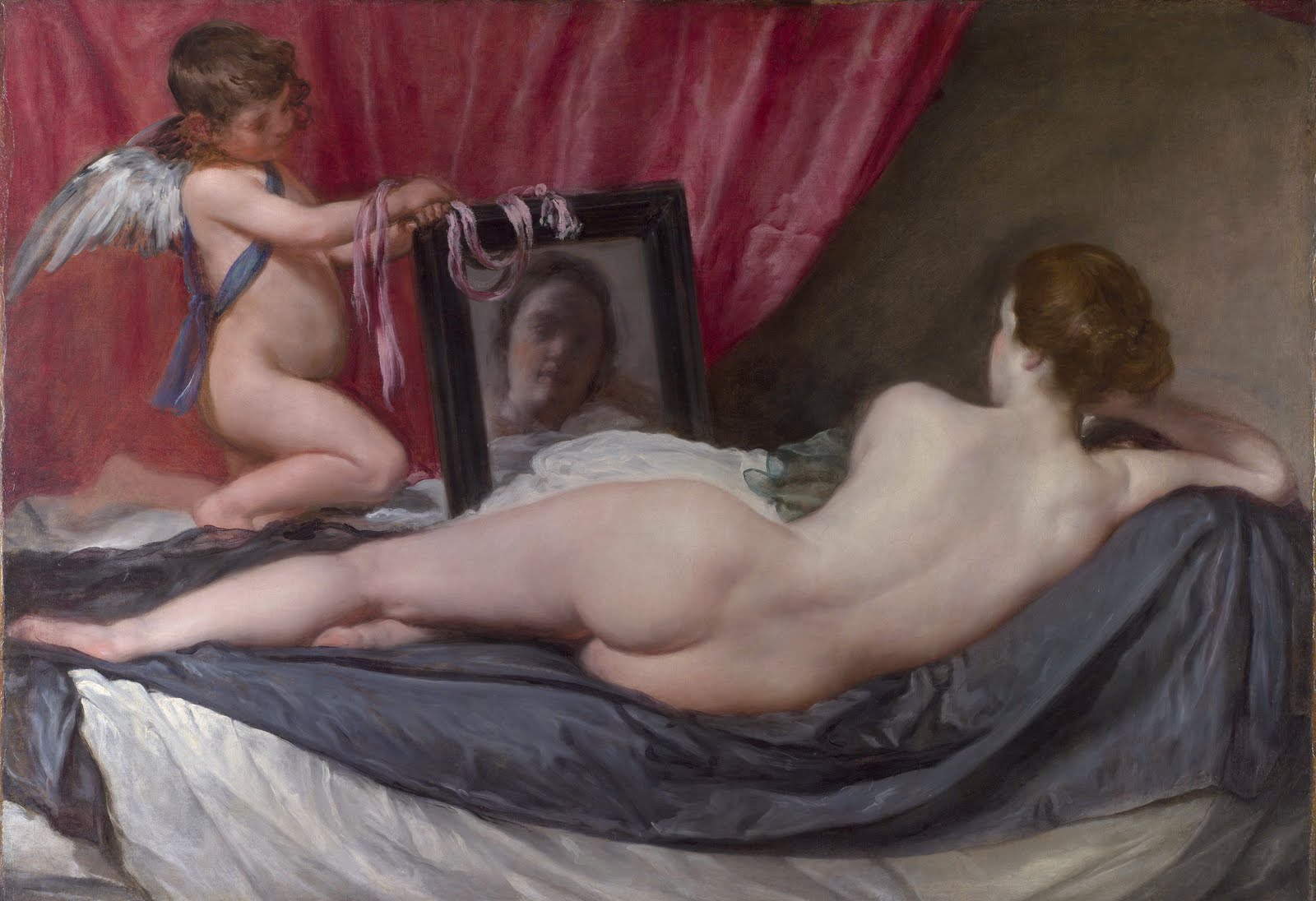
You’d excuse the Duchess of Cambridge, aka our adored Kate Middleton, for being a little miffed at the reception to her sister Pippa’s now famous backside when it meandered up the aisle of Westminster Abbey behind the blushing bride in the decade’s most watched wedding last year. Her bottom was a largely unanticipated feature of the wedding, but one which captured almost as much attention as Kate’s dress, particularly amongst the males watching the wedding (causing unanimous consternation amongst their female partners – one, it was reported, even slashed her boyfriend’s car). But should Duchess Kate wish to console herself of this great usurpation of her wedding day, she need only wander next door from the National Portrait Gallery to which she has recently become patron. There, in London’s National Gallery, she will find a backside which easily eclipses Pippa’s behind in terms of notoriety (and, frankly, beauty), a bottom which has been both ogled at and admired in equal measure for centuries, and one which has stirred such strong reactions in its audience that a King of England helped to purchase it for the nation, and prompted one crazed suffragette to slash the painting repeatedly in pursuit of her campaign for women’s rights (in prompting such violent actions then, perhaps the two bottoms are on par). It is, of course, the beautiful bottom of the Venus, painted by Spanish master Diego Velázquez, which has become known as The Rokeby Venus. 

The original Rokeby Venus by Velazquez (courtesy of The National Gallery, London)

The painting, which became known as Rokeby when it was moved to Rokeby Park in Yorkshire in the 19th century, is easily one of the prizes of The National Gallery’s collection. It not only shows a lovely naked body for audiences to admire and, possibly, to become aroused by, as well as an intimate, uninterrupted moment of self-absorbed beauty, it also offers us an innovative way of representing the archetypal duo of classical figures, Cupid and Venus, with Venus’ back to the viewer, and Cupid, without his usual bow and arrows, engaging, assisting Venus in her act of self-appreciation. Painting Venus’ back to the audience was an unusual choice, but it not only adds to the intimacy of the scene, it also allows the nude to be admired from a hitherto unseen perspective. And in order to involve the audience with his portrayal of Venus further, Velázquez uses the mirror as a device to introduce Venus’ face in the scene as well. In this way the composition is not only innovative but highly effective as a tool to seduce and captivate the viewer. As Velázquez goes, this is quite a departure from Las Meninas and his other court portraiture, and would, in fact, have been painted with a degree of secrecy in a society which was prowled by the stricture of the Spanish Inquisition. Its beauty is however equal to, if not greater than these more “official” works, and provides an intimacy and emotional intensity which would never be captured in the stiff pose of a courtier, or even the traditional classical manifestation of Venus.

Damaged sustained by the Rokeby Venus when slashed by suffragette Mary Richardson in 1914

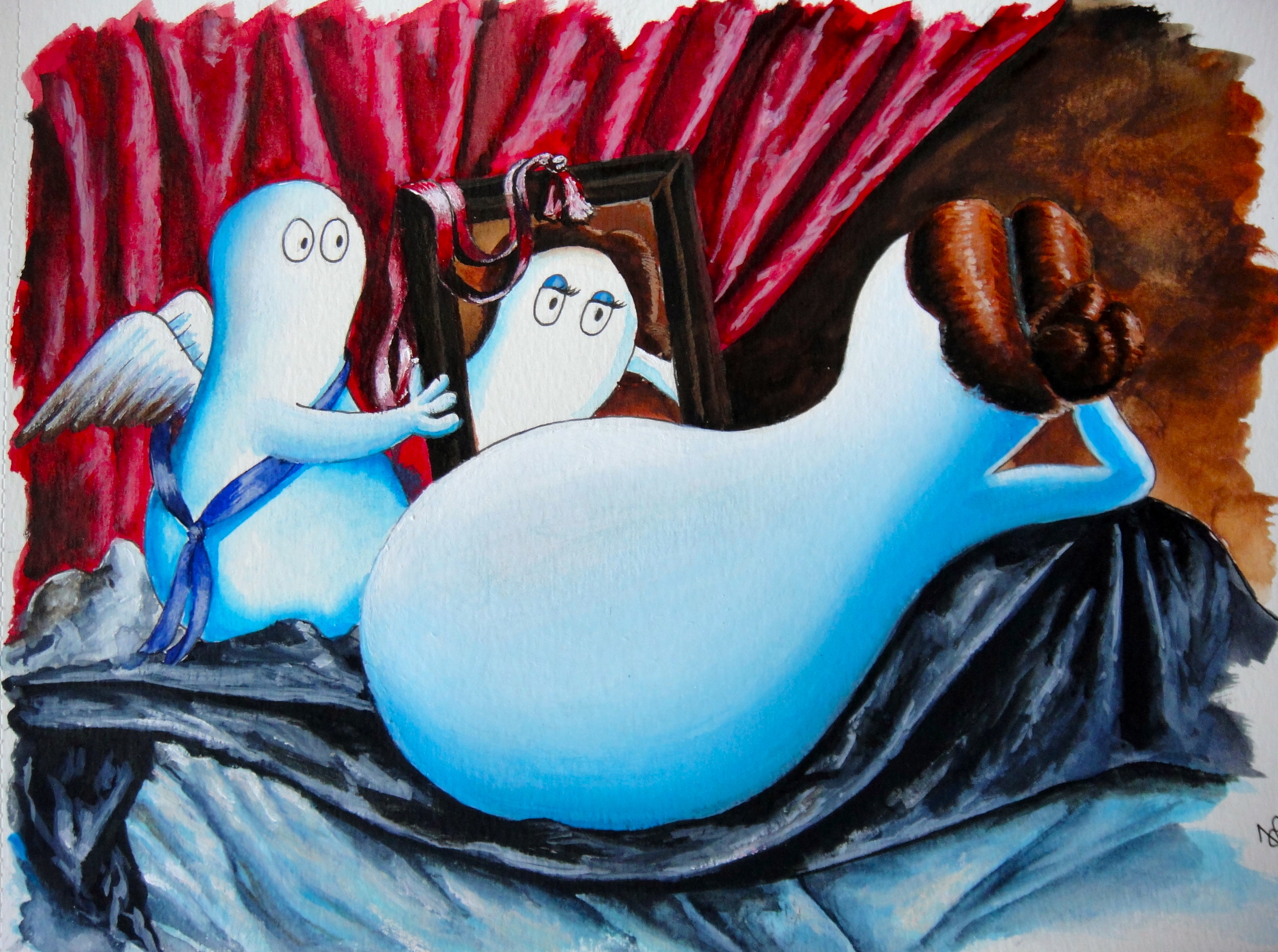
Now the Norms, being as ever, fans of high culture, particularly of a Spanish kind, have adopted the pose of the Rokeby Venus for your pleasure. In this watercolour reimagining of Velázquez’s masterpiece, the composition is pretty faithful to the original, albeit the medium of watercolour provides something of a coarser, more vivid finish than the hazy blended effect which Velázquez has achieved with oils. I also made the face of the Norm in the mirror more prominent that Velázquez’s Venus whose face is inexplicably blurred. Recent National Gallery x-rays have shown that this blurring remains unchanged from the painting’s original finish and was, therefore, always intended by Velázquez. Why he blurred the face no one can be sure, but I like to think that it conformed to the softness of the whole scene, including the gentle finish given to Cupid. In giving Venus a generalised, undefined face, Velázquez emphasises the beauty of her body and the drapery which mirrors its curves so effectively.

The Normby Venus (after Velazquez) (watercolour on paper, 2012 © Nicholas de Lacy-Brown)

Let’s hope that my Norm reimagining remains in one piece and is not slashed to pieces by a protester…

So before leaving you to (hopefully) enjoy my Norm pastiche, just a note on who else has been inspired by the Rokeby Venus. Well the list is fairly long, including Goya, Ingres, and Paul-Jacques-Aimé Baudry with his The Wave and the Pearl. But it is also possible, I think, to attribute Manet’s infamous Olympia to the dare and innovation of Velázquez’s portrayal of the nude. As Velázquez reinvents the female nude with this glance at her behind, so too did Manet reimagine the nude, painting a similarly unembellished nude who stares directly at the viewer, captivating the audience in the same way that the Rokeby Venus pulls the viewer into the intimate scene by way of her reflected stare in the mirror. Notable too is Manet’s drapery, mirroring and enhancing the curvature of his creamy-smooth nude.

Edouard Manet, Olympia (1863) courtesy of the Musée d'Orsay, Paris

Also of note is the 1970s photographic reinaction of the Rokeby Venus by Bergström as well as by contemporary photographer Sam Taylor-Wood. In the latter photograph, Soliloquy III, Taylor-Wood pushes the erotic nature of Velázquez’s work to a new level, capturing what looks like a self-portrait in the Rokeby pose above a freeze which appears to show a group of people indulging in a mass orgy in an office space.

Bergström over Paris (1976)

Soliloquy III (1998) Sam Taylor-Wood

Suddenly Pippa’s small, well-covered bottom loses much of its lustre… Until next time.

© Nicholas de Lacy-Brown and The Daily Norm, 2005-2012. Unauthorized use and/or duplication of the material, whether written work or artwork, included within The Daily Norm without express and written permission from The Daily Norm’s author and/or owner is strictly prohibited. Excerpts and links may be used, provided that full and clear credit is given to Nicholas de Lacy-Brown and The Daily Norm with appropriate and specific direction to the original content.

Norms do… Da Vinci (or Boltraffio??)

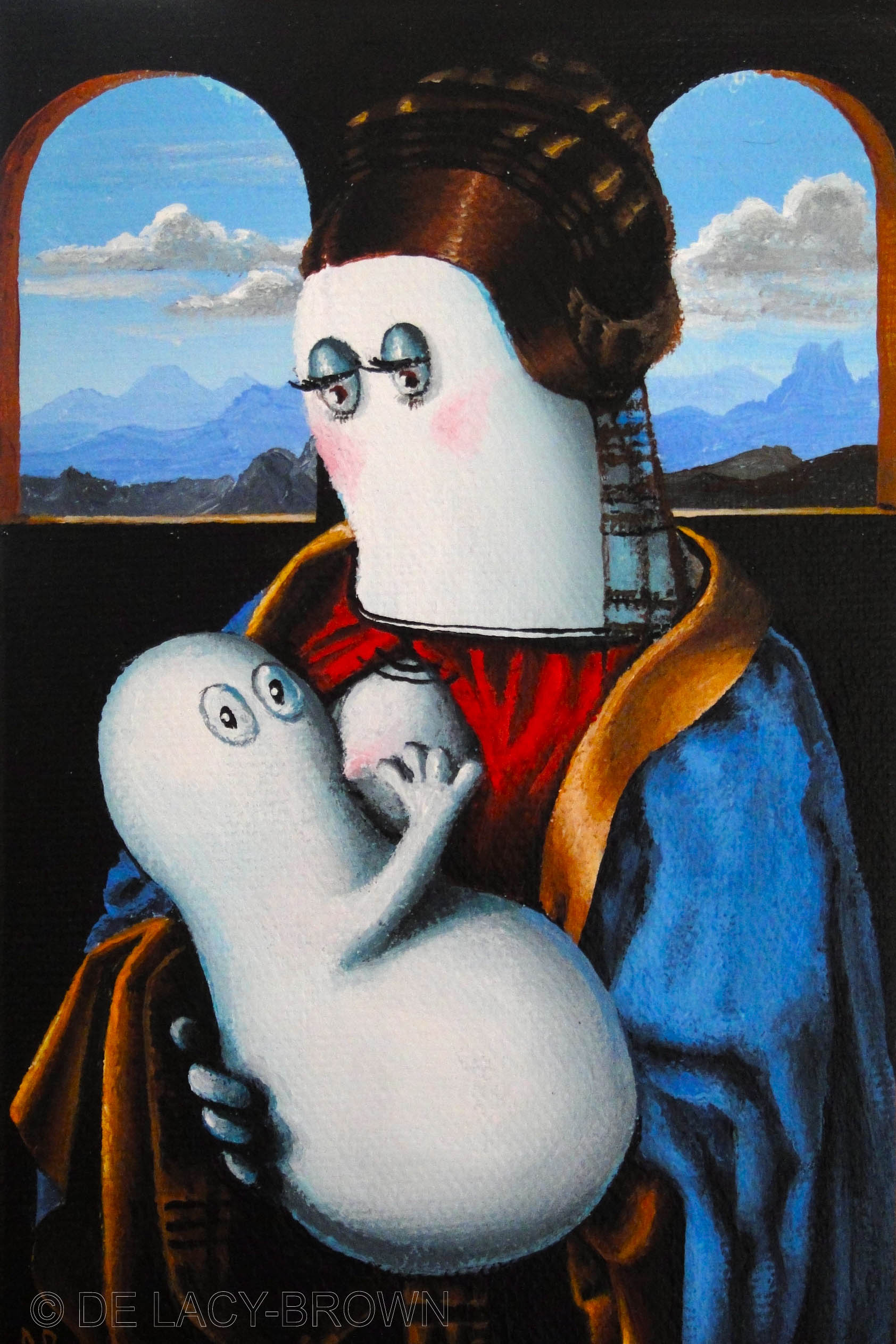
My little Norms have parodied quite a few artists and their masterpieces now. Degas’ L’Absinthe, Goya’s 3 May 1808, Velazquez’s royal portraits and Robert Doisneau’s Kiss at the Opera to name but a few. I also featured a Norm parody of Da Vinci’s great masterpiece Lady with an Ermine back in December. Well now the Norms have returned to this great classical favourite, appearing in a pastiche of that great Da Vinci work, the Madonna Litta. The only problem is, was this sumptuous Madonna and Child, usually to be found in St Petersburg’s Hermitage Museum and most recently featured in the huge sell-out spectacular Da Vinci show at London’s National Gallery, a Da Vinci painting at all?

The Madonna Litta (attributed to Leonardo Da Vinci) courtesy of the Hermitage museum, St Peteresburg

Rumour has it that the work, albeit based on ideas and primary sketches by Da Vinci, was actually completed by his pupil Giovanni Antonio Boltraffio. The Da Vinci-doubters attribute the Christ child’s apparently awkward posture to the lesser known artist, as well as a “formulaic” and “plain” landscape, and the “harsh” outlines of the characters. I’m no art history expert, and who am I to doubt these tell-tale signs. But for me the work is splendid in all its components, Da Vinci or otherwise. The landscape is fairly rudimentary, but this ensures focus is drawn to the protagonists of the tale, while providing colour balance to the piece. The sharp outlines of the characters are attributable to the dark interior background, but this is no different to the effective use of a black background in Da Vinci’s Lady with an Ermine as well as La belle Ferroniere. To my mind, the problem with the Christ child is not so much his “awkward” pose as his direct gaze towards the audience, which seems at odds with the serenity of the moment as he breastfeeds from a caring mother. All in all the painting, bursting with colour, full of familial intensity, is a superb example of the Da Vinci school whether or not painted by the great master himself.

Norm Madonna Litta (after Da Vinci) (acrylic on canvas, 2012 © Nicholas de Lacy-Brown)

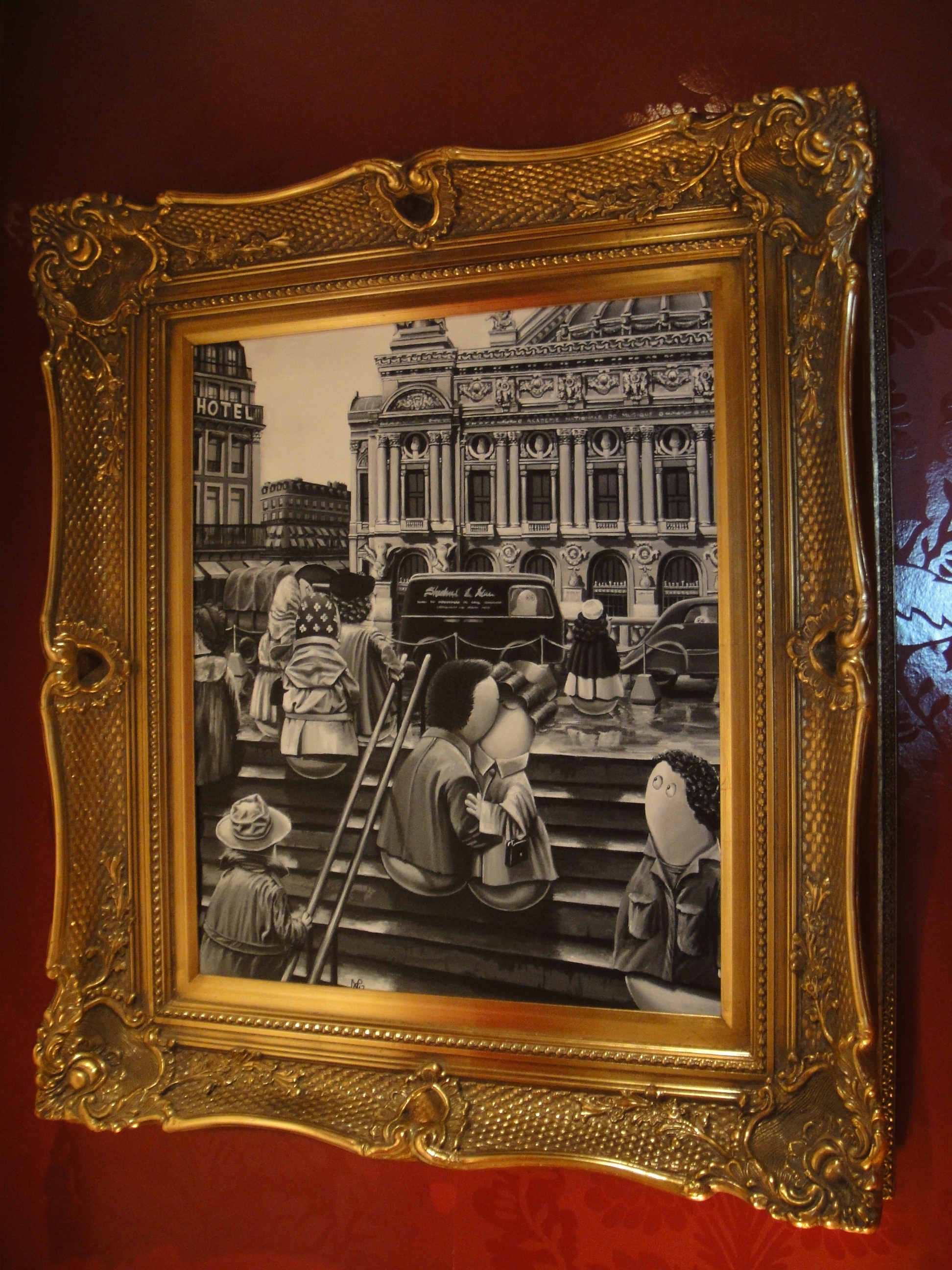
My Norm work is every bit a homage to the original Da Vinci inspiration. At 6″ x 4″, it is probably the smallest painting I have ever attempted which made the detail of the landscape and lavish fabrics difficult to paint. The reason for this size was principally to fit a very fine mock-vintage frame I found online. In fact I am completely obsessed with vintage frames at the moment, and now have a collection, filled with little Norm takes on classical paintings hanging upon dark scarlet flock wallpaper in my hallway. By far my favourite is a frame which is so grand, so utterly exuberant, that it needs to be shared on my blog. When seeking a frame for my Doisneau Norms, I wanted something as extravagant as I could find, to mark a satisfying contrast between the 1950s image and the Renaissance style framing. I love mixing up period design in this way, and in fact my flat here in London is a temple of mixed period design. The frame I eventually found fits the bill perfectly and is by far the most extravagant frame I now have in the house. Keep in mind, this is a fairly large painting – 20″ x 24″ so that gives you a sense of the overall frame size, a frame which is so utterly exquisite in its details that my partner and I have taken to staring at it for long periods of blissful admiration in the same way that the faithful may stare in awe at a beautiful baroque altarpiece. And the best bit – it was only £85 from ebay. But don’t tell anyone!

My lavishly framed Doisneau Norms

Ok, it’s officially snowing (a bit) in London so I’m off to seek warmer climes. See you there!

© Nicholas de Lacy-Brown and The Daily Norm, 2005-2012. Unauthorized use and/or duplication of the material, whether written work or artwork, included within The Daily Norm without express and written permission from The Daily Norm’s author and/or owner is strictly prohibited. Excerpts and links may be used, provided that full and clear credit is given to Nicholas de Lacy-Brown and The Daily Norm with appropriate and specific direction to the original content.

War in my Art: WW1 Norm

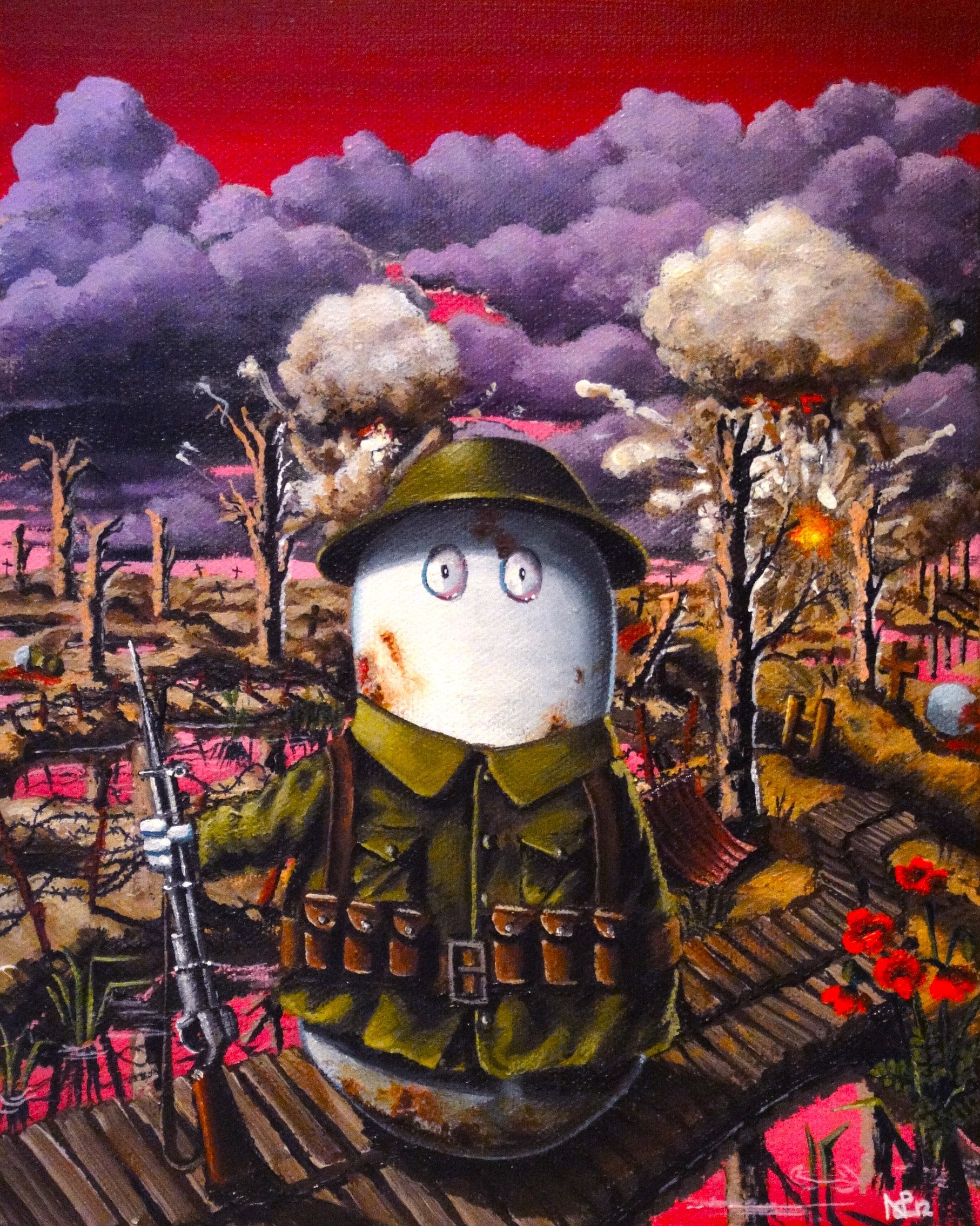
My final post on War brings a little lightheartedness back to the Daily Norm. Having been chewing over the subject of war for a few weeks and having been plentifully inspired by the war art I saw at the Imperial War Museum, I was prompted to once again pick up my paintbrush and devote a work to the ravaged landscape of WW1 France. But as I am all about Norms at the moment, obviously a WW1 Soldier Norm takes centre stage. He may be just a character, but I think that through this parody, the horrors of war are still there for all to see. Hence in his eyes, a look of shock, exasperation and despair at the state of the world around him, beautiful landscape turned into hellish quagmire, human lives used as fodder for the guns. In the background, clouds loom menacingly in the sky, while before them, manmade clouds burst up from explosions, as the putrid, corpse-ridden deserted ground all around the trenches is blown further into the air and scattered like a rain shower. In the foreground poppies: traditional symbol of hope, life growing instinctively from human wreckage. In this, unique and Normy way, I remember.

WW1 Norm (acrylic on canvas, 2012 © Nicholas de Lacy-Brown)

Norms do… Robert Doisneau

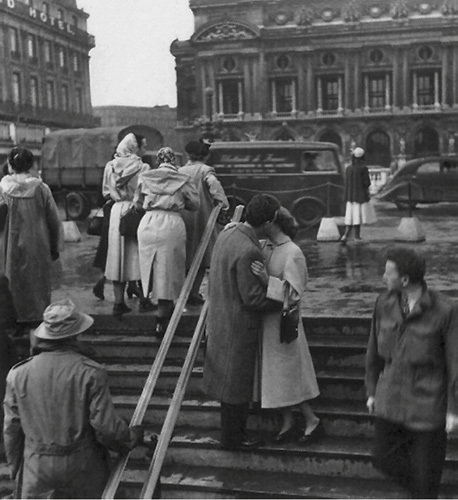
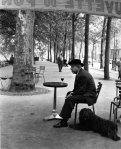
It’s mid January, and with the Christmas stocks cleared away and the January sales dwindling fast, the shops are filling with all things red – roses, truffles, cards adorned with hearts and pink champagne, all in the name of Valentine’s Day. I must confess, while I do find it slightly demeaning to be told I am loved just because a saint’s day says it should be so – and only once a year at that – I am a romantic at heart and do turn into a little softy around mid-February time. In anticipation of this great time of romance, the Daily Norm has looked to the one and only true source of all things amour… the city of Paris. And not only is Paris the undoubted City of Love, in the superbly nostalgic black and white moments captured by the world-renowned photographer, Robert Doisneau (1912-1994), it provides the backcloth to some of the most iconic romantic images ever captured on film. When I think of the ultimate image of love, I think of Robert Doisneau’s most celebrated photograph, Le basier de l’Opera (1950) (The Opera Kiss). Perhaps not quite as famous as his Hotel de Ville kiss, it is nonetheless postcard perfect: 1950s Paris, going about its way, people rushing up and down the stairs at Opera, traffic passing by the grand Opera Garnier, and all the while, the world seems to stop as a couple meet, and kiss, in the middle of the staircase. In fact, here at The Daily Norm, we love this image so much that the Norms have decided to reenact it. And so, voila, for your viewing pleasure, here is the latest Norm creation as the Norms do Doisneau…

Norms Kiss at the Opera (after Doisneau) (acrylic on canvas, 2012 © Nicholas de Lacy-Brown)

And here is Doisneau’s photographic original:

Le baiser de l'Opera (Robert Doisneau, 1950)

“There are days when the technique of an aimless stroll – without timetable or destination – works like a charm, flushing out pictures from the non-stop urban spectacle”

Robert Doisneau

“The “Hôtel de Ville lovers” were part of a series, on which I had already worked for a week and which I had to complete with two or three photos of that kind. But the fact that they were set up never bothered me. After all, nothing is more subjective than l’objectif (the French word for “lens”), we never show things as they “really”are. The world I was trying to present was one where I would feel good, where people would be friendly, where I could find the tenderness I longed for. My photos were like a proof that such a world could exist.”

Robert Doisneau

As you can see, I made a bit more of the Opera House, since it is so beautiful and its details undoubtedly stunning. The fact that my Opera House leans the other way wasn’t exactly intended, but once it started heading that way, there was no stopping it. Painting straight lines is already difficult enough with a hand balancing in mid air, but apparently my steady hand has a tendency to lean to the right.

Le bazier de l’Opera is by no means the only shot taken by Doisneau which is deserving of recgonition. Flicking through any collection of Robert Doisneau photographs is like being transported back down memory lane to a time of idyllic laissez faire. Of course, German-occupied Paris and the post-war city were far from easy times for the Parisians, but there is something about the goodness of human nature which Doisneau manages to capture in his iconic scenes of ordinary life. Plus of course the black and white pallet instantly transforms the image to one having great atmospheric nostalgic effect. In this way, the work of Doisneau has immortalised the magic of Paris, capturing poetry in the commonplace lives of its inhabitants and emphasising the artistic beauty which ripens at every corner of the city. I urge those of you who are not familiar with his work to buy a volume to look through on a sunday afternoon, some Billie Holiday playing in the background, a coffee or glass of wine on standby. You should however be warned that in following my advice, you will probably start hating the modern, inelegant world around you. But like Doisneau, pick up a camera or a paintbrush, and you’ll be surprised what magic you can find in everyday life. In the meantime I leave you with a small gallery of Doisneau shots to muse over. Until next time…

All the photographs are the copyright of Robert Doisneau

Norms do…Goya – The Third of May 1808

When people think about paintings of conflict, the first name to pop into their head is generally Guernica. The painting, by Picasso, has become a worldwide antiwar symbol, and as if proving the fact, a large tapestry of the painting hangs outside the UN’s Security Council HQ in  New York (you know, the same one that they covered up with curtains when making the decision to go to war against Iraq). But in actual fact, there was painted, some 120 years earlier, an equally striking image of conflict, sacrifice and war, an image so resonant, in fact, that Picasso  cited it as an inspiration to his Guernica. The painting is The Third of May 1808, by Francisco Goya.

As my regular readers will have twigged, I’m a big fan of Spanish art, and therefore it is no surprise that somewhere in the dark depths of my imagination, a Norm version of Goya’s magnum opus would take its form, emerging as a brief watercolour sketch the other night. Here it is, with Goya’s original masterpiece.

Norms on 3rd May 1808 (after Goya) (Watercolour, 2012 © Nicholas de Lacy-Brown)

The Third of May 1808 by Francisco Goya (1814), courtesy of the Prado, Madrid

To give a brief background, Goya’s work represents an uprising of Madrid residents in response to the French invasion of Spain under Napoleon I. Having tricked the Spanish into an alliance with the French armies with a view to conquering Portugal and splitting it between then, Napoleon entered Spain with his armies in November 1807 under the guise of strengthening Spanish troops. However, having entered Spain, Napoleon’s true intentions were unveiled, and the French troops moved in to take control of the country, facing very little resistance. It was only on 2 May 1808, when the people of Madrid learnt that the Spanish royals were to be exiled to France, that many of them rose up in rebellion against the French troops. The French army ultimately prevailed, but not without great bloodshed, and Marshal Murat, head of the French army in Spain declared: “The population of Madrid, led astray, has given itself to revolt and murder. French blood has flowed. It demands vengeance. All those arrested in the uprising, arms in hand, will be shot.”. Goya’s painting depicts the moment, early the next morning, when hundreds of Spaniards were led from the monastery where they had been imprisoned overnight (probably the buildings shown in the background) to the surrounding barren lands where they faced point-blank execution before a firing-squad.

The Second of May 1808 by Francisco Goya (1814), courtesy of the Prado, Madrid - partner of the Third of May, this painting depicts the uprising itself.

Goya’s painting is a stunning symbol of slaughter and sacrifice. It works so well on so many levels. There is, for example, the haphazard grouping of sacrificial victims on the left, a monk-like figure shown bending to meet his fate, others turning away in despair, the blood of innocents all over the floor, bloody corpses foreshortened as though falling into the space of the audience. The group of victims shows a human, unorganised element which compares effectively with the group of gunmen on the right who are rigid, dark, sinister, grouped together like a killing machine showing no remorse or sway in their murderous resolve. This contrast of dark and light creates a wonderful tension – good versus evil. Of course the most striking character is the central victim, dressed in a glowing white, his colours matching those of the lantern which casts light upon the scene. Shown with his arms outstretched, he is a christ like figure – he even appears to have the marks of stigmata upon his hands – all suggesting that he represents those Spaniards who stood up to the French invaders, sacrificing their lives for the sake of ultimate Spanish victory. It’s a work which portrays bloody human waste – a waste of life, the destruction of the innocents – and this is why it still stands today as such a powerful anti-war symbol.

Unsurprisingly the painting has inspired countless artists since it went on display in a rather pokey corner of the Prado (after it lay in storage for 40 years – the King of the time, Ferdinand VII, didn’t like it as it glorified people rather than him). One of the first interpretations of the image was this one, by Édouard Manet, which depicts the execution of Emperor Maximilian of Mexico.

Édouard Manet's Execution of the Emperor Maximilian (1868-1869)

Maximilian, a member of the Hapsburg family of Austria, had been installed in power in Mexico by Napoleon III of France in an attempt to recover unpaid debts and establish a European presence there. This endeavor failed, ending with the execution of Maximilian and two of his generals by firing squad on 19th June 1867. Here, the emphasis is reversed, as Manet, ever anti-Napoleon, makes the executors the heroes of the piece, dressed in their smart livery, whereas Maximilian and his generals are, by contrast, depicted with dark, undefined, sinister brushstrokes.

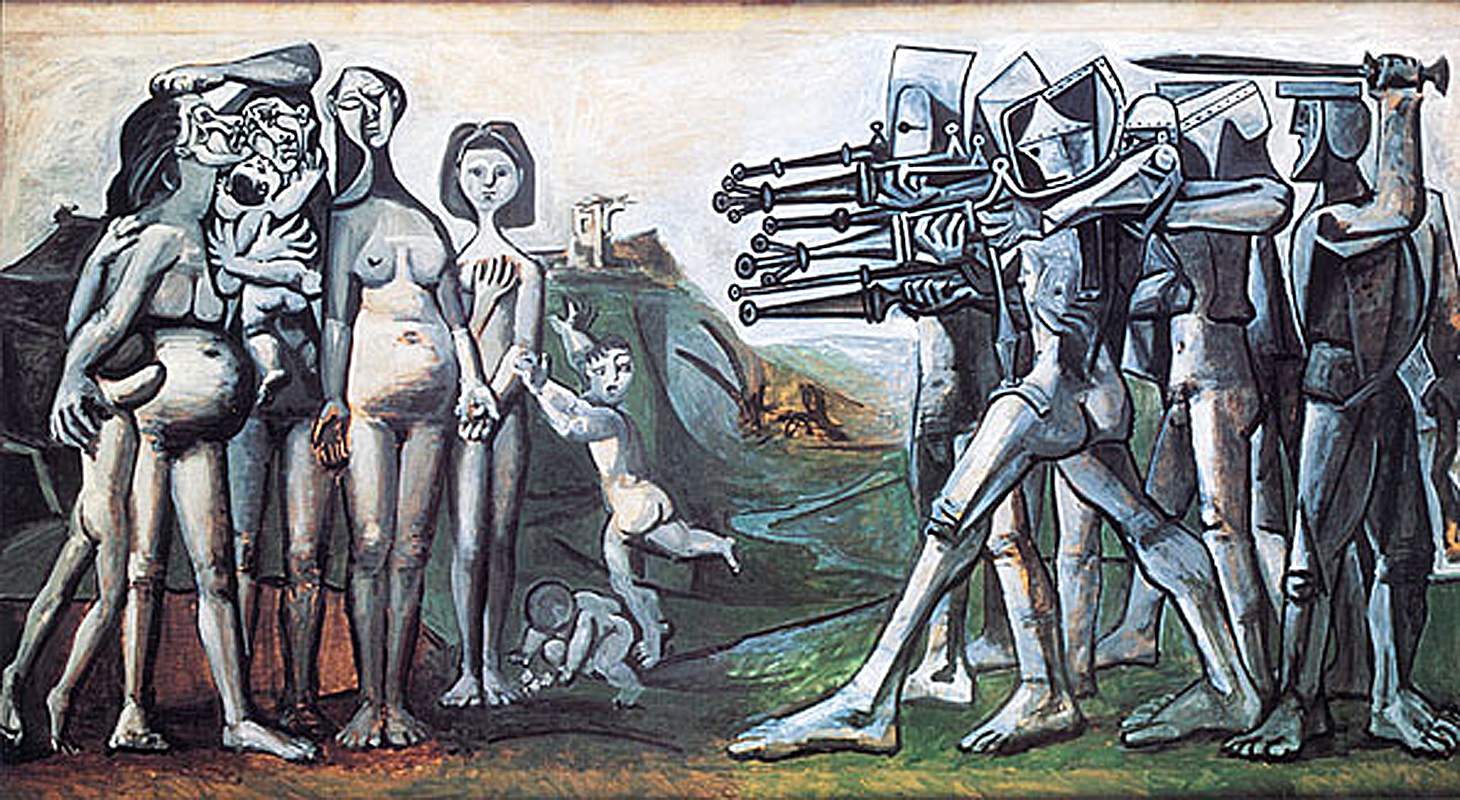
The second most significant use of Goya’s composition is Massacre in Korea by Picasso which depicts the Sinchon Massacre, an act of mass killing carried out by the South Korean and/or American forces in 1950.

Pablo Picasso, Massacre in Korea (1951)

Here the firing squad are once again the aggressors, and Picasso has taken the idea of the killing machine to a new level, depicting the squad as a fantastical group of sinister, mechanical automatons, killing without emotion of any kind. By contrast, the victims are as emotive as could be depicted – women and children, one seemingly pregnant, another’s face crippled with despair.

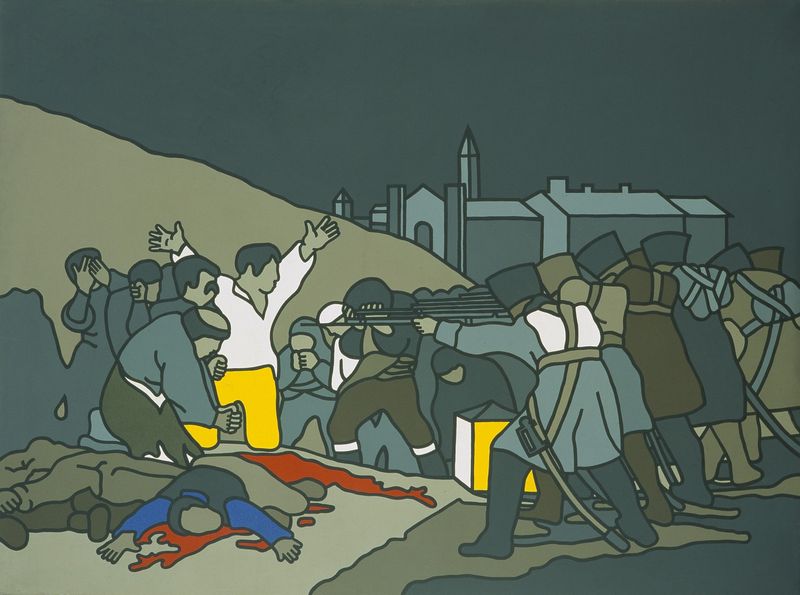
A final, lesser-known depiction, is the pop art homage painted by Irish artist, Robert Ballagh.

The Third of May - After Goya, 1970, by Robert Ballagh

Entitled The Third of May 1970, the painting makes a direct reference to Goya’s work, making no changes to the composition whatsoever, but converting the work into a pop-art creation using black outlines and block colours. The 1970 title of the work is intended to reflect another time of great conflict – this time in Northern Ireland – when British troops entered to enforce some semblance of control.

All three depictions serve demonstrate the continuing relevance of The Third of May 1808 in times of conflict. Like Picasso with his Guernica, Goya created a work for all times, a stark reminder of the brutality and savagery which comes so easily in times of conflict, a brutality which has continued to erupt intermittently around the world, and which, only 120 years after the Third of May, savaged Goya’s homeland, once again.

© Nicholas de Lacy-Brown and The Daily Norm, 2005-2012. Unauthorized use and/or duplication of the material, whether written work or artwork, included within The Daily Norm without express and written permission from The Daily Norm’s author and/or owner is strictly prohibited. Excerpts and links may be used, provided that full and clear credit is given to Nicholas de Lacy-Brown and The Daily Norm with appropriate and specific direction to the original content.

Norms do…A Christmas Carol (Part 2)

It’s incredibly close… only one full day to go until all the presents must be finished, the table primed, Nigella Lawson’s guidelines fully digested and memorised, and a tad of Delia Smith guidance absorbed to boot. And, as my preparations also get underway, this post will be my last before the great Christmas festival gets underway. Thereafter, posts may be a bit intermittent until New Year whereupon The Daily Norm will be back for 2012 with gusto!

In the meantime, and by way of a Merry Christmas gift to all of my followers, here as promised is the second part of my Christmas Carol feature, focusing on the seminal sections from Dickens’ great Christmas tale as illustrated by the Norms themselves. Merry Christmas!

The Cratchit family feast upon a pudding

The Cratchit family celebrate the great Christmas Pudding (2011, pen on paper, © Nicholas de Lacy-Brown)

Read more

Da Vinci Season – Part 1: Norms do… The Lady with an Ermine

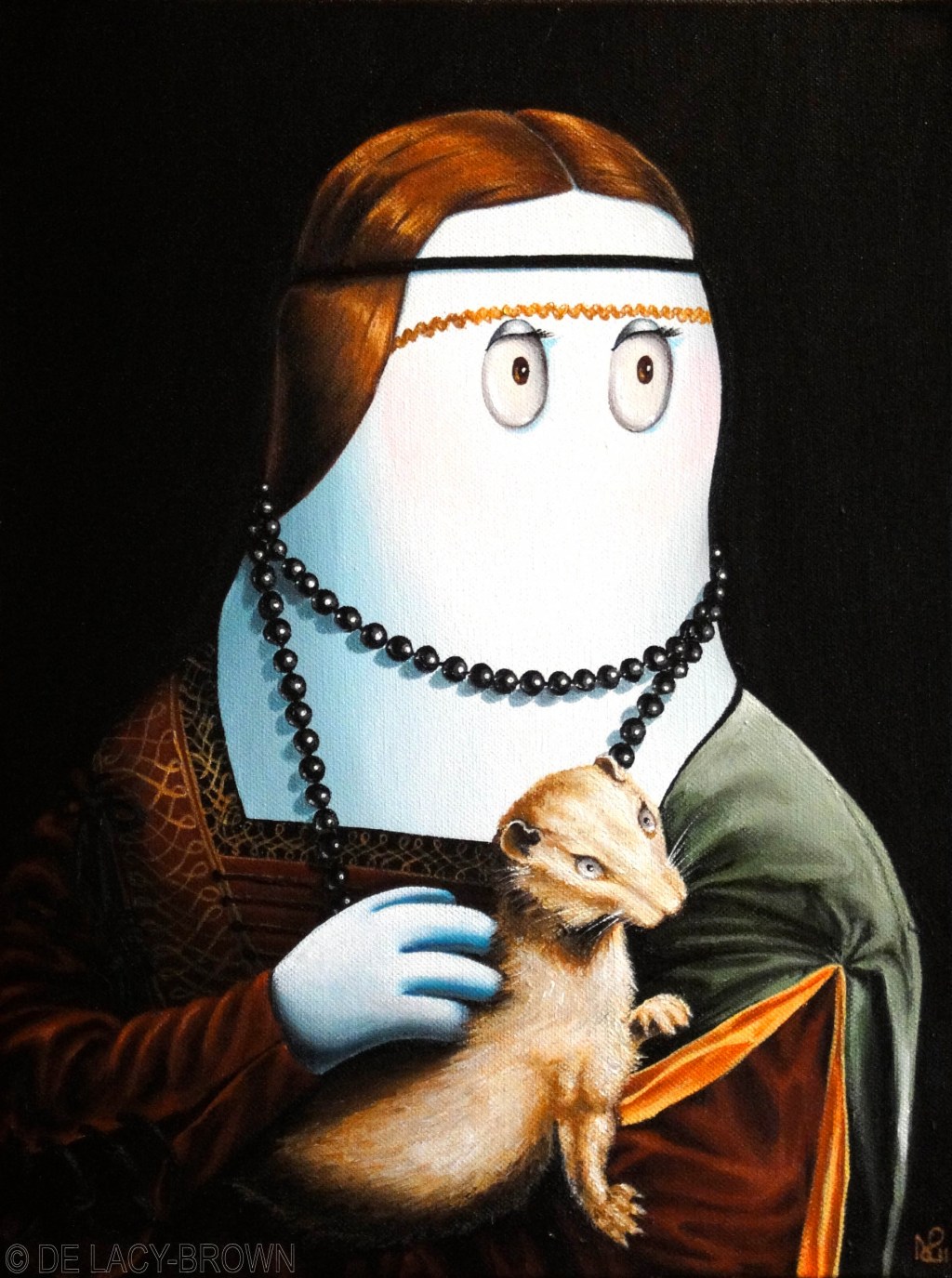
Da Vinci is back in vogue in London. The exhibition Leonardo da Vinci: Painter at the Court of Milan which is currently running at London’s National Gallery has received unprecedented high praise across the board. Critics are calling it a once-in-a-lifetime opportunity to see so comprehensive a collection of Da Vinci’s remaining masterpieces in one show. One art critic’s review was so expressive with superlatives and emotional exasperation that it read as though she had been party to some kind of religious transmogrification. The paintings, she said, were so stunning that one could barely take them in through eyes which were uncontrollably veiled with tears of unrepressed joy. Or something like that. High praise indeed, and with 5 stars across the board, what better way to grasp at some last minute Christmas sparkle than by attending the exhibition itself, a visit upon which I shall embark tomorrow. While you will of course be the first to receive my review of the show for which tickets are allegedly selling for £400 each online (yes, the temptation to sell is there – for these two tickets I could get a 5 star weekend in Milan, let alone see a show about nine paintings and a load of sketches… but naturally I am opting, in good conscience, for the  cultural extravaganza of the year), in the meantime, Part 1 of my seasonal homage to Da Vinci is in the form of the good old Norm parodies which you now know and love. Yes, today, the Norms bring you: Norm Lady with an Ermine.

Norm Lady with an Ermine (after Da Vinci) (acrylic on canvas, 2011 © Nicholas de Lacy-Brown)

And by way of comparison, here is Da Vinci’s stunning original masterpiece…

The Lady with an Ermine (Leonardo Da Vinci)

Da Vinci’s masterpiece was painted in around 1489-1490 and is usually to be found housed in the Czartoryski Museum, Kraków, Poland. It is in fact the central masterpiece of the Museum’s collection, and it’s inclusion in the London show is said to be the greatest coup for London curators of all their achievements in putting the show together. However, her inclusion was not without difficulty, and the Lady with an Ermine’s visit to London  comes only as a result of huge democratic efforts, not just on the part of the National Gallery, but on behalf of the UK Government’s diplomats and foreign office officials.

Read more

Norms do… A Christmas Carol (Part 1)

There is nothing on this earth more archetypical of Christmas than Charles Dickens’ A Christmas Carol. With its moral narrative of bad turned good, a sprinkling of ghoulish magic, pantomime extremes of the baddy Scrooge and audience favourite, wretched but ever optimistic Tiny Tim, and its grim but terribly romantic portrayal of quaint, dirty Victorian London, all covered in snow, it is a story which has been the indubitable partner of the Christmas season since the time of its first publication. Subsequently, it has been adapted on countless occasions, from Alastair Sim’s chilling black and white 1951 portrayal, and the classic 1970 musical version starring Albert Finney in the title role, to the very unique treatment given to the story by the Muppets in 1992 and the new Disney 3D spectacular in 2009 to name but a few. It has also been on the stage, appeared on the national school curriculum, and is now considered such a staple of classic British literature that you can download it for free through an iPad (and they don’t give much away for free…). So, in the ever growing spirit of Christmas, and on the eve of 2012’s Dickens bicentenary celebrations, the Daily Norm thought it only appropriate to bring you some of the seminal moments from A Christmas Carol as portrayed by the Norms. This sketches take a while however, so check back for Part 2 at the end of the week. Enjoy!

Scrooge is haunted by Marley’s Ghost

Scrooge haunted by Marley's ghost (pen on paper, 2011 © Nicholas de Lacy-Brown)

Read more