Skip to content

Da Vinci Season – Part 2: National Gallery exhibition review

Christmas is fast upon us, people are rushing around shopping like maniacs, there are now gigantic queues for macaroons at Ladurée on Piccadilly (I thought this madness only occurred on the Champs Élysées. We did however queue for 3 boxes…) and people are allegedly selling Waitrose Heston Blumenthal Christmas puddings for millions on ebay. However something else is in the air in London, and now, scattered across my coffee table and desk, where newly arrived Christmas cards should be taking central place, postcards of the masterpieces of Leonardo Da Vinci are fanned all over, renaissance music replacing carols on the CD player, and an open, full scale catalogue of Da Vinci’s works enables lavish Leonardo indulgence at every turn of the glossy pages. Yes, as promised, I have visited the much hyped National Gallery blockbuster, and now I can firmly pronounce myself to be a huge Da Vinci fan.
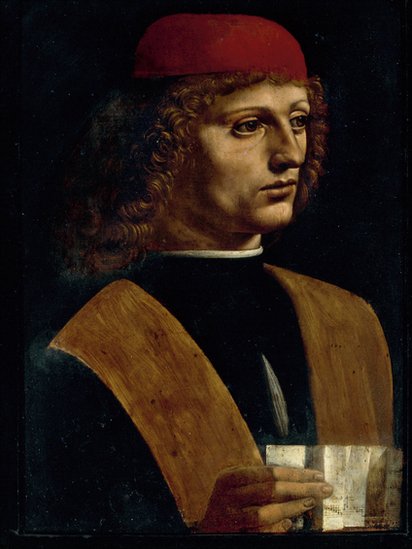
The Musician (Da Vinci, around 1486-7)

The exhibition, Leonardo Da Vinci: Painter at the Court of Milan, is not, at least to my mind, the exhibition of the decade as some commentators have lauded it. Nothing can quite surpass last year’s The Real Van Gogh at the Royal Academy which displayed a vast collection of mind-bogglingly superb works, nor indeed Tate’s incredibly comprehensive 2005 Frida Kahlo retrospective. It is, however, almost undoubtedly the exhibition of 2011. Unlike the close competitor – Tate’s Miro retrospective – Da Vinci did not go arrogantly off the rails towards the end of his career and start burning canvases or indeed painting them white with a single wiggly black line running somewhere across centre. No, for with the Da Vinci show, we are shown, from one work to another, what an undeniable master draftsman and painter this man was (asides from his various other mathematical, scientific, architectural, and engineering plaudits, to name but a few). Considering, compared to most artists, Da Vinci painted only a handful of works, each and every one is executed to an exceptional standard. Even in their various degrees of preservation, it is possible to see how superbly Da Vinci catches the light on his sitter’s skin, how accurately he has utilised his advanced knowledge of the human anatomy and perfect mathematical ratios to capture the very essence of human expression in his portraits, and how brilliantly, through detailed studies and sheer artistic brilliance, he was able to paint the most perfect drapery, clothing and overall compositional balance.

Da Vinci, Drapery Study for an angel (1495-8)

The paintings on show are far and few between, but we know this before entering. To have displayed 9 of only 15 surviving paintings is a coup for the National, and one can’t really ask for more. Take the Mona Lisa from the Louvre, and it would be like ripping Big Ben away from the Houses of Parliament. However, by reason of their sheer rarity, the sight of one, glowing majestically against a plum painted wall (the lighting is, by the way, very well executed) sends excitement through the audience in the same way that one becomes suddenly star struck when seeing a previous nobody reality TV star in a supermarket (I speak from experience – and no, I am not trying to suggest that Da Vinci’s paintings could ever be considered inconsequential). Then, filling the galleries besides are a great number of preparatory sketches and paintings executed by Da Vinci’s pupils and assistants. However the sketches are far from fillers (much like the use of endless sketches and scientific memorabilia in the recent Royal Academy Degas Ballerina show). Rather, they are crucial to understanding how Da Vinci managed to achieve such polished results, as well as gaining an insight into his thought processes (for example, this wonderful drapery study shows his intention for an altered composition for his painting, The Virgin of the Rocks in its second version, an alteration which, owing to pressure from his patrons, was never actually realised –  the original compositional planning for which can now be seen, using xray, under the paint of the final version). They are also crucial, no doubt, to proving the provenance of the various paintings, all of which seem to have undergone some level of doubt as to whether Da Vinci actually painted them.
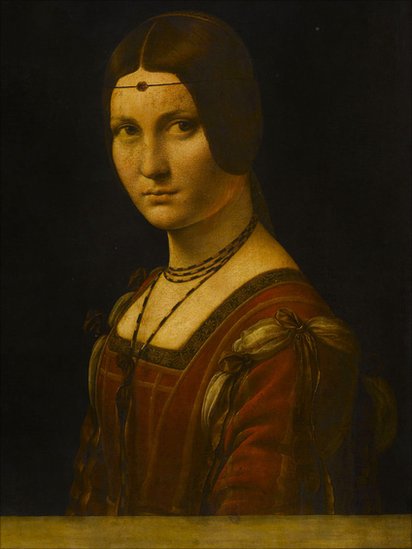
The Belle Ferronniere (Da Vinci, around 1493-4)

Having said that, the sketches are small, as, indeed, are the majority of the paintings, and, predictably, one does find oneself becoming ever so slightly aggressive in trying to get within a metre’s distance of a work. While the National Gallery has been quite careful to limit the visitors to the show (and the huge queue for the daily released tickets which spirals outside is testament to the Gallery’s strict policy when it comes to letting in too many people all at once) there are still an awful lot of people all vying to have their fill of each and every detail of this show. Thus, I did find that one became unavoidably sucked into a sort of revolving carousel around the various exhibits, so that, like a slow conveyor belt, you could get your moment before a painting before being politely shoved forward by the belly of the man standing behind as he/it got a little too close for comfort. Break off from the conveyor and you would find it difficult to get close to a painting again for a while. And thus my eyes were not so much veiled by tears, as one commentator predicted I would, but rather by the sight of people’s heads. But then it’s alright for the reviewers isn’t it – they get to see the exhibition among only a handful of other critics. No wonder they were overcome with emotion – at how bloomin lucky they were to get the exhibition to themselves! Still, I’ve experienced worse, and for the National it does provide the added bonus that more people will buy the expensive exhibition catalogue in order to actually get a good look at what was on show.

Admirer looking at Lady with an Ermine as exhibited at the National

So what was on show at the exhibition? Well the exhibition was broadly split into 7 galleries, each room centralised around one or two Da Vinci masterpieces. In the first room, we met The Musician which is allegedly unfinished, but looks pretty good to me. In the next room, the stunning Belle Ferronniere was hung just across from my favourite, Lady with an Ermine, the two ladies almost competing with one another for who would be judged most beautiful as they had probably competed in life, the lady with an ermine being Cecilia Gallerani, mistress of Duke Ludovico Sforza, and the Belle Ferronnere thouht to have been the Duke’s wife. The Belle Ferronniere is a stunning work, her pose so confident, petulant almost, as though challenging Cecilia Gallerani, whose portrait was literally hung in the direction of La Belle’s gaze, to usurp her role as primary lover to the Duke. Both exhibit truly modern, strongly characterised poses, particularly considering the century in which they were painted.

Da Vinci's unfinished Saint Jerome (around 1488-90)

In the next room, the evidently unfinished Saint Jerome takes centre stage, but even in this state of incompletion, the painting demonstrates how accurately Da Vinci painted the human anatomy. It also proves a useful demonstration of Da Vinci’s working techniques and the stages he undertook in building up layers of paint on a canvas. Moving through into the exhibition’s central gallery, two much larger, more complex compositions are hung opposite one another is a fantastic pairing which is a unique achievement of the Gallery’s show: Da Vinci’s original Virgin of the Rocks, usually to be found in the Louvre in Paris, has been hung with the second version of the same composition, which is owned by the National Gallery. This allows for a direct comparison to be made of the two “rocks”. Personally my favourite was the National Gallery’s later version, where the colours were brighter, and the details more refined such as the little flowers in the foreground. Nonetheless, this version has been recently restored, hence the enhanced colours and more obvious details.

Read more

Da Vinci Season – Part 1: Norms do… The Lady with an Ermine

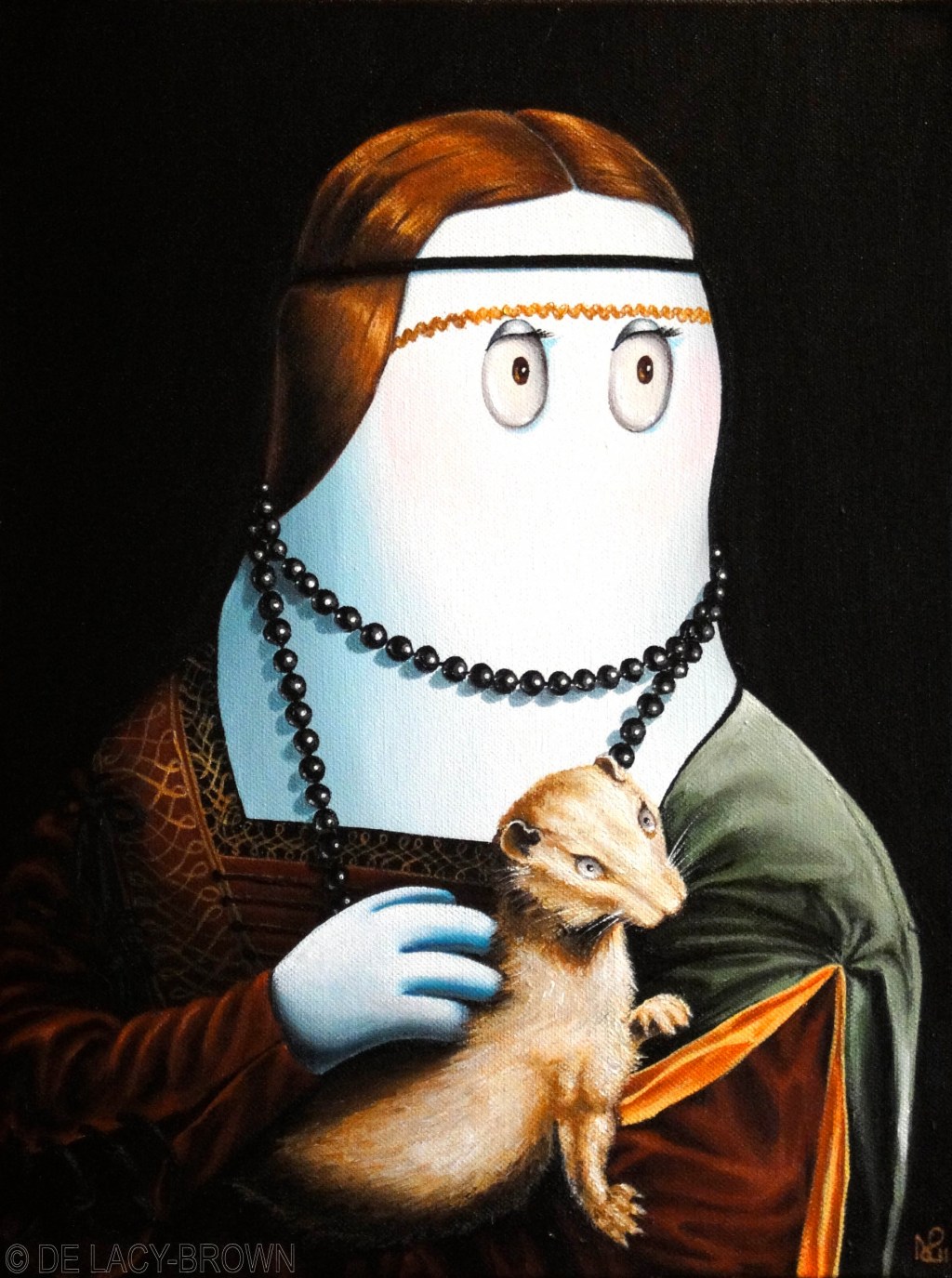
Da Vinci is back in vogue in London. The exhibition Leonardo da Vinci: Painter at the Court of Milan which is currently running at London’s National Gallery has received unprecedented high praise across the board. Critics are calling it a once-in-a-lifetime opportunity to see so comprehensive a collection of Da Vinci’s remaining masterpieces in one show. One art critic’s review was so expressive with superlatives and emotional exasperation that it read as though she had been party to some kind of religious transmogrification. The paintings, she said, were so stunning that one could barely take them in through eyes which were uncontrollably veiled with tears of unrepressed joy. Or something like that. High praise indeed, and with 5 stars across the board, what better way to grasp at some last minute Christmas sparkle than by attending the exhibition itself, a visit upon which I shall embark tomorrow. While you will of course be the first to receive my review of the show for which tickets are allegedly selling for £400 each online (yes, the temptation to sell is there – for these two tickets I could get a 5 star weekend in Milan, let alone see a show about nine paintings and a load of sketches… but naturally I am opting, in good conscience, for the  cultural extravaganza of the year), in the meantime, Part 1 of my seasonal homage to Da Vinci is in the form of the good old Norm parodies which you now know and love. Yes, today, the Norms bring you: Norm Lady with an Ermine.

Norm Lady with an Ermine (after Da Vinci) (acrylic on canvas, 2011 © Nicholas de Lacy-Brown)

And by way of comparison, here is Da Vinci’s stunning original masterpiece…

The Lady with an Ermine (Leonardo Da Vinci)

Da Vinci’s masterpiece was painted in around 1489-1490 and is usually to be found housed in the Czartoryski Museum, Kraków, Poland. It is in fact the central masterpiece of the Museum’s collection, and it’s inclusion in the London show is said to be the greatest coup for London curators of all their achievements in putting the show together. However, her inclusion was not without difficulty, and the Lady with an Ermine’s visit to London  comes only as a result of huge democratic efforts, not just on the part of the National Gallery, but on behalf of the UK Government’s diplomats and foreign office officials.

Read more

Norms do… A Christmas Carol (Part 1)

There is nothing on this earth more archetypical of Christmas than Charles Dickens’ A Christmas Carol. With its moral narrative of bad turned good, a sprinkling of ghoulish magic, pantomime extremes of the baddy Scrooge and audience favourite, wretched but ever optimistic Tiny Tim, and its grim but terribly romantic portrayal of quaint, dirty Victorian London, all covered in snow, it is a story which has been the indubitable partner of the Christmas season since the time of its first publication. Subsequently, it has been adapted on countless occasions, from Alastair Sim’s chilling black and white 1951 portrayal, and the classic 1970 musical version starring Albert Finney in the title role, to the very unique treatment given to the story by the Muppets in 1992 and the new Disney 3D spectacular in 2009 to name but a few. It has also been on the stage, appeared on the national school curriculum, and is now considered such a staple of classic British literature that you can download it for free through an iPad (and they don’t give much away for free…). So, in the ever growing spirit of Christmas, and on the eve of 2012’s Dickens bicentenary celebrations, the Daily Norm thought it only appropriate to bring you some of the seminal moments from A Christmas Carol as portrayed by the Norms. This sketches take a while however, so check back for Part 2 at the end of the week. Enjoy!

Scrooge is haunted by Marley’s Ghost

Scrooge haunted by Marley's ghost (pen on paper, 2011 © Nicholas de Lacy-Brown)

Read more

Banksy’s Christmas Present to Liverpool

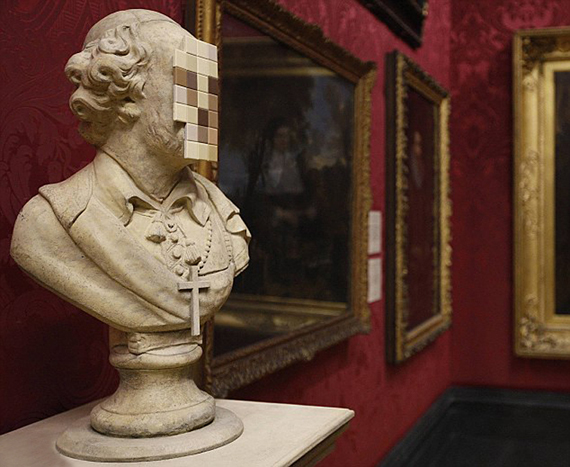
Just a quick one today – the Daily Norm has been blighted by a severe strain of a malignant, violent and all-encompassing virus otherwise known as the common cold, and consequently even the movement of my hands on this keyboard is enough to provoke a series of earth-shattering sneezes which does not make for pleasant results on the Daily Norm’s nice glass desk. Just enough time to reflect upon the new offering by evasive British artist, Banksy, which has been presented to the Walker Gallery in Liverpool as a Christmas present (indefinite loan) to the nation. Banksy, who is of course renowned for his pop-up stencil-effect street art/murals has waded into one of 2011’s hot topics: the Catholic church sex scandal. Called “Cardinal sin”, he offers up a replica of an 18th Century stone bust of a Cardinal, its face sawn off and replaced with a mosaic of small tiles (usually found in a swimming pool, bathroom or kitchen splashback – although not, I suspect, to such effect). The tiles are placed in such a way as replicate the pixellation effect which is commonly used on television news or in the print media to protect the identity of sex crime victims.

Presenting the piece to Liverpool’s Walker Gallery, the ever elusive Banksy, his own identity forever shrouded in mystery, issued a statement which said: “At this time of year it’s easy to forget the true meaning of Christianity – the lies, the corruption, the abuse”. He also stipulated that the work should be placed alongside the Gallery’s period collection which includes works by the likes of  Van Dyke, Poussin and the Pre-Raphaelites.

Cardinal Sin placed in the Walker Gallery

Banksy is renowned for making measured often controversial and political statements with his work. With Cardinal Sin, he reflects on a previously untouched controversy, doing so in an effective, accessible manner. The point he makes is not particularly clever, nor deep or insightful. It does not promote active contemplation in its audience. But nonetheless, his work is an intelligent pun casting further focus (as if any more were needed) on the devastating plight of the many thousands of victims of sexual abuse at the hands of the Catholic church. The work should not be seen as an indiscriminate attack on the Catholic church (despite the impression give by Banksy’s statement) but rather an interesting piece of contemporary art which, unlike so much work filling art galleries these days, has a valid point to make which will resonate with all of society.

Best of all, the work will no doubt turn the focus of Banksy’s huge global following towards Liverpool’s Walker Gallery. I visited the gallery for the first time in September and was beyond impressed with the array of work on show. It’s well worth a visit, especially in 2012 when the John Moores painting prize will be back in the gallery – a worthy rival to the less accessible Turner Prize. And for those culture vultures amongst you, the equally excellent Tate Liverpool is just down the road.

Sunday Supplement: Christmas Double

For this week’s Sunday Supplement, it is in the spirit of Christmas that I bring you not one but TWO de Lacy-Brown paintings to add a little artistic fulfilment to your weekend. And, seeing as this will be the last Sunday Supplement before the big day itself (I am anticipating being ever so slightly too merry and/or stressing in the kitchen next Sunday to blog…and I suspect you will be too busy in similar scenarios to read the good old Daily Norm) I bring you two paintings from my collection which have the great festival of Christmas at their core. Some way apart, the first, painted in a more illustrative style, was created in 2002, while the second, painted in 2010, features a much more matured, realistic style of representation.

Ice Skating at Somerset House (acrylic on canvas, 2002 © Nicholas de Lacy-Brown)

The first work, above, was painted when I was in my first year at university in London. Studying at King’s College London on The Strand, I was lucky enough to be situated bang next door to what has become one of the most iconic sights of London’s Christmas celebrations: the ice skating rink at Somerset House. Flanked on all sides by the stunning Neo-classical masterpiece of Somerset House, the rink in the building’s huge cobbled courtyard is utterly atmospheric, reminding of the days of Dickensian London street scenes which, thanks to the likes of A Christmas Carol, have become synonymous with the traditional view of Christmas all around the world. At night, the rink glistens under turquoise lights, flame lanterns flickering on either side, and a tree, usually sponsored by Tiffany & Co. the jewellers, sparkling at the foot of the ice. It’s a wonderful place to skate, and it is something I really miss doing every Christmas since my accident in 2008 precluded me from engaging in such a risky activity. This painting however represents the jovial, whimsical joy of the skating I remember. However, if you ever got the rink as empty as this these days, you’d be very lucky…

Alexander, Enchanted by Christmas (oil on canvas, 2010 © Nicholas de Lacy-Brown)

The second painting of this week’s Christmas double-whammy is my later portrait of my nephew Alexander when he was just 18 months old. It captures a magical moment when he encountered the large family Christmas tree for the first time. Utterly entranced by the feast of new colours, objects and lights on view, he was literally stopped in his tracks as he took in the wonder of Christmas before him. Painted in a more photo-realistic fashion, I have tried to capture the furry white brim of the cute santa hat he was wearing, while blurring out the tree lights in the background. It was a beautiful moment. As ever, Christmas really is enhanced by the joy you can see reflected in a child’s eyes. However I may feel differently come this time next week, when I have three toddlers running rings around me, fighting for presents and playing catch with the baubles.

Postscript: If you like the painting of Somerset House above, and would like to own a high quality giclee print of the image, there are some available for sale via my Etsy online shop.

© Nicholas de Lacy-Brown and The Daily Norm, 2002-2011. Unauthorized use and/or duplication of the material, whether written work or artwork, included within The Daily Norm without express and written permission from The Daily Norm’s author and/or owner is strictly prohibited. Excerpts and links may be used, provided that full and clear credit is given to Nicholas de Lacy-Brown and The Daily Norm with appropriate and specific direction to the original content.

All the joys of the Nursery School Nativity

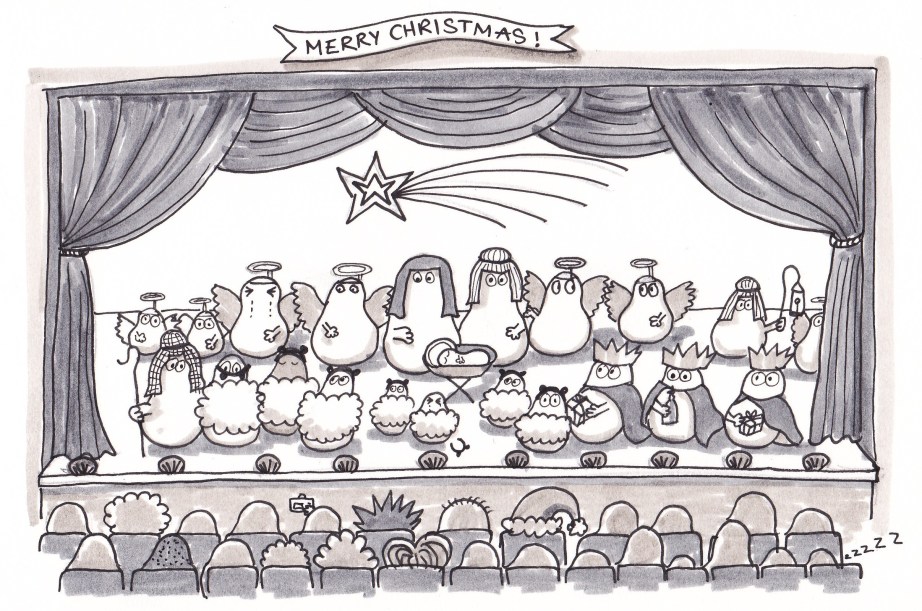
The photo says it all doesn’t it. Deserted old baby doll, an MDF crib and a hastily assembled sheep made from silver foil rolls, cotton wool and PVC glue. Add to this several pairs of gold cardboard wings, some tinsel halos, 3 paper crowns (sharp-edge free), plenty of stripy sheets and even more recycled curtains and what do you have? The show any perfect Christmas wouldn’t be without: the School Nativity. It’s the pride and joy of every parent, but also the source of their greatest anxiety: Will they remember their words? Will they cry or have a tantrum mid-way through? Or will they, like the nightmare of one parent at a nativity my sister attended last year, projectile vomit all over the front row of the audience? For the teachers, even the smallest nativity is a mass production of prodigious strategic complexity… reminding the children to smile, to sing, to stop picking their noses, steering the little angels in the right direction, and pulling them away from where they’re not meant to be, remembering the words to the carols on their behalf and of course watching out for that same nativity-shattering tantrum.

Nativity Norms (Pen on paper, 2011 © Nicholas de Lacy-Brown)

Read more

Norms in Heaven and Norms in Hell

Back in 2005/6 when the Norms were born, my Norm-riddled imagination went all Last Judgment on me, and a diptych with all the foreboding power of the archetypal Renaissance altar-piece was the imploding result: Norms in Heaven and Norms in Hell.

Norms in Heaven (acrylic on canvas, 2005 © Nicholas de Lacy-Brown)

Norms in Heaven features 10 serene angels, floating amidst fair-weather clouds, radiant in their angelic glory, relishing in the celestial music flowing from the golden instruments of three, while for two, the propagation of love is their priority, one one-handed Norm angel holding cupid’s bow, while the other helps to pull back the arrow in readyness for its launch into Elysium. However, even in this scene of paradise, there is always a foreboding reminder of what awaits those whose sins make them unworthy for the great pleasures of this joyful nirvana… the gateway to hell, guarded in all his intrusiveness redness by a demon Norm, a portentous warning of the visions of horror awaiting the viewer in the second half of the diptych…

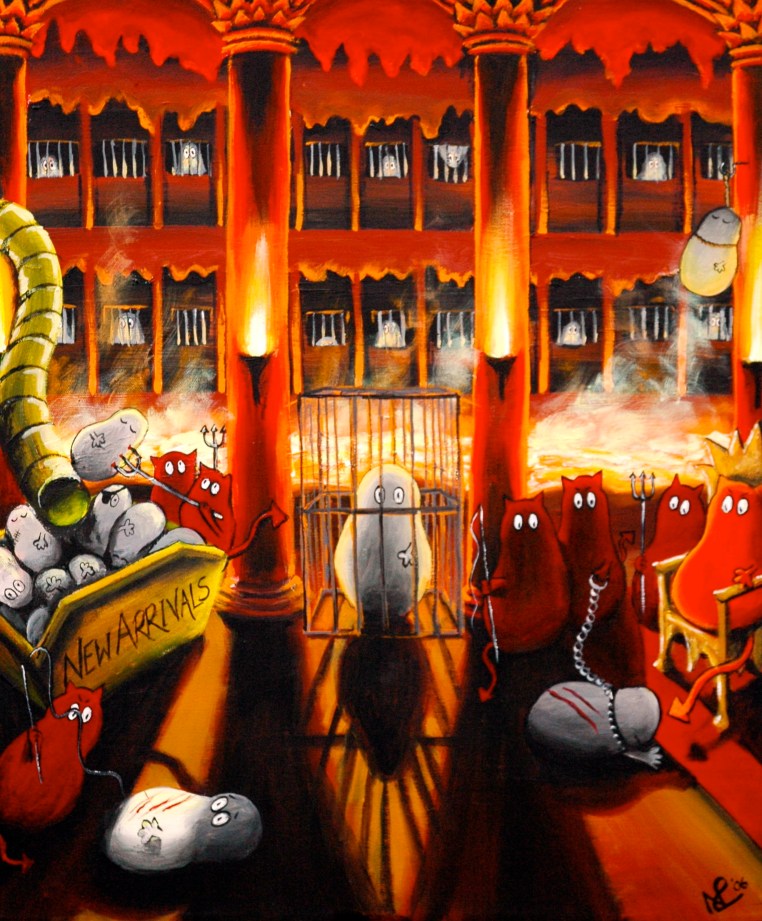
Norms in Hell (acrylic on canvas, 2006 © Nicholas de Lacy-Brown)

For its audience of innocent little earthly Norms, Norms in Hell would be a shocking warning of the fate that awaits those who do not behave. For those Norms whose sins have necessitated a descent into the abyss, their arrival is through a rubbish shoot where their dead, rotten souls pile up in a New Arrivals skip. From there, demon Norms, eager to torture their newly arrived victims, spear the Norms through their side, before awakening their souls to a life of eternal damnation. Thereafter they will be subjected to the most terrifying of horrors, such as the scene of flogging on the left, being hanged from a column and left to roast in the fires of hell, or being caged up only to await an audience with Satan Norm himself, whose punishments deal the deepest and most appalling blows of all. Meanwhile the scene is dramatically lit by the glow of a lava river flowing behind, while on the other side of this burning deluge, further damned souls can be seen in their torment, behind bars, awaiting further retribution for their depraved and iniquitous lives.

Read more

The age-old dilemma of wrapping odd-shaped Christmas presents

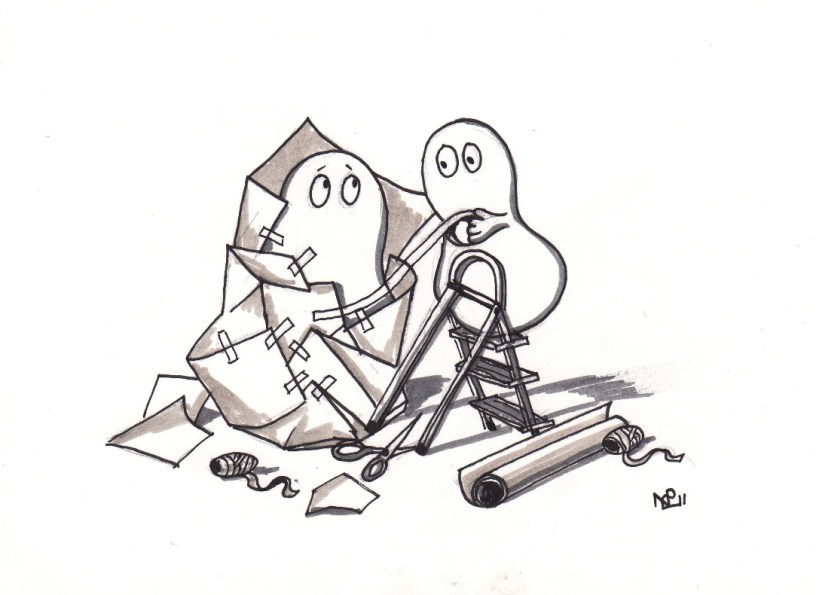
It’s an age-old dilemma. Just how do you wrap odd shaped Christmas presents and make them look good? It’s a dilemma which has been frustrating the hell out of me all morning. For example, my grandmother asked me to buy her a very specific vase. It’s red, beautiful, glass, but also oval, like a rugby ball. I started wrapping it up and soon enough, when I got to either end, the vase almost slipped out of my hands twice, and I went through three attempts to neatly fold the ends of the paper without 1) a huge excess of folds and 2) all the paper scrunching with so many creases that I might as well have wrapped it in newspaper. What I ended up with is frankly not the gem of my collection. The present looks like a wrapped up over-sized potato. I attempted to hide my various folding faux-pas with ribbon, but this resulted in a merely trussed-up looking wrapped up potato. I soon gave up. It will have to do. Doesn’t all the paper end up swiftly in the bin anyway?

The dilemma of wrapping a Norm-shaped Christmas present (Pen on paper, 2011 © Nicholas de Lacy-Brown)

Read more

Norms do… Degas’ L’Absinthe

I’ve always been a bit obsessed with the la fée verte . That is to say, I’ve always been fascinated by the debauched charm of that wonderful peppermint green drink which was and still is (in its full potent form) an illegal alcoholic substance: Absinthe. For absinthe has long been the chaperone of artistic legend, as all the most romantic illusions of the impoverished, desperate, inebriated artist are indubitably accompanied by a bottle of the green stuff, or a glass of its milky diluted counterpart. Baz Luhrmann’s Moulin Rouge, the green faced cancan dancers of Toulouse Lautrec’s underworld masterpieces, and the dissolute tale of a spiral into poverty and lascivious living on the hillsides of Montmartre in Zola’s L’Assomoir all centre around the mirky hallucinogenic potency of this green-eyed alcoholic monster. It is the very essence of bohemian artistic Paris, and it’s association has pervaded art and its cultural progeniture for decades. One of the most prominent sources of the liquor’s legendary quality is the sensational painting L’Absinthe by Edgar Degas. I first saw the painting in London, when it was exhibited at Tate Britain’s superb exhibition Degas, Sickert and Toulouse Lautrec in 2005-6. I was instantly struck by the simple solitude of the female figure, caught in a moment of absentmindedness and melancholia, appearing quite isolated despite the figure sat to her left, he looking away in his own depressive daydream. I’ve remembered the painting ever since and therefore I was so excited to make its acquaintance once again upon visiting the Musée d’Orsay the other week that I decided I had to turn it into a Norm painting. And so, when the Norms do Degas, it looks something like this…

L'Absinthe Norm (after Degas) (Acrylic on canvas, 2011 © Nicholas de Lacy-Brown)

Degas’ original painting, on the other hand, looks like this…

L'Absinthe (Edgar Degas, 1876)

Read more

Paris v London: What ever happened to British Café Culture?

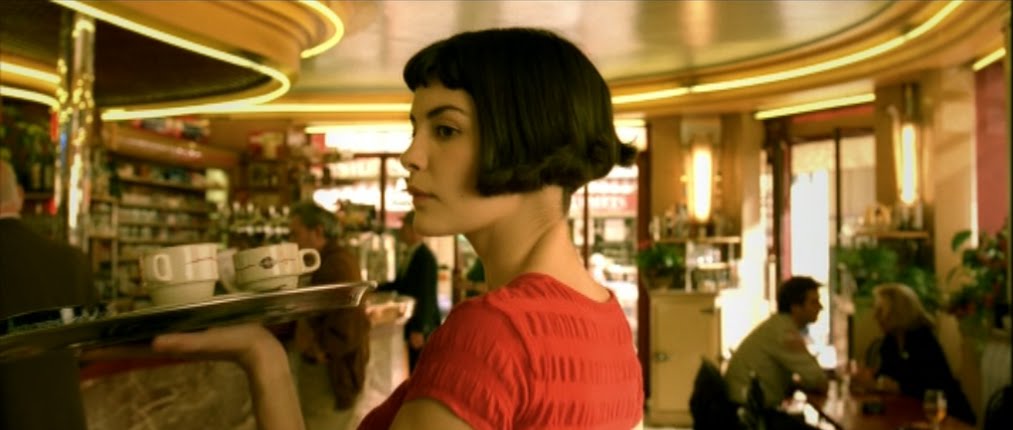
I was reading the post of one of my favourite Paris-based bloggers, Becoming Madame, the other day which described a truly resonant and idyllic scene which she witnessed when sitting inside a Parisian café. Like many of the readers who commented on the post, I was struck by how easily one can be drawn into the romanticised ideal of the Parisian café. It was the same when I was there two weeks ago: There’s something about Parisian cafes which exudes effortless elegance. Some of them are tatty, have tired looking waiters who have been doing the same job for years, browning mirrors and horrible toilets. But there’s something about them, with their hand-written blackboards, mirrored walls, wicker chairs and round tables squeezed outside, and cosy booths inside set amongst an array of old posters and photographs, that just IS romantic and offers us  the very epitome of café culture. This quintessential idyllic view of the French café was very much indulged in my favourite film of all time, Amélie, and yet, despite the cinematic interpretation, the quirky little cafe  captured in than film is wholly representative of reality.

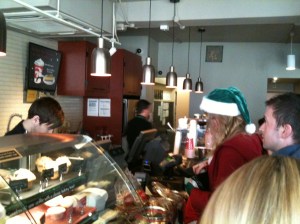
My queuing experience in Starbucks yesterday

So all of this got me thinking (while stood in a massive queue in Starbucks yesterday), while the streets of Paris are literally dotted all over with cafés and brasseries on every corner, each inviting us to indulge with its cherry red awnings and cosy pavement heaters, why is it that in London, the best we can manage is a starbucks or a Cafe Nero every 100 metres? What happened to the Lyons Teahouses which were at the centre of polite society? Or the little privately run café to which everyone would flock for a gossip? In Paris you sit down and are greeted (not always immediately, warranted) by the friendly(ish) face of a smart French waiter. You order your coffee, you sit back, and you indulge in the sweet pleasure that is people watching. In London you queue for a coffee for what seems like an age. You can attempt to sit down, but most of the cafes are turned over to the takeaway trade, so seating is both limited and purposefully uncomfortable so that the turnaround is quick and no one stays too long. Because of the people rushing in and out, the doors are always open. Your experience is cold and drafty and usually, because of lack of accommodation you have to leave with coffee in a paper cup, the small hole in the lid badly designed for sipping so that generally you get half of the scalding liquid down your face before you’ve managed to sit down and enjoy it. And yet the thing is, these cafés are always full, and you get the feeling that in London there really is a growing coffee culture. So why can’t we have the relaxed café culture of Paris?

Read more