

Banksy’s Christmas Present to Liverpool
Just a quick one today – the Daily Norm has been blighted by a severe strain of a malignant, violent and all-encompassing virus otherwise known as the common cold, and consequently even the movement of my hands on this keyboard is enough to provoke a series of earth-shattering sneezes which does not make for pleasant results on the Daily Norm’s nice glass desk. Just enough time to reflect upon the new offering by evasive British artist, Banksy, which has been presented to the Walker Gallery in Liverpool as a Christmas present (indefinite loan) to the nation. Banksy, who is of course renowned for his pop-up stencil-effect street art/murals has waded into one of 2011’s hot topics: the Catholic church sex scandal. Called “Cardinal sin”, he offers up a replica of an 18th Century stone bust of a Cardinal, its face sawn off and replaced with a mosaic of small tiles (usually found in a swimming pool, bathroom or kitchen splashback – although not, I suspect, to such effect). The tiles are placed in such a way as replicate the pixellation effect which is commonly used on television news or in the print media to protect the identity of sex crime victims.
Presenting the piece to Liverpool’s Walker Gallery, the ever elusive Banksy, his own identity forever shrouded in mystery, issued a statement which said: “At this time of year it’s easy to forget the true meaning of Christianity – the lies, the corruption, the abuse”. He also stipulated that the work should be placed alongside the Gallery’s period collection which includes works by the likes of Van Dyke, Poussin and the Pre-Raphaelites.
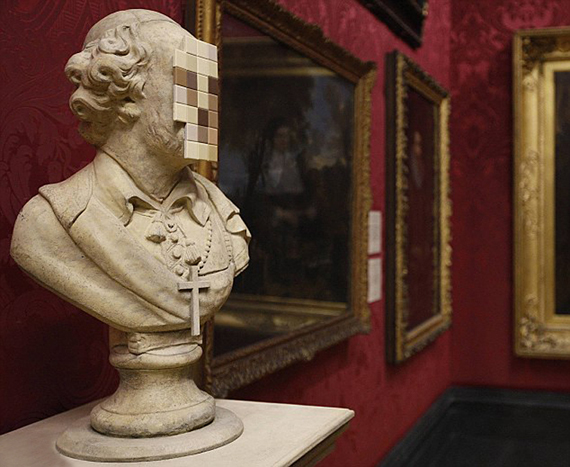
Cardinal Sin placed in the Walker Gallery
Banksy is renowned for making measured often controversial and political statements with his work. With Cardinal Sin, he reflects on a previously untouched controversy, doing so in an effective, accessible manner. The point he makes is not particularly clever, nor deep or insightful. It does not promote active contemplation in its audience. But nonetheless, his work is an intelligent pun casting further focus (as if any more were needed) on the devastating plight of the many thousands of victims of sexual abuse at the hands of the Catholic church. The work should not be seen as an indiscriminate attack on the Catholic church (despite the impression give by Banksy’s statement) but rather an interesting piece of contemporary art which, unlike so much work filling art galleries these days, has a valid point to make which will resonate with all of society.
Best of all, the work will no doubt turn the focus of Banksy’s huge global following towards Liverpool’s Walker Gallery. I visited the gallery for the first time in September and was beyond impressed with the array of work on show. It’s well worth a visit, especially in 2012 when the John Moores painting prize will be back in the gallery – a worthy rival to the less accessible Turner Prize. And for those culture vultures amongst you, the equally excellent Tate Liverpool is just down the road.


 The Daily Norm
May 15
Banksy makes a jubilee-mocking come-back, but are his contemporary statements a little lagging?
There are currently two sites which are inescapable on any UK highstreet as they enjoy their ascension with increasing fecundity: the union jack and the humble pound shop. While the latter is a thriving austerity-proof monster growing out of the wrecks of recession-hit highstreets up and down the country, the former is a symbol of hope, of national pride, a flag which is appearing almost everywhere within eye-sight as the country gears up towards two great festivals of British prowess: the Queen’s Diamond Jubilee, and the London 2012 Olympic games. But for Banksy, known for making bold current statements against anything which has become accepted and standardised by the great public at large, all the union jacks and the poundshops have proven ripe fodder for his stencil-sprayed artistic derision. Indeed, for those passing by the side of a Poundland store in Turnpike Lane, Haringey (North London) this morning, they would have noticed a new addition to the street – a stencil of a child worker, fastidiously plying his trade in making mass produced union jack bunting. The graffiti, applied with Banksy’s trademark stencil technique, is widely considered to be by the great elusive street artist himself, although this provenance is yet to be confirmed by way of its customary inclusion on Banksy’s official website.
Whether the artist be Banksy or a pretender to the street-art throne, the image is apparently purporting to make a double statement. On the one hand it pokes fun at the proliferation of union jacks which have appeared all over London, England and further afield. We’re not just talking bunting either – the distinctive flag has become the favourite of interior designers who have installed the flag on sofas, artwork, rugs, cushions you name it, while there are even those (with little shame – like Ollie Locke from TV docusoap Made in Chelsea) who have taken to wearing the Union Jack on their clothes and blasted across their cars. Meanwhile in Oxford Street, the union jack is hung repeatedly across the famous shopping thoroughfare, and in humble bakeries the union jack has been iced onto cupcakes in preparation for Diamond Jubilee street parties which, if the weather improves, are expected to be held all over the realm.
Union jack furniture is all the rage
But the artist’s more pressing statement relates to the child labourer, and gives clues as to why Banksy (or whoever it was) chose the location he did: two years ago Poundland was involved in a scandal surrounding a boy of seven who was found to be working 100 hours a week in an Indian sweatshop producing goods for the store. The child, known as Ravi, was reportedly earning just 7p a hour to make napkin rings for the cut-price chain. The company severed ties with the supplier at the time and issued a statement saying it ‘did not tolerate child labour under any circumstances’. Which brings me to the point: is this contemporary statement of Banksy’s really that contemporary at all? Or did it take him two years to find a suitable wall to make his point about pound shop culture?
This trend of Banksy being somewhat behind in his latest up-to-the-minute remonstration was also echoed in his recent gift to Liverpool’s Walker Gallery, which saw the artist make a point about sexual abuse in the Catholic church a little too obviously and, frankly, a little too late to make an impact.
Union jack battenberg anyone?
Nonetheless, while Banksy’s point may come a little too late in terms of the Poundland scandal, there can never be too much exposure of child labour. Meanwhile, for the owner of that wall, the appearance of a potential Banksy original will make him/her very happy indeed – past sales of Banksy graffiti have sold in six figure sums, just as long as you can somehow cut the graffiti and the wall away intact! Sadly, what the graffiti also demonstrates is the level of general disrespect which exists within British society. Within hours of the artwork being painted, the union jack bunting, which was stuck onto the stencil, had been stolen. How very predictable these idiots are. The bunting will be worthless detached from the stencil, but some parasites decided to steal it anyway. It may not have been Banksy’s intention, but that kind of behaviour is definitely something which deserves focused remonstration by everyone.
The stencil a few hours after being painted, with bunting stolen
Related articles