Skip to content

Posts tagged ‘Exhibition’

Countdown to my new Solo Exhibition | 3 days – Flamenco Norm

In 2005 when I was studying law at university, I started doodling The Norm. It was a character straight out of my imagination, but inspired by Kelsen’s Theory of Normativity which I was studying in jurisprudence. The inspiration wasn’t so much garnered from topic, which was inherently boring, but more out of the need to distract myself from falling asleep in lectures. With the advent of the Norm came a series of paintings, exhibited in 2006 at my Sussex solo exhibition, Between Me and My Reflection, before the collection dried up.

The next stage of this important Norm story is November 2011. I was on a career break, waiting for a new job to begin, and wondering how to make the most of the time suddenly available to me. It was my friend Cassandra who suggested that I rejuvinate the Norms, some 5 years after I had last painted them. The idea was sewn, and this very blog, The Daily Norm, was the result. I posted my first ever article on 14 November 2011, and from that moment onwards I went into artistic overdrive, drawing, painting and designing Norms for this blog.

Flamenco Norm (2011 © Nicholas de Lacy-Brown, acrylic on canvas)

Flamenco Norm (2011 © Nicholas de Lacy-Brown, acrylic on canvas)

One of the first creations of the Norm rebirth was this painting: Flamenco Norm. Painting on the tail-end of my Spanish collection, and in fact created while I was in my house in Marbella, this painting represents the perfect transition between the Spanish section of my new London exhibition (starting in 3 days!) and the most comprehensive section of the whole show: my Norms! With its deep yellow cracking walls covered with flamenco memorabilia, its bare bulb and wooden floor, this to me is the typical Spanish flamenco setting, while the melancholy guitar and the energetic swish of the flamenco dress represents the heart and soul of this vibrant indefatigable dance. It’s still one of my favourite Norm paintings.

So as the title of my new exhibition, When (S)pain became the Norm, apty represents, this was the period when both pain, and spain transcended into a new era of Norms which has been growing strong ever since. See the entire collection at my new solo show – opening on Tuesday.

© Nicholas de Lacy-Brown and The Daily Norm, 2001-2014. Unauthorized use and/or duplication of the material, whether written work, photography or artwork, included within The Daily Norm without express and written permission from The Daily Norm’s author and/or owner is strictly prohibited. Excerpts and links may be used, provided that full and clear credit is given to Nicholas de Lacy-Brown and The Daily Norm with appropriate and specific direction to the original content. For more information on the work of Nicholas de Lacy-Brown, head to his art website at www.delacy-brown.com

Nicholas de Lacy-Brown’s new solo exhibition, When (S)pain became the Norm, will be at London’s Strand Gallery from 13 – 18 May 2014. For more details, click here.

Countdown to my new Solo Exhibition | 7 days – Bricks and Stones

It seems almost mad that close on 6 months have gone by since I first announced on this blog that I would be holding a brand new solo exhibition of paintings, illustrations and prints in London’s Strand Gallery this May. And yet here we are, with the exhibition on the doorstep. In 7 days, my exhibition, which will feature over 100 displayed artworks and a whole lot more other artworks for sale, will throw open its doors to the prestigious West End of London. A mere 50 metres from London’s Strand, the exhibition is in the heart of the city’s colourful Covent Garden/ Charing Cross area, and frankly I could not think of a better location.

So as excitement builds, the bubble wrapping goes into overdrive, frames are attached, price lists drawn up and champagne gathered, I thought I would take time to explore some of the themes and artworks which will feature in the show on each of the 7 days approach to the exhibition’s opening on 13 May.

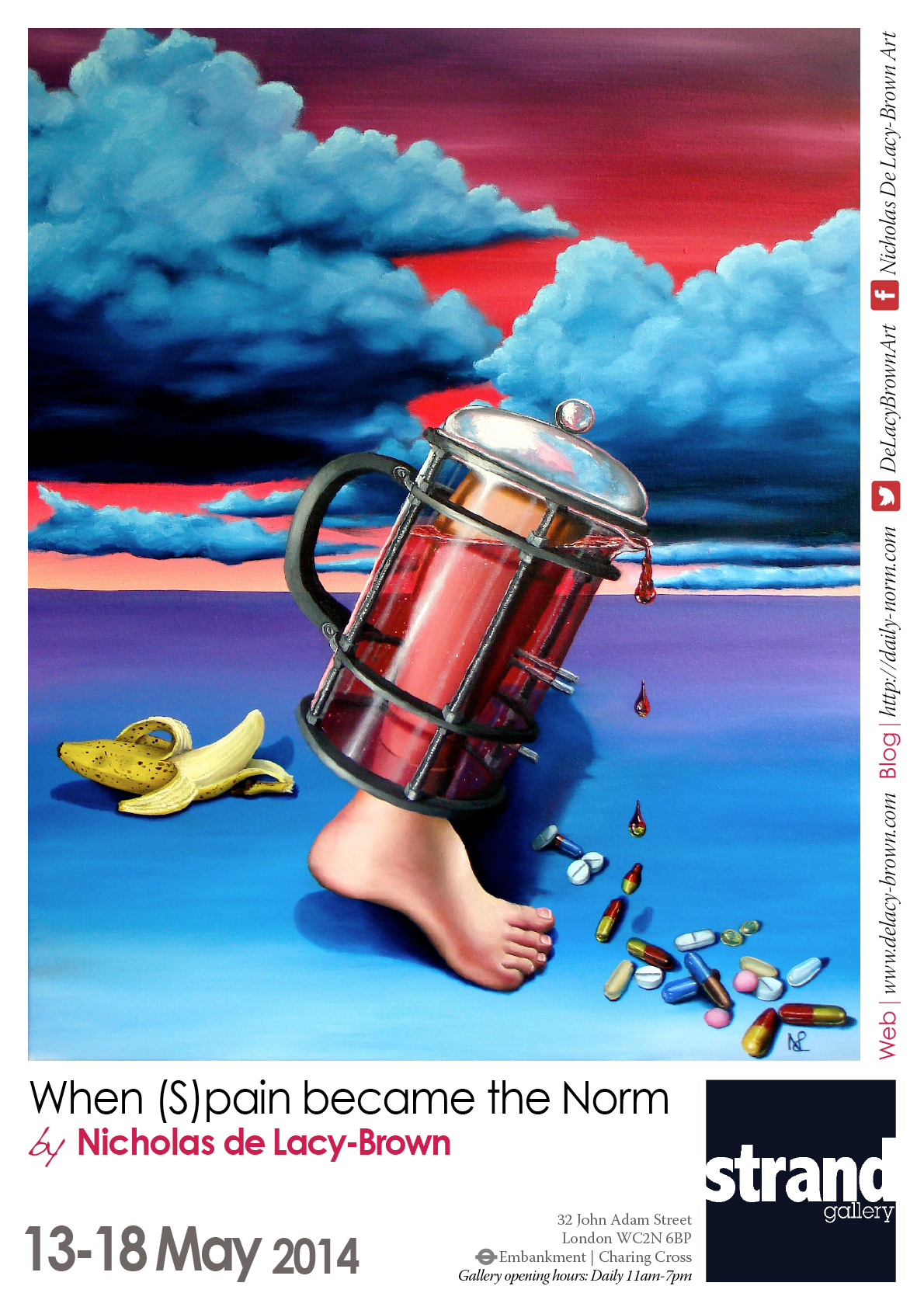
Poster A2 Cafetiere

The exhibition is entitled When (S)pain became the Norm, a title which represents the three main themes which will run through the collection – Pain: the time of my 2008 road traffic accident and the protracted convalenscence which followed; Spain: how this most colourful of European countries has given rise to some of my most exciting and energetic artworks; and the Norms: all my paintings and illustrations of the small white-blobbed one-armed creation of my imagination, most of which have featured on this blog which is named after that same unique character.

In this first post, I am sharing the painting which really kickstarts the whole collection. Entitled Bricks and Stones may Break My Bones (The Show Must Go On)it was the first painting I started in the weeks immediately following the horrendous accident in which I was involved in May 2008. On 29 May 2008, I was walking out to buy some lunch when a lorry, without warning, collided with a 10 ft concrete brick wall which then collapsed onto the pavement as I walked by. I was caught under the rubble and serious crush fractures sustained to my right leg. Frankly, I was lucky to get away with just that. The injuries were so severe that I had to have my leg placed in an external fixator – a horrific instrument attached to the leg with a series of a bloody pins – and I underwent some 7 operations over 3 years before the leg was finally healed, sufficiently, to such a level that I could walk once again.

Bricks and Stones May Break My Bones (The Show Must Go On) 2008 © Nicholas de Lacy-Brown, oil on canvas (130cm x 110cm)

Bricks and Stones May Break My Bones (The Show Must Go On) 2008 © Nicholas de Lacy-Brown, oil on canvas (130cm x 110cm)

This painting, which is perhaps one of the most visceral and uncomfortable of my collection, represents the accident itself. I am shown, in self-portrait, morphed into the wall which had by that time become an inescapable factor in my life. Crashed into it, a small toy lorry is beside me, while on my head, like a crown of thorns, is the barbed wire which ran along the wall and collapsed down upon me in turn. My broken leg is shown as a column broken into three pieces, reminiscent of a similar representation used by my idol, Frida Kahlo, while my crutches are propping up my right food Dali-style since, which, owing to nerve damage, otherwise flopped involuntarily to the floor. Meanwhile over the bleak landscape, the pins which pierced my leg pierce the ground, and on the right, a theatrical proscenium arch likewise propped up by a crutch and a swollen leg demonstrates that despite all of the horror around me, the show had to go on: Something demonstrated by the fact that I was up on two chairs, my leg outstretched, painting this powerful work.

Come back tomorrow for my next featured work, and in the meantime, please consider coming along to my exhibition. More details can be found on my website, and on that of The Strand Gallery.

© Nicholas de Lacy-Brown and The Daily Norm, 2001-2014. Unauthorized use and/or duplication of the material, whether written work, photography or artwork, included within The Daily Norm without express and written permission from The Daily Norm’s author and/or owner is strictly prohibited. Excerpts and links may be used, provided that full and clear credit is given to Nicholas de Lacy-Brown and The Daily Norm with appropriate and specific direction to the original content. For more information on the work of Nicholas de Lacy-Brown, head to his art website at www.delacy-brown.com

Matisse at Tate: Colour Cut-Out to a Career Climax

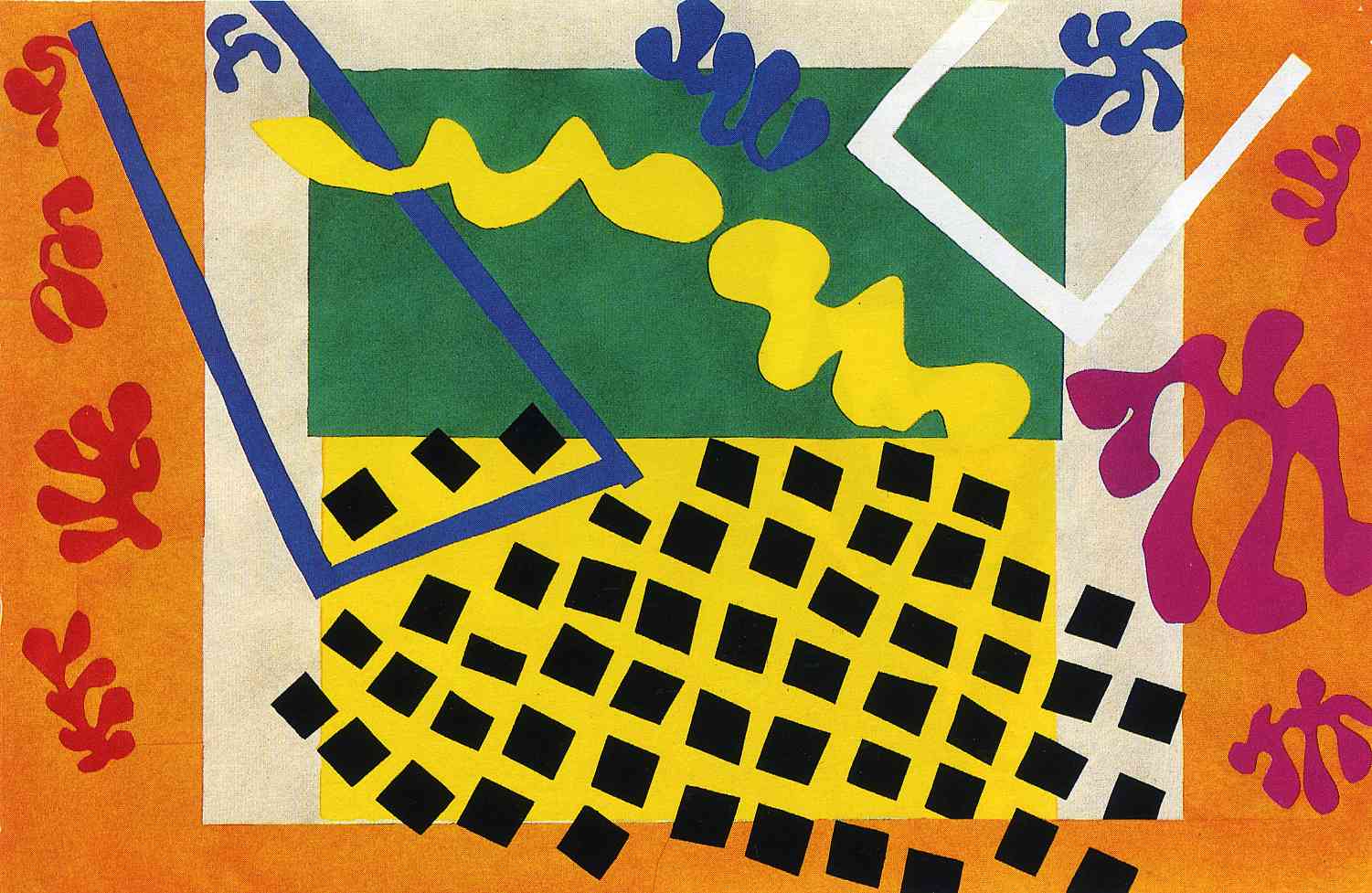
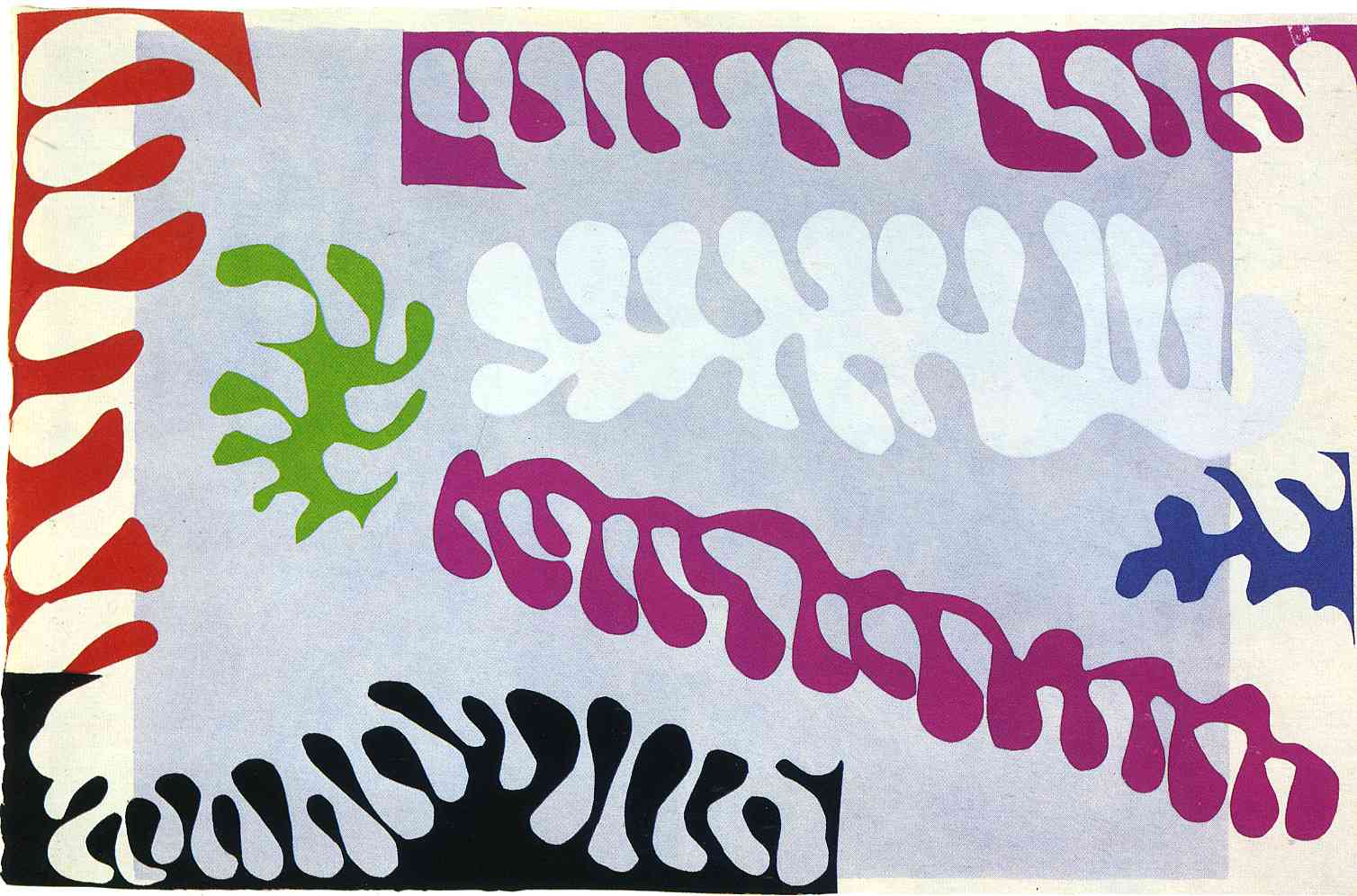
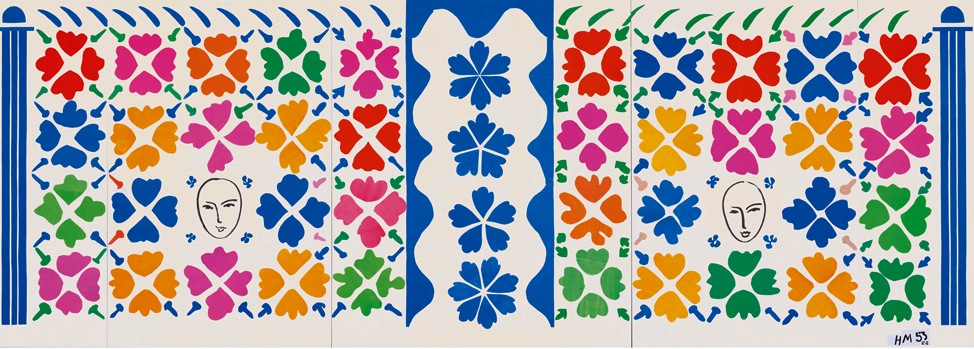
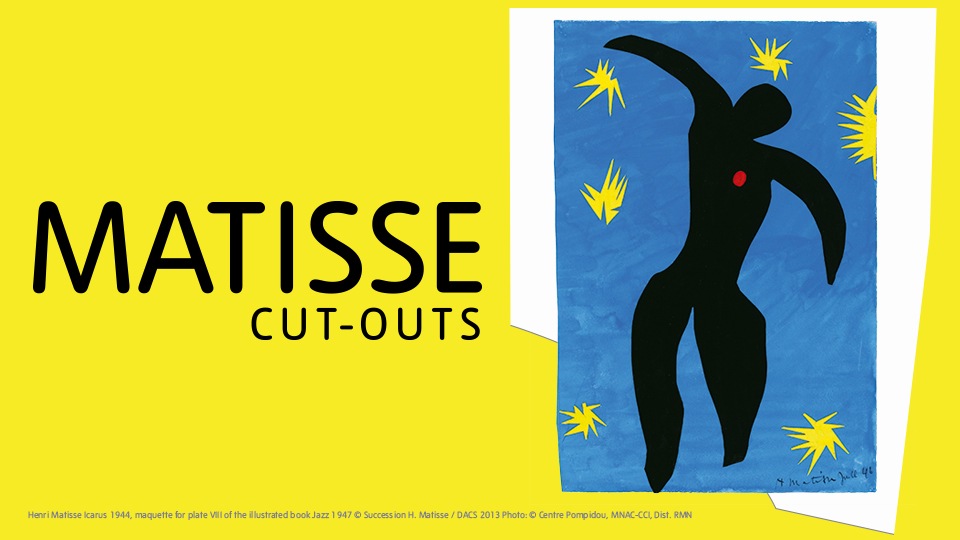
The new Matisse blockbuster at London’s Tate Modern is a show of inexorable joy: of that there can be no doubt. With its whimsical vivid colouration, and playful motifs of sea algae and birds, dancers and blue nudes, it is an exhibition which is full of the happy spirit of the Mediterranean. And yet all of this was created during and immediately after a time when Europe was caught up in the ravaged turmoil of the second world war. How Matisse then managed to create such spirited works, not only during a time of such cataclysm, but also when he was himself frail and confined largely to his bed or to a wheelchair, is one question poised by this exhibition. The answer? Colour was Matisse’s escape from the horrors of war, and cut-outs the vehicle with which he entered the last great hurrah of his groundbreaking career in art.

In bringing together this show of over a hundred of Matisse cut-outs, Tate has managed a real coup. For these works, which dominated the last period of Matisse’s creative output, are merely gouache-painted paper, brought together with paper, sizzors and glue. The result are pictures which retain the same vibrancy that they had when they were first made, but are nevertheless so fragile that few ever leave the national art galleries which they now call home. Yet here they all are, together, many for the first time since they were created.

id_010new_1 cut-outs-3 1394619552732

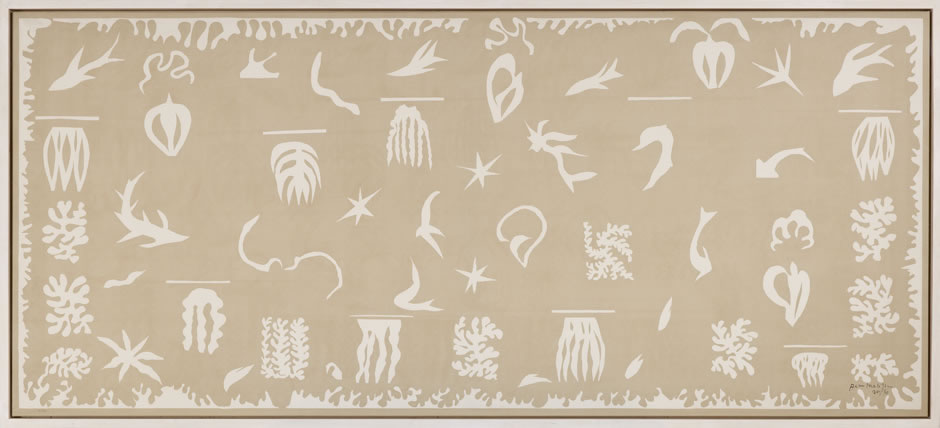
The result is an exhibition which can not fail to please. Starting with the original artwork and resulting first edition of Matisse’s best known artist book, Jazz (which I often paused over in Chelsea’s Taschen store but never purchased before they stopped the reprint, much to my regret), the exhibition moves onto what is essentially the genesis of what is to follow – the Oceana works. With one of the vast works, which originally acted as wall decoration in Matisse’s Paris apartment, featuring figures of the sky, and the other of the sea, these works were inspired by a visit to Tahiti 16 years before. But more importantly, the sea work was pretty much the first time that Matisse used the cut out image of coral, an image which was to become iconic of much of his cut-out works thereafter.

Oceana

matisse_oceanie-la-mer-foto-robert-bayer_l

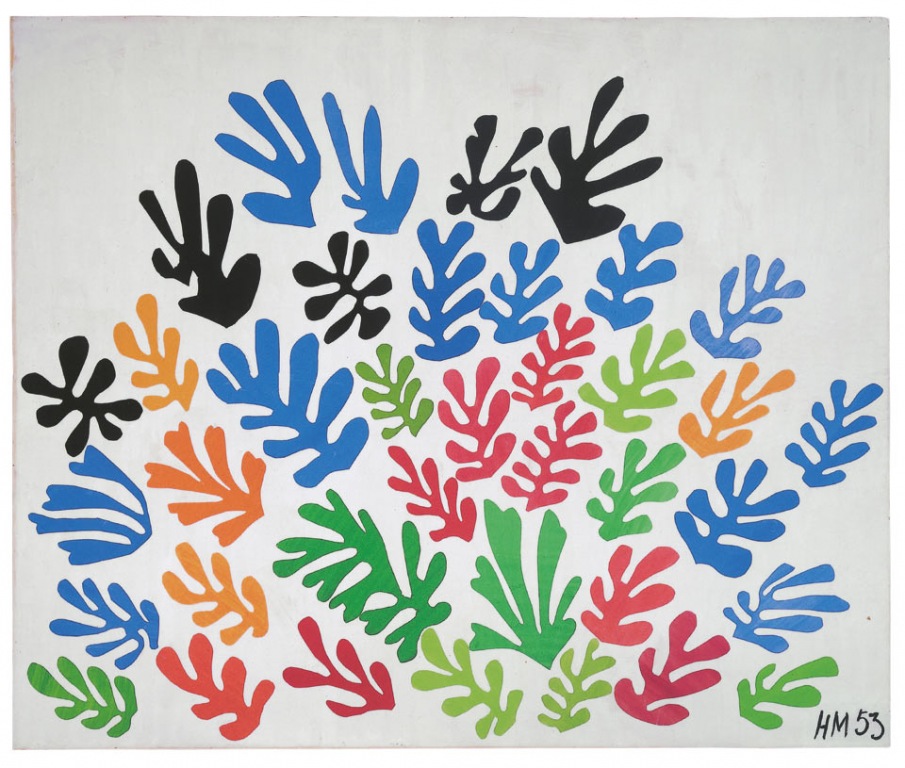
That coral is indeed prevalent in the works that follow, as are the vivd range of colours cut from sheets painted by his dedicated studio assistants. I loved room 5 of the exhibition, which attempts to recreate Matisse’s studio in Vence in Southern France, whose walls were decorated, floor to ceiling, with cut-out works. Seeing the cut-outs grouped together like this makes them come alive as a collection. The variety of colours and shapes and sizes make the corals almost vibrate with the energy emanating from the collected cut-outs, and together the colours sing like an hallelujah chorus.

Coral cut-outs

matissethesheaf1953 kr_matisse_cut_outs_070_071_top_41972_1404021745_id_802580 cut-outs-1

As satisfying as these collected colours undoubtedly are, I could not help but admire Matisse’s famous blue nudes, all four of which are brought together for the first time. Intrinsically simple in both colour, and the seamless way in which they are cut from a single sheet of painted blue-paper, they really are images to be admired – and as a set they never worked better.

The exhibition ends with Matisse cut-outs on a grand scale, from Tate’s famous Snail (which was the closest Matisse comes to abstract, and in my opinion perhaps the least successful because of it), to The Mermaid in which Matisse intended, through use of bird, coral and fruit motifs, to bring the outside into his studio, something which he surely achieved with all-encompassing effect.

_70288189_masks 6a00e00989a58088330176166fd020970c HMB334 The Snail 1953 by Henri Matisse 1869-1954 20130426-102711

I wasn’t expecting to love this show. I’m not a huge fan of Matisse’s oil paintings which too often appear to me badly executed and fussy. But the simplicity and vibrancy of the cut-outs really appealed to me. It demonstrates the power of composition and the effect which simple colours can have when laid alongside each other. Many have criticised the cut-outs as mere child-play. But that’s a very easy observation to make when the idea has already been generated and all the behind-the-scenes work and planning exhaustibly executed. Masterpieces, perhaps, these works are not. Some may even pass them off as mere wall-coverings. But as a collective they are full of an inherent and enticing energy and joy which fewer more “masterful” artworks will ever be able to generate with such consistency or strength.

6a00d83451e76669e2019affca0e4c970d

Henri Matisse: The Cut-Outs is on at Tate Modern, London until 7 September 2014

Norms: The Saints Collection | Saint Sebastian

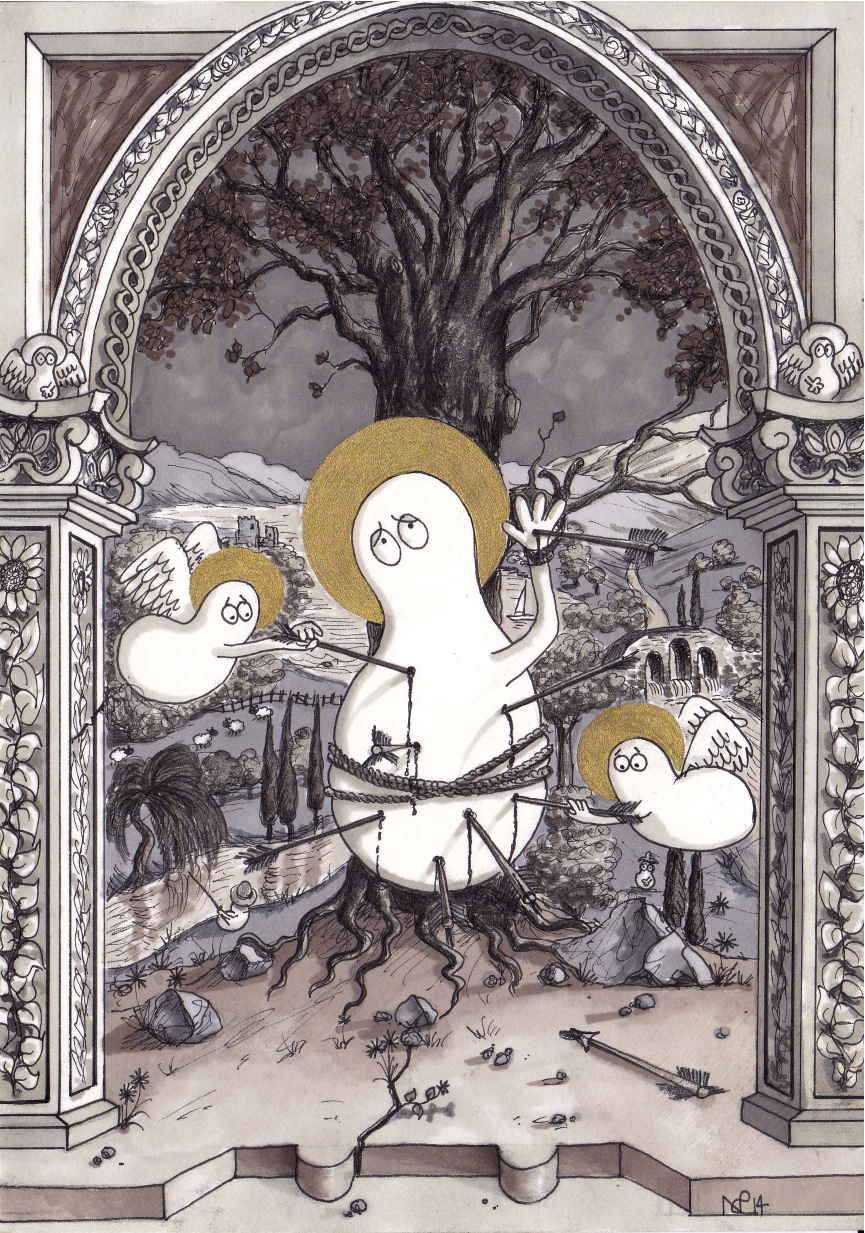
Next up in the fast growing Norm Saint’s Collection is Saint Sebastian. Famed for being the martyr who was martyred twice (once when he was shot with arrows, and second when, after that didn’t kill him, he was pummelled to death), Saint Sebastian is the saint whose writhing naked body, filled with arrows, has become as popular a gay icon as it has a symbol of religious devotion and a great favourite of artists through the ages.

My Norm Saint Sebastian is only the latest depiction of this saint to join the mass of works executed throughout art history by famed artists such as Titian, Botticelli and John Singer Sargent. And like many of those which have gone before it, my depiction shows this poor arrow-riddled saint tied roughly to a tree, while behind him, a beautifully bucolic background gives otherwise irrelevant depth and magnificence to the scene. Meanwhile, a host of dear little Norm angles are doing their best to try and save this most suffering of saints, by pulling out the arrows from his tender skin one by one in an attempt to save him from inevitable suffering and death.

Saint Sebastian Norm (2014 © Nicholas de Lacy-Brown, pen, ink and gold paint on paper)

Saint Sebastian Norm (2014 © Nicholas de Lacy-Brown, pen, ink and gold paint on paper)

Happily, as the story goes, Saint Sebastian did not die from his arrow wounds – miraculously he was nursed back to life by Saint Irene, only to be finally condemned to a more violent end when he taunted the Emperor Diocletian for not having killed him properly in the first place. Some might say he should have learnt his lesson from the first occasion he spoke up against the Emperor a little too loudly. But then he wouldn’t be a very good martyr if he didn’t suffer for his cause.

Up next: Saint Jerome.

© Nicholas de Lacy-Brown and The Daily Norm, 2001-2014. Unauthorized use and/or duplication of the material, whether written work, photography or artwork, included within The Daily Norm without express and written permission from The Daily Norm’s author and/or owner is strictly prohibited. Excerpts and links may be used, provided that full and clear credit is given to Nicholas de Lacy-Brown and The Daily Norm with appropriate and specific direction to the original content. For more information on the work of Nicholas de Lacy-Brown, head to his art website at www.delacy-brown.com

 Nicholas de Lacy-Brown’s new solo exhibition, When (S)pain became the Norm, will be at London’s Strand Gallery from 13 – 18 May 2014. For more details, click here

London’s homage to print: Part 2 – David Hockney Printmaker

Last week I told you all about the first of two high profile celebrations to printmaking currently being held in London. The first, Renaissance Impressions at the Royal Academy charts the development of woodcut to create all of the depth and powerful contrast of chiaroscuro in the 1500s. The second unveils a whole new side to celebrated contemporary artist, David Hockney, best known for his colourful Los Angeles Swimming Pools and large scale multi-piece canvases of the Yorkshire countryside, but here shown to be as skillful a printmaker as he is a painter, or, in my opinion, more so.

In presenting this brilliant little exhibition, Dulwich Picture Gallery shows Hockney as a subtler artist; without the distractions of his trademark bold colours, this is Hockney the skilled draftsman; without the almost theatre-scenery sized canvases, here we see Hockney as a man of detail, capturing intimate scenes with a personal aspect, and delivering sometimes simple still lives but with all of the energy of those familiar swimming pool scenes.

David Hockney, Lithographic Water Made Of Lines And Crayon (Pool II-B) 1978-80 © David Hockney / Tyler Graphics Ltd

David Hockney, Lithographic Water Made Of Lines And Crayon (Pool II-B) 1978-80
© David Hockney / Tyler Graphics Ltd

David Hockney, Self Portrait, 1954 © David Hockney

David Hockney, Self Portrait, 1954
© David Hockney

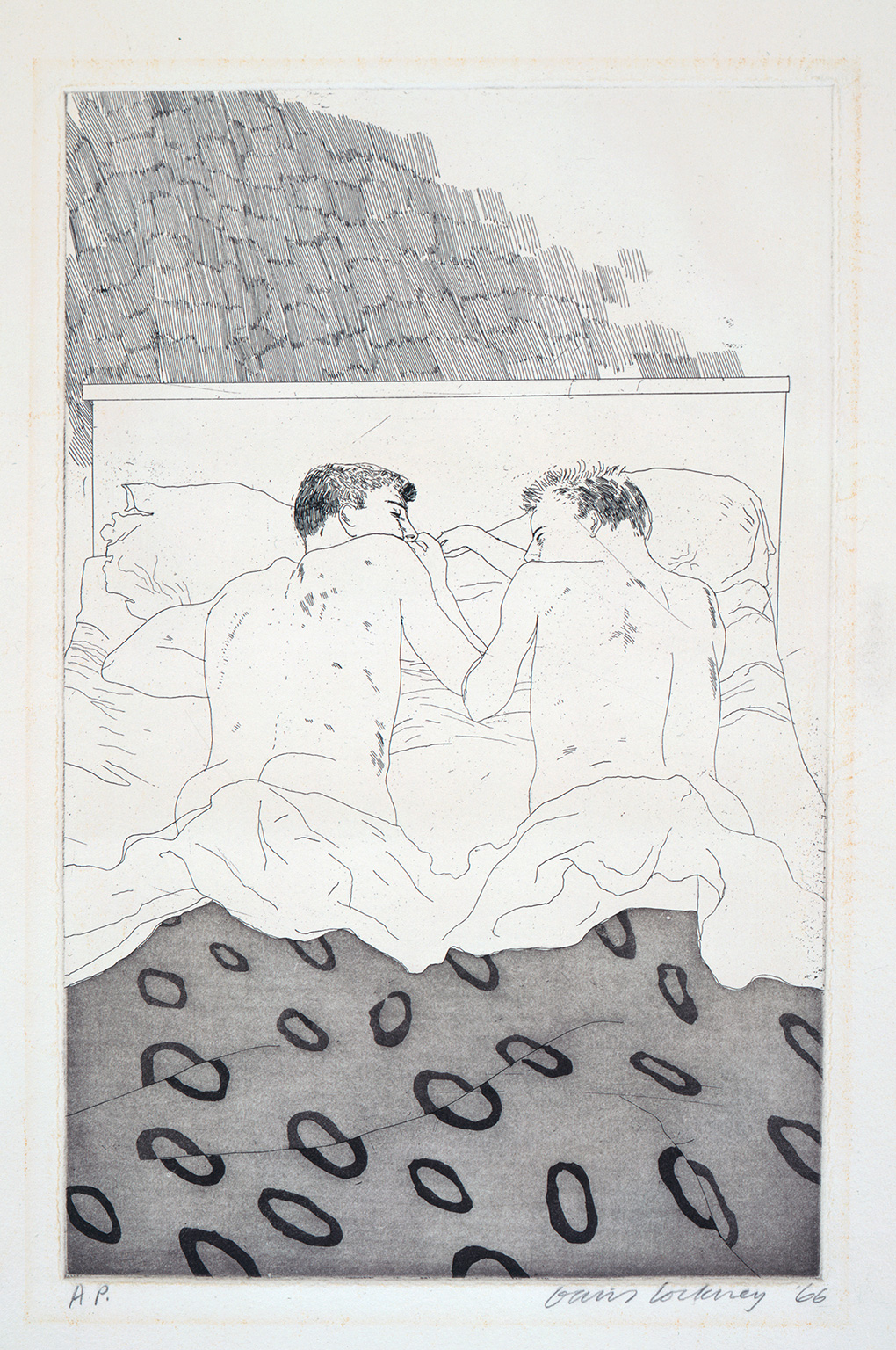
David Hockney, Two Boys Aged 23 or 24 from Illustrations For Fourteen Poems from C.P. Cavafy, 1966-67

David Hockney, Two Boys Aged 23 or 24 from Illustrations For Fourteen Poems from C.P. Cavafy, 1966-67

It is abundantly clear, from the first room of the chronologically hung exhibition, right through to the last, that printmaking has been an important and consistent accompaniment to Hockney’s creative process throughout his career. From his first etchings, amusingly poking fun at his fine art degree (I like the etching which was created using his actual fine art diploma, The Diploma (1962)) and taking a new spin on Hogarth’s The Rake’s Progress, pictorially describing Hockney’s own move to, and development in the US, right through to his recent and renowned use of the iPad as a new digital tool for creating print works, Hockney embraced print and all of the possibilities it provided for artistic expression. His main printmaking stints appear to have been in etching (which lends beautifully to the simple linear illustrations for Cavafy’s Fourteen Poems) and lithography (his print version of his famous swimming pool series being a particularly good example), although Hockney also extended into less traditional print methods – his use of a coloured photocopier to gradually build up a complex image was, for example, particularly effective.

But asides from Hockney’s excellent handling of the medium of print, the images themselves make this show a clear sell-out success. In his Cavafy series, Hockney’s prints exude a wonderful, but always polite intimacy which seems to be characteristic of his somewhat reserved but slightly cheeky persona. With their common place objects and models staring straight out from the print, these images appear to welcome the audience into the works. As viewers, we don’t feel like voyeurs, but more like welcome participants; friends joining in on the happy-go-lucky lifestyle Hockney portrays. In his later Mexico works; Hockney gives us a vivid, energetic lithography whose varying angles and stilted perspective appear to pulsate and dance to the rhythm of that hot Latin country, and remind me a little of the stunningly colourful Grand Canyon works he painted in the late 90s.

David Hockney, Views of Hotel Well III, 1984-85 © David Hockney / Tyler Graphics Ltd., Photo Credit: Richard Schmidt

David Hockney, Views of Hotel Well III, 1984-85
© David Hockney / Tyler Graphics Ltd., Photo Credit: Richard Schmidt

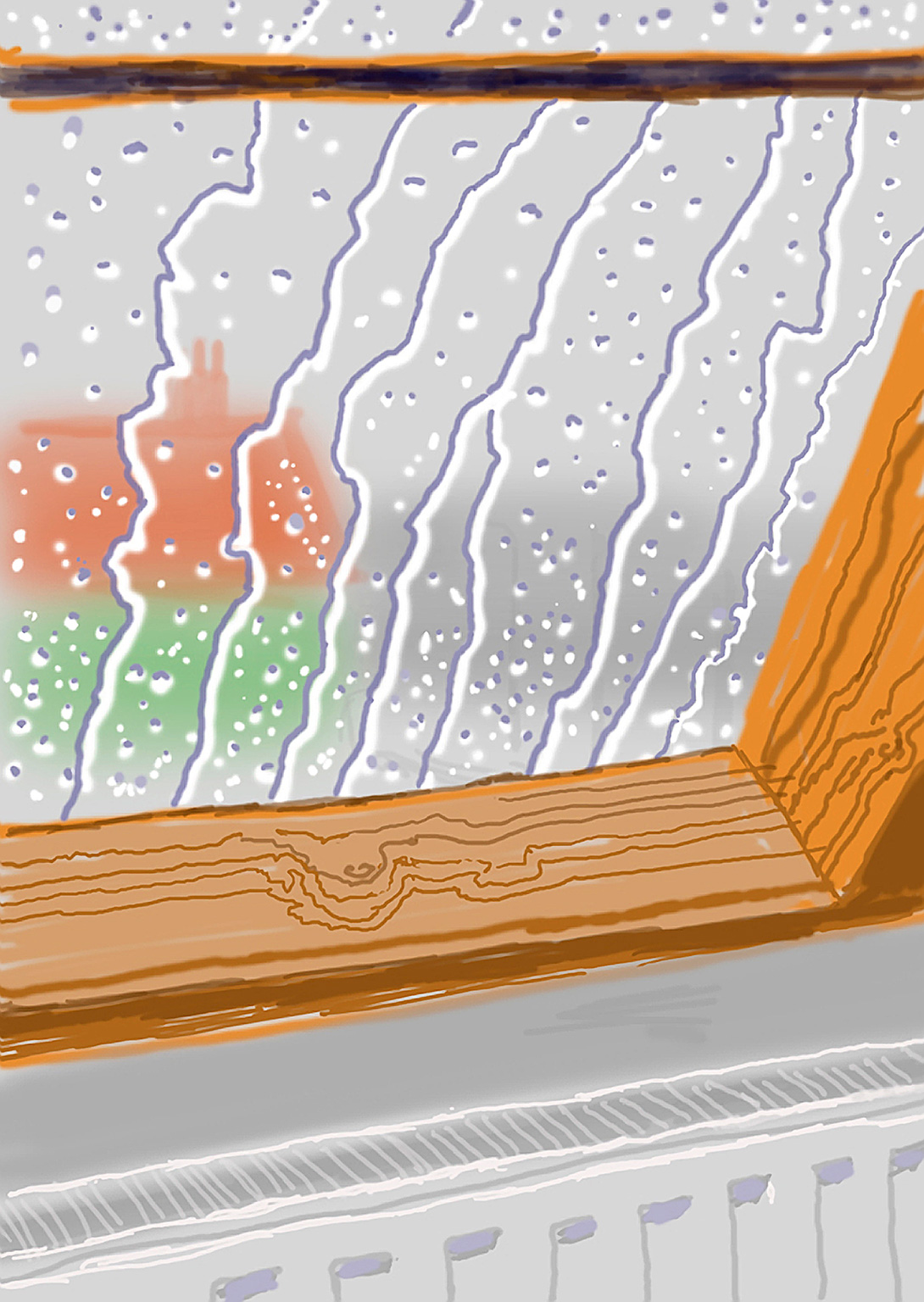
David Hockney, Rain on the Studio Window, From My Yorkshire Deluxe Edition, 2009

David Hockney, Rain on the Studio Window, From My Yorkshire Deluxe Edition, 2009

David Hockney, Artist and Model, 1973-74 © David Hockney

David Hockney, Artist and Model, 1973-74
© David Hockney

David Hockney, Lillies, 1971 © David Hockney

David Hockney, Lillies, 1971
© David Hockney

I also found that some of the best works were the simple ones – a vase of cala lilies, with an accurate and precise cross-hatched background contrasting with the purity of the white flower; a superb iPad image of raindrops running down a window which exudes the cosiness of looking out at rainfall while benefitting from the dryness and comfort of home; and portraits of friends, simply posed, looking straight out at the viewer, prompting interaction, welcoming us in.

It is, therefore, a show with something for everyone, but with an overriding central devotion to the versatile, unique art of printmaking.

London’s homage to print: Part 1 – Chiaroscuro woodcuts

Printmaking is seriously in vogue right now. Whether it be etchings, lithography, linocut or woodcut, prints have seen a huge upsurge in popularity in recent years. This is partly down to the financial crash, which for so many middle-income art collectors meant that the 3-figure price-tags attached to prints suddenly became a much more attractive method of collecting quality images. But it’s not just about cost. Printmakings’ return to prominence also recognises the unique quality and character which is inherent in each of the print mediums, whether it be the fine lines of etching, or the watery translucence of lithography.

And as if further confirmation of this renewed popularity were needed, London is currently showing two blockbuster exhibitions which explore the medium of print in all its rich and versatile brilliance: David Hockney: Printmaker, at the Dulwich Picture Gallery (review coming soon!) and at the Royal Academy: Renaissance Impressions – Chiaroscuro Woodcuts.

Hans Burgkmair the Elder, 'St George and the Dragon', c. 1508-10." Chiaroscuro woodcut printed from two blocks, the tone block in beige. 31.9 x 22.5 cm. Collection Georg Baselitz. Photo Albertina, Vienna. Organised by the Royal Academy of Arts, London and the Albertina, Vienn

Hans Burgkmair the Elder, St George and the Dragon, c. 1508-10. Chiaroscuro woodcut printed from two blocks, the tone block in beige. Collection Georg Baselitz. Photo Albertina, Vienna.

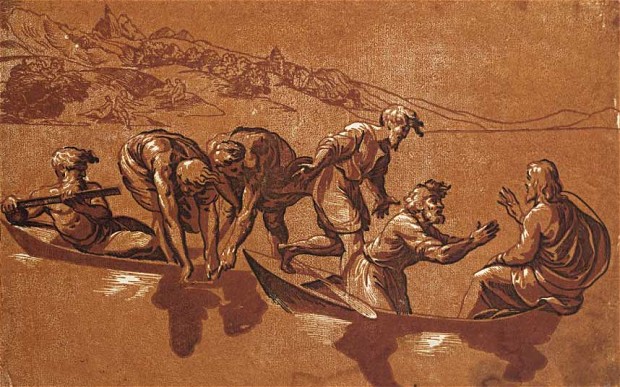
Ugo da Carpi, after Raphael, The Miraculous Draught of Fishes, c. 1523-27. Chiaroscuro woodcut printed from three blocks, the tone blocks in red, 23.4 x 25.7 cm. Albertina, Vienna. Photo: Albertina, Vienna

Ugo da Carpi, after Raphael, The Miraculous Draught of Fishes, c. 1523-27. Chiaroscuro woodcut printed from three blocks, the tone blocks in red. Photo: Albertina, Vienna

Ugo da Carpi, after Raphael; Aeneas and Anchises 1518, Chiaroscuro woodcut printed from four tone blocks, in beige and grey 51 x 37.4 cm Collection Georg Baselitz. Photo Albertina, Vienna. Organised by the Royal Academy of Arts, London and the Albertina, Vienn

Ugo da Carpi, after Raphael; Aeneas and Anchises 1518, Chiaroscuro woodcut printed from four tone blocks, in beige and grey. Collection Georg Baselitz. Photo Albertina, Vienna.

Ugo da Carpi - Diogenes (1527)

Ugo da Carpi – Diogenes (1527)

This exhibition couldn’t be more timely for me. I have only recently started dabbling in woodcutting myself, having been inspired to do so by Felix Vallotton’s exhibition in Paris last year. Likewise, I have been fully immersed in Renaissance art of late, not least in seeking inspiration for my on-going Norm Saints collection which drawn on Renaissance religious imagery for its primary inspiration.

It is that same intense religious flavour, together with the grandiose imagery which was born of the Renaissance, which forms a golden thread through the 150 or so masterful woodcuts which the Royal Academy currently have on exhibition. Formed of the collections of the Albertina in Vienna, and the private haul of contemporary artist, Georg Baselitz (you know, the one who paints upside down portraits), this brilliant show brings together a fine set of prints which explore the birth of the chiaroscuro woodcut, a unique use of wood to express the intensification of light and dark.

Hendrick Goltzius, Hercules Killing Cacus, 1588. Chiaroscuro woodcut printed from three blocks, the tone blocks in yellow and green, 41.1 x 33.3 cm. Collection Georg Baselitz. Photo: Albertina, Vienna

Hendrick Goltzius, Hercules Killing Cacus, 1588. Chiaroscuro woodcut printed from three blocks, the tone blocks in yellow and green, 41.1 x 33.3 cm. Collection Georg Baselitz. Photo: Albertina, Vienna

Andrea Andreani, after Giambologna, Rape of a Sabine Woman, 1584, Collection Georg Baselitz. Photo Albertina, Vienna
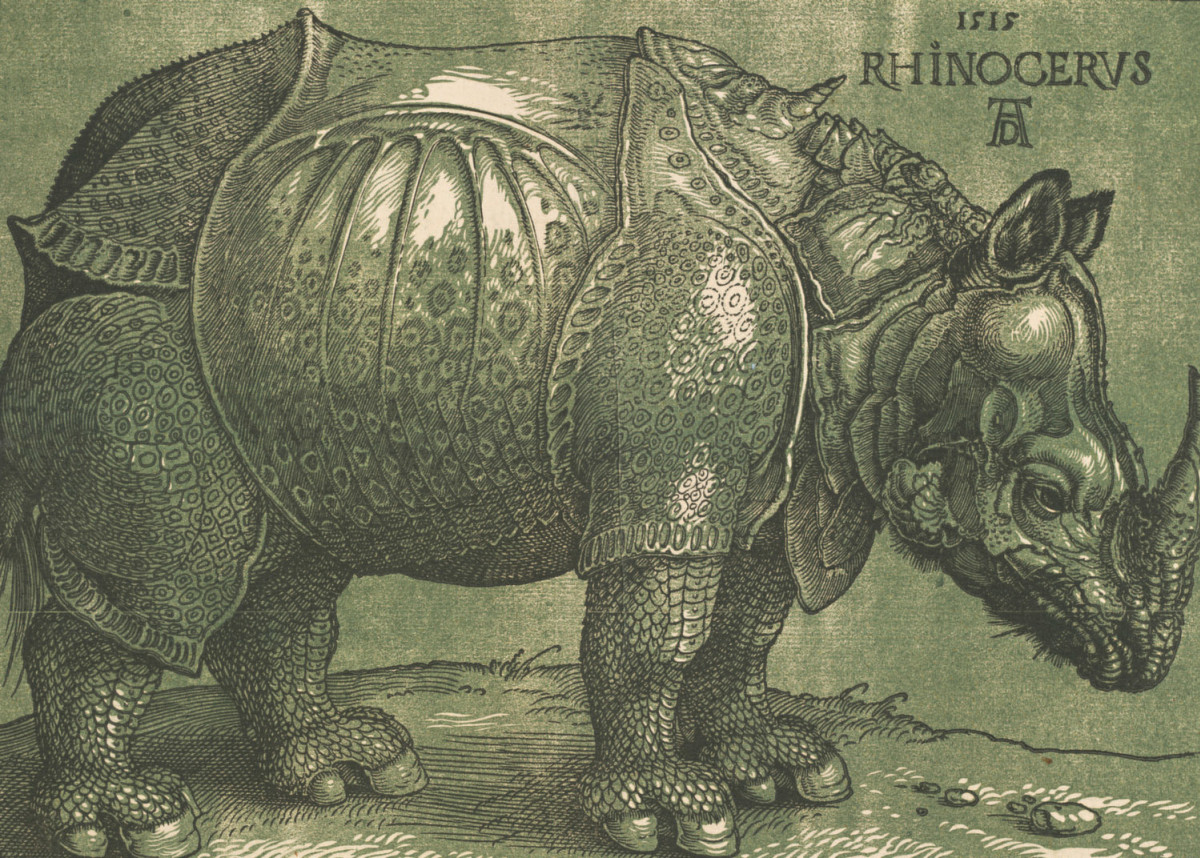
Albrecht Dürer, Rhinoceros (1515 and c.1620 - the highlights)

Albrecht Dürer, Rhinoceros (1515 and c.1620 – the highlights)

Albrecht Dürer, Ulrich Varnbühler (1522 and c.1620 - the highlights)

Albrecht Dürer, Ulrich Varnbühler (1522 and c.1620 – the highlights)

Ugo da Carpi, after Raphael; Aeneas and Anchises 1518, Chiaroscuro woodcut printed from four tone blocks, in beige and grey 51 x 37.4 cm Collection Georg Baselitz. Photo Albertina, Vienna. Organised by the Royal Academy of Arts, London and the Albertina, Vienn

Ugo da Carpi, after Raphael; Aeneas and Anchises 1518, Chiaroscuro woodcut printed from four tone blocks, in beige and grey 51 x 37.4 cm Collection Georg Baselitz. Photo Albertina, Vienna. Organised by the Royal Academy of Arts, London and the Albertina, Vienn

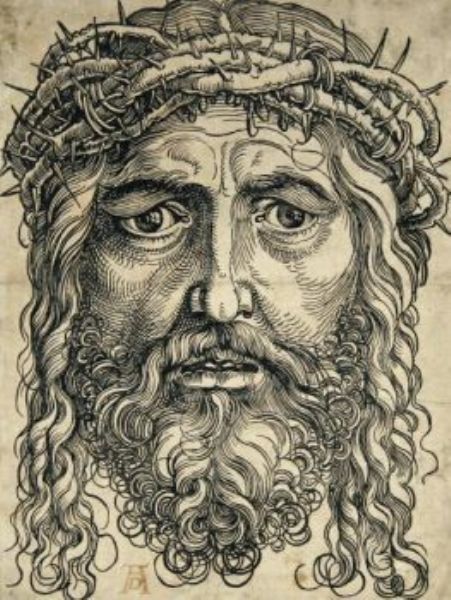
Hans Sebald Beham, Head of Christ Crowned (1520-1) - woodcut from two blocks, tone block in brown.

Hans Sebald Beham, Head of Christ Crowned (1520-1) – woodcut from two blocks, tone block in brown.

From the Italian word meaning light-dark, chiaroscuro is better known to describe the dark and brooding masterpieces of Italian painter, Caravaggio. Just as Caravaggio is famed for utilising the stark contrast of light and shadow to create paintings packed full of drama and intensity, this woodcut technique, invented in the 1500s by Lucas Cranach the Elder and Hans Burgkmair the Elder, provides the same thrill of three-dimensional realism by using different wood plates to layer up light and shadows. It generally involves one plate which contains all of the darkest details (usually the most linear plate), while another provides an overall mid-tone with white highlights cut into it. The effect is one of dramatic contrasts and naturalistic brilliance, as each of the many prints on show in this exhibition demonstrate.

From the work of those inventors, to the development of the medium, mainly by Italian printmakrs such as Ugo da Carpi and Dmenico Beccafumi, we are treated to a period of creativity in which the medium is expertly utilised to create images which, at the time, must have stunned audiences for all of their realism and depth. But just as they may have stunned 1500s audiences for their apparently illusionistic manifestation of light and shadow, so too do they retain the ability to stun the audiences of today – because in their sheer detail and brilliantly perfect execution, these works are a breath of fresh air in a contemporary world where art is so often comprised of some untidy sploshes on a canvas.

Spectator-Royal-Academy

Renaissance Impressions is on at London’s Royal Academy until 8 June 2014.

Saatchi’s positive Body Language

Whenever I visit the Saatchi gallery in Chelsea, I always do so on the assumption that I am going to hate most of the art on show. This reactionary pattern begun some years back, when Saatchi was still on the south bank, and the works included Tracy Emin’s vile “unmade” tip of a filthy bed, and her even viler photographic self portrait surrounded by money shoved up and around her you-know-what. Then, when Saatchi moved to Chelsea, exhibitions included a show of Russian art, which turned out to be even more depressing in its lack of talent than one would have already guessed, and shows which decided that the car wrecks lifted straight out of a (probably tragic) accident scene would somehow make for an enticing art exhibit.

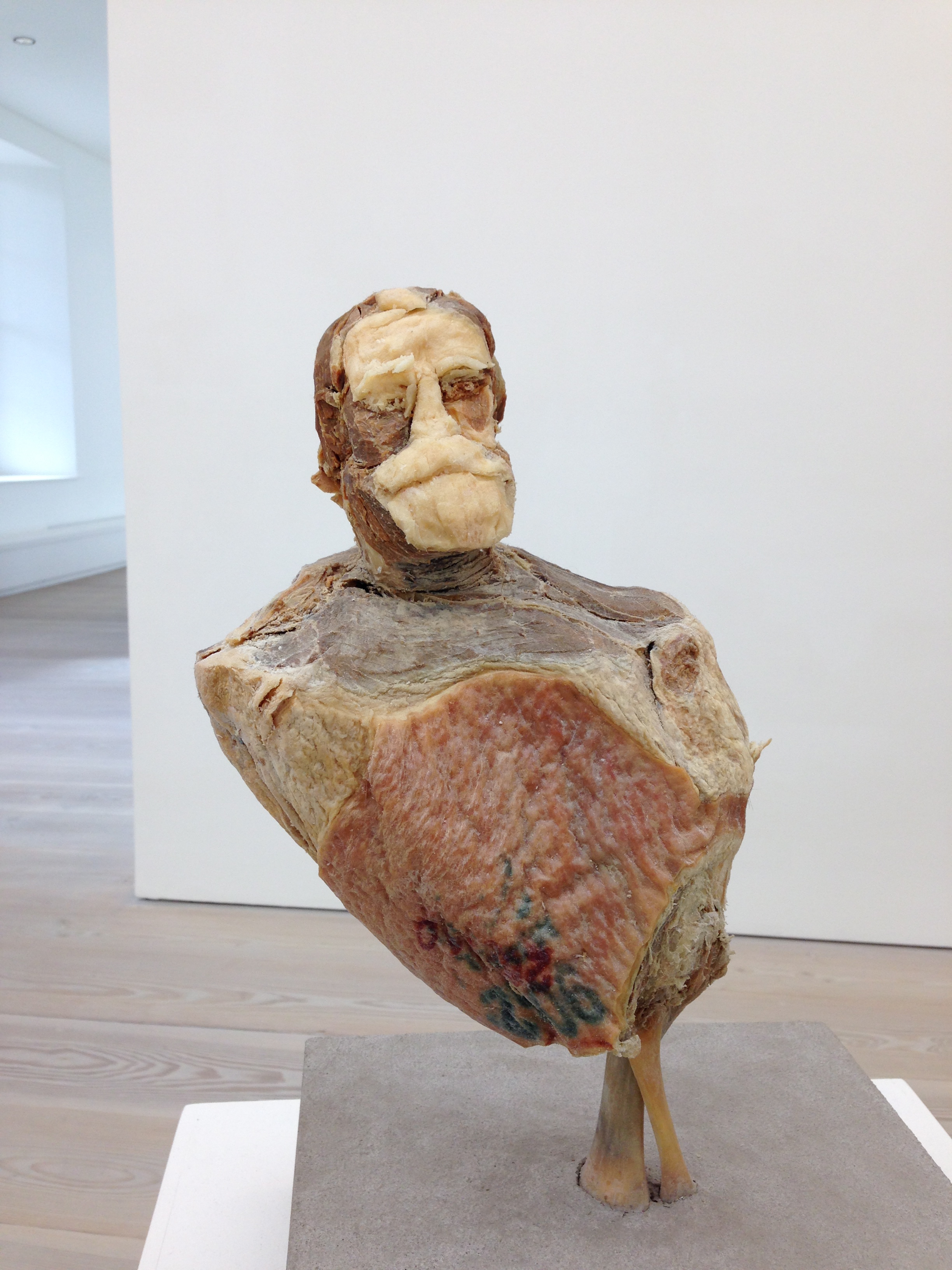
So, when I dropped into Saatchi’s gallery last weekend, I wasn’t expecting the latest offering, Body Language, to be much better than a convenient toilet stop in the midsts of some Chelsea shopping. But when you enter a gallery a see a sculpted portrait made out of Iberico ham, you pretty much know that you are going to be in for a treat. Oh yes, with his brilliantly innovative creation of Spain’s best leg of meat, Kasper Kovitz’ Carnalitos sculptures single handedly opened my eyes to the positives of Saatci’s ever revolving exhibitions of contemporary art works (eyes which had pretty much been sealed shut in opposition following the recent Nigella cafe strangle scandal…).

Carnalitos (Arana) © Kasper Kovitz, 2010

Carnalitos (Arana) © Kasper Kovitz, 2010

Carnalitos (Unamuno) © Kasper Kovitz, 2010

Carnalitos (Unamuno) © Kasper Kovitz, 2010

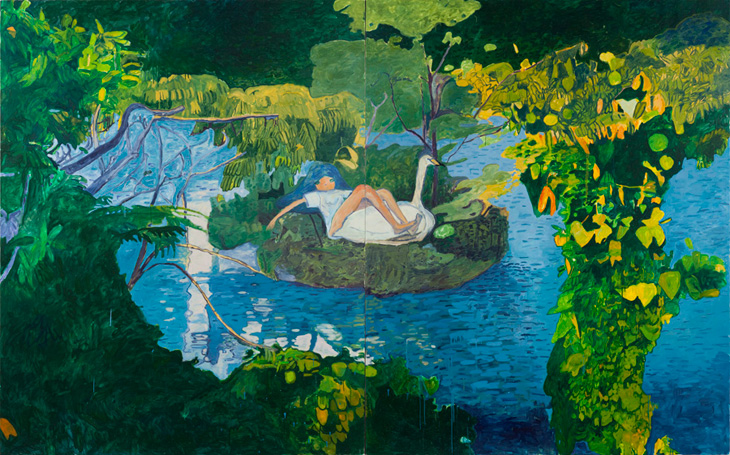
Other favourites from a varied show of contemporary artists include the paintings of Michael Cline, whose somewhat parodied figures reminded me of Stanley Spencer’s Sandham Memorial Chapel paintings which were recently on show at Somerset House. I also loved Nicole Eisenman’s energetic oil paintings such as the Beer Garden at Night (2007) which is full of whimsical figures and amusing social shenanigans which can keep an audience entranced for hours, and Makiko Kudo’s fantastical escapist visions which were in part like a Manga cartoon and at the same time like Monet’s pond bursting with lilies.

That's That © Michael Cline, 2008

That’s That © Michael Cline, 2008

Police Line, © Michael Cline, 2007

Police Line, © Michael Cline, 2007

Floating Island © Makiko Kudo, 2012

Floating Island © Makiko Kudo, 2012

Burning Red © Makiko Kudo, 2012

Burning Red © Makiko Kudo, 2012

Beasley Street, © Nicole Eisenman, 2007

Beasley Street, © Nicole Eisenman, 2007

Beasley Street, © Nicole Eisenman, 2007 (detail)

Beasley Street, © Nicole Eisenman, 2007 (detail)

Beer Garden at NIght, ©  Nicole Eisenman, 2007

Beer Garden at NIght, © Nicole Eisenman, 2007

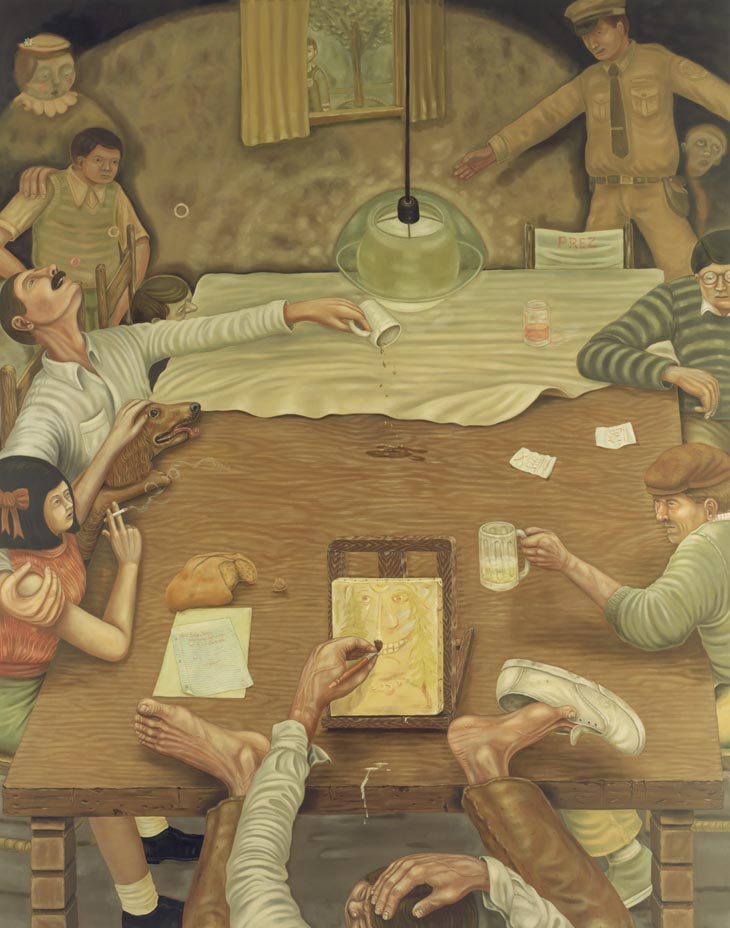
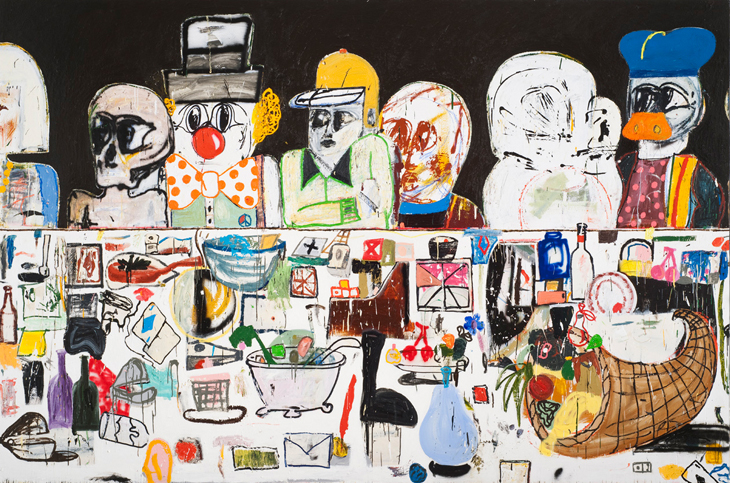
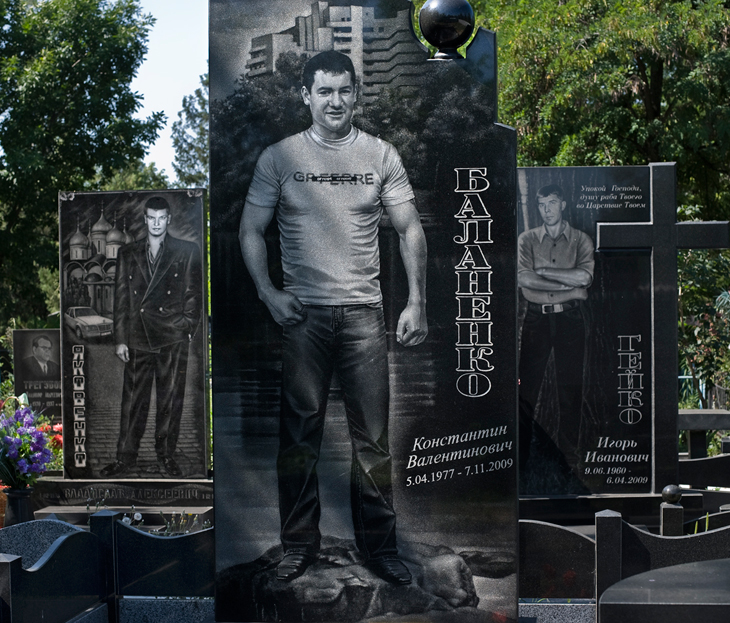
Less convincing were the paintings by Eddie Martinez which were so badly painted as to be derisable. His “Feast” is compared in the gallery brochure to Da Vinci’s historically celebrated Last Supper. I would compare it to the dirty dining table at the end of a meal when my toddler nephews have been to stay. I was equally dismayed by Denis Tarasov’s photographs of tombstones in graveyards in Russia and Ukraine, not because of the photography itself, but because of the hideously tacky gravestone pictures which they captured – huge granite tombs decorated with intricately carved photographic likenesses of the individuals buried beneath them, looking so vulgar that to even place such visions in a freshly painted white gallery in the centre of London’s chelsea felt like dumping a Lidl in the middle of Harrods. That’s not to say they weren’t interesting – one shouldn’t be surprised that this level of vulgarity would come out of a country which has backdated its laws in relation to homosexuality by at least a century of moralistic retardation.

The Feast (detail) © Eddie Martinez, 2010

The Feast (detail) © Eddie Martinez, 2010

Untitled (from the Essence Series)  © Denis Tarasov, 2013

Untitled (from the Essence Series) © Denis Tarasov, 2013

But I digress. From its low points to its very high, Body Language is well worth a visit for its sheer diversity of art – there really is something for everyone, and it’s free too, so what’s to lose? For me, the show demonstrates that painting is very much back in fashion and that the age of nonsense gimmicky installations is largely dead, which can only be good news if the 21st century is ever going to make any kind of decisive mark on art history. Not only that but the Saatchi gallery is, as ever, a brilliant cultural location whose highlights also include a show of emerging British talent, a gallery of limited edition prints which are for sale, a spangly new gift shop which is around 6 times the size of what it used to be (Iberico ham sculptures sadly not for sale – but there’s always Iberica restaurant in Marylebone as a very good consolation prize – and there you even get to eat it).

Body Language is on at the Saatchi Gallery, Chelsea, until the 23 March 2014

Three months and counting… My art exhibition is on its way!

In exactly three months time, the Strand Gallery in the heart of London’s West End will throw open the doors to my brand new solo art exhibition, When (S)pain became the Norm. As my first solo show in 6 years, it will be one of the most comprehensive exhibitions I have ever staged with some 50 paintings and 50 sketches and prints covering the triple theme of my 2008 accident, works inspired by Spain, and the Norm after which this very blog is named.

On paper, three months looks like a while, but I know that it will fly by. So as much as the excitement is beginning to build, I face the next 3 months with some degree of trepidation as I look forward to the amount of work which is still before me. Working now daily to promote the event, finish paintings, order frames, sort out catering, buy bubbly and send out invites, the heat is really on, but the anticipation is starting to fill each preparatory activity with the kind of thrill that only an event of this scale can create (something which I’m sure any wedding couple to be can probably appreciate).

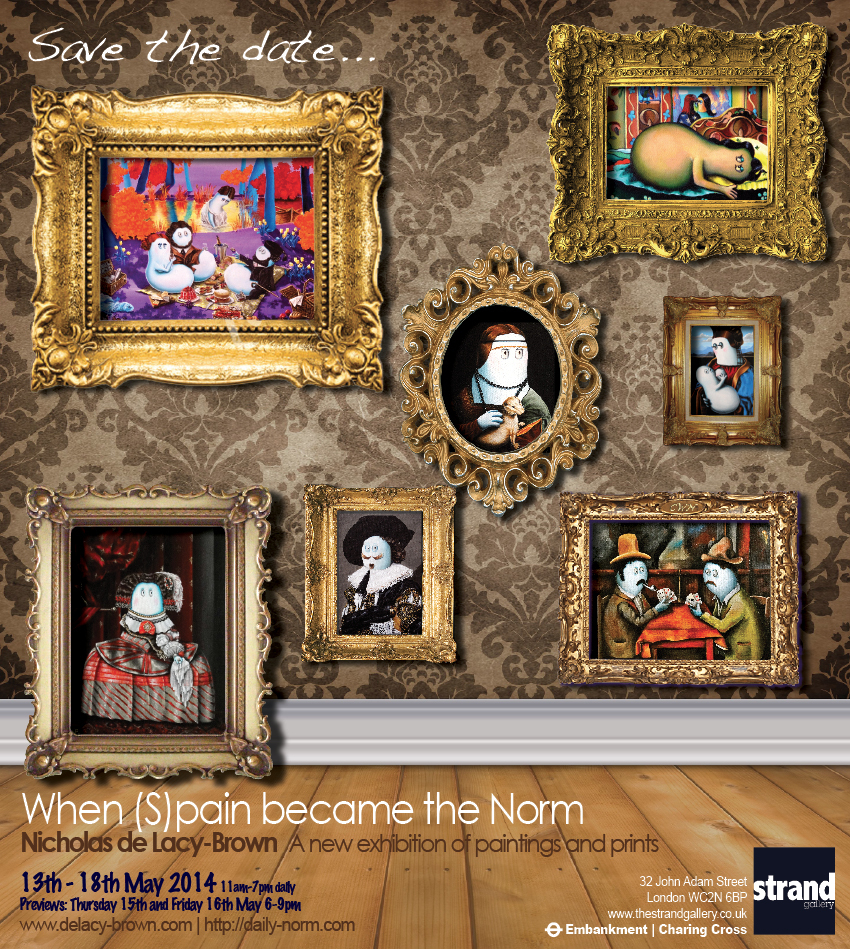
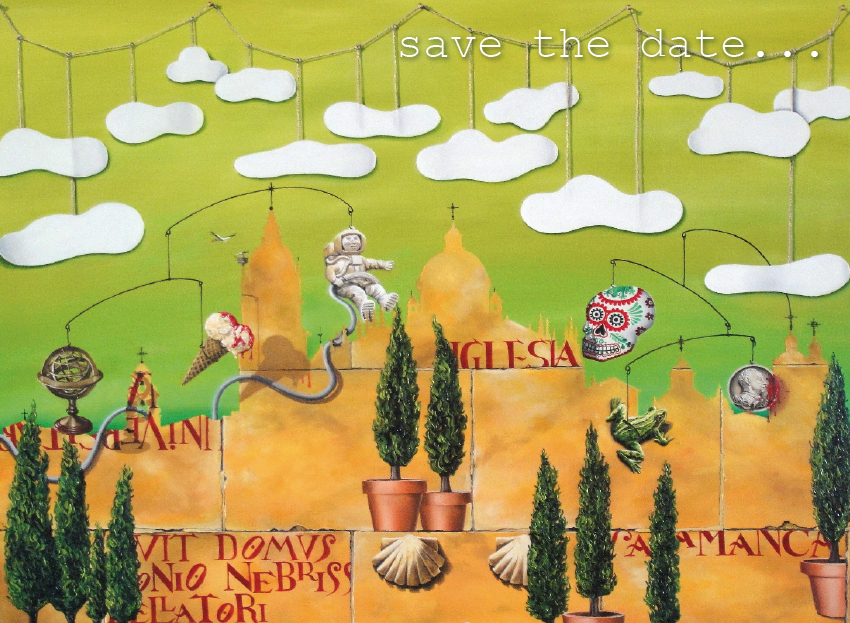
Save the date email frames FINAL

You’re bound to hear a lot more about the exhibition over the next few months, but in the meantime I leave you with the first of my official exhibition posters for the event whose launch marks the start of my marketing drive which commences this week. Just as that poster suggests, I ask that as many of my followers and readers alike consider marking the date in their diaries and heading over to London Town this May 13-18th, to share in this super special event with me.

More details of the exhibition and my art can be found at www.delacy-brown.com

Paris | Art tour 2013 – Braque

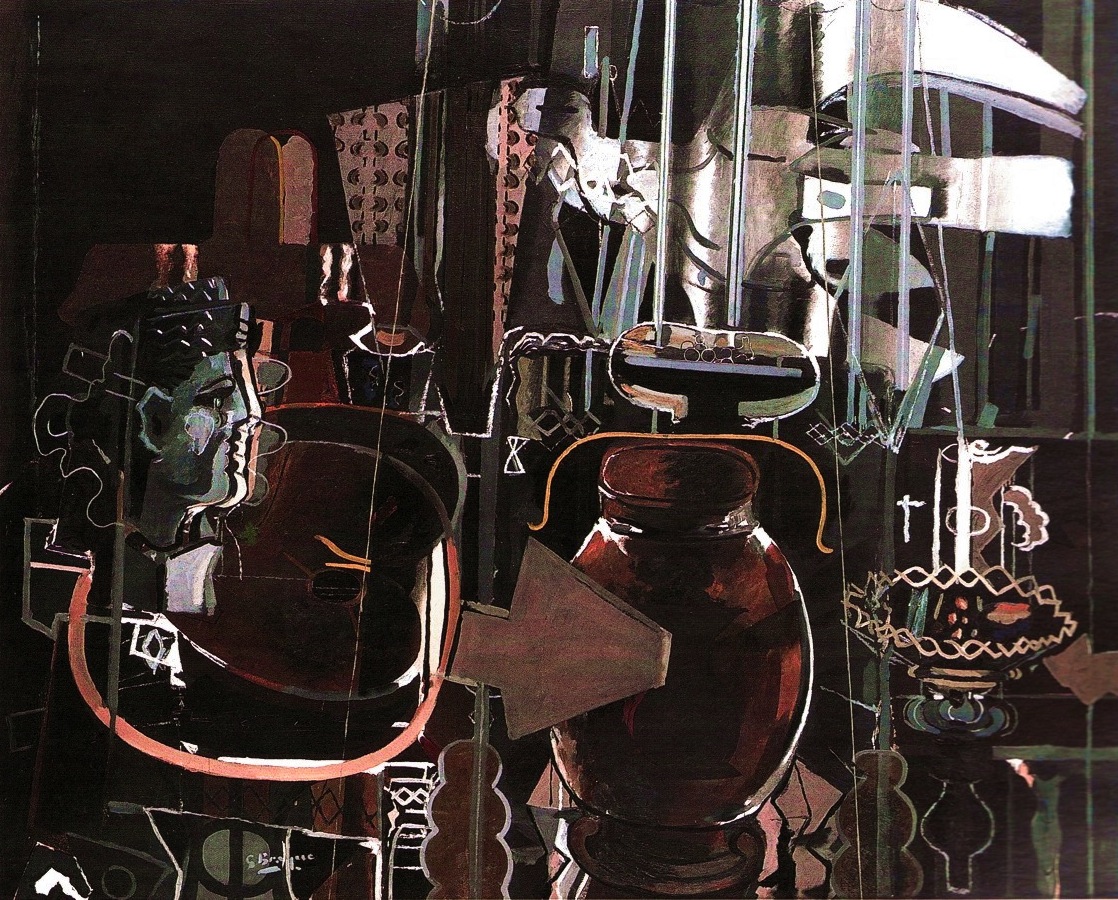
Lovers of 20th century art will all have heard of French-born artist Georges Braque. Of course I’ve heard of him too, renowned as he is for being co-founder of cubism along with the artist with whom he was thick and thieves in early 20th century Paris, Pablo Picasso. But my acquaintance with Braque has all too often occurred because, seeing a cubist masterpiece hanging in a modern art gallery, I have confused it with a Picasso, only to discover that the work was by Braque. It’s an easy mistake to make – the two artists were practically indecipherable from one another when they started out on the cubism road, a likeness of style which must be put down to the fact that they would discuss one another’s work endlessly day after day, night after night. And Braque was, purportedly, inspired into cubism by his glimpse of Picasso’s now world-famous Les Demoiselles d’Avignon, which few understood at the time, Braque being the exception.

So while Braque has, for me, existed solely in the shadows of the far glossier art historical existence of Picasso, I have never had the chance to discover how truly consistently brilliant he was as an artist. That is until this autumn, thanks to the latest blockbuster exhibition of Paris’ Grand Palais, which dedicates two floors of its palatial surrounds in retrospective homage to this French artistic great. I say consistently brilliant, because this show was one of those rare exhibitions where I literally loved almost every single piece, finding myself almost breathless with admiration as I strolled from painting to painting literally in love with what was on the walls before me.\

Early fauvism

The Port at La Ciotat (1907)

The Port at La Ciotat (1907)

Landscape in L'Estaque (1906)

Landscape in L’Estaque (1906)

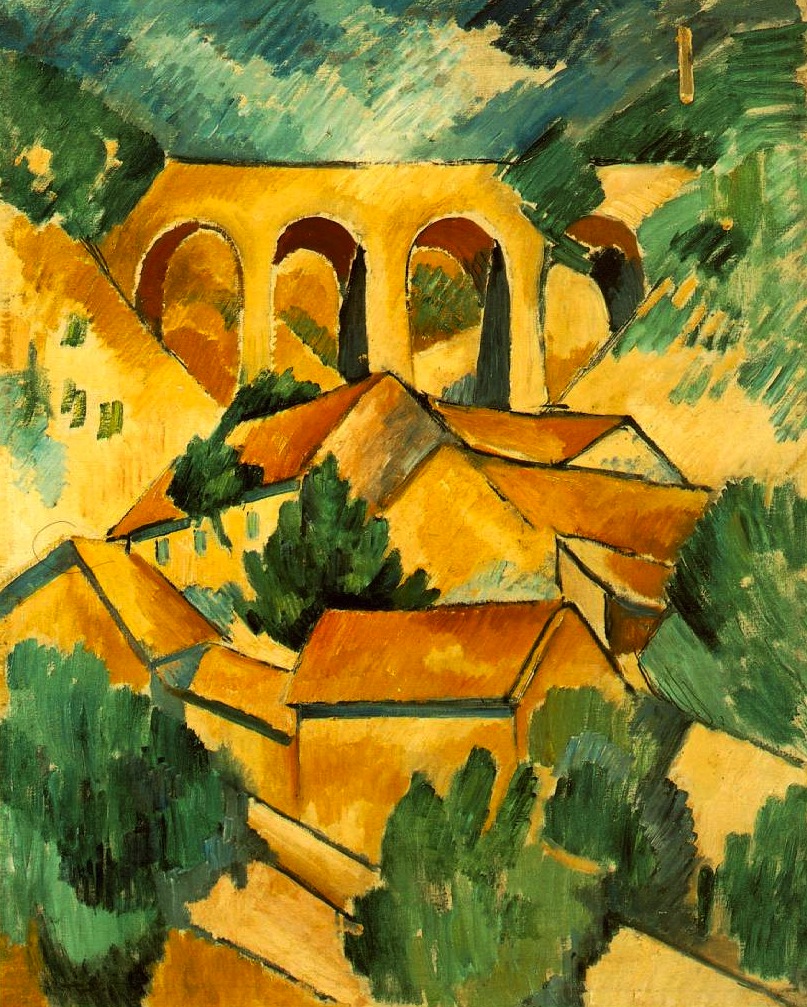
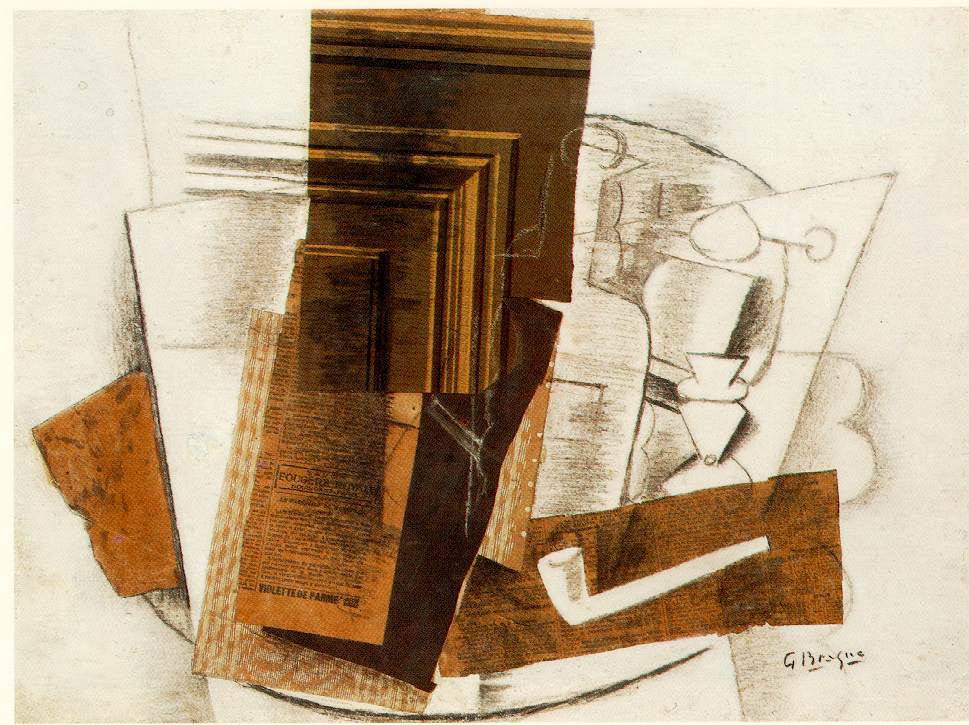
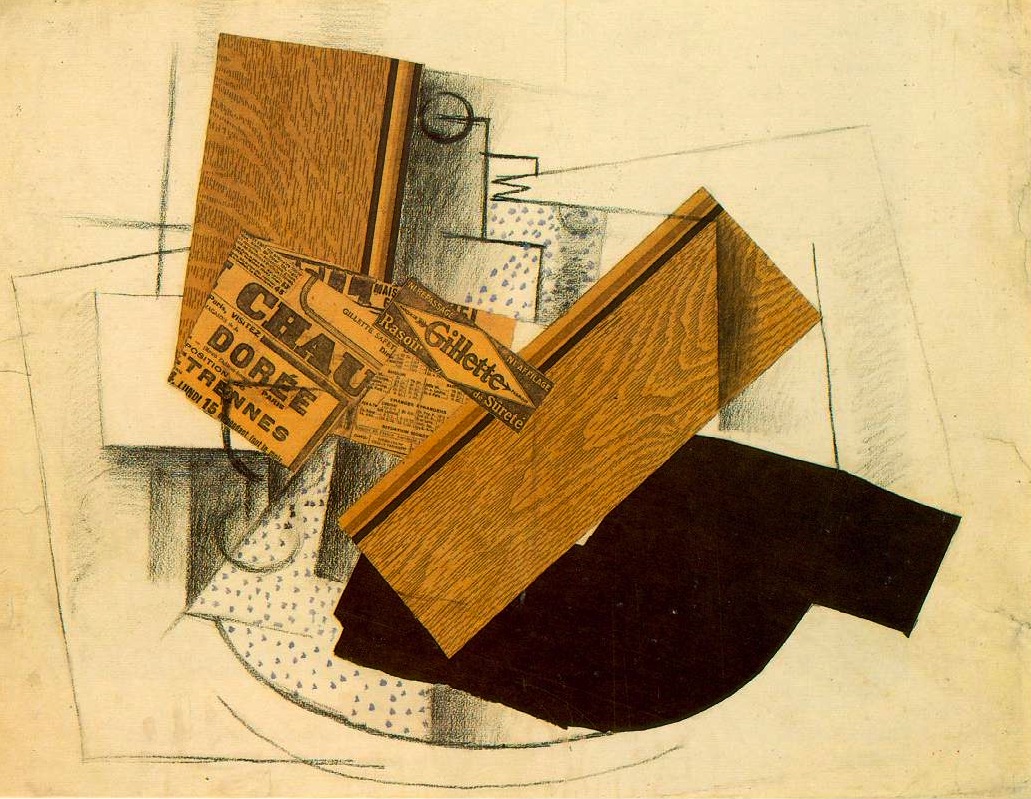
The show starts with early Braque, whereupon he dabbled largely in the fauvist epoque, with the result that his sunny landscapes of Southern France are imbued with scintillating bright colour which can not help but make the viewer yearn for the summer. But soon enough, after this initial embrace of colour, Braque discovers the more subdued shades of cubism, finding his own when fragmenting a scene into colourless, cubist dimensions. Seminal in cubism’s development was a chance visit to a wallpaper shop when Braque saw a reproduction wood-pattern paper in the window. Purchasing the wallpaper by impulse, it soon inspired Braque to set about creating a series of paper collages, which included, as well as the wallpaper, cardboard, newspaper cuttings – anything he could get his hands on. The effect of this geometric fragmentation was to create the cubist look, and soon enough Picasso was doing the same.

Into cubism, collage and then back to paint

Mandora (1909)

Mandora (1909)

The Viaduct at L'Estaque (1908)

The Viaduct at L’Estaque (1908)

Little Harbour in Normandy (1909)

Little Harbour in Normandy (1909)

Still life with pipe (1913)

Still life with pipe (1913)

Still life on a table with Gillette (1914)

Still life on a table with Gillette (1914)

Violin and Pipe (Le Quotidien) (1913)

Violin and Pipe (Le Quotidien) (1913)

back to painting.... Still Life with Fruit and Ace of Clubs (1913)

back to painting…. Still Life with Fruit and Ace of Clubs (1913)

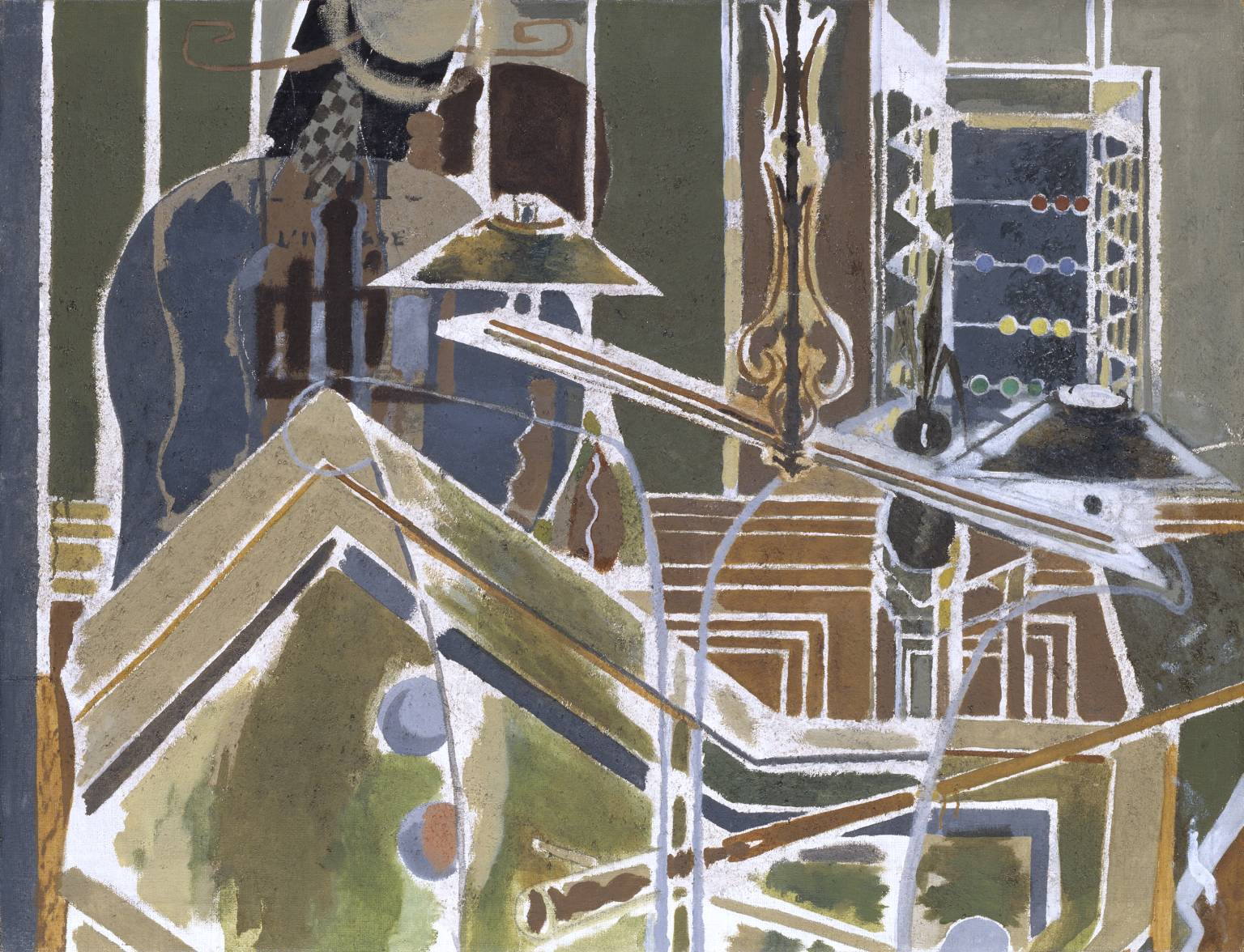
After several years of collage experimentation, Braque returned to paint, but using the medium to create what were almost pastiches of the collage look – still fragmented, full of geometric shapes, but differing in their progressive return to the bolder colours of his fauvist age, a return which was no doubt eased along by the weakening of his relationship with Picasso, and his strengthening bond with spirited Spanish artist, Juan Gris.

The Table (1928)

The Table (1928)

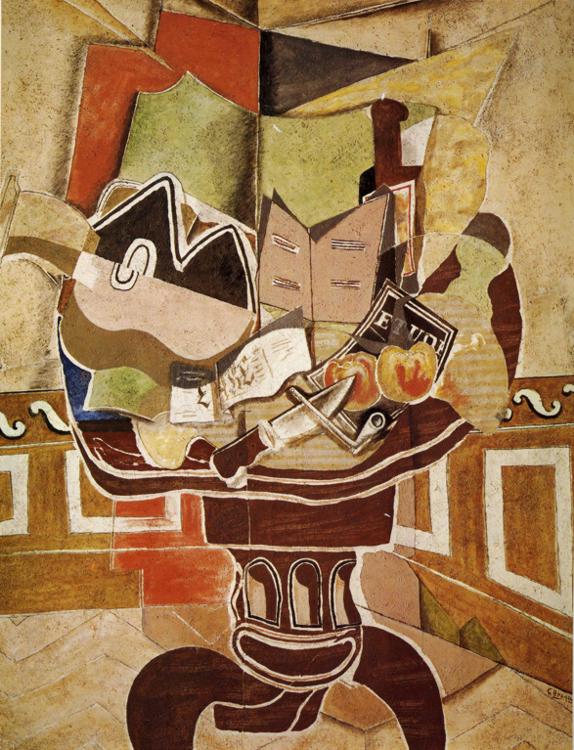
The Round Table (1929)

The Round Table (1929)

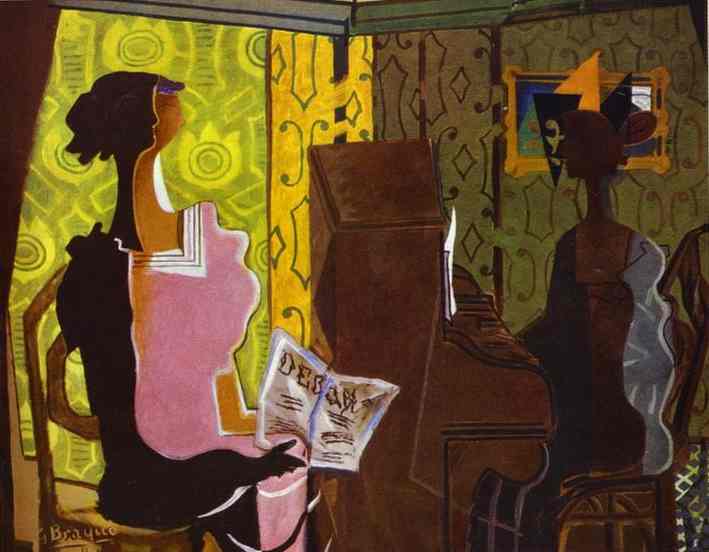
The Duet (1937)

The Duet (1937)

Studio II (1949)

Studio II (1949)

Studio with Skull (1938)

Studio with Skull (1938)

Thus it was that as the 20s and 30s ticked by, Braque’s work moved the cubist spirit further and further, as the artist pushed the boundaries of the movement he had helped to create, until such a time as his works become progressively more figurative, but all the while maintaining the multi-dimensional expression which was central to cubism. Take his billiard table series for example – seen from various angles, Braque’s bold green billiard table is shown from all kinds of impossible angles, and yet there is no mistaking what Braque was trying to depict.

The Billiard Table (1945)

The Billiard Table (1945)

I would be selling the show short to suggest that it all ended there. From colour-drenched fauvism to colour-collected cubism, Braque’s mastery extended to every avenue of life, as he used his pioneering imagery to depict portraits, artist’s studios, landscapes, still life and even greek mythology. From room to room we see an artist who never failed to be inspired, and to inspire his countless followers in response. Never again will Georges Braque be in Picasso’s shadow as far as I am concerned, but level pegging as a genius of 20th century art.

Georges Braque is showing at the Grand Palais, Paris until 6 January 2014.

Announcing the details of my May 2014 solo art exhibition!

After some 6 years in the waiting since I last exhibited as a solo artist in London, I am delighted to announce that in May 2014, I will be holding the most comprehensive survey of my art ever. Concentrating on three distinct periods of my artistic output, all of which have been integral to my development as an artist since my last solo show, When (S)pain became the Norm will display paintings grouped to reflect those periods – Pain, Spain and Norms.

In Pain, I will exhibit the often traumatic but importantly cathartic set of paintings which I created during the protracted three years of recovery after the major road traffic accident in which I was involved in 2008. In Spain, I explore my works based on Spanish society, history and culture, themes which have been so significant in influencing the direction of my work over the last decade. And finally in becoming the Norm, I exhibit the works which I created upon the initiation of this very blog; the new paintings which saw me reintroduce the Norm as a prominent icon of my art.

savethedate FRONT large Savethedate BACK large STRAND LOGO

This exciting exhibition, which will show over a hundred works ranging from large canvases to small Norm sketches will be hosted by the Strand Gallery, centrally located in John Adam Street just off the Strand in London’s Covent Garden. Bang next door to Charing Cross Station and a few hundred metres from Embankment tube station opposite the London Eye, I could barely wish for a more central gallery. And spread as it is across two floors, there should be plenty of space for my art to be shown at its very best.

The show will include…

Bricks and Stones May Break My Bones (The Show Must Go On) 2008 © Nicholas de Lacy-Brown, oil on canvas (130cm x 110cm)

Bricks and Stones May Break My Bones (The Show Must Go On) 2008 © Nicholas de Lacy-Brown, oil on canvas (130cm x 110cm)

¡Guerra! The Spanish Civil War (2009 © Nicholas de Lacy-Brown)

¡Guerra! The Spanish Civil War (2009 © Nicholas de Lacy-Brown)

Le Déjeuner sur l'herbe (after Manet) 2012 © Nicholas de Lacy-Brown, Oil on canvas

Le Déjeuner sur l’herbe (after Manet) 2012 © Nicholas de Lacy-Brown, Oil on canvas

And so the details – well these initial save the date flyers (above) pretty much say it all, and whether you live in London, in England, or far across the globe, I would encourage you all to make London your priority destination from 12th – 18th May 2014 for what I hope will be the most significant exhibition of my life so far.

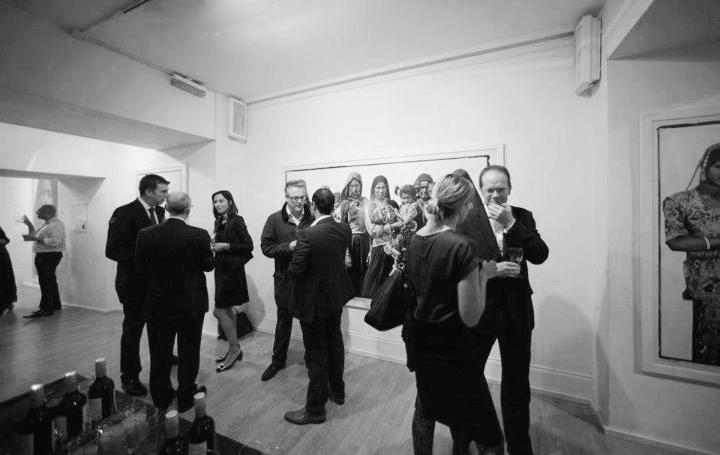
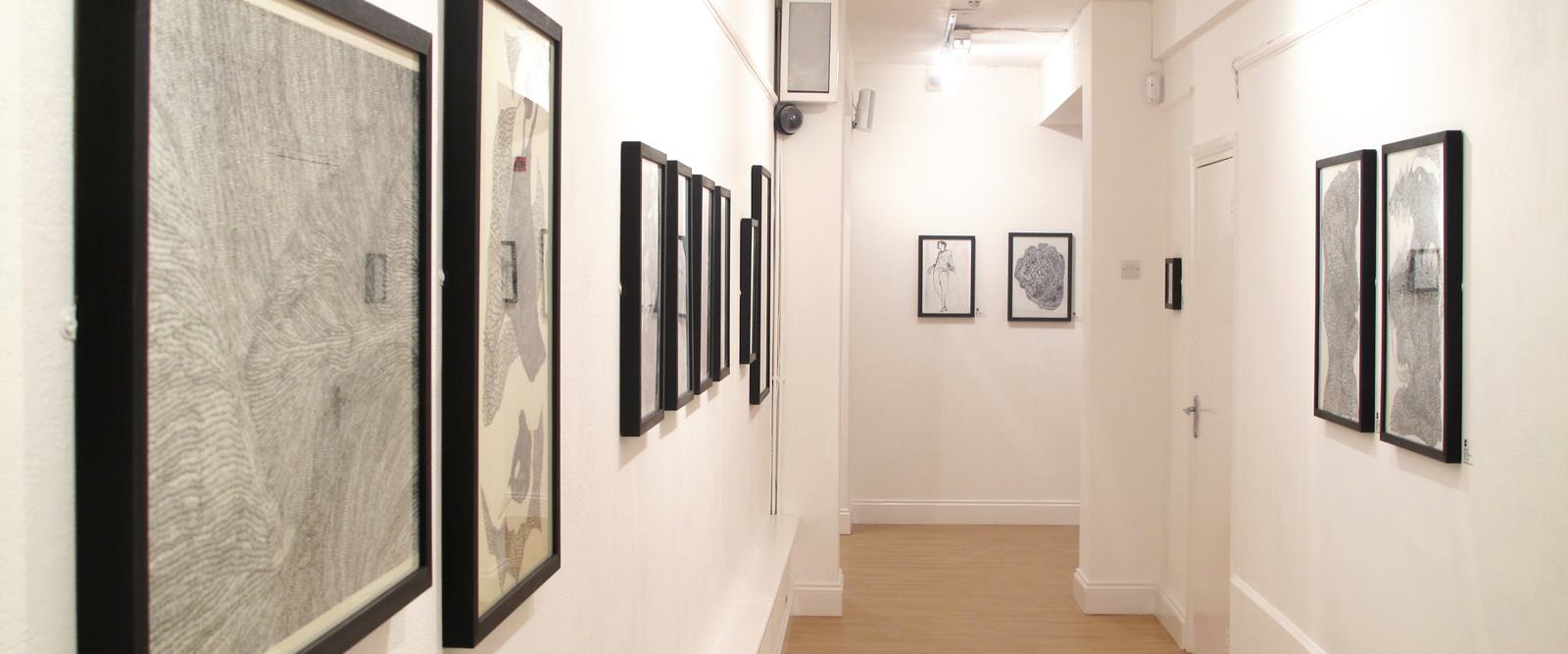
The inside of the gallery (albeit not with my works!) (Images © Strand Gallery)

The Strand Gallery Events Hire inside The Strand Gallery Events Hire (2)

So there it is – my show is announced, and readers of The Daily Norm can expect to hear a lot more about it over the next 6 months as the show week approaches. In the meantime, please put the dates in your diary, and get yourself ready for the show of my life.

All photos and written content are strictly the copyright of Nicholas de Lacy-Brown © 2013 and The Daily Norm. All rights are reserved. Unauthorized use and/or duplication of the material, whether written work, photography or artwork, included within The Daily Norm without express and written permission from The Daily Norm’s author and/or owner is strictly prohibited. Excerpts and links may be used, provided that full and clear credit is given to Nicholas de Lacy-Brown and The Daily Norm with appropriate and specific direction to the original content. For more information on the work of Nicholas de Lacy-Brown, head to his art website at www.delacy-brown.com