Skip to content

Posts tagged ‘Exhibition’

Johan Zoffany: Society Observed

If you’ve read my last few posts, you’ll probably  know that the weather in London is bleak, persistently grey, and wintery cold. Sorry to go on, but to be fair, it has been like this since the beginning of April. So while we all gasped a sign of understandable relief to have a bank holiday weekend with one extra day off work, I for one did not relish the enhanced days of freedom alongside what looked to be a weather forecast stuck somewhere in December. So what to do with a wintery weekend in May save for staying in bed? Why, a good old exhibition of course.
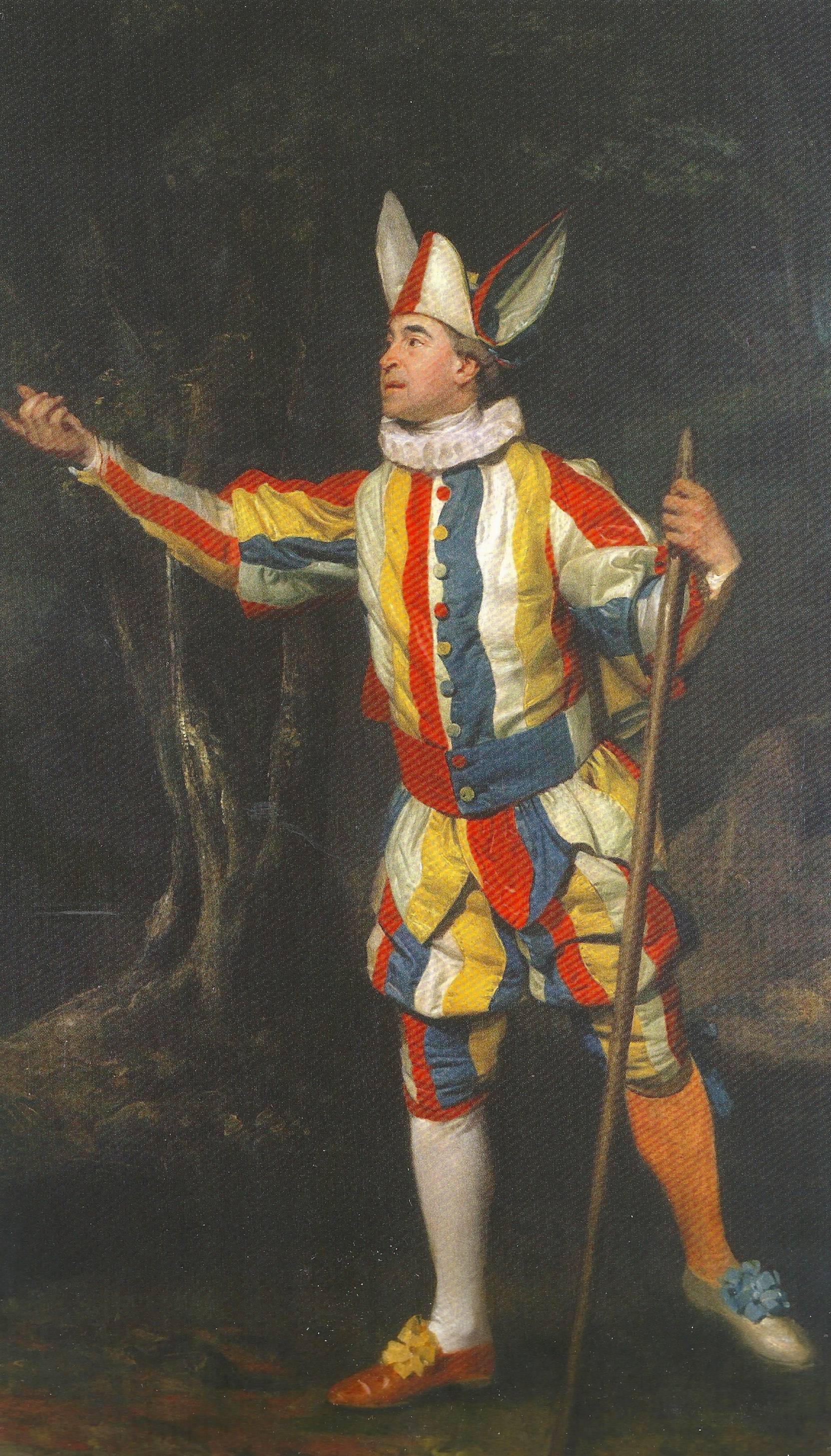
Thomas King as Touchstone in ‘As You Like It’ (1780)

London has been the European capital of exhibitions this year, from David Hockney for which queues formed an hour before opening and extended long past the Royal Academy courtyard until closing, to that Da Vinci spectacular at the National Gallery, for which queues not only spiraled around the whole of the West End, but tickets started reaching astronomical figures in the dark and dangerous world of the black market. We’ve had a bit of Picasso, and a whole show devoted to Lucien Freud, and now we have the master of marketing manipulation himself, Damien Hirst, installed at Tate Modern. But otherwise things are drying up a bit on the exhibition front, with some new shows promised towards the end of the year, but nothing compared to the blockbuster paroxysm which we had at the start (I’m not too sure why they decided to show the best stuff at the beginning of the year before the Olympics start… but owing to the ridiculous crowds experienced when it was just us Brits in tow, it’s probably a good thing that we didn’t have to compete with the rest of the world in the galleries as well).

Henry Knight of Tythegston with his Three Children (1770)

So this weekend I had a choice of Hirst, which I’m trying to put off for as along as possible because he makes me angry, Nicholson/ Mondrian which looks a bit geometric, Turner, which is all very well but a bit samey, and this Zoffany chap at the Royal Academy. I’ve never heard of Zoffany before, but seeing as the Royal Academy is currently in a visitor loll, after the close of Hockney and before the opening of their annual car crash – The Summer Exhibition – I decided to give him a go.

Johan Zoffany (1733-1810) was born in Frankfurt, Germany, but moved to England at the age of 27. A keen socialite and excellent networker, he soon found himself the darling of the rich, influential aristocrats and profligate patrons of the age. Within four years he was enjoying the patronage of King George III and his wife Queen Charlotte, and was also the beloved of the Austrian Royals, being created a Baron by the Archduchess Maria Theresa at the age of 33.

Zoffany was a keen social observer. Through his connections in high society, and through his friendship of leading actor of the  time David Garrick, Zoffany was afforded countless opportunities to paint scenes enriched by the lively portrayals of contemporary society, from lavish theatrical productions of Shakespeare’s As You Like It and Macbeth, to complex portrayals of musician troupes, families in conversation and at play, large social gatherings watching cock fights in India and attending the Uffizi in Florence, and the Royal Family in both formal attire, and playing dress up.
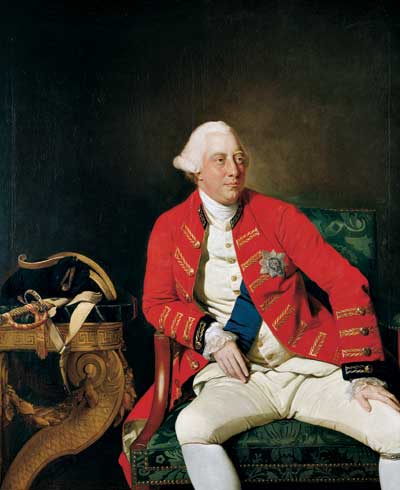
George III (1771)

The distinctive thing about Zoffany’s works is this element of social interaction which he portrays. Unlike many portrait painters of his day, he did not paint head to toe, stiffly posed portraits. Rather he painted his sitters, both singularly, as couples or as large groups, interacting and in the course of “doing”. For this reason, his paintings are both wonderfully natural, and appear to represent a highly realistic snapshot on society of that day. This realism is of course vastly augmented by his meticulous attention to detail and his impeccably intricate fashioning of fabrics, furniture, interiors and objects.

The show starts with a number of mythological and allegorical pieces. One of my favourites was this, David with the Head of Goliath (1756). Some have asserted that the piece is a self-portrait, others disagree, but all comment upon what appears to be the purposeful homoerotic and phallic nature of the piece, as David’s sling hangs close to Goliath’s open mouth, while David stares out provocatively, holding what appears to be the glans of a marble phallus from an antique sculpture in his hand.

David with the Head of Goliath (1756) National Gallery of Victoria, Melbourne.

Of Zoffany’s various Court paintings, my favourite was this one, showing Queen Charlotte with her sons George, Prince of Wales, and Frederick, Duke of York. Asides from the cuteness of the young prices dressing up, one as Telemachus, son of Odysseus from Homer’s Odyssey, and the other in a Turkish costume, the thing that struck me most about this painting was the stunningly executed drapery of Queen Charlotte’s dress, painted with exquisite skill and attention to detail.
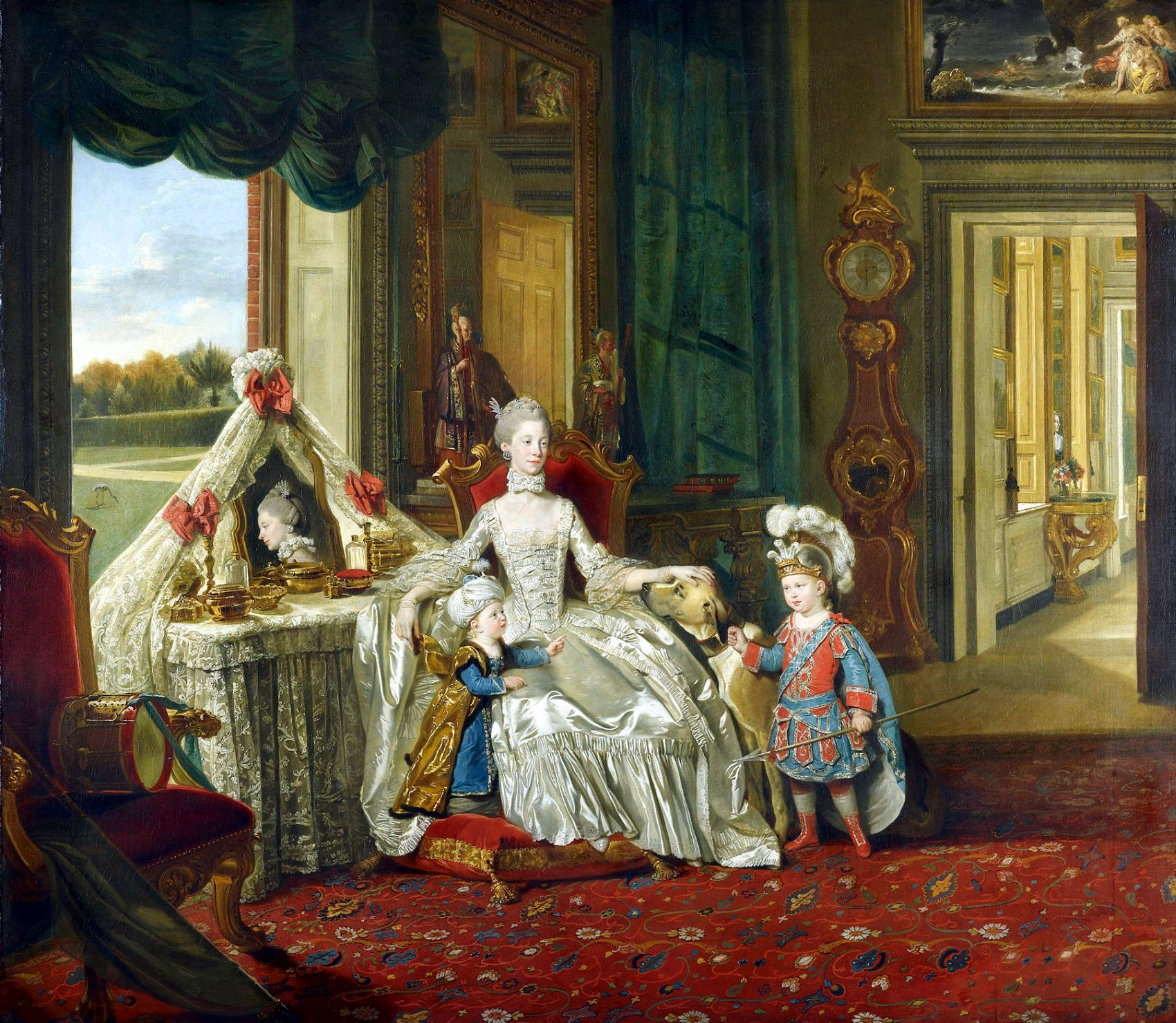
Queen Charlotte with her Two Eldest Sons (1764-5), The Royal Collection of HM Queen Elizabeth II

It wasn’t all high society that Zoffany observed. This painting, of an optician with his attendant, exhibits with great sensitivity two ageing craftsmen in a cluttered workshop filled with a plethora of materials each painted with intricacy and realism. For me, it is reminiscent of a an old Dutch interior scene by the likes of Vermeer, but with the added intensity and captivating quality held in the direct gaze of Mr Cuff the optician.

John Cuff and his Assistant (1772), The Royal Collection of HM Queen Elizabeth II

Zoffany’s real skill lay not only in social observation, but in his attention to detail. One of my stand out favourites of the exhibition was this painting, showing the library of Charles Townley complete with a large variety of sculptures from antiquity echoing the grand tour travels which were so fashionable in those days across continental Europe, and in which Zoffany too indulged when he went to Italy for a number of years at the behest of his patron, Queen Charlotte.

Charles Townley’s Library No. 7 Park Street, Westminster (1781-3, 1792, 1798)

Finally I loved this group portrait of the Sharp family, a family of musicians who used to gather together once a fortnight to give performances. In the summer these performances were given by the Sharps on yachts, shallops and barges in what they termed “Water Scheems”, becoming so well known in doing so that they captured the attention of George III himself. This painting shows one such gathering on a barge on the River Thames – you can see Fulham Church in the background.
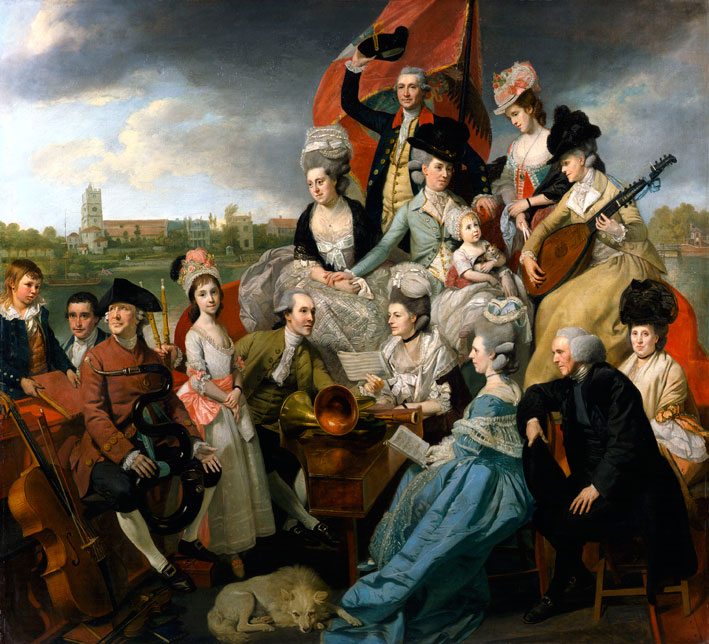
The Sharp Family (1779-81), National Portrait Gallery

This exhibition just goes to show that sometimes it’s the old masters and past artists, although perhaps lesser known, but whose skill is nonetheless indubitable, that really shine. The Hockneys and the Hirsts of this world may pull the crowds, seduced and manipulated as they are by the media sway, but the real treasures are to be found in the oeuvres of the past masters, painters who worked at a time when skill was King, and an unmade bed was swiftly remade and freshened, not displayed in a gallery or proclaimed a masterpiece of art. We can always live in hope that such days of aesthetic appreciation and just reward will return. In the meantime head along to the Royal Academy. The show is on until 10 June 2012.

Lucian Freud Portraits

Roll up roll up for the 2012 London Cultural Olympiad. All the big wigs of the Brit-art A-list are in town, the banners are up, and the art posters line the saturated platforms of the underground as the PR machine goes into overdrive. As if in response to the cattle cry, the crowds have come to town –  the galleries are packed, the gallery restaurants have waiting times of over an hour, and the gallery shops are partitioned by huge queues of customers cashing in on memorabilia of these big-billed art shows. It’s all really quite stressful.

Next in line to meet my sampling eye was the Lucian Freud portraits retrospective at London’s National Portrait Gallery. Having been in the pipeline for some time, and organised in collaboration with the artist himself, the NPG’s exhibition gained additional poignance when, last July, Lucian Freud died at the ripe old age of 88. He did so working right up until the end, and his unfinished portrait of his studio assistant and dog hangs at the climax of the show.

Portrait of the Hound (2011)

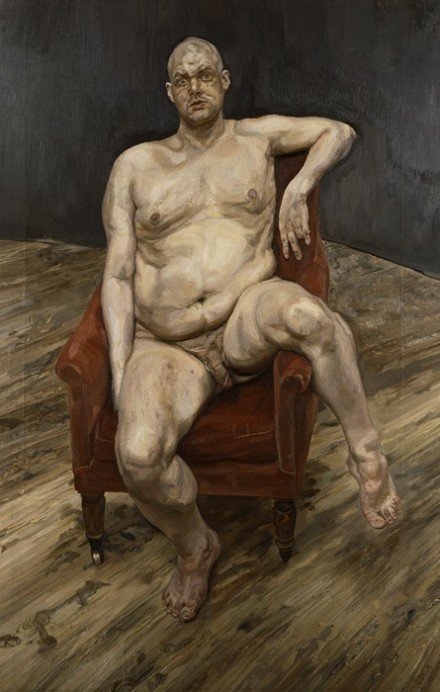
There is no doubting Freud’s stature as a preeminent star of British art. When his painting, Benefits Supervisor Sleeping, sold at Christie’s in New York for the sum of US$33.6million in 2008, it broke the record for the highest price paid for a painting by a living artist. It is consequently appropriate that he should be lined up along with the likes of David Hockney and Damien Hirst for blockbuster solo exhibitions which promise to showcase British art to the world. It is also appropriate that the show focuses on his portraits, for Lucian Freud is long associated with his unforgiving nudes, painted with a multi-layered impasto application of fleshy pale paint, striking often uncomfortable and usually unflattering poses, and portraying a deeply penetrated psychological profile cast free from boundaries, clutter or clothing for full and frank disclosure to the world.

Benefits Supervisor Sleeping (1995)

Leigh Bowery (Seated) (1990)

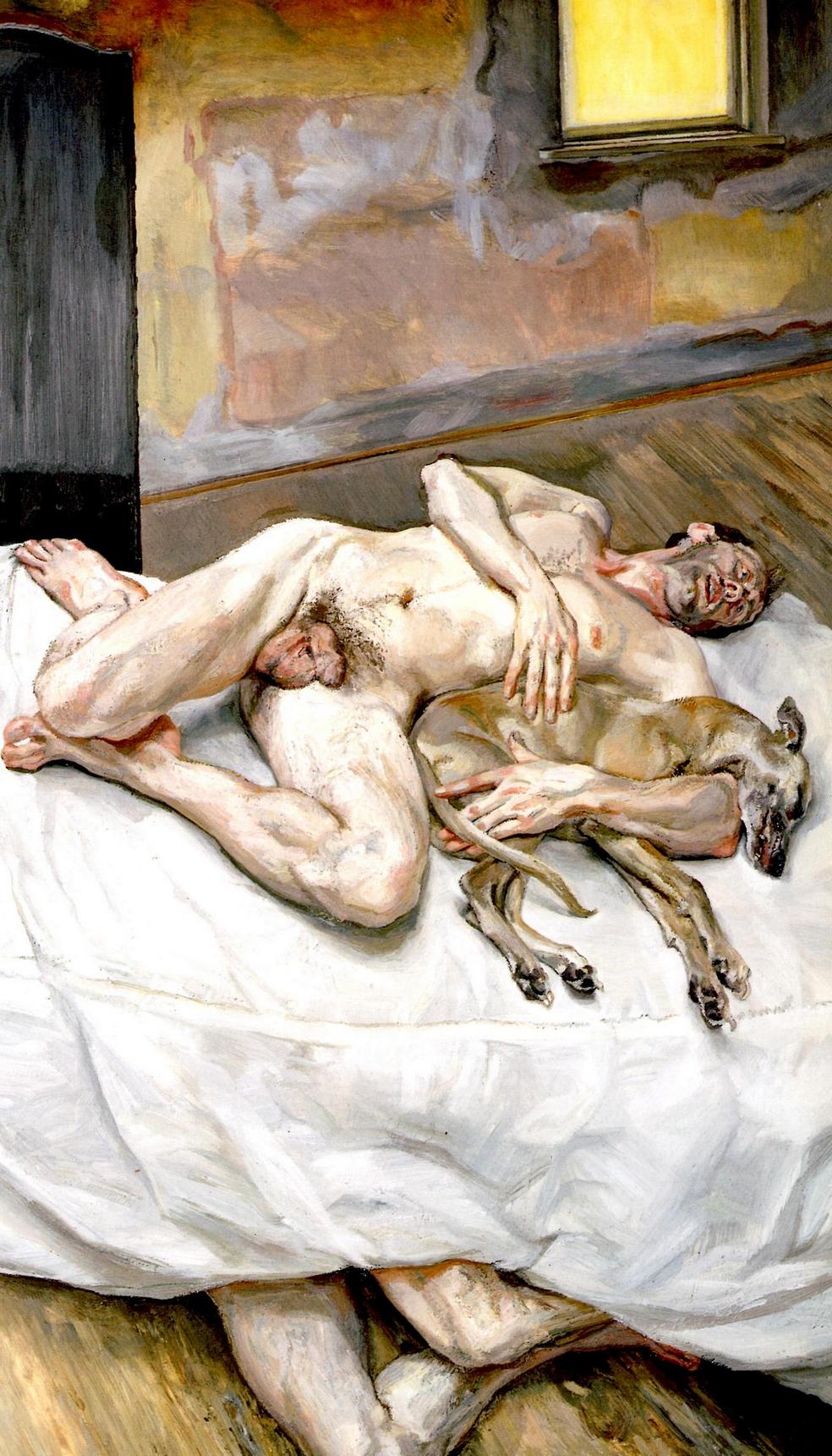
In this show, the NPG give us plenty of raw unabashed flesh to stare at, as Freud’s emboldened, unrepentant portraits confront the audience rather than seduce. In the galleries, there was an almost tangible electricity in the air, as the scale of the show and the sheer number of these awkwardly posed nudes threw light on the often disconcerting relationships between artist and model, the somewhat fragmented and awkward relationship between artist and children, and the range of dynamic but often slightly disturbing characters on show.

Sunny Morning - Eight Legs (1997)

The paintings are never going to be easy to look at, not least because these are not ideological nudes. This is not like looking at the beautifully blended, perfectly shaped backside of the Rokeby Venus (by Velazquez) and appreciating the aesthetics of the scene. These portraits depict ordinary people, with very ordinary bodies in no holds barred portrayal, pubic hair out, penises dangling, sagging flesh. It would be like walking along the street and seeing everyone naked, their legs parted awkwardly, their private parts on full view. It’s not easy to look at, but these portraits are undoubtedly fascinating to view, just because they are ordinary people – people who have bared all to the artist and, through him, to the world.

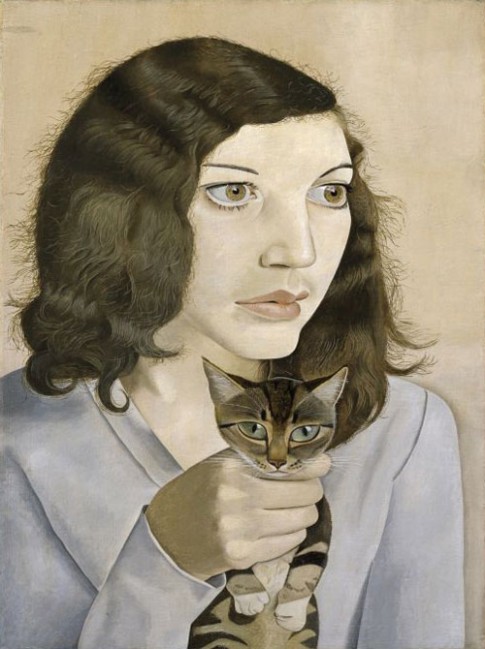
Girl with a Kitten (1947)

Nonetheless, emblematically Freudian impasto flesh asides, my favourite paintings were those from the beginning of Freud’s career. In this delightfully chronologically curated show, the first few galleries, while packed, showed Freud’s fastidiously executed, perfectly drafted early portraits, when he used very fine brushes and paid close attention to every detail. Thus in the portraits of his first wife, Kitty Garman, you can see every hair on her head, and in the portrait of her wearing a yellow gown (with boob unceremoniously flopping out), each fibre of that gown’s toweling texture is painted. As Freud’s portraits grew less detailed and Freud’s preference was for thicker sable brushes, he still paid close attention to a number of background factors in his work. In Interior with Plant, Reflection Listening (1968) for example, the leaves of the plant are painted with excruciating detail – every millimeter of the plant, from its shiny leaves and rough edges, to the dying leaves and dried up ends, are perfectly represented by Freud. His early paintings have lost none of their intensity in being scrupulously painted – the sitters look tense, and the widened eyes, typical of Freud’s portraits at that time, are full of emotional anxiety and unguarded vulnerability. From the very beginning, Freud had an exceptional talent for painting simple portraits loaded with dramatic tension and emotional complexity.

Girl with a White Dog (1950-51)

Interior with Plant, Reflection Listening (Self-Portrait) (1967-8)

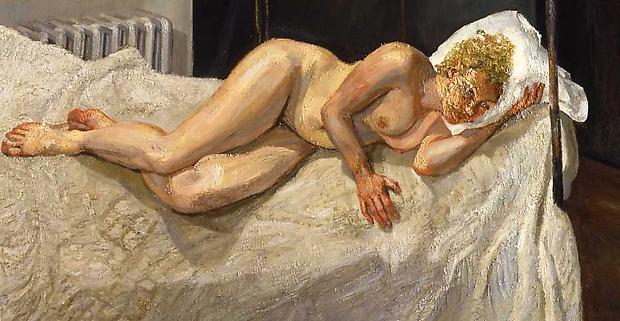
As the show goes on, the works become more ambitious and the nakedness more frequent. This is all very well, but what upset me was not the nudity, but the increased coarseness of Freud’s finish. From his Benefits Supervisor onwards, the texture of his paint finish becomes more and more lumpy which really made my stomach turn. In his 2007 portrait, Ria, Naked Portrait, the face of Ria appears disfigured by a mass of lumpy built up textured paint on her face, which looks more like the affliction of some terrible skin disease. The effect is the same in his final, unfinished painting, Portrait of the Hound (above) where the face of his studio assistant appears contaminated by the same warty contagion. It’s an unpleasant finish which rather repulsed me as I walked away from this show.

Ria, Naked Portrait (2006-7)

Still, this messy end did nothing to dissuade me of the overall merits of this show, and the superb skill which Freud demonstrated throughout his career. Through his paintings, he has created self-contained independent souls who appear to jump from the canvas and steal the attention of the viewer. In this way, Freud leaves behind a multifaceted legacy which will live on wherever his portraits hang. In the meantime, this opportunity to see so many hung together is truly a must-see, and so much more fulfilling than 5 million purple trees lauded down the road in Piccadilly.

Painter and Model (1986-7)

All images above are the copyright of Lucian Freud.

Grayson Perry: Tomb of the Unknown Craftsman

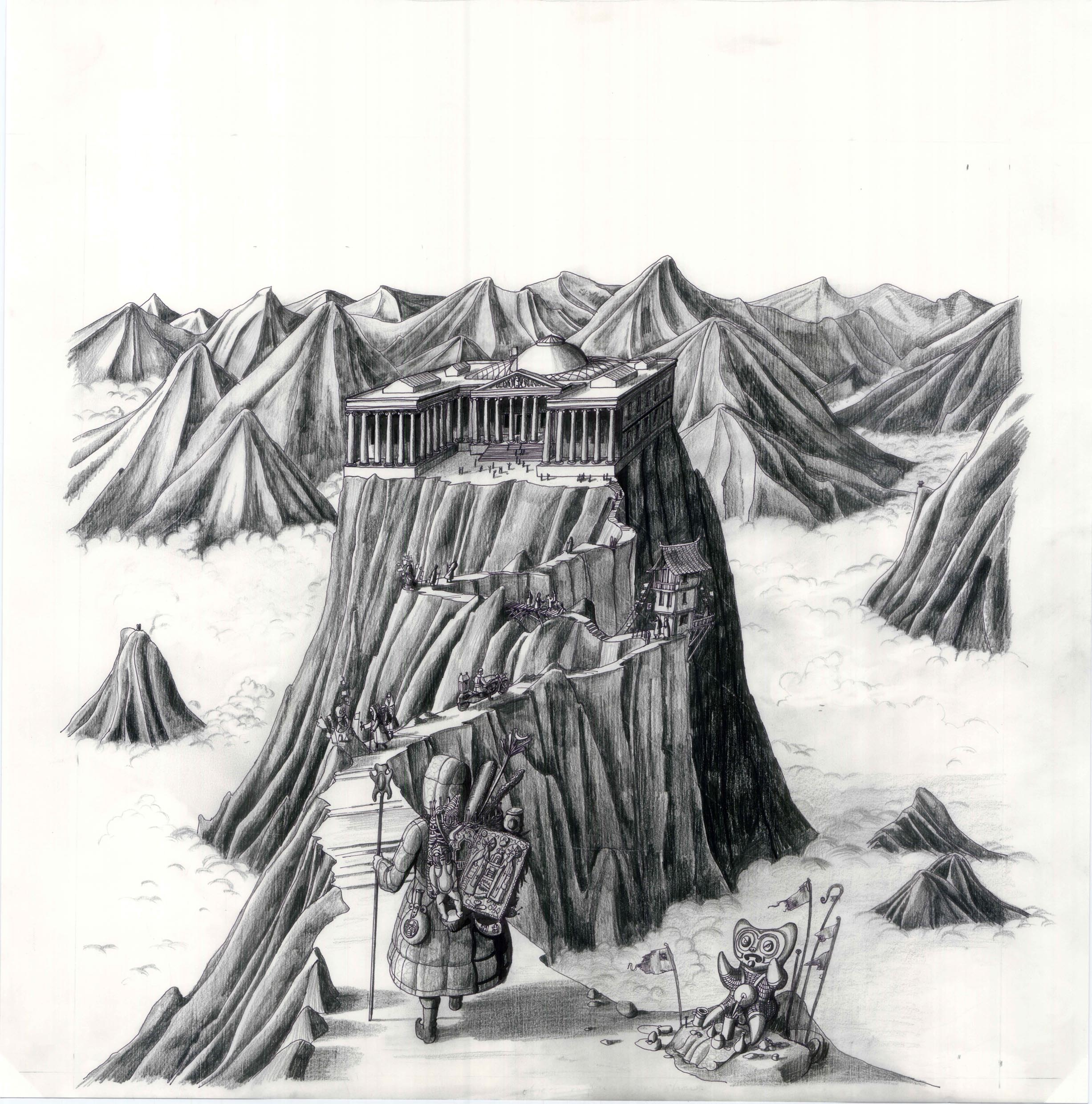
Pilgrimage to the British Museum. Ink and graphite, 2011 © Grayson Perry

There is not praise enough for this superb, unusual and highly original exhibition which is currently being held at the British Museum in London. Combining works from the British Museum’s collection of ancient and historical importance, with the hyper-contemporary artistic musings of infamous cross-dressing artist, Grayson Perry, the British Museum has put on a show which departs radically from its mainstay shows of ancient China, ancient Lebanon, ancient Iran and so on. This utterly inventive exhibition is not only a refreshing change for the British Museum, but also for British contemporary art. For through Grayson Perry we have an artist who does not speak his mind for the sake of being controversial, but who, as a philosopher of our times, makes objective, shrewd and rational observations about the madness of today’s society. And he does so not in a way that is patronising or judgmental, but through works which are accessible, original and imbued with a sophisticated yet unpretentious sense of humour. And thus, amidst the requisite hushed silence of a London gallery, giggles, chuckles and sometimes outright guffaws broke through the air as the attendees of the exhibition relished in the exquisitely imaginative creations of Perry’s show.

Grayson Perry's teddy, Alan Measles

So what is the exhibition all about? Well, it basically gives Grayson Perry free reign to indulge in the unhindered realms of his imagination. Perry’s show thus takes the audience on a “pilgrimage” into his imaginary world, a world which revolves around his childhood teddy bear, Alan Measles, as the central protagonist. As the “god” of this imagined reality, the little teddy bear is expressed in a variety of religious personae, from temple keeper to the enshrined teddy as Perry explores themes connected with notions of craftsmanship in faith and sacred journeys – from shamanism, magic and holy relics to motorbikes, identity and contemporary culture. In fact, Perry and his teddy went on their own pilgrimage as a precursor to the exhibition, taking a trip on a wonderful decorated motorbike, complete with it’s own attached temple for Teddy, to Germany, the country which, in Perry’s youthful fantasies, Alan Measles had been at war with, the brave warrior in his turbulent childhood imagination. As the pilgrimage is transposed from physical journey to metaphorical odyssey through the carefully curated exhibition, we are taken through a winding gallery space, fit to bursting with a tempting display of rich glossy potteries and gems of the British Museum collection, extravagant Perry designed tapestries and plentiful shrines to Alan Measles. At its completion, the pilgrim trail concludes at the foot of a richly decorated cast-iron ship, a memorial to all the anonymous individuals that over the centuries have fashioned the handmade wonders of the world.

Read more