

Sunday Supplement: The Seville Triptych
It’s an early 2012 Spanish Season here at the Daily Norm, and what better thoughts to fill your head at this time of ferocious cold across much of the Northern Hemisphere. Here in Spain the snow hasn’t reached us, but the winds were almighty and angry. On emerging from home yesterday we found much of Marbella’s lush greenery had hit the ground. A crying shame, but such is the rapid growth of the plants out here, I’m sure many of the gaps will have filled come July.
In line with this short season of Spanish indulgence, today’s Sunday Supplement pays homage to one of Andalucía’s most famous and exquisite cities: Seville. Having travelled there in the Spring of 2010 my mind rapidly filled with numerous ideas with all the energy of a kindergarten playground. What resulted was not one, not two, but three canvases portraying the city, which, when placed together flow seamlessly into one complete panegyric to Spain’s southern gem.

Seville Triptych - Canvas I (Oil on canvas, 2010 © Nicholas de Lacy-Brown)
Prominent in the first canvas is a beautiful Spanish lady. Some asked if I had painted Amy Winehouse. Au contraire – this is the infamous Sevillian femme fatale, Carmen, immortalised in Bizet’s opera, seductive in her gaze, languidly smoking a cigarette from a packet which is decorated with the ceramic signage of the Tobacco factory where Carmen worked – a factory which today stands beautifully as ever in the centre of the city, now converted into a university. Beneath her traditional black lace mantilla which, in part, is used as a fisherman’s net, are the paraphernalia of the matador, Escamillo who, in Bizet’s operatic tale, prompted such jealousy in Carmen’s lover Don José that it led to her eventual downfall. Also in this canvas are the Moorish walls of Seville’s Real Alcazar palace, harping back to the city’s Moorish past, which is also embodied in the Torre del Oro which stands by Seville’s Guadalquivir river. Across the river, the bridge designed by Gustav Eiffel features, while from the fishing nets, floating buoys become the oranges for which Seville is renowned throughout the world. Meanwhile the flower from fragrant orange blossom adorns Carmen’s ear, while above her head, the architectural splendour of the ceramic-covered Plaza de España emerges. Finally, sat like a spider upon the ground, the elaborate gothic architecture of Seville’s great cathedral is featured in a vibrant purple.
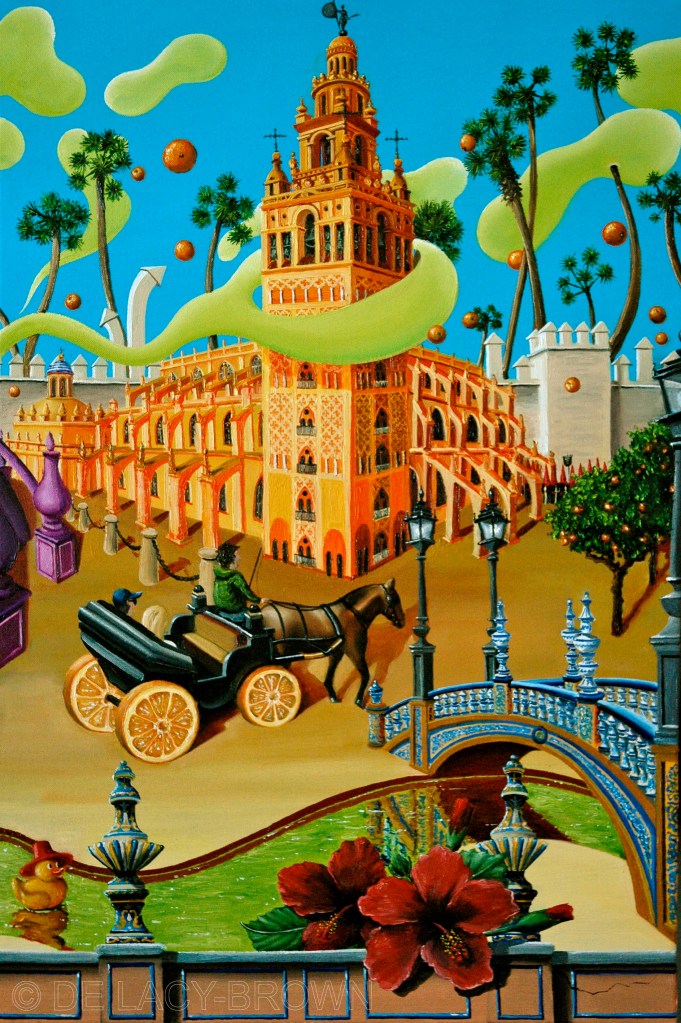
Seville Triptych - Canvas II (Oil on canvas, 2010 © Nicholas de Lacy-Brown)
In the second canvas, the Giralda bell tower and the adjoining magnificent cathedral take centre stage, enveloped by the smoke of Carmen’s cigarette smoke. The angle of the building shows off its magnificent gothic details as well as the Moorish features on the lower section of the Giralda tower which is retained from Seville’s Moorish past. In front of the cathedral, a common site of Seville is featured – the horse and cart – whose characteristic yellow wheels are replaced with orange slices. Meanwhile, the distinctive blue and white ceramic bridge of the Plaza de España signifies that here, the river has become the pleasure lake which is central to the Plaza de España complex.
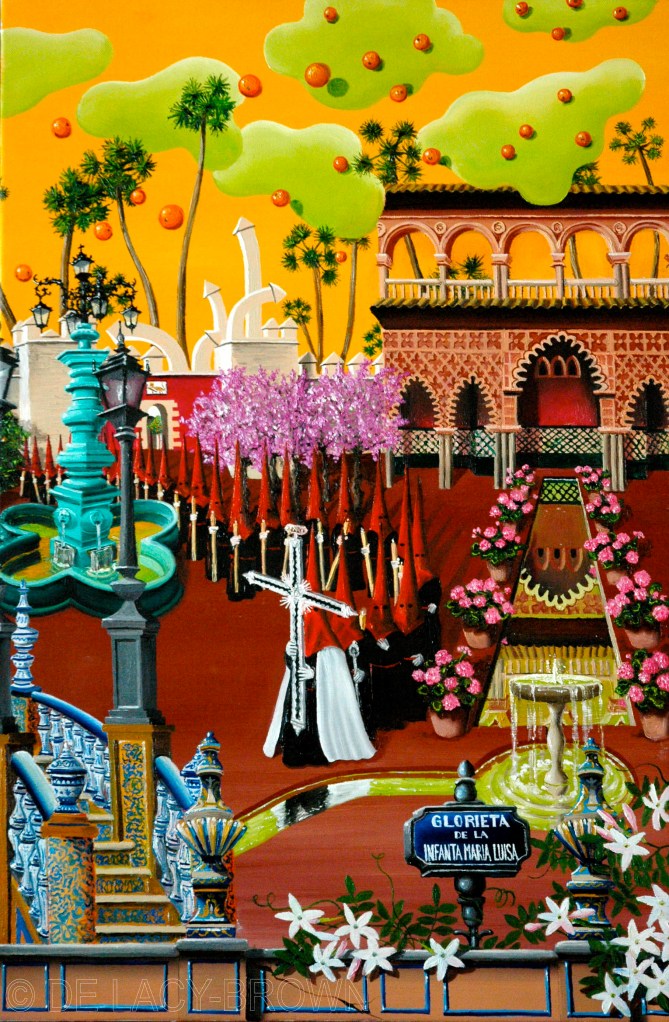
Seville Triptych - Canvas III (Oil on canvas, 2010 © Nicholas de Lacy-Brown)
The third canvas is testament to Andalucía’s complex religious history, from the Moorish architecture which features strongly in the Real Alcazar palace, to the staunchly catholic Semana Santa (Easter Week) parades which are famous throughout Andalucía but most especially in Seville. In the foreground there is a decorative sign from the Parque Maria Luisa, which appears to emanate from the modernist age of design, while in the background, the pointed battlements of the Moorish city walls appear freed from the uniform constraints of their design, playfully reaching for the skies.
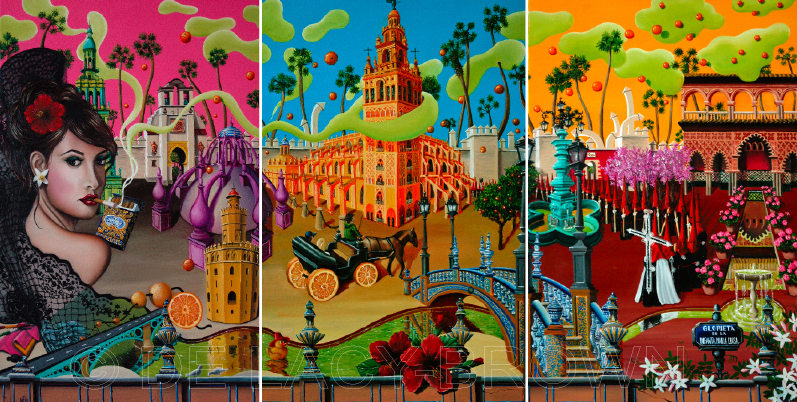
Seville Triptych - the complete triptych (Oil on canvas, 2010 © Nicholas de Lacy-Brown)
Across the three paintings, several unifying features dominate: In the immediate foreground are the walls and ceramic decorations of the Plaza de España, and behind it the River Guadalquivir which, in the second canvas becomes the pleasure pools of the Plaza de España and, by the third canvas, has turned into the Moorish pools of the Alcazar palace. In the background, the distinctive slender palm trees which pepper the cityscape and a shower of Seville oranges scatter the painting, while along the horizon, the walls of the Real Alcazar unify the canvas.
© Nicholas de Lacy-Brown and The Daily Norm, 2005-2012. Unauthorized use and/or duplication of the material, whether written work or artwork, included within The Daily Norm without express and written permission from The Daily Norm’s author and/or owner is strictly prohibited. Excerpts and links may be used, provided that full and clear credit is given to Nicholas de Lacy-Brown and The Daily Norm with appropriate and specific direction to the original content.
Related articles
- Seville, the Alcazar and Cathedral – Seville, Spain (travelpod.com)
- Seville – Street Lights and Bullrings (acfong.wordpress.com)
- A Postcard from Seville (eatlikeagirl.com)


 The Daily Norm