Skip to content

Posts tagged ‘Gouache’

Art-in-Amalfi – Painting 1: Positano I (viewed from the beach)

Having seen my post of photos on yesterday’s Daily Normand perhaps even my photos of the incredible views which we were lucky enough to enjoy for our week’s stay at the Palazzo Talamo Hotel, you will easy to understand why I was inspired to create by the town of Positano on Italy’s Amalfi Coast. Not only is the town a picture perfect dazzlement of beautiful houses clustered against a vast imposing mountain backdrop, but it is also a riot of pastel colours in an otherwise natural landscape of verdant greenery and sheer greyish purple rock. The most striking thing about Positano is the fact that the small town appears to defy nature as a small cluster of dwellings clinging, almost like limpits, to the sheer side of the otherwise inhospitable mountain sides. The effect is a stark and beautiful contrast between the man-made regularised geometric forms of buildings and the irregular looming presence of the nature-made mountains, and it was this contrast which struck me the most as I set about painting my first homage to the town.

Positano I (viewed from the beach) (2014 © Nicholas de Lacy-Brown, gouache on paper)

Positano I (viewed from the beach) (2014 © Nicholas de Lacy-Brown, gouache on paper)

Stretched out on the beach a day after our arrival, I started work on this piece: Positano I (viewed from the beach). Using simplified geometric forms and stripping away all of the details which otherwise characterise the houses and hotels of Positano (windows, balconies and so on), this painting purposefully reduces the buildings of Positano to their most basic cubic form in order to emphasise the contrast between rigid geometry and rugged mountain, all the while expressing the beauty of Positano’s very colourful cluster of houses. The result is a painting I love. Made in gouache on paper, for me its colours and sunshine brightness sum up the mediterranean mood, while the geometric gathering of cubes echoes the shape of this small town which makes it so unique on much publicised postcards and travel guides throughout the world.

As with all of my travel-inspired art works, this painting gave me great satisfaction to create, all the more so because it was started on the beach and completed on my balcony with a view. Now who can ask for a better  art studio than that?

© Nicholas de Lacy-Brown and The Daily Norm, 2001-2014. Unauthorized use and/or duplication of the material, whether written work, photography or artwork, included within The Daily Norm without express and written permission from The Daily Norm’s author and/or owner is strictly prohibited. Excerpts and links may be used, provided that full and clear credit is given to Nicholas de Lacy-Brown and The Daily Norm with appropriate and specific direction to the original content. For more information on the work of Nicholas de Lacy-Brown, head to his art website at www.delacy-brown.com

Matisse at Tate: Colour Cut-Out to a Career Climax

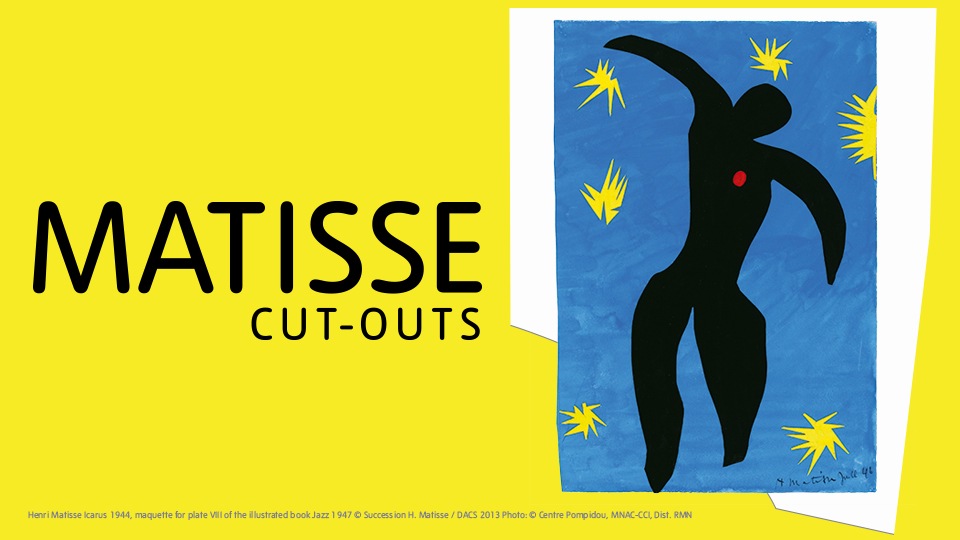
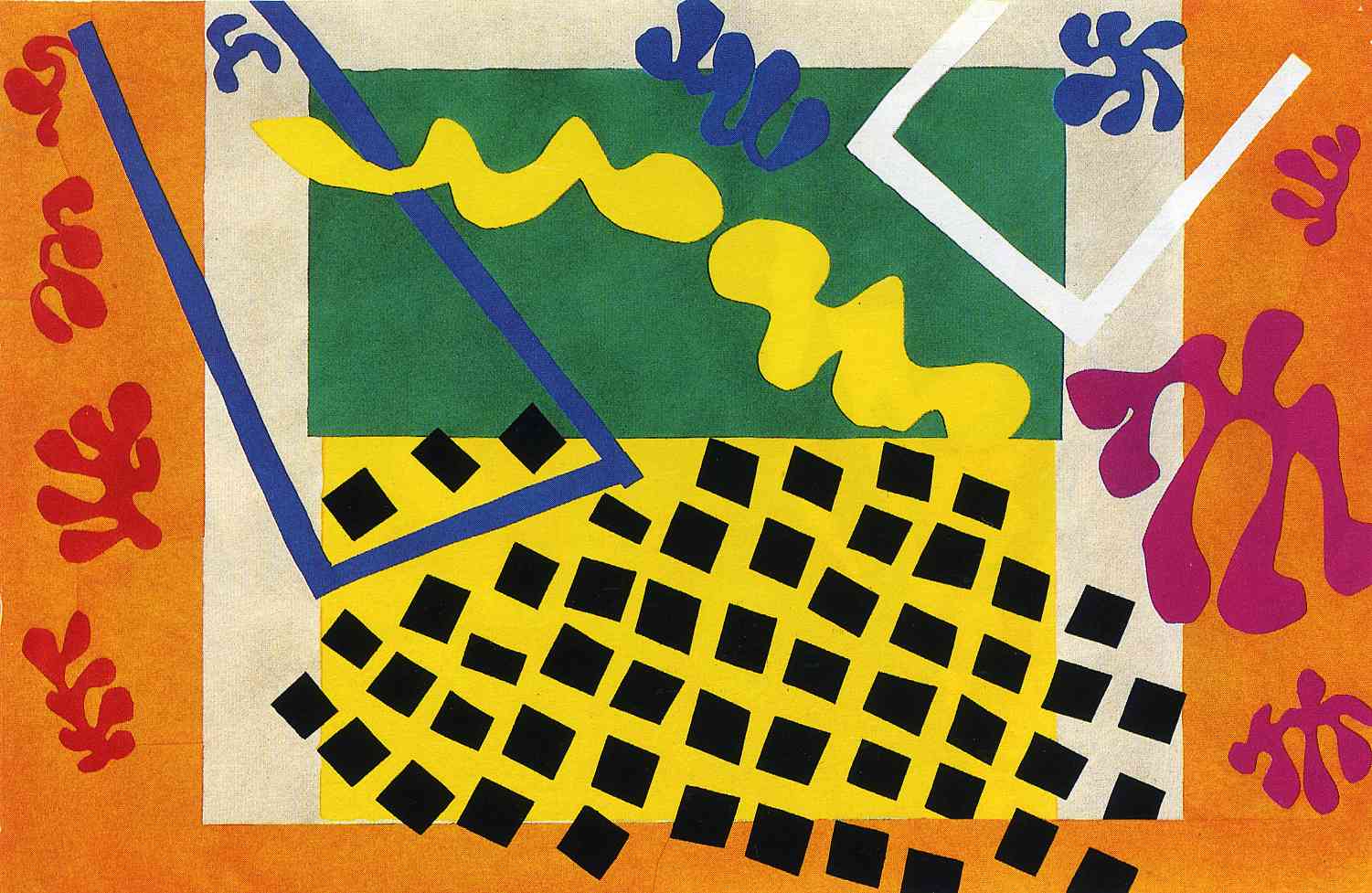
The new Matisse blockbuster at London’s Tate Modern is a show of inexorable joy: of that there can be no doubt. With its whimsical vivid colouration, and playful motifs of sea algae and birds, dancers and blue nudes, it is an exhibition which is full of the happy spirit of the Mediterranean. And yet all of this was created during and immediately after a time when Europe was caught up in the ravaged turmoil of the second world war. How Matisse then managed to create such spirited works, not only during a time of such cataclysm, but also when he was himself frail and confined largely to his bed or to a wheelchair, is one question poised by this exhibition. The answer? Colour was Matisse’s escape from the horrors of war, and cut-outs the vehicle with which he entered the last great hurrah of his groundbreaking career in art.

In bringing together this show of over a hundred of Matisse cut-outs, Tate has managed a real coup. For these works, which dominated the last period of Matisse’s creative output, are merely gouache-painted paper, brought together with paper, sizzors and glue. The result are pictures which retain the same vibrancy that they had when they were first made, but are nevertheless so fragile that few ever leave the national art galleries which they now call home. Yet here they all are, together, many for the first time since they were created.

id_010new_1 cut-outs-3 1394619552732

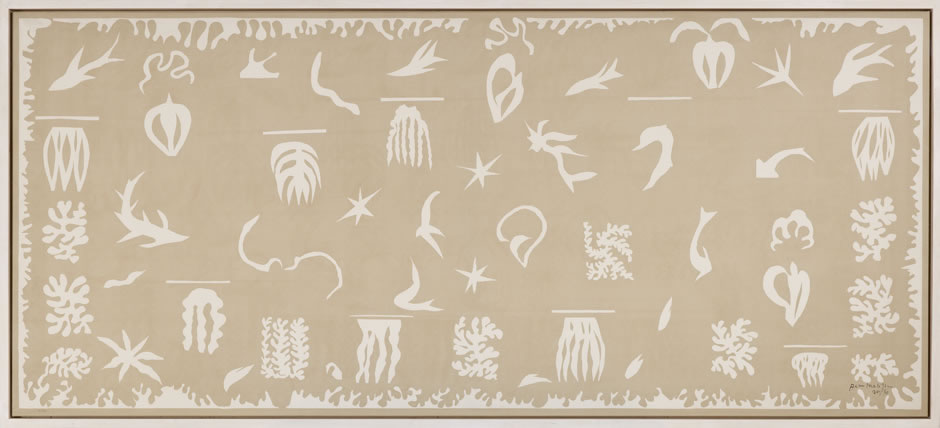
The result is an exhibition which can not fail to please. Starting with the original artwork and resulting first edition of Matisse’s best known artist book, Jazz (which I often paused over in Chelsea’s Taschen store but never purchased before they stopped the reprint, much to my regret), the exhibition moves onto what is essentially the genesis of what is to follow – the Oceana works. With one of the vast works, which originally acted as wall decoration in Matisse’s Paris apartment, featuring figures of the sky, and the other of the sea, these works were inspired by a visit to Tahiti 16 years before. But more importantly, the sea work was pretty much the first time that Matisse used the cut out image of coral, an image which was to become iconic of much of his cut-out works thereafter.

Oceana

matisse_oceanie-la-mer-foto-robert-bayer_l

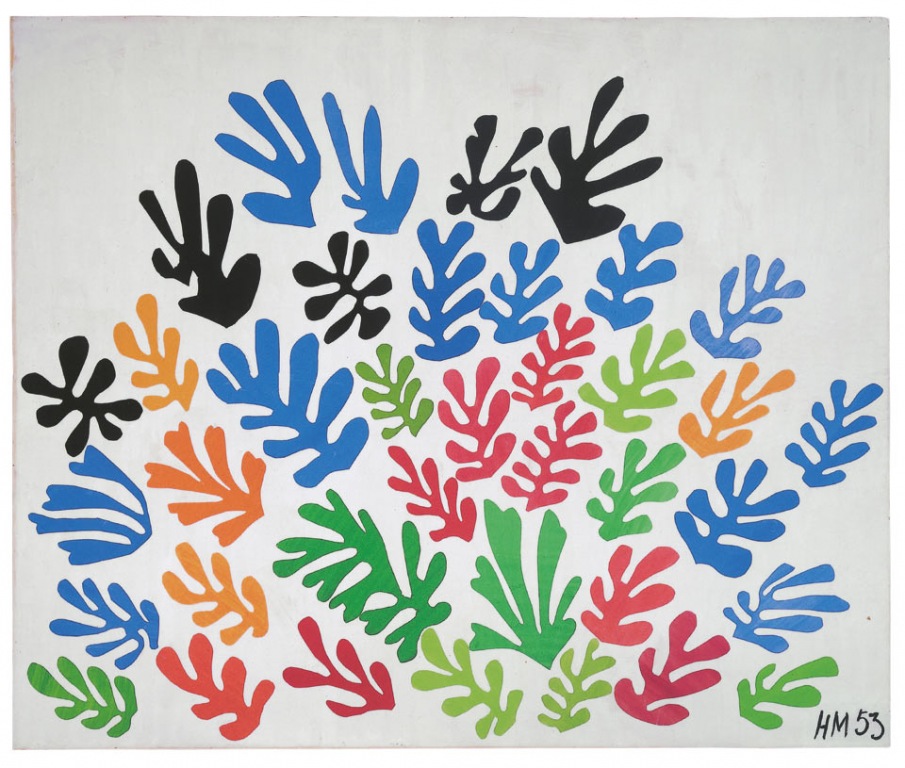
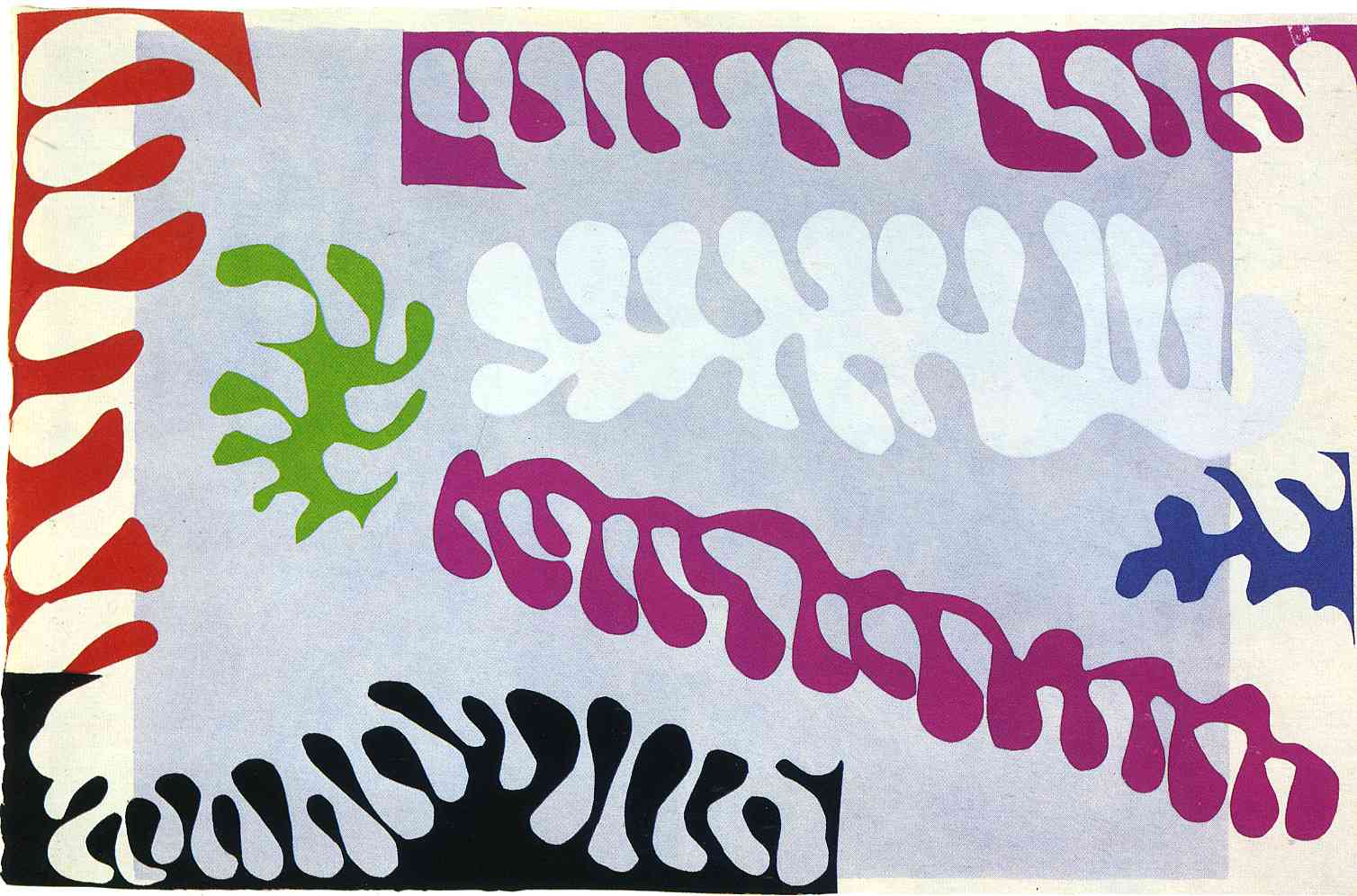
That coral is indeed prevalent in the works that follow, as are the vivd range of colours cut from sheets painted by his dedicated studio assistants. I loved room 5 of the exhibition, which attempts to recreate Matisse’s studio in Vence in Southern France, whose walls were decorated, floor to ceiling, with cut-out works. Seeing the cut-outs grouped together like this makes them come alive as a collection. The variety of colours and shapes and sizes make the corals almost vibrate with the energy emanating from the collected cut-outs, and together the colours sing like an hallelujah chorus.

Coral cut-outs

matissethesheaf1953 kr_matisse_cut_outs_070_071_top_41972_1404021745_id_802580 cut-outs-1

As satisfying as these collected colours undoubtedly are, I could not help but admire Matisse’s famous blue nudes, all four of which are brought together for the first time. Intrinsically simple in both colour, and the seamless way in which they are cut from a single sheet of painted blue-paper, they really are images to be admired – and as a set they never worked better.

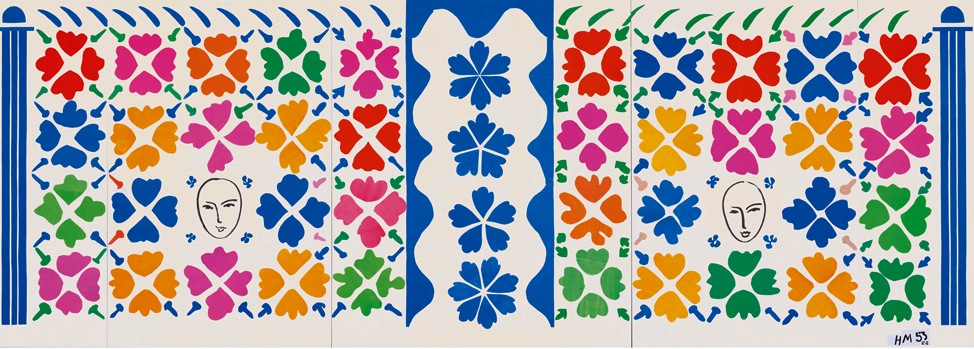
The exhibition ends with Matisse cut-outs on a grand scale, from Tate’s famous Snail (which was the closest Matisse comes to abstract, and in my opinion perhaps the least successful because of it), to The Mermaid in which Matisse intended, through use of bird, coral and fruit motifs, to bring the outside into his studio, something which he surely achieved with all-encompassing effect.

_70288189_masks 6a00e00989a58088330176166fd020970c HMB334 The Snail 1953 by Henri Matisse 1869-1954 20130426-102711

I wasn’t expecting to love this show. I’m not a huge fan of Matisse’s oil paintings which too often appear to me badly executed and fussy. But the simplicity and vibrancy of the cut-outs really appealed to me. It demonstrates the power of composition and the effect which simple colours can have when laid alongside each other. Many have criticised the cut-outs as mere child-play. But that’s a very easy observation to make when the idea has already been generated and all the behind-the-scenes work and planning exhaustibly executed. Masterpieces, perhaps, these works are not. Some may even pass them off as mere wall-coverings. But as a collective they are full of an inherent and enticing energy and joy which fewer more “masterful” artworks will ever be able to generate with such consistency or strength.

6a00d83451e76669e2019affca0e4c970d

Henri Matisse: The Cut-Outs is on at Tate Modern, London until 7 September 2014

Ripples 1: Venice (Yellow window)

In the last of my posts on Venice, which also happened to be a post about the 5th of my 2007 paintings of the watery city, I hinted at the prospect that a new collection of works painting in homage to Venice would surely follow. Well today I am excited to share with you the newest painting to come off my easel, a creation which not only marks a new homage to La Serenissima herself, but also represents my first completed effort of 2014 (something I only realised when I was close to signing it 2013 by mistake – near disaster averted).

Unlike my previous Venice works, which explored the beauty of the city itself as well as the wonder of Venice reflected in the ripples of its canals, all reference to the permanent structures above water have now gone, and sole focus has moved to the wonderful watery image which presides below.

Ripples 1 (Venice: Yellow Window) (2014 © Nicholas de Lacy-Brown, gouache on paper)

Ripples 1 (Venice: Yellow Window) (2014 © Nicholas de Lacy-Brown, gouache on paper)

In this first attempt at capturing those rippled images, I have created something which is first a window, but second of all an abstract image which flows and merges to create different more unfamiliar forms in its partnership of yellows and blues.

The work, which is my 13th exploration in the medium of gouache which I discovered last year, is already set to be one of my favourites of the lot, and I’m excited about painting a whole lot more ripples to add to this one, and to seeing where the collection will lead me.

© Nicholas de Lacy-Brown and The Daily Norm, 2001-2014. Unauthorized use and/or duplication of the material, whether written work, photography or artwork, included within The Daily Norm without express and written permission from The Daily Norm’s author and/or owner is strictly prohibited. Excerpts and links may be used, provided that full and clear credit is given to Nicholas de Lacy-Brown and The Daily Norm with appropriate and specific direction to the original content. For more information on the work of Nicholas de Lacy-Brown, head to his art website at www.delacy-brown.com
Composition No.12 – Christmas Dinner

A crispy skinned, moist roast turkey, its skin alive with the unctuous effluvia of hot meaty gravy; accompaniments of smokey soft sausages wrapped in bacon and carrots caramelised in honey, crunchy steamed sprouts and sharp cranberries; and a dessert of sticky-sweet Christmas pudding, drizzled with creamy custard, and served alongside the buttery pastry of mincemeat filled pies – this is the feast that Christmas days are made of; the abundant dinner which sits at the heart of the festive celebrations, and with which I wish all readers of The Daily Norm a very happy Christmas this Christmas Day.

Composition No. 12 (Christmas Dinner) (2013 © Nicholas de Lacy-Brown, gouache on paper)

Composition No. 12 (Christmas Dinner) (2013 © Nicholas de Lacy-Brown, gouache on paper)

Yes, painted some weeks ago, when the spirit of the festive season began to seep into my bones and inject an energetic spring in my step, this 12th composition of a gouache collection started this summer marks the culmination of my year’s creative efforts. In style it mixes both a focus on realistic figurative efforts together with the overlapping transparencies which have characterised a lot of my “compositions” work. Thus while one brussel sprout is depicted realistically, the others around it are semi-transpararent reflections on a theme; shades of green darkening and lightening depending on their surroundings. Added to a scene complicit with Christmas spirit is a whimsical nutcracker together with the hearty walnuts it has been cracking, glasses of wine adding cheer to the dinner, and finally a cosy candle, providing warmth and intimacy to this festive scene.

It’s a scene that I hope is being repeated the world over this 25th December as we all celebrate this festive event, a time of togetherness, of socialising and of hearty indulgent feasting.

Happy Christmas everyone!

© Nicholas de Lacy-Brown and The Daily Norm, 2001-2013. Unauthorized use and/or duplication of the material, whether written work, photography or artwork, included within The Daily Norm without express and written permission from The Daily Norm’s author and/or owner is strictly prohibited. Excerpts and links may be used, provided that full and clear credit is given to Nicholas de Lacy-Brown and The Daily Norm with appropriate and specific direction to the original content. For more information on the work of Nicholas de Lacy-Brown, head to his art website at www.delacy-brown.com

Composition No. 11 – Autumn descends

A couple of weeks ago, a forage amongst the undergrowth and autumn tones of London’s Wandsworth Common inspired a whole series of photographs which celebrated the tangible transformation which accompanies the onset of Autumn. While the weather since that gorgeous sunny weekend has been something of a damp squid (and therefore far from ideal in which to appreciate the ruby hues of Autumn), the inspiration of those initially sun-drenched reflections on the season prompted to me to once again take out my gouache paint box, and create the 11th of my “compositions” series: Autumn descends.
Composition No. 11: Autumn Descends (2013 © Nicholas de Lacy-Brown, gouache on paper)

Composition No. 11: Autumn Descends (2013 © Nicholas de Lacy-Brown, gouache on paper)

Against a backdrop of leaves which turn gradually from summery green, through golden tones until they become a rich autumnal red at the foot of the painting – Autumn in full descent – a group of those delightful forest mushrooms which had prompted me to go out foraging in London’s parks grow whimsically in the undergrowth, each angled playfully one way or another, differing in heights, in shapes and sizes, just like the plethora of mushrooms I found here in London.
Looking out of the window now onto a wet and windy London, I can see that Autumn truly has descended. But it’s not all gloom – Autumn is a time of rich colour and seasonal transformation like none other, something which I hope my latest painting portrays.

© Nicholas de Lacy-Brown and The Daily Norm, 2001-2013. Unauthorized use and/or duplication of the material, whether written work, photography or artwork, included within The Daily Norm without express and written permission from The Daily Norm’s author and/or owner is strictly prohibited. Excerpts and links may be used, provided that full and clear credit is given to Nicholas de Lacy-Brown and The Daily Norm with appropriate and specific direction to the original content.

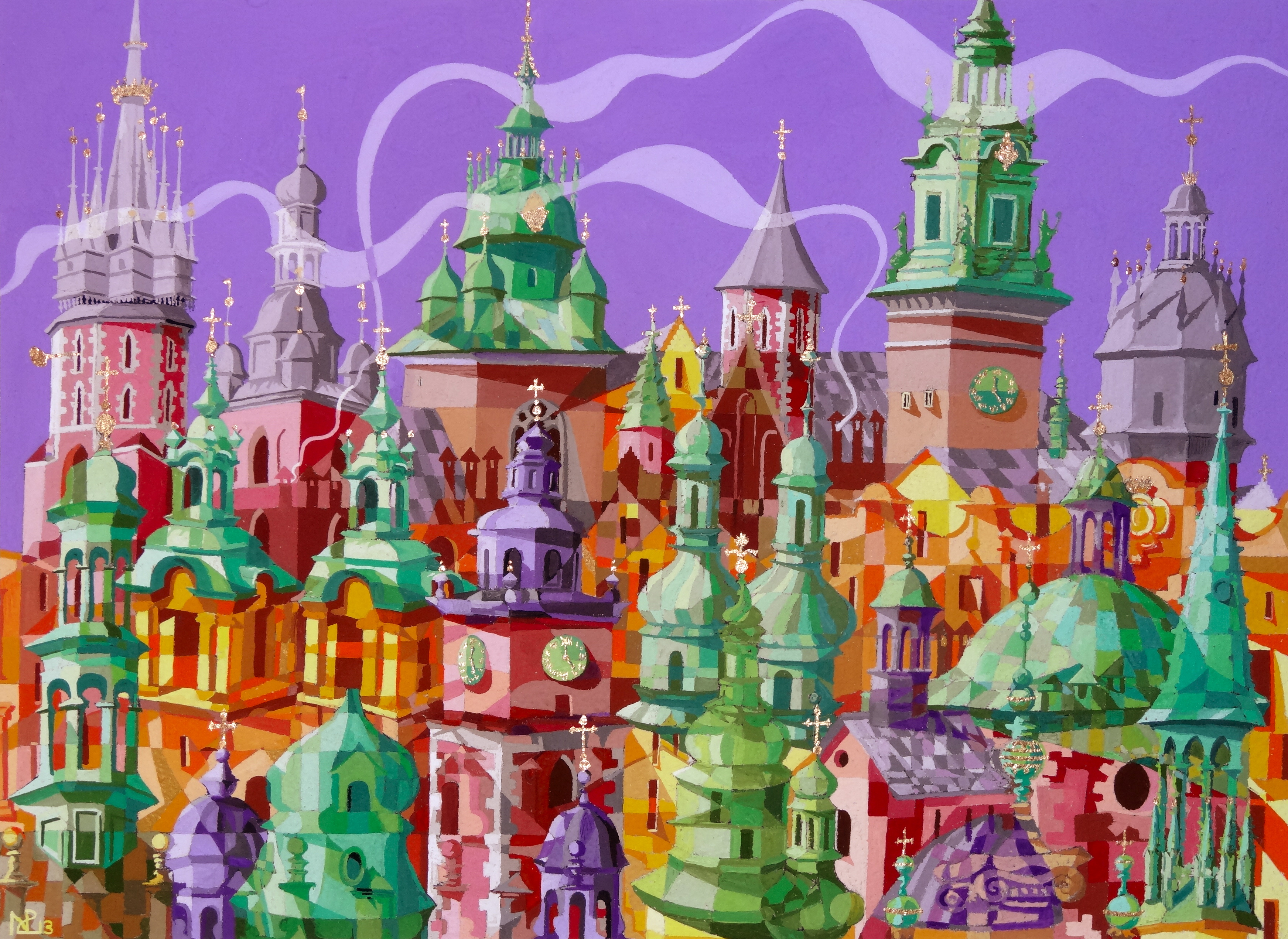
Composition No. 10 – Cupolas of Kraków

Almost every town or city across the world will have some place of worship at the centre of its community. Very often, a church, a synagogue or a mosque will dominate the town, both in spiritual significance, but also in architectural superiority. In the average Spanish city for example, elaborate bell towers will loom large over the deferential terracotta roof tops of the town below, while even in the highly developed city of London, the globally recognised icon of St Paul’s Cathedral remains at the heart of London’s cityscape horizon. Yet in Kraków, the stunning Polish city with a sprawling, unspoilt historical old town at its heart, you are literally spoilt for choice, such is the array of spiritual icons bursting up all over the city.

While the breathtaking gold-tipped spires of the regal Mariacki church at the centre of the Rynek Główny square and the copper-sculpted embellishments of the Wawel Cathedral are obvious contenders as the city’s spiritual matriarchs, there are so many churches complete with their own flourish of architectural exuberance cropping up all over the city and in between, that the visitor feels almost overwhelmed, literally like a child in a sweet shop full of glistening boiled sweets and sugar-covered jellies. In fact with its turrets and towers, its copper cupolas and its wrought iron domes, Kraków takes decoration to new levels of baroque opulence. Its bell towers are so ornate as to be like multi-tiered wedding cakes iced up with sugar statues of saints, and finished with gold beading and sparkling with jewels; and the use of copper is so prominent in its oxidised green, that for as far as the eye can see, the skyline is splattered by turquoise aqua marines.

Composition No. 10 - Cupolas of Krakow (2013 © Nicholas de Lacy-Brown, gouache on paper)

Composition No. 10 – Cupolas of Krakow (2013 © Nicholas de Lacy-Brown, gouache on paper)

All of this just had to form the basis of the next painting in my “Compositions” series, having already decided that I must surely devote a piece to my time in Kraków. But as far as my gouache paintings go, this one is by far the most complicated. For not only did I want to pack into my Kraków skyline almost every cupola and rooftop which I had so admired in the city (and there are plenty), but I also wanted to follow the theme of my compositions by exploring overlapping objects and cubist interpretations. The result was a piece so complex that in terms of duration, I could probably have completed all 9 of my previous compositions in the time it took to do this one. But with a result so satisfyingly abundant with detail that it compares to the great city itself, I would surmise that the time, and the effort was worth it. Hope you like it!

© Nicholas de Lacy-Brown and The Daily Norm, 2001-2013. Unauthorized use and/or duplication of the material, whether written work, photography or artwork, included within The Daily Norm without express and written permission from The Daily Norm’s author and/or owner is strictly prohibited. Excerpts and links may be used, provided that full and clear credit is given to Nicholas de Lacy-Brown and The Daily Norm with appropriate and specific direction to the original content.

Composition No. 9: Ojén Rooftops

I’ve always loved terracotta tiled roofs, for the same reason I suppose that I love palm trees and the chirping sound of cicadas in the heat – because they remind me of the Mediterranean, of the sunshine, of the summer. And is there a sight more conceivably Mediterranean than a little hill top village, a cluster of white washed walls when seen from the side, and a angular hodgepodge of terracotta roofs when viewed from above?

It was exactly this kind of collective village feel that I tried to emulate when I moved onto my 9th gouache composition in the dying days of my Spanish holiday, and having visited the hilltop village of Ojén up in the mountains behind Marbella. The lower section of the village, when seen from the upper road which cuts through its centre makes for a rather breathtaking spectacle; its terracotta roofs uniform apart from the odd turquoise ceramic exception; this consistent sea of peachy-red marking a wonderful contrast against the undulating hillsides which form a backdrop against the village, rolling steadily down the mountain as they fade outwards towards the sea. I was particularly enamoured by the hills around Ojén, not least because, whether it be by reason of agriculture or just because of the natural lie of the land, the hillsides appeared to be almost spotty on the one hand with olive trees, like the polka dot traje de flamencas of the flamenco dancers, and crossed with horizontal stripes on the other.

Composition No. 9: Ojén Rooftops (2013 © Nicholas de Lacy-Brown, gouache on paper)

Composition No. 9: Ojén Rooftops (2013 © Nicholas de Lacy-Brown, gouache on paper)

Naturally I couldn’t resist but reflect these patternings in my latest gouache composition, the likes of which I present, fresh from my artist’s sketchbook, terracotta roofs (and those odd turquoise exceptions) included. I hope you like it.

© Nicholas de Lacy-Brown and The Daily Norm, 2001-2013. Unauthorized use and/or duplication of the material, whether written work, photography or artwork, included within The Daily Norm without express and written permission from The Daily Norm’s author and/or owner is strictly prohibited. Excerpts and links may be used, provided that full and clear credit is given to Nicholas de Lacy-Brown and The Daily Norm with appropriate and specific direction to the original content.

Composition No. 8: La Flamenca

Enrapturing, passionate, chromatic; clapping hands, a deep pulsating rhythm manifested in stamping feet, forceful bursts at the hip, all the way up to the twisting, extending, angular movements in the fingers; her face revels in an outward disclosure of passion felt deep within; her wailing, harsh swansong sings of deep sorrow; of inherent, historical pain; her dress, an abundant effluvia cascade of polka dots and frills moves to the same captivating rhythm as the dancer, its multiple layers swaying and bouncing, augmenting the dazzling mirage of a tangible passion climaxing towards its duende.

The dance of flamenco has long fascinated me, captivated my very heart and soul as it leaves me spell bound, pinned to the spot, enraptured by the raw materialisation of an emotional depth and cultural heritage which is so different from any dance ever made in the polite ballrooms of the west. When I went to see a concert of Estrella Morenete this Spring in London, I sat throughout much of the performance in tears. There is something about flamenco – its melodies and rhythms just as much as its dance which has the power to transport directly into the heart of Spain, and I think for this reason alone, I am in love with it.

Composition No. 8 - La Flamenca (2013 © Nicholas de Lacy-Brown, gouache on paper)

Composition No. 8 (La Flamenca) (2013 © Nicholas de Lacy-Brown, gouache on paper)

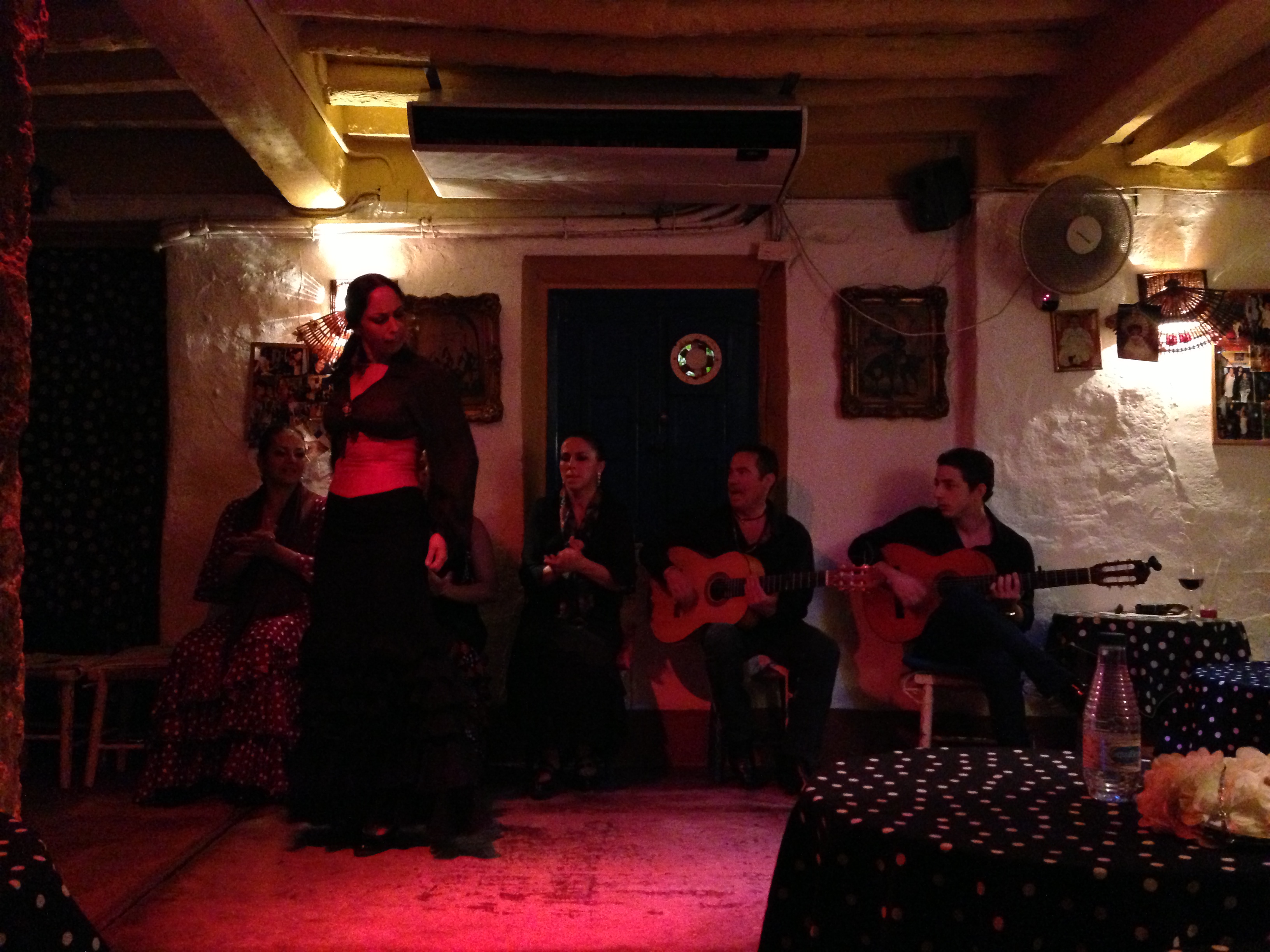
This summer’s return to Spain of course never failed to inspire me artistically as the last few posts on The Daily Norm will demonstrate – and where that inspiration led to paintings, I continued to explore the medium of gouache which I first started using a few months back. When I headed along to the Flamenco Ana Maria in Marbella’s old town on the night before my birthday, and was again entranced by the exquisitely spontaneous emotional outpouring of the music and the dance, I knew that Flamenco would inspire my next gouache. So following on from my series of “compositions” in which I take more of an abstract attitude to otherwise figurative works, I constructed my dancer (on a page twice the size of my other compositions numbers 3-7) utilising the idea of an overlapping construct which I have been exploring in my other works, something which worked well when I was unable to settle on one pose, and so instead depicted several poses, all overlapping into a collective exploration of the electric impassioned movements of a flamenco dancer.

Her dress, my favourite feature, is a cornucopia of different reds, polka dots and of course those lacey frills, while the background attempts to reflect not only the angular, chromatic, discordant sounds of the flamenco rhythms and moves of the dance, but also echoes the kind of rich elaborate Moorish wooden ceilings which were introduced in Spain during the Islamic occupation of Al Andalus, and are now an iconic feature of the Islamic architecture which has helped to shape the cultural character of the South, and is indeed accredited to having given birth to the songs and movements of the Flamenco we know and love.

So without further ado, I leave you to look at my new composition, and also, below, a series of photographs from our recent visit to the Flamenco in Marbella. Hasta luego.

IMG_3861 IMG_3859 IMG_3852 IMG_3864 IMG_3849

© Nicholas de Lacy-Brown and The Daily Norm, 2001-2013. Unauthorized use and/or duplication of the material, whether written work, photography or artwork, included within The Daily Norm without express and written permission from The Daily Norm’s author and/or owner is strictly prohibited. Excerpts and links may be used, provided that full and clear credit is given to Nicholas de Lacy-Brown and The Daily Norm with appropriate and specific direction to the original content.

Composition No. 7: Andalucía

As regular readers of The Daily Norm will know, over the past few months, my own art work has become dominated by a simplified use of flat tones, overlapping forms, and abstract compositions using as my newly preferred medium gouache paint on paper. What has resulted is a series of what I have loosely called “compositions” but which are progressively becoming more figurative rather than compositional, as these quasi abstract images are used more and more to provide a narrative of a scene, essence or depiction.

Following on from a series of compositions inspired by my holiday in Provence, and a single piece (Composition No.6) depicting a day at the seaside in Sussex, I had a feeling that once out in Marbella in Spain, I would again become inspired to pick up my fine-tipped paint brush and start producing another gouache piece. In fact so sure was I that inspiration would hit me that a box of gouache paints was one of the first things to make it into my suitcase.

And of course as soon as I reacquainted myself with the charming historic centre of Marbella, with its white washed houses basking in the sunshine, with the terracotta floor tiles and with the polka dots of flamenco whose rich chromatic melodies can be heard wafting in and out of households around the old town, I felt the urge to take out those very same paints and get to work.

Composition No. 7: Andalucía (2013 © Nicholas de Lacy-Brown, gouache on paper)

Composition No. 7: Andalucía (2013 © Nicholas de Lacy-Brown, gouache on paper)

The result is this piece: Composition No. 7: Andalucía – a simple title for what is a simple attempt to capture the essence of Andalucía, and the iconic symbols which have come to represent the region around the world – the Spanish fan, a necessary antidote to the searing summer heat; the polka dots and guitar of the flamenco passion which stirs the region’s hearts; the windows, always open to capture whatever breeze they can, the richly decorated iron bars providing both security and decoration while facilitating this necessary ventilation;  and pots of geraniums scattered across walls forming in themselves a kind of polka dot pattern of floral colour across a blank white canvas.

I really hope you like this latest addition to my Compositions series.

© Nicholas de Lacy-Brown and The Daily Norm, 2001-2013. Unauthorized use and/or duplication of the material, whether written work, photography or artwork, included within The Daily Norm without express and written permission from The Daily Norm’s author and/or owner is strictly prohibited. Excerpts and links may be used, provided that full and clear credit is given to Nicholas de Lacy-Brown and The Daily Norm with appropriate and specific direction to the original content.

Summertime Sussex (Part 1): Composition No. 6

One of the great things about gouache paint (the likes of which I rediscovered a few months back and am now totally in love with) is how quickly one can turn around a fairly detailed painting in a short space of time. Of course it helps that the paint dries within minutes of its application to the paper, allowing a detailed image to be swiftly executed. The result of this is that I am finding myself increasingly able to catalogue my life’s adventures in gouache paint, as well as through photography and the written word.

Consequently, no sooner had I finished off the last of my Provence-inspired gauche paintings, which in turned formed part of my “compositions series” (the idea behind the series being that the paintings follow a more abstract compositional styling rather than being constrained too heavily by accurate figurative representation), than I got to work on another, this time inspired by a short 24 hour trip I made to my home town of Worthing in Sussex for something of a pre-birthday celebration.

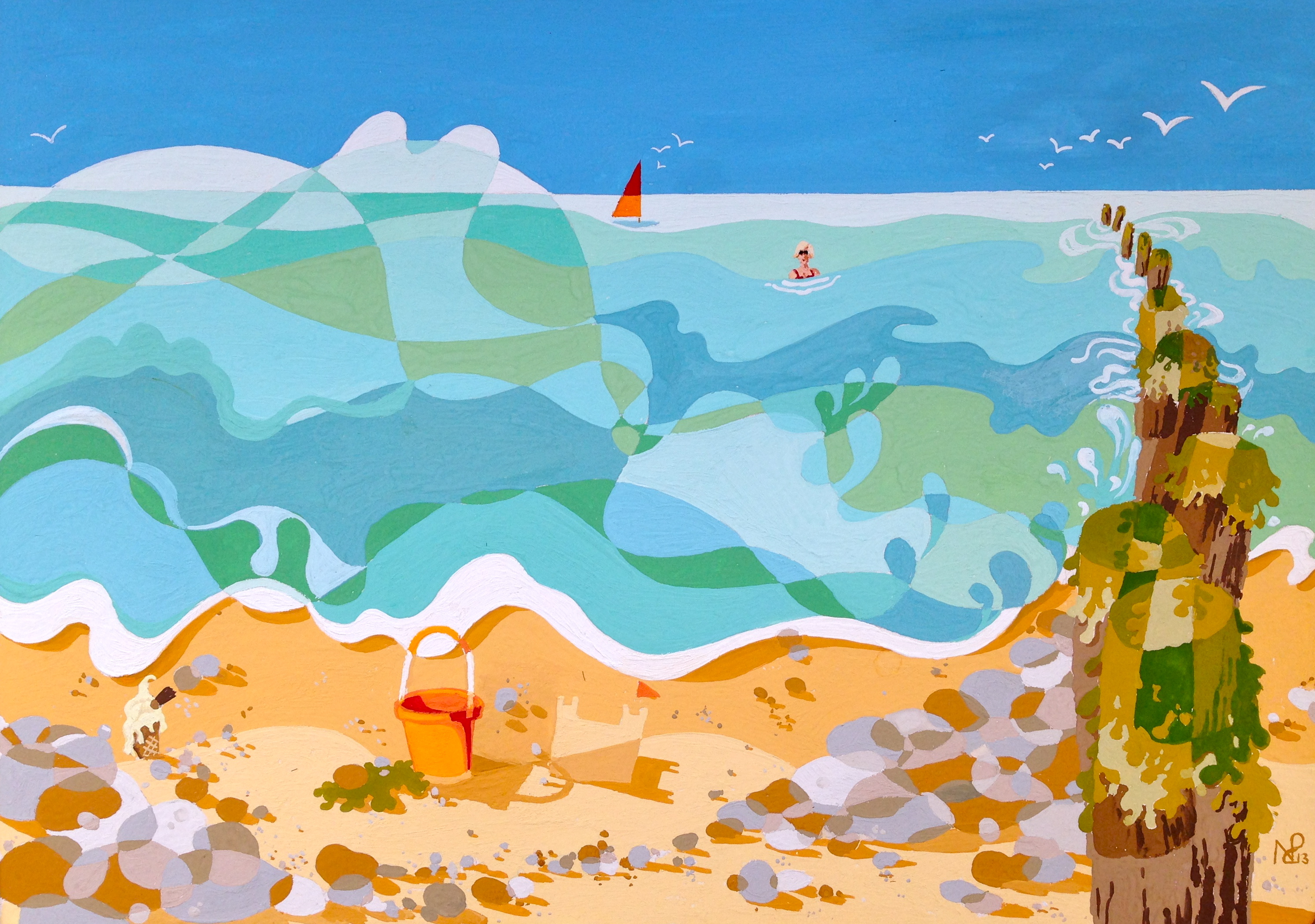
Composition No. 6 (Summertime Sussex: Taking a bathe) (2013 © Nicholas de Lacy-Brown, gauche on paper)

Composition No. 6 (Summertime Sussex: Taking a bathe) (2013 © Nicholas de Lacy-Brown, gouache on paper)

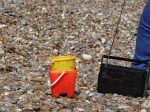
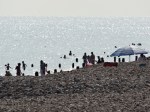
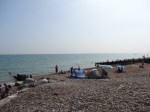
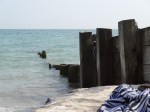
Having been languishing in the sultry summer sunshine of late, the UK has firmly entered the holiday season, and its many beaches have each become heavily populated by visitors taking dips in the English sea to cool off from the unseasonably high temperatures. The beach at Goring-by-Sea, the small suburb East of Worthing and where my family home is situated, is no exception. My mother and I headed down to the beach on a warm Saturday afternoon and, having made our way through the various groups of barbequing families, young children playing in the sand, and sun-lovers spreading themselves out in worship of the sun rays, we reached the shore whose waters were surprisingly warm and clear. Neither of us could resist a dip, and this 6th painting in my compositions series marks the moment when my mother was taking a bathe in the sea while I, looking after our things and taking in the surprisingly summery scene before me, sat on the water’s edge, this image building in my head.

The very next morning I began to sketch out the composition, complete with its curving wave-like forms and overlapping seaweed-covered groynes and within a few days it was done. The perfect testament to a perfect British summer’s day. I leave you with some photos of that little beach trip which, like my gouache, capture some essence of the British seaside in the summer.

© Nicholas de Lacy-Brown and The Daily Norm, 2001-2013. Unauthorized use and/or duplication of the material, whether written work, photography or artwork, included within The Daily Norm without express and written permission from The Daily Norm’s author and/or owner is strictly prohibited. Excerpts and links may be used, provided that full and clear credit is given to Nicholas de Lacy-Brown and The Daily Norm with appropriate and specific direction to the original content.