Skip to content

Posts tagged ‘Nicholas De Lacy-Brown’

Sunday Supplement – The Spanish Double

For the last few weeks on a Sunday, I have been exploring the collection of 10 paintings I created during my convalescence from an accident between 2008-2010. True, the subject matter is not easy to write about, nor, possibly, easy to read, but I hope you will agree that these paintings are amongst the most worthy of my works for further exploration and examination. They are, after all, a representation of a potent threshold in my life. When I underwent not just physical change but mentally was forced to mature and re-evaluate life in a way I have never before considered necessary.

In today’s Sunday Supplement, I am featuring two of my accident paintings which almost formed a sub-category of their own. Both were painted, unlike the other 8, when I was convalescing in Spain, both have Spanish titles, both are painted with acrylic paints, rather than oil, and the result of the colours used makes them, in my opinion, a bit more “pop art” in finish.

Desayuno del Norte

Desayuno del Norte (2008 © Nicholas de Lacy-Brown, acrylic on canvas)

In the first of the two, Desayuno del Norte (“Breakfast of the North”), I cross-referenced a Lowry-inspired Northern industrial landscape with symbols of breakfast “desayuno”, while mixing in images direct from the legal world to which, at the point of painting this work, I had prematurely returned. Of all my accident paintings, this is perhaps the hardest to explain. It was a mood, a time experienced – a collection of various representations which at that time drove me to paint. In the purple-grey background, a sense of my depression and frustration at that time is shown, a time which is appropriately catalogued as Christmas by the holly on a jug of sticky dark gravy which pervades the piece. The industrial landscape is proliferated with an abundance of mauve smoke, while from one of the bigger chimneys in the foreground, the question “why me?” looms large.

While in the accident paintings before this one, I had painted feet, here, I paint a trainer – the specially fitted trainers which were integral to enabling me to travel into work and get around each day, along with the crutch, whose presence cuts across the canvas on the right. Meanwhile, in referencing breakfast throughout the painting, the eggs mark a note of the fragility of my recovery, the blood-like jelly pouring from the trainer suggests my continuing pain, the orange represents my location at the time of painting – Marbella in Southern Spain – and the Marmite gives a clue as to my fading appetite and loss of weight  – it was the only thing I could often bring myself to eat, spread on the toast hovering somewhere below it. Meanwhile, running throughout the painting are the double yellow lines of road markings – these representing prohibition and interdiction – a cessation of my liberty, both physically and in my profession in the overtly constrictive legal world of London’s Bar.

La Marcha de los Champiñones 
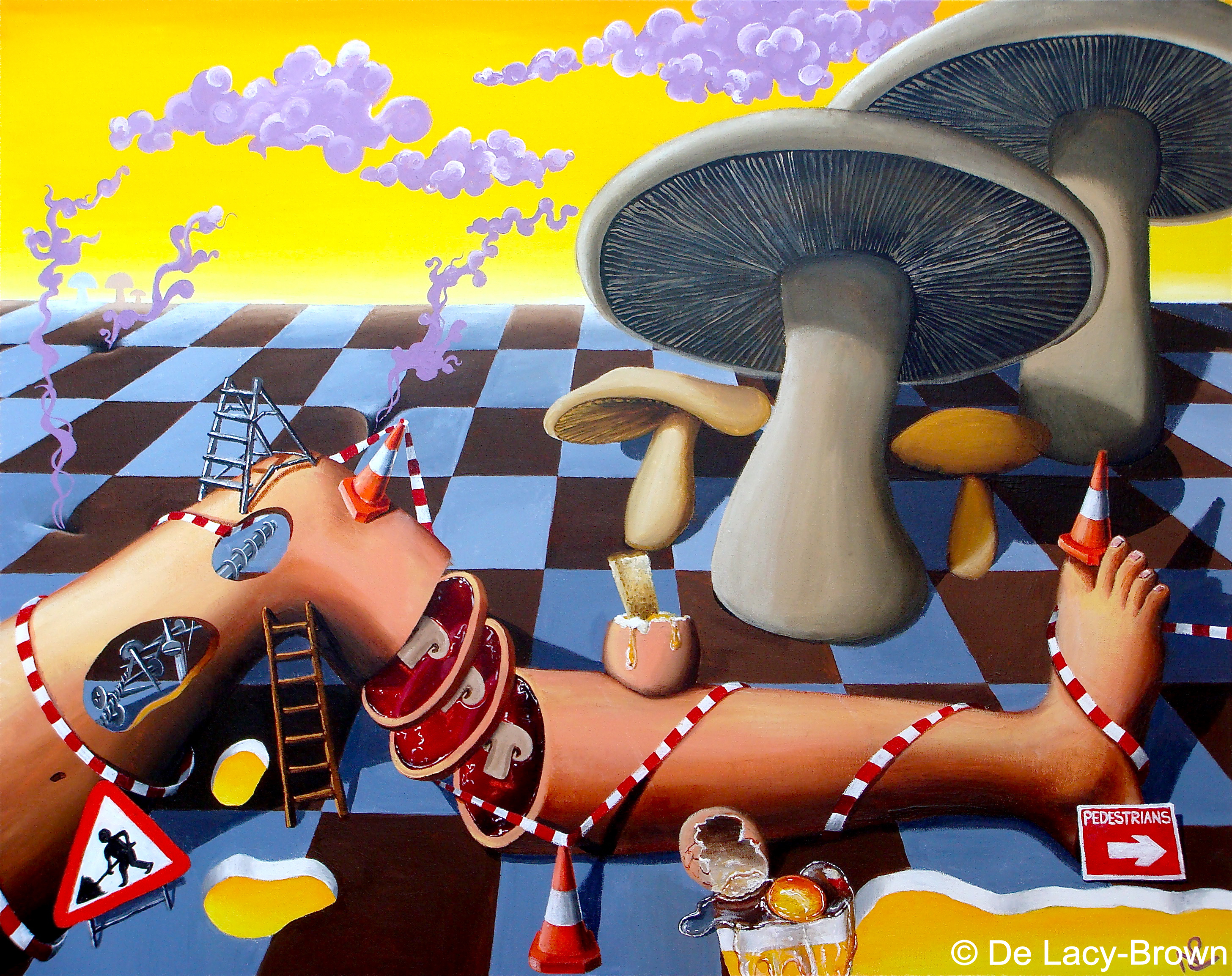
La Marcha de los Champiñones (2009 © Nicholas de Lacy-Brown, acrylic on canvas)

Road traffic symbols are continued in the second painting of this series, La Marcha de los Champiñones (“The March of the Mushrooms”), which represents two major events of my continuing convalescence a year after the original accident – first the fact that my leg became wracked with infection, and secondly that I was required to have my leg re-broken, in order to correct a fixed flexion deformity which had occurred during the healing process (in other words, the leg had healed at a fixed angle, and was unable to lie straight). In this work, I show my leg being re-broken, cut here into slices, each slice revealing, by way of the mushroom-symbol, the spread of infection throughout the limb. Meanwhile, on the outside, huge mushrooms loom over the slightly surreal scene, as the spread of infection becomes worse.

The road traffic symbols in the meantime become more prevalent in this piece. The leg is cordoned off behind road-works ribbon and a road-works warning sign, while the tools and paraphernalia of the workman are all around, including the various pins which were, in reality, holding my leg together (as shown by “windows” allowing the viewer to peer into my metal-ridden leg). A sign diverts pedestrians past the works, but also reminds viewers that throughout my convalescence, one of the worst experiences encountered was the continuous stares of pedestrians on the street, forever gawping at my leg encased in its pins and illizarov frame and covered with dressings and scars.

Meanwhile, the egg which was solid in Desayuno del Norte, has now cracked. The fragility of my steady recovery had given way, and I was back to square one.

© Nicholas de Lacy-Brown and The Daily Norm, 2001-2012. Unauthorized use and/or duplication of the material, whether written work, photography or artwork, included within The Daily Norm without express and written permission from The Daily Norm’s author and/or owner is strictly prohibited. Excerpts and links may be used, provided that full and clear credit is given to Nicholas de Lacy-Brown and The Daily Norm with appropriate and specific direction to the original content.

The Daily Sketch: Prepare to Scream… It’s Normaween!!

The full moon is out, and gliding past, the menacing silhouette of a Witch Norm casting a midnight spell. Beneath the moon, the creepy dilapidated outline of a once glorious house, now abandoned, boarded up and left to decay and ruin comes into view. Within the dark echoes of its now empty chambers, something is stirring. A momentary white flash, a flutter in the breeze, the creak of a lone shutter moving in the wind. In the overgrown gardens, the century old tombs of the long dead previous occupants are starting to move. At the strike of midnight something quivers through the ground. The large, rusty Victorian gates swing open, the stone demon gargoyles upon the plinths come to life, the heavy tomb lid begins slowly to shift and at the window of the house, the previously dark interior is replaced by the screaming wide eyes of a Norm devastated by fear. All around the old mansion, Norm ghosts begin to waver and whir in the wind, moaning and howling at this witching hour, and amongst the graves below, the Vampire Norms awaken, eager in their hunt for their fresh intake of sickly sweet blood.

Norms at the Halloween House of Horrors (2012 © Nicholas de Lacy-Brown, pen on paper)

Are you scared? You should be. For tonight is Normaween, the night when the Norm dead come back to life, when no Norm is safe from the razor sharp teeth of the roaming Vampire Norms, and every little Norm will cower under his or her bedsheets as the screams of the Norm dead pierce their ears and bring the horrors of the underworld to life.

Keep your lights on, don’t dare go to sleep. Just prepare to scream – for tonight is Normaween!

© Nicholas de Lacy-Brown and The Daily Norm, 2001-2012. Unauthorized use and/or duplication of the material, whether written work, photography or artwork, included within The Daily Norm without express and written permission from The Daily Norm’s author and/or owner is strictly prohibited. Excerpts and links may be used, provided that full and clear credit is given to Nicholas de Lacy-Brown and The Daily Norm with appropriate and specific direction to the original content.

Introducing my new painting: The Gentleman (in Paris)

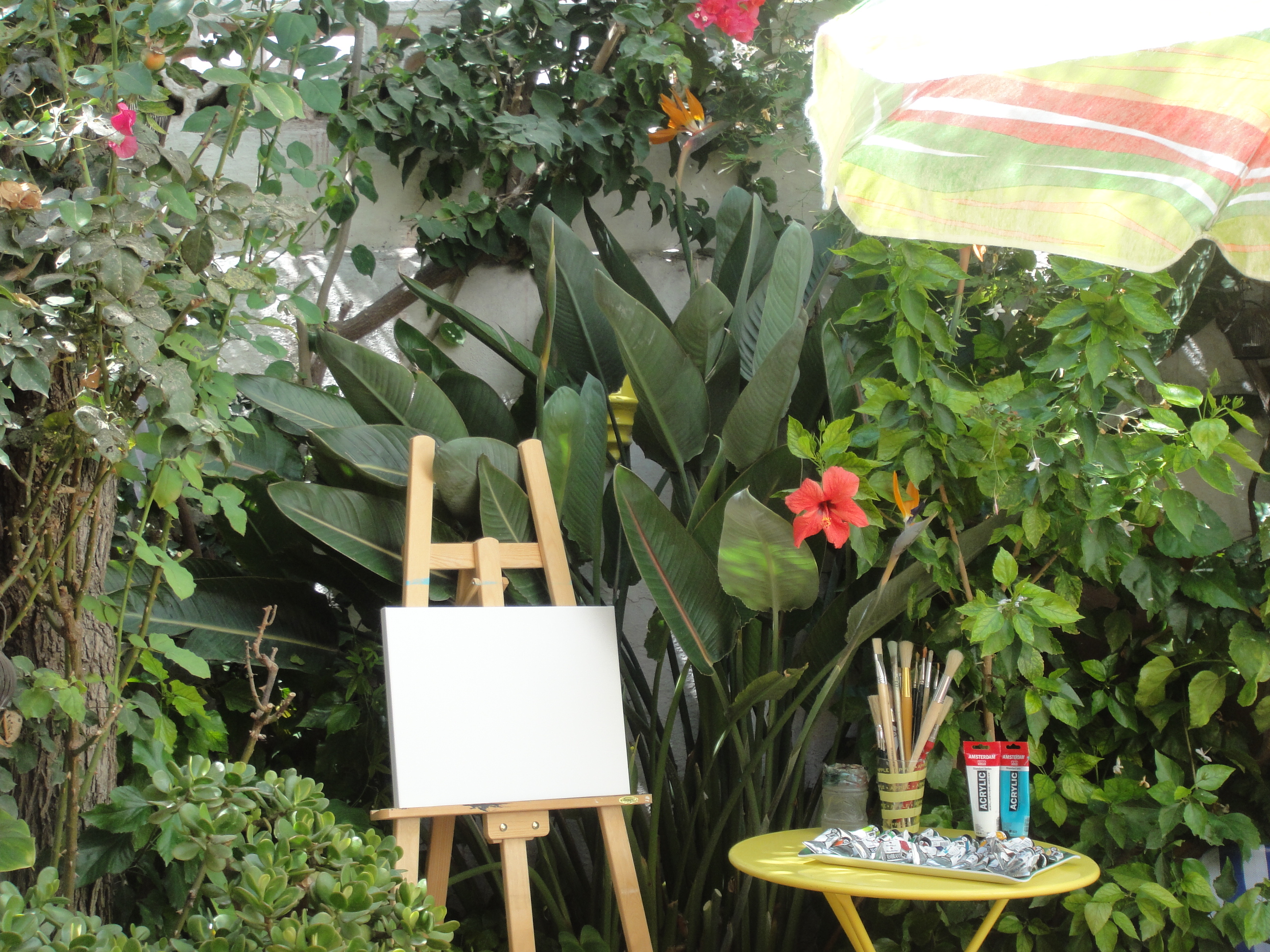
For those keen-eyed amongst you, particularly those reading my recent Spanish posts and my various tapas recipes, you may have noticed (as I know a couple of my regular readers did) in the background in the garden of my Marbella house stood a little easel and upon it a small canvas – from the early photos, when just a blank canvas was present, to the latter shots which showed me making some progress on the work as the balmy days of my holiday whiled onwards.

A canvas awaits me – in my garden in Spain

As the idea developed, and owing to the sad reality that our holiday was only 9 days long, my painting became more compelx, and when I left Marbella, the work was only half done. Luckily the canvas fit in my case (although no doubt contributed to my excess of baggage weight for which the ever unreasonable British Airways charged me a 50 euros flat penalty fee, even though my partner’s luggage was massively underweight) and I continued work in London. Be my life in London as it is – full of work and busyness, it has taken me some time to complete the painting, even though I rushed home most evenings to fit in a few hours of work.

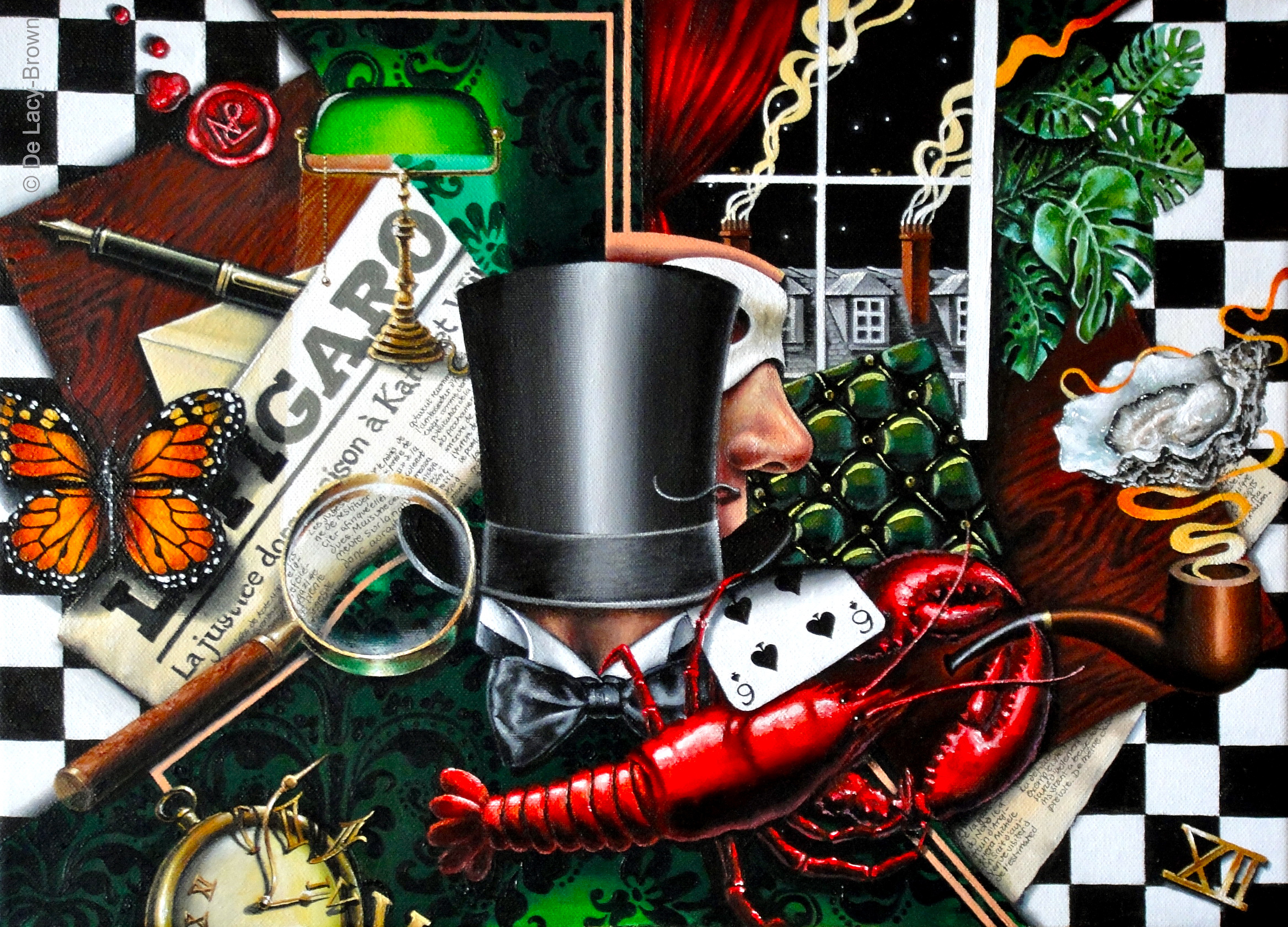
However, having had last weekend to myself, I finally managed to complete the work, a work which I now call The Gentleman (in Paris).

The Gentleman (in Paris) 2012 © Nicholas de Lacy-Brown, acrylic on canvas

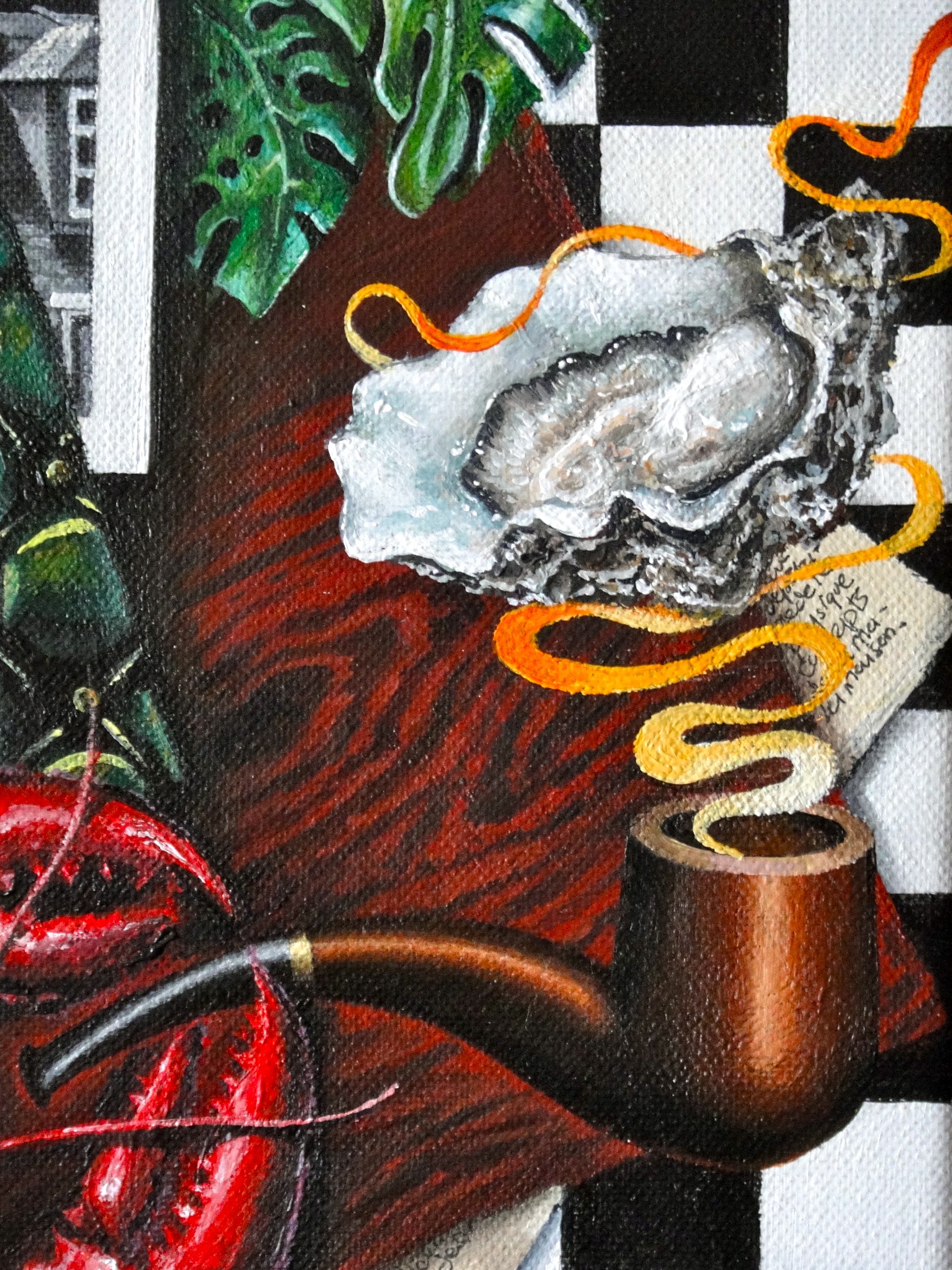
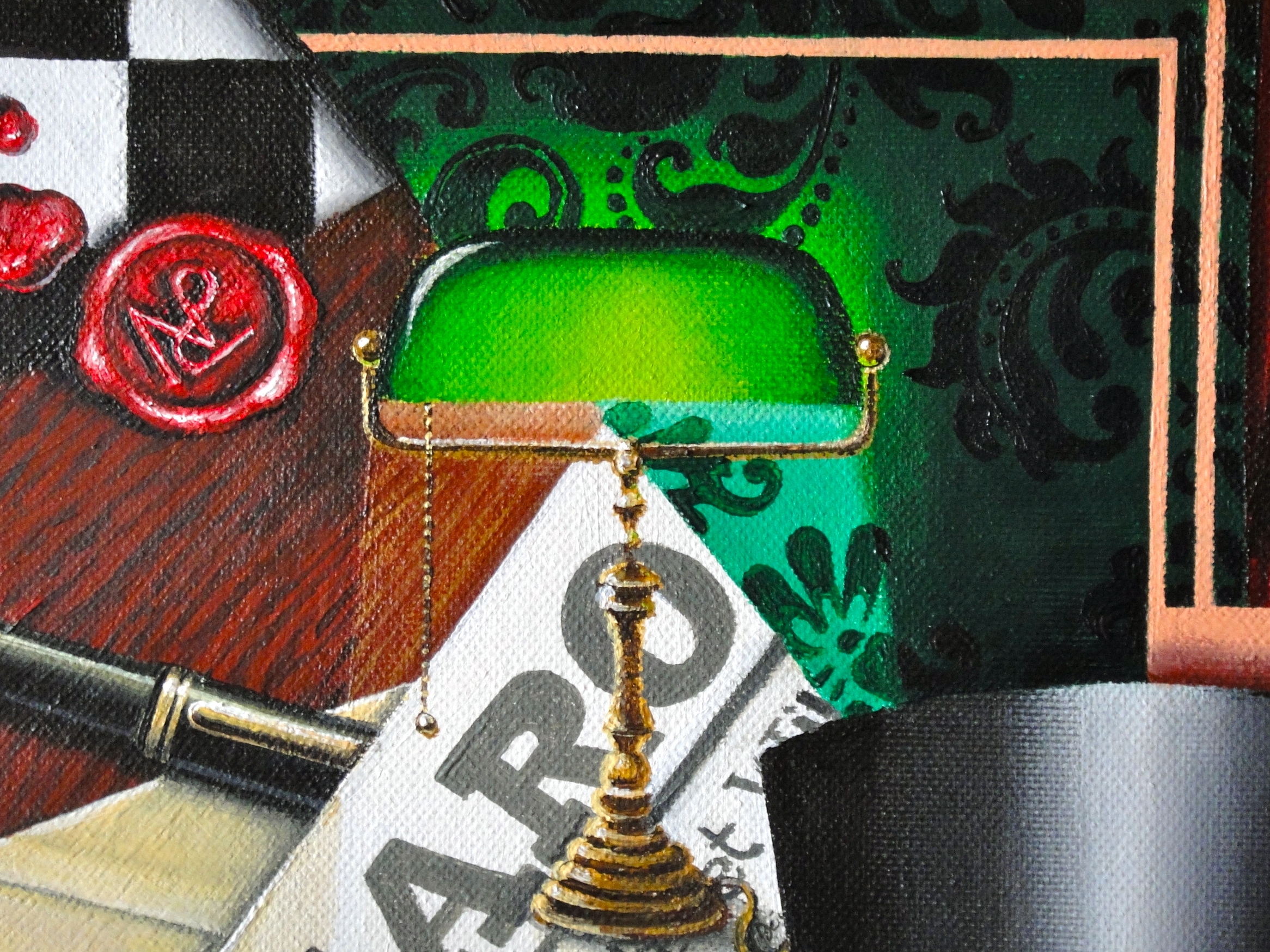
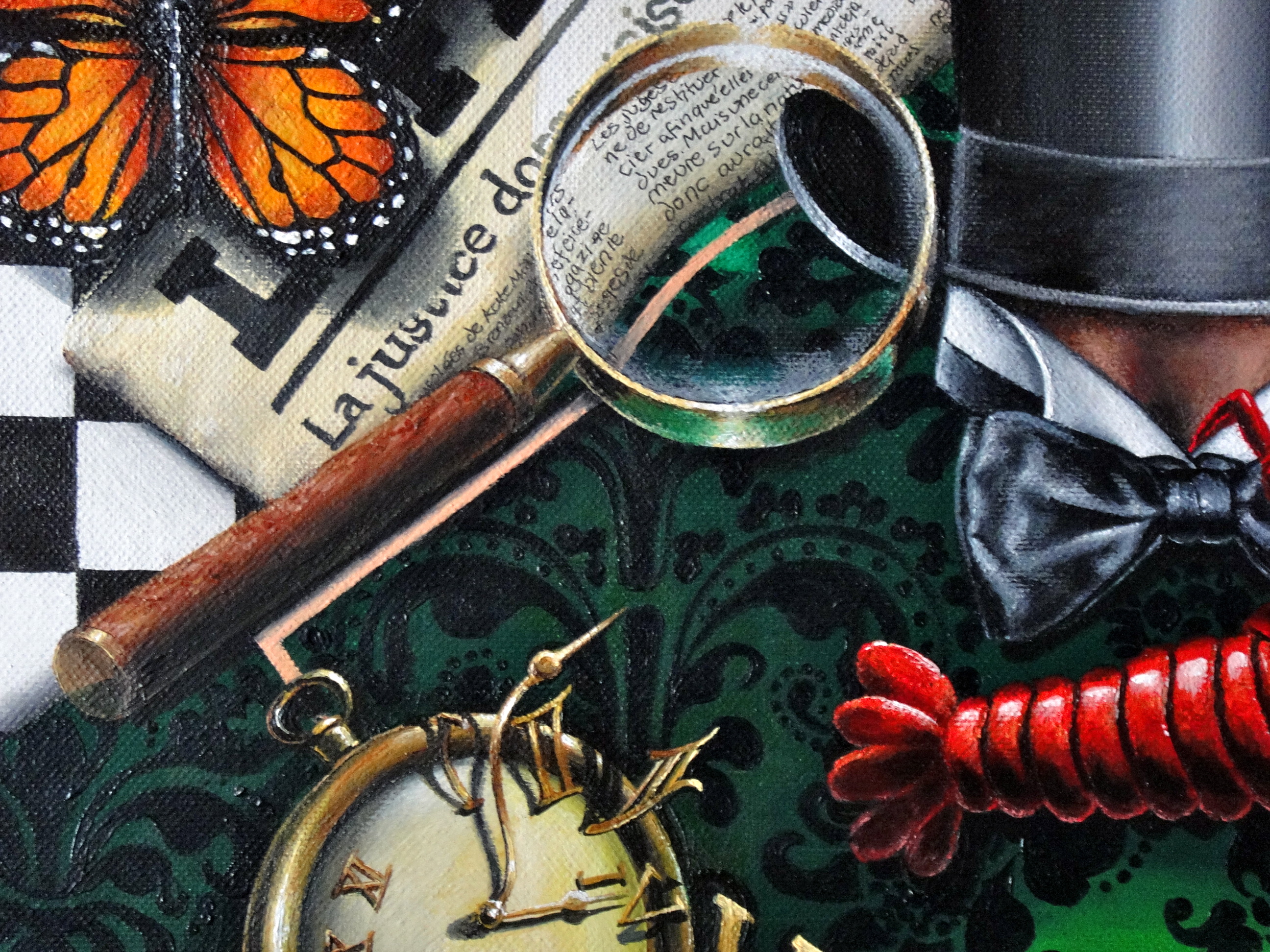
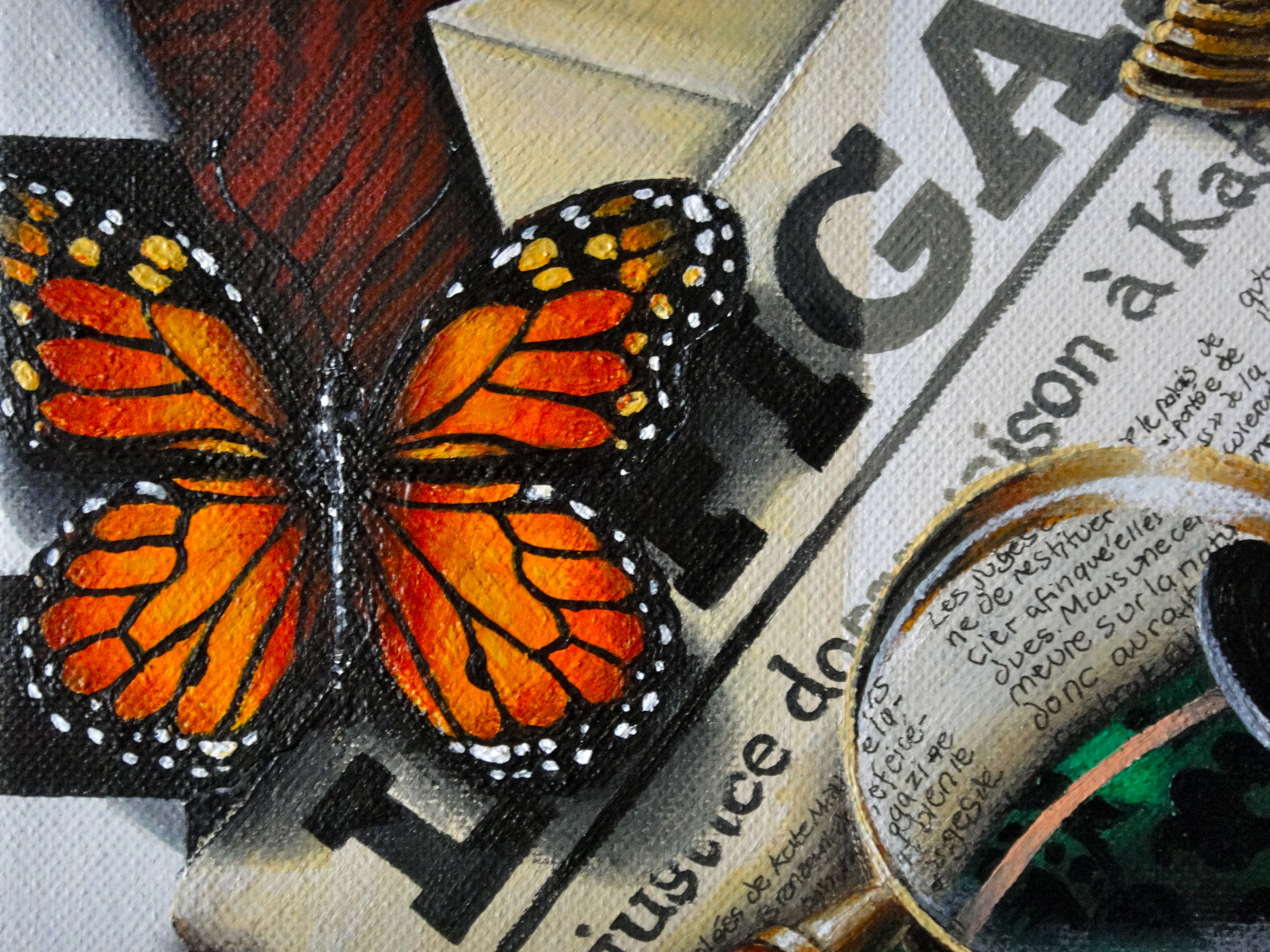
Inspired by the icons of a time I hold dear, a yesteryear when men were gentlemen, when to go out to dinner was a time of dressing up in a top hat and gloves, when chivalry was at the forefront of society and manners were a thing held in the highest of esteem. It was a time when in a Gentleman’s study, such as this one, a Chesterton desk chair would be found amidst the paraphernalia of a professional’s equipage: a pipe, a magnifying glass, a pocket watch, some butterfly specimen and an emerald green desk lamp, an expensive fountain pen and even more expensive culinary delicacies such as lobster and oysters, all set against a black and white floor, a hefty wooden desk, rich damask green wallpaper, verdant plant life and a floor to ceiling window view of the Paris chimneys beyond. And of course, because it’s Paris, the Gentleman has to keep up with the French news in Le Figaro. Meanwhile at the heart of the image, representations of the Gentleman himself: his top hat, a bowtie and wing-collared shirt, and his face, masked in the enigmatic disguise of a masquerade ball.

Explaining this painting is a little like explaining one’s impulses. This is an image which came to my mind in Spain which always provides me with sufficient relaxation and creative stimulation to get my artistic juices running. And even though the resulting painting is far from Spanish, it nonetheless digs deep in my imagination, placing on canvas a time, a place with which I can feel an inexplicable evocation, like an experience which recalls the strongest of emotions, even though it never happened. In this way, I use painting to make sense of the deepest of subconscious sentimentality, helping me to both explore myself, and pay homage to the depth of my creativity.

I leave you with a few shots of the painting’s details. I hope you like it.

© Nicholas de Lacy-Brown and The Daily Norm, 2001-2012. Unauthorized use and/or duplication of the material, whether written work, photography or artwork, included within The Daily Norm without express and written permission from The Daily Norm’s author and/or owner is strictly prohibited. Excerpts and links may be used, provided that full and clear credit is given to Nicholas de Lacy-Brown and The Daily Norm with appropriate and specific direction to the original content.

Sunday Supplement: Moules-Frites

Following on from the last two weeks of rather traumatic accident-based Sunday Supplement features, I’ve got another one for you I’m afraid – in fact there are 10 paintings in all, each depicting my experience of convalescence and the various stages of recovery entailed.

Barrister’s wig and tin

In this week’s feature, Moules-Frites: Nerve and Muscle Pain on a Legal Life Revisited (oil on canvas, 2008), the next stage of recovery requiring a chapter in my painting diary was the new found pain experienced on returning to work after almost 5 weeks being bed-bound post-accident. I should explain by way of background that despite my many artistic endeavours, I am in fact a qualified lawyer – a barrister to be precise – and some months before my accident, I secured myself a pupillage (the last year of training before qualification) in a top London barrister chambers, due to begin in October of my accident year. Pupillages are like gold dust – several hundred young lawyers apply for the handful of places that are given out each year. And so, while the accident came as a mighty blow to me, I was determined to start the pupillage as planned in October.

Traditional moules-frites

This return to work represented the biggest change for me since leaving hospital. I still had an illazarov frame affixed to my leg, so I had to rip my suit trousers down the middle and each day attempt to pin them half way around my leg to try and prevent people seeing the frame, and the blood bath beyond. And yet still they stared. I was still on crutches, and on around 30 pills and painkillers a day. I had to travel by taxi, and by the time I got home (people in London never bothered to give up their seat for me on the tube, despite the obvious paraphernalia of my injury attached to my leg) I was exhausted and in agony. When I attempted to do anything, not least cope with the demands of a full time job in central London, I started to experience a new type of pain – burning shooting spasms coursing down my damaged nerves, and the dull continuous hammering of my muscles as they tried to engage properly for the first time in months.

Moules-Frites: Nerve and muscle pain on a Legal Life revisited (2008 © Nicholas de Lacy-Brown, oil on canvas)

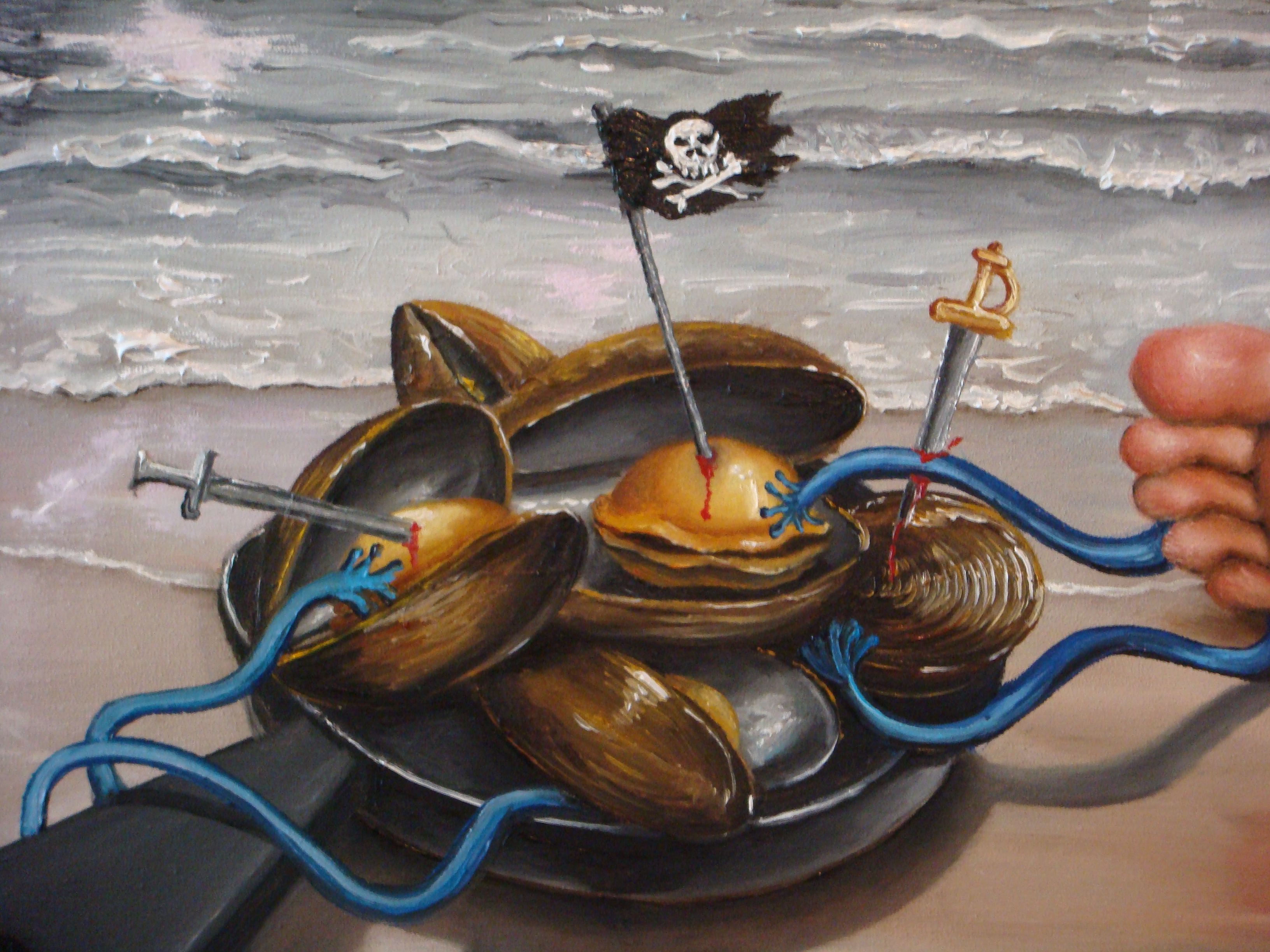
All of this was represented in my fifth painting. The title was an attempt to play on the name of the iconic French/Belgian dish, Moules-Frites – mussels with chips – as this in turn was a play on the words muscles and mussels (try explaining this to the Spanish as I had to do when the painting was exhibited there – not easy!) – In recognition of this word play, a pan of mussels sits in the centre of the piece, representing the burning pain I felt in my muscles as they attempted to rebuild and learn how to walk again.

The scene depicts the stormy Sussex of my childhood. In the sea, the “groynes” (man made sea defences) are replaced with crutches, and by the shore, my disembodied foot is alive with antagonised nerves whose angry electrical currents interact with (or cause) a lightening storm. Meanwhile on the beach, by the frying pan, the traditional black and gold tin of a barrister’s wig becomes a pill box for all of the painkillers on which I was reliant, they in turn being scattered around the beach like pebbles.

As I soon found, the pain of returning to work would all become too much. I stuck it out for five months, but as my condition deteriorated further, and 5  more operations hovered on the horizon, I had to leave again, not returning for almost 2 years.

© Nicholas de Lacy-Brown and The Daily Norm, 2001-2012. Unauthorized use and/or duplication of the material, whether written work, photography or artwork, included within The Daily Norm without express and written permission from The Daily Norm’s author and/or owner is strictly prohibited. Excerpts and links may be used, provided that full and clear credit is given to Nicholas de Lacy-Brown and The Daily Norm with appropriate and specific direction to the original content.

Sunday Supplement: Dicing with Death (La Pieta)

On last week’s Sunday Supplement, I got the ball rolling with an exploration of some of my more traumatic paintings, created while in the immediate and protracted recovery from my nasty life-changing collision with a collapsing wall. In today’s Sunday Supplement, I am featuring the fourth of my accident paintings, and perhaps the most intimate and private of them all.

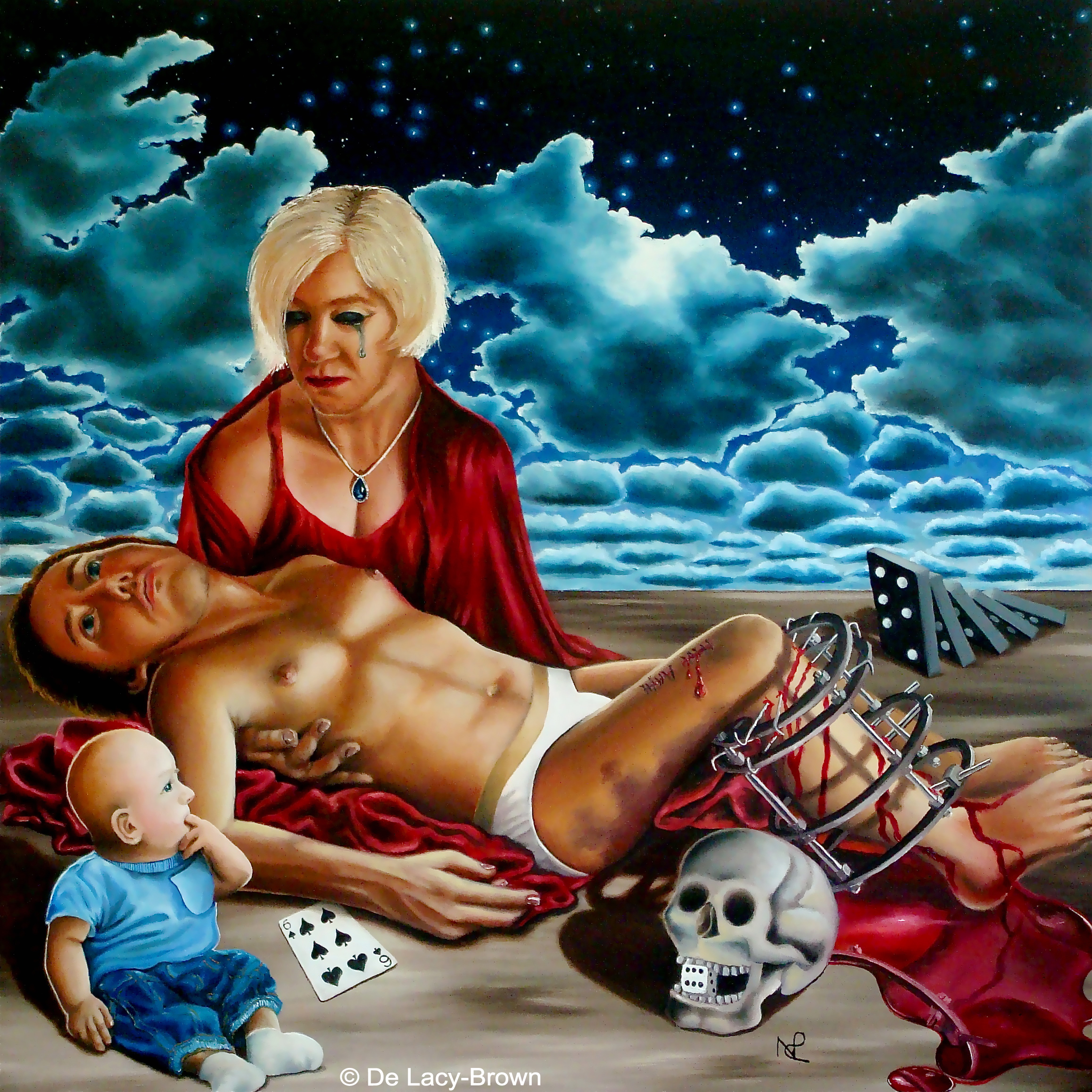
Dicing with Death (La Pieta de l’accident) explores the nursing roll undertaken by my mother is the aftermath of my accident. While as a family, we had always been close, post-accident, a new extent of proximity was forced upon us, as I went back to being practically a baby in the everyday attention I required. Recovery in hospital was one thing, but three weeks later when I was discharged to my family home in Sussex, the real horrors of my convalescence begun. The daily trauma of wearing an illazarov frame, having to clean around the pin entry point, waking up to sheets soaked in blood, screams of agony when I tried to move from bed to the bathroom, and in the middle of the night when I could stand the pain no longer. All of this was for my parents to bear, and for my mother in particular, who was compelled to be a nurse as well as a physio, feeder and grieving mother, and once again become physically intimate with me when I needed help dressing, cleaning, even going to the toilet, it was a huge ordeal to experience.

Dicing with Death (La Pieta de l’accident) 2008 © Nicholas de Lacy-Brown, oil on canvas 120cm x 120cm

The worry, the concern and the strain this had on both of my parents was plain to see, even through the fog of pain which clouded my eyes during those terrible months. My attempt at expressing the uncontrollable spread of the effects of my accident upon my family was to paint this work. It is loosely based on the famous La Pieta sculpture by Michelangelo, which poingantly portrays the grieving Mary cradling, with disbelief and agony, the limp dead body of her son. How different this pose is from the celebratory felicity of the typical mother and child pose, the glowing Mary with her new baby Jesus.

Michelangelo’s La Pieta

It was tapping into the great pathos portrayed by La Pieta that I chose to reflect the pose in my Mother, cradling me, the wounded young adult in her arms, not dead, but so close to it as I practically embraced my end under the weight of a crushing collapsed 10ft concrete wall. There too is my baby nephew, born only a few days before the accident, representing both innocence and the cross-generational effect of my trauma, and also in the scene, a skull, reminding me of how close to death I came. The playing cards, the falling dominoes and the dice all go to represent the great gamble we take every day of our life – when everything appears normal until one, life-changing event occurs and alters everything for ever: Look then how the dominoes will fall and the effects of the event begin to traverse every facet of your existence.

Michelangelo’s La Piete is not unique of course, and I leave you with two other variations on the theme – Bellini’s painting, and Picasso’s heart-wrenching study for his great masterpiece of grief and tragedy, Guernica. 

Bellini’s La Pieta

Mother and Child by Picasso

© Nicholas de Lacy-Brown and The Daily Norm, 2001-2012. Unauthorized use and/or duplication of the material, whether written work, photography or artwork, included within The Daily Norm without express and written permission from The Daily Norm’s author and/or owner is strictly prohibited. Excerpts and links may be used, provided that full and clear credit is given to Nicholas de Lacy-Brown and The Daily Norm with appropriate and specific direction to the original content.

Collecting conkers for a classy seasonal display

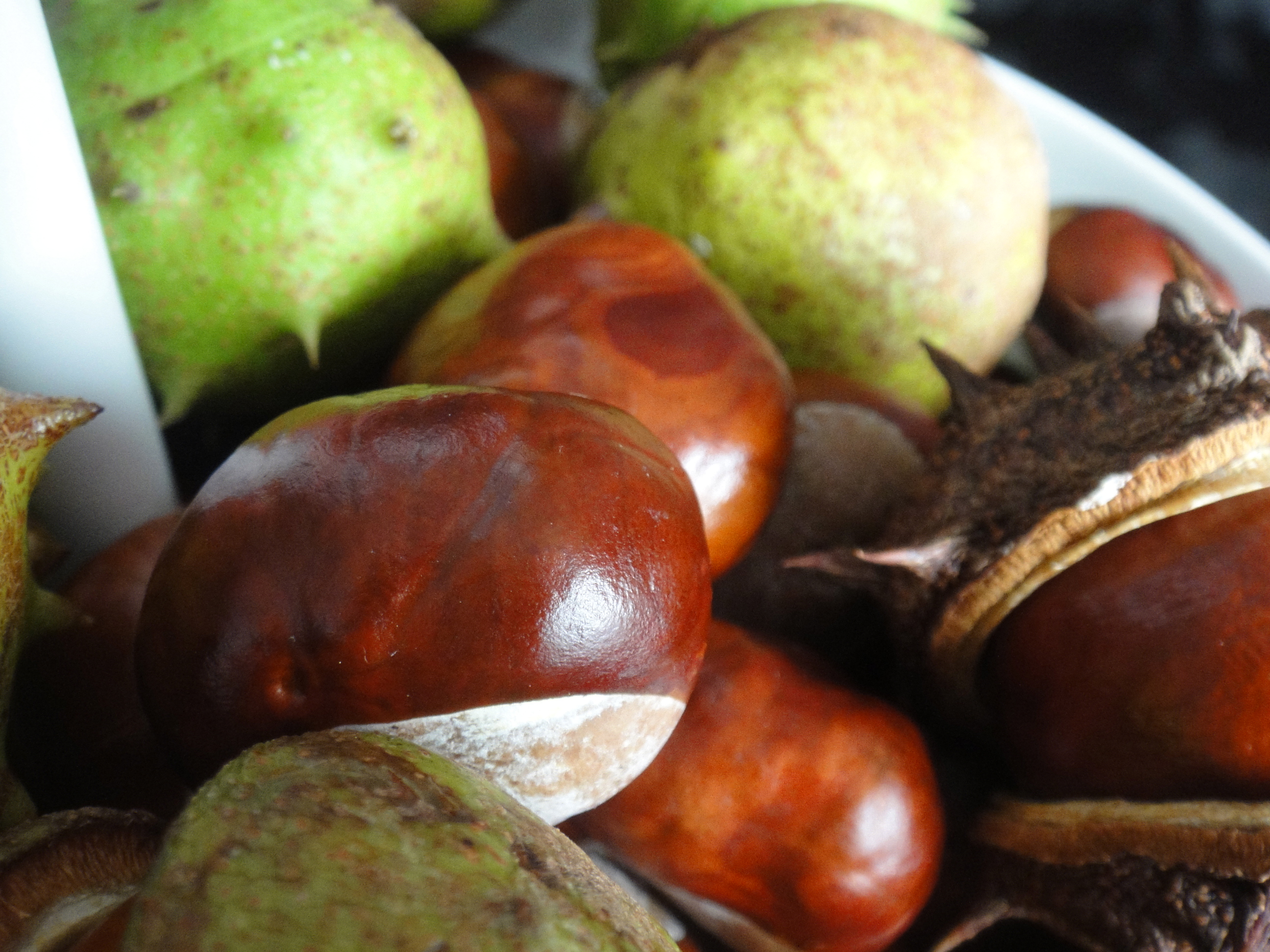
Collecting conkers, fallen from the golden boughs of large horse-chestnut trees, bursting as they are around this time with green spiky cases with their shiny auburn seeds, has always held something of a legendary status for me. When I was younger, it seemed that anyone who was anyone went conker collecting, and the more, the plumper, the shiner you could collect, the better. Of course tradition dictates that conkers are collected, threaded on a string, and then used in a good old game of conker and string, knocking the conkers together until one breaks, the winner being he or she who’s conker remains intact the longest.

Off on our conker search (that’s us in the shadows!)

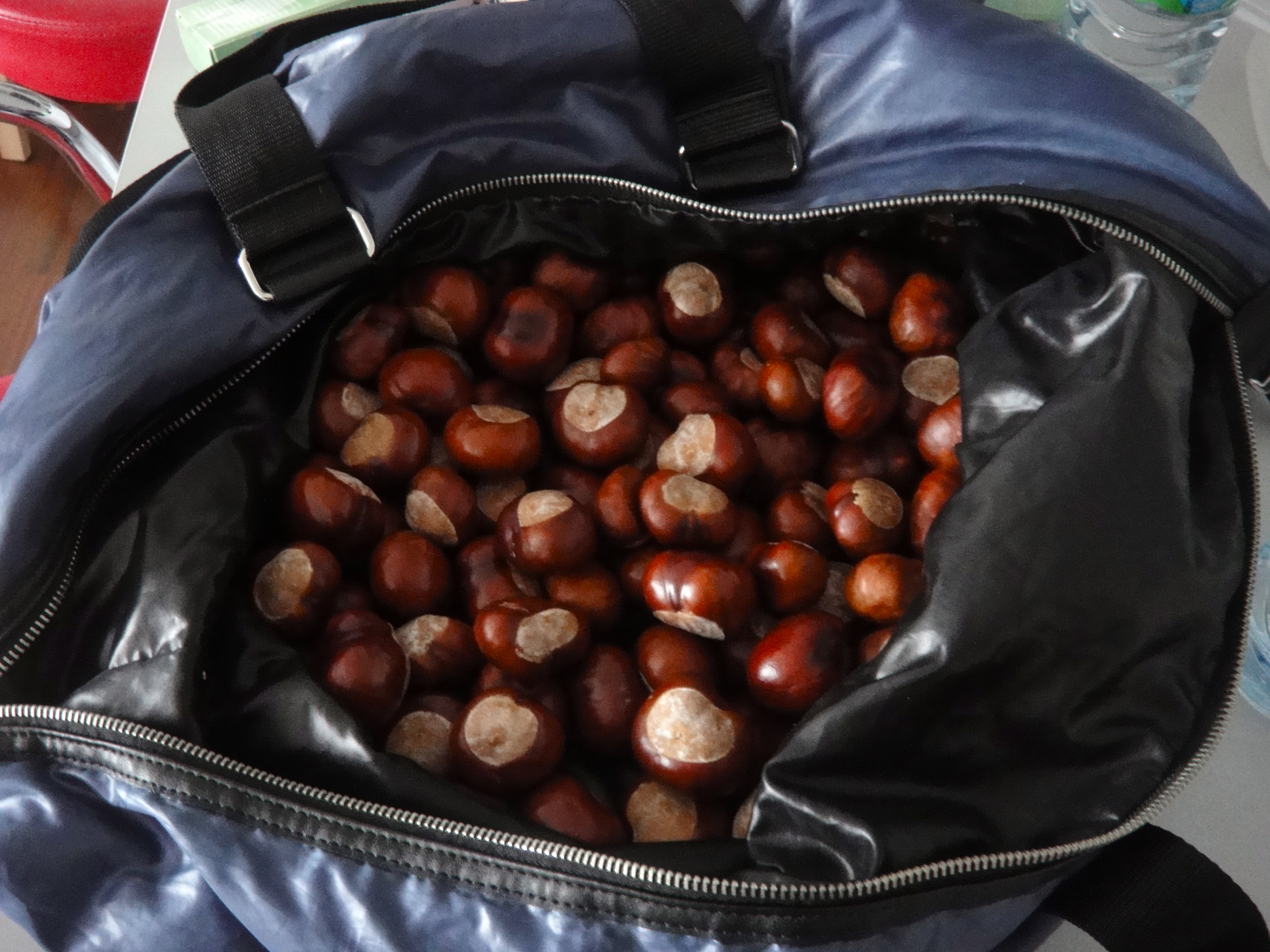
Our conker haul!

The conker game never really appealed to me, but the thrill of finding these shiny round autumn gems certainly satisfied my magpie nature. There was always a great joy to be had in hunting them down, looking amongst piles of crispy brown fallen leaves, all around the wide tree trunks, and coming across a large, plump shiny chestnut-red conker, freshly fallen from the inside of its silky white enclosure, the pure and soft antithesis of the outer thorny shell.

Even now, I love the smell of freshly fallen leaves, slowly starting to decompose in the fresh damp air and the crisp sunny mornings, the scent recalling to my mind those long autumn walks and the joy of collection and discovery, of acorns and conkers, of spiky seeds and ruby red leaves. Living so close to Clapham Common, I have a host of large trees on my doorstep. Unlike the autumns of my Sussex childhood, when my father would use his umbrella to try and pull more conkers down from the trees, such was their scarcity, now, in a single walk, I can bring in a haul of freshly fallen conkers, before the high gloss marbled brown shells have gone dull, or been pecked at my birds or squirrels.

A shiny conker bursting from its shell

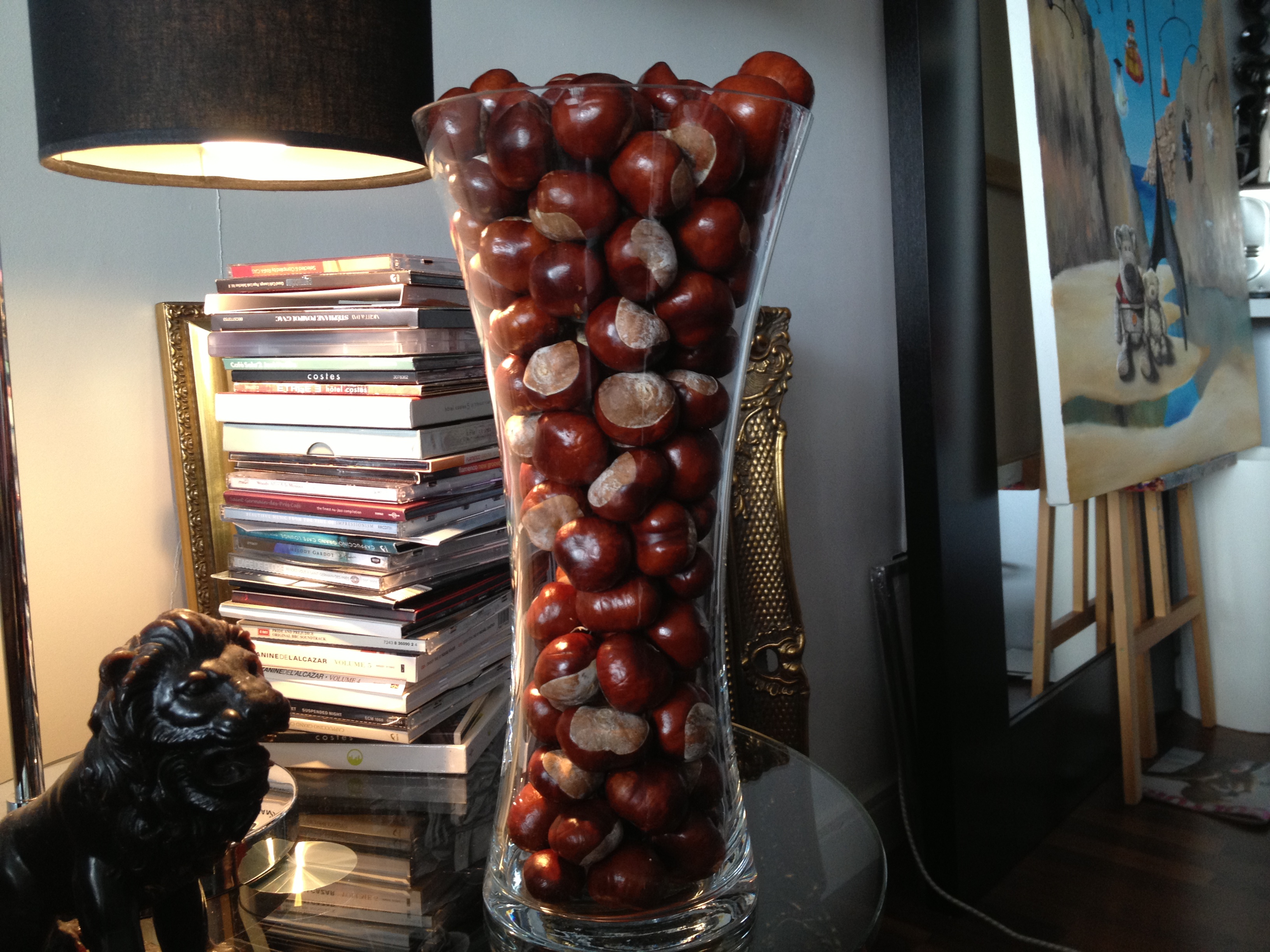
It was one such haul which I collected for myself the other day, as has become a new more adult tradition of my later years here in London. Depending on what I find, I tend to display my collection in fruit bowls so that their lustrous glory can be reflected upon during these darkening autumn days. And this year, so impressed was I with my find, that I even filled a vase full of them too. You should try it – while they don’t last forever, they’re guaranteed to last longer than your average vase of flowers, and better still, they’re free! Try getting a few barely opened complete pods – these will take a few days to open and when they do, the fresh shine of the conker within will look especially good in your display.

Displayed in our fruit bowl

Mixing other autumn seeds into the mix

My vase display

I leave you with some shots of the acorns and conkers I painted as part of my Richmond Park painting last year. Happy conker hunting!

Conkers as featured in my painting of Richmond Park last year

© Nicholas de Lacy-Brown and The Daily Norm, 2001-2012. Unauthorized use and/or duplication of the material, whether written work, photography or artwork, included within The Daily Norm without express and written permission from The Daily Norm’s author and/or owner is strictly prohibited. Excerpts and links may be used, provided that full and clear credit is given to Nicholas de Lacy-Brown and The Daily Norm with appropriate and specific direction to the original content.


Sunday Supplement: Bricks and Stones May Break My Bones

Following on from the somewhat tender recollection of my accident when painting the traffic cone upon my autobiographical mobile, I thought the time was probably ripe now to share a few of my accident paintings too. They’re not the easiest of works to suddenly introduce on The Daily Norm which, after all, tends to be more about the joie de vivre and the pleasant past times of daily life. Nonetheless, we would be foolish to underestimate the power of art as a channel through which stories of pain can be relayed in often the most powerful way, and also as an invaluable tool through which, as an artist, that pain can be relayed and tackled head on.

In the months which followed my altercation with a falling wall, I was bed bound and imprisoned under the weight of a barbed metallic illizarov frame. This frame, which is a form of external fixator, was attached to my leg, with some 14 metal rods sinking deep through the flesh and into the bones. The daily pain of moving around with such a structure affixed was indescribable, which, along with my need for crutches, and severe weakness meant that I could do little more than lie, sleep, read and, mercifully, paint.

Bricks and Stones May Break My Bones (The Show Must Go On) 2008 © Nicholas de Lacy-Brown, oil on canvas (130cm x 110cm)
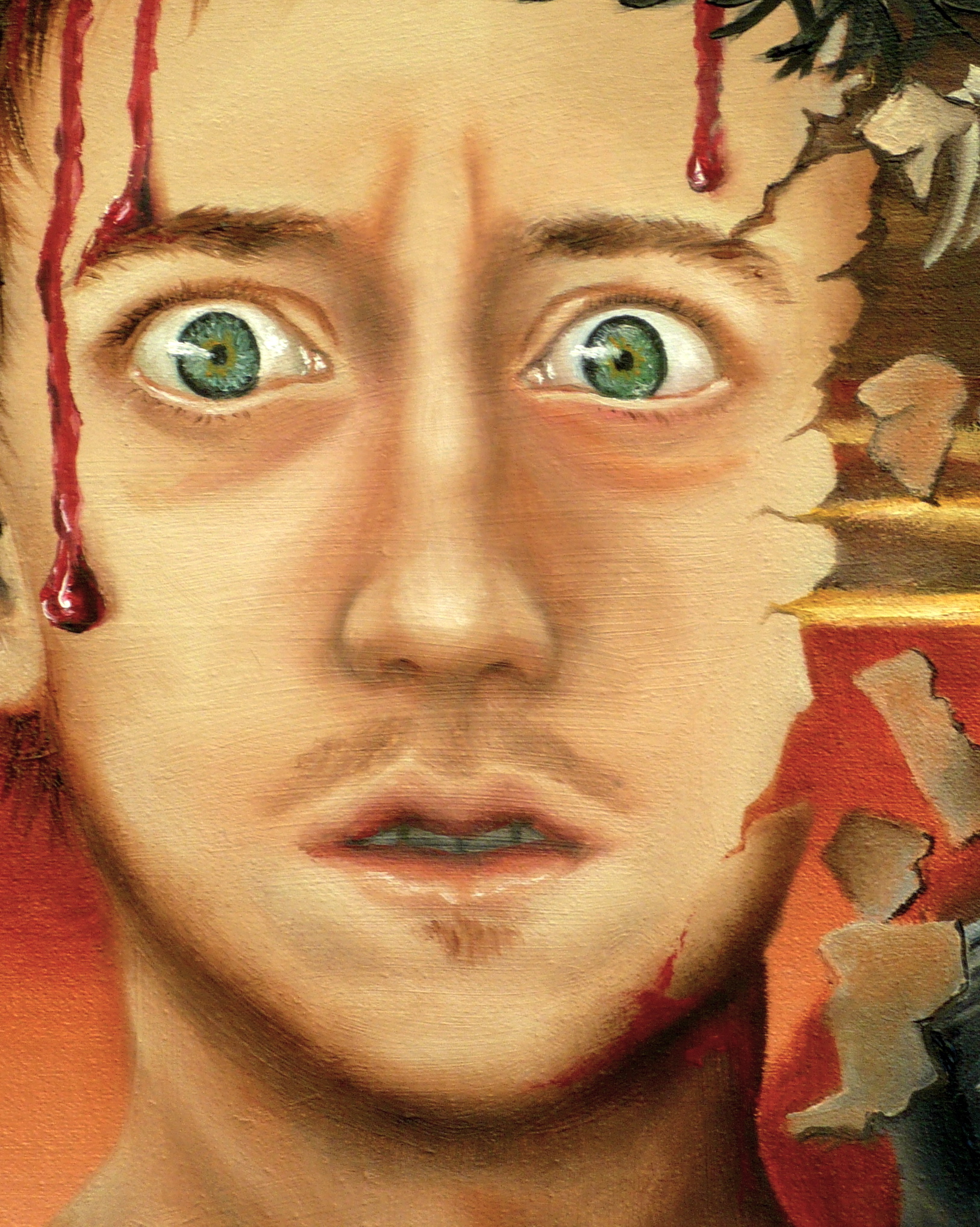
This painting, entitled “Bricks and Stones May Break My Bones (The Show Must Go On)” was the first of ten paintings which I eventually completed during the course of my recovery. I started imagining the painting shortly after the accident, when the effect of a falling wall had become so inextricably linked with the physical and mental course of my life that I imagined myself morphed into the wall, the chilling barbed wire from the top of the wall framing my head like a kind of crown of thorns. With the work growing inside my head, I ordered the canvas while in hospital and set to work as soon as I could when I was at home in my parents’ house in Sussex.

The work wasn’t easy. I had to be lifted onto one chair, with another chair directly in front of me so I could place my leg upon it. Both chairs were on wheels so that I could move around the full dimensions of the canvas (it’s 130cm wide), but in fact I could paint only in short bursts at a time, such was the pain that wracked my leg and the fatigue which overcame me.

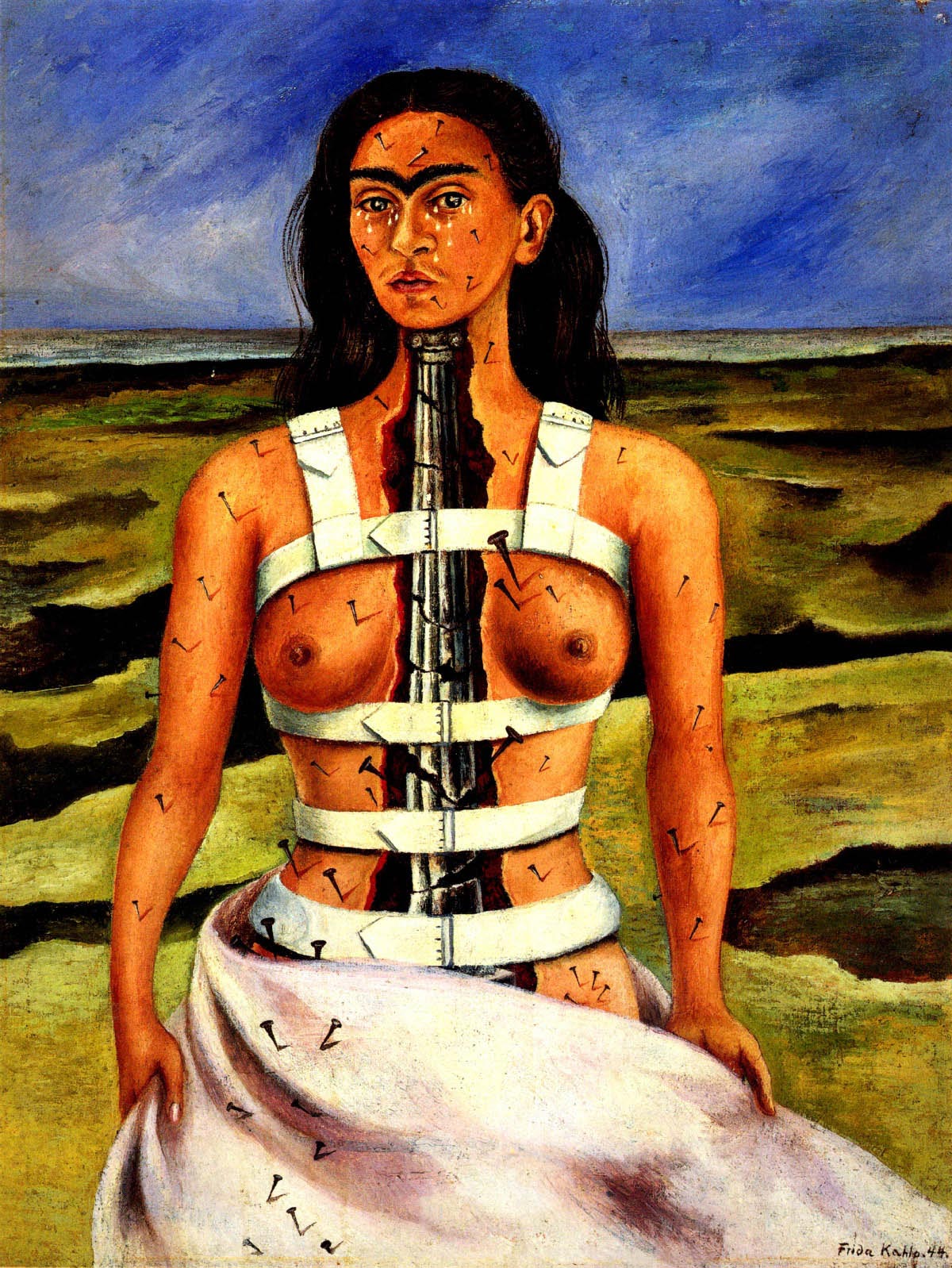
The resulting painting illustrates the accident through a toy lorry, crashing into the wall which has metamorphosed into a classical bust with my horrified face atop it. To my left, my crushed leg is like a column, broken into pieces, the foot, with its nerves damaged resulting in a foot-drop, being propped up by a crutch. I guess I drew influence from Dali for this image, who himself used wooden crutches as symbolism in many of his works – how ironic that after years of loving Dali’s work they should be so pertinent to me now. The broken column meanwhile is a reference to the work of Frida Kahlo, the Mexican artist, who struggled through her career with a spinal injury sustained in a tragic bus crash, and whose pain is transposed so powerfully into her work.

Dali’s Crutches

Frida Kahlo, The Broken Column (1944)

On the right of the canvas, the idea that “the show must go on” is represented, another crutch propping up the theatrical proscenium arch in a demonstration of my means to carry on and not give up at this early and all important stage of my convalescene. However in this theatre, the curtains are red like blood, pinned to an engorged fattened pillar (representing my swollen leg) with the ghastly metal stakes which fixed the illizarov frame to my bones. There too the traditional masks of comedy and tragedy have both adopted the guise of tragedy.

And as my body crumbles, my ear has fallen away and lies in the foreground, next to my artist’s signature. This is my representation that my accident had made me a stronger artist. As a symbol of this, I used the ear, making reference to the likes of Van Gogh who, despite the emotional turmoil, the chopping off of his right ear etc etc, was a real artist, who used his work to give him strength, and communicate his turbulence to the world.

Finally, I should add that the title, “Bricks and Stones May Break My Bones” is a play on the familiar saying “Sticks and stones may break my bones, but words will never hurt me” – a phrase through which a child, perhaps teased at school, attempts to instil strength within himself, despite the pain he feels for having been the victim of mean words. The phrase was pertinent then, because like the child, I was struggling so hard with the relentless pain of my recovery, but through art I drew the strength to somehow get through it and tell my story to the world.

© Nicholas de Lacy-Brown and The Daily Norm, 2001-2012. Unauthorized use and/or duplication of the material, whether written work, photography or artwork, included within The Daily Norm without express and written permission from The Daily Norm’s author and/or owner is strictly prohibited. Excerpts and links may be used, provided that full and clear credit is given to Nicholas de Lacy-Brown and The Daily Norm with appropriate and specific direction to the original content.

Autobiographical Mobile: My painting diary – Day 7: My accident

It was a drizzly dull day, the day that changed my life. I was cleaning my windows. I had laboured all day. My newly found art agent was due to visit my flat the next day and I wanted to make a show of it. So I cleaned away, polishing each surface, wiping away a winter’s worth of raindrops from my large sliding glass windows on this mild May day. The cleaning was time consuming however, and it was past 2pm when I realised I had missed lunch. Just a quick break is all it would take to walk along to Marks and Spencer’s, only two doors away, where I could buy a snack.

So out I went, leaving my flat, and walked along the road to grab a sandwich and a drink so that I could carry on my day. I left my now clean windows open, the TV on. I was only going to be a minute.

But I never got that sandwich. And that TV was switched off by the police.

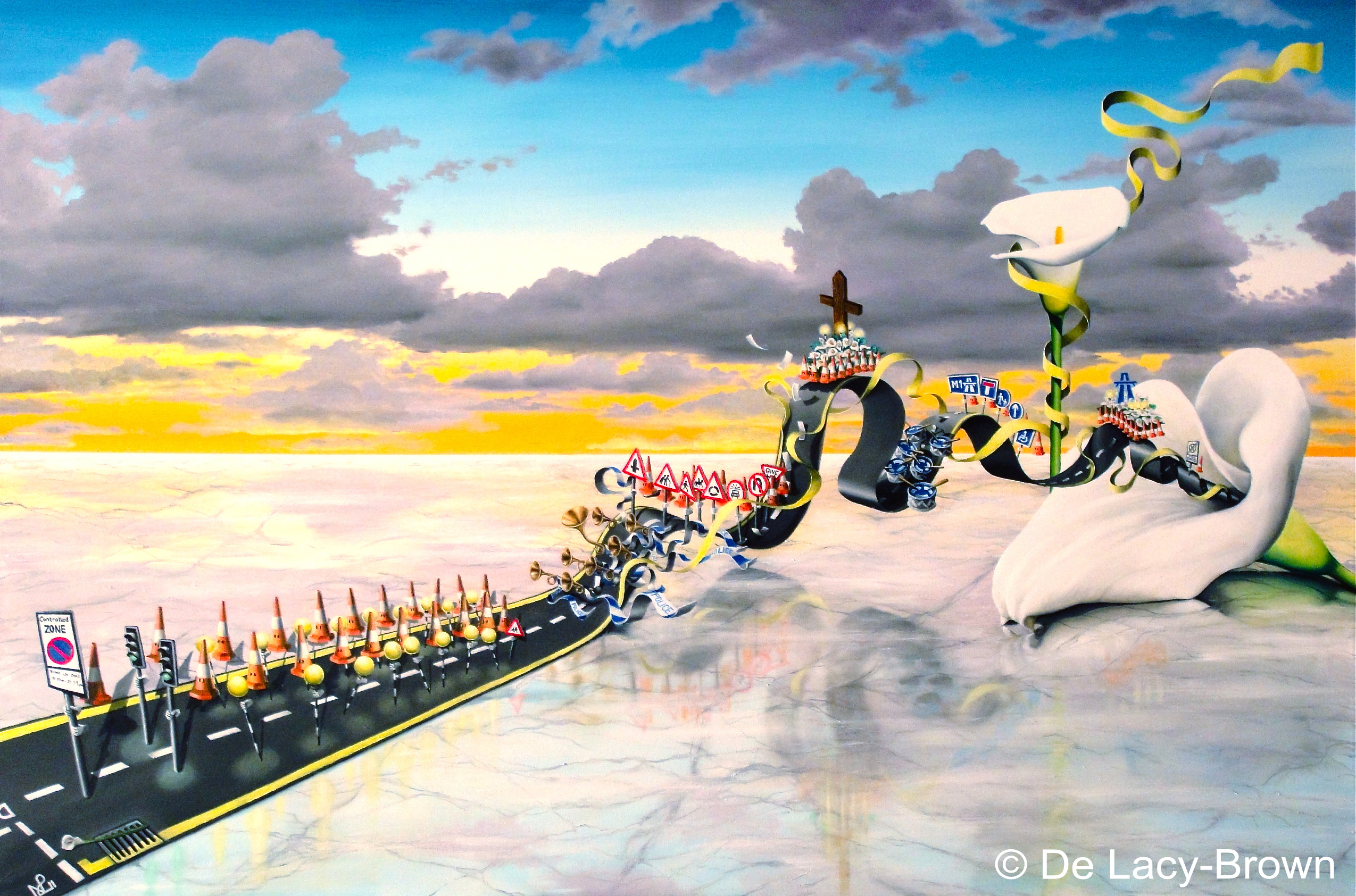
Traffic cones in my art – Road Traffic Control (The Semana Santa Code) (2012 © Nicholas de Lacy-Brown, oil on canvas)

There was a large concrete brick wall next to the building in which I live. Atop the wall, barbed wire prevented trespassers, but also gave the otherwise empty site the appearance of a concentration camp, stark and deserted on the South London skyline. I had walked past this wall countless times, but had never paid it much notice, at least not until that barbed wire cut into my head, like a crown of thorns encircling above my eyes. True, the huge metal gates were occasionally swung open, but were more often closed: the site was used for some kind of storage, and large delivery lorries would occasionally enter and exit the site. There was, occasionally some activity there.

The day that changed my life was one of those days. As I walked past the wall, a large lorry was driving towards the exit. It was heading closer and closer to the wall. But something was wrong. What happened next is something of a blur. It wasn’t a long distance to walk, but as I passed the wall, time seemed to stand still. I will always remember in my mind that enduring image – the top corner of the wall seeming to crumple, like paper, folding outwards towards me. Once I realised that the wall was falling, it was too late. As the masonry fell and the whole weight of the massive 10ft concrete wall started to crash towards the ground, there was no escape. I was already pinned under it.

It’s the loneliness that haunts me. No family, no friends. Alone, imprisoned under a fallen wall. Not knowing whether I would walk again.

I remember the rain. The sickly feeling of a pitter patter around my head. And the stinging sensation. I couldn’t locate it – the signals were all too mixed. But I remember around my face feeling sharp pain, the cold water from the skies, the trickle of blood, the uncomfortable sensation of grit all around me, the numb pain of weight pounding down upon my body as I tried to move.

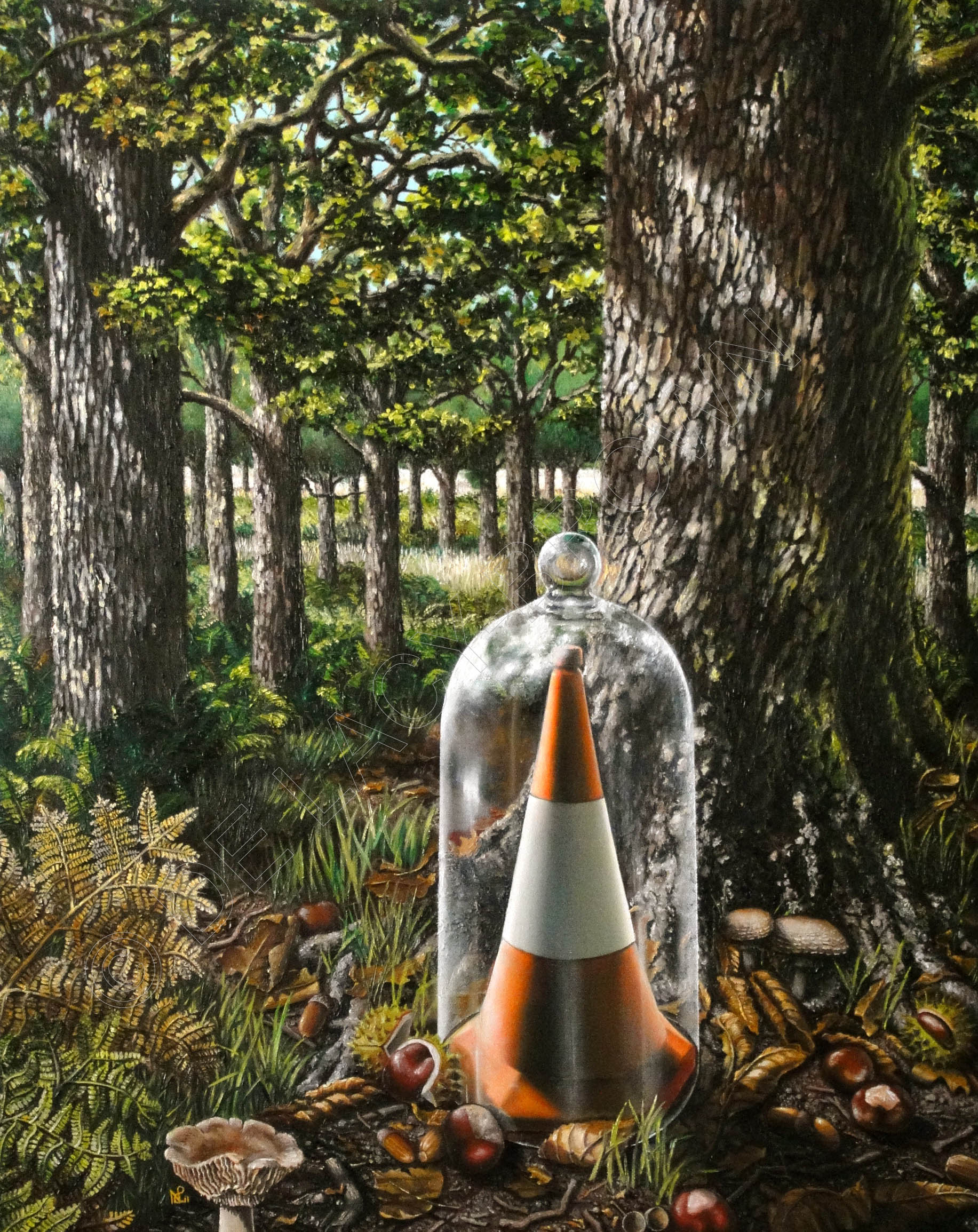
Moving on from my accident – Road Traffic Control (Autumn in Richmond Park) (Oil on canvas, 2011 © Nicholas de Lacy-Brown)

But I couldn’t move, try as I might. Because my right foot was somewhere around my shoulders – my entire body was twisted in a way that no skeleton was ever meant to withstand. The wall had fallen – the lorry had crashed into it, brought it down as the driver tried to go forwards. He was not, as it was later reported, reversing. This driver was heading forwards into the wall, consciously sealing my fate as he continued in his reckless trajectory towards the road. I never knew why he brought down the wall, what he was doing, what was his excuse. I never learnt why he drove away, leaving the scene of the accident until police stopped him. And I was never given an apology.

Yet 4 and a half years after the day, I live with a mercifully saved leg, a leg pieced together by 7 operations but which must, still, endure the intrusion of a string of future operations still to come. After two years on crutches I can now walk unhindered, but not for long. I cannot run, cannot bend my leg sufficiently to get on a bike. I cannot stretch it fully out, and I cannot lift my toes. I’m forever tripping on my feet, and bemoaning the burning sensation which runs down my damaged nerves. I have to fill my shoes with insoles, and build my heels up to compensate for my now shortened leg. But I survived. And in a way, I’m stronger, as cliché as that may be.

The day the wall crushed my leg was a day that changed my life. I face an uncertain future, but I was given the opportunity, as a 23 year old, to face up to the fragility of life, and now live life to the full.

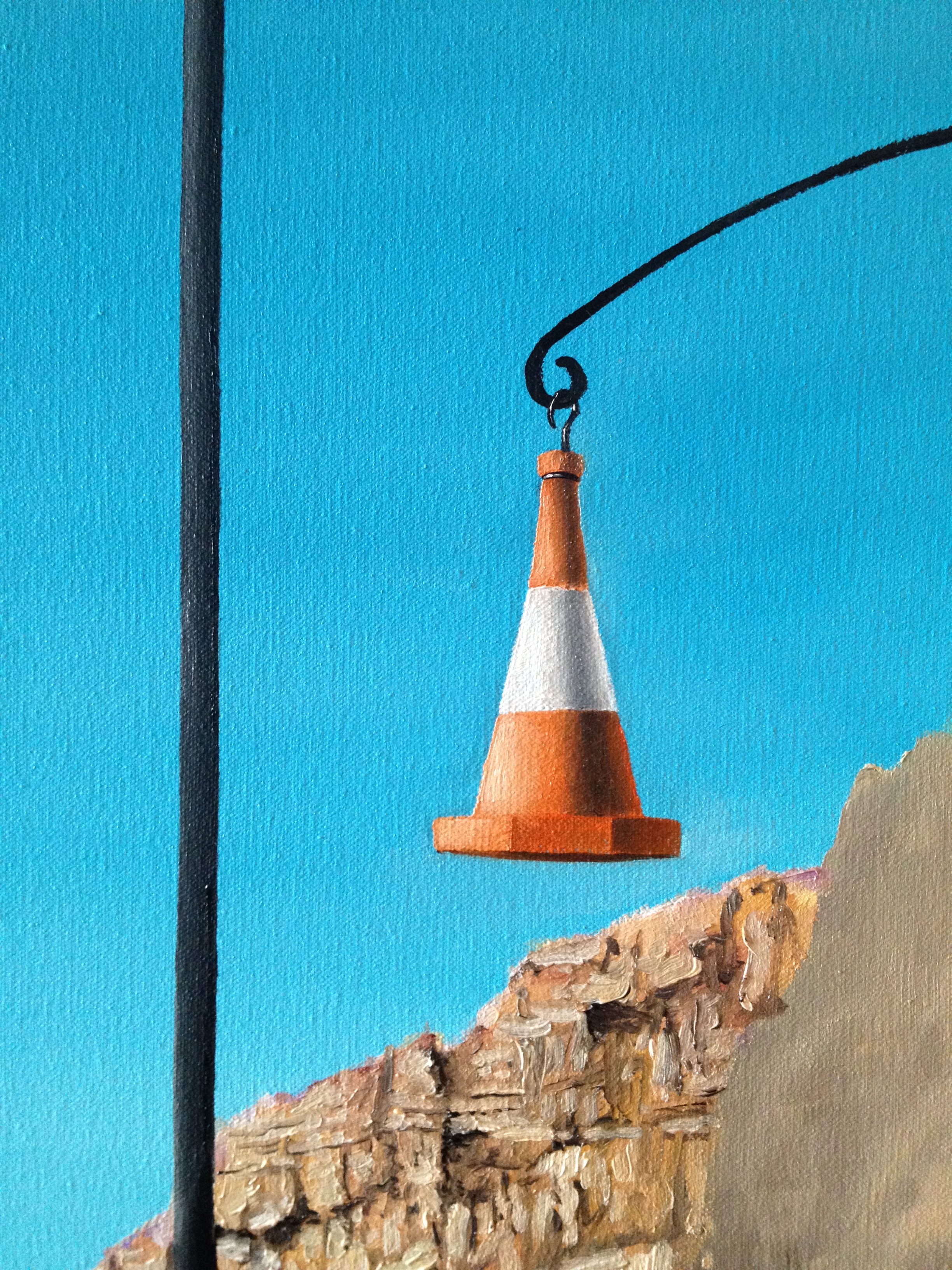
A traffic cone now hangs on my autobiographical mobile

On my autobiographical mobile, my accident must feature. It’s a Calder-based mobile, and simplicity is the key. So what better way then to symbolise the accident, than a simple traffic cone, a symbol which I have already adopted in my art as a representation of my accident on the roadside, when a heavy goods vehicle brought down a wall and disabled a passer by.

The day that changed my life: My accident, my story.

© Nicholas de Lacy-Brown and The Daily Norm, 2001-2012. Unauthorized use and/or duplication of the material, whether written work, photography or artwork, included within The Daily Norm without express and written permission from The Daily Norm’s author and/or owner is strictly prohibited. Excerpts and links may be used, provided that full and clear credit is given to Nicholas de Lacy-Brown and The Daily Norm with appropriate and specific direction to the original content.

Sunday Supplement – Orange Square

To think that just a week ago I was sitting in Marbella’s Plaza de Los Naranjos (Orange Square) sipping upon a creamy Cafe con leche, and snacking upon a light crispy churros con chocolate. The sun was shining, and we were sat in the shade, shying away from the September heat which, remarkably, was hitting the 30s. Only a few hours later we took a flight back to London. The realisation only kicked in as the plane started to descend. It was that moment as we plunged from a clear peachy sky at sunset into the grey gloom of a tumultuous storm cloud. The little plane was battered from side to side, the windows were suddenly hit with a rain shower, the drops dancing diagonally across the pain in the direction of our high-speed travel, and within seconds we had been violently redirected from Summer into a deep and depressing winter. Setting down on the concourse at City Airport, we could barely see for the heavy rain all around us, and descending the plane’s steps into the outside, our sun-kissed bodies shivered in despair at the instantaneous 20 degrees drop to which they had been so suddenly sacrificed.

A few hours later and I was back at work. A week later and it’s as if the holiday never happened at all. And yet it’s the memories which to my mind give a holiday its value. When you’re away, its all too often like you’re traversing a dream, your feet never quite touching the ground, as the ties of reality continue to drag your concentration back to the entrapments of home, never quite freeing you sufficiently to fully immerse yourself in your holiday destination. It’s vital then that we remember – and of course this blog, and my photos, and my recipes are key to my success in this.

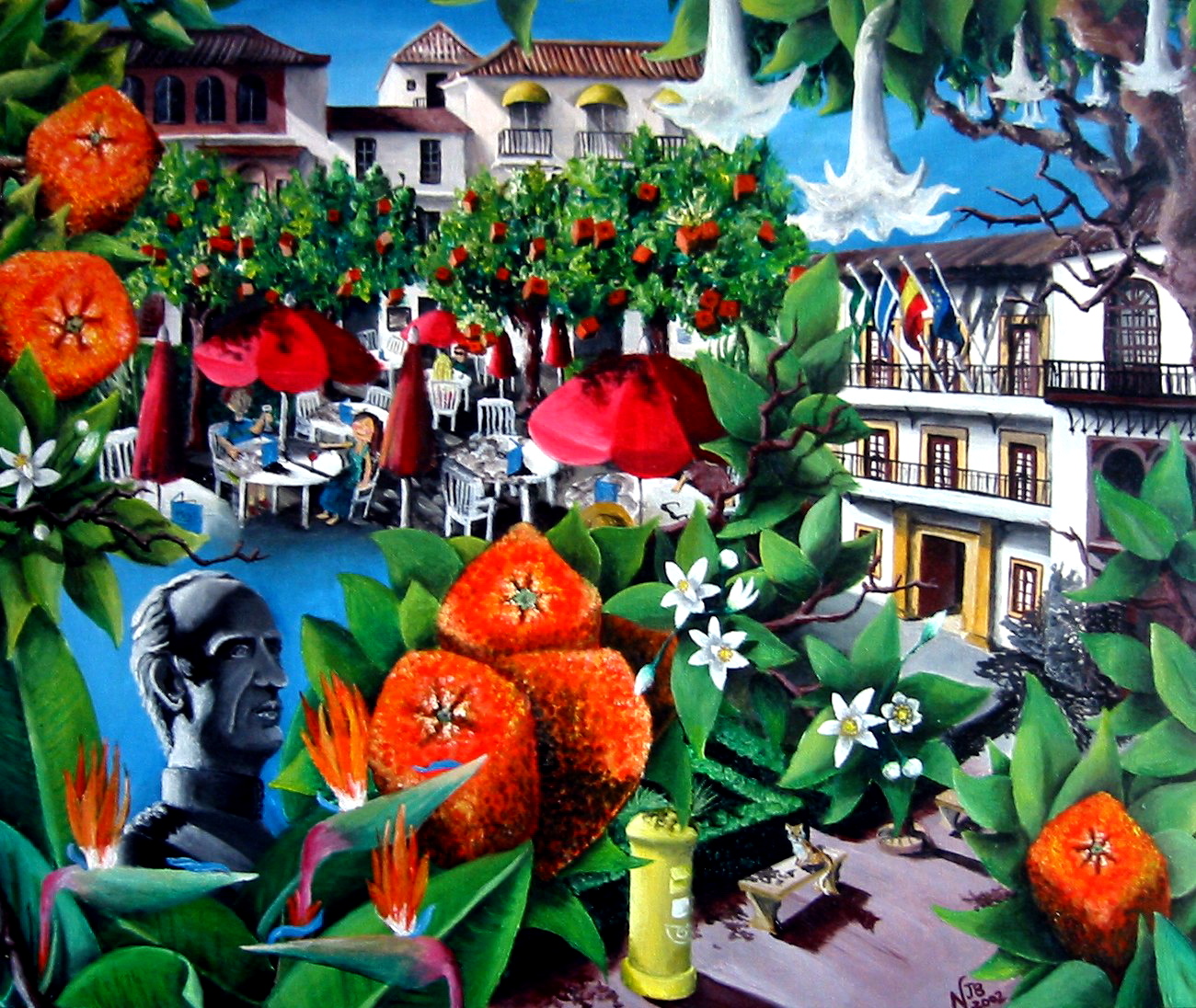
Orange Square (2002 © Nicholas de Lacy-Brown, acrylic on canvas)

For today’s Sunday Supplement then, I have decided to return to one of my earliest paintings, completed in Marbella in 2002. It shows the old town’s main bustling square, full as it is of cafe’s and restaurants, musicians and people turning out for their evening stroll. With a play on words which only the English translation of the square’s name accommodates, I painted the oranges square to give pictorial illusion to the place name. There too is the central bust of King Juan Carlos, and the bright yellow postbox which gives some lemon to an otherwise orange square. Finally the painting is dappled with the flowers – the brugmansia, the bird of paradise and the jasmine whose scent fills the square with perfume all year round.

It may be Autumn all around me, but in my mind, orange hues and blossom scents fill my imagination.

Orange Square in the centre of Marbella’s old town with the bust of King Juan Carlos

PS: If you like my painting of Orange Square, it’s available as a limited edition print along with other prints and my range of Norm Christmas cards on my Etsy Shop – check it out!

Enjoy your Sunday.

© Nicholas de Lacy-Brown and The Daily Norm, 2001-2012. Unauthorized use and/or duplication of the material, whether written work, photography or artwork, included within The Daily Norm without express and written permission from The Daily Norm’s author and/or owner is strictly prohibited. Excerpts and links may be used, provided that full and clear credit is given to Nicholas de Lacy-Brown and The Daily Norm with appropriate and specific direction to the original content.

The Daily Sketch: Milkmaid Norm

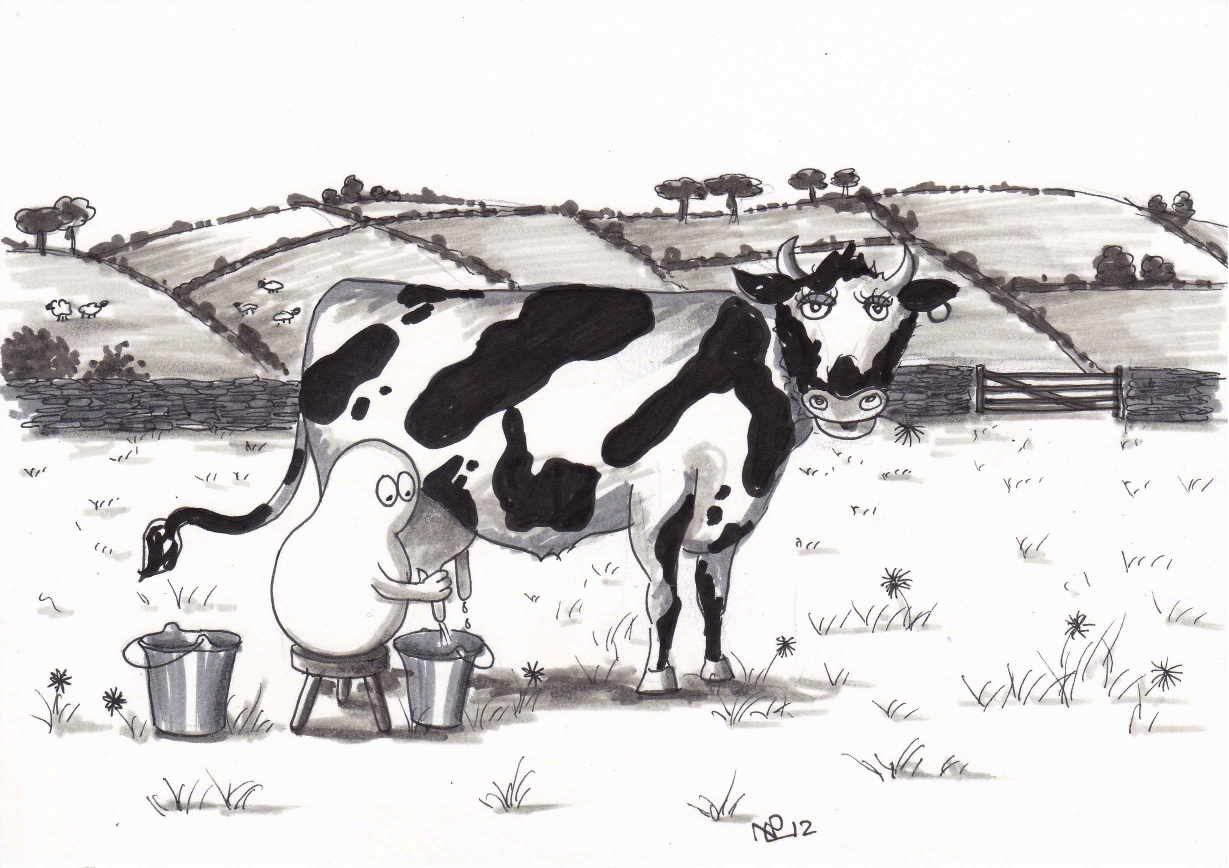
Now you see admittedly there’s a problem with this title. To call this Norm a Milkmaid is a little misleading, because he’s not a maid at all. But call him a Milkman, and you’d expect this little Norm to be driving around in an electric-powered milk van making his early morning deliveries around the towns and suburbs of Britain. He may go on to do that later of course (farms are generally short of staff these days – you know, what with all the reduced EU farming subsidies and all) but that’s hardly the point. I suppose as an alternative, I could call him a MilkNorm, but that just gives all the wrong ideas. Norms are white enough as they are, let alone being confused for a globule of milk (and it’s not as if they haven’t tried to tan, but it tends to turn them a kind of unattractive vertiginous purple rather than a butterscotch brown).

Milk(maid) Norm (2012 © Nicholas de Lacy-Brown, pen on paper)

So there we have it. It’s a dilemma which may serve to overshadow this otherwise bucolic scene of pastures green and an attractive friesian cow being milked by her proud milkmai…man…Norm… Here we go again. I give up. Enjoy the sketch while remembering an apparently important lesson in life – not everyone can be labelled. Some Norms just want to be themselves.

© Nicholas de Lacy-Brown and The Daily Norm, 2001-2012. Unauthorized use and/or duplication of the material, whether written work, photography or artwork, included within The Daily Norm without express and written permission from The Daily Norm’s author and/or owner is strictly prohibited. Excerpts and links may be used, provided that full and clear credit is given to Nicholas de Lacy-Brown and The Daily Norm with appropriate and specific direction to the original content.