Skip to content

Posts tagged ‘Nicholas De Lacy-Brown’

War in my Art: WW1 Norm

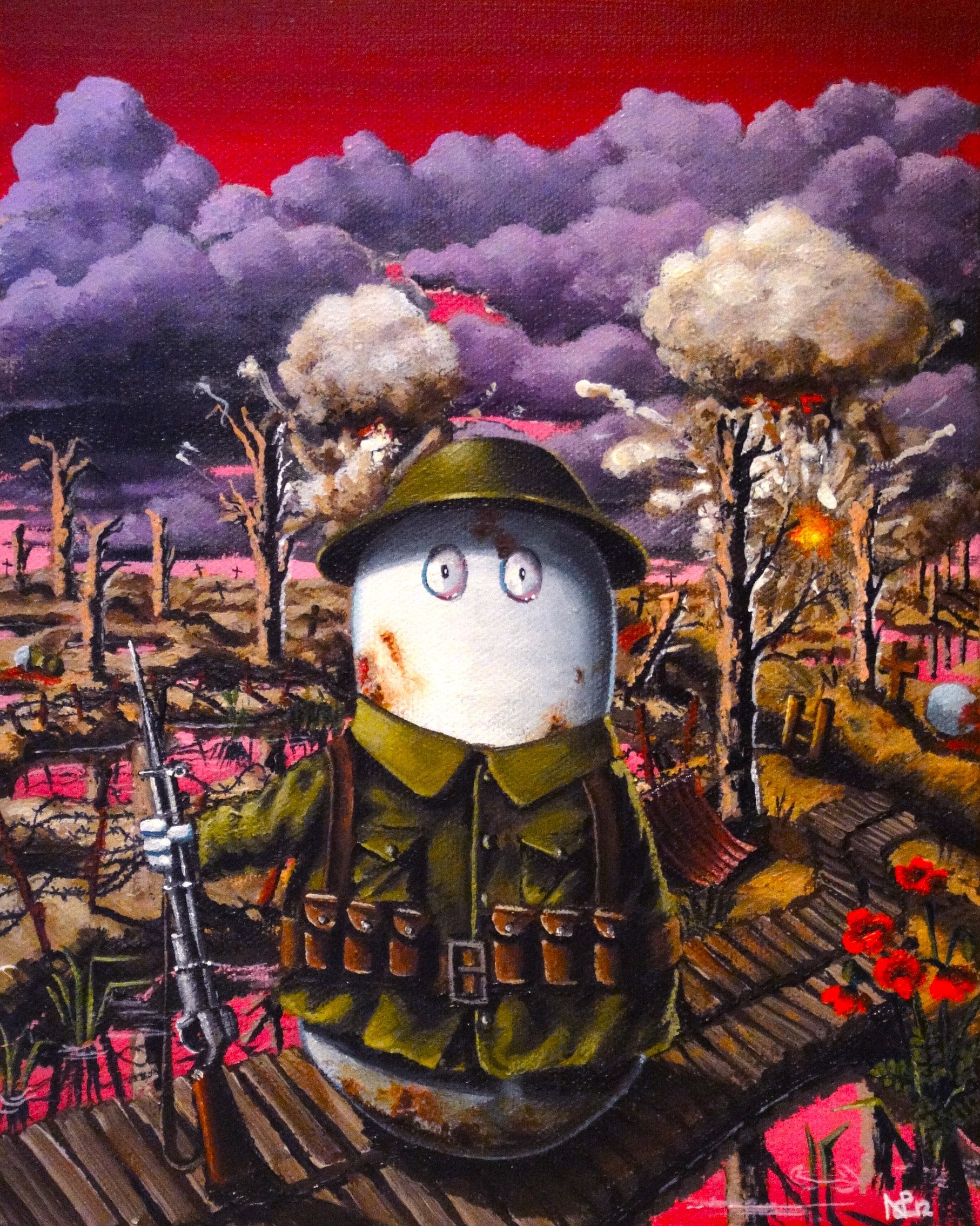
My final post on War brings a little lightheartedness back to the Daily Norm. Having been chewing over the subject of war for a few weeks and having been plentifully inspired by the war art I saw at the Imperial War Museum, I was prompted to once again pick up my paintbrush and devote a work to the ravaged landscape of WW1 France. But as I am all about Norms at the moment, obviously a WW1 Soldier Norm takes centre stage. He may be just a character, but I think that through this parody, the horrors of war are still there for all to see. Hence in his eyes, a look of shock, exasperation and despair at the state of the world around him, beautiful landscape turned into hellish quagmire, human lives used as fodder for the guns. In the background, clouds loom menacingly in the sky, while before them, manmade clouds burst up from explosions, as the putrid, corpse-ridden deserted ground all around the trenches is blown further into the air and scattered like a rain shower. In the foreground poppies: traditional symbol of hope, life growing instinctively from human wreckage. In this, unique and Normy way, I remember.

WW1 Norm (acrylic on canvas, 2012 © Nicholas de Lacy-Brown)

War in my Art: Works inspired by Birdsong

Having reflected for the majority of last week’s posts on the subject of war, I made the decision to seek inspiration further by visiting London’s Imperial War Museum. There, tucked away behind the major exhibitions of planes, military instruments, uniforms, the holocaust and even a WW1 trench reproduction, is a collection of war art to rival all of London’s major galleries. There is something about war as a subject matter which loads each and every painting with a heavy significance, because you know that for these images to have been produced, the painter has either lived through the hell portrayed, or at least witnessed it first hand. Consequently the pain which is captured is visceral, the emotions cutting, cynical, raw. Yet these works are undoubtedly beautiful. At the centre of the IWM’s collection is Sargent’s gigantic work, Gassed, an incredible, moving image, which shows soldiers who have been temporarily blinded after a gas attack helping to guide one another with in caterpillar-like line, while all around them, soldiers similarly afflicted fill both the foreground and background. It’s scale is startling, but the small moments of human kindness in desperate times are even more striking.

John Singer Sargent, Gassed (courtesy of Imperial War Museum, London)

This painting is not unique in it’s superb captivation of WW1, and as you stroll around the collection at the Imperial War Museum, paintings which you may never have seen before seem somehow familiar – for it is clear that as the memory of war slips further and further into the past, with survivors now few and far between, and photographic and film accounts being scarce and of poor quality, it is the paintings of war which now take centre stage in helping a modern audience to imagine the apocalypse of trench warfare. It is, for example, immediately clear to me that the cinematography in Spielberg’s new film, Warhorse, is inspired by the haunting trench landscapes of Paul and John Nash.

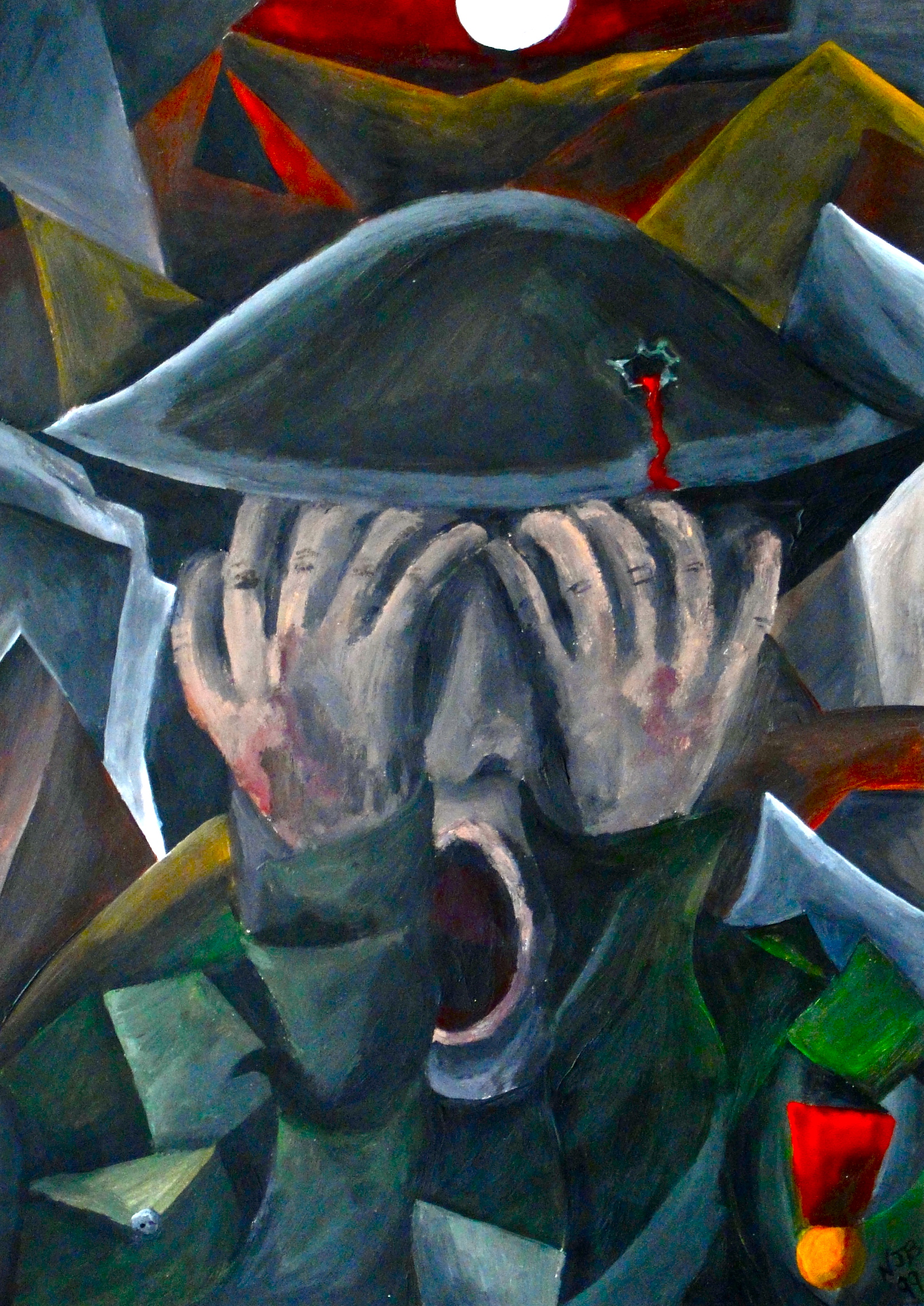
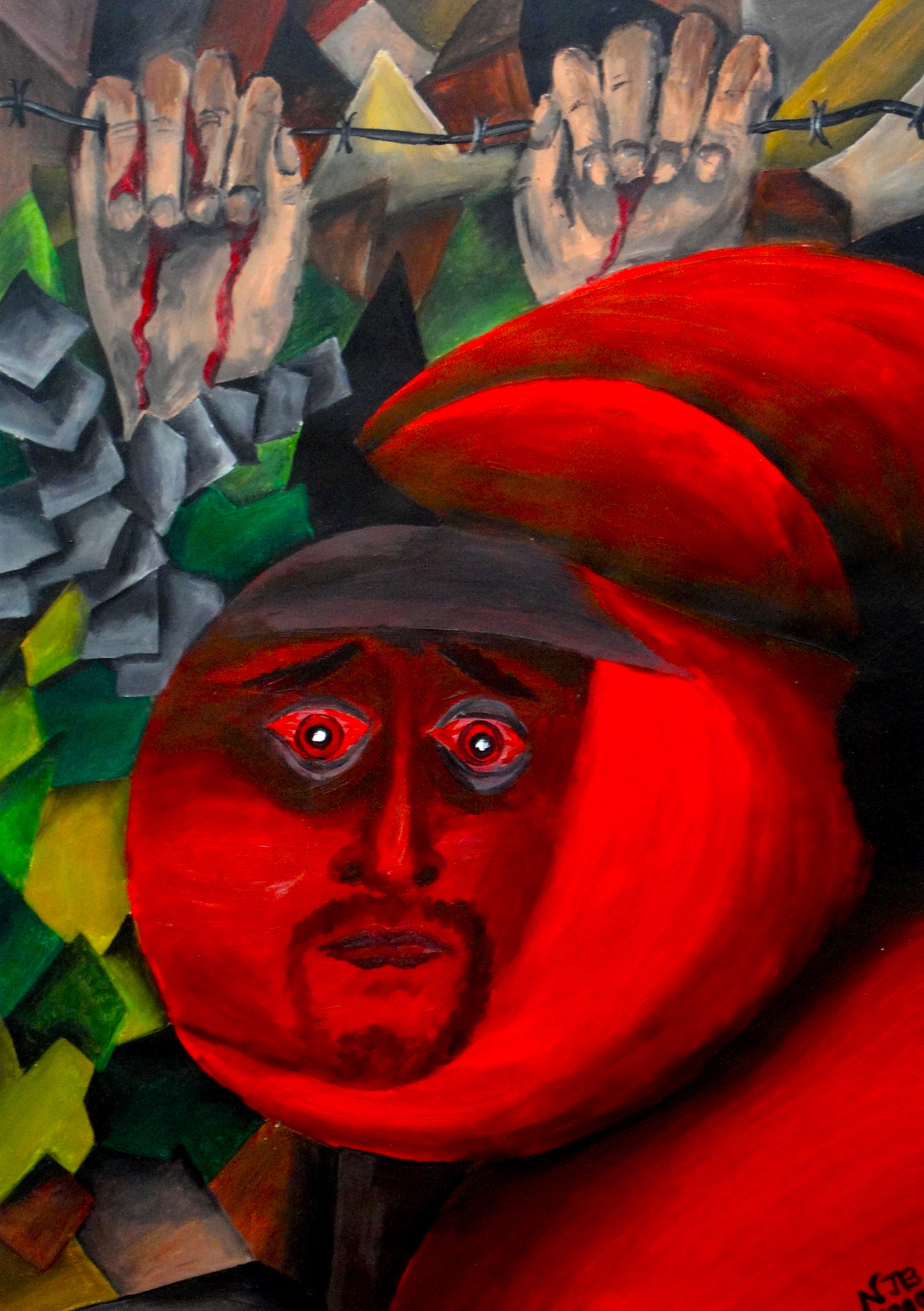
Yet before I even set eyes on the Imperial War Museum’s collection, I was myself emotionally engaged with the subject of war, and sufficiently inspired to begin painting it as a young artist. The source of my inspiration was the novel Birdsong by Sebastian Faulks. The novel is the only book every to have made me cry. It’s depiction of war is so striking, so accessible, that it is impossible not to be caught up with the plight of its characters and the horror of war. For a 15 year old reading the story, I was unintentionally drawn wholeheartedly into this evocative re-imagining of the First World War, even though so many people in my generation appreciate little about it – for most they think WW1 is all about wearing a poppy every 11/11. And when I finished the novel, one of those rare moments of inspiration flooded into my head – I knew immediately that I wanted to paint a tryptic based on the scenes conjured in my head. And the fact that I then painted war without pictorial reference is, I suppose, testament to what a superbly descriptive writer Sebastian Faulkes is. Having at last got home to my parents’ house in Sussex, I was able to photograph the paintings which resulted from that inspiration. I painted them at the age of 15, before I really appreciated that I might have artistic talent, and certainly before I took it seriously. Nevertheless, I like the paintings to this day probably since their imagery, like their subject matter, has timeless significance.

Screaming Soldier - A Victim of War (acrylic on paper, 1999 © Nicholas de Lacy-Brown)

Trench Rat (acrylic on paper, 1999 © Nicholas de Lacy-Brown)

The Truth Behind the Poppy (acrylic on paper, 1999 © Nicholas de Lacy-Brown)

Following these works, I moved onto another tryptic of war paintings, this time depicting the First and Second World Wars and the Cold War. I donated the collection to the history department of my old school Our Lady of Sion School in Worthing, where I believe they are still hanging to this day. Sadly I don’t have any photos of the works, but before I donated them to my school, the paintings attracted the interest of Worthing Town Hall. As a result, the works were exhibited in a special exhibition marking Remembrance Sunday in November 2000. A photograph of me with the Mayor of Worthing and the pictures hanging on the wall behind us was on the front page of the local Newspaper that month. That paper was then painted into the background of another of my very early works in which I mourned the death of my guinea pigs. So here it is, the only picture I have left of that second war tryptic.

Cinnamon and Nutmeg (acrylic on canvas, 2000 © Nicholas de Lacy-Brown)

The conclusion of this post is, I suppose, the potential of a well-written novel to empower the mind, and to recreate past tragedy in the minds of innocent, often unappreciative generations. That novel, Birdsong, is not only a must-read. It is also now a must-see, a televised adaptation having premiered on BBC television last Sunday which is every bit as beautiful, sensitive and poignant as the novel, and so much more powerful in its portrayal of war than the current cinematic offering, Warhorse. 


War on canvas: Guernica – history repeating itself

On the 5th February 2003, when the US Secretary of State, Colin Powell, took to the stage at the UN headquarters in New York to present America’s case for war against Iraq, one thing was missing, or at least appeared to be missing from the much-photographed press area outside the Security Council chamber. For concealed beneath a baby-blue banner containing the UN logo erected for the occasion was a tapestry reproduction which had hung proudly in its place for almost 20 years. Appropriate? Maybe, as the masterpiece carefully concealed is easily the most striking, anti-war demonstration ever created, a work which art historian Herbert Read described as “a cry of outrage and horror amplified by a great genius” and by the ‘genius’ himself as “an instrument of war against brutality and darkness”. The artist? Picasso. The masterpiece: Guernica.

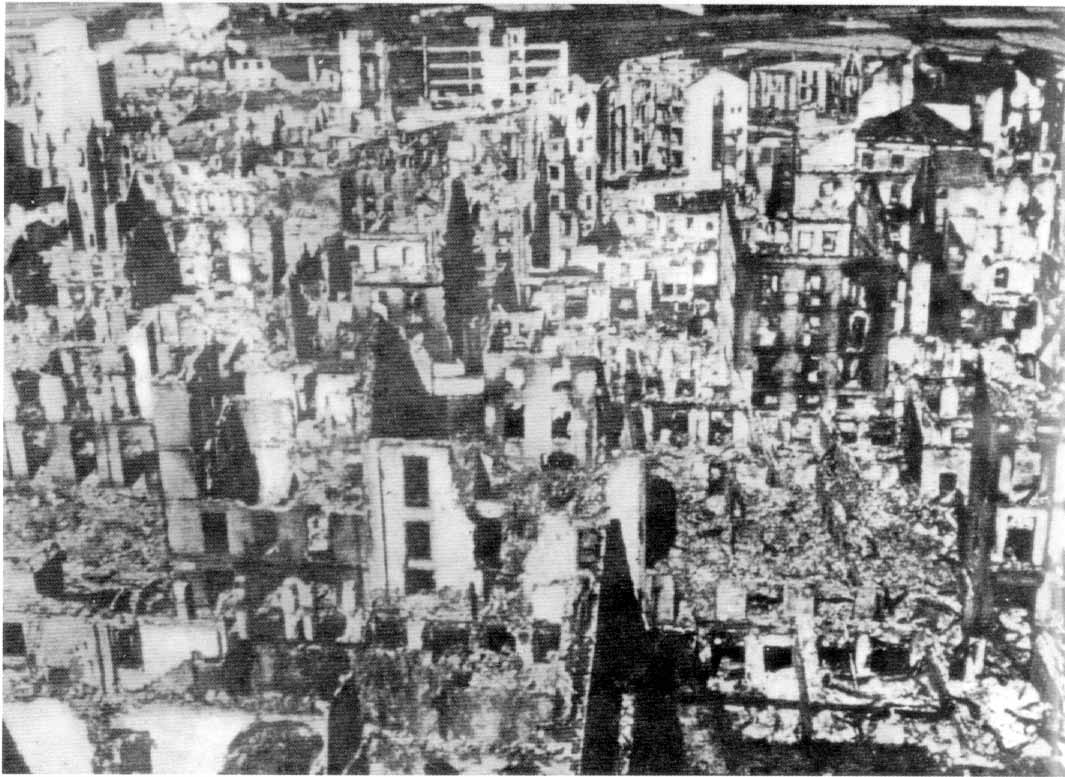
Between 4:30 a.m. and 7:45 a.m. on the 26th April 1937, in the midst of Spain’s vicious Civil War, the Basque village of Guernica was brutally attacked by an unprovoked raid of German bombs and gunfire on the orders of the Nationalist leader, General Franco. One third of the population of the village, some 2300 people, were either killed or severely injured, and the old town was utterly destroyed. At 7:39 am on the 11th March 2004, the first of 10 bombs exploded in a train packed with Madrid’s early morning commuters. Almost 200 people were killed in this horrendous massacre, innocent lives destroyed, families ripped apart and Spain, targeted in this ‘second Guernica’ by an unprovoked attack of terrorist means. The similarities are striking. Both the fascist regime of Franco along with his Nazi and Italian fascist support and the terrorist organisation of Al Qaeda sought to intimidate and terrorise and take whatever innocent lives were necessary in pursuance of their iniquitous objectives, while both attacks have rendered Spain the victim of unspeakable horror and its attackers the subject of international abhorrence and outrage. So while Colin Powell and the advocates of the Iraqi war may have felt more comfortable in covering up this phenomenal anti-war masterpiece when they promoted a new war in which similar scenes of horrific slaughter would be an inevitable result, there can be no doubts of the unquestionable relevance which the painting has in today’s violent and nonsensical world.

Guernika – the basque town in ruins after the bombing

Memorial to victims of Madrid 3/11

In this post, I will begin by exploring Picasso’s use of intrinsically nationalistic themes in Guernica, which present such a powerful portrayal of the suffering not just in Guernica, but for the nation of Spain as a whole. Secondly I will go on to illustrate the continuing relevance of these nationalistic sentiments, highlighted most powerfully by the events of the 11th March in Madrid, which inspired my own interpretation of Picasso’s work, ‘Segunda Guernica’ .

Read more

Norms do…Goya – The Third of May 1808

When people think about paintings of conflict, the first name to pop into their head is generally Guernica. The painting, by Picasso, has become a worldwide antiwar symbol, and as if proving the fact, a large tapestry of the painting hangs outside the UN’s Security Council HQ in  New York (you know, the same one that they covered up with curtains when making the decision to go to war against Iraq). But in actual fact, there was painted, some 120 years earlier, an equally striking image of conflict, sacrifice and war, an image so resonant, in fact, that Picasso  cited it as an inspiration to his Guernica. The painting is The Third of May 1808, by Francisco Goya.

As my regular readers will have twigged, I’m a big fan of Spanish art, and therefore it is no surprise that somewhere in the dark depths of my imagination, a Norm version of Goya’s magnum opus would take its form, emerging as a brief watercolour sketch the other night. Here it is, with Goya’s original masterpiece.

Norms on 3rd May 1808 (after Goya) (Watercolour, 2012 © Nicholas de Lacy-Brown)
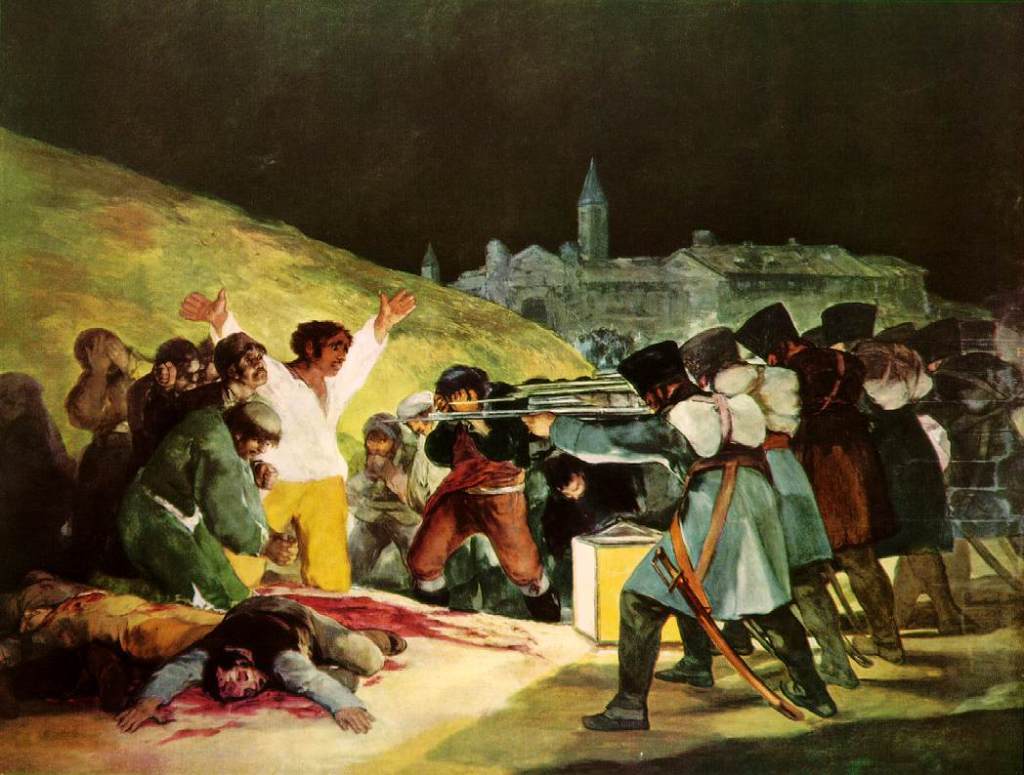
The Third of May 1808 by Francisco Goya (1814), courtesy of the Prado, Madrid

To give a brief background, Goya’s work represents an uprising of Madrid residents in response to the French invasion of Spain under Napoleon I. Having tricked the Spanish into an alliance with the French armies with a view to conquering Portugal and splitting it between then, Napoleon entered Spain with his armies in November 1807 under the guise of strengthening Spanish troops. However, having entered Spain, Napoleon’s true intentions were unveiled, and the French troops moved in to take control of the country, facing very little resistance. It was only on 2 May 1808, when the people of Madrid learnt that the Spanish royals were to be exiled to France, that many of them rose up in rebellion against the French troops. The French army ultimately prevailed, but not without great bloodshed, and Marshal Murat, head of the French army in Spain declared: “The population of Madrid, led astray, has given itself to revolt and murder. French blood has flowed. It demands vengeance. All those arrested in the uprising, arms in hand, will be shot.”. Goya’s painting depicts the moment, early the next morning, when hundreds of Spaniards were led from the monastery where they had been imprisoned overnight (probably the buildings shown in the background) to the surrounding barren lands where they faced point-blank execution before a firing-squad.

The Second of May 1808 by Francisco Goya (1814), courtesy of the Prado, Madrid - partner of the Third of May, this painting depicts the uprising itself.

Goya’s painting is a stunning symbol of slaughter and sacrifice. It works so well on so many levels. There is, for example, the haphazard grouping of sacrificial victims on the left, a monk-like figure shown bending to meet his fate, others turning away in despair, the blood of innocents all over the floor, bloody corpses foreshortened as though falling into the space of the audience. The group of victims shows a human, unorganised element which compares effectively with the group of gunmen on the right who are rigid, dark, sinister, grouped together like a killing machine showing no remorse or sway in their murderous resolve. This contrast of dark and light creates a wonderful tension – good versus evil. Of course the most striking character is the central victim, dressed in a glowing white, his colours matching those of the lantern which casts light upon the scene. Shown with his arms outstretched, he is a christ like figure – he even appears to have the marks of stigmata upon his hands – all suggesting that he represents those Spaniards who stood up to the French invaders, sacrificing their lives for the sake of ultimate Spanish victory. It’s a work which portrays bloody human waste – a waste of life, the destruction of the innocents – and this is why it still stands today as such a powerful anti-war symbol.

Unsurprisingly the painting has inspired countless artists since it went on display in a rather pokey corner of the Prado (after it lay in storage for 40 years – the King of the time, Ferdinand VII, didn’t like it as it glorified people rather than him). One of the first interpretations of the image was this one, by Édouard Manet, which depicts the execution of Emperor Maximilian of Mexico.

Édouard Manet's Execution of the Emperor Maximilian (1868-1869)

Maximilian, a member of the Hapsburg family of Austria, had been installed in power in Mexico by Napoleon III of France in an attempt to recover unpaid debts and establish a European presence there. This endeavor failed, ending with the execution of Maximilian and two of his generals by firing squad on 19th June 1867. Here, the emphasis is reversed, as Manet, ever anti-Napoleon, makes the executors the heroes of the piece, dressed in their smart livery, whereas Maximilian and his generals are, by contrast, depicted with dark, undefined, sinister brushstrokes.

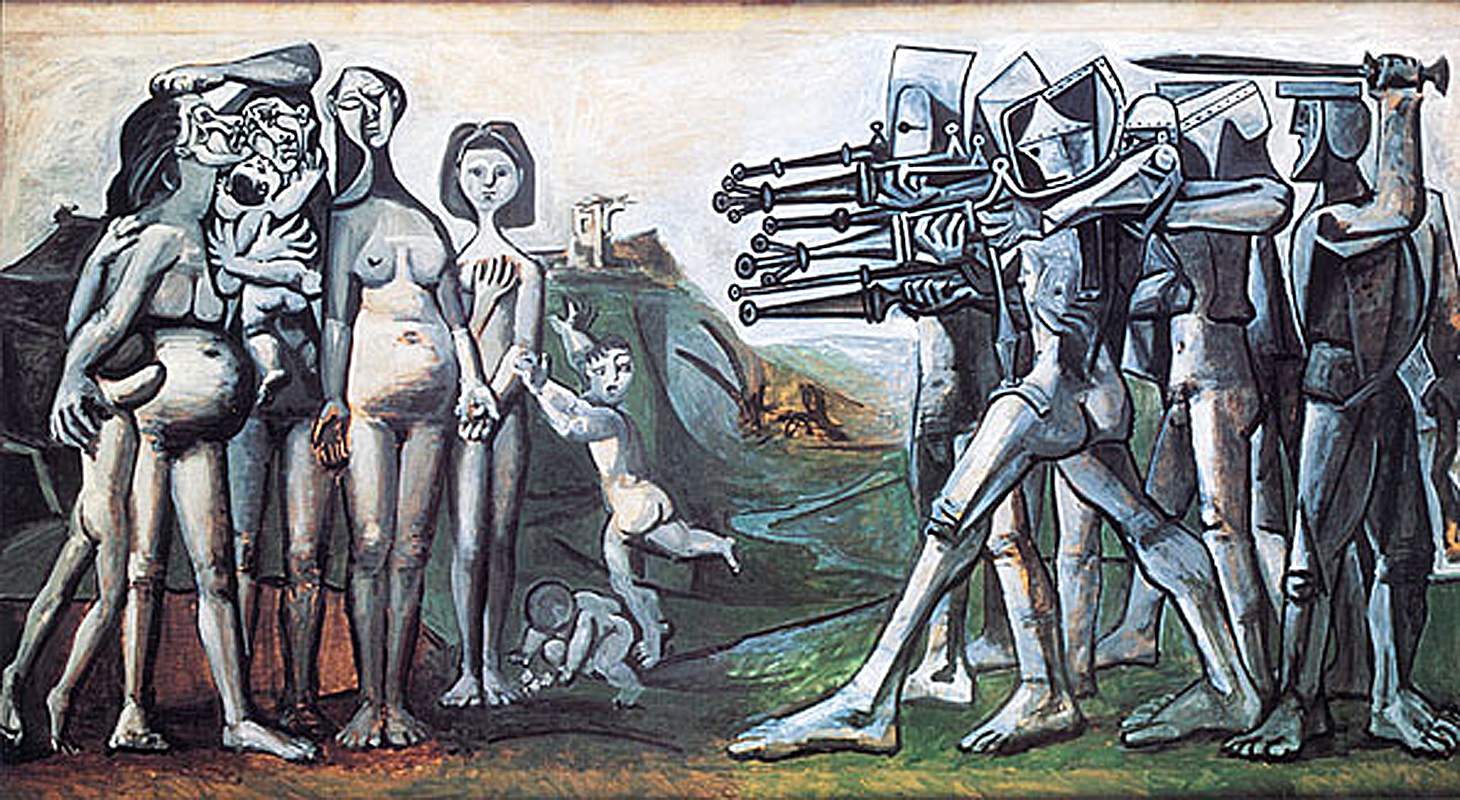
The second most significant use of Goya’s composition is Massacre in Korea by Picasso which depicts the Sinchon Massacre, an act of mass killing carried out by the South Korean and/or American forces in 1950.

Pablo Picasso, Massacre in Korea (1951)

Here the firing squad are once again the aggressors, and Picasso has taken the idea of the killing machine to a new level, depicting the squad as a fantastical group of sinister, mechanical automatons, killing without emotion of any kind. By contrast, the victims are as emotive as could be depicted – women and children, one seemingly pregnant, another’s face crippled with despair.

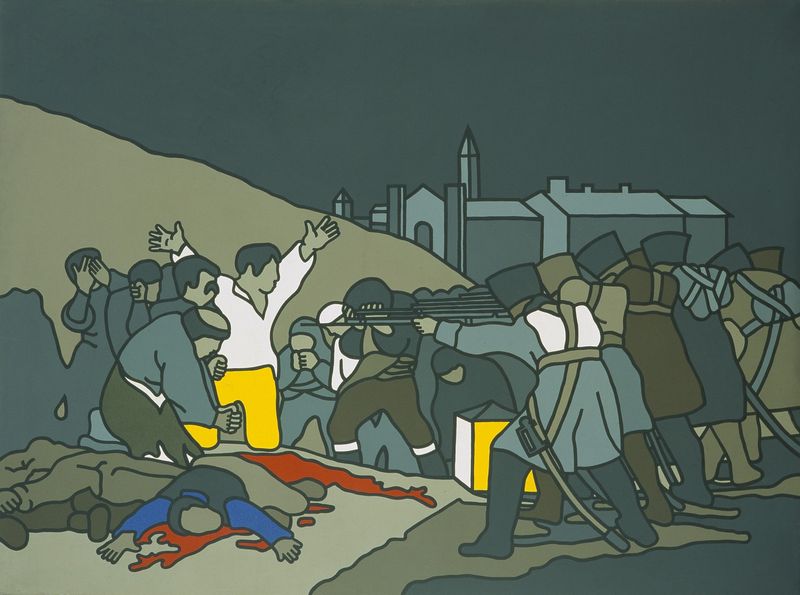
A final, lesser-known depiction, is the pop art homage painted by Irish artist, Robert Ballagh.

The Third of May - After Goya, 1970, by Robert Ballagh

Entitled The Third of May 1970, the painting makes a direct reference to Goya’s work, making no changes to the composition whatsoever, but converting the work into a pop-art creation using black outlines and block colours. The 1970 title of the work is intended to reflect another time of great conflict – this time in Northern Ireland – when British troops entered to enforce some semblance of control.

All three depictions serve demonstrate the continuing relevance of The Third of May 1808 in times of conflict. Like Picasso with his Guernica, Goya created a work for all times, a stark reminder of the brutality and savagery which comes so easily in times of conflict, a brutality which has continued to erupt intermittently around the world, and which, only 120 years after the Third of May, savaged Goya’s homeland, once again.

© Nicholas de Lacy-Brown and The Daily Norm, 2005-2012. Unauthorized use and/or duplication of the material, whether written work or artwork, included within The Daily Norm without express and written permission from The Daily Norm’s author and/or owner is strictly prohibited. Excerpts and links may be used, provided that full and clear credit is given to Nicholas de Lacy-Brown and The Daily Norm with appropriate and specific direction to the original content.

Norm Profile: Robot Norm

Following on from my previous posts last year profiling some of my old Norm portraits, that is those painted in 2005-6, the last to feature (it was a limited collection) is Robot Norm. It somehow seems appropriate to profile this Norm now, futuristic as he is, at the same time as we are all heralding in a New Year full of possibilities, new advances, inventions and more and more things and places to explore, and in my case, to paint and photograph. Robot Norm was sold when it was first exhibited back in 2006 at my solo exhibition, Between Me and My Reflection. I believe he is now hanging somewhere in Southampton, and hope that he is very happy there.

Robot Norm (2006, Acrylic on canvas, © Nicholas de Lacy-Brown)

Robot Norm follows the same, illustrative style of my original Norms collection. In common with all Norms, he has only one arm, but unlike his Norm counterparts, he is an automaton, engineered, no doubt, by other Norms, but still retaining the Norm-like curvaceous shape. He is fitted with all the mod-cons which a Robot could possibly need – a dial pad, an electronic extendable arm, and an antennae, no doubt for receiving commands, yet his body is somewhat roughshod in its construction, with sheets of metal pinned like a patchwork into one metal whole.

Read more