Skip to content

Posts tagged ‘Oil on canvas’

Sunday Supplement ITALIA – Tuscany Wharf: 15km to San Gimignano

It’s ITALIA Season on the Daily Norm, celebrating, for at least two weeks, everything that’s fantastic about Italy. And to kick of the season, here on the Sunday Supplement, the weekly showcase of my art, I am featuring my 2010 painting, Tuscany Wharf: 15 km to San Gimignano. 

I was inspired to paint the scene when my Partner’s family and I were driving through the incredibly beautiful green and golden rolling hills of the Tuscan countryside. The journey, from Donoratico down on the coast up through the hills, past Volterra and on to San Gimignano involved so many curves and bends and meanders through the Tuscan countryside that when we reached a road sign advising us that after around 90 minutes of said meandering, we were finally within 15 km reach of our final destination, my Partner, whose face was very green by that point, breathed a huge sigh of relief, or as much of a sigh as could be mustered after a double dose of very soporific travel sickness tablets.
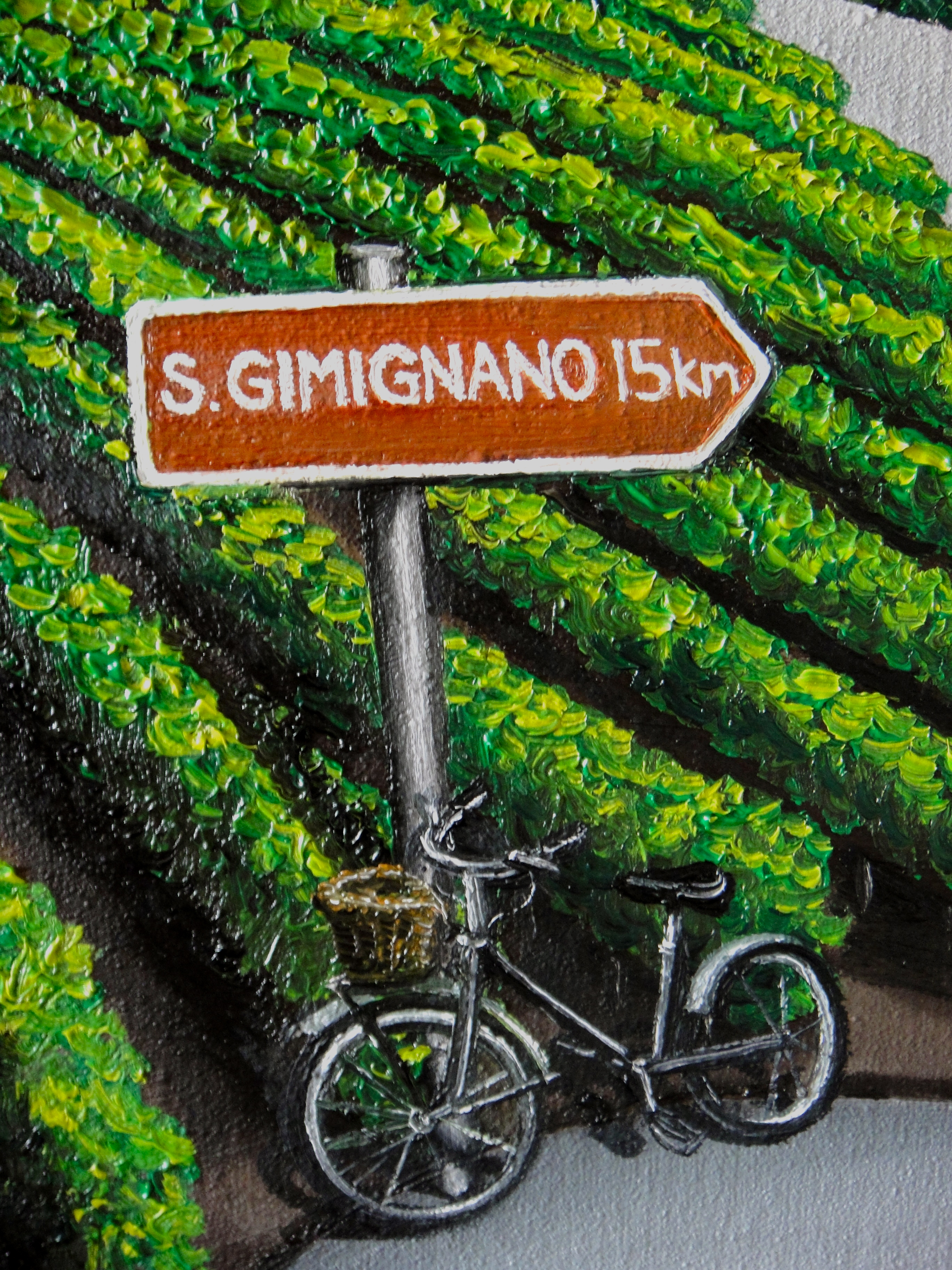
As we approached San Gimignano, a UNESCO world-heritage protected town, famous for its collection of medieval towers which grew taller with each new construction as rich merchant families sought to compete with one another, the view was better than ever. Approaching the town from some distance, seeing the iconic towers gradually emerging from behind the brow of a set of undulating hills, was quite a sight, and one which I have attempted to capture in my painting, which celebrates all the beauty of the Tuscan countryside from rows of perfectly lined up vineyards and golden fields with rolled up hay, to the curly-wurly road itself, rising and falling over and around the crests of hills, lined by cypress trees and Italian pines.
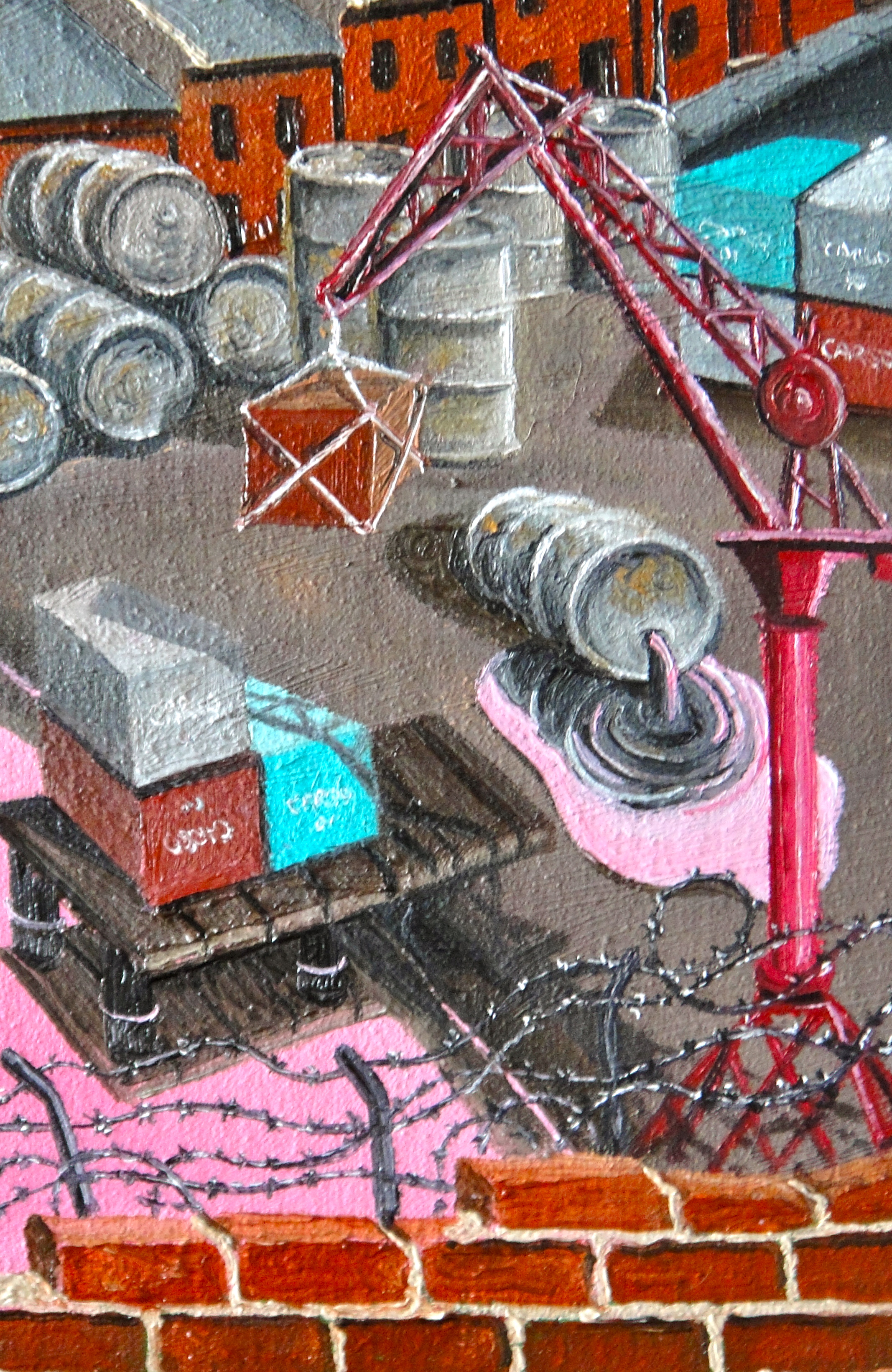
However what makes this representation of Tuscany different is that sliced through one part of the landscape is a vertical insight into another world. It’s industrial Northern England, a scene with such industrialised toxicity that the smoke bellowing out from the factory chimneys pour into the Tuscan scene, filling turquoise skies with a decided collection of clouds. The English scene, which was inspired by the works of L. S. Lowry, was inserted by way of marked contrast to the beauty of the Tuscan scenery. However both scenes appear to be in sync, as if they represent the same geography in a parallel universe. Where the tuscan hills roll upwards, the english scene follows the same trajectory, with a row of cramped terraced houses following the same incline of the Tuscan hill. Where in tuscany there is a round bail of hay, in the English scene, the bail of hay is replaced with a cylindrical oil container. Similarly the roses, planted next to a vineyard so the grape grower can detect disease early, is replaced by the barbed wire keeping trespassers off the industrial site. Thus it is that the two landscapes appear inescapably conflicting, and yet coexisting in perfect union.
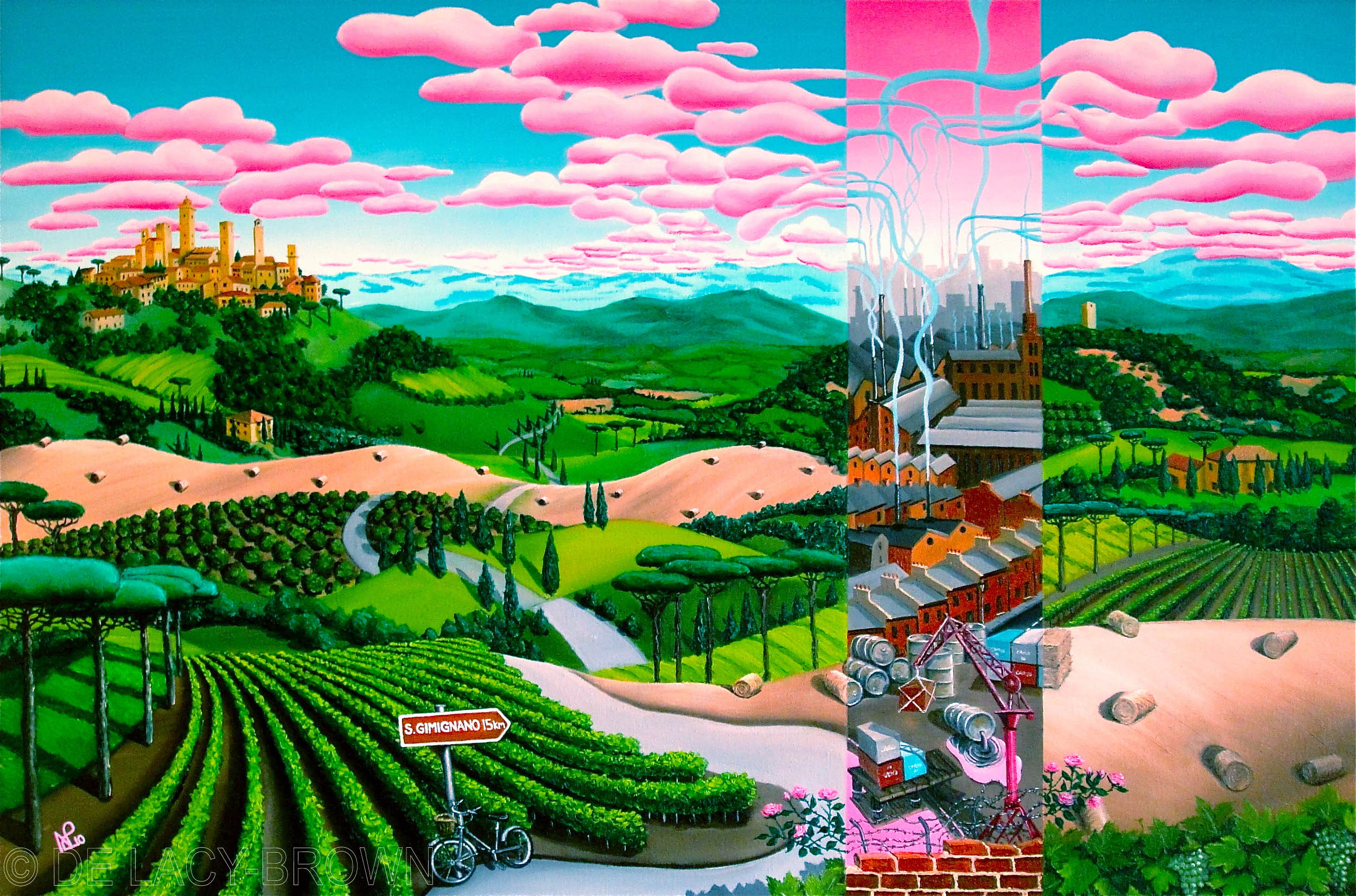
Tuscany Wharf (15km to San Gimignano) (oil on canvas, 2010 © Nicholas de Lacy-Brown)

© Nicholas de Lacy-Brown and The Daily Norm, 2001-2012. Unauthorized use and/or duplication of the material, whether written work, photography or artwork, included within The Daily Norm without express and written permission from The Daily Norm’s author and/or owner is strictly prohibited. Excerpts and links may be used, provided that full and clear credit is given to Nicholas de Lacy-Brown and The Daily Norm with appropriate and specific direction to the original content.


Salamanca: My Painting – Homage to a sandstone city in oil on canvas

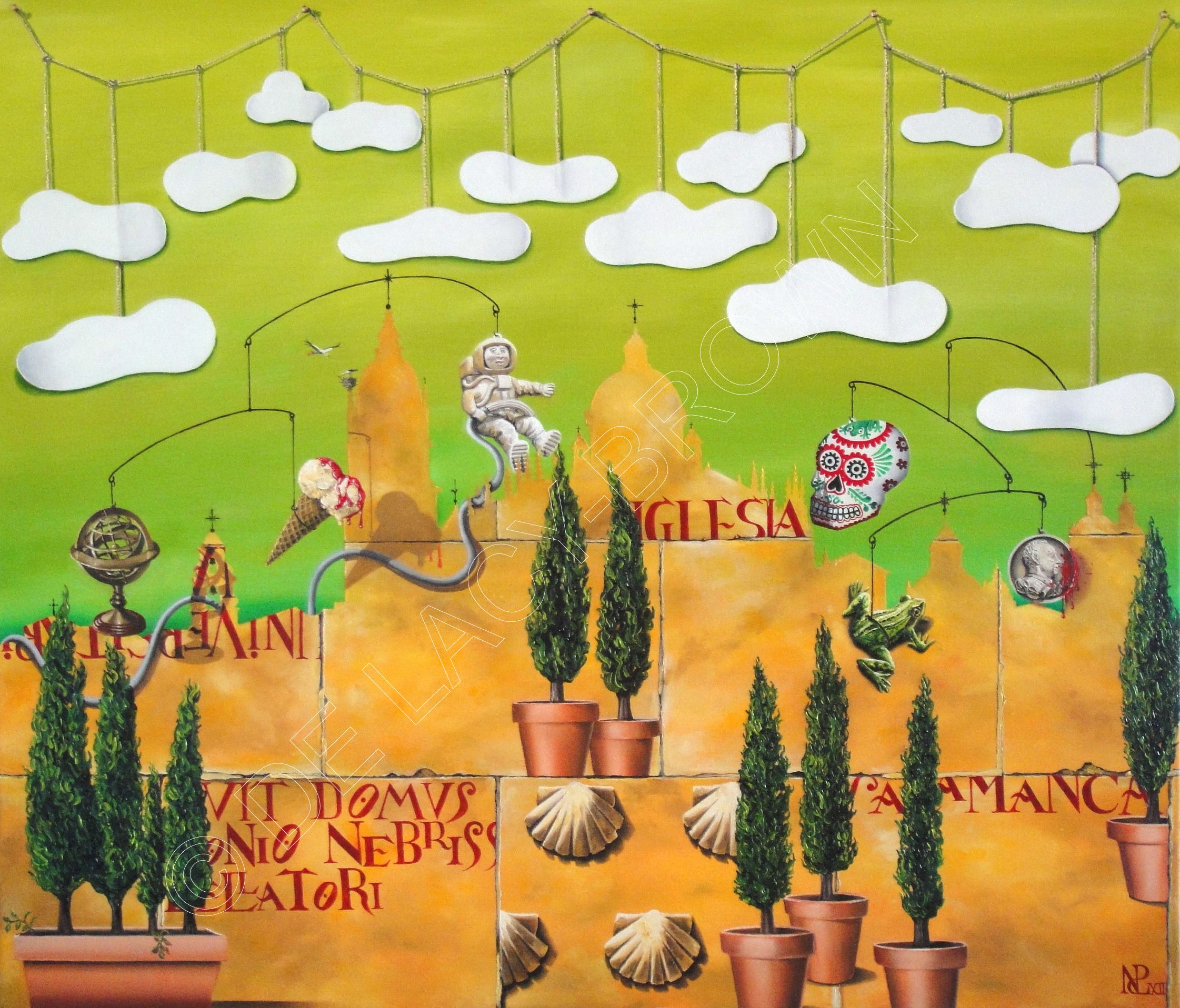
It’s been two months since I returned from the golden glowing sandstone Spanish city of Salamanca. There was so much to inspire me when I walked those elegant historical streets. When I gazed, mesmerised through my hotel window onto the stunning baroque Cathedral, the sun setting upon its orange stonework, and cypress trees gently waving from side to side in the evening breeze before it, a painting came to my mind. I rushed to make a quick sketch which I still have on the back of a reservation print out for the restaurant we were dining at that night. My painting of Salamanca was to contain what to my mind was the essence of the city – a kaleidoscope of dappled, marbled oranges and golds in a landscape uniquely built from the local Villamayor sandstone, a city bursting with historical artefacts flowing from the dual powerhouses of church and university. It is a city which is elegant in its antiquity, and yet bursting with fresh new life from its greenery, its strong local life, the pull of tourism and the thriving university population which resides there. This was my inspiration and shortly after returning from Spain I set to work on a large 105 cm x 90 cm canvas. I finally finished  the work over the long Jubilee Weekend. And here, exclusively, is the result, as I present my first (non-Norm) painting of 2012…

Salamanca (2012 © Nicholas de Lacy-Brown, oil on canvas, 105 cm x 90 cm)

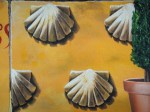
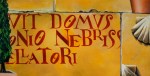
Dominating the centre of the canvas is a silhouetted skyline of the city, recognisable by the Cathedral spires and the intricate turrets, domes and baroque roofing of the nearby University. Rather than paint the detail of the buildings, I constructed the skyline out of a wall of villamayor sandstone bricks, in the same way that each building of the city is constructed. Those individual bricks act as a window onto different features of the city. On one brick you see the conch shells of the famous Casa de las Conchas, while on others, parts of the hand painted street letterings are featured, infamous for their historical use of pigs blood and olive oil.

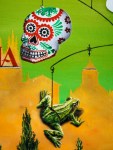
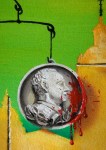
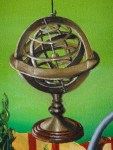
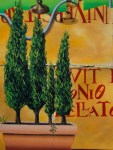
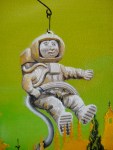
In the meantime, out of the Cathedral and the university, the ironwork crosses become large mobile-like structures, inspired by the great maker of mobile art, Alexander Calder. On these mobiles hang various symbols of the city. The astronaut and the ice cream which are usually imbedded in the intricate plateresque facades of the Cathedral and the University’s famous sandstone frog are all featured, as well as the skull upon which the frog sits (my painted skull is inspired by the Mexican Dia de los Muertos celebrations for which houses and graves are adorned with beautifully decorated hand painted skulls like this one). Represented too is the tradition of learning at the University, embodied in the Orrery (one of which I bought while in Salamanca as a souvenir of the city) as well as the famous Plaza Mayor, represented by the infamous bust of Fascist leader Franco which can be found amongst the busts of Spanish rulers around the square, and the inclusion of which causes such controversy that it is regularly vandalised. My Franco too has been vandalised, but is that paint on his face or blood on his hands? Finally the painting is generously sprinkled with various groups of cypress trees, tidily placed in terracotta pots at various spots across the canvas as well as a curtain of clouds sweeping across a clear green sky. Ooh and look out for the little stork’s nest embedded amongst the spires of the cathedral – the storks are a customary feature of the city and do not appear to cause the residents any hassle – in fact some churches have baskets placed on top of their spires to aid the storks in building a safe and secure nest!

So there it is, and above, so you don’t miss the details, are more photos showing the various individual aspects of the painting. I hope you like the painting and, more importantly, let me know what you think! I’ve already started a new work, so look out for that over the coming months.

© Nicholas de Lacy-Brown and The Daily Norm, 2001-2012. Unauthorized use and/or duplication of the material, whether written work or artwork, included within The Daily Norm without express and written permission from The Daily Norm’s author and/or owner is strictly prohibited. Excerpts and links may be used, provided that full and clear credit is given to Nicholas de Lacy-Brown and The Daily Norm with appropriate and specific direction to the original content.

Sunday Supplement: High Perspective (Viewed from 21c)

Having recently been voted the top city to visit in the world (as if we didn’t know it already), after last weekend’s Jubilee spectacular and, of course, with the olympics almost on our doorstep, it seems only appropriate that in this week’s Sunday Supplement, I feature one of my paintings which features the city of London as its central theme.

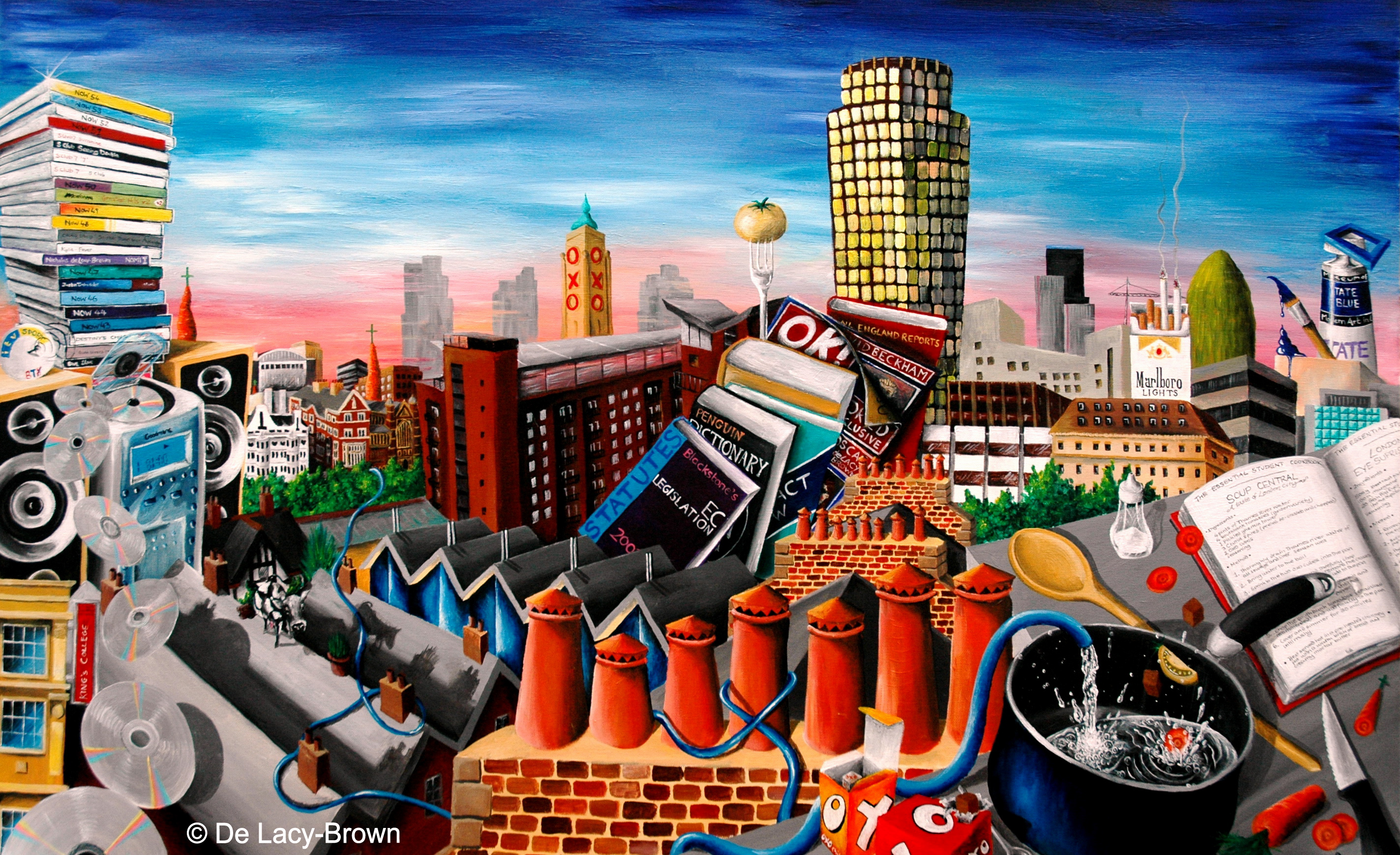
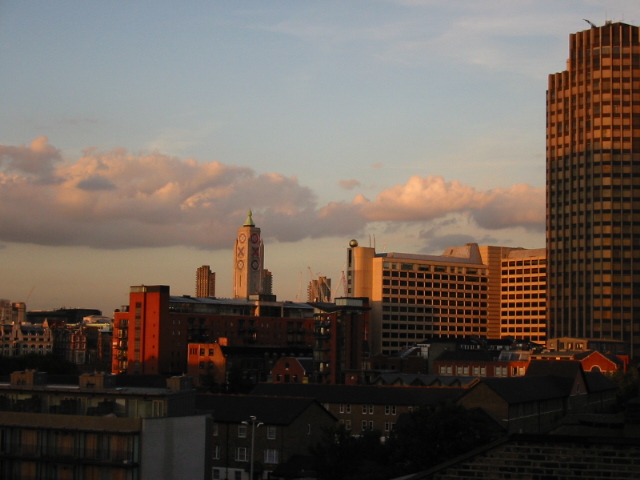
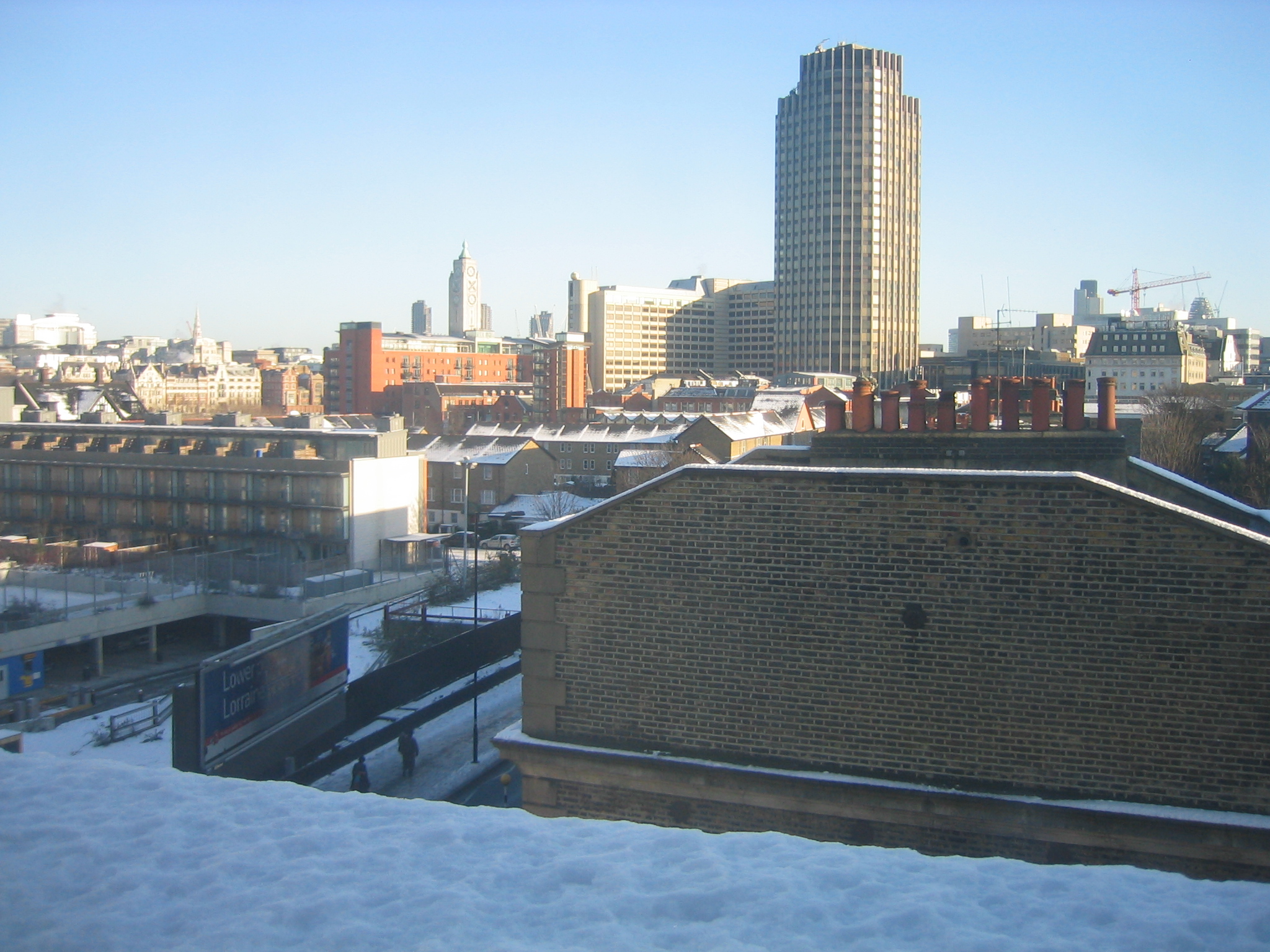
I moved to London ten years ago this September, when I came to study law at King’s College London. I was thrilled when, full of anticipation at what was to be my first day moving away from home in order to start university, I entered my student digs to find this view before me: a perfect vista over London’s south bank complete with the skyscrapers of the city and the tower of Tate Modern, all framing the iconic “Oxo Tower” at the centre. It was as though this room had been chosen for me as an artist, despite the reason for my studies being the pursuit of law. Over that year, I saw this incredible view change over the seasons, as buildings became blanketed with snow, shrowded in a thick mist, and glimmering with the soft hues of pinky golden sunsets and bright midday sun. At the end of my academic year, when my first year law exams were finally over, I imported a canvas into my room and sat down to paint this representation of my view.

High Perspective (Viewed from 21c) (2003 © Nicholas de Lacy-Brown, acrylic on canvas)

It’s not a straight forward landscape: far from it. Rather I used symbols to represent various landmarks rather than paint them directly as I saw them. The GMTV tower on the left for example was replaced with the stack of CDs which my friends and I were listening to during that year, this being a pertinent representation because the GMTV studios are where so many entertainment shows are filmed. Similarly I replaced the Tate tower with a tube of paint, and one of the large publishing headquarters with a stack of magazines (and a couple of law books to show willing). A predominant theme running through the work is food. This was inspired by the Oxo tower itself, named after the stock cube which, in the days when London’s south bank was a hive of industrial activity, would no doubt have been manufactured at the site. Since these stock cubes are frequently incorporated in soups and stews and casseroles, I started reinterpreting the London skyline as various vegetable ingredients which could then be added to the dish which is being cooked in the bottom right hand corner of the work. Instead of the golden balls on the corners of one south bank building, golden tomatoes take their place; similarly London spires become carrots and Norman Foster’s famous “gherkin” building is painted as just that. Finally, since I could see where the river was, but couldn’t actually see the water itself (owing to buildings blocking the view), I imported the water into the scene with the aid of a very long hose pipe which spirals through the roof tops and chimneys before finally adding much needed liquid into the saucepan on my windowsill.

The view as it really was back in 2002

And covered in snow…

So there you have it, one of my most prominent London works, and actually one of my most valuable painting sales when it was sold at exhibition in Mayfair in 2008. Not to worry though – if you like the work and wish you had the original brightening up your lounge, there are limited edition prints of the work available on my main art website, here.

Have a great Sunday and come back to The Daily Norm this coming week for a load of food and art-based posts including the unveiling of my newest painting!

© Nicholas de Lacy-Brown and The Daily Norm, 2001-2012. Unauthorized use and/or duplication of the material, whether written work or artwork, included within The Daily Norm without express and written permission from The Daily Norm’s author and/or owner is strictly prohibited. Excerpts and links may be used, provided that full and clear credit is given to Nicholas de Lacy-Brown and The Daily Norm with appropriate and specific direction to the original content.

Sunday Supplement: Road Traffic Control (The Semana Santa Code)

Happy Easter everyone! Yes it may be grey, and bleak, and ever so slightly damp here in London, but my flat is nonetheless filled with all the yellows of Spring, a chicken (cooked Spanish style with a grape juice glaze and caramalised apples) is about to go into the oven, and I am still putting up total resistance to the chocolate temptations all around.

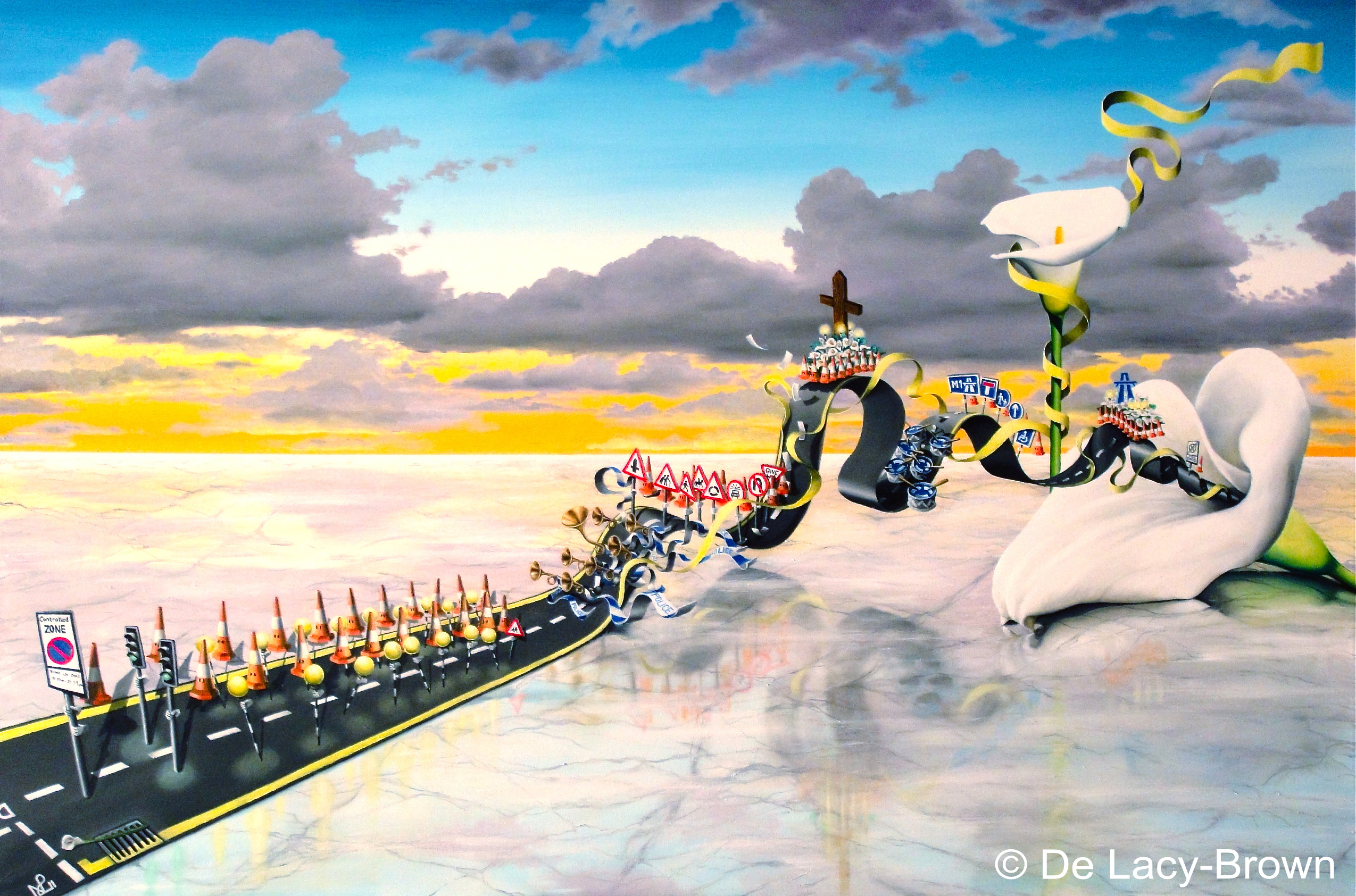
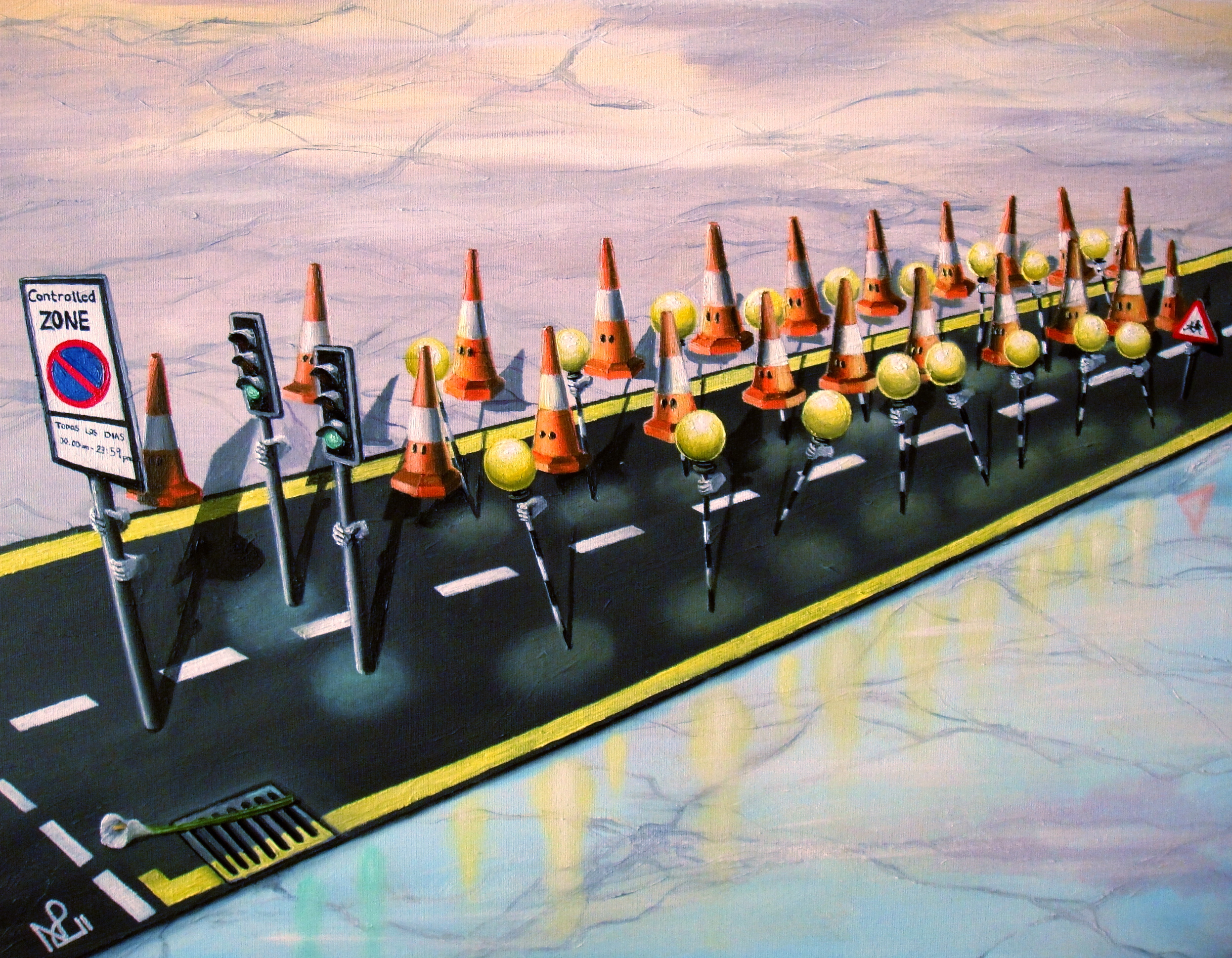
In this final post in a week which has been bursting full of Easter-themed homages, mainly to the sensational Semana Santa spectacles of my dear España, I introduce you to my ultimate canvas exploring the theme of Semana Santa. This vast painting, entitled Road Traffic Control (The Semana Santa Code) was painted by yours truly towards the end of last year and is consequently my most recent painted depiction of the Semana Santa parades. But this work, which measures some 150cm across, depicts Semana Santa processions in a slightly unusual way, using road traffic symbols from the highway code to illustrate the main characters in a typical Semana Santa procession. In fact, the symbolism is at times so detailed that I like to think of the painting as being something of a new Da Vinci Code, the likes of which I will decrypt in today’s Sunday Supplement.

Road Traffic Control (The Semana Santa Code) (2012 © Nicholas de Lacy-Brown, oil on canvas)

Traffic Cones and the Lily Cathedral

Road Traffic Control - Nazareños detail (2012 © Nicholas de Lacy-Brown)

The idea behind this interpretation of Semana Santa came to me when I was watching a procession last year and it occurred to me that the Nazareños with their pointed hats look a bit like walking traffic cones. From there the idea was born – their candles were swiftly replaced by zebra crossing lamps, the large lanterns carried at the front of the parade were replaced by traffic lights, and the banner held at the front of the procession was replaced by a “Controlled Zone” sign – after all, isn’t religion an attempt to control or at least orchestrate a way of life? The road is of course no different from the kind of road which a procession in Spain would walk along, except that here it spirals and wafts like a ribbon in full flight, from its point of emergence from a large lily, which represents a great Spanish Catedral, the smaller bell-like cala lily representing the cathedral’s campanile.

Brass Bands

Road Traffic Control - Brass band detail (2012 © Nicholas de Lacy-Brown)

Road Traffic Control - Drums detail (2012 © Nicholas de Lacy-Brown)

In every procession, there are at least two brass or military bands setting a rhythm and a melodic resonance for the procession. Generally speaking, a band will either lead or follow the Jesus tronos, and a second will either lead or follow Mary. Here the representation of the bands follows the road traffic theme, with old fashioned car hooters and police ribbon making up the first band, while roundabout drums with sides made up from a road’s diagonal warning lines (which warn of an approach to a junction or crossing) make up the second.

The depiction of Jesus

Road Traffic Control - Crucifix detail (2012 © Nicholas de Lacy-Brown)

Road Traffic Control - Jesus detail (2012 © Nicholas de Lacy-Brown)

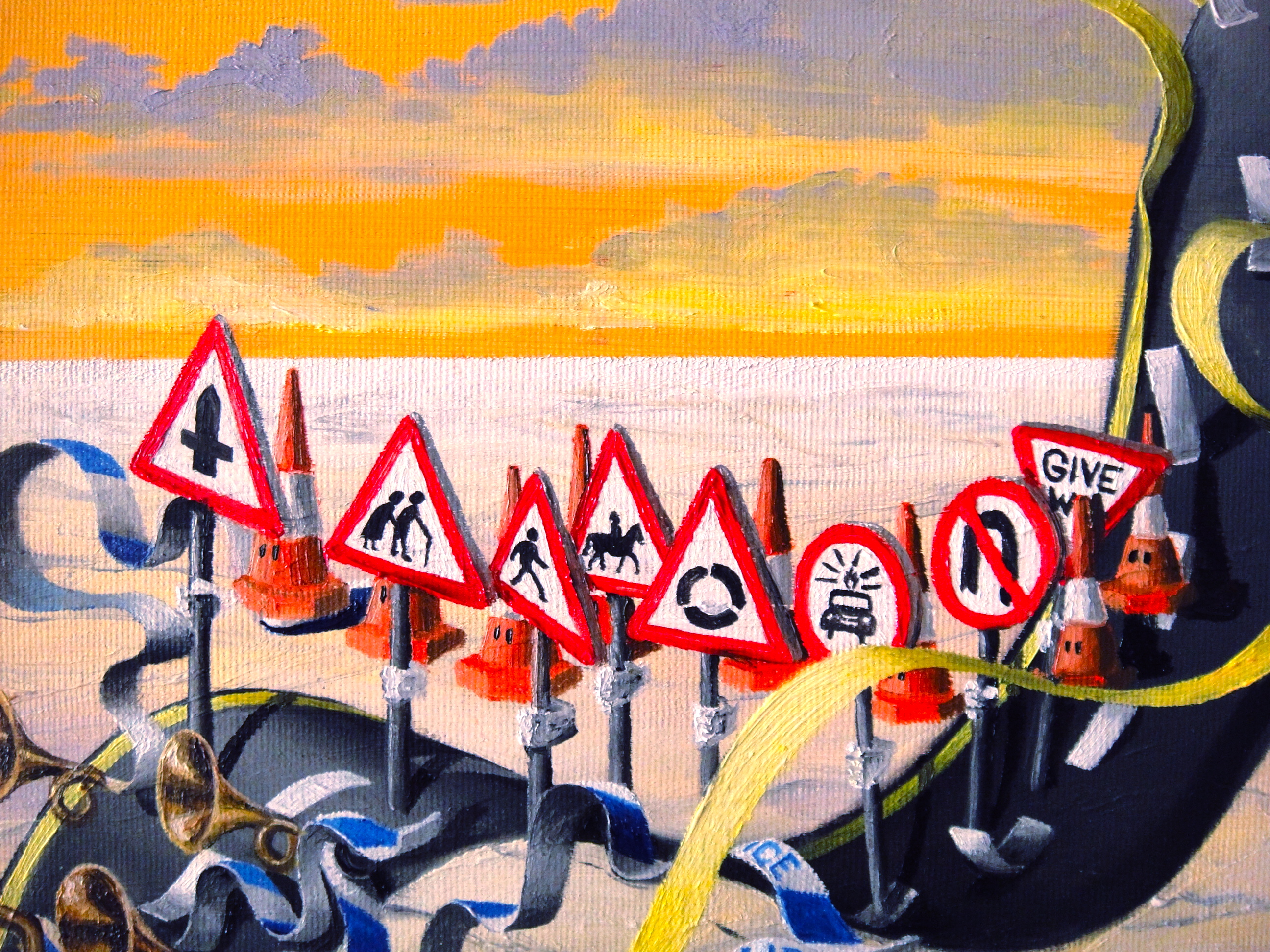
For me, the depiction of Jesus came as easily to my mind as the traffic cones – I used the “crossroads” symbol to represent the crucifixion carried on a tronos, while before it, the signs carried by Nazareños represent, in order: the crucifxion (cross roads); pilgrims (elderly crossing); the disciples (pedestrians); Jesus on a donkey; the Holy Trinity (roundabout); the crusades (explosives); no U-Turn i.e. do not turn your back on Christ; and Give Way – to the Catholic faith as the one and only true religion.

The depiction of Mary

Road Traffic Control - Mary detail (2012 © Nicholas de Lacy-Brown)

Road Traffic Control - Mary detail (2012 © Nicholas de Lacy-Brown)

Mary is depicted using the “motorway” symbol which, with the addition of a small bridging line at the top, resembles a figure with a veil over her head. Meanwhile, the parade which precedes her includes signs with the following meaning: Mary, Mother of Christ (M1); the immaculate conception (no through way); Mother and Child; the ascension; pilgrims (disabled – such as those visiting Lourdes to visit the shrine of Mary).

Finally the painting ends with a sign signifying the end of the “controlled zone”. Hence the title of the painting, “Road Traffic Control”.

Road Traffic Control - Zone end detail (2012 © Nicholas de Lacy-Brown)

I hope you’ve enjoyed the painting and have a great Easter Day, wherever you are.

© Nicholas de Lacy-Brown and The Daily Norm, 2005-2012. Unauthorized use and/or duplication of the material, whether written work or artwork, included within The Daily Norm without express and written permission from The Daily Norm’s author and/or owner is strictly prohibited. Excerpts and links may be used, provided that full and clear credit is given to Nicholas de Lacy-Brown and The Daily Norm with appropriate and specific direction to the original content.