
Skip to content

Posts tagged ‘Pallant House’

Conscience and Conflict: Pallant House explores British Artists and the Spanish Civil War

As the year draws to a close, it is only natural to look back on the highs and lows, and to review everything a little. When it comes to exhibitions, I wouldn’t say that 2014 was necessarily the strongest of years in the UK. I was left a little disappointed by a number of exhibitions I attended, especially at the Royal Academy and Tate Britain. However that is not to say that there were not a number of sure hits. My top 5 exhibitions of the year (in no particular order) have to include the Matisse Cut-outs at Tate Modern, Malevich at Tate Modern, Egon Schiele at the Courtauld, and Rembrandt at the National Gallery. But for the final of the 5, one further exhibition has managed to squeeze into my year’s hit-list, just before 2014 expired: Conscience and Conflict: British Artists and the Spanish Civil War at the Pallant House Gallery in Chichester.

As far as modern world history goes, the Spanish Civil War is too often overshadowed by the longer, larger Second World War that followed it. But none can underestimate the significance of this conflict which, in effect, lasted decades beyond the cessation of fighting, and not least because this was one conflict where the Fascists won the war, right on the doorstep of democratic civilisation. And it was this fear – the very real concern that fascism might win at a time when two major fascist dictators were already installed in Germany and Italy, and when a greater world conflict seemed more than likely – that inspired the artistic reaction amongst British Artists that is the focus of this excellent exhibition.

Frank Brangwyn: For the relief of women and children in Spain (1936-7), detail
Frank Brangwyn: For the relief of women and children in Spain (1936-7), detail

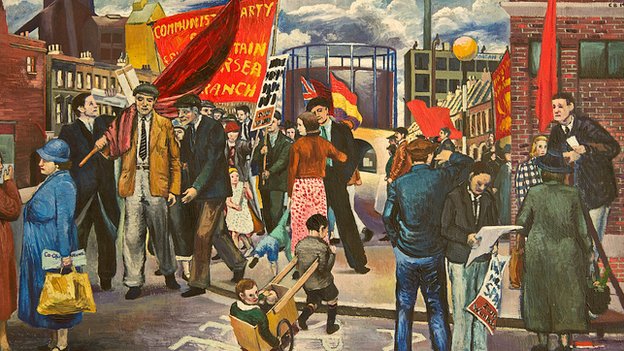
Clive Branson, Demonstration in Battersea (1939)

Clive Branson, Demonstration in Battersea (1939)

Merlyn Evans, Distressed Area (1938)
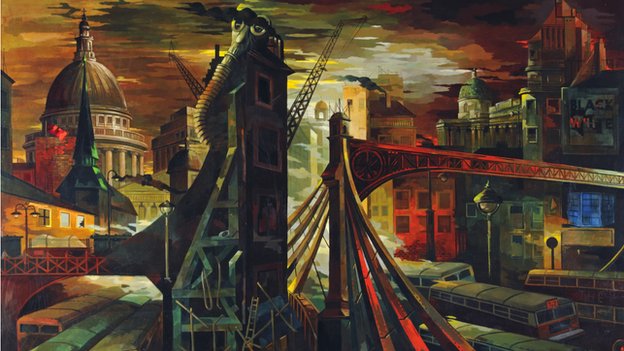
Merlyn Evans, Distressed Area (1938)

Walter Nessler, Premonition (1937)
Walter Nessler, Premonition (1937)

Edward Burra, The Watcher (1937)

Edward Burra, The Watcher (1937)

Stanley William Hayter, Paysage Anthropophage (Man-eating landscape) (1938)

Stanley William Hayter, Paysage Anthropophage (Man-eating landscape) (1938)

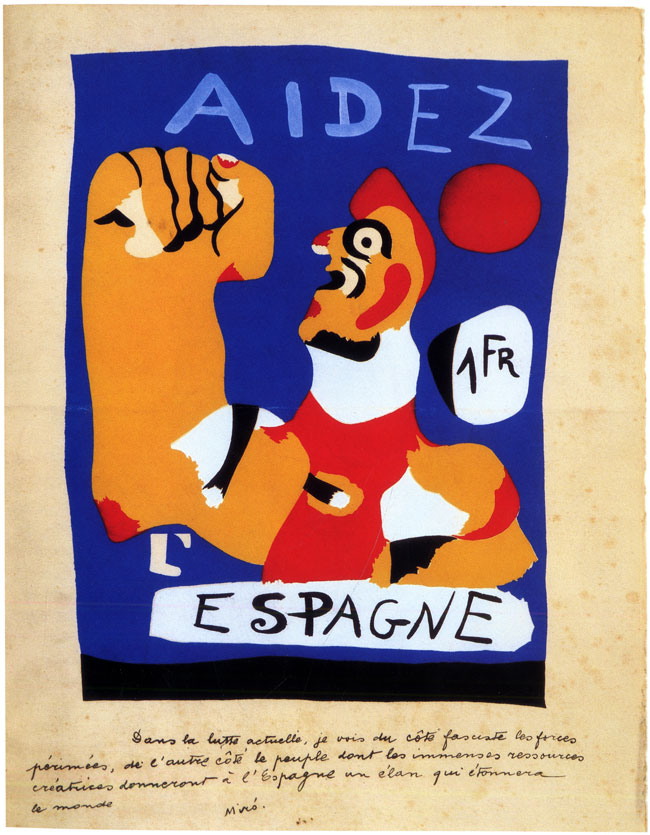
For British Artists between 1936-9 were reacting not just to the horrors of the war, often with surreal images (Edward Burra’s brilliant watercolours being a prime example), destroyed landscapes (Merlyn Evans), and distraught victims (Henry Moore and Picasso), but also to the innate frustration that the British Government had adopted a non-interventionist policy. This felt like utter madness when the fascist leaders of Europe were actively intervening in the Fascist cause, and caused artists of Britain to uprise, creating brilliant propaganda posters supporting the Republican Cause and, ultimately, fighting in the war themselves.

Pablo Picasso, Weeping Woman (1937)

Pablo Picasso, Weeping Woman (1937)

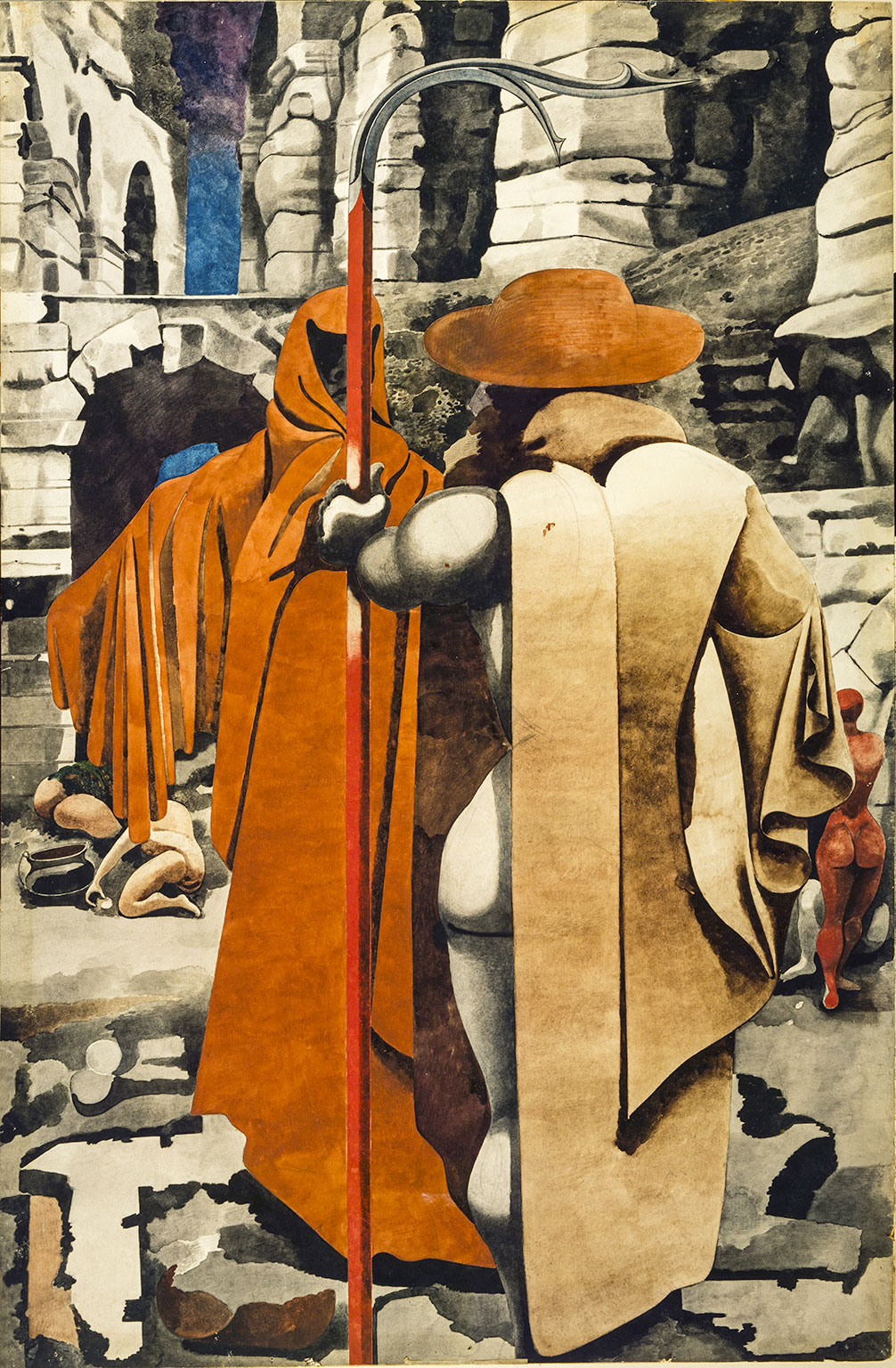
John Armstrong, Invocation (1938)
John Armstrong, Invocation (1938)

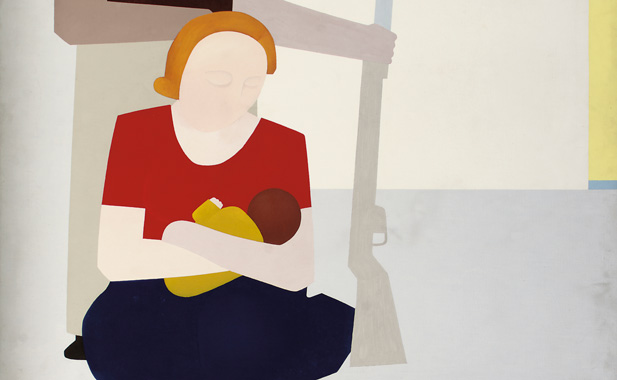
Alastair Morton, Spanish Civil War (1939)
Alastair Morton, Spanish Civil War (1939)

Joan Miro, Aidez L'Espagne (Help Spain) (1937)

Joan Miro, Aidez L’Espagne (Help Spain) (1937)
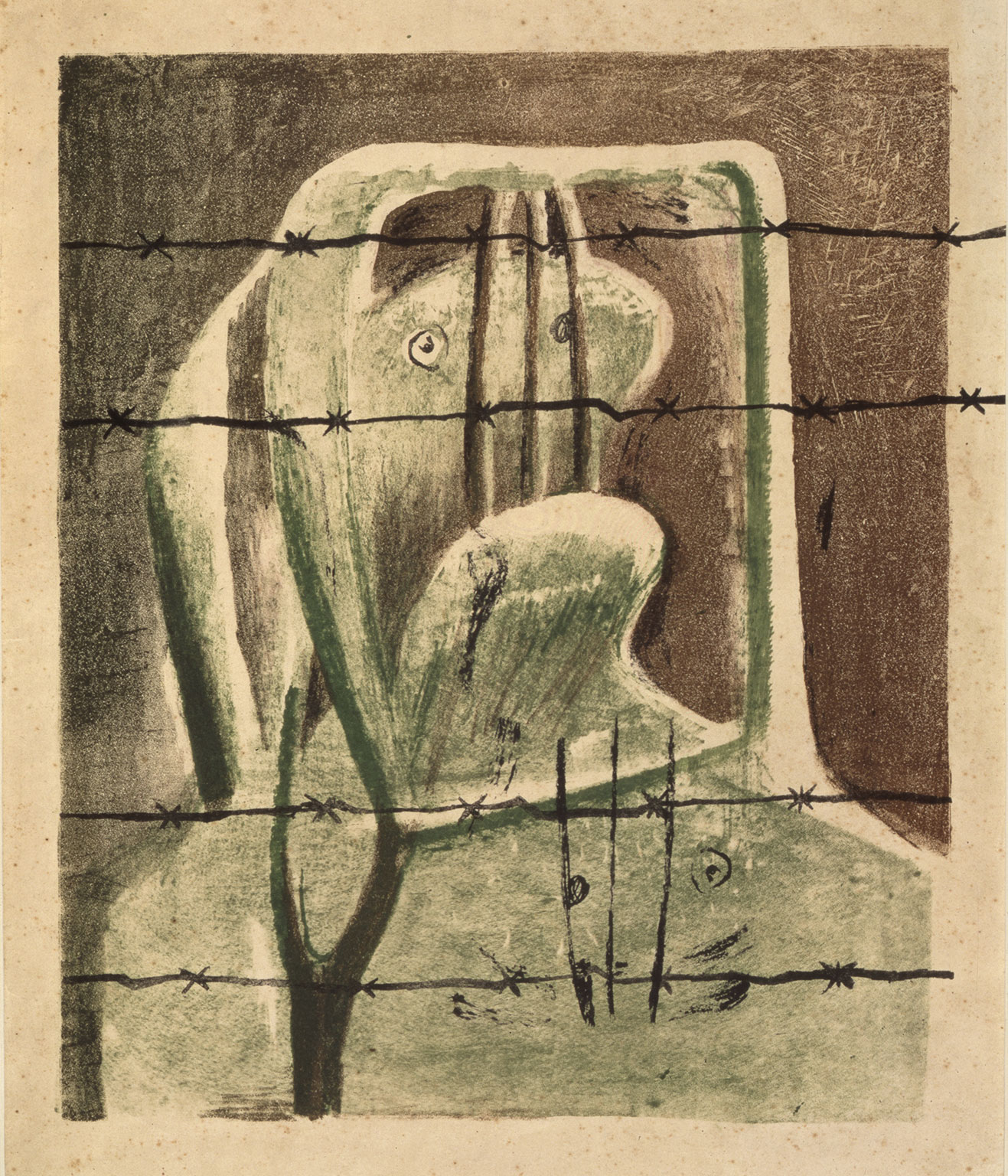
Henry Moore, Spanish Prisoner (1939)

Henry Moore, Spanish Prisoner (1939)

So this is an exhibition of posters and of paintings, all sharing the high tensions and morbid premonitions of the time. How apt, for example, was Walter Nessler’s Premonition in 1937, in which he imagined London suffering the same bombardment as had destroyed the Basque town of Guernica only weeks before. How right he was, for only 3 years later, his imagined landscape would become a stark reality for Blitzed London. Those tensions are also brilliantly played out in posters such as Brangwyn’s For the Relief of Women and Children in Spain, which uses the catholic imagery of Mary to emphasise the war’s human plight, especially amongst Spanish Children, and of course in Picasso’s Weeping Woman, painted at the same time as the most famous of all reactions to the war, Guernica, and which makes for a sensational focus of this exhibition.

Conscience and Conflict has only 6 weeks to go, but it’s a truly brilliant exhibition, and if you can’t make it your last favourite of 2014, make it your first of 2015. The exhibition closes on 15th February 2015.

2011 – The Daily Norm’s top five (and floppy five) exhibitions of the year

When looking back on any year, it’s very easy to concentrate on what a rubbish year it’s been. And this year is no exception, what with economic gloom, a projected double-dip recession, euro-zone gloom, riots and unemployment gloom. Lot’s of gloom basically. But for that reason alone, I, ever the optimist, try to look back on the highlights of the year. And these tend to consist of two main categories – holidays (of which, sadly, there are not enough to fill a review such as this) and art exhibitions (of which there have been plenty). I am lucky enough to have attended the lion’s share of the exhibitions which London, and further afield, had to offer in 2011, and therefore, in a season when all the papers seem to be doing “roundups” of the year, I thought I’d share my thoughts on the best (and worst) exhibitions I’ve seen this year.

No.5 | Toulouse-Lautrec and Jane Avril: Beyond the Moulin Rouge – Courtauld Institute of Art, London

Jane Avril in the Entrance to the Moulin Rouge, c.1892 © The Samuel Courtauld Trust, The Courtauld Gallery, London

This small exhibition at London’s superb Courtauld Institute at Somerset House was no less brilliant by virtue of its size. Taking up space in only two of the Courtauld’s many galleries, the show was an intimate but atmospheric examination of the Absinthe-tinted shadowy underworld of the Paris cabaret-scene so emblematically captured in the works of post-impressionist master, Henri de Toulouse-Lautrec. It is thanks to him that seminal movie moments such as Baz Luhrman’s Moulin Rouge have been able to capture the essence of 1890’s debauched Pigalle social scene, filled with wonderful personalities such as La Goulue (the Glutton), Grille d’Egout (Sewer-grate) and Nini les-Pattes-en-l’air (Nini legs-aloft) as well as other characterful prostitutes, drunks and dancers. One such dancer who became synonymous with the Paris dancehall spectacle was Jane Avril, one of the stars of the Moulin Rouge, who undoubtedly played the role of muse to Lautrec’s portrayals of that same infamous nightclub. Such was her prominence in his work that her flame-red hair and exotic dance moves became symbols of the Moulin Rouge spectacle, as her fame was assured by a series of dazzlingly inventive posters in which she was the central attraction. However, her influence on Lautrec went further, and this exhibition features a number of stirring, more emotional portraits of Jane Avril which show the dancer off the stage, in private moments of introspection.

At the Moulin Rouge, 1892-95 © The Art Institute of Chicago

Such was the importance of this artistic coupling between aristocratic Lautrec and courtesan-born Avril (née Jeanne Beaudon) that the Courtauld placed the relationship at the centre of its show, including photographs of both the Artist and the dancer, and examination of the peculiar “St. Vitus’ Dance” disease which gave Avril her unique, disjointed dancing style, and an attempt to explore Avril’s persona, both in public and in private. This core objective was explored effectively by the Courtauld, but for me, the real winner of the show was simply the basic exposure it gave to this wonderful atmospheric Parisian world of the 1890s. Therefore for me, the star of the show has to be this piece leant by the Institute of Chicago, At the Moulin Rouge, a scene which perfectly depicts the atmosphere of the dancehall, complete with a self-portrait of Lautrec himself, the emblematic red hair of Avril, and the looming ghostly green face of May Milton, one of the performers, imbued with even more Absinthe-green hallucinogenic mystery than the melancholic daze induced by the green fairy in Manet’s masterpiece, L’Absinthe.

Read more