Skip to content

Posts tagged ‘Paris’

Sunday Supplement Valentine’s Special – Engaged in Paris

On Valentine’s Day we witnessed the momentous and happy event that was Normy and Normette’s engagement a-top the Eiffel Tower. The tower is, inevitably, a popular place for engagement, and there can be no surprises why – who could resist the views afforded by the tower, across the ultimate city of love, when choosing a place to pop the ultimate question? I myself got engaged in Paris, although our view was from the Butte in Montmartre – for that place means so much to me as an artist, but also afforded us a view of the Eiffel Tower itself, just as it started sparkling on the hour – that way we got the best of both worlds – what a moment it was!

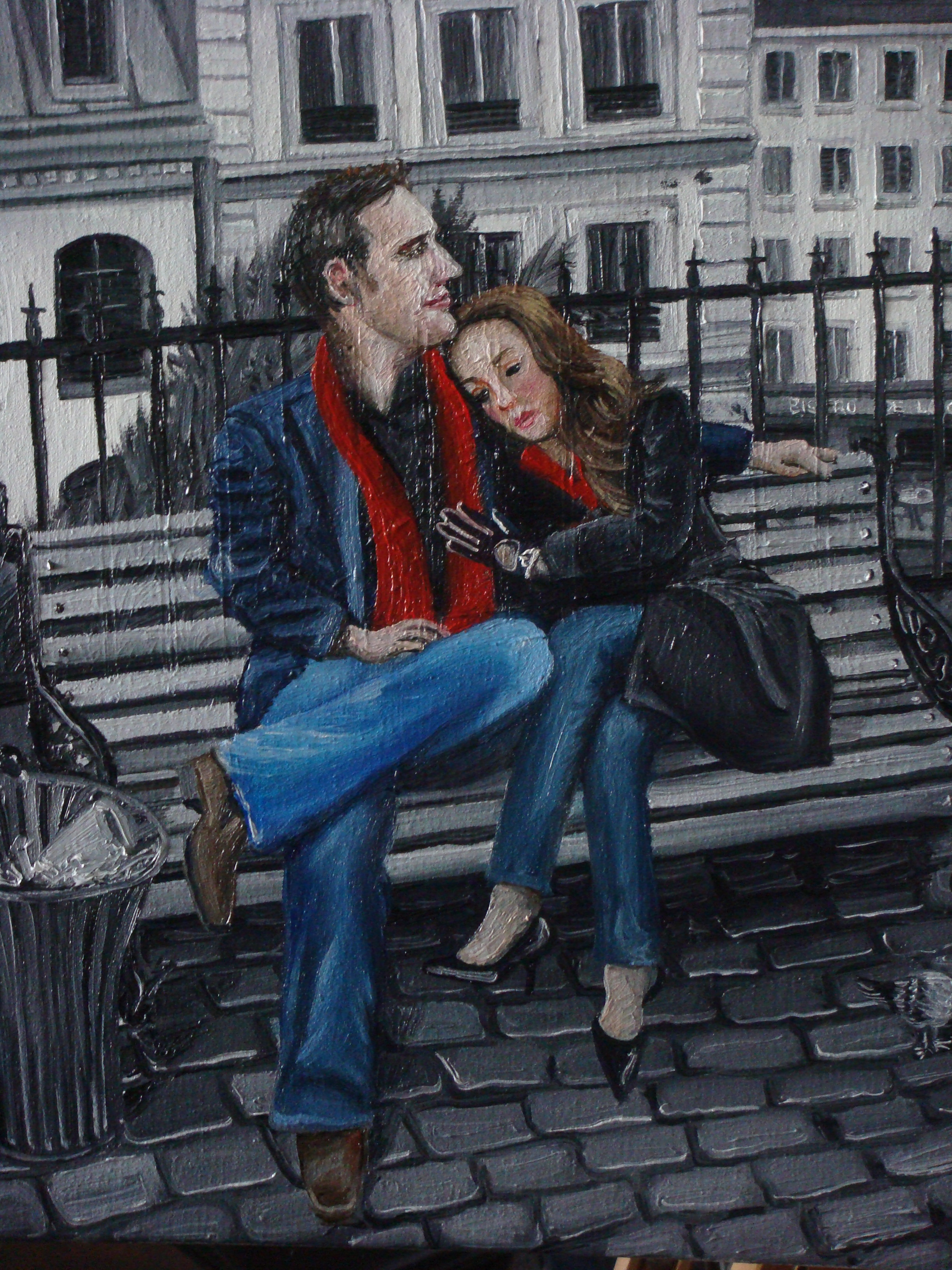
DSC06085It was in the place of my own engagement (although, significantly, I hadn’t actually popped the question at this time, although you can see that subconsciously, I was intending to) that I set this double portrait which I am featuring in today’s Sunday Supplement in honour of Valentine’s. Painted in 2009, the painting features two friends of mine, Charlotte and Ben, who themselves got engaged upon the Eiffel tower. When they approached me to do a portrait of them for the wedding itself, I couldn’t resist painting them surrounded by the city in which their engagement was sealed, but also in the romantically cobbled surroundings of Montmartre, along with the Tour Eiffel in the background. That way all the charm of Paris is captured, while the place of their engagement is given appropriate prominence in the scene.

Engaged in Paris: Charlotte and Ben (2009 © Nicholas de Lacy-Brown)

Engaged in Paris: Charlotte and Ben (2009 © Nicholas de Lacy-Brown)

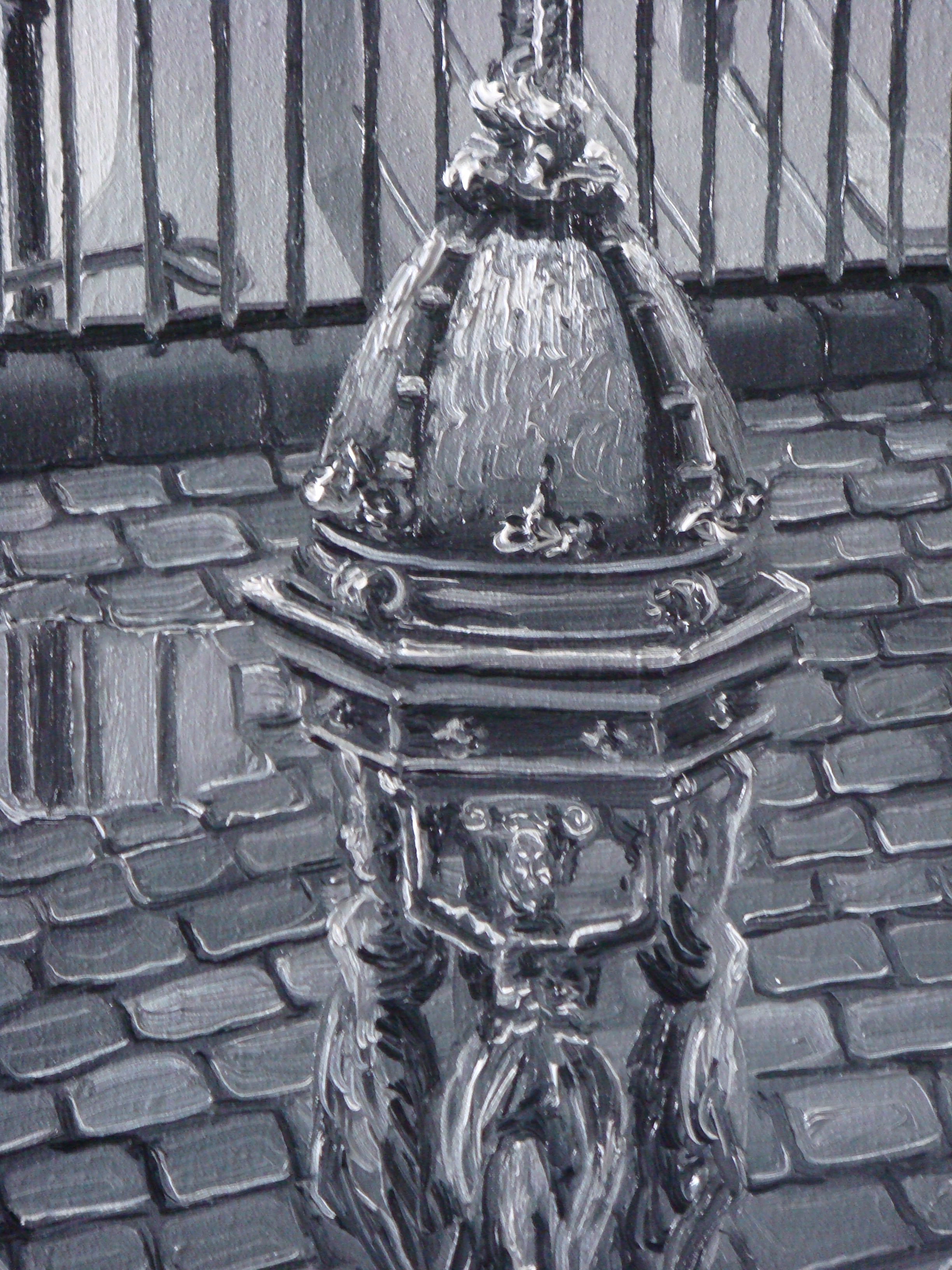
DSC06083The painting, albeit a commission, was a pleasure to create, not least because Paris has always been my spiritual home. The moment I first walked into the Place du Tertre in Montmartre, led their blindfolded by a teacher (on a school trip) who knew instinctively how much I would love it, my heart hit the floor and has remained firmly embedded in those charming cobbles ever since, surrounded by cafes, by artists and the sound of the accordion. It is for this reason that I feel compelled to visit Paris every year, in order to plug myself into my heart and my spiritual being, and likewise why I chose to stage my own engagement in this incredibly special place.

I leave you with the painting, and for those celebrating Valentine’s this weekend wish you a very special celebration.

© Nicholas de Lacy-Brown and The Daily Norm, 2001-2012. Unauthorized use and/or duplication of the material, whether written work, photography or artwork, included within The Daily Norm without express and written permission from The Daily Norm’s author and/or owner is strictly prohibited. Excerpts and links may be used, provided that full and clear credit is given to Nicholas de Lacy-Brown and The Daily Norm with appropriate and specific direction to the original content.

Valentine’s in Paris – Normy pops the ultimate question

It’s every Norm-girl’s dream. Whisked to Paris by her hunky Norm lover, taken to exhibitions, to restaurants, having his arm wrapped around her on evening strolls along the Seine, taking rides on carousels and sipping coffee outside packed bohemian cafes. All this Normette has experienced in the last few days of her Valentine’s trip to Paris, but she could never have imagined just how special this trip could get.

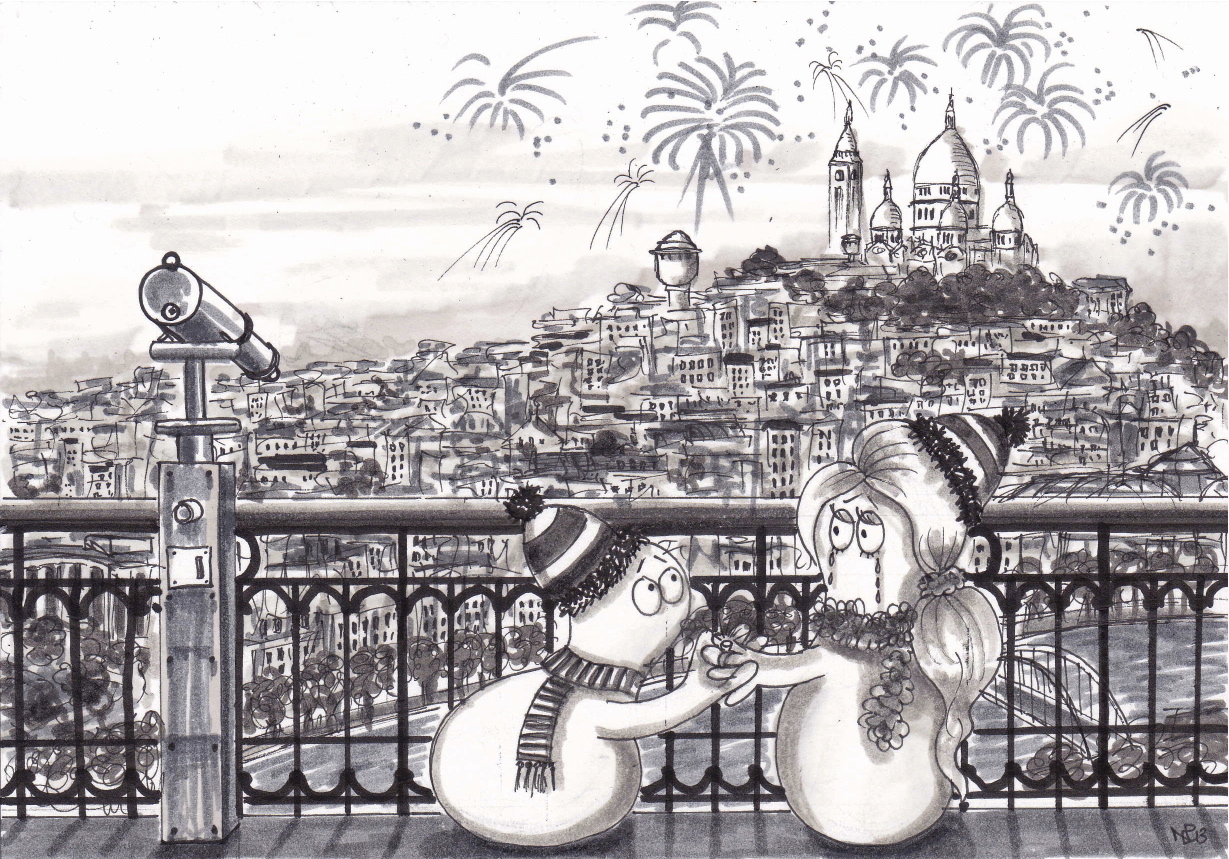
Normy had it all planned. The date was Valentine’s, festival of love, and the location was of course the Tour Eiffel. Wrapped up warm to face the February cold, Normy whisked Normette up the express lift to the third and highest floor of the tower, where spectacular views of Paris awaited. And then, just as the skies were beginning to dull and descend into a rosy pink, and the lights of Paris beneath began to sparkle like a carpet of diamonds, Normy genuflected forwards (Norms don’t have knees you see), took Normette’s single cold hand in his, and asked her to do him the greatest honour of all things, and agree to be his Norm-wife!

Normy and Normette: engaged on the Eiffel Tower (2013 © Nicholas de Lacy-Brown, pen on paper)

Normy and Normette: engaged on the Eiffel Tower (2013 © Nicholas de Lacy-Brown, pen on paper)

As if the cold hadn’t made her eyes water enough, Normette reacted with flowing tears of unabashed joy. Her heart beating asunder and her smooth gelatinous skin feeling suddenly goose-pimpled all over, Normette answered almost instantaneously: “Yes! Yes! Yes!!”. At that moment fireworks appeared to explode all around them (or perhaps that was just in their heads) as the significance of the moment manifested into a chorus of cheering exultation – Normy and Normette had got engaged!!

What happier story can there be for this Valentine’s day than the tale of two beloved Norms, united at last, despite turbulence and strife over Christmas, and facing the joys of a united life ahead. I leave you with a view of the moment of their engagement, and heartfelt Valentine’s wishes from all the Norms, and from me.

Happy Valentine’s Day!

© Nicholas de Lacy-Brown and The Daily Norm, 2001-2012. Unauthorized use and/or duplication of the material, whether written work, photography or artwork, included within The Daily Norm without express and written permission from The Daily Norm’s author and/or owner is strictly prohibited. Excerpts and links may be used, provided that full and clear credit is given to Nicholas de Lacy-Brown and The Daily Norm with appropriate and specific direction to the original content.

Valentine’s in Paris – Normy love upon Dali’s Mae West Lips

We last met with Normy and Normette on the 6th January. After a month of somewhat turbulent relations, when poor Normy did his level-best to present Normette with a series of 12 magnificent presents each representing one of the 12 days of Christmas (only to result in a catalogue of disasters from the demands of 3 pretentious french hens, a frozen-up swan lake, and an immoral dance show culminating in Normette running away to the Moulin Rouge for good), Normy and Normette finally patched things up. Having reunited and reaffirmed their love, they were invited to celebrate their union before cheering crowds of the Three Kings festival in Spain.

It’s now a little over a month later, and things have really moved on. Normy asked Normette to move in with him (this went smoothly on the whole, except for when Normette’s Louis XVI style dressing table got stuck in the narrow doorway of Normy’s bedroom, and when Normette’s little kitten, quite traumatised by the upheaval of the move, wet itself all over Normy’s prize Persian rug) and the two have been getting closer every day. So it didn’t come as a huge surprise when Normy made the ultimate in romantic gestures and whisked Normette off for a short break to Paris, the city of love, to celebrate Valentine’s.

Normy and Normette ponder the meaning of Dali's Mae West Lips (2013 © Nicholas de Lacy-Brown, pen on paper)

Normy and Normette ponder the meaning of Dali’s Mae West Lips (2013 © Nicholas de Lacy-Brown, pen on paper)

Here we see the loved-up twosome at one of their first Parisian stop-offs. Being of a cultured disposition, Normy and Normette couldn’t resist dropping into the Pompidou Centre to take a look at the work of renowned Norm artist, Dali-Norm. There, they were able to experience first hand his recreation of the famed Normy actress, Mae West. What after all could be more romantic than lounging in the recreated face of such a famously beautiful Normy actress? No wonder then that Normy chose this moment to give his Normette a Valentine’s rose.

There was only one slightly disconcerting feature about this room that Normy and Normette couldn’t quite understand. Just what was that red sofa they were sat on supposed to represent? Everyone knows that Dali Norm was a master of surrealism, but that strange rather voluptuous red shape the Norms had never seen before. Yes, they had seen Mae West’s luscious golden hair, and yes her two beautifully made up eyes? But those red things further down her face? According to Normy’s guide book, Dali Norm called them “lips”. Surreal indeed…

© Nicholas de Lacy-Brown and The Daily Norm, 2001-2012. Unauthorized use and/or duplication of the material, whether written work, photography or artwork, included within The Daily Norm without express and written permission from The Daily Norm’s author and/or owner is strictly prohibited. Excerpts and links may be used, provided that full and clear credit is given to Nicholas de Lacy-Brown and The Daily Norm with appropriate and specific direction to the original content.

Paris: la visite d’art – Exhibition 3: Salvador Dalí

I have waited my whole life for the latest retrospective blockbuster at Paris’ Pompidou Centre – or at least the whole of my life since the momentous day when I first cast my eyes upon the work of Catalan artistic genius, Salvador Dalí. It was, I believe, his melting clocks, a painting which I first saw when the headmistress of my primary school showed us some projected images of the world’s most famous paintings. It was a defining moment of my life. In that collection was Monet’s garden, Van Gogh’s sunflowers and Dalí’s melting clocks. And ever since, I was hooked – hooked on art, but most of all, on the mysterious, unsettling, iconically surreal world of Salvador Dalí.

When you think of Dalí, you of course think of those clocks, of ants and eggs, crutches and long-legged elephants, Venus de Milo turned into a cabinet of draws, figures fragmenting like an atomic explosion, optical illusions, the lobster on a phone, barren landscapes and long dark shadows. It’s an incredible list of characteristics which Dalí made his own through images which have become so well known across the globe that there can be no doubting Dalí’s self-proclaimed accolade – that he was a genius. His paintings are so brilliantly executed down to the tiniest detail that the mind honestly boggles. The extent of his imagination is almost enough to make the brain implode, and yet when faced with his paintings composed with such faultless artistic skill, you cannot help but roam the canvas with your eyes hungrily, sucking in every exquisite detail, exploring the multi-layered imagery and baulking and the sheer audaciously brilliant output  of this creative prodigy.

The Persistence of Memory (1931)

The Persistence of Memory (1931)

Dream Caused by the Flight of a Bee around a Pomegranate (1944)

Dream Caused by the Flight of a Bee around a Pomegranate (1944)

The Great Masturbator (1929)

The Great Masturbator (1929)

Sadly, up until now, my love for Dalí has been lived out largely through the fair few catalogues I have of his work. I’ve taken in every detail of the four Dalí’s owned here in London by Tate on countless occasions, and done the same with the fairly comprehensive collection of the Reina Sofia in Madrid. I’ve visited Montmartre’s Espace Dalí on numerous occasions, but found it to be largely lacking in paintings, and I’ve been to a few surrealism-based shows in London in which one or two canvases have featured. But I have often bemoaned the lack of Dalí paintings in Europe and I have longed for an exhibition when many would come together.

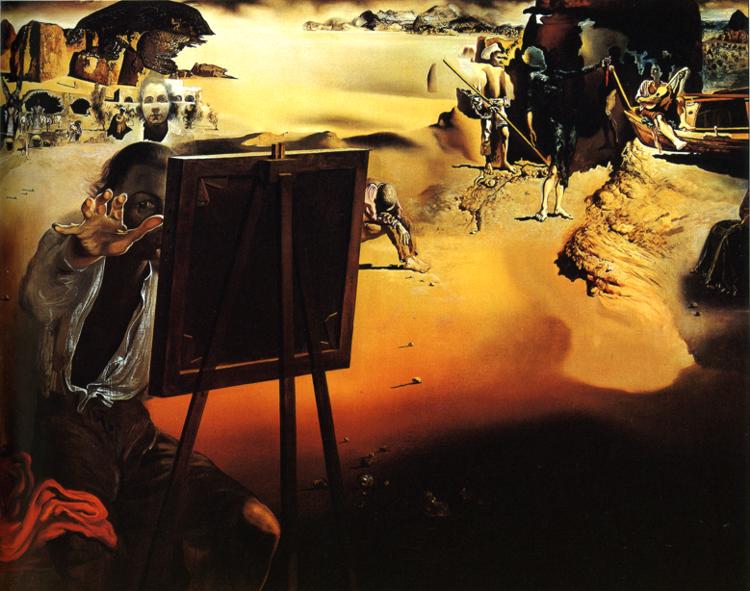
DaliThe Pompidou have answered my prayers. This Dalí retrospective is nothing short of stunning. It is one of the best if not the best exhibition I have ever been to. The show isn’t a peripheral tribute to Dalí, but a comprehensive exploration of his entire career featuring an incredible 120 paintings all in one place, as well as sketches, sculptures, a recreation of his famous red-lipped sofa Mae West room and other paraphernalia. I was in heaven. The show’s curators appear to have acquired all of the works from Tate, and all those owned by the Reina Sofia, but most importantly of all, the exhibition brings together a huge collection of works which are hiding away over in the Dalí museum in St Petersburg, Florida, whose collection alone comprises some 96 paintings, and, most brilliantly of all, the globally recognised melting clocks themselves, all the way over from New York. Could this show get any better?

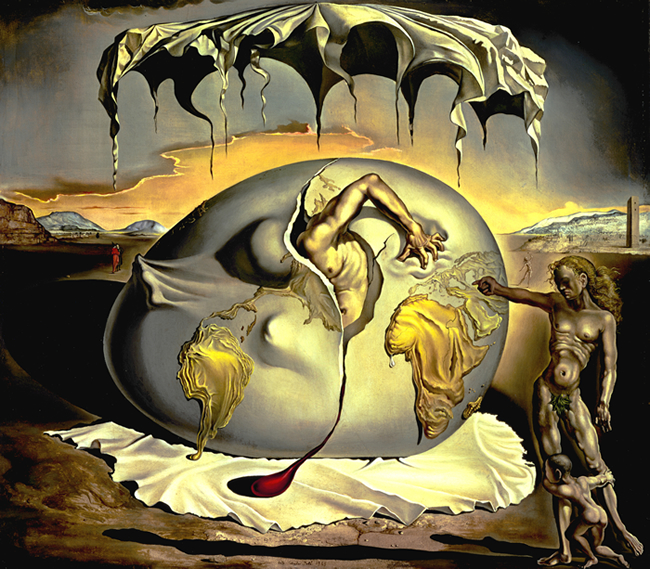
Geopoliticus child watches the birth of the new man (1943)

Geopoliticus child watches the birth of the new man (1943)

Impressions of Africa (1938)

Impressions of Africa (1938)

The exhibition starts with an egg – a large egg which forms an entrance to the first gallery and whose pounding heartbeat could be heard all the way down the corridor of the Pompidou’s 6th floor. It was like the warm up to a mega-star’s pop-concert, as the audience is whipped up into a frenzy in anticipation of the great star’s arrival onto the concert stage. And appropriately so, for there is no greater star of the artistic world, in my opinion, than Salvidor Dalí, and at the Pompidou, the stage was truly set.

Read more

Paris: la visite d’art – Les Photos

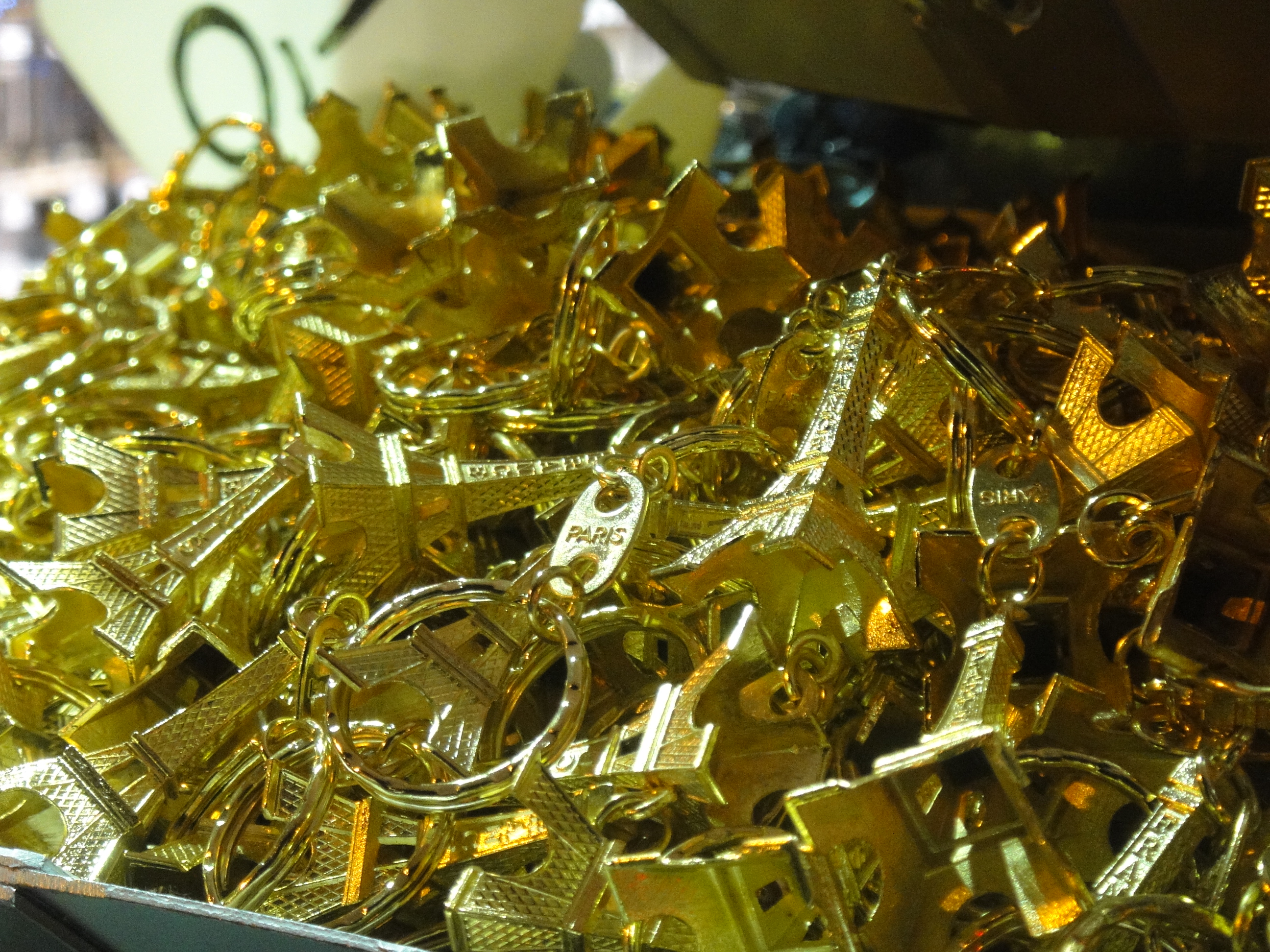
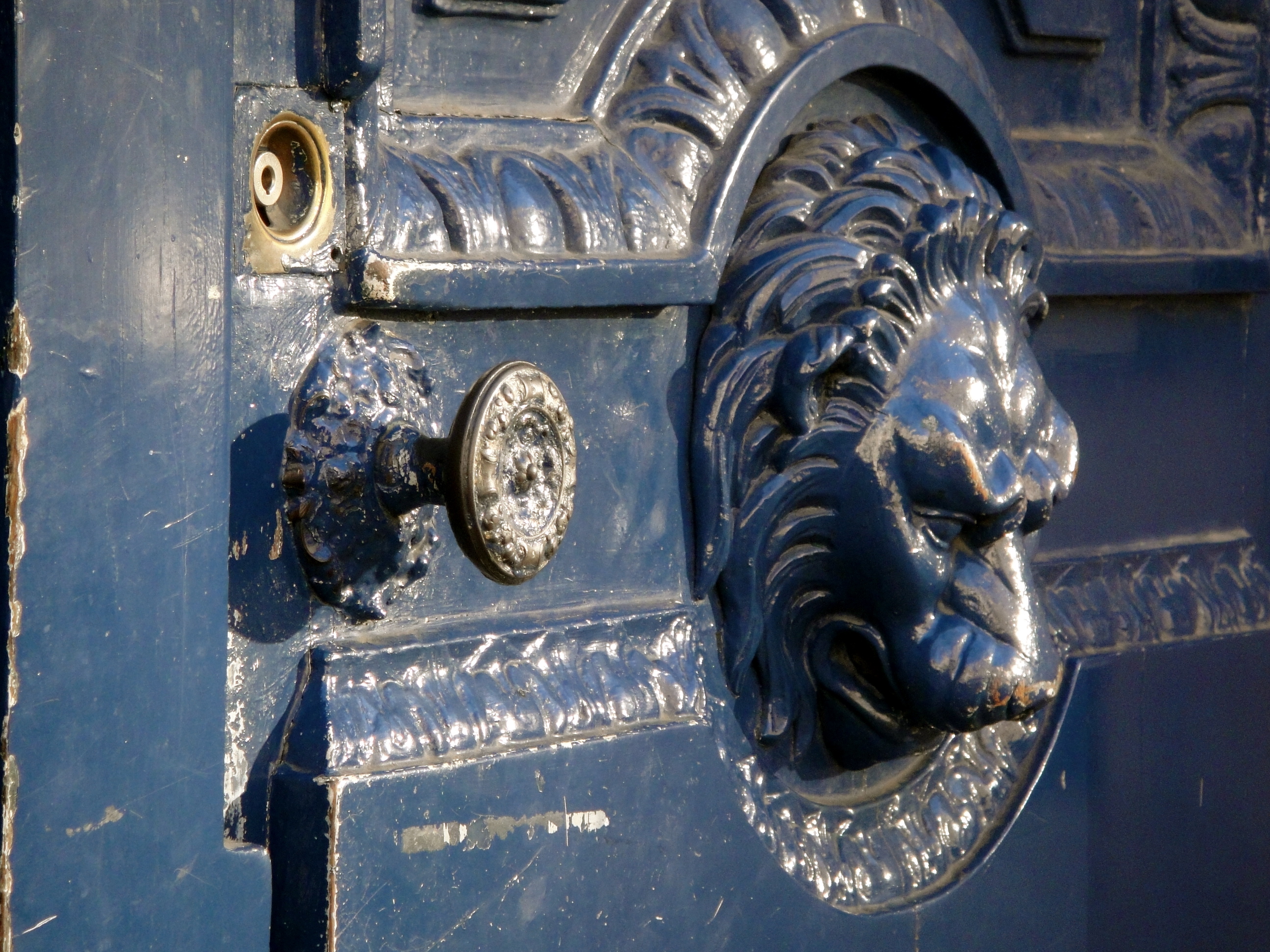
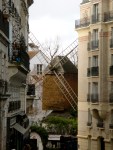
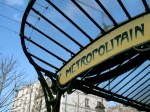
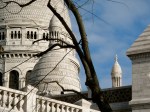
I’ve already mentioned that my recent trip to Paris had been justified on the basis that there were at least 3 tremendous exhibitions on show which I was bursting to see. But likewise, while I always try to rationalise my extravagance in visiting Paris as often as possible, for those who really appreciate the aesthetic beauty, the artistic perfection of life, I need justify this visit no further, nor indeed any other foray into this undeniably beguiling city. Just one look at my recent set of Paris photos is justification in itself. For where else on earth could a heaving, busy, pulsating capital city exhibit such indisputably captivating elegance? From its broad Haussmann boulevards and narrow cobbled streets, to the blue lacquered doorways and red wings of the Moulin Rouge Windmill, Paris is a paradise of unparalleled artistic ravishment, seducing every species of the creative collective within its fold.

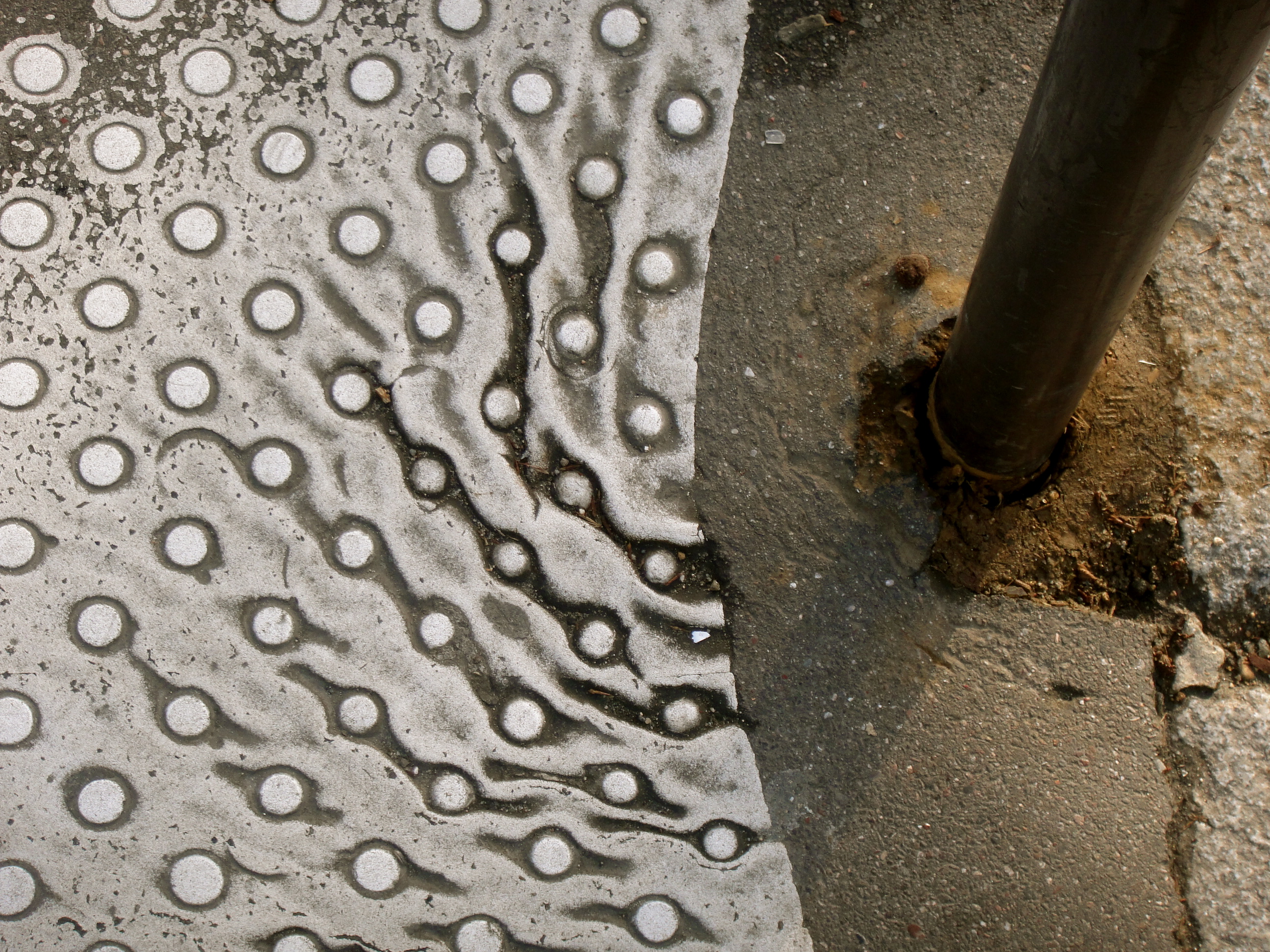
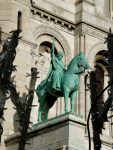
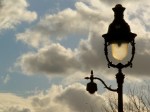
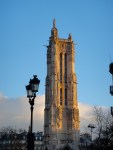
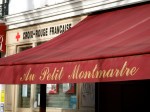
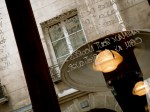
DSC04858 DSC04656 DSC04595 DSC04612

I have taken so many photographs of Paris, and every time I visit, I think there cannot possibly be anything left for me to capture. And yet with each new visit, Paris proves that I was wrong to doubt, bounteous as it is with fodder for even the most seasoned photographer, constant inspiration to those who like me, cannot resist the temptation to immortalise this city in a thousand new shots at every turn of the corner.

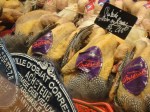
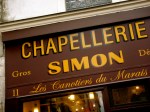
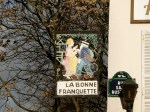
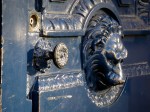
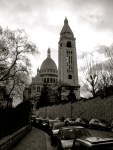
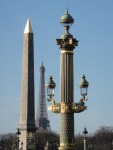
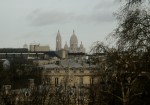
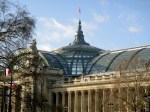
This time round I became freshly inspired by the quaint streets of Montmartre, and the rubicund red of the Moulin Rouge. I was enchanted by some of the smaller details such as the glossy blue lions on the doors of official government buildings, and by contrast, captivated by the creative graffiti art lining the stairs leading up to the infamous Butte de Montmartre, and the oddities of the urban landscape such as this almost melted pavement, above. So from shots of shop signs and garlic filled snails, to souvenirs aplenty and cityscapes which are like poetry on the eyes, I leave you now with just a few of my recent photos – my ode to the true art of Paris: Paris itself.

© Nicholas de Lacy-Brown and The Daily Norm, 2001-2012. Unauthorized use and/or duplication of the material, whether written work, photography or artwork, included within The Daily Norm without express and written permission from The Daily Norm’s author and/or owner is strictly prohibited. Excerpts and links may be used, provided that full and clear credit is given to Nicholas de Lacy-Brown and The Daily Norm with appropriate and specific direction to the original content.

Paris: la visite d’art – Exhibition 2: Bohèmes

With a second day comes a second exhibition direct from the city of love, light, and above all things, art. Paris, inspiration to so many creatives over the years, is host to a sensational array of art exhibitions this Autumn/Winter season, and I could not wait to rush over on eurostar to get my fill.

Our second show, after Hopper, was also the second of two big blockbuster shows being held consecutively in the mammoth greenhouse-come-palace otherwise known as Le Grand Palais. Entitled Bohèmes, this exhibition promised to be an enriching exploration of the bohemian age of Paris, when pearly green absinthe dripped from sugar on a balanced spoon in little grimy bars on the step hillsides of Montmartre, when dandy artists courted flirty prostitutes and cabaret dancers, and when the true spirit of the artistic revolution was born.

L'Absinthe (Edgar Degas, 1876)

L’Absinthe (Edgar Degas, 1876)

It was the inevitable consequence of the impressionist age, when artists and intellectuals alike broke free from the shackles of Napoleonic Paris, zealously keen to explore the new modernised world, an age with re-written moral values, re-examined sensibilities, and artistically a blank-canvas ripe for the most extravagant exploration. It was the age of the bohemian revolution, the time of Toulouse Lautrec, the Moulin Rouge and the can-can, and surely the most charming age of all Parisian history.exposition_bohemes_grand_palais-470-wplok

It was with a high degree of excitement then that we entered our second expo in the Grand Palais, ready to indulge in Le Chat Noir, the decadence of dandyism, and the melancholy of alcoholic introspection. And yet what we were faced with was a huge long gallery full of dank old paintings…of gypsies! This was not at all what I had expected, and I must admit to being quite put out by this start to the show. Unenthusiastically, we browsed the nondescript works, before turning the corner, only to find more. Gypsies in Romania, Gypsies in Spanish Seville, all painted in a very classical, traditional fashion, each in turn failing to inspire me (I also thought it was rather ironic that this exhibition was even on show in Paris… after all, wasn’t France the country which was recently so caught up in a scandal with the Romani communities?).

However soon enough, the exhibition changed for the positive. Depictions of the gypsy communities became all the lighter, more colourful and lighthearted. Enter Van Gogh, with his fresh, turquoise skies and bright yellow gypsy caravan near Arles, and Renoir with his iconically idealistic portrayal of a gypsy girl. Then there was the great Courbet, the artist much lauded for kickstarting the spirit of the artistic revolution, and his highly original self-portrait, Bonjour Monsieur Courbet.

Gustav Courbet, La Recontre ou Bonjour M. Courbet (1854)

Gustav Courbet, La Recontre ou Bonjour M. Courbet (1854)

Van Gogh, Gypsy Camp near Arles

Van Gogh, Gypsy Camp near Arles

Auguste Renoir, En été / La bohémienne (1868)

Auguste Renoir, En été / La bohémienne (1868)

So why all the gypsies? Well apparently, the origin of the word “bohemian” is from the French word bohémien, which is the french word for gypsy, allegedly because the French believed the Romani people to have come either from or certainly through Bohemia (now the Czech Republic). From the gypsy connotations, the word gradually became used to describe people who were “socially unconventional” and so the bohemian concept was born – the art lovers, the dancers, the scandalous inhabitants of Montmartre – all were part of a mass bohemian revolution, where social conventions were cast to the weakening winds of the past, and free spirited minds were unleashed upon the world of art, love and leisure. And it was to this time, at the end of the 19th century, when bohemianism truly came into its own, that the exhibition finally wandered, casting behind the historical gypsy poses, and taking us to the heart of the bohemian insurrection of 19th century Paris.

From hereon in, I was in art heaven. From Courbet’s dashing self-portraits, and depictions of the artist’s arteliers (art studios), to the vibrant artistic community of Montmatre, with its cafés, its dance halls and its Moulins aplenty, these paintings unleashed an age of debauchery, of charm and of vivacious artistic liberty which was almost unique to the Montmartre region and a decisive factor in why I came to adore Paris as a young school boy first wandering into the Place du Tertre.

Paul Signac, Le Moulin de la Galette (1884)

Paul Signac, Le Moulin de la Galette (1884)

Van Gogh, Coin a Montmartre, le Moulin a poivre (1887)

Van Gogh, Coin a Montmartre, le Moulin a poivre (1887)

Ramon Casas, En Plein-air (1890)

Ramon Casas, En Plein-air (1890)

But not only did the exhibition feature the paintings of bohemianism, but also recreated their world. The café scenes were displayed in a mock up café with long benches, peeling walls and posters from the infamous cabaret Le Chat Noir and the artist’s hangout, Le Lapin Agile, while the depictions of the ateliers were hung on the walls of an artist’s studio. Playing in the background was the music of two operas – Bizet’s Carmen, the opera about Seville’s most famous gypsy protagonist, and of course Puccini’s La Bohéme, a story of the quintessential bohemians in 19th century Paris – the starving writer and his equally hungry artist friend, scraping together a living while falling in love with prostitutes and suffering the full potency of love, romance and the horrors of a poverty-ridden death.

Ramon Casas, Madeleine or Au Moulin de la Galette (1892)

Ramon Casas, Madeleine or Au Moulin de la Galette (1892)

Santiago Rusiñol, Café de Montmartre (1890)

Santiago Rusiñol, Café de Montmartre (1890)

Steinlein, poster for Le Chat Noir

Steinlein, poster for Le Chat Noir

The atmosphere conjured by the paintings of that time are like a snapshot onto an almost impossible age of charm. Of course it’s easy to romanticise poverty and decadence, in times which were hard, often miserable, and tragic, and yet there is something about that age which fills me with incredible inspiration, as though the artistic spirit which was kindled in that time has never burnt out, pervading through the centuries and igniting the artistic spirits of a millennia of new creative generations.

Ccharles Amable Lenoir, Rêverie (1893)

Ccharles Amable Lenoir, Rêverie (1893)

I only wish that you too could be inspired by the paintings on show… however these photos will have to be enough. Having just checked the website, I see that this great show finished at the weekend, drawing this fascinating study of bohemia to a close, but reopening a chapter of artistic revolution whose impact will live forever.

I leave you, for completeness, with the Norms’ very own version of Degas’ L’Absinthe (above)… it wasn’t featured in Bohémes, but clearly should have been.

L'Absinthe Norm (acrylic on canvas, 2011 © Nicholas de Lacy-Brown)

L’Absinthe Norm (acrylic on canvas, 2011 © Nicholas de Lacy-Brown)

À bientôt

Paris: la visite d’art – Exhibition 1: Hopper

I don’t need a reason to visit Paris. The beauty of the winding cobbled streets of Montmartre echoing with accordion melodies, the charm of the boutique-filled Marais, the glory of the sweeping River Seine, and the regal grandeur of the Louvre, the Napoleonic boulevards, the sandy parks and the super-sized fountains… I could just walk around the place, breathe in the atmosphere, and munch upon macarons year after year, month after month. I never grow tired of Paris.

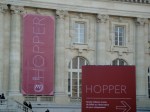
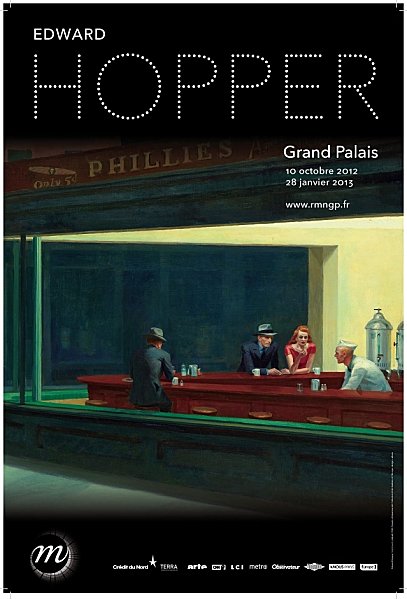
affiche-hopperAnd yet this year, Paris’ artistic offerings provided me not only with an excuse to make my second trip to the city in the space of 12 months, but made it a requirement. For the exhibitions which have graced the Paris art scene this autumn/winter have frankly been second to none – a Hopper retrospective at the Grand Palais, an exhibition focusing on the “bohemians” of 19th century Paris, also at the Grand Palais, a show of the significant artistic productivity, including Picassos aplenty, of occupied Paris during the second world war at the Modern Art Museum and, most significantly of all, a Salvador Dali retrospective at the Pompidou. I have waited all my life for that one. Yet by comparison, what did we have in London in the so called “cultural olympiad” of 2012? A show of Hockney’s “bigger picture”, which was always so crowded that the most you could see of his bigger pictures was his clumsy brushstrokes pushed almost up against your nose, a premature retrospective of the great pretender, Damien Hirst, and a further foray down the well-trodden path of the Pre-Raphaelites for the 5th time in as many years.

So off to Paris I went with my partner, full of anticipation for what lay ahead – 3 days; 3 exhibitions – an anticipation which was fulfilled many times over.

Now it would be an injustice to try and feature the three shows I saw all in one post – the Dali exhibition alone should have a whole blog of its own. So I will take you through the shows one by one, sharing the joy of Paris’ cultural agenda for those of you who cannot make the trip, and making a strong case for the prompt purchase of exhibition tickets for those who can.

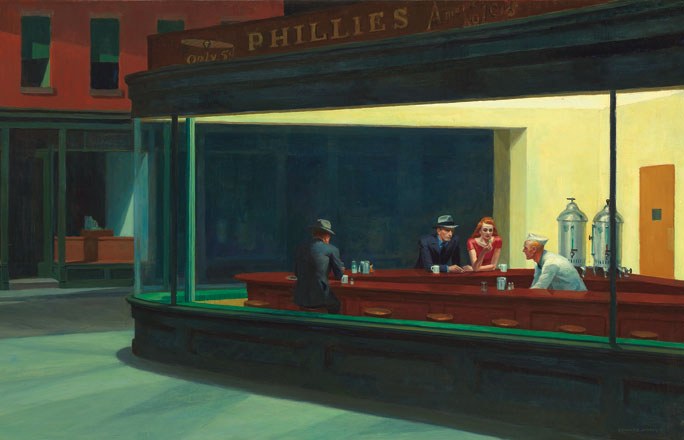
So up first – Edward Hopper at the Grand Palais. Hopper (1882-1967) the all-American painter, best known for his depictions of introspective early 20th century city dwellers, lost in a world of thought in an often artificial unnatural urban space, has long fascinated me, ever since I “accidently” hung on to a catalogue lent to me by my friends, Sarah and Truong, of this artist previously unknown to me. Of course at least two paintings are recognisable to us all – House by the Railroad (1925) – the quite reclusive, slightly sinister victorian house which is said to have inspired Hitchcock’s Psycho house, and a number of haunted house parodies ever since; and Nighthawks (1942), the quintessential Hopper masterpiece, with its four mysterious figures, enigmatic relationships, and strangely unnatural nighttime glare. But asides from those popular references, I did not know Hopper, yet wished to be better acquainted.
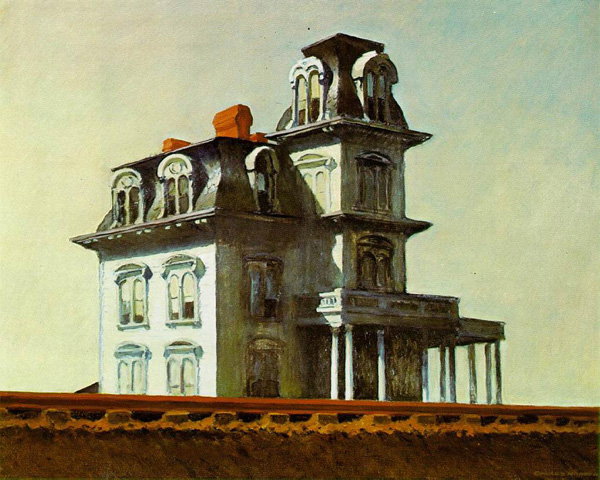
House by the Railroad, 1925 (© MOMA, NY)

House by the Railroad, 1925 (© MOMA, NY)

Nighthawks, 1942 (© Art Institute, Chicago)

Nighthawks, 1942 (© Art Institute, Chicago)

In staging this significant retrospective (featuring 160 works, that was almost Hopper’s entire life’s output – he was a notoriously fastidious and slow painter), the Grand Palais was providing the ultimate in Hopper shows, allowing not only an acquaintance with this fine artist, but a chronological embrace through each stage of his artistic career. 

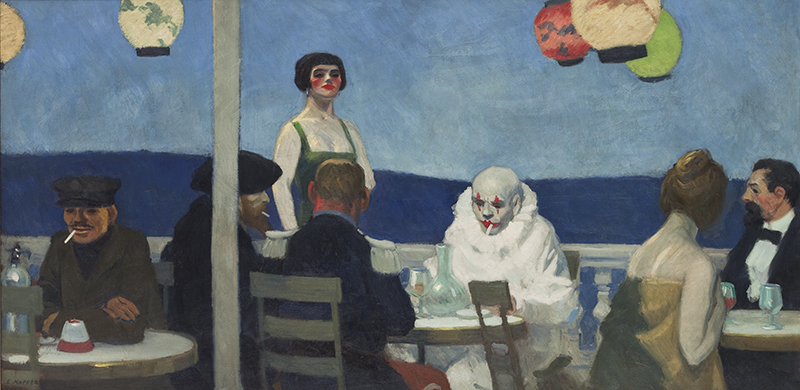
An early work - Soir Bleu, 1914 (© Whitney Museum of American Art)

An early work – Soir Bleu, 1914 (© Whitney Museum of American Art)

First up, we were shown his early works – painted around the beginning of the 20th century and suitably inspired by Paris and artists like Degas and Pissarro, Hopper dabbled in his earliest cityscapes – broad brushed meditations on a captivating city, yet rather subdued, although already mastering an effective contrast of sunlight and shadow. But soon enough, Hopper turned to illustration, finding that his paintings were not selling. Here, we see Hopper as the caricaturist and illustrator, both mediums in which he was able to demonstrate great skill as a draftsman and social commentator. It was only in the 20s that he began to paint seriously again, and finding greater success as he did so. From this point in the show onwards, there begins a vast array of Hopper paintings, spoiling the viewer with their breadth and sheer number.
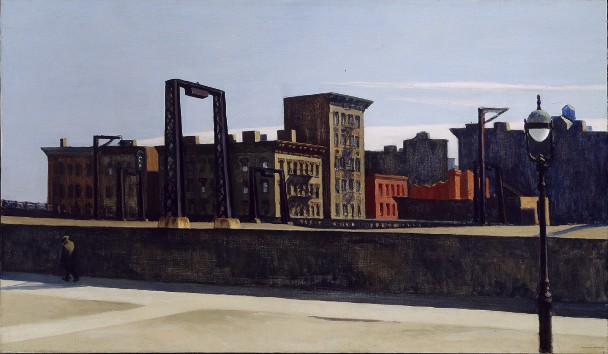
Manhattan Bridge Loop, 1928 (© Addison Gallery of American Art)

Manhattan Bridge Loop, 1928 (© Addison Gallery of American Art)

The City, 1927 (© University of Arizona Museum of Art)
The City, 1927 (© University of Arizona Museum of Art)

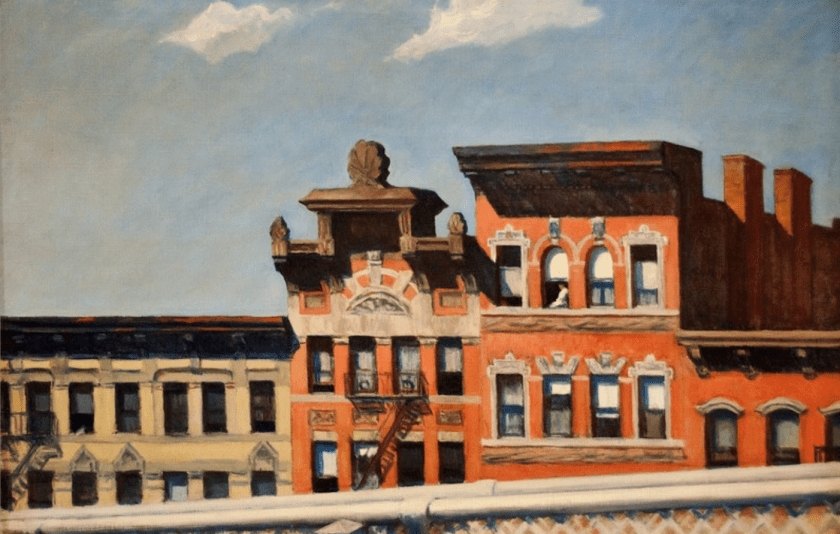
From Williamsburg Bridge, 1928 (© Met Museum of Art, NY)

From Williamsburg Bridge, 1928 (© Met Museum of Art, NY)

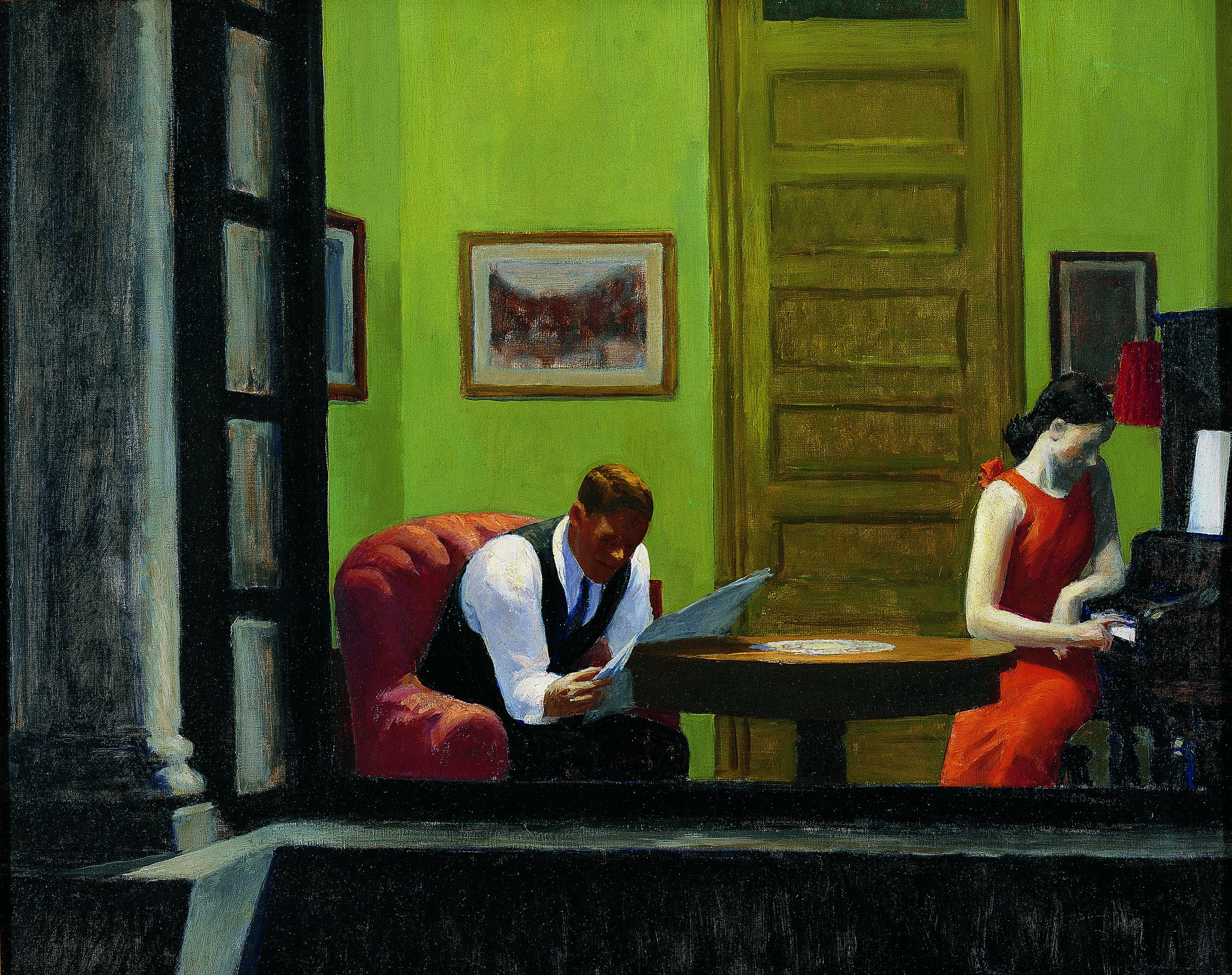
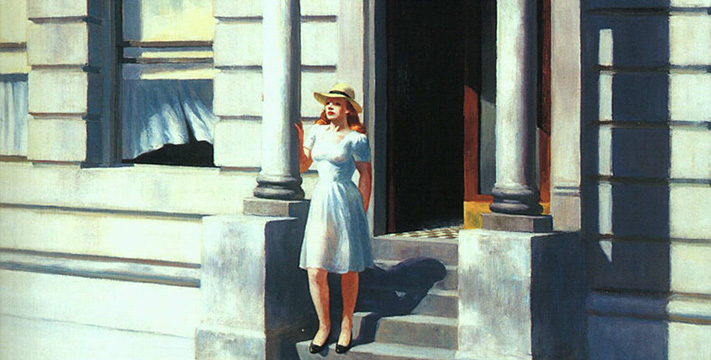
The paintings can almost be split, both chronologically and thematically. In the first set, Hopper’s paintings are conspicuous through their absence of people. Hopper had turned to urban scenes in his native America, concentrating on everyday scenes, roads, highways, lonely houses, and managing to capture the spirit of both suburban America and central city spaces, yet with the often noticeable lack of inhabitants. This then is to be contrasted by the later raft of works, in which the person takes centre stage in his paintings, as Hopper becomes almost voyeristic, appearing to intrude into scenes of great personal contemplation and introspection, as the characters he portrays stare, apparently into space, or couples appear together, yet both lost it seems in their own world.
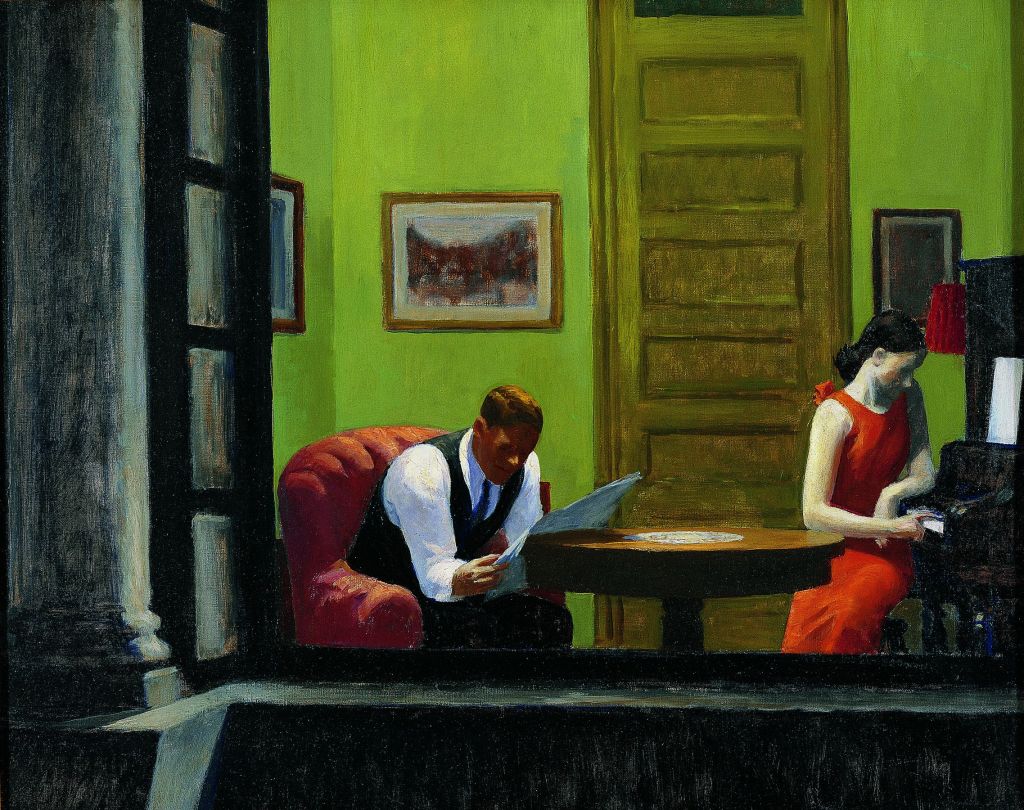
Room in New York, 1932 (© Sheldon Museum of Art, University of Nebraska)
Room in New York, 1932 (© Sheldon Museum of Art, University of Nebraska)

Summertime, 1943 (© Delaware Art Museum)

Summertime, 1943 (© Delaware Art Museum)

These are the paintings which really made Hopper’s name – the lonely people – the built up urban scenes which nonetheless leave us with a feeling of emptiness and solitude. They are like a commentary on that time, as though Hopper is making a statement about the commercialisation and urban growth which was happening all around him – the more it grows, the lonelier the people caught up in the growth feel. The smaller the spaces, the inhabitants sink into themselves. In this respect, Hopper perhaps anticipated the pop-art of later years, yet doing so more as a resigned critic than as a celebrant of popular culture.
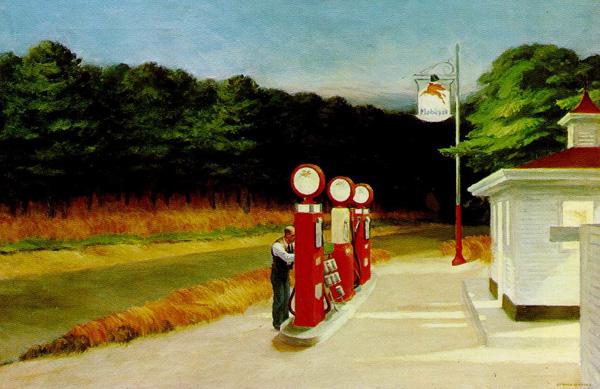
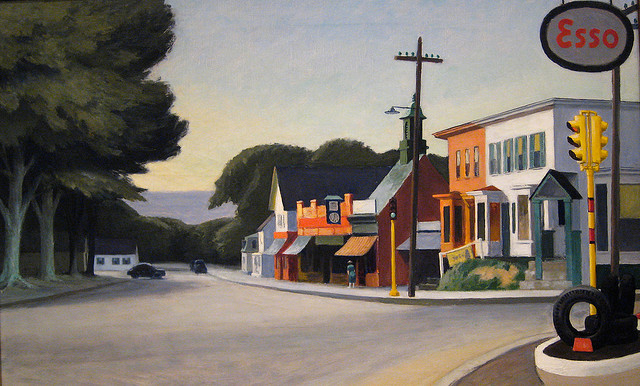
Gas, 1940 (© MOMA, NY)

Gas, 1940 (© MOMA, NY)

Portrait of Orleans, 1950 (© Fine Arts Museum of San Francisco)

Portrait of Orleans, 1950 (© Fine Arts Museum of San Francisco)

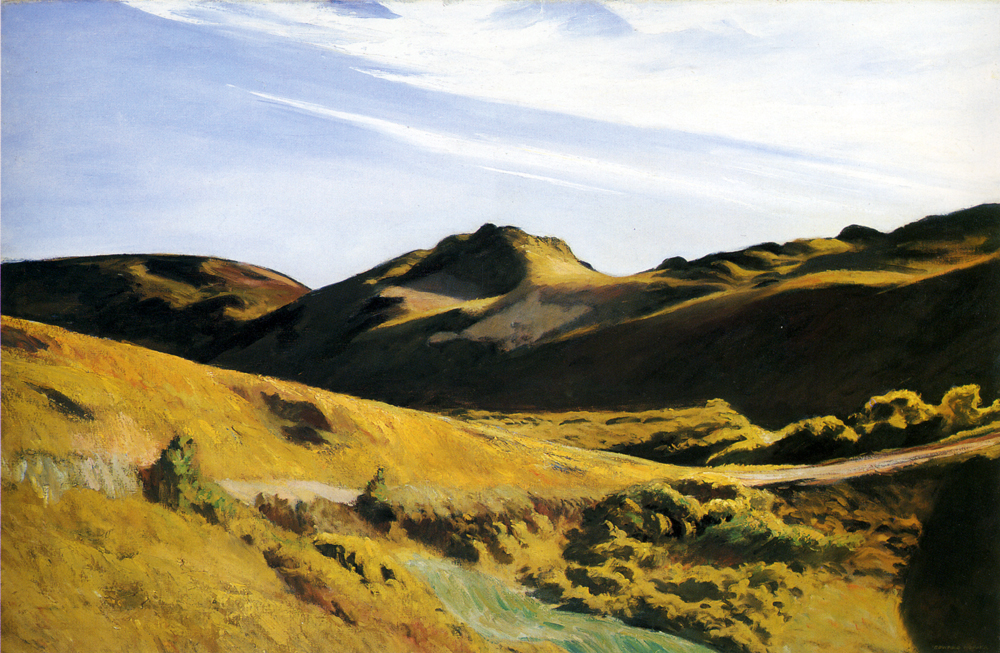
Personally, while I found Hopper’s people fascinating to consider, their stories open to so much interpretation, and Hopper’s intentions likewise, I couldn’t help but feel that too often his figures had something of a cartoony look about them, almost as though Hopper couldn’t quite kick the habit of his earlier days as an caricature artist. Rather, by far my favourite paintings were the solitary landscapes, the soulless cityscapes with not a person to be seen, the forest road interspersed with a jarring petrol station, the rolling landscape of The Camel’s Hump which was, by far, my favourite of his works.
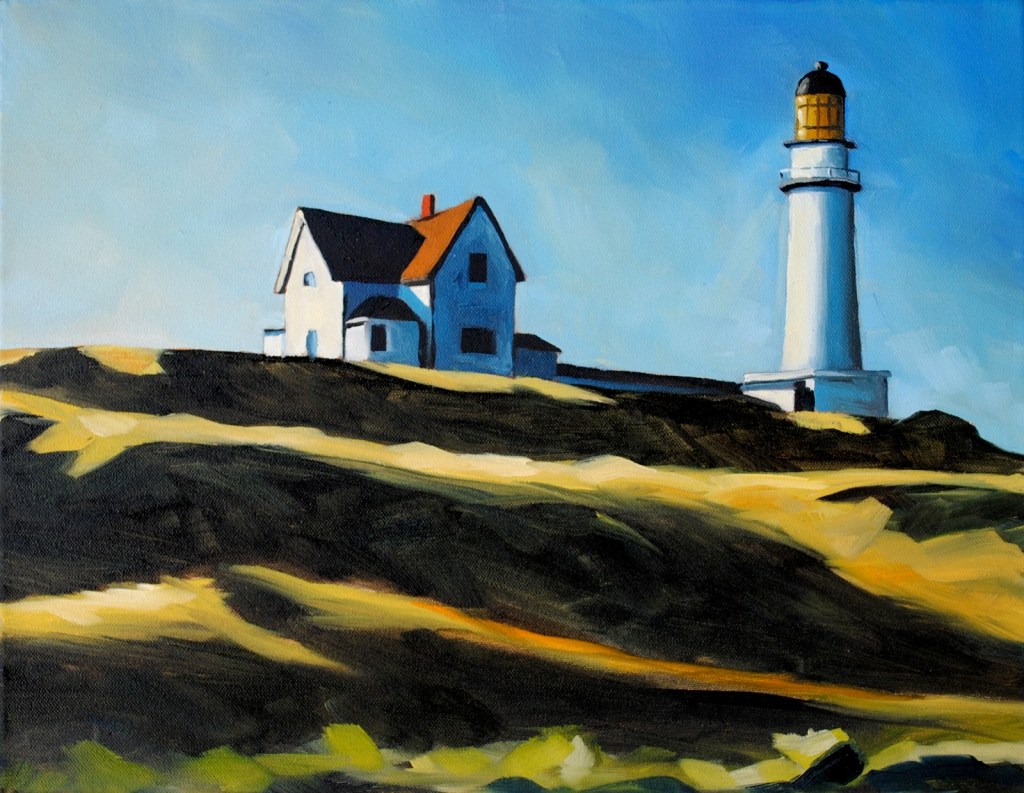
Lighthouse Hill, 1927 (© Dallas Museum of Art)

Lighthouse Hill, 1927 (© Dallas Museum of Art)

The Camel's Hump, 1931 (© Utica (NY))

The Camel’s Hump, 1931 (© Utica (NY))

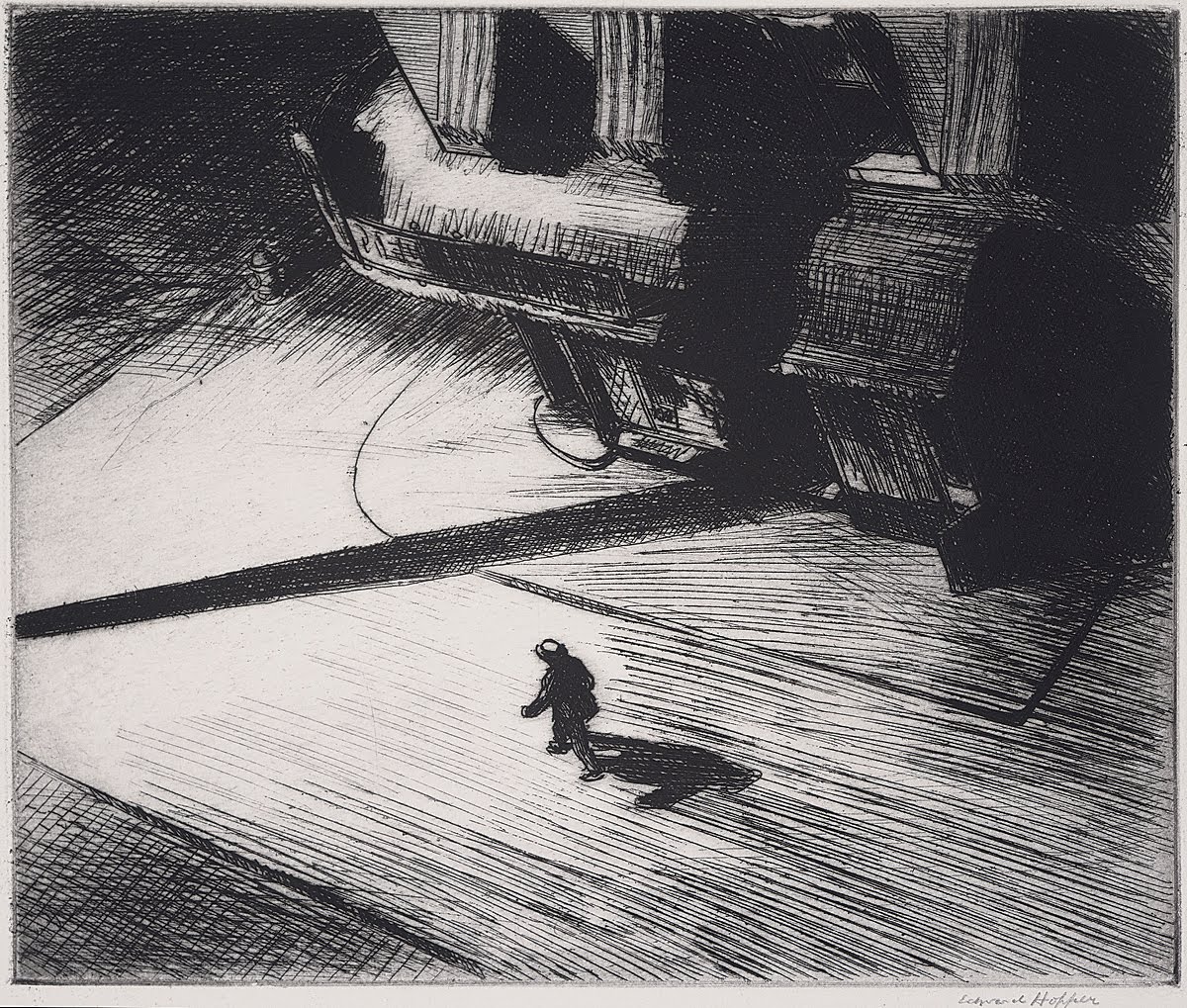
However likewise I loved a small gallery which showed some of Hopper’s etchings. This is quite bizarre, being that I have previously been drawn to Hopper by his great use of colour. Yet for me, Hopper’s etchings were more like a window onto his soul as an artist, whereas with his paintings, so often we look through opaque glass, misunderstanding his intentions and the messages he attempts to portray. Through his etchings we can enjoy his interaction with nature, appreciate the small details of life which fascinated him, and also track something of the thought process which underlay some of his later works. Take Night Shadows for example, which, in all its start Hitchcockian glory, appears to be something of a precursor to the enigmatic mystery which pervades many of his later paintings, especially the Nighthawks.
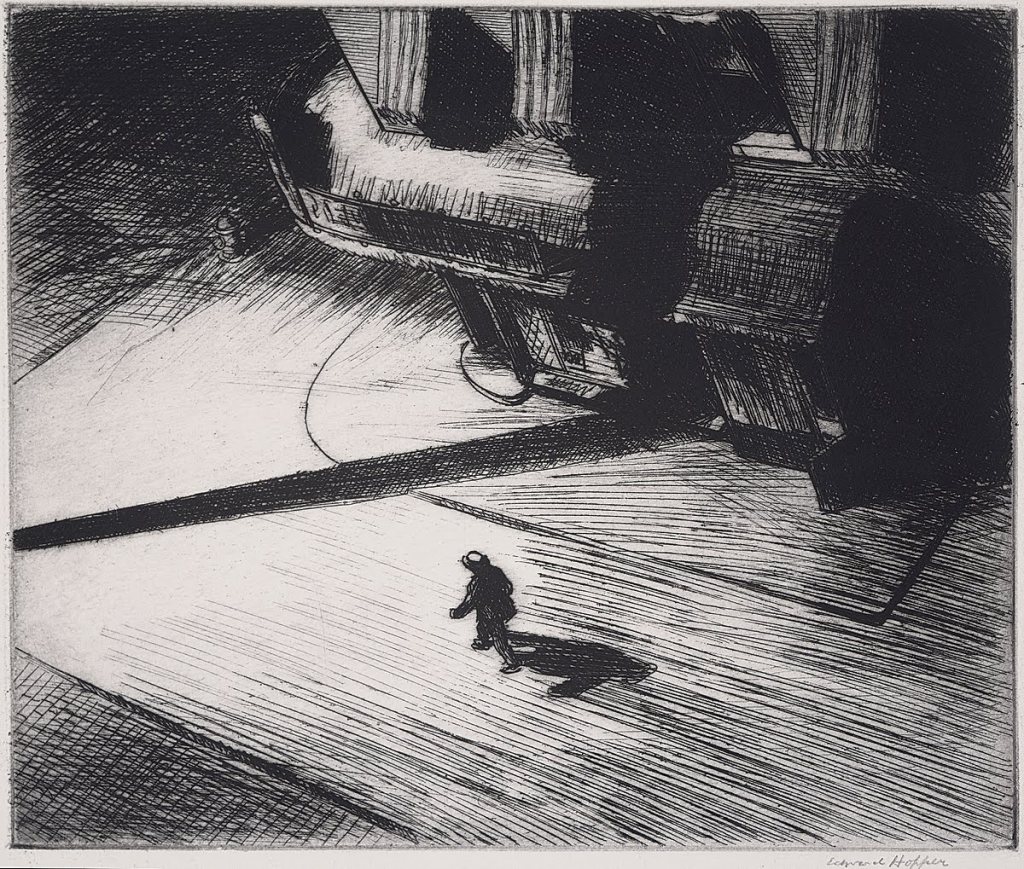
Night Shadows, 1921 (etching, © Philadelphia Museum of Art)

Night Shadows, 1921 (etching, © Philadelphia Museum of Art)

Whether it’s the inscrutable figures or the stark urban landscapes which do it for you, Hopper is a very likeable artist. His works are uncontroversial; they are inherently mysterious yet still very accessible; they beg questions, but provide no answers, and for that reason will continue to enagage audiences for many years to come. Yet so many of these works come from collections across America, and therefore for the European viewer, this is likely to be the best opportunity there will be for some years to engage with Hopper this side of the pond. So I urge you to go along, and make sure you book tickets in advance – did I mention that the show is so popular that we had to queue for almost an hour, just to get in on our pre-booked time slot?

The exhibition runs at Paris’ Grand Palais until 3 February 2013. You can buy your tickets here. Alternatively, if you can’t make it, the exhibition comes with its own mobile App which can be downloaded (at least from the itunes app store) and will guide you around the show with commentary and pictures – so even if you can’t make it to Paris, you’ll feel like you’ve done the show from the comfort and solitude of your very own armchair. Now Hopper would have loved that image.

On the Third day of Christmas, my Normy gave to me…

…three French hens

Now that’s more like it. A little bit of class, newly arrived straight from across the channel via eurostar. These three french hens are the height of chic. There’s the typically-French hen, sporting “le pullover” in iconic stripy blue and white, a string of onions and of course a little black beret; then fashionista-hen, draped with Coco Chanel’s characteristic long beads of pearls and a quilted chanel bag, along with louboutin shoes and a waft of Chanel No.5; and finally cabaret-hen, straight out of the Moulin Rouge herself, with a fetching outfit of fishnet and can-can frills, topped with an exuberant feathered head-dress (as if she needed more feathers).

Oh yes, these hens ought to perfectly reflect Normette’s stylish bearing, although she must remember that French hens aren’t just any old hens. Oh no. They require regular trips to the Harrods pet pampering salon, a cosy cashmere nest in which to lay their Fabergé eggs and a diet full of French delicacies such as oysters, baguette, moules-frites and, ewww, frogs legs… hmmm, good luck with sourcing those Normette.

On the third day of Christmas, my Normy gave to me...3 French Hens (2012 © Nicholas de Lacy-Brown, pen on paper)

On the third day of Christmas, my Normy gave to me…3 French Hens (2012 © Nicholas de Lacy-Brown, pen on paper)

What will Normy give her on day four?

© Nicholas de Lacy-Brown and The Daily Norm, 2001-2012. Unauthorized use and/or duplication of the material, whether written work, photography or artwork, included within The Daily Norm without express and written permission from The Daily Norm’s author and/or owner is strictly prohibited. Excerpts and links may be used, provided that full and clear credit is given to Nicholas de Lacy-Brown and The Daily Norm with appropriate and specific direction to the original content.

Introducing my new painting: The Gentleman (in Paris)

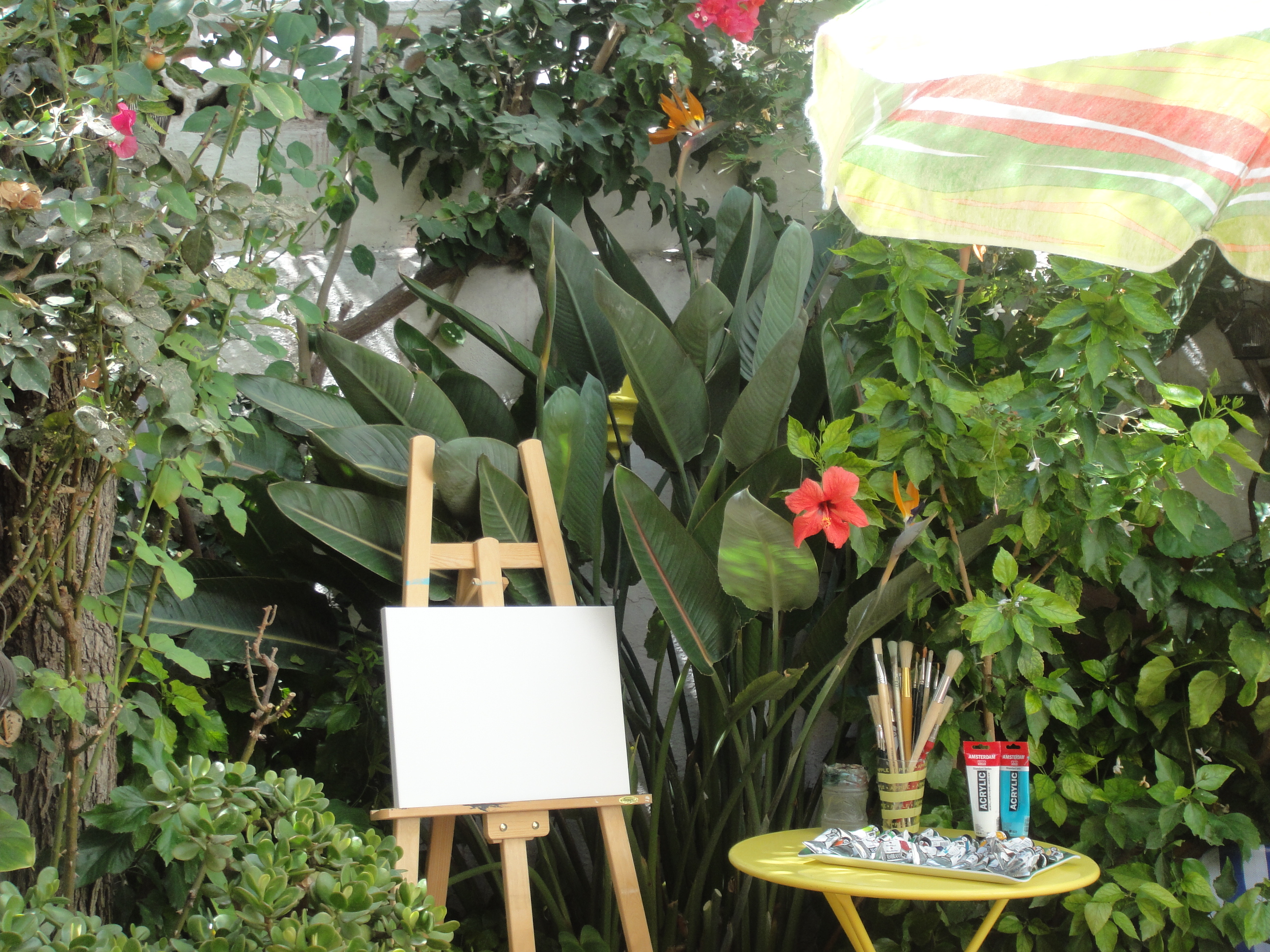
For those keen-eyed amongst you, particularly those reading my recent Spanish posts and my various tapas recipes, you may have noticed (as I know a couple of my regular readers did) in the background in the garden of my Marbella house stood a little easel and upon it a small canvas – from the early photos, when just a blank canvas was present, to the latter shots which showed me making some progress on the work as the balmy days of my holiday whiled onwards.

A canvas awaits me – in my garden in Spain

As the idea developed, and owing to the sad reality that our holiday was only 9 days long, my painting became more compelx, and when I left Marbella, the work was only half done. Luckily the canvas fit in my case (although no doubt contributed to my excess of baggage weight for which the ever unreasonable British Airways charged me a 50 euros flat penalty fee, even though my partner’s luggage was massively underweight) and I continued work in London. Be my life in London as it is – full of work and busyness, it has taken me some time to complete the painting, even though I rushed home most evenings to fit in a few hours of work.

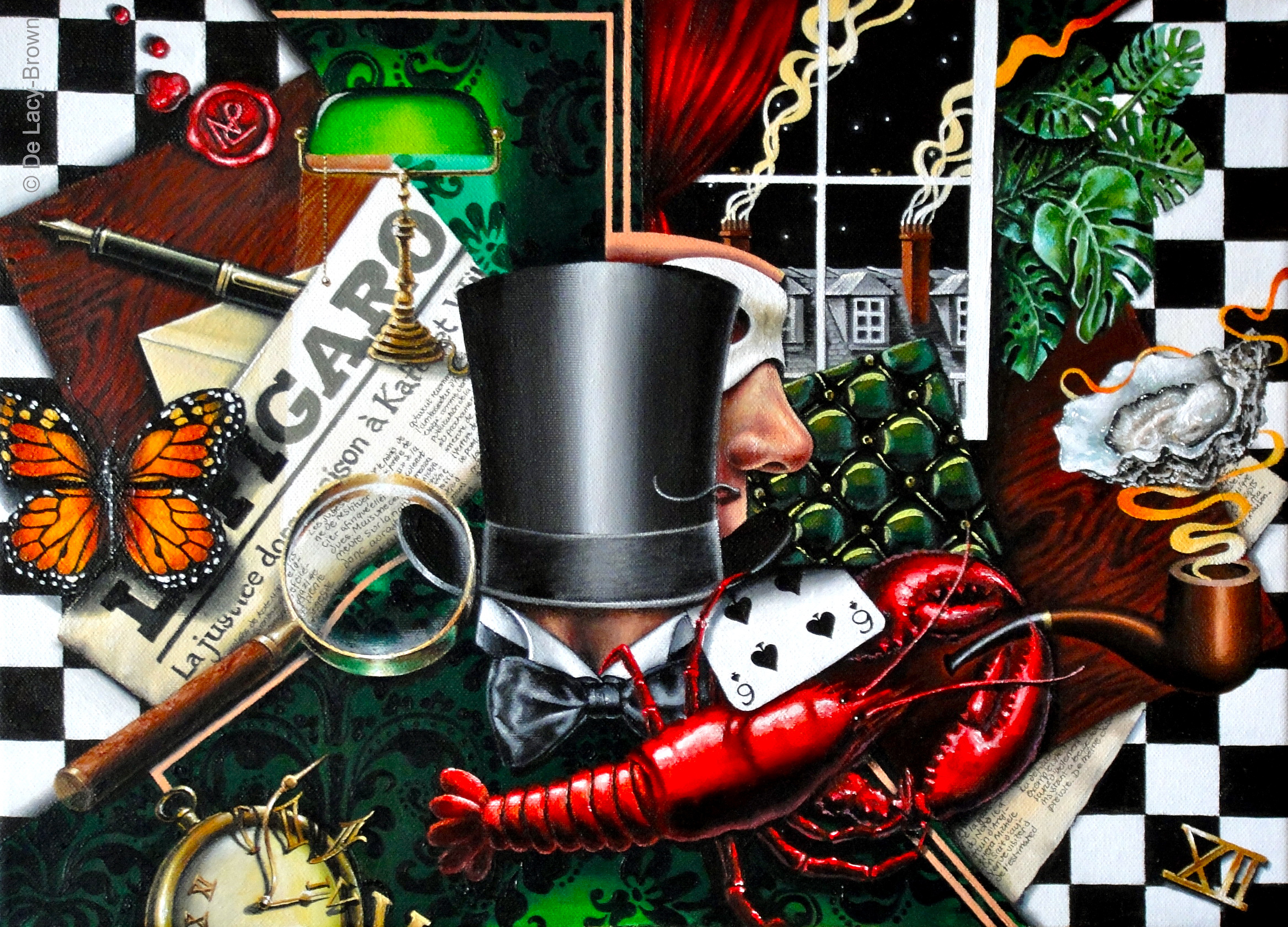
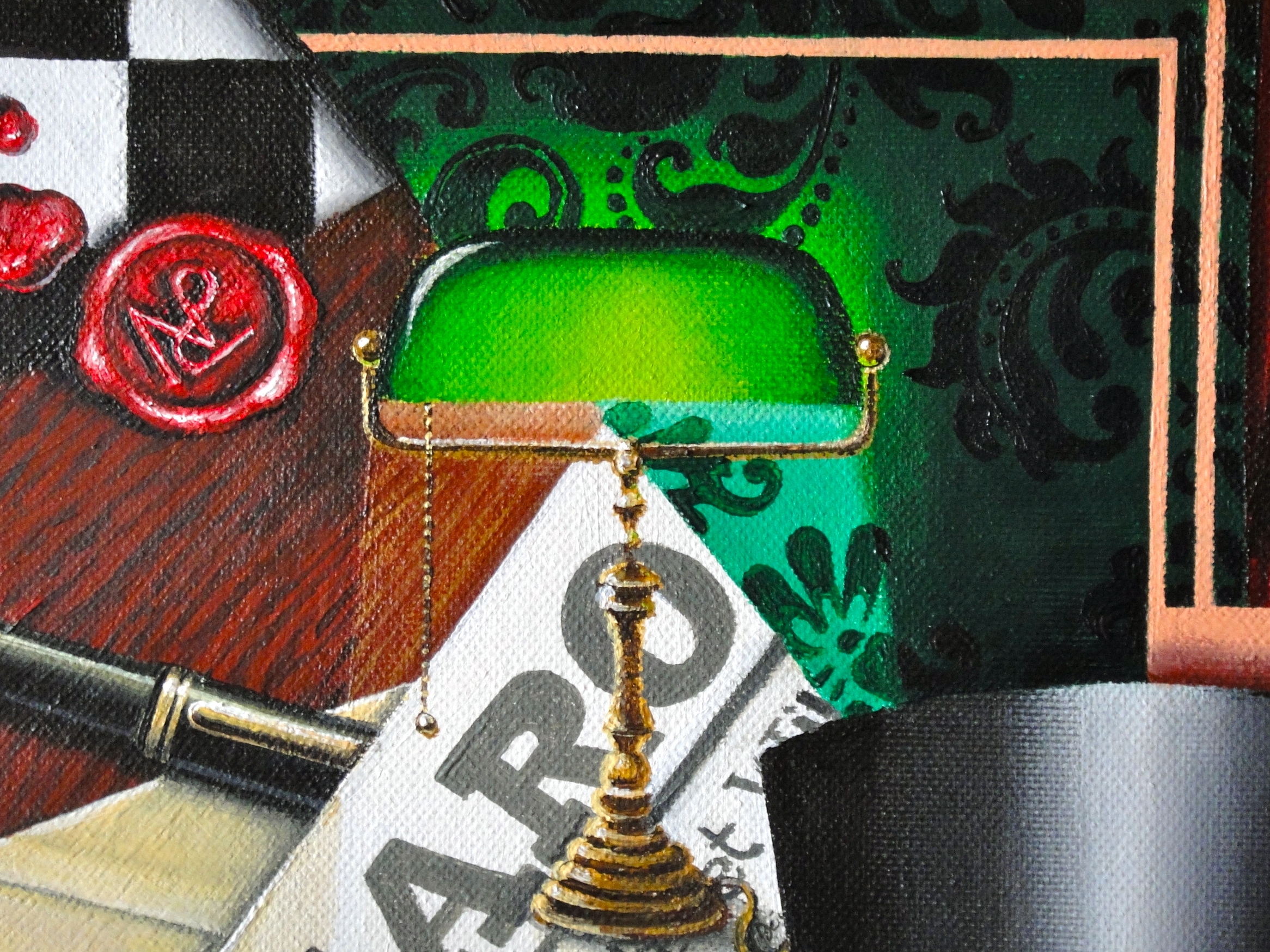
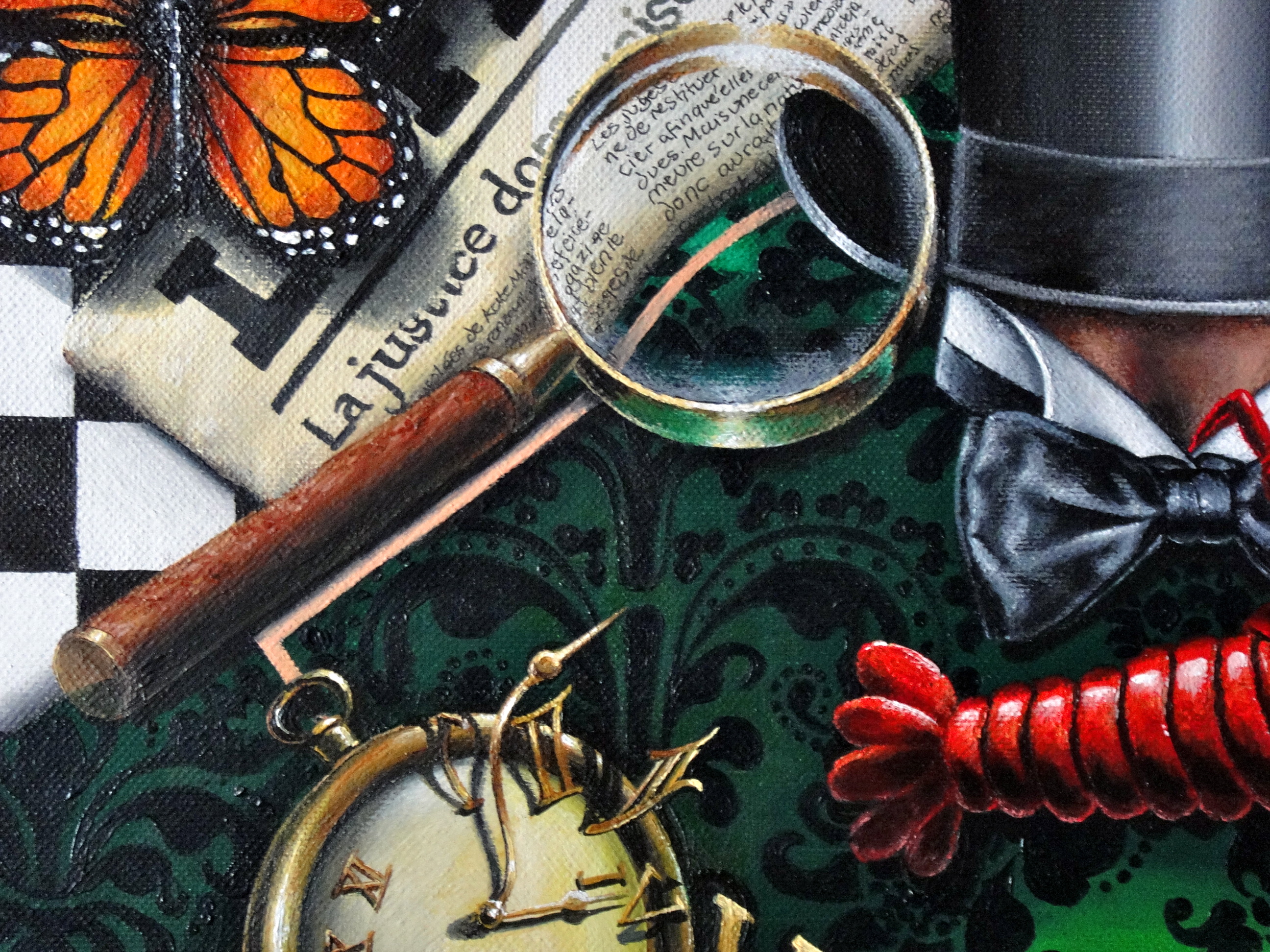
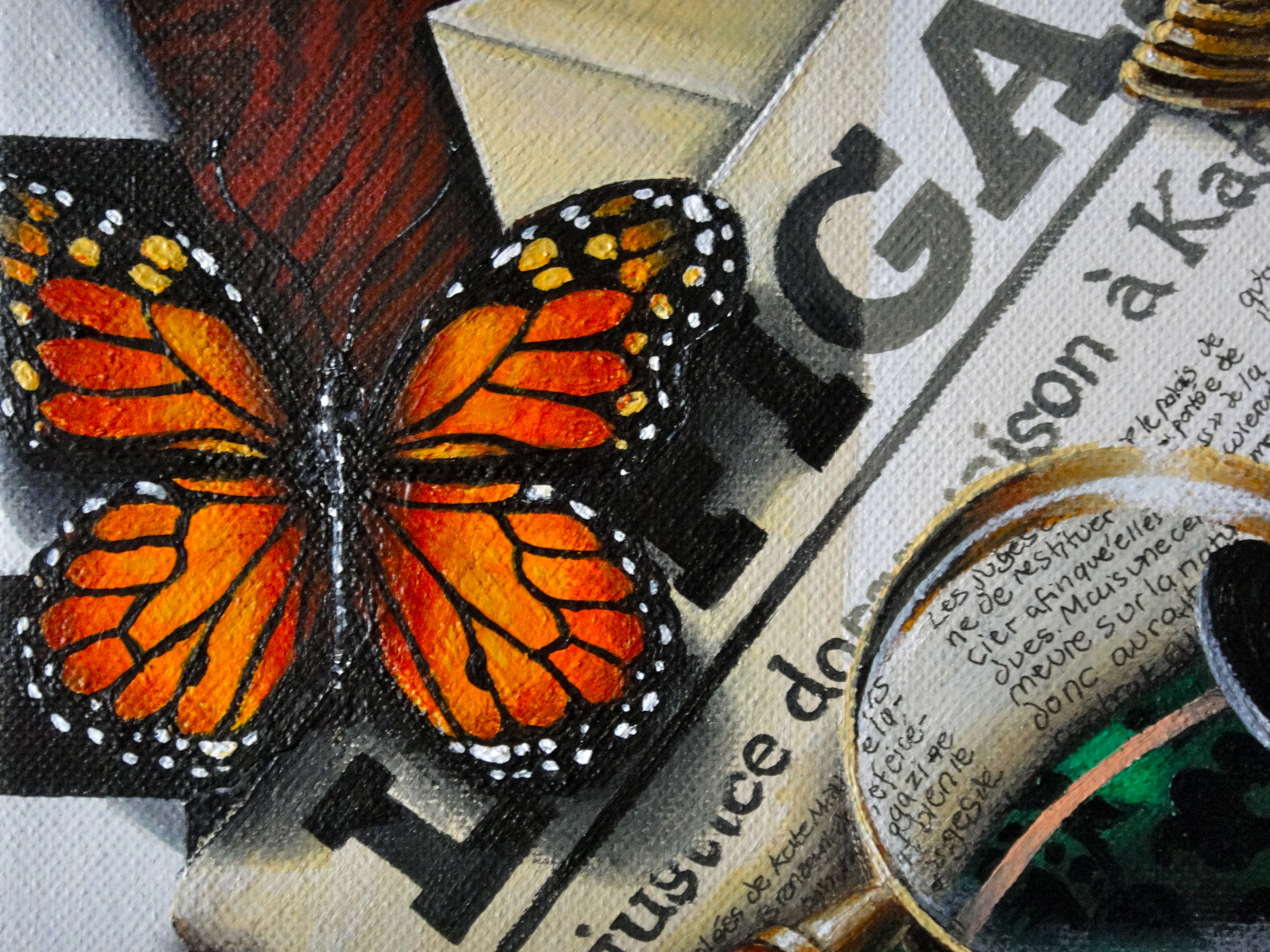
However, having had last weekend to myself, I finally managed to complete the work, a work which I now call The Gentleman (in Paris).

The Gentleman (in Paris) 2012 © Nicholas de Lacy-Brown, acrylic on canvas

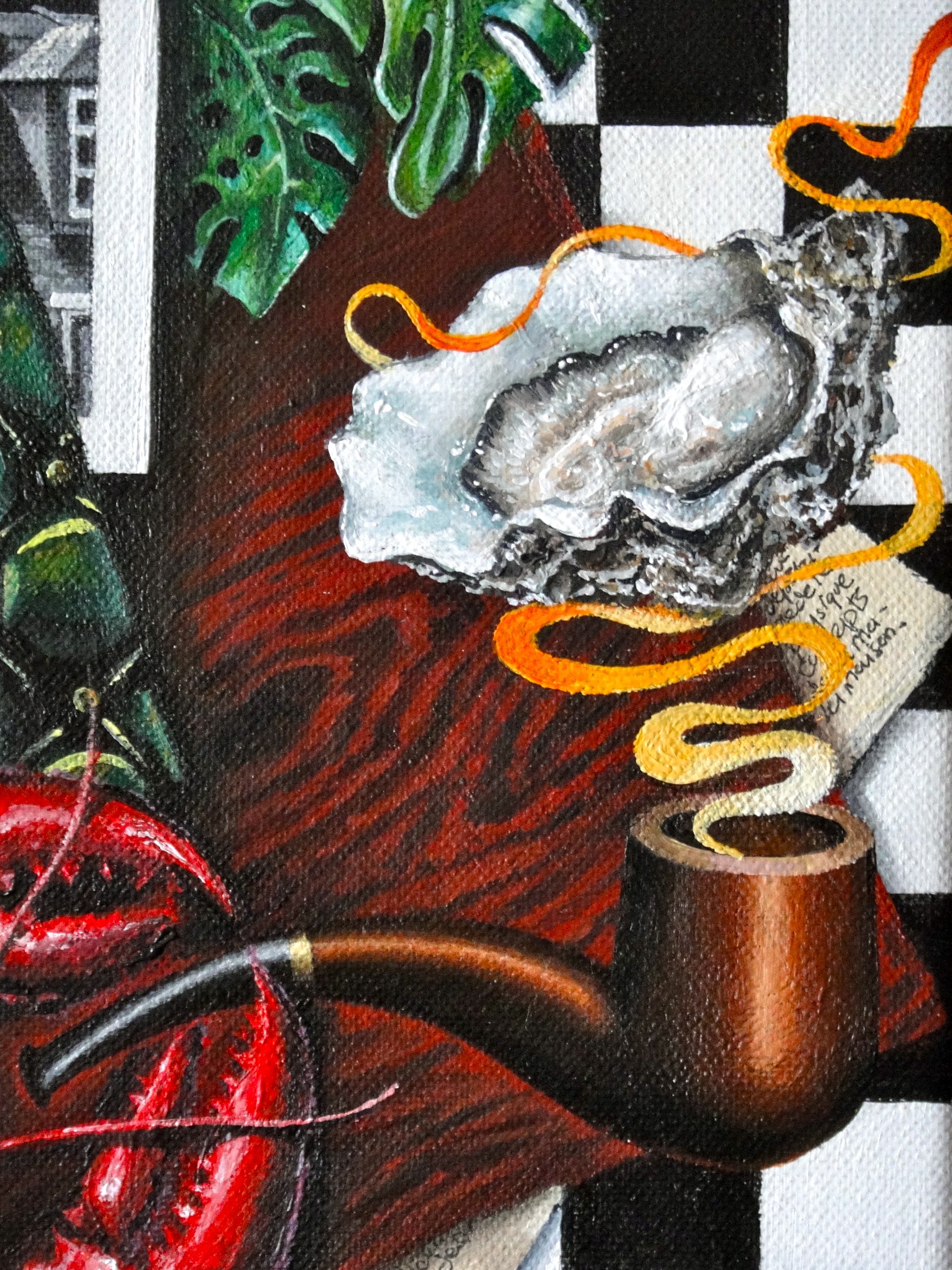
Inspired by the icons of a time I hold dear, a yesteryear when men were gentlemen, when to go out to dinner was a time of dressing up in a top hat and gloves, when chivalry was at the forefront of society and manners were a thing held in the highest of esteem. It was a time when in a Gentleman’s study, such as this one, a Chesterton desk chair would be found amidst the paraphernalia of a professional’s equipage: a pipe, a magnifying glass, a pocket watch, some butterfly specimen and an emerald green desk lamp, an expensive fountain pen and even more expensive culinary delicacies such as lobster and oysters, all set against a black and white floor, a hefty wooden desk, rich damask green wallpaper, verdant plant life and a floor to ceiling window view of the Paris chimneys beyond. And of course, because it’s Paris, the Gentleman has to keep up with the French news in Le Figaro. Meanwhile at the heart of the image, representations of the Gentleman himself: his top hat, a bowtie and wing-collared shirt, and his face, masked in the enigmatic disguise of a masquerade ball.

Explaining this painting is a little like explaining one’s impulses. This is an image which came to my mind in Spain which always provides me with sufficient relaxation and creative stimulation to get my artistic juices running. And even though the resulting painting is far from Spanish, it nonetheless digs deep in my imagination, placing on canvas a time, a place with which I can feel an inexplicable evocation, like an experience which recalls the strongest of emotions, even though it never happened. In this way, I use painting to make sense of the deepest of subconscious sentimentality, helping me to both explore myself, and pay homage to the depth of my creativity.

I leave you with a few shots of the painting’s details. I hope you like it.

© Nicholas de Lacy-Brown and The Daily Norm, 2001-2012. Unauthorized use and/or duplication of the material, whether written work, photography or artwork, included within The Daily Norm without express and written permission from The Daily Norm’s author and/or owner is strictly prohibited. Excerpts and links may be used, provided that full and clear credit is given to Nicholas de Lacy-Brown and The Daily Norm with appropriate and specific direction to the original content.

The Daily Sketch: Norms guillotined in the Place de la Concorde

As the rigour and excitement of the Paralympic Games continues to thrill not only us in London, but also the millions of viewers around the world, spare a thought for those young ones amongst us for whom this week may well spell the end of their summers and the start of a whole new school year. God, I used to hate this time of the year – that compulsory trip to the school uniform shop with my mother, trying on a scratchy new knitted jumper, full of foreboding for the cold days and dark nights to come, the homework, the long lessons and the exams at the end of it all, and all this when my golden summer tan was still fresh on my skin.

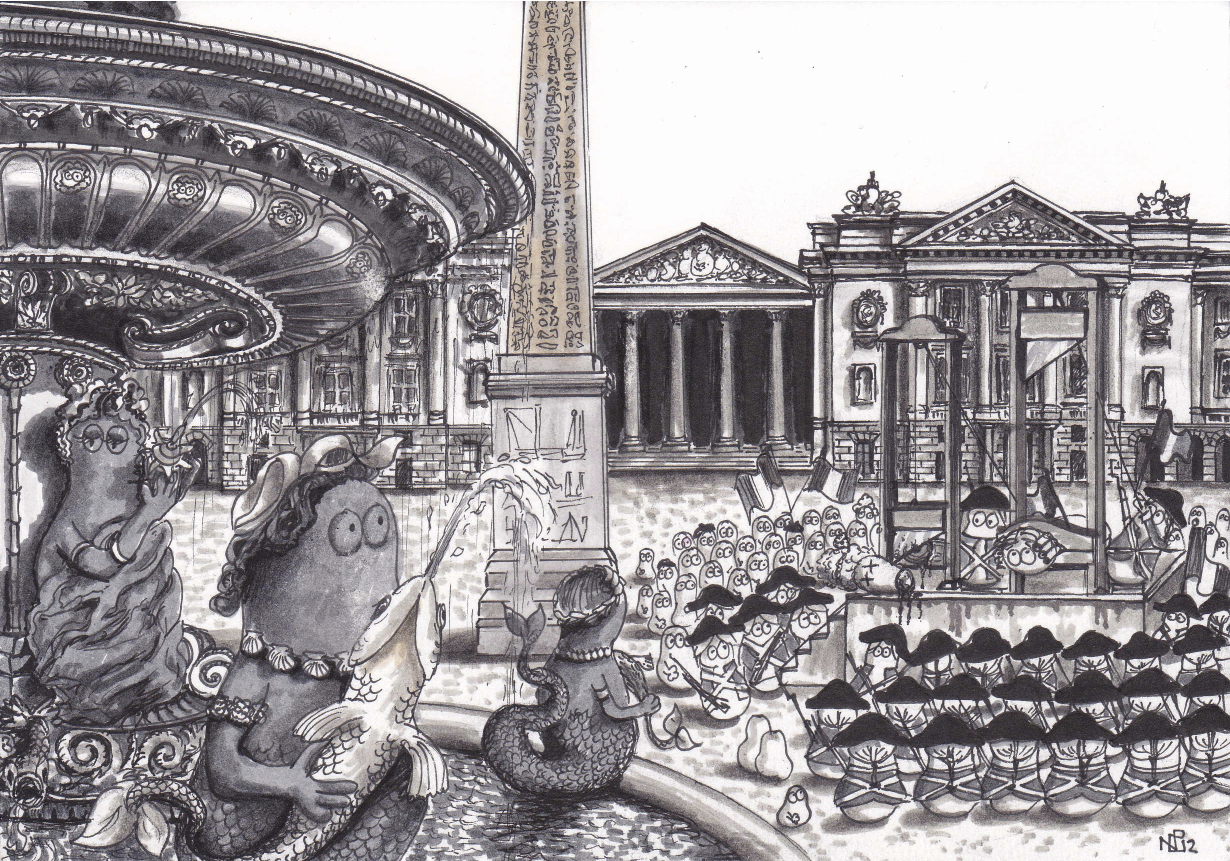
For many, that time has come, but as this Norm sketch shows, learning need not be a drag, especially if history is on the timetable for the first day. History is all around us you see, and this is no more so than in Paris, a city laced with its own fair share of gruesome tales, like this one, in the Place de la Concorde (or the Place de la Révolution as it was known then), where on 21 January 1793, King Louis XVI was sensationally beheaded upon the gruesome guillotine, along with his much despised wife, Queen Marie Antoinette (“let them eat cake” and all that jazz).

Norms guillotined in the Place de la Concorde (2012 © Nicholas de Lacy-Brown, pen on paper)

Here we join this bloody day of Norm history, as Marie Antoinette has just lost her head, and Louis XVI, looking at the blade hanging menacingly above his head, knows that he is next. All around him, the soldiers of the revolution see that this day of reckoning goes down without interruption, while close by, the serene elaborate statues of the nearby fountains look on, a reminder that although all we see today is the architectural glory of this square, not so many years ago it was a place of significant blood shed and historical significance.
Vive la Révolution! (Not that I approve of beheading I should add).

See you next time.
© Nicholas de Lacy-Brown and The Daily Norm, 2001-2012. Unauthorized use and/or duplication of the material, whether written work, photography or artwork, included within The Daily Norm without express and written permission from The Daily Norm’s author and/or owner is strictly prohibited. Excerpts and links may be used, provided that full and clear credit is given to Nicholas de Lacy-Brown and The Daily Norm with appropriate and specific direction to the original content.