Skip to content

Posts tagged ‘Tate Modern’

Damien Hirst at Tate: Repetitive, super-sensationalised science-show which is strangely enjoyable

The blockbuster show of Tate’s annual exhibition calendar, a retrospective to YBA supremo Damien Hirst, has been long anticipated by London’s art scene as well as the purveyors of trashy gossip magazines and followers of The Only Way is Essex alike. And such is the pull of Damien Hirst – this isn’t highbrow fine art, it’s not oil paintings fastidiously executed or sculptures miraculously carved from marble. This is a highly-commercialised , over-exposed fair ground of cut up creatures and stomach-churning curiosities, highly laminated multi-coloured, multi-formed collected lacquered lustre and sparkling, extravagant and utterly pointless bling. And where there is bling, that twinkle to attract the masses, you don’t need to be erudite and sophisticated to pull in the crowds. This is Tate doing household gloss paint, not oil paint.

Damien Hirst, Lullaby, the Seasons (2002) (detail)
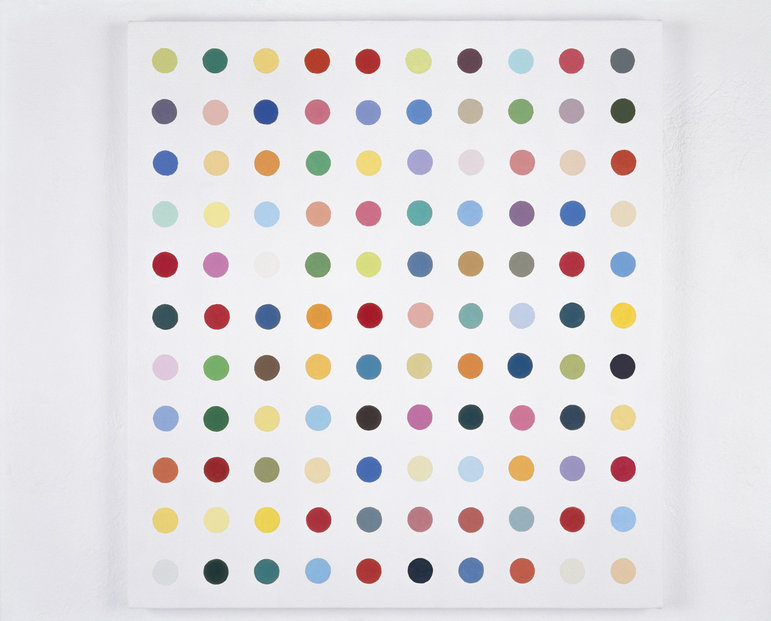
Damien Hirst, Arg-Glu (1994)

To give him is due, Mr Hirst is unapologetically tawdry . He doesn’t at least pretend to be the next Caravaggio. He makes art for a modern generation, a generation which consumes weekly updates on Katie Price’s deflating boobs rather than a good Jane Austen, who are only too aware of drug culture, who over use and abuse pharmacies in their hypochondriacal self-obsession, and are ultimately attracted by the latest trend, sensation or sparkle. No wonder Damien Hirst has been successful. He only had to stick diamonds to the fatalistically familiar skull and reproductions started springing up in homewear stores up and down the country. He took polka dots and made them uber-cool. Yet the Spanish have been celebrating the steadfast spot in their flamenco garb for centuries. Commercially clever Damien Hirst surely is. Super-skilled artist? I have my doubts. Yet without the guise and mystique of art to promote him, wouldn’t all of Damien Hirst’s oeuvre fall into a science museum/ interior design shop/ chemist/ butchers/ fishmongers where it belongs?

Damien Hirst, In and Out of Love (White Paintings and Live Butterflies) (1991) (detail)

There weren’t many surprises in the show. Such has been the success of Hirst’s publicity machine that almost every work is almost instantly recognisable.The dot paintings were predictable, and there were an AWFUL lot of them.  The great shark looms menacingly at the centre of the show. Either side of the shark, the sliced-in-half cow and calf, a few other fluffy sheep and birds (all in formaldehyde) are flanked by those repugnant rotting flies. All around the animal detritus, the repetitive spot motif translates into the pharmacy cabinets with row upon row of pill bottles, and then to the pills themselves, painstakingly laid out on shelf upon shelf, while next door you have fish, all laid out in the same direction, apparently “for the purpose of understanding”. Then you move on to the butterflies – the simpler butterfly pictures were a disappointment – the beautiful creatures had been clumsily placed onto thick gloss paint which messily spilled onto their delicate features.

Damien Hirst, Doorways to the Kingdom of Heaven (2007)

Much more impressive were the complex butterfly collages which were symmetrically placed to form incredible stained-glass window formations, not to mention the room which was full of live butterflies, their chrysalises forming their own kind of natural art as they attached themselves onto the blank canvases hung on the walls. There too were the “spin paintings” (basically paint chucked onto a fast moving canvas) and then, as though to emphasise the repetitive nature of Hirst’s work, a “bling” version of everything – the pill cabinet replaced with crystals, the coloured spots painted on a gold background, a smaller shark floating in a black tank rather than white, and butterflies stuck onto a gold canvas. There was also a superfluous obsession with cigarettes and ashtrays, used in Hirst’s art to make the oh-so novel point that one day we might die. Clever.

Damien Hirst, Judgement Day (2009)

Damien Hirst, The Physical Impossibility of Death in the Mind of Someone Living (1991)

So it was all rather predictable, and very repetitive, but strangely, and I hate to admit this, enjoyable. The insides of a cow are fascinating, not least when you get to walk in between the two halves of a once unified body. Looking down the huge throat of a shark at close quarters, shivering with horror when faced with its ghastly serrated teeth and menacing empty eyes is a unique experience, and the opportunity to appreciate the startling natural beauty of a multi-coloured catalogue of butterflies was a wonder. So too is it fun to look upon row upon row of multi-coloured pills and reflect on how many beautiful colours exists amongst a group of medicines which appear so mundane when viewed in isolation, or to appreciate the great skill of gravity in making such vivid and striking splashes when paint is spun around a canvas.

One of the spin paintings

However one can’t help but conclude, upon later analysis, that all the things you enjoyed at the exhibition were just   examples of the splendour of nature itself – the beauty of butterflies, the complexity of animal organs, the results of a spinning mechanism whose beauty is owed simply to chance. And yet if we had seen these things in a science museum, would we have given them a second glance? The isolation of the mundane within an artistic context certainly gives the objects the mystique and glamour which makes them deserving of our attention. But it is ironic that so much of what is praised of Damien Hirst’s work is what has simply been left to nature, or to chance.

Damien Hirst, No Feelings (1989)

Damien Hirst, For the Love of God (2007)

I cannot overly bemoan Hirst for creating a show which offers the chance to interact with his work, to engage with nature, and to enjoy thinking about what is, and what is not, art. I was also pleased that Tate did not try to swamp the visitor with overtly complex and inevitably meaningless lectures on what the art is supposed to mean and how it should be interpreted. Rather, on the whole the visitor was left to enjoy the show relatively uninterrupted, although Hirst’s titles are quite often unnecessarily convoluted and embarrassingly pretentious, not to mention barely related to the work titled.  But what really does make me feel uneasy is the knowledge that hardly any of the work on show has been made or created by Hirst himself, that there is no indication of any artistic talent, only of clever ideas.

Damien Hirst, The Anatomy of an Angel, 2008 – but who sculpted it??

As an artist myself, the most enjoyable thing about an exhibition for me is the chance to interact with it, to look at the art works and learn from the techniques, to appreciate the variation in skill and representation. In this exhibition that opportunity to interact with the work was lost. There is only so far you can be captivated by a medicine cabinet or a canvas packed with dead flies. In the latter butterflies gallery for example, where butterflies were used like stained glass windows, there was a sculpture of an angel, partially cut open to reveal the anatomy underneath. The sculpture was at first captivating, but the fact that I did not know who sculpted it, and whose skill I was appreciating really left something missing for me. The fact that most of these works are made my some factory process leaves me dead inside, just as I would be if someone asked me to study supermarket shelves for an hour.

For me, much of what is produced under the “Damien Hirst” brand will never be true art. It may be design, it may be the work of some unknown worker in the Hirst factory, or it may just be well preserved science, but it so often lacks the prerequisite skill to be art. Others will fiercely oppose my view, but that’s the great thing about the creative world. It makes us think, and in that respect alone, Damien Hirst is undoubtedly successful.

Damien Hirst, Sympathy in White Major – Absolution II (2006)

Damien Hirst at Tate Modern, London, is on until 9 September 2012.

The Daily Sketch: Norm gets attacked by a serious case of Kusama Polka dots

Is it just me, or is this Norm, and his lounge, and the view through his window, and all of his possessions covered with spots? Norm is thinking the same, hence the general look of concern on his face as he falls victim to a hideous case of the dreaded Kusama Polka dot disease. It spreads fast and wild, and is super contagious, or it was at least in the mind of Japanese artist Yayoi Kusama, whose work is currently the subject of a solo retrospective at Tate Modern (as reviewed in my post, yesterday). Relentless were the dots which covered Kusama’s world, and persistent too are the little spotty blighters as they invade the home of Norm. I’d seek to comfort him with the promise of an antidote for this contagion. The problem is, Kusama’s work doesn’t show any signs of becoming spot free, ergo Norm may need to get used to his new look. At least the new Kusama Louis Vuitton collection will fit in well…

A serious case of Kusama Polka-dots (2012, © Nicholas de Lacy-Brown, pen on paper)

© Nicholas de Lacy-Brown and The Daily Norm, 2005-2012. Unauthorized use and/or duplication of the material, whether written work or artwork, included within The Daily Norm without express and written permission from The Daily Norm’s author and/or owner is strictly prohibited. Excerpts and links may be used, provided that full and clear credit is given to Nicholas de Lacy-Brown and The Daily Norm with appropriate and specific direction to the original content.

Yayoi Kusama at Tate Modern – neon-spotted walk through a lady’s troubled mind

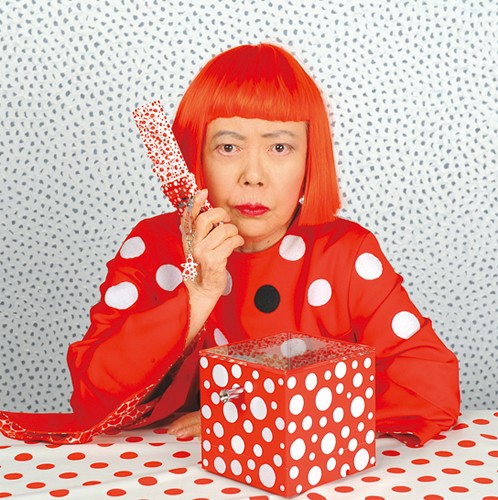
Tate Modern has gone all polka dot – and I’m not talking about the impending arrival of Damien Hirst. No, no, another artist, similarly best-selling and awfully contemporary, but perhaps less readymade, and stemming all the way from Japan claims that she made polka dots her artistic trademark long before Hirst made the colourful dots his personal emblem with LSD . And she’s probably right, because for Yayoi Kusama, the eccentric, self-admitted mental-institution resident and world famous artist who is the subject of Tate Modern’s latest retrospective exhibition, the polka dot was not just emblematic of her early and continuing artistic career, but represented the hallucinations looming inside her troubled head.

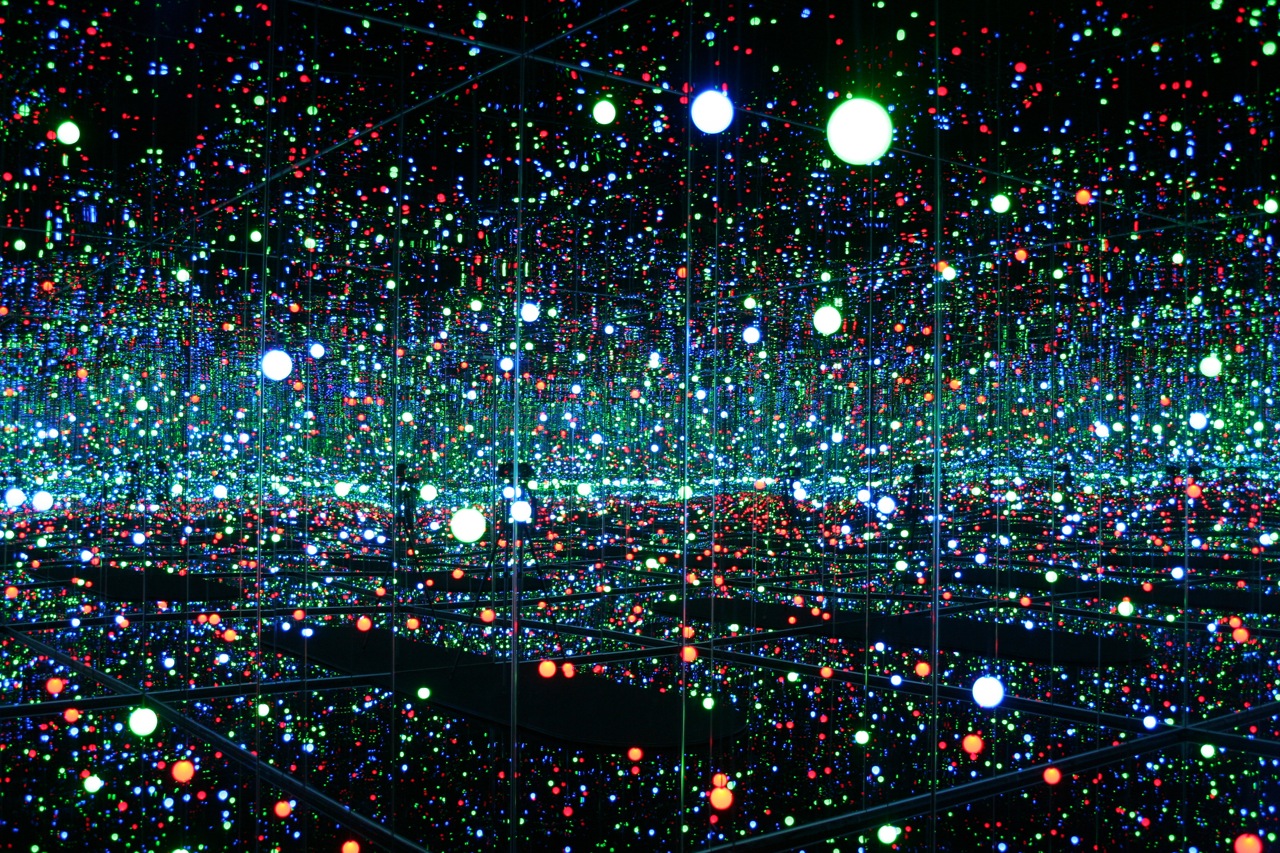
Welcome to Kusama world, a world where an artist’s output is not the product of imagination, but mental torture. Famous for her immersive installations, phallic representation, neon-bright colours and those all-embracing polka dots, Kusama is acutely successful in being able to welcome the viewer of her art into her slightly disturbed, turbulent world. This is, of course, aided by “immersive” installations, such as her work Aggregation: One thousand boats show, where the viewer becomes participant in the work as we are able to walk into a room covered floor to ceiling with the same repeated image of the phallus-filled boat before us. The effect is the same in I’m here but nothing, where an everyday sitting room is covered, all over, with neon polka dots, and, in the rather striking climax of the show, Infinity Mirrored Room – Filled with the brilliance of life, one walks through a room covered with mirrors and filled with a colour show of different LED filled lights – the effect is an infinity of light which is stunning for the senses. Nevertheless, it does feel more fairground than art gallery, as beautiful as it may be.

Yayoi Kusama, Aggregation: One thousand boats show (1953)

Yayoi Kusama, Infinity Mirrored Room - Filled with the brilliance of life.

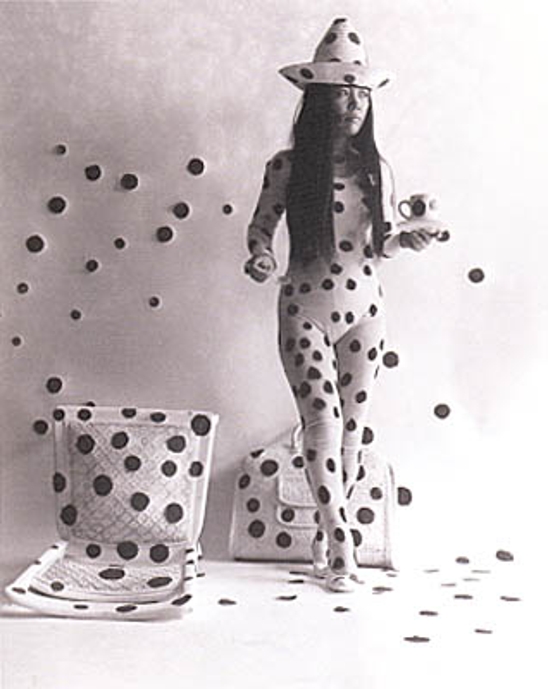
Yayoi Kusama, Self-Obliteration by Dots (detail), 1968, performance, documented with black-and-white photographs by Hal Reif.

Allegedly, all of this dottiness (both in mind and matter) began when Kusama was a young girl, when the image of a flower began to repeat itself before her eyes. Yayoi Kusama said about her 1954 painting titled Flower

One day I was looking at the red flower patterns of the tablecloth on a table, and when I looked up I saw the same pattern covering the ceiling, the windows and the walls, and finally all over the room, my body and the universe. I felt as if I had begun to self-obliterate, to revolve in the infinity of endless time and the absoluteness of space, and be reduced to nothingness. As I realized it was actually happening and not just in my imagination, I was frightened. I knew I had to run away lest I should be deprived of my life by the spell of the red flowers. I ran desperately up the stairs. The steps below me began to fall apart and I fell down the stairs straining my ankle.

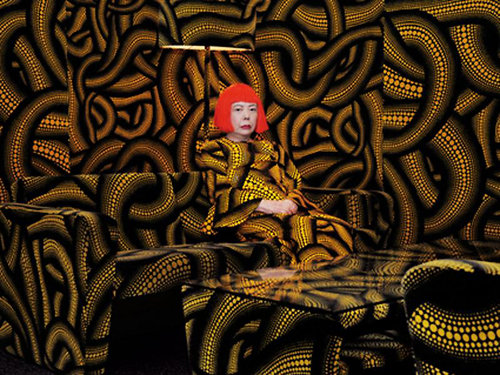
From this point onwards, Kusama started to cover everything with polka dots: walls, ceilings, floors, furniture, household objects, naked models, and herself, all representing the world as she sees it through repetitive and persistent hallucinations.

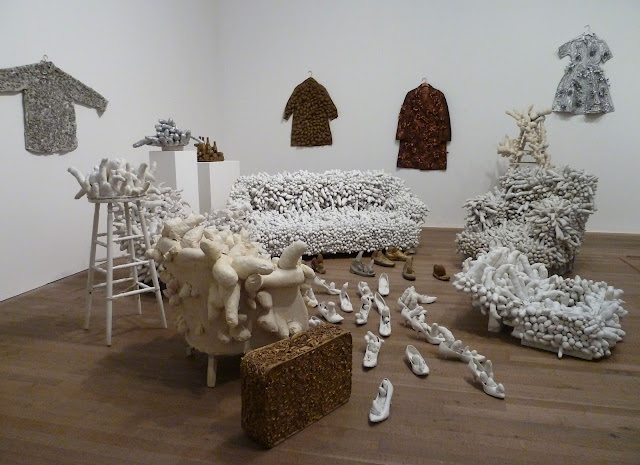
Even when the exhibits do not give you cause to “immerse” yourself within Kusama’s way of thinking, the art work on show betrays the extent of her troubled mind. Another installation of household objects, Accumulation sculptures, are presented bursting all over with an eruption of phallic protrusions. I found these works to be quite sickening – the textural surface of the resulting objects made me feel rather queasy, much like I would feel if I was looking at the surface of skin erupting with blisters. It was also possible to feel the magnitude of her repressive repetitiveness in her famous “infinity net” paintings – vast monotone canvases painted repeatedly with a single arc pattern, representing the loops of a net. These works are rather intrustive in their scale and claustrophobic in their illusion to an unrelenting and obsessive mental torture.

Yayoi Kusama, Accumulation sculptures (1950)

Yayoi Kusama, Flame (1992)

Personally my favourite works of the exhibition were probably her early paintings, in a variety of mediums from watercolour and gouache to charcoal and oils. Her 1949 work Lingering Dreams betrays the same sense of traumatic perturbation pervading all of her work, but is nonetheless beautifully painted – like an acutely depressed Van Gogh sunflower, the life and vitality strained and stretched out of it. I also rather enjoyed Kusama’s latest works, large multicoloured acrylic canvases, painted in a studio adjacent to her resident mental institution. The works appear to reflect a period of comparative contentment in Kasama’s latter career, although they continue to betray an element of obsessiveness and their bright colours are frequently harsh and discordant.

Yayoi Kusama, Lingering Dreams (1949)

I left Kusama’s show feeling a little tired. In immersing yourself into Kusama’s mind, you tread a mental journey which is not always comfortable, and often overly stimulating on all the senses. It did not impress upon me in the way that a greatly skilled figurative artist has the power to do. Instead it caused me to reflect upon the cognitive expressions of a high-wired eccentric lady. There is much reason to argue that some of this work, particularly the light installations, are not really art at all – but I’m not going to get into that today. For me, the greatest disappointment came upon entering the Tate shop and discovering no crazy polka dot embellished Louis Vuitton bags for sale – this was, after all, a Vuitton-sponsored exhibition. Having said this, my disappointment may not last long. As I write, I learn that Kusama and Vuitton are joining forces for a collection due out in Summer 2012… so it looks like the madness will continue, even into the finest echelons of Paris couture. Vive le polkadot!

Looking a bit like a snake surrounded by her creations... Yayoi Kusama in the installation Yellow Tree Furniture (2010). Photo : Y.Kusama Studio/Half Reiff


Brit Art is the main focus of the UK’s 2012 exhibition diary

It’s 2012, year of the London Olympics, and to celebrate the fact that this year, the UK will be the focus of the world (hopefully for all good reasons) London entered the New Year with a spectacular firework display like none other. But as the country gears up towards its greatest sporting event for generations, the UK’s major art galleries are embarking on a cultural olympiad all of their own. This is my brief guide of what’s on in the UK’s art diary in 2012.

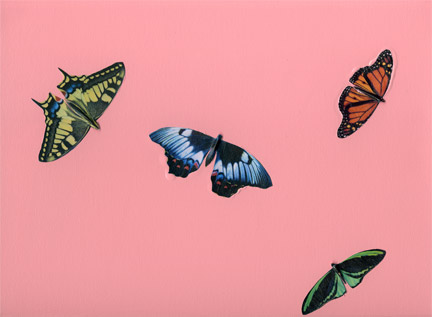
From the Damien Hirst 2007 butterflies collection

Patriotism is at an all time high in the UK, what with the Royal Wedding last year and the Diamond Jubilee this year, a sense that we should fling ourselves unceremoniously out of the EU and of course those all important Olympics. And it’s a state of national pride which is being more than represented in 2012 by the UK art galleries. Having spent 2011 promoting some of the world’s best artists (Catalan Miró at Tate Modern, Mexican Kahlo and Rivera at Pallant House, Parisian patriarch Degas at the Royal Academy, and of course the Italian master himself, Da Vinci, at the National Gallery), in 2012, the UK is promoting some of its biggest British artistic stars of past and present.

LSD by Damien Hirst

Damien Hirst - LSD - Image via Wikipedia

For sure one of the biggest exhibition events of 2012 will be the Damien Hirst retrospective at Tate Modern from 4 April to 9 September 2012. Love him or loathe him (I tend towards the latter, but not always), he is one of the big stars of our generation, and his works do at least show some longevity, unlike many of his unsavoury, untalented counterparts (unmade bed anyone?). In particular I love some of the butterfly works of his recent oeuvre, but who knows whether they will be included in this show. For sure Mr Hirst’s 1991 Shark in Formaldehyde (“The Physical Impossibility of Death in the Mind of Someone Living”) is bound to feature prominently” – has it not rotted yet?) as well as his pharmaceutical cabinet (“Pharmacy” 1992). Expect big crowds, and a slightly stinking smell of putrefaction lingering in the air at this show.

The Physical Possibility of a Norm in Formaldehyde (after Damien Hirst) (2011, pen on paper © Nicholas de Lacy-Brown)

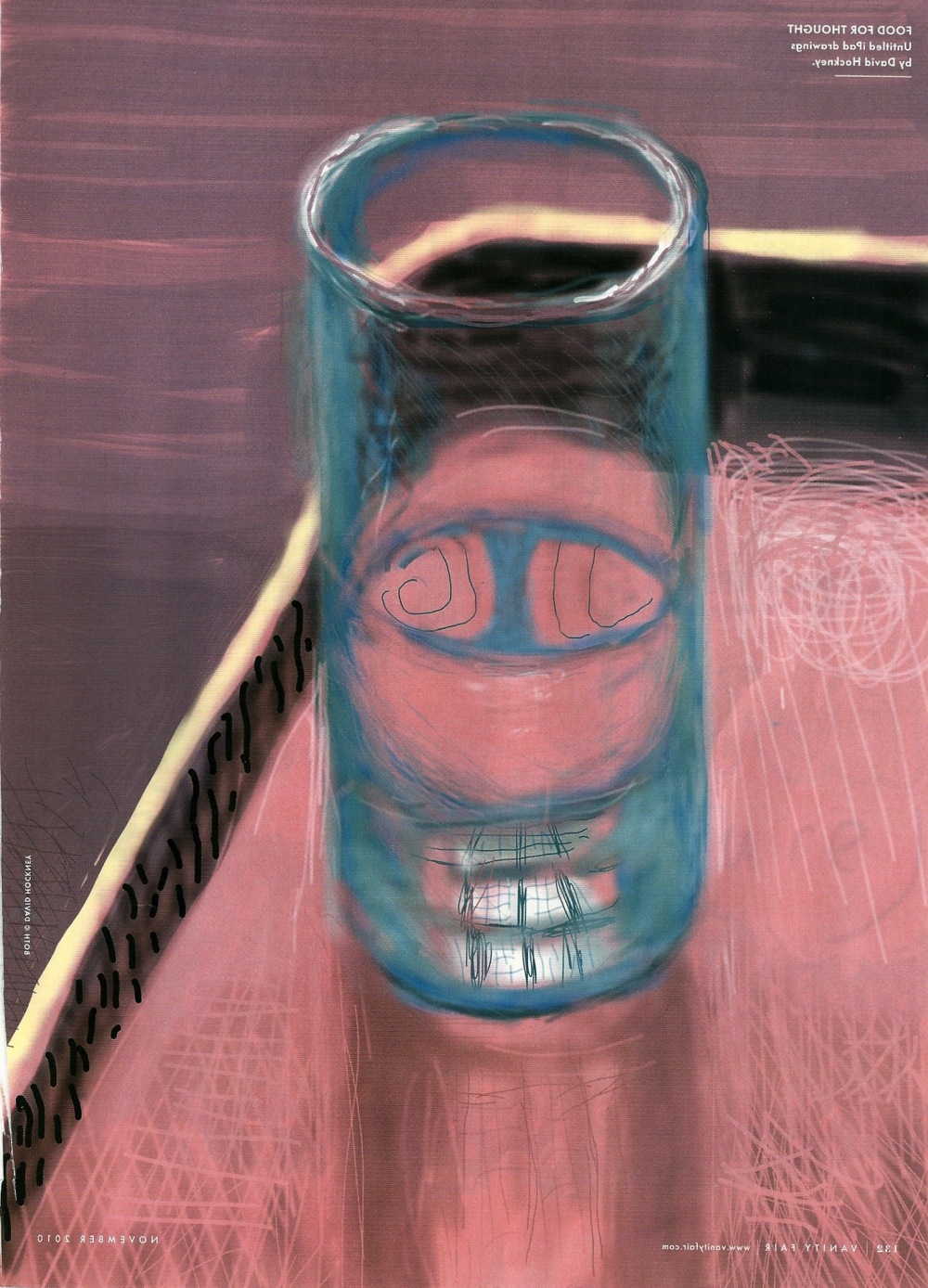
One of Hockney's ipad works

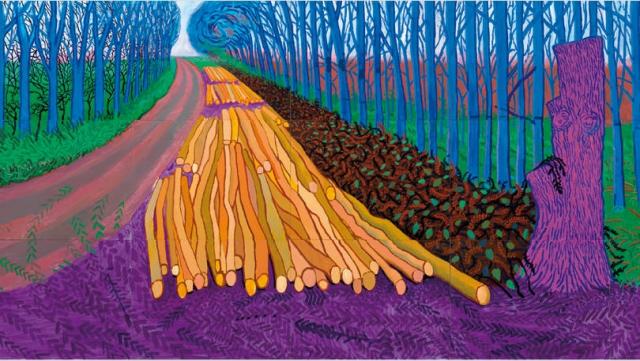
The second contemporary Brit art blockbuster must be the Royal Academy‘s David Hockney RA: The Bigger Picture solo exhibition from 21 January – 9 April 2012. This is an exhibition of new large scale landscapes rather than a complete retrospective. While it may therefore lack the naked golden-skinned boys jumping into Los Angeles pools of Hockney’s earlier career, his bigger landscapes look to be every bit as colourful and vivacious, as well as… well, massive. Having said that, the exhibition is set to include landscapes spanning his whole career, and will, interestingly, feature some of his new iPad creations for which he is famously enthusiastic. His ipad works have already been exhibited to some acclaim at the Pierre Bergé-Yves Saint Laurent Foundation in Paris in an exhibition appropriately entitled: “Fleurs Fraîches” so I will be intrigued to see how the works are displayed in this London show. There is no doubt about it, the ipad has made for a revolutionary new canvas for Hockney’s works. Just a shame about the financial side of things…

David Hockney, Winter Timber (2009)

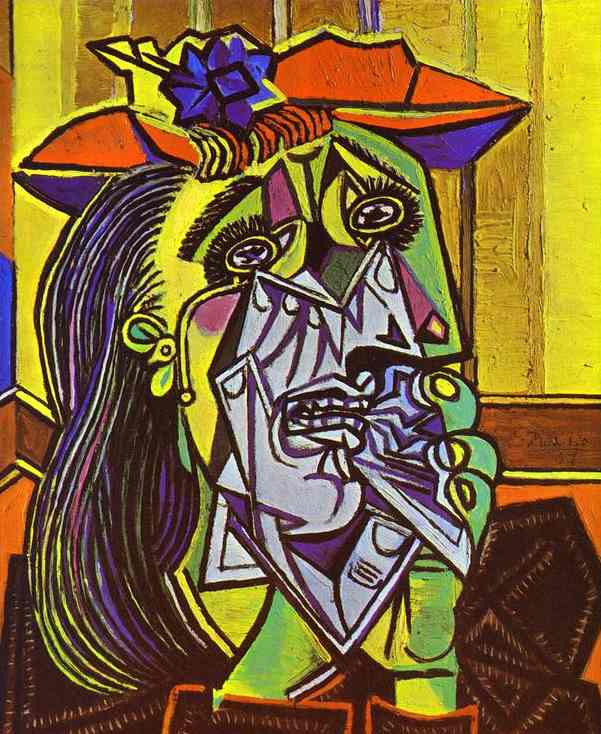
Picasso's Weeping Woman (1937)

Meanwhile, at Tate Britain, a new exhibition running from 15 February – 15 July 2012 will explore how Picasso influenced generations of British artists: Picasso and Modern British Art. The British art on show will include some 90 art works by Duncan Grant, Wyndham Lewis, Ben Nicholson, Henry Moore, Francis Bacon, Graham Sutherland and, once again, good old Hockney. However, I’m frankly more excited by the 60 Picasso’s on show, and hope that the works will extend beyond Tate’s own collection of his works. Although having said that, I could spend hours in front of Picasso’s Weeping Woman (1937) – the first ever Picasso I saw and the one I fell in love with.

Ben Nicholson, 1937


Ben Nicholson, the tumultuous ex husband of other British favourite, Barbara Hepworth, will also feature prominently in a forthcoming exhibition held at the Courtauld Institute between 16 February – 20 May 2012, Mondrian || Nicholason: In Parallel. The show will aim to explore the largely untold relationship between Nicholson and Piet Mondrian during the 1930s when both artists were leading forces in abstract art in Europe. Promising to reveal how each artist was driven by a profound belief in the potential of abstract to create new forms of beauty and visual power, it’s something of a diversion from the collection-based norm of the Courtauld’s temporary exhibitions and should be a good one to look out for.

Claude Monet, Poplars on the Epte (1891)

Next, that old British master, Turner, will be given the kind of exposure which Britain does so well when bringing out it’s most celebrated artist for admiration. Both the National Gallery and Tate Liverpool will be paying homage to Turner in 2012, the National Gallery hosting a new show comparing Turner with Claude Gellée with Turner Inspired: In the Light of Claude  from 14 March – 5 June 2012, while at Tate Britain, an ambitious exhibition from 22 June – 28 October 2012 will bring together works by Turner Monet Twombly and explore the similarities between them in style, subject and artistic motivation. It is well known that Monet was suitably inspired by Turner’s superb handling of light and fog, storms and mist when he came to London during the Franco-Prussian war. How Twombly fits in remains to be seen – but I’m always open to suggestion.

Reflection (Self-portrait), 1985 © Lucian Freud

Finally, who better to complete the set of British artist masters than the artist who we sadly lost last year – Lucien Freud. In memory of this great artist, and taking a look back at what he did best – portraiture – the National Portrait Gallery will be taking a closer, comprehensive look at some of his greatest portraits from 9 February – 27 May 2012 in Lucien Freud: Portraits. It’s an exhibition which is sure to be a hit, as Freud paints his sitters with uncompromising honesty and intensity with virtuosity and exceptional skill. The exhibition features over 100 works from museums and private collections, so this will be an opportunity not to be missed.

So there you have it, a selection of the biggest and best shows coming our way in 2012. It’s going to be a busy year! Also worth a quick mention is a Pre-Raphaelites exhibition which will come to Tate Britain at the end of the year and the return of Edvard Munch to the UK – in fact to Tate Modern. It is I believe the same show I have just seen at Paris’ Pompidou Centre. If so, it’s a rather depressing retrospective, and won’t stand up overly well next to the superb retrospectives earlier on in the year.

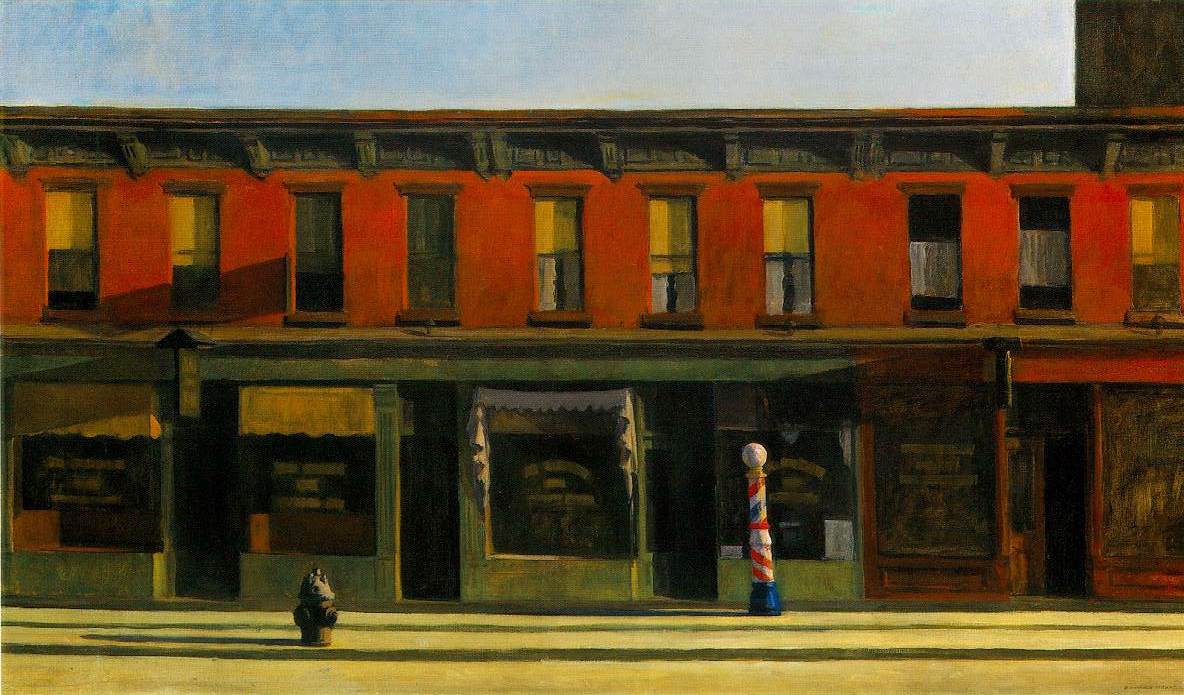
Talking of Paris, I can’t end this post without mentioning one forthcoming show over in the City of Light which has caused me a great deal of excitement – the Edward Hopper retrospective – at the Grand Palais from 8 October 2012 – 20 January 2013. I cannot wait for this opportunity to see so many of this artist’s soulful, introspective works up close. Yes, it’s not exactly Brit art, but then we can’t expect Paris to promote the spirit of the London 2012 olympics… they were the losers after all.

Hopper, Early Sunday Morning 1930 Whitney Museum of American Art, New York