Skip to content

Posts from the ‘Art’ Category

Interpretation No. 18: London

I suppose it shouldn’t come as much of a surprise. It took my departure from London after 12 years of living there to recognise that the city, while not consistently beautiful, still has a certain amount of inspirational magic to it. When I lived there I would always profess the need to travel to the Mediterranean and beyond in order to find artistic inspiration. When asked whether I ever painted London, I looked at people as though they were mad: paint this city? But it’s just a pool of grey, I would say.

Yet when I visited the city afresh at the beginning of last week, and sat in the glass fronted restaurant on the 6th floor of Tate Modern on Bankside, I could not help but stare in wonderment at the beauty of the cityscape before me, as I realised that London is much more than 50 shades of grey. Indeed, with the greeny shades of the River Thames, the plethora of glass skyscrapers and old baroque and gothic churches and the terracotta hues of many of the brick buildings, London is a metropolis full of contrasting colours.

Interpretation No.18: London (2015, Nicholas de Lacy-Brown, gouache on paper)

Interpretation No.18: London (2015, © Nicholas de Lacy-Brown, gouache on paper)

Absence makes the heart grow fonder. It’s a cliché but it’s true. And as soon as I returned from the city, I started work on this latest of my Interpretations series. A simplified but devoted landscape of a city which is beautiful after all.

© Nicholas de Lacy-Brown and The Daily Norm, 2001-2015. Unauthorized use and/or duplication of the material, whether written work, photography or artwork, included within The Daily Norm without express and written permission from The Daily Norm’s author and/or owner is strictly prohibited. For more information on the work of Nicholas de Lacy-Brown, head to his art website at www.delacybrown.com

Art in London (Part 2): The Goya Portraits

When I first saw the grand lofty gallery in the Prado filled with Goya’s portraits, and indeed upon subsequent visits, I admit that I was not overly won over. It was not so much that the portraits were bad, just that by comparison with the dramatic visions of the 2nd and 3rd May 1808 in the adjacent room, or of the even more terrifying and enthralling Black Paintings alongside that, the portraits of Francisco de Goya y Lucientes (1746-1828) always felt a little…bland. It also occurred to me that they all looked a little samey, with their piercing round black eyes sparkling like the glass eyes of teddy bears, and this led me to the perhaps premature conclusion that Goya had painted his sitters more idealistically, rather than realistically.

But the current Goya exhibition at London’s National Gallery sheds new light on this important epoch of the artist’s work, and seen within a narrative of their rich historical context, and with the ability to compare and contrast a magnificent set of some of Goya’s best, suddenly these portraits seem just as compelling as the magnificent sombre works which followed.

Carlos IV of Spain and His Family, 1800

Carlos IV of Spain and His Family, 1800

Charles IV in Hunting Dress, 1799

Charles IV in Hunting Dress, 1799

Maria Luisa wearing a Mantilla, 1799

Maria Luisa wearing a Mantilla, 1799

The Duke and Duchess of Osuna and their Children, 1788

The Duke and Duchess of Osuna and their Children, 1788

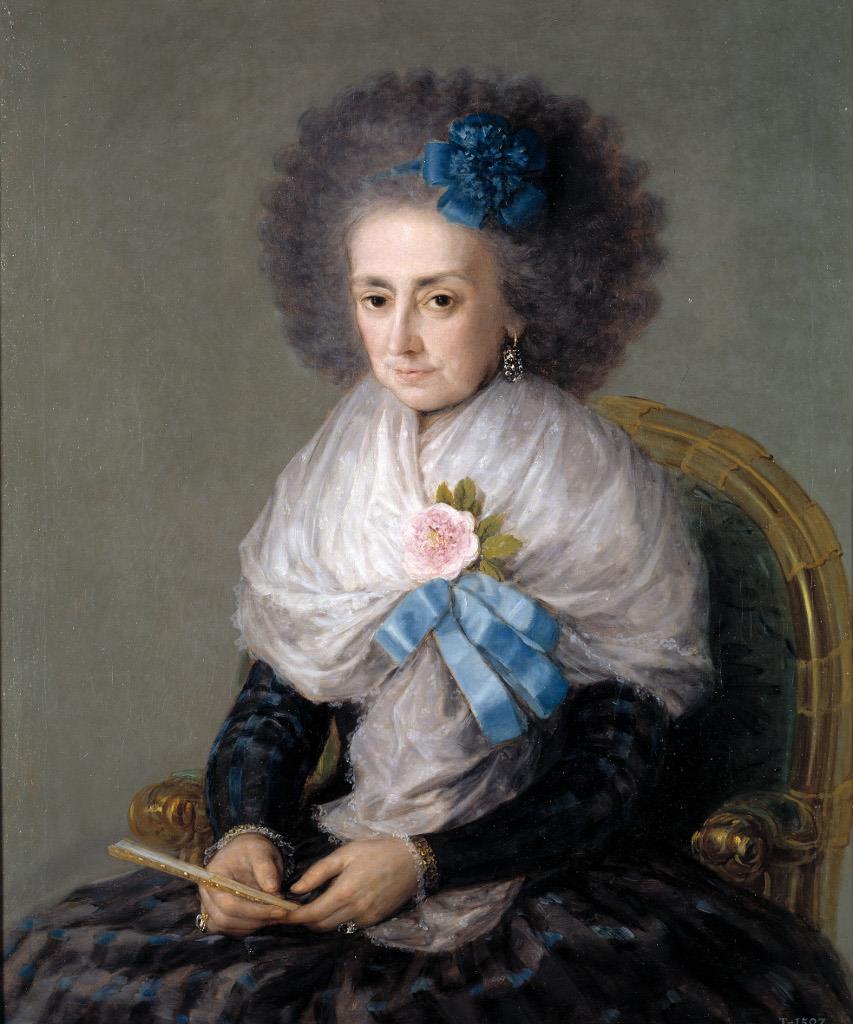
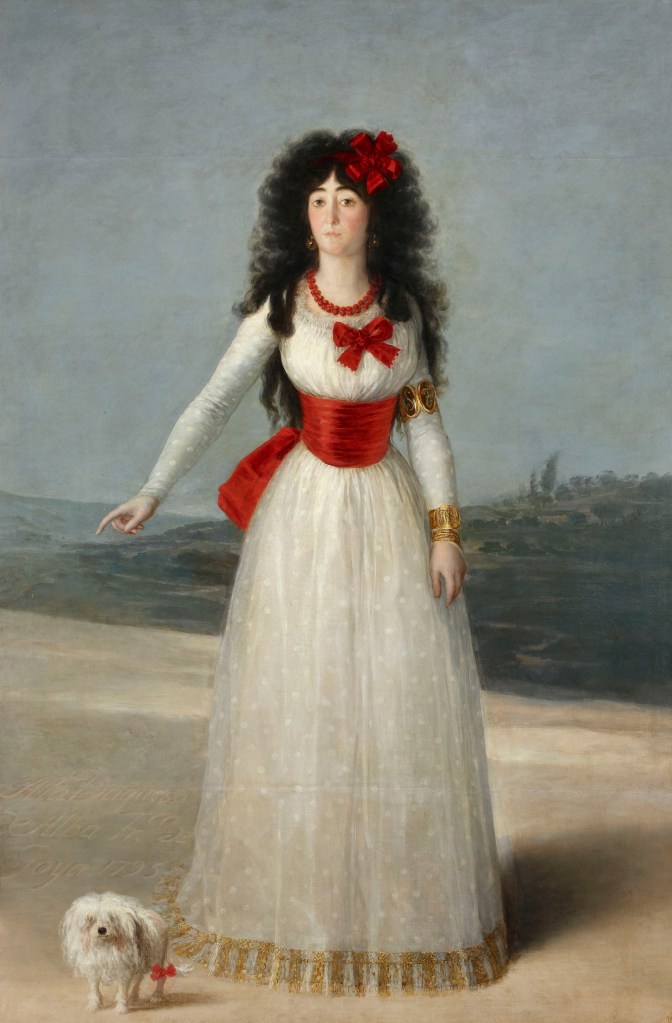
The portraits of Goya cannot be deemed the most technically adept in the world. I could not help but notice that on this head or that, the shading was wrong, or the head-piece look flattened and oddly two-dimensional. And I was interested to read that Goya’s was mostly self-trained, a fact which was to me, a likewise self-taught painter, obvious in the gradual improvement of his portraits from early attempts through to his magnificent depictions of the family of Charles IV of Spain. However, his greatest skill was psychological insight, and this was evident in a series of portraits which seemed to penetrate the sitter through to the core. The result was a series of rooms which felt as though they were occupied by the living shadows of history, almost like the paintings in Harry Potter’s Hogwarts, whose sitter would come alive within the frame.

This all makes for a thoroughly enthralling exhibition whose sitters literally leap off the walls to introduce us to the historical periods which characterise the works; from the more informal portraits of the Spanish royals, painted with a view to pacifying the public in the aftermath of the French Revolution, to the somewhat obsequious depictions of French generals after the Napoleonic invasion of Spain. However of all the works, my favourites were of the aristocratic stars of the time, full of bold gestures and extravagant swagger, each competing with the other to afford the more exquisite portrait, and with it, the greater standing in society.

Portrait of the Duchess of Alba, 1797

Portrait of the Duchess of Alba, 1797

The Dowager Marchioness of Villafranca, 1796

The Dowager Marchioness of Villafranca, 1796

The Marquis of Villafranca and Duke of Alba, 1795

The Marquis of Villafranca and Duke of Alba, 1795

The White Duchess (Duchess of Alba), 1795

The White Duchess (Duchess of Alba), 1795

Goya’s portraits are a window on a long past world of aristocratic dominance, and regal fancy, and of a time caught between the birth of the enlightenment and the trauma of invasion and turbulent changes of power. And while many of the sitters exhibited those same teddy-bear black eyes which had caught my intention at the Prado years before, it is the intensity behind the gaze in those eyes which left a lasting impression on me as I left this superb London show.

Goya: The Portraits is on at The National Gallery in London until 10 January 2016… so get there quick!

Art in London (Part 1): Calder’s Mobiles

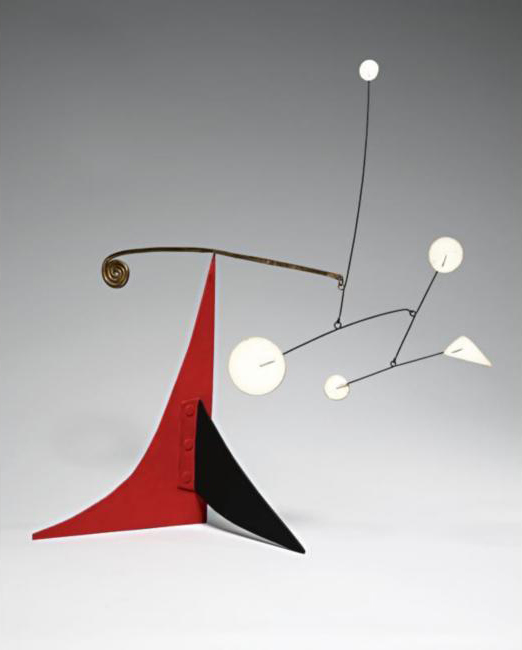
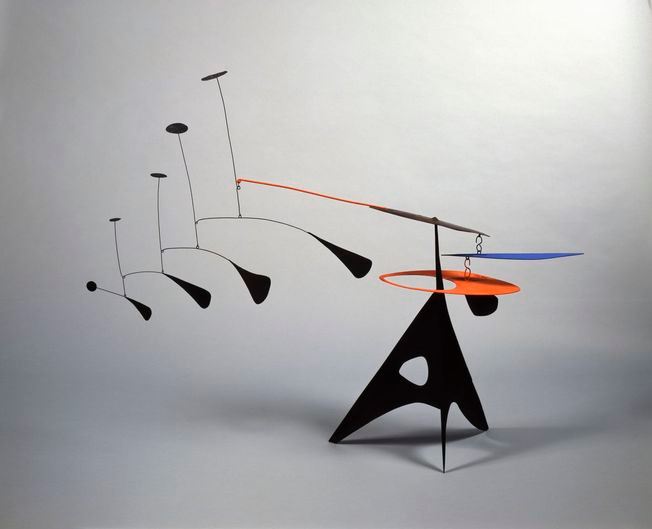
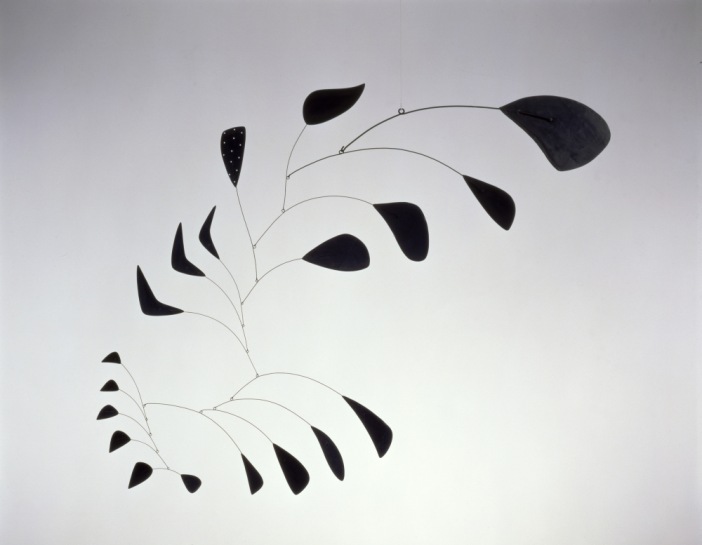
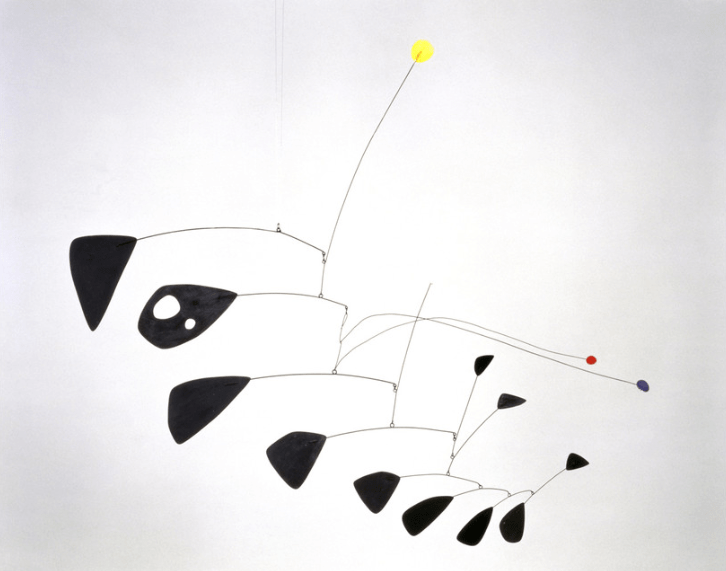
London is alive with some truly exciting artist retrospectives at the moment, each of them tending to focus on a particular aspect of their creative output. In the National Gallery, the portraiture of Goya is the focus of a major show, and likewise in the National Portrait Gallery where Giacometti and his drawings are the stars. Meanwhile, over the river in Tate Modern, a retrospective of Alexander Calder focuses on the works which surely made him famous…sculptures which dance, perform and are always on the move: his mobiles. 

It’s strange to imagine a world where the mobile, that innocuous moving collection of animals and stars hanging above every respectable baby cot, did not exist. But it was Calder who actually invented this type of sculpture, long before it ever became a favourite of the child’s bedroom, and in doing so Calder showed himself to be one of the first ever proponents of performance art, something which is now such a staple of contemporary art spaces across the world.

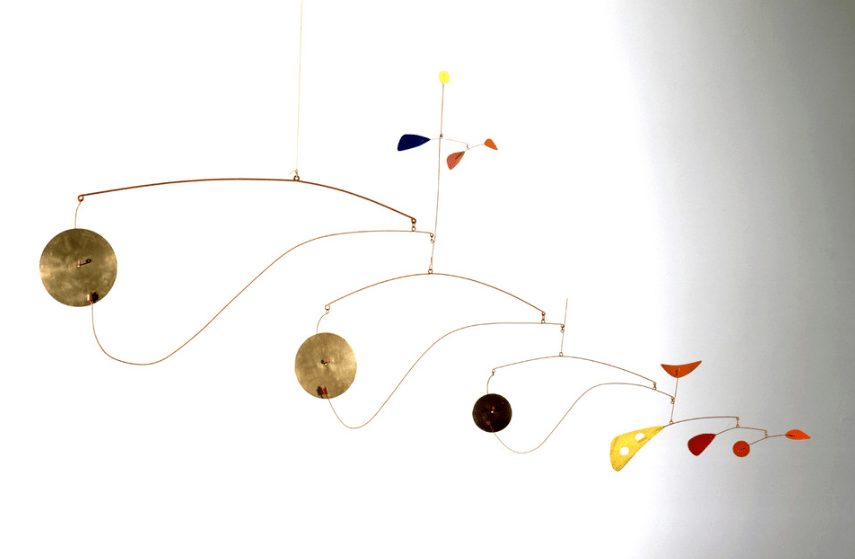
Mobile2

Triple Gong, 1948 (© 2015 Calder Foundation, New York / DACS, London)

Untitled

Untitled, 1963

Mobile3

Gamma, 1947 (© 2015 Calder Foundation, New York / DACS, London)

In creating the mobile, Calder was looking for a work which moved, and evolved. At first his moving sculptures were controlled, either in the form of puppets which would perform in his own Calder Circus Shows (the likes of which were visited in Paris by some of the biggest names of the 20th century art world), or those carefully choreographed by a series of connected motors and pulleys. But the true mobile, the freely moving construction based on a series of shapes, wires and strings, was created in response to Calder’s desire to free abstraction, and for the bold shapes and colours which he had seen in the likes of Mondrian’s tightly structured geometric works to move about without constraint.

And so were born the sculptures for which Calder became synonymous, and which have cropped up in some of the most culturally enriched open public spaces in the world, including here in Palma de Mallorca, and of course that sensational mobile left by Calder himself by the poolside at the Colombe d’Or Hotel in St. Paul de Vence.

Calder5WhiteBrassSpiralalexandercalder12Standing mobile

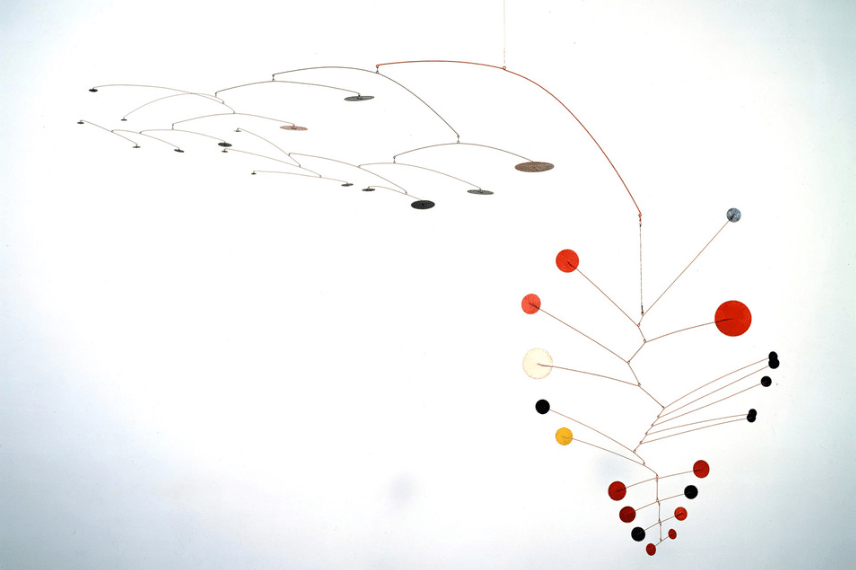
For me, ever so fascinated by the mobiles of Calder, this was truly an exquisite show. I wandered between the mobiles entranced by the poetry in their movements; by the constant slow flow and turns of the wire arms whose many delicate branches create an ever changing and unpredictable dance. And beyond the mobiles, the secondary most beautiful vision were the shadows created on the walls, themselves moving, creating the most beautiful abstract art, albeit free and transitory as Calder would have wished.

It’s a unique opportunity to see so many of Calder’s greatest works in one place, and to understand the revolutionary journey, from canvas to moving mobiles, which prompted him to create these most oscillatory of sculptures.

calderverticalfoliage

Vertical Foliage 1941(© 2015 Calder Foundation, New York / DACS, London)

Mobile 4

Mobile1

Antennae with Red and Blue Dots, 1953 (© 2015 Calder Foundation, New York / DACS, London)

Alexander Calder, Performing Sculpture is on at Tate Modern, London, until 3 April 2016.

Interpretation No. 16 – From La Rive Gauche, Paris

Although this week will mark a year’s anniversary since we moved from London to the Mediterranean island of Mallorca, I am invariably a creature of habit, and while I surround myself daily by some of the most beautiful views Europe has to offer, there are still some things I miss about my former London life. Prince among them, ironically, is not a London experience at all, but our annual trip, taking what I always consider to be a glamorous sub-Channel rail journey from London St Pancras to L’Estacion Gare du Nord, to visit my favourite amongst cities, Paris. And as that annual trip always happened around about now, I cannot hide my internal pining for the French city of lights.

So in my efforts to satisfy something of my longings, I have somewhat franco-fied my home life of late. On my ipod, the hauntingly beautiful songs of old 20s French cabaret play; on the TV, film favourites such as La Vie en Rose are on continuous repeat, and moving from my paintbrush, this very Parisian scene emerged – a gouache painting which becomes the newest in my simplified interpretations landscape series.

Interpretation No. 16: From La Rive Gauche (2015, © Nicholas de Lacy-Brown,  gouache on paper)

Interpretation No. 16: From La Rive Gauche (2015, © Nicholas de Lacy-Brown, gouache on paper)

With its simplified colour palette of turquoise, ochre and grey, it reflects the memory of a similar such scene encountered just as we were crossing from the left bank on our last trip to Paris. I remember that the day had been pretty grey, but about the time the sun set, the clouds dispersed and left the sky a creamy golden yellow. This in turn reflected on the water, turning the grey River Seine a beautiful shade of turquoise which then glowed, almost unnaturally, against the greys and beiges of the surrounding city architecture.

It feels good to have Paris back in my life again… even if it is just on paper.

© Nicholas de Lacy-Brown and The Daily Norm, 2001-2015. Unauthorized use and/or duplication of the material, whether written work, photography or artwork, included within The Daily Norm without express and written permission from The Daily Norm’s author and/or owner is strictly prohibited. Excerpts and links may be used, provided that full and clear credit is given to Nicholas de Lacy-Brown and The Daily Norm with appropriate and specific direction to the original content. For more information on the work of Nicholas de Lacy-Brown, head to his art website at www.delacybrown.com

An Englishman in Andalucia

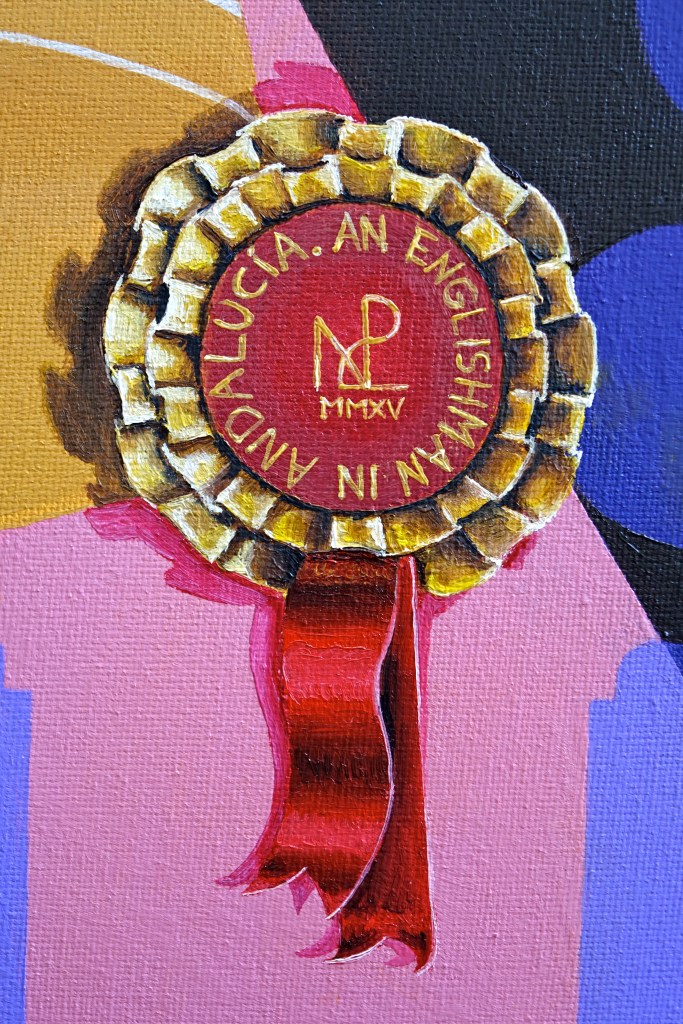
Dark, broody, flames flickering through a purple and chocolate brown backdrop…a portrait on the wall is alive. Dressed in the guise of a toreador, it is my self-portrait, part alarmed, part anxious, as I consider conflict in my life… the ever omnipresent concerns which come of big changes and repercussive decisions, a conflict which is played out in reflection in a Spanish bull ring; the steady workmanship which comes of intricately embroidering the matador’s traje de luz being the catalyst of the conflict, as blood pours from the pin which pierces at the heart of the bull.

An Englishman in Andalucia (2015 © Nicholas de Lacy-Brown, oil on canvas)

An Englishman in Andalucia (2015 © Nicholas de Lacy-Brown, oil and acrylic on canvas)

Set in the context of Andalucia, where I was when I painted the piece, this is the work of An Englishman in Andalucia… when my displacement in Marbella triggered a time of contemplation, when internal thoughts just poured onto the canvas. In the midsts of expressing my preoccupation of the time, I was inspired to utilise the Spanish corrida as my protagonist, having passed a bullfighting poster on my way to the beach. From that second onwards, this painting sprang into mind as I lay on the beach, and that afternoon I rushed home to start work on the piece.

DSC01033 DSC01039 DSC01057 DSC01071 DSC01067

It is a painting which deals with the contrasts and conflicts which are always present in my life. The fact of being English and living in Spain, the repercussions of pursuing a creative career which inevitably meant the sacrifice of another. It is a brooding contemplative piece, but for me its creation made for a satisfying process. And in so far as its motifs are therefore consequently dark, the effect of painting it was to fill my mind with clarity and light.

© Nicholas de Lacy-Brown 2015. Unauthorised use and/or duplication of the material, whether written work, photography or artwork, included on this website without express and written permission from Nicholas de Lacy-Brown is strictly prohibited. For more information on the work of Nicholas de Lacy-Brown, head to his art website at www.delacybrown.com

Ocho Balcones (No. 8): The Artist’s Studio

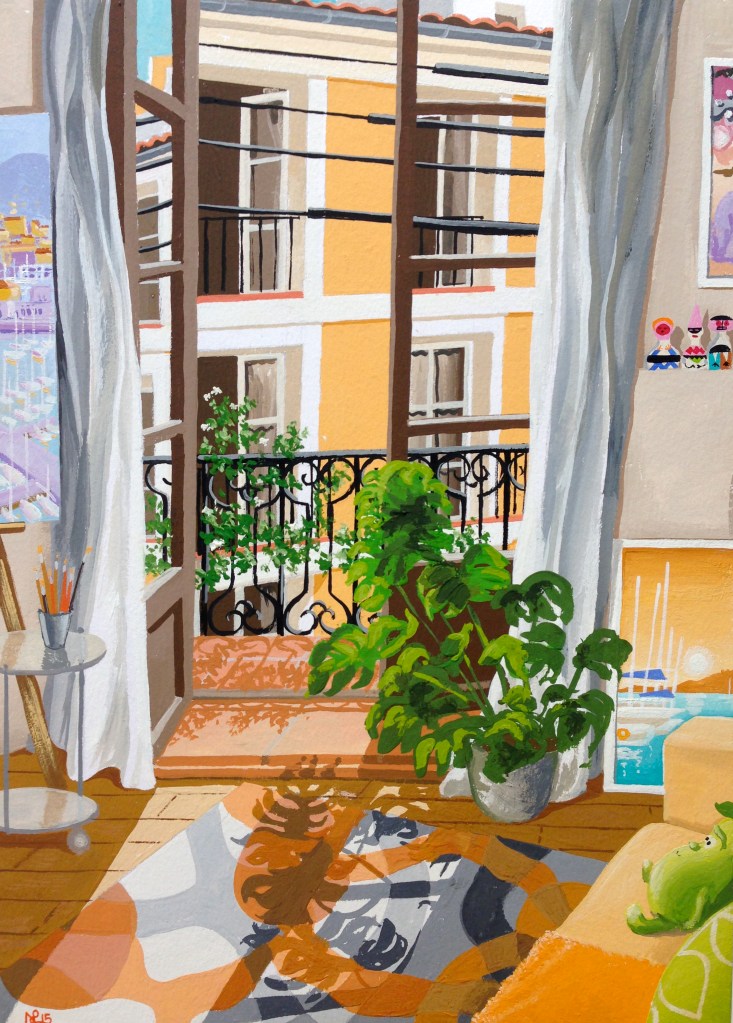
It’s almost unbelievable that over 2 months have gone by since I shared the first balcony from my Ocho Balcones collection, the series of gouaches which illustrate the 8 balcony views which we have enjoyed over the past year living in the old town of Palma de Mallorca. But on this final post of the series, the collection comes to a close, and a very appropriate close at that… since the last balcony which remains is the view of, and from, my art studio. 

It’s by far the space in which I have spent the most time in this Palma apartment, since in this little space which I can call my own, I not only created all of the art works which have filled my oeuvre over the last year, but I also spend time editing photos, working on admin, and of course writing this very blog. The painting is more multicoloured than the rest of the series, in an apt illustration of my studio which is full of paintings characterised by my iconic use of colour. And while this painting of course focuses on the balcony at the heart of the studio space, there are a few tantalising glimpses of some of the paintings which have filled the space… from the large Palma landscape which I was working on for 6 months, to Arrival, the first work I completed in Palma, and a thin slice of Pink Bf, one of my most beloved paintings. Also in the painting are various other personal touches, from the collection of Alexander Girard wooden dolls which I always keep close at hand, to the little cuddly pear which I recently collected with a series of vouchers from my local supermarket, El Corte Ingles.

Ocho Balcones VIII: The Artist's Studio (2015 © Nicholas de Lacy-Brown, gouache on paper)

Ocho Balcones VIII: The Artist’s Studio (2015 © Nicholas de Lacy-Brown, gouache on paper)

And so, with my art studio, I close the Ocho Balcones collection. And this closure is appropriate in a number of ways, not only because it shows the heartland of my creative life, but because it is posted just days before we leave this lovely apartment for good. For we are moving on to pastures new, not outside of Mallorca, but somewhere close by… a fresh new apartment with a new art studio space. And amongst those works which I am sure will be made there, maybe our new balcony/terrace will feature too.

© Nicholas de Lacy-Brown 2000-2015. Unauthorised use and/or duplication of the material, whether written work, photography or artwork, included on this website without express and written permission from Nicholas de Lacy-Brown is strictly prohibited. For more information on the work of Nicholas de Lacy-Brown, head to his art website at www.delacybrown.com

My Mallorca Sketchbook: Café at the Calatrava Hotel

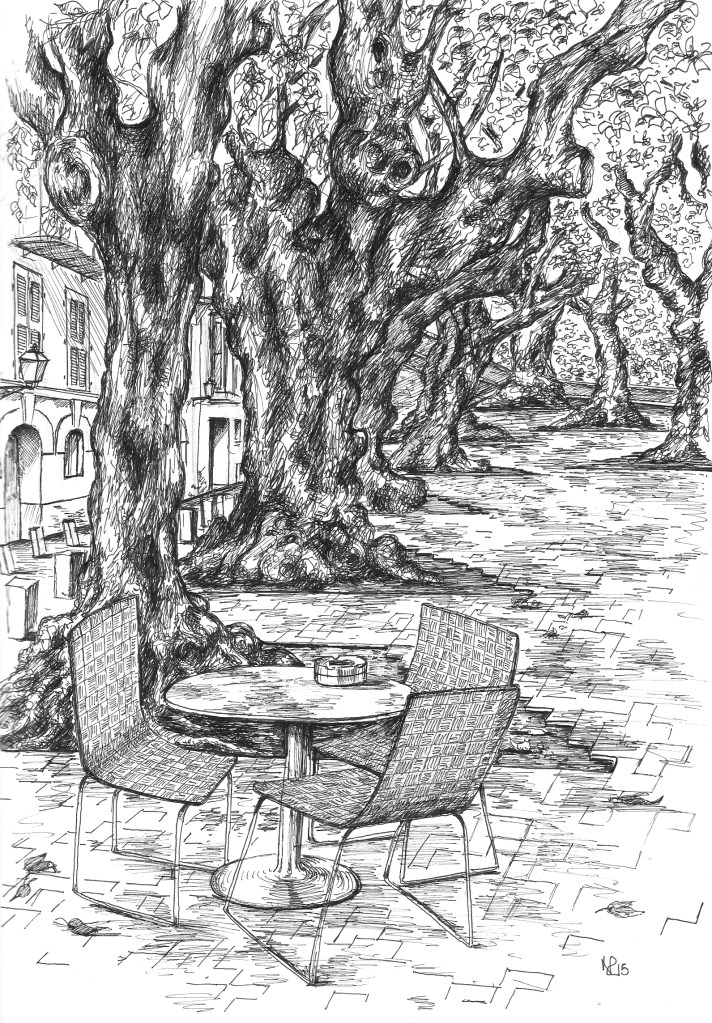
In today’s Daily Norm post I continue sharing some of the pages of my flourishing sketchbook, and this time it’s a double whammy. Both were sketched during the balmy days of summer from the same table outside the Calatrava Boutique hotel in Palma de Mallorca. It’s one of my all time favourite spots in Palma… Alongside the sea but exhibiting none of the exhausting heat of the beach thanks to the shade provided by huge twisting ancient trees. Plus it’s just outside the main tourist thoroughfare of Palma meaning that tranquility really can be enjoyed here, in the middle of one of the Mediterranean’s busiest cities. 

Cafe at the Calatrava Hotel (2015 © Nicholas de Lacy-Brown, pen on paper)

Cafe at the Calatrava Hotel (2015 © Nicholas de Lacy-Brown, pen on paper)

These sketches capture two aspects of this leafy patio in front of the suitably lavish boutique hotel – both looking beyond the cafe towards the incredible row of knotty trees, and then back towards the buildings of, and adjoining the hotel… glorious because of the intricate lattice work of their windows and the delicately ageing facades. 

Looking towards the Calatrava Hotel, Palma (2015 © Nicholas de Lacy-Brown, pen on paper)

Looking towards the Calatrava Hotel, Palma (2015 © Nicholas de Lacy-Brown, pen on paper)

© Nicholas de Lacy-Brown 2000-2015. Unauthorised use and/or duplication of the material, whether written work, photography or artwork, included on this website without express and written permission from Nicholas de Lacy-Brown is strictly prohibited. For more information on the work of Nicholas de Lacy-Brown, head to his art website at www.delacybrown.com

Ocho Balcones (No. 7): Dominik’s Office

After a week’s break, it’s back to business as usual this week as I share the penultimate balcony from my new Ocho Balcones collection of gouaches, all of which feature one of the eight different views we enjoy from our old town apartment here in Palma de Mallorca.

This week, I feature the exclusive little office space which my partner Dominik occupied with such enthusiasm from the first days of our time in this apartment, filling this classic study space with his many books, a fancy glass desk, a whole host of my norm sketches, and best of all… a balcony full of cacti of every different shape and size. And in wanting to focus in on this verdant feature of the balcony, I used a small dose of artistic license to tone down the colours of the street outside in order to create a more uniform sepia backdrop, allowing the green of the cacti to pop.

Ocho Balcones No. 7: Dominik's Office (2015 © Nicholas de Lacy-Brown, gouache on paper)

Ocho Balcones No. 7: Dominik’s Office (2015 © Nicholas de Lacy-Brown, gouache on paper)

But while the cacti may be the protagonists of this piece, Dominik’s simple desk lamp tends to take on its own staring role, its angular black structure contrasting perfectly with the curving wrought iron balconies and horizontal stripes of the electricity cables outside in the street.

7 down and 1 to go. The Ocho Balcones collection is nearing its close. See you soon, for the final instalment.

© Nicholas de Lacy-Brown 2000-2015. Unauthorised use and/or duplication of the material, whether written work, photography or artwork, included on this website without express and written permission from Nicholas de Lacy-Brown is strictly prohibited. For more information on the work of Nicholas de Lacy-Brown, head to his art website at www.delacybrown.com

My Palma: 6 months, 157 buildings and 205 boats

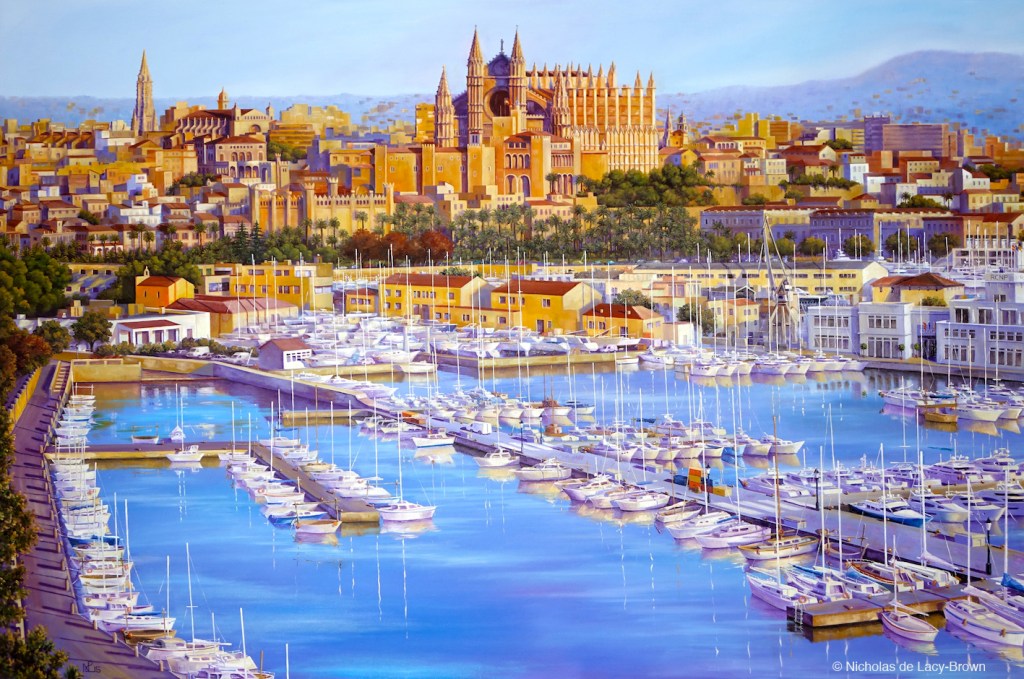
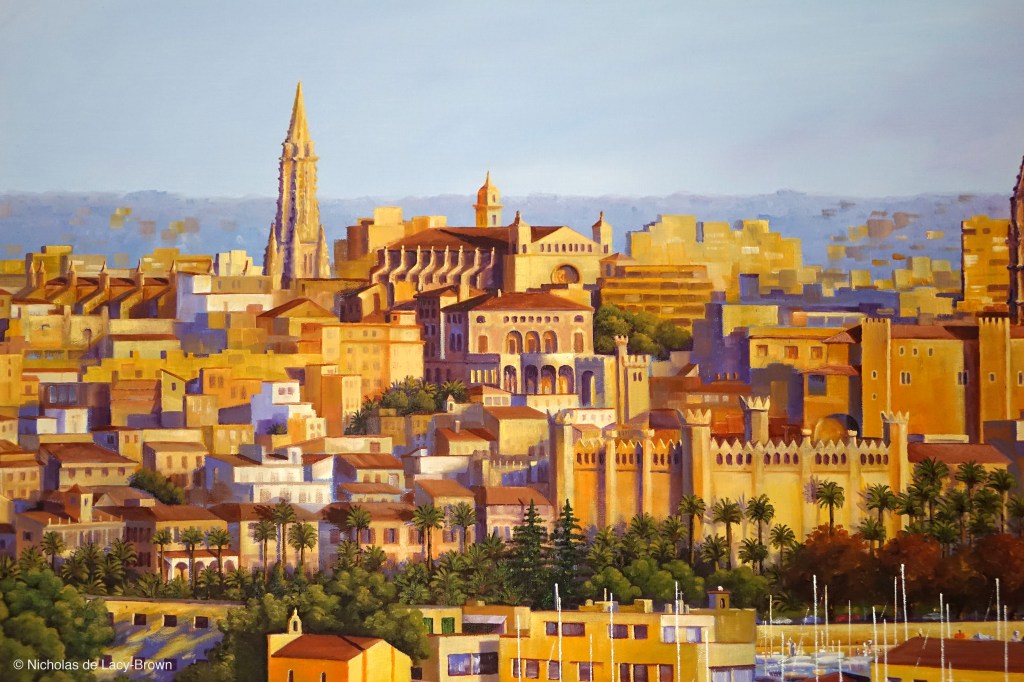
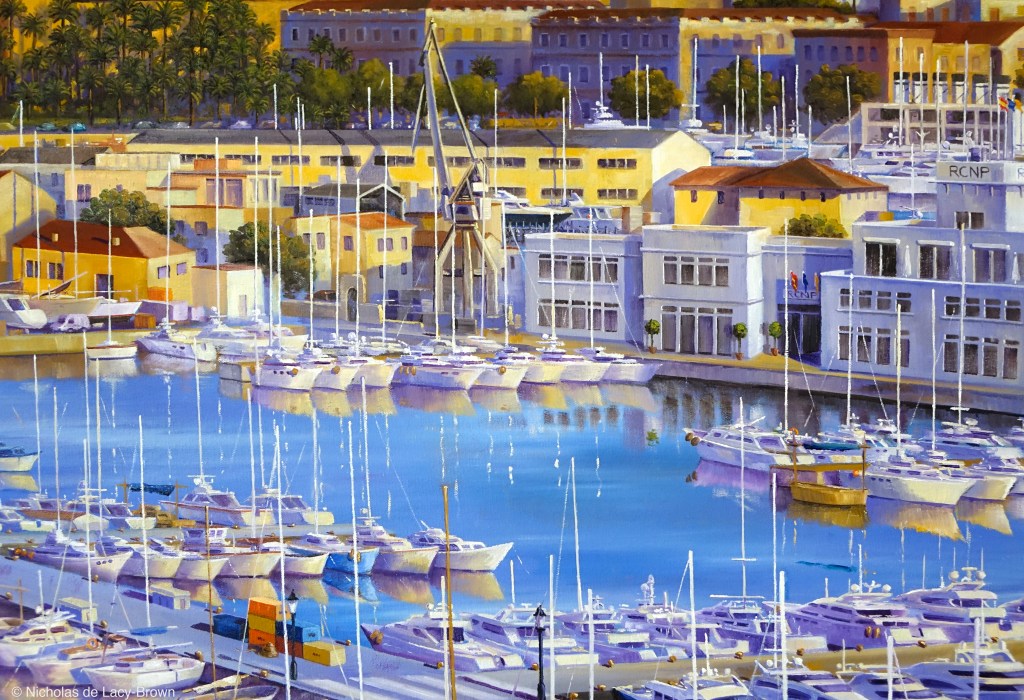
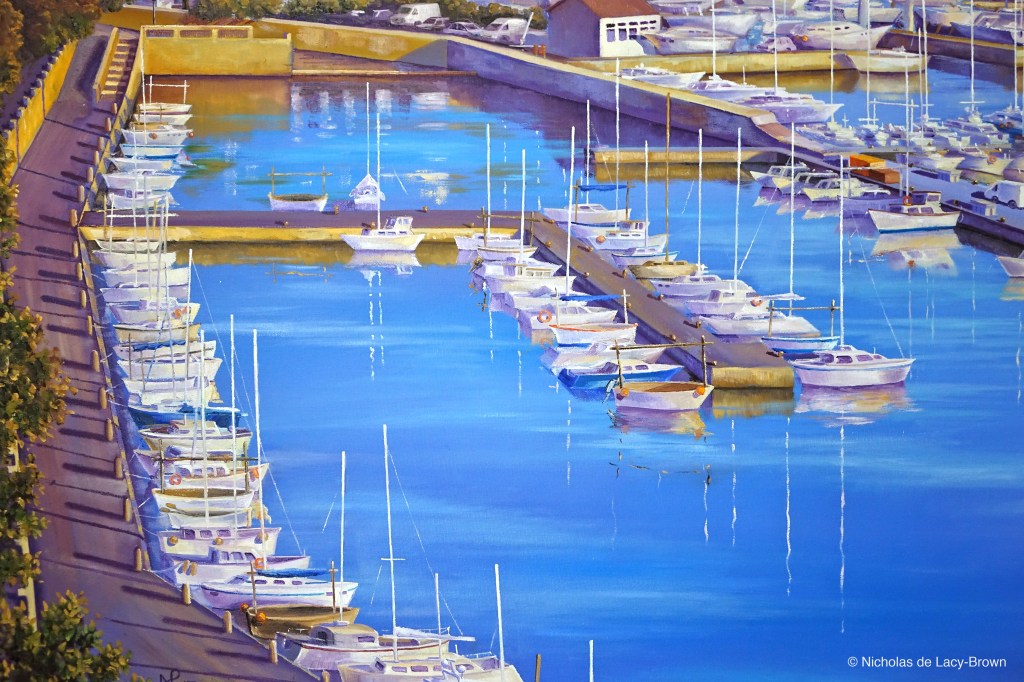
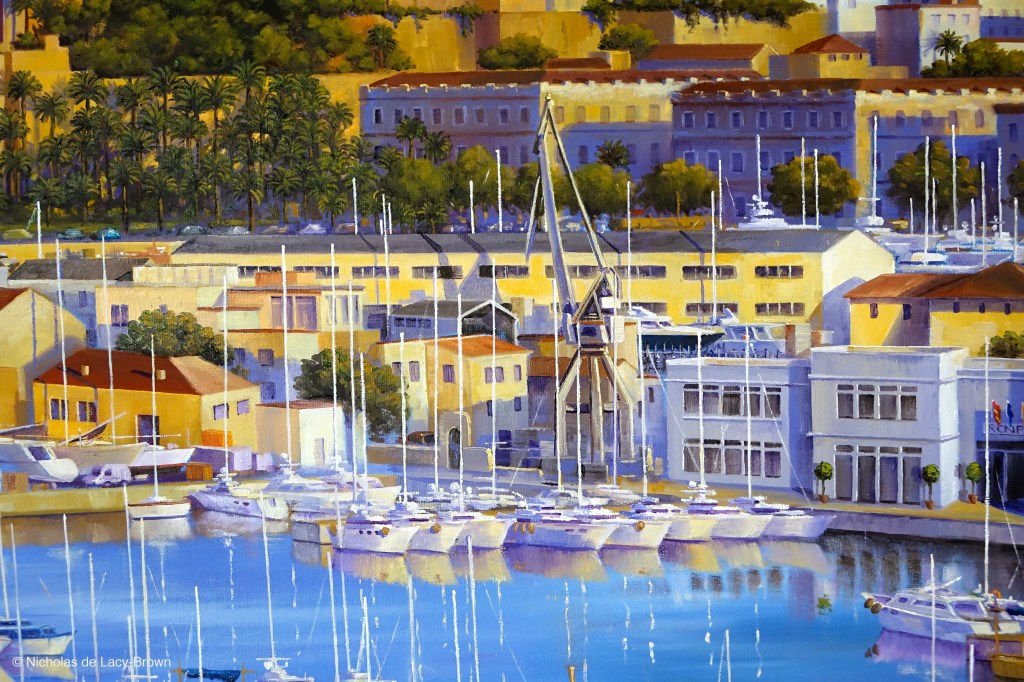
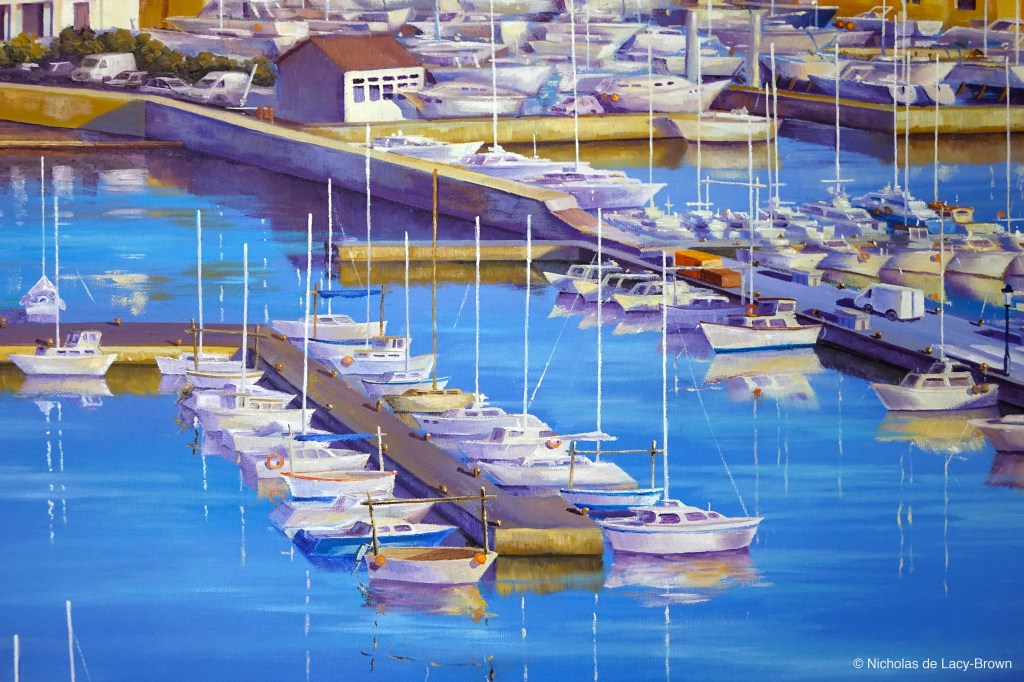
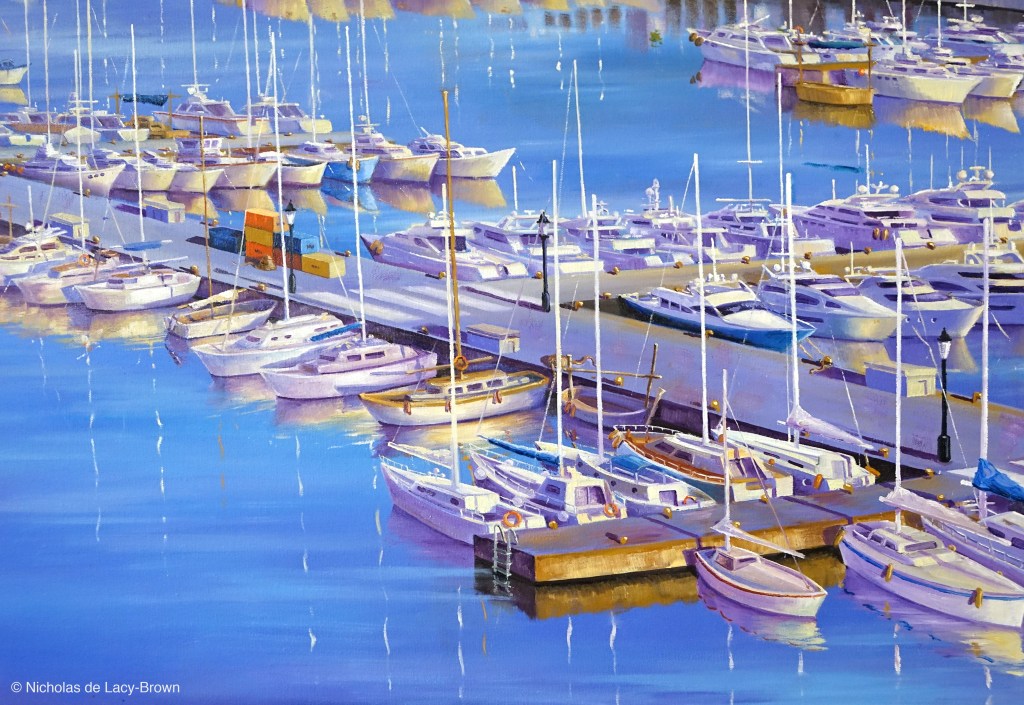
I interrupt my weekly digital exhibition of gouaches in my Ocho Balcones collection to present, with a considerable degree of excitement, my newest oil painting: The Bay of Palma. Started back in April when I found a typical little postcard of this typical view of the sprawling bay of Palma de Mallorca, I couldn’t resist the temptation to paint this city I have so come to love on the largest scale possible. So starting work on an immense 152 x 101 cm canvas, I set about painting what must be one of the most complicated painting projects of my art career.

Just the cathedral alone took endless hours of laboured work and adjustments of proportion, let alone the city which surrounds it and then those dreaded boats. Ah the boats… how I agonised over painting these seemingly innocuous white forms, correcting shadows and trying to paint masts with a shaking hand. But once 205 of them were done, I stood back in pride and admiration at what I had a achieved: a landscape which is both a typical view of this most admired of cities, but which was nonetheless technically difficult to capture, both because of its size and its detail. But I am delighted with the result.

Bay of Palma Water

I am therefore proud to share this painting exclusively on The Daily Norm along with a few shots of some of the many details which fill the work. I hope you like it!

Cathedral Port2 City Port3 Port Cathedral vertical Port buildings Port1

© Nicholas de Lacy-Brown and The Daily Norm, 2001-2015. Unauthorized use and/or duplication of the material, whether written work, photography or artwork, included within The Daily Norm without express and written permission from The Daily Norm’s author and/or owner is strictly prohibited. Excerpts and links may be used, provided that full and clear credit is given to Nicholas de Lacy-Brown and The Daily Norm with appropriate and specific direction to the original content. For more information on the work of Nicholas de Lacy-Brown, head to his art website at www.delacy-brown.com

My travel sketchbook: La Concha, Marbella

This week I’m sharing the last of my sketches completed while I was in Marbella last month. It’s funny how, with the passage of the seasons and the onset of autumn, that blissful fortnight in the middle of the summer now seems so far removed from reality. And yet when I reopen my sketchbook, the familiar smell of the cream pages wafting delicately towards my face, those balmy days of summer are never far away. And as I look at this last sketch, I remember the final rush to finish just one more drawing before our holiday came to an end.
It features La Concha, the mighty mountain which stands at 1243 metres above the town of Marbella and which has consequently become emblematic of the cityscape, and of this stretch of the Sierra Blanca mountain range in Andalucia. In all my years holidaying at my family home in Marbella, I have never stopped admiring this mighty giant, with its rippled folds and satisfying slopes. Providing the backdrop to so many of the town’s best views, Marbella would surely be half the place without it.

La Concha, Marbella (2015 © Nicholas de Lacy-Brown, pen on paper)

La Concha, Marbella (2015 © Nicholas de Lacy-Brown, pen on paper)

In this sketch I draw a mere slice, so that I could concentrate on some of those complex and fascinating undulations. It marked an appropriate end to this year’s happy reacquaintance with Marbella.

© Nicholas de Lacy-Brown 2000-2015. Unauthorised use and/or duplication of the material, whether written work, photography or artwork, included on this website without express and written permission from Nicholas de Lacy-Brown is strictly prohibited. For more information on the work of Nicholas de Lacy-Brown, head to his art website at www.delacybrown.com