Skip to content

Posts from the ‘Comment’ Category

A baby showered with a chequerboard of tropical cupcakes

We English don’t easily accept the idea of being influenced by America. We’ve always been the slightly supercilious older brother of our younger indefatigable sibling across the pond, wincing at the loosening of our Queen’s erudite parlance, the widening of the vowels, the advent of stuffed-crusts, of bagels and Reese’s peanut butter cups, the creator of drive-thru culinary culture and the over-eager stentorian expression which makes the refined of Kensington tut condescendingly. Yet it’s an indubitable fact of English life that the influence of the big U-S-of-A is all around us, in our music, in our food, on TV, in politics and on the high street, and no more so is this influence felt than in the way we party. The US gave us candy-abundant halloween and fairy light-filled dazzling Christmas spectaculars. And the latest craze which is doing the rounds is the Baby Shower.

According to wikipedia, a Baby Shower is generally thrown either shortly before or shortly after a baby is born. Only women are invited (!) and the new mother in question is “showered” with presents. So when my dear friend Sarah gave birth to a beautiful baby girl, Ruby, a few months ago, and announced that she would finally bring her angelic daughter down to London to be celebrated amongst our vivacious friendship circle, I decided that this baby shower business ought to be tried and tested, refined in the way that only the english know best. For starters we had men, and quite right too. In the modern world, with fathers playing an increasingly dominant role in the daily task of bringing up their children, why shouldn’t they too be showered with gifts and praise and plenty of sweet treats? Presents were showered aplenty – little cute girly outfits and some alcoholic indulgence for papa (when he’s off duty, naturally) and my gift – a norm sketch of course – devoted to little Ruby.

Welcome Ruby (© 2012 Nicholas de Lacy-Brown, pen and ink on paper)

As for the sweet treats – cupcakes went all tropicana, as I chose flavours referencing the mixed and culturally rich heritage of Ruby’s parents – I made one batch of tropical cupcakes –  pineapple and coconut cupcake referencing Sarah’s Jamaican heritage and father Truong’s South Pacific patrimony – while tropical banana meets England’s now demised Hungry Monk restaurant, inventor of the infamous Banoffee Pie, inspiration for my second selection – a banoffee cupcake, loaded with indulgent dulce de leche and a gingery spiced banana sponge. Tropical flavoured, but London refined, these cupcakes were the epitome of english chic, served like a chequerboard of black and white, with one cake covered in coconut and the other in chocolate vermicelli. The fruit in both, and additions of creamy coconut milk and indulgent full fat milk respectively, made these cakes moist and delicious, while the butter cream icing was a suitably indulgent celebration of the beautiful new life in our midsts.

My recipes were adapted from London’s favourite purveyor of cupcakes, the Hummingbird Bakery. To make the pineapple and coconut cupcake, take 140g caster sugar and beat in 40g unsalted butter. Then add 120g plain flour, a pinch of salt, and 1 and a half teaspoons of baking power and mix everything together with an electric mixer. Once everything is combined, gradually mix 120ml of coconut milk and half a teaspoon of vanilla essence into the flour mixture, and finally add and mix in one egg (I actually used a bit more coconut milk – my mother always told me that the softest sponge mixtures always drip of the mixing spoon like syrup, and therefore I always add a bit more milk to achieve this effect – but it’s a matter of personal taste). Prepare 12 paper cupcake cases. Chop up 8 rings of tinned pineapple into small chunks and disperse evenly in the bottom of the paper cases. Pour the cake mixture on top and place in the oven at 170 degrees celsius for around 20-25 minutes. Test with a skewer to make sure the cakes are cooked. The skewer should come out clean. Once the cakes are cooled, make your butter icing. Beat 250g icing sugar with 80g unsalted butter with an electric mixer. Slowly add 25ml of coconut milk and whisk until very white and light and frothy (around 5-10 minutes). Paste onto the cake with a palette knife and sprinkle liberally with desiccated coconut.

The banoffee cupcakes are pretty similar. 140g of caster sugar should be added to 80g of unsalted butter. Then add 120g plain flower, a teaspoon of baking powder, a pinch of salt, a teaspoon of ground ginger and a teaspoon of ground cinnamon. Mix until well combined and then slowly add 120ml of whole milk and two eggs. Separately mash up approximately one largish banana (around 120g peeled) and stir into the cake mixture. Spoon into paper cases and cook at 170 degrees for around 20 minutes. For the icing, beat 250g icing sugar with 80g unsalted butter. Then, if you want to make your icing indulgently dulce de leche, take a small can of condensed milk and simmer on a low heat for 3 hours (yep, this takes patience) without opening the can. Make sure the water doesn’t dry out in the pan and the tin is always covered with water or the tin will explode. After three hours, open up the can and you should find yourself with a tin full of caramel deliciousness. Add a few tablespoons of this to your butter icing mixture depending on how sweet and rich you want it. Build up on your cakes with a palette knife and sprinkle chocolate vermicelli liberally over the cakes.

And there you have it. Uber sophisticated tropical cupcakes, perfect for the summer, whether a baby is forthcoming, newly arrived, or just a distant pipe-dream.

PS: Talking of uber-chic cupcakes, I am SO proud of my friend Celia whose red-velvet multi-layered ombre cake made it into this week’s Sunday Times style section as shown here… amazing!

Banksy makes a jubilee-mocking come-back, but are his contemporary statements a little lagging?

There are currently two sites which are inescapable on any UK highstreet as they enjoy their ascension with increasing fecundity: the union jack and the humble pound shop. While the latter is a thriving austerity-proof monster growing out of the wrecks of recession-hit highstreets up and down the country, the former is a symbol of hope, of national pride, a flag which is appearing almost everywhere within eye-sight as the country gears up towards two great festivals of British prowess: the Queen’s Diamond Jubilee, and the London 2012 Olympic games. But for Banksy, known for making bold current statements against anything which has become accepted and standardised by the great public at large, all the union jacks and the poundshops have proven ripe fodder for his stencil-sprayed artistic derision. Indeed, for those passing by the side of a Poundland store in Turnpike Lane, Haringey (North London) this morning, they would have noticed a new addition to the street – a stencil of a child worker, fastidiously plying his trade in making mass produced union jack bunting. The graffiti, applied with Banksy’s trademark stencil technique, is widely considered to be by the great elusive street artist himself, although this provenance is yet to be confirmed by way of its customary inclusion on Banksy’s official website.

Whether the artist be Banksy or a pretender to the street-art throne, the image is apparently purporting to make a double statement. On the one hand it pokes fun at the proliferation of union jacks which have appeared all over London, England and further afield. We’re not just talking bunting either – the distinctive flag has become the favourite of interior designers who have installed the flag on sofas, artwork, rugs, cushions you name it, while there are even those (with little shame – like Ollie Locke from TV docusoap Made in Chelsea) who have taken to wearing the Union Jack on their clothes and blasted across their cars. Meanwhile in Oxford Street, the union jack is hung repeatedly across the famous shopping thoroughfare, and in humble bakeries the union jack has been iced onto cupcakes in preparation for Diamond Jubilee street parties which, if the weather improves, are expected to be held all over the realm.

Union jack furniture is all the rage

But the artist’s more pressing statement relates to the child labourer, and gives clues as to why Banksy (or whoever it was) chose the location he did: two years ago Poundland was involved in a scandal surrounding a boy of seven who was found to be working 100 hours a week in an Indian sweatshop producing goods for the store. The child, known as Ravi, was reportedly earning just 7p a hour to make napkin rings for the cut-price chain. The company severed ties with the supplier at the time and issued a statement saying it ‘did not tolerate child labour under any circumstances’. Which brings me to the point: is this contemporary statement of Banksy’s really that contemporary at all? Or did it take him two years to find a suitable wall to make his point about pound shop culture?

This trend of Banksy being somewhat behind in his latest up-to-the-minute remonstration was also echoed in his recent gift to Liverpool’s Walker Gallery, which saw the artist make a point about sexual abuse in the Catholic church a little too obviously and, frankly, a little too late to make an impact.

Union jack battenberg anyone?

Nonetheless, while Banksy’s point may come a little too late in terms of the Poundland scandal, there can never be too much exposure of child labour. Meanwhile, for the owner of that wall, the appearance of a potential Banksy original will make him/her very happy indeed – past sales of Banksy graffiti have sold in six figure sums, just as long as you can somehow cut the graffiti and the wall away intact! Sadly, what the graffiti also demonstrates is the level of general disrespect which exists within British society. Within hours of the artwork being painted, the union jack bunting, which was stuck onto the stencil, had been stolen. How very predictable these idiots are. The bunting will be worthless detached from the stencil, but some parasites decided to steal it anyway. It may not have been Banksy’s intention, but that kind of behaviour is definitely something which deserves focused remonstration by everyone.

The stencil a few hours after being painted, with bunting stolen

L.S. Lowry is coming to Tate Britain

I was thrilled by the news last week that Tate Britain will be honouring the work of frequently overlooked British industrial landscape painter L.S. Lowry from 25 June to 20 October 2013. The only frustration is that I have a whole year to wait until the spectacle hits London!

Lowry has long been one of my favourite British artists, ever since my parents purchased a tiny cottage in rural Isle of Wight almost 20 years ago, and along with the various odds and ends left in the cottage by the previous owner, there was a strangely gloomy yet enticing industrial scene hanging on the wall together with a group of funny little people walking around in the foreground.

L S Lowry, Street Scene (Pendlebury)

I was strangely fascinated by the image, which bared very little resemblance to the fresh, green bucolic landscape surrounding the cottage. Rather this industrial scene was rather bleak, in monotone shades of browns and greys, with vast forests of chimneys puffing smoke into the air in a continuous, unyielding fashion, while the workers all dressed in the same earthy tones looked the same – small cogs in a spiritless industrial machine. Despite its apparent despondency, the painting fascinated me, for it showed a snap shot of the humdrum of modern life, but in a style which was both naive but accessible. I had been introduced to Lowry, and I have been hooked ever since.

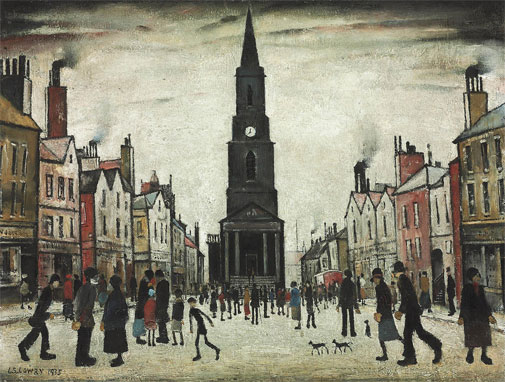
L S Lowry, A Market Place, Berwick upon Tweed (1935)

It is perhaps because of the naivety of Lowry’s draftsmanship, such as his figures, which are often referred to as “matchstick men” which has caused him to be relatively overlooked in the history of British art. I have often looked on amazon, for example, for a catalogue of Lowry’s oeuvre, but have found publications of his works to be woefully lacking. The only exhibitions I have attended of his works have been small scale sales of limited edition prints in private galleries, and I must have bemoaned the lack of a retrospective show of his work on at least a dozen occasions. It is therefore with great excitement that I await Tate’s show, and in the meantime fully intend to get everyone else excited by a small gallery below of some of Lowry’s works.

L S Lowry, Huddersfield (1965)

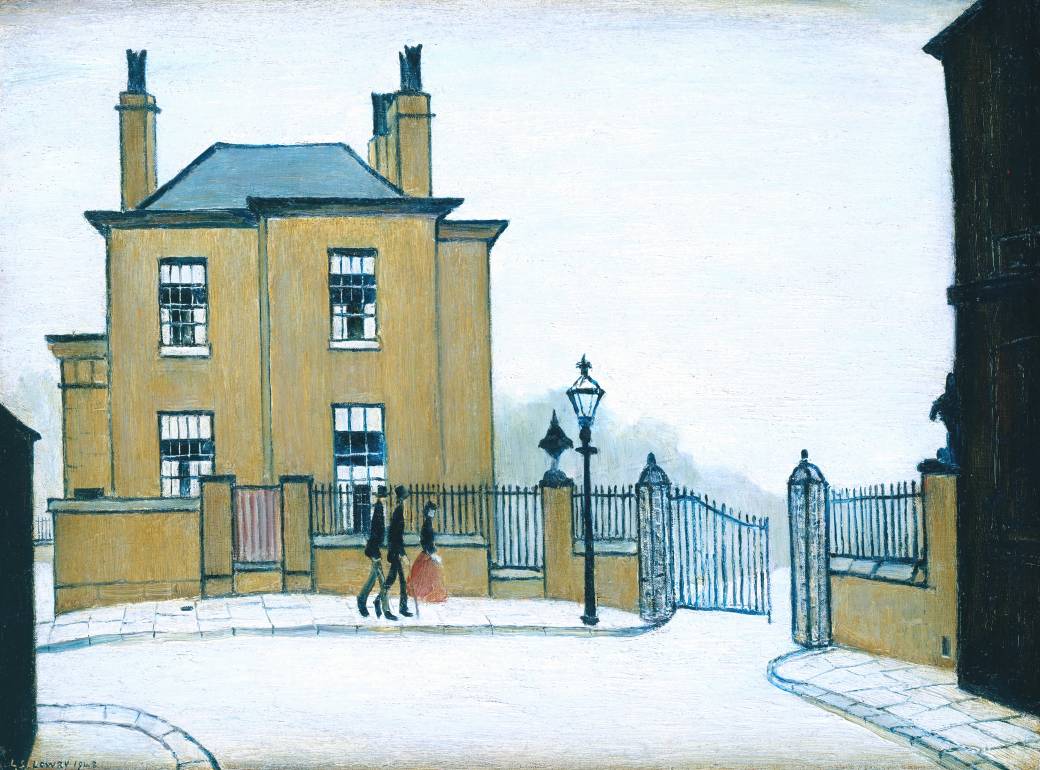
Bleak and grey as ever, the works rarely diversify from depicting scenes of industrialised Northern England where Lowry was born and worked and which, during the years of Queen Victoria’s reign had become a hub of industrialised growth leading to a population boom but a vast decrease in living conditions. Lowry demonstrates that England is not all lush green and pleasant lands as captured in works by Constable, or grand waterways and misty sea views as pronounced with such effect by Turner. Rather, these industrialised landscapes are typical of much of the country, even to this day, and Lowry’s paintings not only reflect upon the 20th century urban landscape, but also focus on the everyday lives of the ordinary masses. Yet in doing so, he rarely focuses on a single individual. Rather, through painting large groups, Lowry represents a typical city day for what it really is – large groups of people, all stripped of personality, as towns become influxed with workers, and the individual merges into one roving mass. Like the impressionists before him, Lowry is a proponent of the ordinary, but unlike the Manets and Degas of this world, Lowry depicts lives as most of us see them – crowds of faceless individuals, who represent statistics, but whose stories remain locked in the crowds.

L S Lowry, Industrial Landscape (1955)

L S Lowry, The Pond (1950)

L S Lowry, The Old House, Grove Street, Salford (1948)

L S Lowry, Coming out of School (1927)

Information of Tate’s forthcoming show can be found here.

The madness continues: Rothko and Munch sales break new auction records (and steal yet more works from the public eye)

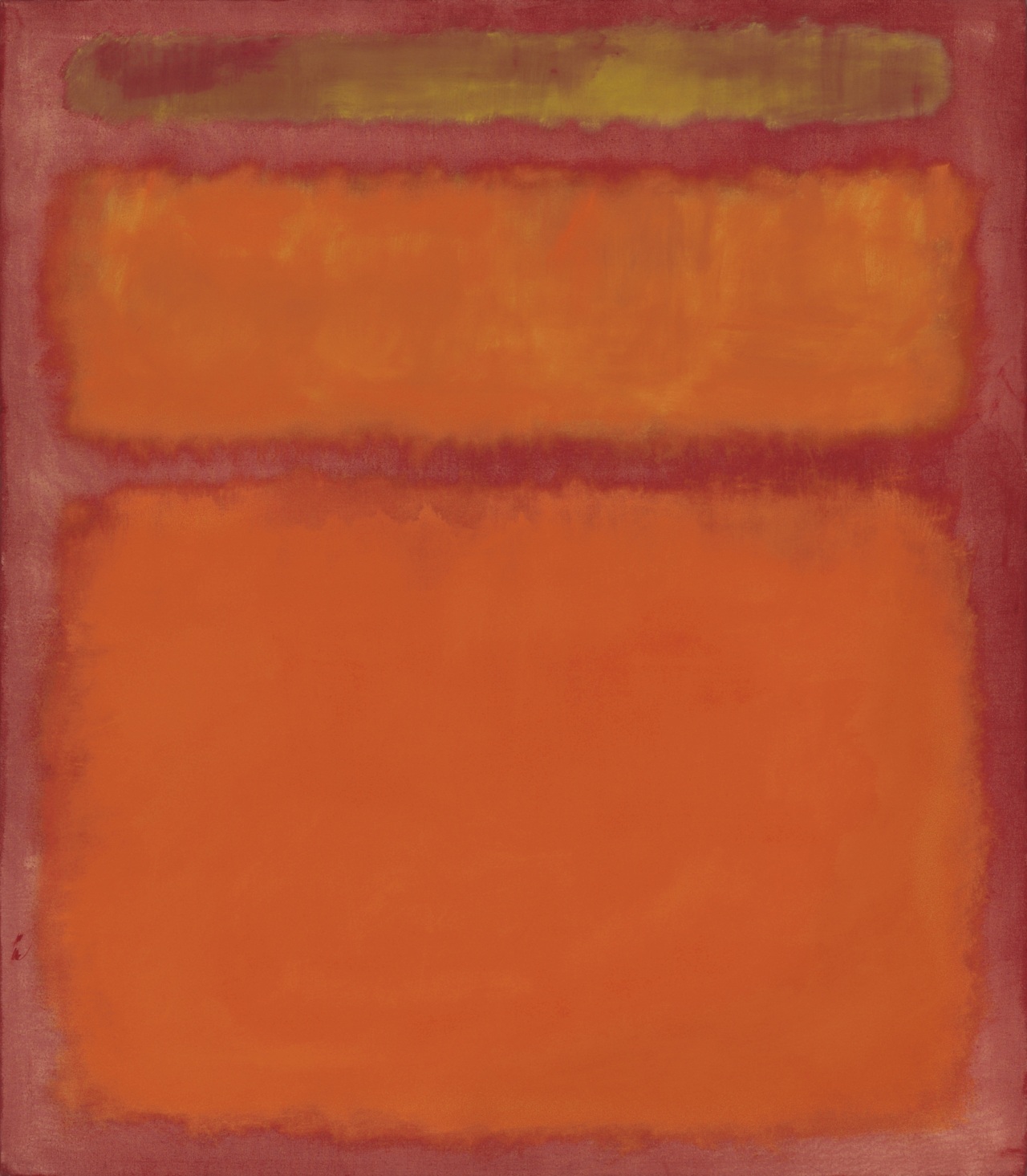
Your eyes do quite possibly deceive you. This is not a photo of haphazardly applied paint samples on my living room wall in the consideration of a new mediterranean-inspired coloured scheme. Oh no. It is a painting, originally entitled Orange, red, yellow by american artist Mark Rothko and not just any painting either. This striped bodge-job of a monotoned canvas has the honour of reaching the highest price ever fetched by a piece of contemporary art at auction when it sold at Christie’s auction house last night for $86.9million. And this sale comes only a week after a pastel version of Edvard Munch’s The Screan set a new world record for the highest price ever paid for an artwork (of its era) at auction at a price tag of some $119.9. Did I mention that half the world is in a recession?

Mark Rothko, Orange, Red and Yellow (1961)

That’s not where it ended either. With total takings of $388 million, last night’s Christie’s auction was the most lucrative in history. I’m sure I’m not the only person who feels slightly ill about this. This hideous commercialisation of art works is the same force which drives contemporary artists of our age to be amplified and promoted as serious artists purely because a rich man has backed them despite their decided lack of talent. It’s a world which most artists would gawp at, appalled at the rich men lavishing their coin over an art work, not because of its merit, but because its artificially escalated price tag defines them as wealthy men with apparent cultural appreciation despite their probable inability to tell you a single historical fact about the artist they have just lavished millions on. After all, wasn’t it Rothko himself who, upon being awarded a commission to paint two major mural commissions for the Seagram’s luxury Four Seasons restaurant commented that he wanted to paint “something that will ruin the appetite of every son-of-a-bitch who ever eats in that room. If the restaurant would refuse to put up my murals, that would be the ultimate compliment. But they won’t. People can stand anything these days.” What then would he have thought about one of his works selling for such an absurd sum, and entering the collections of one of the richest men on the earth? He’d say the same thing no doubt: people can stand anything these days, especially when it gives them a bit of status amongst all their equally rich friends.

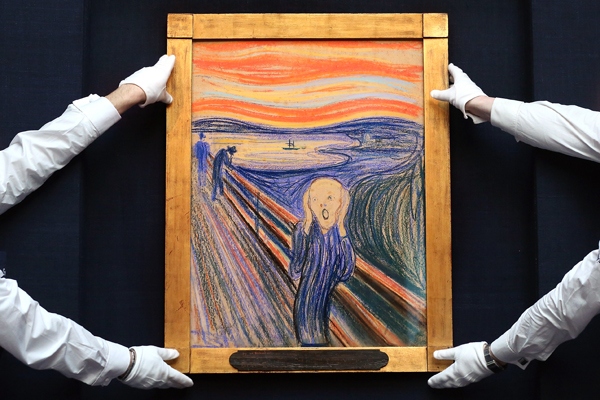
Edvard Munch, The Scream (pastel)

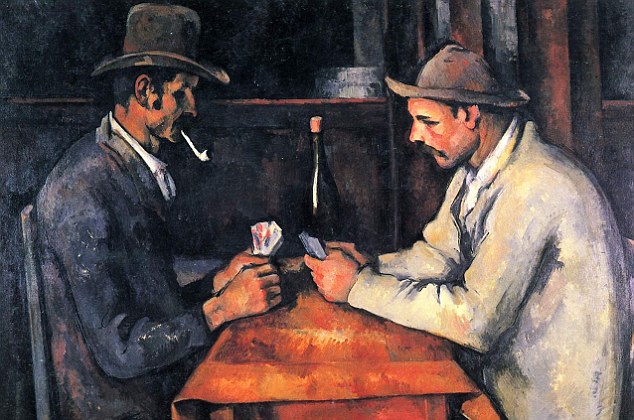
It’s not just about the price either. Munch’s Scream is thought to be making its way to the private collection of the Qatar royal family, and there it will join Cezanne’s Card Players sold to the Qatari royals for an equally absurd amount last year. What would Munch, whose painting represents a time of intense personal agony, or Cezanne, who spent his career agonising obsessively over finding a new way of representing the life of peasants and Provencial countryside, have thought about their works ending up in some dessert (and oil) surrounded palace in a part of the world where freedoms are suppressed, homosexuals are persecuted, and women are swathed in material, hidden from the view of men? Wasn’t the intention of the impressionists and post-impressionists and most artists for that matter to liberate through their art, to emphasise the lives of the ordinary people, be them whores or gays, women in the nude or men in emotional turmoil? I can almost hear Cezanne turning in his grave, no doubt somewhere near the Mont St Victoire, as I type.

Cezanne, The Card Players – bought by the Qatar Royal Family

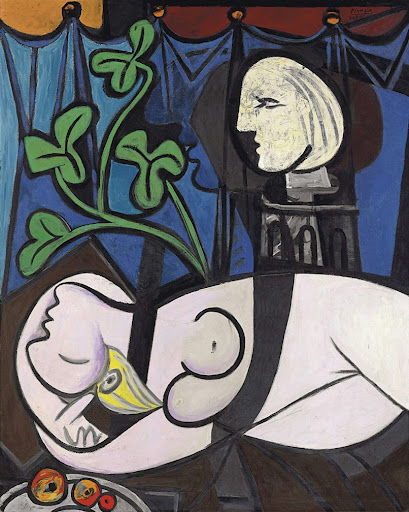
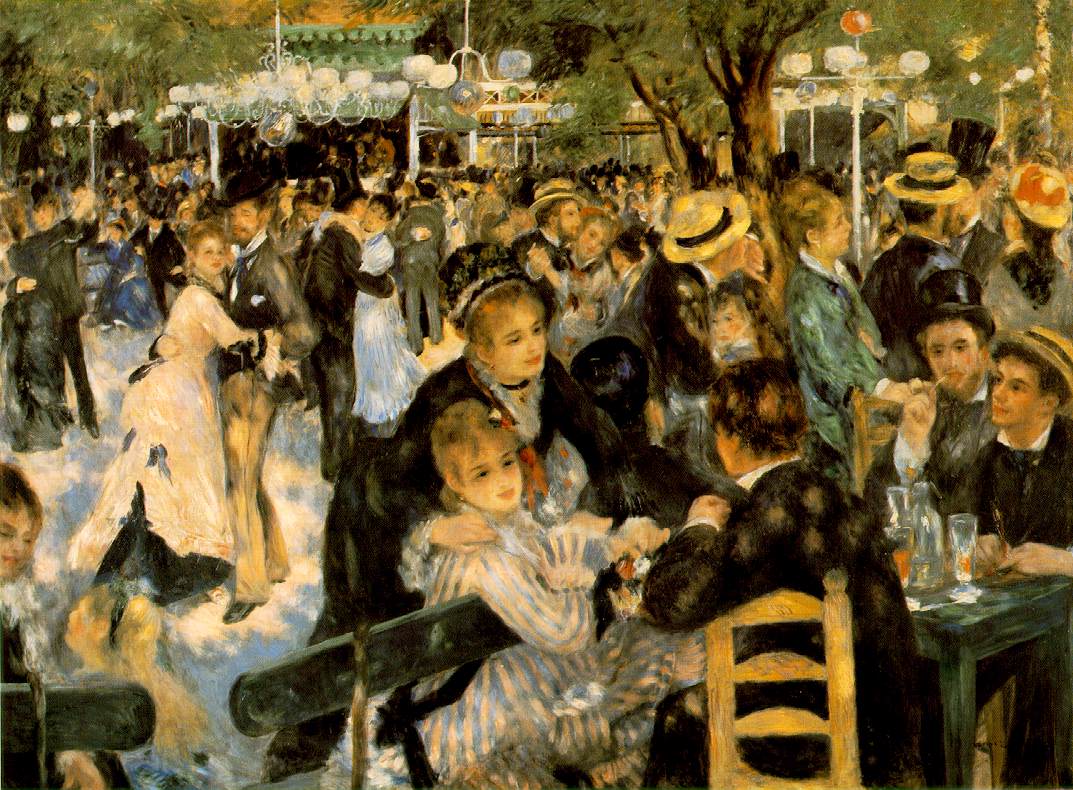
Worst of all is that the destiny of the majority of these privately bought paintings is to be hidden away in vast private collections, locked away from public view, as the increased secularisation and privatisation of the world’s masterpieces continues. And as the prices are pushed up, so too is the opportunity for a public gallery, most of them cash strapped, to ever acquire one of these great art works again. While the occasional private purchaser is good enough to loan their acquisition to a public gallery for public view, such as Picasso’s Nude, Green Leaves and Bust sold to a private bidder (thought to be a Russian oligarch) but currently on show at Tate Britain as part of its Picasso and Modern British Artists exhibition, most will never see the light of day again. Much like Renoir’s Bal du moulin de la Galette, purchased by Ryoei Saito in 1990 and supposedly never heard of from that day onwards.

Picasso, Nude, Green Leaves and Bust (1932)

It’s not like these paintings are stunning. Munch’s recently sold Scream was only a pastel study and not nearly as intense as the oil-painted original which thankfully remains on public view in Oslo. Rothko’s work on the other hand (for I hate to call it a “painting”) is a matter of personal taste, although I am sick of constantly being told that Rothko’s works are moving, incredibly important masterpieces worthy of my attention. Because they’re certainly no worthier of my attention than the blank canvases sat in my cupboard, and the only thing that moves me about them is why they are taking up valuable space in some of the most important contemporary art museums in the world. Anyway, I digress. No matter what my personal opinion is of Rothko, I recognise his place in art history, and once again I would prefer to see his works on public display for the contemplation of countless generations, than for the sole entertainment of a few Qatar Royals and a herd of camels.

Renoir, Bal du Moulin de la Galette

In an ideal world, legislation would be passed forcing public galleries to have first dibs when an important work comes up for sale, at a heavily reduced price of course. But sadly this is not how the world works. Everyone wants to make a profit, and no more so than the auction houses of London and New York who revel in their press-grabbing broken records in the same way that White Star Line encouraged a speedier Titanic voyage in order to make headlines with the ship’s early arrival in New York. And we all know how that story ended, don’t we.

Easter Eggs – the Spanish do those better too.

I know I’m forever praising the efforts of my European neighbours rather than my own here in England, but there is something about continental Europe that just exudes a class and elegance which has been long since forgotten here in the UK. Take Easter Eggs – here the shelves are loaded full of Easter Eggs, but for the most part they are covered in branding, a boring shell in a huge box with plenty of space for adverts and promotion – of Mars, of Milky Way, Twix, Kit Kat and After Eight. Admittedly, there are some exceptions in the higher end market, but otherwise your typical UK egg is likely to be little more than smoke and mirrors, mass produced and devoured without as little thought as went into making it.

By comparison check out these eggs currently to be found gracing the well stocked shelves of local Marbella cafe favourite, Goyo. Yes, there is some branding, in the form of cartoon characters made into eggs, but there is also a wonderful hand made element, an intricacy in the skill shown by the chocolatiers, and a sense of fun and Easter-tide joy. And this runs pretty consistently across the board when it comes to Easter eggs in Spain – all handmade, all intricate, all worthy of this celebratory festival. Even the foil covered eggs are brightly wrapped and spill, as though from Pan’s cornucopia, in all their multicoloured vibrancy from Easter baskets and displays. Beautiful. Only problem is, the calories.

For me, it’s the little things in life that bring the difference between the UK and continental Europe into sharp focus. As I’ve said before, the UK is, and has always been economically driven. Here it’s about mass production, value for money, business efficacy. On the Continent however, precedence is given to the good things in life – taking time to achieve a better, more satisfying finish, prioritising aesthetics, and allowing time to enjoy the joie de vivre. It’s the same with art – take Damien Hirst, currently enjoying an even bigger spotlight than previously at his Tate retrospective. He’s all about lazy art – mass produced, and painted/ created by a factory of assistants. But he’s also about the brand, the business, the marketing. Did Van Gogh care that he hadn’t sold? Not nearly as much as he cared about creating beautiful paintings. And I can guarantee that fewer people will be queueing to see Damien Hirst’s rotting shark in 100 years than queue every day to see Van Gogh paintings around the world.

Happy Easter everyone!

Parallelism – Giving Hockney another chance

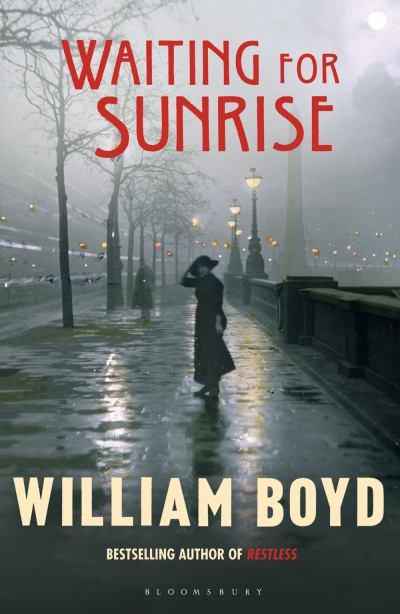
I’ve just finished reading the new novel, Waiting for Sunrise, by William Boyd. The novel has something of a Tinker Tailor Soldier Spy vibe about it, and is certainly atmospheric of 1900s Vienna and WW1 London although it doesn’t come to an altogether satisfactory ending. Nonetheless, I digress – far from intending to proffer a review of the novel, I wanted to talk about an interesting theory espoused by therein.

The book’s central character, Lysander Rief, has a mental disorder which prevents him from climaxing during sex. At the story’s beginning, we find Lysander in Vienna, seeking the help of an eminent British psychiatrist, Dr Bensimon. Dr Bensimon isolates a particular incident in Lysander’s childhood which he believes is the cause of his sexual problems. He attempts (and is ultimately successful) to cure Lysander through the use of a psychoanalytical theory, Parallelism.

Dr Bensimon describes the theory thus:

“Parallelism” worked approximately along the following lines. Reality was neutral, as he had explained – ‘gaunt’ was a word he used several times to describe it. This world, unperceived by our own senses, lay out there like a skeleton, impoverished and passionless. When we opened our eyes, when we smelled, heard, touched and tasted we added the flesh to these bones according to our natures and how well our imagination functioned. Thus the individual transforms ‘the world’ – a person’s mind weaves its own bright covering over neutral reality. This world is created by us as a ‘fiction’, it is ours alone and is unique and unshareable…

‘Pure common sense,’ Bensimon said. ‘You know how you feel when you wake up in a good mood. The first cup of coffee tastes extra delicious. You go out for a stroll – you notice colours, sounds, the effect of sunlight on an old brick wall. On the other hand, if you wake up gloomy and depressed, you have no appetite. Your cigarette tastes sour and burns your throat. In the streets the clanging of the trams irritates you, the passers-by are ugly and selfish. And so on.

(Waiting for Sunrise by William Boyd, page 62)

I have no idea whether this theory of “Parallelism” exists beyond the pure fiction of Boyd’s imagination, and certainly a provisional search online seems to suggest that it does not. Nevertheless, the thought process described by the fictional character, Dr Bensimon, immediately resonated with me. Living in London is always a testing place, but there are some days when I love the place; other days when I just hate it. Just as Dr Bensimon describes, on a sunny day when I’m in a good mood, the people on the streets seem to exude a happy community spirit, the music from passing cars makes me feel like dancing, the polluted air smells urban and exciting. Conversely when I am tired or in a bad mood, I conclude that London is a living hell, that music from passing cars is deeply inconsiderate, the people on the streets are taking up the space on the pavement, they walk too slowly, they are ugly and annoying, and the London air is choking at my throat, begging me to escape to the countryside. It may all sound like common sense, but when you think about it, it’s interesting just how much our mood can affect our perception of the world around us. For this reason it is sensible, one might conclude, when making a snap judgment about anything, to step back and consider: was it really that bad or was I just in a bad mood?

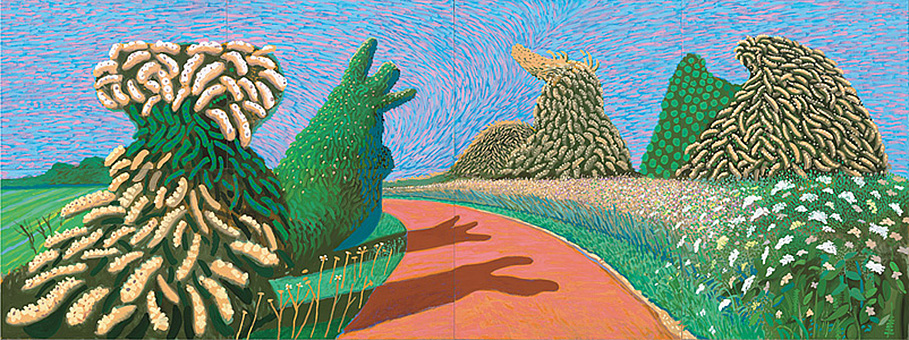
May Blossom on the Roman Road, David Hockney (2009)

I decided to put the theory to the test. As regular readers will know, I was none too impressed with the Royal Academy’s latest Hockney blockbuster exhibit. I found the paintings to be mediocre, the colours alarmingly vivid, the content boring and very repetitive. Yet everywhere I go, there are shining reviews, Hockney’s story is played out all over TV documentaries, and English landscapes are the new vogue. So I decided to give the exhibition another chance.

Hawthorn Blossom, Woldgate (David Hockney, 2009)

Last time I went on a RA Friends’ preview day, it was pure and undiluted bedlam. This time, I booked my Friends’ slot at the earliest opportunity: 10am. Upon arriving a little early, I was dismayed to find queues, even for Friends, and even more dismayed when the doors opened at 10am and scores of advanced ticket holders poured into the exhibition before we Friends. However, when I finally got into the exhibition, I took the decision to skip the first 3 rooms – they are retrospective anyway. And thereafter, ahead of me, were the bulk of the Hockney galleries, completely free from crowds. It was bliss. Suddenly, seeing the canvases from afar, I could begin to appreciate “the bigger picture” which Hockney was trying to create. Without hundreds of packed in heads in front of me, being surrounded by these huge canvases depicting forests and Yorkshire landscapes was like treading a path through that magical forest in all seasons. Without the crowds, the vibrant colours were not gaudy but uplifting. When I could see the complete paintings unhindered, they did not appear repetitious, but necessary, subtle reworkings on a theme.

Hockney’s gallery of watercolours and oils on observation was now airy and bright, and the paintings perfectly reflected the seasonal bucolic treasures of the English countryside. In further galleries, Tunnels and Woldgate Woods, seasonal variations on the same view demonstrated how far a season can serve to differentiate the same spot. And these seasonal changes were given dynamic attention through Hockney’s use of 18 cameras to film the same spot from different angles, in different seasons. These films, being shown in the cinema which, upon this second visit, I was finally able to get into, were mesmeric, calming and beautiful as the cameras glided alongside trees and bushes and country roads in all seasons.

Hawthorn Blossom, Woldgate (2009, David Hockney)

But best of all, in my renewed opinion, were the Hawthorn Blossom paintings (featured in this blog). Yes, the blossom looks like hairy caterpillers devouring a leafy bush, and the vast shadows look like the emergence of a sinister criminal, ready to pounce, but these images are also refreshingly original interpretations of what is really quite boring white blossom. They are colourful, without being shocking, very whimsical, and remind me a lot of the work of Philip Guston. On my first visit, I hardly noticed them. Now, refreshed and reinvigorated by this empty gallery, I loved them.

As if to confirm that this parallelism theory is true, when I attempted to revisit the initially skipped rooms at the end of the exhibition, hell had again descended. Like a tidal wave of sardine packed bodies, without a space between them, huge crowds had now filled the galleries of the Royal Academy and it was again impossible to see beyond the square centimetre of painted canvas directly in front of you. Absurd. I therefore felt very sorry for the vast spiralling queues of visitors snaking through the Royal Academy’s courtyard when we left the exhibition after this refreshingly empty experience. They, alas, will get nonesuch the experience, and if parallelism has it’s way, its highly likely that they won’t like the paintings nearly as much as a result.

Hawthorne Blossom Near Rudston, 2008, David Hockney

Ravishing Radleys – The picture bags that keep on giving

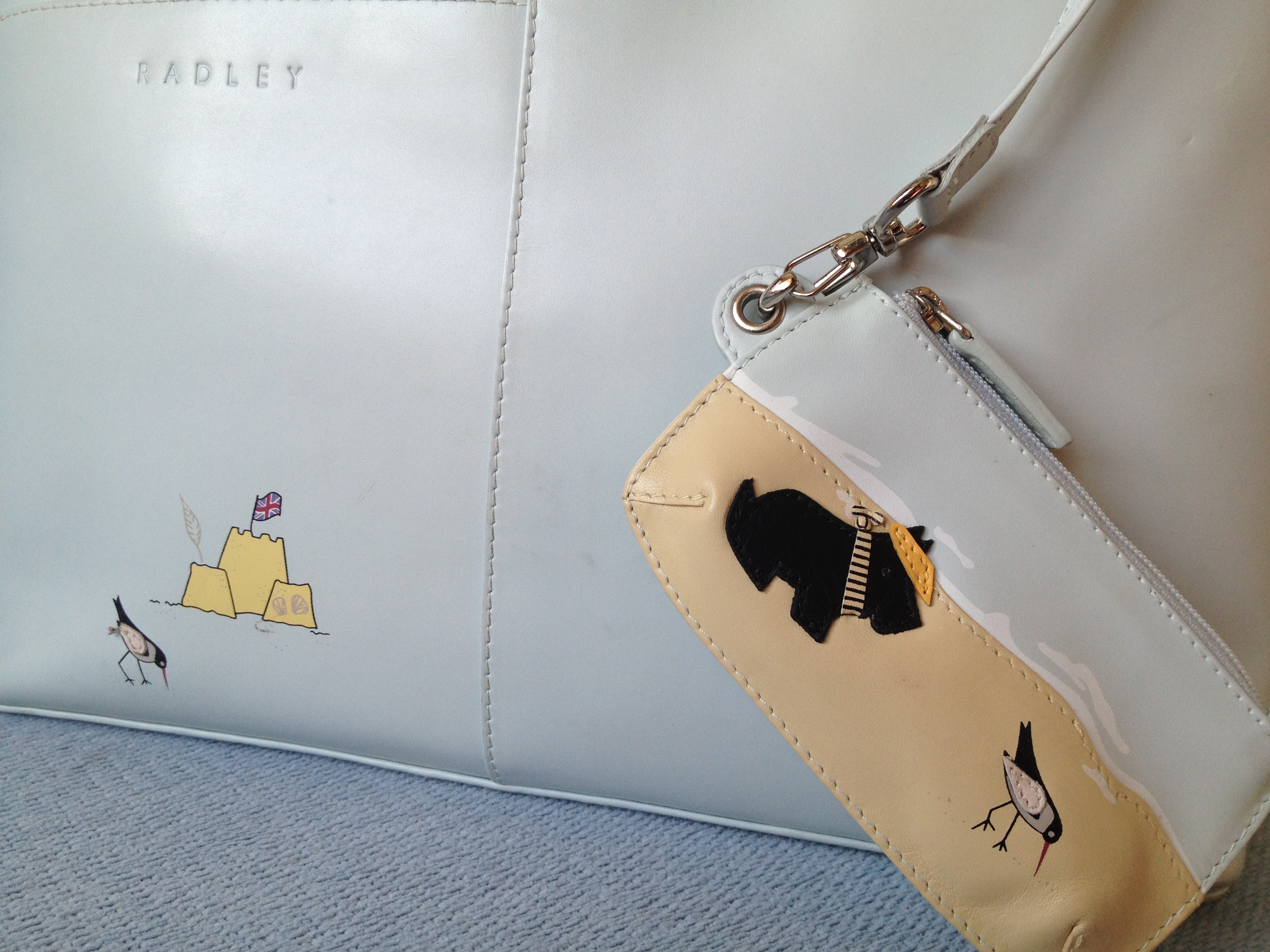
Now you can never accuse the Daily Norm of neglecting its female audience, nor indeed the best of British. And in todays post, I’m targeting both. On a recent trip to my parents home, I was treated to a display of my mother’s new Radley picture bags. The bags, which are limited edition leather creations by London luxury bag maker, Radley, and which generally retail for around £200 each, are a pictorial delight, so much so that I just had to photograph them and share them on The Daily Norm. My mother now has one bag from each of the respective 2010, 2011 and 2012 collections, but a fair number of equally exceptional designs have gone before them. The bags are unique, playful and colourful – sufficient to brighten anyone’s day. Nonetheless, it is ironically recommended that the bags should be stored away, in their original packaging, and never touched – such is the value which attaches to these limited edition items. Like all things, it is tempting to pack limited edition items away for prosperity, but with whimsical scenes as good as these, surely this protectionist stance somewhat misses the point? At the very least, the bags require a regular outing around the house just so we can gaze at their jolly offerings.

The first bag of my mother’s collection is Beside the Seaside launched in the Spring Summer 2010 collection. Complete with beach huts, a deckchair, a seagull and a seaside promenade, it illustrates the archetypal British seaside resort.

Inside, the picture bags contain a little coin pouch, while the back of the bag has its own accompanying design.

My mother’s next purchase was the 2011 Autumn/ Winter picture bag, Through the Hoop, a wonderful Toulouse Lautrec inspired circus scene.

And here is it’s back and coin pouch.

Finally the 2012 Spring/Summer picture bag, Happy Camper, illustrating a typical camping scene complete with caravan, awning and summer barbeque. It appears that after only a week since its release, the bag has already sold out from the Radley website, but I’m sure overpriced resales are widely available on ebay!

So all this makes me think – I really need to make Norm handbags! Can you imagine the possibilities?! But how to go about it… If anyone knows someone who makes leather goods, please let me know! In the meantime I leave you with a picture of the bags all packed up in the protective drawstring bags ready for bed. Until next time…


Brit art shunned by dOCUMENTA (13) – time for the UK to face up to our talentless contemporary art?

From June to September this year, the town of Kassel, Germany, will play host to the 13th dOCUMENTA exhibition. Established in 1955 by artist, teacher and curator Arnold Bode, the 5-yearly exhibition, whose first show featured the likes of Picasso and Kandisky, is self-proclaimed as a “key international exhibition of contemporary art worldwide”. Yet  the “worldwide” element seems to have missed out a key player from its compass: At dOCUMENTA (13), the UK is conspicuous by reason of British artists’ total absence from the show. Are they trying to tell us something?

I read an interesting article in yesterday’s Sunday Times written by  resident art critic, Waldemar Januszczak. He blamed dOCUMENTA’s apparent shunning of British artists on curators. He argues: “[t]he chief reason British art is mistrusted and hated abroad is that international curators disapprove of it. It isn’t clever enough for them. It does not espouse enough theory. It has a directness to it that makes their gaseous interpretations redundant. And it likes jokes, which they don’t”.

Damien Hirst - A thousand years

Good on Januszczak for being patriotic. But I can’t help but conclude that the real joke is British art itself. Contemporary art is a sticky wicket, a difficult often inaccessible manifestation of an artist’s attempts to find some new avenue which art has left hitherto unexplored. The trouble is, artists don’t have the luxury which the impressionists or the cubists or the abstractists did – these artists were emerging out of a rigid, regulated era of art, where paintings closely followed convention and artists feared exploring techniques beyond figurative representations of classical and biblical themes. Once artists began to break the mould, there were so many directions where artists could go, and so much they could do with the familiar canvas image, leading to an explosion of creativity and the creation of some of the world’s best loved works – the Picassos, the Van Goghs, the Matisses. Come the 1960s and things started to dry up. Jackson Pollock started to spray his canvases without any perceptible talent and Rothko painted vast works in a single colour. Little by little the need for actual artistic talent fell to the wayside as the singular requirement for “ideas” took hold until finally the hand of the artist was made entirely redundant: the art of the “readymades” reigned triumphant, right up until the monstrosity that was Tracey Emin’s unmade bed.

My bed - © Tracey Emin 1998 (like you'd want to copy it)

This would all be fine – call it a fad – if these artists weren’t taken so damn seriously. Damien Hirst has become a serial industrialist, a commercial tycoon all in the name of “art”. His works – pickled shark, rotting cow and polka dots aplenty (the majority of which he didn’t paint himself because, allegedly, he “couldn’t be ****ing arsed”) – are about to be given a huge solo retrospective at Tate Modern of all places. Meanwhile, Tracey Emin – who can’t draw to save her life – has been made Professor of Drawing at London’s Royal Academy, while her annual contribution to the RA’s Summer Exhibition make me want to weep. Yet still the visitors lap them up, buying each and every print of her childlike scrawl at lightening pace, just because they think, or rather they know, that they are making a good investment.

Damien Hirst - LSD

And herein, in my opinion, lies the problem. Compared to the romantic sentimentalism of countries like France, and the aesthetic-led inclination of countries like Italy, England has always been the boring big brother – the big industrialist placing economic concern at its core. We didn’t give birth to the airy luminescence of  impressionist paintings – but we did bring you gloomy scenes of the industrial North by Lowry. We didn’t give you empassioned El Greco or compassionate Da Vinci, but we did give you Lucien Freud – creator of the most expensive painting every sold by a living artist. We’ve always been led by money, by investment, by industry.

Tracey Emin "I’ve got it all" (2000) - says it all really doesn't it.

We don’t rave about Emin and Hirst because we think they are any good – we know about them because advertising tycoon Charles Saatchi has bought into them. And once Saatchi invests in an artist, they must be good right? Wrong. Saatchi is the man with the money. He isn’t an authority on taste and this is why British art is being shunned by exhibitions like dOCUMENTA. Because our artists make it big because of investment, not talent. All the integrity of our art has flown out of the window, as we gaze in apparent wonder at a whole gallery turned over to a lightbulb switching on and off. And why is Tate modern giving itself over to that Hirst retrospective this summer? – Why, because it’s olympic year, and they can pull in the punters, and the admission fee, of course.

Tracey Emin Tower Drawing 18 (2007) monoprint, paper size: 4 11/16 x 5 11/16 in. (11.9 x 14.4 cm), Photography by Stephen White. Courtesy of White Cube.
© Tracey Emin ("Professor of Drawing")

In conclusion, dOCUMENTA (13)’s shun of Brit art should make collectors and galleries in the UK stand up and think. Art shouldn’t be about money – it should be about talent; about discovering an artistic genius who will place British art on the map for centuries to come, long after the last scrap of that unmade bed has been swept away into the rubbish. But  how likely is that to happen so long as the powers that be stand to make a buck or too? I think you can answer that one for yourself.

Persistently mysterious; indubitable genius: Manet’s Le Déjeuner sur l’herbe

It’s a mystery to us all. Just why would a naked woman be sitting with two clothed men in the middle of the forest? Are they not hot? Is she not cold? Why is there an uneaten picnic, and why does the background look so flat, almost like stage scenery? What is the woman in the background doing and why is the woman in the foreground looking at us with such fervour?

Ever since it’s sensational first appearance at the Salon des Refuses in 1863, Le Déjeuner sur l’herbe (luncheon on the grass) by Edouard Manet has given rise to a relentless stream of questions and comparatively few answers. While it’s meaning and narrative might have been profoundly unclear to contemporary audiences, what it did do was shock and inspire in equal measure from the first moment of its appearance. It disgraced the reserved Parisian audiences of the 1863 Salon des Refuses, spurred on by a sensational outcry in the press, outraged to see a shockingly unapologetic female nude staring out at the audience so audaciously and mixing with fully clothed civilised gentlemen. But in equal measure it inspired: It was art for art’s sake – not retelling a classical mythological tale as was common at the time – this was a large canvas reserved for every day life. It was a work which exposed the artist’s active hand through visible brush strokes and a hastily composed background. It was a nude woman whose every crease and curve was unflatteringly exposed, ending the previous hypocritical use of nudes as a representation of deity in all their smooth perfection – here was a real woman, with folds of flab and an unwavering gaze. Unsurprising then that this painting became the touchstone of a new impressionist movement, a movement of artists who would circle around Le Déjeuner’s maker, Manet, making him their leader, a movement which would change the course of art history forever.

Le Déjeuner sur l'herbe by Edouard Manet (1863)

No surprise then that despite the initial outcry caused by the image, Le Déjeuner sur l’herbe has gone on to inspire countless generations of artists, and has become an artistic icon of our times. The work has always been one of my favourites of the (pre-)impressionist era, and I too have been inspired to recreate the scene in my own individual way (and yes, it involves Norms!). I’ll be unveiling my finished work tomorrow, but before I do, it seems only appropriate that the original work and those works which have followed in its shadow should be separately analysed, not least because of the sheer number of artists who have been similarly inspired by the work.

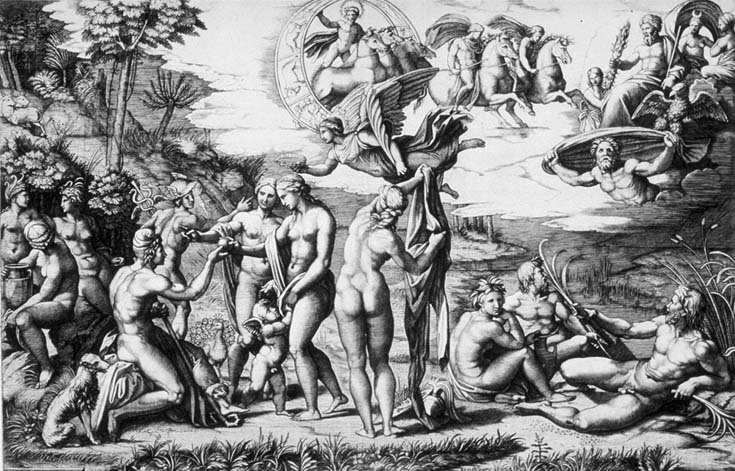
The Judgement of Paris by Marcantonio Raimondi (c.1510-20)

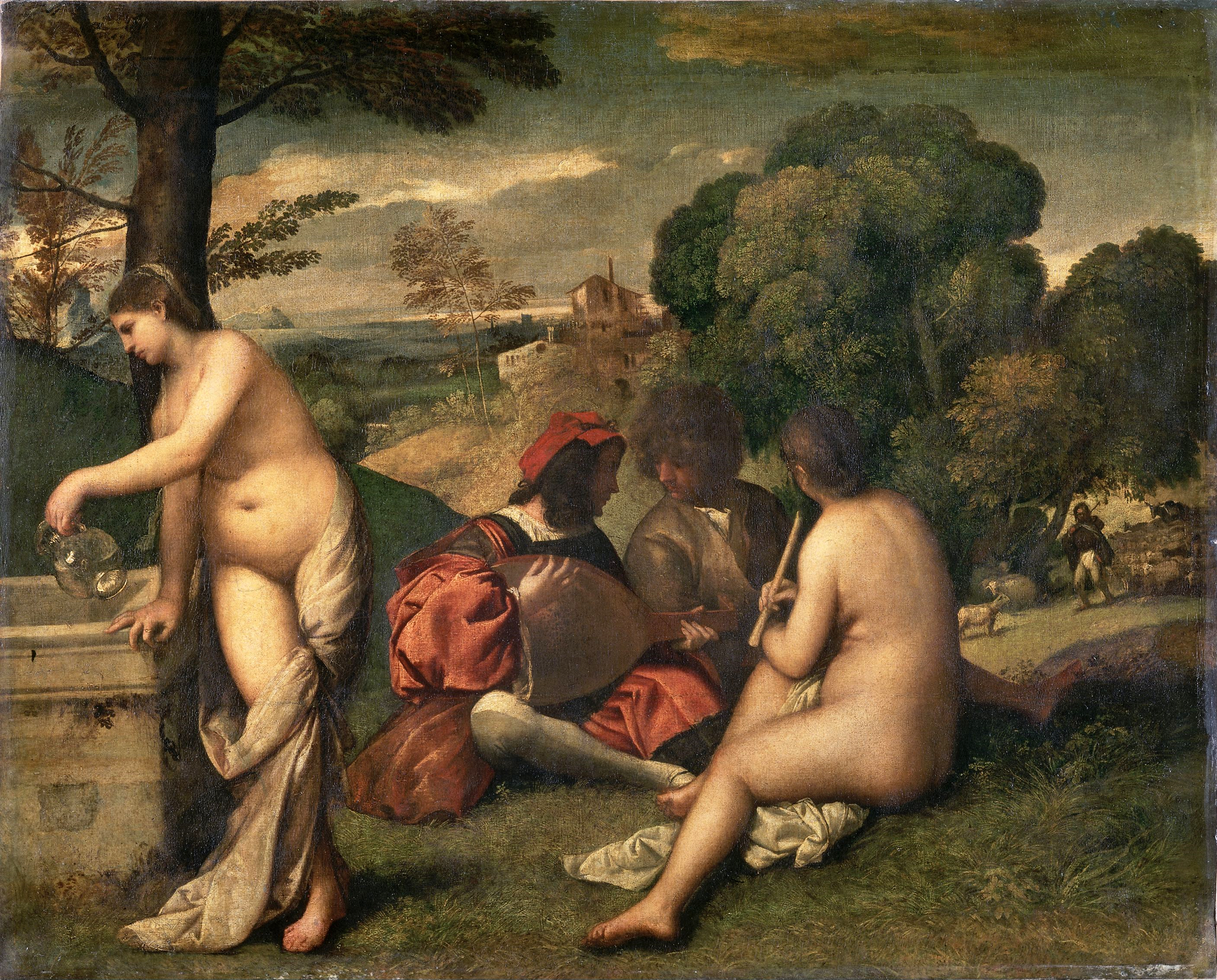
However, before looking at the subsequent reinventions of the work, it is interesting to note the possible sources of Manet’s inspiration as he set about painting this work. It is now thought that Manet was at least partly inspired by two works which would have been staple masterpieces of his time. The first is The Judgment of Paris by Marcantonio Raimondi (above). The engraving, which itself was based on a work by Raphael and copies of which would have been widely distributed at the time Manet set to work on Le Déjeuner includes a familiar composition in the bottom right hand corner. Here, a water nymph and two river gods are sat on the ground watching the judgment of Paris in poses which are exactly reminiscent of the poses adopted in Le Déjeuner sur l’herbe. It may well have been that when deciding to reference these poses, Manet was making a purposeful reference to the judgment of Paris as being like the judgment of paintings submitted to the Salon, the annual open art exhibition of Paris for which Manet’s work, as with every other artist’s work in Paris at that time, was intended. For Manet, it was important to be accepted by the unforgiving group of Salon judges, but only on his terms. Therein lay the difficulty. Nudes were very popular at the time, generally as mythological characters, and it is possible that in painting his very realistic confrontational nude, Manet was both aiming to please the Salon, while also sticking a finger up at their traditions – giving with one hand, and taking away with the other. As for Manet’s decision to mix his nude with clothed male characters, it is likely that Manet took inspiration from Pastoral Concert (c.1510) attributed to Titian and a gem of the Louvre collection. Here two contemporaneously clothed men are joined by two naked nymphs – but this was excusable being that the nymphs were inherently and permanently naked.

Pastoral Concert, attributed to Titan or Giorgione (Louvre Paris) c.1510

Here an interesting point arises. In subsequent xrays of Le Déjeuner sur l’herbe, it has been revealed that the pile of clothes on the left of the scene was actually a last minute addition by Manet. It is therefore highly possible that in first painting the scene, he wished to conform with Salon standards by painting two contemporaneously dressed men being visited by a classical nymph, or two (and thus representing an up-to-date reinvention of the Titian work). It was only towards the completion of his work, perhaps realising that despite his coarse brush stroked finish and striking pose of the nude, his work was not going far enough to be innovative and daring, that he decided to add the discarded clothes, thus transforming the nude from a nymph into an everyday woman (it is highly possible he would have added the light chiffon clothing to the woman in the background at the same time). In adding these clothes, Manet transforms the entire tenor of the piece, from mythological pleasantry into a scene of social scandal, as ladies of the time would have recognised the nude as a prostitute consorting with well-bred gentlemen, while the gentlemen in the audience would have undoubtedly felt judged and debased by the direct unwavering gaze of the nude as if to say: “remember me? I’m the one you had behind your wife’s back in Montmartre last night”.

Read more

The Daily Norm: Proud winner of three new blogging awards

It may be award season in the glitzy world of film, but here on WordPress, it appears that bloggers alike have become festooned with an abundantly generous spirit in not only reading The Daily Norm, but nominating it for three separate awards. In the last few weeks I have been humbled and overawed by the kindness and generosity of the following bloggers who each nominated me for a different blogging award:

Jackie Paulson for the Hope Unites Globally “HUG” Award

Anonparis for the Versatile Blogger Award 

Joy Returns for the Very Inspiring Blogger Award

And since on WordPress, nominations mean an instantaneous win of the award in question, I wanted to take this opportunity to thank those bloggers, and indeed all of my followers, for your amazing loyalty and interest in my blog. The Daily Norm takes a surprising amount of time to write and compile, quite asides from the time spent in painting new Norm works and making Norm sketches especially to share with you all. But your “likes”, comments and now totally unexpected awards make it all worth it. Since starting the blog back in November last year, I’ve had an incredible 38,000 hits and now have over 250 followers. It’s been an amazing start, and the blog provides me with an undeniably precious outlet for my creativity in a world, and indeed a city (London) where the creative spirit can become so easily subdued by the humdrum of ordinary life. Thank you all therefore for giving me a reason to blog. Long may it continue!

Now all of the three awards have slightly different approaches to what I am supposed to do upon receipt. All three require me to reveal certain hitherto unknown facts about myself, and to nominate other bloggers for these awards. Well, I admit, I am going to cheat somewhat in combining my response to the three awards, but since I have already undertaken the full process once already (when I received a Versatile Blogger Award last year) I don’t want to bore you all with what could become a rambling autobiography! I have therefore decided to compile a list of some of my “favourite things” a la Sound of Music, and then I will nominate a few of my favourite bloggers for each award respectively.

My Favourite Things

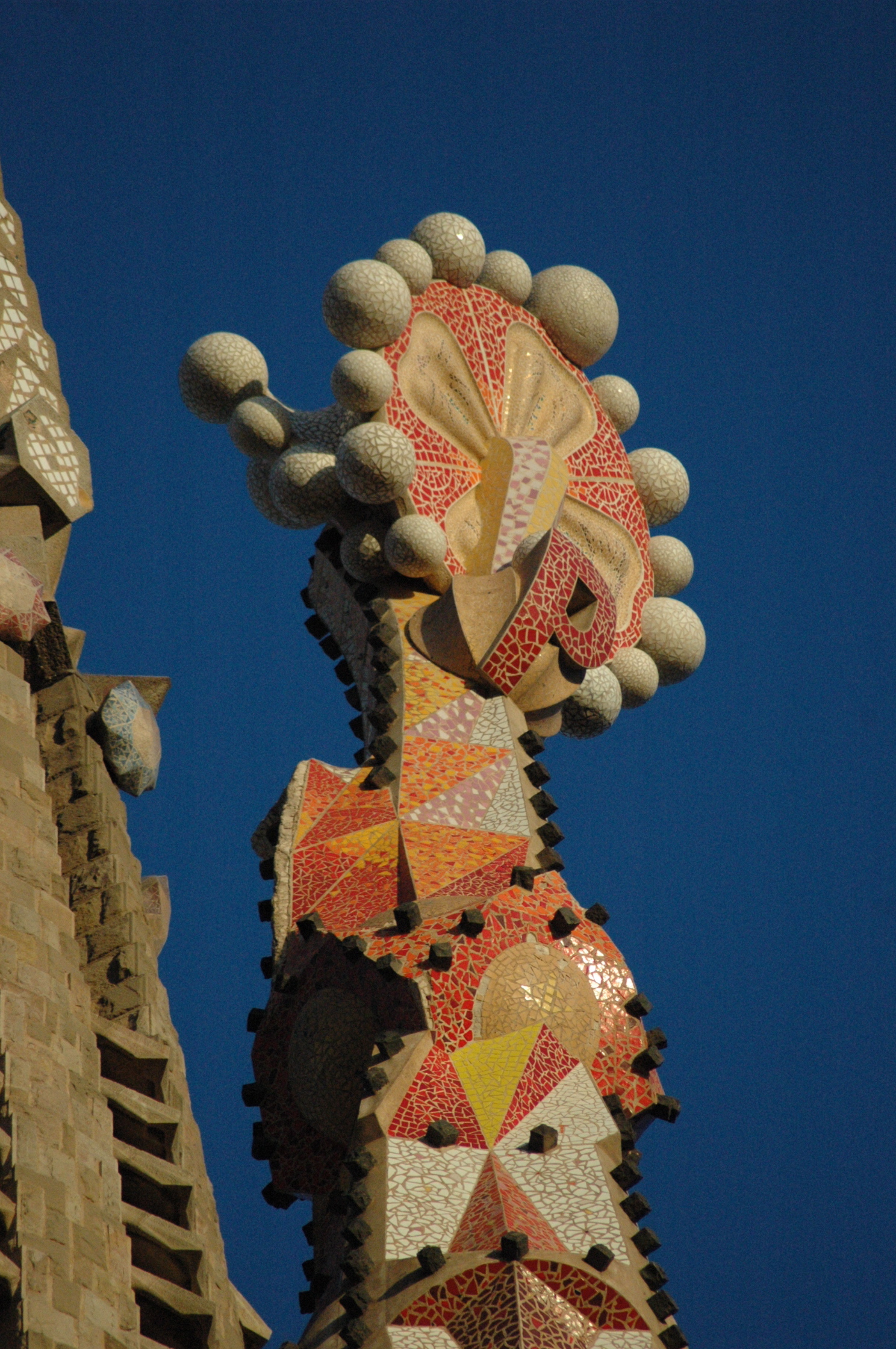
Detail of the Sagrada Familia, Barcelona

Favourite City – as regular followers of my blog will know, I am pretty much obsessed with Paris. But there is another city which fills my heart in equal measure – Barcelona. It’s a city which offers so much – a magnificent selection of modernist architecture from the likes of Antoni Gaudi, a picturesque gothic quarter, a vibrant fast-paced modern shopping district, a scenic port and a wide expansive beach – what more could you want, asides from great art, great restaurants and chic hotels, all of which Barcelona has in abundance.

Favourite Hotel – asides from the amazing Hotel Estheréa which was recently the highlight of my stay in Amsterdam, the other hotel which wowed was the EME Catedral Hotel in Seville. From it’s incredible situation bang opposite Seville’s gothic masterpiece cathedral, this hotel exudes moorish chic inside and out, with little pools of water covered with floating petals, contemporary bedroom decor and a pool-topped roof terrace to die for.

Favourite Café – It’s got to be Cappuccino Grand Café, either one of their picturesque Mallorca branches, or the stunningly situated branch in Marbella.

Favourite Restaurant – Again in Marbella – Restaurante Messina – a place exuding style – its degustacion menu presents an evening full of culinary delight but not at back-breaking prices.

Favourite Artist – This isn’t an easy question, and as an artist myself, it’s one I get asked fairly frequently. I think it has to be Salvador Dali, whose works are so technically brilliant, but whose incredibly comprehensive imagination pervades all of his works giving them a superb originality which hasn’t, in my opinion, been topped since. Generally speaking, my favourite artists tend to emanate from Spain (I also adore El Greco and Velazquez) although self-trained Henri Rousseau is also a huge favourite.

Favourite Painting – Again, this is a difficult one to pin down, but I think if I was forced to choose, it would have to be Las Meninas by Velazquez (housed in Madrid’s El Prado)- an iconic work for all the right reasons, but it is only when you see it in person that you can appreciate the startling use of light and shadow, as well as a brilliant composition and superb characterisation. Second place probably goes to another star of Madird, Guernica, by Picasso, while third place has to be Bar at the FoliesBergère by Manet, thankfully kept here in London.

Las Meninas, Velazquez (1656)

Favourite Icon – Frida Kahlo, self-trained Mexican artist, is a true inspiration to me, not least the way she used her art to channel her feelings of pain and despair throughout a lifetime of disability, always managing to look on the positives and create works out of pain which are still bursting with colour and vitality.

Favourite Food – White chocolate desserts

Favourite Drink – earl grey tea!

Favourite Music – lounge/jazz

Favourite Author – Carlos Ruiz Zafon – author of masterpieces such as Shadow of the Wind and Angels Game – I can’t wait for his next work to be published!

And the award goes to…

HUG Award

The HUG Award has very strict criteria as to what kind of blogs deserve this award. My nomination goes to Joy Returns – this is a very touching blog which seeks to change people’s perception of widows. It certainly seems to unite hope globally, and therefore seems highly suitable for this nomination.

Versatile Blogger Award

I would like to nominate the following excellent blogs which I follow regularly

MJ Springett – nature photohrapher

Photobotos – an amazing new photo, everyday

Conceptual art – frequently reblogging the work of other artists, this is a great blog to visit regularly to see what’s going on in the wordpress art scene

Very Inspiring Blogger Award

These blogs have inspired me in my day to day life, so who better to nominate:

Beautiful hello – a beautiful blog about art

All About Lemon – a brilliant blog about all things creative

Enjoy my adventure – Norwegian designer, living in Portugal

And, finally, a superb non-wordpress blog written by my dear friend Celia: Lady Aga  – a fantastic blog which places gastronomy where it ought to be – straight in our hearts. Check it out!

Ok this rambling thank you speech is now at an end. Heartfelt hanks again to all of my followers and nominators and congratulations to those I have nominated above – your blogs are fully deserving of recognition.