Skip to content

Posts from the ‘My Art’ Category

My Van Gogh Bedroom heads for Beijing!

A few months ago, I was on the brink of being inspired by another great artist in creating a further painting in my interpretative abstract collection when I received an important email. It was an artist who has inspired me several times before, the one and only master of colour and of passionately applied brush strokes, Vincent Van Gogh. The email I received flew into my inbox almost at the moment when I applied my signature to canvas. I had been contacted by the prestigious Van Gogh museum in Amsterdam. An opportunity had arisen, they told me, to submit contemporary artworks inspired by Van Gogh to be considered for a new globally important project. I did not hesitate to apply, and amongst those works I sent was the new work I had been working on when their email had been received: Vincent’s Bedroom, an abstractive interpretation of Van Gogh’s most famous work depicting his bedroom in the Yellow House in Arles, and presented here on The Daily Norm for the first time.

Vincent Bedroom FINAL

Vincent’s Bedroom (after Van Gogh) (2016, ©Nicholas de Lacy-Brown, acrylic on canvas)

A few weeks passed, and I was delighted to receive the news that not only had this new painting been accepted by the prestigious museum, but likewise two others painted when the same Dutch genius inspired me in the past: The Sweet Potato Eaters (based on Van Gogh’s famous The Potato Eaters) and my Norm version of his Self-Portrait with bandaged ear.

The months rolled by, during which time I waited in excited anticipation to hear from the museum what would happen to the images of my work. Thrillingly, it has now been announced that digital reproductions of my paintings will be included as part of a brand new interactive exhibition, the Meet Vincent Van Gogh experience, which will premier in Beijing in China before going off on tour. I may not have travelled anywhere near as far, but I am overwhelmed with pride that images of my paintings will be going in my place to the other side of the globe.

Vincent_van_Gogh_-_De_slaapkamer_-_Google_Art_Project

The original inspiration: Bedroom in Arles by Vincent Van Gogh (first version, 1888 – Van Gogh Museum, Amsterdam)

All that remains is to wish the Van Gogh Museum the best of luck in this exiting new venture, and to thank them in turn for their incredible support of my work. It’s not the first time I have been lucky enough to have my work included in an installation by that world-renowned museum, but it is a uniquely new experience for my works to go to Asia. You never know, I may get over to China myself to see them.

© Nicholas de Lacy-Brown and The Daily Norm, 2001-2016. Unauthorized use and/or duplication of the material, whether written work, photography or artwork, included within The Daily Norm without express and written permission from The Daily Norm’s author and/or owner is strictly prohibited. For more information on the work of Nicholas de Lacy-Brown, head to his art website at www.delacybrown.com

The Wrestlers (after Courbet)

I adore art, especially the masterpieces of old, and I spend a lot of my time gazing in admiration at the works of the old masters and the more recently celebrated artists of the 20th century. However, of all the works I see, only a few inspire me to recreate the work in my own way. Velázquez´s Las MeninasTitian’s Bacchus and Ariadne and Rubens’ Descent from the Cross are three such works which have recently driven me to paint the old masterpieces afresh, and a few weeks ago, another chance encounter had a similar effect.

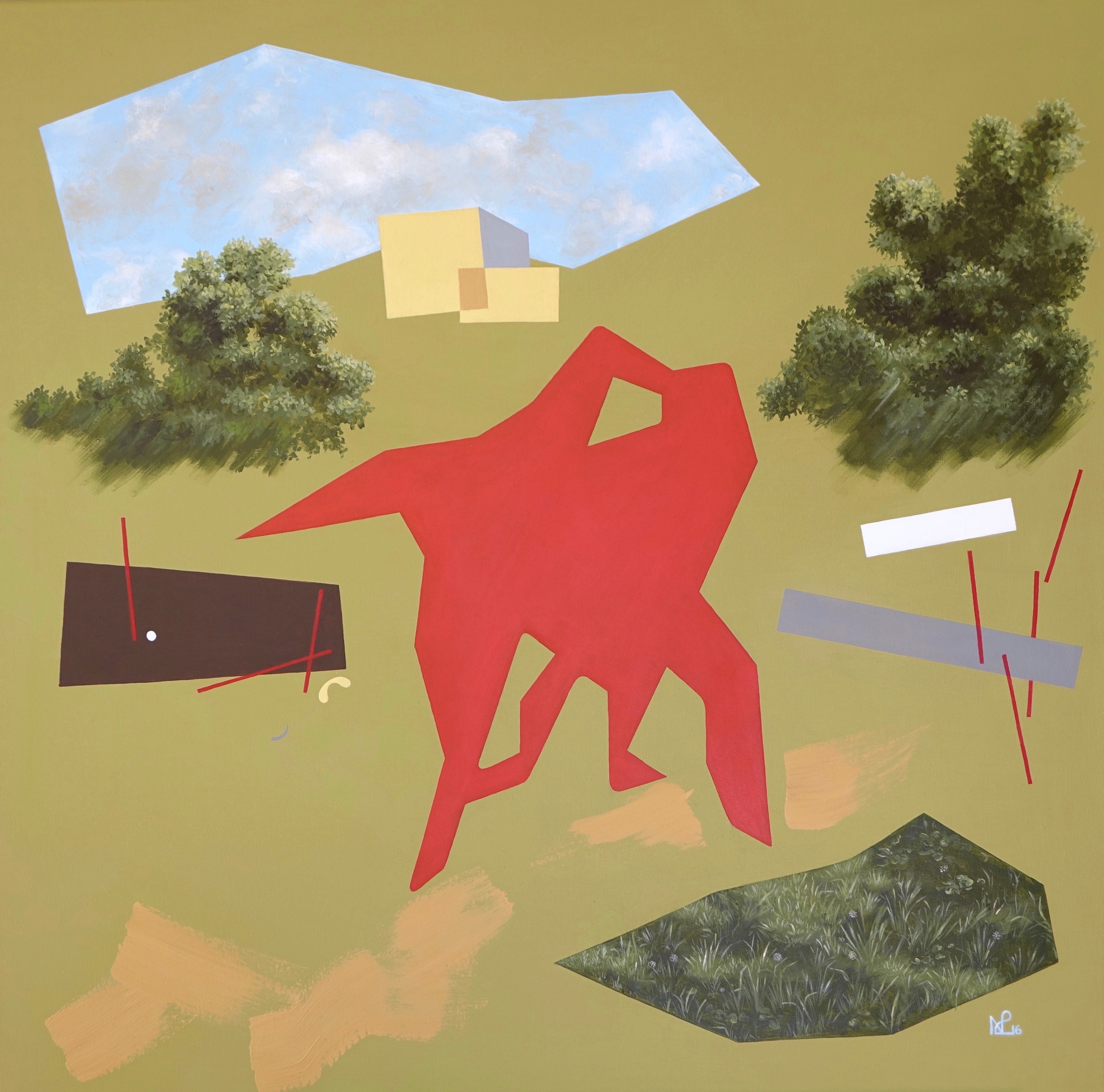
It was on Instagram in fact that I stumbled across this most recent inspiration – a work by the French master, Gustave Courbet, The Wrestlers – which the instagram user had also discovered for the first time. Painted in 1853, in the typical realist style for which Courbet was best known, and which saw him break away from the classical genre style of painting which was predominant in the mid-19th century, the work is not one I have seen before, perhaps because it is housed in the Fine Arts Museum in Budapest. But as soon as I saw it on the screen of my iPhone, I was struck by the incredible energy of the wrestlers, and the brilliant realism of their taught muscles, interlinked as they strain and struggle against each other – a fantastically visceral image in contrast with the refined crowds watching them from civilised stands in the background.

The Wrestlers FINAL

The Wrestlers (after Courbet), 2016 ©Nicholas de Lacy-Brown, acrylic on canvas

It didn’t take long for my own version of the image to form in my head, following my new interpretative abstract style with which to give the work a new treatment. I have included some realistic elements myself, in homage to Courbet, but for the most part my reinterpretation is highly abstracted, not least the central figures themselves. This was by far the most difficult element to complete, and it took me some 20+ attempts before I was happy with the final abstract form. Unsure whether to separate the figures, or paint them as one, I latterly settled on a unified form, since the wrestlers in Courbet’s original are so obviously, almost erotically combined into a single star-like figure. The cadmium red colour however was clear as soon as I saw, around the same time as discovering the Courbet work, a photo of a brilliant red Alexander Calder mobile against a green grassy background. I knew from that moment that my wrestlers had to be red, creating a central contrast which is key to the balance of the painting. And so it was born.

Gustave_Courbet_-_The_Wrestlers_-_WGA5462

The Wrestlers (1853) by Gustave Courbet (Fine Arts Museum, Budapest)

© Nicholas de Lacy-Brown and The Daily Norm, 2001-2016. Unauthorized use and/or duplication of the material, whether written work, photography or artwork, included within The Daily Norm without express and written permission from The Daily Norm’s author and/or owner is strictly prohibited. For more information on the work of Nicholas de Lacy-Brown, head to his art website at www.delacybrown.com
Shakespeare 400: Richard III

It probably will not have escaped your notice (particularly if you live in the UK) that this year marks 400 years since the death of Britain’s most famous ever playwright and poet, William Shakespeare. And across the country and beyond there has been something of a resurgence of interest in his work. This, together with the coincided discovery of a Shakespearian theatre troupe out here in Mallorca aroused my own Bard reawakening, not least because I have a little anniversary all of my own – some 20 years since I painted, at the tender age of 13, my first ever substantial collection of paintings which just happened to be a scene from every one of Shakespeare’s 37 plays.

So with one thing leading to another, it wasn’t long before I felt old inspirations stir up, and the decision to once again tackle Shakespeare as an inspiration for my art took hold.

Richard III (2016 ©Nicholas de Lacy-Brown, acrylic on canvas)

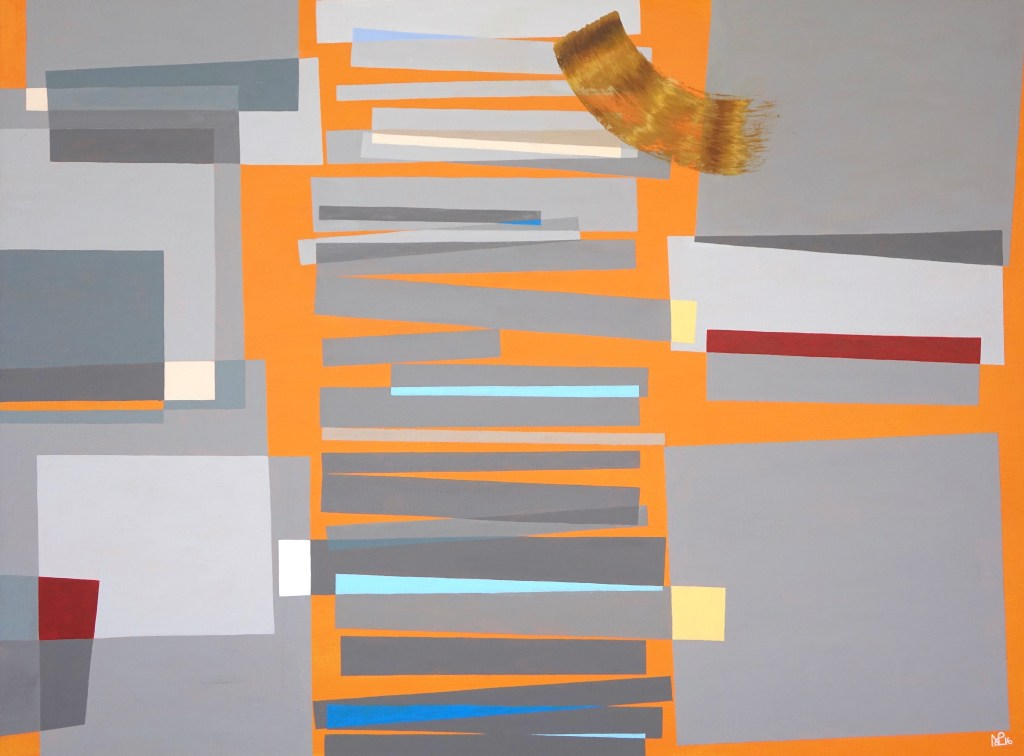
Richard III (2016 ©Nicholas de Lacy-Brown, acrylic on canvas)

First off the rack is this painting of one of the Bard’s history plays, Richard III. Painted in my new style, interpretative abstraction, the work appears simple but in fact represents the story of Richard III in three clear aspects. First, the three piles of what one could mistake for bricks or books represents, at the painting’s most simplistic visual level, the “III” of Richard in roman numerals. The second meaning is the allusion to the famous scene whereby the Duchess of York (Richard’s mother), Queen Elizabeth (his dead brother’s wife) and Queen Margaret (the previously exiled wife of the former King Henry VI) meet together and bemoan and curse the Machiavellian rise of Richard III to power.

That rise is finally, and most importantly represented by the same three pillars of blocks, each of which depict an important part of the story: The central column is the staircase which tracks Richard’s bloody ascent through the rungs of power to be King, with the slash of the golden crown shining boldly at the top; the column on the right is the Tower of London and in it the two yellow cubes are the two blond princes, the true heirs to the throne who Richard famously kills in the tower in order to clear his path to the crown; and the column on the left, with its overlapping grey forms like medieval armour, represents the Battle of Bosworth at which Richard was finally defeated.

It seems remarkable that some 20 years have passed since I painted my teenage Shakespeare collection, especially now as I rediscover the same excitement which his plays engendered in me all those years ago. Now I’m looking forward to the challenge of finding them again, and painting them afresh (albeit perhaps not all 37…!).

© Nicholas de Lacy-Brown and The Daily Norm, 2001-2016. Unauthorized use and/or duplication of the material, whether written work, photography or artwork, included within The Daily Norm without express and written permission from The Daily Norm’s author and/or owner is strictly prohibited. For more information on the work of Nicholas de Lacy-Brown, head to his art website at www.delacybrown.com

Interpretative Abstract: Cala Sant Vicenç

After some months now of pursuing a new artistic style, I think I’ve finally hit upon a way to describe it. In cleansing my forms and decluttering my method of expression, there is something decidedly abstract about my new work. But by its nature, painting the abstract is to strip an image of almost any recognisable qualities, and instead to create something entirely without figuration. My paintings do not do that –  more often than not they aim to reinterpret something recognisably visual, whether it be an famous painting from the history of art, or an Easter parade. Yet those interpretations are in many ways decidedly abstract – simplistic, geometric. And therefore I think that the best way to describe them would be to call them Interpretative Abstracts. That way, at least, I feel I am on my way to understanding what it is I am setting out to create.

Interpretative Abstract: Cala Sant Vicenç (2016 ©Nicholas de Lacy-Brown, acrylic on canvas)

Interpretative Abstract: Cala Sant Vicenç (2016 ©Nicholas de Lacy-Brown, acrylic on canvas)

This week I am featuring the newest work off my easel, in which I have attempted to extend my new interpretative abstract style to the simple landscape. Taking one of the most generic views in Mallorca, the jagged rocks of the Cala Sant Vicenç, and simplifying every aspect of the landscape, the result is a painting which is at once a place, and at the same time a simple composition.

 Nicholas de Lacy-Brown and The Daily Norm, 2001-2016. Unauthorized use and/or duplication of the material, whether written work, photography or artwork, included within The Daily Norm without express and written permission from The Daily Norm’s author and/or owner is strictly prohibited. For more information on the work of Nicholas de Lacy-Brown, head to his art website at www.delacybrown.com


Abstract #26: Todos Rectos

I have long been inspired by the Semana Santa parades which fill the streets of Spain with their melancholic processions at Easter time. Too many times I have berated the confusion of ignorant outsiders who see the parades as anachronistic, or worse still, reminiscent of the unthinkable 3Ks. In truth, they make for a stirring spectacle, no matter that their devotional repercussions are undoubtedly far weaker than they might have been 100, even 50 years ago. Yet with the sinister pointed masks of the nazareños, the swinging thrones lifted on high allowing a precious statue of Jesus or the Madonna to make its annual outing into the streets, and their moving brass band harmonies resonating throughout cobbled streets, Spain’s Easter parades are for me a highlight of the annual calendar.

Readers familiar with my blog will know that this will not be the first time I have painted Spain’s Easter parades. They feature in my Seville Triptych, my study of Domingo de Ramos, my Semana Santa code, and my painting Catholicism CatholicismBut these solemn spectacles never fail to move me, and it was during the afternoon in the week immediately preceding the parades that a moment’s reflection on what was to come brought this image sweeping before my eyes. That same evening I bought my canvas and set to work.

Abstract #26: Todos Rectos (2016 ©Nicholas de Lacy-Brown, acrylic on canvas)

Abstract #26: Todos Rectos (2016 ©Nicholas de Lacy-Brown, acrylic on canvas)

Featuring all of the various characteristics of the parades; the pointed hats of the nazareños, the enthroned statues of Jesus and Mary, the candles, trumpets and incense smoke, this new painting encapsulates Semana Santa, with each aspect reduced into an abstract form typical of my new style, and with a highly limited colour palette of deep blood red, yellows and touches of blue.

Asides from the forms, the title of the piece is something of a play on words. Todo recto in Spanish means straight on, like the direction of the parade, led by the trumpet. But to be todos rectos is to be literally all right, referring not only to the moral righteousness of those involved in the procession, but also eluding to the right wing politics with which the Spanish Catholic church was always historically associated. And of course to be recto is also to be straight. Enough said.

It’s a painting with which I am wholeheartedly delighted. A finely balanced addition to my new collection, and the many of my works which have been inspired by Easter in Spain.

© Nicholas de Lacy-Brown and The Daily Norm, 2001-2016. Unauthorized use and/or duplication of the material, whether written work, photography or artwork, included within The Daily Norm without express and written permission from The Daily Norm’s author and/or owner is strictly prohibited. For more information on the work of Nicholas de Lacy-Brown, head to his art website at www.delacybrown.com
Soller: First touch of summer

Although, as I write, some clouds have descended over Mallorca, this moment is the first in a long time when the sun has not shone. And while the sunshine in March often came accompanied by a chilly wind, reminding of winter, last weekend an intensity of heat seemed to welcome in the first touch of summer.

The moment I really felt it was when I was sitting with my family at a sunny table on the Port of Soller. As sun rays bounced across the water of that tranquil marina, through my glass of chilled white wine and onto my face, I became truly entranced by the elysium of summer. Around me, I was enveloped by one of the most beautiful harbours in Mallorca – a natural almost 360 degree inlet ringed by spectacular mountains and packed with a few rows of little white washed houses which to me recall the French Riviera.

Soller FINAL

Soller (2016 ©Nicholas de Lacy-Brown, acrylic on canvas)

It was in that moment that this painting clarified as a mental vision in my mind. I jumped up, asked the waitress for a pen and paper, and on the back of a till receipt made a sketch. A few days later the painting is done. Its key is its simplicity of composition, which allows the viewer the space to breath and reflect on a work filled with the soft colours of the Mediterranean, and to think of their own encounters with this most wonderful part of the world, when the sun first touched them after a long dull winter…

© Nicholas de Lacy-Brown and The Daily Norm, 2001-2016. Unauthorized use and/or duplication of the material, whether written work, photography or artwork, included within The Daily Norm without express and written permission from The Daily Norm’s author and/or owner is strictly prohibited. For more information on the work of Nicholas de Lacy-Brown, head to his art website at www.delacybrown.com

Bacchus & Ariadne

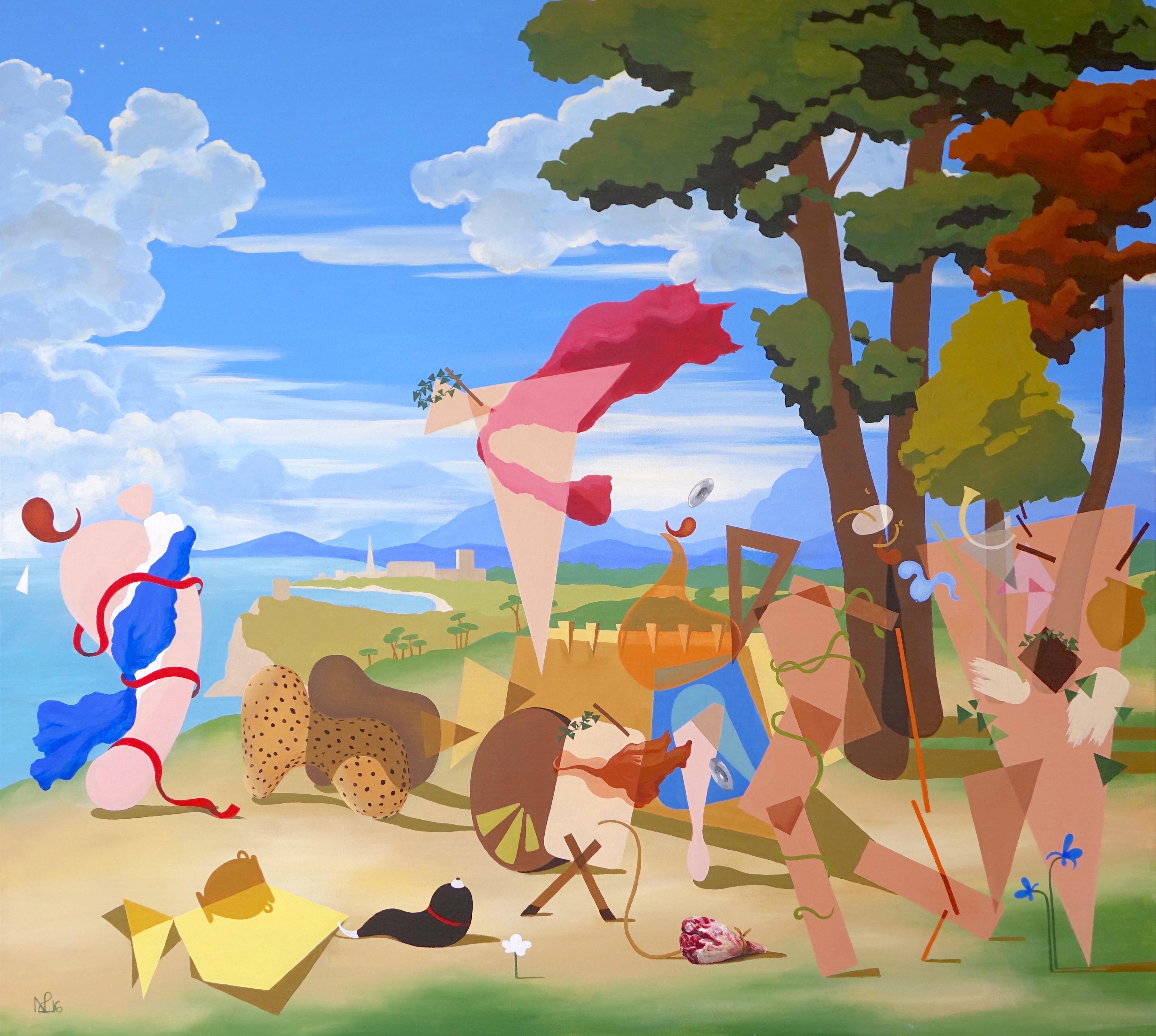
The year toils on, March is upon us, and in line with my new year’s resolution, I have made painting the very heart of my year’s endeavours. In that vein, I am progressing well with a new collection of abstract interpretations, not only of my own experiences, but also of well known masterpieces. Following hot on the heels of my interpretations of Velazquez’s Las MeninasI have now painted what must be my favourite of my entire new collection, an interpretation of Titian’s masterpiece, Bacchus and Ariadne.

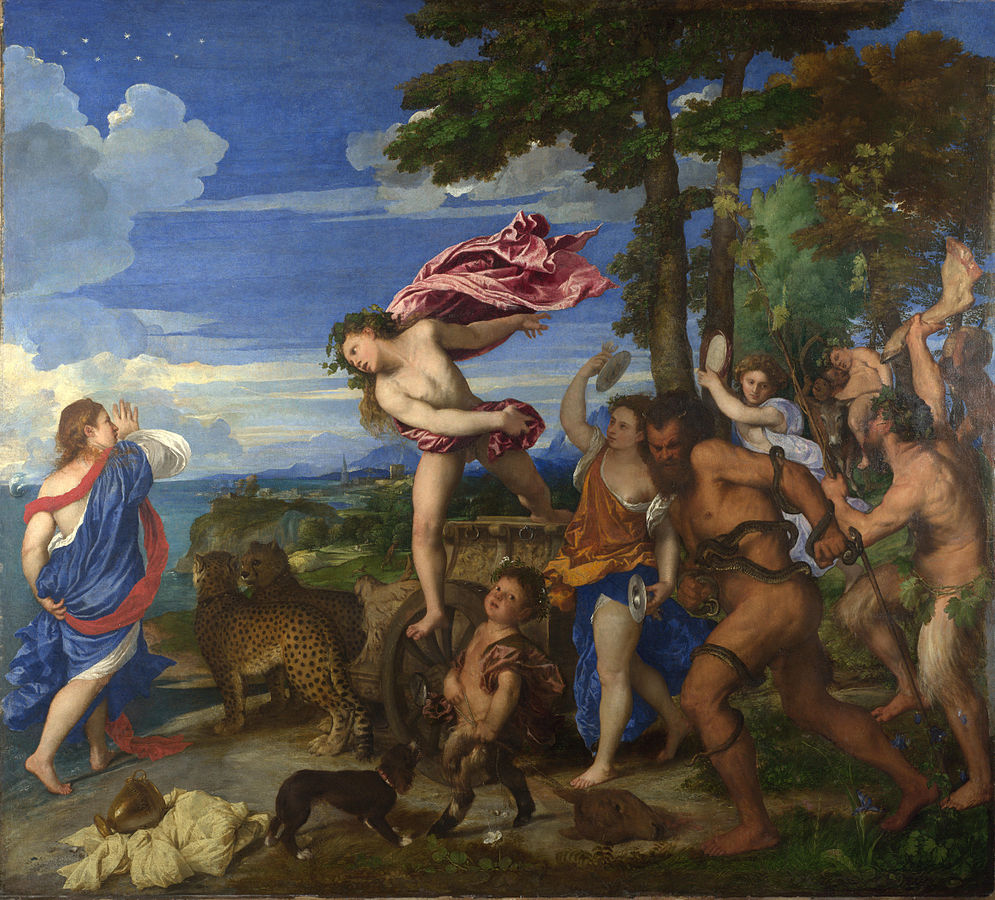
With its stunning sky of ultramarine and the sheer energy of the central character, Bacchus, jumping into the air, the painting has always been one of my absolute favourites in the collection of The National Gallery in London. Painted as part of a cycle of paintings on mythological subjects produced for Alfonso I d’Este, the Duke of Ferrara, the painting is based on a tale told by Roman poets Catullus and Ovid. It depicts Ariadne, daughter of Minos, being deserted by her lover Theseus on the island of Naxos. She is rescued by Bacchus, god of wine who, in a chariot drawn by two cheetahs, sweeps into the scene with his retinue of drunken followers in a campaign to seduce Ariadne. In so doing, he promises her the sky, where, he declares, she will become a constellation of stars, like the Northern Crown which can be seen glimmering in the sky.

Bacchus Ariadne FINAL

Bacchus & Ariadne (2016 ©Nicholas de Lacy-Brown, acrylic on canvas)

995px-Titian_Bacchus_and_Ariadne

Bacchus and Ariadne by Titian, 1522-23 (National Gallery, London)

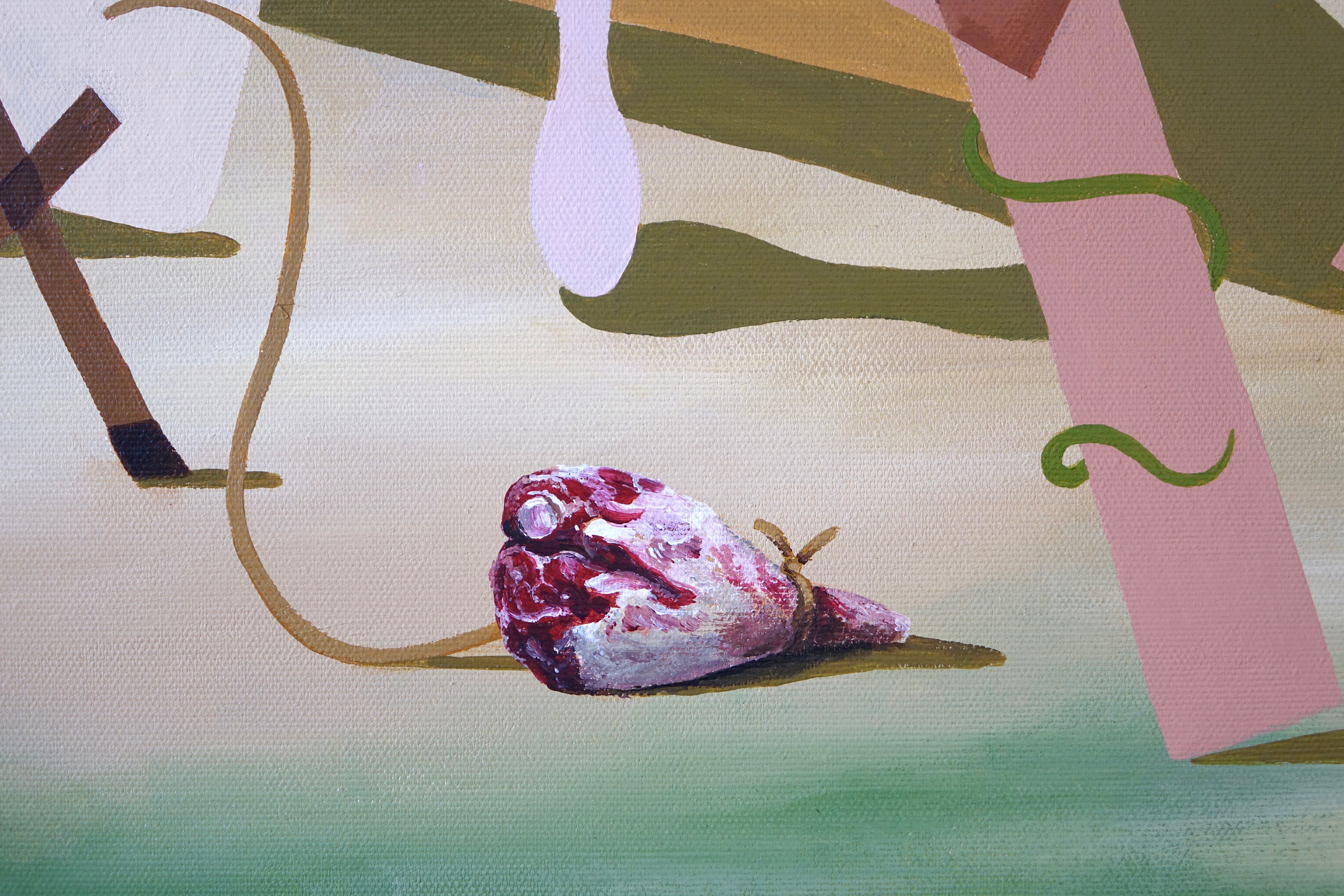
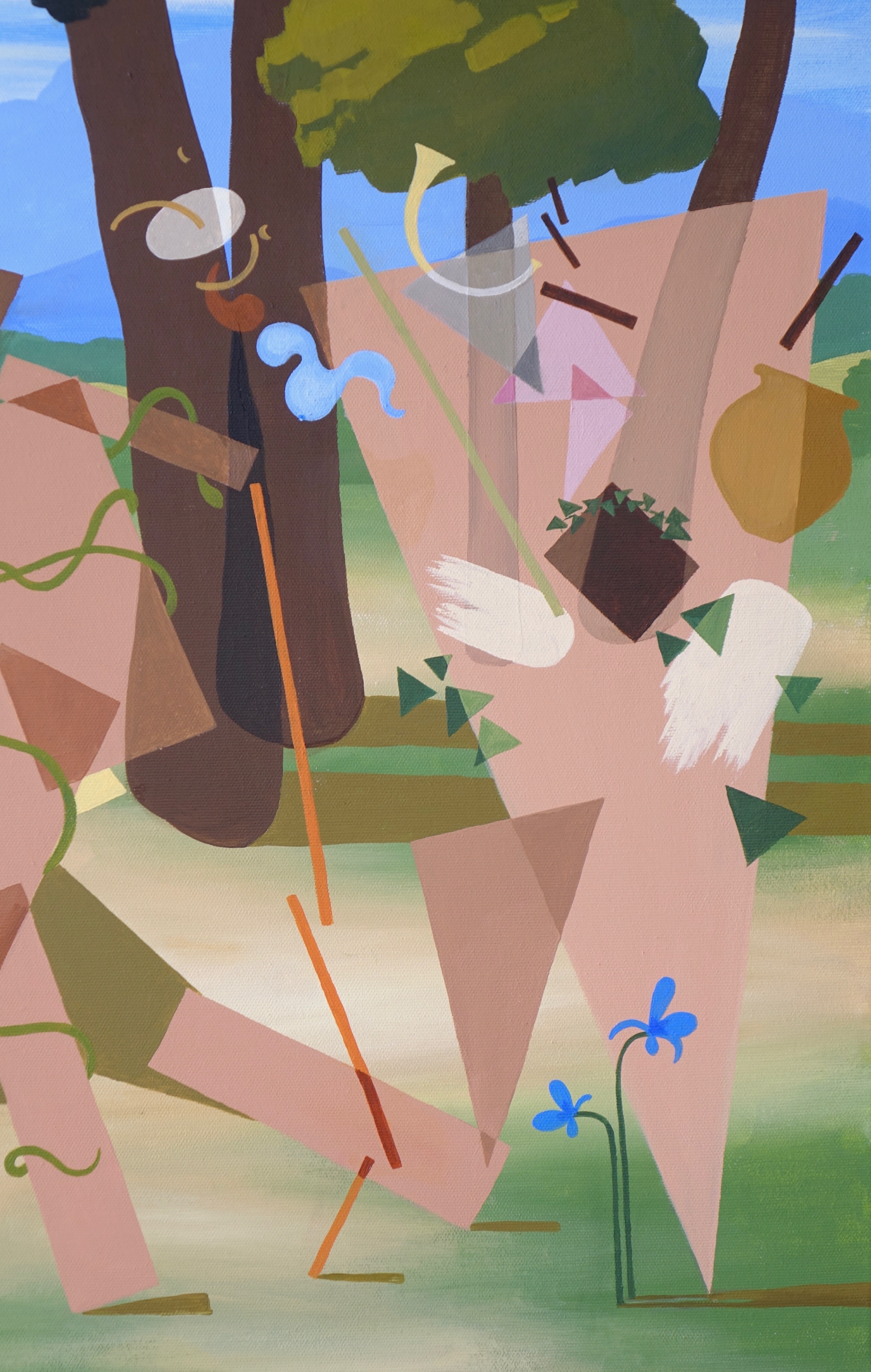
The composition and the colours are so striking that in painting my own version, I wanted to change neither, instead choosing to retain the stunning blue sky with its rolling fair-weather clouds, while in front simplifying the forms of the characters, the trees and the landscape. In finding ways to “abstract” the figures, I discovered various triangles across the composition, and used this shape, in particular, in depicting the masculine figures in the scene, while for the feminine figures, I used curving forms.

DSC09206DSC09209DSC09205

Nothing can repeat the true genius of the Venetian master, Titian, but my version of this painting, created in perfect ratio to the original, is certainly something of a high point in my new collection of a freshly revolutionised style.

© Nicholas de Lacy-Brown and The Daily Norm, 2001-2016. Unauthorized use and/or duplication of the material, whether written work, photography or artwork, included within The Daily Norm without express and written permission from The Daily Norm’s author and/or owner is strictly prohibited. For more information on the work of Nicholas de Lacy-Brown, head to his art website at www.delacybrown.com

Barcelona (The Yellow Painting)

I’m on a new road, it’s an artistic revolution, and as part of the journey my art has become abstracted. I have discovered the joys of simplicity, like breathing the freshness of countryside air after years spent in a congested city. Perhaps, now I come to think about it, my new style is the subconscious manifestation of my new life in Mallorca, a freshness of mind which has opened up since my departure from London.

Whatever the cause, my mind is alive with new ideas, and when I recently spent the Valentine’s weekend with my partner in Barcelona, this new painting, simply entitled Barcelona (but better known in our household as “The Yellow Painting”) leapt into life. It was inspired primarily by the textures and experience of our hotel room, whose luxurious black bedspread inspired the black form in the centre of the painting, while the rose is of course the very symbol of Valentines. Meanwhile amongst the simplified shapes, the four spires of one face of Gaudi’s Sagrada Familia can be found, as well as the curved square blocks of the Eixample area which predominate the shape of the city when seen from above, and which also appears in the simplified rose.

Barcelona FINAL

Barcelona (The Yellow Painting) (2016 ©Nicholas de Lacy-Brown, acrylic on canvas)

But this painting is so much more than what is plainly visible. It is a feeling, a sensation – moments of happiness in a weekend of discovery. When we felt free, and excited, and reinvigorated by the city atmosphere. And its predominant colour – a yellow full of hope – just about perfectly sums up the optimism which this new period of creativity has engendered.

© Nicholas de Lacy-Brown and The Daily Norm, 2001-2016. Unauthorized use and/or duplication of the material, whether written work, photography or artwork, included within The Daily Norm without express and written permission from The Daily Norm’s author and/or owner is strictly prohibited. For more information on the work of Nicholas de Lacy-Brown, head to his art website at www.delacybrown.com

Las Meninas: Third Interpretative Exercise

I’m having an artistic revolution, and my head is spinning with shapes and colours. Ever since my last encounter with Velazquez’s Las Meninas last November, a seed has been sewn and new buds of Spring are rapidly taking shape as they shoot forth from my imagination to the tip of my paintbrush.

The latest result of this creative flowering is this, the third in my own Las Meninas exercise, each canvas taking a new approach to painting one step further. While in the second of the series, I reduced the famous figures of Velazquez’s work into simplified abstract forms, but maintained the familiar composition, in this third experiment, I have stripped the painting almost entirely of its compositional values, maintaining only the basic three dimensional construct of the room. As for the remainder, all of the shapes which can be found in the second painting are now displaced, recoloured and fragmented, distributed in an energetic whirl of abstracted movement which is entirely free in its composition.

Las Meninas 3 FINAL

Las Meninas: Third Interpretative Exercise (2016 ©Nicholas de Lacy-Brown, acrylic on canvas)

Had I come across a work such as this in an art gallery, I may have assumed that it was easy to paint. Yet as this painting taught me, it was far from simple. The delicacy with which a composition of this nature needs to be approached, not just technically (there are an awful lot of straight lines) but also compositionally, cannot be underestimated. I would spend long periods staring at the painting, trying to work out where the next shape should be placed, knowing that one incorrect angle or placement could throw out the entire energy of the piece, reducing the painting into something mediocre, devoid of its own story.

As it is, and with a few wrong turns rectified along the way, I am delighted with the final composition as it turns out. For me it is a composition rejuvenated, a painting which appears to burst before your eyes. And most importantly it retains, for me, some of the key ingredients of Las Meninas, albeit presenting them in an entirely different way.

© Nicholas de Lacy-Brown and The Daily Norm, 2001-2016. Unauthorized use and/or duplication of the material, whether written work, photography or artwork, included within The Daily Norm without express and written permission from The Daily Norm’s author and/or owner is strictly prohibited. For more information on the work of Nicholas de Lacy-Brown, head to his art website at www.delacybrown.com

Las Meninas: Second Interpretative Exercise

There are some art exhibitions that you go to that simply have the capacity to strike deep. Many shows are pleasing, others interesting, but then there are those which you remember for ever. I’ll never forget for example Frida Kahlo or Henri Rousseau at Tate Modern, Tamara de Lempicka at the Royal Academy, Dali at the Centre Pompidou or Da Vinci at the National Gallery London. Now to that list I add the Kandinsky retrospective at CentroCentro in Madrid, not because it was any better than the Kandinsky I saw many years before at Tate, but simply because the combination of time and energy and who know’s what combined to leave me utterly inspired.

When, the next day, I walked into the Prado and saw Velázquez’s Las Meninas once again, something shifted in my head, and I left an artist converted.

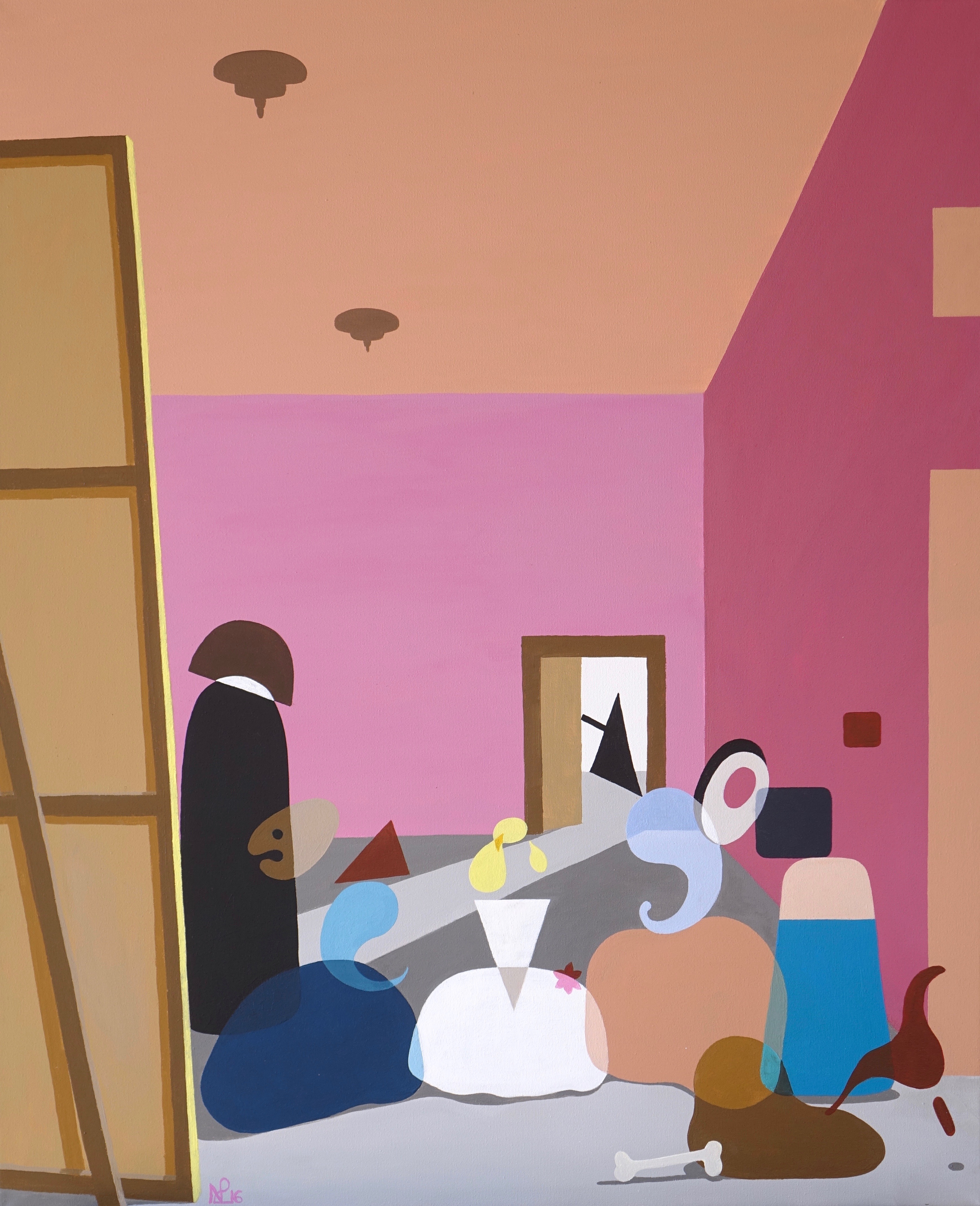
I started my reinterpretations of Las Meninas shortly after the whirl of the Christmas season was over, and my first, Las Meninas (In Our Time) I shared with you a few weeks ago. But my new project was far from over, and this painting, shared today, was the one which leapt into life before my eyes that day in the Prado Gallery when Kandinsky was still very much on my mind.

Las Meninas 2 FINAL

Las Meninas: Second Interpretative Exercise (2016 ©Nicholas de Lacy-Brown, acrylic on canvas)

Las Meninas: Second Interpretative Exercise borrows from Velázquez’s composition, but otherwise radically simplifies the forms of his dramatic personæ, and swaps the dark browns and neutral shades of his painting with a vibrant almost pop-art palette. The result is an image which pleases me incredibly. It is at once abstract but recognisable, tidy but surreal. I had great fun in reimagining each piece of the painting – for example painting the dog’s stretched out arm as a bone, and the nun’s head like a piece of sushi – and best of all, I know that this is only the beginning. Abstraction and simplified forms are spinning around my head. Ideas are overflowing, and I can’t sit still for a need to paint.

It’s why I’ll always remember that Kandinsky show, because it switched on a light in my head which has long remained dormant.

© Nicholas de Lacy-Brown and The Daily Norm, 2001-2016. Unauthorized use and/or duplication of the material, whether written work, photography or artwork, included within The Daily Norm without express and written permission from The Daily Norm’s author and/or owner is strictly prohibited. For more information on the work of Nicholas de Lacy-Brown, head to his art website at www.delacybrown.com