Skip to content

Posts from the ‘Review’ Category

North Road Restaurant: Another notch in the Danish gastronomic revolution

Denmark, the country that brought us Lego, the Little Mermaid and a whole host of funky, fresh and chic interior design ideas is currently leading the world with its gastronomic innovation. René Redzepi’s two-Michelin starred extravaganza, Noma, has been awarded the ultimate accolade of Best Restaurant in the World for the last three years in a row, stealing the crown from the extended reign of El Bulli long before it closed.
While Noma will soon share its wiles with the best of British when it opens up in Claridge’s during the Olympics (i.e. those who could afford it/ were clever enough to buy a £195/head ticket before they sold out practically as soon as the event was announced), another star of culinary Denmark has drifted over to the British shores and, mercifully for we whose visits to Copenhagen are at best infrequent, is here to stay – I am of course talking about Christoffer Hruskova, whose restaurant, North Road is the bright new star of Smithfield’s market/ St John’s Road and was the location of my dinner on saturday night.

I booked up North Road upon the recommendation of my in-the-know foodie-friend Celia, whose nose for fine-dining is so refined that I would willing follow her blindfolded throughout my life, so long as she gave me plenty of slices of her fantastic Ombre cakes en route. It’s not a cheap option, but as it was the third anniversary of my first date with my partner, we at least had an excuse for a splash. And with the promise of a tree made from candy floss, who on earth could resist?

Just to start…”snacks” of quail eggs, smoking potatoes and pork crackers
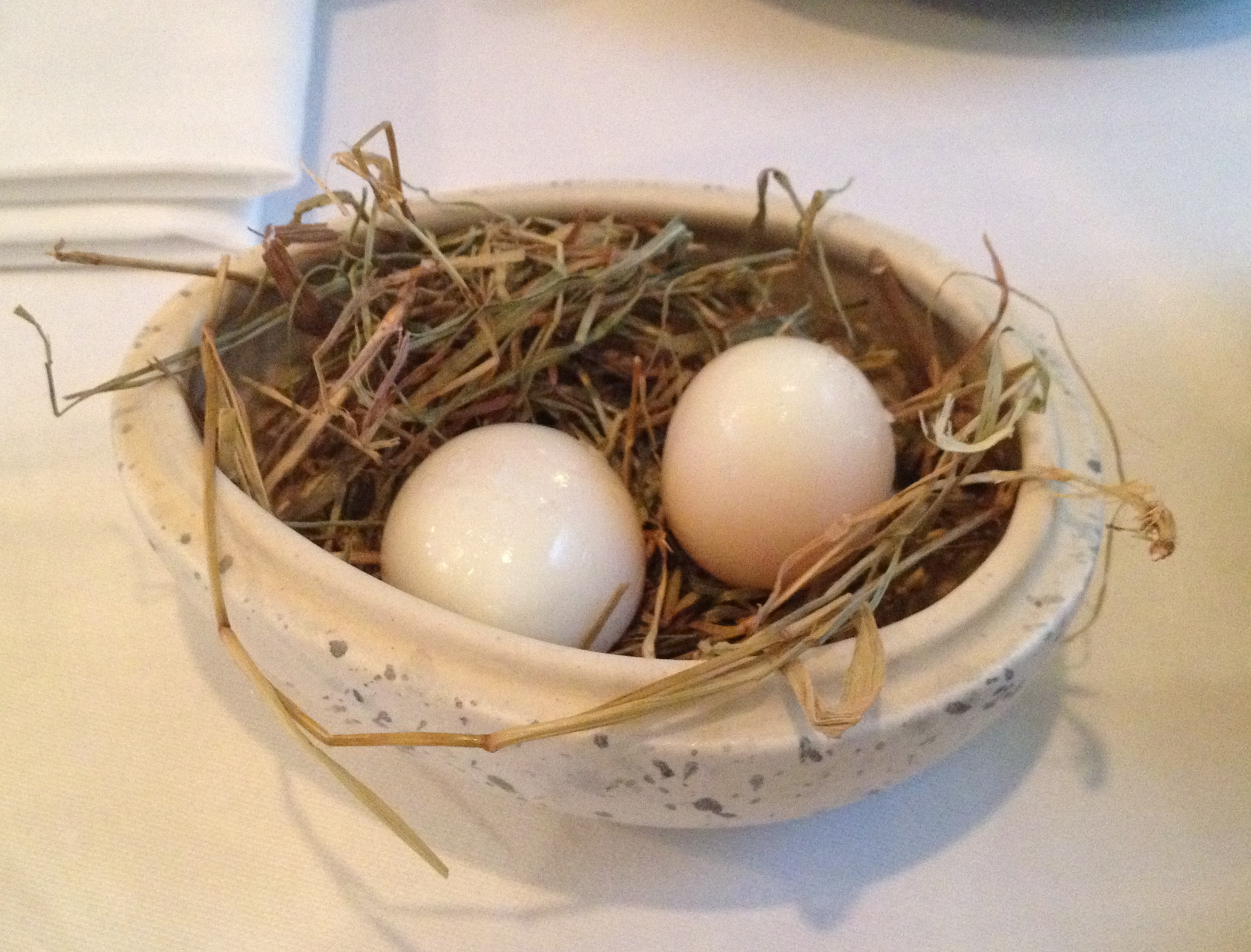
Upon entering the restaurant, we were immediately struck by the sophisticated elegance of Denmark which so enthralled me upon visits to the Illum Bolighus department store in Copenhagen. So too were we instantly wooed by the attentive but very friendly welcome of the staff. Soon after being seated, the enticing smell of smoke filled our nostrils as we were treated to some starting snacks – Jersey Royal Potatoes smoked in hay and served with an exquisite mayonnaise, pickled quails’ eggs and pork crackling which was like a giant fluffy prawn cracker. My partner’s eyes met mine across the table and with that knowing look that occurs between couples who have gradually merged in one over the years of their relationship, we knew that this meal was going to be good. Very, very good.
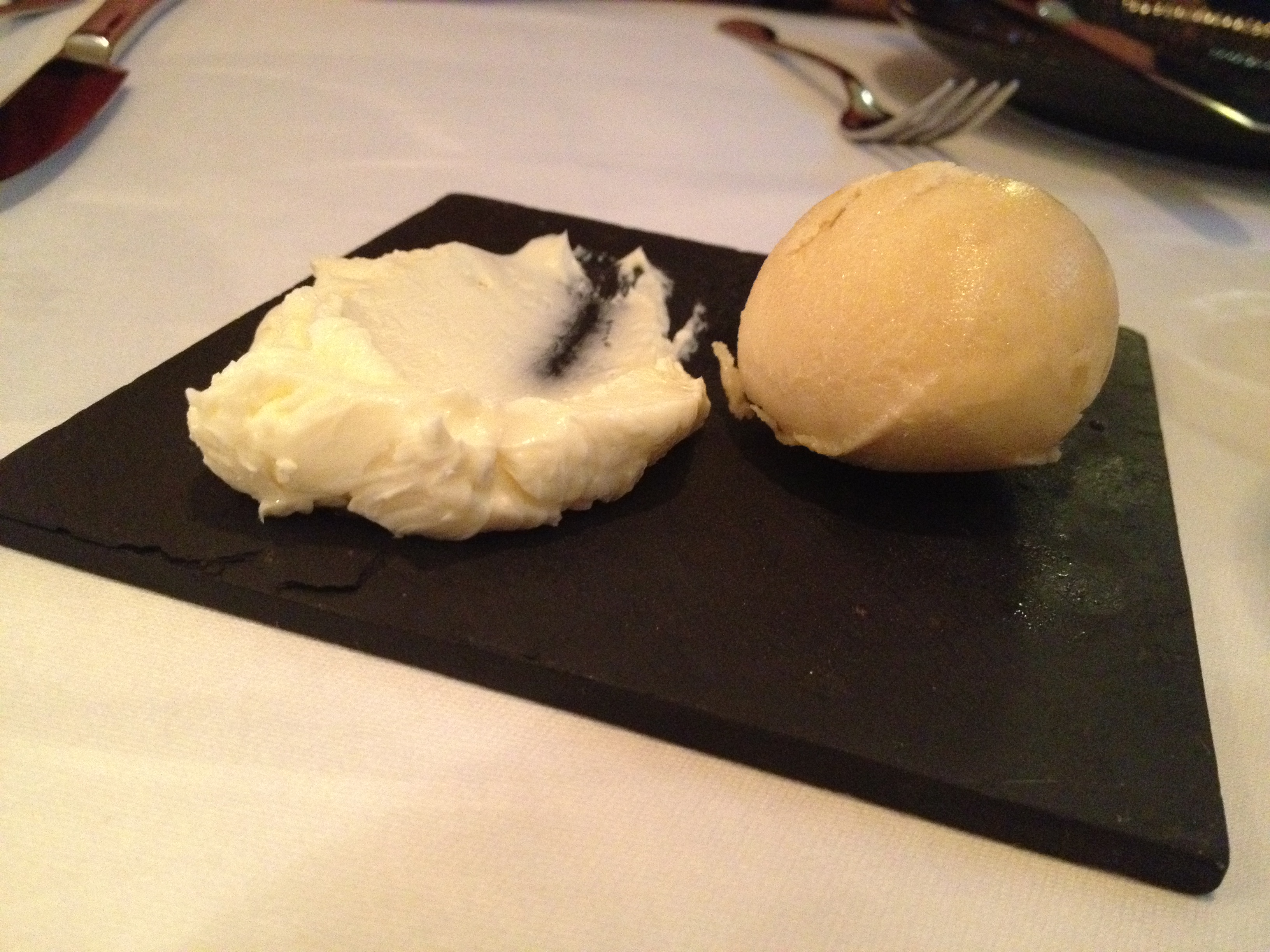
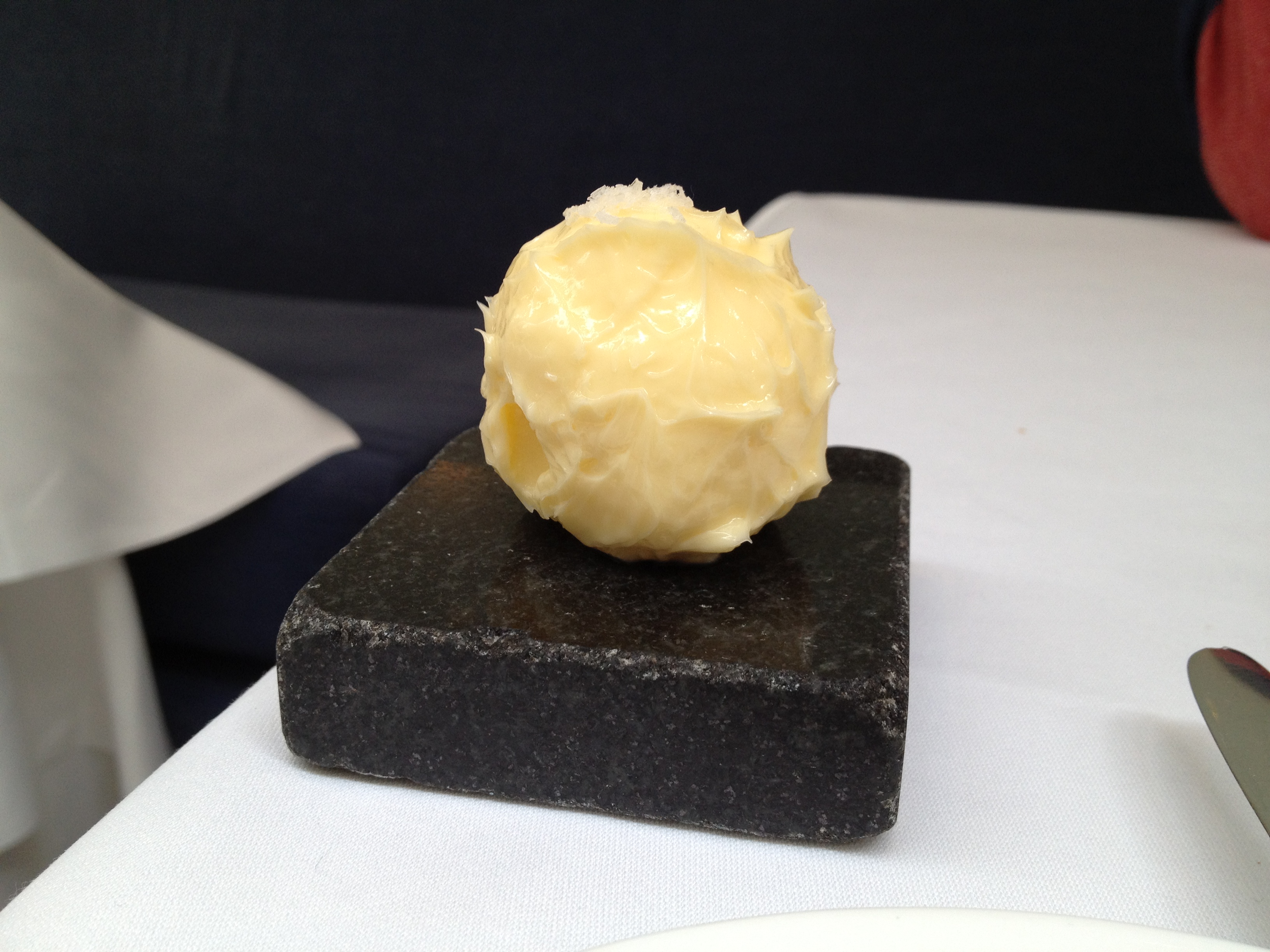
Caramalised butter…to die for

We opted for the 7 course tasting menu – it would be foolish not to, as 7 courses is only £7 more than the 5 course alternative. But before the dishes began rolling out with perfectly timed pauses between each, we were treated to a bag of little bread rolls and – wait for it – caramalised butter and a buttermilk butter. Oh dear god, let me tell you, that caramel butter was so exquisite in my mouth I almost ate the whole ball. It was crystallised and punctuated with occasional shards of salt – a rich sugary caramel which melted upon the palate before suddenly releasing a smooth butteriness. All I can say is that having enthused so fervently about this to the waiter, he told me how to make it, so future guests at my dinner parties – prepare to be wowed.

Razor claims – a masterpiece on a plate

Onto the food. First up was scottish razor clams with coastal herbs, organic cream and parsley. This was art on a plate. The exquisite marbling of the cream and the green parsley reduction was so beautiful, that even when lifted up on a spoon it made multi-marbled pictures worthy of a Turner prize. The clams were incredibly sweet and delicate – flavours of rose petals, the sea, and generalised freshness came flowing into my mouth in a way that shop-bought clams would never provide. And the flavour was perfectly matched by some wonderfully unusual coastal herbs which felt like my mouth was going off on a little adventure to some far off wind-swept seaside.

The lobster symphony

Upon that seaside I found myself engorging upon the next dish – an incredible lobster and buttermilk creation with baby cucumbers and nasturtium leaves.  As its forbearers had been, so too was this dish delicious to every degree. The nasturtium leaves were peppery, and the mini cucumbers refreshing and texturally distinctive from the succulent sweet lobster. Oh how my grandfather would have loved this dish! Once again the visual treat was tantalising, as pink undulations of soft-shelled lobster were punctuated with the star-burst leaves of the nasturtium, the hapless scatter of some sandy deliciousness, the drizzle of oil and the contrast of straight little cucumbers. Goodness, I sound like a Masterchef judge.
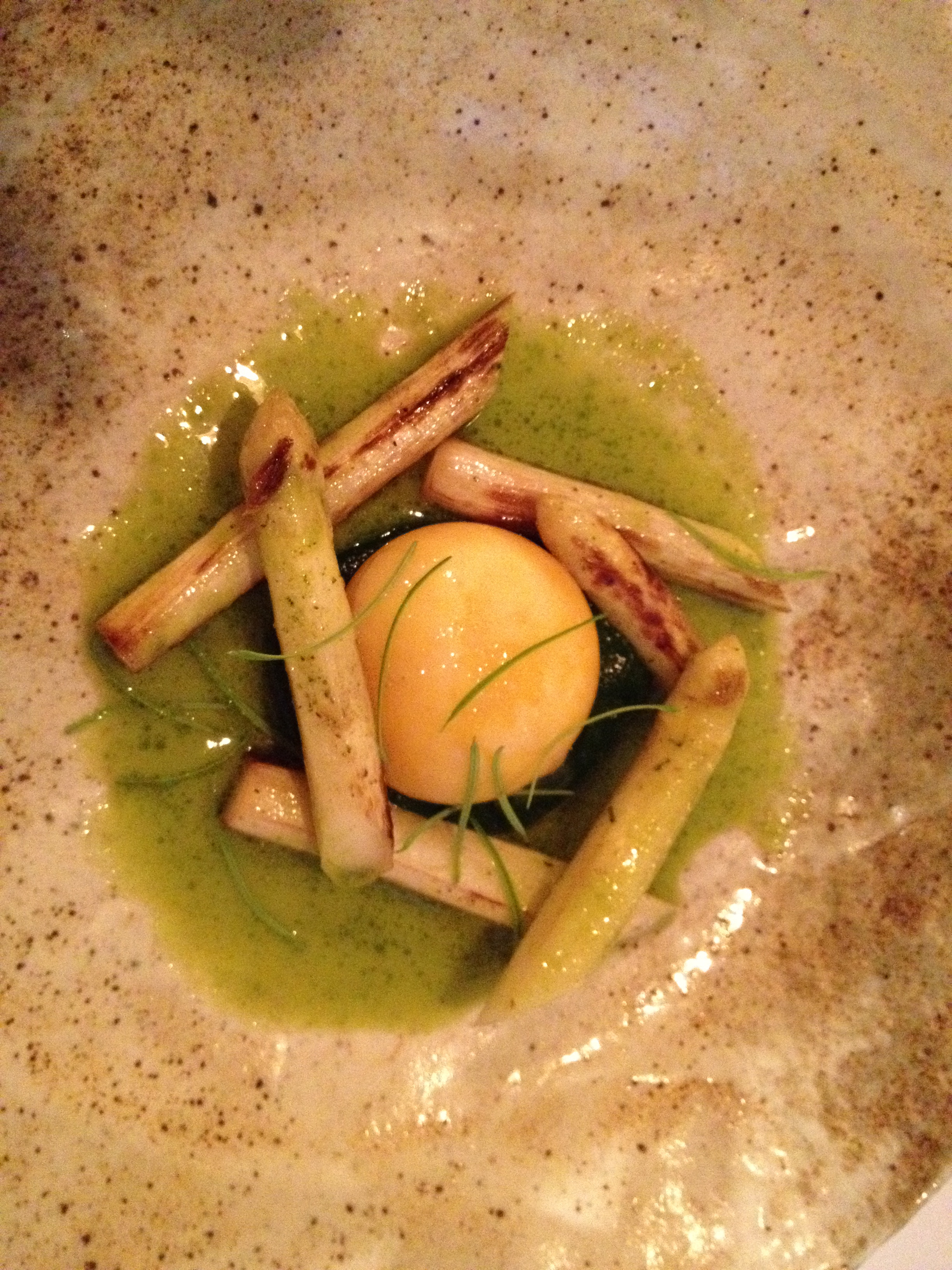
White asparagus with that perfect egg yolk pre explosion

Onwards on our trajectory towards gastronomic perfection, and up next was white kent asparagus with some revolutionary method of importing the taste of pine needles without having said needles needlessly slashing ones throat. Oh and spinach too. My goodness this was the dish of summer – a burst of summer garden freshness in every mouthful, and with a whole and masterfully served single egg-yolk at the centre, which looked so solid and yet, upon impact with the knife, burst into a flurry of sunshine yellow sweetness providing a syrupy soup in which the asparaguses floated like pale beautifies taking their first fill of sunshine.

A garden delight

Talking of summer freshness, the next course was the summer garden, placed on a plate in almost literal form. Jersey Royal potatoes, lovage and radishes were “planted” in amongst soil made from burnt butter in some brilliantly molecularly innovated form, while at the base of the dish, a creamy butter foam gave moisture and exquisite salty/creamy balance to the whole dish. The radishes provided a fresh crunch, and one potato was coated in hay ash to brilliant flavour-effect, like a barbecue and a summer potato salad all rolled into one (I note that the chef, Christoffer Hruskova, is quite keen on importing the flavour and smoke from burnt hay into his dishes which gives an incredible depth of flavour and scandinavian savour to the food).

The interior (photo: Sarah Lee)

Next up was the main course which, owing to my gradual state of inebriation by this stage I neglected to photograph. It was no less superb however – a selection of exquisitely tender Herdwick lamb cuts and little sweetbreads which were a revelation. When you think about the little lamb cheeks, tenderised by the sweet suckling of its mother’s milk, it’s a rather off-putting image, until you eat them that is, and the soft creamyness of that milk is reflected in this very soft, very rich little nugget. The dish was served with more seasonal summeryness – sea lettuce, sea blite and more coastal herbs, giving us all hope that despite a decided lack of sun outside, we may at least sample the summer through this bombardment of taste sensation in our mouthes, as well as discover the delicious, albeit slightly surreal symphony of a lamb lost somewhere on an ocean’s edge. Reminds me of that terrible movie scene when a load of lambs fell of a cliff edge – what film was that? Silence of the lambs or something?

Stone and Hay

Who knows, for up next was a plate of delicious vintage cheeses, again, neglectfully unphotographed, followed by the pure theatre of the evening. First “stone and hay” – basically a frozen stone, not to be eaten I might add, and another realistically executed stone resting on top, except this one was edible, flavoured delicately and covered convincingly with that favourite of the chef – hay soot. It wasn’t the most delicious dish of the evening, but made for a welcome palate cleanser and clever piece of gastronomic amusement.

Gorgeous gooseberries

Slightly full up by this point, we almost feared the onset of the dessert in case our dwindling appetite would not do this incredible food justice. But we oughtn’t have worried, as the dessert of english gooseberries with douglas fir and wood sorrel was fresh, bucolic and perfectly balanced between sharp and sweet with a wonderful variety of textures and again a very scandinavian, effortlessly green and glorious look.
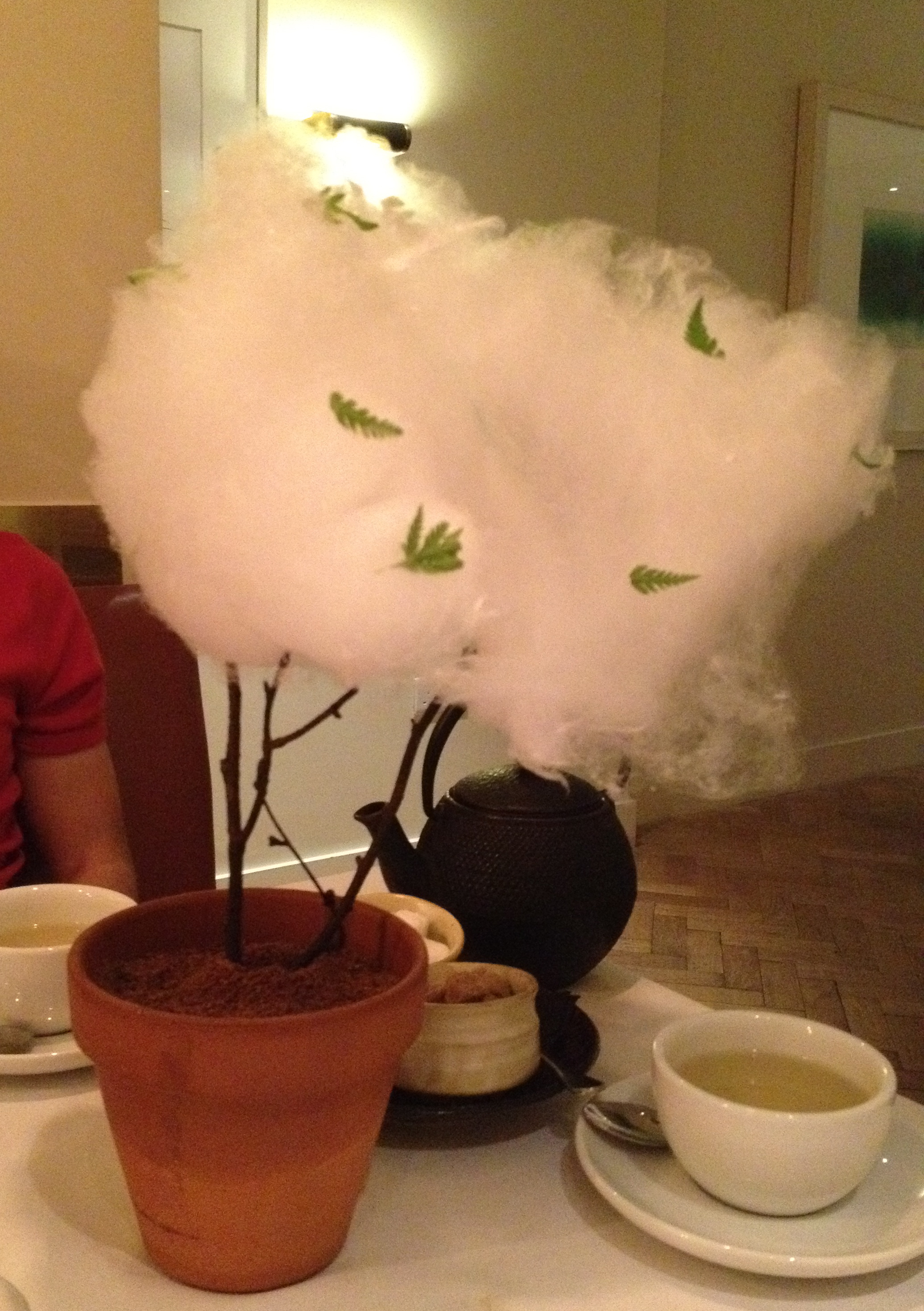
The candyfloss tree!!

But finally, what we had all been waiting for. Emerging from the kitchen, in its unmistakable terracotta pot, the branches of a fine, blossomed candyfloss tree headed our way, complete with edible soil (made again from burnt butter which to my mind tasted of cocoa) and little petit fours of strawberry jam shortcake and fudge. Need I say more? My evening was complete. This meal was a twisting triumph with elegance, flavour exuberance and pure gastronomic sophistication throughout. Michelin star? This place deserves a galaxy!
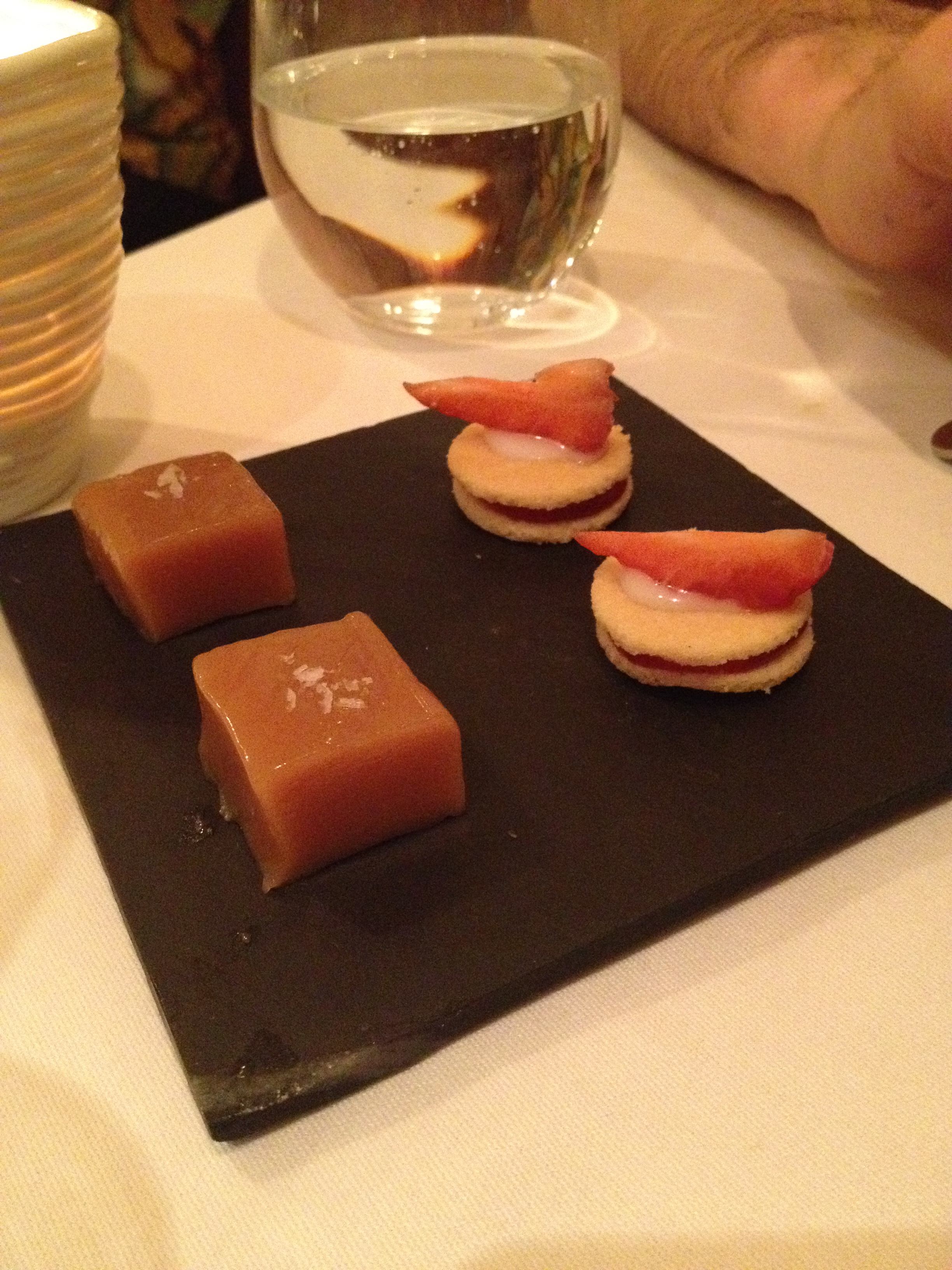
Petit fours

So why is Danish gastronomy on such a high? In my opinion, its because Denmark offers us superb creative innovation without the stuffy anachronistic rulebook of the grand European tradition. It’s cuisine for a modern age – clean, unpretentious but effortlessly chic and fantastically clever. With the overflowing charm of the Scandinavians, you are made to feel welcome, looked after and indulged, rather than made to feel edgy and uncomfortable as is so often the atmosphere given off by the penguin waiters of the old-school. All the while, Danish food is injected with the same vitality and fun in its exploration of molecular gastronomy and thematic presentation that made the equally successful Heston Blumenthal such a star of the culinary world. In this way, Denmark is one step ahead of the rest of the world, soaring into its ascendancy where others must now follow. If they can ever catch up.

Twelfth Night at the Roundhouse: Laugh-out-loud funny with a Fawlty Towers twist

As a Director, being given one of Shakespeare’s best known plays to direct must be a bit like being handed a gift-wrapped life time of Christmases all at once: On the one hand you get the most spectacular array of gifts to play with, but on the other, there’s always the risk, as comes with the familiar, that the experience will descend into Family warfare, as new generations upset the old fogies in the corner, and traditional conservative values give way to brash commercialisation.

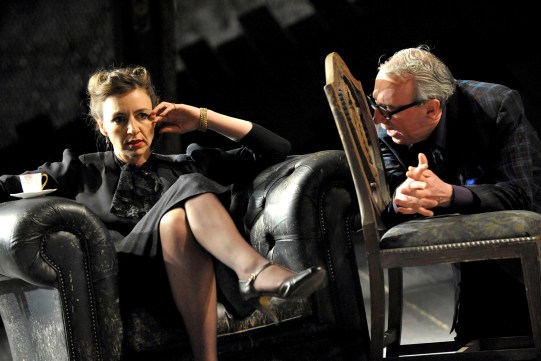
Nicholas Day as Sir Toby Belch in Twelfth Night. Photograph by Keith Pattison.

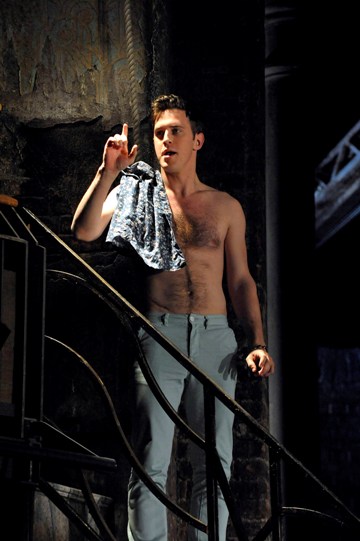
So it is with Shakespeare. You get those who turn up expecting ruffs and garters, men playing all the parts and the accompaniment of Greensleeves or some other suitably Tudor refrain in the background. Then there are those who want to see a familiar tale, with the same dialogue and characters, but retold in a totally reinvented way. I must admit to being one for the latter category. Admittedly, reinvented Shakespeare doesn’t always work. Shakespeare played out in the modern age can jar. Often directors are so intent on modernising that they lose all essence of the story they are reinterpreting. But the RSC’s latest offering, Twelfth Night, now commencing its London season at Camden’s Roundhouse, faces no such problems. Reinvented in a brilliantly original way, but losing none of the charm of the characters nor the tale, this new production, directed by David Farr is, in my refined Shakespearean experience, a phenomenal success.

Stephen Hagan as Sebastian in Twelfth Night. Photograph by Keith Pattison.

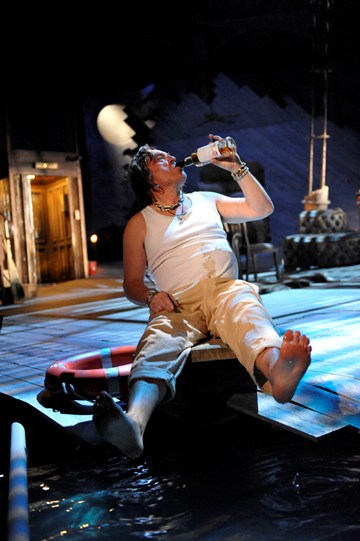
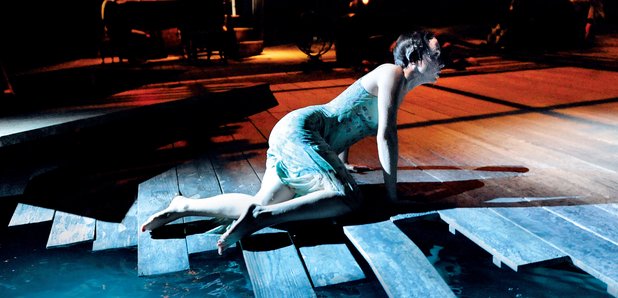
First off, the scenery. It’s brilliant. How to stage Twelfth Night, which on paper is part set in Orsino’s palace, part set in Olivia’s and part set on a beach? Well David Farr and designer Jon Bausor came up with an original solution. They set the play in a rickety old hotel, reminiscent of  Fawlty Towers age hostelries, with a rattling old lift, swing doors, a dusty set of pigeon-holes containing all the room keys, and old-style air con in the form of a single fan with ribbons attach so that they flicker limply in the air whenever the fan is switched on. This hotel setting is in turn amalgamated into a sweeping curved wooden floor, which at the foot of the stage dips limply into a pool of water before curving across the stage into a steep incline at the back of the space, upon which a bed, a bath and other paraphernalia hang steeply suspended, and over which the darting shadows of a ceiling fan spin and flicker. In short, there isn’t a straight line anywhere on the stage, and this gives the set a dilapidated charm perfect for the 70s/80s reinvention.

Cecilia Noble as Maria in Twelfth Night. Photograph by Keith Pattison

Meanwhile the hotel setting is adapted to both the homes of Olivia and Orsino respectively through subtle lighting changes, all of which give the impression that these people live on some expat seaside resort, where the drunkenness of Sir Toby Belch and co. and the electro-keyboard cabaret of Feste the fool seem perfectly pertinent, like the tragic faded grandeur of Benidorm, or Blackpool on a good day.

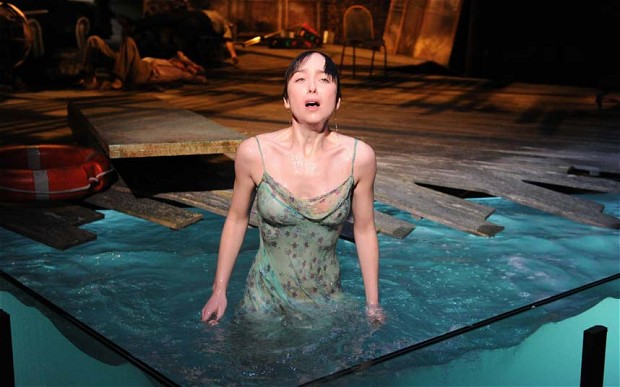
The best part of the set however has to be the pool filled with real water at the corner of the stage. It is from this pool that at the most unexpected moment, both Viola and a little later Sebastian, the shipwrecked protagonists of the play, emerge, gasping for breath, in the most fantastically realistic staging of a shipwrecked twosome. After this initial use of the pool, that same watery expanse is not forgotten. It provides the backdrop for some brilliant slapstick comedy by the likes of Bruce Mackinnon as a fantastically dippy Sir Andrew Aguecheek, and is a suitable space into which the phlegmatic Olivia can discard the unwanted gifts given to her by love-struck Orsino as she shuns his many indefatigable advances. True, the first few rows of the audience did get relentlessly splashed as the pool slowly emptied upon each dramatic entrance and exit by the actors, but at least they can’t moan that the play isn’t inclusive.

Emily Taaffe as Viola – Photo: Alastair Muir

Kirsty Bushell as Olivia and Kevin McMonagle as Feste in Twelfth Night. Photograph by Keith Pattison.

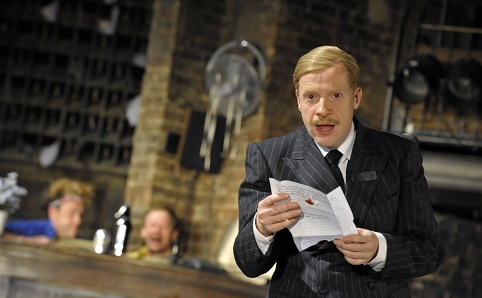
This brings me to the actors themselves, all of whom were brilliant, but with a few standout stars. Number 1 for me was Jonathan Slinger as the odious steward, Malvolio. The hotel setting worked best for Slinger’s character, as Malvolio went from palace porter to over-inflated Hotel Manager with a very heavy dose of small-man syndrome, complete with a clip board and name tag – you know the kind. This made for some genius comedy moments, not least when he travelled across the stage in a golf buggy marked “for management use only”  and as for the famous scene with yellow stockings and cross-garters – this production took the stockings to an all new level of risqué. It was laugh-out-loud hilarious. And it takes a lot to get me almost doubled over with hysteria.

Jonathan Slinger – brilliant as Malvolio – Photo: Jillian Edelstein

Second standout for me had to be Cecilia Noble as a diva-Queen Maria, the brilliant matriarch in amongst the drunken debauchery of Sir Toby’s den, wonderfully complicit as she was in the grand plan to bring the malevolent Malvolio to his shame. Brilliant too were the energetic Kirsty Bushell as Olivia, Bruce Mackinnon as Sir Andrew, and Nicholas Day as Sir Toby. I was a little disappointed by Emily Taafee as Viola, whose delicate Irish accent seemed a little strained in her efforts to be heard amidst the tomfoolery of her fellow cast members, and more often than not I found it difficult to decipher what she was saying. However that too is a problem with theatre (almost) “in the round” which meant that more often than not, we found ourselves facing the back of an actor whose voice simply didn’t carry.

Sir Toby, Sir Andrew and Fabian

No matter – as is often the case with Shakespeare, the old english is frequently difficult to understand in its totality. Which is why the role of a director, in translating that hyperbolic verse into the modern age, is so important. David Farr’s Twelfth Night not only translated brilliantly, but it lived, breathed and pulsated energy and jocularity which was contagious across the Roundhouse audience – even the wet ones at the front.

Twelfth Night continues at the Roundhouse until 5 July.

A baby showered with a chequerboard of tropical cupcakes

We English don’t easily accept the idea of being influenced by America. We’ve always been the slightly supercilious older brother of our younger indefatigable sibling across the pond, wincing at the loosening of our Queen’s erudite parlance, the widening of the vowels, the advent of stuffed-crusts, of bagels and Reese’s peanut butter cups, the creator of drive-thru culinary culture and the over-eager stentorian expression which makes the refined of Kensington tut condescendingly. Yet it’s an indubitable fact of English life that the influence of the big U-S-of-A is all around us, in our music, in our food, on TV, in politics and on the high street, and no more so is this influence felt than in the way we party. The US gave us candy-abundant halloween and fairy light-filled dazzling Christmas spectaculars. And the latest craze which is doing the rounds is the Baby Shower.

According to wikipedia, a Baby Shower is generally thrown either shortly before or shortly after a baby is born. Only women are invited (!) and the new mother in question is “showered” with presents. So when my dear friend Sarah gave birth to a beautiful baby girl, Ruby, a few months ago, and announced that she would finally bring her angelic daughter down to London to be celebrated amongst our vivacious friendship circle, I decided that this baby shower business ought to be tried and tested, refined in the way that only the english know best. For starters we had men, and quite right too. In the modern world, with fathers playing an increasingly dominant role in the daily task of bringing up their children, why shouldn’t they too be showered with gifts and praise and plenty of sweet treats? Presents were showered aplenty – little cute girly outfits and some alcoholic indulgence for papa (when he’s off duty, naturally) and my gift – a norm sketch of course – devoted to little Ruby.

Welcome Ruby (© 2012 Nicholas de Lacy-Brown, pen and ink on paper)

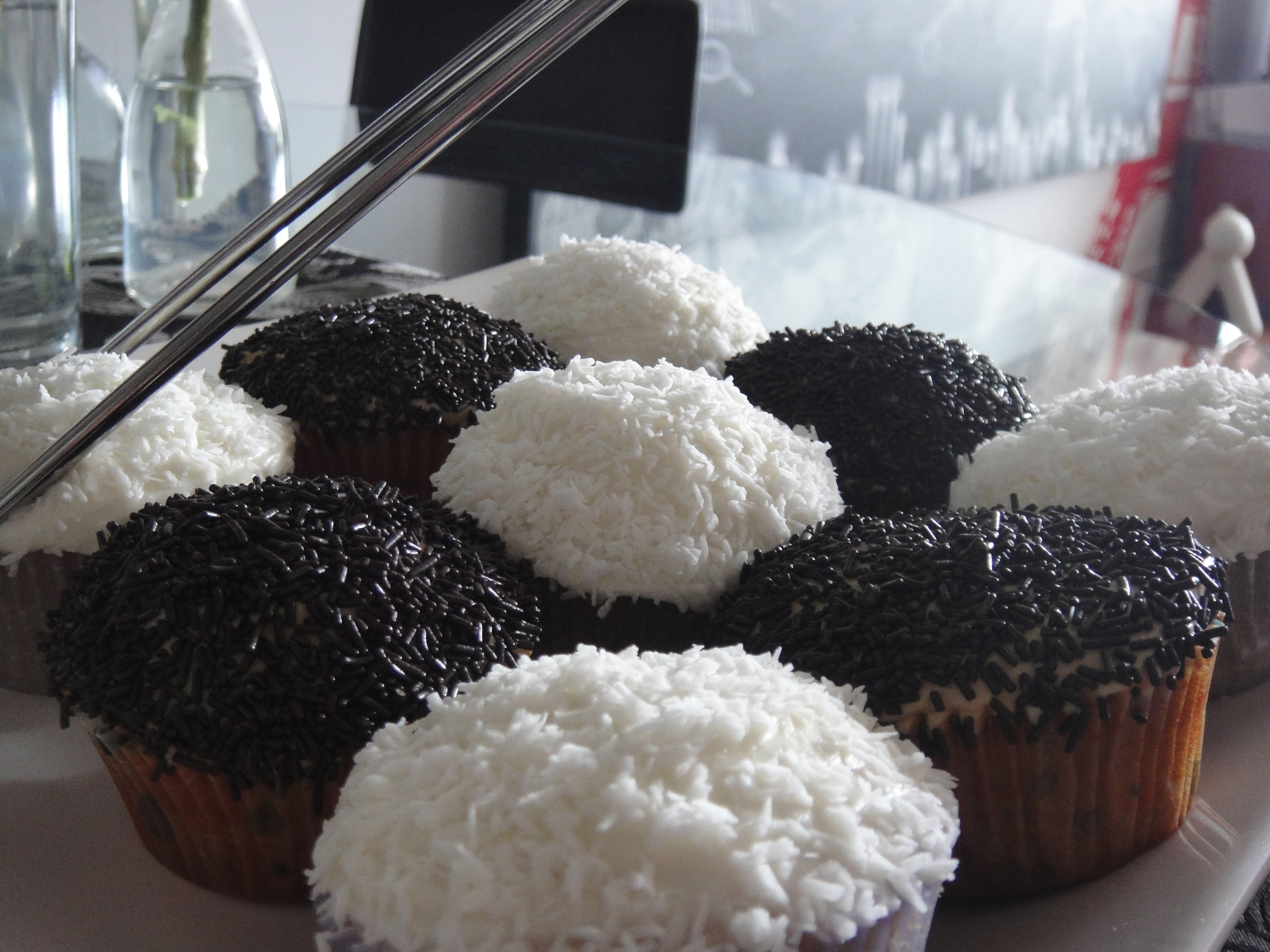
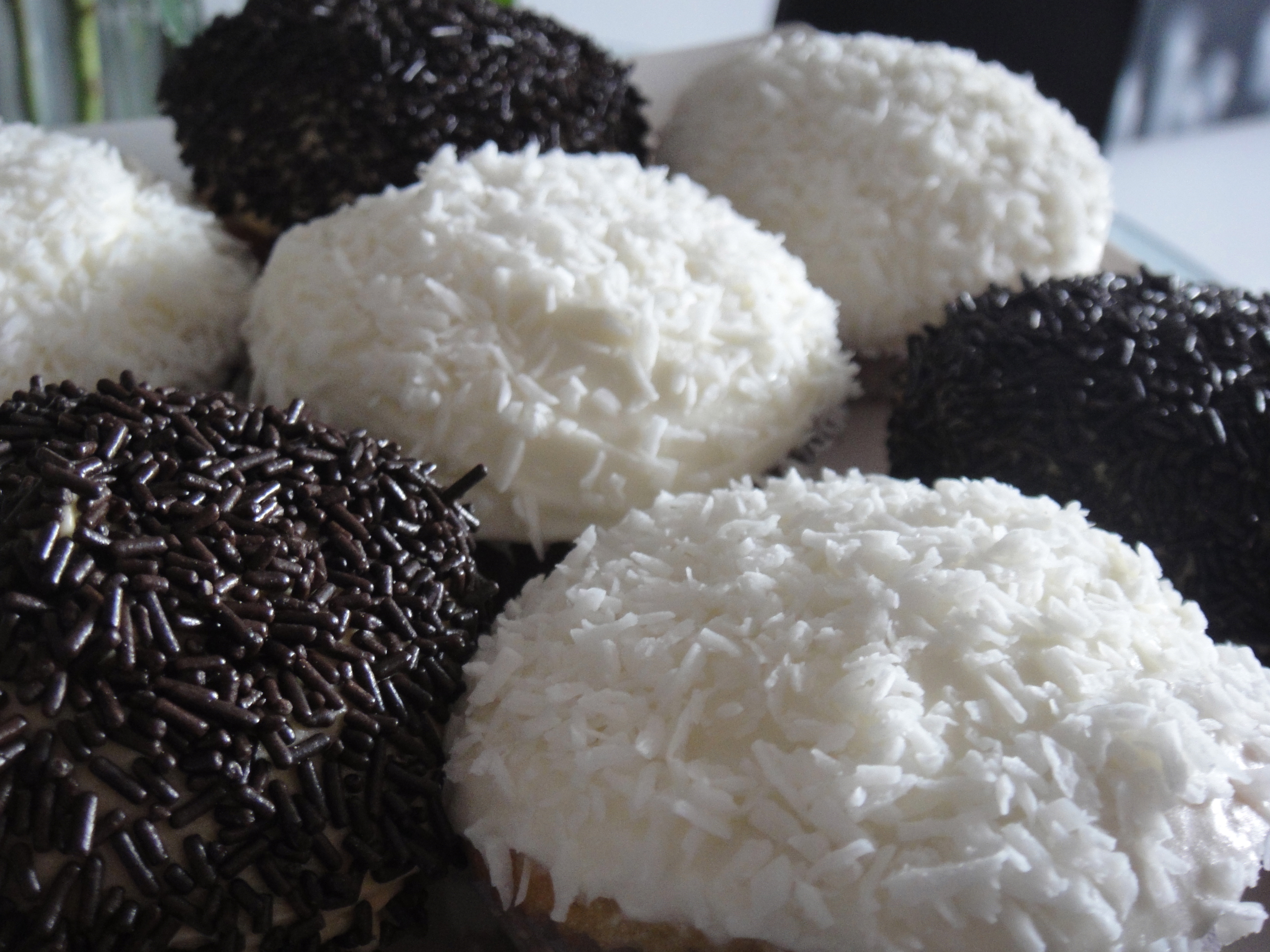
As for the sweet treats – cupcakes went all tropicana, as I chose flavours referencing the mixed and culturally rich heritage of Ruby’s parents – I made one batch of tropical cupcakes –  pineapple and coconut cupcake referencing Sarah’s Jamaican heritage and father Truong’s South Pacific patrimony – while tropical banana meets England’s now demised Hungry Monk restaurant, inventor of the infamous Banoffee Pie, inspiration for my second selection – a banoffee cupcake, loaded with indulgent dulce de leche and a gingery spiced banana sponge. Tropical flavoured, but London refined, these cupcakes were the epitome of english chic, served like a chequerboard of black and white, with one cake covered in coconut and the other in chocolate vermicelli. The fruit in both, and additions of creamy coconut milk and indulgent full fat milk respectively, made these cakes moist and delicious, while the butter cream icing was a suitably indulgent celebration of the beautiful new life in our midsts.

My recipes were adapted from London’s favourite purveyor of cupcakes, the Hummingbird Bakery. To make the pineapple and coconut cupcake, take 140g caster sugar and beat in 40g unsalted butter. Then add 120g plain flour, a pinch of salt, and 1 and a half teaspoons of baking power and mix everything together with an electric mixer. Once everything is combined, gradually mix 120ml of coconut milk and half a teaspoon of vanilla essence into the flour mixture, and finally add and mix in one egg (I actually used a bit more coconut milk – my mother always told me that the softest sponge mixtures always drip of the mixing spoon like syrup, and therefore I always add a bit more milk to achieve this effect – but it’s a matter of personal taste). Prepare 12 paper cupcake cases. Chop up 8 rings of tinned pineapple into small chunks and disperse evenly in the bottom of the paper cases. Pour the cake mixture on top and place in the oven at 170 degrees celsius for around 20-25 minutes. Test with a skewer to make sure the cakes are cooked. The skewer should come out clean. Once the cakes are cooled, make your butter icing. Beat 250g icing sugar with 80g unsalted butter with an electric mixer. Slowly add 25ml of coconut milk and whisk until very white and light and frothy (around 5-10 minutes). Paste onto the cake with a palette knife and sprinkle liberally with desiccated coconut.

The banoffee cupcakes are pretty similar. 140g of caster sugar should be added to 80g of unsalted butter. Then add 120g plain flower, a teaspoon of baking powder, a pinch of salt, a teaspoon of ground ginger and a teaspoon of ground cinnamon. Mix until well combined and then slowly add 120ml of whole milk and two eggs. Separately mash up approximately one largish banana (around 120g peeled) and stir into the cake mixture. Spoon into paper cases and cook at 170 degrees for around 20 minutes. For the icing, beat 250g icing sugar with 80g unsalted butter. Then, if you want to make your icing indulgently dulce de leche, take a small can of condensed milk and simmer on a low heat for 3 hours (yep, this takes patience) without opening the can. Make sure the water doesn’t dry out in the pan and the tin is always covered with water or the tin will explode. After three hours, open up the can and you should find yourself with a tin full of caramel deliciousness. Add a few tablespoons of this to your butter icing mixture depending on how sweet and rich you want it. Build up on your cakes with a palette knife and sprinkle chocolate vermicelli liberally over the cakes.

And there you have it. Uber sophisticated tropical cupcakes, perfect for the summer, whether a baby is forthcoming, newly arrived, or just a distant pipe-dream.

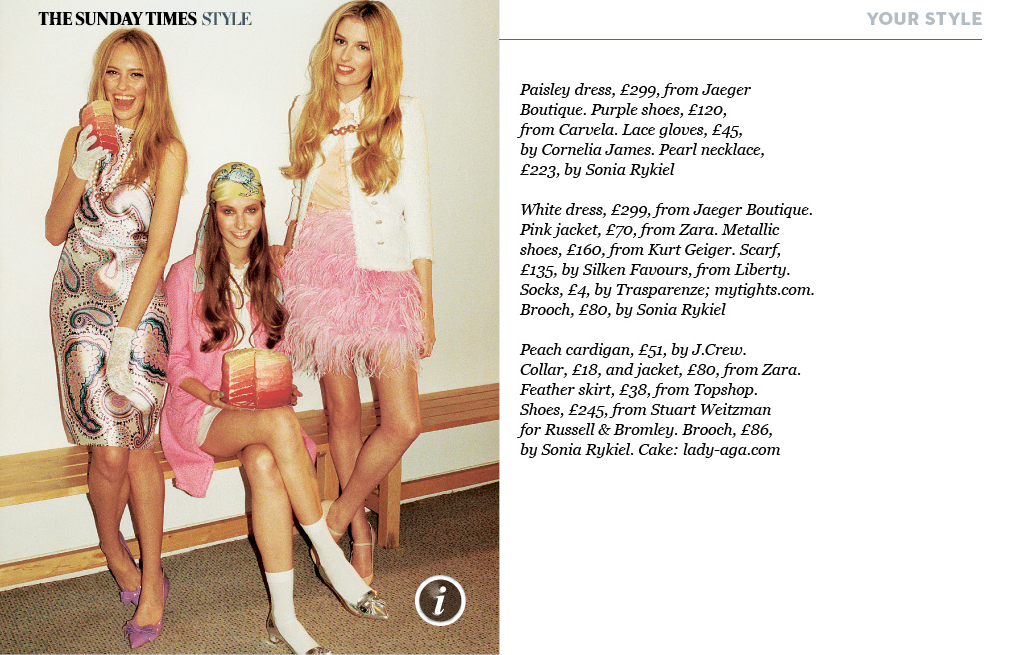
PS: Talking of uber-chic cupcakes, I am SO proud of my friend Celia whose red-velvet multi-layered ombre cake made it into this week’s Sunday Times style section as shown here… amazing!

Monotone May = Culinary indulgence: The Orrery and The Delaunay

The good weather may have reached our shores at last this week in fair-weather Angleterre, but last weekend it was an altogether different picture. One gloomy weekend followed another, as almost 7 weeks after a hose-pipe ban was enforced, we in England were subjected to day upon day of grey rainy autumnal weather. So what can one do to keep happy in such weather? Why, self-indulge, naturally!

As a result of my very rare recourse to hedonism, I visited two superb restaurants in London, both of which deserve the Daily Norm review treatment.

Le beurre

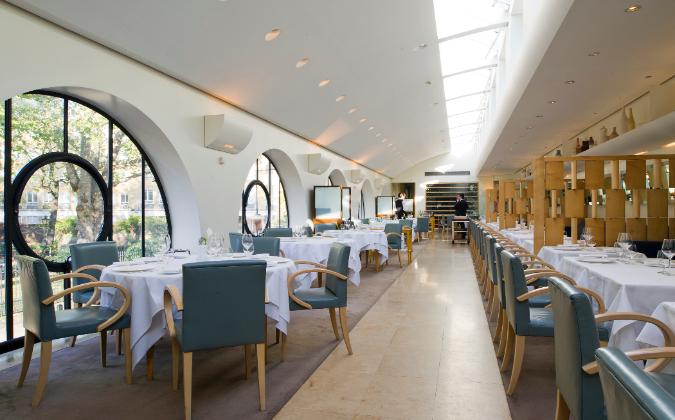
Stop one was Orrery, 55 Marylebone High Street, London, a classy first floor venue situated above the uber-chic Conran Store in Marylebone. I always think that a restaurant with an upstairs location possesses a certain superior exclusivity in the way in which it can go unnoticed so easily, and only those “in the know” get to sample it’s elevated delights. I did already know about the existence of this place, purely because on my frequent visits to Conran (I am interior design obsessed, not that I can afford many of the overblown prices in the place) I could never work out how from the front the shop appeared to have big first floor windows and yet when inside, there were no windows to look through. The secret to this great conundrum lay in a very slim line restaurant, set at the front of the building in a long gallery-like setting, but whose narrow floor-space barely registers owing to the excellent use of mirrors to reflect the large rounded windows which run along one side of the space. Having worked out where the restaurant was, I never in fact went along, that was until I saw it featured on the glitsy docu-soap Made in Chelsea last week. Anything they can do, I can do better, thought I, without anything remotely comparable to the stars of the show padding my wallet. And so it was, that having escaped quickly from Tate Modern on saturday in order to resist the temptations of dining in Tate’s expensive but view-spectacular restaurant, we ended up somewhere even pricer. Whoops.

Orrery’s interior

From the moment we walked into Orrery, we were treated like royalty. The service was exquisite – attentive and brisk, but we did not feel rushed, only well looked after. The menu we went for was the Menu du Jour, which at £25 for three courses didn’t seem bad, especially when the food then came out in a spectacular show-stopping fashion. But let me not rush this. Let us first concentrate on the unctuous fig-imbued bread with creamy home-churned butter, and a delicate amuse bouche of gazpacho – perfectly accompanied by the Catalan wine I had chosen from the wine list with all the bias of my Spain-conditioned heart.

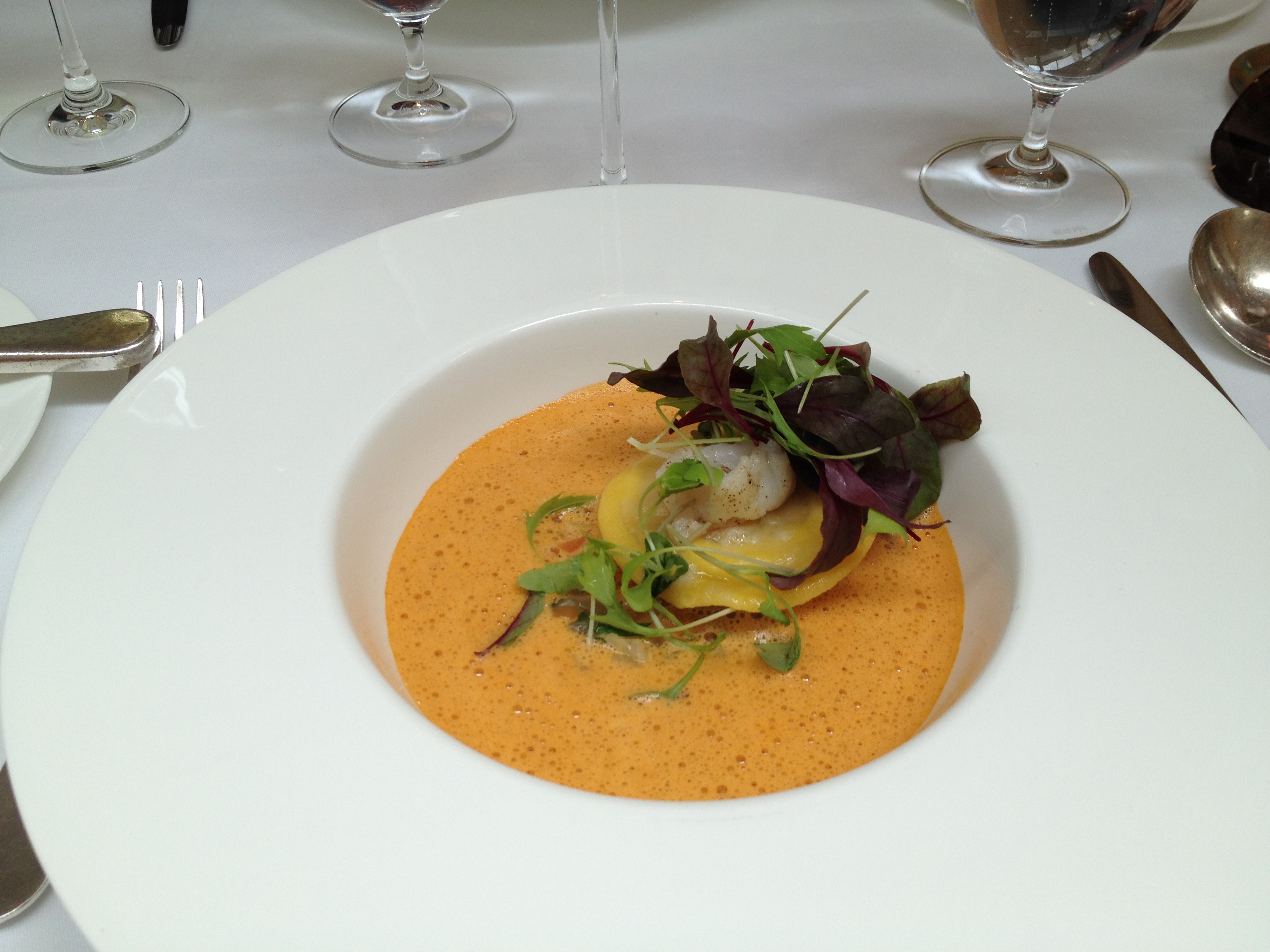
Raviolo

Up the next was the starter. We both went for the seafood raviolo (i.e. just one) surrounded by a frothy seafood bisque and served with a sweet, nutty pile of salad leaves and micro herbs. It was moist, well flavoured, delicate and perfectly seasoned, and the froth reminded of the incoming silky bubbles of a warm mediterranean seashore.

Feuilleté

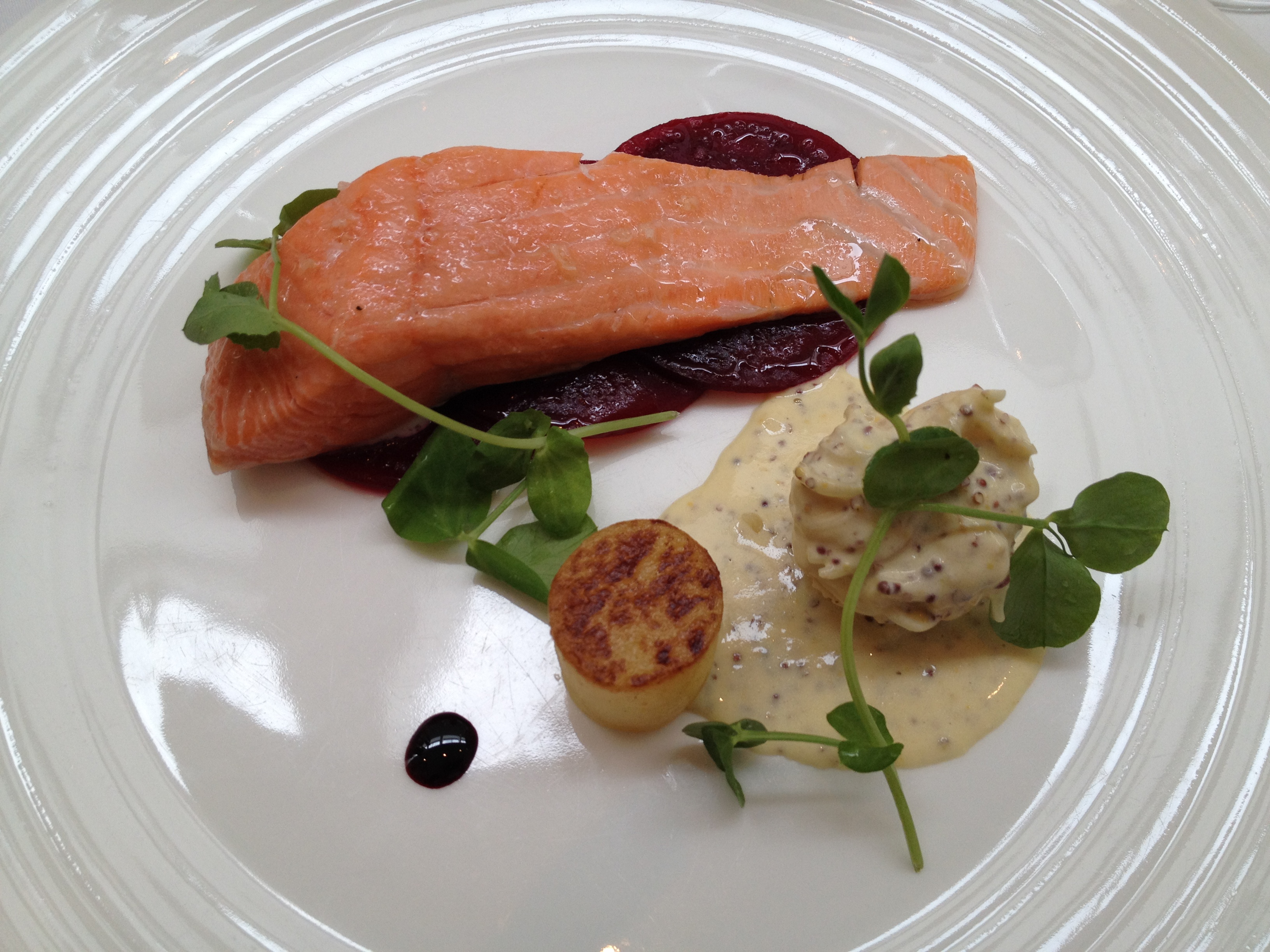
Salmon

For mains I had the Feuilleté of wild mushroom, poached egg, sauce Hollandaise – it was the vegetarian option which I rarely go for but my goodness I’m glad I did. The puff pastry was golden and caramelised, the mushrooms rich and creamy, and the poached egg broke open to reveal a runny goey egg yolk which was a rich and perfect orange spilling sweetly to provide a silky sauce for the dish. My partner had salmon which, he says, was utterly moist and completely delicious. For dessert we were both unable to resist a chocolate mousse with champagne jelly and hazelnuts. Served in frosted little bowls reminiscent of 60s retro furniture, it was cool as well as classy. Finally before dragging ourselves away, we were given complimentary chocolate truffles which broke open in our mouth to reveal a super sweet but seductively sharp passion fruit syrup. Amazing.

Chocolate mousse with champagne jelly

Best of all, I discovered that the astronomers globe instrument I bought in Salamanca is actually called an “Orrery” named after the Earl of Orrery. You see, you learn a new thing every day.

Delaunay interior

The next day, a long-standing and much anticipated late-luncheon engagement with my delectable chic bride-to-be companion in all things gastronomique, Celia, was on the agenda. We were off to The Delaunay, on the Aldwych, London, a restaurant which describes itself as a Café restaurant in the Grand European Tradition. Grandeur was in fact expected – the restaurant is part of the Wolseley group, known for its old-style grandeur renowned of Paris and Vienna, more than London. And as far as grandeur goes, the Delaunay did not disappoint. As I entered, the place was heaving, veritably full with those who lunch, and those who wish that we could all live in the age when every restaurant was clad in brass and marble with giant wall clocks, wood panelling and snobby waiters just like this one (don’t we all, well, perhaps without the snobs). Luckily my exquisitely turned out lunch companion was a lady in red, guiding my eye across the crowded tables so that we could swiftly commence the important business of choosing wine. Slightly intimidated by the prices, we went for house white, which must have been fine, because we were onto prosecco in no time. The food menu at this time of the day was fairly brunchy, but had sufficient choice for us to be able to indulge in a three course feast which proved highly satisfying, in the Grand European traditional way, naturally.

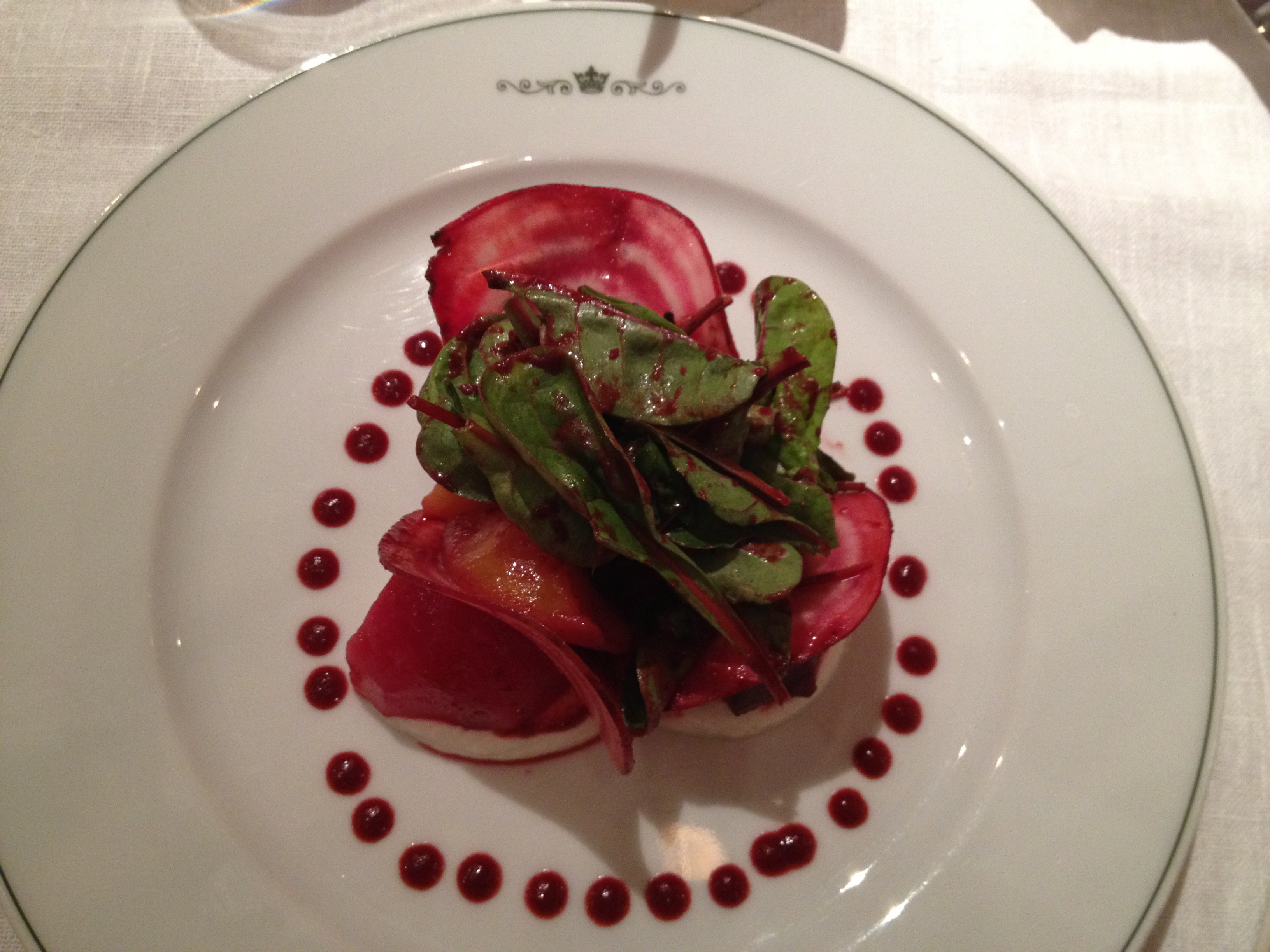
Beetroot and goat’s cheese curd salad

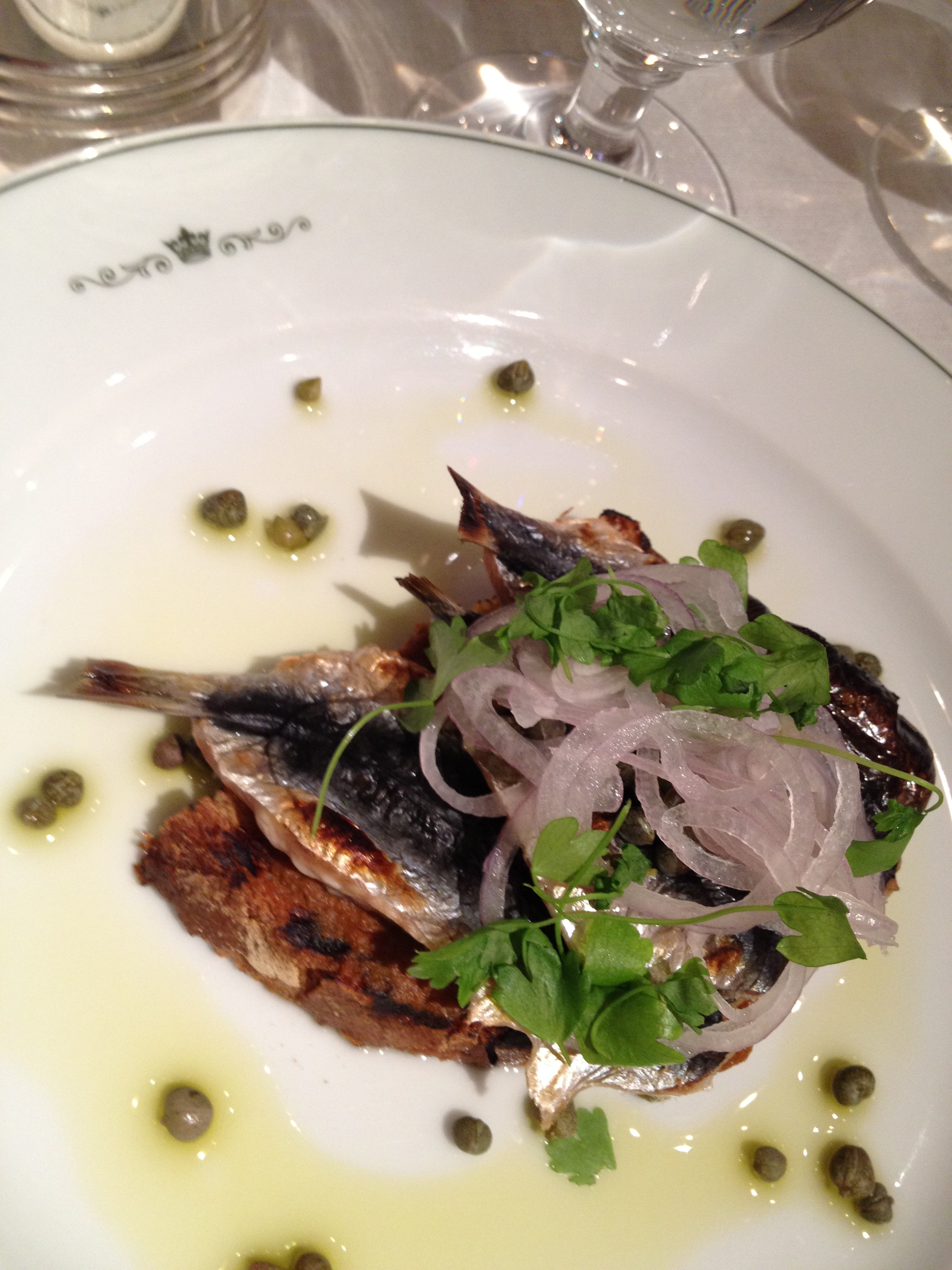
Something fishy

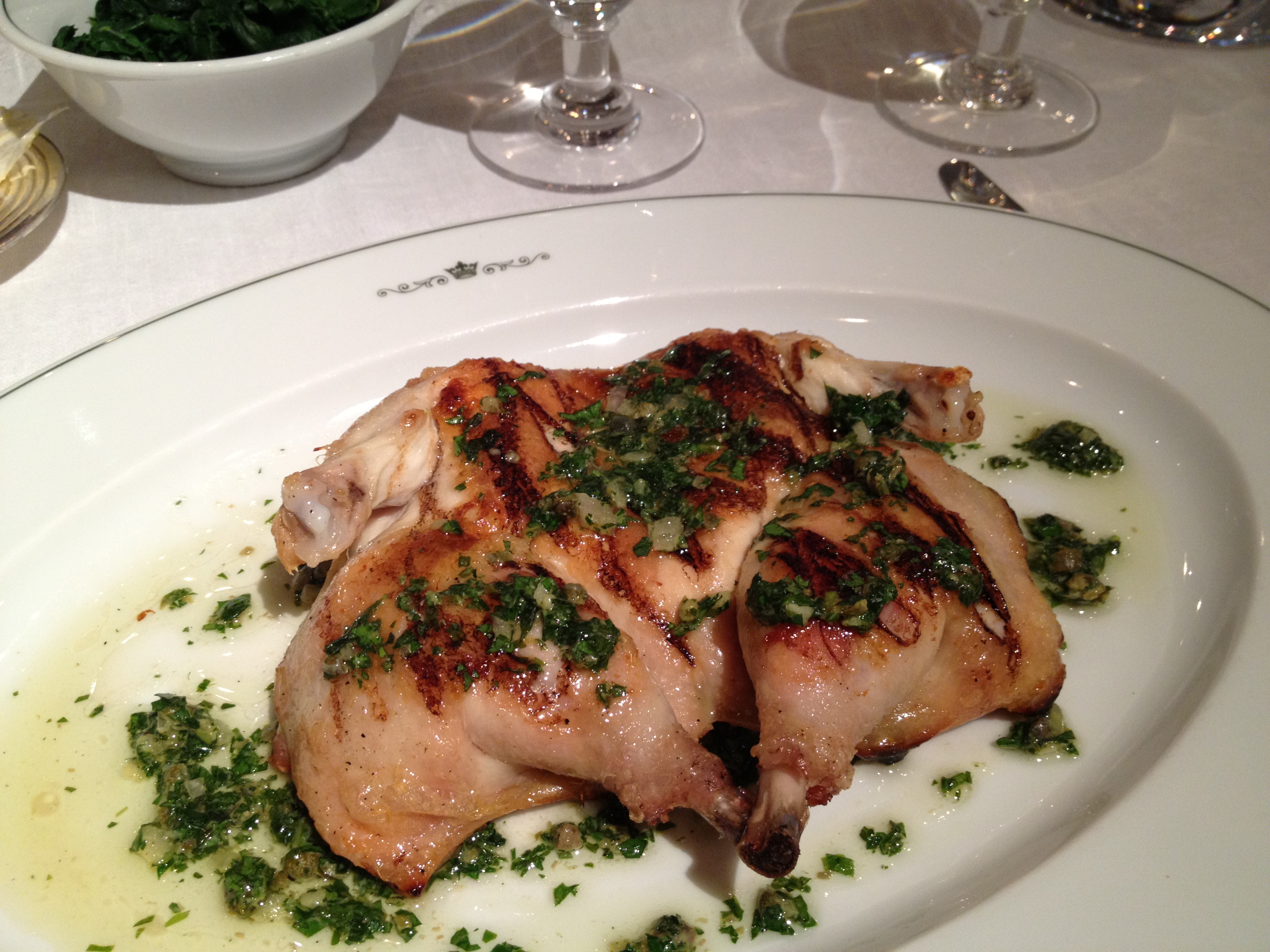
I started with a young beetroot salad with goat’s curd cheese. The flavour balance was perfect – a creamy cheese, not as heavy as it’s older, firmer counterpart, perfectly partnered by a series of different coloured and textured beetroots. Celia had something deliciously fishy. I can’t exactly remember what it was, but I’ll let her tell you on her superb food blog, Lady Aga. Next up I indulged in a golden crunched chicken schnitzel, which was incontrovertibly bad for my summer beach body attempts, but comforting on a grey May day (that rhymes so well, it must be why May turned out to be such a dire month). Celia won on this course though – her poussin with salsa verde was so moist and delicious and meaty I could have stolen the lot. For dessert I went for a white and dark chocolate mousse (I know, I know, second day running, but a boy knows what he likes) and Celia, undoubtedly feeling the pressure of my “hinted” suggestions whispered under my breath, went for a Sevillan orange sorbet which was like a walk along the sun-dappled paths of the Alcazar all over again.

Poussin

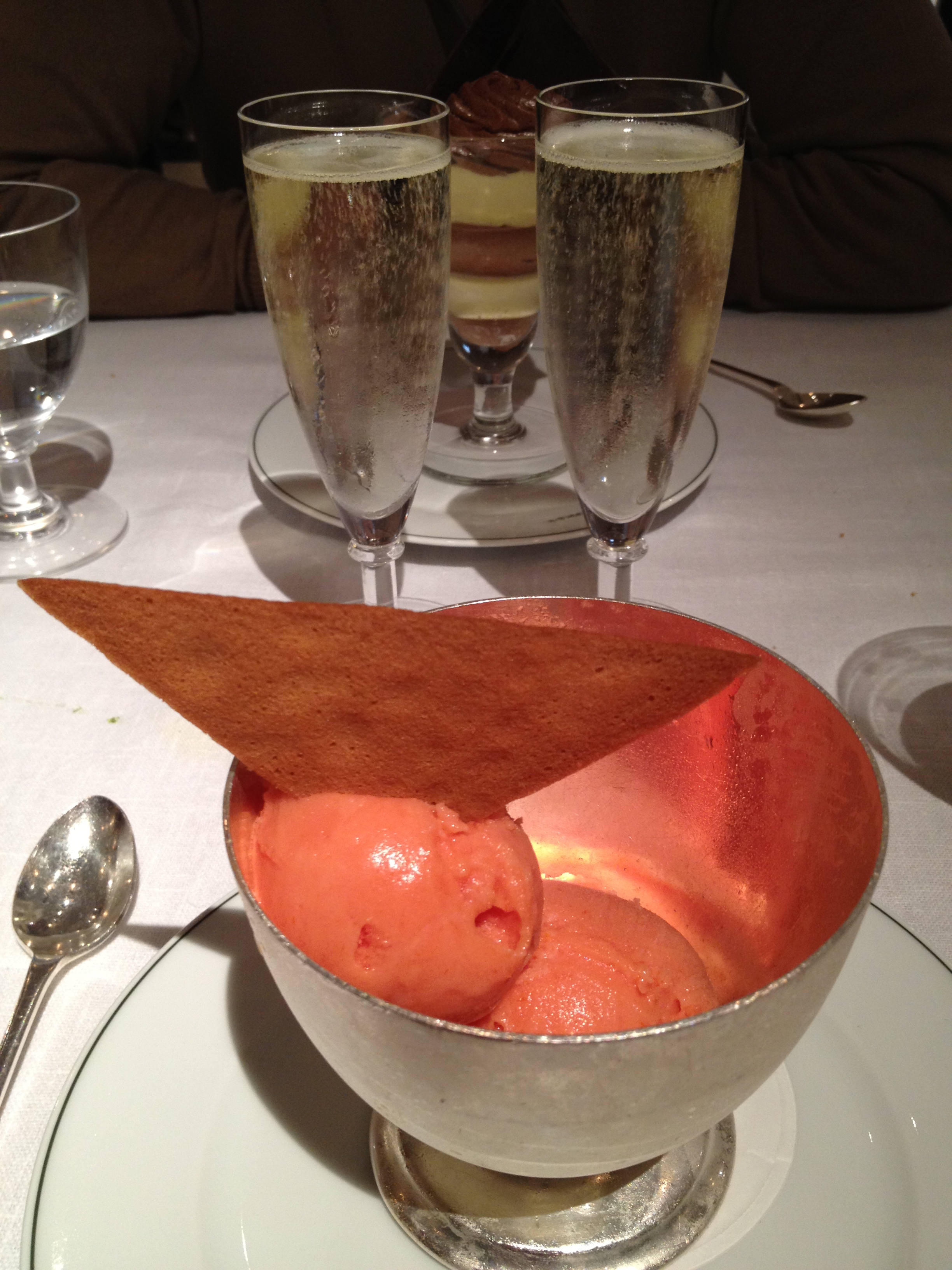
Seville orange sorbet, prosecco and a stripey chocolate mousse somewhere in the background.

The Delaunay does well in promoting the traditional grand café, particularly since it only opened recently. You could easily imagine Coco Chanel dropping in on a brief visit to London. And taking tradition seriously, I noted with bemusement that the maître d’ clicked his fingers when he wanted the attention of his waiters. Ouch. Mind you, the attention of the numerous waiters was often found wanting at our table too, which is surely one tradition Coco would not have approved of.

Damien Hirst at Tate: Repetitive, super-sensationalised science-show which is strangely enjoyable

The blockbuster show of Tate’s annual exhibition calendar, a retrospective to YBA supremo Damien Hirst, has been long anticipated by London’s art scene as well as the purveyors of trashy gossip magazines and followers of The Only Way is Essex alike. And such is the pull of Damien Hirst – this isn’t highbrow fine art, it’s not oil paintings fastidiously executed or sculptures miraculously carved from marble. This is a highly-commercialised , over-exposed fair ground of cut up creatures and stomach-churning curiosities, highly laminated multi-coloured, multi-formed collected lacquered lustre and sparkling, extravagant and utterly pointless bling. And where there is bling, that twinkle to attract the masses, you don’t need to be erudite and sophisticated to pull in the crowds. This is Tate doing household gloss paint, not oil paint.

Damien Hirst, Lullaby, the Seasons (2002) (detail)

Damien Hirst, Arg-Glu (1994)

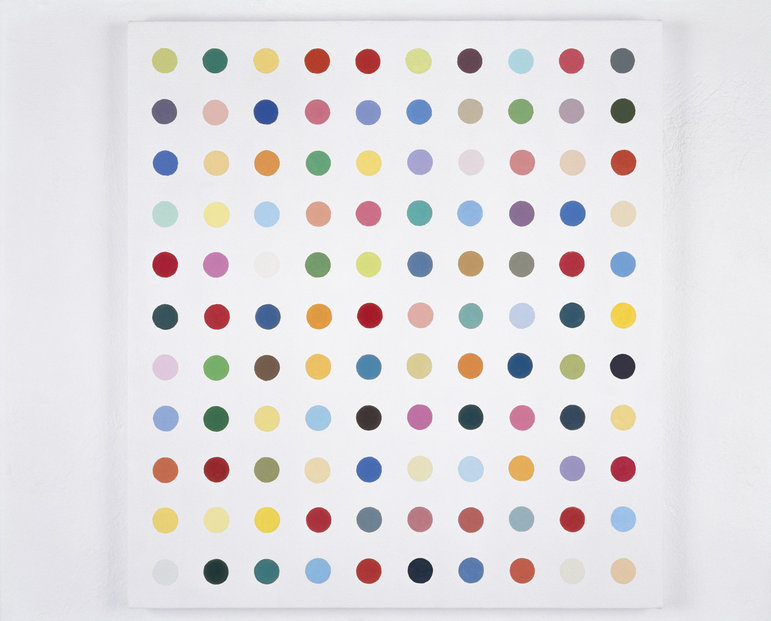
To give him is due, Mr Hirst is unapologetically tawdry . He doesn’t at least pretend to be the next Caravaggio. He makes art for a modern generation, a generation which consumes weekly updates on Katie Price’s deflating boobs rather than a good Jane Austen, who are only too aware of drug culture, who over use and abuse pharmacies in their hypochondriacal self-obsession, and are ultimately attracted by the latest trend, sensation or sparkle. No wonder Damien Hirst has been successful. He only had to stick diamonds to the fatalistically familiar skull and reproductions started springing up in homewear stores up and down the country. He took polka dots and made them uber-cool. Yet the Spanish have been celebrating the steadfast spot in their flamenco garb for centuries. Commercially clever Damien Hirst surely is. Super-skilled artist? I have my doubts. Yet without the guise and mystique of art to promote him, wouldn’t all of Damien Hirst’s oeuvre fall into a science museum/ interior design shop/ chemist/ butchers/ fishmongers where it belongs?

Damien Hirst, In and Out of Love (White Paintings and Live Butterflies) (1991) (detail)

There weren’t many surprises in the show. Such has been the success of Hirst’s publicity machine that almost every work is almost instantly recognisable.The dot paintings were predictable, and there were an AWFUL lot of them.  The great shark looms menacingly at the centre of the show. Either side of the shark, the sliced-in-half cow and calf, a few other fluffy sheep and birds (all in formaldehyde) are flanked by those repugnant rotting flies. All around the animal detritus, the repetitive spot motif translates into the pharmacy cabinets with row upon row of pill bottles, and then to the pills themselves, painstakingly laid out on shelf upon shelf, while next door you have fish, all laid out in the same direction, apparently “for the purpose of understanding”. Then you move on to the butterflies – the simpler butterfly pictures were a disappointment – the beautiful creatures had been clumsily placed onto thick gloss paint which messily spilled onto their delicate features.

Damien Hirst, Doorways to the Kingdom of Heaven (2007)

Much more impressive were the complex butterfly collages which were symmetrically placed to form incredible stained-glass window formations, not to mention the room which was full of live butterflies, their chrysalises forming their own kind of natural art as they attached themselves onto the blank canvases hung on the walls. There too were the “spin paintings” (basically paint chucked onto a fast moving canvas) and then, as though to emphasise the repetitive nature of Hirst’s work, a “bling” version of everything – the pill cabinet replaced with crystals, the coloured spots painted on a gold background, a smaller shark floating in a black tank rather than white, and butterflies stuck onto a gold canvas. There was also a superfluous obsession with cigarettes and ashtrays, used in Hirst’s art to make the oh-so novel point that one day we might die. Clever.

Damien Hirst, Judgement Day (2009)

Damien Hirst, The Physical Impossibility of Death in the Mind of Someone Living (1991)

So it was all rather predictable, and very repetitive, but strangely, and I hate to admit this, enjoyable. The insides of a cow are fascinating, not least when you get to walk in between the two halves of a once unified body. Looking down the huge throat of a shark at close quarters, shivering with horror when faced with its ghastly serrated teeth and menacing empty eyes is a unique experience, and the opportunity to appreciate the startling natural beauty of a multi-coloured catalogue of butterflies was a wonder. So too is it fun to look upon row upon row of multi-coloured pills and reflect on how many beautiful colours exists amongst a group of medicines which appear so mundane when viewed in isolation, or to appreciate the great skill of gravity in making such vivid and striking splashes when paint is spun around a canvas.

One of the spin paintings

However one can’t help but conclude, upon later analysis, that all the things you enjoyed at the exhibition were just   examples of the splendour of nature itself – the beauty of butterflies, the complexity of animal organs, the results of a spinning mechanism whose beauty is owed simply to chance. And yet if we had seen these things in a science museum, would we have given them a second glance? The isolation of the mundane within an artistic context certainly gives the objects the mystique and glamour which makes them deserving of our attention. But it is ironic that so much of what is praised of Damien Hirst’s work is what has simply been left to nature, or to chance.

Damien Hirst, No Feelings (1989)

Damien Hirst, For the Love of God (2007)

I cannot overly bemoan Hirst for creating a show which offers the chance to interact with his work, to engage with nature, and to enjoy thinking about what is, and what is not, art. I was also pleased that Tate did not try to swamp the visitor with overtly complex and inevitably meaningless lectures on what the art is supposed to mean and how it should be interpreted. Rather, on the whole the visitor was left to enjoy the show relatively uninterrupted, although Hirst’s titles are quite often unnecessarily convoluted and embarrassingly pretentious, not to mention barely related to the work titled.  But what really does make me feel uneasy is the knowledge that hardly any of the work on show has been made or created by Hirst himself, that there is no indication of any artistic talent, only of clever ideas.

Damien Hirst, The Anatomy of an Angel, 2008 – but who sculpted it??

As an artist myself, the most enjoyable thing about an exhibition for me is the chance to interact with it, to look at the art works and learn from the techniques, to appreciate the variation in skill and representation. In this exhibition that opportunity to interact with the work was lost. There is only so far you can be captivated by a medicine cabinet or a canvas packed with dead flies. In the latter butterflies gallery for example, where butterflies were used like stained glass windows, there was a sculpture of an angel, partially cut open to reveal the anatomy underneath. The sculpture was at first captivating, but the fact that I did not know who sculpted it, and whose skill I was appreciating really left something missing for me. The fact that most of these works are made my some factory process leaves me dead inside, just as I would be if someone asked me to study supermarket shelves for an hour.

For me, much of what is produced under the “Damien Hirst” brand will never be true art. It may be design, it may be the work of some unknown worker in the Hirst factory, or it may just be well preserved science, but it so often lacks the prerequisite skill to be art. Others will fiercely oppose my view, but that’s the great thing about the creative world. It makes us think, and in that respect alone, Damien Hirst is undoubtedly successful.

Damien Hirst, Sympathy in White Major – Absolution II (2006)

Damien Hirst at Tate Modern, London, is on until 9 September 2012.

Banksy makes a jubilee-mocking come-back, but are his contemporary statements a little lagging?

There are currently two sites which are inescapable on any UK highstreet as they enjoy their ascension with increasing fecundity: the union jack and the humble pound shop. While the latter is a thriving austerity-proof monster growing out of the wrecks of recession-hit highstreets up and down the country, the former is a symbol of hope, of national pride, a flag which is appearing almost everywhere within eye-sight as the country gears up towards two great festivals of British prowess: the Queen’s Diamond Jubilee, and the London 2012 Olympic games. But for Banksy, known for making bold current statements against anything which has become accepted and standardised by the great public at large, all the union jacks and the poundshops have proven ripe fodder for his stencil-sprayed artistic derision. Indeed, for those passing by the side of a Poundland store in Turnpike Lane, Haringey (North London) this morning, they would have noticed a new addition to the street – a stencil of a child worker, fastidiously plying his trade in making mass produced union jack bunting. The graffiti, applied with Banksy’s trademark stencil technique, is widely considered to be by the great elusive street artist himself, although this provenance is yet to be confirmed by way of its customary inclusion on Banksy’s official website.

Whether the artist be Banksy or a pretender to the street-art throne, the image is apparently purporting to make a double statement. On the one hand it pokes fun at the proliferation of union jacks which have appeared all over London, England and further afield. We’re not just talking bunting either – the distinctive flag has become the favourite of interior designers who have installed the flag on sofas, artwork, rugs, cushions you name it, while there are even those (with little shame – like Ollie Locke from TV docusoap Made in Chelsea) who have taken to wearing the Union Jack on their clothes and blasted across their cars. Meanwhile in Oxford Street, the union jack is hung repeatedly across the famous shopping thoroughfare, and in humble bakeries the union jack has been iced onto cupcakes in preparation for Diamond Jubilee street parties which, if the weather improves, are expected to be held all over the realm.

Union jack furniture is all the rage

But the artist’s more pressing statement relates to the child labourer, and gives clues as to why Banksy (or whoever it was) chose the location he did: two years ago Poundland was involved in a scandal surrounding a boy of seven who was found to be working 100 hours a week in an Indian sweatshop producing goods for the store. The child, known as Ravi, was reportedly earning just 7p a hour to make napkin rings for the cut-price chain. The company severed ties with the supplier at the time and issued a statement saying it ‘did not tolerate child labour under any circumstances’. Which brings me to the point: is this contemporary statement of Banksy’s really that contemporary at all? Or did it take him two years to find a suitable wall to make his point about pound shop culture?

This trend of Banksy being somewhat behind in his latest up-to-the-minute remonstration was also echoed in his recent gift to Liverpool’s Walker Gallery, which saw the artist make a point about sexual abuse in the Catholic church a little too obviously and, frankly, a little too late to make an impact.

Union jack battenberg anyone?

Nonetheless, while Banksy’s point may come a little too late in terms of the Poundland scandal, there can never be too much exposure of child labour. Meanwhile, for the owner of that wall, the appearance of a potential Banksy original will make him/her very happy indeed – past sales of Banksy graffiti have sold in six figure sums, just as long as you can somehow cut the graffiti and the wall away intact! Sadly, what the graffiti also demonstrates is the level of general disrespect which exists within British society. Within hours of the artwork being painted, the union jack bunting, which was stuck onto the stencil, had been stolen. How very predictable these idiots are. The bunting will be worthless detached from the stencil, but some parasites decided to steal it anyway. It may not have been Banksy’s intention, but that kind of behaviour is definitely something which deserves focused remonstration by everyone.

The stencil a few hours after being painted, with bunting stolen

The madness continues: Rothko and Munch sales break new auction records (and steal yet more works from the public eye)

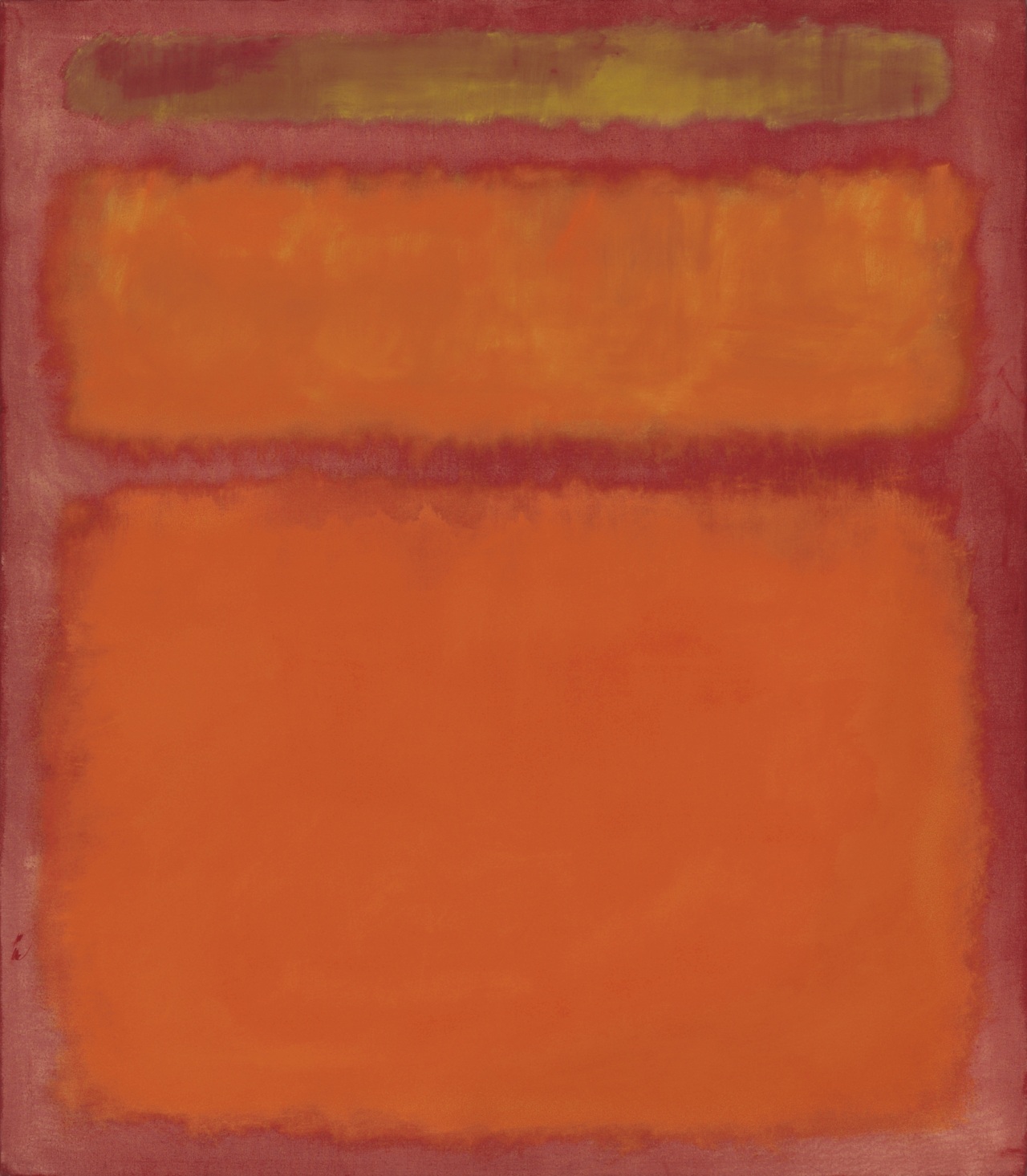
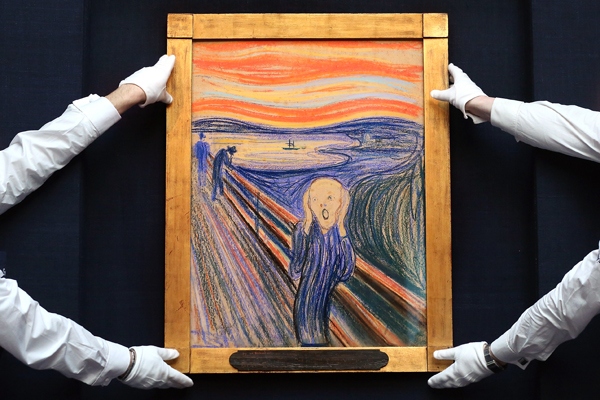
Your eyes do quite possibly deceive you. This is not a photo of haphazardly applied paint samples on my living room wall in the consideration of a new mediterranean-inspired coloured scheme. Oh no. It is a painting, originally entitled Orange, red, yellow by american artist Mark Rothko and not just any painting either. This striped bodge-job of a monotoned canvas has the honour of reaching the highest price ever fetched by a piece of contemporary art at auction when it sold at Christie’s auction house last night for $86.9million. And this sale comes only a week after a pastel version of Edvard Munch’s The Screan set a new world record for the highest price ever paid for an artwork (of its era) at auction at a price tag of some $119.9. Did I mention that half the world is in a recession?

Mark Rothko, Orange, Red and Yellow (1961)

That’s not where it ended either. With total takings of $388 million, last night’s Christie’s auction was the most lucrative in history. I’m sure I’m not the only person who feels slightly ill about this. This hideous commercialisation of art works is the same force which drives contemporary artists of our age to be amplified and promoted as serious artists purely because a rich man has backed them despite their decided lack of talent. It’s a world which most artists would gawp at, appalled at the rich men lavishing their coin over an art work, not because of its merit, but because its artificially escalated price tag defines them as wealthy men with apparent cultural appreciation despite their probable inability to tell you a single historical fact about the artist they have just lavished millions on. After all, wasn’t it Rothko himself who, upon being awarded a commission to paint two major mural commissions for the Seagram’s luxury Four Seasons restaurant commented that he wanted to paint “something that will ruin the appetite of every son-of-a-bitch who ever eats in that room. If the restaurant would refuse to put up my murals, that would be the ultimate compliment. But they won’t. People can stand anything these days.” What then would he have thought about one of his works selling for such an absurd sum, and entering the collections of one of the richest men on the earth? He’d say the same thing no doubt: people can stand anything these days, especially when it gives them a bit of status amongst all their equally rich friends.

Edvard Munch, The Scream (pastel)

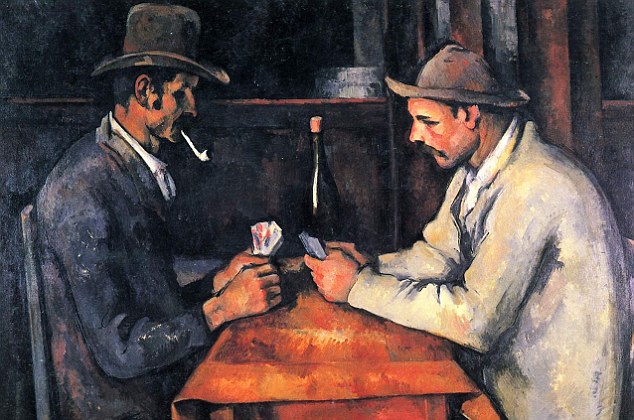
It’s not just about the price either. Munch’s Scream is thought to be making its way to the private collection of the Qatar royal family, and there it will join Cezanne’s Card Players sold to the Qatari royals for an equally absurd amount last year. What would Munch, whose painting represents a time of intense personal agony, or Cezanne, who spent his career agonising obsessively over finding a new way of representing the life of peasants and Provencial countryside, have thought about their works ending up in some dessert (and oil) surrounded palace in a part of the world where freedoms are suppressed, homosexuals are persecuted, and women are swathed in material, hidden from the view of men? Wasn’t the intention of the impressionists and post-impressionists and most artists for that matter to liberate through their art, to emphasise the lives of the ordinary people, be them whores or gays, women in the nude or men in emotional turmoil? I can almost hear Cezanne turning in his grave, no doubt somewhere near the Mont St Victoire, as I type.

Cezanne, The Card Players – bought by the Qatar Royal Family

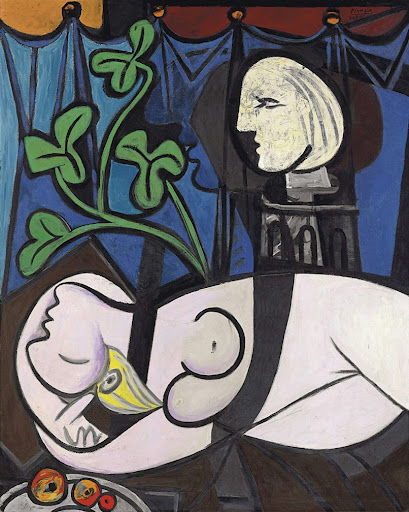
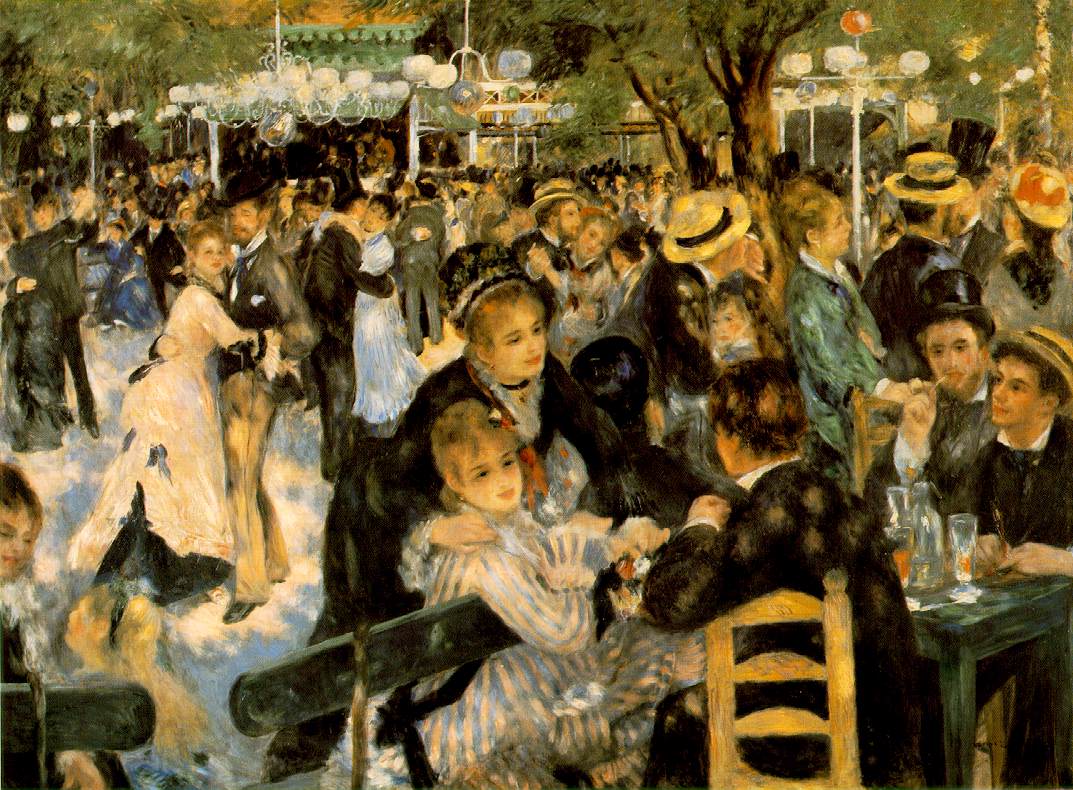
Worst of all is that the destiny of the majority of these privately bought paintings is to be hidden away in vast private collections, locked away from public view, as the increased secularisation and privatisation of the world’s masterpieces continues. And as the prices are pushed up, so too is the opportunity for a public gallery, most of them cash strapped, to ever acquire one of these great art works again. While the occasional private purchaser is good enough to loan their acquisition to a public gallery for public view, such as Picasso’s Nude, Green Leaves and Bust sold to a private bidder (thought to be a Russian oligarch) but currently on show at Tate Britain as part of its Picasso and Modern British Artists exhibition, most will never see the light of day again. Much like Renoir’s Bal du moulin de la Galette, purchased by Ryoei Saito in 1990 and supposedly never heard of from that day onwards.

Picasso, Nude, Green Leaves and Bust (1932)

It’s not like these paintings are stunning. Munch’s recently sold Scream was only a pastel study and not nearly as intense as the oil-painted original which thankfully remains on public view in Oslo. Rothko’s work on the other hand (for I hate to call it a “painting”) is a matter of personal taste, although I am sick of constantly being told that Rothko’s works are moving, incredibly important masterpieces worthy of my attention. Because they’re certainly no worthier of my attention than the blank canvases sat in my cupboard, and the only thing that moves me about them is why they are taking up valuable space in some of the most important contemporary art museums in the world. Anyway, I digress. No matter what my personal opinion is of Rothko, I recognise his place in art history, and once again I would prefer to see his works on public display for the contemplation of countless generations, than for the sole entertainment of a few Qatar Royals and a herd of camels.

Renoir, Bal du Moulin de la Galette

In an ideal world, legislation would be passed forcing public galleries to have first dibs when an important work comes up for sale, at a heavily reduced price of course. But sadly this is not how the world works. Everyone wants to make a profit, and no more so than the auction houses of London and New York who revel in their press-grabbing broken records in the same way that White Star Line encouraged a speedier Titanic voyage in order to make headlines with the ship’s early arrival in New York. And we all know how that story ended, don’t we.

Johan Zoffany: Society Observed

If you’ve read my last few posts, you’ll probably  know that the weather in London is bleak, persistently grey, and wintery cold. Sorry to go on, but to be fair, it has been like this since the beginning of April. So while we all gasped a sign of understandable relief to have a bank holiday weekend with one extra day off work, I for one did not relish the enhanced days of freedom alongside what looked to be a weather forecast stuck somewhere in December. So what to do with a wintery weekend in May save for staying in bed? Why, a good old exhibition of course.

Thomas King as Touchstone in ‘As You Like It’ (1780)

London has been the European capital of exhibitions this year, from David Hockney for which queues formed an hour before opening and extended long past the Royal Academy courtyard until closing, to that Da Vinci spectacular at the National Gallery, for which queues not only spiraled around the whole of the West End, but tickets started reaching astronomical figures in the dark and dangerous world of the black market. We’ve had a bit of Picasso, and a whole show devoted to Lucien Freud, and now we have the master of marketing manipulation himself, Damien Hirst, installed at Tate Modern. But otherwise things are drying up a bit on the exhibition front, with some new shows promised towards the end of the year, but nothing compared to the blockbuster paroxysm which we had at the start (I’m not too sure why they decided to show the best stuff at the beginning of the year before the Olympics start… but owing to the ridiculous crowds experienced when it was just us Brits in tow, it’s probably a good thing that we didn’t have to compete with the rest of the world in the galleries as well).

Henry Knight of Tythegston with his Three Children (1770)

So this weekend I had a choice of Hirst, which I’m trying to put off for as along as possible because he makes me angry, Nicholson/ Mondrian which looks a bit geometric, Turner, which is all very well but a bit samey, and this Zoffany chap at the Royal Academy. I’ve never heard of Zoffany before, but seeing as the Royal Academy is currently in a visitor loll, after the close of Hockney and before the opening of their annual car crash – The Summer Exhibition – I decided to give him a go.

Johan Zoffany (1733-1810) was born in Frankfurt, Germany, but moved to England at the age of 27. A keen socialite and excellent networker, he soon found himself the darling of the rich, influential aristocrats and profligate patrons of the age. Within four years he was enjoying the patronage of King George III and his wife Queen Charlotte, and was also the beloved of the Austrian Royals, being created a Baron by the Archduchess Maria Theresa at the age of 33.

Zoffany was a keen social observer. Through his connections in high society, and through his friendship of leading actor of the  time David Garrick, Zoffany was afforded countless opportunities to paint scenes enriched by the lively portrayals of contemporary society, from lavish theatrical productions of Shakespeare’s As You Like It and Macbeth, to complex portrayals of musician troupes, families in conversation and at play, large social gatherings watching cock fights in India and attending the Uffizi in Florence, and the Royal Family in both formal attire, and playing dress up.

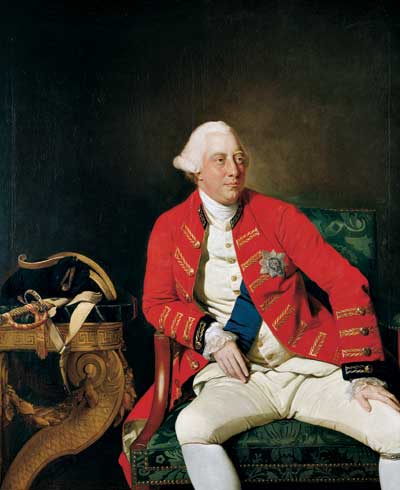
George III (1771)

The distinctive thing about Zoffany’s works is this element of social interaction which he portrays. Unlike many portrait painters of his day, he did not paint head to toe, stiffly posed portraits. Rather he painted his sitters, both singularly, as couples or as large groups, interacting and in the course of “doing”. For this reason, his paintings are both wonderfully natural, and appear to represent a highly realistic snapshot on society of that day. This realism is of course vastly augmented by his meticulous attention to detail and his impeccably intricate fashioning of fabrics, furniture, interiors and objects.

The show starts with a number of mythological and allegorical pieces. One of my favourites was this, David with the Head of Goliath (1756). Some have asserted that the piece is a self-portrait, others disagree, but all comment upon what appears to be the purposeful homoerotic and phallic nature of the piece, as David’s sling hangs close to Goliath’s open mouth, while David stares out provocatively, holding what appears to be the glans of a marble phallus from an antique sculpture in his hand.

David with the Head of Goliath (1756) National Gallery of Victoria, Melbourne.

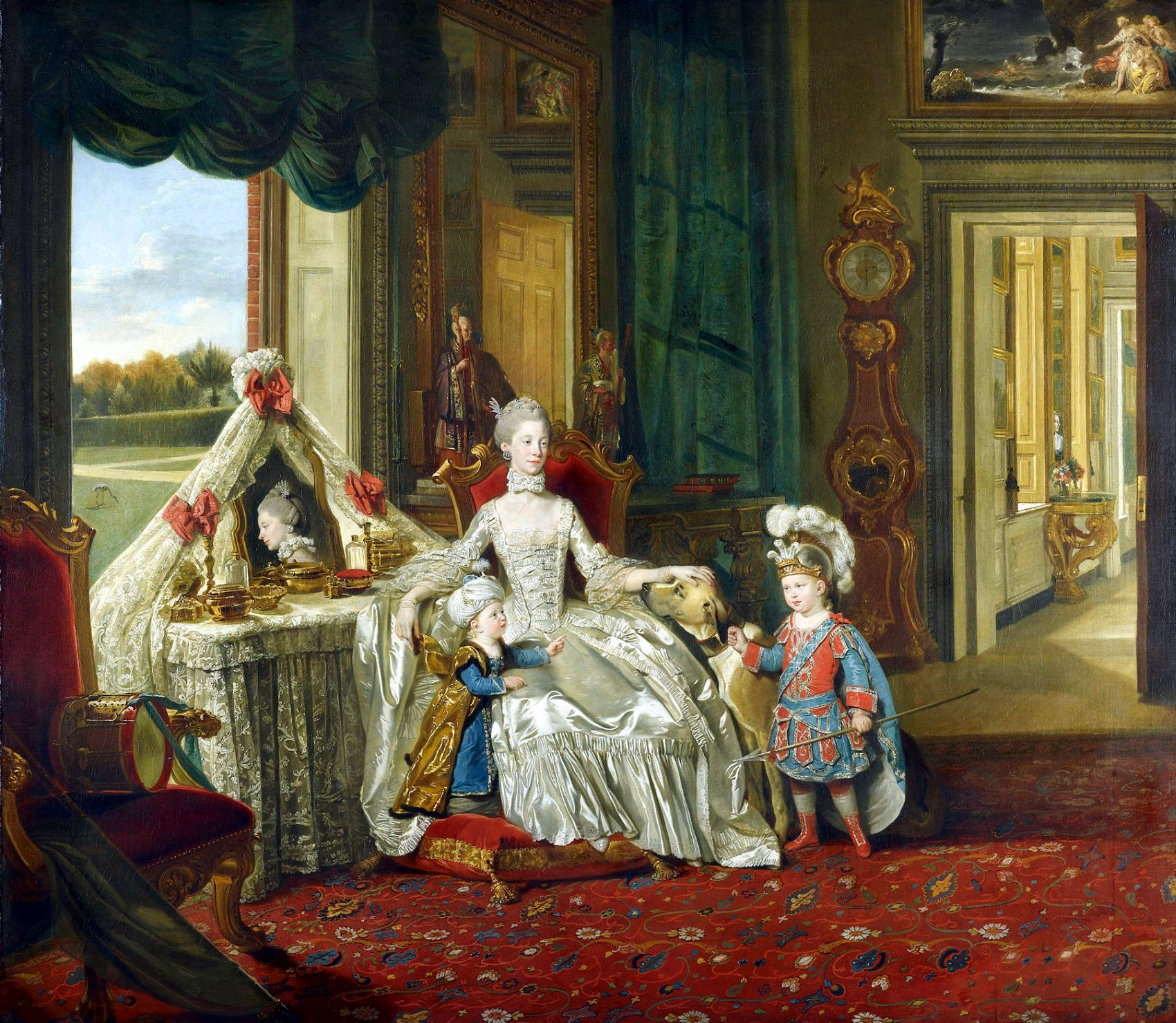
Of Zoffany’s various Court paintings, my favourite was this one, showing Queen Charlotte with her sons George, Prince of Wales, and Frederick, Duke of York. Asides from the cuteness of the young prices dressing up, one as Telemachus, son of Odysseus from Homer’s Odyssey, and the other in a Turkish costume, the thing that struck me most about this painting was the stunningly executed drapery of Queen Charlotte’s dress, painted with exquisite skill and attention to detail.

Queen Charlotte with her Two Eldest Sons (1764-5), The Royal Collection of HM Queen Elizabeth II

It wasn’t all high society that Zoffany observed. This painting, of an optician with his attendant, exhibits with great sensitivity two ageing craftsmen in a cluttered workshop filled with a plethora of materials each painted with intricacy and realism. For me, it is reminiscent of a an old Dutch interior scene by the likes of Vermeer, but with the added intensity and captivating quality held in the direct gaze of Mr Cuff the optician.

John Cuff and his Assistant (1772), The Royal Collection of HM Queen Elizabeth II

Zoffany’s real skill lay not only in social observation, but in his attention to detail. One of my stand out favourites of the exhibition was this painting, showing the library of Charles Townley complete with a large variety of sculptures from antiquity echoing the grand tour travels which were so fashionable in those days across continental Europe, and in which Zoffany too indulged when he went to Italy for a number of years at the behest of his patron, Queen Charlotte.

Charles Townley’s Library No. 7 Park Street, Westminster (1781-3, 1792, 1798)

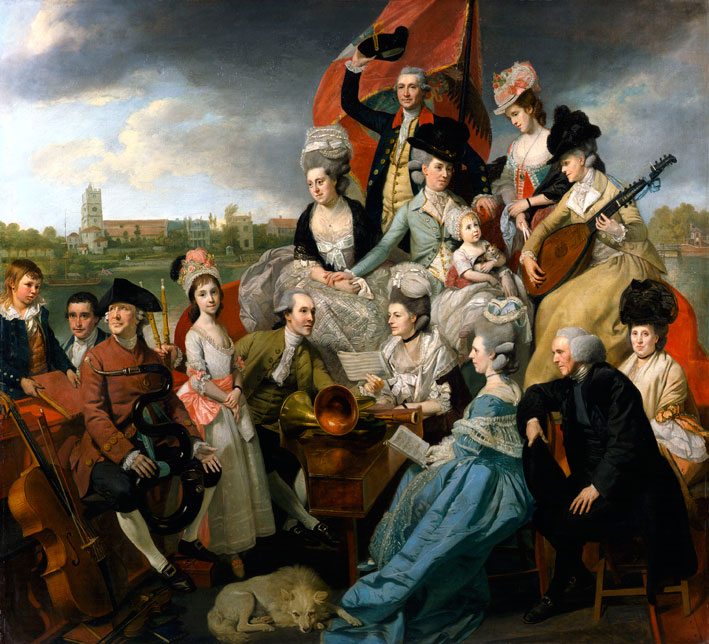
Finally I loved this group portrait of the Sharp family, a family of musicians who used to gather together once a fortnight to give performances. In the summer these performances were given by the Sharps on yachts, shallops and barges in what they termed “Water Scheems”, becoming so well known in doing so that they captured the attention of George III himself. This painting shows one such gathering on a barge on the River Thames – you can see Fulham Church in the background.

The Sharp Family (1779-81), National Portrait Gallery

This exhibition just goes to show that sometimes it’s the old masters and past artists, although perhaps lesser known, but whose skill is nonetheless indubitable, that really shine. The Hockneys and the Hirsts of this world may pull the crowds, seduced and manipulated as they are by the media sway, but the real treasures are to be found in the oeuvres of the past masters, painters who worked at a time when skill was King, and an unmade bed was swiftly remade and freshened, not displayed in a gallery or proclaimed a masterpiece of art. We can always live in hope that such days of aesthetic appreciation and just reward will return. In the meantime head along to the Royal Academy. The show is on until 10 June 2012.

Picasso at Tate – highlight of London’s exhibition year so far

The new exhibition at Tate BritianPicasso and Modern British Art, is a triumph. In analysing Picasso’s complex relationship with the UK and his influence upon Modern British painters and sculptors, the Tate approach a well-trodden artistic oeuvre with a new, fresh perspective. The exhibition not only shows off some wonderful Picasso’s, including many lesser known works from the beginning of his career, but it also places the spotlight on some lesser known British artists such as the superb, prickly and moving work of Graham Sutherland, promoting them to the undisputed limelight enjoyed so regularly by Señor Picasso.

The story of Picasso’s relationship with the UK runs throughout the exhibition, both through the works on show and by way of useful curator commentary placed alongside the canvases. Who would have thought that the artist, so universally  accepted as a leading genius of modern art, and whose paintings comprise the top three most expensive paintings ever sold at auction, should have once been so inexorably spurned by the British art institution? When his work was first exhibited here in 1910, one critic, GK Chesterton described one of Picasso’s cubist paintings thus: “a piece of paper on which Mr Picasso has had the misfortune to upset the ink and tried to dry it with his boots”. 

Picasso, Flowers (1901) - Tate's first conservative Picasso purchase

This sort of reaction was by no means unique, and with his few British fans stemming almost universally from groups of budding artists such as the Bloomsbury group with the exception of a few steadfast collectors, it was many years before one of Picasso’s works entered the public collections in Britain. In fact when Britain did at last buy a Picasso work, they made the purchase of probably the most innocuous and dull painting Picasso ever created – Flowers (1901) – which was purchased in 1933 by Tate.

Picasso’s popularity in England did increase in the inter-war period, with works entering the private collections of collectors such as Douglas Cooper, Roland Penrose and Hugh Willoughby, as well as the stir caused as the worldwide propaganda tour of Picasso’s masterpiece, Guernica, passed through the UK in 1938 in support of the Spanish Republican cause during the Spanish Civil War. Nonetheless, it was not until post-WW2, when, numbed to the horrors of war, a newly optimistic peace-time Britain was ready to truly accept and celebrate the talents of Pablo Picasso. Shortly after the end of the war in 1945, the Victoria and Albert museum held an exhibition of Matisse and Picasso, and in 1960, Tate held the largest exhibition of Picasso’s work to date, an exhibition which proved popular enough to attract some 500,000 visitors.

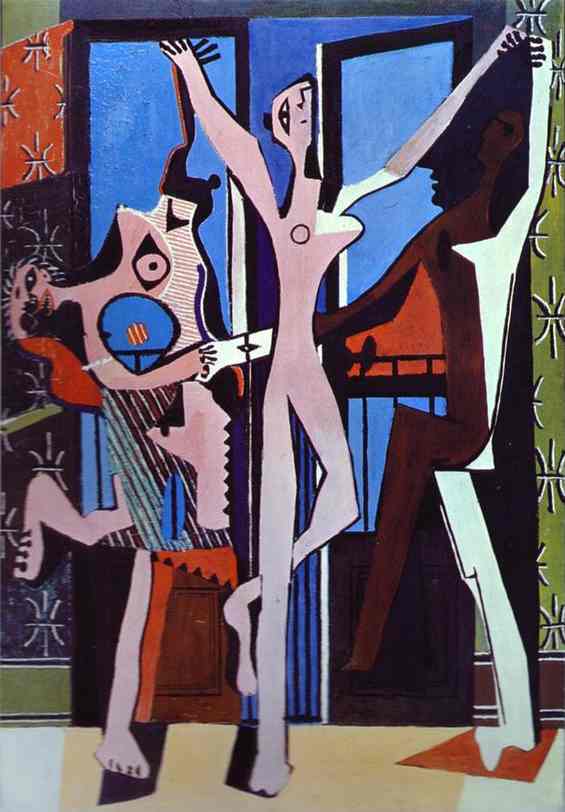
Picasso, The Three Dancers (1925)

It was only after this time that Picasso agreed to sell what he regarded to be one of his most important works to the Tate Gallery in Britian: The Three Dancers, a sale which was agreed in 1965. The work remains one of the masterpieces of Tate Modern’s collection.

Perhaps it’s not all that surprising that Britain was slow to accept Picasso. Historically, the Brits have been a bit slow in adopting anything which causes a disturbance of the traditions which they have always held to be dear. Just look at House of Lords reform – the labour government tried to reform the upper house of Parliament in 1999, but clearly found the disturbance of tradition so ultimately unsettling that they have left the reforms only half completed to this day, a house of semi-herditory peers suspended in history. Even in his time, Turner’s later, more impressionist works proved to be somewhat controversial, even though, by the time the French Impressionists rose to the fore, Turner, cited as a huge influence for the likes of Monet, was held dear to the hearts of the British public. When Picasso came along, the Brits were only just swallowing the new craze of impressionist work coming over from France. Picasso’s cubism and misplaced faces proved a little too radical for most. It is for this reason that Britain, by contrast with the likes of MOMA in New York, holds comparatively few Picasso’s in its public collections (Perhaps this is why Britain is trying to make up for it’s past vacillation by so readily accepting crappy modern art work like Tracey Emin and Martin Creed (you know – lights on, lights off) into its folds? Yes, once again, Britain is out of touch it seems).

Picasso, Weeping Woman (26 October 1937)

Wyndham Lewis, A Reading of Ovid (Tyros)

But despite all those years when Picasso was conspicuous by his absence in the UK’s public galleries, this did not do anything to prevent our budding young artists from being heavily influenced by his work. The second thread of Tate’s exhibition demonstrates how comprehensively Picasso influenced the works of British artists of the time. Duncan Grant, for example, saw many of Picasso’s works when he was in Paris mixing with the likes of Leo and Gertrude Stein. Grant quickly adopted the African-style works which predominated in Picasso’s work around the time of Les Desmoiselles d’Avignon, as well as responding to the collages pioneered by Picasso and his Cubist colleague, Georges Braque. So too was Wyndham Lewis, leader of the Vorticist movement, influenced by Picasso’s work, although he actually sought to criticise Picasso who he considered to be overly sentimental and putting the modern movement “under a cloud”. In fact Lewis’ painting A Reading of Ovid (1920-1) (one of my favourites from the exhibition, sought to criticise Picasso’s return to large curvaceous classical figures at that time (such as The Source, below).

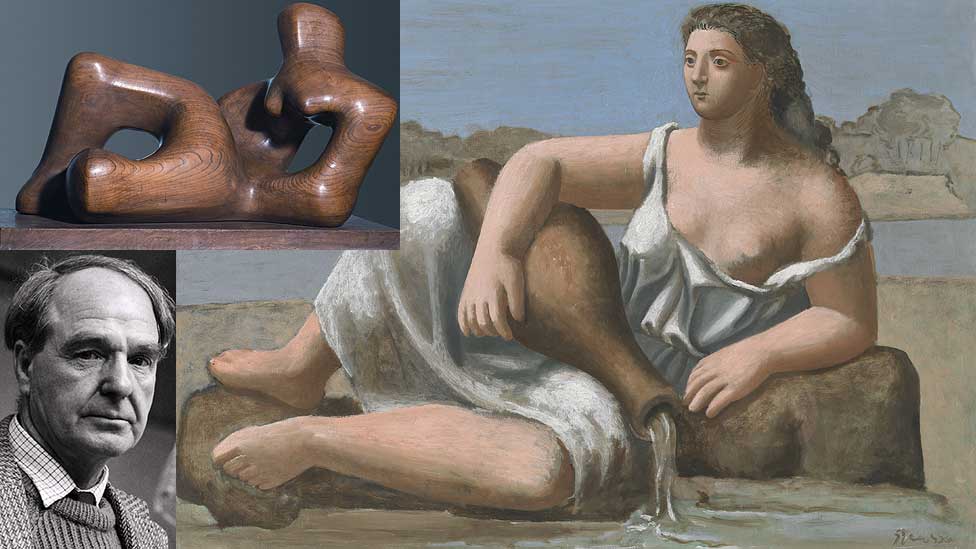
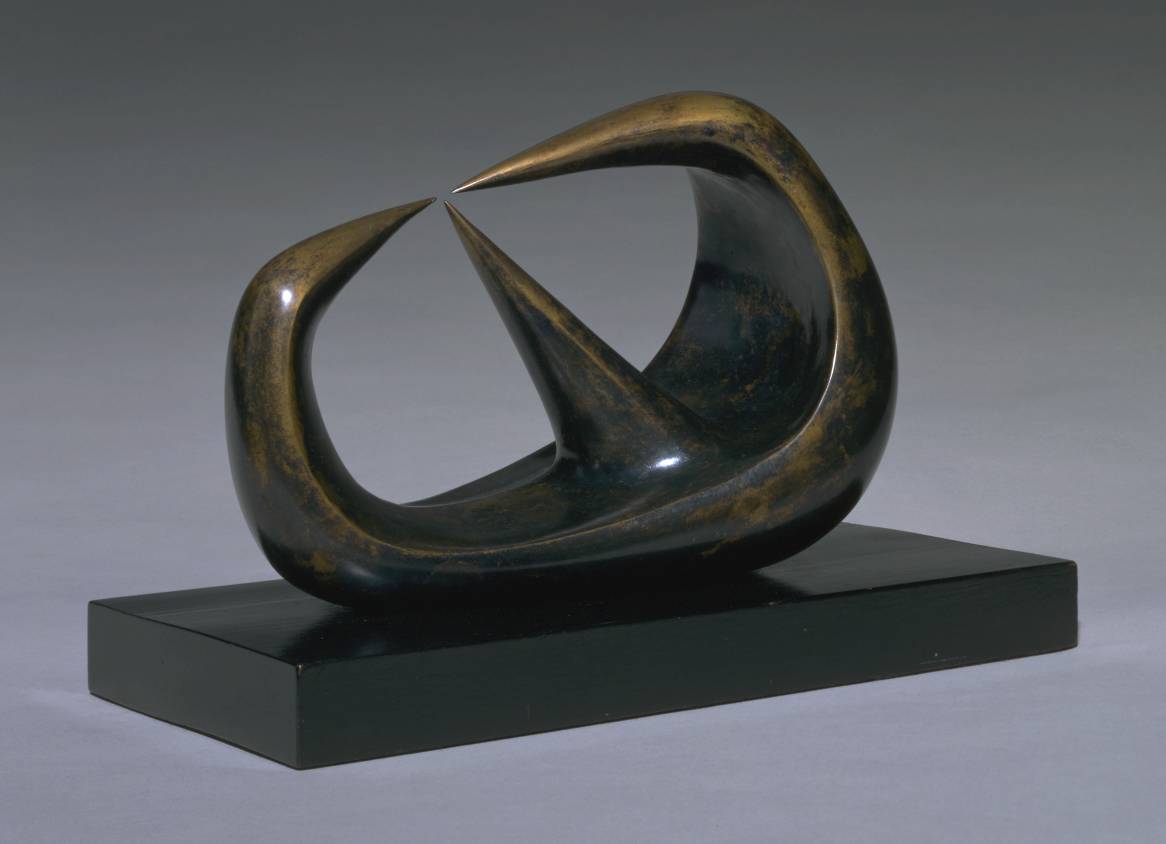
Of other artists influenced by Picasso over the years, amongst them Ben Nicholson (whose first abstract works were notably cubist in style) and Francis Bacon (who readily adopted Picasso’s screaming figures from the Guernica era), one of the most strikingly influenced is British sculptor extraordinaire, Henry Moore. The exhibition proficiently sets up direct comparisons between many of Moore’s sculptural forms and drawings and Picasso’s work. For example in his 1936 Reclining Figure, you can see a direct reference to Picasso’s classical work, The Source. Meanwhile, Moore’s incredibly unsettling and violent work, Three Points (1939) appears to reflect the screaming mouths of Picasso’s Guernica figures, painted two years earlier.

Picasso, The Source (1921) and above, Henry Moore's Reclining Figure (1936)

Henry Moore, Three Points (1939-40)

Picasso's Screaming Horse (1937)

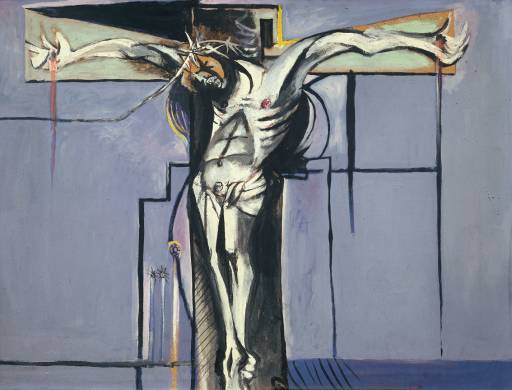
Probably my favourite of the British artists on show was Graham Sutherland, whose works had largely escaped my radar before I saw some of his works a few months back at the Pallant House Gallery in Chichester. Sutherland, who acknowledged his debt to Picasso and in particular to Guernica as he set about painting a number of unsettling works during wartime Britian, particularly in his images of the bomb-damaged English cityscapes and his thorn-like figures, is probably best known for his Crucifixion which he was commissioned to paint for the church of St Matthew, Northampton. One such work related to the commission was included here – a blue-backed crucifixion which I just adored.

Graham Sutherland, Crucifixion (1946)

Some critics who have been to this exhibition had derided the British artists included in the show, pointing out that next to Picasso, their works fall by the wayside. I disagree. Of course it is clear that many artists owe a great debt to the superbly imaginative, constantly changing oeuvre of Picasso (me included), but this is what artists have always done throughout history – borrowing from one another – just like Picasso himself did when he worked relentlessly on reimagining Las Meninas by Velazquez as well as works by Manet and Delacroix. Nonetheless, all of the British works show an originality and vibrancy of their own, from the undisputed sculptural genius of Henry Moore, to the next level of cubism – photographic cubism, advocated by David Hockney. Of course the true star of this exhibition is Pablo Picasso, but then, that kind of is the point of the show.

Picasso and Modern British Art runs until 15 July 2012 – well worth a visit!

PS Other works I loved…

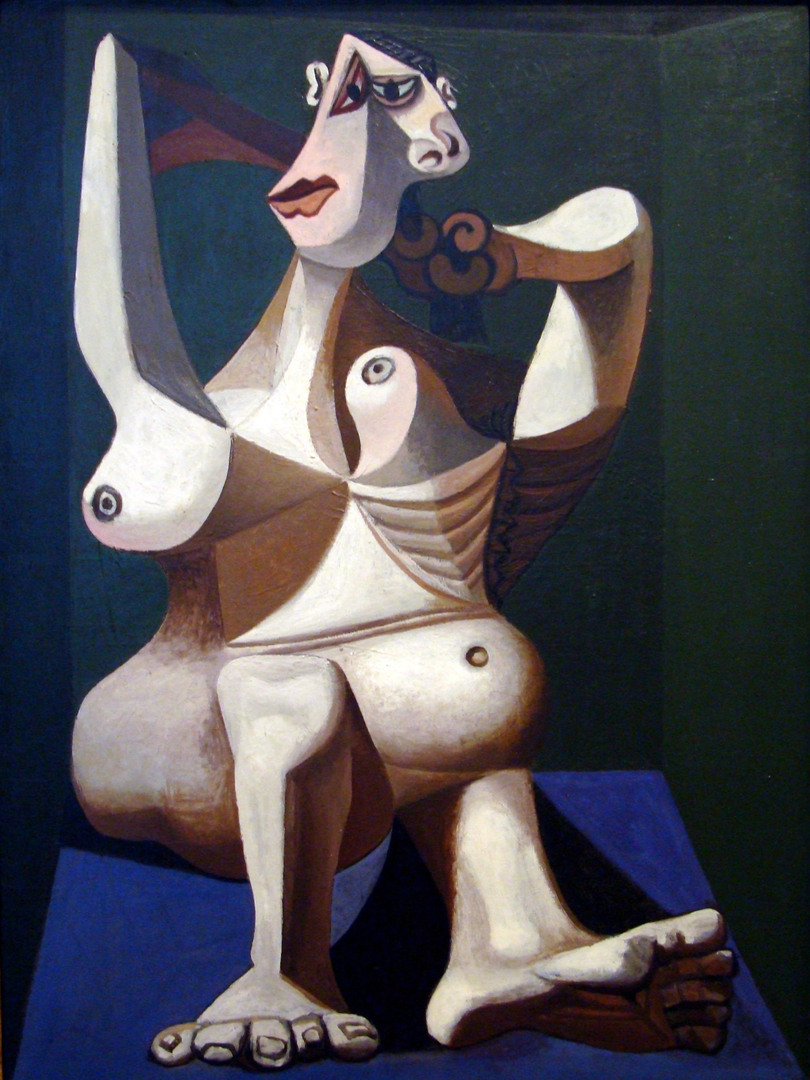
Picasso, Woman Dressing Her Hair (June 1940)

Picasso, Girl in a Chemise (c.1905)

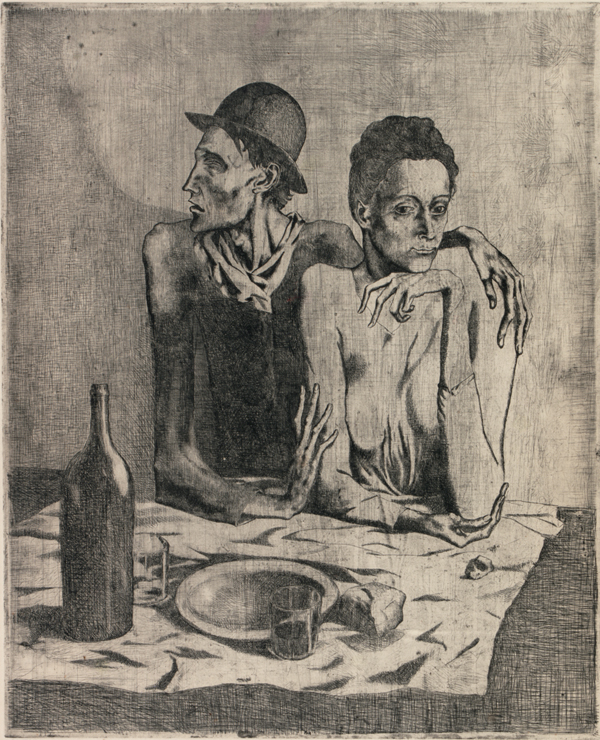
Picasso, The Frugal Meal (1904)

Picasso, Nude, Green Leaves and Bust (1932) - the most expensive painting ever sold at auction

Salamanca – Restaurant Focus: El Alquimista and La Cocina de Toño

Ever since Salamanca placed itself on the European cultural map when it was named European Capital of Culture in 2002, the city has actively promoted itself as a capital of gastronomic prowess, advertising itself under the tag line “Salamanca para comérsela” which literally means “Salamanca to eat”. I’d heard about the frog, the glowing sandstone, and the brilliantly baroque Plaza Mayor. Nonetheless, for gastronomy, I would have told you to head up north to San Sebastian (which, by coincidence, will be European Capital of Culture in 2016). However, no sooner had I started investigating restaurant options using the likes of Trip Adviser before jetting off than I realised that Salamanca is jammed back with high quality, innovative restauranteurs, littered with menus degustaciones (taster menus), and brimming with pristine white hatted chefs with a fastidious attitude towards their picture-perfect cuisine. More than once I read that a Salamanca eatery had offered the reviewing diner the “best meal they had eaten in Spain”. Encouraged, I booked up the best of them and went along to enjoy the ride. Here are my two favourites:

El Alquimista, Plaza San Cristobal 6, 37001 Salamanca Tel 923 21 54 93

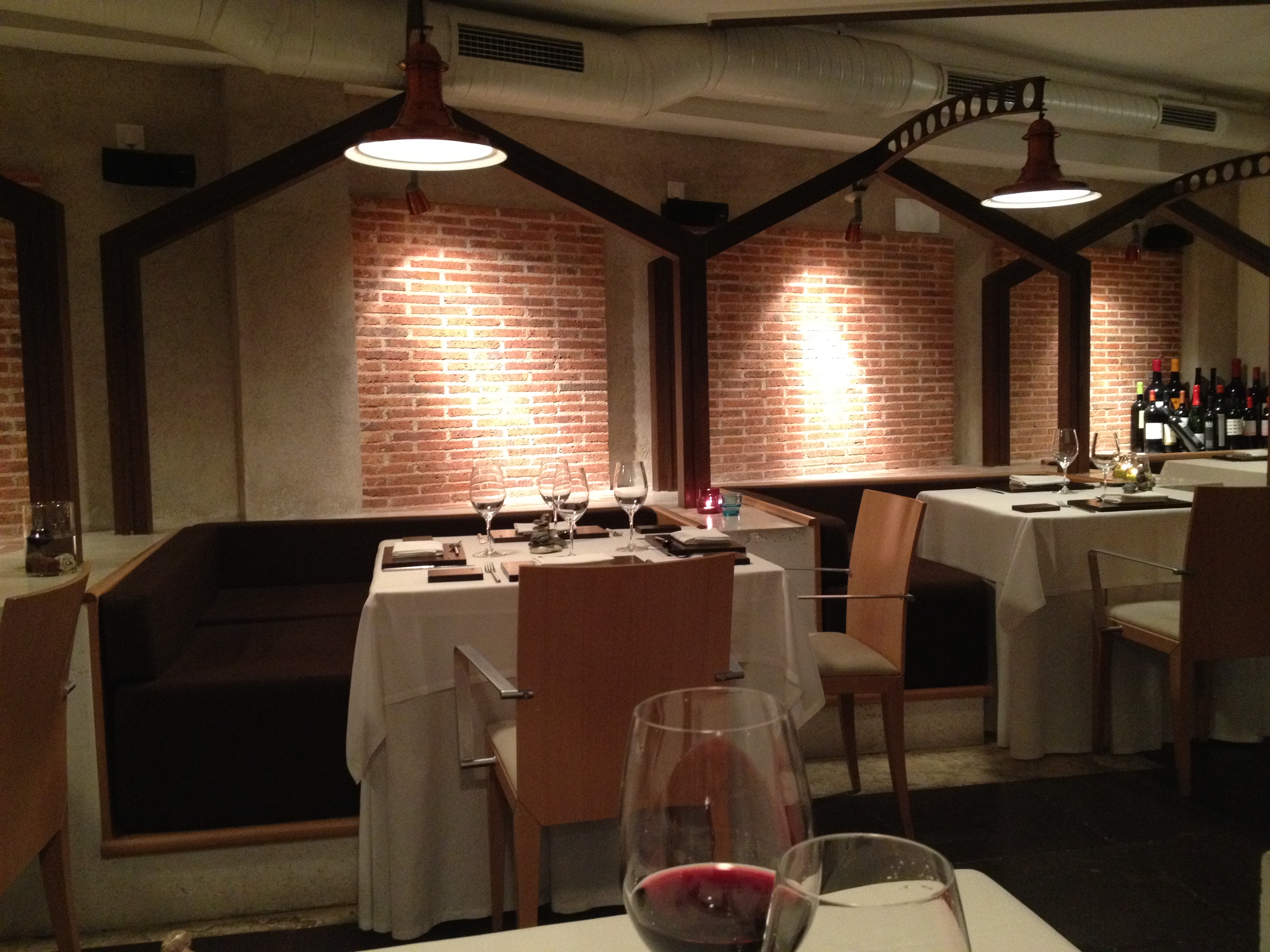
El Alquimista's "urban" interior

I reserved a table at this very unique restaurant on the back of excellent trip advisor reviews which had placed the restaurant in second place out of some 100 restaurants in the city. When I turned up, I began to doubt whether this had been such a good idea. To say the restaurant is off the beaten track is an understatement. Up a steep hill, in a very residential square (surrounded on one side by some dubious looking flats), with a small arrow pointing the way – the restaurant needed this signage, as it could very easily have been missed – approaching the restaurant, one had to double take – it looked like a garage for the flats above. And upon entering, this illusion was not shattered as we were taken through to one of the most unusual restaurant interiors I have ever sat in – with exposed brickwork (newly built) trimmed with concrete slabs to form booths, over which industrial lights hung casting a somewhat unflattering and certainly unromantic harsh light. What was more, when we entered (at around 9pm) the place was empty. The face of my partner probably mirrored my own – concern – although I was trying to put a brave smile on things, not least because my personal pride demanded that my choice be a success, particularly as I boast of being such a good organiser of holiday dining experiences.

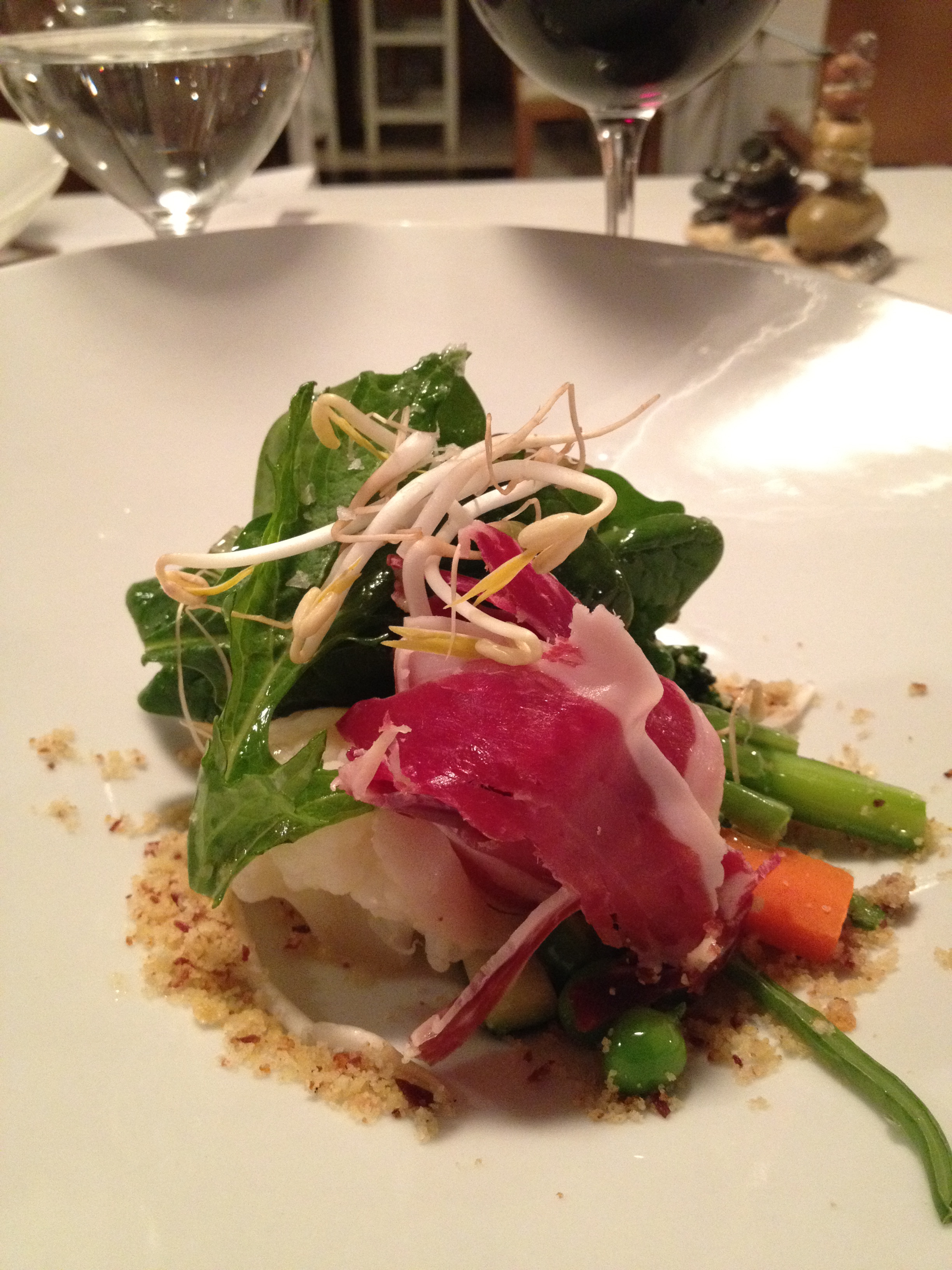
Verduras starter

They call the restaurant “the Alchemist” and at this point, it certainly looked as though some magic was needed. And as though the witching hour itself has come, we found ourselves becoming uncharacteristically merry. I think it was the wine we ordered – I wish I had taken a note of it – it was a Rioja with a mixed grape of around 90% tempranillo and 10% of something else – but it was so good that with one sip, the alchemist seemed to have cast his spell. It’s not that we were drunk – just merried, but certainly sober enough to appreciate the culinary joys which were suddenly to descend upon us, each dish one flurry of magic after another.

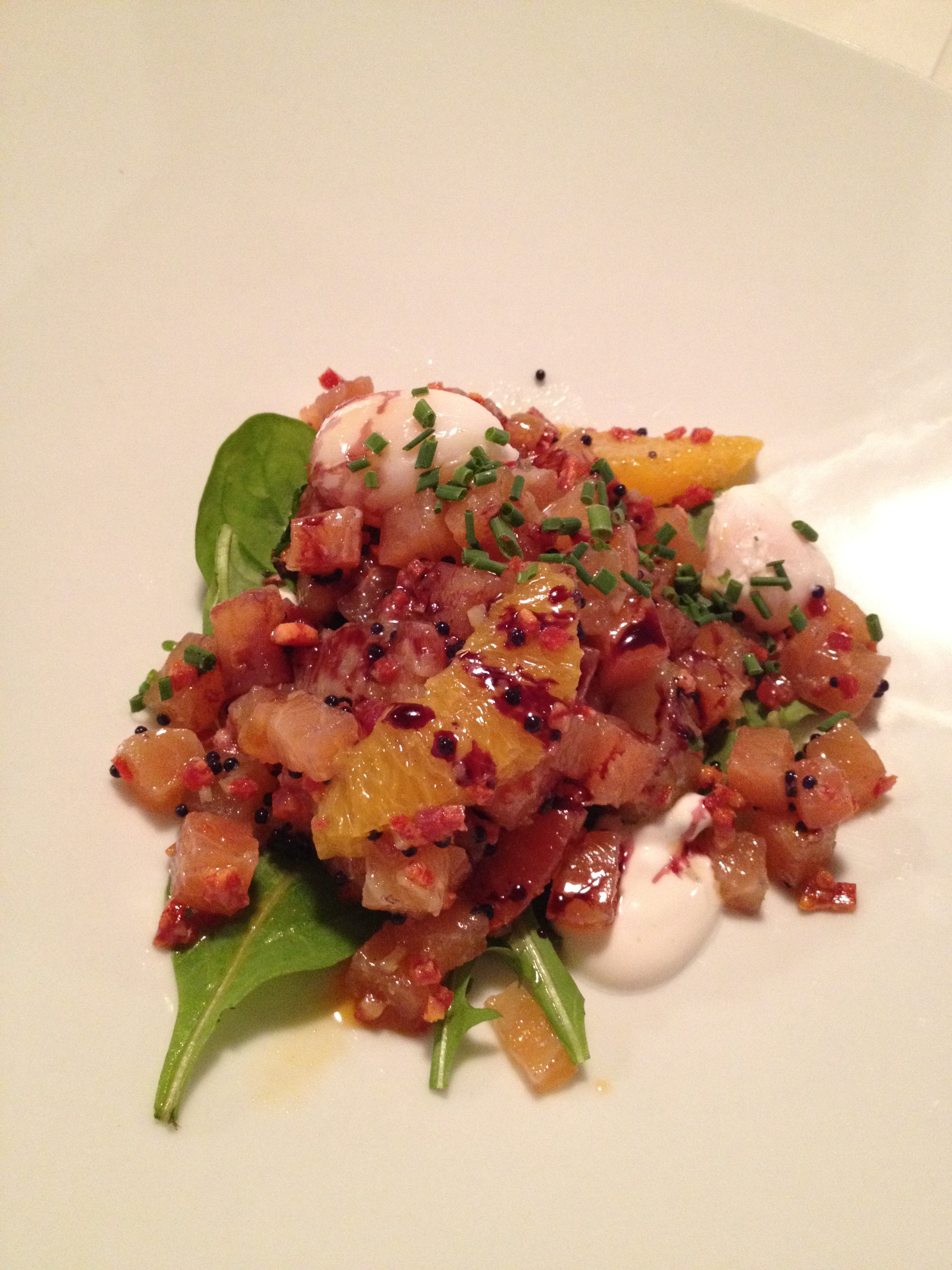
Tartar de salmon

We went for the menu degustacion which, at only €36 per person, was half the price of the sum we are used to forking out for a similar taster menu in Marbella (and far below anything you would pay in London). The first dish was verduras, brotes y hortalizas tibias con lascas de jamon ibérico y migas (Vegetables, sprouts and vegetables with warm slices of Iberian ham and crumbs). The dish was exquisite – the vegetables crunched to perfection, the ham providing a salty undertone and the crumbs a textural variant which provided all round satisfaction with every mouthfull. The dish was one of those perfectly simple but precisely executed why-haven’t-I-thought-of-this kind of dish that you just know you could never recreate so well at home.

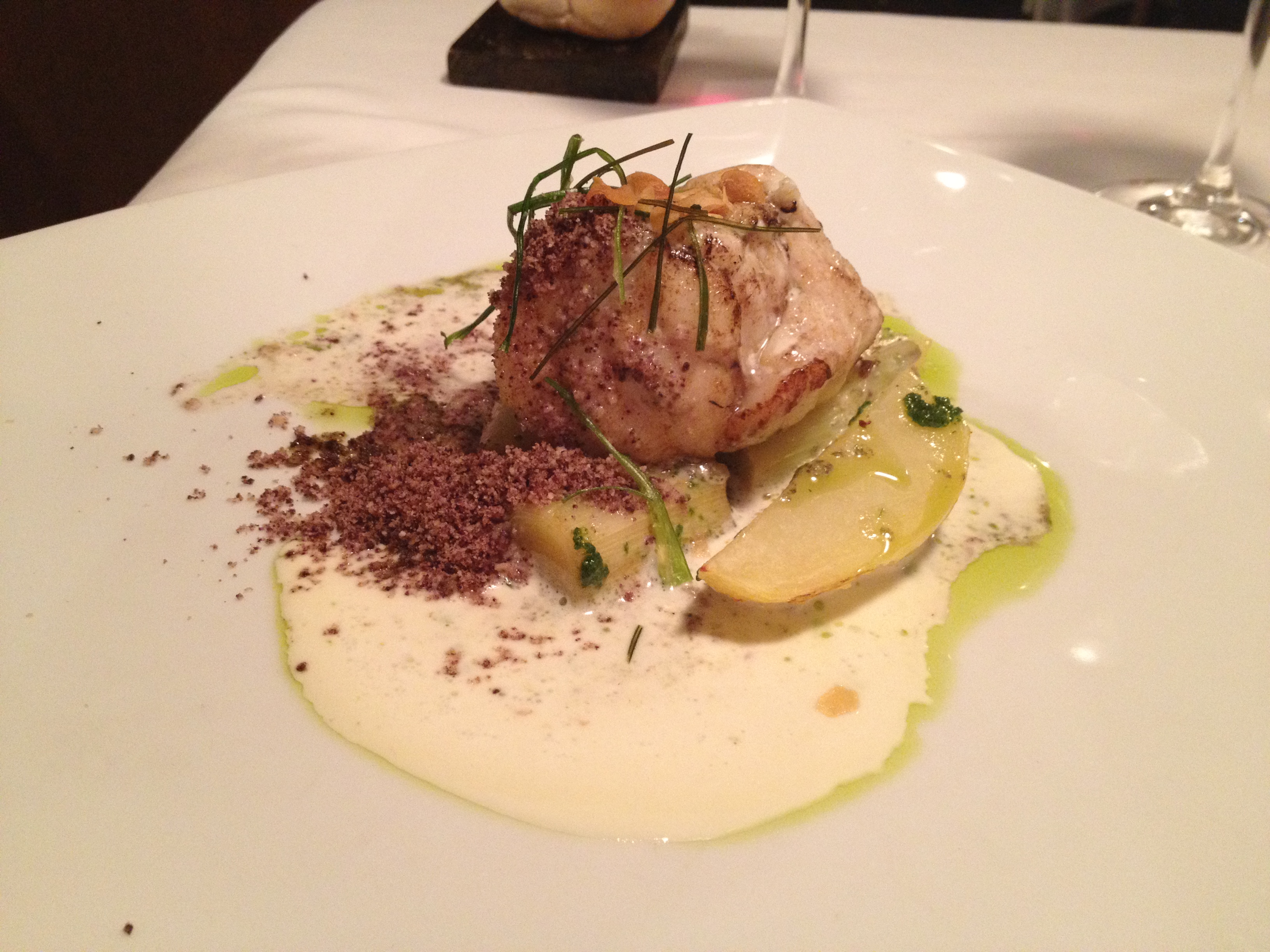
Monkfish

Up next was the tartar de salmon marinado con citricos, chorizo y huevo poché (tartar of salmon marinated in citrus, chorizo and poached egg), a variation on a traditional dish, we were told, where an unlikely fusion of marinated raw salmon with minuscule chorizo pieces scintillated all of the senses with a fresh citrus splash searing lemony acidity through the smokey pimenton of the chorizo. Meanwhile the poached eggs – tiny things – possibly pigeon’s, were perfectly runny, creamy and sweet. Further scintillation was to be provided in the form of rape asado con puerros y polvo de aceituna negra (roasted monkfish with leeks and black olive powder), a fresh and succulent cleansing dish with a seductively rich dusting of black olive to import mediterranean piquancy onto the plate.

The fatty pork

Things went a little awry while the main course of pluma de cerdo ibérico con ragout de verduras y salsa de miel (iberian pig “pen” with vegetable ragout and honey sauce) which was a little too fatty for us. Some people like fat, and crackling and all that porky sinfulness – I’m not a fan, and, embarrassed by my meek attempts at consumption (and by this point being a little tipsy) I then spent the next 20 minutes trying to hide much of the fatty pork in my napkin so as not to offend the chef. In hindsight, he probably would have forgiven me. He may not, however, forgive the pork-filled linen napkin which he finds in the toilet later.

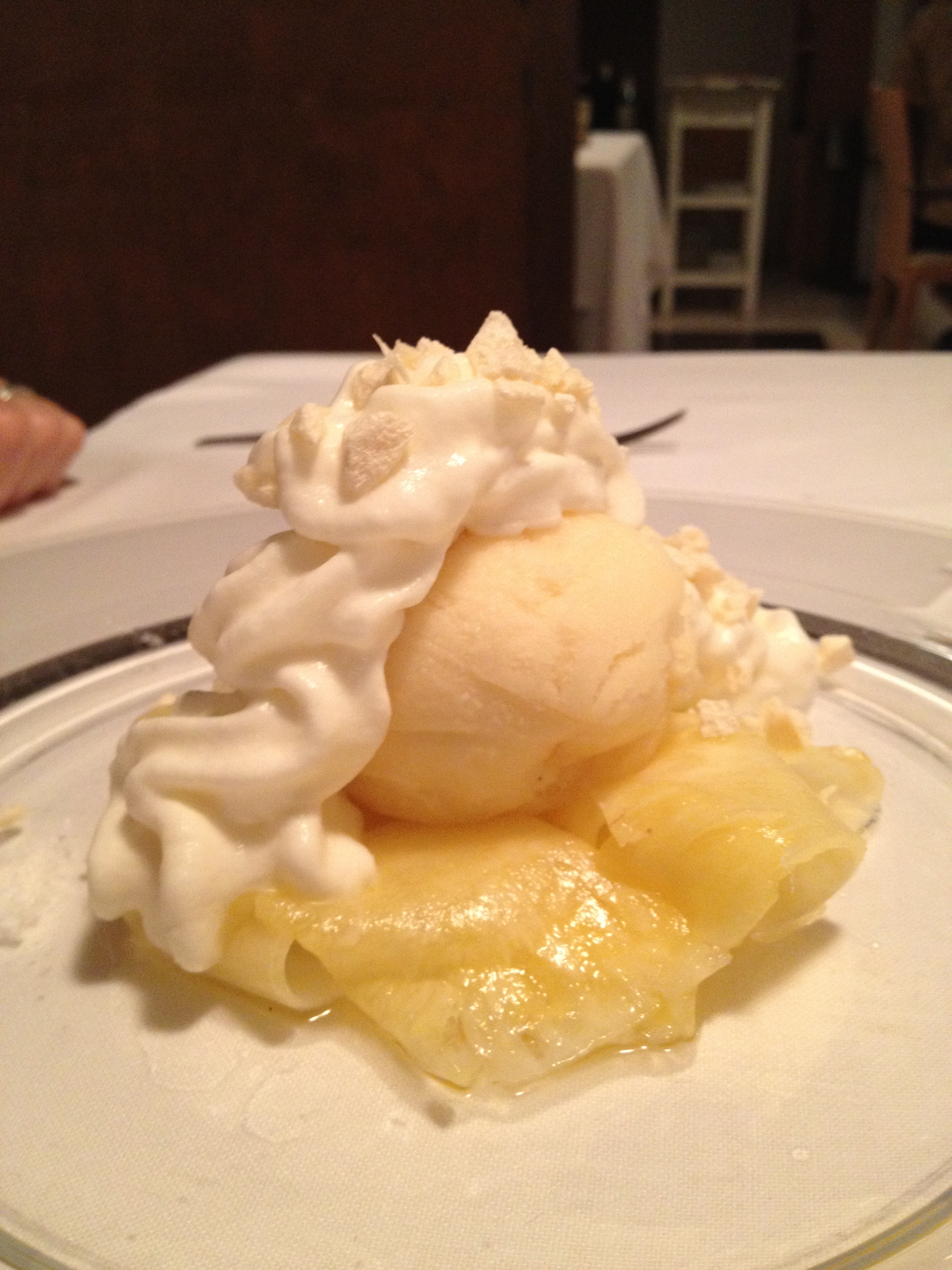
Back on track for piña a la piña con piña (Pineapple with pineappley pineapple), a dessert which presented pineapple three ways – sorbet, form and carpaccio. Not the most innovative dessert I’ve ever seen, but a welcome palate cleanser after all of that semi-masticated fatty pork.

Piña piña piña

La Cocina de Toñoc/ Gran Via, 20, Salamanca  Tel 923 263 977

Strawberry gazpacho

Number 1 on the trip adviser list is this restaurant, the kitchen of Toño, another location which, upon arrival, looked a little speculative – to get into the restaurant you first pass through a very local-looking tapas bar, with a TV, and plenty of old men chatting up at the Bar. Passing through into the restaurant, things get a little better, but the place remains very traditional – old wooden furniture, dark walls, dated decor and a few drinks refrigerators to boot. But the food, ahhh the food. Toño’s kitchen provided nothing short of a culinary spectacle, a carnival of flavours which danced upon the plate, a flurry of gastronomic fusion which was a pure festival for all the senses.

First up was the aperitivo de la casa, a new take on the traditional andalucian gazpacho, the cold tomato based creamy soup successfully fused in Toño’s imaginative kitchen with strawberries. It made for a tantalising combination accompanied by a delicate ricotta for added creamy indulgence. Next up was a bombon de foie relleno de higos (Foie gras bombons with figs), a starter of such flavoursome sophistication that I felt compelled to lose all of my well-bred english inhibitions and gorge upon the delicate creamy form in a few enthusiastic mouthfuls.

Foie gras bonbon

Ensalada de melon y langostinos

Pez mantequilla

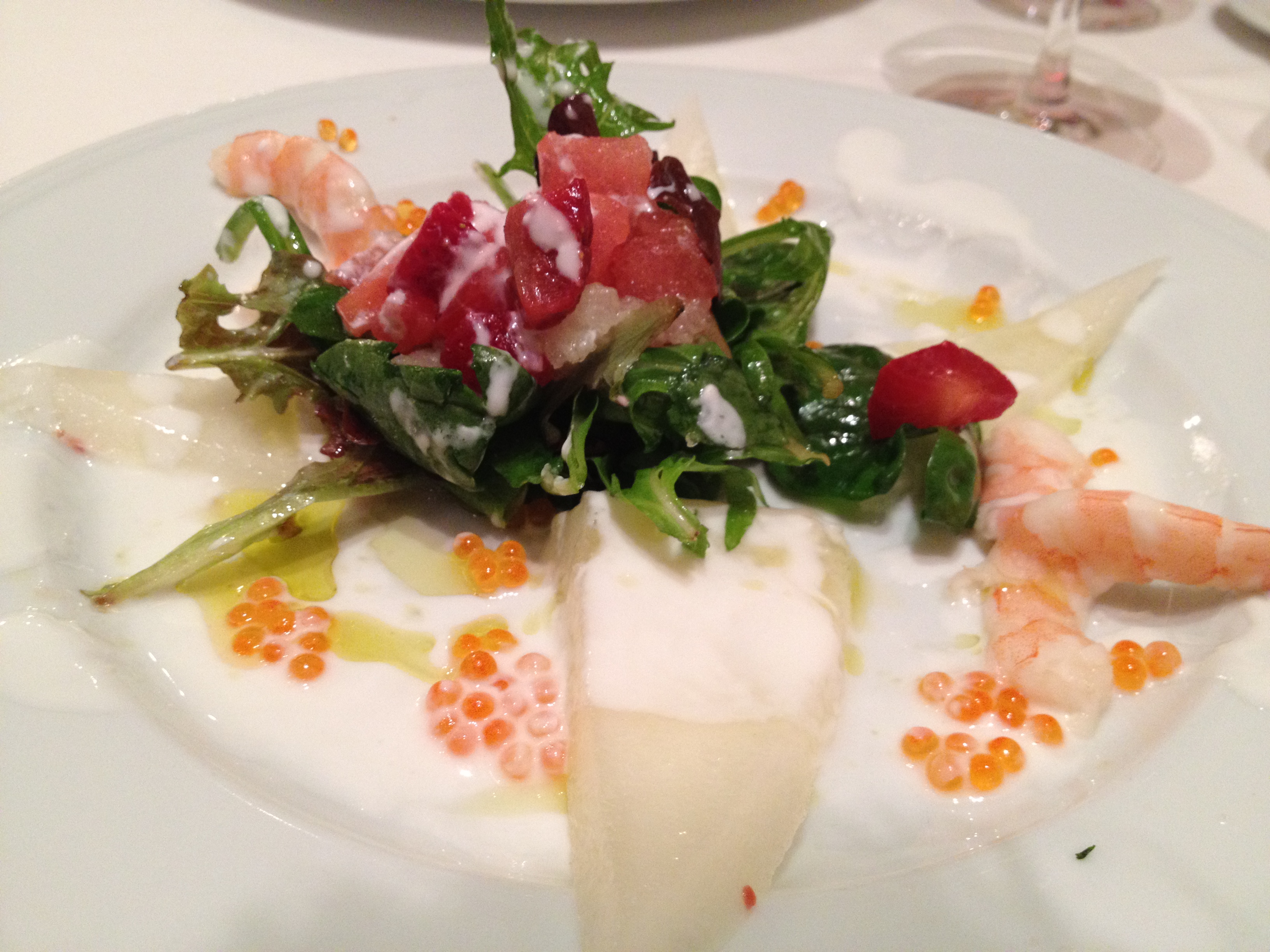
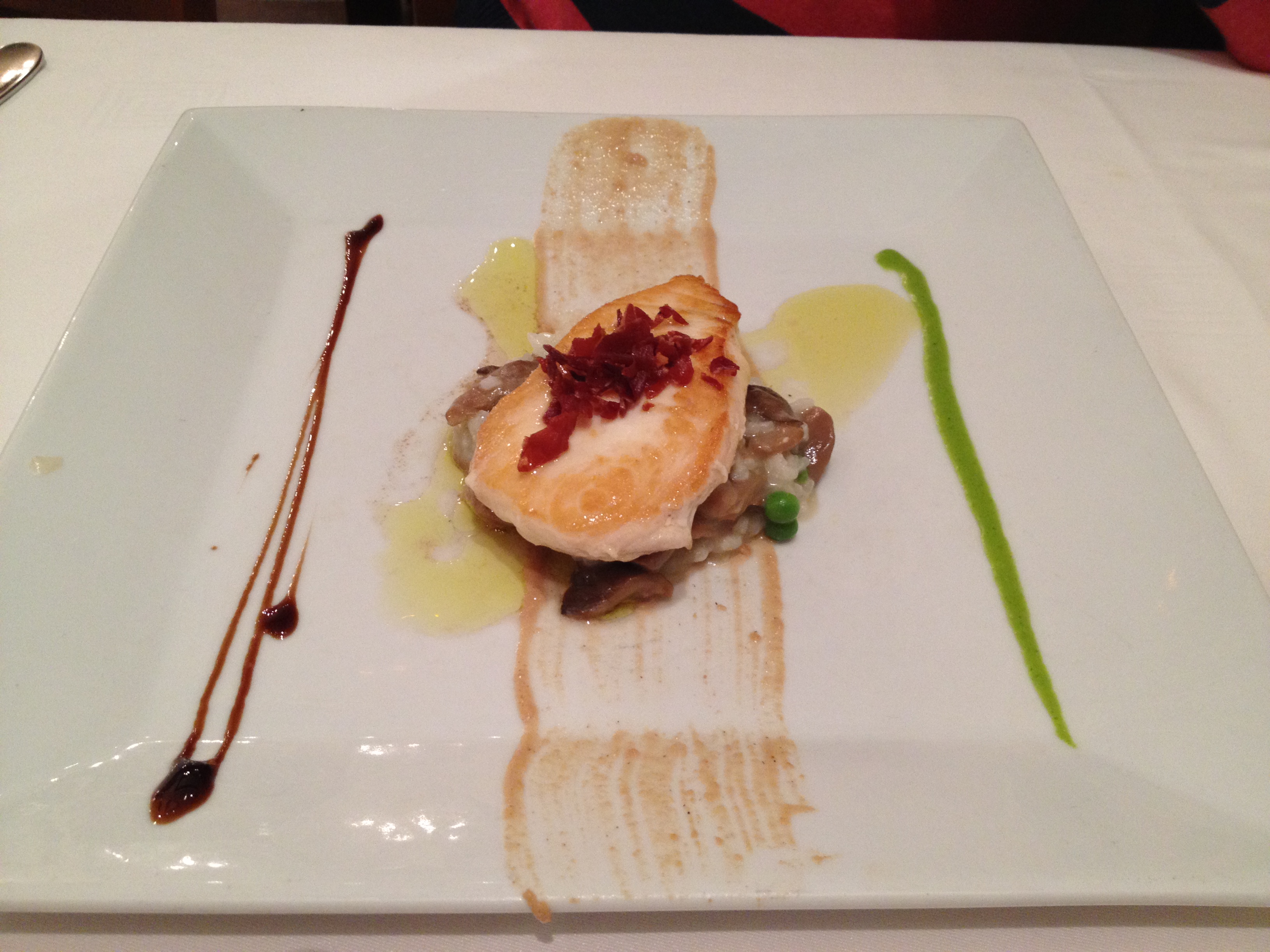
Onto the ensalada de melon con langostinos y vinagreta de yogur (melon salad with prawns and a yoghurt dressing), a delicate but multilayered combination of sweet unctuous prawns and a thirst quenching melon with silky, salty fish roe and sharp strawberries. The fish course came next, a pez mantequilla con arroz meloso con setas, vinagreta de vinagre de trufa y chip de jamon (fish in butter with sticky rice, mushrooms, truffle vinaigrette and a ham chip), a moist perfectly seasoned piece of fish on a creamy risotto base, with a salty ham accompaniment and sticky sweet viaigrette.

The main course spectacular

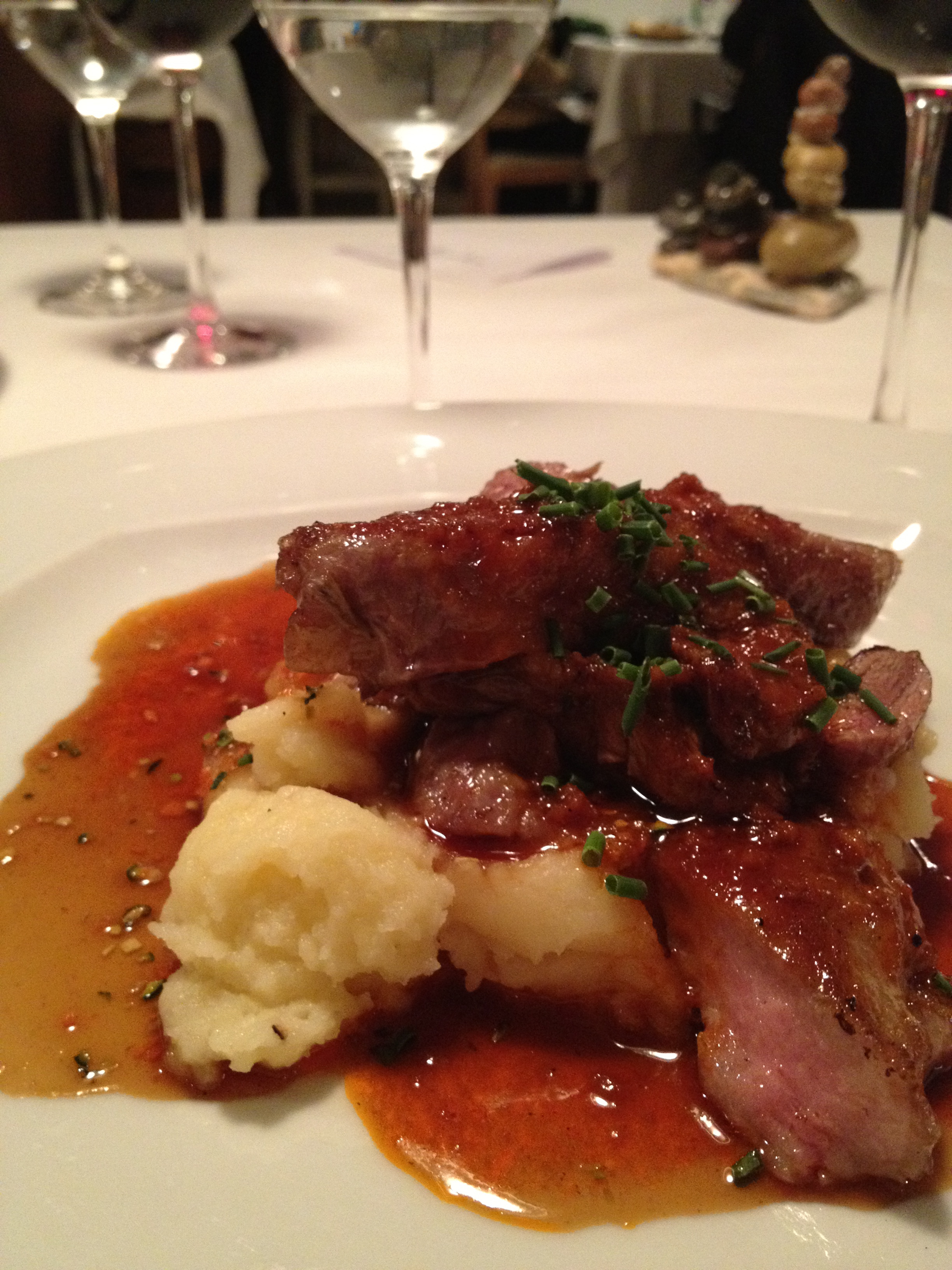
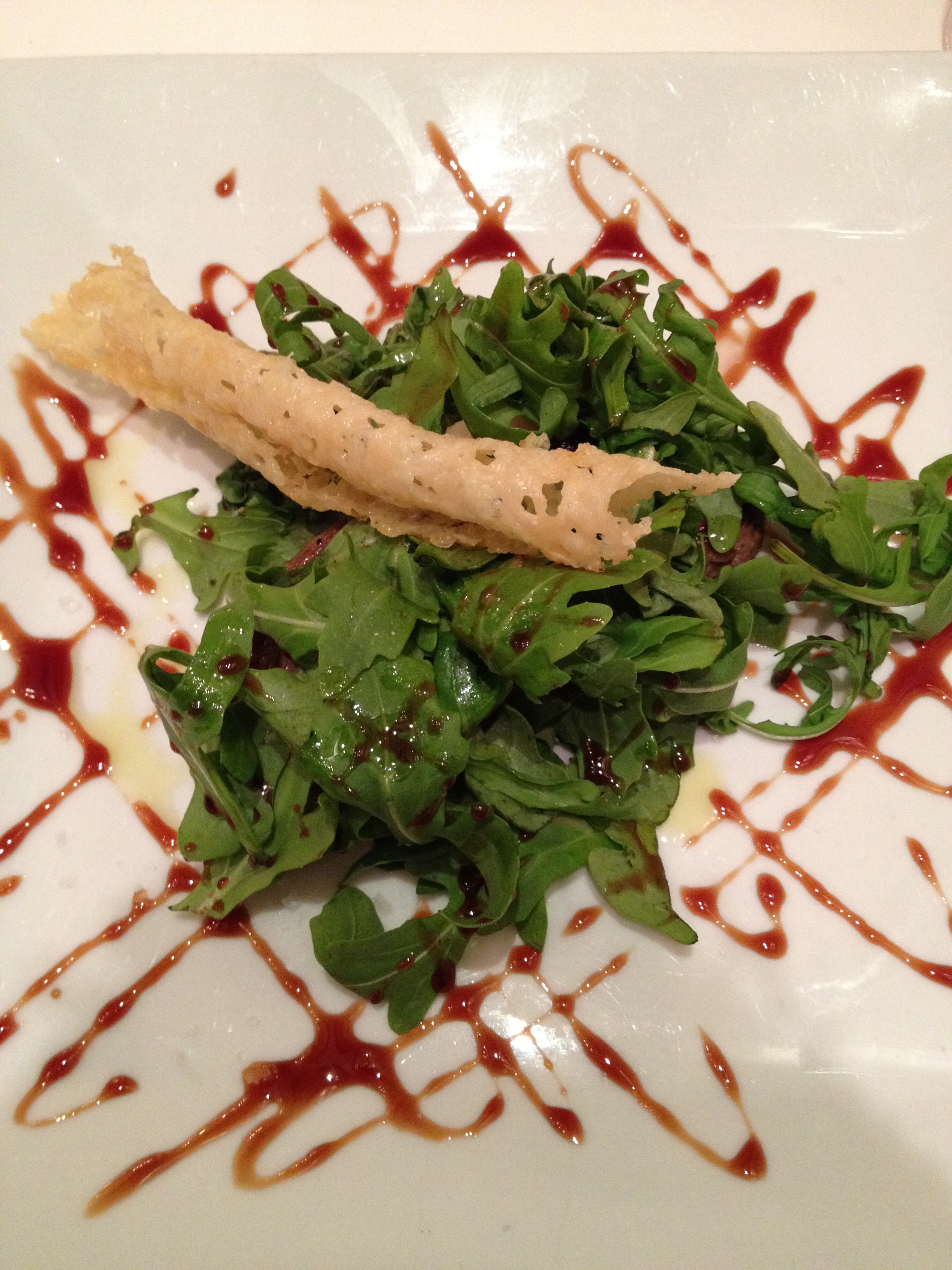
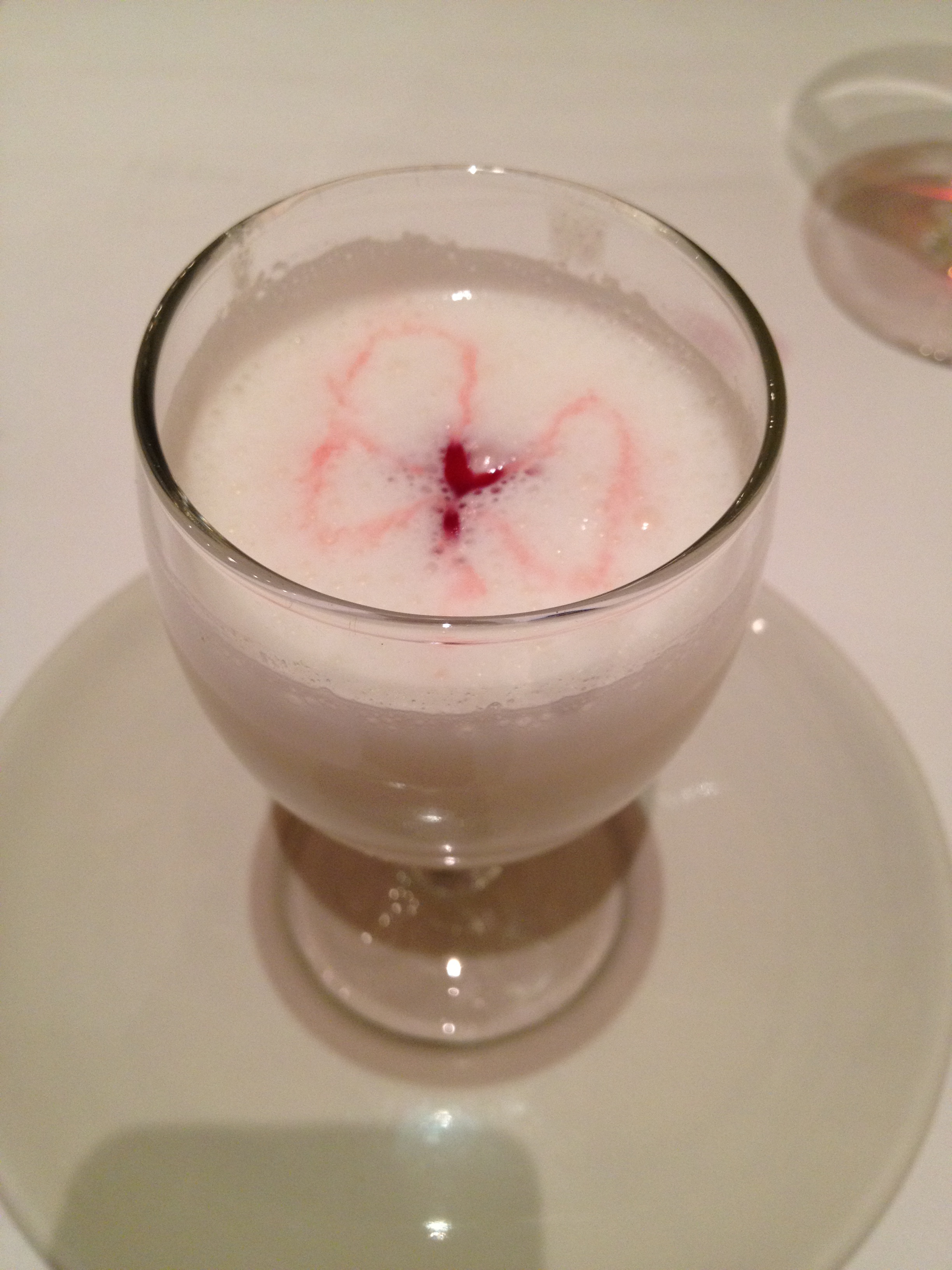
But at the Cocina de Toño, the piece de la résistance came with the main course, a dish which, upon first presentation, I didn’t think I would be able to eat, so full was my stomach and so little my remaining appetite. But as I cut beneath a bed of rocket and a perfectly crispy roll of melted cheese, I found a piece of meat so perfectly seasoned, so sensationally juicy and tender, that I could not help but scrape the plate clean – yes, Toño’s presa ibérica con cigala, canelon de queso y melaza de vino (iberico steak with rocket, cheese cannelloni and a wine reduction) was a sensation, a waltz of salts doing a tango on my tongue with a red wine reduction that was a syrupy sweet seduction. Not to be outdone, this was followed by a yoghurt “digestive”, a shot of fizzy, sparkling, sherbety, foamy pink delight, which was like being a child again. It reinvigorated senses which have long lost grown bored by adult life, and tingled down my throat and throughout my body making me shiver with delight. This was real willy wonker magic.

Fizzy yoghurt digestive

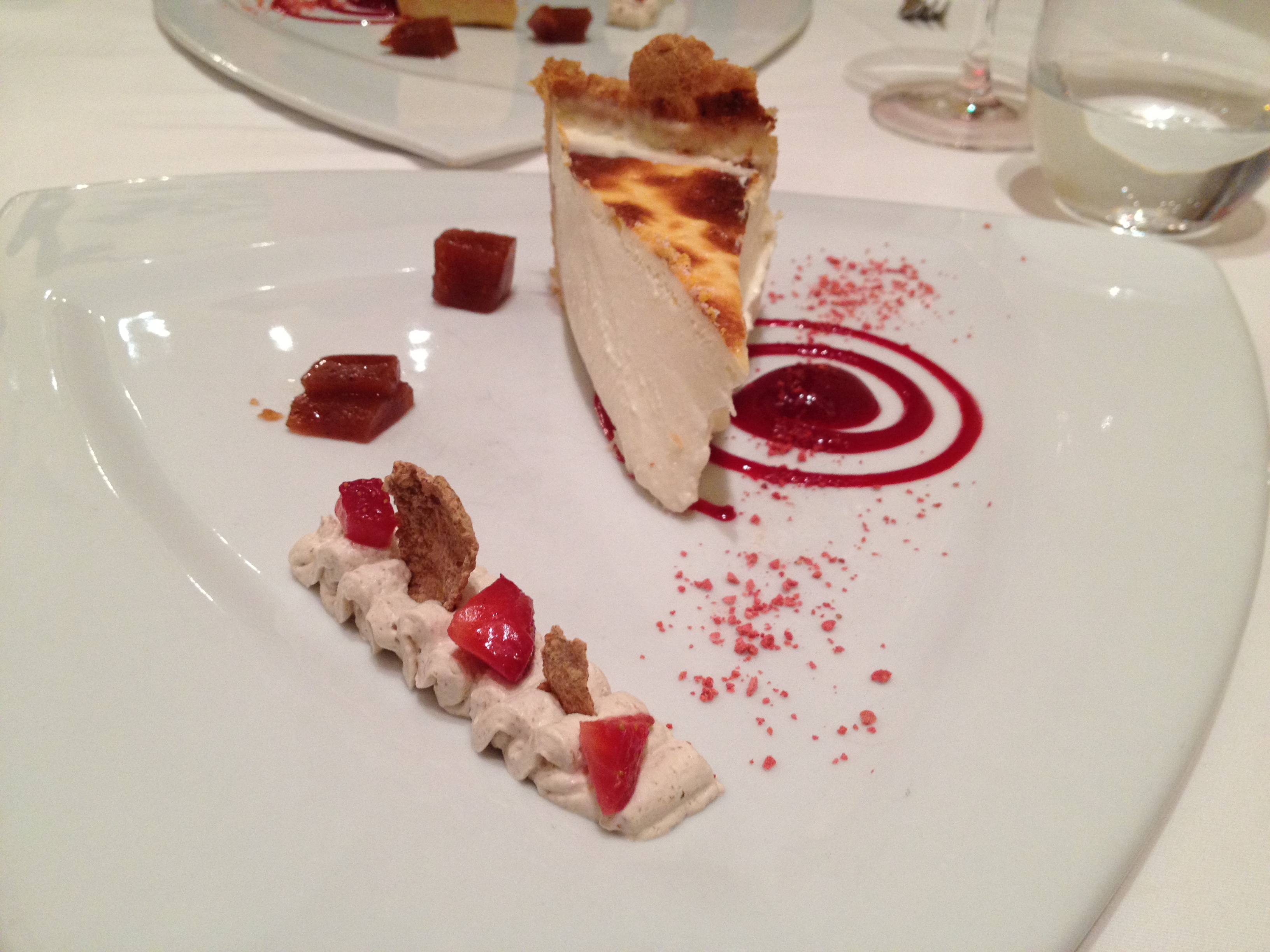
One dish more – a dessert of cheesecake, a surprisingly light springy construct, cross-pannacotta and creme brulee with a cheesecake touch. Delicious. But it beat me. This meal was spectacular. I feasted like a king. But felt roundly stuffed like Humpty Dumpty. I nonetheless was so excited, so almost emotional about the fine quality of the food that we had received that I actually kissed the waitress on my way out! Who can ever say that the english are inhibited? (She could I suppose just assume that I’m a typical english drunk).

Oh well, hats off to you Señor Toño. You’re certainly my Salamanca no. 1.

Cheesecake

So that’s it, my blog’s meandering journey through my trip from Madrid to Salamanca is at an end. I hope you’ve enjoyed it, at least as much as you can without actually sampling the gastronomic delights, the golden glow, and the distinctive smell of a town steeped in history at every masterfully stone-masoned house, church and lowly street corner. Time to start thinking about where comes next. Until then…