Skip to content

Posts from the ‘Review’ Category

George Bellows: Modern American Life

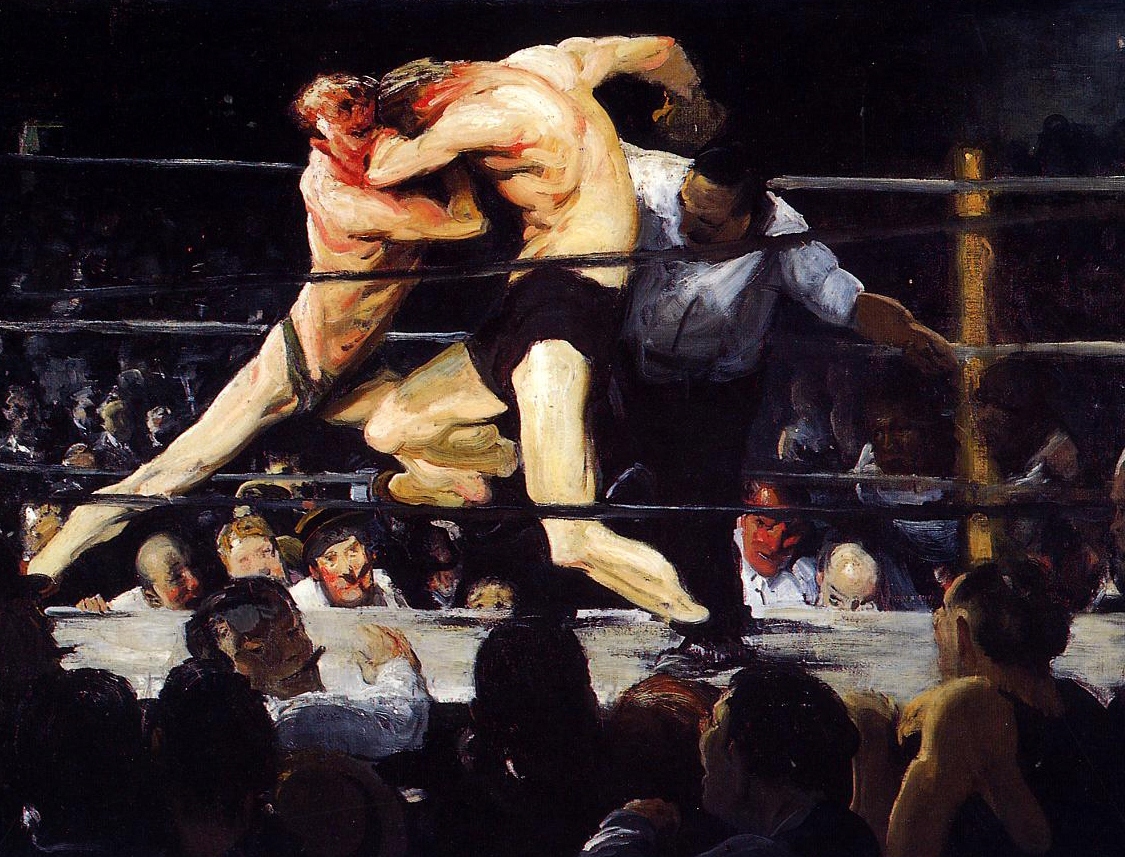
Bulging, twisting angry red bodies reminiscent of Francis Bacon’s cannibalistic, melting forms; great muscular bodies gripped in a violent embrace; long horizontal lines capturing the figures within an illuminated, elevated fighting platform; and a blood-thirsty zealous crowd, their faces hideously disfigured as they vie for blood, sweat and mighty great punches on their night out at the boxing ring – these are the captivating images of the 1900s boxing underworld for which the American artist, George Bellows, is renowned, and which form the focus of the Royal Academy’s new exhibition: George Bellows 1882-1925 Modern American LifeYet as the exhibition attempts to point out, Bellows painted much more than the poignant punches of his most famous images.

I wasn’t aware of Bellows before this show – and I excuse this gap in my art historical knowledge by virtue of the fact that this is the first Bellows retrospective to ever come to the UK, and because, to my knowledge, no or few Bellows works are held in the UK national collections. Moreover, while Bellows was a classmate of the much celebrated Edward Hopper, his career was much shorter – he died at a poultry 43, barely before he had ever got going. And yet the works which he did complete in his short life present us with an unparalleled view of turn-of-the-20th century New York, focusing on the many facets of a city in flux; from the gritty and sinister sweaty boxing underworld and the bustling expanse of Times Square, to the elegant perambulations of the richer citizens in out of town parks; from traumatic, emotionally intense depictions of war, to almost fantastical, saccharine scenes of picnics and fishermen in the outer countryside surrounding the city.

Club NIght (1907)
Club NIght (1907)

Stag at Sharkey's (1909)

Stag at Sharkey’s (1909)

It’s perhaps no wonder that Bellows was so undyingly fascinated by New York City. Coming from a comfortable middle-class Ohio background, he would have been unprepared for the extremes of the city when he arrived there at just 22 years of age. Yet falling under the influence of artist Robert Henri, who was his teacher at the New York School of Art and who encouraged his students to eject the idealised and sentimental depictions of life favoured by the art scene at that time, and instead pursue a more unique expression of reality, Bellows soon found himself seeking out the more insalubrious, undesirable quarters of the city, and there depicting some of his most renowned works, from groups of naked immigrants bathing in the city’s dirty rivers, and builders clearing vast blocks of the city to construct a huge new homage to the modern railway, to the great bustling, smokey squares of central New York, full of workers and citizens from every spice of life, and of course those wonderfully intense boxing masterpieces.
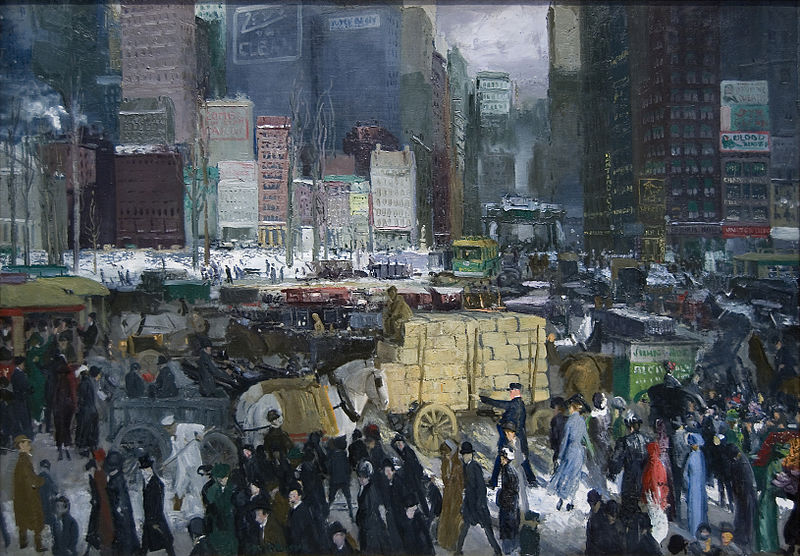
New York (1911)

New York (1911)

But Bellows did not limit himself to this harsher side of New York. Following his initial trawl through the unsavoury and illegal hangouts of the city, he soon moved onto depictions of a more civilised, elegant facade, with paintings of strolling couples, of elegant groups laden with white parasols and large sunhats picnicking out in the parks like something straight out of Seurat’s paintings of Paris, and of families walking out amongst snowy hills and landscapes. This is a changed side of Bellows, but no less fascinating to behold, not least because it somehow fits uneasily into the common perception of the New York of these times, and because, by comparison with Bellow’s earlier body of work, this happy, idle lifestyle appears almost reckless in its apparent disregard for the hardship of the real gritty city which lay at the heart of the nearby urban sprawl.

A Day in June (1913)

A Day in June (1913)

Summer Night, Riverside Drive (1909)
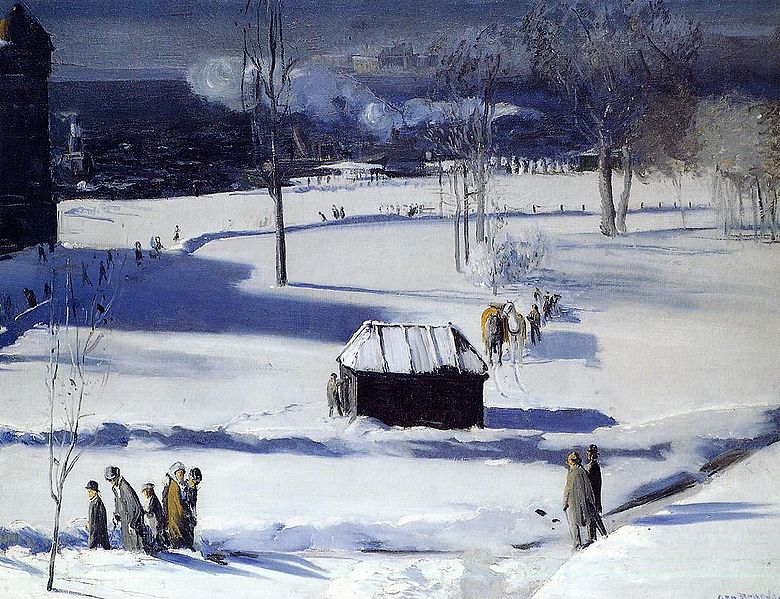
Summer Night, Riverside Drive (1909)

Blue Snow the Battery (1910)

Blue Snow the Battery (1910)

Yet for all his insightful depictions of a modern American life, perhaps the most captivating works of Bellow’s career were those which had no connection to America whatsoever: At the centre of the exhibition are Bellow’s depictions of war, works inspired by the horrors of the First World War in Europe which Bellows had read about in the American press. All five resulting paintings, four of which are on show at the Royal Academy, are conspicuously anti-German, showing the Germans in a devastating light as the perpetrators of previously unseen levels of horrific savagery, such as the Massacre at Dinant which depicts the unprovoked, summary execution of Belgian civilians following the sacking of their town which stood in neutral territory, and The Barricade, which shows the Germans using Belgian innocents as a human shield. The paintings are emotive, powerful and really quite breathtaking.

Massacre at Dinant (1918)
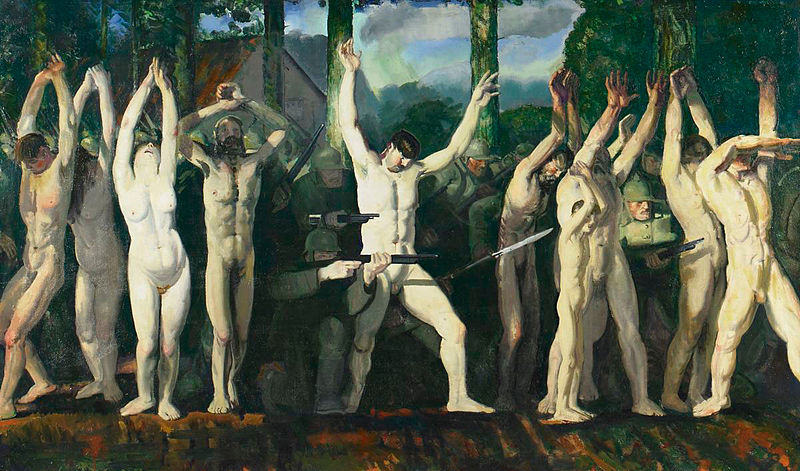
Massacre at Dinant (1918)

The Barricade (1918)

The Barricade (1918)

The Germans Arrive (1918)

The Germans Arrive (1918)

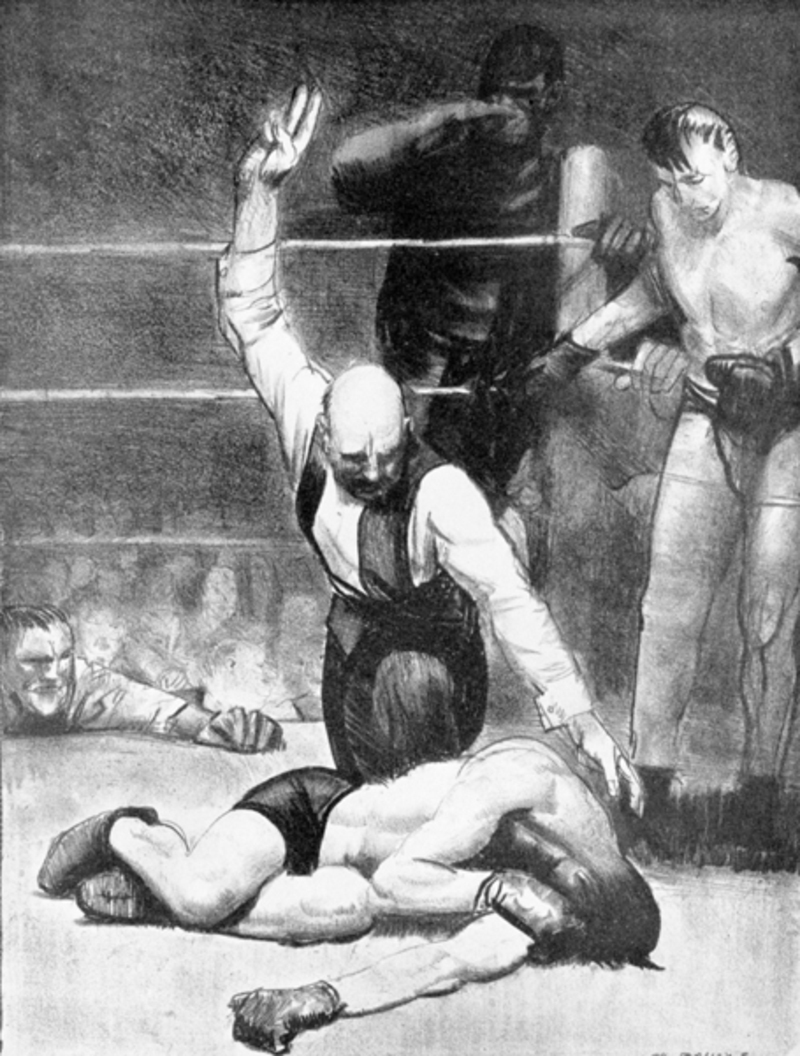
Likewise exceptional was the next room showing Bellows lithography – his brilliant printworks which were likewise used to stunning effect in depicting similarly shocking scenes such as The Law is Too Slow which shows an African American being burnt alive at the stake while surrounded by an apparently calm, even entertained crowd of white Americans. In his print works, Bellows shows himself as a master printer – he uses dark and light to maximum effect, while his faultless illustration of flesh tone in the print version of his later boxing scenes easily outstrips the paintings of the same subject.

The law is too slow (1922)

The law is too slow (1922)

Splinter Beach (1912)
Splinter Beach (1912)

Counted Out No.2 (1921)

Counted Out No.2 (1921)

After this highpoint of the show, the exhibition ends on something of a low in a gallery of overly insipid, saccharine fantastical depictions which look almost Chagall-like in style and appear to represent an uncomfortable diversion from Bellows more intense former work – even his later boxing paintings have nothing like the level of intensity as his boxing works painted 15 years before. The gallery is full of twee and sometimes stiff family portraits which resemble the work of Manet but without anything close to his emotional depth, as well as landscapes which are so excessively sentimental with their white horses and picture-perfect symmetrical mountain landscapes that Bellows’ former teacher, Robert Henri must have been turning in his grave – or at least would have done had he not outlived Bellows.

The Picnic (1924)

The Picnic (1924)

The White Horse (1922)

The White Horse (1922)

A Fisherman's Family (1923)

A Fisherman’s Family (1923)

George Dempsey and Firpo (1924)

George Dempsey and Firpo (1924)

For George Bellows died shortly after depicting these more sugary of his works, suffering from a sudden ruptured appendix and peritonitis. His career was one cut short, but perhaps just in time before his later My Little Pony style of painting threatened to overshadow the truly superb achievements of his former body of work; an oeuvre which now stands out, next to the likes of Edward Hopper, as a truly unique collective depiction of modern American life.

George Bellows: Modern American Life is on at the Royal Academy until 9 June 2013. Details and tickets can be found on the RA website.

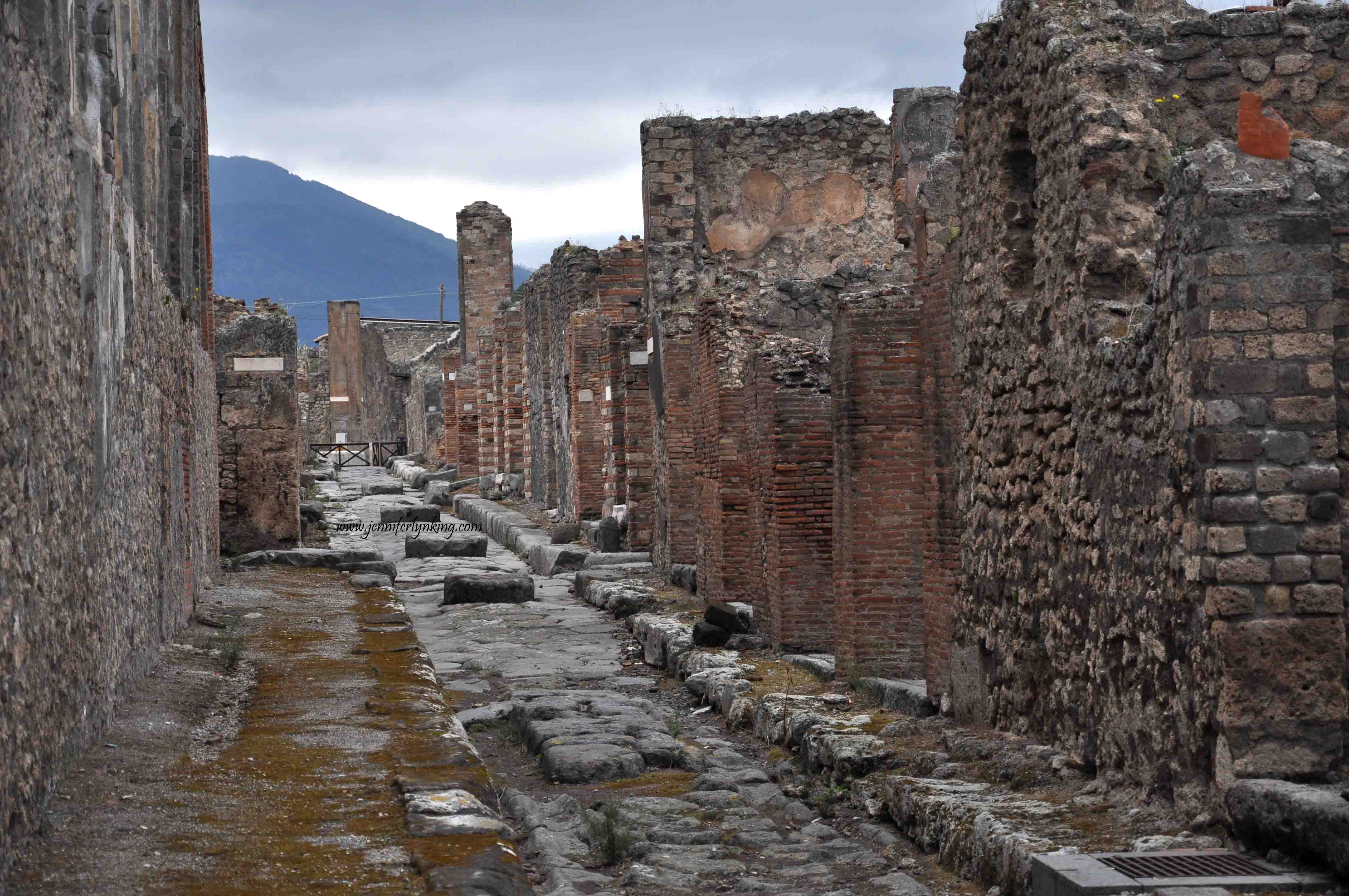
Life and Death in Pompeii and Herculaneum

The stories of Pompeii and Herculaneum are renowned throughout the world. The very mention of their names is synonymous, not with the towns standing on their site today (Ercolano, in the case of the latter), but with the catastrophic volcanic eruption from Mount Vesuvius in Southern Italy which totally obliterated these small Roman cities on 24 August, AD 79. It is an eruption which has gone down in tectonic history as one of the most devastating eruptions in the last two millennia, an event whose very details were captured in the contemporary writings of Pliny the Younger, as well as in the rich geological history which the layers of ash and pumice which spouted out of the volcano can now provide. However, perhaps the greatest irony of this eruption was that in causing the total destruction and devastation of two Roman cities, and then blanketing the burnt urban carcass in several metres of dense ash and pumice, the eruption had the converse effect of actually preserving, sometimes perfectly, a imprint of Roman urban life, providing one of the largest ever discovered archaeological hauls of Roman remains so rich and diverse in its breadth that it provides 21st century audiences with a truly unique insight into societal life some 2,000 years ago.

Pompeii today

Pompeii today

It is this rich collection of excavated artefacts around which the British Museum’s latest blockbuster exhibition, Life and Death in Pompeii and Herculaneum, is centred, a singularly unique exhibition and a first of its kind, because so many of the pieces on show have never been seen outside of Italy before. The exhibition results from the direct collaboration between the British Museum and the Archaeological Superintendancy of Naples and Pompeii, and consequently some absolute gems of Pompeian and Herculenean society are now in London for the first time.

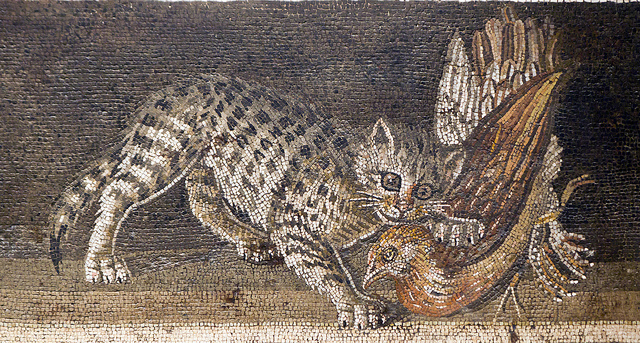
7581646784_0e07b3c010_zConcentrating on the daily lives of the Romans living in these doomed cities, the exhibition is cleverly curated so that the various items on display are grouped thematically into the rooms of a “house” in which they would have been found. In meeting this objective, the layout of the show is based on a reconstructed idea of what a real Pompeian house (the so called “House of the tragic poet”) would have looked like. Consequently, after a large cinematic presentation which provides a well-animated introduction to the show, you start off in what would have been a Roman street, where various paraphernalia of trading life can be seen. Then, heading inside, you enter the atrium, the hall way of a Roman house which would have been flooded with light owing to the skylight which plunged through the centre of most Roman atriums. In this room, the objects on show included some stunning marble statues with barely a chip or scratch in sight, mosaics which would have lined the hallway floor reminding visitors to “Beware of the Dog”, and frescoes depicting the possible Roman occupants of the houses – here what is thought to be the baker Terentius Neo and his wife.

b01r5pxl_640_360

To the right of the atrium, a gallery set out as the bedroom included some quite incredibly preserved Roman wooden furniture, including a rocking baby crib and a stool, as well as an elaborately carved bed stead (all now heavily carbonated). Meanwhile to the left, what would have been the salon area for entertaining included an explanation of what has since become known as the “Pompeian style” of interior design, which comprises exquisitely detailed mosaic flooring, and walls painted with highly realistic and often stylised frescoes in four principal styles, all sharing common themes of richly elaborate pattern together with boxes showing pastiches and scenes from life or mythology, as well as the use of deep colours, generally rich reds and golds and blues. detailI was completely awestruck at just how sophisticated Roman art was – the shadows and tone of human skin as painted on these frescoes rivals anything done in the renaissance, and makes the art of the medieval era, which of course came along hundreds of years after the Roman empire fell, look completely childish and naïve. As for the mosaics, some of the pieces on show were nothing short of astounding, not least a mosaic depicting sea creatures, with its incredibly realistic depiction of fish and other ocean creatures of every size and variety – I love the powerful composition with a staring octopus at the centre appearing almost to enter into battle with the lobster.

fishmosaicnaples 800px-Nilotic_scene_MAN_Napoli_Inv9990_n04 6572054559_b91ac9b238_ztheatre mask

But perhaps my two favourite rooms of this “house” were the garden area, which came decked with some luscious garden frescoes, and the kitchen, which was packed with some incredibly contemporary looking cooking paraphernalia. I loved the tranquillity of the garden space, and can imagine how beautiful it must have been to stroll around colonnaded walkways, painted with these verdant green frescoes, depicting birds and lush plants, while at the centre a fountain would trickle, a sign of ultimate wealth in its extravagant use of precious water for entertainment.

Art-mainpic_2474008b pompeii_garden Art-bird_2474096b

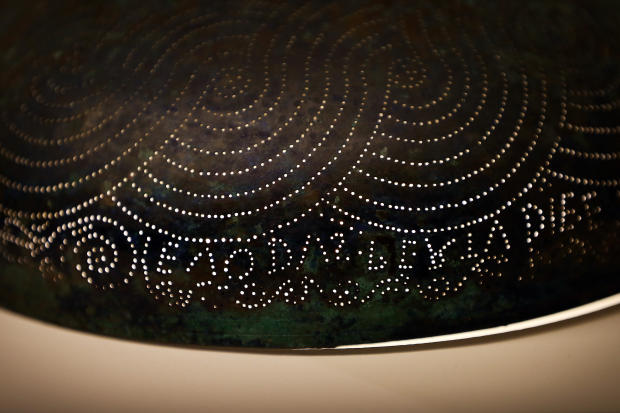
As for the kitchen, I was astounded to see what had been discovered from Pompeii and Herculaneum – actual figs, ripe on the day of the eruption, now preserved as carbon forms under the ash; and a loaf of bread, still imprinted with the name of the slave who baked it! The utensils too were fascinating to see – what looks like a colander for straining vegetables, but punctured with holes forming their own elaborate pattern into the metal; and there too was a pot ingeniously conceived just for the fattening up on dormice (which would then be roasted and ate dipped in honey).

Colander detail

Colander detail

Carbonated bread

Carbonated bread

But after this fascinating stroll through Roman life, the inevitable ending to the story follows suit, like the inescapable tide of history washing over Roman life like the pyroclastic surge catapulted down the volcano, wiping out city life in seconds. The “death” part of the exhibition is as poignant as the “life” section is revealing. Particularly startling are the plaster casts of the dead, found in Pompeii. These casts were made from filling in the gap left in the hardened ash once the bodies underneath rotted away. What we had before us then wasn’t an actual body, but a shadow of one; a poignant and again unique insight into the death of these now faceless humans, cowering away from the extreme heat at that moment of their instant death. Who could not be saddened by the sight of a whole plaster cast family, with the baby still shown laden in its blanket. And don’t forget the dog – that poor animal met his fate in the same way too. Incredibly and moving stuff, that brings us face to face with the tragedy that was Pompeii and Herculaneum, AD 79.

123764081_Pompeii_398154b BRITAIN-ITALY-HISTORY-ARCHAEOLOGY-POMPEII Pompeii and Herculaneum at the British Museum Pompeii1

This exhibition is a must see for anyone living in London or soon to visit. On until 29 September 2013, it still has a fair stretch to go, but be not complacent – it’s extremely popular and advance booking is essential. You can get your ticket on the British Museum website. Unless you’re heading Italy-way anytime soon, this exhibition comes highly recommended as a unique insight into a civilisation now dead, but not lost.
Manet: Not exhibited in his lifetime

Glancing through the current Manet retrospective, Manet: Portraying Life, at the Royal Academy, there is one consistent feature which is perhaps even more noticeable that the works themselves: How many of the paintings are labelled “Not displayed in his lifetime”. Why the Royal Academy is so insistent on spelling this out with such apparent alacrity is unclear. But what it demonstrates is that the majority of works comprising this so called “first ever retrospective devoted to the portraiture of Edouard Manet” are what I call “filler works” – paintings which are either unfinished or merely preparations for other works, and none of which the artist had ever intended to be exhibited for public consumption.

It is therefore with some unease that I looked upon these works, which the Royal Academy tries to pass off as paintings worthy of the not insignificant £15 entry-price, the cynic inside me recognising that what we have here is merely a means by which a show that, fundamentally, consists of one room’s worth of finished and accomplished works, is padded out to fill a much bigger space. And even that space is not filled particularly well.
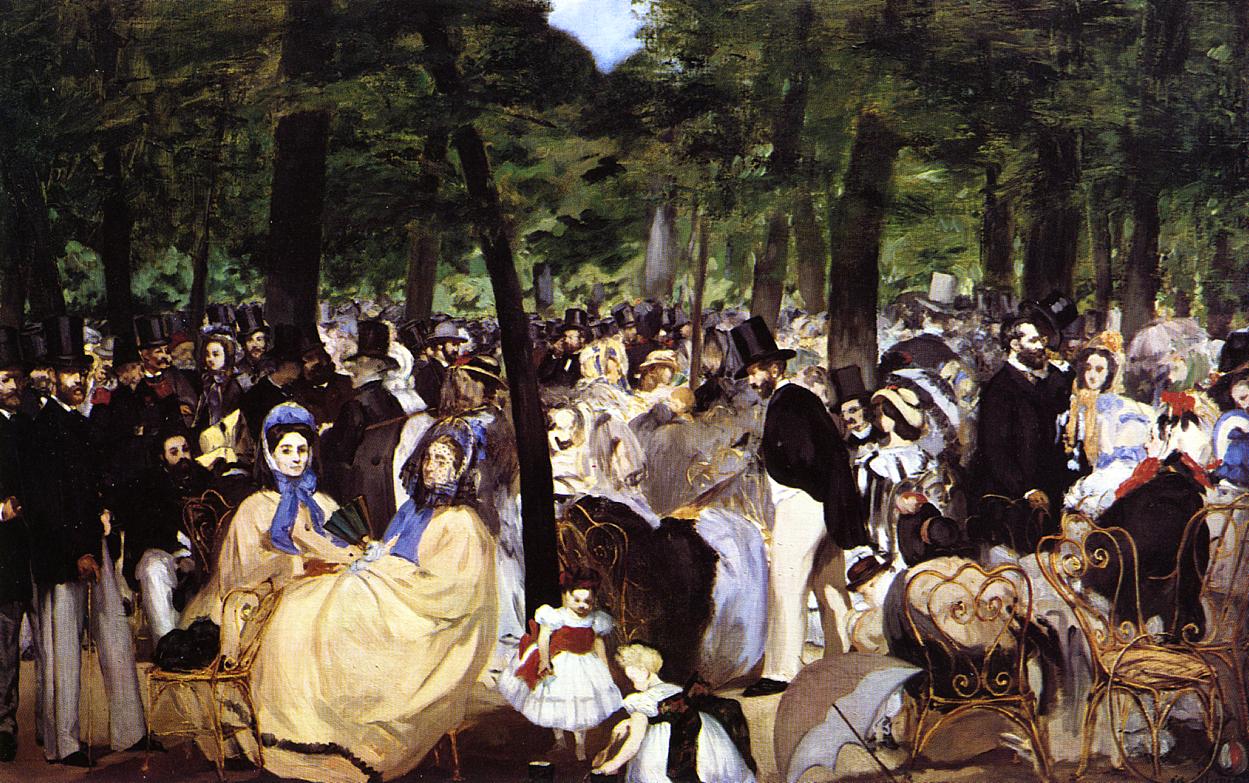
Music in the Tuleries Gardens (1862)

Music in the Tuleries Gardens (1862)

In the second large gallery, for example, the Royal Academy make the slightly unfathomable decision to present Music in the Tuleries all on its own, spotlight upon it, surrounded only by blank walls. I could understand this kind of hang for a masterpiece such as Le Dejeuner sur l’Herbe, which almost single handedly changed the history of art (and sadly lacking from this show), but for this painting? Sure enough, it’s a skilled group painting, giving us a very realistic snapshot of modern day life one sunny afternoon, lacking in the previous contrived composition of the grand historical paintings which were favoured in the time Manet painted it. But the Royal Academy do not succeed in making any significant point worthy of this solo hang. And what’s worse, this painting belongs to London’s National Gallery, so visitors can normally walk up and see the painting whenever they like, without the crowds attracted to the RA, and for free.

But this was not the worse of it. The following gallery was hung, not with paintings, but with a chronology of Manet’s life, and a desk on which copies of the exhibition catalogue could be surveyed – why exactly I’m not sure: after all, isn’t it better to look at the paintings themselves when you have them in front of you?
Unfinished: Portrait of Carolus Duran (1876)

Unfinished: Portrait of Carolus Duran (1876)

But asides from the unpalatable cheek with which the RA filled it’s space and passed off the show as a great survey of Manet’s career, I also felt a deep sense of unease, not as a punter, but as an artist – because so many of these works are so clearly unfinished, unprepared for public consumption. I can imagine Manet now, turning in his grave, horrified at the prospect of these unfinished preparations being gazed at and criticised as though they were finished works. And all for the sake of a buck or too.

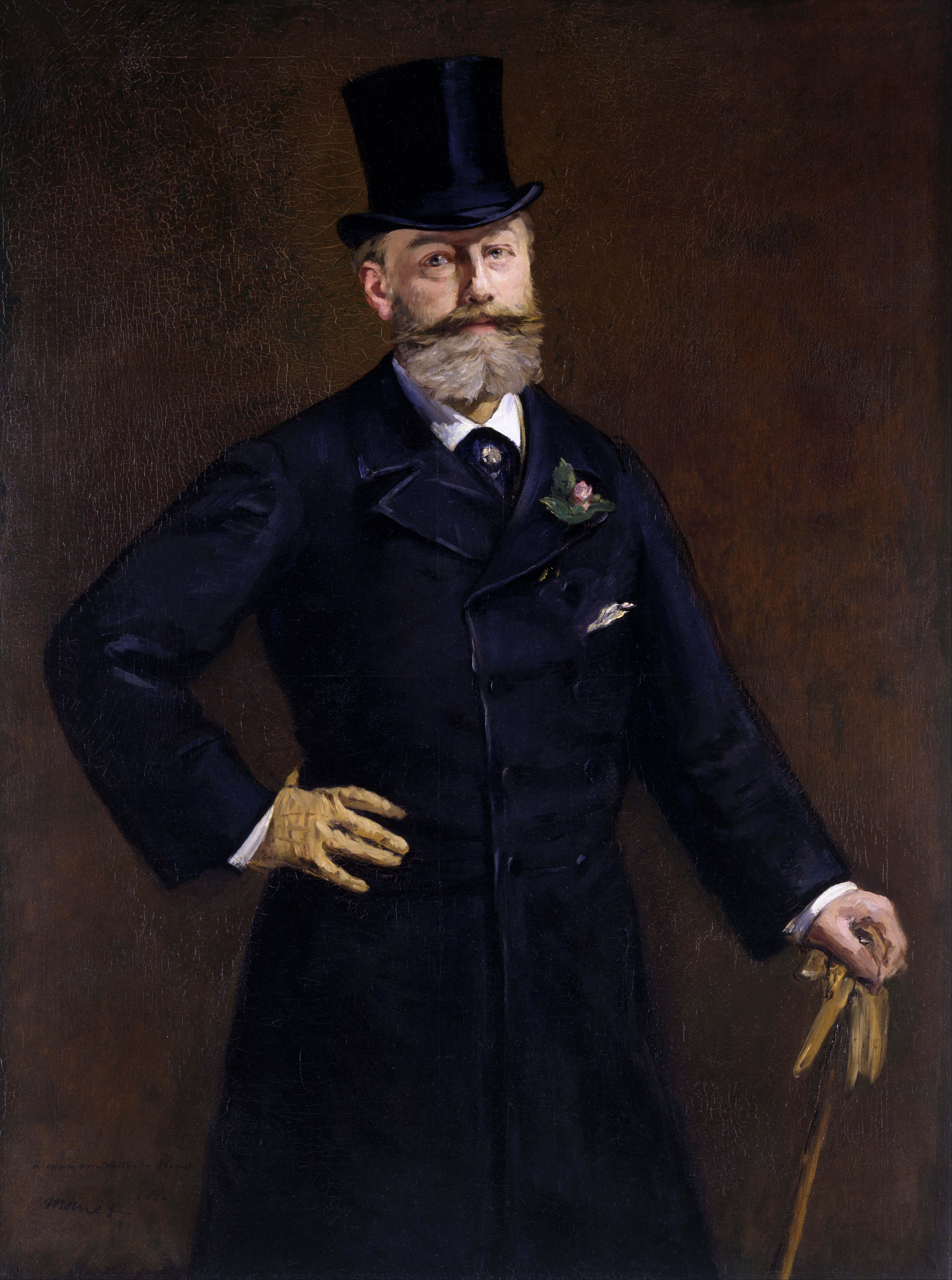
Portrait of M. Antonin Proust (1880)

Portrait of M. Antonin Proust (1880)

The Luncheon (1868)

The Luncheon (1868)

Madame Manet in the Conservatory (1879)

Madame Manet in the Conservatory (1879)

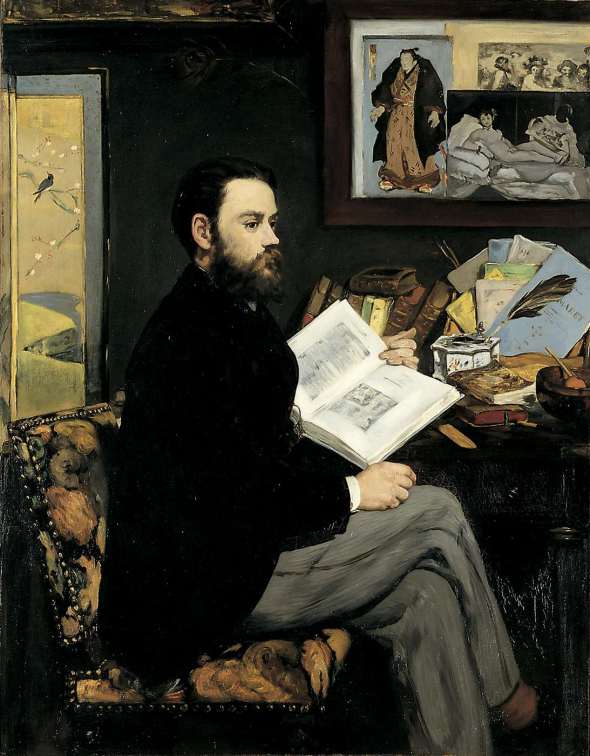
Emile Zola (1868)

Emile Zola (1868)

All that said, the finished works which are on show are masterful Manet’s, apt demonstrations of the artist’s skill at capturing real life, real characters and a sense of the time in which he painted. You get the portrait of M. Antonin Proust (not to be confused with the acclaimed author) – a dandy about town, a man proud and professional in his polished appearance; then there’s Suzanne Leenhoff (later Madame Manet), sat, happily contented in the garden of Manet’s home, her cheeks rosy and her gaze tranquil.

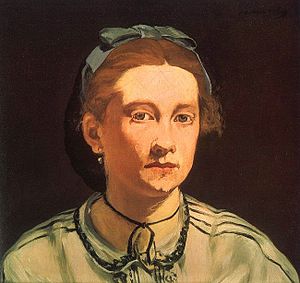
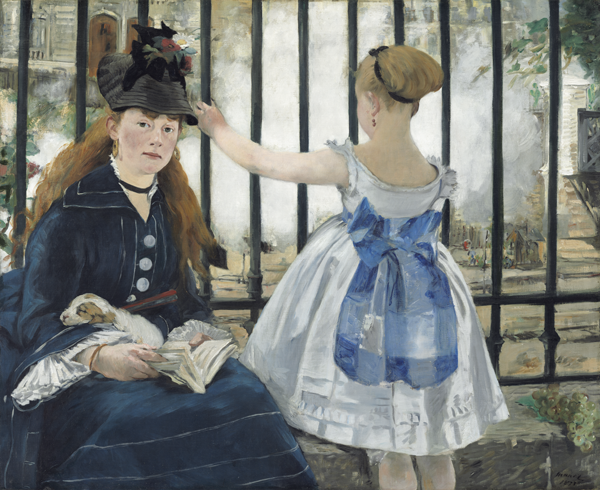
300px-Edouard_Manet_088Then of course there’s Manet’s most infamous sitter of all: Victorine Meurent, who gets a whole gallery to herself in this show. While sadly, and very obviously lacking the two great masterpieces of Manet’s oeuvre in which she features (Le Dejeuner sur l’Herbe (although the Courtaulds inferior and much smaller copy is here) and Olympia), the paintings which are on show present the model with the confidence and audacity which must have attracted the artist to her – the wiley stare, straight out of the canvas, almost judging, daring the viewer to respond. Then there’s Victorine dressed as a street-seller, an accomplished character portrait in which the cherries held to her mouth appear almost as a provocation, a subliminal message inviting us to read a story into her steely gaze,  as well as the wonderful Railway portrait, in which the railings adjoining the railway appear to take centre stage, and the air of noisy, smoky, modern industry appears oddly juxtaposed with the apparent calm and tranquillity of Victorine and her sleeping puppy.

Street Singer (1862)

Street Singer (1862)

The Railway (1883)

The Railway (1883)

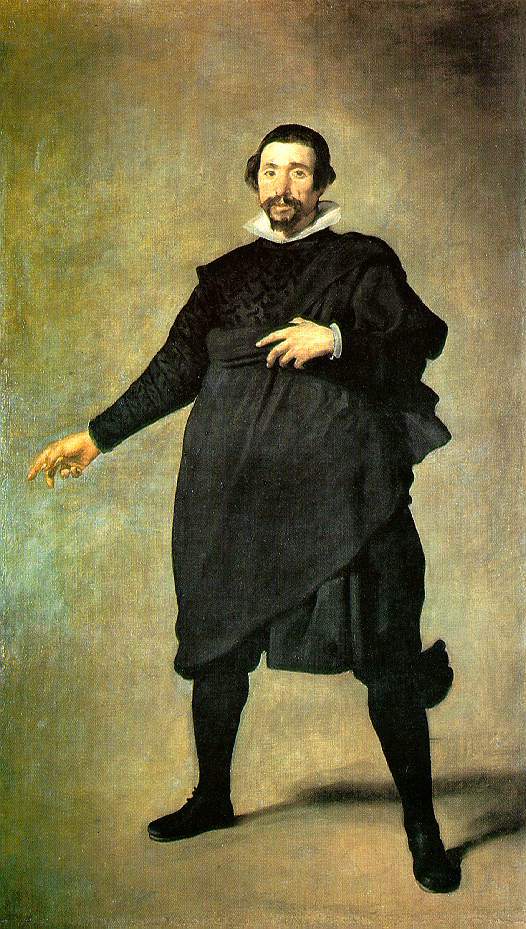
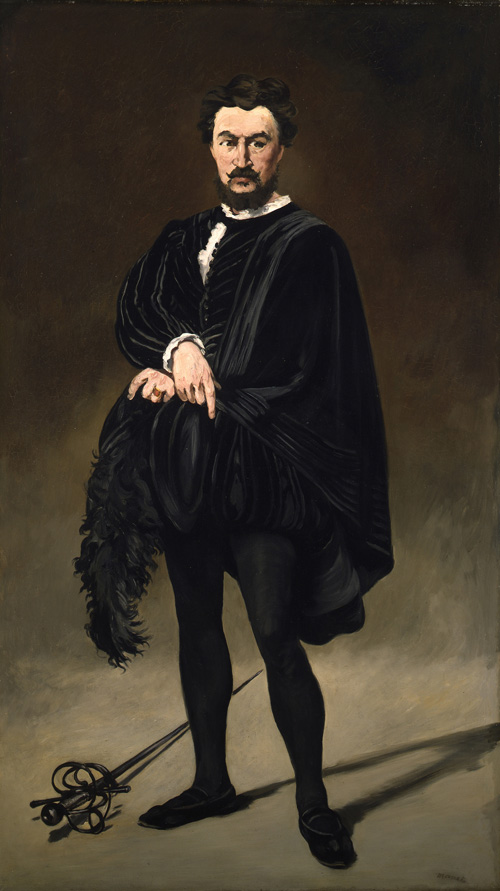
As a Manet lover (need I remind you of my Norm version of both Manet’s Le Dejeuner sur l’herbe and my juxtaposed Manet character Norms sat in Cappuccino Grand Café ?) I was of course familiar with many of the few finished works on show. But one thing that I took out of the show which I had not fully appreciated before was just how influenced Manet had been by Spanish art. Taking a trip to Spain, organised by Zacharie Astruc who’s portrait is also on display, Manet was very quickly inspired by Velazquez, who he saw as a master of painting black in all its surprising variety of shades, as well as other greats such as Goya and Ribera. Following on from this, one can really start to see the Spanish influence infiltrating into Manet’s work. Take the portrait of Rouviere as Hamlet for example, and look how it compares to this portrait by Velazquez. Then of course there’s the portrait of Victorine in the costume of an Espada, again sadly not included in the exhibition, an a portrait of Emilie Ambre as Spain’s favourite operatic diva, Carmen. As an artist much inspired by the Spanish golden age of art, I am well able to understand the effect that Spanish art must have had on Manet, helping him to surge forward as the revolutionary artist he was, in a claustrophobic French art scene which had yet to be struck by the poignancy of Spanish art.

Portrait of Zacharie Astruc (1866)

Portrait of Zacharie Astruc (1866)

Diego Velazquez, The Jester Pablo de Valladoid (1635)

Diego Velazquez, The Jester Pablo de Valladoid (1635)

The Tragic Actor (Rouviere as Hamlet) 1865

The Tragic Actor (Rouviere as Hamlet) 1865

Victorine Meurent in the costume of an Espada (1862)

Victorine Meurent in the costume of an Espada (1862)

Spanish influence: Emilie Ambre as Carmen (1880)

Spanish influence: Emilie Ambre as Carmen (1880)

Of course it is difficult for us, well informed of the contemporary art which followed, to understand just how revolutionary Manet was as an artist, painting in the age when grand history paintings and allegorical images were all the rage. His paintings were so real, so unpretentious a snapshot of the life and the world around him, that many gallery goers took to attacking his paintings with umbrellas. Yet still Manet ploughed on, forging the path which impressionists and expressionists and the whole world of modern art pursued in his wake. This exhibition does not make any statement half so bold as the mighty oeuvre of Manet in itself, but putting asides the unfinished sketches, and concentrating on the completed masterpieces, those works of Manet which are on show are easily strong enough to make an impression all by themselves.

Manet: Portraying Life is on at the Royal Academy until 14 April 2013.

Lichtenstein Retrospective: Artist or copyist, it’s a spot-acularly good show

Intrinsically linked with the school of Pop Art are a series of almost inevitable questions: Is a work which borrows from a pre-existing image original? Does it even matter? Can a painting of a can of soup, for example, the likes of which can be found on every supermarket shelf around the world, be described as having any artistic merit? And just how much creativity is required in order to call a representation of an object “art”?

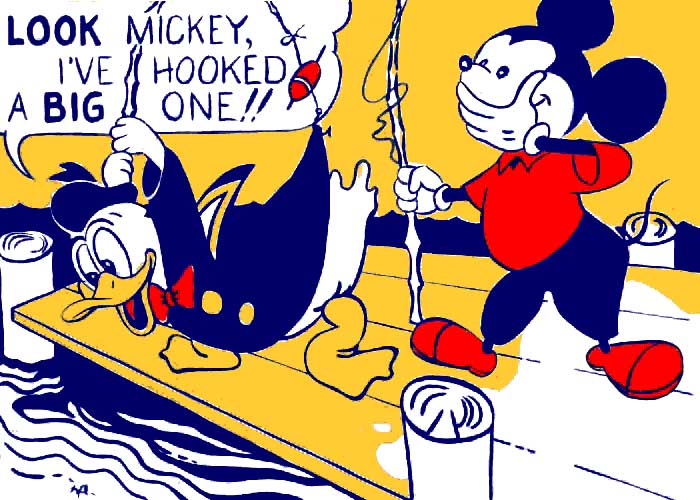
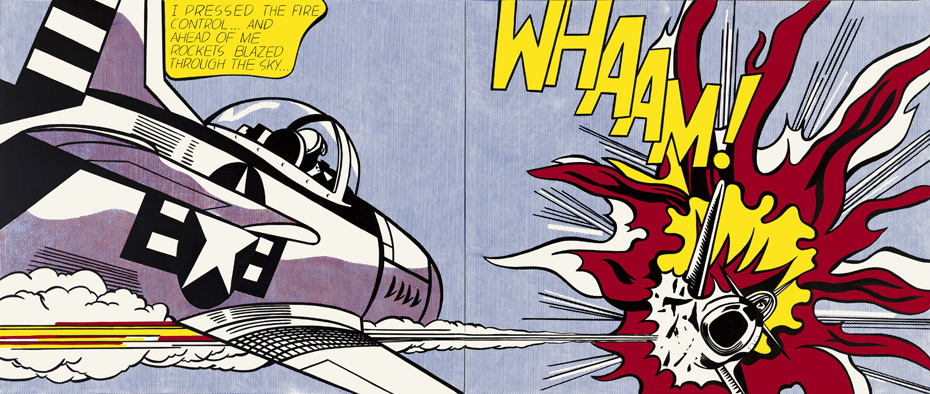
No more so are these questions of relevance than when contemplating the work of American pop art supremo, Roy Lichtenstein (1923-1997), whose retrospective has just opened its doors at London’s Tate Modern gallery. Making it big when, in 1961 he imitated a cartoon of Disney’s Mickey Mouse and Donald Duck, by blowing up a single cartoon frame to life-size proportions and recreating it with oil paint on canvas, Lichtenstein shot to fame as the creator of zany bold paintings which almost exclusively borrowed either from comic books, or images of ordinary life (largely advertisement images in newspapers and magazines). Lichtenstein was unapologetic in taking the work of other cartoon illustrators and, with very few changes except for an increase in size and the occasional simplification of colour, recycling the images as his own (and then selling the canvas for equally increased sums).

Lichtenstein's first pop-art image: Look Mickey (1961)

Lichtenstein’s first pop-art image: Look Mickey (1961)

Inspired by adverts - Step-on can with leg (1961)

Inspired by adverts – Step-on can with leg (1961)

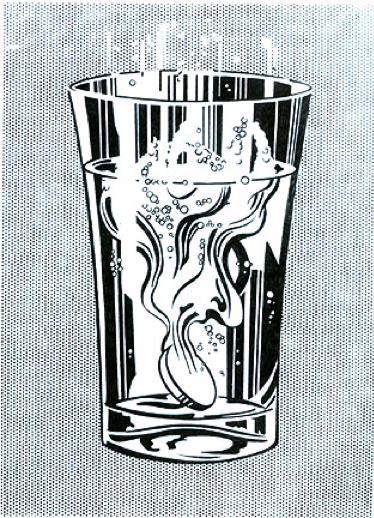
Alka Seltzer (1966)

Alka Seltzer (1966)

And yet to describe Lichtenstein’s process in this way is itself a simplification of the facts. For in transferring print images to the realm of oil on canvas, Lichtenstein does something remarkable – he paints the amplified cartoon or advert so perfectly, including the Ben-Day dots (which was a printing process used to create the effect of colour mixing or dilution) and the black outlines, that he manages to remove almost any indication that this is the work of an artist. Contemporary audiences questioned the merit of doing this. In an age when abstract expressionists like Jackson Pollock had ruled the art world, the absence of any indication of the artist at work, whether through brush strokes or drips of paint, appeared devoid of emotional tangibility or expression. And yet in a way, wasn’t Lichtenstein just doing what had been done centuries before, by the great artists of Renaissance, Baroque and Napoleonic art for example, who painted so perfectly that not a single brush stroke was ever evident in their finished canvases?

Torpedo

To view Lichtenstein’s work as devoid of expression and artistic wit is to misunderstand his accomplishments as an artist. For even in his early works, which do predominantly borrow from comic strips, we see his humour as an artist choosing, and drawing our attention to, the more absurdly worded or amusing cartoons. In amplifying the macho airmen and apparently helpless, romantic and teary blondes of typical american comic books, Lichtenstein is subtly commenting on the stereotypes of the age, if not challenging them then poking fun at the very formulaic trajectory of a modern commercial society, all buying into the same clichés, and tempted by the same products and advertising.

Whaam (1963)

Whaam (1963)

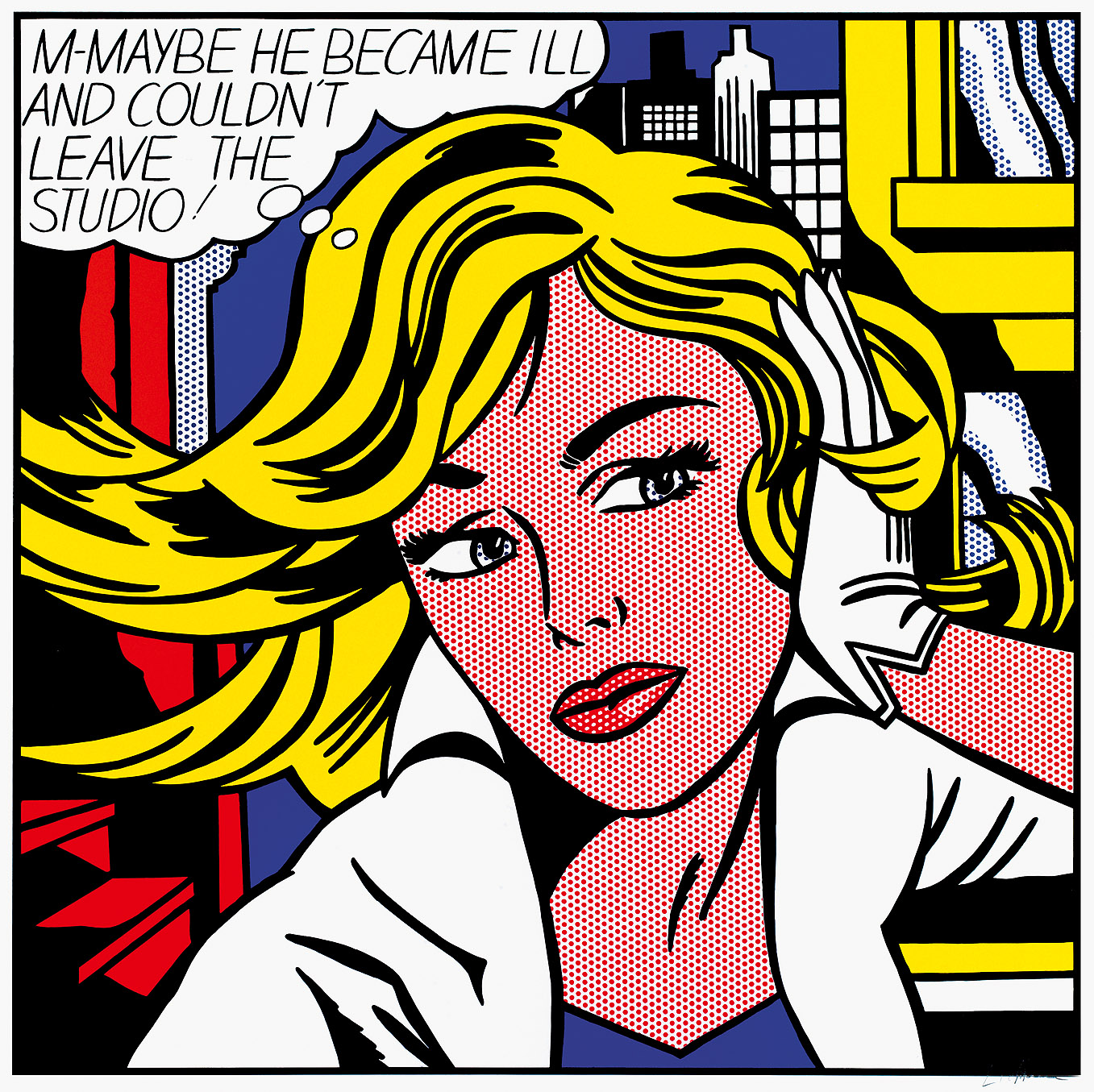
M-Maybe (1965)

M-Maybe (1965)

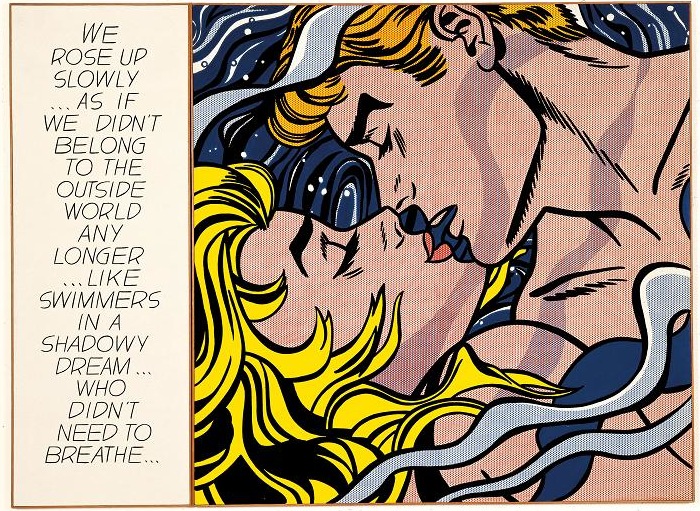
We rose up slowly (1964)

We rose up slowly (1964)

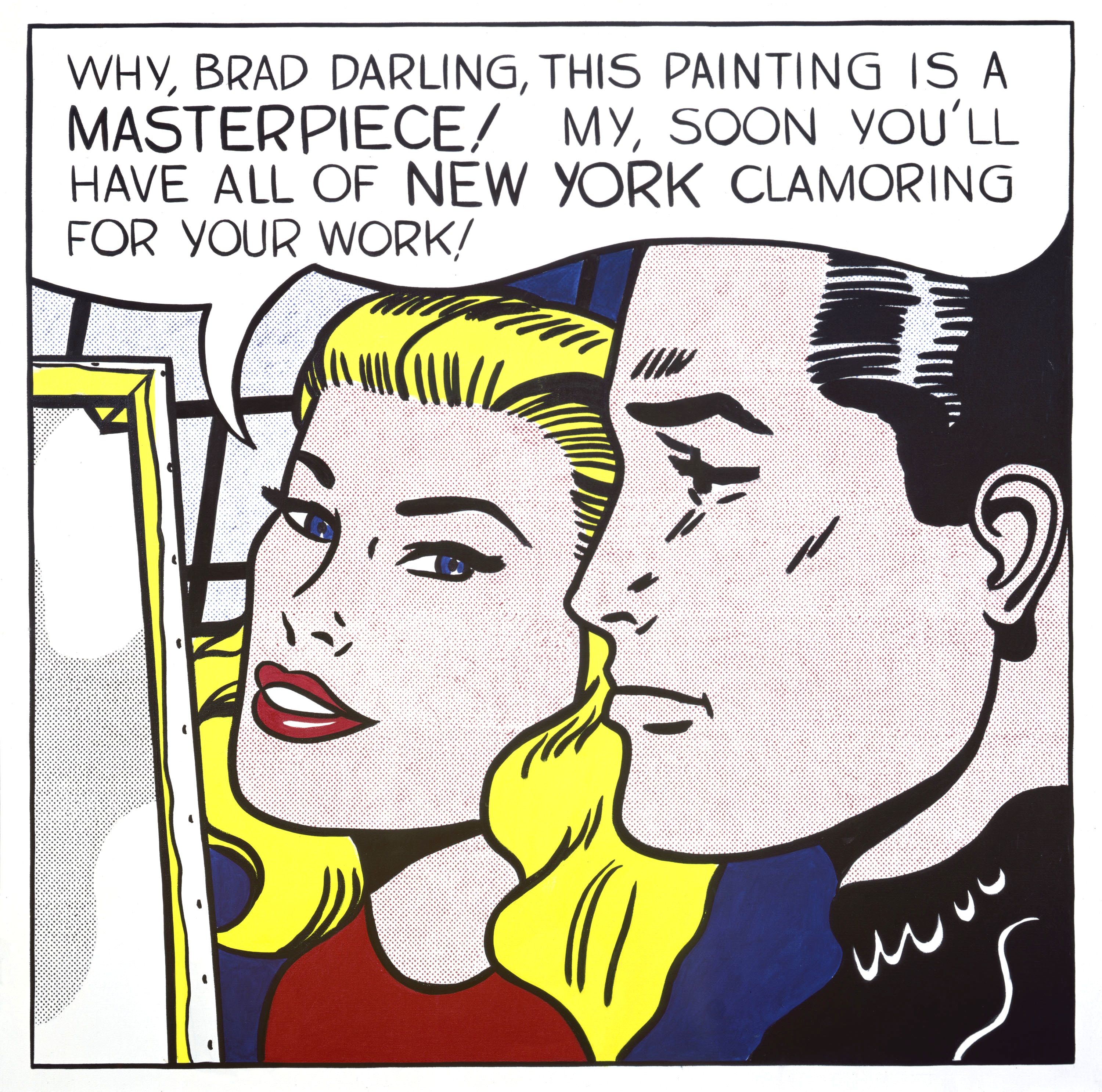
Masterpiece (1962)

Masterpiece (1962)

Yet there can be no doubting the trajectory of Lichtenstein’s own career as clearly evidenced by the helpfully chronologically curated exhibition. Having found his niche in a new pop art era, and very much made the world of the commercial image an artistic style all of his very own, with all the lines and Ben-Day dots that entailed, we see Lichtenstein go on to develop that style in a number of different contexts, expanding beyond the comic-book and advert to develop his own individual chapter in art history. As the years move on, we see Lichtenstein adopt the simple linear forms and carefully graduating colours of the art deco style, using his dots and lines adeptly to recreate the look and feel of that modernist era. Perhaps most effectively of all, we then see him use his own style to reimagine the work of great artists, like those artists had in turn done with the work of other artists before them. This was definitely my favourite section of the exhibition, as Lichtenstein used his unique  pop-art style to reinvent works by Picasso, Mondrian and Matisse, to paint his own still-lifes including a brilliant cubism still life, and most technically brilliant of all, to pay homage to Monet’s various depictions of Rouen Cathedral, doing so with Ben-Day dots alone.

Frolic (1977)

Frolic (1977)

Frolic

Cubish still life (1974)

Cubish still life (1974)

Rouen Cathedral (after Monet) (1969)

Rouen Cathedral (after Monet) (1969)

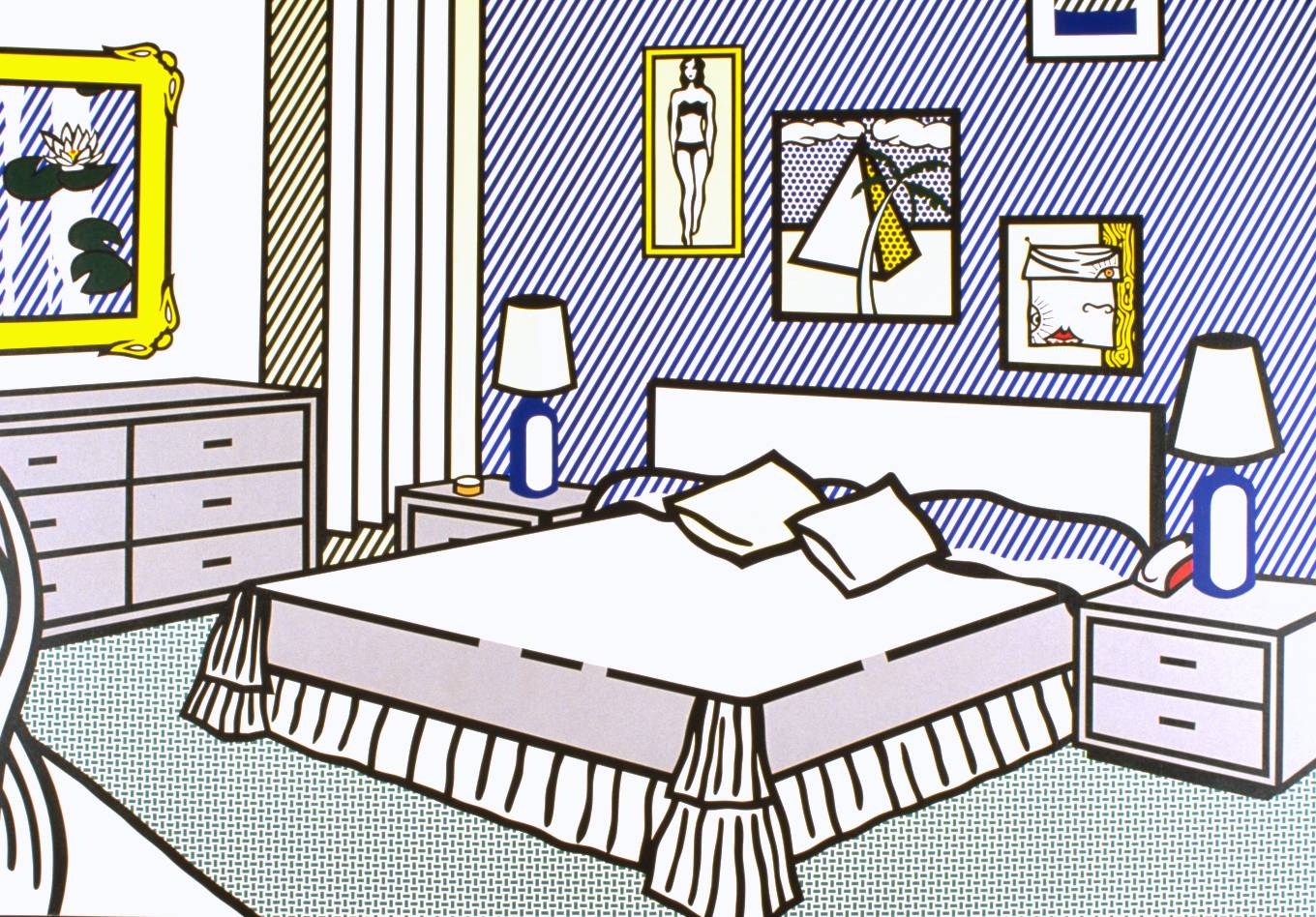
Having tackled art history, Lichtenstein next explores the genre of still-life, as well as depictions of an artist’s studio itself, again something which many artists have done before him. He also paints large scale depictions of rooms, with wonderfully simplified furniture, but always including a number a number of visual clues, generally in the paintings hung in the room, as to a deeper, often more personal tale he is attempting to tell.

Still life with goldfish (1972)

Still life with goldfish (1972)

Artist's Studio "The Dance" (1974)

Artist’s Studio “The Dance” (1974)

Interior with Waterlilies (1991)

Interior with Waterlilies (1991)

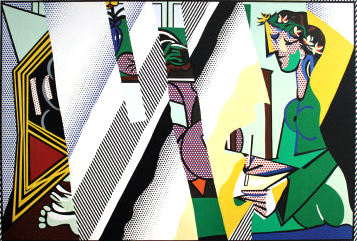
Reflections on Interior with a Girl Drawing

Reflections on Interior with a Girl Drawing

However perhaps the cleverest use of his lines and dots is when Lichtenstein goes on to paint mirrors and reflections. In his “reflections series” he paints recreations of old masterpieces by the likes of Picasso, but then fragments the image with a series of dot-created breaks or fissures interrupting the base depiction. These are intended to replicate the effect of light bouncing off an image when it is framed behind glass. In this way, Lichtenstein focuses not on the painting itself, but the direct effect of imagined environment upon that painting in its exhibited and glazed form.

Mirror no.1 (1969)

Mirror no.1 (1969)

He takes this one step further by using dots to replicate the effect of a mirror, with the perhaps obvious irony that while we appear to be looking at a mirror, we see only a blank space rather than a reflection of our face staring back. In this respect Lichtenstein makes further reference to the simplified representation of glass and mirrors in the world of illustration rather than in the world of realistic representation.

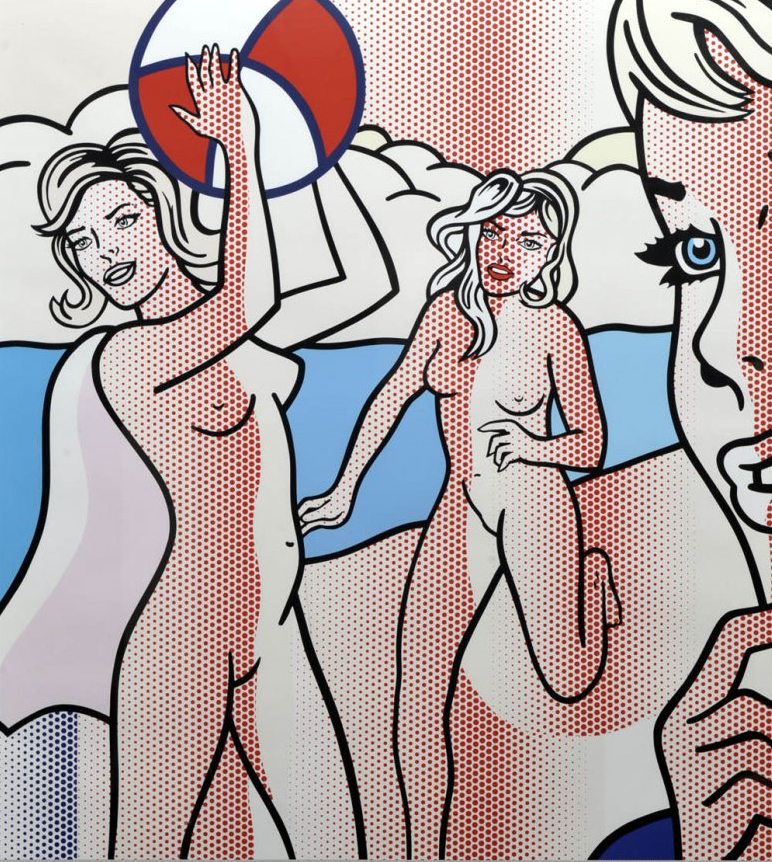
Having taken the Ben-Day dot from its use as a printing technique and replicated it on canvas to suggest a process, rather than a painting, Lichtenstein then used those same dots to suggest light, reflection and shadow. Consequently when he returns to the depiction of cartoon-styled idealistic blonde women some 30 years after he first depicted them in his cartoon-strip canvases, Lichtenstein uses the dots not to suggest a printed colour process, but makes the dots the focus of the image in themselves, painting them now across the image, rather than within the various black lines of the figures illustrated, so the dots almost form a superficial overlay across the painting.

Torpedo...LOS! (1963)

Torpedo…LOS! (1963)

Nudes with beach ball (1978)

Nudes with beach ball (1978)

Landscape with Philosopher (1996)

Landscape with Philosopher (1996)

The Ben-Day dot was king in Lichtenstein’s work, right up until the end when, in his final years, he used graduating sizes of dots to create the impression of landscapes following traditional chinese depictions. Brilliantly, and through dots alone, he manages to give the impression of mist, of distance, of light, of water. These aren’t his best works by any means, but show just how far Lichtenstein had expanded upon his truly unique style from one end of his career to the other.

So did it matter that Lichtenstein borrowed from the work of illustrators, from supermarket shelves, from art history, from printing processes? Of course not, for in that respect, how was he any different from generations of artists before him? Rather, in seizing upon the depictions of modern life in the rapidly expanding post-war economy of 1960s America, Lichtenstein helped to made pop-culture an artistic phenomenon, while taking what were the incredibly simple artistic ingredients of black lines and benday dots, and making them his own in a career which was experimental, varied, and quite contrary to popular belief, incredibly expressive.

Lichtenstein: A Retrospective, runs at Tate Modern until 27th May 2013.

All images are the © of the Estate of Roy Lictenstein

Valencia (v) – Day 3: Last of the big spenders – Ciudad de Las Artes y Las Ciencias

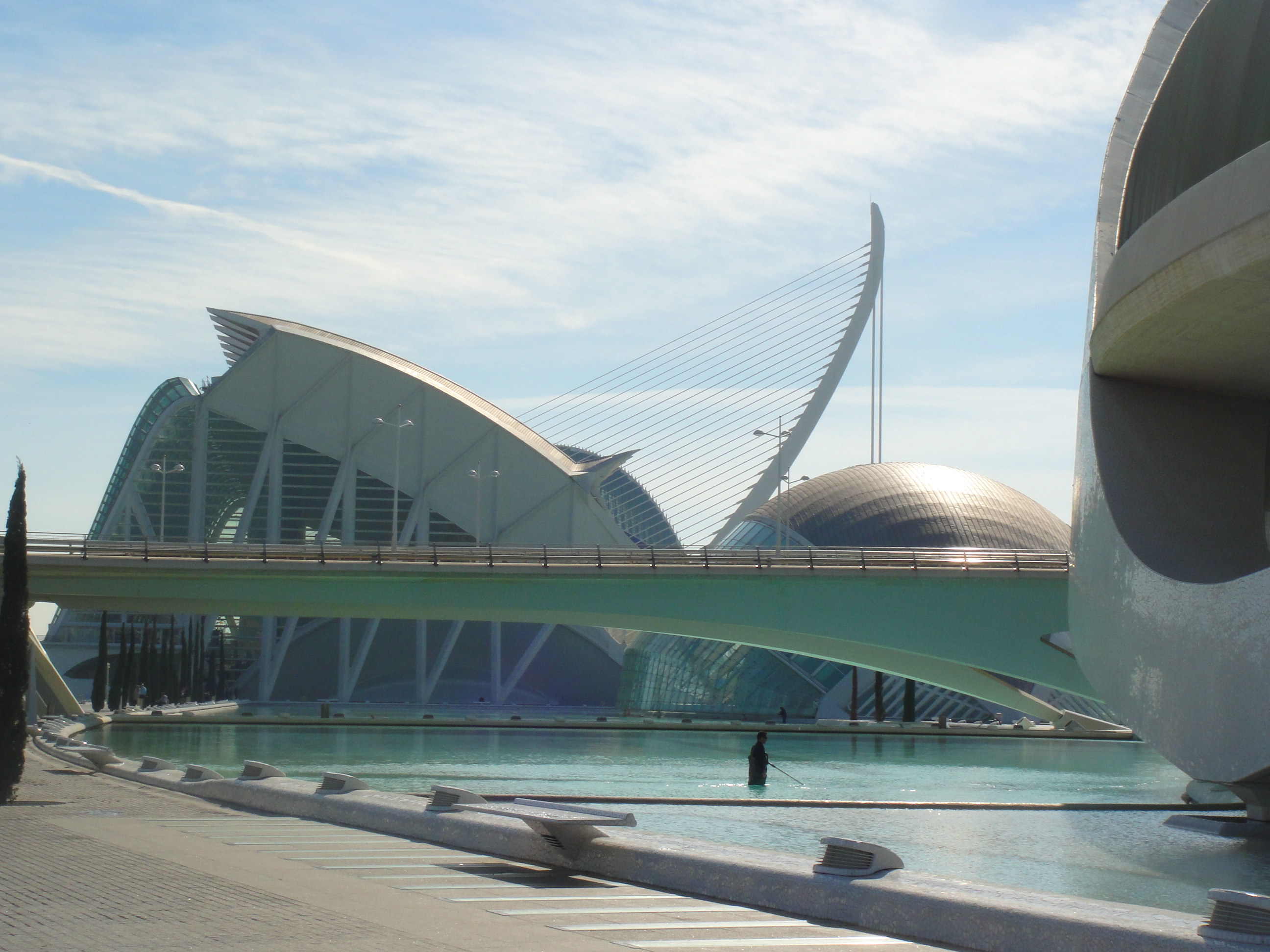
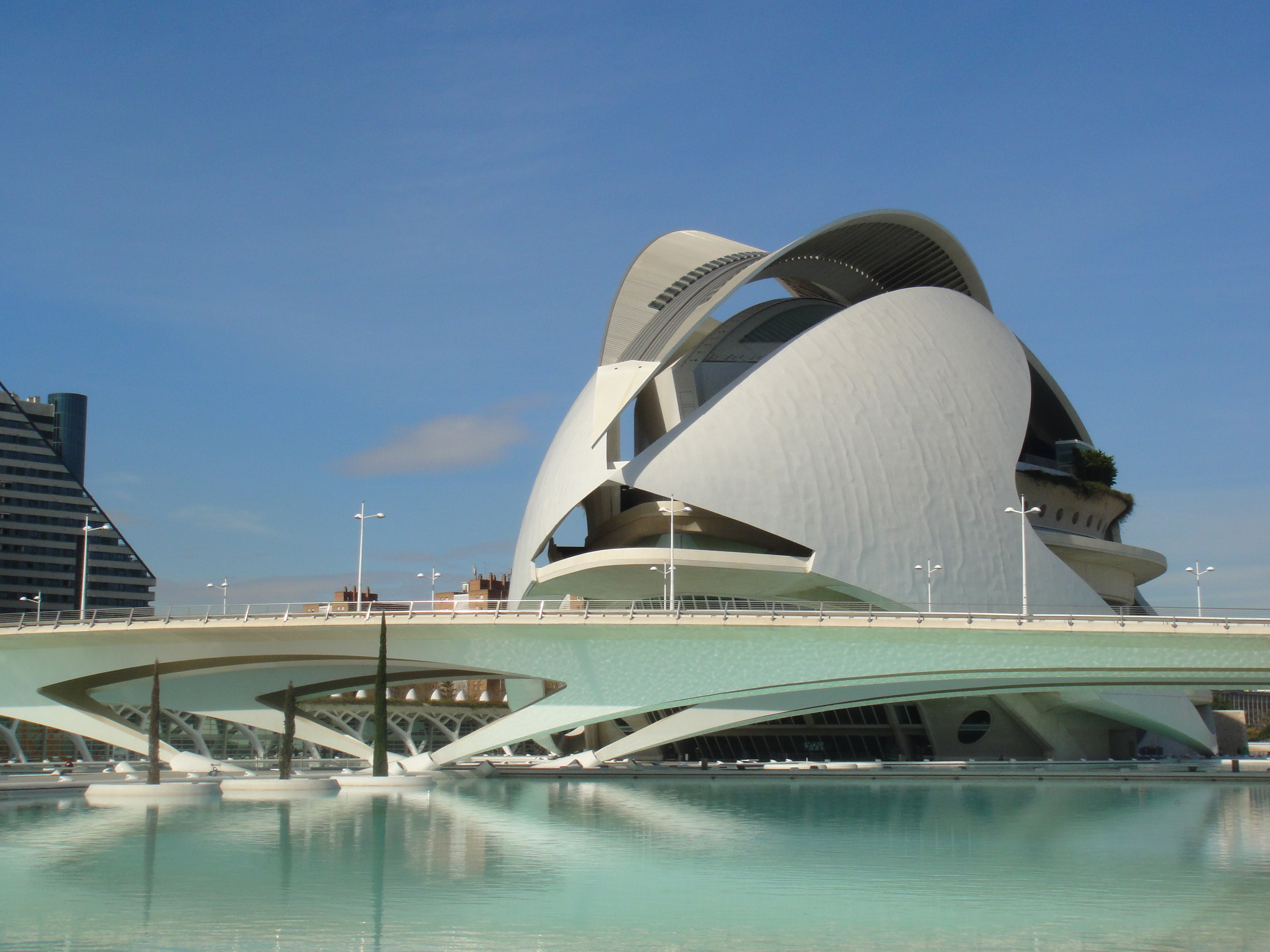
It’s the poster-book image, the flashy, pioneering facade of Valencia which has overtaken all other pictorial references to the city the world across, waving the flag for architectural innovation and groundbreaking artistic grandeur, sweeping the true financial crisis of Spain’s faltering economy beneath its flashy new white reflective surfaces (even though the pure cost of the development undoubtedly punched its own hefty dent in the country’s financial lacuna). The City of Arts and Sciences (La Ciudad de Las Artes y Las Ciencias) is the 21st century icon of not only Valencia, but also of Spain, a symbol of the country’s progressive cultural stance, leaping ahead of its European neighbours in architectural skill, innovation, and pure bare-faced audacity.

DSC05197DSC05268

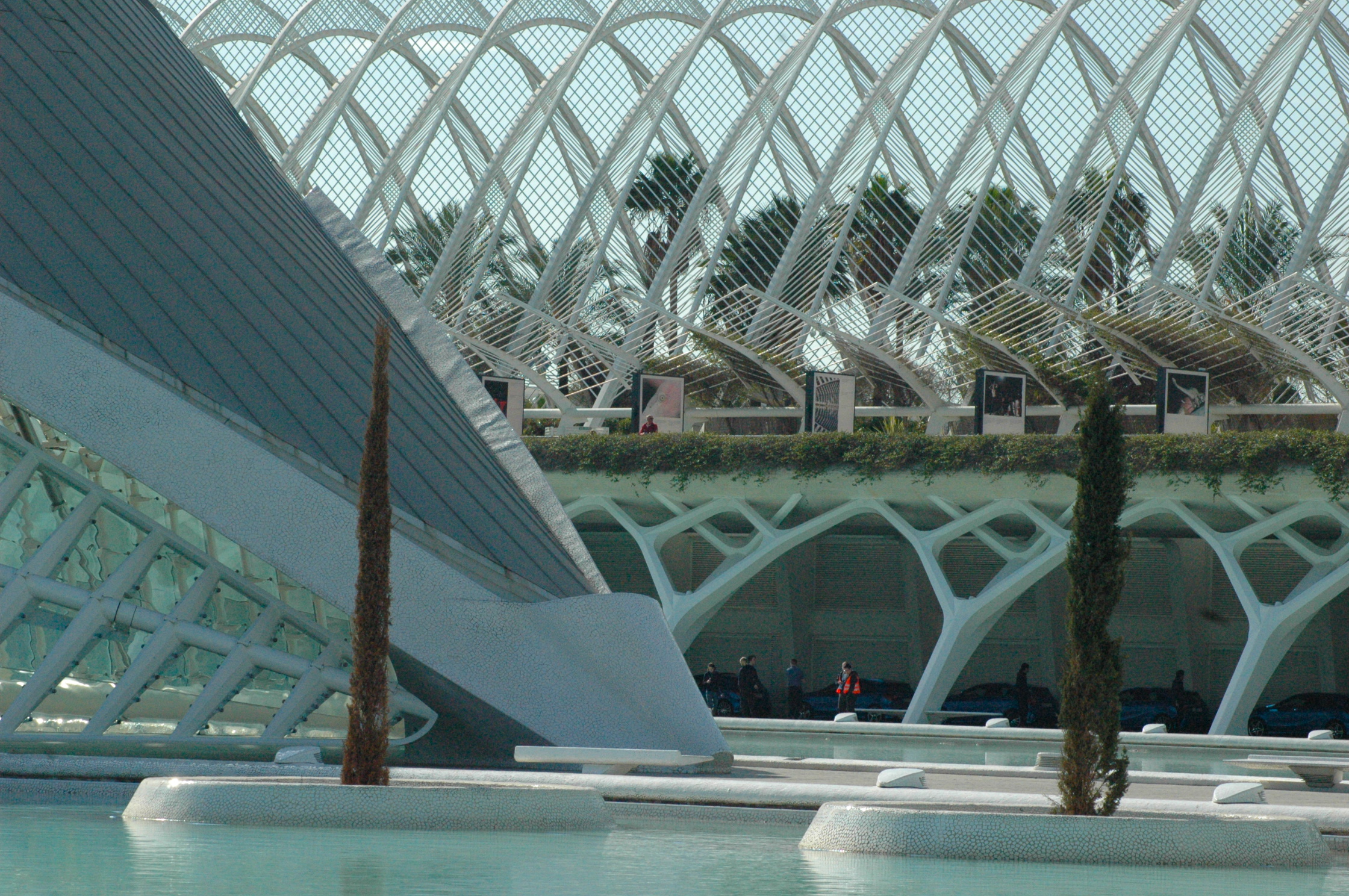
Designed by Valencian-born architect Santiago Calatrava in partnership with Spanish architectural great Felix Candela, the arts and sciences city is a town within a town, a giant complex of architectural spectacles devoted to learning, the arts and science, and set within a glittering azure pool in what was once part of the old Turia river. There are some 7 buildings in all, a panoply of differently angled, curved and bombastically arranged shapes in pearly, clean and uninterrupted white, all dappled and reflected by the blues and turquoises of the huge shallow ponds which surround the buildings, and marking a start contrast to the repetitious lines of one cypress tree after another, each neatly trimmed into perfect alignment with the sharply linear and meandering architecture of Calatrava’s creations.

Cypress trees appear to float on water

Cypress trees appear to float on water

Reaching the arts city by bus (bizarrely, despite spending such a stonking amount of money on developing the site, the city is yet to connect it anywhere close to the metro system, and it’s a good 45 minutes walk from the historic centre), we were simply awestruck by the originality and sheer scale and quantity of the architectural feast on show as we drew progressively closer to the complex. Oohs and aahs simply didn’t cut it when these outlandish buildings emerged before us. It felt a little like entering the set of a huge futuristic feature-film, the warm Valencian sunshine being in itself like studio lights, reflected as it was off the dazzling white surfaces of these luminescent  buildings.

Wanting to take in each and every detail of this incredible place, we simple decided to start off at one end and walk to the other, gawping at and admiring each respective architectural masterpiece in turn.

The Palau Reina Sofia

The Palau Reina Sofia

DSC05213

We began at the  Palau de les Arts Reina Sofia, an opera house and performing arts center which, with the capacity for 4,400 spectctors is one of the biggest opera houses in the world, second only in size to the Sydney opera house and containing some 4 auditoriums. Surrounded by some 87,000 square metres of landscape and water, and comprising two huge metal shells weighing over 3,000 tons, the building is like a vast space-age helmet, appearing to float suspended above a sea of disinfectant or other chemical mass. We did however notice that the building, the newest of the complex, is already showing worrying signs of age – the multi-tiled mosaic surface (paying homage to Gaudi) looks as though its cracking and wrinkling all over. Not a good sign for a building which the architect billed some 100million euros for and which cost much, much more to build.

Elegant curved bridge sweeping across the park

Elegant curved bridge sweeping across the park

The opera house is separated from the next building, L’Hemisfèric, by a faultless curving bridge which sweeps with ease and elegance across the large watery space, carrying cars from one side of the old river bank to the other. Meanwhile the Hemisferic is a perfectly rounded glass and silver entertainment venue, part Imax, part planetarium and par laserium (whatever that is). The building is designed to resemble a giant “eye of knowledge”, and when reflected in the watery surrounds makes a perfect oval shape, completing the eye-like illusion. Allegedly the large shutter along its “roof” opens along the curved axis of the “eye” like a large shutter – I wold love to see that in action.

L'Hemisfèric

L’Hemisfèric

Two for the price of one (or possibly not actually...)

Two for the price of one (or possibly not actually…)

The sympathetically designed cafe

The sympathetically designed cafe

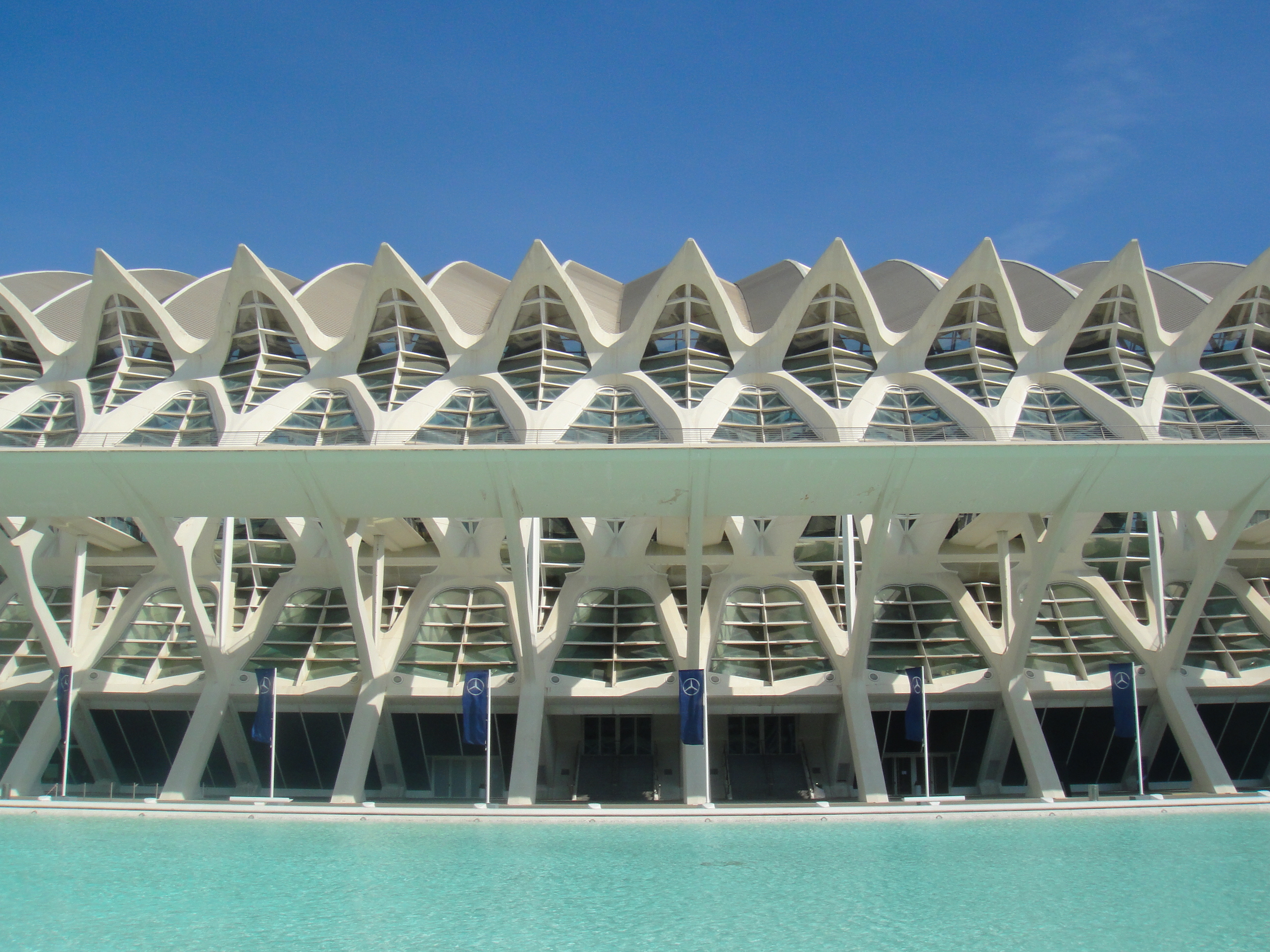
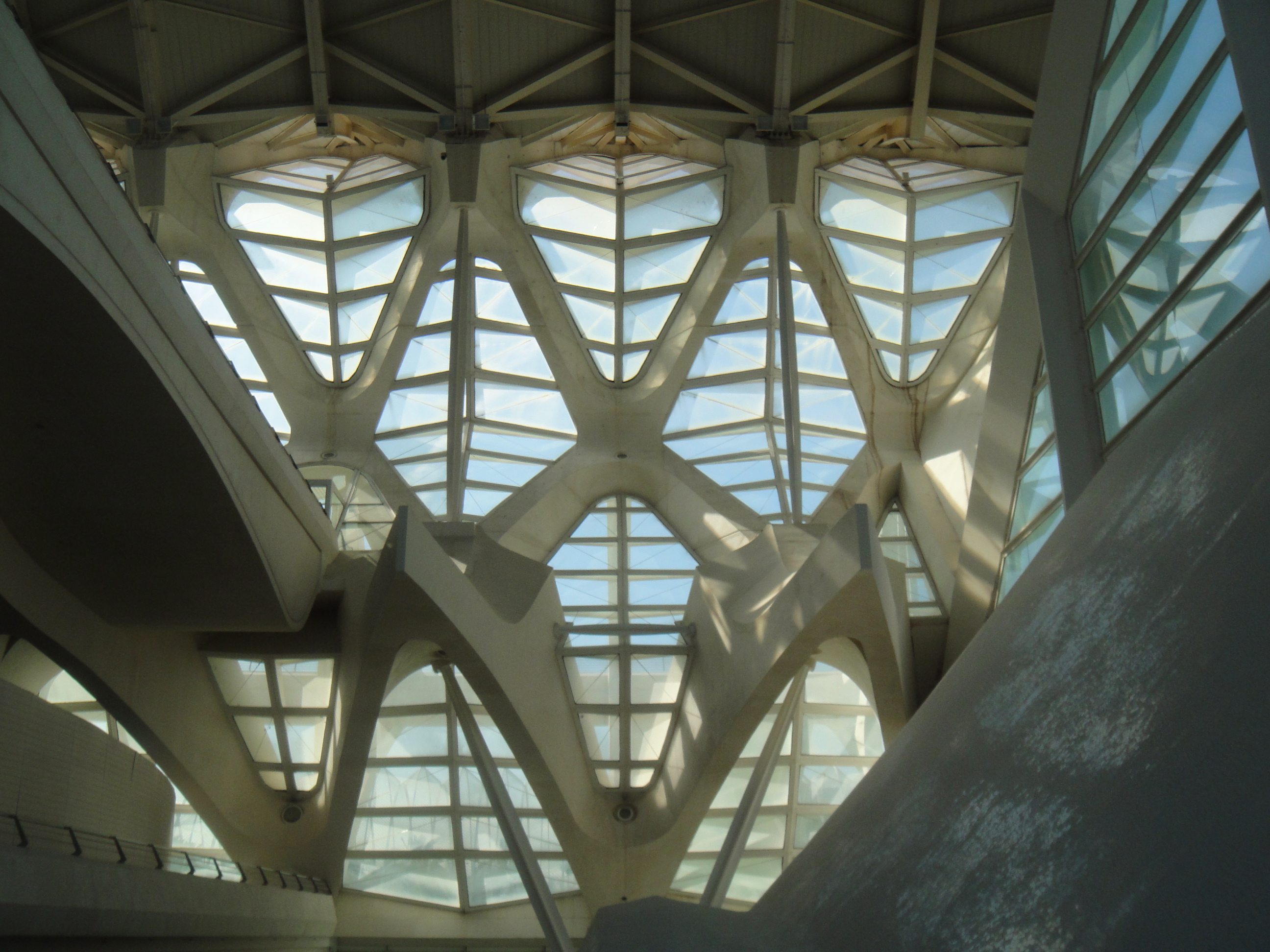
Up next was the vast Museu de les Ciències Príncipe Felipe, an interactive museum of science that is said to resemble the skeleton of a whale, although the spikey diamond shaped window frames reminded me more of a harlequin. While so many of the buildings in the park were shut to the public, this one was open, and at the cost of only 2 euros extra on top of the vast 22 euros aquarium entrance fee, one could tour around the huge science exhibition in this complex. I have to say, I found it all a bit boring and fragmented – there were plenty of self contained little science exhibits which I’m sure would have been of more interesting for school tours following a specific curriculum. Having said this, it was good to marvel at the space – this vast centre is like an airport terminal with so much wasted space – 220 metres long, it comprises 4,000 panes of glass and is also surrounded by it’s own reflective pools which help to magnify the space yet further, and besides which we stopped for a “pick-me-up” expresso sat on equally contemporary looking white angular chairs.

Museu de les Ciències Príncipe Felipe

Museu de les Ciències Príncipe Felipe

Inside the science museum

Inside the science museum

Stairs leading up to the whale bone structure

Stairs leading up to the whale bone structure

The museum's vast interior space

The museum’s vast interior space

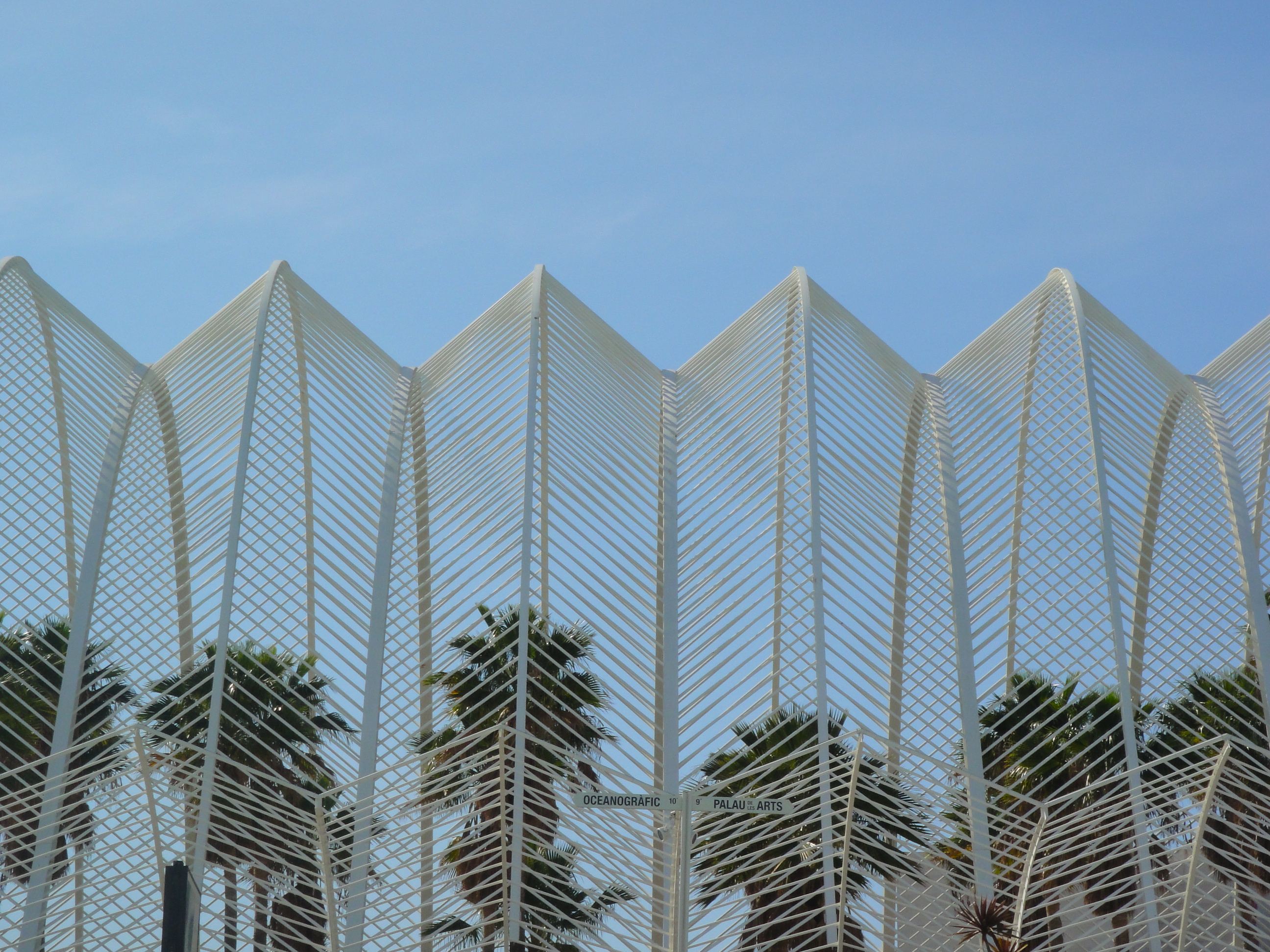
Walking past the science museum one walks either through or under L’Umbracle a feather-resembling landscaped walk way which comprises large super fine archways extending over palms, orange trees, herbs and a plethora of local plant varieties which flourish in this partly protected environment. It amazed me that these tall and slender archways are formed from concrete – they looked so fine and elegant that they appeared feather light, like a hair comb reaching up into the heavens.

L'Umbracle

L’Umbracle

Inside L'Umbracle

Inside L’Umbracle

DSC05412

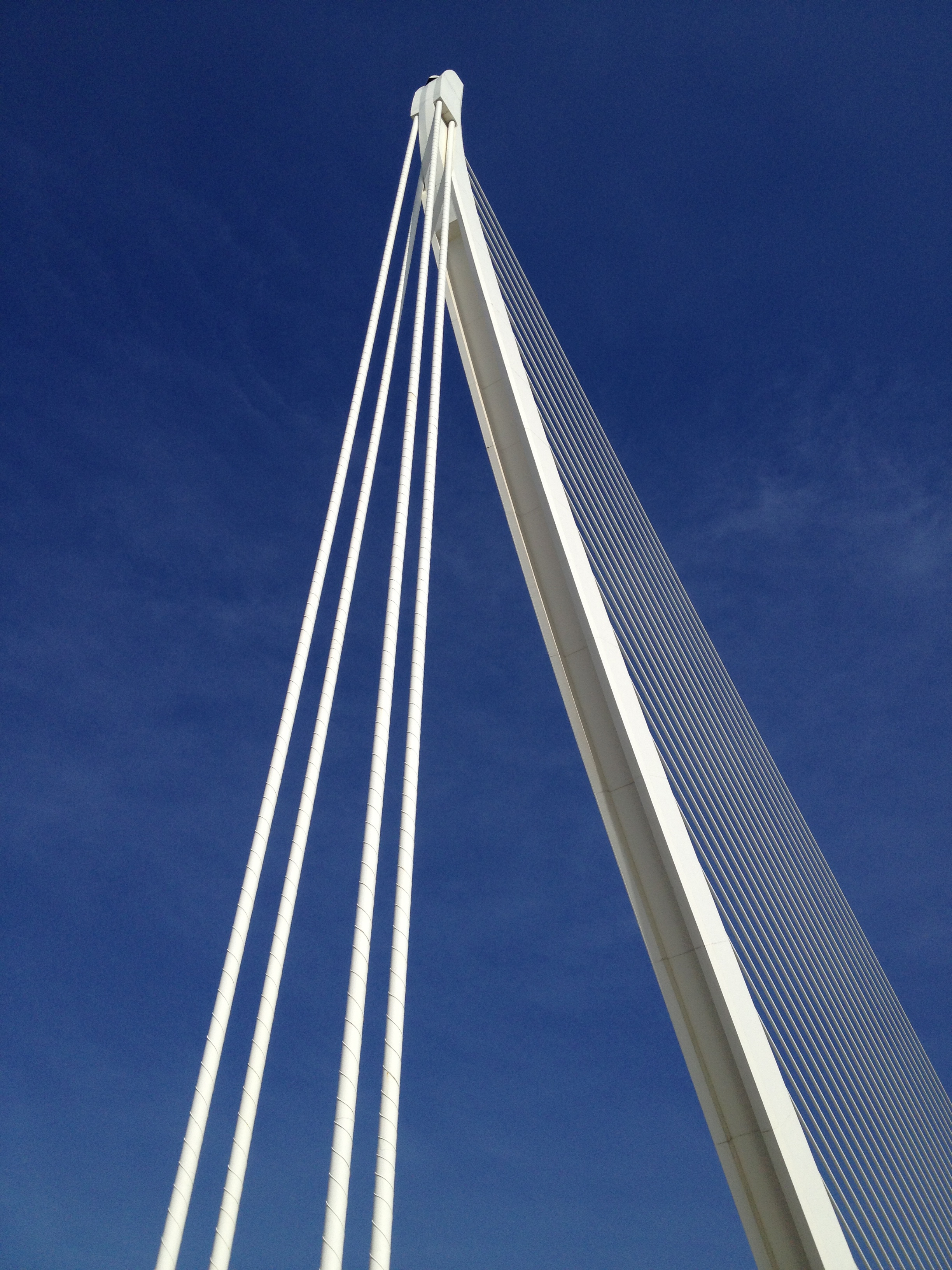
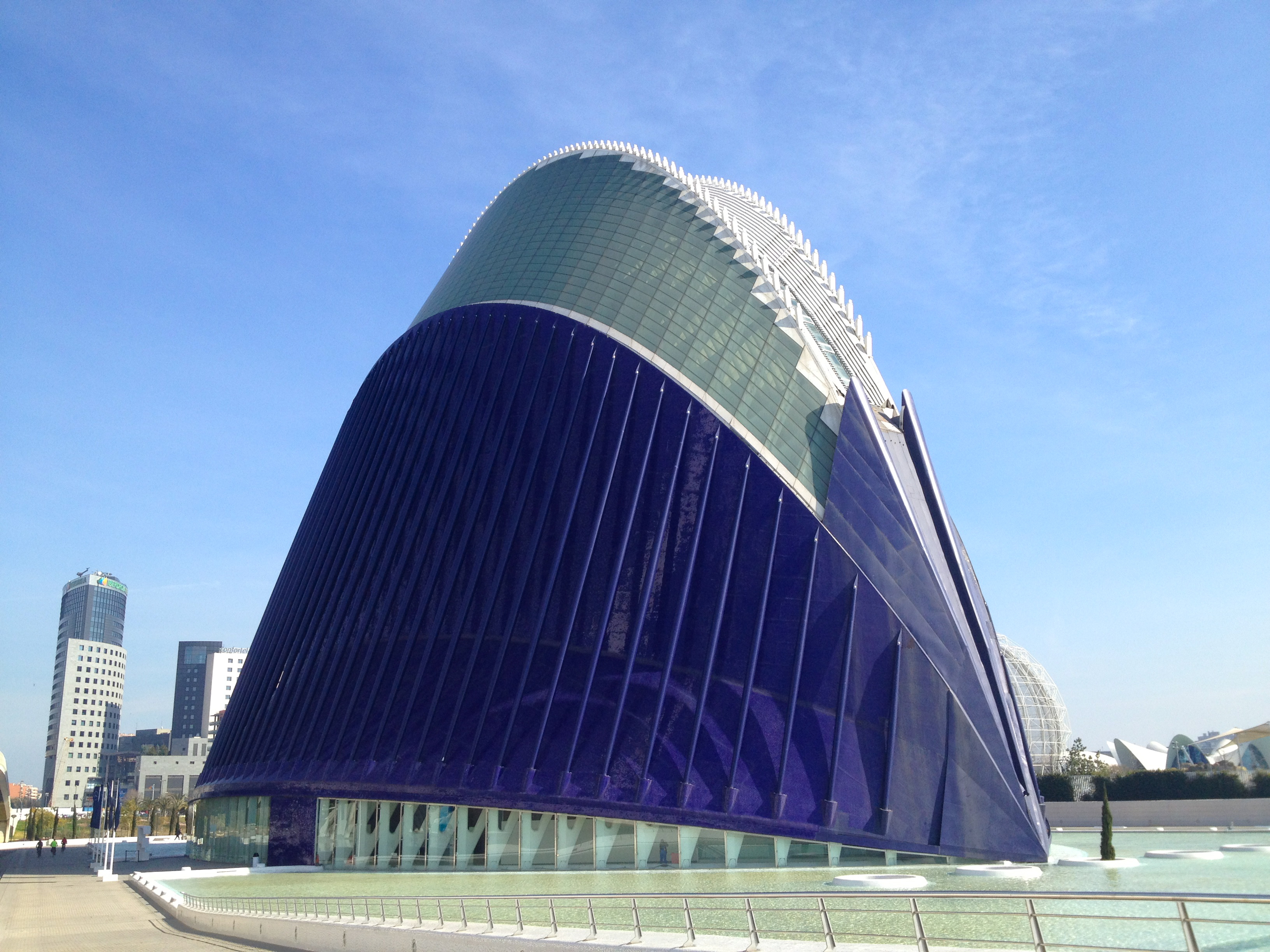
We were making our way to the vast aquarium complex at the far end of the park, but before reaching it passed two other sites of significant interest. First,  Assut d’Or, a suspension bridge so fine and tall that it reaches into the sky like a harp, a ship’s sail, or as some would have it, the “ham slicer”. Beyond that was the only blue building of the white series, L’Àgora looking a bit like a ripening fig. We couldn’t tell what it was from the outside, but apparently it’s a covered plaza in which concerts and sporting events are held – another huge space which, I assume, goes unused for much of the year.

Assut d'Or

The fine harp-like shape of Assut d’Or

With L'Àgora and the Science museum in the background

With L’Àgora and the Science museum in the background

L'Àgora

L’Àgora

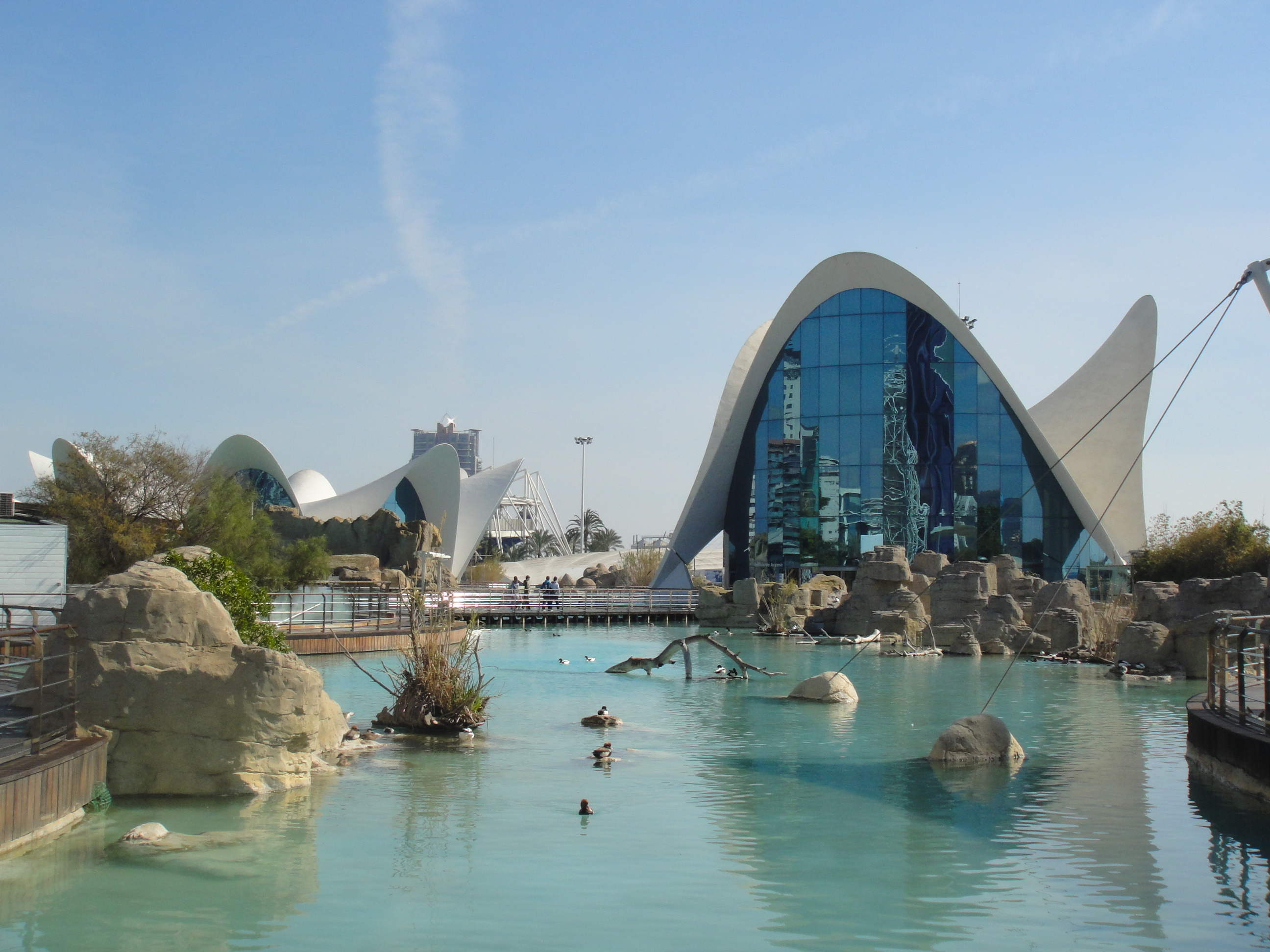
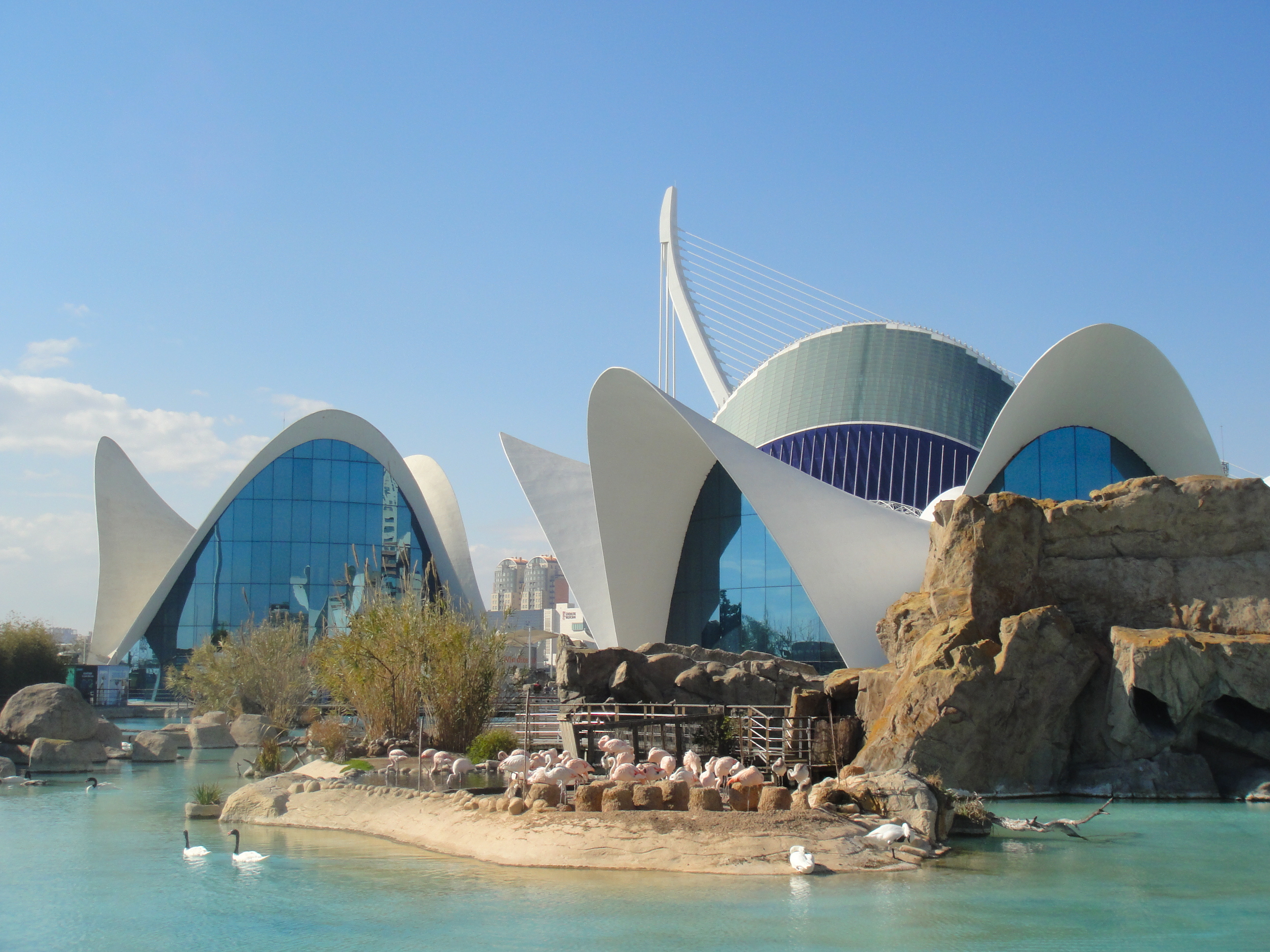
Already pretty exhausted by all we had seen, but still full of enthusiasm for the pure ingenuity and extra-human scale of the site, we finally made it to L’Oceanogràfic, an open-air oceanographic acquarium-come-park, which is the largest aquarium in Europe, and with 110,000 square meters of space,  42 million liters of water, and a number of different buildings representing different aquatic environments from wetlands and tropical seas to antarctic and the pacific, that statistic does not surprise me. Asides from the incredibly varied array of aquatic species found within the park, it is also notable for having two of my favourite buildings in the whole complex. Both by Felix Candela, they were designed to open out from the ponds surrounding them like waterlillies. With super thin concrete shells looking almost like bonnets shaped around large reflective glass windows, these buildings are particularly elegant and looked wonderful as the backdrop to the vibrant pink flock of flamingos ambling in shallow waters near by.

Waterlily bonnets in L'Oceanogràfic

Waterlily bonnets in L’Oceanogràfic

DSC05321

So at the risk of simply writing what is already turning into something of a travel guide into the arts and science city, what was our experience of the park? Apart from being frankly overwhelmed by the size, diversity and other-worldliness of the park, it was hard not to explore the complex with a hint of cynicism  and a touch of distaste at the sheer scale of the extravagance and expense which must have been poured out by the Valencian government in order to pay for this development. While much of Valencia’s city centre is left to slowly crumble, and prime sites near the Catedral are lying empty, further out in the far suburbs of the city, we have this mammoth arts and science centre which appears to belong to another age. Whether that age was the time of optimism (or perhaps just naivety) when economies across the world felt that credit was limitless and pursued vastly expensive projects recklessly unchecked, or whether it is a futuristic age when architecture such as this will become more commonplace (and cheaper to build), who knows. However for the present the site is dogged by controversy; because for much of the time it is empty, unused and silent; because it costs more to upkeep everyday than it can possibly make from revenues (even when we were there there were several men in every pond cleaning the waters, trimming the cypress trees and polishing the white surfaces), and because the local funds diverted into the project could have helped so many living under financial straits in the Valencia region.

Flamingo's bask in the sunny L'Oceanogràfic park

Flamingo’s bask in the sunny L’Oceanogràfic park

The park's "Wetlands" structure

The park’s “Wetlands” structure

Yet there can be no doubting the architectural brilliance of what has been achieved here. Such is the extreme of experimentation that it marks a vast contrast to the rest of Valencia’s historical centre. And this isn’t the first time I have seen such innovation in Spain – there’s the titanium-tiled fish-like Guggenheim in Bilbao for example, and the meandering Marquez de Riscal winery building in La Rioja, as well as a number of other examples of pioneering architecture cropping up across Spain, architecture so forward and extreme that its almost as though Spain, still damaged by the shadow of its savage civil war only two generations ago, is trying to shake of the past by surging forward.

But for now at least, that forward pace is necessarily stunted. The Spanish economy is one of the most precariously shaken in Europe, and the unemployment levels (one third of employable Spaniards are currently unemployed) are probably the worst. But in these grim times, at least we have  masterpieces such as these works by Calatrava and Candela to gaze at in admiration, the manifestation of a crazy dream in a now long-lost time when so many of us were dreamers, untouched by the economic crisis which has now taken an irresolute firmhold across the world.

DSC_1037

All photos and written content are strictly the copyright of Nicholas de Lacy-Brown © 2013 and The Daily Norm. All rights are reserved. Unauthorized use and/or duplication of the material, whether written work, photography or artwork, included within The Daily Norm without express and written permission from The Daily Norm’s author and/or owner is strictly prohibited. 

A tale of two Picassos – the 1901 prodigy and the introspective illustrator of mythology

I take something of a short break from my Valencian reportage to divert my focus slightly to one of the world’s most recognised artist, who is, as ever, creating a fresh storm manifested through two new exhibitions reflecting upon specific aspects of his career; one a period in which he started to develop from young progidy into the artist we know and love today; and the other his propensity towards illustrating mythological figures in his body of work. The first exhibition, Becoming Picasso: Paris 1901recently opened and running until the end of May, is being held here in London, at the Courtauld Gallery. The second, Picasso: Faune, Centaure, Minotareis on show in Valencia itself, and was therefore something I was lucky enough to catch during my stay. Held at the Bancaixa foundation, it’s running for the duration of 2013.

Becoming Picasso…

So let’s go back to the beginning, a time when Picasso was yet to find himself painting mixed up bodies, before the great masterpieces of Guernica and Les Demoiselles d’Avignon, when his figures were not delineated in thick black outlines, nor his compositions fragmented by cubes. In 1901, Picasso was but 19, but already showing huge talent as a young Malaga-born prodigy, so much so in fact that his work had already been chosen, in 1900, to represent Spain in the great Exposition Universelles in Paris, followed shortly afterwards, in 1901, by his very own solo show, held in Paris by collector Ambroise Vollard (Cezanne’s principal agent).

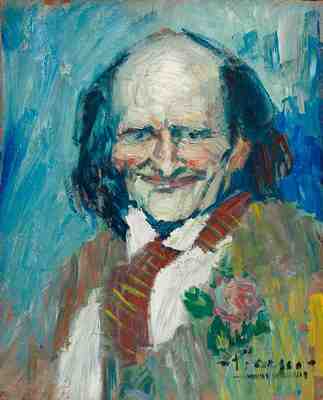
Portrait of Bibi-la-Purée (1901)

Portrait of Bibi-la-Purée (1901)

It was partly in preparation for this show that Picasso had such a prolific year in 1901, sometimes painting up to 3 canvases per day in preparation for his first big exhibition. It was a collection which borrowed from other Paris-based artists before him, such as Toulouse Lautrec’s depictions of the debauched Moulin Rouge nightclub, as well as the Spanish influences from which he was born, including the dwarf like characters of Velazquez’s work, replicated to amusing effect in this period by Picasso with paintings such as “La Nana”, a dwarfish dancer working at the Moulin Rouge. It was a period of colour and vivacity, full of latin spirit seeping into paintings such as “Spanish Dancer” and “Spanish Woman”, a rather promiscuous looking woman who again appears to reflect the work of Velazquez who famously portrayed the Spanish royal infantas with their huge skirts and embellished dresses. 

It is with these fascinating paintings that the Courtauld show marks its strong opening, full of the joie de vivre of Paris but presented with a latin twist, far from the Picasso of later years, but neverthless showing prolific skill and a confident hand, even when painted so quickly.

Dwarf-Dancer (La Nana) (1901)

Dwarf-Dancer (La Nana) (1901)

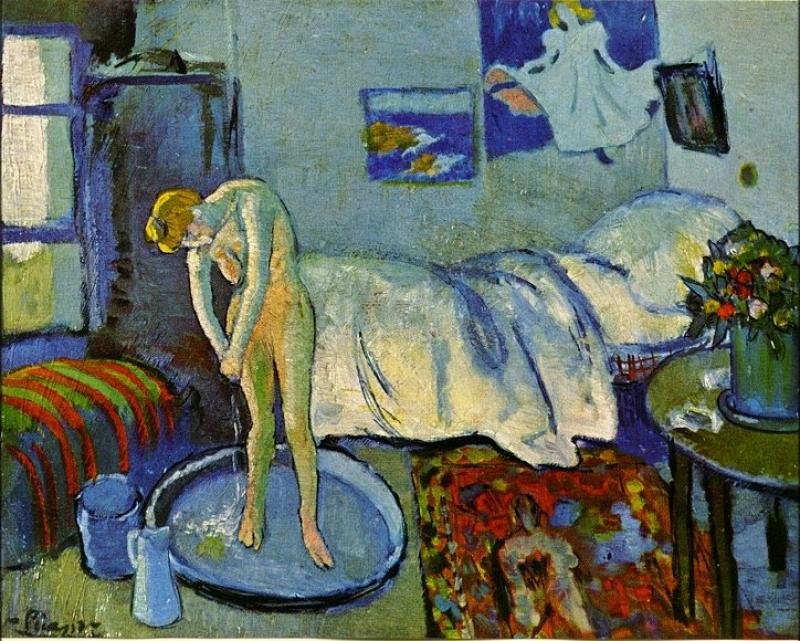
The Blue Room (1901)

The Blue Room (1901)

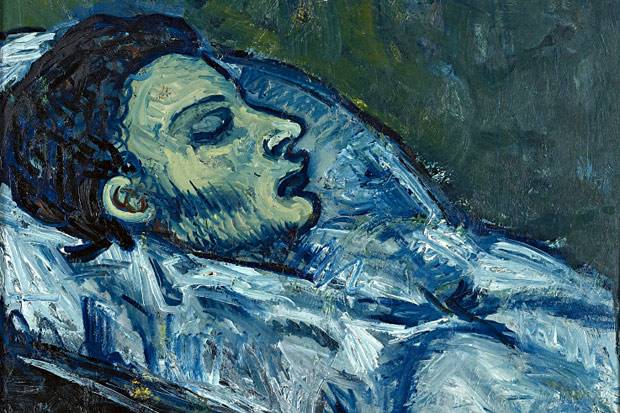
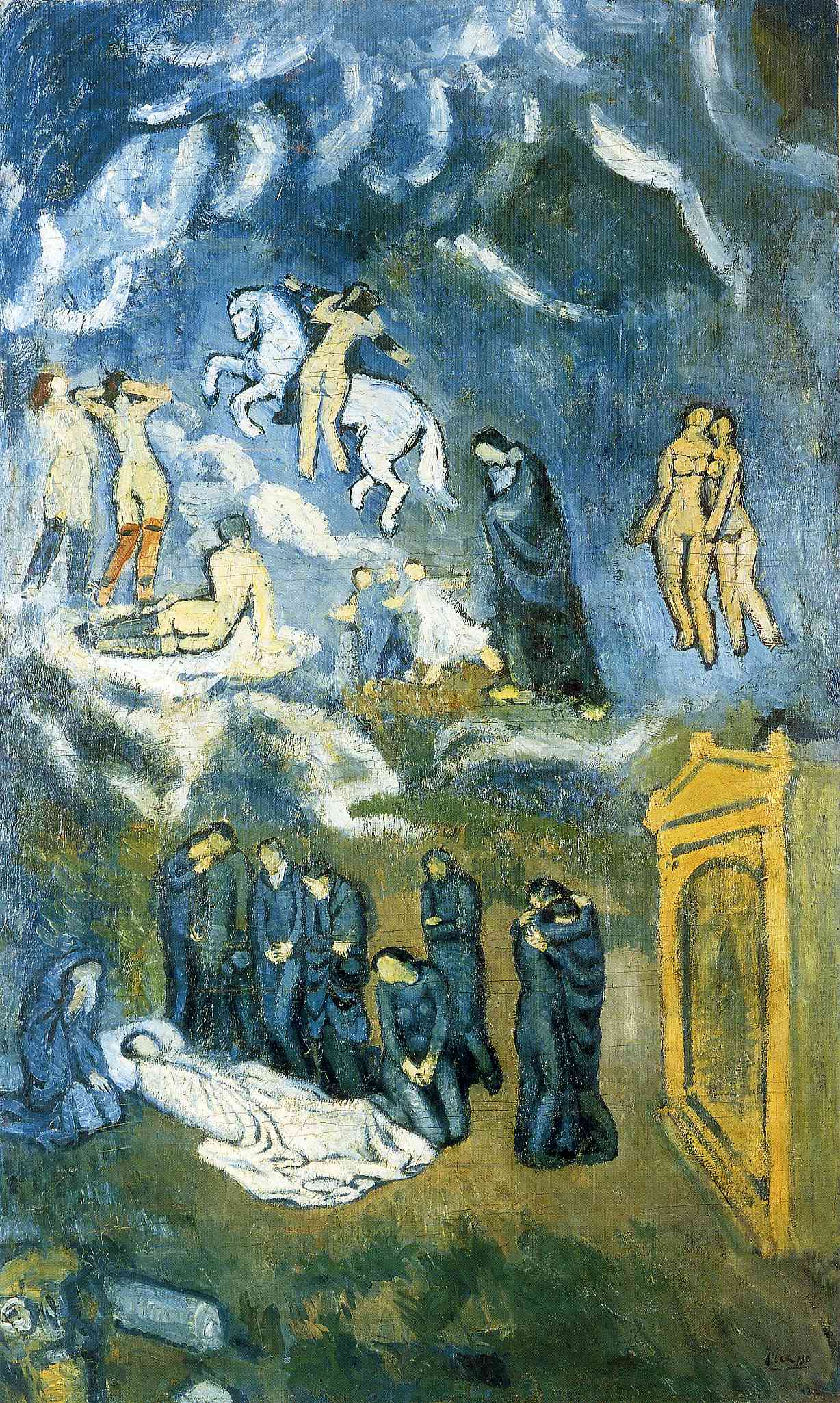
However around the same time that his solo show was being received to critical acclaim, tragedy struck in Picasso’s life. His heartbroken best friend,  Carles Casagemas, shot himself in the head in a Parisian cafe in front of all of his friends. It must have been a highly traumatic event, and the emotional turmoil which results is demonstrated in a marked change to Picasso’s approach. Diverting suddenly from the multi-coloured depictions of Paris as exhibited at the Voillard show, Picasso enters a new “blue” period (as it later became known), works of obvious melancholy. The blue paintings at first reflect on Casagemas’ death itself, as Picasso’s imagination becomes riddled with an almost obsessive preoccupation on his death. Picasso paints his dead body, and an altar-piece sized scene in which Casagemas’ body appears to be riding to heaven surrounded by scantily clad prostitutes taking the place where angels would normally be represented. Again this piece exhibits strong Spanish influences, marking a clear parallel to the impressive altarpiece, “The Burial of the Count of Orgaz” by El Greco, to be found in Spain’s Toledo.

Casagemas in his Coffin (1901)

Casagemas in his Coffin (1901)

Evocation (The burial of Casagemas) (1901)

Evocation (The burial of Casagemas) (1901)

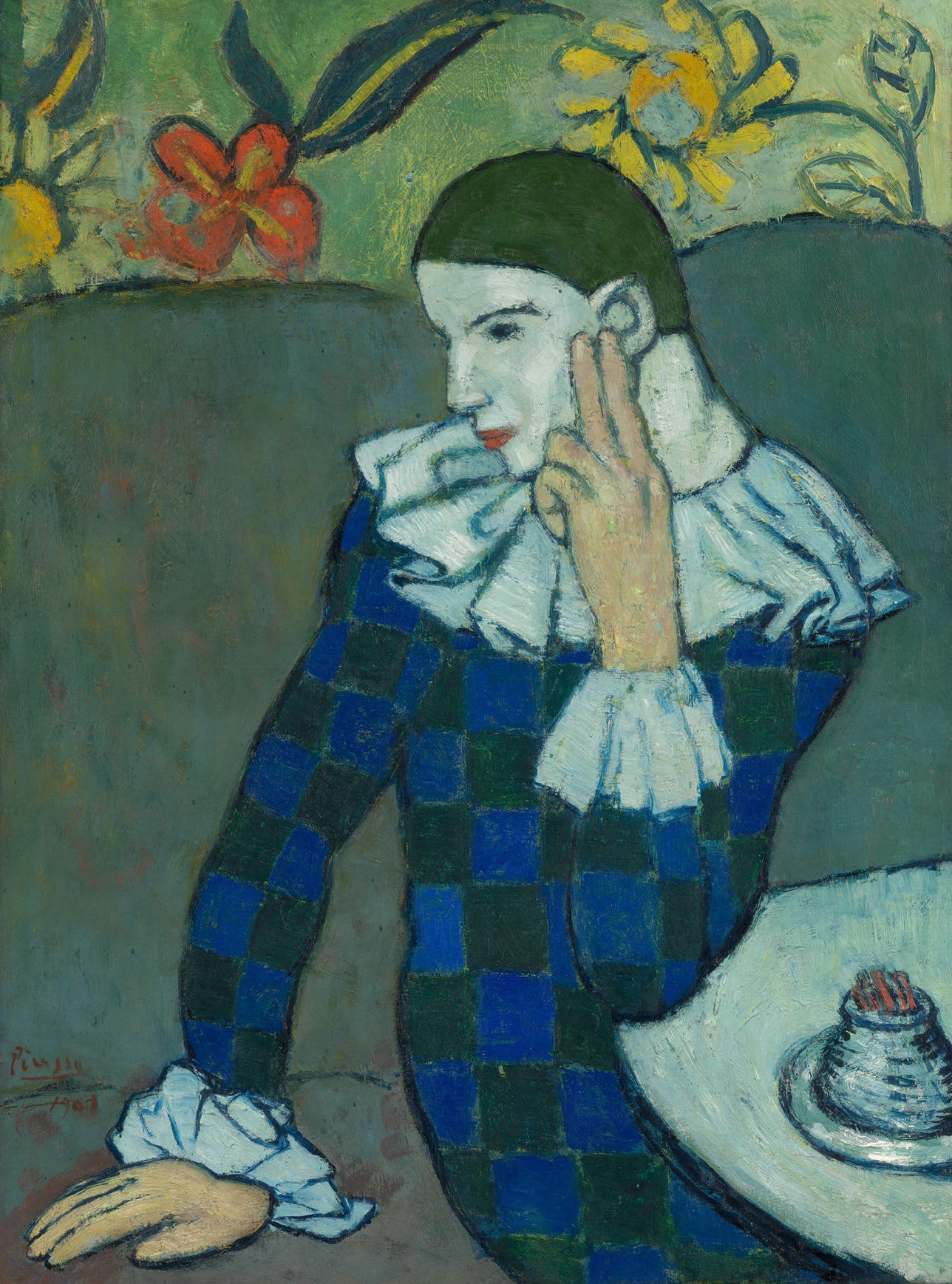
What Parisian scenes Picasso does paint during this period are now marked with the same degree of melancholy. With a clear nod to Degas’ Absinthe drinkers, Picasso’s absinthe-drinking punters are melancholy, drawn out figures, either alone or depicted sat with a mysterious harlequin figure. Meanwhile, away from the cafes, Picasso becomes equally preoccupied with the suffering of others around him, in particular gypsy-looking mothers, shown in the tight embrace of a child to withstand the suffering and hard-bitten existence all around them.

Seated Harlequin (1901)

Seated Harlequin (1901)

Harlequin and his Companion (1901)

Harlequin and his Companion (1901)


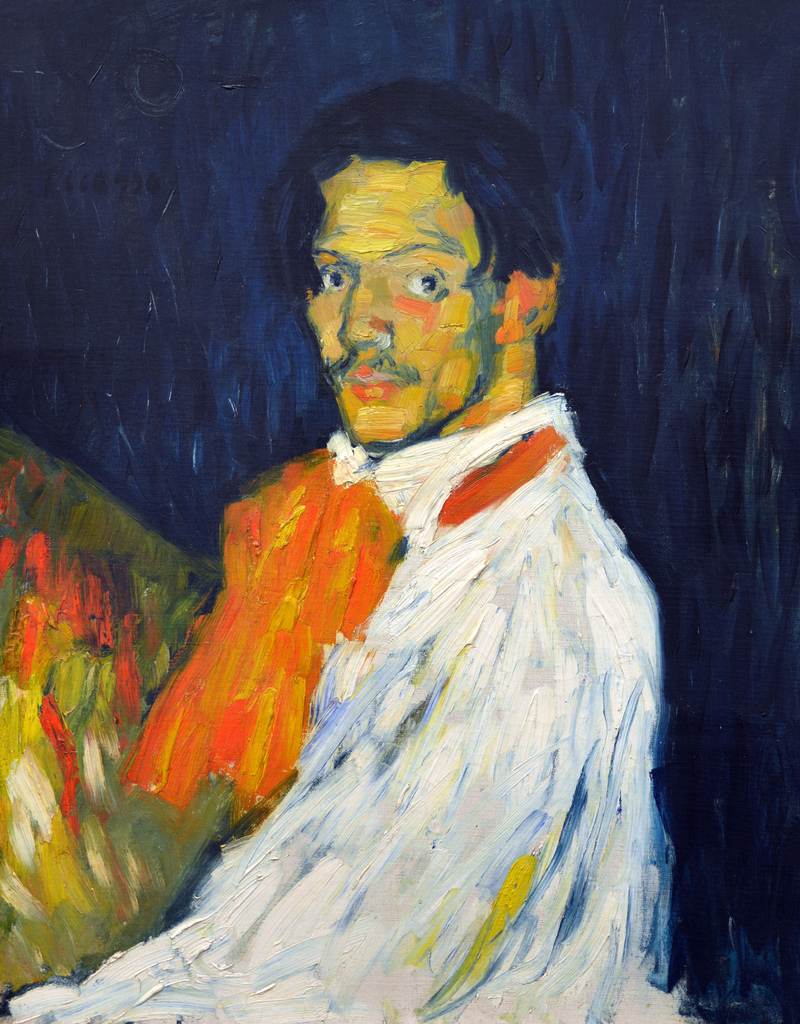
Yo - Picasso (1901)

Yo – Picasso (1901)

And there the show ends. It’s a small and compact exploration of a year which was clearly significant in Picasso’s development as an artist. As his paintings during the year develop, we see him adopting a stronger and darker black outline of his figures, with colour then added in between. It is thought that he had been influenced by the likes of Gauguin and Van Gogh in adopting this approach and taking it forward for the remainder of his career. It was also during this year, and clearly buoyed by his solo exhibition success, that Picasso emerged a more confident artist, as demonstrated by the two self-portraits in the exhibition, entitled “I-Picasso” (“Yo”) and which show the artist staring out boldly, full of strength and belief in his own skills. It was also in 1901 that Picasso, for the first time, started signing his paintings with the simple epithet: “Picasso”.  There was no longer a need for a first name, nor indeed for any further introduction. Bold, prodigious and startlingly original in his changing styles and daring representation, the Malaga-born artist had now made it in Paris, and there was no going back. He had become Picasso.

Picasso: Faune, Centaure, Minotaure

The second show, which I was lucky enough to catch while in Valencia, is held in the rather swish premises of the Spanish bank, Bancaja, who have established something of an art foundation in the Valencia centre. A couple of years back I went to a similar foundation established by La Caixa bank in Palma de Mallorca and remembered thinking then that good old Barclays or Lloyds in London would never have an art foundation like these – and yet it’s a shame, since banks often have huge art collections which never otherwise see the light of day.

This small show, hung across a rather spacious contemporary exhibition area, focuses on Picasso’s preoccupation with mythology, and his use of the mythological figures of the Faun, the Centaur and the Minotaur to depict not only the legendary stories themselves, but also to use those characters in portraying something of himself. Most of the works were either watercolours, lithographs or etchings, and many were illustrations drawn by Picasso in partnership with well-known authors or poets. He also used the mythological figures when designing sets for theatrical and ballet productions and these two were represented in the show.

Faun Revealing a Sleeping Woman (Jupiter and Antiope, after Rembrandt) 1936

Faun Revealing a Sleeping Woman (Jupiter and Antiope, after Rembrandt) 1936

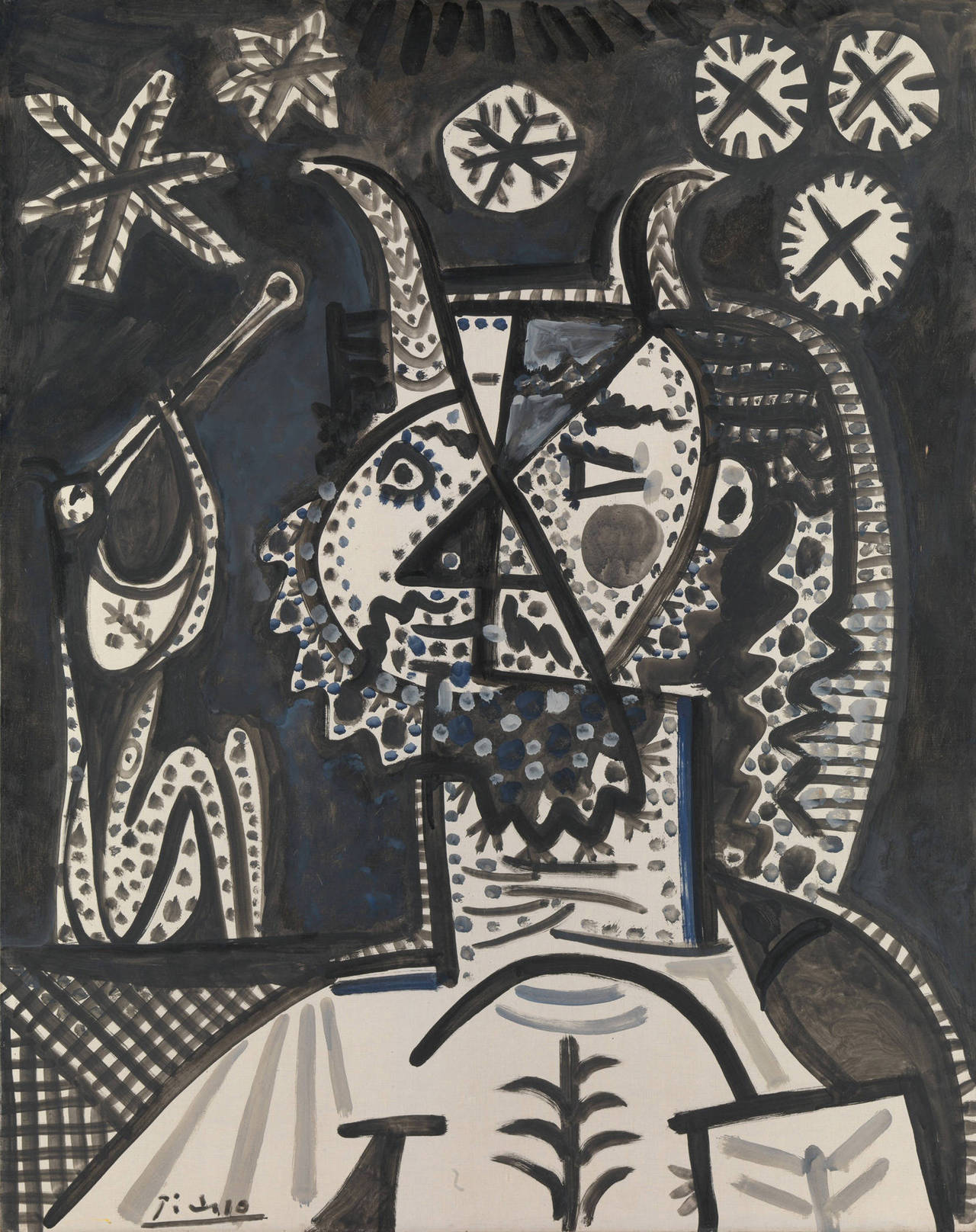
Faun with stars (1955, the Metropolitan Museum of Art, NY)

Faun with stars (1955, the Metropolitan Museum of Art, NY)

Through the faun, Picasso portrayed a happier, jocular ladies man, seducer of women, the party joker; and consequently the sketches and works of Picasso which include the faun are the work of happier times in Picasso’s career, when his subjects and his output appears carefree and creative. It is said that in representing the faun, Picasso looks back to his experiences as a lothario, as a fun and happy lover. In this work (above), “Faun revealing a sleeping woman” (1936) for example, part of the Suite Vollard which was a set of illustrations made as part of a collaboration with Ambroise Voillard, some commentators suggest that the etching was made as Picasso’s relationship with his lover and muse of ten years Marie-Thérèse Walther was coming to an end, and he looked back, nostalgically at their past affection and here, a holiday they spent together in Juan-les-Pins in the South of France.

Centaur and Bacchante, 1947

Centaur and Bacchante, 1947

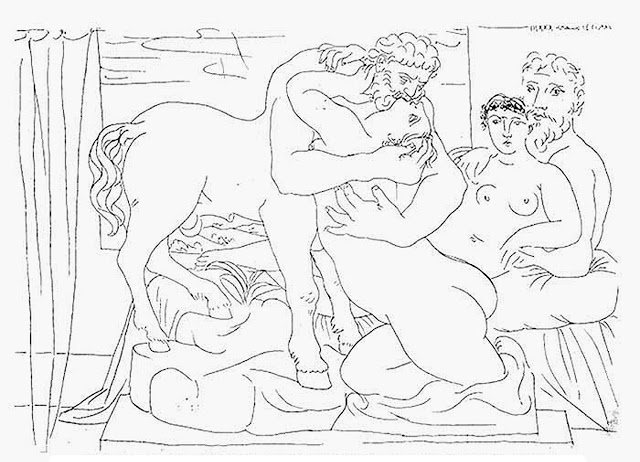
Picasso, Sculptor & Model with Statue of Centaur Kissing Girl, 1933

Picasso, Sculptor & Model with Statue of Centaur Kissing Girl, 1933

Through the centaur, Picasso plays on the traditional perception of the centaur as a mischievous sexual predator, a sexualised lothario, but something of a sexual outcast. On the one hand he shows the centaur painted in the loving embrace of a fellow sexualised bacchant, while on the other showing him as a troubled character who does not fit in within society. In one illustration (which I have been unable to find an image of) Picasso illustrates the rather surreal tale of a man who finds a centaur and brings him to Spain whereupon he tries to find a suitable place for him within society. The centaur is given a job as a picador in the bullring, but the centaur soon leaves the job, disliking the way that the bull would charge at him. Next he tries carting tourists around in a carriage on his back but finds the job too tiresome. Finally he settles in a teaching role. It’s a bizarre tale, but is it one which demonstrates Picasso’s own failure to properly find his niche in society?

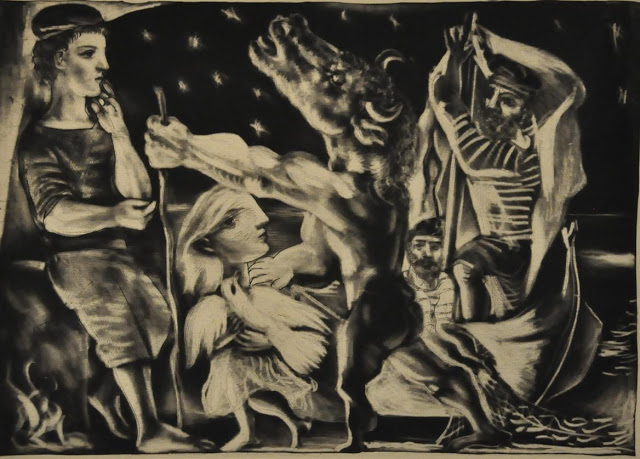
Blind Minotaur Led by a Girl through the Night (1934 Printed in 1939)

Blind Minotaur Led by a Girl through the Night (1934 Printed in 1939)

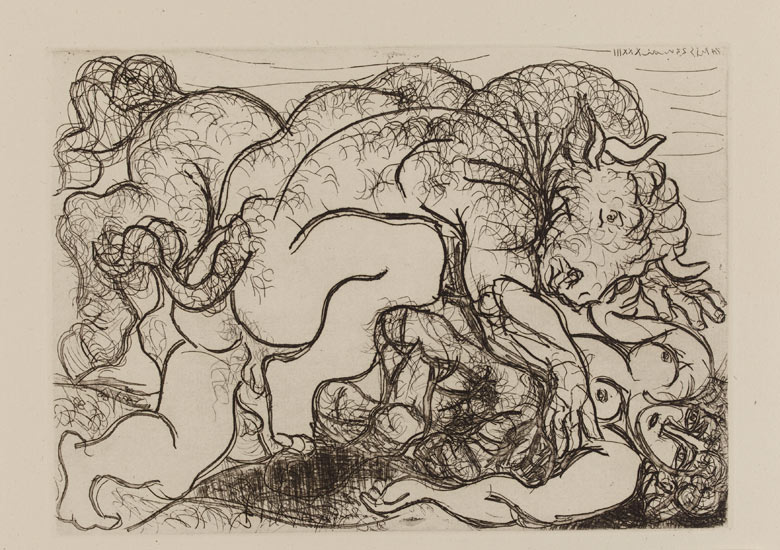
Picasso's Minotaur lying over a female centaur, 1933; plate 87 of the Vollard Suite at the British Museum

Picasso’s Minotaur lying over a female centaur, 1933; plate 87 of the Vollard Suite at the British Museum

Finally, through the minotaur, Picasso reaches his lowest ebb, depicting the troubled, self-loathing and introspective minotaur at the times when Picasso is experiencing his own depression. Sketches showing the minotaur being manipulated by women (such as the illustration of the minotaur being led blinded by a woman into the night, above), injured, murdered and abused litter the period of work which Picasso later revealed to be his lowest and most desperate – it was the time when he was trying to escape a troubled marriage with wife Olga, a time when in paintings such as “Three Dancers” (now in Tate Modern), Picasso’s figures became more severe, defaced and ugly.

So while the Bancaja’s exhibition focused on a fairly narrow chapter of Picasso’s oeuvre, it nevertheless unveiled a number of truths of Picasso’s inner psyche: Picasso the self-doubter, the traumatised, the passionate lover, and the nostalgic and sensitive gentleman. For that reason it was a fascinating biographical tale told through some scintillating visual aids in the mythological genre. If only UK banks could prove such an education.

For details of the two exhibitions above, see the relevant pages of the Courtauld and Bancaja websites.

Valencia (ii) – Food Focus 1: Palo Alto

Review websites such as tripadvisor have easily become the best friend of the tourist, but often the enemy of the hospitality industry, which so easily falls victim to the foul mouths of internet trolls who would never complain to a restaurant’s face (so to speak), but unleash their cowardly fury online to the detriment of the business’s future trade. And yet, when a restaurant knows its stuff and presents a brilliant service, this is more often than not reflected on the said review websites. It is for this reason that before visiting a new city, I tend to check out the top 10 or 20 restaurants as reviewed by visitors on tripadvisor, and more often than not make a few reservations as a result. For Valencia however, I had insufficient time to scan through the various Valencian offerings, and decided to take Valencia like a bull by its horns, and leave my restaurant reservations to chance.

Imagine my surprise then when, after stumbling upon this little neighbourhood gem, Palo Alto C/ Conde de Montornes 30, and enjoying every little expectation-exceeded detail, that I should find said restaurant is only at number 406 of 1266 tripadvisor reviewed restaurants in Valencia! To be fair to them, they only have one review, and that review is a full 5 out of 5 which, while not surprising, should be replicated many times over. I hope therefore that in writing this review, I will play a small part in lifting Palo Alto far up the tripadvisor rankings and into the hearts of Valencia visitors henceforward.

file205_Restaurante_Palo_Alto_08_resize file201_Restaurante_Palo_Alto_03_resize

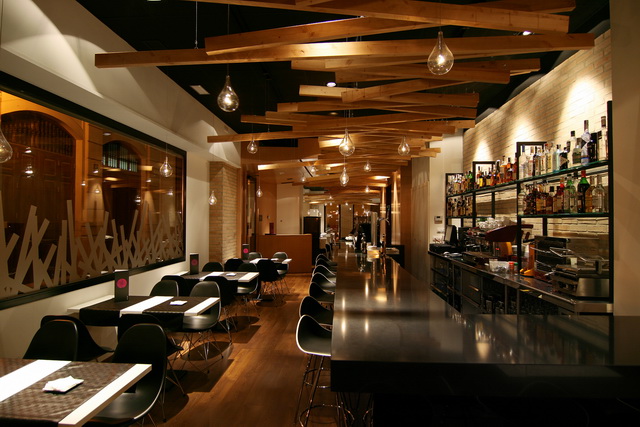
We were quite lucky to chance upon this restaurant. Always on the lookout for something quirky (and always ensuring that I avoid any restaurant which 1. has waiters/ maitre d’s standing outside beckoning/ forcing tourists inside or 2. those whose menu comprises 80s-style yellowing photographs of ideal dishes, to which the actual presentation bears very little resemblance) and heading back to the hotel after our traipse around Valencia’s fine art museum followed by another around the Jardines del Real, I was attracted to this place by the unique interiors (special admiration went for the variously angled wood suspended from the ceiling like a continuous wave rushing along the shore, complete with oversized lightbulbs hanging at differing heights) and the very reasonable menu. For only 44.25 € each, we would get 5 courses, bread, a bottle of wine, water and coffee. Bargain.

Delicious wine, all included

Delicious wine, all included

So turning up later at the allotted time, we found ourselves attentively looked after from the start. Pleasant waitresses asked us whether we would like white or red wine, and on choosing the latter were given an excellent tempranillo rioja “Valdemar, 2011” which far exceeds the normal plonk one may be given as a house wine or as part of a set menu. Smooth and perfectly chilled at the recommended mid-teens centigrade, this wine flowed like liquid velvet upon the tongue, slipping down the throat in perfect unison with the food.

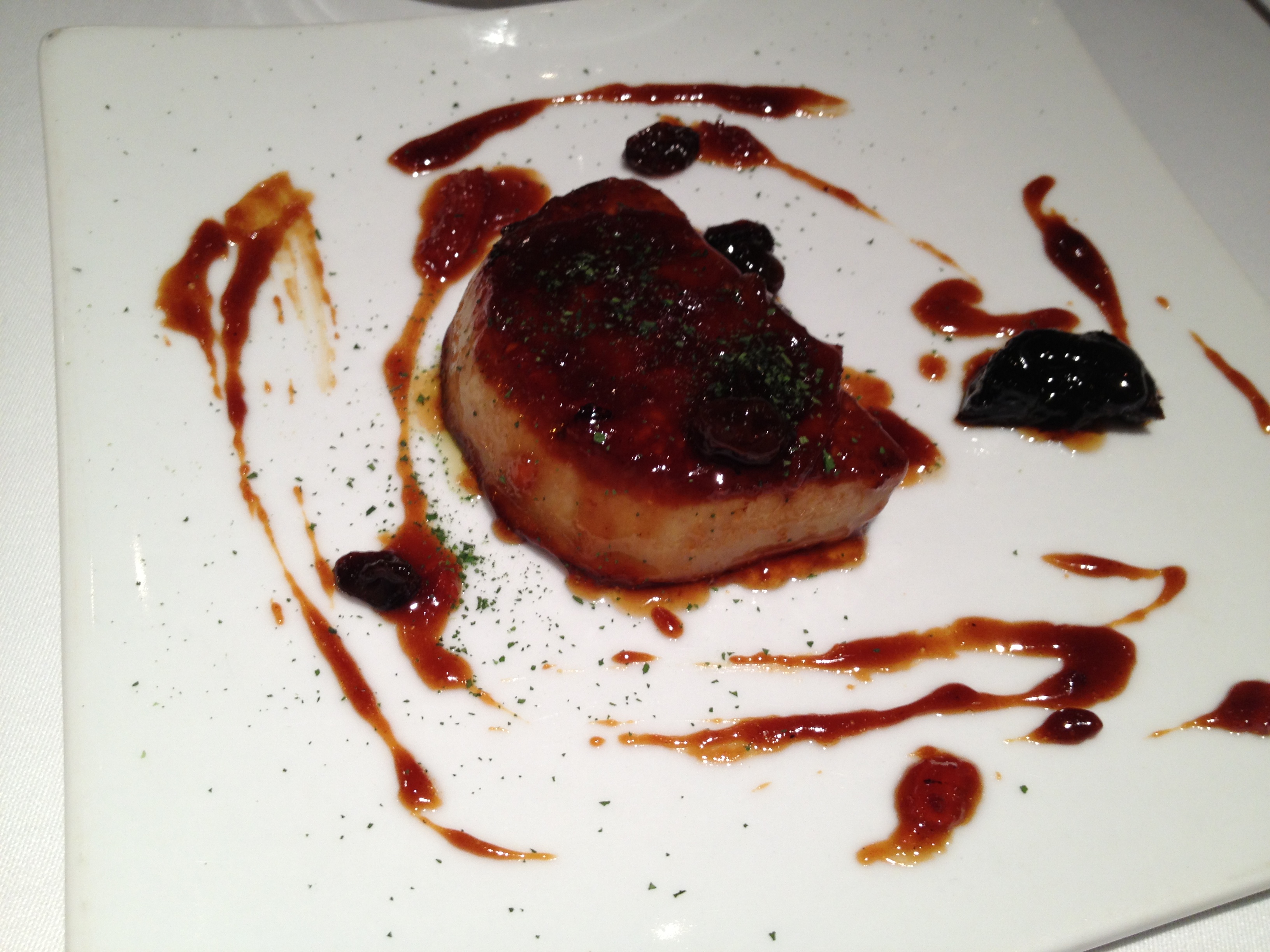
Speaking of which, each and every course of our sampling was delicious, flavourful and each uniquely different. The first, a panfried foie gras with a reduction of pedro ximenez sherry, honey and raisins was a perfectly balanced dish. The reduction had been taken a little too far, with the result that it was a tad sticky in between the teeth, but the sharp sweetness was a beautiful accompaniment to the rich creamy saltiness of the foie.

Foie with a sherry reduction

Foie with a sherry reduction

Onto dish two, a beautifully presented salad of super-fresh scallops, sitting in their little mermaid bikini shells surfing the waves of a verdant salad, dressed in a citrus vinaigrette and topped with that much needed “crunch” supplied by crushed pistachios and crispy iberico ham.

Salade of Scallops with iberico ham and crushed pistachios

Salade of Scallops with iberico ham and crushed pistachios

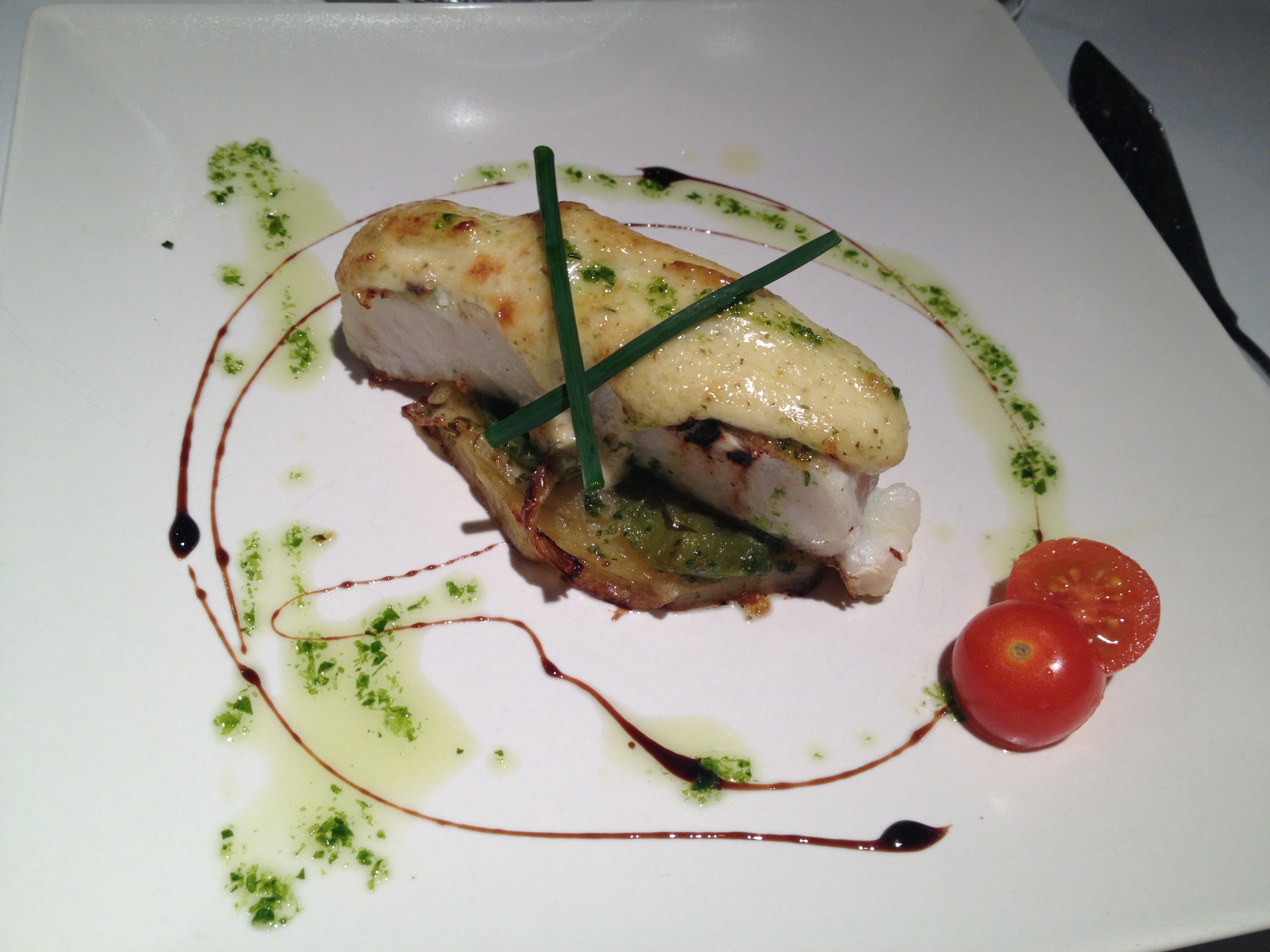
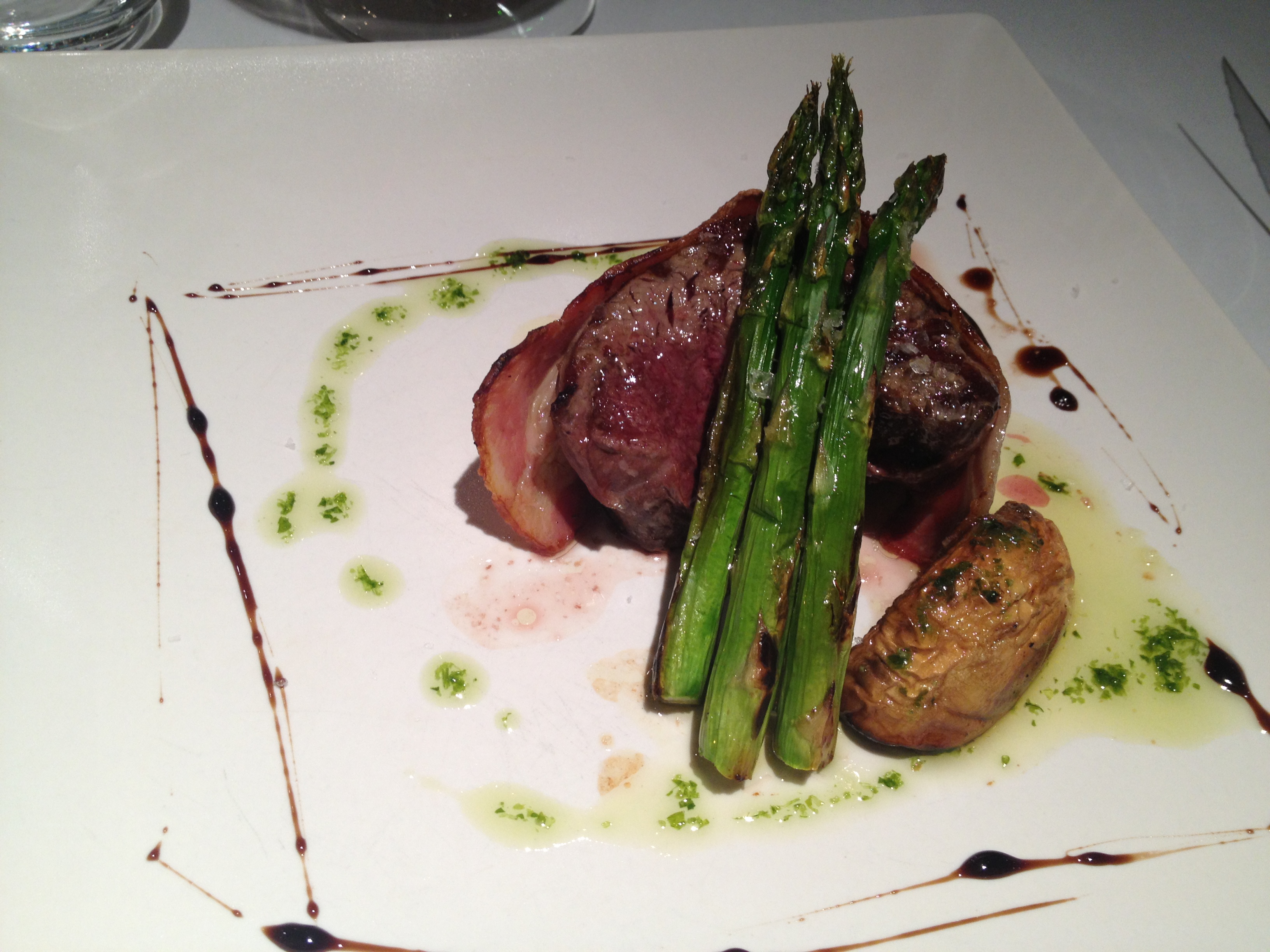
There were two mains, the first a dish of hake  (or “merluza” in Español), served on potatoes with a basil and garlic purée. I could smell the pungent garlic as the dish wafted over from the kitchen (or rather the garlic vapours did) and relished the potent mediterranean flavour. My mother found the garlic a little strong for her more refined anglicised palate and perhaps wisely left a little of the sauce to the side – had I done the same, I may have better appreciated the more delicate flavours of the subsequent main, a tornado of beef wrapped in bacon and served with mushrooms and asparagus. What can I say other than it was delicious, tender and perfectly cooked?

Hake with a garlic and basil sauce

Hake with a garlic and basil sauce

Tournado of beef with bacon

Tournado of beef with bacon

Ok, it's meat juices I know, but the marbling is beautiful

Ok, it’s meat juices I know, but the marbling is beautiful

Finally, onto the unctuous spongey chocolate cake with a strawberry reduction – perfect for the Valentines weekend, although for obvious reasons this was not at the forefront of my mother’s or my mind (!). I can barely remember quite how delicious this cake was, such was my unapologetic embrace of over half of that delicious tempranillo, and my undeniable intoxication by a meal which was, in every detail, on point. Having almost forgotten how reasonably priced this set menu was, the final bill of 88 € came as something of a shock, but was worth every centimos. Palo Alto – may you rise to the altos of tripadvisor. You deserve it.

Chocolate cake with strawberries

Chocolate cake with strawberries

Palo Alto in on the C/ Conde de Montornes 30 which is a few minutes east of the Cathedral and close to the bed of the old Turia River.

Valencia (i) – Day 1: Beauty and the Bell Tower

As I stood listening to the huge iron bell strike atop the Miguelete tower at 1pm, I was caused to reflect on where I had been just two weeks ago. Having climbed the 330-odd steps to the top of London’s Elizabeth Tower, to view the gigantic bell famous throughout the world as “Big Ben”, my ascendance up this latest bell tower marked my second climb up the steep spiralling steps of a campanile in as many weeks. Yet the differences in the visits were all too visible. In Elizabeth tower, the 330 steps were fairly gentle and wide; here the 207 steps were steep and arduous, narrowing as they got higher. In London, we were the only visitors on the stairs, whereas in the Miguelete tower high numbers of tourists meant crossing each other’s paths going up and down these narrow spirals was perilous to say the least. Up here, our ears only suffered one single bong, whereas up Big Ben at 12pm, 12 huge dongs reverberated around our bodies causing us near deafness and a strong case of jellylegs.

The city, viewed from above

DSC_0578 DSC_0583 DSC_0587

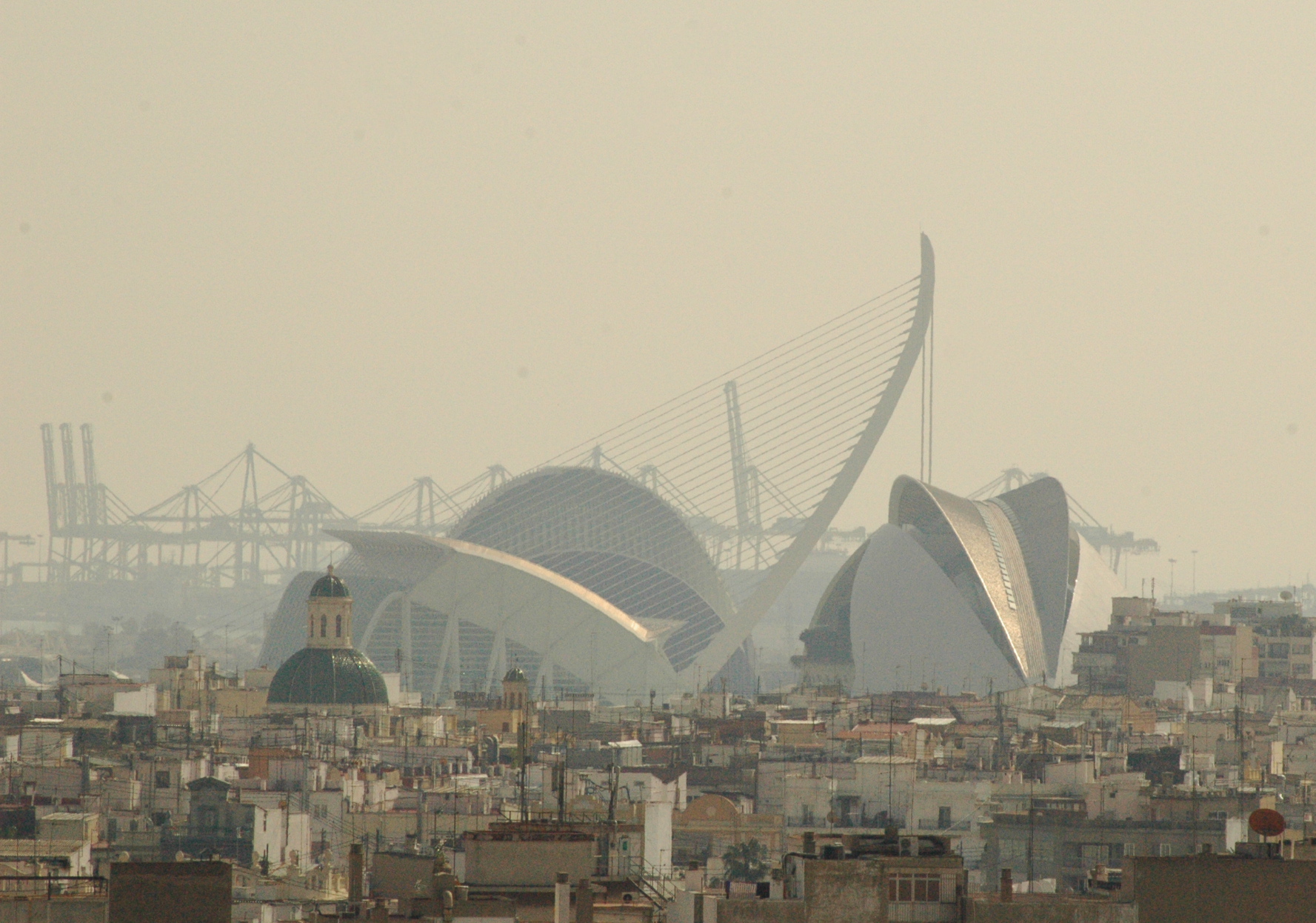
But the biggest differences between these two bell towers were twofold: First, temperature – in London I perished in freezing cold winds, desperate to get inside behind the relative shelter of the clock’s huge stained-glass faces; whereas atop the Miguelete tower, I was in a pleasant 20 degrees. Secondly, the view: From Big Ben the city of London spread out beneath my feet, famous landmarks were one to the dozen, but they were basked in cold and grey and ice; here, another city spread before me – golden browns and auburn hues toped with elegant ceramic tiled domes of blues and greys, eau de nil and white, while towards the sea beyond, the eccentric discordant architectural forms of Santiago Calatrava’s revolutionary arts and science park rose from the now empty basin of the old river Turia. So what was the city I was viewing from this bell tower with such felicitous awe and inspiration? None other than Valencia.

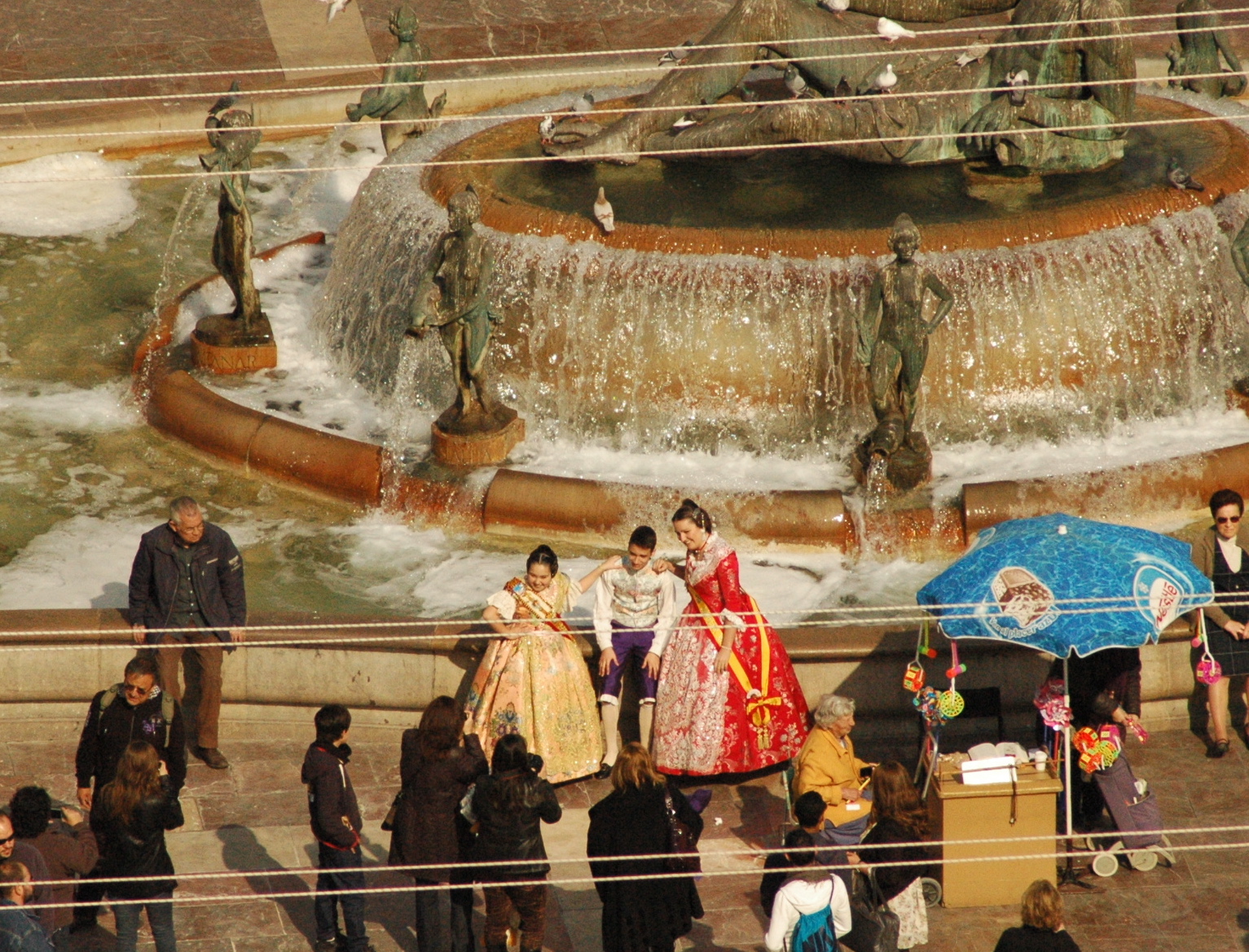
Traditionally dressed Valencians cause a stir in the Plaza de la Virgen

Traditionally dressed Valencians cause a stir in the Plaza de la Virgen

The City of Arts and Sciences in the distance

The City of Arts and Sciences in the distance

Valencia, capital of its own eponymously self-named region and located on the Eastern Mediterranean coast of the Iberian Peninsular, is Spain’s third largest city and one of the most visited in the country. Famous for Las Fallas, its March festival in which huge models are paraded down the city streets in a carnival of colour and festivity, as well as the rather oddly traditional mass human tomato fight (La Tomatina) which is held each August in the nearby town of Buñol, Valencia is a city with many facets, from its charming old centre, to its super modern Ciudad de las artes y las ciencias which boasts such startlingly innovative architecture as to have put Valencia on the architectural map of the world.

It seemed appropriate that having explored so much of my beloved Spain, I would eventually make it to this bustling Spanish centre, and all the more so at Valentines, a festival which shares so much of the city’s name. Romance wasn’t exactly my priority however – I was visiting with my Mother, with whom I have a shared love for Spanish culture – although it was certainly not lacking in the picturesque streets, charming street cafes, and large open squares of this iconic Spanish heartland.

Views of Valencia’s historic quarter

DSC_0473 DSC_0375 DSC_0356 DSC_0439 DSC_0462 DSC_0511

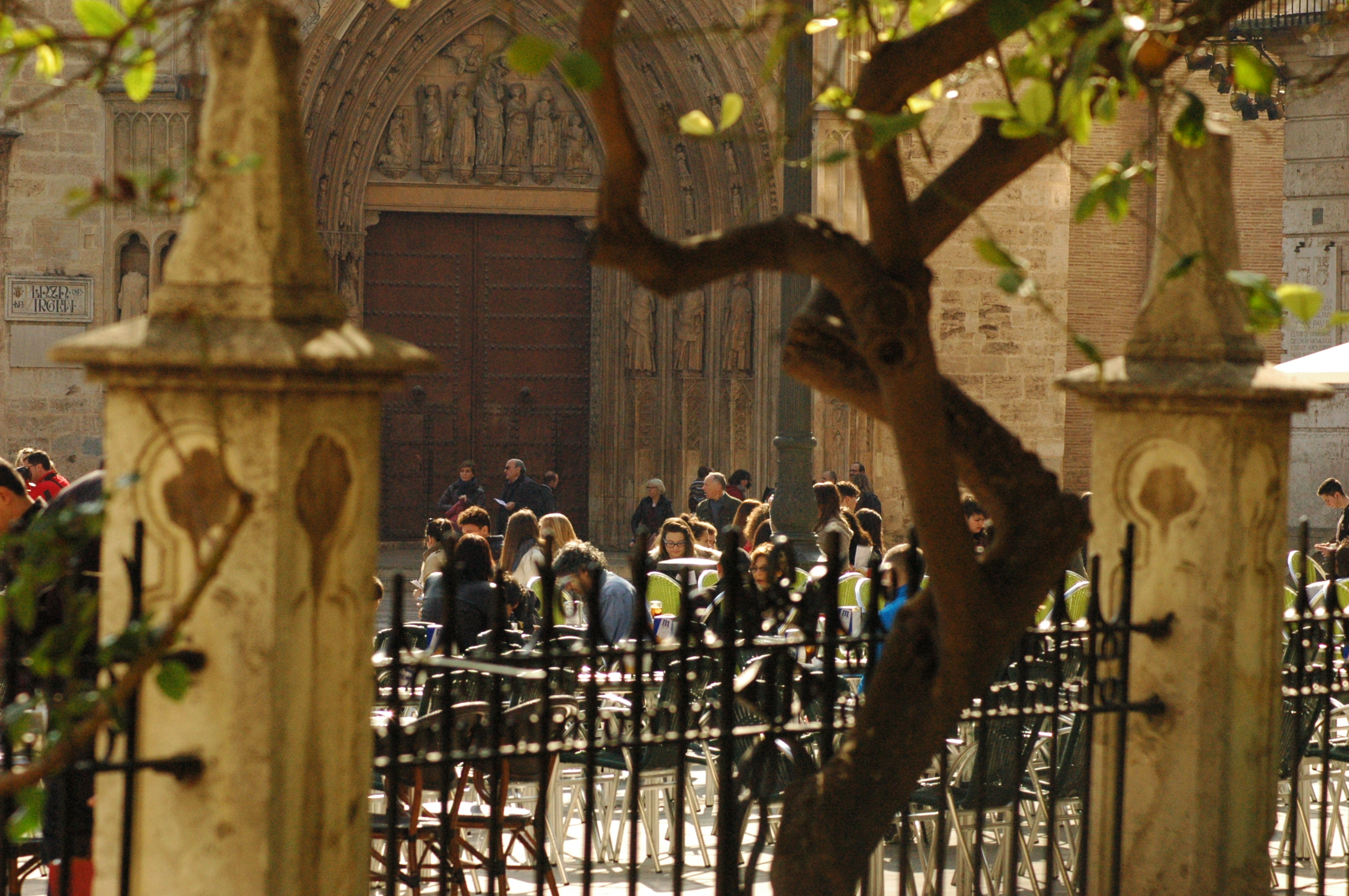
Staying in the heart of Valencia’s historic centre, in the conveniently located, wonderfully modernista Vincci Palace Hotel, we were only a short stroll away from the Plaza de la Virgen and next door, the Plaza de la Reina, in between which the city’s principle cathedral and it’s Miguelete bell tower mark the city’s centre-point. And what a place to begin what has surely followed as a love affair with this diverse and inviting city (although the steep spiralling stairs down from the tower did perhaps make sightseeing for the remainder of the day a little more tiresome). The cathedral’s tower is however only one aspect of this architecturally multi-faceted building. From austere gothic nave, to elaborate renaissance altar, and classical colonnaded rear to a front entrance dripping in baroque details, the cathedral is, to a degree, a perfect representation of this city. Not only is it situated at the beating heart of the city’s historical centre, but it demonstrates the plethora of influences and historical changes which have helped to shape and expand Valencia into the sprawling and diverse city it is today.

The Cathedral's gothic interior

The Cathedral’s gothic interior

and its baroque facade

and its baroque facade

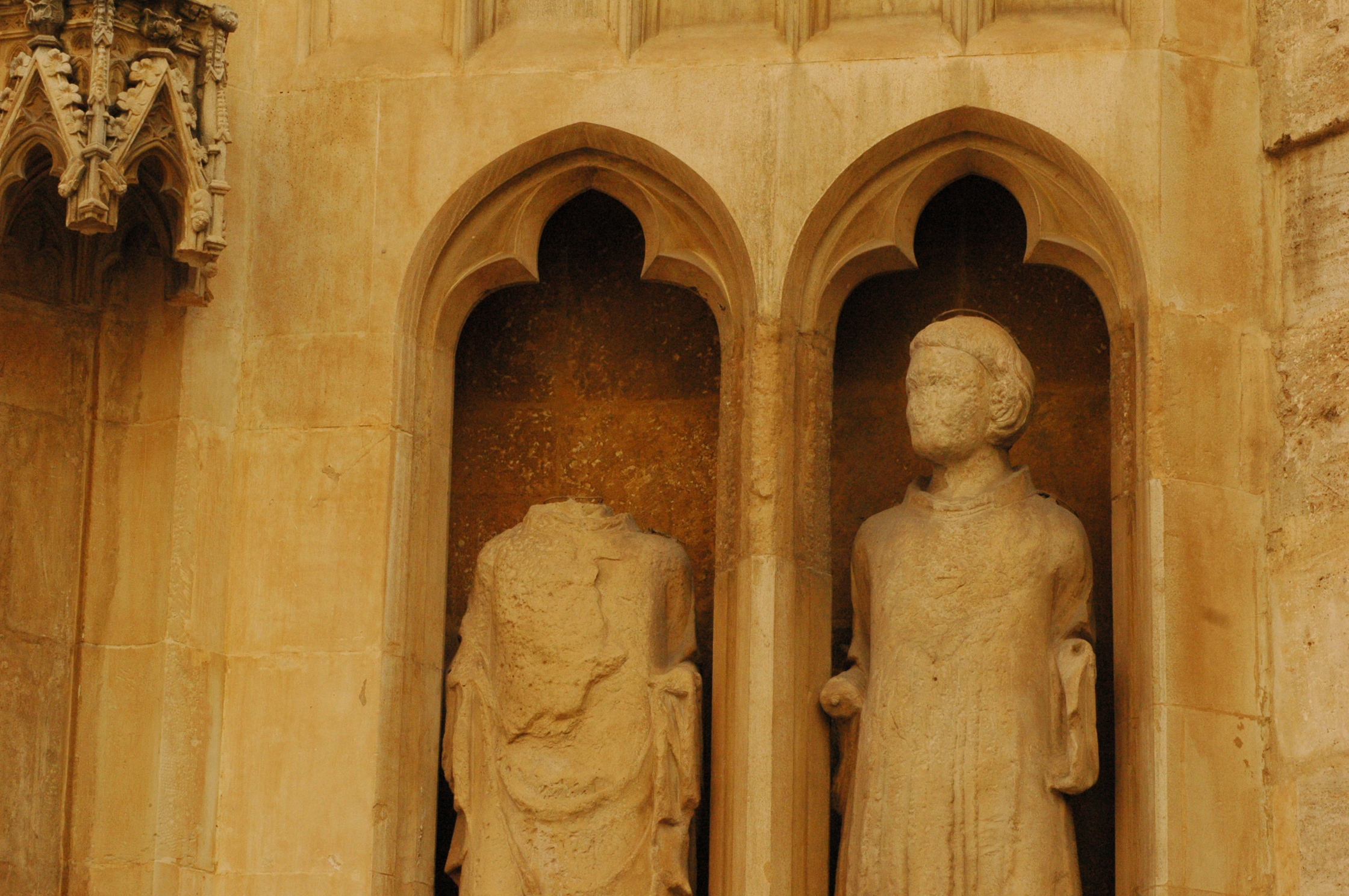
And a poor headless saint

And a poor headless saint

So with a taste for the city’s multi-faceted personality, we spent our morning ambling contentedly from one square to another, down narrow little streets full of souvenir shops and cafes, photographing fountains and statues of (sometimes headless) saints and sinners, and noting the details of human gargoyles and colonnaded arches, heavily decorated churches and shady orange-tree lined courtyards which fill the old quarter.

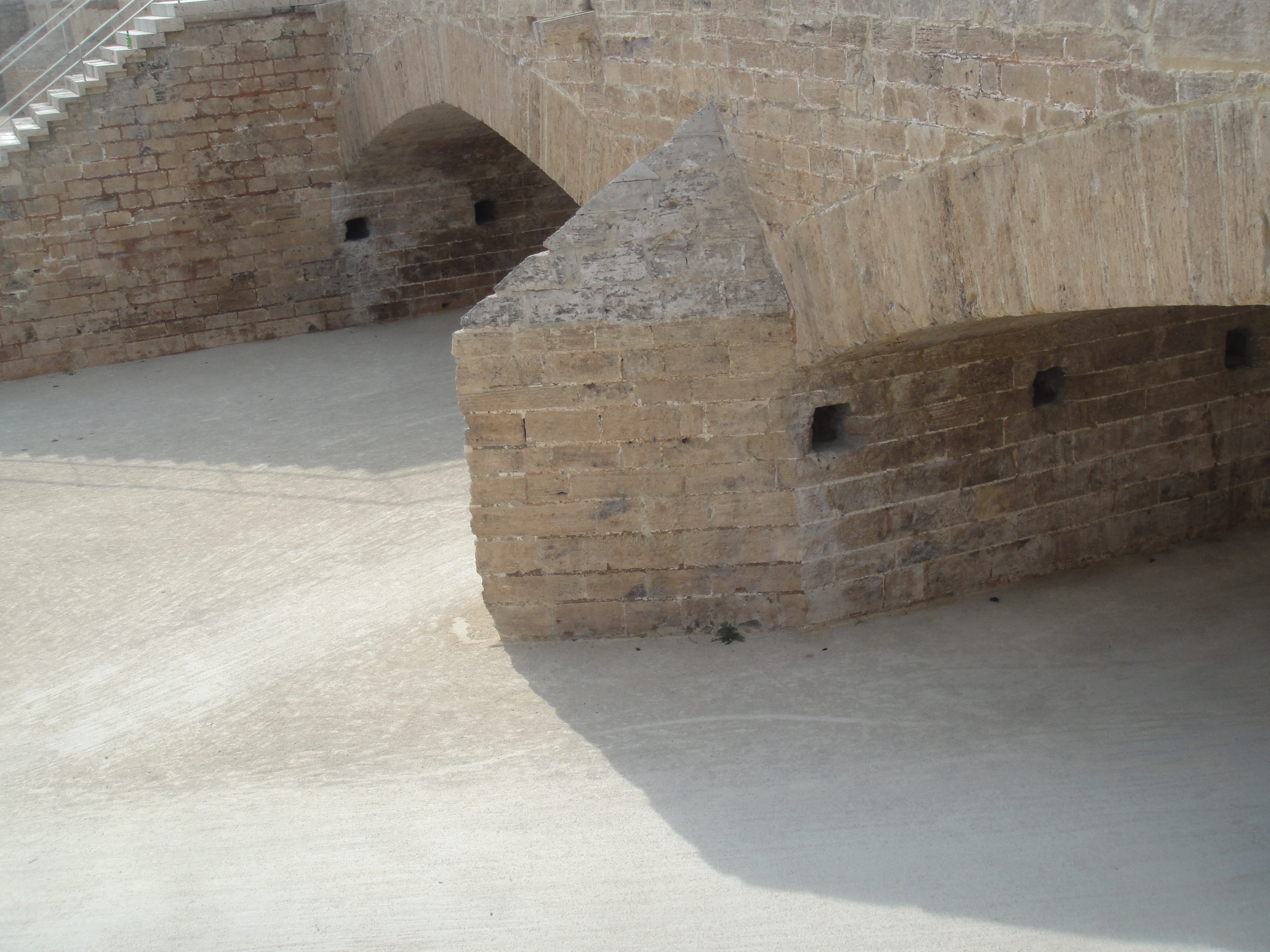
After lunch, and having reached the northern extent of the old town, we crossed what was once the River Turia in pursuit of the city’s fine art collection. The old River Turia is perhaps one of the oddest elements of the city. Once a thriving great river which ran around the city’s historic centre like the caressing arm of a lover, the river caused such devastating floods in 1957 that the decision was taken to divert the river away from the city and out to the Mediterranean via a different course. The result is a strange ghost of what was once – still the river bed runs around the city, and still the bridges which once crossed water cross this large basin. However instead of water, along the old river bed runs extensive gardens for some 9km. The effect is to inject a huge swathe of greenery running through the heart of the city’s modern expanse, but it’s also an odd one – the base of bridges, normally plunging into water, plunge straight into concrete and flower beds instead – a ghost of what once was.

The Museum of fine arts with the gardens now in the old river bed in front

The Museum of fine arts with the gardens now in the old river bed in front

A bridge plunges into concrete on the old river

A bridge plunges into concrete on the old river

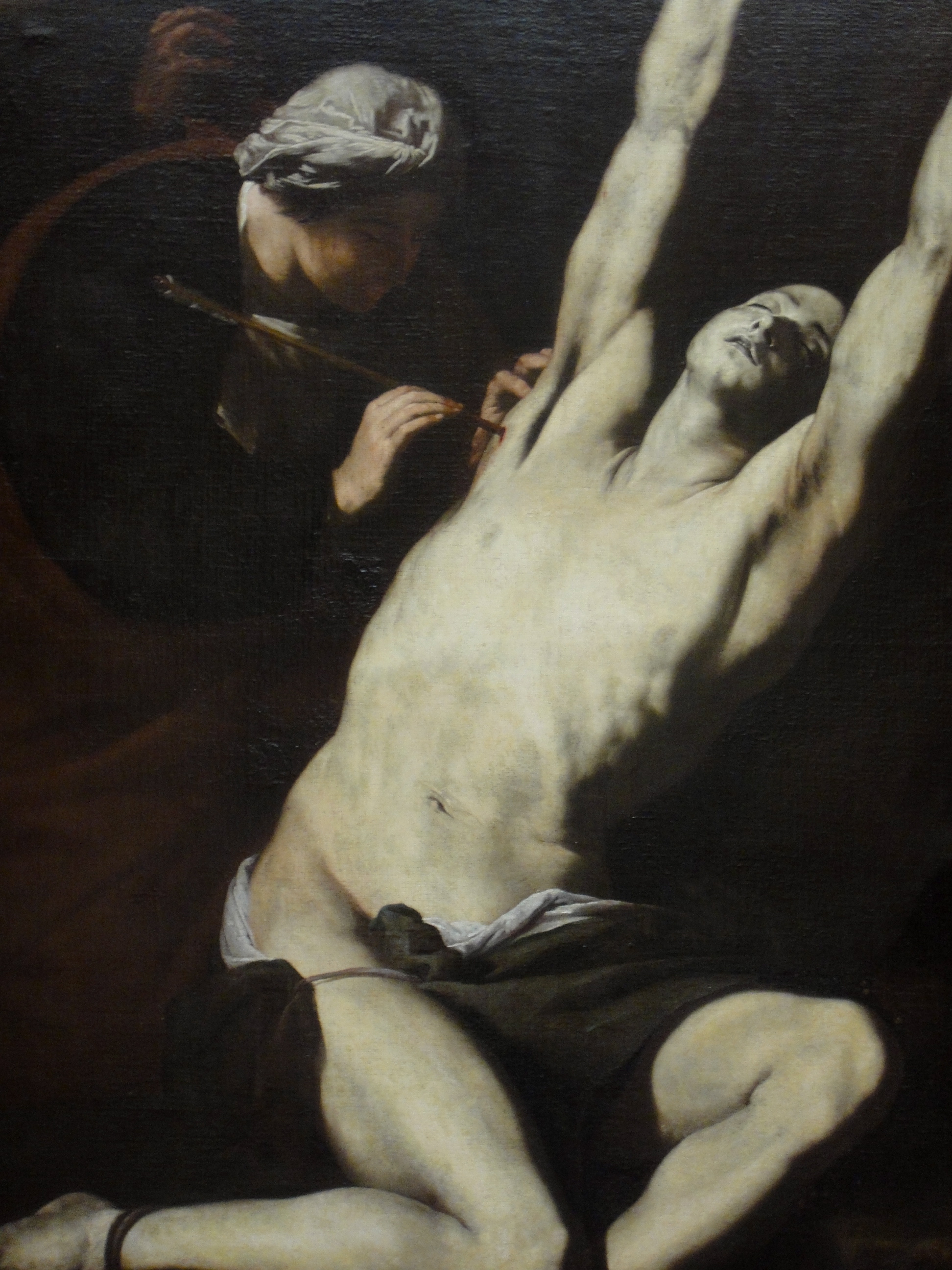
So crossing the ghost of the Turia, we arrived at the aptly named Museo de Bellas Artes. Said to have a collection second only in size to Madrid’s Prado (although I’m not sure how – the Reina Sofia in Madrid seems much bigger, although perhaps Valencia’s complete collection is not out on display) the museum is a cornucopia of paintings from Spain’s golden age of painting, including a self-portrait by Velazquez, several works by Goya, and an incredibly beautiful painting of Saint Sebastian by de Ribera (see below). The purity of his skin, pierced by arrows and tended to by the Saint Irene, against the beauty of his face, almost ecstatic with the extent of his martyrdom, made for an incredible painting to behold.

St Sebastian tended by St Irene, by Jose de Ribera (1591-1652)

St Sebastian tended by St Irene, by Jose de Ribera (1591-1652)

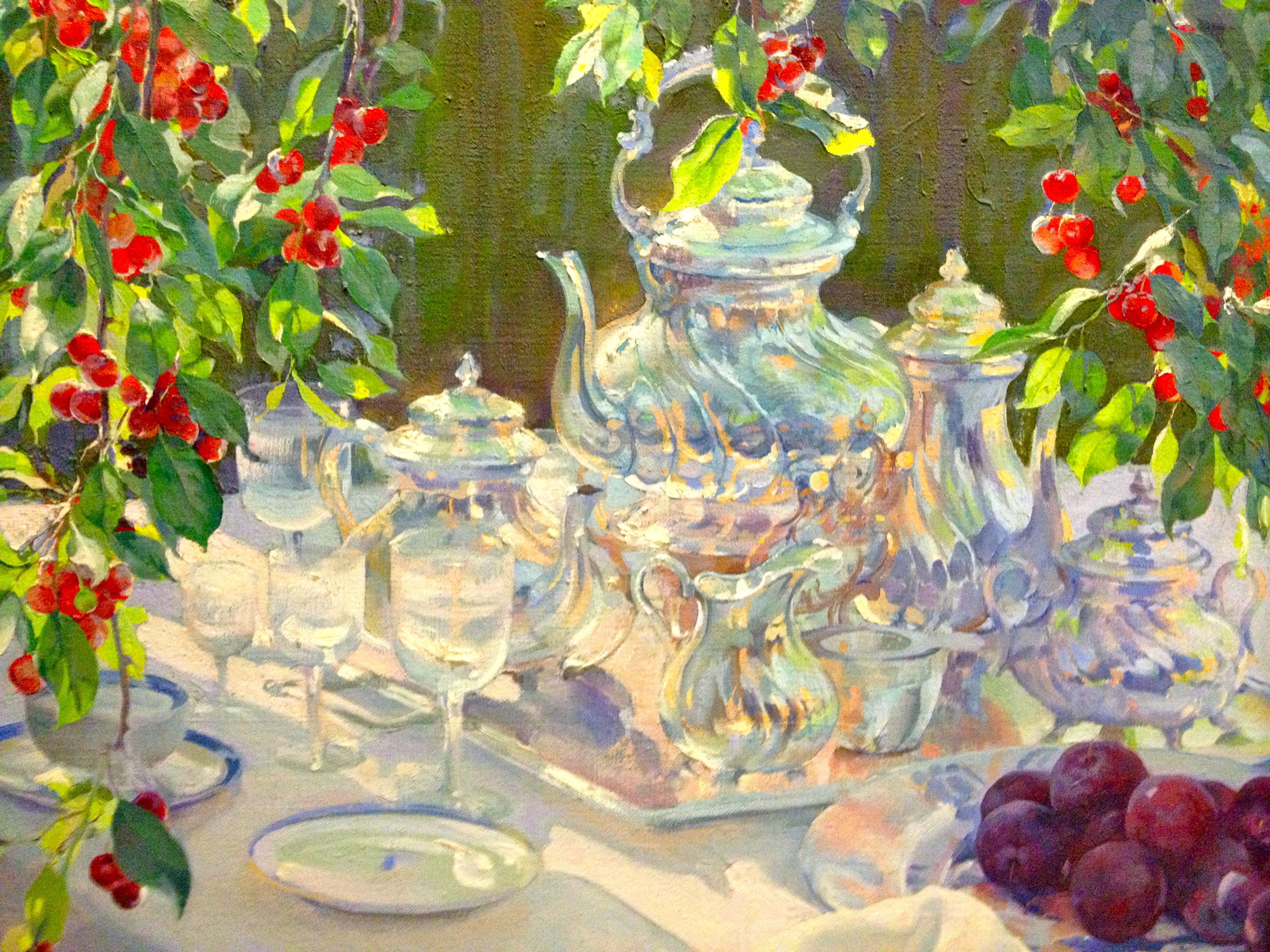
Also at the gallery are the works of leading Spanish exponent of the impressionist school, Joaquin Sorolla. Valencian born, and bequeathing his works to his home city on the condition that they would be collected together in a gallery such as this, the museum boasts a fine collection of mainly portraits which provide an evocative, very personal view of the city and its residents. Of particular attraction, for me, were his nudes and human studies, such as this academic study of a male, below. Also at the more modern end of the collection was this beautiful study of Cherries by Pons Amau, who perfectly captures the effect of sun shining through the leaves of this cherry tree.

Joaquin Sorolla, Academic Study from Life (Man) (1887)

Joaquin Sorolla, Academic Study from Life (Man) (1887)

Francisco Pons Amau, Cherries (1886-1953)

Francisco Pons Amau, Cherries (1886-1953)

Oh and beyond the paintings, I should also mention the museum’s two palatial courtyards, one red and one blue, both bursting with busts and relics from antiquity, the perfect places of calm to explore towards the end of our first Valencian day.

Other highlights from the Museo Bellas Artes

DSC_0700 DSC_0676 DSC_0672 DSC05067DSC_0677

So from the 207 steps of the Miguelete bell tower, across the historic quarter of Valencia, over the old Turia river and around the Belles Artes museum, our first day in Valencia presented a complex opening in this urban tale, a tale in which we were presented with the undeniable beauty of Valencia’s belles arts, as well as the clamouring melodies of its bells, ringing out in recognition that the central heart of this vast city bursts full of vigour for all to see, hear and explore. And that’s just what we intend to do tomorrow.

© Nicholas de Lacy-Brown and The Daily Norm, 2001-2012. Unauthorized use and/or duplication of the material, whether written work, photography or artwork, included within The Daily Norm without express and written permission from The Daily Norm’s author and/or owner is strictly prohibited. Excerpts and links may be used, provided that full and clear credit is given to Nicholas de Lacy-Brown and The Daily Norm with appropriate and specific direction to the original content.

Paris: la visite d’art – Exhibition 3: Salvador Dalí

I have waited my whole life for the latest retrospective blockbuster at Paris’ Pompidou Centre – or at least the whole of my life since the momentous day when I first cast my eyes upon the work of Catalan artistic genius, Salvador Dalí. It was, I believe, his melting clocks, a painting which I first saw when the headmistress of my primary school showed us some projected images of the world’s most famous paintings. It was a defining moment of my life. In that collection was Monet’s garden, Van Gogh’s sunflowers and Dalí’s melting clocks. And ever since, I was hooked – hooked on art, but most of all, on the mysterious, unsettling, iconically surreal world of Salvador Dalí.

When you think of Dalí, you of course think of those clocks, of ants and eggs, crutches and long-legged elephants, Venus de Milo turned into a cabinet of draws, figures fragmenting like an atomic explosion, optical illusions, the lobster on a phone, barren landscapes and long dark shadows. It’s an incredible list of characteristics which Dalí made his own through images which have become so well known across the globe that there can be no doubting Dalí’s self-proclaimed accolade – that he was a genius. His paintings are so brilliantly executed down to the tiniest detail that the mind honestly boggles. The extent of his imagination is almost enough to make the brain implode, and yet when faced with his paintings composed with such faultless artistic skill, you cannot help but roam the canvas with your eyes hungrily, sucking in every exquisite detail, exploring the multi-layered imagery and baulking and the sheer audaciously brilliant output  of this creative prodigy.

The Persistence of Memory (1931)

The Persistence of Memory (1931)

Dream Caused by the Flight of a Bee around a Pomegranate (1944)

Dream Caused by the Flight of a Bee around a Pomegranate (1944)

The Great Masturbator (1929)

The Great Masturbator (1929)

Sadly, up until now, my love for Dalí has been lived out largely through the fair few catalogues I have of his work. I’ve taken in every detail of the four Dalí’s owned here in London by Tate on countless occasions, and done the same with the fairly comprehensive collection of the Reina Sofia in Madrid. I’ve visited Montmartre’s Espace Dalí on numerous occasions, but found it to be largely lacking in paintings, and I’ve been to a few surrealism-based shows in London in which one or two canvases have featured. But I have often bemoaned the lack of Dalí paintings in Europe and I have longed for an exhibition when many would come together.

DaliThe Pompidou have answered my prayers. This Dalí retrospective is nothing short of stunning. It is one of the best if not the best exhibition I have ever been to. The show isn’t a peripheral tribute to Dalí, but a comprehensive exploration of his entire career featuring an incredible 120 paintings all in one place, as well as sketches, sculptures, a recreation of his famous red-lipped sofa Mae West room and other paraphernalia. I was in heaven. The show’s curators appear to have acquired all of the works from Tate, and all those owned by the Reina Sofia, but most importantly of all, the exhibition brings together a huge collection of works which are hiding away over in the Dalí museum in St Petersburg, Florida, whose collection alone comprises some 96 paintings, and, most brilliantly of all, the globally recognised melting clocks themselves, all the way over from New York. Could this show get any better?

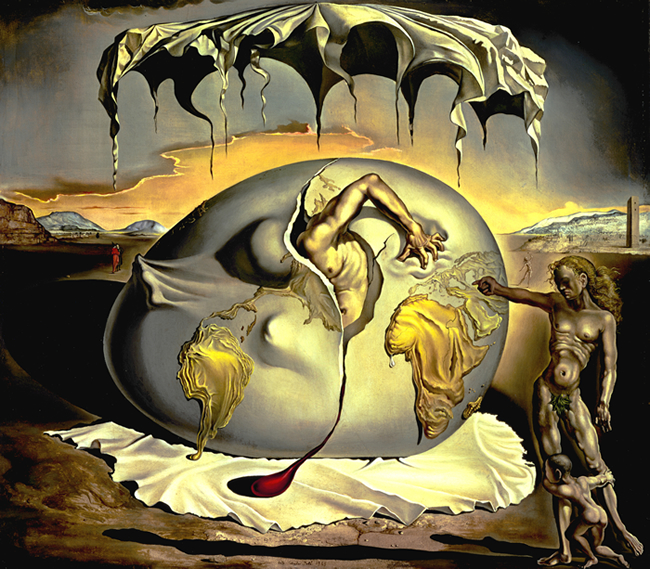
Geopoliticus child watches the birth of the new man (1943)

Geopoliticus child watches the birth of the new man (1943)

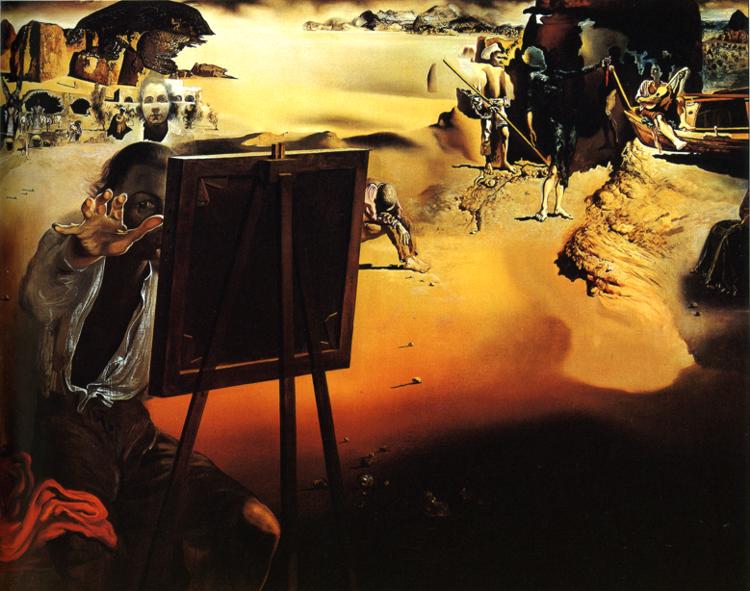
Impressions of Africa (1938)

Impressions of Africa (1938)

The exhibition starts with an egg – a large egg which forms an entrance to the first gallery and whose pounding heartbeat could be heard all the way down the corridor of the Pompidou’s 6th floor. It was like the warm up to a mega-star’s pop-concert, as the audience is whipped up into a frenzy in anticipation of the great star’s arrival onto the concert stage. And appropriately so, for there is no greater star of the artistic world, in my opinion, than Salvidor Dalí, and at the Pompidou, the stage was truly set.

Read more

Paris: la visite d’art – Exhibition 2: Bohèmes

With a second day comes a second exhibition direct from the city of love, light, and above all things, art. Paris, inspiration to so many creatives over the years, is host to a sensational array of art exhibitions this Autumn/Winter season, and I could not wait to rush over on eurostar to get my fill.

Our second show, after Hopper, was also the second of two big blockbuster shows being held consecutively in the mammoth greenhouse-come-palace otherwise known as Le Grand Palais. Entitled Bohèmes, this exhibition promised to be an enriching exploration of the bohemian age of Paris, when pearly green absinthe dripped from sugar on a balanced spoon in little grimy bars on the step hillsides of Montmartre, when dandy artists courted flirty prostitutes and cabaret dancers, and when the true spirit of the artistic revolution was born.

L'Absinthe (Edgar Degas, 1876)

L’Absinthe (Edgar Degas, 1876)

It was the inevitable consequence of the impressionist age, when artists and intellectuals alike broke free from the shackles of Napoleonic Paris, zealously keen to explore the new modernised world, an age with re-written moral values, re-examined sensibilities, and artistically a blank-canvas ripe for the most extravagant exploration. It was the age of the bohemian revolution, the time of Toulouse Lautrec, the Moulin Rouge and the can-can, and surely the most charming age of all Parisian history.exposition_bohemes_grand_palais-470-wplok

It was with a high degree of excitement then that we entered our second expo in the Grand Palais, ready to indulge in Le Chat Noir, the decadence of dandyism, and the melancholy of alcoholic introspection. And yet what we were faced with was a huge long gallery full of dank old paintings…of gypsies! This was not at all what I had expected, and I must admit to being quite put out by this start to the show. Unenthusiastically, we browsed the nondescript works, before turning the corner, only to find more. Gypsies in Romania, Gypsies in Spanish Seville, all painted in a very classical, traditional fashion, each in turn failing to inspire me (I also thought it was rather ironic that this exhibition was even on show in Paris… after all, wasn’t France the country which was recently so caught up in a scandal with the Romani communities?).

However soon enough, the exhibition changed for the positive. Depictions of the gypsy communities became all the lighter, more colourful and lighthearted. Enter Van Gogh, with his fresh, turquoise skies and bright yellow gypsy caravan near Arles, and Renoir with his iconically idealistic portrayal of a gypsy girl. Then there was the great Courbet, the artist much lauded for kickstarting the spirit of the artistic revolution, and his highly original self-portrait, Bonjour Monsieur Courbet.

Gustav Courbet, La Recontre ou Bonjour M. Courbet (1854)

Gustav Courbet, La Recontre ou Bonjour M. Courbet (1854)

Van Gogh, Gypsy Camp near Arles

Van Gogh, Gypsy Camp near Arles

Auguste Renoir, En été / La bohémienne (1868)

Auguste Renoir, En été / La bohémienne (1868)

So why all the gypsies? Well apparently, the origin of the word “bohemian” is from the French word bohémien, which is the french word for gypsy, allegedly because the French believed the Romani people to have come either from or certainly through Bohemia (now the Czech Republic). From the gypsy connotations, the word gradually became used to describe people who were “socially unconventional” and so the bohemian concept was born – the art lovers, the dancers, the scandalous inhabitants of Montmartre – all were part of a mass bohemian revolution, where social conventions were cast to the weakening winds of the past, and free spirited minds were unleashed upon the world of art, love and leisure. And it was to this time, at the end of the 19th century, when bohemianism truly came into its own, that the exhibition finally wandered, casting behind the historical gypsy poses, and taking us to the heart of the bohemian insurrection of 19th century Paris.

From hereon in, I was in art heaven. From Courbet’s dashing self-portraits, and depictions of the artist’s arteliers (art studios), to the vibrant artistic community of Montmatre, with its cafés, its dance halls and its Moulins aplenty, these paintings unleashed an age of debauchery, of charm and of vivacious artistic liberty which was almost unique to the Montmartre region and a decisive factor in why I came to adore Paris as a young school boy first wandering into the Place du Tertre.

Paul Signac, Le Moulin de la Galette (1884)

Paul Signac, Le Moulin de la Galette (1884)

Van Gogh, Coin a Montmartre, le Moulin a poivre (1887)

Van Gogh, Coin a Montmartre, le Moulin a poivre (1887)

Ramon Casas, En Plein-air (1890)

Ramon Casas, En Plein-air (1890)

But not only did the exhibition feature the paintings of bohemianism, but also recreated their world. The café scenes were displayed in a mock up café with long benches, peeling walls and posters from the infamous cabaret Le Chat Noir and the artist’s hangout, Le Lapin Agile, while the depictions of the ateliers were hung on the walls of an artist’s studio. Playing in the background was the music of two operas – Bizet’s Carmen, the opera about Seville’s most famous gypsy protagonist, and of course Puccini’s La Bohéme, a story of the quintessential bohemians in 19th century Paris – the starving writer and his equally hungry artist friend, scraping together a living while falling in love with prostitutes and suffering the full potency of love, romance and the horrors of a poverty-ridden death.

Ramon Casas, Madeleine or Au Moulin de la Galette (1892)

Ramon Casas, Madeleine or Au Moulin de la Galette (1892)

Santiago Rusiñol, Café de Montmartre (1890)

Santiago Rusiñol, Café de Montmartre (1890)

Steinlein, poster for Le Chat Noir

Steinlein, poster for Le Chat Noir

The atmosphere conjured by the paintings of that time are like a snapshot onto an almost impossible age of charm. Of course it’s easy to romanticise poverty and decadence, in times which were hard, often miserable, and tragic, and yet there is something about that age which fills me with incredible inspiration, as though the artistic spirit which was kindled in that time has never burnt out, pervading through the centuries and igniting the artistic spirits of a millennia of new creative generations.

Ccharles Amable Lenoir, Rêverie (1893)

Ccharles Amable Lenoir, Rêverie (1893)

I only wish that you too could be inspired by the paintings on show… however these photos will have to be enough. Having just checked the website, I see that this great show finished at the weekend, drawing this fascinating study of bohemia to a close, but reopening a chapter of artistic revolution whose impact will live forever.

I leave you, for completeness, with the Norms’ very own version of Degas’ L’Absinthe (above)… it wasn’t featured in Bohémes, but clearly should have been.

L'Absinthe Norm (acrylic on canvas, 2011 © Nicholas de Lacy-Brown)

L’Absinthe Norm (acrylic on canvas, 2011 © Nicholas de Lacy-Brown)

À bientôt