Skip to content

The Queen: Art and Image – at the National Portrait Gallery

You can’t blame the National Portrait Gallery for cashing in on HRH Queen Elizabeth this year. Since her Diamond Jubilee celebrations at the beginning of this month, the popularity of the Queen has been at an all time high – in fact over  90% of those recently polled stated that they were satisfied with the Queen, figures which represent the significant surge of support which is now felt for the Royals in England. In the meantime, tourist numbers lingering outside Buckingham Palace, visiting Windsor Castle, and pouring into souvenir shops all over London have soared . So adding an exhibition of portraits of the Queen into the mix seems like an obvious choice, not least because, having been the subject of at least one official portrait in every of her reign, as well as the subject of numerous photographs and unofficial tributes, there are so many portraits to choose from!

Queen Elizabeth II (Cecil Beaton, 2 June 1953)

I therefore went along to the NPG’s exhibition, The Queen: Art & Image today expecting 60 official portraits lined up, each recognising a gradual change in the Queen’s image, from glamourous young Queen in her 20s, to the Nation’s favourite grandmother. However to my surprise, the exhibition was a little light on the official portraits. In fact it was a little light on paintings altogether, instead concentrating on the Queen’s image, as masterminded  by officials, and seen through the lens of the paparazzi, captured on camera. That is not to say that the exhibition was not historically narrative and collectively interesting.

Queen Elizabeth II (LIghtness of Being) © Chris Levine (2007)

Queen Elizabeth II (Equanimity) (© Chris Levine, 2007)

The show begins and ends with the masterful 3D works of Chris Levine, Lightness of Being and Equanimity. These have to be amongst my favourite portraits of the Queen. The way they are mastered – a print on a lightbox, multilayered so that the Queen’s posture changes as you move around the work, is startlingly realistic. It has never been so possible to feel as though you are meeting the Queen, when in reality such an opportunity is stored away in a box of other pipe dreams such as the big retirement mansion and everlasting fame. Every wrinkle is there to see, but unlike the horrendous portrait by Lucian Freud, also included in the show, the portrait is truthful and yet still utterly glamorous, not least Lightness of Being which captures the Queen, eyes briefly closed, in white ermine, white pearls, and her glittering crown. Even her hair glimmers with a silver sheen rather than dull grey.

Queen Elizabeth II (Dorothy Wilding, 1952)

From this impressive start, the exhibition heads back to the 1950s and thus begins a chronological exploration of the Queen’s changing image and public portrayal. I suppose thinking about it, a load of official portraits would have always been a little contrived, as artists seek to flatter and do deference in the employ of this almost supernaturally important sitter, while photographs capture the Queen as a real person, a loving mother, happy relaxed tourist and here, in the 1950s section, as a glamourous, almost Hollywood worthy young Monarch, with a perfect figure and natural celebrity smile.

It is from this point that we begin to see the Queen mature from glamorous young starlet into a rounded family woman, but one who had to bare the full weight of the royal responsibility of her solitary role, as many of the portraits demonstrate. Through the 60s and 70s, her posture becomes more official, and her stride seems more confident and self-assured. Still, moments of rare relaxation, such as the Queen laughing on the decks of her beloved Yacht Britannia are captured during this period, which was probably the last decade of uninhibited happiness before the traumas of the future descended upon her.
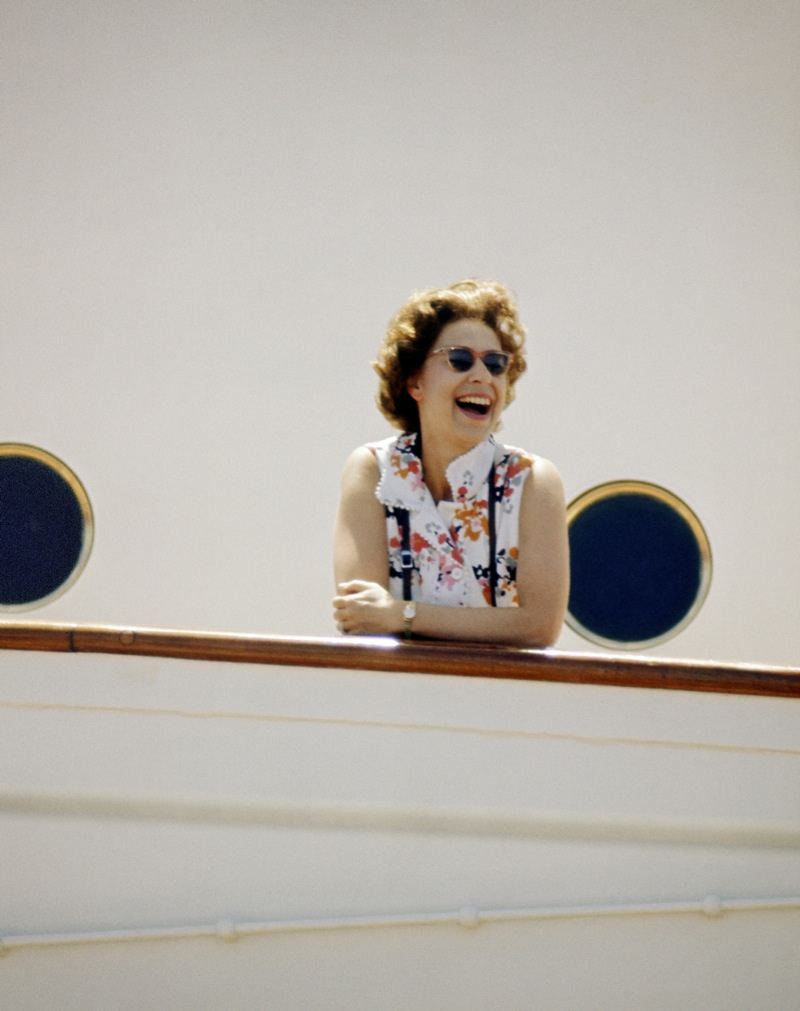
Queen Elizabeth II by Patrick Lichfield (1971)

Elizabeth I (this is not a typing error btw) by Gerhard Richter 1966
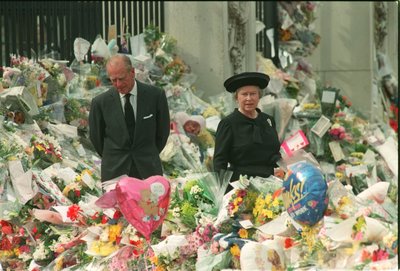
Queen and Prince Philip survey floral tributes after the death of Diana, Princess of Wales © Peter Nichols, 5 September 1997

Moving into the 1980s, you see the Queen fall into the shadow of Princess Diana, the attention of the public transferring to this more volatile of characters. In the meantime the Sex Pistols released a single, God Save the Queen, with controversial lyrics suggesting the Queen belonged to a “fascist regime” (the artwork for which is included in the exhibition), Gilbert and George betrayed the Queen and Prince Philip in the shape of the “cross potent” (a symbol of the Austrian Fascist party) and Andy Warhol hinted at the superficiality of the Queen in his series of lithographs of the Queen painted as part of his fixation on the cult of celebrity. Onto the 90s, when most of the Queen’s children’s marriages fell apart and her beloved Windsor Castle sustained severe fire damage. While who could have predicted the shock of the late 90s, when Princess Diana tragically died, and the Queen fell victim to a media hunt as the papers decried her failure to show her face in the immediate aftermath. The turbulence of the period is captured by the exhibition, and it is perhaps appropriate that Lucian Freud’s portrait, the ugliest of the them all, is hung at the end of this period.
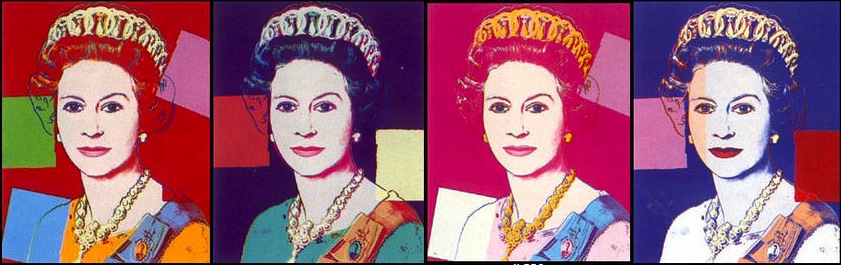
Queen Elizabeth II, Andy Warhol (1985)

Queen Elizabeth II, Lucian Freud (2001)

Onto the new millennium, where things get good again. The popularity of the Queen surges, and the portraits of the Queen become more respectful, portraying the Queen as a genuine person, a consistent and beloved figurehead, and a cherished icon of not only the nation, but the world. Here hangs another of my favourites and one of the most recent portraits by Thomas Struth, commissioned especially for the Diamond Jubilee. The photograph, which features Prince Phillip and the Queen slightly off centre, sat relaxed on a green, rather elaborate sofa, is delightfully accessible, like a family portrait – you can see every vein, every wrinkle of both sitters, suggesting a warm, human aspect, which is always surprising in those who seem so inaccessible. I also love the portrait for demonstrating the bond between Phillip and the Queen, who sit fairly formally, but who are nevertheless the clear support of one another, forming a single union with a bond which is clear for all to see.
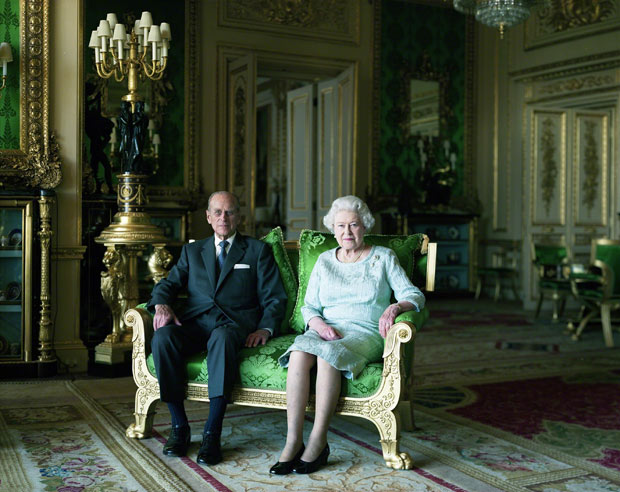
Prince Phillip and Queen Elizabeth II, Windsor Castle © Thomas Struth 2011

I loved too this portrait by Annie Leibovitz (2007) which, with its solitary and dramatic background, and with the Queen dressed in a cloak, references the paintings by Annigoni, and photographs by Cecil Beaton placed at the beginning of the show. And thus, as the exhibition ends, the portraits come full circle, as we see a Queen as much loved now, as then, a Queen who inspires in us all a deep sense of reverence and respect, and for we British, is someone of whom we can be resolutely proud.

Queen Elizabeth, Annie Leibovitz (2007)

The Queen: Art & Image is on at the National Portrait Gallery until 21 October 2012.

The Daily Sketch: Summer Solstice?

Summer Solstice? Could have fooled me. The calendar may show June 21st, but this year’s longest and lightest day of the year  had something decidedly dark about it, as thick grey clouds lingered over the UK all day, burgeoning upon us a winter’s worth of damp, windy wet weather. And all this on the first day of summer? No wonder then that at Salisbury’s infamous prehistoric monument, Stone Henge, the usual crowd of slightly “buzzing” pagan (“new age”) revelers were somewhat down in numbers, and perhaps a little dizzier than usual as the much promised summer got lost somewhere around mainland Europe, as the skies in Britain unfolded around them, and the solstice sunshine was irreverently blanketed in a thick layer of obstinate, wet cloud. But such is the English summer. The first day brings with it what promises to be another few months of depressing drizzle, with the following inevitable results: rained-off Wimbledon, squidgy Olympic opening ceremony, water-logged open air theatre and an August from the ice age. God bless the Brits – try as we might, life in the Summer outdoors is never quite going to work for us. Still, the weather can never take the strawberries and cream away from us. Even if they are imported from Egypt. Pimm’s anyone?

Norms celebrating “Summer” Solstice, at Stone Henge (2012 © Nicholas de Lacy-Brown, pen on paper)

North Road Restaurant: Another notch in the Danish gastronomic revolution

Denmark, the country that brought us Lego, the Little Mermaid and a whole host of funky, fresh and chic interior design ideas is currently leading the world with its gastronomic innovation. René Redzepi’s two-Michelin starred extravaganza, Noma, has been awarded the ultimate accolade of Best Restaurant in the World for the last three years in a row, stealing the crown from the extended reign of El Bulli long before it closed.

While Noma will soon share its wiles with the best of British when it opens up in Claridge’s during the Olympics (i.e. those who could afford it/ were clever enough to buy a £195/head ticket before they sold out practically as soon as the event was announced), another star of culinary Denmark has drifted over to the British shores and, mercifully for we whose visits to Copenhagen are at best infrequent, is here to stay – I am of course talking about Christoffer Hruskova, whose restaurant, North Road is the bright new star of Smithfield’s market/ St John’s Road and was the location of my dinner on saturday night.

I booked up North Road upon the recommendation of my in-the-know foodie-friend Celia, whose nose for fine-dining is so refined that I would willing follow her blindfolded throughout my life, so long as she gave me plenty of slices of her fantastic Ombre cakes en route. It’s not a cheap option, but as it was the third anniversary of my first date with my partner, we at least had an excuse for a splash. And with the promise of a tree made from candy floss, who on earth could resist?

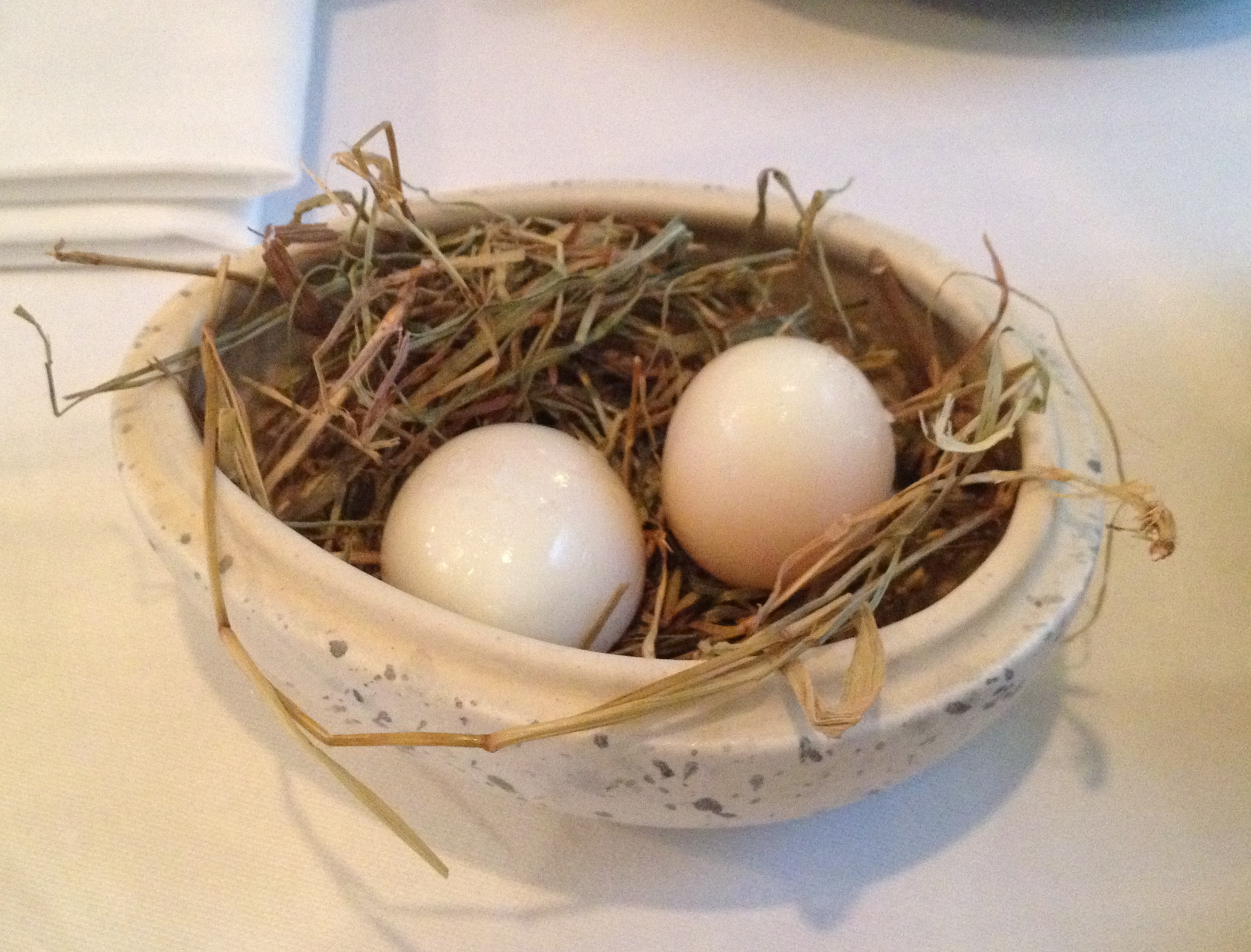
Just to start…”snacks” of quail eggs, smoking potatoes and pork crackers

Upon entering the restaurant, we were immediately struck by the sophisticated elegance of Denmark which so enthralled me upon visits to the Illum Bolighus department store in Copenhagen. So too were we instantly wooed by the attentive but very friendly welcome of the staff. Soon after being seated, the enticing smell of smoke filled our nostrils as we were treated to some starting snacks – Jersey Royal Potatoes smoked in hay and served with an exquisite mayonnaise, pickled quails’ eggs and pork crackling which was like a giant fluffy prawn cracker. My partner’s eyes met mine across the table and with that knowing look that occurs between couples who have gradually merged in one over the years of their relationship, we knew that this meal was going to be good. Very, very good.

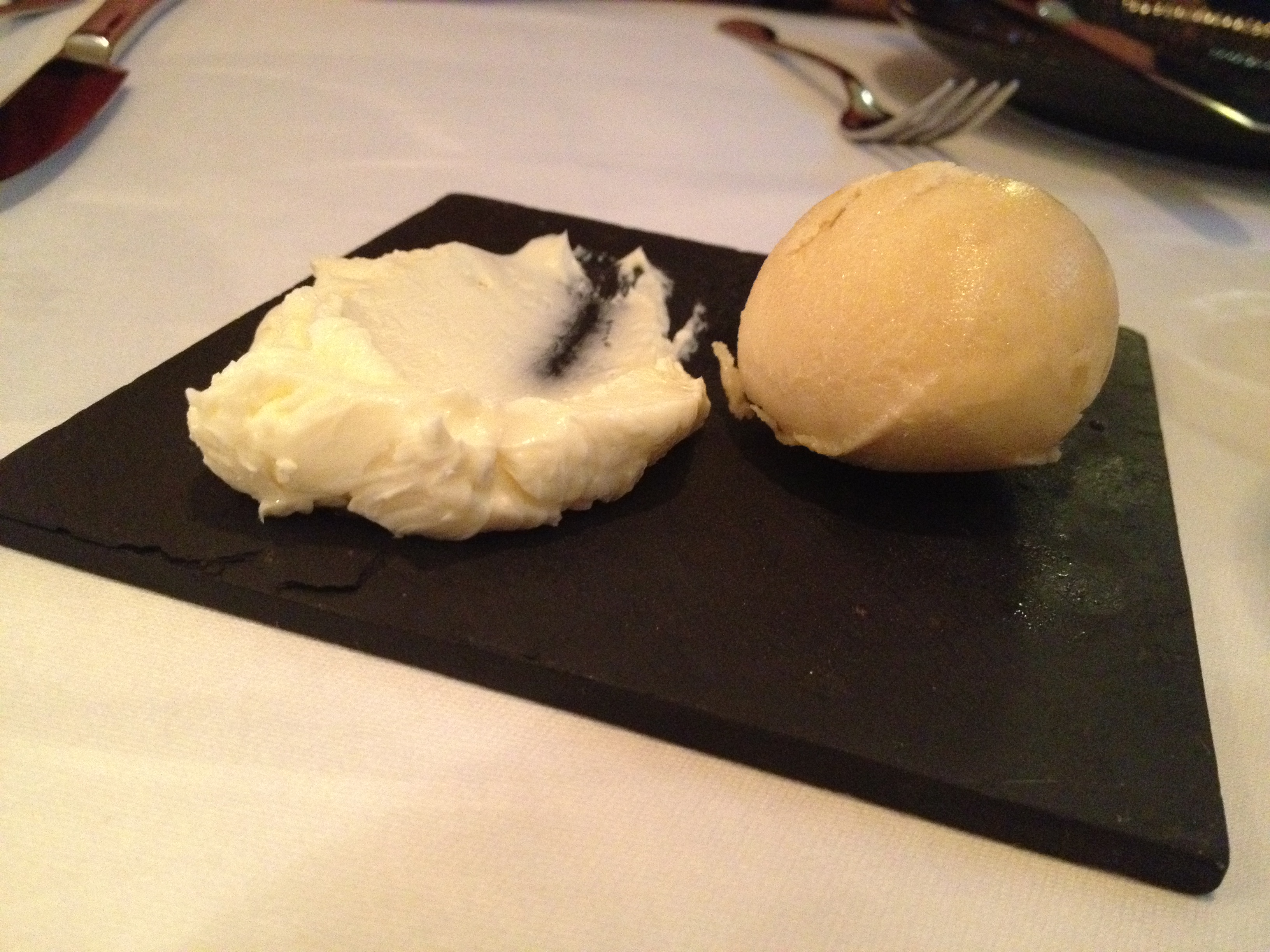
Caramalised butter…to die for

We opted for the 7 course tasting menu – it would be foolish not to, as 7 courses is only £7 more than the 5 course alternative. But before the dishes began rolling out with perfectly timed pauses between each, we were treated to a bag of little bread rolls and – wait for it – caramalised butter and a buttermilk butter. Oh dear god, let me tell you, that caramel butter was so exquisite in my mouth I almost ate the whole ball. It was crystallised and punctuated with occasional shards of salt – a rich sugary caramel which melted upon the palate before suddenly releasing a smooth butteriness. All I can say is that having enthused so fervently about this to the waiter, he told me how to make it, so future guests at my dinner parties – prepare to be wowed.

Razor claims – a masterpiece on a plate

Onto the food. First up was scottish razor clams with coastal herbs, organic cream and parsley. This was art on a plate. The exquisite marbling of the cream and the green parsley reduction was so beautiful, that even when lifted up on a spoon it made multi-marbled pictures worthy of a Turner prize. The clams were incredibly sweet and delicate – flavours of rose petals, the sea, and generalised freshness came flowing into my mouth in a way that shop-bought clams would never provide. And the flavour was perfectly matched by some wonderfully unusual coastal herbs which felt like my mouth was going off on a little adventure to some far off wind-swept seaside.

The lobster symphony

Upon that seaside I found myself engorging upon the next dish – an incredible lobster and buttermilk creation with baby cucumbers and nasturtium leaves.  As its forbearers had been, so too was this dish delicious to every degree. The nasturtium leaves were peppery, and the mini cucumbers refreshing and texturally distinctive from the succulent sweet lobster. Oh how my grandfather would have loved this dish! Once again the visual treat was tantalising, as pink undulations of soft-shelled lobster were punctuated with the star-burst leaves of the nasturtium, the hapless scatter of some sandy deliciousness, the drizzle of oil and the contrast of straight little cucumbers. Goodness, I sound like a Masterchef judge.

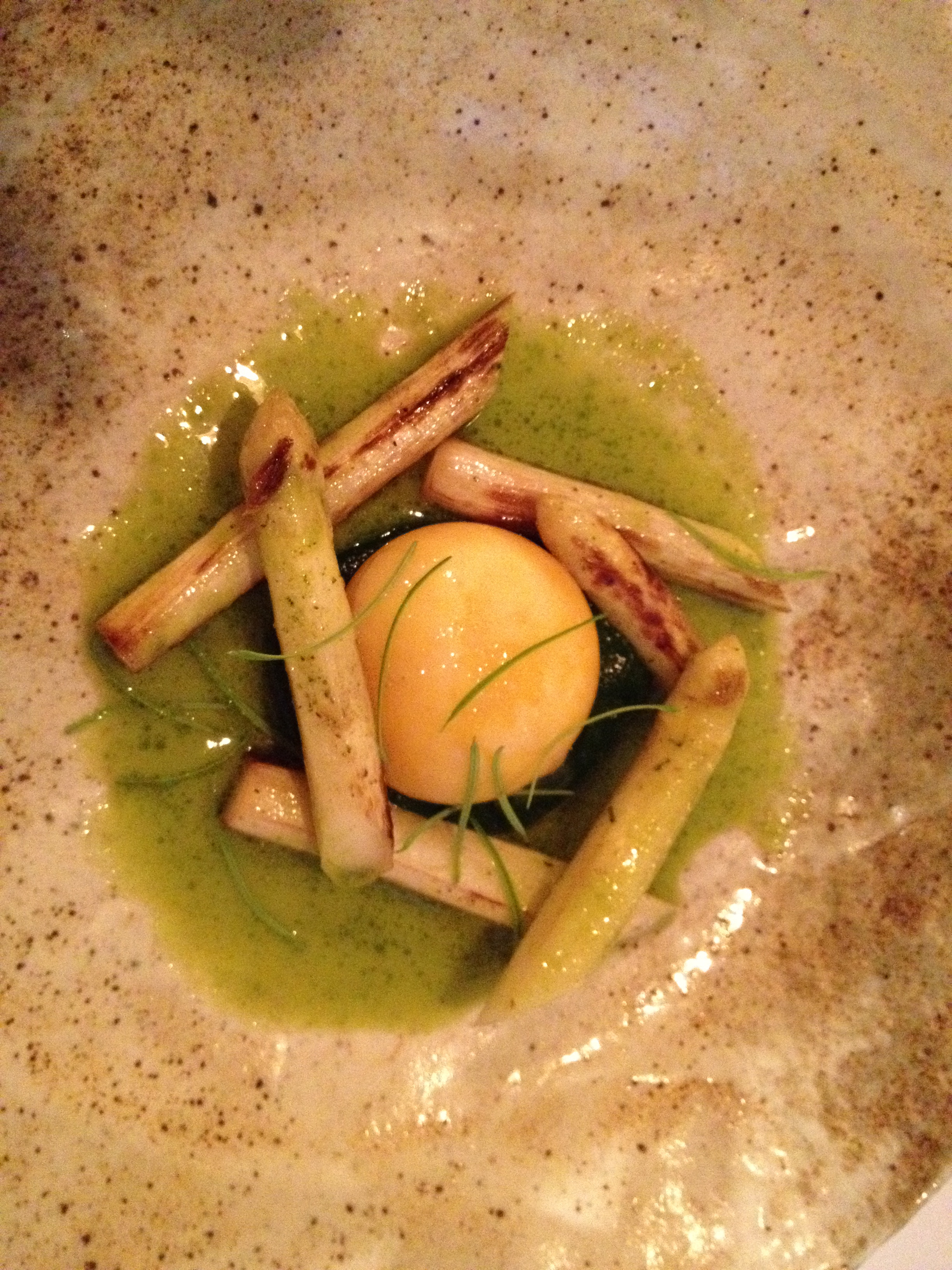
White asparagus with that perfect egg yolk pre explosion

Onwards on our trajectory towards gastronomic perfection, and up next was white kent asparagus with some revolutionary method of importing the taste of pine needles without having said needles needlessly slashing ones throat. Oh and spinach too. My goodness this was the dish of summer – a burst of summer garden freshness in every mouthful, and with a whole and masterfully served single egg-yolk at the centre, which looked so solid and yet, upon impact with the knife, burst into a flurry of sunshine yellow sweetness providing a syrupy soup in which the asparaguses floated like pale beautifies taking their first fill of sunshine.

A garden delight

Talking of summer freshness, the next course was the summer garden, placed on a plate in almost literal form. Jersey Royal potatoes, lovage and radishes were “planted” in amongst soil made from burnt butter in some brilliantly molecularly innovated form, while at the base of the dish, a creamy butter foam gave moisture and exquisite salty/creamy balance to the whole dish. The radishes provided a fresh crunch, and one potato was coated in hay ash to brilliant flavour-effect, like a barbecue and a summer potato salad all rolled into one (I note that the chef, Christoffer Hruskova, is quite keen on importing the flavour and smoke from burnt hay into his dishes which gives an incredible depth of flavour and scandinavian savour to the food).

The interior (photo: Sarah Lee)

Next up was the main course which, owing to my gradual state of inebriation by this stage I neglected to photograph. It was no less superb however – a selection of exquisitely tender Herdwick lamb cuts and little sweetbreads which were a revelation. When you think about the little lamb cheeks, tenderised by the sweet suckling of its mother’s milk, it’s a rather off-putting image, until you eat them that is, and the soft creamyness of that milk is reflected in this very soft, very rich little nugget. The dish was served with more seasonal summeryness – sea lettuce, sea blite and more coastal herbs, giving us all hope that despite a decided lack of sun outside, we may at least sample the summer through this bombardment of taste sensation in our mouthes, as well as discover the delicious, albeit slightly surreal symphony of a lamb lost somewhere on an ocean’s edge. Reminds me of that terrible movie scene when a load of lambs fell of a cliff edge – what film was that? Silence of the lambs or something?

Stone and Hay

Who knows, for up next was a plate of delicious vintage cheeses, again, neglectfully unphotographed, followed by the pure theatre of the evening. First “stone and hay” – basically a frozen stone, not to be eaten I might add, and another realistically executed stone resting on top, except this one was edible, flavoured delicately and covered convincingly with that favourite of the chef – hay soot. It wasn’t the most delicious dish of the evening, but made for a welcome palate cleanser and clever piece of gastronomic amusement.

Gorgeous gooseberries

Slightly full up by this point, we almost feared the onset of the dessert in case our dwindling appetite would not do this incredible food justice. But we oughtn’t have worried, as the dessert of english gooseberries with douglas fir and wood sorrel was fresh, bucolic and perfectly balanced between sharp and sweet with a wonderful variety of textures and again a very scandinavian, effortlessly green and glorious look.

The candyfloss tree!!

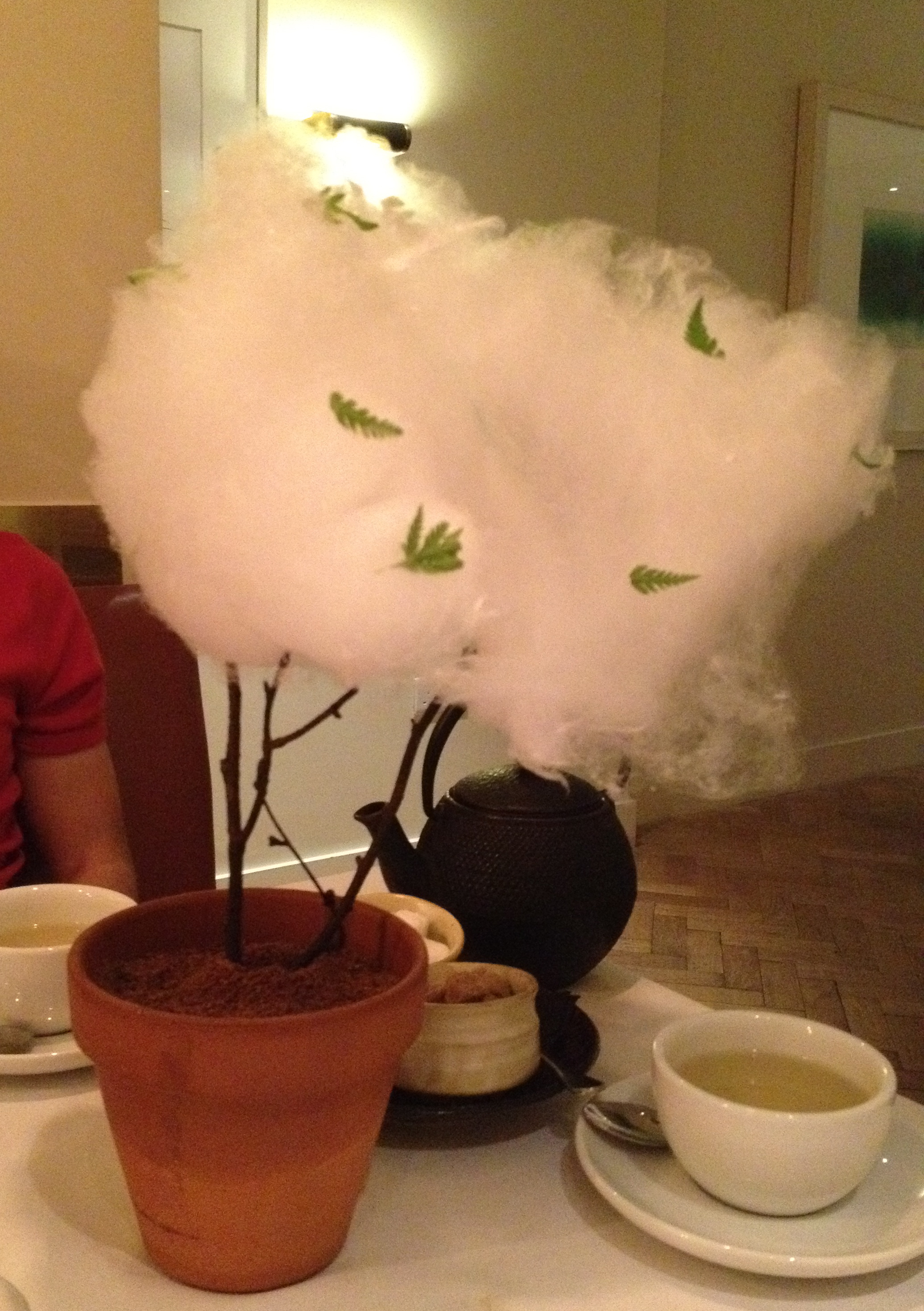
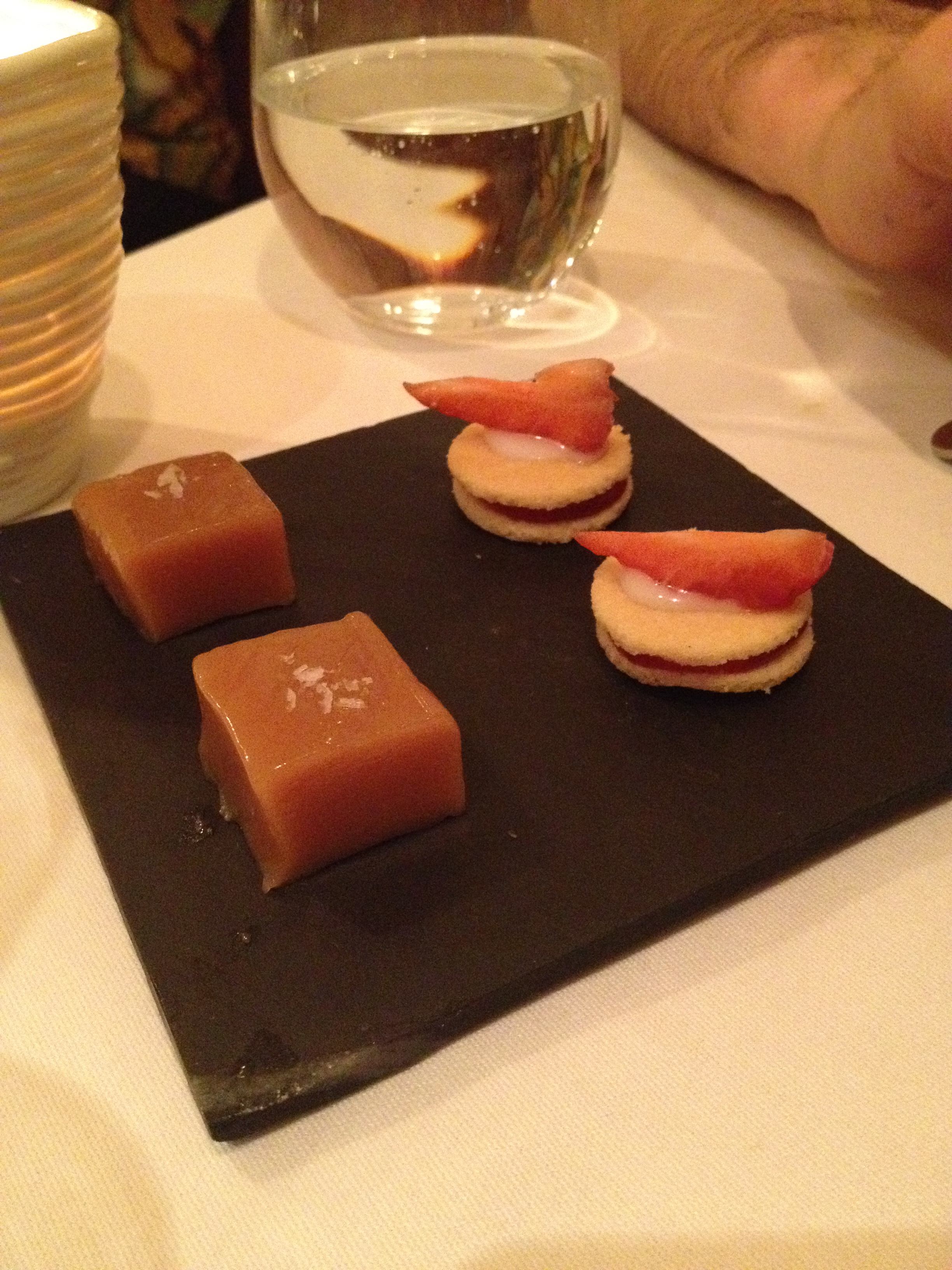
But finally, what we had all been waiting for. Emerging from the kitchen, in its unmistakable terracotta pot, the branches of a fine, blossomed candyfloss tree headed our way, complete with edible soil (made again from burnt butter which to my mind tasted of cocoa) and little petit fours of strawberry jam shortcake and fudge. Need I say more? My evening was complete. This meal was a twisting triumph with elegance, flavour exuberance and pure gastronomic sophistication throughout. Michelin star? This place deserves a galaxy!

Petit fours

So why is Danish gastronomy on such a high? In my opinion, its because Denmark offers us superb creative innovation without the stuffy anachronistic rulebook of the grand European tradition. It’s cuisine for a modern age – clean, unpretentious but effortlessly chic and fantastically clever. With the overflowing charm of the Scandinavians, you are made to feel welcome, looked after and indulged, rather than made to feel edgy and uncomfortable as is so often the atmosphere given off by the penguin waiters of the old-school. All the while, Danish food is injected with the same vitality and fun in its exploration of molecular gastronomy and thematic presentation that made the equally successful Heston Blumenthal such a star of the culinary world. In this way, Denmark is one step ahead of the rest of the world, soaring into its ascendancy where others must now follow. If they can ever catch up.

Sunday Supplement: St Ives

We Brits are so accustomed to heading down to Gatwick and jetting out to the Mediterranean, the French Countryside or the Aegean Sea for our summer holidays that we forget what we have on our doorstep. It’s not that we can be blamed – look at us now. Mid-June, almost the longest day, and last week we had temperatures in the region of 12 degrees. Last Monday in fact that skies were so dark as they spouted out a continuous torrent of abusively heavy rain that I felt as though apocalypse had fallen. However on the rare occasion that the weather actually behaves in correlation with the seasons, England can do summer holiday like each of its European neighbours.

I love my photo of old women on a bench – so marvellously English

There’s nothing quite like an English summer – Pimms in the garden on a setting sun, when the grass goes slightly dewey and the sunlight dapples on the dinner jackets and ballgowns of attendees to Glyndebourne Opera, or open-air Shakespeare in Regent’s Park; picnics under willow trees, next to ponds quietly humming with the sounds of multi-coloured dragonflies dancing across the surface of lily-pads; and the coast. The English coast is emblematic of old-school summer holidays, as men took out their handkerchiefs and tied knots in the corners to make a hat providing scant protection of their bald-batches, children risked breaking their teeth on a lump of sticky-sweet “rock” complete with writing running through the middle, and others took up exploring in rock-pools searching for crabs and shrimps and other creepy crawlies which lurk in amongst the rocks and seaweed when our extreme tidal system takes the sea way out beyond the beach.

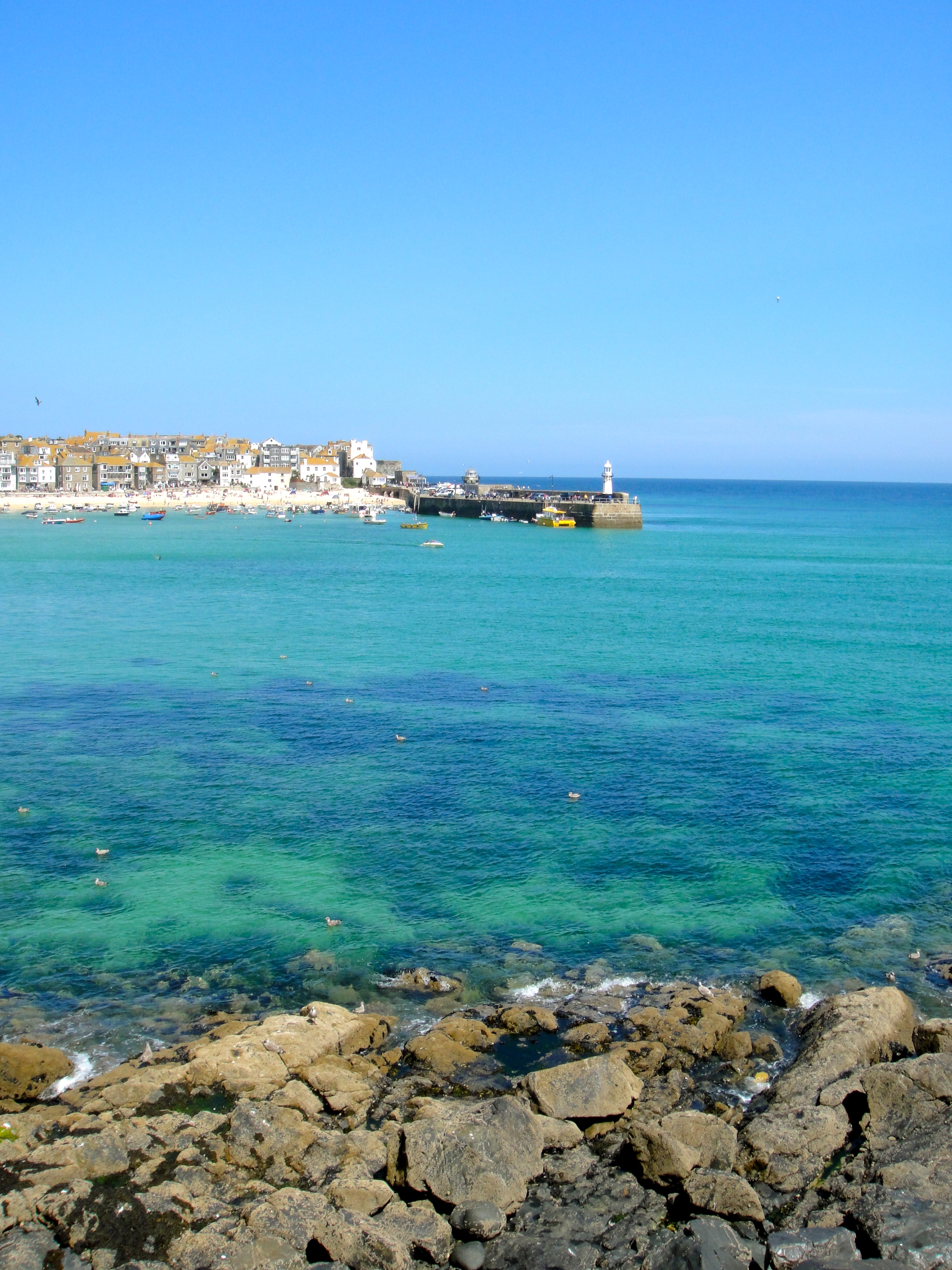
Yes, this IS English sea!

Together with this tradition, you expect to find plenty of seaweed, lots of rocks and stones and a slightly dull tinge to the seawater, making it altogether a more English, slightly less comfortable affair. But last year when I headed down to Cornwall, right at the bottom of our fair nation, I was flabbergasted by the site of such a stunning coastline, with such sapphire-sparkling crystal-clear turquoise waters that I could have been in the Caribbean. No wonder then that the little harbour town of St Ives has proved such an inspiration to generations of artists (Barbara Hepworth and Ben Nicholson being two foremost examples of modern times) that the world-famous Tate Gallery has set up an outpost there.

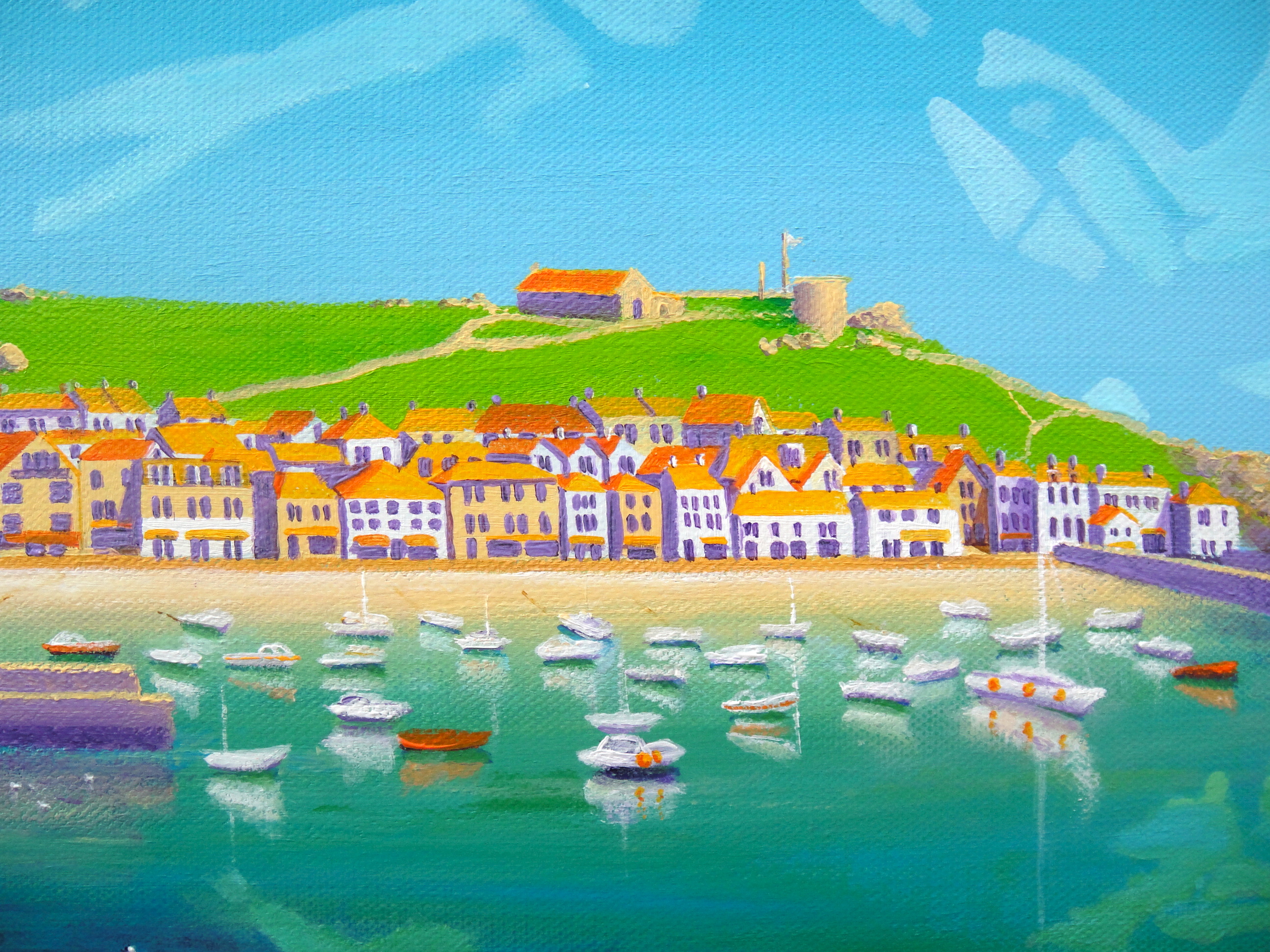
Well when I stayed last year, I too became inspired by the burst of very mediterranean colours that were all around me and, when I was, ironically, sat in the garden of my family home in Spain on the Mediterranean itself, I took to my canvas and recollected the beauty of what I had seen in Cornwall a few weeks before.

St Ives (Cornwall) (2012 © Nicholas de Lacy-Brown, acrylic on canvas, 60 cm x 50 cm)

My painting of Cornwall uses a simple colour palate with fresh oranges, greens and purples, while the turquoise qualities of the sea are reflected in all their beauty. I’ve introduced something of a cubism element when tackling the many rocks which frame the coast and most unusually of all, I’ve actually painted an impression of how the light dappled upon the canvas when I sat painting it in my parents’ garden, with the light cast through the intricate mesh of the jasmine tree. In this way I have forever captured a St Ives imbued with the light of the Med where I was inspired to paint it.

Detail of the harbour (© Nicholas de Lacy-Brown)

Detail of the town and lifeboat pier (© Nicholas de Lacy-Brown)

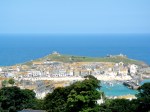
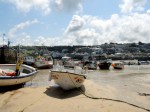
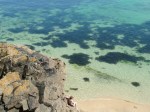
In addition, take a look at this little gallery of some of my photos from St Ives so you can see what inspired it.

Have an amazing Sunday.

© Nicholas de Lacy-Brown and The Daily Norm, 2001-2012. Unauthorized use and/or duplication of the material, whether written work or artwork, included within The Daily Norm without express and written permission from The Daily Norm’s author and/or owner is strictly prohibited. Excerpts and links may be used, provided that full and clear credit is given to Nicholas de Lacy-Brown and The Daily Norm with appropriate and specific direction to the original content.

My Muse, the Lily

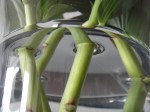
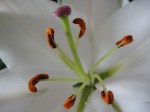
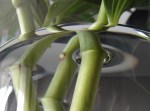
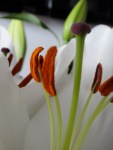
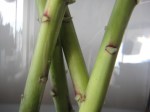
There’s nothing new about an artist being inspired by nature. It’s the main source of inspiration for most artists, particularly those who prefer the aesthetic merits of the lush and diverse countryside, the wide expanses of ocean and the changing effect of light and seasons. But what struck me today, as I sat on my sofa taking more than a momentary glance at a vase of supermarket-bought lilies next to me, was that in just a humble flower, there is so much incredibly complex beauty. Captured on camera, you have the opportunity to focus in on the individual features of the flower, its stamen, its stems, as well as the flower’s relationship with its surroundings – exit from the water, and entry into the water, as a suction bubble forms around the stem, whose angles are in turn distorted and multiplied by the effect of glass and water. When framed by a camera lens, stamen become complex, furry organisms, worthy of intense interest and query. In the same way simple stems become stripy, complex sculptures, criss-crossing like the motif from a Japanese silk screen. On the leaves, intense ribbing creates a delightful landscape of rise and fall, light and shade, while each petal resonates with different shades of white, as the delicate edge comes into focus, and the centre of the flower softens into shadow.

For me, it only takes a vase of flowers to inspire, and with a camera, I can seize upon this ripe source of inspiration, creating a hundred different photographic canvases from this one group of four lily stems, as each photo in turn proffers an abstract dance of white, green and orange, and the humble flower becomes artistically abundant, deconstructed and captured forever in art’s two dimensions.

© Nicholas de Lacy-Brown and The Daily Norm, 2001-2012. Unauthorized use and/or duplication of the material, whether written work, photography or artwork, included within The Daily Norm without express and written permission from The Daily Norm’s author and/or owner is strictly prohibited. Excerpts and links may be used, provided that full and clear credit is given to Nicholas de Lacy-Brown and The Daily Norm with appropriate and specific direction to the original content.

Eating España, again – Part II: The sweet stuff

So after a heavy dose of savoury Spain and seductive Salamanca you’d be forgive for thinking that this week, the week in which Spain was once again splashed over the headlines as a bank bailout was agreed, that The Daily Norm couldn’t get any more Spanish. Well you would be wrong, for today, it’s time for the ever-so-tempting waist-line enlarging pudding-perfect postres, all of which I cooked, and ate, at the weekend (I am now avoiding my bathroom scales – I feel that our current acquaintance could lead to a small falling out).

First up, something for afternoon tea, and as cakes go, this one is more almond than butter, which must make it healthy, right? It’s the very traditional Santiago Almond Cake, a firm Spanish favourite, moist in its naturally oily almond component, with a delicate and delicious simplicity.

Tarta de Santiago (Almond cake)

I first ate this delicious cake in Cappuccino Grand Café is the stunning hill-top town of Valldemossa in Mallorca. No sooner had I returned home than I was buying up the local supply of ground almonds and sampling my own.

This recipe is from the collection of Spanish desserts by the vivacious and frequently tipsy TV chef favourite, the late Keith Floyd. His recipe is so simple you have no excuse not to make this cake. In fact probably the trickiest part of the whole operation is lining a 20cm cake tin (I use a spring form to make the operation even simpler at the end). Once you’ve done that, all you need to do is get yourself a food processor and all the work will be done for you – Just whizz up 3 eggs with 225g caster sugar, 100g butter, 175g self-raising flour and 125ml water until all of the ingredients are well blended.Then add 225g ground almonds and the grated zest of 1/2 a lemon. Whizz for a few seconds only, just to mix (if you overwork the almonds the mixture will become too oily). And that’s it! Tip the mixture into your greased and preferably lined tin and bake at 180 degrees centigrade for an hour. Test with a skewer and when it comes out clean, you’re done. Once the cake is cooled, sprinkle with icing sugar and enjoy.

Flan de naranja (Orange Crème caramel) 

Next up are Rick Stein’s Orange Flans (the Spanish equivalent of the French Crème caramel, or if you want to entirely strip the words of their glamour, Caramel Creams). But these have an orange twist which provides an exquisite burst of Sevillian sunshine in your mouth. I’ve cooked these a few times now and they’ve gone down ravishingly well on each occasion. They’re not that fiddly either – just be careful not to burn the sugar.

Ok, so you need to start by preparing your space. You’re going to need around 6 ramekins which should be ready placed in a roasting tin so you can make a bain marie later (this needs to be ready because once you’ve made your caramel, you need to pour it directly into the ramekins otherwise it will turn rock hard in your pan).

Onto the caramel then. This is where you need to be careful. Place 100g caster sugar and 45ml of water in a heavy-based pan and leave over a very low heat until the sugar has completely dissolved (I stir it a bit to ease the process, but old Rick doesn’t tell you to). Once the sugar has dissolved, whack the heat up to high and leave to boil rapidly, without stiffing, until the syrup starts to turn orange, orangier, red and then a pale brown brick red colour (tends to take around 5 minutes). Be careful here. If you let it go too far into the red zone, it will very quickly burn – I’m talking seconds here. So as soon as it starts to go a brick red, whip it off the heat and pour straight into the ramekins, distributing it evenly between them. You can leave them there as you turn your attention to the orange cream.

Finely grate the zest from 2 oranges and squeeze the juice out of these and 2 others until you have around 400ml of fresh orange juice. Pour this, the zest and 300g caster sugar into a pan and bring to the boil over a low heat, stirring now and then to dissolve the sugar.

In the meantime separate out 14 (yes, fourteen!) egg yolks (discard the egg white – or save it for a nice pavlova (see below)) and place with two whole eggs (this hen has been busy) in a mixing bowl and whisk. When the orange juice comes to the boil, turn down the heat and allow it to simmer rapidly for 2 minutes. Then, through a sieve, pour the orange juice mixture into the eggs and mix.

Now it’s time to pour the mixture into your ramekins on top of the caramel. Once this is done, pour boiling water into the baking tin so it comes to two-thirds of the way up the sides of the ramekins. Place in the oven at 160 degrees centigrade for around 15 minutes for small ramekins, and 20 minutes if they’re a bit bigger. Once out of the oven lift out of the water (being careful, obv) and allow to cool before placing in the fridge. Ensure they are refidgerated for at least 4 hours before eating, but preferably overnight.

When serving, carefully invert each dish onto a small serving plate. With a bit of jigging they should plop out quite easily, but you can always eaze around the side with a knife if they’re being obstinate. Some caramel will come out on the top, but if you want more from the mass that is stuck to the bottom of your ramekin, place back in a roasting tin filled with boiling water and leave until the caramel melts a bit. Now go and eat the divine things – you’ll be booking flights straight to Andalucia in no time.

And one for luck… a very un-Spanish mini strawberry pavlova

Wasting all of those egg whites from the Flan would have been a crying shame, so I decided to make a few meringues, just to soothe my guilt at pouring so much of a hen’s hard work down the sink. I used Raymond Blanc’s simple meringue recipe which can be found here except I made mine smaller. The original intention was to crush up the meringue and make an Eton Mess but the meringues turned out so surprisingly beautifully that I made them into mini pavlovas. Here are the fruits of my labour, and well worth the extra effort.Happy cooking!


Salamanca: My Painting – Homage to a sandstone city in oil on canvas

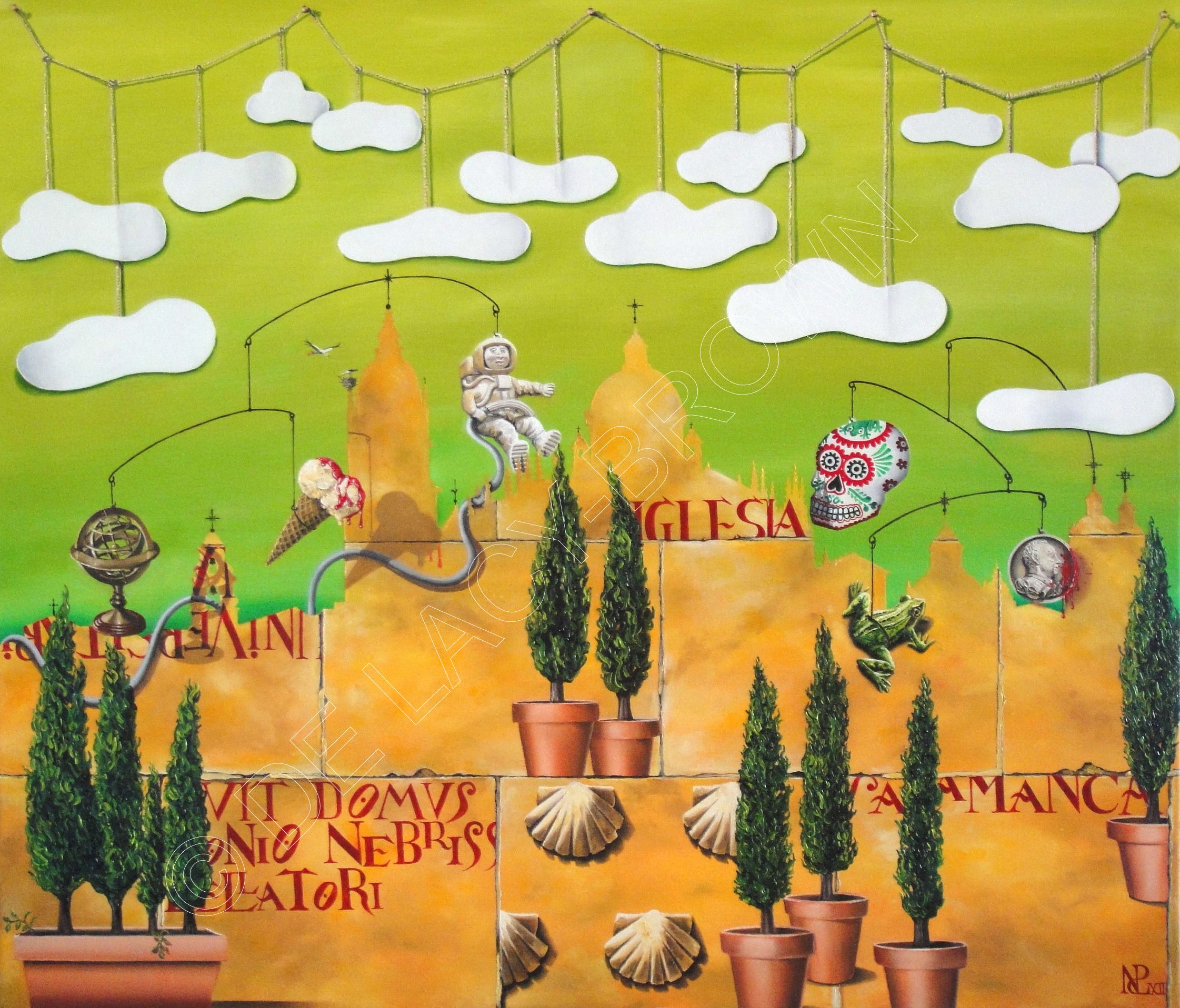
It’s been two months since I returned from the golden glowing sandstone Spanish city of Salamanca. There was so much to inspire me when I walked those elegant historical streets. When I gazed, mesmerised through my hotel window onto the stunning baroque Cathedral, the sun setting upon its orange stonework, and cypress trees gently waving from side to side in the evening breeze before it, a painting came to my mind. I rushed to make a quick sketch which I still have on the back of a reservation print out for the restaurant we were dining at that night. My painting of Salamanca was to contain what to my mind was the essence of the city – a kaleidoscope of dappled, marbled oranges and golds in a landscape uniquely built from the local Villamayor sandstone, a city bursting with historical artefacts flowing from the dual powerhouses of church and university. It is a city which is elegant in its antiquity, and yet bursting with fresh new life from its greenery, its strong local life, the pull of tourism and the thriving university population which resides there. This was my inspiration and shortly after returning from Spain I set to work on a large 105 cm x 90 cm canvas. I finally finished  the work over the long Jubilee Weekend. And here, exclusively, is the result, as I present my first (non-Norm) painting of 2012…

Salamanca (2012 © Nicholas de Lacy-Brown, oil on canvas, 105 cm x 90 cm)

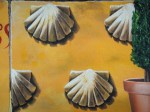
Dominating the centre of the canvas is a silhouetted skyline of the city, recognisable by the Cathedral spires and the intricate turrets, domes and baroque roofing of the nearby University. Rather than paint the detail of the buildings, I constructed the skyline out of a wall of villamayor sandstone bricks, in the same way that each building of the city is constructed. Those individual bricks act as a window onto different features of the city. On one brick you see the conch shells of the famous Casa de las Conchas, while on others, parts of the hand painted street letterings are featured, infamous for their historical use of pigs blood and olive oil.

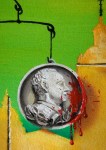
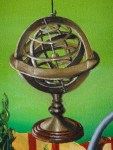
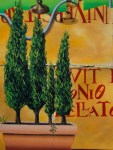
In the meantime, out of the Cathedral and the university, the ironwork crosses become large mobile-like structures, inspired by the great maker of mobile art, Alexander Calder. On these mobiles hang various symbols of the city. The astronaut and the ice cream which are usually imbedded in the intricate plateresque facades of the Cathedral and the University’s famous sandstone frog are all featured, as well as the skull upon which the frog sits (my painted skull is inspired by the Mexican Dia de los Muertos celebrations for which houses and graves are adorned with beautifully decorated hand painted skulls like this one). Represented too is the tradition of learning at the University, embodied in the Orrery (one of which I bought while in Salamanca as a souvenir of the city) as well as the famous Plaza Mayor, represented by the infamous bust of Fascist leader Franco which can be found amongst the busts of Spanish rulers around the square, and the inclusion of which causes such controversy that it is regularly vandalised. My Franco too has been vandalised, but is that paint on his face or blood on his hands? Finally the painting is generously sprinkled with various groups of cypress trees, tidily placed in terracotta pots at various spots across the canvas as well as a curtain of clouds sweeping across a clear green sky. Ooh and look out for the little stork’s nest embedded amongst the spires of the cathedral – the storks are a customary feature of the city and do not appear to cause the residents any hassle – in fact some churches have baskets placed on top of their spires to aid the storks in building a safe and secure nest!

So there it is, and above, so you don’t miss the details, are more photos showing the various individual aspects of the painting. I hope you like the painting and, more importantly, let me know what you think! I’ve already started a new work, so look out for that over the coming months.

© Nicholas de Lacy-Brown and The Daily Norm, 2001-2012. Unauthorized use and/or duplication of the material, whether written work or artwork, included within The Daily Norm without express and written permission from The Daily Norm’s author and/or owner is strictly prohibited. Excerpts and links may be used, provided that full and clear credit is given to Nicholas de Lacy-Brown and The Daily Norm with appropriate and specific direction to the original content.

Eating España, again – Part I: One starter and two mains

Ever the diplomat, and clearly qualified for a high powered job in the Foreign Office, whenever a country get’s a bit of bad press, I try to do my bit to remind all the cynics out there that despite financial plight, banking crises, and the incessant need for multi-billion euro bailouts from reticent cash-strapped neighbours, the culture which made these economically shaky countries great survives through the monetary meltdown. This is no more so than in my beloved Spain, where the great flavours and platos ricos were born from poverty, using basic and cheap ingredients which, when combined, produce a flavour sensation which captures in its aroma, colour and savour the very essence of that culturally diverse country. Consequently, just like I did for poor old Greece a few weeks ago, I’ve returned to my London kitchen, and cooked up a feast in honour of Spain’s great gastronomic heritage.

Here are just a few dishes I tried out over the weekend. In this post I’m going to share three great savoury dishes from apple-lush Asturia, seafood-filled Catalonia and the once-moorish highly spiced lands of Andalucia. Later in the week, I’m moving on to the sweet stuff, when I’ll share a traditional Santiago almond cake, and some divinely Sevillan orange-burst creme-caramels.

Centollo a la sidra (Baked crab with cider)

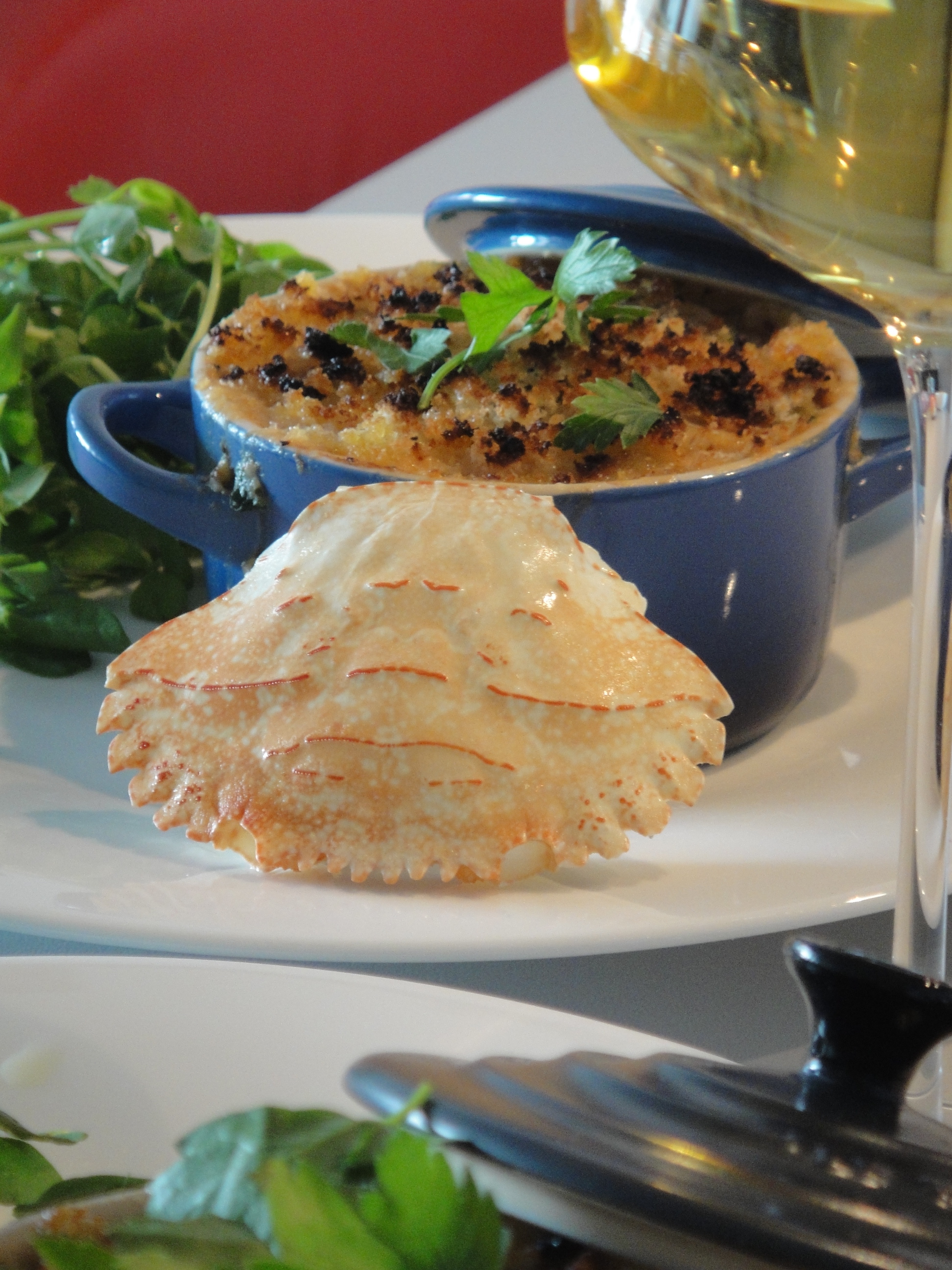
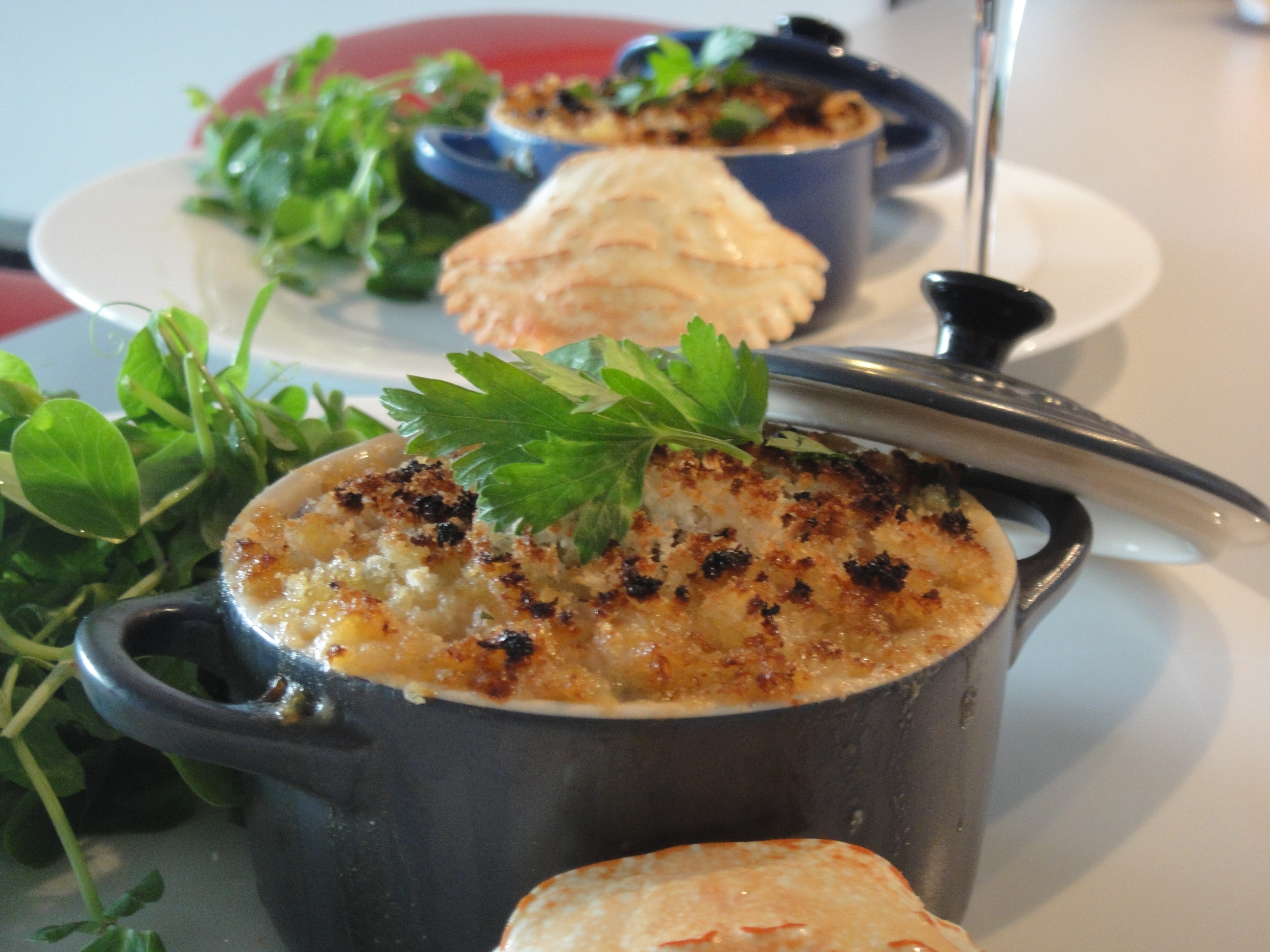
This recipe takes its inspiration from the Asturias region of Spain, where Cider is the drink of choice and sidrerias can be found in every town and village. My take is in turn based on the recipe by Claudia Roden in her fantastic book, The Food of Spain: A Celebration (Penguin, 2012) so all credit must go to her. These little ramekin filled dishes make a perfect starter or, as I did, served as a light lunch with a little side salad. In Asturias, they make this filling and stuff it back inside the shell of their txangurro spider crabs. While not attempting any such culinary craftsmanship, I paid homage to their skills by serving my dish in a mini le creuset pot with a little crab shell on the side, just for decoration (you eat with your eyes before your mouth etc etc).

To make your own crab dish (whatsoever you may chose to stuff it in) take a chopped medium onion which should be sauteed over a low heat until soft. Add to it one peeled and chopped tomato, a pinch of chilli powder (or cayenne pepper) and another pinch of salt and cook over a medium heat for around 8 minutes. Next take a fillet of cod (around 150-250 g depending on how many ramekins you want to fill) and cook for about 5 minutes or until it begins to flake, turning it once. Flake the cooked fish and add 250g of cooked white and dark crab meat, 175ml of dry cider and 2 tablespoons of chopped flat-leaf parsley. Cook for around a minute. Oil 4 small ramekins or two big mini casseroles (like mine) and spoon the mixture in. Sprinkle with fresh breadcrumbs, a few blobs of butter and place under the grill until the breadcrumbs are browned. It’s probably best you leave the ramekins to cool for a couple of minutes once they come out of the grill before you serve them!

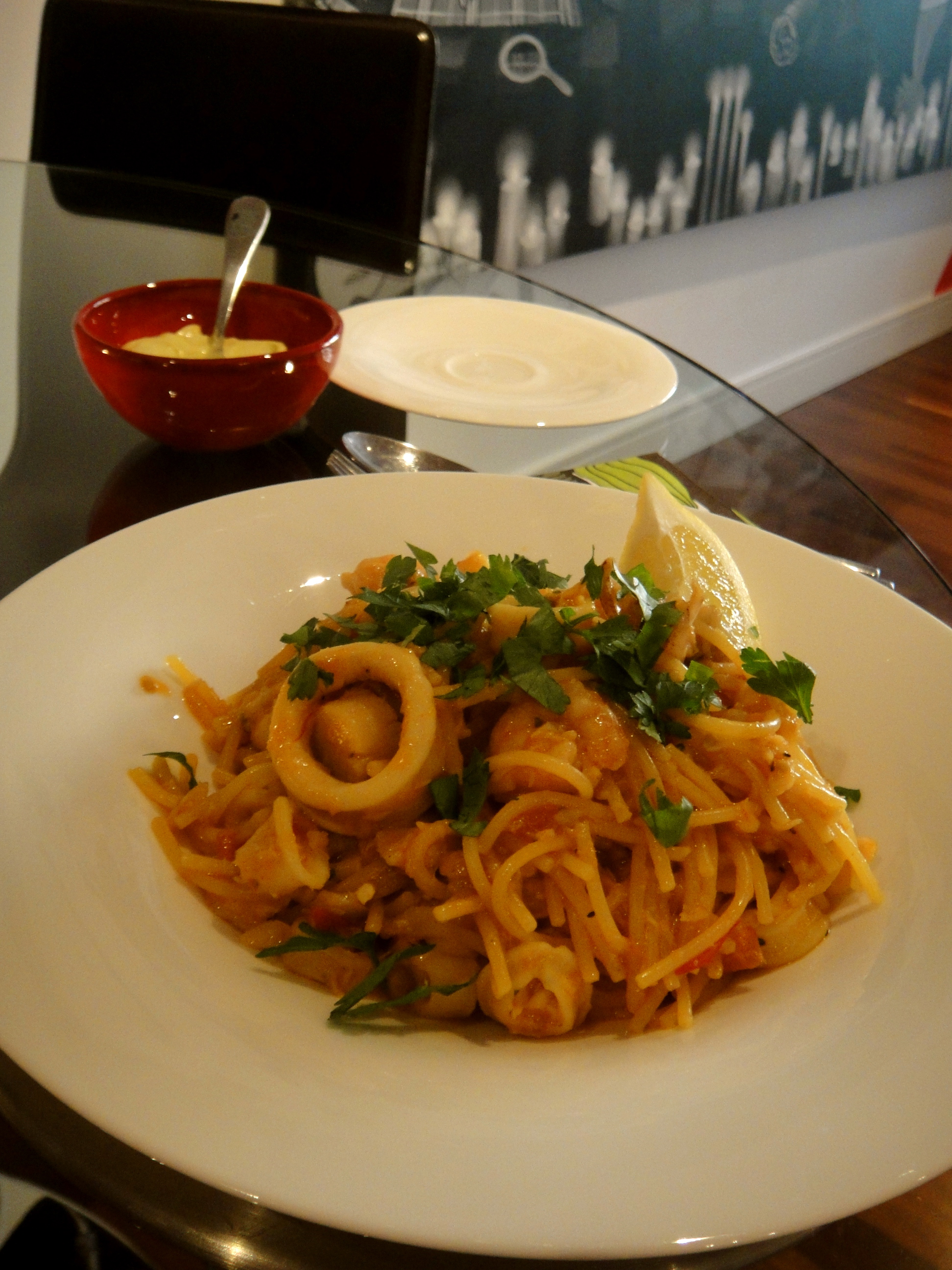
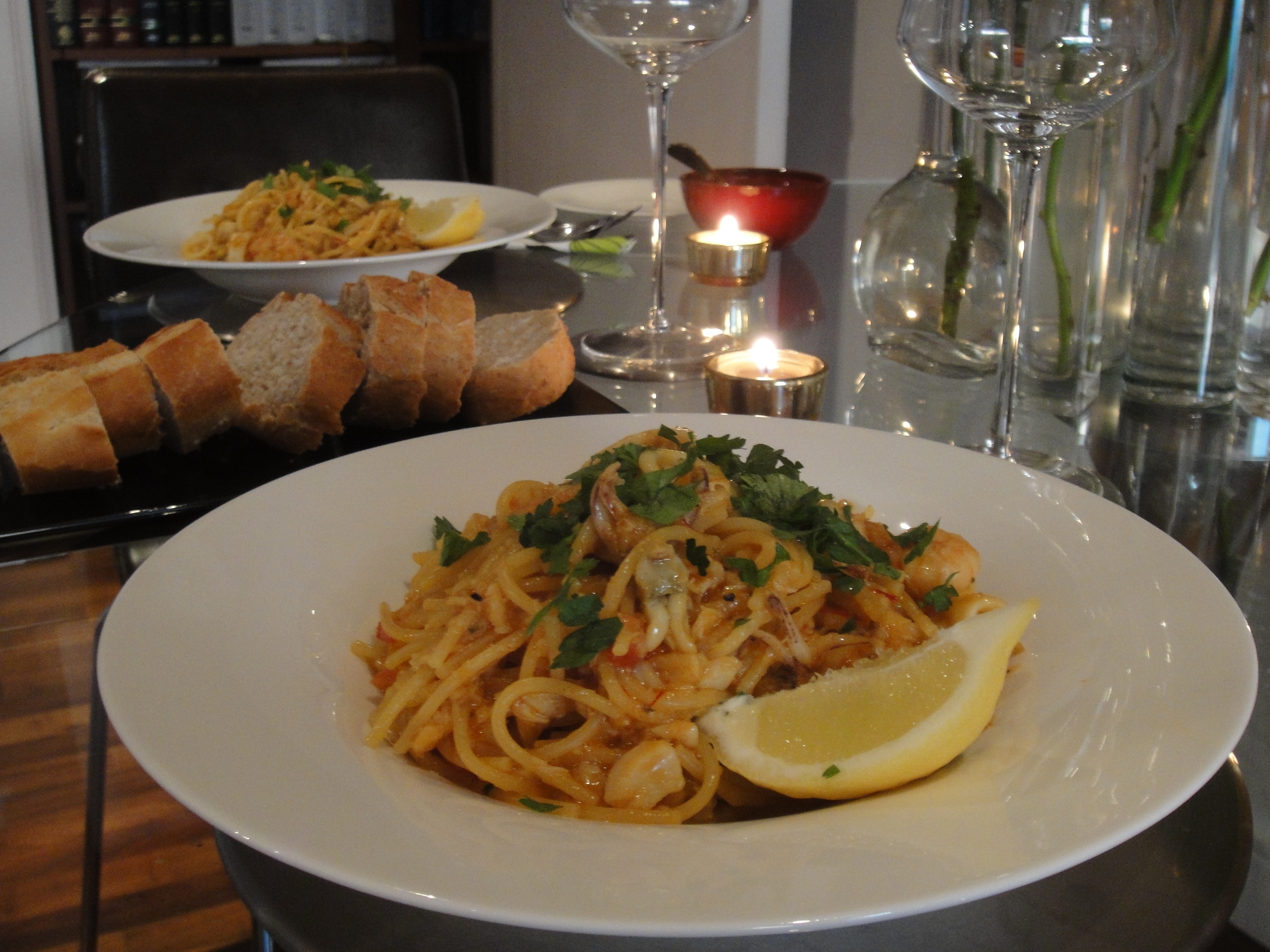
Fideuada del señorito – (smoked) seafood pasta

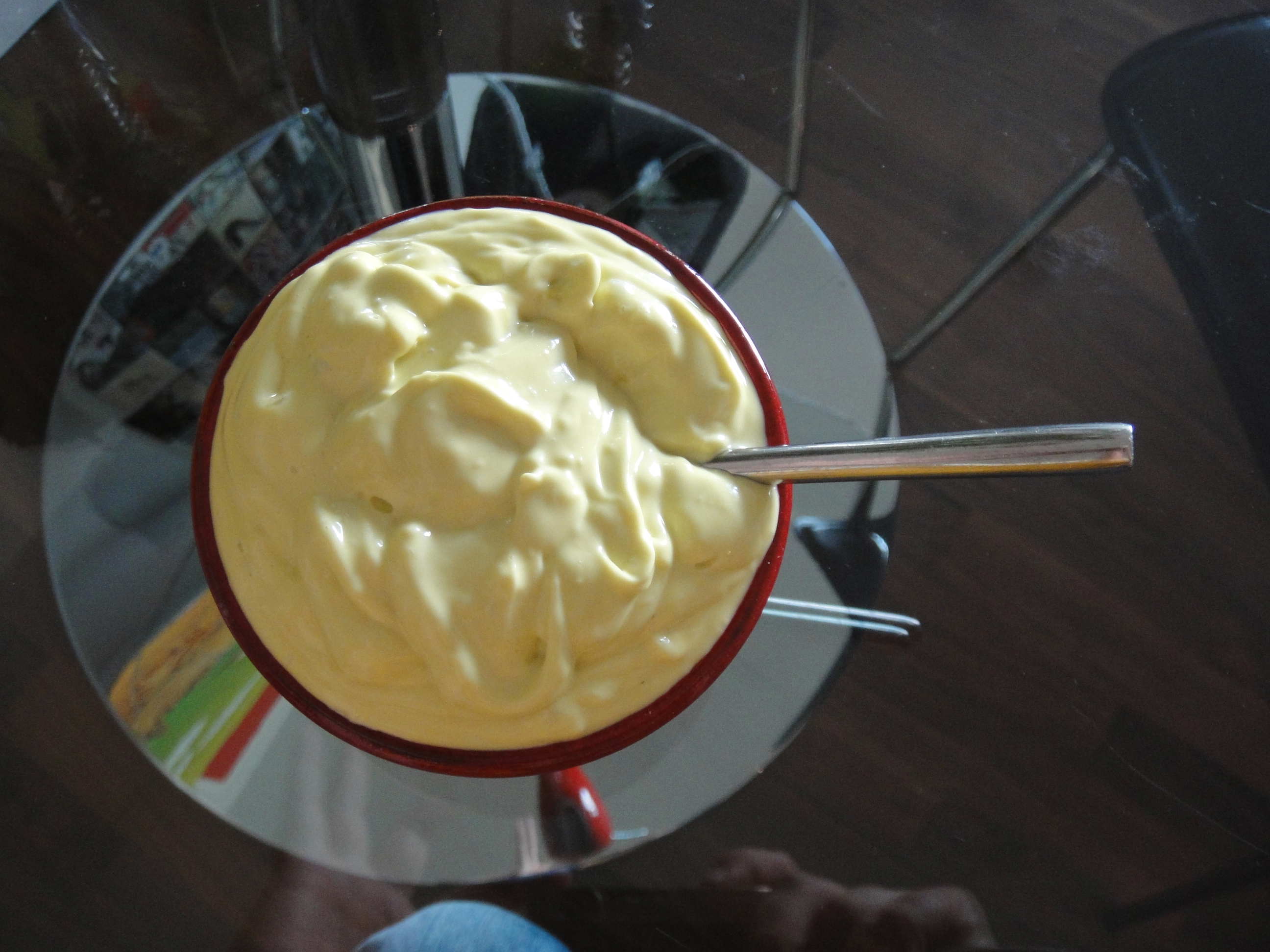
This is a pasta dish straight from the gutsy seafood-filled region of Catalonia, and brought to my attention, once again, by Claudia Roden although once again, I’ve gone my own way with it and shaken it up a bit (sorry Claudia). The dish, for no apparent reason, translates as “of the young gentleman”, perhaps because the short pieces of pasta and shelled prawns make the dish particularly easy for young senoritos and senoritas to eat. Either way its truly delicious for us adults too. You should service it with a good blob of alioli (garlic mayonnaise). If you can’t be bothered to make you own mayo, just add crushed garlic to shop bought mayonnaise. Mine is thick and yellow because I made it with extra virgin olive oil straight from a vineyard next to my Partner’s family home in Tuscany (yes yes, I know, it’s not Spain) so well worth the rather tedious effort of making it from scratch.

My alioli

To make the pasta, heat 4 tablespoons of oil in a large frying pan (or paella pan if you have one). Cook around 400g of cubed smoked haddock (Claudia Roden uses monkfish, but I didn’t have any to hand – I adore smoked haddock and loved the results in this dish – it gives a subtle smokey flavour which works amazingly well with the alioli on the side) and cook on a medium heat for around 3-5 minutes. Next add 4-6 baby squids, sliced into rings, cooking for a further couple of minutes before adding a dozen or so peeled king prawns and an equal number of scallops. Cook until the prawns are nice and pink (1-2 mins). Place all the cooked seafood to one side in a separate dish, keeping it warm. Preserve any liquid. Using the same pan, heat 2 tablespoons of oil and stir in 1-2 crushed cloves of garlic. Just before the garlic colours, add 3 chopped tomatoes, 1 heaped teaspoon of pimenton dulce (or sweet paprika), a little salt and a good pinch of saffron threads (and at this point pause and indulge in the aroma of Spain, a warm mediterranean evening wafting past your nose, a magical culinary noche brought to life in your kitchen, wherever it may be). Sorry, where was I… ah yes, The tomato will quickly thicken so at this point I added 120ml of oloroso dry sherry (although dry white wine will work too). Wait for that to reduce down, cooking for around 10 minutes.

Add around 300g (for 2-3 people) of spaghetti, broken into 3-4cm pieces to the tomato mixture, making sure it is well coated. Then add around a pint of boiling chicken stock and add back the cooked seafood, stirring it into the pasta/ tomato mix. Cook until the pasta is al dente. This should use up all the stock, but add a little more if the liquid dries up before the pasta is cooked. The dish should be moist when its finished.

And that’s it! Serve with some sprinkled parsley and a good dollop of alioli – the mixture of smoked fish and pimenton with delicate seafood and a pungent winey tomato sauce is to die for, I promise. Oh and don’t forget to give the whole thing a good squeeze of lemon juice – the acid cuts across the strong salty smokeyness perfectly.

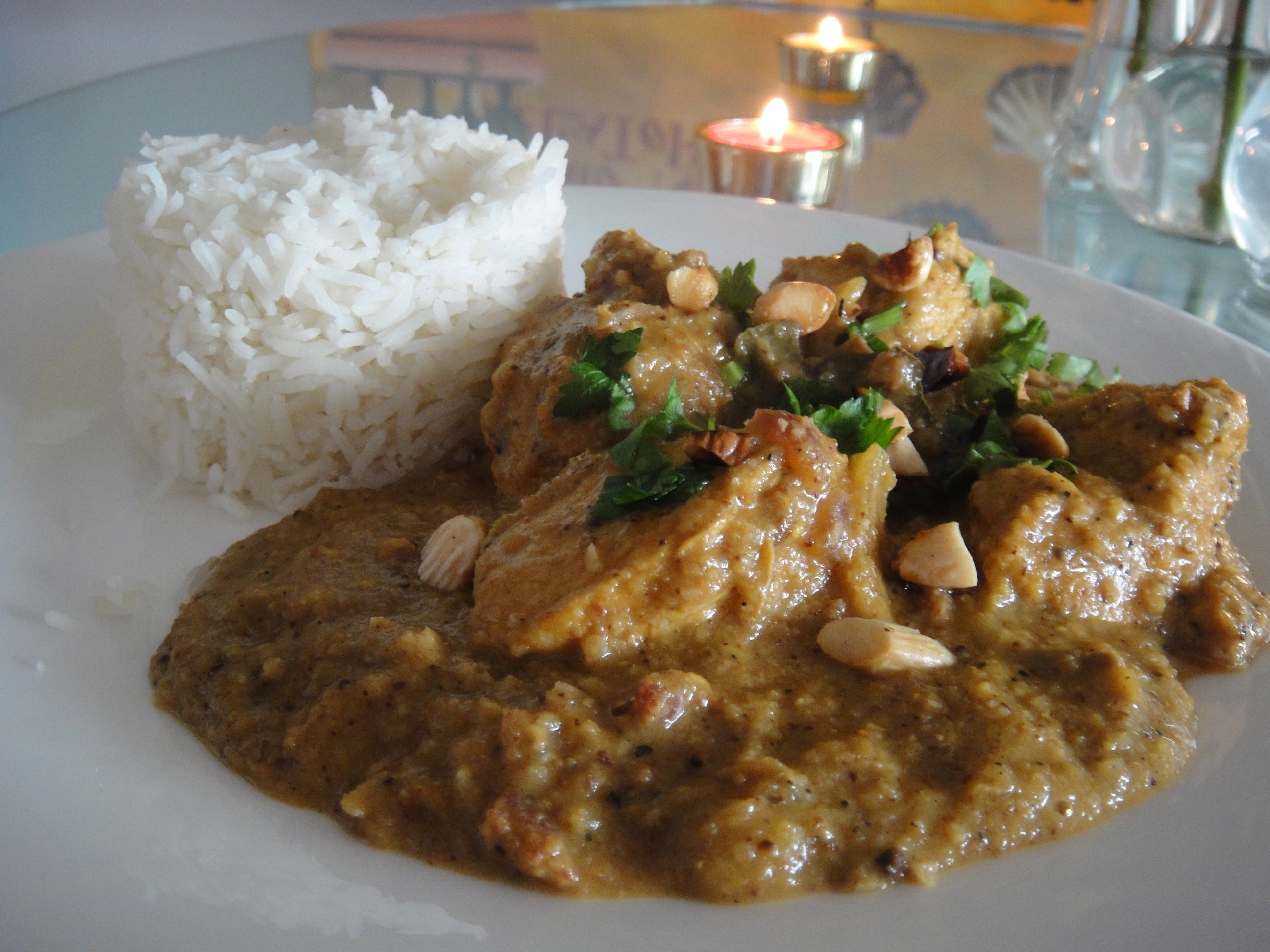
Pollo en pepitoria (Chicken in a mildly spiced saffron, pine nut and almond sauce)

Last up it’s down to the Med and the region of Andalucia where the influence of 700 years of Islamic rule can still be felt from the rafting voices and spasmodic dancing of gypsy culture emanating from Seville, to the use of mild moroccan spices in their food. This dish is no exception. It was first cooked for me by my mother, who in turn got it from chef Rick Stein, who in turn nicked it from Australian chef Luke Mangan who opened a restaurant specialising in a mixture of Spanish and Moorish cuisine. Despite this chinese-whisper-like chain of chefs, all of whom have no doubt made changes here and there, the dish is nonetheless emblematic of Southern spanish cooking, with its warm aromatic spices and plentiful use of almonds. Moreover, the use of a “picada”, that is a nutty paste stirred into the chicken, is popular across the whole of the Iberian peninsula.

Start off by hard boiling two large eggs for 10 minutes. You’ll need these later. Allow them to cool and then peel off the shell.

Next deal with your chicken. Some people will use a whole chicken, in which case they’ll chop up and use the legs, wings, breasts etc. I only really like chicken breasts and am not therefore much help on how to use these other bits of the bird – but you can. I use four chicken breasts. Cut these into fairly large pieces (probably three from each breast) so they remain moist.

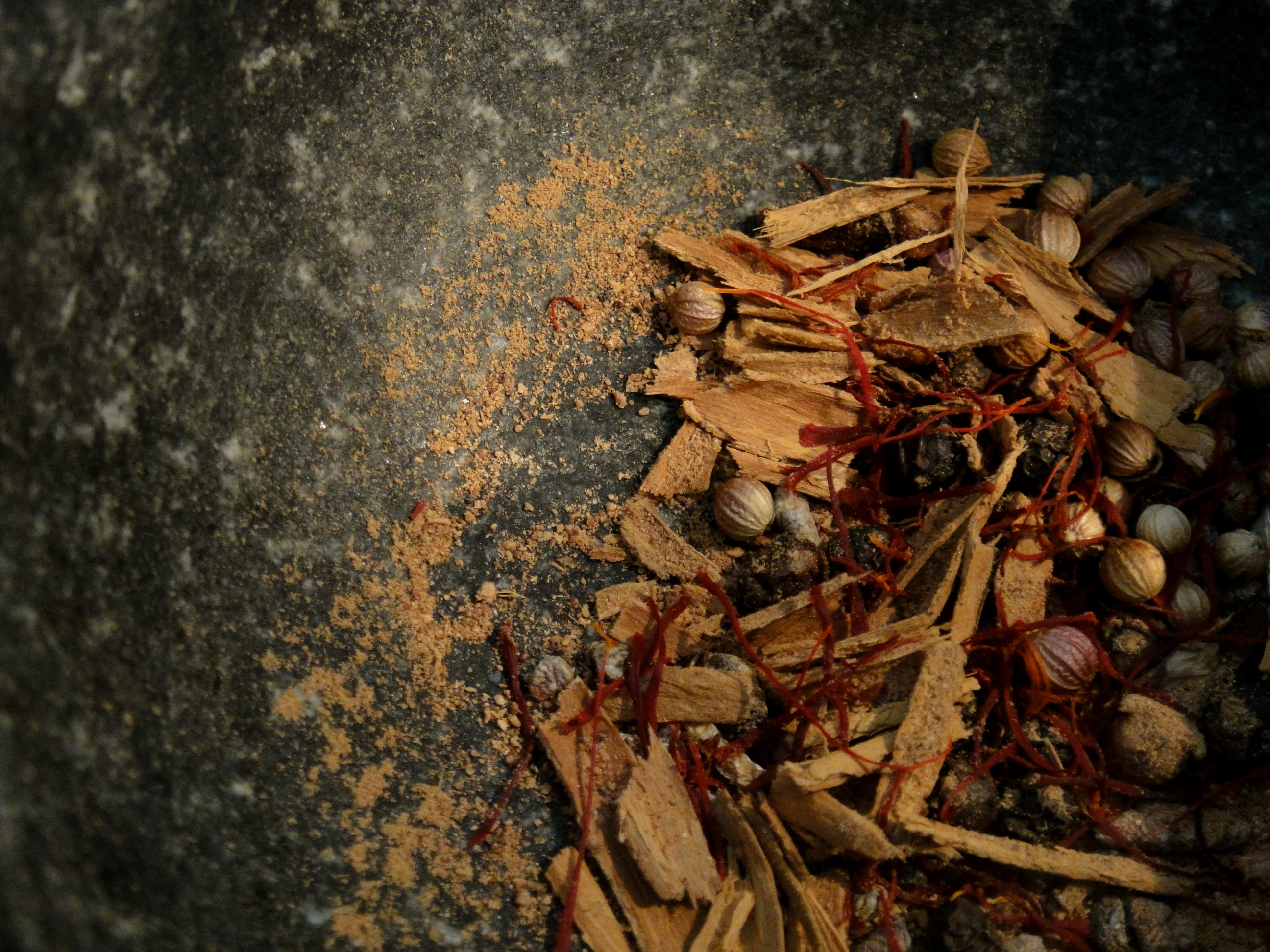
My spices: they smell as good as they look

Onto spices. Lightly crush approximately 10 cardamom pods and remove the seeds from inside (this is fairly tedious but worth it, I promise). Discard the shells and add the seeds to a pestle and mortar into which should also go 1/2 teaspoon of coriander seeds, 1/2 teaspoon saffron strands, 2 cloves, 1 cm piece of cinnamon stick, 1/4 teaspoon of nutmeg and around 10 peppercorns. Grind to a fine powder and enjoy the aromas while you’re doing so.

Now heat around 4 tablespoons of oil in a casserole. Add two peeled whole garlic cloves and a slice of white bread. Fry on both sides until golden. Transfer to a food processor. Now season the chicken lightly and fry until golden on the sides. Remove and set aside. Now in another tablespoon of oil, add 1 large onion, finely chopped and fry lightly until soft and sweetened but not brown. Stir in the spices, cooking for 1 minute and then stir in 200ml of dry oloroso (or other) sherry or white wine and 200ml of chicken stock. Return the chicken to the pan with 2 bay leaves, a handful of raisins or dates (these are my addition, but are optional) and a pinch of salt. Bring to a simmer and cook gently for around 20 minutes (40 minutes is probably necessary for chicken legs etc).

In the meantime heat a frying pan and dry roast 40g pine nuts for 1 minute and 40g blanched almonds for 2 minutes. Leave to cool. Add the nuts and the yolks from the hardboiled eggs to the bread in the food processor along with 10-12 tablespoons of cooking liquid from the chicken. Grind to a paste (this is the “picada”). Chop 20g more of blanched almonds to sprinkle over the dish at the end.

Once the chicken is cooked, stir in the picada paste and simmer for a couple of minutes longer until thickened. Stir in 1 tablespoon of lemon juice approx and make sure your seasoning is on course. Finally, in a separate pan, stir fry those remaining chopped almonds for a couple of minutes in a little oil until golden. Serve your chicken with the sauce and sprinkle the almonds on the top with some parsley.

OK, we’re done. Three dishes bringing the flavours and character of Spain directly into your house. On second thoughts maybe this post isn’t so helpful to the Spanish economy after all – once these amazing cooking aromas fill your home, you’ll have no need to go on holiday again!

Sunday Supplement: High Perspective (Viewed from 21c)

Having recently been voted the top city to visit in the world (as if we didn’t know it already), after last weekend’s Jubilee spectacular and, of course, with the olympics almost on our doorstep, it seems only appropriate that in this week’s Sunday Supplement, I feature one of my paintings which features the city of London as its central theme.

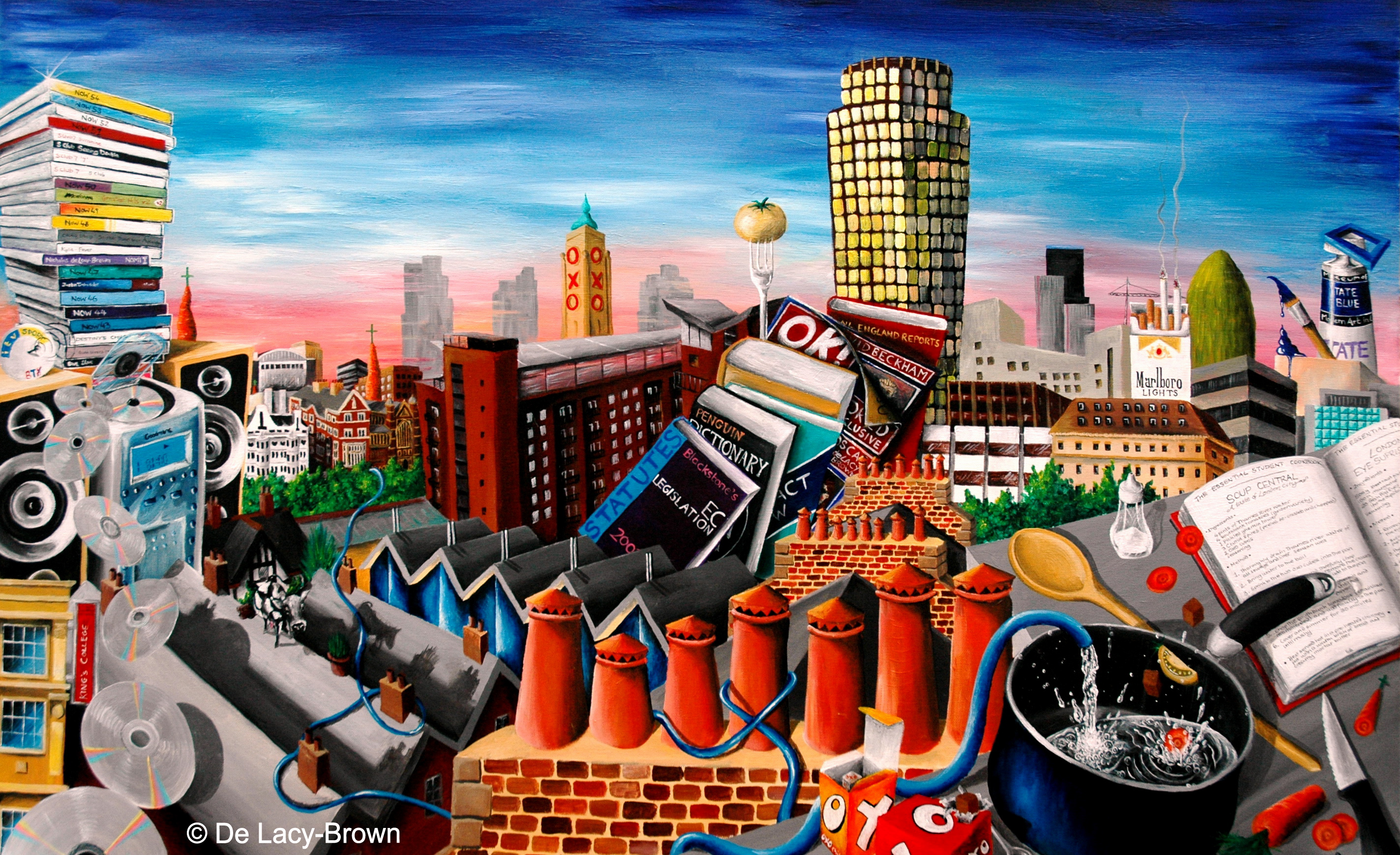
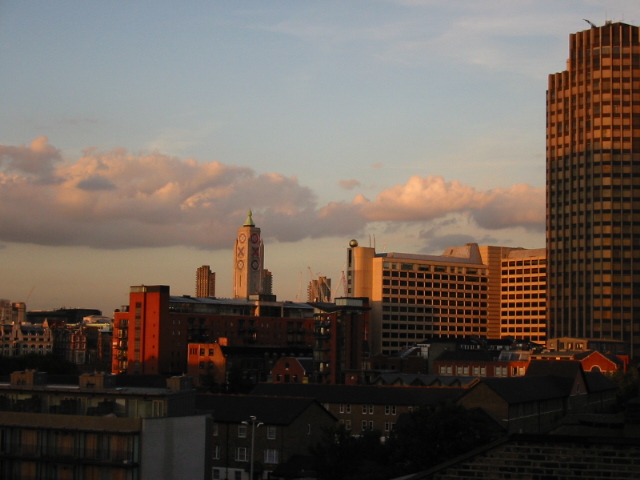
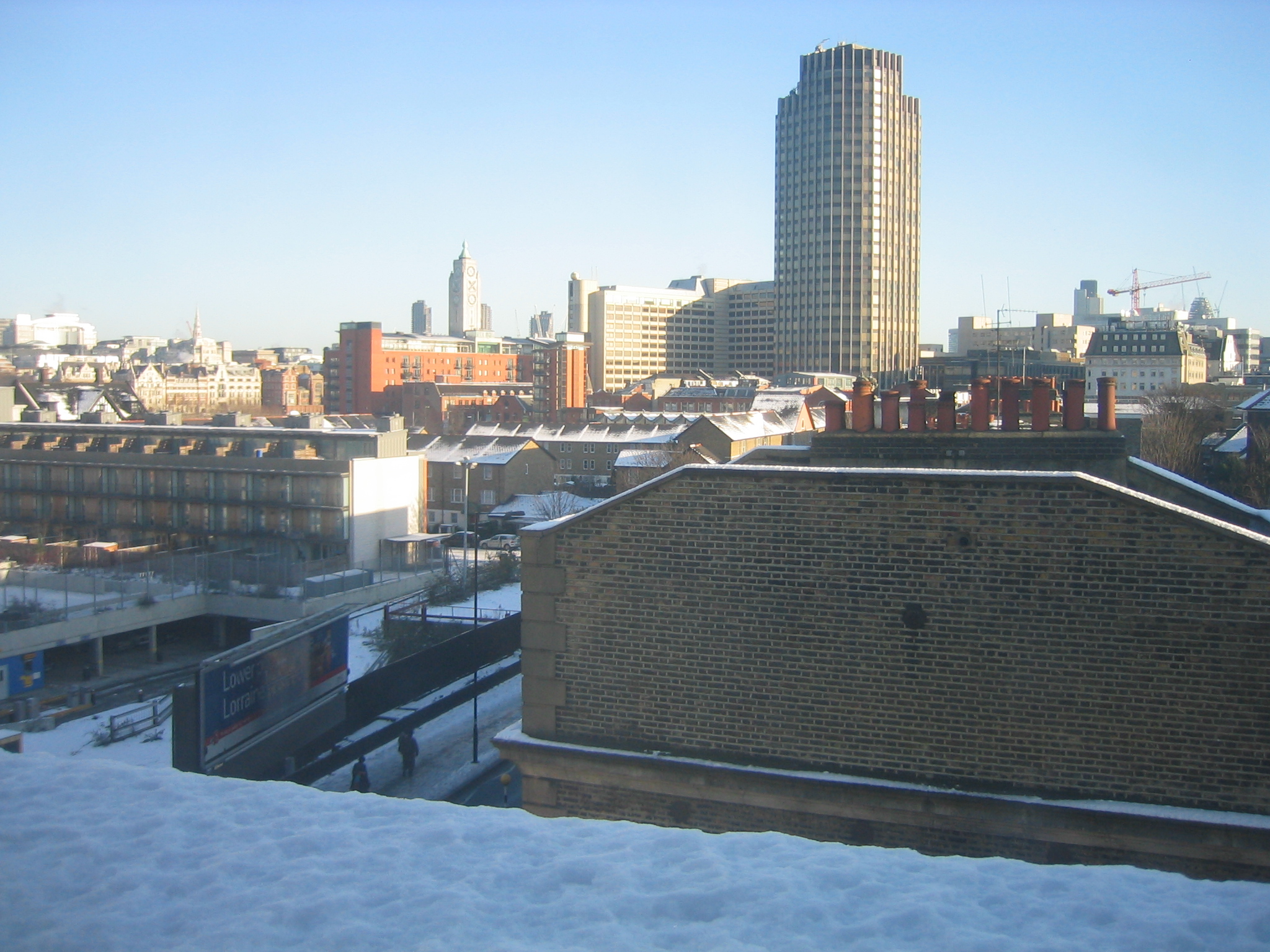
I moved to London ten years ago this September, when I came to study law at King’s College London. I was thrilled when, full of anticipation at what was to be my first day moving away from home in order to start university, I entered my student digs to find this view before me: a perfect vista over London’s south bank complete with the skyscrapers of the city and the tower of Tate Modern, all framing the iconic “Oxo Tower” at the centre. It was as though this room had been chosen for me as an artist, despite the reason for my studies being the pursuit of law. Over that year, I saw this incredible view change over the seasons, as buildings became blanketed with snow, shrowded in a thick mist, and glimmering with the soft hues of pinky golden sunsets and bright midday sun. At the end of my academic year, when my first year law exams were finally over, I imported a canvas into my room and sat down to paint this representation of my view.

High Perspective (Viewed from 21c) (2003 © Nicholas de Lacy-Brown, acrylic on canvas)

It’s not a straight forward landscape: far from it. Rather I used symbols to represent various landmarks rather than paint them directly as I saw them. The GMTV tower on the left for example was replaced with the stack of CDs which my friends and I were listening to during that year, this being a pertinent representation because the GMTV studios are where so many entertainment shows are filmed. Similarly I replaced the Tate tower with a tube of paint, and one of the large publishing headquarters with a stack of magazines (and a couple of law books to show willing). A predominant theme running through the work is food. This was inspired by the Oxo tower itself, named after the stock cube which, in the days when London’s south bank was a hive of industrial activity, would no doubt have been manufactured at the site. Since these stock cubes are frequently incorporated in soups and stews and casseroles, I started reinterpreting the London skyline as various vegetable ingredients which could then be added to the dish which is being cooked in the bottom right hand corner of the work. Instead of the golden balls on the corners of one south bank building, golden tomatoes take their place; similarly London spires become carrots and Norman Foster’s famous “gherkin” building is painted as just that. Finally, since I could see where the river was, but couldn’t actually see the water itself (owing to buildings blocking the view), I imported the water into the scene with the aid of a very long hose pipe which spirals through the roof tops and chimneys before finally adding much needed liquid into the saucepan on my windowsill.

The view as it really was back in 2002

And covered in snow…

So there you have it, one of my most prominent London works, and actually one of my most valuable painting sales when it was sold at exhibition in Mayfair in 2008. Not to worry though – if you like the work and wish you had the original brightening up your lounge, there are limited edition prints of the work available on my main art website, here.

Have a great Sunday and come back to The Daily Norm this coming week for a load of food and art-based posts including the unveiling of my newest painting!

© Nicholas de Lacy-Brown and The Daily Norm, 2001-2012. Unauthorized use and/or duplication of the material, whether written work or artwork, included within The Daily Norm without express and written permission from The Daily Norm’s author and/or owner is strictly prohibited. Excerpts and links may be used, provided that full and clear credit is given to Nicholas de Lacy-Brown and The Daily Norm with appropriate and specific direction to the original content.

Twelfth Night at the Roundhouse: Laugh-out-loud funny with a Fawlty Towers twist

As a Director, being given one of Shakespeare’s best known plays to direct must be a bit like being handed a gift-wrapped life time of Christmases all at once: On the one hand you get the most spectacular array of gifts to play with, but on the other, there’s always the risk, as comes with the familiar, that the experience will descend into Family warfare, as new generations upset the old fogies in the corner, and traditional conservative values give way to brash commercialisation.

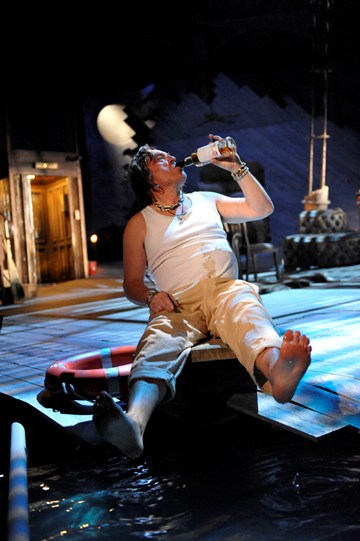
Nicholas Day as Sir Toby Belch in Twelfth Night. Photograph by Keith Pattison.

So it is with Shakespeare. You get those who turn up expecting ruffs and garters, men playing all the parts and the accompaniment of Greensleeves or some other suitably Tudor refrain in the background. Then there are those who want to see a familiar tale, with the same dialogue and characters, but retold in a totally reinvented way. I must admit to being one for the latter category. Admittedly, reinvented Shakespeare doesn’t always work. Shakespeare played out in the modern age can jar. Often directors are so intent on modernising that they lose all essence of the story they are reinterpreting. But the RSC’s latest offering, Twelfth Night, now commencing its London season at Camden’s Roundhouse, faces no such problems. Reinvented in a brilliantly original way, but losing none of the charm of the characters nor the tale, this new production, directed by David Farr is, in my refined Shakespearean experience, a phenomenal success.

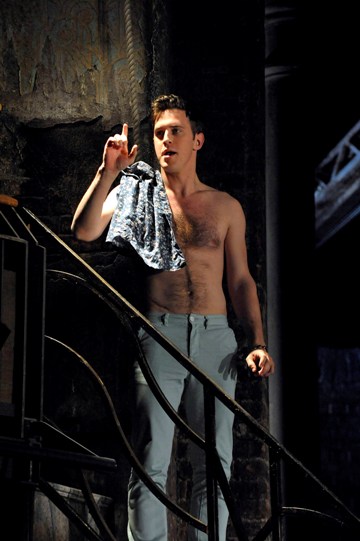
Stephen Hagan as Sebastian in Twelfth Night. Photograph by Keith Pattison.

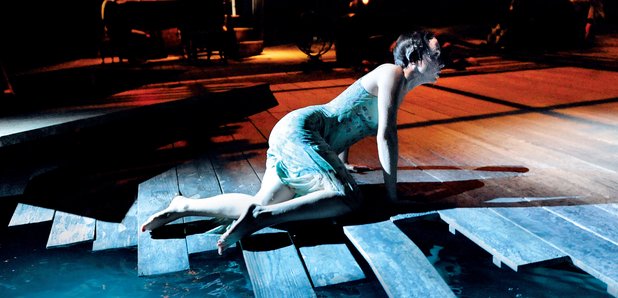
First off, the scenery. It’s brilliant. How to stage Twelfth Night, which on paper is part set in Orsino’s palace, part set in Olivia’s and part set on a beach? Well David Farr and designer Jon Bausor came up with an original solution. They set the play in a rickety old hotel, reminiscent of  Fawlty Towers age hostelries, with a rattling old lift, swing doors, a dusty set of pigeon-holes containing all the room keys, and old-style air con in the form of a single fan with ribbons attach so that they flicker limply in the air whenever the fan is switched on. This hotel setting is in turn amalgamated into a sweeping curved wooden floor, which at the foot of the stage dips limply into a pool of water before curving across the stage into a steep incline at the back of the space, upon which a bed, a bath and other paraphernalia hang steeply suspended, and over which the darting shadows of a ceiling fan spin and flicker. In short, there isn’t a straight line anywhere on the stage, and this gives the set a dilapidated charm perfect for the 70s/80s reinvention.

Cecilia Noble as Maria in Twelfth Night. Photograph by Keith Pattison

Meanwhile the hotel setting is adapted to both the homes of Olivia and Orsino respectively through subtle lighting changes, all of which give the impression that these people live on some expat seaside resort, where the drunkenness of Sir Toby Belch and co. and the electro-keyboard cabaret of Feste the fool seem perfectly pertinent, like the tragic faded grandeur of Benidorm, or Blackpool on a good day.

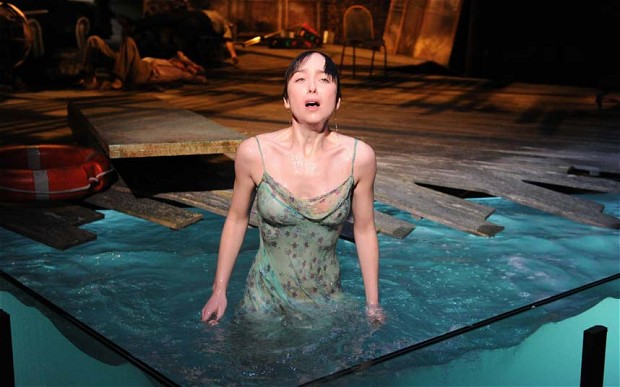
The best part of the set however has to be the pool filled with real water at the corner of the stage. It is from this pool that at the most unexpected moment, both Viola and a little later Sebastian, the shipwrecked protagonists of the play, emerge, gasping for breath, in the most fantastically realistic staging of a shipwrecked twosome. After this initial use of the pool, that same watery expanse is not forgotten. It provides the backdrop for some brilliant slapstick comedy by the likes of Bruce Mackinnon as a fantastically dippy Sir Andrew Aguecheek, and is a suitable space into which the phlegmatic Olivia can discard the unwanted gifts given to her by love-struck Orsino as she shuns his many indefatigable advances. True, the first few rows of the audience did get relentlessly splashed as the pool slowly emptied upon each dramatic entrance and exit by the actors, but at least they can’t moan that the play isn’t inclusive.

Emily Taaffe as Viola – Photo: Alastair Muir

Kirsty Bushell as Olivia and Kevin McMonagle as Feste in Twelfth Night. Photograph by Keith Pattison.

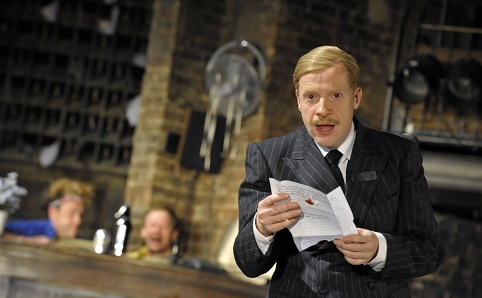
This brings me to the actors themselves, all of whom were brilliant, but with a few standout stars. Number 1 for me was Jonathan Slinger as the odious steward, Malvolio. The hotel setting worked best for Slinger’s character, as Malvolio went from palace porter to over-inflated Hotel Manager with a very heavy dose of small-man syndrome, complete with a clip board and name tag – you know the kind. This made for some genius comedy moments, not least when he travelled across the stage in a golf buggy marked “for management use only”  and as for the famous scene with yellow stockings and cross-garters – this production took the stockings to an all new level of risqué. It was laugh-out-loud hilarious. And it takes a lot to get me almost doubled over with hysteria.

Jonathan Slinger – brilliant as Malvolio – Photo: Jillian Edelstein

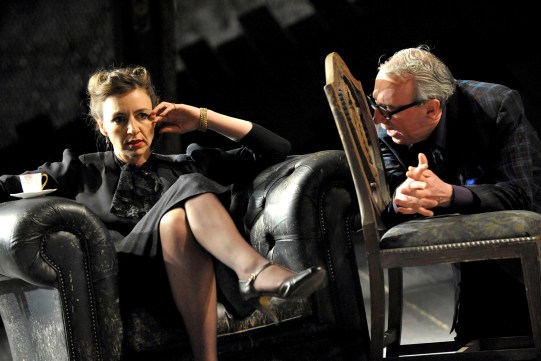
Second standout for me had to be Cecilia Noble as a diva-Queen Maria, the brilliant matriarch in amongst the drunken debauchery of Sir Toby’s den, wonderfully complicit as she was in the grand plan to bring the malevolent Malvolio to his shame. Brilliant too were the energetic Kirsty Bushell as Olivia, Bruce Mackinnon as Sir Andrew, and Nicholas Day as Sir Toby. I was a little disappointed by Emily Taafee as Viola, whose delicate Irish accent seemed a little strained in her efforts to be heard amidst the tomfoolery of her fellow cast members, and more often than not I found it difficult to decipher what she was saying. However that too is a problem with theatre (almost) “in the round” which meant that more often than not, we found ourselves facing the back of an actor whose voice simply didn’t carry.

Sir Toby, Sir Andrew and Fabian

No matter – as is often the case with Shakespeare, the old english is frequently difficult to understand in its totality. Which is why the role of a director, in translating that hyperbolic verse into the modern age, is so important. David Farr’s Twelfth Night not only translated brilliantly, but it lived, breathed and pulsated energy and jocularity which was contagious across the Roundhouse audience – even the wet ones at the front.

Twelfth Night continues at the Roundhouse until 5 July.