Skip to content

Posts tagged ‘Art’

Valentine’s in Paris – Normy love upon Dali’s Mae West Lips

We last met with Normy and Normette on the 6th January. After a month of somewhat turbulent relations, when poor Normy did his level-best to present Normette with a series of 12 magnificent presents each representing one of the 12 days of Christmas (only to result in a catalogue of disasters from the demands of 3 pretentious french hens, a frozen-up swan lake, and an immoral dance show culminating in Normette running away to the Moulin Rouge for good), Normy and Normette finally patched things up. Having reunited and reaffirmed their love, they were invited to celebrate their union before cheering crowds of the Three Kings festival in Spain.

It’s now a little over a month later, and things have really moved on. Normy asked Normette to move in with him (this went smoothly on the whole, except for when Normette’s Louis XVI style dressing table got stuck in the narrow doorway of Normy’s bedroom, and when Normette’s little kitten, quite traumatised by the upheaval of the move, wet itself all over Normy’s prize Persian rug) and the two have been getting closer every day. So it didn’t come as a huge surprise when Normy made the ultimate in romantic gestures and whisked Normette off for a short break to Paris, the city of love, to celebrate Valentine’s.

Normy and Normette ponder the meaning of Dali's Mae West Lips (2013 © Nicholas de Lacy-Brown, pen on paper)

Normy and Normette ponder the meaning of Dali’s Mae West Lips (2013 © Nicholas de Lacy-Brown, pen on paper)

Here we see the loved-up twosome at one of their first Parisian stop-offs. Being of a cultured disposition, Normy and Normette couldn’t resist dropping into the Pompidou Centre to take a look at the work of renowned Norm artist, Dali-Norm. There, they were able to experience first hand his recreation of the famed Normy actress, Mae West. What after all could be more romantic than lounging in the recreated face of such a famously beautiful Normy actress? No wonder then that Normy chose this moment to give his Normette a Valentine’s rose.

There was only one slightly disconcerting feature about this room that Normy and Normette couldn’t quite understand. Just what was that red sofa they were sat on supposed to represent? Everyone knows that Dali Norm was a master of surrealism, but that strange rather voluptuous red shape the Norms had never seen before. Yes, they had seen Mae West’s luscious golden hair, and yes her two beautifully made up eyes? But those red things further down her face? According to Normy’s guide book, Dali Norm called them “lips”. Surreal indeed…

© Nicholas de Lacy-Brown and The Daily Norm, 2001-2012. Unauthorized use and/or duplication of the material, whether written work, photography or artwork, included within The Daily Norm without express and written permission from The Daily Norm’s author and/or owner is strictly prohibited. Excerpts and links may be used, provided that full and clear credit is given to Nicholas de Lacy-Brown and The Daily Norm with appropriate and specific direction to the original content.

Valentine’s kiss for equal marriage

Love is in the air as Valentine’s Day draws ever closer. The empty shelves of post-Christmas and post-sales shopping have been filled with rosy red pleasantries, boxes of indulgent truffles, delicate red roses and cards making declarations of ever lasting love. But there’s something about the commercialisation of love at Valentine’s which has always slightly unnerved me. Yes, it’s a chance to remind your loved one that your cherish them, but isn’t there something contrived about telling them this only when a card shop tells you to?

For these two Norms however, there is no need for a card, a box of chocolates or a bouquet of flowers to demonstrate their true bond of love and affection – a simple, heartfelt kiss will do, here shared in front of one of the most iconic buildings of Paris’ 4th arrondissement, the Hotel de Ville. On holiday from London and staying in the Marais (which also hosts Paris’ gay district), these Norms also have something else to celebrate this year asides from their own love – the British Parliament has just voted by overwhelming majority to give same-sex couples the right to marry.

Doisneau Norms share a valentine's kiss in celebration of equal marriage (2013 © Nicholas de Lacy-Brown)

Doisneau Norms share a valentine’s kiss in celebration of equal marriage (2013 © Nicholas de Lacy-Brown)

In doing so, Parliament have not made a statement about faith or religion, nor attempted to widen the extents of religious marriage beyond the bounds with which the church is comfortable. Rather, they have recognised, quite simply, that for both men and women who love those of their own sex, being gay is not a choice made or a lifestyle favoured, but who they are, and how they were born. Why then should gay men, women (and Norms)  not be afforded the equal opportunity to marry when they, like heterosexual couples, find themselves in a relationship so strong and so loving that they want to devote themselves to that person for the rest of their lives?

The Doisneau original

The Doisneau original

So this Valentine’s day, even if you do not have a loved one with whom to share a Valentine’s day kiss, take some time to consider the enhanced rights which have been afforded to gay men, women (and Norms) all over the UK. Finally, like their heterosexual counterparts, they have been given the opportunity to validate their love in marriage like everyone else.

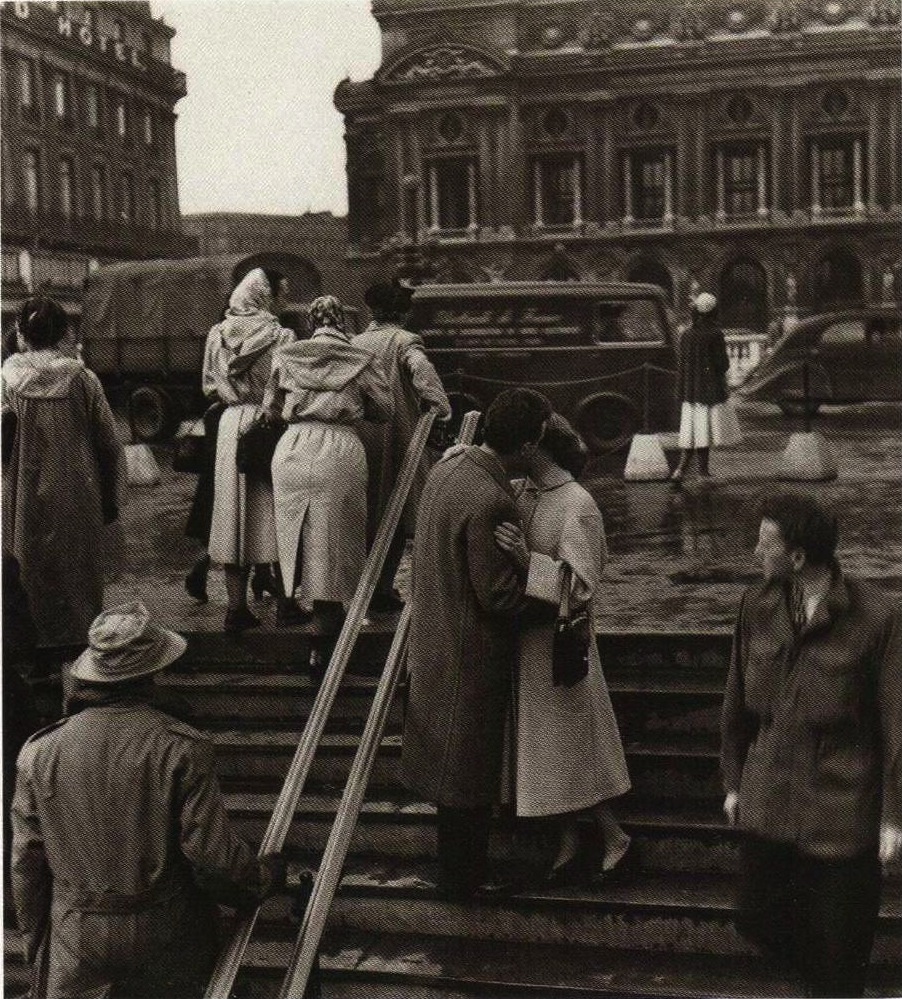
And for those eagle-eyed art lovers amongst you, you may recognise the scene which these two Norms now recreate. It is, of course, based on the famous photograph, Le Baiser de l’Hotel de Ville, by celebrated French photographer Robert Doisneau. Last Valentine’s I recreated another of his famous kiss photographs from the 1950s on canvas, in Norm-style. Here is that painting, and the Doisneau’s originals.

Le bazier de l'opera (after Doisneau) (acrylic on canvas, 2012 © Nicholas de Lacy-Brown)

Le baiser de l’opera (after Doisneau) (acrylic on canvas, 2012 © Nicholas de Lacy-Brown)

The Doisneau original

and the Doisneau original

Happy Valentine’s day to all and everyone, especially those celebrating the manifestation of an equal right to love and marry, at last.

Painting Parliament: Turner, Monet and Me

It’s not only an icon of London, recognisable around the world twice over, but it’s also one which I pass every working day. The Houses of Parliament in London is at the beating heart of the city. We set our clocks by the familiar chime of it’s big ben bell, we pass souvenir stalls packed full of paraphernalia containing the image of building, and we can see the soaring bell tower, now named Elizabeth Tower, from far across London. Yet we are all guilty of taking the Palace of Westminster, a.k.a. the Houses of Parliament for granted. When I emerge from the tube every morning, I do so directly opposite the great gothic palace, but never stop to take in its majesty, despite the hundreds of tourists who are always collecting before it with their cameras ready.
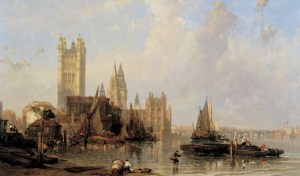
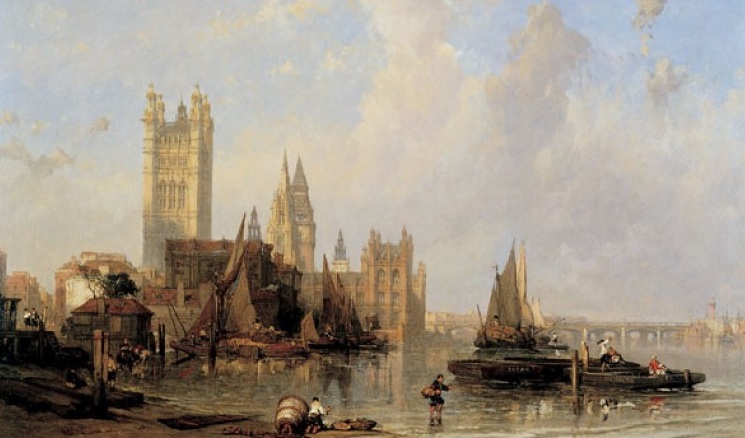
The Houses of Parliament from Millbank, David Roberts (1861) © Museum of London

The Houses of Parliament from Millbank, David Roberts (1861) © Museum of London

However all this changed when yesterday I headed up Elizabeth Tower to meet the great Big Ben first hand. Suddenly I have found myself looking at Parliament afresh. I even went into the Parliament bookshop and bought myself a souvenir or two (including a chocolate Big Ben – every visitor needs one). And all this had me thinking, the Palace of Westminster is such an impressive, iconic building, a masterpiece of architecture which is all the more perfect for its purposeful lack of symmetry, its miscellany of towers, spires and gothic ornamentation – no wonder then that the building has proved such an inspiration to artists over the years. And we’re not just talking any artists, but two of the greats. British favourite JMW Turner, and someone who, in a way, could be called Turner’s protege or disciple, father of the Impressionists, Claude Monet.

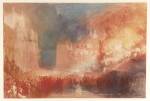
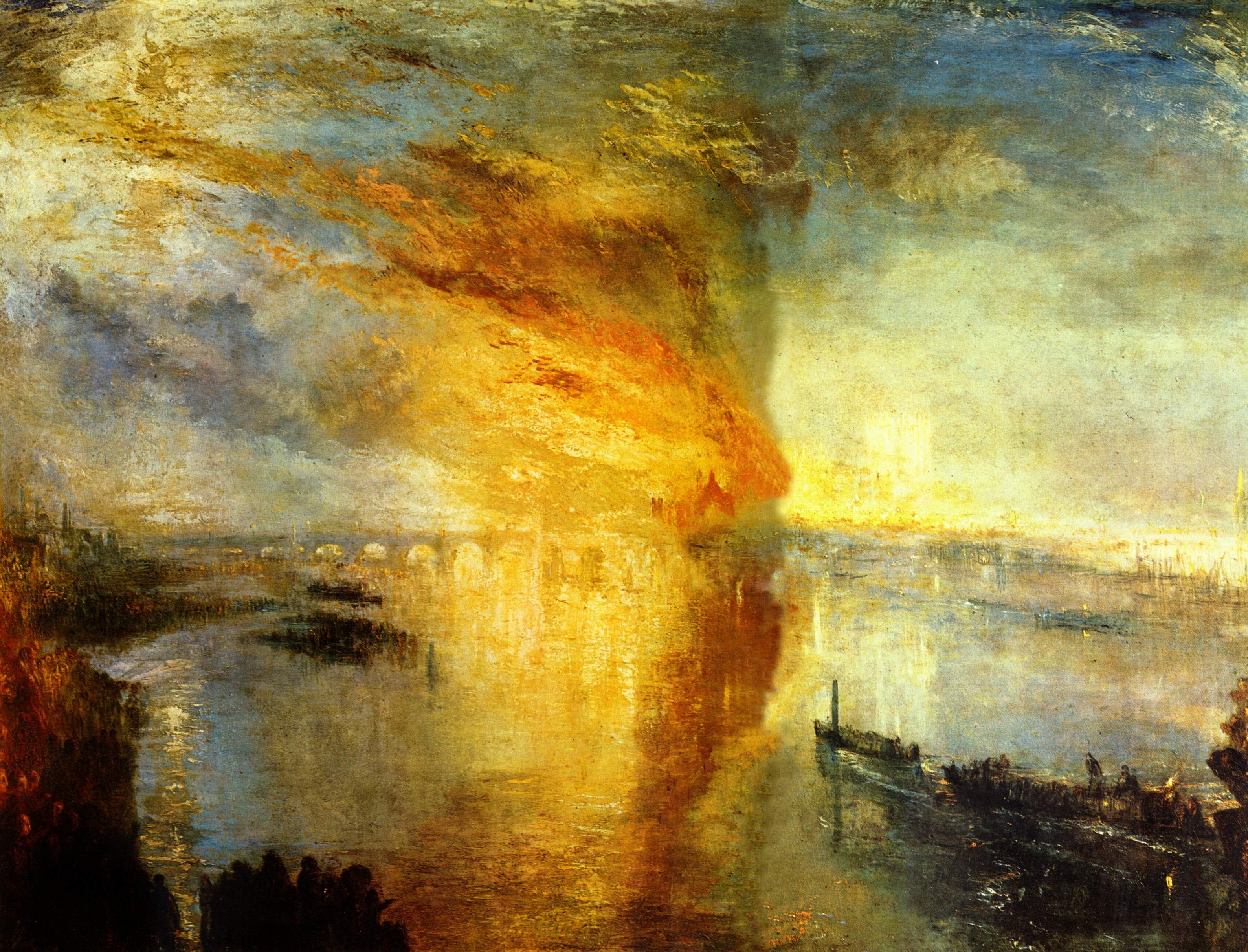
Both artist’s depictions of the Palace of Westminster have become iconic images of Parliament, but are also invaluable depictions of the building’s chequered history. For when Turner painted Parliament, he did so at a crucial point in its history – the day when Parliament was destroyed by fire: 16 October 1834. The fire, which ravaged the palace, gutting almost everything but Westminster Hall, proved inspirational to Turner. Already renowned for capturing the effect of light and smoke, almost impregnable foggy landscapes and turbulent great storms, Turner, who witnessed the great fire raging first hand, was evidently captivated by the gigantic inferno, pouring billowing smoke and red-hot flames high into the sky above the Thames.
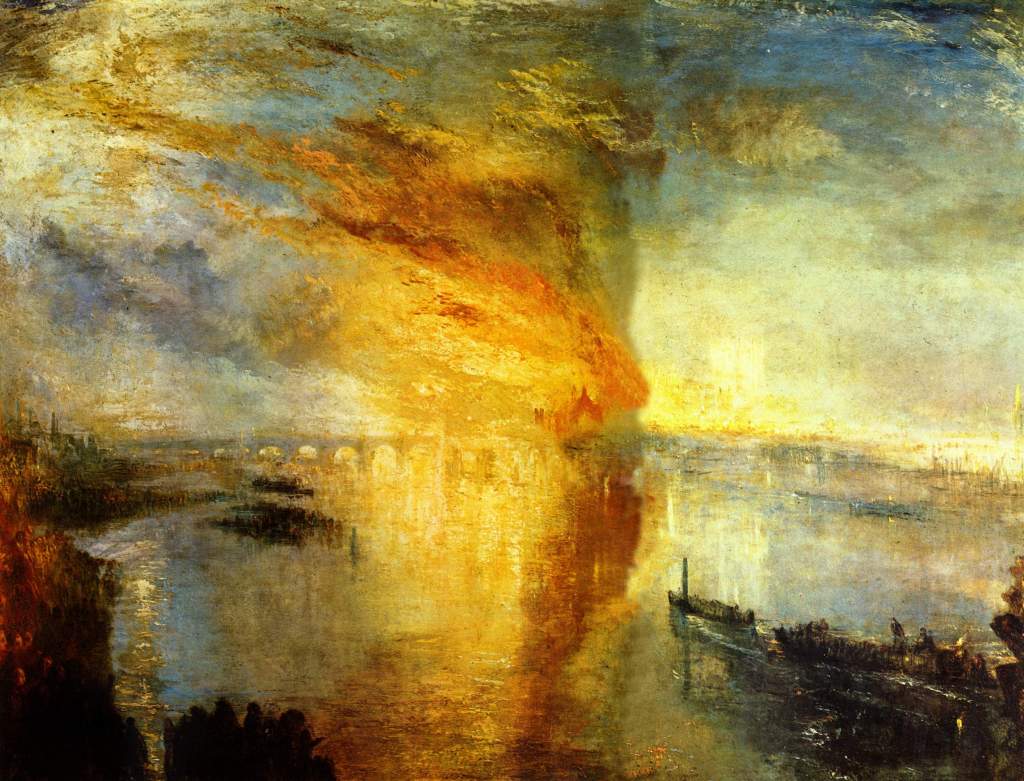
J M W Turner, The Burning of the Houses of Lords and Commons, 16th October, 1834 (1835)

J M W Turner, The Burning of the Houses of Lords and Commons, 16th October, 1834 (1835)

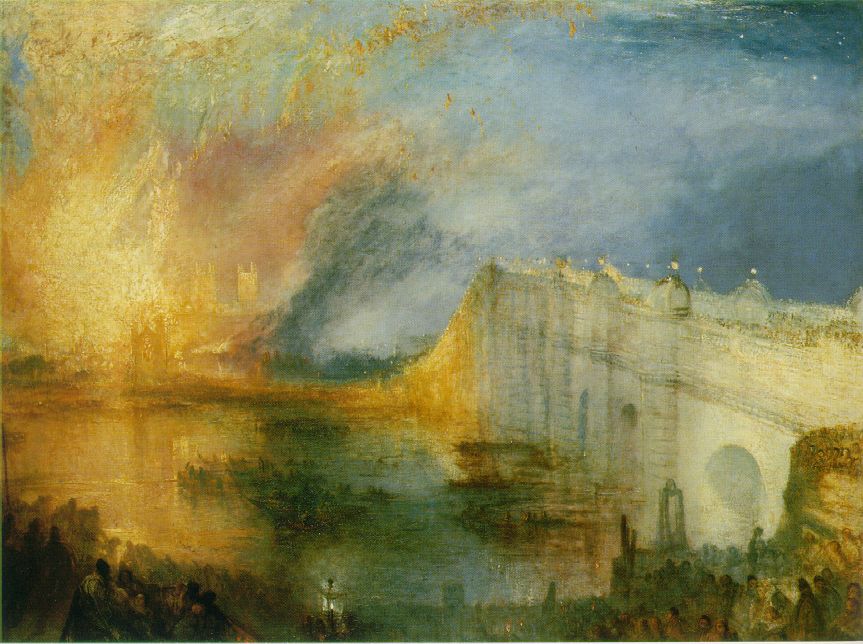
J M W Turner, The Burning of the Houses of Lords and Commons, 16th October, 1834 (1834-5)

J M W Turner, The Burning of the Houses of Lords and Commons, 16th October, 1834 (1834-5)

The canvases which result (the first held by the Cleveland Museum of Art, and the second by the Philadelphia Museum of Art) are brilliant, dramatic depictions of the fire, demonstrating the devastating extent of the inferno as it climbed high into the sky contrasted with the small shocked witnesses in the lower foreground. I love, in the second, the subtle silhouette of Westminster Cathedral glowing before the flames of its now burning neighbouring palace, and the huge column of fire rising dangerously high in the first.

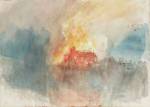
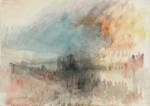
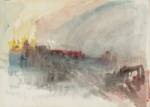
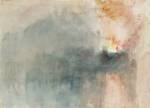
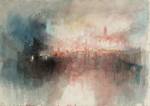
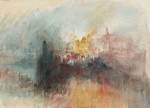
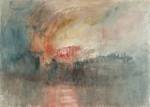
Turner was evidently more than inspired. A series of watercolour sketches (pictured below), which appear to have been sketched roughly at the scene or shortly afterwards, are a striking record of the almost undefinable power of the fire, as the light and heat of the inferno blurs and tempers the city surroundings. These watercolours, which were bequeathed to London’s National Gallery and are now held at Tate, are so instantaneous in their quick creation that they start to look almost abstract in their composition while retaining a powerful contrast between glowing super-hot heat and the foggy smokey surrounds. It’s an effect which is brilliantly executed for such a loose and uncontrollable painting medium as watercolour.

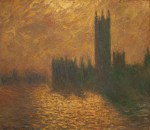
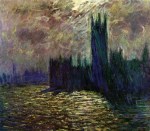
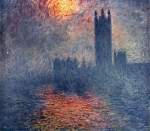
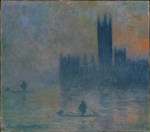
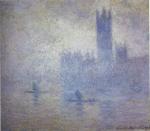
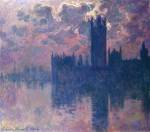
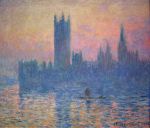
But perhaps the most famous paintings of the Houses of Parliament are those depictions by impressionist master, Claude Monet. Monet, too, was evidently inspired by the elegant gothic structure which, by the time he visited London twice, once seeking safe haven during the Franco-Prussian war in the early 1870s and again at the beginning of the 20th century, had been rebuilt into the structure we know and love today.
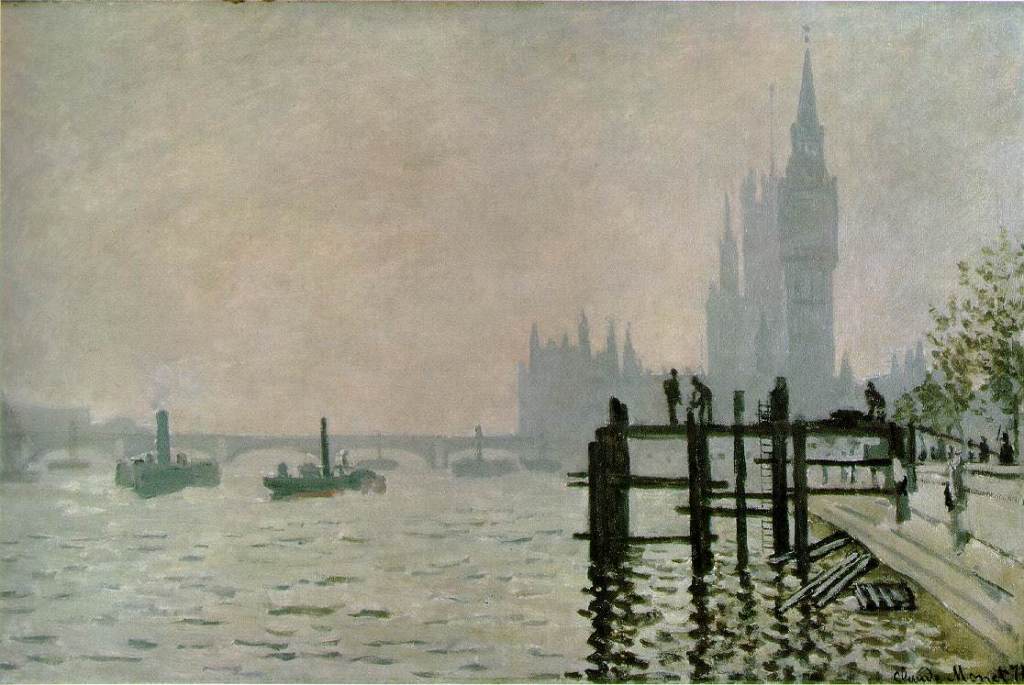
Claude Monet, The Thames at Westminster (1871)

Claude Monet, The Thames at Westminster (1871)

But for Monet, who was, by his own admission, greatly inspired by Turner’s expression of light and changing weather, the real inspiration appears to be not so much the Parliament building itself, but the varying effects of weather, light and city smog upon the building. While his first depiction of Parliament (above) is a fairly detailed depiction of the Thames at Westminster, showing the intricacy of the Palace of Westminster, albeit somewhat faded into a smoggy urban background, his later series of Parliament paintings concentrate far more on the changing light of London than on the landscape itself.

The results are a stunning series of works. The quick application of paint, no doubt painted in a great rush to capture the changing light as was Monet’s obsession, is so energetic and alive that the Palace appears to quiver before our very eyes, the effect of the smog and river mist undulating and turning over the surface of the canvas, capturing in turn the light as it filters through the layers of cloud and vapour. It’s hard to choose between these depictions, all of which are equally evocative of another stage in Parliament’s history, when London was almost chocked with poisonous noxious gases and a horrible river stench. But oh what a beautiful effect it had once captured by Monet’s hand.

Finally, we turn to the modern day. The Houses of Parliament continues to delight Londoners and tourists alike, stood proudly adjacent to the River Thames, and surrounded not by city smog, but by a thriving bustling capital city and, every 31 December, a firework display to rival all others across the world. Yet still, the character of the building changes, and its mood metamorphoses, as weather and light cast transformative moods upon this spectacular structure.

On one such day, when menacing clouds began to break apart, and blue sky and a winter sun peeked out from behind the cover of cloud directly above the great gothic structure, I, like Monet and Turner before me, was captivated by the stunning view before me, and all the more so for the doubling of the image thanks to the reflective image in the river below it. Some time later, I took out my brushes, oil paints and a canvas and painted that view I had seen – it was in fact one of the first oils I had ever attempted. And here it is. It’s no Turner or Monet admittedly, but it is my own painted homage to the power and glory of London’s Houses of Parliament.

Cityscape I: London (2012 © Nicholas de Lacy-Brown, oil on canvas)

Cityscape I: London (2012 © Nicholas de Lacy-Brown, oil on canvas)

Autobiographical Mobile: My painting diary – Day 16 and a half: The Caravan

Very occasionally, when I get home after work early enough, and when I am not totally exhausted from the daily grind of London living, I may take out my paintbrushes and indulge in a little evening painting. I find it difficult to dip in and out of my art work like this, not least because it always takes me a while to get back into the swing of painting after a break of even a few hours, but equally, taking the time out in a busy week for a little creativity can only be a good thing.

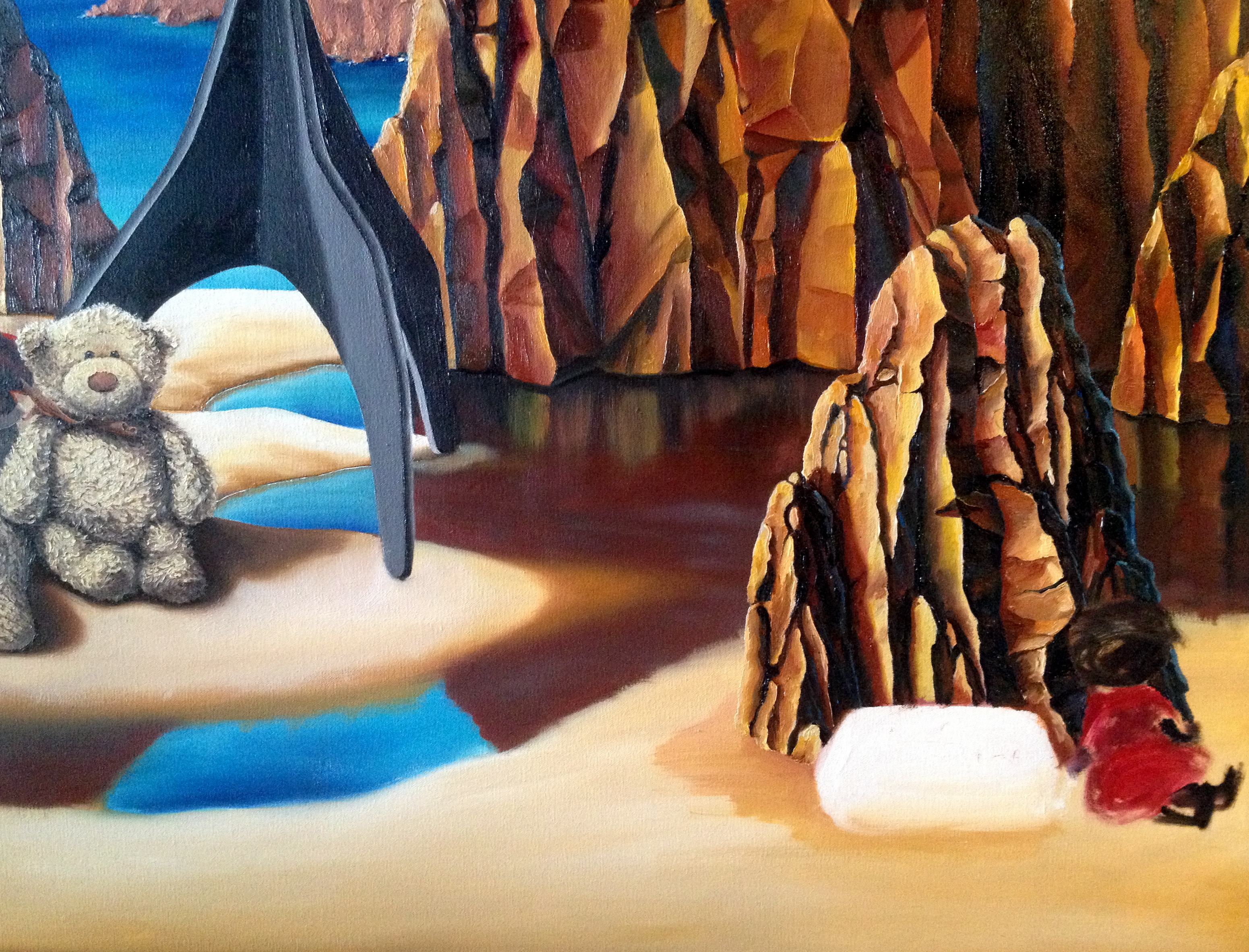
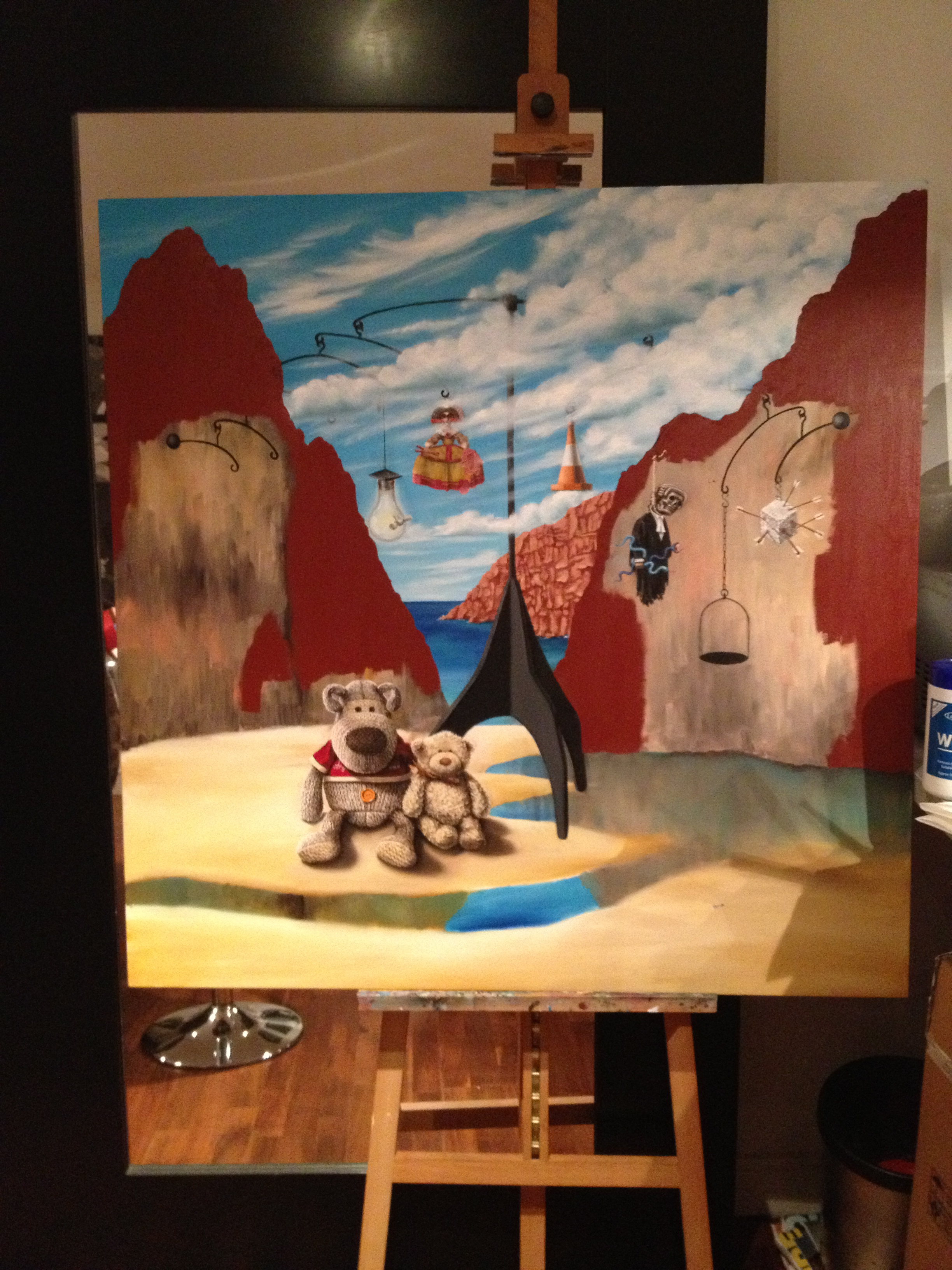
So my recent addition to my autobiographical mobile painting wasn’t really a day’s work as such, more of a half-day effort (or less). However what I painted was no less important for the quick few hours in which it was created. Following on from my weekend’s work on Enid the Golly, I went on to fill in that mysterious white box to the left of her: My family caravan.

IMG_3101

Not our caravan, but one just like it.

Not our caravan, but one just like it.

I think it’s fair to say that caravan holidays aren’t perhaps as trendy as they once were, back in the 70s and 80s when British families were only really starting to dip their toes into the great brave new world that is foreign travel. While the tourist boom was only starting to implode across the globe, for many of us, like my family, the comforts of familiar surroundings, driven on wheels from one holiday destination to the next was both a more economic and convenient holiday solution. The holidays taken by my parents, sister and I in our caravan, largely in the likes of the New Forest and the Isle of Wight, were some of the best of my childhood. Simpler holidays, but imbued with so many rich, sensuous memories, such as evening walks through the sun-warmed english countryside, returning to the slightly dewy damp caravan to cosy beds made by my mother from the easily converted sofas, setting aside bunches of freshly picked wild flowers, and settling down to the sultry sounds of country wildlife and the faint smell of now smoldering barbeques from neighbouring caravans; the family meals around the collapsible table, eating off our plastic caravan crockery emblazoned with a merry strawberry design; and those occasional days when, faced with grizzly British summer rain outside, we all gathered in the caravan to watch the likes of Wimbledon on the crackling old TV.

The caravan, painted.

The caravan, painted.

But beyond the holidays, the caravan was also hugely important to my academic progression. In term times, we used to park the caravan on our driveway, and in it I would sit, studying away for hours at a time, turning the caravan into my makeshift study, providing me with the perfect solitude in which to concentrate. I credit that caravan as being one of the reasons why I was able to do so well at school.

Sadly, the caravan is gone now, sold some years ago when we used it no longer, when a house in Spain took over our affections, and the physical strain intrinsic in camping became too much for my parents. But that caravan, its sights, its smells, is still so familiar to me, so inextricably a part of the fabric of my childhood that this biographical painting would not be complete without it.

The painting at its current stage

The painting at its current stage, complete with caravan

So I give you, our family caravan.

Until next time.

© Nicholas de Lacy-Brown and The Daily Norm, 2001-2012. Unauthorized use and/or duplication of the material, whether written work, photography or artwork, included within The Daily Norm without express and written permission from The Daily Norm’s author and/or owner is strictly prohibited. Excerpts and links may be used, provided that full and clear credit is given to Nicholas de Lacy-Brown and The Daily Norm with appropriate and specific direction to the original content.

Autobiographical Mobile: My painting diary – Day 16: Water reflection and Enid

The 2013 return to my latest large-scale painting is well and truly kick-started now. After last week’s update on the progress of my autobiographical mobile painting, I am now able to report on another day’s technical painting work on the canvas which has taken over my artistic output for the last 9 months.

Day 16 of work saw me concentrate on the lower right-hand corner of the panel. There, having completed my large cliffs, it was now time to undertake the rather arduous chore of reflecting the cliffs into the pool of water below. I like this watery area… it has a sense of darkness and mystery for me, a bit like a large lake in a cave, a sense which is no doubt heighted because of the vast area of hostile rock face above.

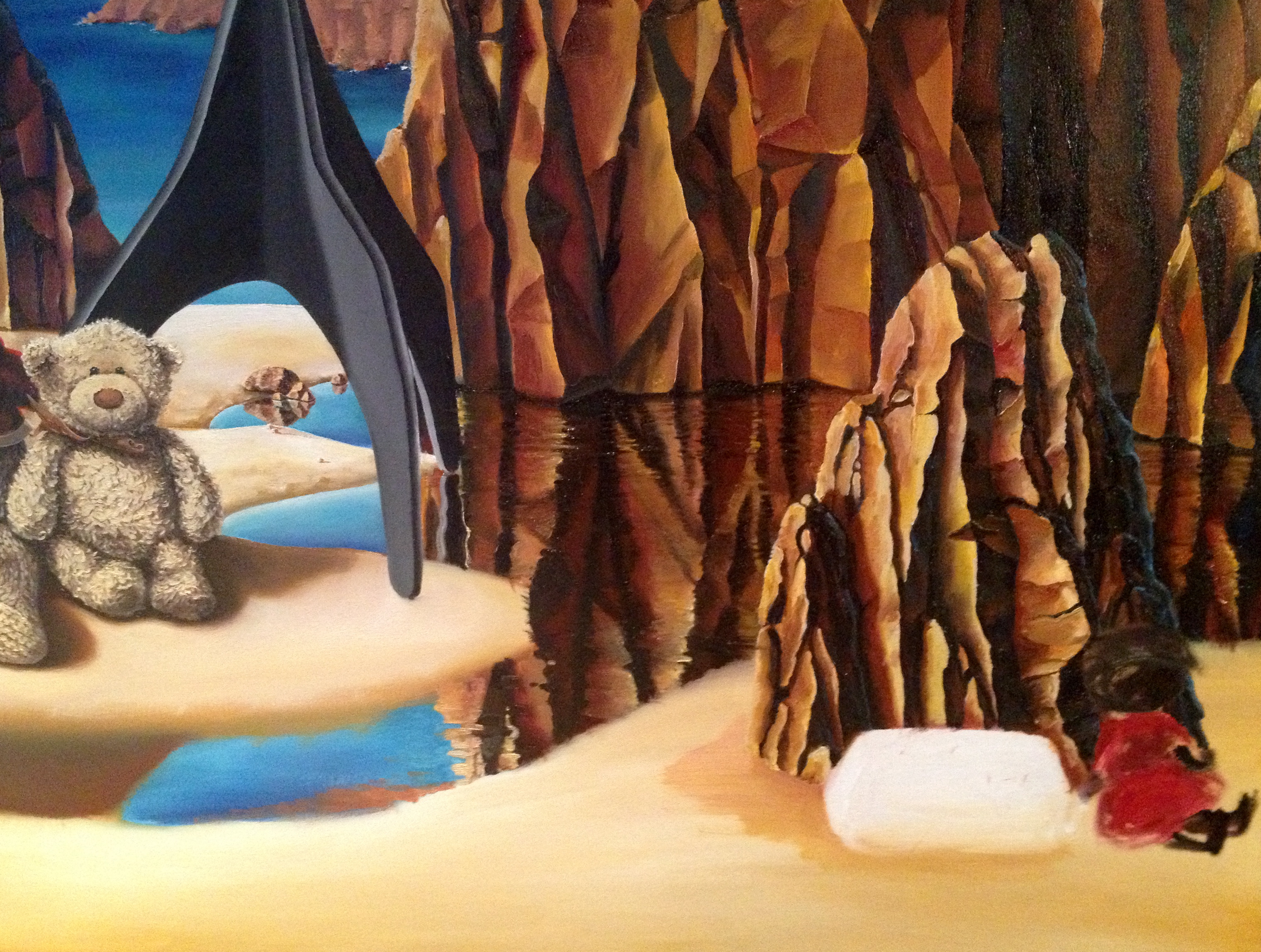
IMG_3034In order to undertake the reflection, I started by practising a very small rock area in one of the little pools in the centre of the canvas (I anticipate that there will be a fair few rock pools by the time the canvas is finished). Having tested the art of reflection in that small area, I went on to the vast reflection of the right-hand cliff. It’s not easy to repeat what you have painted before, but all the more so to do so in reverse, as a reflection requires. It requires you to almost go back on yourself, to flip over every angle and to mirror every shade and colour, while ensuring that proportions are kept the same.

It took me most of the morning to repaint the cliffs in the pond. Once finished, I achieved what looked to me like a mirror reflection, but was not watery enough. The distinction between water and a mirror of course in the propensity of water to move, and therefore even on a still day, the reflection in water is bound to be distorted compared with a normal mirror reflection. Deciding that I’d give my scene a gentle sea breeze, I set about distorting my reflection with various ripples, many of which I created through dragging a dry brush over the surface of what I had just painted. This was a slightly scary moment, especially when I’d just spent the whole morning meticulously painting the reflected area. And of course if I got this bit wrong, the smudges of dark and light oil paint would dirty the canvas and it would be sometime before I could correct it.

At the beginning of the day

At the beginning of the day

First stage of reflection done

First stage of reflection done

Made into a watery reflection

Made into a watery reflection

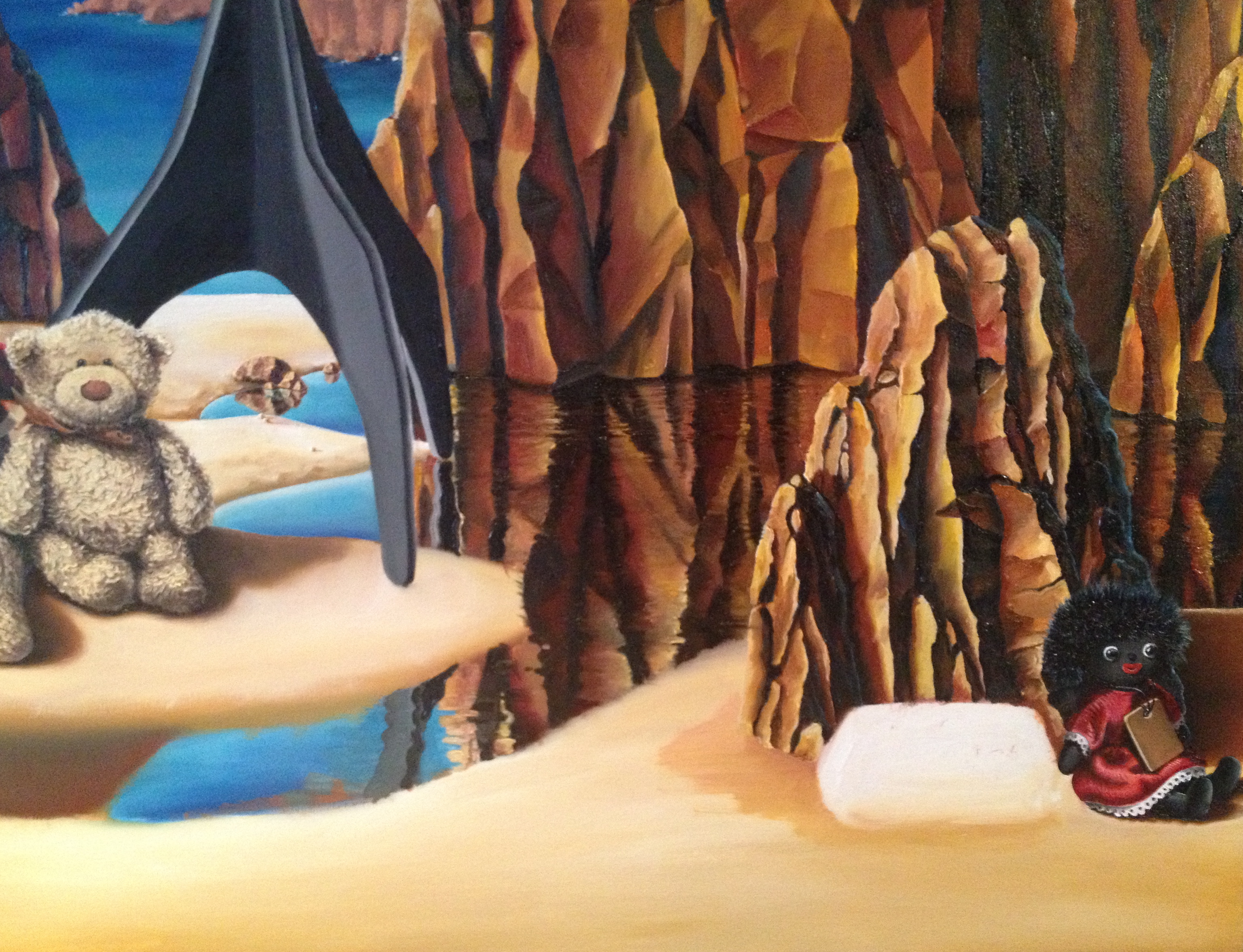
Sufficiently pleased with my watery reflection for now (it will undoubtedly change as other details of the image materialise and alter), I moved on to a detail at the foot of the canvas. While Bilbao and Fluffy, my teddies at the centre of the canvas, represent myself and my partner (they were our gifts to each other at the early stages of our relationship and now follow us around the world), Enid, the little “golly” down on the right, is a representation of my mother, and my childhood.

Enid in reality

Enid in reality

My mother, who herself has a large collection of gollies, some from her childhood, gave me Enid for a birthday present some 10 or so years ago. I was so pleased with her, I used to take her travelling with me. That was at least until travelling with a golly aroused too much anxiety on my part – This was in part because people displaying gollies in their windows have been arrested and accused of racial hatred… Is this the world gone “politically correct” mad? Perhaps so, and frankly it’s not a debate I want to entertain on my art blog, but all I know is that I grew up with gollies being to me, at most, as harmless as teddies and barbie dolls. My sister and I used to have golly picnics, where we would gather all the family’s gollies together and picnic with them, like your typical teddybears’ picnic. And I used to collect golly badges which one could only obtain having collected a sufficient number of vouchers from the jars of Robertson’s Jam. They are, needless to say, no longer available, but perhaps for that reason I alone, I prize my collection.

IMG_3057 IMG_3058

So in representing both my Mother, and my childhood, Enid is an integral feature of this autobiographical canvas. She’s all finished now, save for her label, to which I will add writing when the paint is dry.

Enid completed

Enid completed

And that was my day’s work. More to come, I hope, soon.

© Nicholas de Lacy-Brown and The Daily Norm, 2001-2012. Unauthorized use and/or duplication of the material, whether written work, photography or artwork, included within The Daily Norm without express and written permission from The Daily Norm’s author and/or owner is strictly prohibited. Excerpts and links may be used, provided that full and clear credit is given to Nicholas de Lacy-Brown and The Daily Norm with appropriate and specific direction to the original content.

Autobiographical Mobile: My painting diary – Days 8-15: The sky and the cliffs

It’s been a long time since I last posted the progress of my Autobiographical Mobile painting – the large canvas on which I am painting something of a representational narrative of my life. The reason for this absence is not forgetfulness, more a lack of time to paint. Such is the continuous treadmill of modern life, that time to paint becomes slimmer and slimmer, and as daily work predominates the days of the week, its potential to sap at my creative energies extends further still, into the evenings and the weekends. I find it hard to paint on these dark winter’s evening, working in artificial light, when hunger pangs in my tummy and fatigue pulls at my eyelids. And at the weekends I find my time is filled with the many menial activities for which the week no longer allows time. And so my autobiographical mobile, itself a rather ambitious task, is taking its time to develop. Nevertheless, since I last featured the painting in October, some significant changes have manifested.

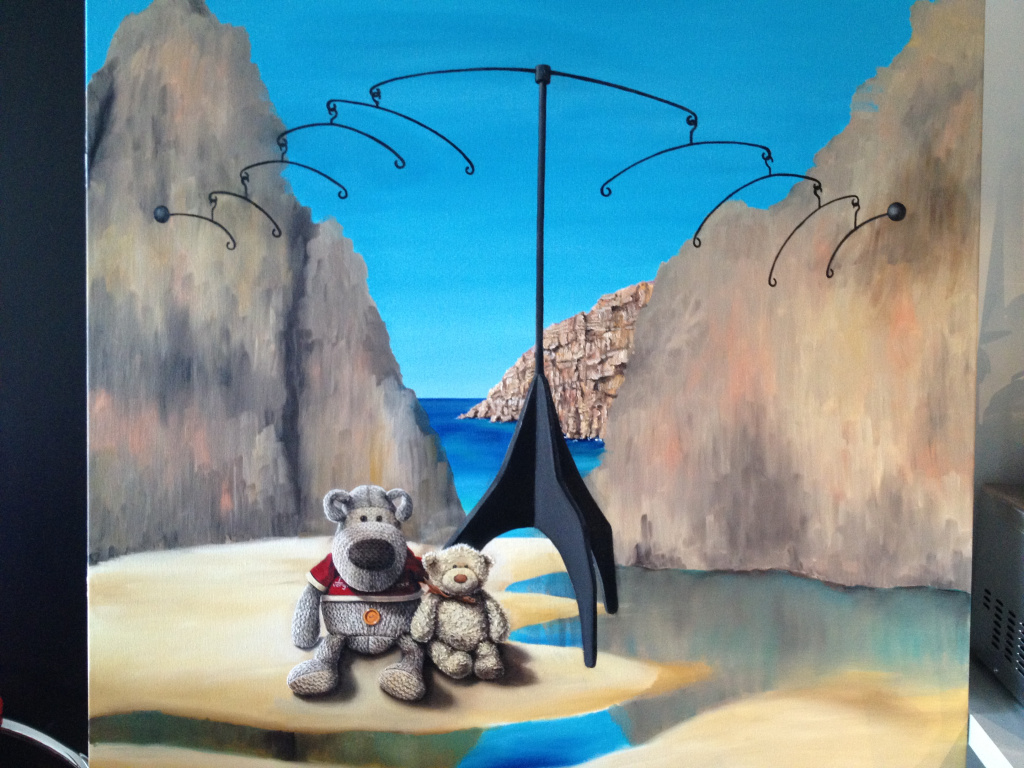
The painting after Day 1

The painting after Day 1

And with the "Calder" mobile, Fluffy and Bilbao

And with the “Calder” mobile, Fluffy and Bilbao

One benefit of having a painting slowly develop, hanging around my home from week to week, is that I have more time to contemplate its development. It was during the autumn that I developed a growing sense of unease about the work, finding gradually that the colours did not work. The pastel shade of the cliffs was too insipid, and the sky lacked depth. Both had to change.

So as I set to work on the painting after some weeks of rest, I first tackled the sky. Even though this meant largely undoing much of the work I had completed on the “Calder” mobile, I found the addition of clouds gave the flat blue sky more depth, more character and a greater balance.

The sky with the addition of clouds (and further work to the articles hanging from the mobile)

The sky with the addition of clouds (and further work to the articles hanging from the mobile)

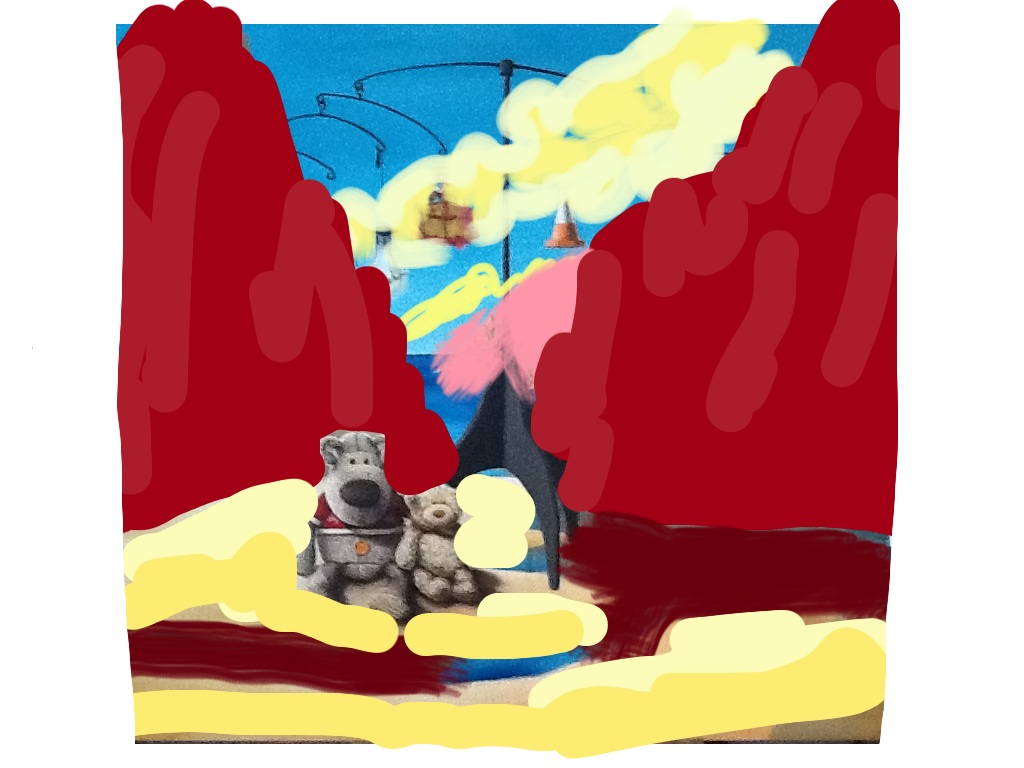
Satisfied now by my sky, I turned to the cliffs. It is one of the great benefits of modern technology that I can plan the direction of my painting midway through its progress, without even touching brush to canvas. With the aid of a paint application on my iPad and some very quick finger work, I was able to try out several new colour schemes with a view to assessing how the work would look with a bolder colour palate. I knew the insipid pastels of my background were no longer working with the bold modernist contrast of my central mobile, but I wasn’t sure which colour direction to take with the background. Here were a few iPad ideas…

photo image image1

In the end, opting for a richer brown-red cliff face, I set about covering the pinkier pastels of the pre-existing background. Just applying a plain coat of Indian Red required me to carefully paint around the already completed elements of my mobile and autobiographical symbols.

IMG_2511

With a new base coat applied, and much more satisfied with the richer colour balance upon my canvas, I set about working on the textural surface of my cliffs. Part inspired by the cubism of the early 20th Century, and wanting to create a more jarring, robust environment for my slightly surreal beach scene, I found myself drawn to create a multi-textured cracking, angular surface from a rich array of reds, browns, oranges and beiges. The total surface of the vast cliffs took me several days to complete, and even now I am forever changing and rebalancing sections.

IMG_2533

For the final touches of my cliffs, I added a number of large, self-standing almost obelisk-like boulders, increasing the detail and textural variance of these rocky surfaces the closer they got to the foreground.

The finished cliffs

The finished cliffs

At the end of all of this, I started to repaint my mobile structure, now much abused by the reinvention of the background all around it. Finally with the cliffs done, I can turn to the sand, the pools, and the all important mobile and the items which, hanging from its various tendons, will tell my story.

Until next time.

Norms do… Dalí

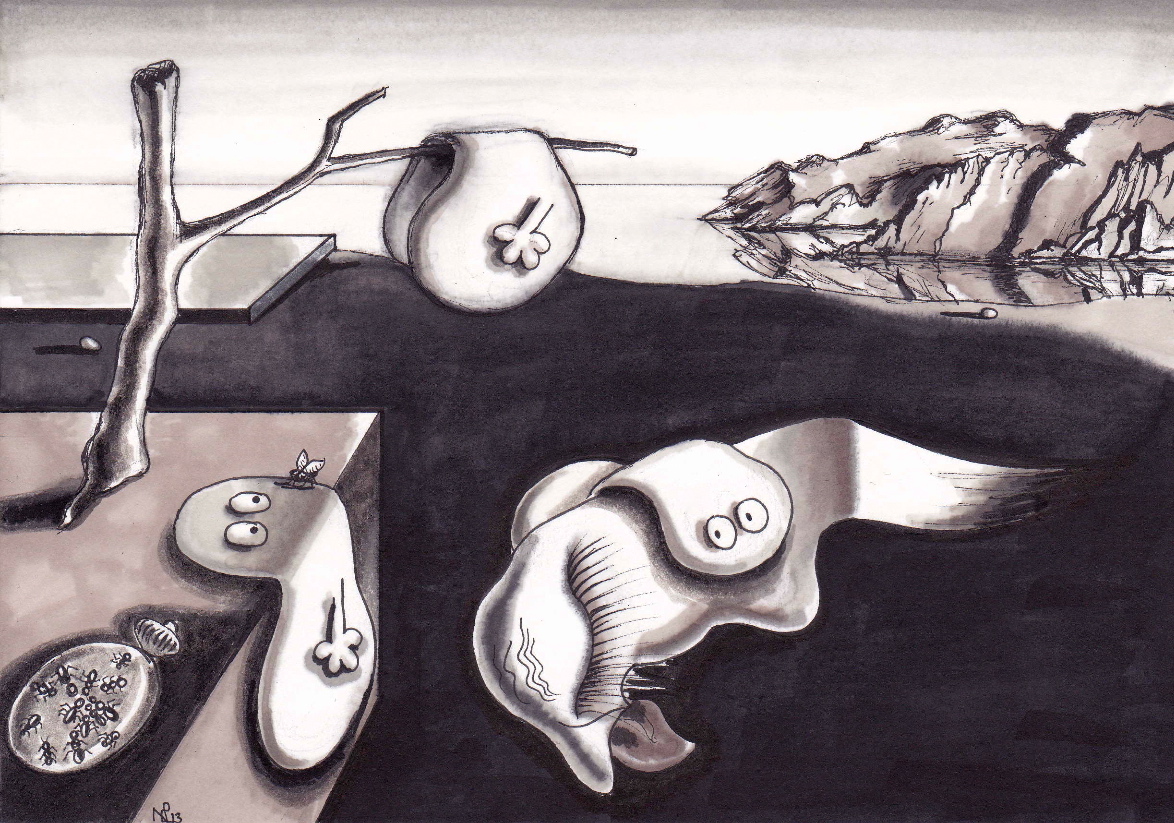
In a strange distant land, almost like the manifestation of a dreamlike unreality, where sharp craggy cliffs are reflected into the mirrored surface of a completely still ocean, and lone eggs cast elongated shadows into the bleak night, three Norms are left flattened, distorted, and almost draped over a series of nonsensically placed objects. Like overly ripe camembert or a floppy wet sardine, the Norms have been reduced to near 2-dimensional formulations of their once rotund gelatinous anatomies, bending and flopping over the inhabitants of this mystifying land: a morphed bird-like manifestation, a bleak, apparently root-less tree, and a cubic structure set like a stage for a nonexistent theatre troop. No one is clear why they are there, or when they will go, but in this eery, intransigent episode, one thing is clear: this milieu has no timescale, no locus, sense of rationality or reason, other than to clarify one indubitable observation: the Persistence of Normativity.

The Persistence of Normativity (after Dali) (2013 © Nicholas de Lacy-Brown, pen on paper)

The Persistence of Normativity (after Dali) (2013 © Nicholas de Lacy-Brown, pen on paper)

Confused? Who isn’t, but since the Norms have been suitably inspired by Salvidor Dalí’s The Persistence of Memory, they thought a Delphic description was suitable to narrate this inconclusively surreal scene. Replacing Dalí’s famous melting clocks, these Norms fill the scene suitably, with their lucid organic forms, yet retaining all of Dalí’s characteristic inclusions, from the eggs and the craggy landscape of his home town, Cadaqués, to his ants, his flies and his strange bird-like forms. This is pure Dalí, with a little spice of Normativity.

© Nicholas de Lacy-Brown and The Daily Norm, 2001-2012. Unauthorized use and/or duplication of the material, whether written work, photography or artwork, included within The Daily Norm without express and written permission from The Daily Norm’s author and/or owner is strictly prohibited. Excerpts and links may be used, provided that full and clear credit is given to Nicholas de Lacy-Brown and The Daily Norm with appropriate and specific direction to the original content.

Norms do… Hopper’s Nighthawks

The streets of the city are deserted. Not a soul stirs, even the birds have gone to bed for the night. The roads are traffic free, and the shops are shut up. But turn the corner and a strange glaring light bounces off the blackened windows of the building opposite – it is the light and the long shadows, cast like a jarring artificial human invasion upon the darkness of nature’s night time veil. This is the intrusion of the night cafe, the all night American diner, hangout of the lost and lonely, last retreat for those Nighthawks who are unable to sleep.

In Normies diner, three enigmatic norm figures sit at an otherwise deserted bar, served by the one lone bar tender who has drawn the short straw of the night-shift. Their stories are a mystery, their relationships even more so. Do these Norms know each other, or is it a coincidence that three such Norms should stare, so passively into the night, caught in the confines of their own introspective imagination. Are they in trouble? Why can’t they sleep? They’re questions which will remain forever unanswered as we glimpse, unbeknown to the Norms, into the world of their solitary nighttime shadows.

The Nighthawk Norms (after Hopper) (2012 © Nicholas de Lacy-Brown, pen on paper)

The Nighthawk Norms (after Hopper) (2012 © Nicholas de Lacy-Brown, pen on paper)

This Normy scene if of course based on Nighthawks by Edward Hopper. With its enigmatic narrative and uncomfortable conflict between darkness and light, Nighthawks is easily Hopper’s most famous painting, and one which I was delighted to have met face to face at the recent Grand Palais exhibition in Paris. Now of course the Norms are inspired, and it’s only reasonable that they should want to recreate Hopper’s most well-recognised image.

(Upon creating it, I (the Norms’ illustrator) soon realised just how complex this painting of Hopper’s is – full of steep angles, and a superb perspective, I had to work hard with my pencil and ruler before I even got started on this one – so many straight lines to map out, so many angles to get right. And then there were the shadows and his excellent contrast between lightness and dark – difficult to achieve in black and white pens, although not impossible – Hopper’s own lithographs and etchings, also on show in Paris, demonstrated that much. I hope you enjoy the result.)

© Nicholas de Lacy-Brown and The Daily Norm, 2001-2012. Unauthorized use and/or duplication of the material, whether written work, photography or artwork, included within The Daily Norm without express and written permission from The Daily Norm’s author and/or owner is strictly prohibited. Excerpts and links may be used, provided that full and clear credit is given to Nicholas de Lacy-Brown and The Daily Norm with appropriate and specific direction to the original content.

Paris: la visite d’art – Exhibition 3: Salvador Dalí

I have waited my whole life for the latest retrospective blockbuster at Paris’ Pompidou Centre – or at least the whole of my life since the momentous day when I first cast my eyes upon the work of Catalan artistic genius, Salvador Dalí. It was, I believe, his melting clocks, a painting which I first saw when the headmistress of my primary school showed us some projected images of the world’s most famous paintings. It was a defining moment of my life. In that collection was Monet’s garden, Van Gogh’s sunflowers and Dalí’s melting clocks. And ever since, I was hooked – hooked on art, but most of all, on the mysterious, unsettling, iconically surreal world of Salvador Dalí.

When you think of Dalí, you of course think of those clocks, of ants and eggs, crutches and long-legged elephants, Venus de Milo turned into a cabinet of draws, figures fragmenting like an atomic explosion, optical illusions, the lobster on a phone, barren landscapes and long dark shadows. It’s an incredible list of characteristics which Dalí made his own through images which have become so well known across the globe that there can be no doubting Dalí’s self-proclaimed accolade – that he was a genius. His paintings are so brilliantly executed down to the tiniest detail that the mind honestly boggles. The extent of his imagination is almost enough to make the brain implode, and yet when faced with his paintings composed with such faultless artistic skill, you cannot help but roam the canvas with your eyes hungrily, sucking in every exquisite detail, exploring the multi-layered imagery and baulking and the sheer audaciously brilliant output  of this creative prodigy.

The Persistence of Memory (1931)

The Persistence of Memory (1931)

Dream Caused by the Flight of a Bee around a Pomegranate (1944)

Dream Caused by the Flight of a Bee around a Pomegranate (1944)

The Great Masturbator (1929)

The Great Masturbator (1929)

Sadly, up until now, my love for Dalí has been lived out largely through the fair few catalogues I have of his work. I’ve taken in every detail of the four Dalí’s owned here in London by Tate on countless occasions, and done the same with the fairly comprehensive collection of the Reina Sofia in Madrid. I’ve visited Montmartre’s Espace Dalí on numerous occasions, but found it to be largely lacking in paintings, and I’ve been to a few surrealism-based shows in London in which one or two canvases have featured. But I have often bemoaned the lack of Dalí paintings in Europe and I have longed for an exhibition when many would come together.

DaliThe Pompidou have answered my prayers. This Dalí retrospective is nothing short of stunning. It is one of the best if not the best exhibition I have ever been to. The show isn’t a peripheral tribute to Dalí, but a comprehensive exploration of his entire career featuring an incredible 120 paintings all in one place, as well as sketches, sculptures, a recreation of his famous red-lipped sofa Mae West room and other paraphernalia. I was in heaven. The show’s curators appear to have acquired all of the works from Tate, and all those owned by the Reina Sofia, but most importantly of all, the exhibition brings together a huge collection of works which are hiding away over in the Dalí museum in St Petersburg, Florida, whose collection alone comprises some 96 paintings, and, most brilliantly of all, the globally recognised melting clocks themselves, all the way over from New York. Could this show get any better?

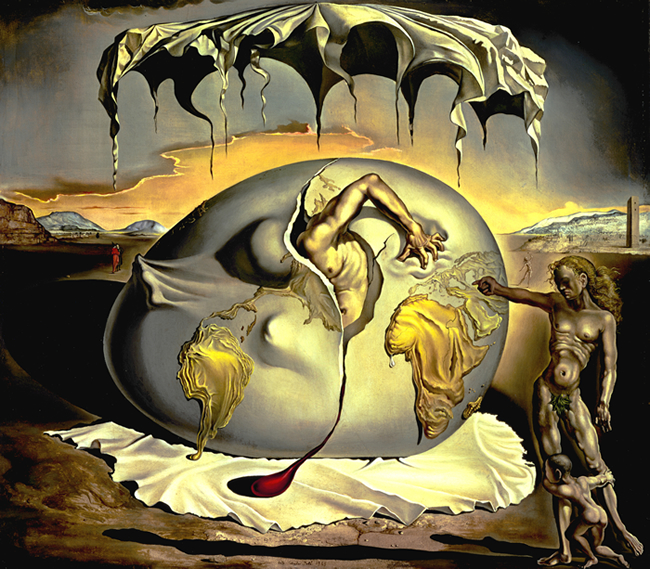
Geopoliticus child watches the birth of the new man (1943)

Geopoliticus child watches the birth of the new man (1943)

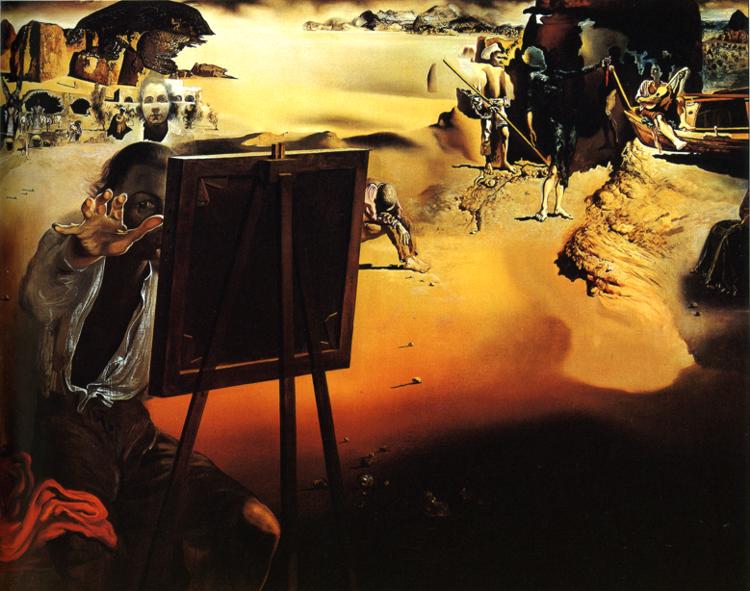
Impressions of Africa (1938)

Impressions of Africa (1938)

The exhibition starts with an egg – a large egg which forms an entrance to the first gallery and whose pounding heartbeat could be heard all the way down the corridor of the Pompidou’s 6th floor. It was like the warm up to a mega-star’s pop-concert, as the audience is whipped up into a frenzy in anticipation of the great star’s arrival onto the concert stage. And appropriately so, for there is no greater star of the artistic world, in my opinion, than Salvidor Dalí, and at the Pompidou, the stage was truly set.

Read more

Paris: la visite d’art – Les Photos

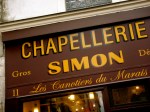
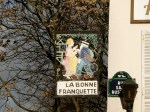
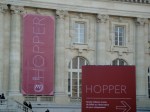
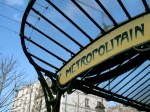
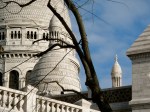
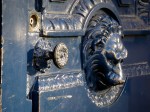
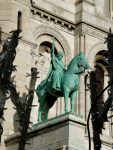
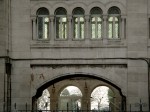
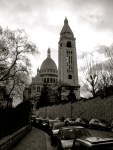
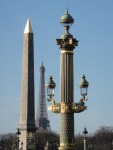
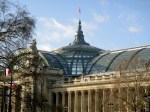
I’ve already mentioned that my recent trip to Paris had been justified on the basis that there were at least 3 tremendous exhibitions on show which I was bursting to see. But likewise, while I always try to rationalise my extravagance in visiting Paris as often as possible, for those who really appreciate the aesthetic beauty, the artistic perfection of life, I need justify this visit no further, nor indeed any other foray into this undeniably beguiling city. Just one look at my recent set of Paris photos is justification in itself. For where else on earth could a heaving, busy, pulsating capital city exhibit such indisputably captivating elegance? From its broad Haussmann boulevards and narrow cobbled streets, to the blue lacquered doorways and red wings of the Moulin Rouge Windmill, Paris is a paradise of unparalleled artistic ravishment, seducing every species of the creative collective within its fold.

DSC04858 DSC04656 DSC04595 DSC04612

I have taken so many photographs of Paris, and every time I visit, I think there cannot possibly be anything left for me to capture. And yet with each new visit, Paris proves that I was wrong to doubt, bounteous as it is with fodder for even the most seasoned photographer, constant inspiration to those who like me, cannot resist the temptation to immortalise this city in a thousand new shots at every turn of the corner.

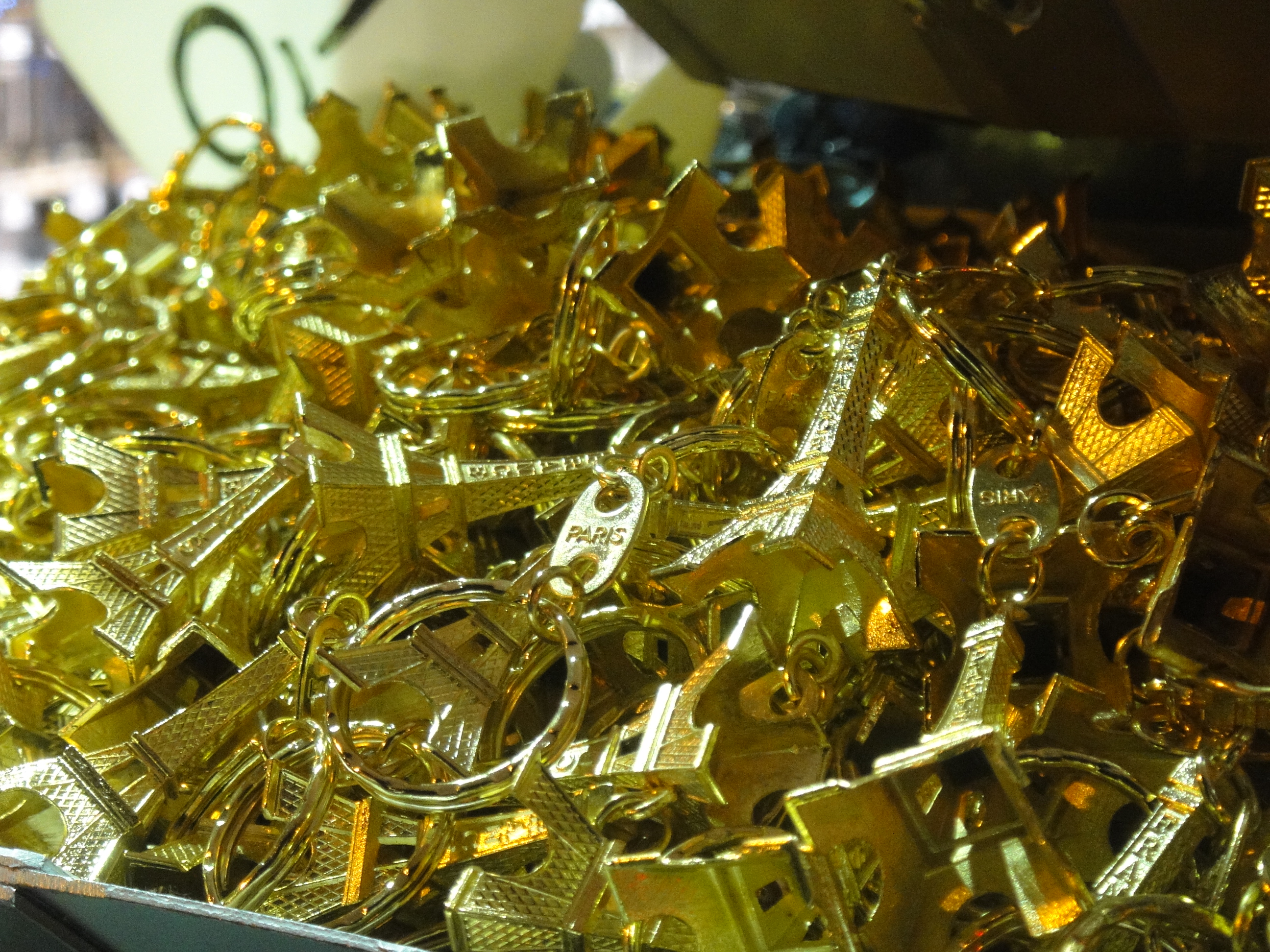
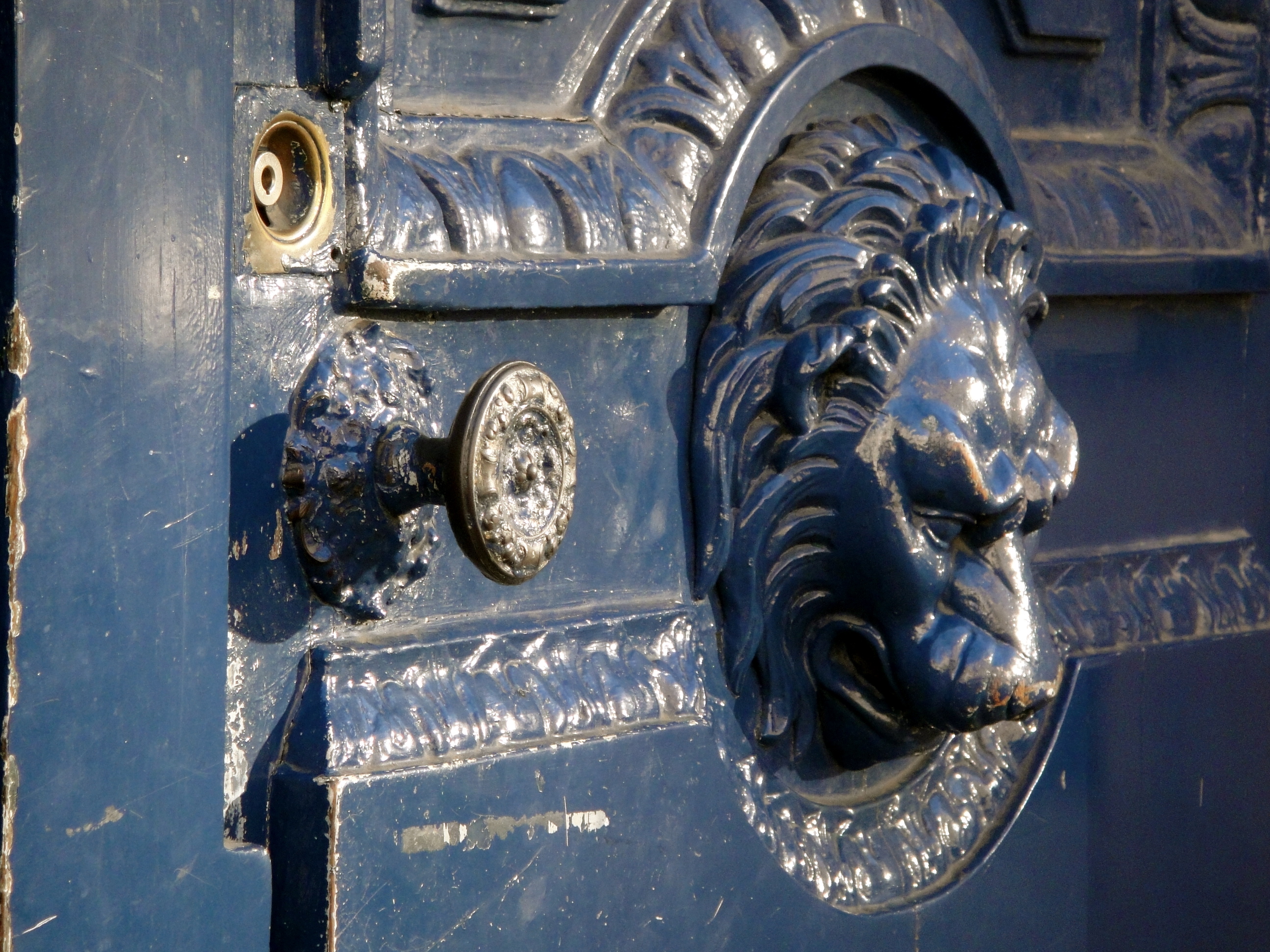
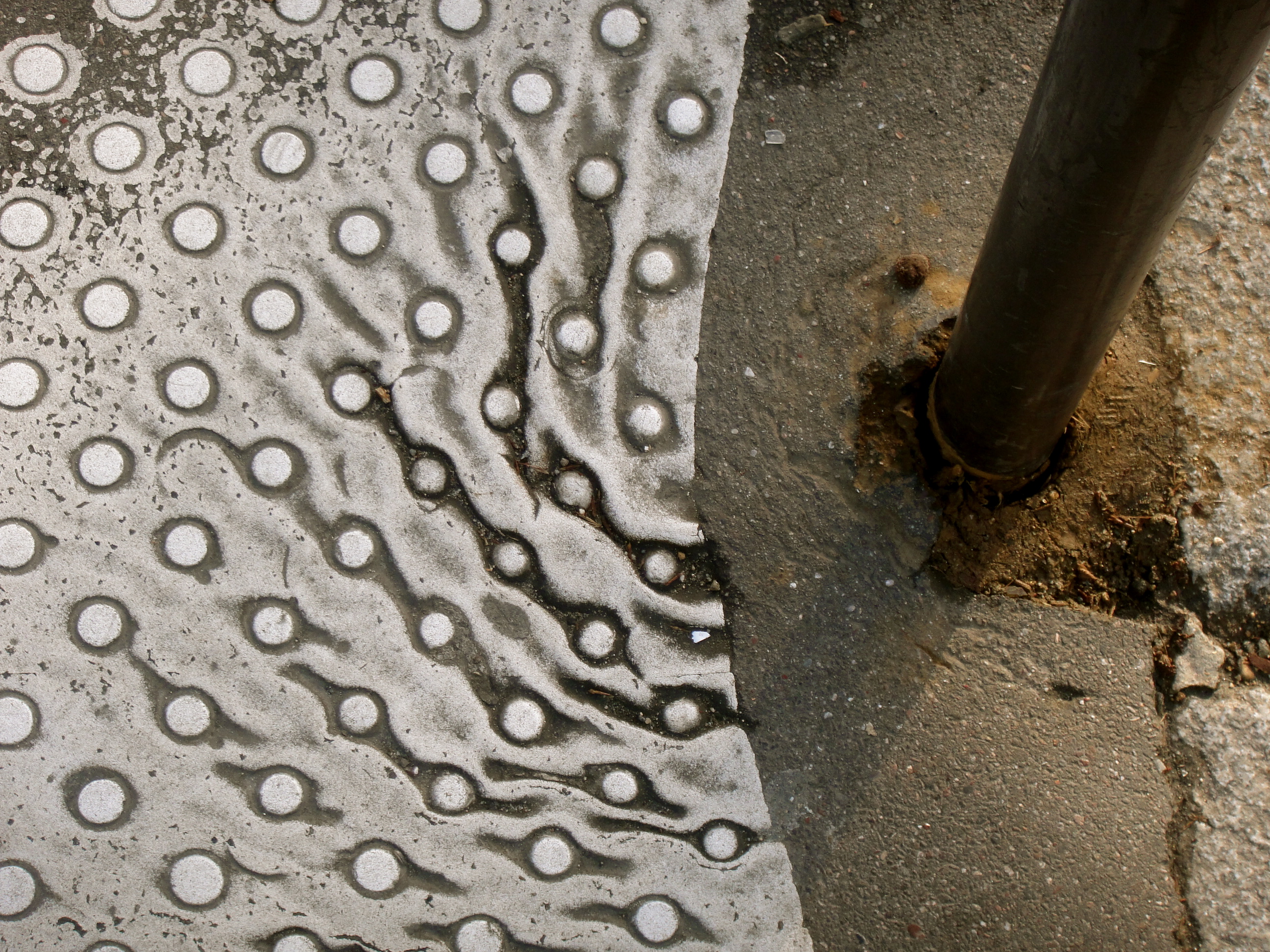
This time round I became freshly inspired by the quaint streets of Montmartre, and the rubicund red of the Moulin Rouge. I was enchanted by some of the smaller details such as the glossy blue lions on the doors of official government buildings, and by contrast, captivated by the creative graffiti art lining the stairs leading up to the infamous Butte de Montmartre, and the oddities of the urban landscape such as this almost melted pavement, above. So from shots of shop signs and garlic filled snails, to souvenirs aplenty and cityscapes which are like poetry on the eyes, I leave you now with just a few of my recent photos – my ode to the true art of Paris: Paris itself.

© Nicholas de Lacy-Brown and The Daily Norm, 2001-2012. Unauthorized use and/or duplication of the material, whether written work, photography or artwork, included within The Daily Norm without express and written permission from The Daily Norm’s author and/or owner is strictly prohibited. Excerpts and links may be used, provided that full and clear credit is given to Nicholas de Lacy-Brown and The Daily Norm with appropriate and specific direction to the original content.