Skip to content

Posts tagged ‘Artist’

Painting my travels: Castagneto Carducci

Painting is slowly re-entering my life. It’s been a long few months without it. As many an artist will tell you, it’s difficult to find inspiration when life is unstable, and an international move, a new London job, plus a mammoth redecoration project has done few favours in terms of my artistic production. But how could I not be inspired by my recent venture to Tuscany? The photos I have been sharing over the last couple of weeks go far in demonstrating just what kind of a place it is. As soon as I awoke on the first sunny day, the birdsong, fresh air and sunrays combined to fill my mind afresh with hypothetical paintings. And this one is the first to result from that round of preliminary creative ideas.

My 2016 collection, interpretative abstract, instigated a new abstract language in my art, one which has followed through to subsequent creative projects, and even the way I choose to capture landscapes in my photography. This meant that as I wandered the towns of Tuscany, I saw the sunlit streets not as townscapes, but as a series of abstract compositions. I was aided in this interpretation by the stark contrast between shadow and light, often casting distinct geometric patterns and lines across monotone building walls, and likewise by the nature of Tuscan streets which are inherently narrow resulting in a more dynamic composition of vertical and horizontal planes.

Castagneto #1 FINAL

Castagneto Carducci #1 (2017 ©Nicholas de Lacy-Brown, watercolour and gouache on paper)

The result is this painting, entitled simply Castagneto Carducci #1, after the town which inspired it and which was featured on Wednesday’s Daily Norm. It uses watercolour, which is not a medium I utilise often, but whose transparency leant a very authentic depth to the depiction of the texture of Tuscan walls. But it also uses gouache in creating flatter colour planes, and the combination of media, together with an angular geometric finish to street-inspired constructs, forms a landscape which is at the same time an abstract composition.

© Nicholas de Lacy-Brown and The Daily Norm, 2001-2017. Unauthorized use and/or duplication of the material, whether written work, photography or artwork, included within The Daily Norm without express and written permission from The Daily Norm’s author and/or owner is strictly prohibited. For more information on the artwork of Nicholas de Lacy-Brown, visit http://www.delacybrown.com 


My Mallorca Gouache goes Bankside

I look at the date I last posted on this blog and blush with shame. But to be fair, my excuses are good. Very good. For I have just made an international move from Mallorca, back to London, and for almost 3 weeks I didn’t have a computer to write with, and for a further week beyond that, I had no office nor desk to place it on. However things are slowly getting there, and with only some 7 boxes out of around 107 left to unpack, and an entire home redecoration project more or less at its end, life is finally starting to settle, and my characteristic devotion to The Daily Norm will now, I hope, do likewise.

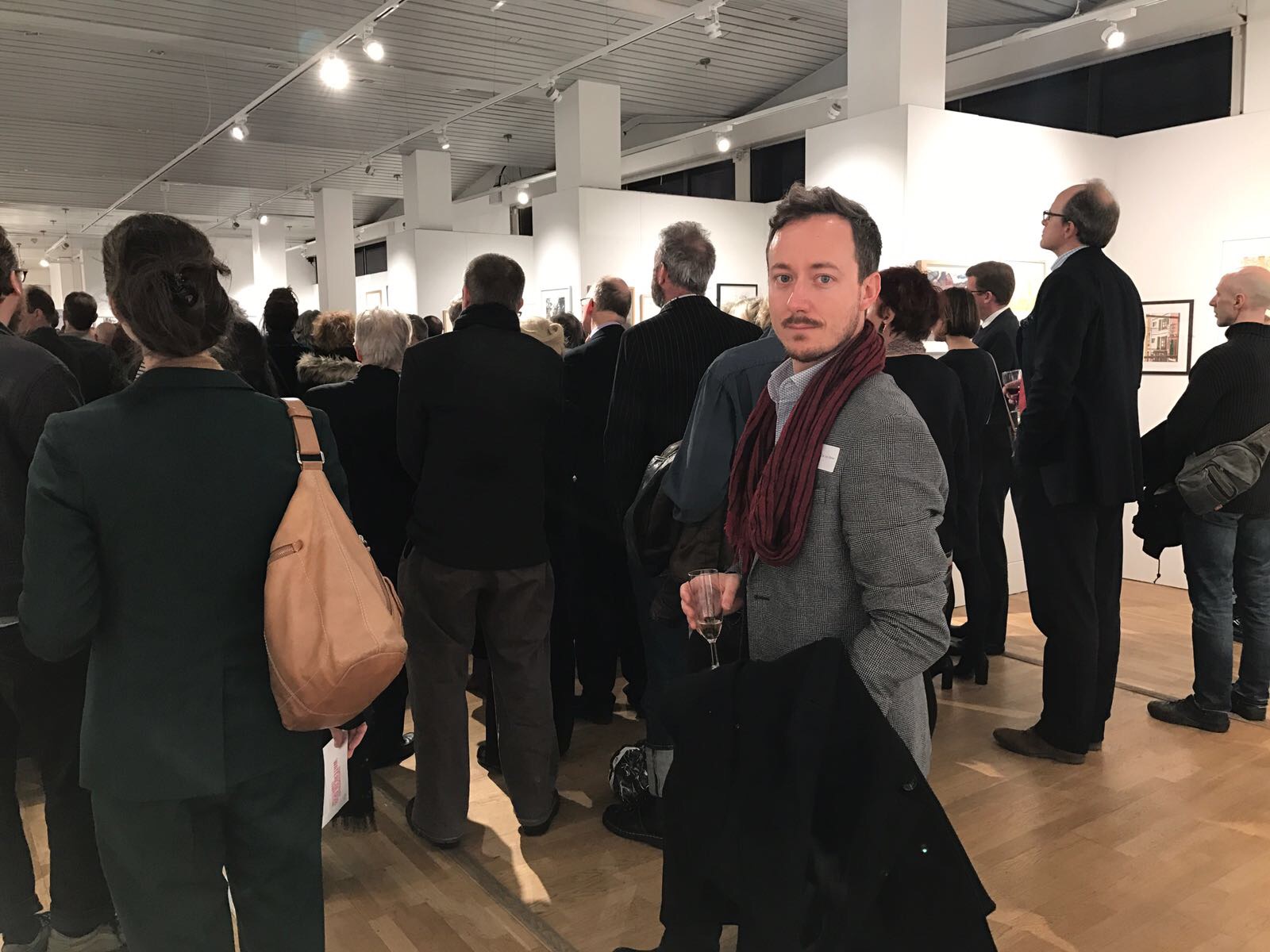
One of the escapes I was able to make during the course of this hectic  time was a series of visits to the Bankside Gallery on London’s South Bank (to be found directly next door to Tate Modern). For in a moment of perfect poetry, in my last days of Mallorca residence, I discovered that one of my paintings of Palma had been accepted by the jury of the Royal Watercolour Society Contemporary Watercolour Competition, and would be soon thereafter exhibited in London. So a painting of one home is exhibited at the very heart of another, and as I re-embrace London as my new home city, I was delighted and indeed honoured to be able to visit the Competition exhibition, both to see my own work displayed, and to admire the work of all the other successful competitors.

Galera 2

My winning submission: Ocho Balcones No. 2: Old Town Cables, Palma (2015 © Nicholas de Lacy-Brown, gouache on paper)

IMG_8456

All of the works currently on show in the exhibition can be seen here on the RWS website. What struck me from the show was just how versatile water-based mediums are in the creation of contemporary art. Often seen as a traditional method of painting, watercolour and other water-based mediums such as gouache can be used to create vivid, modern depictions of the world around us, or simply abstract or surreal images straight from the artist’s head. They are also great for really precise work on paper, as my winning work, Ocho Balcones No.2: Old Town Cables, demonstrates.

IMG_8455

Enjoying the packed private view …

My tardy publication of this article does not give you much time to enjoy these fine works in reality, for the exhibition will come to a close this Wednesday. But if you get a chance, go along…not just for my sunny glimpse of Mallorca, but for the wonderfully diverse work of the other participants whose art really proves that water-based mediums are as popular today as they ever were.

Remembrance of things current (No.2): À la table de Mme Verdurin

Marcel Proust continues to ensnare me with the mellifluous poetry of his prose. Having struggled through the first 50 pages of his epic first novel, Swann’s Way, I found that what had at first been like an exercise in chipping away at solid ice had become the easier removal of slushy semi-melted layers, before the watery manifestation of his literary masterpiece washed over me without any effort on my part. I am now what could be termed Prousted, so easily accustomed to bathing languidly in my daily dose of Proust’s world that it has become less an escape from reality as a natural reacquaintance with a perfected present, from whose elegant embrace I depart unwittingly whenever I happen to put down the book.

Happily, when the time comes to place to one side the irresistible pages of In Search of Lost Time, my departure from Proust’s reality is rarely complete, for now the work is inspiring my artwork too. Just before Christmas, I introduced La Madeleine de Proust, the first instalment of my Remembrance of things current series of paintings. I have now completed the second: À la table de Madame Verdurin.

mme-verdurin-final

Remembrance of times current (No.2): À la table de Madame Verdurin (2017 ©Nicholas de Lacy-Brown, acrylic on canvas)

Anyone who has read Proust will know Madame Verdurin as the monarchical matriarch of her own exclusive, carefully selected carve out of Parisian society. Gathering together those people who she considered to be sufficiently witty to contribute to what she termed her collection of The Faithful, this little congregation importantly included Odette de Crécy who was later to become the infamous Mme Swann, wife of one of the book’s major protagonists, Charles Swann. The gatherings which Proust describes, ruled over by Mme Verdurin and her obedient husband, and playing host to the witticisms of guests, musical recitals, and even its own in-house artist, make for some of the most enjoyable passages of Swann’s Way. Providing an enthralling insight into the self-imposed societal norms practised by those who are not quite high society but form their own exclusive club in lieu of the better connections to which they secretly aspire, the Verdurin salon says so much of the social climbing and inter-class backbiting which was rife in Paris in the belle epoch.

Importantly for the novel, the house of Mme Verdurin provids the backdrop for Swann’s first encounters with Odette, and the frictions which thereafter developed when the couple dared to live a life beyond the congregation of The Faithful. In my painting, I have tried to capture the friction between Swann and Mme Verdurin in the two figures which dominate the bottom half of the piece. There, Mme Verdurin’s hairstyle is almost halo-like in her self-imposed status as a kind of deity in her home, while the red bar above her head is like the sentencing hat worn by a judge who makes severe judgement on the society around her. Above and below, the chandelier and the black and white floor represent the decorative embellishments which ensured that visitors to the Verdurin household were fully aware of their burgeoning social status, but the black and white also represents the keys of the piano which played out Vinteuil’s musical refrain which was to underpin the force of Swann’s passion for Odette. Yet for all this pomp and ostentation, the table of Madame Verdurin, around which the diners sit, is notably empty. Vacuous and without depth, like the true nature of the party’s rather frivolous conversation.

Now I am on the third novel of Proust, and with 4 still to go, I know that my collection of paintings will grow accordingly.

© Nicholas de Lacy-Brown and The Daily Norm, 2001-2017. Unauthorized use and/or duplication of the material, whether written work, photography or artwork, included within The Daily Norm without express and written permission from The Daily Norm’s author and/or owner is strictly prohibited. For more information on the work of Nicholas de Lacy-Brown, head to his art website at www.delacybrown.com

Artist in Focus: Frédéric Bazille

Impressionism was not just an artistic movement. It was a way of seeing which radically changed the path of art, paving the way to practically every contemporary creative vision which followed whether it be abstract expressionism or visceral photorealism, or even works of sculpture and photography. Accordingly, as an artistic epoch, its works have become so well known that even the most unknowledgeable could probably associate Monet’s Japaenese bride or a watery vision of waterlilies with the movement. But for all the fuzzy edged Renoir portraits, and the softly lit Monet landscapes, few people ever refer to one of Impressionism’s earliest pioneers: Frédéric Bazille.

frederic_bazille_-_bazilles_studio_-_google_art_project

Bazille’s Studio; 9 Rue de la Condamine, 1870

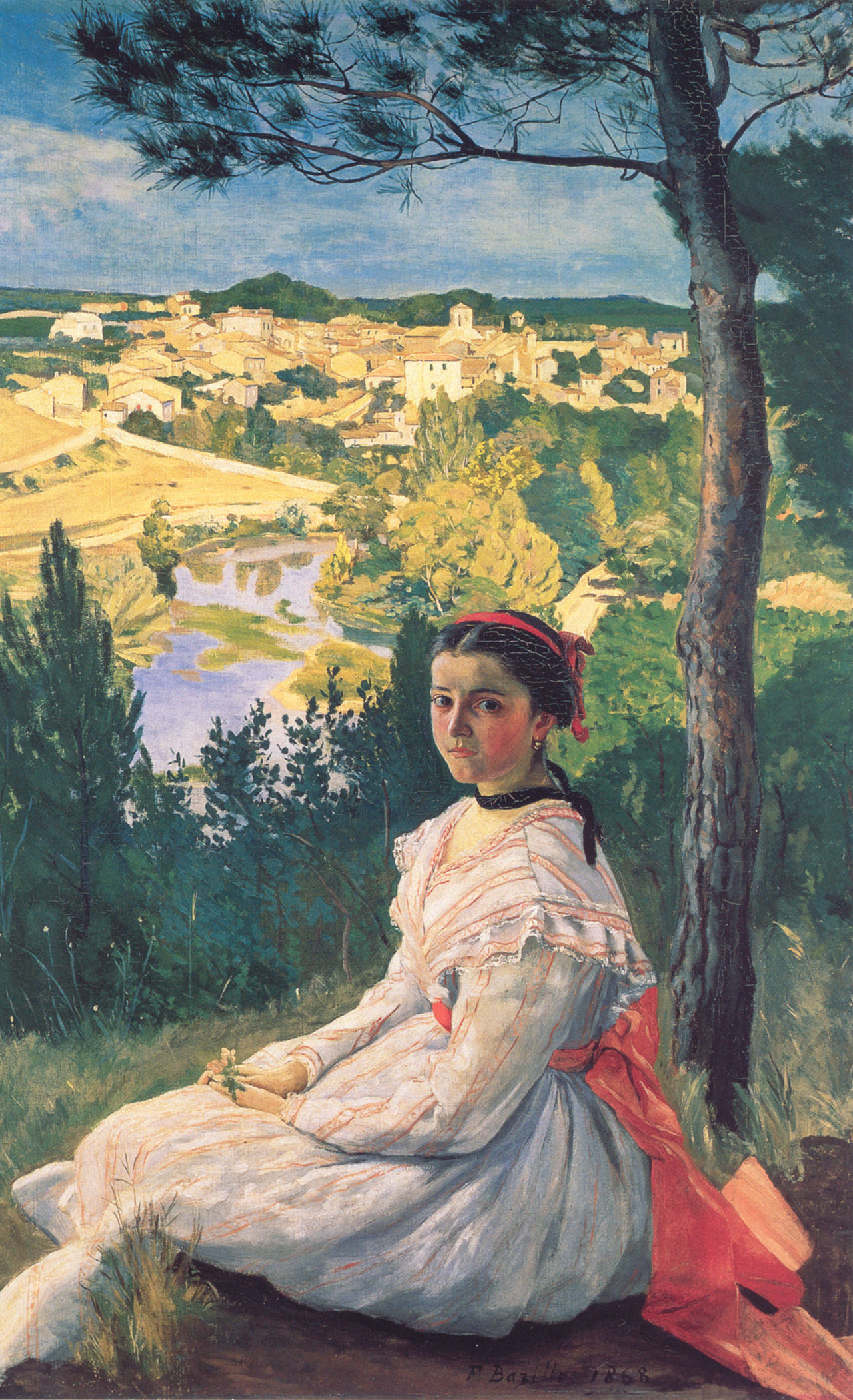
Born in Montpellier in 1841, Bazille was both a contemporary and working companion of  Monet and Renoir whom he met while studying fine art in Paris having given up his parents’ preferred discipline of medicine. Coming from a wealthy family, Bazille was more than just a friend to his budding co-artists, providing them with shared studio space and much needed income during their crucial early years of creation. It was as a trio that the zealous three began to paint en plein air, rejecting the studio-based historical compositions that were in fashion and favouring the recreation of reality, or at least an impression thereof.

However Bazille was not just an early Impressionist. In fact his works were not even included in the first renowned Impressionist exhibitions in which the most iconic artists of the movement were hung. His work was stylistically unique, with a finessed confident line and clear figurative composition which eschewed the feathery brush work of his colleagues and endowed his work with a potent but still poetic atmosphere.

frederic_bazille_001

Family Reunion, 1867

bazille_frederic_-_aigues-mortes

Aigues-Mortes, 1867

bazille_view_of_the_village

View of the Village, 1868

frederic_bazille_-_the_pink_dress_-_google_art_project

The Pink Dress (View of Castelnau-le-Lez, Hérault), 1864

When the opportunity to see the works of Bazille enmassed arose this winter in the Musée d’Orsay in Paris, I rushed to the show as quickly as I could get through the enormous queues outside. There, I cherished an encounter with the majority of Bazille’s most famous works, such as his captivating Family Reunion, and his highly homo erotic works, Fisherman with a Net, and Summer Scene. For capturing the male was another way in which Bazille differed from his contemporaries. For unlike the womaniser Renoir and the almost married Monet, Bazille was more of a loaner, said to be drawn to his own sex, and in these beautiful languid portrayals of the male, you can feel both a passionate admiration for the masculine form, and what must have been his frustration at not being able to openly explore it otherwise than in paint.

bazille_frederic__summer_scene_1869_oil_on_canvas_fogg_art_museum_cambridge_massachusetts

Scène d’été, 1869

bazille_-_pecheur_a_lepervier

Fisherman with a Net, 1868

Sadly for us, the show at the d’Orsay was a short one, for the oeuvre of Bazille was cut tragically short by his early death at the age of only 28 while fighting during the Franco-Prussian war. Thus a needless bullet ended what might have been one of the most prolific careers of the Impressionist age, and who should always be remembered as one of its most promising young stars.

Norms: The Saints Collection | Saint Ramon Llull of Mallorca

There is a spiritual kind of sensibility in the air which is very tangible for me at Christmas time. It has much to do with my childhood experiences of singing Christmas carols by candlelight in cold churches, the orangey smell of the Christingle mixed with candle wax, and my life changing art history course in Italy when the Catholic churches of Florence and Rome in December really came alive in my imagination. All of this means that I am at my most spiritually receptive at this time of year, particularly when it comes to admiring Renaissance and pre-renaissance gilded altar pieces and religious masterpieces. And it is for that same reason that when it comes to my own creativity, I love creating Saint Norms.

First inspired by an altarpiece I saw in the Accademia in Venice, my Saint Norms was a collection of illustrations started in early 2014. The last two I made were later that year, following our move to Mallorca. With Santa Lucia and Saint Nicholas, I laid the collection to rest…that was at least until now. For following a recent visit to the magnificent Cathedral of Palma, I became inspired by the island’s own patron saint, Ramon Llull.

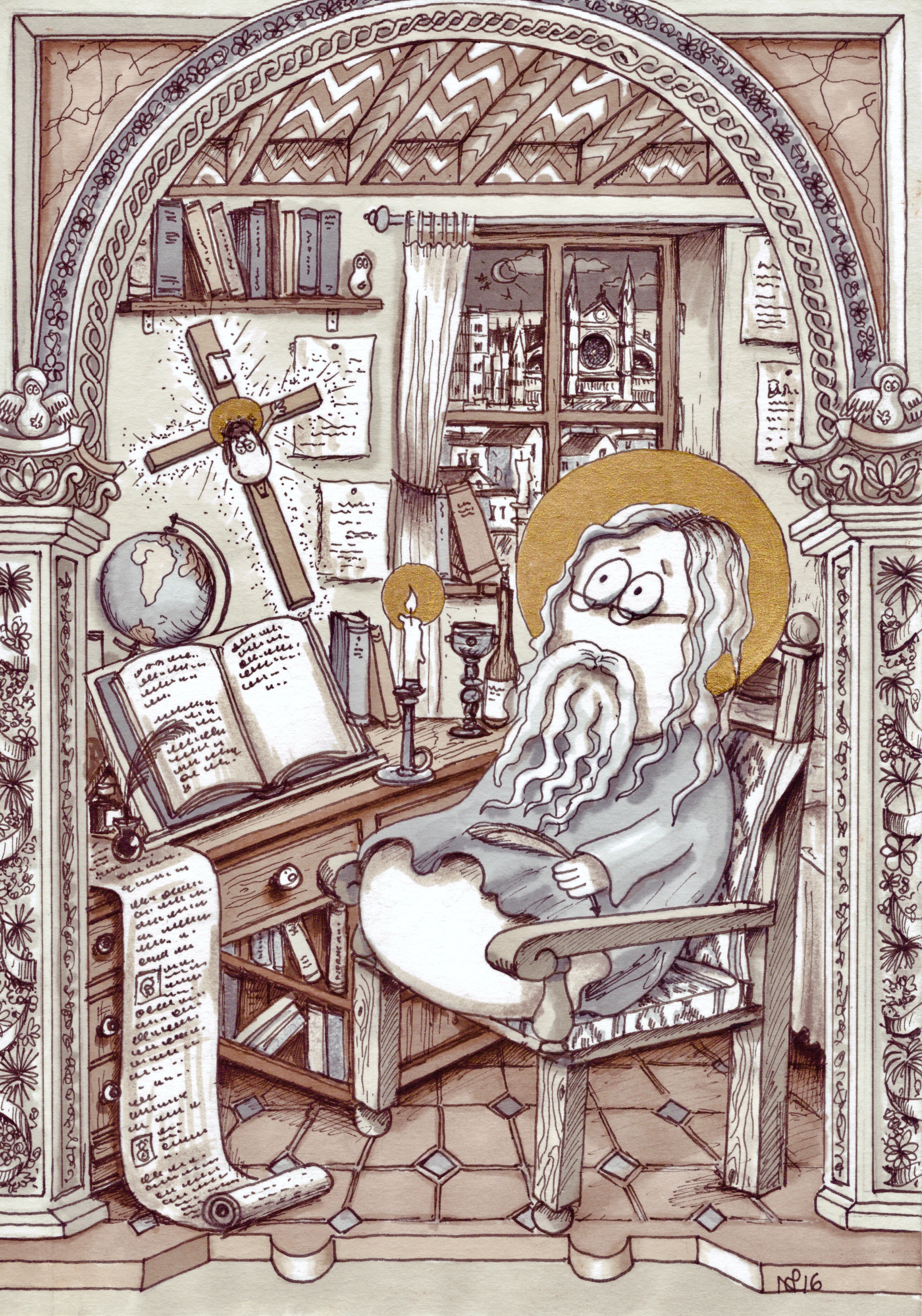
Born in 1232 in the turbulent period following the reconquest of Mallorca from islamic rule, Ramon Llull was a writer, philosopher and Franciscan tertiary famous for creating what is quite possibly the first major work of Catalan literature, and for his prominent work on elections theory and computation. While he may just have been a happy-go-like writer of salacious poems, he turned towards saintliness following a continued apparition of Christ on the Cross, the likes of which first came to him as he sat writing in his Mallorquín home.

saint-ramon-llull-norm-2

Saint Ramon Llull Norm (2016 ©Nicholas de Lacy-Brown, pen and gold paint on paper)

Such is the scene now imagined here in this latest Saint Norm sketch, which also includes all of the traditional trademarks of Mallorca craftsmanship, from the ancient zig zag frescoed ceilings, to the Mallorquín lenguas fabric cushions on his chair.

Now my latest Saint Norm is completed, I finally feel fully ready for Christmas.

© Nicholas de Lacy-Brown and The Daily Norm, 2001-2016. Unauthorized use and/or duplication of the material, whether written work, photography or artwork, included within The Daily Norm without express and written permission from The Daily Norm’s author and/or owner is strictly prohibited. For more information on the work of Nicholas de Lacy-Brown, head to his art website at www.delacybrown.com
Remembrance of things current (No.1): La Madeleine de Proust

Memory is a powerful thing and there are times in life when it is triggered quite involuntarily. Such moments occur frequently during this season of Christmas for example, when the smell of tinsel upon opening a box of decorations may transport you directly back to a moment of your childhood, or when the sound of a carol may take you back to a chilly but magical evening in a carol concert. Such moments of involuntary remembrance were a principal preoccupation for the extraordinary French novelist, Marcel Proust, and the so called “Madeleine moment”, when the narrator is reminded of a whole raft of his childhood by the innocuous flavour of a madeleine dipped in tea, is one of the central most important moments of Proust’s seminal novel, In Search of Lost Time (À la recherche du temps perdu).

It has long been an ambition of mine to read Proust’s masterpiece of 7 volumes but I must admit that on previous attempts to start his epic, the scale, and the style of the work somewhat intimidated me. But I believe that there are good times and bad times to read such a substantial philosophical work, and from the moment I restarted the tome last month, I was hooked. As inevitably happens when I am engrossed in a book, Proust started to colour my present life and my imagination. The coincidence of reading his first volume with a visit to the Crystal Cubism exhibition in Barcelona made for a powerful motivation, and within days a painting, inspired by the very same Madeleine moment, was blossoming in my head.

proust-madeleine-final

Remembrance of things current: La Madeleine de Proust (2016 ©Nicholas de Lacy-Brown, acrylic on canvas)

And here is the result. A work which combines both the Madeleine, the musings which result, and a reflection upon my own current life while reading the novel. Thus you have the knitting with which I have been engaging myself of late, the armchair and lamp in which I have taken to reading the work, and the use of arabesque-like patterns taken from Pakistani fabric. For my current tea of choice is not the tila (lime blossom) featured in the novel, but Pakistani tea – a so called black tea with festive spiced hints. These reflections upon my current environment also inform the title of this new collection “Remembrance on things current” which is a play on the original title of the book, “remembrance of things past”  originally adopted for the seminal english translation before the more literal “In search of lost time” was universally accepted.

Now I am well into volume 2 of Proust’s work, and as his poetical reflections and magnificent belle epoch atmosphere continues to ensnare me, I have no doubt that a second painting like this one will not be long in coming.

© Nicholas de Lacy-Brown and The Daily Norm, 2001-2016. Unauthorized use and/or duplication of the material, whether written work, photography or artwork, included within The Daily Norm without express and written permission from The Daily Norm’s author and/or owner is strictly prohibited. For more information on the work of Nicholas de Lacy-Brown, head to his art website at www.delacybrown.com

Las Meninas: Fourth Interpretative Exercise

It’s been almost 10 months since I last created a work in my collection of painted interpretations of Velazquez´s famous masterpiece, Las Meninas, and in fact, after I had completed the third of the set, I thought that the group was pretty much complete. It was a collection which was significant not just in itself, but because it launched for me an entire new way of seeing both famous masterpieces and reinterpreting them (something which went on to inspire my new redevelopment of works by Rubens, Van Gogh and Courbet amongst others), but also instigated a new collection of more simplified quasi-cubist works developing flattened colour panes and using acrylic as a primary medium. However, at the time of painting the third Las Meninas, I also started a fourth, but as I remember it, a little while after starting, my interpretation of a Titian got me all carried away, and I left the canvas unfinished.

Thus it may have remained were it not for a spring (well autumn…) clean on which I embarked a couple of weeks ago. Discovering the canvas in its unfinished state I was 50:50 whether to bin it, or finish it. Opting to finish what I had started, I am now happy to present the final interpretation of Velazquez´s renowned masterpiece.

las-meninas-4-final

Las Meninas: Fourth Interpretative Exercise (©2016 Nicholas de Lacy-Brown, acrylic on canvas)

Taking the abstracted character shapes from both the second and third interpretations and reusing them in yet another composition, this work is more of a satyrical take on the modern day clinical art gallery in which works such as Velazquez’s can be seen today… seen but certainly not touched. With their security guards, their roped off works, their cameras and alarms and pristine white walls, galleries are not always the most welcome of places, especially when compared with the abundantly filled, cosy interiors depicted in the likes of the original Las Meninas. But at the same time, this vacuous white gallery setting has become the staple of art institutions the world over, a space which allows the masterpieces themselves to shine in relative safety, free to inspire future generations with their majesty, just as Las Meninas did me.

© Nicholas de Lacy-Brown and The Daily Norm, 2001-2016. Unauthorized use and/or duplication of the material, whether written work, photography or artwork, included within The Daily Norm without express and written permission from The Daily Norm’s author and/or owner is strictly prohibited. For more information on the work of Nicholas de Lacy-Brown, head to his art website at www.delacybrown.com

Norms Palma Series: Paseo Mallorca

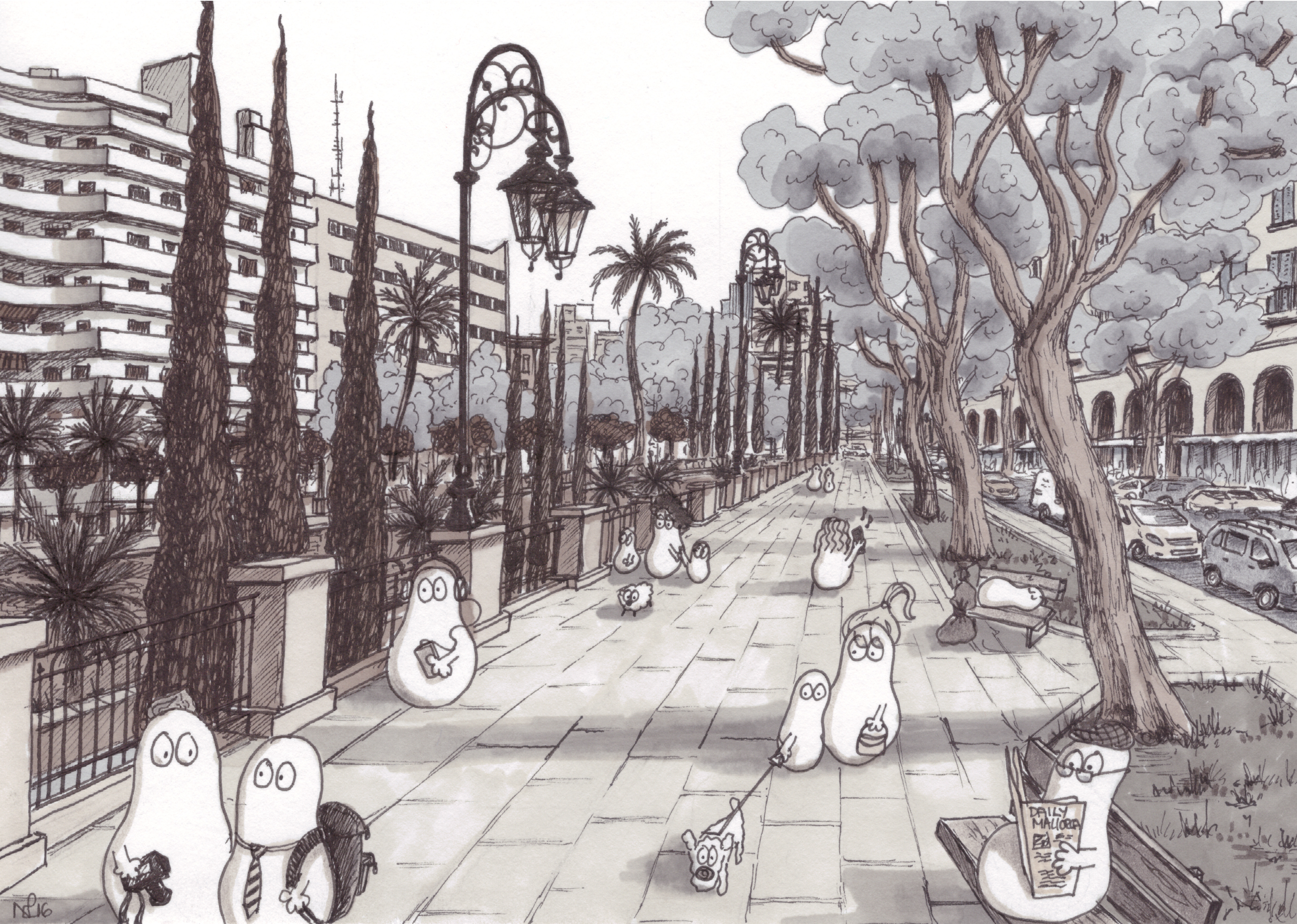
I find it awfully coincidental just how much the Norms and I have in common. They adore lounging around in galleries, and sipping coffees in a city’s best cafes. They love to be beside the seaside and they adore rivers and greenery too. And so it is no surprise to me that the Norms, likewise, adore the area of Paseo Mallorca, the green spine of Palma where a river runs out to the sea and where cypress trees and palms grow gracefully besides the water and elegant residential blocks. After all, it is a place which has inspired me a good number of times, and no doubt inspires these green loving creatures too.

Here we see the Norms enjoying the leafy surroundings of the Paseo Mallorca, where a stroll along the broad avenues adjacent to the river is every bit as chic as a walk along the paths of the Bois de Boulogne or a perambulation alongside the River Seine. Little norms, old norms, doggie norms, even homeless norms…all of them enjoy hanging out in this recreational idyll. I can even see two who look suspiciously like my partner and me heading off together to work, a backpack loaded for the day and a must-have camera in hand. Must be that coincidental similarity again…

norms-on-paseo-mallorca

© Nicholas de Lacy-Brown and The Daily Norm, 2001-2016. Unauthorized use and/or duplication of the material, whether written work, photography or artwork, included within The Daily Norm without express and written permission from The Daily Norm’s author and/or owner is strictly prohibited. For more information on the work of Nicholas de Lacy-Brown, head to his art website at www.delacybrown.com

A Portrait of Mallorca

Sometimes I just want to paint what’s on my mind. The energetic fusion of ideas applied to canvas in a mixed and multifarious revolution of form and colour. But unlike the Expressionist movement, which tended to splash and splosh their emotion onto canvas in more of a literal application of paint, my variety of expressionism materialises in more of a controlled fashion. I suppose it says something about my rather controlling mind (a tendency for which my partner may testify). For my wildest form of expression is something more cubist in nature. I have always been enchanted by the age of the cubists. The ability to show an object or a subject on multidimensional planes has always filled me with an ultimate sense of pictorial satisfaction. And while my cubism is less a single subject and rather more a mixed bag of ideas, it definitely belongs to the genre.

retrato-mallorca-final

Portrait of Mallorca (2016 ©Nicholas de Lacy-Brown, acrylic on canvas)

This cubist work, which also belongs to my interpretative abstract way of thinking, is the latest canvas to hop off my easel and says everything and anything about the island on which I have spent the last two happy years of my life. It is for me a true portrait of Mallorca, because beyond the tacky tourism for which the island is so unfortunately infamous, the island is one of true bucolic peasant culture, with its own cuisine and characterised by a stunning mixed mountainous and coastal landscape. All this is represented in the imagery packed into this “portrait” which includes the spiralled ensaimada pastry for which the island is famous, the lacey headdress and straw hat worn by the traditional peasant women, as well as their flowing striped skirts flapping in the Mediterranean breeze. There too are the mountains and the beaches, the glittering coast and the yachts which encircle the island like moths around a light source. And of course the sails of the windmills, which likewise characterise the lower lying stretches of countryside.

It is a painting which fully encapsulates the multifaceted personality of an island which is much, much more than Magaluf.

© Nicholas de Lacy-Brown and The Daily Norm, 2001-2016. Unauthorized use and/or duplication of the material, whether written work, photography or artwork, included within The Daily Norm without express and written permission from The Daily Norm’s author and/or owner is strictly prohibited. For more information on the work of Nicholas de Lacy-Brown, head to his art website at www.delacybrown.com
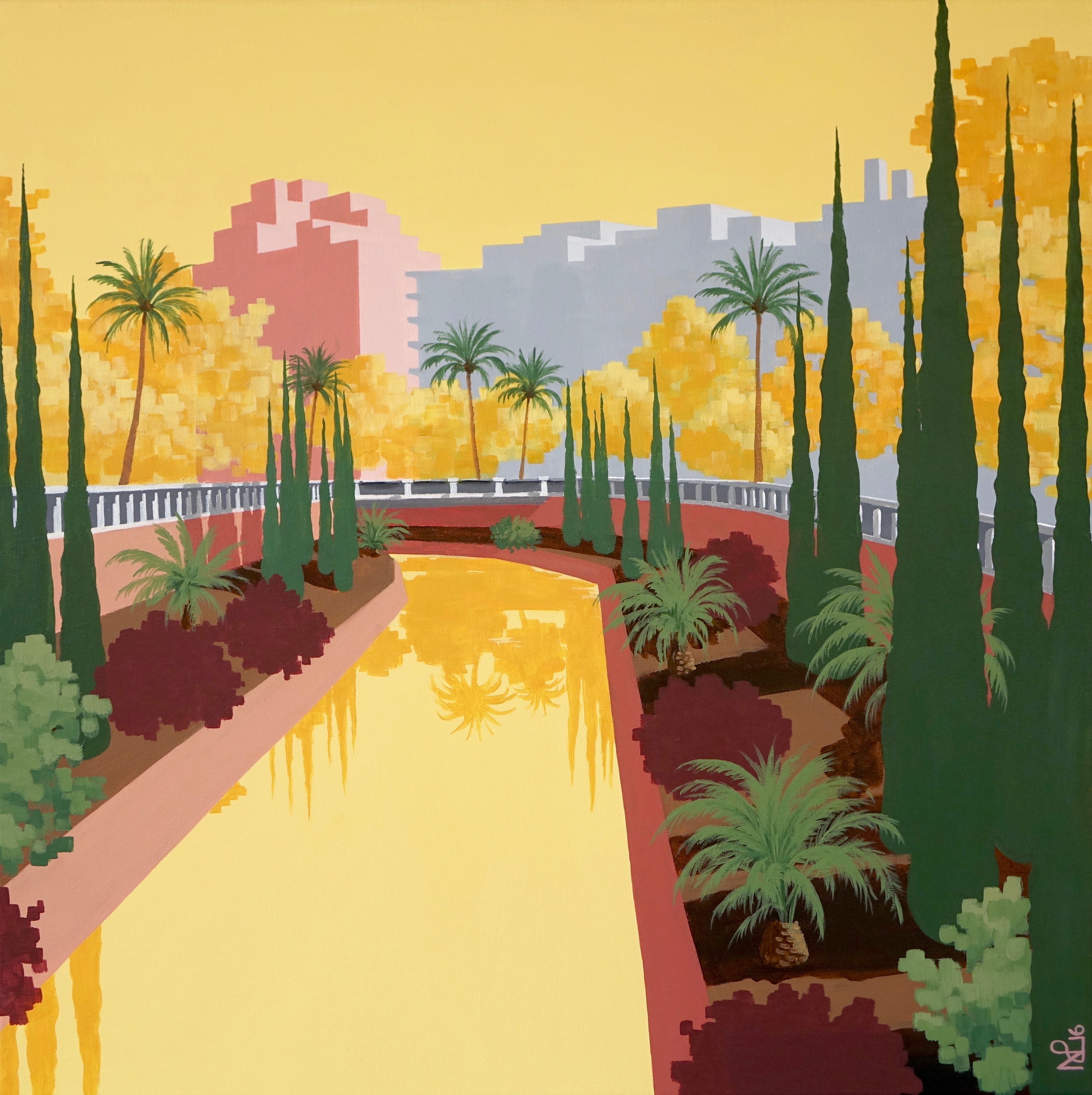
Inspired by my surroundings: Paseo Mallorca 3

The Paseo Mallorca, a stretch of treelined river in Palma, continues to inspire. I am lucky enough to live on this panorama of green which acts like the lungs of a city already awash with the air of the Mediterranean. It is, if you like, the perfect gateway to the sea from the city sprawl built up alongside it, since a stroll along this tree-lined avenue will take you directly down to the city’s magnificent port.

I set about painting this stretch of urban utopia a few months ago, starting with the bridge closest to the Es Baluard museum of art, and moving onto the bridge of Jaume III and the magnificent post-modern stretch of residential buildings beyond. In this third addition to the collection, I move further up the river, to the area where I live. Here the bridges are simplified but the greenery is all the more stunning. The colour palette is carefully chosen to represent the humid warmth of the season (I started the work on the painting in July), and also to perfectly partner the first painting in this group. For me it captures the essence of this happy, leafy suburbia which I am lucky enough to call home.

paseo-mallorca-3-final

Paseo Mallorca 3 (2016 ©Nicholas de Lacy-Brown, acrylic on canvas)

© Nicholas de Lacy-Brown and The Daily Norm, 2001-2016. Unauthorized use and/or duplication of the material, whether written work, photography or artwork, included within The Daily Norm without express and written permission from The Daily Norm’s author and/or owner is strictly prohibited. For more information on the work of Nicholas de Lacy-Brown, head to his art website at www.delacybrown.com