Skip to content

Posts tagged ‘London’

Kazimir Malevich: Beyond the Black Square

Whether it is the intention of the exhibition or not, Tate Modern’s brilliant new retrospective exhibition of Polish-born Russian Artist, Kazimir Malevich, shows that there is truly more beyond the Black Square. Leading the ranks in an artistic revolution which went from Cubo-Futurism to the simplified geometric forms of Suprematism, Malevich’s most famous and enduring work is a simple, stark and enigmatic black square set on a white canvas. Of course since 1915 when the black square was created, many artists have gone down the single-colour-on-canvas route, and a contemporary art museum is not a contemporary art museum without at least a Blue Canvas or an Untitled (Red Rectangle) to delight and frustrate art audiences in equal measure. But at the time when Malevich’s Black Square was created, it marked a dramatic and stark departure from everything that had gone before it.

Despite its very obvious simplicity, it carries with it an enigmatic complexity as an artistic gesture. Looking at this dark patch of paint, one can almost feel a suppression of joy, a rebellious desire for change, a stark reaction to the turbulence of war, a zero hour in the world of modern art. And yet while it is perhaps understandable why this painting caused such a stir, both positive and negative in the time of its creation, Tate’s new exhibition shows that Malevich had so much more to offer as an artist, and much much more of it in invigorating compositionally intricate colour.
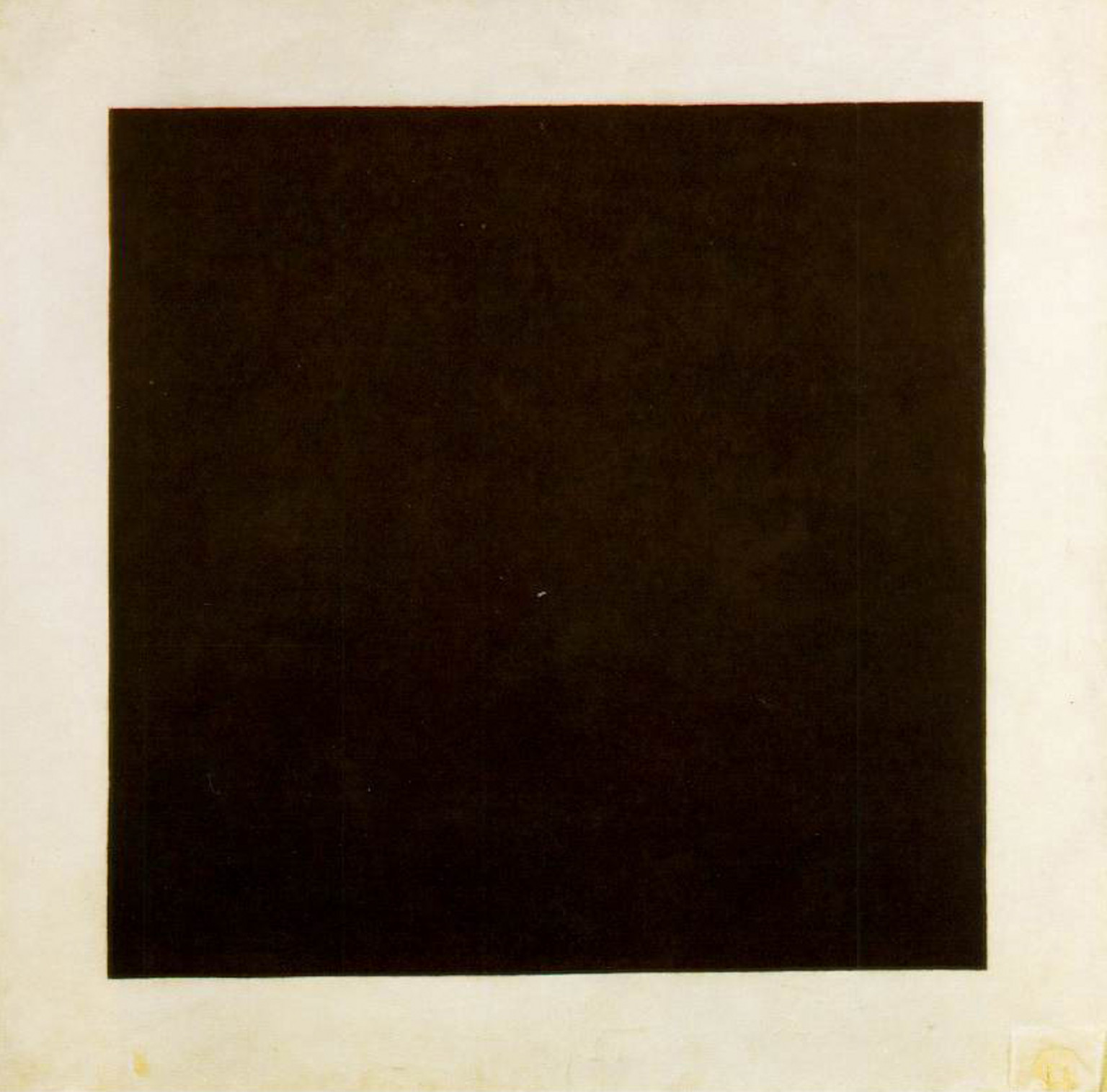
Black Square (1915)
Black Square (1915)

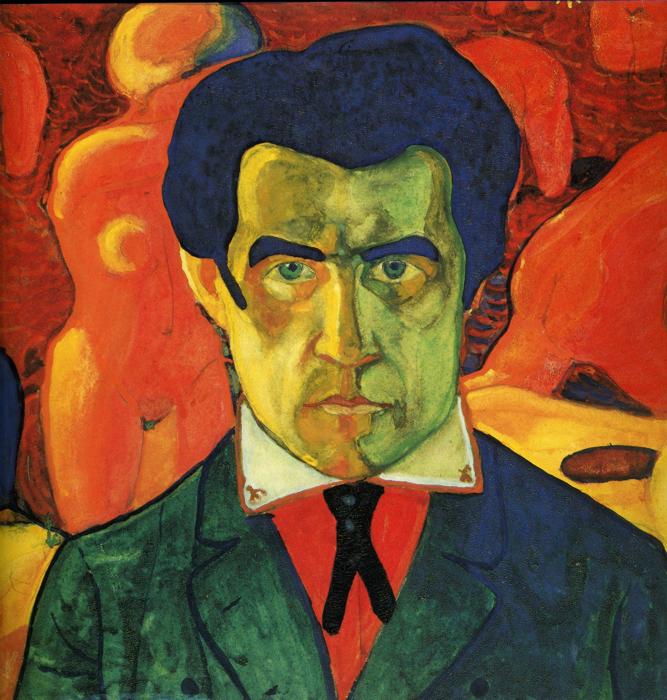
Self Portrait (1908)

Self Portrait (1908)

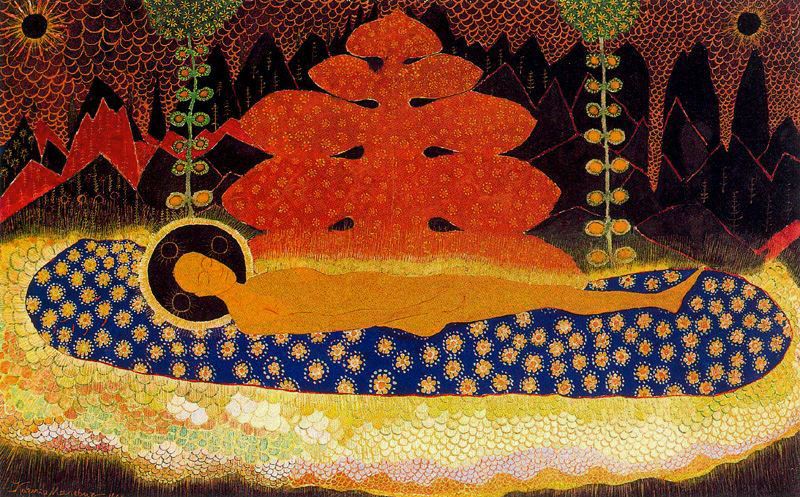
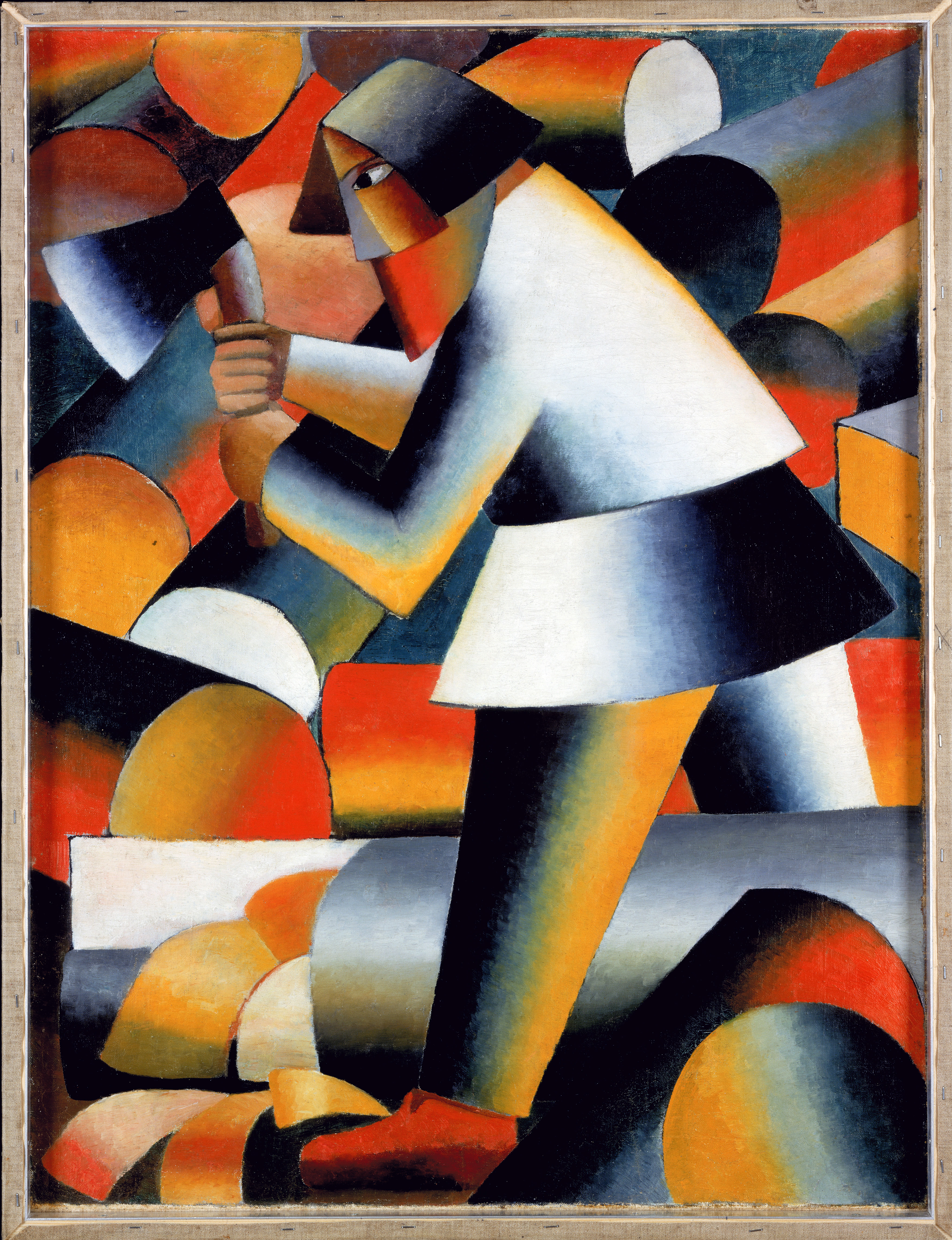
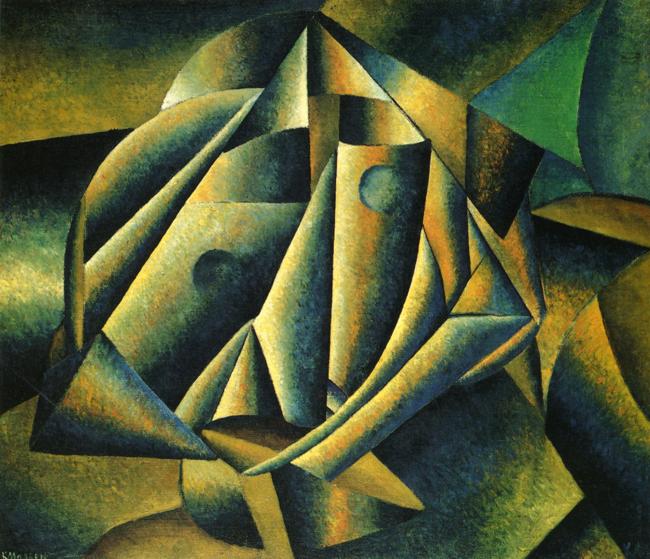
The start of the show demonstrates a certain reliance by Malevich on the artists who had gone before him, and a very clear influence of the avant-garde of post-impressionism, particularly the bold colours of the Fauvists and the flattening of perspective and exotisim advocated by Gauguin. Those influences are particularly obvious in Malevich’s early self-portrait, whose backdrop of exotic nudes and use of a multi-coloured palate recalls the work of Matisse and Gauguin alike. However, very quickly, we see the influence of other artists slipping away as Malevich starts to find a more unique style of his own. While relying to some extent on cubist notions, Malevich rejects the subject matter topical of the works of the Paris avant-garde and starts painting heavily geometric works based on the peasants and traditions of Russia. Painting simplified figures in cubist almost metallic forms, Malevich’s portraits are static like robots, referencing Futurism whose artistic reach was spreading across Europe, and yet exuding a rurality and authentic subject matter which is far departed from the industrialisation which characterises most works of the Futurist movement.

Early works 
Head_of_a_Peasant_Girl Kasimir Malevich007 Kazimir-Malevich,-The-Woodcutter,-1912_original

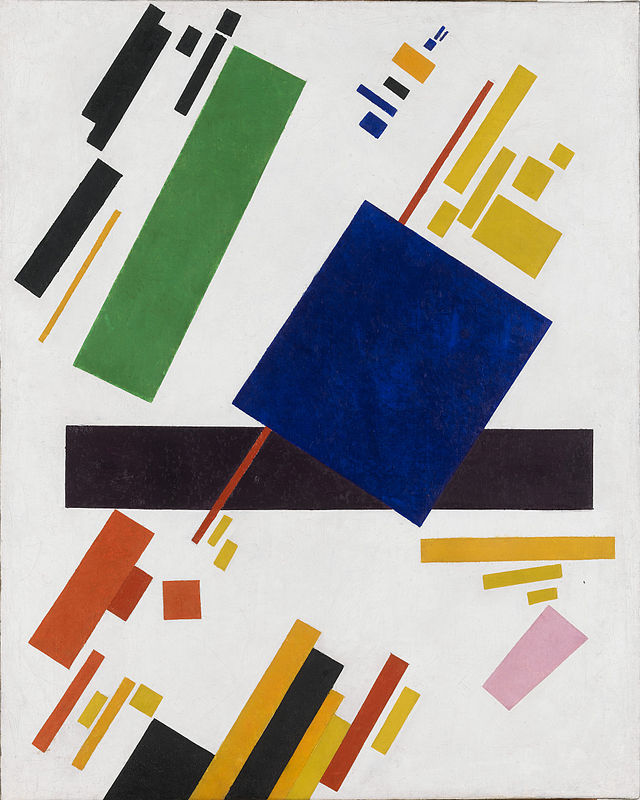
But Malevich’s early cubo-futurist works were only the beginning, and it was when, in 1914, Malevich painted his first black rectangle – Black Quadrilateral – that the artist took a clear and drastic departure from figurative works, presenting his ideas in The Last Exhibition of Futurist Painting 0.10 in what was then Petrograd in 1915. Calling his new direction Suprematism, Malevich believed that “the artist can be a creator only when the forms in his picture have nothing in common with nature” and dismissing the artists of the past as “counterfeiters of nature” he went about creating works which are starkly geometric and lacking in any feature which could link them to the natural world. The paintings which resulted from this period are a wonderful collection of energetic and colourful works (with the exception of the Black Square of course) which I loved. There is a complexity of composition in the way that these various shapes are interlayed and angled which cannot be underestimated, and in seeing these works, I saw that here Malevich really was creating from scratch rather than relying on nature for reference.

Suprematist works

Malevici06 640px-Suprematist_Composition_-_Kazimir_Malevich Kazimir_Malevich_-_Suprematism_-_Google_Art_Project malevich28 malevich4

However Malevich could only take his Suprematist ideas so far, and by the time of the Russian Revolution in 1917, he consciously began to “kill off” paintings, gradually draining his paintings of colour in works such as White Suprematist Cross (1920) – a white cross on a white background – and Dissolution of a Plane (1917) where the colour is gradually fading out of the edges of a red rectangle. This was what Malevich called the “death” of painting, and in 1919, Malevich wrote that “Painting died, like the old regime, because it was an organic part of it”and what followed was several years when the artist dabbled in transferring his ideas to architecture, and teaching.
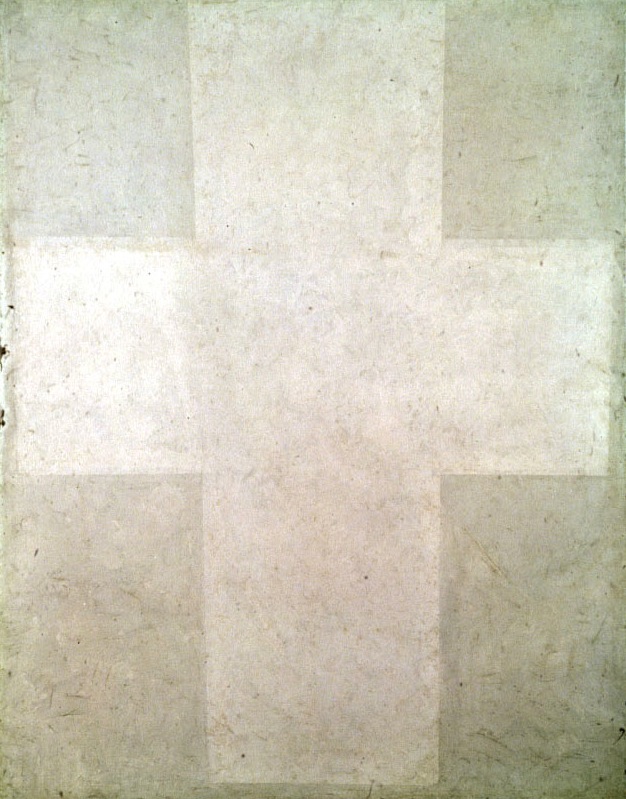
White Suprematist Cross (1920)

White Suprematist Cross (1920)

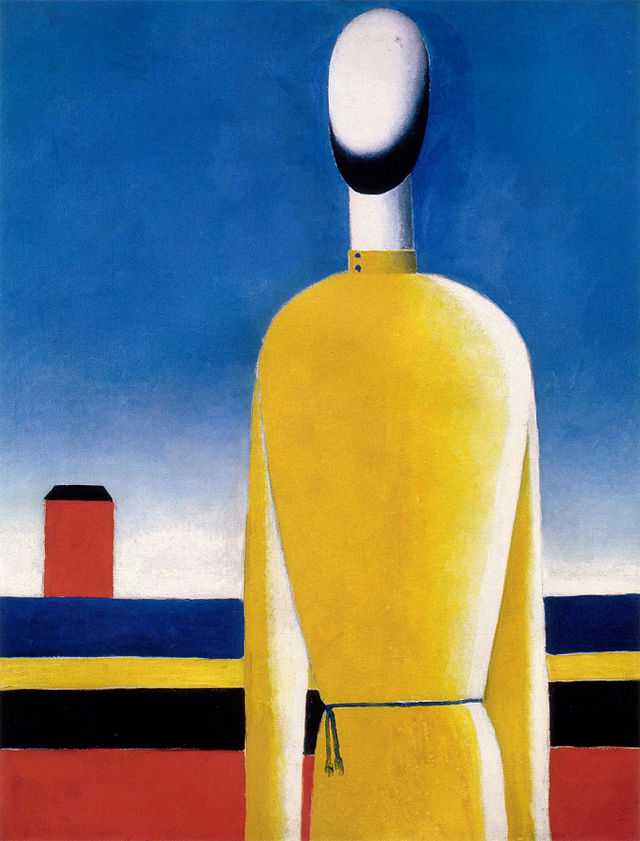
However, it was a temporary death, for a few years later, Malevich came to resurrect his painting, and interestingly, when he did so, he returned not to his Suprematist ideas, but to the cubo-futurist figuration of his early years. It was almost as though his Suprematist manifesto took such efforts that when he returned to painting, almost as a newcomer to it, he found himself drawn more to the instinctive way of painting which was inherent within him from the start. Which just goes to show: the efforts of stripping out nature and forging something new in art may create something of a stir or a statement, but ultimately we always return to the same thing: depicting the world around us, for that is arguably the true purpose and calling of art – to narrate and reference the lives we all live.

Later works

Malevich142 Later

In short this is a marvellous new show which provides a comprehensive review of this important artist, introducing his work to many who, like me, were not familiar with his oeuvre before. Beyond the paintings and the excellent chronological layout of the exhibition, my favourite section was Room 10, which takes a break from the paintings, and is like a mini-retrospective within the bigger story, depicting the whole of Malevich’s career through his works on paper. As such, the display provides a fascinating insight into both Malevich’s preparation of his paintings, and also how quickly his works transformed from cubism to futurism to suprematism and back again. A complex transition truly worthy of a retrospective exhibition on the scale Tate has so ably put on show this summer.

Malevich: Revolutionary of Russian Art is on at Tate Modern, London until 26th October 2014.

The Sensational Success of my Strand Gallery Solo Show

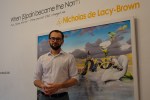
I haven’t written on The Daily Norm for almost a week. The reason is probably obvious to all those who have been reading my posts of late. It was because I was otherwise occupied hosting my biggest ever solo exhibition of paintings, illustrations and prints, a show which combined some 165 works from the last 6 years of my creative out put. The exhibition, which was held at London’s preeminent Strand Gallery finished on Sunday, with more bubble wrap and more packing than I would ever have wanted to engage in during my whole life, let alone a single day, and the days which have passed since have been a flurry of deliveries, unpacking, repacking, digesting and collapsing with the exhaustion of 9 months preparations which has still not quite left me. But, despite the energy-sapping effort and the complete bodily and mental exhaustion, I am delighted to be able to report that my solo exhibition, When (S)pain became the Norm, was a complete and utter show-stopping success!

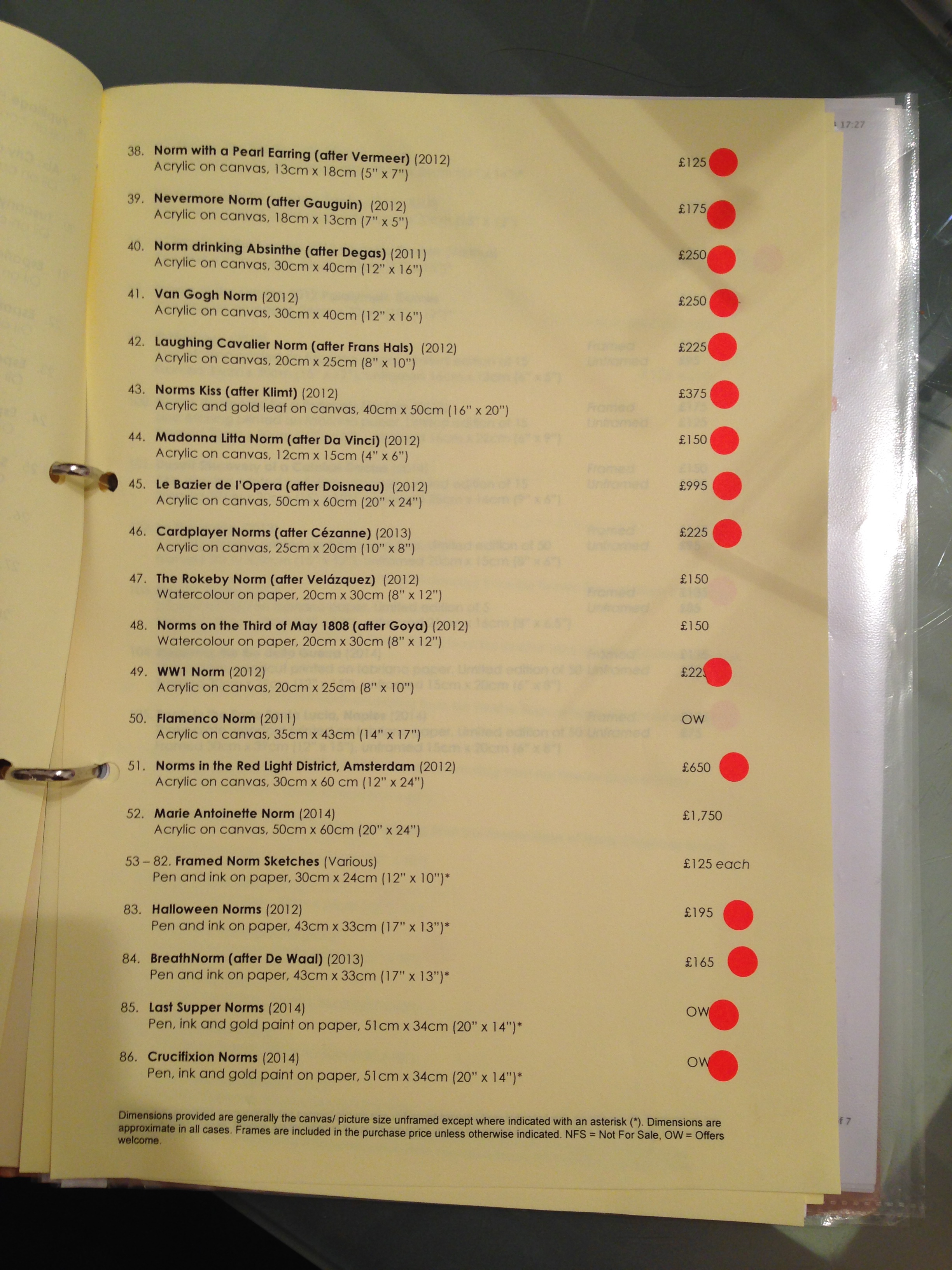
My eyes are close to pricking with tears as I relay how this show not only pulled in crowds into the hundreds, but also sold some 42 works with further commissions arising out of it. Expecting to sell a number in single digits, I was blown away by the support I was shown and just stunned by how many of my works went to new homes. Perhaps unsurprisingly for fans of this blog, the real winner of the show was The Norm, my little blobby character with one arm, the paintings and sketches of which made up around 80% of the sales.

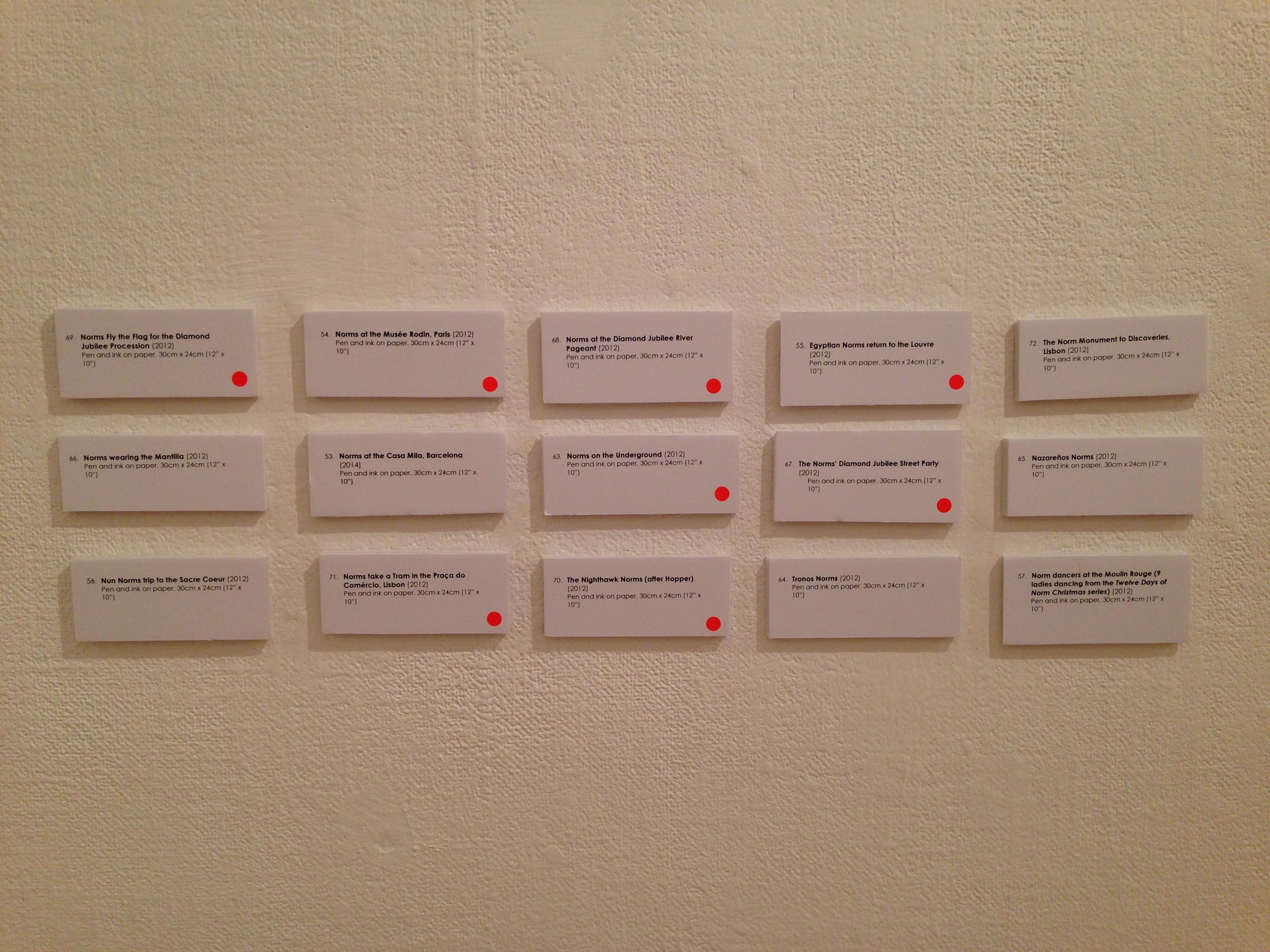
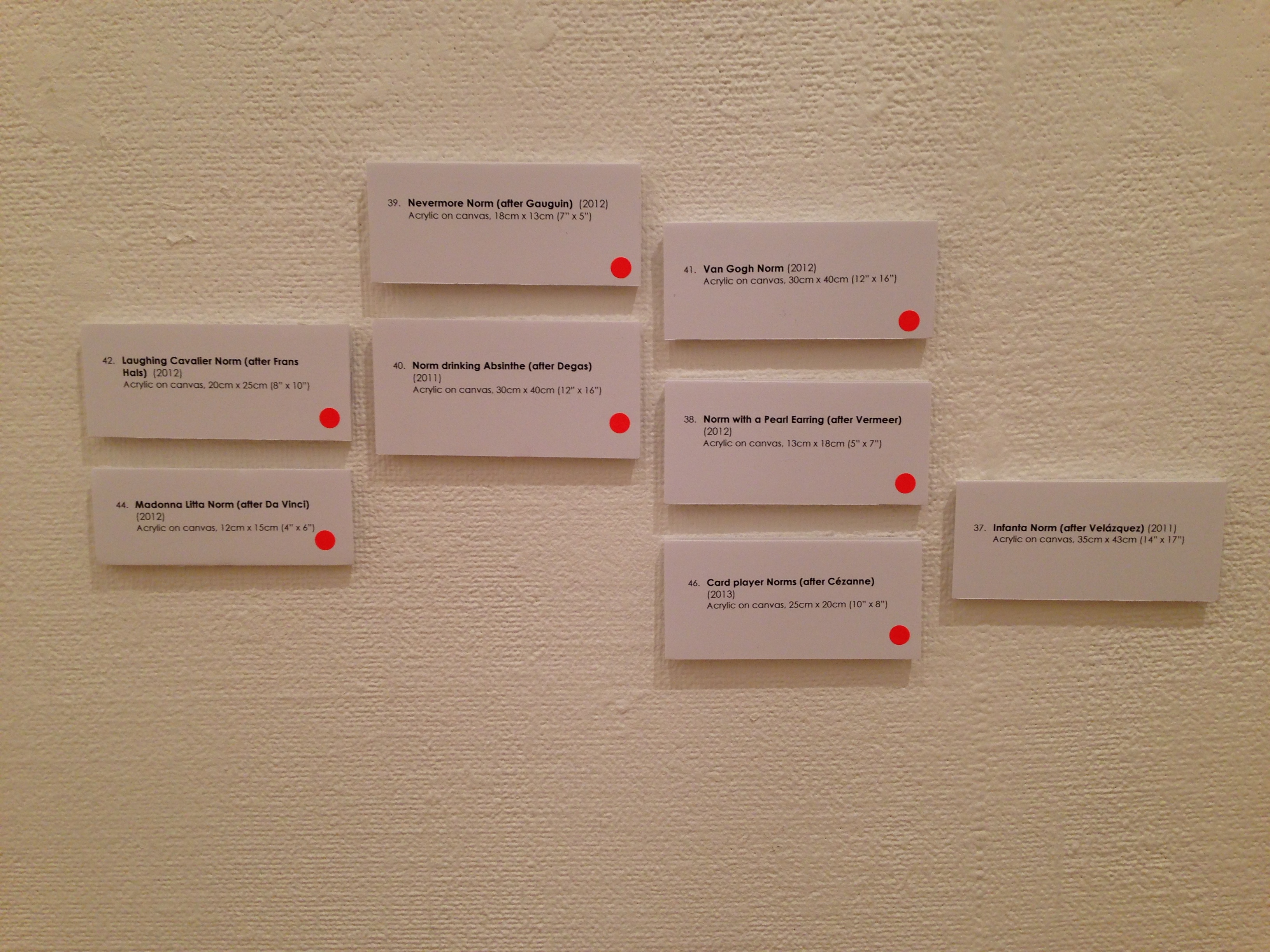
Those beautiful dots signifying multiple sales…

IMG_8613 IMG_8634 IMG_8635 IMG_8625

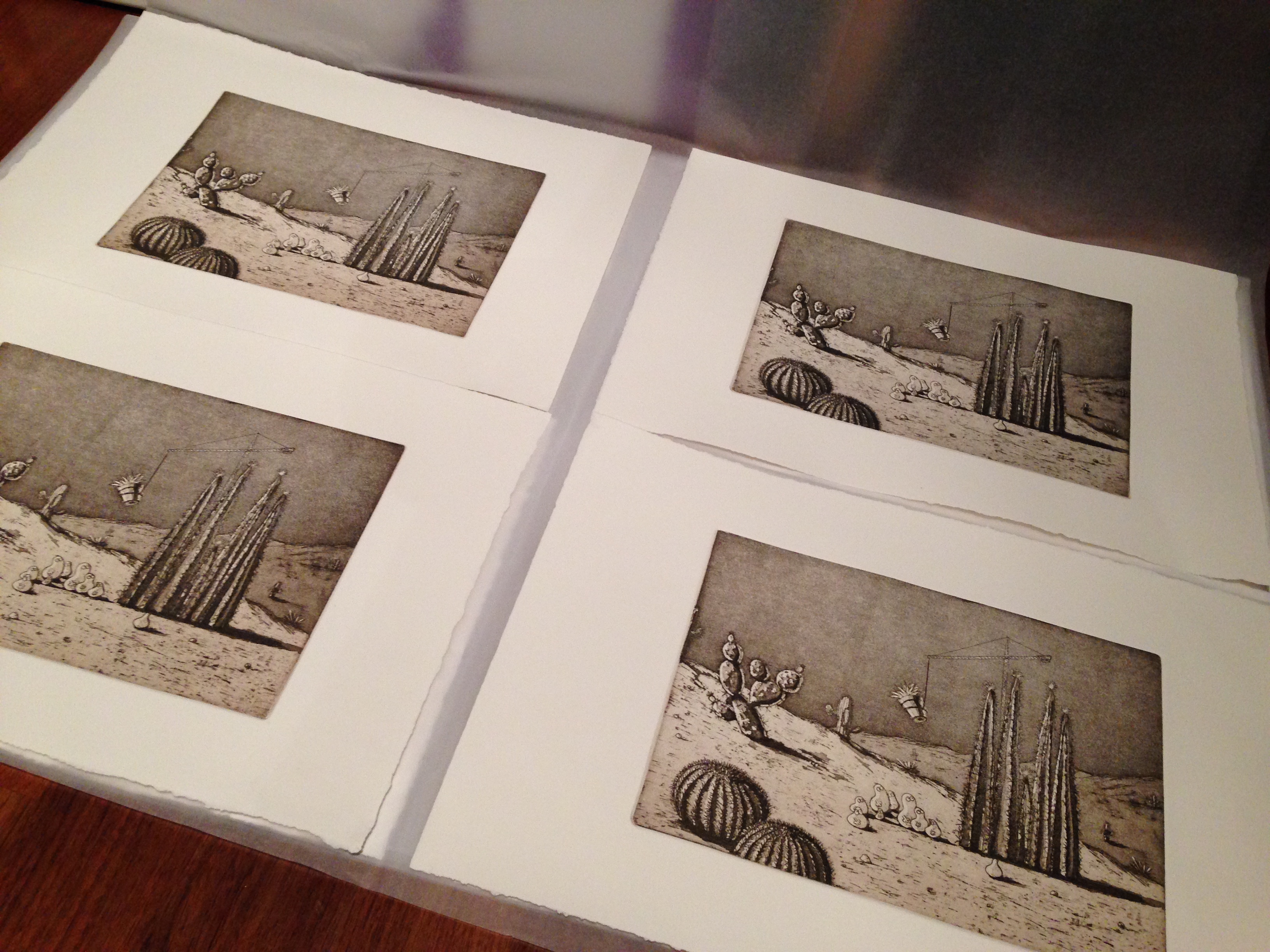
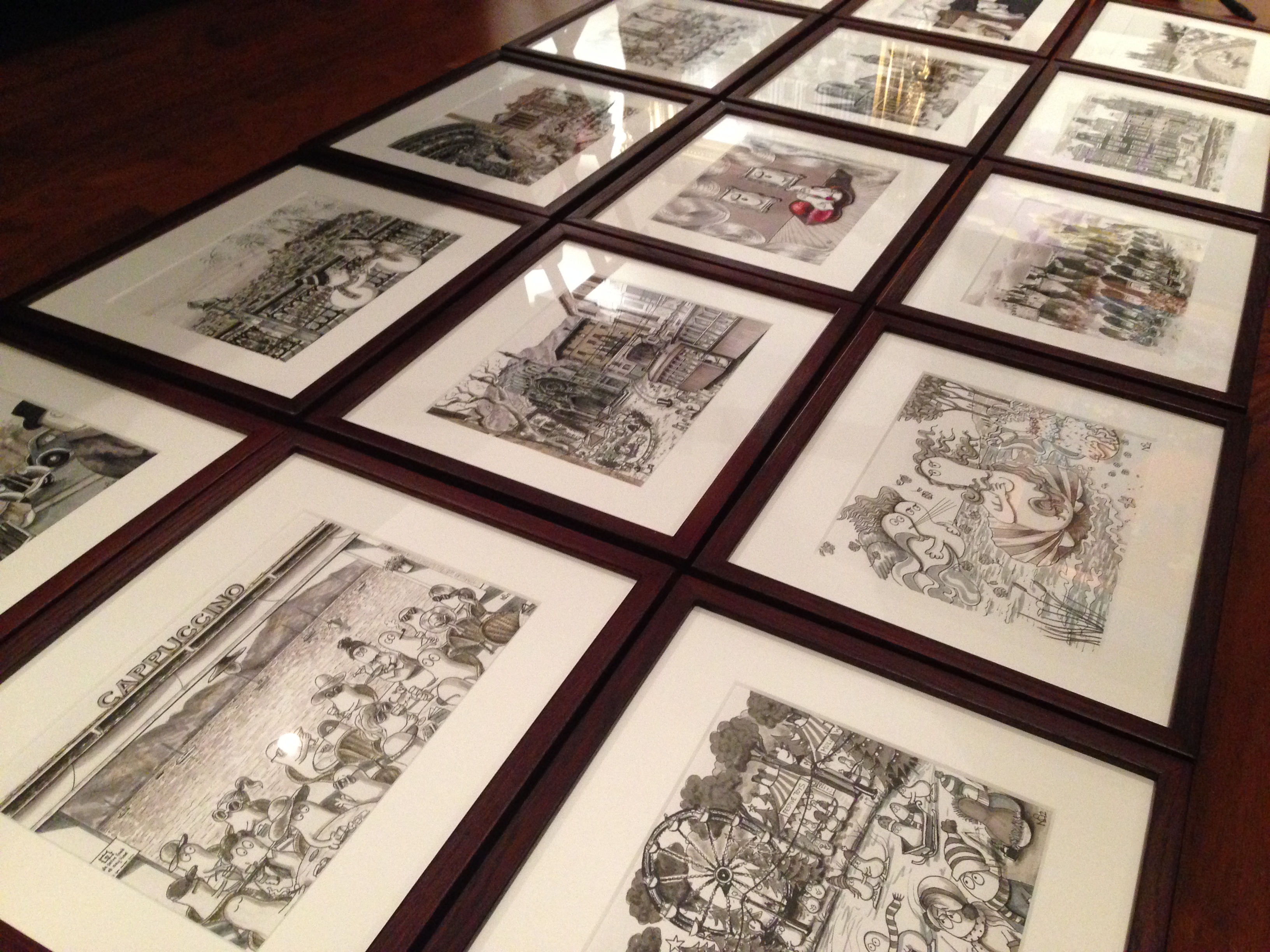
The collection of Norm paintings based on art historical masterpieces sold out, with only Infanta Norm, which I had saved for myself, remaining. My Norm sketches, made primarily as illustrations for this blog, also sold well, with at least half the collection emerging at the end of the exhibition with red dots upon their titles. And my latest endeavour – printmaking – sold similarly well, especially where the Norm, once again, had managed to creep into the image, making my prints a further attraction to the art-buying, Norm-loving public.

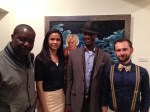
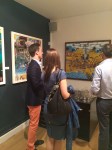
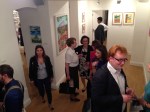
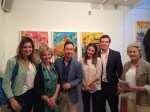
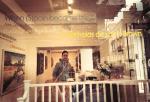
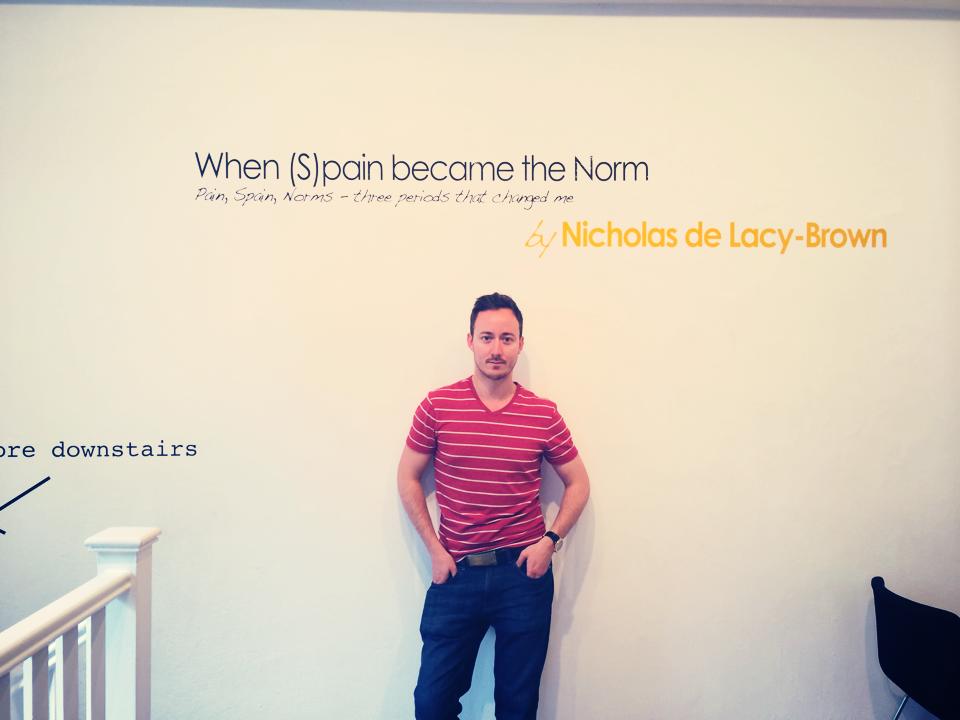
So by way of a final hurrah before I close my exhibition files and move on to the next project, I thought I would share some further photos of my show with you. Not only photos of the gallery looking resplendent when hung with my works, but also full of the very many marvellous people who came to see the show, including my parents who merrily took on the roles of gallery manager and barman, and my dear partner, who supported me throughout.

When (S)pain became the Norm was truly a personal achievement and was undoubtedly the high point of my art career so far. At its close, I emerge not only more confident in my work and the support that exists for it, but also full of excitement for what the future holds.

My new solo exhibition – up, running and beyond all expectations

My new solo exhibition, When (S)pain became the Norm, is up and running at London’s Strand Gallery and already excitement is at an all time high, not only for me, but for those wonderful visitors who have taken the time to visit this comprehensive solo show of my artwork. Already the corks have been popping, the guest book is filling up and little red dots are starting to appear alongside the odd artwork signifying that these precious products of my creativity have found new homes.

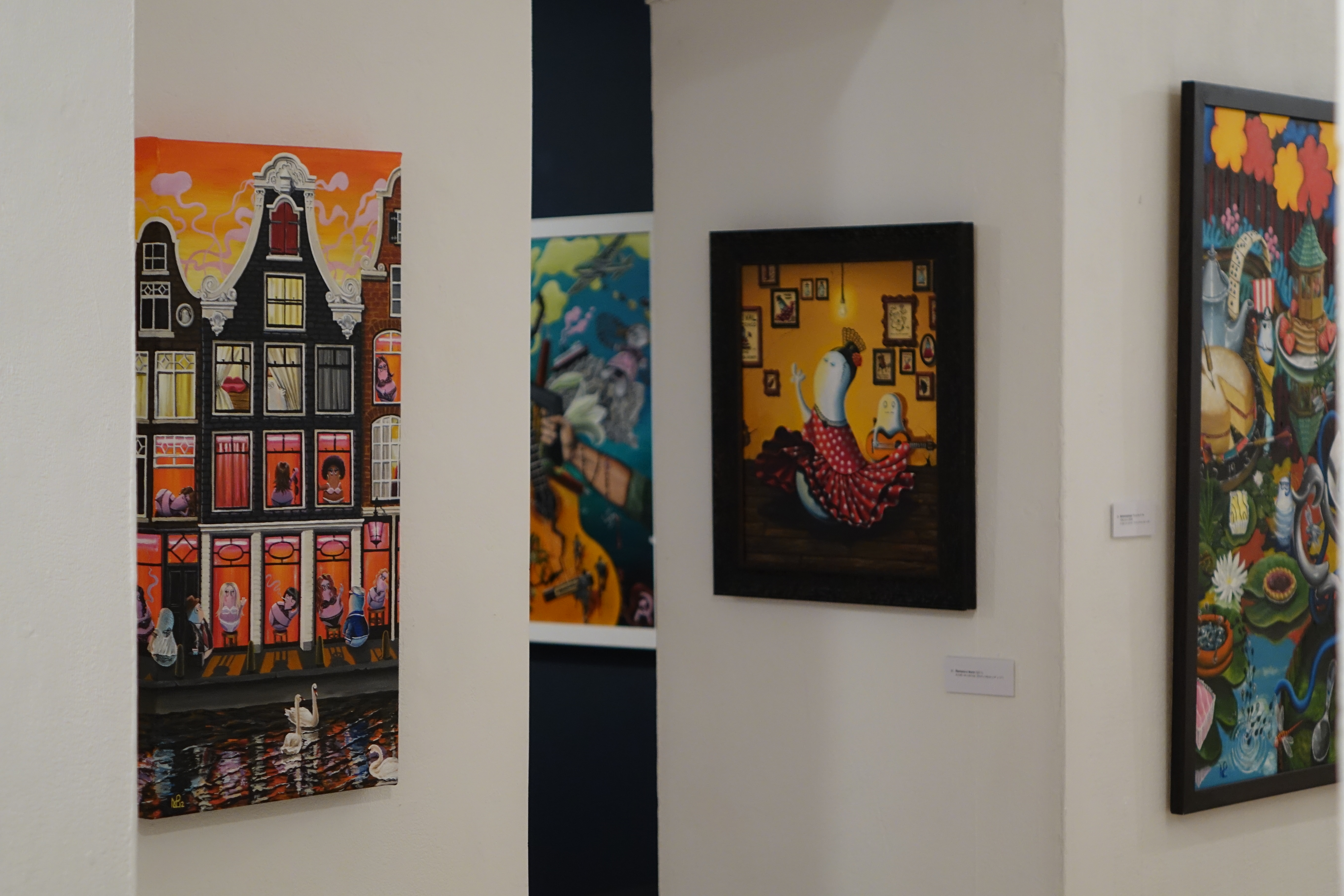
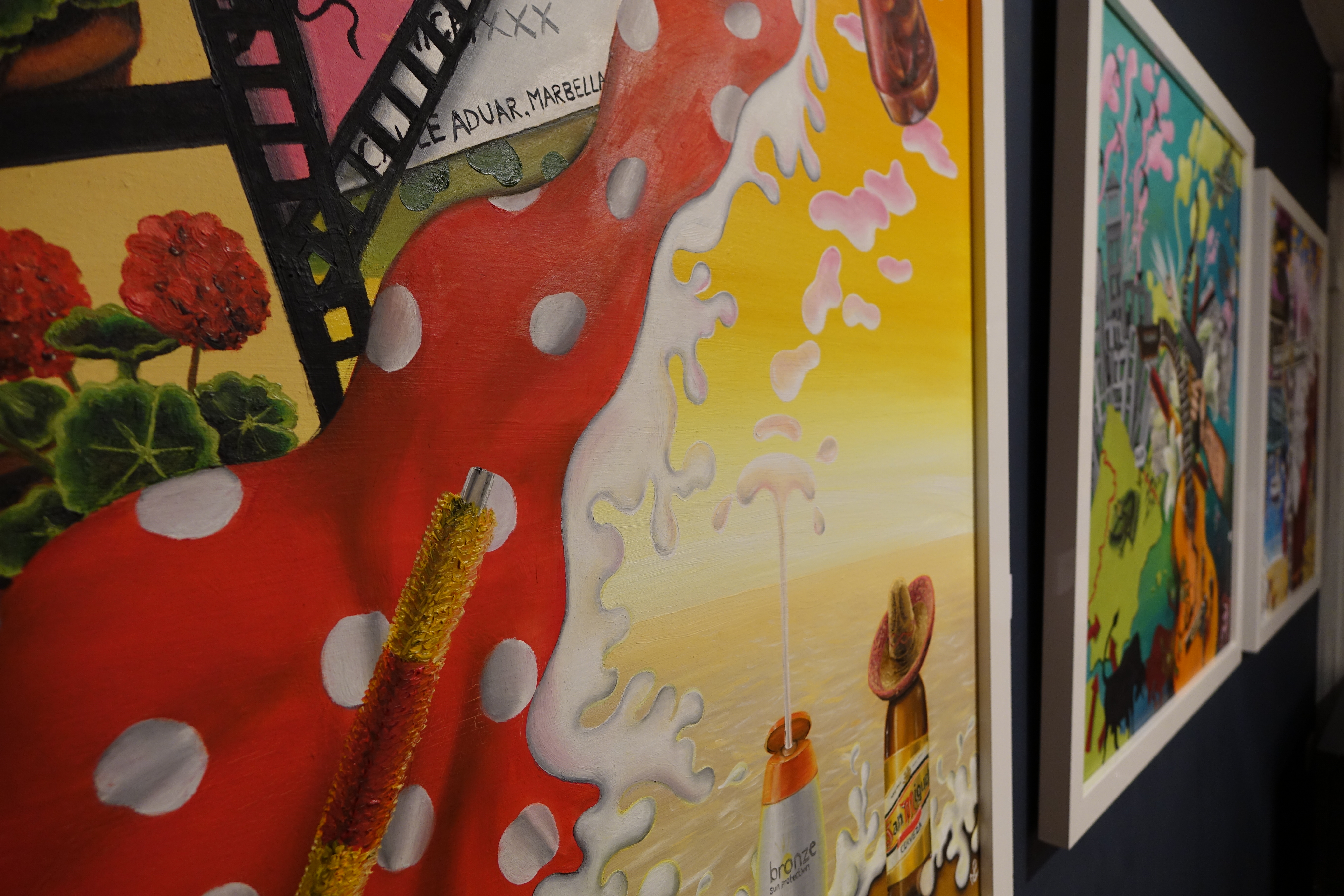
In my last post, I promised you some photos of the show, and I have lived up to my word – albeit with only a small selection. With so many of my paintings hanging in one place, and plenty of questions being asked by the visitors to the show, remembering to take shots of the exhibition to share with all of my faithful blog followers keeps on slipping to the back of my mind. But here are a few photos showing the exhibition is some of its vibrant colour-packed glory, from the ground floor hung with my more emotionally impacting accident art works, to the basement which plays host to the vibrant Spanish works and an entire corridor filled with Norm paintings and illustrations – henceforth christened “Norm World”.

DSC00079 DSC00072 DSC00045 DSC00076

If you are unable to get to the UK or London to see the show, I really hope that you nevertheless enjoy this sneak peak of what is such a proud moment in my artistic life. If you are however able to make it down to London’s Strand Gallery, I hope that this selection is enough to tempt you further, and that I can look forward to welcoming you there later this week.

For now though, I leave you with some sights from my solo show. Enjoy!

Full details of my exhibition can be found on my website here and on the Strand Gallery website.

When (S)pain became the Norm opens its doors to London!

I can’t believe I am even typing this post – that at this very moment, my new solo exhibition of some 170 paintings, prints and illustrations is opening its doors to London, and the world! Located across two floors in the prestigious Strand Gallery in the heart of London’s West End, this exhibition represents the last 6 years of my artistic endeavours.

As I write this post, my body is still aching from the exertion of hanging this most comprehensive show of my career, but seeing how the exhibition has turned out at the end of it all makes every hour of bubble wrapping, every relentless week of painting and every moment’s worry about deadlines and deliveries worth it. Because it just looks great.

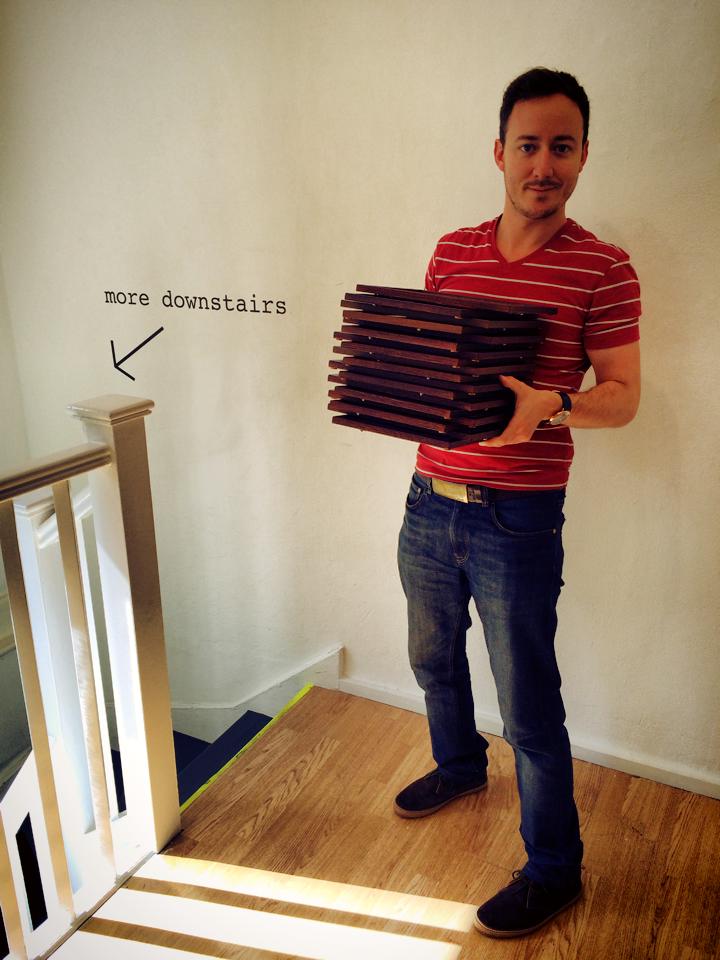
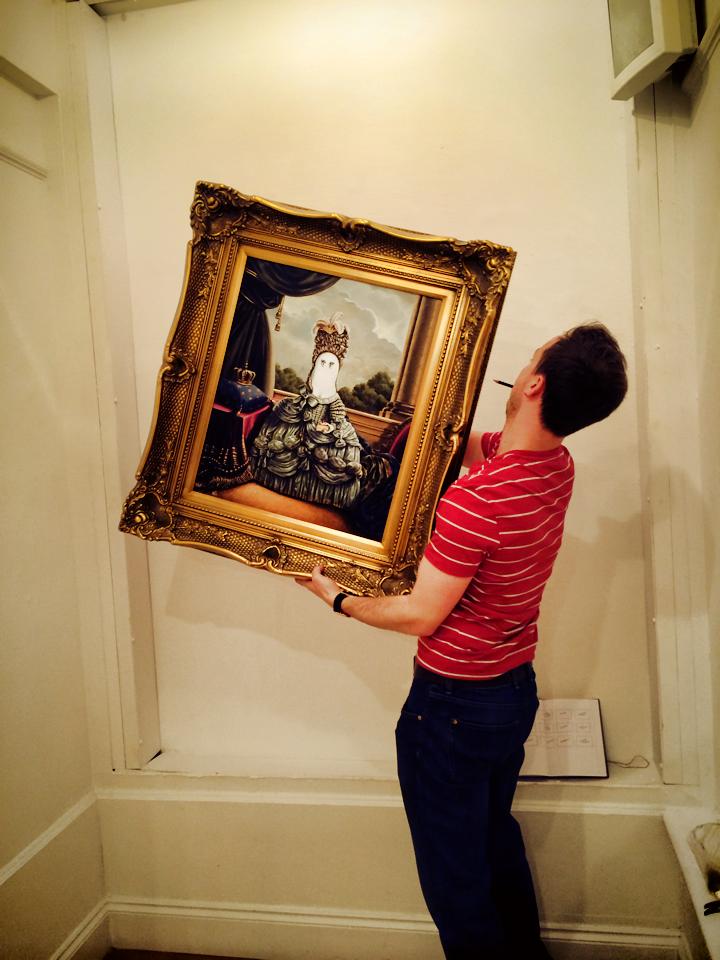
We finished hanging the show on the dot of 7pm last night without a single chance to take proper photos. But here are just a few shots of the headlining painting and me hanging my new Marie Antoinette Norm in her glamourous Versailles-style frame. More photos will follow any day now as well as all the news from this exciting new exhibition which will take visitors through three important periods of my artistic development: my accident paintings, my return to painting Spain as a primary inspiration, and of course my paintings and illustrations of the Norms.

photo 10313460_10152065678110846_3767283894029827316_n 10268403_10152065678390846_6006684457968534319_n 10356032_10152065679210846_8967512974631304410_n 10155629_10152065678020846_1504718687347989773_n

That’s all from me – I have an exhibition to get to! I really hope you will join me there, and if you can’t please tell your friends! More details about the show can be found on my website here.

Countdown to my new Solo Exhibition | 1 day – Ready to go!

I can’t believe it. After almost as many months of planning and preparation as it takes to make a baby, my baby – my new solo art exhibition When (S)pain became the Norm at London’s Strand Gallery – is finally upon us. Today I will be heading into the gallery to set up the show which comprises 105 displayed and framed works, and an additional 65 unframed mounted works – all for sale, of course.

The exhibition is the result of 6 years of hard creative slog. It’s testament to the constant workings of my imagination, and the unrelenting desire to be creating, whether it be on canvas or paper. Each painting or print has a detailed comprehensive story which is told through the combination of colours and form, and in its overall composition, while each Norm illustration has itself been used to tell or accompany a story on this very blog. All in all, from today onwards, London’s Strand Gallery will be filled with 105 windows onto another world, inviting viewers to enter in and go on a little journey within each work.

Preparations for the show

IMG_7995 IMG_8501 IMG_8461 IMG_8503

So as I commence the final piece of my journey towards getting my show open to the world, the final piece of the jigsaw is YOU – without viewers with whom I can share my work, the exhibition will not be ultimately successful. Like any artist, I need my works to be seen – I want people to see my view of the world, even if it is only for a few days. And of course, I need to sell, so that my work can spread beyond the boundaries of my art-filled home to bring colour and life to others. So please do put the details of my exhibition in your diary and come along to central London to share in the world of De Lacy-Brown Art for a moment or two. It won’t be the same without you.

The exhibition is on at The Strand Gallery, 32 John Adam Street, London WC2N 6BP from 13 – 18 May 2014. The gallery is open daily 11am – 7pm with early closure on Sunday. See you there!

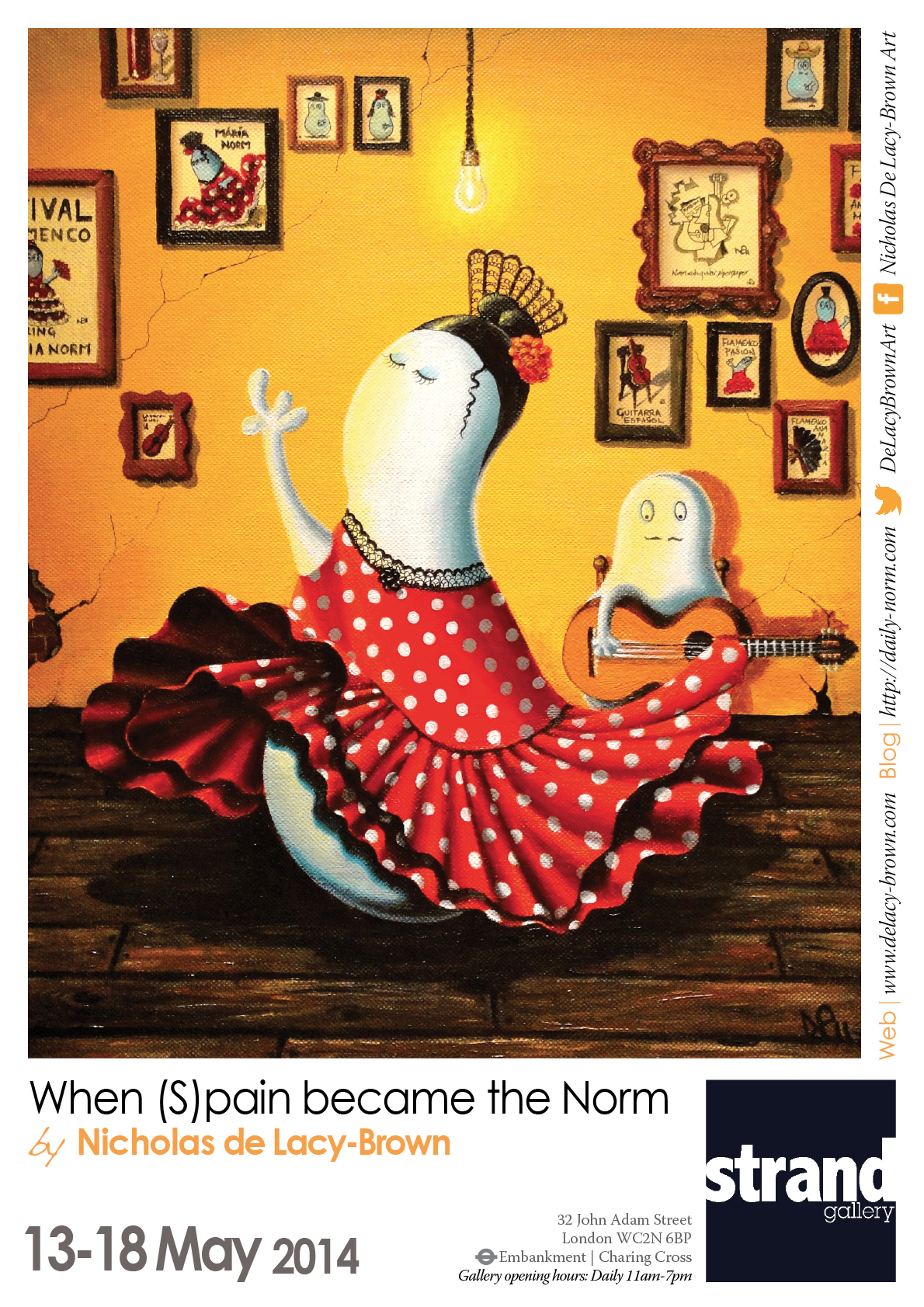
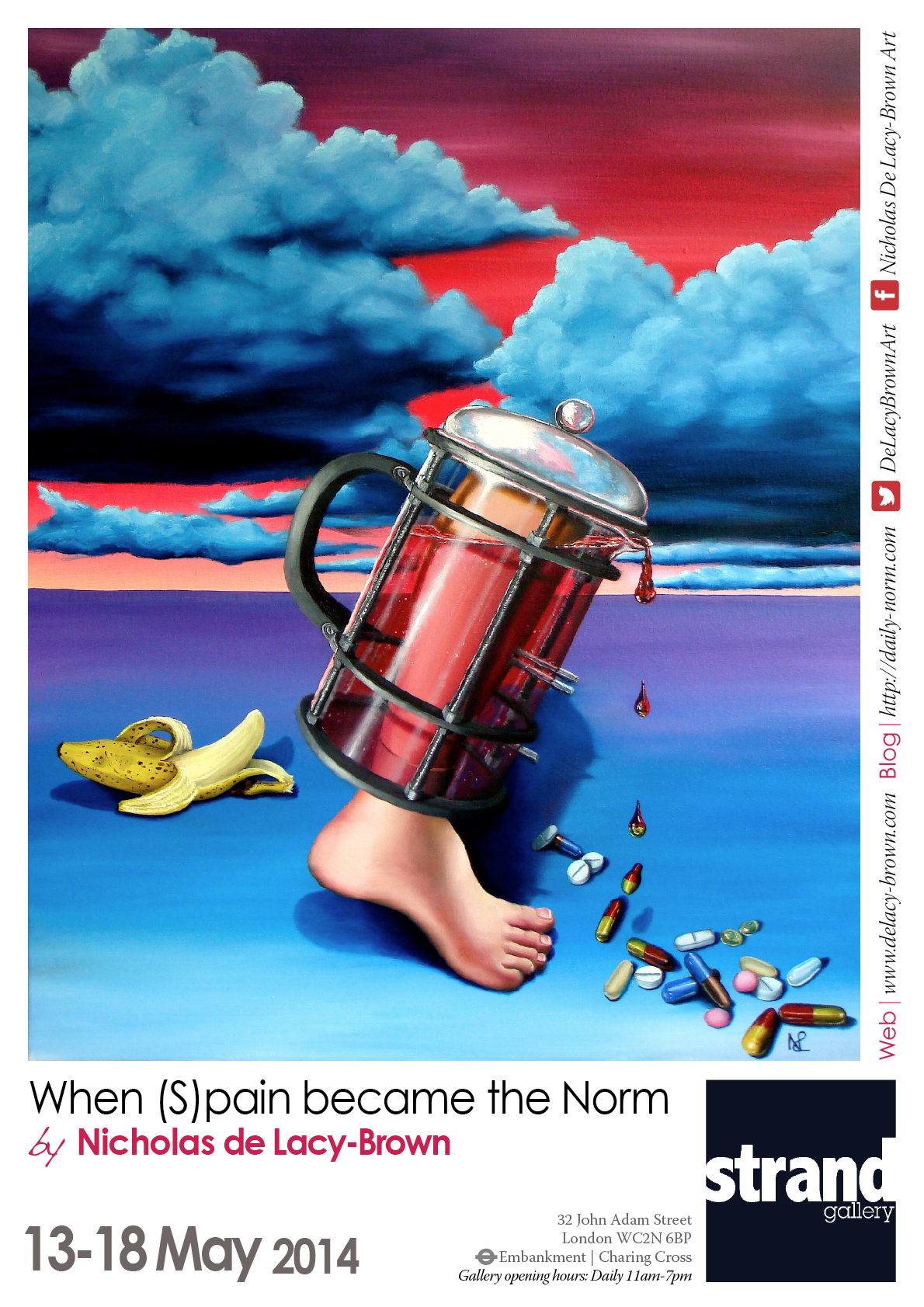
Expo 2014 Poster Bricks Poster A2 Flamenco Poster A2 Cafetiere

© Nicholas de Lacy-Brown and The Daily Norm, 2001-2014. Unauthorized use and/or duplication of the material, whether written work, photography or artwork, included within The Daily Norm without express and written permission from The Daily Norm’s author and/or owner is strictly prohibited. Excerpts and links may be used, provided that full and clear credit is given to Nicholas de Lacy-Brown and The Daily Norm with appropriate and specific direction to the original content. For more information on the work of Nicholas de Lacy-Brown, head to his art website at www.delacy-brown.com
Nicholas de Lacy-Brown’s new solo exhibition, When (S)pain became the Norm, will be at London’s Strand Gallery from 13 – 18 May 2014. For more details, click here.

Countdown to my new Solo Exhibition | 4 days – ¡Guerra!

With 4 days left to go until my exhibition, I wanted to take you to sunnier climes in exploring some of the collection which will be on display as my work goes on show at The Strand Gallery, albeit not necessarily calmer times. For in painting the first of what was to become a comprehensive series of works based on my most beloved of countries, Spain, I reached back into history for inspiration, and more particularly to one of the most turbulent periods of Spanish history – the Spanish Civil War of 1936-9.

The Spanish Civil War has been somewhat overlooked in the typical school’s history curriculum in favour of the more wide reaching first and second world wars. It was perhaps for this reason that I became so engrossed in the story of the war when I first started reading about it during my post-accident convalescence in 2009. Of course I was well aware that the war had happened, but knew nothing of the shocking details which meant that only a little over 70 years before, the country which today seems such a calm sanctuary of beach tourism and a hotbed of cultural highlights, was ravaged by one of the most severe wars in history. And what made the war even more shocking to my mind was the fact that it had seen one Spaniard turn against another, families literally split in two and generations of friends turn in on one another. Here there was not the kind of national solidarity which comes of an entire nation being invaded by an external aggressor, but a country made cannibal, turning in on itself.

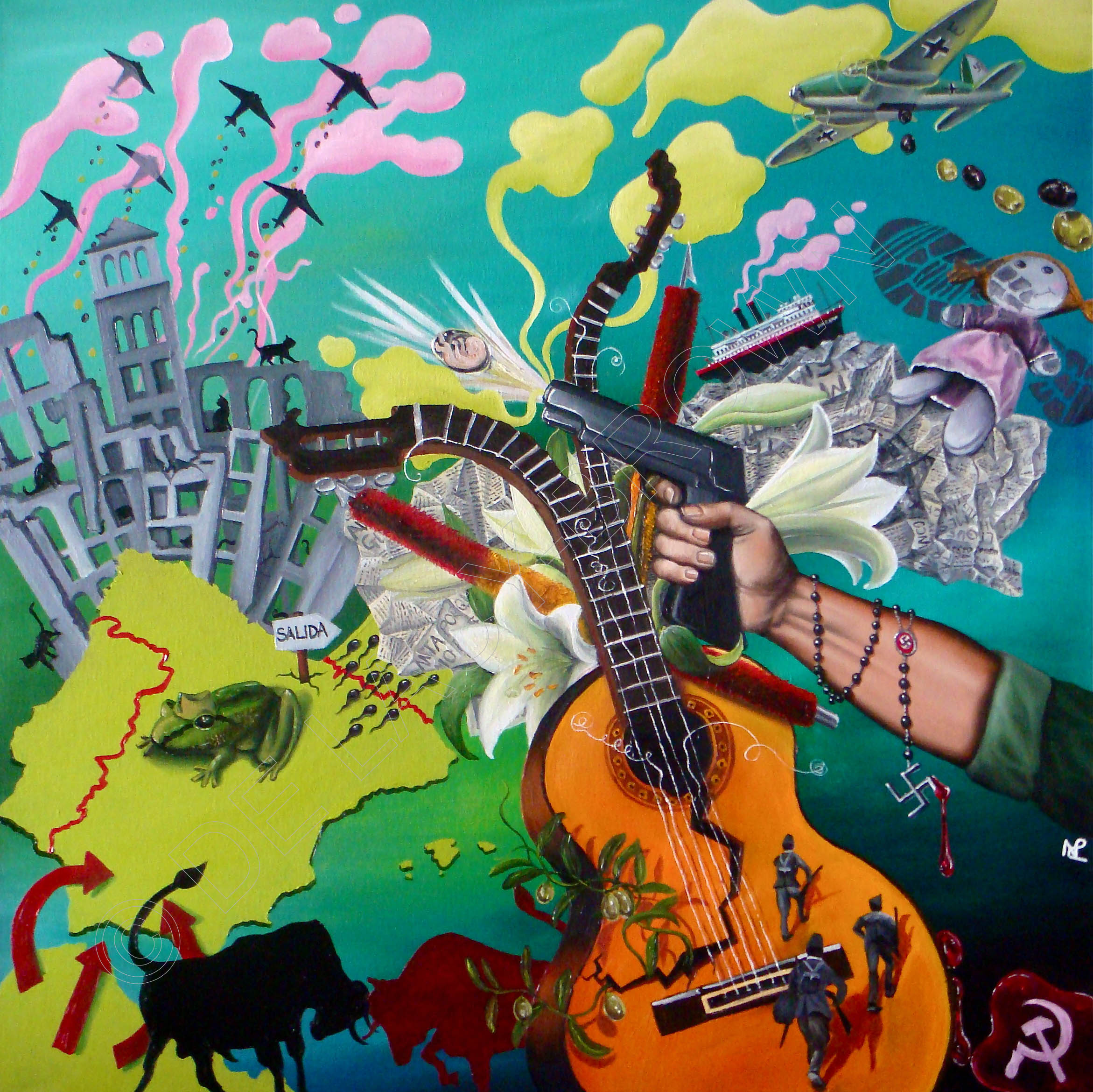
¡Guerra!: The Spanish Civil War (Oil on canvas, 2009 © Nicholas de Lacy-Brown)

¡Guerra!: The Spanish Civil War (Oil on canvas, 2009 © Nicholas de Lacy-Brown)

The more I read about the war, the more engrossed I became, and it was only a matter of time before an image started to emerge in my head for a painting depicting the conflict. So taking a 90cm x 90cm canvas, I set about painting what was to initiate an entire series of Spanish paintings, this one showing the country at its lowest ebb. From the Spanish guitar shown split at the painting’s centre as a symbol of Franco’s attack on the Andaluz gypsy culture, and the bombings of the innocent down of Guernica, to the imprint of a soldier’s show trod across an abandoned doll, symbol of the total disregard for innocent lives, even children’s – this painting contains all of the ingredients which made the Spanish Civil War so shocking to me.

And yet despite the somewhat grim tale it portrays, the work remains one of my favourite paintings, and hangs in prime position above my bed, where it has remained since it was first created. Should I sell the work at my forthcoming Strand Gallery show, it will be a hard one to part from.

© Nicholas de Lacy-Brown and The Daily Norm, 2001-2014. Unauthorized use and/or duplication of the material, whether written work, photography or artwork, included within The Daily Norm without express and written permission from The Daily Norm’s author and/or owner is strictly prohibited. Excerpts and links may be used, provided that full and clear credit is given to Nicholas de Lacy-Brown and The Daily Norm with appropriate and specific direction to the original content. For more information on the work of Nicholas de Lacy-Brown, head to his art website at www.delacy-brown.com

Nicholas de Lacy-Brown’s new solo exhibition, When (S)pain became the Norm, will be at London’s Strand Gallery from 13 – 18 May 2014. For more details, click here.
Countdown to my new Solo Exhibition | 5 days – Semana Santa Code

This is the third post of artwork shares as The Daily Norm warms up for my first solo art exhibition in 6 years. Moving on from the more emotionally raw works of my accident collection which will take centre stage at the exhibition, I move on, albeit gradually, to my works inspired by the culturally abundant, vividly colourful country of Spain. 

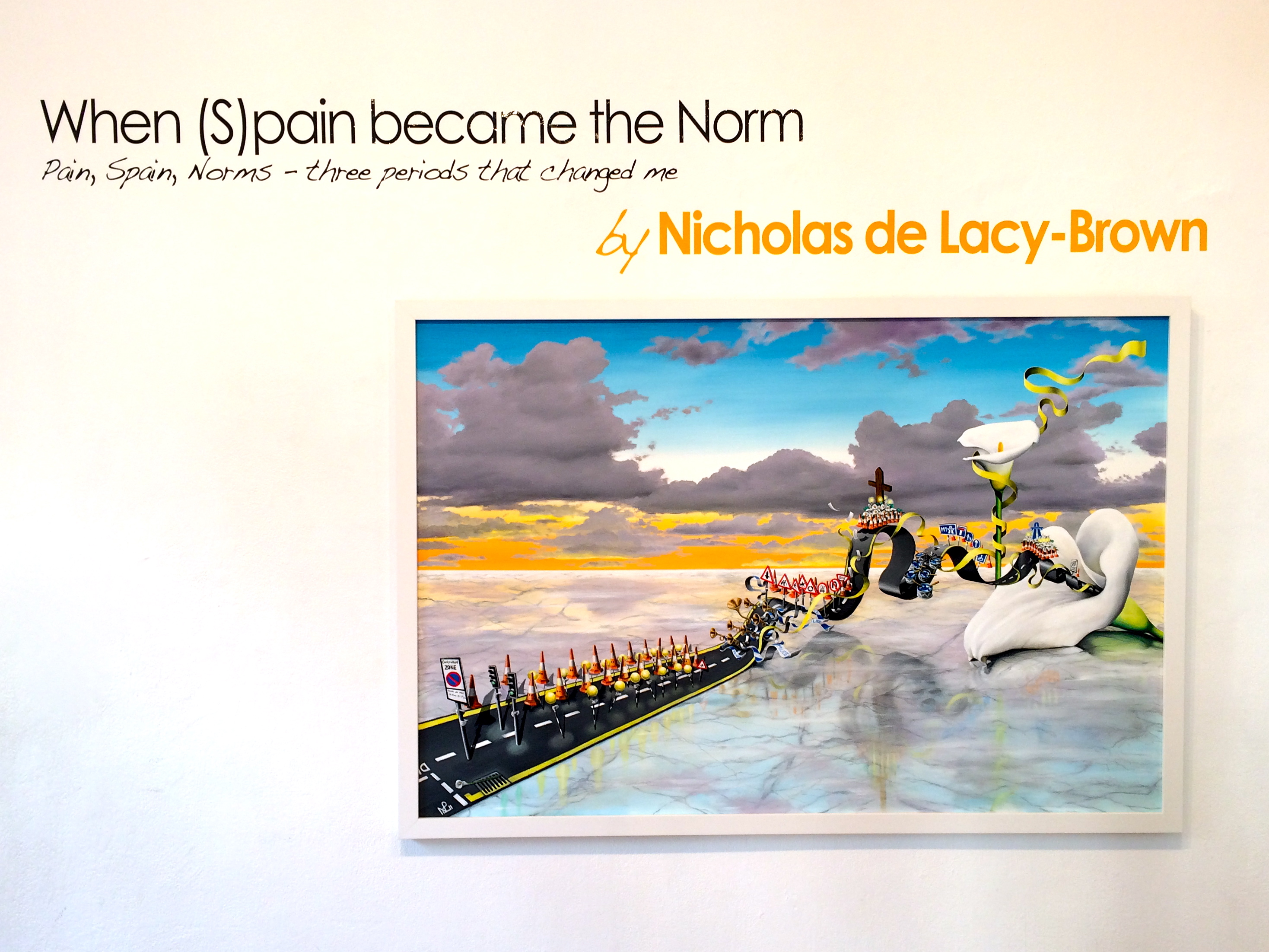
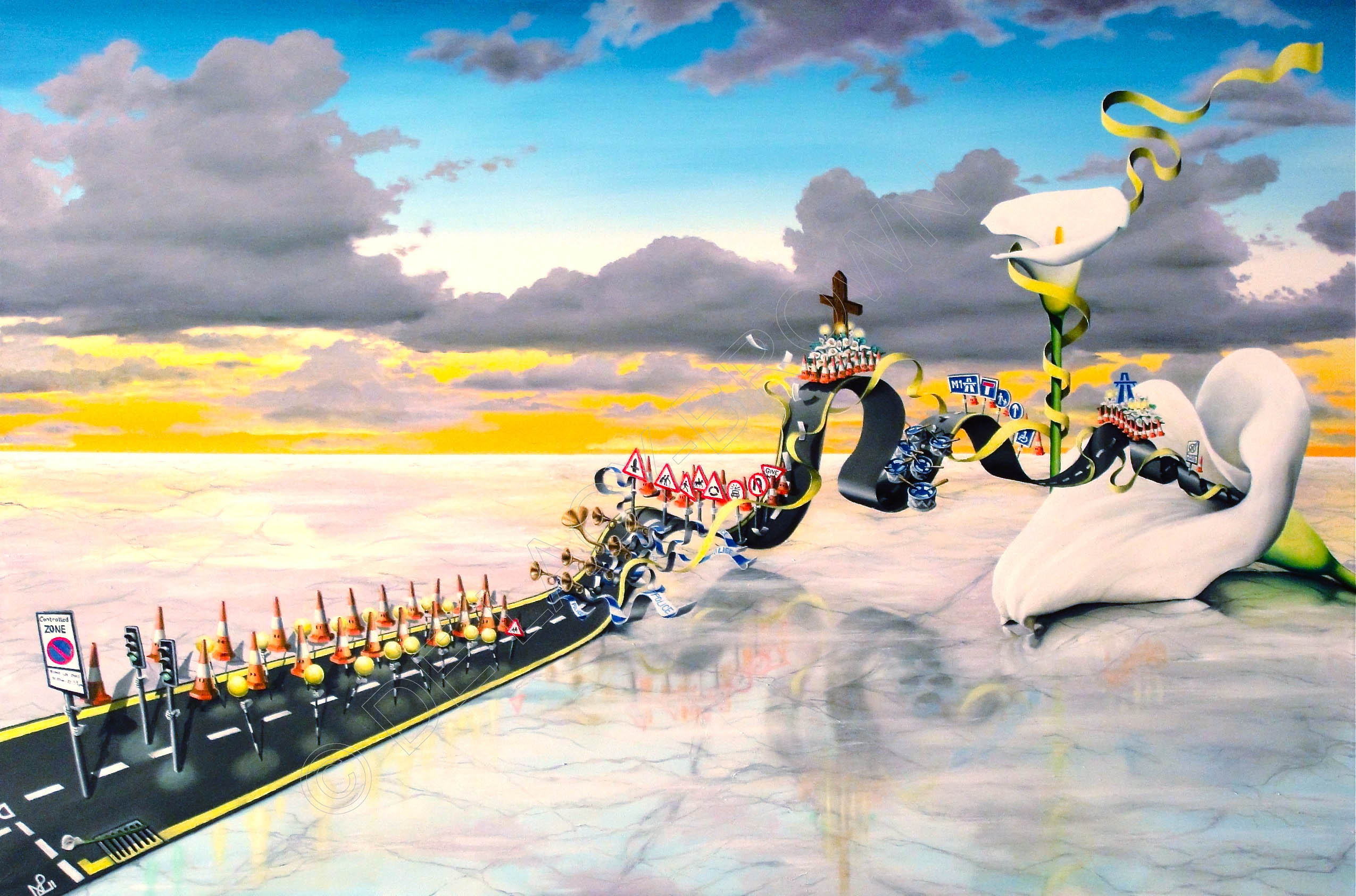
For in the third work I am featuring by way of preview of next week’s exhibition, Road Traffic Control (The Semana Santa Code) I may be representing the Spanish Semana Santa parades which are characteristic of Spanish cities up and down the length and breadth of the country during Easter Week, but I also continue to reference the road traffic symbolism which dominated my work from the time of my 2008 accident onwards.

Whether or not the influence of the accident was still dominant in my mind when I painted this work I am not sure. To some extents I will never truly escaped the effects of my accident in my art, just as I will never totally escape them in life. However, the road traffic imagery in this painting was used, not so much as a reference back to my own accident, but as a way of portraying the traditional parades of the Spanish Easter celebrations through a less traditional mode of illustration.

The Semana Santa Code (Oil on canvas, 2011 © Nicholas de Lacy-Brown)

The Semana Santa Code (Oil on canvas, 2011 © Nicholas de Lacy-Brown)

The idea came to me when I noticed that the Spanish Nazareños, marching along the roads of Spanish cities with their pointed conical caps, looked much like walking traffic cones. And so the idea was born. From the use of traffic cones, I moved on to utilise familiar traffic signs and symbols by way of “codyfying” (in the same way as The Highway Code does for traffic) some of the religious meanings and motivations underlying the Easter parades. For example I converted the typical motorway sign into a symbol of Mary, Mother of Christ, while the crucifixion was replaced with the sign for a crossroads.

For its scale (the painting measures almost 2 metres across) and the relative simplicity of the image, I really do love this painting, a fact which will be reflected as I plan to hang this work at the very opening of my show next week; for as a painting reflecting both the Spanish culture which has so entranced me, and the road traffic imagery which was the cause of so much personal all-encompassing pain, this painting really is apt illustration of the time when (s)pain became the Norm.

© Nicholas de Lacy-Brown and The Daily Norm, 2001-2014. Unauthorized use and/or duplication of the material, whether written work, photography or artwork, included within The Daily Norm without express and written permission from The Daily Norm’s author and/or owner is strictly prohibited. Excerpts and links may be used, provided that full and clear credit is given to Nicholas de Lacy-Brown and The Daily Norm with appropriate and specific direction to the original content. For more information on the work of Nicholas de Lacy-Brown, head to his art website at www.delacy-brown.com

Nicholas de Lacy-Brown’s new solo exhibition, When (S)pain became the Norm, will be at London’s Strand Gallery from 13 – 18 May 2014. For more details, click here.

Countdown to my new Solo Exhibition | 6 days – Champiñones

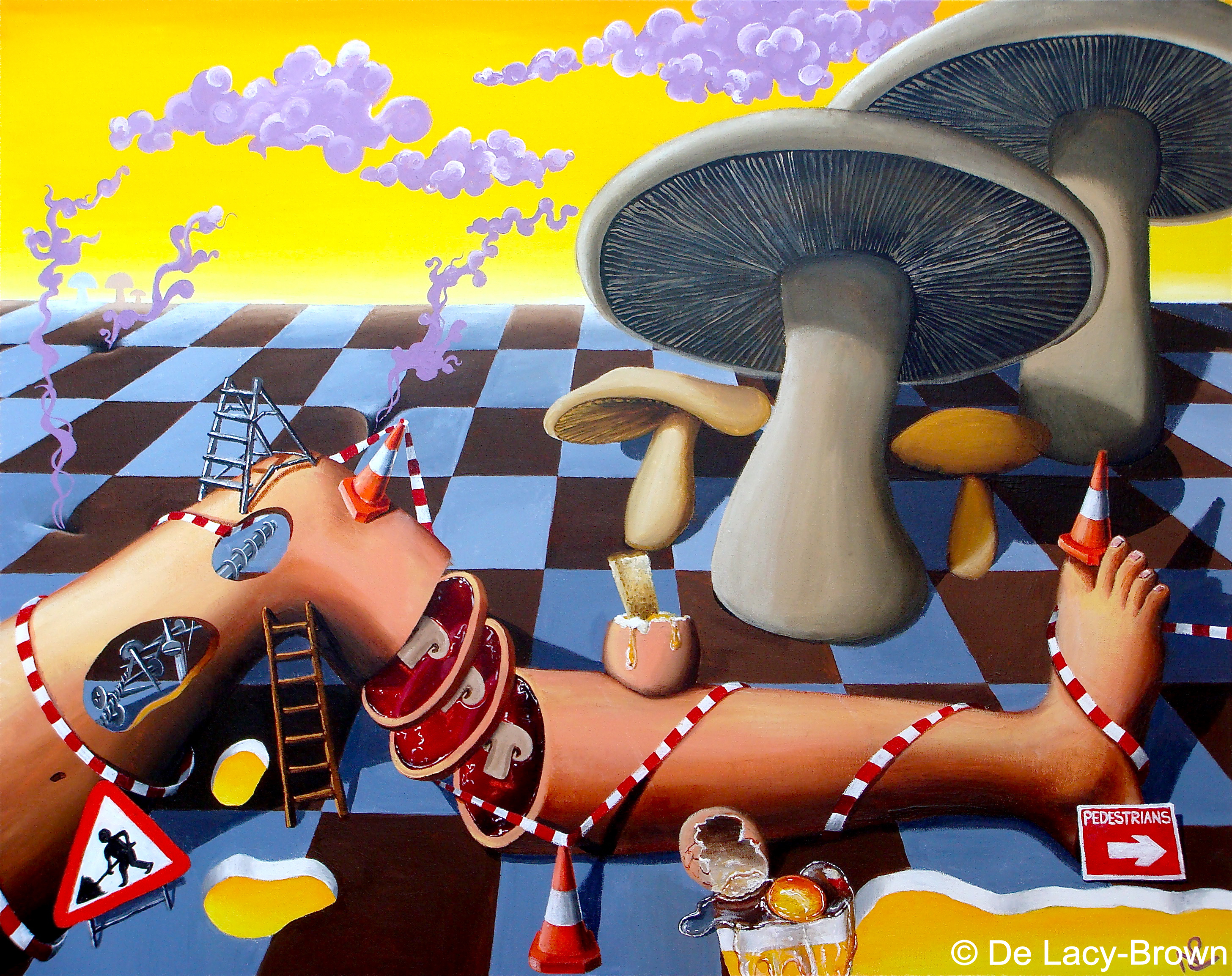
As the time for my new London solo art exhibition fast approaches, I am sharing some of the artworks which will be exhibited, most of them for the first ever time in a public gallery. Yesterday, I shared the first of my accident paintings, created in the immediate aftermath of my sudden accident in May 2009. Today I’m moving on to a work created towards the end of the series, at a time when the problems of my post-accident injuries moved from broken bones to deep internal infection. It was also the time when, after a year of healing and corrective surgery, I was told that the leg would have to be rebroken and reset, which in effect meant that I would be going back to square one all over again.

The resulting painting, La Marcha de Los Champiñones (March of the Mushrooms) was painted in my house in Spain (hence the Spanish title given to the work) immediately following my fifth operation – an emergency procedure to remove large scale infection which had built up in the leg. And no surprise there, since the amount of surgery I had endured up until this point was so extensive that my leg was literally riddled with holes. The leg had also healed with a fixed flexion deformity, which in effect meant that it had healed bent and would need to be rebroken.

La Marcha de los Champiñones (2009 © Nicholas de Lacy-Brown, acrylic on canvas)

La Marcha de los Champiñones (2009 © Nicholas de Lacy-Brown, acrylic on canvas)

All this I reflected visually with the use of mushrooms as an indication of the spread of infection, hence why, when the bent leg is cut open, a mushroom can be found at its centre. Meanwhile, a fragmented landscape, pocked with holes and broken pieces represents the fragility of my half-healed bones at that time, and the leg, which is also full of pins and nails, represents the amount of metal I had in my leg after various metal fixators had been used to piece it back together. Meanwhile, the use of road traffic symbols including ribbon and roadwork signs, as well as ladders, demonstrates that the leg was, at this stage, far from repaired and still a work in progress. It also reflects the accident which occurred by a road side.

It’s a painting full of some of the cynicism and frustration I was feeling at the time, but by this stage, my accident paintings had become more visually playful as I had accepted my fate and focused my energies on expressing my turmoil visually instead. The resulting image is one of bright colours and whimsical imagery which transports the heavily emotional accident works into a new place of greater hope and free-spiritedness. And just in time, for a new collection based on the bright colours and vivid culture of Spain was just around the corner…

© Nicholas de Lacy-Brown and The Daily Norm, 2001-2014. Unauthorized use and/or duplication of the material, whether written work, photography or artwork, included within The Daily Norm without express and written permission from The Daily Norm’s author and/or owner is strictly prohibited. Excerpts and links may be used, provided that full and clear credit is given to Nicholas de Lacy-Brown and The Daily Norm with appropriate and specific direction to the original content. For more information on the work of Nicholas de Lacy-Brown, head to his art website at www.delacy-brown.com

Nicholas de Lacy-Brown’s new solo exhibition, When (S)pain became the Norm, will be at London’s Strand Gallery from 13 – 18 May 2014. For more details, click here.

Countdown to my new Solo Exhibition | 7 days – Bricks and Stones

It seems almost mad that close on 6 months have gone by since I first announced on this blog that I would be holding a brand new solo exhibition of paintings, illustrations and prints in London’s Strand Gallery this May. And yet here we are, with the exhibition on the doorstep. In 7 days, my exhibition, which will feature over 100 displayed artworks and a whole lot more other artworks for sale, will throw open its doors to the prestigious West End of London. A mere 50 metres from London’s Strand, the exhibition is in the heart of the city’s colourful Covent Garden/ Charing Cross area, and frankly I could not think of a better location.

So as excitement builds, the bubble wrapping goes into overdrive, frames are attached, price lists drawn up and champagne gathered, I thought I would take time to explore some of the themes and artworks which will feature in the show on each of the 7 days approach to the exhibition’s opening on 13 May.

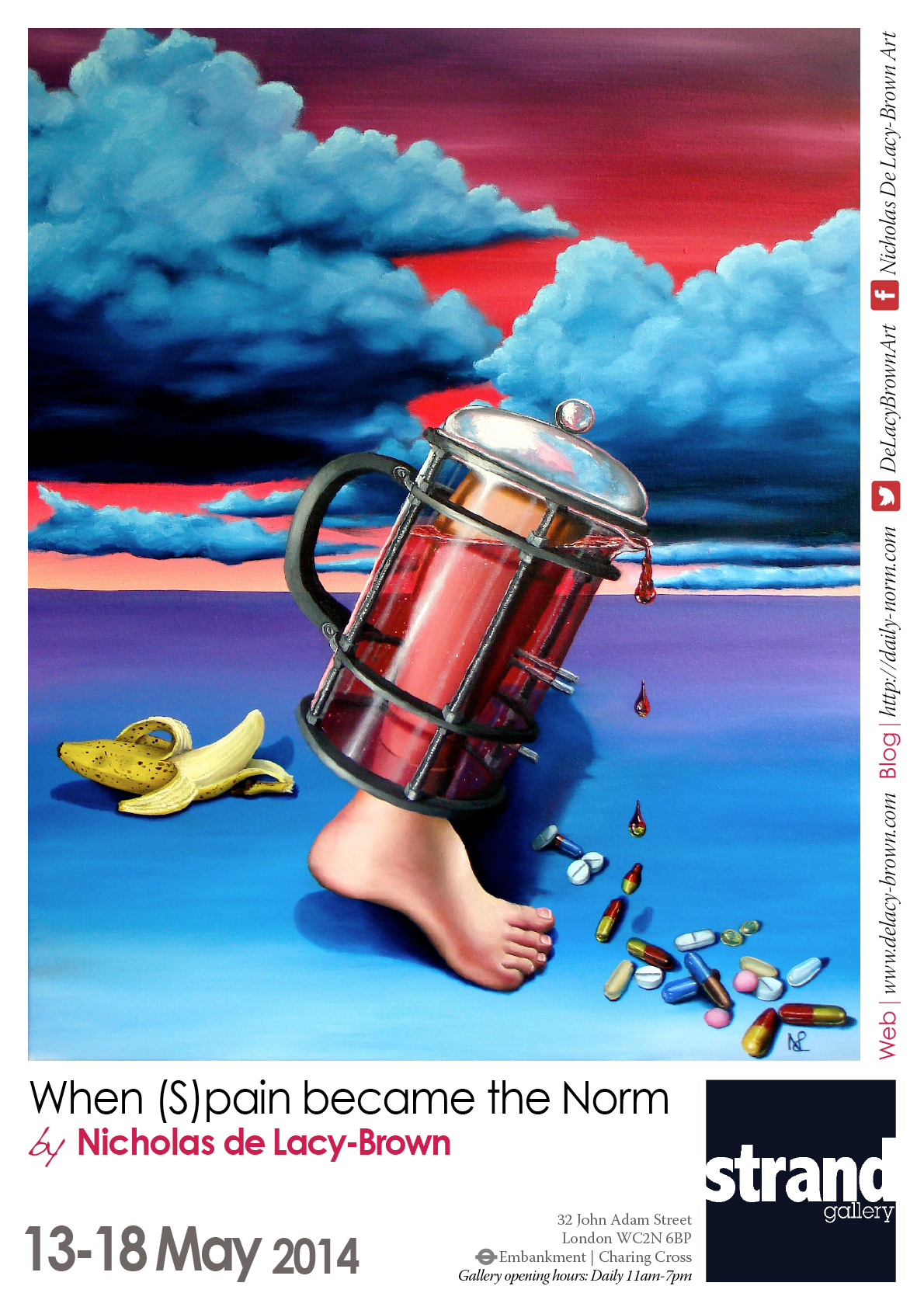
Poster A2 Cafetiere

The exhibition is entitled When (S)pain became the Norm, a title which represents the three main themes which will run through the collection – Pain: the time of my 2008 road traffic accident and the protracted convalenscence which followed; Spain: how this most colourful of European countries has given rise to some of my most exciting and energetic artworks; and the Norms: all my paintings and illustrations of the small white-blobbed one-armed creation of my imagination, most of which have featured on this blog which is named after that same unique character.

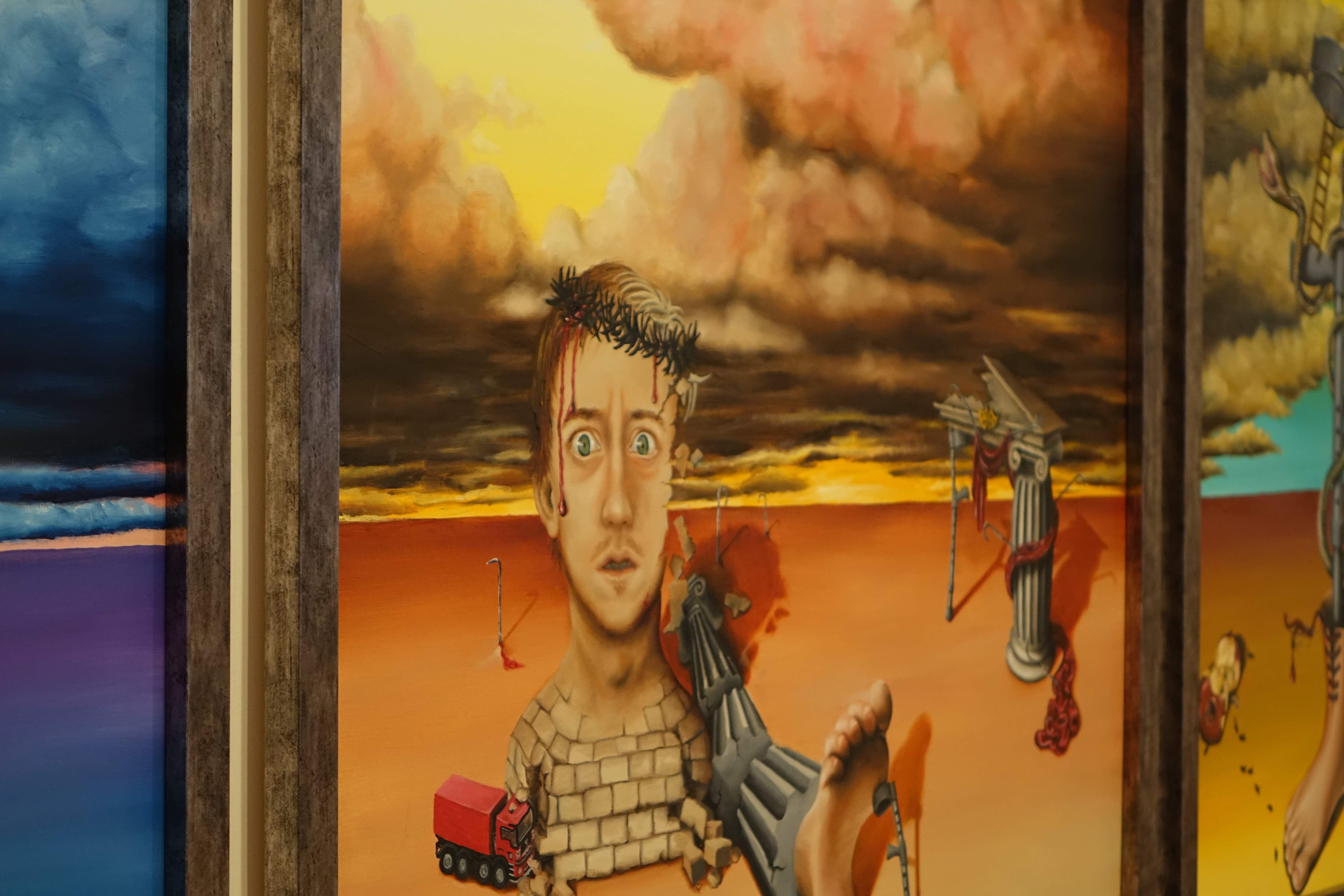
In this first post, I am sharing the painting which really kickstarts the whole collection. Entitled Bricks and Stones may Break My Bones (The Show Must Go On)it was the first painting I started in the weeks immediately following the horrendous accident in which I was involved in May 2008. On 29 May 2008, I was walking out to buy some lunch when a lorry, without warning, collided with a 10 ft concrete brick wall which then collapsed onto the pavement as I walked by. I was caught under the rubble and serious crush fractures sustained to my right leg. Frankly, I was lucky to get away with just that. The injuries were so severe that I had to have my leg placed in an external fixator – a horrific instrument attached to the leg with a series of a bloody pins – and I underwent some 7 operations over 3 years before the leg was finally healed, sufficiently, to such a level that I could walk once again.

Bricks and Stones May Break My Bones (The Show Must Go On) 2008 © Nicholas de Lacy-Brown, oil on canvas (130cm x 110cm)

Bricks and Stones May Break My Bones (The Show Must Go On) 2008 © Nicholas de Lacy-Brown, oil on canvas (130cm x 110cm)

This painting, which is perhaps one of the most visceral and uncomfortable of my collection, represents the accident itself. I am shown, in self-portrait, morphed into the wall which had by that time become an inescapable factor in my life. Crashed into it, a small toy lorry is beside me, while on my head, like a crown of thorns, is the barbed wire which ran along the wall and collapsed down upon me in turn. My broken leg is shown as a column broken into three pieces, reminiscent of a similar representation used by my idol, Frida Kahlo, while my crutches are propping up my right food Dali-style since, which, owing to nerve damage, otherwise flopped involuntarily to the floor. Meanwhile over the bleak landscape, the pins which pierced my leg pierce the ground, and on the right, a theatrical proscenium arch likewise propped up by a crutch and a swollen leg demonstrates that despite all of the horror around me, the show had to go on: Something demonstrated by the fact that I was up on two chairs, my leg outstretched, painting this powerful work.

Come back tomorrow for my next featured work, and in the meantime, please consider coming along to my exhibition. More details can be found on my website, and on that of The Strand Gallery.

© Nicholas de Lacy-Brown and The Daily Norm, 2001-2014. Unauthorized use and/or duplication of the material, whether written work, photography or artwork, included within The Daily Norm without express and written permission from The Daily Norm’s author and/or owner is strictly prohibited. Excerpts and links may be used, provided that full and clear credit is given to Nicholas de Lacy-Brown and The Daily Norm with appropriate and specific direction to the original content. For more information on the work of Nicholas de Lacy-Brown, head to his art website at www.delacy-brown.com

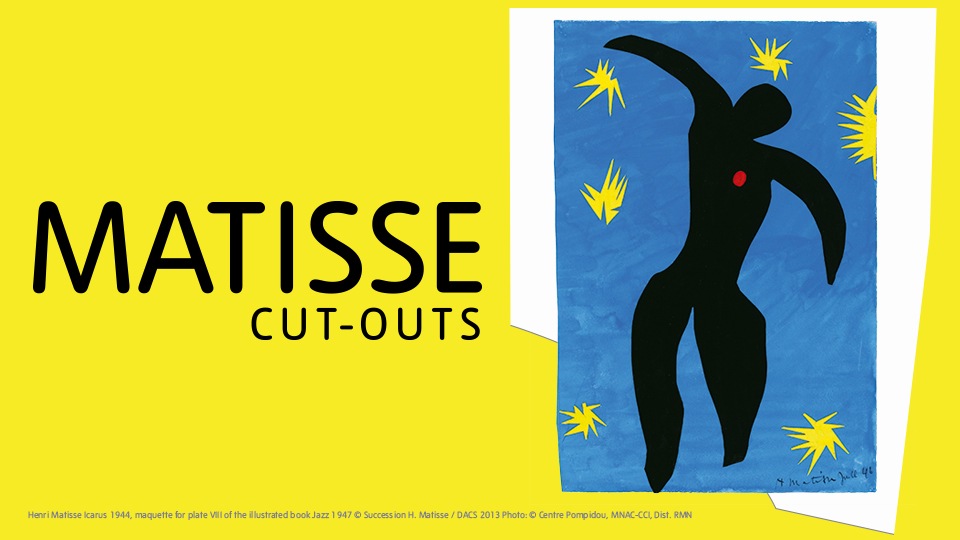
Matisse at Tate: Colour Cut-Out to a Career Climax

The new Matisse blockbuster at London’s Tate Modern is a show of inexorable joy: of that there can be no doubt. With its whimsical vivid colouration, and playful motifs of sea algae and birds, dancers and blue nudes, it is an exhibition which is full of the happy spirit of the Mediterranean. And yet all of this was created during and immediately after a time when Europe was caught up in the ravaged turmoil of the second world war. How Matisse then managed to create such spirited works, not only during a time of such cataclysm, but also when he was himself frail and confined largely to his bed or to a wheelchair, is one question poised by this exhibition. The answer? Colour was Matisse’s escape from the horrors of war, and cut-outs the vehicle with which he entered the last great hurrah of his groundbreaking career in art.

In bringing together this show of over a hundred of Matisse cut-outs, Tate has managed a real coup. For these works, which dominated the last period of Matisse’s creative output, are merely gouache-painted paper, brought together with paper, sizzors and glue. The result are pictures which retain the same vibrancy that they had when they were first made, but are nevertheless so fragile that few ever leave the national art galleries which they now call home. Yet here they all are, together, many for the first time since they were created.

id_010new_1 cut-outs-3 1394619552732

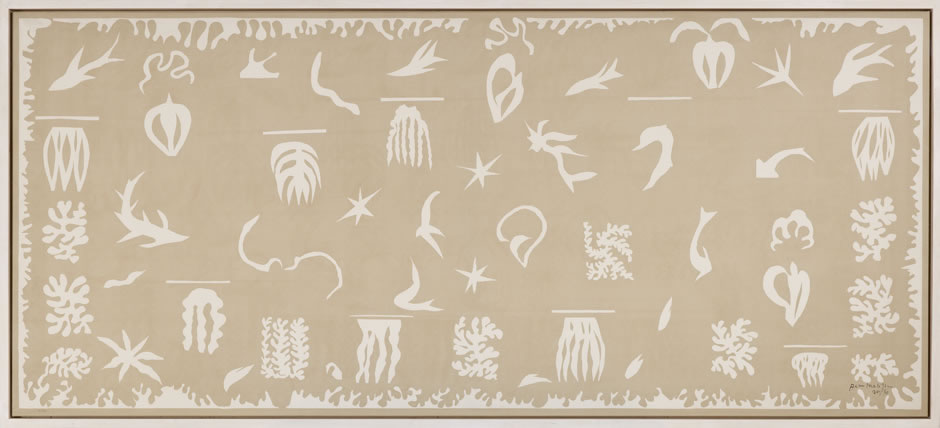
The result is an exhibition which can not fail to please. Starting with the original artwork and resulting first edition of Matisse’s best known artist book, Jazz (which I often paused over in Chelsea’s Taschen store but never purchased before they stopped the reprint, much to my regret), the exhibition moves onto what is essentially the genesis of what is to follow – the Oceana works. With one of the vast works, which originally acted as wall decoration in Matisse’s Paris apartment, featuring figures of the sky, and the other of the sea, these works were inspired by a visit to Tahiti 16 years before. But more importantly, the sea work was pretty much the first time that Matisse used the cut out image of coral, an image which was to become iconic of much of his cut-out works thereafter.

Oceana

matisse_oceanie-la-mer-foto-robert-bayer_l

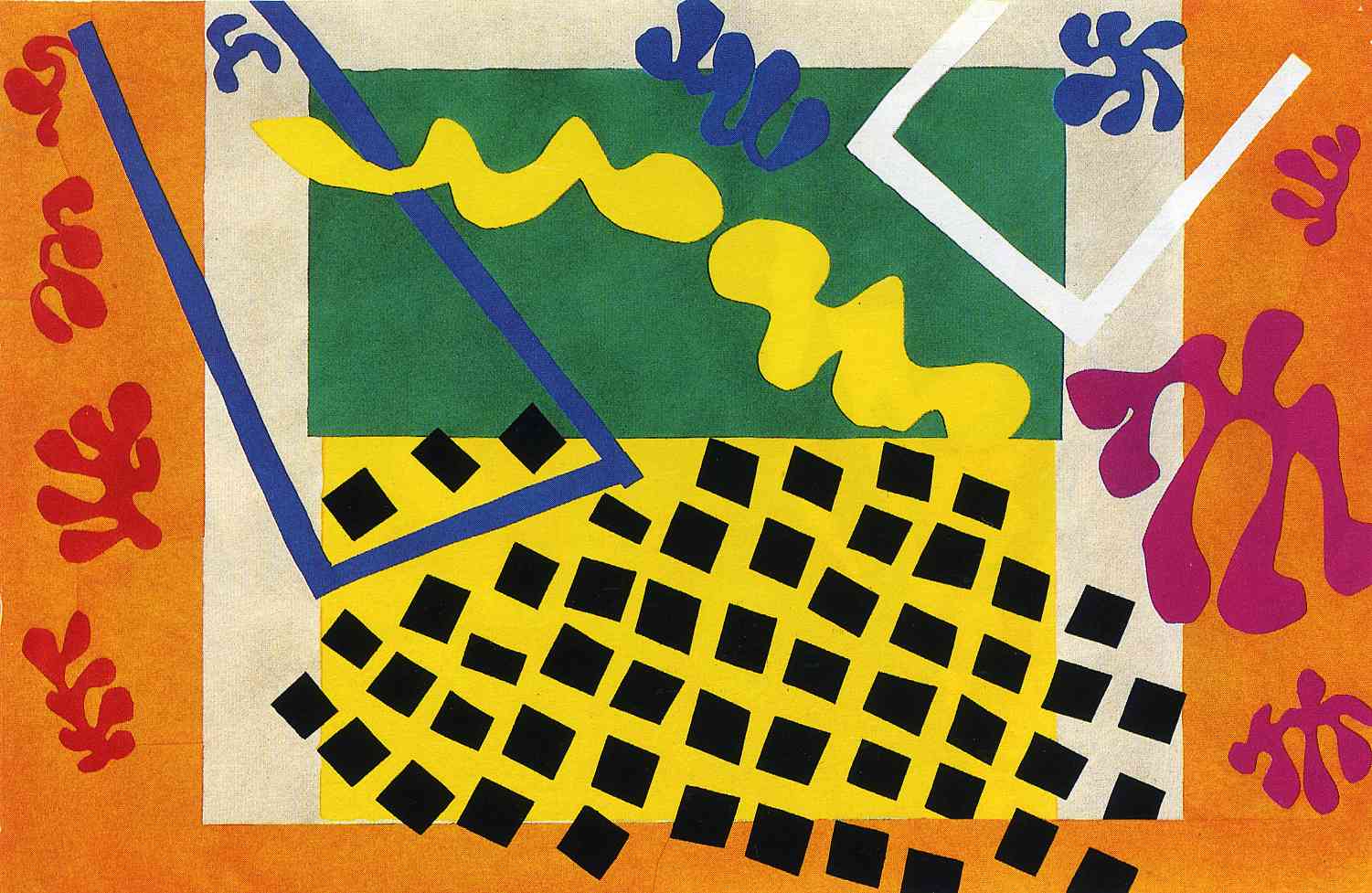
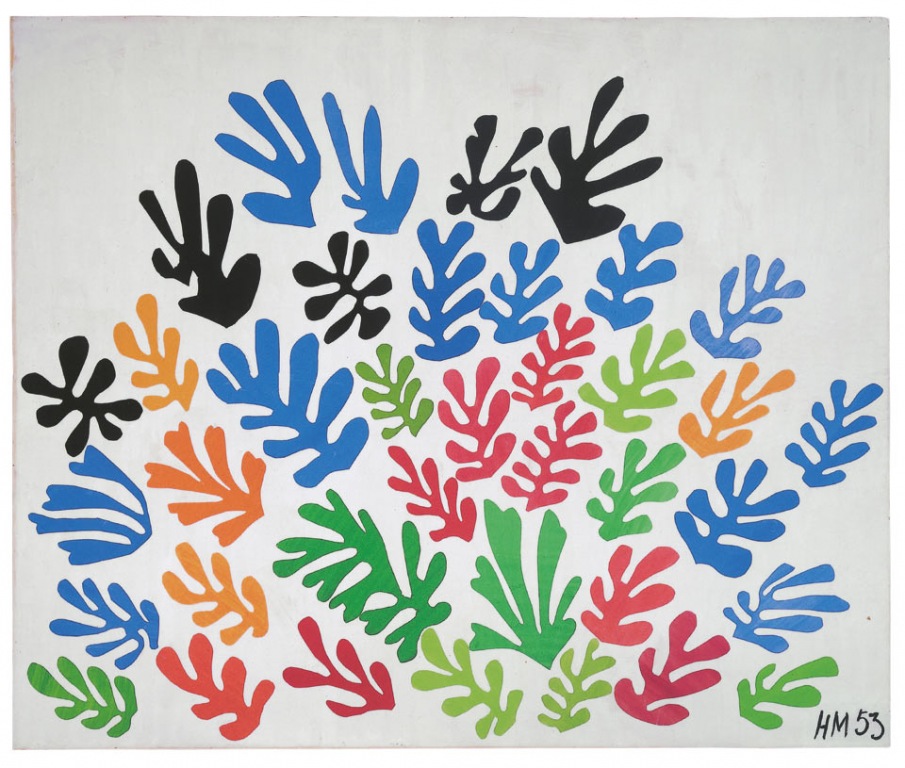
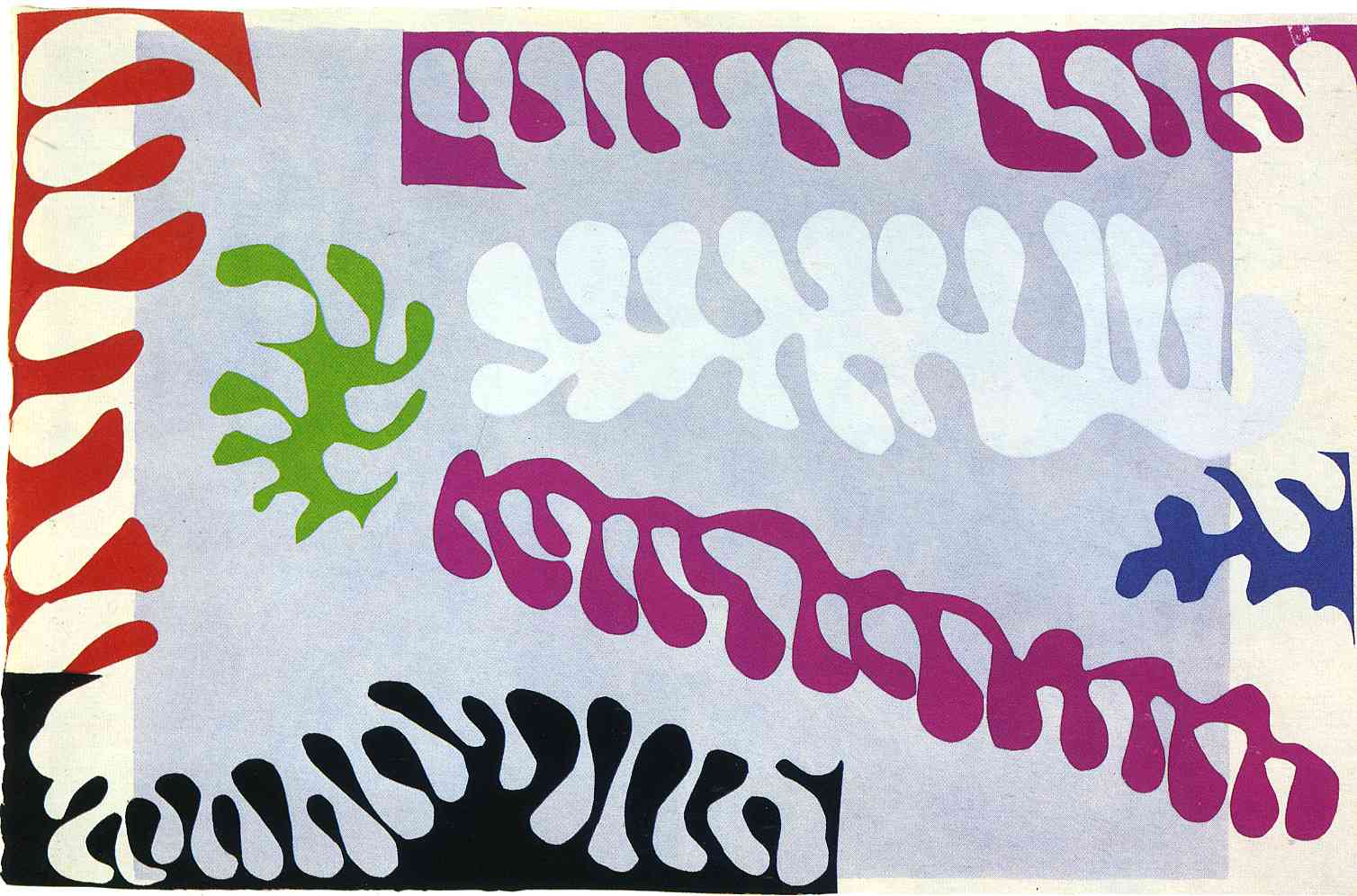
That coral is indeed prevalent in the works that follow, as are the vivd range of colours cut from sheets painted by his dedicated studio assistants. I loved room 5 of the exhibition, which attempts to recreate Matisse’s studio in Vence in Southern France, whose walls were decorated, floor to ceiling, with cut-out works. Seeing the cut-outs grouped together like this makes them come alive as a collection. The variety of colours and shapes and sizes make the corals almost vibrate with the energy emanating from the collected cut-outs, and together the colours sing like an hallelujah chorus.

Coral cut-outs

matissethesheaf1953 kr_matisse_cut_outs_070_071_top_41972_1404021745_id_802580 cut-outs-1

As satisfying as these collected colours undoubtedly are, I could not help but admire Matisse’s famous blue nudes, all four of which are brought together for the first time. Intrinsically simple in both colour, and the seamless way in which they are cut from a single sheet of painted blue-paper, they really are images to be admired – and as a set they never worked better.

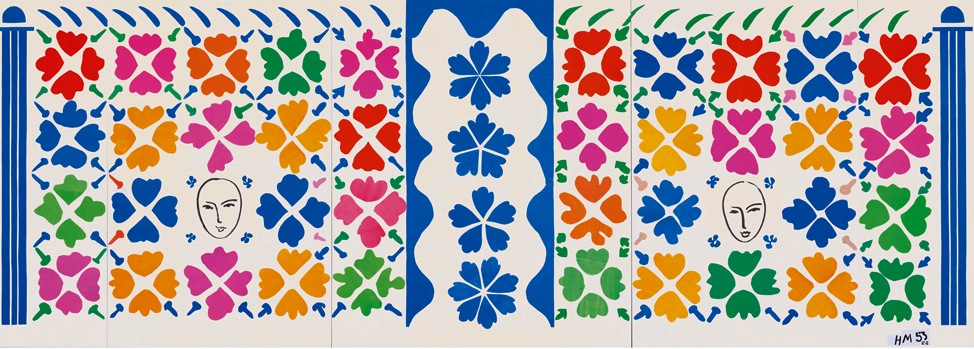
The exhibition ends with Matisse cut-outs on a grand scale, from Tate’s famous Snail (which was the closest Matisse comes to abstract, and in my opinion perhaps the least successful because of it), to The Mermaid in which Matisse intended, through use of bird, coral and fruit motifs, to bring the outside into his studio, something which he surely achieved with all-encompassing effect.

_70288189_masks 6a00e00989a58088330176166fd020970c HMB334 The Snail 1953 by Henri Matisse 1869-1954 20130426-102711

I wasn’t expecting to love this show. I’m not a huge fan of Matisse’s oil paintings which too often appear to me badly executed and fussy. But the simplicity and vibrancy of the cut-outs really appealed to me. It demonstrates the power of composition and the effect which simple colours can have when laid alongside each other. Many have criticised the cut-outs as mere child-play. But that’s a very easy observation to make when the idea has already been generated and all the behind-the-scenes work and planning exhaustibly executed. Masterpieces, perhaps, these works are not. Some may even pass them off as mere wall-coverings. But as a collective they are full of an inherent and enticing energy and joy which fewer more “masterful” artworks will ever be able to generate with such consistency or strength.

6a00d83451e76669e2019affca0e4c970d

Henri Matisse: The Cut-Outs is on at Tate Modern, London until 7 September 2014