

Burger and Lobster
Monopoly players across the world will recognise Mayfair as the uber expensive dark blue site which the most prudent property developer should aim to develop with little plastic green houses and fat red hotels should they wish to sweep the board of this favourite winter’s weekend family game. And in reality, the real Mayfair has existed in parallel to its board game namesake, boasting amongst the most valuable reality in London, from lavish luxury hotels including the Ritz, and refined shopping such as Fortnum and Masons, and swanky car showrooms, packed to the rafters with private drinks receptions of the well healed and fur-wrapped gentry, to private members clubs aplenty and restaurants whose prices are conspicuous by their absence from well-bound menus.
Yet in a city where ambition is the fuel which keeps the big urban pump grinding, and the lavish lifestyle of the London yuppy class predominates as the ultimate aspiration for career ladder climbers and socialites alike, Mayfair is as ever the ultimate in London hangouts, but one which is becoming more and more accessible as a place for everyone with a little taste to embrace the highlife. Take Fortnums, the refined department store, which last Christmas reported its best ever sales in the shops 300 or so year history, swamped by the thousands who decided to prioritise the traditions of a heritage Christmas, despite the economic downturn all around us.
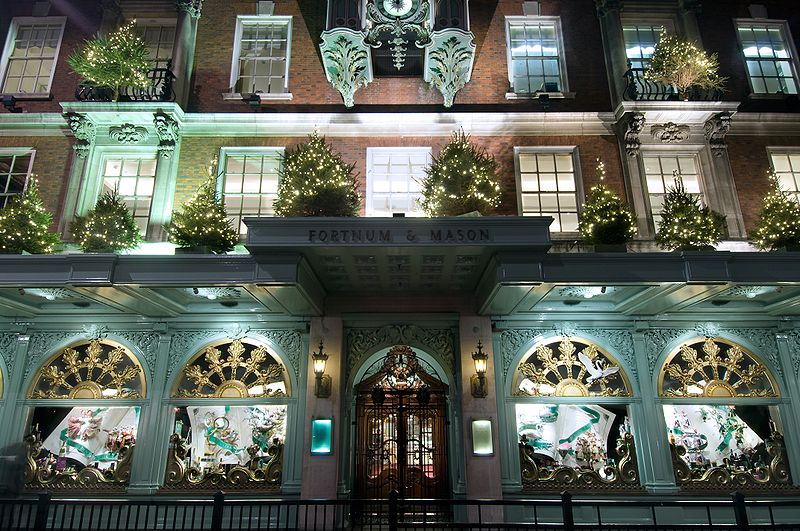
Fortnum and Masons
Then there is Burger and Lobster, the location of my dinner tonight. The name just about says it all. You can have burger, or lobster, or both (or lobster in a brioche roll). That’s the extent of it (hence why perhaps their website is so decidedly bare). The dishes are £20 each. Simples, as the meerkats would have it. Yet for your highly reasonable £20, you get a lobster which is so meaty, and so decidedly unfiddly, that you barely need that funny little fork thing that comes with lobster, and can munch on the freshly grilled flesh to your heart’s desire, along with the moorish salad and chips which accompany it.
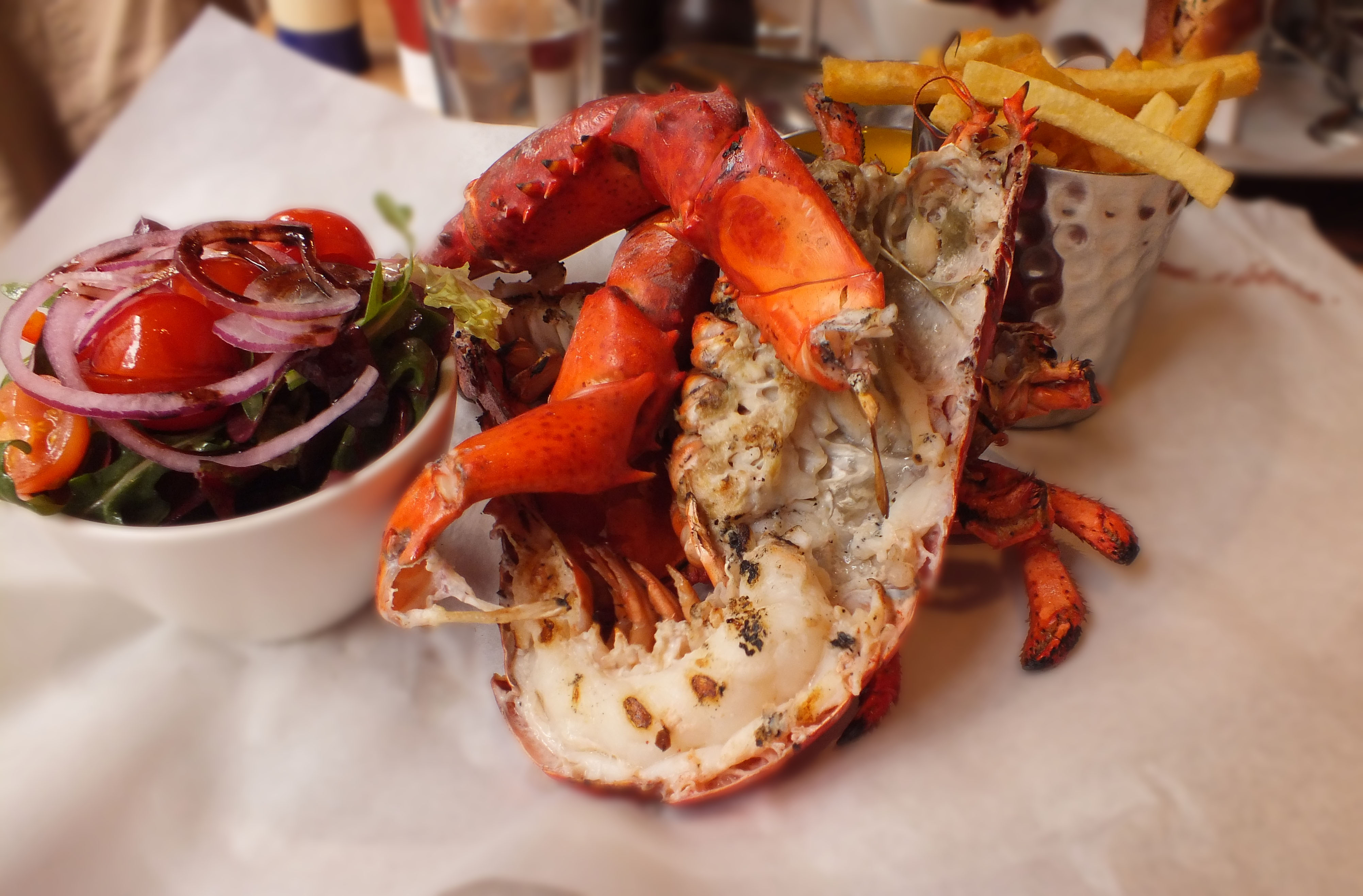
The eponymous lobster
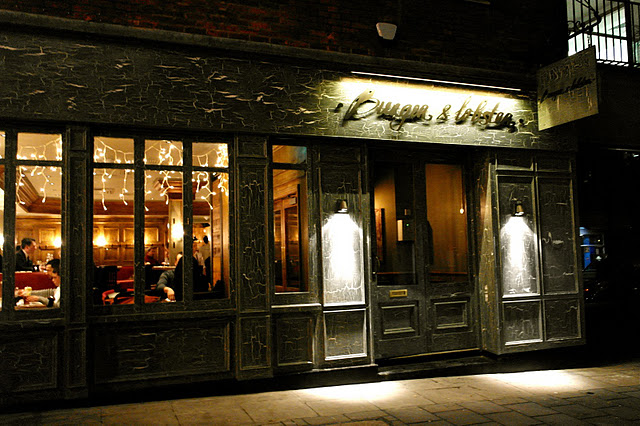
Burger and Lobster, Mayfair
So need Mayfair be monopolised by the dark blue hue of extravagant wealth? Apparently not. Our dinner tonight was excellent value, and came accompanied by a healthy portion of salted caramel cheesecake and some bubbles, all billing at around £40 per person. The only slight snag is you can’t book ahead. We went along shortly after 6pm and at that time had an hour to wait, but this was conveniently filled by some quail eggs and wine at Fortnum’s local winebar – a suitable restoration for two lawyers after a full days work of legal wrangling.

Shanaz’s lobster roll

Cassandra’s grilled lobster
So for your fill of mid-week extravagance, head along to one of Burger and Lobster’s 4 London branches (Soho, Mayfair, Farringdon, City), and if you do have to wait for a table, fill the waiting time (in Mayfair at least) with a drink in Fortnums, a guilty peek at nearby Laudurée’s delectable macaron selection or, if you’re really lucky, why not pop into the Royal Academy, Mayfair’s pre-eminant art establishment, where a Manet blockbuster is due to open its doors within days.
I leave this post with some shameless self-promotion – my paintings of lobsters (sans burgers) – just to get you in the mood 🙂
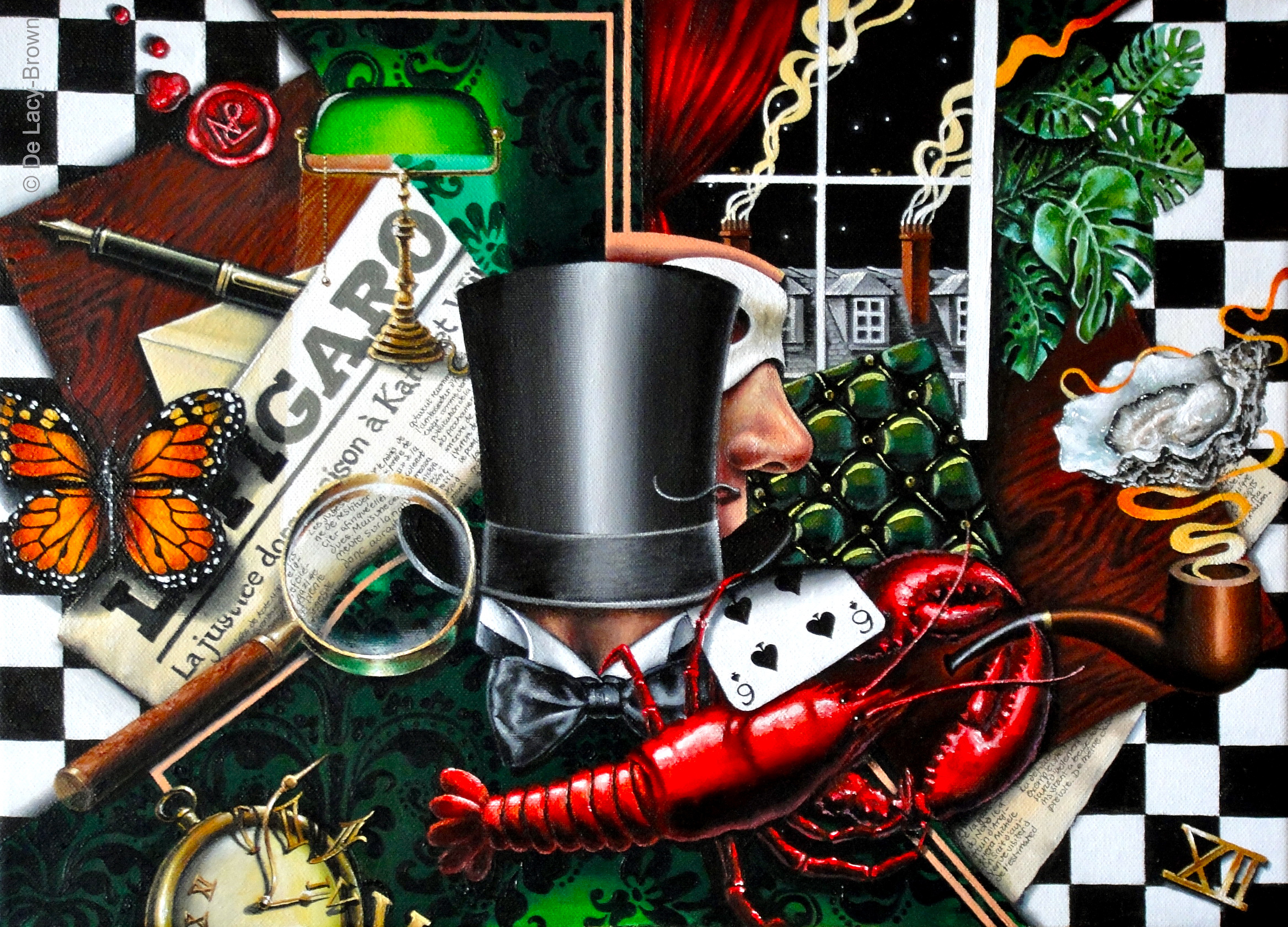
The Gentleman (in Paris) 2012 © Nicholas de Lacy-Brown, acrylic on canvas

Joie de Vivre/ Zest of Life 3: Casino Nights (2005 © Nicholas de Lacy-Brown, acrylic on canvas)

Nicholas in the Renaissance (detail) (2008 © Nicholas de Lacy-Brown, oil on canvas)
Goodnight!
Related articles
- Fortnum & Mason has record-breaking Christmas (telegraph.co.uk)
- Food Glorious Food: Burger & Lobster (onefinestay.com)
































































































 The Daily Norm
Feb 7
Big Ben at close Quarters – the Elizabeth Tower Tour
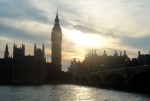
It’s almost certainly one of the perks of the job of working for the British Government that occasionally you get to peek behind the scenes of the nation’s famous landmarks, monuments and buildings – icons which have made Britain and in particular the city of London famous throughout the world. And without a doubt one such perk, in which I have most recently indulged, is getting a tour up London’s most famous landmark of all: Big Ben.
Of course I didn’t actually go up Big Ben. For as we Londoners are so fond of telling everyone who mentions the BB words, “Big Ben” is not actually the name of the bell tower at all – rather the tower is now officially titled “Elizabeth Tower”, a title bestowed upon it only last year in celebration of HRH Queen Elizabeth II’s Diamond Jubilee. “Big Ben”, meanwhile, is the name of the massive bell which sits atop the tower and rings out across Westminster at every quarter past, to, on and half past the hour. And having stood right next to it today as it bonged out the hour at midday, I can confirm that it is both very big and very, VERY loud!
As for Big Ben and the clock itself, when this was designed it was fashioned to be the best of its kind and surpass all clocks like it around the world. And for a time, it did so (it’s still the 3rd tallest free-standing clock tower in the world, and probably the most famous). Designed by a barrister, no less, Edmund Beckett Denison, together with George Airy, Astronomer Royal, and constructed by Edward John Dent, the clock was a feat of engineering for the time, not least because it was designed to be within a second’s accuracy at all times, despite the fact that up in the tower, the clock faces are exposed to such a battering from the elements. Without getting too techy (largely because I don’t understand the technology all that well) the clock consists of various counterweights which move up and down the full height of the tower, which in turn power the clock faces and the various hammers which create the clock’s characteristic bong every 15 minutes. The clock needs to be wound up 3 times a week, and various clock winders are always on hand for the job, although electricity today does much of what it once took an army of men to achieve through brute strength alone.
The stairs looking up (a little daunting) (Parliamentary copyright images are reproduced with the permission of Parliament)
Stairs looking down (not good for those with vertigo) (Parliamentary copyright images are reproduced with the permission of Parliament)
The machinery of the clock (Parliamentary copyright images are reproduced with the permission of Parliament)
The clock is an incredible marvel to bestow, and all the more so from up close. Getting there wasn’t exactly easy. Entering Portcullis House, the new modern entrance to Parliament, we had to go through airport style security before being taken down stylish escalators, descending into the earth which in turn led us to a passage taking us directly beneath Parliament Square and into the grounds of Parliament itself. From there, the starkly modern architecture of Portcullis house metamorphosed rapidly back in time to the iconic gothic decoration of the Palace of Westminster. Soon reaching the small door of the tower, our descent began up all 334 stone spiral steps to the top of the tower.
View from the Tower
This wasn’t as bad as it sounded. Luckily we were allowed to stop roughly one third of the way up for a very informative talk about the tower’s history from tour guide Catherine Moss, before making the final trek, first up to watch the machinery of the clock itself before continuing to see the infamous bells. Well timed as ever, our visit to see the huge cogs and wires of the clock coincided with a quarter to midday, enabling us to see all of the still-original machinery in action, but missing none of the action on the hour itself. This great joy was reserved for the upper platform, above the clock-face, where we emerged just before 12 to stand by the incredibly large Big Ben bell as the clock struck 12.
A quarter bell (Parliamentary copyright images are reproduced with the permission of Parliament)
Big Ben from above (Parliamentary copyright images are reproduced with the permission of Parliament)
Big Ben on the right (Parliamentary copyright images are reproduced with the permission of Parliament)
The chime of the tower, with its melodic 20-chime sequence played by the four Quarter bells, followed by the deep bong of Big Ben itself, is a sound which is well known to us Londoners, and has particular significance every 31 December as it heralds in the new year to the accompaniment of a spectacular firework display. But being up close to the bells as they played out this celebrated tune was nothing short of incredible. The vibration which went through our bodies made for a totally immersive experience (we were given ear plugs I should note), and I must admit to being ever so slightly emotional as I saw, and felt, the familiar chime of Big Ben in action but centimetres away (luckily the wind was so strong that if I had been caused to shed a tear or two – and I’m not saying I did! – the wind disguised it). The chime, by the way, is apparently a variation on a phrase from Handel’s Messiah – the part shortly after the Alleluia chorus.
Our tour guide, Catherine Moss (AP Photo)
The famous clock face (Parliamentary copyright images are reproduced with the permission of Parliament)
The clock face (Parliamentary copyright images are reproduced with the permission of Parliament)
After embracing the great bong of Big Ben and the various Quarter bells in all their mighty fortitude, the final stop of the tour was to head down a level to the most prominent feature of the tower – the four sided clock face. We were able to stand just behind the world-famous clock faces, and see the now fantastically environmentally friendly long-life bulbs, especially designed to light up the huge clock faces with maximum efficiency by Philips, which are placed evenly behind the huge stained glass clock faces. Yet again, this was quite a marvel to behold, not least being able to appreciate just how huge these clock faces really are.
So heading back down the tower, perhaps a little more deaf than when we came up, I descended feeling extraordinarily lucky – access to Big Ben isn’t easy – you need to organise a tour through your local MP, although once organised, the trip is free. But that aside, I would have paid good money to enjoy this exposure to one of the country’s most loved national icons at close quarters, not least to learn the fascinating history of the tower, and gain an understanding of just how that all important national timekeeper keeps ticking onwards day after day.
Details on how to visit Big Ben can be found on the Parliament website.