Skip to content

Posts tagged ‘Paris’

Paris | Photography Focus – Campana d’Orsay

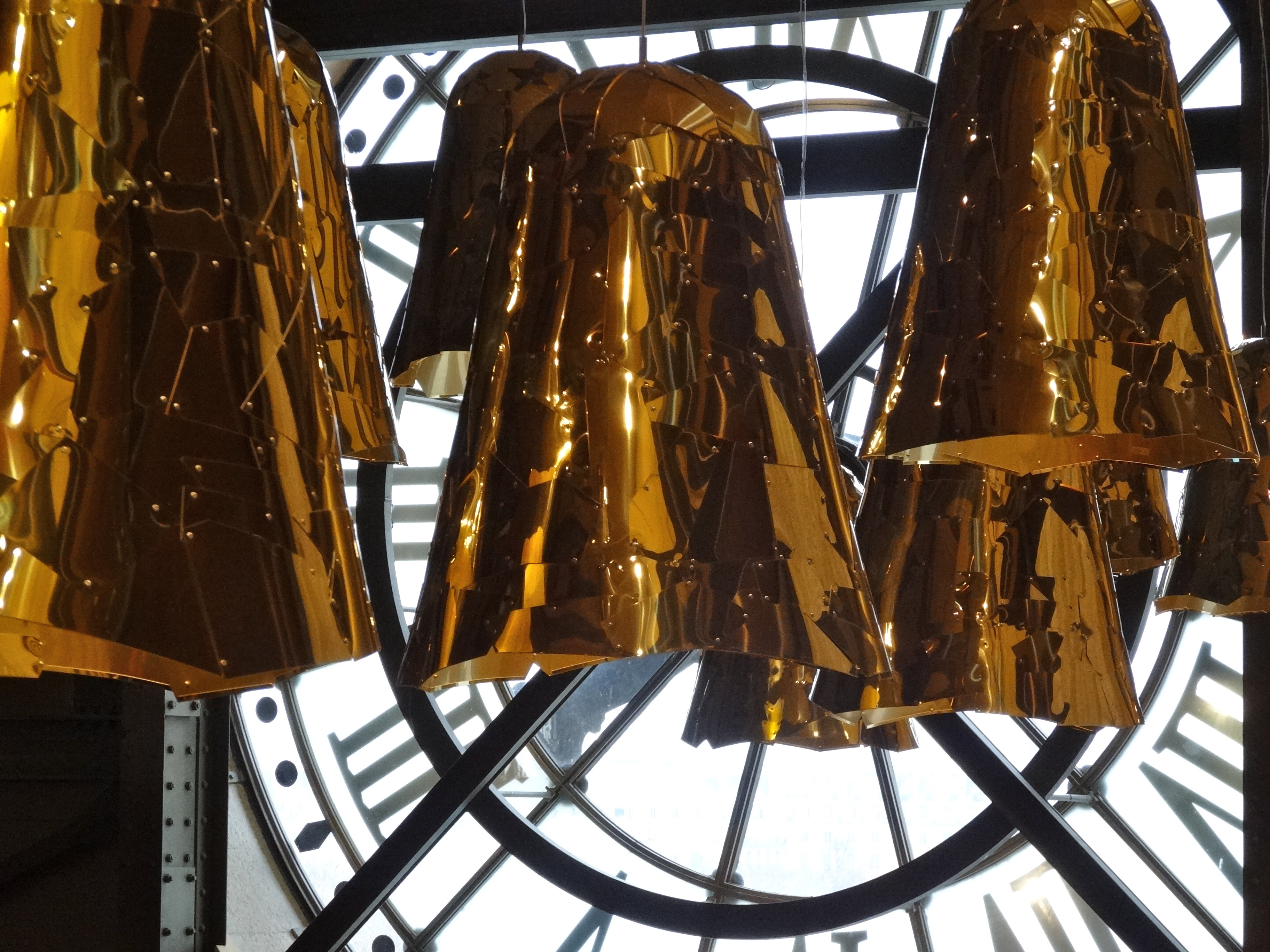
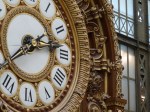
The last post of my recent Parisian adventure, and the fourth set of photographs emanating from the trip pulls something of a sharp focus on a particular place in Paris, and not one that is all that well known either. In the insuperably brilliant Musee d’Orsay, behind one of the two huge round glass windows which double as the prominent clock faces which characterise the building’s impressive riverside façade, is a super chic new café opened following the major renovations of the museum in 2011. The café, which was designed by the Campana brothers, and now carries their name, is very different from the typical bistros and brasseries which are so characteristic of Paris. Ultra modern in its design, throwing diners into something of an undersea aquarium-come-fairy tale palace with its waving lines, bubble like round-patterned chairs, and striking aquamarine backdrop, this café is nothing if not eccentric, but therefore perfectly placed in its location next to the galleries containing France’s foremost collection of impressionist art – after all, these were the artists who challenged all of the art which had gone before them. As a café, the food isn’t all that great, and the selection is even worse, but the design is such a winner that I couldn’t help but give this genius of café design its own little space on The Daily Norm.
DSC09383 DSC09371 DSC09387

The photos which follow focus mainly on the various unique features of the Café Campana, but also include some cheeky shots of fellow diners. I’m not even sure that I’m really allowed to take photos of people without their permission, and still less publish them online. But if that’s the case, it’s a real shame, because there is nothing quite like a voyeuristic glance at fellow dinners to really capture the essence of a place. In fact like the Impressionists before me, these photos represent my way of doing what those artists did best: representing real life, and recognising reality as a thing of beauty in itself. Surely no activity could be more appropriate at the d’Orsay’s café, where only rooms away, Degas’ famous painting of desolate drinkers staring into their glasses of Absinthe in a Paris bar (l’Absinthe) hangs amongst the masterpieces on show.

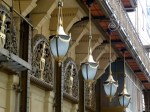
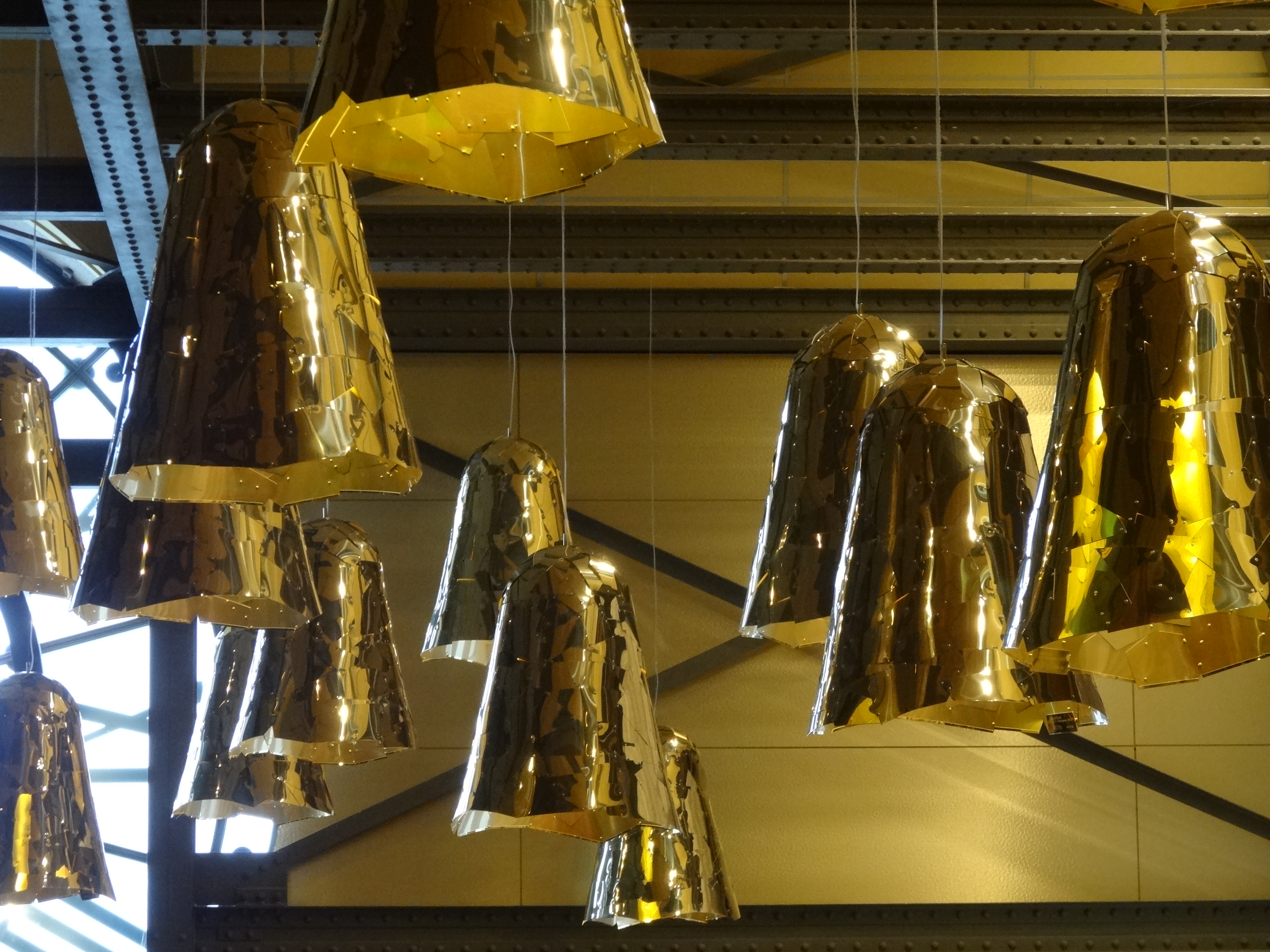
Admittedly the diners in my photos are enhanced by their surroundings, and in particular the glittering gold lights which are by far my favourite aspect of the design. Hanging in their multitudes, these lights give the feeling of being in a kind of Olympian paradise, where over-sized golden blue bells hang abundantly above. Their splendid shiny gold surface, and their installation, hung from great steel joists also painted gold, makes for a lavish spectacle in a way that only gold can; a spectacle which is all the more enhanced by the sheer abundance of it – when you have gold, why not have plenty of it? And hung as they are, all at different lengths, in irregular groupings, these lights seem so unplanned as to be a natural phenomenon; the kind of visionary wonder that makes you appreciate the glory of the world all around.

In short, the Musee d’Orsay is well worth visiting for the Café Campana alone. Not necessarily to anticipate a gastronomic revolution – it is only a café after all, and a museum café at that – but to gaze in wonder at what must be one of the most impressive contemporary restaurant designs in Paris. I leave you with my photos – which include a few inevitable shots of the impressive d’Orsay itself – a former left bank station which has more than found its own as a bastion of 19th and 20th century art. Until next time Paris…
All photos and written content are strictly the copyright of Nicholas de Lacy-Brown © 2013 and The Daily Norm. All rights are reserved. Unauthorized use and/or duplication of the material, whether written work, photography or artwork, included within The Daily Norm without express and written permission from The Daily Norm’s author and/or owner is strictly prohibited. 

Paris | Photography Focus – Rues and Rooftops

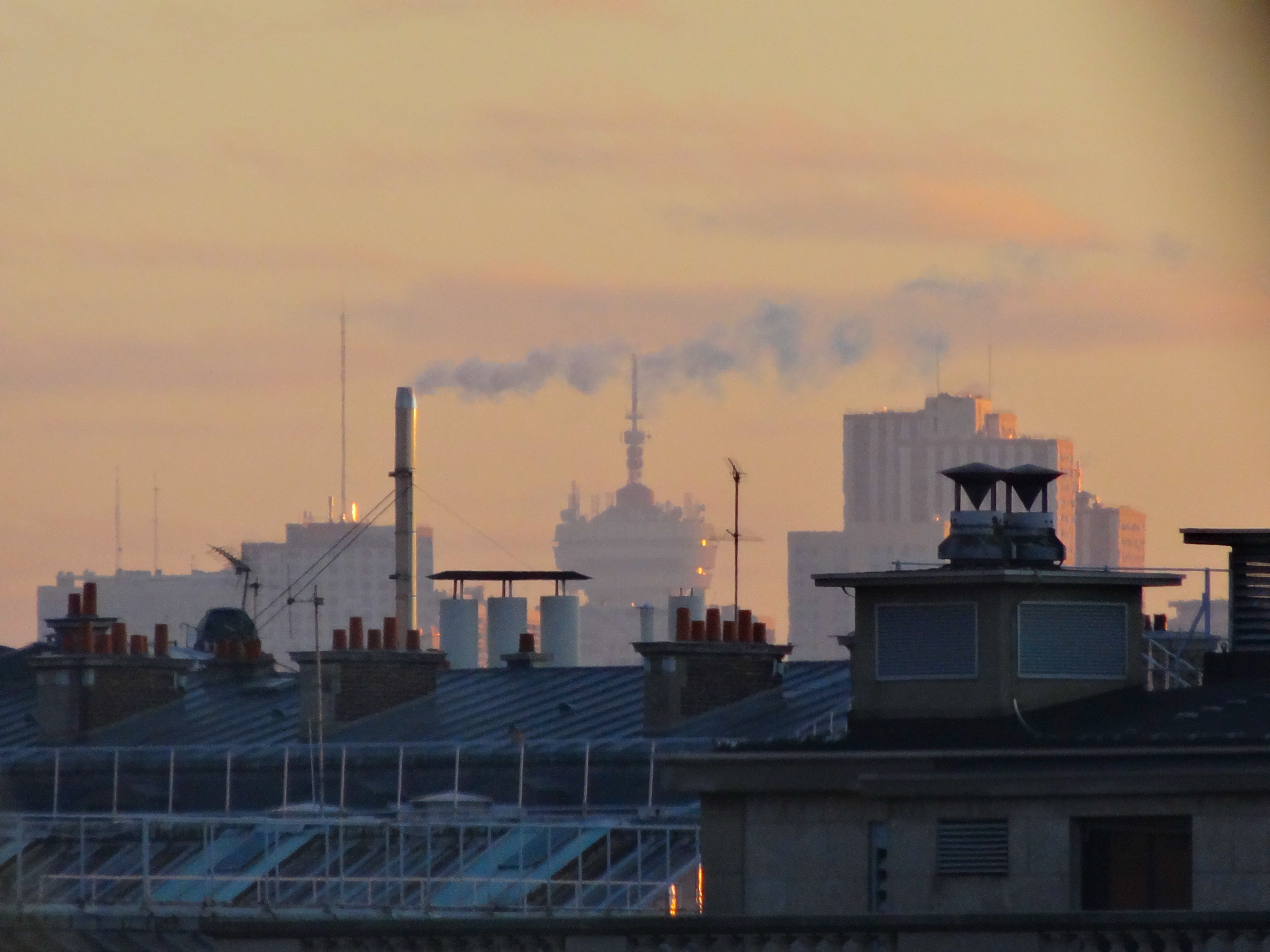
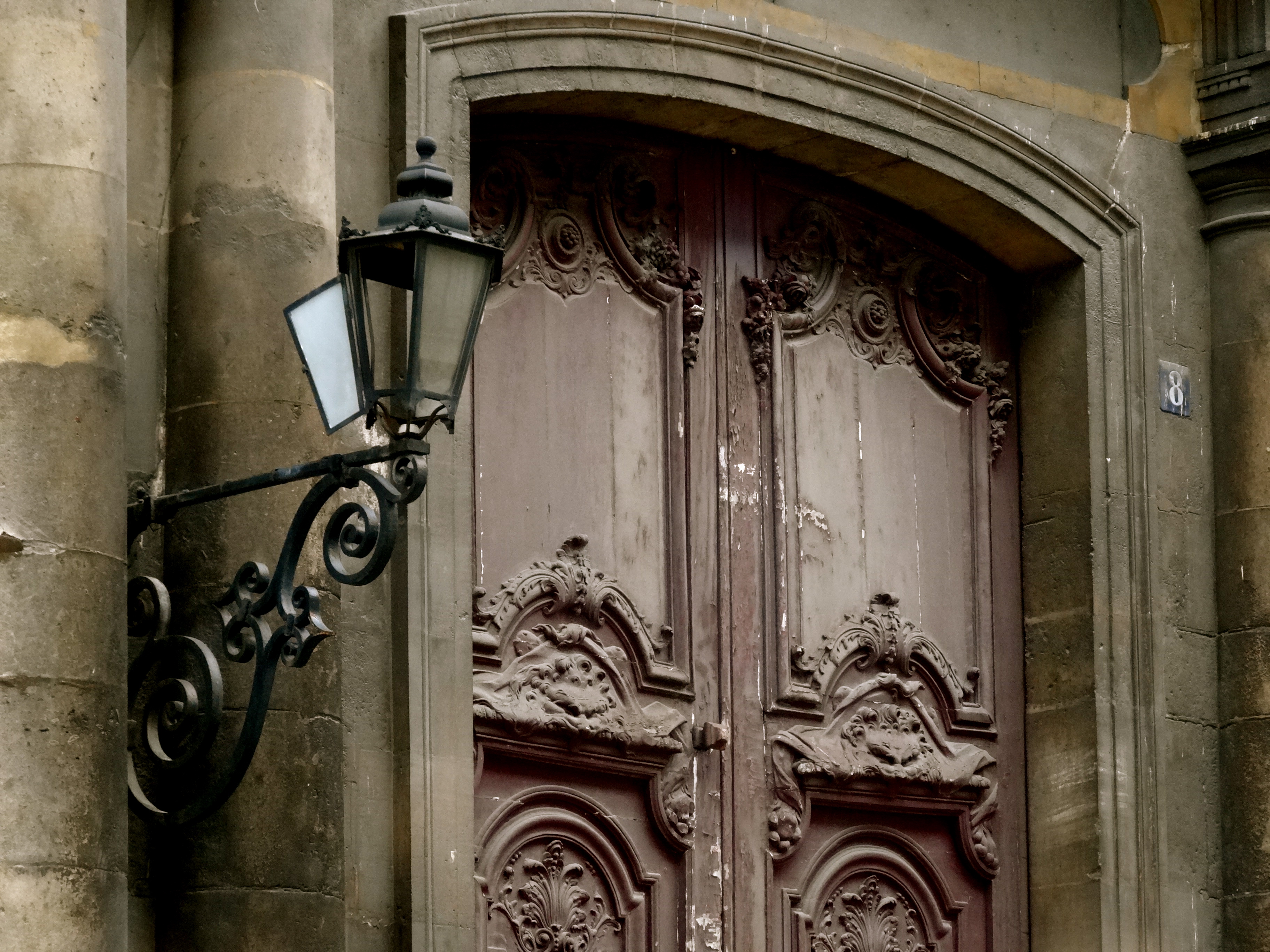
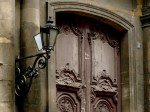
There’s no denying that Paris exudes charm around every corner, in every cobbled street (or rue), across its extensive grant Haussmann boulevards and in the intricate details of its architecture. And of course, on my recent visit to Paris I was moved to capture, as I have done so many times before, all of those beautiful little details. For no matter how many times you visit Paris, it is still abundantly generous in providing picture after picture of incredible angles and tantalising sights. I suppose in a way it’s akin to my daily walk to work through the grand streets of Westminster – where even on my 600th journey I might find a new architectural detail to tempt my camera into action.

DSC09255 DSC09115 DSC09030 DSC09061 DSC09125

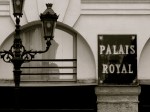
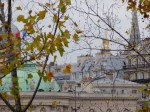
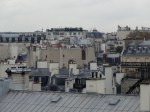
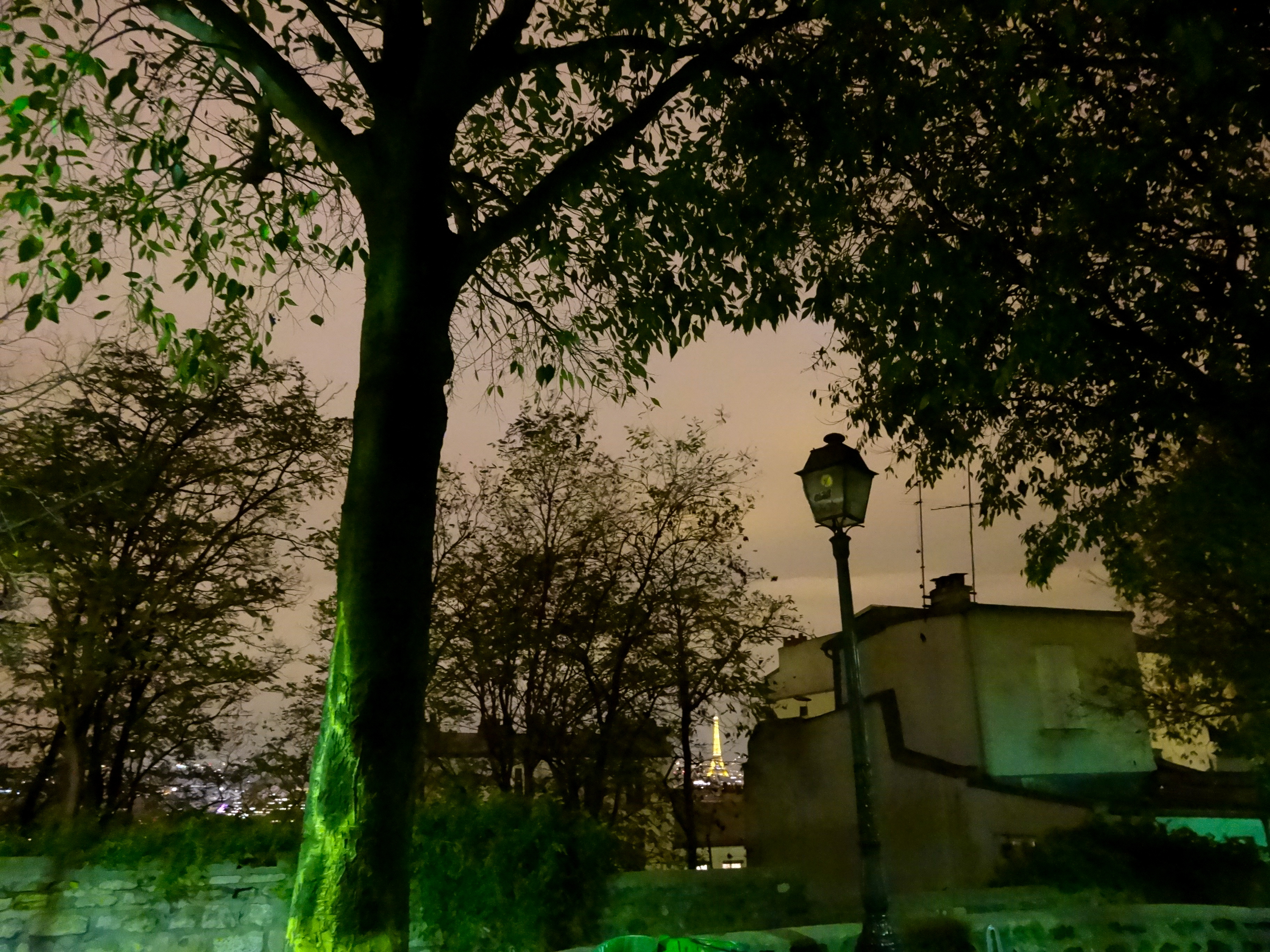
But I would be lying if I said that Paris’ charm resides exclusively in its streets. For one of the defining sights of Paris for me, and the one which makes me gasp more than any other, is the city viewed from the rooftops. Whether it be from atop the Tour Eiffel, at the climax of the external escalator of the Centre Pompidou, up the spiral stone staircase of the Notre Dame, or at the summit of the romantic Butte de Montmartre, the view of Paris’ almost uniform tapestry of silver slate roofs punctuated by the gilded domes and gargoyle-covered spires of its monuments and churches is always breathtaking. On this trip, we were therefore especially lucky to be given a room in our fantastic Citadines hotel which boasted superb views not only over the Palais Royal immediately adjacent to the hotel, but also across the 3rd and 4th arrondissements towards the Notre Dame and beyond.

So in this third set of photos from my recent Paris trip, a collection which focuses on the architectural details which characterise Paris, do not be surprised to find a whole host of different roof-top shots; under grey skies and pink, close up and far away, but always, distinctively, Parisian.

Paris | Art tour 2013 – Vallotton

The incredible thing about Paris is not just the quality of the exhibitions it puts on, but how many of those quality shows it manages to host in a single season. The Grand Palais alone has some 4 or more exhibitions showing at any one time, and as Dominik and I took the long walk around the huge neo-classical structure that is the Grand Palais, we noticed that there were queues lining the building on almost all four sides – testament not just to the popularity of its exhibitions, but also to how many exhibitions were showing in the space of a single (admittedly huge) building.

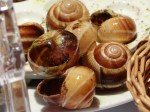
The benefit of these multiple shows (and also the disadvantage if you fatigue easily) is that when you buy one ticket, you can combine your first exhibition with another – or in fact the lot. So having been wowed all morning by the cubist prowess of Georges Braque, and braked for lunch in an excruciatingly expensive brasserie nearby for snails and an ‘amburger (imagine said in a French accent) we returned to the great palace of art to see the second of their major autumn retrospectives: a show devoted to the work of Felix Vallotton.

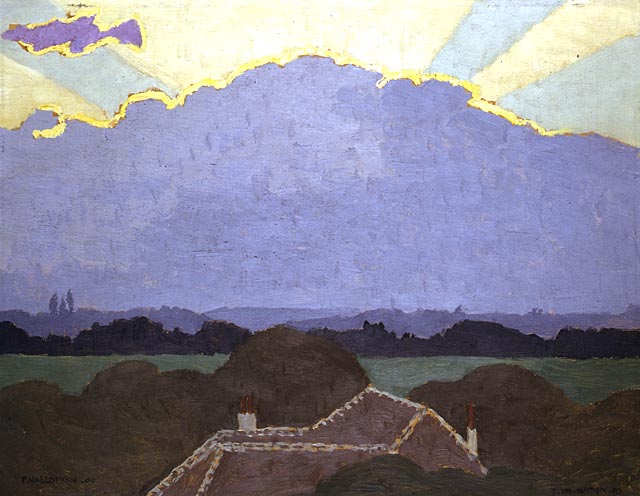
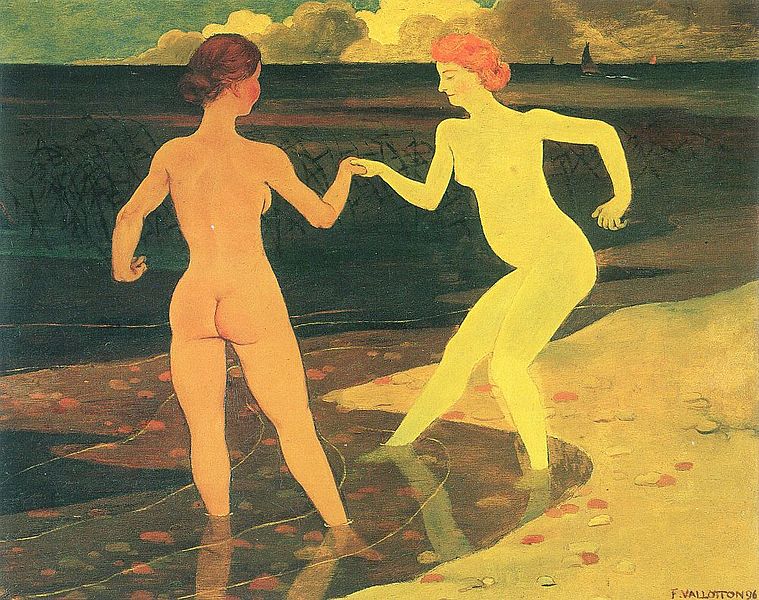
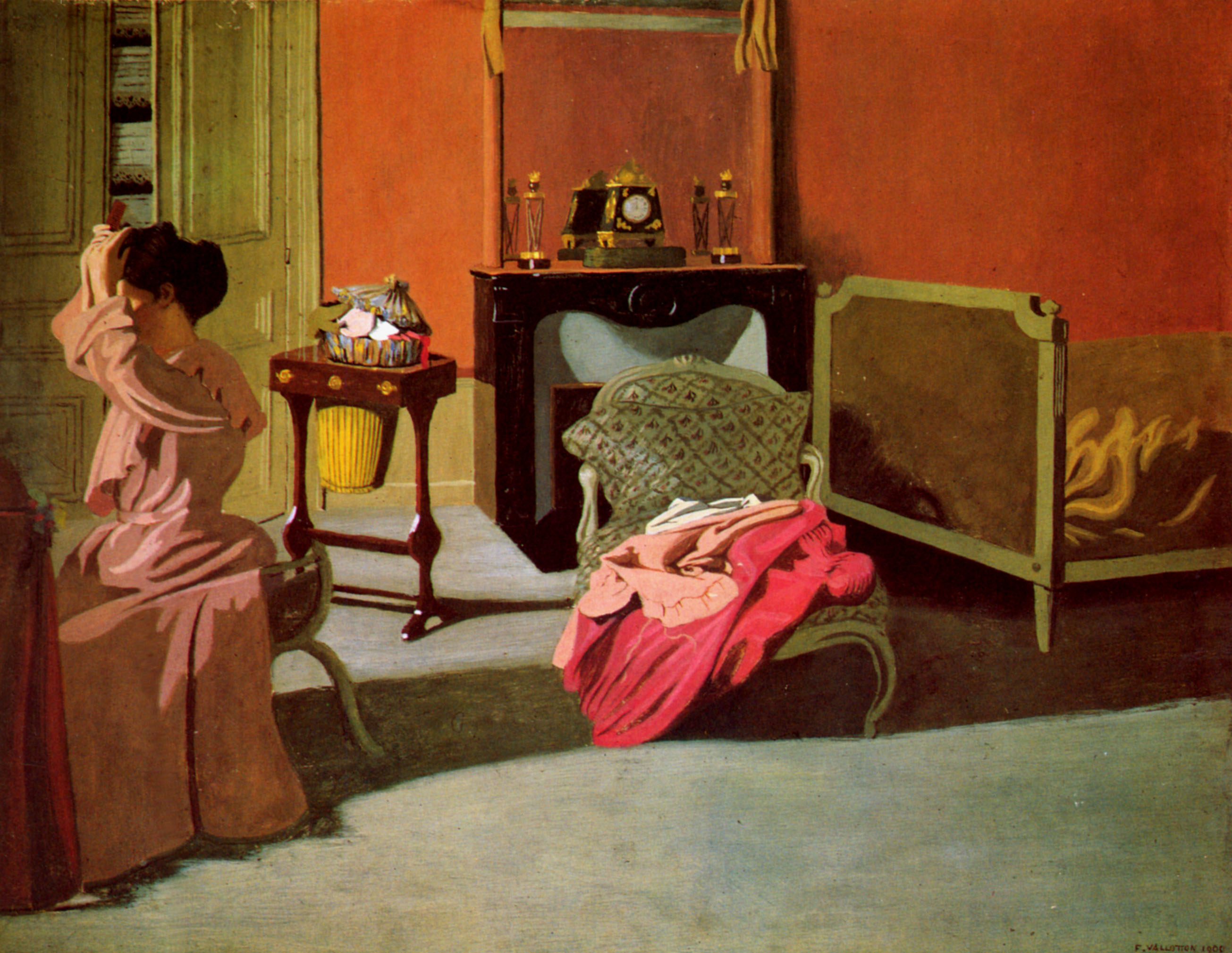
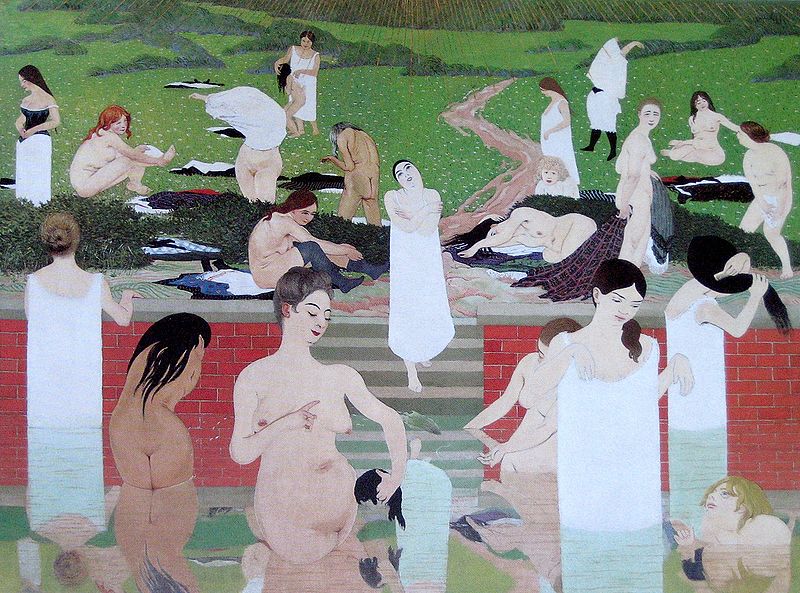
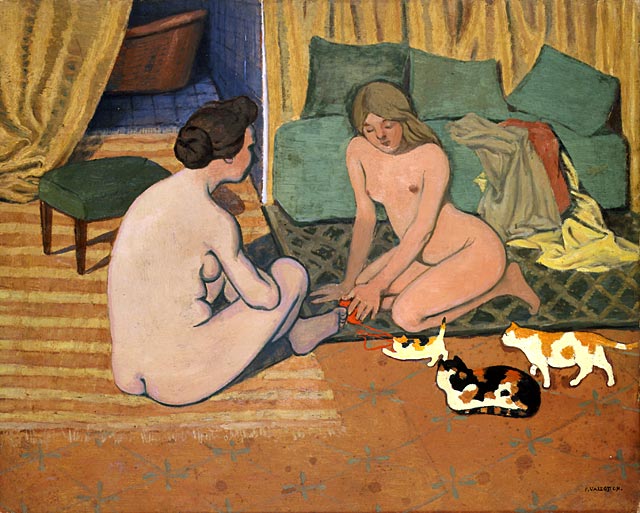
Vallotton paintings in the “aesthetic sythetism” style

Nuage_à_Romanel 759px-Valloton_Frau_mit_Dienstmagd_beim_Baden woman-being-capped-1900 800px-Vallotton_Das_Bad_Sommerabend_1892 Femmes_nues_aux_chats

I wasn’t familiar with either the name Vallotton or his work before I ventured to Paris this autumn. However, as a quasi-member of the French Nabis movement of art, I was already familiar with a number of Vallotton’s artistic allies – Maurice Denis, Pierre Bonnard and Edouard Vuillard being amongst their number. The Nabis were a group of post-impressionist avant-garde artists who took their name from the word Nabi which means a prophet in Hebrew and Arabic. They were so called because they believed that their art revitalised painting in the same way that the ancient prophets had rejuvenated Israel. At the heart of their movement was another term, or style of art, sythetism, which involved the flattening of colour panes and shadows, a heavier reliance on dark outlines, and a preoccupation with the canvas, as “essentially a flat surface covered with colours assembled in a certain order” (so said Maurice Denis). If I was to describe the style in my own words, it would be a painting without depth and perspective, so that the folds of a dress for example would be reduced to a single colour for the shadow and a single colour for the light, with no variation of tone demarking the shape or texture of the material. 

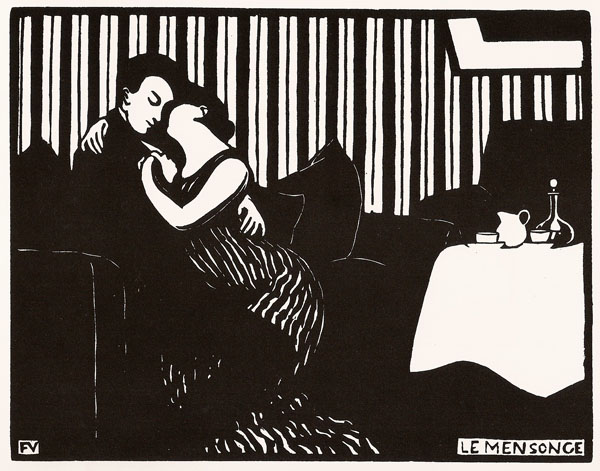
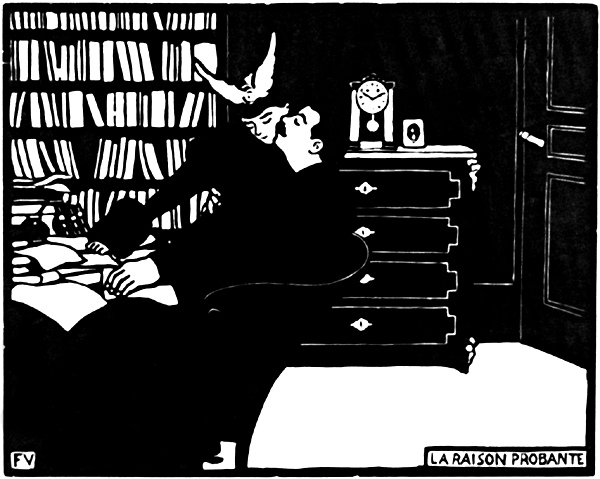
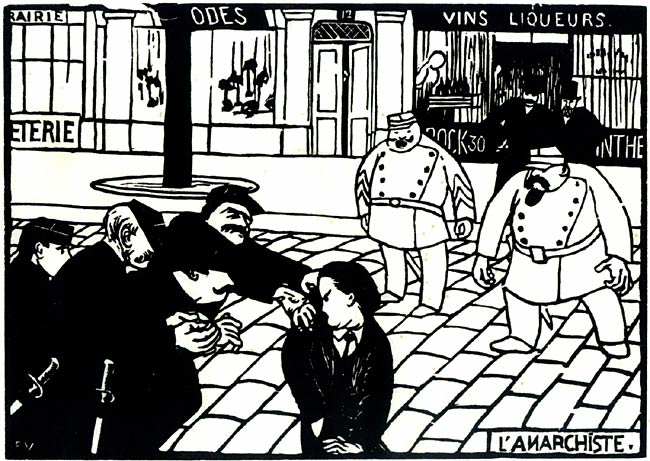
Whether or not Felix Callotton, born in Switzerland in 1865, came to adopt the style as a result of the influence of his fellow Nabis is less certain. From the exhibition, it would appear as though Vallotton’s distinctive flattened panes flowed naturally from his brilliant virtuosity with woodcut printmaking. After all, the finish of woodcut will invariably involve the flattening of light and shadow, as the synthesis of two colours or tones – generally black and white – combine together to illustrate all of the details of an image – black for shadow and features; white for light. And having spent a good decade or so of his early career woodcutting for the sake of making money, the suppression of depth and shadow made its way seamlessly into Vallotton’s paintings which followed.

Vallotton’s brilliant woodcuts

vallotton4 vallotton-trottoir-roulant-1901 5333808295_a0756d9ea8_b Vallotton-Raison va_anarchico title unknown 6

Being recently enamoured with all things printmaking, it will not surprise the reader of this post to learn that I was struck first and foremost by these brilliant woodcuts, which are so full of detail and humour for so intricate and painstaking a medium. In Vallotton’s Intimacies series, he depicts the mundane and mediocre interiors of intimate home settings, but always his images are full of drama, whether it be because of his captivating use of shadow, or the sense of scandal and emotional anxiety which is suggested. From these prints, Vallotton went on to depict brilliantly the everyday street scenes of his Paris surroundings, doing so with whimsical detailing and a surprising attention to detail, and while Vallotton later abandoned woodcutting when the trade had left him sufficiently well furnished with money, his return to the medium to depict the First World War in his This is War! series in 1916 saw him create prints which were equally brilliant, despite the more serious tone of the subject matter.

As to Vallotton’s paintings, I adored the colourful products of his sythetism era, where the influence of his printmaking and the Nabis resulted in works where the subject matter become secondary to the overall pictorial patterning which was being created across the canvas. Just look at his painting of a theatre box for example (“Box seats at the theatre), a canvas which could quite possibly be a Rothko with its simple horizonal colour planes, and which only becomes more figurative thanks to the simple shapes denoting the two occupants of the box and that masterly glove with its single-coloured mauve shadow, suggesting an emotional dimension to the story being depicted.

box-seats-at-the-theater-the-gentleman-and-the-lady-1909.jpg!HD

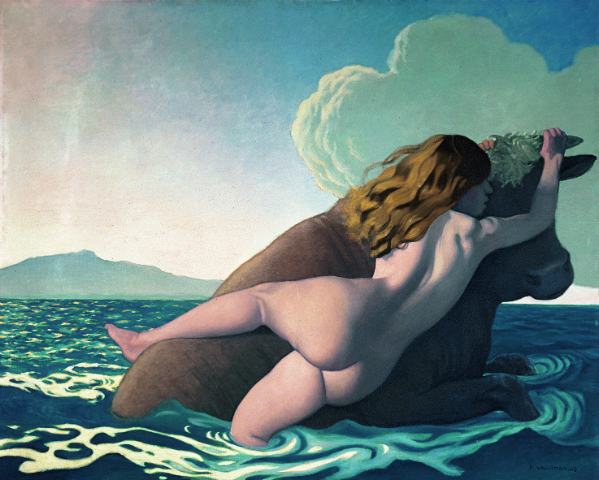
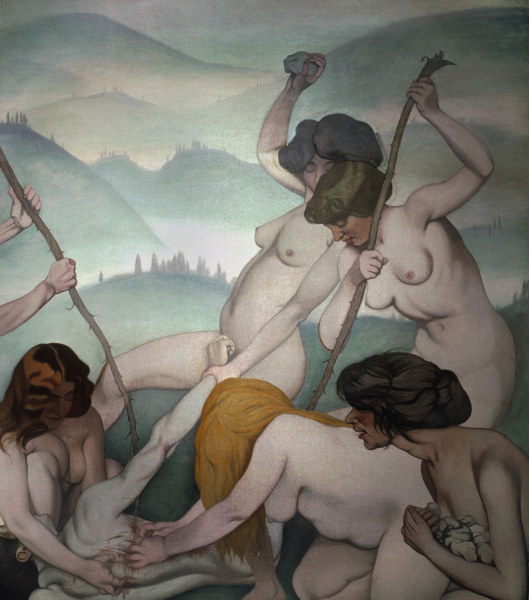
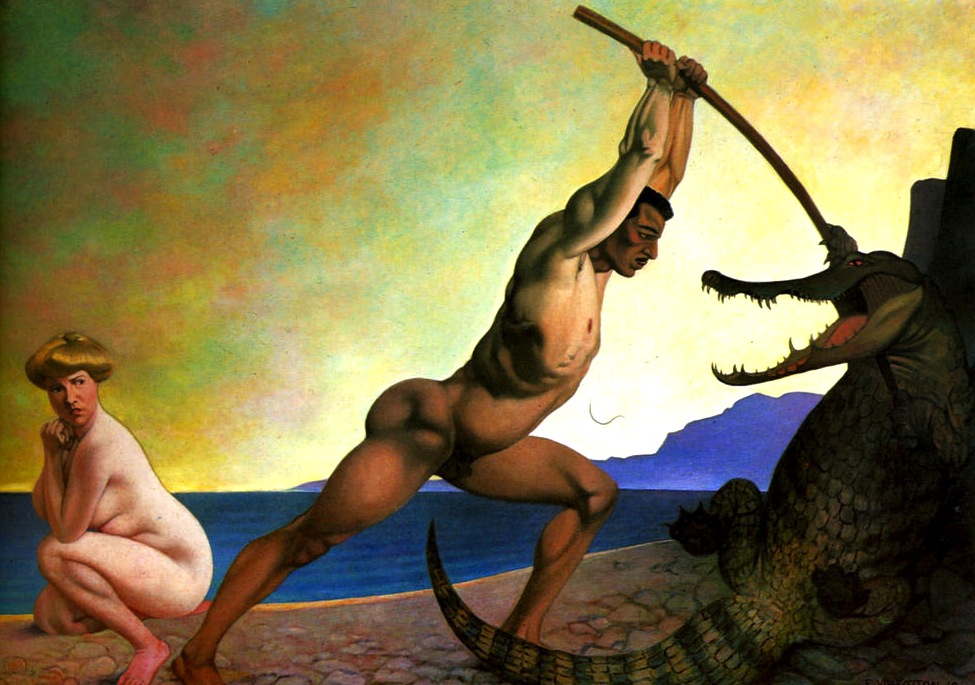
Less impressive, sadly, were the works which Vallotton went on to create in his later career, as he abandoned synthetism and the Nabis, and sought to concentrate on depicting primarily the nude, and latterly huge mythological parodies which were more Disney than anything else. Thank goodness that at the end of his career, and at the end of this show, Vallotton chose to return to the medium of woodcut which, despite their depleted tonal palette and reduction of depth and realism, are perhaps the most captivating and visceral works of all.

All a bit “Disney”- Vallotton’s mythological parodies

pic_143-20131024092755 Felix Vallotton, Orpheus und die Maenaden - Valloton / Orpheus and the Maenads - Vallotton, Felix , 1865-1925. Felix-Vallotton-Persee-killing-the-Dragon

Felix Vallotton: The Fire Under the Ice is on at the Grand Palais, Paris until 20th January 2014

Paris | Photography Focus – The city by night

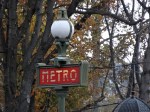
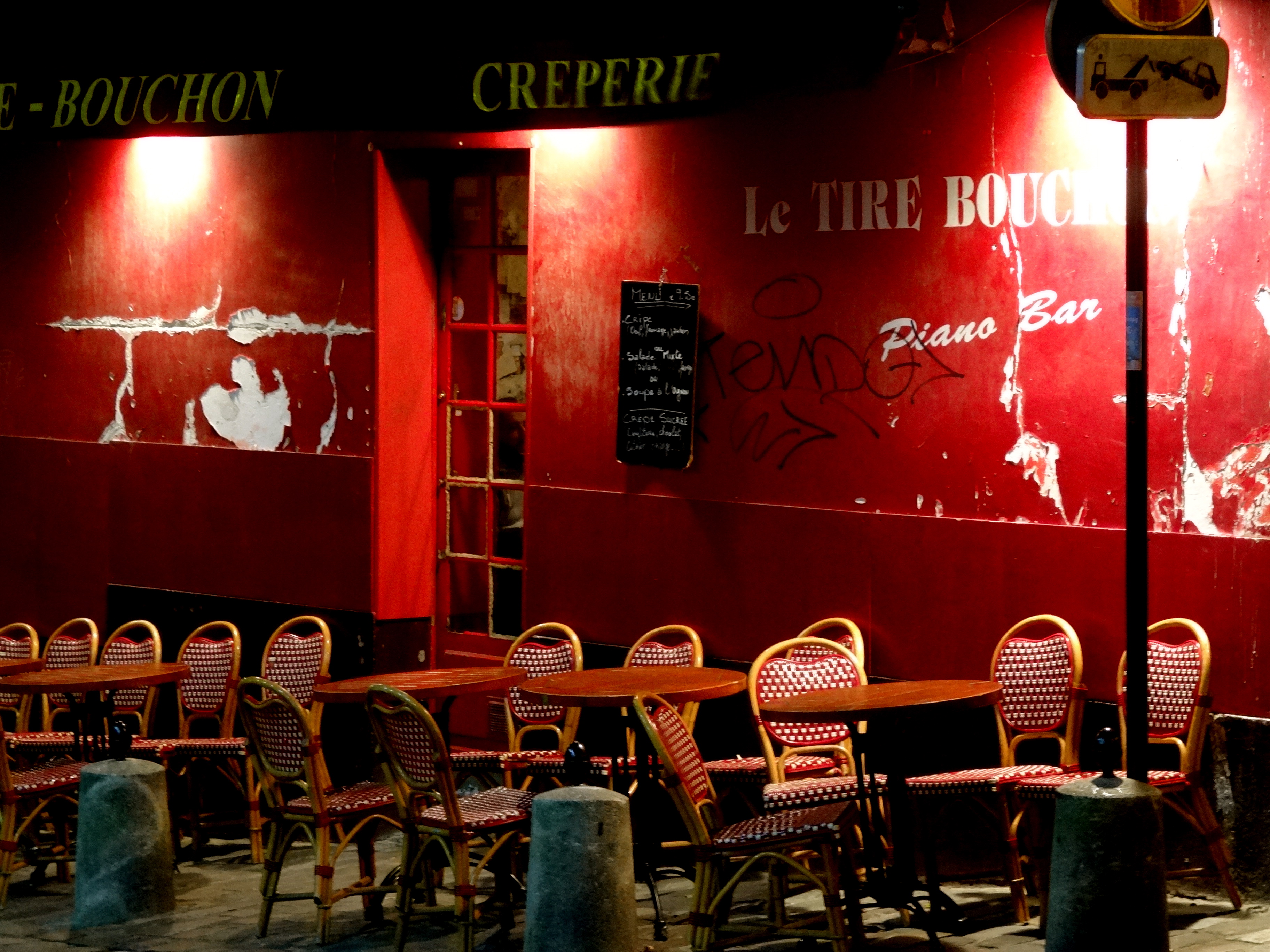
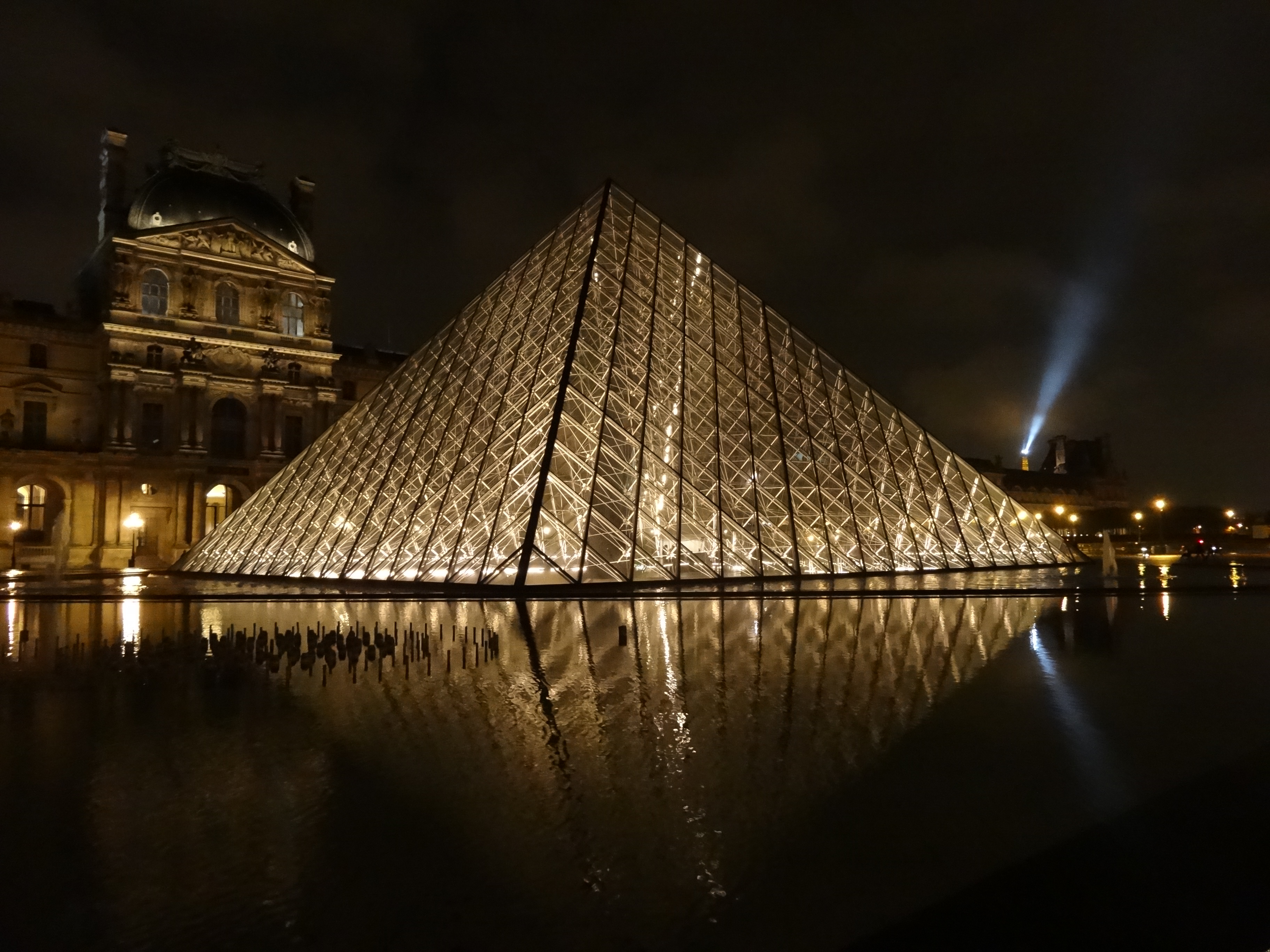
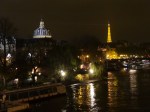
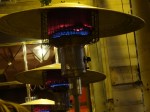
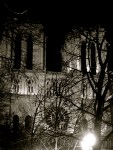
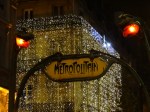
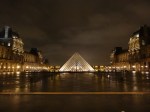
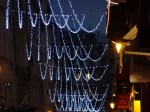
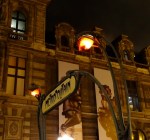
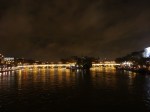
The twinkling lights of the eiffel tower, its mile-high search light cutting through the starry skies; the cosy brasseries with tables squeezed under gas heaters on the pavement outside; the wondrous art nouveau metro signs which glow an eery red when illuminated; the cabarets, the wine, the sparkling fountains, the floodlit buildings – isn’t nighttime in Paris the time which exudes the greatest charm of all? They say that Paris is the city of light, but that light can, ironically perhaps, never truly be appreciated until darkness falls, allowing the city to light up and truly come into its own. For Paris is the city of soirees and banquets, of midnight feasts and follies in the Palais Royale. It is the city which brought us the can-can and the spinning red sails of the Moulin Rouge, and at Christmas it is a city more alight than ever, as the twinkle of the festive season adds extra sparkle to the dazzling streets of the city.

DSC08821 DSC09194 DSC08786 DSC09176 DSC09164

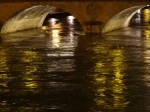
Taking photos at night is never easy without a tripod and all sorts of special flashes and settings, so you’ll excuse why half of the photos I have taken may be a little blurred. But for me that blurring does nothing to distract from the atmosphere these photos create – perhaps it even enhances it – as through the slight blur or subdued light you can still appreciate the glowing warmth of cafes and patio heaters, the sparkling celebration of a glass of champagne set against the blue lights of Christmas, and the stunning effect of illuminated bridge upon the cool waters of the Seine. I give you Paris, by night – Paris, city of light.

All photos and written content are strictly the copyright of Nicholas de Lacy-Brown © 2013 and The Daily Norm. All rights are reserved. Unauthorized use and/or duplication of the material, whether written work, photography or artwork, included within The Daily Norm without express and written permission from The Daily Norm’s author and/or owner is strictly prohibited. 

Paris | Art tour 2013 – Braque

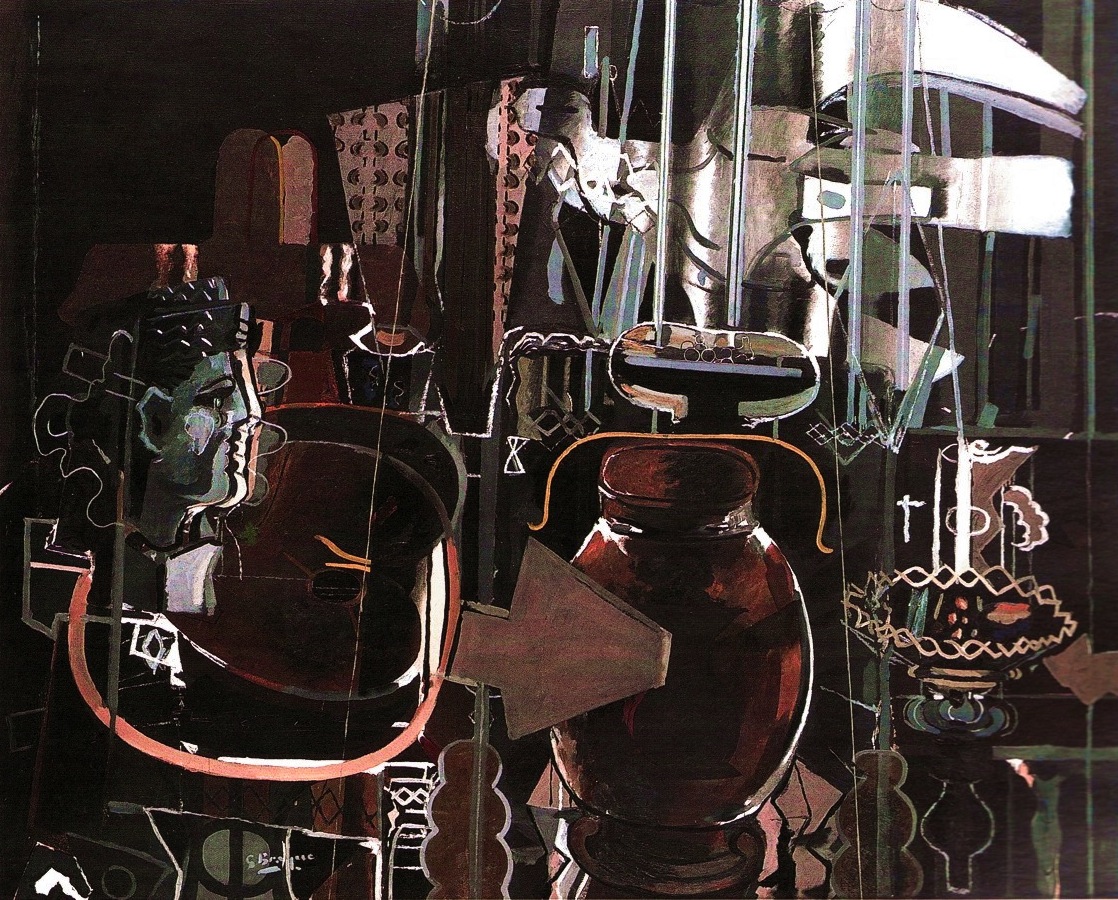
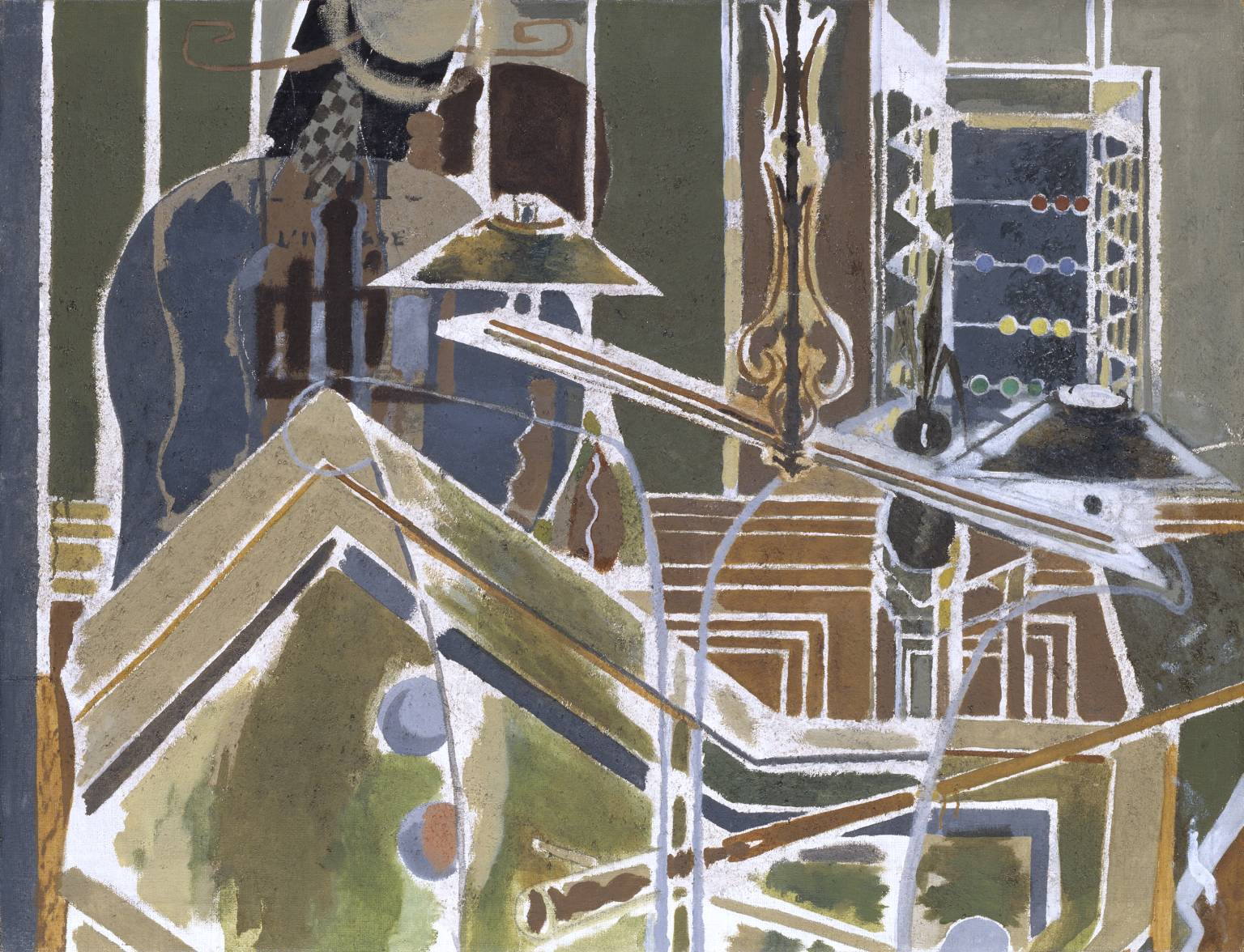
Lovers of 20th century art will all have heard of French-born artist Georges Braque. Of course I’ve heard of him too, renowned as he is for being co-founder of cubism along with the artist with whom he was thick and thieves in early 20th century Paris, Pablo Picasso. But my acquaintance with Braque has all too often occurred because, seeing a cubist masterpiece hanging in a modern art gallery, I have confused it with a Picasso, only to discover that the work was by Braque. It’s an easy mistake to make – the two artists were practically indecipherable from one another when they started out on the cubism road, a likeness of style which must be put down to the fact that they would discuss one another’s work endlessly day after day, night after night. And Braque was, purportedly, inspired into cubism by his glimpse of Picasso’s now world-famous Les Demoiselles d’Avignon, which few understood at the time, Braque being the exception.

So while Braque has, for me, existed solely in the shadows of the far glossier art historical existence of Picasso, I have never had the chance to discover how truly consistently brilliant he was as an artist. That is until this autumn, thanks to the latest blockbuster exhibition of Paris’ Grand Palais, which dedicates two floors of its palatial surrounds in retrospective homage to this French artistic great. I say consistently brilliant, because this show was one of those rare exhibitions where I literally loved almost every single piece, finding myself almost breathless with admiration as I strolled from painting to painting literally in love with what was on the walls before me.\

Early fauvism

The Port at La Ciotat (1907)

The Port at La Ciotat (1907)

Landscape in L'Estaque (1906)

Landscape in L’Estaque (1906)

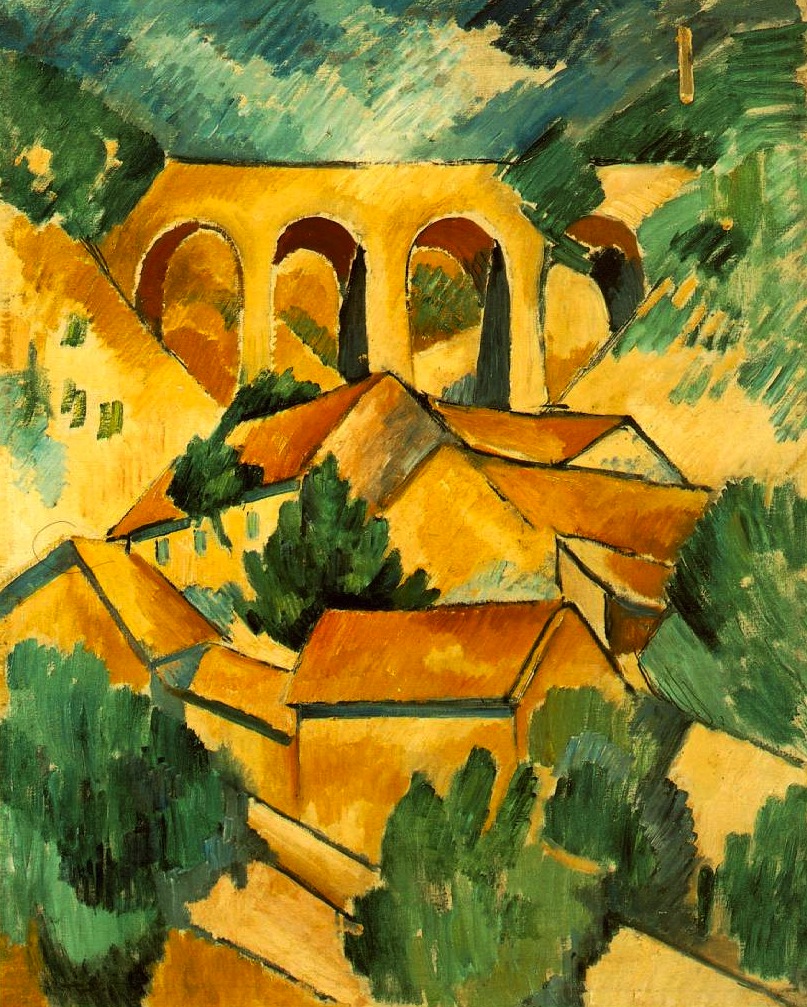
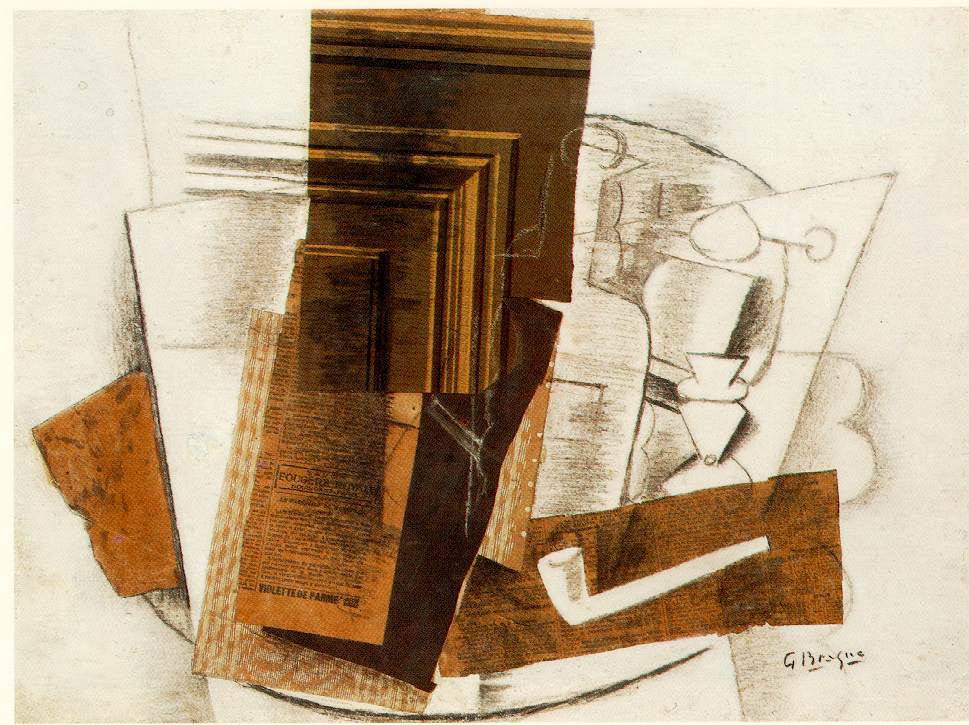
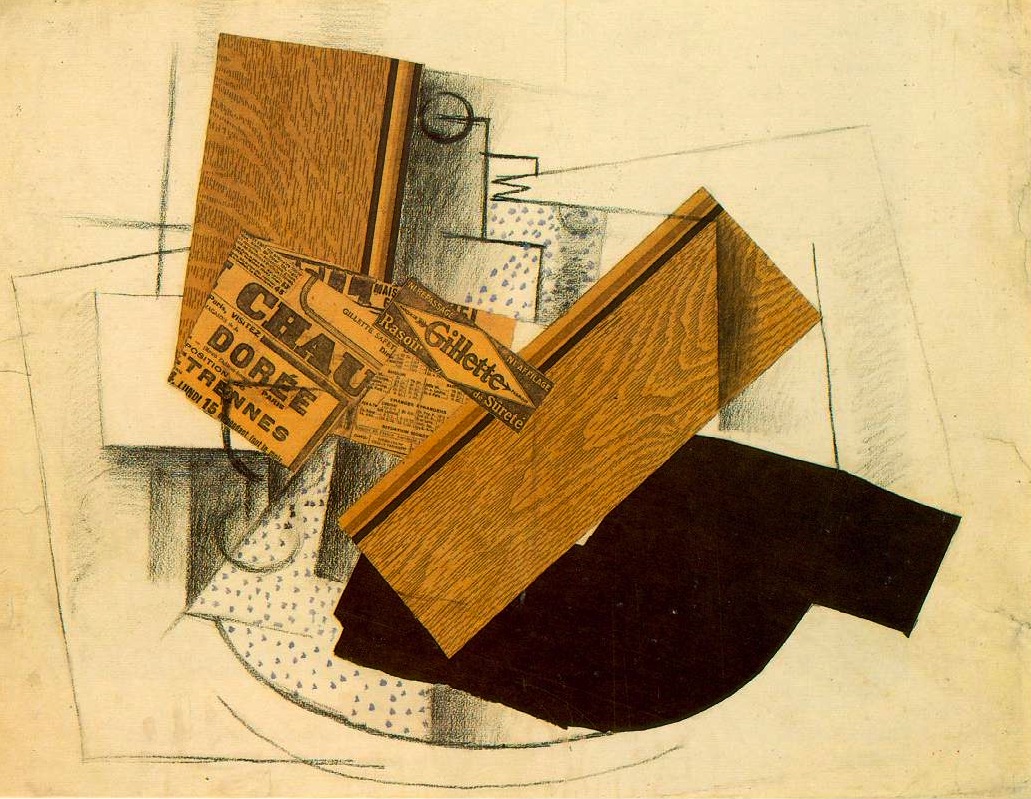
The show starts with early Braque, whereupon he dabbled largely in the fauvist epoque, with the result that his sunny landscapes of Southern France are imbued with scintillating bright colour which can not help but make the viewer yearn for the summer. But soon enough, after this initial embrace of colour, Braque discovers the more subdued shades of cubism, finding his own when fragmenting a scene into colourless, cubist dimensions. Seminal in cubism’s development was a chance visit to a wallpaper shop when Braque saw a reproduction wood-pattern paper in the window. Purchasing the wallpaper by impulse, it soon inspired Braque to set about creating a series of paper collages, which included, as well as the wallpaper, cardboard, newspaper cuttings – anything he could get his hands on. The effect of this geometric fragmentation was to create the cubist look, and soon enough Picasso was doing the same.

Into cubism, collage and then back to paint

Mandora (1909)

Mandora (1909)

The Viaduct at L'Estaque (1908)

The Viaduct at L’Estaque (1908)

Little Harbour in Normandy (1909)

Little Harbour in Normandy (1909)

Still life with pipe (1913)

Still life with pipe (1913)

Still life on a table with Gillette (1914)

Still life on a table with Gillette (1914)

Violin and Pipe (Le Quotidien) (1913)

Violin and Pipe (Le Quotidien) (1913)

back to painting.... Still Life with Fruit and Ace of Clubs (1913)

back to painting…. Still Life with Fruit and Ace of Clubs (1913)

After several years of collage experimentation, Braque returned to paint, but using the medium to create what were almost pastiches of the collage look – still fragmented, full of geometric shapes, but differing in their progressive return to the bolder colours of his fauvist age, a return which was no doubt eased along by the weakening of his relationship with Picasso, and his strengthening bond with spirited Spanish artist, Juan Gris.

The Table (1928)

The Table (1928)

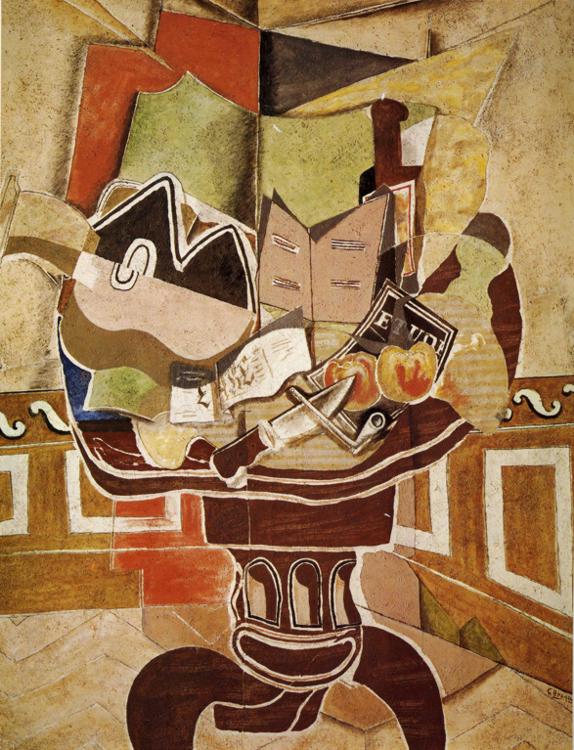
The Round Table (1929)

The Round Table (1929)

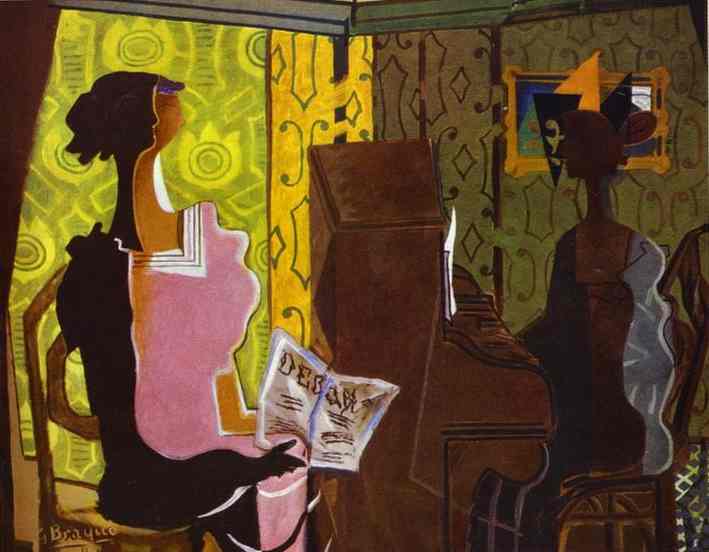
The Duet (1937)

The Duet (1937)

Studio II (1949)

Studio II (1949)

Studio with Skull (1938)

Studio with Skull (1938)

Thus it was that as the 20s and 30s ticked by, Braque’s work moved the cubist spirit further and further, as the artist pushed the boundaries of the movement he had helped to create, until such a time as his works become progressively more figurative, but all the while maintaining the multi-dimensional expression which was central to cubism. Take his billiard table series for example – seen from various angles, Braque’s bold green billiard table is shown from all kinds of impossible angles, and yet there is no mistaking what Braque was trying to depict.

The Billiard Table (1945)

The Billiard Table (1945)

I would be selling the show short to suggest that it all ended there. From colour-drenched fauvism to colour-collected cubism, Braque’s mastery extended to every avenue of life, as he used his pioneering imagery to depict portraits, artist’s studios, landscapes, still life and even greek mythology. From room to room we see an artist who never failed to be inspired, and to inspire his countless followers in response. Never again will Georges Braque be in Picasso’s shadow as far as I am concerned, but level pegging as a genius of 20th century art.

Georges Braque is showing at the Grand Palais, Paris until 6 January 2014.

Paris | Photography Focus – Les Jardins et les chaises

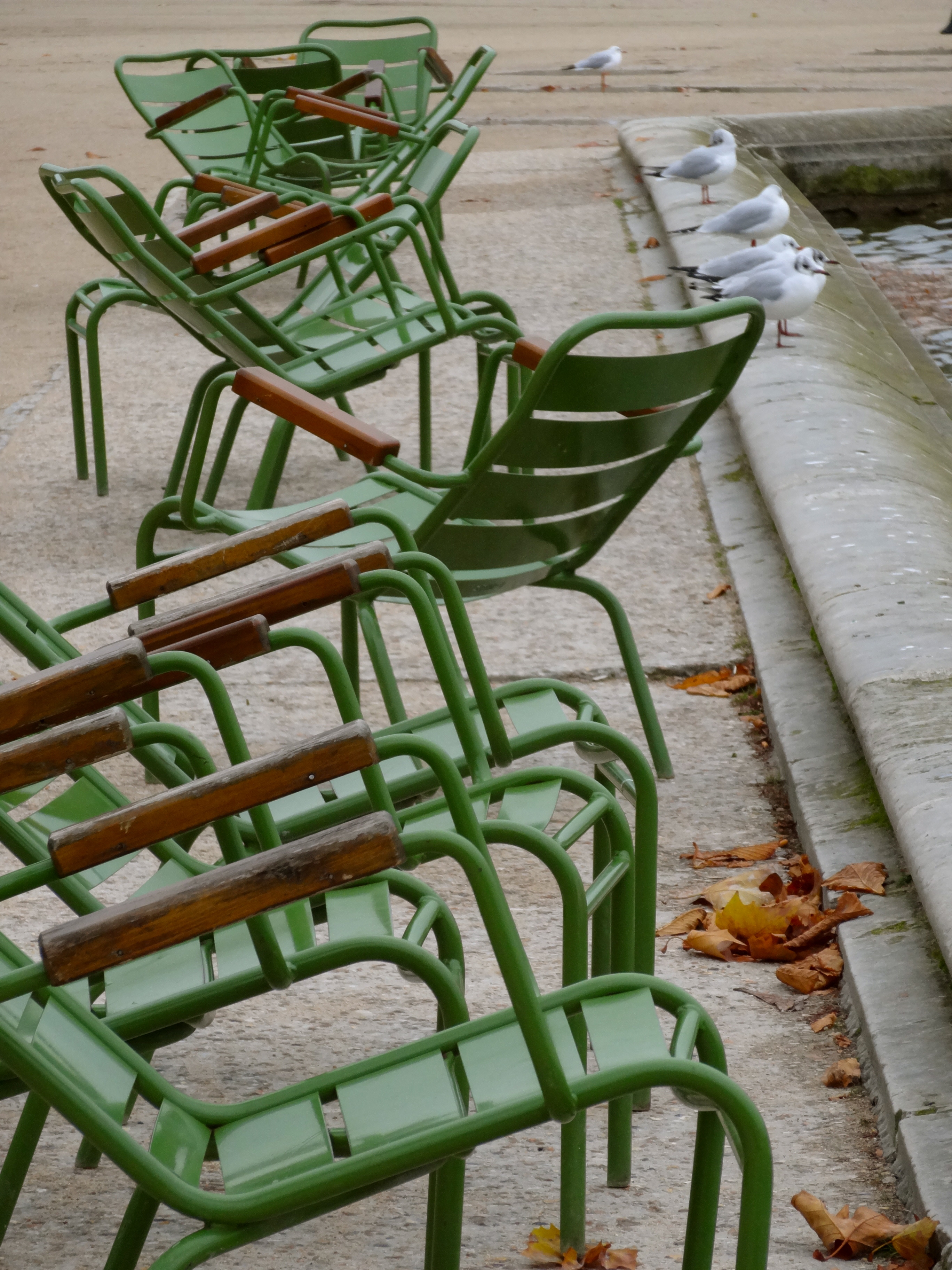
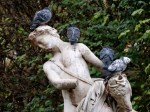
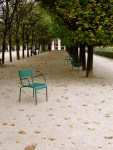
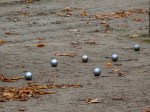
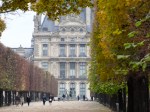
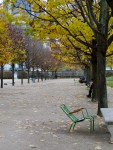
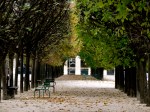
Paris may not be the greenest of cities in the world, but there is something intrinsically Parisian about the parks and gardens which shape it. With their tightly trimmed box hedges and carefully manicured trees, their gravelly, sandy ground and lack of lawns (perfect for a game of  pétanque or boules with a few amis) and with their long wide promenades punctuated by lone statues and cluttered with strolling well-dressed flaneurs with their equally quaffed dogs, the parks of Paris are to me the heart and soul of the city, representing the ordered formality of the Haussmann planned boulevards, reflecting the grandeur of the more built up areas of the city, and providing much needed space for the residents of the city to collectively let their hair down.

DSC08922 DSC08862 DSC09427 DSC08933 DSC09422

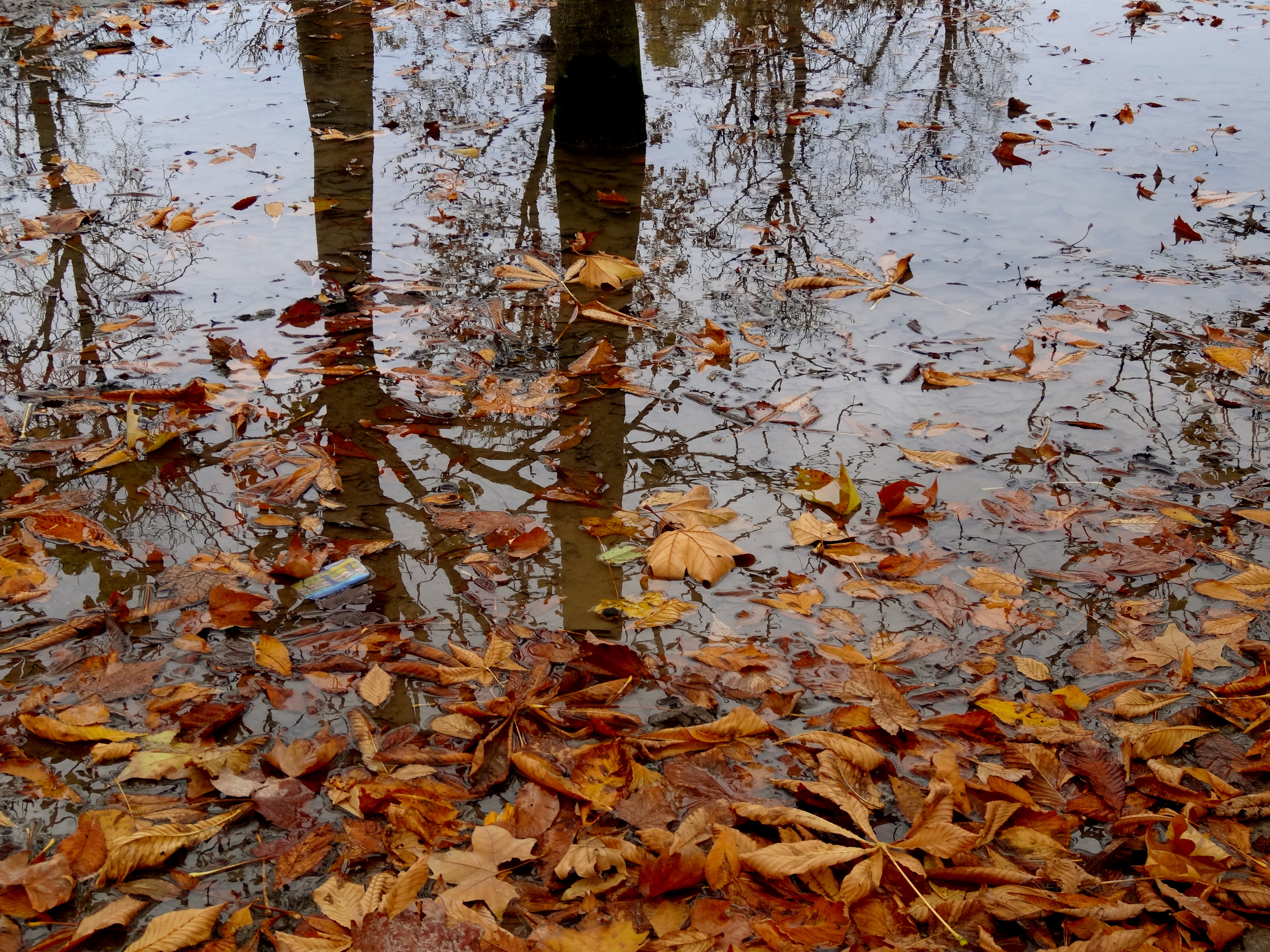
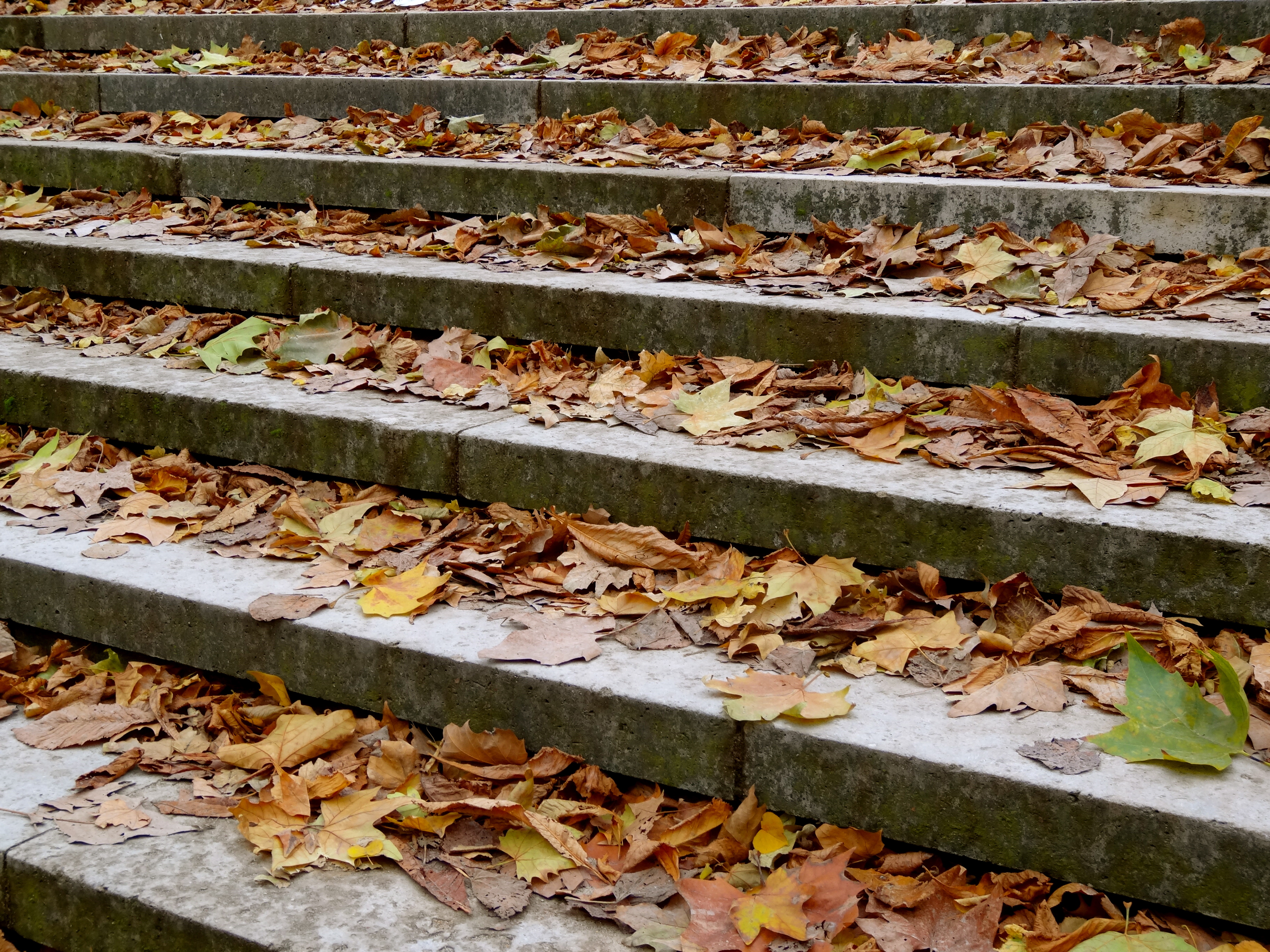
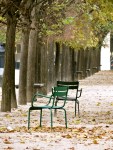
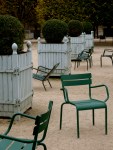
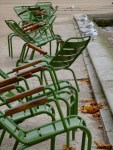
But more than the sandy paths, the clipped hedges and the boules, the randomly collected green metal chairs are for me the symbol of Paris. Rather than, or sometimes as well as the benches which line the parks, Parisian gardens are always full of scattered chairs, some angled at a steep incline to allow the sitter to langour in the sunshine, and others more upright and formal, but none of them attached to the ground so that, at any one time, you can find them in a diverse array of compositions. So characteristic are these chairs of the gardens of Paris that I have made them the focus of my photographic exploration of the Paris gardens which we were strolling through between our various trips to art galleries, photos which also aptly reflect the wonderful array of autumn colours which burned brightly in Paris despite the overcast weather and the very cold winter temperatures. Enjoy!

All photos and written content are strictly the copyright of Nicholas de Lacy-Brown © 2013 and The Daily Norm. All rights are reserved. Unauthorized use and/or duplication of the material, whether written work, photography or artwork, included within The Daily Norm without express and written permission from The Daily Norm’s author and/or owner is strictly prohibited. 

Paris | Art tour 2013 – Kahlo and Rivera

I would like to start off my little Paris art series with a moan about London. For all the great events which take place in the city, its exhibitions tend to pale into insignificance when compared with Paris. Take the exhibitions that are on at the moment. At the Royal Academy, the grand galleries of the Burlington Palace are given over to an exhibition surveying the art history of Australia. Well we all know that Australia has no art history, and this exhibition demonstrates as much. Then there’s Tate Modern’s new retrospective on Paul Klee which presents room after room of samey small little Bauhaus explorations – and leaves the visitor as flat as the image so meticulously conceived by Klee on paper. And let us not forget the Royal Academy’s other homage to a nation’s art – its recent Mexico show, whose only inclusion of perhaps the greatest artist ever to come out of Mexico, Frida Kahlo, was a painting so small (and I mean ridiculously small) that you had to squint to see it.

Rivera's cubist period

Rivera’s cubist period

None of this in Paris, whose exhibitions present such a comprehensive survey of the particular artist at hand that you feel not only completely enriched at the end of the show, but also pretty exhausted too. And Paris doesn’t just have one blockbuster exhibition a year – no no, it holds a good three or four massive artistic events each season, hence why I feel the insuperable need to visit the city each year.

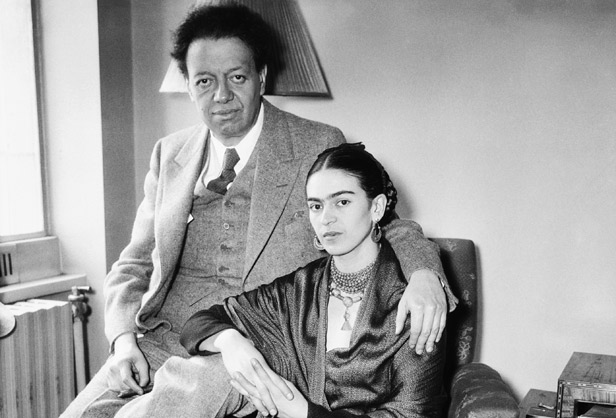
Really marking Paris out as the superior of its cross-channel neighbour this year is the Musée de l’Orangerie’s significant survey of the works of one Frida Kahlo, and her equally inspired artist husband, Diego Rivera. Entitled Art in Fusion, it explores what has to be one of the greatest married (and divorced, and then remarried) painterly partnerships of modern art history, with many of the most substantial of each artist’s oeuvres on exhibition, and not a tiny painting in sight.

The couple together

Diego Rivera with Wife Frida Kahlo tumblr_m965goUs9T1rw3fqbo1_1280 frida-kahlo-diego-rivera3

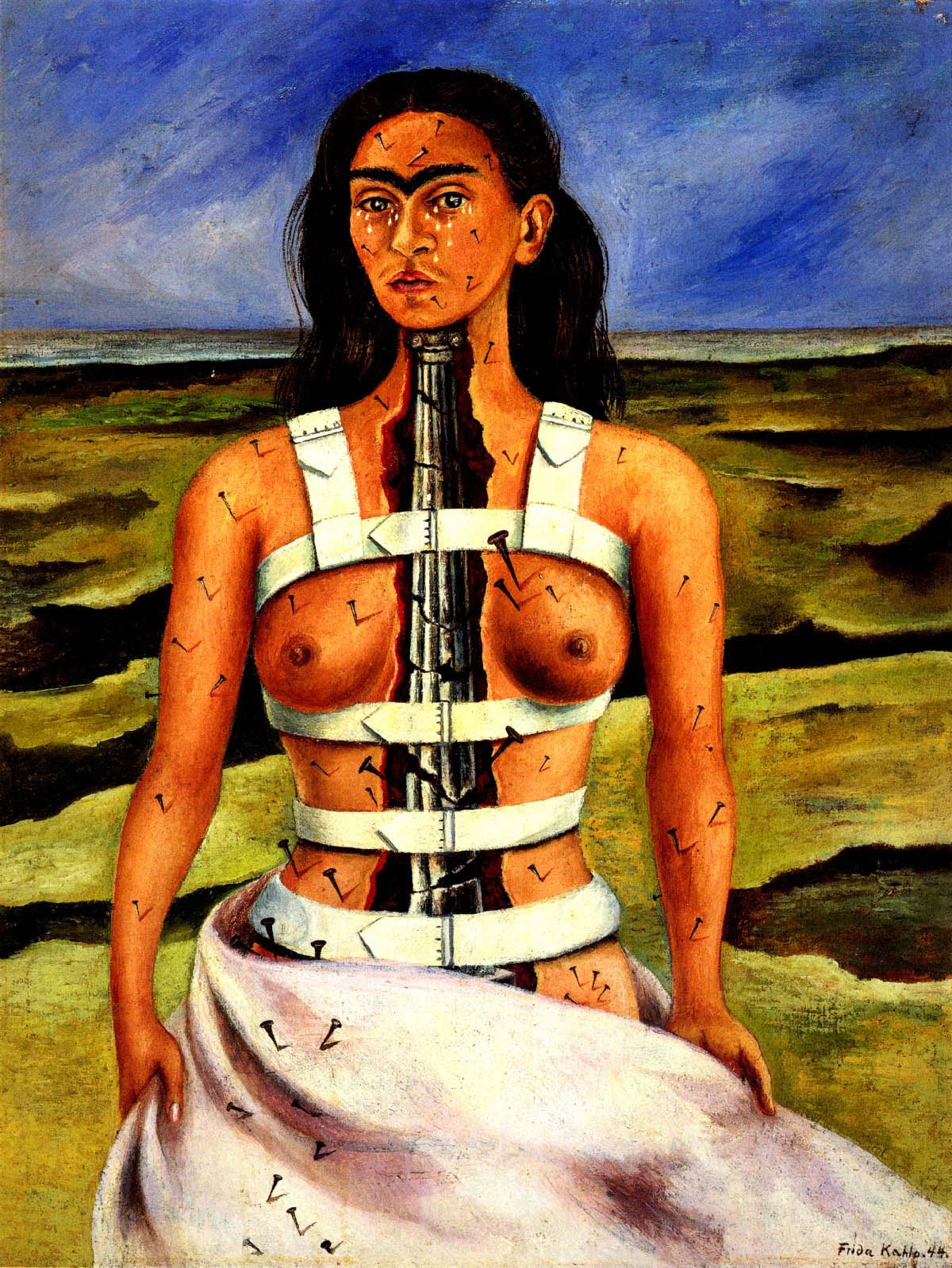
I have always adored the work of Frida Kahlo, resonating so easily with her emotionally raw artistic expression right from the time I first saw her work (ironically in London – those were the good days). For me, Kahlo’s paintings will always trump those of her hubbie’s, which are altogether more political for my taste. Either that or they are too superficial – such as paintings of children tying up lillies or portraits of Mexican natives. His works are altogether too easy to interpret at face value, while faced with a Kahlo masterpiece, you are kept guessing about all of the multi-layered complex meaning with which she imbues her works.

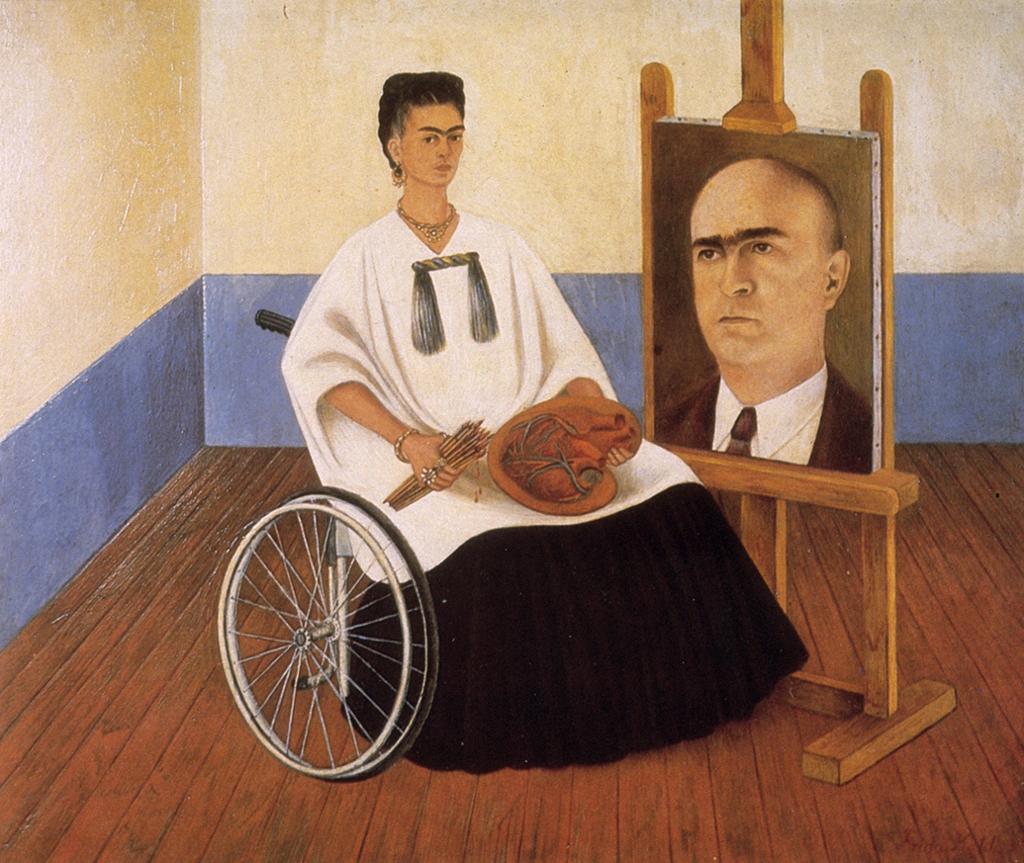
As ever, my favourite of her paintings are those which deal the most viscerally with her experiences of personal trauma – both the bus accident which crippled her for life, and the series of miscarriages which resulted, as well as her painful experience of Rivera’s relentless infidelity. This may make me morose, even morbid in my preferences, but then it was Frida’s works which first inspired me to commit my own life-changing accident to canvas.

Frida’s visceral pain-filled works

Frida-Kahlo-Henry-Ford-Hospital-1932 The-Broken-Column tumblr_lv2v44tlpg1qzse0lo1_1280 Frida-Kahlo_Self-Portrait-with-Dr-Farell kahlo-11

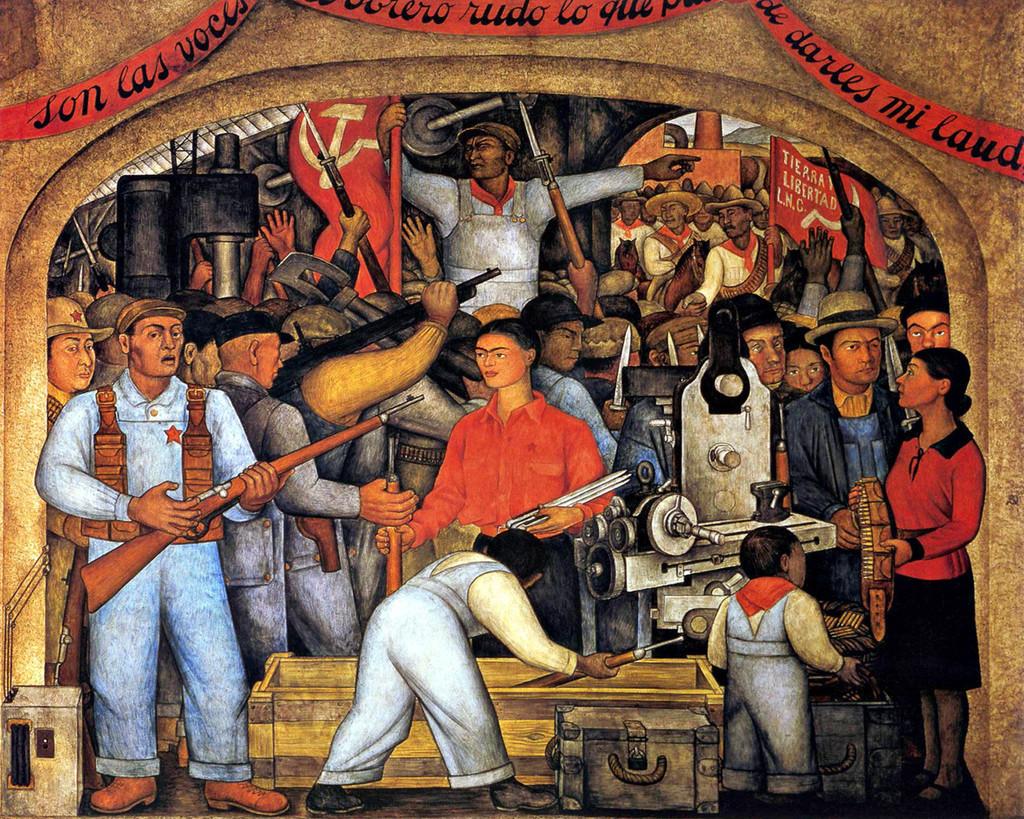
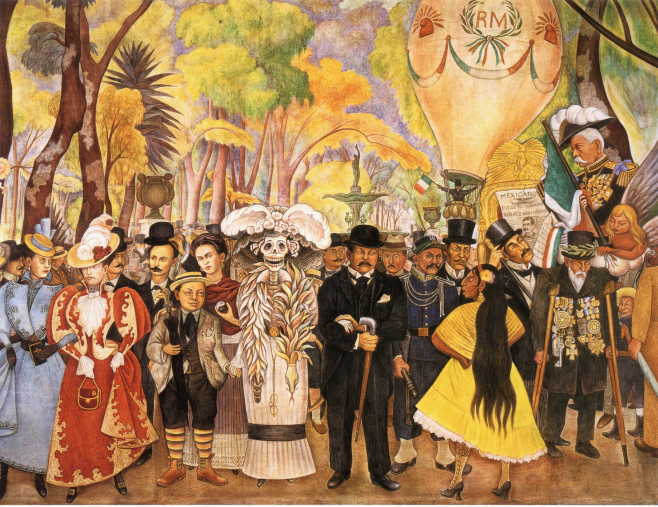
At the risk of being unfair to Rivera, of the canvases on show, a few stand out. I particularly enjoyed his cubist period when, as a young man, he found himself influenced by the early advent of this movement in 1900s Paris. However for the most part, it is Rivera’s murals which are his staggering life’s masterpieces, and sadly, despite some attempt at reproduction in the exhibition, these will require a trip to Mexico to be enjoyed to the full.

Rivera’s murals

diego_rivera_distribution_arms_canvas_print_9a Rivera_AlamedaPark mural(2)

That said, this show, which is a unique opportunity to see both the works of husband and wife displayed alongside each other, is an indisputably unmissable opportunity to see the artistic fusion which these two icons of Mexican art produced during their years together. And, being as it is in the Orangerie, if you find the vitality of colour and the depth of emotional expression a little too much to muster, there’s always Monet’s ultimately calming waterlillies to soothe you upstairs.

Frida Kahlo and Diego Rivera | Art in Fusion is on at the Orangerie until 13 January 2013. If you want to avoid the vast queues which characterise all of the Paris exhibitions, I recommend buying tickets in advance.

The Daily Norm’s Photo of the Week – Preened pups of Paris

There can be no hiding from my inexorable and unapologetic love of all things Parisian. The music of the old Montmartre dance halls has the power to transport me to a parallel consciousness; its abundant art collection contains some of the most incredible masterpieces the world has ever seen; and its streets are so atmospherically romantic, that images of the city litter my London flat. And yet for all of the sensations and memories which I attach to the city, and which I rely on whenever, during the year, I feel those familiar pangs to be there, there is no substitute for visiting the city itself. And with trains from London to Paris’ Gare du Nord taking a mere 2.15 hours, it would be silly not to.

So each year, around Christmas time, when the city is getting cold, when the chic winter fashion is having its airing, and when the cosy little Christmas markets are being set up along the wide stretches of the Champs Elysées, I tend to take the lightening-speed train journey under the Channel sea, to visit the city I love above all others. My excuse for visiting every year is the fantastic array of new art exhibitions which the city does so well every autumn, but in fact very little excuse is needed other than the undeniable need to plug my yearning soul back into this bastion of culture and civilisation once a year.

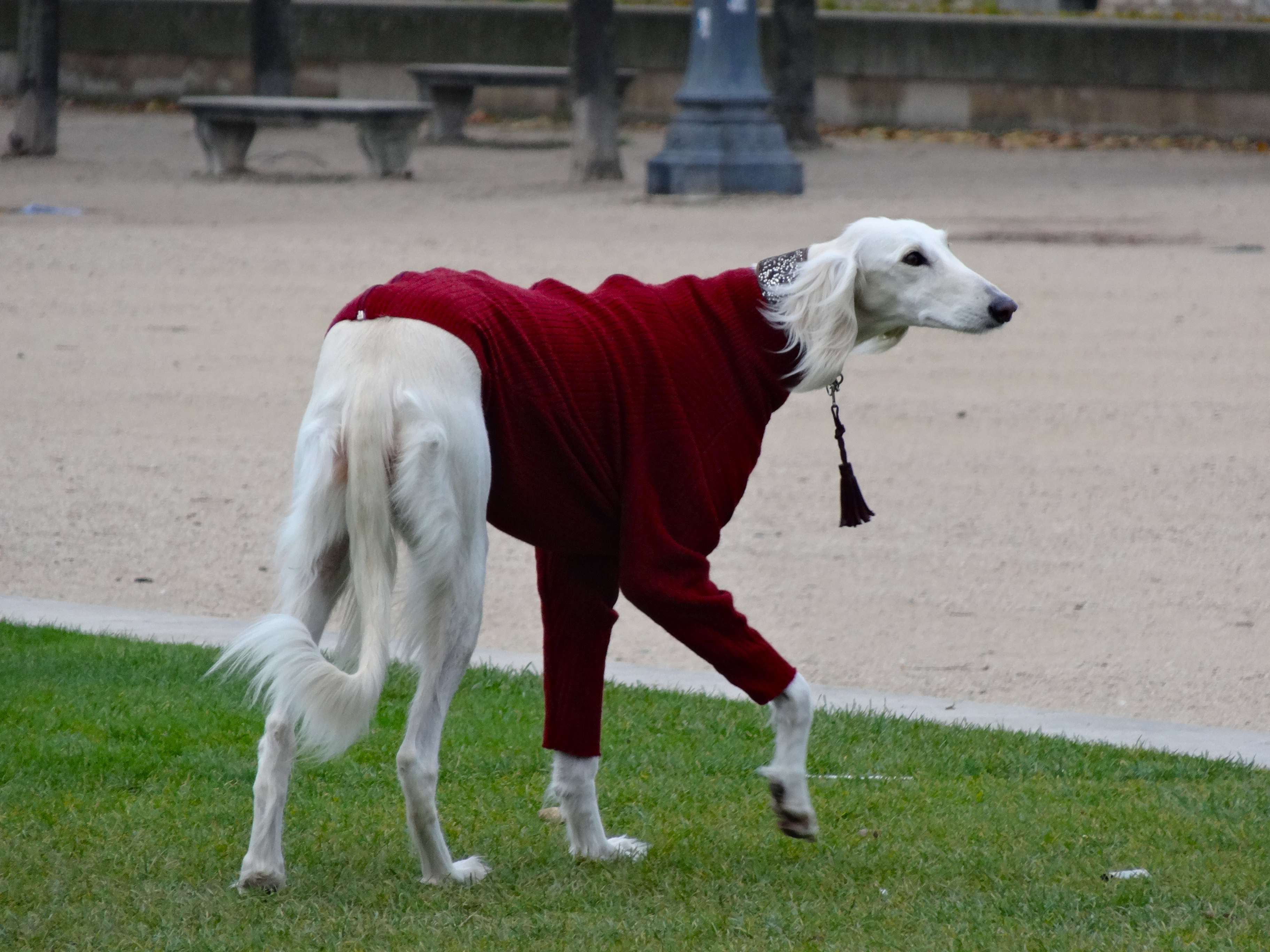
Having just embarked on my 2013 stay, the pages of The Daily Norm are about to go all belle Paris on you, and by way of kickstarting the season, I thought a quick photo of the week was due. For this week’s photographic focus, I have been a little greedy, selecting more of a theme than a single shot, but one nevertheless worthy of the attention. For if there is one  thing that sums up the chic glamour of Paris for me, it is a Parisian’s dog. Never far from any resident of the city, a Parisian and his or her dog seem to be as inseparable as the French to their baguettes, and the city just wouldn’t be the same without the sight of those cute little well-dressed, perfectly preened dogs trotting alongside their equally debonair owners.

DSC08907

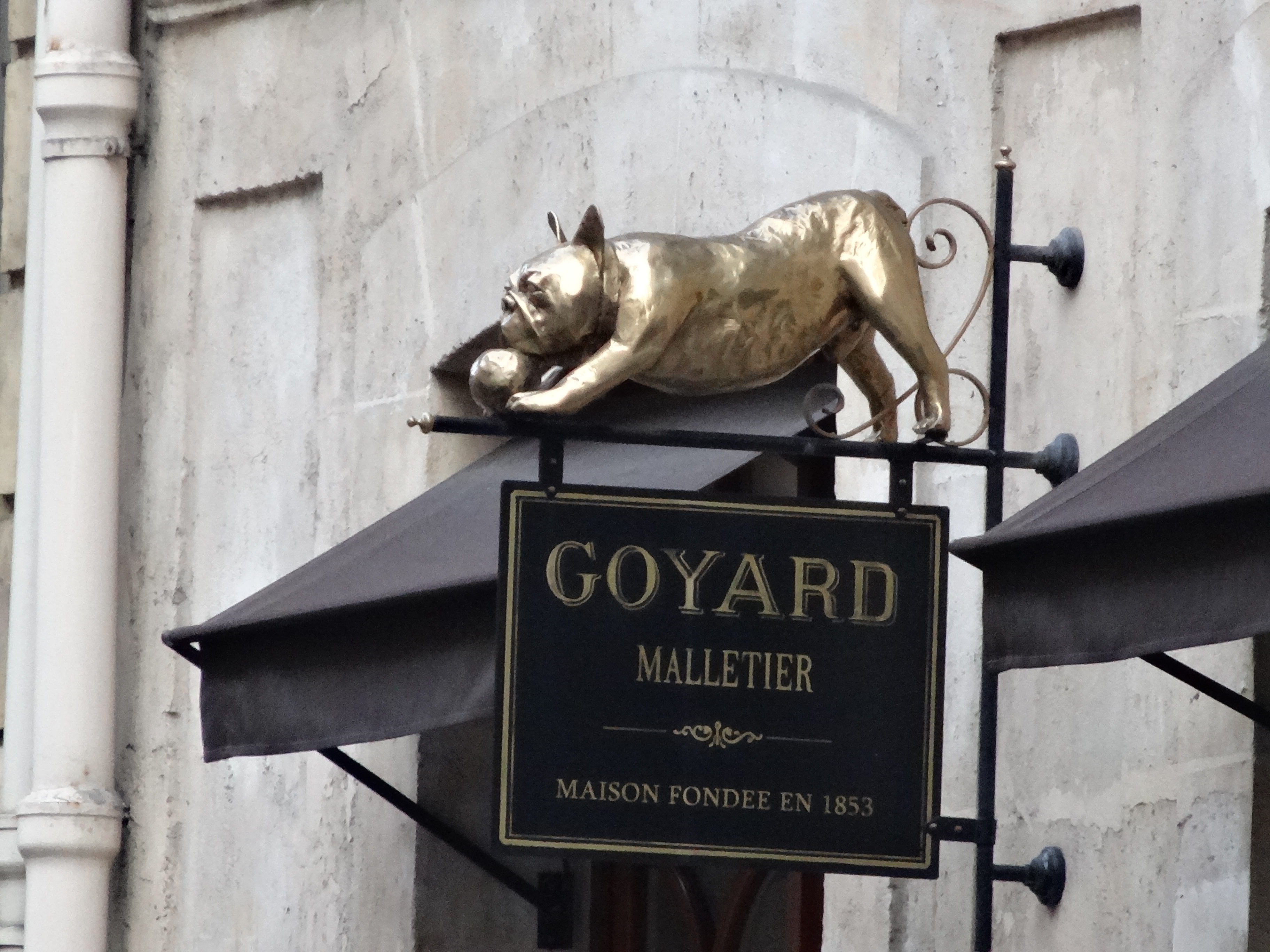
This week’s principal photo, and the shot that inspired me to write this post, is this photo of a svelte curly tailed chien, its beautiful long white hair contrasting delectably against its super stylish red pullover – a sight which is surely too sleek to be found anywhere but in Paris. This dog (someone will have to help me with the breed) was certainly an eyeopener, capturing the attention of many a photographing tourist as it passed by in the Jardin des Tulleries (myself included). However, she was not alone. In the remainder of this post I include a few other super cute doggy shots from the trip – one little dow-eyed doggie sitting so well behaved in the lobby of our hotel; another sleepy bulldog waiting patiently to cross the road. And to top it all off, the chic boutique on Paris’ stylish Rue St Honoré which just about sums up the Parisian’s attitude to dogs – their very own doggie boutique, located in amongst the Prada’s, the D&G’s and the YSL. In Paris it’s surely a dog’s life.

DSC08982 DSC09043 DSC09063 DSC09067

All photos and written content are strictly the copyright of Nicholas de Lacy-Brown © 2013 and The Daily Norm. All rights are reserved. Unauthorized use and/or duplication of the material, whether written work, photography or artwork, included within The Daily Norm without express and written permission from The Daily Norm’s author and/or owner is strictly prohibited. 

Autobiographical Mobile: The finished article

C’est fini! At last, my autobiographical mobile is complete! Started in June last year and completed right at the end of April of this year, the maths alone dictates that this has been a long project in the making. While my blog account of the work has been posted in respect of 25 full days of painting, a great number of evenings and hours grabbed in otherwise hectic weeks have been spent working on this piece, one of the most comprehensive projects of my art career so far. Yet the protracted length of the project (augmented by the fact I work full-time and have been undertaking a whole host of other artistic projects in the meantime) has also been one of its benefits – feeling no rush, I managed to achieve a more perfected finish on each of the areas I was working on, and likewise, owing to the passage of time, the painting has become something of a developing story in itself – a true artistic reflection of the changing circumstances of my life.

Autorretrato (Autobiographical Mobile) 2013 © Nicholas de Lacy-Brown, oil on canvas

Autorretrato (Autobiographical Mobile) 2013 © Nicholas de Lacy-Brown, oil on canvas

And how it looked on the first day of painting

And how it looked on the first day of painting

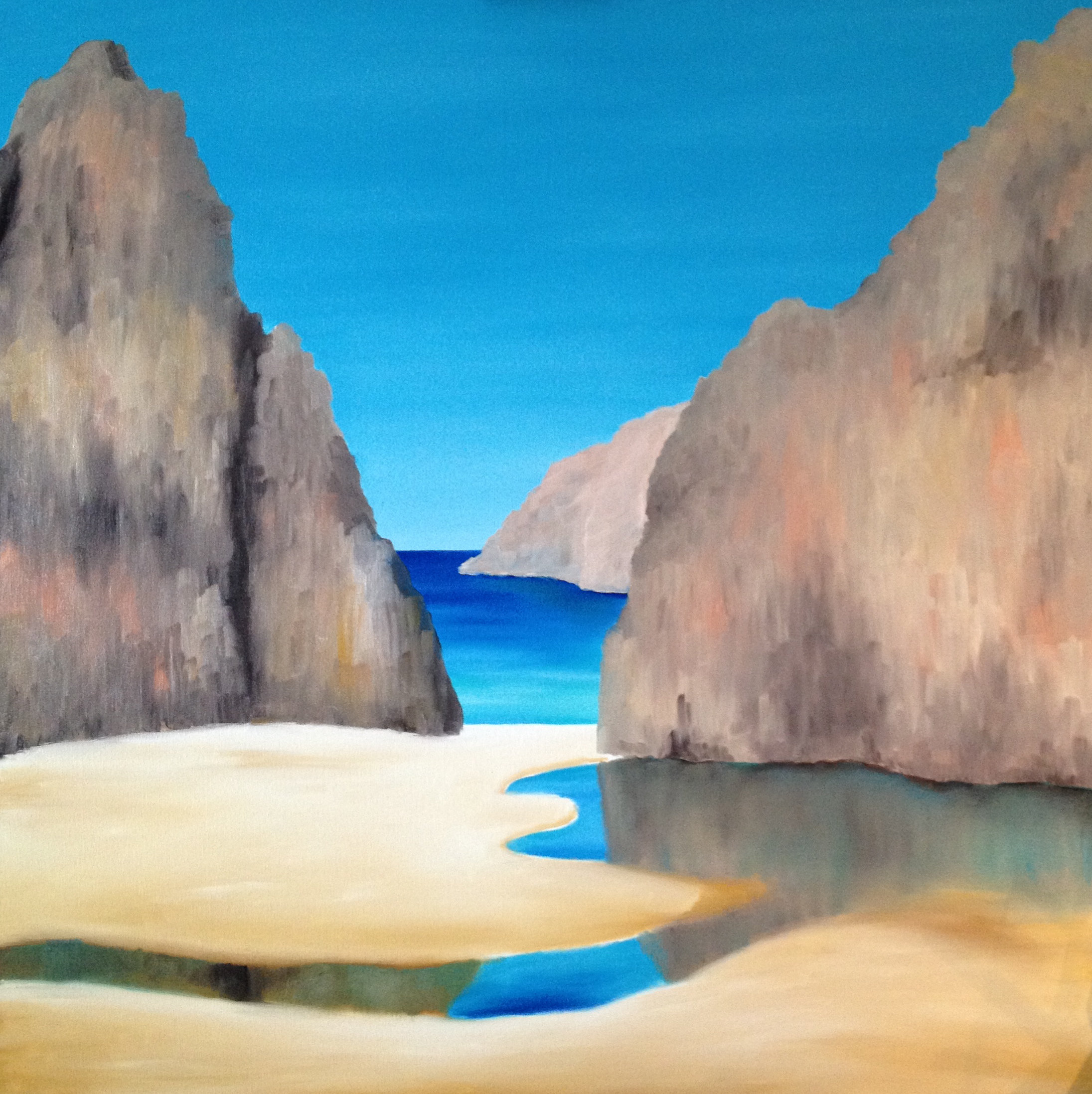
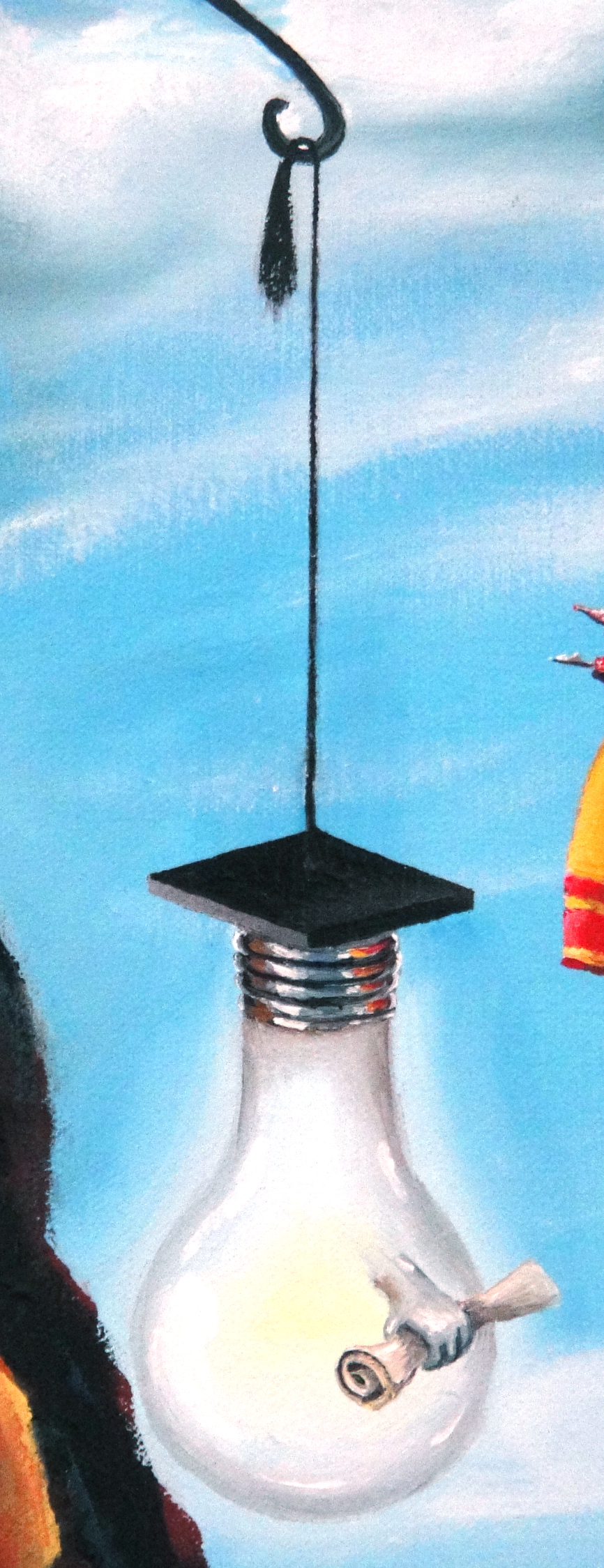
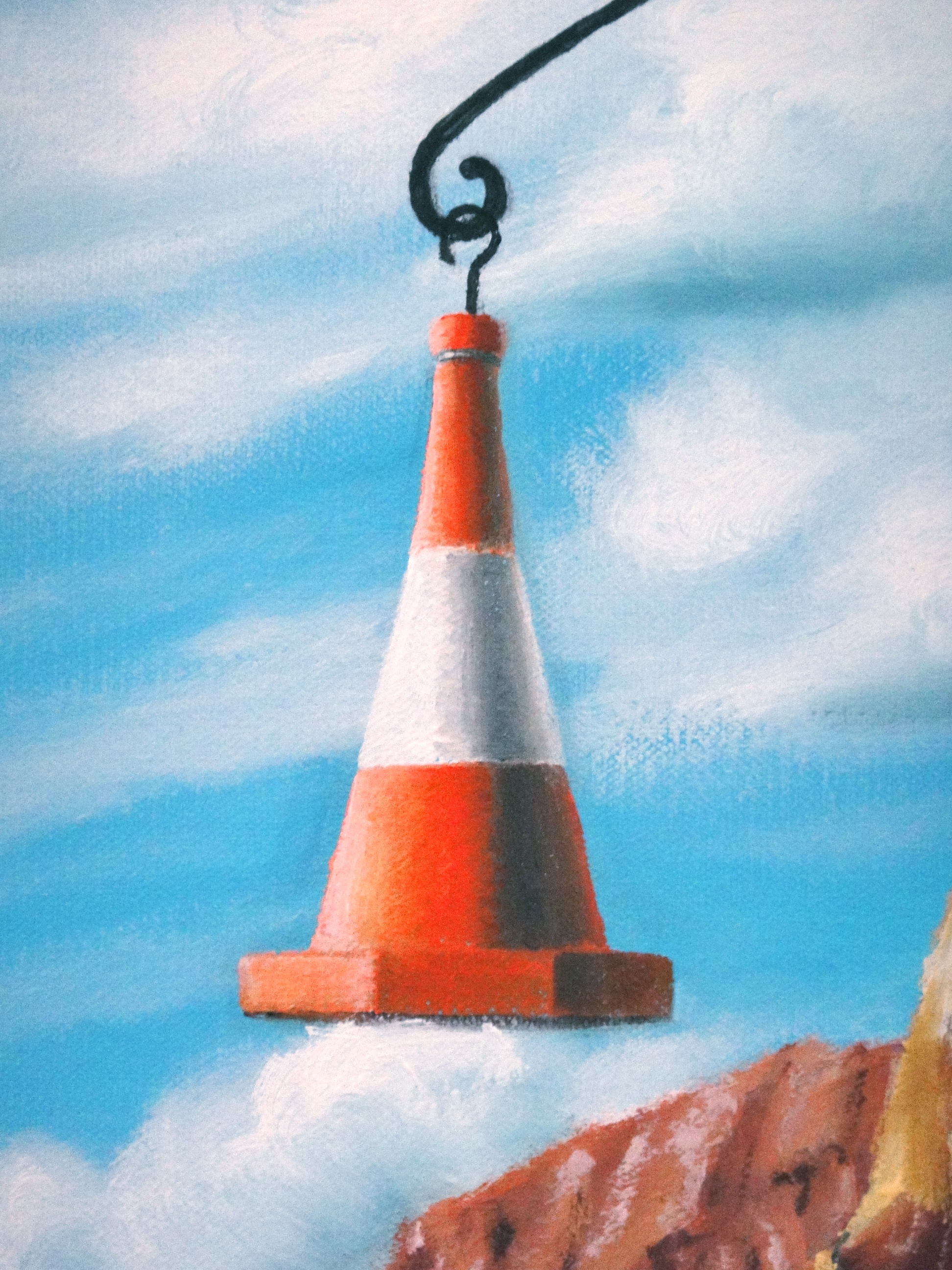
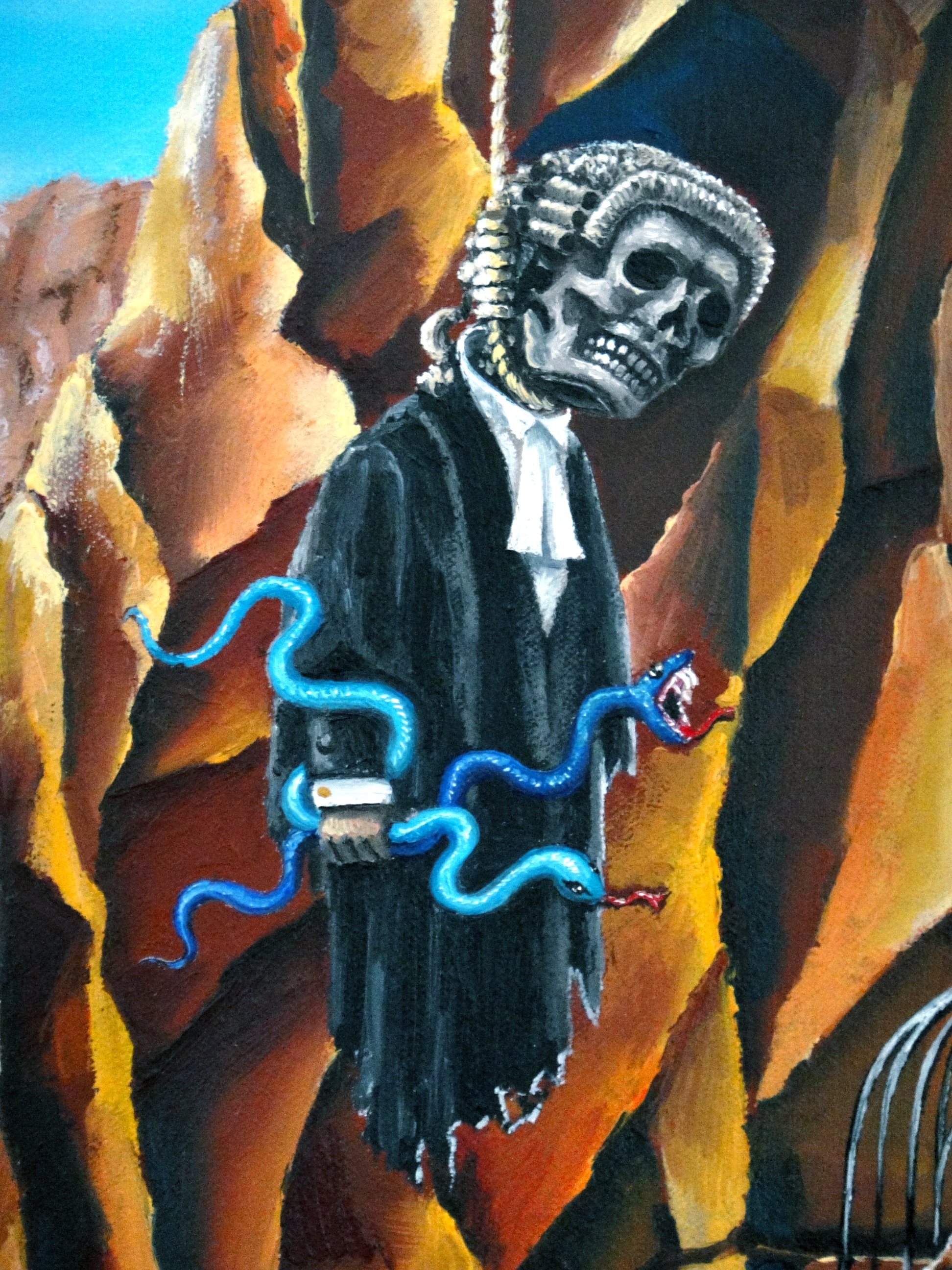
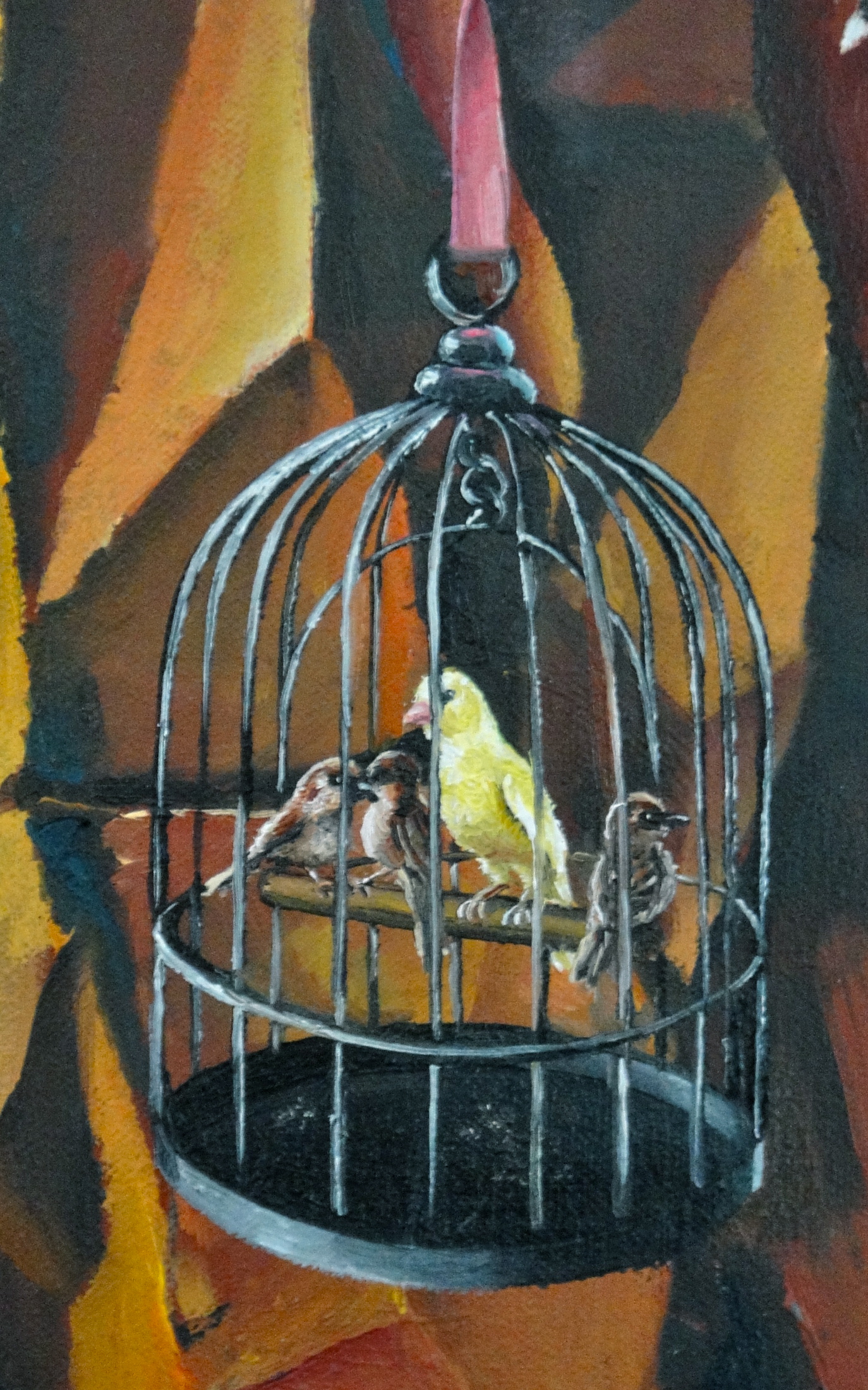
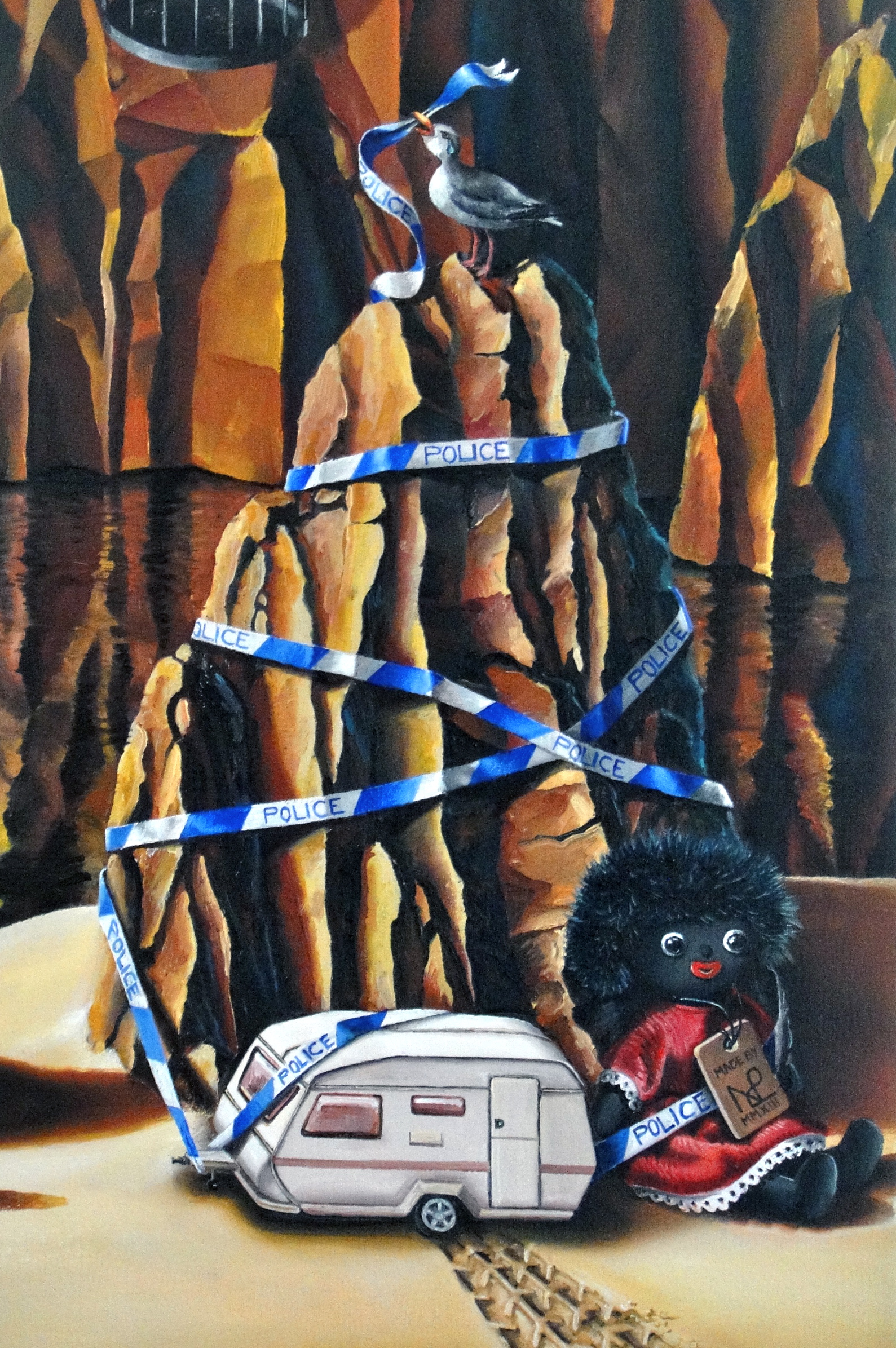
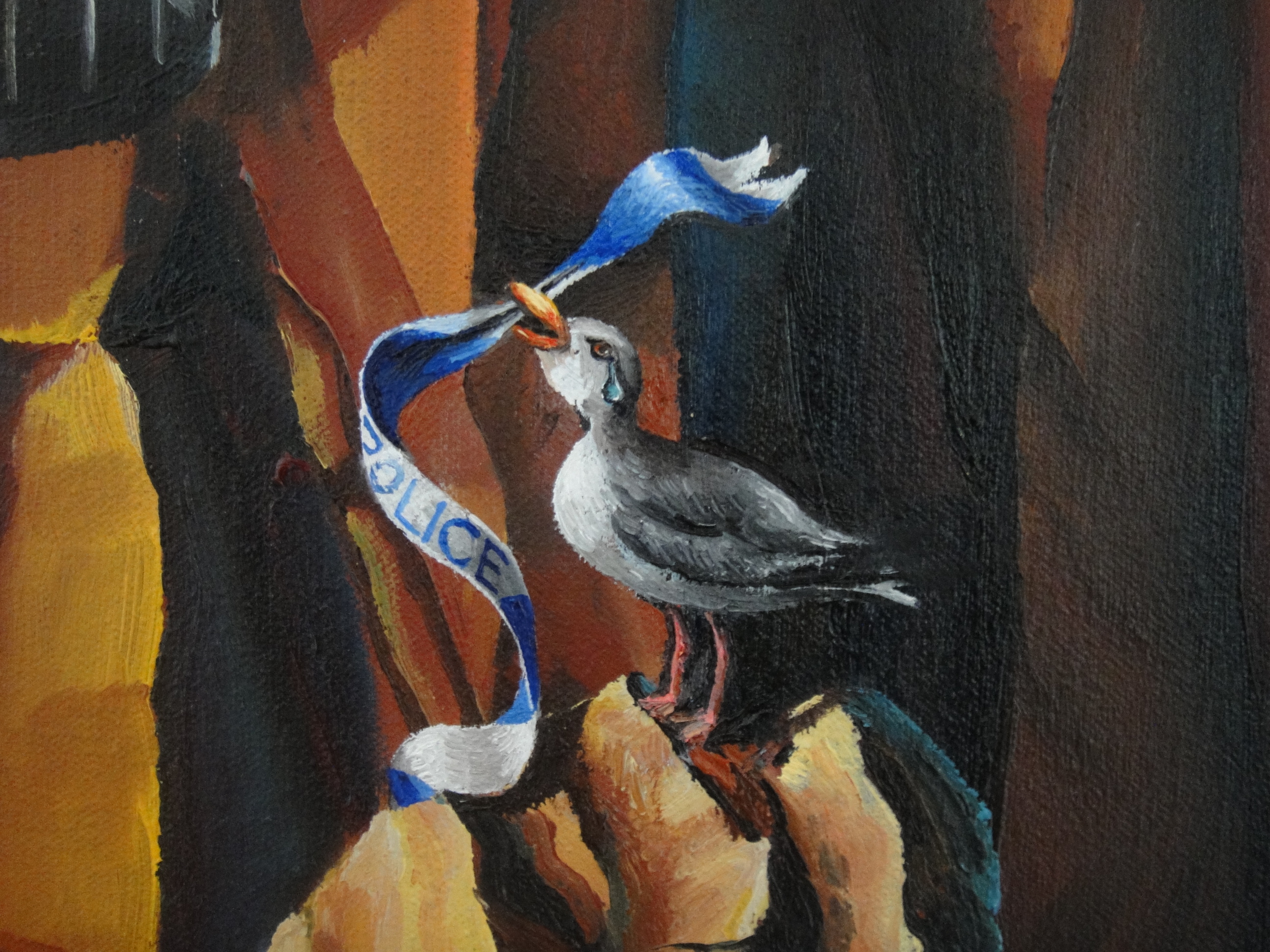
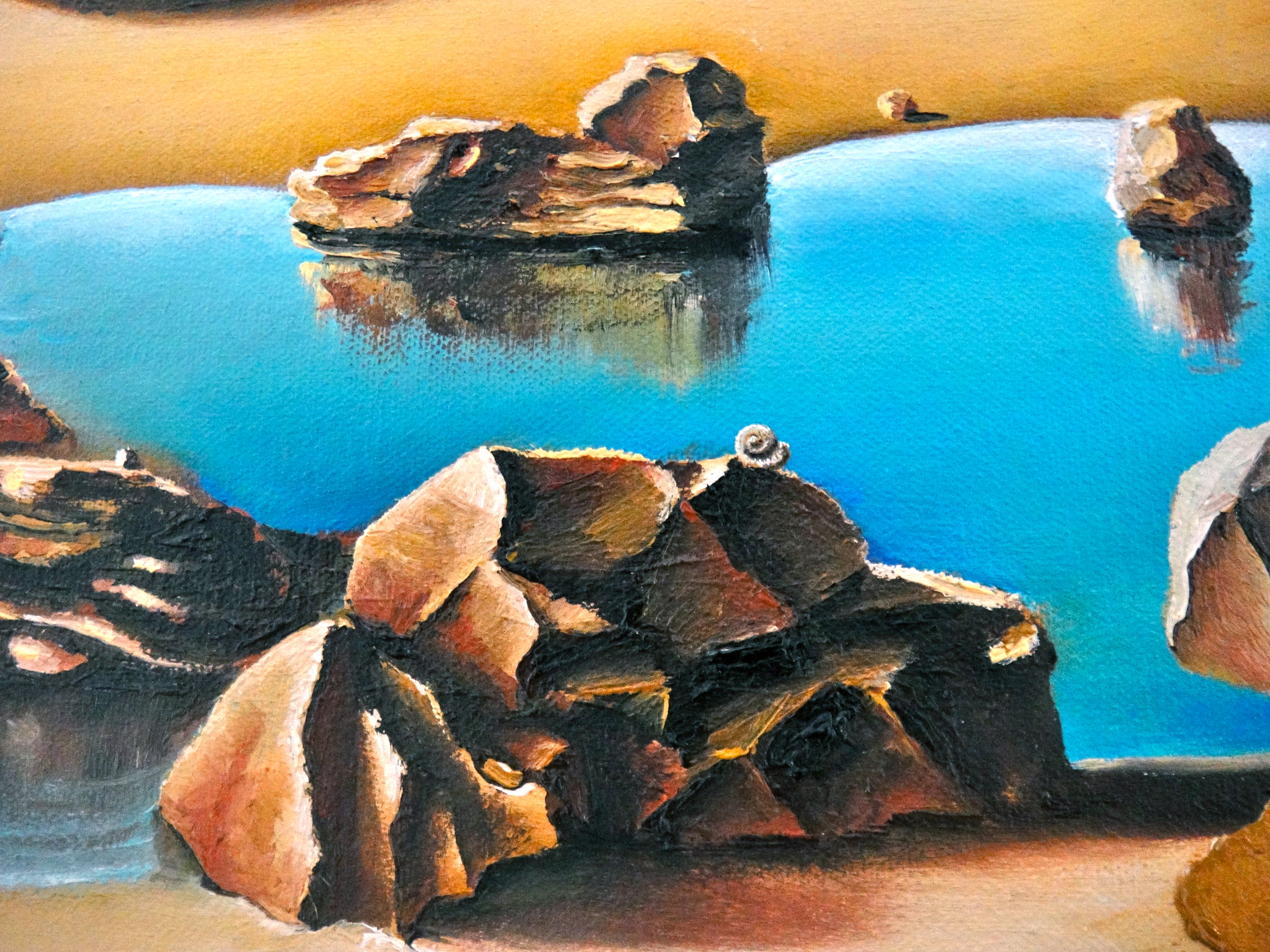
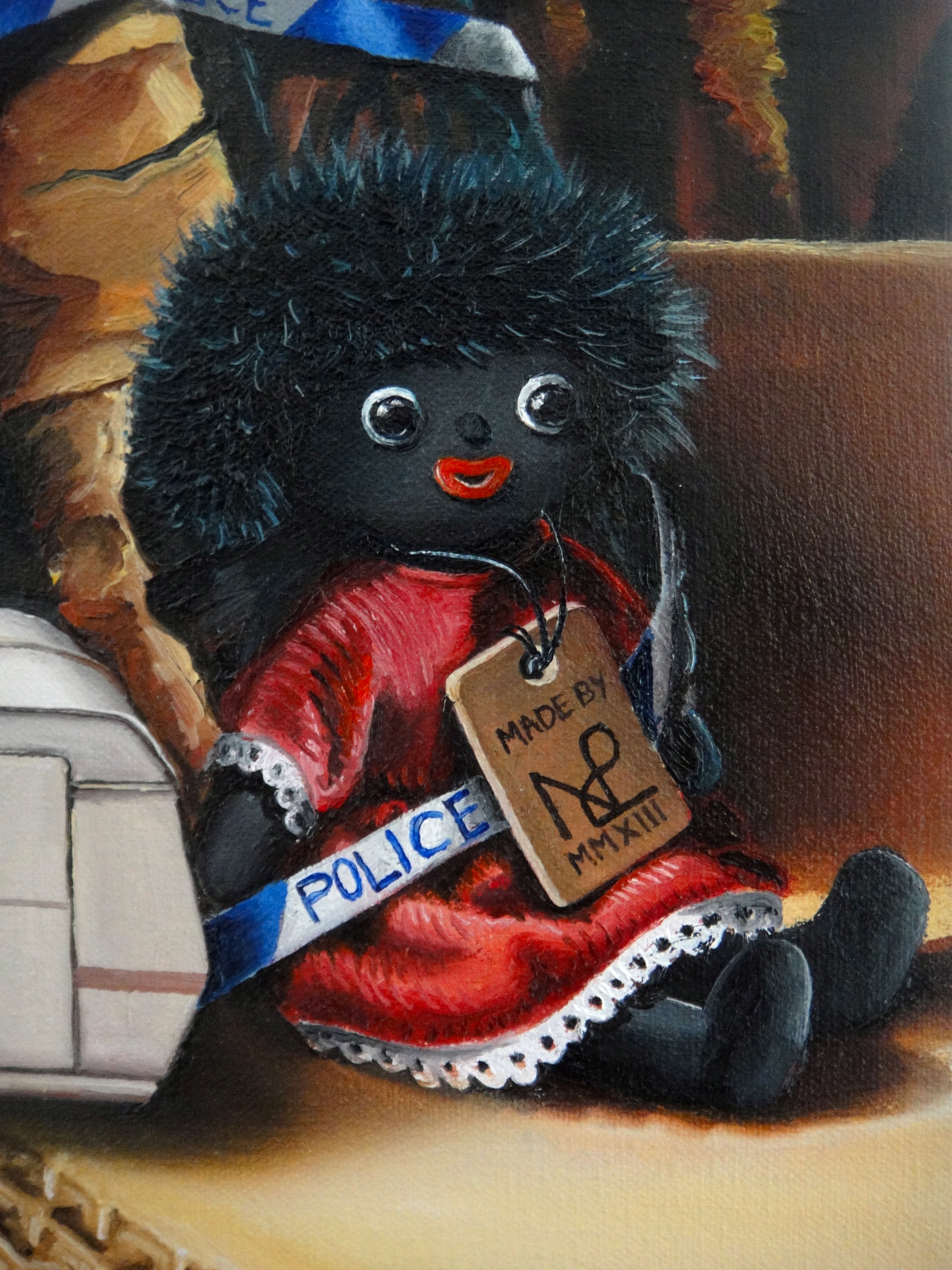
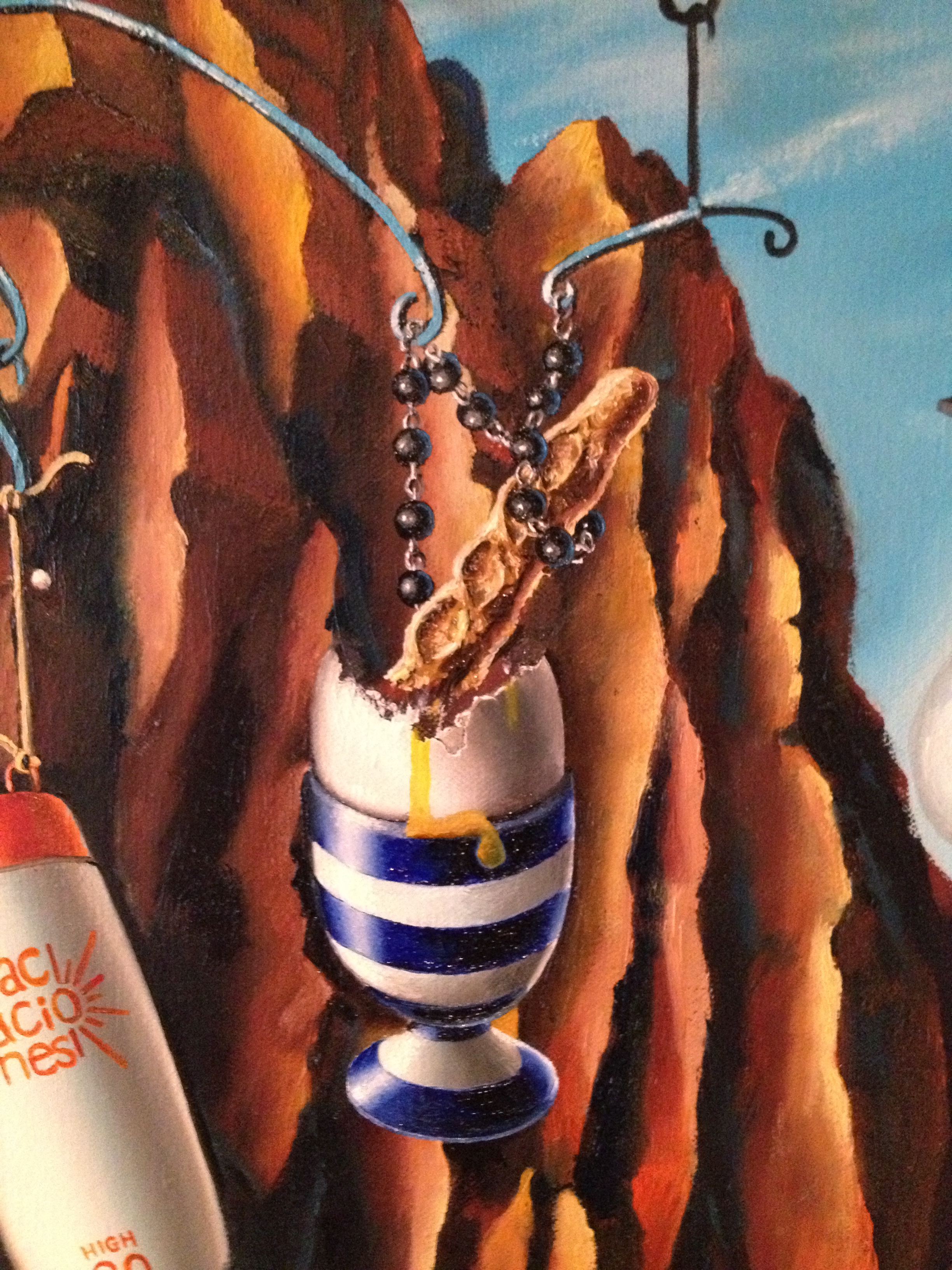
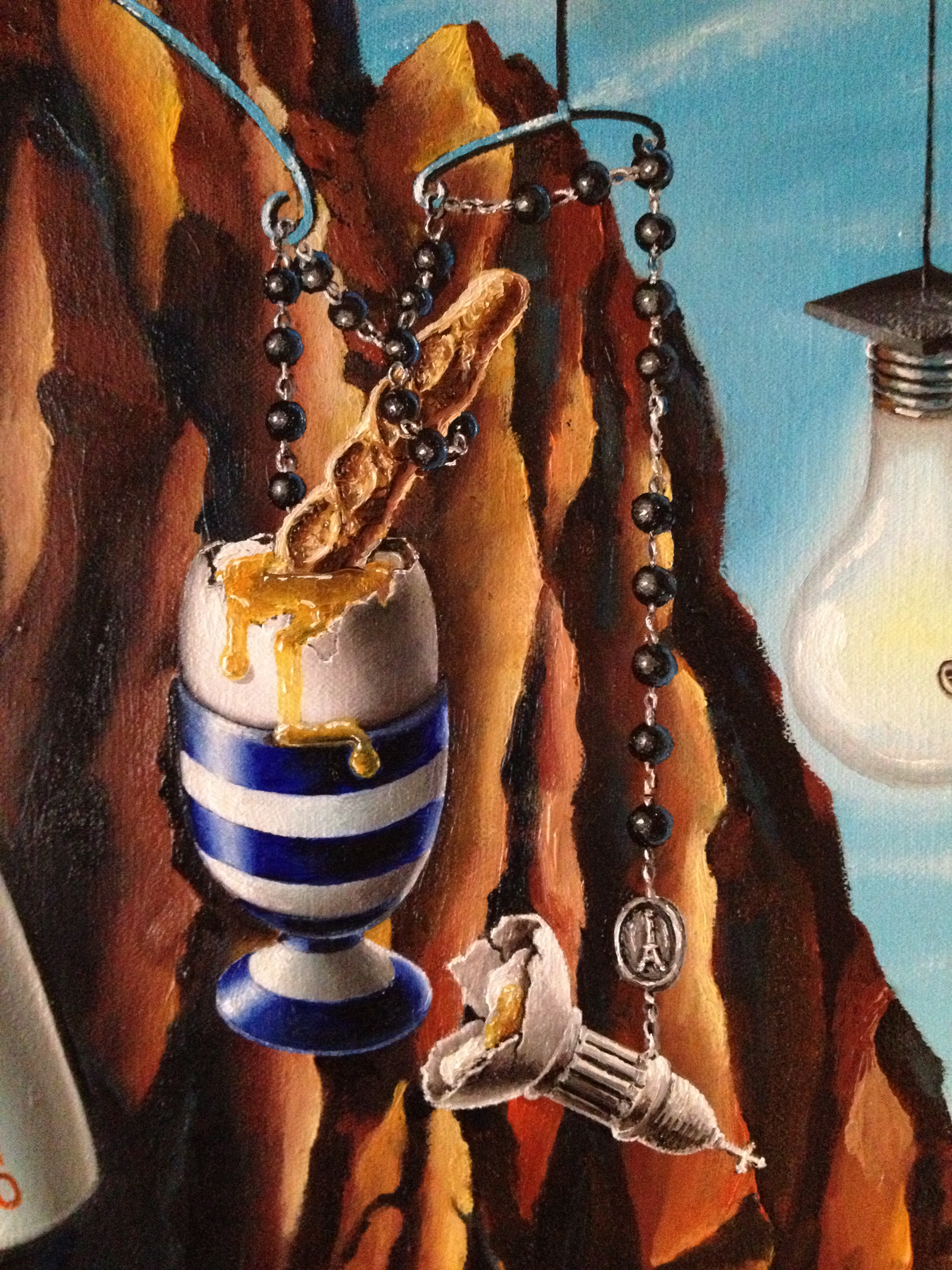
I have extrapolated upon most of the details in the painting in former posts explaining my progress, however in very brief terms, the painting is an autobiographical self-portrait told through symbols and metaphors rather than a head and shoulders portrait. At the centre of the canvas, a large free-standing mobile, in the style of the great mobile-artist Alexander Calder, represents my life. At its base, my constant companions, Fluffy and Bilbao, teddies given by my Partner and me to one another shortly after we first started dating, represent the very consistent, anchoring and significant role of our relationship in my life. Then above, the mobile acts as an autobiography balancing out the various positives and negatives in my life so far. DSC07673 On the left: the positives – all the stuff I love and which has helped to shape me into the person I am today. First up, Spain and art history, symbolised through the iconic image of one of Span’s master-artist’s Infanta portraits, whose dress is in turn decked out to resemble the sandy colours of a Spanish bull ring, while her sunglasses represent Spanish tourism, the industry which has been so important in bolstering the economy of modern day Spain. DSC07623 DSC07619Next, the symbol of enlightenment and creative/ academic success: This is a Norm-shaped lightbulb decked out in a graduation mortar-board and holding a graduation scroll. This hybrid Norm/ bulb character represents my achievements both as an illustrator-blogger and as a lawyer, and stands for the importance of learning and development in my life. Further along, the egg: This is a representation of my art career, and also my love of Paris (where I was engaged and from which I have been inseparable for at least 15 years). Paris was the inspiration for my first major painting, Le Paris Formidable, a creation which I consider to be a milestone in my artistic career and the moment I began to take painting seriously. In that image I painted the Sacre Coeur church as a series of eggs and egg cups (the white domes of the basilica reminding me of eggs), while plunging into the egg, an egg soldier is replaced by a French baguette, held up by a rosary, representing that for me, art is like my religion. DSC07613 Finally in the positives, a sun cream bottle represents my love of travel, and spurting from it, a representation of my love of gastronomy as shown through a mixed and bounteous flow of prawns, marie rose sauce, chorizo, strawberries and wine, all combined together through a meandering strand of spaghetti which in itself metamorphoses from the Fortnum and Masons hamper sat on a rock below it – the hamper representing my love of the finer things in life. DSC07617 Onto the negatives, and up first my 2008 accident – the life-changing event was informed so much of my art and altered my life, both physically and mentally forever. DSC07624 Then the death of my career at the self-employed bar, a hugely difficult time when I suffered stress close to mental breakdown, prejudice, bullying and was effectively cast out of the profession because of the small-minded prejudices which come of a profession in which survival, without fitting into the Oxbridge stereotype (the blue snakes), is all but impossible. DSC07630 Then the birdcage, a symbol of entrapment, both for my sister trapped by the grave fate which arose upon the death of her husband leaving her to bring up three toddlers alone, and for me in my career. DSC07634 Finally the Apprentice – a direct reference to another of my paintings, Nicholas in the Renaissance, a tongue-in-cheek self-portrait in which I parodied a depiction of Saint Sebastian to represent the injustices I felt I had suffered when I appeared in the acclaimed BBC television series, The Apprentice series 4. The sugar cube of course alludes to Lord Sugar, the famous business man for whom the “Apprentices” seek to work under the television format. DSC07645 Meanwhile in the foreground, an expanse of water separates my current life from my childhood, albeit only marginally, and that youth is symbolised my a self-standing rock in the bottom right of the canvas representing my family, a symbol which took on a whole new poignancy when my brother-in-law was killed last December. Meanwhile, in the rock pools to the left, also representative of my childhood, the smallest of shells represents the heady days of my youth when climbing over coastal rocks I would collect shells, affixing them onto little snails I had modelled which I would then sell at local fairs. Some could say it was the start of my art career. They were certainly formative years. DSC07582 DSC07648 DSC07610 So there we have it, my life on a large (120cm x 120cm) canvas in oil paint. I’m awfully proud of this painting, and also glad to have persevered over such a protracted period. The result is a truly reflective glimpse of my life as it stands and also acts for me as a kind of closure on all that is past. Now I look forward to a whole new chapter of my life, with all the artistic expression which will inevitably go hand in hand alongside it.DSC07661 © Nicholas de Lacy-Brown and The Daily Norm, 2001-2013. Unauthorized use and/or duplication of the material, whether written work, photography or artwork, included within The Daily Norm without express and written permission from The Daily Norm’s author and/or owner is strictly prohibited. Excerpts and links may be used, provided that full and clear credit is given to Nicholas de Lacy-Brown and The Daily Norm with appropriate and specific direction to the original content.

Autobiographical Mobile: My painting diary – Day 18: My Art and my Paris

I couldn’t be much more passionate about the second of my painted “favourite things” if I tried. The next metaphor of my life’s great loves to make it onto my latest large canvas – my Autobiographical Mobile – is Art, and Paris.

Paris was the city that made me who I am today. It started on a school trip, when my teacher led me, her hands covering my eyes, into the Place du Tertre atop the Butte de Montmartre, and quickly uncovering them, revealed a scene of such lavish character, such indubitable gyrating ecstatic energy and historical charm that I fell in love. My heart dropped to the cobbled paving beneath my feet, and has stayed in the heart of Montmartre, beating there ever since. Now, when I plug myself into the city on an almost annual basis, I cannot help but swarm mesmerised around the quaint streets, meander around the boutique-lined boulevards, and lounge like a flaneur outside the street cafes and in leafy parks, gazing in never-ending admiration at the beauty of the urban landscape around me.

Le Paris Formidable (2000, acrylic on canvas) © Nicholas de Lacy-Brown
Le Paris Formidable (2000, acrylic on canvas) © Nicholas de Lacy-Brown

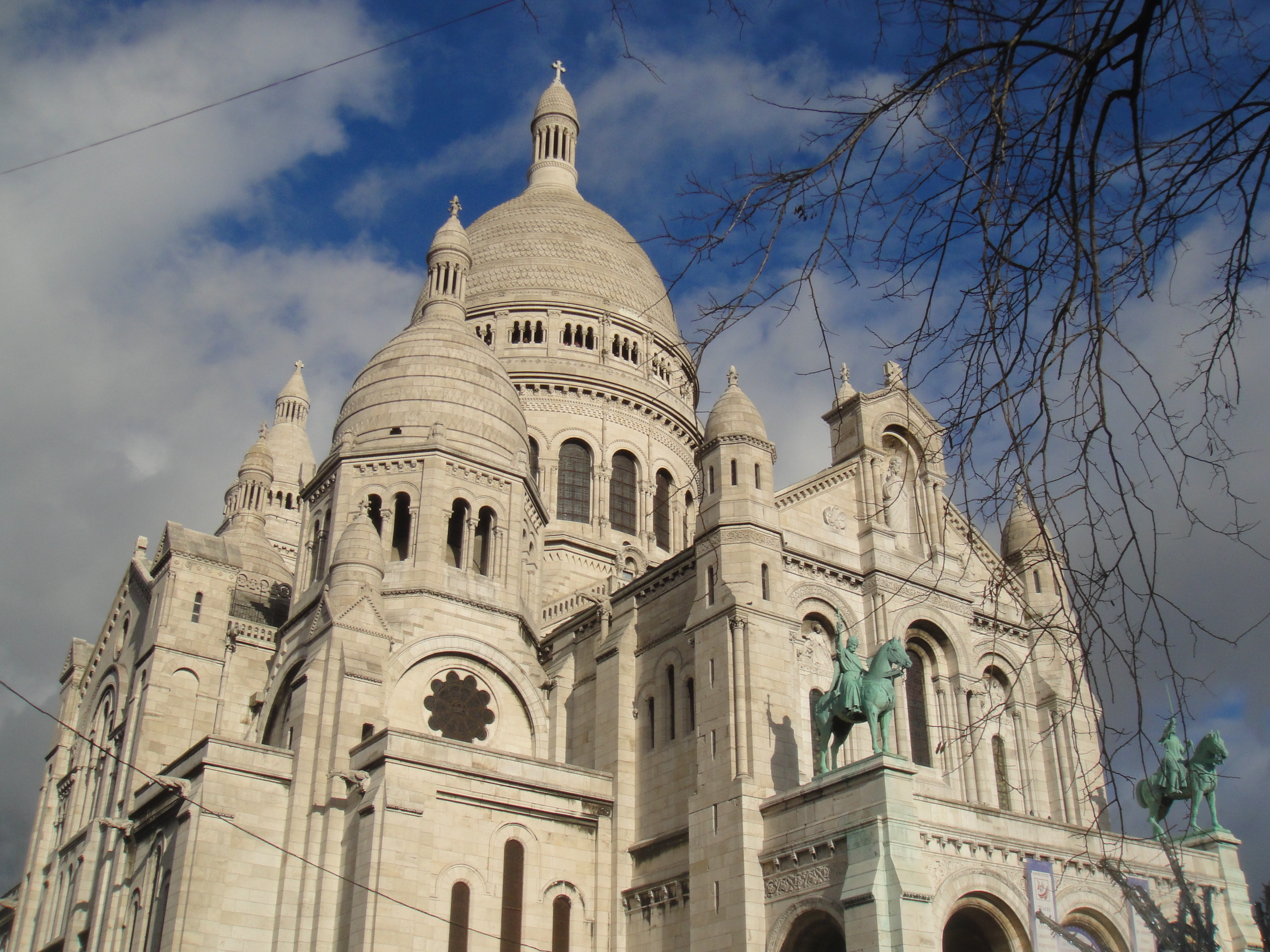
With Paris came Art. For not only does the city ooze creativity from its every crack and surface, but it has also inspired some of the most illustrious artists in recent art history. As well as the slightly less illustrious ones, like me. While I had been painting for some years, the real turning point of my career, when I went from doodles and watercolours to large scale canvases, was when at the age of 16 I embarked on one of my greatest projects, and still my second biggest canvas ever, Le Paris Formidable.

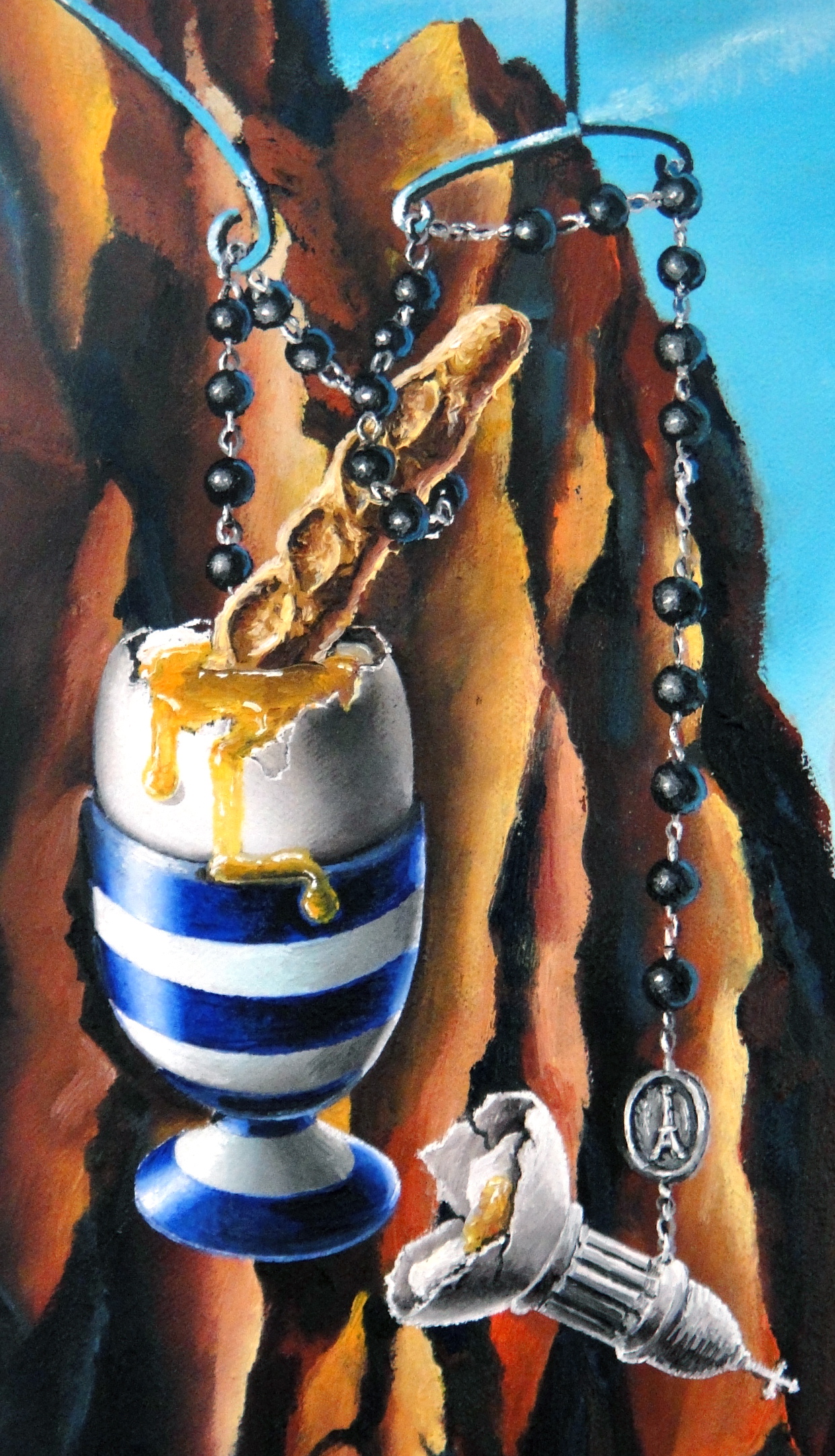
Le Paris aimed to show my beloved Paris from various unusual standpoints, and one of my favourite images was my depiction of the Sacre Coeur, the church atop Montmartre, as a series of eggs in egg cups and split open lavishing the surrounding blue canvas with their eggy contents. The image spoke both of the architectural charisma of this multi-domed church, as well as the inherent fragility of a 21st century Catholic Church. In one dome in particular, a French baguette plunged into the waiting yolky contents like an egg soldier, but also the body of Christ, while his blood, the wine, was represented by the main dome upturned like a communion chalice.

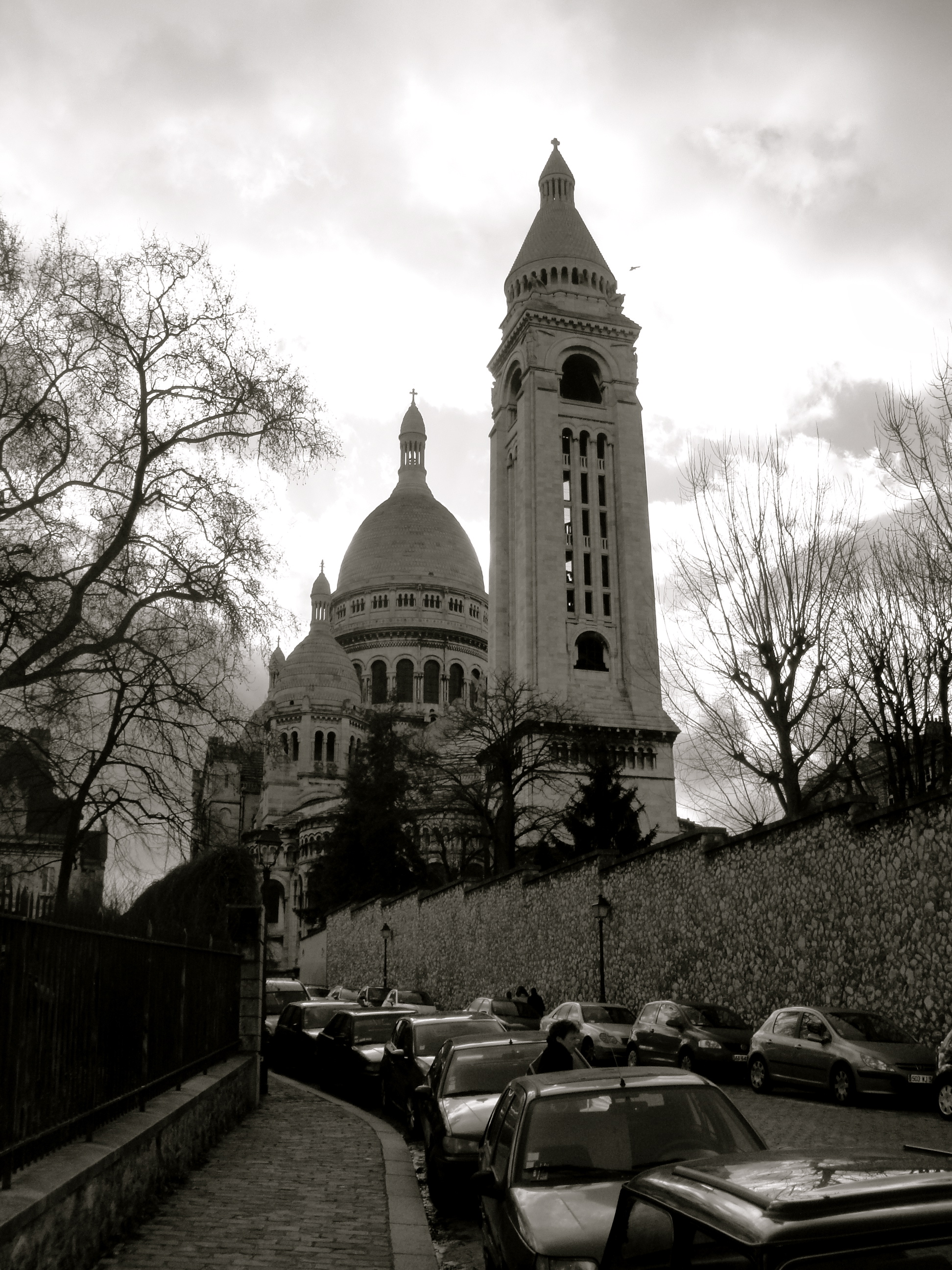
The real thing…

DSC04826 DSC04821 DSC04844

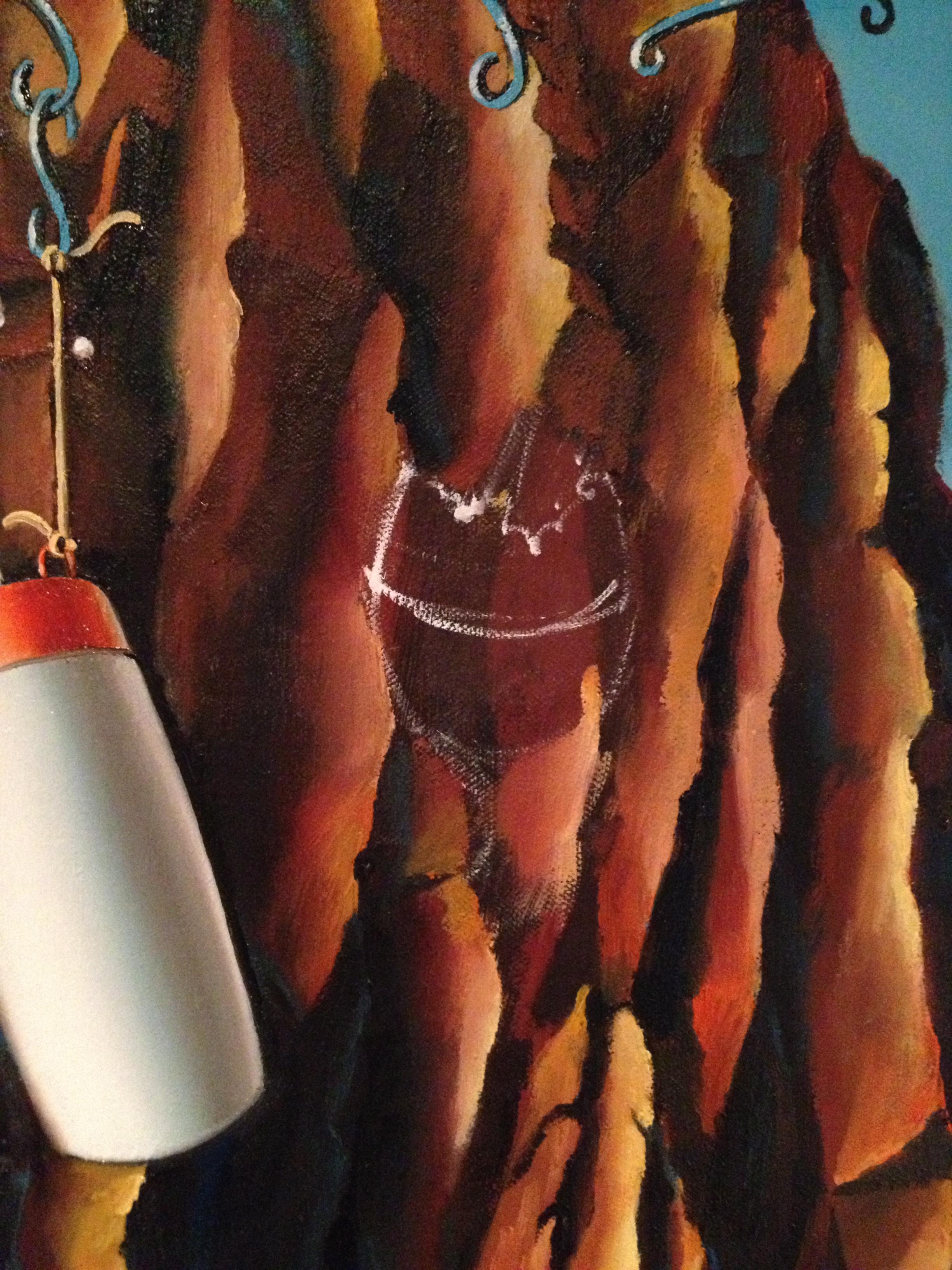
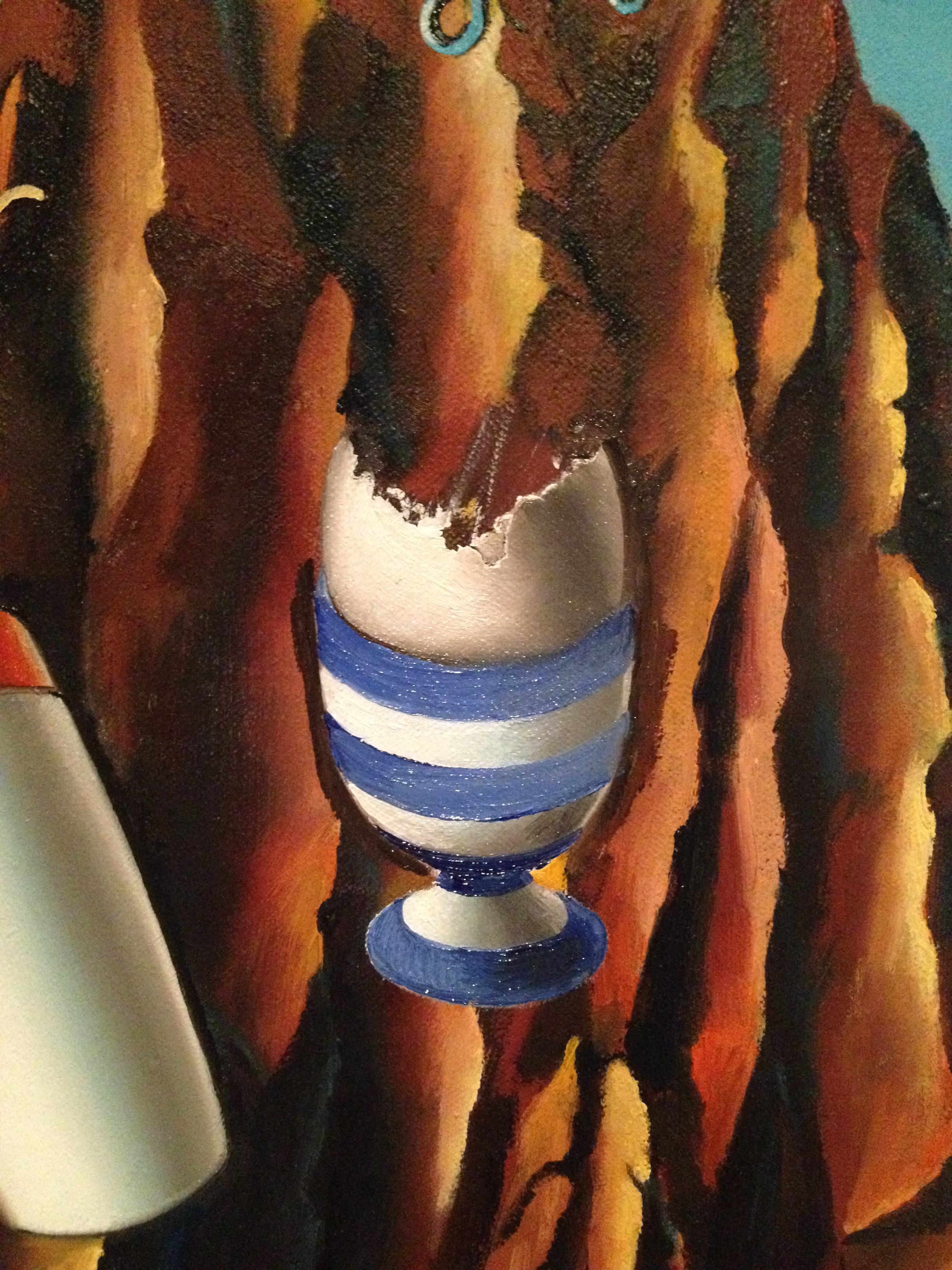
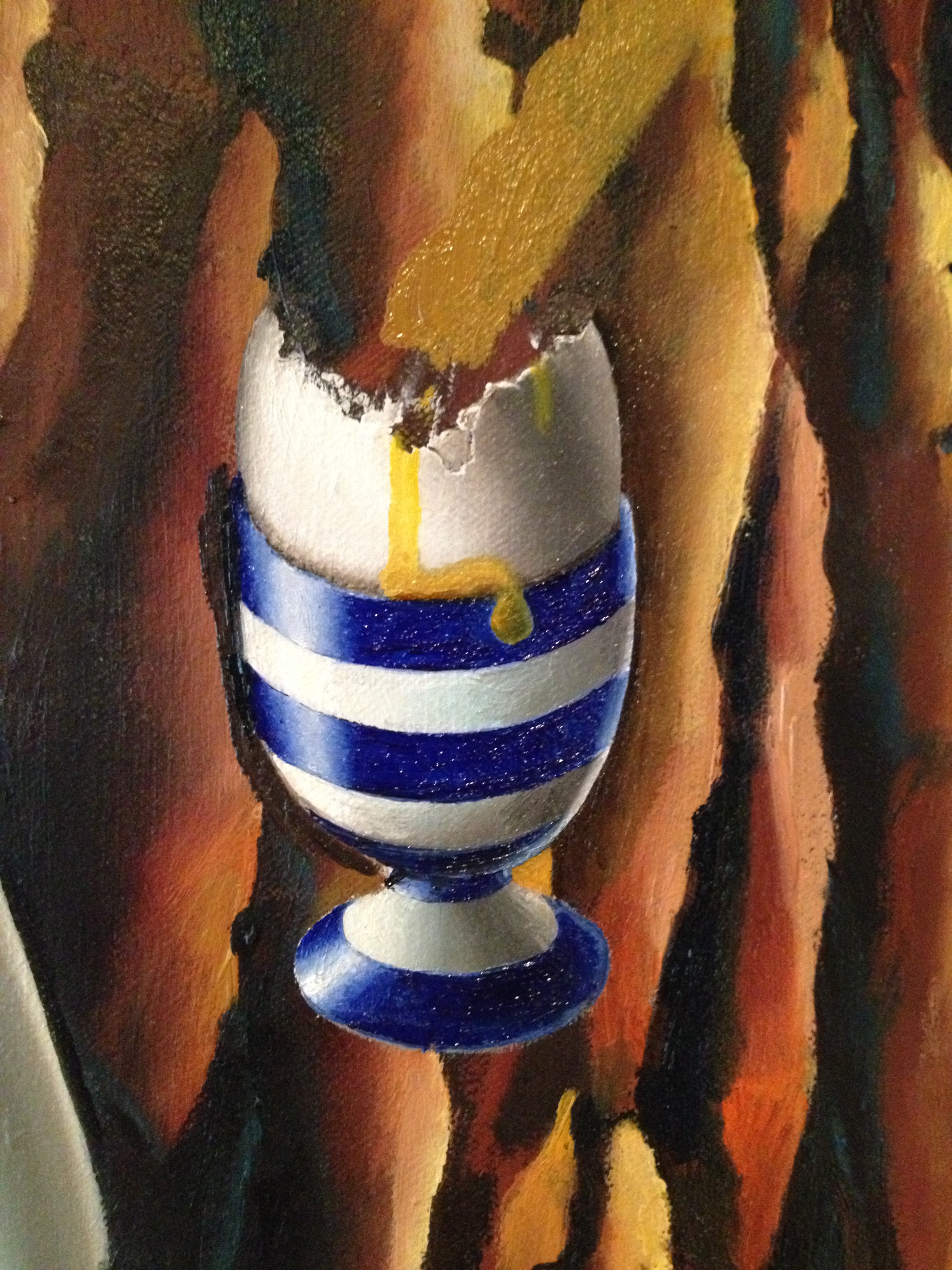
In this new painting I have replicated the egg soldier image, but with some extra frills. Both parts of the egg, and the baguette, are connected to the mobile by what looks like rosary beads, but whose religious imagery is replaced by symbols of Paris – the iconic Eiffel Tower proclaiming that Art and Paris are my ultimate passion: My Religion.

My progress

IMG_3559 IMG_3560 IMG_3562 IMG_3566 IMG_3577 IMG_3579 IMG_3583 IMG_3585 IMG_3588 IMG_3593IMG_3615

The finished image

The finished image

I find it particularly satisfying to compare both this egg and the egg of my 16 year old self – a first great painting, when my untrained skills we still naive. My skills now (although still untrained) have improved, and I feel confident in my ability to better understand light and shadow and dimension so much better than 13 years ago. Yet the idea of my 16 year old self – the Sacre Coeur as eggs – is almost surprisingly impressive to me, innovation which my adult self may struggle to come up with, but which works so well now in this revolution of my art – art revisited for this autobiographical expression of my life, on canvas.

...and the 2000 image

…and the 2000 image

© Nicholas de Lacy-Brown and The Daily Norm, 2001-2013. Unauthorized use and/or duplication of the material, whether written work, photography or artwork, included within The Daily Norm without express and written permission from The Daily Norm’s author and/or owner is strictly prohibited. Excerpts and links may be used, provided that full and clear credit is given to Nicholas de Lacy-Brown and The Daily Norm with appropriate and specific direction to the original content.