Skip to content

Posts from the ‘Art’ Category

Norms: The Saints Collection | St. George

Saint George and his dragon must together comprise one of the most famous icons of a saint there is, not least in England where St George is our patron saint. Yet as I was to discover only last weekend, we English are not the only country to claim him as ours. In fact St George is likewise a patron saint in Bulgaria, Georgia, Greece, Portugal, Ukraine and Syria to name but a few. He is also, I have now learned, the patron saint of none other than Catalonia, the autonomous region of Spain whose capital is Barcelona. And so having just spent the weekend in that very city, there seems no better time than to present the very first Saint of a new Norm sketch collection – I give you Saint George Norm.

Legend has it that St George  defeated a dragon in the far off land of Silene. This dragon poisoned the air of a village, and in order to appease him, the people regularly sacrificed a lamb and a virgin who was chosen. One day the princess of the country met this fate; George killed the dragon and freed her, with the result that the Princess and the entire population were converted to Christianity; the religion behind whose cross St George had been protected as he valiantly fought the beast.

Here is my Saint Norm doing just that, killing the pesky dragon while his rather attractive horse looks on.
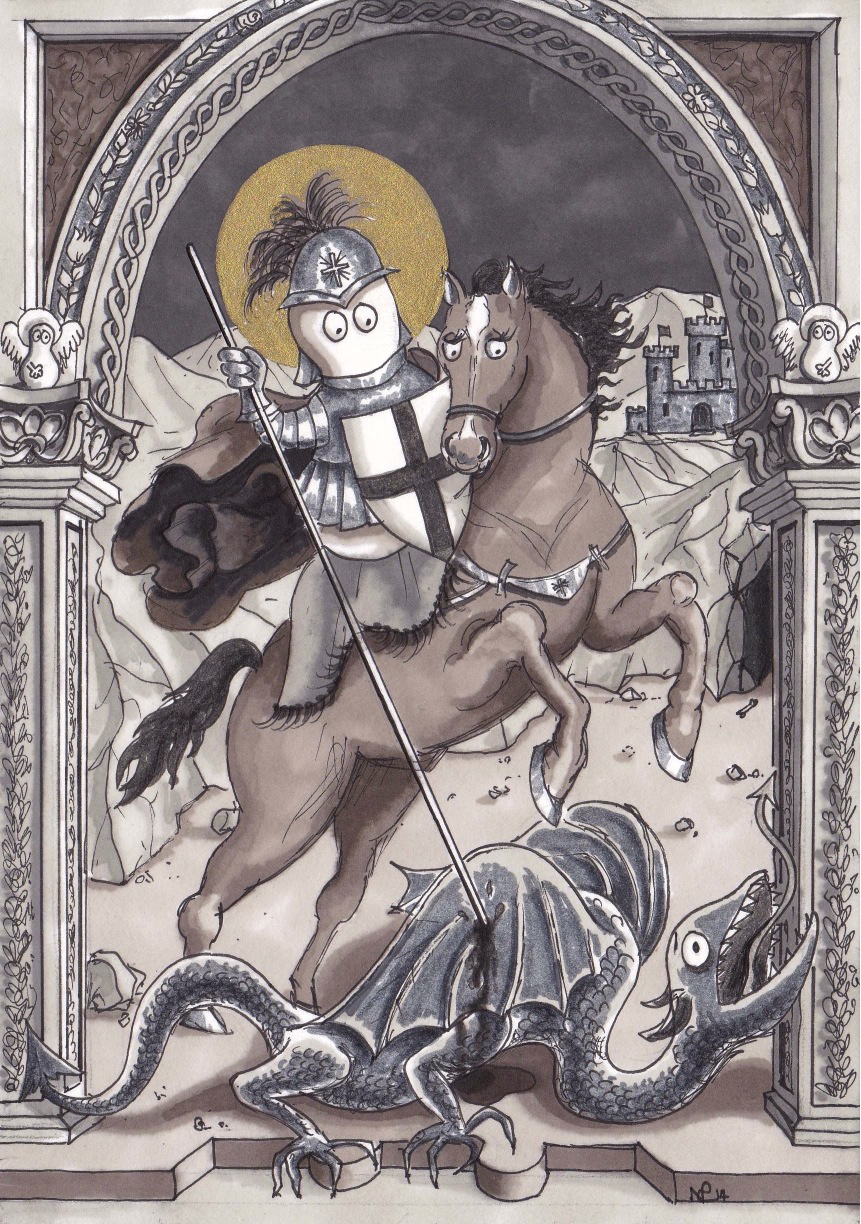
St George Norm (2014 © Nicholas de Lacy-Brown, pen, ink and gold paint on paper)

St George Norm (2014 © Nicholas de Lacy-Brown, pen, ink and gold paint on paper)

I realised that St George was something of a prominent figure in Catalonia only when I noticed statues and icons of the saint when exploring the old gothic quarter of Barcelona on my first day there last weekend. In the tranquil cloisters of the cathedral, a trickling fountain was topped by a bronze statuette of the saint valiantly riding his horse while trampling upon the dying body of the aggressive dragon. Then, upon walking past the city hall in the Plaça St Juame, I noticed the same venerable saint carved into the stone work of the city hall facade. Subsequent investigations reveal that “Sant Jordi” has been venerated in Catalonia since the 8th century, not only in Barcelona but also in Valencia and the Balearics. And in Barcelona itself, the Saint’s presence is felt not just in the obvious iconography – some say that Gaudi himself recognised the saint when he created his dragon-scaled roof atop the famous Casa Batlló.
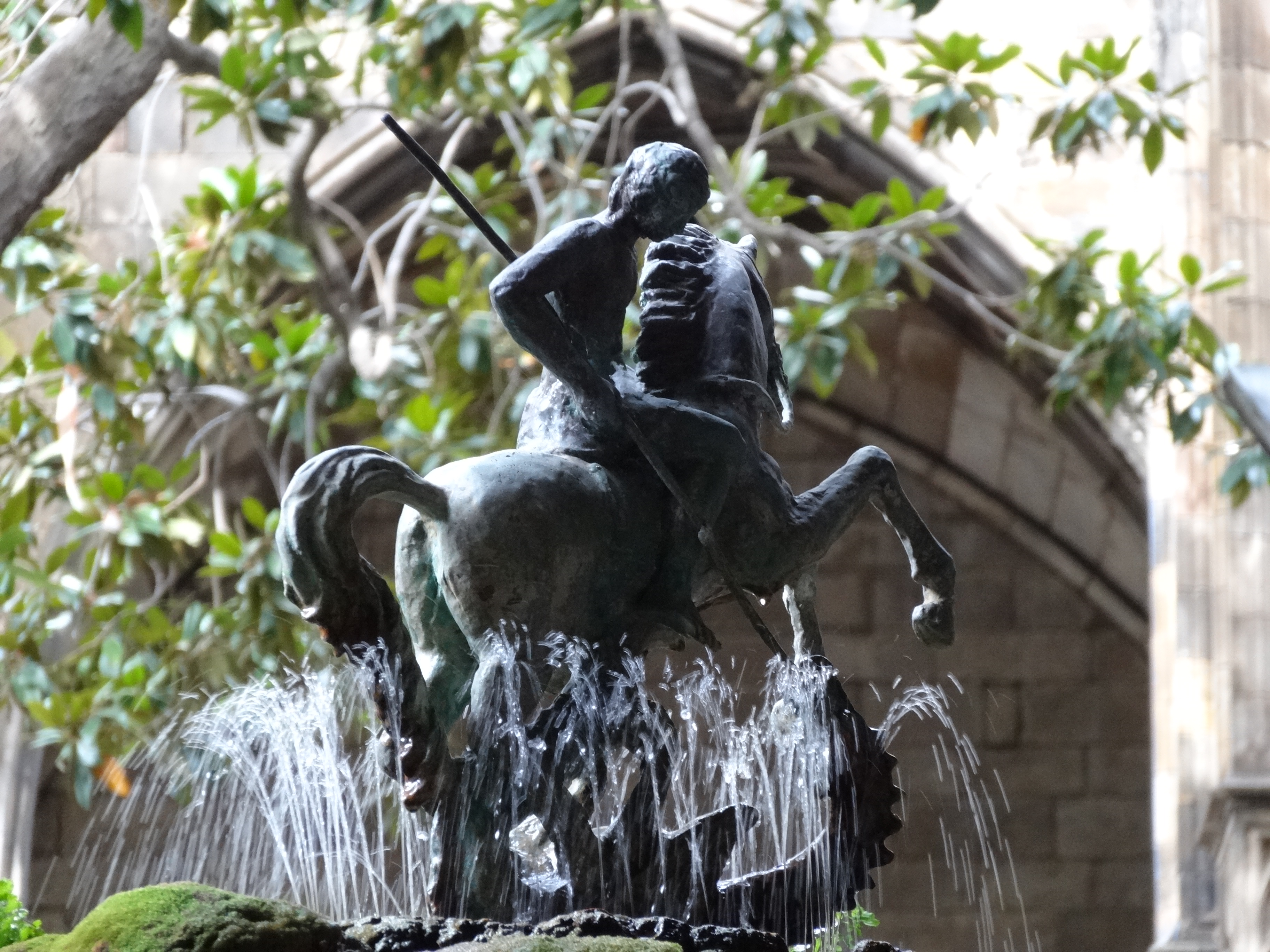
Cathedral fountain

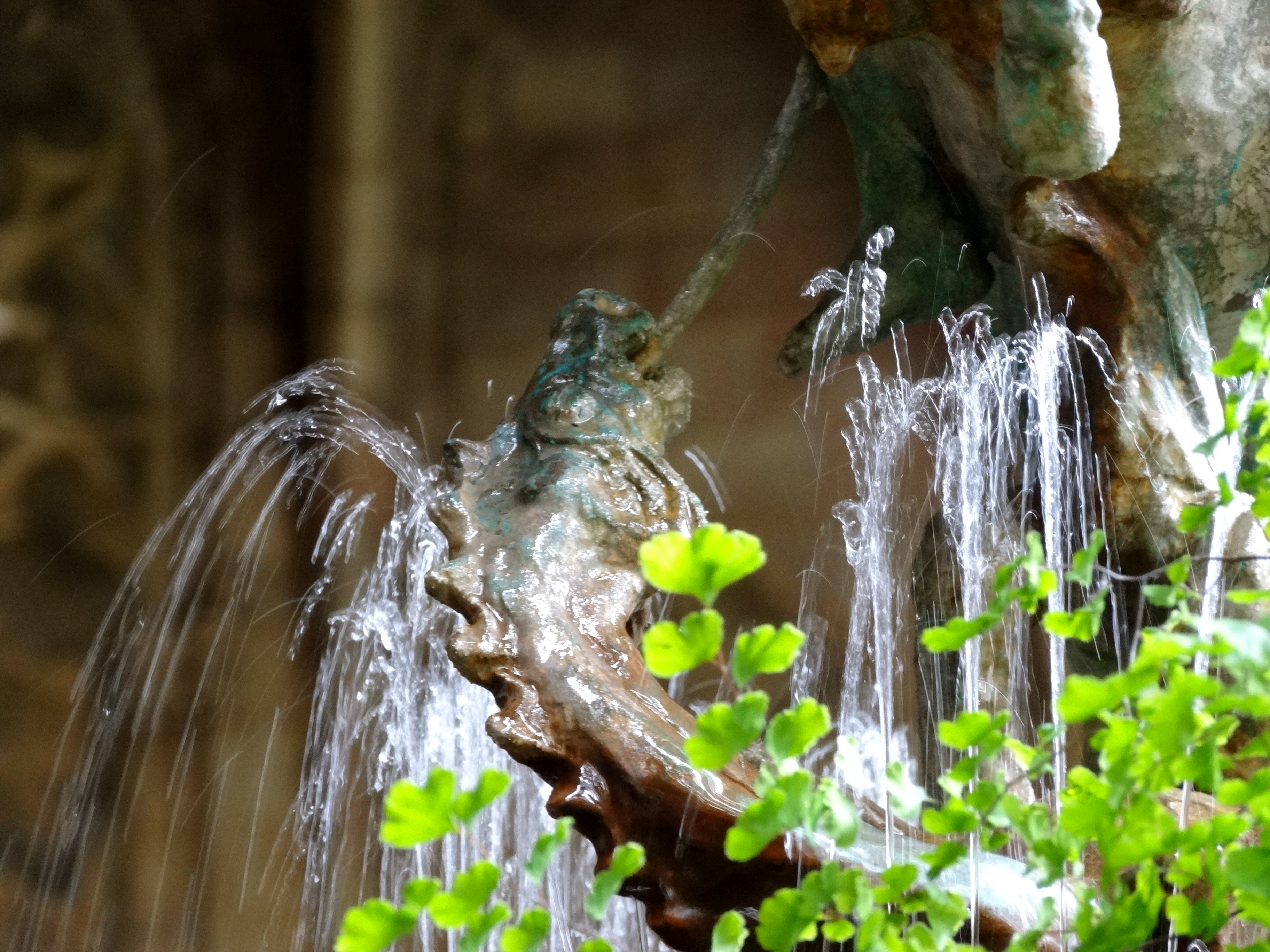
Cathedral fountain

DSC02536 DSC02540

Another cathedral homage to the dragon
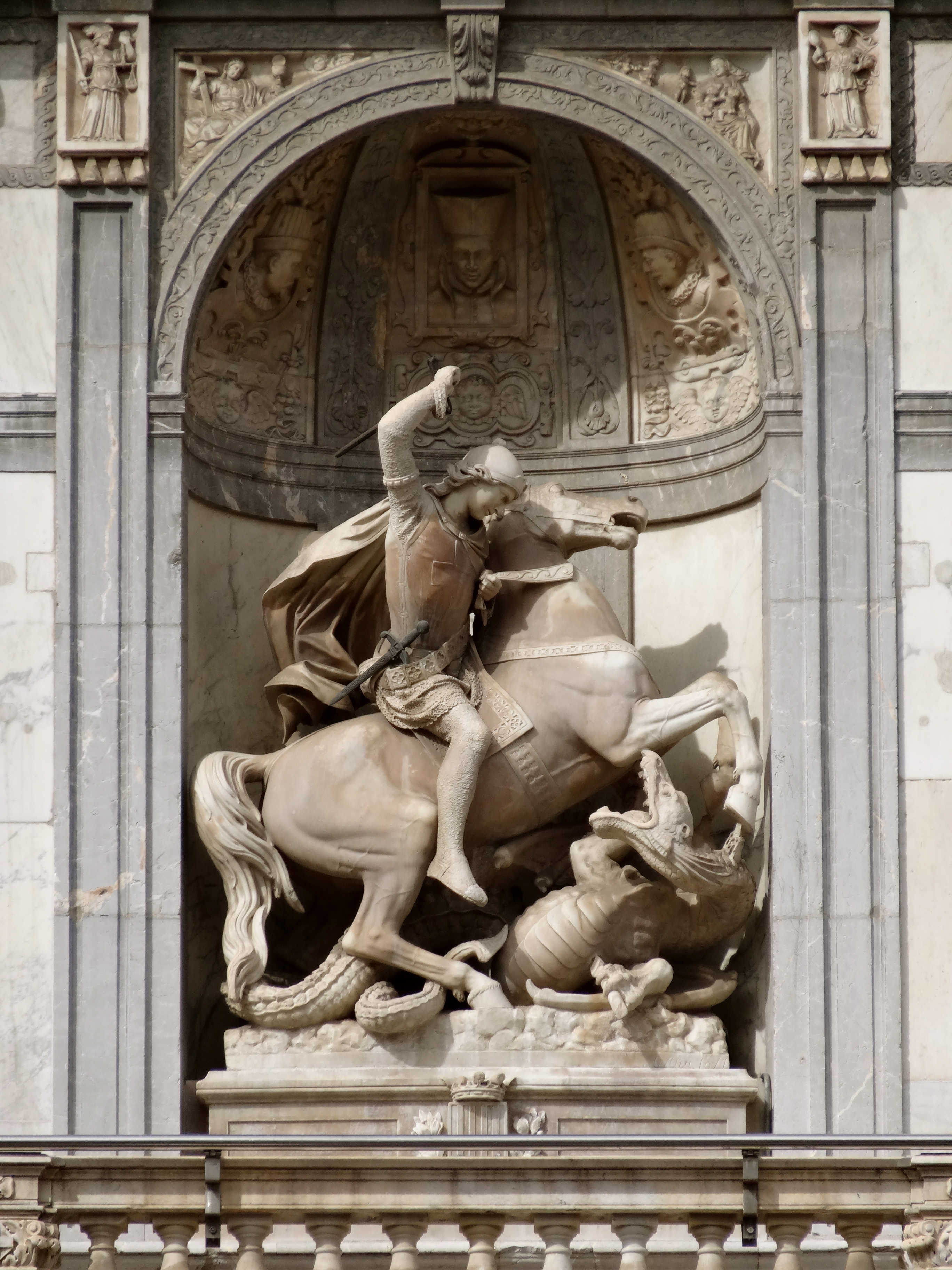
Another cathedral homage to the dragon

Facade of the city hall

Facade of the city hall

Roof of the Casa Batllo
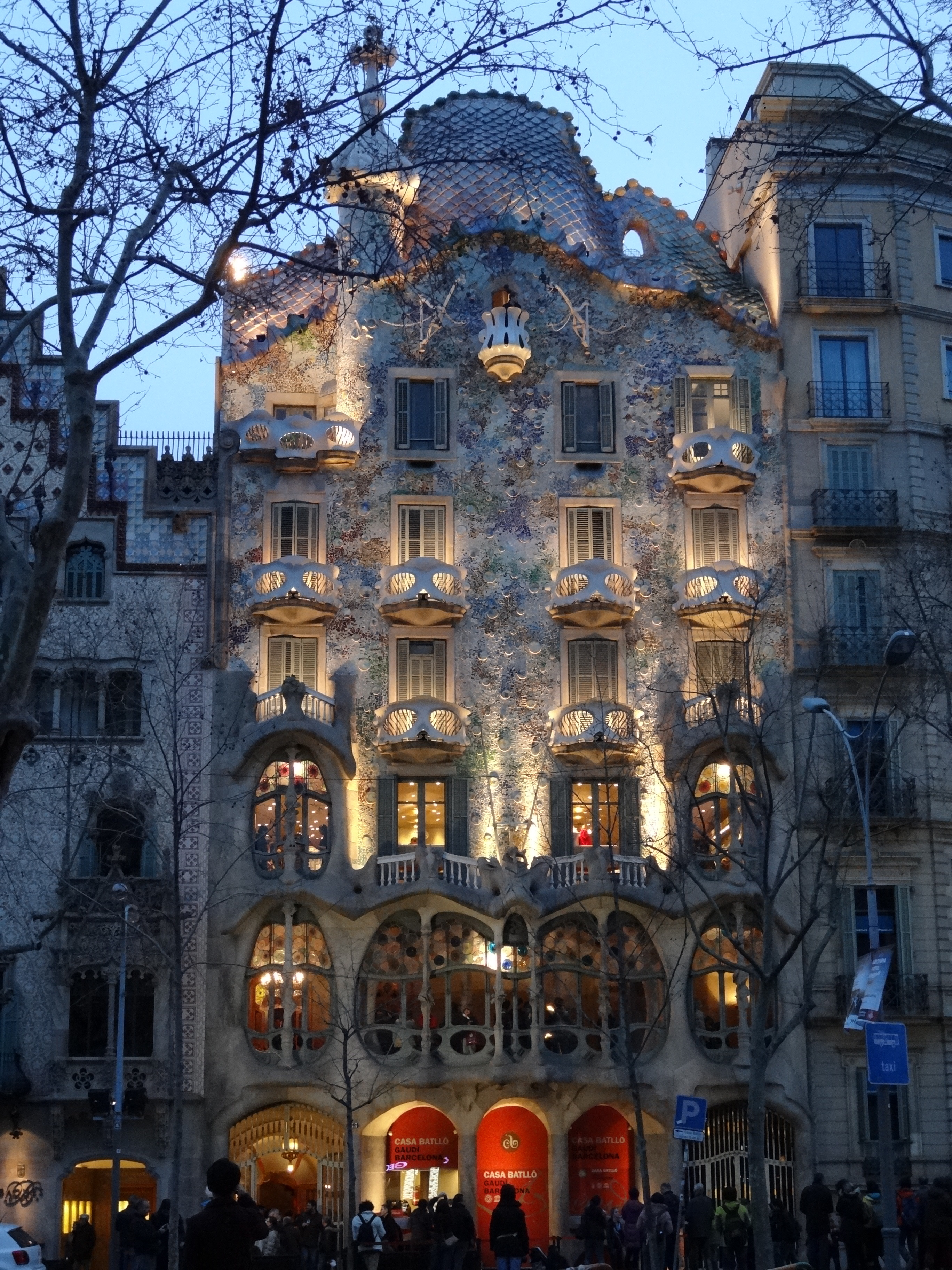
Roof of the Casa Batllo

DSC02847

So with all of this in mind, I leave you to pay appropriate reverence to St George Norm in all of his golden glory, and to look also upon the Barcelona references I found to the saint. But as if by way of further appropriate reference, I also leave you with this English poster using St George as an image to encourage patriotic Englishmen to defend the nation at the outset of World War One 100 years ago. A timely reminder of the continuing power of the iconography of St George to inspire both patriotism and bravery in a time when all faith and hope appeared to have deserted mankind.

Britain_Needs_You_at_Once_-_WWI_recruitment_poster_-_Parliamentary_Recruiting_Committee_Poster_No._108

© Nicholas de Lacy-Brown and The Daily Norm, 2001-2014. Unauthorized use and/or duplication of the material, whether written work, photography or artwork, included within The Daily Norm without express and written permission from The Daily Norm’s author and/or owner is strictly prohibited. Excerpts and links may be used, provided that full and clear credit is given to Nicholas de Lacy-Brown and The Daily Norm with appropriate and specific direction to the original content. For more information on the work of Nicholas de Lacy-Brown, head to his art website at www.delacy-brown.com

Aix: City of a Thousand Fountains

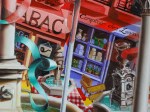
After a week of “sneak peeks” via my delacybrownart twitter feed, I am delighted to be able to share with you the final and complete image of my major new oil painting on canvas – Aix: City of a Thousand Fountains. Started shortly after I returned from my first visit to the stunning Provençal city last summer, I set out to capture something of the sun drenched joie de vivre which  Aix excuses by the bucket in a work which eventually took me 7 months to complete.

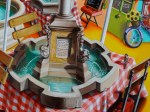
As the painting’s title suggests, the work plays on a well known descriptive adage which notes that the city is one of “a thousand fountains”. While that may be something of an exaggeration, the motivation behind the statement can be well understood – one of the most notable features of the city is indeed its plentiful and elaborate fountains, one situated in what seems to be every square and street, in the middle of junctions and on street corners. It really is a city where water flourishes; where splashing running currents sparkle playfully in the sun.

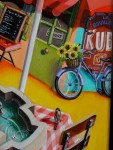
But in choosing to symbolise several of these many fountains, I decided to play with the themes somewhat, combining those fountains with the very predominant cafe culture which is an integral aspect of the city’s character, and which fills it’s many multi-coloured shuttered squares with life. It is in one such square that my work is set, a square which also plays host to a series of Provençal shops and peeling old vintage adverts upon the walls. And there, on the typically dressed chequered tablecloths of cafe tables, my fountains, rather than plates, are the dish of the day.

Aix: City of a Thousand Fountains (2014 © Nicholas de Lacy-Brown, oil on canvas)

Aix: City of a Thousand Fountains (2014 © Nicholas de Lacy-Brown, oil on canvas)

Meanwhile no painting of Aix-en-Provence could be complete without a reference to the magnificent Mont Sainte-Victoire, the mountain which so seduced and fascinated the artist Cézanne for years (resulting in a series of canvases which continue to be his most enduring works) and which features monumentally in my work, dominating the upper half of the canvas. I remember so well that moment when, last summer, my partner and I climbed up the steep hills north of the city to the exact place where Cézanne used to paint the view of the mountain which obsessed him the most – and turning to see that same breathtaking visage which had so captivated this master of modern painting. It was at that moment that I knew I had to make my own homage to that incredible view, and that brilliant artist – and it was at that time when this painting was born.

The keen-eyed amongst you may also notice that I have included a further homage to Cézanne, by featuring his famous card players sat at one of my café tables, as well as a whole host of other details which I now share with you in the gallery of details featured below. Hopefully you will enjoy looking at the individual aspects of this painting as much as I enjoyed painting them. It was, with every brush stroke, like revisiting my holiday to Aix afresh, and for that reason alone, it was surely worth the 7 months slog to complete it.

© Nicholas de Lacy-Brown and The Daily Norm, 2001-2014. Unauthorized use and/or duplication of the material, whether written work, photography or artwork, included within The Daily Norm without express and written permission from The Daily Norm’s author and/or owner is strictly prohibited. Excerpts and links may be used, provided that full and clear credit is given to Nicholas de Lacy-Brown and The Daily Norm with appropriate and specific direction to the original content. For more information on the work of Nicholas de Lacy-Brown, head to his art website at www.delacy-brown.com
Ripples 2: Venice (Rio della Guerra)

With my solo exhibition fast approaching, I am going full steam ahead in an attempt to get my collection ready for its big unveiling this May. Not only am I working concurrently on three oil and acrylic canvases, but I also have several gouache works, a new woodcut edition, and old woodcut edition, a new etching and several Norm sketches on the go. It’s a daunting task trying to get all of those works completed in less than 3 months (with the fact that I work full time as a lawyer also being something of an issue…), but I am happy to say that the factory process is in full flow, churning out the works at a steady and pleasing pace (factory = me). As if by way of demonstration, this week I will be sharing not one, but two new paintings with you – one which sees the completion of an ambitious canvas which I started way back last summer, and the second, today’s, which I begun only a few weeks ago.

Yes, hot on the heels of my Natale Italiano posts, and my obsession with the abstract forms created by rippled water, as subsequently demonstrated in my posts on ripples photographs, paintings, my recent woodcut, and in the first of my new gouache ripples collection, I now present the second gouache painting of the series: Ripples 2: Venice (Rio della Guerra).

Ripples 2: Venice (Rio della Guerra) 2014 © Nicholas de Lacy-Brown, gouache on paper

Ripples 2: Venice (Rio della Guerra) 2014 © Nicholas de Lacy-Brown, gouache on paper

As with the first piece, this painting focuses on the rippled reflection, rather than showing both the reflection and the scenery it reflects. Focusing on the ripples rather than on the real world above them means that the viewer is left with the more abstract image which nature creates, causing one to question what is actually being shown in the image when seen at a first glance. Is it just an unplanned abstract image, or something more illustrative? It is only after some time that you then realise that what this painting shows is the underside of a bridge, an iron railing, and a building punctuated by windows behind it, albeit rippled into a charmingly haphazard abstract form.

I’m so excited by the prospect of a world in ripples that I could go on painting them forever. The only trouble is, I don’t think they’ll actually be on show at my solo show in May, which means I should really start concentrating on other works. As to which – come back a little later in the week, to see the work which will be central to my solo exhibition in May.

Until then, have a great week.

© Nicholas de Lacy-Brown and The Daily Norm, 2001-2014. Unauthorized use and/or duplication of the material, whether written work, photography or artwork, included within The Daily Norm without express and written permission from The Daily Norm’s author and/or owner is strictly prohibited. Excerpts and links may be used, provided that full and clear credit is given to Nicholas de Lacy-Brown and The Daily Norm with appropriate and specific direction to the original content. For more information on the work of Nicholas de Lacy-Brown, head to his art website at www.delacy-brown.com

Saatchi’s positive Body Language

Whenever I visit the Saatchi gallery in Chelsea, I always do so on the assumption that I am going to hate most of the art on show. This reactionary pattern begun some years back, when Saatchi was still on the south bank, and the works included Tracy Emin’s vile “unmade” tip of a filthy bed, and her even viler photographic self portrait surrounded by money shoved up and around her you-know-what. Then, when Saatchi moved to Chelsea, exhibitions included a show of Russian art, which turned out to be even more depressing in its lack of talent than one would have already guessed, and shows which decided that the car wrecks lifted straight out of a (probably tragic) accident scene would somehow make for an enticing art exhibit.

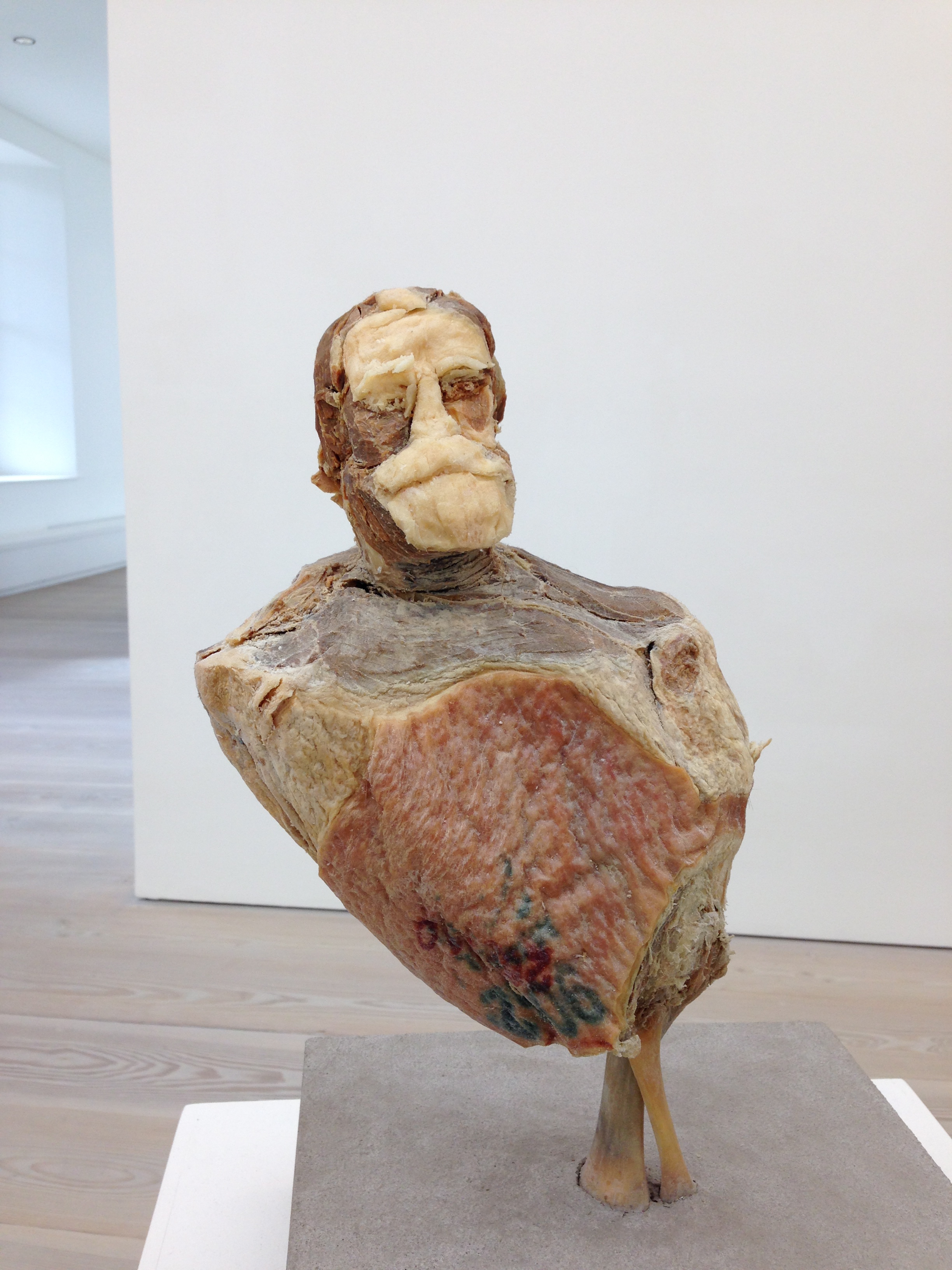
So, when I dropped into Saatchi’s gallery last weekend, I wasn’t expecting the latest offering, Body Language, to be much better than a convenient toilet stop in the midsts of some Chelsea shopping. But when you enter a gallery a see a sculpted portrait made out of Iberico ham, you pretty much know that you are going to be in for a treat. Oh yes, with his brilliantly innovative creation of Spain’s best leg of meat, Kasper Kovitz’ Carnalitos sculptures single handedly opened my eyes to the positives of Saatci’s ever revolving exhibitions of contemporary art works (eyes which had pretty much been sealed shut in opposition following the recent Nigella cafe strangle scandal…).

Carnalitos (Arana) © Kasper Kovitz, 2010

Carnalitos (Arana) © Kasper Kovitz, 2010

Carnalitos (Unamuno) © Kasper Kovitz, 2010

Carnalitos (Unamuno) © Kasper Kovitz, 2010

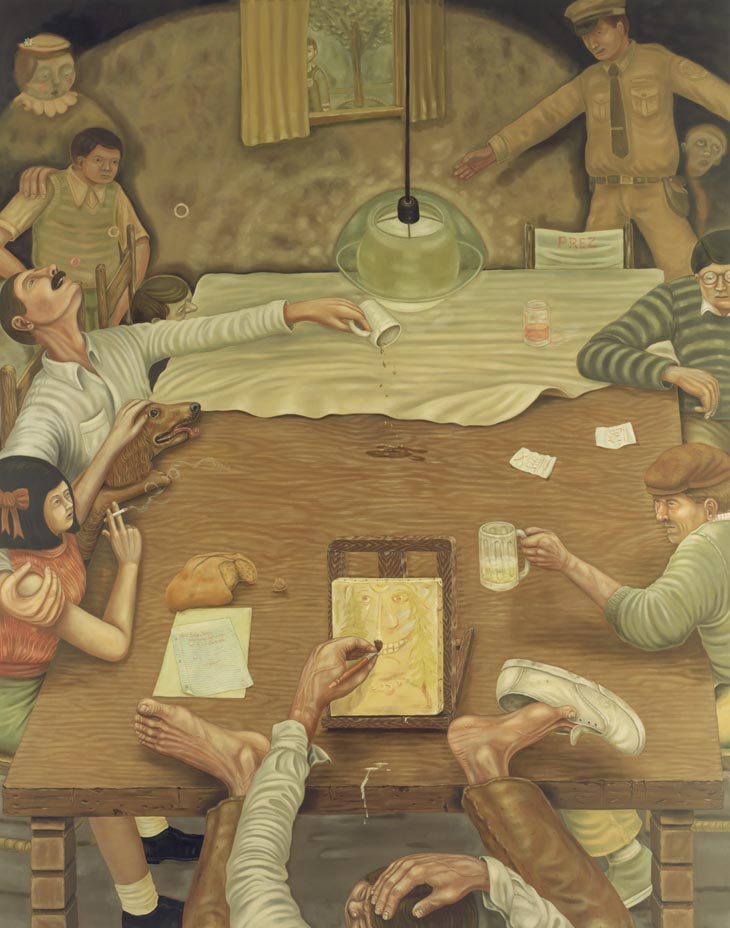
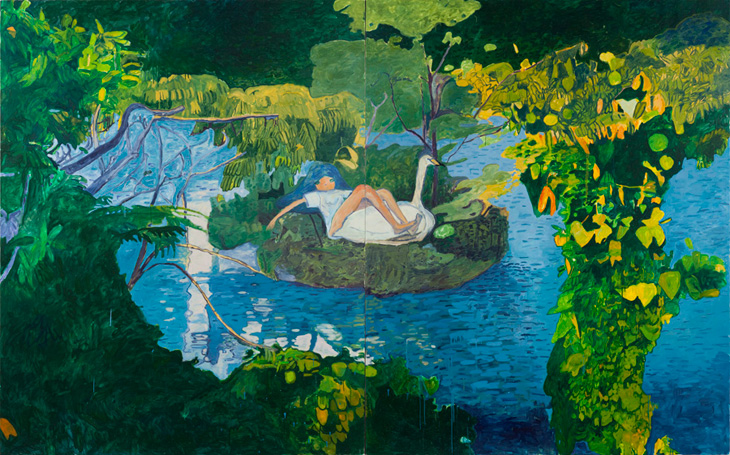
Other favourites from a varied show of contemporary artists include the paintings of Michael Cline, whose somewhat parodied figures reminded me of Stanley Spencer’s Sandham Memorial Chapel paintings which were recently on show at Somerset House. I also loved Nicole Eisenman’s energetic oil paintings such as the Beer Garden at Night (2007) which is full of whimsical figures and amusing social shenanigans which can keep an audience entranced for hours, and Makiko Kudo’s fantastical escapist visions which were in part like a Manga cartoon and at the same time like Monet’s pond bursting with lilies.

That's That © Michael Cline, 2008

That’s That © Michael Cline, 2008

Police Line, © Michael Cline, 2007

Police Line, © Michael Cline, 2007

Floating Island © Makiko Kudo, 2012

Floating Island © Makiko Kudo, 2012

Burning Red © Makiko Kudo, 2012

Burning Red © Makiko Kudo, 2012

Beasley Street, © Nicole Eisenman, 2007

Beasley Street, © Nicole Eisenman, 2007

Beasley Street, © Nicole Eisenman, 2007 (detail)

Beasley Street, © Nicole Eisenman, 2007 (detail)

Beer Garden at NIght, ©  Nicole Eisenman, 2007

Beer Garden at NIght, © Nicole Eisenman, 2007

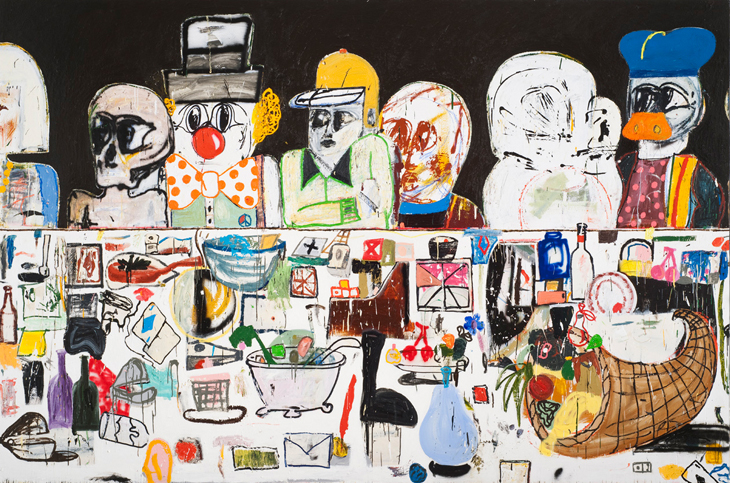
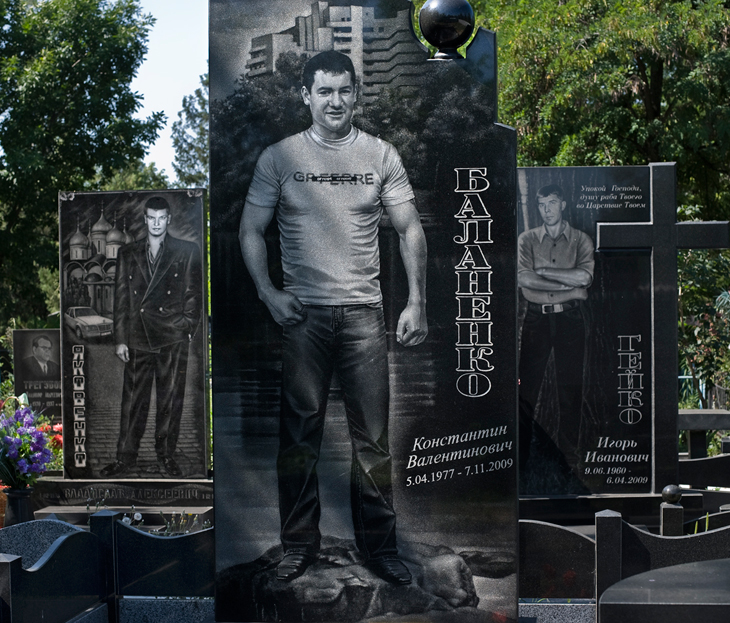
Less convincing were the paintings by Eddie Martinez which were so badly painted as to be derisable. His “Feast” is compared in the gallery brochure to Da Vinci’s historically celebrated Last Supper. I would compare it to the dirty dining table at the end of a meal when my toddler nephews have been to stay. I was equally dismayed by Denis Tarasov’s photographs of tombstones in graveyards in Russia and Ukraine, not because of the photography itself, but because of the hideously tacky gravestone pictures which they captured – huge granite tombs decorated with intricately carved photographic likenesses of the individuals buried beneath them, looking so vulgar that to even place such visions in a freshly painted white gallery in the centre of London’s chelsea felt like dumping a Lidl in the middle of Harrods. That’s not to say they weren’t interesting – one shouldn’t be surprised that this level of vulgarity would come out of a country which has backdated its laws in relation to homosexuality by at least a century of moralistic retardation.

The Feast (detail) © Eddie Martinez, 2010

The Feast (detail) © Eddie Martinez, 2010

Untitled (from the Essence Series)  © Denis Tarasov, 2013

Untitled (from the Essence Series) © Denis Tarasov, 2013

But I digress. From its low points to its very high, Body Language is well worth a visit for its sheer diversity of art – there really is something for everyone, and it’s free too, so what’s to lose? For me, the show demonstrates that painting is very much back in fashion and that the age of nonsense gimmicky installations is largely dead, which can only be good news if the 21st century is ever going to make any kind of decisive mark on art history. Not only that but the Saatchi gallery is, as ever, a brilliant cultural location whose highlights also include a show of emerging British talent, a gallery of limited edition prints which are for sale, a spangly new gift shop which is around 6 times the size of what it used to be (Iberico ham sculptures sadly not for sale – but there’s always Iberica restaurant in Marylebone as a very good consolation prize – and there you even get to eat it).

Body Language is on at the Saatchi Gallery, Chelsea, until the 23 March 2014

New painting alert! – A week of sneaky-peeks on twitter

I make no secret of the fact that I am a great creative, spending hours of every day and week creating, whether it be sketching, painting or printing, or further afield cooking up feasts in the kitchen or closely acquainting myself with my camera. However, since starting work full-time two years ago, the rate at which I complete the large scale oil paintings which I used to create on a regular basis, and many of which will be on display at my forthcoming solo exhibition, has really slowed. Last year’s Autorretrato took me around 9 months to complete, and the work which I turned to shortly after completing that one – my painted exploration of Aix-en-Provence in the South of France was commenced as long ago as last summer.

So it is with a great degree of excitement that I am but mere brushstrokes away from completing this homage to Aix which I have been working on tirelessly (on and off, admittedly) for the last 6 months. Fairly large in scale (1oocm x 75cm) and big on detail, it was always going to be a fairly ambitious project, containing as it does a landscape and cityscape all rolled into one together with illustrations of some 9 of the city’s famous fountains as well as a number of shops and cafes.

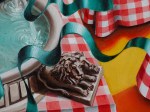
As I approach the completion of that work, I wanted to share the excitement with you, and what better way to do that than share some exclusive peeks of the details of the work? Starting from today, I will be sharing one glimpse a day of my new painting – it’ll be a bit like a jigsaw puzzle, with little pieces of the work being released day by day before the whole painting is unveiled next week. But while the first peek is contained here on this post, it’ll be the only one – for all of the rest, you’ll need to check out my twitter, @DeLacyBrownArt, from which I will be posting a new detail of the painting every day this week. And as if that weren’t incentive enough to follow me, my twitter will also tell you whenever a new Daily Norm post is published!

Aix: City of a Thousand Paintings (2013-4 © Nicholas de Lacy-Brown, oil on canvas) Detail - Ribbons!

Aix: City of a Thousand Paintings (2013-4 © Nicholas de Lacy-Brown, oil on canvas) Detail – Ribbons

So please do check out my twitter, and come back again to The Daily Norm soon to see the complete image of my brand new oil painting. Arghhh, the excitement!!

© Nicholas de Lacy-Brown and The Daily Norm, 2001-2014. Unauthorized use and/or duplication of the material, whether written work, photography or artwork, included within The Daily Norm without express and written permission from The Daily Norm’s author and/or owner is strictly prohibited. Excerpts and links may be used, provided that full and clear credit is given to Nicholas de Lacy-Brown and The Daily Norm with appropriate and specific direction to the original content. For more information on the work of Nicholas de Lacy-Brown, head to his art website at www.delacy-brown.com
Printmaking Progress V: Woodcut Ripples

Having  satisfied myself that I have learnt the basics of etching in both zinc and copper (and having quickly realised that I am probably not all that good at Linocut) my next challenge in my quest to learn the multifaceted skills of printmaking was to learn the art of woodcut. This sudden desire to print images from carvings made in wood was very much inspired by the work of Felix Vallotton, whose superb satirical woodcuts stood out for me way and beyond his paintings at the recent Paris Grand Palais retrospective.

So when I saw a multiplate woodcut course being offered up at my favourite art college, The Art Academy in London Bridge, I jumped at the chance to enrol.

The night before the course began, I wasn’t at all sure what image to portray with my wood. On the one hand I wanted to emulate the moody mysterious social scenarios created by Vallatton, but on the other, I wanted to continue relishing in the fond memories of my recent Italy trip. Nostalgia eventually took precedence and I decided to continue my new experiment in Venetian ripples.

The wooden plates and a first proof

woodcut 2 woodcut 1 woodcut proof

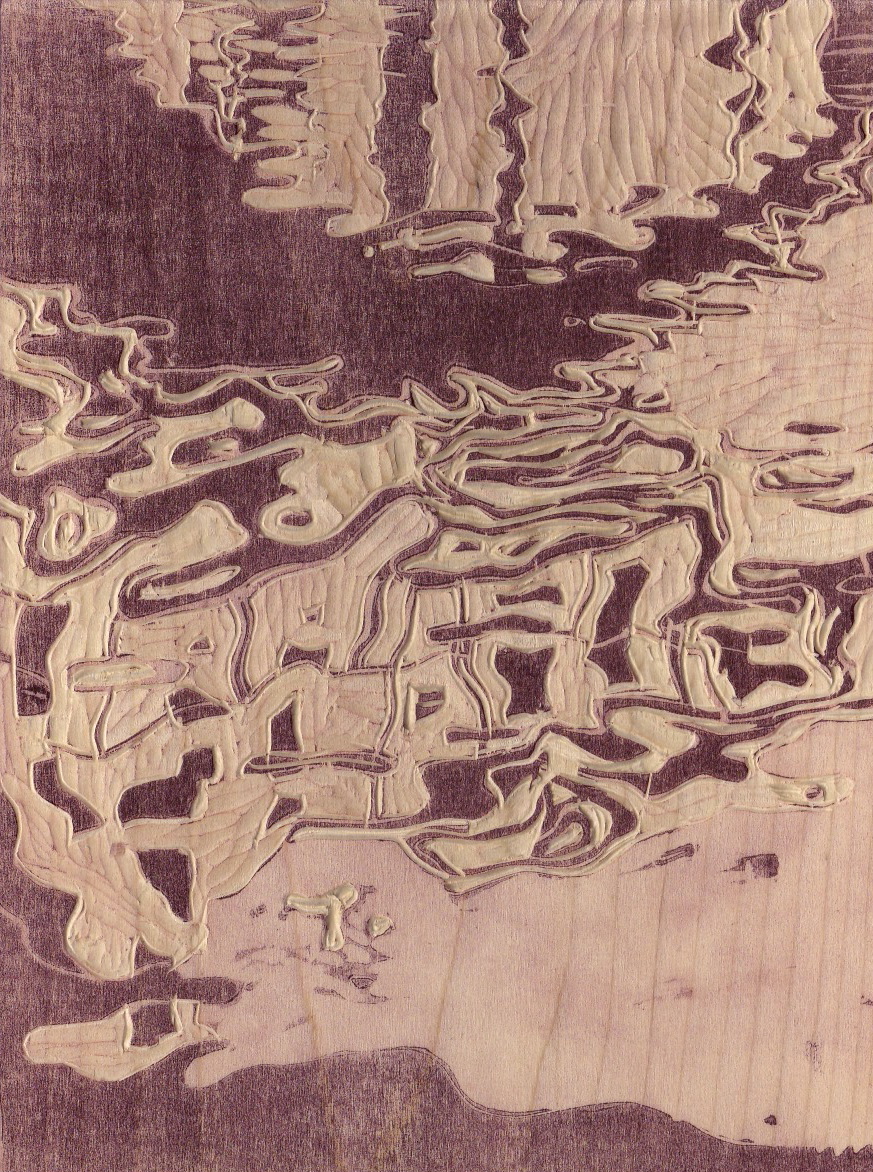
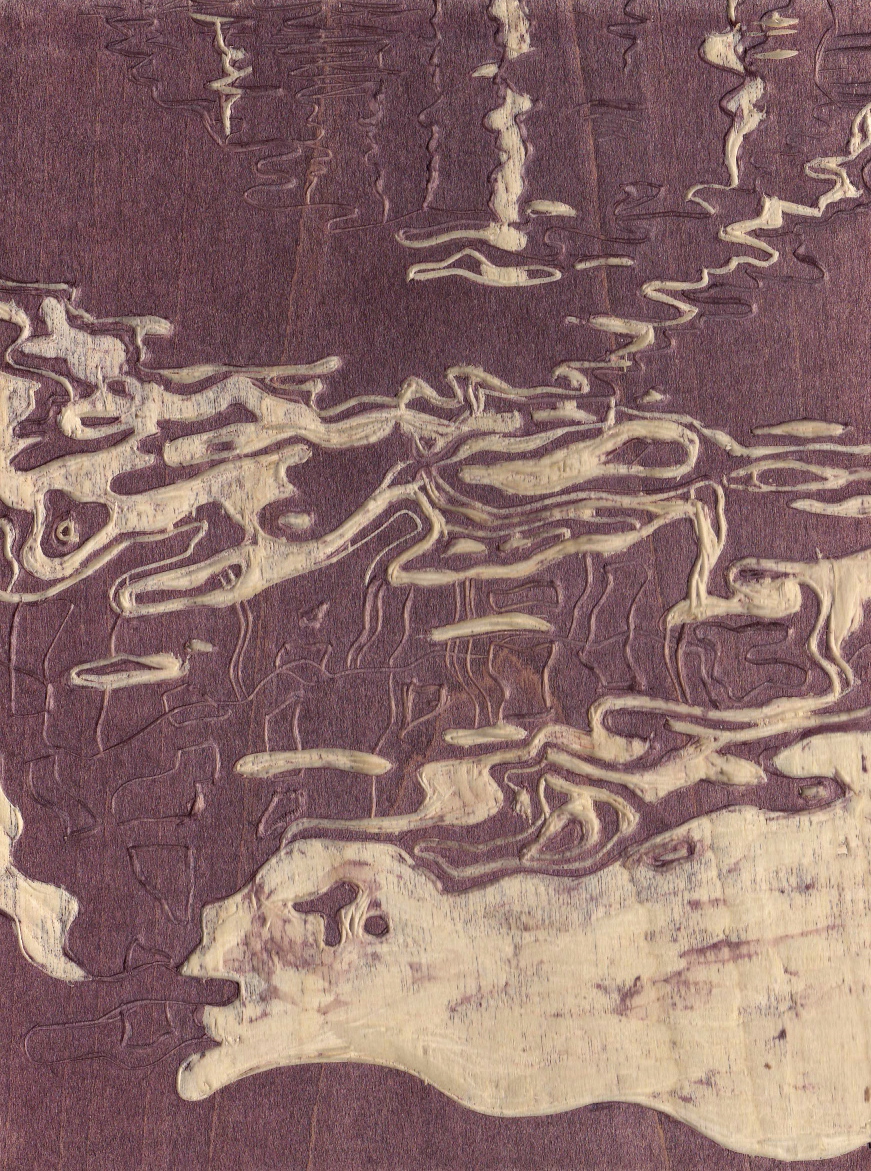
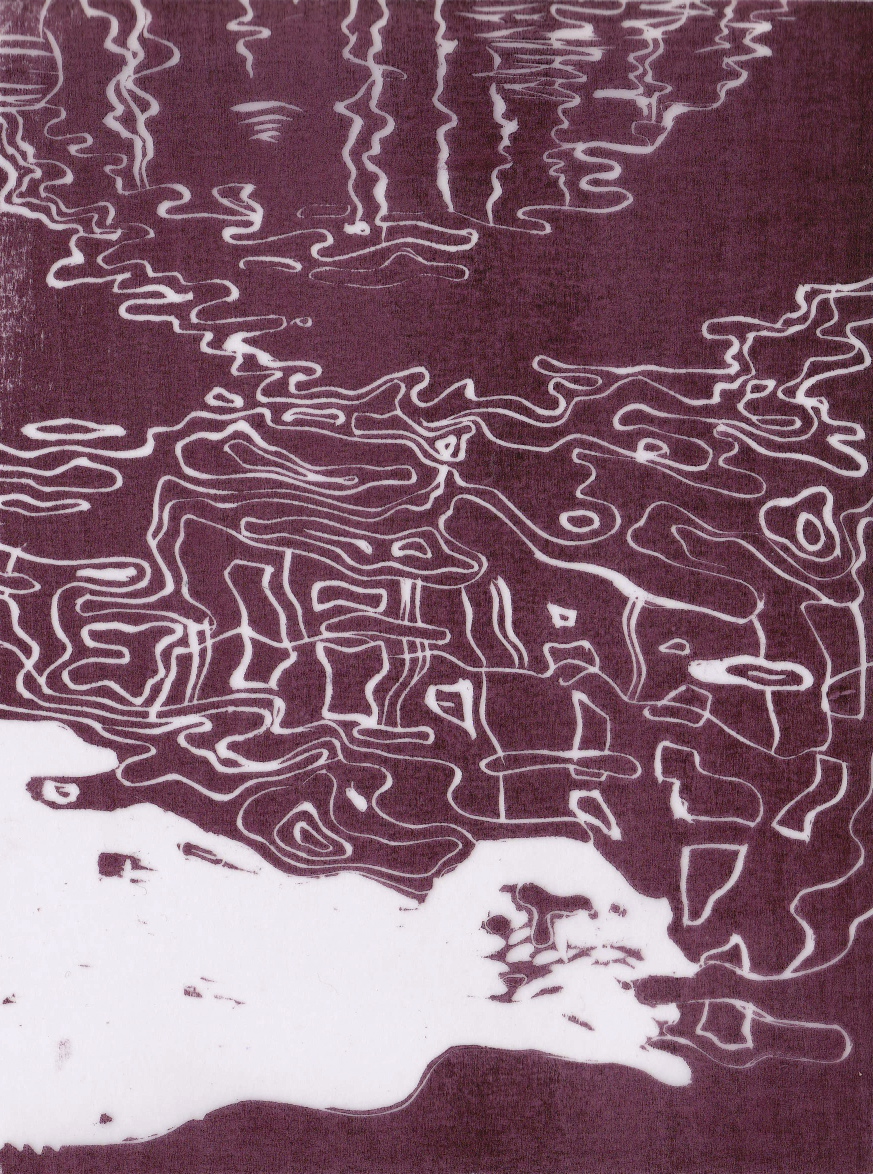
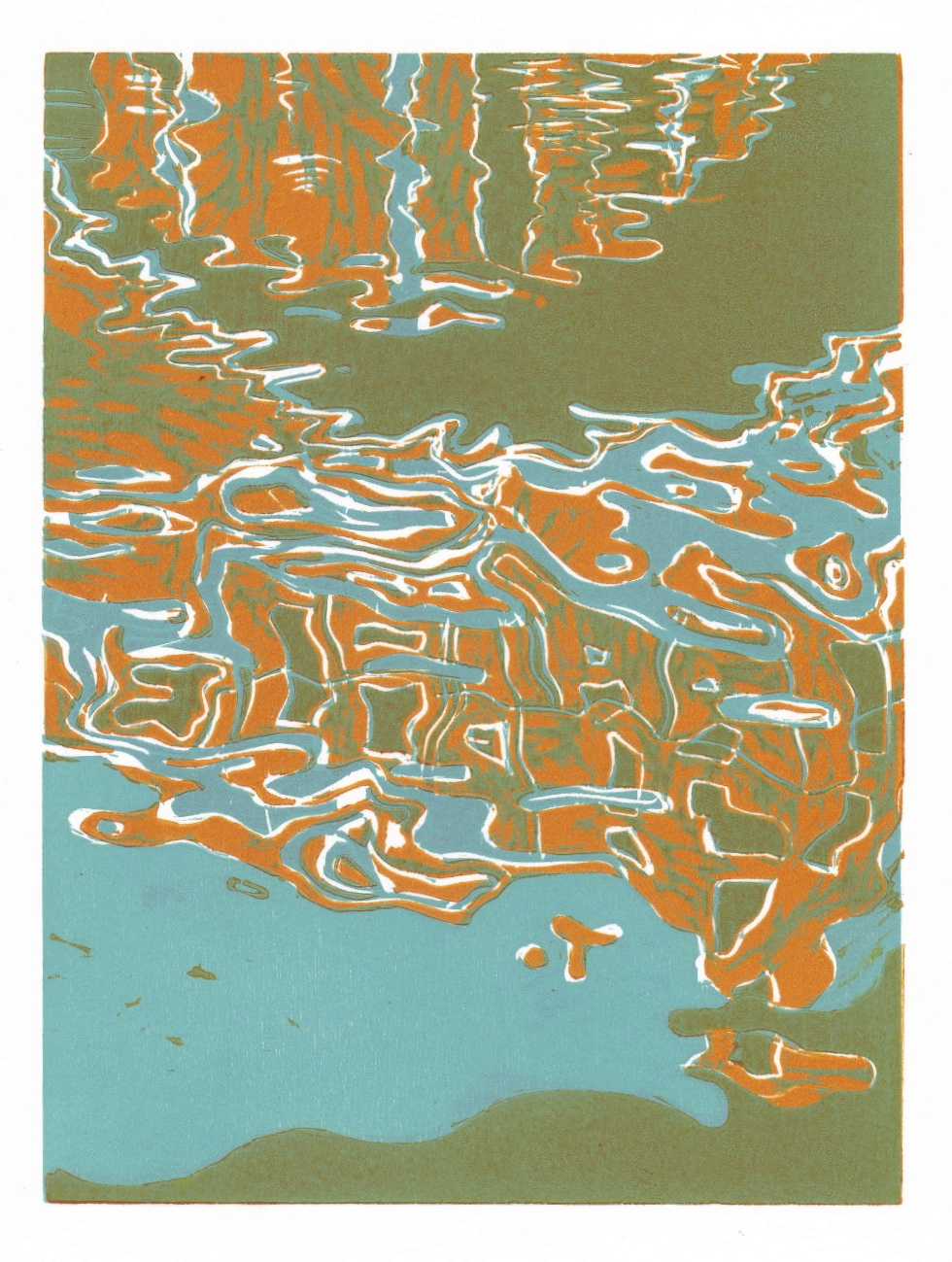
That’s all very well, except that as I was about to discover, woodcut is rather tricky for a newcomer to the medium, and having chosen a photo on which my image would be based, and drawn it onto my wood, I soon found trying to cut the fluid curving lines inherent to watery reflections nigh on impossible to cut. Yet despite a few scratches, a punctured thumb and a clear case of repetitive strain injury in my forefinger, I persevered, and the photos on this blog show both the finished woodcut print, as well as a range of prints taken along the way when I was using just two plates (and therefore two colours) before I added depth to my image with an additional third plate.

The finished print and a detail shot

Ripples on the Rio della Guerra (2014 © Nicholas de Lacy-Brown, woodcut print on paper)

Ripples on the Rio della Guerra (2014 © Nicholas de Lacy-Brown, woodcut print on paper)

Ripples DETAIL

Not bad for my first attempt – I love the fact that when you first look at the print, it looks almost like an abstract expression before your mind becomes acquainted with the various darker shapes which make up the underside of the bridge, and the windows of a nearby Venetian house – all seen rippled of course.

Much inspired I’m sure that more woodcuts will follow as I continue my merry journey into the world of printmaking.

Alternative colours and a print run of the final print

red ripple yellow ripple orange ripplephoto

© Nicholas de Lacy-Brown and The Daily Norm, 2001-2014. Unauthorized use and/or duplication of the material, whether written work, photography or artwork, included within The Daily Norm without express and written permission from The Daily Norm’s author and/or owner is strictly prohibited. Excerpts and links may be used, provided that full and clear credit is given to Nicholas de Lacy-Brown and The Daily Norm with appropriate and specific direction to the original content. For more information on the work of Nicholas de Lacy-Brown, head to his art website at www.delacy-brown.com

Three months and counting… My art exhibition is on its way!

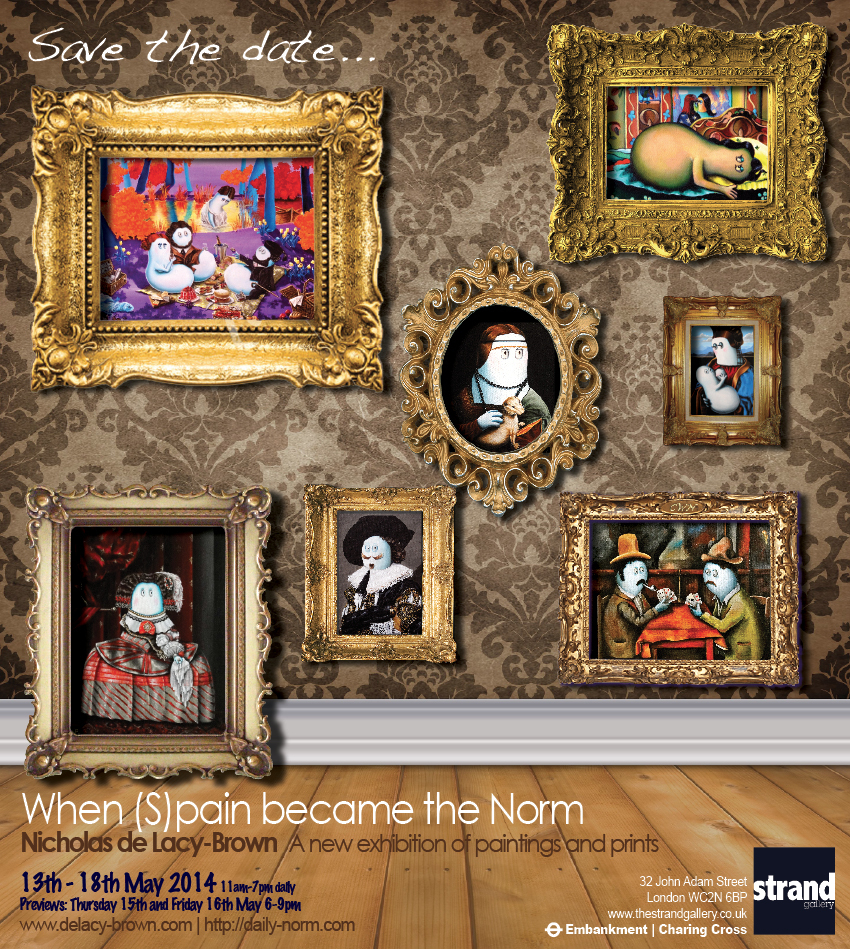
In exactly three months time, the Strand Gallery in the heart of London’s West End will throw open the doors to my brand new solo art exhibition, When (S)pain became the Norm. As my first solo show in 6 years, it will be one of the most comprehensive exhibitions I have ever staged with some 50 paintings and 50 sketches and prints covering the triple theme of my 2008 accident, works inspired by Spain, and the Norm after which this very blog is named.

On paper, three months looks like a while, but I know that it will fly by. So as much as the excitement is beginning to build, I face the next 3 months with some degree of trepidation as I look forward to the amount of work which is still before me. Working now daily to promote the event, finish paintings, order frames, sort out catering, buy bubbly and send out invites, the heat is really on, but the anticipation is starting to fill each preparatory activity with the kind of thrill that only an event of this scale can create (something which I’m sure any wedding couple to be can probably appreciate).

Save the date email frames FINAL

You’re bound to hear a lot more about the exhibition over the next few months, but in the meantime I leave you with the first of my official exhibition posters for the event whose launch marks the start of my marketing drive which commences this week. Just as that poster suggests, I ask that as many of my followers and readers alike consider marking the date in their diaries and heading over to London Town this May 13-18th, to share in this super special event with me.

More details of the exhibition and my art can be found at www.delacy-brown.com
Vintage Italy – advertisements from a golden age

Many may have empathised with the characters Gil and Adriana in Woody Allen’s 2011 film, Midnight in Paris, who were accused of having suffering from “golden-age nostalgia” – the condition whereby a person believes that a previous era was better than the present. In a way, the purpose of the film was to disprove this way of thinking, since Gil’s obsession with the 1920s led him to meet Adriana who was from the 1920s but who herself thought the golden age was the Belle Epoque, who in turn met the likes of Degas and Manet in the Belle Epoque who in turn thought the golden age was the renaissance…and so it goes on. Which just goes to show that “the grass is always greener” applies to the past as well as a comparison of your own life with other possibilities.

italy


Despite this chord of warning which was espoused in Woody Allen’s film, I have to admit to suffering from a little golden-age nostalgia myself. Who could not pine after the elegance of evening dress in the 20s and before – the Downton Abbey style of dressing for dinner every evening and the top-hatted gentlemen in the Moulin Rouge? True, much of my nostalgia is probably founded in fiction – of course we all know that sanitary conditions and general quality of life was probably much lower then than we are used to now, especially for the poor. But nonetheless, the charm of past years cannot help but seep into my imagination, and fill my days with a warm sense of longing for a time of sophistication and innocence. And that charm is no more embodied than in the multi-coloured art work of vintage advertisements at the start of the great commercial age.

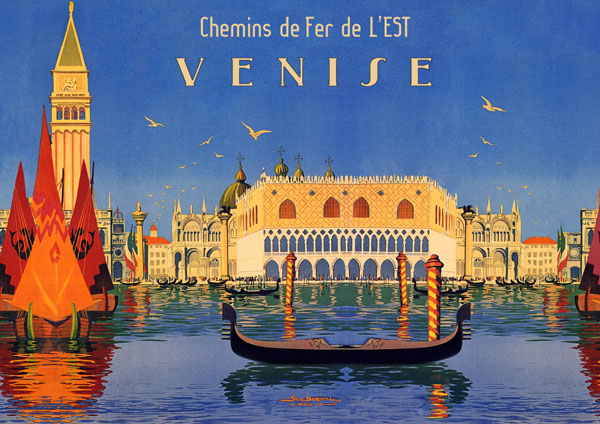
venice 2011087_1_l AP513H-vesuvius-gulf-of-naples-italy-1920s


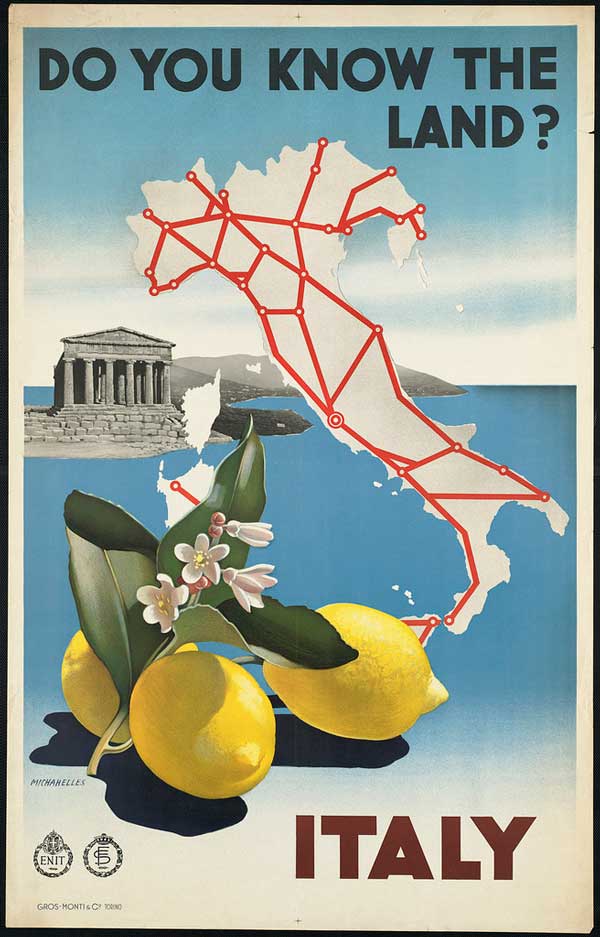
I love old adverts. This passion is directly inherited from my father who collects enamel advertisement signs and various advertising paraphernalia. Sadly I have to make do with reproduction postcards and posters, but the images are no less pleasurable for the reproduction. And following on from my recent series of Italy posts, I thought I would share with you a few classic examples of the vintage advertising age promoting the very cities which I have just visited: Venice, Rome and Naples.

photo 1 AP463-roma-rome-italian-travel-poster-1935 Napoli 1960

With their bold lettering, romanticised skies, bright colours and simple motifs, it is completely understandable how these posters would have been effective in luring the pre or post-war era of awakening travellers to the charms of Italia. If only adverts today could exude such innate charisma. Oh no… there I go with my golden-age nostalgia again. I think I’d better leave you with the posters. Till next time…

photo il_570xN.342658530

Natale Italiano | Naples – Day 2: Diamonds in the Rough

In nature as in life, some of the greatest contradictions can be found together. Inside a dull-looking pebble, the brightest of sparkling diamonds can be found; from a single block of hard marble cut out of the Carrara quarry, the magnificent muscular form of Michelangelo’s David emerged; and in the ugly hostile exterior of an oyster shell is born the beauty of the perfect pearl. In Naples, such contradictions are not hard to find. In the grim graffiti covered streets emerge beautiful palaces and stunning churches; in the foothills of the life-destroying Mount Vesuvius, agricultural production thrives in richly fertile soils; and in the dark and dirty alleyways of the Spaccanapoli, treasures of sublime artistic beauty wait in the shadows to be discovered.

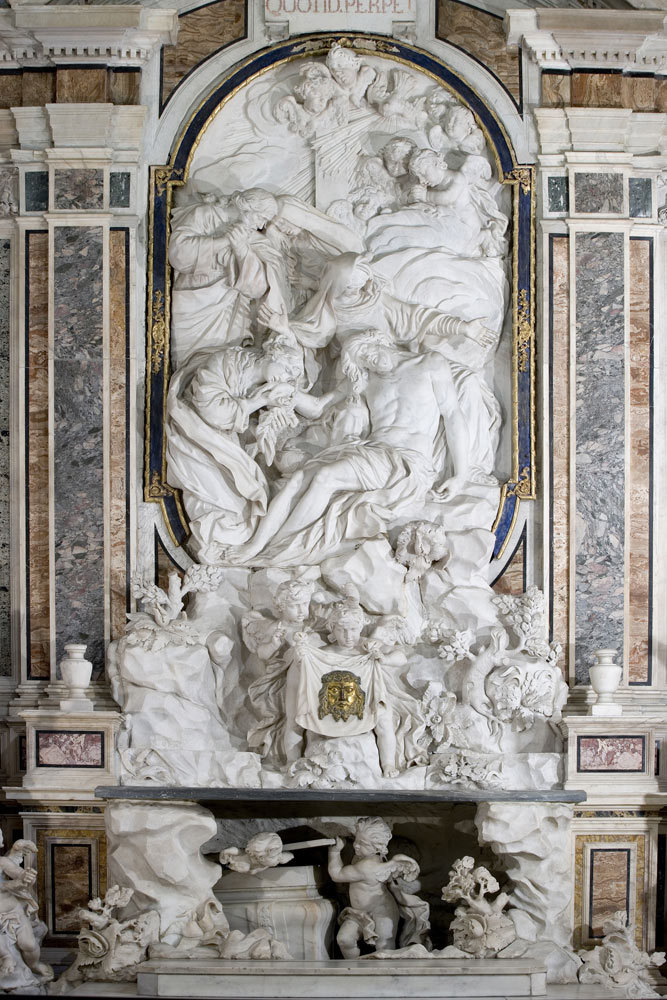
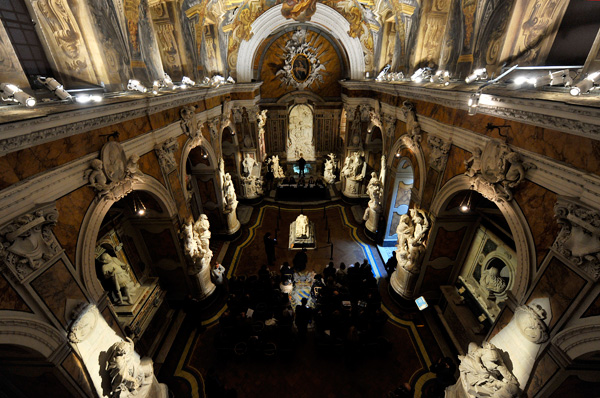
It was to these treasures that we headed on our final day in both Naples, and Italy, unwilling to leave the city without our own experience of these infamous sights. The first was the Capella Sansevero, whose location down a tiny side street was made obvious by the queues of tourists forming round the corner and leading up to both its front door and, somewhat illogically, to the ticket office from where a ticket had to be purchased before you could then join the second queue into the main chapel. The queues were off-putting at first, and we almost gave up on this treasure, being as we were short of time before our flight home to London. But persevering in respect of both queues, we soon made our way, slowly but surely, into what has to be one of the most stunning baroque creations of Italian art history.

The Capella Sansevero

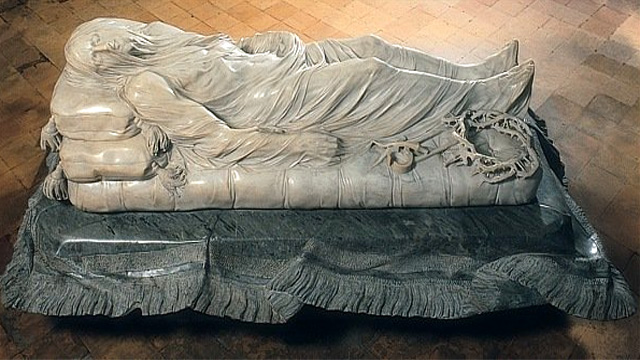
Cappella Sansevero Interni Cristo Velatocappella-sansevero_05IMG_7127 san_severo sansevero8

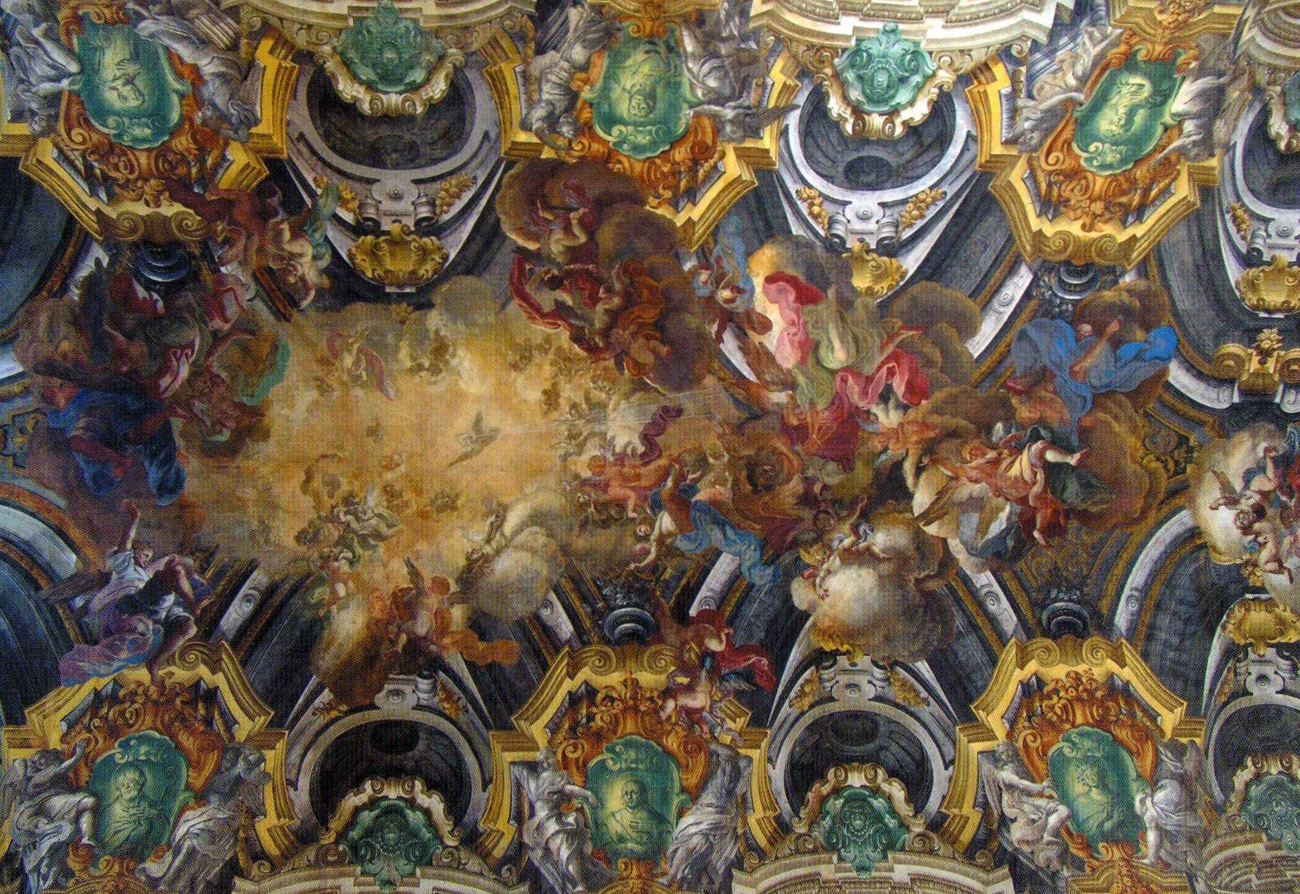
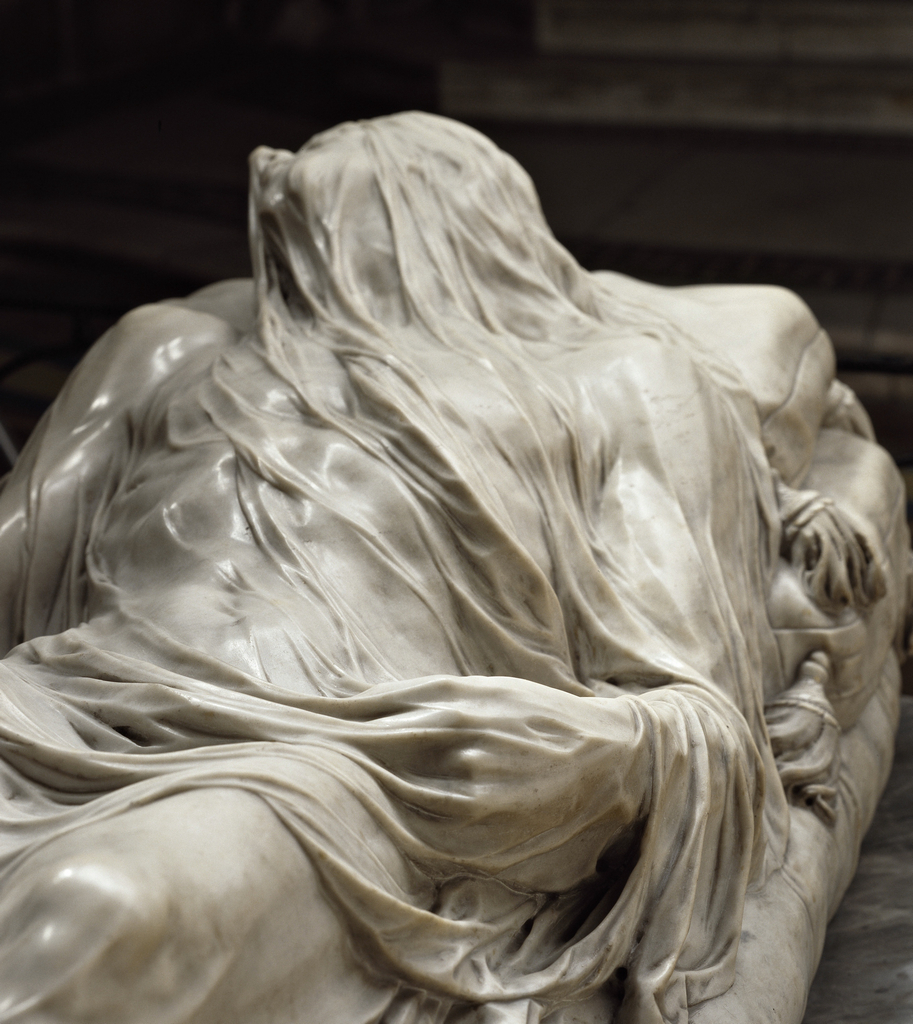
Originating from 1590 but substantially embellished by Raimondo di Sangro, the Prince of Sansevero, it contains some 30 incredible works of art created by some of the leading Italian artists of the 18th century. A masterfully elaborate frescoed ceiling almost gets lost amongst the crowds of marble sculptures which fill every alcove and appear to metamorphose out of the altar, but the sculpture that really pulls in the crowds is “The Veiled Christ” by Giuseppe Sanmartino. Looking at this stunning depiction of the dead Christ covered with a shroud you are almost in denial that this masterpiece of deception can be marble, so fine are the features of the shroud which even show the scars sustained by Christ during his crucifixion beneath its apparently fine drapery.

Sanmartino’s Veiled Christ

13906228_cristo_velato_cappella_sans 0563B_ 013 0563B_ 014

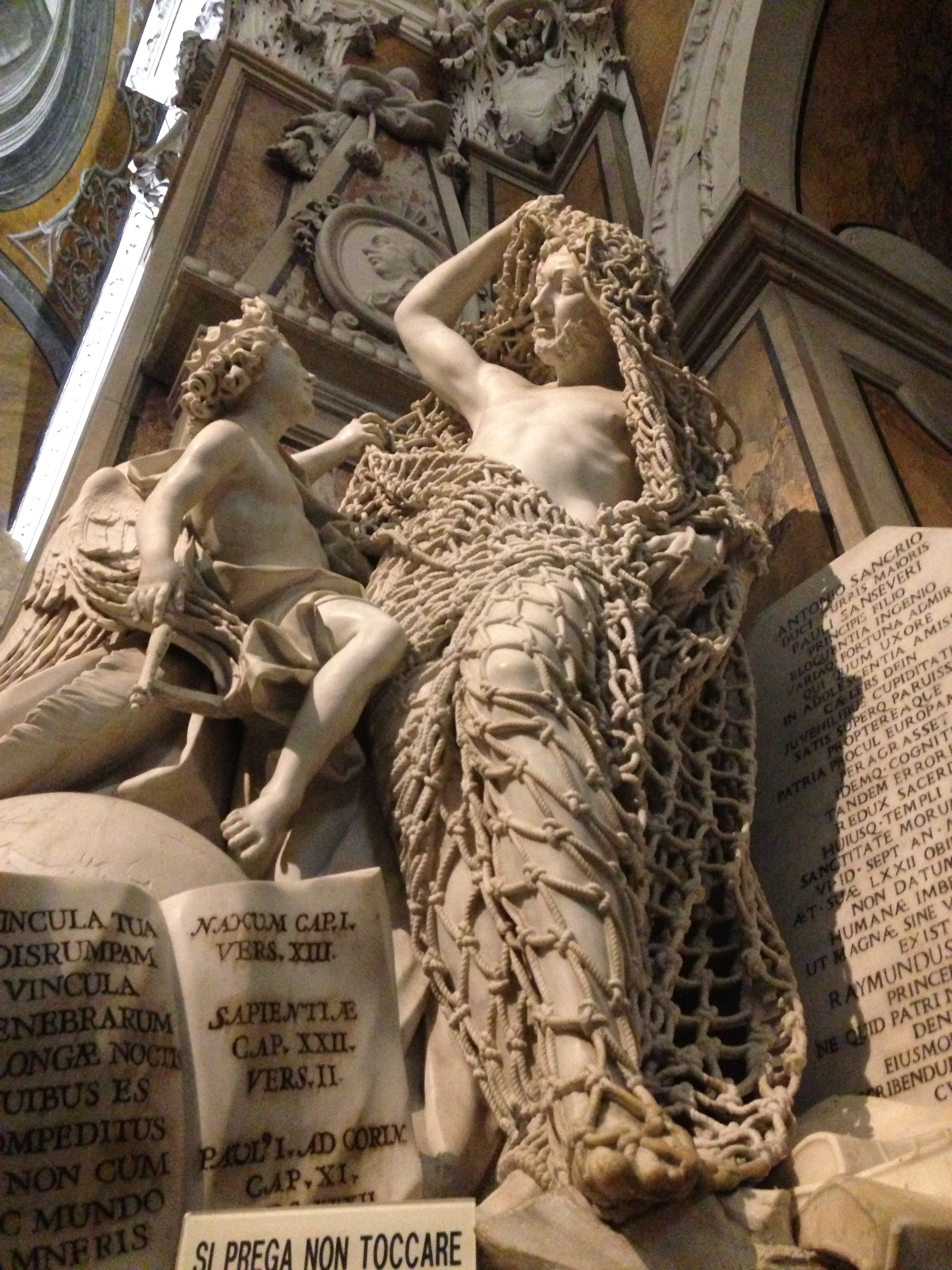
However for my money, the real star of the show, and too often overlooked in preference for the Veiled Christ, is Francesco Queirolo’s The Release from Deception (Disinganno) which shows a figure (some say it is Raimondo’s father) emerging from an intricate bundle of nets to look at a small angel who has appeared besides him. The netting is so incredibly intricate, with every knot and twist captured to perfection, that this sculpture has me entranced in absolute awe at its brilliance. How the sculptor managed to create this from a single block of marble, with all of those empty spaces cut out between the rungs of rope, I will never know. As far as I am concerned, this is the greatest masterpiece of sculpture ever to have been created in all the world. The visit to Naples was worth it for this alone.

Queirolo’s Disinganno

FT05_SAN SEVEROIMG_7126

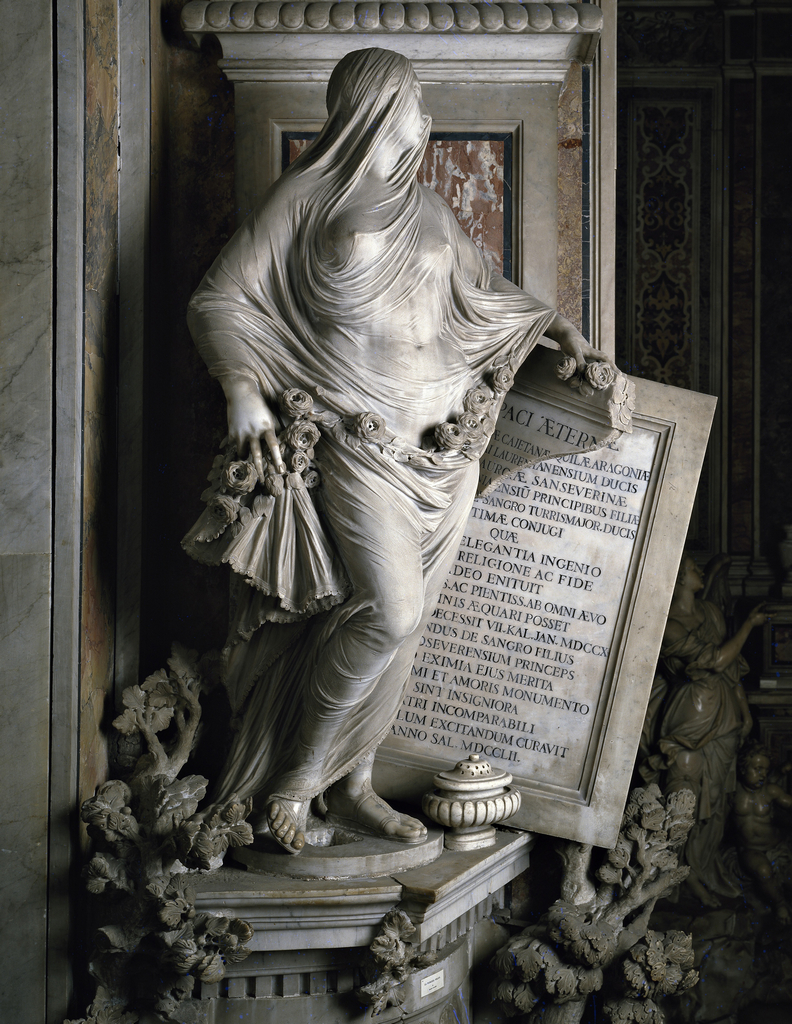
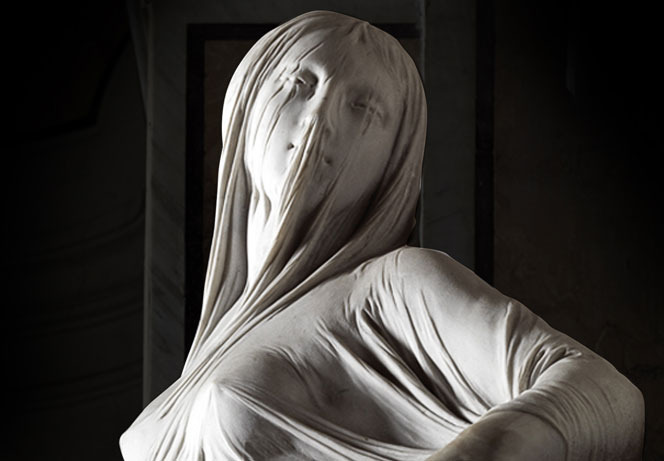
and another masterpiece of the Capella, Antonio Corradini’s Veiled Truth (Pudicizia)

0563A_ 013 8042OP346AU30300 IW_Antonio-Corradini_LaPudicizia_01

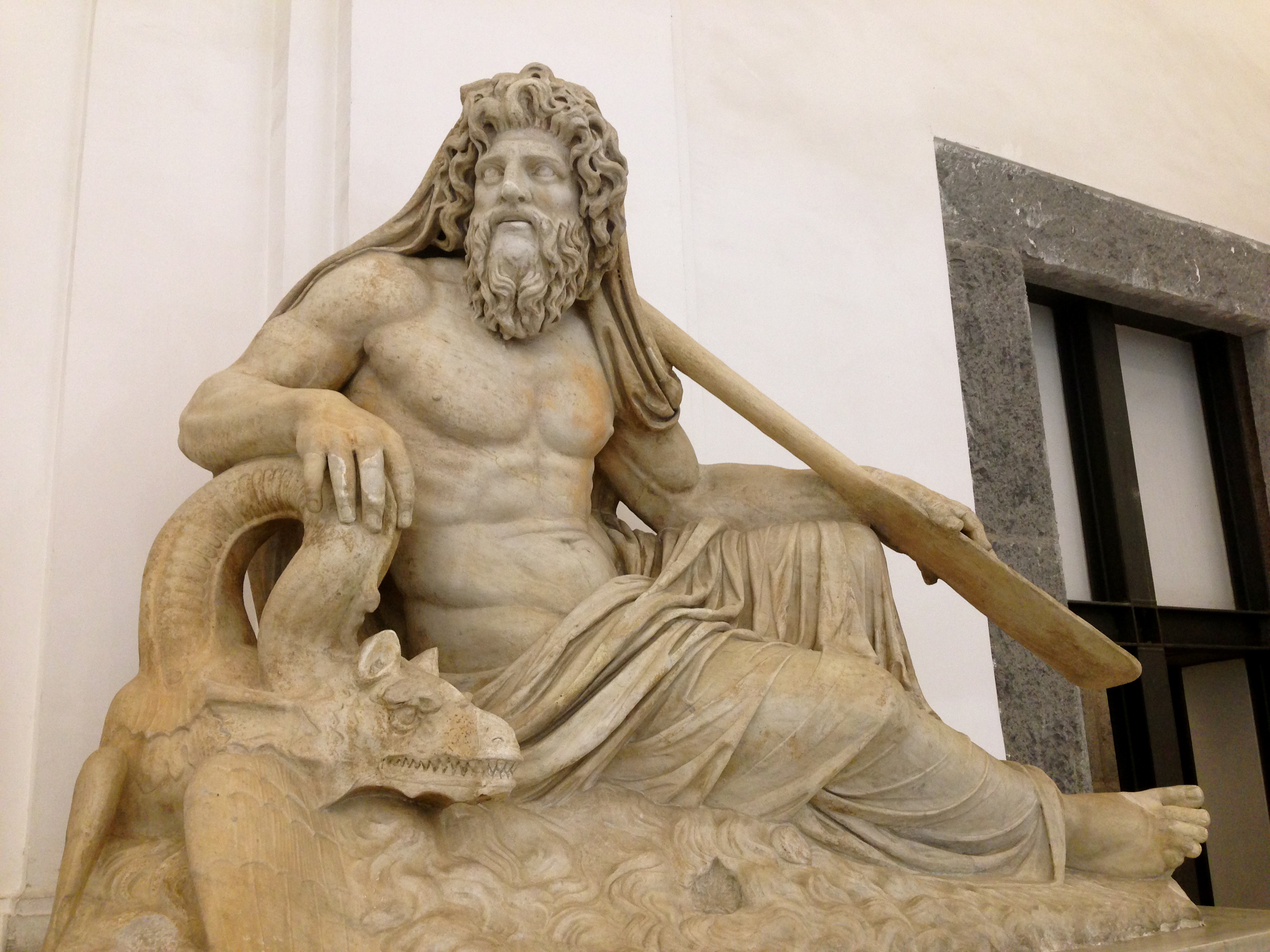
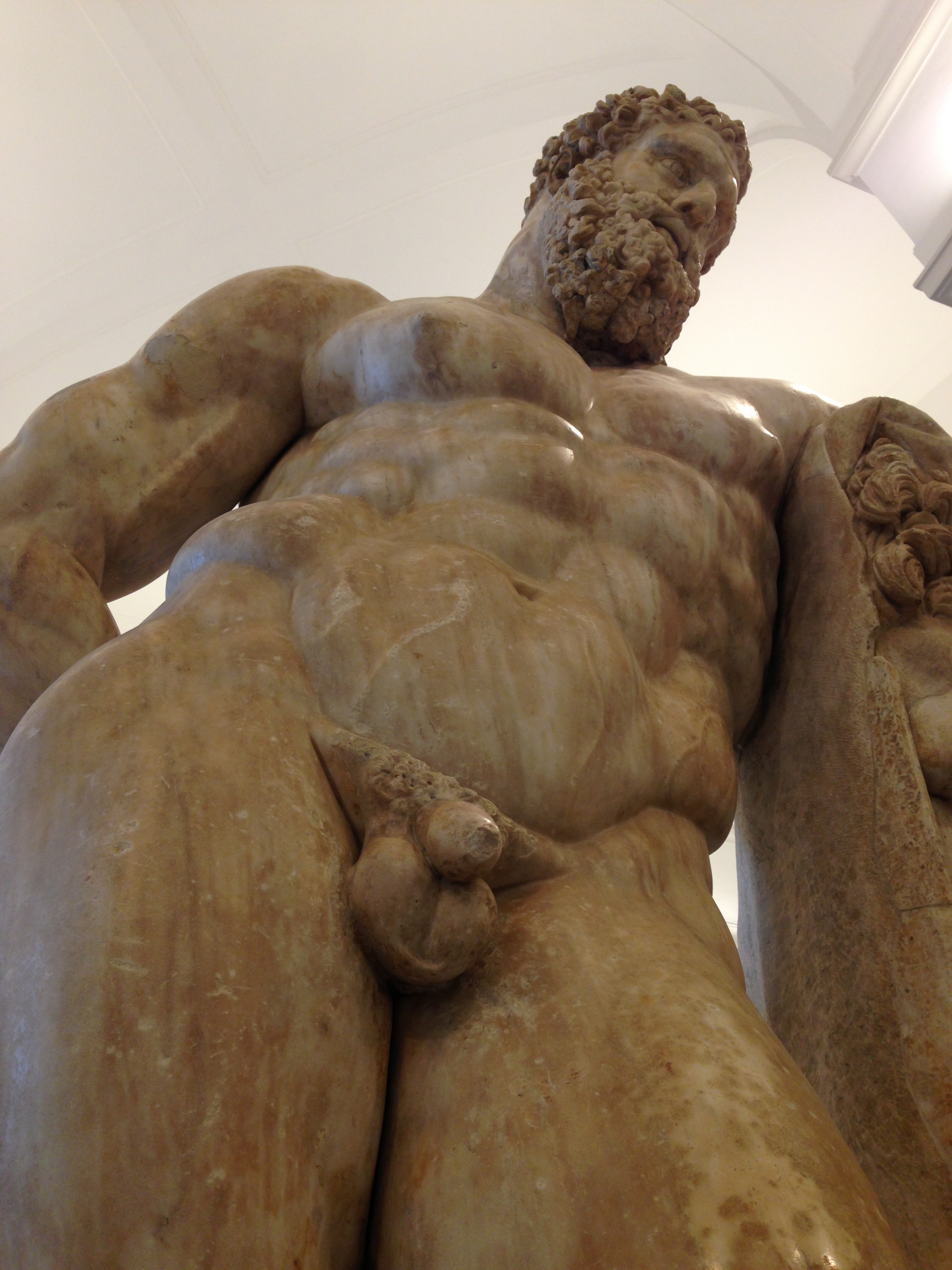
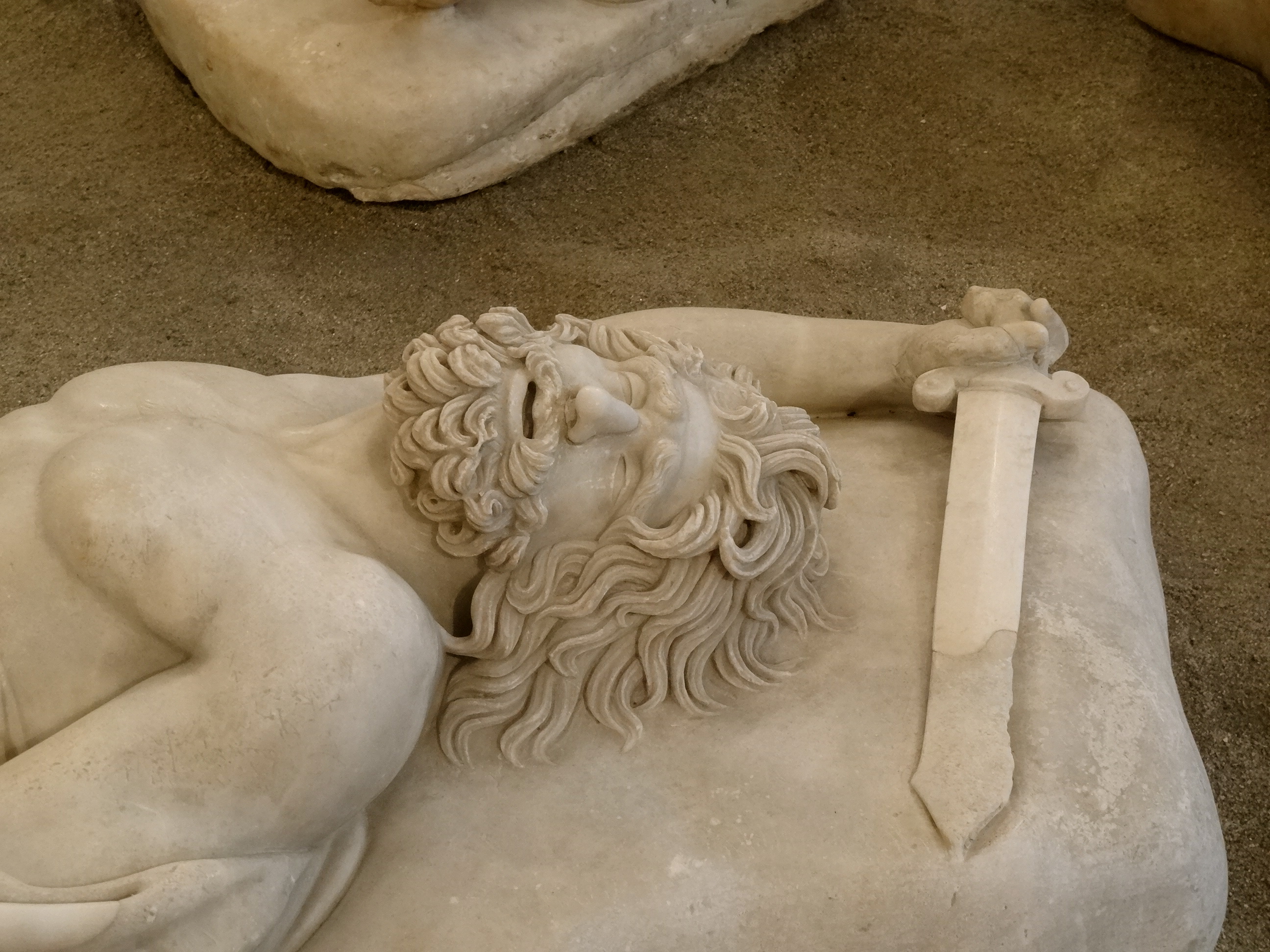
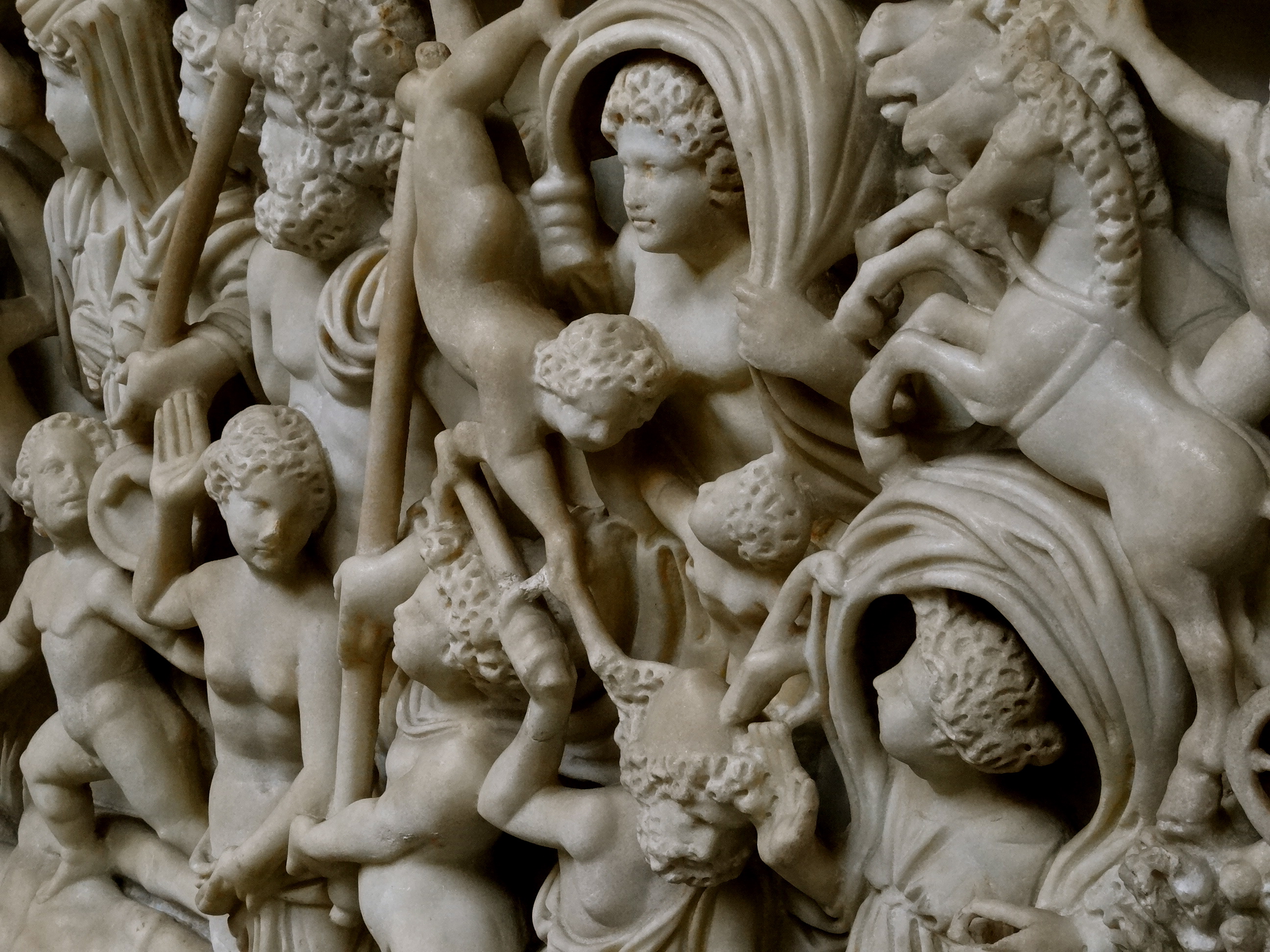
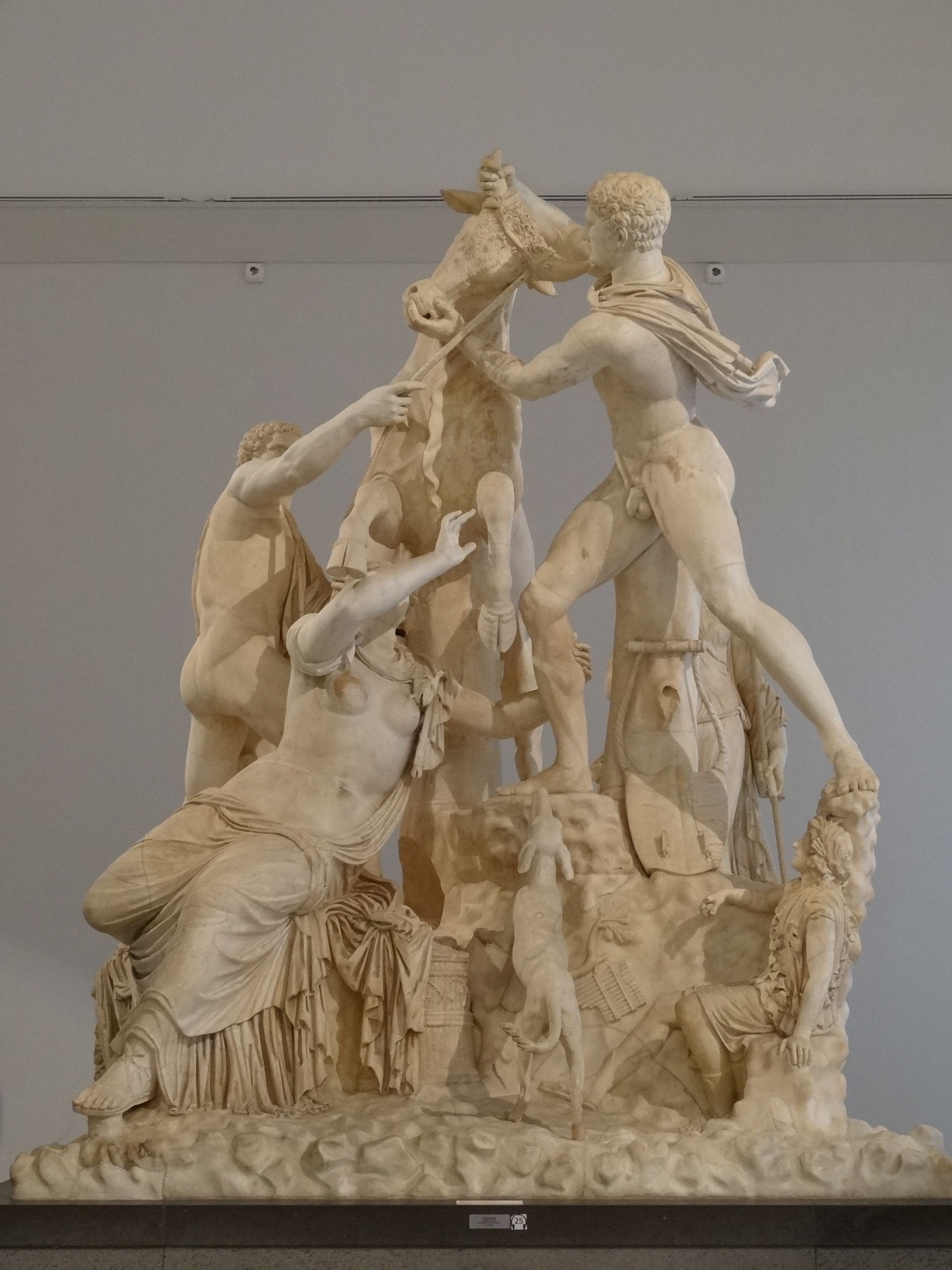
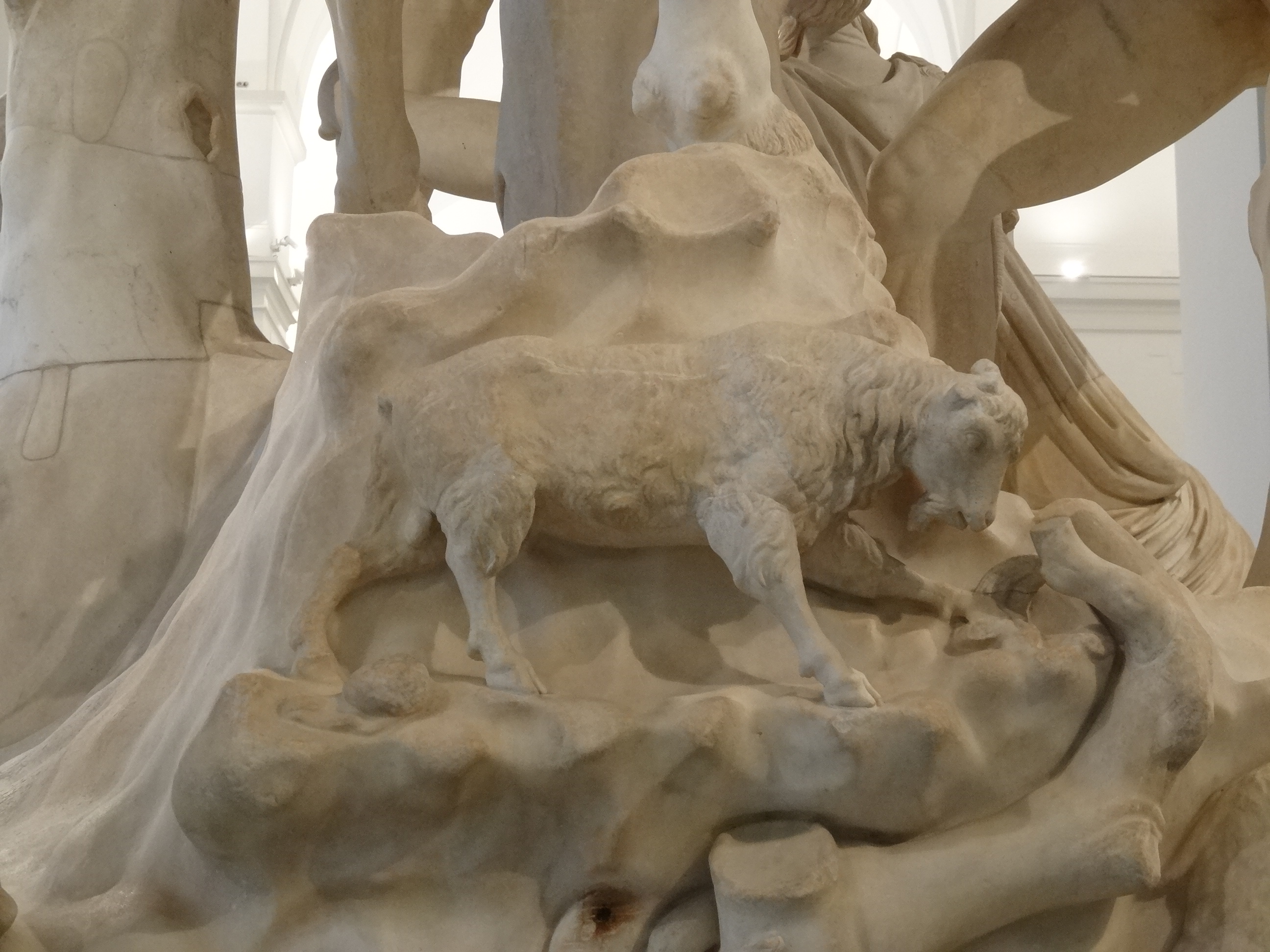
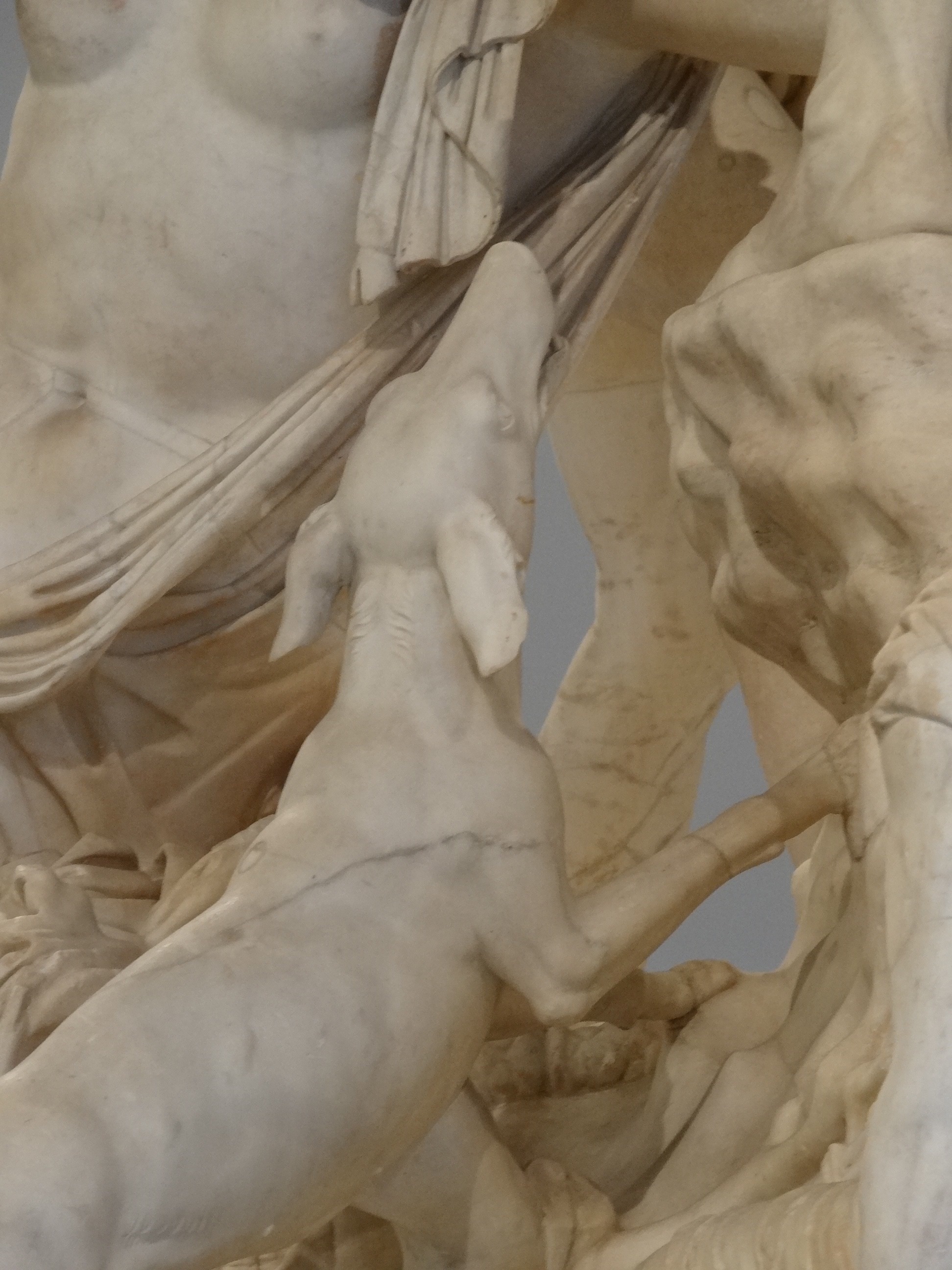
But despite being deeply satisfied by our acquaintance with these works, a second collection of masterpieces awaited us – masterful not just because of their brilliant execution, but because of the time in which they were made, and the miracle of their survival. I am of course talking about the stunning collection of art and sculptures collected together in another of Naples’ artistic gems – the Archaeological Museum. A must for anyone who does not make it to Pompeii or wonders, if they have gone, what happened to all of the fine art which was originally excavated on the site, this museum is the home not only of treasures found in the Roman towns crushed by Vesuvius in AD 79, but also in other Roman excavations elsewhere in Italy. Number one of these incredible discoveries has to be the Farnese Bull – a group sculpture which is the largest single sculpture ever recovered from antiquity to date and thought to have been commissioned at the end of the 2nd Century BC and carved from a single block of marble.

Masterpieces of the Archeological museum

DSC01970 IMG_7141 IMG_7172 DSC01955 DSC02077

This colossal marble sculptural group represents the myth of Dirce, wife of the King of Thebes, who was tied to a wild bull by the sons of Antiope as punishment for the ill treatment inflicted on her. It was unearthed in 1546 during excavations at the gymnasium of the Roman Baths of Caracalla and thereafter adorned the Farnese Palace in Rome, hence the nickname it has acquired having been restored by Michelangelo himself. The size and scale of this piece is as breathtaking as the detail of Quierolo’s Disinganno, and an appropriate finish to an enchanting tour of the treasures of Napoli.

The Farnese Bull

DSC01988 DSC01990 IMG_7183 DSC01998 DSC01995 DSC01991

Our trip to Naples ended, as all trips should, with a Neapolitan pizza and a bottle of Chianti. Thus it was, slightly tiddly, that we made our way back to the hotel, collected our baggage, and headed home to the UK; Home to London with bags stuffed full of Venetian masks, replicas of the Bucca della Verita, packets of Roman coffee and a couple of bottles Neapolitan limoncello – a manifestation in souvenirs of the most incredible Natale Italiano we could ever have hoped for.

Check out my final photo posts from the trip – coming later this week.

Corot and Degas – The Castel dell’Ovo in Art History

I’ve spoken before about the novelty of coincidence – when a chain of events leads you to discover things over and over, or when two apparently novel similarities inexplicably collide – and concluded that rather than being mere coincidence, such occurrences are probably the result of becoming cognisant to something you hadn’t noticed before, something which translates into all of the succession of sightings or experiences which follow. It might also be to do with environmental or social factors which all of a sudden affect more people than just yourself. Still, a little piece of me makes me wonder whether such occurrences are in fact the work of fate, and disguise some hidden meaning or key to the future – we will probably never know.

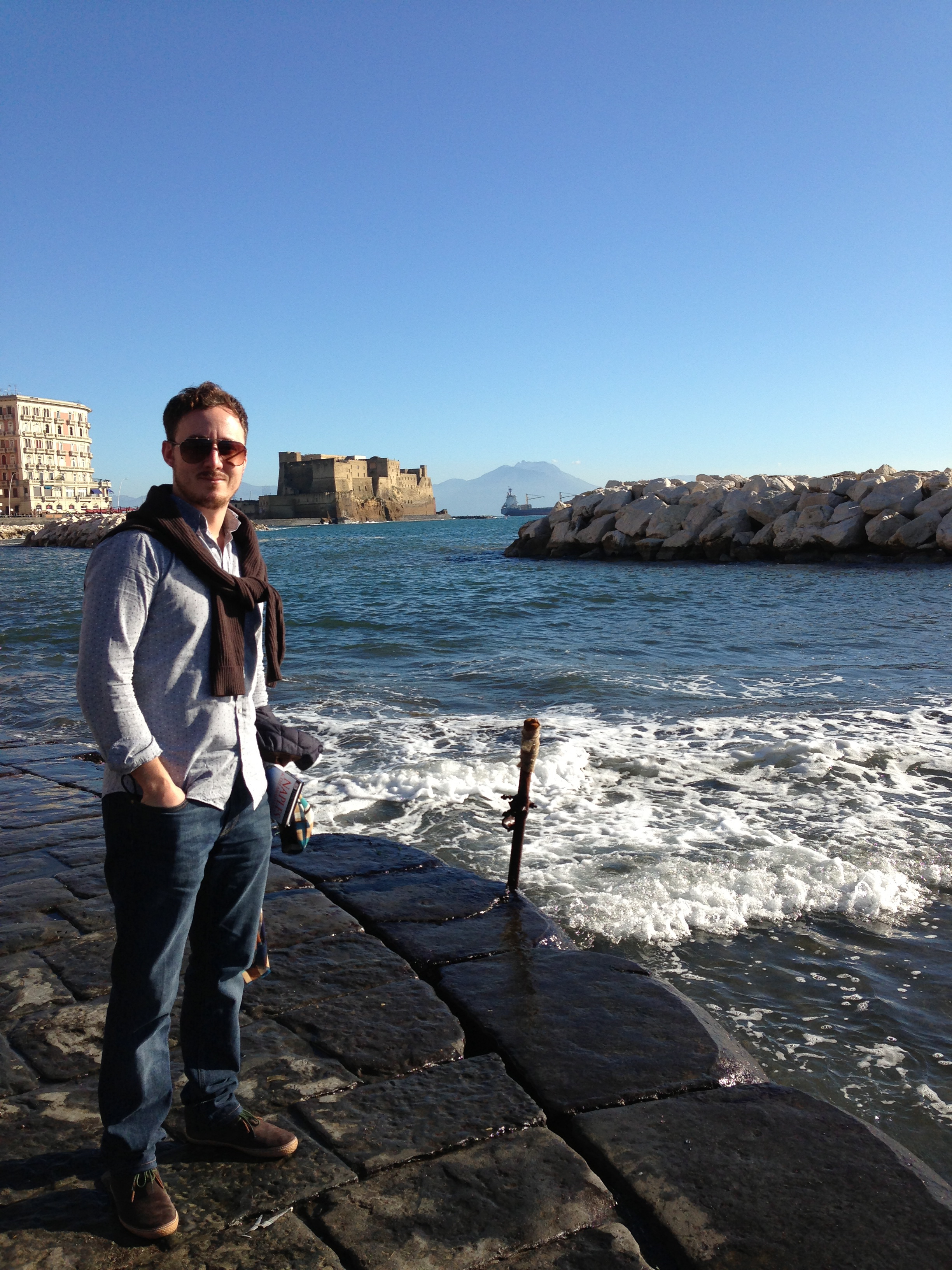
But one little coincidence which happened the other day seemed so relevant to my current string of Naples posts that I felt compelled to share it, not least because it comes with a little art added in for good measure. I didn’t know Naples very well before my most recent visit, and still less the coastal areas of the city which I had never experienced before. It was therefore with some unbridled delight that I recently discovered the stunning seaside promenade, with the beautiful Castel dell’Ovo and its little marina which is surely the centrepiece of the famous curving coastal bay.

The Castel dell'Ovo

The Castel dell’Ovo

Imagine my surprise then when, upon my return, I strolled into London’s National Gallery one lunch time (as I often do) to spend a brief 10 minutes or so amongst some of my favourite Impressionist masterpieces, and discovered a new Degas painting which I hadn’t seen there before. The work, entitled Hélène Rouart in her Father’s Study is a rather striking portrait of the named Hélène – so far no coincidence there. But because Hélène was allegedly the daughter of a rich collector, Monsieur Rouart, what stands out in the work is the array of antiques and fine art which Degas portrays in the background. Amongst them he paints a small little painting, almost indecipherable because of his loose brushstrokes, but nonetheless unmistakably a coastal landscape. Looking at the description to find out more was when the penny dropped – it was a painting of the Castel dell’Ovo by Jean-Baptiste-Camille Corot!

Hélène Rouart in her Father's Study (Edgar Degas, 1886)

Hélène Rouart in her Father’s Study (Edgar Degas, 1886)

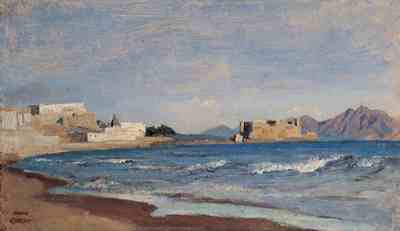
Allegedly the work had hung in the study of Hélène’s father where the portrait is set, and upon subsequent investigation, I have found an image of the painting in all its glory. It’s the Castel dell’Ovo for sure, looking almost unchanged despite being painted some 200 years ago when, in 1828, the French artist spent some seven weeks in Naples and its surroundings painting some 6 recorded views of the city.

Napoli, Castel dell'Ovo (1828)

Napoli, Castel dell’Ovo (1828)

And another painting by Corot of the same view

And another painting by Corot of the same view

So was it my new acquaintance with the Castel dell’Ovo which made me notice this new Degas, and through it a Corot depiction of the Castel dell’Ovo for the first time or some more fate-led coincidence? Who knows. But what I can conclude is that both paintings make for excellent lunchtime viewing and a perfect interlude to my blog’s adventures in Napoli.

Wish I was back there - me in front of the same view

Wish I was back there – me in front of the same view