Skip to content

Posts from the ‘Art’ Category

Wellcome Death: A Self-Portrait

When one of my favourite friends, fellow blogger Celia, told me that she was going to spend her honeymoon in Mexico during “Dia de los Muertos” I got almost as excited as if I were going myself. Ever since developing an early obsession with the art of Frida Kahlo, and in turn the film Frida starring Salma Hayek, I have been fascinated by the Mexican celebration of the dead, in which they make and paint brightly coloured papier mache skulls, masks and skeletons, often adorned with hearts and flowers and all number of patterns, and parade them out in the streets. I even painted a Muertos skull in my recent painting of the city of Salamanca in Spain (below). Having never been to Mexico, I half-heartedly asked Celia to bring be back a “Muertos doll” never actually expecting that on her honeymoon, she would give me a second thought.

Salamanca (2012 © Nicholas de Lacy-Brown, oil on canvas, 105 cm x 90 cm)
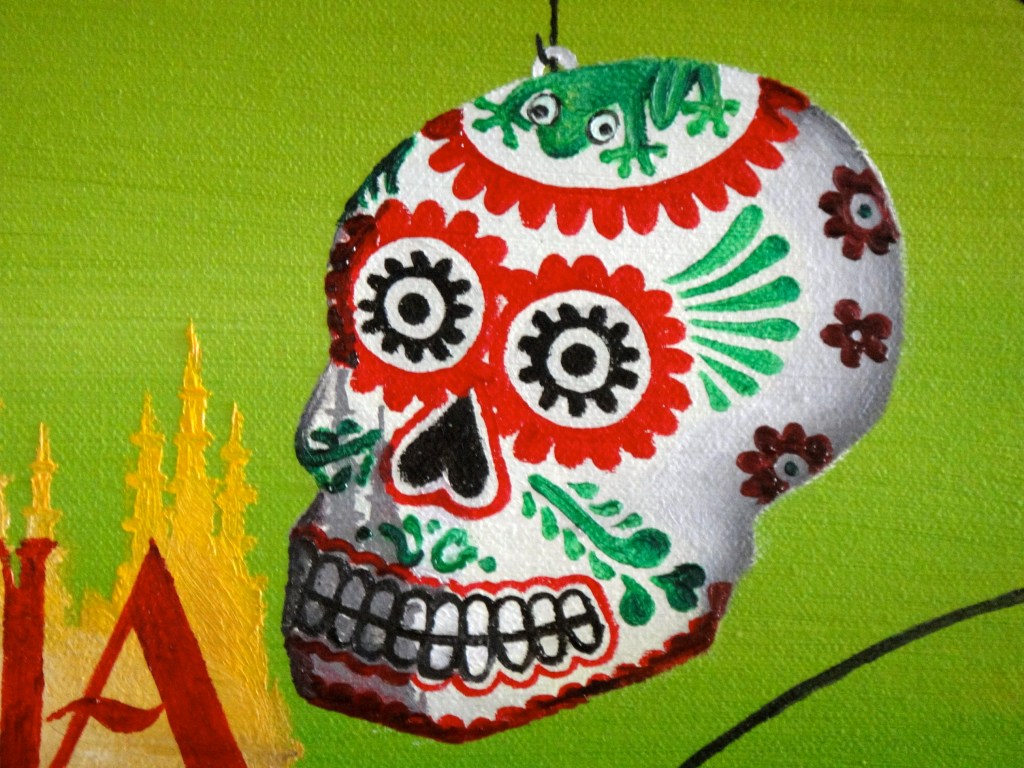
Salamanca (2012 © Nicholas de Lacy-Brown, oil on canvas, 105 cm x 90 cm)

DSC08541But last week, amazing as she is, and freshly returned from the tropics of that South American paradise, she presented to me what must be the ultimate in double whammy presents – a Frida Kahlo doll with a Muertos skeleton face (pictured)! The doll is frankly amazing, combining all the fun and spirit of Kahlo’s works, including the occasional morbidity which creeps into her often pain-expressing paintings. No sooner had I lovingly placed said doll alongside my Frida Kahlo art catalogue on my book shelves (from the Tate Modern expo some years back), I then heard about another exhibition which has recently hit the streets of London – not of Kahlo, but of Death.

My Frida doll!

My Frida doll!

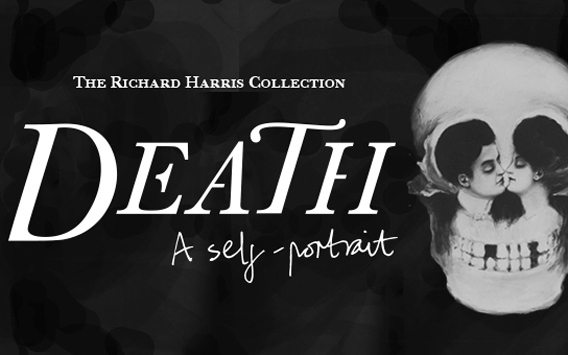
I know what you’re thinking, death, as the subject of an exhibition? Isn’t that likely to be morbid, or heartwrenching, or just plain scary? Well if you’re thinking those things, you probably don’t know the Wellcome Collection on Euston Road in London, a superb gallery adjunct of the Wellcome Trust, who regularly organises fascinating exhibitions of art and curiosities with a decidedly medical theme. The latest exhibition explores the theme of death and our preoccupation both with death, and combating death, in society.
WC_Death

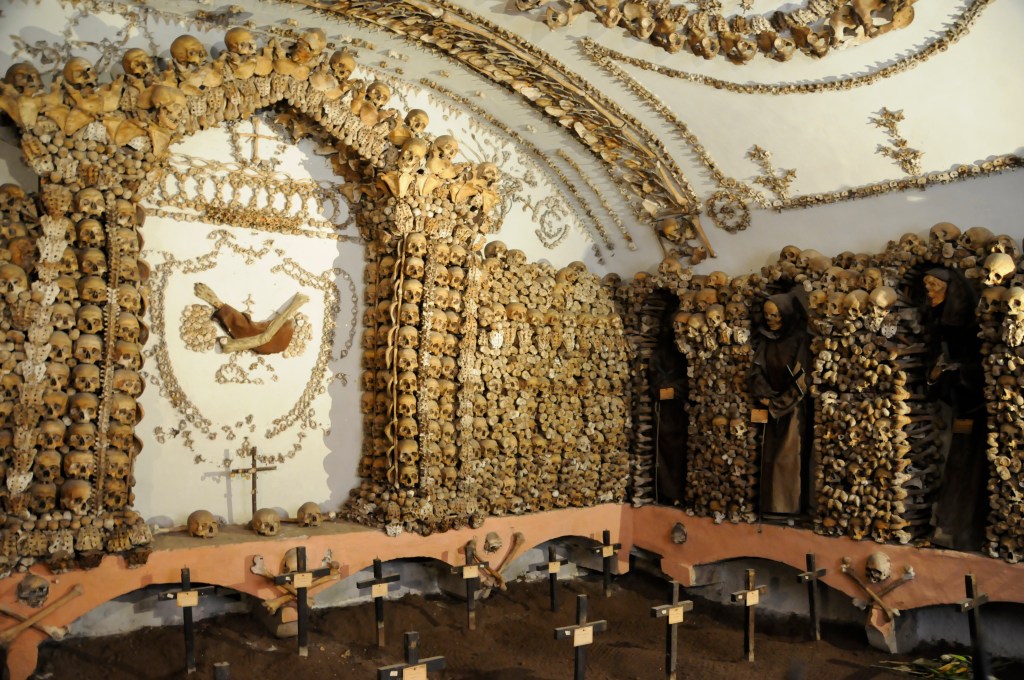
The exhibition comprises the vast and varied collection of Richard Harris, a former antique print dealer from Chicago and explores the subject in a brilliantly diverse array of mediums, themes and expressions. Upon entering the gallery, we were met by Jodie Carey’s 2009 work, In the Eyes of Others (2009), a giant chandelier made entirely of bones. Sadly, the bones were not real bones, but rather plastic reproductions, and therefore this did not have quite the same effect as a chapel I once visited in Rome, the Capuchin Crypt, made entirely from human bones (very morbid, but unusually architecturally beautiful). However, it set us up for a show which ranged from the oldest of 15th century art, to ambitious contemporary pieces.

In the Eyes of Others by Jodie Carey (2009)
In the Eyes of Others by Jodie Carey (2009)

The Capuchin Crypt, Rome

The Capuchin Crypt, Rome

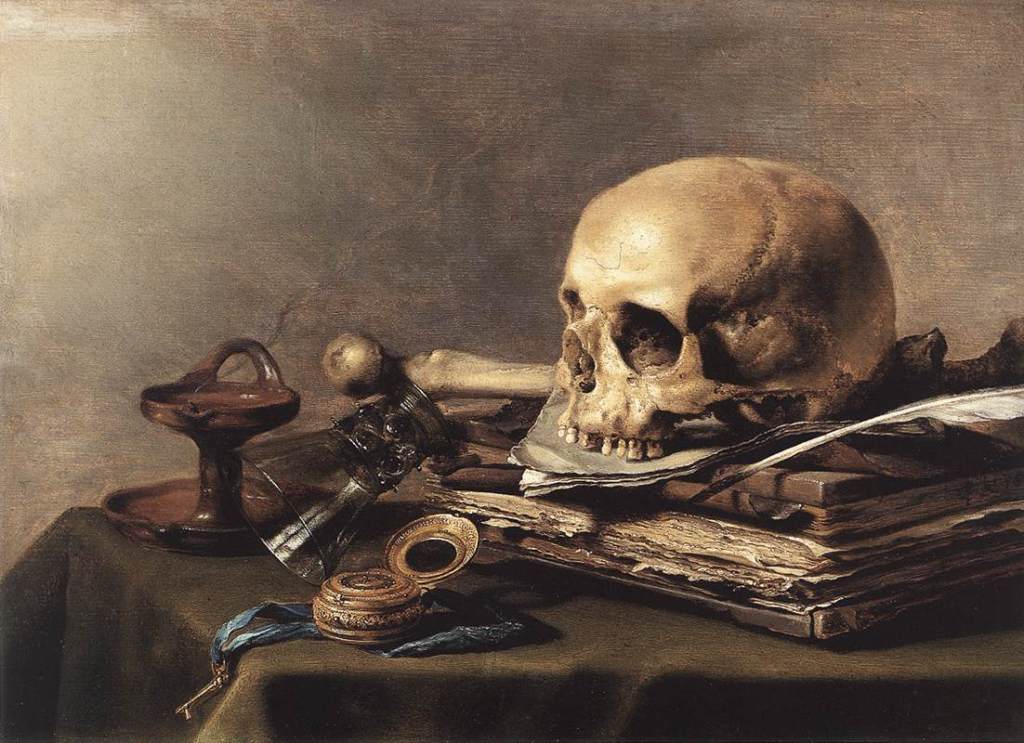
The first room explored the theme, Contemplating Death, comprising examples from throughout history of memento mori (Latin for “remember you will die”), the well-advised reminder to us all that we should seize the day because all of us, inevitably, will be dead one day. This ranged from the classically painted Vanitas still life from 16th century Belgium, the skull sat amongst the clutter of Saint Jerome’s cell by Dürer.
Vanitas still life

Vanitas still life

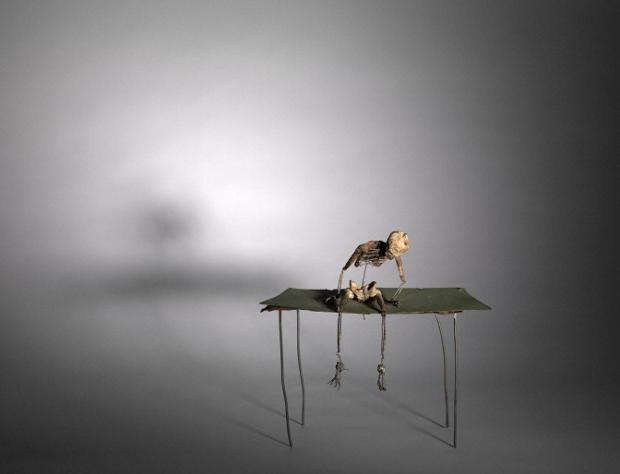
Up next was the Dance of Death, a room which focused on the universal certainty of death, regardless of status in life. This included many a depiction of the Danse Macabre, in which feverish revelry united humans with skeletons, works intended to dissuade people from self-indulgence and vanity in life. I loved the beautiful, almost introspective solace of the dead skeleton sat upon a table in June Leaf’s sculpture, Gentleman on Green Table (1999-2000), as well as the Mondongo Collective’s The Skull Series, in which a huge sculpted scull made from plasticine was, upon closer inspection, a detailed exploration of the influence of the US and Europe upon the world.
June Leaf, Gentleman on Green Table

June Leaf, Gentleman on Green Table


Mondongo Collective, The Skull Series. Number eight from a series of 12. Plasticine

Mondongo Collective, The Skull Series. Number eight from a series of 12. Plasticine

For me, the third room, which explored the representation of death in its most violent form, was by far the most powerful and engaging works of the lot. Featuring some examples of the series The Disasters of War (Los Desastres de la Guerra) by Francisco Goya, this room gave us confrontational and often hard-to-view representations of war and death agony. Goya’s etchings are a brilliant and deeply moving representation of Napoleon’s invasion of Spain at the beginning of the 19th Century. Seeing these images gives some indication of why Goya, having experienced the horrors of war, went from being sycophantic portrait painter of polite society, to creator of the stunning and deeply disturbing Black Paintings held within Madrid’s Prado gallery.

Goya, Tampoco (1810-20)

Goya, Tampoco (1810-20)

Detail from one of Goya's Black Paintings

Detail from one of Goya’s Black Paintings

Goya’s etchings have since influenced a number of artists, including Picasso and the Chapman Brothers, but perhaps none more so than German artist Otto Dix, whose series of 51 etchings entitled Der Krieg (War) based on his gruesome experiences in the trenches during WW1, were also on display alongside the Goya works which inspired them. Dix’s etchings were incredibly moving, and unapologetic in their gruesome and violent portrayal of war, death, and devastating injury. All in black and white, these works didn’t need the vivid red of blood to convey the horror of the WW1 deathtol. Rather, in their monochromatic greys and blacks, they perfectly portrayed the grim horror of those times.

war301

Dix, Wounded Soldier

Dix, Wounded Soldier

Dix, Machine Gunners Advancing

Dix, Machine Gunners Advancing

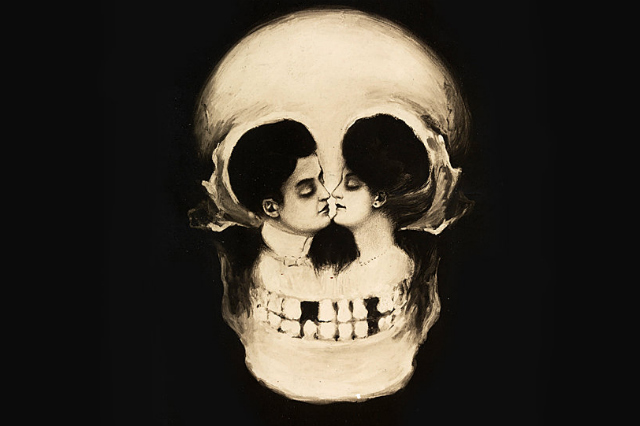
It was perhaps with some relief that the fourth gallery showed us a lighter view of death – in fact, rather unusually, death’s relationship with eroticism as representations of death were shown intertwined with the nude and appearing to infiltrate the embrace of lovers. In this room, I loved the little optical illusion postcards which reminded me a bit of Dali. The skull appears in each to be the most prominent symbol, but look again and you can see a perfectly innocent domestic scene, which bears no relation at all to the skull which it at first appears to represent.
deathwellcome

La Vie et la Mort, Leben und Tod (Postcard c.1900-10)

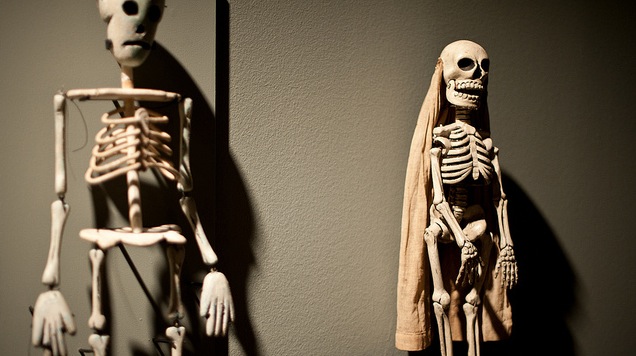
The final room was a representation of the Dia de los muertos festival which has so fascinated me, along with other cultural representations of death in society around the world. I was particularly drawn towards Dan Salvo’s photos of shrines and elaborate altars (known as ofrendas) which are designed to welcome the spirits of those who have departed. I also loved the wall of Muertos dolls straight out of Mexico.

Press+Preview+Death+Self+Portrait+Exhibition+IzQ7EoHlYYxl 8187392941_767eaca1e2_z 8187378029_e3d0f9c713

So with some greater sense of joy, we left the exhibition, full of joys of the Mexican carnival, that was at least until we saw the last wall of the show which gave statistics about the causes of death around the world. Then our joy turned to slightly less jovial stark realism mixed with scientific curiosity as, captivated, we spent a good 5 minutes fascinated by the statistics which show that, far from the horrors of war, the greatest killer of mankind is the role of disease, illness and other irreparable physical conditions. Now if that isn’t a reminder to seize the day, I don’t know what is.

Death: A Self-Portrait is on at the Wellcome Collection until 24 February 2013


On the Seventh day of Christmas, my Normy gave to me…

…seven swans a-swimming

So on the sixth day of Christmas, poor Normy never managed to give his loved one Normette any gift at all. Or, to put it accurately, he did give a gift, but Normette would have had to fly all the way out to the Caribbean to get her hands on it, and what she would do with 6 slightly sun-roasted geese complete with an underlying taste of sun tan lotion she didn’t know. So as for the seventh day of Christmas, Normy had all 3 of his fingers and his 1 thumb crossed in the hope that his next gift would be a success, and Normette had her carefully curled eyelashes equally crossed in the hope that this time she might actually receive something she could enjoy, or at the very least get her hands upon!

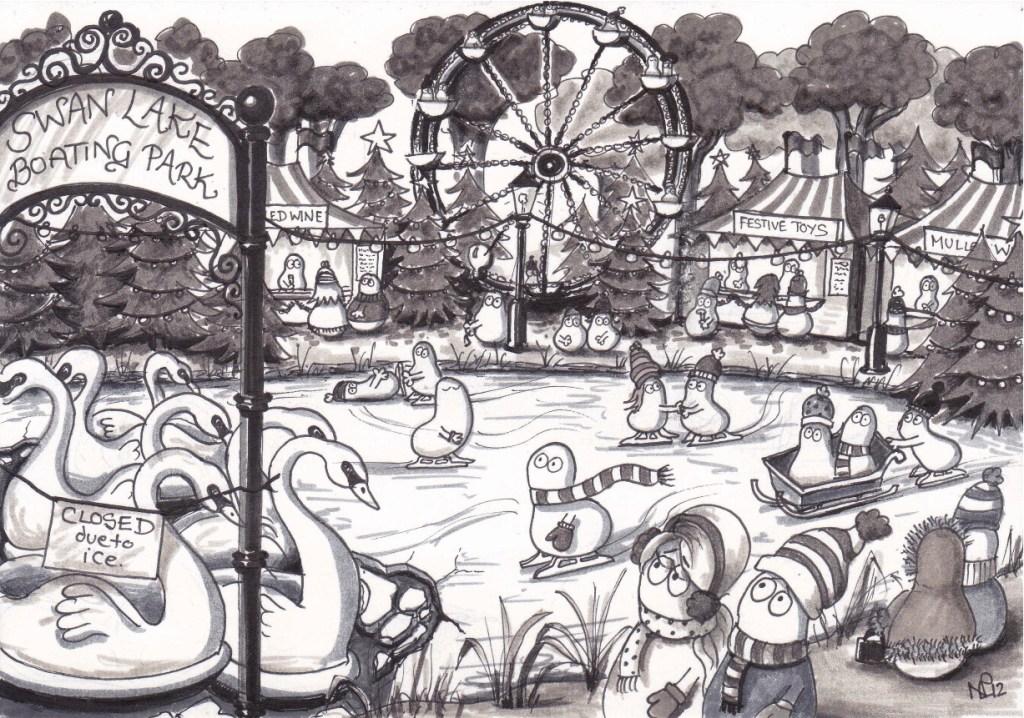
Up next in the 12 days carol is the seven swans a-swimming. Normy wasn’t overly sure how to go about gifting 7 swans. It seemed altogether rather extravagant to him, and what with there being some antiquated law about its being treason towards Her Majesty Queen Normabeth II if you kill a swan in her realm (allegedly she owns them all), Normy thought he had better steer clear of the real thing. Instead he had a brainwave! He could take Normette on a trip down to the local park, where, as luck would have it, there was a “Swan Lake boating park”, whereby those Norms who enjoy bobbing around on the water, could hire a swan-shaped boat and sail around the large lake to their hearts’ content. Why, he would even hire 7 of the things if he needed to!

So off they went, Normette barely containing her excitement as they went on their merry way to collect her latest present. However this excitement was, as ever, shortlived. No sooner had they arrived in the boating park, than they noticed an ugly large sign alerting them that Swan Lake was closed! The swan-shaped boats were there, but there was certainly no swimming, or boating to be done in them – the lake was frozen solid! Poor Normy! Poor Normette!

On the 7th day of Christmas my Normy gave to me, 7 swans a-swimming (2012 © Nicholas de Lacy-Brown, pen on paper)

On the 7th day of Christmas my Normy gave to me, 7 swans a-swimming (2012 © Nicholas de Lacy-Brown, pen on paper)

However there is surely a happy ending to this story… The lake may be frozen, but just look what a magical ice-skating rink it has become. As Norms young and old set out on their Norm-tailored skates, toboggans and sledges, dancing and skidding across the lake’s hardened surface, others enjoy the festive Christmas fair which has popped up around it, complete with mulled wine and traditional Christmas toys, and behind, a ferris wheel spins Norms around at a leisurely pace, affording them the best view of the frozen lake, the market and the woods beyond.

So no swans a-swimming, but this winter wonderland must be worth some brownie points surely? Well done Normy, you’re getting there! Let’s hope his luck continues on the eight day of Christmas…

© Nicholas de Lacy-Brown and The Daily Norm, 2001-2012. Unauthorized use and/or duplication of the material, whether written work, photography or artwork, included within The Daily Norm without express and written permission from The Daily Norm’s author and/or owner is strictly prohibited. Excerpts and links may be used, provided that full and clear credit is given to Nicholas de Lacy-Brown and The Daily Norm with appropriate and specific direction to the original content.

On the Sixth day of Christmas, my Normy gave to me…

…six geese a-laying

Now Normette would be the first to admit that her presents from Normy haven’t exactly been a huge success so far. The Norm-pear tree was pretty good, albeit that it takes a lot of watering and doesn’t survive at all well in this chilly weather, oh and the partridge perched in it keeps on attempting to peck at the baby Norms; then there were the two turtle-doves who wouldn’t fly or fit in a dove cot; the three French hens were awfully chic but ever so demanding, and as for the four colly birds – by the time they had flown from their pie, shocked the guests and splattered gravy all over Normette’s living room, they then proved a devil to catch. And perhaps it’s better not to mention the five gold rings, one of which caused an irrevocable breakdown in Normette’s trust for Normy (despite his later protestations that the fifth ring was presented in homage to the carol, and not intended for another lover!). Despite all of this, when the sixth day of Christmas came, Normette was rather looking forward to receiving another gift, and Normy saw it as an opportunity to redeem himself.

Imagine their shock then when no present turned up! Let me explain… Next on the list in The Twelve Days of Christmas are the six geese a-laying. In pursuit of six egg-laying geese, Normy called his local farmer and explained what he wanted. Farmer Norm noted down the order, but was rather busy skinning some Turkeys for a mountain of Christmas orders, so he passed on the order to 6 geese on his farm explaining what Normy wanted.

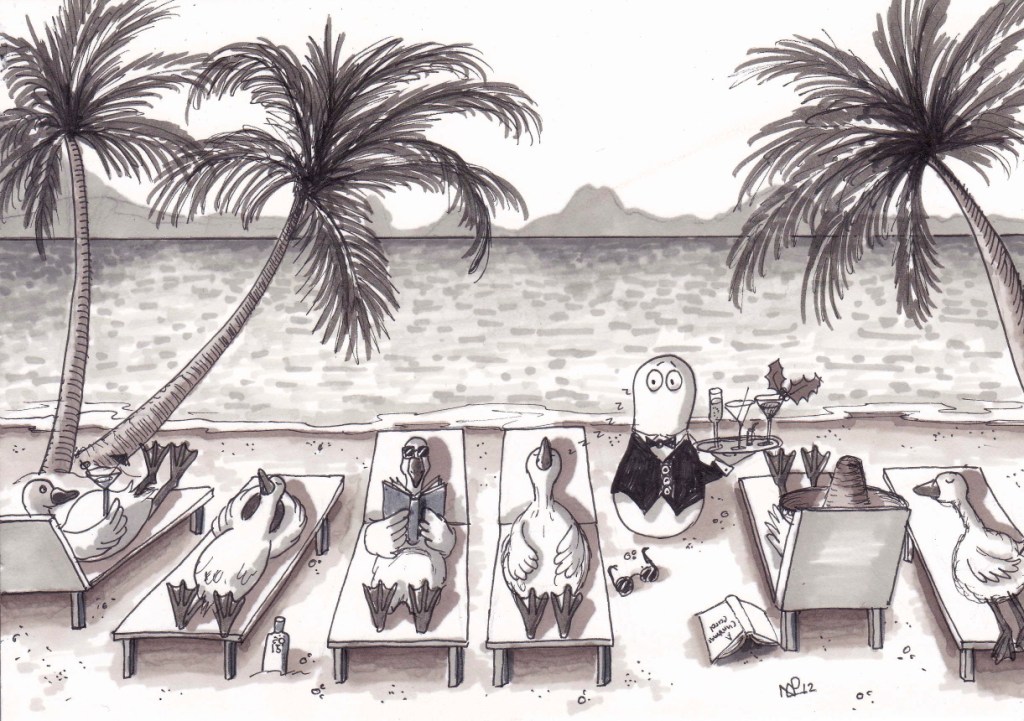
Now geese are not the cleverest of birds, and when they saw that Normy wanted “six geese a-laying”, they assumed he wanted six geese lying down. Now “lay” is the past tense of “lie”, so it’s not altogether surprising that they made this obvious grammatical mistake, especially as geese are not that used to reading… Anyway, the geese, being something of a group of opportunists, decided that since they were expected to present themselves lying down, they may as well do it somewhere nice. And seeing as Normy had already sent payment to the farmer for the geese, the very same pesky birds decided to take the cash and book themselves the first available flights to a location where lying back would be enjoyable.

And so, while the six geese should have been a-laying big eggs in Normette’s backyard, where do you think they ended up? Why, lying back having a splendid time on a beach in the caribbean, and not an egg or nest in sight!

On the Sixth day of Christmas my Normy gave to me six geese a-laying (2012 © Nicholas de Lacy-Brown, pen on paper)

On the Sixth day of Christmas my Normy gave to me six geese a-laying (2012 © Nicholas de Lacy-Brown, pen on paper)

Poor Normy. Poor Normette. Let’s cross our fingers and hope that Normy has better luck on the Seventh day of Christmas…

© Nicholas de Lacy-Brown and The Daily Norm, 2001-2012. Unauthorized use and/or duplication of the material, whether written work, photography or artwork, included within The Daily Norm without express and written permission from The Daily Norm’s author and/or owner is strictly prohibited. Excerpts and links may be used, provided that full and clear credit is given to Nicholas de Lacy-Brown and The Daily Norm with appropriate and specific direction to the original content.

On the Fifth day of Chritsmas my Normy gave to me…

…five gold rings

Poor Normy has got himself into a bit of a pickle over this one. Trying to remain as faithful as possible to the words of the traditional carol, The Twelve Days of Christmas, Normy decided to give to his loved one, Normette, five gold rings upon the fifth day of Christmas. Little could he foresee the trouble that would ensue.

On receiving the package containing her latest gift from Normy, Normette’s eyes grew wider and wider with delight as she uncovered one gold ring after another. However her happiness soon turned to consternation. You see Norms only have one arm, and four fingers – well, three fingers and a thumb to be exact. So having slipped one gold ring over each of her fingers and thumb respectively (they fitted like a glove), imagine her confusion when Normette found a further fifth ring at the bottom of the package. Why could this be? Norms only have four fingers, so what on earth would the other one be for, she thought. It was too small for her wrist, and Norms don’t have ears upon which a ring can be hung. Well then, there was only one conclusion she could make. With tears in her eyes, and filling up with rage and distress and utmost horror, Normette came to the only conclusion she considered to logically fit the facts…Normy must be having an affair!

On the 5th day of Christmas my Normy gave to me...5 gold rings (2012 © Nicholas de Lacy-Brown, pen on paper)

On the 5th day of Christmas my Normy gave to me…5 gold rings (2012 © Nicholas de Lacy-Brown, pen on paper)

Oh dear. Something tells me there won’t be “peace on earth and goodwill to all Norms” in the home of Normy and Normette this Christmas! Let’s hope Normy can make up for his faux pas with a suitably lavish gift on the sixth day of Christmas…

© Nicholas de Lacy-Brown and The Daily Norm, 2001-2012. Unauthorized use and/or duplication of the material, whether written work, photography or artwork, included within The Daily Norm without express and written permission from The Daily Norm’s author and/or owner is strictly prohibited. Excerpts and links may be used, provided that full and clear credit is given to Nicholas de Lacy-Brown and The Daily Norm with appropriate and specific direction to the original content.

On the Fourth day of Christmas, my Normy gave to me…

…four colly birds

I know what you’re thinking – is that a misprint – isn’t it 4 calling birds? Well, here’s the newsflash – 4 calling birds is wrong! And thank goodness for Normy, whose dedicated research uncovered this now largely unknown mistake!

Yes, persevering in his hunt of the gifts fabled to be given to a loved one in the carol, The Twelve Days of Christmas, Normy was researching online to find out where on earth he would find 4 calling birds to give to his dear Normette…only to discover that actually he should be giving her 4 colly birds. Various theories exist online as to why the colly of the 16th century verse gradually became mixed up and morphed into calling birds. But now that the mistake has firmly taken hold in the consciousness of so many, we at The Daily Norm thought it was about time the record was put straight. And not only that. Normy was adamant that he would give Normette a present representing the correct version of the carol.

However, despite his efforts, poor Normy got carried away with his internet research. Having discovered that the word colly derives from colliery, (which is a coal mine) and that a colly is actually another word for a blackbird, this nickname being given because of the blackbird’s coal-like black feathers, Normy then started researching where he could buy blackbirds. Sure enough, he came across that other popular verse, Sing a song of sixpence, A pocket full of rye. Four and twenty blackbirds, Baked in a pie, and quite forgetting which lyrics he was meant to be emulating, ordered 4 blackbirds baked in a pie! Imagine then the shock Normette experienced when she sat down to a Christmas feast with her friends and family only to break into a pie full of live blackbirds! I’m not sure she will ever get over the shock!

On the 4th day of Christmas my Normy gave to me 4 colly birds (2012 © Nicholas de Lacy-Brown, pen on paper)

On the 4th day of Christmas my Normy gave to me 4 colly birds (2012 © Nicholas de Lacy-Brown, pen on paper)

Let’s hope Normy does better on the fifth day of Christmas…

© Nicholas de Lacy-Brown and The Daily Norm, 2001-2012. Unauthorized use and/or duplication of the material, whether written work, photography or artwork, included within The Daily Norm without express and written permission from The Daily Norm’s author and/or owner is strictly prohibited. Excerpts and links may be used, provided that full and clear credit is given to Nicholas de Lacy-Brown and The Daily Norm with appropriate and specific direction to the original content.

On the Third day of Christmas, my Normy gave to me…

…three French hens

Now that’s more like it. A little bit of class, newly arrived straight from across the channel via eurostar. These three french hens are the height of chic. There’s the typically-French hen, sporting “le pullover” in iconic stripy blue and white, a string of onions and of course a little black beret; then fashionista-hen, draped with Coco Chanel’s characteristic long beads of pearls and a quilted chanel bag, along with louboutin shoes and a waft of Chanel No.5; and finally cabaret-hen, straight out of the Moulin Rouge herself, with a fetching outfit of fishnet and can-can frills, topped with an exuberant feathered head-dress (as if she needed more feathers).

Oh yes, these hens ought to perfectly reflect Normette’s stylish bearing, although she must remember that French hens aren’t just any old hens. Oh no. They require regular trips to the Harrods pet pampering salon, a cosy cashmere nest in which to lay their Fabergé eggs and a diet full of French delicacies such as oysters, baguette, moules-frites and, ewww, frogs legs… hmmm, good luck with sourcing those Normette.

On the third day of Christmas, my Normy gave to me...3 French Hens (2012 © Nicholas de Lacy-Brown, pen on paper)

On the third day of Christmas, my Normy gave to me…3 French Hens (2012 © Nicholas de Lacy-Brown, pen on paper)

What will Normy give her on day four?

© Nicholas de Lacy-Brown and The Daily Norm, 2001-2012. Unauthorized use and/or duplication of the material, whether written work, photography or artwork, included within The Daily Norm without express and written permission from The Daily Norm’s author and/or owner is strictly prohibited. Excerpts and links may be used, provided that full and clear credit is given to Nicholas de Lacy-Brown and The Daily Norm with appropriate and specific direction to the original content.

On the Second day of Christmas, my Normy gave to me…

… two turtle doves (and a partridge in a Norm-pear tree)

These extravagant Christmas presents on each of the 12 days of Christmas are all very well, but as Normette has quickly found out, some of them are more trouble than they’re worth. Take day two’s offering. Two turtle doves? What kind of a present is that? Not only are these strange creatures a kind of hybrid between dove and turtle, but sadly for Normette, who has all sorts of Christmas shopping to get on with (not to mention a manicure down at the local beauty salon) her turtle doves appear to have adopted all the sluggardly pace of a turtle, and none of the graceful speed of a dove. Not only that, but with a great lumbering shell on their backs, how ever is Normette supposed to fit the creatures into the dovecot provided by her lover on this second day of Christmas?

Let’s hope he does better on the third…

On the second day of Christmas my Normy gave to me...Two turtle doves (2012 © Nicholas de Lacy-Brown, pen on paper)

On the second day of Christmas my Normy gave to me…Two turtle doves (2012 © Nicholas de Lacy-Brown, pen on paper)

© Nicholas de Lacy-Brown and The Daily Norm, 2001-2012. Unauthorized use and/or duplication of the material, whether written work, photography or artwork, included within The Daily Norm without express and written permission from The Daily Norm’s author and/or owner is strictly prohibited. Excerpts and links may be used, provided that full and clear credit is given to Nicholas de Lacy-Brown and The Daily Norm with appropriate and specific direction to the original content.

On the First day of Christmas, my Normy gave to me…

…a partridge in a Norm-pear tree.

We’re into December and Christmas is but weeks away. Hard to believe really that it’s come around so quickly, but now that my decorations are up, it’s time to get the Norms into gear as well.

This year, as part of the Norms’ celebration of Christmas, the Norms have decided to recount one of their favourite Christmas carols: “The Twelve Days of Christmas” in illustrated form. Now before you say anything, I know that the 12 days of Christmas don’t start until after Christmas day itself, but let’s face facts here, no one is really interested in Christmas much after the Downton Abbey Christmas special has aired at around 10pm on the 25th. So it’s only appropriate that the Norms’ recollection of this much-loved carol is celebrated now, on these heady days leading up to Christmas.

So, as the familiar carol goes, on the 12 days of Christmas, Normy gave his lover a gift each day, the gift becoming more and more extravagant as the days went on.

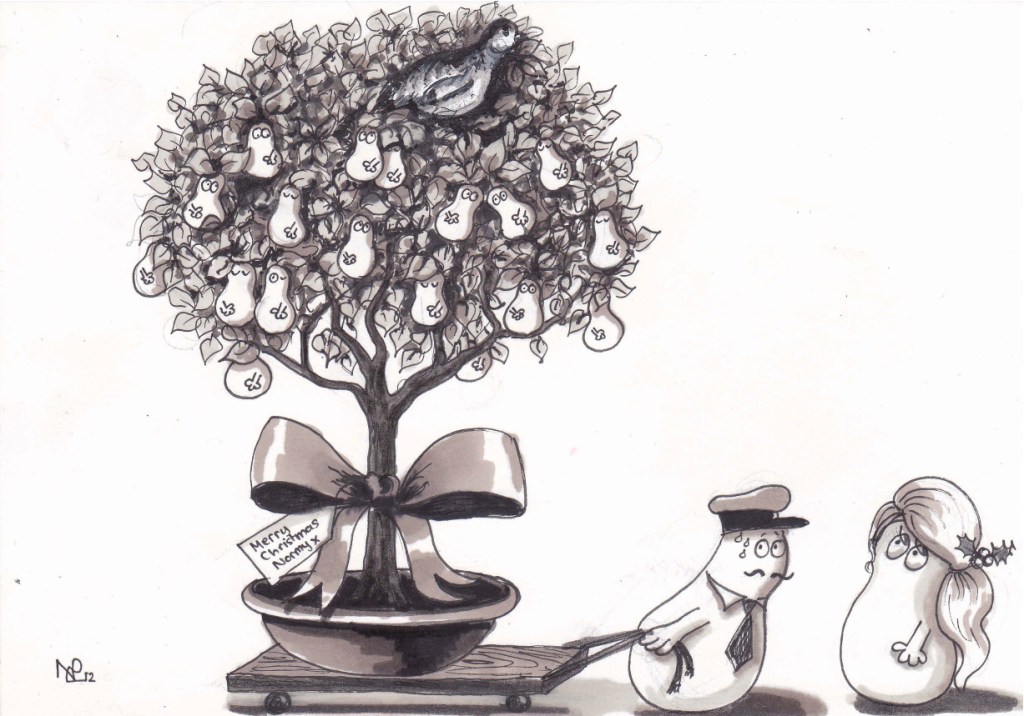
A partridge in a Norm-pear tree (2012 © Nicholas de Lacy-Brown, pen on paper)

A partridge in a Norm-pear tree (2012 © Nicholas de Lacy-Brown, pen on paper)

“On the first day of Christmas, my Normy gave to me, a partridge in a Norm-pear tree”.

Now this may be the first gift of many, but do not underestimate its value: the Norm-pear tree is a rare and interesting phenomenon, rarely seen by us humans. While scientists looking into the complex genealogy of the Norm species have yet to understand the true process by which a Norm is born, it is widely considered that Norms, who are by nature intrinsically pear-shaped, are actually born from the Norm-pear tree. Starting as flowers with a fragrance as sweet as honeyed nectar, and a colour the shade of azure-tinted white, the Norm-pears take several months to develop from a small round blob into the perfect curvaceous Norm-shape we love and know. In the final stages of gestation, the Norm develops his characteristic one arm and his wide eyes open to the light of day. At this point it is thought that the Norm will fall to the ground, leaving his leaves and stalk behind on the tree, and will, owing to his gelatinous form, bounce a little until coming to a stop. And so the Norm life begins.

So that’s the theory, and you will, no doubt, understand now what a precious gift Normy has given his lover on the first day of Christmas. The fact that there is a pesky partridge sitting inside it is by-the-by.

What will Normy give his lover on the second day of Christmas?

© Nicholas de Lacy-Brown and The Daily Norm, 2001-2012. Unauthorized use and/or duplication of the material, whether written work, photography or artwork, included within The Daily Norm without express and written permission from The Daily Norm’s author and/or owner is strictly prohibited. Excerpts and links may be used, provided that full and clear credit is given to Nicholas de Lacy-Brown and The Daily Norm with appropriate and specific direction to the original content.


Norms do… Gauguin

In the same way that an inquisitive child may like playing dress up in the clothes box of his or her parents, so too do the art-loving Norms love to emulate the works of the great artistic masters. In the past on The Daily Norm, the Norms have brought you Frans Hals, Van Gogh, Degas, Picasso, Klimt, Da Vinci and Vermeer to name but a few. Next in line to receive the Norm treatment is none other than the post-impressionist master, Paul Gauguin himself.

Gauguin, master of colour, and leader of the movement out of impressionist naturalism into the more expressionistic unreality, he is famous for his vibrant images of the Pacific island of Tahiti, and perhaps infamous for the rather suspect love affairs he had while on the island, allegedly with underage girls.

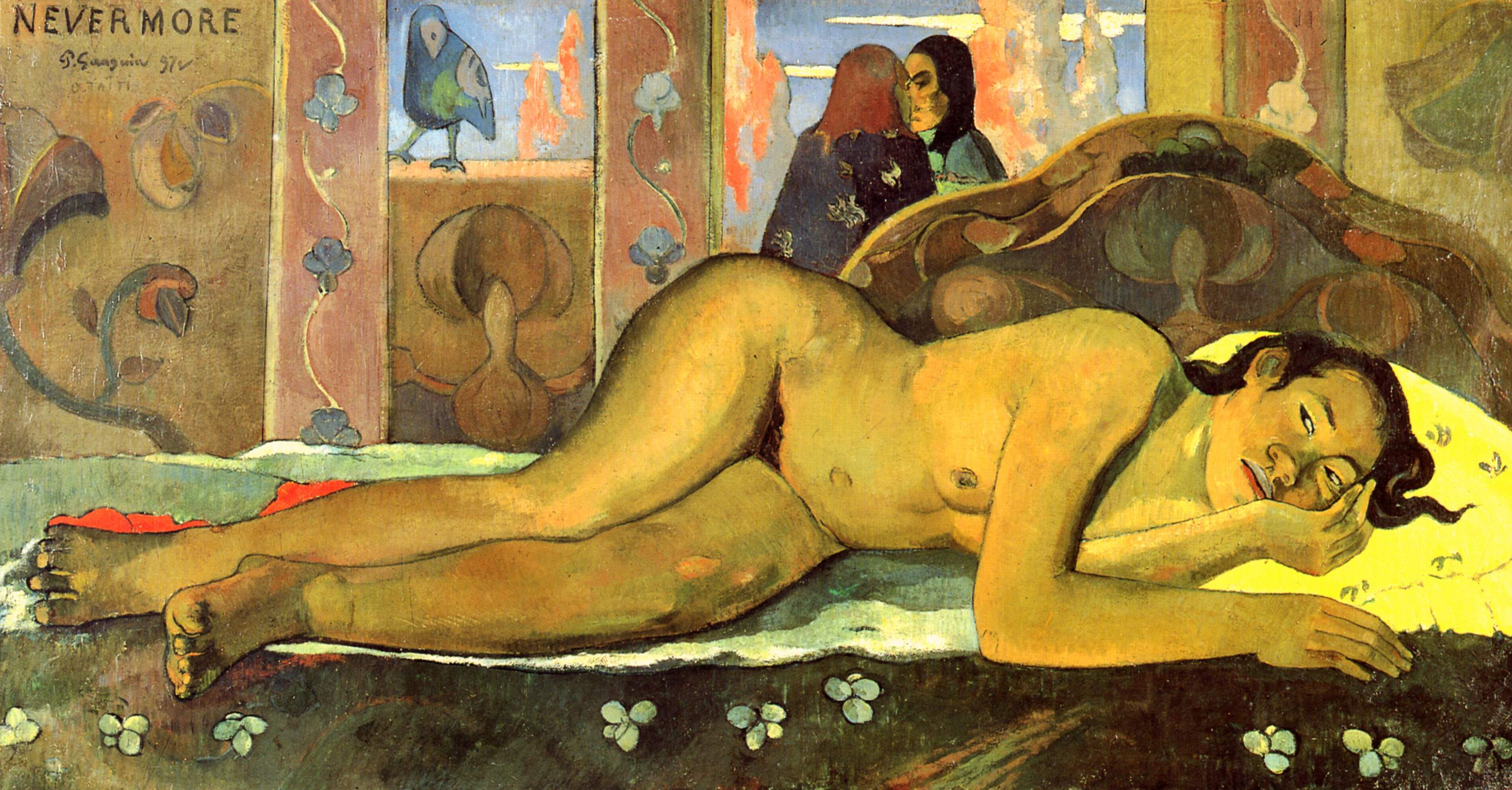
It is undoubtedly one such girl who is the subject of one of Gauguin’s most famous paintings, Nevermore O Tahiti, which today enthralls audiences at its home, the Courtauld Gallery in London’s Somerset House. With its striking bright yellow pillow, its richly coloured background, and the mysterious and melancholy gaze of the nude stretched out before us, it has long been one of my favourite paintings, not just by Gauguin, but in the richly constituted Courtauld collection.

It is hardly surprising then that the time would come when I could resist painting a Norm version of this enigmatic masterpiece no longer. So without further ado, I give you, Nevermore Norm…

Nevermore Norm (after Gauguin) (2012 © Nicholas de Lacy-Brown, acrylic on canvas)

Nevermore was painted by Gauguin in 1897 in Tahiti, the Polynesian island which the French artist made his home in the latter years of his career. The painting is highly enigmatic both in image and title. Asides from being painted onto the canvas, the title is potentially an allusion to the idea of paradise lost (Milton’s epic poem, with which Gauguin would have been familiar) but more likely refers to the poem by Edgar Allan Poe’s The Raven which Stéphane Mallarmé, a French poet, is said to have recited at the Café Voltaire around the time when Gauguin left Paris. In the poem, a man imagines that a bird flapping at the window repeating the word “nevermore” is the spirit of his dead lover. Hence, perhaps, why Gauguin, in his work, has painted the raven stood on the window sill of this colourful Tahitian room.

Nevermore O Taiti, Paul Gauguin (1897) (Courtauld Institute, London) (Source: wikipedia commons)

As for the rest of the painting, its meaning is less certain. The picture is dominated by a full length reclining Tahitian nude.  Her attention seems to be turned towards the figures and the raven in the background. She appears almost to be listening, bitterly aware that the two are gossiping maybe, or conspiring against her, but unwilling to rise from her repose and confront the pair. But could they, on the other hand, be figments of her imagination, together with the almost dreamlike two dimensional blue sky and yellow clouds, and the patterned walls of her home which feels and looks almost like a temporary stage set?

Whatever the meaning behind this elusive piece, it is characteristic of Gauguin’s pursuit, post-impressionism, not of reality, but of introspection. It was in fact Guiguin’s pursuit of inner vision, rather than external reality which led to his quarrel with Van Gogh in Arles which in turn culminated in the latter’s infamous ear-cutting incident. In Nevermore, we see Gauguin at his introspective, expressionist best, fabricating an image from a sense of unreality, while hinting at the tropical bounties of the lush Pacific surroundings in which he was painting.

While Gauguin’s time on Tahiti has since been revealed to have been littered with sexual controversy and even a defamation wrangle with the governor of the Marquesas Islands, it is certain that the works he produced during his extensive stay on the island are amongst his best. Vivid, exploding with colour, as blue skies, tropical plants and the bronzed tones of his beautiful Tahitian women fill the canvas and make the viewer yearn to leave Europe, and its watery impressionistic landscapes behind forever. That is, in fact, what Gauguin did, dying not in his native France, but in Tahiti, of syphilis, alcoholism and all manner of other health problems. But what he left behind was an amazing collection of paintings which have since served to capture Tahiti in the hearts and minds of art lovers across the world.

Here are just a few to feast your eyes upon…

Paul Gauguin, Tahitian Women on the Beach (1891) (wikipedia commons)

Paul Gauguin, Where Do We Come From? What Are We? Where Are We Going?, (1897) (wikipedia commons)

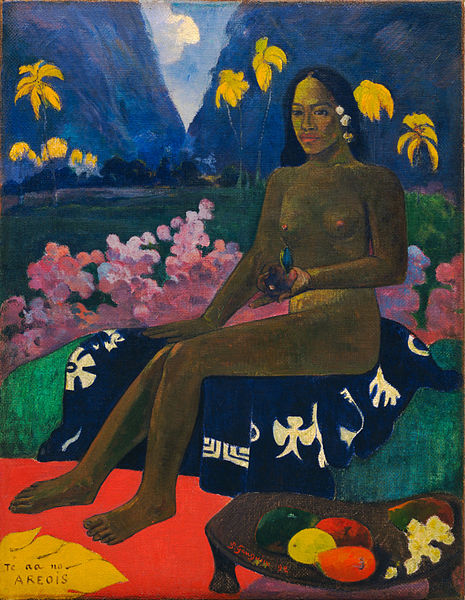
Paul Gauguin, Tahitian: Te aa no areois (The Seed of the Areoi) (1892) (wikipedia commons)

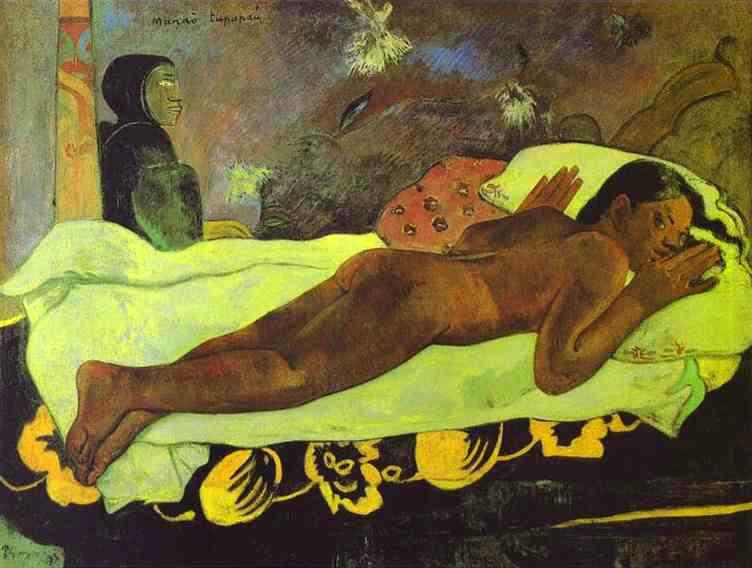
Paul Gauguin, Manao tupapau (The Spirit of the Dead Keep Watch) (1892) source: wikipedia commons

The question now is, who will the Norms set their sights upon next?

© Nicholas de Lacy-Brown and The Daily Norm, 2001-2012. Unauthorized use and/or duplication of the material, whether written work, photography or artwork, included within The Daily Norm without express and written permission from The Daily Norm’s author and/or owner is strictly prohibited. Excerpts and links may be used, provided that full and clear credit is given to Nicholas de Lacy-Brown and The Daily Norm with appropriate and specific direction to the original content.

The Lisbon Sketch II – Norms on a Tram

It’s another busy day in Lisbon’s Praça do Comércio, bustling central square of Portugal’s capital city, and transport hub for the  many passing rambling little trams from Lisbon’s pre-war era. Here in the square which was the site of Lisbon’s former palace before revolution in 1910 made it the centre of the new Republic’s administration, Lisbon locals, business Norms, and tourist Norms alike mix, mingle and meander against the backdrop of the square’s vast geometric cobbled paving and its impressive triumphal arch.

But for these Norms, there is little time to gaze in wonder at the palatial surroundings. For now it’s time to board the number 83 tram which will take these little passengers straight along the coast to Belém, under the gigantic Ponte 25 de Abril and past the little residential districts sprawling in its ample shadow. It’s a busy day and there are plenty already on board, as as these Norms are about to find out, it doesn’t take much to fill these cute little vehicles. Best let them get on with it…

Norms on a Tram in the Praça do Comércio, Lisbon (2012 © Nicholas de Lacy-Brown, pen on paper)

© Nicholas de Lacy-Brown and The Daily Norm, 2001-2012. Unauthorized use and/or duplication of the material, whether written work, photography or artwork, included within The Daily Norm without express and written permission from The Daily Norm’s author and/or owner is strictly prohibited. Excerpts and links may be used, provided that full and clear credit is given to Nicholas de Lacy-Brown and The Daily Norm with appropriate and specific direction to the original content.