Skip to content

Posts from the ‘Art’ Category

Soller: First touch of summer

Although, as I write, some clouds have descended over Mallorca, this moment is the first in a long time when the sun has not shone. And while the sunshine in March often came accompanied by a chilly wind, reminding of winter, last weekend an intensity of heat seemed to welcome in the first touch of summer.

The moment I really felt it was when I was sitting with my family at a sunny table on the Port of Soller. As sun rays bounced across the water of that tranquil marina, through my glass of chilled white wine and onto my face, I became truly entranced by the elysium of summer. Around me, I was enveloped by one of the most beautiful harbours in Mallorca – a natural almost 360 degree inlet ringed by spectacular mountains and packed with a few rows of little white washed houses which to me recall the French Riviera.

Soller FINAL

Soller (2016 ©Nicholas de Lacy-Brown, acrylic on canvas)

It was in that moment that this painting clarified as a mental vision in my mind. I jumped up, asked the waitress for a pen and paper, and on the back of a till receipt made a sketch. A few days later the painting is done. Its key is its simplicity of composition, which allows the viewer the space to breath and reflect on a work filled with the soft colours of the Mediterranean, and to think of their own encounters with this most wonderful part of the world, when the sun first touched them after a long dull winter…

© Nicholas de Lacy-Brown and The Daily Norm, 2001-2016. Unauthorized use and/or duplication of the material, whether written work, photography or artwork, included within The Daily Norm without express and written permission from The Daily Norm’s author and/or owner is strictly prohibited. For more information on the work of Nicholas de Lacy-Brown, head to his art website at www.delacybrown.com

Bacchus & Ariadne

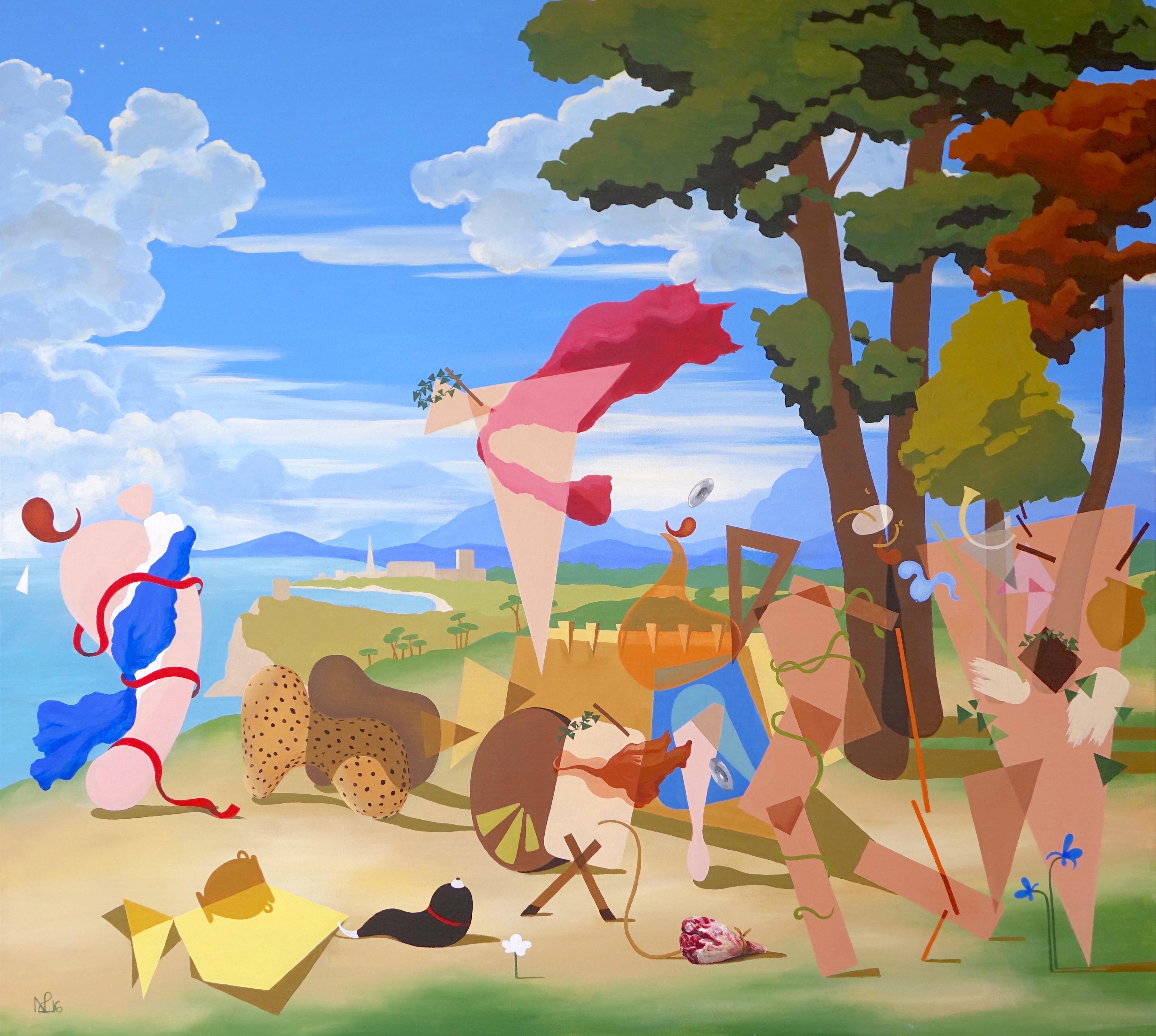
The year toils on, March is upon us, and in line with my new year’s resolution, I have made painting the very heart of my year’s endeavours. In that vein, I am progressing well with a new collection of abstract interpretations, not only of my own experiences, but also of well known masterpieces. Following hot on the heels of my interpretations of Velazquez’s Las MeninasI have now painted what must be my favourite of my entire new collection, an interpretation of Titian’s masterpiece, Bacchus and Ariadne.

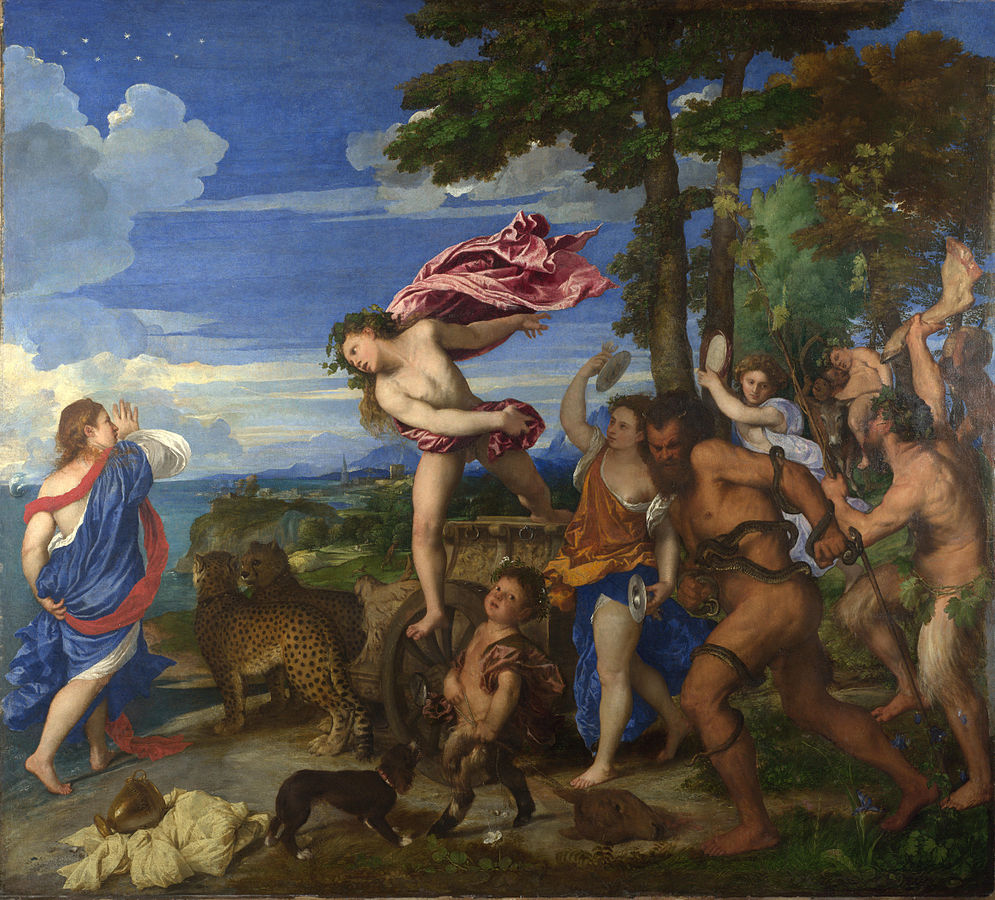
With its stunning sky of ultramarine and the sheer energy of the central character, Bacchus, jumping into the air, the painting has always been one of my absolute favourites in the collection of The National Gallery in London. Painted as part of a cycle of paintings on mythological subjects produced for Alfonso I d’Este, the Duke of Ferrara, the painting is based on a tale told by Roman poets Catullus and Ovid. It depicts Ariadne, daughter of Minos, being deserted by her lover Theseus on the island of Naxos. She is rescued by Bacchus, god of wine who, in a chariot drawn by two cheetahs, sweeps into the scene with his retinue of drunken followers in a campaign to seduce Ariadne. In so doing, he promises her the sky, where, he declares, she will become a constellation of stars, like the Northern Crown which can be seen glimmering in the sky.

Bacchus Ariadne FINAL

Bacchus & Ariadne (2016 ©Nicholas de Lacy-Brown, acrylic on canvas)

995px-Titian_Bacchus_and_Ariadne

Bacchus and Ariadne by Titian, 1522-23 (National Gallery, London)

The composition and the colours are so striking that in painting my own version, I wanted to change neither, instead choosing to retain the stunning blue sky with its rolling fair-weather clouds, while in front simplifying the forms of the characters, the trees and the landscape. In finding ways to “abstract” the figures, I discovered various triangles across the composition, and used this shape, in particular, in depicting the masculine figures in the scene, while for the feminine figures, I used curving forms.

DSC09206DSC09209DSC09205

Nothing can repeat the true genius of the Venetian master, Titian, but my version of this painting, created in perfect ratio to the original, is certainly something of a high point in my new collection of a freshly revolutionised style.

© Nicholas de Lacy-Brown and The Daily Norm, 2001-2016. Unauthorized use and/or duplication of the material, whether written work, photography or artwork, included within The Daily Norm without express and written permission from The Daily Norm’s author and/or owner is strictly prohibited. For more information on the work of Nicholas de Lacy-Brown, head to his art website at www.delacybrown.com

Barcelona (The Yellow Painting)

I’m on a new road, it’s an artistic revolution, and as part of the journey my art has become abstracted. I have discovered the joys of simplicity, like breathing the freshness of countryside air after years spent in a congested city. Perhaps, now I come to think about it, my new style is the subconscious manifestation of my new life in Mallorca, a freshness of mind which has opened up since my departure from London.

Whatever the cause, my mind is alive with new ideas, and when I recently spent the Valentine’s weekend with my partner in Barcelona, this new painting, simply entitled Barcelona (but better known in our household as “The Yellow Painting”) leapt into life. It was inspired primarily by the textures and experience of our hotel room, whose luxurious black bedspread inspired the black form in the centre of the painting, while the rose is of course the very symbol of Valentines. Meanwhile amongst the simplified shapes, the four spires of one face of Gaudi’s Sagrada Familia can be found, as well as the curved square blocks of the Eixample area which predominate the shape of the city when seen from above, and which also appears in the simplified rose.

Barcelona FINAL

Barcelona (The Yellow Painting) (2016 ©Nicholas de Lacy-Brown, acrylic on canvas)

But this painting is so much more than what is plainly visible. It is a feeling, a sensation – moments of happiness in a weekend of discovery. When we felt free, and excited, and reinvigorated by the city atmosphere. And its predominant colour – a yellow full of hope – just about perfectly sums up the optimism which this new period of creativity has engendered.

© Nicholas de Lacy-Brown and The Daily Norm, 2001-2016. Unauthorized use and/or duplication of the material, whether written work, photography or artwork, included within The Daily Norm without express and written permission from The Daily Norm’s author and/or owner is strictly prohibited. For more information on the work of Nicholas de Lacy-Brown, head to his art website at www.delacybrown.com

Las Meninas: Third Interpretative Exercise

I’m having an artistic revolution, and my head is spinning with shapes and colours. Ever since my last encounter with Velazquez’s Las Meninas last November, a seed has been sewn and new buds of Spring are rapidly taking shape as they shoot forth from my imagination to the tip of my paintbrush.

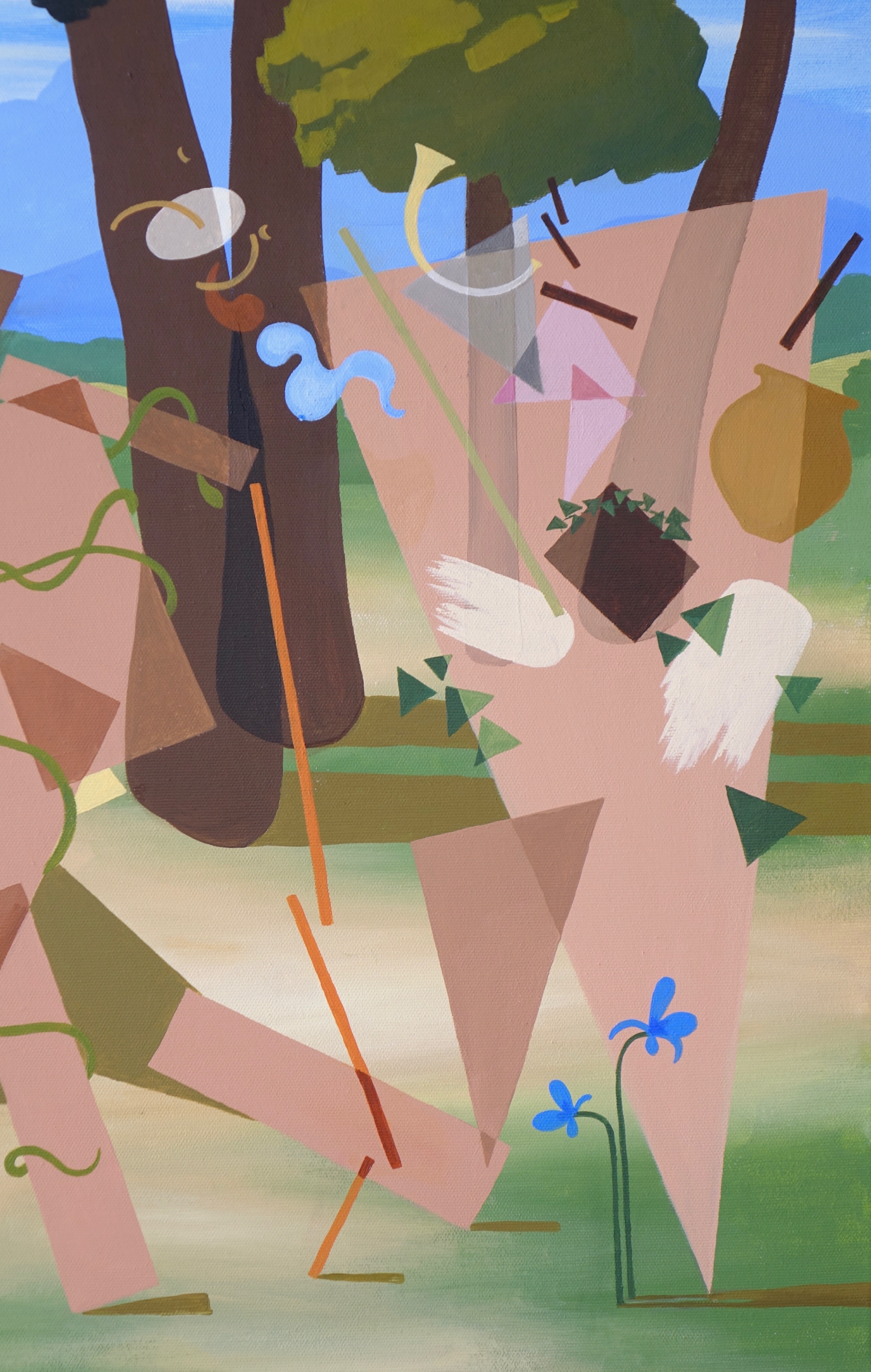
The latest result of this creative flowering is this, the third in my own Las Meninas exercise, each canvas taking a new approach to painting one step further. While in the second of the series, I reduced the famous figures of Velazquez’s work into simplified abstract forms, but maintained the familiar composition, in this third experiment, I have stripped the painting almost entirely of its compositional values, maintaining only the basic three dimensional construct of the room. As for the remainder, all of the shapes which can be found in the second painting are now displaced, recoloured and fragmented, distributed in an energetic whirl of abstracted movement which is entirely free in its composition.

Las Meninas 3 FINAL

Las Meninas: Third Interpretative Exercise (2016 ©Nicholas de Lacy-Brown, acrylic on canvas)

Had I come across a work such as this in an art gallery, I may have assumed that it was easy to paint. Yet as this painting taught me, it was far from simple. The delicacy with which a composition of this nature needs to be approached, not just technically (there are an awful lot of straight lines) but also compositionally, cannot be underestimated. I would spend long periods staring at the painting, trying to work out where the next shape should be placed, knowing that one incorrect angle or placement could throw out the entire energy of the piece, reducing the painting into something mediocre, devoid of its own story.

As it is, and with a few wrong turns rectified along the way, I am delighted with the final composition as it turns out. For me it is a composition rejuvenated, a painting which appears to burst before your eyes. And most importantly it retains, for me, some of the key ingredients of Las Meninas, albeit presenting them in an entirely different way.

© Nicholas de Lacy-Brown and The Daily Norm, 2001-2016. Unauthorized use and/or duplication of the material, whether written work, photography or artwork, included within The Daily Norm without express and written permission from The Daily Norm’s author and/or owner is strictly prohibited. For more information on the work of Nicholas de Lacy-Brown, head to his art website at www.delacybrown.com

Las Meninas: Second Interpretative Exercise

There are some art exhibitions that you go to that simply have the capacity to strike deep. Many shows are pleasing, others interesting, but then there are those which you remember for ever. I’ll never forget for example Frida Kahlo or Henri Rousseau at Tate Modern, Tamara de Lempicka at the Royal Academy, Dali at the Centre Pompidou or Da Vinci at the National Gallery London. Now to that list I add the Kandinsky retrospective at CentroCentro in Madrid, not because it was any better than the Kandinsky I saw many years before at Tate, but simply because the combination of time and energy and who know’s what combined to leave me utterly inspired.

When, the next day, I walked into the Prado and saw Velázquez’s Las Meninas once again, something shifted in my head, and I left an artist converted.

I started my reinterpretations of Las Meninas shortly after the whirl of the Christmas season was over, and my first, Las Meninas (In Our Time) I shared with you a few weeks ago. But my new project was far from over, and this painting, shared today, was the one which leapt into life before my eyes that day in the Prado Gallery when Kandinsky was still very much on my mind.

Las Meninas 2 FINAL

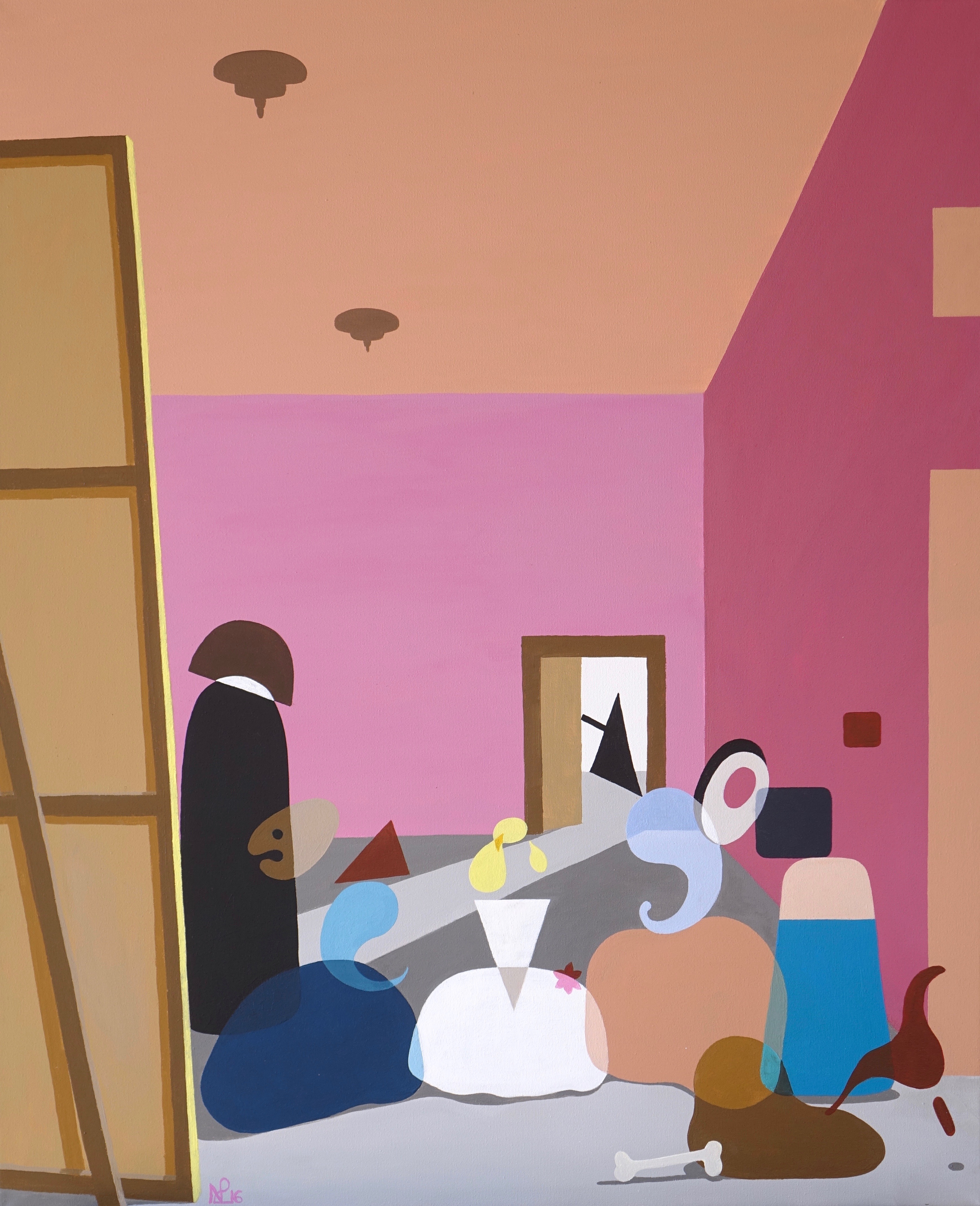
Las Meninas: Second Interpretative Exercise (2016 ©Nicholas de Lacy-Brown, acrylic on canvas)

Las Meninas: Second Interpretative Exercise borrows from Velázquez’s composition, but otherwise radically simplifies the forms of his dramatic personæ, and swaps the dark browns and neutral shades of his painting with a vibrant almost pop-art palette. The result is an image which pleases me incredibly. It is at once abstract but recognisable, tidy but surreal. I had great fun in reimagining each piece of the painting – for example painting the dog’s stretched out arm as a bone, and the nun’s head like a piece of sushi – and best of all, I know that this is only the beginning. Abstraction and simplified forms are spinning around my head. Ideas are overflowing, and I can’t sit still for a need to paint.

It’s why I’ll always remember that Kandinsky show, because it switched on a light in my head which has long remained dormant.

© Nicholas de Lacy-Brown and The Daily Norm, 2001-2016. Unauthorized use and/or duplication of the material, whether written work, photography or artwork, included within The Daily Norm without express and written permission from The Daily Norm’s author and/or owner is strictly prohibited. For more information on the work of Nicholas de Lacy-Brown, head to his art website at www.delacybrown.com

Onwards to Vienna, Part 3: Palaces of Art

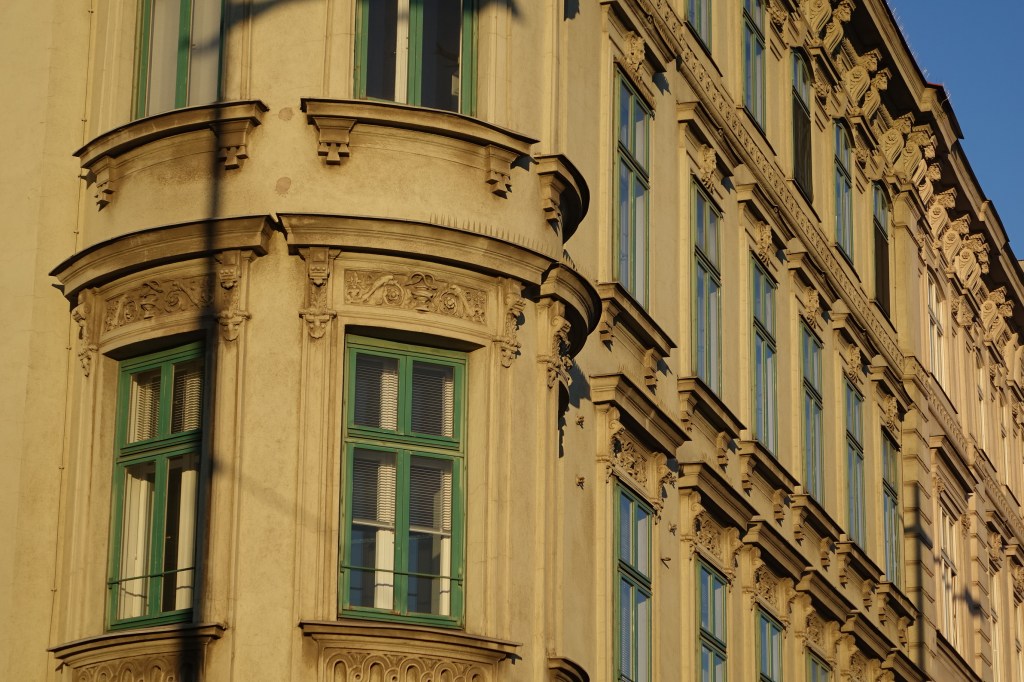
To say that there is a lot of art in Vienna is like saying there are a lot of paellas in Spain. The city literally lives, breathes and exudes art from its every corner and facet. Everywhere you go, large posters advertise the latest sensational exhibition appearing at the Leopold, or the Albertina, while inside the Belvedere and the Kunsthistoriches museums, some of the most famous paintings ever known to the history of art happily reside. We were literally astonished by the wealth of art contained within a small central core of the city, and by the end of our trip were rendered utterly exhausted by the amount of art we saw. But we were all the more fulfilled as a result.

If I were to reproduce a photo of all the paintings we saw in permanent collections and temporary shows alike, the single blog post resulting would probably keep you scrolling downwards for a lifetime. Rather than do that therefore, I wanted to focus a little on the majestic buildings which host Vienna’s amassed artistic treasures, before showing you just a few of the works on show within them.

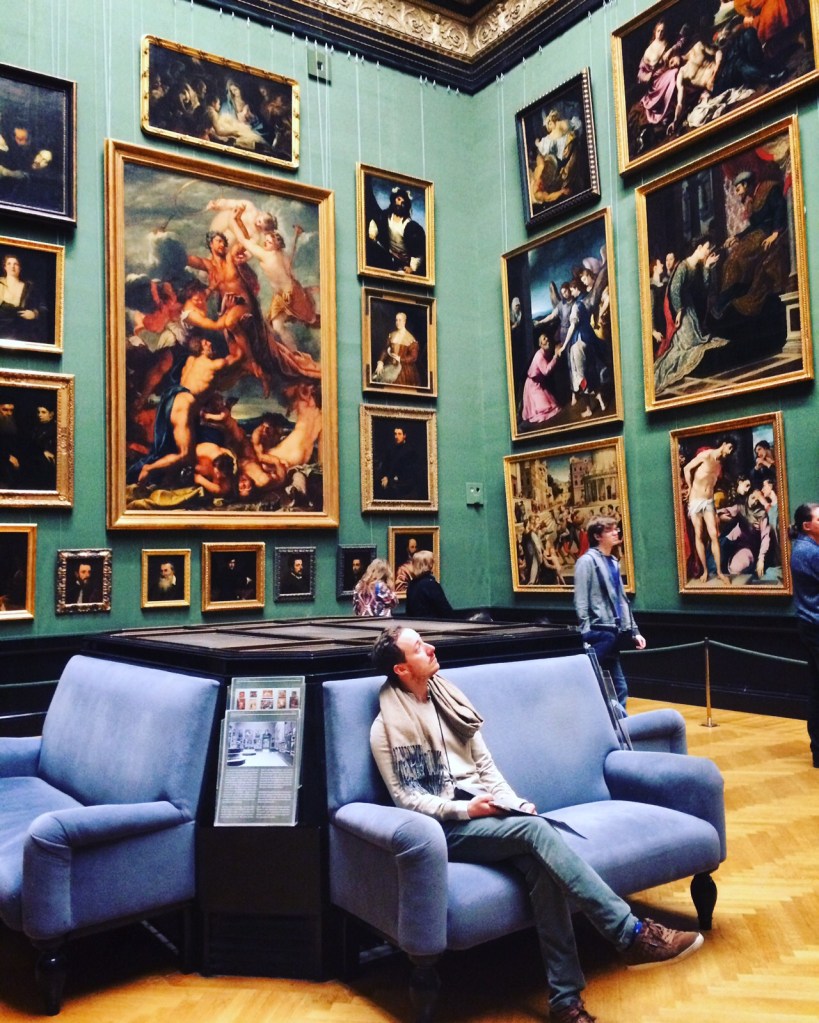
Almost unable to take in the breadth of art at the Kunsthistoriches Museum

Almost unable to take in the breadth of art at the Kunsthistoriches Museum

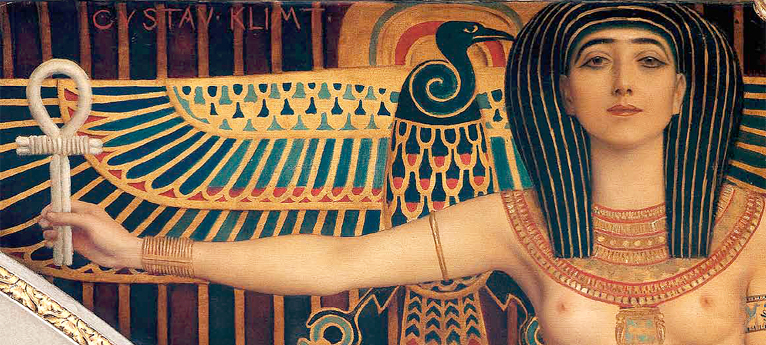
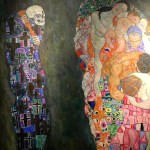
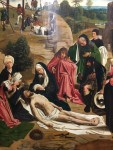
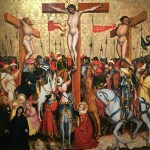
There was no missing the incredible grandeur of the building hosting the Kunsthistoriches Museum (The History of Art Museum), which sits opposite its domed twin – a duo of palaces built some 150 or so years ago upon the advent of the Ringstrasse. With an art collection mainly built up over successive generations of Hapsburg rule, and containing breathtaking masterpieces by the likes of Titian, Rembrandt, Caravaggio and Velazquez, it is no wonder that the museum is visited by more than 1.5 million people every year. But beyond the art on the walls, what is truly momentous is the building itself which, tailor-created especially to hold the very collection which graces the building today, is filled with every kind of creative lavishness, from murals to sculptures, friezes and reliefs, and chief amongst them all, some beautiful wall murals by Gustav Klimt himself.

Klimt murals in the main hallway of the Kunsthistoriches Museum

Klimt5 Lunette Klimt2

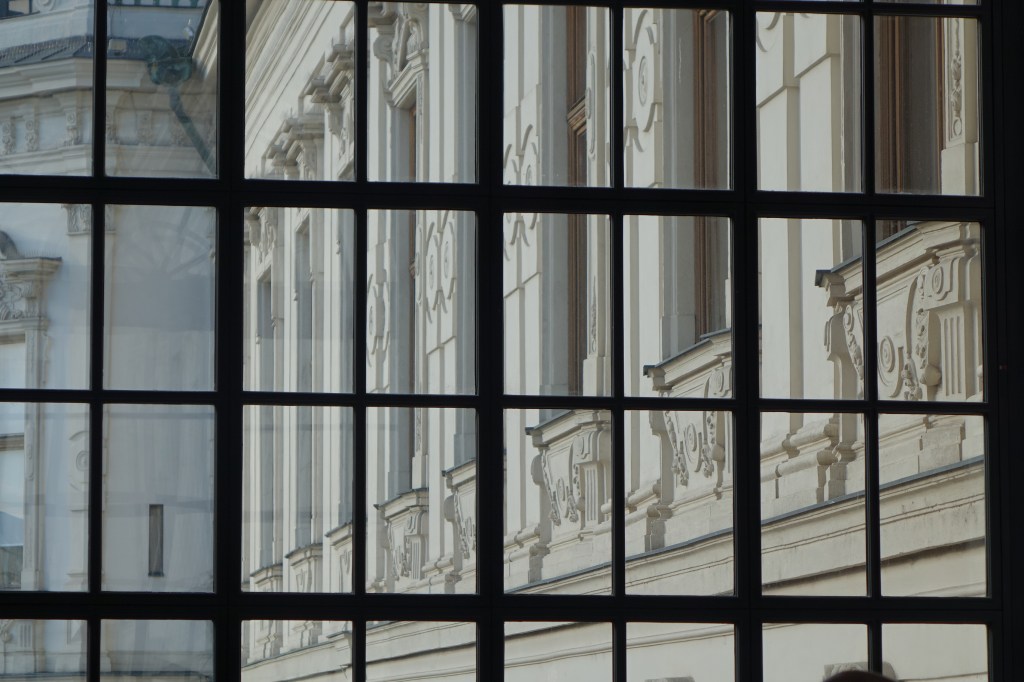
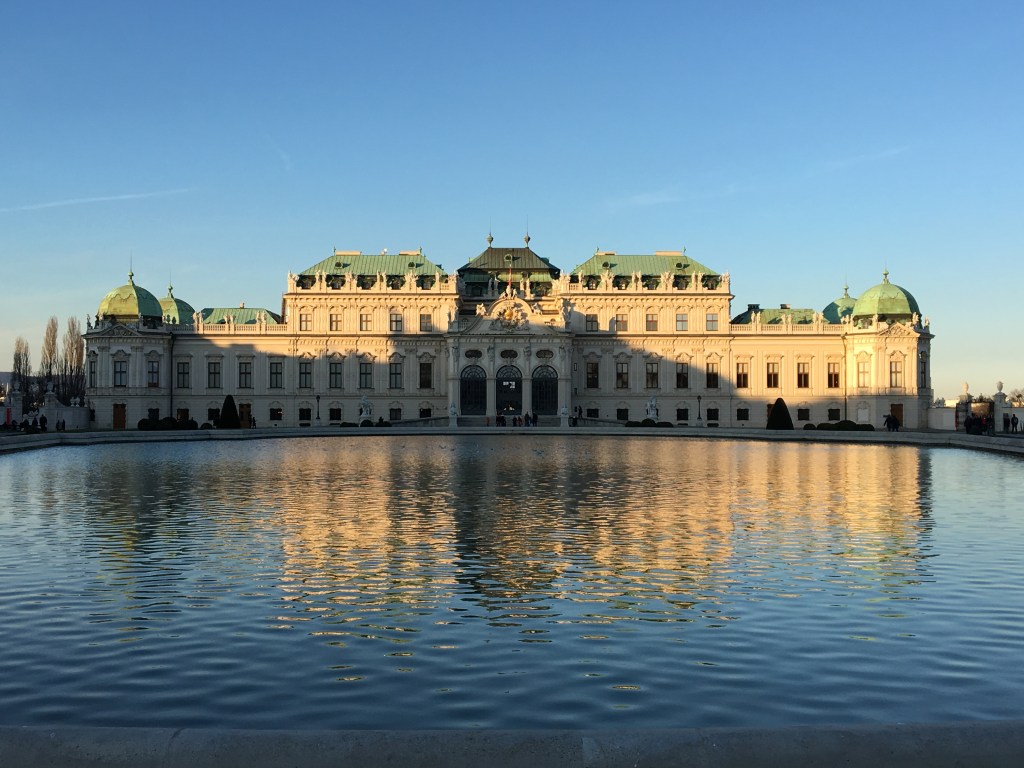
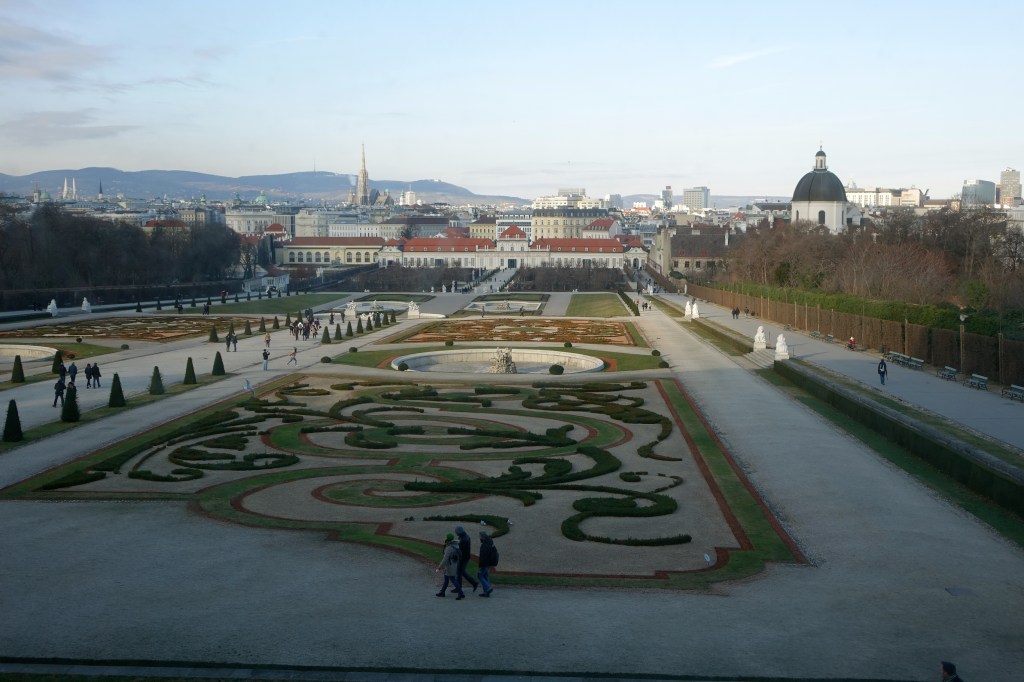
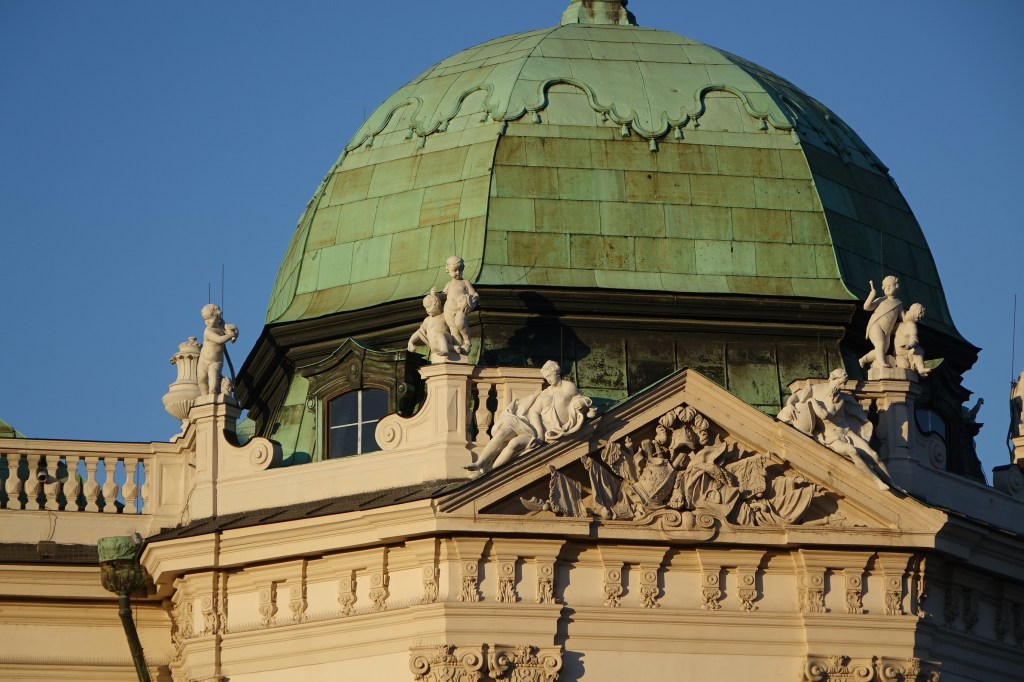
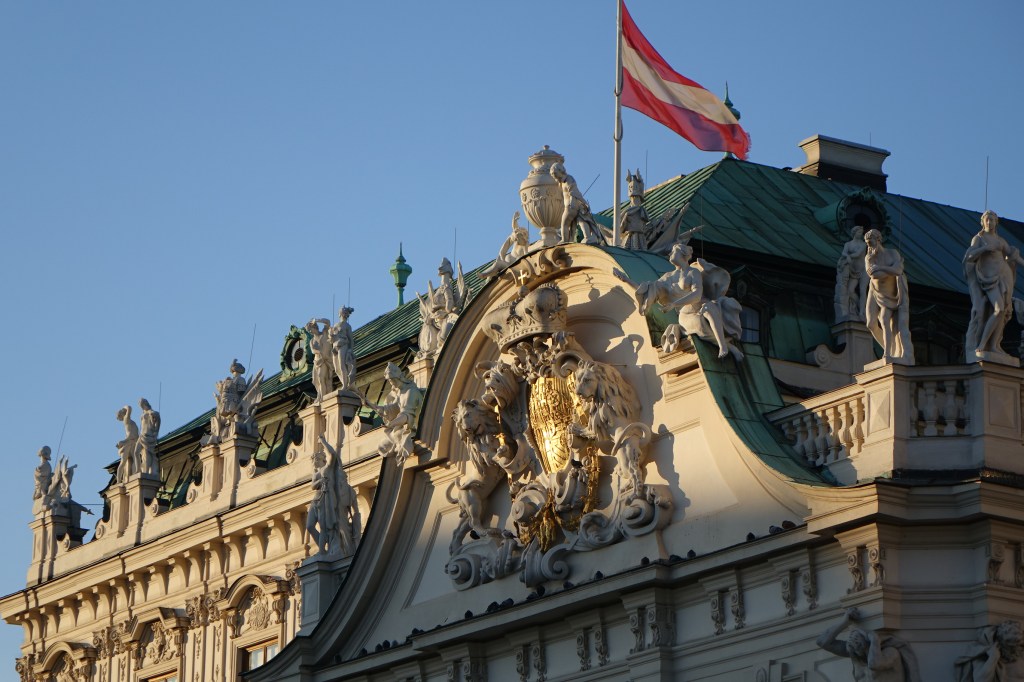
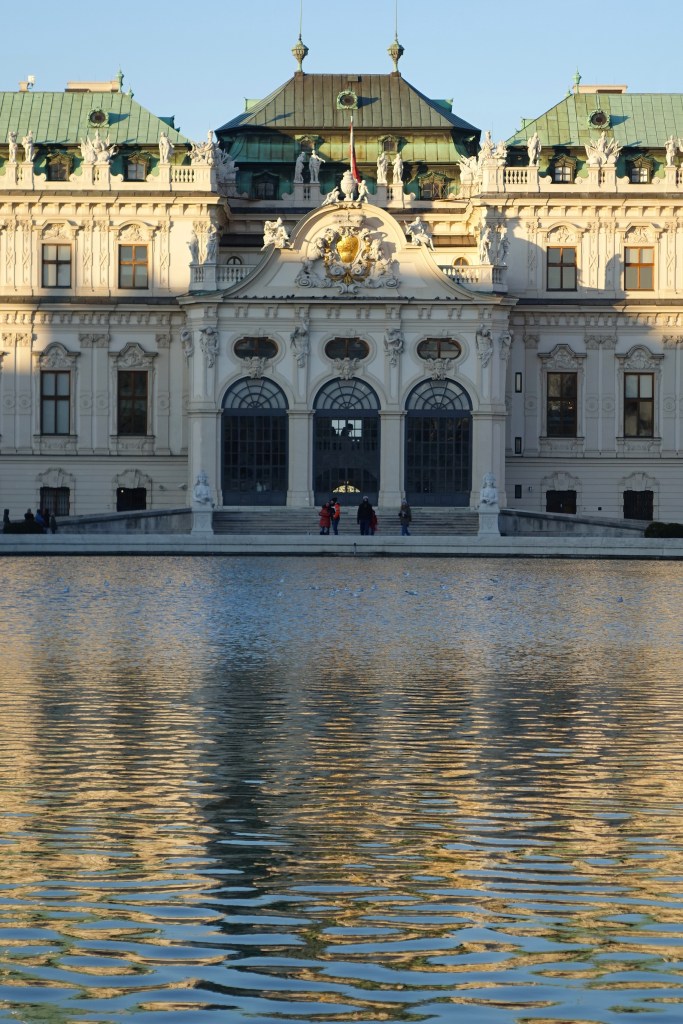
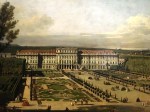
Klimt was of course to take centre stage across Vienna’s artistic offerings, not only in the galleries but in every manifestation of souvenir and guidebook. At the core of the city’s multifaceted Klimt showcase, his famous painting The Kiss lords over all the rest, glimmering with its multi-layered gold leaf in a long gallery on one side of the Upper Belvedere gallery. This equally spectacular palace is just one half of an iconic centre of art which offers exhibitions in both the Upper and Lower galleries and whose buildings are laced with all of the elaborate pomp intended by the original owner, Prince Eugene of Savoy, to evoke the magnificent of his various 17th century military successes.

The beautiful Belvedere

DSC06018 DSC05967 DSC05988 DSC05984 DSC05989 DSC05995 IMG_7449 DSC05997 DSC05991 DSC05981 DSC05992 DSC06021 DSC06008 DSC06017 DSC06006 DSC06014

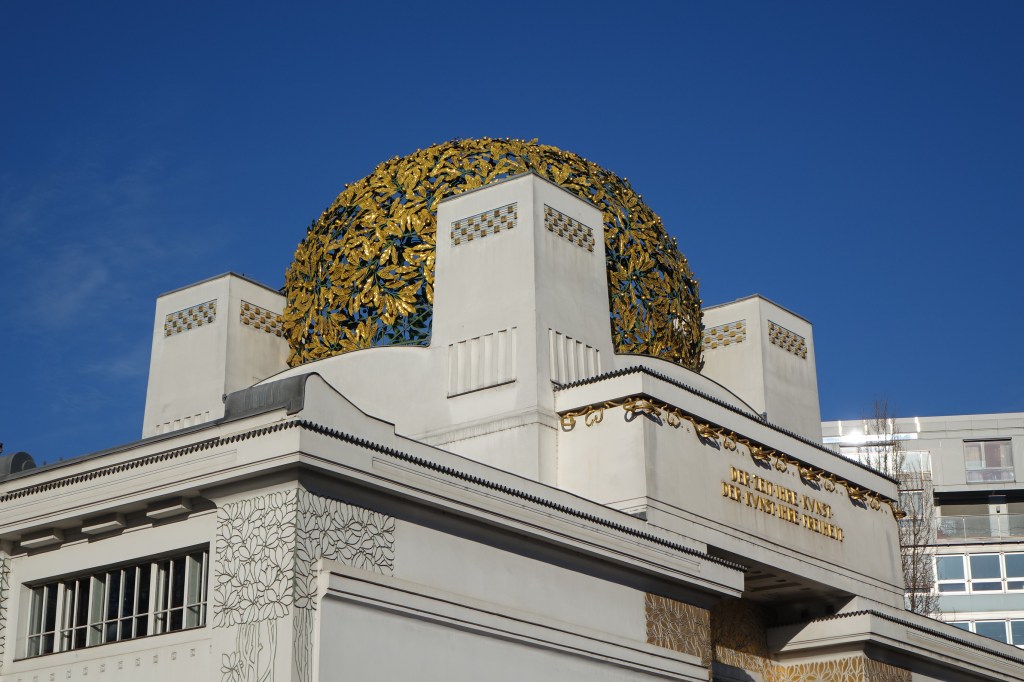
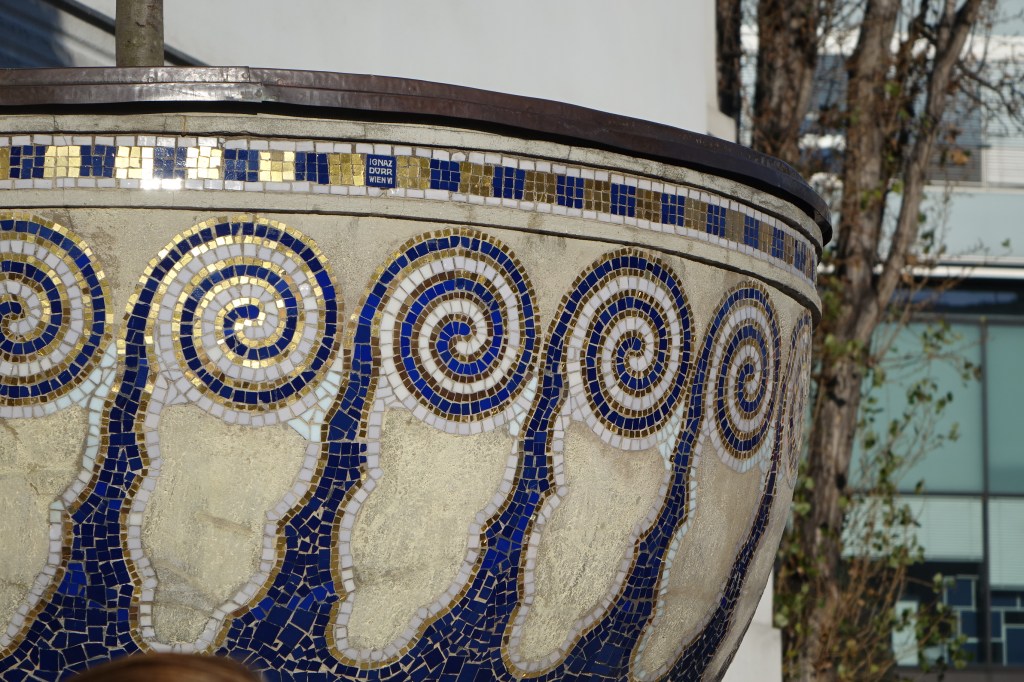
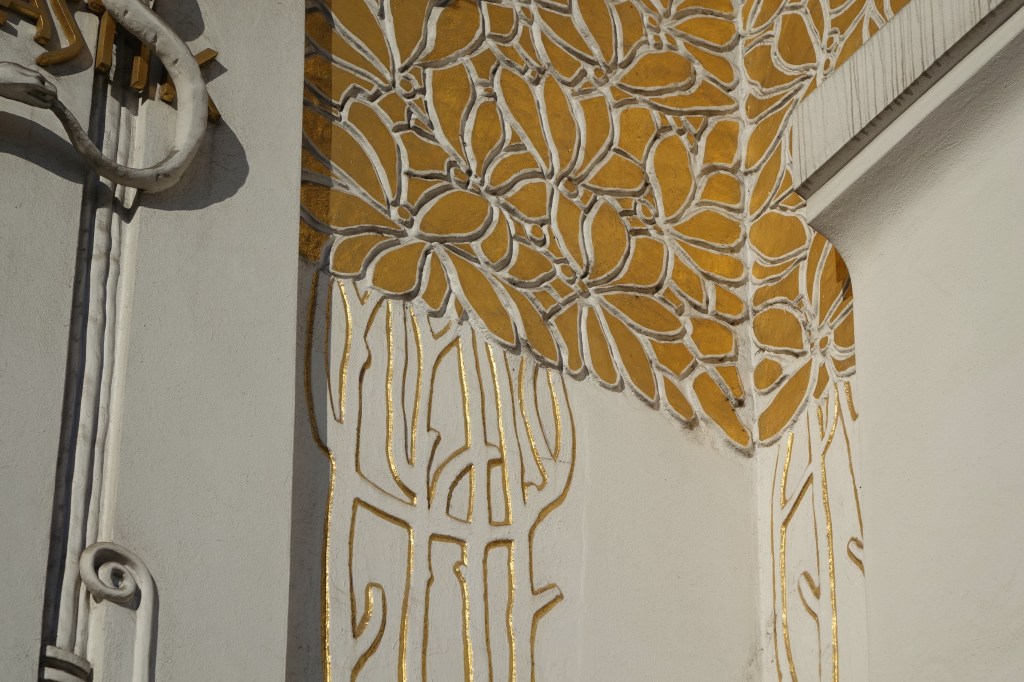
But back to the 20th century, and my favourite of all the Klimt spectacles is the Secession building, a glimmering gold spectacle of modernism constructed in the Jugendstil style as a showcase for the Secession movement’s artists, chief amongst whom was of course Klimt himself. And today, the star attraction is Klimt’s allegorical Beethoven Frieze, one of the most iconic of the artist’s works.

The Secession Building and Klimt’s Beethoven Frieze

DSC06205 DSC06211 DSC06212 DSC06203 DSC06202 DSC06201 DSC06206 DSC06209

000171 I

In all, during 4 days in the city of Vienna, we visited some 8 galleries, an equal number of permanent exhibitions and an additional 12 temporary exhibitions. The vast wealth of art on offer was simply mind blowing, from the ancient treasures of the Kunsthistoriches museum and the delicate 19th century works of the Belvedere, to the in depth studies of Klimt and Schiele in the Leopold museum, and the incredible collection of impressionist art in the Albertina. Below are just a few photos of the many artistic treasures we saw. Far too many to take in, but we made and enjoyed our every attempt.

Lunch in the Café Eiles (Vienna Muse)

There are times in life when a single moment gains more clarity than the thousand moments before and after; when the significant size of a city space shrinks in the coincidence of two people meeting again and again, quite unplanned, as though destiny had it all preemptively narrated. Such were the moments in Vienna when I, previously untouched by the poetic force of a female muse, found myself repeatedly captivated by a mysterious, delicate girl.

It was a fascination which might not have been so fortified were it not for the repetition of the first encounter. I first saw my muse in the elegant cafeteria of the Kunsthistoriches Museum. Dominik and I had both marked her out, quite independently of one another. We were struck by the purity of her face, quite devoid of artificial make up but alive with a natural innocence, and by her clothing which was different. Her outfit looked almost home-made, but betrayed a feminine elegance in each of its carefully combined components.

I might not have thought of her again, had it not been for the coincidence of a second encounter the following day, some kilometres away on the other side of Vienna, in the Café Eiles. Unable to believe the coincidence of quite independently finding the same girl who had so captivated me in the art museum the day before, my interest peaked and I found myself utterly enraptured by this girl. Again she betrayed characteristic elegance as she went about sipping a tea while writing what looked like a journal, and knitting a rather complex scarf.

Vienna Muse FINAL

Lunch at the Café Eiles (Vienna Muse) (2016 ©Nicholas de Lacy-Brown, gouache on paper)

By this point I knew that the girl was becoming something of an inspiration to me, and like paparazzi I grabbed for my camera, desperate to capture the sight of this girl who I was sure I would never see again. It’s just that the following day a third encounter, in the same café, occurred. No longer a coincidence of place, but of timing. Another encounter which appeared to defy chance and confirmed to me that the paths of this girl and I were meant to cross. That she was my muse and that I must paint her.

As soon as I saw my muse on that second encounter this painting formed in my head. Now I have created it, complete with the lunch we ate in the cosy Café Eiles as I sat, captivated by my muse, I feel somehow satisfied that my muse has been set down on paper. But I can’t help but feel sad that even now, after three coincidental encounters I know nothing more about the girl who ensnared me. Neither her name, nor her voice, nor even a single thing about her. I just know that to me she was very special. Maybe one day we’ll meet again.

Vienna Muse DETAIL

Lunch at the Café Eiles (Vienna Muse) detail, 2016 ©Nicholas de Lacy-Brown

© Nicholas de Lacy-Brown and The Daily Norm, 2001-2016. Unauthorized use and/or duplication of the material, whether written work, photography or artwork, included within The Daily Norm without express and written permission from The Daily Norm’s author and/or owner is strictly prohibited. For more information on the work of Nicholas de Lacy-Brown, head to his art website at www.delacybrown.com

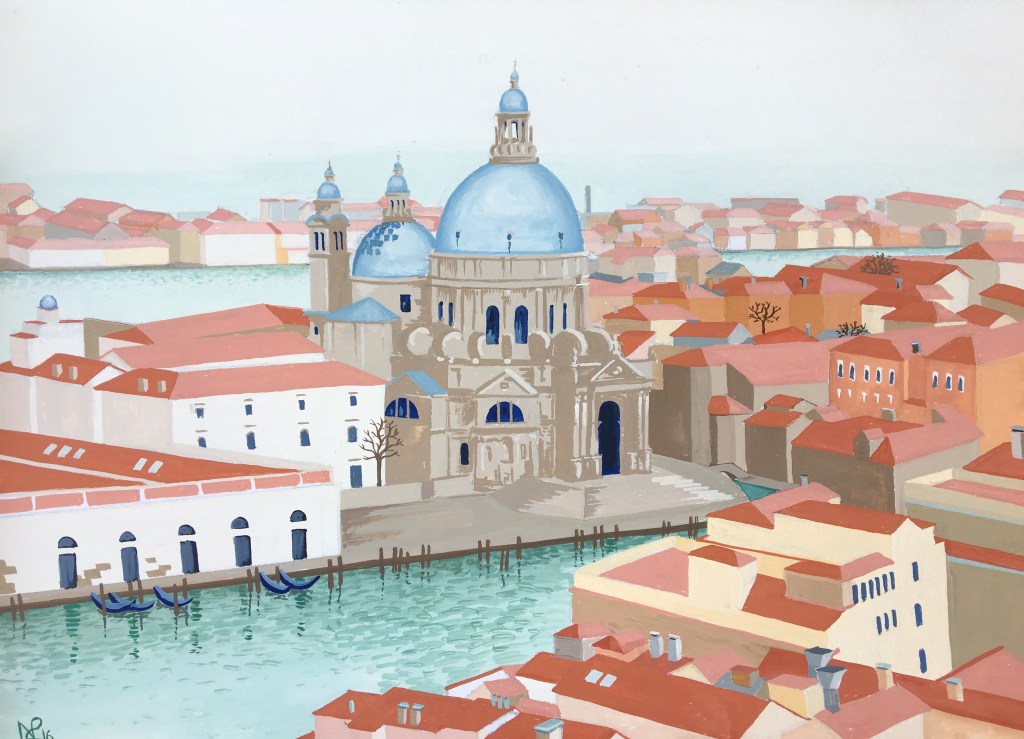
Interpretation No. 19: Venice, the Dorsoduro from above

It’s hard to believe that my series of landscape interpretations are now entering their third year. Started back in Positano on the Amalfi Coast when I was inspired by the cubic contrast of urban development against rugged natural scenery, the collection has morphed and developed, now reaching its 19th in number. While traditional landscape painting seems to be too often looked down on by the so called “experts” in today’s contemporary art world, these simplified landscapes allow me the opportunity to relive a landscape, to simplify it into the basic forms which make the view so beautiful, and most importantly to relax and enjoy the process of creation.

As my little Venice seasons comes to an end here on The Daily Norm, and we travel together, to cities further afield, there could have been no more appropriate final curtain to the collection than to share this, my latest in the interpretations series. Inspired by the stunning views over the city which I photographed from the top of St Mark’s campanile and shared on The Daily Norm last week, this view for me was compositionally just too tempting not to paint.

Interpretation No. 19: Venice, the Dorsoduro from above (2016 © Nicholas de Lacy-Brown, gouache on paper)

Interpretation No. 19: Venice, the Dorsoduro from above (2016 © Nicholas de Lacy-Brown, gouache on paper)

With its waves of terracotta rooftops covering Venetian red, cream and ochre buildings, all leading to the magnificence of the church of Santa Maria della Salute at its centre,  and with its intersection of creamy turquoise canals and a view of the Giudecca island in the foggy distance, this is a view of the Dorsoduro region at its best. And it makes for a fine addition to the urban wing (Paris, London & Palma and counting…) of my continuing collection gouache landscapes.

© Nicholas de Lacy-Brown and The Daily Norm, 2001-2016. Unauthorized use and/or duplication of the material, whether written work, photography or artwork, included within The Daily Norm without express and written permission from The Daily Norm’s author and/or owner is strictly prohibited. For more information on the work of Nicholas de Lacy-Brown, head to his art website at www.delacybrown.com

2015: Looking back at my year’s work

Each year I grow more and more frustrated that time seems to pass so quickly with so very little artwork done. I suppose its only natural for an artist, when new ideas and burning creativity consumes from within desperate to find its manifestation on canvas, or paper. And as the years go on, and time seems to be ticking closer towards the great unknown, that frustration only grows deeper.

And yet, as I look back upon the last year’s work, I cannot say that the year was unproductive. On the contrary, a glimpse over my creative output demonstrates a fair breadth of artistic endeavours, and shows that besides the obvious application of time spent enjoying the incredible Mediterranean surroundings in which I am now living, I also applied myself to expressing those visions in a concrete illustrated form.

Interpretations

Chief among my works for 2015 have been gouaches painted on paper. Perfect for their ease of use and the speed of their execution, I painted more gouache than any other paintings because they gave me moments of relaxation in between the pressures of work, and enabled me to quickly express my reaction to a new landscape or experience without lingering for months on a forever unfinished canvas.

Interpretation No. 13 - Ibiza (2015 © Nicholas de Lacy-Brown, gouache on paper)
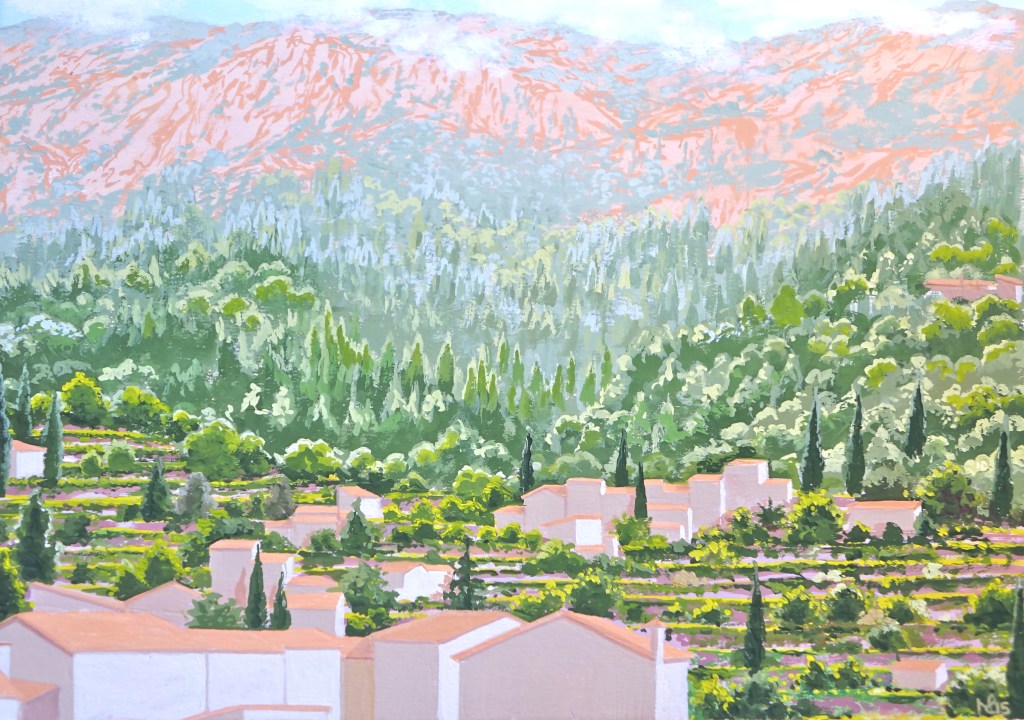
Interpretation No. 13 – Ibiza (2015 © Nicholas de Lacy-Brown, gouache on paper)

Interpretation No. 14 , Deia (2015 © Nicholas de Lacy-Brown, gouache on paper)
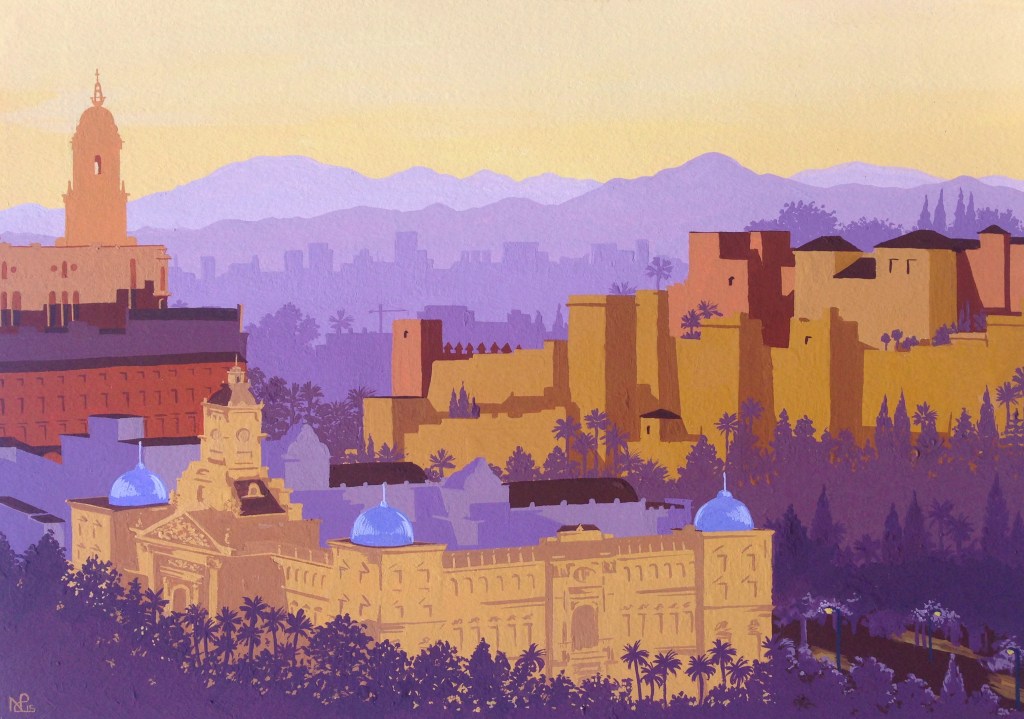
Interpretation No. 14 , Deia (2015 © Nicholas de Lacy-Brown, gouache on paper)

Interpretation No. 15 - Malaga (2015 © Nicholas de Lacy-Brown, gouache on paper)

Interpretation No. 15 – Malaga (2015 © Nicholas de Lacy-Brown, gouache on paper)
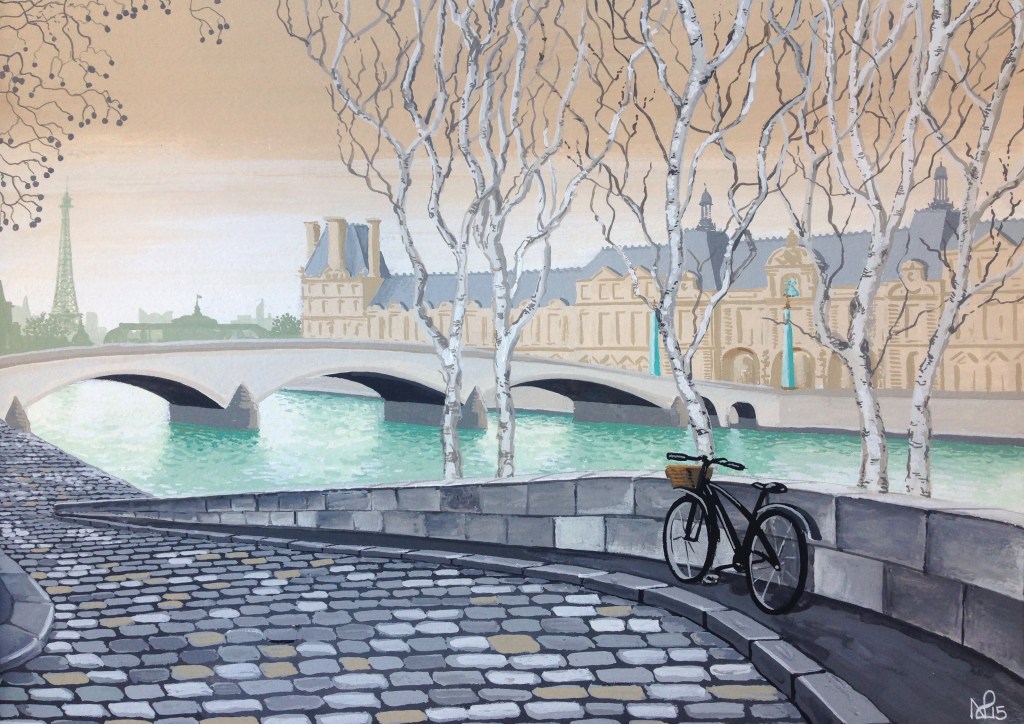
Interpretation No. 16: From La Rive Gauche (2015, © Nicholas de Lacy-Brown, gouache on paper)

Interpretation No. 16: From La Rive Gauche (2015, © Nicholas de Lacy-Brown, gouache on paper)

Interpretation No. 17 - Autumn light on La Rambla (2015 © Nicholas de Lacy-Brown, gouache on paper)

Interpretation No. 17 – Autumn light on La Rambla (2015 © Nicholas de Lacy-Brown, gouache on paper)

Interpretation No.18: London (2015, Nicholas de Lacy-Brown, gouache on paper)

Interpretation No.18: London (2015, Nicholas de Lacy-Brown, gouache on paper)

Ocho Balcones

Asides from adding new interpreted landscapes to my Interpretations collection, I also created a new collection of portrait-format gouaches painted of the eight views enjoyed from the eight balconies of our Palma old town apartment. And it’s a good job I did, for no sooner had the collection been completed, we moved out!

Ocho Balcones (No.1): From the bedroom
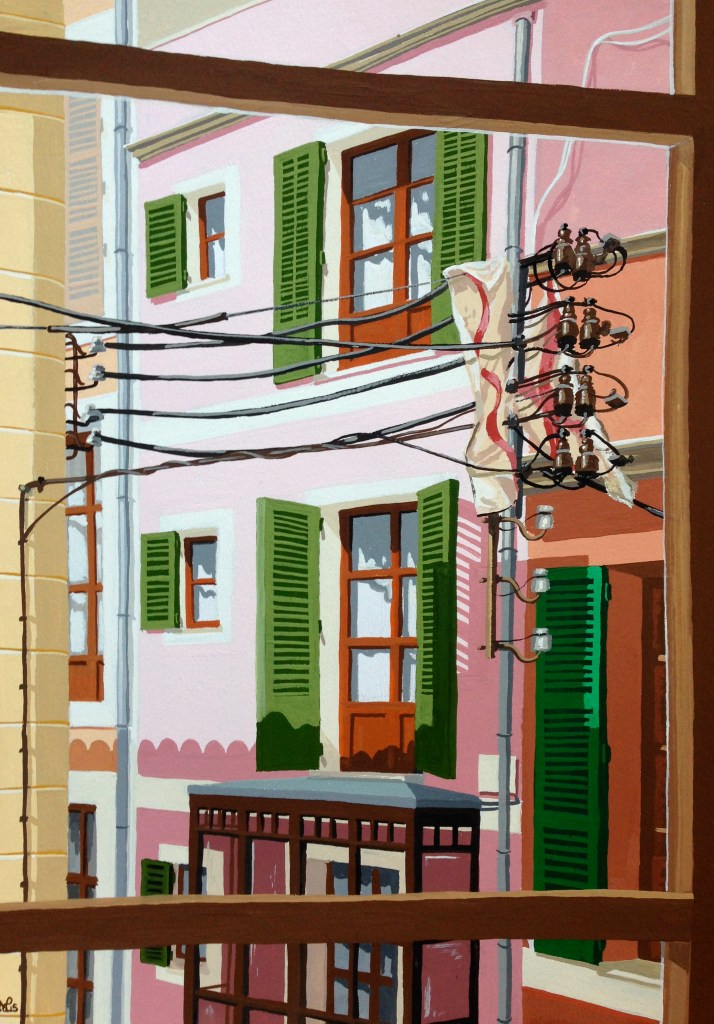
Ocho Balcones (No.1): From the bedroom

Ocho Balcones No. 2: Cables in the Calle (2015 © Nicholas de Lacy-Brown, gouache on paper)
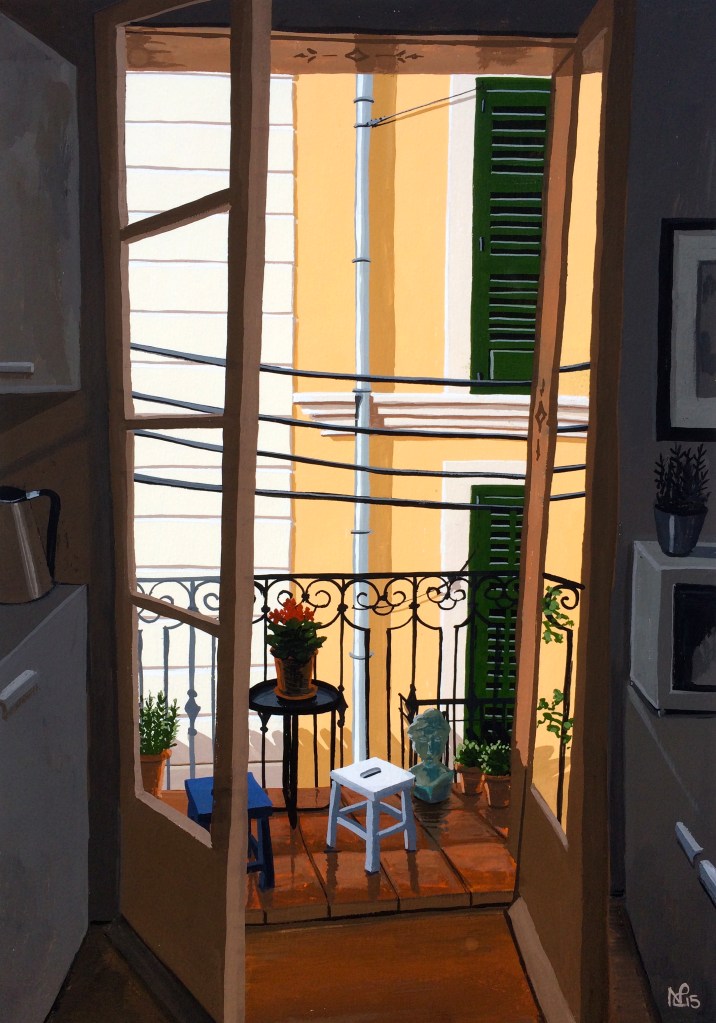
Ocho Balcones No. 2: Cables in the Calle (2015 © Nicholas de Lacy-Brown, gouache on paper)

Ocho Balcones No. 3: KItchen Contrast (2015 © Nicholas de Lacy-Brown, gouache on paper)
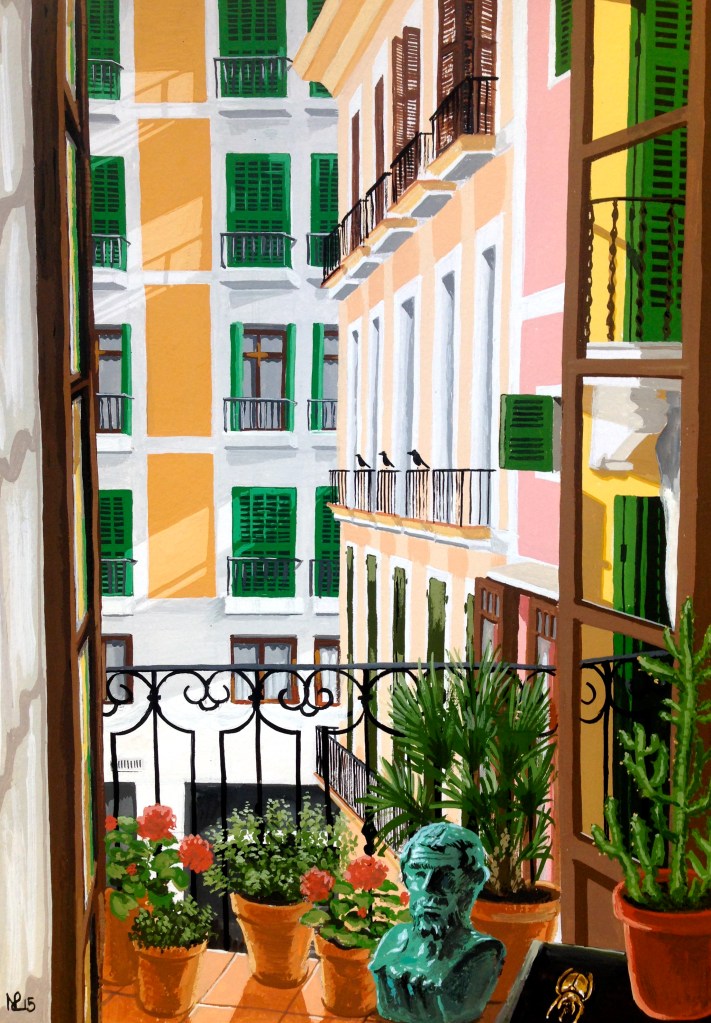
Ocho Balcones No. 3: KItchen Contrast (2015 © Nicholas de Lacy-Brown, gouache on paper)

Ocho Balcones No.4: The Longest View (2015 © Nicholas de Lacy-Brown, gouache on paper)

Ocho Balcones No.4: The Longest View (2015 © Nicholas de Lacy-Brown, gouache on paper)

Ocho Balcones, No.5: The Summer Bathroom (2015 © Nicholas de Lacy-Brown, gouache on paper)

Ocho Balcones, No.5: The Summer Bathroom (2015 © Nicholas de Lacy-Brown, gouache on paper)

Ocho Balcones No.6: Angled Perspective (2015 © Nicholas de Lacy-Brown, gouache on paper)

Ocho Balcones No.6: Angled Perspective (2015 © Nicholas de Lacy-Brown, gouache on paper)

Ocho Balcones No. 7: Dominik's Office (2015 © Nicholas de Lacy-Brown, gouache on paper)

Ocho Balcones No. 7: Dominik’s Office (2015 © Nicholas de Lacy-Brown, gouache on paper)
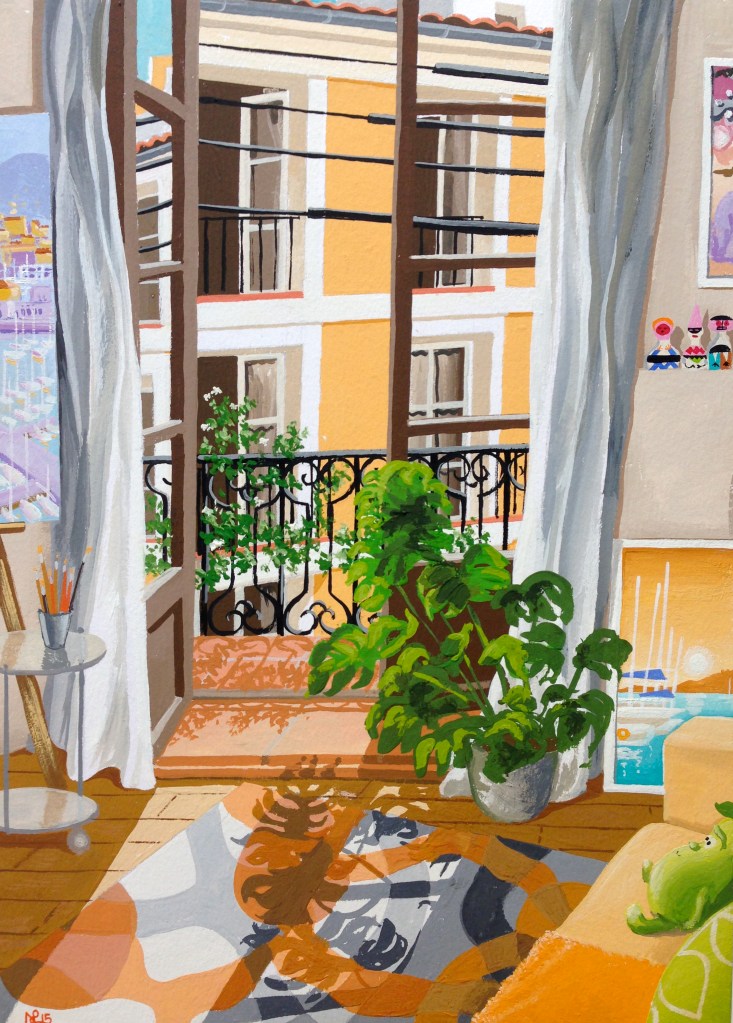
Ocho Balcones VIII: The Artist's Studio (2015 © Nicholas de Lacy-Brown, gouache on paper)

Ocho Balcones VIII: The Artist’s Studio (2015 © Nicholas de Lacy-Brown, gouache on paper)

The Honeymoon Suite

Of course my wedding and the honeymoon which followed were not only the central point of the year, but provided their own inspiration, not least at La Colombe d’Or hotel, where we were lucky enough to dine surrounded by original works by the likes of Leger, Braque and Picasso, and sunbathe under the wings of an Alexander Calder mobile. With only my small box of gouaches with me, I set about painting each of the rooms of the three hotels we stayed in, as well as the stunning leafy garden of the Colombe.
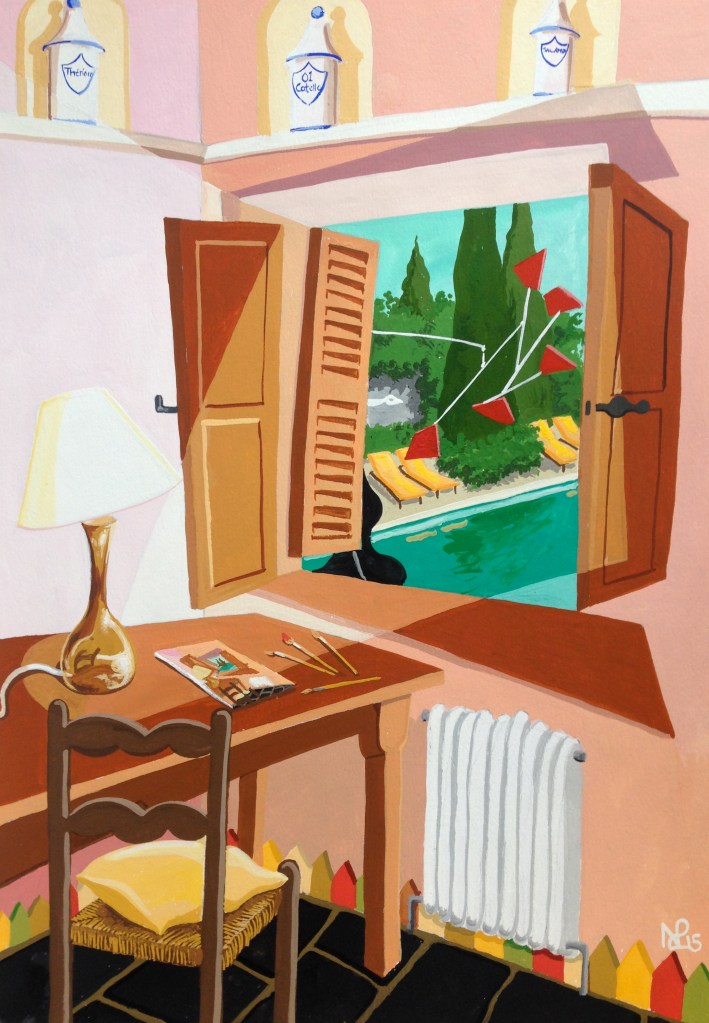
Honeymoon Suite I: Bedroom at La Colombe d'Or (2015 © Nicholas de Lacy-Brown, gouache on paper)
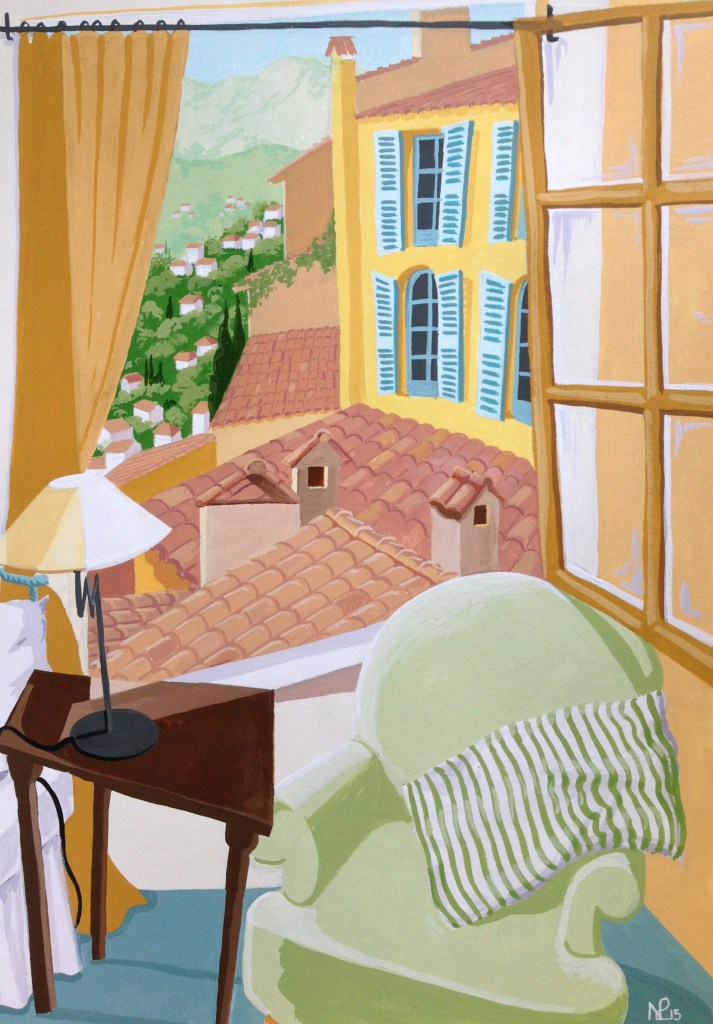
Honeymoon Suite I: Bedroom at La Colombe d’Or (2015 © Nicholas de Lacy-Brown, gouache on paper)

Honeymoon Suite II: Bedroom in the Chateau de Cagnard (2015 © Nicholas de Lacy-Brown, gouache on paper)

Honeymoon Suite II: Bedroom in the Chateau de Cagnard (2015 © Nicholas de Lacy-Brown, gouache on paper)

The Honeymoon Suite 3: Bedroom at the Arai Barcelona
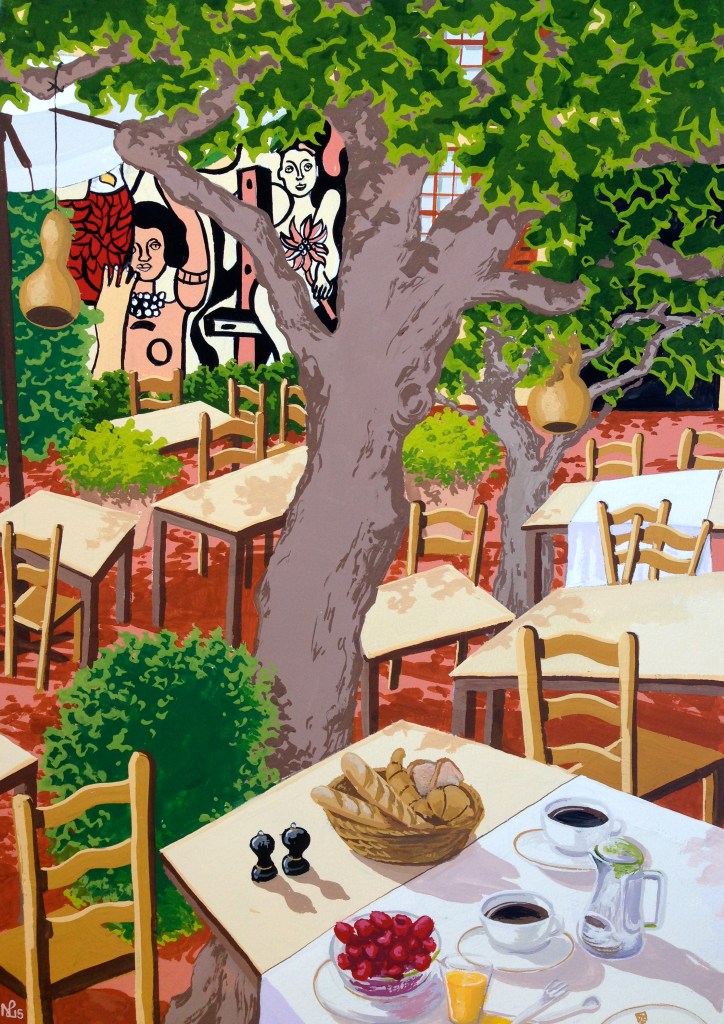
The Honeymoon Suite 3: Bedroom at the Arai Barcelona

Breakfast at La Colombe d'Or (2015 © Nicholas de Lacy-Brown, gouache on paper)

Breakfast at La Colombe d’Or (2015 © Nicholas de Lacy-Brown, gouache on paper)

Commissions

It was also a good year for Commissions, and apart from the wide variety of works created for my employer, a few outside commissions also enabled me to paint these works which made it into the press across Mallorca and beyond.

Antiguedades (2015 © Nicholas de Lacy-Brown, gouache on paper)

Antiguedades (2015 © Nicholas de Lacy-Brown, gouache on paper)

Autumn in Paris (2015 © Nicholas de Lacy-Brown, gouache on paper)
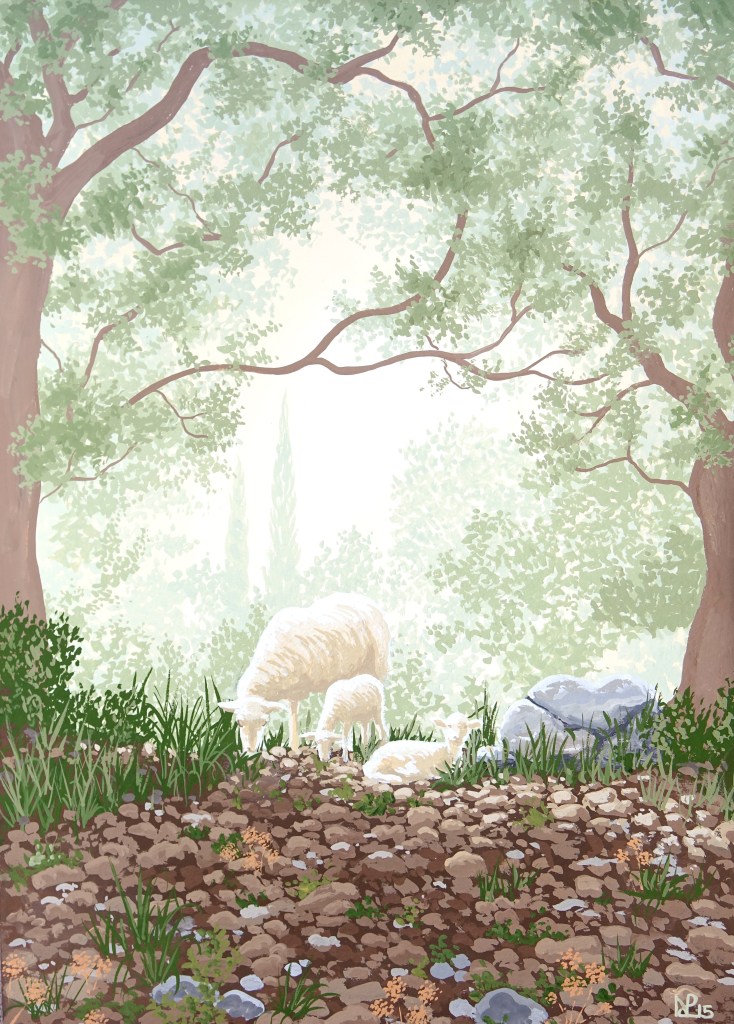
Autumn in Paris (2015 © Nicholas de Lacy-Brown, gouache on paper)

Ovejas en Orient (2015 © Nicholas de Lacy-Brown, gouache on paper)

Ovejas en Orient (2015 © Nicholas de Lacy-Brown, gouache on paper)

My travel sketchbook

Taking a break from all the colour, 2015 was also a bumper year for my travel sketchbook. Started the year before, it is now almost full to the bursting with sketches completed this year including landscapes from across Mallorca, the French Riviera, Ibiza and Marbella.

The Oil Paintings

And finally to what, perhaps, I do best – the mighty projects on canvas; oil paintings each of which take weeks if not months to complete, but whose realisation is all the more fulfilling because of the time spent. I painted very few completed works on canvas this year, but those which reached the finish line were mainly Mallorca based landscapes, my ultimate challenge being the 1.5m landscape of the Bay of Palma. A true achievement for the year 2015.

Orient (2015 © Nicholas de Lacy-Brown, oil on canvas)
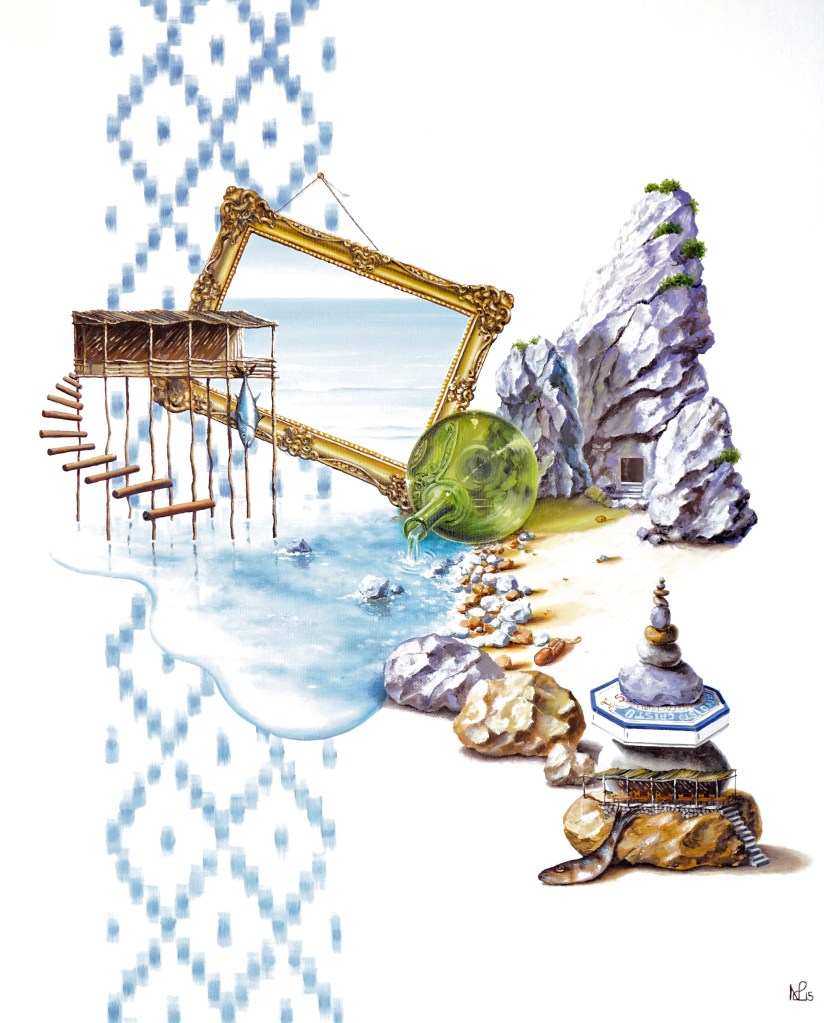
Orient (2015 © Nicholas de Lacy-Brown, oil on canvas)

Mallorca Landscape (Chiringuitos) (2015 © Nicholas de Lacy-Brown, oil on canvas)

Mallorca Landscape (Chiringuitos) (2015 © Nicholas de Lacy-Brown, oil on canvas)

An Englishman in Andalucia (2015 © Nicholas de Lacy-Brown, oil on canvas)
An Englishman in Andalucia (2015 © Nicholas de Lacy-Brown, oil on canvas)

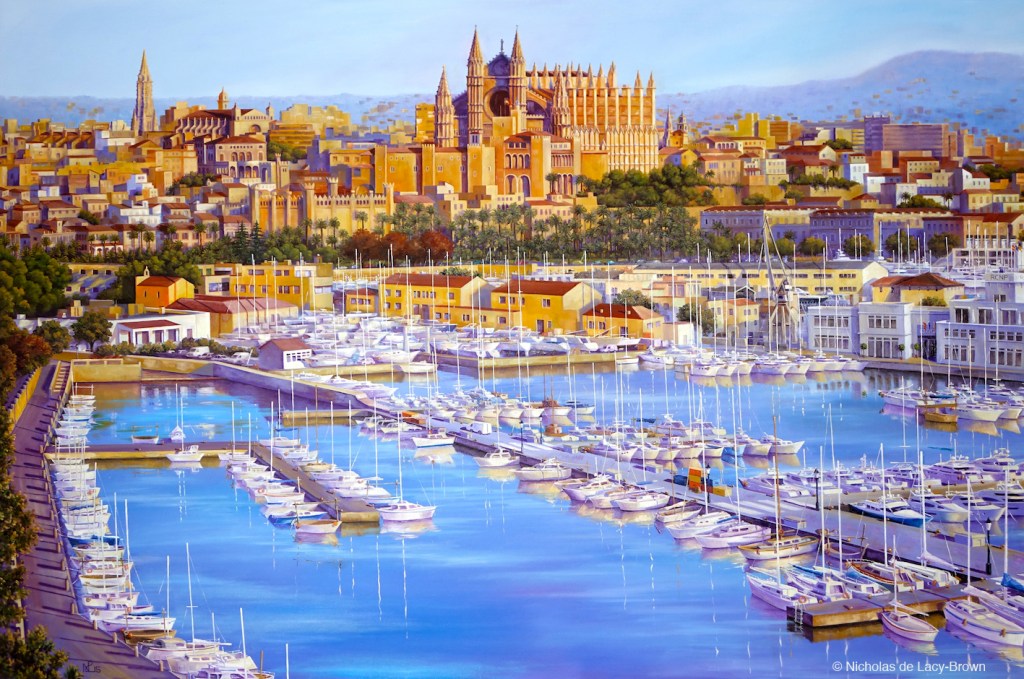
The Bay of Palma (2015 © Nicholas de Lacy-Brown, gouache on paper)

The Bay of Palma (2015 © Nicholas de Lacy-Brown, gouache on paper)

And now, as I look forwards, with three large paintings already on the go, and a whole new sketchbook ready to be filled, I cannot wait to see what the next year of creativity will bring.

© Nicholas de Lacy-Brown and The Daily Norm, 2001-2015. Unauthorized use and/or duplication of the material, whether written work, photography or artwork, included within The Daily Norm without express and written permission from The Daily Norm’s author and/or owner is strictly prohibited. For more information on the work of Nicholas de Lacy-Brown, head to his art website at www.delacybrown.com

Art in London (Part 3): Giacometti Pure Presence

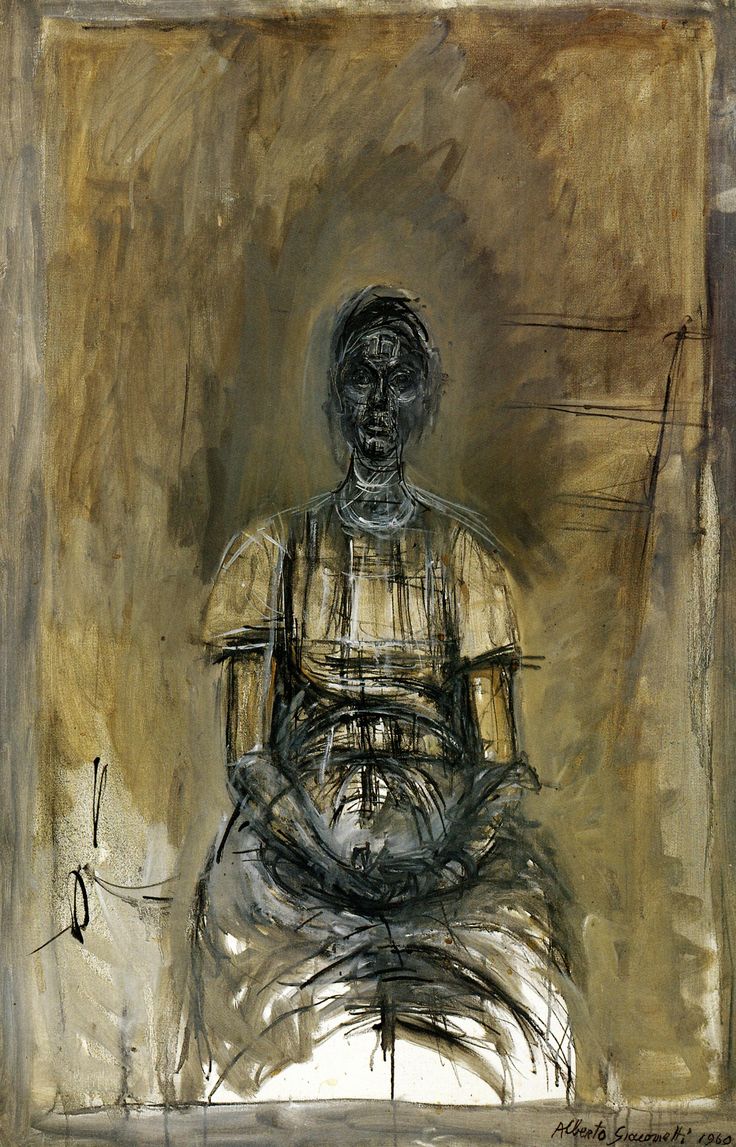
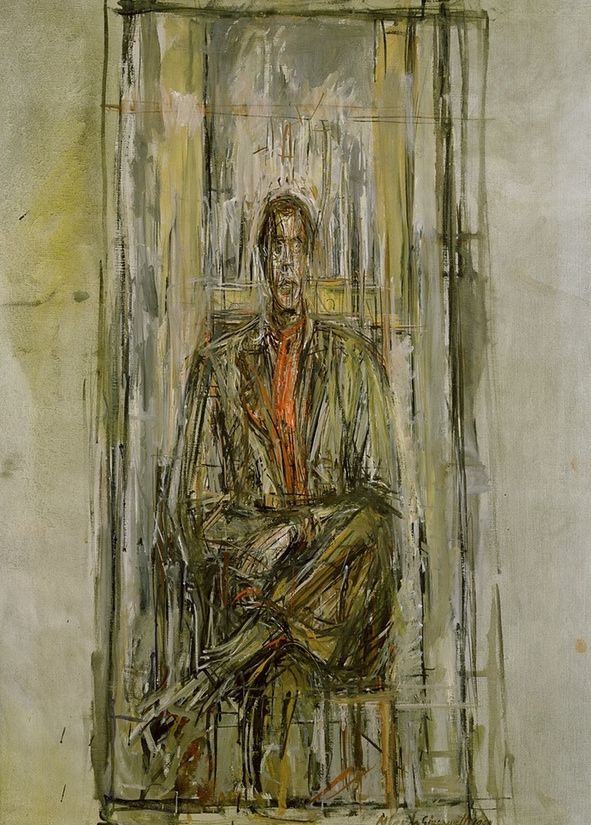
Say Alberto Giacometti to most art enthusiasts, and for the majority, an image of his long, spindly totem-pole like human sculptures will come to mind. For it is these famous works which made Giacometti’s name, and which today reach eye-wateringly high prices at auction. But for me, the true genius of this artist was not in his sculptures at all, but in his frenetic, impulsive two-dimensional works.

I first discovered the drawings of Giacometti when I attended a short course in life drawing at the Chelsea College of Art. The teacher was trying to ally the many frustrations spreading amongst the students in the room by the changing positions of the models both during the life drawing session, and after breaks. Yet as he attempted to show us through Giacometti’s work, a portrait does not have to comprise a single well-defined line, but can emerge from a series of lines and positions.
GIACOMETTIGiaco6Giaco10Giaco9

The portraits he showed us by way of example were by Giacometti, and in drawing his sitters, he did not concern himself with the perfect line of the face or body, but instead through a series of energetic lines, he would draw a fragmented impression of the sitter, building up the lines more and more until he got to the face, where the real details were introduced. The result was a drawing which focused so intently on the face that it appeared to be emerging from the paper.

So I was filled with excitement to discover that this autumn, the National Portrait Gallery in London are exhibiting a retrospective focusing on Giacometti’s many portraits. And while the show does this through some of the sculptures which made him famous, it is Giacometti’s two dimensional works on paper and on canvas which turned out to be as thrilling as I had anticipated.

Giaco8Giaco7Giaco5Giaco4

Like drawings and paintings created from wire, or built up through a passionate and continued interaction between pencil (or paintbrush) and paper, Giacometti’s portraits are utterly unique, and, after what appears to be a process of interrogation and exploration of the flesh, result in vivid portraiture full of emotional depth. But while the Goya exhibition at the National Gallery next door tended to bring to life the story of each of Goya’s sitters, in Giacometti’s works, I could sense the passion and intention of the artist himself.

Giacometti: Pure Presence runs at The National Portrait Gallery until 10 January 2016.