Skip to content

Posts from the ‘My Art’ Category

Printmaking Progress II: Aquatinting

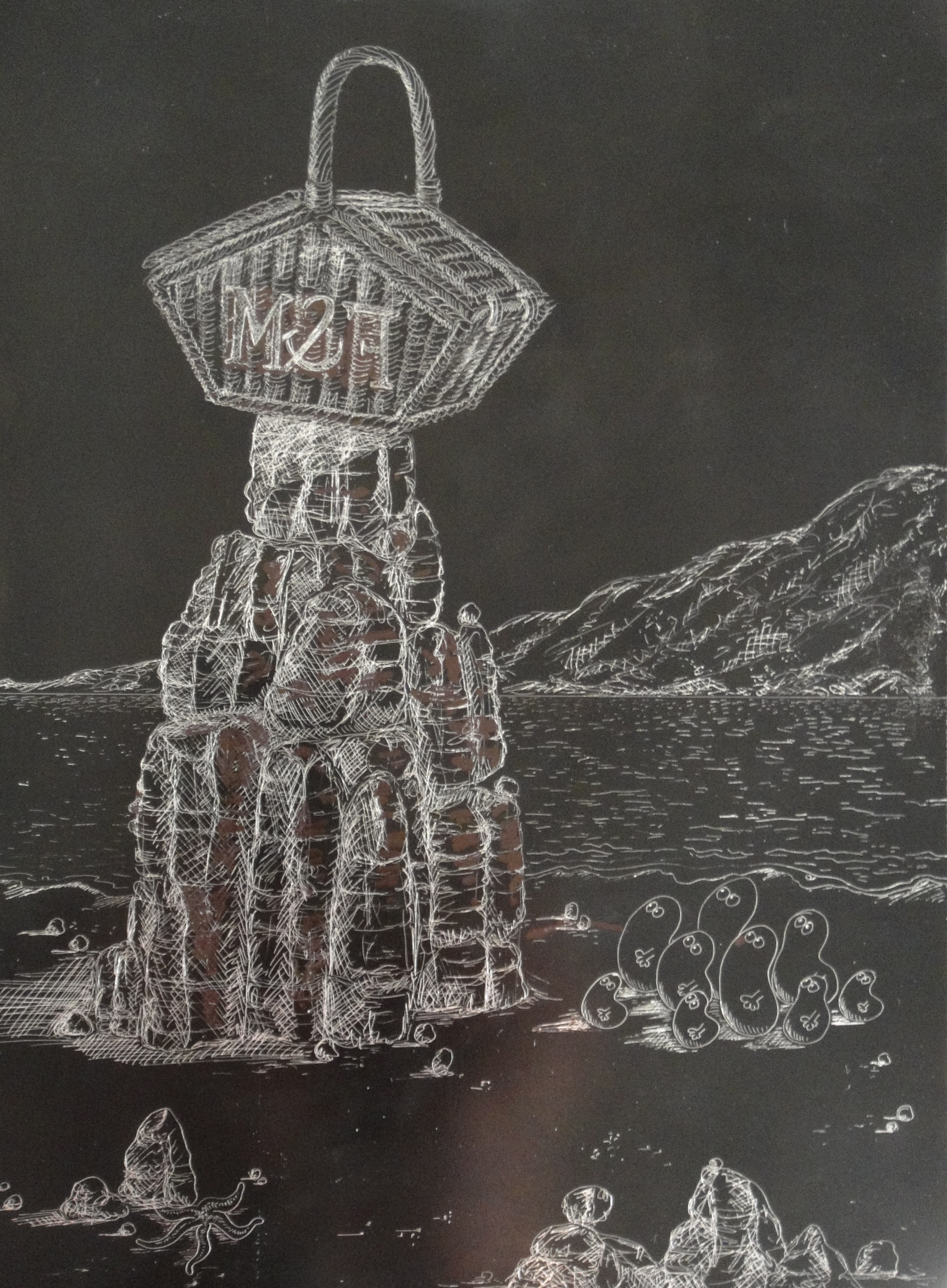
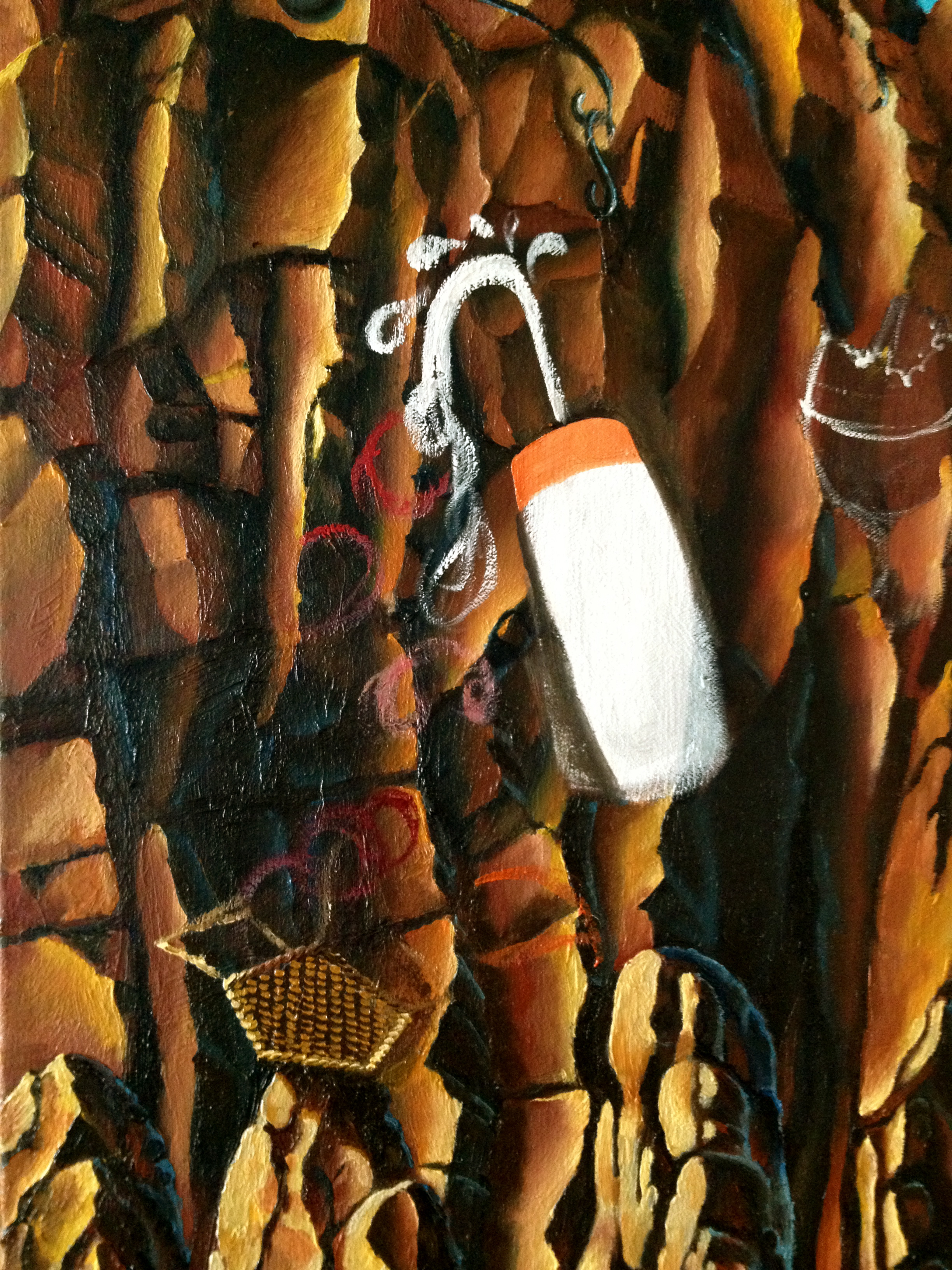
Being a self-trained artist, and so lacking the basic overview which art college provides of the many mediums which an artist has at his or her disposal, I became so entrenched in the world of painting for so many years that my recent discovery of the world of print has come as a complete revelation. Now over midway through an intermediate course in etching, I have taken to the medium like a duck to water. For not only does the medium transfer all of the skills of draughtsmanship which I have been mastering over the years in painting and more recently sketch, but through the sheer narrowness of the needle upon ground it enables me to pack the kind of detail into my etched images that I love. So, in my now advanced second etching, of a Fortnum and Mason’s hamper balanced upon a craggy rock, I have been able to go to town on the detail of the wicker, the rock texture, the little Norms looking up at the rock and the mountain and sea in the background.

Over the last two weeks, I have developed my etched image from metallic reverse image in black ground, to simple line drawing etched into metal and printed in reverse, to an image now loaded with different tonal variety achieved through the process of aquatinting. I am not sure why the technique has the name it does – I imagined it to involve some sort of watery application, a little like applying watercolours to a finished print. But in fact it involves no water at all. Rather, aquatinting is the process by which tone is added to the etching plate through measured re-exposure to acid. It works a bit like the Benday dots which Lichtenstein made famous – apply thousands of little dots to protect the metal and when exposed to acid, only those areas of the metal not covered by dots will etch and turn darker as a result. Step back and with the light dots and the dark exposed plate combined you get a shade of grey. The longer the exposure to acid, the darker the plate becomes, as the distance between dots increases.
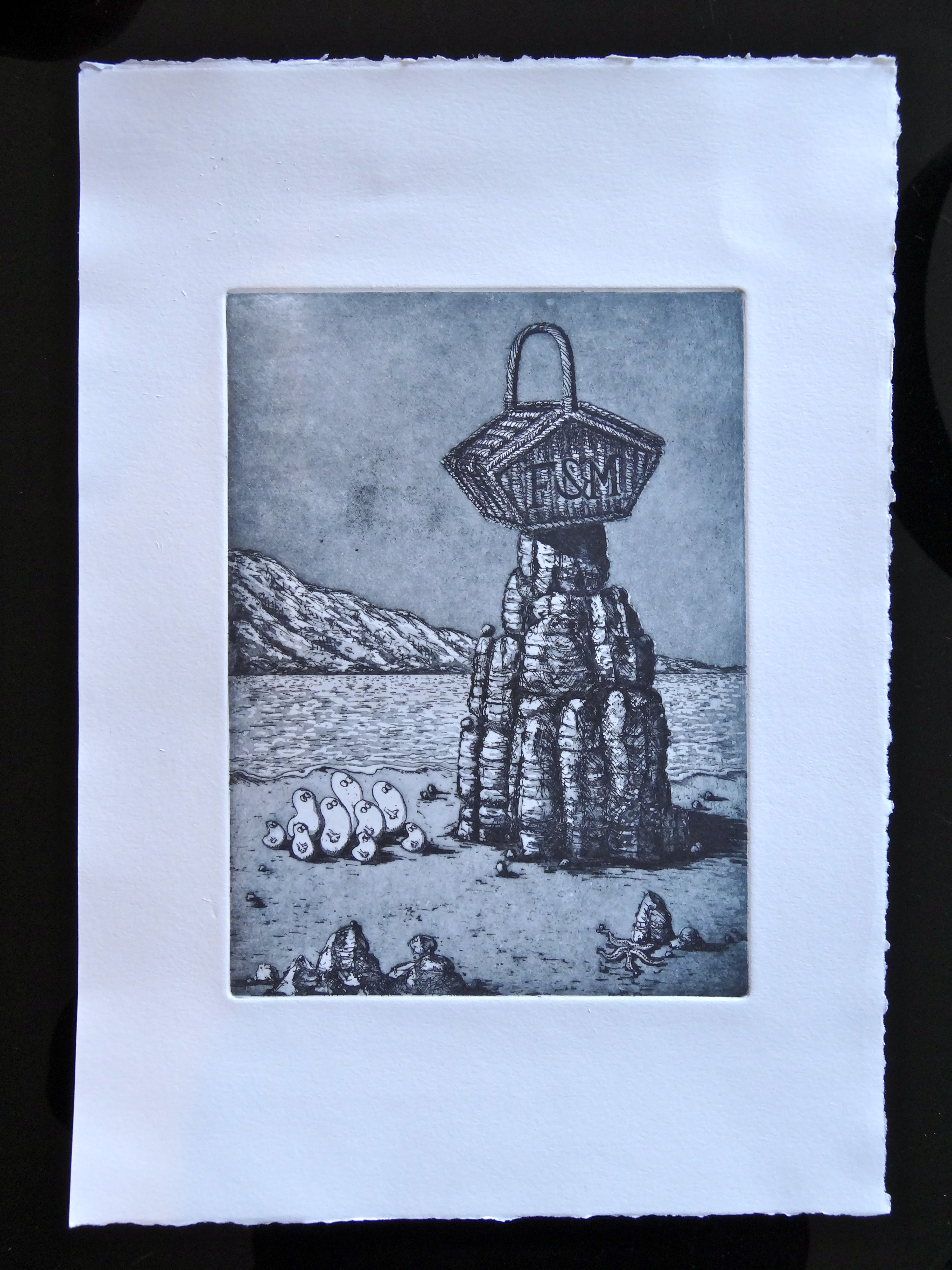
My finished tonal etching after aquatinting

My finished tonal etching after aquatinting

Following this rationale, aquatinting involved first the exposure of the whole plate to a kind of rosin dust which was allowed to settle upon the plate under controlled conditions (it’s very toxic, hence the rather attractive gas mask we were required to wear by way of protection). This was then hardened over a gas fire. Then we had to protect details of the plate which we wanted to remain white, before dipping the plate back in acid, gradually protecting more and more of the plate so that in its final dip into acid, the only part of the plate left exposed was the parts of the image I wanted to print the darkest.

The result is a plate now textured differently depending on the exposure to acid and then, once the ink is reapplied to the plate, an image which comes alive with different tonal shades. Owing to what is a fairly hopeless attempt to explain the aquatinting process above in words, perhaps the process will become clearer by looking at my finished print itself.
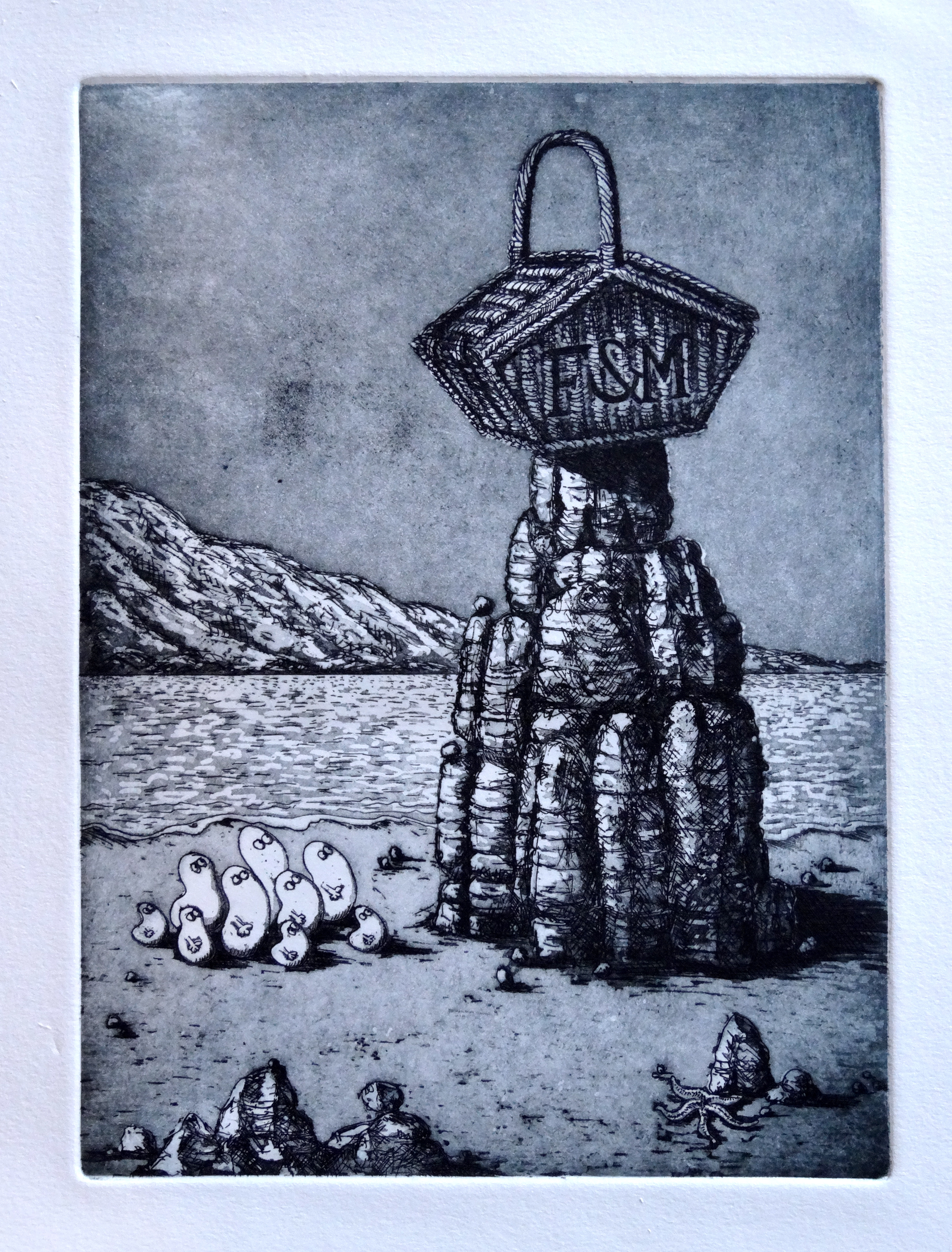
DSC00569

You will see that the Norms and the highlights of the basket and rock have remained white – that’s because I covered those with a black “stop-out” before re-exposing the entire plate to acid. The next lightest shade is the sand – this pale grey results from a quick 15 second dip into acid. This was then covered while I re-exposed the plate, allowing the sky to go darker, followed by the basket, the shadows of the rock and so on.

And there you have it, my first finished etching with aquatint applied – I am so, so delighted with the result and thrilled that I have taken so naturally to the etching medium. I have a feeling that this will not be the last.

The etching before aquatinting
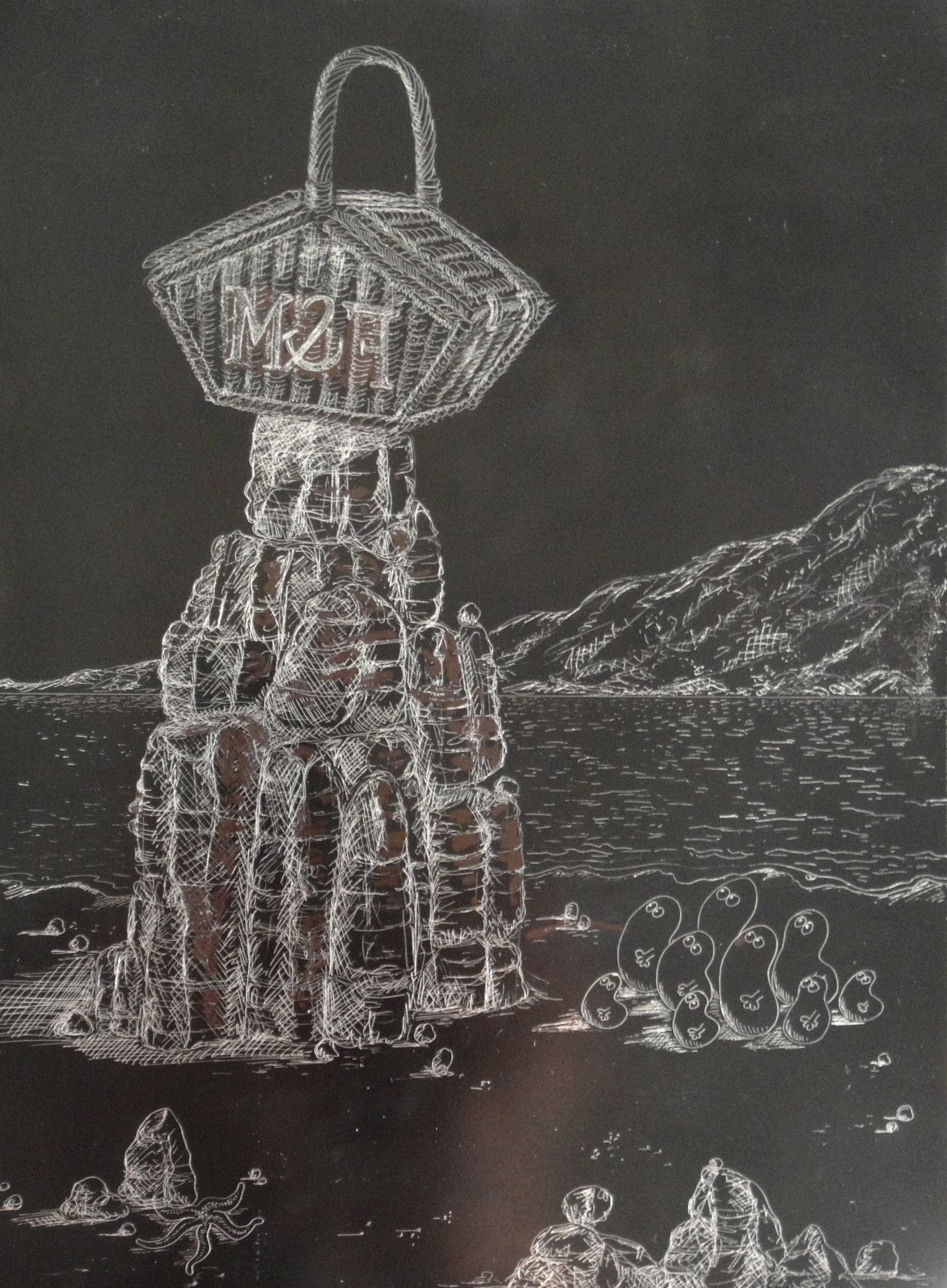
The etching before aquatinting

And before that, the initial image drawn into the "ground" layer

And before that, the initial image drawn into the “ground” layer

Related articles

Autobiographical Mobile: The finished article

C’est fini! At last, my autobiographical mobile is complete! Started in June last year and completed right at the end of April of this year, the maths alone dictates that this has been a long project in the making. While my blog account of the work has been posted in respect of 25 full days of painting, a great number of evenings and hours grabbed in otherwise hectic weeks have been spent working on this piece, one of the most comprehensive projects of my art career so far. Yet the protracted length of the project (augmented by the fact I work full-time and have been undertaking a whole host of other artistic projects in the meantime) has also been one of its benefits – feeling no rush, I managed to achieve a more perfected finish on each of the areas I was working on, and likewise, owing to the passage of time, the painting has become something of a developing story in itself – a true artistic reflection of the changing circumstances of my life.

Autorretrato (Autobiographical Mobile) 2013 © Nicholas de Lacy-Brown, oil on canvas

Autorretrato (Autobiographical Mobile) 2013 © Nicholas de Lacy-Brown, oil on canvas

And how it looked on the first day of painting

And how it looked on the first day of painting

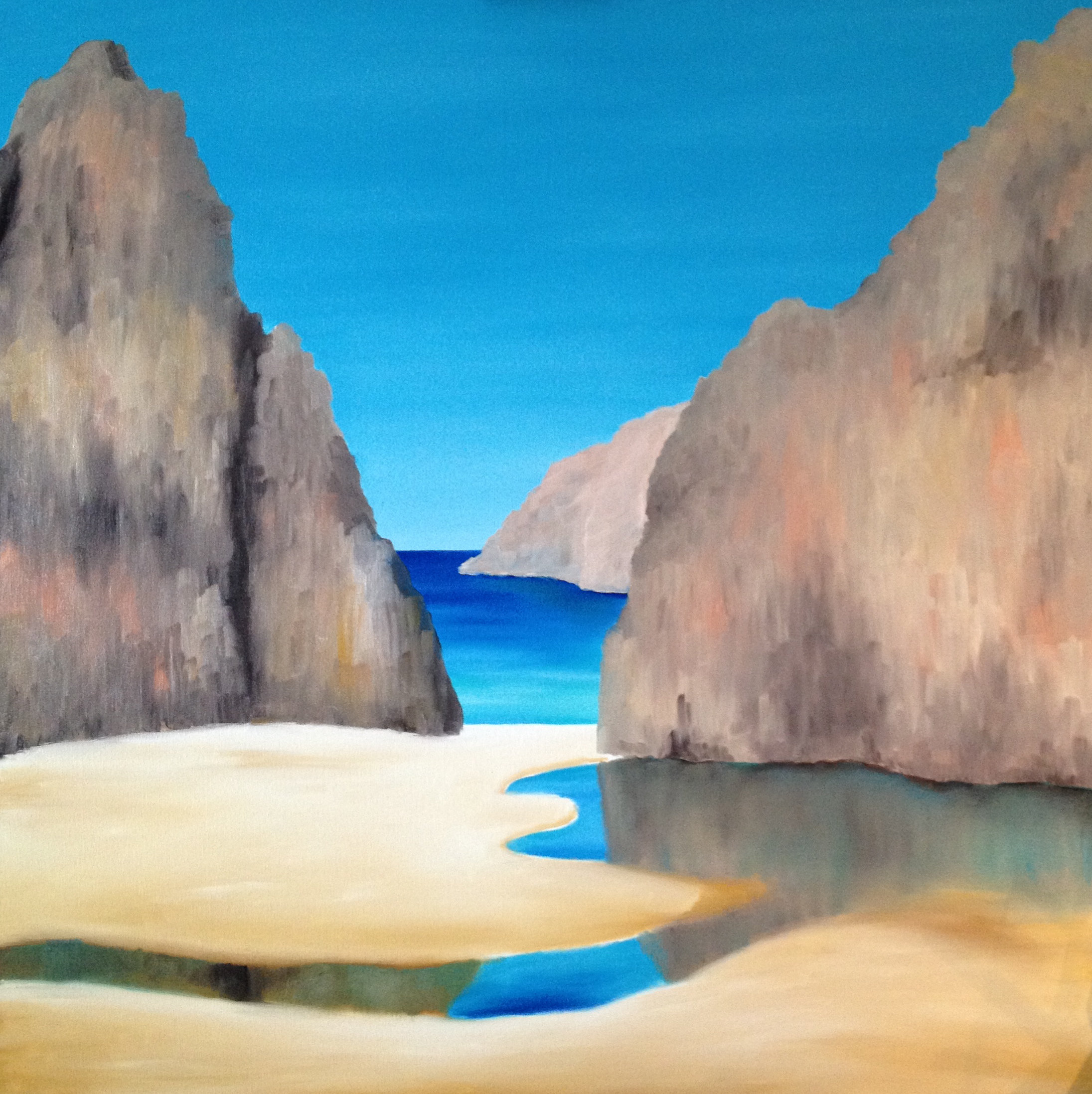
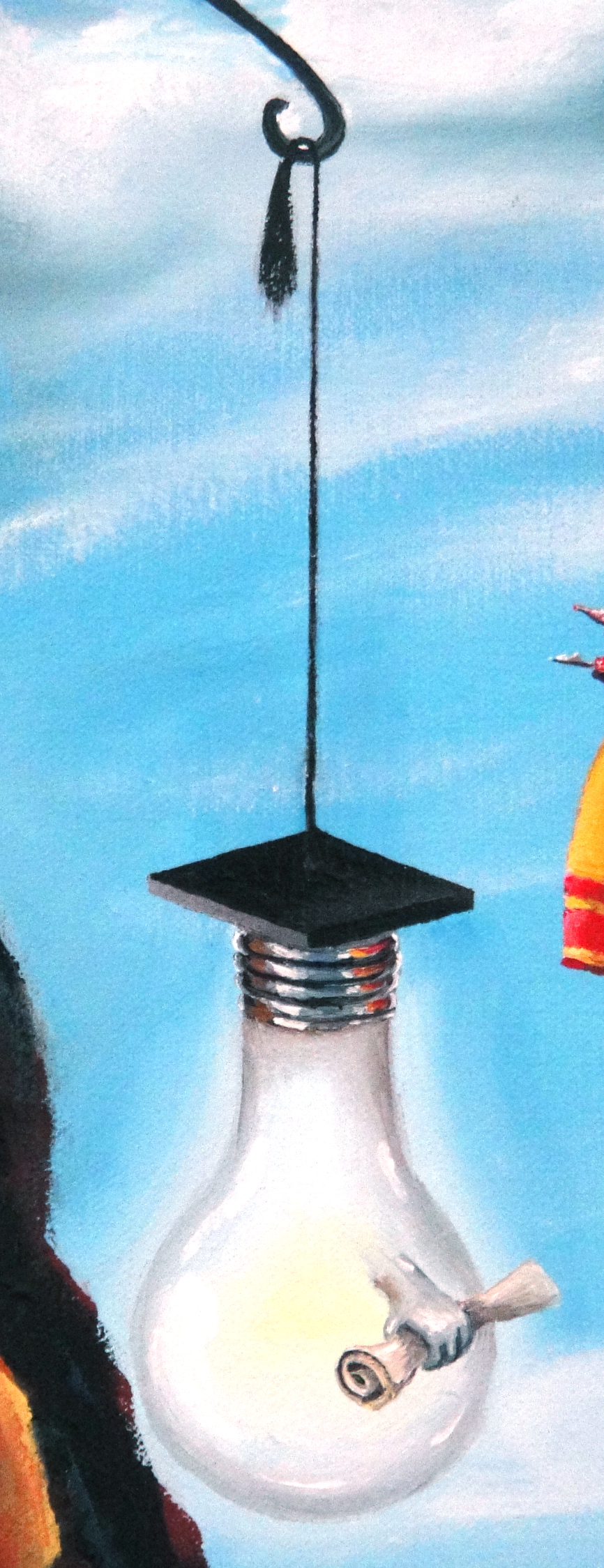
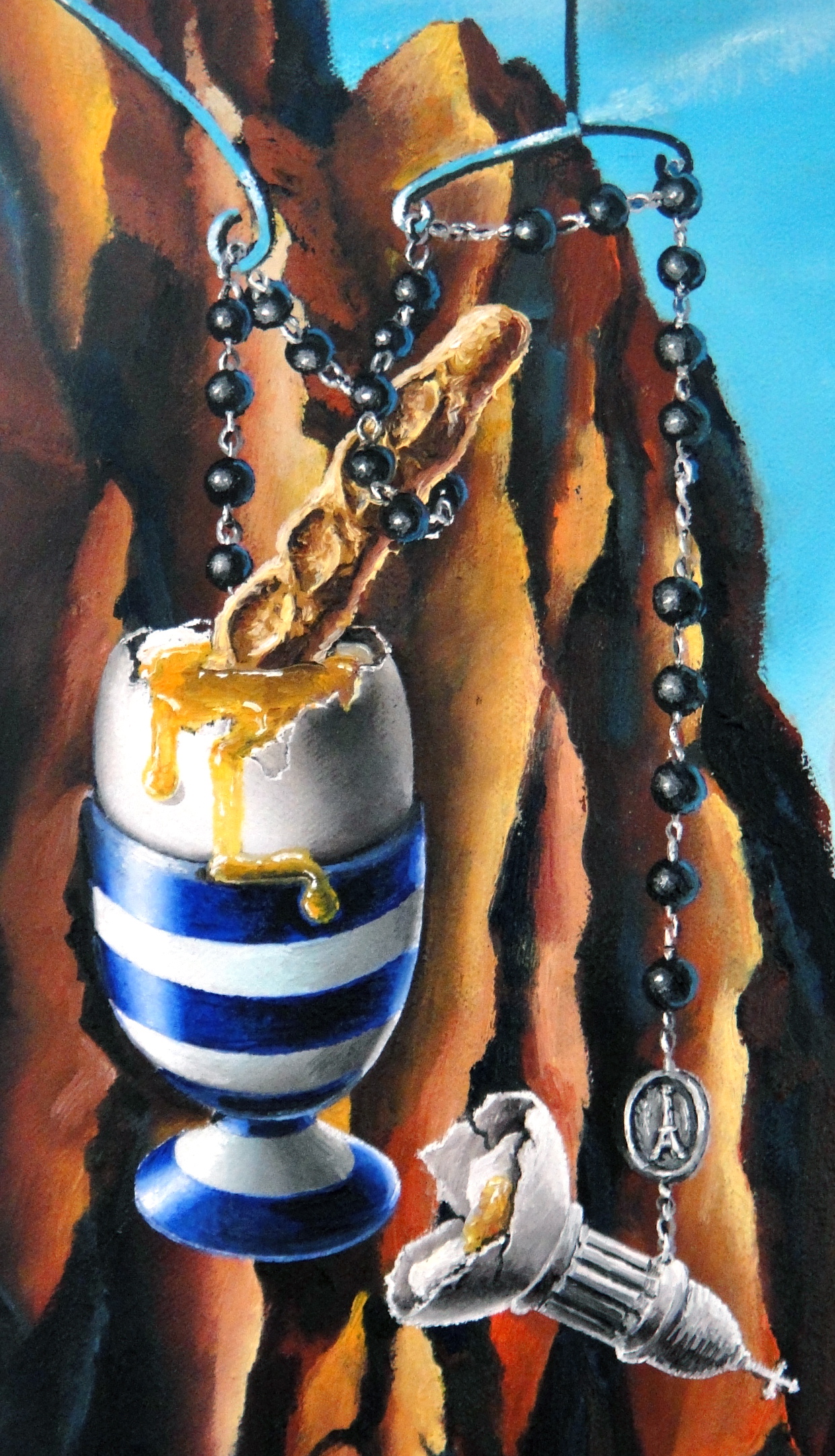
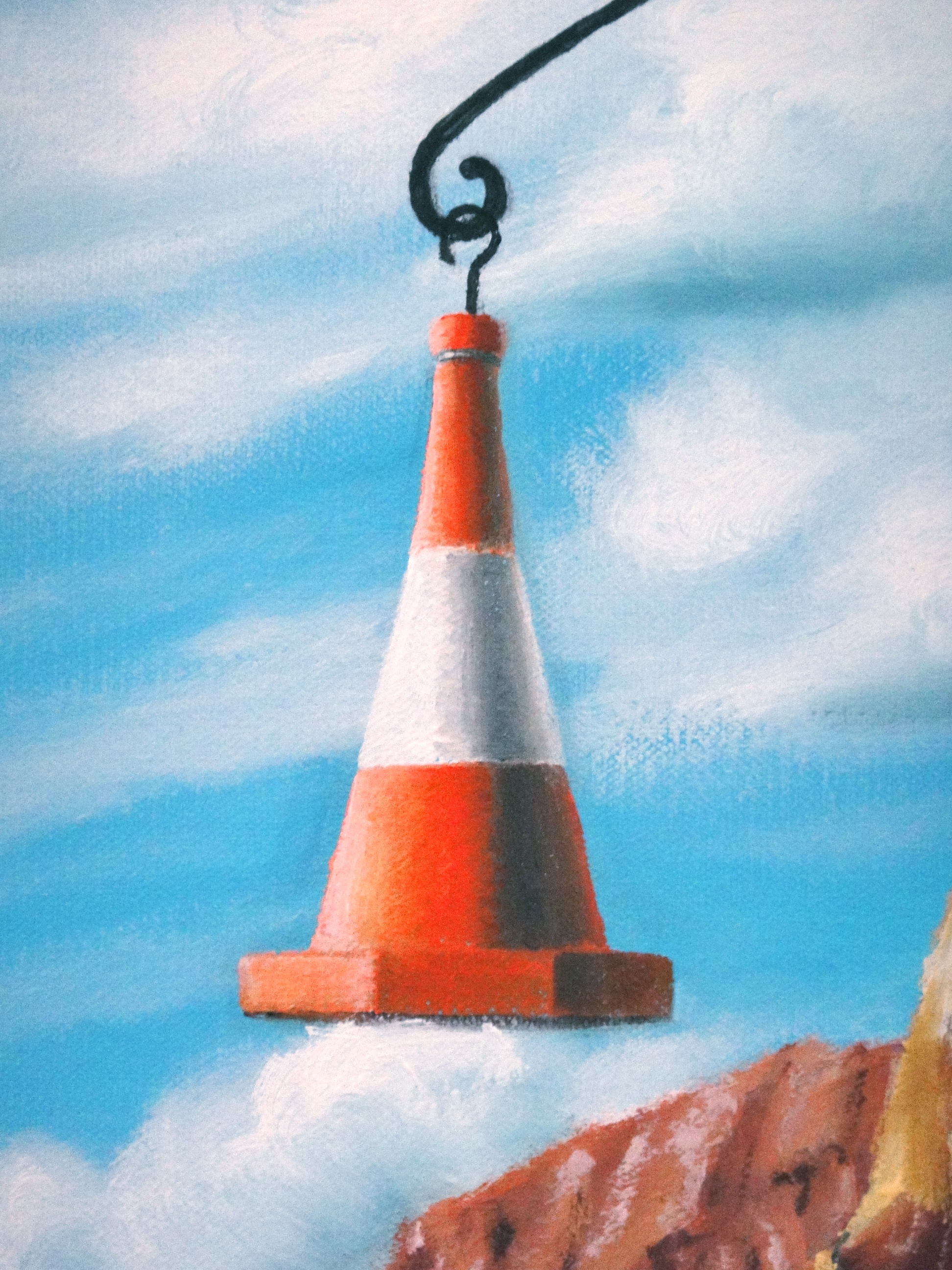
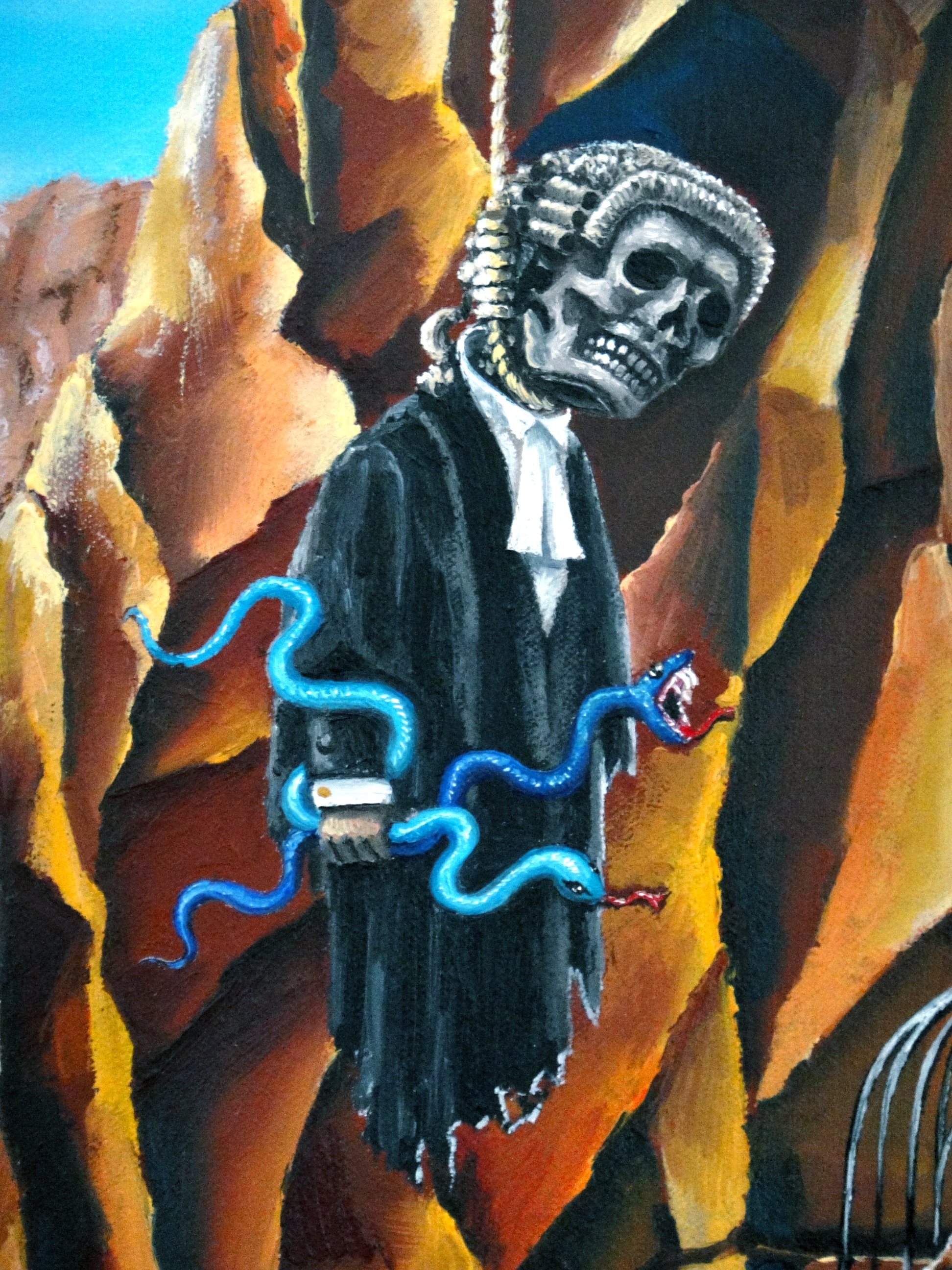
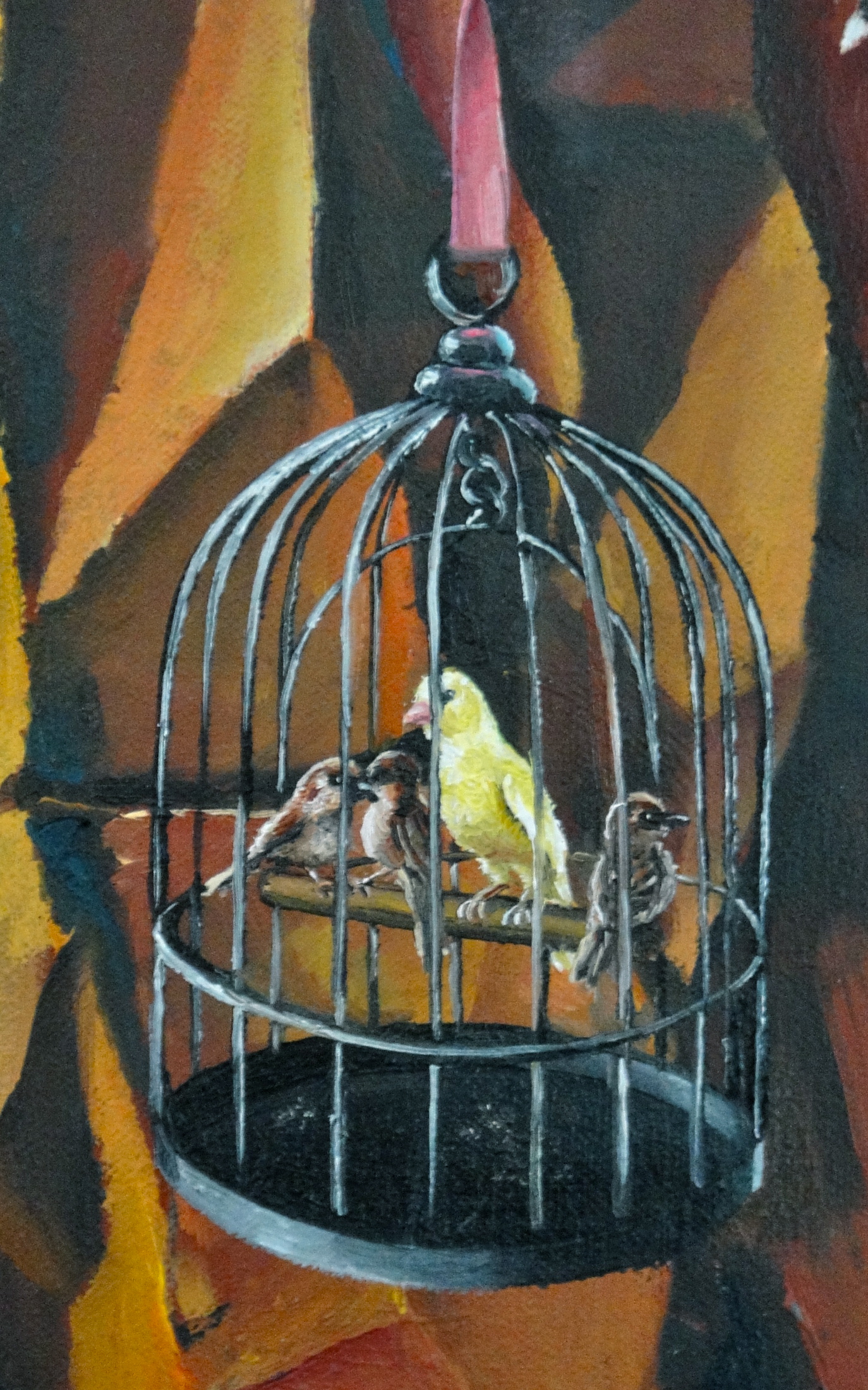
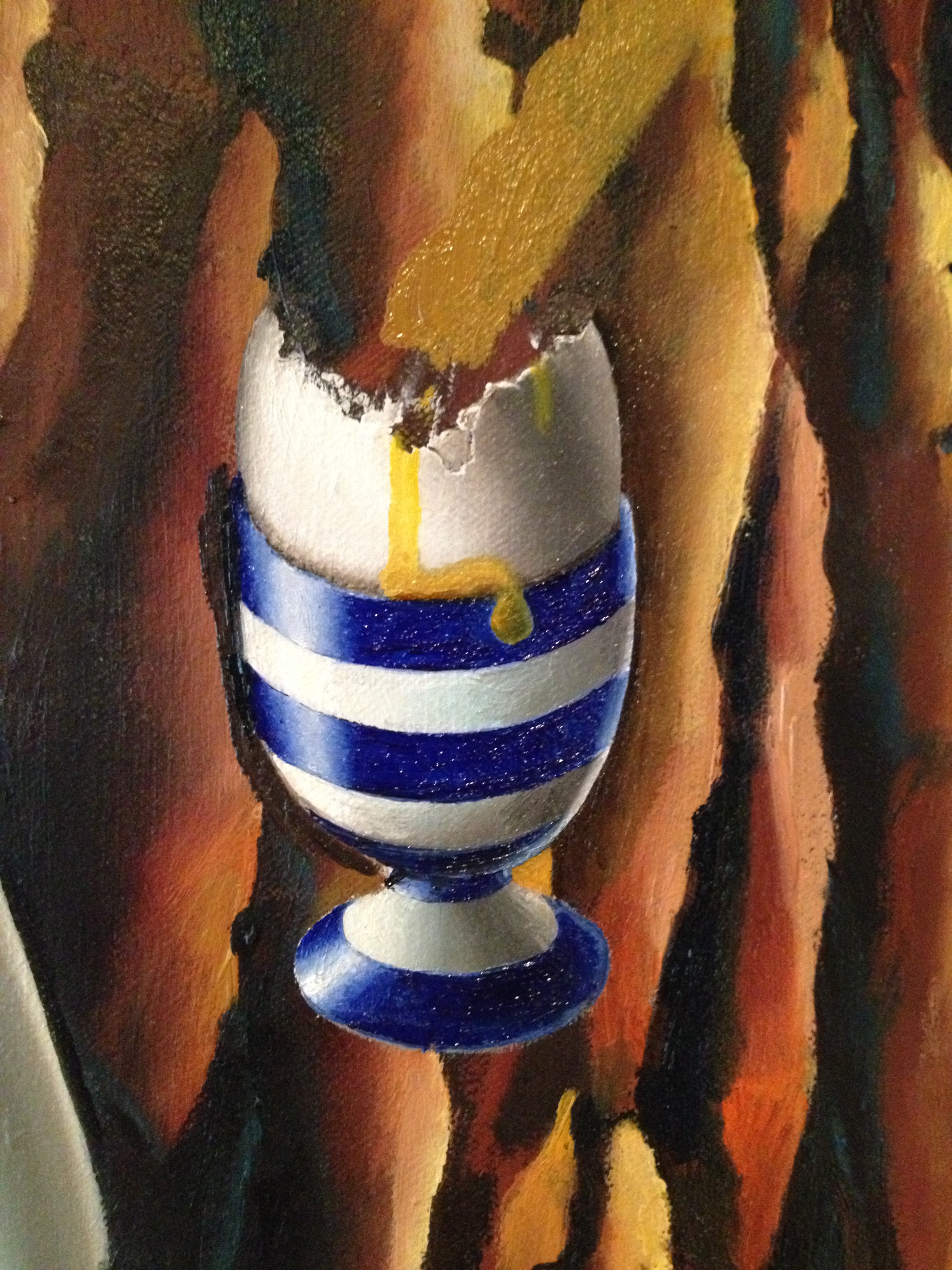
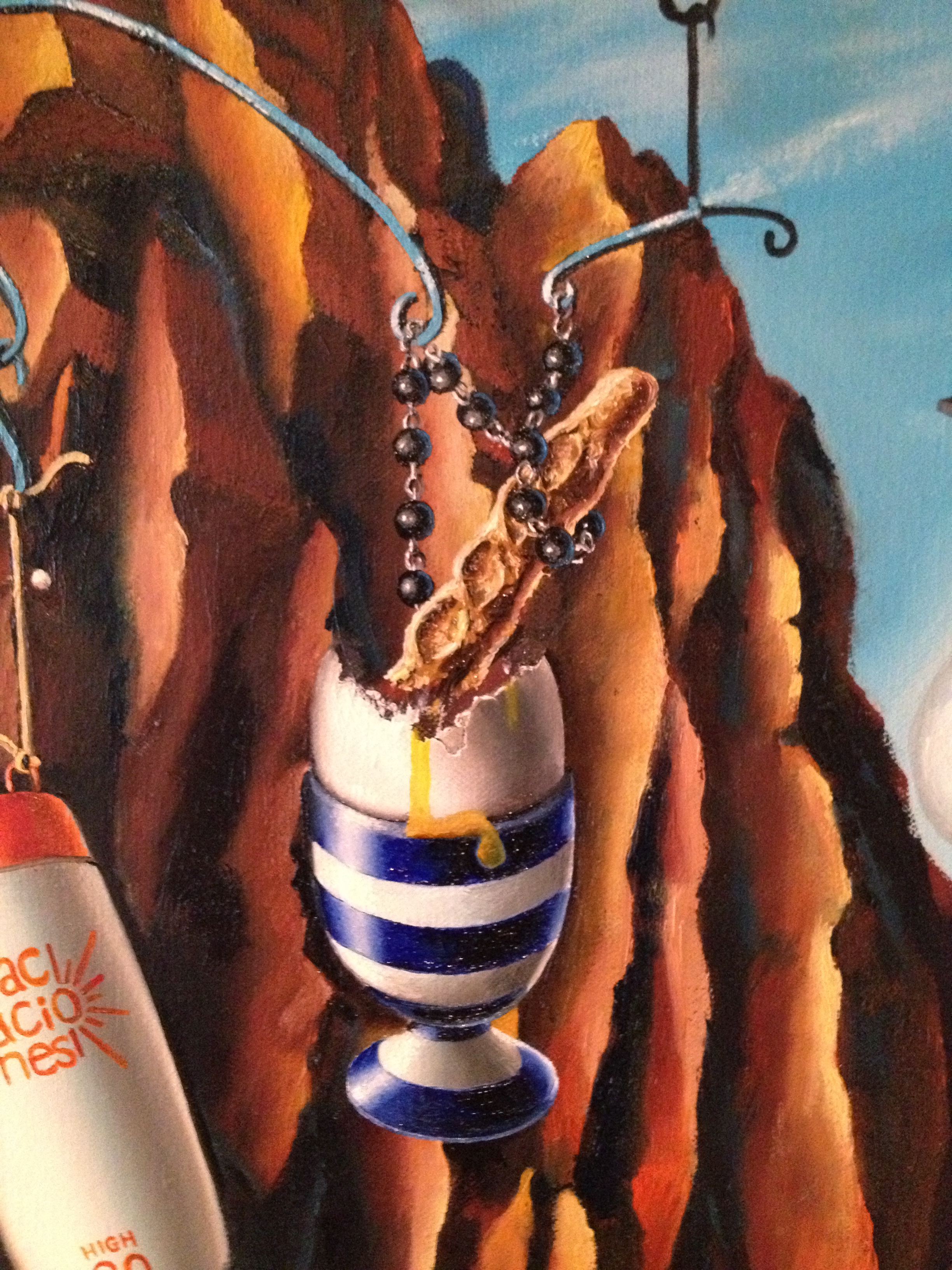
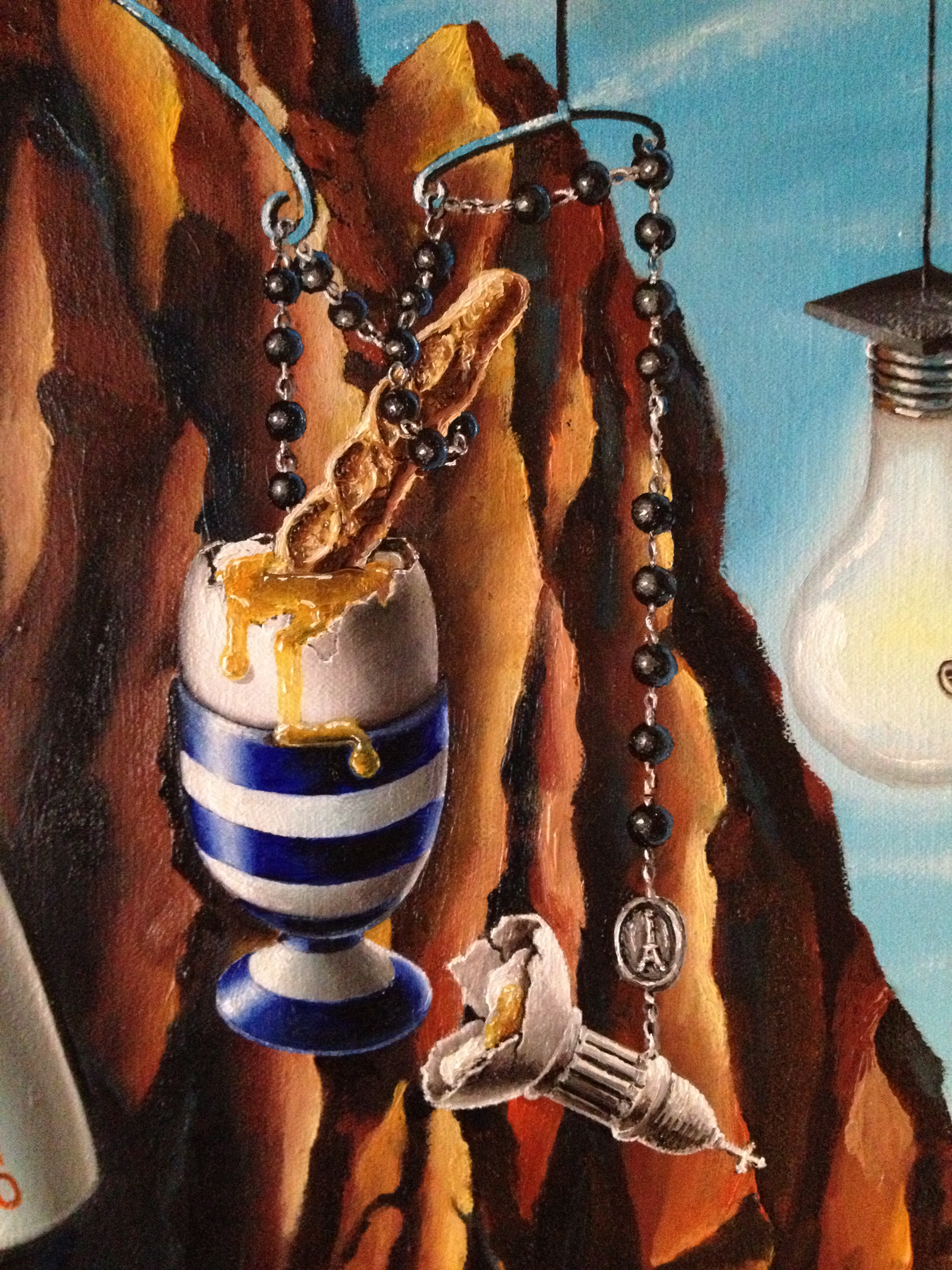
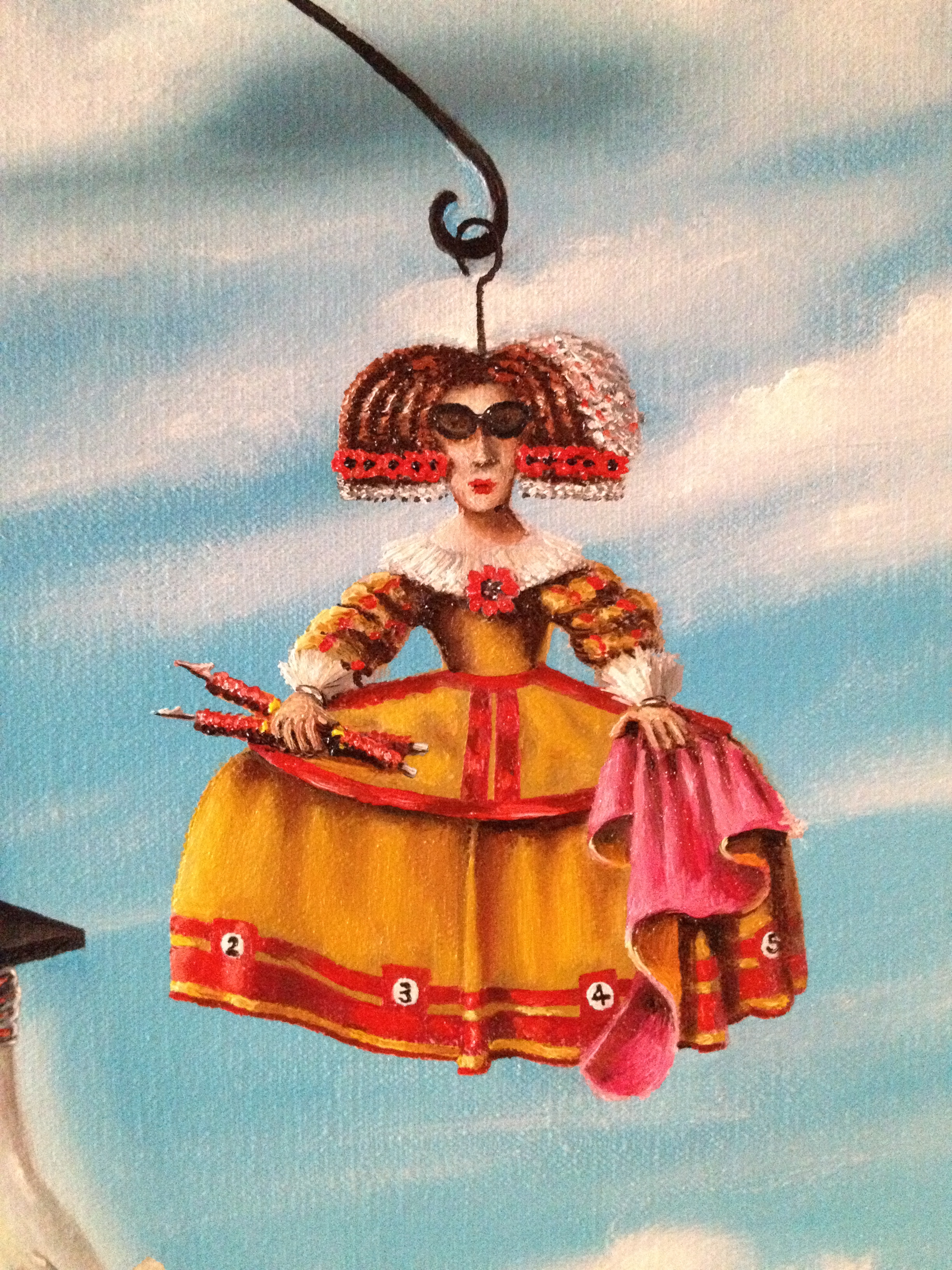
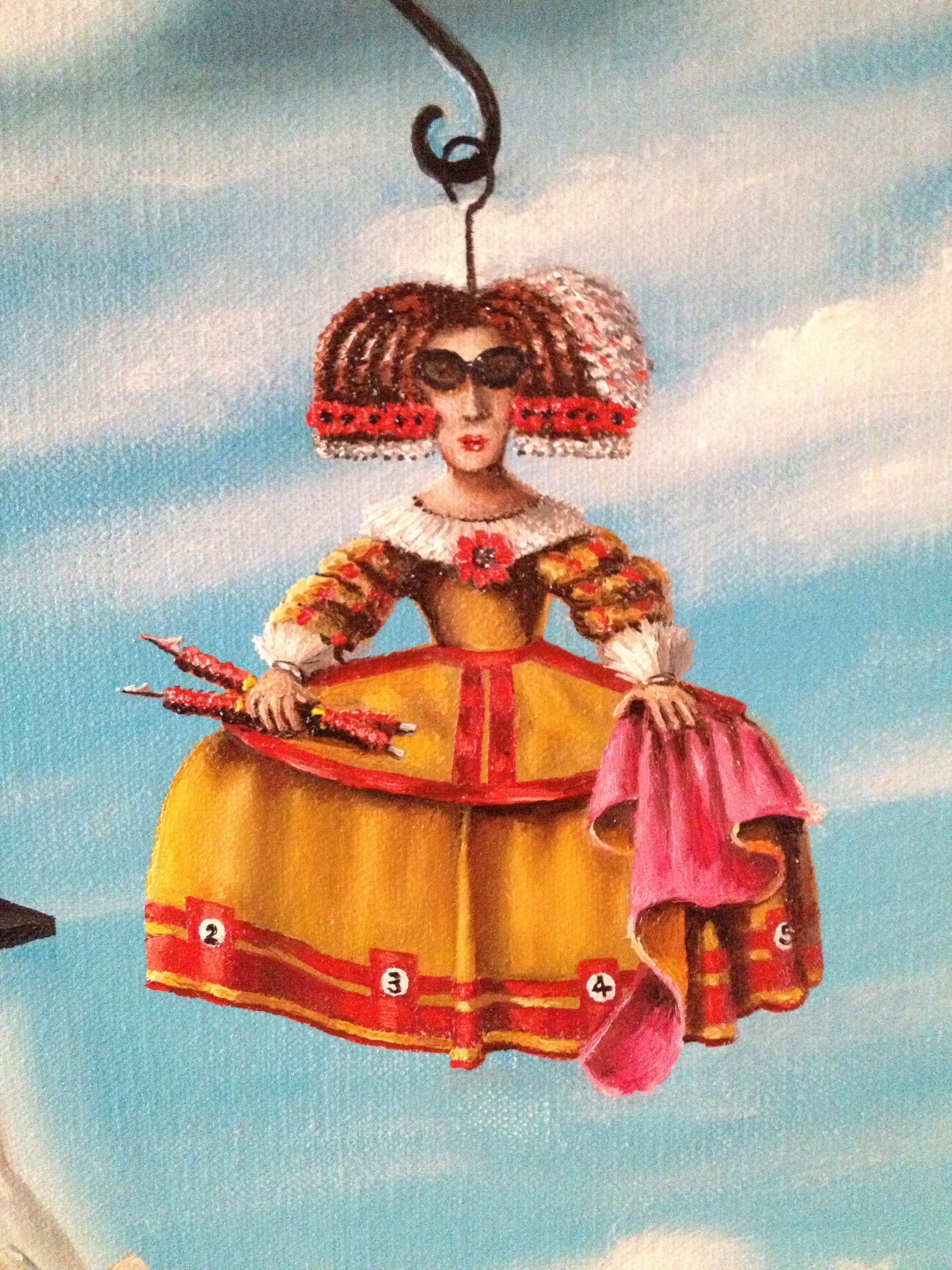
I have extrapolated upon most of the details in the painting in former posts explaining my progress, however in very brief terms, the painting is an autobiographical self-portrait told through symbols and metaphors rather than a head and shoulders portrait. At the centre of the canvas, a large free-standing mobile, in the style of the great mobile-artist Alexander Calder, represents my life. At its base, my constant companions, Fluffy and Bilbao, teddies given by my Partner and me to one another shortly after we first started dating, represent the very consistent, anchoring and significant role of our relationship in my life. Then above, the mobile acts as an autobiography balancing out the various positives and negatives in my life so far. DSC07673 On the left: the positives – all the stuff I love and which has helped to shape me into the person I am today. First up, Spain and art history, symbolised through the iconic image of one of Span’s master-artist’s Infanta portraits, whose dress is in turn decked out to resemble the sandy colours of a Spanish bull ring, while her sunglasses represent Spanish tourism, the industry which has been so important in bolstering the economy of modern day Spain. DSC07623 DSC07619Next, the symbol of enlightenment and creative/ academic success: This is a Norm-shaped lightbulb decked out in a graduation mortar-board and holding a graduation scroll. This hybrid Norm/ bulb character represents my achievements both as an illustrator-blogger and as a lawyer, and stands for the importance of learning and development in my life. Further along, the egg: This is a representation of my art career, and also my love of Paris (where I was engaged and from which I have been inseparable for at least 15 years). Paris was the inspiration for my first major painting, Le Paris Formidable, a creation which I consider to be a milestone in my artistic career and the moment I began to take painting seriously. In that image I painted the Sacre Coeur church as a series of eggs and egg cups (the white domes of the basilica reminding me of eggs), while plunging into the egg, an egg soldier is replaced by a French baguette, held up by a rosary, representing that for me, art is like my religion. DSC07613 Finally in the positives, a sun cream bottle represents my love of travel, and spurting from it, a representation of my love of gastronomy as shown through a mixed and bounteous flow of prawns, marie rose sauce, chorizo, strawberries and wine, all combined together through a meandering strand of spaghetti which in itself metamorphoses from the Fortnum and Masons hamper sat on a rock below it – the hamper representing my love of the finer things in life. DSC07617 Onto the negatives, and up first my 2008 accident – the life-changing event was informed so much of my art and altered my life, both physically and mentally forever. DSC07624 Then the death of my career at the self-employed bar, a hugely difficult time when I suffered stress close to mental breakdown, prejudice, bullying and was effectively cast out of the profession because of the small-minded prejudices which come of a profession in which survival, without fitting into the Oxbridge stereotype (the blue snakes), is all but impossible. DSC07630 Then the birdcage, a symbol of entrapment, both for my sister trapped by the grave fate which arose upon the death of her husband leaving her to bring up three toddlers alone, and for me in my career. DSC07634 Finally the Apprentice – a direct reference to another of my paintings, Nicholas in the Renaissance, a tongue-in-cheek self-portrait in which I parodied a depiction of Saint Sebastian to represent the injustices I felt I had suffered when I appeared in the acclaimed BBC television series, The Apprentice series 4. The sugar cube of course alludes to Lord Sugar, the famous business man for whom the “Apprentices” seek to work under the television format. DSC07645 Meanwhile in the foreground, an expanse of water separates my current life from my childhood, albeit only marginally, and that youth is symbolised my a self-standing rock in the bottom right of the canvas representing my family, a symbol which took on a whole new poignancy when my brother-in-law was killed last December. Meanwhile, in the rock pools to the left, also representative of my childhood, the smallest of shells represents the heady days of my youth when climbing over coastal rocks I would collect shells, affixing them onto little snails I had modelled which I would then sell at local fairs. Some could say it was the start of my art career. They were certainly formative years. DSC07582 DSC07648 DSC07610 So there we have it, my life on a large (120cm x 120cm) canvas in oil paint. I’m awfully proud of this painting, and also glad to have persevered over such a protracted period. The result is a truly reflective glimpse of my life as it stands and also acts for me as a kind of closure on all that is past. Now I look forward to a whole new chapter of my life, with all the artistic expression which will inevitably go hand in hand alongside it.DSC07661 © Nicholas de Lacy-Brown and The Daily Norm, 2001-2013. Unauthorized use and/or duplication of the material, whether written work, photography or artwork, included within The Daily Norm without express and written permission from The Daily Norm’s author and/or owner is strictly prohibited. Excerpts and links may be used, provided that full and clear credit is given to Nicholas de Lacy-Brown and The Daily Norm with appropriate and specific direction to the original content.
Autobiographical Mobile: My painting diary – Day 24: A family tragedy

I set out painting my Autobiographical Mobile in June last year, and wrote my first post on the painting (once I realised it would take me some time to complete) back in August. The intention was to paint a mobile like structure, balancing from its various offshoots both the good and bad experiences of my life so far. In this way, the mobile would tell my story, acting as a autobiographical self-portrait through symbolism alone. Yet when I was planning out the painting back in the summer of last year, I could never have known that when designing how to represent the bad experiences of my life so far that a further, horrendous family tragedy would occur, rocking my world and the lives of my family forever.
Three days before Christmas last year, my brother in law was killed – hit by a car. He left behind my sister and their three children: two year old twins and a 4 year old – all boys. It’s not been something I’ve addressed directly on this blog: before now it felt too soon to address so traumatic an experience on this platform. And even now it’s too tender to describe in words. Yet as with my own road traffic accident five years before, there is no underestimating the relief which artistic representation has given me in being able to work through the pain that tragedy brings.

DSC07639

When his death occurred, Christmas died. The sparkle, the light, the glory and excitement of Christmas was automatically extinguished like a glass of water poured suddenly over a candle. The continuing presence of the decorations around us felt somehow awkward, almost insulting, like someone wearing bright pink at a funeral. And once those decorations were packed away, the world left behind was in so many ways changed from what it had been when we had taken them out, full of the spirit of Christmas only a few weeks before.

In my home what remained after Christmas had been packed away was my Autobiographical Mobile painting, sat on my easel still incomplete, but already including what I had previously considered to be a completed “bad experiences” side of the mobile. Staring at the painting it dawned on me, that no aspect of this work, like a living breathing organism in our home, was ever going to be finished until the last brushstroke had been applied – in the meantime it was a continuing record of my life, and this grave family tragedy would now have to have its place on the canvas.

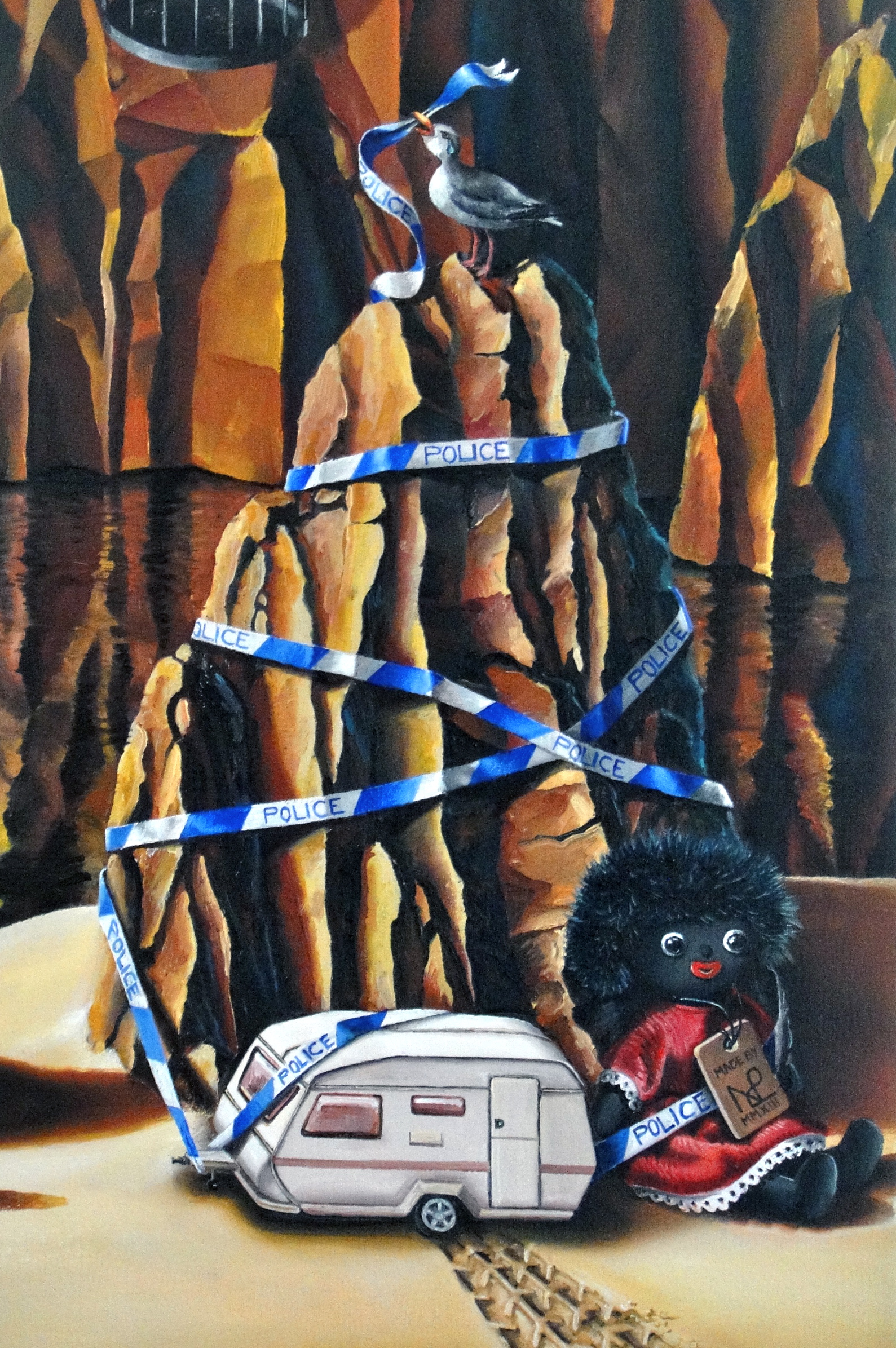
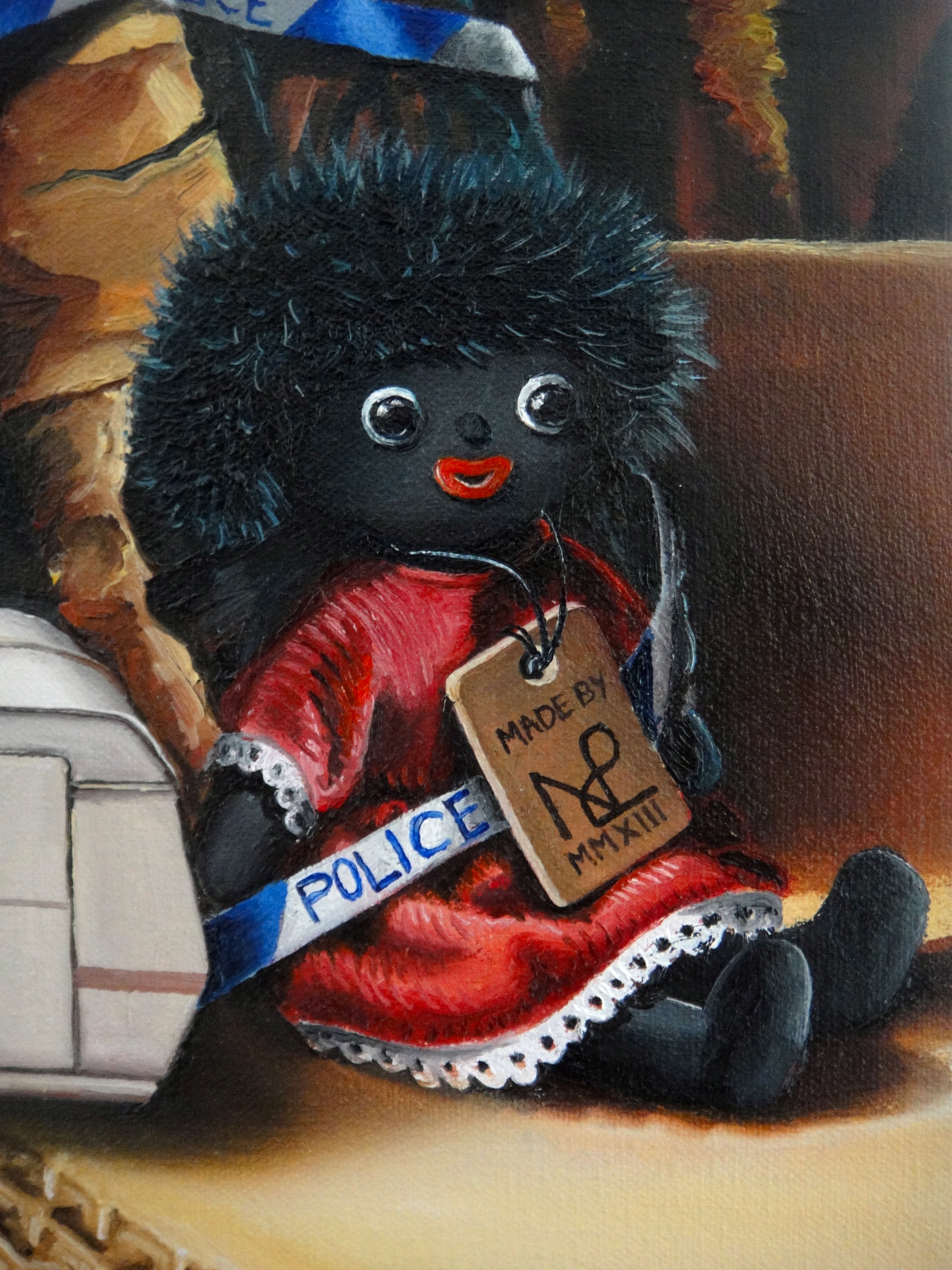
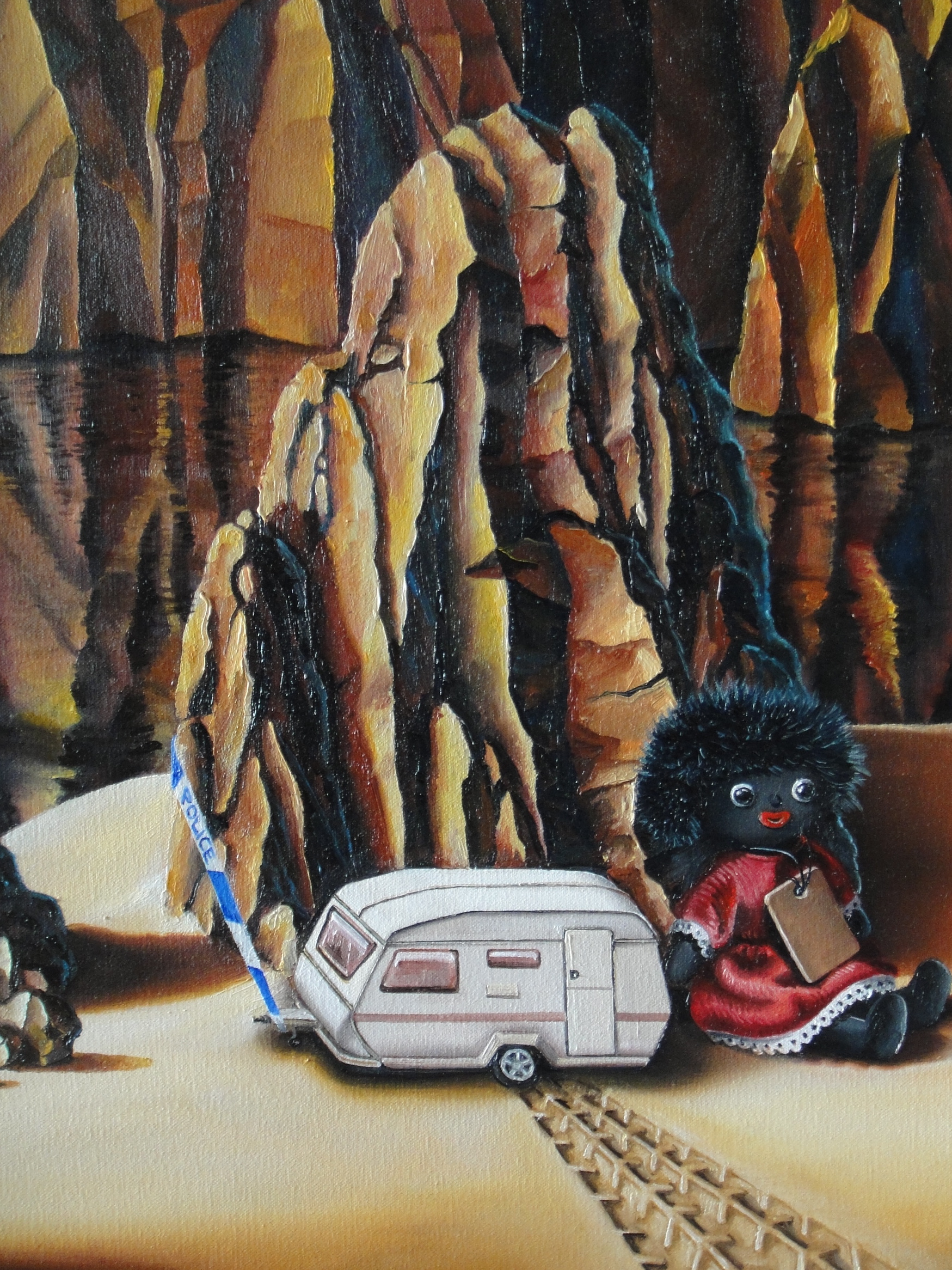
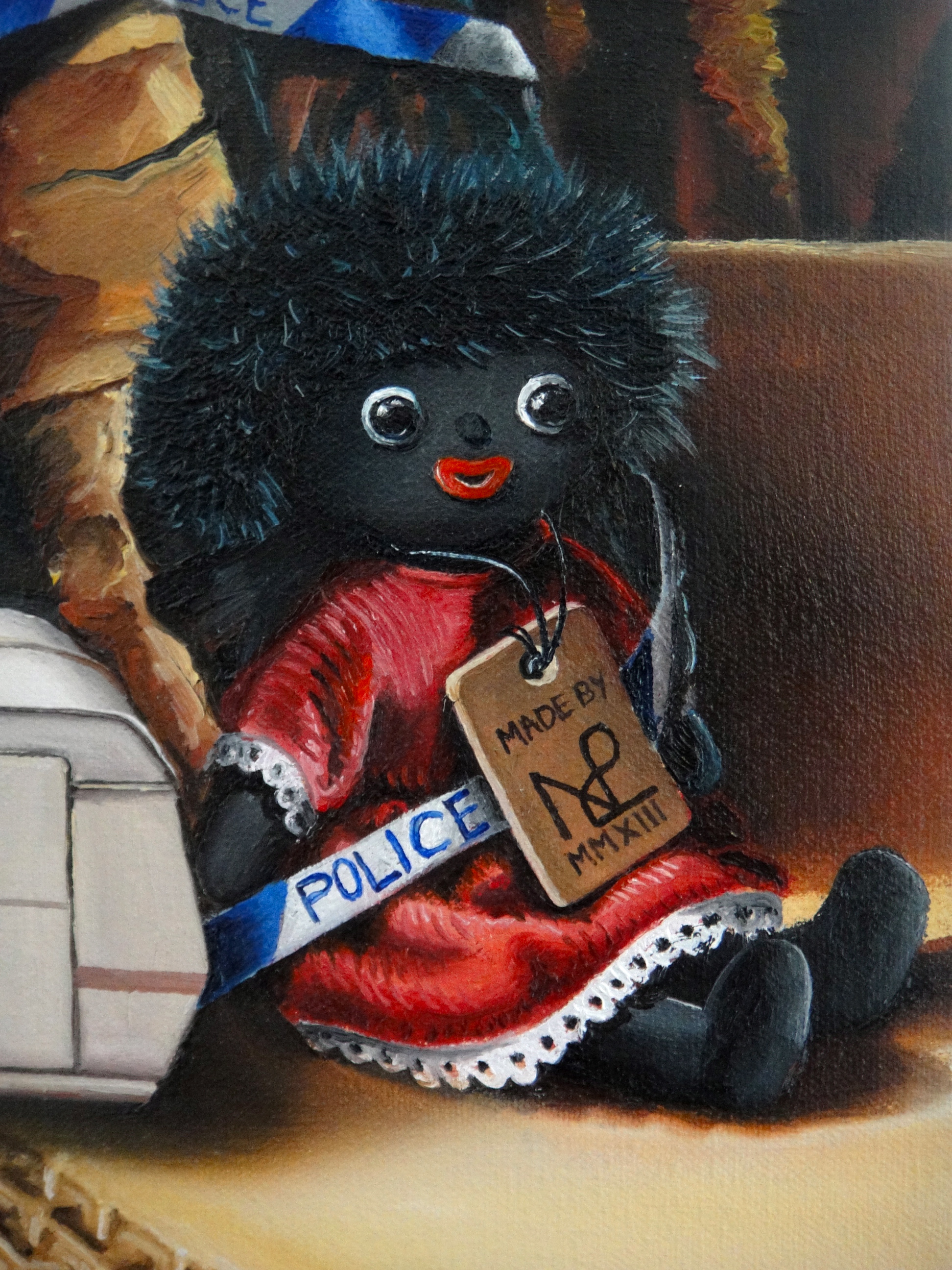
Already painted pre-Christmas was what I had thought of as the “family rock” – a large rock in the bottom right of the canvas, against which a small golly-doll, representing my mother, and a caravan representing family childhood holidays are placed. Those representations remain, but now in a different guise. For wrapped around the rock, ensnaring, entangling the family, the doll, and the caravan in its sinuous web is a police ribbon taken straight from an accident scene. Nothing in the family is free from its reach – it is all-encompassing, a symbol of the inescapable consequences of a family death, a loss of life which affects so many, irreparably, now and into the future.

DSC07444 DSC07582

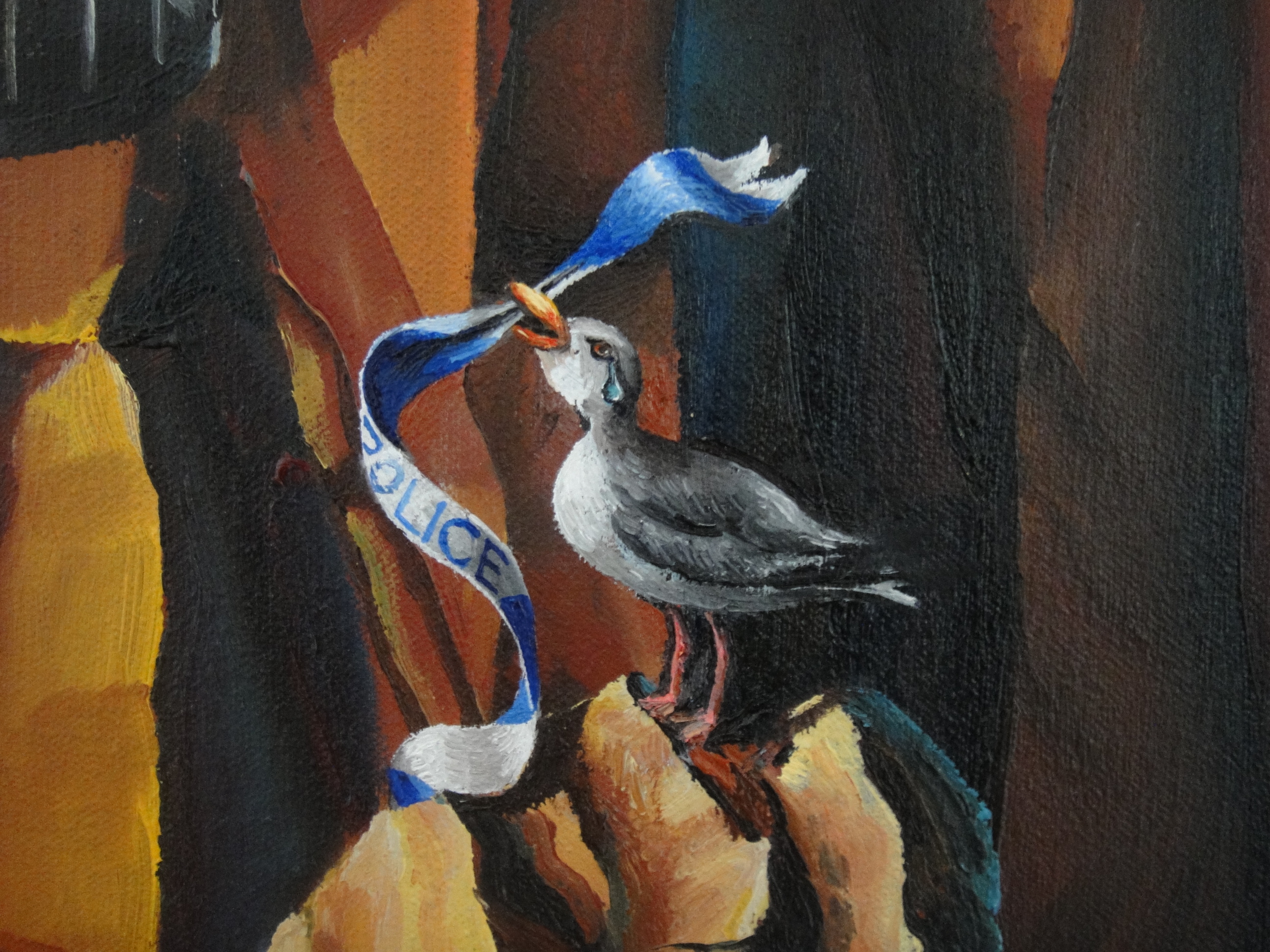
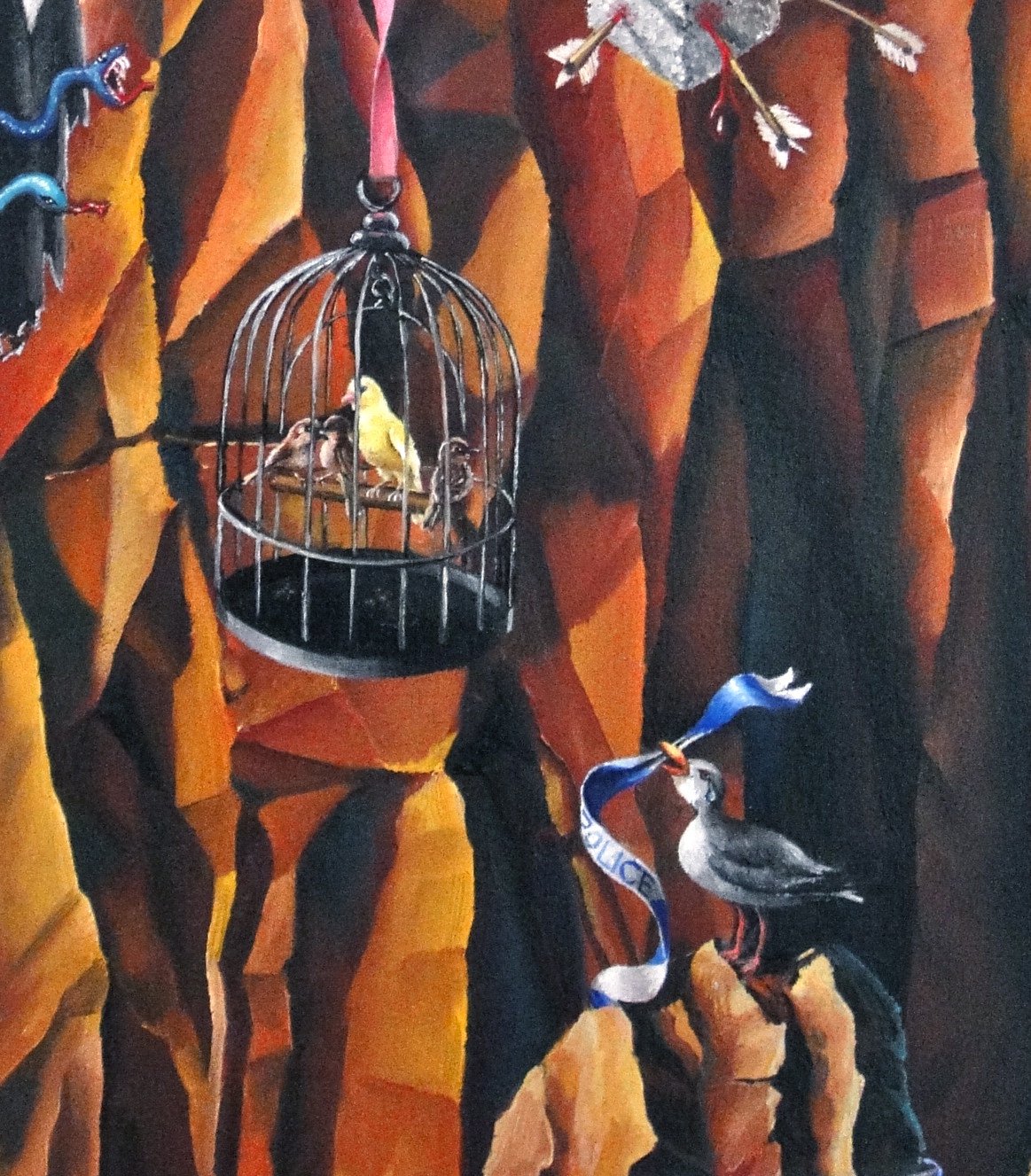
But the image goes further. Atop the rock, a seagull is standing, trying, hard as it might to break the ribbon away, a tear rolling from its eye as it comes to terms with the struggle. The seagull is my sister. We always used to call seagulls “Cathy’s friends” because they always seemed inexorably attracted to her when we were on beach holidays – maybe something to do with the snacks she was eating! The seagull – my sister – looks upwards in the direction of a cage, and in that cage is a bright yellow bird, trapped with three small babies, imprisoned within the confines of its own destiny: responsibility enclosing the bird with an iron fist.

DSC07634

Meanwhile, down at the bottom of the painting, a tire track has imprinted itself through the sand, plunging directly into the rock – the impact of the accident, hitting my family hard. None can escape, although some of us got off lighter than others – around the golly (my mother), a manufacturing certificate hangs outside the confines of the police ribbon. It bares a signature. It’s mine.

DSC07661

© Nicholas de Lacy-Brown and The Daily Norm, 2001-2013. Unauthorized use and/or duplication of the material, whether written work, photography or artwork, included within The Daily Norm without express and written permission from The Daily Norm’s author and/or owner is strictly prohibited. Excerpts and links may be used, provided that full and clear credit is given to Nicholas de Lacy-Brown and The Daily Norm with appropriate and specific direction to the original content.

Printmaking Progress I

I headed along to the Royal Academy of Arts yesterday for the London Original Print Fair. According to the website, it’s the longest-running specialist print fair in the world and yet, I am embarrassed to admit, I’d never heard of it before. Having been abundantly inspired by the prints room at last year’s Royal Academy Summer Exhibition, I never realised that only two months before, the whole Academy is veritably given over to the heterogenous medium of printmaking. And it couldn’t have come at a better time – as I unveiled on The Daily Norm last week, I am now a very eager printmaking student myself, having completed a weekend’s beginners intaglio and etching, and now enrolled upon the intermediate course, with esteemed printmaker Victoria Browne my very enthusiastic and gracefully patient teacher.

©Trevor Price - The Feast II

©Trevor Price – The Feast II

Wondering around the fair, which comprised some 50 galleries and print dealers selling an array of prints from £100 works by lesser-known artists, to 5-figure editions by the likes of Lichtenstein and Francis Bacon (and what I wouldn’t do for one of those), it dawned on me just how fantastically versatile the medium of print really is. While after only 3 days in the attempt, I now feel sufficiently versed in lino printing and etching to at least understand the basics of the medium, I haven’t even got started on dry point, on lithographs, on soft-ground etching, on screen printing. Yet with a beginner’s understanding of at least some print techniques, I was able to enjoy this comprehensive show of prints with a knowing and enthusiastic eye, taking inspiration from the array of prints on offer, and even making a small purchase of a beautiful Cornish-inspired supper scene by distinguished print-artist Trevor Price which was relief-printed and priced mercifully at the lower end of the scale!

Meanwhile back at home my head is awash with ideas for my own future print creations and an eagerness to learn new techniques. This week I’m due to learn aquatint, a method by which tone is added to the basic lines of an etching. I’ll be adding aquatint to my current etching plate which I can now very proudly unveil. As something of a follow up to my first etching, this one is also set out a Mallorcan beach, and borrows form my Autobiographical Mobile painting in its motif of a Fortnum and Mason’s hamper atop a rock. Meanwhile. down below, a group of perplexed Norms look up at the hamper, as much confused by its appearance as they are slightly scared by its precarious placing upon the rock’s peak.

My second etching pre-aquatint stage (© Nicholas de Lacy-Brown)

My second etching pre-aquatint stage (© Nicholas de Lacy-Brown)

The etching drawn into the  black "ground" pre-exposure to acid

The etching drawn into the black “ground” pre-exposure to acid

I hope to be able to show you an aquatinted version of this plate very soon! In the meantime, I cannot extol the virtues of printmaking enough – fill your homes, check out the print works of the great artists and attend print fairs everywhere – original canvases are so yesterday.

Autobiographical Mobile: My painting diary – Days 20-23: Rock pools

It’s hard to believe that this post represents only days 20-23 of this painting. Something surely has to have gone wrong with this account, for in only now approaching the end of this vast project, it feels like I have been painting for months. I have, in fact, been working on this canvas for sometime – since June last year in fact (albeit intermittently) which just goes to show how little time I actually have to paint now that I am a full time lawyer, blogger and new found sketcher and printmaker.

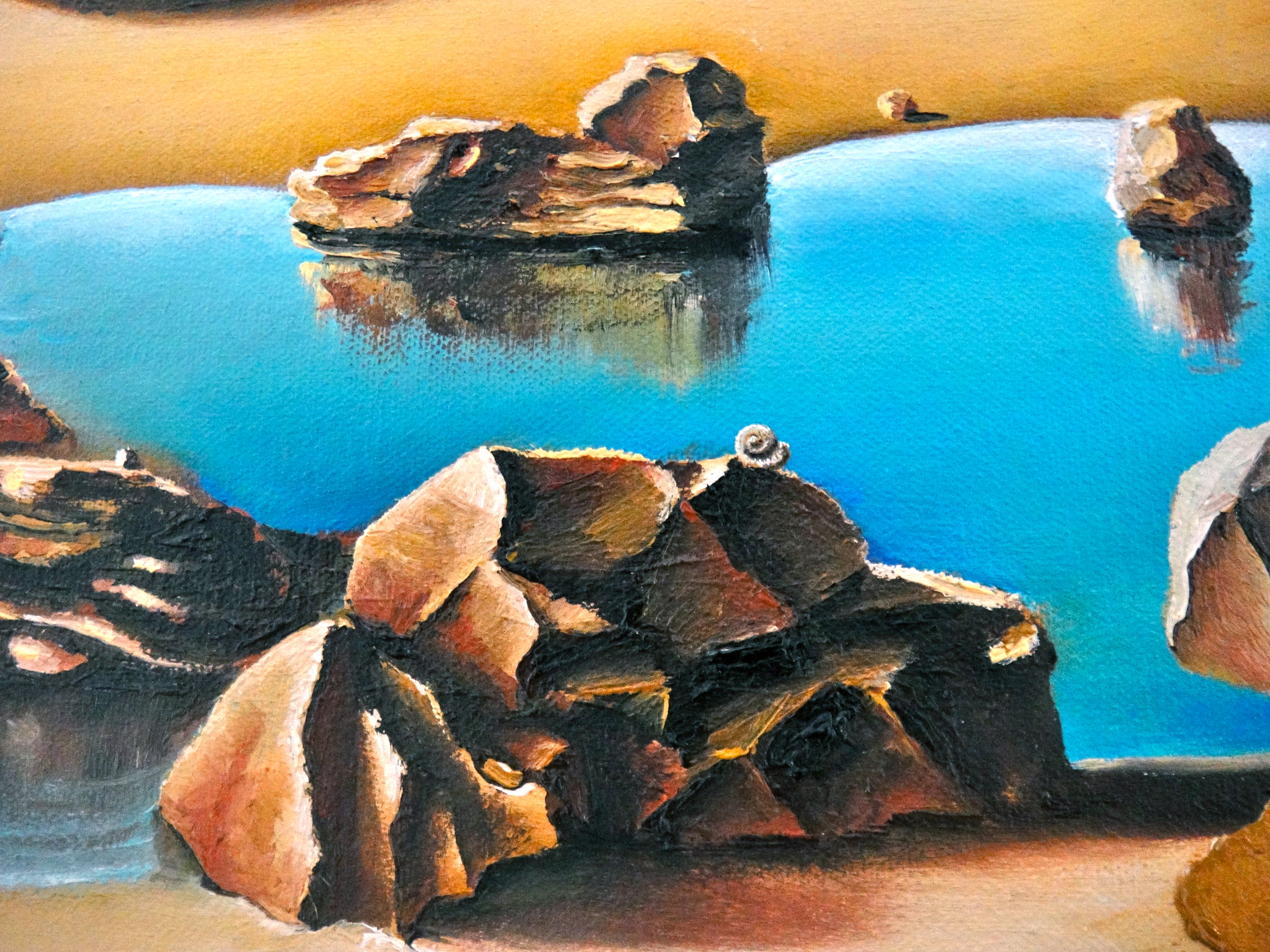
All the same, sometimes the best results are achieved with a little patience and plenty of hard work, and this aphorism is no better proved than with the latest additions to my autobiographical canvas – 4 days painting rock pools. Hard to believe that they would take so long, but each of the little rock forms, which create balance at the foot of my canvas, reflecting the large mountainous forms above in the sandy stretch below, has its own peculiar shape and character. And since each rock comes straight from my imagination, this isn’t a simple case of painting what’s in front of me. Rather, a process of trial and error commences as I try to paint rocks straight from the soul, with a lightness of approach at first as I allow the naturalistic forms to almost metamorphose innately from a wider brush stroke. Then once I feel and see a shape begin to form, I start filling in the painstaking details with a small brush.

This slideshow requires JavaScript.

The result is a satisfying swathe of rocks and water which add shape and texture to the lower foreground of my work. Reminding me of the hours spent climbing in amongst the various rock pools of the beaches of Jersey in the Channel Islands every summer throughout my childhood, collecting little shells which I later made into little models of snails, these rock forms are an important reflection on the younger years of my life as I explore my story so far on this autobiographical canvas.

© Nicholas de Lacy-Brown and The Daily Norm, 2001-2013. Unauthorized use and/or duplication of the material, whether written work, photography or artwork, included within The Daily Norm without express and written permission from The Daily Norm’s author and/or owner is strictly prohibited. Excerpts and links may be used, provided that full and clear credit is given to Nicholas de Lacy-Brown and The Daily Norm with appropriate and specific direction to the original content.

Autobiographical Mobile: My painting diary – Day 19: Infanta España

The third of my passions, represented upon the left arm of my autobiographical mobile, is my indisputable love affair with Spain, and with art history. If my heart lives in Paris, then my soul resides in Spain. The chromatic, melancholy chords of a flamenco guitar reach straight into my soul, transporting me to a place of almost otherworldliness tranquility, a land enriched with Moorish heritage, baked in the unyielding summer sun, bearing the scars of a bloody civil war and the ardor of a religious inquisition, wafting afresh with the scents of garlic and pigs and pimenton, sweet syrups and blossoming orange and almond trees, and giving birth to some of the greatest creative minds ever known. Spain is every bit a part of me as the country of my birth, and continues to inspire me in so many areas of my creative manifestation.

DSC_0477

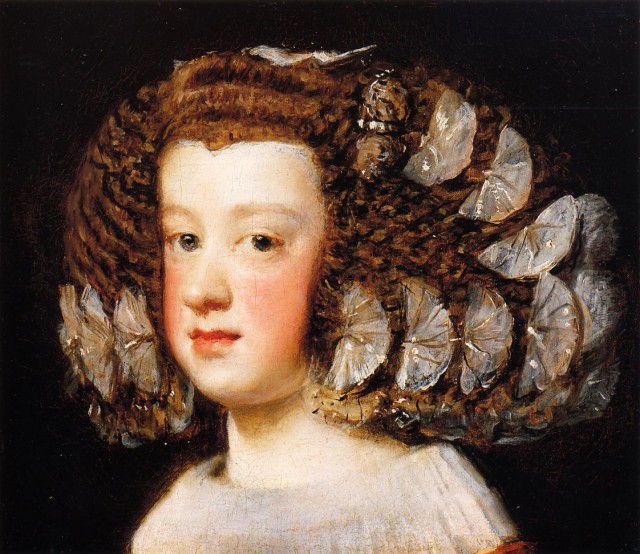
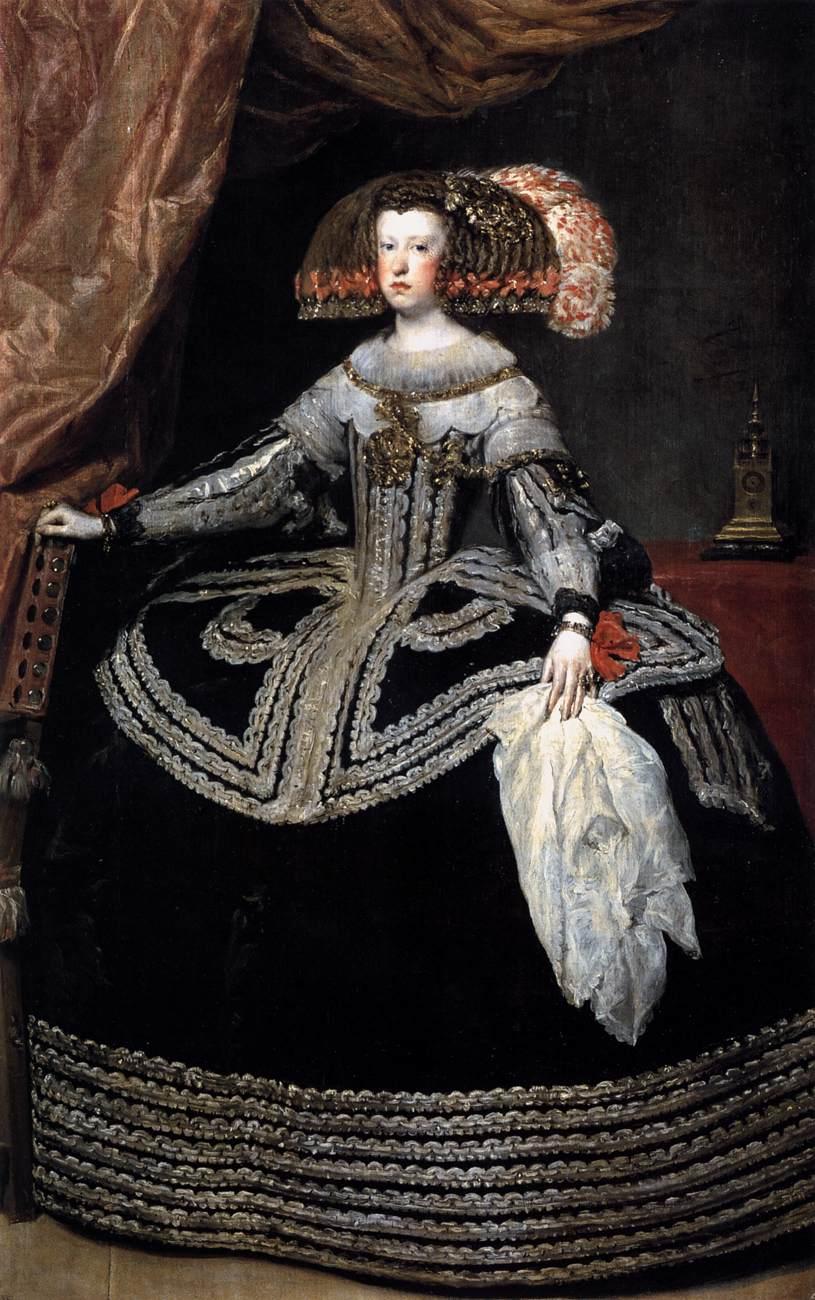
Since Spain occupies so many of my thoughts and pleasures, it is unsurprising that in pursuing that other great passion – art history – I have enjoyed a particular focus on the art of Spain, from the incredible innovation of El Greco and the dark, disturbing black paintings of Goya, to the iconic court portraits of Velázquez’s big-skirted princesses, the exquisite surreal mastery of Dali and the fragmented multi-faceted masterpieces of Picasso.

Velázquez's original Infanta portraits

Velázquez’s original Infanta portraits

357136 Diego Velazquez - Infanta Maria Teresa queen-mariana-of-austria-16531354741336843

Las Meninas

Las Meninas

Only one image could perfectly capture these dual loves of Spain and art history: Velázquez’s Infanta, the now iconic image of the Spanish Royal Princess in the court of King Philip IV. These world-famous portraits, centrepieces of Madrid’s Prado gallery and culminating in the breathtaking masterpiece, the group portrait Las Meninas, have inspired countless generations of artists, amongst them Dali and Picasso. I painted my own version of the Velázquez greats in the form of Infanta Norm, and could not resist exploring the image again in this representation of Spain.

Infanta Norm (After Velázquez) (2011, acrylic on canvas) © Nicholas de Lacy-Brown

Infanta Norm (After Velázquez) (2011, acrylic on canvas) © Nicholas de Lacy-Brown

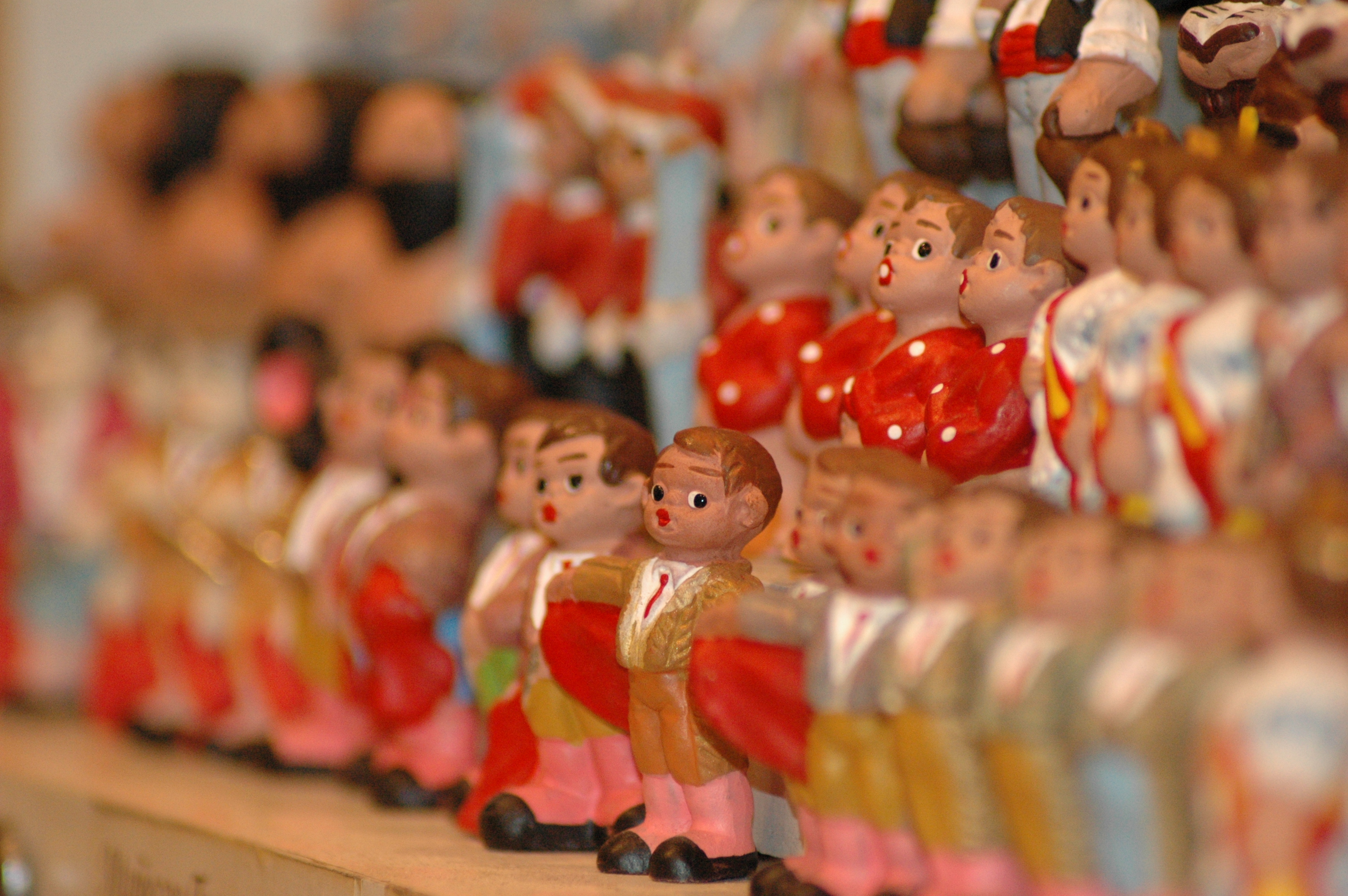
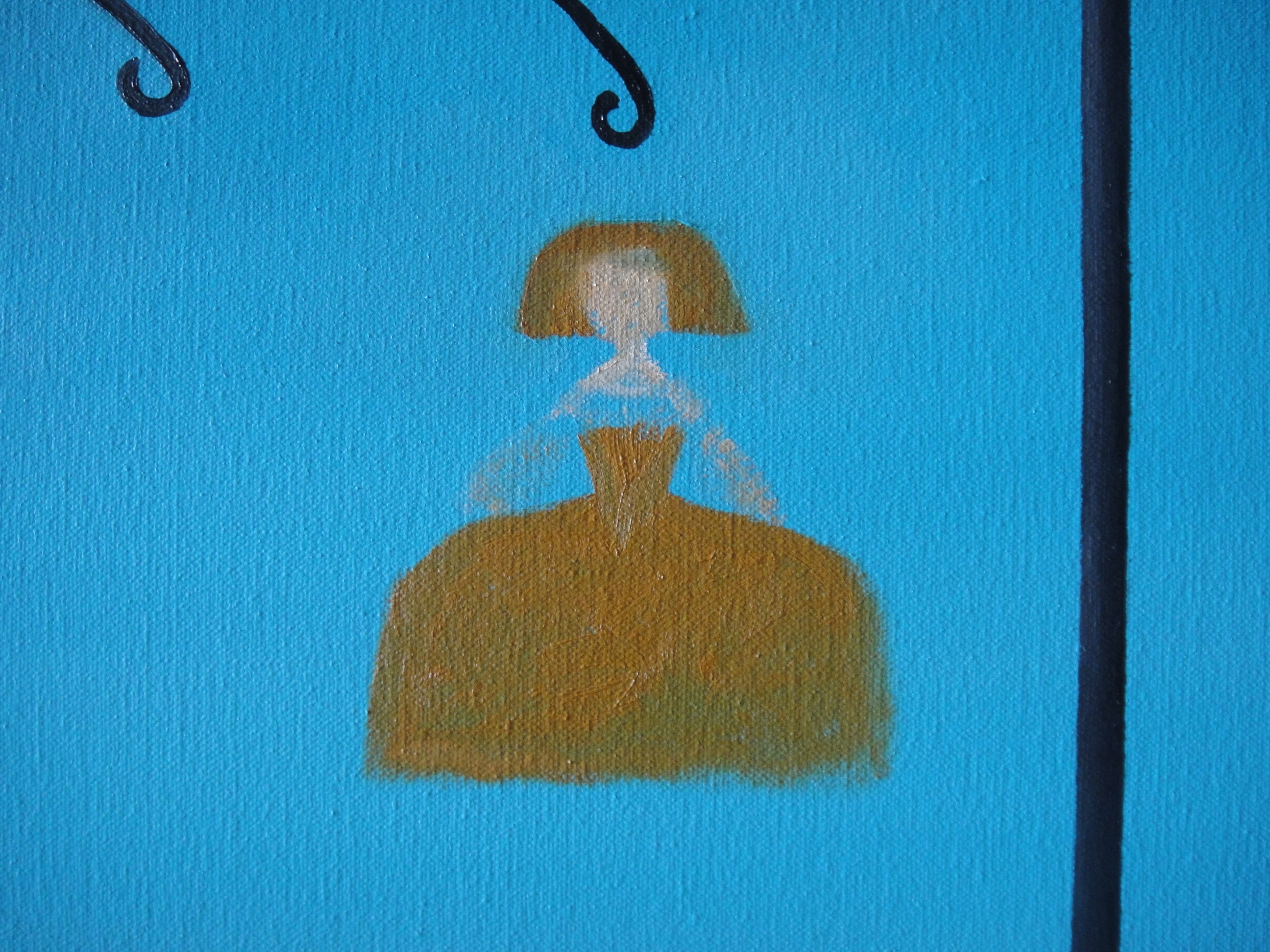
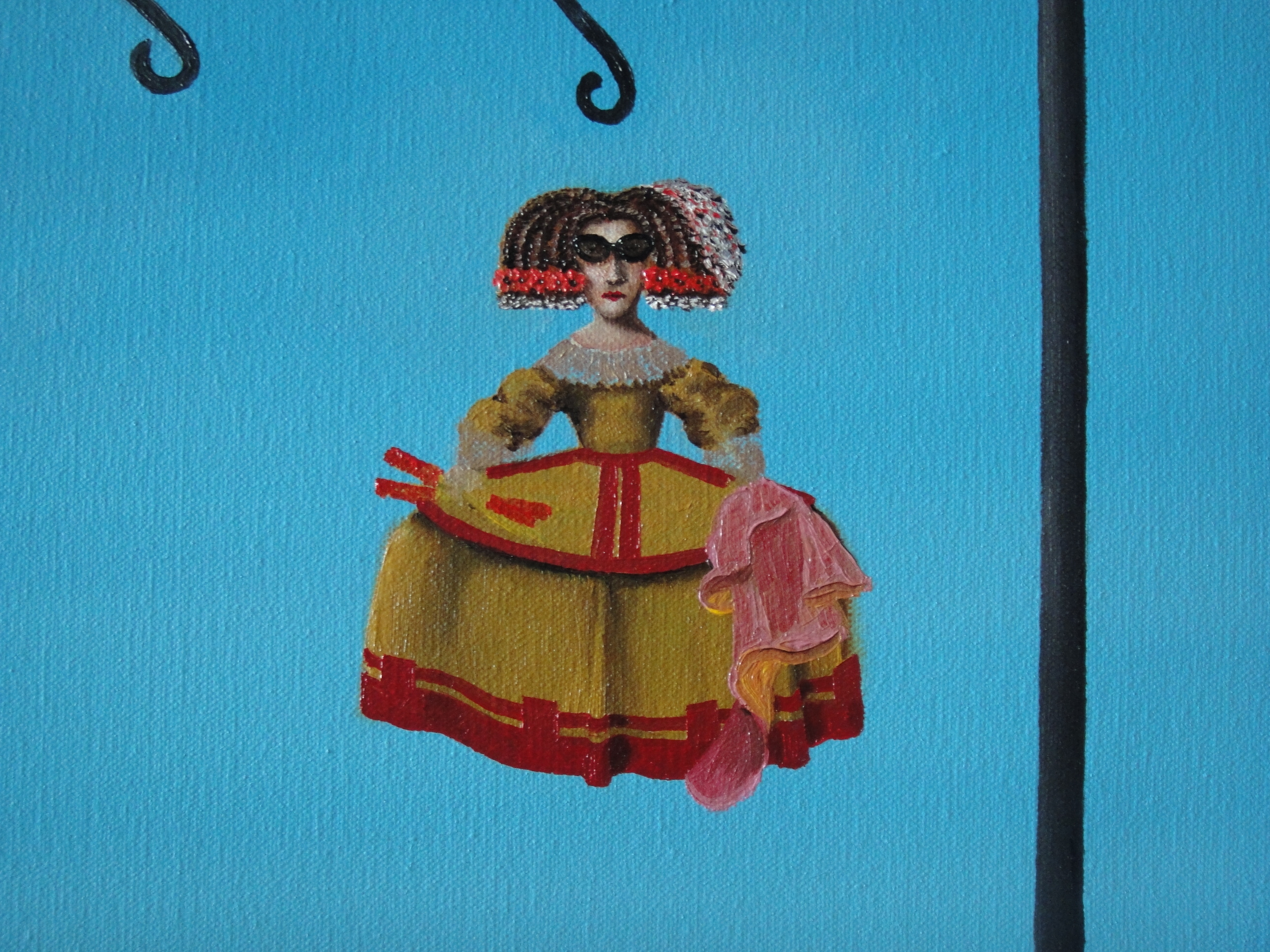
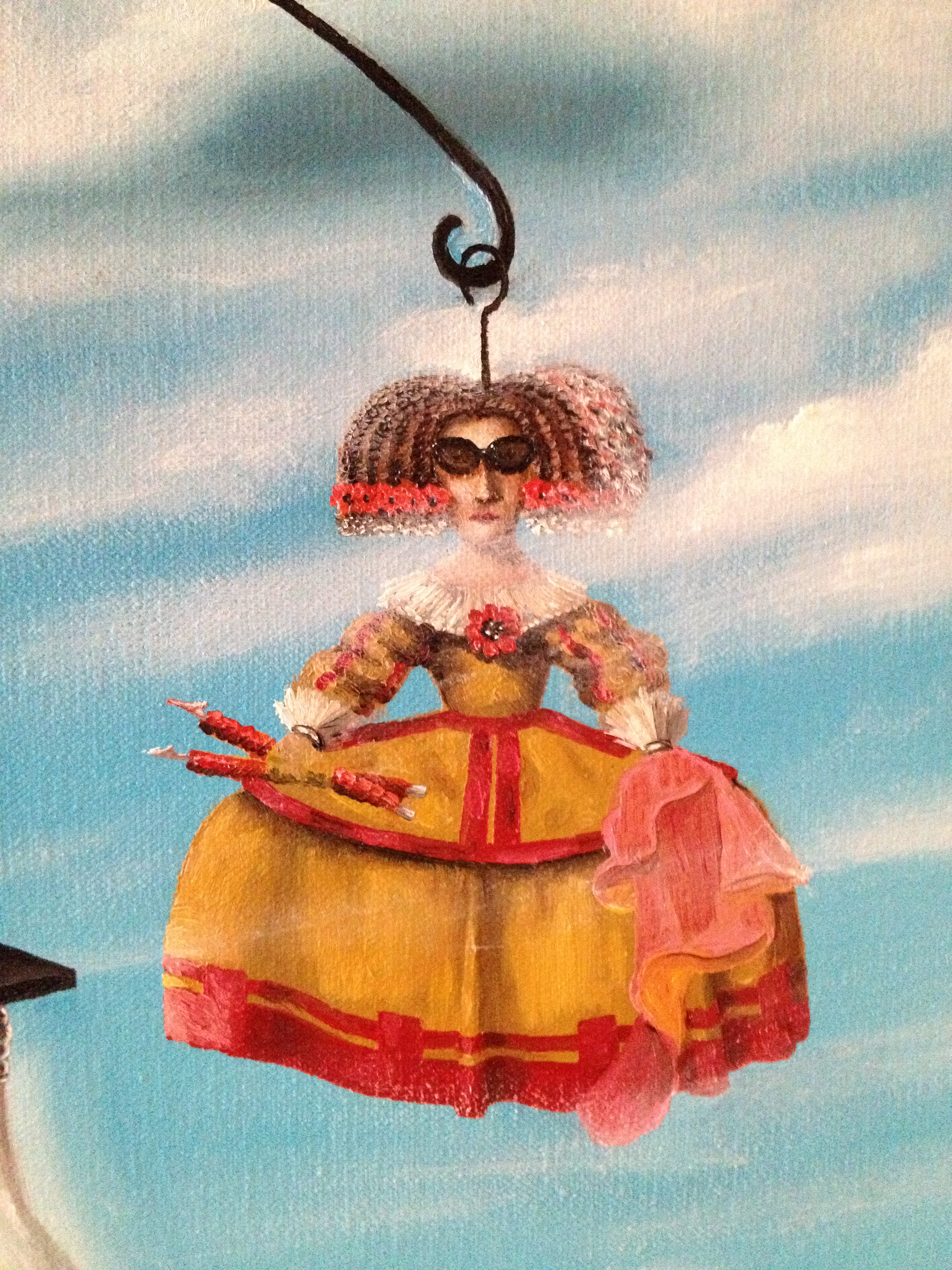
My new image of the Infanta is also a representation of Spain, with her dress painted to resemble both the colours of the Spanish flag and also a bull ring. I always loved Bullfighting as a teenager, and while the bloody sight of death in the afternoon was always a shocking one for someone unused to such a spectacle, there is no denying the elegance of the matador’s costumes (the traje de luces), the contrast of red against the black of the panting bull, the grand parades of the picadores, and the wonderful pomposity of the emboldening paso doble playing in the background. By way of further representation of the Corrida, my Infanta España holds the banderillas which are inserted into the taunted bull, and the pink and gold capote (cape) which is waved in front of its maddened eyes.

My Infanta España in progress

DSC02005 DSC02009 DSC02029 IMG_3618 IMG_3632

The finished Infanta España

The finished Infanta España

But Spain isn’t just about the bull fighting. Also represented is Spain’s all important tourism industry, here illustrated through my Infanta’s rather fetching sunglasses. We British could do with a bit of that sun right now…

Until next time – Viva España!

Marbella 760

© Nicholas de Lacy-Brown and The Daily Norm, 2001-2013. Unauthorized use and/or duplication of the material, whether written work, photography or artwork, included within The Daily Norm without express and written permission from The Daily Norm’s author and/or owner is strictly prohibited. Excerpts and links may be used, provided that full and clear credit is given to Nicholas de Lacy-Brown and The Daily Norm with appropriate and specific direction to the original content.

Autobiographical Mobile: My painting diary – Day 18: My Art and my Paris

I couldn’t be much more passionate about the second of my painted “favourite things” if I tried. The next metaphor of my life’s great loves to make it onto my latest large canvas – my Autobiographical Mobile – is Art, and Paris.

Paris was the city that made me who I am today. It started on a school trip, when my teacher led me, her hands covering my eyes, into the Place du Tertre atop the Butte de Montmartre, and quickly uncovering them, revealed a scene of such lavish character, such indubitable gyrating ecstatic energy and historical charm that I fell in love. My heart dropped to the cobbled paving beneath my feet, and has stayed in the heart of Montmartre, beating there ever since. Now, when I plug myself into the city on an almost annual basis, I cannot help but swarm mesmerised around the quaint streets, meander around the boutique-lined boulevards, and lounge like a flaneur outside the street cafes and in leafy parks, gazing in never-ending admiration at the beauty of the urban landscape around me.

Le Paris Formidable (2000, acrylic on canvas) © Nicholas de Lacy-Brown

Le Paris Formidable (2000, acrylic on canvas) © Nicholas de Lacy-Brown

With Paris came Art. For not only does the city ooze creativity from its every crack and surface, but it has also inspired some of the most illustrious artists in recent art history. As well as the slightly less illustrious ones, like me. While I had been painting for some years, the real turning point of my career, when I went from doodles and watercolours to large scale canvases, was when at the age of 16 I embarked on one of my greatest projects, and still my second biggest canvas ever, Le Paris Formidable.

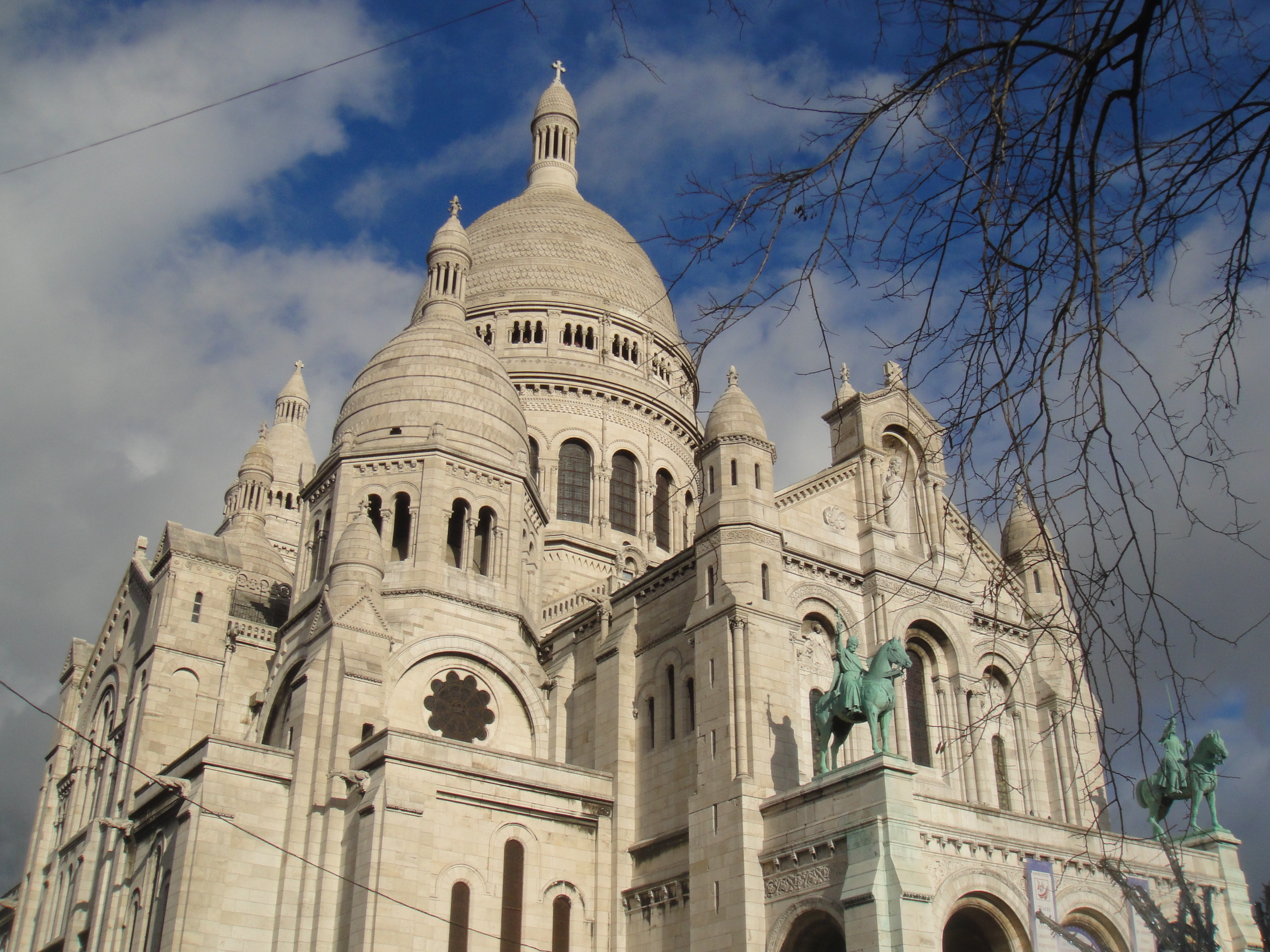
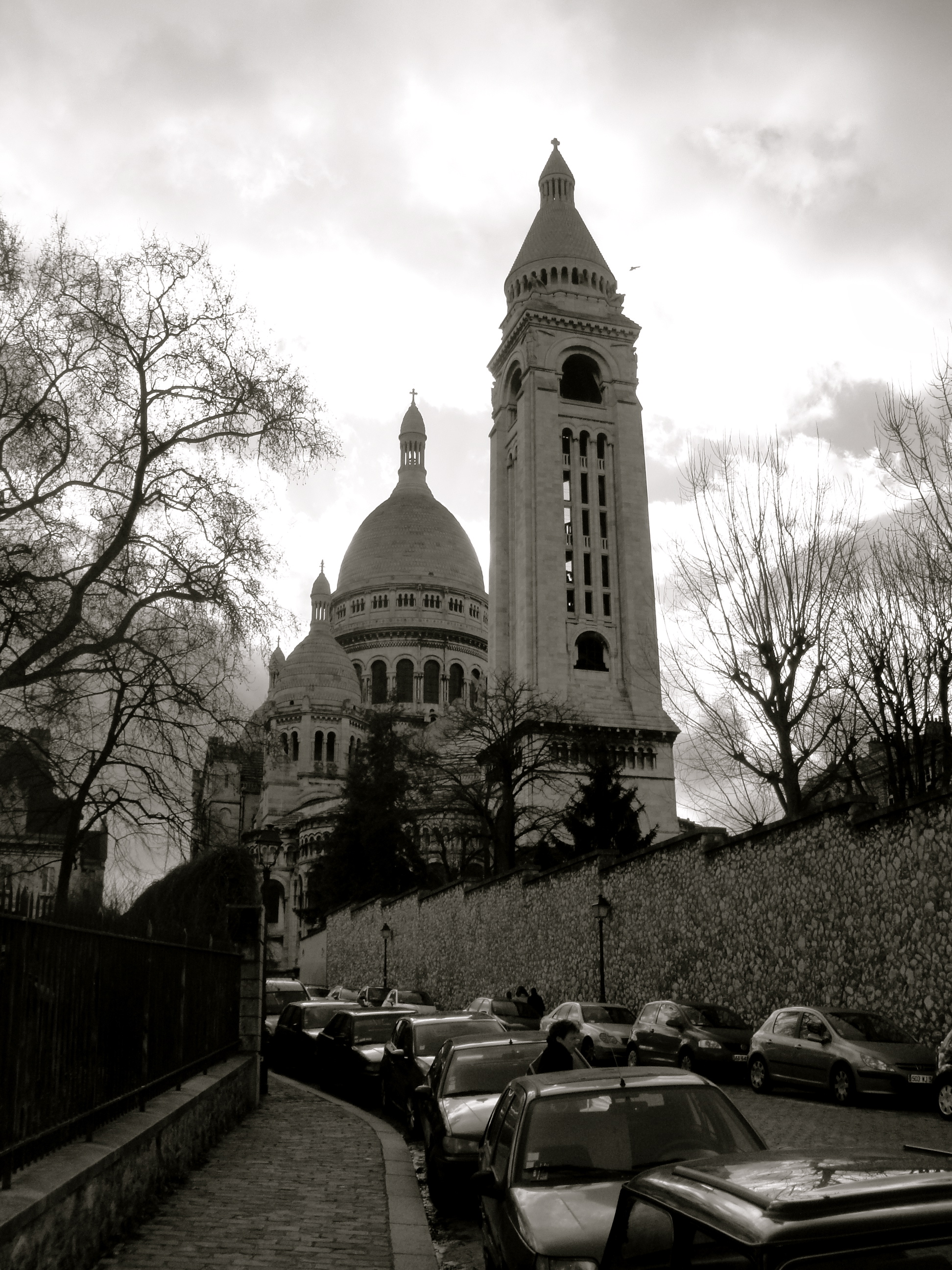
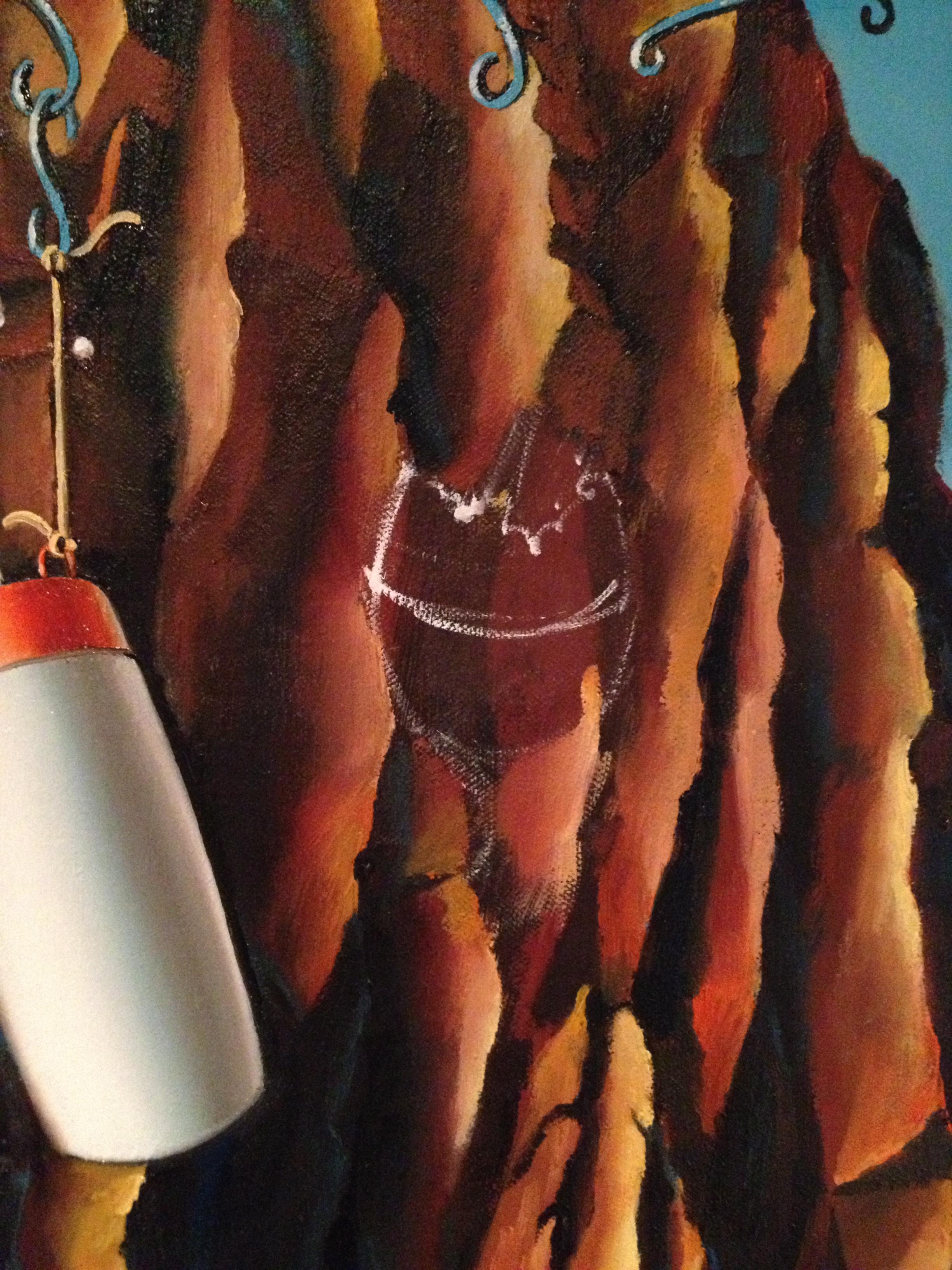
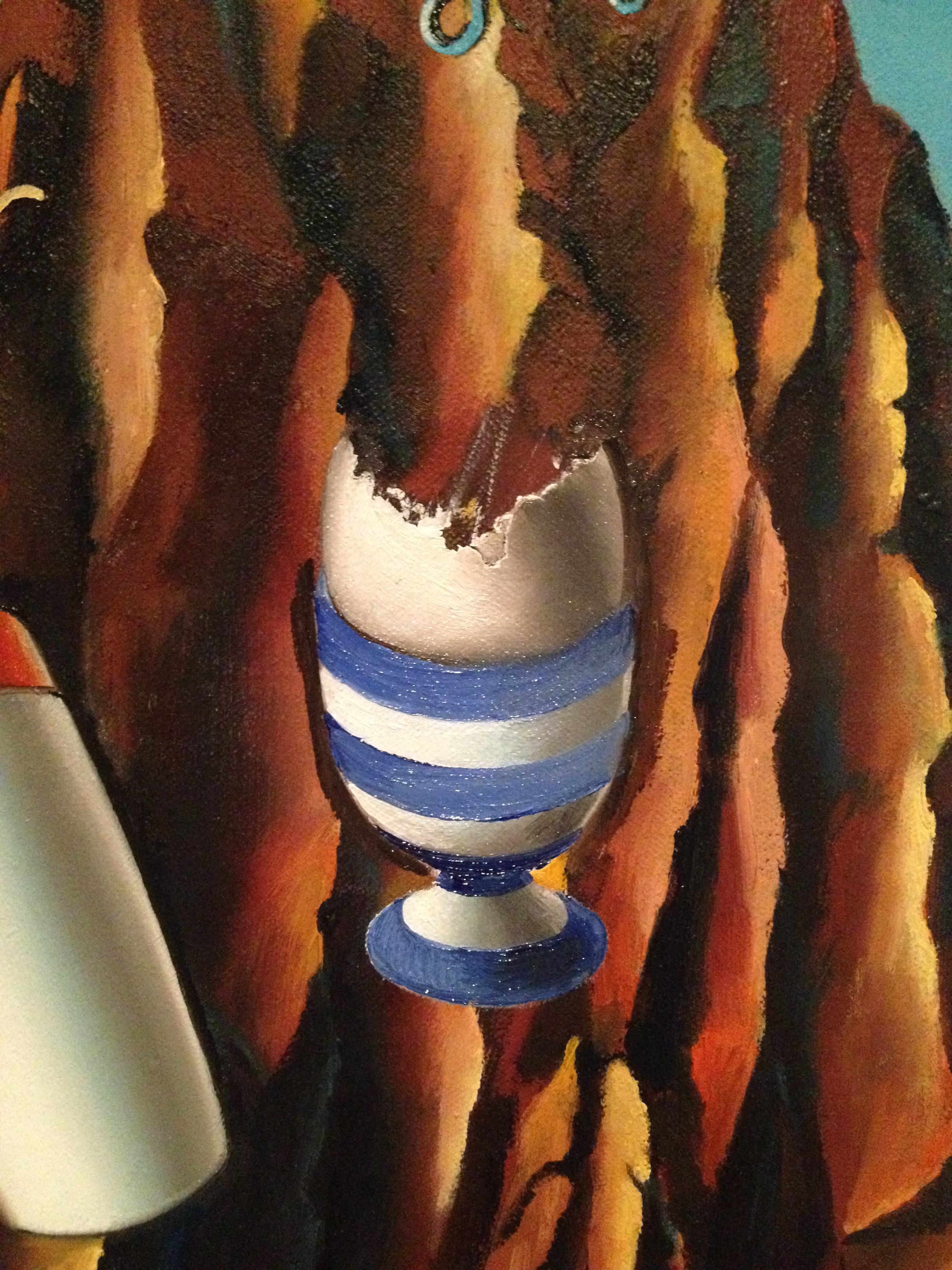
Le Paris aimed to show my beloved Paris from various unusual standpoints, and one of my favourite images was my depiction of the Sacre Coeur, the church atop Montmartre, as a series of eggs in egg cups and split open lavishing the surrounding blue canvas with their eggy contents. The image spoke both of the architectural charisma of this multi-domed church, as well as the inherent fragility of a 21st century Catholic Church. In one dome in particular, a French baguette plunged into the waiting yolky contents like an egg soldier, but also the body of Christ, while his blood, the wine, was represented by the main dome upturned like a communion chalice.

The real thing…

DSC04826 DSC04821 DSC04844

In this new painting I have replicated the egg soldier image, but with some extra frills. Both parts of the egg, and the baguette, are connected to the mobile by what looks like rosary beads, but whose religious imagery is replaced by symbols of Paris – the iconic Eiffel Tower proclaiming that Art and Paris are my ultimate passion: My Religion.

My progress

IMG_3559 IMG_3560 IMG_3562 IMG_3566 IMG_3577 IMG_3579 IMG_3583 IMG_3585 IMG_3588 IMG_3593IMG_3615

The finished image

The finished image

I find it particularly satisfying to compare both this egg and the egg of my 16 year old self – a first great painting, when my untrained skills we still naive. My skills now (although still untrained) have improved, and I feel confident in my ability to better understand light and shadow and dimension so much better than 13 years ago. Yet the idea of my 16 year old self – the Sacre Coeur as eggs – is almost surprisingly impressive to me, innovation which my adult self may struggle to come up with, but which works so well now in this revolution of my art – art revisited for this autobiographical expression of my life, on canvas.

...and the 2000 image

…and the 2000 image

© Nicholas de Lacy-Brown and The Daily Norm, 2001-2013. Unauthorized use and/or duplication of the material, whether written work, photography or artwork, included within The Daily Norm without express and written permission from The Daily Norm’s author and/or owner is strictly prohibited. Excerpts and links may be used, provided that full and clear credit is given to Nicholas de Lacy-Brown and The Daily Norm with appropriate and specific direction to the original content.

Autobiographical Mobile: My painting diary – Day 17: Travel/ Gastronomy

After what felt like months of working and reworking the Mallorcan beach background of my latest large-scale painting, my Autobiographical Mobile, I have finally started to complete some of the finer details of the work and find myself galloping into the final stretch (albeit over the hurdles which are inexorably cast into my path by a full-time job working in the law). Those details are, arguably, the most important sections of the painting, as they are the series of symbols and metaphors which hang from a large Calder-style mobile representing a biography of my life. On one side, the mobile balances my great loves and passions, on the other, the black spots and bad experiences I have encountered and, in some cases, which continue to cast their dark shadow over my life.

Over the last few days, I have concentrated on the jocular manifestation of my life’s favourite things, the section of the painting which reads a bit like the song from The Sound of Music. Of the four symbols hanging on the positive side of the mobile, the first I tackled was my symbol of travel and gastronomy. I should start by explaining that each of my symbols have a double meaning, encompassing at least two of my passions (and therefore giving the metaphors more complexity and freeing up space on the canvas). As regular readers of The Daily Norm will have noticed, I am inexcusably fond of both travel, and of food (both cooking, and of course, of eating) and particularly enjoy both pursuits when they have something of a Spanish flavour.

Progress on my travel/ gastronomy metaphor…

IMG_3523 IMG_3525 IMG_3526 IMG_3530 IMG_3545 IMG_3555 IMG_3576

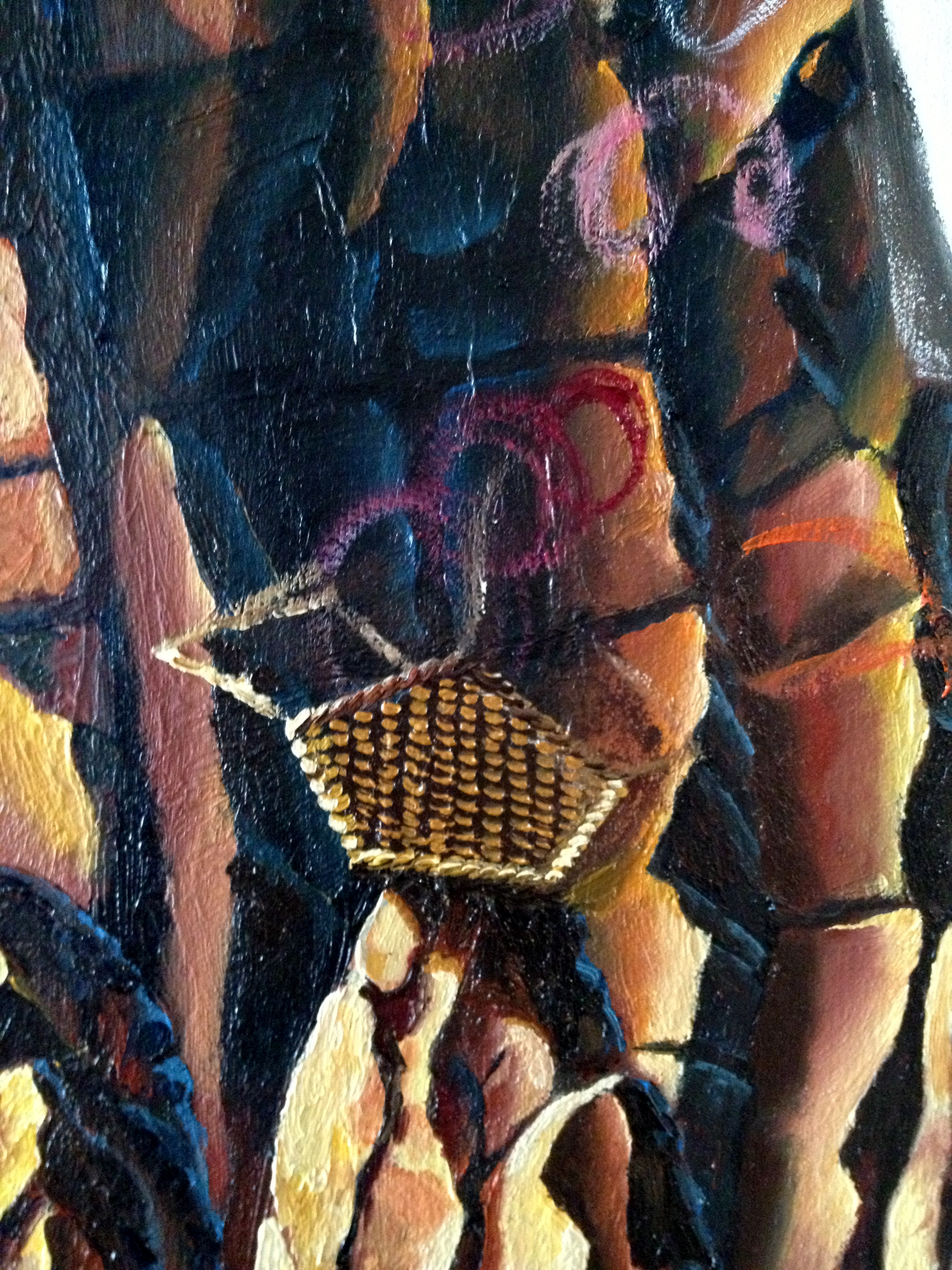
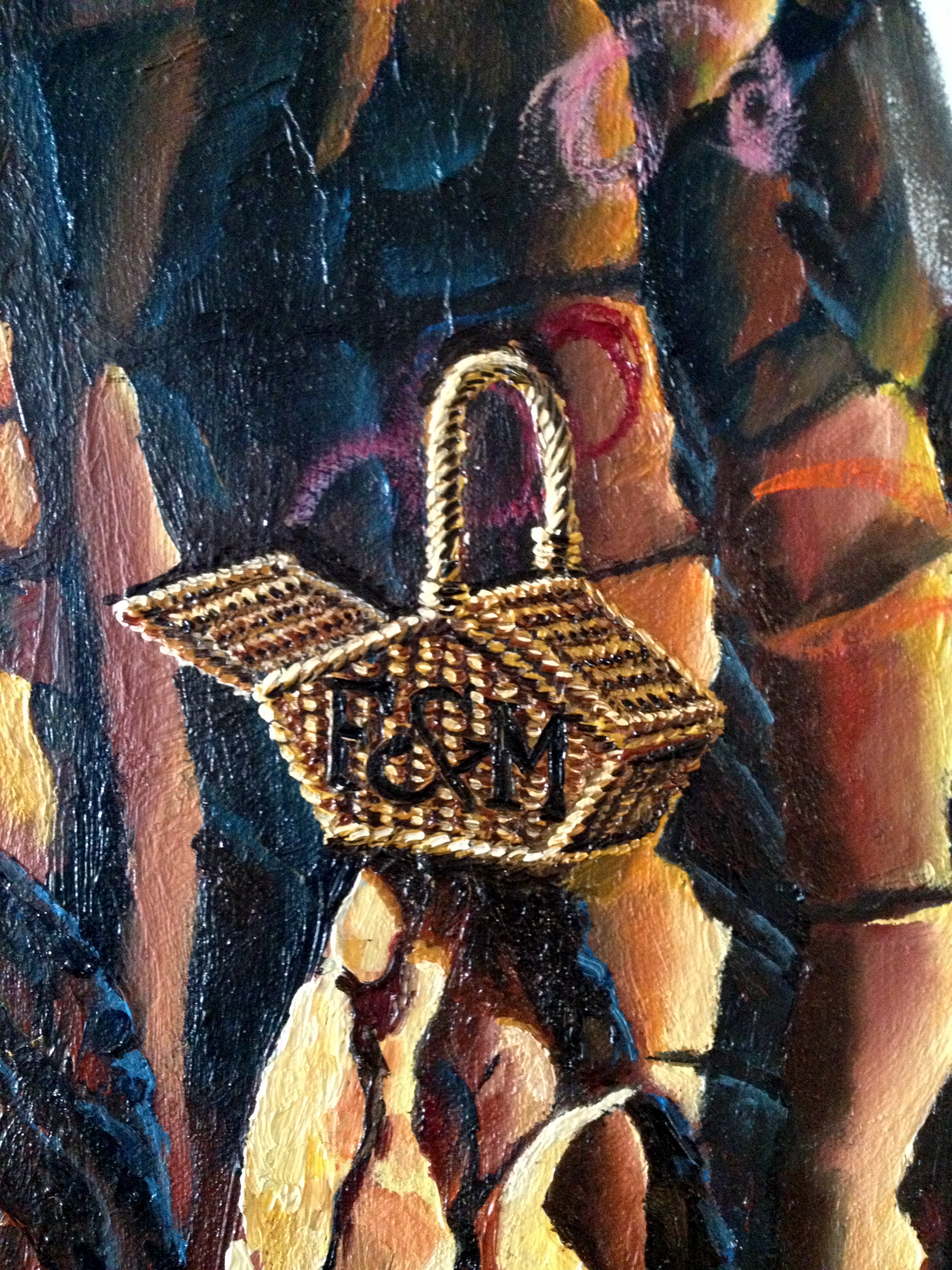
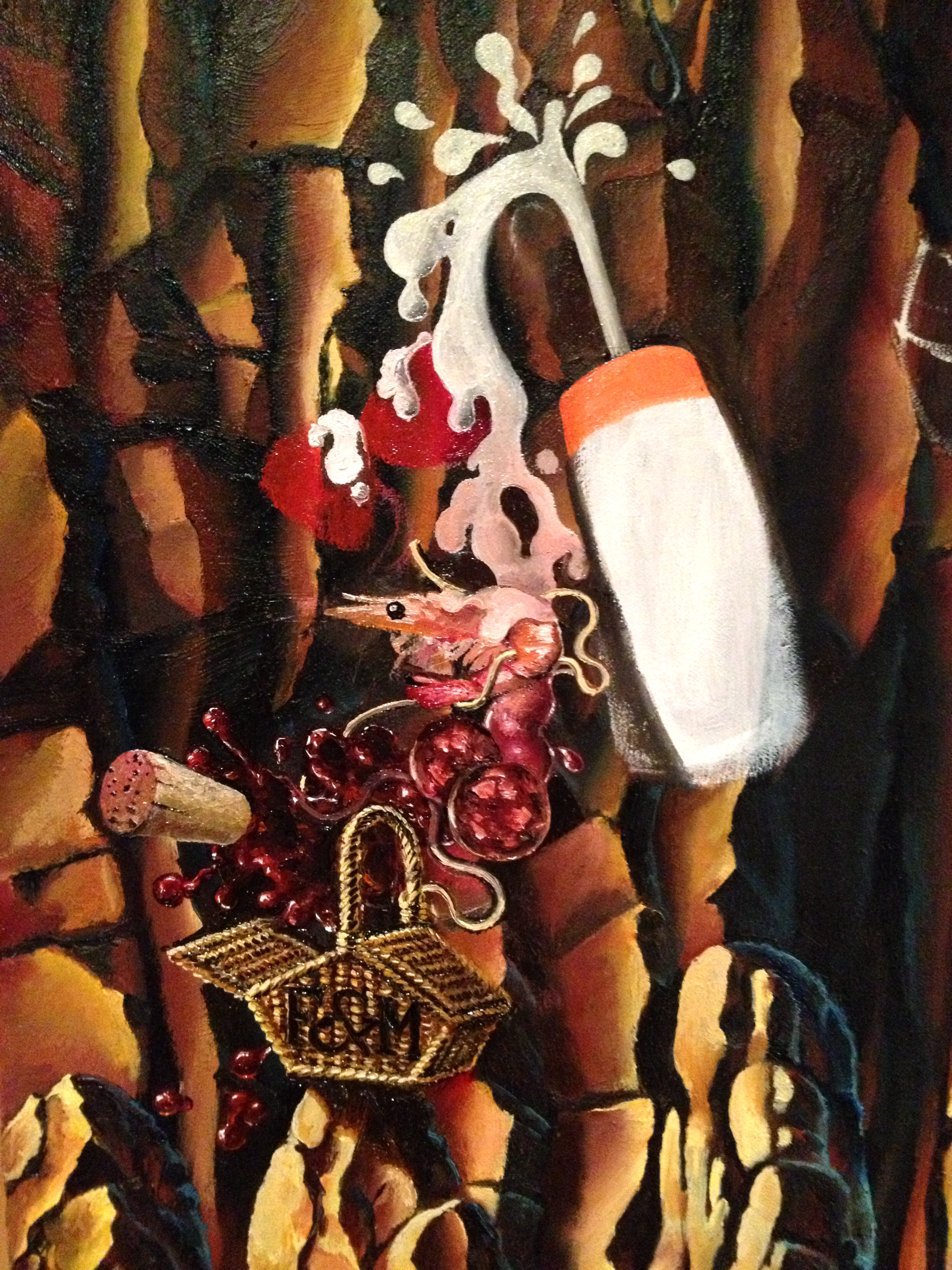
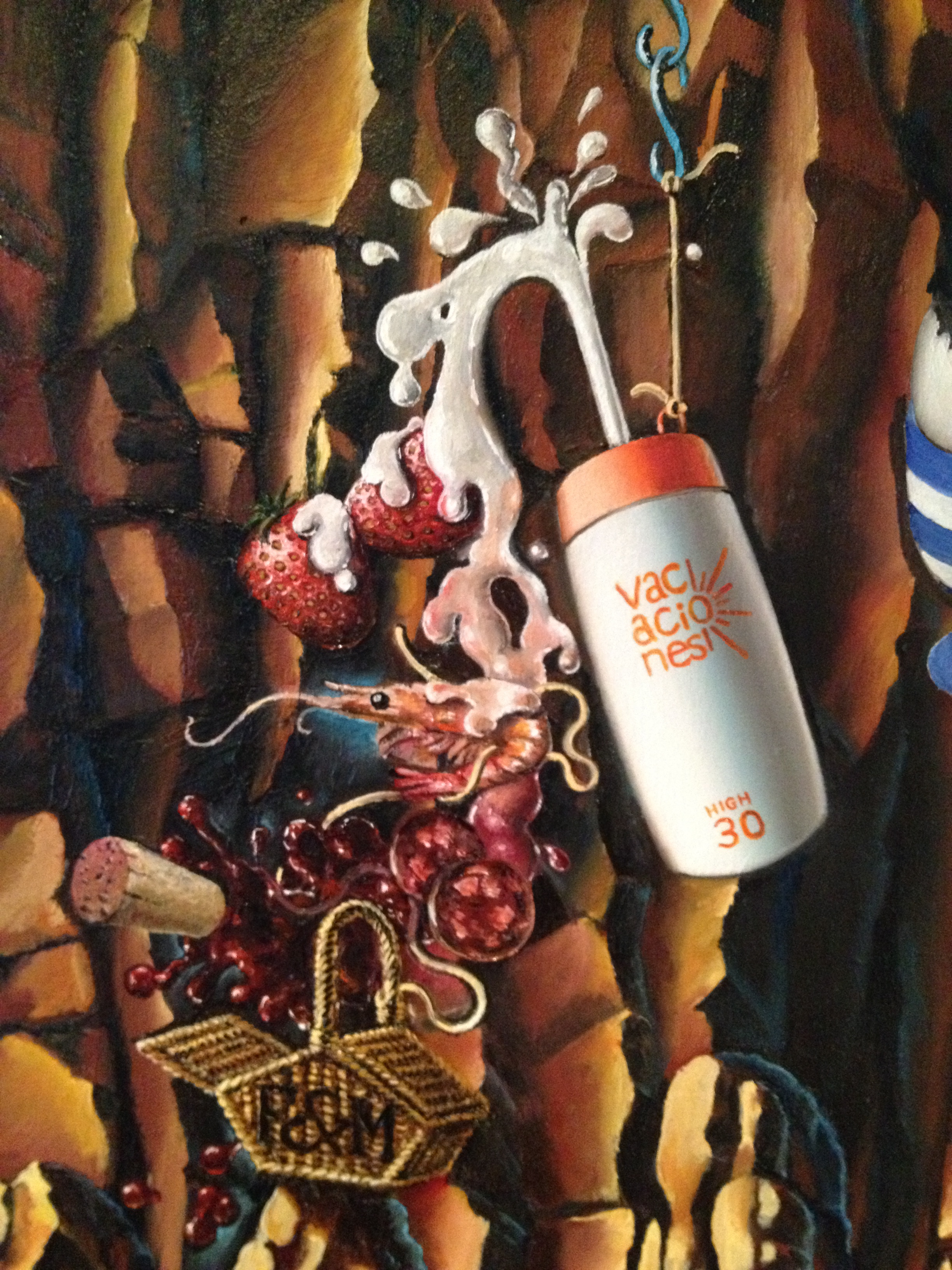
Representing both passions therefore, I have painted a bottle of sun-cream. It has a high protection level (30) which also happens to be my impending next birthday-age. On the bottle, the word “vacaciones” which is Spanish for “holidays” is suitably branded, surrounded by sun-rays (I’m quite pleased with this – I clearly should have been a brand designer!). Squirting from the bottle, the sun-cream becomes edible cream which itself swathes around two juicy strawberries – a representation of fresh, ripe summery food. The cream, graduating downwards, becomes a pinker marie-rose sauce, which in turn accompanies some succulent prawns. These in turn are accompanied by two slices of my favourite of all meats – Spanish chorizo sausage (chorizo and prawns are often to be found together in a great big pan of Spanish paella) and the chorizo is in turn doused in a delicious red wine (thus making the popular tapas dish, Chorizo al Vino) which has metamorphosed out of the marie-rose sauce. The final item on the flurry of food then is wine, as ever a subject of my most tender affection, and represented by an energetic splash and a wine bottle cork. All of this falls into a Fortnum and Mason’s picnic hamper (an icon of my favourite London department store), whose basket twine starts to unravel, curling like a piece of spaghetti around the food suspended above it.

It’s a rather complex image, but I have always had a penchant for images which metamorphose, as one object becomes another, and an image builds in complexity and entendre. Check out the third painting of my 2005 Joie de Vivre series for example. Amongst the metamorphoses there are harbour lights which become pearls which become buoys floating in the water, and rain which becomes snow which becomes ice cream.

Joie de Vivre/ Zest of Life 3: Casino Nights (2005 © Nicholas de Lacy-Brown, acrylic on canvas)

Joie de Vivre/ Zest of Life 3: Casino Nights (2005 © Nicholas de Lacy-Brown, acrylic on canvas)

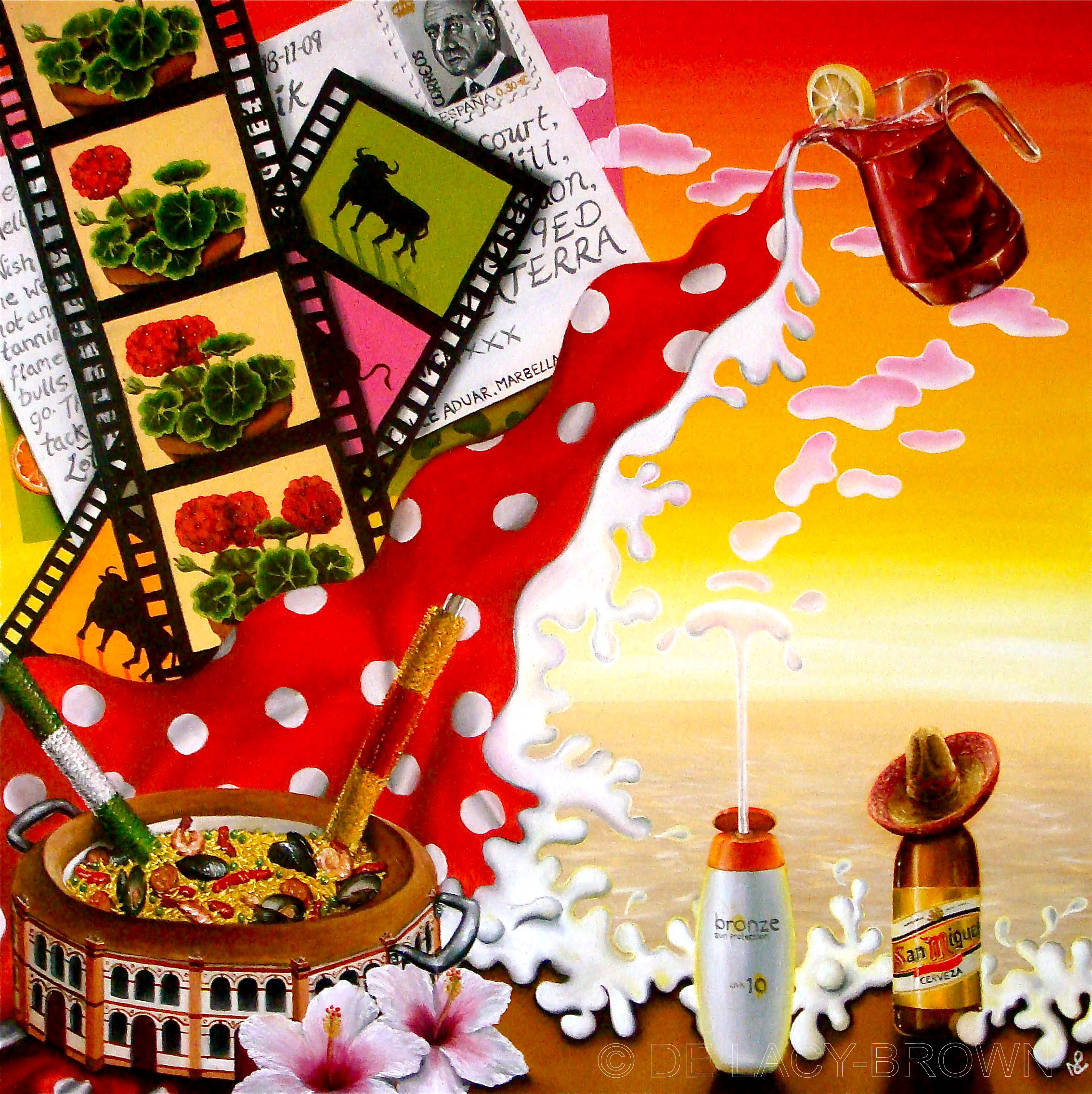
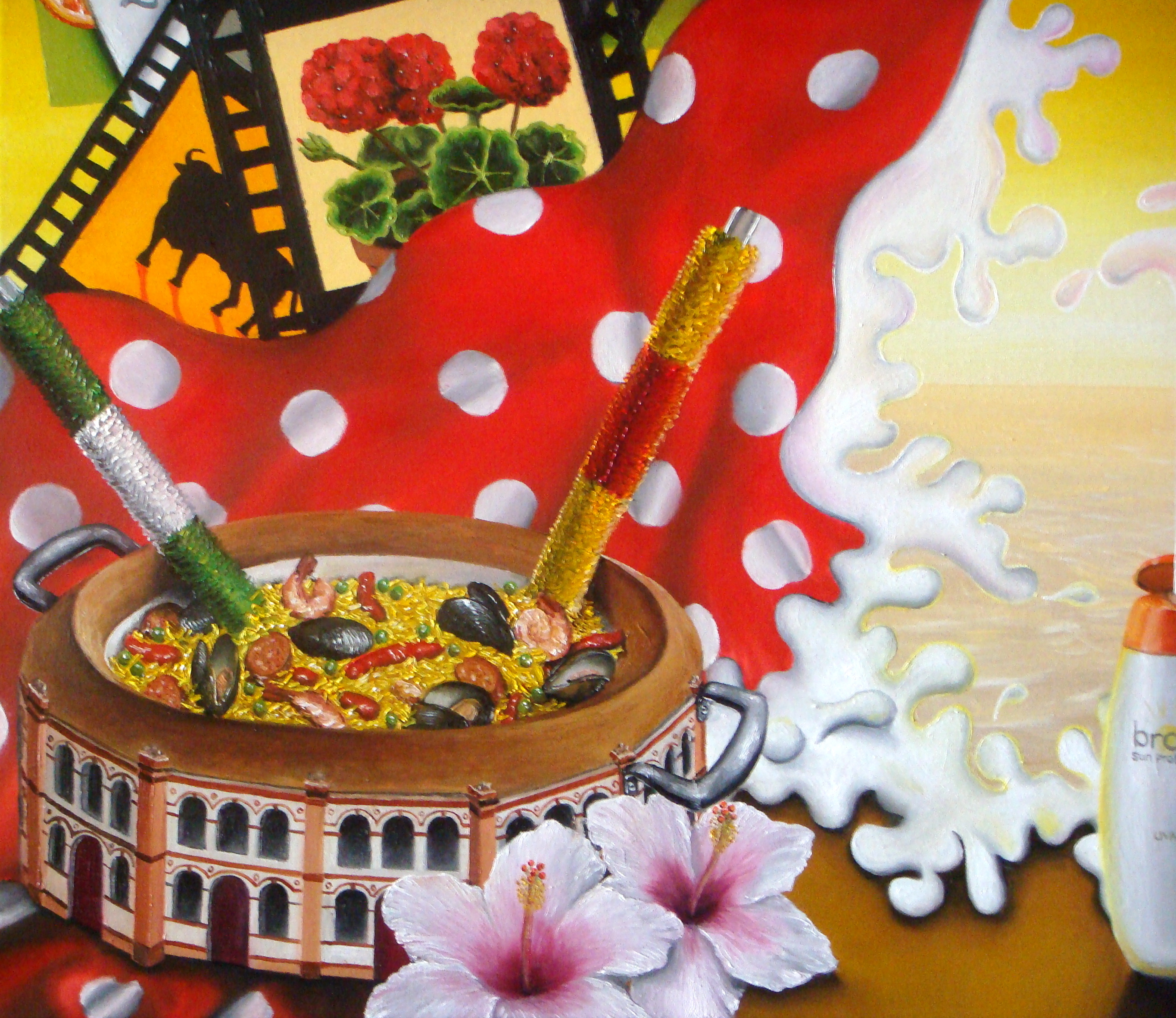
As much of the current painting deals with my life, it’s unsurprising that many of my symbols which make direct reference back to my past body of art work. In painting the sun-cream bottle, for example, I make direct reference to my 2009 painting, Souvenir of Spain, which deals with the tourist stereotypes of my favourite country. Amongst them is the general consensus of the ignorant British tourists that Spain is all about “sea, sand, sex and sangria” hence the symbols of sunbathing which permeate the piece. Here’s that painting and some detailed shots of the work, including, as you will see, my previous depiction of Spanish cuisine, namely the iconic paella, a fodder of Spanish tourist haunts all over the world, and which here is painted inside of a bullfighting ring.

Souvenir of Spain (2009 © Nicholas de Lacy-Brown)

Souvenir of Spain (2009 © Nicholas de Lacy-Brown)

DSC08783 DSC08796 DSC08789

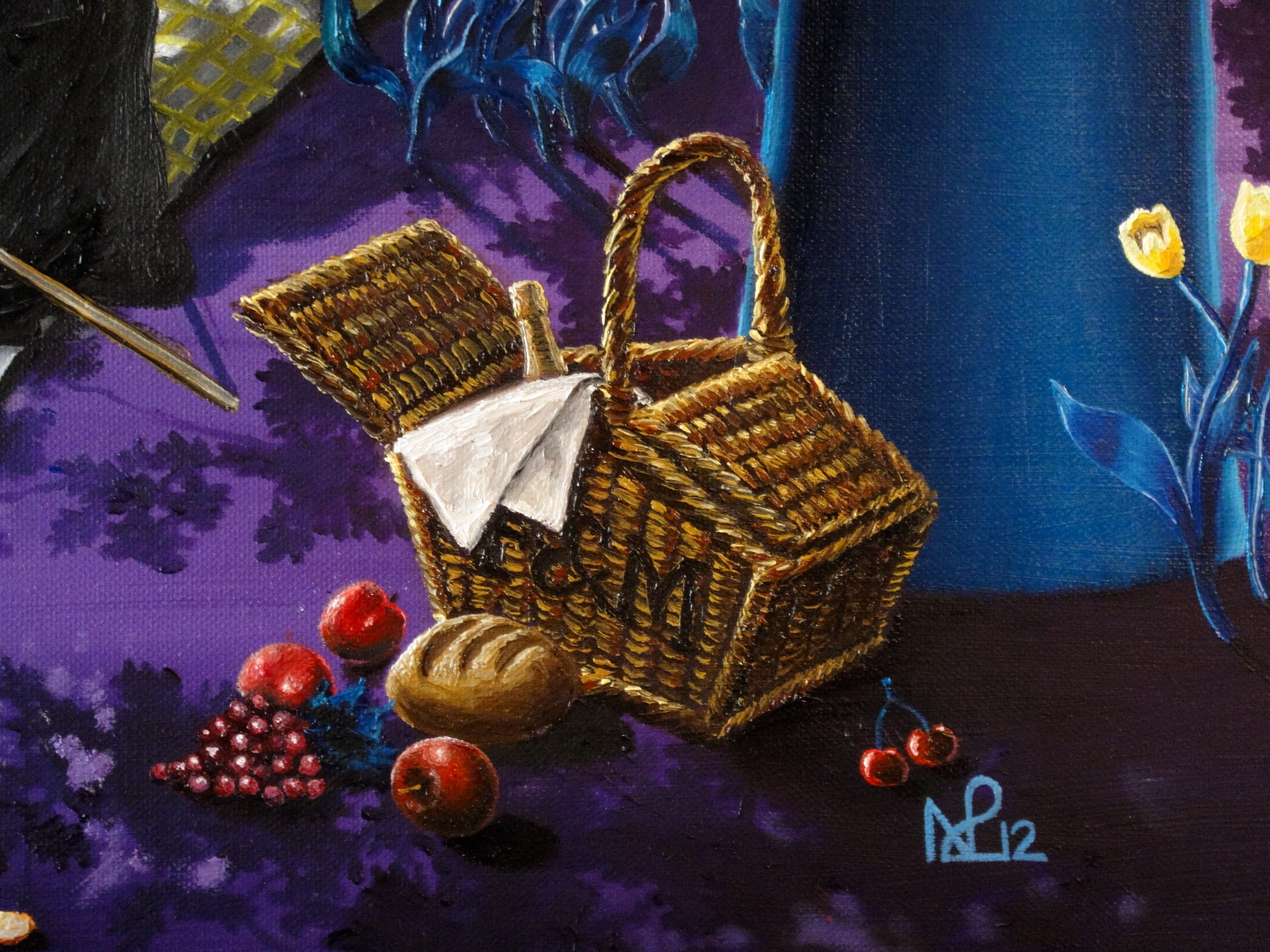
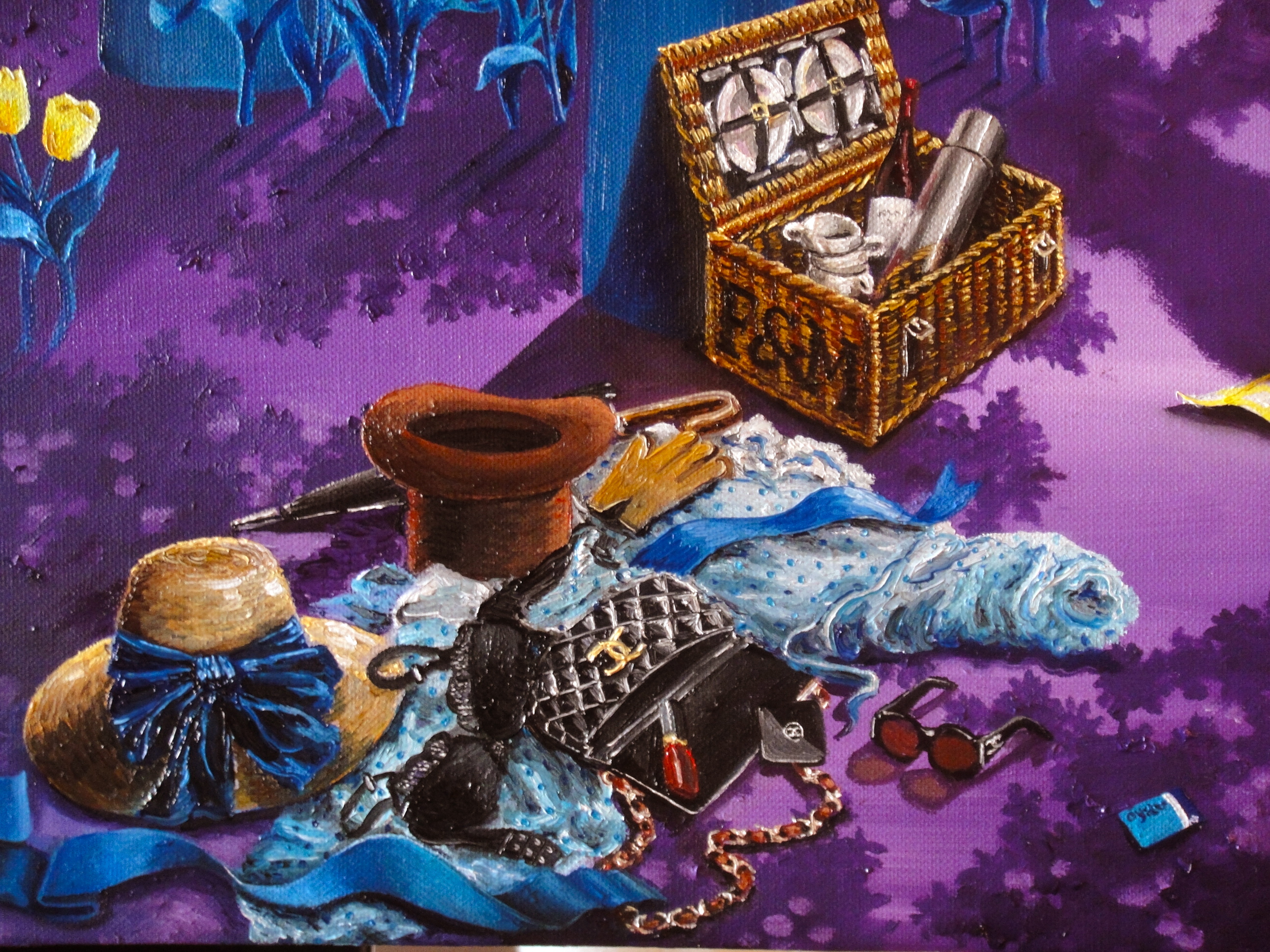
This image also references back to my Norm depiction of Manet’s Le Dejeuner sur l’Herbe, and the two Fortnum and Mason’s hampers I included in that fine picnicking piece. For me the idea of being out in the summer warmth, feasting of the grass out of a decadent Fortnum’s hamper is amongst the most pleasant of all thoughts. Ironically I have never owned a Fortnum’s hamper (they’re not cheap…) but my ambition to get my hands on one (preferably a full one!) lives on. Maybe as a present to myself when this large painting is finally complete?

Le Déjeuner sur l'herbe (after Manet) 2012 © Nicholas de Lacy-Brown, Oil on canvas

Le Déjeuner sur l’herbe (after Manet) 2012 © Nicholas de Lacy-Brown, Oil on canvas

Fortnum and Masons Hamper with bread, grapes, apples and cherries

Fortnum and Masons Hamper with bread, grapes, apples and cherries

The Norms' discarded clothes and handbag

The Norms’ discarded clothes and handbag

Up next time… My art and my adored Paris.

© Nicholas de Lacy-Brown and The Daily Norm, 2001-2013. Unauthorized use and/or duplication of the material, whether written work, photography or artwork, included within The Daily Norm without express and written permission from The Daily Norm’s author and/or owner is strictly prohibited. Excerpts and links may be used, provided that full and clear credit is given to Nicholas de Lacy-Brown and The Daily Norm with appropriate and specific direction to the original content.

Sunday Supplement Valentine’s Special – Engaged in Paris

On Valentine’s Day we witnessed the momentous and happy event that was Normy and Normette’s engagement a-top the Eiffel Tower. The tower is, inevitably, a popular place for engagement, and there can be no surprises why – who could resist the views afforded by the tower, across the ultimate city of love, when choosing a place to pop the ultimate question? I myself got engaged in Paris, although our view was from the Butte in Montmartre – for that place means so much to me as an artist, but also afforded us a view of the Eiffel Tower itself, just as it started sparkling on the hour – that way we got the best of both worlds – what a moment it was!

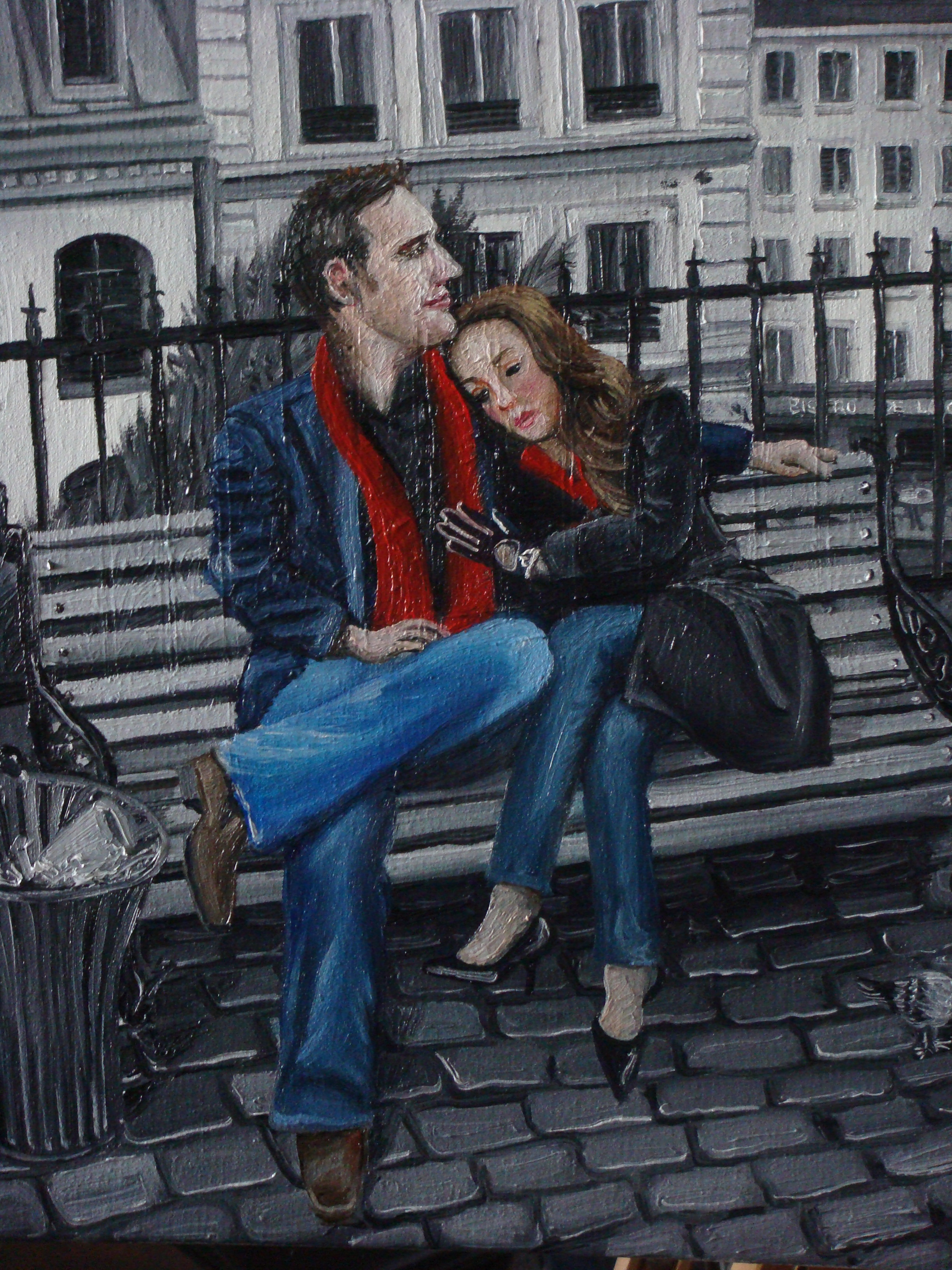
DSC06085It was in the place of my own engagement (although, significantly, I hadn’t actually popped the question at this time, although you can see that subconsciously, I was intending to) that I set this double portrait which I am featuring in today’s Sunday Supplement in honour of Valentine’s. Painted in 2009, the painting features two friends of mine, Charlotte and Ben, who themselves got engaged upon the Eiffel tower. When they approached me to do a portrait of them for the wedding itself, I couldn’t resist painting them surrounded by the city in which their engagement was sealed, but also in the romantically cobbled surroundings of Montmartre, along with the Tour Eiffel in the background. That way all the charm of Paris is captured, while the place of their engagement is given appropriate prominence in the scene.

Engaged in Paris: Charlotte and Ben (2009 © Nicholas de Lacy-Brown)

Engaged in Paris: Charlotte and Ben (2009 © Nicholas de Lacy-Brown)

DSC06083The painting, albeit a commission, was a pleasure to create, not least because Paris has always been my spiritual home. The moment I first walked into the Place du Tertre in Montmartre, led their blindfolded by a teacher (on a school trip) who knew instinctively how much I would love it, my heart hit the floor and has remained firmly embedded in those charming cobbles ever since, surrounded by cafes, by artists and the sound of the accordion. It is for this reason that I feel compelled to visit Paris every year, in order to plug myself into my heart and my spiritual being, and likewise why I chose to stage my own engagement in this incredibly special place.

I leave you with the painting, and for those celebrating Valentine’s this weekend wish you a very special celebration.

© Nicholas de Lacy-Brown and The Daily Norm, 2001-2012. Unauthorized use and/or duplication of the material, whether written work, photography or artwork, included within The Daily Norm without express and written permission from The Daily Norm’s author and/or owner is strictly prohibited. Excerpts and links may be used, provided that full and clear credit is given to Nicholas de Lacy-Brown and The Daily Norm with appropriate and specific direction to the original content.

Autobiographical Mobile: My painting diary – Day 16 and a half: The Caravan

Very occasionally, when I get home after work early enough, and when I am not totally exhausted from the daily grind of London living, I may take out my paintbrushes and indulge in a little evening painting. I find it difficult to dip in and out of my art work like this, not least because it always takes me a while to get back into the swing of painting after a break of even a few hours, but equally, taking the time out in a busy week for a little creativity can only be a good thing.

So my recent addition to my autobiographical mobile painting wasn’t really a day’s work as such, more of a half-day effort (or less). However what I painted was no less important for the quick few hours in which it was created. Following on from my weekend’s work on Enid the Golly, I went on to fill in that mysterious white box to the left of her: My family caravan.

IMG_3101

Not our caravan, but one just like it.

Not our caravan, but one just like it.

I think it’s fair to say that caravan holidays aren’t perhaps as trendy as they once were, back in the 70s and 80s when British families were only really starting to dip their toes into the great brave new world that is foreign travel. While the tourist boom was only starting to implode across the globe, for many of us, like my family, the comforts of familiar surroundings, driven on wheels from one holiday destination to the next was both a more economic and convenient holiday solution. The holidays taken by my parents, sister and I in our caravan, largely in the likes of the New Forest and the Isle of Wight, were some of the best of my childhood. Simpler holidays, but imbued with so many rich, sensuous memories, such as evening walks through the sun-warmed english countryside, returning to the slightly dewy damp caravan to cosy beds made by my mother from the easily converted sofas, setting aside bunches of freshly picked wild flowers, and settling down to the sultry sounds of country wildlife and the faint smell of now smoldering barbeques from neighbouring caravans; the family meals around the collapsible table, eating off our plastic caravan crockery emblazoned with a merry strawberry design; and those occasional days when, faced with grizzly British summer rain outside, we all gathered in the caravan to watch the likes of Wimbledon on the crackling old TV.

The caravan, painted.

The caravan, painted.

But beyond the holidays, the caravan was also hugely important to my academic progression. In term times, we used to park the caravan on our driveway, and in it I would sit, studying away for hours at a time, turning the caravan into my makeshift study, providing me with the perfect solitude in which to concentrate. I credit that caravan as being one of the reasons why I was able to do so well at school.

Sadly, the caravan is gone now, sold some years ago when we used it no longer, when a house in Spain took over our affections, and the physical strain intrinsic in camping became too much for my parents. But that caravan, its sights, its smells, is still so familiar to me, so inextricably a part of the fabric of my childhood that this biographical painting would not be complete without it.

The painting at its current stage

The painting at its current stage, complete with caravan

So I give you, our family caravan.

Until next time.

© Nicholas de Lacy-Brown and The Daily Norm, 2001-2012. Unauthorized use and/or duplication of the material, whether written work, photography or artwork, included within The Daily Norm without express and written permission from The Daily Norm’s author and/or owner is strictly prohibited. Excerpts and links may be used, provided that full and clear credit is given to Nicholas de Lacy-Brown and The Daily Norm with appropriate and specific direction to the original content.