Skip to content

Posts from the ‘Review’ Category

London 2012: Infected by Olympic Fever – Tennis at Wimbledon

I’m not a big sports fan. I don’t really know the terminology, and my familiarity with the various sports stars extends as far as those faces who regularly hit the headlines and are splashed across perfume promotions and London buses. However there is something utterly contagious about the Olympic spirit which has swept throughout London and up and down the British isles which just cannot be resisted. The aim of London’s bid was to bring all Britons and people from throughout the world together under the olympic flag, to create a huge party of spectators enjoying the adrenaline rush engendered by sporting achievement and to inspire future generations to enjoy sport and aim for sporting brilliance. They’re all cliches, the stuff of marketing machines, but what the last week has proved to me, is that those objectives have really manifested – I feel inspired by sport, part of the global sporting party and loving every minute of London 2012.

Wimbledon green with the distinctive Olympics purple

The Wimbledon Wenlock

As with many Britons, I found it difficult to get any olympic tickets, despite applying for a good few (and yes, like everyone else, I am secretly seething inside at seeing so many empty seats at the events – a byproduct of the Olympics’ necessary reliance upon corporate sponsorship and IOC executives who then don’t bother to turn up, depriving so many future generations of the opportunity to be inspired). However the one set of tickets I did get was to see men’s semi-finals tennis at Wimbledon. This was a double whammy for me. Not only did it mean I would get to visit the British home of Tennis (tickets for the main Wimbledon tournament are as easy to get your hands on as the holy grail) but it also meant that I would be treated to not one, not two, but three matches played by undisputed tennis royalty.

Read more

Korean Eye at the Saatchi

It wasn’t easy returning to London from Italy. The first week back, and there was rain every day. Grey skies, autumnal temperatures, AND I was expected to be able to work 9-5 every day. Where’s the justice, the cappuccinos on the beach, the Bologna porticos and red-tinted palazzos? Eagerly I worked through the week, each day that passed taking me one day closer to the weekend, when an attempt to relive the Italy experience would commence.

Our efforts were fairly successful. As the grey clouds passed and London finally began to heat up again, we headed to an Italian restaurant, Getti, on Marylebone High Street on the Saturday, where the smells of fresh mozzarella on a crispy thin pizza base were now wonderfully familiar – it was like an Italian homecoming. We even managed to utilise a little of our now polished restaurant Italian.
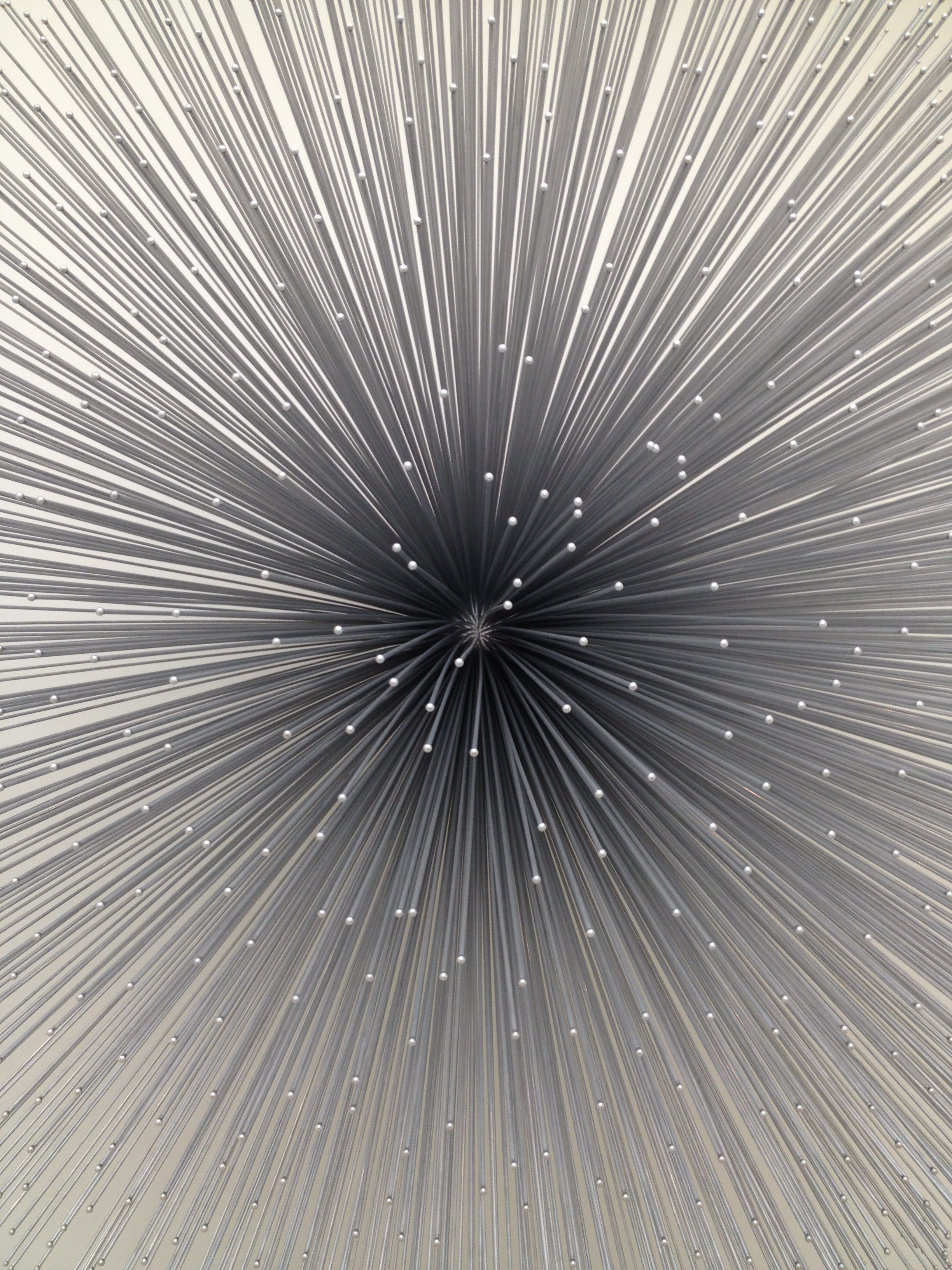
Kim Byoungho, Soft Crash (2011)

Meanwhile, on the Sunday morning, it was a trip to Chelsea that satisfied all of our holiday yearnings. Sat out having a creamy cappuccino (again, Italian made) in the fashionable Duke of York’s square, in the full uninterrupted summer sunshine, felt just like being back on the Mediterranean. And, as is so often the effect of sunlight and warmth, it got us in the mood to indulge. Sadly for our wallets, this meant for subsequent glasses of prosecco, a large plate of Italian cheese, the undoubtedly unnecessary but practically irresistible purchase of various Olympics merchandise and even a new printer. Whoops.

But with our minds opened by the light summer mood which befalls all of us when seduced by the sun’s rays, it was surely the perfect time to head to the Saatchi gallery, whose frequently changing works of contemporary art usually fail to impress me, if not make me despair. But whether it be the sun which had opened my mind, or just the sheer brilliance of the works on show, Saatchi’s new show, Korean Eye 2012which is the largest survey of contemporary Korean art in the UK to date, is fascinating throughout.

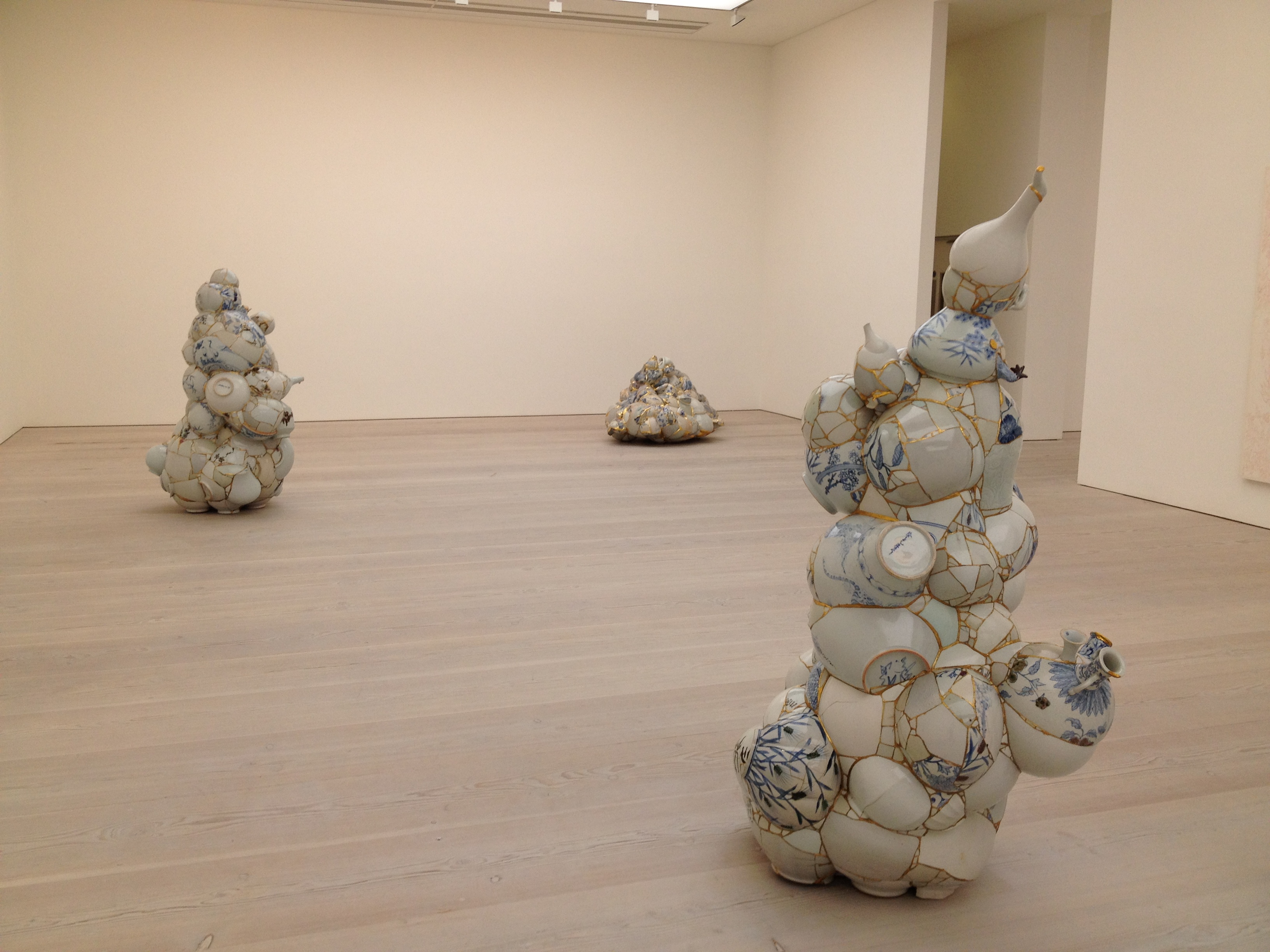
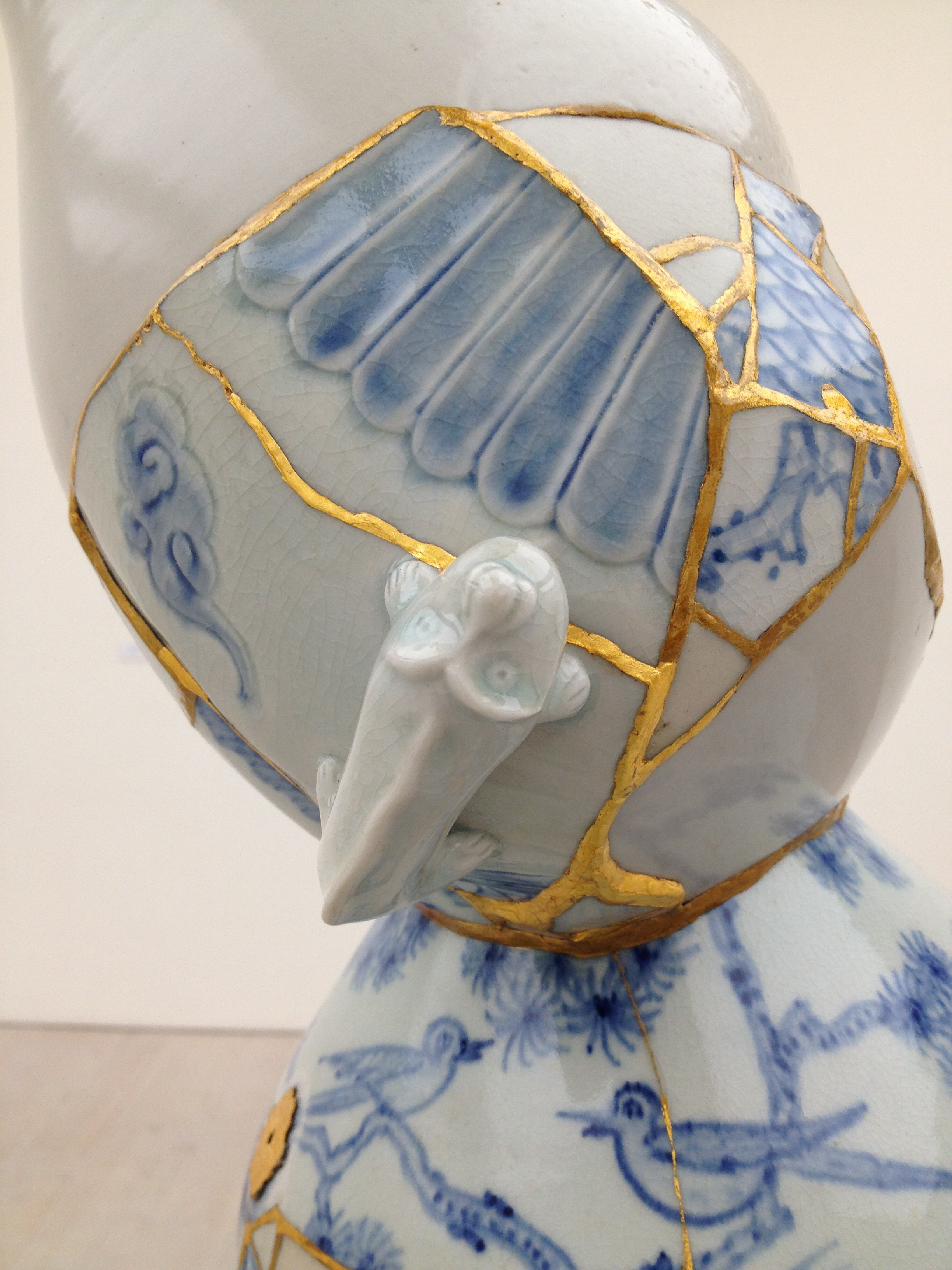
The show started with a trademark Saatchi huge white gallery full of very little. But that little there was on show was actually pretty cool. Yeesookyung’s Translated Vase (2007) aims to transform everyday objects into new contemporary forms. It’s a simple idea, but effective as a piece of contemporary sculpture – and I particularly liked the use of gold grouting which acts as a consistent element bringing the shards from various pots together as a single, newly innovated shape.
Next up, in gallery 2, were the works that got me completely hooked on this show. These were large mixed-media works by Bae Joonsung which looked pretty innocuous at first – until you moved past the canvas and realised that some aspects were moving, and other disappearing. Joonsung brilliantly incorporates painting and photography, executed upon different sheets of transparent acrylic which act almost like a hologram so that, when you view the painting from different angles, the work changes before your very eyes. I’ll let my photos demonstrate as best as they can…
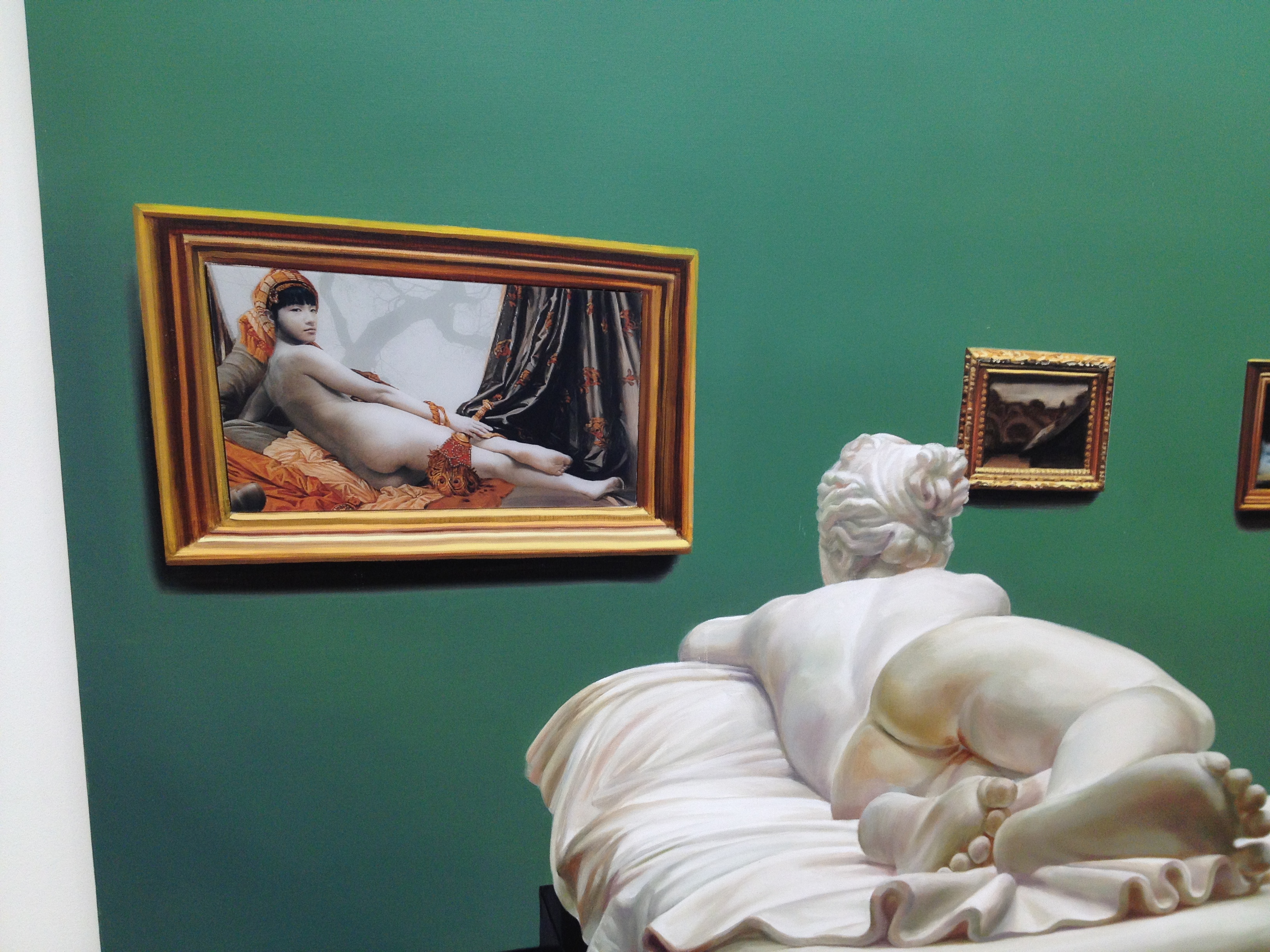
Woman reclining…

…in the nude
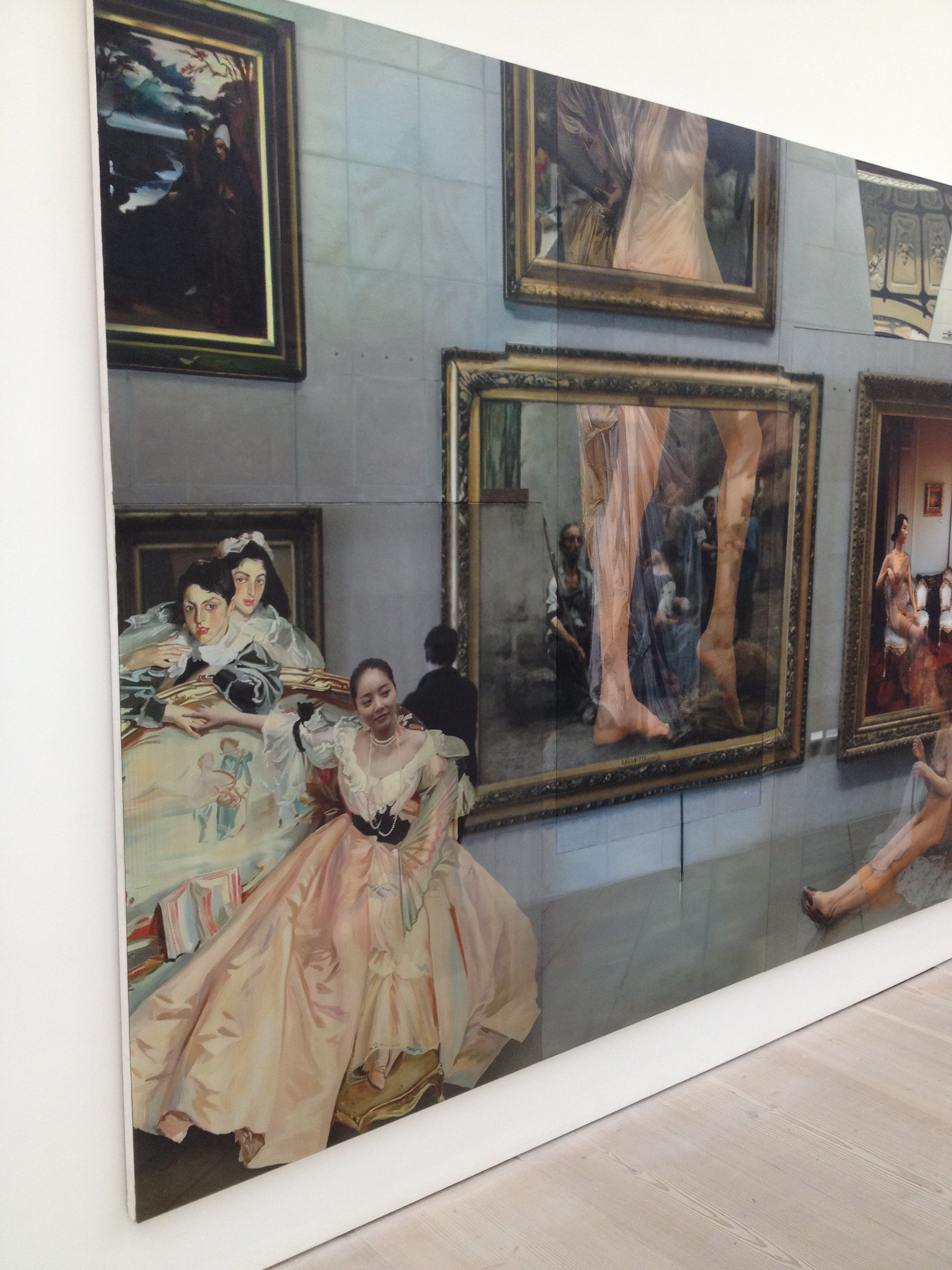
Lavish dress one minute…

…and ooh la la the next
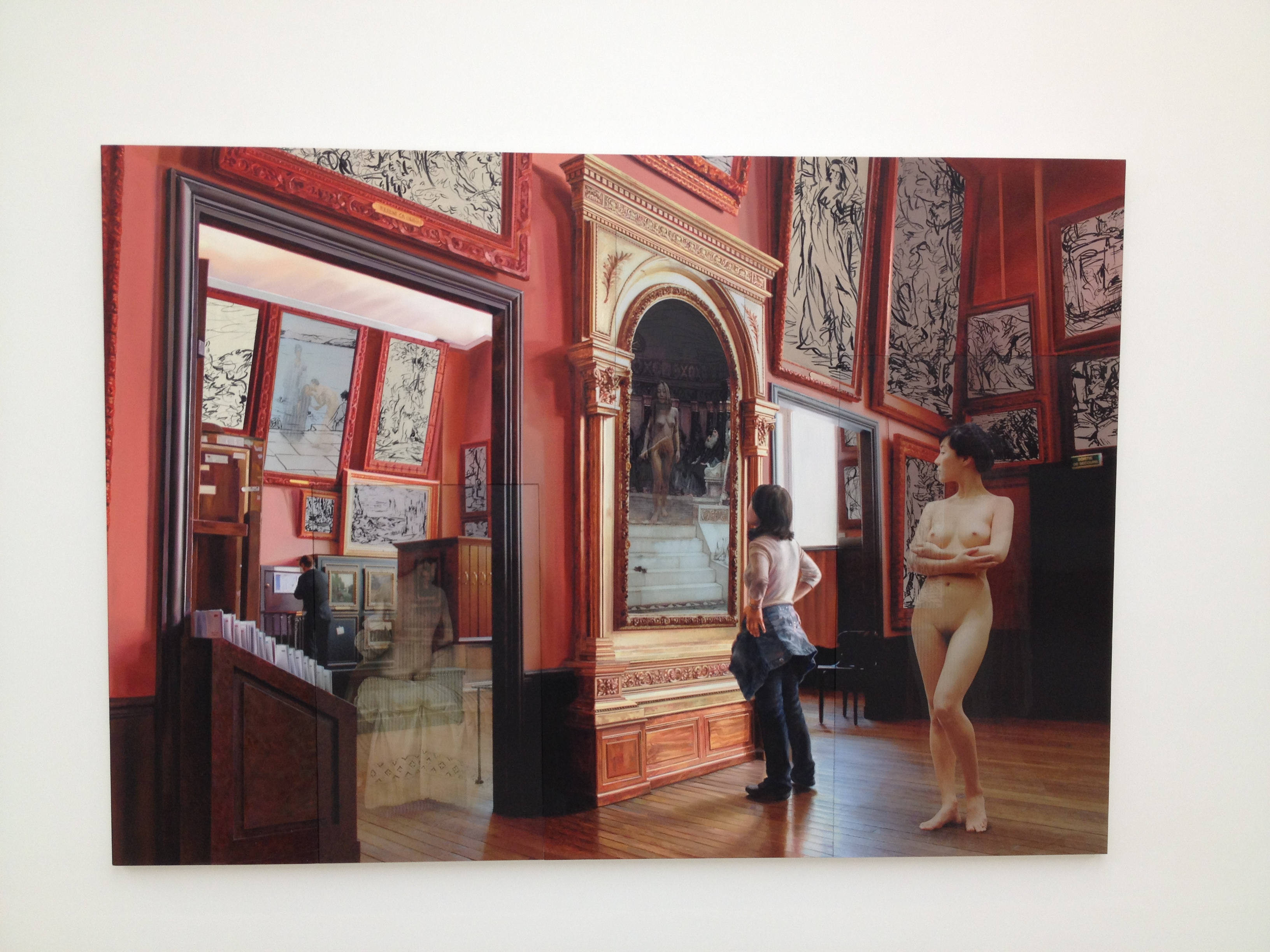
Now you see her…
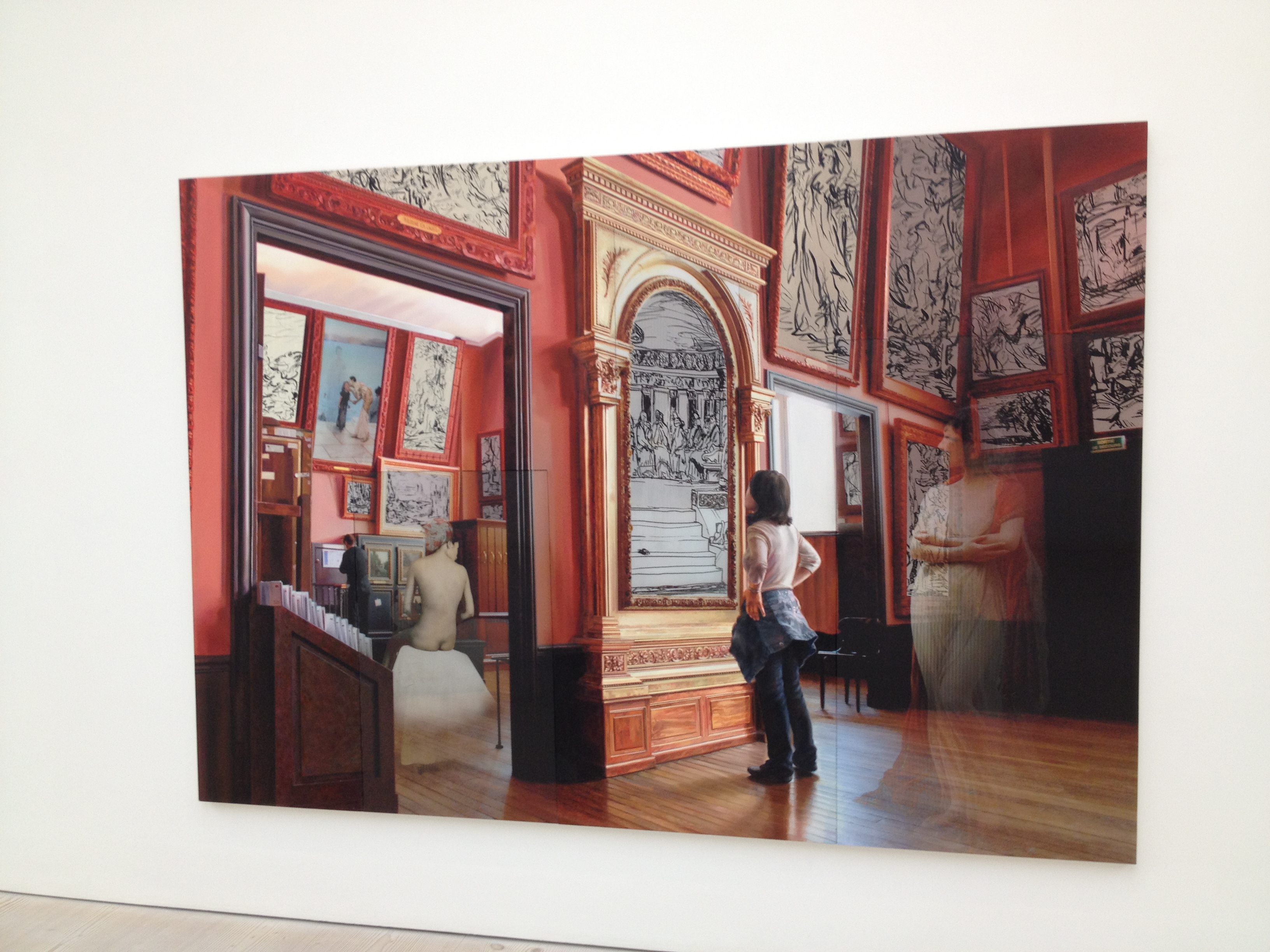
…now you don’t

Also in gallery 2 were the 32 ceramic heads which comprise the work of Debbie Han, The Battle of Conception (2004-10). The heads look identical from a distance, but again, closer viewing betrays different facial features in each one, as the artist attempts to demonstrate with diverse facial features the different racial and ethnic characteristics that exist across the human race. In this respect, the work builds upon racial stereotypes, and explores the significance of human perception as the key to defining ourselves and others.
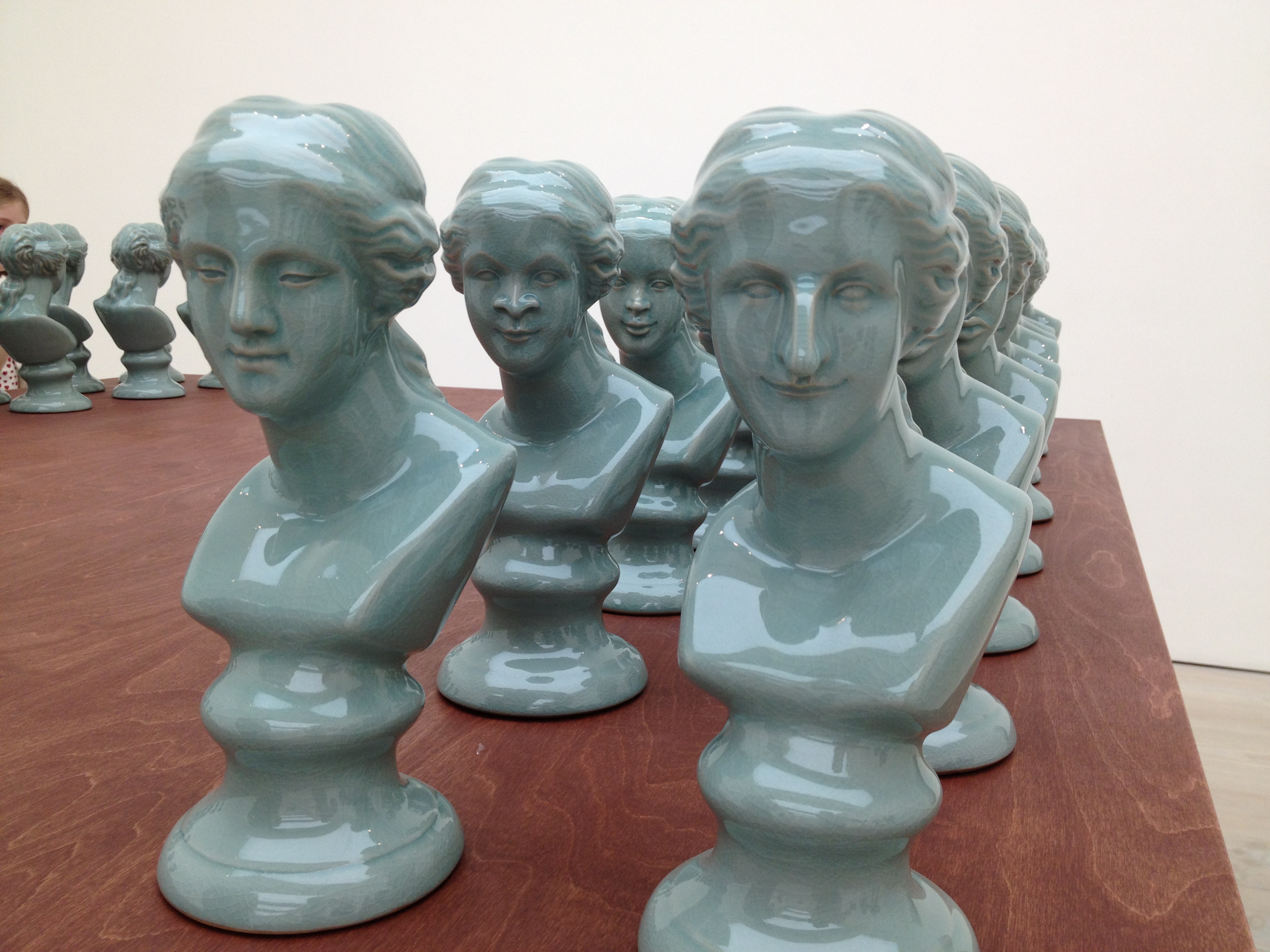
Read more

Bologna: La Grassa – Phenomenal food without a Spaghetti Bolognese in sight

I’m going to pardon myself inadvance of a post which will be an unapologetic engorgement upon food glorious food. Bologna is after all the city that brought us Spaghetti Bolognese, tagliatelle, tortellini and mortadella among other Italian favourites. In fact, without Bologna, half of your standard Italian restaurant menu would disappear. And true to form, the city whose third and perhaps most appropriate epithet is La Grassa – the fat – delivered, delivered and delivered again. We made no plans, instead opting to wander into restaurants randomly as they took our fancy. And yet on every occasion we were surprised, enthralled and deeply satisfied by one consistently high quality meal after another. No wonder then that Mr Artusi, great master of culinary arts once wrote, “When you hear about Bologna’s cuisine, make a bow, for it deserves it”. I could eat in Bologna for ever – it may make me grassa, but hell, it’s worth it.

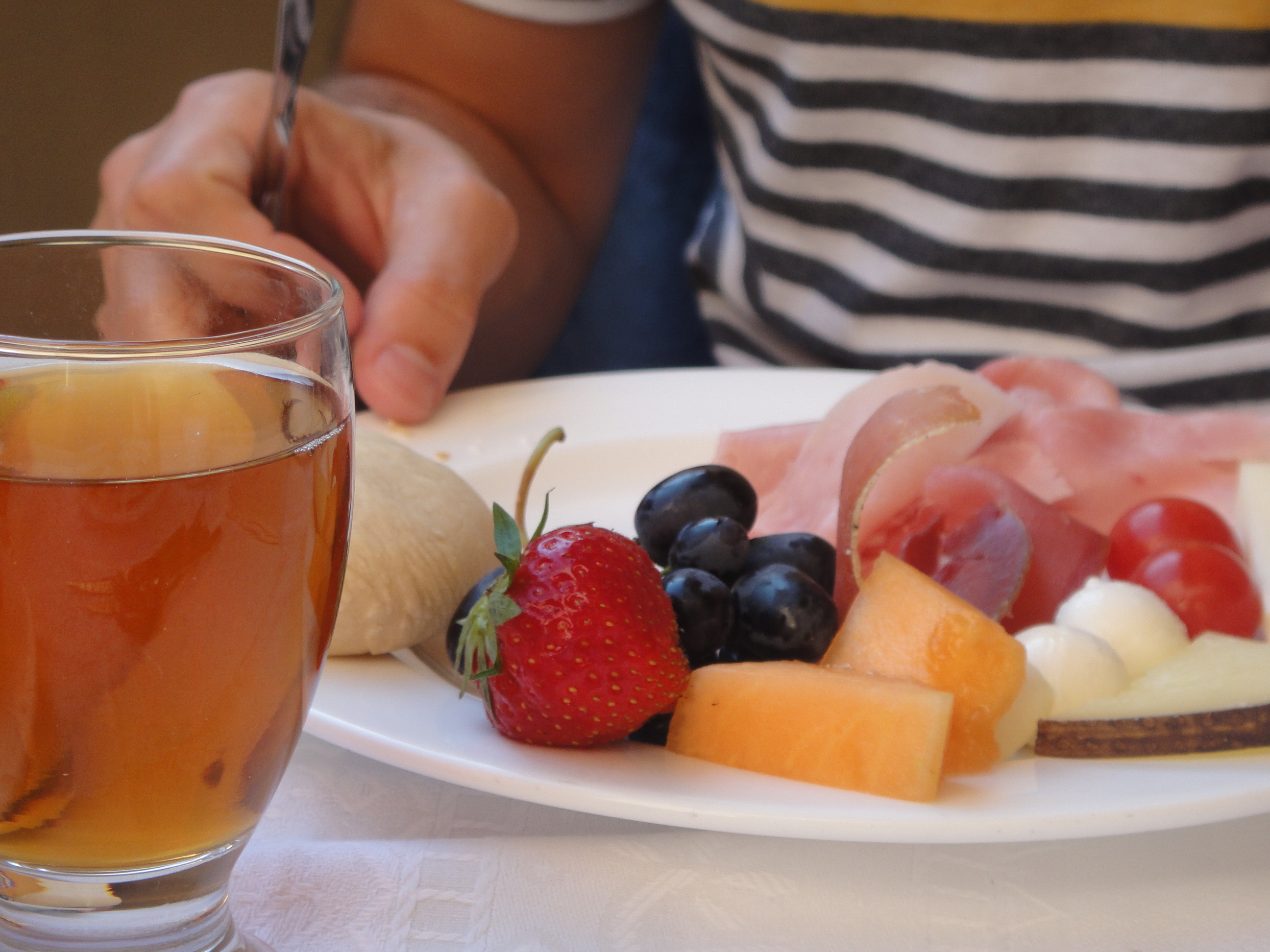
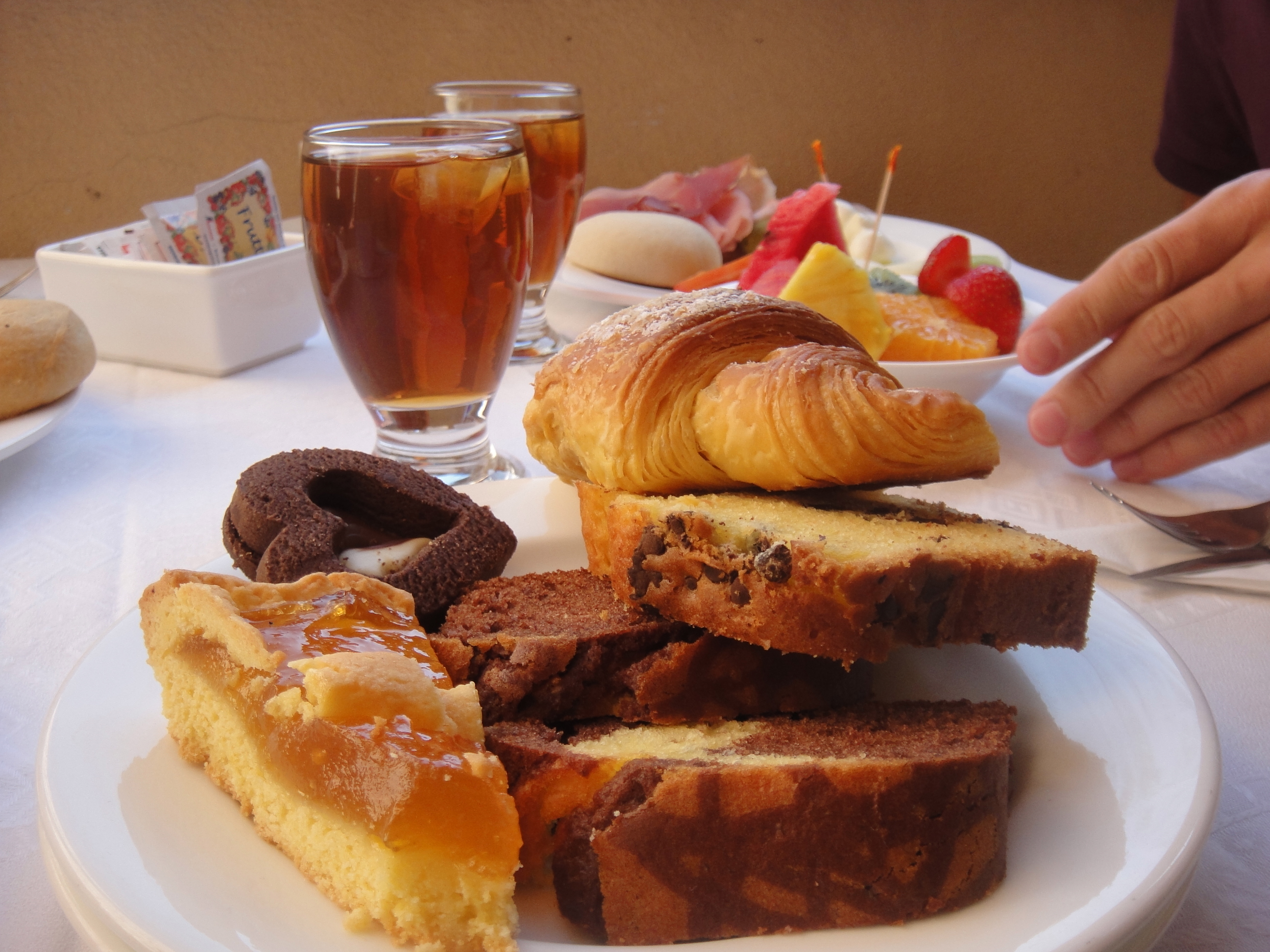
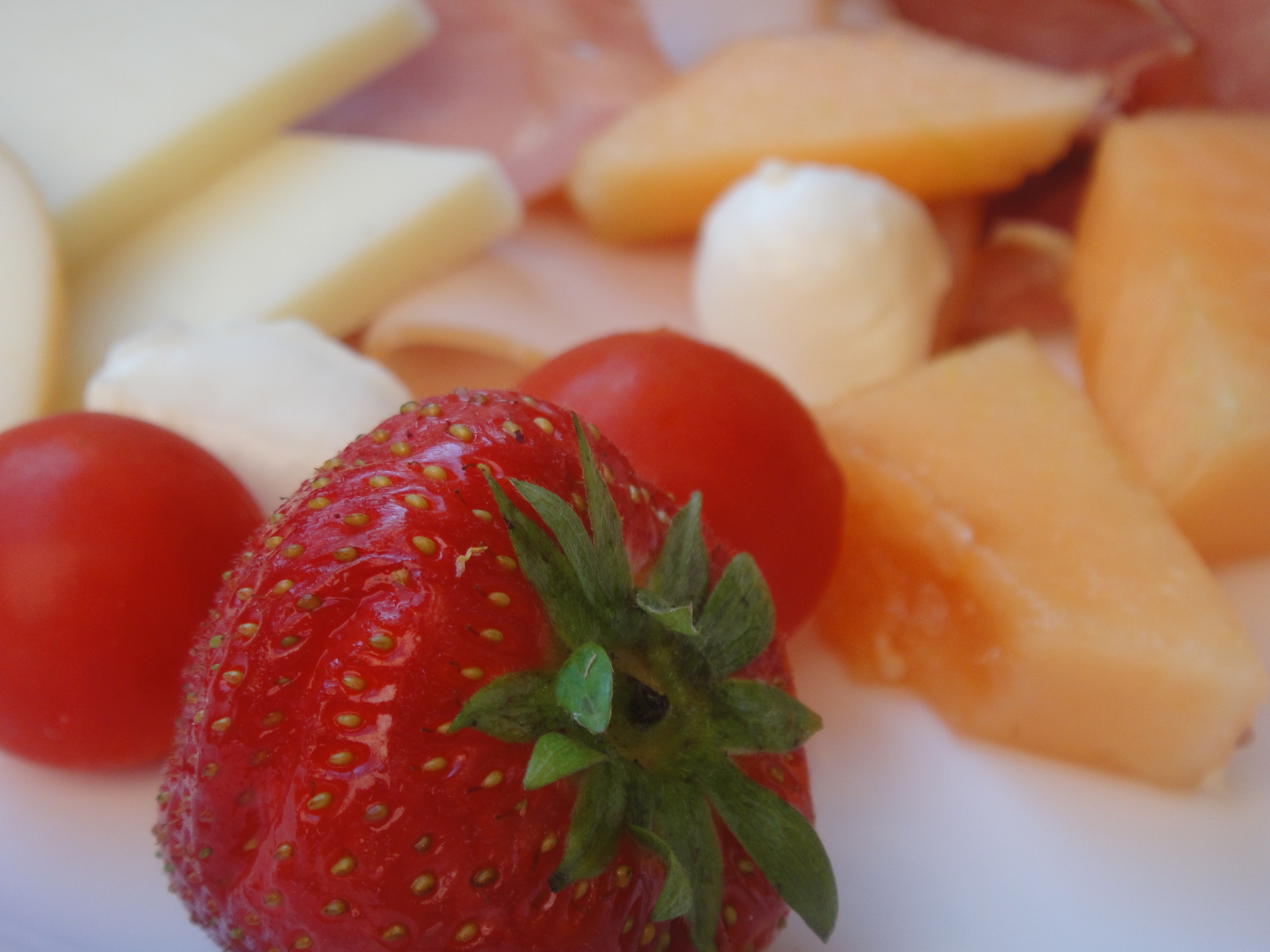
So where to begin. Well, breakfast I guess, a multi-coloured kaleidoscope of colour, as fresh ingredients collided into a cocktail of fruits and meats, soft greasy breads and sweet spongey cakes, all succulently fresh, strawberries as red as La Rossa herself, and mortadella, straight from the manufacturers, limply reclining across our plate. And we didn’t have to go far either. Breakfast was served upon our little terrace at the faultlessly stylish, centrally located  Art Hotel Novecento, a perfect start to each of our four days in Bologna.

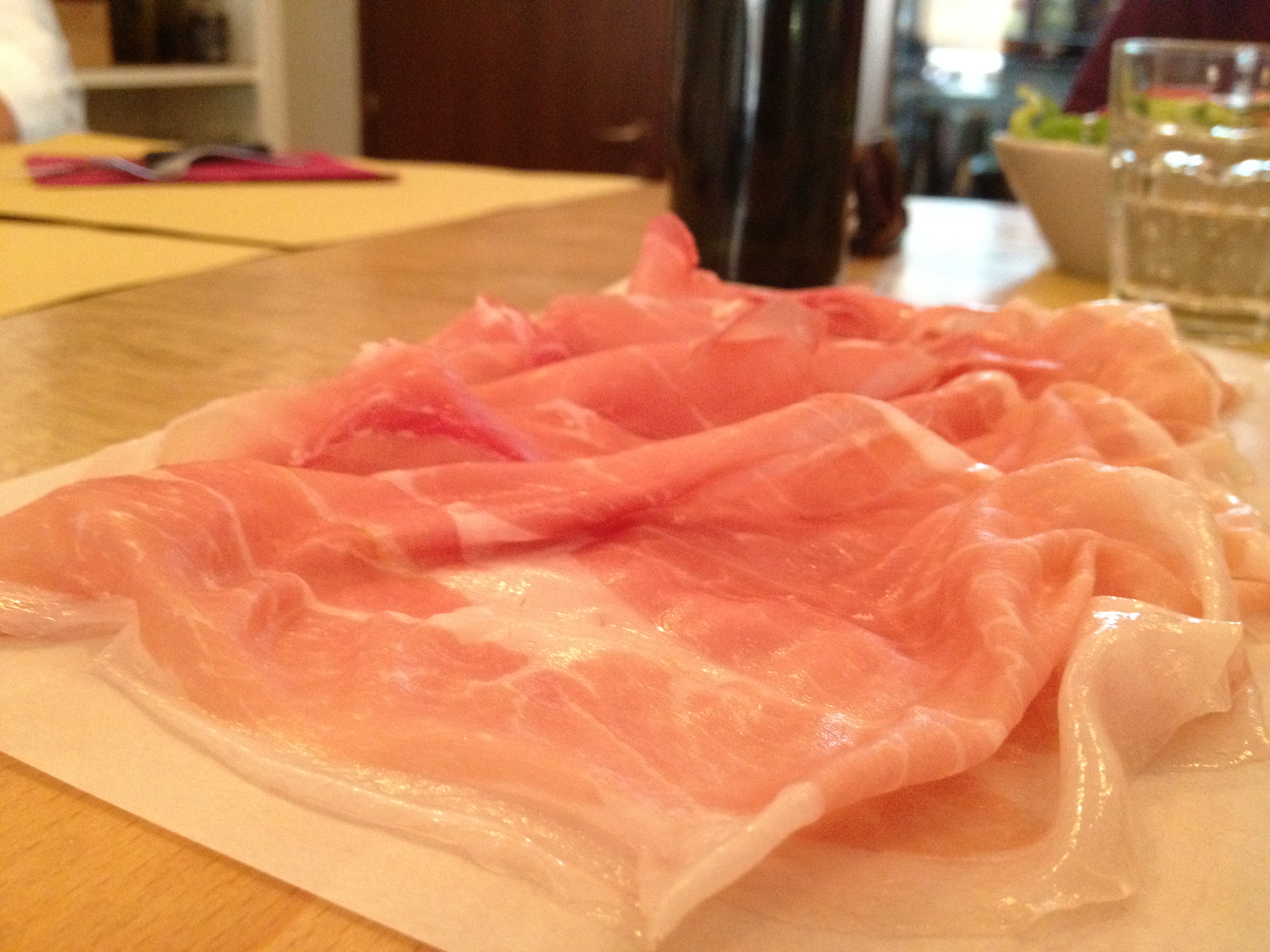
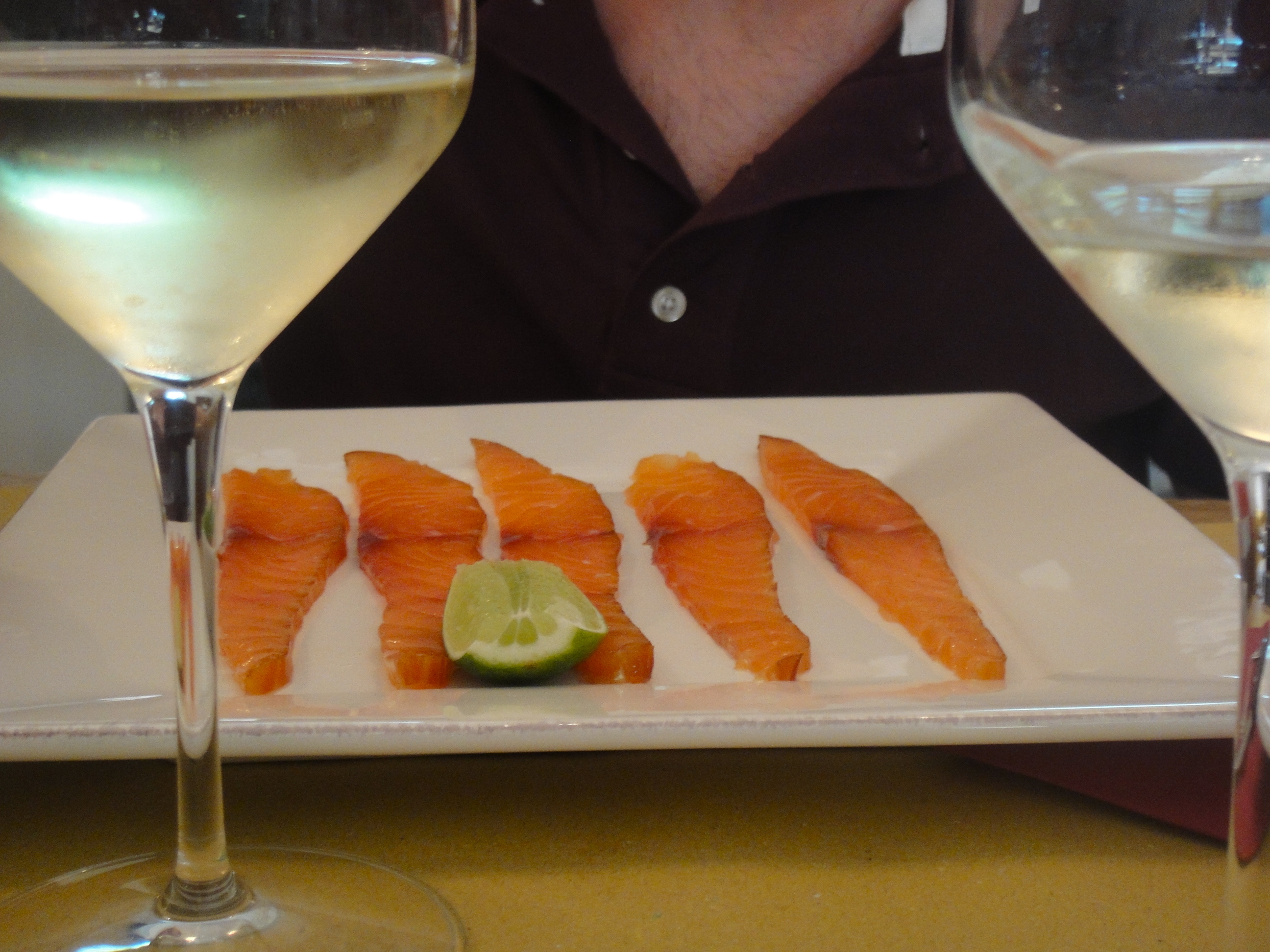
Next, lunch. We stumbled upon this place, Banca del Vino (Via Mantana), on the outskirts of the rough and tumble of Bologna’s ghetto. Here the pizza was amongst the best I have had in Italy. So fresh, so thin and crispy, with a plate of soft silky parma ham served on the side, so that it could be added to the richly endorsed buffalo mozzarella pizza at will. In the meantime, my partner sampled the delights of an equally fresh, thickly cut home-smoked salmon, with a palate-pleasing glass of local white wine on the side. This was rounded off with a rich chocolate parfait with accompanying white chocolate chunks.

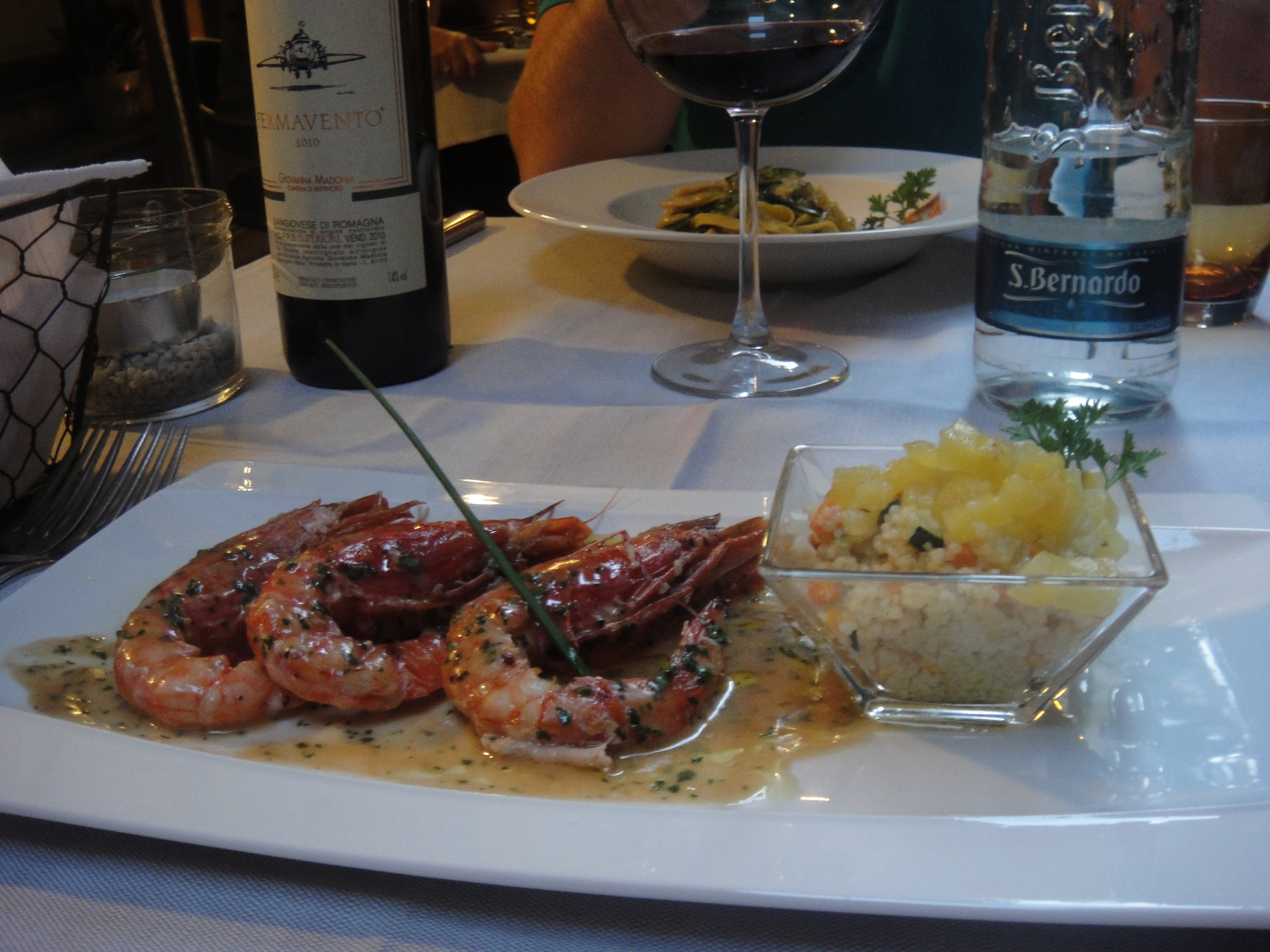
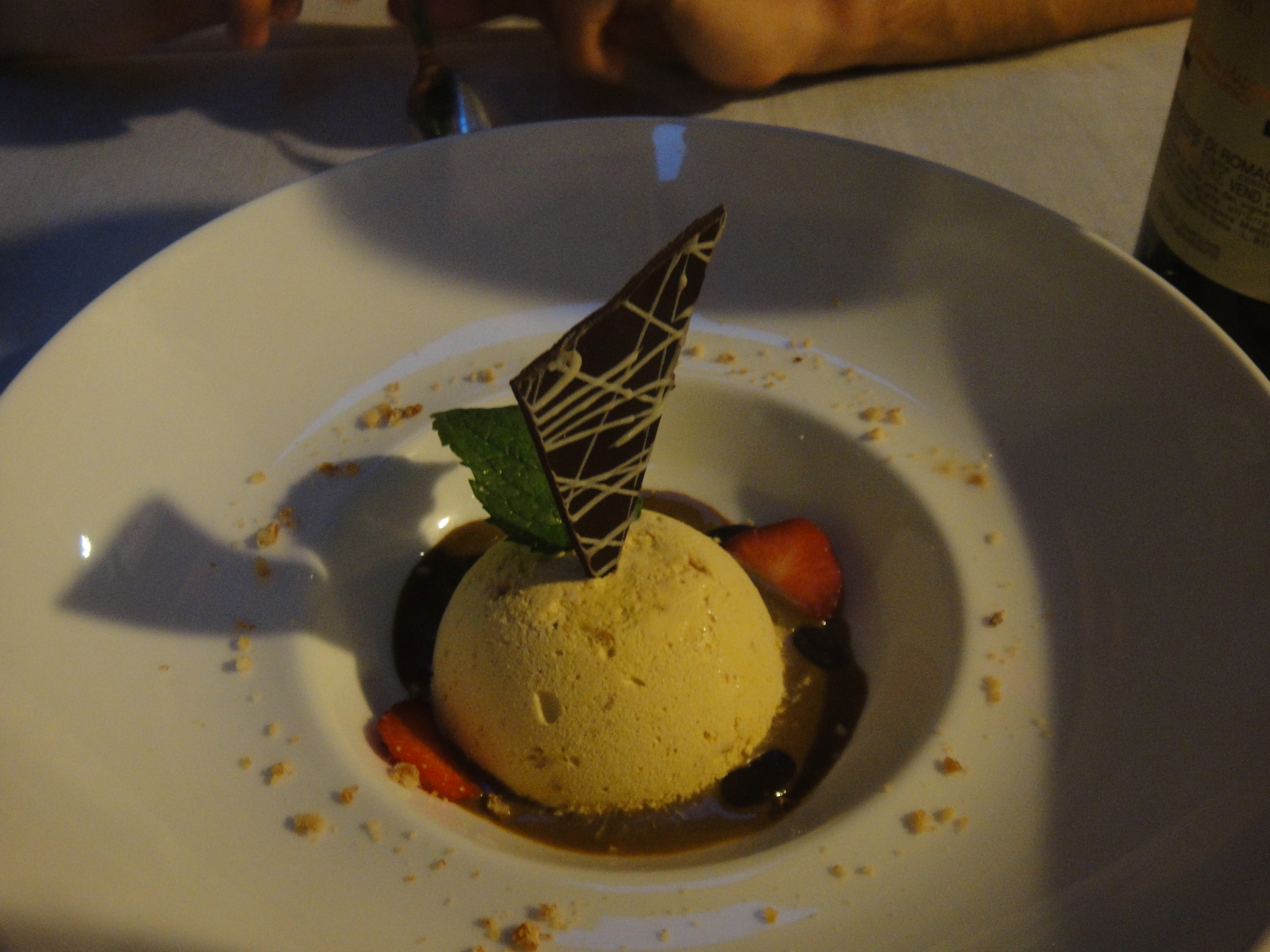
Our first dinner was at the stylish Trattoria Battibecco (Via Battibecco, 4), found down a tiny side street, just off the Piazza Galileo. The food was highly stylised and delicately balanced. I started with the Sformatino di ricotta con cuore di bacon e zucchine su crema di nocciole, a kind of ricotta-enrichend risotto cake, with courgette, bacon and the cream of nuts. Gamberoni rossi in padella leggermente piccanti con cous cous all’ananas was to follow for mains – lightly cooked prawns with pineapple couscous and a chilli hot sauce to balance, while for dessert, a semifreddo with cherry chocolate and a strawberry on the side foretold of the spectacular dinners which were to come.

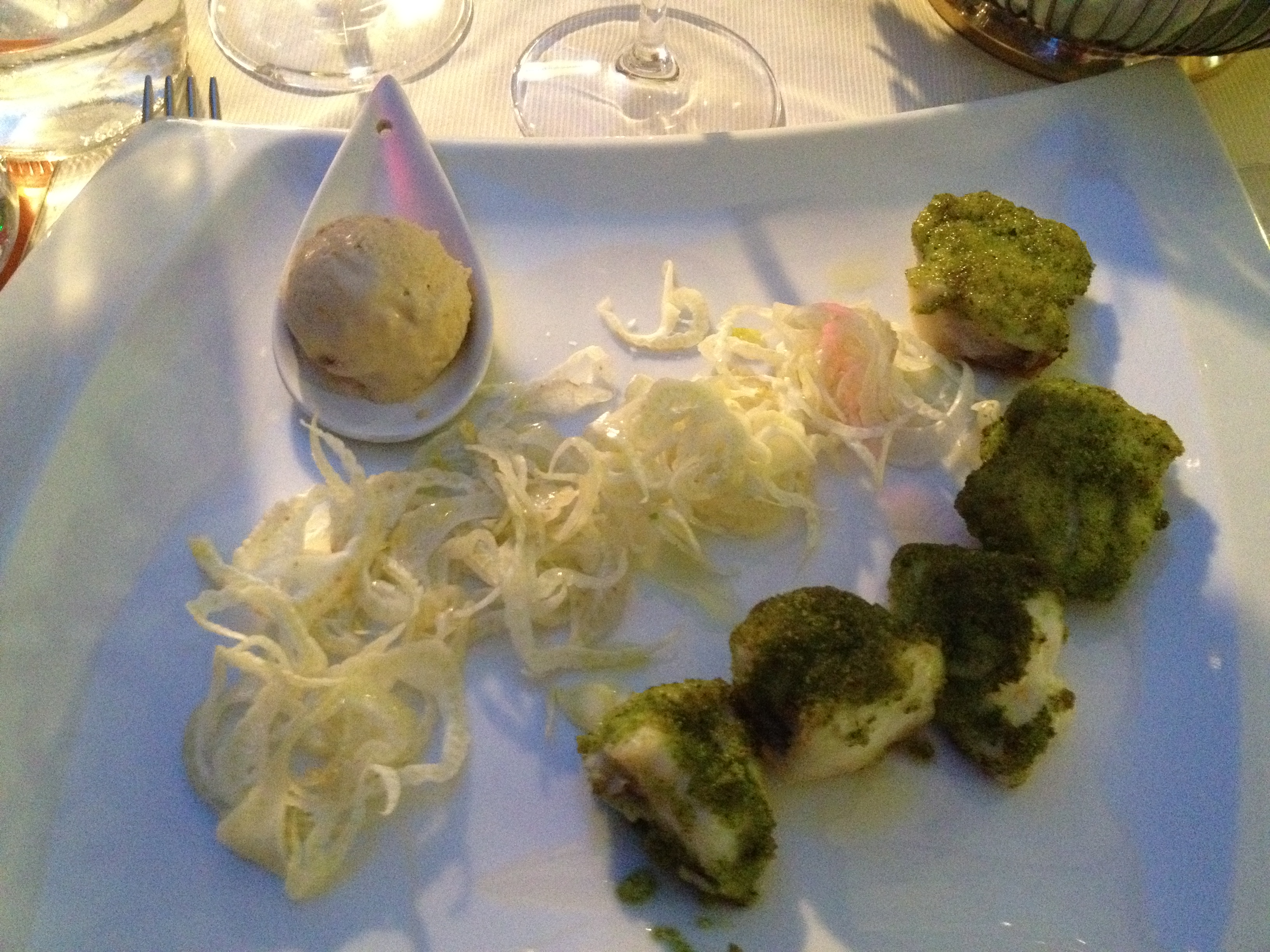
Our second dinner was at the Ristorante Ciacco (Via San Simone), another off-street secret which we stumbled upon having escaped the more tourist-focused affairs of the central Piazzas and cheaper offerings of the university quarter. Here we were treated to an innovation of ice cream, as almost every dish was served with some form of welcomingly-cool ice cream accompaniment. With my warm foie gras, an ice cream flavoured with orange and thyme provided both a sweet and sharp contrast to the rich meaty flavour of the foie, while my partner’s starter (a prawn and scallop club sandwich) was similarly accompanied with an ice cream of wholegrain mustard. For main course, I was treated to a dish of monkfish with liquorice flavoured ice cream – while the monkfish was, inevitably, a little lacking in flavour, the liquorice gave a punch to the dish, helped out in this objective by a light salad of finely sliced fennel. Unsurprisingly, there were innovative ice creams aplenty on the dessert menu, but we instead opted for a white chocolate parfait, accompanied by a vivid green fresh-mint coulis.

Our third dinner was at the super cute Ristorante Teresina di Fuggetta Sebastiano (Via Oberdan, 4), not so much on a side street as much as in a side alleyway – the tables were artfully squeezed in between one leaning old palazzo and another, and the affect was truly cosy and unique, and the later addition of a harp player added a further garnish of romance to the air. Sadly I neglected to take any photos capable of public consumption – the wine caused significant blurring on the old camera – damn that tempting Sangiovese! However the food was super-tempting too. We started with a pea and mint garnished prawn dish, followed by a succulent steak tagliata accompanied by rosemary potatoes. Dessert was a creme caramel of sorts, which my partner declared, with some audacity (clearly bolstered by the Sangiovese) to be better than mine! He was clearly drunk.

Our final instalment of Bolognese dining (as if there was any space left in our significantly lined stomachs by now) was the Ristorante Cesarina (Via Santa Stefano), a more traditional affair, set in the heart of one of Bologna’s most beautiful squares. What this place lacked in innovation, it excelled in traditional cuisine cooked with excellence. We’re talking stuffed Zucchini flowers, faultlessly grilled seafood and all washed down with a mega-strong bottle of Sangiovese. But never mind all of that. The starter I had was simply mind-blowing. I mean, we’re talking a world-stopped-turning moment of culinary ephiphany. And we’re only talking ravioli – and a pumpkin ravioli at that (and from the photo, it doesn’t look all that much either). But OMG, I can’t even begin to explain how good that pasta was – perfectly al dente, giving way to a salty-sweet pumpkin centre topped with a buttery sauce and – the crowning glory – a kind of marzipan/ caramalised/ honeycomb crumb which just set my mouth alight. If I could get the recipe for that dish and bring it back to the UK I could retire early.

It tasted so much better than it looks.

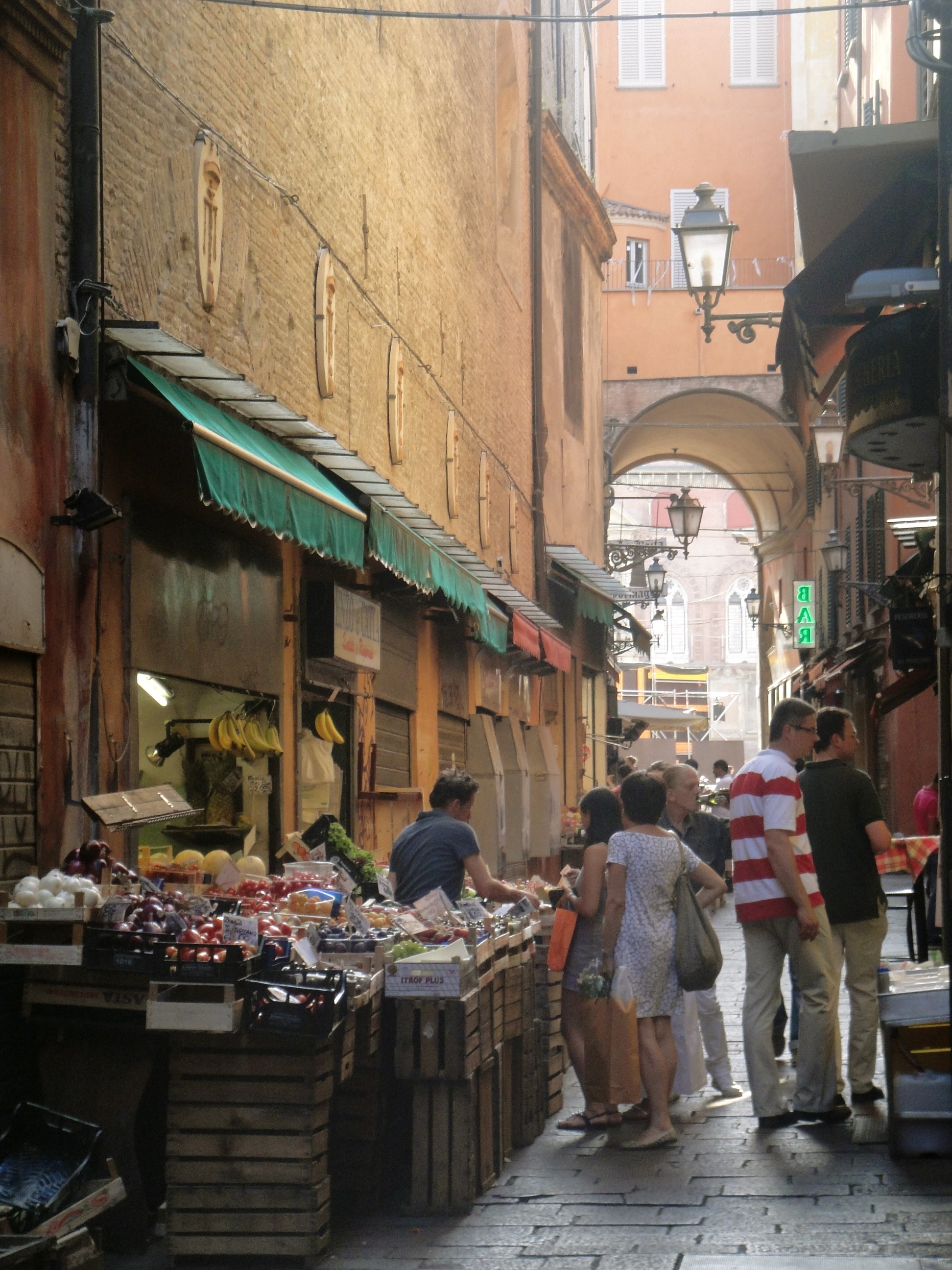
So there you go, a food explosion well worthy of all the fuss. There is no doubt in my mind that Bologna lives up to its reputation of food capital of Italy. And it’s not just the restaurants either. A short walk off the Piazza Maggiore, and you find yourself on the quaint Via Pescherie Vecchie, where a bustling food market continues to thrive and tempt passers by with the fragrant scent of ripe fruits, sea-fresh fish and sweet juicy cold meats. Meanwhile, head to any half-descent cafe, and we’re talking an affogato worth writing home about.

All this talk of food has made me hungry. I’m off to raid my nearest Italian deli. Hey, it’s not Bologna, but I will leave that crowning glory firmly where it belongs, carefully rested upon Bologna’s culinary pinnacle, amongst the perfect colonnades, the cinema under the stars and the perfectly leaning red-bricked towers. Bologna La Grassa, La Dotta, La Rossa: Te adoro.

All photos are strictly the copyright of Nicholas de Lacy-Brown © 2012 and The Daily Norm. All rights are reserved.

Bologna: La Dotta – Learned city where the profane is sacred, and the sacred is mundane.

As far as outward appearances go, Bologna holds its own amongst the crowd. For beautiful buildings, magnificent public monuments, fading Renaissance elegance and vast central piazzas, Bologna is undaunted by its more celebrated rival cities of Florence, Milan and Rome. But behind the facade, in mind, Bologna is quite different. In Rome, for example, the dominant influence of the church, and in particular of the Vatican looming close by, is evident all around. You only need to turn a corner to find another vast church, stuffed to saturation full of the most exquisite baroque sculpture, euphoric painted ceilings, depicting heaven and hell with startling realism and artistic virtuosity, gold-dripping altars, elaborate side chapels, and 100% fresco coverage throughout. In Florence, the green, pink and white marble covered Duomo and its baptistry dominates the city’s central piazza, while just around the corner, the equally stunning Santa Croce and Santa Maria Novella dominate their own respective squares.

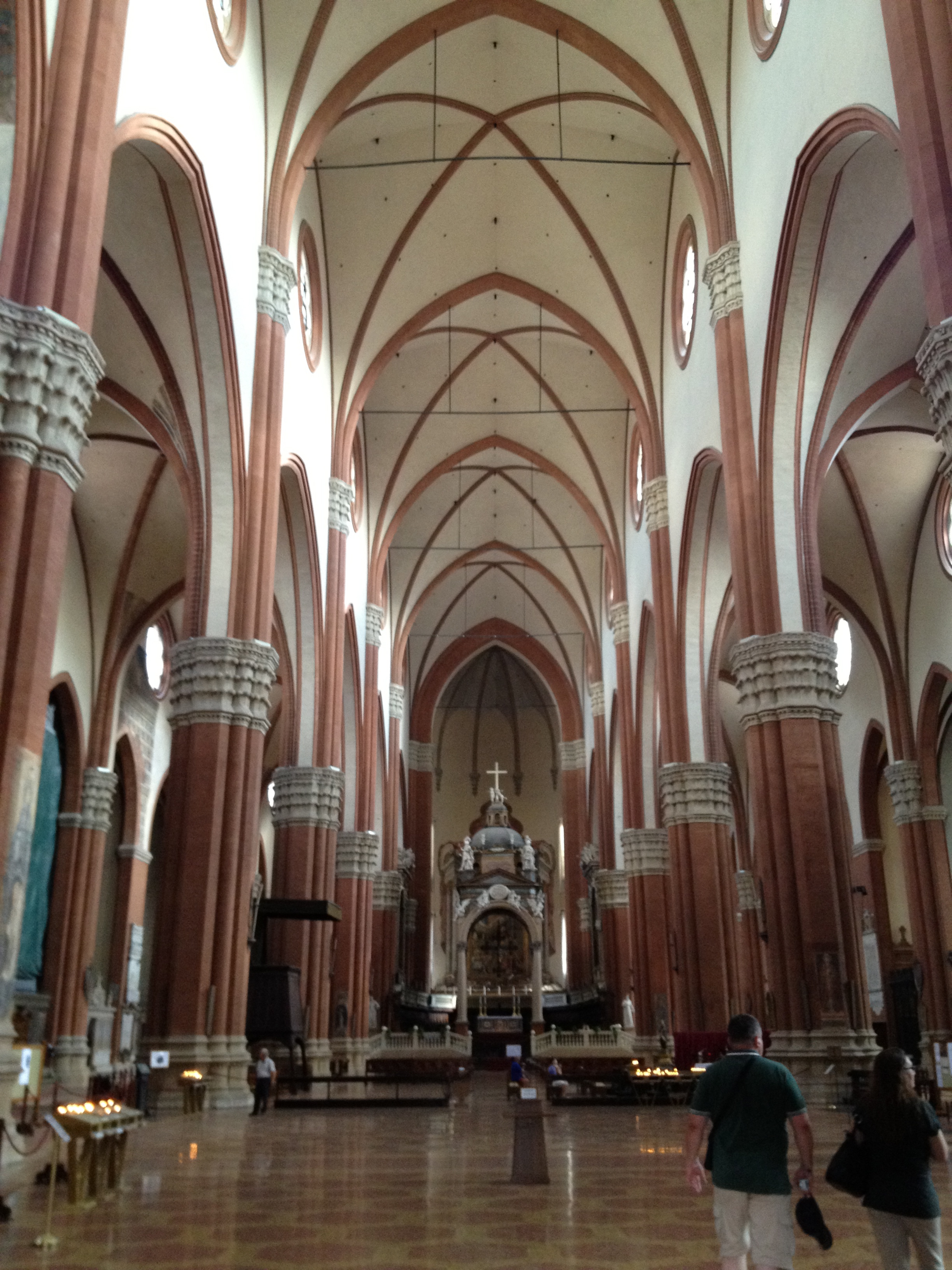
In Bologna, by contrast, there is a sense that the church plays second fiddle. True, the Piazza Maggiore is at least partially dominated by the looming presence of the Basilica San Petronio, but its vast marble facade has been left unfinished, as though the Bolognese started the expensive task of covering the brown bricks with marble, only to decide that the money could be better spent on other things. Meanwhile, on the inside, the church has a vast gothic interior, rising almost endlessly into the sky, yet compared with other Italian cathedrals, this interior is stark and austere, exhibiting the same lack of embellishment as is all too obvious on the exterior.

San Petronio’s unfinished exterior

And its impressive but austere gothic interior

In Bologna too is the iconic church of Santo Stefano, which is actually comprised of a hodge-bodge of some 8 older churches all linked together. However the rather plain brick-facade of this church is easily dominated by the stunning collonades of the neighbouring buildings, and all of the guide books of Bologna refer not to the beauty of the church, but of the square itself, with its fine Merchant mansions, shopping arcades and perfectly-proportioned palazzos.

Overshadowed: Santo Stefano

That’s not to say that the Bolognese are a population of heathens, rejecting the church and pursuing a life of hedonistic profanity and over-indulgence. The Basilica of San Petronio is, in fact, a mere shadow of its original design, which was intended to be a vast religious temple when designs were drawn up in the 16th century, but which were promptly interrupted by the Vatican who feared that the resulting cathedral would overshadow St Peter’s in Rome. As it is, the cathedral is the 15th biggest in the world. While the intention was there, you can’t help but notice that in spirit, Bologna’s priorities lie elsewhere. For the second of Bologna’s three renowned epithets is La Dotta: the Learned, and the great prevailing buttress of Bologna’s cultural foundation is intellect and learning – and you can see it all around.

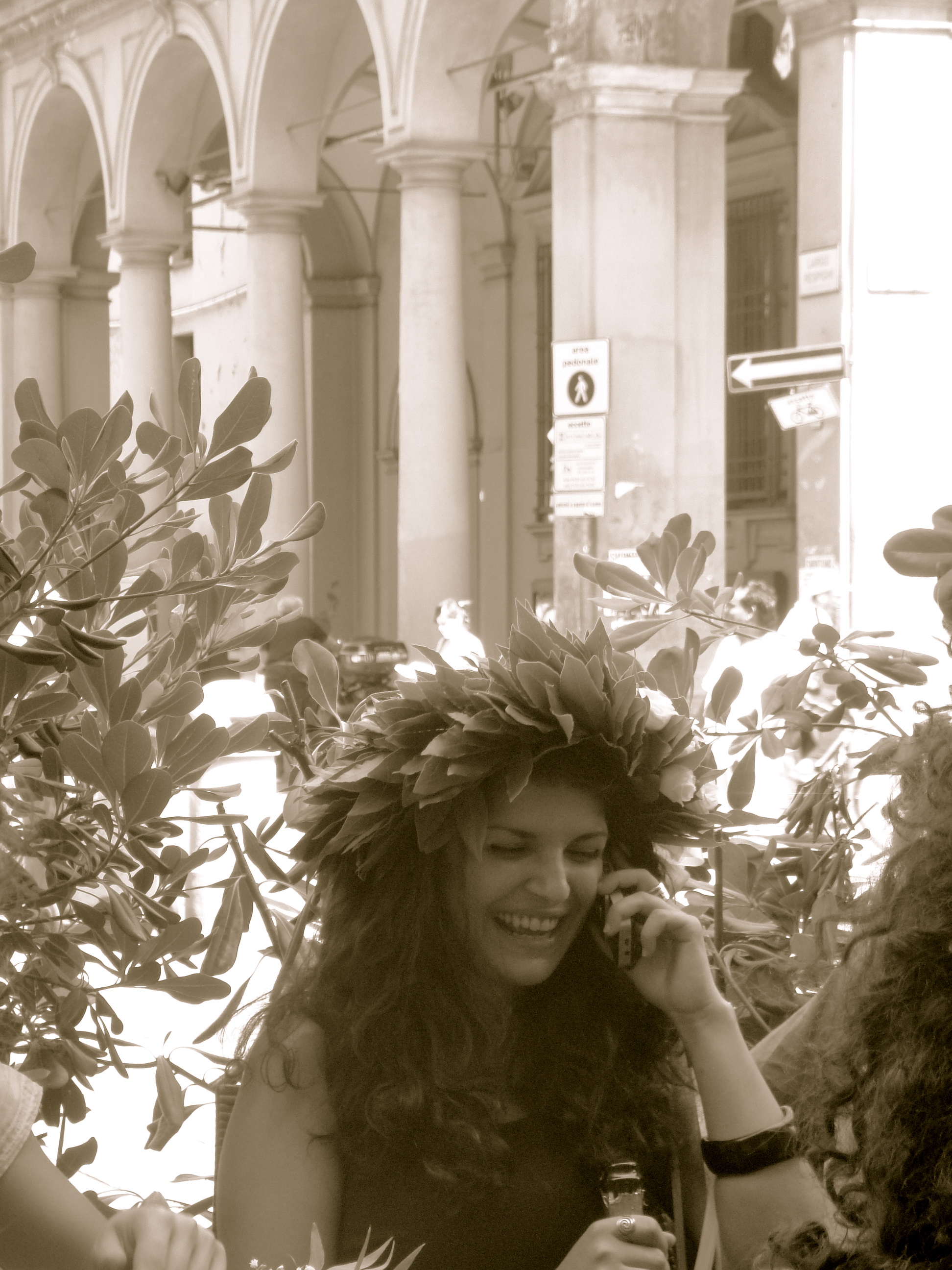
A happy Bologna graduate on her graduation day

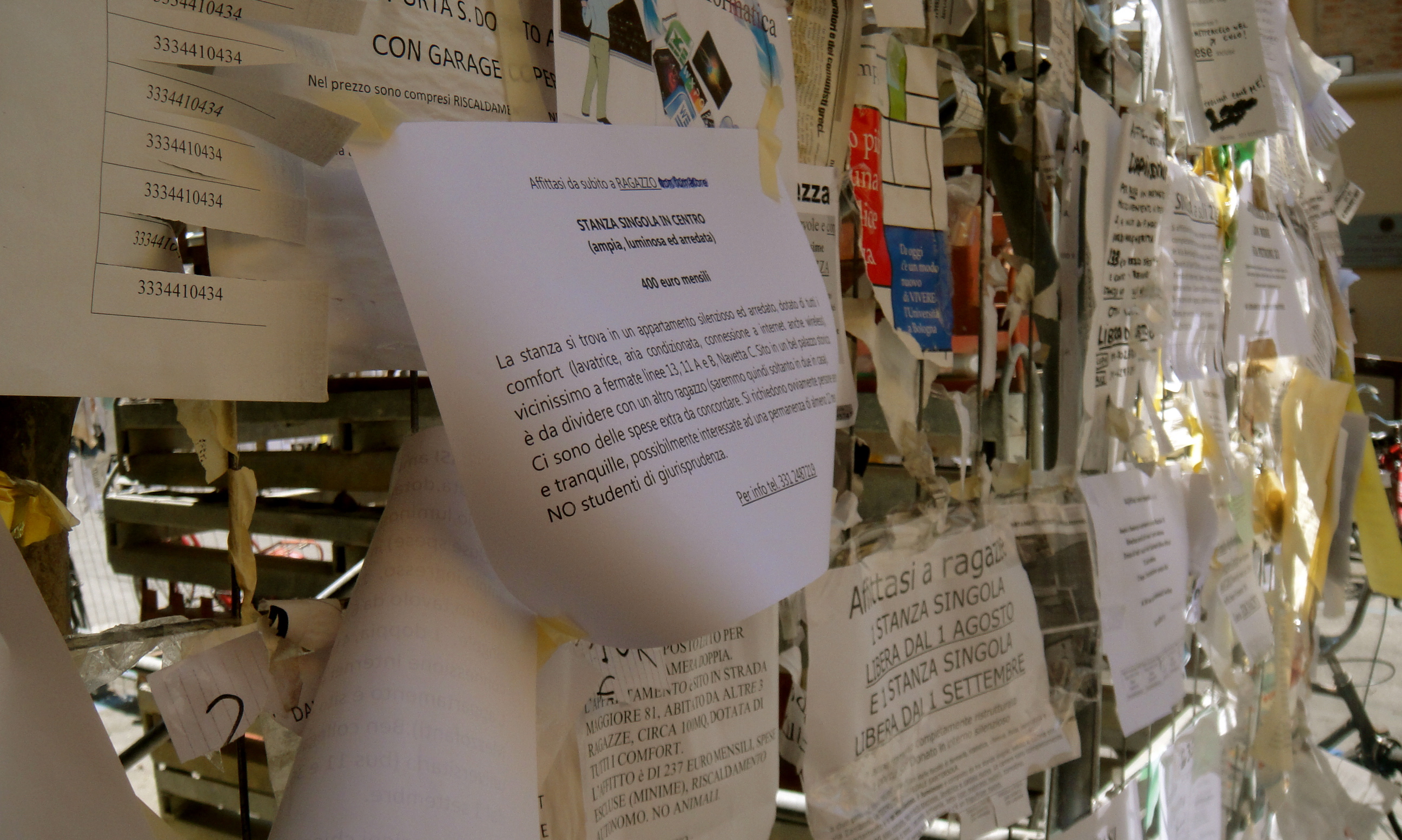
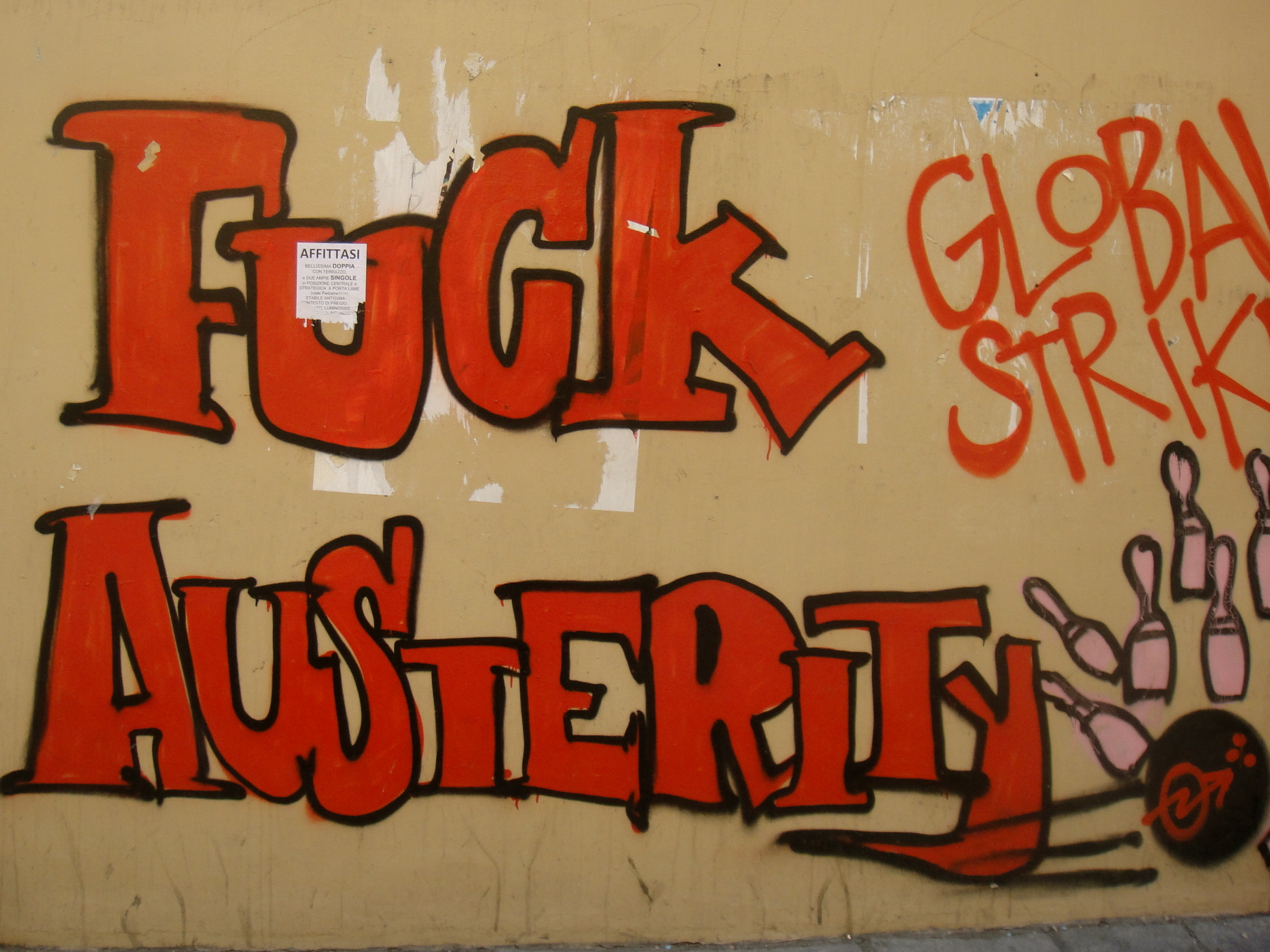
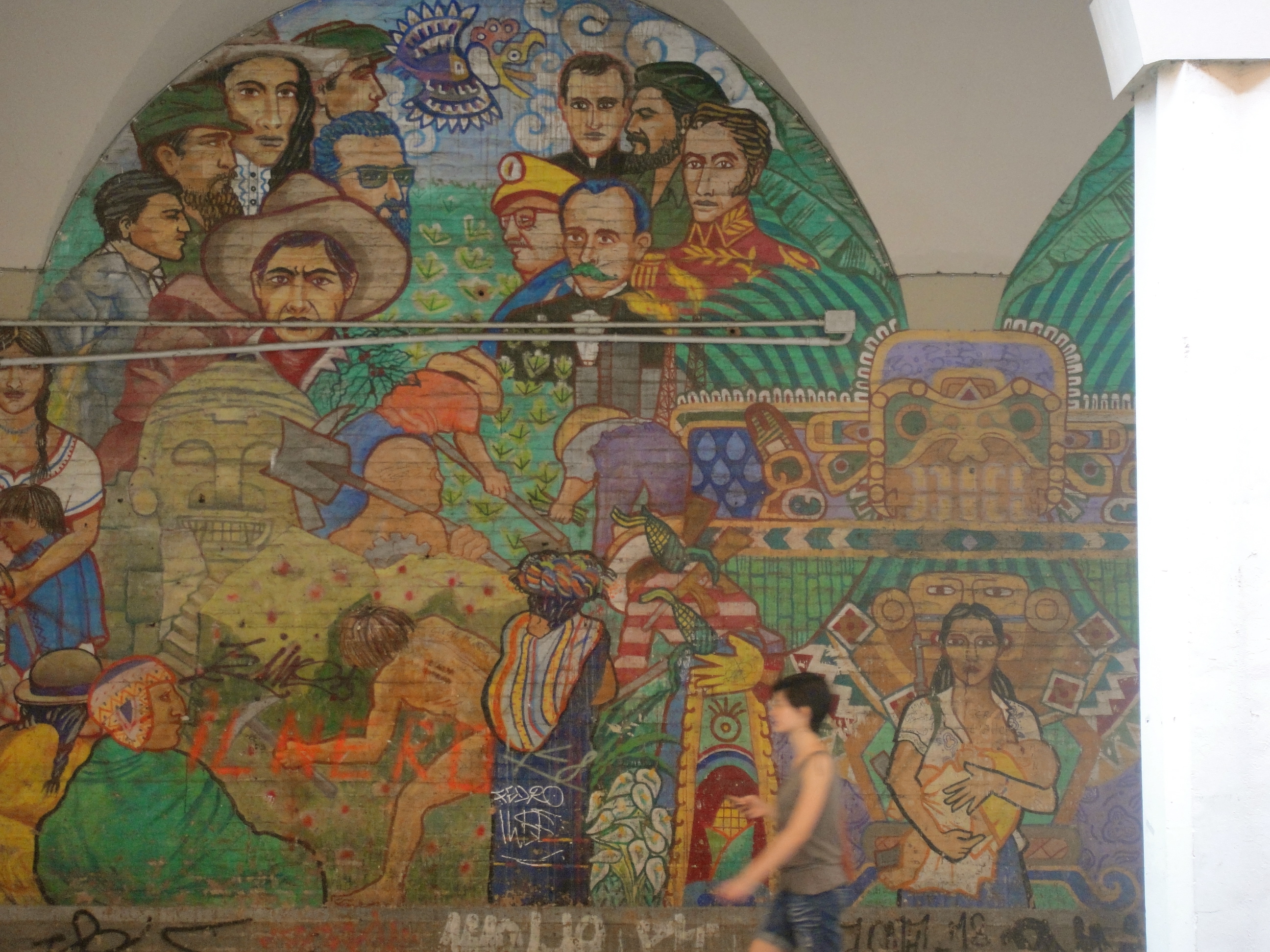
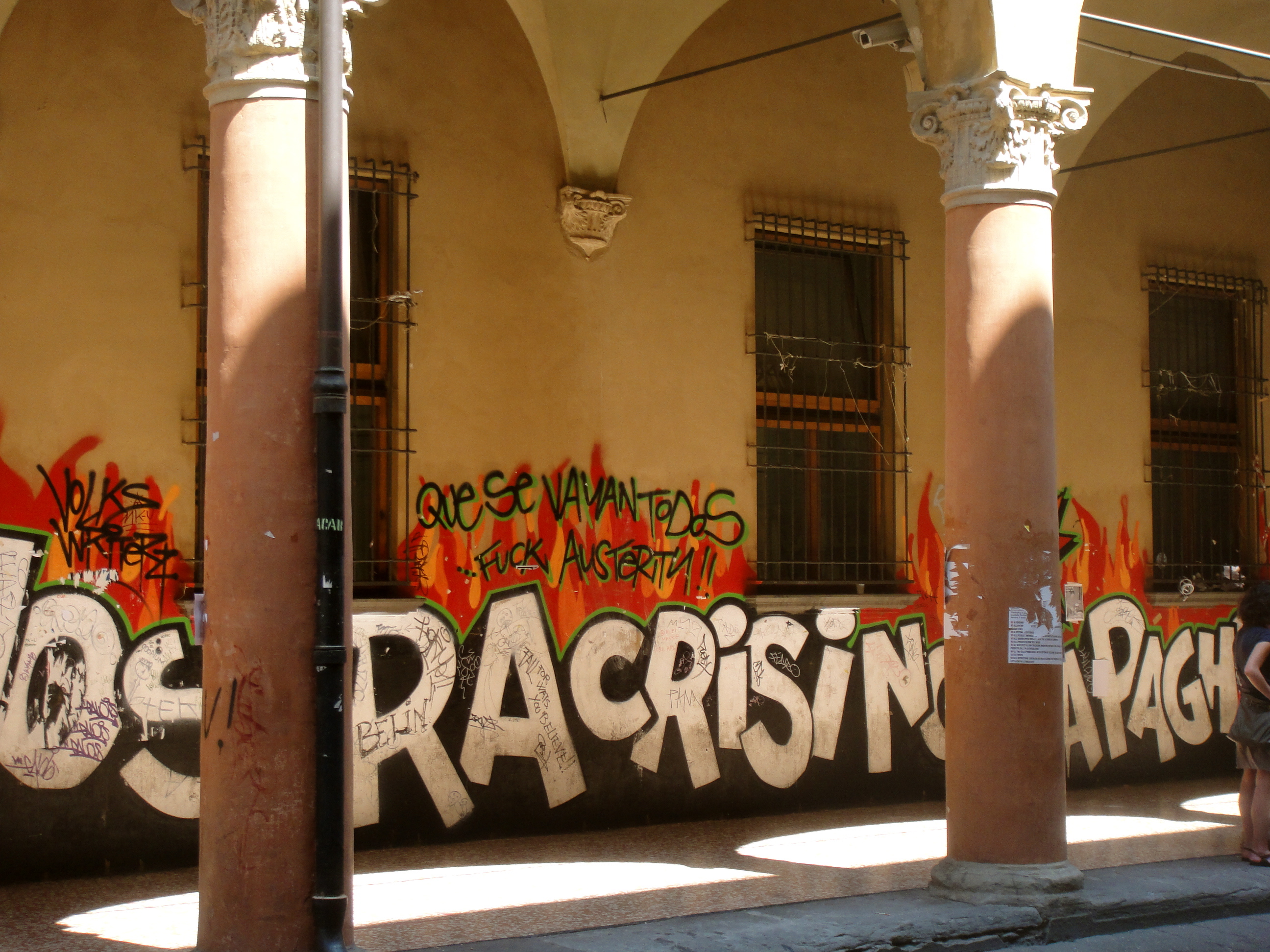
For starters, Bologna boasts what is said to be Europe’s oldest University, going back some 900 years, and the vivacious influence of the city’s still-thriving university population can be seen all around. On our first morning in the city, we wandered into the university district, just north of the central leaning towers, and there we found a district which was markedly alive with a thriving cafe culture, with campuses and libraries and a predominant feeling of youth and exploration. There, the elegant porticos of the southern city had been replaced by vast graffiti murals, protesting against austerity, opposed to Gaddafi and debating other modern polemics in technicoloured spray-paint. Instead of frescos, here the walls were covered with posters promulgating student presidential campaigns, advertising rooms to rent and promoting concerts and lectures. And instead of tourists, here the students dominated, and in fact on our visit were in the midst of a great summer graduation, for which the macabre mortar-board was replaced with a garland made from olive leaves and ribbon.

But the spirit of learning extended beyond the university. In the Piazza Maggiore we past a group of ordinary locals, energetically debating the state of the economy, some berating the influx of immigrants, others bemoaning the lack of jobs, and the rare few wishing Berlusconi was back in power. The debate went round and round, and views differed widely, but it was wonderful to see these people, vocalising their views, no matter how extreme, in a jocular environment, rather than building up resentment as is so often the case in reserved England. Meanwhile, around the Piazza, a wide range of impressive museums demonstrates Bologna’s thirst for global culture, art and history: We visited the beautiful archeological museum, where a courtyard stuffed full of Roman relics was an awesome sight, and the Pinacoteca Nazionale Bologna, where sadly the most famous works – a Giotto altarpiece and a Raphael had been hidden away owing to the double-bill of earthquakes which hit the Emilia-Romagna region in the last year.

The archeological museum

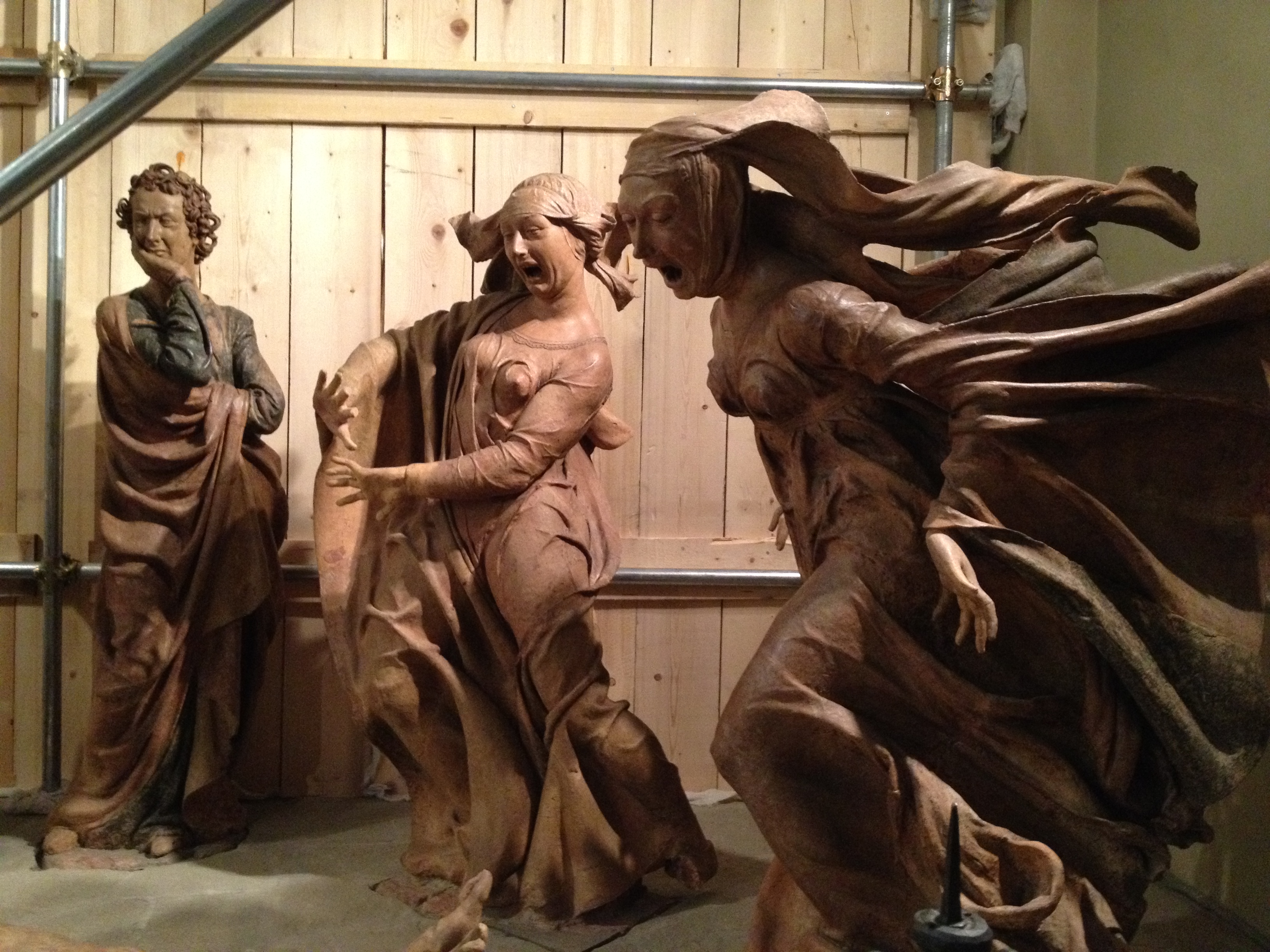
It would be unfair however to dismiss Bologna’s religious heritage all together. Seek and ye shall find, or so they say, and when you head away from the major Piazzas, there are some religious gems still to be found. The church of Santa Maria della Vita for example was quite a sight to behold. Tucked away in a side street off the Piazza Maggiore, a small door led to an interior which simply took my breath away. You can see from these photos why without further description. Also held in the church were the equally enthralling terracotta sculptures by Niccolo dell’Arca of the dead Christ and surrounding mourners. The sculptures exuded incredible dramatic pathos, the expressions of grief and torment of the figures intensified by the realism of their dramatic facial details.

Santa Maria della Vita

The Niccolo dell’Arca sculptures (protected from earthquakes, hence all the ugly wood)

Meanwhile, head out beyond the city, following the world’s longest continuous arcade (4km long, comprising an ominous 666 arches) from the centre of the city and at its end you will find the stunning sanctuary of the Madonna di San Luca, perched atop a hill, glowing orange, looking over the city for which it was appointed ultimate guardian.
San Luca

The uphill end of the world’s longest continuous arcade (we took the trenino rather than suffer those steps…)

So at the end of it all, Bologna, with its fiercely independent spirit and pursuit of intellectualisation and cultural superiority has captured a perfect balance. It has not sacrificed religious influence, nor morality, but it has cast the perfect equilibrium between moral precedent and intellectual and cultural freedom. In that respect Bologna has perfected a model which must surely be envied throughout the world.

All photos are strictly the copyright of Nicholas de Lacy-Brown © 2012 and The Daily Norm. All rights are reserved. 

A night at Glyndebourne Part 2: Damp Grounds; Delicious Dinner

When you attend the opera in most theatres, doors will open half an hour before. No sooner have you arrived that the bell will go and you’ll hurry to your seats. The interval will provide at most, the opportunity for a rushed glass of something bubbly before your brisk return into the theatre again for the second half. Once the curtain goes down, it’s home as quick as your legs can carry you, avoiding the waves of leaving attendees wherever possible.

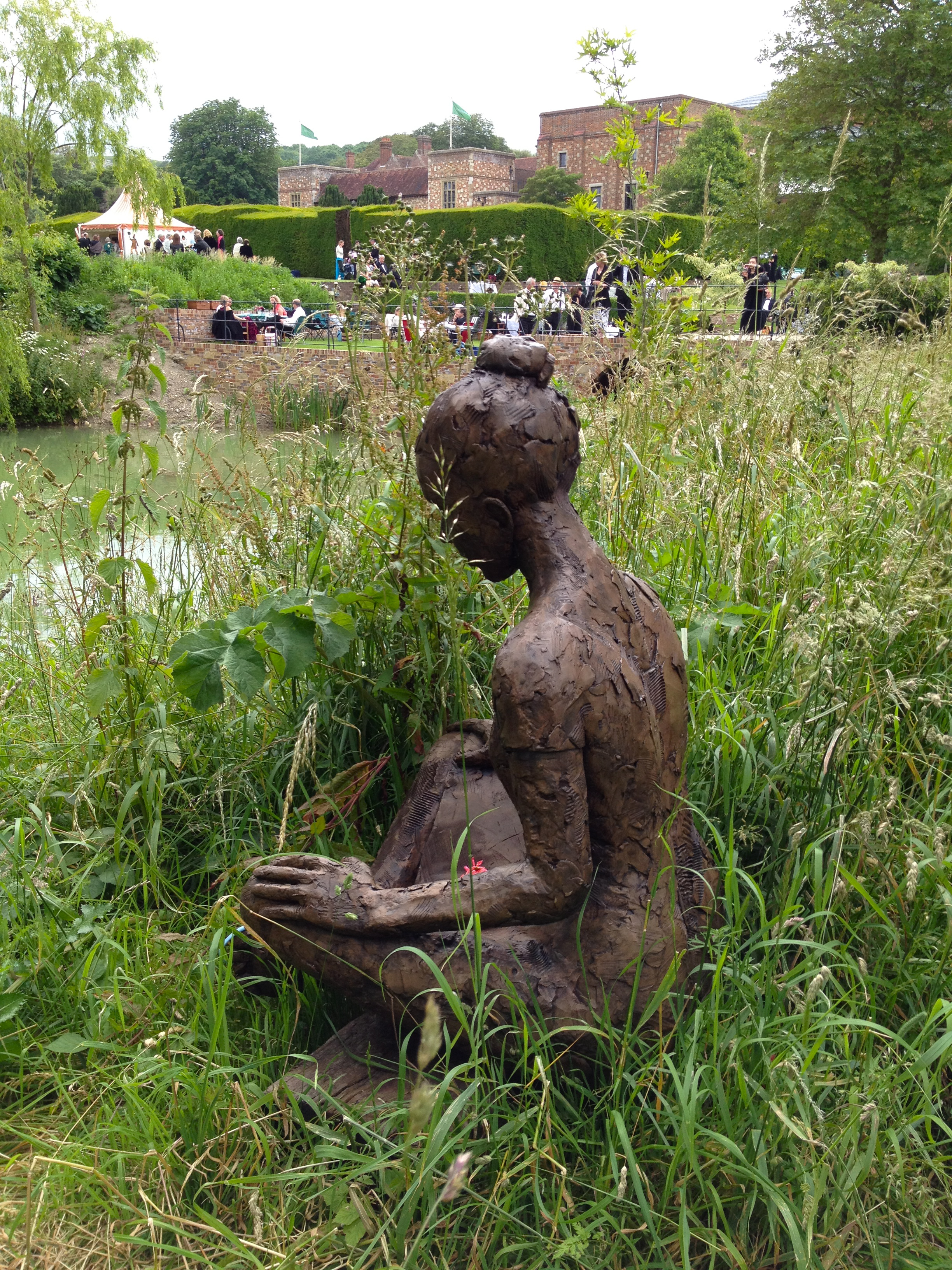
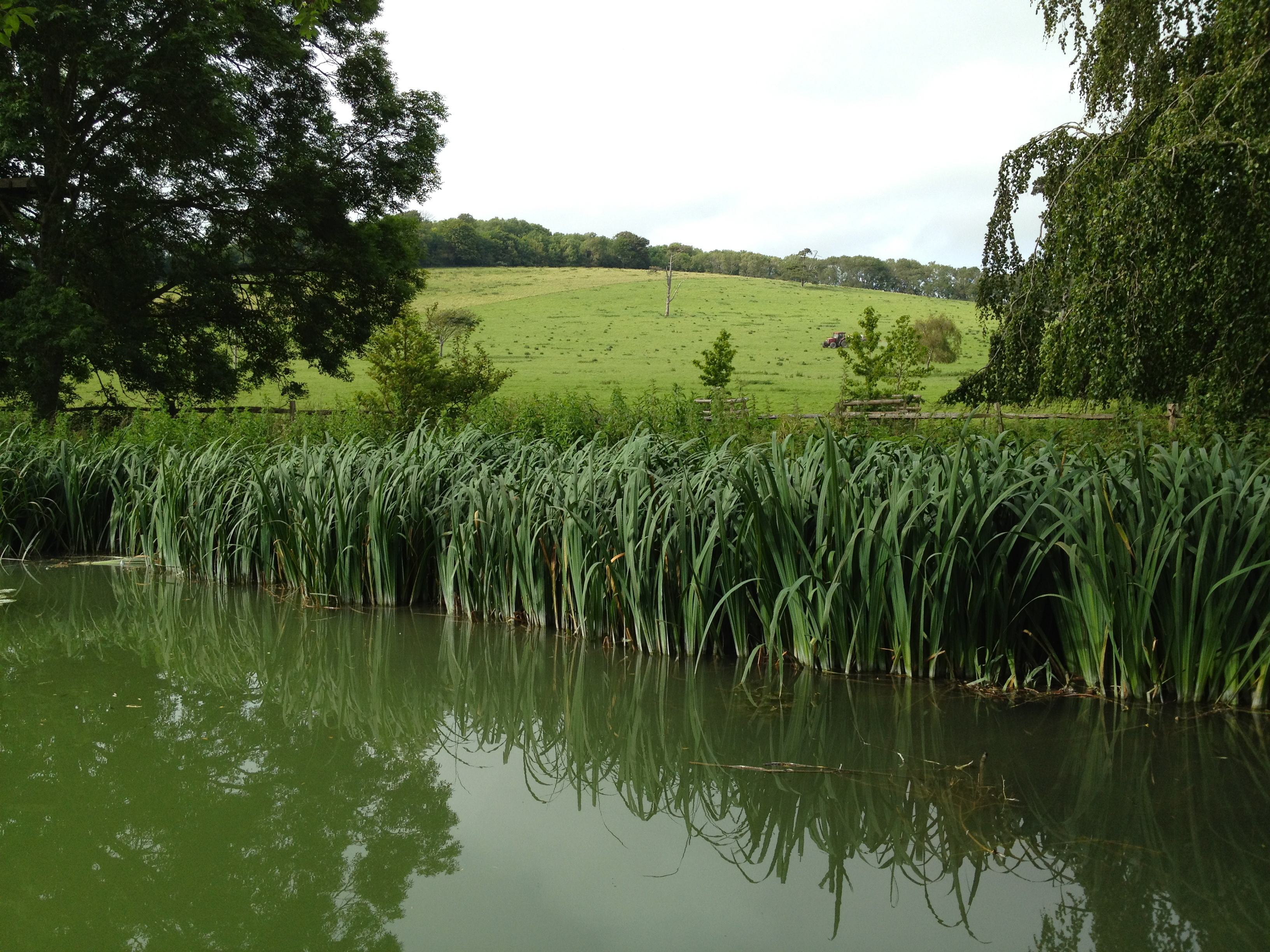
Going to see an opera at Glyndebourne is very different. It’s an event; it’s practically a day trip. Before the start of a performance, you can stroll around the grounds, walk around the dammed stream and look at the sheep, enjoy a glass of champagne on a bouncy lawn, or take high tea in one of the restaurants. There is even a small art gallery in the basement of the opera house for your entertainment, and walled gardens bursting with multi-coloured blooms. When it’s finally time for the Opera to begin you watch the first half followed by an interval of 80-90 minutes. It’s during this time that the spirit of Glyndebourne really comes alive, as picnics, already set up by opera-goers all over the perfectly maintained grounds are enjoyed, with time to sit back, sup, and discuss the first half of the performance.

A dammed stream in Glyndebourne’s extensive grounds

It’s the picnics that are, for me, emblematic of Glyndebourne, and offer a wonderful insight into a slice of English society. It’s hilarious to see how people subtly compete with one another. Far from picnicking out on a mere blanket, the Glyndebourne picnickers bring practically their whole dining room with them. They’ll be those who bring a fold up table and deck chairs which are fairly easy to carry and unpretentious. Of course they’ll have a Fortnums hamper with them, but then who doesn’t? They’ll be the ones with the plastic plates and food wrapped up in foil. But on the table next door they’ll be no such shortcuts. For those proud picnickers, the presentation of the picnic is a status symbol. So they bring chairs which are sturdy and firm. Their table is covered by a linen tablecloth with matching napkins. They’ll bring china plates and glass champagne flutes. And who could picnic without a crystal vase of flowers to set off the contents of the table? I wouldn’t be surprised if some of these picnickers bring a Butler too. I adore the charming pretention that comes with these picnics, seen equally as guests vie for the best spot on the grounds, marking their claimed territory with grand extensions of blankets and umbrellas, huge picnic baskets and other tokens of home. All done of course with a broad smile and exchanged pleasantries with the picnic table next door.

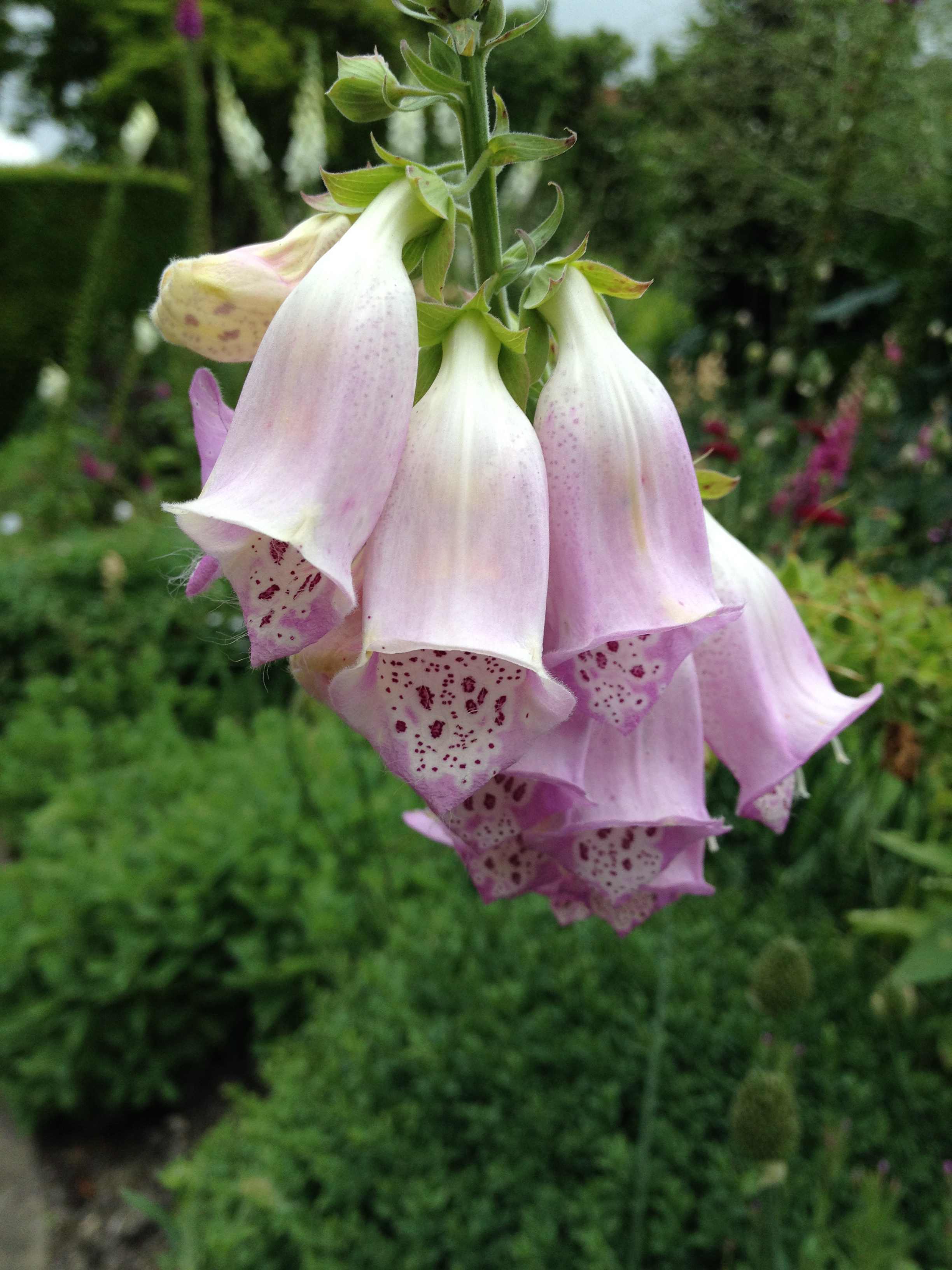
Flowers in the walled gardens

Sadly, of my four trips to Glyndebourne, I have never once been able to picnic in the grounds. I’m clearly cursed, as on each of my visits, it’s been either raining, perilously windy, or both. Such is the instability of the English summer. On good days it must be amazing in those grounds. Sadly I am yet to find out. On this visit my mother and I had long given up the hope of picnicking. We were travelling from London with minimal time to prepare, so we booked a table at the Middle & Over Wallop restaurant. As the day approached, we did not regret our decision. True, the rain just about held off, but with a keen wind and grey skies, picnicking conditions were not ideal. Yet still the majority of guests braved the conditions and stuck with their picnicking plans – another apt demonstration of Englishness – to stick it out, no matter what.

For we, perhaps more cynical diners, the Middle & Over Wallop restaurant, run during the season by Leiths with chef Albert Roux overseeing operations, provided a delicious mid-Opera feast in opulent surroundings (the restaurant must be hung with about 50 or so separate chandeliers) which was, most importantly, cosy and dry. What with time being on the short side, everything was chosen in advance, so a swift service was guaranteed.

The Middle and Over Wallop Restaurant

We both started with Hure of organic salmon, smoked salmon, crab and quail egg with watercress dressing. That dressing was light and peppery, and the smoked salmon delicate and moist. It was a fairly simple arrangement but full of flavour.

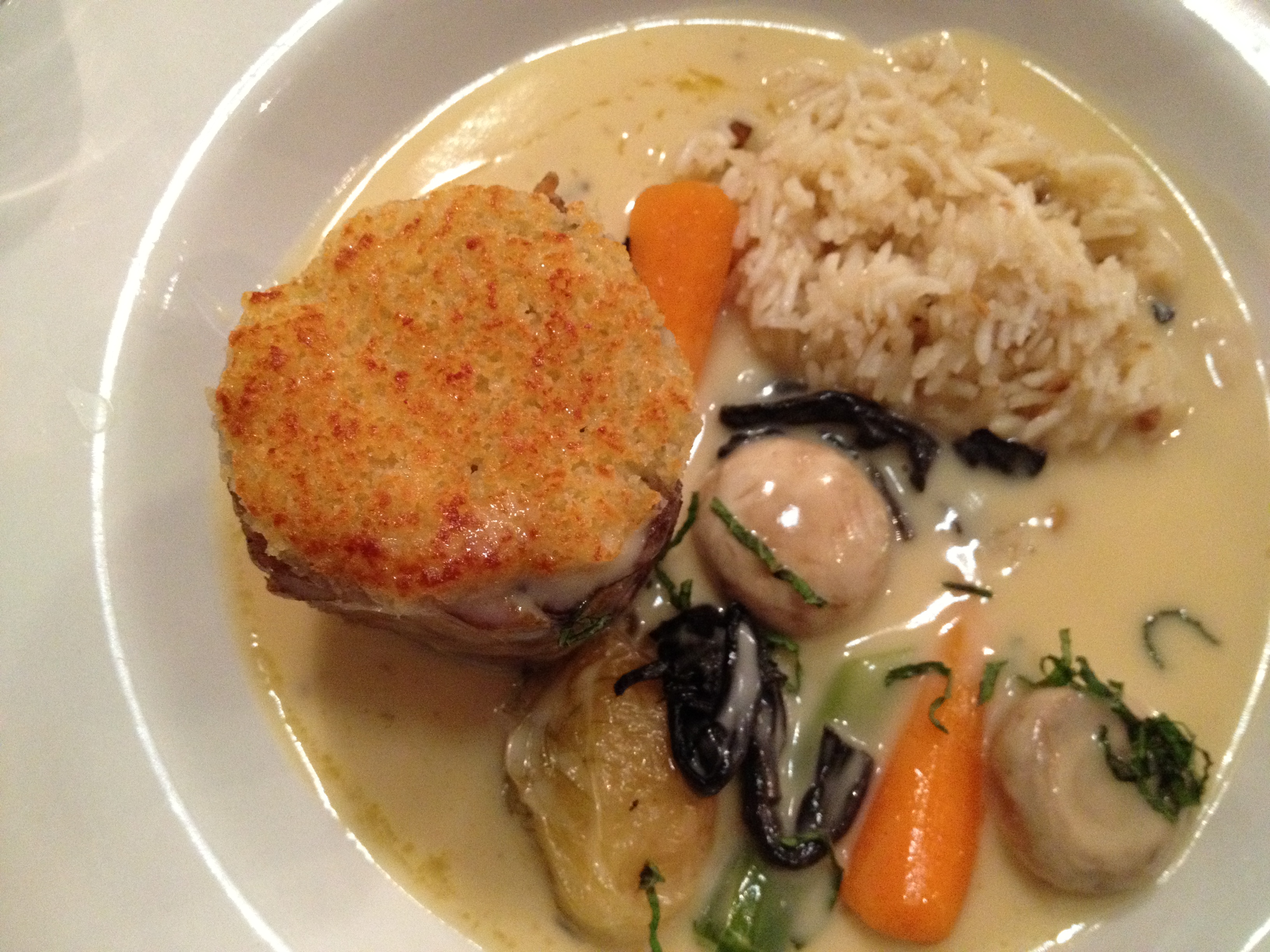
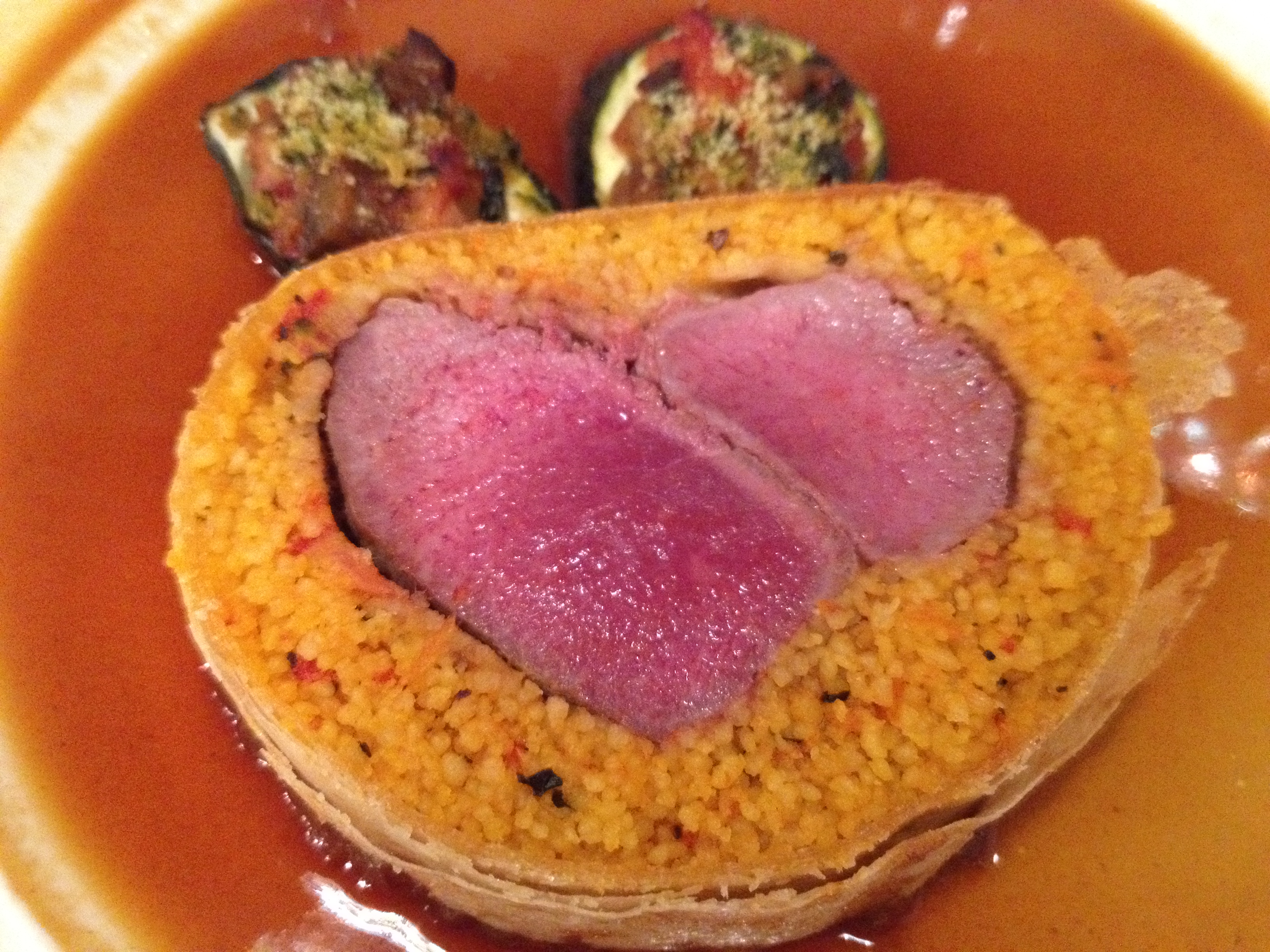
Next up for me was a blanquette of veal with mint, baby onions, Chanteney carrots and basmati rice. It was exquisite. The cheesy crumb on the top of the veal was to die for, while the meat just fell apart under my knife. Meanwhile my Mummy had a loin of Cumbria fell bred lamb wrapped with saffron couscous, and cumin rataouille. She too was aptly impressed, and this once can even be recreated at home – bonus!

Blanquette of Veal

Saffron couscous encrusted lamb

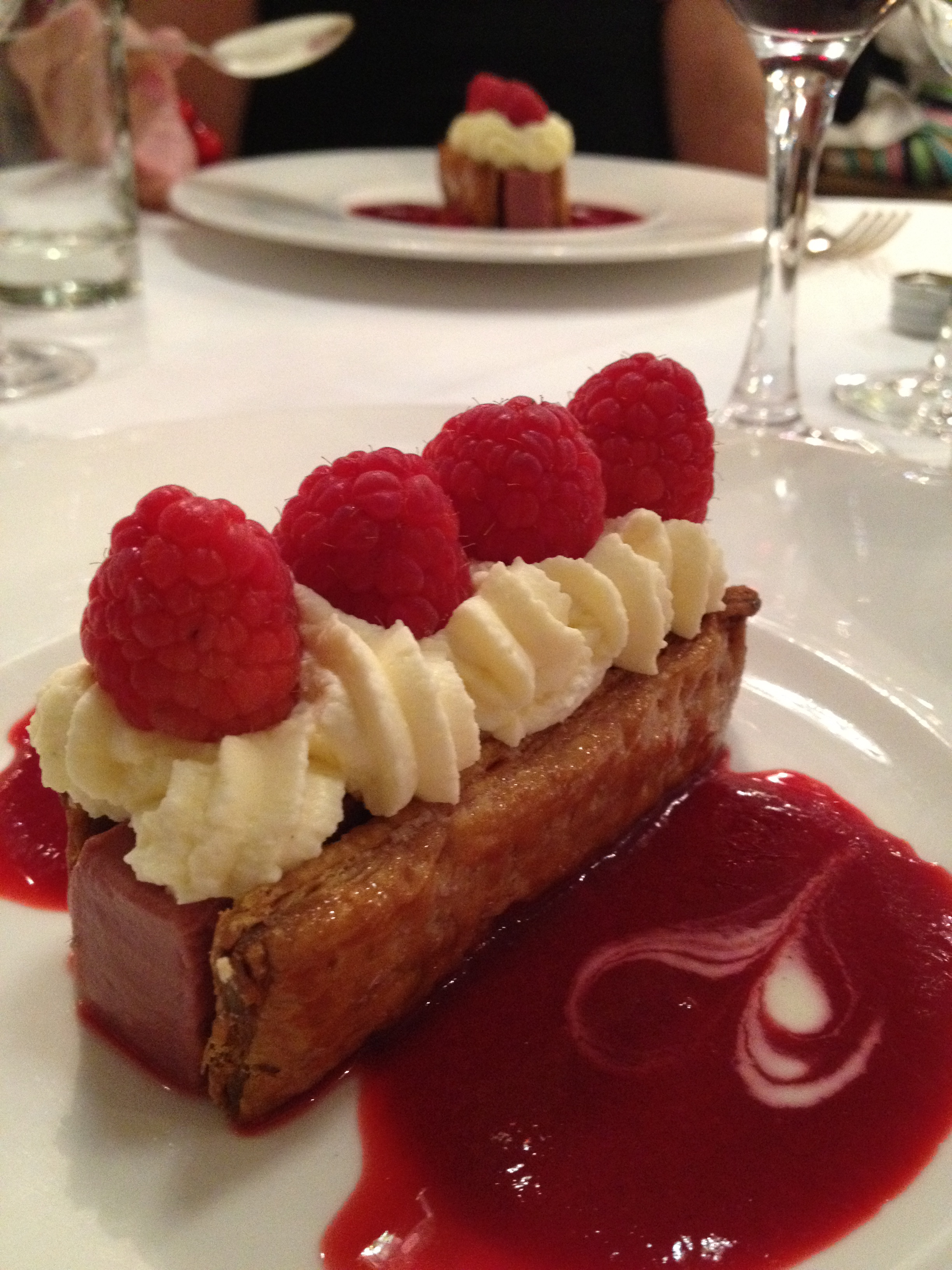
Dessert was a raspberry triple – a millefeuille of Kent raspberry, raspberry mousse and raspberry coulis. It tasted as good as it looked.

The raspberry triple

Luckily the food, while swiftly served, was light with fairly small portions – I was wearing a waist-repressing cummerbund after all!

So you see, Glyndebourne ain’t all about the Opera – it’s very much an occasion, and one which I cannot wait to repeat again. You never know, next time the sun may actually come out, and I might get to enjoy that picnic after all. But just watch me coming fellow picnickers if I get out on that lawn. Competitive is my middle name.

A night at Glyndebourne Part I: The Opera – Puccini’s La bohème

There is nothing quite so wonderful as a summer evening at the opera. Don’t get me wrong, opera can be pretty cosy in the middle of the winter too, but there is something about the combined smells of champagne, Pimm’s and fresh grass, the swish of long luxurious dresses against the green tints of summer, and the descent into long, light evenings at the end of the performance that make summer operas a wholly more enchanting affair. And no where is this more true than at the Glyndebourne Opera House in East Sussex.

Glyndebourne opera house

Ekaterina Scherbachenko as Mimi (Photo: Robert Workman)

Growing up in Sussex, I was always aware of an aura of elegance surrounding Glyndebourne. Most summers, my parents would suddenly emerge from their bedroom exceptionally smartly dressed, my father in black tie, and my mother is taffeta and jewels. They would engage the babysitting services of my grandmother while they headed off to Glyndebourne, with a picnic basket in hand and some fold up furniture to boot. A few years later, when old enough to properly appreciate the occasion (and thus not waste the exorbitant ticket prices) I was lucky enough to make my first trip to Glyndebourne. The place astounded me. It has to be one of the most idyllic settings I have ever set my eyes upon. A lush green landscape of rolling hills, a field echoing with the gentle calls of sheep, a stream surrounded by willows, and in the middle of it all, an architecturally thrilling opera house – part modern, a stylish round red-brick creation, and part old manor house. Even now, with their new ultra-environmental wind turbine installed, the place is a feast for the eyes.

Christmas festivities at the end of Act II (Photo: Robert Workman)

A night at Glyndebourne opera is almost like stepping back in time – as people dress up to nines, with a  strict dress code of black tie and formal dresses being unanimously imposed, and the opera-goers sit out on the lawn with picnics set up, not just on rugs, but with furniture imported (some even bring tablecloths and vases of flowers!) – the whole occasion appears to represent a last bastion of civilised society – utterly polite, completely sophisticated and awfully quite “English”.  There’s much to say about all of this, and in tomorrow’s post I will tell you all about the dining at Glyndebourne. But for today, I’m sticking to the opera which was the pull of our visit in the first place – Glyndebourne’s 2012 performance of Puccini’s La bohème.

Mimi in her last moments (Photo: Robert Workman)

The opera is familiar to many opera-lovers. It doesn’t contain some of Puccini’s most memorable arias, but the score is at all times opulent, dramatic and pretty stirring throughout – at times it was almost stressfully upsetting. The story, based on the book by Henri Murger which was in turn brought to life by librettists Illica and Giacosa, is a simple, and now well-known tale – the story of an impoverished writer in Paris who falls in love with an equally penniless heroine who then dies from tuberculosis leaving said writer devastated right at the moment when the curtain falls. Lovers of Baz Luhrman’s Moulin Rouge will probably recognise the story – it was, after all, based on Murger’s tale. It’s a simple tale of love in a cold climate, where passion provides the only warmth, and attempts to transcends the ravages of poverty only to then fall victim to the destruction of an incurable illness which only poverty, and desperation could have caused. It’s highly tragic, but utterly romantic, and all of this is helped of course by the intended backdrop of the winding-streets of Paris’ idyllic, cobbled Latin Quarter.
Michael Sumuel, David Lomeli, Andrei Bondarenko, Nahuel Di Perro (Photo: Robert Workman)

Move to Glyndebourne’s production however, originally directed by Davud McVicar and now revitalised for the 2012 festival, and the setting has been transported not to the Marais or Montmartre, but to London’s tatty present-day Soho. Thus we have policemen running after thieves, road sweepers, security men, Christmas shoppers adorned with bags from Harrods and Selfridges, and even what looked like the entrance to the underground. It’s a bold move which isn’t overly consistent with the libretto, which continues to talk of the view of Paris rooftops, nor the rousing drama and opulence of the score. However it is at least a novel retelling of the story – it’s just difficult perhaps to get all romantic about the lovers, Rodolfo and Mimi, when Rodolfo is dressed in a hoodie, and Mimi in jeans. But as David Cameron would have it, we should all be “hugging hoodies”- so why not stage them in a opera too?

David Lomeli as Rodolfo and Ekaterina Scherbachenko as Mimi (Photo: Robert Workman)

While the tatty studio flat of Rodolfo and his artist friend, full of rubbish and constructed from what resembles crumbling concrete and steel, isn’t exactly easy on the eye, the sound emanating from the opera singers themselves was certainly easy on the ears. David Lomeli as Rodolfo produced an incredible, rich and rounded sound – his aria in Act 1 (Che Gelida Manina – Your Tiny Hand Is Frozen) was exquisite and immediately had my eyes filling up. Meanwhile, Ekaterina Scherbachenko made an equally credible Mimi, with the earnest demeanor and visible courage expected of the character, but it was a little disconcerting when, upon completing her first aria with Rodolfo, she suddenly trailed off just before the top note – I wonder whether she tripped down a step when heading off stage?! High praise has to be reserved for Irina Iordachescu as Musetta who played the cocky femme fatale with swagger and style, greatly enhanced no doubt by a pair of Louboutin boots and a very sparkly top.

Irina Iordachescu as Musetta and Donald Maxwell as Alcindoro (Photo: Robert Workman)

The orchestra sounded wonderful throughout, although at times the cast struggled to hold their own against the rousing crescendos of the score. We also had the benefit of being able to see the orchestra from our seat on the circle, which greatly enhanced the overall experience – at least when I could see them. For the problem , but also the great attraction of this opera is that it is so bloody sad, with the inevitable result that my eyes were constantly blurring with tears. As if it wasn’t bad enough that the superb resonance of David Lomeli’s aria had me crying in Act 1, the end of the opera just completely devastated me. I found it so utterly traumatic that I struggled to talk for about 5 minutes after the curtain came down. Which just goes to show, London or Paris, top hat or hoodie, when you get a good orchestra, a good conductor and great singers, Puccini’s score has the enduring power to stir up its audience and tap into the rawest of emotions, taking them on a rollercoaster with a power to enthrall, charm, and ultimately, upset. Now that’s true operatic genius, and it is a genius which the Glyndebourne experience helped to enhance to new levels of dramatic intensity, with a dash of pleasing english reserve to boot, naturally.
Mimi: close to death (Photo: Robert Workman)

La bohème is on until 31 July – try to get tickets – if you can. 

It’s all in the Sole: Christian Louboutin celebrates 25 years at London’s Design Museum

Glossy red lips, emblematic red telephone boxes, and the sumptuous vivid spiraling red of a voluptuous red rose. There is something about red which strikes a devilishly powerful impact. In fact scientists declare that red is the colour most instantaneously attractive to the human eye: and it’s true. Look around a room, survey the rainbow of colours and shades all around you, and the first colour you notice will always be red. No wonder then that throughout the ages, it’s the scarlet woman, the red lights of shady backstreets and the unctuous red-painted lips of Hollywood prima donnas that have become so indubitably emblematic of seduction, attraction and the height of munificent glamour.

No wonder then that when one, previously unknown French Cameroonian son of an ébéniste (ivory wood carver) turned shoe-maker decided to place a seamlessly lacquered vivid red sole on the bottom of his women’s shoes, he became an instant hit. When you see a woman in high polished black stilettos sauntering down the street, and as her shoes lift with each step, you see a hint of glossy red, you know that the woman has taste – instantly glamourous, emblematic of sexy chic and seductive sophistication, that red sole can only mean one thing, and have only one maker – it’s a work of art, and it’s made by Christian Louboutin.

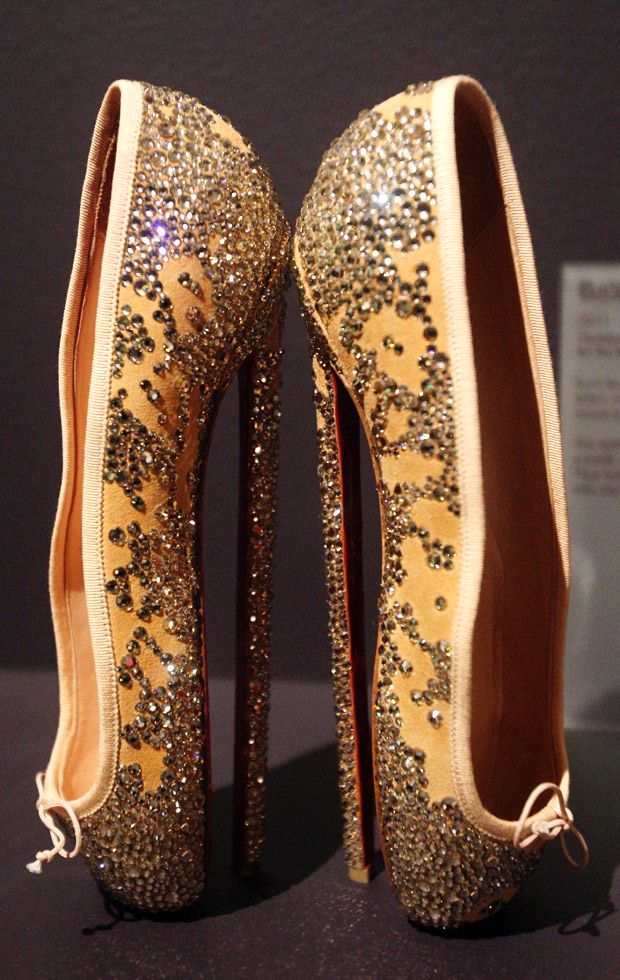
Fetish shoes

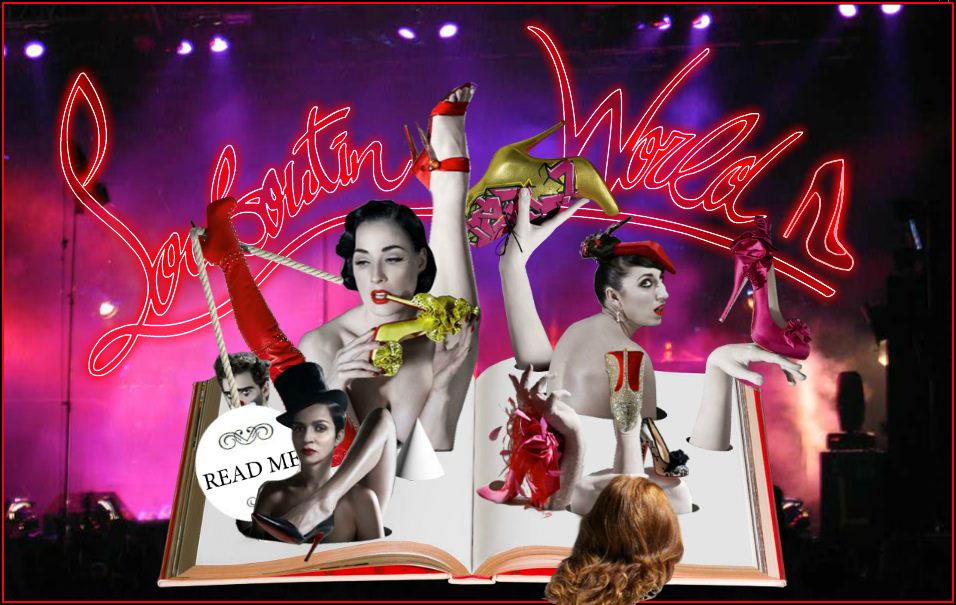
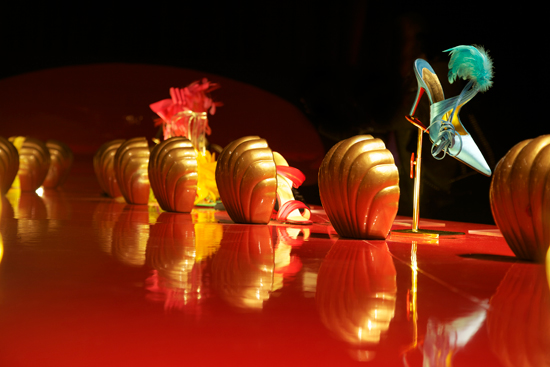
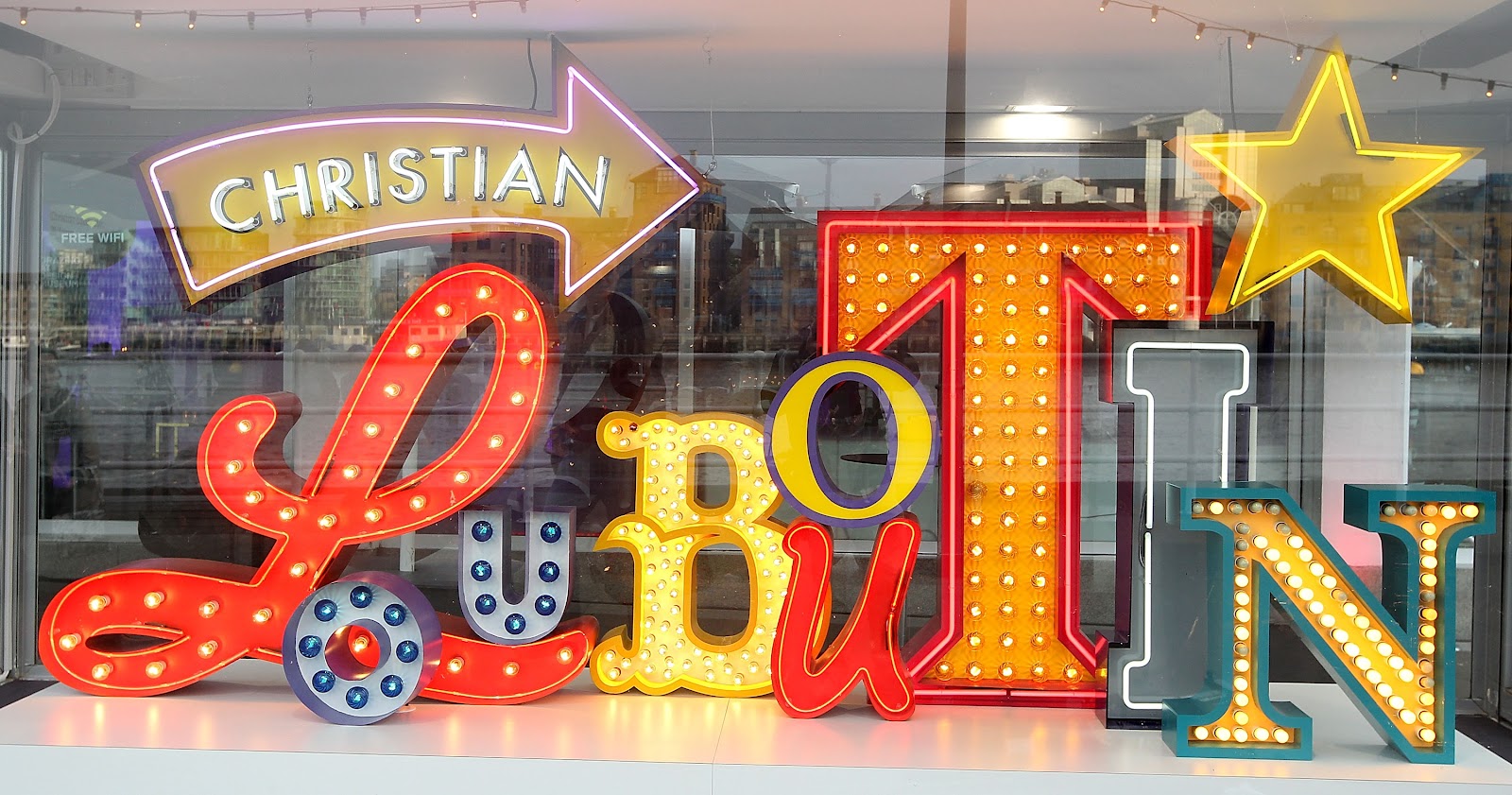
Yes, Louboutin, iconic French designer and the man who made red soles his signature, is now celebrating an illustrious 20 years of shoe design, during which time he seized the shoe, and in particular the daringly high stiletto, and lifted it into a new ascendancy of design significance, when, through darlingly innovative designs, and unhindered imaginative genius, he made the shoe the star of the show, as well as the means to make a woman’s legs, and figure, beautiful.  Such is the theatricality of his designs, that it comes as no surprise that in celebrating 20 years of iconic shoe design, London’s Design Museum on the South Bank has put on the show of all shows, like a retreat into the cabaret of 1900s Paris at the Moulin Rouge, as a vast illuminated stage, a playground carrousel, and a garden of delights play host to shoes and only shoes, singled out and exhibited in all their fantastically original glory.

The Dita Von Teese hologram

The exhibition exudes the playfulness of Louboutin. At its centre is a wonderfully raunchy Hologram video of the deliciously sexy Dita Von Teese, herself spectacularly bedazzled in a pair of sparkling diamond-encrusted Louboutin’s, demonstrating just how seductive a woman in these shoes can become. Meanwhile at the back of the show is a den of iniquity, a naughty display of fetish shoes designed to push a woman to the maximum of pain and pleasure and panda to every man (or woman’s) every sexual desire when shoes are their ultimate proclivity. I loved the little garden, when crazy platformed shoes were displayed like fantasy creatures in Alice’s wonderland, and the recreated studio of Louboutin himself, where a vast array of objects, instruments and other paraphernalia provide daily inspirations for his ingenious creations.

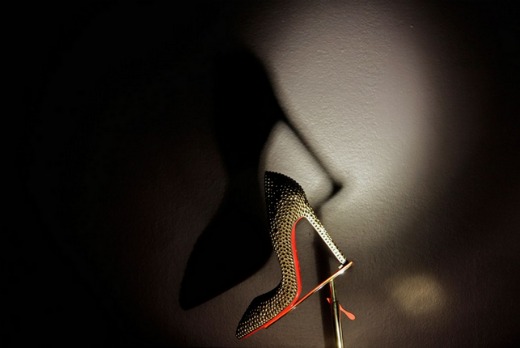
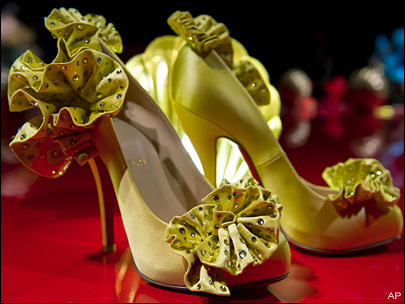
But amongst all of this showmanship, let us not forget that the stars of the show are the shoes – and there were so many beautiful designs it’s hard to choose from amongst them. But being something of a magpie, I was instantly attracted to all those which sparkled, while the delicate sophistication of shoes and boots covered in lace held a particular attraction. But amongst all of these design gems, from hugely built-up platform boots, with corset-style laces crisscrossing up to the thigh, to sleek yellow open-toed stilettos bursting with tropical flowers, perhaps one of my favourites was the most understated of all, the simple, sleep shiny black stiletto, albeit with that trademark red sole and a frighteningly high 5 inch heel.

The shoes amazed, the red soles seduced, and the diamonds and studs aplenty dazzled, yet when I left the exhibition, I still came out wondering why and how Louboutin had hit upon the red sole that has become his signature. How did he stumble upon it? What was his inspiration? All of this goes unexplained in the history of Louboutin’s 20 year retrospective, and at £125 a pop, I wasn’t about to put my hands in my pocket and pay for the vast (and admittedly very beautiful) exhibition catalogue to find out. Besides, I was too busy trying to escape from the unnecessarily copious groups of “girly” women, giggling all over the place and drooling over shoes they could barely ever afford, enjoying themselves far too much and occasionally yelping as though on a hen night. This is art darlings, take your window-shopping to Aldo.

So why is Louboutin worthy of my praise? I am after all a man. I’ve never worn a stiletto, let alone owned one, and, unless I undergo some kind of hither unanticipated breakdown in my life, never intend to. Well the answer is simple – it’s because Louboutin has suspended his shoes into a design ascendancy which goes way beyond dress choice. These shoes are art, pure and simple, and best seen encircled by a spot light, up on a little stage or under a glass cloche where they belong, preferably sans foot, sans sweat and definitely sans ground surface to scratch that perfect lacquered red sole.

Christian Louboutin is on at the Design Museum, Shad Thames, London until 9 July.

Summer Exhibition at the RA: How a private view can make the mediocre marvellous

I’ve said it before, and I’ll say it again: When the viewing conditions are right, even the most mediocre of art can appear wonderful. When your mood is carefully massaged by fortuitous circumstances, your mind will be opened, and you’ll look for the positives in everything. Look what happened a few months back with the huge David Hockney exhibition at London’s Royal Academy: On my first visit, the gallery was so packed I came out spitting blood (almost literally as the hustle in the giftshop between usually restrained “Friends” of the RA to grab as much Hockney merchandise as possible almost ended up in fisticuffs). What was all the fuss about Hockney? He can’t even paint, I thought, bitterly. However, when I went back a few weeks later at the behest of my partner, first thing in the morning, tactically skipping the first couple of rooms and emerging, victoriously from the crowds into an empty exhibition beyond, I began to see what all the fuss was about. The paintings were so atmospheric, airy, colourful, pleasing. It was all about the viewing conditions.

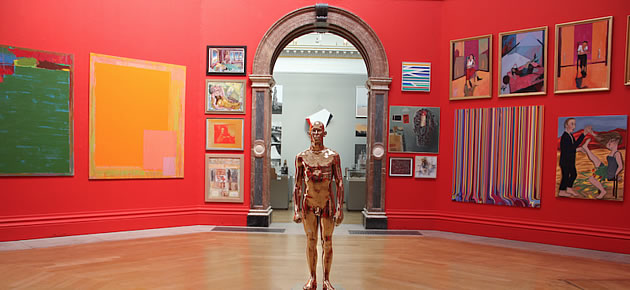
The central Matisse-red gallery complete with sculpture by Leonard McComb RA

The same, now, can be said for my experience of the Royal Academy’s most famous annual offering, the Summer Exhibition, which I attended, with my mother, last night. So used to the unseemly crush of packed-in spectators, all vying for space in the Small Weston Room to see the small paintings squeezed unapologetically onto the wall from floor to ceiling, I would always leave the Summer Exhibition feeling resentful. Why had I just spent good money to go along and see a load of same-old mediocre paintings, small canvases of flowers and ovens and animals, not to mention Tracey Emin’s hideous, crass doodles and the repetitive works of the closed-club Royal Academicians? But not this year. Yes, the same old Royal Academicians still dominate, and yes, the ridiculously crap works of Tracey Emin, now named “Prof. Tracey Emin RA” after her recent ascendancy to the role of RA Professor of Drawing (what a joke) are still conspicuous by their unashamed lack of skill (and because of the hundreds of “sold” dots stuck to the frame because people seem to think scrawled depictions of half-vaginas are valuable), but the difference this year was that I attended on a private view. There were literally 80 of us in the entire venue, and those rooms are big. Once the small gathering had dispersed around the place, we frequently found ourselves quite alone in the huge Royal Academy galleries.

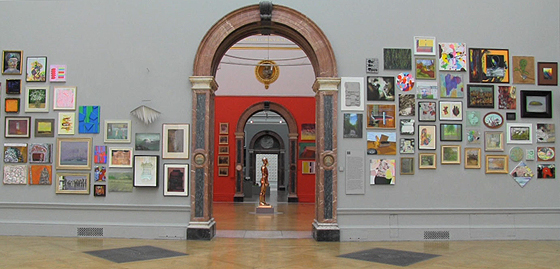
The “wave” hanging of small paintings

It was wonderful! Feeling so airy, ephemeral, and almost important, we glided around the galleries in such a good mood that we actually started to point out details of all the paintings, noticing the colours and the skill involved, complementing, and sometimes even tempted to buy and generally loving the whole affair. We were also treated to a talk by the charming Harry Baxter (an “artist educator” at the RA) whose insight into the exhibition made the whole thing instantly accessible and immediately unpretentious. This year’s show, the 244th in the RA’s history was, he explained, a homage to the small and the beautiful, an intentional contrast to the Hockney “Bigger Picture” exhibition where crowds had crammed into the galleries to see vast paintings made up from multiple small canvases. The focus on “small” can only be a good thing – it meant that rather than squeeze into the tiny rooms with hundreds of others to see all the small works, this year the huge central galleries were given over to countless small paintings (some 1,500 in all) which were hung around the walls like a wave of moving art. It wasn’t quite a Salon floor-to-ceiling hang, but it was an all-embracing journey from one artist’s expression to another’s.

So amidst all this good feeling, what were my favourite works? Top of the list has to be Buffalo Grill by Scottish artist Jock McFadyen, not least because I used to eat in one such of the French chain restaurant bang opposite the Moulin Rouge in Paris. This huge green canvas, with an off-centre, almost hazy image of the American-looking chain restaurant made for quite an impact in a gallery in which it easily dominated. It’s almost like the blur of the restaurant viewed from a fast-moving car, and yet the top of the restaurant is crisp and clear, like an after-image of the place stamped onto your retina.

Buffalo Grill (2004) © Jock McFadyen

Top of my list of sculptures, meanwhile, was the super-shiny bronze creation by Leonard McComb RA, Portrait of a Young Man Standing. Only a shame that it has the very modest price tag of £600,000. Against a red painted central gallery (apparently painted as such in homage to Matisse) and reflecting in its polished surface the paintings hung all around it, the sculpture looked truly remarkable. Second place for sculpture had to be given to Professor David Mach RA, whose cheetah made from coathangers, Spike, is an incredible feat of innovation (as was the brilliant recreation of the head of Michelangelo’s David built from the heads of matches, also by David Mach).

Top half of Leonard McComb’s Portrait of a Young Man Standing

David Mach RA, Spike

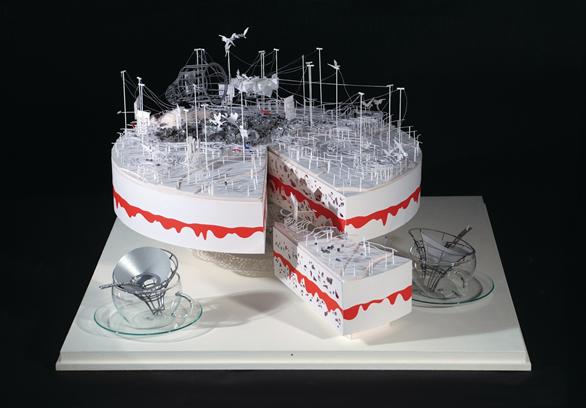
The architecture gallery was pretty interesting this year, bordering more on the surreal, not least with CJ Lim’s Dream Isle: London, the Victorian Sponge Cake which was a model imagining just that – a city shaped like a sponge cake! Also amongst the architecture were the predictable inclusions of Olympic stadiums and other Olympic buildings, as well as the new King’s Cross station concourse.

C J Lim, Dream Isle: London, the Victorian Sponge Cake

I also loved this by Graham Crowley…

Red Drift No. 3, © Graham Crowley

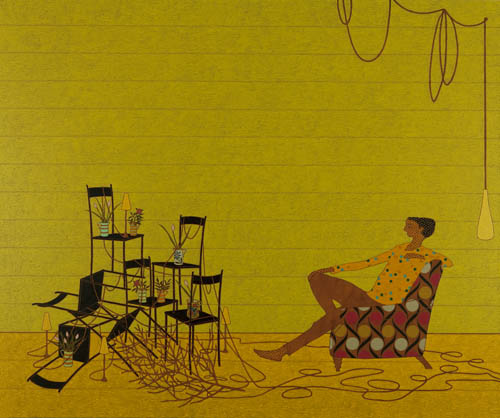
And this by one of my favourite Royal Academicians, Stephen Chambers RA

Stephen Chambers RA, I Know Trouble (And She’s My Friend)

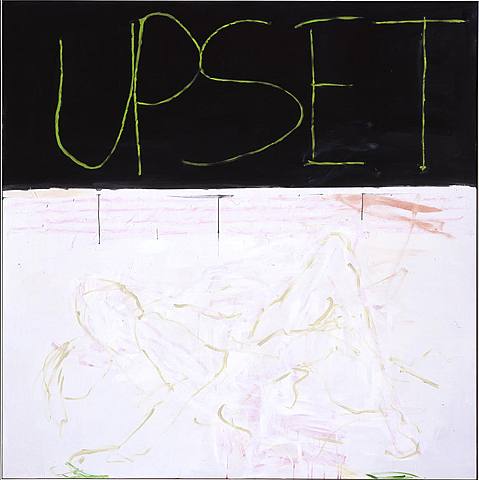
While this, by Tracey Emin, appalled me…

Upset, by “Prof” Tracey Emin RA

I could go on, and there is of course plenty to look at, and to mention, but hopefully the photos I have included in this post will provide a hint of the wonders on show (except of course for Tracey Emin’s “Upset” which is included purely for the purposes of demonstrating how a totally talentless media novelty can rob some poor talented unknown of a huge amount of wall-space and all the opportunities that go with it).

The Royal Academy don’t always get it right, but with this year’s Summer Exhibition, they really seem to be progressing. Perhaps it’s because of the new president, Christopher Le Brun, or maybe it’s just because of the space all around me, the exclusivity and of course the complementary wine… It’s a question which remains as yet untested, but if you want to have a punt, go and visit the show – as the name suggests, it’s on all summer, and you can find out all of the details here.

BP Portrait Prize – Hyper-photorealism is all very well, but I want to see the Artist’s soul on the canvas

As something of a postscript to my post on Friday about the Queen’s Portrait exhibition is a short note about another exhibition currently showing at the National Portrait Gallery, the BP Portrait Prize (It’s clever marketing that requires an exhibition’s integral name to be precursored by the name of an international petrol conglomerate, although I’m not too sure how happy I am having to represent said marketing on my own blog just by nature of naming the exhibition). Anyway, I digress. The exhibition, which is now in its thirty-thid year, features some 55 works selected from an open submission of 2,187 international entrants. The sole requirement of entry is that the work is a portrait, painted in the last year.

The height of photorealism – Lindsay Lohan © Ben Ashton (2012)

This year, like most years before it, the Judges of the Prize seem to have been unashamedly seduced by the skills of artists painting photorealistically, rather than with soul. It’s now as predicable an aspect of this show as the British summer is full of rain that when you wander into the exhibition, you double-take, wondering whether you have strolled into a photography exhibition rather than a painting one. The artist paints so fantastically well, and plies his craft with such faultless skill, that one cannot see a single brush stroke and one would swear blind, even upon being 10 centimetres distance from the canvas, that this is a photo before you. This is all very well – there is no denying the skill, and absolute kudos needs to be given to these artists for executing the works with such sophistication – but the problem for me is that, if I wanted to see an exhibition of photos, I would be elsewhere. It is also, to my mind, the inherent problem of the annual offerings of the BP Portrait Prize, and what, for me, makes it all a bit boring.

These paintings do not look like paintings, and as such they do not strike me as bursting with the emotional impact that a very paint-plastered canvas exudes. In the manic multitude of Van Gogh’s plentiful brush strokes, you can identify with the bursts of energy expressed by the artist when he went about executing the work, while in the fragmented, abstracted portraits of Picasso, you can identify with an artist bursting with innovation, with a rebellious streak who wants to give more, to change art as we know it, to pioneer new forms of expression.

Swallow, © Alexandra Gardner 2012

By contrast when you look at the works hung in the BP Portrait prize, first you need to challenge your preconception that the work is actually a photograph, and then you spend your time staring at the work wondering how it is painted. But all of this emphasis somewhat takes away from the story of the sitter. The emotion is somehow lost in the perfection. When you can see no sign of an artist’s presence on the canvas, it becomes craftsmanship, and not art. It loses it’s soul. I compare these works to an exquisitely well crafted table – I would glance at the work and admire the virtuosity of the craftsman, but I would not attempt, nor be able to engage with the work in the same way as I can when an artist’s soul is poured onto a canvas.

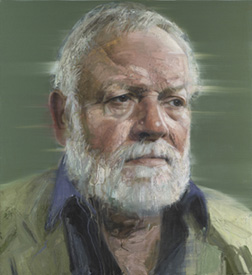
The Dialects of Silence (Portrait of Michael Longley) © Colin Davidson 2012

There were some exceptions in this year’s show, and it is therefore unsurprising that these were my standout favourites. In Colin Davidson’s The Dialects of Silence (Portrait of Michael Longley), there is a superbly executed focus on his sitter’s melancholy eyes, which are practically photographic, but then as the work spans outwards, it becomes more and more fragmented, as swathes of paint are hastily applied to the canvas, but with no less effect. This work demonstrates both the soul of the sitter, and the passion of the artist, and that is why, for me, it works incredibly well as a portrait worthy of artistic merit. I also liked Alexandra Gardner’s Swallow which had something of the Gauguin about it. Yes it’s just a portrait, but the insertion of the striking yellow wall paper and the presence of a swallow around the sitter’s neck makes you interact with the work, wondering about the significance of the swallow, and no doubt captivated by the use of bold colour, and realism contrasting with the two dimensional black outline which circumnavigates the figure.

Mr Kitazawa’s Noodle Bar, Tokyo
© Carl Randall

However my favourite work of the show was undoubtedly this one, Carl Randall’s Mr Kitazawa’s Noodle Bar, Tokyo. This “group portrait” is startlingly original for a number of reasons: the viewpoint from above, its composition: customers on the right, servers on the left, the slice of city life seen through the window, and the exclusive use of black, white and shades of grey. I love the apathetic, indifferent stares of the customers, minding their own business, indulging in quick dinner in a hostile urban environment, thinking no doubt about work and the pressures around them. On the left we are met with the equally impassive stares of the workers, tired after cooking all day and bored of the relentless monotony of their work. But in the middle of this we have this almost embrace, the only human contact in the whole work, when the worker gives a bowl of food to a customer, or the other way round – because they both hold the bowl with two hands, it is akin to a loving embrace, a fusion of worker and customer, and composition-wise it provides the work with a horizontal variance to otherwise brash vertical lines. Brilliant.

Is that a photo?: Silent Eyes © Antonios Titakis (2012)

If the BP Portrait Prize included more works like this every year, it would be a startlingly interesting show. But as ever with exhibitions judged and chosen by a group of outdated art professionals and even a representative from BP (who clearly knows so much about art) we will continue to be shunned by a group of high-gloss works which, like any photo, reflect the viewer and push him away, rather than a show of works which, because an artist has bared his soul or painted a scene of such dynamic composition and interest, the viewer is captivated and invited in. For me, it’s this relationship between artist and viewer which is not just integral to the power and purpose of art, but central to the very definition of what “art” really is, whether it be triggered by a portrait, a landscape or an abstract clutter. Remove the soul of the artist, and the painting becomes just one more image to add to the ever changing visual landscape of the fast-moving world around us. A fleeting encounter, without a lasting impact.

The Queen: Art and Image – at the National Portrait Gallery

You can’t blame the National Portrait Gallery for cashing in on HRH Queen Elizabeth this year. Since her Diamond Jubilee celebrations at the beginning of this month, the popularity of the Queen has been at an all time high – in fact over  90% of those recently polled stated that they were satisfied with the Queen, figures which represent the significant surge of support which is now felt for the Royals in England. In the meantime, tourist numbers lingering outside Buckingham Palace, visiting Windsor Castle, and pouring into souvenir shops all over London have soared . So adding an exhibition of portraits of the Queen into the mix seems like an obvious choice, not least because, having been the subject of at least one official portrait in every of her reign, as well as the subject of numerous photographs and unofficial tributes, there are so many portraits to choose from!

Queen Elizabeth II (Cecil Beaton, 2 June 1953)

I therefore went along to the NPG’s exhibition, The Queen: Art & Image today expecting 60 official portraits lined up, each recognising a gradual change in the Queen’s image, from glamourous young Queen in her 20s, to the Nation’s favourite grandmother. However to my surprise, the exhibition was a little light on the official portraits. In fact it was a little light on paintings altogether, instead concentrating on the Queen’s image, as masterminded  by officials, and seen through the lens of the paparazzi, captured on camera. That is not to say that the exhibition was not historically narrative and collectively interesting.

Queen Elizabeth II (LIghtness of Being) © Chris Levine (2007)

Queen Elizabeth II (Equanimity) (© Chris Levine, 2007)

The show begins and ends with the masterful 3D works of Chris Levine, Lightness of Being and Equanimity. These have to be amongst my favourite portraits of the Queen. The way they are mastered – a print on a lightbox, multilayered so that the Queen’s posture changes as you move around the work, is startlingly realistic. It has never been so possible to feel as though you are meeting the Queen, when in reality such an opportunity is stored away in a box of other pipe dreams such as the big retirement mansion and everlasting fame. Every wrinkle is there to see, but unlike the horrendous portrait by Lucian Freud, also included in the show, the portrait is truthful and yet still utterly glamorous, not least Lightness of Being which captures the Queen, eyes briefly closed, in white ermine, white pearls, and her glittering crown. Even her hair glimmers with a silver sheen rather than dull grey.

Queen Elizabeth II (Dorothy Wilding, 1952)

From this impressive start, the exhibition heads back to the 1950s and thus begins a chronological exploration of the Queen’s changing image and public portrayal. I suppose thinking about it, a load of official portraits would have always been a little contrived, as artists seek to flatter and do deference in the employ of this almost supernaturally important sitter, while photographs capture the Queen as a real person, a loving mother, happy relaxed tourist and here, in the 1950s section, as a glamourous, almost Hollywood worthy young Monarch, with a perfect figure and natural celebrity smile.

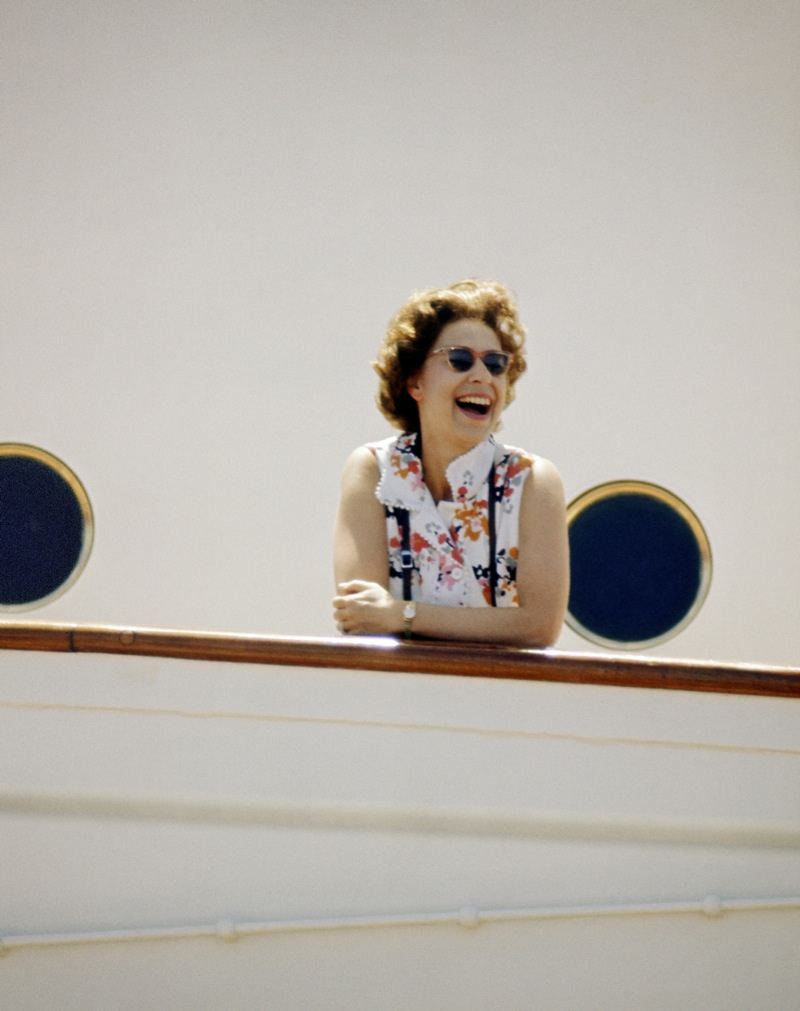
It is from this point that we begin to see the Queen mature from glamorous young starlet into a rounded family woman, but one who had to bare the full weight of the royal responsibility of her solitary role, as many of the portraits demonstrate. Through the 60s and 70s, her posture becomes more official, and her stride seems more confident and self-assured. Still, moments of rare relaxation, such as the Queen laughing on the decks of her beloved Yacht Britannia are captured during this period, which was probably the last decade of uninhibited happiness before the traumas of the future descended upon her.

Queen Elizabeth II by Patrick Lichfield (1971)

Elizabeth I (this is not a typing error btw) by Gerhard Richter 1966

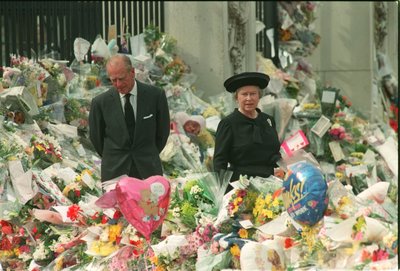
Queen and Prince Philip survey floral tributes after the death of Diana, Princess of Wales © Peter Nichols, 5 September 1997

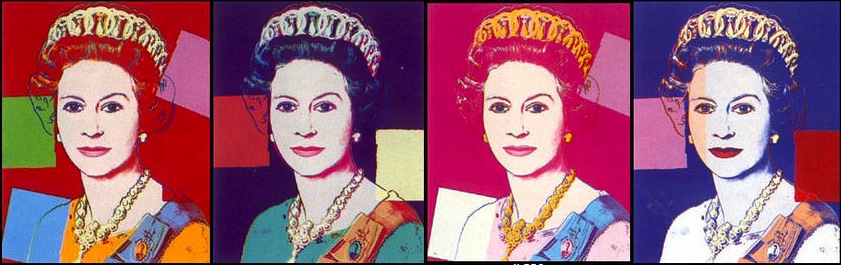
Moving into the 1980s, you see the Queen fall into the shadow of Princess Diana, the attention of the public transferring to this more volatile of characters. In the meantime the Sex Pistols released a single, God Save the Queen, with controversial lyrics suggesting the Queen belonged to a “fascist regime” (the artwork for which is included in the exhibition), Gilbert and George betrayed the Queen and Prince Philip in the shape of the “cross potent” (a symbol of the Austrian Fascist party) and Andy Warhol hinted at the superficiality of the Queen in his series of lithographs of the Queen painted as part of his fixation on the cult of celebrity. Onto the 90s, when most of the Queen’s children’s marriages fell apart and her beloved Windsor Castle sustained severe fire damage. While who could have predicted the shock of the late 90s, when Princess Diana tragically died, and the Queen fell victim to a media hunt as the papers decried her failure to show her face in the immediate aftermath. The turbulence of the period is captured by the exhibition, and it is perhaps appropriate that Lucian Freud’s portrait, the ugliest of the them all, is hung at the end of this period.

Queen Elizabeth II, Andy Warhol (1985)

Queen Elizabeth II, Lucian Freud (2001)

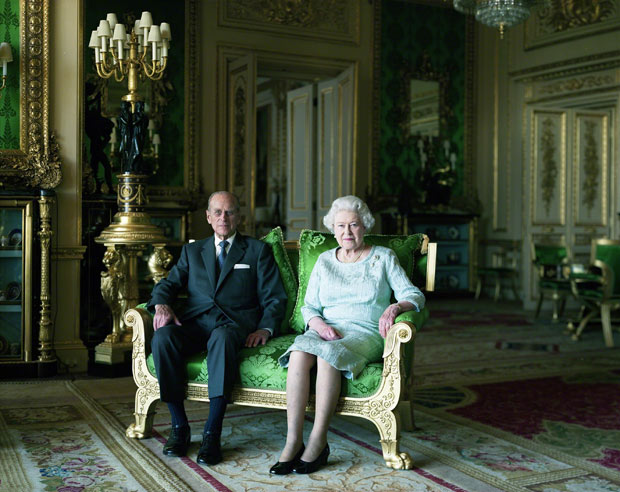
Onto the new millennium, where things get good again. The popularity of the Queen surges, and the portraits of the Queen become more respectful, portraying the Queen as a genuine person, a consistent and beloved figurehead, and a cherished icon of not only the nation, but the world. Here hangs another of my favourites and one of the most recent portraits by Thomas Struth, commissioned especially for the Diamond Jubilee. The photograph, which features Prince Phillip and the Queen slightly off centre, sat relaxed on a green, rather elaborate sofa, is delightfully accessible, like a family portrait – you can see every vein, every wrinkle of both sitters, suggesting a warm, human aspect, which is always surprising in those who seem so inaccessible. I also love the portrait for demonstrating the bond between Phillip and the Queen, who sit fairly formally, but who are nevertheless the clear support of one another, forming a single union with a bond which is clear for all to see.

Prince Phillip and Queen Elizabeth II, Windsor Castle © Thomas Struth 2011

I loved too this portrait by Annie Leibovitz (2007) which, with its solitary and dramatic background, and with the Queen dressed in a cloak, references the paintings by Annigoni, and photographs by Cecil Beaton placed at the beginning of the show. And thus, as the exhibition ends, the portraits come full circle, as we see a Queen as much loved now, as then, a Queen who inspires in us all a deep sense of reverence and respect, and for we British, is someone of whom we can be resolutely proud.

Queen Elizabeth, Annie Leibovitz (2007)

The Queen: Art & Image is on at the National Portrait Gallery until 21 October 2012.