Skip to content

Posts from the ‘Travel’ Category

Sunday Supplement: St Ives

We Brits are so accustomed to heading down to Gatwick and jetting out to the Mediterranean, the French Countryside or the Aegean Sea for our summer holidays that we forget what we have on our doorstep. It’s not that we can be blamed – look at us now. Mid-June, almost the longest day, and last week we had temperatures in the region of 12 degrees. Last Monday in fact that skies were so dark as they spouted out a continuous torrent of abusively heavy rain that I felt as though apocalypse had fallen. However on the rare occasion that the weather actually behaves in correlation with the seasons, England can do summer holiday like each of its European neighbours.

I love my photo of old women on a bench – so marvellously English

There’s nothing quite like an English summer – Pimms in the garden on a setting sun, when the grass goes slightly dewey and the sunlight dapples on the dinner jackets and ballgowns of attendees to Glyndebourne Opera, or open-air Shakespeare in Regent’s Park; picnics under willow trees, next to ponds quietly humming with the sounds of multi-coloured dragonflies dancing across the surface of lily-pads; and the coast. The English coast is emblematic of old-school summer holidays, as men took out their handkerchiefs and tied knots in the corners to make a hat providing scant protection of their bald-batches, children risked breaking their teeth on a lump of sticky-sweet “rock” complete with writing running through the middle, and others took up exploring in rock-pools searching for crabs and shrimps and other creepy crawlies which lurk in amongst the rocks and seaweed when our extreme tidal system takes the sea way out beyond the beach.

Yes, this IS English sea!

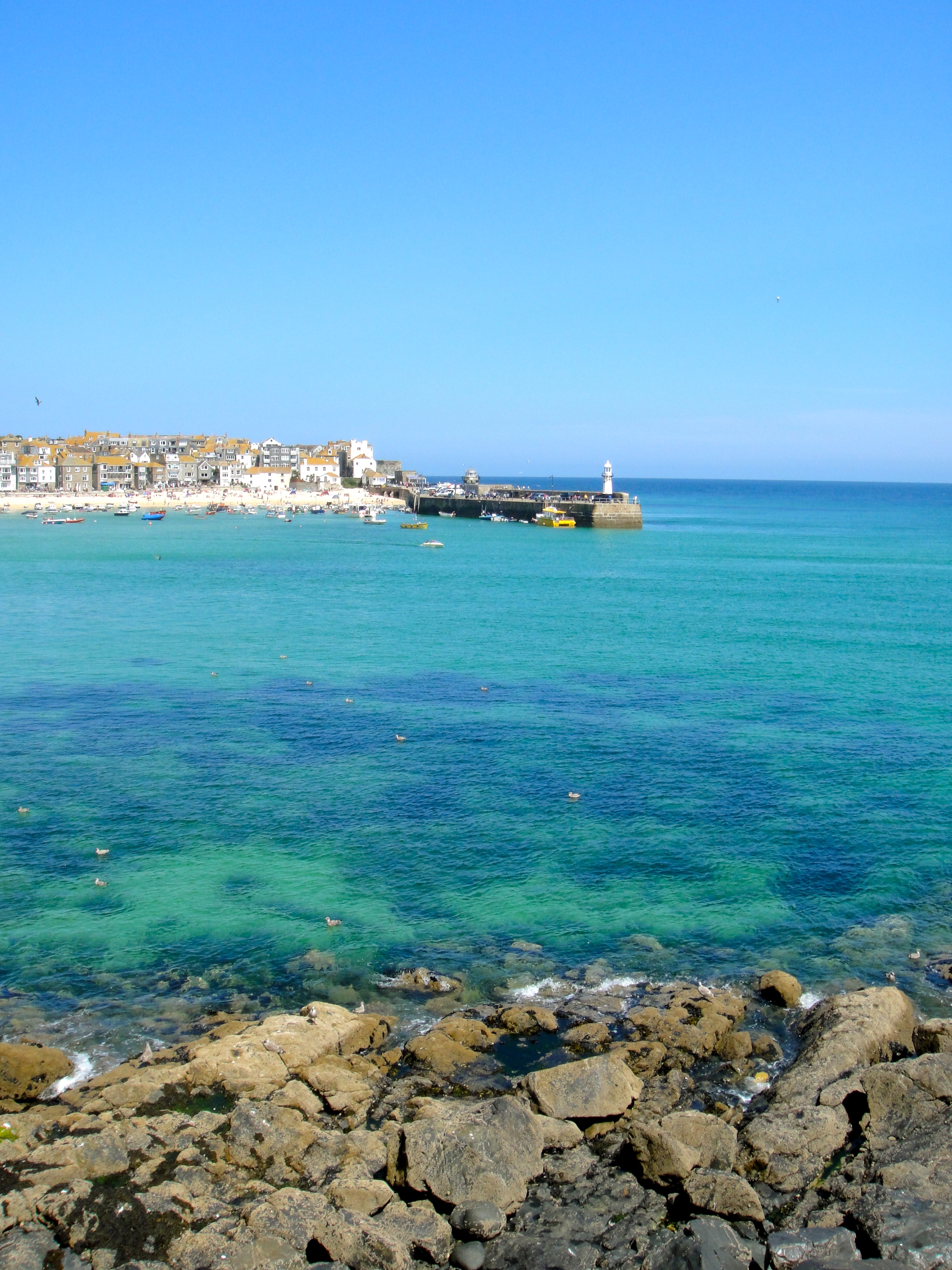
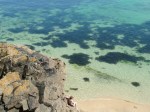
Together with this tradition, you expect to find plenty of seaweed, lots of rocks and stones and a slightly dull tinge to the seawater, making it altogether a more English, slightly less comfortable affair. But last year when I headed down to Cornwall, right at the bottom of our fair nation, I was flabbergasted by the site of such a stunning coastline, with such sapphire-sparkling crystal-clear turquoise waters that I could have been in the Caribbean. No wonder then that the little harbour town of St Ives has proved such an inspiration to generations of artists (Barbara Hepworth and Ben Nicholson being two foremost examples of modern times) that the world-famous Tate Gallery has set up an outpost there.

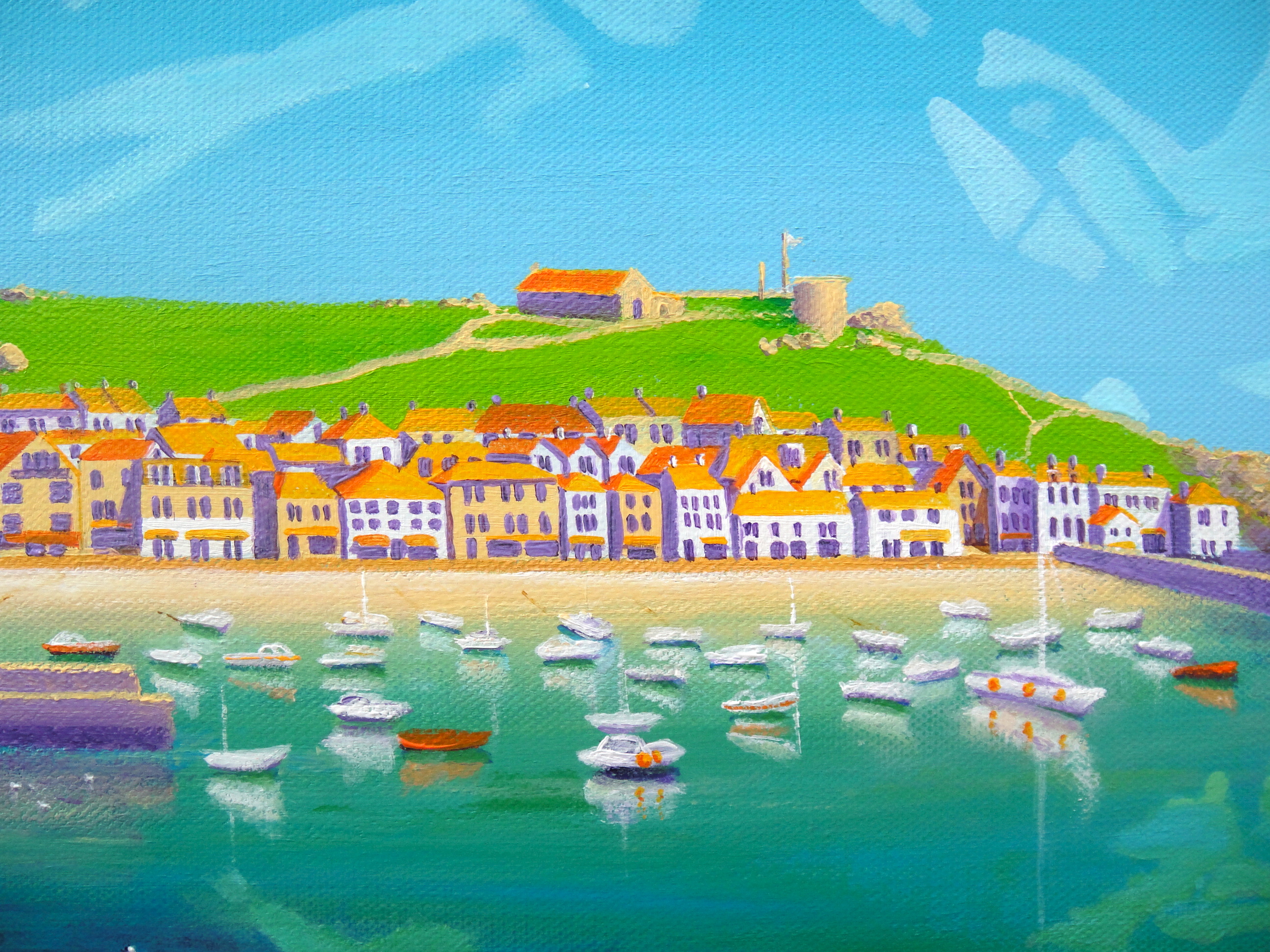
Well when I stayed last year, I too became inspired by the burst of very mediterranean colours that were all around me and, when I was, ironically, sat in the garden of my family home in Spain on the Mediterranean itself, I took to my canvas and recollected the beauty of what I had seen in Cornwall a few weeks before.

St Ives (Cornwall) (2012 © Nicholas de Lacy-Brown, acrylic on canvas, 60 cm x 50 cm)

My painting of Cornwall uses a simple colour palate with fresh oranges, greens and purples, while the turquoise qualities of the sea are reflected in all their beauty. I’ve introduced something of a cubism element when tackling the many rocks which frame the coast and most unusually of all, I’ve actually painted an impression of how the light dappled upon the canvas when I sat painting it in my parents’ garden, with the light cast through the intricate mesh of the jasmine tree. In this way I have forever captured a St Ives imbued with the light of the Med where I was inspired to paint it.

Detail of the harbour (© Nicholas de Lacy-Brown)

Detail of the town and lifeboat pier (© Nicholas de Lacy-Brown)

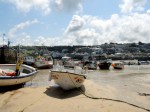
In addition, take a look at this little gallery of some of my photos from St Ives so you can see what inspired it.

Have an amazing Sunday.

© Nicholas de Lacy-Brown and The Daily Norm, 2001-2012. Unauthorized use and/or duplication of the material, whether written work or artwork, included within The Daily Norm without express and written permission from The Daily Norm’s author and/or owner is strictly prohibited. Excerpts and links may be used, provided that full and clear credit is given to Nicholas de Lacy-Brown and The Daily Norm with appropriate and specific direction to the original content.

Eating España, again – Part II: The sweet stuff

So after a heavy dose of savoury Spain and seductive Salamanca you’d be forgive for thinking that this week, the week in which Spain was once again splashed over the headlines as a bank bailout was agreed, that The Daily Norm couldn’t get any more Spanish. Well you would be wrong, for today, it’s time for the ever-so-tempting waist-line enlarging pudding-perfect postres, all of which I cooked, and ate, at the weekend (I am now avoiding my bathroom scales – I feel that our current acquaintance could lead to a small falling out).

First up, something for afternoon tea, and as cakes go, this one is more almond than butter, which must make it healthy, right? It’s the very traditional Santiago Almond Cake, a firm Spanish favourite, moist in its naturally oily almond component, with a delicate and delicious simplicity.

Tarta de Santiago (Almond cake)

I first ate this delicious cake in Cappuccino Grand Café is the stunning hill-top town of Valldemossa in Mallorca. No sooner had I returned home than I was buying up the local supply of ground almonds and sampling my own.

This recipe is from the collection of Spanish desserts by the vivacious and frequently tipsy TV chef favourite, the late Keith Floyd. His recipe is so simple you have no excuse not to make this cake. In fact probably the trickiest part of the whole operation is lining a 20cm cake tin (I use a spring form to make the operation even simpler at the end). Once you’ve done that, all you need to do is get yourself a food processor and all the work will be done for you – Just whizz up 3 eggs with 225g caster sugar, 100g butter, 175g self-raising flour and 125ml water until all of the ingredients are well blended.Then add 225g ground almonds and the grated zest of 1/2 a lemon. Whizz for a few seconds only, just to mix (if you overwork the almonds the mixture will become too oily). And that’s it! Tip the mixture into your greased and preferably lined tin and bake at 180 degrees centigrade for an hour. Test with a skewer and when it comes out clean, you’re done. Once the cake is cooled, sprinkle with icing sugar and enjoy.

Flan de naranja (Orange Crème caramel) 

Next up are Rick Stein’s Orange Flans (the Spanish equivalent of the French Crème caramel, or if you want to entirely strip the words of their glamour, Caramel Creams). But these have an orange twist which provides an exquisite burst of Sevillian sunshine in your mouth. I’ve cooked these a few times now and they’ve gone down ravishingly well on each occasion. They’re not that fiddly either – just be careful not to burn the sugar.

Ok, so you need to start by preparing your space. You’re going to need around 6 ramekins which should be ready placed in a roasting tin so you can make a bain marie later (this needs to be ready because once you’ve made your caramel, you need to pour it directly into the ramekins otherwise it will turn rock hard in your pan).

Onto the caramel then. This is where you need to be careful. Place 100g caster sugar and 45ml of water in a heavy-based pan and leave over a very low heat until the sugar has completely dissolved (I stir it a bit to ease the process, but old Rick doesn’t tell you to). Once the sugar has dissolved, whack the heat up to high and leave to boil rapidly, without stiffing, until the syrup starts to turn orange, orangier, red and then a pale brown brick red colour (tends to take around 5 minutes). Be careful here. If you let it go too far into the red zone, it will very quickly burn – I’m talking seconds here. So as soon as it starts to go a brick red, whip it off the heat and pour straight into the ramekins, distributing it evenly between them. You can leave them there as you turn your attention to the orange cream.

Finely grate the zest from 2 oranges and squeeze the juice out of these and 2 others until you have around 400ml of fresh orange juice. Pour this, the zest and 300g caster sugar into a pan and bring to the boil over a low heat, stirring now and then to dissolve the sugar.

In the meantime separate out 14 (yes, fourteen!) egg yolks (discard the egg white – or save it for a nice pavlova (see below)) and place with two whole eggs (this hen has been busy) in a mixing bowl and whisk. When the orange juice comes to the boil, turn down the heat and allow it to simmer rapidly for 2 minutes. Then, through a sieve, pour the orange juice mixture into the eggs and mix.

Now it’s time to pour the mixture into your ramekins on top of the caramel. Once this is done, pour boiling water into the baking tin so it comes to two-thirds of the way up the sides of the ramekins. Place in the oven at 160 degrees centigrade for around 15 minutes for small ramekins, and 20 minutes if they’re a bit bigger. Once out of the oven lift out of the water (being careful, obv) and allow to cool before placing in the fridge. Ensure they are refidgerated for at least 4 hours before eating, but preferably overnight.

When serving, carefully invert each dish onto a small serving plate. With a bit of jigging they should plop out quite easily, but you can always eaze around the side with a knife if they’re being obstinate. Some caramel will come out on the top, but if you want more from the mass that is stuck to the bottom of your ramekin, place back in a roasting tin filled with boiling water and leave until the caramel melts a bit. Now go and eat the divine things – you’ll be booking flights straight to Andalucia in no time.

And one for luck… a very un-Spanish mini strawberry pavlova

Wasting all of those egg whites from the Flan would have been a crying shame, so I decided to make a few meringues, just to soothe my guilt at pouring so much of a hen’s hard work down the sink. I used Raymond Blanc’s simple meringue recipe which can be found here except I made mine smaller. The original intention was to crush up the meringue and make an Eton Mess but the meringues turned out so surprisingly beautifully that I made them into mini pavlovas. Here are the fruits of my labour, and well worth the extra effort.Happy cooking!


Salamanca: My Painting – Homage to a sandstone city in oil on canvas

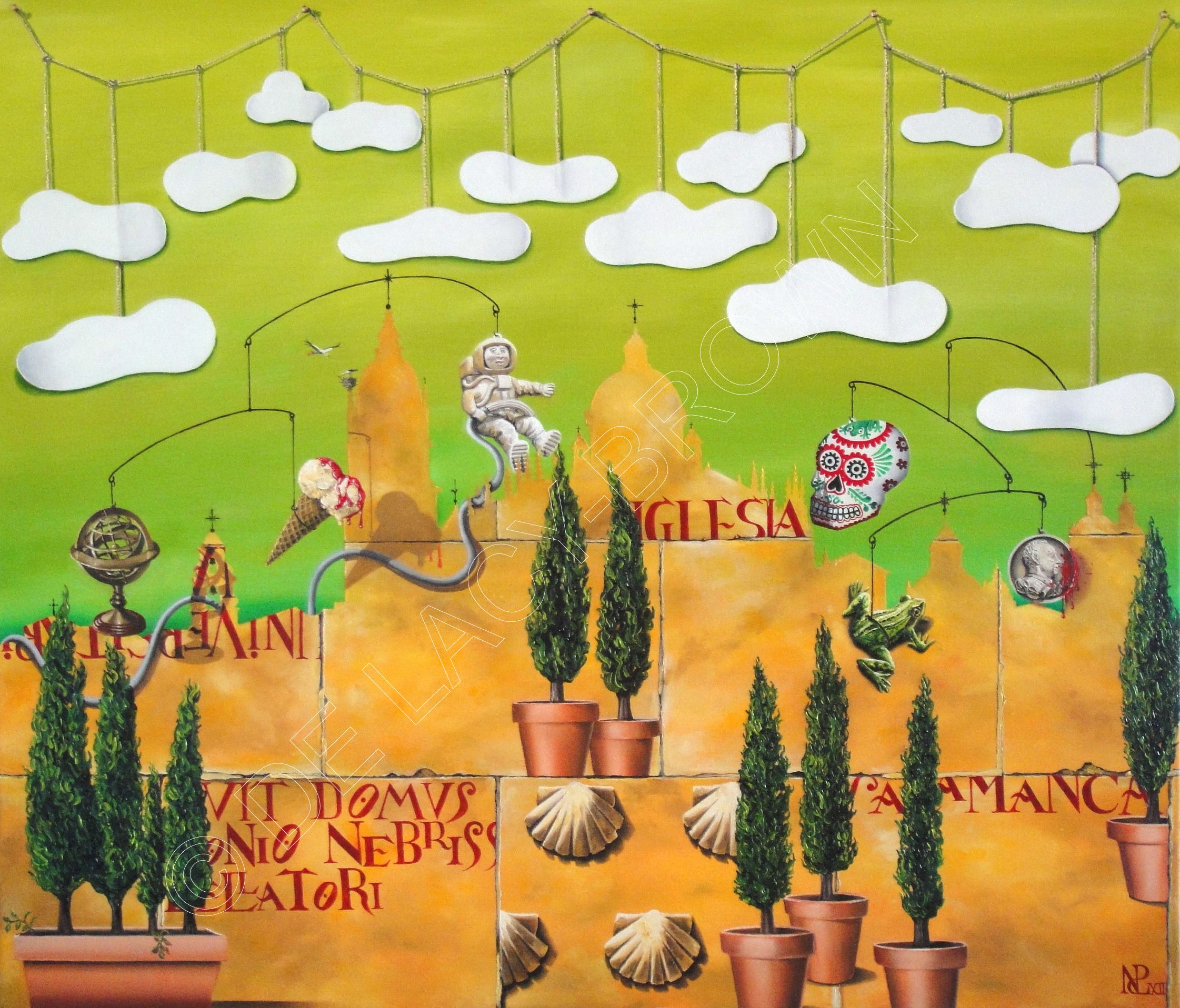
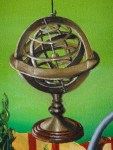
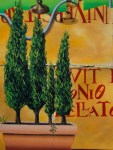
It’s been two months since I returned from the golden glowing sandstone Spanish city of Salamanca. There was so much to inspire me when I walked those elegant historical streets. When I gazed, mesmerised through my hotel window onto the stunning baroque Cathedral, the sun setting upon its orange stonework, and cypress trees gently waving from side to side in the evening breeze before it, a painting came to my mind. I rushed to make a quick sketch which I still have on the back of a reservation print out for the restaurant we were dining at that night. My painting of Salamanca was to contain what to my mind was the essence of the city – a kaleidoscope of dappled, marbled oranges and golds in a landscape uniquely built from the local Villamayor sandstone, a city bursting with historical artefacts flowing from the dual powerhouses of church and university. It is a city which is elegant in its antiquity, and yet bursting with fresh new life from its greenery, its strong local life, the pull of tourism and the thriving university population which resides there. This was my inspiration and shortly after returning from Spain I set to work on a large 105 cm x 90 cm canvas. I finally finished  the work over the long Jubilee Weekend. And here, exclusively, is the result, as I present my first (non-Norm) painting of 2012…

Salamanca (2012 © Nicholas de Lacy-Brown, oil on canvas, 105 cm x 90 cm)

Dominating the centre of the canvas is a silhouetted skyline of the city, recognisable by the Cathedral spires and the intricate turrets, domes and baroque roofing of the nearby University. Rather than paint the detail of the buildings, I constructed the skyline out of a wall of villamayor sandstone bricks, in the same way that each building of the city is constructed. Those individual bricks act as a window onto different features of the city. On one brick you see the conch shells of the famous Casa de las Conchas, while on others, parts of the hand painted street letterings are featured, infamous for their historical use of pigs blood and olive oil.

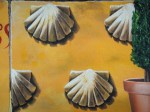
In the meantime, out of the Cathedral and the university, the ironwork crosses become large mobile-like structures, inspired by the great maker of mobile art, Alexander Calder. On these mobiles hang various symbols of the city. The astronaut and the ice cream which are usually imbedded in the intricate plateresque facades of the Cathedral and the University’s famous sandstone frog are all featured, as well as the skull upon which the frog sits (my painted skull is inspired by the Mexican Dia de los Muertos celebrations for which houses and graves are adorned with beautifully decorated hand painted skulls like this one). Represented too is the tradition of learning at the University, embodied in the Orrery (one of which I bought while in Salamanca as a souvenir of the city) as well as the famous Plaza Mayor, represented by the infamous bust of Fascist leader Franco which can be found amongst the busts of Spanish rulers around the square, and the inclusion of which causes such controversy that it is regularly vandalised. My Franco too has been vandalised, but is that paint on his face or blood on his hands? Finally the painting is generously sprinkled with various groups of cypress trees, tidily placed in terracotta pots at various spots across the canvas as well as a curtain of clouds sweeping across a clear green sky. Ooh and look out for the little stork’s nest embedded amongst the spires of the cathedral – the storks are a customary feature of the city and do not appear to cause the residents any hassle – in fact some churches have baskets placed on top of their spires to aid the storks in building a safe and secure nest!

So there it is, and above, so you don’t miss the details, are more photos showing the various individual aspects of the painting. I hope you like the painting and, more importantly, let me know what you think! I’ve already started a new work, so look out for that over the coming months.

© Nicholas de Lacy-Brown and The Daily Norm, 2001-2012. Unauthorized use and/or duplication of the material, whether written work or artwork, included within The Daily Norm without express and written permission from The Daily Norm’s author and/or owner is strictly prohibited. Excerpts and links may be used, provided that full and clear credit is given to Nicholas de Lacy-Brown and The Daily Norm with appropriate and specific direction to the original content.

Eating España, again – Part I: One starter and two mains

Ever the diplomat, and clearly qualified for a high powered job in the Foreign Office, whenever a country get’s a bit of bad press, I try to do my bit to remind all the cynics out there that despite financial plight, banking crises, and the incessant need for multi-billion euro bailouts from reticent cash-strapped neighbours, the culture which made these economically shaky countries great survives through the monetary meltdown. This is no more so than in my beloved Spain, where the great flavours and platos ricos were born from poverty, using basic and cheap ingredients which, when combined, produce a flavour sensation which captures in its aroma, colour and savour the very essence of that culturally diverse country. Consequently, just like I did for poor old Greece a few weeks ago, I’ve returned to my London kitchen, and cooked up a feast in honour of Spain’s great gastronomic heritage.

Here are just a few dishes I tried out over the weekend. In this post I’m going to share three great savoury dishes from apple-lush Asturia, seafood-filled Catalonia and the once-moorish highly spiced lands of Andalucia. Later in the week, I’m moving on to the sweet stuff, when I’ll share a traditional Santiago almond cake, and some divinely Sevillan orange-burst creme-caramels.

Centollo a la sidra (Baked crab with cider)

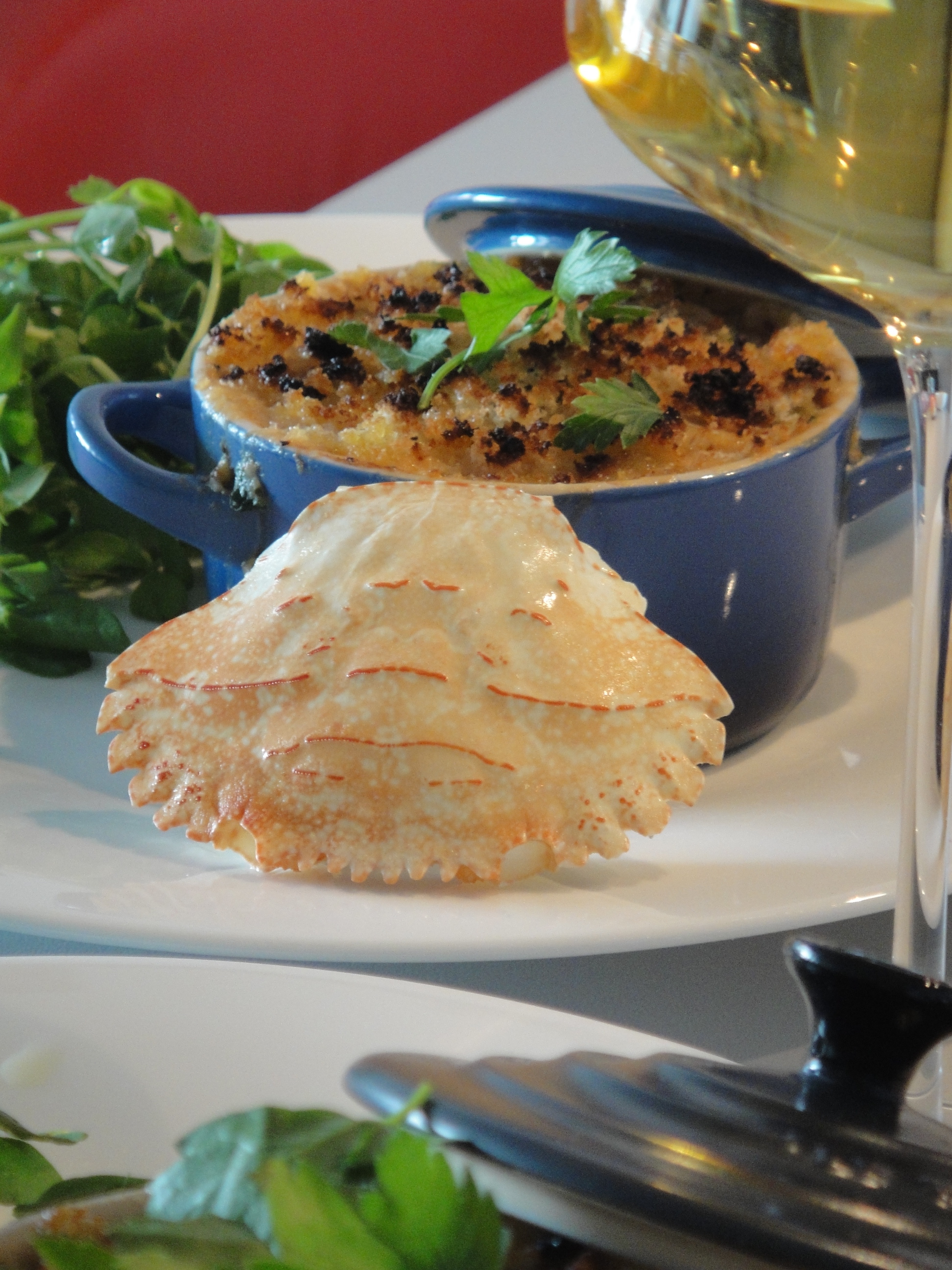
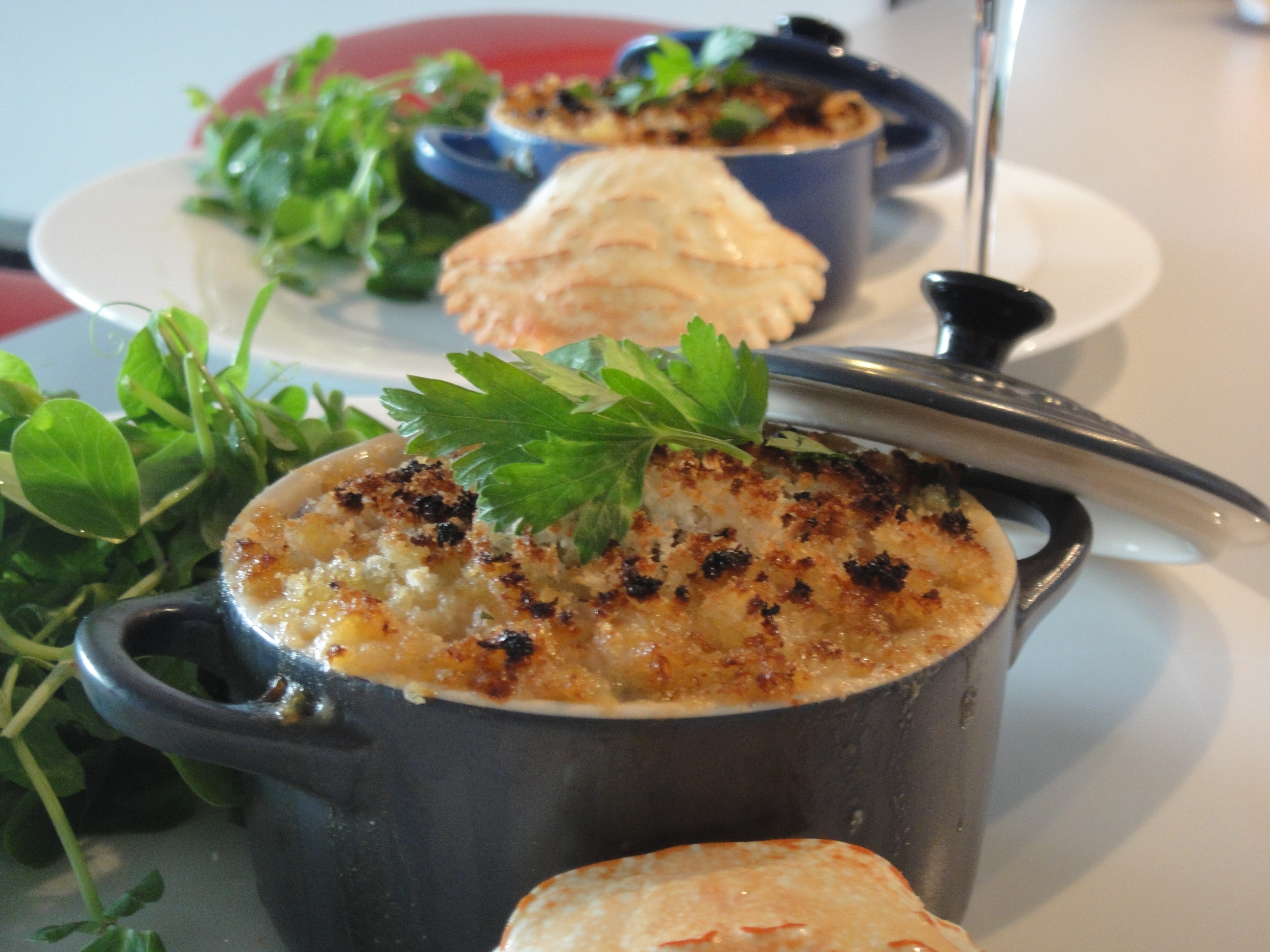
This recipe takes its inspiration from the Asturias region of Spain, where Cider is the drink of choice and sidrerias can be found in every town and village. My take is in turn based on the recipe by Claudia Roden in her fantastic book, The Food of Spain: A Celebration (Penguin, 2012) so all credit must go to her. These little ramekin filled dishes make a perfect starter or, as I did, served as a light lunch with a little side salad. In Asturias, they make this filling and stuff it back inside the shell of their txangurro spider crabs. While not attempting any such culinary craftsmanship, I paid homage to their skills by serving my dish in a mini le creuset pot with a little crab shell on the side, just for decoration (you eat with your eyes before your mouth etc etc).

To make your own crab dish (whatsoever you may chose to stuff it in) take a chopped medium onion which should be sauteed over a low heat until soft. Add to it one peeled and chopped tomato, a pinch of chilli powder (or cayenne pepper) and another pinch of salt and cook over a medium heat for around 8 minutes. Next take a fillet of cod (around 150-250 g depending on how many ramekins you want to fill) and cook for about 5 minutes or until it begins to flake, turning it once. Flake the cooked fish and add 250g of cooked white and dark crab meat, 175ml of dry cider and 2 tablespoons of chopped flat-leaf parsley. Cook for around a minute. Oil 4 small ramekins or two big mini casseroles (like mine) and spoon the mixture in. Sprinkle with fresh breadcrumbs, a few blobs of butter and place under the grill until the breadcrumbs are browned. It’s probably best you leave the ramekins to cool for a couple of minutes once they come out of the grill before you serve them!

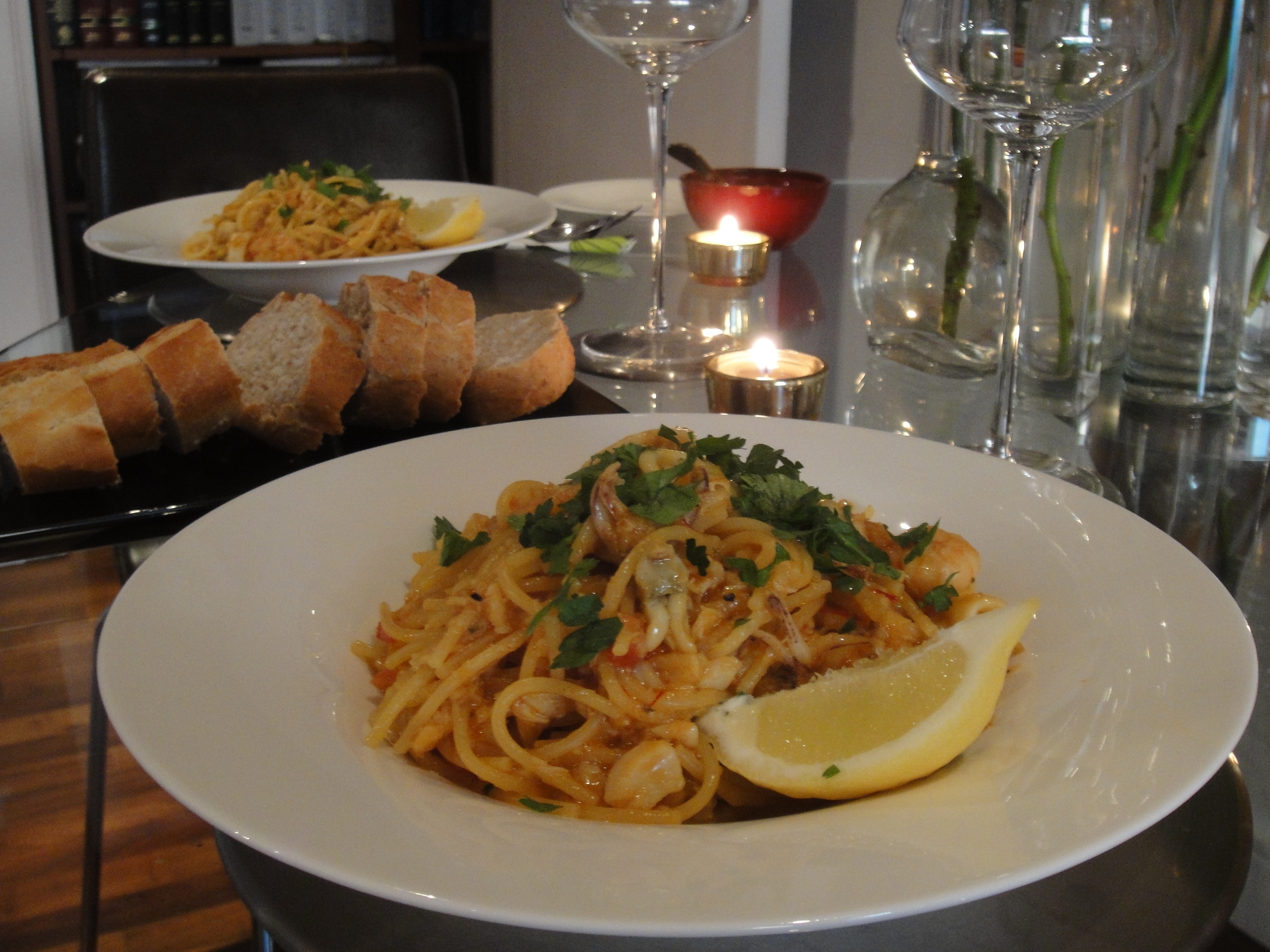
Fideuada del señorito – (smoked) seafood pasta

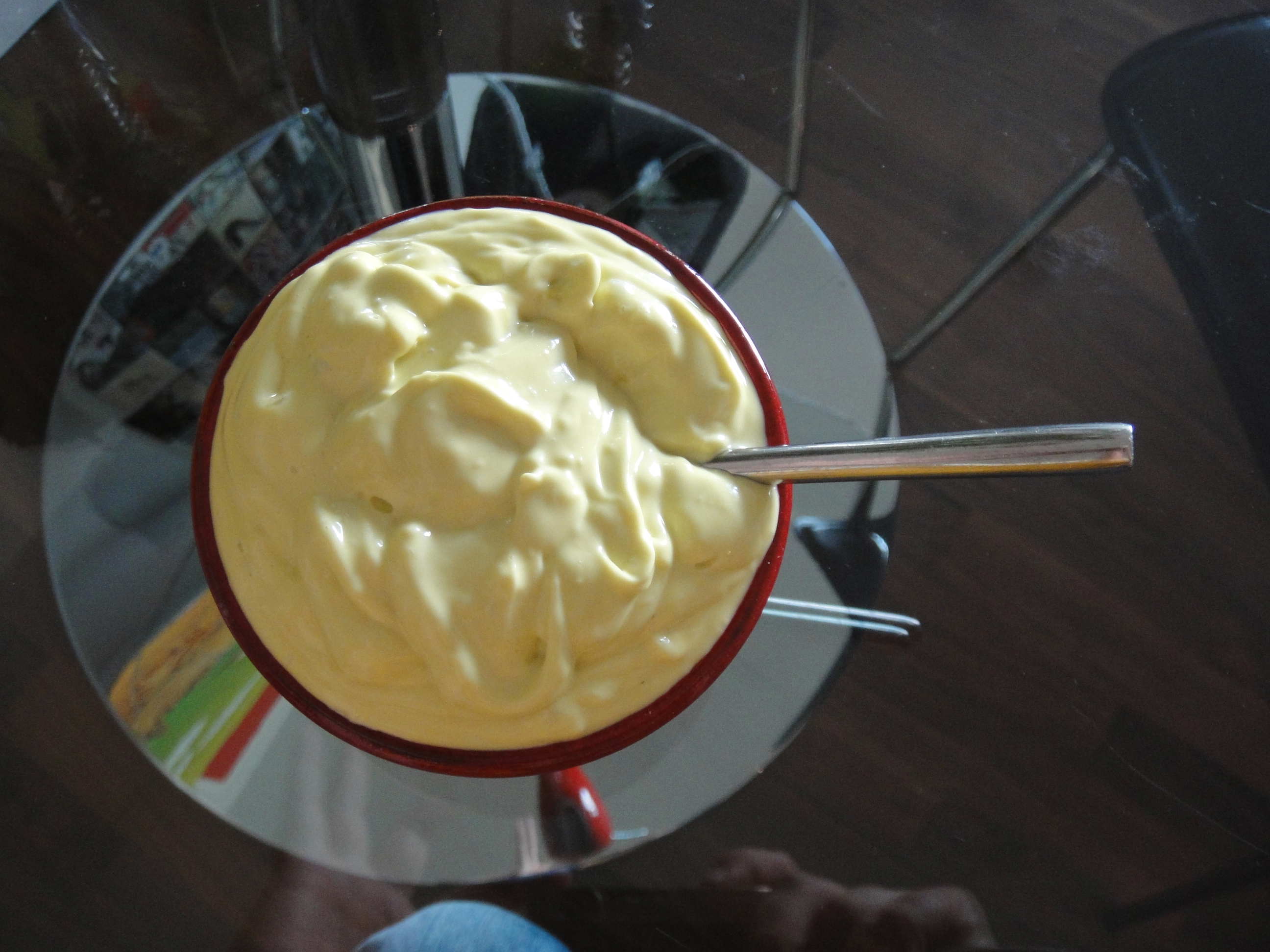
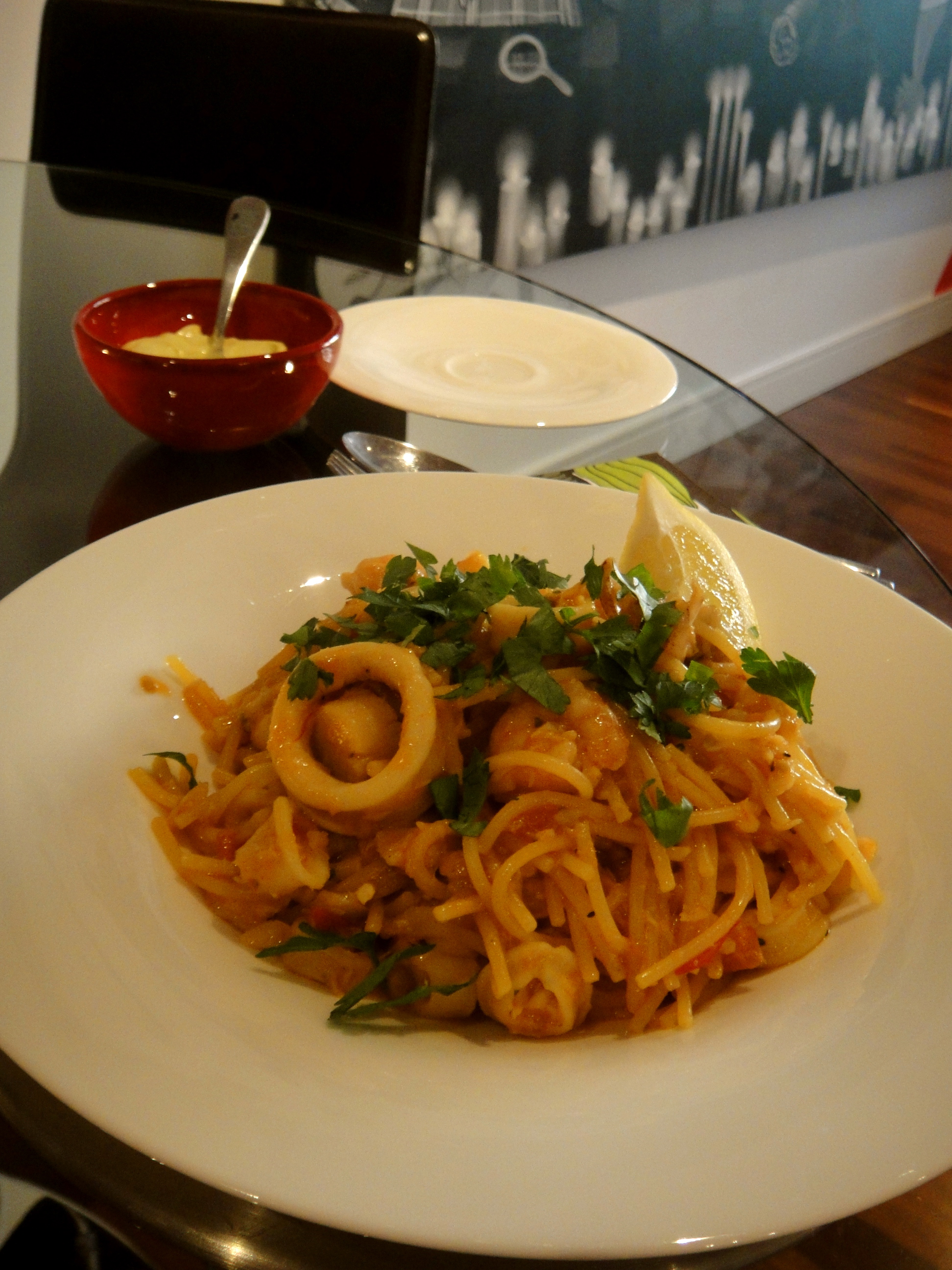
This is a pasta dish straight from the gutsy seafood-filled region of Catalonia, and brought to my attention, once again, by Claudia Roden although once again, I’ve gone my own way with it and shaken it up a bit (sorry Claudia). The dish, for no apparent reason, translates as “of the young gentleman”, perhaps because the short pieces of pasta and shelled prawns make the dish particularly easy for young senoritos and senoritas to eat. Either way its truly delicious for us adults too. You should service it with a good blob of alioli (garlic mayonnaise). If you can’t be bothered to make you own mayo, just add crushed garlic to shop bought mayonnaise. Mine is thick and yellow because I made it with extra virgin olive oil straight from a vineyard next to my Partner’s family home in Tuscany (yes yes, I know, it’s not Spain) so well worth the rather tedious effort of making it from scratch.

My alioli

To make the pasta, heat 4 tablespoons of oil in a large frying pan (or paella pan if you have one). Cook around 400g of cubed smoked haddock (Claudia Roden uses monkfish, but I didn’t have any to hand – I adore smoked haddock and loved the results in this dish – it gives a subtle smokey flavour which works amazingly well with the alioli on the side) and cook on a medium heat for around 3-5 minutes. Next add 4-6 baby squids, sliced into rings, cooking for a further couple of minutes before adding a dozen or so peeled king prawns and an equal number of scallops. Cook until the prawns are nice and pink (1-2 mins). Place all the cooked seafood to one side in a separate dish, keeping it warm. Preserve any liquid. Using the same pan, heat 2 tablespoons of oil and stir in 1-2 crushed cloves of garlic. Just before the garlic colours, add 3 chopped tomatoes, 1 heaped teaspoon of pimenton dulce (or sweet paprika), a little salt and a good pinch of saffron threads (and at this point pause and indulge in the aroma of Spain, a warm mediterranean evening wafting past your nose, a magical culinary noche brought to life in your kitchen, wherever it may be). Sorry, where was I… ah yes, The tomato will quickly thicken so at this point I added 120ml of oloroso dry sherry (although dry white wine will work too). Wait for that to reduce down, cooking for around 10 minutes.

Add around 300g (for 2-3 people) of spaghetti, broken into 3-4cm pieces to the tomato mixture, making sure it is well coated. Then add around a pint of boiling chicken stock and add back the cooked seafood, stirring it into the pasta/ tomato mix. Cook until the pasta is al dente. This should use up all the stock, but add a little more if the liquid dries up before the pasta is cooked. The dish should be moist when its finished.

And that’s it! Serve with some sprinkled parsley and a good dollop of alioli – the mixture of smoked fish and pimenton with delicate seafood and a pungent winey tomato sauce is to die for, I promise. Oh and don’t forget to give the whole thing a good squeeze of lemon juice – the acid cuts across the strong salty smokeyness perfectly.

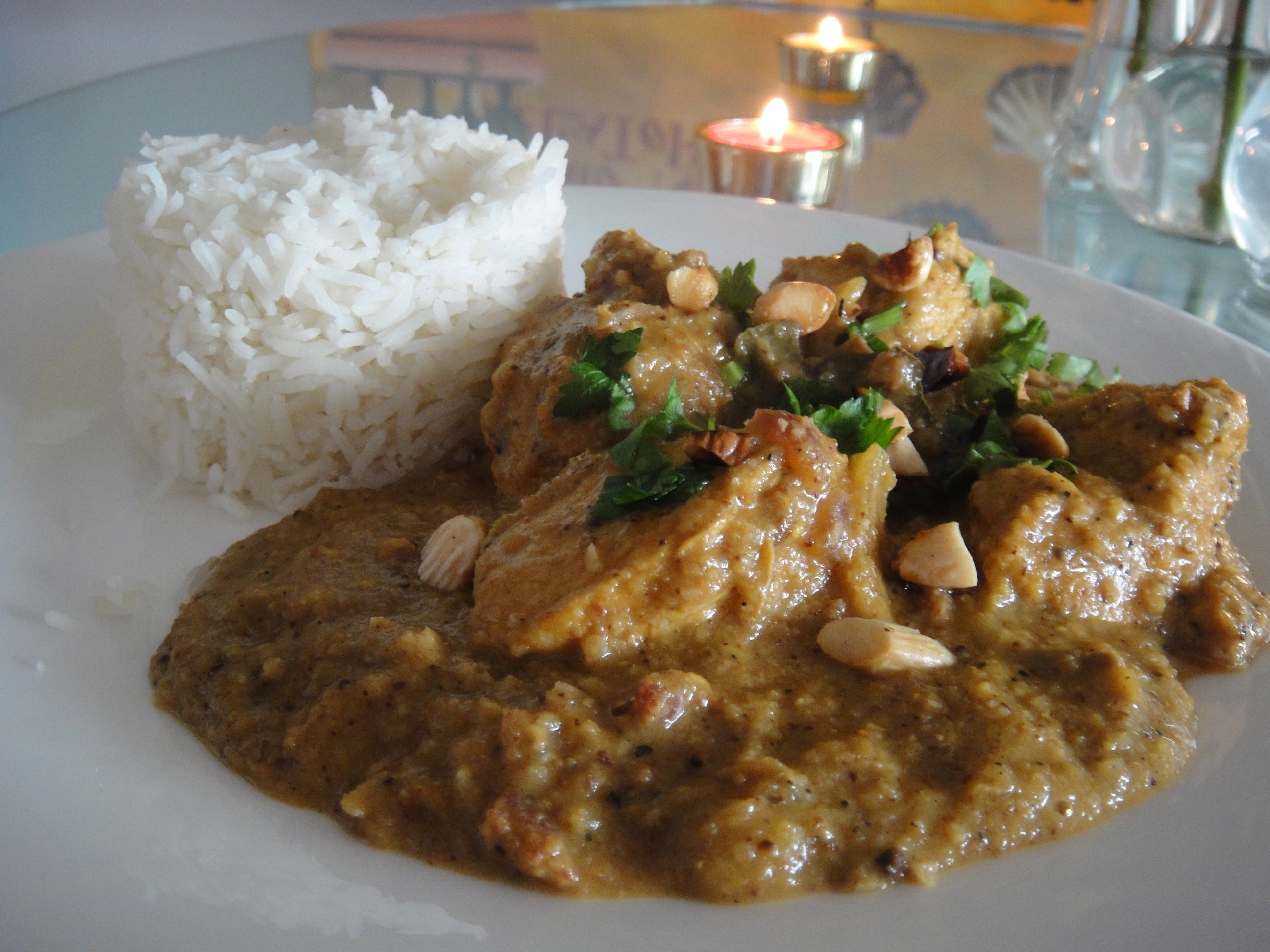
Pollo en pepitoria (Chicken in a mildly spiced saffron, pine nut and almond sauce)

Last up it’s down to the Med and the region of Andalucia where the influence of 700 years of Islamic rule can still be felt from the rafting voices and spasmodic dancing of gypsy culture emanating from Seville, to the use of mild moroccan spices in their food. This dish is no exception. It was first cooked for me by my mother, who in turn got it from chef Rick Stein, who in turn nicked it from Australian chef Luke Mangan who opened a restaurant specialising in a mixture of Spanish and Moorish cuisine. Despite this chinese-whisper-like chain of chefs, all of whom have no doubt made changes here and there, the dish is nonetheless emblematic of Southern spanish cooking, with its warm aromatic spices and plentiful use of almonds. Moreover, the use of a “picada”, that is a nutty paste stirred into the chicken, is popular across the whole of the Iberian peninsula.

Start off by hard boiling two large eggs for 10 minutes. You’ll need these later. Allow them to cool and then peel off the shell.

Next deal with your chicken. Some people will use a whole chicken, in which case they’ll chop up and use the legs, wings, breasts etc. I only really like chicken breasts and am not therefore much help on how to use these other bits of the bird – but you can. I use four chicken breasts. Cut these into fairly large pieces (probably three from each breast) so they remain moist.

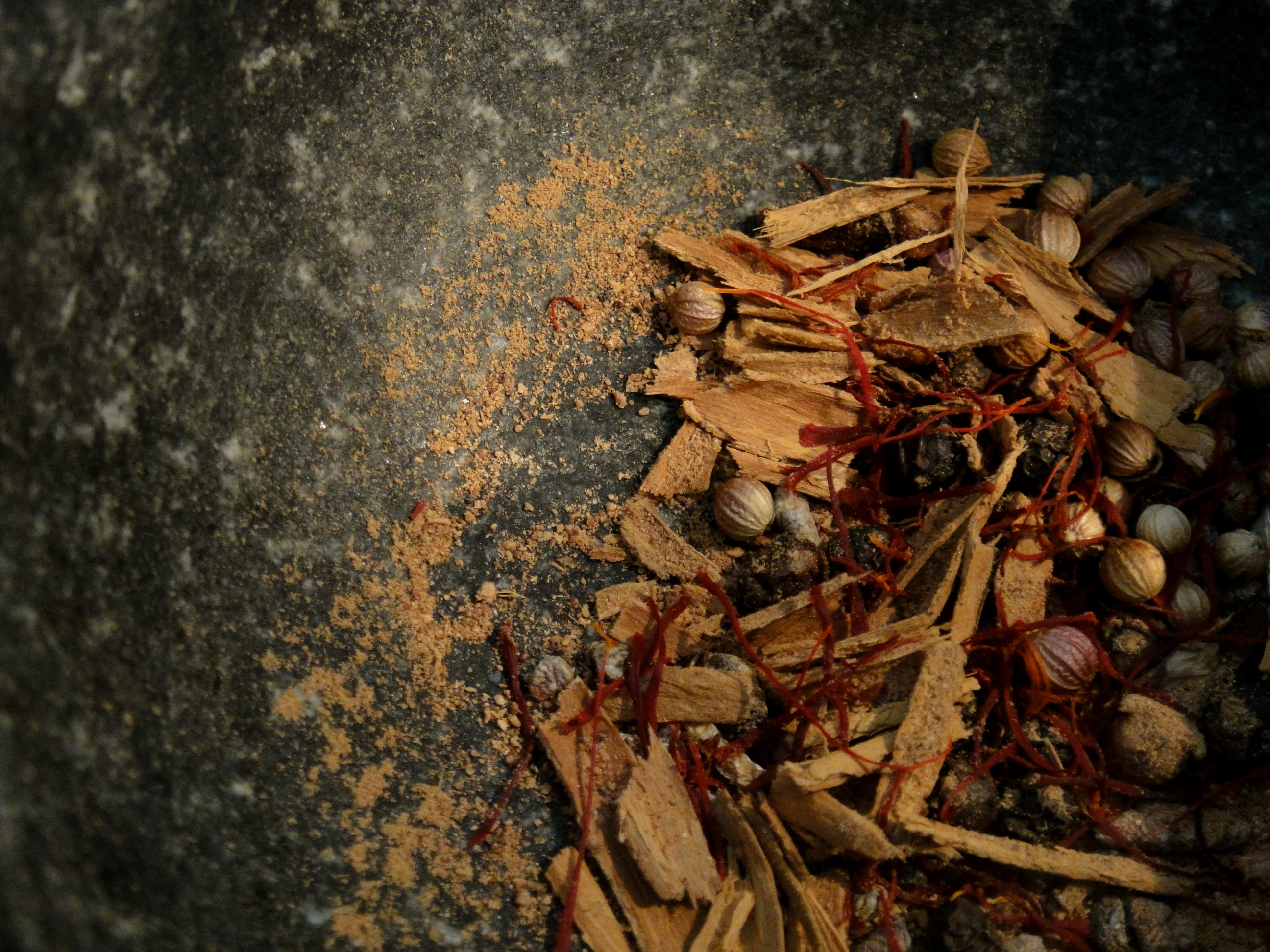
My spices: they smell as good as they look

Onto spices. Lightly crush approximately 10 cardamom pods and remove the seeds from inside (this is fairly tedious but worth it, I promise). Discard the shells and add the seeds to a pestle and mortar into which should also go 1/2 teaspoon of coriander seeds, 1/2 teaspoon saffron strands, 2 cloves, 1 cm piece of cinnamon stick, 1/4 teaspoon of nutmeg and around 10 peppercorns. Grind to a fine powder and enjoy the aromas while you’re doing so.

Now heat around 4 tablespoons of oil in a casserole. Add two peeled whole garlic cloves and a slice of white bread. Fry on both sides until golden. Transfer to a food processor. Now season the chicken lightly and fry until golden on the sides. Remove and set aside. Now in another tablespoon of oil, add 1 large onion, finely chopped and fry lightly until soft and sweetened but not brown. Stir in the spices, cooking for 1 minute and then stir in 200ml of dry oloroso (or other) sherry or white wine and 200ml of chicken stock. Return the chicken to the pan with 2 bay leaves, a handful of raisins or dates (these are my addition, but are optional) and a pinch of salt. Bring to a simmer and cook gently for around 20 minutes (40 minutes is probably necessary for chicken legs etc).

In the meantime heat a frying pan and dry roast 40g pine nuts for 1 minute and 40g blanched almonds for 2 minutes. Leave to cool. Add the nuts and the yolks from the hardboiled eggs to the bread in the food processor along with 10-12 tablespoons of cooking liquid from the chicken. Grind to a paste (this is the “picada”). Chop 20g more of blanched almonds to sprinkle over the dish at the end.

Once the chicken is cooked, stir in the picada paste and simmer for a couple of minutes longer until thickened. Stir in 1 tablespoon of lemon juice approx and make sure your seasoning is on course. Finally, in a separate pan, stir fry those remaining chopped almonds for a couple of minutes in a little oil until golden. Serve your chicken with the sauce and sprinkle the almonds on the top with some parsley.

OK, we’re done. Three dishes bringing the flavours and character of Spain directly into your house. On second thoughts maybe this post isn’t so helpful to the Spanish economy after all – once these amazing cooking aromas fill your home, you’ll have no need to go on holiday again!

Sunday Supplement – The Joie de Vivre Triptych

The sun is shining in London, the olympic torch is gradually winding its way around the country to rapturous applause, and the nation is decking its streets in union jacks in anticipation of the Diamond Jubilee celebrations next weekend (you notice I’ve ignore the slight blip that was eurovision last night, when the UK came second from bottom in the results table – but no surprises there, it only goes to emphasise our disconnection from continental europe). So with spirits high, and with what looks like the arrival of summer (finally!) I have decided to showcase a triptych of paintings which I completed when the times were good, the sun was shining, and I was enjoying uninhibited zest for life. I was holidaying in Marbella, Spain at the time. I had just finished my law degree, and was spending almost a month in Spain. By day I would enjoy the freshness of the mediterranean sea, the heat of the beach, and the pleasure of seafood and of wine. In the balmy afternoons, I would retreat to our sun-dappled garden, under the shade of our fragrant jasmine tree, and rest, contemplate, and (being english, even when in Spain) drink tea.

It was in these times of ultimate afternoon delight that the Joie de Vivre triptych was born, three paintings which were unplanned, but which burst freely out of my paintbrush and straight onto canvas, an apt demonstration of my uninhibited happiness when life was good, the drinks flowed, the sea lapped upon the shore and my imagination came to life.

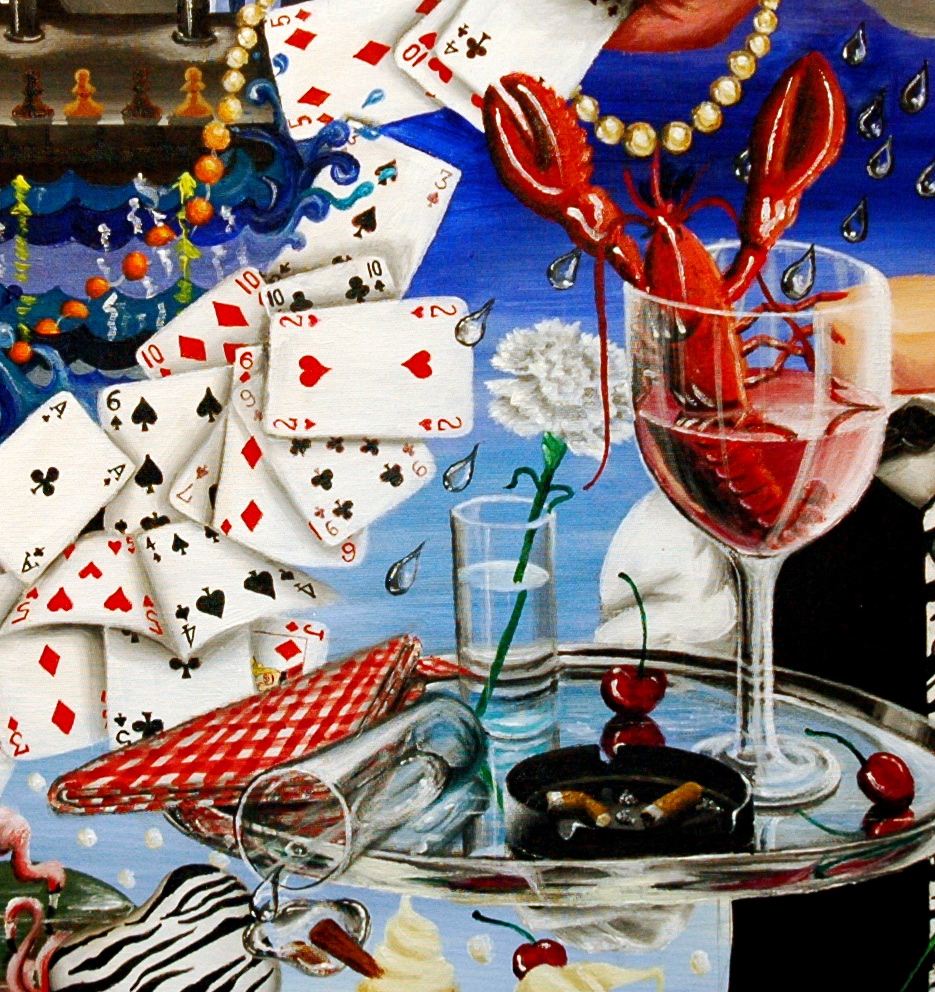
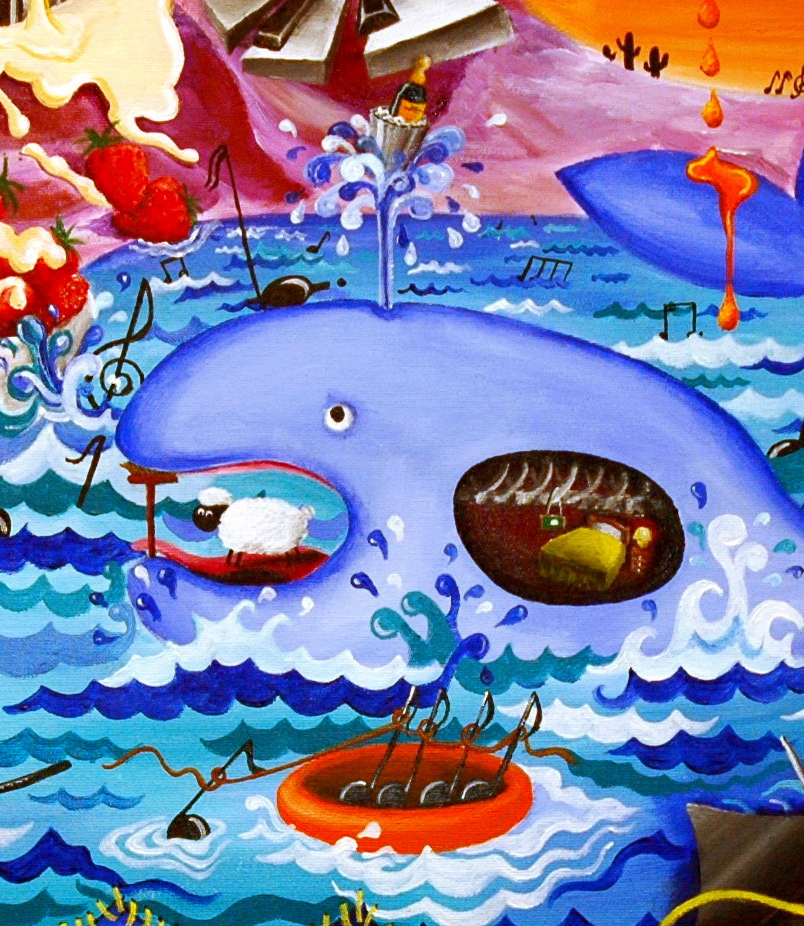
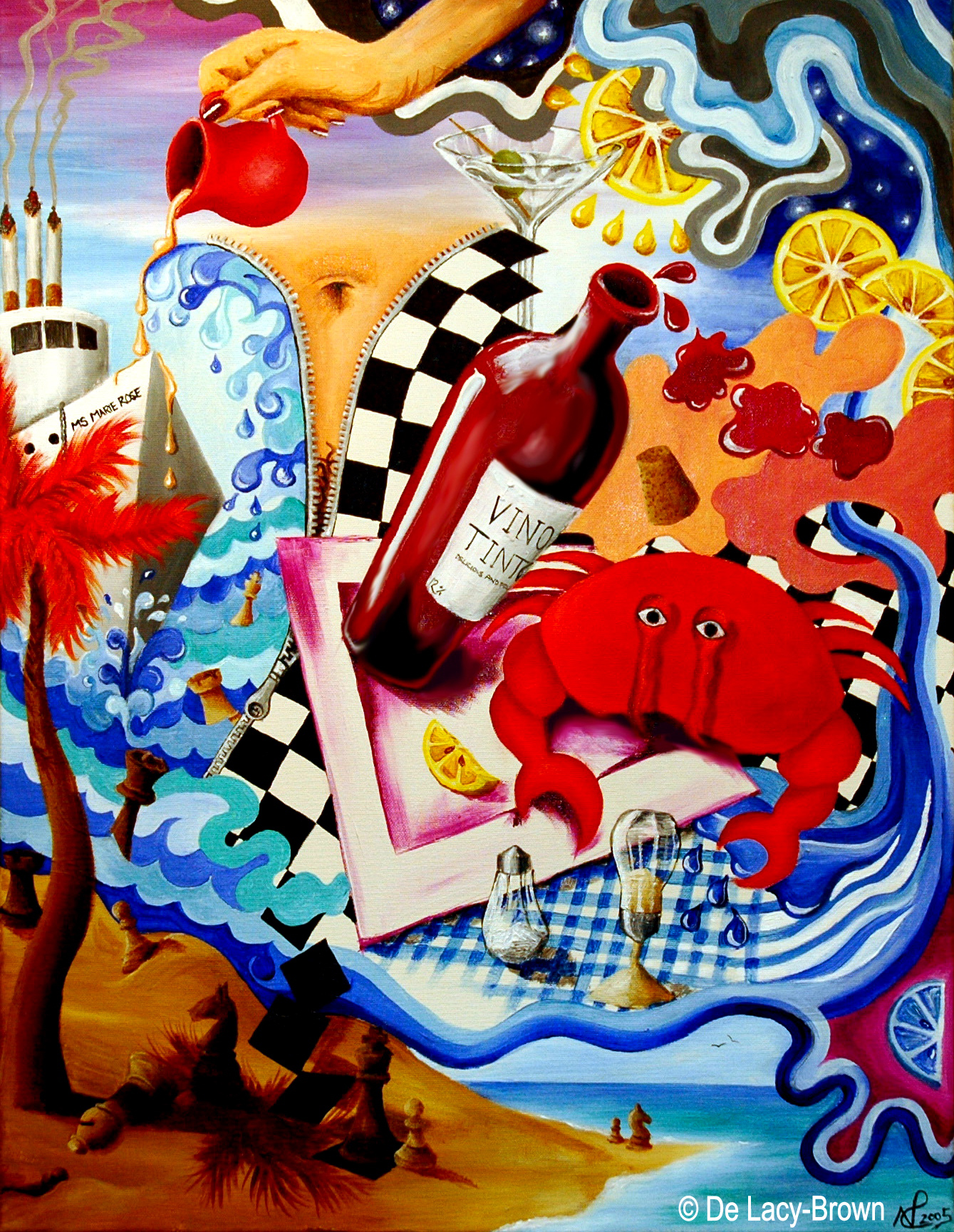
The resulting triptych sold at my 2006 exhibition, Between me and my Reflection and is now one of my best selling limited edition prints (with some still for sale on my Etsy store). It celebrates the ‘zest’ or joys of life through an illustration of the three stages of culinary and alcoholic indulgence during the day; lunchtime, afternoon tea and evening. Recreation and hedonism are central to the juxtaposed images with a further emphasis on home entertainment, namely piano/music, cards/gambling and chess. Opulence is illustrated by symbols of extravagance contained within all three images, as well as buried treasure and jewellery. Sea food is the culinary indulgence on the menu: many other life-forms or objects are anthropomorphised, for example, the sheep seen in the domestic setting of its whale-house, the musical notes struggling to save each other from the perils of a rough sea, and a snail which digs underground to retrieve the buried treasure. The ‘zest of life’ which these images embody is also specifically reflected by the citrus slices which radiate perfect weather conditions in each scene, while a human hand is always “on hand” to assist in the activities being illustrated, whether it be pouring the cream for the afternoon’s strawberries and the marie-rose sauce for the crab, or dealing out the cards for an evening of casino entertainment. The painted images flow and metamorphose from one object to another, as a string harbour-side lights becomes a string of pearls which in turn  becomes of floating buoys or a sudden rain shower becomes ice cream, piled on a cone to be enjoyed with a glass of rosé.

There’s a lot to explore in these paintings, which are typical of what happens when I set my mind loose, so without further ado I will let you enjoy the paintings in full, hoping that you take from them the optimism for life which they engender as you go about enjoying your sunny sunday and forthcoming summer.

Joie de Vivre/ Zest of Life 1: Crab Cocktail (2005 © Nicholas de Lacy-Brown, acrylic on canvas)

This print is available to purchase as a limited edition print at my Etsy store 

Joie de Vivre/ Zest of Life 2: Afternoon Sea (2005 © Nicholas de Lacy-Brown, acrylic on canvas)

This print is also available to purchase as a limited edition print at my Etsy store

Joie de Vivre/ Zest of Life 3: Casino Nights (2005 © Nicholas de Lacy-Brown, acrylic on canvas)

This print is also available to purchase as a limited edition print at my Etsy store

© Nicholas de Lacy-Brown and The Daily Norm, 2001-2012. Unauthorized use and/or duplication of the material, whether written work or artwork, included within The Daily Norm without express and written permission from The Daily Norm’s author and/or owner is strictly prohibited. Excerpts and links may be used, provided that full and clear credit is given to Nicholas de Lacy-Brown and The Daily Norm with appropriate and specific direction to the original content.

A Greek-inspired weekend feast without a single mention of austerity measures

It’s true. You can’t talk about Greece these days without the mention of austerity measures, riots in Athens, political instability and the potential crash of the Euro. All of this has had a knock-on effect on the Greek tourism industry, as families are put off by negative news pictures showing growing social unrest, and the current trend for “staycations” means tourists are setting their sights on local drafty beaches rather than the blue-domed, white-washed panoramas of Greece’s formerly favoured island attractions. While Greece loses its tourists, and its economy dwindles further, the tourists lose the opportunity to enjoy an affable burst of Grecian spirit in their lives, denied their chance to indulge in the mediterranean smells of garlic and basil, mint and spinach, flakey pastry and syrupy dessert, thick rich yoghurt and fresh just-caught seafood. So while Greece finds itself thrown into yet a further bout of political and social uncertainty, I have chosen, as always, to look on the brighter side of life, taking it upon myself to celebrate the sunshine-imbued gastronomic culture for which Greece should be making headlines, and importing the tastes and smells of a warm mediterranean evening into my flat. As such, I have been cooking up a storm of Greek-inspired food in my flat here in gloomy London, and the results have been so good, I feel compelled to share the results.

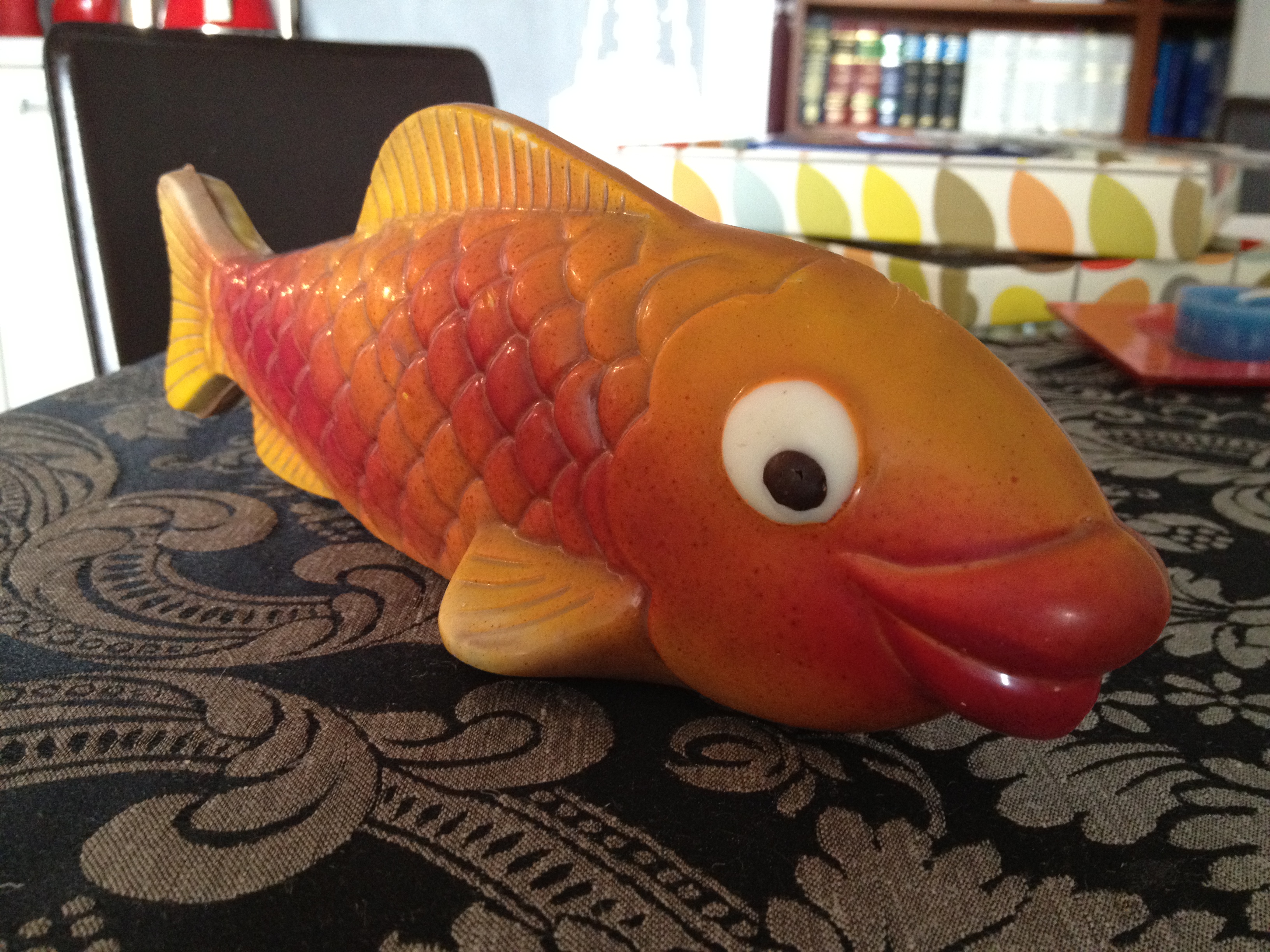
Most of the recipes are taken or adapted from Rick Stein’s Mediterranean Escapes (© Rick Stein 2007), but the cheese platter and stuffed squid dish are entirely my own creation (the chocolate fish is, sadly, so perfect as to be un-makeable – well, at least by my clumsy hands).

Feast 1 – light lunch cheese platter with a chicory salad

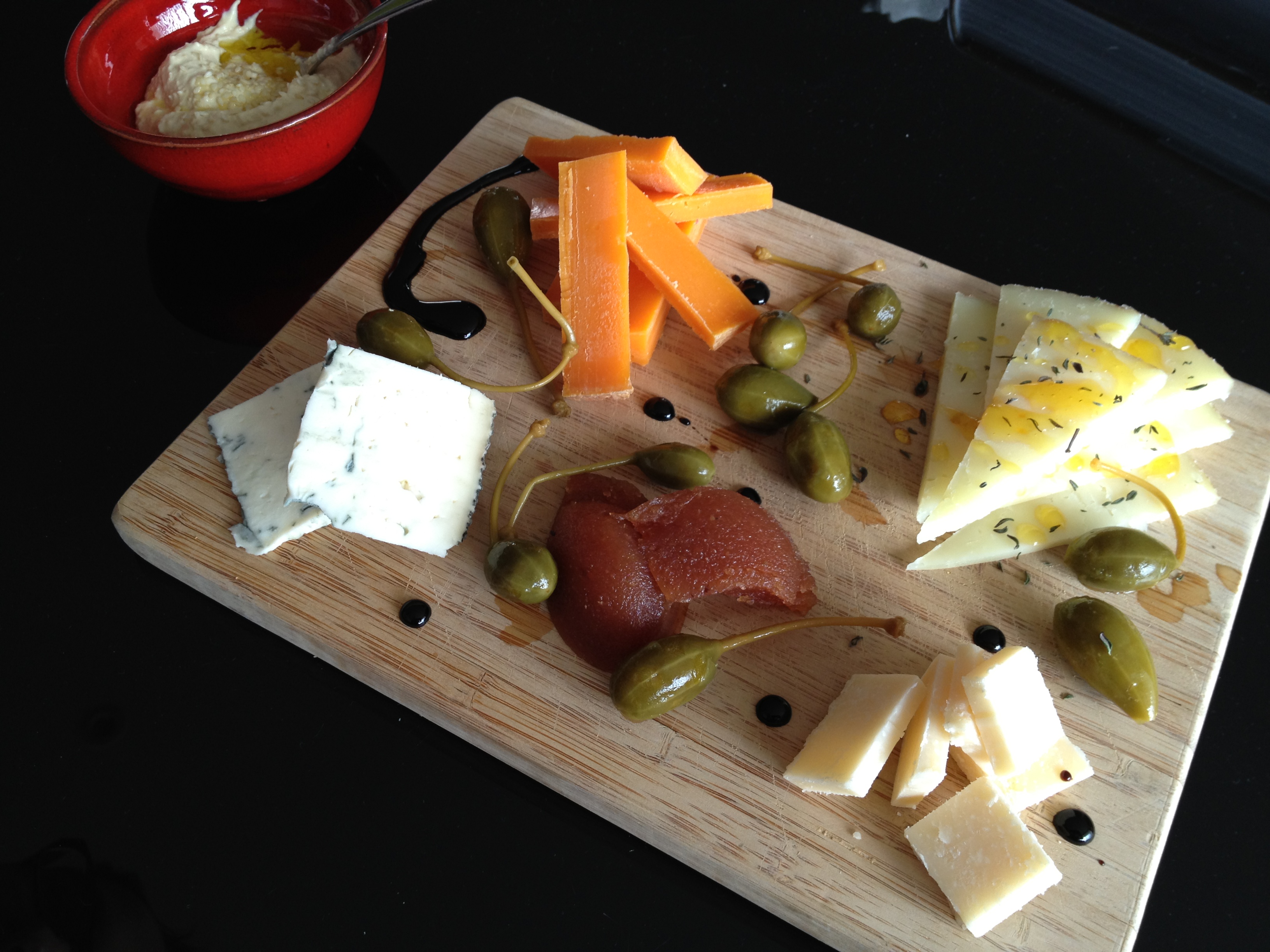
I started my greek food season (I should point out that i didn’t eat all of this at once – this was over a few days) with a light snack: a cheese platter with some greek (kefalotiri, halloumi and feta) and other mediterranean cheeses (there’s always space for my favourite Spanish cheese – manchego – drizzled with honey and sprinkled with thyme). With so many Greek cheeses out there you can go mad. I served my cheese board with a home made houmous sprinkled with sesame seeds, flat bread and rather large Greek capers, as well as a chicory, pomegranate and walnut salad.

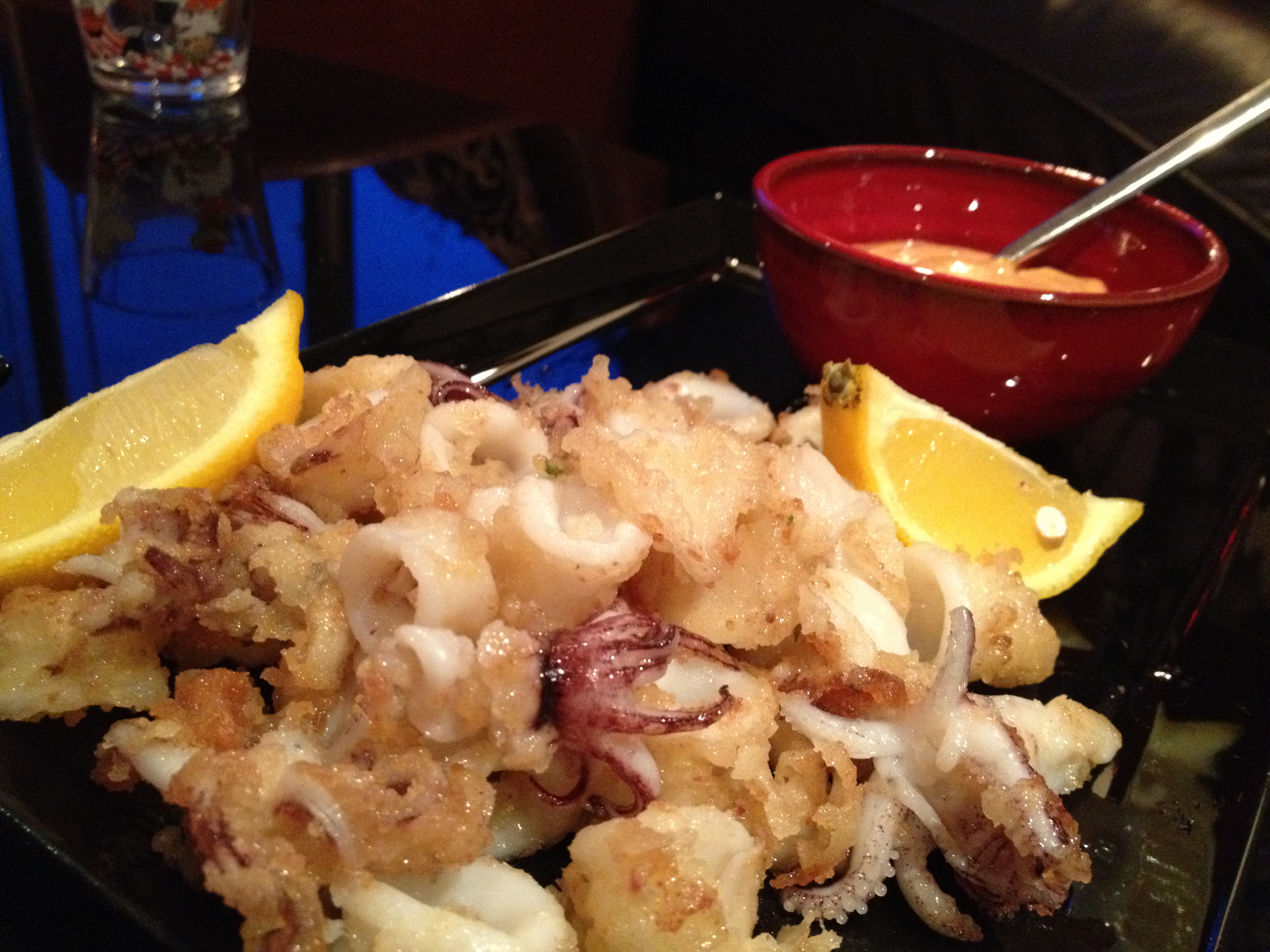
Feast 2 – Greek mezze: shallow-fried squid with a pimenton dipping sauce, Tzatziki, Baba Ghanoush, Spanakopita and pitta bread

For a real taste of the mediterranean, you can’t go wrong with some simple, lightly fried squid, dusted in well-seasoned flour and shallow fried. The key is to leave the flour-coated squid for a couple of minutes before frying as the damp flour will give a crispier finish. Then you just need to shallow-fry the squid in oil (I use olive-oil for a more rich mediterranean flavour) for around a minute. I served the squid with a wedge of lemon and a smoked pimenton mayonnaise – simply make up a standard mayonnaise with a little extra lemon. Finely chop some garlic and crush into a smooth paste with the flat blade of a knife. Add this and a teaspoon of smoked pimenton to the mayo and you have the perfect dipping sauce for the squid.

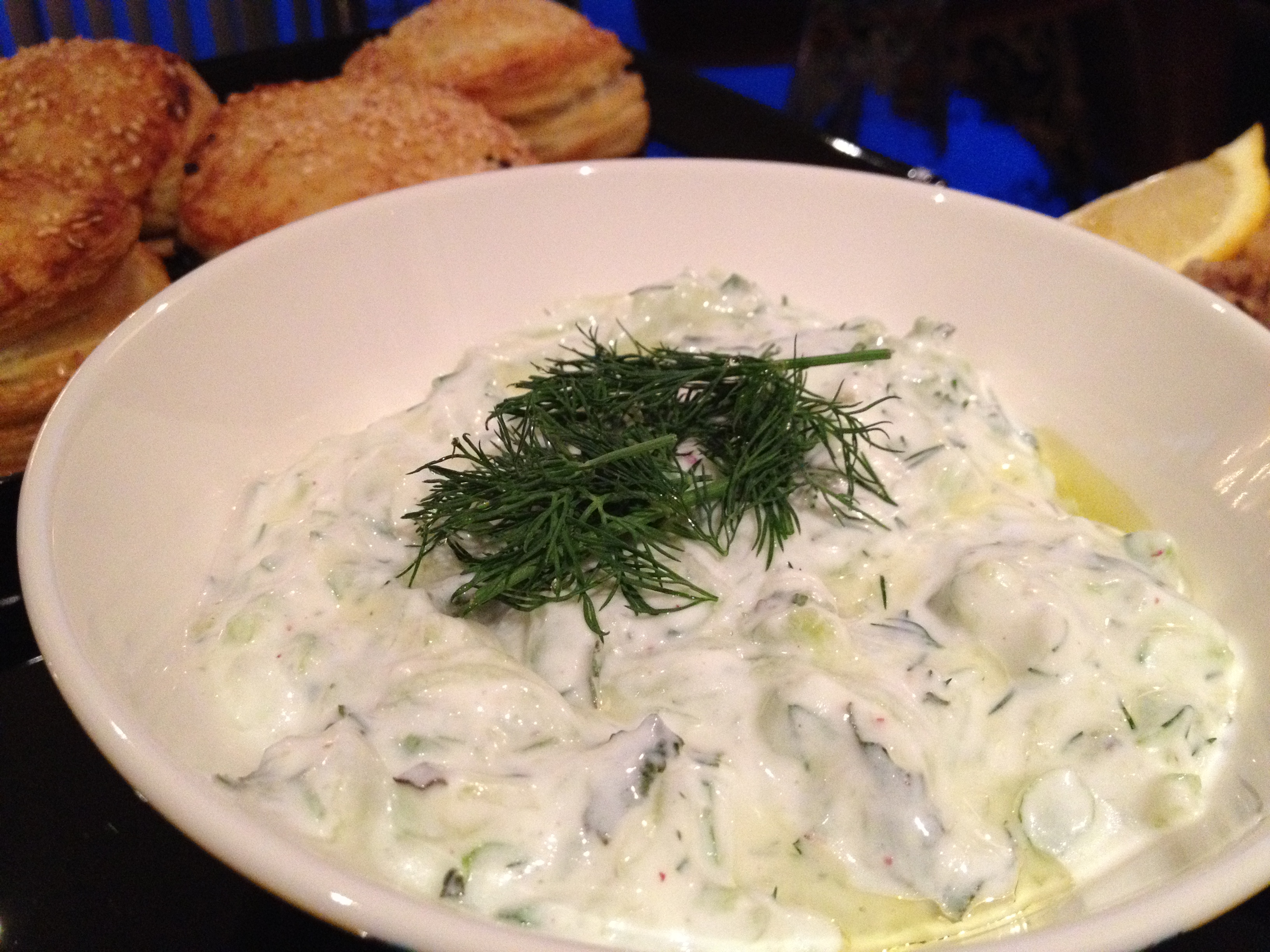
No mezze is complete without Greek favourite, Tzatziki, a cucumber and yoghurt dip perfect for eating with flat bread or pitta bread. There are various pools of thought as to how to make Tzatziki. My Cypriot friend swears by yoghurt with oregano, where as others will use mint. Rick Stein recommends dill. And frankly all of these herbs work well. Personally I’m a lover of mint, but I couldn’t resist adding a little dill as well, and I found the Tzatziki lost nothing for this herb combination. So you need to take a cucumber which should be coarsely grated (you can peel off the skin if you like, although I generally leave it for texture). Squeeze most of the juice out of the cucumber in a (clean, obviously) tea towel and add to 500g Greek yoghurt, 75g of finely chopped spring onions, 2-3 heaped tablespoons of your chopped herbs (mint, dill, and/or oregano as preferred), 2 tablespoons of good quality olive oil, a teaspoon of white wine vinegar, seasoning and 1-2 crushed garlic cloves (be careful here – the raw garlic can be surprisingly overpowering in this dish. In my experience it’s best to start with one clove and add more if you like a pungent garlic flavour).

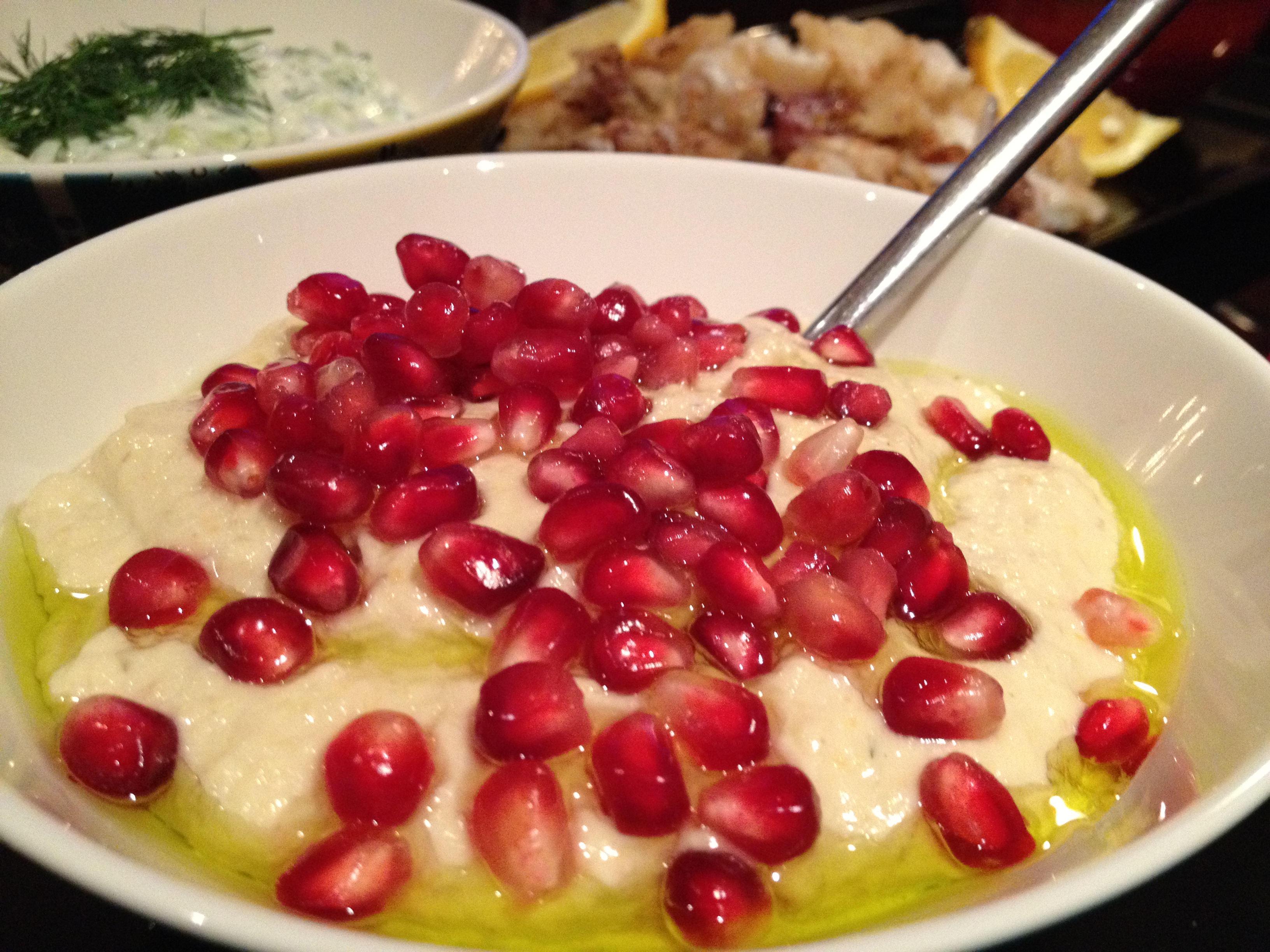
Typical mezze will include a houmous as well as a tzatziki, but I decided to import a dish from Turkey to add variation to the typical hummus dish. Baba Ghanoush has a similar texture to houmous but with a predominant flavour of smoked aubergine which is delicious, especially when served sprinkled with pomegranate. To make the Baba Ghanoush, take three large aubergines, and pierce them near the stalk to prevent them from bursting. Place them under a grill for around 40 minutes until black on the outside and soft in the middle. Once cool enough to handle, cut the aubergines lengthways and scoop out the flesh. This should be mashed up with a masher or fork, or for those who like a smoother texture, whizz it in the food processor. Time to add 2-3 garlic cloves, crushed (again, be careful about adding too much – it’s best to start with one and keep testing), plenty of salt, 3 tablespoons of light tahini paste, a drizzle of olive oil and half a teaspoon of sesame seed oil, a squeeze of lemon juice and some parsely to garnish. Serve with pomegranate and an extra drizzle of oil.

I completed my mezze with standard greek favourites, spanakopita  (I got over excited and forgot to photograph them). These are delicious crispy spinach and feta filled pastries and are wonderful when accompanied with the tzatziki or on their own. For the filling, sweat half a small onion and two finely chopped spring onions until soft. In a separate pan wilt 500g of spinach and press out the juices. Once cool, combine the spinach and sweated onions and add 100g of crumbled feta cheese, 1 large egg, 1 tablespoon of finely grated kefalotiri or parmesan cheese, a pinch of nutmeg, 2 -3 large tablespoons of fresh mint, and seasoning and mix well. For the pastry, buy a packet of pre-made filo pastry. Cut the stack of pastry into strips 7.5 cm wide. Brush the top layer with melted butter and place a heaped teaspoon of the spinach filling into the centre of one strip at the end nearest you. Then fold one bottom corner of the pastry diagonally over the filling so that the corner touches the opposite side to make a triangle. Then fold over the filled triangular corner, continuing to fold along the whole strip until a perfect triangular pastry is formed. Do the same for all the mixture. Brush the pastries with more butter (and, if you like, sprinkle with sesame seeds). Place on a lightly buttered baking tray and bake for 25 minutes at 180 degrees centigrade/ gas mark 4 until golden and crisp. I should note that you can make this recipe with puff pastry – I did it when I bought the wrong pastry and it was still delicious!

Feast 3 – Pot roasted chick with sun-dried tomatoes, cinnamon and oregano

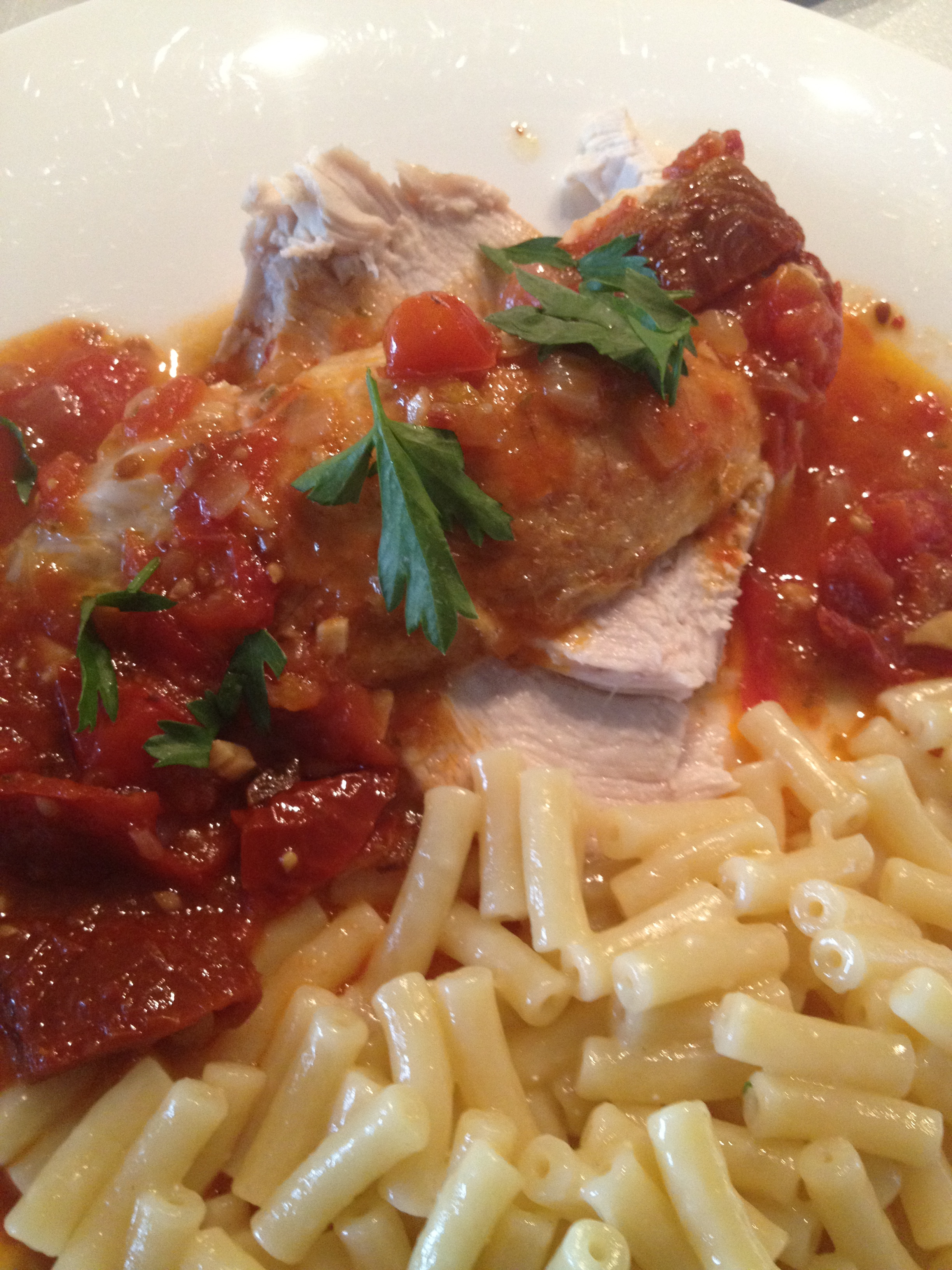
Next up an easy-cook chicken dish which imports the spices of the Aegean sea with a rich tomatoey mediterranean sauce. Simply take a whole chicken (around 2kg) and pan fry in a casserole for a few minutes on each side to brown. Remove the chicken and in the same pan gently brown a thinly sliced onion. Add 4 garlic cloves, thinly sliced, 60 g of sun-dried tomatoes, 500g of chopped vine tomatoes (or a tin of chopped tomatoes is fine), a cinnamon stick, 150ml of chicken stock, a generous pinch of dried chillies, 1 teaspoon of dried oregano and seasoning. Bring to a simmer and replace the chicken. Cover with a tight fitting lid and bake in the oven for 1.5 hours at 180 degrees celsius/ Gas Mark 4 and baste the chicken with the sauce every so often. Once the chicken is cooked and the juices run clear, lift the chicken onto a carving board and wrap in foil to keep warm. Then bring the tomato juices to a rapid simmer for around 10 minutes until slightly reduced and thickened. Remove the cinnamon stick and serve the tomato gravy in a generous flurry over the carved chicken. You’re meant to serve this dish with orzo (rice-shaped pasta) tossed in a handful of grated kefalotiri/ parmesan cheese, but since I couldn’t source any locally, I used macaroni – which worked surprisingly well!

Feast 4 – Grilled stuffed squid with a broccoli and beetroot salad (with a chocolate fish for dessert)

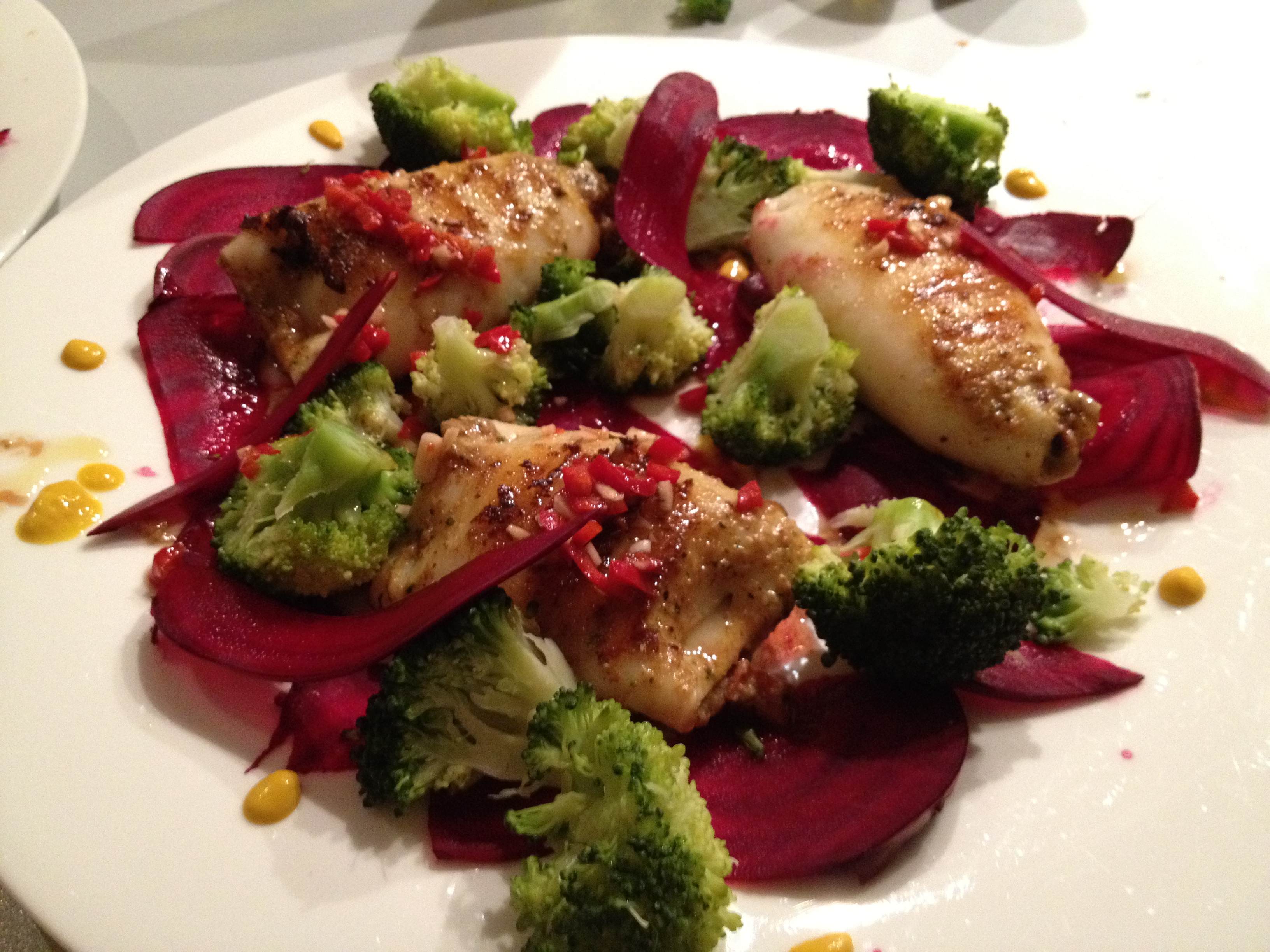
My final installment of Greek food was a stuffed squid dish which was an exercise in using up the contents of my fridge. I defrosted 6 frozen squids (they’re not currently in season) and stuffed them with a mixture of lightly toasted pine nuts, 50g or so of feta cheese, 50 g or so of mozarella cheese, a handful of basil, a good squeeze of lemon, some very finely chopped spanish chorizo sausage, seasoning and a lightly sauteed finely chopped shallot. I made a pesto-style paste from half the pine nuts by whizzing them in a food processor with the cheese and basil and added this to the gently friend chorizo and shallots along with the other half of the toasted pine nuts (I used a 100g bag in total). This made for a variety of textures. I stuffed each squid with the mixture and fastened the end shut with a toothpick for cooking. I then grilled the squid in a griddle pan for 2-3 minutes on each side. In the meantime I lightly steamed some broccoli and finely sliced a beautiful fresh raw beetroot which I scattered over the plate at random, along with a light dressing of chopped chilli, olive oil and a squeeze of lemon juice. I also dressed the plate with a few blobs of mustard for decoration and yet more flavour intensity.

For dessert we ate something which has no remote connection to Greece whatsoever, but so beautiful was this chocolate fish which we gorged upon that he merits inclusion in this post. Bought in Salamanca, Spain a few weeks back, this fish is a chocolate beauty, so good that we resisted eating him for at least 3 weeks until finally succumbing to temptation last weekend. He tasted as good as he looked.

Sunday Supplement: Achean adventure and Cruise thru Cubes

I’m in Greece mode. It all started the other night when I was channel flicking in a desperate attempt not to go to bed which means the inevitable rise the following morning for work. In the process, I staggered upon the film version of Captain Corelli’s Mandolin starring Nicholas Cage and Penelope Cruz and I was entranced. Despite having the film on DVD in my cabinet and having seen it at the cinema when it first came out, I’ve always dismissed the film to some extent because, like many other fans of the sensational Louis De Bernieres original novel, I was pretty upset about how much the film changed the charm, and crucially the ending of the book. I wasn’t best pleased about the casting of Cage as Captain Corelli either, who I had always imagined to be a short, rotund charismatic fellow.

Nevertheless, when I caught a glimpse of the film, it entered my flat, descended with the rest of the UK into a renewed wintery gloom, with a much needed breath of fresh summery air. Who cannot be seduced by the stunning cinematography of the film which was set exclusively on the island of Cephalonia, as De Bernieres had intended.

So all of this has sparked off a Greek revival in my flat. Greece has been getting a lot of bad press recently, what with financial disaster threatening to instigate a total collapse of the single European currency, and countless violent strikes and protests reacting against the suffocating austerity budgets imposed across the county. But while its coffers may be found wanting, what Greece does have is a wealth of cultural and historical richness which is almost unrivalled, not to mention a cluster of beautiful island destinations, each with their own individuality and incredibly picture-postcard views.

The beaches of stunning Cephalonia

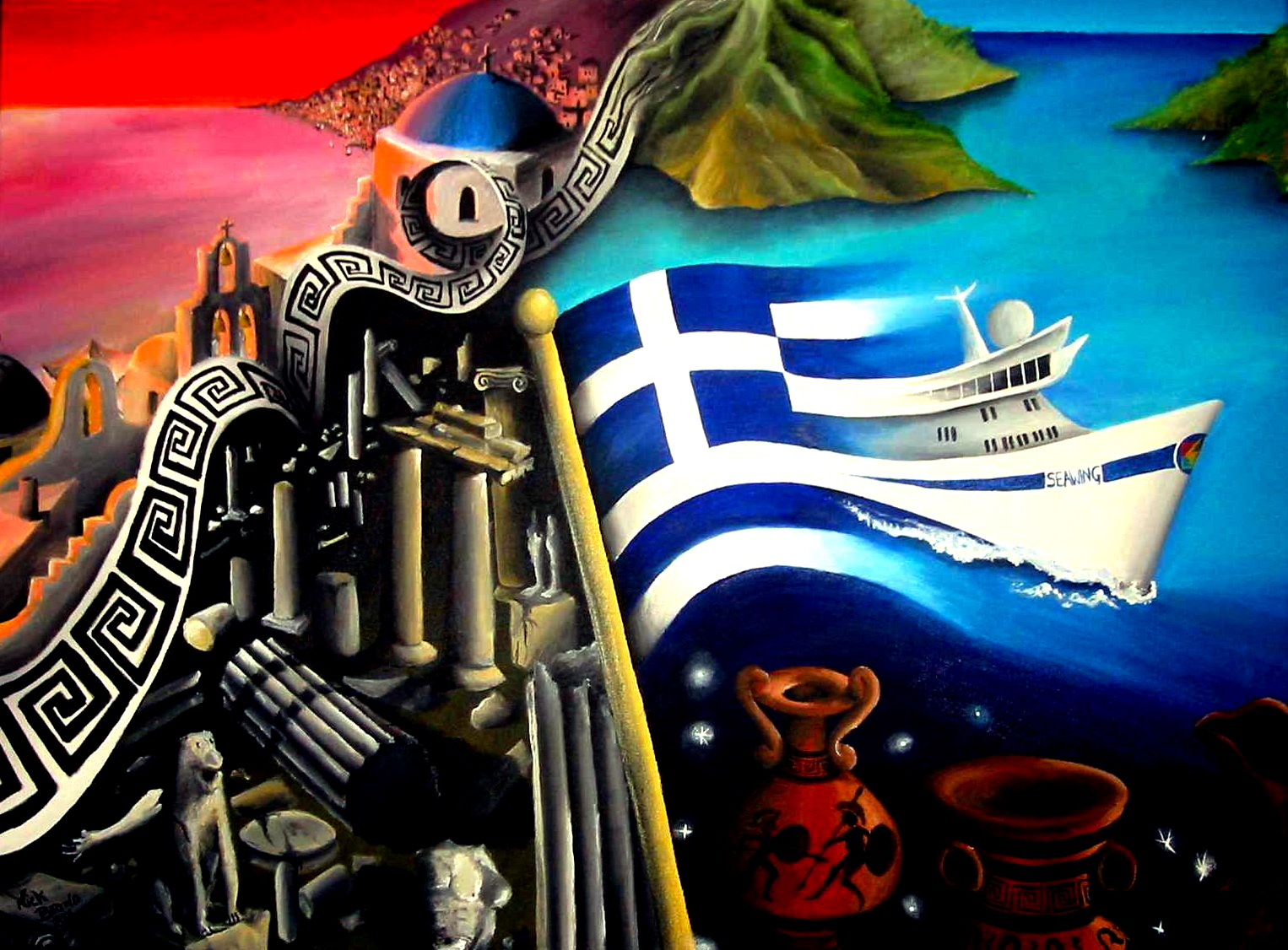
I was lucky enough to  visit the Greek islands twice during my gap year back in 2001/2, first piggybacking with my sister upon my parents’ wedding anniversary celebratory cruise around the Aegean Sea, and later in the year, joining two very good friends for a little island hopping around the Ionian Islands of which Cephalonia is one. While I would love to return to these gorgeous lands, where empty beaches and crystal clear waters can be found in their plenty, along side charming crumbling houses, and dry arid landscapes and mountain passes, I have in the meantime satisfied myself by grabbing the Captain Corelli DVD and watching the film through not once, but twice. I have also been cooking dish after dish of Greek treats (hopefully to be featured on my blog sometime this week) and now, for your viewing pleasure, I’m featuring two of the paintings I completed back in my gap year, at the ripe age of 18, when I first visited Greece on my parents’ anniversary cruise.

Shot from the film of Captain Corelli’s Mandolin

The first painting, Achean Adventure (2001), reflects not only upon the cruise liner, which can be seen emerging from the Greek flag, but also the antiquity which features predominantly across Greece (and which had a particular fascination for me having just completed my A-Level classics studies at the time) and the beautiful Grecian landscapes such as this one, of the island of Santorini.

Achean Adventure (2001 © Nicholas de Lacy-Brown, acrylic on canvas)

The second painting, Cruise Thru Cubes (2001) works like a multilayered exploration of our cruise around the Aegean Sea. Uncover various layers of the painting, and you see the cruise liner having docked and sailed in a variety of different destinations across the cruise, amongst them Mykonos (on the right) and Santorini (on the left).

Cruise thru Cubes (2001 © Nicholas de Lacy-Brown, acrylic on canvas)

It’s good to give these paintings a good airing. Completed over ten years ago, they were some of my earliest painting attempts, and Achean Adventure was sold shortly after I painted it when it was first exhibited in Sussex.

Hopefully this post will bring a little mediterranean sunshine into your Sunday especially if, like mine, it’s gloomy like hell. I’d better sign off now… I feel the need to shop around for a cheap trip to Cephalonia…

© Nicholas de Lacy-Brown and The Daily Norm, 2001-2012. Unauthorized use and/or duplication of the material, whether written work or artwork, included within The Daily Norm without express and written permission from The Daily Norm’s author and/or owner is strictly prohibited. Excerpts and links may be used, provided that full and clear credit is given to Nicholas de Lacy-Brown and The Daily Norm with appropriate and specific direction to the original content.

Manet Norms at the Cappuccino Grand Café – Part II: Decoding the Manet’s

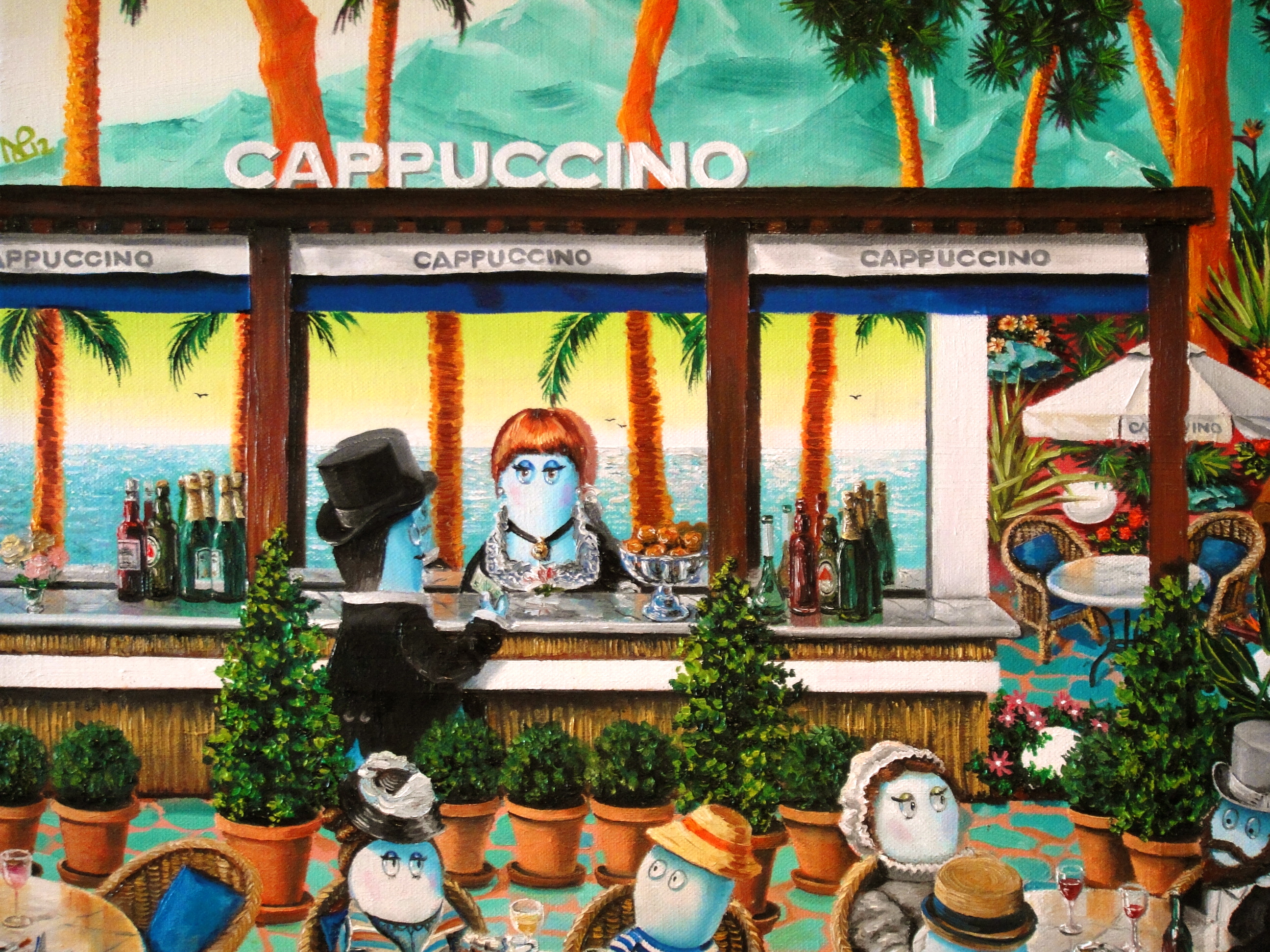
Yesterday I launched my new painting onto the public stage – Manet Norms at the Cappuccino Grand Café. Having stemmed from an idea to recreate Manet’s masterpiece, Bar at the Folies-Bergère, I felt that an insertion of the painting into my Cappuccino landscape would only work if the other Norms too were based on Manet paintings. One look at Manet’s oeuvre revealed a host of images which were ripe for reconstruction within my Normy café scene. Like many of his impressionist colleagues after him, Manet was a pioneer of painting real life, scenes capturing the French society all around him, from lonesome drinkers supping upon a plum brandy, to day trippers out on the coast and a child fascinated by the plumes and puffs of the steam railway. All this Manet captured to perfection, and feasting hungrily upon his works, I transformed a great many of them into Norm customers at my café when presenting the thriving, bustling atmosphere for which Cappuccino Grand Café is famous.

So without further ado, here are all of Manet’s original paintings followed by my own interpretation as featured in my new Cappuccino café scene. Despite being some 150 years apart, these characters slip effortlessly behind the elegant marble tables and botanical celebration of Cappuccino’s terrace in a café which exudes sophistication, and retains the feeling of glamour and recreational hedonism which was intrinsic to venues such as the Folies-Bergère back in Manet’s day. Parfait!

Bar at the Folies-Bergère

Edouard Manet – A Bar at the Folies Bergère (1882)

My reimagination of the Bar at the Folies Berger…

Those bottles…

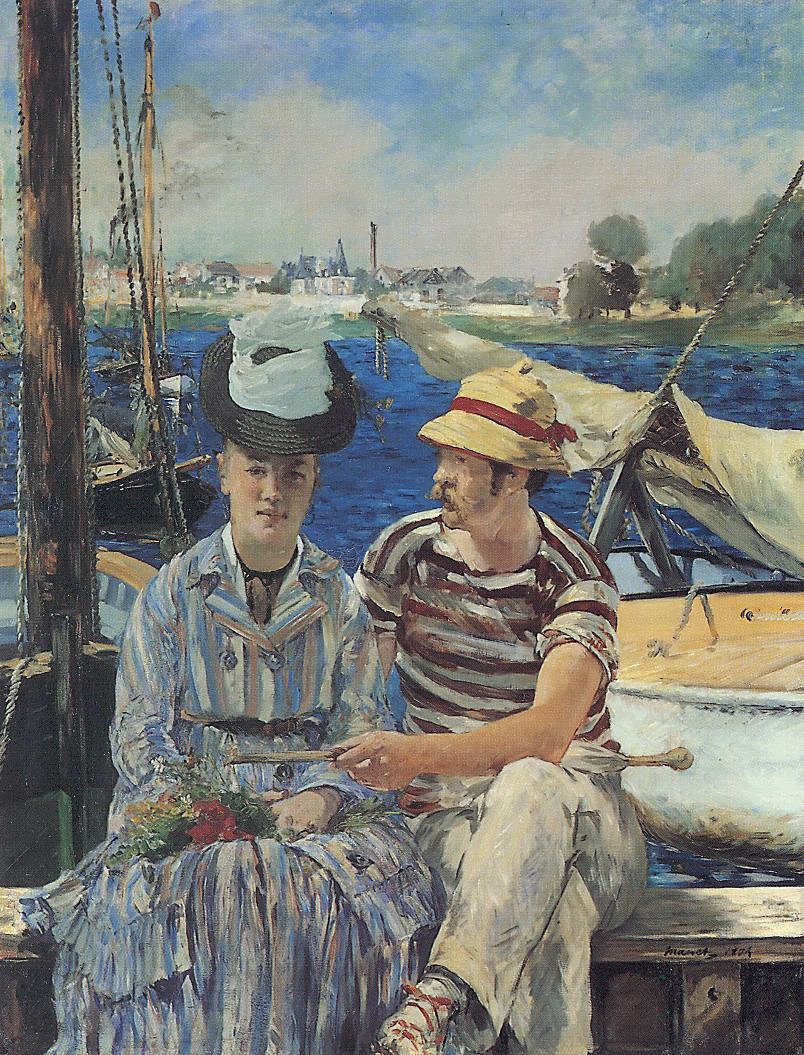
Argenteuil

Edouard Manet – Argenteuil (1874)

My Norms, loosely based on the figures in “Argenteuil”

The Luncheon

Edouard Manet – The Luncheon (1868-9)

The Luncheon-based trio of Norms

Le Chemin de Fer (The Railroad)

Edouard Manet – Le Chemin de Fer (The Railroad) (1873)

Norms, complete with the little sleeping puppy

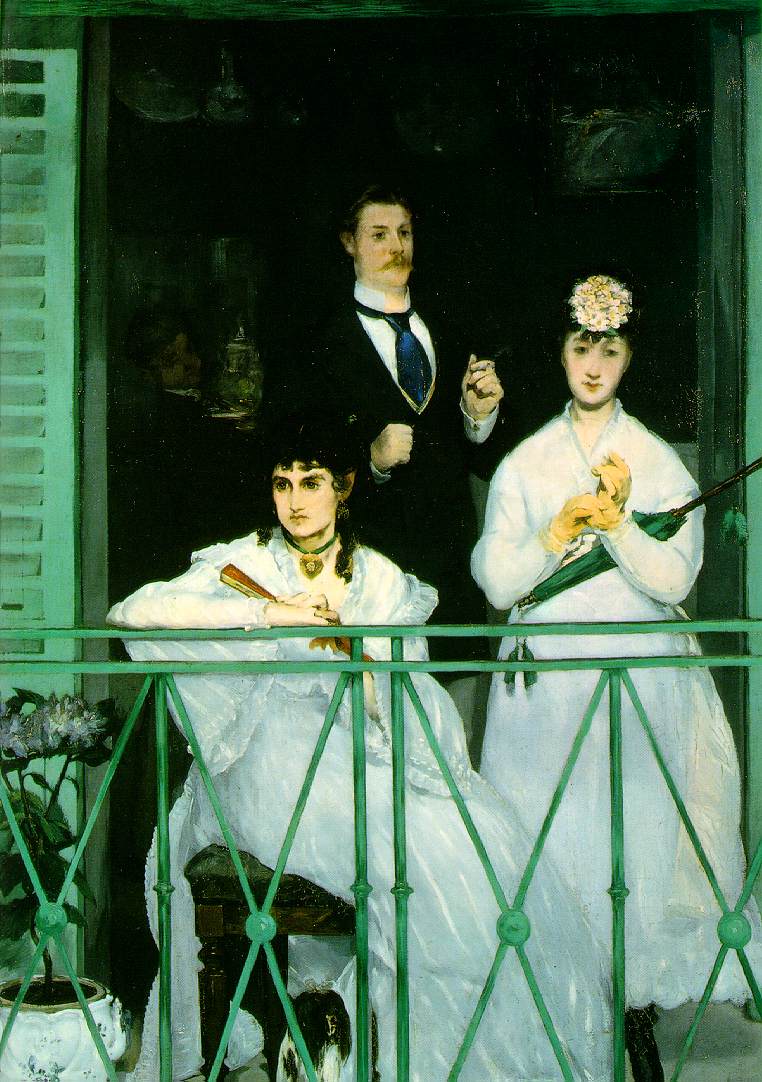
The Balcony

Edouard Manet – The Balcony (1868-9)

Not on a balcony, but the same trio as Norms

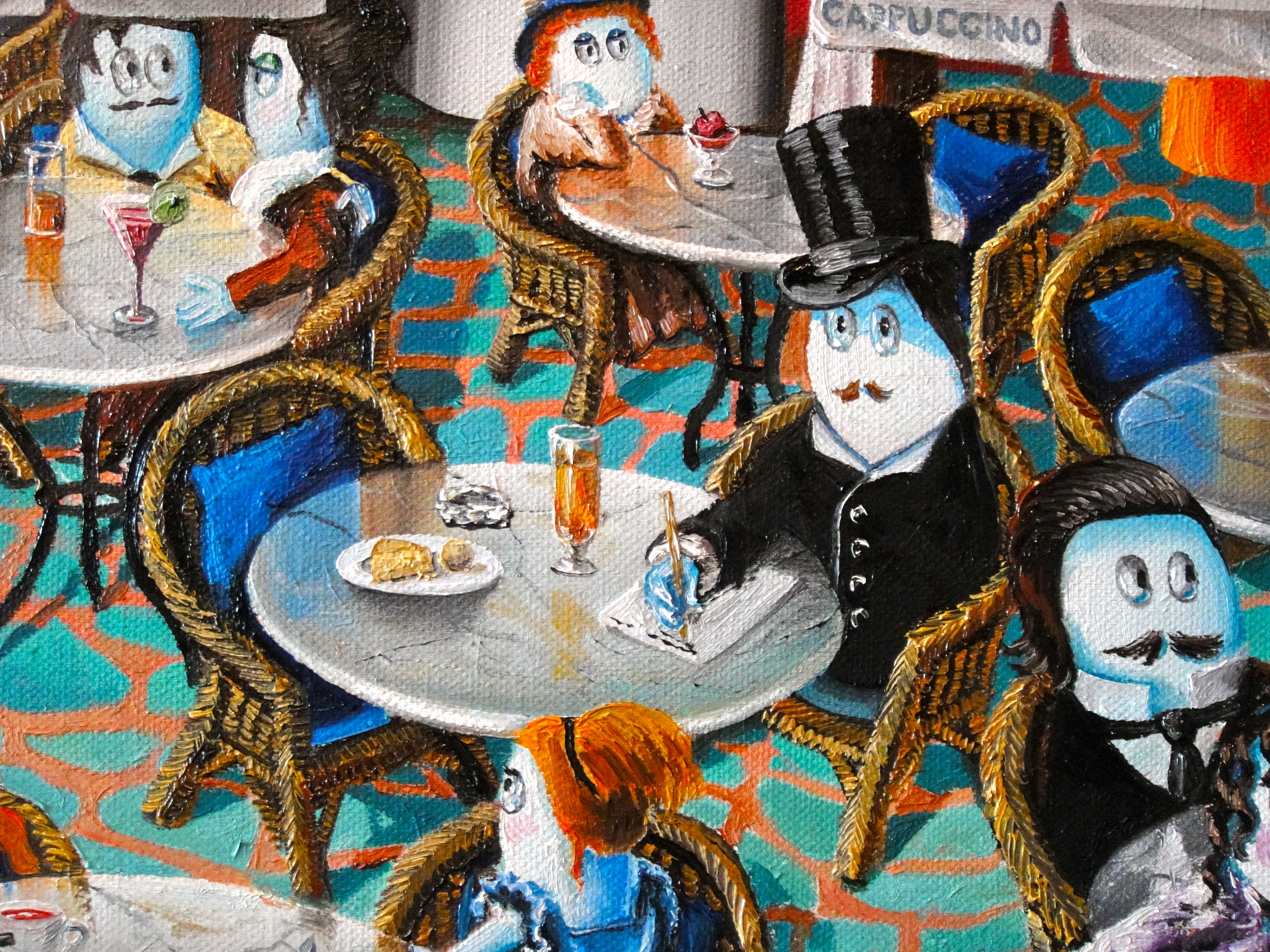
Man writing in a café / “Chez Tortoni”

Edouard Manet – Man Writing in a Café / ‘Chez Tortoni’ (1878)

Writing just the same “Chez Cappuccino”

Chez Le Pere Lathuille 

Edouard Manet – Chez Le Pere Lathuile (1879)

Love is in the air, at least for one of these Norms…

La Prune (The Plum Brandy)

Edouard Manet – La Prune (The Plum Brandy) (1876-8)

I hope the Norm writing will join this lone drinker for a date

© Nicholas de Lacy-Brown and The Daily Norm, 2005-2012. Unauthorized use and/or duplication of the material, whether written work or artwork, included within The Daily Norm without express and written permission from The Daily Norm’s author and/or owner is strictly prohibited. Excerpts and links may be used, provided that full and clear credit is given to Nicholas de Lacy-Brown and The Daily Norm with appropriate and specific direction to the original content.

Salamanca – Restaurant Focus: El Alquimista and La Cocina de Toño

Ever since Salamanca placed itself on the European cultural map when it was named European Capital of Culture in 2002, the city has actively promoted itself as a capital of gastronomic prowess, advertising itself under the tag line “Salamanca para comérsela” which literally means “Salamanca to eat”. I’d heard about the frog, the glowing sandstone, and the brilliantly baroque Plaza Mayor. Nonetheless, for gastronomy, I would have told you to head up north to San Sebastian (which, by coincidence, will be European Capital of Culture in 2016). However, no sooner had I started investigating restaurant options using the likes of Trip Adviser before jetting off than I realised that Salamanca is jammed back with high quality, innovative restauranteurs, littered with menus degustaciones (taster menus), and brimming with pristine white hatted chefs with a fastidious attitude towards their picture-perfect cuisine. More than once I read that a Salamanca eatery had offered the reviewing diner the “best meal they had eaten in Spain”. Encouraged, I booked up the best of them and went along to enjoy the ride. Here are my two favourites:

El Alquimista, Plaza San Cristobal 6, 37001 Salamanca Tel 923 21 54 93

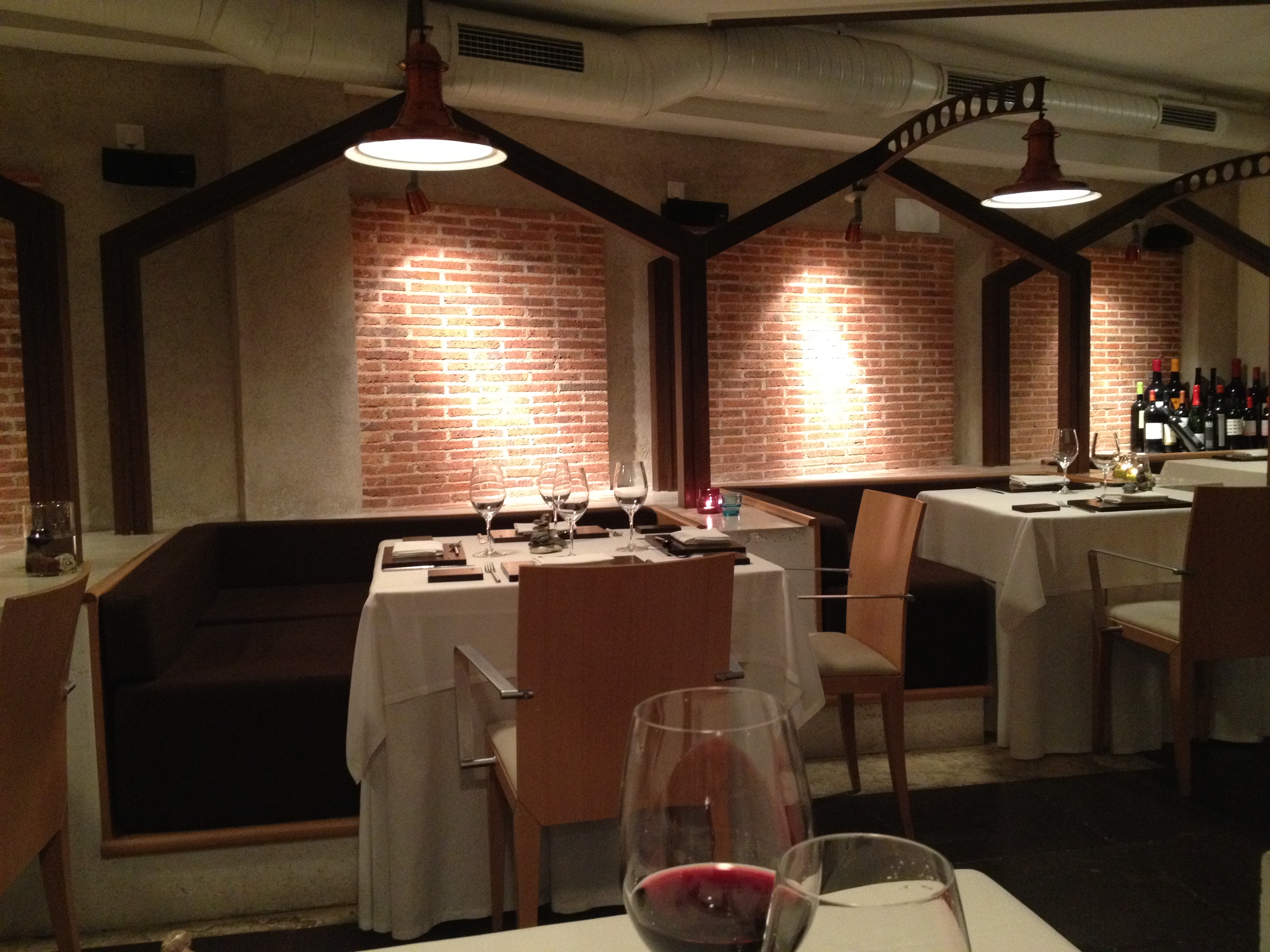
El Alquimista's "urban" interior

I reserved a table at this very unique restaurant on the back of excellent trip advisor reviews which had placed the restaurant in second place out of some 100 restaurants in the city. When I turned up, I began to doubt whether this had been such a good idea. To say the restaurant is off the beaten track is an understatement. Up a steep hill, in a very residential square (surrounded on one side by some dubious looking flats), with a small arrow pointing the way – the restaurant needed this signage, as it could very easily have been missed – approaching the restaurant, one had to double take – it looked like a garage for the flats above. And upon entering, this illusion was not shattered as we were taken through to one of the most unusual restaurant interiors I have ever sat in – with exposed brickwork (newly built) trimmed with concrete slabs to form booths, over which industrial lights hung casting a somewhat unflattering and certainly unromantic harsh light. What was more, when we entered (at around 9pm) the place was empty. The face of my partner probably mirrored my own – concern – although I was trying to put a brave smile on things, not least because my personal pride demanded that my choice be a success, particularly as I boast of being such a good organiser of holiday dining experiences.
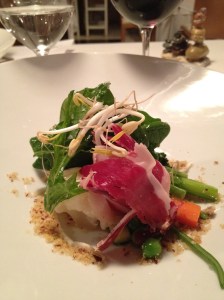
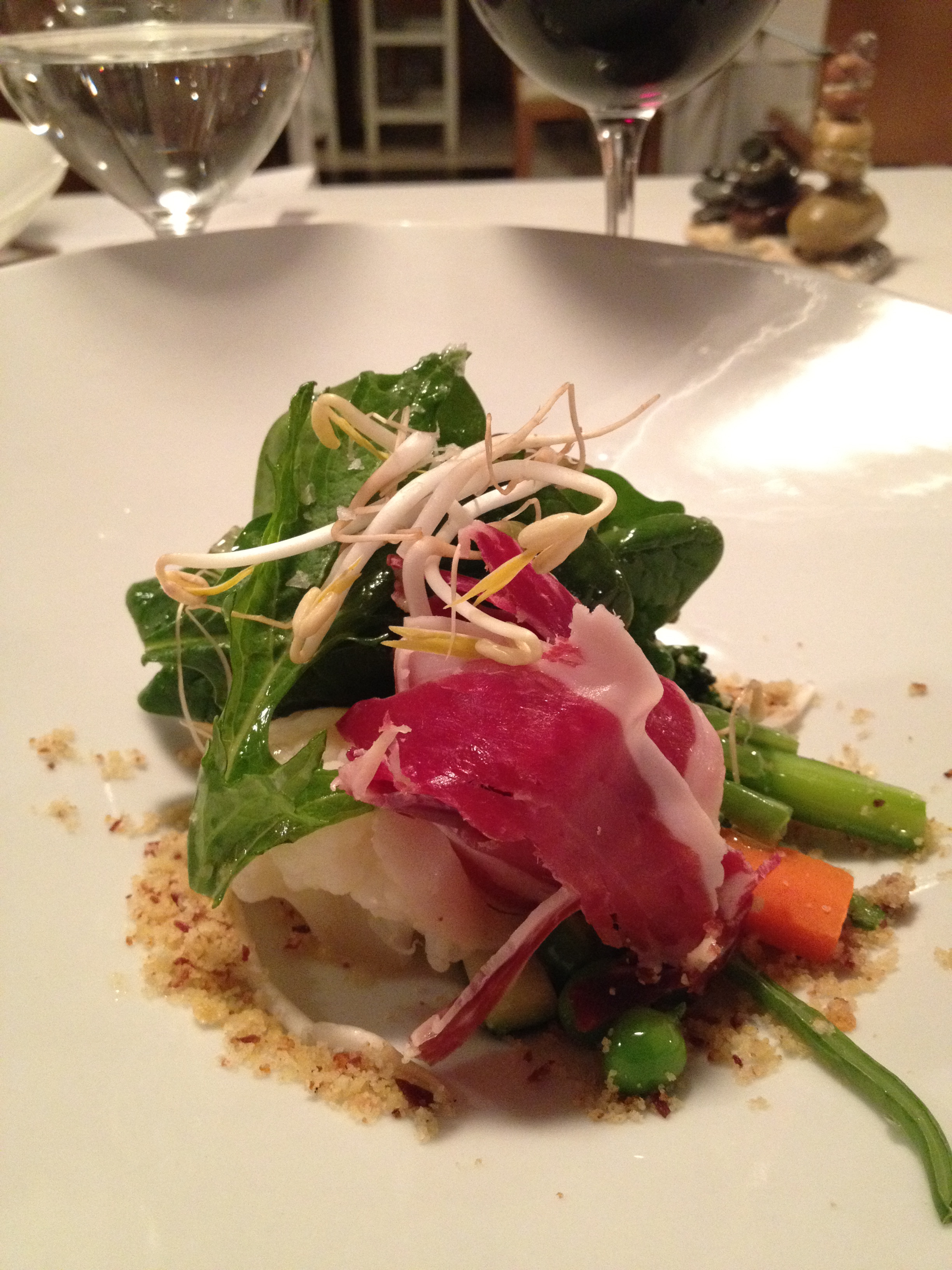
Verduras starter

They call the restaurant “the Alchemist” and at this point, it certainly looked as though some magic was needed. And as though the witching hour itself has come, we found ourselves becoming uncharacteristically merry. I think it was the wine we ordered – I wish I had taken a note of it – it was a Rioja with a mixed grape of around 90% tempranillo and 10% of something else – but it was so good that with one sip, the alchemist seemed to have cast his spell. It’s not that we were drunk – just merried, but certainly sober enough to appreciate the culinary joys which were suddenly to descend upon us, each dish one flurry of magic after another.
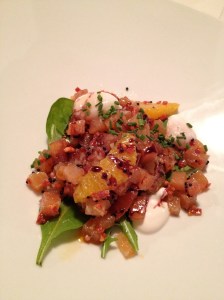
Tartar de salmon

We went for the menu degustacion which, at only €36 per person, was half the price of the sum we are used to forking out for a similar taster menu in Marbella (and far below anything you would pay in London). The first dish was verduras, brotes y hortalizas tibias con lascas de jamon ibérico y migas (Vegetables, sprouts and vegetables with warm slices of Iberian ham and crumbs). The dish was exquisite – the vegetables crunched to perfection, the ham providing a salty undertone and the crumbs a textural variant which provided all round satisfaction with every mouthfull. The dish was one of those perfectly simple but precisely executed why-haven’t-I-thought-of-this kind of dish that you just know you could never recreate so well at home.
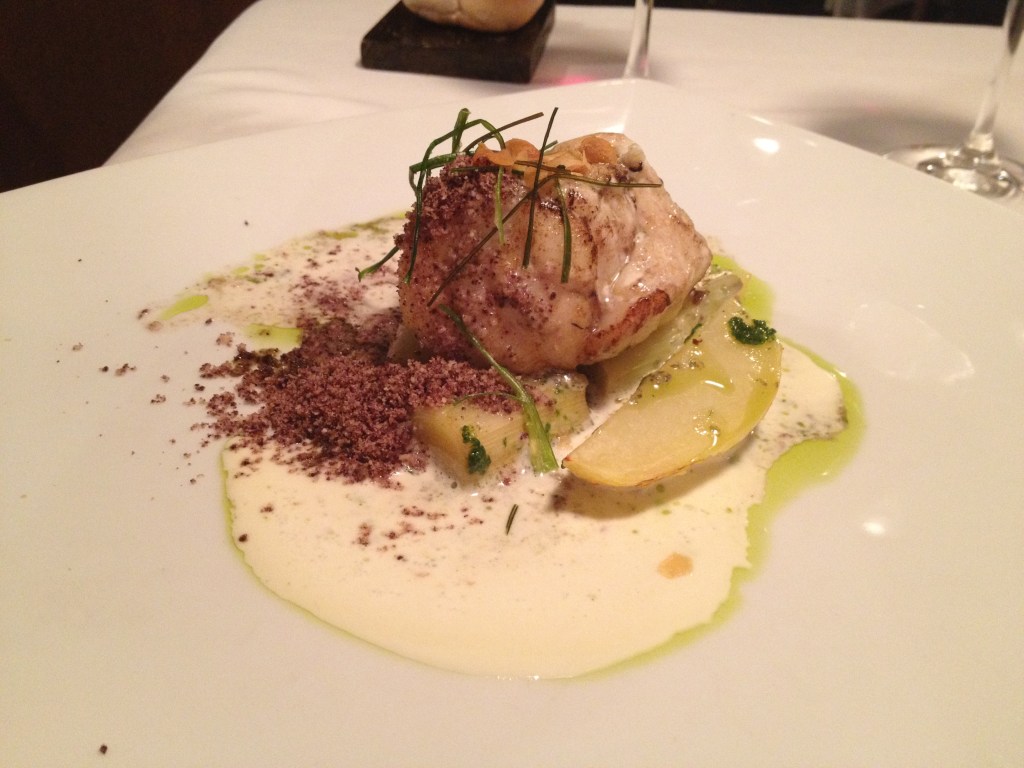
Monkfish

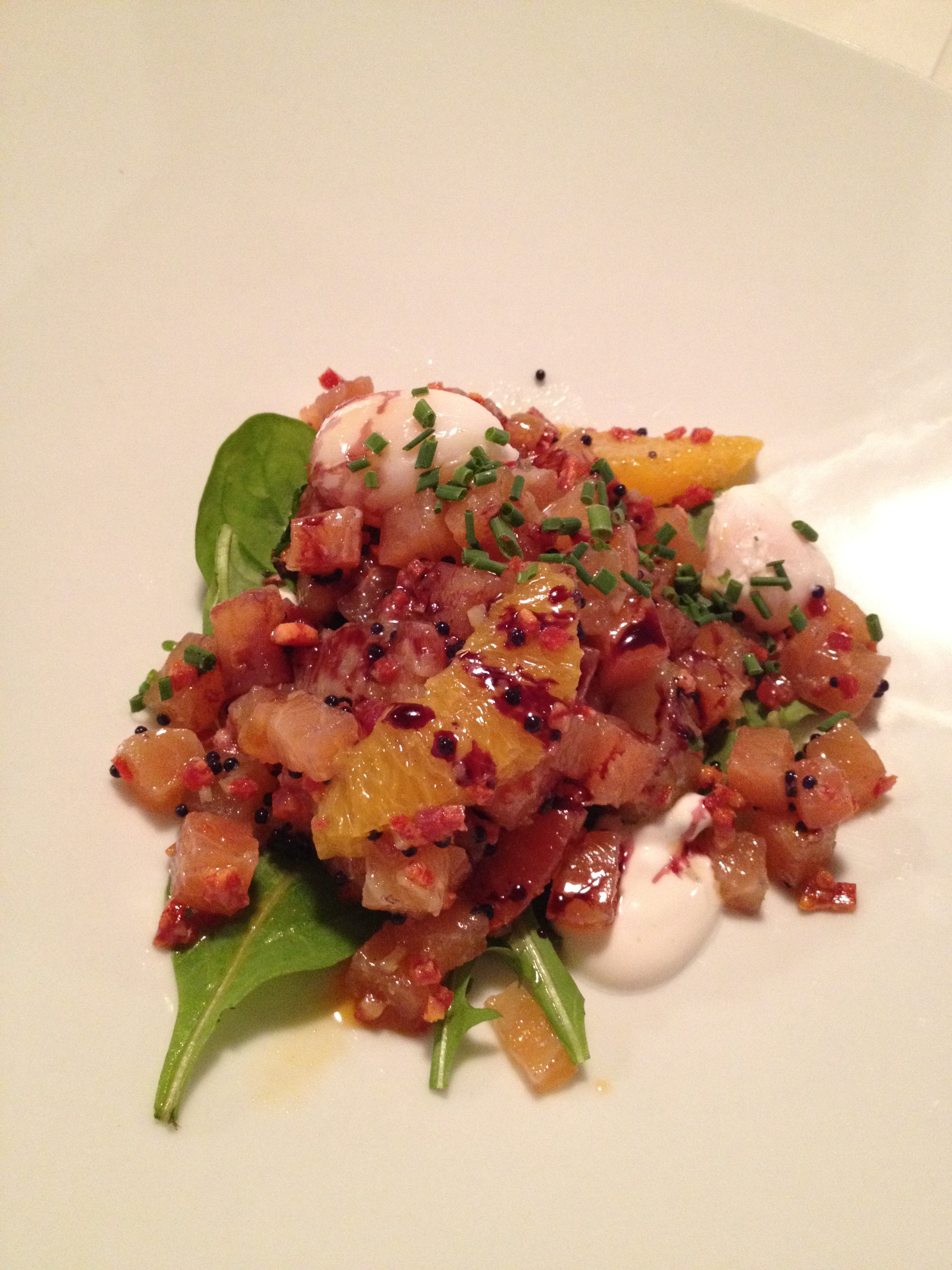
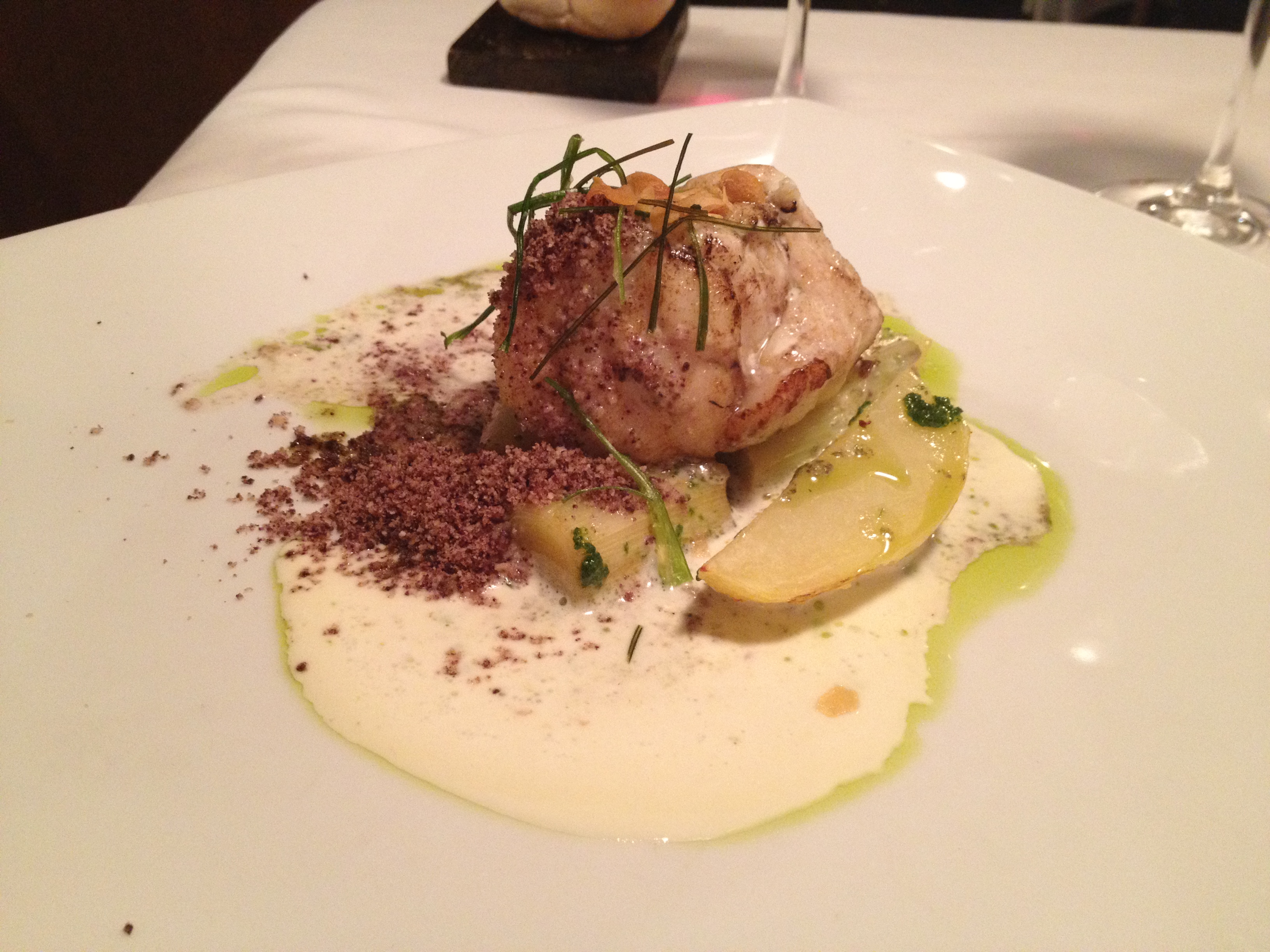
Up next was the tartar de salmon marinado con citricos, chorizo y huevo poché (tartar of salmon marinated in citrus, chorizo and poached egg), a variation on a traditional dish, we were told, where an unlikely fusion of marinated raw salmon with minuscule chorizo pieces scintillated all of the senses with a fresh citrus splash searing lemony acidity through the smokey pimenton of the chorizo. Meanwhile the poached eggs – tiny things – possibly pigeon’s, were perfectly runny, creamy and sweet. Further scintillation was to be provided in the form of rape asado con puerros y polvo de aceituna negra (roasted monkfish with leeks and black olive powder), a fresh and succulent cleansing dish with a seductively rich dusting of black olive to import mediterranean piquancy onto the plate.
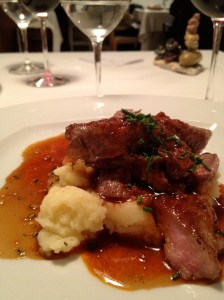
The fatty pork

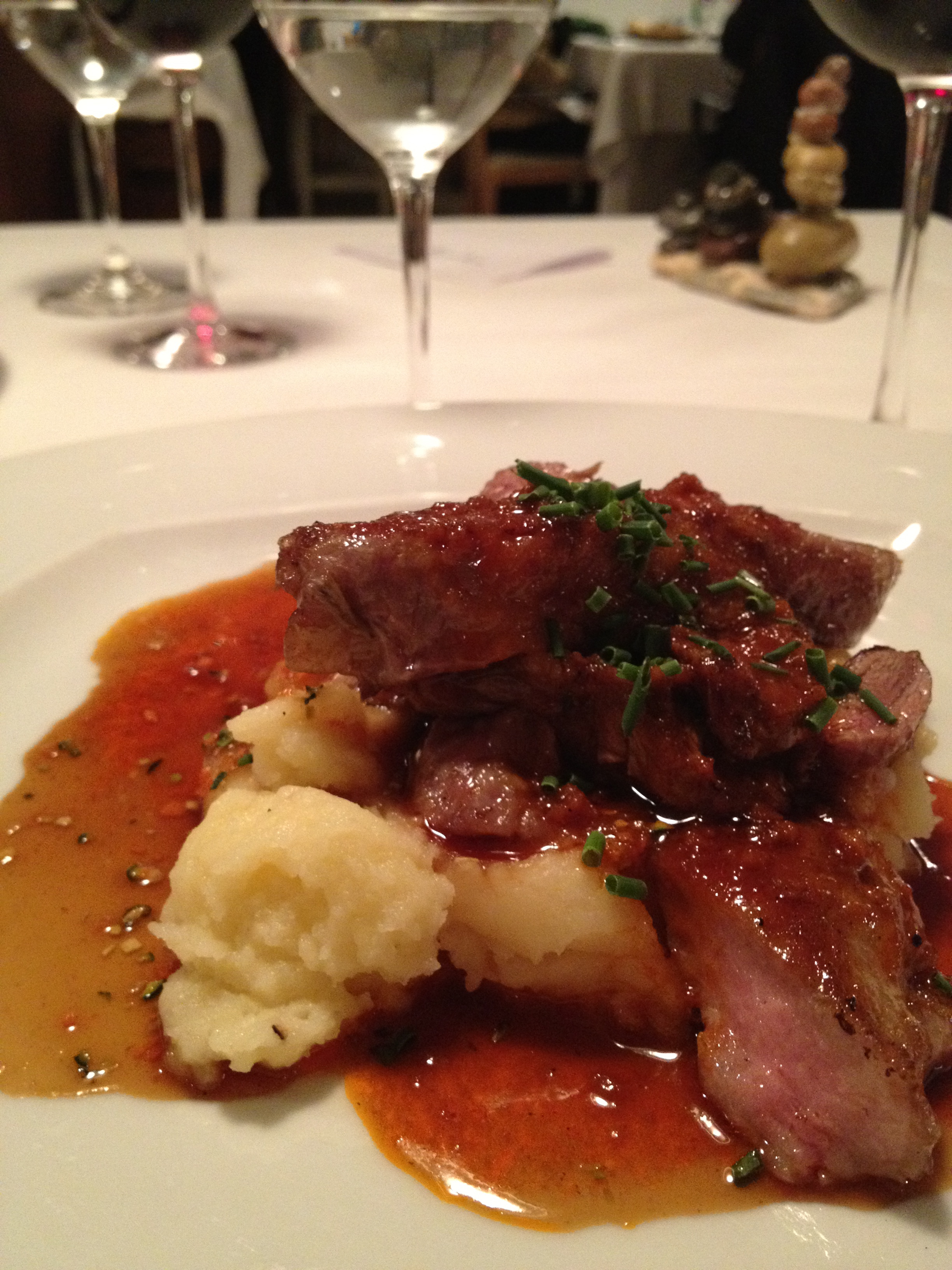
Things went a little awry while the main course of pluma de cerdo ibérico con ragout de verduras y salsa de miel (iberian pig “pen” with vegetable ragout and honey sauce) which was a little too fatty for us. Some people like fat, and crackling and all that porky sinfulness – I’m not a fan, and, embarrassed by my meek attempts at consumption (and by this point being a little tipsy) I then spent the next 20 minutes trying to hide much of the fatty pork in my napkin so as not to offend the chef. In hindsight, he probably would have forgiven me. He may not, however, forgive the pork-filled linen napkin which he finds in the toilet later.

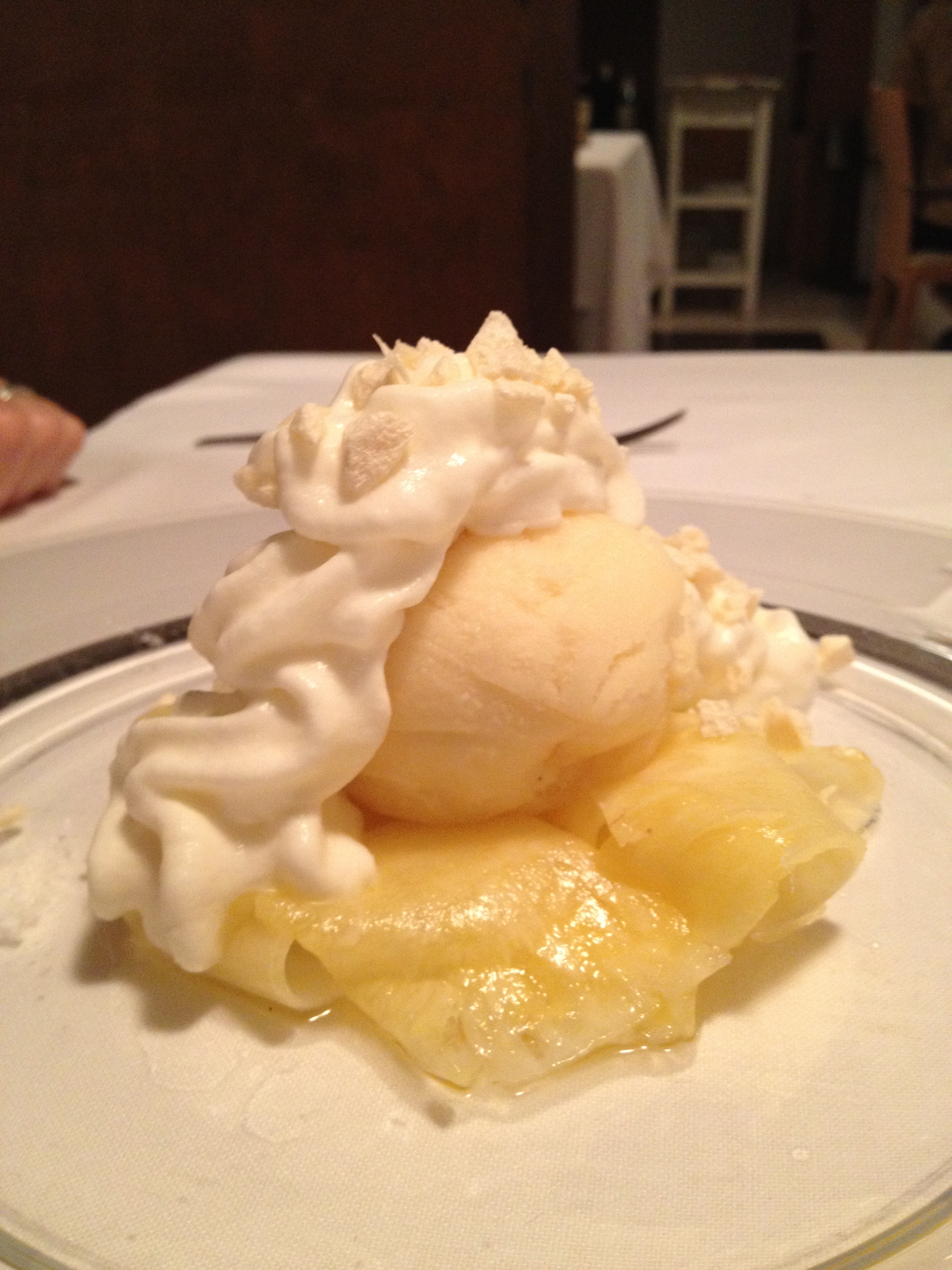
Back on track for piña a la piña con piña (Pineapple with pineappley pineapple), a dessert which presented pineapple three ways – sorbet, form and carpaccio. Not the most innovative dessert I’ve ever seen, but a welcome palate cleanser after all of that semi-masticated fatty pork.
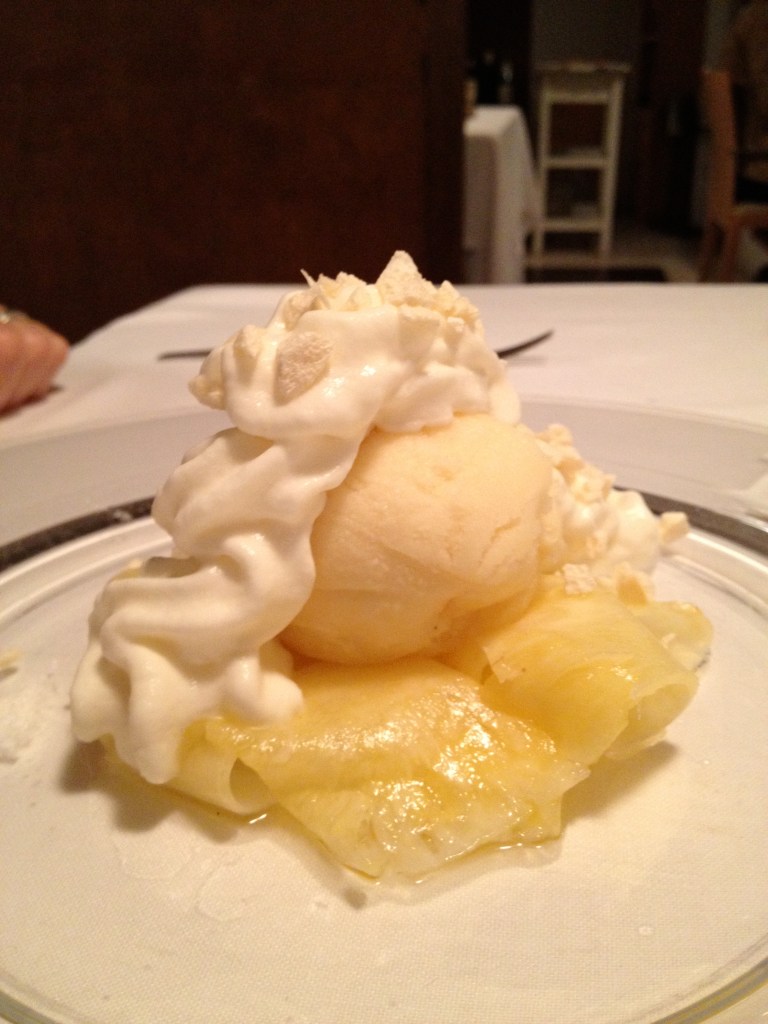
Piña piña piña

La Cocina de Toñoc/ Gran Via, 20, Salamanca  Tel 923 263 977
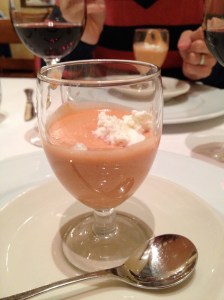
Strawberry gazpacho

Number 1 on the trip adviser list is this restaurant, the kitchen of Toño, another location which, upon arrival, looked a little speculative – to get into the restaurant you first pass through a very local-looking tapas bar, with a TV, and plenty of old men chatting up at the Bar. Passing through into the restaurant, things get a little better, but the place remains very traditional – old wooden furniture, dark walls, dated decor and a few drinks refrigerators to boot. But the food, ahhh the food. Toño’s kitchen provided nothing short of a culinary spectacle, a carnival of flavours which danced upon the plate, a flurry of gastronomic fusion which was a pure festival for all the senses.

First up was the aperitivo de la casa, a new take on the traditional andalucian gazpacho, the cold tomato based creamy soup successfully fused in Toño’s imaginative kitchen with strawberries. It made for a tantalising combination accompanied by a delicate ricotta for added creamy indulgence. Next up was a bombon de foie relleno de higos (Foie gras bombons with figs), a starter of such flavoursome sophistication that I felt compelled to lose all of my well-bred english inhibitions and gorge upon the delicate creamy form in a few enthusiastic mouthfuls.
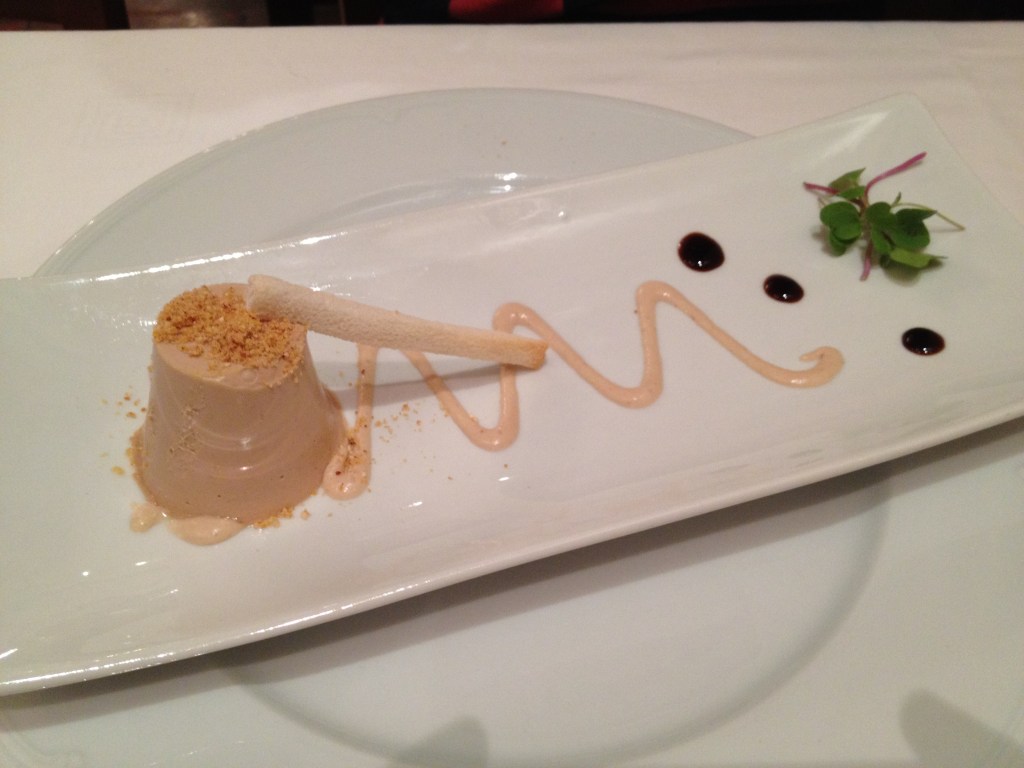
Foie gras bonbon

Ensalada de melon y langostinos

Pez mantequilla

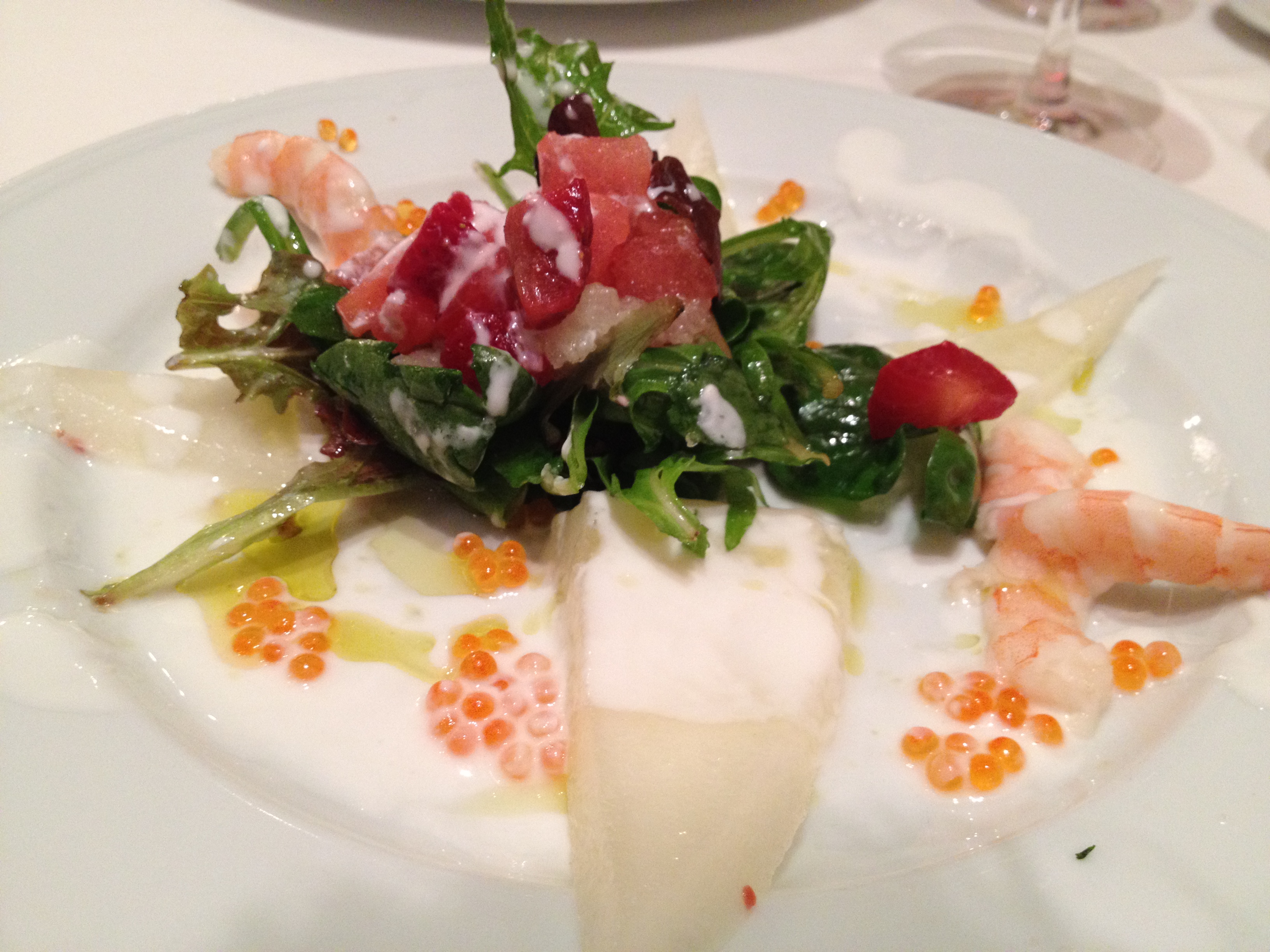
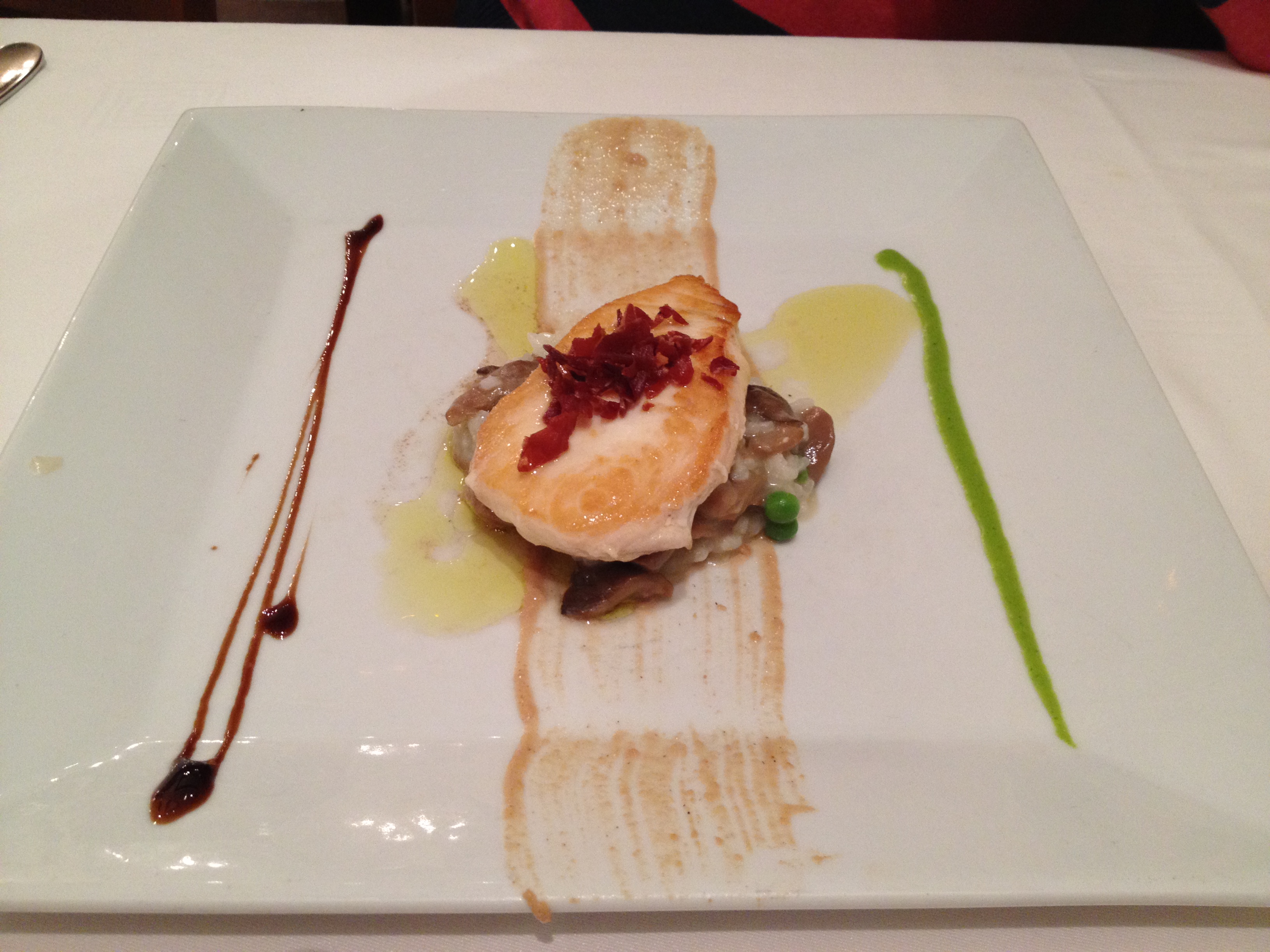
Onto the ensalada de melon con langostinos y vinagreta de yogur (melon salad with prawns and a yoghurt dressing), a delicate but multilayered combination of sweet unctuous prawns and a thirst quenching melon with silky, salty fish roe and sharp strawberries. The fish course came next, a pez mantequilla con arroz meloso con setas, vinagreta de vinagre de trufa y chip de jamon (fish in butter with sticky rice, mushrooms, truffle vinaigrette and a ham chip), a moist perfectly seasoned piece of fish on a creamy risotto base, with a salty ham accompaniment and sticky sweet viaigrette.
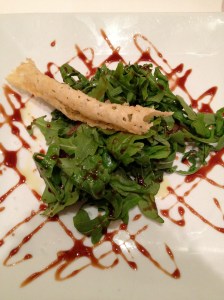
The main course spectacular

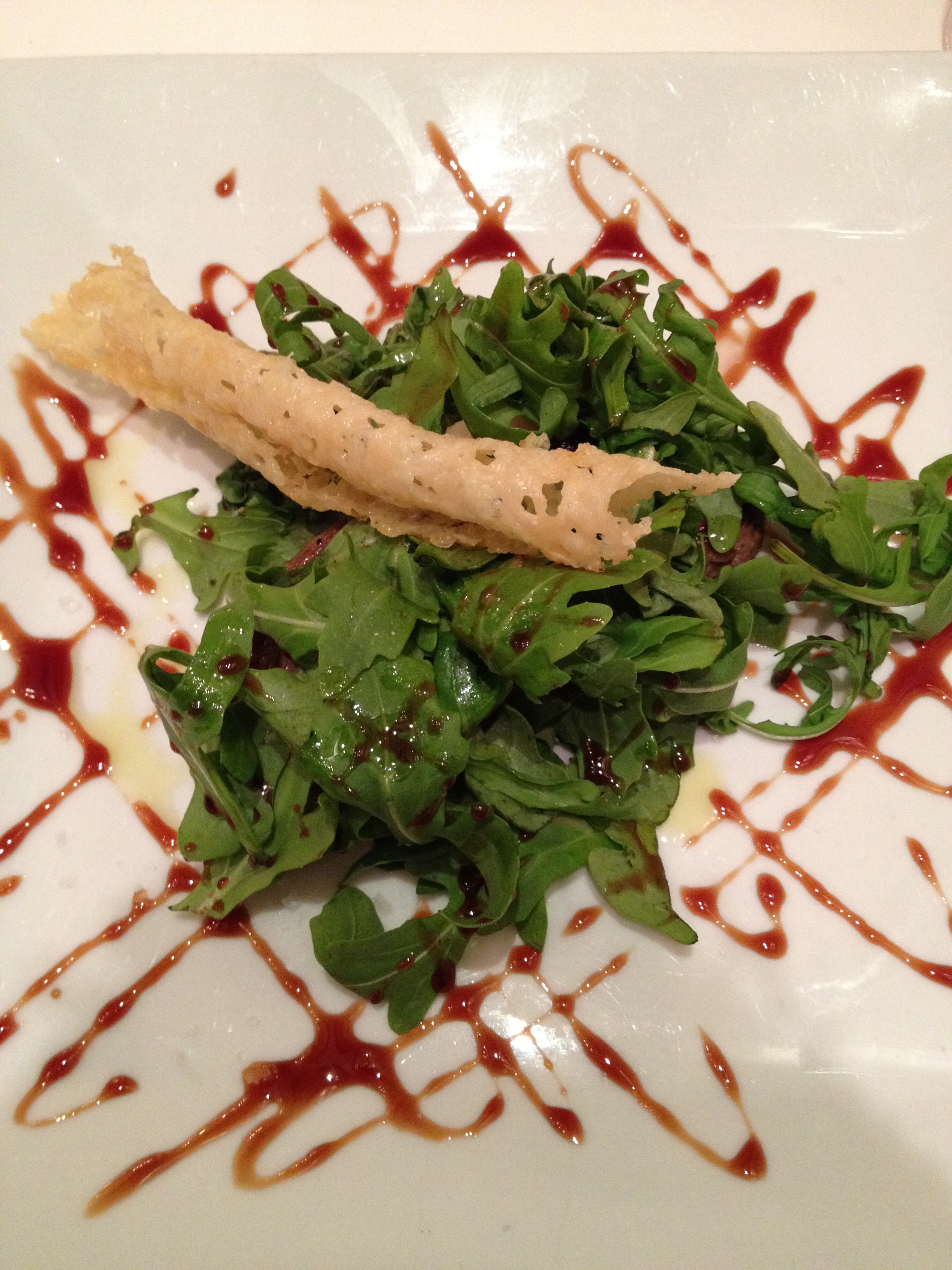
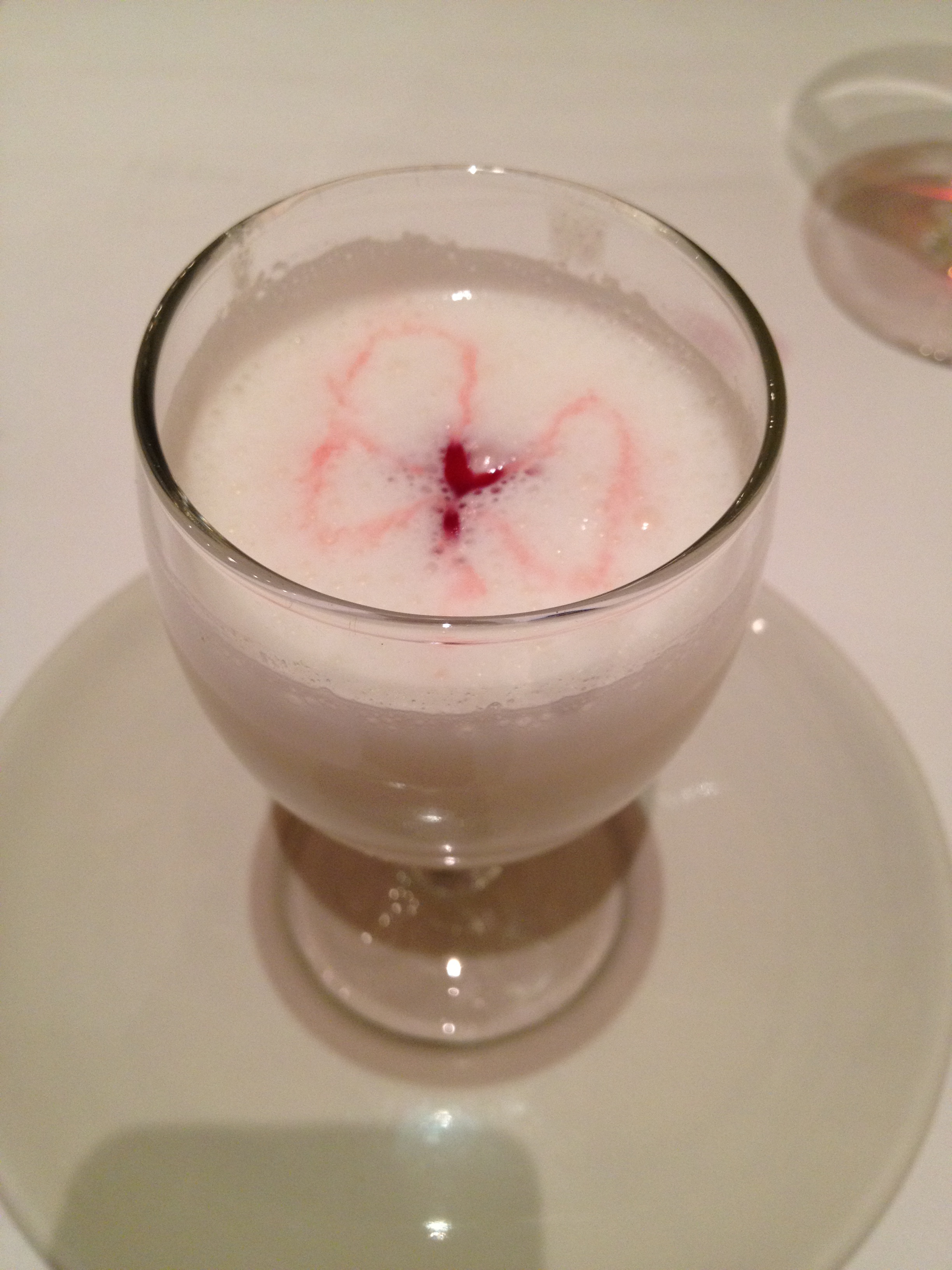
But at the Cocina de Toño, the piece de la résistance came with the main course, a dish which, upon first presentation, I didn’t think I would be able to eat, so full was my stomach and so little my remaining appetite. But as I cut beneath a bed of rocket and a perfectly crispy roll of melted cheese, I found a piece of meat so perfectly seasoned, so sensationally juicy and tender, that I could not help but scrape the plate clean – yes, Toño’s presa ibérica con cigala, canelon de queso y melaza de vino (iberico steak with rocket, cheese cannelloni and a wine reduction) was a sensation, a waltz of salts doing a tango on my tongue with a red wine reduction that was a syrupy sweet seduction. Not to be outdone, this was followed by a yoghurt “digestive”, a shot of fizzy, sparkling, sherbety, foamy pink delight, which was like being a child again. It reinvigorated senses which have long lost grown bored by adult life, and tingled down my throat and throughout my body making me shiver with delight. This was real willy wonker magic.
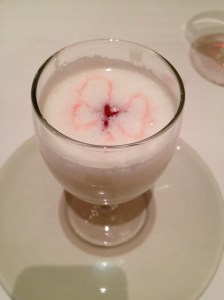
Fizzy yoghurt digestive

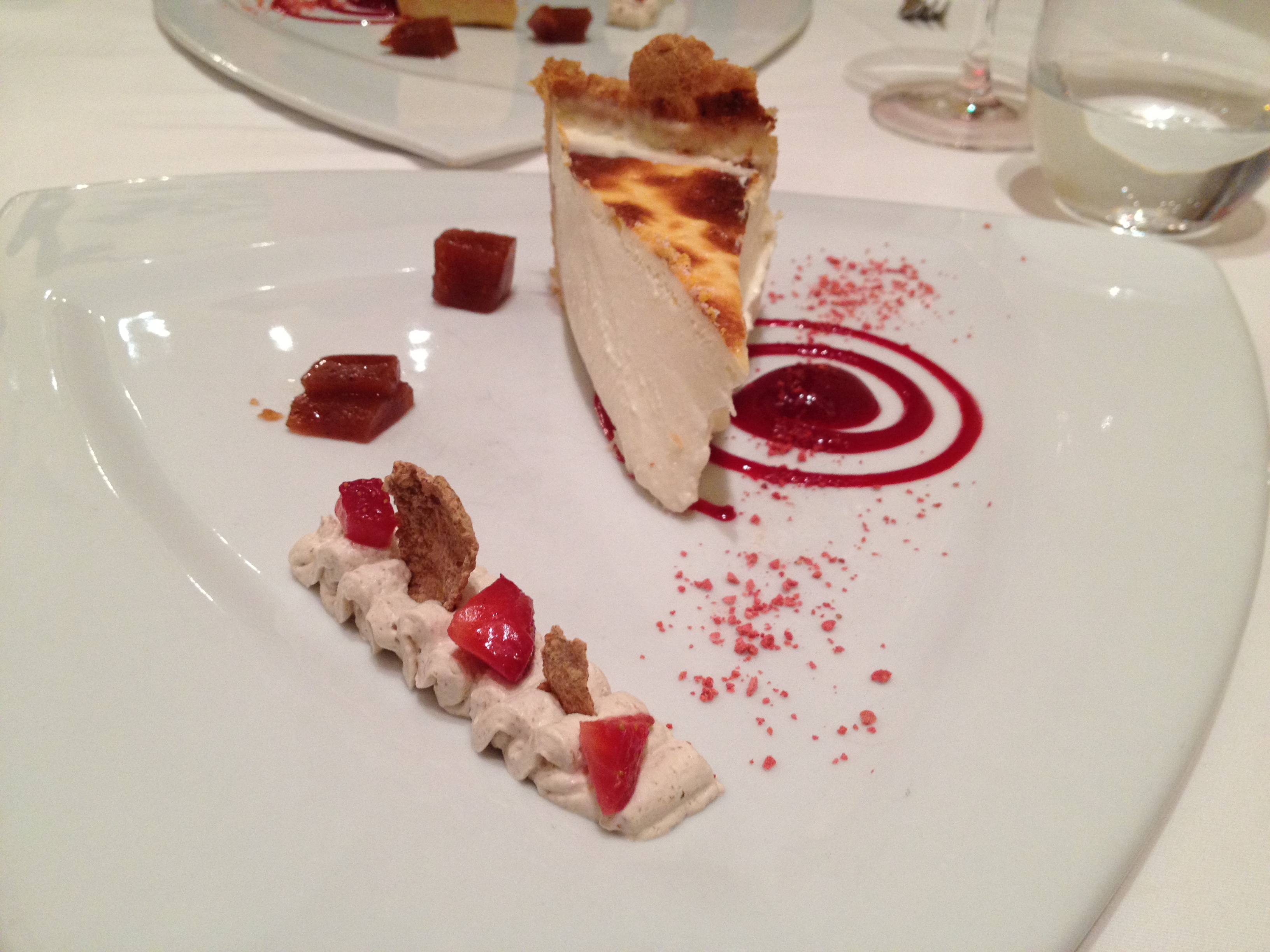
One dish more – a dessert of cheesecake, a surprisingly light springy construct, cross-pannacotta and creme brulee with a cheesecake touch. Delicious. But it beat me. This meal was spectacular. I feasted like a king. But felt roundly stuffed like Humpty Dumpty. I nonetheless was so excited, so almost emotional about the fine quality of the food that we had received that I actually kissed the waitress on my way out! Who can ever say that the english are inhibited? (She could I suppose just assume that I’m a typical english drunk).

Oh well, hats off to you Señor Toño. You’re certainly my Salamanca no. 1.
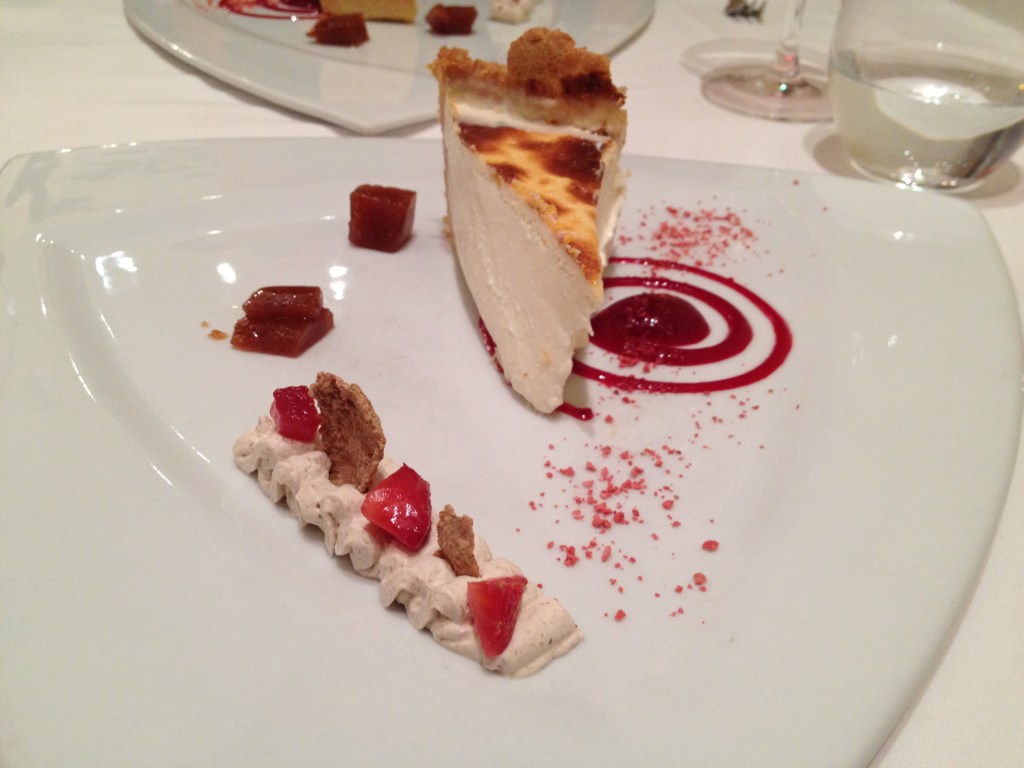
Cheesecake

So that’s it, my blog’s meandering journey through my trip from Madrid to Salamanca is at an end. I hope you’ve enjoyed it, at least as much as you can without actually sampling the gastronomic delights, the golden glow, and the distinctive smell of a town steeped in history at every masterfully stone-masoned house, church and lowly street corner. Time to start thinking about where comes next. Until then…

Salamanca – My photographs

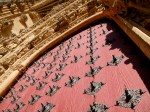
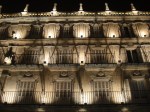
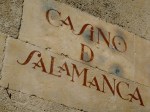
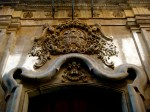
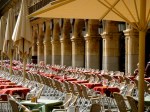
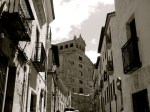
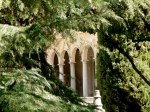
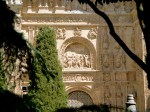
You’ve read all about my trip around beauty-suffused golden-hued Salamanca, and now I’m sharing a few of the vastly numbered photographs (around 750 in total!) which flew out of my camera in response to the sensational sights which pleasured my eyes at every turn of this aureate city. From sun drenched cloisters and intricate stone masonry, to the city’s modern day junctions and its glowing facade at sunrise, these photos are testament to my adoration and admiration for a city which inspires from every elegantly carved facet of its kaledescopic cultural, historical and aesthetic offerings.

Once you’ve indulged on the visual delights which Salamanca’s offers aplenty, come back to The Daily Norm tomorrow, when the gastronomic delights and inexorable strengths of both Madrid and Salamanca will be my focus. Until then, enjoy…

© Nicholas de Lacy-Brown and The Daily Norm, 2005-2012. Unauthorized use and/or duplication of the material, whether written work or artwork, included within The Daily Norm without express and written permission from The Daily Norm’s author and/or owner is strictly prohibited. Excerpts and links may be used, provided that full and clear credit is given to Nicholas de Lacy-Brown and The Daily Norm with appropriate and specific direction to the original content.