

David Hockney at the RA – A stroll through the countryside without any defining moments
The dials of the huge London PR machine have been whirring noisily in anticipation of the David Hockney blockbuster show at the Royal Academy of Arts. Suddenly the charismatic British artist, complete with broad Yorkshire accent, white beret and a cigarette rebelliously hanging out of his mouth, has been on the front of every paper and magazine. For a new show of his work, simplistically titled “A Bigger Picture” has come to town, hailed as a key event of the Olympic year, as the living artist is practically unique in having the whole mass of the Royal Academy’s huge main galleries turned over solely to him. And the incontrovertible fact is, yes, these new paintings are very, very big. But as the wise (or just disappointed) often remind themselves…size isn’t everything. For poor old Hockney, stuck in the frenzied efforts of an ageing artist faced with the Herculean task of filling the RA space with largely new works created in only a handfull of years, this much-lauded artist has fallen foul of yet another well known adage: quality, not quantity.

The Road across the Wolds (Hockney, 1997)

Salts Mill, Saltaire, Yorkshire (Hockney, 1997)
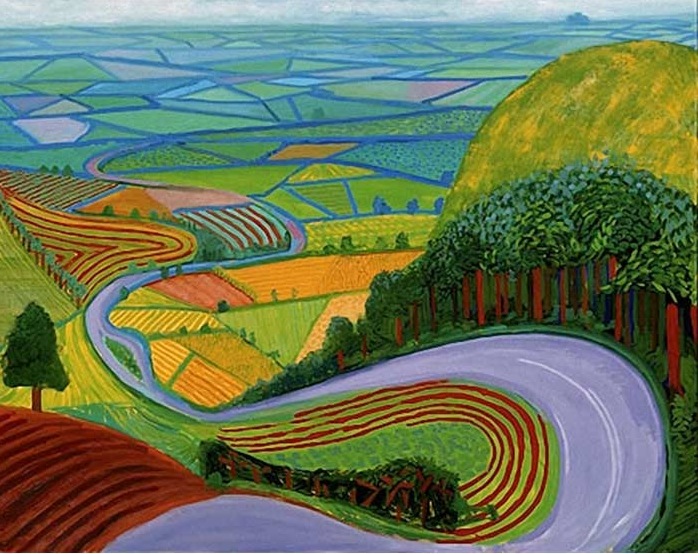
Garrowby Hill (Hockney, 1998)
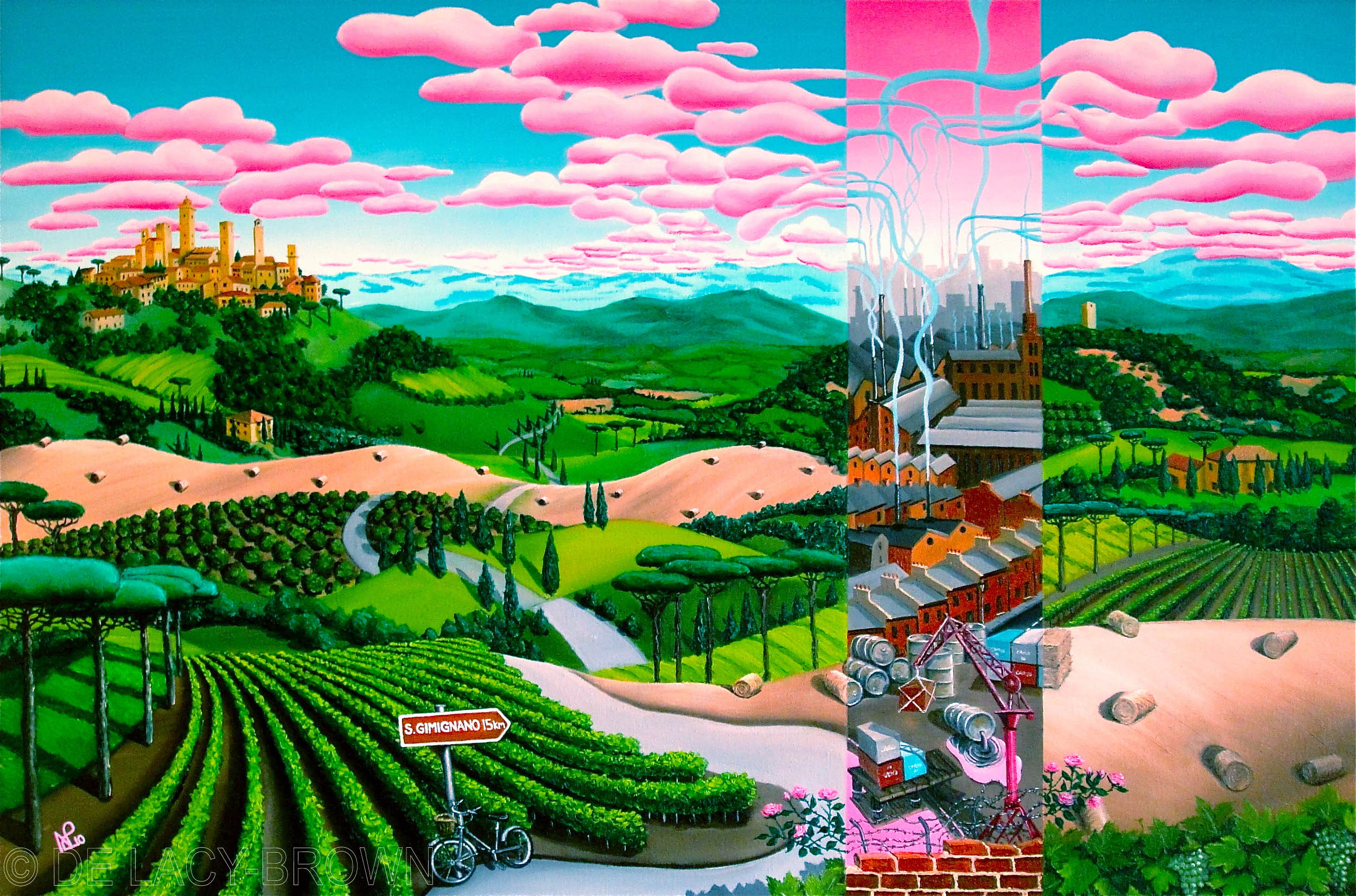
The exhibition started well. Once we had passed fairly swiftly through a gallery containing four landscapes of the same three trees in Thixendale, each painted in the four respective seasons, we entered a gallery paying retrospective homage to Hockney’s pre-2000 landscapes, starting with his magnificent burning orange rocky illustration of the Grand Canyon, and moving on to his Yorkshire landscapes completed when he moved back to the area from a long spell in LA (see above). I really enjoyed these works. With their bold but reflective colour scheme and rolling hills (which reminded me of my own Tuscany painting) they were pleasing on the eye and original in their composition. From there, we moved into the first of a long line of huge galleries all of which, as it turned out, contained pretty much the same image repeated countless times during different seasonal changes and from slightly altered viewpoints. The first wall was like a tapestry of small oil paintings which, as a set, worked well. They were pleasant to look at – like seeing a slideshow of countryside views all at once. However on closer observation of any specific canvas, it was clear that the works lacked in painterly technique – despite being painted outside, from observation, and at speed, Hockney does not capture the light or the complexity of the landscape in the sensational way that that other great outside painter, Claude Monet, did. In fact, for the most part, Hockney’s brushwork looked decidedly lackluster, even childish.

Three Trees near Tixendale, Spring (Hockney, 2008)
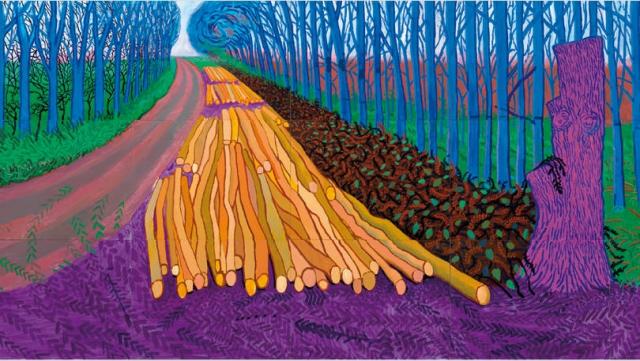
Thereafter we were met with a strange sensation of déjà vu as we walked form painting to painting, from one room to another. They are all paintings of trees. Lots and lots of trees. He hasn’t just painted forests, but with wall to wall forest views he’s managed to create a 3D forest in each of the galleries… perhaps that was the intention. Trees on single canvases, trees on multiple canvases stapled together, trees on film, trees on his iPad. Trees. That is not to say they weren’t pleasant, and scenic, and all the other niceties one can throw at them – but there was nothing striking, nothing remarkable. It was like bring on a stroll or a drive through the countryside. You look around you and think: the scenery is beautiful. And as you move on, you continue to be impressed by the subtle changes in the landscape all around you. But nothing really stands out. It just makes for pleasant surroundings. That was this exhibition – pleasant, samey and oh so repetitive.
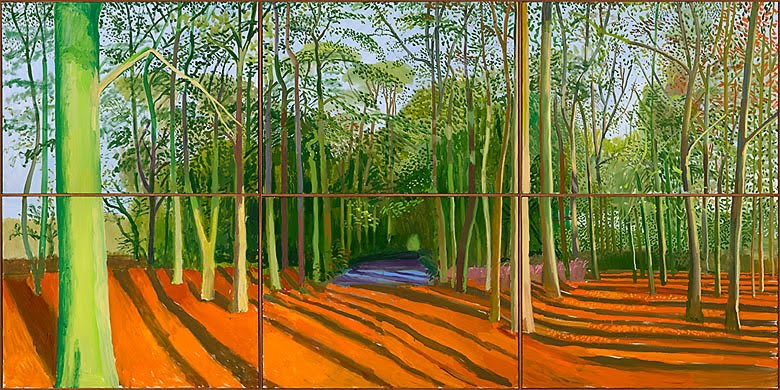
Woldgate Woods 21, 23 and 29 November 2006
There was one distinguishing feature of course – but it’s nothing new for Hockney. It’s his fragmentation of all his big paintings into lots and lots of little canvases. In a way it probably makes them easier to paint in smaller spaces, more economical to travel, and more practical when the size of the walls available at the RA demands huge canvases to fill the space. But on so many occasions, Hockney was painting at a scale when a complete one-piece canvas would have done the job. But still he would insist on painting the scene across several canvases, even though they would then be stapled and framed together (thus obviating the benefits of smaller canvases considered above). The effect of this fragmentation of the canvas space was, for me, distracting, not least when Hockney had not even lined up the image over the canvases properly, so one tree trunk would start somewhere else in the adjacent canvas. To me, all these harsh deep edges, grid-like across the painting, felt a little violent as they jarred with the organic, living and breathing landscapes captured in the painting.

The Big Hawthorn (Hockney, 2008)
Nonetheless, the biggest distraction of all had less to do with Hockney’s compositions and much much more to do with the vast multitudes of people all around us. The place was packed – and this was a Friends’ preview day. Overcrowding has been the cause of much grumbling amongst the RA Friends, who after all pay a rather hefty annual subscription for these rare privileges of private views and the odd discount. In an attempt to alleviate the squash, the RA has started allocating Friends entrance times (causing further grumbles) but despite this, the RA clearly over-allocates for the space available, and as a result not only was every room packed tight but there was a vast queue to even enter the show. This cram did not dissipate at any stage, right up until the shop at the end, where people where fighting over postcards, swiping catalogues within an inch of another customer’s nose and losing all semblance of social etiquette in aggressively pushing their way to the till.

The Arrival of Spring in Woldgate (Hockney on his ipad, 2011)
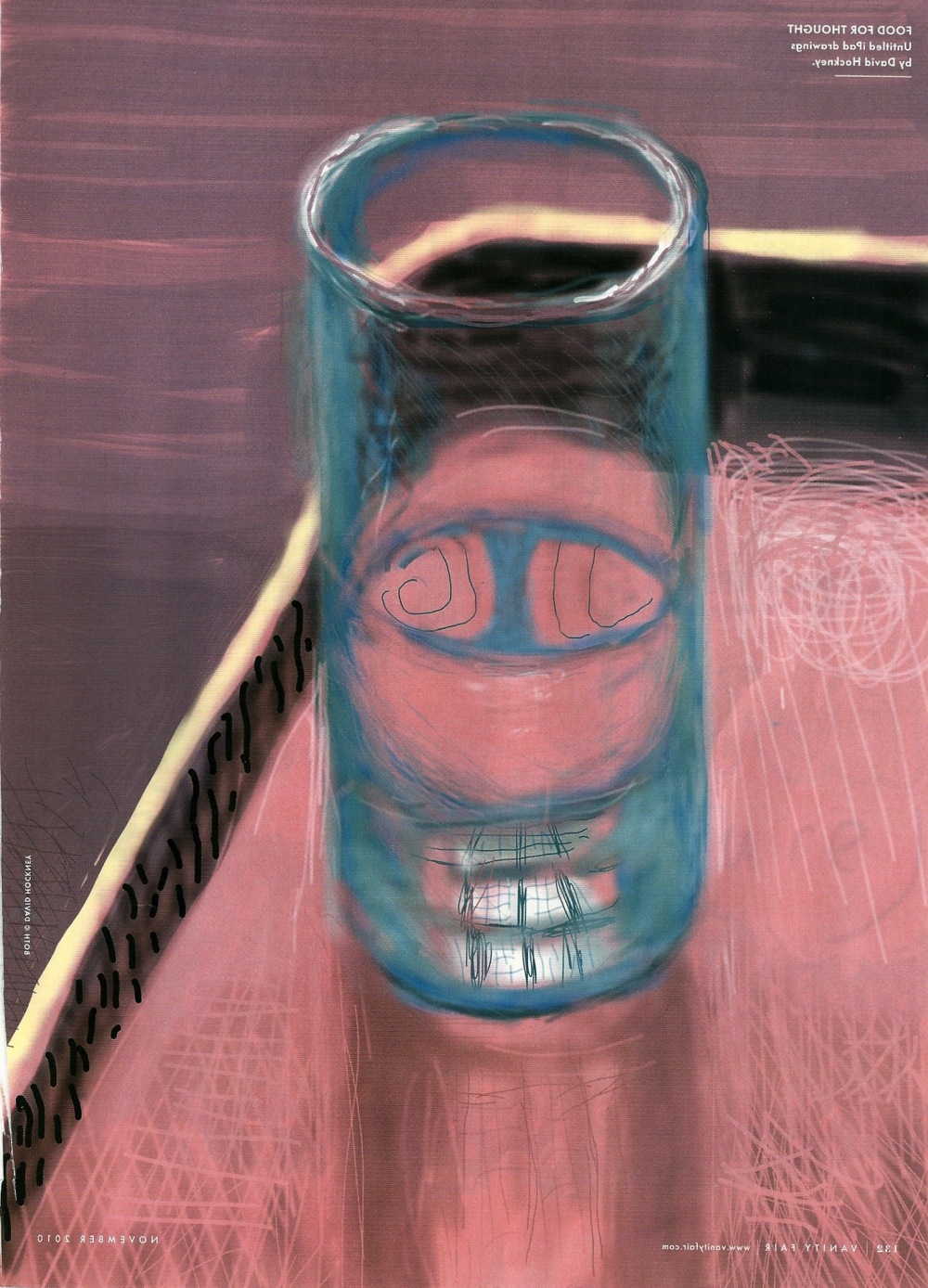
This crush meant that the very point of the exhibition was a flop. For big paintings require a wide berth to be given before each painting so that one can stand back and consider the work from afar. But no such luck for us, pushed almost with our faces against the canvas, so what was visible more than anything was Hockney’s rather coarse brush strokes, rather than the intended over all effect of the whole. This was not, at least, a problem with the much talked about iPad pictures of which there were some 60 or so. These were blown up (and printed) quite substantially, but lost none of their precision in being so inflated – this was great news for the audience who could appreciate the iPad image from both close up and from a distance, all without pixilation disturbing the effect. However, disappointingly, because the works weren’t shown on iPad themselves, the whole point of this new digital medium was lost, since the images lacked the background luminescence which they would have boasted when created in their original form.
The final part of the exhibition did at least introduce some diversity. Hockney’s relentless study of Claude’s Sermon on the Mount resulted in a series of parodies. These made for a refreshing change – like finding a well lit path again after trawling through a dense forest. The biggest reproduction was particularly impressive. Having said that, Hockney has not added much to his reimagining of Claude’s work, only making it a bit lighter and more colourful. It’s a far cry from Picasso’s reworking of Velazquez’s Las Meninas for example, where he not only poked fun at the original, but brought so much of his own original style into the frame.
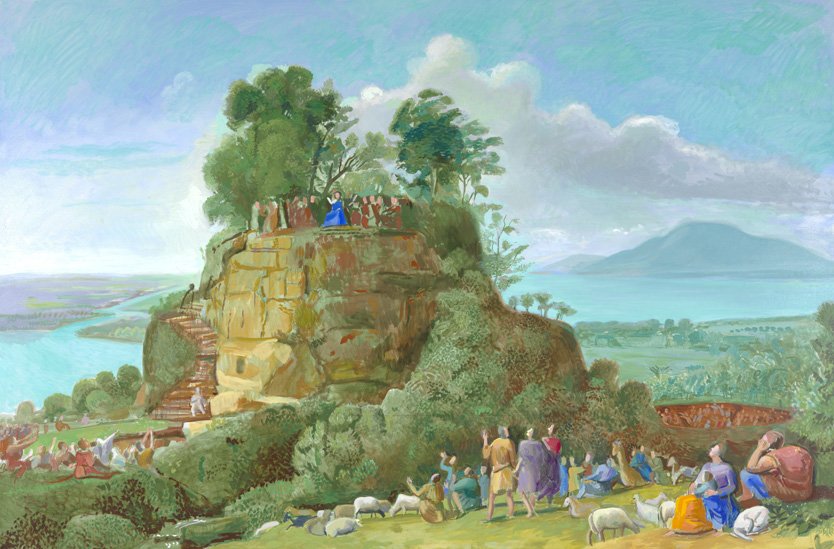
The Sermon on the Mount II (after Claude) (Hockney, 2010)
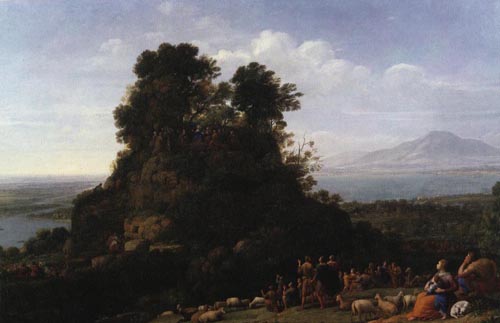
The Sermon on the Mount (Claude)
Hockney concludes the exhibition with a series of films of, yes, you’ve guessed it, trees (amongst other things) captured concurrently using 9 or 18 cameras. Such was the cram in the cinema-laid out room where they were being shown that I could get nowhere close, so in fairness to Hockney, I will comment no further.

The Arrival of Spring in Woldgate (Hockney, 2011)
In conclusion then, this show is like a refreshing stroll through the countryside on one of those days when the sun is out, and the first signs of Spring are breaking through after a frosty winter. But like all walks, you get tired quite soon, and the beauty of your surroundings quickly fade as your attention is swallowed up by the aching in your feet and the realisation that upon walking so far, you have the same distance to cover in order to get home again. There’s too many trees and too many people. Moreover, there is an overall feeling that the works have all been a bit rushed in anticipation and realisation of the scale of the show. Size isn’t everything, but clear away the crowds and you may just be able to appreciate the quality of the wood from the quantity of the trees.
All the images contained on this post are the copyright of David Hockney.
Written content is the copyright of Nicholas de Lacy-Brown © 2012.
Related articles
- Brit Art is the main focus of the UK’s 2012 exhibition diary (normsonline.wordpress.com)
- David Hockney-mania overloads Royal Academy website (telegraph.co.uk)























 The Daily Norm
Jan 25
War in my Art: Works inspired by Birdsong
Having reflected for the majority of last week’s posts on the subject of war, I made the decision to seek inspiration further by visiting London’s Imperial War Museum. There, tucked away behind the major exhibitions of planes, military instruments, uniforms, the holocaust and even a WW1 trench reproduction, is a collection of war art to rival all of London’s major galleries. There is something about war as a subject matter which loads each and every painting with a heavy significance, because you know that for these images to have been produced, the painter has either lived through the hell portrayed, or at least witnessed it first hand. Consequently the pain which is captured is visceral, the emotions cutting, cynical, raw. Yet these works are undoubtedly beautiful. At the centre of the IWM’s collection is Sargent’s gigantic work, Gassed, an incredible, moving image, which shows soldiers who have been temporarily blinded after a gas attack helping to guide one another with in caterpillar-like line, while all around them, soldiers similarly afflicted fill both the foreground and background. It’s scale is startling, but the small moments of human kindness in desperate times are even more striking.
John Singer Sargent, Gassed (courtesy of Imperial War Museum, London)
This painting is not unique in it’s superb captivation of WW1, and as you stroll around the collection at the Imperial War Museum, paintings which you may never have seen before seem somehow familiar – for it is clear that as the memory of war slips further and further into the past, with survivors now few and far between, and photographic and film accounts being scarce and of poor quality, it is the paintings of war which now take centre stage in helping a modern audience to imagine the apocalypse of trench warfare. It is, for example, immediately clear to me that the cinematography in Spielberg’s new film, Warhorse, is inspired by the haunting trench landscapes of Paul and John Nash.
Yet before I even set eyes on the Imperial War Museum’s collection, I was myself emotionally engaged with the subject of war, and sufficiently inspired to begin painting it as a young artist. The source of my inspiration was the novel Birdsong by Sebastian Faulks. The novel is the only book every to have made me cry. It’s depiction of war is so striking, so accessible, that it is impossible not to be caught up with the plight of its characters and the horror of war. For a 15 year old reading the story, I was unintentionally drawn wholeheartedly into this evocative re-imagining of the First World War, even though so many people in my generation appreciate little about it – for most they think WW1 is all about wearing a poppy every 11/11. And when I finished the novel, one of those rare moments of inspiration flooded into my head – I knew immediately that I wanted to paint a tryptic based on the scenes conjured in my head. And the fact that I then painted war without pictorial reference is, I suppose, testament to what a superbly descriptive writer Sebastian Faulkes is. Having at last got home to my parents’ house in Sussex, I was able to photograph the paintings which resulted from that inspiration. I painted them at the age of 15, before I really appreciated that I might have artistic talent, and certainly before I took it seriously. Nevertheless, I like the paintings to this day probably since their imagery, like their subject matter, has timeless significance.
Screaming Soldier - A Victim of War (acrylic on paper, 1999 © Nicholas de Lacy-Brown)
Trench Rat (acrylic on paper, 1999 © Nicholas de Lacy-Brown)
The Truth Behind the Poppy (acrylic on paper, 1999 © Nicholas de Lacy-Brown)
Following these works, I moved onto another tryptic of war paintings, this time depicting the First and Second World Wars and the Cold War. I donated the collection to the history department of my old school Our Lady of Sion School in Worthing, where I believe they are still hanging to this day. Sadly I don’t have any photos of the works, but before I donated them to my school, the paintings attracted the interest of Worthing Town Hall. As a result, the works were exhibited in a special exhibition marking Remembrance Sunday in November 2000. A photograph of me with the Mayor of Worthing and the pictures hanging on the wall behind us was on the front page of the local Newspaper that month. That paper was then painted into the background of another of my very early works in which I mourned the death of my guinea pigs. So here it is, the only picture I have left of that second war tryptic.
Cinnamon and Nutmeg (acrylic on canvas, 2000 © Nicholas de Lacy-Brown)
The conclusion of this post is, I suppose, the potential of a well-written novel to empower the mind, and to recreate past tragedy in the minds of innocent, often unappreciative generations. That novel, Birdsong, is not only a must-read. It is also now a must-see, a televised adaptation having premiered on BBC television last Sunday which is every bit as beautiful, sensitive and poignant as the novel, and so much more powerful in its portrayal of war than the current cinematic offering, Warhorse.
Related articles