Skip to content

Posts tagged ‘Art’

2011 – The Daily Norm’s top five (and floppy five) exhibitions of the year

When looking back on any year, it’s very easy to concentrate on what a rubbish year it’s been. And this year is no exception, what with economic gloom, a projected double-dip recession, euro-zone gloom, riots and unemployment gloom. Lot’s of gloom basically. But for that reason alone, I, ever the optimist, try to look back on the highlights of the year. And these tend to consist of two main categories – holidays (of which, sadly, there are not enough to fill a review such as this) and art exhibitions (of which there have been plenty). I am lucky enough to have attended the lion’s share of the exhibitions which London, and further afield, had to offer in 2011, and therefore, in a season when all the papers seem to be doing “roundups” of the year, I thought I’d share my thoughts on the best (and worst) exhibitions I’ve seen this year.

No.5 | Toulouse-Lautrec and Jane Avril: Beyond the Moulin Rouge – Courtauld Institute of Art, London

Jane Avril in the Entrance to the Moulin Rouge, c.1892 © The Samuel Courtauld Trust, The Courtauld Gallery, London

This small exhibition at London’s superb Courtauld Institute at Somerset House was no less brilliant by virtue of its size. Taking up space in only two of the Courtauld’s many galleries, the show was an intimate but atmospheric examination of the Absinthe-tinted shadowy underworld of the Paris cabaret-scene so emblematically captured in the works of post-impressionist master, Henri de Toulouse-Lautrec. It is thanks to him that seminal movie moments such as Baz Luhrman’s Moulin Rouge have been able to capture the essence of 1890’s debauched Pigalle social scene, filled with wonderful personalities such as La Goulue (the Glutton), Grille d’Egout (Sewer-grate) and Nini les-Pattes-en-l’air (Nini legs-aloft) as well as other characterful prostitutes, drunks and dancers. One such dancer who became synonymous with the Paris dancehall spectacle was Jane Avril, one of the stars of the Moulin Rouge, who undoubtedly played the role of muse to Lautrec’s portrayals of that same infamous nightclub. Such was her prominence in his work that her flame-red hair and exotic dance moves became symbols of the Moulin Rouge spectacle, as her fame was assured by a series of dazzlingly inventive posters in which she was the central attraction. However, her influence on Lautrec went further, and this exhibition features a number of stirring, more emotional portraits of Jane Avril which show the dancer off the stage, in private moments of introspection.

At the Moulin Rouge, 1892-95 © The Art Institute of Chicago

Such was the importance of this artistic coupling between aristocratic Lautrec and courtesan-born Avril (née Jeanne Beaudon) that the Courtauld placed the relationship at the centre of its show, including photographs of both the Artist and the dancer, and examination of the peculiar “St. Vitus’ Dance” disease which gave Avril her unique, disjointed dancing style, and an attempt to explore Avril’s persona, both in public and in private. This core objective was explored effectively by the Courtauld, but for me, the real winner of the show was simply the basic exposure it gave to this wonderful atmospheric Parisian world of the 1890s. Therefore for me, the star of the show has to be this piece leant by the Institute of Chicago, At the Moulin Rouge, a scene which perfectly depicts the atmosphere of the dancehall, complete with a self-portrait of Lautrec himself, the emblematic red hair of Avril, and the looming ghostly green face of May Milton, one of the performers, imbued with even more Absinthe-green hallucinogenic mystery than the melancholic daze induced by the green fairy in Manet’s masterpiece, L’Absinthe.

Read more

Sunday Supplement: Christmas Double

For this week’s Sunday Supplement, it is in the spirit of Christmas that I bring you not one but TWO de Lacy-Brown paintings to add a little artistic fulfilment to your weekend. And, seeing as this will be the last Sunday Supplement before the big day itself (I am anticipating being ever so slightly too merry and/or stressing in the kitchen next Sunday to blog…and I suspect you will be too busy in similar scenarios to read the good old Daily Norm) I bring you two paintings from my collection which have the great festival of Christmas at their core. Some way apart, the first, painted in a more illustrative style, was created in 2002, while the second, painted in 2010, features a much more matured, realistic style of representation.

Ice Skating at Somerset House (acrylic on canvas, 2002 © Nicholas de Lacy-Brown)

The first work, above, was painted when I was in my first year at university in London. Studying at King’s College London on The Strand, I was lucky enough to be situated bang next door to what has become one of the most iconic sights of London’s Christmas celebrations: the ice skating rink at Somerset House. Flanked on all sides by the stunning Neo-classical masterpiece of Somerset House, the rink in the building’s huge cobbled courtyard is utterly atmospheric, reminding of the days of Dickensian London street scenes which, thanks to the likes of A Christmas Carol, have become synonymous with the traditional view of Christmas all around the world. At night, the rink glistens under turquoise lights, flame lanterns flickering on either side, and a tree, usually sponsored by Tiffany & Co. the jewellers, sparkling at the foot of the ice. It’s a wonderful place to skate, and it is something I really miss doing every Christmas since my accident in 2008 precluded me from engaging in such a risky activity. This painting however represents the jovial, whimsical joy of the skating I remember. However, if you ever got the rink as empty as this these days, you’d be very lucky…

Alexander, Enchanted by Christmas (oil on canvas, 2010 © Nicholas de Lacy-Brown)

The second painting of this week’s Christmas double-whammy is my later portrait of my nephew Alexander when he was just 18 months old. It captures a magical moment when he encountered the large family Christmas tree for the first time. Utterly entranced by the feast of new colours, objects and lights on view, he was literally stopped in his tracks as he took in the wonder of Christmas before him. Painted in a more photo-realistic fashion, I have tried to capture the furry white brim of the cute santa hat he was wearing, while blurring out the tree lights in the background. It was a beautiful moment. As ever, Christmas really is enhanced by the joy you can see reflected in a child’s eyes. However I may feel differently come this time next week, when I have three toddlers running rings around me, fighting for presents and playing catch with the baubles.

Postscript: If you like the painting of Somerset House above, and would like to own a high quality giclee print of the image, there are some available for sale via my Etsy online shop.

© Nicholas de Lacy-Brown and The Daily Norm, 2002-2011. Unauthorized use and/or duplication of the material, whether written work or artwork, included within The Daily Norm without express and written permission from The Daily Norm’s author and/or owner is strictly prohibited. Excerpts and links may be used, provided that full and clear credit is given to Nicholas de Lacy-Brown and The Daily Norm with appropriate and specific direction to the original content.

Norms do… Degas’ L’Absinthe

I’ve always been a bit obsessed with the la fée verte . That is to say, I’ve always been fascinated by the debauched charm of that wonderful peppermint green drink which was and still is (in its full potent form) an illegal alcoholic substance: Absinthe. For absinthe has long been the chaperone of artistic legend, as all the most romantic illusions of the impoverished, desperate, inebriated artist are indubitably accompanied by a bottle of the green stuff, or a glass of its milky diluted counterpart. Baz Luhrmann’s Moulin Rouge, the green faced cancan dancers of Toulouse Lautrec’s underworld masterpieces, and the dissolute tale of a spiral into poverty and lascivious living on the hillsides of Montmartre in Zola’s L’Assomoir all centre around the mirky hallucinogenic potency of this green-eyed alcoholic monster. It is the very essence of bohemian artistic Paris, and it’s association has pervaded art and its cultural progeniture for decades. One of the most prominent sources of the liquor’s legendary quality is the sensational painting L’Absinthe by Edgar Degas. I first saw the painting in London, when it was exhibited at Tate Britain’s superb exhibition Degas, Sickert and Toulouse Lautrec in 2005-6. I was instantly struck by the simple solitude of the female figure, caught in a moment of absentmindedness and melancholia, appearing quite isolated despite the figure sat to her left, he looking away in his own depressive daydream. I’ve remembered the painting ever since and therefore I was so excited to make its acquaintance once again upon visiting the Musée d’Orsay the other week that I decided I had to turn it into a Norm painting. And so, when the Norms do Degas, it looks something like this…

L'Absinthe Norm (after Degas) (Acrylic on canvas, 2011 © Nicholas de Lacy-Brown)

Degas’ original painting, on the other hand, looks like this…

L'Absinthe (Edgar Degas, 1876)

Read more

Sunday Supplement: Merry Christmas, Goodwill to all (Gingerbread) Men

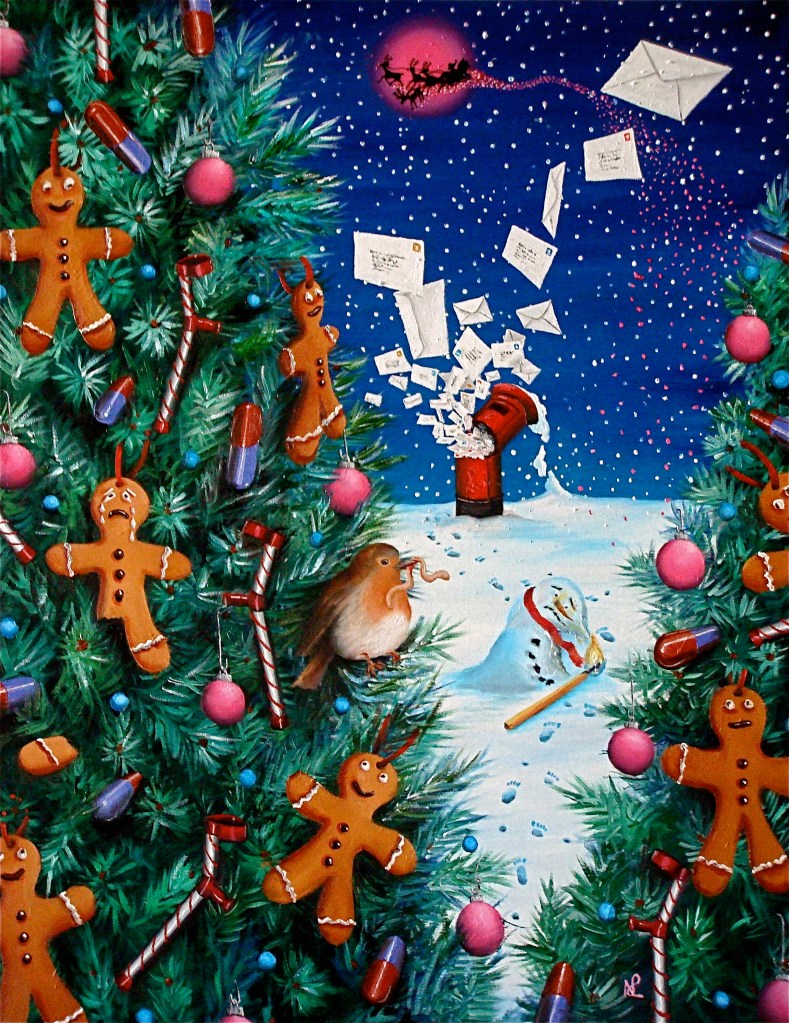
Following on from my recent Christmas tree posts, it seems suitable that for this week’s Sunday Supplement, I introduce you to the work: “Merry Christmas, Goodwill to all (Gingerbread) Men” (2008, oil on canvas). On it’s face, it’s a typical Christmas scene. Christmas trees hung with decorations and gingerbread men, snow scattered widely on a crisp winter’s night, Santa’s sleigh riding through the sky. But this is not a typical Christmas. Look closer and the images represented betray a sense of suppressed panic and bitterness. Off-centre, but at it’s heart, a gingerbread man with a broken right leg is iced with tears of apparent despair, while around him, he is surrounded by gingerbread men staring in his direction, their chocolate smiles still adhered mockingly to their faces. Also on the tree, candy canes are replaced with candy crutches, and where baubles should hang, pink ibuprofen tablets share branches with blue and red antibiotics and blue amitriptylene. On the tree perches the archetypal red-breasted robin, but he too appears menacing, caught in the act of murder of the still-living worm clasped in his beak. Between the two trees a further unsettling scene emerges, as a snowman struggles against the lit match which lays at his side, apparently placed there by whomsoever has left the footprints in the snow, footprints which betray a limp in the right foot because only the ball of the foot appears to impact the ground. Meanwhile above a British post box is cracked open, Christmas cards and other correspondence flying through the air, while above, a supposedly magical scene of santa and his sleigh is interrupted by the fall of one of his reindeers mid-flight.

Merry Christmas, Goodwill to all (Gingerbread) Men (Oil on canvas, 2008 © Nicholas de Lacy-Brown)

This is not the stereotypical scene of Christmas. It is in fact one of ten paintings which I created in the direct aftermath of a very traumatic road traffic injury of which I was the unwitting victim in May 2008. Just as I was walking past a very large structural concrete wall, a lorry crashed into it, causing the wall to collapse on top of me. I sustained severe crush fractures to my right leg as well as various other, more superficial injuries. I was lucky to be alive. What got me through the months of severe post-traumatic recovery was, and continues to be, my art. When I painted 10 paintings based on my accident, I was able to pour out my personal grief and frustration onto canvas. Each of the 10 canvases I painted represent a particular stage of my recovery. In this festive-themed painting, I recollect my first Christmas experienced after the accident and in particular my insecurity at being surrounded by a busy city at Christmas time, when I was visually and physically impeded by a very large illizarov external fixator which I was required to wear on my leg for 9 months. As I began to return to London society, I became more and more aware that people would stare at my leg in horror. They would never speak to me about my accident, but just stare – it made me feel like a leper. And all this at at time when society encouraged “goodwill to all men”. I expressed my feelings in this image of a gingerbread man, his leg broken, and all the gingerbread men around him staring, unfeeling, making his suffering all the worse.

At the same time I was ever conscious that my social life had been destroyed by my disabilities, an image I expressed in the broken letter box, its lost letters a sign of my broken friendships and lost social ties. Meanwhile the snow, the baubles and the crutches are all representative of the multitude of medication and medical aids I was required to take and use at that time. The foot steps in the snow are mine. Am I then an agent of my own self-destruction? Or am I facing up to the inevitability of life’s often bleak, stark reality?

For me, the accident was a distinct and painful reminder that we all take things for granted. I took my healthy right leg for granted until it was too late. I also took my mobility for granted. After two years on crutches and a life of mobility difficulties ahead, I now recognise how difficult life is for those with limited mobility, particularly in big cities and on public transport. I also realised that for people with disabilities, the last thing they want is to be looked at differently by other people in society. The purpose of my blog is not to lecture, rather it is to share the art and culture and beauty of life. But what I would say is: enjoy your  Christmas, your new year, and your life. Never take anything for granted, and if you see someone hobbling along a street with crutches or a bad limp, don’t stare. If you’re interested, just ask… If they’re like me, victims of accidents and disabilities would much rather talk about their experience than be marginalised because of it.

© Nicholas de Lacy-Brown and The Daily Norm, 2005-2011. Unauthorized use and/or duplication of the material, whether written work or artwork, included within The Daily Norm without express and written permission from The Daily Norm’s author and/or owner is strictly prohibited. Excerpts and links may be used, provided that full and clear credit is given to Nicholas de Lacy-Brown and The Daily Norm with appropriate and specific direction to the original content.

Turner Prize winner recalls the quirky originality of the modernist revolution

I adore modernism in art. Just what the genre entails is debatable, but when I think of Modernism, I think of Gaudi’s masterpieces in Barcelona, and the art nouveau of Paris, the rethinking of everyday objects to create masterpieces out of functionality, obliterating corners and straight lines, and emboldening quirky, individual designs over and above the monotonous linear structures inherent of 19th century urban development. The free-thinking spirit of modernism barely visited the shores of England, which was too constrained by the censored expression and elaborate attention to detail embodied by the Victorian era. Then with the two world wars dampening the UK’s embrace of architectural innovation, and the second world war flattening half of the country, the architecture which followed needed to be quick and cheap. Hence the hideous 50s and 60s monsters which now litter the British horizon.
George Shaw

These depressing urban environments, many of which have now fallen into disrepair and face demolition, are the eery subject matter of one nominee of this year’s Turner Prize: George Shaw. His works, such as this one, are painted in enamel paints, akin to those used by model makers, and as a result they exhibit a strange, photorealistic finish which depresses as much as it entices. I’m glad to see that paintings have made it into the Turner prize, and skilfully painted works at that. It’s a far cry from the “readymades” of conceptual art’s previous dictatorship over the prize. But this does not alter the spirit-crushing reaction which this paintings conjure in their audience. I haven’t been to the Prize (it’s location in the far out sticks of Gateshead does not make a visit for a Londoner particularly easy) but from viewing the work online, I am most struck by the photorealistic skill which has been utilised in producing the images. So are they art? Well, there are aspects of artistic composition and balance in these canvases, from the stark tower block background, cut off menancingly mid tower, suggesting the interminable rise of these modern monsters way into the landscape, while in the foreground, light dapples almost elegantly on the stark road surface. This is artistic, and I must say, I like his works. Although I think they’re better suited to a gallery setting: Hang them in your lounge and you’ll be on prozac in no time.

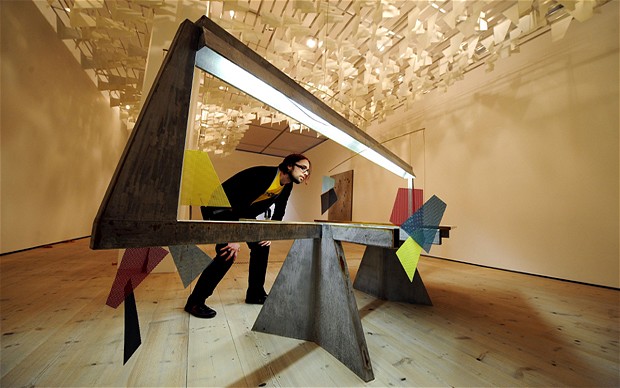
Martin Boyce installation

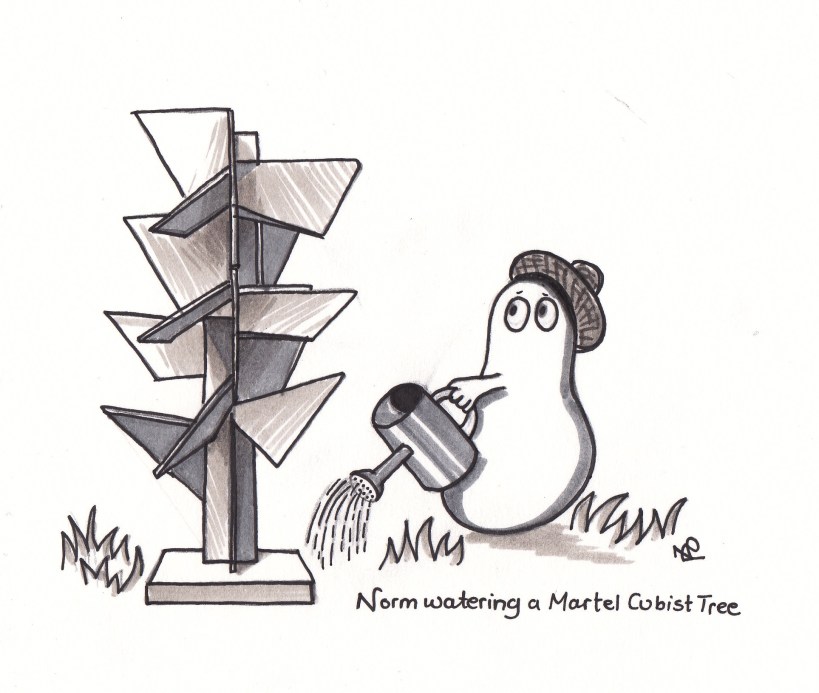
Martels' Cubist Trees

However it is the winner of this year’s Turner Prize, announced yesterday evening, which most inspires, and for me, Martin Boyce’s take on the urban environment recalls the quirky originality of the modernist revolution. His “installation” is a quietly atmospheric, almost poetic exploration of an autumnal park landscape, a bench like structure dappled with the light which flows through a metal leafy mesh on the ceiling. There are geometic paper leaves on the floor, and further leaves suggested by the mobile structures which appear to reference the whimsical mobiles of Calder. I especially love the slanted wonky litter bin, perfectly completing the urban park environment which has been created, but which also appears, nostalgically, to reflect the spirit of modernism. This reference is concreted (excuse the pun) by the explicit reference to the concrete Modernist garden of the artists Joel and Jan Martel, first shown in the 1925 Exposition des Art Décoratifs et Industriels Modernes in Paris, a picture of which hangs within Boyce’s installation. This Modernist garden included concrete, geometric trees, their angular motifs seemingly reflected in Boyce’s own structures within the installation.

Norm watering a Cubism "Martel" Tree (2011 © Nicholas de Lacy-Brown)

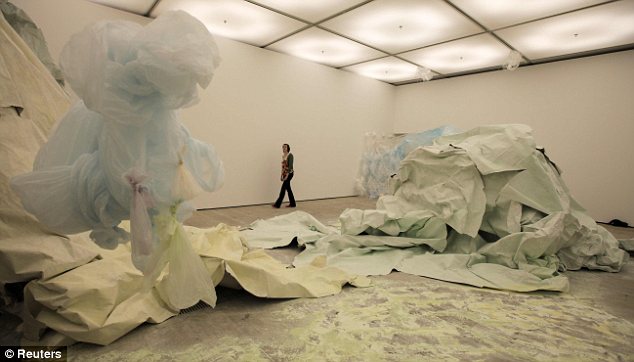
Boyce’s work is no readymade. This has taken skill, and with it he creates undeniable atmosphere and produces a work with all the potential to trigger an emotional response from his audience. How wonderful then that with this year’s Turner Prize, we appear to be moving forward away from conceptual art which, in yesterday’s blog entry, I so bemoaned. As for the other two Turner nominees, in particular Karla Black’s painted bin bags… well, the less said about that, the better…

Karla Black's bin bags

Sunday Supplement: Road Traffic Control

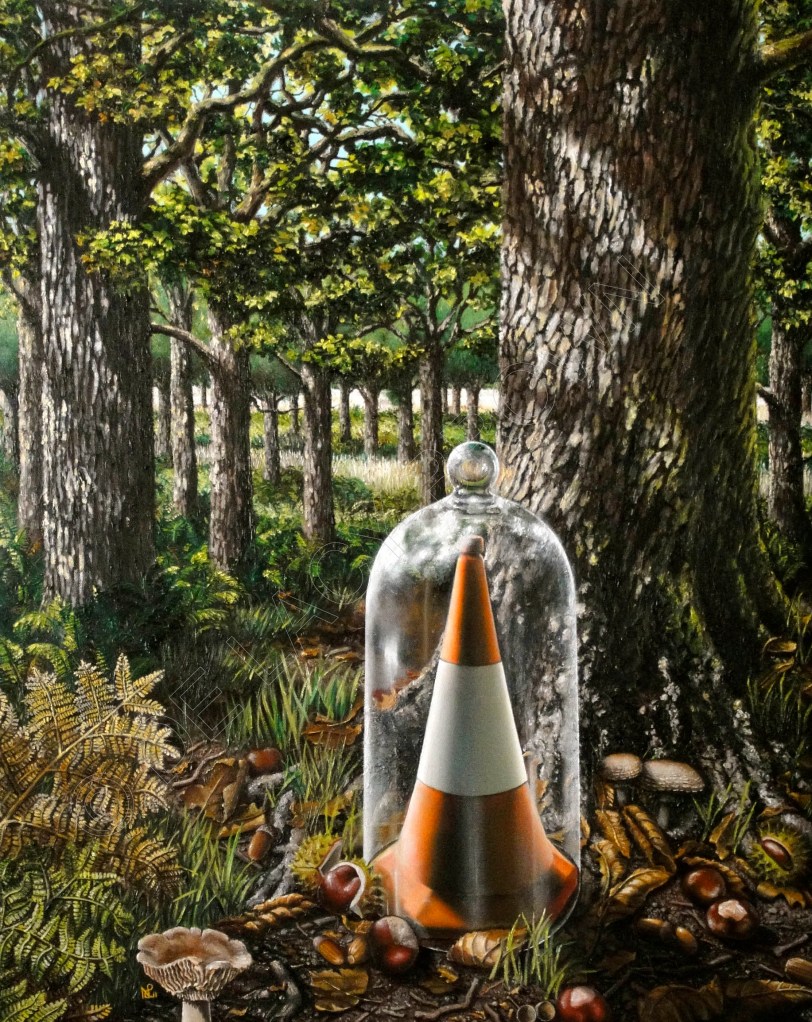
In the continued spirit of the Sunday Supplement’s exploration of some of my more detailed non-Norm work, this Sunday I am presenting a painting which I literally finished two days ago, having been working on it on and off since the first week of October: Road Traffic Control (Autumn in Richmond Park). The work was inspired by an early autumn day in Richmond Park – it was in fact the day of the mini heat wave in the UK with temperatures of 29 degrees on 1 October. This made for the rare sensation of feeling summer on the skin, but with the eyes seeing autumn hues bathed in glorious sunlight. It made for wonderful visual results in Richmond Park, which is in itself a unique and vast bucolic landscape in amongst the urban jungle that is London surrounding it. As soon as I got home, I started work on this canvas.

Road Traffic Control (Autumn in Richmond Park) (Oil on canvas, 2011 © Nicholas de Lacy-Brown)

Read more

Paris Part IV: Photographs

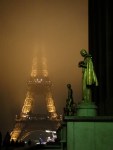
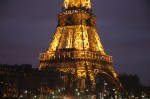
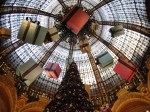
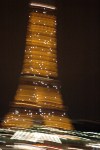
Well I may be back in gloomy old London, but our cousin over the Channel continues to inspire, and as part of The Daily Norm Paris Season, here are some of the photos I took on my recent trip. Ranging from architectural icons, to skyline spectaculars, there is a bit of everything for all the Paris fans amongst us. Enjoy!

Paris Part III: The Musée d’Orsay rehang and, finally, some macaroons

Our last day in Paris, our last breakfast in Le Pain Quotidien on the Rue des Archives, but not the end for our art tour of Paris. For today, we decided to try our luck on a week day where we had failed on Sunday… the Musée d’Orsay. So, like Sunday, there were queues to get tickets. You can buy tickets for the museum online, but they don’t give you the option of printing at home (like the Grand Palais tickets) and instead you have to go in search of a FNAC store to collect your pre-bought tickets, which in my opinion somewhat negates the queue jumping benefits of buying online. So in the event, we waited 40 minutes in a spiralling but steadily moving queue to get in, and those minutes went by fairly quickly, as the anticipation of getting inside and feasting on perhaps Paris’ greatest art collection grew closer. And once inside, we were not disappointed.

Read more

Paris Part II: The Stein Collection, Munch (and the Screaming Norm) and the unyielding stench of Camembert

My feet still cry out in protest at the mere recollection of how much we were on our feet yesterday. But what a cultural extravaganza our eyes were able to feast upon as we went from one blockbuster exhibition to another.

First stop was the Grand Palais, at which we arrived slightly giddy having indulged in a mid morning mulled wine from the festive christmas market along the Champs Élysées. The Grand Palais is always the host of superb temporary exhibitions, having held Courbet, Renoir and Monet spectaculars in the last few years. This year’s offering is Matisse, Cézanne, Picasso…The Stein Family’s Adventure in Art which explores the stalwart patronage of the well known Stein family of superstar early 20th century artists at the shaky commencement of their careers, and exhibits the vast collection of important works which they amassed as a result (see my gallery below for a preview of some of the works in the exhibition).

The exhibition was split roughly into three sections, each following the acquisitions of the three respective Stein siblings, Leo, Michael (and his wife Sarah) and Gertrude. Michael and Sarah’s almost exclusive obsession with Matisse makes for a very comprehensive show of the latter’s earlier work, when, as undisputed head of the Fauvists, his paintings command attention with their multiple bright colours and coarse brush work. Leo Stein, the more conservative collector, whose at first collected with sister Gertrude, took more to Picasso, but stopped collecting his work shortly after the blue period, finding Picasso’s progression into cubism all too much. It was Gertrude Stein who took the collection further, resolutely supporting Picasso at every twist and turn of his experimental career before his prices spiralled beyond her reach. Then her patronage embraced the likes of Juan Gris and Picaba, right up to artists working in abstract which she began to collect before her death in the 40s. Ever the pioneer, Gertrude’s collection is substantial and multifaceted and makes for a fascinating overview of the post-impressionist period when art was changing rapidly. However my favourite section was Leo Stein’s Picassos from the blue period (see the gallery below). The melancholy figures and muted colours on these canvases are loaded with a depth of emotion and sophistication of draftsmanship which is lacking in the more superficial and, dare I say it, commercial compositions in his later work. Although of Picasso’s adventures into cubism, there are some superb examples, particularly in the preparations he makes for Les Damoiselles d’Avignon. Also worth seeing are the works of Juan Gris who, taking the torch from Picasso, explores the cubism genre in his brilliantly composed geometric fragmentation of everyday life.

Read more

Paris Part I: Dali, Moreau and the problem of getting a good macaroon.

It’s Paris season at The Daily Norm, and here in the City of Lights, Paris pulsates with the buzz of pre-Christmas anticipation, millions packing the shops and the metro, the streets starting to sparkle with fairy lights, and a chill in the air coupled with the occasional waft of log fires from the Marais chimneys indicating that Christmas is close at hand.

But the city is not just readying itself for seasonal festivities. Tourists continue to pack and cram into every irresistible cultural corner, cameras flashing, and queues forming. Yes, those queues have been the bane of my Paris visit so far, curling tirelessly out of every museum, on the metro platforms, out of restaurants, and even to get into some shops! Our primary intention, as we set off yesterday morning, was to visit the Musée d’Orsay, my partner having never seen it before, and myself intrigued by the rehang on an allegedly revolutionary scheme of coloured walls which are meant to enable the impressionist paintings to glow more against their new backgrounds. However as we approached, it was possible to see, even from the Tulleries across the river, the masses queuing before the entrance, these queues snaking way beyond the old railway building and almost onto the nearby bridge.

Read more