Skip to content

Posts tagged ‘Exhibition’

Zeno Brains and Oracle Stones: Jan Fabre at La Llotja

Jan Fabre is a multitalented creator. Having successfully dappled in writing, performance, and screenplays, he has also shown himself to be a prolific artist, skilled in drawings and installations quite asides from his stunning sculpture work. He is also tremendously successful. He was the first contemporary artist to be given a solo exhibition at the Louvre in Paris (“L’ange de la métamorphose”) and has participated several times in the Venice Biennale, and twice in the Kassel Documenta. Yet most importantly of all (for me at least), his incredible thought-provoking works are now on show in Palma, in the haunting lofty space that is La Llotja – the old 15th century maritime exchange, on the city’s waterfront.

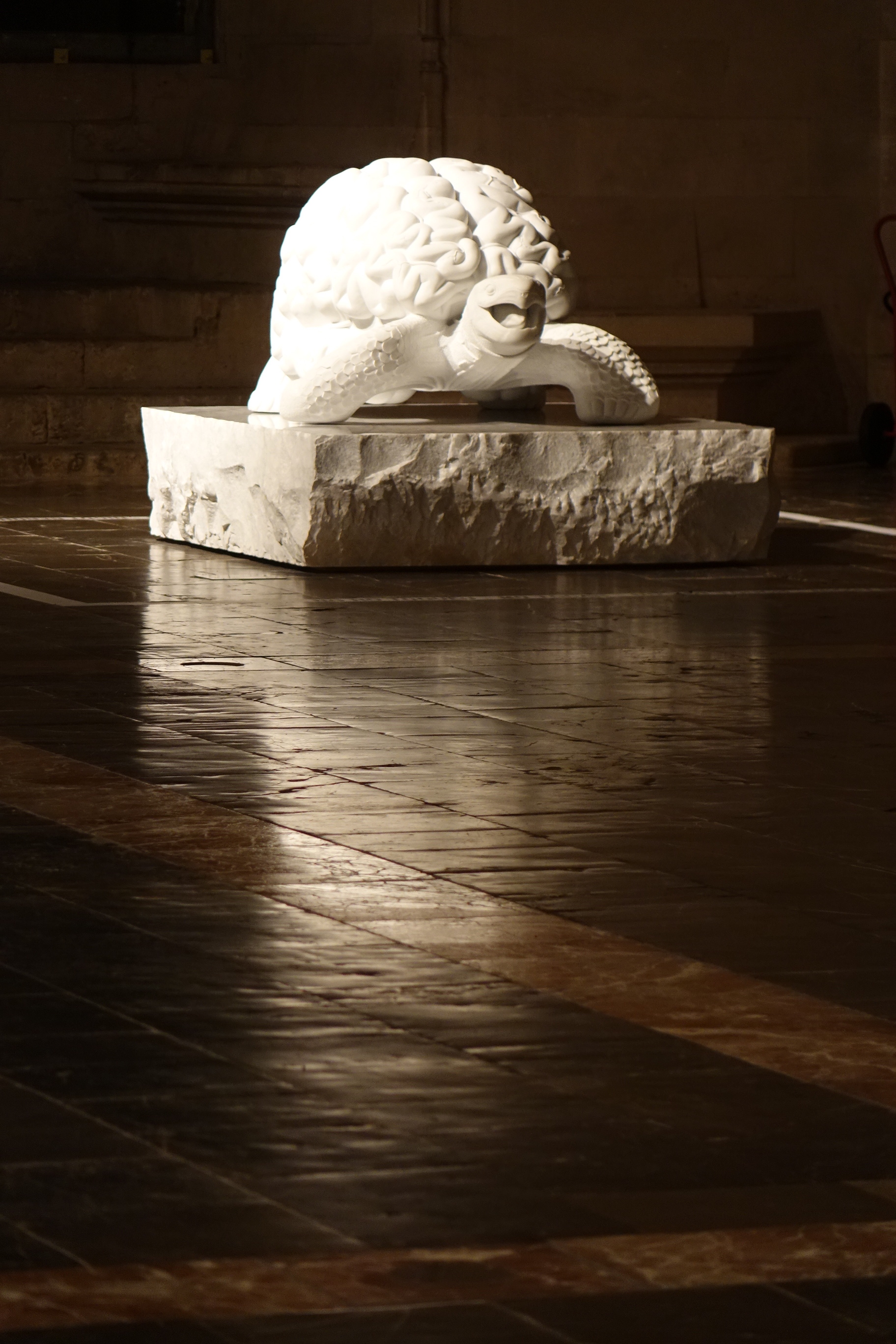
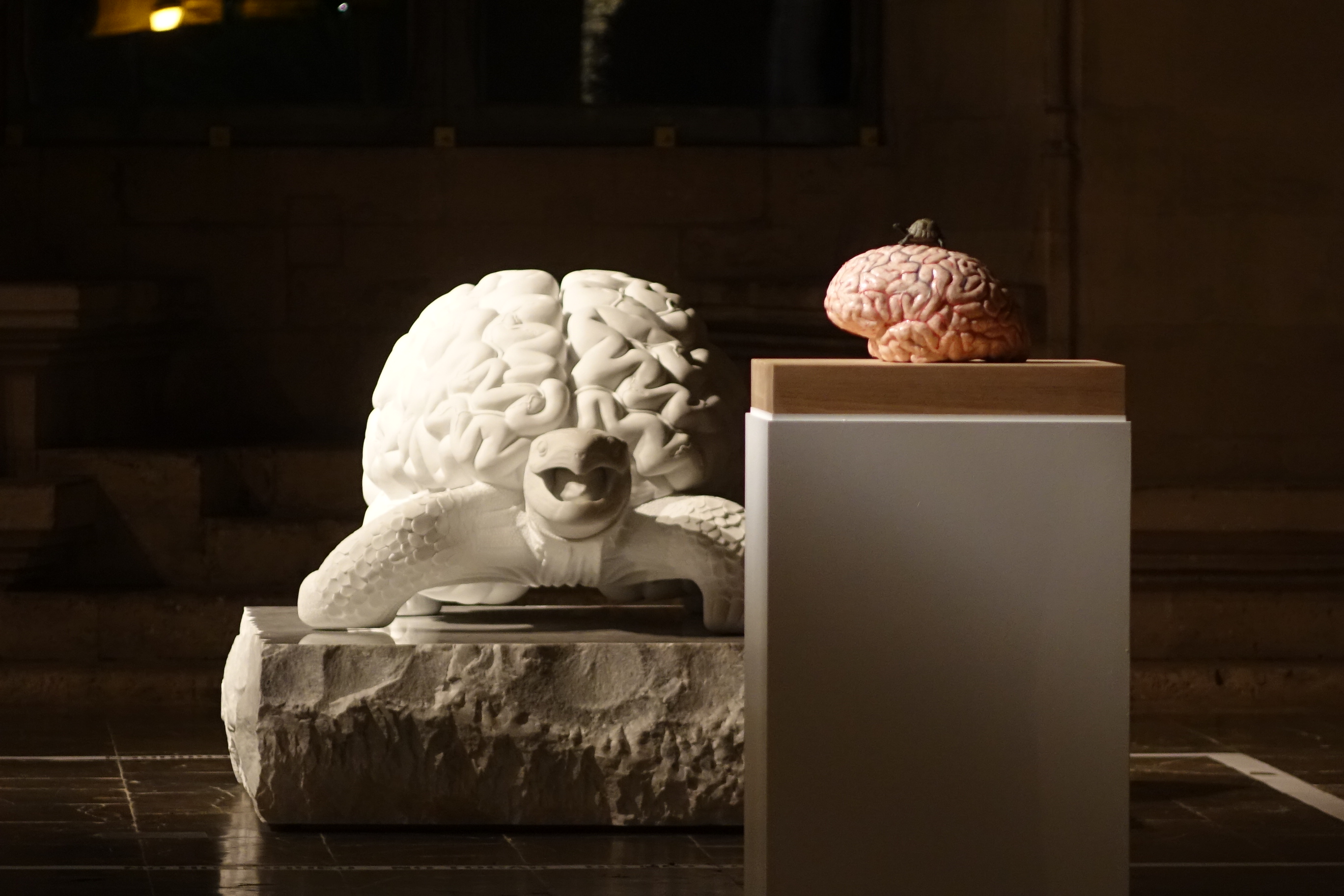
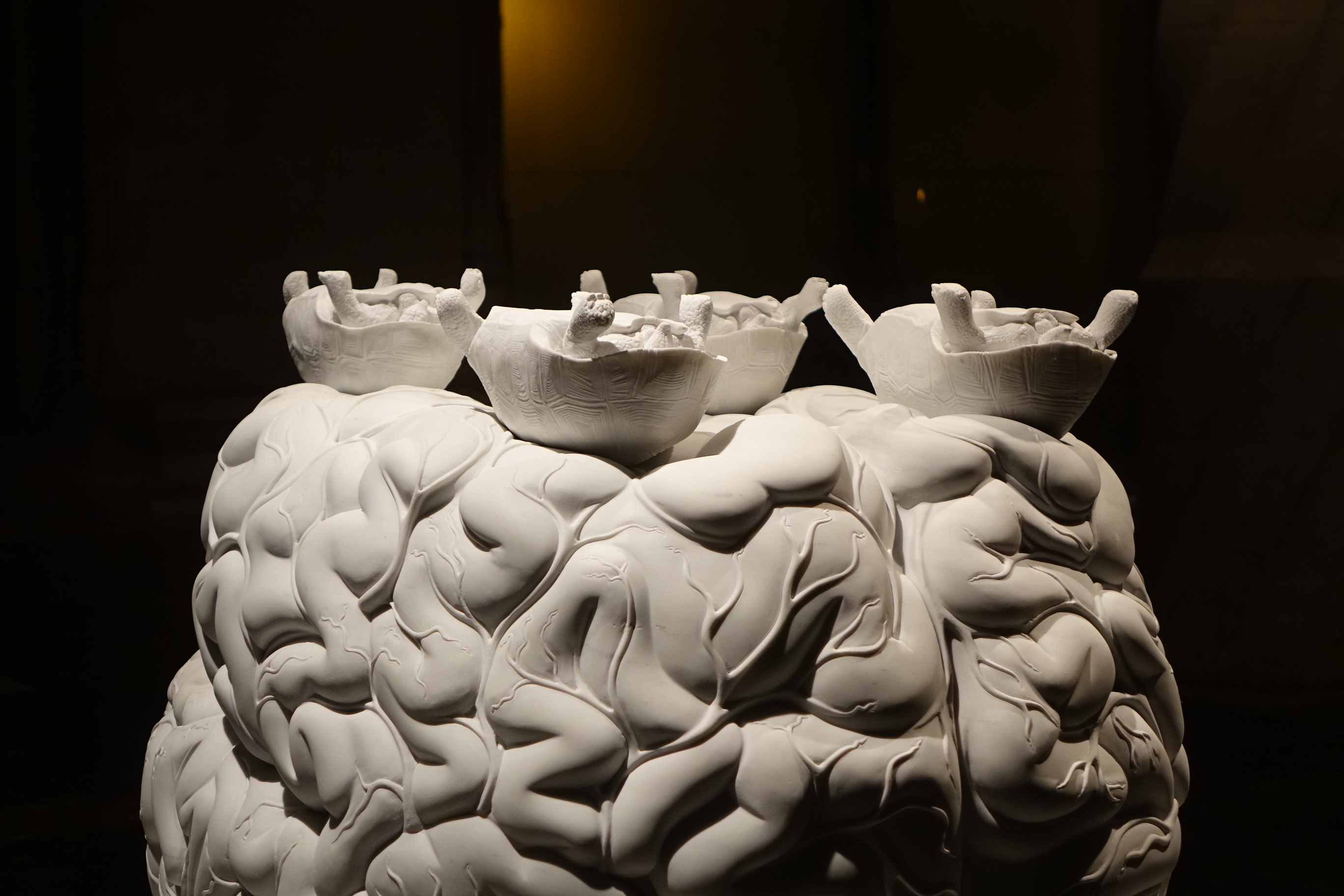
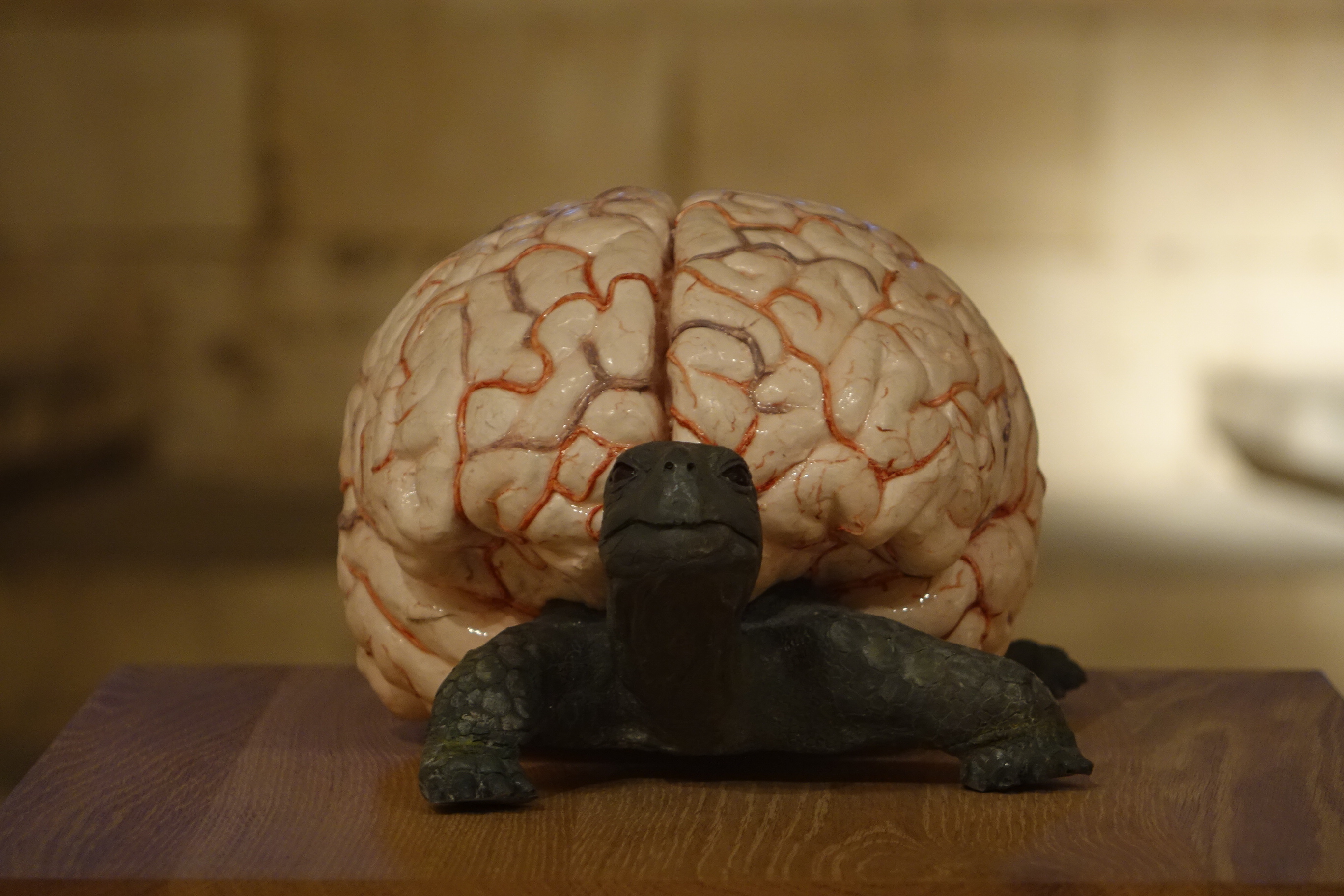
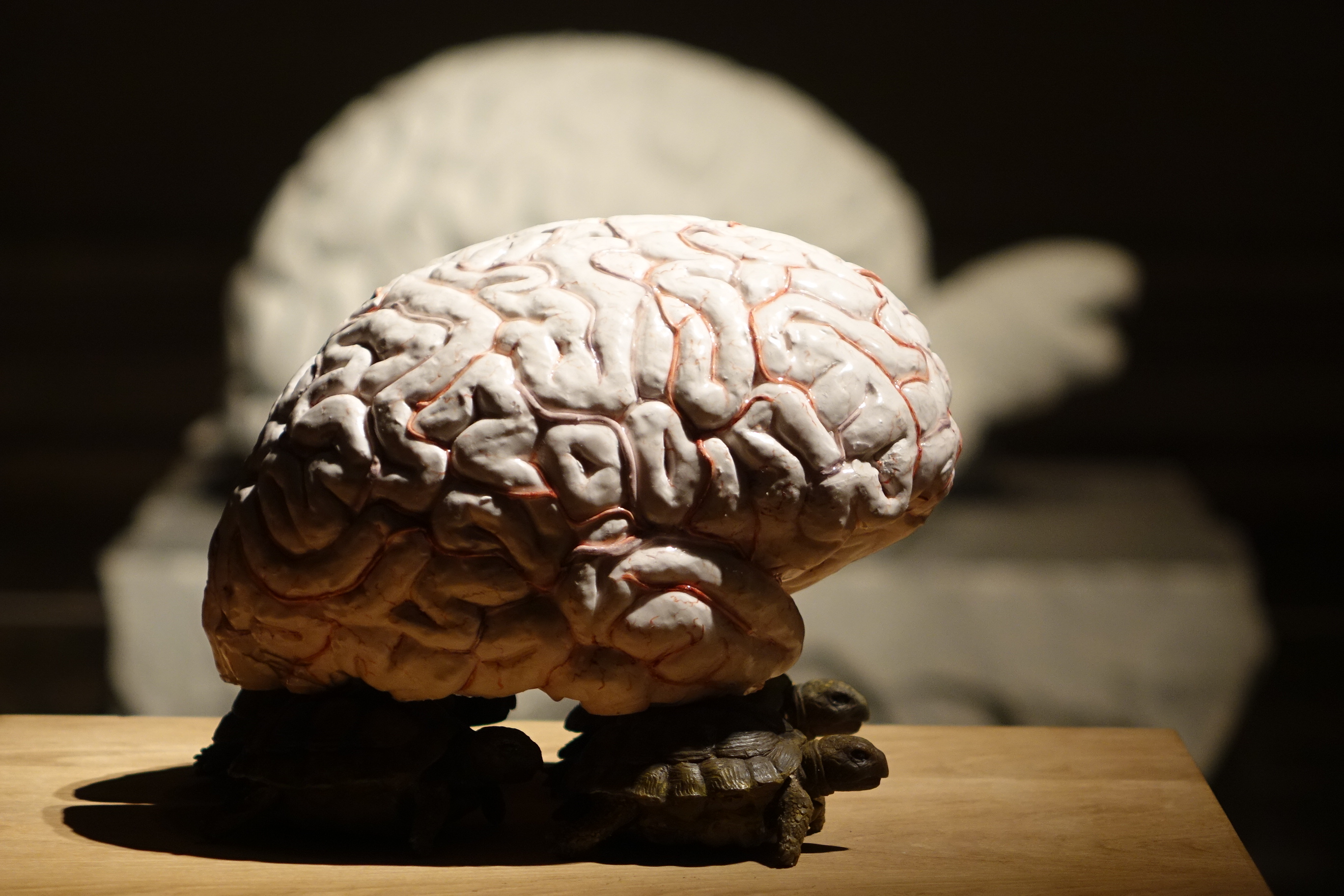
His Palma exhibition, Zeno Brains and Oracle Stones, is as enigmatic as it is enticing. After perusing the internet for some time, I have found myself quite unable to find any coherent explanation of what the exhibition is about, nor what the artist intended to represent. And yet the show, which comprises some 9 sculptures revolving around the same theme: the tortoise and the brain, makes for a stunning sight. This is not least because of the space: given over to these simple sculptures in marble and stone, illuminated powerfully in the otherwise dark cavernous space, the whole installation feels almost spiritual as each sculpture sits soulfully in wait, a focused spotlight falling upon its cold stone surface in the darkness. But the sculptures themselves are so enigmatic that they call out for engagement and interpretation.

DSC01305 DSC01309 DSC01321 DSC01315 DSC01302

Fabre gives us tortoises on a brain, tortoises under a brain; a tortoise whose shell is made out of a brain, and another who carries a brain precariously on its shell. There are tortoises lying upside down atop a brain, and others pushing a brain away as though in an attempt to alleviate the world of this unnecessarily complex organism. So why the brain and why the tortoise? Well they are both as old as time, and perhaps both inexplicable as a manifestation of nature’s creativity. They also look pretty similar working in unison – a partnership evidently explored by Fabre in these various sculpted manifestations. But there is almost something sinister and monstrous about the works, and while I am not completely invested with an understanding of how the works reflect Kafka’s Metamorphosis, as is suggested by the brochure accompanying the exhibition, I can see the plight of Gregor Samsa in the upturned tortoises, reminding of how that poor man awoke one fated morning finding himself unable to get up from his back which had metamorphosed into the shell of a hideous beetle.

DSC01330 DSC01319 DSC01318 DSC01311 DSC01325

But as ever, the enigma of this work is integral to its power, and much of the reason why I love it. And if you wish to see it you must be quick, for the exhibition will end on 21 December 2014. Yet another reason to get yourselves to Mallorca before the year is out.

Intelligent Insight: Grayson Perry – Who Are You?

Following on from his superb show, Tomb of the Unknown Craftsmen at the British Museum in 2010 is the latest collection of brilliantly insightful works by artist and craftsman Grayson Perry. This time fitting seamlessly into the collection of the National Portrait gallery, peppered throughout the museum therefore encouraging visitors on a kind of magical mystery your through the space, Perry’s new exhibition, Who are You? once again shows that Grayson Perry is one of the most intelligent artists of our times. Made in conjunction with a series of channel 4 documentaries reflecting on a series of individuals each struggling with some particular facet of their individuality, these “portraits” are very appropriately located within the hallowed halls of the London’s temple of portraiture. Ranging from etching to tapestry, enamel portrait to glazed pottery, they show Perry at his adroit best. But beyond the skilled execution of these works is the messages they so sensitively and intelligently portray. 

Line of Departure (2014 © Grayson Perry)

Line of Departure (2014 © Grayson Perry)

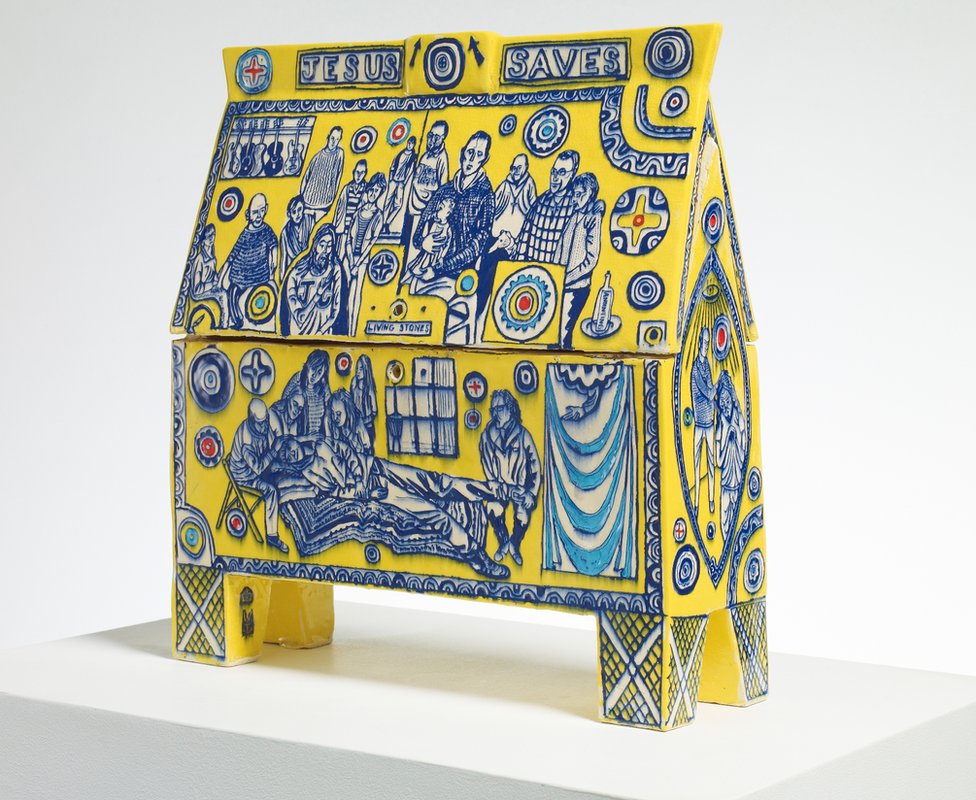
Jesus Army Money Box (2014 © Grayson Perry)

Jesus Army Money Box (2014 © Grayson Perry)

The Earl of Essex (2014 © Grayson Perry)

The Earl of Essex (2014 © Grayson Perry)

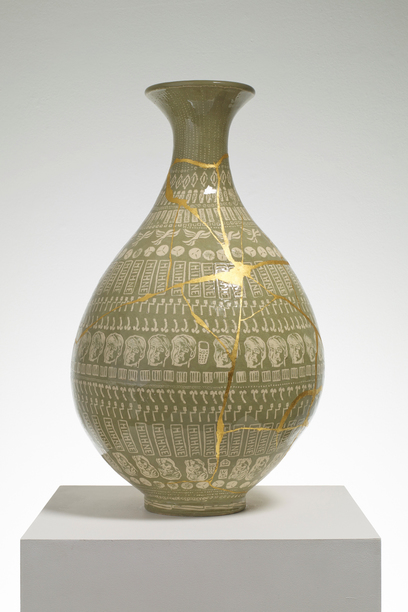
The Huhne Vase (2014 © Grayson Perry)

The Huhne Vase (2014 © Grayson Perry)

In mounting the show, Perry tells how he chose sitters who were each on some kind of identity journey. People who had changed religion or gender, physical or mental facilities, lost status or belonging to a group who are actively trying to change the way others see them. Thus Perry presents a vase representing the fall from grace of politician Chris Huhne, who was imprisoned for perjury after asking his wife to take the blame for a speeding offence he had committed. The vase shows his image and that of his car registration plate repeated over and over like the tire tracks of his car. It was smashed and pieced back together again in gold demonstrating Huhne’s downfall but also the fact that his new fragility in a world dominated by generic status figures will make him a richer more complex individual. There too Perry gives us a miniature enamel portrait hidden away in glass cases with others far older. It portrays XFactor star Rylan Clark as the Earl of Essex because, as Perry says, celebrity is the aristocracy of the day. 

But amongst my favourites was the Ashford Hijab, a brilliantly drafted black, white and red design on a silk scarf (appropriately) illustrating the draw of Islam for young white middle aged women who are sick of consumer culture and sexualised scrutiny of women and seek instead the comparative calm and integral values of Islam. So it shows one woman leading her family towards Mecca, her hijab being the metamorphosis of a road which in turn transforms from the outlet shopping centre of consumer culture from which she flees. Brilliant. 

The Ashford Hijab (2014 © Grayson Perry)

The Ashford Hijab (2014 © Grayson Perry)

Memory Jar (2014 © Grayson Perry)

Memory Jar (2014 © Grayson Perry)

I also loved Memory Jar, the vase sensitively portraying the effects of Alzheimer’s on a couple, as the disease ravages the mind of one man leaving his wife deprived not only of his personality and mental functions, but also destroying their shared memories. As Perry says, two people are the guardians of their shared memories. Once one person goes, so does the poignancy of the memories, and in depicting this he shows a kind of demon cutting up the family photos of the couple also reflected on the vase. It’s a stunning piece. 

And of course mention has to go to Comfort Blanket, a huge banknote tapestry representing everything that is so intrinsic to British culture and which makes the country such a stable, lawful, integral place, drawing people from all over the world. Of course fish and chips looms large, as well as words like “fair play” and “Posh and Becks”. Everything on it was so English I stood in awe at how masterfully Perry had managed to capture the essence of an entire nation in one tapestry. It also felt particularly poignant for me, an Englishman, as I prepare to leave England to move overseas in only a few days time. 

Comfort Blanket (2014 © Grayson Perry)

Comfort Blanket (2014 © Grayson Perry)

Grayson Perry: Who are You? is showing at The National Portrait Gallery until 15 March 2015. Entrance is free.

Rembrandt’s Late Works: Better seen, and never forgotten

While the works of Rembrandt, Dutch master and one of the most applauded artists in the history of art, are instantly recognisable for their energetic brush strokes, moody lighting, undeniable intensity and rich umber colour palate, there is nothing like seeing his paintings in reality to truly appreciate the virtuosity of his work.

The National Gallery London’s new blockbuster on Rembrandt, The Late Works, provides just the opportunity to do that. In the dark bowels of the Sainsbury Wing of galleries, in rooms purpose-designed with dark walls and sharp focused lighting perfectly offsetting the brilliance of Rembrandt’s mastery over light, one enters the exhibition to come face to face with not one, but a whole room of Rembrandt self-portraits. Each demonstrates a startling honesty in self-examination, as the artist becomes visibly older and more saggy. But in as much as this room shows that a Rembrandt self-portrait is far from a rareity  (he made some 80 painted, drawn or etched self portraits in the course of his career), it immediately demonstrated that there is nothing like seeing these famous works in reality: for only then can you appreciate the brilliant layering of the paint, and the masterful use of brushwork to build an aging texture of skin which appears so realistic as it catches the light against a dark mocha background, that it almost feels as though Rembrandt has cast himself in three dimensions, ready to climb out of the frame when the many visitors to the exhibition have gone home.

Self-Portrait (1669)

Self-Portrait (1669)

Self-Portrait (1669)

Self-Portrait (1669)

Self Portrait with Two Circles (1665-9)

Self Portrait with Two Circles (1665-9)

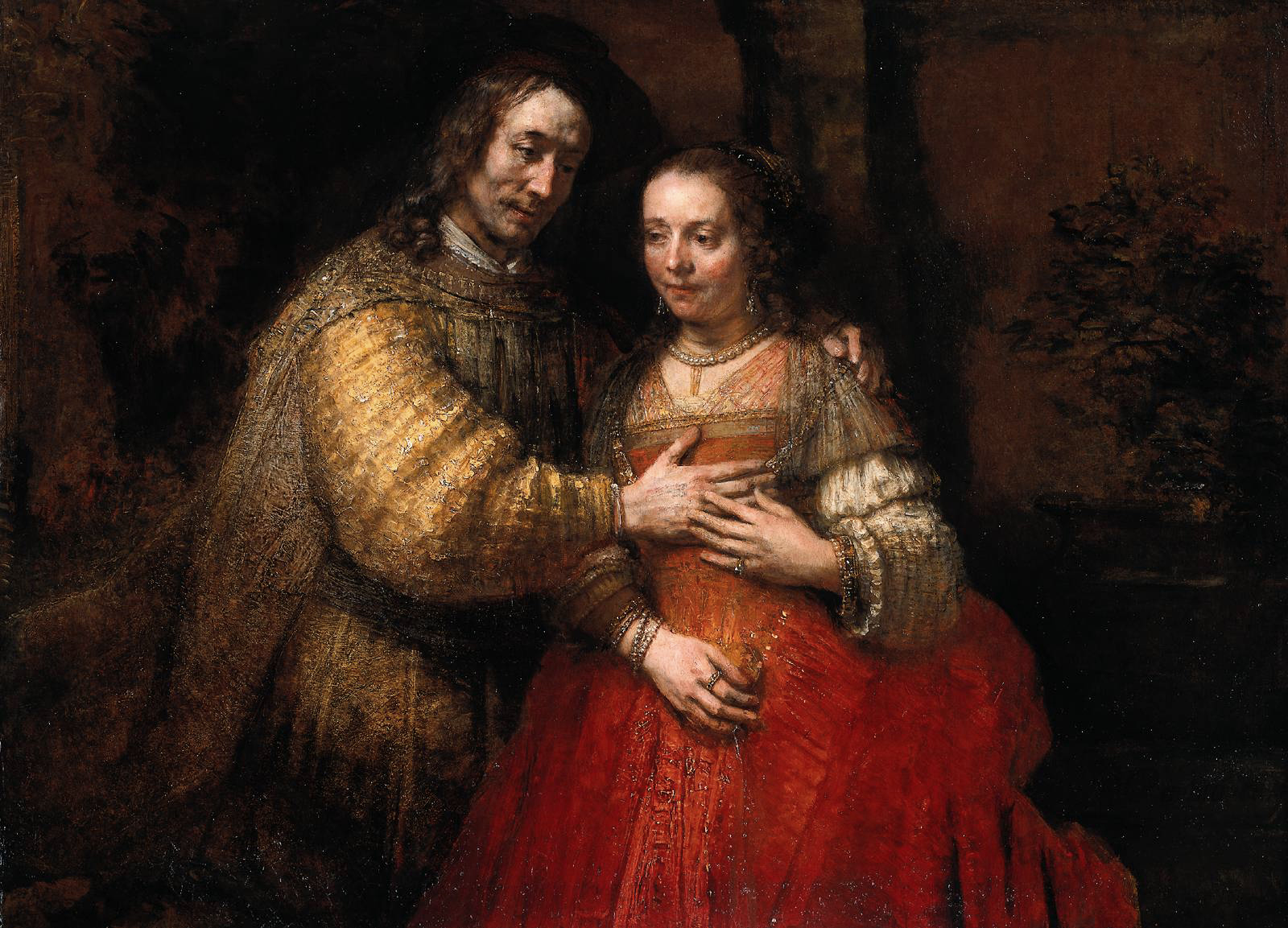
Such was the main impression that this excellent new exhibition left on me as I departed. I felt thrilled to have had the opportunity to see so many brilliant works executed at the tail end of Rembrandt’s career, when his personal fortunes were in decline, but when the product of his paintbrush was more fantastic than ever. But so too was I struck by the breadth and significance of the collection on show, testament no doubt to the National Gallery’s partnership in organising the exhibition with the Rijksmuseum in Amsterdam, who either own or have access to much of the works on show. The result is the chance to come face to face with famous works such as the Jewish Bride – a subtly romantic painting which held Van Gogh so spellbound that he declared he would give up 10 years of his life for a few moments before the painting – and the masterful group portrait, The Syndics, a superb work on a huge scale, surely surpassable only by The Night Watchmen, perhaps Rembrandt’s most famous work.

The Syndics (1662)

The Syndics (1662)

The Jewish Bride (1665)

The Jewish Bride (1665)

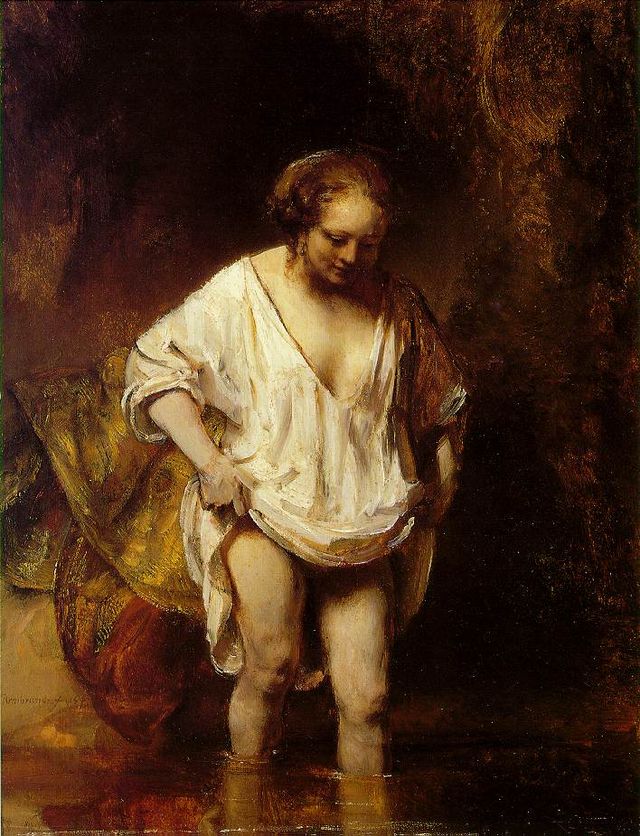
A Woman Bathing in a Stream (1654)

A Woman Bathing in a Stream (1654)

The Consipiracy of the Batavians under Claudius Civilis (1661)

The Consipiracy of the Batavians under Claudius Civilis (1661)

The other thing that struck me was how bloody popular this exhibition is. Even when you have a timed ticket, you need to queue. Admittedly I went along at the weekend, but that does not mean to say that this show will be any quieter during the week, such is the appetite no doubt for a sensational London art show after a year consisting largely of flops and unknowns (I do not include Tate Modern’s brilliant Matisse or Malevich shows in this otherwise scathing review). What this then means is something of a struggle throughout the show, something which is felt less when gazing upon huge works such as the rather questionable Conspiracy of the Batavians under Claudius Civilis, a portion of Rembrandt’s less than successful painting for Amsterdam’s new Town Hall. It is however annoying when trying to study the stunning intricacies of Rembrandt’s print works. I never knew that he was such a skilled printmaker, and his drypoint etchings were, in particular, worth elbowing the odd visitor out of the way.

The Three Crosses (1653)

The Three Crosses (1653)

Christ Presented to the People (1655)

Christ Presented to the People (1655)

Christ Presented to the People

Christ Presented to the People

Christ Preaching (1652)

Christ Preaching (1652)

But what these crowds all go to show is how superb this show is – a final hurrah for 2014, and the first great show to come out of The National Gallery, in my view, since the Da Vinci sensation in 2011/2012. Whether it be the intense forlorn gaze of Lucretia at the point of her honour suicide, the sensationally melancholic Man in Armour thought to be Alexander the Great, or the knowledgeable calm grace of Margaretha de Geer depicted wearing her ginormous lace ruff, there are masterpieces aplenty to keep you hooked to this show, and resilient to the many crowds around you.

Rembrandt_lucretia

Portrait of Margaretha de Geer (1661)

Portrait of Margaretha de Geer (1661)

A Man in Armour (Alexander the Great?) 1655

A Man in Armour (Alexander the Great?) 1655

Rembrandt, the Late Works is on at  the National Gallery until 18th January 2015.

My début at the Dulwich Picture Gallery

2014 has been a great year for me artistically. In May, I held my most commercially successful exhibition to date, with plenty of exciting commissions and opportunities flowing straight out of it. In July I exhibited with a new generation of freshly graduated art students at London Bridge’s Art Academy, and in September I exhibited my prints in a sensational show of printmaking talent amongst the works of the East London Printmakers at the Embassy Tea Gallery in London Bridge. But as far as 2014 goes, I have certainly left the best until last. For this October, one of my paintings will hang in an art gallery so prestigious, and so imbued with history, that it feels like a dream to see my work up on its walls.

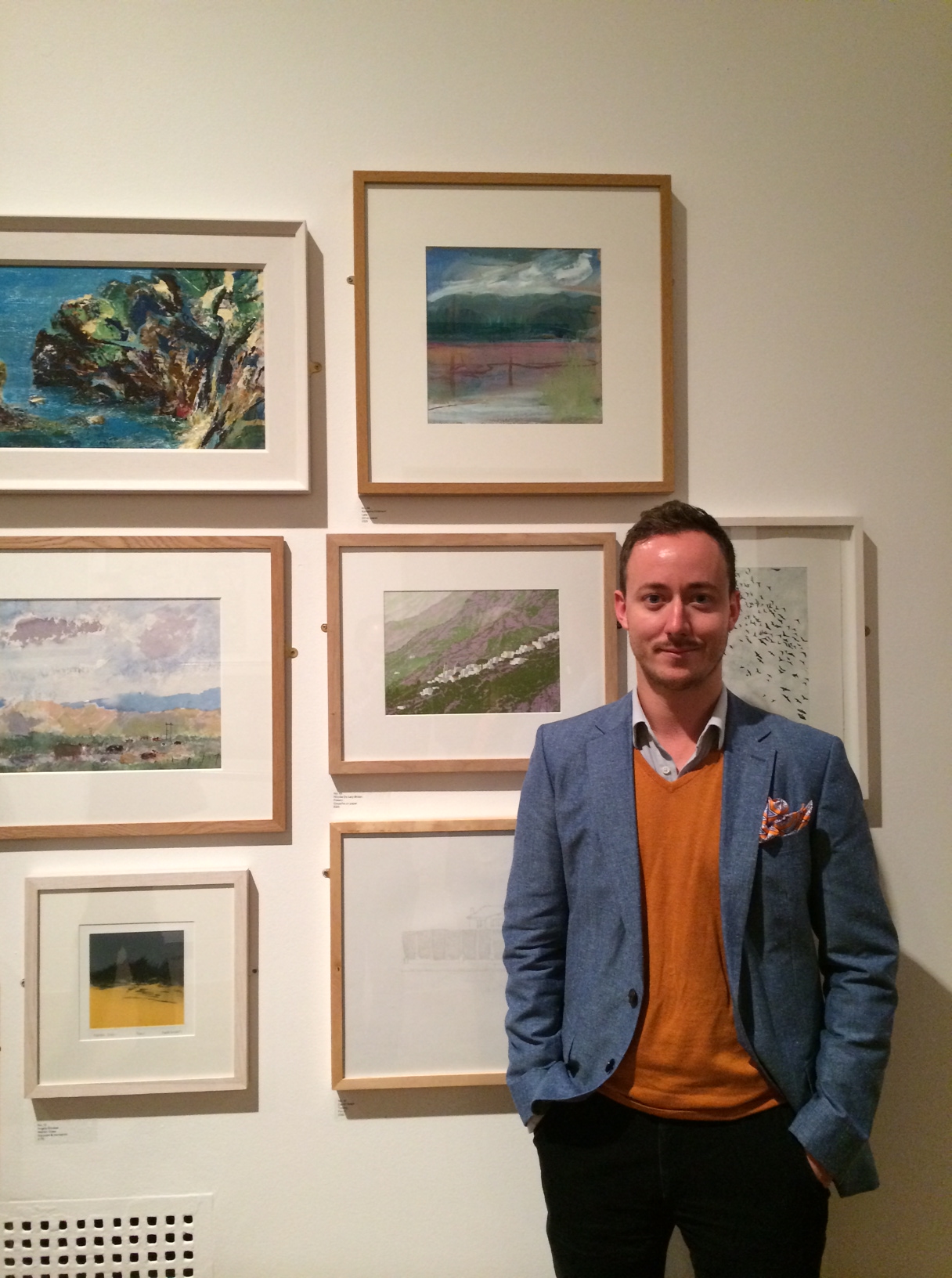
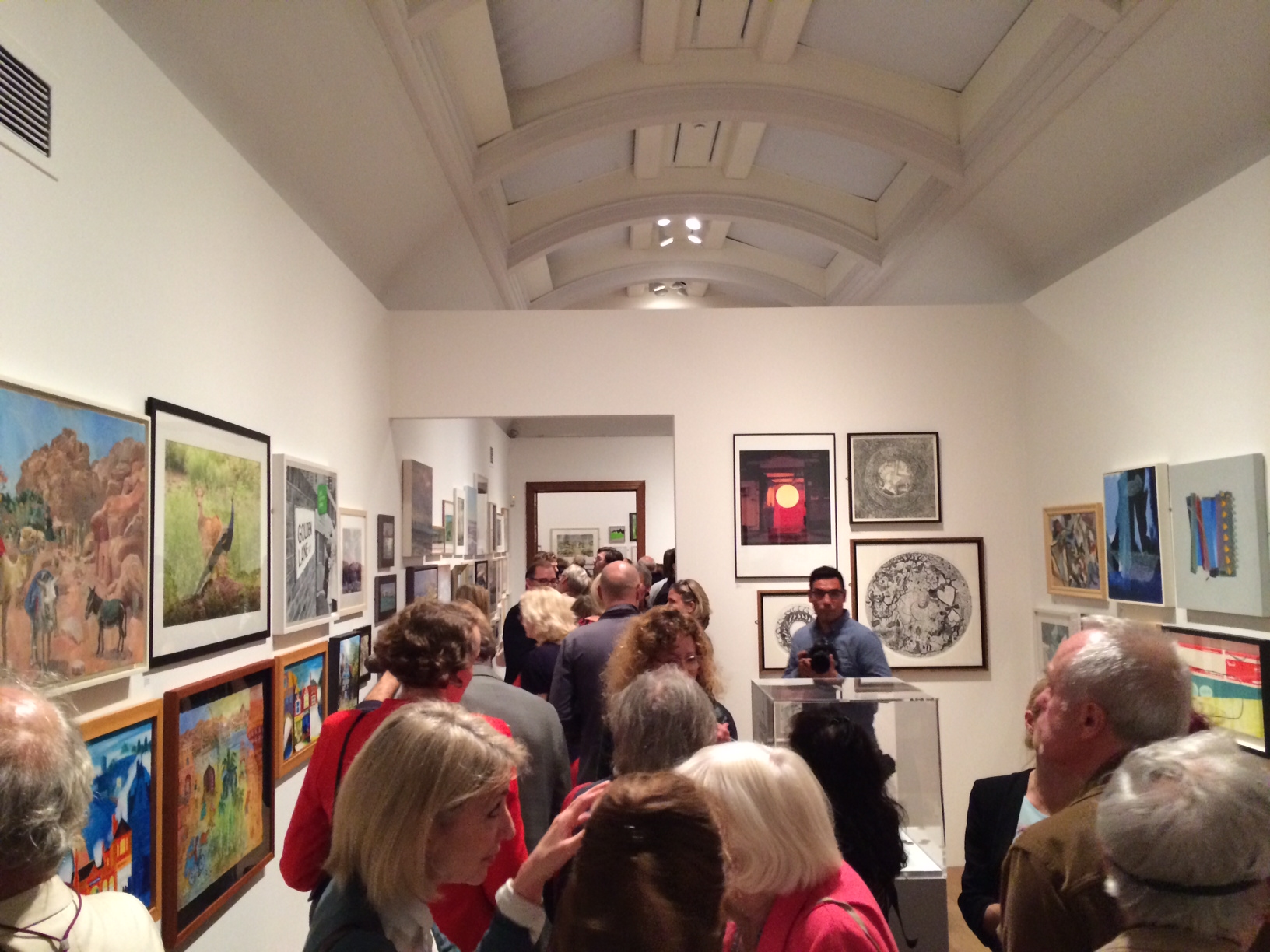
I am of course talking about the Dulwich Picture Gallery, Britain’s oldest public art gallery, and home to some of the UK’s most illustrious artists and art collections, amongst them undisputed masters such as Gainborough, Watteau, Canaletto, Veronese and Reynolds. And for the next two and a half weeks, starting with a lavish opening gala last night, my very own artwork will be hanging amongst other works in a new Open Submission show a mere few metres from these incredible masterpieces of art history – a complete honour.

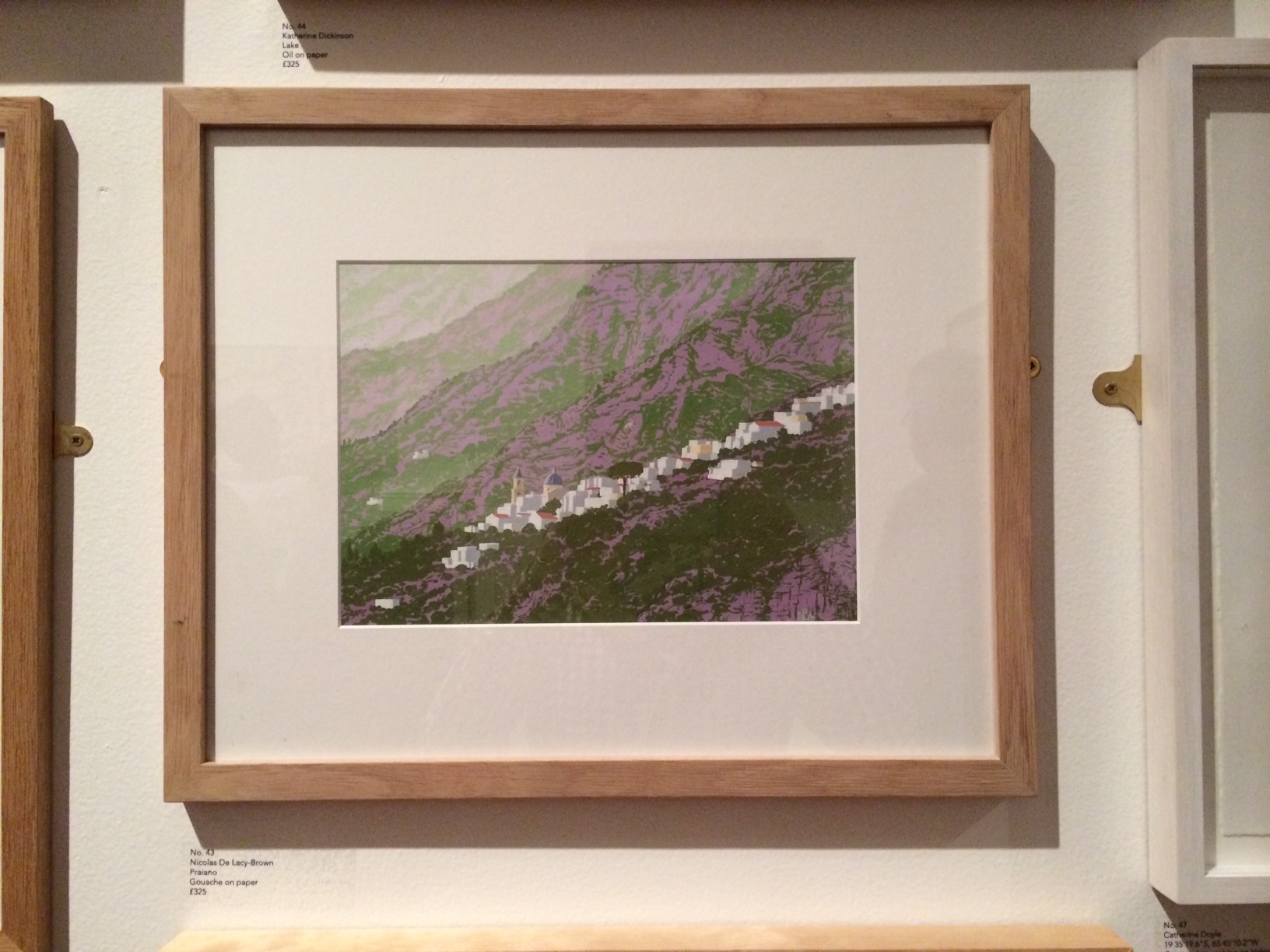
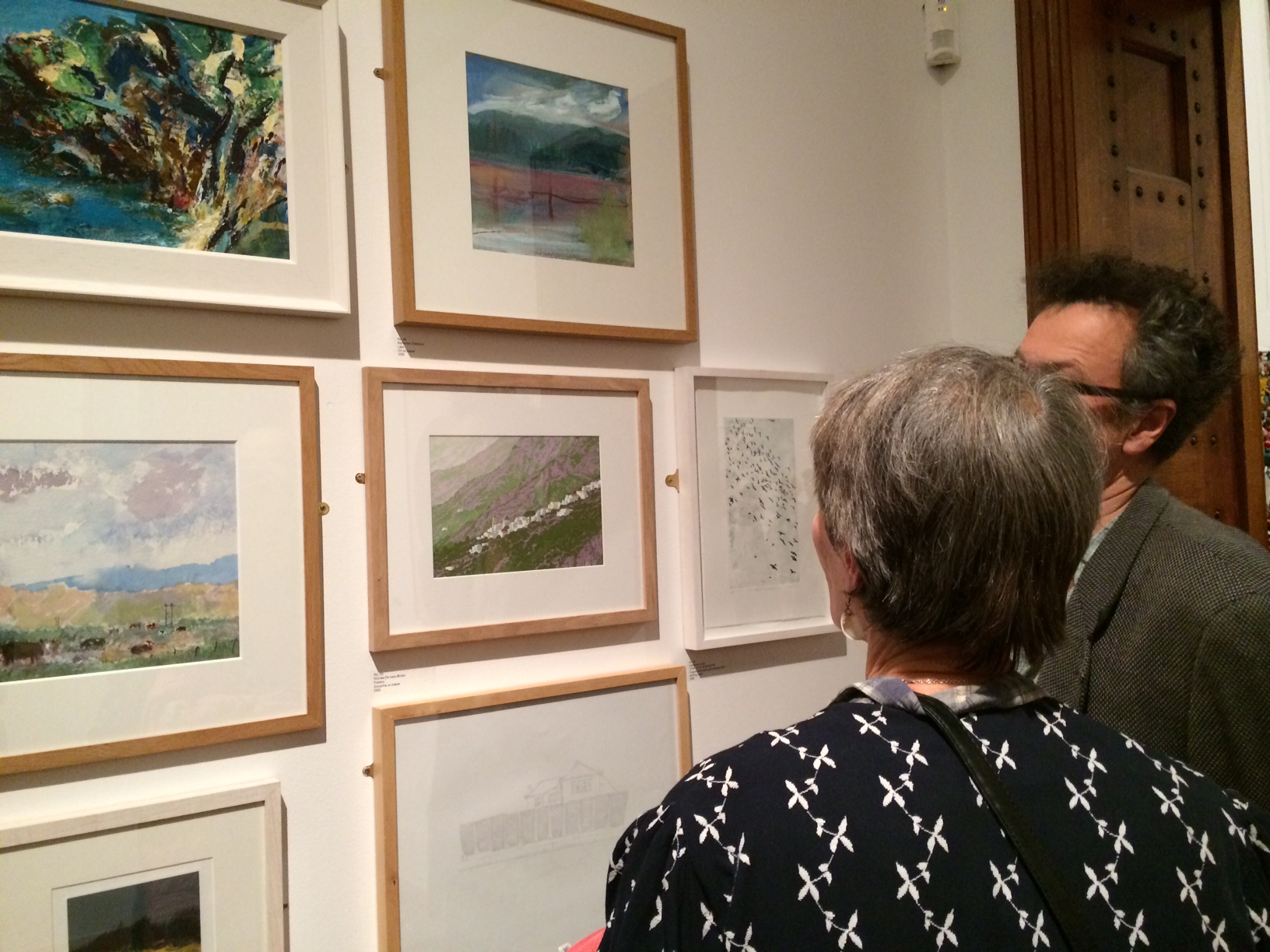
The painting selected for show was my simple landscape of Praiano, a glistening little town on the mountainous Amalfi Coast. Painted in gouache on paper in the immediate aftermath of my Amalfi Coast trip, the painting is one of currently 11 paintings comprising my “interpretations” collection, and is perhaps the most meditative and tranquil of them all. All framed up in a fancy oak frame, it looks splendid, and I have never been prouder of my artwork than last night, when I saw my little painting hung on these walls where only months before David Hockney’s world-class printworks had been admired by crowds of thousands.

2 1 image 3 imwsef

And of course my painting is not alone. Hanging amongst some 170 others, it is but one in a collection of wonderful works submitted by the Friends of the Dulwich Picture Gallery and chosen for exhibition by a panel of illustrious judges. So  don’t just go along to see my Praiano – make your way to Dulwich to see galleries full of creative gems – both those of new budding artists, and of art history’s greats.

The Dulwich Picture Gallery Friend’s Open Exhibition runs until 12 October 2014.

The East London Printmakers Annual Show: You’re Invited

My summer has been so incredibly hectic, full of travels, work and multiple new artistic creations that I have barely had time to promote the fact that several of my print works are about to feature in the East London Printmakers (ELP) Annual group Exhibition at the Embassy Tea Gallery in London Bridge over the next two weeks! And in fact it’s very much a case of better late than never, because the show will open this very night, with an exclusive guest appearance and official opening by none other than British abstract expressionist, Albert Irvin RA.

Amongst 70 artists exhibiting works created over the last year and aptly showcasing the versatility of printmaking as a medium will be none other than yours truly – me! Yes, this show will represent my first significant outing into the exhibiting circuit since my near sell-out show at the Strand Gallery in May, and I am particularly excited to be showing two brand new prints. The works, both of which were inspired by summer travels in Spain and Croatia respectively, mark something of an innovative departure for me. Having learned both the techniques of etching and woodcut, with these prints, I decided to combine the two things, thus taking the mediums in new directions, and printing on a totally different scale.

10644904_753873787981410_8613060105862232654_n

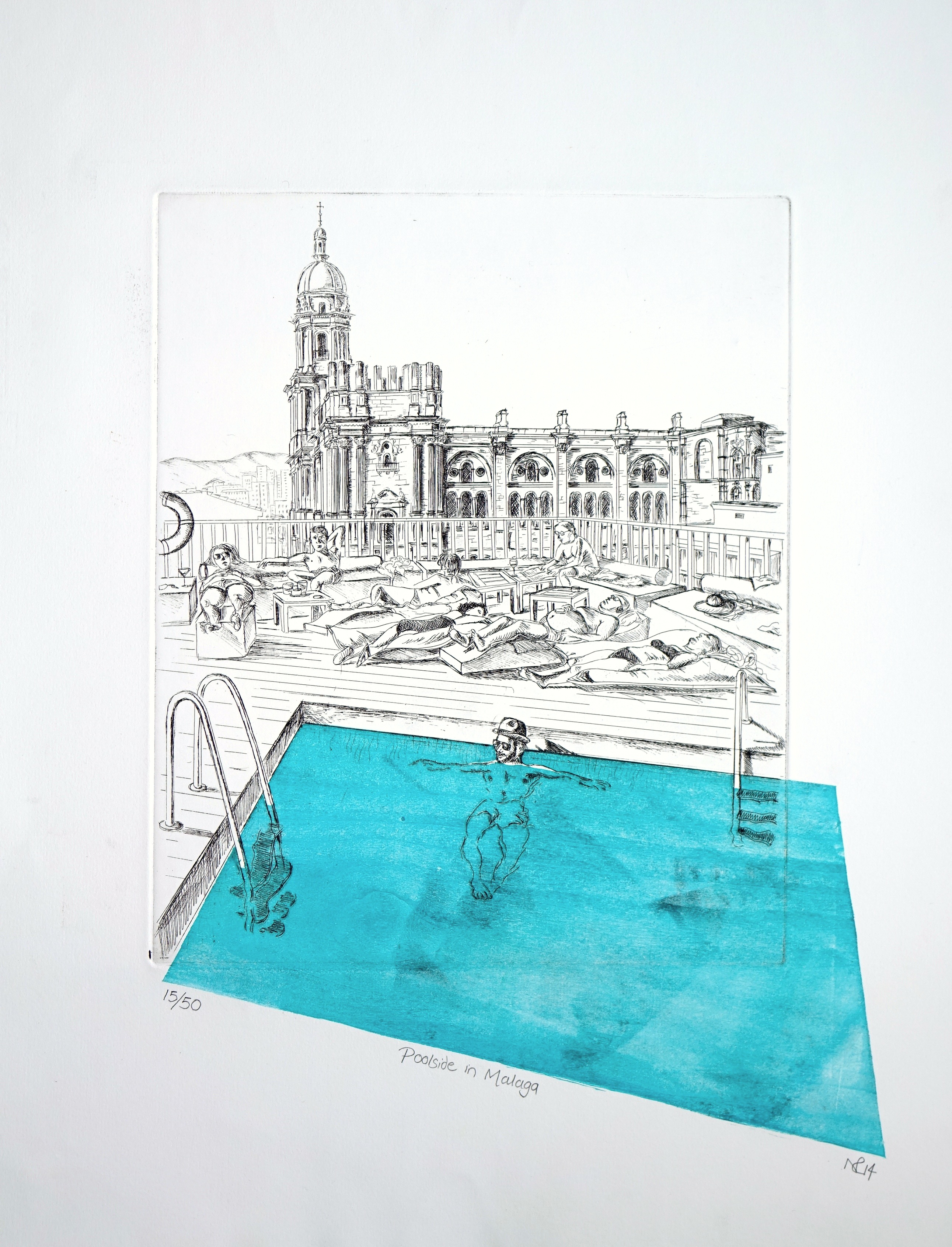
The first of the two prints, Malaga Poolside, shows a heady day when my partner and I sunbathed and swam on the incredible rooftop of the Molina Lario Hotel in Malaga. We couldn’t quite believe that up on that hotel terrace, we were able to swim with the stunning surroudings of Malaga’s one-armed cathedral just besides us, and this print attempts to capture that incredible view in a simple black and white etched line drawing, contrasting with the vivacity of the turquoise swimming pool which is almost Hockneyian in nature.

Malaga Poolside (2014 © Nicholas de Lacy-Brown, etching and woodblock on paper)

Malaga Poolside (2014 © Nicholas de Lacy-Brown, etching and woodblock on paper)

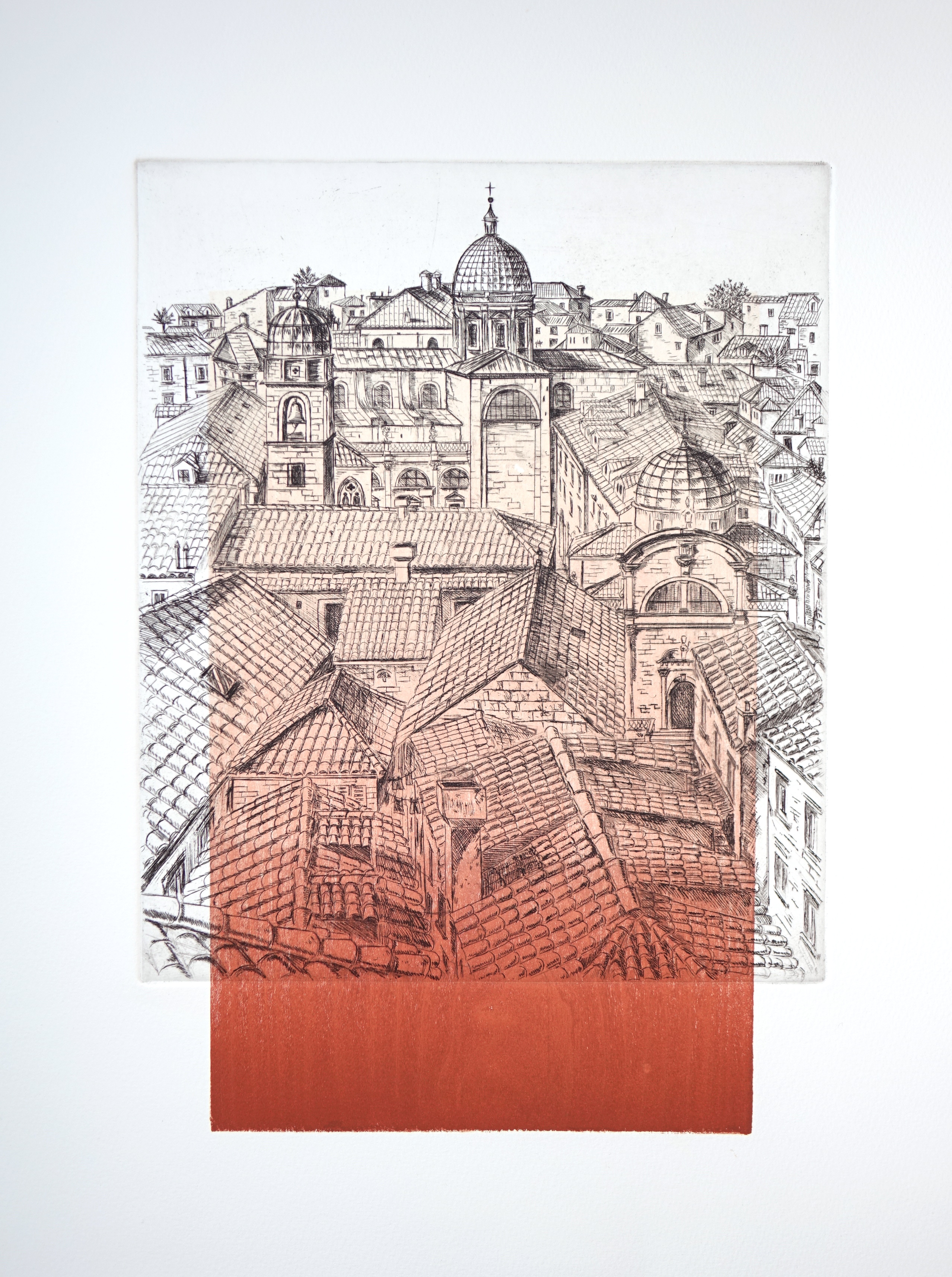
The second of my prints is entitled Terracotta Sunrise, and illustrates the swathe of terracotta rooftops which so captivated me when I visited Dubrovnik earlier this year. While I opted again for a simple line to illustrate the details of the compact houses and streets of this beautiful Croatian city, I wanted to use a graduating block of terracotta to subtly represent the overarching colour of the city when seen from afar, doing so with a graduating roll of colour which fades off almost like a sunrise.

Terracotta Sunrise (2014 © Nicholas de Lacy-Brown, etching and woodblock on paper)

Terracotta Sunrise (2014 © Nicholas de Lacy-Brown, etching and woodblock on paper)

But of course these are only photos (and not very good ones at that) and there is no substitute for seeing the real thing. So if you are able to get down to the Southawk/ London Bridge area of London tonight (for the opening) or any time over the next two weeks, do please come along – the gallery will be open until 6pm daily until 28th September. All the details can be found here. See you there.

10678733_753879087980880_4077473047340161283_n

London’s homage to print: Part 3 – Bruegel to Freud

Earlier this year I reviewed two London exhibitions which played homage to the brilliance and versatility of the printmaking medium, both through the chiaroscuro effects achieved in early renaissance woodcuts, or through the work of a Titan of contemporary British printmaking – David Hockney. Well no sooner had those shows shut up shop than another showcase to print has opened up, this time at my favourite gallery in London, the Courtauld. 

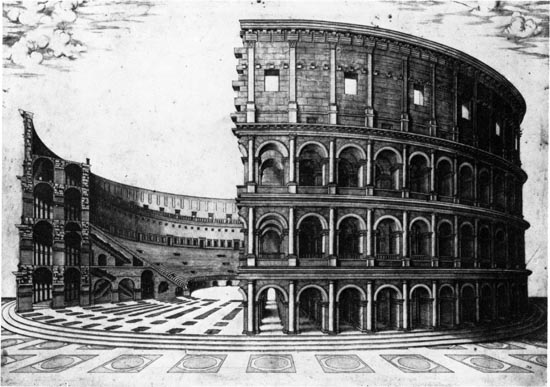
This new exhibition, From Bruegel to Freud is characteristic of the shows that the Courtauld does best: small yet focused, and although it displays only some 30 or so prints from a total collection of 24,000, the chosen prints perfectly illustrate the startling breadth and variety of the Courtauld’s impressive print holdings. And in giving itself over to a range of prints rather than honing in on one type or period, the exhibition ably demonstrates the potential of print both as an educator and communicator (for example Nicolas Beatrizet’s vast engraved copy of the Last Judgment wall of the Sistine Chapel, or the historical engravings of various architectural buildings such as the wonderfully detailed engraving of Rome’s Colosseum exhibited), as well as a wonderfully diverse medium for artistic expression in its own right. 

Engraving of the Colosseum

Engraving of the Colosseum

Nicolas Béatrizet, The Last Judgment

Nicolas Béatrizet, The Last Judgment

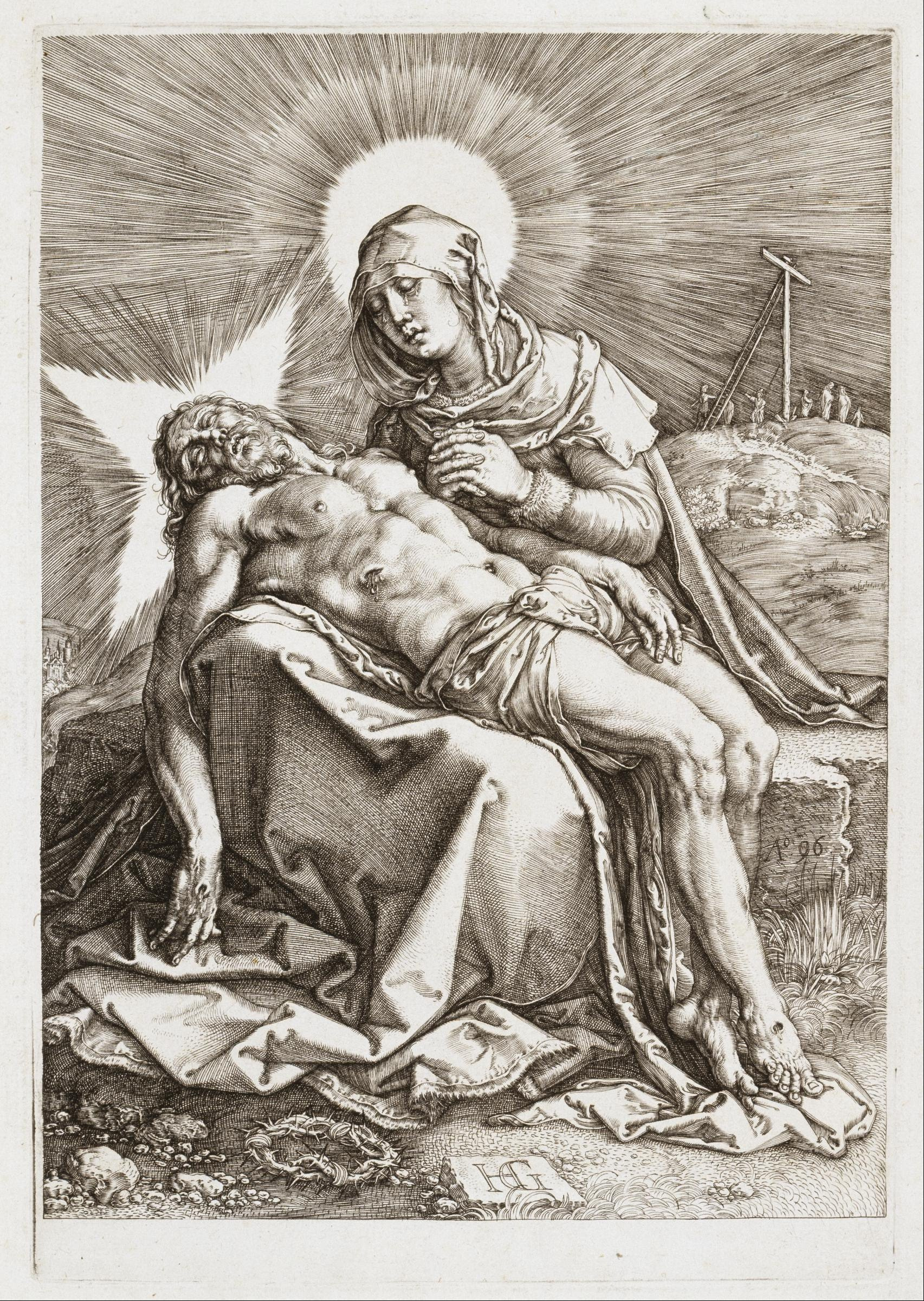
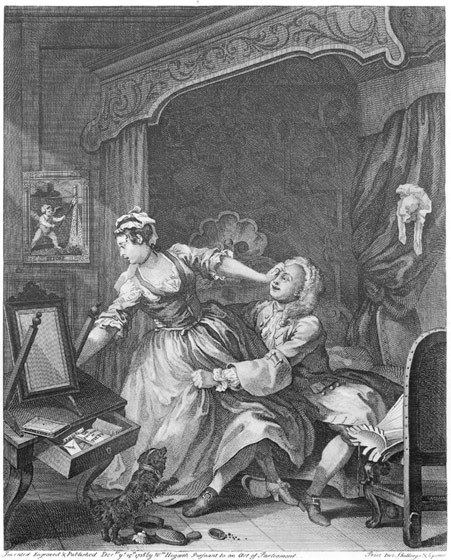
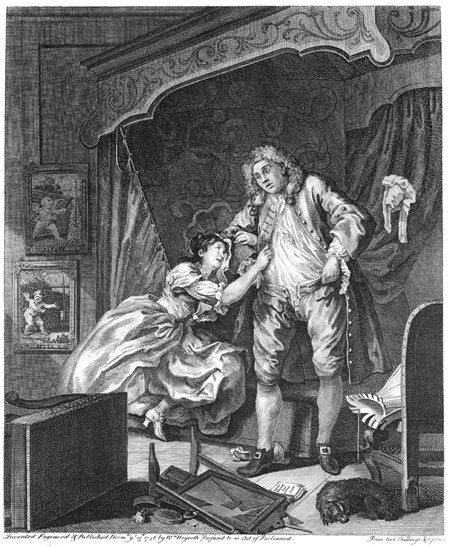
Starting with prints from the likes of Andrea Mantegna from the mid 1400s and ending with recent offerings from Chris Ofili, the show is chronologically broad. The early works are full of exquisite detail. I loved Agostino Veneziano’s The Academy of Baccio Bandinelli which, through engraving not only captures the brilliant detail of artists at work in a studio but also the drama of low candlelight with incredible shadows dancing and flickering on the wall behind. I also adored Hendrik Goltzius’s The Pieta, another engraving utilised to maximum effect – the lines and contours of Christ’s muscular body are stunning here. There was also great humour in Hogarth’s Before and After engravings, showing a man ravaged with passionate desires for a woman in one print, and the same man much dismissive once he has had his saucy way with her. 

Agostino Veneziano, The Academy of Baccio Bandinelli

Agostino Veneziano, The Academy of Baccio Bandinelli

Hendrick Goltzius, The Pieta

Hendrick Goltzius, The Pieta

William Hogarth, Before

William Hogarth, Before

William Hogarth, After

William Hogarth, After

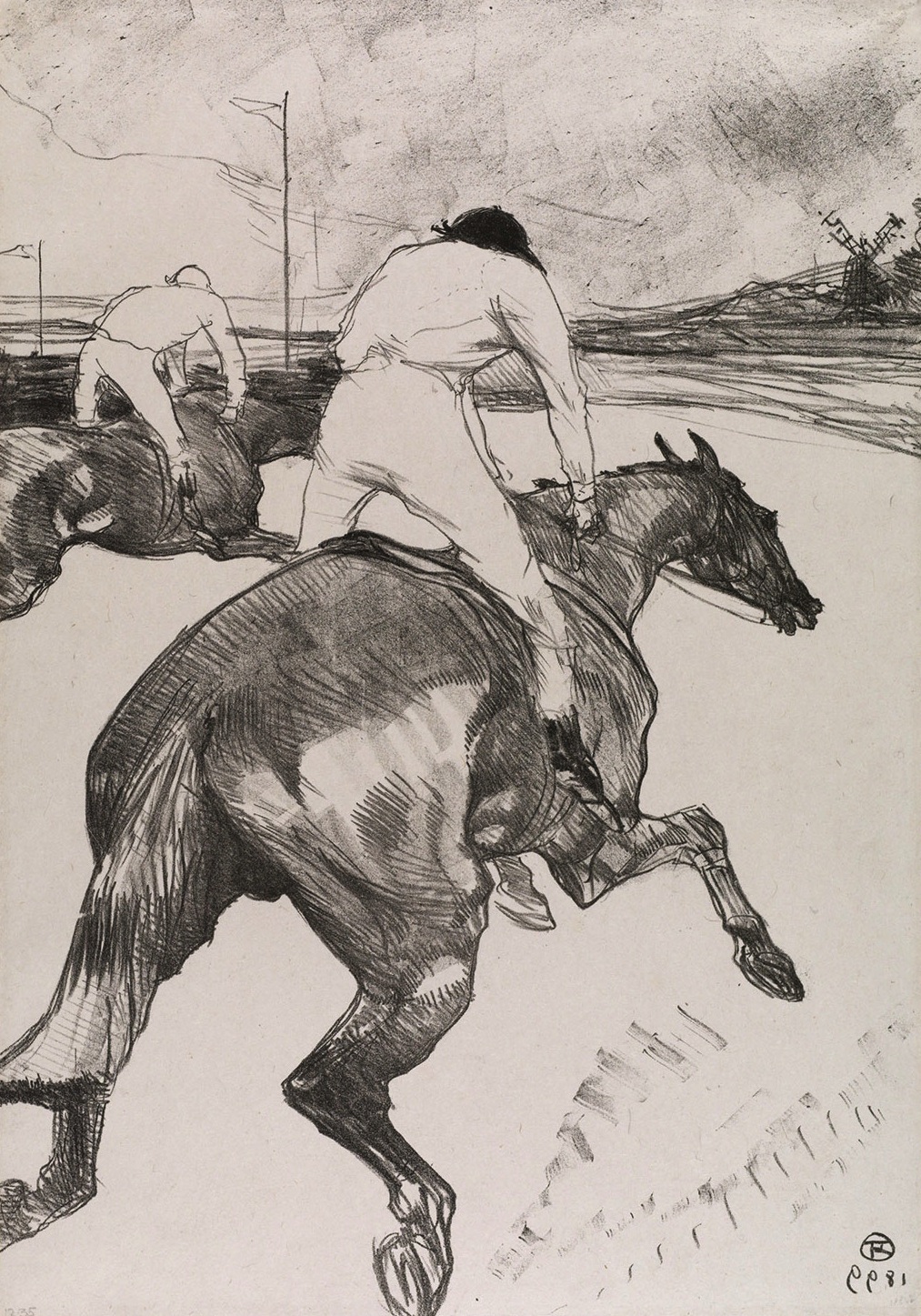
But perhaps unsurprisingly for a museum whose finest collection is its impressionist and post impressionist works, my favourites were those emanating from the late 1800s when printmaking as a medium was having a new hayday, and innovations such as lithography were opening up printmaking to more artists. Amongst them was Toulouse-Lautrec whose lithograph of a jokey straddling a fast moving galloping horse was rightly displayed at the centre of the show, and Bonnard, whose whimsical and somewhat mysterious Woman with a Child and dog from the Nannies’ Promenade series was my favourite in show. 

Toulouse Lautrec, The Jockey (1899)

Toulouse Lautrec, The Jockey (1899)

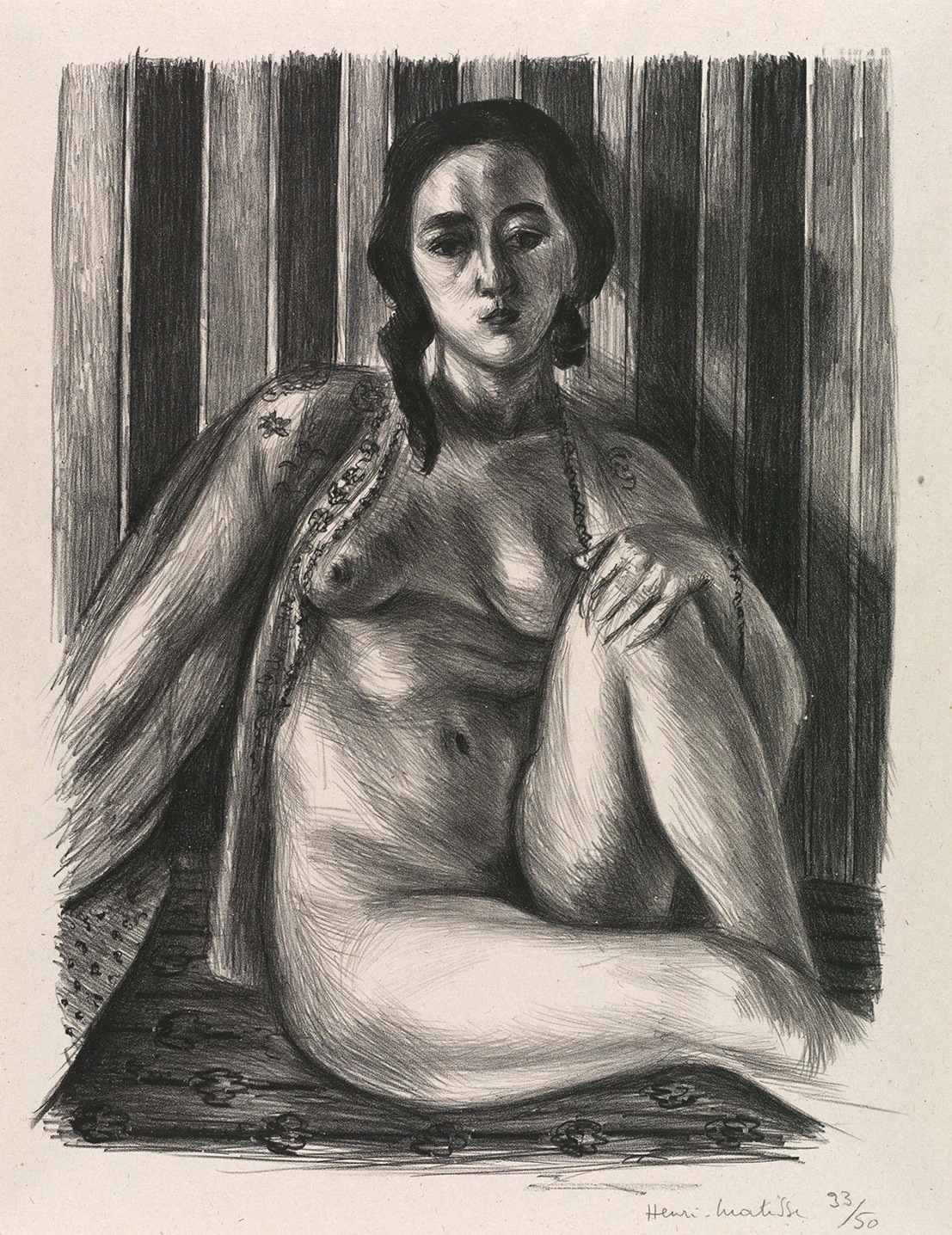
Matisse, Seated Nude Woman with a tulle blouse

Matisse, Seated Nude Woman with a tulle blouse

Pierre Bonnard - The Nannies' Promenade (1897)

Pierre Bonnard – The Nannies’ Promenade (1897)

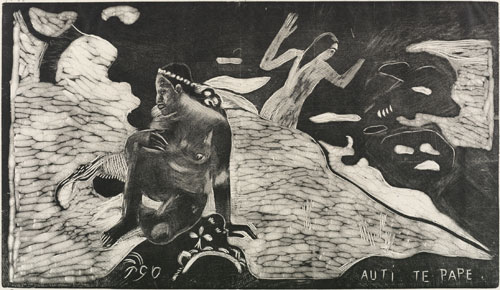
Gauguin, Auti te Pape

Gauguin, Auti te Pape

But of course I cannot end this brief canter through the Courtauld’s show without mentioning one of the last prints being exhibited – Blond Girl by Lucian Freud. For it was this very etching, and those others held in the Courtauld’s collection, that inspired me to start printing a little over a year ago. And for all of the etchings and woodcuts I have done since, I have Freud and the Courtauld to thank.

Lucian Freud - Blond Gird (detail)

Lucian Freud – Blond Girl (detail)

This brilliant homage to print is on at the Courtauld until 21 September 2014.

Kazimir Malevich: Beyond the Black Square

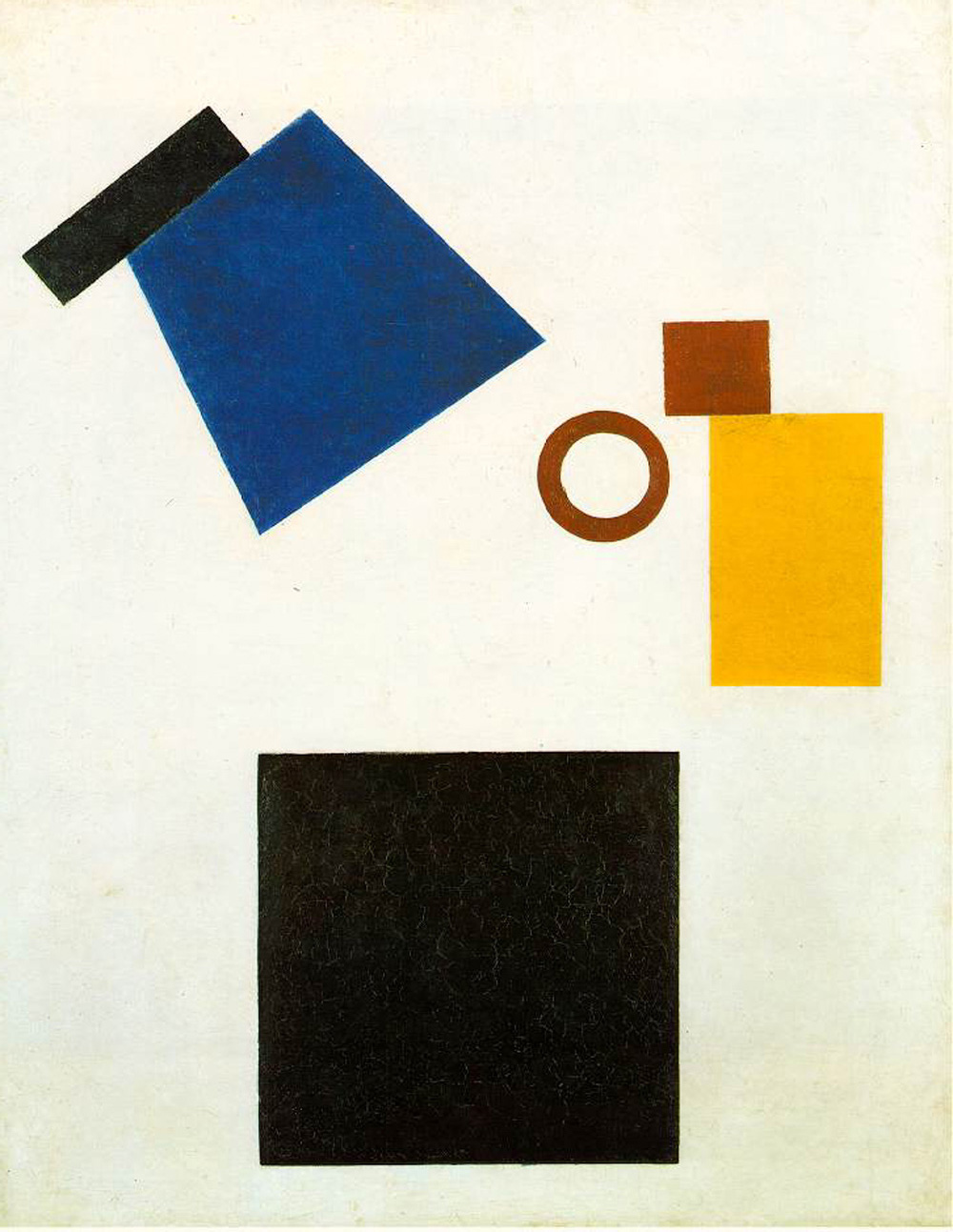
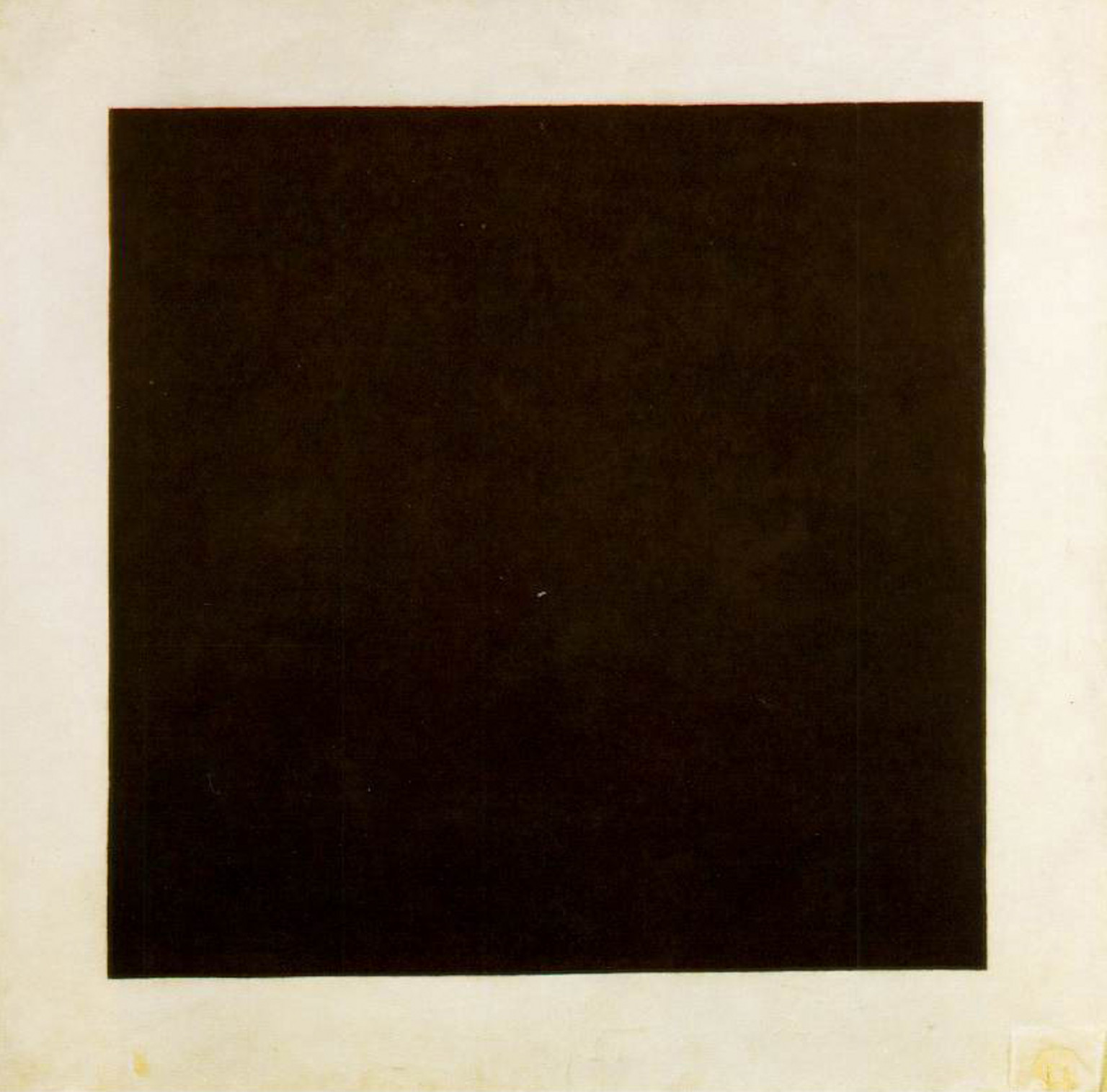
Whether it is the intention of the exhibition or not, Tate Modern’s brilliant new retrospective exhibition of Polish-born Russian Artist, Kazimir Malevich, shows that there is truly more beyond the Black Square. Leading the ranks in an artistic revolution which went from Cubo-Futurism to the simplified geometric forms of Suprematism, Malevich’s most famous and enduring work is a simple, stark and enigmatic black square set on a white canvas. Of course since 1915 when the black square was created, many artists have gone down the single-colour-on-canvas route, and a contemporary art museum is not a contemporary art museum without at least a Blue Canvas or an Untitled (Red Rectangle) to delight and frustrate art audiences in equal measure. But at the time when Malevich’s Black Square was created, it marked a dramatic and stark departure from everything that had gone before it.

Despite its very obvious simplicity, it carries with it an enigmatic complexity as an artistic gesture. Looking at this dark patch of paint, one can almost feel a suppression of joy, a rebellious desire for change, a stark reaction to the turbulence of war, a zero hour in the world of modern art. And yet while it is perhaps understandable why this painting caused such a stir, both positive and negative in the time of its creation, Tate’s new exhibition shows that Malevich had so much more to offer as an artist, and much much more of it in invigorating compositionally intricate colour.
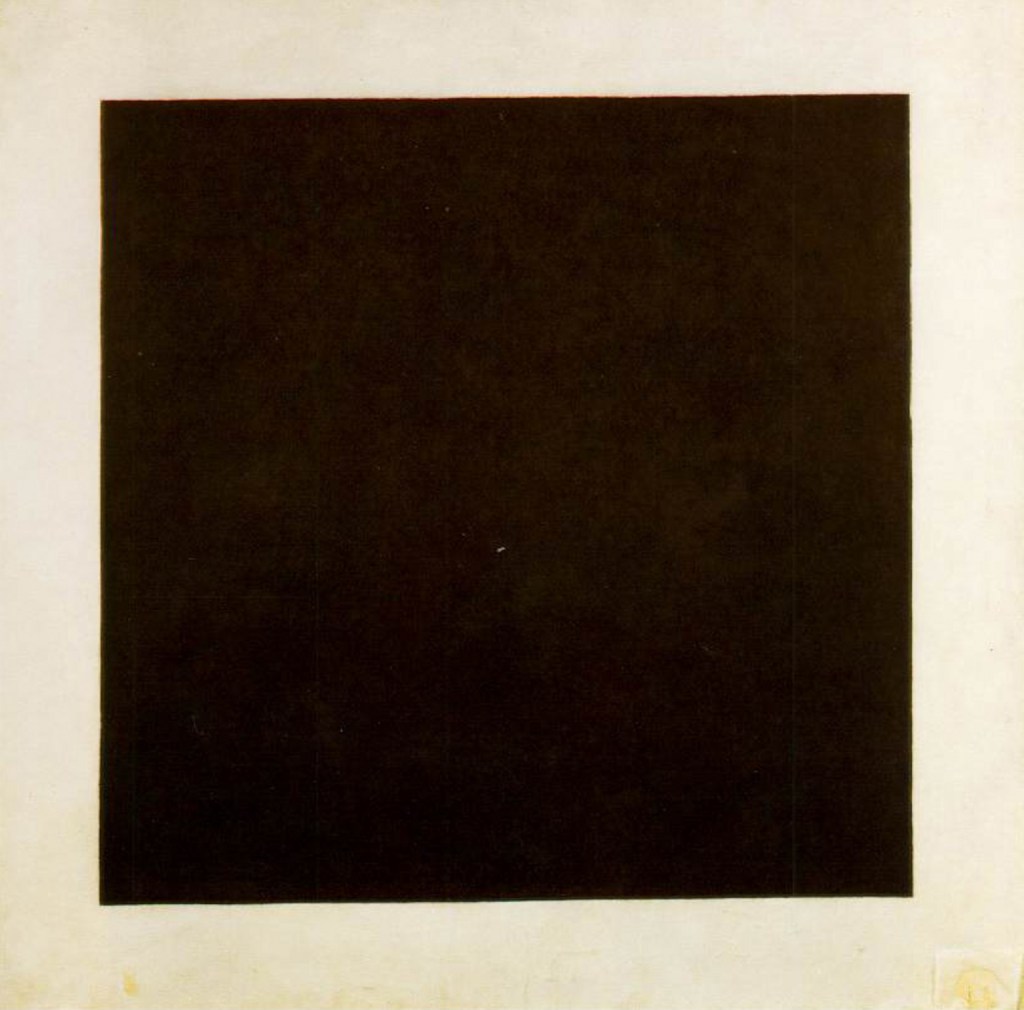
Black Square (1915)

Black Square (1915)

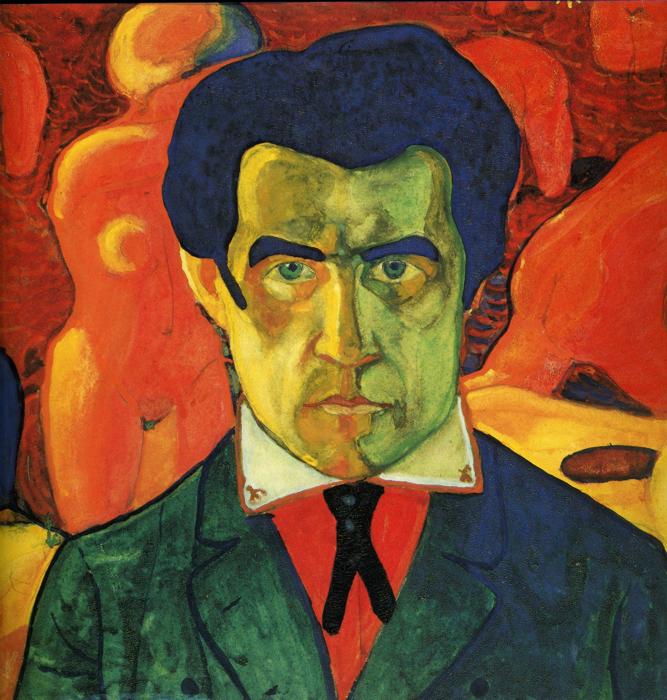
Self Portrait (1908)

Self Portrait (1908)

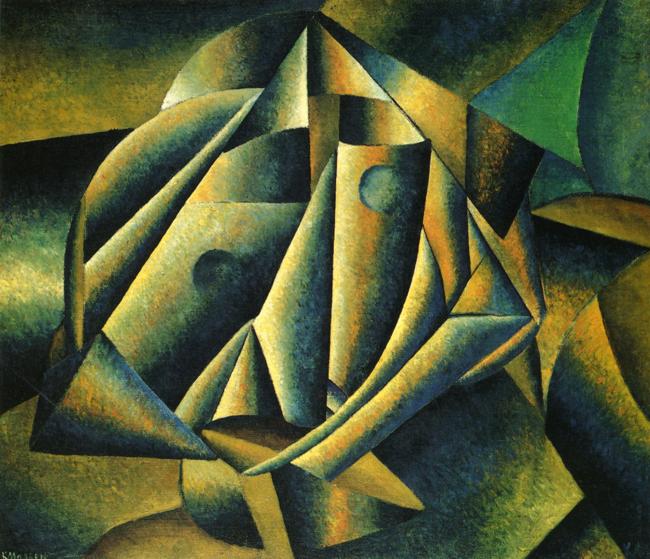
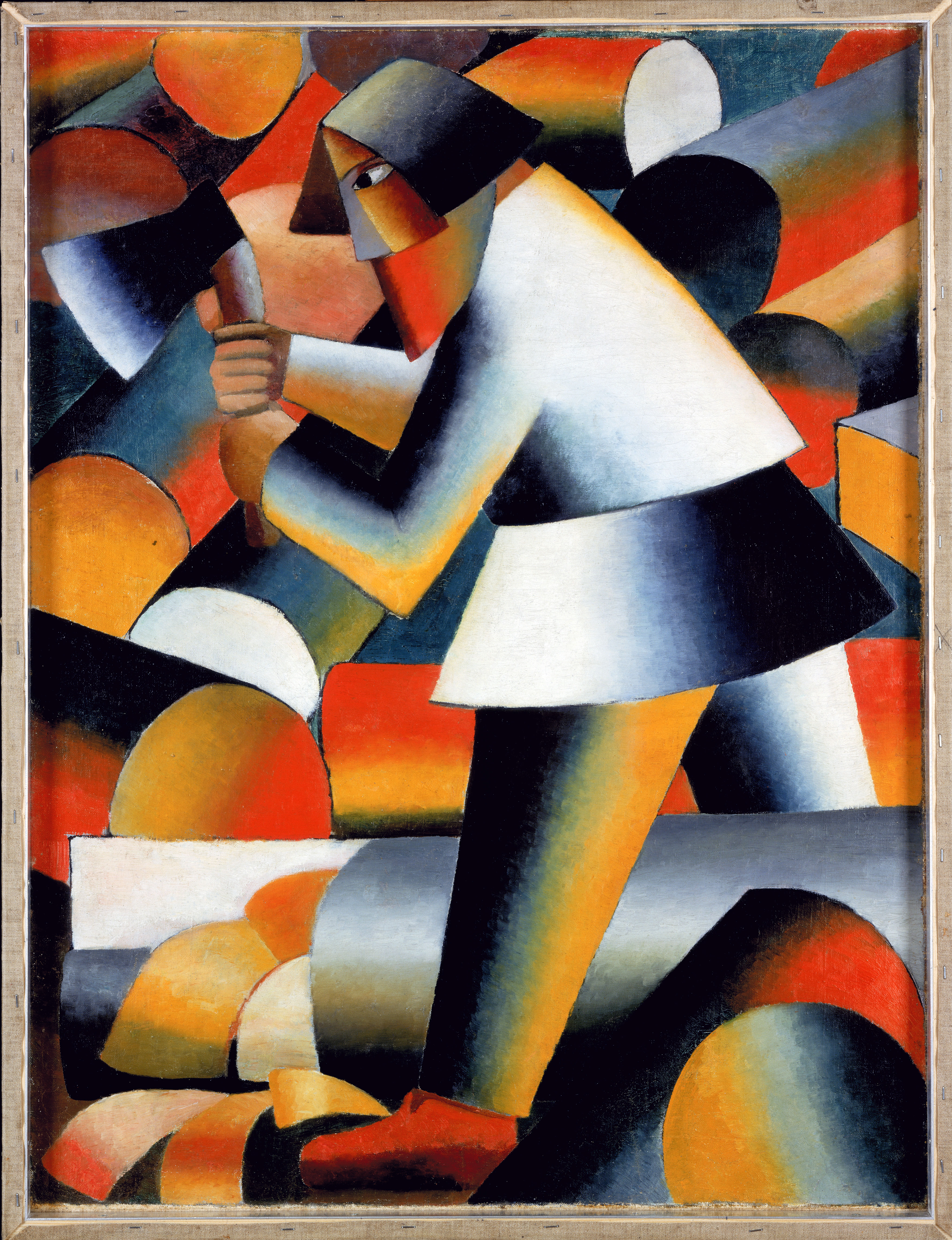
The start of the show demonstrates a certain reliance by Malevich on the artists who had gone before him, and a very clear influence of the avant-garde of post-impressionism, particularly the bold colours of the Fauvists and the flattening of perspective and exotisim advocated by Gauguin. Those influences are particularly obvious in Malevich’s early self-portrait, whose backdrop of exotic nudes and use of a multi-coloured palate recalls the work of Matisse and Gauguin alike. However, very quickly, we see the influence of other artists slipping away as Malevich starts to find a more unique style of his own. While relying to some extent on cubist notions, Malevich rejects the subject matter topical of the works of the Paris avant-garde and starts painting heavily geometric works based on the peasants and traditions of Russia. Painting simplified figures in cubist almost metallic forms, Malevich’s portraits are static like robots, referencing Futurism whose artistic reach was spreading across Europe, and yet exuding a rurality and authentic subject matter which is far departed from the industrialisation which characterises most works of the Futurist movement.

Early works 

Head_of_a_Peasant_Girl Kasimir Malevich007 Kazimir-Malevich,-The-Woodcutter,-1912_original

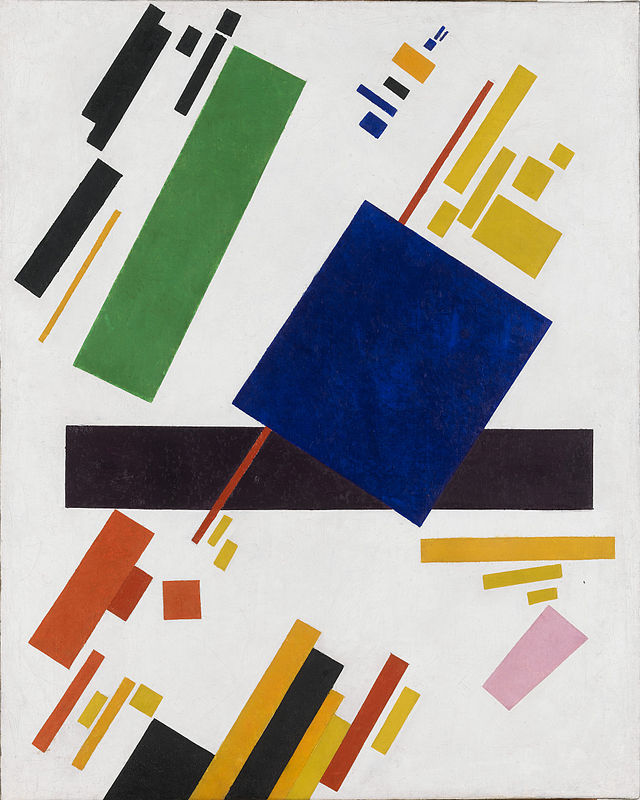
But Malevich’s early cubo-futurist works were only the beginning, and it was when, in 1914, Malevich painted his first black rectangle – Black Quadrilateral – that the artist took a clear and drastic departure from figurative works, presenting his ideas in The Last Exhibition of Futurist Painting 0.10 in what was then Petrograd in 1915. Calling his new direction Suprematism, Malevich believed that “the artist can be a creator only when the forms in his picture have nothing in common with nature” and dismissing the artists of the past as “counterfeiters of nature” he went about creating works which are starkly geometric and lacking in any feature which could link them to the natural world. The paintings which resulted from this period are a wonderful collection of energetic and colourful works (with the exception of the Black Square of course) which I loved. There is a complexity of composition in the way that these various shapes are interlayed and angled which cannot be underestimated, and in seeing these works, I saw that here Malevich really was creating from scratch rather than relying on nature for reference.

Suprematist works

Malevici06 640px-Suprematist_Composition_-_Kazimir_Malevich Kazimir_Malevich_-_Suprematism_-_Google_Art_Project malevich28 malevich4

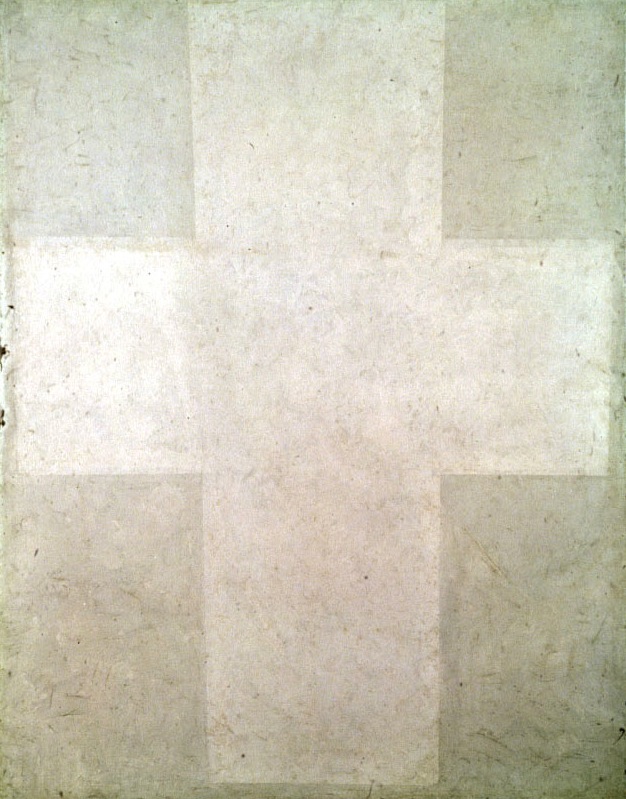
However Malevich could only take his Suprematist ideas so far, and by the time of the Russian Revolution in 1917, he consciously began to “kill off” paintings, gradually draining his paintings of colour in works such as White Suprematist Cross (1920) – a white cross on a white background – and Dissolution of a Plane (1917) where the colour is gradually fading out of the edges of a red rectangle. This was what Malevich called the “death” of painting, and in 1919, Malevich wrote that “Painting died, like the old regime, because it was an organic part of it”and what followed was several years when the artist dabbled in transferring his ideas to architecture, and teaching.

White Suprematist Cross (1920)

White Suprematist Cross (1920)

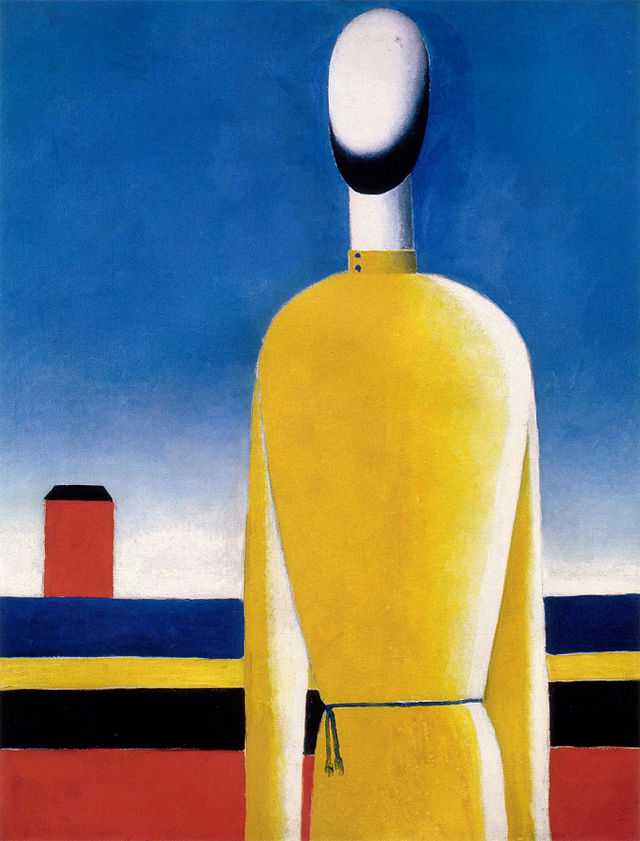
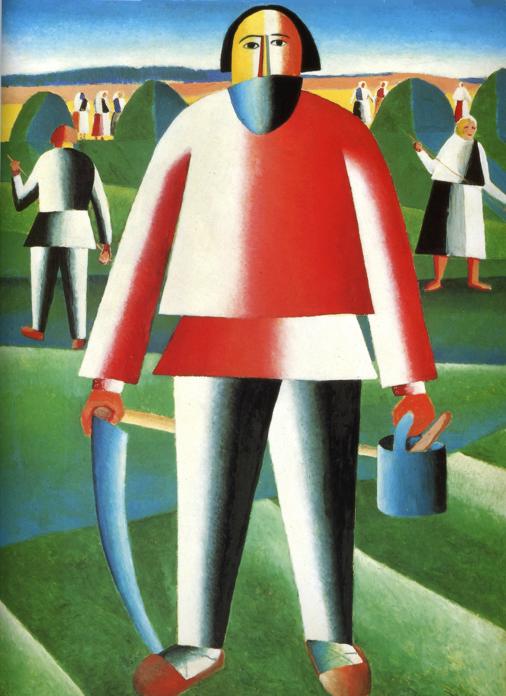
However, it was a temporary death, for a few years later, Malevich came to resurrect his painting, and interestingly, when he did so, he returned not to his Suprematist ideas, but to the cubo-futurist figuration of his early years. It was almost as though his Suprematist manifesto took such efforts that when he returned to painting, almost as a newcomer to it, he found himself drawn more to the instinctive way of painting which was inherent within him from the start. Which just goes to show: the efforts of stripping out nature and forging something new in art may create something of a stir or a statement, but ultimately we always return to the same thing: depicting the world around us, for that is arguably the true purpose and calling of art – to narrate and reference the lives we all live.

Later works
Malevich142 Later

In short this is a marvellous new show which provides a comprehensive review of this important artist, introducing his work to many who, like me, were not familiar with his oeuvre before. Beyond the paintings and the excellent chronological layout of the exhibition, my favourite section was Room 10, which takes a break from the paintings, and is like a mini-retrospective within the bigger story, depicting the whole of Malevich’s career through his works on paper. As such, the display provides a fascinating insight into both Malevich’s preparation of his paintings, and also how quickly his works transformed from cubism to futurism to suprematism and back again. A complex transition truly worthy of a retrospective exhibition on the scale Tate has so ably put on show this summer.

Malevich: Revolutionary of Russian Art is on at Tate Modern, London until 26th October 2014.

The Sensational Success of my Strand Gallery Solo Show

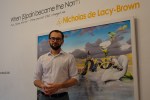
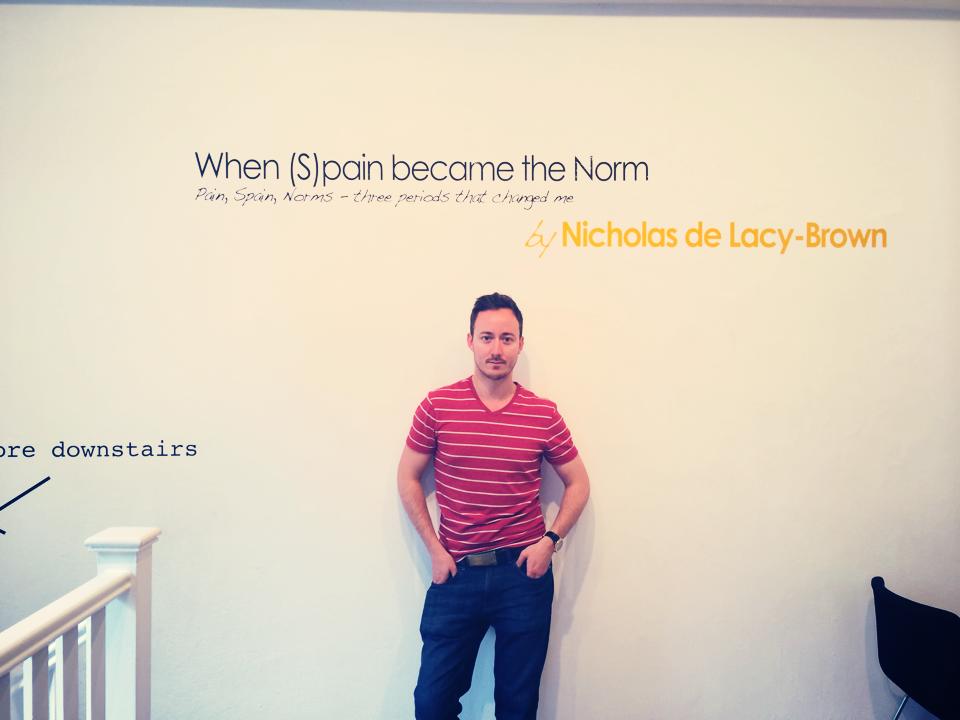
I haven’t written on The Daily Norm for almost a week. The reason is probably obvious to all those who have been reading my posts of late. It was because I was otherwise occupied hosting my biggest ever solo exhibition of paintings, illustrations and prints, a show which combined some 165 works from the last 6 years of my creative out put. The exhibition, which was held at London’s preeminent Strand Gallery finished on Sunday, with more bubble wrap and more packing than I would ever have wanted to engage in during my whole life, let alone a single day, and the days which have passed since have been a flurry of deliveries, unpacking, repacking, digesting and collapsing with the exhaustion of 9 months preparations which has still not quite left me. But, despite the energy-sapping effort and the complete bodily and mental exhaustion, I am delighted to be able to report that my solo exhibition, When (S)pain became the Norm, was a complete and utter show-stopping success!
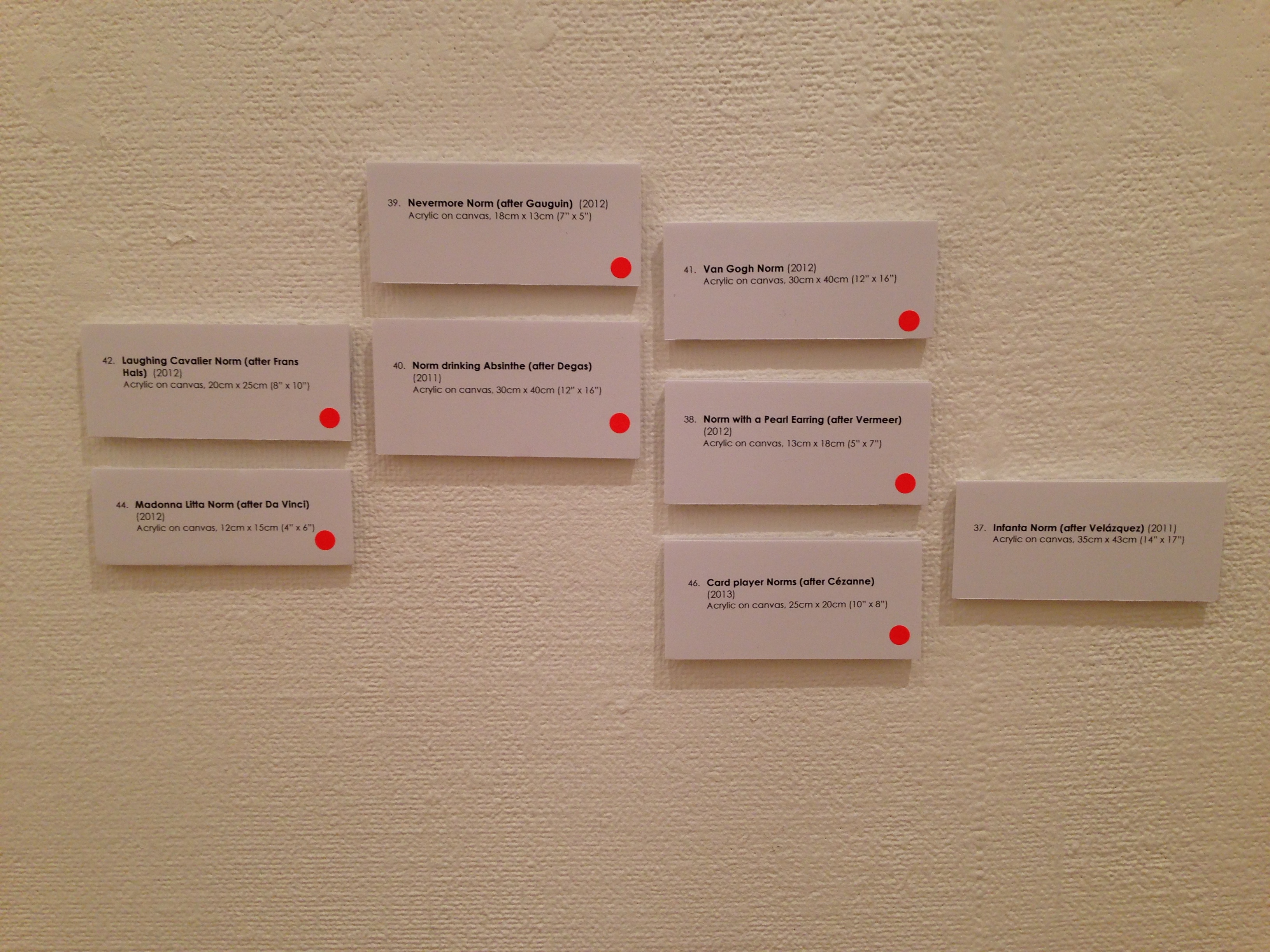
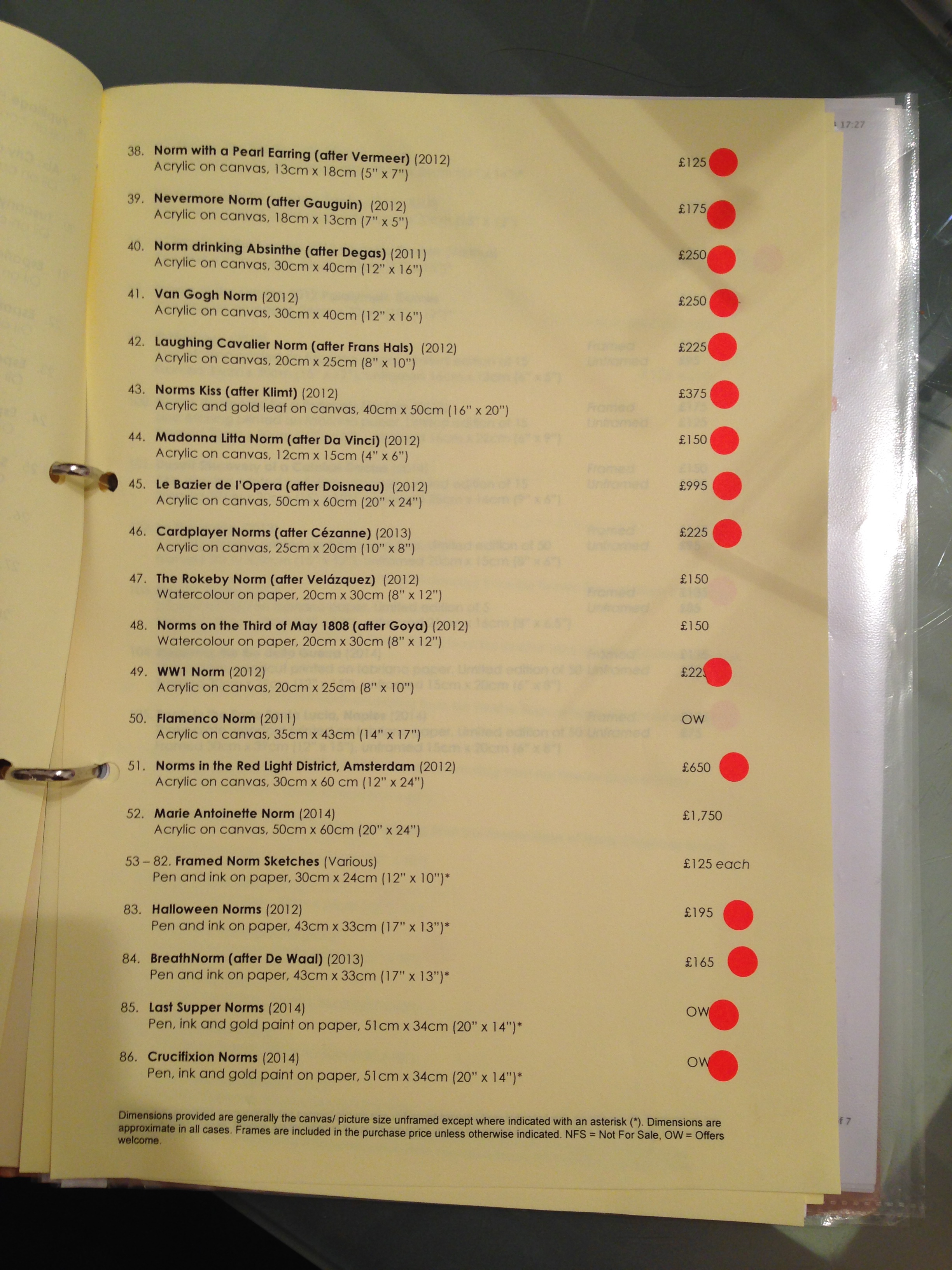
My eyes are close to pricking with tears as I relay how this show not only pulled in crowds into the hundreds, but also sold some 42 works with further commissions arising out of it. Expecting to sell a number in single digits, I was blown away by the support I was shown and just stunned by how many of my works went to new homes. Perhaps unsurprisingly for fans of this blog, the real winner of the show was The Norm, my little blobby character with one arm, the paintings and sketches of which made up around 80% of the sales.

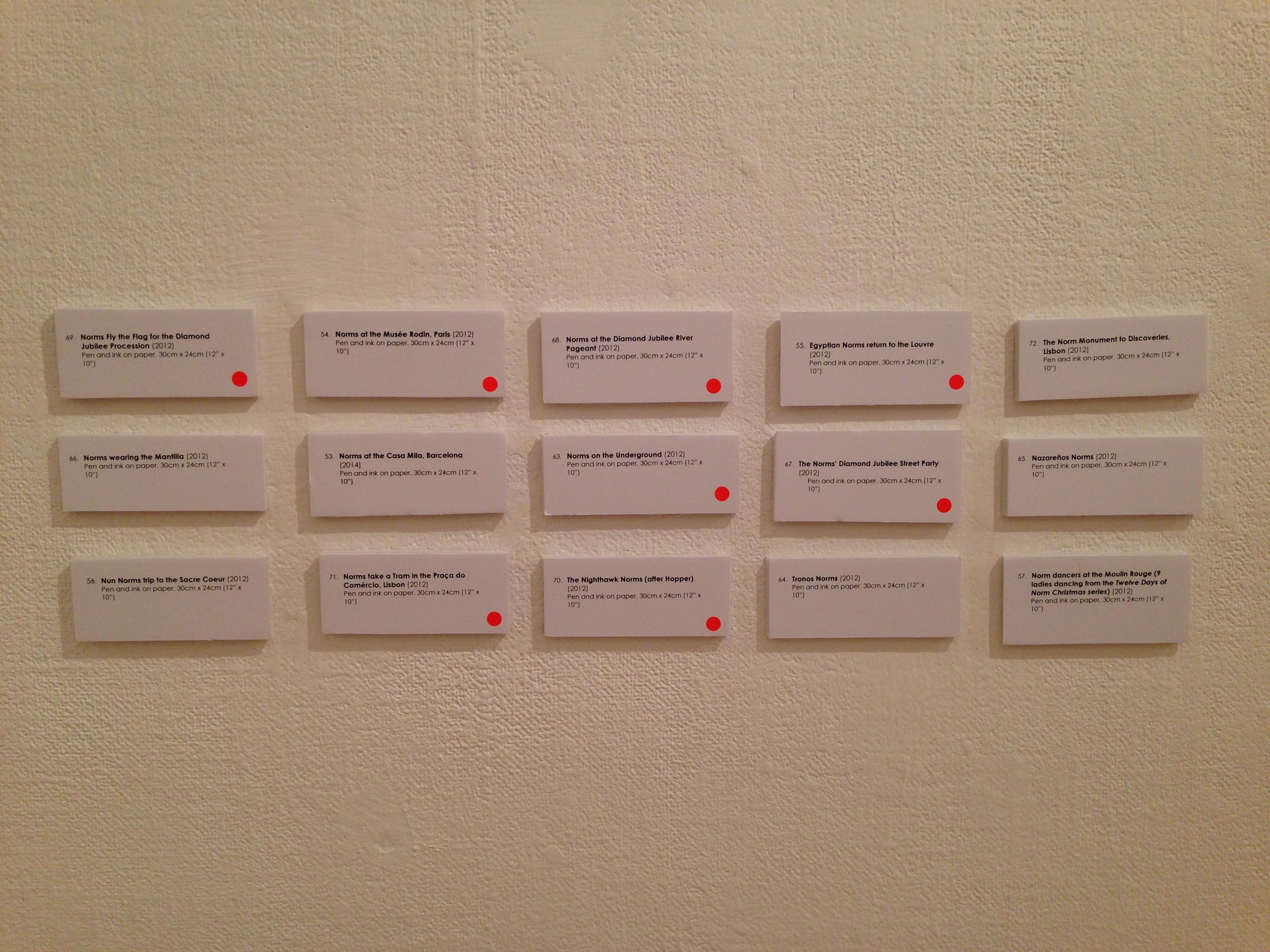
Those beautiful dots signifying multiple sales…

IMG_8613 IMG_8634 IMG_8635 IMG_8625

The collection of Norm paintings based on art historical masterpieces sold out, with only Infanta Norm, which I had saved for myself, remaining. My Norm sketches, made primarily as illustrations for this blog, also sold well, with at least half the collection emerging at the end of the exhibition with red dots upon their titles. And my latest endeavour – printmaking – sold similarly well, especially where the Norm, once again, had managed to creep into the image, making my prints a further attraction to the art-buying, Norm-loving public.

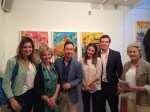
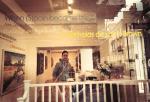
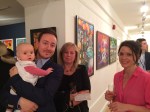
So by way of a final hurrah before I close my exhibition files and move on to the next project, I thought I would share some further photos of my show with you. Not only photos of the gallery looking resplendent when hung with my works, but also full of the very many marvellous people who came to see the show, including my parents who merrily took on the roles of gallery manager and barman, and my dear partner, who supported me throughout.

When (S)pain became the Norm was truly a personal achievement and was undoubtedly the high point of my art career so far. At its close, I emerge not only more confident in my work and the support that exists for it, but also full of excitement for what the future holds.

My new solo exhibition – up, running and beyond all expectations

My new solo exhibition, When (S)pain became the Norm, is up and running at London’s Strand Gallery and already excitement is at an all time high, not only for me, but for those wonderful visitors who have taken the time to visit this comprehensive solo show of my artwork. Already the corks have been popping, the guest book is filling up and little red dots are starting to appear alongside the odd artwork signifying that these precious products of my creativity have found new homes.

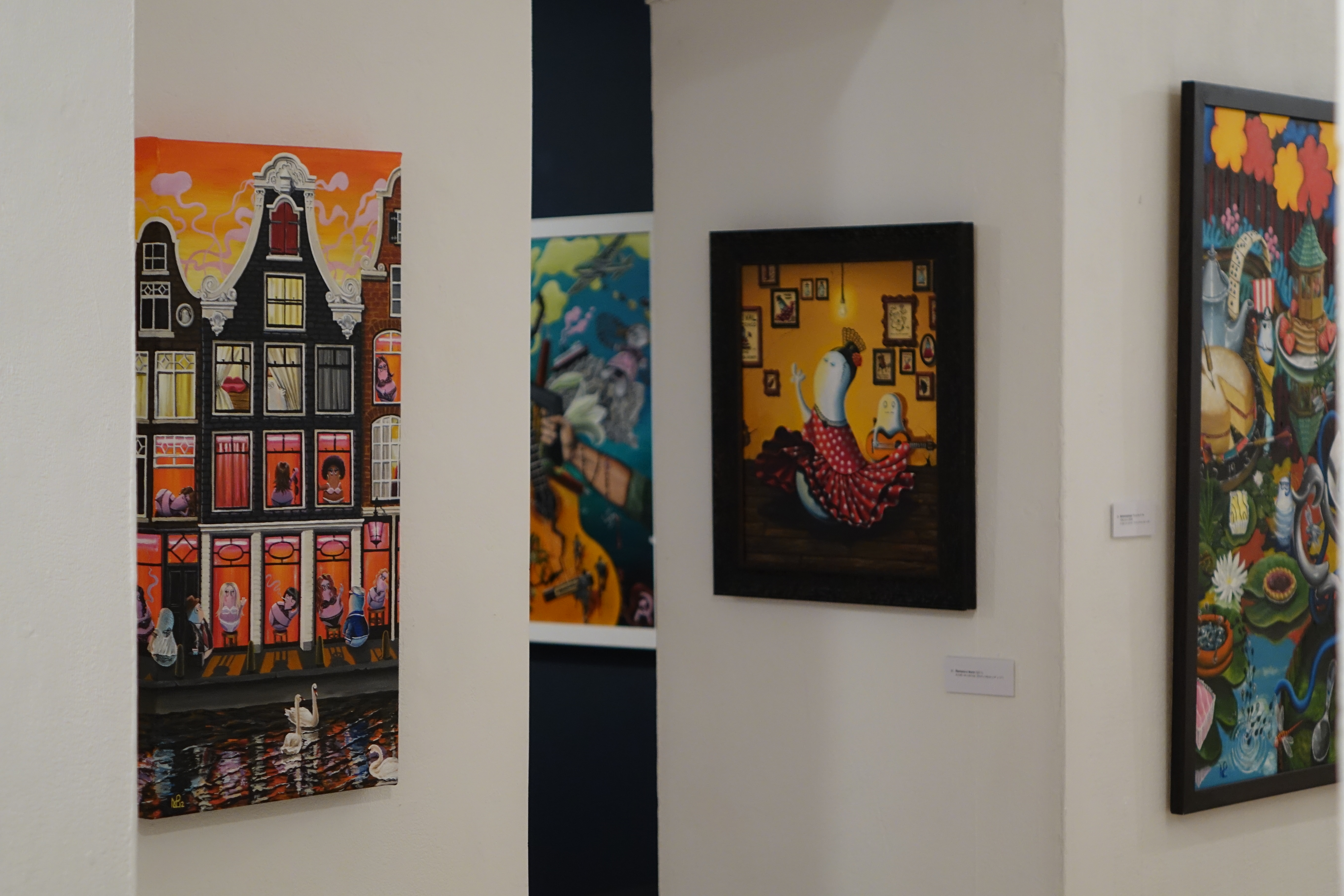
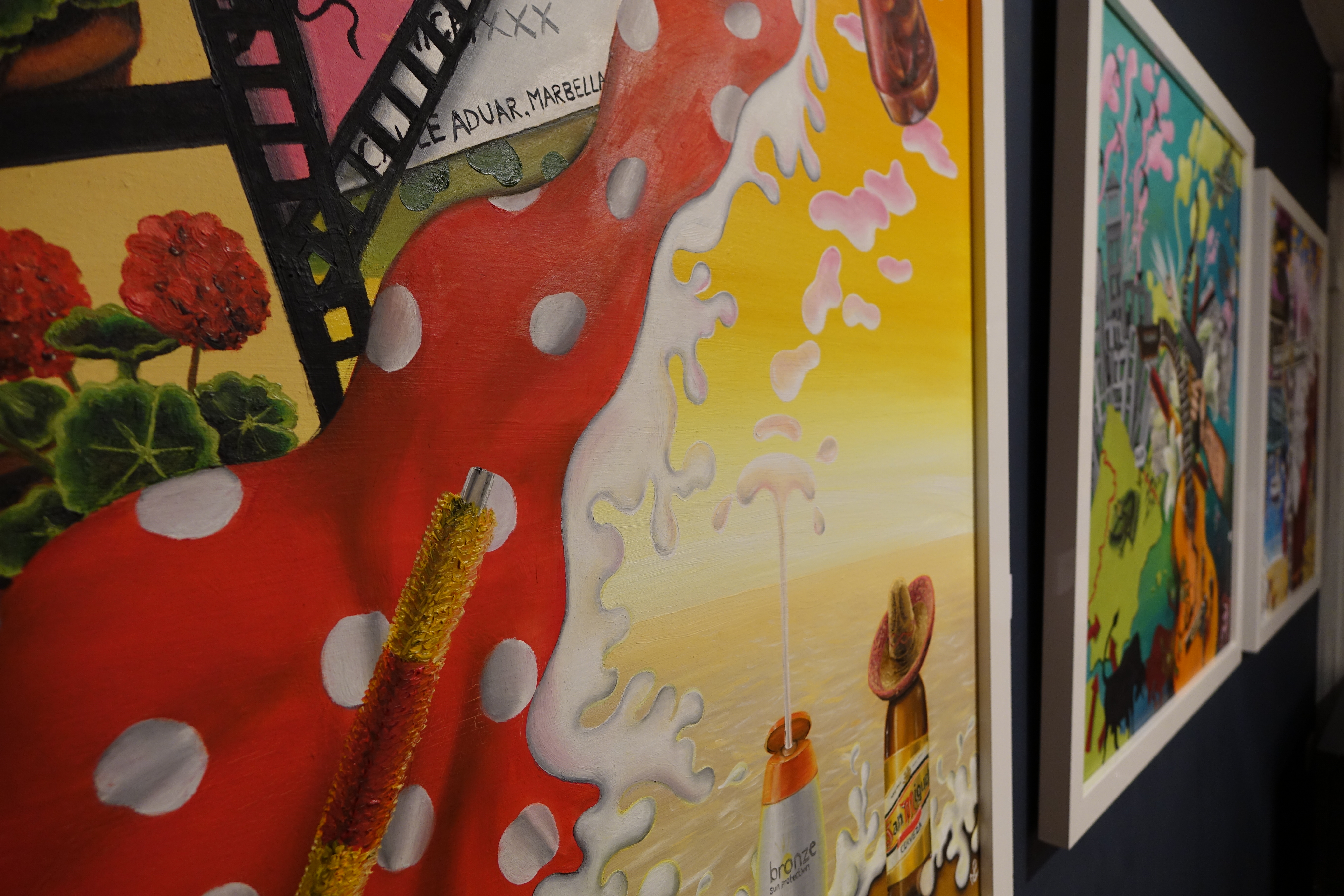
In my last post, I promised you some photos of the show, and I have lived up to my word – albeit with only a small selection. With so many of my paintings hanging in one place, and plenty of questions being asked by the visitors to the show, remembering to take shots of the exhibition to share with all of my faithful blog followers keeps on slipping to the back of my mind. But here are a few photos showing the exhibition is some of its vibrant colour-packed glory, from the ground floor hung with my more emotionally impacting accident art works, to the basement which plays host to the vibrant Spanish works and an entire corridor filled with Norm paintings and illustrations – henceforth christened “Norm World”.

DSC00079 DSC00072 DSC00045 DSC00076

If you are unable to get to the UK or London to see the show, I really hope that you nevertheless enjoy this sneak peak of what is such a proud moment in my artistic life. If you are however able to make it down to London’s Strand Gallery, I hope that this selection is enough to tempt you further, and that I can look forward to welcoming you there later this week.

For now though, I leave you with some sights from my solo show. Enjoy!

Full details of my exhibition can be found on my website here and on the Strand Gallery website.

When (S)pain became the Norm opens its doors to London!

I can’t believe I am even typing this post – that at this very moment, my new solo exhibition of some 170 paintings, prints and illustrations is opening its doors to London, and the world! Located across two floors in the prestigious Strand Gallery in the heart of London’s West End, this exhibition represents the last 6 years of my artistic endeavours.

As I write this post, my body is still aching from the exertion of hanging this most comprehensive show of my career, but seeing how the exhibition has turned out at the end of it all makes every hour of bubble wrapping, every relentless week of painting and every moment’s worry about deadlines and deliveries worth it. Because it just looks great.

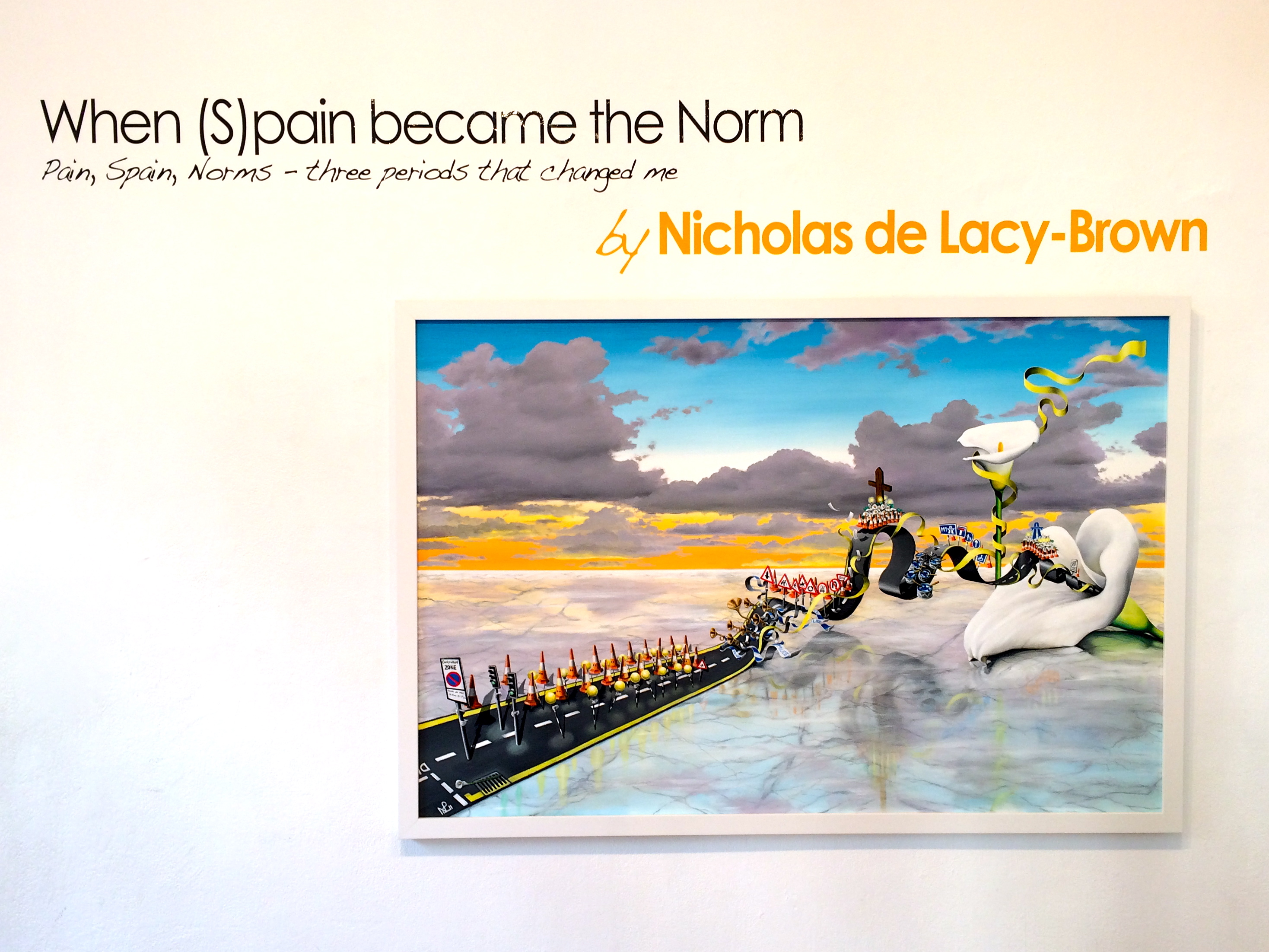
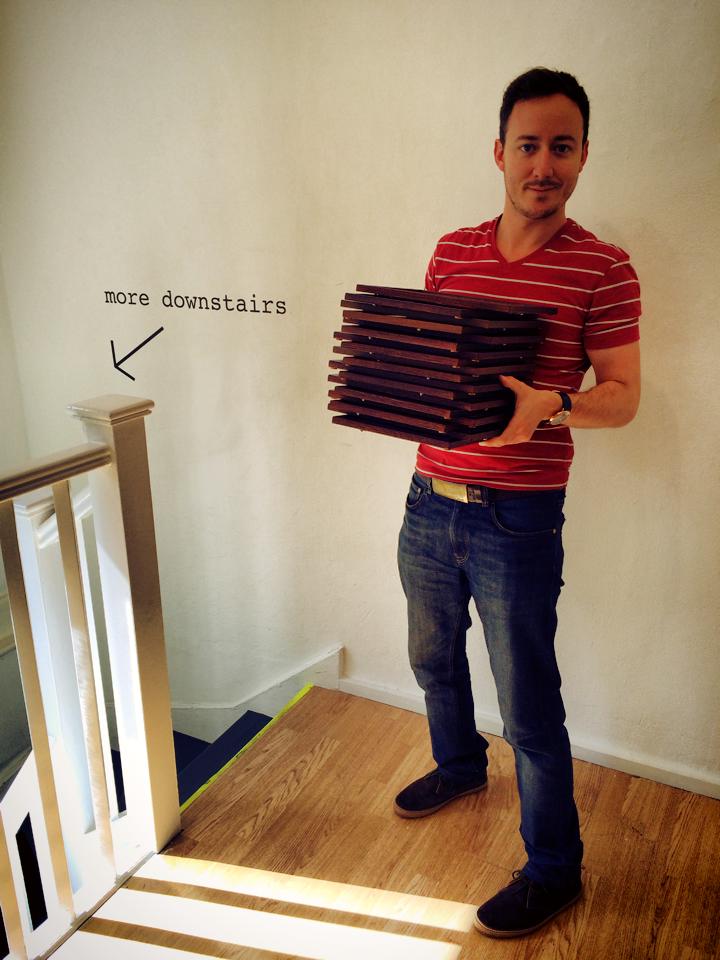
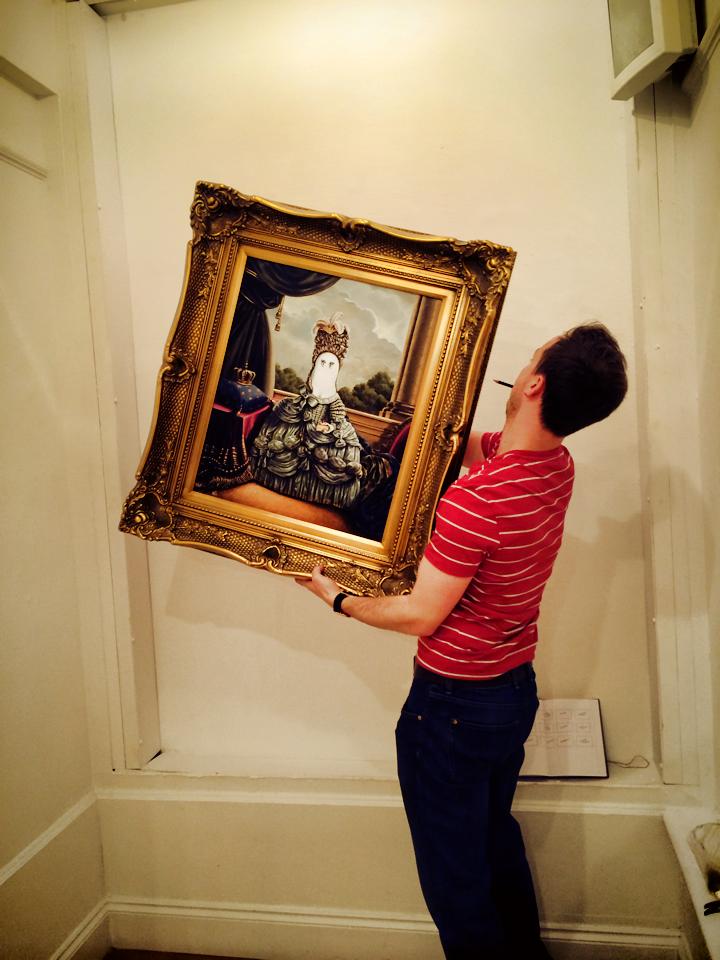
We finished hanging the show on the dot of 7pm last night without a single chance to take proper photos. But here are just a few shots of the headlining painting and me hanging my new Marie Antoinette Norm in her glamourous Versailles-style frame. More photos will follow any day now as well as all the news from this exciting new exhibition which will take visitors through three important periods of my artistic development: my accident paintings, my return to painting Spain as a primary inspiration, and of course my paintings and illustrations of the Norms.

photo 10313460_10152065678110846_3767283894029827316_n 10268403_10152065678390846_6006684457968534319_n 10356032_10152065679210846_8967512974631304410_n 10155629_10152065678020846_1504718687347989773_n

That’s all from me – I have an exhibition to get to! I really hope you will join me there, and if you can’t please tell your friends! More details about the show can be found on my website here.